Welcome to FMEP’s Weekly Settlement & Annexation Report. To subscribe to this report, please click here.
June 24, 2026
- WEST BANK: New Settlement Approved; Multi-Billion Dollar Deals for Northern West Bank Settlements; Area B Outpost Construction Continues
- GAZA SETTLEMENTS
- BONUS READS
WEST BANK
Israel Approves New Settlement, Sa-Nur East
Peace Now reports that on July 15th Israel approved the establishment of a new settlement adjacent to the Palestinian village Sa-Nur, located in the northern West Bank south of Jenin. The new settlement is planned to be constructed on the site of a former military base close to the recently re-established settlement of Sa-Nur (a settlement that was dismantled by the Israeli government in 2005).
This is the 104th new settlement established since the current Israeli government came into power in December 2022.
Bezalel Smotrich said in a statement:
“We are leading an historic revolution in Judea and Samaria that will prevent the creation of a terror state in the very heart of Israel. Approving the community of Sa-Nur East is another significant step in this process, alongside 103 new communities, over 160 agricultural outposts, massive funding for infrastructure and roads, and pioneer neighborhoods in the new communities.”
Peace Now said in a statement:
“The government has gone into overdrive ahead of the elections, racing to create as many facts on the ground as possible and leave scorched earth behind. With the stroke of a pen, it has decided to pour NIS 2.5 billion into establishing more and more settlements that will deepen the political and security abyss into which Israel is descending. By now it is clear to everyone—and the IDF has emphasized this repeatedly—that establishing settlements harms security, places an extraordinary burden on the military, and undermines the possibility of resolving the conflict and achieving any future security and peace.”
Israel Signs Multi-Billion Dollar Agreement with Settlement Council in Northern West Bank
Peace Now reports the Israeli government signed a $2.79 billion umbrella agreement with the Samaria Regional Council (which acts as a municipal council for settlements in the northern West Bank) guaranteeing support for the construction of new infrastructure and 12,000 new settlement units. Similar deals have already been signed for other settlement councils: In June 2026, Israel committed $650 million to the Karnei Shomron Local Council; and, in September 2025 for almost $1billion in guarantees to the Ma’ale Adumim municipality.
Peace Now said in a statement:
“This is a fire sale of the State of Israel. Not only is the government thumbing its nose at millions of Israelis and plundering their money for the benefit of a narrow settler sector — it is digging, with its own hands, the diplomatic and security pit in which the State of Israel may end up buried. From the government’s perspective, it is a double win: unbridled construction in the settlements, along with shackling the next government to commitments that will make it difficult to roll back this terrible government’s reckless policy.”
Israel Approves $330 Million for New Settler Roads
The Times of Israel reports Israeli Defense Minister Katz approved $330million to build new access roads for West Bank settlements. In a statement, Katz’s office said:
“We are continuing to lead a settlement revolution in Judea and Samaria,” his office says, using the biblical term for the West Bank. “Alongside the approval of 104 new communities and 160 farms, we are also ensuring the infrastructure that will enable their development, strengthen security, and improve residents’ quality of life. This is a strategic investment in the future of settlement and in the security of the State of Israel.”
Peace Now Report: 21 New Outposts in Area B Since 2024
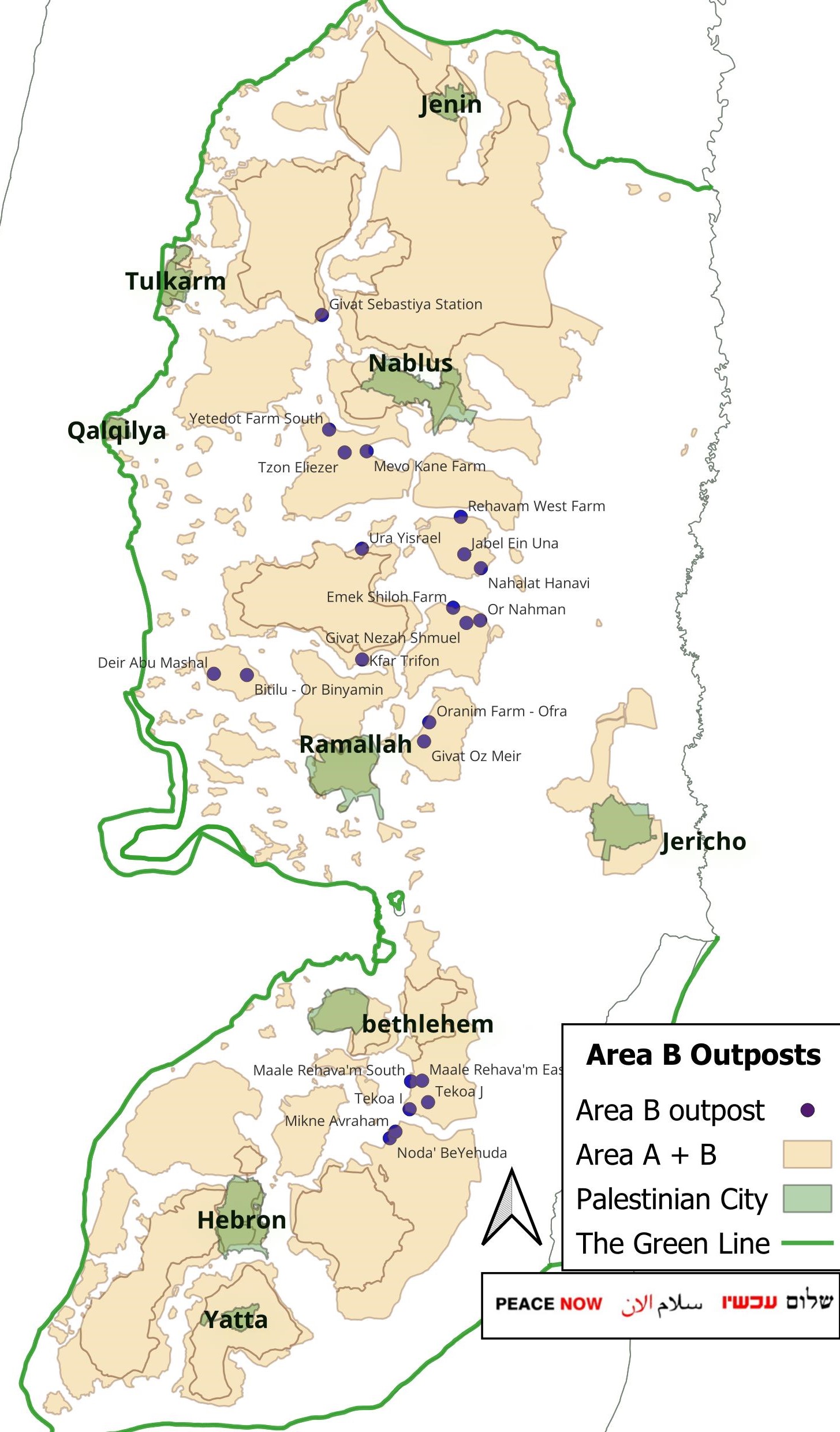 In a new report, Peace Now documents and maps the continuing settler success in establishing outposts in Area B of the West Bank, a trend Peace Now raised the alarm over in 2024. While illegal under Israeli law, the current Israeli government unmistakenly supports outposts. IDF Central Command chief Maj. Gen. Avi Bluth recently said outposts “greatly strengthen security” for Israel.
Peace Now said in a statement:
“The establishment of settlement outposts deep inside Area B demonstrates the government’s annexation agenda and its efforts to weaken the Palestinian Authority. Alongside the massive takeover of Area C, the government is allowing settlers to extend their control into areas that were transferred to Palestinian civil jurisdiction under the Oslo Accords. The fact that these outposts continue to expand even after the Prime Minister publicly stated that they should be evacuated shows that, in practice, the State is violating the agreements it signed and creating unprecedented tensions with the Palestinian population.”
GAZA SETTLEMENTS
Katz Announces Plan for Three “Nahal Outposts” in Gaza as Policymakers Join Gaza Settlement March
Last week, Israeli Defense Minister Israel Katz announced he planned to establish three “Nahal outposts” in northern Gaza, referring to a type of outpost that serves as both a military base and a farming presence – a type of settlement precursor that has previously led to permanent civilian settlements. Israel now controls nearly 70% of the Gaza Strip.
Dror Etkes told The Guardian:
“The military is only the first phase, which aims to prepare it for future settlement. All together, dozens of Israeli settlements in the West Bank were established in this way.”
On July 19th, Israeli Cabinet Members and MKs joined march called on Gaza in support of building Israeli settlements in the Gaza Strip. Amongst the hundreds who participated in the march: National Security Minister Itamar Ben-Gvir and Finance Minister Bezalel Smotrich. The march was organized by Daniella Weiss’s Nachala Movement, which is an extreme settler group that has set its sights on reestablishing settlements in Gaza.
BONUS READS
- “West Bank family says IDF order has barred them from accessing their own bathroom” (The Times of Israel, 7/20/2026)
- “‘Sip your coffee while watching the sunrise’: How Israel is colonizing the West Bank by selling Palestinian land to Jewish Americans” (Mondoweiss, 7/17/2026)
- “PHOTO ESSAY: Palestinian shepherds endure life alongside Israeli settler outposts” (AP, 7/15/2026)
- “Netherlands to ban products from Israeli settlements beginning September 22” (The Times of Israel, 7/21/2026)
- “Israeli settlers escalate violent takeover of Palestinian homes in areas under Palestinian Authority control” (Mondoweiss, 7/17/2026)
- “Report: Cabinet quietly okayed plan to curb settler violence; PM called phenomenon ‘cancer’” (The Times of Israel, 7/21/2026)
- “On a West Bank Eviction Tour, Israeli Settlers Advertise “No Arabs Here”” (The Intercept, 7/23/2026)
Welcome to FMEP’s Weekly Settlement & Annexation Report. To subscribe to this report, please click here.
July 3, 2026
- EAST JERUSALEM: E-1 Tenders Expected Aug 5th; Appeal to UN to Intervene in Israel’s Seizure of Church Land in Silwan; Huckabee Hosts Theatrical Ceremony for New U.S. Embassy in South Jerusalem
- WEST BANK: Smotrich Announces Three New Settlements Ready to Go in Norther WB; Settlers Push Plan to Takeover 100 Sites in Area A; Report Looks at ‘103 Nails on the Map’
- BONUS READS
EAST JERUSALEM / JERUSALEM
E-1 Tenders Set to Open Aug. 5th
According to reports the Israeli government has set dates for the publication of two tenders for the construction of the E-1 settlement:
- On August 5th, the government will open a tender for the construction of 3,401settlement units. The tender will be open for two months, during which companies can bid on the project.
- On July 21st, a tender will be opened for the construction of an employment and commercial zone in the E-1 settlement area. The tender will close September 14th.
Ir Amim writes:
“The new dates were published despite the fact that petitions against the E1 settlement project remain pending before the District Court. These include a petition filed by Attorney Michael Sfard on behalf of Ir Amim, Bimkom and Peace Now. While the June 15th court hearing on the petitions delivered an interim positive outcome, there is currently no standing injunction to halt or freeze the opening of the tenders. The court ordered the state and the Ma’ale Adumim settlement municipality to file a detailed response to the petitions’ arguments by September 1, 2026, suggesting that the petitions’ core legal questions carry sufficient weight and warrant fuller deliberations. Therefore, the court declined the state’s request to dismiss the petitions outright, allowing them to proceed to the merits phase, after which it will issue a ruling.”
Terrestrial Jerusalem’s Danny Seidemann writes:
“Earlier this year, the Government published its intent to issue tenders for the construction of E-1, which was, to all intents and purposes, a declaration of intent. The actual tender process begins on the date upon which the tender documents are published. Before that date, contractors and developers do not have the details needed to file the copious documents required to submit a bid. That date has now been fixed. That means that the clock begins ticking on August 5, and the contractors and the developers will have until October 5th to submit their bids. Once a bid is selected and the contract awarded, it will be virtually impossible to stop E-1. Until now, the Government has been able to suspend all of its plans regarding E-1 at its sole discretion. Once the contracts are signed, third-party rights come into play, and reversing course on E-1 becomes almost impossible.
The countdown that begins on August 5th will culminate shortly after the end of the bidding period on October 5th, with the signing of contracts for the construction of E1, at which time the project will have reached the point of no return…
The new dates mean that the entire bidding period will take place in the heat of the upcoming Israeli elections. Firstly, this makes the already unlikely possibility of Netanyahu freezing E-1 even less likely. He is already consolidating his rather extreme right-wing base. Secondly, E-1 may become a wedge issue in the campaign. By touting the implementation of E-1, Netanyahu will force the opposition to take a stand on the plan – and that is the last thing the opposition would like to do. Regardless, there is little likelihood of significant and vocal opposition to E-1 during the election campaign.”
Palestinians Ask UN to Intervene Against Israel’s Seizure of Church Property
The Balasan Initiative has appealed to the UN Special Procedures to intervene against Israel’s seizure of Church property in Silwan, East Jerusalem (background here). The appeal asks the United Nations to urge Israel to restore possession of the land to the Greek Patriarchate.
Balasan Initiative writes:
“Notably, based on the latest developments and increased settlement expansion and forced evacuations in Silwan, there is an increasing likelihood that this seizure will be integrated into broader plans linked to the “City of David” and “King’s Garden” settlement project administered by entities affiliated with the Elad organization.
These indicate that the developments in Silwan are part of a broader and escalating pattern of attacks that seek to undermine the indigenous Christian presence in Palestine. Expressing serious concern over the growing incidents targeting Christians and churches, in the context of what it described as unacceptable international inaction, as that in 2024 alone, incidents of violence or attacks attributed to Israeli actors were documented against Christian clergy, nuns, worshippers, and church communities, including 35 cases directed at churches, monasteries, and religious symbols.”
U.S. Advances Construction of New Embassy on Stolen Palestinian Land in Southern Jerusalem
On July 1st U.S. Ambassador Mike Huckabee and Israeli Foreign Minister Gideon Sa’ar signed an agreement to build a new U.S. embassy compound in southern Jerusalem, to be built on a stolen plot of land confiscated from Palestinians by Israel in 1950. Palestinians have produced documentation showing the land is Palestinian refugee property confiscated by the Israeli authorities, and that the site was part of an Islamic waqf. Palestinians have sustained a campaign to prove these facts since at least 1989 when Israel first signed a lease on the land to the U.S..
Huckabee paid a single dollar to lease the plot, called the Allenby Compound, in a purely symbolic act of theater. In 2017, U.S. President Donald Trump announced the U.S. would move its Embassy to Jerusalem, recognizing Jerusalem as Israel’s capital.
Huckabee said at the ceremony:
“We are going to plant our flag, our American flag, on the soil of Jerusalem for a permanent and a brand-new embassy compound that will serve as our mothership of diplomatic activities here in Israel. I would say God made that decision 3,800 years ago, and we finally got around to acknowledging what had been determined long before the United States of America came along.”
Rashid Khalidi told Haaretz:
“The Allenby compound does not belong to Israel, which has no right to offer the site to the United States for the location of its embassy in Jerusalem.. [this] collaboration of the United States government with Israel in the theft of Palestinian private and waqf property is yet another American infringement on Palestinian rights, in keeping with a long and disgraceful record of such hostile behavior towards the Palestinian people and their inalienable rights, national, religious and private.”
WEST BANK
Smotrich Says Three More New Settlements Are Imminent, Pushes for Total Annexation of Gaza
During a visit to the Israeli town Sderot near the Gaza boundary, Finance Minister Smotrich announced that Israel is ready to begin construction on a bloc of three new settlements in the northern West Bank pending a final green light from the Prime Minister. Haaretz reports Smotrich appears to be referring to the settlements Elei Sinai, Dugit and Nisanit. Smotrich also called on the IDF to complete its conquest of the whole Gaza Strip.
Settlers Push “Execution Day” Plan to Seize 100 Sites in Area A
According to Al-Andalou Agency, Israel Hayom reports Israeli settler groups have a plan to seize 100 sites located in Area A of the West Bank, the 18% of the West Bank that the Palestinian Authority is supposed to have total administrative and security control over (but in reality, does not) and where Israeli settlement activity has only recently started to target. Settlers have prepared a plan to take the sites, calling for an “execution day” where Israel takes the sites by force.
The plan was reportedly authored by the Settler Farms Association and the Havat Forum, and handed to the Israeli government ministers for consideration. The Farms Association was recently sanctioned by a group of European governments
103 Nails on the Map and in the Two-State Coffin

by Peace Now and Kerem Navot
Haaretz has published a deep dive report on the massive wave of settlements approved and constructed in the wake of October 7, 2023. The report, entitled “103 Nails on the Map: How Israel’s Government Is Burying the Two-state Solution” uses data and maps produced by Peace Now and Kerem Navot to show the overwhelming picture in totality, that Israel has undertaken sweeping efforts to fracture beyond repair any hope of a Palestinian state in the West Bank.
A supplementary article from the Haaretz Editorial Board entitled, “Israel Must Rid Itself of the Government Behind the Settler Revolution” the editors write:
“A special Haaretz project proves that the effort involves solidifying and deepening the splintering of the Palestinian territories, and confining them into increasingly smaller areas, while increasing the physical, social and economic disconnect among the enclaves. It’s a step in keeping with the principles of Religious Zionism party leader Bezalel Smotrich’s “subjugation plan.” In addition, several phenomena have become apparent, some of which involve steps from which Israel had refrained for decades, and others that are entirely new…The person who promoted this revolution, including the terrorist arm on the ground, is Smotrich. But the person who appointed him and granted him the power, authority and resources and who gave him the green light was Prime Minister Benjamin Netanyahu. If Israel is to cherish life, it needs to rid itself of the settler, Kahanist government that he heads.”
FURTHER READING
- “Escalating settler attacks raise displacement concerns in Dar Faza’a and East Tayba Bedouins” (OCHA OPT, 6/26/26)
- “Israeli settlers and troops at the archaeological site of Sebastia” (Reuters, 6/29/26)
- “‘I Am the Homeowner’ Armed Israeli Settlers Take Over Palestinian Home in PA-controlled Area B” (Haaretz, 6/28/26)
- “Ben-Gvir tours East Jerusalem Palestinian neighborhood under tight security” (Haaretz, 6/30/26)
- “Israel strips the Hebron municipality of its planning powers, threatening to further erode the city’s Palestinian identity” (Mondoweiss, 6/28/26)
- “Unshielded Childhood: Palestinian children and teenagers killed by Israel in the West Bank in 2025” (B’Tselem, June 2026)
- “In His Own Words: Naftali Bennett Is Committed to Annexing the West Bank” (Haaretz, 6/30/2026)
- “Eisenkot, What Will You Do About Settler Terror?” (Amira Hass in Haaretz, 6/30/26)
Welcome to FMEP’s Weekly Settlement & Annexation Report. To subscribe to this report, please click here.
June 26, 2026
- WEST BANK: Israel Seizes Land for Outpost Legalization; Smotrich Announces Millions for Illegally Seized Ancient Pool; New Report on Israel’s Seizure of the Hasmonean Palaces; New Lightrail for Settlers?
- STATE-BACKED SETTLER TERRORISM: Key stories this week
- BONUS READS
WEST BANK
Israel Seizes Land South of Nablus to “Legalize” Givat Haroeh Outpost
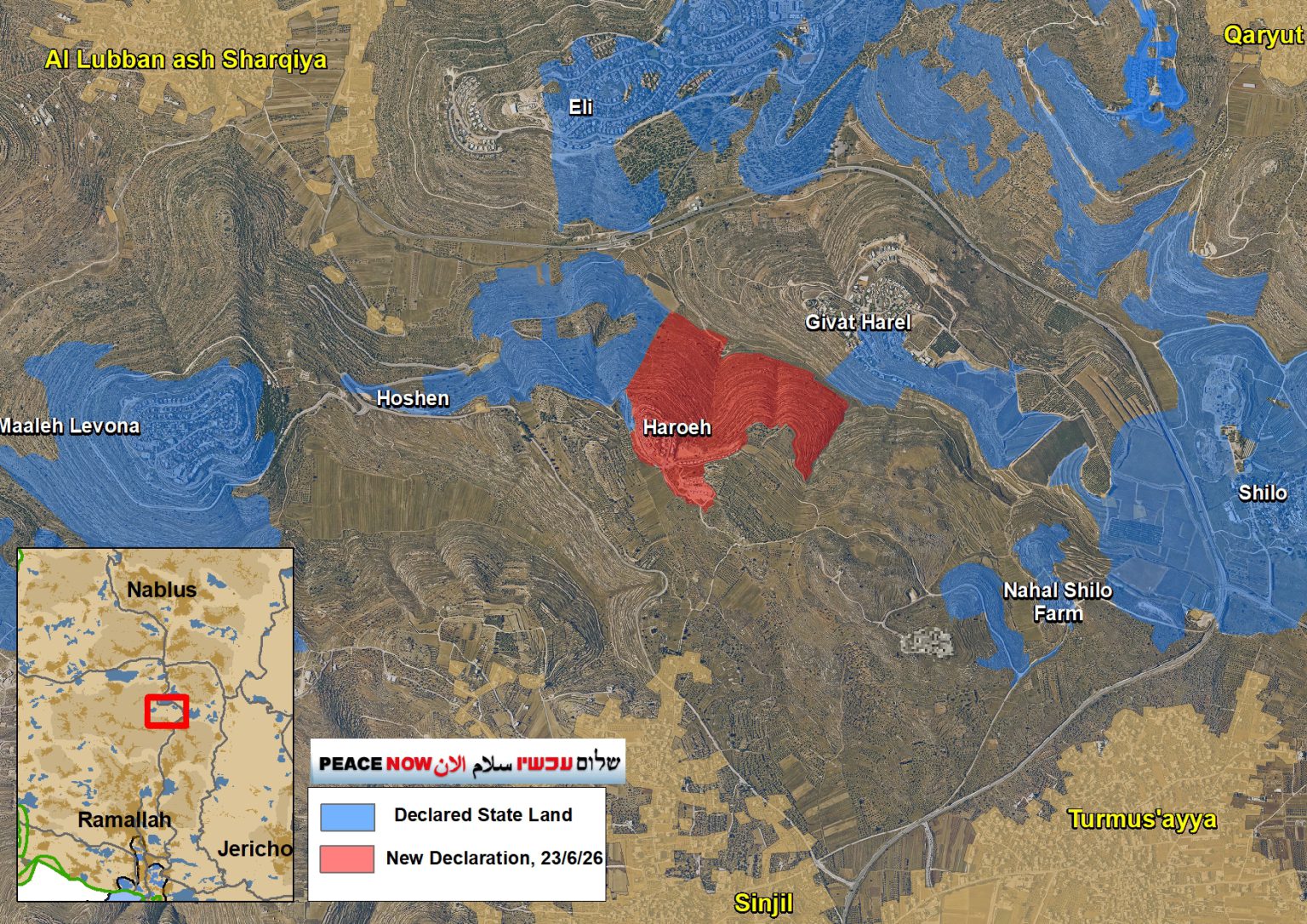 Peace Now reports the Israeli Civil Administration declared over 115 acres of land belonging to the village of Sinjil, located south of Nablus, as “state land” in order to enable the “legalization” of the Givat Haroeh outpost under Israeli law. The declaration more than quadruples the size of the outpost’s boundaries, allowing for massive growth in the future and consolidating the contiguous sting of Israeli settlements in the Shilo Valley area.
Peace Now said in a statement:
“Netanyahu and Smotrich are determined to fight against the entire world and against the interests of Israel’s residents for the benefit of a small group of settlers who receive thousands of dunams as a gift, as if there is no political conflict to resolve. They are exploiting every moment in power to create more and more facts on the ground that will make it harder for Israel to reach peace. Today it is clear to everyone that this conflict cannot be resolved without a political agreement that includes the establishment of a Palestinian state in the West Bank, yet the Israeli government is choosing instead to make this possibility more difficult and move us further away from peace and from ending the bloodshed.”
The Israeli government approved the legalization of the Givat Haroeh outpost in 2023 as part of a Cabinet decision to legalize 10 outposts, setting in motion the legal process to do so. Givat Haroeh was known to the Israeli government to have been illegally built on land that is at least partially privately owned by Palestinians; these landowners now have 45 days to file objections to the new military seizure order.
As noted at the time, a source told Haaretz that the Israeli Cabinet chose the ten outposts for authorization specifically because they are all located in remote or isolated locations — meaning they cannot be “legalized” via expanding the borders of a nearby settlement and declaring the outposts to be merely neighborhoods of those “legal” settlements (a legal maneuver Israel has repeatedly used to expand settlements and retroactively legalize settlements). This means, among other things, that legalization of these 10 new settlements would inevitably l lead to additional land seizures for related infrastructure work.
Joint Report: Israel’s Seizure of Land Near Hasmonean Palaces
In new analysis, Emek Shaveh, the Palestine Solidarity Co-op and Emek Shaveh detail Israel’s recent military seizure order taking control of land near the Hasmonean Palaces, a West Bank archaeological site located on the outskirts of Jericho in Area C of the West Bank. The seizure order will allow Israel to construct a new road to the site that bypasses Jericho.
 The construction ratchets up the violent and coercive conditions facing the Kaabneh bedouin community of Ein ad-Duyuk al Tahta, which is located on land immediately adjacent to the Hasomonean palaces. The community has been subjected to increasingly violent daily settler attacks and harassment, a trend which crescendoed on February 10, 2026 when dozens of settlers carried out a pogrom against the community. Settlers attacked violently, including women and children, looted the village, and brought in a bulldozer to level 13 homes. Israeli police and military did not respond to calls from the community for intervention. The community lives now on the ruins of these homes, while Israel is pursuing the development of the Hasmonean Palaces into a major tourist attraction.
The three groups write:
“The Hasmonean Palaces are also one of several major antiquity sites that the current Minister of Heritage, Amihai Eliyahu, had defined as “anchor sites” in the plan to develop Judeo-centric archaeological theme parks across the West Bank. In July 2023, the government had allocated 20 million NIS for the development of the site into a tourist attraction. At the time it was said that the Binyamin Regional Council would operate the site. The community of Ein ad-Duyuk al-Tahta is situated in part on what Israel considers state land and in part on land privately owned by East Jerusalemite families. The area under seizure order is privately owned, but as of June 2026, the owners have not yet been located.
In recent years, a settler-led campaign, spearheaded by the NGO Guardians of Eternity, claimed deliberate destruction of “Jewish” antiquities by the Palestinians, in an attempt to push the government to expand control over West Bank sites. The Hasmonean Palaces site was often mentioned in this context. Over the years, the SOA has carried out numerous enforcement actions at the site, including stopping works, confiscating equipment, and demolishing what it defines as illegal construction.”
Dror Etkes told The Forward:
“We will see an area completely disconnected from its surroundings. Palestinians won’t be able to enter the area. Two roads [for Israelis] will lead to this area. Settlers will be very violent, it will be very restricted for the Palestinians, construction in the area [by Palestinians] will be completely banned, the construction that already exists is without a permit and a large part of it will be demolished by Israeli authorities.
It will be another national park that will tell one story — the story the Israeli radical right wants you to hear.”
Emek Shaveh’s ED Alon Arad told The Forward:
“You change the identity so that from a village on the outskirts of Jericho it becomes a palace of a dynasty. You don’t need actual settlers there, it’s enough to build an access road, put up a fence and whatever comes with tourist development-a kiosk, a parking lot, someone to guard it…You start bringing in tourists and it’s a normalizing process for people to go inside the West Bank and return to Haifa or wherever they are from. They go in and out and it was fun for them and you create the idea that this is part of Israel.”
Smotrich Announces Millions to Renovate Illegally Seized Ancient Pool Near Jericho
Haaretz reports Israel plans to invest millions of shekels in developing an illegally-sized ancient pool and archaeological site near the Petza’el settlement in the Jordan Valley. Israeli Finance Minister Smotrich announced that he allocated 3 million shekels for the development and the site.
Settlers took control over the pool just a month ago, and began renovating the site. According to Haaretz, the IDF recognizes the area as privately owned Palestinian land. One landowner told Haaretz:
“They [the settlers] diverted the water, they are swimming in the pool, they put up Israeli flags and opened a tourist site for settlers, and they do not allow anyone to approach the area or repair anything…”We have springs on land we have owned for many years, and we use them for agricultural irrigation…we have no water.”
Dror Etkes from the Kerem Navot told Haaretz that
“trifles like Palestinian property rights do not interest the extreme and violent elements in the government. They have no problem reaching a site that settlers covet, attaching an invented history to it and looting it in the name of a historical past that has nothing behind it but a lust for plunder and nothing more.”
New Light Rail for Settlements?
On June 21st, the Gush Etzion Regional Council announced “the transportation revolution in the bloc continues” and that a new light rail line will connect the settlement block to Jerusalem. The press event announcing the project included an illustration of the light rail line, being held by the smiling Transportation Minister Miri Regev and Yaron Rosenthal, the head of the settlement regional council. Despite the public support for the announcement, the Israeli Department of Transportation denied the plan, saying it had not been approved or funded by the government.
STATE-BAKED SETTLER TERRORISM
Key Reads this week:
- “Israeli Settler Indicted Over West Bank Rampage That Left Eight Palestinians Wounded” (Haaretz, 6/26/26); “Yitzhar resident indicted after armed sheep search erupts into violence in Huwara, West Bank” (Jerusalem Post, 6/25/26); “Israel prosecutors charge settlers with terror offences after West Bank attack” (The New Arab, 6/26/26)
- “Former settlement chief charged with threatening Palestinians with assault rifle” (The Times of Israel, 6/25/26)
- “Israel’s Top Court Slams Police for Failing to Probe Settler Attack on Rabbi Solidarity Activist” (Haaretz, 6/25/26)
- “Israeli Soldiers Were Sent to Harass a Bedouin Community That’s Halfway to Expulsion” (Haaretz, 6/24/26)
- “Israeli former leaders and security chiefs threaten legal action over ‘Jewish terrorism’” (The Guardian, 6/24/26)
- “As settlers rampage, IDF soldiers accused of aiding violence, theft against Palestinians” (The Times of Israel, 6/26/26)
- “An Israeli Settler Shot a Disabled Palestinian Five Times. Police Quickly Labeled the Wounded Man a ‘Terrorist’” (Haaretz, 6/20/26)
- “Ethnic Cleansing 3.0: How Israel Became the Transfer State” (Gideon Levy in Haaretz, 6/25/26)
BONUS READS
- “How the Jewish National Fund Became the Face of Israeli Expulsion” (Haaretz, 6/24/26)
- “Chevra Kadisha Burial Society Seeks Payment From East Jerusalem Residents for Using Path to Their Homes” (Haaretz, 6/24/26)
- “Death Penalty For Palestinians Only” (Visualizing Palestine, June 2026)
- “IDF Eases Closures on West Bank Palestinian Town, but Keeps Key Highway Blocked” (Haaretz, 6/25/26)
- “The Israeli right is marching under a new flag” (+972 Magazine, 6/15/26)
- “Palestinians warn West Bank antiquities bill designed to expand Israeli control” (The Times of Israel, 6/25/26)
- “Palestinians decry Israeli push for control over ancient West Bank sites” (Reuters, 6/25/26)
- “Hundreds of Bedouin left homeless as Israel ramps up Naqab expulsions” (+972 Magazine, 6/24/26)
Welcome to FMEP’s Weekly Settlement & Annexation Report. To subscribe to this report, please click here.
June 19, 2026
- EAST JERUSALEM: Silwan Updates, Israel Seizes Church Land, New Report by Ir Amim
- WEST BANK: Plans for 576 Units Advance, Israel OKs Settler Construction in Hebron’s H2, Doron Settlement Cornerstone Laid, IDF Clears Several Outposts
- BONUS READS
EAST JERUSALEM
Court Continues Ethnic Cleansing in East Jerusalem; Final Ruling Seals Displacement of Family in Batan al-Hawa
Peace Now reports the Israeli Supreme Court has summarily rejected the final appeal of the Palestinian Sarhan family, ruling that the family must vacate their homes of more than 60 years in the Batan al-Hawa section of Silwan so that the Ateret Cohanim settler organization can take possession of it. Ateret Cohanim has used discriminatory Israeli law to carry out the mass displacement of the local Palestinian community in Silwan and other communities of East Jerusalem.
Peace Now said in a statement:
“Regrettably, there is no other term to describe this than ethnic cleansing. Settlers, with the assistance of the government and a discriminatory legal framework, are expelling an entire Palestinian community and replacing it with settlers. This is happening in Jerusalem in 2026, and it will remain a stain on the State of Israel. The government can and must stop the forced displacement of an entire community, and responsibility rests squarely on its shoulders. In its advisory opinion, the International Court of Justice (ICJ) explicitly addressed the discriminatory legal regime and Israel’s settlement policy in East Jerusalem, finding them to be in violation of international law.”
The Sarhan family is made up of 12 nuclear families, living in four buildings on the same plot of land; one of the buildings – a five story hose that can house up to 12 families – has already been taken over by settlers with the assistance of the state.
In Batan al-Hawa, 38 Palestinian families (numbering hundreds of people) have already been evicted from their homes and replaced with settlers. There are four more buildings scheduled to be evicted in the coming months, and still three ongoing lawsuits where Palestinian families are continuing to fight against settlers seeking their eviction.
JNF Targets Another Family in Silwan for Displacement
Peace Now reports the Palestinian Shaludi family has received an eviction order telling them to leave their longtime home in Silwan by June 24, 2026. The lawsuit behind their eviction was brought by the Jewish National Fund (JNF-KKL), which plans to move settlers into the home upon the family’s forcible displacement where they have lived since 1964. For more information on the legal mechanism behind this instance of displacement, see Peace Now’s reporting.
Abed Shaludi told Peace Now:
“My parents rented this house in 1964, I was born here 55 years ago, and here my four children were born. I have memories from every corner of this house. I cannot imagine myself in another place, without this house, without the olive tree in the yard upon which I built wooden houses where I slept during summer nights. No one can give anyone the right to expel a person from his home and his land. This is an injustice and a crime.”
Peace Now said in a statement:
“The Jewish National Fund has turned itself into the Settler National Fund and is trying to throw a destitute Palestinian family out of their home just so settlers can take over another house in a Palestinian neighborhood. This is cruelty and an ugly move of using the Absentees’ Property Law based on dubious testimonies in order to take properties from Palestinians and give them to settlers, and to destroy the delicate fabric of life in Jerusalem.”
Israel Raids, Takes Control of Jerusalem Patriarchate Property in Silwan
The Orthodox Patriarchate of Jerusalem reports that Israeli authorities raided its Church property in Silwan on June 15th, forcibly removing Patriarchate staff, confiscating Church property, uprooting trees, and barricading the property off with fences and gates. The Jerusalem Municipality has said that it conducted these operations on the basis of “gardening orders”, which allow the government to take control of land in order to do landscaping.
The Patriarchate filed a lawsuit to stop the work and recoup damages, asserting that the Patriarchate is the registered owner of the land, which is not only adjacent to an ancient monastery but also contains significant historical, archaeological and religious artifacts.
The Jerusalem Magistrate’s Court held a hearing on the matter on June 18th for a hearing, where the Jerusalem Municipality argued the land was neglected and does not recognize the Patriarchate’s ownership of the land, stating that since the land is uncultivated it is considered “state land.” A representative of the Israel Nature and Parks Authority further told the Court that it is his intention to establish a permanent Israeli presence on the site. The Court ultimately decided not to issue an injunction, and asked the parties to continue discussions for one week.
In a June 15th statement the Patriarchate said:
“…the seizure of this private Church property, with its Christian heritage and religious significance, sets a dangerous precedent for Church rights in Jerusalem. The Patriarchate added that reliance on a municipal gardening order issued on April 18, 2019, whose term expired in April 2024, provides no lawful basis for uprooting trees, removing the lawful caretaker, sealing off Church land, or denying the Patriarchate access to its own property.
The Patriarchate stated that the events in Silwan fall within a wider pattern of escalating assaults aimed at weakening the indigenous Christian presence in the Holy Land. It noted with deep concern the rising Israeli attacks against Christians and churches amid unacceptable international tolerance. In 2024, 111 Israeli attacks or acts of violence were recorded against Christian clergy, nuns, worshippers, and church communities, including 35 attacks targeting churches, monasteries, and religious symbols.”
Jerusalem expert Daniel Seidemann posted:
“Let there be no doubt about what is happening here: this is the Jerusalem Municipality fronting for the settler organizations in Silwan, in a blatantly illegal attempt to seize Church properties for the benefit of the settlements in Silwan. I will not trouble you with the baseless pretext for seizing the property. I rely on the Church to do that. But this needs be said: when the biblically driven, messianic settlers of East Jerusalem covet property that happens to belong to a Church, nothing will stop the Government from using all their powers to seize that property. The vulnerable Christian communities struggling to maintain their communal presence, and secure their properties, are expendable. Acceptable collateral damage. Unless they happen to be end-of-days evangelical rapture mongers.”
Peace Now said in a statement:
“Jerusalem is a city of profound importance to three religions and to billions of people around the world. The State of Israel should serve as a model of governance that respects all faiths and affords dignity to all of Jerusalem’s residents. Instead, in recent years, Israeli authorities have increasingly pushed the city’s non-Jewish presence aside, not only Palestinians, but also Christians.
The takeover of Church land in Silwan is part of a broader effort, led by settler organizations, to gain control over the entire Wadi Rababa and Silwan area and transform it from a Palestinian space into an Israeli one. The Jerusalem Municipality and the Israel Nature and Parks Authority have become instruments of the settler ideological agenda.”
New Report from Ir Amim: “‘Greater Jerusalem’ – Expulsion and Annexation”
In a new report entitled, “‘Greater Jerusalem” – Expulsion and Annexation”’ Ir Amim provides a comprehensive documentation of the settlement expansion, construction of outposts, construction of settler infrastructure, and the escalating state and settler violence against Palestinian communities that have propelled Israel’s accelerated annexation of the “Greater Jerusalem” area. The report documents how Israel has dramatically reshaped the West Bank area around Jerusalem over the past three years, and argues to understand the many mechanisms for Israel’s forcible transfer of Palestinian communities as a key tool in its annexation drive.
Ir Amim writes:
“These developments are part of a broader Israeli government agenda across the West Bank: expanding Israeli territorial contiguity while uprooting and pushing Palestinians into disconnected enclaves within an increasingly fragmented Palestinian space. This strategy is unfolding throughout the West Bank, but it is especially visible around Jerusalem.
[Thie report] details the cumulative system of pressure being used to make life unsustainable for Palestinian communities, including land confiscation, settlement and outpost expansion, demolition orders and denial of building permits, military closure orders, new permit regimes, settler and military violence, severe restrictions on movement, and the closure of entire areas to Palestinian access.”
Read the full report and/or executive summary here.
WEST BANK
Israel Approves 576 New Settlement Units Across West Bank
On June 17th the Israeli High Planning Council approved the construction of 576 new settlement units across the West Bank. the approvals include:
- Mitzpe Yericho: 456 new settlements units were approved for the Mitzpe Yericho settlement, located just west of the Palestinian city of Jericho in the Jordan Valley. This plan will enable thousands of new settlers.
- Karnei Shomron: 120 new settlements units were approved for the Karnei Shomron settlement, located in the northern West Bank, east of the Palestinian village of Qalqilya. Israel has openly declared its intention to continue expanding settlements in this area with the stated goal of bringing 1 million settlers to live in the area.
- Approval of a new dormitory for yeshiva students in the heart of historic Hebron, see the next section for more details.
After Seizing Planning Authority, Israel Approves Construction of Dormitory in Historic Hebron
Peace Now reports that on June 16th the Israeli High Planning Council approved the construction of a new dormitory for settlers on Al-Shalala street, located in the heart of Hebron’s historic market (the Kasbah) and which has become the main route for Palestinians to access Hebron’s Old City and the Ibrahimi Mosque since Shuhada Street has been sealed off to Palestinians. The dormitory will be built above a building called the “Romano House”, which the government gave to settlers in September 2025 and have since become a religious school (Shavei Hevron yeshiva).
This new construction approval comes just one week after the Israeli Higher Planning Council seized authority over Israeli settlement construction and planning in Hebron H2 area and Jewish heritage sites there (the Ibrahimi Mosque/Tomb of the Patriarchs), stripping the Palestinian-run Hebron Municipality of the administrative powers assigned to it in the 1997 Hebron Protocol (which was signed by Israel). The Israeli Security Cabinet reportedly approved the assumption of these authorities, though
Israeli Minister Smotrich posted defiantly on X that he “canceled the Hebron Agreement.,” prompting the Israeli Foreign Ministry to put out a statement saying the Protocols have not been annulled but confirmed Israel had taken control of administrative powers from the Hebron Municipality. Nonetheless, while celebrating the opening of the Doron settlement, Smotrich said in a speech:
“Yesterday we annulled the Hebron Accords…For many years, one of the most absurd clauses of the Oslo accords remained in place, in which authority over the Jewish settlement in Hebron and the holy sites were dependent on the terrorist municipality of Hebron. Yesterday we put an end to that.”
Issa Amro, a prominent Palestinian activist living in Hebron, released a video statement responding to these developments.
Peace Now said in a statement:
“The government is racing toward annexation and apartheid. Hebron is the most extreme example of the regime Israel imposes in the West Bank, under which Israeli Jews enjoy rights while Palestinians are denied them. It is a city where entire streets are closed to Palestinians so that settlers can move through them freely. The decision to strip Palestinians of planning authority and to build a large new settlement compound in the heart of Hebron’s Kasbah is a microcosm of the annexation being implemented by the government—one that is condemning us to a future of conflict and bloodshed.”
Doron Settlement in South Hebron Hills Opens
Israeli Minister Bezalel Smotrich and Defense Minister Israel Katz participated in a cornerstone-laying ceremony at the new Doron settlement in the South Hebron Hills. Pictures show Smotrich planting a tree and raising a flag over the site of the future settlement. Makeshift structures were later brought to the site, which had been previously cleared, including several caravans, water tanks and equipment.
The ceremony punctuates the settlers’ takeover of the land and continued harassment of nearby Palestinian communities. The settlement is located on the lands of the Dura village, on Mount Tarousa. Last week Palestinians filmed the IDF escorting settlers and their equipment onto the lands.
IDF Clears Several Outposts
Overnight on June 18th, the IDF cleared settlers and their illegal structures from several outposts, including:
- Tel Talpiot near the Shiloh settlement in the northern West Bank;
- Kochav Yehuda, a farming outpost near the Efrat settlement;
- Shaagat Yehuda, a farming outpost established months ago by violent settlers on the lands of Tayasir in the northern West Bank. This is Area A under the Oslo Accords. A CNN news crew was attacked by IDF soldiers when they were attempting to document the violent settler attacks on Palestinians in Tayasir.
- An encampment near the Esh Kodesh settlement.
BONUS READS
- “Government to provide 50-shekel daily stipends for hundreds of hilltop youth – report” (The Times of Israel, 6/15/26)
- “Israel Is Conducting a Systematic Campaign of Ethnic Cleansing and Crimes Against Humanity in the West Bank” (Ehud Olmert in Haaretz, 6/18/26)
- “Israel Must Choose Life, Not the West Bank Settlements” (Haaretz Editorial, 6/17/26)
- “The Jewish Ku Klux Klan Has a Calculated Plan for the Palestinians” (Haaretz, 6/15/26)
- “The Israeli State Armed Settlers With Thousands of Guns. Now It Can’t Control Them” (Haaretz, 6/16/26)
- “Israel took control of more land from its neighbors since Oct. 7 than it has in decades” (The Times of Israel, 6/18/26)
- “Netanyahu gov’t doubled number of Gush Etzion Jewish communities” (JNS, 6/18/26)
Welcome to FMEP’s Weekly Settlement & Annexation Report. To subscribe to this report, please click here.
June 12, 2026
- WEST BANK: Israel Expediting NIS 1 Billion to 61 Outposts; Israel Allocates Land to Outpost in Beit Sahour; Israel Building Permanent Military Base in Jenin; News on New Outposts; Amnesty Report Alleges Ethnic Cleansing
- STATE BACKED SETTLER VIOLENCE: European Countries Announce New; United Nations Says State is Complicit in Settler Terror
- BONUS READS
WEST BANK
Bibi Slows Push to Expedite Funds for 61 Outposts
Early this week the Israeli press widely reported that the Israeli Cabinet was scheduled to meet on June 11th to approve a $1billion NIS ($337 million) package to fund extensive development projects for 61 outposts, which remain illegal under Israeli law (though the government has already announced its intent to “legalize” these outposts, that process has not been completed). Following significant international attention, Netanyahu moved consideration of the funding to a closed-door Security Cabinet meeting on June 14th.
According to reports, the package would fund the construction of temporary residences at the outpost locations, to include 15 residential caravans and two caravans designated for public-use buildings. It would also fund significant investments into permanent infrastructure for the outposts even before they are legalized, including roads, sewage systems land clearing, and water infrastructure. The package also funds new government positions called “community coordinators” which will work to bring settlers to these locations, assisting them with moving and settling there.
While the specific outposts are not clear, it is reported to be outposts that do not have any significant population size, possibly empty sites. And the package will fund development of these outposts located in Areas A and B of the West Bank, and in strategic areas that carve up the West Bank and establish Israeli contiguity between settlements and through to the Jordan Valley.
Peace Now explains the background and comments:
“Since taking office in December 2022, the government has approved the establishment of 103 new settlements. Some of these already existed as “neighborhoods” of existing settlements, while others were established as unauthorized outposts; the decision is expected to facilitate their formal legalization. The remainder consists of dozens of settlements that have not yet been established or currently contain only agricultural outposts with limited infrastructure. The planned NIS 1 billion investment is intended to support their development. According to one report, the funding relates to 61 new settlements…
It should be noted that under the laws applicable in the West Bank, the construction of buildings—including temporary structures and caravans—requires approved planning schemes and building permits issued by the competent authorities. In the case of the new settlements approved by the government, most currently lack approved planning schemes, and some do not even have available “state land” that could be allocated for planning purposes. Consequently, it appears that the government intends to bypass planning and construction regulations, potentially through the use of military orders that allow permits to be granted for sites deemed to be of “national importance,” or through other legal mechanisms.
Peace Now: The government is on a reckless pre-election sprint to raid the public purse in order to create facts on the ground that will leave a scorched-earth reality for the next government. It is no coincidence that the Chief of Staff warned that the establishment of so many settlements would harm security and could bring the IDF to the point of collapse. October 7 proved that the right-wing approach has failed: the conflict cannot be “managed,” and the Palestinians cannot be “defeated.” Israel must reach a political solution and diplomatic agreement, but instead the government is only sinking us deeper into the mire and condemning us to many more years of bloody conflict.”
Israel Allocates Land for New Settlement in Beit Sahour
The Applied Research Institute of Jerusalem (ARIJ) reports that the Israeli government has declared 116 dunams of land to be included in the jurisdiction of the new “Yitzav” settlement, located on land belonging to the Palestinian town of Beit Sahour near Bethlehem. The designated land includes the former military compound that settlers initially (and illegally) first established the Yitzav outpost just four months ago, but it also includes surrounding lands and part of a public park that belongs to the municipality of Beit Sahour
ARIJ estimates about 13 settler families currently live there.
Israel Building a Permanent Military Base on Palestinian Land
Haaretz reports that Israel is building a new permanent miltary base near the Palestinian city of Jenin, marking the first time since the signing of the Oslo Accords that the Israeli has built a permanent military installment in Area A of the West Bank.
Breaking the Silence explains the how this is part and parcel of the settlement movement and Israel’s annexation of the West Bank:
“For more than a year, the IDF has been conducting an operation in the West Bank dubbed “Iron Wall.” As part of the operation, the IDF has repeatedly raided the Palestinian refugee camps of Jenin, Tulkarm, and Nur Shams. In many ways, it resembled practices we’ve seen in Gaza.
45,000 Palestinians have been forcibly displaced and, for the most part, are still not allowed to return. The IDF demolished entire residential blocks and loosened rules of engagement, permitting opening fire at anyone who was deemed to be “messing with the ground”…
The operation’s declared goal, as usual, is “strengthening security.” Yet against this backdrop, the Israeli government approved the establishment of new settlements in the Jenin area, some of them planned just a few kilometres from the refugee camp.
Settling civilians near what the IDF considers a terror stronghold while conducting a military operation there is hardly a recipe for their safety. No surprises here. The operational logic in the West Bank mostly works the other way around.
First, a settlement is deliberately established near a Palestinian village or city to fragment the West Bank, disrupt Palestinian life, and grab land. Then, because this settlement must be protected, it draws a heavy military presence into the area.
The planned base in Jenin is another step toward the creeping annexation of the West Bank. The goal is to concentrate Palestinians in shrinking, disconnected enclaves. Working hand in hand with settlers, the IDF advances this apartheid project under the banner of “security.””
Reports on New Outposts
There were several reports regarding new outposts over the past week, including:
- Settlers moved in more caravans to a new outpost recently established on the lands of Taybeh village.
- Settlers moved several mobile homes onto land belonging to the village of Jourat ash‑Sham’ah, south of Bethlehem. This is the second outpost built on lands belonging to this village in the past month.
- Settlers were documented clearing land near an ancient church in the Palestinian village of Aboud.
- A new settler outpost was spotted on the lands of the Deir Abu Meshal northwest of Ramallah.
- Construction work is being done to build a new road to an outpost on the land of Abu Njeim, southeast of Bethlehem.
In addition, the IDF attempted to clear out an outpost near the Ma’ale Amos settlement located south of Bethlehem, but were met with violent settlers attempting to stop the enforcement. Three soldiers were reportedly wounded.
Amnesty International: Israel is Ethnically Cleansing Bedouin & Herding Communities from the West Bank
Amnesty International released a new report entitled, “Erasing Anything Palestinian: Israel’s Ethnic Cleansing of West Bank Bedouin And Herding Communities” documenting Israel’s systematic erasure – by settlers and by the state – of Palestinian Bedouin and herding communities from Area C of the occupied West Bank. The report accuses Israel of committing the crime against humanity of forcible transfer by uprooting, dispossessing and driving Palestinian communities from their land.
Amnesty writes:
“This report lays bare the scale and severity of the ethnic cleansing campaign targeting these communities, carried out in a context of apartheid and unlawful occupation and against the backdrop of an ongoing genocide in the occupied Gaza Strip.
The report also demonstrates—contrary to what too many in the international community suggest—that the campaign is not the product of “rogue” settlers, settlers’ organizations, or “extremist” government ministers.
In other words, settler violence is not an aberration but an integral part of an organized state policy.
The report demonstrates that the ethnic cleansing campaign in Area C is state-sanctioned, state-driven and state-implemented; it seeks to accelerate the Israeli government’s annexation agenda and settlement expansion through war crimes and crimes against humanity.
As such, the report’s conclusions demand that the international community fully confront and name the Israeli state-driven project and act decisively to prevent the destruction of Palestinian communities and the annexation of the West Bank.”
STATE-BACKED SETTLER TERROR
United Nations Accuses IDF of Enabling Settler Terrorism
A new report by the United Nations’ Commission of Inquiry on the Occupied Palestinian Territory asserts that the Israeli government is complicit in enabling settler terrorism via its financial and military support for settlers. The report specifically documents that Israeli security forces routinely accompany settlers during their attacks and act as a shield for their violence against Palestinians and their property.
France Bans Smotrich; New EU Sanctions Target Entities
Six European countries led by the United Kingdom announced a new round of sanctions targeting six settler entities and one settler alleged to be involved in illegal outpost activity and violence against Palestinians. In addition, France has banned Israeli Minister Bezalel Smotrich along with four leaders of settler groups and 21 individual settlers from entering the country. Settlers have said the sanctions are a badge of honor.
The sanctioned entities and individuals are:
- The Farms Union: which provides financial and organizational support to illegal farming outposts and residential outposts linked to violence and the forcible displacement of Palestinians.
- Ahavat Gilad (“Love of Gilead”): serves as a financial conduit for the Farms Union, channelling donations to settler outposts including those associated with violence against Palestinians.
- Ari Yshag: a fundraising organization that supports illegal settler outposts known to be violent, including Hilltop Youth outposts.
- Artzenu (“Our Land”): a group that raises funds for tactical military equipment for armed settler squads. It also deploys volunteers to farm outposts and settlement outposts in the West Bank.
- Shivat Zion Lerigvey Admata (“Return of Zion to its Land,”): the registered legal vehicle through which Artzenu’s financial activities are conducted, channelling donations to outposts linked to serious human rights abuses
- Eyal Hari Yehuda Company: a construction and demolition company that allows settlers to use its equipment to destroy Palestinian land and property, and perpetrate violence against Palestinians. The company is owned by brothers Yinon and Itamar Yehuda Levy. Yinon has previously been sanctioned, and is responsible for the murder of Awdah Hathaleen in Umm al-Khair last year.
- Itamar Yehuda Levi: owner of EYAL HARI YEHUDA COMPANY LTD (also designated).
Bonus Reads
- “Palestinians Attacked in West Bank Say IDF Troops Stood Idly by as Settlers Rampaged” (Haaretz, 6/7/26)
- “Before the Settler Abused the Dog, He Beat the Palestinian Family Who Owns It” (Haaretz, 6/6/26)
- “Importing Occupation: Europe’s Complicity in Palestinian Dispossession through Settlement Agricultural Trade” (Global Echo, June 2026)
- “Welcome to the 60th Year of Israel’s Occupation of the West Bank” (Michael Sfard in Haaretz, 6/10/26)
- “Left-wing U.K. Leaders Slam Israeli Real Estate Event, Alleging West Bank Home Sales” (Haaretz, 6/11/26)
Welcome to FMEP’s Weekly Settlement & Annexation Report. To subscribe to this report, please click here.
June 5, 2026
- WEST BANK: E-1 Update; High Council Advances Plans for 2,162 New Units; Archaeology Annexation Bill is Stopped for Now; Tax Break for Settlers; WZO Eases Land Purchase Rules
- Further Reading
WEST BANK
E-1 Update
As previously reported, tenders for the construction of the E-1 settlement were scheduled to be published/opened on June 1st – – but as of reporting the tenders have not been published. Terrestrial Jerusalem founder and Jerusalem expert Danny Seidemann cautions that delays are normal and alarm should remain high:
“In the past, this [delay] would be very much in line with Netanyahu’s modus operandi: bluster, but at the last moment make E-1 go away without leaving fingerprints. However, with Smotrich breathing down his neck and elections approaching, Netanyahu will be called out if he silently freezes E-1. He is not likely to do that.”
On June 3rd, 85 members of the U.S. Congress penned a letter to Secretary of State Rubio urging action to stop the construction of E-1. On the same day, a group of EU representatives visited Khan al-Ahmar, the bedouin community that stands to be forcibly transferred from their land by Israel in order to enable the construction of the E-1 settlement. At the United Nations, the Arab Group (an official regional and political coalition composed of 22 member states representing the Arab nations), issued a statement touching on many Israeli annexationist moves including E-1, urging strong opposition and increased pressure on the Israeli government to back off.
2,162 New Settlement Units Advanced
On June 3rd, the Israeli High Planning Council advanced the construction of 2,162 new settlement units, including plans for two new settlements. The plans advanced this week were:
- Hamivesher (a new settlement): The Council approved for deposit a plan for the construction of 234 new settlement units in the outpost of Hamivesher, which would authorize its as a legal (under Israeli law only) settlement. Until now, the Hamivesher outpost has been laundered through the planning process as a “neighborhood” of the Kiryat Arba settlement but is more properly understood as its own settlement. The Hamivesher settlement is detached from Kiryat Arba, located some ~800 meters north.
- Gvaot: The Council gave final approval for the construction of 1,006 new units in the Gvaot settlement, located west of Bethlehem. There are only a few dozen families currently living in the Gvaot settlement, so this plan represents a massive expansion and its transformation into a more established and urban settlement. Gvaot was built illegally by settlers and initially laundered as a “neighborhood” of the Alon Shvut settlement despite being detached from it. The government authorized Gvaot as an independent settlement in March 2025.
- Har Bracha: The Council approved a plan for 922 new units in the Har Bracha settlement, located south of Nablus. If given final approval, this plan will triple the size of Har Bracha, which is known to be particularly violent towards surrounding Palestinian communities.
Celebrating the approvals, Bezalel Smotrich said:
“This is not just a planning step, but a national development that solidifies our hold on the territory, strengthens Israel’s security, and establishes clear facts that prevent the establishment of an Arab terrorist state in the heart of the country.”
Bibi Stops (for now) Annexation-Via-Archaeology Bill
It’s widely reported that Prime Minister Netanyahu has intervened to stop the advancement of a bill that would annex heritage and archaeological sites across the West Bank and Gaza. Emek Shaveh warns the bill is not dead yet:
“it is important to emphasize that the bill has yet to be withdrawn (a procedure that we will demand). And as long as it remains within the legislative process, it can be revived relatively quickly. Since it has already passed its first reading, a future government or coalition could apply legislative continuity and resume the process from the point at which it was halted. In practical terms, the bill remains very close to being ready for second and third readings.”
Israel Seizes Herodium Archaeological Site & Surrounding Land
The Israeli Civil Administration issued an expropriation order for the Herodium archaeological site – which Israel had already seized and declared an Israeli national park – and surrounding areas, totalling 320 dunams (80 acres). The Herodium site is located on a hilltop south east of Bethlehem, in Area C, surrounded by settlements. This is at least the third archaeological annexation of the year, following the expropriation at the Nabi Samwil site last week and at the Sebastia site in February 2026.
Peace Now said in a statement:
”The government is trying to exploit every moment before the elections to create additional facts on the ground that will advance the full annexation of the West Bank. Tourist and archaeological sites constitute another form of settlement. Their purpose is not only to seize extensive areas of land but also to shape public consciousness, marginalize the Palestinian connection to the land, and transform this country into a land exclusively for Jews, both physically and in terms of heritage. This policy condemns us to many more years of a painful and bloody conflict that can only be resolved through a compromise over this land, which is precious to both Israelis and Palestinians.”
Tax Break for Settlers aka Looting Public Funds for Settlers
This week by a vote of 32-23 the Knesset passed a bill that grants a 7% tax break (capped at NIS 10,000 per year) to residents of 58 specified settlements – most of which are settlements which support, based on voting data, Bezalel Smotrich’s political party (an earlier version of the bill sought to benefit all settlements, but was shrunk to 58 settlements when the cost was estimated at 450million NIS annually). Ostensibly, the 58 settlements were selected based on distance from Israel’s Separation Barrier and the use for armored school buses for children.
Peace Now – which said the move is “a brazen move of looting public funds” – said in a statement:
“The proposal to grant tax benefits to settlements is brazen greed on the part of settlement leaders. No sector in the country receives more benefits and public investment than the settlers, and there is no justification whatsoever for adding tax breaks that would simply plunder the public treasury for the benefit of a small minority within the government’s political base.”
WZO Eases Rules on Land Purchases
The World Zionist Organization recently announced that it will begin allowing settlers to buy a second residential plot of land. Until now, the WZO closely controlled land management and most settlers do not own the land on which their houses are situated, instead they have long term leases on the land via the WZO.
Bonus Reads
- “Israeli Settlers Wound Three Palestinians in Attack Near West Bank’s Hebron, Medics Say” (Haaretz, 6/5/26)
- “Seven Palestinians Wounded in West Bank Settler Raid, Some by IDF Fire” (Haaretz, 5/30/26)
- “Digitally annexing the West Bank: Israel moves its theft of Palestinian land online” (Mondoweiss, 6/3/26)
- “Who Will Stop Smotrich, if Not The Hague?” (Haaretz, 6/3/26)
West Bank
Israel Expropriates Nabi Samwil Antiquity Site Currently Managed by the Muslim Waqf
The Israeli Civil Administration issued an expropriation order to seize the Nabi Samwil antiquity site, located just north of Jerusalem’s municipal boundary in the Palestinian village of Nabi Samwil. The seizure order affects a mosque that is currently managed by the Palestinian Authority’s Muslim Waqf, marking the first time Israel has unilaterally taken control of a holy site owned by the Waqf. In addition to the mosque, Israel has expropriated the archaeological site around the mosque, a spring, agricultural lands, and access roads leading to the area – a total of 109.79 dunams (27 acres).
The Civil Administration explained it was seizing the site “for the public benefit, for the purposes of undertaking a development project to preserve the archaeological site of the Prophet Samuel’s tomb,” claiming that there are safety issues in the compound. Israel is advancing development plans for several other significant antiquity sites that have been under Palestinian control across the West Bank, most notably Sebastia.
Peace Now said in a statement:
“Once again, we find ourselves confronting decisions by the Civil Administration, operating under Minister Smotrich, that are intended to expand and deepen annexation. From plans to expand settlements and unprecedented declarations of ‘state land,’ the Civil Administration has moved on to taking control of heritage sites and is now appropriating religious sites, creating tension in some of the most peaceful and sensitive places in the West Bank. The messianic agenda of the Israeli government should have been stopped long ago. Instead, each passing day appears to further endanger us and create the conditions for transforming a political conflict into a religious war.”
The Palestinian village of Nabi Samwil is located on a strategic and highly prized hilltop (inside of an area Israel post-facto declared a national park) just outside of the municipal borders of Jerusalem but on the Israeli side of the separation barrier — placing residents (who have West Bank ID cards) in a Kafka-esque situation wherein they are cut off from both Jerusalem and the West Bank (legally they are forbidden from taking the one road out of the village into Jerusalem, since they are West Bankers, and the West Bank is accessible only via a circuitous route that passes through an Israeli checkpoint – for background see: The Palestinian village where Israel forbids everything). The suffocation of Nabi Samwil is in line with Israel’s long-time ambitions to completely de-populate the village and take control of the land.
Israel Takes Another Step Towards Forcible Transfer of Khan Al-Ahmar
Ir Amim reports the Civil Administration issued a seizure order for a strip of land running through the Khan al-Ahmar bedouin community’s land to enable the construction of a new water line between two nearby settlements, Mishor Adumim and Kfar Adumim. The seizure order was issued the same day, May 19th, that Finance Minister Bezalel Smotrich vowed to move forward with the long-stalled forcible transfer of Khan al-Ahmar.
Ir Amim further details:
“Moreover, the water line is clearly not intended to serve Khan al-Ahmar or other Palestinian communities in the area. It is rather designed to upgrade infrastructure for the settler population in the E1/Maaleh Adumim area. Since Kfar Adumim is already connected to water infrastructure, the new line likely indicates preparations for the expansion of Kfar Adumim and/or other nearby settlements.”
Bibi Requests Review of Annexation via Antiquities Bill
The Times of Israel reports that Prime Minister Netanyahu has directed his Cabinet Secretary to prepare a comprehensive review of a bill to annex antiquity sites in the West Bank and Gaza. Bibi’s request might be intended to delay or scuttle the bill, which has faced heavy international criticism in addition to opposition by Israeli legal advisors and defense experts. Just this week the Knesset Education, Culture and Sports Committee Legal Adviser Tami Sela wrote a position paper criticizing the bill saying that it “contradicts” international law, specifically with regard to the bill’s application to Areas A & B in the West Bank and to Gaza. The Israeli army has also expressed opposition.
In addition to fast-tracking a bill to create an Israeli civilian authority to control antiquity sites in all areas of the West Bank and Gaza, the Israeli government is simultaneously proceeding with the appointment of a new head of the Israel Antiquities Authority that is both unqualified and clearly political. A group of 60 archaeologists petitioned the Knesset this week to block the appointment.
Israel Launches Online West Bank Land Registration System
On May 27th the Israeli government launched an electronic registration system for the “Land Registry and Settlement of Rights” for Area C of the West Bank. The online system is an instrument for the implementation of a February 2026 decision by the Israeli Security Cabinet to publish the West Bank land registry and to revive a “State Land Acquisition Committee.” These moves are best understood as a way to annex the West Bank, to help facilitate settler claims over disputed and/or unregistered land, and to spur the proactive government purchases of West Bank land for the purpose of settlement expansion.
The Palestinian Authority urged Palestinians to withhold information from Israeli entities working on the registration system, which Birzeit University’s Institute of Law argues consolidates Israeli dominance, marginalizes the Palestinian Authority, legitimizes settlement expansion, and creates irreversible facts on the ground.
Following the Security Cabinet’s February 2026 decisions, the full Israeli Cabinet quickly approved the decisions and allocated a four-year, $78 million (NIS 244.1 million) budget to establish a mechanism (with up to 35 employees) for updating the records in Area C of the West Bank. The Israeli Justice Ministry is tasked with carrying out the land registration process, effectively transferring sovereignty over Area C from the Israeli military to Israeli civilian governance, clear annexation. According to Peace Now, the process of land registration in Area C carried out will lead to the wide scale dispossession of Palestinians from the area. The Cabinet set a target goal of completing the land registration process for 15% of Area C within the next five years.
Yara Asi explains for the Arab Center DC:
“Israel’s February 2026 decisions mark a turning point in the governance of the West Bank. While presented as administrative measures, they collectively restructure land, authority, and law in ways that extend beyond the logic of temporary occupation. Through land registration, control is converted into ownership; through governance reforms, Israeli authority is extended across territorial lines; and through judicial changes, the limited constraints on these processes are further weakened. Together, these developments reflect a shift from managing occupied territory to integrating it into Israel.
This transformation carries significant legal and political implications. By embedding control within legal and institutional frameworks, these measures reduce the prospect of reversal and reshape the conditions for any future political settlement. In this sense, they illustrate a broader strategy of annexation through law—one that proceeds without formal declaration yet produces many of its defining effects.”
Itay Epshtain posted on X:
“The system, codenamed “Grenade”, was launched this morning and openly endorsed by Ministers Smotrich and Strook as “a central pillar in applying sovereignty in the territory and strengthening our hold and roots in Judea and Samaria.”
The candor is striking. What was once advanced incrementally, is now pursued through digitized cadastral engineering. A land registry presented as bureaucratic modernization is, in substance, an instrument for the consolidation of unlawful territorial acquisition.
International law is neither ambiguous nor silent. An occupying Power is prohibited from annexing occupied territory, permanently appropriating public or private property outside the strict limits of military necessity, or altering the legal status of the territory under occupation. Yet this is precisely what is now occurring, in broad daylight, through administrative and technological means designed to render unlawful presence increasingly irreversible.”
As a reminder, only one-third of West Bank land was registered and titled (under the British Mandatory government and then continued by Jordan) when Israel seized control of the West Bank and froze land registration proceedings. The publication of the West Bank land registry is something the settlement movement has pushed for in order to be able to identify landowners in all areas of the West Bank and approach them for purchase, which – with the repeal of the ban on the sale of land to non-Arabs – settlers can now do outright. Opening the land registry will help facilitate settler claims over disputed and/or unregistered lands, making Palestinians vulnerable to further settler harassment regarding the sale of land.
As reported by Israel Hayom in 2020, the Israeli land registration process would first require a survey of the land, after which time anyone claiming ownership could present documents to the Israeli government seeking to prove their ownership. In the case of land where Israel recognizes no valid ownership claims – including cases where Palestinians do not have documentation that Israel will accept – Haaretz has previously reported that the process gives heavy weight to whomever currently controls the land (e.g., if a settler has built illegally on Palestinian land and lived there, under the protection of the IDF, the process will give weight to their claim absent overwhelming documentation, accepted by Israel, from the Palestinian owner). The registration decisions can be appealed, but once the claims are resolved by an Israeli official appointed to oversee the process, no further appeal is possible. Moreover, all “unclaimed” land – that is, land over which Israel does not recognize any legal ownership, will automatically become “state land.
Shlomo Zacharia, a land lawyer working with Yesh Din, further explained how the process of Israeli-controlled land registration will dispossess Palestinians, saying:
“If a village has 30 plots, with [specific, documented] ownership claims on only 20 of those, the other ten automatically transfer to the state. If you haven’t filed a claim of ownership, it goes to the state. Period. The arrangement will primarily benefit the Civil Administration and the settlers, since most of the land allocated by the state goes to settlers, and because the arrangement process (in Israel and the West Bank) favors the person holding the land in practice.”
Israel Seizes Area A Land Inside Jenin for Army Base
972 Magazine reports the Israeli army seized land inside of the Palestinian village of Jenin, on a hilltop overlooking the Jenin refugee camp, in order to establish an army base. Dror Etkes (Kerem Navot) reports the seizure order coupled with newly paved military roads nearby suggest Israel has plans to establish a large military base there, marking the first time since the signing of the Olso Accords that Israeli seized land in Area A for a military base. Etkes ties the move to the broader Israeli government move to expand settlements around the Jenin area. Etkes says:
“There are more than 100 new settlements [including outposts] in the West Bank, and 15 in the Jenin area alone,” he said. “This is not just going back to the four settlements dismantled in 2005. It is something much larger. This is [Israel] reestablishing a military presence in the Jenin area, The only reasonable interpretation is that it is directly related to the biggest settlement boom in the West Bank…The aim is to strengthen the settlements that already exist along these routes, effectively surrounding Jenin and disconnecting it from its immediate rural surroundings. These are methods that we recognize from settlement expansion patterns elsewhere.”
Bonus Reads
- “Humanitarian Situation Report | 25 May 2026” (OCHA)
- “Pastoral Settlement: Dispossession, Forced Displacement and the Erosion of Livestock-Based Livelihoods in the Context of Eid al-Adha” (Balasan Initiative, 5/26/26)
- “The Four Steps Israel Is Taking to Clear Palestinians From West Bank’s E1 Area” (Haaretz, 5/27/26)
- “’They stole our sheep, killed my son’: Israeli settlers, soldiers attack and loot West Bank villages” (Middle East Eye, 5/27/26)
- “In West Bank, Latest Victim of Israeli Settler Violence Shocks in a New Way” (New York Times, 5/22/26)
- “Likud minister says resettlement of Gaza should be on party’s official election platform” (The Times of Israel, 5/26/26)
- “Smotrich’s Bid for Political Survival Relies on Bribing Israeli Settlers” (Haaretz, 5/28/26)
- “Israel Has Physically Divided Gaza With Over 25 Kilometers of Earthen Barriers” (Drop Site, 5/25/26)
Welcome to FMEP’s Weekly Settlement & Annexation Report. To subscribe to this report, please click here.
May 22, 2026
- WEST BANK: Smotrich Orders Khan Al-Ahmar Demolition; Knesset Fast-Tracks Annexation-via-Archaeology; Smotrich Leads Settlers to Joseph’s Tomb
- EAST JERUSALEM: Flag March and Related Government Action
- STATE-BACKED SETTLER TERRORISM: EU Sanctions
- BONUS READS
WEST BANK
Smotrich Orders Khan al-Ahmar Cleared, as E-1 Plan Advances
On May 19th, Israeli Finance Minister Bezalel Smotrich announced that he had ordered preparations for the forcible displacement and demolition of the Khan al-Ahmar, the bedouin village located just east of Jerusalem in an area that needs to be cleared in order for the construction of the E-1 settlement. The destruction of the community is expected to move forward in the coming days, as the publication of tenders for the construction of the E-1 settlements is scheduled for June 1st and bids will close on June 6th.
Amnesty International says that, if implemented, the forcible transfer of Khan al-Ahmar is a war crime. Smotrich said he issued the order after the International Criminal Court notified him that it was prepared to issue an arrest warrant against him, along with National Security Minister Ben Gvir, Settlement Minister Orit Strock, and two IDF officials.
The E-1 settlement will see the construction of 3,401 new settlement units on a site located northeast of Jerusalem that is home to several Palestinian bedouin communities, comprising 3,000 people, including about 300 residents of Khan al-Ahmar. The residents of Khan al-Ahmar have lived and worked on this land since the 1950s – when the community was forced to leave their land in the Negev during the 1948 war. There has been a decades long drama over the Israeli government’s plans to construct the E-1 settlement, which has long been held as a red-line for Israel that the international community had been willing to step up to maintain.
Terrestrial Jerusalem’s Danny Seidemann explains:
“Why Khan al-Ahmar? Israel has delineated the area under its exclusive control in the occupied West Bank between Jerusalem and the Jordan River Valley. It has consolidated its hold by large and medium-sized settlements, and “illegal” outposts. It has neutralized the Palestinian presence, and has seamlessly integrated the area into pre-1967. Multi-lane highways, tunnels, and bridges have erased the Green Line.
There is little doubt that this reality is tantamount to de facto annexation.If that be so, why is Israel so obsessed with the displacement of the few hundred
Bedouin of Khan al-Ahmar that it is willing to bear universal opprobrium in order to evacuate the hamlet?
The answer is simple: because Khan al-Ahmar and similar Bedouin encampments are the final obstacle standing in the way of de jure annexation.
In 1967, Israel annexed East Jerusalem. It did so without extending Israeli citizenship to the Palestinians residing in the annexed areas. The Palestinians of East Jerusalem enjoy certain personal entitlements, but no political rights.”
Balasan Initiative explains:
“The evacuation of Khan Al-Ahmar violates the International Criminal Law (ICL) and International Humanitarian Law (IHL), which prohibit the forcible transfer of protected persons from territory under occupation…particularly in light of the retaliatory intentions of Smotrich following the ICC arrest warrant proceedings, the planned evacuation of Khan Al-Ahmar remains unlawful, unjustified, and incompatible with international humanitarian law.
Hence, alongside the humanitarian consequences that would result from the demolition of the village and the forcible displacement of its residents, the destruction of Khan Al-Ahmar must also be understood within the broader framework of territorial fragmentation and settlement expansion in the occupied Palestinian territory. The village’s strategic location within the E-1 corridor renders its removal politically and geographically significant, as it would facilitate the territorial linkage between Ma’ale Adumim and Jerusalem while further isolating East Jerusalem from the remainder of the West Bank. Such measures undermine the contiguity and viability of a future Palestinian state and reinforce irreversible demographic and geographic changes on the ground.”
Peace Now said in a statement:
“Minister Smotrich seeks to take revenge on The Hague and the international community at the expense of one of the most vulnerable communities, which for years has struggled simply for the right to live on the small piece of land in its possession. The expulsion of Khan al-Ahmar is part of a broader government plan to take control of the entire central West Bank area, build in E1, and remove all Palestinian communities from the region. This is a cynical and destructive plan that could devastate the prospects for future peace and a resolution of the conflict, as part of Smotrich and his allies’ annexation agenda.”
Knesset Fast-Tracks Annexation-via-Archaeology
On May 20th, the Israeli Knesset passed a bill allocating $86 million (NIS 250 million) for developing archaeological and heritage sites across the West Bank. In addition to this huge budget investment, on May 11th the Knesset began fast-tracking a separate bill that would outright annex heritage, antiquities, and archaeological sites to Israel by bringing them under direct Israeli civilian control. That bill is being finalized by the relevant Knesset Committee and expected to be ready for its second and third readings and vote on Sunday, May 24th. For further information on the bill, see this detailed paper opposing the bill by Emek Shaveh.
If approved, the annexation bill will create a new Israeli civilian authority under the Heritage Ministry given exclusive authority to develop and manage West Bank heritage sites, taking those authorities away from the Israeli Defense Ministry. The new body in the Heritage Ministry would have the power to acquire or expropriate land for the purpose of protecting, conserving, researching, and developing heritage sites. In an added absurdity, Heritage Minister Amihai Eliyahu recently announced he has selected Esther Schreiber as the next head of the Israel Antiquities Authority (IAA), that is in despite of the fact Schreiber has no background in archaeology and lacks experience in managing large public institutions.
Emek Shaveh said:
“The political appointment at the Israel Antiquities Authority and the proposed Heritage Authority Law for the West Bank are two sides of the same coin: transforming archaeology from a tool of research into an instrument of propaganda in the service of annexation, dispossession, and a messianic ideology.”
The Haaretz Editorial Board writes:
“The proposed new agency will be another tool by which the government will be able to abuse its Palestinian subjects in the West Bank (it will have the authority to expropriate land) and to harness archaeology to the needs of the settlers. The bill also amounts to annexation, in violation of international law. The bill, like Schreiber’s appointment, was advanced despite overwhelming opposition from Israel’s archaeological community, which already faces boycotts abroad that hinder its operation. It can only be hoped that the government is replaced before Eliyahu & Co. also manage to destroy Israeli archaeology.”
Smotrich Leads Settler Raid on Joseph’s Tomb
On May 14th Finance Minister Smotrich led a group of over 100 settlers on a trip to Joseph’s Tomb for morning prayers, the heritage site in Nablus as Israel expands the scope and scale of Israeli presence there. Smotrich promised to control the site and said during his visit:
“Our presence here at Joseph’s Tomb, in broad daylight, is a clear statement: the people of Israel are returning home to all parts of their land…Joseph’s Tomb is living testimony to the inseparable connection between the people of Israel and their land.”
As a reminder, Joseph’s Tomb is a holy site for Jews and cultural site for Palestinians, located in the heart of Nablus. The tomb is located within Area A of the West Bank (where Israel does not, under the Oslo Accords, have direct control). However, Joseph’s Tomb is one of two sites in Area A which the Oslo Accords stipulate are under the control of the Israeli military. As such, it has been a perennial flashpoint, largely due to deliberately provocative actions by settlers.
In January 2026, Israeli Defense Minister Katz agreed to allow settlers to perform morning prayers at Joseph’s Tomb in Nablus for the first time in 25 years, and on January 29th, Israeli ministers and settler leaders led a group of 1,500 people under a heavy security escort to Joseph’s Tomb. In 2000 during the Second Intifada, Israeli officials restricted Israeli access to the site to nighttime hours in hopes of minimizing conflict.
EAST JERUSALEM
Israel to Expropriate Land/Homes/Business on Chain Gate Road
Ir Amim reports that on May 17th – Jerusalem Day – the Israeli government approved the establishment of an inter-ministerial committee tasked with advancing land expropriation of dozens of properties along the Chain Gate road in the Old City. The move would displace generations-old Palestinian family homes and businesses in the Muslim Quarter. Ir Amim explains:
“The decision refers to a 1968 land expropriation order for an area within Jerusalem’s Old City, which served as the basis for the expropriation of properties in the Jewish Quarter and the displacement of its Palestinian residents at the time. According to the new government decision, the expropriation order issued 58 years ago was never fully implemented. This specifically concerns properties along the southern side of Chain Gate Street (Bab al-Silsila Street), a strategic and central corridor along the seamline between the Muslim and Jewish Quarters that connects Jaffa Gate directly to Al-Aqsa/Temple Mount. See exaction location on map below.
The government now appears poised to advance the expropriation of these properties under a decades-old order, with the new committee tasked with devising the mechanism for its implementation. The committee has been instructed to complete an action plan within 12 months.”
The Flag March
As in years past, thousands of radical Israeli settlers staged a violent rampage – the “Flag March” – through the Old City on Jerusalem Day, bringing destruction and chaos with them as they attempted to show dominance and control over the city. As usual, the crowds shouted “Death to Arabs” and “May your village burn,” and gangs of young settlers were filmed attacking shopkeepers and one Israeli journalist.
Israel Ministers Smotrich and Ben Gvir joined the parade this year, with Ben Gvir leading a large group into the Al-Aqsa Mosque Compound – waiving the Israeli flag in front of the Dome of the Rock. Ir Amim explained the significance of this event:
“The erosion of the status quo at Al-Aqsa cannot be separated from the Flag March itself. In the lead-up to the march, we warned about the growing influence of Temple movements and the support they receive from organizers and participants alike. Throughout the march, countless shirts and flags called for the construction of a Third Temple — in even greater numbers than in previous years — alongside signs reading: “This is not Al Aqsa, this is the Temple Mount!” and “You wanted a massacre? You’ll get a Nakba!” Meanwhile, in the markets of the Old City, Palestinian shop owners were forced by police to close their businesses to clear the area for marchers. Year after year, the daily lives and livelihoods of Palestinian residents are disrupted and undermined to facilitate the march’s passage through the Damascus Gate plaza and Muslim Quarter.
Throughout the march, racist and violent chants filled the streets, including: “May your village burn,” “May your name be erased,” and “Slaughter Nablus.” Palestinian residents and solidarity activists were assaulted, while shops and property were vandalized — all under heavy police presence and with little meaningful intervention. Many Palestinian residents were forced to remain inside their homes or leave the Old City altogether out of fear of violence from the crowds.
Contrary to the way these events are often portrayed in mainstream coverage, such displays of racism and hatred are not isolated incidents on the margins of the march — they are central to it. They unfold within a crowd that includes not only youth, but also educators and adults, many of whom respond with indifference or outright encouragement. The march is officially recognized by Israel’s Ministry of Education and supported by the Jerusalem Municipality. The deeper issue is not merely the racist slogans or acts of violence, but the march itself: a public display of domination in the heart of the Muslim Quarter, built on the takeover and paralysis of Palestinian public space and reflective of a much broader political reality.”
Bonus Reads on East Jerusalem
- “Palestinians forced to demolish own homes to make way for Israeli theme park” (The Guardian, 5/22/26)
- “Only 7% Approved: Palestinian Building Permits in East Jerusalem Plunge, Freezing Construction” (Haaretz, 5/17/26)
- “Israel to Build Defense Compound on Site of Demolished UNRWA Headquarters in East Jerusalem” (Haaretz, 5/17/26)
- LISTEN: “And I too, Love Jerusalem “: Voices from Al Nakba” (This is Palestine podcast, 5/14/2026)
- “Israel’s trying to expel a whole Palestinian district in East Jerusalem, activists say” (NPR, 5/19/26)
STATE BACKED SETTLER TERRORISM
EU Sanctions Violent Settler Entities & Individuals
On May 11th the European Union announced that it plans to place sanctions on several Israeli settlement organizations, including Amana, Nachala and its leader Daniella Weiss, Hashomer Yosh and its former CEO Avichai Suissa, and Regavim and its Director Meir Deutsch. For background on these organizations, see Peace Now’s reporting.
An EU MP told The Guardian that the decision to sanction these entities and individuals is only a “baby step” after years of deadlock on the action. Ireland, a member of the EU, is going even further and is expected to introduce a bill seeking to limit the trade of goods with Israeli settlements.
In response, Israeli Minister Smotrich called for Israel to annex parts of the West Bank. Ben Gvir called the sanctions antisemitic.
Peace Now said in a statement:
“This is a grave warning sign presented to us by the European Union. The rampant violence of settlers in the West Bank, encouraged and supported by the government, is leading Israel into a moral abyss and casting an indelible stain on the State of Israel. The European Union’s decision is also a call to the Israeli public to open its eyes and see the reality we have created through decades of control and settlement in the occupied territories. It is time to stop the deterioration and begin the long journey toward a political agreement and peace. The first step is stop settlement activity.”
Bonus Reads on Settler Terrorism
- “The State Is Supplanting Settlers as the Driving Force of West Bank Takeover” (Haaretz, 5/18/26)
- “’He Attacked a Tied-up Dog’: Israeli Settler Filmed Abusing Palestinian-owned Dog in West Bank” (Haaretz, 5/16/26)
- “Israeli settlers force Palestinian family to exhume and rebury their father” (Al Jazeera, 5/9/26) and,
- “In the Palestinian Village Where a Man Was Buried Twice in a Day, Residents Are Still Stunned” (Haaertz, 5/16/26)
- “Timeline: How One Palestinian West Bank Community Was Erased” (Haaretz, 5/13/26)
- “They Fled to Safety in Palestinian Territory, Then Settlers Attacked Again” (New York Times, 5/16/26)
BONUS READS
- “Israel’s Gradual Annexation of Southern Syria under the Pretext of Mine Removal” (Syrian Network for Human Rights, 5/17/26)
- “Israeli Right’s Praise of Free Market Capitalism Stops at West Bank Settlements” (Haaretz, 5/18/2026)
- ”Israel’s Real Police Commander Lives in the West Bank Settlement of Kiryat Arba” (Haaretz, 5/12/26)
- “Strangle, Expel, Collapse: The Smotrich Doctrine for Bringing Down the Palestinian Authority” (Haaretz, 5/18/26)
- “The Numbers Behind the ‘Sacred Work’ of Cleansing West Bank Palestinians for Future Jewish Villas” (Haaretz, 5/20/26)
- “Erased: Israeli Settlers’ Brutal War on Palestinian Communities in the West Bank” (Haaretz)
Welcome to FMEP’s Weekly Settlement & Annexation Report. To subscribe to this report, please click here.
May 8, 2026
- EAST JERUSALEM: More Displacement in Silwan
- WEST BANK: Demolition Notices Raises Concern E-1 Settlement Construction is Nearing, Plans Advance for 643 New Units, Settlers Plot Return to Ganim Settlement, Spotlight on Agricultural Destruction Wrought by Settlements
- STATE-BACKED SETTLER TERRORISM
- BONUS READS
EAST JERUSALEM
May 17th Eviction Date for Two Families in Batan al-Hawa
Peace Now reports Israel recently delivered an eviction notice affecting 42 members of the Palestinian Rajabi family (7 households), ordering the families to vacate their longtime homes by May 17th. The court ruled in favor of the Ateret Cohanim settler organization’s dubious legal claim to the land on which the homes are built. Ateret Cohanim revived a long-dormant Jewish land trust that owned the land at the end of the 19th century. Ateret Cohanim is using its control over the historic Benvenisti Trust to systematically evict approximately 700 Palestinians in Silwan, replacing them with Jewish Israelis.
Zoheir Rajabi, director of the community center in the neighborhood, told Peace Now:
“I see myself like a candle that is gradually going out. And it’s hard. You see before your eyes, after 12 years of difficult legal and public struggle, how everything ends. This is the second time we are being removed from our homes. The first time was in 1967 from the Jewish Quarter in the Old City, and now from Silwan. This is the work of the government. It is the one acting to expel us from Jerusalem, and there is no one who can stop it or its racist policy against Palestinians in Jerusalem.”
Peace Now said in a statement:
“This is a real alarm. If the government does not intervene, and if pressure is not applied to make it intervene, we may see within two weeks more entire families thrown into the street and settlers moving in their place. This is a terrible injustice based on discriminatory laws and the exploitation of the vulnerability and ongoing discrimination against residents of East Jerusalem. The dispossession of Palestinians from their homes in Silwan—homes that there is no dispute were legally purchased by them—through the implementation of a ‘right of return’ for Jews is an indelible stain on the State of Israel. The government can and must stop the forced displacement of an entire community, and the responsibility lies on its shoulders.”
WEST BANK
Israel Delivers Demolition Notices to Palestinian Shops in Plan Connected to E-1 Construction
Peace Now reports Israel has delivered demolition notices to a complex of shops owned by Palestinians near the entrance to the village of Al-Eizariya located just east of Jerusalem next to Ma’ale Adumim. There is concern the demolition of the shops is in preparation for the construction of a new road in the area meant to divert Palestinian traffic away from the E-1 settlement area.
Israel Advances Plans for 643 New Settlement Units, Including Units in the Sa-Nur Settlement
On April 29th, the High Planning Council met to approve plans for 643 new settlement units. Full reporting is not available but according to Peace Now the plans include:
- 126 new units in the Sa Nur settlement, which finalizes the statutory planning. Israeli government officials and policymakers joined settlers to celebrate the reestablishment of Sa-Nur weeks ago.
- 176 settlement units in the Mahane Gadi settlement, which will be legalized as a neighborhood of the Masu’a settlement in the northern Jordan Valley. This outpost was built in 2018 on an abandoned Israeli military camp. The outpost has functioned as an educational campus and pre-military academy.
Settler Leaders Planning to Move Settlers Into Ganim Settlement Area
Ynet reports that Yossi Dagan, head of the settler Yesha Council, is very publicly planning to build a new outpost on the site of the Ganim settlement, which was one of four settlements the Israeli government dismantled in 2005 (along with Sa-Nur, Kadim, and Homesh). Dagan said that he has firm plans to move in a “core group of families made up of graduates of the Bnei David pre-military academy in the settlement of Eli” this summer.
In May 2024, the head of the Israeli Defense Minister Gallant lifted military orders barring Israeli citizens from entering the areas where the Sa-Nur, Ganim, and Kadim settlements once stood.
Palestinian Agriculture is Being Decimated by the Settlement Enterprise
Settlements, outposts and the system of infrastructure that serves them continues to carve up the West Bank, ruin agricultural harvests, and destroy the livelihoods of Palestinian farmers.
Peace Now reports that the IDF Chief signed a seizure order for land west of the Bethelehm so that Israel can build a new settler-only bypass road to the illegal outpost Nahal Heletz. The road will provide settlers a shorter route bypassing the Palestinian village of Battir. Peace Now shares the history behind the Nahal Heletz outpost – is located on the land of Battir, a Palestinian village known for its ancient terraced hills, which are recorded as a UNESCO World Heritage site.
Peace Now explains the situation:
“the outpost already has an existing road that does not pass between Palestinian homes, but it is unpaved, winding, and long. To shorten the route, settlers from the outpost travel through the village of Battir between the houses. Now the IDF seeks to provide them with a separate road from the Palestinian road that will bypass the homes, under the security pretext, in order to save them the longer journey on the alternative road.”…“The government has lost all shame. After establishing an outpost illegally, without valid plans and on land whose status is disputed, it now dares to use the security pretext to take more Palestinian land in order to create an apartheid road for the settlers of the outpost. This outpost has an alternative route that does not pass between village homes, but it is longer, and therefore the government prefers to seize land from others and harm a heritage site—all just to save a few minutes of travel time for settlers close to its heart.”
Drop Site also reports that Israeli bulldozers destroyed 50 acres of farmland and killed thousands of fruit trees east of Hebron in order to expand Route 60, the major north-south artery through the West Bank. The area is the largest grape-producing region in the West Bank. Farmers tell local news sources they did not receive any advance notice from Israel that their lands were to be cleared.
Peace Now reports the Israeli government’s 2026-2028 budget allocatesl $370,523,582 (1,075,000,000 NIS) for settlement road infrastructure. The current government has already allocated NIS 7 billion for settlement roads.
Peace Now said in a statement:
“The government is using its final months in office to plunder the public coffers and pour funds into the sector closest to its heart. These are roads that lead to the destruction of the State of Israel. Today, after October 7, it is clear to everyone what the cost is of continuing the conflict, and of continuing to invest all security resources in protecting the settlements. The Netanyahu government is condemning us to many more years of bloodshed while simultaneously impoverishing the State of Israel.”
STATE BACK SETTLER TERROR
Documented attacks over the past week include:
-
- Duma: On April 25th settlers attacked the Palestinian village of Duma, injuring many including a small child whose face was injured.
- Al-Mughayir: A boy was shot and killed at school.
- Jalud: Settlers attacked the Palestinian town of Jalud on April 27th. The settlers assaulted a 14-year old boy and an elderly man, and set fire to at least one house before soldiers urged the settlers to leave the area. Later, one settler was arrested for the attacks. Haaretz reports the IDF escorted the settlers back to the outpost and secured their presence there just one day after the attacks.
- Al-Aroub refugee camp: On May 1st, an IDF reservist and settler living in a nearby outpost opened fire towards Palestinian homes in the Al-Aroub refugee camp – located south of Bethlehem.
Ynet reports that authority has been transferred from the IDF to the Israeli Border Police for policing settler crime in Areas A & B (the Border Police already operate in Area C).
Additional selected reports and analysis on settler terrorism:
- New OCHA report: “West Bank – The impact of Settler attacks | January 2023 – December 2025”
- “OCHA Humanitarian Situation Report | 1 May 2026”
- “A Child Born, a Father Dead: IDF’s West Bank Commander Says They’re Killing Like It’s ’67” (Haaretz, 5/2/26)
- “In village battered by settler violence, Palestinian still in coma nearly month after attack” (The Times of Israel, 5/3/2026)
- “With World Distracted by War, Extremist Settlers Intensify Attacks in West Bank” (New York Times, 5/4/26)
- “‘The settlers are winning now’: West Bank activists aiding Palestinians are increasingly targets themselves” (The Forward, 4/27/26)
- “‘The night guards’: Inside the grassroots network fighting back against Israeli settler attacks” (Mondoweiss, 4/27/26)
- “5 Things to Know About Israeli Settler Violence Against Palestinians” (The IMEU, 4/1/2026)
BONUS READS
- “JNF to Cut Back Most of Its Funding of Programs at West Bank Settler Farm Outposts” (Haaretz, 4/26/2026)
- “The Palestinian farmers whose livelihoods have been destroyed by Israeli settlers” (Mondoweiss, 4/29/26)
- “Israel’s war on the West Bank comes for Palestinian greenhouses” (+972 Magazine, 5/7/2026)
- “Israeli maps outline expanded zone of military control in Gaza” (Reuters, 4/29/26)
- “Reproductive Injustice and Colonial Violence in the West Bank: Animated” (Visualizing Palestine, April 2026)
Welcome to FMEP’s Weekly Settlement & Annexation Report. To subscribe to this report, please click here.
April 24, 2026
- EAST JERUSALEM: Yeshiva Approved in Sheikh Jarrah, Land Registration
- WEST BANK: Settlers Move Into Sa-Nur, U.S. Backs Settlement Frenzy, New OCHA Map
- GAZA
- LEBANON
- STATE-BACKED SETTLER TERRORISM
- BONUS READS
EAST JERUSALEM
Israel Approves Yeshiva in Sheikh Jarrah
On April 20th, the Jerusalem District Planning Committee approved a plan to build an ultra-Orthodox yeshiva and dormitory complex (called the Glassman Yeshiva, or “Ohr Somayach”) at the entrance to the Palestinian East Jerusalem neighborhood of Sheikh Jarrah. Ir Amim reports, “if implemented, the plan would significantly increase the settler presence in the neighborhood, raise security concerns for Palestinian residents, and further alter the character of the space.
 The plan calls for the construction of an 11-story building (3 stories below ground) which will include a religious school and dormitories for students and faculty. There are several settler enclaves in Sheikh Jarrah currently, while Palestinians are facing concerted eviction efforts by settlers and the government.
The yeshiva is slated to be built on a patch of land that was expropriated from Palestinian owners for “public needs”; in 2007 the land was transferred by the Israeli government to the Ohr Somayach Institutions, an international organization which is promoting the yeshiva plan. Ir Amim reports that in 2023, the Ohr Somayach Institutions received over 6 million NIS from its U.S. branch and its donors.
Ir Amim says:
“…The resumed advancement of this plan should be seen in the larger context of heightened efforts to expand Israeli settlement in the neighborhood and displace its Palestinian residents. This includes ongoing eviction threats against Palestinian families and advancement of new settlement plans under the guise of “urban renewal” for Umm Haroun and the Menachem Begin complex in northern Sheikh Jarrah. Urban renewal plans entail the demolition of existing structures and the construction of new buildings in their place. This mechanism is being exploited by the state and settler groups to circumvent the protections afforded to Palestinian residents under protected tenancy and evict entire families in one fell swoop for the establishment of Jewish settlements.
Together, these measures create an ever-increasing stranglehold on Sheikh Jarrah marked by heightened displacement and dispossession of the local Palestinian community. Instead of remaining a vibrant Palestinian neighborhood, it risks becoming a fragmented enclave punctuated by major Israeli settlements that sever the center of East Jerusalem from the Old City and its northern areas.”
East Jerusalem Land Registration
Jewish Currents published a detailed look at what Israel’s campaign to register land in East Jerusalem looks like, and the role the Jewish National Fund is playing (in concert with the Israeli government) to seize land from Palestinians and give it to Israeli settlers.
The article concludes:
“As SOLT spreads across East Jerusalem and the West Bank, it continues to undermine and endanger what is left of historic Palestine. And while some Palestinians are boycotting the SOLT process, most residents know that registration will go on regardless of whether they participate, and that if they do not make a claim, they will likely be expelled. The Abu Tairs share this knowledge, along with a commitment to stay: Abid is erecting new buildings behind his house for his children’s families and relatives returning from abroad, and he promises “no one is going anywhere.” But they are not optimistic. “We’ll be kicked out, that’s what we expect,” Abid said. But, he added, “we’ll have to be dragged out of our houses to leave. Who’s going to leave? Where would we go?”
WEST BANK
Settlers Move Into Sa-Nur Settlement
On April 19th, several Israeli Ministers attended a ribbon cutting ceremony to celebrate the reestablishment of the Sa-Nur settlement in the northern West Bank. The Israeli government has approved the construction of 126 settlement units, and this week 16 Israeli families, including the family of Yesha Council chairman Yossi Dagan, moved into mobile homes in the settlement. The Sa-Nur settlement – located southwest of the Palestinian city of Jenin – was dismantled by the Israeli government in 2006 as part of a larger Disengagement Plan signed by the Sharon government.
Israeli Finance Minister Bezalel Smotrich (who also serves as Minister in the Defense Ministry) said at the event:
“On this moving day, we are honored to make a historic correction to the sinful expulsion from northern Samaria…We are abolishing the disgrace of expulsion, killing the idea of the Palestinian state, and returning to the settlement of Sa-Nur. This is a day of celebration for the settlement movement and a national holiday for the State of Israel.”
Smotrich Says Settlement Expansion Has Full U.S. Support
Israeli Finance Minister Bezalel Smotrich told The Jerusalem Post that the U.S. Trump Administration has given “full coordination and full backing for everything related to construction, regulation, and security in the West Bank.” Smotrich further said that Trump had not yet given U.S. support for Israel’s annexation of the West Bank, but that he hoped “we will also succeed in that.”
Peace Now reports that since the beginning of 2025, when Trump came into office, Israel has advanced a total of 27,941 new settlement units – an all time record. The Netanyahu government, since coming into power in 2023, Israel has established 102 new settlements (many of which were outposts), increasing the total number of settlements by 80%.
New OCHA Map of West Bank Movement Barriers
OCHA release a new fact sheet and an updated West Bank Access Restrictions Map (PDF | Interactive), showing:
- 925 obstacles across the West Bank (the highest number on OCHA’s 20-year record)
- At least 459 obstacles block or hinder access to main roads
- Over 120 new road gates installed in 2025 (standalone or as part of checkpoints)
- The 712-km-long Barrier (64% built) remains the single largest obstacle
- 3.4 million Palestinians affected
The new map is based on December 2025 fieldwork.
ANNEXATION OF GAZA
Israel is de-facto annexing huge parts of the Gaza Strip via its ever-creeping installation of a new boundary there – called “The Yellow Line.” At the same time, Israeli politicians and settlers continue to call for outright and total annexation, and the establishment of settlements there.
At an event on April 19th, Bezalel Smotrich said:
“I call on the prime minister to order the IDF to prepare immediately for the full conquest of the Gaza Strip, to establish Israeli control over all the territory of the Strip, and to establish Israeli settlement in it. Without settlement, there will be no security. For a hundred years it has been proven – where the plow passes, the border and security follow. The war must end in an expansion of the State of Israel’s borders.”
On April 22nd, the Nachala settler group organized a 2,000-person march demanding Israel’s annexation of Gaza and construction of Israeli settlements.
ANNEXATION OF LEBANON
In its war on Iran and Lebanon, Israel has invaded southern Lebanon and appears intent to annex large swathes of Lebanese territory south of the Litani River – area which Israel has invaded, bombed, and forced residents to leave.
On April 22nd, a group of Israeli settlers crossed into Lebanon and Syria, calling on the government to annex the areas and establish Israeli civilian settlements there.The group which organized the incursion, called Uri Tzafon (“Awaken Norht”), has previously led illegal crossings into Lebanon, even planting trees in the past. The group said:
“We reiterate our call for true independence and full sovereignty of the State of Israel in southern Lebanon – up to the Litani River and beyond.”
For more on Israel’s history with Lebanon, check out a new FMEP podcast, “The Roots of Israel’s Aggression Against Lebanon” featuring FMEP fellow Peter Beinart in conversation with Bard College Professor Ziad Abu-Rish about the roots of Israel’s aggression against Lebanon.
STATE-BACKED SETTLER TERRORISM
In its April 23rd update, OCHA reports that Israeli settlers have committed at least 680 attacks on Palestinians in over 200 communities — a wild average of six attacks per day. As a result, at least settlers have been directly involved in the killing of 24 Palestinians this year.
Key attacks over the past week include:
-
- Al Mughayyir: On April 21st, settlers attacked the village, opening fire towards the a school. Two Palestinians were killed by settler fire, one of which was a 14-year old child at the school. Al-Mughayir is attacked by settlers on a near daily basis.
- Beith Imrin: On April 21st, settlers attacked and set fire to care and buildings – injuring at least eigh Palestinian in the attack.
- Deir Dibwan: On 22 April, Israeli settlers shot and killed a Palestinian man during a settler attack on the village of Deir Dibwan, located near Ramallah.
- Halhul: OCHA reports dozens of Israeli settlers attacked Palestinian farmers while they were working on their land near Halhul. The IDF arrived at the scene and declared the area a closed military zone, and detained about 120 Palestinians.
- Qusra: On April 24th, settlers attacked the village of Qusra in the northern West Bank. Settlers threw stones and set fire to property using molotov cocktails.
In addition, settlers built a barb wire fence to prevent children in the Umm al-Khair community of the South Hebron Hills from going to the school in a neighboring community.
BONUS READS
- “In the West Bank, Israeli settlers who commit crimes enjoy total impunity” (Le Monde, 4/17/2026)
- “Brief, arbitrary abductions: A new tool of Israeli intimidation in Masafer Yatta” (+972 Magazine, 4/15/2026)