Welcome to FMEP’s Weekly Settlement & Annexation Report. To subscribe to this report, please click here.
September 19, 2025
- Israel Advances Plans for 1,276 New Settlement Units
- Israel Tells PA It Will Act Unilaterally on Al-Ibrahimi Mosque/Cave of the Patriarchs in Hebron
- Escalating Attacks, Violence, Dispossession and Takeover in Ramallah Area
- U.S. Secretary of State Attends Settler Archaeology Event in Silwan
- Bonus Reads
Israel Advances Plans for 1,276 New Settlement Units
The Israeli Civil Administration’s Higher Planning Council met on September 17th and advanced plans for the construction of 1,276 new settlement units in the West Bank.
The approved plans include:
- Elaazar: 66 new settlement units
- Ma’ale Amos: 371 new settlement units
- Ariel: 280 new settlement units
- Gitit: 281 new settlement units
- Avigail – 278 new settlement units were approved for deposit. Avigail was an illegal outpost until 2023, when the Israeli government afforded it official recognition along with nine other outposts.
- Plans for a new industrial zone in the Omerim settlement were authorized for deposit.
Israel Tells PA It Will Act Unilaterally on Al-Ibrahimi Mosque/Cave of the Patriarchs in Hebron
Peace Now reports that on September 15th the Israeli Civil Administration finalized an order that seizes, for the first time, space inside the upper prayer floor in the Al-Ibrahimi Mosque/Cave of the Patriarchs in order to erect a new roof over the inner courtyard. This was all done over the objections of the Palestinian Authority, which violates agreements for managing the site set out in the 1997 Hebron Protocol, which assigns planning and construction authority at the site to the Palestinian Authority. According to the settler-run Arutz Sheva outlet, the Civil Administration informed the PA about the order and insisted that the status quo arrangement is still in affect.
Peace Now reports further detail:
“The expropriation order was made possible after the Defense Ministry’s legal advisory office, recently reshaped under Minister Bezalel Smotrich, approved it. While presented as a technical step regarding an open space, in reality it constitutes a major structural change to a historic religious site, and another stage in the erosion of the fragile arrangements that safeguard access and worship at holy places. This process began four years ago, when Israel constructed an elevator at the site, despite significant public opposition, including from Israelis, and after a prolonged legal battle.”
The upper prayer hall of the Tomb of the Patriarchs contains the tombs of six religious figures: Abraham, Isaac, Jacob, Sarah, Rebecca, and Leah, alongside a Muslim prayer area. The open courtyard at its center connects the tombs and worship spaces. The existing structure was built during the Mamluk period (13th–16th centuries), on foundations dating back to Herod’s time in the 1st century BCE.
The annexationist government is playing with fire and with the security of us all. The Cave of the Patriarchs is regarded as the fourth holiest site in Islam, following Al-Aqsa Mosque, and any unilateral change is perceived by millions of Muslims as a humiliation and an attack on a sacred place. Documents recently exposed by intelligence services revealed the central role that messianic provocations on the Temple Mount — backed by the government — played in Hamas’s preparations for October 7. The government is dragging us into a religious war in the name of a messianic fringe. Anyone who truly cares about the Cave of the Patriarchs should seek an agreement with the Palestinians that would allow for consensual changes to holy sites, with the consent of all parties involved.”
Escalating Attacks, Violence, Dispossession and Takeover in Ramallah Area
The areas surrounding Ramallah have been increasingly volatile as settlers terrorize villages on the outskirts of the Palestinians’ de facto capital city.
Settlers attacked the village of Jaba’ on September 13th, just the latest in a long line of attacks since the settlers established an illegal outpost nearby in February 2025. Palestinians report setting up a night watch because of the regularity of settler arson attacks on their homes, lands and livestocks. The IDF has demolished the outpost six times, but settlers are not prevented from reestablishing it – which they do.
Last week settlers clashed with Palestinians near Deir Jarir, located northeast of Ramallah, during which a 21-year old Palestinian was shot and killed (either by settlers or an IDF soldier, reports are disputed).
The week before, settlers attacked the village of Atara, setting vehicles on first and spraying hateful graffiti.
U.S. Secretary of State Attends Settler Archaeology Event in Silwan
 On September 16th, U.S. Secretary of State participated in a private ceremony inaugurating a new section of the “Pilgrim’s Road,” the excavation of which is a settler-run project in the Silwan neighborhood of East Jerusalem, located in the shadow of the Old City. Rubio’s visit lends U.S. support for state-backed settler domination over the Silwan neighborhood, where settlers have conspired with the state to weaponize archaeology as a tool for mass displacement of Palestinians.
Indeed, the Pilgrim’s Road runs under the homes of residents in Silwan, and according to Emek Shaveh:
“The gradated street (no. 10 on the map) was dug as a tunnel by the Antiquities Authority and it is part of the Israeli governments’ Shalem Plan which is intended to strengthen Israeli presence in the Old City basin through extensive tourism development and archaeological excavations in Silwan and the Old City….The use of archaeology by Israel and the settlers as a political tool is a part of a strategy to shape the historic city and unilaterally entrench Israeli sovereignty over ancient Jerusalem. It is a process which is likely to produce devastating results for both Israel and the Palestinians. It is inexcusable to ignore the Palestinian residents of Silwan, carrying out extensive excavations of an underground city and to use such excavations as part of an effort to tell a historic story that is exclusively Jewish in a 4,000 year-old city with a rich and diverse cultural and religious past.”
Fakhri Abu Diab, an activist from Silwan, said told Al-Monitor:
“This act by the United States gives the green light for more settlement expansion, demolitions, ethnic cleansing, and all the practices carried out by Israel.”
Bonus Reads
- “Israel Demolishes Palestinian Village Attacked by Settlers in West Bank” (Haaretz, 9/18/25)
- “How Israel’s Education Minister Is Using School Trips to Push a Far-right Agenda” (Haaretz, 9/15/25)
- “‘An Imposition of a Political Stance’ Israeli Principals Slam Plan to Give More Funding to West Bank School Trips Over Domestic Trips” (Haaretz, 9/17/25)
- “Oscar-winning Palestinian director Basel Adra says his home in West Bank raided by Israeli soldiers” (AP, 9/14/25)
- “EU Proposes Sanctions on Israel: Suspending Trade Benefits, Targeting Far-right Ministers” (Haaretz, 9/17/25)
- “In the West Bank, Trump Is Not Standing in Israel’s Way” (New York Times, 9/19/25)
- “Editorial: Israel’s ‘Real Estate Bonanza’ Involves Wiping Gaza Off the Face of the Earth” (Haaretz, 9/19/25)
- “EU Proposes Sanctions on Israel: Suspending Trade Benefits, Targeting Far-right Ministers” (Haaretz, 9/17/25)
- “Ambassador Huckabee receives honorary Samaria citizenship” (Arutz Sheva, 9/17/25)
Welcome to FMEP’s Weekly Settlement Report, covering everything you need to know about Israeli settlement activity this week.
To subscribe to this report, please click here.
August 17, 2023
- New Petition Filed Against Israel Moves to “Legalize” the Homesh Outpost
- Israel Massively Expanding Size of Outposts As Part of “Legalization” Process
- Israel to Allocate $180million to Settlements & Outposts
- Smotrich Orders Outpost Evacuation
- Emboldened Settlers Attack Village of Burqa, Murder Palestinian Teen
- Bonus Reads
New Petition Filed Against Israel Moves to “Legalize” the Homesh Outpost
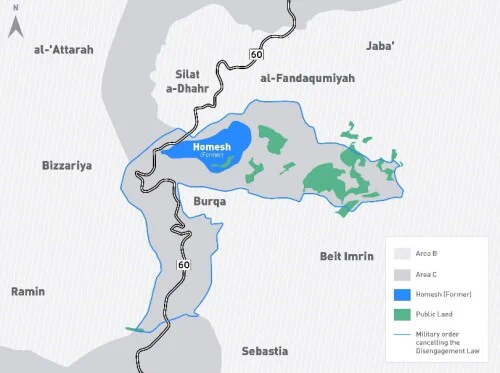
Palestinian landowners have filed a new petition with the Israeli High Court of Justice against the legalization of the Homesh outpost on a small sliver of state land surrounded by privately owned Palestinian land. The petition, which was filed in cooperation with the Israeli NGO Yesh Din, comes two weeks after another petition seeking the removal of the outpost was dismissed by the Israeli court. The State has been ordered to submit an initial response by mid-September.
Yesh Din said in a statement:
“The allocation of land to the Samaria Regional Council for the sake of establishing a new settlement deepens the continuation of systemic and blatant discrimination in the allocation of public lands in the West Bank. Less than one percent (! ) From the public lands were allocated for the benefit of the Palestinian public, while 99% were allocated to the settlements factory.
In this case, the purpose of the allocation is to promote political interest of a political level that cannot be part of the considerations of the military commander both according to international law and according to the High Court ruling. And in the specific context, the decision to allocate the land specifically to the Samaria Regional Council – in light of its many years involvement in breaking the law in the region – is unreasonable and in terms of awarding a prize specifically to the factors behind the violation. It even contradicts the authority and the main duty of the military commander to preserve and promote public order.”
As a reminder – Homesh was built on lands historically belonging to the Palestinian village of Burqa. The land was never returned to its Palestinian owners even after the settlement was dismantled in 2005. The legalization of the Homesh yeshiva – which was built illegally by settlers in the area where the Homesh settlement once stood – was explicitly agreed to in the coalition deals which formed the current Israeli government. On May 18, 2023 the IDF Commander signed a military order that finalized the Knesset’s recent repeal of key sections of the 2005 Disengagement Law, allowing Israelis to legally enter the area in the northern West Bank where the Homesh settlement stood before it was dismantled. In parallel, the Israeli Defense Minister announced that the government plans to relocate the Homesh outpost from its current location on land that Israeli courts have recognized as private Palestinian property, to a small plot of nearby “state land.” Settlers quickly rebuilt the yeshiva on the “state land” and the new outpost was soon connected to the State water grid.
Israel Massively Expanding Size of Outposts As Part of “Legalization” Process
 As part of the process of granting retroactive legalization to the outposts of Asa’el and Avigail (both located in the South Hebron Hills), the IDF recently published new maps of the proposed jurisdiction of the new settlements, showing that the government is planning to massively expand the new settlements’ boundaries. The Israel government approved the outposts for retroactive legalization, along with eight others, in February 2023. Now that the maps have been published, the public has 21 days to submit objections to the plans.

The Israeli non-profit Kerem Navot reports that the proposed new boundary of the Asa’el settlement is eighteen times larger than the outpost. The boundary of the Avigail settlement is nearly three times the size of the outpost. The Avigail outpost is located in Firing Zone 918 in the South Hebron Hills. This is the same firing zone that is home to the Palestinian communities of Masafer Yatta — whose existence pre-dates Israel’s declaration of the area as a firing zone. Those communities are today in the process of being ethnically cleansed by Israel.
Both Avigail and Asael have, illegally, built access roads on privately owned Palestinian land. Legalization of the outposts will undoubtedly also include the theft of the Palestinian-owned land these roads were illegally built on.
Israel to Allocate $180million to Settlements & Outposts
According to news reports, the Israeli government will soon vote to allocate an additional $180million (NIS 670 million) in the 2023-2024 state budget to settlements, including over $7 million (NIS 27.6 million) specifically for improving infrastructure in unauthorized outposts. The effort is being led by Finance Minister and minister in the Defense Ministry Bezalel Smotrich aligned with Settlements Minister Orit Strock. Ynet reports that the new funding calls for the conversion of five IDF bases in the West Bank to be converted into new settlements or industrial zones.
Peace Now reports further details of the budget:
- $25 million (NIS 95 million) allocated directly to the World Zionist Organization’s Settlement Division. As a reminder, the Settlement Division is a body within the WZO established in 1971 and fully funded by the Israeli government. Its mission was, and remains, to provide a channel by which the government can establish settlements – legally and illegally – in the occupied territories, while avoiding the pesky rules, regulations, and transparency requirements to which government entities are bound. The Israel government assigned management responsibilities to the WZO for over 60% of the land in the West Bank which the government declared to be “state land” (90,000 acres/400,000 dumans). The WZO has given that land to settlers to build settlements and secretly funnel government money to illegal outposts.
- $13 million (NIS 50 million) for encouraging Israeli Jewish citizens to move to settlements
- $3.6 million (NIS 13.7 million) for developing West Bank archaeological tourism sites, which comes in addition to the May 2023 invest of $9 million into these sites.
- $11.9 million (NIS 45 million) for the establishment of a new hospital.
- $15 million (NIS 57 million) for encouraging Israelis and others to move to the settlements.
The budget for these investments is being taken from the budgets of domestic programs.
Peace Now said in a statement:
“The Government of Israel is exerting all its power and the budget at its disposal to support one specific sector at the expense of the entire public. The allocation of 700 million NIS by the current government decision is evidence of the public officials’ shamelessness in prioritizing the interests of a small group living in occupied territory over the broader Israeli society. Instead of investing in Israel’s future, the Israeli government is pouring money into settlements, perpetuating the occupation, and fueling the conflict and confrontation with the Palestinians.”
Smotrich Orders Outpost Evacuation
On August 14th, on the orders of Bezalel Smotrich the IDF dismantled five buildings in an illegal outpost called “Aira Shahar“, from lands located east of Ramallah. The outpost remains on the land, with at least 15 structures allowed to remain. In explaining the demolition of the five buildings, Smotrich stressed that he attempted to negotiate the relocation of the buildings from lands recognized as privately owned Palestinian land to nearby state land. But settlers did not agree, and even attempted to stop the security forces from demolitioning the buildings by burning tires and scattering spikes on the access road.
Smotrich took heavy criticism from members of his own parties and the settlers who he serves. In his defense, Smotrich said:
“We are talking about several new buildings that were erected on regulated and private lands that belong to Arabs. We really want to settle anywhere in the Land of Israel, but there are laws and restrictions. We are doing things that have not been done for many years.”
Bonus Reads
- “Samaria farms open to public touring for the first time” (Arutz Sheva)
- “6 Things to Remember When Covering Israeli Settler Violence“ (IMEU)
- “West Bank: Entire Palestinian communities disappeared due to Israeli settler violence” (Norwegian Refugee Council)
- “Settlements Are the Engine of Israel’s ‘Forever Occupation’—and a War Crime” (Michael Lynk for DAWN)
- “The settlers wanted supreme power. They got a rebellion instead” (Meron Rapoport for +972 Magazine)
- “Palestinian Family Evicted From East Jerusalem Home Ordered to Pay for Own Eviction” (Haaretz)
- “‘Israel wanted a silent, perfect victim. We refused’” (+972 Magazine)
- “Ex-Israeli General Says Army Partner in West Bank War Crimes, Invokes Nazi Germany” (Haaretz)
- “Israeli Court Orders Release of Settler Suspected of Killing Palestinian in West Bank” (Haaretz)
- “Israel Prevents Palestinians From Defending Themselves as It Empowers the Settlers” (Amira Hass for Haaretz)
- “Radical Settlers Now Control the Israeli Government. This One Became a Left-wing Activist” (Haaretz)
Welcome to FMEP’s Weekly Settlement Report, covering everything you need to know about Israeli settlement activity this week.
To subscribe to this report, please click here.
February 28, 2020
- Fuel on the Fire: Netanyahu Advances E-1 Settlement Plans
- Making Good On Bibi’s Promise, Israel Issues Tenders for Givat Hamatos Settlement – And Plans for More
- High Planning Council Advances Plans for 1,739 Settlement Units, Including a New Industrial Zone
- Netanyahu Orders 12 Outposts Hooked Up to Israeli Infrastructure, with More to Follow
- Israel is Planning New West Bank Electricity Grid to Serve the Settlements
- Deputy Israeli AG Bemoans “Alarming Accumulation” Of Cases in Which Political Echelon Stops Outpost Evacuations
- Joint U.S.-Israeli Annexation Mapping Team Begin Work in Ariel
- Bonus Reads
Comments or questions – email Kristin McCarthy (kmccarthy@fmep.org).
Fuel on the Fire: Netanyahu Advances E-1 Settlement Plans
On February 26th, the High Planning Council of the Israeli Civil Administration deposited for public review two separate plans (for a combined total of 3,401 units) for the construction of the infamous E-1 settlement. This move sets in motion a 60-day public commenting period, after which the committee can grant final approval for construction. Long called a “doomsday” settlement by supporters of a two-state solution, construction of the E-1 settlement would sever the West Bank effectively in half, foreclosing the possibility of drawing a border between Israel and Palestine in a manner which preserves territorial contiguity between the northern and southern parts of the West Bank. It would likewise consolidate the isolation of Palestinian neighborhoods in East Jerusalem from the West Bank. In combination with the recent advancements on Givat Hamatos and new tenders for Har Homa, Prime Minister Netanyahu’s Greater Jerusalem settlement construction announcements – leading up to the third round of Israeli elections – have crossed red lines (in the eyes of the international community) that Netanyahu didn’t dare cross in the past.
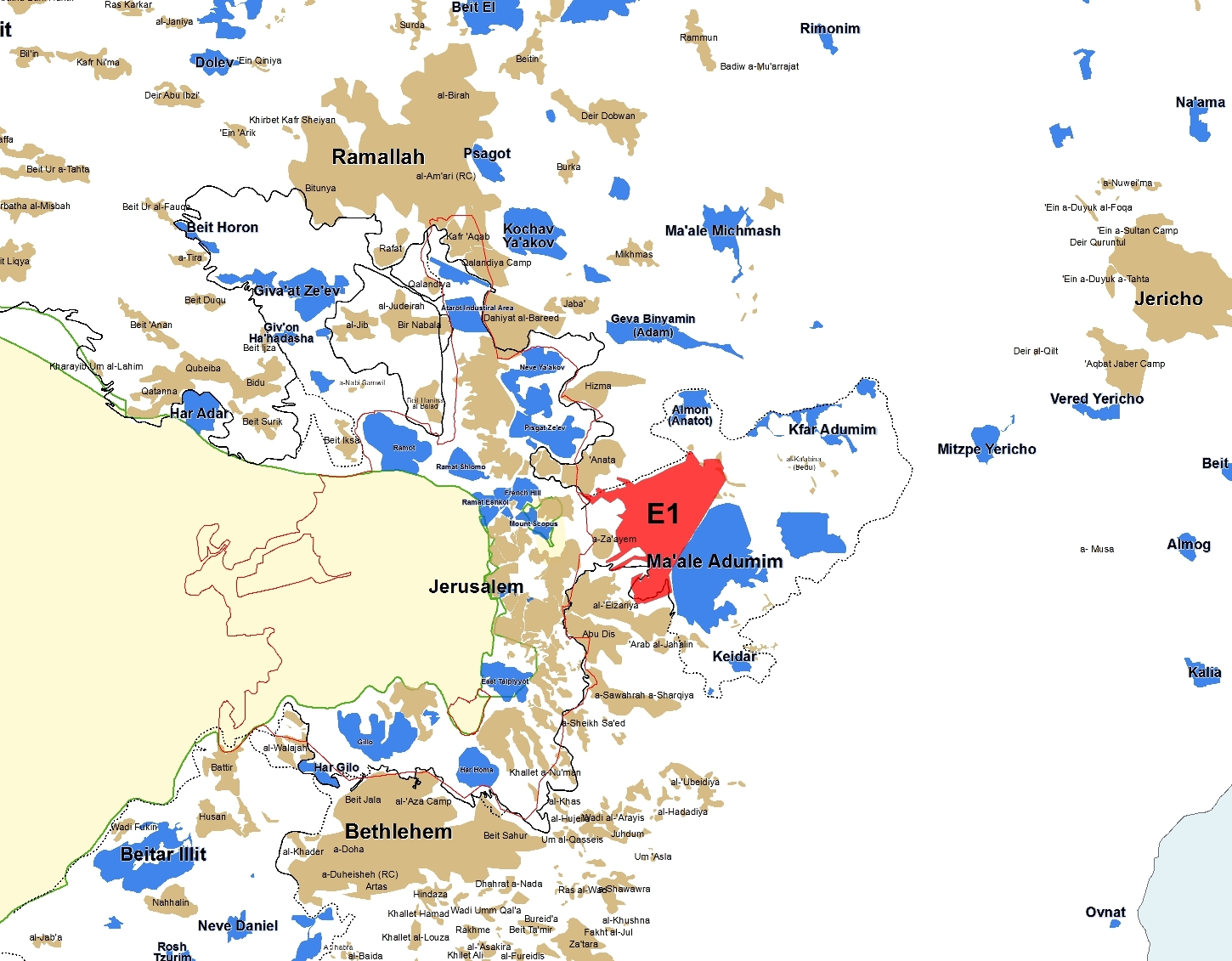
Map by Peace Now
The day before the High Planning Committee’s decision to deposit the plans, Netanyahu announced that he had lifted the freeze on E-1 that his government has imposed since 2012. Though the plans were approved for deposit in 2012, the administrative act of actually depositing the plans (which requires the plans to be published in at least three newspapers to inform the public) never occurred, largely as a result of intense international opposition to E-1. Under the recently released Trump Plan, the area where E-1 is located is slated to become part of Israel, meaning the long-held U.S. opposition to E-1 has transformed into apparent support.
Peace Now explains important context to Netanyahu’s flood of East Jerusalem settlement approvals:
“This move to promote settlement units in E1 should be understood in the context of government actions to promote settlement construction in Givat Hamatos and Har Homa to sever the Bethlehem-Jerusalem continuum, and the early promotion of a plan to turn the decommissioned Atarot Airport into a new Jerusalem settlement that would work toward severing the Ramallah-Jerusalem continuum. With E1 added to the mix, the pattern of severing the East Jerusalem and the West Bank is a clear policy direction of this government. While this announcement may be connected to the upcoming election, Netanyahu should be taken at his word and his comments should not be written off as campaign bluster. Indeed just this week he fulfilled a promise he made the week prior to publish tenders in Givat HaMatos, another area that was seen as a red line by the international community. It is likely that if moving on E1 is not met with deterring action domestically or abroad then it will further encourage settlement activity, seeing as E1 is the most recognized red line on settlement construction. The US, which has traditionally played a large role in deterring activity in E1, will likely not do so now with its current administration. Indeed, the Trump Plan envisions E1 as part of Israel, and allows for Israeli annexation pending coordination with the US and not negotiations with the Palestinians.”
Ir Amim adds:
“Although these advancements have taken place against the backdrop of the upcoming Israeli elections, they should also be seen as an alarm bell in the context of a new reality which has been created with the publication of the US Peace Plan. Carte blanche has essentially been given to Netanyahu and the Israeli government to further carry out unilateral measures in the Jerusalem area with little to no resistance. An acute exemplification of this major shift is the spate of new settlement plans (Atarot, Har Homa E, Givat Hamatos) being advanced over the Green Line in East Jerusalem, and now within the E1 area. After years of restraint due to international opposition, Israel is now set to advance construction in some of the most controversial areas in Jerusalem and along its perimeter. The realization of these plans will serve as an immense obstacle towards the future establishment of a Palestinian capital in the city and the prospect of a negotiated agreement based on a viable two-state framework.”
PLO Executive Committeewoman Hanan Ashrawi said in a statement:
“With the active participation and support of the current US administration, Israel is unilaterally and illegally annexing Palestinian territory and trampling on the Palestinian people’s most basic rights. These announcements are the practical translation of an extremist, ideologically-driven, and dangerous right-wing agenda that trounces Palestinian human rights and threatens to unravel the international order in favor of unilateralism, exceptionalism and political bullying.”
UN Special Coordinator for the Middle East Peace Process, Nikolay Mladenov, said:
“I am very concerned about Israel’s recent announcements regarding the advancement of settlement construction in Giv’at Hamatos and Har Homa, as well as the worrying plans for 3,500 units in the controversial E1 area of the occupied West Bank. All settlements are illegal under international law and remain a substantial obstacle to peace. If the E1 plan were to be implemented, it would sever the connection between northern and southern West Bank, significantly undermining the chances for establishing a viable and contiguous Palestinian state as part of a negotiated two-state solution. I urge the Israeli authorities to refrain from such unilateral actions that fuel instability and further erode the prospects for resuming Palestinian-Israeli negotiations on the basis of relevant UN resolutions, international law and bilateral agreements.”
Making Good On Bibi’s Promise, Israel Issues Tenders for Givat Hamatos Settlement – And Plans for More
As expected, on February 24th the Israeli Lands Authority published a tender for the construction of 1,077 housing units in the Givat Hamatos settlement. Haaretz reports that the tender relates to plans for “state land” and are intended to be sold as part of the the Treasury Ministry’s subsidized housing plan for young Jewish couples. Private companies will invited to bid on the project starting March 5th, with bidding set to close on June 22nd.
In addition to issuing tenders, the Jerusalem District Planning Committee met on February 27th to discuss the possibility of creating a new master plan for Givat Hamatos, in order to allow for more construction in the area. Ir Amim reports that the committee is considering a plan allowing for 6,500 residential units – which nearly doubles the total outlined in the current plan.
Ir Amim writes:
“This is the first time since the late 1990’s that Israel is constructing a new neighborhood/settlement in East Jerusalem. Furthermore, the location of Givat Hamatos means that its consturction will have dire consequences: It will serve to detach Bethlehem and the south of the West Bank from East Jerusalem while isolating the Palestinian neighborhood of Beit Safafa. For several years Netanyahu has abstained from publishing the Givat Hamatos tenders, serving as a source of frustration among rightwing parties. Netanyahu’s announcement therefore constitutes a break in the longstanding restraint. This dramatic change of policy should be seen in the context of his re-election campaign and against the backdrop of the formal release of the US Peace Plan.”
In announcing his support for the construction of the Givat Hamatos settlement last week, Netanyahu also mentioned plans to build 1,000 new homes for Palestinian residents of Beit Safafa – an East Jerusalem neighborhood which will be completely encircled by Israeli construction if/when the Givat Hamatos and Har Homa West settlement plans are implemented. According to Haaretz, the plan was/is to build 1,000 units on “Arab-owned” land — and that plan, in fact, is frozen.
In reaction to the tender for construction of the Givat Hamatos settlement, European Union High Representative Josep Borrell said in a statement:
“The Israeli authorities have announced an imminent decision regarding settlement construction in the Givat Hamatos and Har Homa neighbourhoods in East Jerusalem. Such steps would be deeply detrimental to a two-state-solution. As set out clearly on numerous occasions by the European Union, including in Council conclusions, such steps would cut the geographic and territorial contiguity between Jerusalem and Bethlehem, isolate Palestinian communities living in these areas, and threaten the viability of a two-state solution, with Jerusalem as capital of both states. Settlements are illegal under international law. The EU will not recognise any changes to the pre-1967 borders, including with regard to Jerusalem, other than those agreed by the parties. We call on Israel to reconsider these plans.”
High Planning Council Advances Plans for 1,739 Settlement Units, Including a New Industrial Zone
On February 27th, the High Planning Council – a body within the Israeli Civil Administration responsible for regulating all construction in the West Bank – approved the advancement of plans for 1,739 settlement units in the West Bank. These advancements come on the heels of the publication of tenders to build the E-1 settlement , the initiation of plans to massively expand the Har Homa settlement, and the recommitment of Israel to build a new massive new settlement in East Jerusalem, at the site of the disused Atarot airport. All of these plans deal with construction on the edges of Jerusalem and serve collectively to sever the connection between Palestinian neighborhoods of East Jerusalem and the West Bank (consolidating Israel’s uncontested sovereignty over “Greater Jerusalem”).
Of the total, 703 units received final approval, including:
- Plans to grant retroactive legalization to 620 units in the Eli settlement, a move which had been frozen by the High Court of Justice for the past 5 years while the Court considered a petition filed by Palestinians (with the assistance of Yesh Din and Bimkom) claiming to own the land. Last week, the High Court ruled against the Pallestinian petition and removed the injunction against the plans. The Eli settlement is located south of Nablus and southeast of the Ariel settlement in the central West Bank
- 48 units in the Har Bracha settlement, located just south of Nablus
- 35 units in the Givat Ze’ev settlement, located south west of Ramallah (north of Jerusalem).
Of the total, 1,036 units were approved for deposit for public review, including:
- A new industrial zone – called “Shaar Hashomron” – to be located south of the Palestinian village of Qalqilya (a town which is literally surrounded on three sides by the Israeli separation barrier – which in this area is, indeed, a massive wall). Peace Now reports: “[the new industrial zone is] close to Green Line, east of Salfit and South of Qalqilya, near the planned Nahal Rabah cemetery. In the area of Nahal Rabah, there existed a firing zone for years that prevented the use of the land. The land’s designation as a firing zone was lifted a few years ago, and the government’s Blue Line team set new boundaries for the state lands that comprised this area, all in preparation for a plan to build a new industrial zone. Industrial zones are a type of settlement in of themselves, and the planned cemetery is likely to be the first component toward establishing the new industrial zone. The plan for this new industrial park is separate from the 1,739 housing units advanced in the HPC announcement.”
- A winery in the Kiryat Arba settlement, located on the border of Hebron.
- 534 units in the Shvut Rachel settlement, located near the Shilo settlement in the central West Bank. Shvut Rachel only recently became an authorized settlement area when Israel extended the jurisdiction of the Shiloh settlement to include it as a “neighborhood” (along with three other outposts).
- Two plans for a total of 156 units in the Tzofim settlement, located just north of the Palestinian village of Qalqilya, a town completely encircled by Israel’s seperation barrier (except for a single road connecting it to the rest of the West Bank) – in the northern West Bank.
- 110 units in the Alon Shvut settlement, located south west of Bethlehem.
- 106 units in the Ma’aleh Shomron settlement, located east of the Palestinian village of Qalqilya.
- 105 units in Kfar Eldad (formally a part of the Nokdim settlement), located south of Bethlehem.
- 24 units in the Karnei Shomron settlement, located in the northern West Bank east of the Palestinian village of Qalqilya. Israel is planning to continue expanding Karnei Shomron with the stated goal of bringing 1 million settlers to live in the area surrounding the settlement.
The Times of Israel notes that this is the second time the High Planning Council has convened in as many months, marking an uptick in the frequency of such meetings, which until now have taken place quarterly (4x/year) since the Trump Administration came into power.
Peace Now said in a statement:
“The caretaker government, without a public and moral mandate, sets facts on the ground for a small and extreme minority, against the will of the majority. In the battle over the settler right-wing vote, Bennett and Netanyahu are dragging Israel to invest in thousands of harmful and unnecessary settlement units. This is how a cynical and irresponsible leadership that is willing to abandon the Israeli interest for its political survival behaves.”
Netanyahu Orders 12 Outposts Hooked Up to Israeli Infrastructure, with More to Follow
On February 23rd, Prime Minister Netanyahu announced that he had ordered 12 unauthorized outposts to be connected to Israeli infrastructure, and that his government was working to formally legalize over 100 outposts. Connecting outposts to Israeli water, sewer, power, garbage collection, and other municipal services entrenches the permanence of these outposts and furthers the de facto annexation of Palestinian land. It also copiously rewarding settlers for breaking Israeli law (by illegally building outposts), incentivizing further lawbreaking by Israel’s most radical and ideological settlers. 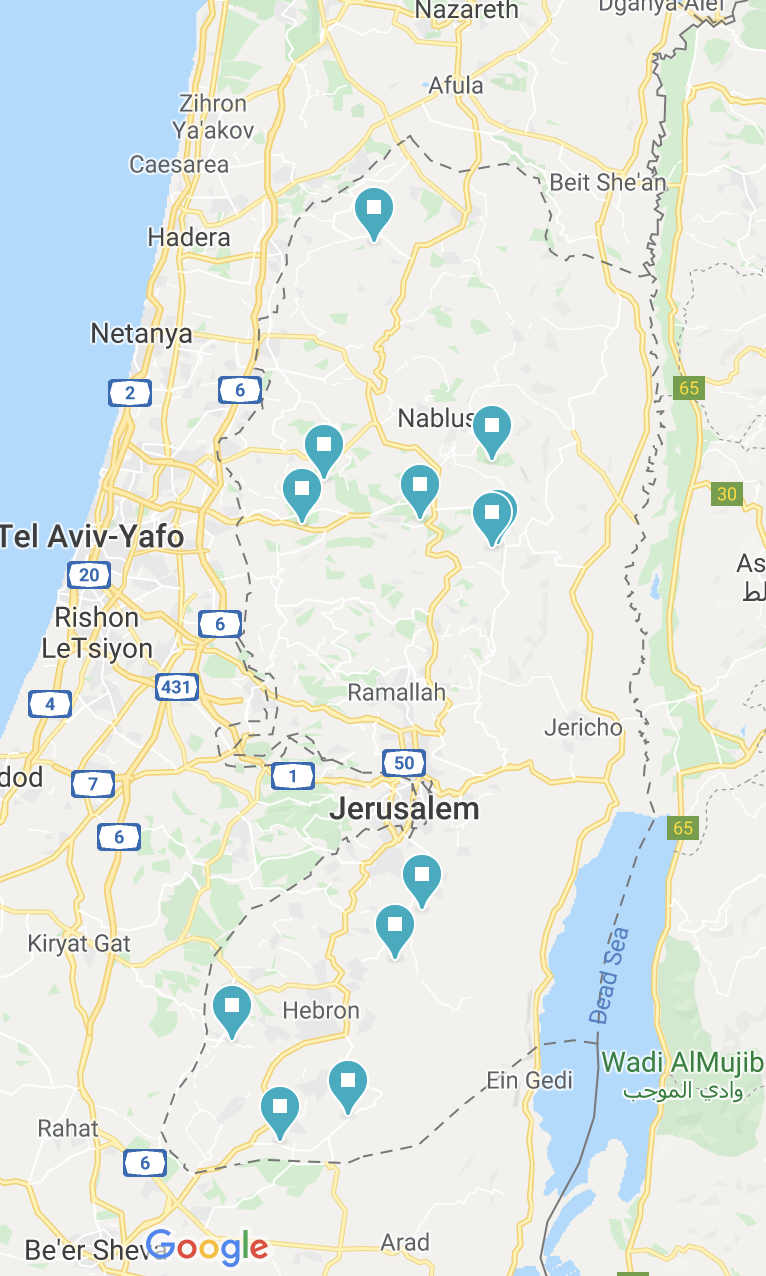
According to a letter from Netanyahu’s office, the 12 unauthorized outposts that will be connected to Israeli infrastructure were all built with “government encouragement” (though not formal approval or permits). In a perversion of the very notion of the “rule of law,” this unofficial encouragement for illegal actions is now treated by Israel as a valid legal basis for granting those outposts authorization.
The outposts slated for connection to Israeli municipal services are:
- The Nofei Nehemia outpost, located east of the Ariel settlement in the heart of the West Bank.
- The Havot Yair (Yair Farm) outpost, located west of Nablus.
- An outpost called “Hill 851”, located south east of Nablus in the central West Bank.
- The Maoz Zvi outpost, located in the northern West Bank.
- The Shaharit outpost, located in a string of settlements stretching from Israel proper to the Ariel settlement in the central West Bank, and going on to the Jordan Valley.
- The Pnei Kedem Farm outpost, located halfway between Bethlehem and Hebron in the southern West Bank.
- The Tekoa D outpost, located southeast of Bethlehem.
- The Negohot Farm outpost, located west of Hebron.
- The Avigayil outpost, located in the South Hebron Hills near the village of Susya.
- The Asa’el outpost, located east of the Palestinian village of Susiya in the southern tip of the West Bank.
- The Esh Kodesh outpost, located east of the Ariel and Shilo settlements, in a string of settlements stretching to the Jordan Valley.
- Ahiya, located in the Shilo Valley in the central West Bank.
David Elhayani, head of the umbrella settlement body called the Yesha Council, cheered Netanyahu’s announcement, saying:
“This is an important step for the benefit of young communities that have been suffering from electricity problems for years, and will now be able to receive electricity, just like any other citizen in the country.”
Since the passage of the Regulation Law in February 2017 and the invention of the “market regulation” principle by the Israeli Attorney General, the Netanyahu government has undertaken an energetic effort to grant retroactive legalization to outposts for which the Israeli government has not yet found a means to grant retroactive approval (though it has tried). The obstacle in all of these cases has been the fact that the outposts were built on privately owned Palestinian land. Following passage of the Regulation Law, Netanyahu immediately formed a committee tasked with finding a way to suspend the property rights of Palestinians; that committee produced the Zandberg Report in May 2018 — a report that, indeed, offers several justifications for the government to expropriate privately owned Palestinian land (one of the Report’s recommendations is to connect the outposts to Israeli municipal services). Following the publication of the Zandberg report, Netanyahu formed another committee tasked with implementing the report’s recommendations, by preparing individualized plans for each outpost to gain retroactive legalization. That taskforce, headed by notorious settler Pinchas Wallerstein. helped secure Cabinet approval for another bill to grant authorization to 66 outposts. All but two of the outposts named by Netanyahu this week (Hill 851 & Negohot) were part of a December 2018 bill to regulate 66 outposts – a fact that has drawn the wrath of settler leaders who bemoan Netanyahu’s delayed implementation.
FMEP tracks all events related to Israeli annexation and the drive to authorize outposts in its regularly updated Annexation Policy Tables.
Israel is Planning New West Bank Electricity Grid to Serve the Settlements
Haaretz reports that the Israeli government is close to approving a Master Plan for a new electricity grid in the West Bank, which will service Israel’s settlements. It may also serve Palestinian villages but only if — and it is a big if — the Palestinian Authority agrees to jointly implement the project. The plan is in the hands of Israel’s National Infrastructure, Energy and Water Ministry, which seeks to “provide a blueprint for the electricity market in the West Bank through 2040 and to develop infrastructure for Israeli settlements as well as for the Palestinians residing there.” However, the Israel-conceived plan calls upon the the Palestinian Authority to take responsibility over the Palestinian side of the equation, and the PA has refused to play that role and has condemned the plan.
In a statement, the Palestinian Authority’s Energy Authority said that the plan is designed:
“to establish Israeli sovereignty in the West Bank and to support the brutal presence of the settlements on our land.”
Settler leaders concurred with the PA’s assessment. Gush Etzion Regional Council chairman Shlomo Ne’eman told Haaretz:
“All moves point to sovereignty, and when we build infrastructure, there is also a basic understanding that the State of Israel is the sovereign. We are pleased that more and more government ministries have realized that this sovereignty is the reality.”
The plan, as reported by Haaretz, would see the Israeli Electric Company build a vast network of power lines across the West Bank. Israel will build six substations in Area C of the West Bank to distribute the high voltage power to settlements. Palestinians, if they are willing, are called upone to build eight substations in order to distribute power to Palestinian homes. The project is expected to cost between $870 million to $1.2 billion. The integration of settlements into Israel’s domestic planning schemes and the construction of massive infrastructure in the West Bank to service the settlements are significant advancements in Israel’s ongoing, de facto annexation of land in the West Bank.
Deputy Israeli AG Bemoans “Alarming Accumulation” Of Cases in Which Political Echelon Stops Outpost Evacuations
Haaretz reports that the Israeli Civil Administration planned to evacuate the unauthorized Mitzpe Yehuda outpost, located east of Jerusalem, in September 2019, but was directed to cancel the evacuation by one of Netanyahu’s personal aids in the Defense Ministry – Avi Roeh. The political interference was revealed in a High Court case filed by Palestinians claiming to own the land upon which the outpost was illegally constructed. The Palestinians are seeking to have the outpost immediately evacuated. Settlers claim to have purchased the land, and even submitted an application to have the outpost retroactively legalized by the government.
At the time of the scandal, Deputy Attorney General Erez Kaminitz wrote to Ronen Peretz, acting director of the Prime Minister’s Office, criticizing Roeh’s role in the Mitzpe Yehuda case, as well as the recurrence of political interference on behalf of the outposts. Citing several cases in which such interference occurred (Sde Ephraim, Givat Assaf, and Havat Negohot), Kaminitz wrote:
“This is a very alarming accumulation of cases that raises the specter of the emergence of a highly problematic trend that undermines the rule of law. It’s important to make clear that, as a rule, the political echelon is not authorized to intervene in decisions related to law enforcement.
Joint U.S.-Israeli Annexation Mapping Team Begin Work in Ariel
On February 24th, members of the U.S.-Israeli team tasked with mapping Israel’s annexation of West Bank land under the Trump Plan met for the first time to “explore the terrain.” At a vista near the Ariel settlement, Netanyahu underscored the significance of the project:
“The joint mapping process of the Israeli team and the American team is underway here in Ariel. This is a major mission. The area has an 800-km. perimeter. There is serious work, but we will work as quickly as possible to get it done…[the mapping process will] allow for the application of Israeli law [sovereignty] on these areas and later American recognition as well…[once complete] sovereignty can happen immediately.”
U.S. Ambassador David Friedman said:
“In Israel rain is a blessing, and I hope that our efforts should be blessed as much as the rain is coming down right now,” Friedman declared before the meeting started, the US Embassy in Jerusalem said in a statement. “We have our team here, and we’re going to get to work right away. We hope to complete it as soon as possible, and complete it the right way for the State of Israel.”
Ariel Mayor Eli Shaviro – one of the few settler leaders who publicly supports the Trump Plan – praised the mapping team, saying:
“The sovereignty ship is under way. As I have said in the past, I believe that the prime minister will advance the ‘Deal of the Century’ with President Trump and US officials. believe that the application of Israeli law in the Jordan Valley and in the communities of Judea and Samaria is closer than ever.”
Shaviro recently resigned from the settler Yesha Council over the group’s disavowal of the Trump Plan.
Bonus Reads + Resources
- “An Alternative Guide to City of David Archeological Park” (Emek Shaveh)
- “The Trump plan threatens the status quo at al-Haram al-Sharif” (Al Jazeera)
- “50 ex-European leaders and FMs condemn Trump plan, cite apartheid similarities” (The Times of Israel)
- “Planned Western Wall Train Will Threaten Historic Jerusalem Spring, Report Says” (Haaretz)
- “The Israelis fighting to keep the Jordan Valley Palestinian” (Al-Monitor)