Welcome to FMEP’s Weekly Settlement & Annexation Report. To subscribe to this report, please click here.
October 17, 2025
- Settlers Establish New Outpost to Encircle Umm Al Kheir, Court Pauses Move-In
- Eviction Date Looms for Six Families Facing Displacement from Homes in Silwan
- As The Olive Harvest Starts, Settler Terrorism Reaches New Heights
- Israeli Commitment Against West Bank Annexation is Not in Final Ceasefire Deal
- International Crisis Group Report: “Sovereignty in All but Name: Israel’s Quickening Annexation of the West Bank”
- Bonus Reads
Settlers Establish New Outpost to Encircle Umm Al Kheir, Court Pauses Move-In
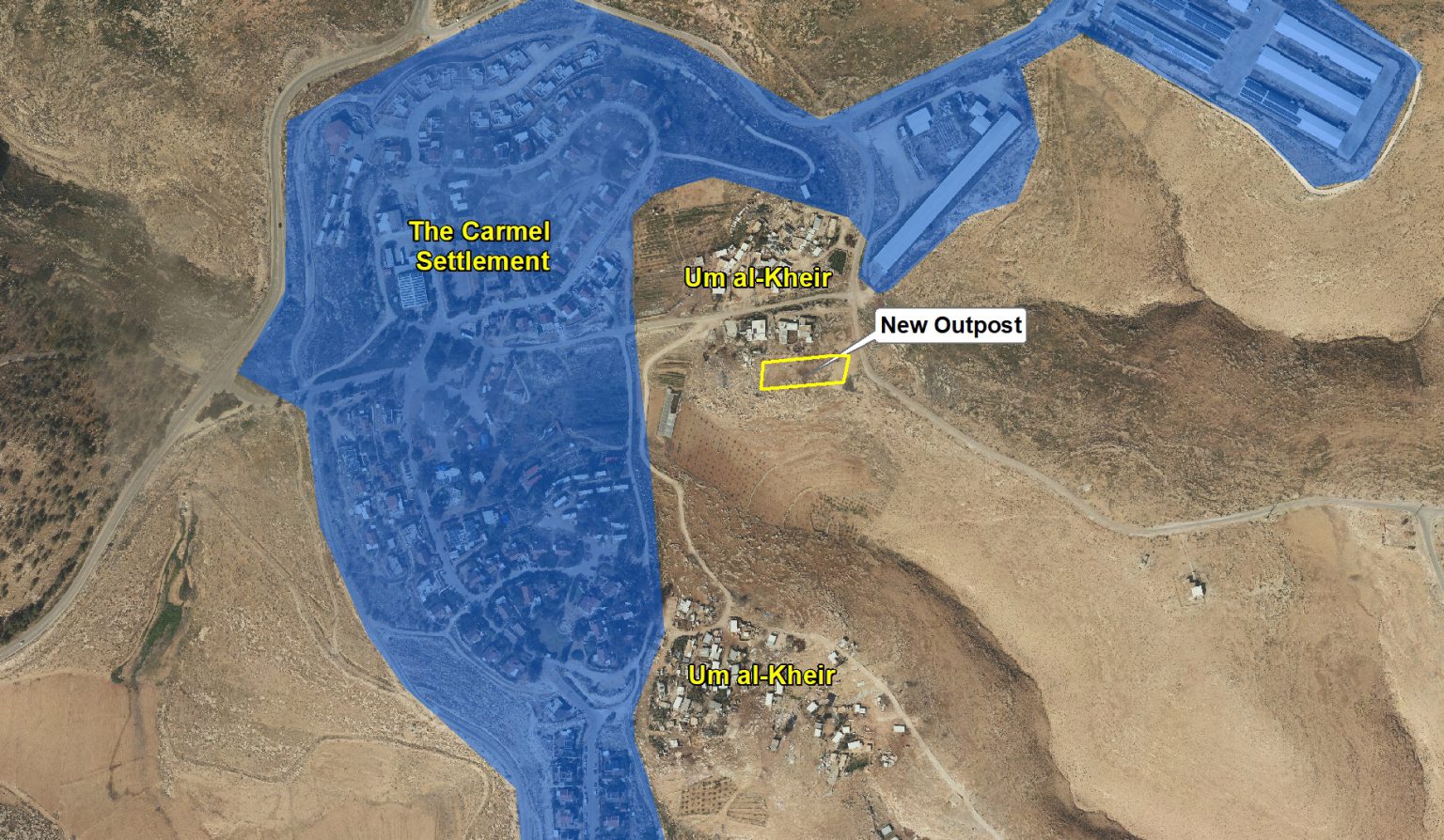 Two months ago, Israeli settlers began building yet another outpost surrounding the tiny Palestinian village of Umm al Khair in the South Hebron Hills, almost completing the encirclement of the 200 people who live in village by the Carmel settlement and its illegal outposts. The settlers cleared land and moved in caravans into the area, within spitting distance of Palestinian homes, as part of their years-long effort to expand their control of land in the area and compel/coerce the displacement of Umm al-Kheir. It was during the settlers illegal preparation of the land for this new outpost that Awdah Hathaleen, a prominent activist in the area and a protagonist in the critically acclaimed documentary No Other Land, was shot and killed by the internationally sanctioned settler Yinon Levy.
On October 12th, the Jerusalem District Court issued an order temporarily barred settlers’ from inhabiting the new outpost while the Court considers the underlying legal challenge which seeks to compel settlers to remove the caravans from the land. Settlers promptly violated the Court order, and moved more caravans into the area the very next day.
Peace Now said in a statement:
“For months, all enforcement authorities have known full well about the massive, blatantly illegal construction project taking place on the village’s land — and not only did they do nothing to stop it, they actually secured and assisted it in various ways. It is depressing and sad, though not surprising, that it takes a court order to make the army and the police do their duty. We hope the order will give the residents of Um al-Kheir, who are suffering under the settlers’ ongoing harassment, some space to breathe and live normal lives.”
Eviction Date Looms for Six Families Facing Displacement from Homes in Silwan
Six Palestinian families living in the Silwan neighborhood of East Jerusalem are facing an impending eviction date ordering them to vacate their longtime homes sometime between October 19 and November 4. If the families do not agree to their own displacement, Israeli police will remove them by force. At this point, all legal remedies have been exhausted and the Nasser, Rajabi, Shweiki, and Odeh families are set to be forcibly displaced under at the behest of Israeli settlers and the facilitation of Israeli legal courts, a system Ir Amim describes as: “proceedings [that] are underpinned by structural discrimination rooted in Jewish supremacy and a system rigged against Palestinians from the outset, which denies them equal access to justice.”
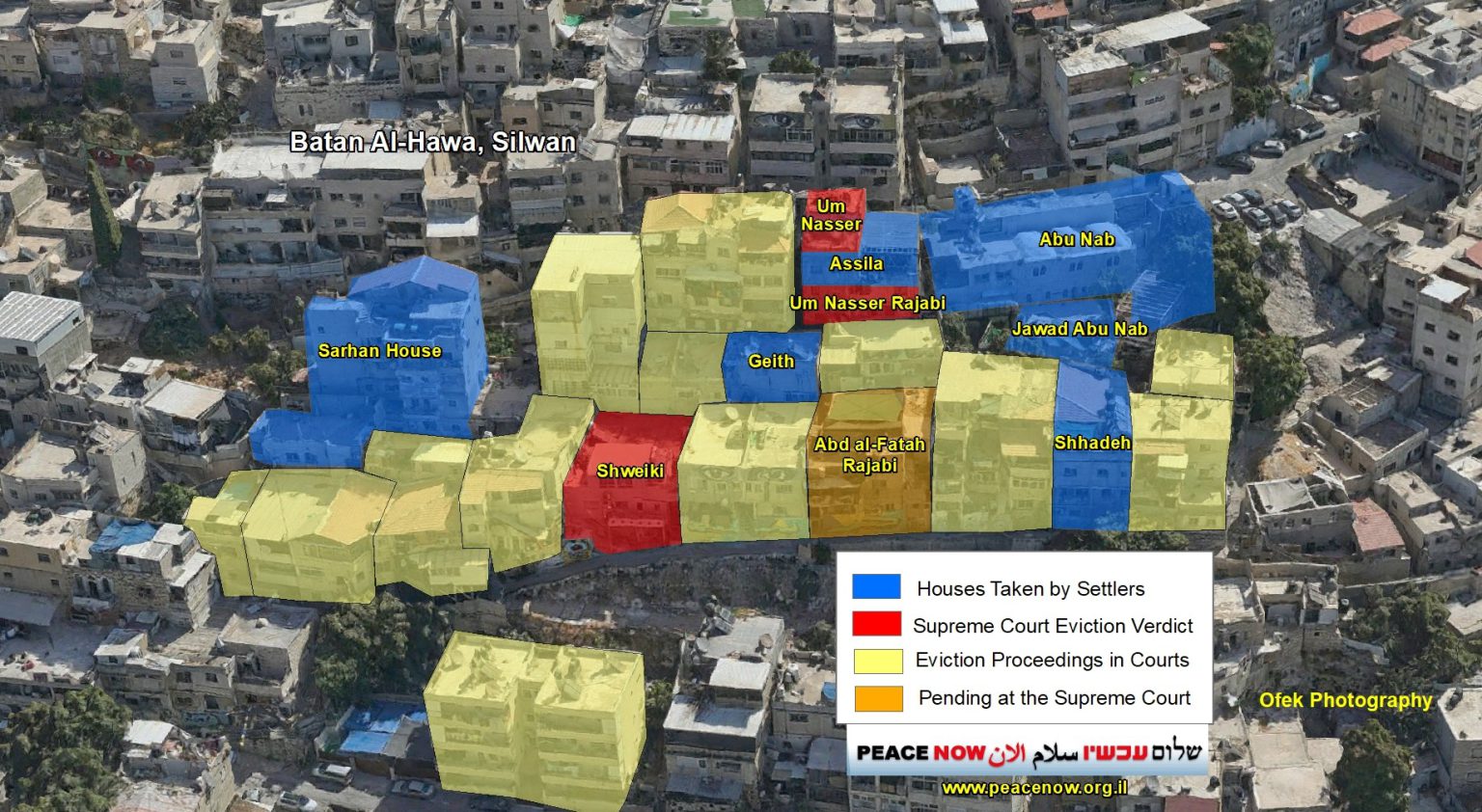 For more background on these cases, see Peace Now’s reporting.
Peace Now reports that 16 families have already been evicted from the Batan al-Hawa section of Silwan – 6 in this year alone – with settlers facilitating their displacement and taking up residence in the vacated homes. There are five additional cases affecting dozens of families that are at various stages in the Jerusalem Magistrate Court.
Peace Now said in a statement:
“This is a real emergency. If the government does not intervene, and if pressure is not brought to bear on it to act, we may witness in the coming weeks families literally thrown out into the street and settlers taking their place. This is a terrible injustice, based on discriminatory laws and on the ongoing exploitation and marginalization of East Jerusalem residents. The dispossession of Palestinians from their legally purchased homes in Silwan, under the guise of realizing a “right of return” for Jews, is an indelible stain on the State of Israel. The government can and must stop the forced expulsion of an entire community—the responsibility lies on its shoulders.”
As The Olive Harvest Starts, Settler Terrorism Reaches New Heights
The Palestinian olive harvest is now underway, and as in past years presents a massive target for violent settlers to terrorize Palestinians attempting to work their land – and in fact settler violence has rapidly increased from already high levels. Between 7 and 13 October, OCHA documented 71 Israeli settler attacks against Palestinians, 36 of which were directly connected to the olive harvest. As a result of the documented attacks, 99 Palestinians were injured and 1 killed. These attacks have included:
- On October 8th settlers were throwing stones at Palestinian cars near the village of Deir Jarir, located near Ramallah. One Palestinian was shot and killed when settlers opened fire on a group of people who had gathered to chase off the stone-throwers. This is the 12th settler attack on Deir Jarir this year, according to OCHA.
- On October 9th, settlers raided the village of Atara, near Ramallah, damaging homes and cars. Settlers established a new outpost near Atara in August 2025, and have since used the outpost as a launching point to routinely attack Atara. OCHA has counted at least 8 attacks so far.
- On October 10th, settlers attacked the Palestinians harvesting olives near Beita, resulting in an injury to an AFP photographer. Settlers further seized harvesting equipment and burned 12 vehicles.
- On October 12th, settlers staged a large-scale attack on the village of Burqa during which they cut down over 800 fruit trees (including olive trees, citrus trees, and grapevines).
- On October 13th, settlers accompanied by Israeli forces attacked Beit Fajjar, near Bethlehem. Settlers assaulted a family of six which was attempting to harvest grapes, and later assaulted the emergency responders who came to assist the victims. Settlers used sticks, molotov cocktails and dogs to injure the family, and later burned their vehicle.
- On October 13th, settlers attacked the village of Ein Yabrud, near Ramallah, and burned down a house.
- On October 16th, the two different groups of Paelstinians harvesting olives near Burin were attacked by settlers from the Yitzhar settlement. The harvesters were chased off and their farming equipment was stolen.
Israeli Commitment Against West Bank Annexation is Not in Final Ceasefire Deal
According to leaked reports, an earlier version of the Trump ceasefire deal included a commitment that Israel would not annex the West Bank. Despite Trump’s press conference weeks before where he said publicly that he will not allow Israel to annex the West Bank, ultimately the commitment was not included in the final ceasefire deal.
Nonetheless, The Times of Israel reports that the Knesset is set to reconvene from its summer break and immediately take up a few bills that would affect the annexation of the West Bank. A Knesset insider told The Times of Israel:
“there is a majority in the Knesset to annex today…The reason it’s not on the agenda is because Netanyahu has made it very clear that he’s not going to support anything of the sort. You can say it’s because of Trump. You can say it’s because of his own fear of global isolation or a regional war or whoever knows what it is that he’s thinking. But if there was a secret ballot in the Knesset today, a majority would definitely annex.”
The source further told the outlet that Netanyahu will find a way to postpone voting on the annexation bills, without outright opposing them, until the next election in October 2026.
International Crisis Group Report: “Sovereignty in All but Name: Israel’s Quickening Annexation of the West Bank”
The International Crisis Group (ICG) published a new report entitled, “Sovereignty in All but Name: Israel’s Quickening Annexation of the West Bank.” The report responds to European states offering recognition to the State of Palestine, a recognition with ICG calls a “strategy that should also have teeth,” taking seriously that “annexation is not a future threat – it is already under way.” The report urges international actors to do what they can to “halt the further consolidation of Israel’s annexation and to begin the difficult work of persuading Israel to reverse course.”
The Executive summary of the report ends:
“The impediments to a two-state solution to the Israel-Palestine conflict are longstanding and immense, and a body of informed commentary argues that they are indeed insurmountable. Perhaps they are, but there is no world in which the further progress of annexation will produce a better result for the Palestinian people – or, for that matter, for Israelis. Israel may never alter its posture in the West Bank, but if outside actors play a long game and act concertedly, they will optimise their chances of changing its behaviour. Absent that, the status quo, which denies the Palestinian people not just a state, but also basic rights, will only become further entrenched.”
Bonus Reads
- “Sweeping Israeli actions transform West Bank in shadow of Gaza war” (Washington Post, 9/28/25)
- “Ben-Gvir’s Aide Suspected of Preventing Weapon Seizure of Settler Who Shot at Palestinians” (Haaretz, 9/29/25)
- “Israel detains two Palestinian children in Hebron under claims of ‘espionage‘” (Middle East Eye, 10/1/25)
- “The Trump-Netanyahu Peace Deal Promises Indefinite Occupation” (The Intercept, 10/1/25)
- “Israeli bulldozers in West Bank carve up hopes for Palestinian state” (Reuters, 10/2/25)
- “Bureaucratic Antics for Three West Bank Villages Show How an Israeli Annexation Began Long Ago” (Haaretz, 10/12/25)
- “At This West Bank Checkpoint, ‘It’s Not Just Movement That’s Blocked. It’s Time Itself’” (Haaretz, 10/13/2025)
- “Israeli settlements close in on West Bank herding community” (Al-Monitor, 10/10/25)
- “Despite war’s end, Smotrich calls for renewed Jewish settlement in Gaza” (Ynet, 10/14/25)
Welcome to FMEP’s Weekly Settlement Report, covering everything you need to know about Israeli settlement activity this week.
To subscribe to this report, please click here.
June 23, 2023
- Smotrich Receives Near Unilateral Power Over Shortened Settlement Planning Process
- Israel To Advance Plans for 4,799 New Settlement Units, Including Retroactive Authorization of an Outpost
- Netanyahu Announces 1,000 New Units for the Eli Settlement in “Response” Palestinian Attack
- Settlers Reoccupy Evyatar Outpost As Netanyahu Reportedly Decides to “Legalize” It & Ben Gvir Encourages More Illegal Settlement Activity
- With Assistance from IDF, Settlers Establish a New Outpost Near Eli
- Settler Violently Rampage Across West Bank with Little to No Repercussion
- Eviction of Palestinian Ghaith-Sub Laban Family Scheduled
- Bonus Reads
Smotrich Receives Near Unilateral Power Over Shortened Settlement Planning Process
On Sunday, June 18th the Israeli Cabinet approved a measure that immediately expands Bezalel Smotrich’s authority over construction in existing settlements by significantly shortening the planning process and removing almost any role for Israeli politicians in that process, a lever which – for decades – has been utilized by successive Israeli governments to intervene in settlement planning usually in consideration of pressure from the international diplomatic community. Under the new procedures, political approval is only needed once at the very beginning stage of the planning process, whereas for the past three decades political approval was needed at each and every phase.
In Haaretz, Israel lawyers Ronit Levine-Schnur and Michael Saliternik explain:
“The requirement of the defense minister’s approval at each stage reflected the understanding that settlement construction, which is illegal under international law, has major legal, diplomatic and security implications. This requirement enabled government officials to halt or postpone construction in the settlements based on the changing political and security situation, and sharpened the distinction between construction within the state’s sovereign borders and construction on occupied land under Israel’s temporary military control….This week’s decision…is designed to prevent or significantly reduce not only the government’s but also the public’s and international community’s oversight of settlement construction.”
Removing the role of political figures surrenders the power of settlement planning and construction to an avowed annexationist whose agenda, at least in part, is to double the number of settlers while further entrenching Israeli domestic rule over settlers and leaving Palestinians under Israeli military rule. The Israeli Cabinet decision advances both of these goals: it differentiates settlement planning from planning for Palestinians (which remains a more complicated political-bureaucratic process in which Smotrich and Defense Minister Gallant both have power); and, as Smotrich and his allies are framing it, this procedural change “normalizes” the laws governing settlers by aligning them with Israeli domestic rule. In the words of Peace Now, “From a planning perspective, there is no difference between the Tel Aviv district and the ‘Judea and Samaria’ district, except for the initial decision by Minister Smotrich.”
The change is celebrated by settler leadership. Yisrael Gantz, head of the Benjamin Regional Council, said:
“This government resolution brings the residents of Judea and Samaria to the regular situation of the entire State of Israel,” said Gantz, using the biblical name for the West Bank region. “This step will turn construction in the settlements into something that is not newsworthy but rather, routine.”
Yossi Dagan, head Head of the Samaria Regional Council, said:
“We must stop treating residents of Judea and Samaria as second-class citizens. It’s unthinkable that only residents of Judea and Samaria need approval from the political echelon in order to build a home or a kindergarten.”
It’s worth re-sharing the latest legal analysis and commentary arguing that Israel has, even without a formal declaration, annexed the West Bank via bureaucratic transformations such as this: “A Theory of Annexation” (Berda, Meggido, & Levin-Schner, January 2023 – SSSN); “Israel is Officially Annexing the West Bank” (Sfard, June 2023 – Foreign Policy); and, “Israel’s Annexation of the West Bank Has Already Begun” (Scheindlin & Berda, June 2023 – Foreign Affairs); “This Decision by Israel Is as Dramatic as Attempts at Constitutional Change” (Levine-Schnur & Saliternik, June 2023 – Haaretz)
Peace Now further comments:
“The implication of this decision is that once Minister Smotrich decides and approves the advancement of construction plans in West Bank settlements, the plans will go directly to the planning committees in the West Bank (the Higher Planning Council), and the political and military echelon will have no authority to delay or influence the planning stages or the submitted plans. This process will allow unrestricted construction in the West Bank, disregarding security and diplomatic considerations, and perpetuating de facto annexation in the West Bank.”
The Haaretz Editorial Board writes:
“The settlers’ patience has paid off. After 27 years, they have managed to bring about a change in the way the system operates. The government decided to give a messianic settler, one who favors Israeli sovereignty over the entire Land of Israel and supports Jewish supremacy, the power to speed up construction in the settlements…Smotrich and the settlers understood very well that Netanyahu’s utter dependence on the extreme right opened a historic window of opportunity for them, and they are exploiting every moment of it to take over more and more Palestinian land to build, alter the area irreversibly and entrench one large apartheid state between the Jordan River and the Mediterranean Sea. The crisis that Israel is mired in is a golden opportunity for the settlers and their destructive project.”
Israel To Advance Plans for 4,799 New Settlement Units, Including Retroactive Authorization of an Outpost
On the same day Smotrich was awarded new power to oversee settlement construction, the Israeli High Planning Council published an agenda for its June 26th meeting outlining plans for 4,799 settlement units which will be advanced, to include plans which would have the effect of retroactively legalizing the Palgei Maim outpost as a neighborhood of the Eli settlement. The June 26th meeting will be the second time the High Planning Council convenes this year, and could bring the total number of settlement units advanced in 2023 to 12,149 – – nearly three times more than in the entire 2022 year (4,427 units). Smotrich – who now has near unilateral authority over construction planning for settlements – gloated in a statement saying that 2023 has set “a record for the rate of settlement construction [planning] in the last decade” and:
“The construction boom in Judea and Samaria and in all parts of our country continues. As we promised, today we are advancing the construction of thousands more new units in Judea and Samaria… We will continue to develop the settlements and strengthen Israel’s hold on the territory.”
Peace Now said in a statement:
“The Israeli government is advancing us at an unprecedented pace towards the annexation of the West Bank. The promotion of nearly 5,000 housing units, including the authorization of a settlement in the heart of the West Bank, joins a series of destructive decisions that the government has advanced, including yesterday’s decision granting exclusive power to Minister Smotrich for promoting settlements in the occupied territories. As the world remains silent and public attention is focused on preventing the judicial coup, the government is rushing towards an annexation coup turning Israel into an apartheid state.”
Of the total number of units on the agenda, 1,434 units are set for final approval, including:
- Carmel – 42 units, expanding construction in the settlement towards the southeast. This settlement is located in the South Hebron Hills, where Palestinians are facing ongoing displacement and forcible relocation.
- Elkana – 351 housing units. Elkana is located in the northern West Bank in an area where the Israeli separation barrier cuts deeply into the land in order to keep settlements on the Israeli side of the barrier.
- Givat Ze’ev – three plans totalling 642 units. Givat Ze’ev is located north of Jerusalem.
- Revava – 399 housing units. Revava is located west of the Ariel settlement in the heart of the northern West Bank.
Of the total, 3,306 units will be approved for deposit (an earlier stages of the planning process):
- Adora – 310 housing units. If approved, this will triple the size of the Adora settlement. Adora is located west of Hebron.
- Beitar Illit – a total of 312 units in three plans. Beitar Illit is located west of Bethlehem.
- Eli – 142 units.
- Etz Efraim – 264 units in two plans. Etz Efraim is located near the Elkana settlement in the northern West Bank in an area where the Israeli separation barrier cuts deeply into the land in order to keep settlements on the Israeli side of the barrier.
- Givat Ze’ev – 228 units. Givat Ze’ev is located north of Jerusalem.
- Halamish (also called Neve Tzuf) – 330 units, which will significantly expand the Elisha “neighborhood” of the settlement, which began as an outpost that was retroactively legalized in 2015 as a neighborhood of Halamish. If approved, this will more than double the size of the Halamish settlement. Located between Ramallah and the Ariel settlement in the northern West Bank.
- Hashmonaim – 150 units. Hashmonaim is located just over the 1967 Green Line, west of the Modin Illit settlement in the northern West Bank.
- Karnei Shomron – 104 units in two plans. Karnei Shomron is located in the northern West Bank, east of the Palestinian village of Qalqilya. Israel has openly declared its intention to continue expanding settlements in this area with the stated goal of bringing 1 million settlers to live in the area.
- Ma’ale Adumim – 340 units. Located east of Jerusalem.
- Ma’ale Amos – 152 units. If approved, this will more than double the size of the Ma’ale Amos settlement, which is located between Bethlehem and Hebron.
- Metzad (Asfar) – 78 units.
- Kiryat Arba – 120 units. Located just outside of Hebron.
- Migdalim – 184 units. Located in the extreme south of the West Bank.
- Palgei Maim outpost – 347 units located within the Palgei Maim outpost. This plan will have the effect of retroactively legalizing the outpost as a neighborhood of the Eli settlement
Netanyahu Announces 1,000 New Units for the Eli Settlement in “Response” Palestinian Attack, Bringing Outpost Legalization Total to 3 This Week
In response to the murder of four Israelis by Palestinian gunmen near the settlement of Eli on June 21st, the Israeli government announced that it is advancing plans for 1,000 new settlement units in Eli, which come in addition to the 499 units expected to be advanced by the High Planning Council at its meeting next week (see the above section). The decision was made by Prime Minister Netanyahu, Defense Minister Gallant, and Finance Minister Smotrich. The trio said in a statement:
“Our response to terror is to hit it hard and build in our land.”
According to Peace Now, the plans for 1,000 units announced by Netanyahu include three discrete schemes, inlcuding two plans to grant retroactive legalization and add hundreds of units in two outposts associated with Eli – HaYovel and Nof Harim. The third plan is for a new neighborhood in the Eli settlement consisting of 650 units. Recall that that part of what the High Planning Council is expected to advance next week is a plan to retroactively legalize and expand yet another outpost of the Eli settlement, called Palgei Maim outpost, meaning that the Eli settlement could see three of its outposts legalized soon. Peace Now comments on the totality of plans to expand the Eli settlement:
“The implication of the government’s decisions in the past week is the doubling of the number of settlers residing at Eli while legalizing and expanding three outposts located at the edge of the settlement, in close proximity to the Palestinian villages of As-Sawiya (Palegi Mayim) and Karyut (Jubal).”
National Missions Orit Strock (Religious Zionism party) celebrated the announcement, saying:
“1,000 more Jewish families in the place where Jewish lives were cut short. Every terrorist must know that this was the Zionist price tag for murdering Jews. In the place from where they try to uproot us – there we will deepen our roots. Not instead of eliminating the terrorists, not instead of the checkpoints, and not instead of drying up the terror swamp. But absolutely, as a necessary and clear Zionist step.’’
Settlers Reoccupy Evyatar Outpost As Netanyahu Reportedly Decides to “Legalize” It & Ben Gvir Encourages More Illegal Settlement Activity
Hundreds of settlers moved into the illegal Evyatar outpost on June 21st in an effort to permanently reoccupy the outpost. The massive action only escalates the demand that the government expedite the implementation of its decision (as agreed to in its coalition deals) to grant retroactive authorization to the outpost, and is now framing that demand as part of the government’s response to the murder of four Israelis by Palestinian gunmen near the Eli settlement. According to Peace Now, Israeli press reports suggest that on June 21st Prime Minister Netanyahu made a final decision to grant retroactive authorization to the outpost.
The area of the Evyatar outpost – located east of the Ariel settlement, closer to the Jordan Valley than to sovereign Israeli territory – remains a closed military zone, where Israelis and Palestinians are barred from entering. Nonetheless, the IDF appears to have deliberately decided to allow the settlers to enter the outpost area, and are now providing security for the settlers entering and leaving the area. All of this suggests that the settlers will not be removed from the site.
National Security Minister Itamar Ben Gvir traveled to the Evyatar outpost on June 23rd, congratulating the settlers and encouraging them to continue to establish new outposts and urging more violent action against Palestinians. Ben Gvir said:
“Run to the hilltops. Here, there should be a full settlement, not only here, but in all the hills around us. We should settle the Land of Israel, and at the same time, launch a military operation, take down buildings and eliminate terrorists. Not just one or two, but dozens and hundreds and if needed, thousands.”
MK Zvi Sukkot participated in the demonstration on June 21st, saying:
“We’ve returned home to Evyatar…Terrorists should know that any attack will only deepen the Jewish hold on the territory. Two years after being evacuated, the time has come for us to return forever.”
As a reminder, Evyatar is an illegal outpost (established by settlers in violation of Israeli law, in addition to international law) built on a hilltop that Palestinians have long known as Mt. Sabih, land which has historically belonged to the nearby Palestinian villages of Beita, Yatma, and Qablan. The outpost was evacuated by the Israeli government in 2021 in the context of an agreement with settlers that left all construction at the site in place, maintained an IDF presence at the site, and made clear the government’s intent to legalize settlement at the site in the future. Since then, re-establishment/legalization of Evyatar has been a regular demand of settlers and their political backers, and was agreed to in writing as part of the coalition agreements that formed the current Israeli government.
In April 2023, settlers staged another march to demand Evyatar be reestablished, with march organizers hosting a carnival-like rally at the Evyatar site. Importantly and perhaps tellingly, Haaretz reports that the April march was the first time settlers have received approval to enter the Evyatar outpost since the aforementioned 2021 agreement.
For full background on the Evyatar outpost saga, see previous FMEP reporting here.
With Assistance from IDF, Settlers Establish a New Outpost Near Eli
On evening of June 21st, a group of settlers moved five mobile homes to land near the Eli settlement but belonging to the Palestinian villages of Sinjil and Lubban ash-Sharqiya (a village settlers violently attacked the night before) in order to establish a new outpost, which they are calling “HaMor”. The Wafa news outlet reports that the IDF assisted the settlers efforts by leveling the ground with a tractor prior to their arrival with the mobile homes.
Peace Now has published pictures of this new outpost and reported:
“It appears that the outpost was established deliberately in a predetermined location, receiving support and funding from institutional sources, enabling the transportation of relatively spacious caravans, heavy equipment, and the commencement of infrastructure work.”
Peace Now further comments:
“Netanyahu’s government’s complicity in allowing and supporting settler outposts fuels an already volatile situation in the occupied Palestinian territories, intensifying violence against innocent Palestinians by extremist settlers. This flagrant disregard for justice and human rights undermines the prospects for a political resolution. The international community must vehemently condemn these actions and hold Israel accountable for its role. Moreover, the alarming rise in settler violence further exacerbates the situation. Urgent measures are imperative to prevent and punish such acts, fostering a culture of accountability and ensuring the safety and well-being of Palestinians. While the world remains silent and Israeli public attention is focused on preventing a judicial coup, the government is hastily moving towards an annexation coup, which will ultimately transform Israel into an apartheid state.”
Settler Violently Rampage Across West Bank with Little to No Repercussion
On June 20th hundreds of settlers descended on the Palestinian village of Turmus Ayya in the northern West Bank where they attacked Palestinians and their property – injuring 11 and setting fires across the town that damaged 30 houses and 60 vehicles. When the IDF came to help the settlers leave the village after residents confronted them, IDF soldiers shot indiscriminately at Palestinians resulting in one death and several serious injuries.
Another group of settlers attacked Huwara, the village where settlers committed a pogrom earlier this year. Still another group of settlers attacked the village of Al Luban Al Sharqiya located near the Eli settlement. There, settlers attacked a 12-year old boy riding his bike, leaving him seriously injured.
The Times of Israel reports that four Israelis have been arrested in connection to these attacks. B’Tselem spokesperson Roy Yellin commented that, “We didn’t expect much…The rule is impunity from justice.” Yesh Din Executive Director Ziv Stahl called the arrests a “drop in the bucket” and told AP:
“(The army) had four months after (the attack in) Hawara to study how to deal with this and stop it,” she said. “But everything happened in broad daylight. They didn’t detain anyone on the scene. They allowed the settlers to do whatever they felt like doing.”
B’Tselem said in a statement:
“Responsibility for deadly West Bank pogrom wave lies with Israel, which arms settler gangs and encourages them to attack Palestinians. Right after the deadly shooting near the settlement of Eli yesterday afternoon, settlers backed by the state began rioting across the West Bank, attacking Palestinians and their property.The rioting continues today, with one Palestinian reported killed and three others wounded by live fire in the village of Turmusaya. These events are not a single, isolated failure of the military or state, but a clear expression of Israel’s policy in the OpT. As part of this policy, Israel arms gangs of settlers and allows and even encourages them to attack Palestinians.”
Eviction of Palestinian Ghaith-Sub Laban Family Scheduled
Living under imminent risk of dispossession since June 11th, this week the Ghaith-Sub Laban family received an order from the Israeli Enforcement and Collection Authority stating that the couple will be evicted anytime between June 28th and July 13th. Ir Amim reports that Israeli authorities oftentimes state a window for carrying out forced evictions in order to “maintain an element of surprise to reduce anticipated resistance and ensure the eviction is carried out without disruption.” Ir Amim reports that the family – consisting of an elderly couple, Nora Ghaith and Mustafa Sub Laban – are presently living under extreme conditions, writing:
“Over the course of the past few weeks, the Ghaith-Sub Laban family has been subject to ongoing harassment by the police, private security guards, and settlers in the area. On numerous occasions, Israeli security forces arrived to their home demanding information and IDs of those present in the apartment, including activists, journalists, and diplomats. Beyond the looming threat of displacement, the continued uncertainty has added to their severe psychological distress.”
The Ghaith-Sub Laban family has spent more than 45 years in a legal battle against settlers (and the State) over their home in the Muslim Quarter of the Old City of Jerusalem. Nora recently told Haaretz columnist Gideon Levy when asked if she has ever considered giving up her struggle:
“I will answer with a question. If you had been born in this house, and all your brothers and sisters had been born here, grown up in it, married in it, if your mother and father had died in it, your brother had been exiled from it – would you surrender and forsake it? I want an answer. Every minute that I remain in this house is another minute of protecting my childhood memories. Every minute is to feel embraced by family members who are no longer with us. I am never alone in this house, even when I am by myself – all my family and all my memories are always with me in this house. If they come to evict us, I will not open the door. But if I feel danger to myself and to my husband, I will surrender and forsake it in order to safeguard my family. If I am evicted, I will give the house to God. This house will remain a prison until it is liberated. I will return. And if not me, then my children. One day the occupation will end, and we will return.”
This family’s story is not unique, and the broader, systemic processes behind the forcible dispossession of Palestinians in Jerusalem is also discussed. In March 2023, FMEP hosted Rafat Sub Laban and Ir Amim’s Amy Cohen on a podcast – “‘We Are Determined to Stay”: One Palestinian Family’s Story of Dispossession in Jerusalem” – to discuss the Sub Laban case and how it relates to broader State-back settler efforts to dispossess Palestinians across Jerusalem.
A large consortium of Palestinian civil society groups released a joint statement on the Sub Laban family dispossession, which reads:
“Alarmed by the imminent forcible transfer of the Ghaith-Sub Laban family from their house in the Old City of Jerusalem, which is slated to occur sometime between 28 June and 13 July 2023, the Palestinian NGOs Network (PNGO) and the Palestinian Human Rights Organisations Council (PHROC) vociferously assert that such manifestation of the ongoing Palestinian Nakba is a result of the international community’s deliberate failure and unwillingness to take effective and meaningful measures to end Israel’s illegal occupation, and settler-colonial apartheid regime…….For over 45 years, the Ghaith-Sub Laban family has endured a lengthy, exhausting, and unaffordable legal struggle, actively resisting recurring lawsuits, harassment, and efforts by Israel and settler organisations to forcibly displace them and seize their home for the purpose of expanding settlements in the eastern part of occupied Jerusalem…Indeed, the Ghaith-Sub Laban’s case is not an isolated incident but rather emblematic of a larger widespread and systematic attack against the Palestinian civilian population. The Israeli occupying authorities – mobilising its discriminatory judicial system – have consistently employed similar methods and policies to forcibly transfer dozens of Palestinian families from the Old City, Silwan, Sheikh Jarrah and other neighbourhoods of the eastern part of occupied Jerusalem.”
Bonus Reads
- “As Israel seeks West Bank expansion, a controversial outpost is revived” (Washington Post)
- “In the West Bank, UNESCO site Battir could face a water shortage from a planned Israeli settlement” (AP)
- “We’ve Found Something Settlers and Palestinians Agree On: How Ugly This Construction Is” (Haaretz)
- “Israel’s annexation drive is behind escalations in the West Bank” (The New Arab)
- “Jerusalem Permits Building U.S. Embassy on Disputed Site as Washington Mulls Location” (Haaretz)