Welcome to FMEP’s Weekly Settlement & Annexation Report. To subscribe to this report, please click here.
August 8, 2025
- Israeli Planning Committee Convened on E-1 Settlement Plan, Decision Pending
- Israel Advances Plans to Expand Four Settlements in East Jerusalem: Gilo, Har Homa, East Talpiot, and Ramot
- New Outpost Near Bethlehem Tightens Settler Grip on Kisan
- In Highly Symbolic Trip, U.S. Speaker Johnson Visits the Ariel Settlement
- Bonus Reads
Israeli Planning Committee Convened on E-1 Settlement Plan, Decision Pending
On August 6th the High Planning Council convened for a final hearing on public objections submitted against the E-1 settlement plan. In an unusual delay, the Committee meeting ended without issuing its decision and as of publication the decision is still pending. The decision to reject the objections to the E-1 plan and advance it towards final approval could be issued by the Committee any day.
The hearing itself seemed to indicate the Committee’s strong support for the plan and intention to advance it to the final stage of approval. The hearing was scheduled on very short notice, so much so that none of the objectors were able to attend. Peace Now relayed that the committee meeting began with an argument between the committee members and a lawyer representing the Palestinian community of Al-Ezaria which stands to be displaced by E-1 construction. The lawyer asked the committee to be allowed to make preliminary arguments, which the Chair of the Committee rejected and proceeded to have a discussion on the plan.
The E-1 settlement has, for decades, been viewed as a “dooms-day” settlement and treated as a red-line for countries pushing diplomatic efforts towards a two state solution. E-1 is also vehemently opposed by Palestinians and human rights activists because of the impact it will have on thousands of bedouin, including Khan Al-Ahmar, who live in the area slated for the settlements’ construction, just east of Jerusalem. Construction of this settlement would have severe geopolitical implications (cutting the West Bank in half, cutting it off from East Jerusalem); would necessitate the forcible transfer of several bedouin communities (a war crime); and affect thousands of Palestinians (shredding the fabric of life).
There have been attempts to promote the E-1 plan since the early 1990s, but due to wall-to-wall international opposition, the plan was not advanced until 2012. At that time Netaynuahu ordered it to be approved for deposit for public review (a key step in the approval process), ostensibly as payback for the Palestinians seeking recognition at the United Nations. Following an outcry from the international community, the plan again went into a sort of dormancy, only to be put back on the agenda by Netanyahu in February 2020. Though plans for construction have been repeatedly delayed, in the interim Israel has taken decisive steps to prepare for the construction of E-1, including building the “Sovereignty Road” in 2023, and then In March 2024, Israel seized the land – by declaring it “state land” – designated for the construction of E-1.
Israel Advances Plans to Expand Four Settlements in East Jerusalem: Gilo, Har Homa, East Talpiot, and Ramot
Ir Amim reports that the Jerusalem District Planning Committee was scheduled to meet on August 4th to advance plans to expand three settlements in East Jerusalem, which if all approved would see 3,976 new settlement units built.
The plans considered for advancement are:
-
- Gilo South – 1,900 new units that will expand the Gilo settlement south towards Beit Jala/Bethlehem, to be built on land that includes ancient olive groves owned and tended to by residents of Beit Jala.
- Har Homa East – 660 new settlement units that will expand the settlement to the south and east, further encroaching on two Palestinian communities – Beit Sahour/Nu’man and Um Tuba – where residents are facing the threat of mass displacement at the hands of the Israeli government and settlers.
- East Talpiyot – 700 new units that will expand the settlement south further threatening to permanently divide the Palestinian neighborhoods of Sur Baher and Jabal Mukabber.
- Ramot – 900 new units that will expand the settlement north right up to the Separation Wall.
While Israeli authorities look to advance these plans for the benefit of settlers, authorities are also advancing plans for the mass displacement of Palestinians from East Jerusalem. Including most receipts plans to demolish a 5-story building in the A-Sawana neighborhood which will displace 17 families. In an all too common occurrence, the building was constructed without Israeli permits (which are systematically denied to Palestinians), and so Israel issued a demolition order against the building soon after it was built. The order has not been enforced for 22 years, but is now being pursued by and Israeli agency under the full control of National Security Minister Itamar Ben Gvir.
New Outpost Near Bethlehem Tightens Settler Grip on Kisan
Middle East Eye reports settlers have established a new outpost east of Bethlehem near the Palestinian village of Kisan. Kisan has struggled against settler encroachment for decades, and OCHA reports that 65% of the village’s land has already been seized by Israel for the construction of settlements including Ma’ale Amos and Mizpe Shalem.
The village is almost completely surrounded by Israeli settlements and at least eight outposts, and has been the target of routine, sustained, and violent harassment by settlers. Over the past month, 23 families (128 people) from the areas surrounding Kisan were forcibly displaced by repeated violence attacks by settlers.
In Highly Symbolic Trip, U.S. Speaker Johnson Visits the Ariel Settlement
Speaker of the House Mike Johnson (R, LA-4) arrived in Israel this week and included a stop in the Ariel settlement on his itinerary, making him the highest ranking elected official to visit a settlement (though U.S. Ambassador David Friedman and former U.S. Secretary of State Mike Pompeo have previously done so).
Speaker Johnson was escorted on his trip to Ariel by Marc Zell, chairman of the Republicans Overseas Israel chapter, who gleefully celebrated Johnson’s visit and the support Johnson offered to Israel’s annexation of the West Bank. According to Zell, Johnson said that “the mountains of Judea and Samaria are the rightful property of the Jewish People.”
Israel Hayom reports that the settler Yesha Council was key to arranging Johnson’s visit to Ariel, and sees it as “a step towards legitimizing Israeli settlement.” Axios reports that the evangelical group “U.S. Israel Education Association” (USIEA) was the main organizer of Johnson’s stay in Israel. USIEA is run by American evangelical mega-church pastors Heather Johnston, and the organization is a pro-Israel, pro-settlement, non-profit group which works with the Family Research Council to lead Congressional delegations to Israel. USEIA has previously signed contracts with the Israeli government to bring thousands Israeli high schoolers to the Ariel settlement to help Jewish Israeli students who are “disconnected from the roots of their faith” to establish “a deeper connection to God by embracing their biblical and cultural heritage.” The website also says that Ariel is “at the forefront of biblical prophecy unfolding in modern Israel.”
Drop Site News reports that Speaker Johnson’s trip to the Ariel settlement connects to a long-running evangelical Christian apocalyptic movement calling for the construction of the Third Temple in order to usher in the end of times (as believed by dispensationalist Christians).
Johnson was joined on his trip to Israel by Arkansas Gov. Sarah Huckabee-Sanders (who is the daughter of the current U.S. Ambassador to Israel Mike Huckabee), Reps. Moran, McCaul, Tenney, and Cloud. Rep. Claudia Tenney serves as the chair of the Friends of Judea and Samaria Caucus in the U.S. Congress, and champions legislation to acknowledge Israel sovereignty over the West Bank. The trip is being labelled a private trip, and not an official one.
At the CUFI conference In March 2024 Johnson stated: “The United States must show unwavering strength and support for Israel.” He continued, “God is going to bless the nation that blesses Israel. We understand that that’s our role. It’s also our biblical admonition. This is something that’s an article of faith for us.”
Bonus Reads
- “Israeli Settlers Torch Palestinian Farmhouse, Tag Walls With ‘Revenge’ and ‘Price Tag‘” (Haaretz, 8/4/25)
- “Court Clears Settler of Assaulting Bedouin Women and a Toddler in the West Bank” (Haaretz, 8/5/25)
- “Thousands of Israelis Marched to Gaza – Not to Free It, but Rather to Call for Renewed Jewish Settlement” (Haaretz, 8/4/25)
Welcome to FMEP’s Weekly Settlement Report, covering everything you need to know about Israeli settlement activity this week.
To subscribe to this report, please click here.
January 20, 2023
- Postponed: Plan to Massively Expand East Jerusalem Settlement Enclave
- Coalition Deal Enables Massive Hebron Settlement Plan to Advance
- Settlers to Petition Government to Annex Jordan Valley
- Bonus Reads
Postponed: Plan to Massively Expand East Jerusalem Settlement Enclave
Just hours before the Jerusalem Planning Committee was scheduled to advance a new plan to massively expand the Nof Tzion settlement enclave (located inside the Palestinian East Jerusalem neighborhood of Jabal Mukaber), consideration of the plan was removed from the agenda. Consideration of this plan has been postponed several times in recent months, with this latest deferral coming just before U.S. National Security Advisor Jake Sullivan arrived in Israel.
 The plan – called “Nof Zahav” – would allow for 100 new residential units and 275 hotel rooms in the settlement enclave, which currently consists of 95 units, plus another 200 under construction. In order to provide sufficient land for this expansion, the Jerusalem Planning Committee is simultaneously advancing another plan to relocate an Israeli police station [the Oz station], currently located on the border of Jabal Mukaber, to a new site across the street. This will leave its original location free for the planned expansion of Nof Zion, while the new site will become a massive new Israeli security headquarters. Ir Amim filed a petition against the police station plan, arguing that it is an affront to the planning needs of the local community and that it represents a continuation of Israel’s systematic, city-wide discrimination against the housing, educational, and service-based needs of Palestinian neighborhoods. A decision on the police station relocation plan is expected soon.
Ir Amim further explains the impact of these plans:
“Expanding the settlement towards the main entrance of Jabal Mukabber will infringe on the residents’ freedom of movement and further disrupt the fabric of life in the neighborhood. Prior experience show that during clashes and periods of tension and instability, Israel rushes to impose collective restrictions under the pretext of protecting Israeli settlers.”
Ir Amim researcher Aviv Tartarsky told Haaretz:
“In Jabel Mukaber, the state is handing over Palestinian homes to settlers just as in Sheikh Jarrah and Silwan… [A new settlement] that controls the entrance to Jabel Mukaber, will deepen the presence of the police, the border guard and armed security guards, which will harm the sense of security and disrupt daily life for the tens of thousands of neighborhood residents.”
Coalition Deal Enables Massive Hebron Settlement Plan to Advance
Haaretz reports that the coalition deal between the Likud and Religious Zionism parties includes an agreement to hand control of West Bank lands/properties owned by Jews before 1948 (and lost in the 1948 War) back to their original owners (or their descendants). These assets have been held by the Israeli army since 1967, when Israel established its occupation of the West Bank, and since the 1990s Israeli government policy has viewed the disposition of these assets as a matter for final status talks with Palestinians.
Peace Now and Bimkom estimate that 13,000 dunams (3,250 acres) of land in the West Bank are implicated in this policy, including about 70 buildings in central Hebron, the handover of which will enable the realization of an Israeli plan to convert the old wholesale market into a new settlement compound.
In addition to buildings in Hebron, the move will affect land located for the most part in the areas surrounding Bethlehem as well as plots in the area of the Palestinian villages of Nabi Samwil, Batir, and Beit Furik – including plots in Area B of the West Bank, as defined by the Oslo Accords.
As a reminder, while Israel implements this Jewish right to reclaim properties lost in the 1948 War (as it has done systematically in East Jerusalem for years), Israeli law systematically denies Palestinians any rights to claim properties they lost in that same war.
Settlers to Petition Government to Annex Jordan Valley
The Sovereignty Youth Movement – a group of young settlers – has been gathering signatures for a letter calling on the Israeli government to annex the Jordan Valley. The group reportedly plans to send the letter to Prime Minister Netanyahu in the coming days.
Meanwhile, six settlers in the Jordan Valley were caught on film violently attacking a group of tourists and Palestinians who were on a hike near Jericho. Settlers are seen striking the group with clubs and using pepper spray. The Israeli army arrived in time to escort the hikers out of danger, but no arrests were made (or have been since). Three hikers went to the hospital for their injuries.
One Israeli activist familiar with the area identified the attackers seen on video as residents of a nearby outpost, one of whom is known to be violent towards Palestinian shepherds.
Bonus Reads
- “On Flimsy Grounds: Israel’s Pervasive Night Arrests of Palestinian Children” (HaMoked)
- “Protection of Civilians Report | 20 December 2022 – 9 January 2023” (OCHA)
- “Israel’s new army chief Herzi Halevi forced to navigate multiple bosses, far-right whims” (Al-Monitor)
- “Opinion | The Cost of De Facto Annexation Will Be Paid in Blood” (Haaretz)
- “Israel to open ‘there is no occupation’ campaign, new minister says” (Jerusalem Post)
- “Israeli army survey number of residents of two Masafer Yatta hamlets” (WAFA News)
- “Give up your right to live in the West Bank, or never see your children in Gaza again” (+972 Magazine)
Welcome to FMEP’s Weekly Settlement Report, covering everything you need to know about Israeli settlement activity this week.
To subscribe to this report, please click here.
January 14, 2022
- Israeli Attorney General Supports Settler-Led Dispossession of the Sumreen Family in Silwan
- Tender Published for 300 New Units in East Jerusalem Settlement of East Talpiyot
- Israel to Advance Expansion of East Jerusalem settlement of Gilo
- Israel Advances Plan that Will Pave Way for Expansion of East Jerusalem Settlement Enclave of Nof Zion
- IDF Evacuates Oz Zion Outpost (Again)
- Fight Over Homesh Outpost & Yeshiva Continues (Both Physically and Politically)
- Settlers Seek Outpost Gains from Divided & Fragile Government (With Some Success)
- Construction Begins on Key Stretch of the “Tunnels Road” for Settlements South of Jerusalem
- Israel Gives U.S. Army Officers Tour of Hebron Led by Settlement Spokesman
- Further Reading
Israeli Attorney General Supports Settler-Led Dispossession of the Sumreen Family in Silwan
On January 9th, Israeli Attorney General Avichai Mandelblit submitted a legal opinion to the Supreme Court arguing in support of the immediate eviction of the Sumreen family from their home of 60+ years in the Silwan neighborhood of East Jerusalem. The Supreme Court is expected to announce its next steps on the case in the coming days, which might include setting a new hearing date to again consider legal arguments from both sides (now that the Attorney General has weighed in).
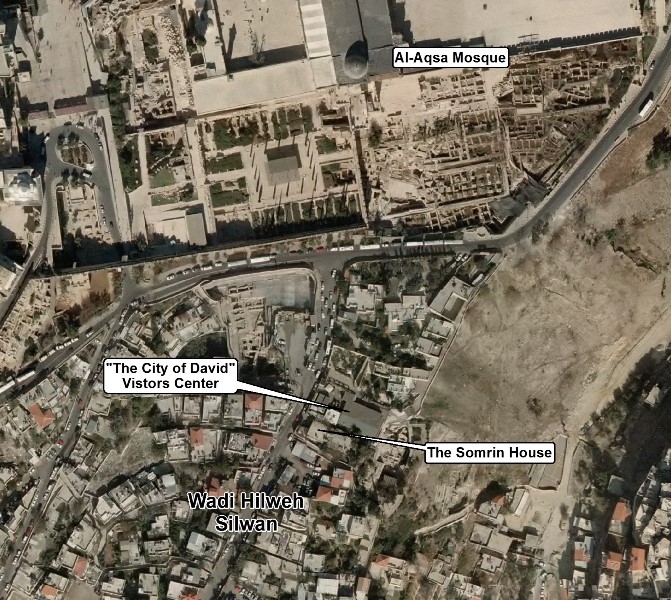
Map by Peace Now (click to expand)
The case to evict the Sumreen family, spearheaded by the JNF, with the secret funding/backing of the Elad settler group, is a key test of the State’s use of the Absentee Property Law to seize Palestinian homes in East Jerusalem. If dispossessed of their home, the Sumreen family case sets a broader precedent for many other ongoing eviction cases in Silwan that could result in the mass displacement of Palestinians in favor of settlers.
In his opinion, the Attorney General did not address the broader political context of widespread dispossession of Palestinians in Silwan, or legally dubious actions on the part of the Elad settler group and the Jewish National Fund in having the property declared to be absentee (see a detailed history of that scandal here) in order to take control over it. Instead, the Attorney General decided simply that there is no new basis on which to overturn the 1999 ruling that legitimized the JNF’s ownership of the home, and that the Sumreen family does not have a legal right to reside there.
Peace Now said in a statement:
“Instead of intervening and doing justice, the Israeli government, through the Attorney General, becomes a direct partner in crime and unforgivable injustice. The Attorney General chooses to ignore the context and the injustice behind the eviction suit and dives into quasi-legal questions to help settlers take over another property in Silwan. The Government’s fingerprints are smeared all over the Sumerin case. This is a political move in which government mechanisms such as the Custodian of Absentee Property and the Israel Land Administration and the JNF have been utilized in order to dispossess Palestinians of their property in East Jerusalem and replace them with settlers.”
It’s worth noting that the Sumreen house is located only a very short distance from the Al-Aqsa Mosque (approximately 10 meters) at the entrance to the Silwan neighborhood, and is adjacent to the “City of David” visitors center built and operated by the Elad settlers. The home is also located in the middle of what today has been designed by Israel as “the City of David National Park.” The entire area is managed by the radical Elad settler organization, which for years has also been pursuing the eviction of Palestinians from the homes in Silwan. For nearly three decades, the Sumreen family has been forced to battle for legal ownership of their home, after the state of Israel, prompted repeatedly by the JNF, declared the Sumreen’s home to be “absentee” property, despite the fact that this was manifestly not the case. Under that designation – which was not communicated to the Sumreen family – Israeli law permitted the State to take over the rights to the building. The State then sold the rights to the home to the JNF in 1991. The JNF has pursued the eviction of the Sumreen family ever since. Israeli courts ruled in favor of the Sumreen family’s ownership claims to the home for years, until a September 2019 ruling by the Jerusalem Magistrate’s Court granted ownership of the family’s home to the JNF, a decision the family immediately appealed to the Jerusalem District Court.
A full history of the saga involving the Sumreen family – which is similar to dozens of other Palestinian homes in Silwan that were declared Absentee Property in the 1990s – can be found on the Peace Now website here.
Tender Published for 300 New Units in East Jerusalem Settlement of East Talpiyot
On January 5th the Israel Lands Authority published a tender for the construction of 300 settlement units in the East Talpiyot settlement, located in East Jerusalem. Ir Amim reports the tender is scheduled to be opened for bids on February 14th.
The new units will expand the built-up footprint of East Talpiyot in the direction of the Palestinian neighborhood of Sur Baher, a neighborhood that is facing multiple new settlement plans that encroach on its historic land (including the Givat HaMatos, Har Homa, and Lower Aqueduct plans). Sur Baher has also been targeted by the Israeli Custodian General in its efforts to gain control over more land that was owned by Jews previous to 1948.
Israel to Advance Expansion of East Jerusalem settlement of Gilo
On January 10th the Jerusalem District Planning Committee convened to discuss two plans that would add 1,538 settlement units to the Gilo settlement in East Jerusalem. The plans are being advanced under the banner of “urban renewal” and will involve demolishing existing settlement units and replacing 470 existing settlement units with 2,008 new units (representing a net expansion of the settlement by 1,538 units). Ir Amim notes that, “while the plans will not necessarily enlarge Gilo territorially, it will increase the Israeli population in the settlement and hence the number of Israelis living in East Jerusalem.”
Israel Advances Plan that Will Pave Way for Expansion of East Jerusalem Settlement Enclave of Nof Zion

Map by Ir Amim (click to expand)
On January 11th, the Jerusalem District Planning Committee held a meeting to discuss public objections to a plan connected to the expansion of Nof Zion, a settlement enclave located inside the Palestinian East Jerualem neighborhood of Jabal Mukaber. One such objection was filed by Palestinian residents of Jabal Mukaber with assistance from Ir Amim. That objection argues that the plan is an affront to the planning needs of the local community and continues Israel’s systematic, city-wide discrimination against the housing, educational, and service-based needs of Palestinian neighborhoods. The Committee closed the meeting without reaching a decision, and has scheduled further private (closed to the public) continuation of its discussion of the plan.
The plan under consideration provides for the construction of a large, new Israeli police station on the border of Jabal Mukhaber neighborhood, on a plot of land that is across the street from the existing police station. The new station, according to Ir Amim, will “constitute a massive security headquarters and border police base, replete with detention facilities and laboratories.” Under the plan, after the new station is built the site of the current station will be designated for public buildings; however, Ir Amim warns that the land is currently allocated for the construction of hotels directly connected to plans to expand the Nof Zion settlement enclave. The relocation of the police station is a step towards the construction of those two hotels, which is part of the larger plan to expand Nof Zion to include the construction of commercial centers, educational institutions, and a sports field.
Ir Amim comments:
“In light of the dearth of public buildings and/or public spaces in the neighborhood, the objection [to the police facility plan] underscores the complete planning error and misuse of the respective plot of land. Rather than allocating the space to meet the dire public needs of the community, the authorities see it fit to utilize the land for a massive security base on the edge of the neighborhood. According to the objection [filed by Ir Amim and Palestinian residents], a plan of such magnitude implies that members of the community are seen as constituting a ‘threat’ rather than actual residents of Jerusalem entitled to equal socioeconomic rights and equitable access to municipal services. The depletion and appropriation of public spaces in East Jerusalem to serve Israeli interests and the expansion of setter enclaves in Palestinian neighborhoods not only erode the fabric of these communities, but severely impinge on Palestinian individual and collective rights and further entrench Israeli control of East Jerusalem.”
Israel has been working consistently to expand and entrench Nof Zion — which it should be underscored is an enclave located wholly inside a Palestinian neighborhood. On July 8, 2021 settlers and their allies held a cornerstone-laying ceremony to mark the beginning of construction on hundreds of new units in Nof Zion. The new construction is just preliminary work on a project that will triple the settlement in size and make it the largest settlement enclave in East Jerusalem.
As a reminder: In 2017, the Israeli government approved a plan to build a new synagogue and mikveh in Nof Zion on private Palestinian land that was expropriated from the Jabel Mukaber neighborhood in 2016. Then, in September 2017, rumors emerged that the government was set to issue 176 building permits for the already-approved project. According to Ir Amim, those permits were ultimately issued in April 2019.
IDF Evacuates Oz Zion Outpost (Again)
On January 10th, settlers sought to obstruct Israeli forces that were dismantling structures at the unauthorized outpost site called Oz Zion, located between Jerusalem and Ramallah. Settlers reportedly chained themselves to structures at the scene, and clashed with Israeli forces when they arrived to remove them.
Oz Zion has been dismantled by the IDF several times in the past (most recently in June 2021). Yet, the settlers – who have violently resisted Israeli forces carrying out the demolition – have repeatedly been allowed to reestablish it. It is one of the outposts for which a standing demolition order was recently re-issued by the IDF.
Fight Over Homesh Outpost & Yeshiva Continues (Both Physically and Politically)
On January 10th, settlers clashed with Israeli forces attempting to confiscate property from the illegal yeshiva settlers have established at the site of the evacuated settlement of Homesh — a yeshiva that the IDF continues to permit settlers to visit and operate. It’s worth recalling the great lengths to which the IDF has gone to offer protection for the settlers to access the yeshiva, at the cost of the freedom of movement and obstruction of normal life to entire nearby Palestinian villages.
In the wake of the killing last month of a settler connected to the illegal yeshiva, national furor – spearheaded by settlers protesting in front of the Prime Minister’s residence – has kept the heat on the government over the fate of the Homesh outpost and yeshiva. Key settler leaders are threatening to bring down the current coalition if the yeshiva is dismantled. While the government has not clearly signaled what it intends to do with the yeshiva, settlers and their political allies outside of the governing coalition are now aggressively pushing the government to undertake hugely consequential efforts on behalf of the settlements — including but not limited to re-establishing the settlement of Homesh and normalizing the status of the illegal yeshiva at the site — in order to prove it allegiance. See below for more details.
Settlers Seek Outpost Gains from Divided & Fragile Government (With Some Success)
As part of their campaign to push the government to authorize the Homesh yeshiva and reestablish the Homesh settlement, key settler leaders are raising at least two additional major initiatives in their aggressive push on the government to compensate the settlers in response to the recent death of settler Yehuda Dimentan.
Those two additional demands by the settlers – a contingent of whom are encamped in front of Prime Minister Bennett’s residence – are:
- To pass a bill – or act unilaterally – to connect unauthorized outposts to the Israeli electric and water grids. To that end, Defense Minister Benny Gantz and Interior Minister Ayelet Shaked reportedly held a meeting on this topic on January 9th. The settler-run news outlet Artuz Sheva optimistically reports that dozens of outposts might meet Israeli criteria for being connected to Israeli infrastructure, and that Gantz would support the move if the Defense Ministry Legal Advisor gives it an OK. This has been a longtime demand of settlers, and has typically included the demand to connect outposts to Israeli water, sewer, power, garbage collection, and other municipal services. Doing so would further entrench the permanence of these outposts and furthers the de facto annexation of Palestinian land. It would also continue and expand on Israel’s long practice of copiously rewarding settlers for breaking Israeli law (by illegally building outposts), and directly incentivizing further settler lawbreaking.
- To more aggressively police Palestinian construction in Area C of the West Bank (some 60% of the land). This demand is grounded in an Orwellian twisting of reality to treat Palestinian construction on Palestinian private land in Area C without permits required by Israel (permits Israel consistently refuses to issue) as theft of Israeli land. For more on this long running, and particularly pernicious, tactic of the settlement movement, see FMEP’s previous reporting.
Construction Begins on Key Stretch of the “Tunnels Road” for Settlements South of Jerusalem
Arutz Sheva reports (gleefully) that ground has been broken on a final stretch of the new tunnel road that will connect settlements to the south of Jerusalem (the Etzion settlement bloc) more seamlessly to the heart of the city. The tunnel is part of Highway 60, which Israel has already begun work to widen, which runs from Jerusalem all the way to the Kiryat Arba in Hebron.
In a deeply researched report on how infrastructure like roads is a means for settlement expansion and annexation, Breaking the Silence explains:
“While Israeli authorities justify many of the projects described in this document by claiming that they serve both the settler and the Palestinian populations in the West Bank, it is important to note that these roads are designed with Israeli, not Palestinian, interests in mind. Many of the roads that are technically open to Palestinian traffic are not intended to lead to locations that are useful to Palestinians.16 Instead, these roads are primarily designed to connect settlements to Israel proper (and thus employment and other services) via lateral roads, rather than to connect Palestinian communities to one another. Further, roads intended to connect Israeli settlements to Jerusalem (many of which are currently under construction) do not serve West Bank Palestinians outside of Jerusalem, as they are not allowed to enter Jerusalem without a permit. In addition, an extensive system of checkpoints and roadblocks allows Israel to control access to bypass roads and the main West Bank highways, and it can restrict Palestinian access when it so chooses.
This prejudice against Palestinian development is even starker when one considers that, according to an official Israeli projection, the expected Palestinian population in the West Bank (excluding East Jerusalem) in 2040 is 4,600,000 individuals. Even if the vision of settler leaders to arrive at 1,000,000 settlers is realized by 2040, the Palestinian population would still be four times the size of the settler one. Despite this discrepancy, priority is still given to settler infrastructure development.
West Bank road and transportation development creates facts on the ground that constitute a significant entrenchment of the de facto annexation already taking place in the West Bank and will enable massive settlement growth in the years to come. By strengthening Israel’s hold on West Bank territory, aiding settlement growth, and fragmenting Palestinian land, this infrastructure growth poses a significant barrier to ending the occupation and achieving an equitable and peaceful solution to the Israeli-Palestinian conflict.”
Israel Gives U.S. Army Officers Tour of Hebron Led by Settlement Spokesman
Raising many eyebrows, the secretariat of the Israeli Central Command reportedly arranged a settler-led tour of Hebron for a delegation of U.S. army officers. The full-day tour designed by the settlers included a visit to the Tomb of the Patriarchs/al-Ibrahimi Mosque and a visit to the settler-run museum (in the Beit Hadassah enclave). The visit empowered settlers to present their version of the religious, historic, geo-political, and security significance of Hebron (including with respect both to settlers/settlements, and presenting Palestinians through the settler lens). The U.S. delegation did not engage any Palestinians while in Hebron, creating an obvious and problematic imbalance in perspective on all matters.
Haaretz reports that the Israeli army has refrained from engaging the settlers for diplomatic tours of Hebron in recent years. In a statement to Haaretz about the tour, the IDF issued a bland statement saying:
“Last week, a few U.S. army officers came for a tour of the Tomb of the Patriarchs and Beit Hadassah led by the commander of the Central Command, for the purpose of learning about the history of the site. As part of the ongoing tours that are held regularly, the American delegation meets with various people in the State of Israel as well as in the Palestinian Authority. This is in order to learn about the area in the best way possible. Dr. Noam Arnon [a far-right-wing settler activist and spokesman for the Hebron settlements] was chosen to guide this tour. The tour was held according to the established regulations in the IDF.”
Further Reading
- “Who Do Israeli Settlement ‘Sheriffs’ Report To? Even They’re Not Sure” (Haaretz)
- “West Bank settlements are annexing land in Israel, too” (+972 Magazine)
- “Fresh Sheikh Jarrah eviction threatens to roil capital anew” (The Times of Israel)
- “From Iron Dome to supply chains, US Christian group quietly shaping US-Israel ties” (The Times of Israel)
- “Editorial | As Israel Bends Over Backwards for Homesh, Palestinians Pay the Price” (Haaretz)
- “The International Community and Israel: Giving Permission to a Permanent Occupation” (Michael Lynk in Just Security)
- “Congress launches bipartisan Abraham Accords Caucus” (Jewish Insider)
Welcome to FMEP’s Weekly Settlement Report, covering everything you need to know about Israeli settlement activity this week.
To receive this report via email, please click here.
April 26, 2018
- Construction Begins on Government Housing New Talpiot Settlement in East Jerusalem
- Defense Ministry Blames Yitzhar Settlement & its “Hilltop Youth” for Recent Price-Tag Attacks
- High Court Super-Session Legislation Increasingly Threatens the Stability of Netanyahu’s Governing Coalition
- U.S. Ambassador David Friedman Pushes Policy Language Backing Settlers & Annexation
- Trump Questioned Netanyahu Over Settlement Approvals
Comments, questions, or suggestions? Email Kristin McCarthy at kmccarthy@fmep.org
Construction Begins on Government Housing Near Talpiot Settlement in East Jerusalem
On April 23rd, Israeli bulldozers uprooted dozens of olive trees from land farmed by Palestinians in East Jerusalem, located between the Palestinian neighborhood of Sur Baher and the settlement neighborhood of East Talpiot. The Israeli government expropriated the land from Sur Baher in 1970 for “public use,” barring Palestinian construction on the land but permitting owners (now legally ex-owners) to continue farming it; in 2012, the Israel Land Authority (ILA) – a quasi-governmental agency – submitted plans to build 180 residential units on the site for former Defense Ministry employees.

Map by Peace Now
The Association for Civil Rights in Israel (ACRI) petitioned the High Court of Justice in 2012 to stop the new settlement plan, arguing that it discriminates against Palestinians. The petition was rejected, with the Court accepting the government’s argument that ~20% of Israeli security forces (whom the project is meant to serve) are minorities and that therefore the project serves the public good – despite the fact that few if any Palestinian Jerusalemites (the overwhelming majority of whom are not citizens of Israel) serve in the Israeli security forces. As noted by Terrestrial Jerusalem:
“Given that Palestinians of East Jerusalem do not serve in the IDF or the Israeli Police, this new construction is de facto intended for exclusively Israeli-Jewish residents – i.e. it is new settlement construction in East Jerusalem.”
In 2014, a Palestinian family petitioned the Court to modify the plan, in order to save their olive tree grove. The Court rejected the petition, ruling that the family should have petitioned against the 1970 expropriation, not the current plan. According to Palestinian media, the court case regarding the fate of these trees was still pending when Israeli authorities went ahead with uprooting the trees this week.
The Israel Lands Authority announced that it plans to market the project (i.e., seek bids from construction companies) in the near future.
Peace Now said:
“This was not a legitimate expropriation for public purposes, but rather an invalid expropriation that takes land from one community (Palestinians) and allocates it to another (Israelis). The U.S. ambassador [David Friedman] can see this ugly situation from the window of [what will soon be] the embassy, which is located only about a kilometer away from the olive grove that was uprooted: the reality of a divided Jerusalem of discrimination and deprivation.”
Defense Ministry Blames Yitzhar Settlement & its “Hilltop Youth” for Recent Price-Tag Attacks
Speaking to The Times of Israel, an anonymous official from the Defense Ministry said that the radical Yitzhar settlement near Nablus is responsible for the sharp rise of troubling “price-tag” attacks in recent weeks targeting Palestinians and their property. The official said that members of the “Hilltop Youth” – which is known to base its operations in Yitzhar – and students enrolled in Yitzhar’s religious school (the Od Yosef Chai yeshiva) are the main perpetrators.
A leader from Yitzhar defended his settlement by blaming the Defense Ministry for allegedly targeting and mistreating the “Hilltop Youth.” At the same time, the Israeli Welfare Ministry confirmed that the Israeli government is involved in supporting an informal educational-vocational program in the Yitzhar settlement to try to redirect radical young settlers who identify with the Hilltop Youth.
Yitzhar continues to function as the base for the Hilltop Youth, as evidenced by the IDF’s undercover arrest of a Hilltop Youth member in Yitzhar over the weekend. The settler was allegedly involved in throwing stones at IDF officers in an incident last week. Last year, in advance of evacuating one of the Hilltop Youth’s outposts, Israeli security officials met with leaders from the Yitzhar settlement in the hopes of deterring the settlement from allowing the displaced setters from taking up residence in Yitzhar.
High Court Super-Session Legislation Increasingly Threatens the Stability of Netanyahu’s Governing Coalition
It was another eventful week of internal political jockeying amongst Israeli cabinet ministers in their respective efforts to advance legislation that will empower the Knesset to reinstate laws that are stricken down by the High Court of Justice. Referred to as the “override bill,” the various versions of the legislation – several of which were covered in last week’s Settlement Report – have not, at the time of publication of this Settlement Report, been reconciled.
Education Minister Naftali Bennett (Jewish Home), who is pushing for one of the more extreme versions of the bill, threatened to call for elections if Prime Minister Netanyahu does not bring the legislation up for a vote (despite the fact the cabinet has not agreed on what they would be voting on). The threat comes after Netanyahu’s decision to delay the vote by one week in order to seek the support of High Court Chief Justice Esther Hayut, who the Times of Israel speculates might offer another version of the bill. Hayut agreed to meet with Netanyahu on the condition that the vote is delayed. That meeting is scheduled for Sunday, April 29th.
Bennett, in defending his threat and his rationale for the legislation, said:
“Over the past 25 years, the Supreme Court has radically encroached on the government’s authority to govern…Time and again it cancels bills the Knesset legislates. When you want to expel a terrorist who murdered, they say you can’t. When you want to take key security steps, they cancel them. When you want to pass tax bills, they stop it. The Supreme Court is not a government on top of a government.”
The drama over the “override bill” relates to settlements because Knesset members are anticipating that the High Court of Justice will strike down the Regulation Law. That law (covered extensively in past reports and in FMEP’s new resource documenting annexation policies) was passed in February 2017 in order to provide a legal basis for Israel to retroactively legalize outposts and settlement structures by permitting Israel to expropriate privately owned Palestinian land for this purpose. Last week, comments by Transportation Minister Yariv Levin made explicit the connection between the fate of the Regulation Law and the “override bill,” making clear that a key goal is to ensure that in the event that the High Court strikes down the Regulation Law, the Knesset will have the power to reinstate it.
Earlier in the week the Knesset’s Legal Advisor, Eyal Yinon, issued a strong rejection of all proposals to empower the Knesset to reinstate laws struck down by the High Court of Justice. Yinon rejected not only the proposals but the principle behind the legislation. He said,
“In our [Israel’s] reality, I think that in principle it would be a mistake to pass a supersession clause, whether it specifically concerns illegal migrants, or whether it is framed in general terms, and that it would do more harm than good. Good legislation requires restraint and balance, and as soon as, in effect, you remove constitutional review, that is liable to deal a severe blow to the quality of legislation and to the balances that must be maintained in it.”
U.S. Ambassador David Friedman Pushes Policy Language Backing Settlers & Annexation
The same week that the term “occupied territories” (as well as “occupation”) disappeared from the State Department’s annual report on human rights, reports surfaced suggesting that U.S. Ambassador to Israel David Friedman has been angling to use the term “Judea and Samaria” in his speeches and in State Department literature, instead of “the West Bank.” The phrase “Judea and Samaria” is the Biblical term for the area known to the world today as the West Bank. It is the term used by settlers and pro-annexationist Israelis to refer to the West Bank in order to assert what they see as the Jewish right to and rightful ownership of the land.
Friedman has been pushing for consequential shifts in State Department language since assuming his post. In a major break with decades of U.S. policy, Friedman has referred to settlements as “part of Israel,” and last December, he ordered the Embassy to stop referring to the West Bank as “occupied.”
Trump Questioned Netanyahu Over Settlement Approvals
After hearing that Prime Minister Netanyahu was planning to advance settlement construction projects, President Trump reportedly asked Netanyahu if he was genuinely interested in peace in a call late last year. Three sources told Axios that the call took place as Israeli press outlets were speculating that Netanyahu intended to allow a number of sensitive settlement to advance soon. The White House has not denied the account of the conversation.