Welcome to FMEP’s Weekly Settlement Report, covering everything you need to know about Israeli settlement activity this week.
To subscribe to this report, please click here.
July 12, 2024
- A Stunning, Expansive Time for Israel’s West Bank Annexation
- Civil Admin Seizes Patchwork of Plots as “State Land” in Order to Legalize the Evyatar Outpost
- Government Establishes Jurisdiction for New Settlement on World Heritage Site Near Bethlehem
- Settlers Takeover New Building in Hebron
- Historic Year for Land Grabs: Israel Seizes Over 3,000 Acres in the Jordan Valley as “State Land”
- Civil Admin Advances Plans to Legalize Three Outposts & Build 5k New Units Across West Bank
- Israeli Cabinet Gives Civil Admin Authority Over Antiquity Sites in Area B
- Israeli Cabinet Supports Knesset Considers Bill to Transfer West Bank Antiquities Control from Civil Admin to Domestic Body
- U.S. Issues New Round of Sanctions Against Settlers & Settler Organizations
- Israeli Court Orders 11 Families Out of Homes in Batan al-Hawa, Silwan
- Israeli Court Rules to Demolish Wadi Hilweh Info Center in Silwan
- Israeli Court Tells Settlers To Leave Khalidi Library in Old City of Jerusalem
- Israel to Advance 6,000+ Settlement Units in East Jerusalem in Coming Weeks
- Amidst Wave of Violence, Settlers Lead Progrom On Massafer Yatta Region
- Ariel Settlers Close Access Road to Palestinians
- IDF Demolishes Outposts, Clashes With Settlers
- Bonus Reads
A Stunning, Expansive Time for Israel’s West Bank Annexation
Over the past two weeks, Israel has unleashed a flurry of settlement activity that makes its annexation of the West Bank complete. Even a small sampling of those acts, detailed below along with other news, are stunning when taken together. Indeed, Israeli National Missions Minister Orti Strock called this “a miraculous time,” referring to the control her and her allies have over key government bodies and how easy it is for them to fund settlement construction. Strock is a member of the Religious Zionism party, along with Bezalel Smotrich.
Renowned Israeli human rights lawyer Michael Sfard encapsulates this time powerfully in an article entitled, “Smotrich Has Completed Israel’s Annexation of the West Bank”:
“The only thing the annexationist criminals must be saying to themselves now is: why did we wait for 57 years? It’s so easy.”
Civil Admin Seizes Patchwork of Plots as “State Land” in Order to Legalize the Evyatar Outpost
On July 8th, the Israeli government declared 16 acres (66 dunams) of land south of Nablus as Israeli “state land” in order to pave the way for the legalization of the Evyatar outpost. Palestinians who have private ownership claims to the land have 45 days in which to submit an appeal. The declaration is the result of three years of “work” by Smotrich’s Settlements Administration to examine the status of the land in order to find a way for the state to take control of the land in order to legalize the outpost. The declaration comes one week after the Israeli Security of Cabinet decided in favor of legalizing the Evyatar outpost along with four other outposts.
The Evyatar outpost was illegally built by settlers on a strategic hilltop named Mount Sabih, located just south of Nablus on land historically belonging to nearby Palestinian villages Beita, Yatma, and Qablan. It was evacuated by the Israeli government in 2021 in the context of an agreement with settlers that left all construction at the site in place, maintained an IDF presence at the site, and made clear the government’s intent to legalize settlement at the site in the future – a goal which was made more than official when it was agreed to in writing as part of the coalition agreements that formed the current Israeli government.
 To underscore the absurdity which has characterized the State’s blatant intent to legalize Evyatar even though Israeli law makes that an impossibility because parts of the land are recognized by the State as privately owned by Palestinians (which is the only reason Evyatar has yet to be legalized), the State’s new declaration of “state land” is a complete patchwork. The order does not include the land on which the central square of the outpost is built, nor does it include 11 buildings, or, very importantly, the access road leading from the main road to the outpost. The implications of this patchwork is that even though the privately owned land was not seized, Palestinians will remain unable to access the land and will, in practice, lose that land as well as land abutting the settlement as it grows, expands, and establishes control over the area with the assistance of the IDF.
Peace Now reports that this is the fifth “state land” declaration so far in 2024 bringing the total land in the West Bank taken into Israeli control this year to 5,879 acres (23,572 dunams), breaking all previous annual records combined. Israel invented the concept of “state land” in order to find means by which to confiscate land in the occupied West Bank, and to do so Israel cites Ottoman law which provided that land which has not been cultivated in consecutives years becomes the property of the sovereign. Peace Now explains:
“The declaration process is essentially a legal maneuver developed by Israel to circumvent the prohibition in international law against expropriating private property of the occupied population for the benefit of the occupying power. To “convert” private land into public land (termed “state land”) without expropriating it, Israel claims that it is not changing the land’s status but merely “declaring” it officially.
According to Israel’s interpretation of Ottoman land law, which underpins the land laws in the occupied territories, if a landowner does not cultivate their land for several years, the land is no longer theirs and becomes public property. To this end, the mapping personnel of the Civil Administration, now operating under the Settlements Administration with legal counsel under Minister Smotrich, examine aerial photographs to identify uncultivated lands and mark them as “state land.”
The declaration map for the Evyatar outpost shows that there were indeed several cultivated lands, even by Israel’s stringent interpretation. For example, the declaration creates an enclave of about 3.5 dunams in the middle of the area designated for the settlement, considered private land. In principle, Israel would argue that it is not expropriating this area and that the Palestinian landowners are still recognized as the owners. However, as in hundreds of similar cases, it is clear that they will not have access to their land and no possibility of using it when it is located in the middle of an Israeli settlement.
To enable an access road connecting the outpost to the main road without crossing private land, the map’s designers managed to “find” an 11-meter-long and 1.5-meter-wide corridor of land that they claim was uncultivated and thus considered state land. This interpretation of Ottoman law brings it to absurdity.
According to this, if a person has a plot and cultivates it intensively, but there is a small uncultivated strip on the edges, say a rock that cannot be plowed, that small part of the plot is not owned by the landowner. This interpretation is far removed from the purpose of the Ottoman law, which was to encourage the empire’s subjects to cultivate the lands to increase its tax revenues.
Regarding the access road – in any case, for modern vehicles, a road 1.5 meters wide is insufficient, and it is clear that to allow access to the settlement, the state will encroach on private Palestinian lands (requiring another legal maneuver). Thus, it can be said that this entire declaration of state land is essentially an unlawful expropriation under international law.”
Government Establishes Jurisdiction for New Settlement on World Heritage Site Near Bethlehem
On July 9th, the IDF Commander signed an order establishing the jurisdiction for a new settlement on the lands just west of Bethlehem, lands that are recognized as a World Heritage Site by UNESCO. Notably, the jurisdiction for the new settlement, called “Nahal Heletz”, does not include the land on which two illegal outposts already exist on Battir’s land. The new settlement is being planned for land that is between Bethlehem and several villages to its west (Walaja, Battir, and Husan) – meaning that construction on this land will sever the territorial continuity of Palestinian land in the Bethlehem region, and, in the words of Peace Now: “turn them [the villages] into an enclave within Israeli territory.”
There are several extraordinary facts about this land and Israel’s legal acrobatics to establish a new settlement at this location:
-
- The status of the land within the new jurisdiction is unclear, and quite possibly includes privately owned Palestinian land. The Israeli Blue Line Team (a government effort to precisely map the boundaries of state land in the West Bank) has prepared updated maps to show the boundaries of state land in the area, but has yet to release it – meaning that the status of the land is unclear. The jurisdiction appears to stretch beyond the previously understood boundaries of land that Israel seized as “state land” in the 1980s, onto land that is privately owned by Palestinians. The updated boundaries might change that fact in the eyes of the Israeli government. But,once the new Blue Line in the area is made public, Palestinians will/should be able to contest it.
- There is no access road to the area, and it is surrounded by privately owned Palestinian land. Israel will have to unilaterally expropriate privately owned Palestinian land in order to pave a road to the new settlement – – an extraordinary act which Israel has done in the past (having invented a legal basis on which to do it, a concept which considers Israeli settlers as part of the “local population” of the West Bank).
- The jurisdictional area established by this new order is too small for real development – just under 30 acres (120 dunams). Peace Now explains that “small settlements severely impact open spaces, require substantial resources for infrastructure and transportation, and contradict fundamental planning principles. The sole reason for establishing such a settlement is political: the desire to prevent a Palestinian territorial continuity in the Bethlehem area and the possibility of a viable Palestinian state.”
- The jurisdiction is a stones throw away from Palestinian houses and Area B.
Settlers Takeover New Building in Hebron
Peace Now reports that in early June 2024 settlers have taken over a building (“Beit HaTkuma”) in Hebron and established a new settlement enclave there. The house, which settlers illegally entered once before but were removed under the Bennet-Lapid government, on the main road leading from the Kiryat Arba settlement to the Tomb of the Patriarchs/Al-Ibrahimi Mosque.
Settlers claim to have purchased the house, which is a three-story building, from its Palestinians owners, and report that the Civil Administration has recently issued them a permit to begin the registration process. The timing of this permit coincides with the first days of Hillel Roth’s assumption of his role in the Defense Ministry as the civilian in charge of all land matters in the West Bank. Upon receiving the permit (allegedly), the settlers decided to enter and occupy the building although the permit does not provide for that. [map]

Historic Year for Land Grabs: Israel Seizes Over 3,000 Acres in the Jordan Valley as “State Land”
 On June 25th, the head of the IDF signed an order declaring 3,138 acres (12,700 dunams) of land in the Jordan Valley as “state land” – the largest state land seizure since the Oslo Accords were signed in 1993. This is the first declaration enacted under the authority of Hillel Roth, the new civilian deputy in the Civil Administration responsible for land policy in Area C of the West Bank. Peace Now reports that the legal opinion supporting this massive declaration of state land was crafted by lawyers in the Department of Defense and not legal advisors with the IDF.
Peace Now further reports:
“A significant part of the area that was declared as state land was previously defined as a nature reserve, and also as a “fire area”, for military use, for decades. Today’s announcement completes the Israeli takeover of this area that has been done so far through the declaration of the area as a military area and as a nature reserve – something that imposed many restrictions on the Palestinians’ ability to use their lands. The declaration creates a territorial continuity between the settlements in the Jordan Valley (Yifit and Masu’a) and the settlements at the eastern end of the mountainside (Gitit and Ma’ale Efraim).”
So far in 2024, Israel has declared 5,852 acres as “state land” a figure eclipsing any other year since the Oslo Accords were signed in 1993. The highest previous total was in 2014, and it was for 1,181 acres.
Civil Admin Advances Plans to Legalize Three Outposts & Build 5k New Units Across West Bank
On July 4th, the Israeli Civil Administration approved the advancement of plans for 5,295 settlement units, including plans which would in effect legalize three outposts under the guise of being “neighborhoods” of existing settlements. This is the first time the Civil Administration’s High Planning Council has met since it came under the authority of a civilian official, Hillel Roth, who was appointed by Bezalel Smotrich. The HPC last met in March 2024. The Associated Press has called Israel’s advancement of plans a “turbo charged settlement drive [that] threatens to further stoke tensions on the West Bank.”
The three outposts that are now on their way to legalization, once given final approval, are:
- Mahane Gadi – to be legalized as a neighborhood of the Masu’a settlement in the northern Jordan Valley. This outpost was built in 2018 on an abandoned Isareli military camp. The outpost currently functions as an educational campus and pre-military academy. Plans advanced this week are for the construction of 260 settlement units. Masu’a settlement, and its outpost satellites, were recently benefitted by the Israeli government’s massive declaration of state land that borders Masu’a.
- Givat Hanan (Susya East) – to be legalized as a neighborhood of the Susya settlement located in the South Hebron Hills.
- Kedem Arava – it appears that the Kedem Arava outpost was legalized along with Beit Hogla in February 2023 (previously unclear), located south east of Jericho. Plans advanced this week are for 316 settlement units in the Kedem Arava outpost area, but filed as if they are plans for the Beit Hogla settlement.
The settlement plans that were approved for validation (a near final step in the West Bank planning process) are:
- Beitar Illit – 298 settlement units. An additional 453 units were approved for deposit (751 settlement units total).
- Givat Zeev – 452 settlement units
- Mitzpe Yericho – 365 settlement units
- Nokdim – 290 settlement units
- Immanuel – 266 settlement units
- Elon Moreh – 186 settlement units
- Kiryat Arba – 165 settlement units
- Negohot – 158 settlement units
- Tzofim – 74 settlement units
- Ganei Modiin – 46 settlement units
- Etz Efraim – 12 settlement units. An additional 24 units were approved for deposit (36 units total)
- Eli – 24 settlement units
- Mitzad (Asfar) – 6 settlement units
The settlement plans that were approved for deposit (an earlier step in the West Bank planning process) are:
- Neria – 436 settlement units
- Modin Illit – 300 settlement units
- Gva’ot – 250 settlement units. There were over 1,000 plans for the Gva’ot settlement on the High Planning Council’s agenda, but only one plan was advanced, the rest continue to be worked on.
- Yakir – 168 settlement units. Haaretz reports that these units are slated to be built on land that is discontiguous from the built up area of the Yakir settlement, on the far side of the settlement’s access road, effectively building a new settlement. The construction of these units requires the evacuation of a military base.
- Kiryat Netafim – 136 settlement units
- Hagai – 135 settlement units
- Maale Shomron (Elamatan) – 120 settlement units
- Almon (Anatot) – 91 settlement units
- Shilo – 90 settlement units
- Pduel – 37 settlement units
- Revava – 16 settlement units
- Elkana – 8 settlement units
- Shaarei Tikva – 6 settlement units
Peace Now said in a statement:
“Netanyahu and Smotrich’s agenda became evident through the decisions of the Planning Council: approval for thousands of housing units, the establishment of three new settlements, and strategic appointments of Smotrich’s allies in key roles instead of military personnel underscore the annexation occurring in the West Bank. Our government continues to change the rules of the game in the occupied West Bank, leading to irreversible harm. While the north is neglected and citizens across the country are abandoned, with 120 hostages still in Gaza, the process of annexation and land theft continues to expand, contrary to Israeli interests. This annexationist government severely undermines the security and future of both Israelis and Palestinians, and the cost of this recklessness will be paid for generations to come. We must bring down the government before it’s too late.”
Israeli Cabinet Gives Civil Admin Authority Over Antiquity Sites in Area B
In late June, the Israeli Cabinet approved several punitive measures against the Palestinian Authority, measures which included usurping the Palestinian Authority’s singular responsibility for antiquity sites in Area B. Under the decision passed last week, the Civil Administration was granted enforcement powers over antiquity sites in Area B that are alleged to be damaged.
Emek Shaveh explains why this is incredibly significant:
“Approximately 6,000 archaeological sites have been identified in the West Bank. Almost every village or settlement contains archaeological and historical remains that require archaeological supervision to prevent damage to sites, structures, or findings. Thousands of sites are located in Areas A and B…expanding the powers of the [Civil Administration] into these areas represents another Israeli departure from the Oslo Accords. The implications of the decision for Palestinian residents are far reaching. The Staff Officer for Archaeology [in the Civil Administration], which derives its authority from the antiquities law effective in the West Bank (the Jordanian Antiquities Law of 1966), will now be empowered to perform various enforcement actions in Area B including:
- Declaration of archaeological sites, determining their boundaries.
- Issuing work stoppage orders for any development within the boundaries of a declared site or a site suspected of containing archaeological remains.
- Imposing fines for damage to an antiquity site, whether the site is declared or not.
- Demolishing structures located within a declared archaeological site or one that will be declared in the future.
- Collecting information, investigating, and requesting the arrest of suspects in antiquities theft or illegal antiquities trade.
This decision taken together with other decisions for Area B aimed at promoting annexation will dramatically reduce Palestinian space. It should be noted that the SOA consistently avoids enforcing the law when it comes to heritage site destruction by settlers (this is true in Hebron, Battir, and in other places)….
The expansion of archaeological activity into the oPt, especially as reflected in this cabinet decision, indicates the government’s intention to promote annexation by any means. It also fundamentally challenges the possibility of conducting impartial archaeological-scientific activity as long as it operates as part of an oppressive mechanism under military auspices. Israeli archaeological activity in the West Bank necessarily becomes an act of land appropriation and a deepening of Israel’s hold on the West Bank. This action violates international law and ethics, disregards the existence of the Palestinian community, and serves as a weapon for oppression.
The destruction of sites cannot and should not serve as a pretext for political action, and political action should not be disguised as archaeological activity. Blurring the distinction between heritage preservation and settlement and annexation activities turns the practice of archaeology into a weapon of oppression while undermining its professional legitimacy.”
Notably, Israel Hayom credits this Cabinet action to a settler group called “Keepers of the Eternal,” (or, “Guardians of Eternity” – an offshoot of Regavim) the leader of which called the new powers granted to the Civil Administration “dramatic.” FMEP has reported on this group repeatedly as it has increased its pressure on and work with the government to take control of West Bank antiquity sites. Dating back to June 2020, the “Guardians of Eternity” began surveying areas in the West Bank that Israel has designated as archaeological sites, looking for Palestinian construction (barred by Israel in such areas) that they could then use as a pretext to demand that Israeli authorities demolish it. The group systematically began communicating its findings to the Archaeology Unit of the Israeli Civil Administration.
Then in January 2021, the Israeli government committed funding to a settler initiative to surveil archeological sites under Palestinian control. While the objective of protecting antiquities might appear uncontroversial and apolitical, the true (and transparently self-evident) objectives behind this effort are: to support yet another pretext to surveil and police Palestinians; to establish and exploit yet another means to dispossess Palestinians of their properties; to expand/deepen Israeli control across the West Bank; and to further entrench Israeli technical, bureaucratic and legal paradigms that treat the West Bank as sovereign Israeli territory. It is the result of a campaign that has taken place over the past year in which settlers have escalated their calls for the Israeli government to seize antiquities and “heritage sites” located in Palestinian communities across the West Bank, especially in Area C, which Israel today treats as functionally (and legally) indistinguishable from sovereign Israeli territory.
Israeli Cabinet Supports Knesset Considers Bill to Transfer West Bank Antiquities Control from Civil Admin to Domestic Body
Emek Shaveh reports that the Israeli cabinet gave its support to a bill in the Knesset that would transfer authority over West Bank antiquity sites from the Defense Ministry’s Civil Administration to the domestic Israeli Antiquities Authority, bringing the cultural, heritage, and archaeological sites in the West Bank under the direct control of the Israeli government in which West Bank Palestinians have no rights.
The bill, as proposed by Likud’s Amit Halevi, explains that the move is justifiable because the West Bank antiquity sites (unbelievably) “have no historical or other connection to the Palestinian Authority.” The bill passed a preliminary vote in the Knesset on July 10th.
U.S. Issues New Round of Sanctions Against Settlers & Settler Organizations
On July 11th, the United States announced another round of sanctions targeting Israeli settlers and settler organizations it asserts are perpetrating violent crimes against Palestinians and Israeli solidarity activists in the West Bank. These sanctions expand the web or already sanctioned individuals and entities.
The individuals and entities sanctioned by the U.S. this week are:
- 1 settler organization:
- Lehava – a settler group led by Benzi Gopstein, who is already under U.S. sanctions.
- 3 individuals:
- Issachar Manne – who established the Manne’s Farm outpost.
- Reut Ben Haim – the co-head of the Tzav 9 settler group, which is already under U.S. sanctions;
- Shlomo Sari – the co-head of the Tzav 9 settler group, which is already under U.S. sanctions;
- Four illegal outposts:
- Meitarim Farm (established by Yinon Levi, who is already under U.S. sanctions);
- HaMahoch Farm (established by Neria Ben Pazi, who is already under U.S. sanctions);
- Neria’s Farm (established by Neria Ben Pazi, who is already under U.S. sanctions); and,
- Manne’s Farm, established by Issachar Manne, who came under sanctions this week, and located in the South Herbon Hills.
Notably, The Times of Israel has previously reported that in 2021 a corporation owned by the Har Hebron Regional Council signed a legally binding contract with Yinon Levi (a previously sanctioned individual) to establish Meitarim Farm. This legal connection exposes the settlement municipality to US sanctions as well.
Aaron David Miler, a former state department Middle East negotiator now a senior fellow at the Carnegie Endowment for International Peace, tells The Guardian that the expanding targets of U.S. sanctions are creeping closer towards the Israeli government, saying:
“It appears that [the U.S. State Department] not just targeted extremist settlers but … introduced a linkage to territoriality by citing illegal outposts…It doesn’t take much imagination to conclude that the next target would be [Israeli] government financing for illegal outposts. And that would be a new departure to be sure.”
Sara Yager, Washington director of Human Rights Watch, said:
“In this case we’re pleased that the Biden administration is going farther than before with the alert…Now it’s time for sanctions against the Israeli authorities that are approving and inciting. We want to see the US, UK, Canada and others focus on power behind all this in the West Bank.”
Israeli Court Orders 11 Families Out of Homes in Batan al-Hawa, Silwan
This week the Jerusalem District Court ruled on two significant cases affecting 11 Palestinian families in Silwan facing forcible eviction from their homes at the hands of the Ateret Cohanim settler organization. Both cases were found in favor of the settlers, leaving 11 families at risk of imminent mass displacement from East Jerusalem. The Palestinians plan to appeal the ruling to the Israeli Supreme Court – though it was only a month ago that the Supreme Court rejected an appeal by the Shehadeh family whose case is similar to those decided this week.
On July 9th, the Israeli court rejected the final appeal of the Gheith and Abu Nab families (4 family units totalling 22 individuals) and ordered their immediate eviction. The families were also ordered to pay the legal fees incurred by Ateret Cohanim.
On July 10th, the Israeli court rejected the final appeal of the Rajabi family (7 family units, 65 individuals), ruling that the 66-member family must vacate their longtime home by January 2025.
In both cases, Ateret Cohanim claims ownership of the buildings becuase it gained control of the historic Benvenisti Trust, which oversaw the assets of Yemenite Jews who lived in Silwan in the 19th century. In 2001 the Israeli Charitable Trust Registrar granted Ateret Cohanim permission to revive the trust and become its trustees following 63 years of dormancy. In 2002, the Israeli Custodian General transferred ownership of the land in Batan al-Hawa to the Trust (i.e., to Ateret Cohanim). Since then, Ateret Cohanim has accelerated its multi-pronged campaign to remove Palestinians from their homes, claiming that the Palestinians are illegal squatters. Silwan is just one site of Ateret Cohanim’s work to establish Jewish enclaves inside densely populated Palestinian neighborhoods of East Jerusalem, for the explicit purpose of “reclaiming” Palestinian parts of Jerusalem for Jews.
Ir Amim explains:
“These families are among some 85 Palestinian families, consisting of over 700 individuals, who face largescale displacement and settler takeovers of their homes in Batan al-Hawa. This is a result of eviction claims filed by a Jewish trust established in the 19th century, which is now controlled by the Ateret Cohanim settler group who is exploiting it to take over Palestinian homes.
While carried out under a veneer of legitimacy, the proceedings are underpinned by discriminatory laws, political motivations, and a system that is rigged against Palestinians from the outset which deprives them of equal access to justice. Moreover, theses measures are a violation of international law and could amount to a form of forcible transfer.
Rather than adjudicating these cases from a broader perspective, which includes moral, geopolitical, and humanitarian considerations, as well as international law, the Israeli judiciary is instead complicit with these moves.
These cases are part and parcel of a coordinated and systematic political campaign aimed at uprooting Palestinians and expanding Jewish settlement in the heart of Palestinian neighborhoods. While the eviction claims themselves are initiated by settlers, they are aided and abetted on all levels of the state, which carry far-reaching implications on the future of Jerusalem and the conflict as a whole.”
Israeli Court Rules to Demolish Wadi Hilweh Info Center in Silwan
On July 3rd, the Jerusalem Court of Local Affairs ruled that the Wadi Hilweh Information Center will be demolished within a year, and fined the Center over $5,000 (NIS 20,000). The Wadi Hilweh Information Center is run by prominent activist Jawad Siyam, who along with the center is a fixture in Silwan and an important interlocutor with diplomats and alternative tourism who are seeking to learn about Palestinian history in the area and current struggles to remain there while enduring state + settler harassment and displacement.
The Center was opened in 2009, at which time the Jerusalem Municipality issued a warning notice demanding the demolition of part of the building that was recently “renovated” (the roof was repaired) because the Center did not obtain an Israeli-issued building permit to do the work. The Center says that the building itself predates Israel’s control of the area in 1967. It currently stands in the shadow of the massive “City of David Visitors Center” complex that the Elad settler organization has built over the years.
Peace Now said in a statement:
“Instead of taking care of all the residents of Jerusalem, Jews and Arabs, the Jerusalem Municipality works to harm the Palestinian residents and make their lives difficult. The tourist settlement in the Palestinian neighborhoods around the Old City, which is massively supported by the government, is aiming at erasing the Palestinian presence from the public space in East Jerusalem. The pressures exerted by the municipality against the Wadi Hilweh Information Center in Silwan and the intention to demolish it, are for the political purpose of not allowing the residents to organize and make their voices heard in the public domain.”
Israeli Court Tells Settlers To Leave Khalidi Library in Old City of Jerusalem
On June 30th, the Jerusalem District Court made a group of settlers vacate ta building in the Khalidi Library complex located in the Old City of Jerusalem after they broke into the building and occupied it three days prior. The library is within eyesight of the Western/Wailing Wall plaza (Kotel Plaza), on Chain Gate Road, which leads to the Haram al-Sharif. There is an IDF checkpoint right outside of the door, reflecting what an intensely sensitive area it is in.
The settlers had forged documents claiming to have purchased the building, but upon review of the Khalidi families’ own documents which show the family has owned the building for at least 160 years, the Court ordered the settlers to leave. There is another hearing set in the coming weeks which will allow the settlers, if they choose, to make their case.
Listen to Rashid Khalidi explain the history of the Khalidi Library, the current situation and its importance, and the ongoing fears of settler takeover in a conversation with FMEP Fellow Peter Beinart on a recent episode of FMEP’s “Occupied Thoughts” podcast.
In a statement, the Khalidi family said:
“Despite this temporary success, there is an ongoing fear of settler violence and the chilling effect of the occupation. Two of the settlers involved have been identified as Eli Attal ad Erez Zaka, the former linked to previous takeovers of Palestinian properties in the old city. After today’s ruling, scores of settlers remain lingering outside the house and on the rooftops filming and occasionally bagining on the doors and windows, posing a threat of breaking and entry and further illegal actions.”
Israel to Advance 6,000+ Settlement Units in East Jerusalem in Coming Weeks
Ir Amim reports that within the next two weeks Israel is planning to advance plans for 6,700 new settlement units in East Jerusalem. Plans to be advanced include:
-
- Givat Hamatos – plans for 3,500 new units, 1,300 new hotel rooms, five synagogues, and two mikvahs (ritual baths). This plan wouldl double the number of units in the settlement and expand its size by nearly 40%;
- Gilo – two plans for a total of 1,288 new settlement units, expanding hte settlement to the south east, further choking the Palestinian neighborhood of Beit Safafa and severing neighborhoods in southern Jerusalem from the Bethlehem area;
- Ramot – plans for 800 new settlement units.
Details of the plans slated for advancement are reported here by Ir Amim, and will be reported by FMEP in more detail when they are advanced.
Amidst Wave of Violence, Settlers Lead Progrom On Massafer Yatta Region
Palestinian residents in Masafer Yatta, an area of small villages in the South Hebron Hills, have been live streaming the frequent and intensifying terror that Israeli settlers have been inflicting on them for years. The terror peaked to unimaginable levels over the last weeks when, on multiple occasions, armed settlers descended on villages in the area inflicting terror, violence, and intimidation.
Eid Suleman, a prominent activist in Umm al-Khair, told the Associated Press:
“We know what this is. They’re trying to expel us out of here. The military did the dirty job last week and now the settlers are following up.”
Some of the events that have transpired include:
On June 26th, the IDF arrived in Umm al-Khair early in the morning and proceeded to demolish a third of Umm al-Khair’s structures (11 homes), leaving 38 people (30 children) homeless).
On July 1st, armed settlers descended on Umm al-Khair, some dressed as IDF officers, and fired live ammunition toward Palestinians, deployed tear gas, and attacked people with wooden sticks. Israel soldiers and police were nearby but did not intervene.
On July 2nd, settlers were accompanied by Isreali soldiers as the entered the village of Umm al-Khair and built a tent in the center square, where 40 settlers gathered in a sort of celebration. When they eventually left, the settlers cut the water pipes supplying the village and warned of their plans to return the next day.
On July 3rd, settlers descended on the nearby village of Khalled al-Daba’a and set agricultural crops and trees on fire. The settlers then proceeded to march on the homes in the village carrying cans of gasoline and guns.
On July 4th, Palestinian residents reported that 100 settlers attacked the village of Khaled al-Daba, setting fire to fruit trees and shooting live ammunition directly towards Palestinians. Settlers proceeded to beat villages with sticks. Israeli forces arrested one Palestinian.
Settlers then moved to Mufagarah, a nearby village, where they destroyed vehicles and prevented emergency medical workers from reaching Palestinians and internationals in need. Palestinians report several Palestinians and two internationals were injured by the settlers.
On July 7th, the IDF arrested members of the Hureini family – who are all prominent activists in the area – who had called the police to report that settlers had shepherded flocks of sheep onto the Hureini’s land.
The Center for Jewish Nonviolence (which maintains a protective presence in Masafer Yatta and closely allied with the local population there) reports that “the attacks on Umm al-Khair after the demolition on Wednesday are being led by a settler named Shimon Atiya (or Atia), a leader of the nearby illegal outpost, Havat Shorashim (or “Roots Farm” in English). For months, he has been one of countless settlers acting with impunity while wreaking havoc on Palestinian communities across Area C.”
The events in Massafer Yatta bring into stark relief the intensity and persistence of settler terrorism in the West Bank, especially since October 7, 2023. AIDA (Association of International Development Agencies) has recorded 1,000 incidents of settler violence since October 7th.
The outgoing head of the Israeli Army’s Central Command, Yehuda Fuchs, used his farewell speech to criticize Israel policy makers for their failure to deter settler terrorism in the West Bank.
Ariel Settlers Close Access Road to Palestinians
The Mayor of the Ariel settlement has blockaded on the main access road leading to the nearby Palestinian village ofSalfit, boasting about his actions in an Instagram post. In addition to building a blockade of boulders and a welded gate, workers also destroyed parts of the road. The Civil Administration has attempted to remove the blockades and restore use of the road, but each time the settlers have re-constructed the blockade.
The Ariel settlement Mayor, Yair Chetboun, said in the video:
“Security is foremost upon us, upon the city. We trust the IDF, love the IDF, but if the senior levels don’t understand the importance of blockading this route – which led to attacks and enables car theft. We won’t permit such a reality. We are also operating on the political front but also on the ground.”
IDF Demolishes Outposts, Clashes With Settlers
On July 3rd, settlers clashed with Israeli authorities as they attempted to demolish the illegal outpost “Oz Zion B.” Haaretz reports that five settlers were arrested for violence against Israeli Border Police, and four were quickly released without questioning or restrictions. One settler who pepper sprayed an officer was brought to court for a hearing but later released and forbidden from going near the outpost.
The demolition of the outpost was reportedly ok’d by Prime Minister Netanyahu – going over the head of Bezalel Smotrich and the Settlement Administration, which has seized control of building enforcement in the West Bank. The outpost, according to the Shin Bet, was the source of violent terror.
Bonus Reads
- “Road to Redemption: How Israel’s War Against Hamas Turned Into a Springboard for Jewish Settlement in Gaza” (Haaretz)
- “A look at how settlements have grown in the West Bank over the years” (AP)
- “West Bank Annexation and Destabilization in the Shadow of the Israel-Hamas War” (J Street)
- “The Status of De Jure West Bank Annexation” (Israel Policy Forum)
- “Mounting International Sanctions Against Powerful Israeli Settler Group Could Be Earth-shattering” (Haaretz)
- “A warm relationship is being built between Judea, Samaria and America” (JNS)
- “Why there is no uprising in the West Bank – yet” (Mondoweiss)
- “In His Retirement Speech, Israel’s Top Officer in the West Bank Revealed the Hidden Truth” (Haaretz)
- “The Companies Making it Easy to Buy in the West Bank” (The Intercept)
Welcome to FMEP’s Weekly Settlement & Annexation Report. To subscribe to this report, please click here.
January 22, 2021
- Cashing In Before Trump Cashes Out, PART 1: Israel Awards Tender for the Construction of Givat Hamatos
- Cashing In Before Trump Cashes Out, PART 2: Israel Issues Tenders for 2,572 Settlement Units
- Cashing In Before Trump Cashes Out, PART 3: In Final Hours of Trump Era, Israel Advances Plans for 780 Settlement Units Across the West Bank
- Netanyahu’s Bid for Mass Legalization of Outposts Fails (For Now)
- Bonus Material
Comments/Questions – email Kristin McCarthy (kmccarthy@fmep.org)
Cashing In Before Trump Cashes Out, PART 1: Israel Awards Tender for the Construction of Givat Hamatos
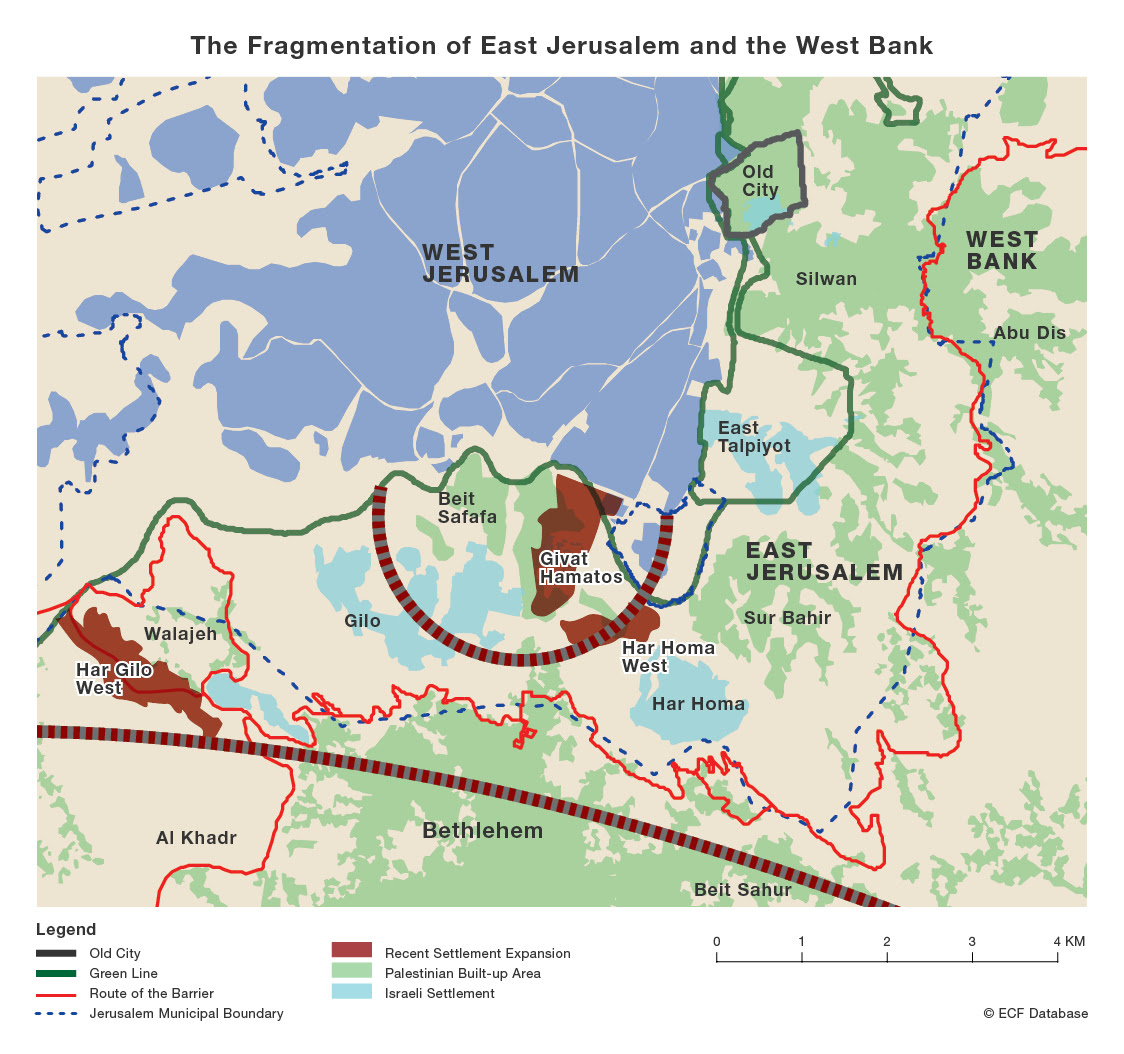
Map by Terrestrial Jerusalem
On January 19th, the Israel Land Authority issued the tender for the construction of the Givat Hamatos settlement in East Jerusalem (the tender is for a total of 1,257 settlement units). The issuance of the tender came a mere 6 hours before Joe Biden was sworn in as the President of the United States.
Prior to the issuance of the tender, the Jerusalem District Court rescinded its injunction against the tender, which the Court had issued last week in response to a petition filed by Palestinian residents of East Jerusalem and the Israeli NGO Ir Amim. That petition – which alleges that the planned construction of government-subsidized housing has discriminatory eligibility guidelines – is still pending, and the Court scheduled a discussion of the petition for May 27th.
According to Jerusalem expert Daniel Seidemann (of the Israeli NGO Terrestrial Jerusalem), now that the tender has been issued and awarded, construction of Givat Hamatos is now “virtually inevitable.” Givat Hamatos has long been regarded as a doomsday settlement by parties interested in preserving the possibility of a two-state solution, in that it will prevent the division of Jerusalem into an Israeli capitol and a Palestinian capitol (if the Givat Hamatos settlement is built, the Palestinian neighborhood of Beit Safafa in East Jerusalem will be completely surrounded by Israeli construction, severing its connection to the West Bank). Regardless of the implications of Givat Hamatos on a two state solution, the impact of the new settlement on the Beit Safafa neighborhood are nonetheless significant.
Explaining how Netanyahu bears direct responsibility for the highly consequential decision to move ahead with Givat Hamatos, Terrestrial Jerusalem writes:
“Netanyahu could have made this ‘go way’ at ZERO political cost to himself. He could have said truthfully: I tried, but the Court didn’t let me. Instead, he pulled out all plugs and instructed the State Attorney to aggressively pursue the rescission of the injunction. He went out of his way to make this happen. The tender process may now be completed, after which construction is virtually inevitable.This is happening because Netanyahu wants it to happen. This is happening now, because Netanyahu wants it to happen now.”
Ir Amim punctuates its analysis of the move by writing:
“The fact that the ILA hastened to announce the winners of the tender only 6 hours before Joe Biden’s inauguration serves to underline how determined the Israeli government is to create as many facts on the ground as possible before Biden takes office.”
Regarding the prospects of its petition against the Givat Hamatos tender, Ir Amim writes:
“The petition targets the conditions of eligibility for subsidized housing within the tender which discriminate against Palestinians. The petition does not call for cancellation of the tender but it remains to be seen how the petition will be viewed by the court and whether or not this will affect more than the specific discrimination present. One possible result of the petition – although we do not think its likelihood is high – can be that subsidized housing be completely removed from the tender in which case it is very possible that the tender will have to be reissued.”
Cashing In Before Trump Cashes Out, PART 2: Israel Issues Tenders for 2,572 Settlement Units
On January 20, 2021 – inauguration day in the U.S., the Israeli government issued tenders for the construction of 2,572 units (total) in settlements across the West Bank, as well in East Jerusalem. Now that the tenders are issued, construction companies are invited to bid to win the contract. Peace Now estimates that building is likely to happen within two years from now.
The issuance of these tenders comes in addition to the Givat Hamatos tender (see section above) and the advancement of plans for 780 more settlement units (see section below).
Commenting on the tenders, Peace Now said in a statement:
“Our out-of-touch government leadership continues to press on with its mad scramble to promote as much settlement activity as possible until the last minutes before the change of the administration in Washington. By doing so, Netanyahu is signaling to the incoming President that he has no intention of giving the new chapter in US-Israel relations even one day of grace, nor serious thought to how to plausibly resolve our conflict with the Palestinians.”
The 2,572 tenders issued on January 20 provide for:
- 941 units in the Emanuel settlement, located in the northern West Bank east of the Palestinian village of Qalqilya. Israel has openly declared its intention to continue expanding settlements in this area – which includes the settlements of Karnei Shomron and Alfei Menashe – with the stated goal of bringing 1 million settlers to live in the area.
- 460 units in the Pisgat Zeev settlement, the largest settlement in East Jerusalem. This involves the issuance of two tenders, one for 210 units and a second for 250 units.
- 377 units in the Adam (aka Geva Binyamin) settlement, through the issuance of three tenders, one for 94 units, a second for 263 units, and a third for 20 units. The Adam settlement is located northeast of Jerusalem, just beyond the separation barrier. Israel has for some years been steadily building the Adam settlement in a manner meant to connect the settlement seamlessly with East Jerusalem settlements and infrastructure, erasing the Green Line.
- 359 units in the Beit Aryeh settlement, located northwest of Ramallah, through the issuance of two tenders, one for 159 units and a second for 200 units.
- 220 units in the Maaleh Efraim settlement, located in the northern West Bank in the area between the central ridge and the Jordan Valley, through the issuance of three tenders, one for 24 units, a second for 178 units, and a third for 18.
- 150 units in the Alfei Menashe settlement, located in the northern West Bank east of the Palestinian village of Qalqilya. Israel is planning to continue expanding this area – which includes Karnei Shomron and Emmanuel – with the stated goal of bringing 1 million settlers to live in the area.
- 49 units in the Karnei Shomron settlement, through the issuance of two tenders, one for 48 units and a second for 1 unit). Israel also advanced plans for construction of 24 more units in the Karnei Shomron settlement through an earlier stage of the planning process (see the section below). Karnei Shomron is located in the northern West Bank east of the Palestinian village of Qalqilya. Israel is planning to continue expanding Karnei Shomron with the stated goal of bringing 1 million settlers to live in the area.
- 16 units in the Beitar Illit settlement. through the issuance of two tenders, one for 14 units and a second for 2 units). Beitar Illit is located west of Bethlehem, near the Green Line.

Cashing In Before Trump Cashes Out, PART 3: In Final Hours of Trump Era, Israel Advances Plans for 780 Settlement Units Across the West Bank
At its final meeting of the Trump era — which took place the day before Joe Biden’s inauguration — Israel’s High Planning Council advanced plans for 780 new settlement units. This includes final approval for plans for a total of 365 units plus the expansion of an industrial zone and approval for deposit for public review (one of last steps before final approval) for a total of 415 units, including retroactive legalization to two illegal outposts.
Commenting on the Council’s actions, Peace Now said in a statement:
“By promoting hundreds of settlement units, Prime Minister Netanyahu is once again putting his personal political interests over those of the country. Not only will this settlement activity erode the possibility for a conflict-ending resolution with the Palestinians in the long-term, but in the short-term it needlessly sets Israel on a collision course with the incoming Biden administration.”
Specifically, plans granted final approval by the Council include:
- 152 new units in the Shavei Shomron settlement, located in the northern West Bank, northwest of Nablus.
- 123 new units in the Itamar settlement, located southeast of Nablus in a cluster of notoriously violent settlements and outposts.
- 66 new units in the Oranit settlement, located in the northern West Bank, in the “seam zone” between the 1967 Green Line and the Israel separation barrier (a barrier constructed along a route designed to keep as many settlements and as much adjacent land as possible on the Israeli side of the wall/fence).
- 24 new units in the Karnei Shomron settlement, located in the northern West Bank east of the Palestinian village of Qalqilya. Israel is planning to continue expanding Karnei Shomron with the stated goal of bringing 1 million settlers to live in the area.
- Expansion of the Barkan Settlement Industrial Zone, located in the northern West Bank and a part of a strand of settlements connecting Israel proper and the Ariel settlement. Ariel is located in the very heart of the northern West Bank, reaching literally to the midpoint between the Green Line and the Jordan border. The future of Ariel and the settlements between Ariel and Israel proper have long been one of the greatest challenges to any possible peace agreement, since any plan to connect Ariel to Israel will cut the northern West Bank into pieces. For background on this industrial zone and others, see here.
Plans the Council approved for deposit for public review include:
- The retroactive legalization of 118 existing units in the Nofei Nehemia outpost. If implemented, this plan would have the effect of retroactively legalizing the outpost as a “neighborhood” of the Rehelim settlement, notwithstanding the fact that the Nofei Nehemia outpost is a fair distance from the Rehelim settlement and is not contiguous with the built-up area of Rehelim. In reality, Nofei Nehemia – if authorized – should be understood as a brand new settlement in its own right, rather than an expansion of an existing one (as the Israeli government wants the world to believe). The Nofei Nehemia outpost is located east of the Ariel settlement in the very heart of the northern West Bank. The Nofei Nehemia outpost made news this week with launch of a public bus route through the outpost – an overt act of entrenching and normalizing its presence by Israeli authorities.
- 107 new units in the Tal Menashe settlement, located on the tip of the northern West Bank, inside the “seam zone” between the 1967 Green Line and the Israel separation barrier, which was constructed along a route designed to keep as many settlements and as much adjacent land as possible on the Israeli side of the wall/fence. Tal Menashe is technically a neighborhood of the Hinanit settlement, though the built-up areas do not connect. The plans for 107 units would, if implemented, “dramatically increase” the size of the Tal Menashe settlement, which is the settlement where Esther Horgan – who was murdered by a Palestinian in late December 2020 – lived. Israeli government officials have made it a clear policy to advance settlement construction in response to deadly attacks on settlers by Palestinians, an approach publicly endorsed by U.S. Ambassador to Israel David Friedman.
- The retroactive legalization of 96 units in the Havot Yair outpost, with the intention of granting retroactive legalization (under Israeli law) to the entire outpost. The Havat Yair outpost is located near the Karnei Shomron settlement in the northern West Bank, east of the Palestinian village of Qalqilya. Israel is planning to continue expanding Karnei Shomron area with the stated goal of bringing 1 million settlers to live in the area.
Netanyahu’s Bid for Mass Legalization of Outposts Fails (For Now)
Despite an intensive last ditch effort, Netanyahu did not succeed in pushing through a government decision to grant retroactive legalization to dozens of outposts in the waning hours of the Trump era.
According to reports, Netanyahu made a last minute effort to gain Gantz’s support for a more narrow authorization – for 6 outposts instead of the 43 outposts as included in an earlier draft government decision. Gantz reportedly blocked Netanyahu’s proposal from coming up for a vote at the Israeli government cabinet meeting on January 19th, saying that “no diplomatically irresponsible proposal will be raised at such a sensitive time.” Other reports suggest European leaders intervened to make their objections to outpost authorization clear.
According to Haaretz, Netanyahu made several attempts to get the decision passed, including convening a call with Israel’s Attorney General to make progress. During that call Netanyahu complained that “jurists” were getting in his way. Netanyahu then surprised Gantz by adding the outpost issue to the Cabinet’s meeting planned for January 19th (a meeting devoted solely to the COVID-19 crisis).
The 6 outposts Netanyahu’s proposal reportedly listed for legalization are: Tel Zion, Ovnat, Metzoke Deragot, Kedem Arava, Avigail, and Asa’el. For more information on those outposts, see Peace Now’s reporting. Of those outposts, three would have been legalized as neighborhoods of existing settlements (Tel Zion, Ovnat, Metzoke Deragot), and three would have been authorized as full-fledged independent settlements (Kedem Arava, Avigail, Asa’el). Netanuyahu’s new proposal also called for the government to allocate over $6.2 million (NIS 20 million) to hire 13 new staff members at the Civil Administration tasked with continuing outpost legalization legal efforts.
FMEP has traced this saga for weeks – from the time when Likud and Blue & White officials were collaborating to draft such a decision, to last week’s news that Gantz decided to continue blocking the move despite a private meeting with settlers asking him to give his OK. It’s worth reiterating that Gantz has made clear he is not opposed to granting retroactive legalization to outposts, but is opposed to this manner of doing so. Gantz prefers for each outpost to be considered on an individual basis.
Bonus Material
- “A regime of Jewish supremacy from the Jordan River to the Mediterranean Sea: This is apartheid” (B’Tselem)
- “Al-Haq Welcomes B’Tselem’s Recognition of Israeli Apartheid” (Al-Haq)
- [VIDEO] “Calling the Thing by its Proper Name: “Apartheid” Between the Jordan River & the Mediterranean Sea” (FMEP)
- “Palestinian factory workers strike in West Bank industrial zone” (Al-Monitor)
- “West Bank demolitions and displacement | December 2020” (OCHA)
Welcome to FMEP’s Weekly Settlement Report, covering everything you need to know about Israeli settlement activity this week.
To subscribe to this report, please click here.
April 12, 2019
- In Largest Settlement Surge Since Trump, Israel Advances Plans for 3,659 Settlement Units – Including Plan to Retroactively Legalize the Haresha Outpost
- Housing Ministry Publishes Tenders for 956 Settlement Units
- Ariel Medical School Gets Approval, But Faces Two High Court Petitions
- Settlers Celebrate Right-Wing Election Victory
- AirBnb Reverses Settlement Policy
- U.S. Ambassador Friedman Touts East Jerusalem Settlement Business as “Path to Peace”
- Bonus Reads
Questions/comments? Email kmccarthy@fmep.org
In Largest Settlement Surge Since Trump, Israel Advances Plans for 3,659 Settlement Units – Including Plan to Retroactively Legalize the Haresha Outpost
Following up on FMEP’s reporting last week, on April 4th the Israeli Civil Administration Higher Planning Council (the body responsible for regulating all construction in the occupied West Bank) advanced plans for at least 3,659 settlement units, including a plan to retroactively legalize homes in the unauthorized Haresha outpost.
This is the largest batch of settlement plans advanced at one meeting by the High Planning Council since President Trump took office in January 2017; previous High Planning Council meetings (which happen every three months, per a reported agreement with the U.S. Administration) advanced plans on the order of 1,000 to 2,000 units.
Of the total units advanced on April 4th, the High Planning Council granted final approval for 1,226 new settlement, to be built entirely on the west side of the Israeli separation wall. These are:
- In Beitar Illit:
- 31 new units
- A 100 room building for the elderly, or a hotel
-
Map by Peace Now
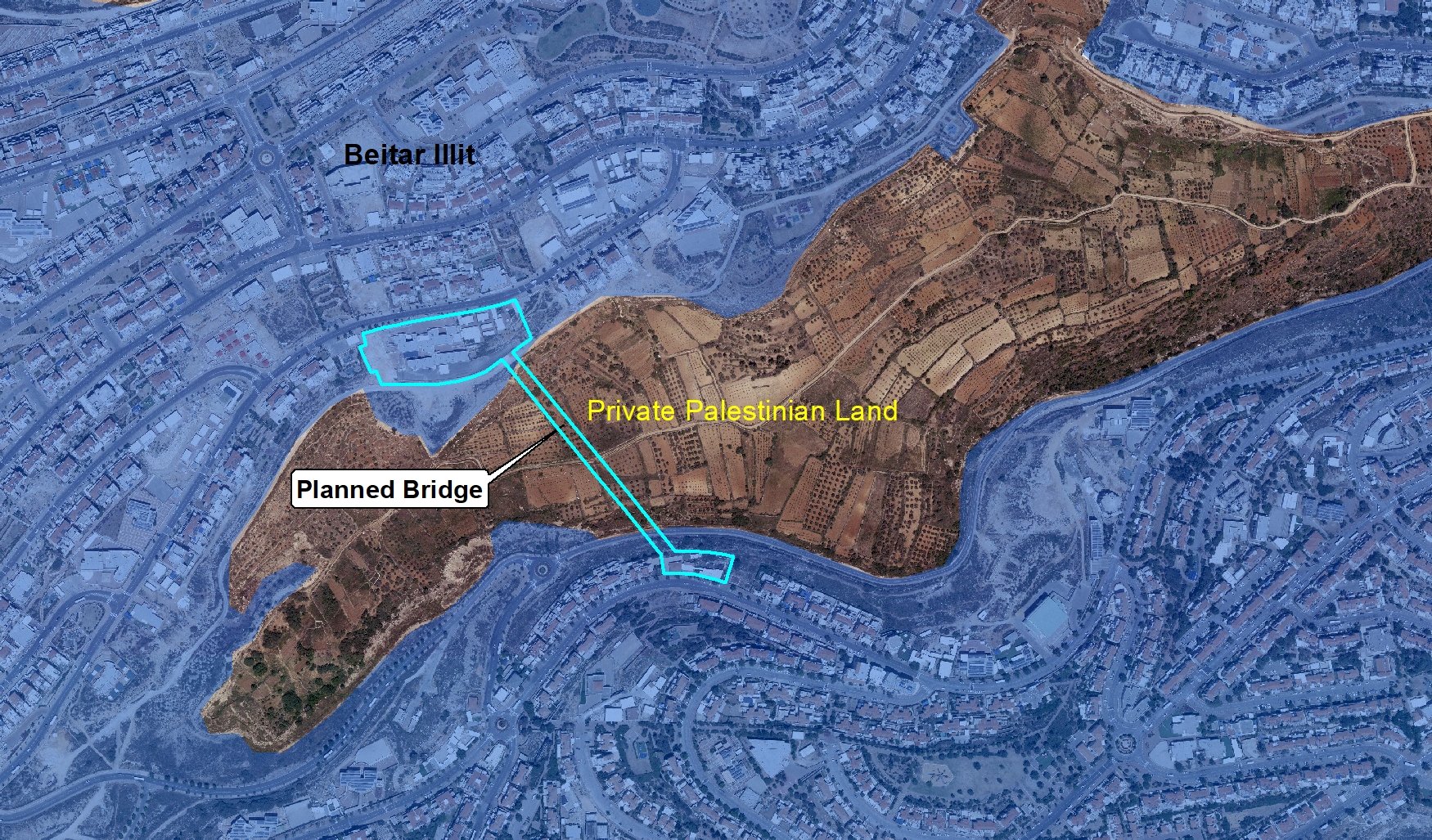
A new pedestrian bridge over privately owned Palestinian land for Israeli settlers to use on the Sabbath (when observant Jews do not drive, and had to walk a long route in order to reach other parts of the settlement).
- 603 new units in Maale Adumim
- A plan to retroactively legalize residential units in the Sde Bar settlement; Peace Now has not yet verified how many units are involved in this plan. Sde Bar was first established as an outpost of the Nokdim settlement in 1998, but Israel granted full approval to that outpost, recognizing it as an educational institute and a full-fledged settlement, in 2005. Settlers recently built a residential neighborhood there without Israeli authorization. The plan approved by the council on April 4th will grant retroactive authorization to those residential settlement units.
- 289 new units in the Alon settlement, located on the Palestinian side of the separation wall within sight of the Khan al-Ahmar bedouin village that Israel is prepared to forcibly relocate. There are plans to expand the neighboring Kfar Adumim settlement to takeover the land where Khan al-Ahmar currently stands.
- 110 new units in the Givat Zeev settlement.
- 108 new units in the Etz Efraim settlement.
- 85 new units in the Karnei Shomron settlement.
Of the total units advanced on April 4th, the High Planning Council also approved for deposit for public review plans for 2,433 new settlement units, the majority of which (1,198) will be built on the east side of the Israeli separation barrier, including:
- 1000 units in Efrat
- A plan to retroactively legalize 720 units in the Haresha outpost. This is part of the Israeli government’s ongoing efforts to retroactively legalize the outpost, which hinges on Israel’s ability to build a legal access road to the outpost. The Israeli government has found several creative solutions to that problem – like building a tunnel or building a bridge – all of which will undoubtedly infringe on the property rights and livelihoods of the Palestinian land owners.
- 210 units in Shiloh – expanding the footprint of the settlement to its north
- 147 units in Ariel.
- 147 units in Mitzpe Yericho.
- 114 units in Elon Moreh.
- 73 new units in Beitar Illit (in addition to the final approvals covered previously).
- 66 units in Oranit.
- 42 more units in Givat Zeev.
- 32 units in Beit Arie.
- 7 new units in Rehelim.
- An unverified number of new units in the following settlements: Paduel, Karnei Shomron, and Elkana.
Peace Now said in response:
“Netanyahu has decided, officially or unofficially, to annex the West Bank to Israel, otherwise one cannot explain the promotion of thousands of units for Israelis in the Occupied Territories. The construction of the settlements only makes it harder to end the occupation and to get to a two states peace agreement and is bad for the Israeli interest to remain a democratic and secured state.”
Housing Ministry Publishes Tenders for 956 Settlement Units
On April 4th the Israeli Ministry of Housing and the Israel Lands Authority met and published tenders for the construction of 956 new settlement units, including commercial complexes; 106 tenders are for plans in settlements east of the separation barrier. These units are in addition to the 3,659 units advanced this week by the Civil Administration’s High Planning Council (discussed above).
The published tenders are:
- 250 units in the Elkana settlement.
- 195 units in the Ariel settlement.
- 118 units in the Ofarim settlement.
- 112 in the Alfei Menashe settlement.
- 111 units in the Oranit settlement.
- 62 in the Adam (Geva Binyamin) settlement, located east of the separation barrier.
- 50 in the Emmanuel settlement.
- 44 units in the Maale Ephraim settlement, located east of the separation barrier.
- 14 units in the Beitar Illit settlement
As Peace Now explains, “some of the tenders are for units that were published in previous tenders but were not sold. The new tenders mean that the government is currently seeking to promote and build those units although failed to do so in the past.”
Ariel Medical School Gets Approval, But Faces High Court Petition
On April 12th, the Israel Higher Education Council voted to approve a new medical school in Ariel University, located in the West Bank settlement of Ariel. This approval contravenes the normal practice of the council, in that it ignores a vote to reject the school by the Higher Education Council’s own professional subcommittee. The medical school is slated to open this fall with significant financing from American casino magnate (and Trump supporter/financial backer) Sheldon Adelson.
However, the High Court of Justice is set to hear a petition regarding the unusual and scandal-ridden process by which the school gained approval at various stages of the planning process. The petition was filed by two Israeli academics – Prof. David Harel of the Weizmann Institute of Science and Prof. Alon Harel of the Hebrew University of Jerusalem – asserting that the approval “casts a heavy shadow on the decision making process in higher education.” It is unclear how the outcome of the petitions might affect the newly approved plan to open the medical school this fall.
Settlers Celebrate Right-Wing Election Victory
Settlers are mostly celebrating the results of Israel’s April 9th elections (in which West Bank and East Jerusalem Palestinians could not vote), which delivered incumbent Prime Minister Netanyahu an opportunity to form and lead the next government.
As has come to be expected, Netanyahu made an 11th hour election pitch by promising to start the process of annexation if he was reelected. Settlers received Netanyahu’s annexation promise and his reelection with predictable enthusiasm. The Yesha Council released a congratulatory statement saying:
“This morning we can say with certainty: In the face of all the campaigns and manipulations, the people of Israel chose the right. The people expressed their loyalty to the Land of Israel and chose in favor of applying Israeli sovereignty over Judea, Samaria and the Jordan Valley. We congratulate Prime Minister Benjamin Netanyahu on his election, and look forward to the establishment of a strong and broad right-wing government. In the next Knesset, too, we will continue to build, expand, legalize and jointly develop Israeli communities in the region.”
Not all settlers believe that Netanyahu will deliver on his promise to annex the settlements, but generally speaking, settlers dismiss the “will he/won’t he” debate (perhaps correctly) as a political decision that does not impact the reality of their presence on the ground.
Peace Now issued a sharp statement on the election results:
“Now the settlement lobby and its re-elected backers in the Knesset are doing what they know best – extorting and manipulating to save Netanyahu from prosecution in exchange for his compliance in working toward annexation. We at Peace Now were never relying on the election to change reality, but rather see grassroots public engagement as the only way to build pressure on the government. Now that Netanyahu has let the annexation genie out of the bag with his pre-election rhetoric, we stand even more equipped to go on the offense by showing fellow Israelis the bleak future the settler lobby and its Knesset backers are leading us, and what viable alternative path Israel can take toward a more prosperous, democratic, secure future.”
AirBnb Reverses Settlement Policy
On April 9th, AirBnB announced that it had reversed its decision to remove rental listings located inside of Israeli settlements in the occupied West Bank, despite previously acknowledging that settlements “are at the core of the dispute between Israelis and Palestinians,” and that the listings there “contribute to existing human suffering.”
AirBnB’s new announcement acknowledges (again) that settlements are “central to ongoing tensions,” but says it will nonetheless continue to allow those listings to remain on their website. Giving a nod to the controversial nature of this decision, AirBnB promised to donate all profits derived from West Bank settlement listings to humanitarian groups, but it conspicuously specified that these will be humanitarian groups working in other parts of the world (as opposed to with the Palestinians).
Omar Shakir, the Israel/Palestine Director at Human Rights Watch – which issued a significant and damning report on the issue of tourism being used to normalize occupation – tweeted in reaction:
“Disappointing @Airbnb decision reverses their stance to fully respect rights. Donating profits from unlawful settlement listings does nothing to remedy ‘human suffering’ they’ve acknowledged causing. By continuing to do business in settlements, they remain complicit in abuses.”
Along with AirBnB’s policy reversal, it settled several lawsuits filed against AirBnB in U.S. courts. FMEP President Lara Friedman tweeted on this important element:
“And just like that, US courts let themselves becomes weapons used to legitimize the violation of intl law, the re-definition of ‘lsrael’ to mean ‘all the land between the river and the sea,’ & the re-definition of ‘anti-Semitism’ to mean ‘refusal to endorse/normalize occupation.’ This is part of a broader trend that very few people are paying any attention to, which is a dangerous mistake. By the time folks wake up it will likely be too late. [link to: https://forward.com/opinion/417058/opinion-the-surprising-new-battleground-in-the-war-against-palestinian/]”
The Center for Constitutional Rights – which recently intervened in the legal cases involving AirBnB – issued a response saying:
“We are dismayed that Airbnb has caved to the legal bullying of Israeli settlers and re-listed properties in illegal settlements in occupied Palestinian territory. Airbnb’s decision reflects an alarming lack of commitment to human rights. When we filed counterclaims on behalf of the Palestinians who actually own the land the listed properties unlawfully sit on, we laid out the international and domestic law violations committed by the settlers, including war crimes and crimes against humanity. In backing down from its decision not to list properties in occupied Palestinian territory, Airbnb is in breach of its international human rights obligations, and is discriminating against Palestinians.”
Amnesty International – which also published a report on the complicity of online rental companies who list properties in East Jerusalem and the West Bank – said in response to AirBnB:
“Airbnb’s decision to continue to allow accommodation listings in illegal Israeli settlements in the occupied West Bank is a reprehensible and cowardly move that will be another devastating blow for the human rights of Palestinians…Airbnb are trying to absolve themselves by stating they will donate the profits from these listings to charity, but that fails to change the fact that by continuing to drive tourism to illegal settlements they are helping to boost the settlement economy. In doing so, they are directly contributing to the maintenance and expansion of illegal settlements, a breach of the Geneva Conventions and a war crime under Rome Statute of the International Criminal Court. Airbnb had a clear opportunity to make the right decision to uphold human rights and use their influence to set a precedent in the tourism industry. Instead, they have chosen to bury their heads in the sand – ignoring blatant evidence that they are helping to fuel violations that cause immense suffering to Palestinians. Airbnb’s reversal demonstrates why we can’t just rely on companies to take the right decisions, and that we need governments to fulfil their obligations by intervening and passing laws obliging their companies to respect human rights.”
U.S. Ambassador Friedman Touts East Jerusalem Settlement Business as “Path to Peace”
U.S. Ambassador David Friedman tweeted his support for the new Rami Levy mall, located in the Atarot settlement industrial zone within sight of Ramallah but inside the security barrier and within Israel’s municipal border, as expanded by Israel after the 1967 war.
Friedman said:
“Great morning at the new Atarot Mall in northern Jerusalem, anchored by a Rami Levy Supermarket. Was given a tour by Rami Levy himself. Israelis and Palestinians working, shopping and doing business together — a simple path to peace!”
FMEP President Lara Friedman tweeted in response:
“Amb Friedman & co’s special notion of peace, based on racist notion that unlike Jews who for 1000s of years refused to forsake their history/narrative, Palestinians will be beaten into submission or bribed into giving up basic human demand for freedom & equal rights.”
When the Rami Levy mall opened in January 2019, FMEP explained:
“The massive new mall is the crown jewel of the shopping empire built by Israeli businessman Rami Levy, who already operates a network of supermarkets in settlements. Like all of Levy’s projects (and settlement industrial zones in general), the new mall is branded as a socially-conscience, ‘coexistence’-building business initiative, with Levy and government officials praising the fact that the new mall will attract both Israeli and Palestinian shoppers and be home not only to Israeli businesses, but to to a few Palestinian-owned/operated businesses as well.”
The ‘coexistence’ argument is dismantled by the Israeli watchdog group Who Profits, which explained:
“The Jerusalem mall would mark a new stage in Levy’s involvement in the occupation economy…[which] began with providing services to Israeli settlers and continued with the exploitation of Palestinians as a cheap labor force in his supermarkets. He now appears to be turning his attention to massive construction projects on occupied Palestinian land and the exploitation of a Palestinian captive market in the East Jerusalem…Rami Levy is in a position that would allow him establish a large mall on “virgin land” because the Israeli authorities have prevented Palestinian businesses from competing with Israelis. Levy’s plan would take advantage of the fact that Palestinians do not have other large-scale retail facilities. A flourishing market in Bir Nabala was destroyed by Israel’s wall in the West Bank. And venturing into West Jerusalem is not an option for Palestinians, most of whom live below the poverty line. Although there is every likelihood that the Israeli authorities will portray Levy’s mall as beneficial to Palestinians, there are important facts to be remembered. Palestinians entering his mall will not be exercising the right of a consumer to informed choice. Rather, they will be captive clients — belonging to an occupied people.”
Bonus Reads
- “Democracy, Israeli Style” (New York Times)
- “Jerusalem is Finally Unified, In Opposition to this Plan” (Haaretz)