Welcome to FMEP’s Weekly Settlement & Annexation Report. To subscribe to this report, please click here.
July 9, 2021
- Palestinians Submit Petition Against Settler-Government “Deal” Regarding Evyatar Outpost
- Settlers Take Over House in Wadi Hilweh, Silwan [East Jerusalem]
- In Ongoing Attempt at Erasure, Israel Demolishes Khirbet Humsa for the Sixth Time
- Israel Moves to Dismiss Petitions Delaying Mass Demolitions in Al-Walajah
- Construction to Begin on New Units in Nof Zion Settlement Enclave Inside Jabal Al-Mukaber [East Jerusalem]
- New Israeli Government, Same Settlement Policy, Despite Including the “Left”
- Bonus Reads
Comments or questions? Email Kristin McCarthy – kmccarthy@fmep.org.
Palestinians Submit Petition Against Settler-Government “Deal” Regarding Evyatar Outpost
On July 8th, Palestinians submitted a petition with the Israeli High Court of Justice that challenges key agreements the Israeli government and settlers struck last week regarding the Evyatar outpost – which was built by settlers illegally (even under Israeli law) on land Palestinians know as Jabal Sabih. Under the terms of that deal, settlers agreed to leave the outpost on July 9th while the government examines the legal status of the land; the settler-built structures and roads will remain in place while that examination takes place. If the state decides, pursuant to the investigation, that it has a basis on which to declare the site to be “state land,” the settlers will be allowed to return and resume the establishment of what would from that point no longer be an illegal outpost, but a new “legal” settlement.
The petition against the deal is led by the local councils of Beita, Yatma and Qabalan (whose land is impacted by the outpost) and a group of nine individual Palestinian landowners. The petitioners seeks the demolition of all illegal settler structures and infrastructure at Jabal Sabih, and the lifting of a military seizure order for the land issued by the Israeli army in the early 1980s (in order to build a military base at the site, a strategic hilltop in the middle of Beita, Yamta, and Qablan). The petition further seeks an investigation into the officials and entities that assisted the settlers in establishing the outpost, including Defense Minister Gantz, the Israeli Civil Administration, and the settler regional council governing the area (the Shomron Regional Council).
The petitioners also seek to prove to the Court that they are the rightful owners of the Jabal Sabih land. Since the land was not registered under the Jordanian government at the time Israel took control over the West Bank (after which Israel promptly froze the land registration process, making it impossible for Palestinian to register land), the petitioners are using Ottoman tax records as well as aerial photos to document and demonstrate that they own the land and cultivated it prior to the time the area was seized by the Israeli army in the 1980s – based on Israeli security needs, not on declaring the area “state land.” Though by the 1990s the army no longer used Jabal Sabih as an army base, Israel continued to define the area as a closed military zone and continued to actively prevent Palestinians from accessing and cultivating their land. Now, as Palestinians seek to have Israel recognize their ownership, the fact that Israel has forcibly prevented them from cultivating the land might become the basis for Israel declaring that the land qualifies as “state land”, since it has not been actively cultivated for a period of at least 10 years.
Sliman Shahin, one of the two attorneys representing the petitioners, told Haaretz:
“The new government is continuing its predecessors’ policy with a vengeance, encouraging the culture of taking over Palestinian lands in the West Bank. With this agreement the state is enlisting the army as a trustee for the squatters to protect the illegal structures at the outpost.”
Alaa Mahajna, the second attorney involved, added:
“In Evyatar’s case, the government intervened on behalf of the squatters and forced an unprecedented, corrupt mechanism that spits in the face of the law. The government has signaled to the settlers that it’s possible to act like the West Bank is the Wild West.”
Settlers Take Over New Property in Wadi Hilweh, Silwan
On the night of July 1st, Israeli police accompanied a large group of Israeli settlers as they moved into a Palestinian home in the Wadi Hilweh neighborhood of Silwan, in East Jerusalem. Reports suggest that the large piece of property – including the home, stores, a plot of land, and another building that is currently under construction – was sold by its Palestinian owners to a Palestinian citizen of Israel, who in turn sold it to individuals associated with the Elad settler organization. Those owners had denied selling the home in the days prior to the takeover; the Palestinian citizen of Israel involved as the middle man confirmed buying the house, but claimed he intended to renovate it into a clinic and denied selling it to Elad. The Wadi Hilweh Information Center obtained footage of the Palestinians who lived in the home leaving in a hurry in the early morning hours of July 1st – suggesting that they did indeed sell the home and knew of the transfer of the home to the settlers later that day.

Map by Peace Now
Peace Now, noted the importance of the broader significance of this new settler-controlled site in Silwan, as well as the context in which Palestinians “sell” homes to settlers, writing:
“A settlement within Palestinian neighborhoods in Jerusalem is harmful to Jerusalem and harmful to Israel. Settler houses in the heart of Palestinian neighborhoods make it difficult to reach a future peace agreement and a compromise in Jerusalem, and they severely damage Jerusalem’s delicate fabric and regional stability. The so-called “purchase” of Palestinian properties, is an ugly and despicable matter, almost always involves the exploitation of the structural inequalities and the fact that Palestinian residents are discriminated against in all areas of life in Jerusalem…
“Elad has dozens of properties in Wadi Hilweh in Silwan, and the government has handed over the management of one of the most important and sensitive tourist sites in Israel, the “City of David” site. With the help of archeology and tourism as legitimating mechanisms, Elad association gains control of a vast area of Silwan and hundreds of thousands of visitors a year. For more information, see: Settlement under the guise of tourism.
“These days are very tense days in East Jerusalem. More than a thousand residents in Silwan (Batan Al-Hawa) and Sheikh Jarrah are facing eviction claims by settlers; More than a thousand residents of Bustan in Silwan are under threat of demolition of their homes because of government plans to build the “King’s Garden” park on the site. On Tuesday, the municipality demolished a store in the Bustan neighborhood (about 700 meters from the new house that the settlers entered today), and in protest of the residents after the demolition, several residents were arrested a dozen wounded by police sponge bullets and stun grenades.”
In Ongoing Attempt at Erasure, Israel Demolishes Khirbet Humsa for the Sixth Time
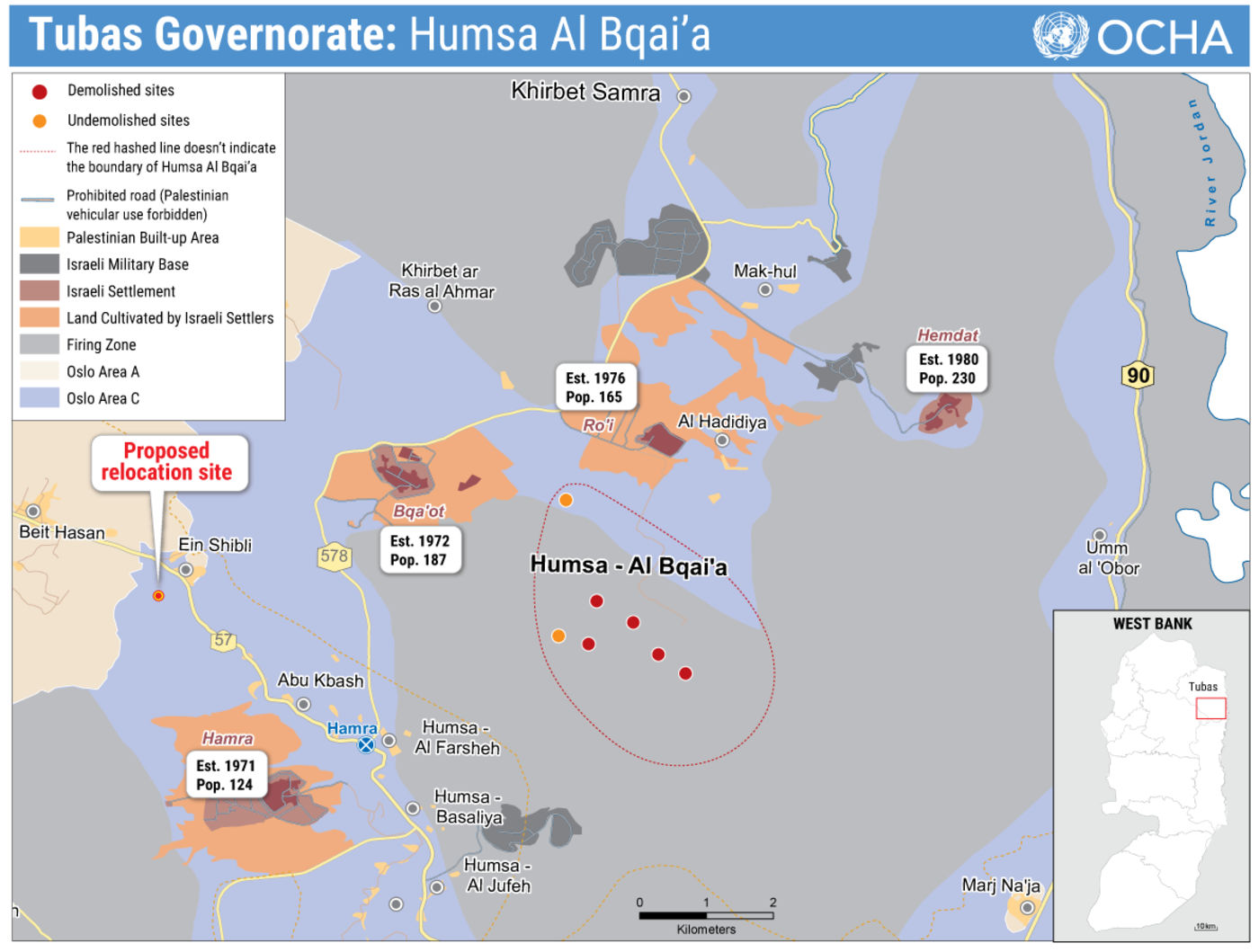
Map by OCHA
On July 7th, Israeli border police demolished the tiny Palestinian village of Khirbet Humsa, located in the northern Jordan Valley. The bulldozers leveled some 27 tent homes in addition to all of the village’s agricultural structures. Israeli forces also seized the remnants of those tents and their residents’ personal belongings, in addition to the community’s water tanks and food parcels. This demolition left 70 Palestinians – including 36 children – homeless, and left them and their livestock without shelter, shade, food, or water in the hot summer heat (expected to reach 102/39 degrees that day). This is the sixth time in less than a year that Israel has demolished Khirbet Humsa, the last time being in February.
The Israeli Civil Administration proceeded to dump the confiscated items at the site where the Israeli government has proposed relocating the Khirbet Humsa community, a place called Ein Shibli. The community has continually rejected and resisted this plan for their forced displacement.
B’Tselem writes:
“House demolitions in this community are part of the policy Israel employs throughout the West Bank in an effort to create unbearable living conditions with the ultimate aim of pushing Palestinians to leave their homes, concentrating them in enclaves and taking over their lands. This policy is an attempted forcible transfer of the residents – a war crime under international humanitarian law. The responsibility for this policy lies primarily with the government, which directs it, the top military command, which implements it, and the justices of the Supreme Court, who lend it legal legitimacy. Israel’s actions are also a badge of shame for the international community, which has absolved itself of the obligation to demand Israel respect the human rights of Palestinians living under its control and allowed itself to be satisfied with empty rebukes lacking any practical consequences.”
Khirbet Humsa is located in Area C of the West Bank, in an area of the Jordan Valley that Israel declared a closed military zone even though Palestinians had been living there for decades, and using the land for agriculture and herding. Israel has long used the pretext of military firing zones to pursue the forcible displacement of Palestinians, while simultaneously ignoring (and in some cases openly assisting) settlers to establish a presence in the very same areas. Firing zones constitute nearly 30% of Area C, including the native lands and current homes of 38 Palestinian Bedouin and herding communities.
Israel Moves to Dismiss Petitions Delaying Mass Demolitions in Al-Walajah
Ir Amim reports that the state of Israel filed a motion seeking the dismissal of appeals that have delayed the demolition of 38 homes — housing around 300 people — in the Palestinian village of al-Walajah, located just south of Jerusalem (a small part of the city actually within the expanded municipal borders of Jerusalem), based on the argument the houses were built without the required Israeli permits. The Court has given the Palestinians until July 11th to file a response to the State’s motion to dismiss.
The state’s motion comes four months after it rejected a proposed outline plan for al-Walajah, which was developed by experts working with the community. The plan would have provided a way for the 38 homes facing demolition to retroactively receive Israeli building permits. Israel rarely issues such permits to Palestinians anywhere in Area C. For residents of al-Walajah the situation is even worse: given the fact that the Israeli government has refused to approve an official outline plan for the area, they have zero hope of obtaining the permits required to build on their own land, as without an outline plan permits simply cannot be issued.
In an effort to overcome this obstacle, Palestinians, with the help of planning experts, initiated their own outline plan for this section of Al-Walajah in the hopes of getting it approved by Israeli authorities — to no avail. Israeli authorities have repeatedly refused to approve the resident-backed plan, and have also refrained from initiating their own planning process. The result: Al-Walajah’s residents were left in limbo – that is, until the Jerusalem District Committee, as part of a January 25, 2021 ruling against an outline plan proposed by residents, deemed the area in question — where Palestinians have lived for decades — an “agricultural area” where no building would ever be permitted.
Construction to Begin on New Units in Nof Zion Settlement Enclave Inside Jabal Al-Mukaber [East Jerusalem]
Peace Now reports that on the evening of July 8th, a cornerstone laying ceremony was scheduled to be held to mark the beginning of construction on hundreds of new units in the settlement enclave called Nof Zion, which is located in the center of the Jabal al-Mukaber Palestinian neighborhood in East Jerusalem. Jerusalem Mayor Moshe Leon was scheduled to partake in the celebration
Preliminary work on the expansion of Nof Zion – a project that will triple its size and make it the largest settlement enclave in East Jerusalem – first began in December 2019. The project will add 182 homes to the existing 91 units that were approved for construction in 1994 (and built in the early 2000s). The Israeli government originally approved plans for a total of 395 units but the first phase of construction bankrupted the developer and the remaining building 304 permits were never issued. A drama ensued over the fate of the project, after a Palestinian-American made a bid to buy the development rights. His winning bid was ultimately blocked by right-wing Israelis [with a key role played by Jerusalem settler impresario Aryeh King], who objected to the sale of the property – in a Palestinian neighborhood – to an Arab. Plans then stalled until settlers were able to recruit Australian billionaire Kevin Braimster and Israeli entrepreneur Rami Levy (read about Levy’s settlement superstore empire here), to fund and acquire the rights to the project — preventing its transfer to Palestinians.
Nof Zion received significant investment from the Israeli government in 2017, when the government approved a plan to build a new synagogue and mikveh on private Palestinian land that was expropriated from the Jabel Mukaber neighborhood in 2016. Then, in September 2017, rumors emerged that the government was set to issue 176 building permits for the already-approved project. According to Ir Amim, those permits were ultimately issued in April 2019.
Peace Now, in its appeal to Mayor Leon to cancel his attendance at the ceremony, writes:
“Nof Zion is a failed settlement project in the heart of the Palestinian neighborhood of Jabel Mukaber. The first incarnation of the settlement proved that the vast majority of Israelis are not interested in buying houses in the heart of Palestinian neighborhoods and the only ones willing to live there are a minority driven by ideological motives. It so happened, as is well known, that in the end the entrepreneurial company of the project went bankrupt. The fact that the current project is funded by philanthropists is the clear proof that the new project has no economic or real estate interest and does not constitute anything in line for the city’s residents, but only another political attempt to prevent the possibility of compromise and coexistence in Jerusalem.”
New Israeli Government, Same Settlement Policy, Despite Including the “Left”
Interior Minister Ayelet Shaked (Yamina) recently told settler leaders that the new Israeli government, led by Prime Minister Naftali Bennett (Yamina) and alternate Prime Minister Yair Lapid (Yesh Atid), will continue the same basic practices of the recent Netanyahu government when it comes to settlement policy. That includes planning to convene the Civil Administration’s High Planning Council (within the Defense Ministry) once per quarter in order to consider settlement construction plans. Israeli Defense Minister, Benny Gantz (Blue & White), publicly criticized Shaked for telling settler leaders about decisions that fall under the authority of his Ministry.
When asked to confirm Shaked’s announcement that the High Planning Council will meet once per quarter, as was the agreed arrangement between Netanyahu and Trump, a spokesperson for the Defense Ministry said:
“We will run things as we see fit. [The council] didn’t meet once a quarter in the previous administration. There has been no decision.”
Shaked and Gantz recently clashed over the fate of the unauthorized Evyatar outpost, with Shaked advocating for the community’s permanent settlement and Gantz pushing for enforcement of Israeli law and, thus, the demolition of the outpost. Shaked ultimately won out (see above for details of the Israeli government’s “compromise” with settlers that likely paves the way for Evyatar to become a brand new, “legal” settlement).
Bonus Reads
- “The draconian law used by Israel to steal Palestinian land” (Al Jazeera)
- “’With God’s Help, We Will Return Legally’: Israeli Settlers Quietly Leave Illegal Outpost” (Haaretz)
- “In order to expand settlement, Israelis fence off tract of Palestinian land southwest of Bethlehem” (WAFA)
- “Apartheid, the Green Line, and the Need to Overcome Palestinian Fragmentation” (EJIL:Talk // Rania Muhareb)
- “US freezes Abraham Fund, as Israel-UAE business ties falter” (Globes)
- “Israeli-UAE investment projects in uncertainty as US indefinitely ends support for Abraham Fund” (The New Arab)
- “How Israel is automating the occupation of Palestine” (The New Arab)
- “U.S. Slams Israel for Razing Home of Palestinian-American Who Murdered an Israeli” (Haaretz)
Welcome to FMEP’s Weekly Settlement & Annexation Report. To subscribe to this report, please click here.
February 12, 2021
- ICC Confirms Jurisdiction Over (Israeli and Palestinian) War Crimes Committed in OPT
- ICC Investigation Expected to Take On Settlements, Potentially Exposing Untold Number of Israeli Government Officials to Criminal Liability
- Jewish National Fund to Start (Openly) Purchasing West Bank Land for Settlement Expansion
- Israel Rejects Development Plan for al-Walajah, Paving the Way for Further Demolitions
- Israel Demolishes Khirbet Humsa for Third Time this Month, Highlighting Discriminatory Enforcement in Jordan Valley as Path to Israeli Annexation
- Israeli Court Hears Appeal to Stop Mass Dispossession in Sheikh Jarrah
- Who Profits Report: “Infrastructures of Dispossession and Control Transport Development in East Jerusalem”
- Bonus Reads
Comments, questions? Email kmccarthy@fmep.org
ICC Confirms Jurisdiction Over (Israeli and Palestinian) War Crimes Committed in OPT
In a ruling published on February 5, 2021, a three judge pretrial chamber of the International Criminal Court confirmed that the Court’s jurisdiction extends over the occupied Palestinian territories (the West Bank, East Jerusalem, & Gaza Strip). As a reminder, the Court’s jurisdiction is over individuals (not states) and includes jurisdiction over war crimes committed by both Israeli combatants and Palestinian combatants. With this ruling, the ICC’s Chief Prosecutor Fatou Bensouda will need to decide whether and when to formally open an investigation into potential war crimes. According to an official statement from Bensouda’s office welcoming the decision, her office is “carefully analyzing the decision & will then decide its next step.”
The pretrial chamber was convened by Bensouda in December 2019 to make a final determination on the highly disputed issue of the Court’s jurisdiction in Palestine. Bensouda herself submitted a brief to the chamber in April 2020 articulating her belief that the Oslo Accords – signed by the PLO and Israel – are a credible legal basis for establishing Palestine as an internationally recognized state. Her brief refuted arguments made in amicus curiae briefs filed by several countries, including Germany (the second largest funder of the ICC), insisting that Palestine is not a state and that the Court therefore cannot have jurisdiction. The Czech Republic, Austria, Australia, Hungary, Brazil and Uganda also filed briefs along those lines. Bensouda’s brief — well worth reading in full — also systematically rebutted the raft of arguments made by various international lawfare organizations asserting that the Court has no right to investigate. As a reminder: in June 2020, President Trump signed an Executive Order authorizing sanctions against ICC officials; in September 2020, the Trump Administration used that Executive Order to impose sanctions on Bensouda and another ICC official; in January 2021, a US court blocked those sanctions..
In response to the decision of the pretrial chamber, the Biden Administration promptly stated its opposition. State Department spokesperson Ned Price said in a statement that the U.S. has “serious concerns about the ICC’s attempts to exercise its jurisdiction over Israeli personnel” – statement that was on the one hand categorical and on the other hand far more restrained than what had previously come out of the Trump Administration or the Israeli government (objecting to the decision but not attacking the court itself). It’s worth noting that the Biden Administration has yet to reverse sanctions imposed on ICC officials by former President Trump (including the revocation of Fatou Bensourd’s entry visa to the United States) or revoke Trump’s anti-ICC executive order.
In response to the White House statement, +972 Magazine Editor Amjad Iraqi wrote:
“The fact that the White House rejects this mission at The Hague is further proof that the United States is not really interested in an independent Palestinian state. If Israel prefers apartheid, then Washington will stand behind it, even at the cost of its own proclaimed policy. The Biden administration should either admit this fact or begin backing up its two-state vision with meaningful action. If neither, then it should step back and let the court do its job.”
ICC Investigation Expected to Take On Settlements, Potentially Exposing Untold Number of Israeli Government Officials to Criminal Liability
Having now established its jurisdictional authority to proceed, the International Criminal Court is expected to take up, in addition to other alleged crimes, the criminal acts perpetrated by individuals who participated in the establishment of Israeli settlements in the West Bank. The basis for investigating such persons is international law, according to which the transfer of a civilian population into occupied territory is prohibited.
Yuval Shany, Israel Democracy Institute, told AP:
“The settlement issue is really the biggest issue. This is the elephant in the room. This exposes basically the entire Israeli political elite that has been part of a settlement policy to criminal proceedings before the court. This is a significant setback.”
Yesh Din, an Israeli NGO deeply involved in fighting settlement expansion and defending Palestinian rights in the West Bank, said in response to the ICC’s jurisdictional ruling and the investigation into settlement construction:
“Yesh Din has, for many years, also exposed, challenged and petitioned to the HCJ regarding settlement expansion and takeover of Palestinian lands, an official policy and long-standing practice by successive Israeli governments, despite being a clear violation of international law. We have, time and again, seen that even when a degree of legal remedy is occasionally achieved, too often, failures of enforcement or other mechanisms are applied to prevent Palestinians from truly returning to their lands (see HCJ 88/19 and HCJ 9948/09).
Furthermore, the HCJ has served to enable the establishment and expansion of settlements (HCJ 4481/19) and even approved the State’s efforts to retroactively authorize, or ‘regularize,’ outposts and settlement construction considered illegal even under Israeli law, such as in ongoing proceedings regarding illegal construction in the Netiv Ha’avot (HCJ 5480/15) and Adei Ad outposts (8395/14), among others. The HCJ has further failed to halt creeping annexation, leading to today’s situation of de-facto annexation already in place.
These failures in Israel’s law enforcement and judicial processes reflect a lack of will to hold perpetrators responsible, willingly turning a blind eye to offenses committed within the broader context of a clear intention to expand control over Palestinian lives, land and resources.
As such, Yesh Din welcomes the ICC’s jurisdiction to open an investigation into potential war crimes in the hopes for greater accountability and a future in which international law will be respected and upheld and, ultimately, in which the fundamental human rights of Palestinians and Israelis alike will be protected.”
Jewish National Fund to Start (Openly) Purchasing West Bank Land for Settlement Expansion
According to Axios, the Board of Directors of the Jewish National Fund is expected to approve a new policy on Sunday (February 14) allowing the organization to in directly purchase land in Area C of the West Bank for the purposes of facilitating settlement expansion (which is illegal under international law and opposed by governments the world over as a violation of Palestinian rights). If this new policy is indeed adopted, the JNF will officially make financing the Israeli settlement enterprise a loud and proud part of its mission. This would be a shift not so much in policy as in public relations, given that the JNF has long worked in support of settlements, but until this point has left settlement-related activities deliberately obscured. The shift in approach that will culminate in Sunday’s vote is in line with the JNF’s new right-wing, settler leadership (which effectively took control of the organization in October 2020).
According to the report, the proposed JNF policy – which could see hundreds of millions of dollars invested in the settlement enterprise – includes directives for the organization to purchase land subject to the following conditions:
- The land is privately owned by Palestinians.
- The land will be used to expand existing settlements, not build new ones (this presumptively includes purchasing land to build outposts).
- The land is in Area C (some 60% of the West Bank), not land in Areas A and B.
- The land is located inside of a settlement’s jurisdiction or adjacent to it.
- Focus will be on purchasing land in areas identified as a priority, including the Jordan Valley, the Etzion settlement bloc, areas around Jerusalem, the Binyamin region north of Jerusalem, the South Hebron Hills, and areas adjacent to the pre-1967 border. The draft specifically says that no land shall be purchased in the Nablus or Jenin areas.
- Foreign donations will only be used to purchase land in the West Bank if the laws of the donor’s country permit it.
Commenting on the report, Peace Now put it bluntly:
“The Israeli Jewish National Fund has long had a dark side in discreetly facilitating settlement expansion. This latest news on it intending to purchase private Palestinian land is a decision to bring it into the open. Make no mistake. This isn’t about whether Jews can live wherever. KKL-JNF purchasing land in the West Bank is meant for Israel to keep the land. It’s not like it intends for Jews and these land plots to be in a Palestinian state.”
When asked for comment, the spokesperson for the U.S. Department of State, Ned Price, said:
“Well, I think there is a broad point at play here, and that point is this: We believe it is critical to refrain from unilateral steps that exacerbate tensions and that undercut efforts to advance a negotiated, two-state solution. And unilateral steps might include annexation of territory, settlement activity, demolitions, incitement to violence, the provision of compensation for individuals imprisoned for acts of terrorism. We have continued to emphasize that it is critical to refrain from all those activities.”
Established in 1901, the JNF devoted itself to buying land for Jews. Today, the JNF owns about 15% of all the land inside the Green Line. In addition, the JNF has also used two subsidiary companies – both called Himanuta – to purchase land in the West Bank, even though stated JNF policy (until now) did not support such purchases . The JNF and Himanuta used middle men in order to allow the JNF to deny a direct role in West Bank land purchases, which JNF leadership feared would hurt the organization’s fundraising potential. Peace Now reports that the JNF, via its subsidiary Himanuta, has already purchased over 160,000 acres (65,000 dunams) across the West Bank; settlements established on some of those lands include Itamar, Alfei Menashe, Einav, Kedumim, Givat Ze’ev, Metzadot Yehuda (Beit Yatir), Otniel and more. At the same time, the JNF and the settler group Elad have been partnering together to pursue the mass eviction of Palestinians from East Jerusalem neighborhoods, including Silwan.
Israel Rejects Development Plan for al-Walajah, Paving the Way for Further Demolitions
 On January 25th, the Jerusalem District Planning Board rejected a Palestinian-proposed outline plan for the village of al-Walajah, located on the southern flank of Jerusalem. For at least 15 years, al-Walajah residents have attempted to gain Israeli approval for an outline plan – which is a key planning document that establishes land usage and provides for the future development of the community. Without an outline plan, no building permits can even be considered, leading to a situation where Palestinians are forced to build illegally to meet the basic needs of a growing community.
Due to its location and unique political situation (both discussed below) Al-Walajah is already the focus of a years-long campaign of demolitions and land confiscations. By rejecting the outline plan, the Planning Board has cleared the way for an additional 38 homes in al-Walajah to be demolished because they lack Israeli-issued building permits.
Ir Amim reports important detail on context of the Board’s decision:
“The planning committee rejected the outline plan based on various dubious claims, including on the basis of nature and environmental conservation, yet plans for massive Israeli settlement construction and expansion in the same area have all been approved. Not only is this a prime example of the rampant housing discrimination against Palestinians in Jerusalem, but the committee’s citation that the area’s traditional and historical agricultural assets must be preserved entirely overlooks the village’s exclusive role in this centuries-old preservation. Without the homes and the farmers to build and cultivate the land as they have for generations, there will be nothing left to preserve.”
Haaretz reports that, prior to its ruling in January, the Jerusalem District Planning Board refused to discuss this outline plan. The Board was forced to consider the plan when al-Walajah residents petitioned the Isareli Supreme Court. Attorney Jiat Nasser, who is representing the villagers, told Haaretz:
“The district board’s decision is discriminatory and dripping with malice. It feels like the hearings were fixed, as if they want the residents to leave… We didn’t expect inhumanity would reach such proportions.”
Al-Walajah is a village besieged by Israel from every angle. In the words of Danny Seidemann:
“ Since 1967, Walajeh’s inhabitants have lived in a Kafka-esque situation, with their village technically located inside Israel’s expanded borders, but with villagers never given Israeli residency (they are considered West Bankers and thus are not permitted inside Jerusalem). As a result, the villagers’ presence in their own village is, under Israeli law, illegal, and their homes there are, by definition, illegal.”
For decades, the Israeli government has carried out a multi-prong effort to push Palestinians off of their land in al-Walajah. This has included demolition campaigns, construction of the separation barrier along a route that encircles the village and cuts residents off from their land, refusal to grant building permits, and the declaration of state parks over lands on which Palestinians have lived for generations.
In October 2020, it was revealed that Israel, in order to build the Har Gilo West settlement, plans to extend the separation barrier to completely encircle al-Walajah, which is already surrounded on three sides by the separation wall. The new section of the barrier will be a 7-meter high concrete slab along the western edge of the built-up area of Al-Walajah.
Israel Demolishes Khirbet Humsa for Third Time this Month, Highlighting Discriminatory Enforcement in Jordan Valley as Path to Israeli Annexation
On February 8th, Israel forces returned to the Palestinian Bedouin community of Khirbet Humsa in the Jordan Valley for the third time this month to demolish structures and confiscate the property of the ~65 Palestinians who continue to live there despite Israeli attempts at forced relocation. This was the fourth time that the community has been demolished.
Khirbet Humsa is located in Area C of the West Bank, in an area of the Jordan Valley that Israel declared a closed military zone even though Palestinians had been living there, and using the land for agriculture and herding, for decades. Israel has long used the pretext of military firing zones to pursue the forcible displacement of Palestinians, while simultaneously ignoring (and in some cases openly assisting) settlers to establish a presence in the very same areas.
B’Tselem documented the demolitions of Khirbet Humsa, and responded:
“These demolitions are part of Israel’s policy, enacted throughout the West Bank, to make Palestinians’ lives unbearable, in order to force them to leave their homes, concentrate them in enclaves and take over their land. This policy constitutes an attempt at forcible transfer — which is defined as a war crime under international humanitarian law. The responsibility for its execution lies first and foremost with the political decision-makers leading it, the senior military command carrying it out, and the Supreme Court lending it a legal stamp of approval.”
In telling the story of another Palestinian village in the Jordan Valley facing a similar fate (the village of Jibneh), Yuval Abraham wrote in +972 Magazine:
“Israel has declared about 18 percent of the West Bank as firing zones for military training. This is roughly as large as the West Bank area under full Palestinian control. During a 2014 Knesset subcommittee meeting on “illegal Palestinian construction in Area C,” Col. Einav Shalev, then operations officer of Central Command, admitted that one of the main reasons for increasing military training in these firing zones is to prevent Palestinian construction.
It is important to stress that these are villages that have existed for many decades. The residents have no way of building legally because the Civil Administration, the arm of Israel’s military responsible for governing Palestinians in the occupied West Bank, denies more than 98 percent of permit requests filed by Palestinians in Area C. To even discuss this issue in terms of legal compliance is absolutely ridiculous, since the law is clearly based on ethnic bias…
Increasing governance, meaning, amplifying Israel’s pressure to expel local communities like Jinbeh, that live in areas the state wants to Judaize. Israel is currently focusing on three West Bank areas: the Jordan Valley, south Hebron Hills, and an area known as E1, which connects East Jerusalem to the West Bank. There, Israel systematically denies building permits to Palestinians in order to force them to leave.”
Last week, prior to the demolition on February 5th, a large delegation of European diplomats visited Khirbet Humsa to witness what was taking place. One participant on the delegation, Sven Kuehn von Burgsdorff, said:
“We express our strong concern regarding the policy of demolishing residential structures of Bedouin communities who have been residing here for decades. And our concern is very simple. We are here to uphold international law, including international military law which forbids demolitions of residential structures in occupied territories. It’s contrary to the obligations [of Israel] under the 4th Geneva Convention evictions or forcible transfer likewise. Here we’re talking about 100 people, of whom 40 to 50 are children. We’re in the midst of a pandemic we are in the midst of winter-time. Where do these people go facing homelessness, facing winter?”
Israeli Court Hears Appeal to Stop Mass Dispossession in Sheikh Jarrah
On February 9, the Jerusalem District Court held a hearing to consider an appeal submitted by four Palestinian families – including the El-Kurd family – facing eviction from their homes in Sheikh Jarrah, a neighborhood of East Jerusalem in the shadow of the Old City. The appeal holds significance beyond the families directly involved, as it threatens to cement a legal precedent that can be used by settler groups to carry out a mass eviction in Sheikh Jarrah.
The evictions being challenged in Court are part of an ongoing campaign to throw Palestinians out of their homes in Sheikh Jarrah and replace them with Israeli settlers. It is led by the Ateret Cohanim settler group (and others), with the evictions based on Israel’s Absentee Property Law – a law that allows Jews to reclaim property that was abandoned in the 1948 war. To take advantage of that law, Ateret Cohanim has tracked down Jews (or their heirs) who before 1948 owned homes in highly desirable East Jerusalem neighborhoods, convincing them to make a claim on the property, and then working with them or on their behalf to evict Palestinians who have been living – legally – in the homes or on the property, in some cases for more than half a century.
On the day of the Court hearing, Palestinians led a protest (which included Israeli and international activists) outside of the Jerusalem District Court. Along with protests on the ground, international diplomatic pressure appears to be picking up. A group of 81 Members of the British Parliament penned a letter to their own foreign secretary asking for the country’s leadership to engage on the issue of Sheikh Jarrah. The letter asked the secretary to “make clear to its [the UK government’s] Israeli counterpart that relations cannot continue as normal in the event of such transgressions,” stating:
“All measures should be considered including reducing diplomatic engagement and banning trade in settlement products in full conformity with international law obligations in order to challenge the settler economy that profits from the occupation.”
Just Vision – which shared one Sheikh Jarrah family’s story in the docuseries “My Neighborhood,” said in a November 2020 email drawing attention to these evictions:
“While the cases in Sheikh Jarrah are thinly veiled as a legal matter, the political motivations are clear. This latest round of evictions is part of a broader attempt by the Israeli state to forcibly displace Palestinians from their homes in East Jerusalem and the West Bank. The process is methodical and impacts thousands of lives on a daily basis. In the past month alone, Israel hid under the US election media frenzy to undertake the largest demolition of Palestinian homes and structures in a decade, and just yesterday, announced a new settlement, Givat Hamatos, that would effectively cut East Jerusalem off from Bethlehem. This all happens under the United States’ watch – subsequent US administrations have done little to hold the Israeli government to account, and the latest administration has given a carte-blanche for unjust activity like this.”
Who Profits Report: “Infrastructures of Dispossession and Control Transport Development in East Jerusalem”
In a new report, Who Profits expertly surveys major infrastructure projects in East Jerusalem that are part of the Israeli government’s drive to dispossess Palestinians and facilitate a stronger Jewish presence and control across the entire city. Providing an overview of the report, Who Profits writes:
“Transport infrastructure, which regulates not only space but the movement of people and goods across space, offers a powerful organizing instrument for an occupying power. Together with the Wall and the checkpoints, Israel’s transport network in the occupied Palestinian territory (oPt) works to manage and control both land and population in accordance with Israeli interests.
For Israel’s illegal settlement enterprise, infrastructure development provides a lifeline, enhancing settler connectivity, supporting economic development and normalizing Israeli presence on occupied land.
For the occupied Palestinian population, these infrastructure development projects are intimately tied to the processes of dispossession and facilitate land grabs. In this way transport projects are a means of annexing land, fragmenting and isolating communities and destroying agrarian livelihoods by separating farmers from their agricultural lands.
This flash report focuses on five large scale transport infrastructure projects in East Jerusalem currently at various stages of development, and exposes the private corporations involved in their implementation. All companies profiled herein were contacted prior to publication. To date, no responses have been received. The projects surveyed are: (1) the expansion of the Tunnel Road, a section of Route 60 south of Jerusalem; (2) the construction of the American Road, a north-south highway that cuts through East Jerusalem’s Palestinian neighborhoods; (3) the construction of an underpass and grade separation at the Qalandia checkpoint on the outskirts of Ramallah, north of Jerusalem; (4) the construction of grade separation in the French Hill settlement neighborhood and (5) the expansion of the Jerusalem Light Rail Network.
Our research shows that although the projects themselves are carried out by Jerusalem’s municipal development arm, the Moriah Jerusalem Development Corporation (hereafter: Moriah) and located largely within municipal lines, they target not only the settlement neighborhoods of illegally annexed East Jerusalem—but also the occupied West Bank as a whole. The transport projects examined in this publication are part and parcel of a broader Israeli strategy to promote the economic and spatial integration of the West Bank in terms of dispossession, segregation and control.”
Bonus Reads
- “Settlers stop Palestine TV documenting settlement activities in West Bank” (MEMO)
- “Concern rises over takeover of hundreds of dunums of West Bank village land as Israelis survey the area” (WAFA)
- “Sa’ar says West Bank Annexation still a goal, even if not implemented now” (Jerusalem Post)
- “Biden must prevent Israel’s march toward annexation” (Responsible Statecraft)
- “David Friedman: We left the world a better place” (Arutz Sheva)
- “In assertion of sovereignty, Palestinians launch postcodes in West Bank” (The Times of Israel)