Welcome to FMEP’s Weekly Settlement & Annexation Report. To subscribe to this report, please click here.
October 23, 2020
- Following Wave of New Settlement Approvals, Israel Advances Plans for New Settler Bypass Roads
- Settler Violence (Predictably) Spikes During Olive Harvest, IDF (Predictably) Fails to Intervene
- Settlers Establish New Outpost in Jordan Valley to Expand Maskiyot Settlement
- Israel Increasing Demolitions of Palestinian Construction in Second Half of 2020
- The Return of Economic “Peace” Schemes: Judea and Samaria Business Council Holds Virtual Summit, Praises Abraham Accords as Model for “Peace”
- CONFIRMED: Tekoa Settles Illegally Built on Palestinian Land
- Friedman Reiterates Trump Admin Support for Settlements & Outposts
- Bonus Reads
Comments/questions? Contact Kristin McCarthy (kmccarthy@fmep.org)
Following Wave of New Settlement Approvals, Israel Advances Plans for New Settler Bypass Roads
This week Israeli authorities advanced plans for the construction of three new settler bypass roads. The advancement of the plans comes just a week after the High Planning Council advanced plans for the construction of 4,948 new settlement units (in addition to the retroactive legalization of hundreds of existing units and approval of 4 major non-residential settlement construction projects).
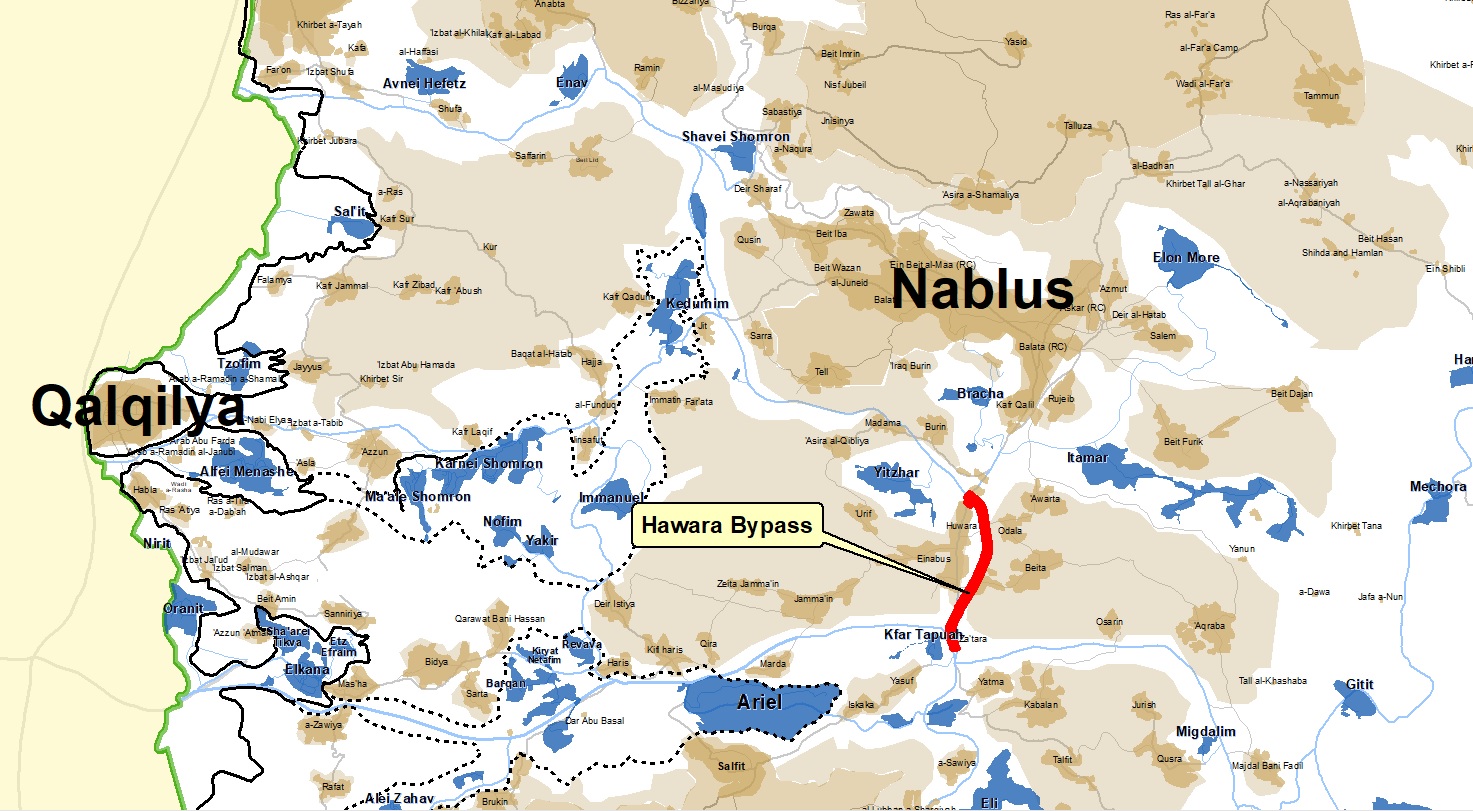
Map by Peace Now
Specifically, a special committee within the Israeli Finance Ministry approved a tender for the construction of the Huwwara Bypass Road, a new road designed to enable settler traffic from the Nablus area to bypass the the Palestinian village of Huwwara (which is an area with heavy traffic congestion from daily commuters) in order to more easily/directly access Jerusalem. This bypass road has long been a top priority for the settlers, who have complained about the long commute to Jerusalem and the limit this puts on the potential for growth of Nablus-area settlements; the radical/violent Yitzhar settlement will benefit from the bypass road, along with the settlements of Har Bracha, Itamar, and Elon Moreh. Building the road also gained urgency for the settlers after the release of the Trump Plan’s conceptual map, which left the area where the road is slated to be built within the borders a future Palestinian “state.”
Peace Now told FMEP via email:
“This bypass road was primarily built for the far-flung Israeli settlements around Nablus. As we see throughout the West Bank, when road infrastructure is improved for settlements, they grow rapidly, sometimes even doubling in size in the space of a decade. This bypass road will entrench the occupation, not to mention violate Palestinian rights as protected rights holders under international law.”
In addition to the Huwara bypass road, Ir Amim reports that the Israeli Civil Administration deposited for public review two plans for the construction of settler bypass roads in the Greater Jerusalem area (plans “YOSH-938” and “YOSH-926”). Now that plans have been deposited for public review, a 60-day public comment period has opened, after which the Civil Administration can grant final approval for the construction of these two new settler bypass roads.
The first of the Jerusalem-area plans deposited for public review this week relates to the area south of Jerusalem. This plan will enable the permanent legalization of an existing bypass road – Road 385 – which connects the Har Gilo settlement to the area south of Bethlehem area, by bypassing the Palestinian village of Al-Walaja, located just south of Jerusalem (part of Al-Walajah is in fact inside the expanded Jerusalem Municipality border). That road is built on privately-owned Palestinian land that Israel seized 25 years ago via a military confiscation order. In order for the road to become a legal (in the eyes of the Israeli planning law) access road to the site of the future Har Gilo West settlement, the plan for which was approved for deposit last week, the land on which the road was built needs to be permanently seized by Israel. This plan, along with the construction of Har Gilo West and Givat Hamatos, will leave Al-Walaja completely encircled by Israeli settlements and settlement infrastructure. Ir Amim reports how Israel plans to justify and carry out this land seizure, and its impacts:
“the Israeli Civil Administration wishes to justify its confiscation of Palestinian private lands needed for the construction of the road by claiming that it will also serve Palestinian traffic. This claim would clearly be false as the road only leads into Jerusalem along a route from which Palestinian traffic is blocked by Israeli checkpoints. Furthermore, as previously reported by Ir Amim, Israel is planning to relocate the checkpoint on this road farther away from Jerusalem and closer to Walaja. The planned expansion of Har Gilo by 560 housing units – an addition which will more than double the current size of Har Gilo – is located adjacent to Al-Walaja from the west and will result in the village’s complete isolation. Israel constructed the Separation Barrier in a route that surrounds Al-Walaja on three sides very close to the built-up area of the village; this has left the village only with the possibility to develop westwards where the barrier is not built. These lands on the west side of Al-Walaja are now targeted for the new settlement which, along with the Separation Barrier, will complete the encirclement of Al-Walaja in all directions. The village has already lost more than a thousand dunams of land which were cut off by the Separation Barrier and declared by Israel as the Nahal Rephaim National Park. The Separation Barrier, National Park, and planned settlement combine to turn Al-Walaja into an isolated enclave cutoff from the Bethlehem area while they serve as a connection between Jerusalem and the settlements to its south.”

Click to expand
The second of the Jerusalem-area plans deposited for public review this week relates to the area north and east of Jerusalem. It is designed to enable settler traffic bypass the Palestinian villages of Al-Ram, Qalandiya, and Ramallah (including a new tunnel under the Qalandiya checkpoint which Palestinians must pass through on foot to access Jersusalem) in order to more easily access Jerusalem. This plan specifically serves a cluster of settlements, located deep inside the West Bank, that Netanyahu has dubbed a “fourth settlement bloc” in an effort to designate the area as one over which Israel will never relinquish control. This “bloc” includes the settlements of Adam, Kochav Yaakov, Ofra, and Beit El – almost all of which received construction approvals last week (as a reminder, Beit El is the settlement which Ambassador David Friedman has long supported, serving as the head of the US organization supporting Beit El until just before he was named ambassador).
In order to construct this new bypass road, Israel will need to expropriate privately owned Palestinian land, and justifies doing so on the patently false claim that the road will provide a benefit both to Palestinians and to settlers. Ir Amim explains:
“…the Civil Administration claims that the road will also serve Palestinian traffic and for that purpose an interchange nearby Qalandia will connect it to the road to Ramallah. But when examining the schedule for construction of the road, it is clear that this interchange is scheduled to be operational only in the year 2040 – many years after the road serving settler traffic is scheduled to open. The fact that Israel is advancing large scale plans for 20 years into the future demonstrates Israeli intentions regarding its control of the area for decades to come.”
Regarding even further consequences of this new bypass road, Ir Amim writes:
“The planned road will also cut through the A-Ram and Qalandia area between A-Ram and Ramallah. Today there are no settlements in this area nor is settler traffic passing through it. It is telling that during the discussion the planners explained that the route of the road was designed to pass a distance away from the Kochav Yaakov settlement and close to the town of A-Ram. As in many other cases, this means that the road leaves a large area next to the settlements enabling its future expansion, while its construction will serve to limit the possibility of A-Ram’s future development.”
Settler Violence (Predictably) Spikes During Olive Harvest, IDF (Predictably) Fails to Intervene
As has become the norm, Israeli settlers have stepped up their violent aggression against Palestinians and their property during the current olive harvest season (which comes in January and October each year). Yesh Din has documented 25 violent incidents since the beginning of the harvest season, with Haaretz reporting on data that shows 5 violent assaults against Palestinians and the destruction of 62 olive trees during the first week of harvest alone.
Ghassan Daglas, who monitors settlement activity for the Palestinian Authority, told Haaretz:
“This year we are seeing larger groups, sometimes dozens at a time, entering the groves, causing damage and attacking while the army looks on. From year to year they only reduce the territory where Palestinians are allowed to harvest, and at the same time the settlements grow larger and during harvest time this leads to violent confrontations. It’s intolerable, we don’t have the tools to handle this. If you’re looking for a key sign of what occupation is about, it’s what’s happening in the olive groves.”
To closely follow the violent incidents, here are the key groups to follow:
- Yesh Din’s Facebook page, and staff on Twitter:
- Lior Amihai (@lioramihai);
- Sharona Weiss (@sharona_weiss).
- B’Tselem’s website and newsletter;
- OCHA oPt’s essential newsletter.
Settlers Establish New Outpost in Jordan Valley to Expand Maskiyot Settlement
WAFA news reports that settlers from the Maskiyot settlement in the Jordan Valley have built a new structure just west of the settlement in order to keep and tend to their livestock. Aref Daraghmeh, a local activist, called this practice of unauthorized settlement construction a “silent policy of eating up more Palestinian land”.
Last week FMEP covered a separate report concerning yet another new settler outpost in the Jordan Valley. This illegal – but as of yet un-demolished – settler construction stands in sharp contrast to Israel’s escalating policy of demolitions against unauthorized Palestinian construction (undertaken by Palestinians on their own lands), discussed in the next section.
Israel Increasing Demolitions of Palestinian Construction in Second Half of 2020
In a new report, the Palestinian human rights organization Al-Haq notes how the monthly average number of Israeli demolitions of Palestinian property in the occupied Palestinian territory has nearly doubled – from a monthly average of 31 demolitions from January to June to a monthly average of 58 demolitions from July through September. Both figures are much higher than previous years – which saw an monthly average of 30 demolitions in 2019 and 22 in 2018.
Al Haq writes:
“this policy of unlawfully demolishing Palestinian buildings and structures, taken alongside many other similarly unlawful policies and actions, reveal Israel’s intention to forcibly transfer Palestinian communities from their homes. Settlement construction and expansion, exploitation of natural resources, restricting movement and access, the application of a discriminatory planning policy, and the virtual impossibility of obtaining building permits create a coercive environment for Palestinians, which amounts to direct and indirect forcible transfer, prohibited under the Fourth Geneva Convention and which may constitute a war crime and a crime against humanity. [2] Moreover, having their properties demolished and destroyed, the Palestinian people are deprived of their right to develop their resources, and are ultimately denied from exercising their right to self-determination.”
The Return of Economic “Peace” Schemes: Judea and Samaria Business Council Holds Virtual Summit, Praises Abraham Accords as Model for “Peace”
The Judea and Samaria Chamber of Commerce (JSCC) – a settler-creeated, settler-led body that promotes itself as a joint Israeli-Palestinian model for advanceing economic peace (despite lacking any meaningful buy-in from the Palestinian business community) – recently co-hosted a virtual conference entitled the “Israeli-Palestinian Economic Forum” (IPEF 2020). During the conference, the JSCC’s President Avi Zimmerman announced that two companies were selected to receive $150,000 in kick-start funds (one is an Israeli-run renewable energy company and the second is a Palestinian-run digital health company). Zimmerman further announced plans to launch a “Israeli-Palestinian business accelerator” in early 2021.
The last time FMEP covered the JSCC was in December 2019 when Ashraf Jabari — the Chamber’s only Palestinian member apparently willing to speak publicly — was in Washington lobbying Congress to fund economic peace projects. As a reminder, economic “coexistence” initiatives like the JSCC are in fact efforts to normalize, entrench, and reward Israeli settlements while perpetuating Israel’s economic exploitation of occupied territory (including the local workforce, land, and other natural resources). Congressional support for such initiatives could mean U.S. taxpayer dollars going directly (and publicly) to the settlements.
In addition to the new projects and funding, Zimmerman and many speakers at the summit hailed the Abraham Accords, which were recently signed between Israel, the UAE, and the US. According to reports, as part of the new accords, a joint fund will soon be launched and is expected to finance the renovation of Israeli operated checkpoints throughout the West Bank — in effect, bringing the UAE into the game of financing and normalizing permanent occupation..
Connecting the Abraham Accords to the JSCC’s work, Zimmerman told the JNS news outlet:
“there is a window of opportunity for Israeli-Palestinian economic partnerships to flourish following the monumental Abraham Accords.”
Appearing at the virtual conference, Israel’s Minister of Regional Cooperation Ofir Akunis said:
“peace through economic strength is the right formula for true peace in the Middle East.”
Ashraf Jabari – who even today is still one of the very few (and the most public-facing) Palestinian businessmen to join the projfect – said:
“this is the next stage of Palestinian-Israeli economic cooperation. There are countless opportunities for our neighboring communities to create business partnerships, but there are some who don’t want our shared success to be public. Fortunately, market forces are stronger than politics. Our growing relationships will continue to lead the way.”
CONFIRMED: Tekoa Settlers Illegally Built on Palestinian Land
Kerem Navot reports that the Civil Administration finally published an updated map of the Tekoa settlement definitively showing that settlers have been illegally (and knowingly) developing land located beyond the settlement’s legal (according to Israel) boundaries. The land in question was confirmed to be outside of Tekoa’s borders in 2000, when the Israeli Blue Line team issued its maps; nonetheless, Tekoa settlers went ahead and built on it anyway.
Kerem Navot contends that the Civil Administration delayed publication of the new map since February 2019, in the hopes that the Knesset’s passage of the Regulation Law would offer the State an avenue for granting retroactive legalization to the illegal construction on private Palestinian land, which amounts to 80 houses, located on 27 plots of land which were widely known by the settlers to fall outside of the settlement’s borders. The Regulation Law was overturned by the High Court of Justice in June 2020, and Israel’s alternative to that law – utilizing the “market regulation” principle, which enables the legalization of illegal construction undertaken by settlers “in good faith” – cannot, in any reasonable interpretation of the concept, be applied to the Tekoa case, since the buildings were constructed by the settlers with full knowledge that the land was not allotted to the settlement.
Kerem Navot writes:
“And what about the settlers who will soon tell everyone that this was, once again, only a mistake, made in “good faith”? What did they know before the work began? Note the answer that the Civil Administration gave in response to an article that was published by a resident of the settlement Tekoa, Yehuda Yifrach, who also serves as Israeli newspaper Makor Rishon’s ‘legal commentator’ (without, of course, properly disclosing that he lives in Tekoa): ‘As for the case mentioned in Tekoa–we emphasize that the council has long known what the correct boundaries are for the declared state land where the settlement is located, and in spite of this, has been granting exceptional building permits for these areas over the last two years.’ “In other words, the Civil Administration basically said that the Gush Etzion Regional Council (which the Tekoa settlement is part of) knew all along that construction was being done on private property that is forbidden to build upon, and chose to build in that area anyway.”
Friedman Reiterates Trump Admin Support for Settlements & Outposts
In what should be news to no one, this week U.S. Ambassador to Israel David Friedman once again made it clear that the Trump Administration supports the permanency of all of Israel’s settlements and outposts in the West Bank. Friedman said:
“The position of the United States is that Jewish communities in Judea and Samaria will never be evacuated. We will never ask any community in Judea and Samaria to ever disband.”
Addressing why the Trump Administration has delayed recognizing Israel’s sovereignty over the settlements in favor of normalization deals with the UAE and others, Friedman said:
“there are Israeli flags flying in Hebron, Shiloh, Gush Etzion, Eli, and under our plan they will be flying there forever, so it is not an immediate concern.”
Friedman made the comments at a conference convened by the Kohelet Policy Forum, the Shiloh Forum, and Israel Hayom – a triumvirate of organizations leading the fight for “Greater Israel” — to discuss (read: celebrate) the signing of the “Abraham Accords” between the UAE, Israel, and the United States.
Bonus Reads
- “Exclusive: Documents reveal decades of close cooperation between JNF and Elad“ (+972 Magazine)
- “Israeli construction plans for West Bank raise tensions with Europe.” (Media Line)
- “Republicans in Israel chair: I hope Trump will formalize West Bank outposts” (Jerusalem Post)
Welcome to FMEP’s Weekly Settlement Report, covering everything you need to know about Israeli settlement activity this week.
To subscribe to this report, please click here.
August 9, 2019
- Summary: Another Week, Another Round of Major Settlement Approvals
- Israeli Annexation via Settlement Construction Unleashed, Part 1: Three Outposts are “Legalized”
- Israeli Annexation via Settlement Construction Unleashed, Part 2: Final Approval for 648 New Settlement Units
- Israeli Annexation via Settlement Construction Unleashed, Part 3: Plans Advanced for 1,466 New Settlement Units (With More to Come)
- Israeli Annexation via Settlement Construction Unleashed, Part 4: Reactions
- Following Murder of Settler Youth, Netanyahu Doubles Down on Commitment to Settlements
- Latin Patriarchate Files Suit Claiming New Proof of Fraud Behind Settler Takeover of Old City Hotel Properties
- Education Minister Strips Key Committee Membership from Professor Who Objected to Authorization of Settlement Medical School
- Bimkom Report: Israel’s “No Construction Zone” Adjacent to the Separation Barrier Has Little To Do With Security
- Ir Amim: Israel’s Crackdown in Issawiya Advances Settlement Project in East Jerusalem
- Terrestrial Jerusalem In-Depth Report: The Silwan Tunnel Project
- Bonus Reads
Questions or comments? Contact Kristin McCarthy at kmccarthy@fmep.org.
Summary: Another Week, Another Round of Major Settlement Approvals
During its quarterly convening on August 5th and 6th, the Israeli Defense Ministry’s High Planning Council advanced plans for a total of 2,304 new settlement units. This includes:
- the approval of plans legalizing 190 units that have the effect of retroactively legalizing 3 unauthorized outposts;
- final approval for the construction of 648 settlement units; and
- interim approval (i.e., a step toward final approval) for the construction of 1,466 new settlement units
These approvals comes on the heels of the Israeli Security Cabinet’s decision to issue 6,000 building permits for settlement units last week (details of which are still unpublished). The past week of massive settlement advancements is a clearer-than-ever indication that Israel (with very public backing from top U.S. officials) is not holding back its illegal settlement activities and its ongoing annexation of the West Bank, particularly in Area C.
Details of this week’s approvals are broken down below.
Israeli Annexation via Settlement Construction Unleashed, Part 1: Three Outposts are “Legalized”
Plans advanced August 5-6 by the Israeli Defense Ministry’s High Planning Council In its decisions taken August 5th and 6th include at least 190 units in three illegal outposts — which have the effect of retroactively legalizing those three outposts. The outposts that gained retroactive approval this week are:
- Haroah Haivri – The council approved a plan for an educational institute and accompanying housing for students and staff. Most extraordinarily, Haroah Haivri, located just east of Jerusalem, is within eyesight of the Khan al-Ahmar community, which Israel is planning to demolish (forcibly relocating the Palestinian bedouin community that has lived there since the 1950s) — ostensibly because the structures in Khan al Ahmar were built without necessary Israeli approvals. The Haroah Haivri outpost was also built without the necessary Israeli approvals, but instead of demolishing the construction, Israel has retroactively legalized it — demonstrating once again that, when it comes to administering the occupation, Israel prefers “rule by law” – where law is turned into a tool to elevate the rights/interests of one party over another, over the democratic rule of law.
- Ibei Hanachal – The Council approved 96 units in this outpost, located southeast of Bethlehem, turning it into a “neighborhood” of the Maale Amos settlement. In reality, the outpost is not contiguous with the built-up area of the Maale Amos settlement, meaning that the implementation of this plan will, in effect, create a distinct new settlement (for coverage of this plan, see here) .
- Givat Salit – The Council approved 94 units in this outpost, located in the northern Jordan Valley, as part of turning it into a “neighborhood” of the nearby Mechola settlement.
The legalization of these three outposts only adds to the success of Israel’s ongoing and increasingly successful effort to retroactively legalize all illegal settler construction in the West Bank (that is, construction undertaken illegally under Israel law; all settlement construction is illegal under international law). The lengths to which Israel has gone to in order to achieve that goal include inventing new legal grounds — some outlined by the government’s “Zandberg report” and another – the “market regulation principle” identified by the Isareli Attorney General — that in effect allow Israel to suspend the rule of law and erase private property rights of Palestinians. For the past 2.5 years, FMEP has documented this campaign in detail in its Annexation Policies Tables – regularly updated and available online.
Israeli Annexation via Settlement Construction Unleashed, Part 2: Final Approval for 648 New Settlement Units
The actions taken this week by the High Planning Council include issuing final approval for 648 settlement units – mostly new construction but also some approval of existing construction that had been undertaken without approval (all of this is in addition to the 190 units in outposts legalized retroactively). Details of these approvals for new settlement construction are as follows:
-
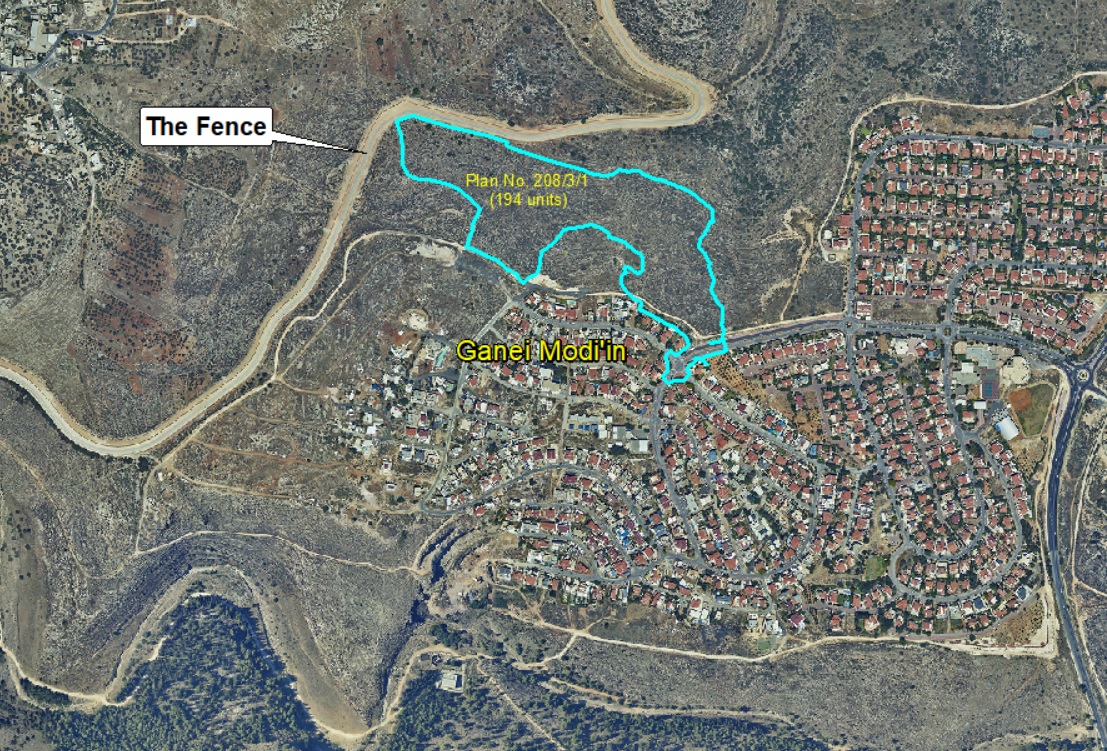
Map by Peace Now
194 units in the Ganei Modlin settlement, located in the northern “seam line zone” in the West Bank but on the Israeli side of the security barrier (by design of the Israeli government). The plan for 194 new units will bring the settlement’s built-up area directly up to the separation barrier, a particularly notable plan given Israel’s recent demolition of 70 Palestinian homes in the West Bank, based on the argument that the construction within a 200-250 foot Israeli-imposed “no construction zone” on either side of the barrier poses an unacceptable security risk to Israel. Israel rejected an offer by Palestinians to privately finance the construction of new and higher wall near the buildings; developers behind the Ganei Modlin project also offered to finance the construction of high wall near the construction, an offer the courts saw fit to accept – resolving the matter in the eyes of the High Planning Council, which approved the plan.
- 96 units in the Kiryat Netafim settlement, located in the northern West Bank and part of a string of settlements and unauthorized outposts – most notably Ariel – extending from the Green Line into the very heart of the West Bank and on towards the Jordan Valley.
- 76 units in the Beit Hagai settlement, located just south of Hebron,
- 66 units in the Efrat settlement, located south of Bethlehem. Efrat had already received final permission for 1,000 new settlement units at the most recent High Planning Council meeting, in April 2019. As a reminder, Efrat is located inside a settlement enclave that cuts deep into the West Bank. Efrat’s location and the route of the barrier wall around it, have literally severed the route of Highway 60 south of Bethlehem, cutting off Bethlehem and Jerusalem from the southern West Bank. The economic, political, and social impacts of the closure of Highway 60 at the Efrat settlement (there is literally a wall built across the highway) have been severe for the Palestinian population.
- 61 units attached to an educational institute in the Gva’ot settlement, located south of Bethlehem. The Gva’ot (Gevaot) settlement was established as an outpost of mobile homes, and later benefited from Israel’s unilateral, mass expropriation of Palestinian land in 2014 (which Israeli officials explictly said was done in response to a Palestinian terror attack). At the time, Peace Now reported that the move constituted the largest single expropriation of Palestinian land by the Israeli state in over 30 years.
- 51 units in Shvut Rachel, which only recently became an authorized settlement area when Israel extended the jurisdiction of the Shiloh settlement to include it as a “neighborhood” (along with three other outposts). The plans approved this week will retroactive legalize existing units and permit the construction of a few news one.
- 29 units in the Otniel settlement, located in the South Hebron Hills area. The plans serve to retroactively legalize existing units.
- 27 units in the Maskiyot settlement, located in the northern Jordan Valley. These units are part of a plan allowing the construction of a “bed and breakfast” with 27 additional rooms (and calling to mind Amnesty International’s recent report on the role tourism plays in supporting the occupation).
- 19 units in the Peduel settlement, located in the northern West Bank and part of a string of settlements and unauthorized outposts – most notably Ariel – extending from the Green Line into the very heart of the West Bank and on towards the Jordan Valley.
- 18 units and a park in the Ma’ale Adumim settlement.
- 11 units in the Einav settlement, located northwest of Nablus.
In addition, the Council gave retroactive approval for a controversial archeological site in the Shiloh settlement, located in the center of the northern West Bank. The Israeli government has devoted a significant amount of money and political energy towards building the tourist site, which is now drawing upwards of 60,000 evangelical tourists each year. For background on the site, see this Emek Shaveh report from 2014 and this brief from 2017, when the government approved the commercialization of the site. For analysis on how the site fits into a bigger pattern of Israeli efforts to normalize the settlements through tourism, see this report by Amnesty International.
Israeli Annexation via Settlement Construction Unleashed, Part 3: Plans Advanced for 1,466 New Settlement Units (With More to Come)
Actions taken August 5-6 by the Israeli Defense Ministry’s High Planning Council include advancing plans that, when they eventually receive final approval, will allow for the construction of 1,466 settlement units (details of the various steps of the planning/approval process are laid out by Peace Now here). Specifically, the Higher Planning Council this week approved the following plans for deposit for public review:
- 382 units in the Beit El settlement, located north of Ramallah. The plans include the retroactive legalization of 36 units; the remaining 346 are new units. As a reminder, Beit El is the settlement closely associated with U.S. Ambassador to Israel David Friedman, who among other things was the President of the “Friends of Beit El” organization, which raised money on its behalf.
- 354 in the Nili settlement, located in the northern West Bank;
- 200 units in the Asfar settlement, located northeast of Hebron. If approved, this plan will triple the size of the Asfar settlement.
- 168 units in the Talmon settlement, located north west of Ramallah. In December 2018, FMEP reported on a deadly encounter between neighboring Palestinians and settlers from Talmon and/or the many unauthorized outposts associated with it. The settlers had been attempting to takeover another hilltop on the outskirts of the Palestinian village of al-Mazra’ah al-Qibliyah. When Palestinians staged an attempt to stop the settlers from entering the area, a scuffle ensued and Israeli soldiers shot and killed two Palestinians.
- 132 units in the Kfar Adumim settlement, located east of Jerusalem and less than one mile from the Khan al-Ahmar bedouin community which the state of Israel is seeking to demolish.
- 84 units in the Shima settlement, located in the southern tip of the West Bank.
- 74 units in the Yakir settlement, located in the northern West Bank and part of a string of settlements and unauthorized outposts – most notably Ariel – extending from the Green Line deep into the West Bank.
- 48 units in the Bracha settlement, located south of Nablus.
- A recreational area in the Kochav Yaakov settlement, located just south of Ramallah.
In addition to the plans approved and advanced detailed above, the High Planning Council delayed consideration of two additional plans, which are:
- A plan that would effectively legalize another outpost, known as Brosh. Similar to the Haroah Haivri plan, discussed above, the plans relating to Brosh serve to retroactively legalize an existing educational institute. Approval of the plan was delayed because the Council had not resolved objections that were filed against the plan, including an objection filed by Peace Now.
A plan for 207 settlement units in the Bracha settlement, located near Nablus (these plans are in addition to the plans for 48 units approved to be deposited for public review, covered above). Though plan was on the Council’s schedule, it could not be approved because the Council first needs to approve the extension of Har Bracha’s existing settlement jurisdiction to include the area units are to be built. Since the plan calls for the construction of units outside of the existing area of jurisdiction, the plan could not be approved.
Israeli Annexation via Settlement Construction Unleashed, Part 4: Reactions
Following this week’s advancement of plans for 2,304 settlement units, settlement watchers and key members and bodies of the international community issued sharp criticism and sounded the annexation alarm bells. In contrast, there was glaring – and very, very, very predictable – silence came from the U.S. administration. A few notable reactions are included below.
Peace Now said in a statement:
“The approval of settlement plans is part of a disastrous government policy designed to prevent the possibility of peace and a two-state solution, and to annex part or all of the West Bank. The linkage of thousands of housing permits for settlers and a negligible number of housing units for Palestinians cannot hide the government’s discrimination policy. As a result, we see for example an approval of the illegal outpost (Haroeh Haivri) built for Israelis adjacent to the Palestinian bedouin village of Khan Al-Ahmar, for which the government refuses to approve any construction permits and instead seeks to transfer. Or we see, the approval of the construction of a new settlement neighborhood adjacent to the separation barrier after demolishing 72 housing units built adjacent to the separation barrier in Wadi Hummus, despite offering to fund security measures.”
The European Union issued a statement which reads:
“The EU expects the Israeli authorities to fully meet their obligations as an occupying power under International Humanitarian Law, and to cease the policy of settlement construction and expansion, of designating land for exclusive Israeli use, and of denying Palestinian development.”
United Nations Special Coordinator for the Middle East Peace Process Nickolay Mladenov said in a statement:
“The expansion of settlements has no legal effect and constitutes a flagrant violation of international law. By advancing the effective annexation of the West Bank, it undermines the chances for establishing a Palestinian state based on relevant UN resolutions, as part of a negotiated two-state solution.”
British Foreign Secretary Dominic Raab urged Israel to stop what he called:
“the effective annexation of the West Bank.”
Leilani Farha, the United Nations Special Rapporteur for the right to housing, and Michael Lynk, the United Nations Special Rapporteur for human rights in the Palestinian territory occupied since 1967, said in a statement:
“These settlement housing units are clearly meant to solidify the Israeli claim of sovereignty over the West Bank. Building civilian settlements in occupied territory is illegal, as is the annexation of territory. The international community has spoken out against the Israeli settlements, but it has not imposed effective consequences for the country’s defiance of international law. Israel’s actions indicate it plans to remain permanently and advance a claim of sovereignty. The Israeli Prime Minister made this clear when he said recently that: ‘No settlement and no settlers will ever be uprooted.’ Should we not take him at his word that Israel has no intention of complying with international law? Criticism without consequences is hollow. The international community has a wide menu of commonly-used countermeasures to push recalcitrant states into compliance with their international duties. If the international community is serious about its support for Palestinian self-determination and its opposition to Israeli settlements then, surely, the time has come for meaningful action.”
Israeli settlers, on the other hand, we filled with glee. Gush Etzion Regional Council Head Shlomo Ne’eman said in a statement:
“Thank God today we received approval from the Higher Planning Council for new housing units in Gush Etzion. Congratulations to all of our residents on the 200 units in Metzad, which is historic in that it will triple the size of the community. Congratulations on the final approvals for the Sadna institution, which works towards integration and is located in Gevaot, and will enable permanent construction of tens of units. Another major breakthrough is the final approval for Ibei Hanachal, which essentially fully legalizes the community and includes the construction of 96 permanent homes. These are major accomplishments for southeastern Gush Etzion, for the Jewish communities in the Judean Desert, and of course for all of Judea and Samaria. This is an opportunity for me to thank Prime Minister Netanyahu on this impressive accomplishment. Let’s hope that the trend of development and construction in Judea and Samaria continues full speed ahead.”
Following Murder of Settler Youth, Netanyahu Doubles Down on Commitment to Settlements
Following the murder of a 19-year old Israeli settler, Prime Minister Netanyahu vowed once again that he will promote settlement construction in all areas of the West Bank. Speaking at a ceremony marking the establishment of a new neighborhood of 650 units in the settlement of Beit El (which just saw plans for 382 new units advance, see above) Bibi said:
“We promised to build hundreds of housing units. Today we are doing it, both because we promised and because our mission is to establish the nation of Israel in our country. We know that the Land of Israel is bought in agony. Today another one of our sons fell. He was from a family that has already made a heavy sacrifice for the Land of Israel. These vicious terrorists: They come to uproot, we come to plant. They come to destroy, we come to build. Our hands will reach out and we will deepen our roots in our homeland – in all parts of it.”
Bibi’s words — which suggest an intention to continue/expand settlement construction across the entirely of the West Bank — did not satisfy many of his challengers on the Israeli right (against whom he is squaring off against in the upcoming election). Ayelet Shaked – who is leading a union of right wing parties – called directly for annexation. She said:
“We have to apply sovereignty to Judea and Samaria. Gush Etzion is in consensus and there is no reason not to apply sovereignty there.”
Knesset Speaker Yuli Edelstein (Likud) said:
“our response to the murder has to be [to] apply sovereignty on the settlements, starting with Gush Etzion.”
And the Sovereignty Movement – is an offshoot of the Women in Green organization, and has been working to formalize its expanding influence over Israeli politicians and public discourse by pushing for the establishment of a Knesset committee devoted to the cause of Israeli annexation of the West Bank – issued a statement saying:
“It is either us or them! This is a 52-year-old struggle that must be resolved. Sovereignty will bring resolution and will erase the hope of pushing us out of here through terror attacks. The resolution must be clear and unambiguous – we have returned to the heritage of our fathers, we will bring another million Jews here, we will build dozens of communities. The Arabs are invited to live under our sovereignty as individuals and enjoy a prosperous life as residents.”
Latin Patriarchate Files Suit Claiming New Proof of Fraud Behind Settler Takeover of Old City Hotel Properties
On August 5th, the Greek Orthodox Patriarchate in Jerusalem filed a request to reopen the underlying case in Jerusalem District Court which awarded the radical settler group Ateret Cohanim the ownership rights to three historic church properties in the Old City of Jerusalem. The Patriarchate’s appeal is based on new evidence of fraud committed by the Jerusalem settler organization Ateret Cohanim – with the aid of church officials – during the sale of the properties. The original Jerusalem District Court ruling acknowledged that there were problems in the transaction, but found that the church failed to prove its allegations of bribery and corruption.
The allegations of fraud rely on the testimony of Ted Bloomfield, a man who managed the Petra Hotel in the 1990s. Bloomfield reportedly told the Greek Patriarchate that Ateret Cohanim paid him to help persuade the Palestinian protected tenants to sell their rights. The lawsuit says these actions are “extraordinary in their severity” and include fraud, forgery of legal documents, and bribery – including alleged attempted sexual bribery. The church’s complaint also alleges that the settler group obstructed justice in deliberately concealing documents during legal proceedings.
Haaaretz recently published a moving video testimony of one Palestinian man, Abu-Walid Dajani, whose family has run the New Imperial Hotel, one of the targeted properties, since 1949. Dajani is now facing eviction.
Education Minister Strips Key Committee Membership from Professor Who Objected to Authorization of Settlement Medical School
The Haaretz Editorial Board penned a sharp criticism of newly appointed (and interim) Israeli Education Minister Rafi Peretz, who recently removed Professor Yossi Shain from the Planning & Budgeting Committee of the Higher Education Council. Shain was one of the members of the key professional committee – which essentially serves as the gatekeeper for schools hoping to join the ranks of accredited Isareli education institutions – who objected to the rushed and politicized process by which, in contravention to the Council’s normal practice, a medical school located in the settlement of Ariel received approval from the Higher Education Council.
The Editorial Board writes:
“The ‘revenge’ taken by Peretz against someone acting according to his professional judgment is a worrisome sign. The message conveyed by the education minister’s bureau is crystal clear: In education and academia, loyalty to the occupation and annexation project has become a decisive criterion.”
Bimkom Report: Israel’s “No Construction Zone” Adjacent to the Separation Barrier Has Little To Do With Security
In a new report, the Israeli NGO Bimkom sheds light on the very problematic regulation that was the legal pretext behind Israel’s recent demolition of 70 Palestinian homes in Wadi Hummos – i.e., the argument that the construction was located too close to Israel’s separation barrier.
Bimkom explains that in 2011, the Israeli military issued a “no construction order” to prevent construction close to the separation barrier, ostensibly on the basis of security considerations. The zone defined by the order ranges from ranges from 30 meters to 700 meters in different areas (on both sides of the barrier). Given that much of the barrier passes through the West Bank (meaning the land on both sides is Palestinian land), the cumulative impact on the Palestinians is significant. According to Bimkon, the total area affected by the no-construction order is approximately 195,000 dunams [48,185 acres/195km2] of land, belonging to 115 Palestinian villages.
While the order also (theoretically) impacts 15,000 dunams of land in areas where there are settlements located close to the barrier, the perimeter of the zone and enforcement against construction within it follows a predictable logic in favor of the settlements.
Bimkom writes:
“Similar to the barrier route, the no-construction order is determined such that its impact on settlement construction is minimal, but its impact on Palestinian villages is enormous. The negative impact of the physical barrier on hundreds of thousands of Palestinians is intensified expanded to hundreds of meters in which Palestinian construction is prevented. The potential for Palestinian development in Area C is already very limited, and the no-construction zone only serves to exacerbate the situation. In summary, it can be seen that the security considerations which are supposedly behind the construction ban are often questionable, and this also applies to Wadi al-Hummus. The obvious conclusion is that the security considerations according to which buildings in Areas A and B were demolished are a smoke-screen for political considerations whose purpose is to reduce the Palestinian population in the seam zone, especially in the Jerusalem region, or even to punish them for unrest in the area, according to army reports. The threat of demolition still hangs over Wadi al-Hummus, as there are a large number of other buildings that have received demolition orders and the court is scheduled to discuss their case in the coming months.”
Also, as detailed above, the inconsistency of Israeli policy when it comes to enforcing the “no-construction zone” was on display this week, as Israel approved the construction of 194 units in the Ganei Modlin settlement, right up to the barrier (discussed above). Whereas Israel rejected an offer by Palestinians in Wadi Hummos to privately finance the construction of new and higher wall near their buildings (and went ahead and demolished them), Israel authorities accepted an offer by developers behind the Ganei Modlin project to finance the construction of high wall near the construction, allowing expansion of a settlement to move ahead.
Ir Amim: Israel’s Crackdown in Issawiya Advances Settlement Project in East Jerusalem
In +972 Mag, Ir Amim researcher Aviv Tartarsky published a superb analysis of the ongoing campaign of daily harassment and intimidation Israeli authorities have unleashed against Palestinians living in the Issawiya neighborhood of East Jerusalem. Tatarsky writes:
“The campaign against Issawiya signals a new stage in Israel’s oppressive policies in East Jerusalem, and is part of the overall change in Israeli policy toward the Palestinians with the backing of the Trump administration. In the past, Israel primarily focused on settlement construction in the eastern part of the city. By building so-called ‘facts on the ground,’ the government intended to make it as difficult as possible to draw a border along the Green Line and create two capitals in Jerusalem. Today that focus has dangerously shifted to breaking apart Palestinian Jerusalem. Israel is pouring hundreds of millions of shekels into projects that will take over large parts of the the Old City and its surrounding neighborhoods, while fragmenting Palestinian territory and jeopardizing the Palestinian population. Neighborhoods such as Silwan, A-Tur and Sheikh Jarrah have seen an intensification of home demolitions and evictions on the one hand, while on the other the municipality has built promenades, heritage centers, and other tourist attractions for the Jewish settlers living inside Palestinian neighborhoods. Meanwhile, Israel is aiming to redraw the city’s municipal borders so as to push 120,000 Palestinians — more than a third of the city’s Palestinian population — out of the city. According to legislation advanced last year by Jerusalem Affairs Minister Ze’ev Elkin, neighborhoods such as Kufr Aqab, Ras Hamis and the Shuafat refugee camp — already separated from the rest of the city by the separation wall — will be drawn out of the municipal boundaries. Issawiya, then, portends what Israel has in store for the remaining Palestinian neighborhoods of Jerusalem: continual violence that has no aim other than oppressing and making life miserable for all who live there.”
Terrestrial Jerusalem In-Depth Report: The Silwan Tunnel Project
Terrestrial Jerusalem produced an essential in-depth report on Israeli and U.S. policy towards Silwan, offering important context and shedding new light on the significance of Ambassador Friedman and Jason Greenblatt’s political stunt alongside Elad in the tunnels underneath the neighborhood.
Danny Seidemann writes in the report’s introduction:
“The event was not merely dramatic. The choreography illuminated at one critical moment and in one critical space two apparently disparate dimensions of the Israel-Palestine conflict, and their current dynamics: the territorial skirmishing and the battle over narrative in Jerusalem. More than anywhere else, the settlement in Silwan embodies the significant changes taking place in the Old City of Jerusalem and its immediate environs. The opening tunnel was, superficially, a minor routine event that disclosed developments that are anything but routine. As such, it requires an in-depth analysis that takes a hard look at the event, its background and its consequences. In our three sectioned report, we will begin by examining the background and significance of the settlement in Silwan. In Part II, we will examine the tunnel, its archeological, historical and ideological significance and the context in which it was excavated. Part III will deal with the nature of the shift in US policy regarding Silwan, its sources and its ramifications.”
Bonus Reads
- “Goodbye withdrawal, hello sovereignty: The triumph of the settlers” (Times of Israel)
- “Peace Cast: Housing Rather than Ideology” (Americans for Peace Now)
- “How Ayelet Shaked, a secular woman, came to dominate the right-wing religious camp in Israel” (JTA)
- “India’s Settler-Colonial Project in Kashmir Takes a Disturbing Turn” (Washington Post)