Welcome to FMEP’s Weekly Settlement Report, covering everything you need to know about Israeli settlement activity this week.
To subscribe to this report, please click here.
June 7, 2024
- Jerusalem Flag Parade Terrorizes Jerusalem, Ben Gvir Tests Temple Mount Status Quo
- IDF Demolishes Outpost, Ben Gvir Calls (Again) for Gallant to Be Dismissed
- Settlers & Knesset Call for Israel to Create “Special Regime” With Open Fire Directives to Fortify Settlement Safety
- Israeli Govt is Working with “Friends in the U.S.” To Cancel/Reduce Sanctions on Settlers
- Bonus Reads
Jerusalem Flag Parade Terrorizes Jerusalem, Ben Gvir Tests Temple Mount Status Quo
On June 5th, tens of thousands of Israelis – including ministers and Knesset members – took part in the annual Jerusalem Flag parade [of terror] through the Old City of Jerusalem, going from the Damascus Gate, through the Muslim Quarter, and culminating with a rally at the Western Wall Plaza. Demonstrating how inflammatory the march and many of its participants are each year, and how particularly frenzied and emboldened the participants were expected to be this year, 3,000 police officers were deployed along the parade route and throughout the city. In addition to the chants common for years (including “May your village burn,” “Death to Arabs” “Muhammad is dead,” and “May their name be erased”) marchers physically assaulted Palestinians, activists, and Israeli and Palestinian journalists – flaunting their incendiary, criminal behavior while police and military officers largely stood by (thirteen people were arrested, and five detained, including a Palestinian journalist who was attacked).
In addition, Haaretz reports that hundreds of Israelis were permitted entry to the Temple Mount on June 5th as part of the parade day, which posed a serious test of Netanyahu’s control over his National Security Minister Ben Gvir as well as Netanyahu’s commitment to upholding the delicate and ever-eroding Status Quo on the Temple Mount, which has been succinctly articulated by Bibi Netanyahu himself as: “Muslims pray on the Temple Mount, non-Muslims visit the Temple Mount”.
Ben Gvir, in his role as the Israeli National Security Minister, is ostensibly in charge of ensuring the security of Jerusalem and on the Temple Mount. True to his ideology and political commitments, Ben Gvir caused a serious panic as the parade began by saying that he had revoked the status quo and that Jews can freely pray on the Temple Mount (an incendiary demand by the Temple Mount Movement to which Ben Gvir subscribes). Netanyahu’s office countered by quickly issuing a statement that the Status Quo has not and will not change.
While the political drama swirled, Haaretz reported that some of the Jewish Israeli parade-goers who were permitted to go to the Temple Mount started to sing and pray, and then were stopped and removed by Israeli police. An activists who went to the Temple Mount told Arutz Sheva that dozens were removed.
After being overruled by Netanyahu, Ben Gvir did not back down, telling Army Radio after the march that “My policy is very clear on this matter: Jews can be anywhere in Jerusalem, pray anywhere.”
The Temple Mount issue is not the only headline Ben Gvir made that day. While arriving at the Damascus Gate to join the festivities (along with Smotrich), Ben Gvir he told reporters:
“I came here for one thing, to send a message to Hamas and every house in Gaza and also in the north. Jerusalem is ours. The Damascus Gate, Temple Mount is ours. Today, according to my policy, Jews entered the Old City freely. And also the Temple Mount where they prayed freely. We say in the simplest way, it’s ours. This is the message to Hamas. I pray for the wounded, pray for the release of the hostages. But I say Hamas and Hezbollah must be defeated in war, only in war! And this is ours, our Temple Mount, our Damascus Gate. Let the whole world know it.”
One of the journalists who was assaulted that day, Nir Hasson of Haaretz, later wrote:
“The Flag March on Jerusalem Day is an accurate thermometer of the condition of Israeli society. It measures the levels of hatred, racism and violence in the religious Zionist society and the tolerance of the police and the rest of society to these traits. This year’s diagnosis is terminal. Wednesday’s march was one of the most violent and ugliest I have seen – and I have witnessed every single one over the past 16 years.”
Ir Amim said in a statement calling for the parade to be re-routed away from the Muslim Quarter:
“Against the backdrop of the ongoing devastating war in Gaza and growing international criticism over Israel’s conduct, the Israeli authorities are preparing to mark Jerusalem Day on June 5, which commemorates the “liberation” of East Jerusalem and “re-unification” of the city. This year, the date on which Jerusalem Day is celebrated according to the Hebrew calendar falls on the exact date of the start of the 1967 War and marks 57 years of Israeli occupation and illegal annexation of East Jerusalem. Over the past nearly six decades, consecutive Israeli governments have continued to create irreversible facts on the ground to entrench Israeli control over Jerusalem in its entirety and foil any prospect of an agreed political resolution with two capitals in the city. As a result, it continues to cement a one-state reality of permanent occupation and systematic oppression of Palestinians.”
IDF Demolishes Outpost, Ben Gvir Calls (Again) for Gallant to Be Dismissed
On June 4th the IDF demolished an illegal outpost in the northern West Bank, which was built by settlers without permission on privately owned Palestinian land southwest of Nablus near the settlement called Yair’s Farm. The Israeli Civil Administration reports that a total of six structures were demolished.
The Civil Administration’s action against the outpost elicited the latest repudiation of Gallant by his fellow Minister Itamar Ben Gvir, who called on Netanyahu to fire Gallant over the outpost demolition. As a reminder, as a result of a power struggle between Gallant and Smotrich in forming the current government (circa February 2023), Defense Minister Gallant ceded most all authority over civilian matters in the West Bank to Smotrich – – except for the authority over building enforcement laws. However, the compromise was the Gallant had to notify Smotrich of any plans to demolish settlement/outpost construction. In March 2024, news leaked that Smotrich is actively trying to wrest demolition powers from Gallant, though the demolition this week makes clear that Gallant remains in control (because Smotrich is opposed to enforcing Israeli law if it means holding settlers accountable).
Settlers and their leaders are also furious over the demolition of the outpost, which they say was built in memory of Moti Shamir, who was killed during the Hamas attack on Israeli towns on October 7, 2023. Settlers also say that the land is not privately owned by Palestinians, instead they feel justified in building there because they expect the government to declare the land as “state land” soon.
Settlers & Knesset Call for Israel to Create “Special Regime” With Open Fire Directives to Fortify Settlement Safety
This week saw several media hits and a Knesset hearing pushing a call along similar lines for the Israeli government to drastically step up its military operations in the West Bank to protect settlements and outposts.
At a Knesset subcommittee hearing on June 2nd, settlers called for the military to undertake more proactive military operations against Palestinian population centers.
In an op-ed published in Israel Hayom on June 2nd, former national security advisor Meir Ben Shabbat urged the government to establish a “special regime” with “unique open-fire instructions for the Seam Zone”
Yigal Dilmoni had an op-ed published in The Jewish Press on May 28th, in which he warned that the IDF needs to increase its operations in the West Bank and for settlements to expand in order to prevent another October 7th.
Israeli Govt is Working with “Friends in the U.S.” To Cancel/Reduce Sanctions on Settlers
The Associated Press reports that Bezalel Smotrich said the Israeli government is working with “our friends in the U.S.” to cancel or reduce the Bedien Administrations sanctions on settlers and settler entities believed to be perpetrating violent attacks on Palestinians and activists in the West Bank. The AP’s reporting also demonstrates just how ineffectual those sanctions are, with one of the sanctioned individuals saying that it has only further emboldened him to continue his activities in the West Bank, and that he only experienced financial punishment for two months before the Israeli government and banking sector reopened his accounts, and crowd-funding campaigns raised tens of thousands on his behalf.
Bonus Reads
- “Worshipers who arrived at Mount Ebal detained by the IDF” (Arutz Sheva)
- “UN rights office criticises Israel over deaths of 500 Palestinians in West Bank” (Reuters)
- “In the West Bank, Guns and a Locked Gate Signal a Town’s New Residents” (The New York Times)
- “Rising violence strikes fear into West Bank school” (Al-Monitor)
- “Trump Is Desperate for Miriam Adelson’s Cash. Her Condition: West Bank Annexation” (Haaretz)
- “US sanctions Palestinian group under decree used to target Israeli settlers” (Al Jazeera)
Welcome to FMEP’s Weekly Settlement Report, covering everything you need to know about Israeli settlement activity this week.
To subscribe to this report, please click here.
September 7, 2018
- Israel Advances Plan for New Settlement in East Jerusalem
- Even More East Jerusalem Settlement Plans Advanced
- Israel Demolishes Homes in al-Walajah, Advancing “Greater Jerusalem” Project
- State Admits to High Court it Built Settler Road on Palestinian Private Land
- Prominent Human Rights Activists Arrested While Leading Tour of Hebron Region
- Government Official Claims Jerusalem Cable Car Project Will Benefit Palestinians in Silwan
- BonusReads
Comments, questions, or suggestions? Email Kristin McCarthy at kmccarthy@fmep.org. To subscribe to this report, please click here.
Israel Advances Plan for New Settlement in East Jerusalem
On September 5th, the Jerusalem Local Planning and Building Committee advanced a plan to build a large new settlement enclave (150 units) within yet another Palestinian neighborhood of East Jerusalem. The project – a pet project of Jerusalem settlement financier (and since 2013, Jerusalem city council member) Aryeh King – would be the first-ever authorized settlement project in the Beit Hanina neighborhood of East Jerusalem, located north of the Old City.
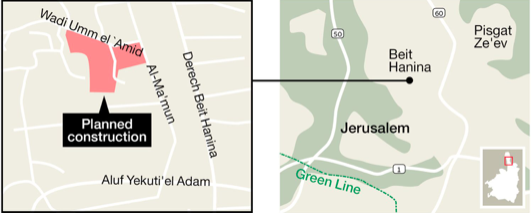
Map by Haaretz
The plan would build housing for approximately 75 settler families (which, based on a conservative estimate, would mean a population of around 500 settlers in Beit Hanina). If built, it would be one of the largest Israeli settlement enclaves inside any Palestinian neighborhood in East Jerusalem.
According to the plan, 75 units units would theoretically be earmarked for Palestinians – a point used by the plan’s supporters to suggest that it is actually benevolent. The key word here, however, is: theoretically. As noted by Jerusalem expert Danny Seidemann in another context:
“Since 1967, the Government of Israel has directly engaged in the construction of 55,000 units for Israelis in East Jerusalem; in contrast, fewer than 600 units have been built for Palestinians in East Jerusalem, the last of which were built 40 years ago.”
In announcing the approval of the plan, Israel’s deputy mayor made clear what part of the plan the Municipality is actually focused on:
“We’re happy to announce today that we’ve approved construction of 150 housing units in Beit Hanina, and especially that 75 Jewish families can now live there.”
Notably, the Jerusalem Local Planning and Building Committee advanced the plan through the first stage of the planning process, despite an objection filed by the private Palestinian company that owns 45% of the land upon which the new units would be built (ownership that the Israeli government tried – and so far failed – to cancel, through efforts to rescind the sale of the land to that company). The Committee explained its decision to ignore the objection by asserting that it was only discussing planning schemes and not ownership issues. The Jerusalem Municipality also weighed in, suggesting that the Palestinian company is too late in asserting its rights, saying that the ownership issue was “examined as part of the examination of the plan’s preconditions.”
Director of the Peace Now Settlement Watch program, Hagit Ofran, rejected that argument, saying:
“this is not a real estate project but a project of defiance and settlement. The fact that Israeli entrepreneurs, who own only half of the land, have prepared a plan without consulting Palestinian owners [of the other half] indicates that they have no intention of coexistence and peace.”
 A handful Israeli settlers already live in Beit Hanina, having directly acquired private property in the heart of the neighborhood. This small group of settlers clearly benefit from the plan, both because it lends legitimacy to their presence in and broader claims to the neighborhood, and because the new project would create a territorial linkage between the new settlement in Beit Hanina and the large ultra-Orthodox settlement of Ramat Shlomo to its south.
The historic nature of the Beit Hanina settlement plan is being hailed by pro-settlement media and activists. The Deputy Mayor of Jerusalem, Yossi Deitch, said, “I hope approval of the units will be the sign and signal that construction in the city will be unfrozen next year throughout the city and for all sectors. I’ll do everything possible to thaw the construction freeze in Jerusalem.”
Israel has increased home demolitions across East Jerusalem, including Beit Hanina, over the past year. In Beit Hanina, many homes are under the threat of demolition because they lack Israeli-issued building permits – permits that Palestinians find all but impossible to secure. Just this week, Israel demolished the Farrah family home in Beit Hanina, built over 16 years ago – despite the fact that the family has spent years attempting to obtain the necessary permits and has paid 250,000 shekel ($69,362) fine to the Israeli government.
Even More East Jerusalem Settlement Plans Advanced
In addition to the Beit Hanina settlement plan, Ir Amim reports that Jerusalem authorities have advanced several other inflammatory settlement projects in East Jerusalem over the past week:
- The Local Planning and Building Committee discussed issuing a permit to retroactively legalize unauthorized settlement construction – several shops and offices – in Silwan, located at the entrance of the settler-run City of David National Park. The buildings were constructed, without permits, under the direction of the radical Elad settler group, which is contracted by the Israel National Parks Authority to run the City of David National Park. As a reminder, Elad’s mission is to establish a permanent Jewish presence in Palestinian neighborhoods of East Jerusalem. The retroactive permit, in addition to legalizing the current buildings, would also allow the group to build an additional story to one of the buildings, to serve a”lookout” point. Demonstrating government collusion with the settlement enterprise in Jerusalem, the permit request was filed by the Israel National Parks Authority, not Elad.
- The Local Planning and Building Committee committee discussed public objections filed against a plan to build a 6-story office building for settlers at the entrance of the Sheikh Jarrah neighborhood. The office building, if approved, would be located adjacent to the site of a planned Jewish religious school to also be built in Sheikh Jarrah – called the Glassman Yeshiva. That school, once it is built, will house dozens of young religious settlers. Together, the two projects will flank the road leading into Sheikh Jarrah and become part of a settlement bridge/corridor connecting the isolated settlement enclaves in the heart of Sheikh Jarrah to West Jerusalem. Ir Amim notes that both settlement projects have been advanced “despite the area being zoned for public buildings for a Palestinian neighborhood sorely lacking in social services.” This latest advancement was anticipated and noted in last week’s Settlement Report.
- The Jerusalem Local Committee advanced two plans to increase the number of new units authorized to be built in the Gilo and Neve Ya’akov settlements. In both instances, the Local Committee discussed plans that increase the number of units permitted to be built under already-approved plans (adding an additional 48 units in both cases, bringing the Neve Ya’akov project to 86 units total and the Gilo project to 148 units total).
Israel Demolishes Homes in al-Walajah, Advancing “Greater Jerusalem” Project
On September 3rd, Israeli officials demolished four buildings in the al-Walajah village, on the pretext that they lack required Israel-issued building permits. Israeli security forces fired tear gas and rubber-coated steel bullets at a crowd of protestors who gathered to try to stop the demolition, injuring several.
The demolitions were in the Ein Juweza neighborhood of the village – an area that is technically located within the municipal borders of Jerusalem (the border runs through the village, leaving the rest of al-Walajah in the West Bank), and therefore subject to Israeli planning and building laws. An additional 189 homes in al-Walajah have demolition orders issued against them.
The lawyer representing al-Walajah residents in this case said,
“The residents’ attempts to submit a master plan [without which it is impossible for residents to even apply for permits to build on their own land] were thwarted by the objection of the state and subsequently, the planning authorities. In this situation of criminal neglect of the village and its residents, the only service the state gives them is ‘home demolition service.’ This is an impossible, illegal situation that contradicts the most minimal fairness.”
Ir Amim reports:
“While refusing to allow building in Walajeh, in the area around the village Israel is promoting construction of thousands of housing units for Israelis on lands – some of which were confiscated from Walajeh – in the settlements of Gilo and Har Gilo. To the north of the village, within the Green Line and on lands that belonged to Walajeh until 1948, a construction plan of over 4,000 housing units is being advanced. These construction plans, together with the national park declared on al-Walajeh land in 2013, are meant to create an Israeli continuum between Jerusalem and the Gush Etzion settlements surrounding Bethlehem. This morning’s demolitions in Walajeh are an inherent part of the policy to transform this area into an Israeli space.”
As FMEP has previously reported, residents of al-Walajah have long been struggling against the growing encroachment the nearby Etzion settlement bloc and the Israeli government’s attempt to de facto annex the bloc as part of “Greater Jerusalem.” Ir Amim explains several prongs of this effort, including a particularly problematic section of the separation barrier around al-Walajah that has been planned in order to (a) almost completely encircle the village, (b) turn its valuable agricultural land into an urban park for Jerusalem, and (c) enable construction of a highway that will connect the Etzion settlement bloc to Jerusalem with Israeli-only bypass roads.
State Admits to High Court it Built Settler Road on Palestinian Private Land
The Israeli government admitted to the High Court of Justice that it cut and paved a road on land that is privately owned by Palestinians in the South Hebron Hills. The State claimed it did so by mistake, believing the land in question, which had been included in construction plan for the settlement of Shima – despite the fact that Palestinian owners objected as soon as construction started in 2015. Even after the objections were lodged against the construction, Israeli authorities took months before issuing a stop work order, allowing the road to be completed/paved in the meantime.
In the brief submitted this week, the State asked the High Court to dismiss the case regarding the road, explaining that the Civil Administration had already taken action to correct the borders of the Shima settlement to, in effect, return the land to is owners (now paved with a road for the settlers). The State says that action was prompted in 2015 when the Civil Administration “Blue Line” team released new mapping of the area, which clarified that the land is indeed privately owned by Palestinians.
Commenting on the story, a spokesperson for Rabbis for Human Rights told Haaretz:
“The state acted like the ‘hilltop youth’ [a radical settler group]. You can’t explain this away using the excuse of an innocent mistake, given that even after our warnings it took a long and embarrassing legal procedure to get them to do the obvious: check who actually owns the land.”
Prominent Human Rights Activists Arrested While Leading Tour of the Hebron Region
Israeli security forces arrested three prominent human rights activists while they were leading a sizeable group on a tour of settlements and outposts in the Hebron/South Hebron Hills area. Avner Gvaryahu (Executive Director of Breaking the Silence), Michael Sfard (a prominent Israeli human rights lawyer), and Achiya Schatz (Communications Director for Breaking the Silence) were released after three hours of detention.
The men were arrested near the Mitzpe Yair outpost in Hebron, the same spot where activists from Taayush – “Israelis & Palestinians striving together to end the Israeli occupation and to achieve full civil equality through daily non-violent direct-action” – were violently attacked by settlers the previous week, with at least four wounded seriously enough to be evacuated to for medical treatment. In that attack, IDF soldiers reportedly stood by and did nothing (and in its aftermath, the Israeli government and senior officials, including Netanyahu, said nothing).
Breaking the Silence related the events, saying:
“As we drove up the road leading to the outpost, we were blocked by a Border Police jeep. Within minutes, we were presented with a ‘closed military zone’ order, signed by the brigade commander. We were given one minute to evacuate a group of 120 participants, some of whom weren’t so young. When we asked for more time to get everyone on the buses, the arrests started. As was reported in the media, the arrests were aimed at the leaders of the tour, which reinforced our suspicion that they were initially meant to sabotage the tour….Upon arriving at the police station, Avner, Achiya, and Michael had been told that they were in fact not arrested but rather detained, and that there was no immediate need for investigations or arrests. They were then told to return in a month and a half for further investigation.”
The group’s email to supporters ends:
“we refuse to cave in to settler violence and to surrender to their intimidation, incitement, and violence directed against those who oppose the immoral reality of the occupied territories.”
Government Official Claims Jerusalem Cable Car Project Will Benefit Palestinians in Silwan
On September 5th, the Society for the Protection of Nature held a public forum to discuss the planned cable car project in Jerusalem, which is slated to have its final stop at the settler-run Kedem Center in Silwan. The Kedem Center is a project of the radical Elad settler group, which works to settle Jewish Israelis inside Palestinian neighborhoods of East Jerusalem.
Sami Arsheid, a lawyer representing Palestinian residents of Silwan (who will be deeply impacted by the project), attended the town hall event to raise their concerns. Arsheid said that Palestinians had not been consulted and noted that the invitation to the meeting was written in Hebrew only.
A Israeli government official responsible for planning the cable car project, Aner Ozeri, stressed how the project will ease movement and alleviate transportation pressures, and insisted that the project will, in fact, benefit Palestinian residents of Silwan. Even if that claim turns out to be true, it glosses over the fact that, assuming the most benign intent, the Israeli government is engaging in planning in Silwan that rejects/ignores the views of the vast majority of the residents (i.e., the only residents of Silwan whose voices are listened to in this process are the settlers). Moreover, in the case of this plan the intent, entirely unhidden by planners, is by no means benign: the purpose of the cable car project has nothing to do with the interests of Palestinian residents – rather, its purpose is to facilitate tourist visits to Jewish sites in East Jerusalem, in a manner that prevents tourists from seeing or encountering Palestinians.
The meeting was also attended by government officials tasked with explaining and defending the project, as well as architects, academics, preservation experts, and tourism professionals who criticized the plan on a myriad of bases – mostly highlighting how the project will damage the historic landscape of Jerusalem.
Bonus Reads
- “In West Bank Settlements, It’s a Bull Housing Market” (Haaretz)
- “Israeli right wing party aims at one million settlers” (Al-Monitor)