Welcome to FMEP’s Weekly Settlement & Annexation Report. To subscribe to this report, please click here.
June 26, 2026
- WEST BANK: Israel Seizes Land for Outpost Legalization; Smotrich Announces Millions for Illegally Seized Ancient Pool; New Report on Israel’s Seizure of the Hasmonean Palaces; New Lightrail for Settlers?
- STATE-BACKED SETTLER TERRORISM: Key stories this week
- BONUS READS
WEST BANK
Israel Seizes Land South of Nablus to “Legalize” Givat Haroeh Outpost
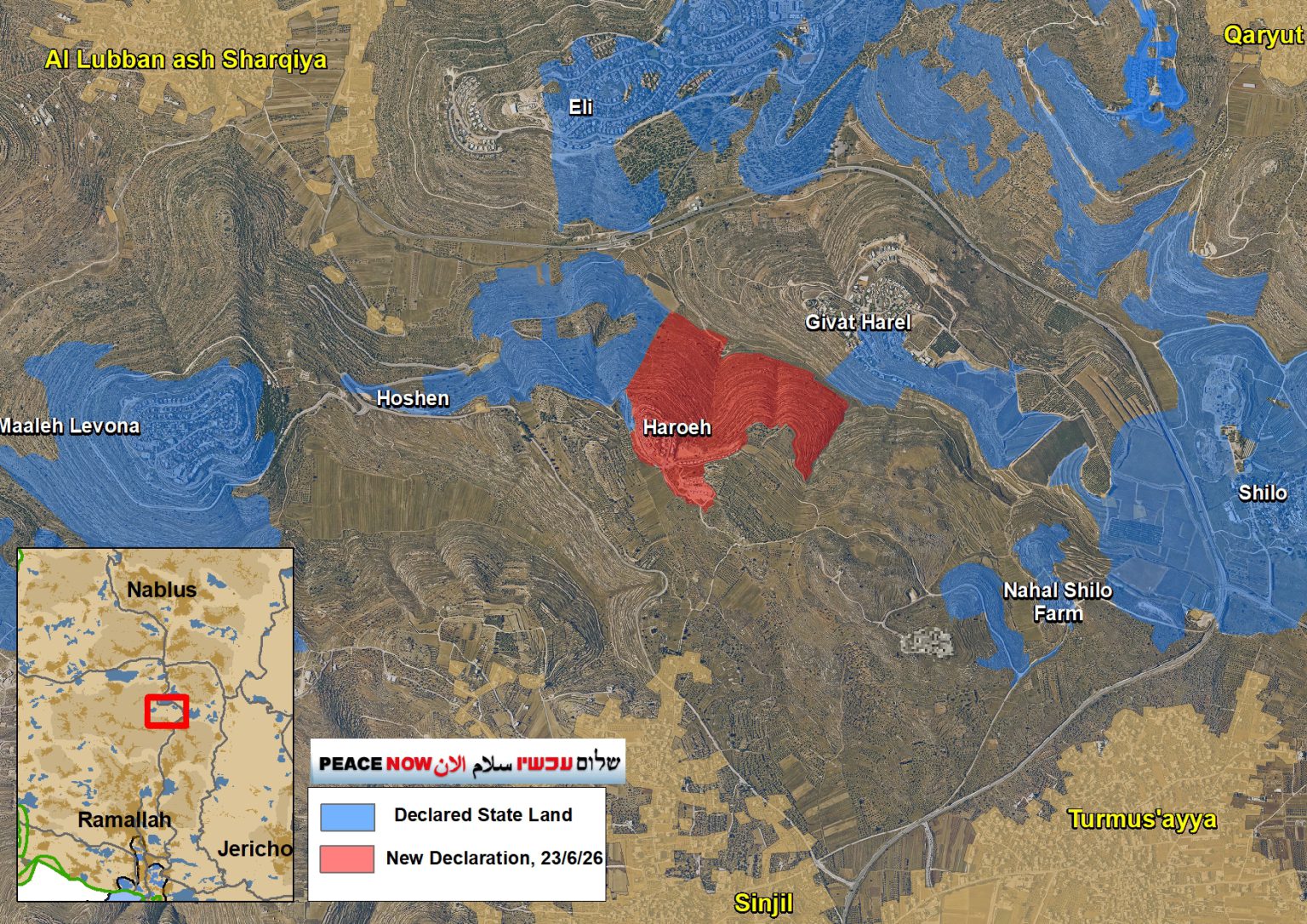 Peace Now reports the Israeli Civil Administration declared over 115 acres of land belonging to the village of Sinjil, located south of Nablus, as “state land” in order to enable the “legalization” of the Givat Haroeh outpost under Israeli law. The declaration more than quadruples the size of the outpost’s boundaries, allowing for massive growth in the future and consolidating the contiguous sting of Israeli settlements in the Shilo Valley area.
Peace Now said in a statement:
“Netanyahu and Smotrich are determined to fight against the entire world and against the interests of Israel’s residents for the benefit of a small group of settlers who receive thousands of dunams as a gift, as if there is no political conflict to resolve. They are exploiting every moment in power to create more and more facts on the ground that will make it harder for Israel to reach peace. Today it is clear to everyone that this conflict cannot be resolved without a political agreement that includes the establishment of a Palestinian state in the West Bank, yet the Israeli government is choosing instead to make this possibility more difficult and move us further away from peace and from ending the bloodshed.”
The Israeli government approved the legalization of the Givat Haroeh outpost in 2023 as part of a Cabinet decision to legalize 10 outposts, setting in motion the legal process to do so. Givat Haroeh was known to the Israeli government to have been illegally built on land that is at least partially privately owned by Palestinians; these landowners now have 45 days to file objections to the new military seizure order.
As noted at the time, a source told Haaretz that the Israeli Cabinet chose the ten outposts for authorization specifically because they are all located in remote or isolated locations — meaning they cannot be “legalized” via expanding the borders of a nearby settlement and declaring the outposts to be merely neighborhoods of those “legal” settlements (a legal maneuver Israel has repeatedly used to expand settlements and retroactively legalize settlements). This means, among other things, that legalization of these 10 new settlements would inevitably l lead to additional land seizures for related infrastructure work.
Joint Report: Israel’s Seizure of Land Near Hasmonean Palaces
In new analysis, Emek Shaveh, the Palestine Solidarity Co-op and Emek Shaveh detail Israel’s recent military seizure order taking control of land near the Hasmonean Palaces, a West Bank archaeological site located on the outskirts of Jericho in Area C of the West Bank. The seizure order will allow Israel to construct a new road to the site that bypasses Jericho.
 The construction ratchets up the violent and coercive conditions facing the Kaabneh bedouin community of Ein ad-Duyuk al Tahta, which is located on land immediately adjacent to the Hasomonean palaces. The community has been subjected to increasingly violent daily settler attacks and harassment, a trend which crescendoed on February 10, 2026 when dozens of settlers carried out a pogrom against the community. Settlers attacked violently, including women and children, looted the village, and brought in a bulldozer to level 13 homes. Israeli police and military did not respond to calls from the community for intervention. The community lives now on the ruins of these homes, while Israel is pursuing the development of the Hasmonean Palaces into a major tourist attraction.
The three groups write:
“The Hasmonean Palaces are also one of several major antiquity sites that the current Minister of Heritage, Amihai Eliyahu, had defined as “anchor sites” in the plan to develop Judeo-centric archaeological theme parks across the West Bank. In July 2023, the government had allocated 20 million NIS for the development of the site into a tourist attraction. At the time it was said that the Binyamin Regional Council would operate the site. The community of Ein ad-Duyuk al-Tahta is situated in part on what Israel considers state land and in part on land privately owned by East Jerusalemite families. The area under seizure order is privately owned, but as of June 2026, the owners have not yet been located.
In recent years, a settler-led campaign, spearheaded by the NGO Guardians of Eternity, claimed deliberate destruction of “Jewish” antiquities by the Palestinians, in an attempt to push the government to expand control over West Bank sites. The Hasmonean Palaces site was often mentioned in this context. Over the years, the SOA has carried out numerous enforcement actions at the site, including stopping works, confiscating equipment, and demolishing what it defines as illegal construction.”
Dror Etkes told The Forward:
“We will see an area completely disconnected from its surroundings. Palestinians won’t be able to enter the area. Two roads [for Israelis] will lead to this area. Settlers will be very violent, it will be very restricted for the Palestinians, construction in the area [by Palestinians] will be completely banned, the construction that already exists is without a permit and a large part of it will be demolished by Israeli authorities.
It will be another national park that will tell one story — the story the Israeli radical right wants you to hear.”
Emek Shaveh’s ED Alon Arad told The Forward:
“You change the identity so that from a village on the outskirts of Jericho it becomes a palace of a dynasty. You don’t need actual settlers there, it’s enough to build an access road, put up a fence and whatever comes with tourist development-a kiosk, a parking lot, someone to guard it…You start bringing in tourists and it’s a normalizing process for people to go inside the West Bank and return to Haifa or wherever they are from. They go in and out and it was fun for them and you create the idea that this is part of Israel.”
Smotrich Announces Millions to Renovate Illegally Seized Ancient Pool Near Jericho
Haaretz reports Israel plans to invest millions of shekels in developing an illegally-sized ancient pool and archaeological site near the Petza’el settlement in the Jordan Valley. Israeli Finance Minister Smotrich announced that he allocated 3 million shekels for the development and the site.
Settlers took control over the pool just a month ago, and began renovating the site. According to Haaretz, the IDF recognizes the area as privately owned Palestinian land. One landowner told Haaretz:
“They [the settlers] diverted the water, they are swimming in the pool, they put up Israeli flags and opened a tourist site for settlers, and they do not allow anyone to approach the area or repair anything…”We have springs on land we have owned for many years, and we use them for agricultural irrigation…we have no water.”
Dror Etkes from the Kerem Navot told Haaretz that
“trifles like Palestinian property rights do not interest the extreme and violent elements in the government. They have no problem reaching a site that settlers covet, attaching an invented history to it and looting it in the name of a historical past that has nothing behind it but a lust for plunder and nothing more.”
New Light Rail for Settlements?
On June 21st, the Gush Etzion Regional Council announced “the transportation revolution in the bloc continues” and that a new light rail line will connect the settlement block to Jerusalem. The press event announcing the project included an illustration of the light rail line, being held by the smiling Transportation Minister Miri Regev and Yaron Rosenthal, the head of the settlement regional council. Despite the public support for the announcement, the Israeli Department of Transportation denied the plan, saying it had not been approved or funded by the government.
STATE-BAKED SETTLER TERRORISM
Key Reads this week:
- “Israeli Settler Indicted Over West Bank Rampage That Left Eight Palestinians Wounded” (Haaretz, 6/26/26); “Yitzhar resident indicted after armed sheep search erupts into violence in Huwara, West Bank” (Jerusalem Post, 6/25/26); “Israel prosecutors charge settlers with terror offences after West Bank attack” (The New Arab, 6/26/26)
- “Former settlement chief charged with threatening Palestinians with assault rifle” (The Times of Israel, 6/25/26)
- “Israel’s Top Court Slams Police for Failing to Probe Settler Attack on Rabbi Solidarity Activist” (Haaretz, 6/25/26)
- “Israeli Soldiers Were Sent to Harass a Bedouin Community That’s Halfway to Expulsion” (Haaretz, 6/24/26)
- “Israeli former leaders and security chiefs threaten legal action over ‘Jewish terrorism’” (The Guardian, 6/24/26)
- “As settlers rampage, IDF soldiers accused of aiding violence, theft against Palestinians” (The Times of Israel, 6/26/26)
- “An Israeli Settler Shot a Disabled Palestinian Five Times. Police Quickly Labeled the Wounded Man a ‘Terrorist’” (Haaretz, 6/20/26)
- “Ethnic Cleansing 3.0: How Israel Became the Transfer State” (Gideon Levy in Haaretz, 6/25/26)
BONUS READS
- “How the Jewish National Fund Became the Face of Israeli Expulsion” (Haaretz, 6/24/26)
- “Chevra Kadisha Burial Society Seeks Payment From East Jerusalem Residents for Using Path to Their Homes” (Haaretz, 6/24/26)
- “Death Penalty For Palestinians Only” (Visualizing Palestine, June 2026)
- “IDF Eases Closures on West Bank Palestinian Town, but Keeps Key Highway Blocked” (Haaretz, 6/25/26)
- “The Israeli right is marching under a new flag” (+972 Magazine, 6/15/26)
- “Palestinians warn West Bank antiquities bill designed to expand Israeli control” (The Times of Israel, 6/25/26)
- “Palestinians decry Israeli push for control over ancient West Bank sites” (Reuters, 6/25/26)
- “Hundreds of Bedouin left homeless as Israel ramps up Naqab expulsions” (+972 Magazine, 6/24/26)
Welcome to FMEP’s Weekly Settlement & Annexation Report. To subscribe to this report, please click here.
January 30, 2026
- West Bank Settlements & Outposts: More Funding for Settler-Only Roads; Expanded Settler Access to Joseph’s Tomb, Soil Smuggling, and More
- Settler Terrorism: Pogrom in Masafer Yatta, Displacement in Sinjil, and More
- Bonus Reads
West Bank Settlements & Outposts
Israel Allocated More Funds for New Roads & More for Settlers
Peace Now reports that the Israeli government approved some 550 million shekels ($177.97 million) for the “reinforcement of security components,” most of which will be directed to the West Bank. The funds will be used for paving new settler security roads, upgrades to bus stations and armored buses, and new security features for settlements like fences, lighting, gates, cameras, and sensors.
The Palestine Chronicle further reports that part of the budget will be used for the construction of Route 45 (aka the “Quarry Road”), a settler-only bypass road that would connect settlements south of Ramallah to Jerusalem. Israel expropriated Palestinian land in January 2025 to allow for the construction of this road.
Peace Now said in a statement:
“Under the pretext of “security components,” the government has already invested hundreds of millions of shekels in illegal outposts and violent settler farms in the occupied territories. It is now seeking to further expand this budget, deepening Israel’s security and economic entanglement in the occupied territories. It is now clear to all — especially after Oct. 7 — that the settlements constitute a security and economic burden on Israel, yet the government continues to serve only its settler base.”
For the First Time in 25 Years, Settlers Allowed Morning Prayers Joseph’s Tomb
Israeli Defense Minister Katz agreed to allow settlers to perform morning prayers at Joseph’s Tomb in Nablus for the first time in 25 years. Joseph’s Tomb is a holy site for Jews and cultural site for Palestinians, located in the heart of Nablus. The site has long been a flashpoint for violence because the Tomb (and entrance to it) requires settlers to pass through very densely populated Palestinian neighborhoods.
On January 29th, Israeli ministers and settler leaders led a group of 1,500 people under a heavy security escort to Joseph’s Tomb. In 2000 during the Second Intifada, Israeli officials restricted Israeli access to the site to nighttime hours in hopes of minimizing conflict.
Israel is Trucking Soil from Tel Aviv to West Bank to Build New Outposts & Settlements
Kerem Navot told Haaretz that Israeli trucks are smuggling a large amount of soil from Tel Aviv construction sites to the West Bank in order to prepare the land for the expansion of at least two outposts. The soil has been transferred reportedly without the permission of the Israeli Civil Administration, and is apparently a widespread phenomenon in part because environmental regulations in the West Bank and relaxed (and bent to favor Israeli interests) and because Israel lacks regulated sites where excess construction debris can be deposited.
There has been increased construction at the two outposts, Havat Tzurim and Shacharit, preparing for what Haaretz calls “the outposts’ emerging farm operations.” Schacharit was granted retroactive legalization by the Israeli government in 2023 along with 9 others outposts, but Havat Tzurim remains illegal under Israeli law. None of the current construction is legal.
Haaretz reports:
“Settlers often frame the establishment of outposts and farms as a means of protecting nature and preserving landscapes from damage allegedly caused by the activity of Palestinians, such as overgrazing and illegal hunting. However, the dumping of excess soil increases the risk of waste contaminants seeping into groundwater reservoirs, which communities rely on for drinking and irrigation, while road construction and other land preparation activities increase the risk of erosion, flooding and other runoff issues.”
More from the West Bank
- IDF seizes thousands of dunams from a village near Hebron.
- VIDEO: “How Israel is planning to build an ‘apartheid road’” (Guardian News, 1/27/2026)
- “Israeli forces raid Hebron city and surrounding towns, turn building into military outpost” (Wafa News, 1/29/2026)
SETTLER TERRORISM
Settler & IDF Pogrom in South Hebron Hills
On January 27th a large group of settlers under IDF escort carried out a large-scale, coordinated pogrom on three villages in the Masafer Yatta region of the South Hebron Hills. The settlers moved from one village to another, setting fire to Palestinians property, stealing livestock, spraying teargas inside of homes, and horrifically terrorizing residents. Two Palestinians were severely assaulted by settlers, one severely beaten with clubs and an elderly woman had her arm broken. After the attack, two Palestinian and zero Israelis were arrested by the IDF.
In a separate incident on January 26th, settlers destroyed 500 trees in the nearby village of Susiya.
Sinjil Residents Threat of Forced Displacement, Marking New Heights of Settler Terror
Haaretz reports that 15 families have recently been forced to leave their homes located on the periphery of the town of Sinjil under settler terror. Sinjil, unlike the many bedouin and pastoral communities that have been forcibly displaced under settler terror over the past two years, is a large town with 8,000 people. Residents tell Haaretz settlers from surrounding outposts first began to trespass on their land in 2022, and it has only escalated since – causing many families to leave.
In Area B, Outpost Settlers Attack Qusra, Atara, Bir Zeit
Settlers from a newly established outpost near Nablus carried out several attacks on Palestinians in the surrounding area. The outpost is located deep in Area B (the vast majority of settlements and outposts are in Area C), and Haaretz reports that this new outpost is “the deepest so far within territories under Palestinian jurisdiction.” Settlers are expanding the outpost, and have brought in a large herd of sheep to take over grazing land. The IDF claims to have evacuated the outpost previously, but local residents report the outpost was quickly reestablished by settlers.
On January 23rd a group of at least 10 masked settlers from the new outpost attacked the village of Qusra, firing live rounds towards Palestinians and carrying clubs.
On January 25th settlers set fire to vehicles in nearby Atara village, and spray painted hateful messages.
Earlier on the same day, settlers were filmed in an olive grove in the nearby village of Beir Zeit, and settlers reportedly attacked a 60-year old woman and her son who tried to assist her.
More on settler terrorism
- Settler attacks reported in Ein Samiya and Taybeh, effecting water supply.
- “The calculated erasure of Ras Ein Al-Auja” (+972 Magazine, 1/16/26)
- Haaretz Editorial Board: “The Israeli Ethnic Cleansing Militias in the West Bank Have Succeeded Once Again” (1/27/2026)
- “A bloody season: the olive harvest in the West Bank” (Mondoweiss, 1/29/2026)
BONUS READS
- “’People will live in the streets’: Israel steps up evictions of Palestinians from east Jerusalem” (Reuters, 1/282026)
- “A Palestinian neighborhood’s last stand against Israeli settler takeover in Jerusalem” (Mondoweiss, 1/26/2026)
- “Paving military roads, Israel prepares permanent control of West Bank camps” (+972 Magazine, 1/19/26)
- “UNRWA Heads Tell Haaretz: ‘We Don’t Radicalize Palestinians – Their Lived Existence Does‘” (Haaretz, 1/20/26)
- “Israel Will Not Allow Gaza Residents to Receive Medical Treatment in West Bank, East Jerusalem Due to ‘Security Risks’” (Haaretz, 1/26/26)
- “‘I cannot help my clients’: The impossible task of representing Palestinian detainees” (+972 Magazine, 1/27/2026)
Welcome to FMEP’s Weekly Settlement Report, covering everything you need to know about Israeli settlement activity this week.
To subscribe to this report, please click here.
May 19, 2023
- Peace Now Reports: 613 New Settlement Units Advanced, Including Tender for A New Settlement – “Ariel West”
- March of Flags Expanded Route
- Gallant Orders IDF To Allow Israeli Jews to Reestablish Homesh Outpost & Yeshiva
- Smotrich is Leading a Push to Double Settler Population
- Al Walajah Checkpoint Construction Blocks Palestinians from Land
- Settler Visit to Joseph’s Tomb Causes Conflict
- MKs Oppose New Section of Security Wall, Say it Will Divide Settlements from Israel
- Bonus Reads
Peace Now Reports: 613 New Settlement Units Advanced, Including Tender for A New Settlement – “Ariel West”
Peace Now reports that Israeli planning authorities convened on May 17th to advance plans for a total of 613 new settlement units, including a move by the Israeli Ministry of Housing and Construction to re-publish a tender for the construction of 58 units constituting a new “neighborhood” of the Ariel settlement which is, in effect, a new settlement. The Civil Administration’s High Planning Committee also convened on the 17th and is expected to have issued final approval to a plan for 552 units in the Givat Ze’ev settlement, and also to have deposited for public review a plan for 2 more units in Givat Ze’ev as well as a plan for 1 new unit in the Itamar settlement (final confirmation of the Committee’s decision was not available at the time of publication). Peace Now warns that construction could commence quickly on the plan to build 552 new units in the Givat Ze’ev settlement because a contractor has already been selected. Givat Ze’ev is located south of Ramallah in an area that is on the Israeli side of the barrier. 
The Ministry of Housing and Construction’s issuance of a tender to build 58 units in the Ariel settlement is final approval to build a brand new settlement, dubbed “Ariel West.” Plans for the Ariel West settlement were first made public in November 2021, after the tenders were issued under the guise of a plan to “expand” the Ariel settlement [for more on how this plan was kept quiet, see Peace Now’s detailed history]. The units for the new Ariel West settlement will be built on a hilltop located 1.2 miles away from Ariel, in an area that is non-contiguous with the built-up area of the current Ariel settlement. The new settlement will be directly adjacent to the Palestinian village of Salfit, further limiting the future development of Salfit and restricting Palestinian agricultural workers’ access to land, as illustrated in this video by Peace Now. [map]
Peace Now said in a statement:
“It is clear that annexing the West Bank is the main agenda of the Israeli government. Promoting more than 600 housing units in settlements, among them a tender for the construction ‘Ariel West’, an entirely new settlement established under the official guise of a neighborhood an Ariel settlement, joins previous devastating annexationist decisions advancing annexation, made by the government, such the decision to legalise 15 outposts, the advancement of nearly 10,000 housing units in settlements, the cancelation of the disengagement law from the North part of the West Bank, the promotion of the apartheid road east of Jerusalem and the transfer of powers from the military to Minister Smotrich. Each decision alone demonstrates that the government is acting with an intention to annex the occupied territory, prevent the possibility of establishing a viable Palestinian State, and to escalate tensions between Palestinians and Israel.”
March of Flags Expanded Route
Tens of thousands of ultra-nationalist extremist Israeli Jews participated in the annual Jerusalem Day “Flag March” through Jerusalem in celebration of Israel’s (illegal) annexation of East Jerusalem in 1967. The parade drew security support from over 3,200 Israeli security forces and aerial drones, which sealed off the route of the parade and shuttered large parts of Jerusalem for Palestinians. The parade poses an annual threat of erupting into large-scale violence because it is a direct provocation – which Israeli lawmakers egg on and participate in – against Palestinians in Jerusalem. Israeli Jews participating in the parade chant Jewish Supremacist slogans and anti-Palestinian slurs including “Death to Arabs” and “May Your Village Burn,” the latter of which is particularly horrific given the pogrom Israeli settlers committed against the Palestinian village of Huwara earlier this year.
This year the Israeli government extended the route of the Flag March, which Haaretz estimated to impact at least an additional 50,000 Palestinian residents of East Jerusalem. The longer route will include stops at two East Jerusalem settlement compounds, bringing the parade for the first time through the Palestinian neighborhood of A-Tur and near the village of Ras Al-Amud. Haaretz also reports that march organizers will hold tours in Sheikh Jarrah.
Ir Amim’s Yudith Oppenheimer explained the motivation of the marchers:
“At the parade’s core lies an ideology that Palestinians ought to be humiliated and pushed to their limit; they should be reminded at every moment that they live in an occupied city where they have no authority and no place; every reaction by Palestinians must be exploited to justify increased use of force and establish more facts on the ground.This is why the parade organizers and their sponsors insist on the route going through Damascus Gate and the Muslim Quarter. And if necessary, may our city burn just to prove it.”
The Haaretz Editorial Board wrote:
“The essence of the Flag March is to poke a finger in the eye of the city’s Palestinian inhabitants, to humiliate them and to drive home the fact that 40 percent of the residents of Israel’s capital live under occupation. Absurdly, the march actually underscores the fragility of Israeli sovereignty over East Jerusalem. It takes place under heavy security provided by thousands of police officers, after the police impose severe restrictions on the Palestinian public and merchants.”
Gallant Orders IDF To Allow Israeli Jews to Reestablish Homesh Outpost & Yeshiva
On Wednesday May 17th, Defense Minister Yoav Gallant issued an order instructing the head of the IDF Central Command – Yehuda Fuchs – to sign a military order that makes it legal for Israeli Jews to enter and reside in the area of the Homesh settlement in the northern West Bank, including the Homesh settlement which settlers have been pushing to reestablish. The military order is needed even after the Knesset repealed clauses of the 2005 Disengagement Law in March 2023, which it did explicitly in order to facilitate the reestablishment of the Homesh settlement which was dismantled under the law, along with three other settlements in the area.
The Knesset’s repeal of the Disengagement Law faced international criticism, which Prime Minister Netanyahu, at the time, assuaged by issuing a statement that his government has ““no intention of establishing new settlements in the area.”
The U.S. State Department issued a statement to Israel Hayom in reaction to Gallant;s order, reiterating opposition to the reestablishment of Homesh, saying:
“The United States strongly urges Israel to refrain from allowing the return of Israeli settlers to the area covered by the legislation passed in March, consistent with both former PM [Ariel] Sharon’s and the current Israeli government’s commitments to the United States…We have been clear that advancing settlements is an obstacle to peace and the achievement of a two-state solution. This certainly includes creating new settlements, building or legalizing outposts, or allowing building of any kind on private Palestinian land or deep in the West Bank adjacent to Palestinian communities”
Further reports suggest Gallant and Smotrich are working on a plan to build the Homesh settlement on a small plot of “state land” in the settlement’s former location, which was built almost entirely on land that belongs to (and is recognized by Israel as registered as belonging to) Palestinian owners. The Israeli NGO Yesh Din noted that the repeal of clauses related to Homesh in the Disengagement Law did not change the legal status of the land, and did not create a legal option for reestablishing the Homesh settlement there. Smotrich and Gallant are apparently advancing a plan to build Homesh on the small parcel of “state land” in the area, which in effect will allow settlers – and the security apparatus that enables, accompanies, and entrenches their presence – to retain total control over the Homesh area even though the land is privately owned by Paelstinians.
As a reminder, even after the Homesh settlement was dismantled in 2005, control over the land was never returned to its owners. The area was instead declared by the Israeli army to be a closed military zone, with Palestinains, including the owners of the land, barred from access. The Palestinians owners have been fighting for the right to access their own land since 2009, with no success. At the same time, the Israeli army allowed Jewish Israeli settlers to access the area regularly, and even permitted the settlers to illegally (under Israeli law) establish a religious school and settlement outpost at the site. Rather than enforce Israel’s own laws against the settlers, the current Israeli government has agreed to grant retroactive approval to the settlers’ illegal presence, the first step towards doing so being the aforementioned repeal of clauses in the Disengagement Law that make any Israeli presence there illegal. A
Smotrich is Leading a Push to Double Settler Population
Haaretz reports that since Bezalel Smotrich was granted vast authority over civil affairs in the West Bank, he has set out to initiate wide-scale planning to add 500,000 new settlers, essentially doubling the current number of Isarelis living in the West Bank (not including East Jerusalem). This push includes orders to improve the infrastructure for every settlement and outposts (regardless of legal status) within the next two years. Smotrich is also pursuing ways by which to make it easier for settlers to cross into Israel without the hassle imposed on currently by the checkpoint system.
Haaretz further reports that Defense officials are expected to oppose Smotrich’s planning, even though detailed information has not yet been provided. In addition to security challenges to Smotrich’s plan, he also lacks the massive budget that such an effort would require.
Al Walajah Checkpoint Construction Blocks Palestinians from Land
Ir Amim reports that the Jerusalem Municipality has formally announced the start of work on a project to relocate a key IDF checkpoint leading to the Palestinian village of Al-Walajah, a village which is located on (and partially within) the southern perimeter of Jerusalem’s expanded municipal borders. The effort to move the checkpoint closer to the built-up area of Al-Walajah is part of the Israeli government’s long running effort to take control over an increasing amount of land – and importantly, the Ein Haniya spring – that historically belongs to Al-Walajah.
By relocating the checkpoint to a point closer to Al-Walajah, Palestinians from the village will no longer have unfettered access to approximately 1200 dunams of agricultural land, including the site of the Ein Haniya springs. The Ein Al-Hanya spring, which the Jerusalem Municipality declared a national park in 2013 and then spent years and millions of dollars renovating into a tourist destination, is located on land historically part of Al-Walajah and it long served as a main source of water for households, farms, and recreational purposes for the village’s residents.
Since 1967, Al-Walajah has suffered due to its location and its complicated status (much of the village’s lands, including areas with homes, were annexed by Israel in 1967, but Israel never gave the villagers Jerusalem legal residency by Israel – meaning that under Israeli law, their mere presence in their homes is illegal). Today it is acutely suffering from a multi-prong effort by the Israeli government and settlers to grab more land for settlement expansion in pursuit of the “Greater Jerusalem” agenda. This land grab campaign includes home demolitions (four homes in Al-Walajah were demolished by Israel on November 2, 2022, for example), the construction of the separation barrier and bypass roads in a way that seals off the village on three sides, and the systematic denial of planning permits.
You can join a webinar entitled “What’s Next for al-Walaja”on May 24th at 12pm eastern to learn more about al-Walajah (hosted by Ameinu, Peace Now, T’ruah, and Telos on May 24th at 12pm eastern. Register here.
Settler Visit to Joseph’s Tomb Causes Conflict
On the night of May 17th, thousands of Israeli Jews – including at least two elected officials – staged a trip to the Joseph’s Tomb site in Nablus under the heavy protection of the IDF, which attempted to enforce a curfew on nearby Palestinian neighborhoods. Clashes erupted as Palestinian confronted the parade of settlers, resulting in at least two injuries.
In response to the violence, settler leader Yossi Dagan called on Israel to take complete control over the site, to build a yeshiva there, and to “restore the ISraeli flag at this holy site and show everyone, both ourselves and our enemies, that we are not afraid.”
The tomb is located within Area A of the West Bank (where Israel does not, under the Oslo Accords, have direct control). However, Joseph’s Tomb is one of two sites in Area A which the Oslo Accords stipulate are under the control of the Israeli military. As such, it has been a perennial flashpoint, largely due to deliberately provocative actions by settlers. The whole circumstance – of settlers visiting Joseph’s Tomb – was recently called “absurd” by former IDF Major General Gadi Shamni.
MKs Oppose New Section of Security Wall, Say it Will Divide Settlements from Israel
Israel Hayom reports that the Israeli Defense Ministry is moving towards the start of construction on a very controversial section of the West Bank separation barrier near the Etzion settlement bloc. This particular section has not been built since its initial approval in 2006 because of fierce opposition to the proposed route that, even though the barrier’s route cuts deeply into the West Bank in order to keep the majority of settlements in the Etzion Bloc on the “Israeli side” of the barrier, it leaves a few settlements including Nokdim on the “Palestinian side.”
The IDF said in a statement that the project does not include the construction of concrete walls, but will feature different types of construction that cater to wildlife and the area’s topography – to include “special monitoring technology and sensors.”
Israeli lawmakers reacted negatively to the news of this project, saying that it has the potential to create a “de facto border” between the settlements and Israel proper and that it would turn settlements in the area into enclaves. This opposition is in line with the right wing demands to annex the West Bank to Israel, in which context building a barrier is viewed as conceding land to Palestinians.
For background on the separation barrier, please see B’Tselem’s explainer.
Bonus Reads
- “The Settler Terrorists in Palestinian Vineyards” (Amira Hass, Haaretz)
- “A precious resource: how Israel uses water to control the West Bank” (The Guardian)
- “When Israel’s Highest Court Assaults Human Rights” (Jessica Montell, Haaretz)
Welcome to FMEP’s Weekly Settlement Report, covering everything you need to know about Israeli settlement activity this week.
To subscribe to this report, please click here.
November 11, 2022
- Israel Gives Settler Group $7.8 Million for East Jerusalem Projects
- Israel Supreme Court Holds Hearing on Silwan Displacement Case
- Israeli Lawmakers Join Settlers on Provocative Visit to Joseph’s Tomb; 1 Palestinian Killed
- Peace Now Video Shows Impact and Tragedy of the Planned E-2 /Givat Eitam Settlement
- A New Israeli Government: Implications for Settlements & Annexation
- Bonus Reads
Israel Gives Settler Group $7.8 Million for East Jerusalem Projects
A Haaretz investigation has revealed that various arms of the Israeli government have transferred a combined total of $7.8 million to the Elad settler organization to develop and manage new tourist projects in the Ben Hinnom Valley in East Jerusalem. This figure is double the State’s original budget for Elad – a settler organization which Israel also pays to manage the City of David National Park.
The additional funding came from three sources: the Jerusalem Affairs & Heritage Ministry, the Israel Lands Authority, and the Jerusalem Municipality. All funds were used to fuel the expansion of integrated tourism projects which underpin Elad’s control over land in the Ben Hinnom Valley, located near Silwan. This is an area where most of the land is privately owned by Palestinians and rich with olive groves. Over the past few years Israel has begun seizing land – plot by plot – mainly via the issuance of ”landscaping” (or “gardening”) orders which allow the government to take control of and develop any land that it deems “neglected.” The land, once seized, is then handed over to Elad..
The Israeli NGO Emek Shaveh responded:
“The settlement project of Elad, one of the richest nonprofits in Israel, is being funded by the citizens of the State of Israel and the residents of the poorest city in Israel – out of their own pockets! But the real price and the irreversible damage will be paid by the heritage sites of Jerusalem. At the end of the day, the ancient landscapes of the Hinnom Valley will become a playground, with a suspension bridge, a cable car and a biblical farm for ancient agriculture with sprinklers, an artificial waterfall and an electric outdoor oven – all in order to push the Palestinians out of the valley.”
In addition to its increasing control of the Ben Hinnom Valley, Elad and the Israel Nature and Parks Authority have had a contract, since 2020, to transfer the management and development of the City of David National Park to Elad. Elad carries out this contract with brutal implications for Palestinians who live inside the borders of this national park – borders Israel imposed on Palestinians residents, many of whom had been living in the areas for generations, with what appears to be total disdain/disinterest in their rights or welfare. Elad’s management of the park also weaponizes archaeology in the service of its explicit agenda: increasing Israeli control and imposing an exclusively Jewish religious and historical narrative over the entire city of Jerusalem. Elad is also a main actor behind the widespread house-by-house dispossession of Palestinians living in Silwan. In addition, Elad is pioneering a never growing slate of touristic settlement projects which increase Israeli control over the area and help reinforce a settler narrative of the city of Jerusalem which emphasizes its Jewish history while erasing past, present, and future Palestinian heritage.
Israel Supreme Court Holds Hearing on Silwan Displacement Case
Ir Amim reports that on November 9th, the Israeli Supreme Court held a hearing on an appeal against the pending eviction of the Shahadeh family from their longtime home in the Batan al-Hawa section of Silwan. A decision is expected to be issued by the Court within a few weeks.
The Shahadeh family is one of 85 families in Batan al-Hawa facing displacement at the behest of the Ateret Cohanim settler organization. The legal fate of all of the families is bound together, with the Duweik family’s case being the furthest advanced and setting an dangerous precedent for the Shehadehs and others. Indeed, this week the Supreme Court discussed several of the decisions made in regards to the Duweik family, and their relation to the Shehadehs’ case. Notably, in July 2022 a 3-judge panel of the Supreme Court could not agree on the Duwiek’s family’s petition, which resulted in the petition being sent back to the Jerusalem Magistrate’s Court – where it currently awaits further consideration. One of the judges accepted the argument that the family should be allowed to continue living in their homes because a statute of limitations prohibits Ateret Cohanim – through its management of an historic land trust – from making a claim to the land after such a long period of absence.
As a reminder, Ateret Cohanim has waged a years-long eviction campaign against Palestinians living in Silwan, on property the settler NGO claims to own. In total, Ateret Cohanim’s campaign stands to ultimately dispossess 700 Palestinians (85 families) in Silwan. The group’s claim is based on having gained control of the historic Benvenisti Trust, which oversaw the assets of Yemenite Jews who lived in Silwan in the 19th century. In 2001 the Israeli Charitable Trust Registrar granted Ateret Cohanim permission to revive the trust and become its trustees, (following 63 years of dormancy). In 2002, the Israeli Custodian General transferred ownership of the land in Batan al-Hawa to the Trust (i.e., to Ateret Cohanim). Since then, Ateret Cohanim has accelerated its multi-pronged campaign to remove Palestinians from their homes, claiming that the Palestinians are illegal squatters.
Israeli Lawmakers Join Settlers on Provocative Visit to Joseph’s Tomb; 1 Palestinian Killed
On November 9th, a Palestinian teenager was killed in Nablus during clashes between Palestinians and the IDF. These clashes resulted from a deliberately provocative visit carried out by settlers and Israeli lawmakers – under IDF protection – to the site of Joseph’s Tomb, which is located inside of Nablus. The settlers and eight current and incoming members of the Knesset visited the site despite a public threat to attack the delegation which was issued the day before by a Palestinian armed faction.
On a monthly basis (and sometimes more often) the IDF arranges for settlers to visit Joseph’s Tomb. The tomb is located within Area A of the West Bank (where Israel does not, under the Oslo Accords, have direct control). However, Joseph’s Tomb is one of two sites in Area A which the Oslo Accords stipulate are under the control of the Israel military. As such, it has been a perennial flashpoint, largely due to deliberately provocative actions by settlers. The whole circumstance – of settlers visiting Joseph’s Tomb – was recently called “absurd” by former IDF Major General Gadi Shamni.
While some Jewish Israelis may want to visit the site of Joseph’s Tomb for non-politically-motivated religious purposes, this latest story should be viewed in the larger context of settlers weaponizing claims to sites like Joseph’s Tomb, and archaeology in general, to expand Israel control over (i.e., de facto annexation of) parts of the West Bank that per the Oslo Accords are under Palestinian Authority control.
Peace Now Video Shows Impact and Tragedy of the Planned E-2 /Givat Eitam Settlement
In advance of a High Court hearing scheduled for Nov. 14th, Peace Now has released a 10 minute video explaining the unfolding tragedy of E-2/Givat Eitam. Peace Now is leading the petition alongside the Palestinian landowners.
The Supreme Court – courtesy of a petition filed by Palestinian landowners with the assistance of Peace Now – is due to continue its consideration of the Palestinians’ challenge to the allocation of “state land” to the Israeli Ministry of Housing for the construction of a new settlement called Givat Eitam on a strategic hilltop – which Palestinians call a-Nahle – located just south of Bethlehem.
As a reminder, the High Court held a hearing in June 2021 on this same petition. Peace Now’s Hagit Ofran told FMEP that at the conclusion of that hearing the Court had given the government of Israel 90 days to respond to a proposal to either allocate to the individual petitioners some of the “state land” directly involved in the case, or to allocate to them “state land” nearby. This decision by the Court purposely narrowed the scope of Peace Now’s legal challenge by addressing only the case of the land in a-Nahle and the individual petitioners involved, thereby dodging the more fundamental question put forth in the petition challenging Israel’s discriminatory practice of allocating 99.8% of “state land” for settlement purposes. This is the first time the issue of state land allocations to settlements is being challenged in an Israel court.
A New Israeli Government: Implications for Settlements & Annexation
Likud Party leader and Israel’s longest-serving (over multiple tenures in office) Prime Minister Benjamin Netanyahu is once again poised to lead the Israeli government, this time relying on a governing coalition that includes extremist/racist/Islamophobic/homophobic Jewish supremacist figures like Itamar Ben Gvir (a longtime supporter/devotee of Rabbi Meir Kahane) and Bezalel Smotrich. Settlers are giddy, with notable settler leaders Daniela Weiss describing the election results as a “revolution,” and saying there will certainly be an acceleration in settlement growth.
Here are key demands being made of Netanyahu that will likely define the new government and influence its policies on settlements and annexation:
- Itamar Ben Gvir – who has called for the expulsion of Palestinian citizens of Israel, who was disqualified from IDF service for his extreme views, and who is closely allied with the settlers in Sheikh Jarrah – is demanding to be named the Minister of Public Security. This would put him in charge of the Israeli police and their power over Palestinians living in Israel and East Jerusalem. The Ministry would also hand Ben Gvir a large role over security at the Temple Mount, which Ben Gvir has advocated for Israel to take unilateral control over – a dangerous proposition. Ben Gvir has also publicly proclaimed that, should he be appointed, he will change the rules of engagement so that Israeli soldiers have broader leeway to shoot at Palestinians (for reasons as minimal as suspected stone-throwing), and he will push for broad immunity for Israeli security officials (which combined appear to be a directive to kill Palestinians under the promise of immunity).
- Bezalel Smotrich – who continues to demand either the Defense, Finance, or Justice Ministries – is making two key legislative demands:
- Passage of the Override Clause, which would allow a simple majority in the Knesset to vote to reinstate any law that the Supreme Court rules is unconstitutional. This is particularly relevant for the Settlement Regulation Law, which the Court struck down by the Court in 2020. The Knesset had passed the Settlement Regulation Law in order to create a legal basis to allow Israel to retroactively legalize outposts and settlement structures which had been built on land that Israel acknowledges is privately owned by Palestinians. Smotrich and many of the coalition members have been longtime supporters of the Override Clause in order to reinstate this law in particular.
- Annexation of settlements. Smotrich is demanding that settlements come under domestic Israeli law, which would implement the annexation of the settlements to Israel. This is also a widely-popular initiative, with Yariv Levin – Netanyahu’s Likud partymate – recently saying that annexation is high on the government’s agenda.
Bonus Reads
- “West Bank Settler Accused of Terrorism After Attacking Palestinian in East Jerusalem” (Haaretz)
- “Israel Resumes Construction of Jewish Town Planned Over Ruins of Yet-to-be-demolished Bedouin Village” (Haaretz)
Welcome to FMEP’s Weekly Settlement Report, covering everything you need to know about Israeli settlement activity this week.
To subscribe to this report, please click here.
October 13, 2022
- Settlers Continue Attacks on Palestinians Around Nablus, also Target Israeli Soldiers
- Ben Gvir Joins, Escalates Settler Attacks in Sheikh Jarrah
- Settlers Attack Palestinian Olive Harvest, Seize Control of Silwan Grove
- Hebron-Area Town Emptied for Israeli Military, Settler Event
- Bonus Reads
Settlers Continue Attacks on Palestinians Around Nablus, also Target Israeli Soldiers
It has been another week of settlers and their allies rampaging across the northern West Bank while Palestinians in Nablus continue to be held hostage by the Israeli army, which continues to severely restrict traffic into and out of the city.
On October 19th, settlers once again attacked Palestinians in Huwara, but this time also turned their violent anger against IDF soldiers attempting to intervene. Two soldiers were injured by the settlers attack, resulting in condemnation from Israeli politicians (even Kahanist MK Ben Gvir), and the IDF arrested an IDF soldier who allegedly joined the settler attack. The Israeli army later released a statement that seemingly condemned the settler attacks on soldiers without actually condemning them (this is the distinction between someone saying “I condemn racism” and “everyone has an obligation to condemn racism” – the first is an actual condemnation; the second, not so much). Notably, that statement also avoids the harsh language routinely used by the IDF with respect to Palestinian stone-throwers, and also, notably, the statement doesn’t even mention settler attacks on Palestinians as something the army condemns or thinks even should be condemned:
“Harm against IDF soldiers by settlers, who are protected by them, is wrongful behavior which we have an obligation to denounce and to work against vociferously.”
IDF chief Aviv Kohavi echoed the same sentiments the following morning:
“This is a very serious incident, embodying shameful and disgraceful criminal behavior, which requires swift and strict justice. I support the important activity of IDF soldiers, who work around the clock to protect the residents of Israel. It is unacceptable that IDF soldiers who defend diligently and devotedly will be violently attacked by settlers.
Ben Gvir Joins, Escalates Settler Attacks in Sheikh Jarrah
On October 13th settlers led a rampage through the Sheikh Jarrah neighborhood in East Jerusalem, during which settlers and their supporters threw stones at Palestinian houses and destroyed Palestinian property in a show of power and impunity. The settlers were joined by Kahanist MK Itamar Ben-Gvir, who pulled out a handgun while urging Israeli police to shoot any Palestinian seen throwing stones (caught on video).
The resulting clashes left more than two dozen Palestinians injured – including one seriously injured man who was struck on the head by a young settler wielding a metal bar. Two settlers were also injured.
Settlers Attack Palestinian Olive Harvest, Seize Control of Silwan Grove
The olive harvest season started this month, marking an annual period of intensive settler attacks against Palestinians olive trees and harvesters. Attacks this week took place across the West Bank, including in Nablus, Tulkarem, and in Bethlehem where settlers severely beat Israelis assisting in the harvest.
In Silwan, settlers and soldiers have colluded to seize control of a historic olive grove. The grove and surrounding area was registered as “absentee property” by the Israeli government in 2021, despite the fact that Palestinian farmers have long worked the land and have documents showing their ownership of the plots dating back decades. Once the land was seized by the government, Israeli authorities turned it over to the Israeli Nature and Parks Authority (NPA) to manage.
In July 2022, +972 Magazine revealed that the NPA signed a contract with the Elad settler group to manage the olive grove — a contract which was connected to the wishes of an American donor who promised to donate the grove to Elad. At the time, a staff member of Elad reportedly promised the Palestinian farmers who had tended to the olive grove for decades that they would be permitted to continue harvesting the trees.
Lo and behold, a few months later Palestinian farmers are now being denied access to their trees. Adding insult to injury, soldiers and settlers were seen picking olives from the trees days before the Palestinians were turned away. +972 Magazine reports:
“The establishment of the “agricultural farm” was intended to “restore biblical agriculture with a modern approach,” the Elad farm manager told Local Call during a visit to the area about two months ago. The manager said that although the farm area is fenced off, the Palestinian landowners are still allowed to enter to take care of the trees and harvest them when the season comes. He also said that the organization does not bring visitors to the olive plots nor allow them to harvest there, and that they only carry out development work in these plots. A few weeks later, when the manager was asked by activists what changes had occurred that allowed the soldiers to enter and harvest the trees earlier this month, he replied that he had received new directives from the Nature and Parks Authority permitting them to pick the olives there. According to him, he did not have this permission a month and a half ago.”
Uri Ehrlich, the media coordinator of Emek Shaveh – an NGO that combats the exploitation of archeological and heritage sites as political tools for dispossession – told +972 Magazine:
“For hundreds of years, the Palestinian residents of Wadi Rababa/ Ben Hinnom planted and tended to the olive trees. The attempt by the police to prevent the harvest is part of an effort to negate the Palestinian history of the valley — which itself is a part of the Judaization of East Jerusalem led by the state, the Nature and Parks Authority, and Elad. It is destined to fail. The olive trees and the traditional agriculture of the Palestinians will continue to exist.”
Hebron-Area Town Emptied for Israeli Military, Settler Event
Haaretz reports that the IDF and settlers held a celebratory conference in the heart of the Palestinian town of Khirbat al-Karmil in the South Hebron Hills, and ordered Palestinians to vacate the area – which includes a water reservoir that services the town.
The town, located in Area A where the Oslo Accords afforded Israel civil and security control, is the site of an ancient pool that settlers have frequently invaded an with army escort during Jewish holidays, in a blatant attempt to takeover the area. The military’s event this week undoubtedly encourages and aids the settlers in their efforts.
Bonus Reads
- “Jaffa may become the next Sheikh Jarrah as Palestinians are pushed out” (Mondoweiss)
- “Israeli Settler Violence Surges as Palestinians Turn to Armed Resistance” (Jewish Currents)
- “How my family came face to face with settler violence on the road to Nablus” (+972 Magazine)
- “Brutal settler attacks on Huwwara find allies in Israeli soldiers” (Middle East Eye)
- “’24 hours of hell’: Israeli settler gangs terrorize Palestinian town under army protection” (Mondoweiss)
Welcome to FMEP’s Weekly Settlement Report, covering everything you need to know about Israeli settlement activity this week.
To subscribe to this report, please click here.
October 13, 2022
- Nablus Region Broiling as Settlers Rampage
- Senior Israel Officials Preside Over Cornerstone-Laying Ceremony for New Settler Tourist Project in East Jerusalem
- Israel Antiquities Chief Releases Map of New Israeli National Park Near Jericho (in Area C)
- Amidst Violent Surge, Settlers Demand Establishment of Evyatar Settlement & Yeshiva
- Bonus Reads
Nablus Region Broiling as Settlers Rampage
As violence continues to escalate across the West Bank and in East Jerusalem, this week settlers have continued, seemingly uninhibited, to instigate clashes with and terrorize Palestinians in the West Bank. Some key examples include the following (for an even more thorough listing, see the Palestine Center for Human Rights’ weekly report):
- On October 11th, Israeli settlers staged a massive march – explicitly designed to provoke Palestinians and demonstrate Israeli dominance/impunity – near the Palestinian town of Sebastia, just north of Nablus. An Israeli soldier providing security to the settlers was shot and killed by a drive-by shooter as the march got underway. Following that shooting, the Palestinian militia group calling itself “Lion’s Den” claimed credit for the drive-by shooting, leading the Israeli army to completely shut down the city of Nablus – where the Lion’s Den is based – in response.
- Late in the evening on October 12th — while the Israeli army was keeping all the entrances and exits to Nablus closed in response to the October 11th shooting of an IDF soldier guarding a settler march — the IDF again provided security for settlers, this time enabling them to enter the city of Nablus (the IDF even transported settlers in military vehicles), ostensibly to visit Joseph’s Tomb and conduct religious prayer there (ostensibly because the timing/nature of the visit appeared to be largely if not entirely about provoking Palestinians). In the course of the operation, IDF soldiers exchanged gunfire with Palestinians; no injuries were reported on either side.
- The following morning, October 13th, settlers marauded through and terrorized the Palestinian town of Huwara, located just south of the Nablus. Video footage documents IDF soldiers actively protecting (and therefore enabling) settlers who were brazenly committing crimes and assaulting Palestinians. The Palestinian Red Crescent reports 53 people were injured.
It’s worth recalling that settlers have staged several protests and marches over the past few weeks, ostensibly to pressure the Israeli government to intensify its ongoing military operation in the West Bank – which Israel has dubbed “Break the Wave” – a reference to recent attacks against Israeli civilians (and IDF soldiers, bearing in mind that when IDF personnel are injured/killed in any context by Palestinains, Israel in effect counts those IDF personnel as civilian victims of terrorism). This operation involves Israel staging near daily raids into Palestinian cities in the West Bank — tactics that have led to numerous Palestinian deaths/injuries/detentions.
Notably, the settler march held on October 11th attracted nearly 10,000 people – including lawmakers Bezalel Smotrich and well-known Kahanist (who is likely to be a powerful plate in the next Israeli government) Itamar Ben-Gvir. The settlers paraded from the Shavei Shomron settlement to the nearby Palestinian town of Sebastia, where settlers have been engaged in an effort to take control over antiquity sites under Palestinian control in the city. At the conclusion of the march, settlers staged a festival in Sebastia with live music acts, speeches, and more.
Samaria Regional Council head Yossi Dagan stated:
“We came here today to wave the Israeli flag, to state that we won’t surrender to those who wish to kick us out of our land. We will continue to settle, march, and hike through our entire country. To answer terror we build the land of Israel. We are excited to see the thousands that are marching with us.”
Senior Israel Officials Preside Over Cornerstone-Laying Ceremony for New Settler Tourist Project in East Jerusalem
 Emek Shaveh reports that a ceremony was held on October 6th to lay the cornerstone of a new pedestrian footbridge over the Ben Hinnom Valley/Wadi Rababa in Jerusalem. The bridge is a project pushed by settler groups and will serve to connect two settler-operated tourist facilities located in two Palestinian neighborhoods on opposite sides of the valley – one in Abu Tor and the other in Silwan. The ceremony was held at one of those settler-run tourist facilities – known as the “House in the Valley”, operated by the Elad Foundation – and was presided over by Israeli Minister of Jerusalem Affairs Ze’ev Elkin, Israeli Transportation Minister Yoel Razvozov, Jerusalem Mayor Moshe Leon, and Israeli Antiquities Authority director general Eli Eskosido.
Emek Shaeh comments:
“The bridge is another project in a list of new projects which are transforming the valley, such as the cable car, and the Elad Foundation’s Farm in the Valley (also called Center for Ancient Agriculture). All of these are part of the larger strategy to establish a continuum of biblically themed tourism ventures and Jewish residential settlements in the Silwan-Hinnom Valley area using a variety of legal and administrative mechanisms to displace Palestinians from their homes, shrink their public spaces and downplay their heritage.”
At the cornerstone laying ceremony on October 6th, Minister Elkin confirmed the intent behind the bridge, saying:
“the suspension bridge is an important strategic project led by the Ministry for Jerusalem Affairs and other partners. We are working to turn the Hinnom Valley into a developed tourism zone and in so doing achieve two additional goals: one is to strengthen the sense of security and sovereignty in the area, the other is to ease access to the Old City.”
On the Abu Tor side of the bridge, the Elad settler organization runs and operates a cultural center and cafe named “House in the Valley,” which opened in 2019 after Elad evicted a Palestinian family and renovated the space. A week after Elad’s new cultural center was opened, the Jerusalem Municipality issued “gardening orders” to take control, for an initial period lasting 5 years (with the likelihood of extensions after that) of 12 nearby plots of privately-owned Palestinian land. “Gardening orders” allow Israel to “temporarily” take over privately owned land for what are ostensibly public purposes (like establishing a parking lot or public garden), based on the argument that the private owners are not presently using the land. In this case, Israel has in effect made rules that guarantee that the latter condition applies: as Emek Shaveh has noted, the 12 plots in question are located in an area declared by Israel to be a national park, meaning that private landowners are legally barred from using their own land.
On the Silwan side – a neighborhood where Elad (alongside other settler organizations, including Ateret Cohanim) is waging a house-by-house campaign to displace Palestinians in favor of settlers and settler-run tourist sites – the bridge will end near the Sambuski cemetery, which until recent years was a relatively unknown, neglected site that even Israel did not recognize as a holy site. Under the Trump “Peace to Prosperity” plan, the Sambuski cemetery was suddenly transformed into a place of prime historical and religious importance to Israel. The Emek Shaveh – which has a special expertise on archaeology and the weaponization of archaeology to serve the political agenda of the settlers and the state – wrote a report on exactly how the Trump “Vision” supports settler efforts to use Jerusalem’s history and antiquities to promote Israeli-Jewish hegemony and control over the city.
Israel Antiquities Chief Releases Map of New Israeli National Park Near Jericho (in Area C)
Emek Shaveh reports that Eli Eskosido, the Director General of the Israeli Antiquities Authority, has been sharing a map showing a new “Hasmonean Palaces National Park” on land located southwest of the Palestinian city of Jericho. Notably, the land in question is located in Area C of the West Bank – where the domestic Antiquities Authority does not, legally (under Israeli law and the Oslo Accords) have any jurisdiction.
The Hasmonean Palaces archaeological site was identified in the Oslo Accords as a place of “archaeological and historic importance to the Israeli side”, granting the Israelis control over this enclave of land within a Palestinian population center. However, the area has not been developed by the Israeli government. Emek Shaveh reports that while a National Park has been planned for the area, it does not currently exist.
Bizarrely, the map promoted by Eskosido is emblazoned with the logos of domestic Israeli government bureaus, which – again – do not have any jurisdiction in the West Bank. A settler group focused on weaponizing archaeology to advance Israeli annexation in the West Bank, “Guardians of Eternity,” alleges that the site has been subject to damage by Palestinians over the years. Emek Shaveh reports that the Binyamin Regional Council – the municipal association in charge of settlements in the area – is reportedly interested in taking over direct management of the site.
Emek Shaveh notes:
“The publication of the map by Mr. Eskosido is another manifestation of steps towards de facto annexation in the realm of antiquities which we wrote about earlier this year following the Knesset’s committee’s recommendation of expanding the Israel Antiquities Authority remit into Area C.
The investment in this site is an outcome of a persistent campaign by Guardians of Eternity (Regavim) and the Shiloh Forum which exploits historical, religious and cultural affinities of the Jewish people to sites in the West Bank with the aim of galvanizing the Israeli government to expand and deepen its control. This latest involvement by the IAA in the Hasmonean Palaces should be considered within this context. Although damage by Palestinians to the site is a problem, for the most part this takes the form of light construction. It is certainly not an expression of a Palestinian Authority led plan to destroy Jewish heritage in the West Bank as the settlers repeatedly claim.”
Amidst Violent Surge, Settlers Demand Establishment of Evyatar Settlement & Yeshiva
Over the Sukkot holiday, settlers in the northern West Bank staged a renewed push for the government, specifically Defense Minister Benny Gantz, to act in order to formally establish the Evyatar settlement and yeshiva, located on Palestinian lands just south of Nablus. In February 2022, the outgoing Israeli Attorney General issued an opinion that provides a basis for granting retroactive legalization to the Evyatar outpost (which would mean authorizing Evyatar as a fully-approved new settlement, “legal” under Israeli law). Since February 2022, Defense Minister Gantz has had the authority to declare the area as “state land” as the first (and most significant) step towards authorizing Evyatar. For reasons that remain unclear, Gantz has not (yet) made a move to do so.
The saga of the Evyatar outpost became a recurring headline news story over the past two years, mostly as a result of the determined effort by Palestinians from the nearby village of Beitar to protest the Evyatar outpost and to resist the Israeli government’s efforts to retroactively legalize it. Palestinians staged regular protests near the site of Evyatar outpost, which was built illegally by settlers on a hilltop that Palestinians have long known as Mt. Sabih, land which has historically belonged to the nearby Palestinian villages of Beita, Yatma, and Qablan. No fewer than seven Palestinian protestors died as a result of the harsh and violent attempt by the IDF to quash the protests.
Bonus Reads
- “Drones terrorized Gaza for years. Now they’ll do the same in the West Bank” (+972 Magazine) → “the army is calling for the use of drones to surveil refugee camps and strike militants, for installing remote-controlled gun turrets to secure high-volume checkpoints, and for employing biometric cameras to track civilians across the West Bank.”
- “The GOP’s Plan to Build the Third Temple” (Jewish Currents)
Welcome to FMEP’s Weekly Settlement Report, covering everything you need to know about Israeli settlement activity this week.
To subscribe to this report, please click here.
September 1, 2022
- Ramat Migron Outpost Demolished for Third Time in Three Weeks
- Settlers’ Stealth Visit to Joseph’s Tomb in Nablus Ends in Gun Fight
- Settlers Decry Removal of Trees Planted to Take Over Palestinian Land
- Palestinians Campaign for Nabi Samwil Recognition as New Docs Show Original Israeli Intent to Expel Them for Settlement
- Bonus Reads
Ramat Migron Outpost Demolished for Third Time in Three Weeks
On August 30th, Israeli forces cleared settlers and their makeshift structures — comprising the illegal outpost settlers have named “Ramat Migron” — off of land privately owned by Palestinians, as recognized by the Israeli High Court of Justice in 2012. Five settlers were arrested for violating a military order which makes it illegal to enter the area (both for settlers and even for the Palestinians who own the land), and for obstructing the work of a police officer.
Starting in 2017, settlers have repeatedly attempted to re-establish an outpost at this site, which is where the outpost of Migron once stood. The Migron outpost was dismantled by the Israeli government in 2012 after the Israeli High Court of Justice left the government no other option. Israeli forces have demolished the setters’ repeated attempts to set up a new outpost there more than 10 times, most recently on August 15th and August 11th of this year..
Notably (in light of his rising popularity and the upcoming Israeli elections), Kahanist MK Itamar Ben Gvir seized on the repeated razing of the outpost to campaign against Defense Minister Gantz, saying:
“Community-Eviction Minister Gantz continues time and time again to evacuate outposts and surrender to Abu Mazen, a Holocaust denier, his friend. Today there is another evacuation in Ramat Migron. They are uprooting and destroying – we will plant and resettle. The answer to the evacuation will be given On November 1st with a real right-wing government.”
Settlers’ Stealth Visit to Joseph’s Tomb in Nablus Ends in Gun Fight
Two Israeli settlers were wounded this week by Palestinian gunfire in the course of trying to access Joseph’s Tomb, a holy site located in the heart of Nablus, along with a group of other settlers. Notably, that visit was undertaken without the required (by Israeli authorities) approval of and coordination with the Israeli military, which regularly escorts settlers to the site under heavy protection. While Joseph’s Tomb is in Nablus (Area A of the West Bank), the Oslo Accords afford the Israeli army control over the site.
The incident comes amidst a series of clashes between Israeli forces and Palestinians in Nablus, including the high profile killing of Ibrahim al-Nabulsi as a result of a gun battle with the IDF. Just last week, FMEP reported on the IDF is planning to bulk up its security control over Joseph’s Tomb in order to protect settlers who wish to visit.
Settlers Decry Removal of Trees Planted to Take Over Palestinian Land
The High Court of Justice recently issued an injunction to stop the Israeli Civil Administration from continuing to uproot trees illegally planted by settlers on Palestinian land near the settlement of Nokdim, located southeast of Bethlehem. Settlers filed the petition leading to the freeze after the Court ordered the removal of the trees three months ago.
The settlers made their case for the injunction by arguing that (a) Palestinians who petitioned to have the trees removed had not proven their ownership of the land; and (b) the Civil Administration does not have the authority to uproot these trees, some of which are a protected species — notwithstanding the fact that they were planted illegally under Israeli law (such environmental work requires a permit signed by the staff officer in charge of agriculture, who works for the IDF’s Civil Administration). In effect, the settlers are arguing for the High Court to create/sign off on a new method of land takeover by settlers.
The battle of the trees and the plot of land dates back over 20 years, when settlers first built a fence to prevent Palestinians from accessing the area — which until then had been actively cultivated by Palestinians. In 2013, the IDF involved itself when Palestinians requested that it remove settlers from the site. The IDF ended up agreeing to do so and promised to ensure Palestinian access to the area (which it did, but very infrequently). Then, in 2017, settlers once again invaded the area and began planting trees as a means of taking control of the land. Since then settlers further developed the site into a park that is, of course, inaccessible to Palestinians.
In 2021, Palestinians, with the help of Haqel (an Israeli NGO), filed a petition with the Israeli High Court of Justice asking for the trees to be removed, and asserting that the land has been privately owned for generations.
Palestinians Campaign for Nabi Samwil Recognition as New Docs Show Original Israeli Intent to Expel Them for Settlement
+972 reports that newly released archival documents show that, in 1971, Israeli Prime Minister Golda Meir signed off on a plan to expel Palestinians from Nabi Samwil in order to build a luxury settlement on the ruins of the village (which is now an archeological site). Plans for the new settlement – which Meir at one point dubbed “New Savyon” after a wealthy Tel Aviv suburb – were eventually abandoned by the Israeli government in the mid 1980s, but (of course) Palestinians were not allowed to return.
Instead, refugees established a new village some 200meters from their original homes, still located on a strategic and highly prized hilltop (inside an area that Israel has declared to be a national park) just outside of the municipal borders of Jerusalem but on the Israeli side of the separation barrier. Israel considers the village to be in the occupied West Bank and so Nabi Samwil has been left in a Kafka-esque situation: they are cut off from the West Bank by the separation barrier but barred entry to Jerusalem. They are legally forbidden from taking the one road out of the village because it passes through Jerusalem, and the West Bank is accessible to them only via a circuitous route that passes through an Israeli checkpoint (for background see: The Palestinian village where Israel forbids everything, and this Twitter thread of resources curated by Lara Friedman).
Palestinian refugees of Nabi Samwil, in conjunction with activists, have held weekly protests to demand recognition from the Israeli government, in order to be able to build legal structures and be granted permits to enter Jerusalem. Refugees have petitioned the Israeli government for over 20 years to accept a formal building plan for the village, in order to allow the buildings to be deemed legal, but the government has refused. Eid Barakat, an activist in Nabi Samwil, told +972 Magazine:
“Every few years, a new officer in the Civil Administration comes, makes promises, and in the end nothing is done..all our homes have demolition orders. I dug a well; they destroyed it. I built a fence; they destroyed it. I planted trees; they were uprooted.”
Bonus Reads
- “The Fall and Rise of Israel’s First ultra-Orthodox Settlement” (Haaretz)
- “I tracked down the house Israel stole from my grandfather” (Al Jazeera)
- “WATCH: Women of Masafer Yatta tell their stories of resistance” (+972 Magazine)