Welcome to FMEP’s Weekly Settlement & Annexation Report. To subscribe to this report, please click here.
July 3, 2026
- EAST JERUSALEM: E-1 Tenders Expected Aug 5th; Appeal to UN to Intervene in Israel’s Seizure of Church Land in Silwan; Huckabee Hosts Theatrical Ceremony for New U.S. Embassy in South Jerusalem
- WEST BANK: Smotrich Announces Three New Settlements Ready to Go in Norther WB; Settlers Push Plan to Takeover 100 Sites in Area A; Report Looks at ‘103 Nails on the Map’
- BONUS READS
EAST JERUSALEM / JERUSALEM
E-1 Tenders Set to Open Aug. 5th
According to reports the Israeli government has set dates for the publication of two tenders for the construction of the E-1 settlement:
- On August 5th, the government will open a tender for the construction of 3,401settlement units. The tender will be open for two months, during which companies can bid on the project.
- On July 21st, a tender will be opened for the construction of an employment and commercial zone in the E-1 settlement area. The tender will close September 14th.
Ir Amim writes:
“The new dates were published despite the fact that petitions against the E1 settlement project remain pending before the District Court. These include a petition filed by Attorney Michael Sfard on behalf of Ir Amim, Bimkom and Peace Now. While the June 15th court hearing on the petitions delivered an interim positive outcome, there is currently no standing injunction to halt or freeze the opening of the tenders. The court ordered the state and the Ma’ale Adumim settlement municipality to file a detailed response to the petitions’ arguments by September 1, 2026, suggesting that the petitions’ core legal questions carry sufficient weight and warrant fuller deliberations. Therefore, the court declined the state’s request to dismiss the petitions outright, allowing them to proceed to the merits phase, after which it will issue a ruling.”
Terrestrial Jerusalem’s Danny Seidemann writes:
“Earlier this year, the Government published its intent to issue tenders for the construction of E-1, which was, to all intents and purposes, a declaration of intent. The actual tender process begins on the date upon which the tender documents are published. Before that date, contractors and developers do not have the details needed to file the copious documents required to submit a bid. That date has now been fixed. That means that the clock begins ticking on August 5, and the contractors and the developers will have until October 5th to submit their bids. Once a bid is selected and the contract awarded, it will be virtually impossible to stop E-1. Until now, the Government has been able to suspend all of its plans regarding E-1 at its sole discretion. Once the contracts are signed, third-party rights come into play, and reversing course on E-1 becomes almost impossible.
The countdown that begins on August 5th will culminate shortly after the end of the bidding period on October 5th, with the signing of contracts for the construction of E1, at which time the project will have reached the point of no return…
The new dates mean that the entire bidding period will take place in the heat of the upcoming Israeli elections. Firstly, this makes the already unlikely possibility of Netanyahu freezing E-1 even less likely. He is already consolidating his rather extreme right-wing base. Secondly, E-1 may become a wedge issue in the campaign. By touting the implementation of E-1, Netanyahu will force the opposition to take a stand on the plan – and that is the last thing the opposition would like to do. Regardless, there is little likelihood of significant and vocal opposition to E-1 during the election campaign.”
Palestinians Ask UN to Intervene Against Israel’s Seizure of Church Property
The Balasan Initiative has appealed to the UN Special Procedures to intervene against Israel’s seizure of Church property in Silwan, East Jerusalem (background here). The appeal asks the United Nations to urge Israel to restore possession of the land to the Greek Patriarchate.
Balasan Initiative writes:
“Notably, based on the latest developments and increased settlement expansion and forced evacuations in Silwan, there is an increasing likelihood that this seizure will be integrated into broader plans linked to the “City of David” and “King’s Garden” settlement project administered by entities affiliated with the Elad organization.
These indicate that the developments in Silwan are part of a broader and escalating pattern of attacks that seek to undermine the indigenous Christian presence in Palestine. Expressing serious concern over the growing incidents targeting Christians and churches, in the context of what it described as unacceptable international inaction, as that in 2024 alone, incidents of violence or attacks attributed to Israeli actors were documented against Christian clergy, nuns, worshippers, and church communities, including 35 cases directed at churches, monasteries, and religious symbols.”
U.S. Advances Construction of New Embassy on Stolen Palestinian Land in Southern Jerusalem
On July 1st U.S. Ambassador Mike Huckabee and Israeli Foreign Minister Gideon Sa’ar signed an agreement to build a new U.S. embassy compound in southern Jerusalem, to be built on a stolen plot of land confiscated from Palestinians by Israel in 1950. Palestinians have produced documentation showing the land is Palestinian refugee property confiscated by the Israeli authorities, and that the site was part of an Islamic waqf. Palestinians have sustained a campaign to prove these facts since at least 1989 when Israel first signed a lease on the land to the U.S..
Huckabee paid a single dollar to lease the plot, called the Allenby Compound, in a purely symbolic act of theater. In 2017, U.S. President Donald Trump announced the U.S. would move its Embassy to Jerusalem, recognizing Jerusalem as Israel’s capital.
Huckabee said at the ceremony:
“We are going to plant our flag, our American flag, on the soil of Jerusalem for a permanent and a brand-new embassy compound that will serve as our mothership of diplomatic activities here in Israel. I would say God made that decision 3,800 years ago, and we finally got around to acknowledging what had been determined long before the United States of America came along.”
Rashid Khalidi told Haaretz:
“The Allenby compound does not belong to Israel, which has no right to offer the site to the United States for the location of its embassy in Jerusalem.. [this] collaboration of the United States government with Israel in the theft of Palestinian private and waqf property is yet another American infringement on Palestinian rights, in keeping with a long and disgraceful record of such hostile behavior towards the Palestinian people and their inalienable rights, national, religious and private.”
WEST BANK
Smotrich Says Three More New Settlements Are Imminent, Pushes for Total Annexation of Gaza
During a visit to the Israeli town Sderot near the Gaza boundary, Finance Minister Smotrich announced that Israel is ready to begin construction on a bloc of three new settlements in the northern West Bank pending a final green light from the Prime Minister. Haaretz reports Smotrich appears to be referring to the settlements Elei Sinai, Dugit and Nisanit. Smotrich also called on the IDF to complete its conquest of the whole Gaza Strip.
Settlers Push “Execution Day” Plan to Seize 100 Sites in Area A
According to Al-Andalou Agency, Israel Hayom reports Israeli settler groups have a plan to seize 100 sites located in Area A of the West Bank, the 18% of the West Bank that the Palestinian Authority is supposed to have total administrative and security control over (but in reality, does not) and where Israeli settlement activity has only recently started to target. Settlers have prepared a plan to take the sites, calling for an “execution day” where Israel takes the sites by force.
The plan was reportedly authored by the Settler Farms Association and the Havat Forum, and handed to the Israeli government ministers for consideration. The Farms Association was recently sanctioned by a group of European governments
103 Nails on the Map and in the Two-State Coffin

by Peace Now and Kerem Navot
Haaretz has published a deep dive report on the massive wave of settlements approved and constructed in the wake of October 7, 2023. The report, entitled “103 Nails on the Map: How Israel’s Government Is Burying the Two-state Solution” uses data and maps produced by Peace Now and Kerem Navot to show the overwhelming picture in totality, that Israel has undertaken sweeping efforts to fracture beyond repair any hope of a Palestinian state in the West Bank.
A supplementary article from the Haaretz Editorial Board entitled, “Israel Must Rid Itself of the Government Behind the Settler Revolution” the editors write:
“A special Haaretz project proves that the effort involves solidifying and deepening the splintering of the Palestinian territories, and confining them into increasingly smaller areas, while increasing the physical, social and economic disconnect among the enclaves. It’s a step in keeping with the principles of Religious Zionism party leader Bezalel Smotrich’s “subjugation plan.” In addition, several phenomena have become apparent, some of which involve steps from which Israel had refrained for decades, and others that are entirely new…The person who promoted this revolution, including the terrorist arm on the ground, is Smotrich. But the person who appointed him and granted him the power, authority and resources and who gave him the green light was Prime Minister Benjamin Netanyahu. If Israel is to cherish life, it needs to rid itself of the settler, Kahanist government that he heads.”
FURTHER READING
- “Escalating settler attacks raise displacement concerns in Dar Faza’a and East Tayba Bedouins” (OCHA OPT, 6/26/26)
- “Israeli settlers and troops at the archaeological site of Sebastia” (Reuters, 6/29/26)
- “‘I Am the Homeowner’ Armed Israeli Settlers Take Over Palestinian Home in PA-controlled Area B” (Haaretz, 6/28/26)
- “Ben-Gvir tours East Jerusalem Palestinian neighborhood under tight security” (Haaretz, 6/30/26)
- “Israel strips the Hebron municipality of its planning powers, threatening to further erode the city’s Palestinian identity” (Mondoweiss, 6/28/26)
- “Unshielded Childhood: Palestinian children and teenagers killed by Israel in the West Bank in 2025” (B’Tselem, June 2026)
- “In His Own Words: Naftali Bennett Is Committed to Annexing the West Bank” (Haaretz, 6/30/2026)
- “Eisenkot, What Will You Do About Settler Terror?” (Amira Hass in Haaretz, 6/30/26)
Welcome to FMEP’s Weekly Settlement & Annexation Report. To subscribe to this report, please click here.
June 19, 2026
- EAST JERUSALEM: Silwan Updates, Israel Seizes Church Land, New Report by Ir Amim
- WEST BANK: Plans for 576 Units Advance, Israel OKs Settler Construction in Hebron’s H2, Doron Settlement Cornerstone Laid, IDF Clears Several Outposts
- BONUS READS
EAST JERUSALEM
Court Continues Ethnic Cleansing in East Jerusalem; Final Ruling Seals Displacement of Family in Batan al-Hawa
Peace Now reports the Israeli Supreme Court has summarily rejected the final appeal of the Palestinian Sarhan family, ruling that the family must vacate their homes of more than 60 years in the Batan al-Hawa section of Silwan so that the Ateret Cohanim settler organization can take possession of it. Ateret Cohanim has used discriminatory Israeli law to carry out the mass displacement of the local Palestinian community in Silwan and other communities of East Jerusalem.
Peace Now said in a statement:
“Regrettably, there is no other term to describe this than ethnic cleansing. Settlers, with the assistance of the government and a discriminatory legal framework, are expelling an entire Palestinian community and replacing it with settlers. This is happening in Jerusalem in 2026, and it will remain a stain on the State of Israel. The government can and must stop the forced displacement of an entire community, and responsibility rests squarely on its shoulders. In its advisory opinion, the International Court of Justice (ICJ) explicitly addressed the discriminatory legal regime and Israel’s settlement policy in East Jerusalem, finding them to be in violation of international law.”
The Sarhan family is made up of 12 nuclear families, living in four buildings on the same plot of land; one of the buildings – a five story hose that can house up to 12 families – has already been taken over by settlers with the assistance of the state.
In Batan al-Hawa, 38 Palestinian families (numbering hundreds of people) have already been evicted from their homes and replaced with settlers. There are four more buildings scheduled to be evicted in the coming months, and still three ongoing lawsuits where Palestinian families are continuing to fight against settlers seeking their eviction.
JNF Targets Another Family in Silwan for Displacement
Peace Now reports the Palestinian Shaludi family has received an eviction order telling them to leave their longtime home in Silwan by June 24, 2026. The lawsuit behind their eviction was brought by the Jewish National Fund (JNF-KKL), which plans to move settlers into the home upon the family’s forcible displacement where they have lived since 1964. For more information on the legal mechanism behind this instance of displacement, see Peace Now’s reporting.
Abed Shaludi told Peace Now:
“My parents rented this house in 1964, I was born here 55 years ago, and here my four children were born. I have memories from every corner of this house. I cannot imagine myself in another place, without this house, without the olive tree in the yard upon which I built wooden houses where I slept during summer nights. No one can give anyone the right to expel a person from his home and his land. This is an injustice and a crime.”
Peace Now said in a statement:
“The Jewish National Fund has turned itself into the Settler National Fund and is trying to throw a destitute Palestinian family out of their home just so settlers can take over another house in a Palestinian neighborhood. This is cruelty and an ugly move of using the Absentees’ Property Law based on dubious testimonies in order to take properties from Palestinians and give them to settlers, and to destroy the delicate fabric of life in Jerusalem.”
Israel Raids, Takes Control of Jerusalem Patriarchate Property in Silwan
The Orthodox Patriarchate of Jerusalem reports that Israeli authorities raided its Church property in Silwan on June 15th, forcibly removing Patriarchate staff, confiscating Church property, uprooting trees, and barricading the property off with fences and gates. The Jerusalem Municipality has said that it conducted these operations on the basis of “gardening orders”, which allow the government to take control of land in order to do landscaping.
The Patriarchate filed a lawsuit to stop the work and recoup damages, asserting that the Patriarchate is the registered owner of the land, which is not only adjacent to an ancient monastery but also contains significant historical, archaeological and religious artifacts.
The Jerusalem Magistrate’s Court held a hearing on the matter on June 18th for a hearing, where the Jerusalem Municipality argued the land was neglected and does not recognize the Patriarchate’s ownership of the land, stating that since the land is uncultivated it is considered “state land.” A representative of the Israel Nature and Parks Authority further told the Court that it is his intention to establish a permanent Israeli presence on the site. The Court ultimately decided not to issue an injunction, and asked the parties to continue discussions for one week.
In a June 15th statement the Patriarchate said:
“…the seizure of this private Church property, with its Christian heritage and religious significance, sets a dangerous precedent for Church rights in Jerusalem. The Patriarchate added that reliance on a municipal gardening order issued on April 18, 2019, whose term expired in April 2024, provides no lawful basis for uprooting trees, removing the lawful caretaker, sealing off Church land, or denying the Patriarchate access to its own property.
The Patriarchate stated that the events in Silwan fall within a wider pattern of escalating assaults aimed at weakening the indigenous Christian presence in the Holy Land. It noted with deep concern the rising Israeli attacks against Christians and churches amid unacceptable international tolerance. In 2024, 111 Israeli attacks or acts of violence were recorded against Christian clergy, nuns, worshippers, and church communities, including 35 attacks targeting churches, monasteries, and religious symbols.”
Jerusalem expert Daniel Seidemann posted:
“Let there be no doubt about what is happening here: this is the Jerusalem Municipality fronting for the settler organizations in Silwan, in a blatantly illegal attempt to seize Church properties for the benefit of the settlements in Silwan. I will not trouble you with the baseless pretext for seizing the property. I rely on the Church to do that. But this needs be said: when the biblically driven, messianic settlers of East Jerusalem covet property that happens to belong to a Church, nothing will stop the Government from using all their powers to seize that property. The vulnerable Christian communities struggling to maintain their communal presence, and secure their properties, are expendable. Acceptable collateral damage. Unless they happen to be end-of-days evangelical rapture mongers.”
Peace Now said in a statement:
“Jerusalem is a city of profound importance to three religions and to billions of people around the world. The State of Israel should serve as a model of governance that respects all faiths and affords dignity to all of Jerusalem’s residents. Instead, in recent years, Israeli authorities have increasingly pushed the city’s non-Jewish presence aside, not only Palestinians, but also Christians.
The takeover of Church land in Silwan is part of a broader effort, led by settler organizations, to gain control over the entire Wadi Rababa and Silwan area and transform it from a Palestinian space into an Israeli one. The Jerusalem Municipality and the Israel Nature and Parks Authority have become instruments of the settler ideological agenda.”
New Report from Ir Amim: “‘Greater Jerusalem’ – Expulsion and Annexation”
In a new report entitled, “‘Greater Jerusalem” – Expulsion and Annexation”’ Ir Amim provides a comprehensive documentation of the settlement expansion, construction of outposts, construction of settler infrastructure, and the escalating state and settler violence against Palestinian communities that have propelled Israel’s accelerated annexation of the “Greater Jerusalem” area. The report documents how Israel has dramatically reshaped the West Bank area around Jerusalem over the past three years, and argues to understand the many mechanisms for Israel’s forcible transfer of Palestinian communities as a key tool in its annexation drive.
Ir Amim writes:
“These developments are part of a broader Israeli government agenda across the West Bank: expanding Israeli territorial contiguity while uprooting and pushing Palestinians into disconnected enclaves within an increasingly fragmented Palestinian space. This strategy is unfolding throughout the West Bank, but it is especially visible around Jerusalem.
[Thie report] details the cumulative system of pressure being used to make life unsustainable for Palestinian communities, including land confiscation, settlement and outpost expansion, demolition orders and denial of building permits, military closure orders, new permit regimes, settler and military violence, severe restrictions on movement, and the closure of entire areas to Palestinian access.”
Read the full report and/or executive summary here.
WEST BANK
Israel Approves 576 New Settlement Units Across West Bank
On June 17th the Israeli High Planning Council approved the construction of 576 new settlement units across the West Bank. the approvals include:
- Mitzpe Yericho: 456 new settlements units were approved for the Mitzpe Yericho settlement, located just west of the Palestinian city of Jericho in the Jordan Valley. This plan will enable thousands of new settlers.
- Karnei Shomron: 120 new settlements units were approved for the Karnei Shomron settlement, located in the northern West Bank, east of the Palestinian village of Qalqilya. Israel has openly declared its intention to continue expanding settlements in this area with the stated goal of bringing 1 million settlers to live in the area.
- Approval of a new dormitory for yeshiva students in the heart of historic Hebron, see the next section for more details.
After Seizing Planning Authority, Israel Approves Construction of Dormitory in Historic Hebron
Peace Now reports that on June 16th the Israeli High Planning Council approved the construction of a new dormitory for settlers on Al-Shalala street, located in the heart of Hebron’s historic market (the Kasbah) and which has become the main route for Palestinians to access Hebron’s Old City and the Ibrahimi Mosque since Shuhada Street has been sealed off to Palestinians. The dormitory will be built above a building called the “Romano House”, which the government gave to settlers in September 2025 and have since become a religious school (Shavei Hevron yeshiva).
This new construction approval comes just one week after the Israeli Higher Planning Council seized authority over Israeli settlement construction and planning in Hebron H2 area and Jewish heritage sites there (the Ibrahimi Mosque/Tomb of the Patriarchs), stripping the Palestinian-run Hebron Municipality of the administrative powers assigned to it in the 1997 Hebron Protocol (which was signed by Israel). The Israeli Security Cabinet reportedly approved the assumption of these authorities, though
Israeli Minister Smotrich posted defiantly on X that he “canceled the Hebron Agreement.,” prompting the Israeli Foreign Ministry to put out a statement saying the Protocols have not been annulled but confirmed Israel had taken control of administrative powers from the Hebron Municipality. Nonetheless, while celebrating the opening of the Doron settlement, Smotrich said in a speech:
“Yesterday we annulled the Hebron Accords…For many years, one of the most absurd clauses of the Oslo accords remained in place, in which authority over the Jewish settlement in Hebron and the holy sites were dependent on the terrorist municipality of Hebron. Yesterday we put an end to that.”
Issa Amro, a prominent Palestinian activist living in Hebron, released a video statement responding to these developments.
Peace Now said in a statement:
“The government is racing toward annexation and apartheid. Hebron is the most extreme example of the regime Israel imposes in the West Bank, under which Israeli Jews enjoy rights while Palestinians are denied them. It is a city where entire streets are closed to Palestinians so that settlers can move through them freely. The decision to strip Palestinians of planning authority and to build a large new settlement compound in the heart of Hebron’s Kasbah is a microcosm of the annexation being implemented by the government—one that is condemning us to a future of conflict and bloodshed.”
Doron Settlement in South Hebron Hills Opens
Israeli Minister Bezalel Smotrich and Defense Minister Israel Katz participated in a cornerstone-laying ceremony at the new Doron settlement in the South Hebron Hills. Pictures show Smotrich planting a tree and raising a flag over the site of the future settlement. Makeshift structures were later brought to the site, which had been previously cleared, including several caravans, water tanks and equipment.
The ceremony punctuates the settlers’ takeover of the land and continued harassment of nearby Palestinian communities. The settlement is located on the lands of the Dura village, on Mount Tarousa. Last week Palestinians filmed the IDF escorting settlers and their equipment onto the lands.
IDF Clears Several Outposts
Overnight on June 18th, the IDF cleared settlers and their illegal structures from several outposts, including:
- Tel Talpiot near the Shiloh settlement in the northern West Bank;
- Kochav Yehuda, a farming outpost near the Efrat settlement;
- Shaagat Yehuda, a farming outpost established months ago by violent settlers on the lands of Tayasir in the northern West Bank. This is Area A under the Oslo Accords. A CNN news crew was attacked by IDF soldiers when they were attempting to document the violent settler attacks on Palestinians in Tayasir.
- An encampment near the Esh Kodesh settlement.
BONUS READS
- “Government to provide 50-shekel daily stipends for hundreds of hilltop youth – report” (The Times of Israel, 6/15/26)
- “Israel Is Conducting a Systematic Campaign of Ethnic Cleansing and Crimes Against Humanity in the West Bank” (Ehud Olmert in Haaretz, 6/18/26)
- “Israel Must Choose Life, Not the West Bank Settlements” (Haaretz Editorial, 6/17/26)
- “The Jewish Ku Klux Klan Has a Calculated Plan for the Palestinians” (Haaretz, 6/15/26)
- “The Israeli State Armed Settlers With Thousands of Guns. Now It Can’t Control Them” (Haaretz, 6/16/26)
- “Israel took control of more land from its neighbors since Oct. 7 than it has in decades” (The Times of Israel, 6/18/26)
- “Netanyahu gov’t doubled number of Gush Etzion Jewish communities” (JNS, 6/18/26)
Welcome to FMEP’s Weekly Settlement & Annexation Report. To subscribe to this report, please click here.
May 8, 2026
- EAST JERUSALEM: More Displacement in Silwan
- WEST BANK: Demolition Notices Raises Concern E-1 Settlement Construction is Nearing, Plans Advance for 643 New Units, Settlers Plot Return to Ganim Settlement, Spotlight on Agricultural Destruction Wrought by Settlements
- STATE-BACKED SETTLER TERRORISM
- BONUS READS
EAST JERUSALEM
May 17th Eviction Date for Two Families in Batan al-Hawa
Peace Now reports Israel recently delivered an eviction notice affecting 42 members of the Palestinian Rajabi family (7 households), ordering the families to vacate their longtime homes by May 17th. The court ruled in favor of the Ateret Cohanim settler organization’s dubious legal claim to the land on which the homes are built. Ateret Cohanim revived a long-dormant Jewish land trust that owned the land at the end of the 19th century. Ateret Cohanim is using its control over the historic Benvenisti Trust to systematically evict approximately 700 Palestinians in Silwan, replacing them with Jewish Israelis.
Zoheir Rajabi, director of the community center in the neighborhood, told Peace Now:
“I see myself like a candle that is gradually going out. And it’s hard. You see before your eyes, after 12 years of difficult legal and public struggle, how everything ends. This is the second time we are being removed from our homes. The first time was in 1967 from the Jewish Quarter in the Old City, and now from Silwan. This is the work of the government. It is the one acting to expel us from Jerusalem, and there is no one who can stop it or its racist policy against Palestinians in Jerusalem.”
Peace Now said in a statement:
“This is a real alarm. If the government does not intervene, and if pressure is not applied to make it intervene, we may see within two weeks more entire families thrown into the street and settlers moving in their place. This is a terrible injustice based on discriminatory laws and the exploitation of the vulnerability and ongoing discrimination against residents of East Jerusalem. The dispossession of Palestinians from their homes in Silwan—homes that there is no dispute were legally purchased by them—through the implementation of a ‘right of return’ for Jews is an indelible stain on the State of Israel. The government can and must stop the forced displacement of an entire community, and the responsibility lies on its shoulders.”
WEST BANK
Israel Delivers Demolition Notices to Palestinian Shops in Plan Connected to E-1 Construction
Peace Now reports Israel has delivered demolition notices to a complex of shops owned by Palestinians near the entrance to the village of Al-Eizariya located just east of Jerusalem next to Ma’ale Adumim. There is concern the demolition of the shops is in preparation for the construction of a new road in the area meant to divert Palestinian traffic away from the E-1 settlement area.
Israel Advances Plans for 643 New Settlement Units, Including Units in the Sa-Nur Settlement
On April 29th, the High Planning Council met to approve plans for 643 new settlement units. Full reporting is not available but according to Peace Now the plans include:
- 126 new units in the Sa Nur settlement, which finalizes the statutory planning. Israeli government officials and policymakers joined settlers to celebrate the reestablishment of Sa-Nur weeks ago.
- 176 settlement units in the Mahane Gadi settlement, which will be legalized as a neighborhood of the Masu’a settlement in the northern Jordan Valley. This outpost was built in 2018 on an abandoned Israeli military camp. The outpost has functioned as an educational campus and pre-military academy.
Settler Leaders Planning to Move Settlers Into Ganim Settlement Area
Ynet reports that Yossi Dagan, head of the settler Yesha Council, is very publicly planning to build a new outpost on the site of the Ganim settlement, which was one of four settlements the Israeli government dismantled in 2005 (along with Sa-Nur, Kadim, and Homesh). Dagan said that he has firm plans to move in a “core group of families made up of graduates of the Bnei David pre-military academy in the settlement of Eli” this summer.
In May 2024, the head of the Israeli Defense Minister Gallant lifted military orders barring Israeli citizens from entering the areas where the Sa-Nur, Ganim, and Kadim settlements once stood.
Palestinian Agriculture is Being Decimated by the Settlement Enterprise
Settlements, outposts and the system of infrastructure that serves them continues to carve up the West Bank, ruin agricultural harvests, and destroy the livelihoods of Palestinian farmers.
Peace Now reports that the IDF Chief signed a seizure order for land west of the Bethelehm so that Israel can build a new settler-only bypass road to the illegal outpost Nahal Heletz. The road will provide settlers a shorter route bypassing the Palestinian village of Battir. Peace Now shares the history behind the Nahal Heletz outpost – is located on the land of Battir, a Palestinian village known for its ancient terraced hills, which are recorded as a UNESCO World Heritage site.
Peace Now explains the situation:
“the outpost already has an existing road that does not pass between Palestinian homes, but it is unpaved, winding, and long. To shorten the route, settlers from the outpost travel through the village of Battir between the houses. Now the IDF seeks to provide them with a separate road from the Palestinian road that will bypass the homes, under the security pretext, in order to save them the longer journey on the alternative road.”…“The government has lost all shame. After establishing an outpost illegally, without valid plans and on land whose status is disputed, it now dares to use the security pretext to take more Palestinian land in order to create an apartheid road for the settlers of the outpost. This outpost has an alternative route that does not pass between village homes, but it is longer, and therefore the government prefers to seize land from others and harm a heritage site—all just to save a few minutes of travel time for settlers close to its heart.”
Drop Site also reports that Israeli bulldozers destroyed 50 acres of farmland and killed thousands of fruit trees east of Hebron in order to expand Route 60, the major north-south artery through the West Bank. The area is the largest grape-producing region in the West Bank. Farmers tell local news sources they did not receive any advance notice from Israel that their lands were to be cleared.
Peace Now reports the Israeli government’s 2026-2028 budget allocatesl $370,523,582 (1,075,000,000 NIS) for settlement road infrastructure. The current government has already allocated NIS 7 billion for settlement roads.
Peace Now said in a statement:
“The government is using its final months in office to plunder the public coffers and pour funds into the sector closest to its heart. These are roads that lead to the destruction of the State of Israel. Today, after October 7, it is clear to everyone what the cost is of continuing the conflict, and of continuing to invest all security resources in protecting the settlements. The Netanyahu government is condemning us to many more years of bloodshed while simultaneously impoverishing the State of Israel.”
STATE BACK SETTLER TERROR
Documented attacks over the past week include:
-
- Duma: On April 25th settlers attacked the Palestinian village of Duma, injuring many including a small child whose face was injured.
- Al-Mughayir: A boy was shot and killed at school.
- Jalud: Settlers attacked the Palestinian town of Jalud on April 27th. The settlers assaulted a 14-year old boy and an elderly man, and set fire to at least one house before soldiers urged the settlers to leave the area. Later, one settler was arrested for the attacks. Haaretz reports the IDF escorted the settlers back to the outpost and secured their presence there just one day after the attacks.
- Al-Aroub refugee camp: On May 1st, an IDF reservist and settler living in a nearby outpost opened fire towards Palestinian homes in the Al-Aroub refugee camp – located south of Bethlehem.
Ynet reports that authority has been transferred from the IDF to the Israeli Border Police for policing settler crime in Areas A & B (the Border Police already operate in Area C).
Additional selected reports and analysis on settler terrorism:
- New OCHA report: “West Bank – The impact of Settler attacks | January 2023 – December 2025”
- “OCHA Humanitarian Situation Report | 1 May 2026”
- “A Child Born, a Father Dead: IDF’s West Bank Commander Says They’re Killing Like It’s ’67” (Haaretz, 5/2/26)
- “In village battered by settler violence, Palestinian still in coma nearly month after attack” (The Times of Israel, 5/3/2026)
- “With World Distracted by War, Extremist Settlers Intensify Attacks in West Bank” (New York Times, 5/4/26)
- “‘The settlers are winning now’: West Bank activists aiding Palestinians are increasingly targets themselves” (The Forward, 4/27/26)
- “‘The night guards’: Inside the grassroots network fighting back against Israeli settler attacks” (Mondoweiss, 4/27/26)
- “5 Things to Know About Israeli Settler Violence Against Palestinians” (The IMEU, 4/1/2026)
BONUS READS
- “JNF to Cut Back Most of Its Funding of Programs at West Bank Settler Farm Outposts” (Haaretz, 4/26/2026)
- “The Palestinian farmers whose livelihoods have been destroyed by Israeli settlers” (Mondoweiss, 4/29/26)
- “Israel’s war on the West Bank comes for Palestinian greenhouses” (+972 Magazine, 5/7/2026)
- “Israeli maps outline expanded zone of military control in Gaza” (Reuters, 4/29/26)
- “Reproductive Injustice and Colonial Violence in the West Bank: Animated” (Visualizing Palestine, April 2026)
Welcome to FMEP’s Weekly Settlement & Annexation Report. To subscribe to this report, please click here.
April 17, 2026
- WEST BANK: 34 New Settlements
- EAST JERUSALEM: Demolitions and Evictions in Silwan, Eviction in Old City, First Jerusalem Outpost
- STATE-BACKED SETTLER TERRORISM
- BONUS READS
WEST BANK
Unprecedented: Israel Approves 34 New Settlements

This is the largest number of settlements ever approved at one time. Since Netanyahu came back to power in 2022, his government has approved the establishment of 103 settlements. Before 2022, there were 127 official settlements, meaning that over the past 4 years the Netanyahu government has increased the number of settlements by 80%.
According to media reports (the Cabinet has not published official information), the new settlements are located across the entire West Bank. Notably:
- Six new settlements will be established in isolated areas of the northern West Bank encircling the Palestinian city of Jenin. There is not currently any Israeli presence in at least five of these areas, meaning these settlements will bring with them significant new infrastructure and military presence to serve and protect the settlements. When the Israeli Cabinet met to consider and approve the 34 new settlements, its reported that IDF Chief of Staff Lt. Gen. Eyal Zamir warned the lawmakers that the IDF does not have enough manpower to meet the needs posed by 34 new settlements, and that the IDF could potentially collapse.
- Seven new settlements are slated for the Jordan Valley
- Six new settlements in the South Hebron Hills area, 3 of which are slated for firing zones.
- 8 of the new settlements will be built on land that Israel recognizes as privately owned by Palestinians.
- Only 15 of the settlements are slated to be built on land that Israel has declared “state land,” meaning that eleven settlements will be built on land without clear legal status.
- All of the new settlements are located in Area C.
Peace Now said in a statement:
“The government has gone into a frenzy ahead of the elections, seeking to create as many facts on the ground as possible and leave Israel with scorched earth. Today it is already clear to everyone—and the IDF emphasizes this again and again—that the establishment of settlements harms security, places an abnormal burden on the IDF, and undermines the possibility of resolving the conflict and achieving any future security and peace.”
Israeli settlement expert Shaul Arieli posted on X:
“…32 of the 34 settlements are planned outside the route of the existing security barrier. This exposes the gap between the security rationale long presented to the public and the reality on the ground. If the barrier was built to ensure security, why insist on expanding settlement activity beyond it? The answer is clear: ideology, not security, lies at the heart of this policy. It should also be emphasized that these locations remain approximate, as no official map has been published and no final coordinates have been determined. This ambiguity is hardly incidental; it enables the advancement of far-reaching policies away from public scrutiny, avoiding real-time criticism.”
EAST JERUSALEM
Ethnic Cleansing of Silwan Continues with Demolitions and Evictions
On March 30th, Israel demolished four Palestinian buildings in the Al-Bustan section of Silwan – displacing 16 people and damaging other houses in the area. During the demolitions, Israeli inspectors said 10 more demolitions will happen in the coming weeks, and another 30 demolitions are planned for later this year. That would conclude the demolition of the entire neighborhood; Israel plans to build a settler-run archaeological park called “King’s Garden” on the ruins of Palestinian homes.
Ir Amim writes:
“These expulsions are part of an unprecedented escalation in forced displacement from Silwan that is tantamount to forcible transfer and involves multiple state institutions and entities working in collusion with settler groups and reinforced by a complicit judiciary. The amount of resources being allocated and deployed to carry out these measures during an ongoing war underscores the Israeli government’s resolve to exploit the circumstances to accelerate forcible transfer and solidify an irreversible apartheid reality. As detailed in a forthcoming Ir Amim report, a web of state and local authorities, statutory bodies, and laws converge into a single coordinated, multi-layered system of state-orchestrated dispossession and displacement of Palestinians in East Jerusalem, in flagrant violation of international law.”
In a report on Silwan, B’Tselem writes:
“Silwan lies within what is also known as the Holy Basin, which includes the Muslim and Christian quarters of the Old City, Sheikh Jarrah, aTur (Mount of Olives), Wadi alJoz, Ras al‘Amud and Jabal alMukabber. Due to its geographic location, Silwan is rich in archaeological and historical sites, which Israel uses to justify planning and zoning policies that restrict Palestinian development and promote Israeli control in the area. Declaring land as a national park, archaeological site or nature reserve serves, in practice, as a tool for dispossessing Palestinian residents of their land. Moreover, the development of these areas as heritage sites is carried out in close cooperation with far-right civil society organizations, particularly Ateret Cohanim and Elad. This joint effort serves a clear political objective: creating a Jewish strip of territory that severs the contiguity of Palestinian neighborhoods in East Jerusalem and cuts them off from the rest of the West Bank.”
First Jerusalem-Area Outpost
Settlers have erected the first ever outpost within Israel’s expanded municipal borders of Jerusalem, on lands between the bedouin village of Nu’uman and Umm Tuba.
Haaretz reports the settlers behind the new outpost are a group of teenagers, and while the outpost is currently one large tent the settlers have begun clearing roads. These settlers have already established a pattern of violence, and have launched at least one attac on nearby Palestinian villages – after which the IDF arrested four Palestinians and zero settlers. The settlers also attack Palestinians who have approached their outpost hilltop. Their violent presence has already limited the ability of Palestinians to graze their livestock in the area.
Eviction of Elderly Family in the Old City
The Jerusalem Magistrate Court has ruled that 12 elderly members of the Palestinian Basha family must vacate their home in the Old City, where their family has lived since the 1930s, by April 26th. The State of Israel initiated the eviction case in 2018, arguing that the property belongs to a Jewish religious endowment. The state filed the lawsuit in cooperation with the Ateret Cohanim settler organization.
Mufid Basha told Haaretz: “We have nowhere to go. This is where I was born, and so were all my siblings.”
Peace Now said in a statement:
“This is an injustice that cries out to heaven. While hundreds of thousands of Israelis live securely in properties that belonged to Palestinians before 1948, the law in East Jerusalem allows Palestinians to be dispossessed of homes that belonged to Jews before 1948. The government has established a mechanism for the dispossession and expulsion of Palestinians in East Jerusalem, and the General Custodian, a governmental body, has become a central executive arm of this policy. In addition to dozens of eviction lawsuits filed in recent years against Palestinians, the Custodian has also initiated and advanced plans for new settlements within Palestinian neighborhoods in Jerusalem.”
STATE-BACKED SETTLER TERRORISM
State-backed settler terrorism has continued at an alarming rate of 10 incidents per day since the start of the Israeli-U.S. war on Iran. Key incidents over the past three weeks include:
- Tayasir: On April 9th settlers attacked the Palestinian village of Tayasir,resulting in the murder of one Palestinian, Alaa Khaled Sbaih. This deadly attack is the latest in a string of settler attacks on Tayasir, with settlers injuring Palestinians and setting homes, vehicles, and buildings on fire. Settlers attacked a CNN crew who was documenting their attacks on Tayasir. On April 1st, before the murder of Sbaih, eight families from Tayasir decided to leave their homes and village under the coercive threat of settler violence.
- Deir Jarir: Settles attacked the Palestinian village of Deir Jarir on April 11th, opening fire on Palestinians who attempted to deter them. One Palestinian, Ali Majed Hamadneh (23), was killed by settler fire as he ran away from the settlers.
Further reading on settler terrorism:
- “Israeli Settler Violence: A Strategy to Displace Palestinians from their Land” (Arab Center DC, 4/10/2026)
- “After uprooting Palestinian hamlets, extremist settlers set sights on purge of entire West Bank” (The Times of Israel, 3/31/2026)
- “A strategy ‘to make life intolerable’: Israeli settlers are driving Christians out of West Bank” (The Guardian, 4/5/2026)
- “Political Pressure on IDF High Command Hampers Enforcement Against Settler Violence, Source Says” (Haaretz, 3/31/2026)
- “It’s Time for Trump to Understand: Israel’s Government Won’t Stop Jewish Terror in the West Bank” (Haaretz Editorial, 3/29/2026)
- “Amir Survived a Settler’s Bullet Once. This Time, They Shot Him Through the Heart – in Front of His Father” (Haaretz, 3/27/2026)
- “Israeli Settler Violence Is So Out of Control Even Western Activists Can’t Stop Them” (Jerusalem Post, 4/16/2026)
BONUS READS
- “After Expelling 120 Families, Israeli Settlers Turn Stream Into Holiday Attraction” (Haaretz, 4/12/2026)
- “On the Brink: The Forced Displacement Crisis Facing Bedouin Communities in the Naqab” (Adalah, March 2026)
- “Israeli policies pose an existential threat to Palestinians in the West Bank. Why isn’t there more resistance?” (Mondoweiss, 3/31/2026)
- “US Sanctions: Criminalizing Palestinian and Global Justice Work” (Al-Shabaka, 3/31/2026)
- “‘It’s Treason’: He’s a Founder of Israel’s Settlements. He’s Horrified by the Rise of Jewish Terror” (Haaretz, 4/9/2026)
- “No permit, no work, no future: inside the lives of West Bank workers crushed by Israel’s labor ban” (Mondoweiss, 4/16/2026)
Welcome to FMEP’s Weekly Settlement & Annexation Report. To subscribe to this report, please click here.
March 27, 2026
- WEST BANK: Five New Outposts, Cabinet Approves Legalization of 30 Outposts, 972 Investigations Shows Area B Strategy Unfolding, 19 Billion for Settlements Since 2023, Weaponization Continues
- EAST JERUSALEM: 15 Families Dispossessed in Silwan
- STATE-BACKED SETTLER TERRORISM: Settlers Organze Multi-Day Terror Campaigns
- BONUS READS
WEST BANK
Overnight, Settlers Establish Five New Outposts, Killing One Palestinian Who Tried to Stop Them
Haaretz reports that on the night of March 26 settlers established five new outposts, four of which are located in Area A (some ~18% of the West Bank). Later reports suggest the IDF has already demolished all five outposts.
When approximately 40 settlers invaded land in the Palestinian village of Tayasir, settlers fired at Palestinians who came out to stop them from establishing an outpost, killing Mohammad Faraj Al-Malhi, a 27-year-old resident of East Jerusalem. Clashes at the sites of the other outposts resulted in the injury of 14 additional Palestinians. Settlers had attacked Tayasir just one day prior, firing at Palestinians
Kerem Navot founder Dror Etkes told Haaretz:
“Establishing four outposts in Area A is unprecedented by any measure, and shows the extent to which the State of Israel has lost control not only over settlers in the West Bank, but also over the army, the police and other authorities meant to enforce the law. The establishment of four outposts in a single night is an extreme event with very few precedents in the history of settlements.”
Cabinet Approves “Legalization” of 30 Outposts
The Israeli Security Cabinet reportedly approved the retroactive legalization of 30 outposts across the West Bank. The approval came during the same meeting when IDF Chief of Staff Zamir informed the Cabinet of growing settler violence. There no details on which 30 outposts were affected.
972 Investigation: Settlers Systematically Expanding Control Into Areas A & B
In an investigation with The Nation, 972 Magazine chronicles how settlers, having effectuated the de facto annexation of Area C of the West Bank, are now in the process of “methodically breach[ing] the borders of Area B…[where] settler outposts are being strategically used to seize land and drive Palestinian communities out — with the backing of the Israeli army and police. Palestinian communities on the outskirts and margins of Area B towns are being pushed inward, to the centers of these localities. Land on these margins is incrementally taken over through the construction of outposts, the carving of roads, and the declaration of military zones. The effect is a fragmented landscape in which communities are cut off from one another and from agricultural land essential to their livelihoods.”
The investigation, which focuses on the experiences of 12 Palestinians communities, reports the results of settlers’ shifting focus:
“Since October 7, settlers have worked in tandem with the Israeli army to expel at least 76 entire Palestinian communities, while settlers have simultaneously established 152 new outposts. Among these outposts, at least 22 have been established in Area B, including 12 in the “Agreed-Upon Reserve” (a plot of 167,000 dunams in the southern West Bank that is designated as Area B). One outpost has also appeared inside Area A.
According to mapping by +972 Magazine, Local Call, and The Nation, based on data collected by the Israeli organizations Kerem Navot and Peace Now, the settlers living in these outposts have taken control of around 98,000 dunams (almost 25,000 acres) in Area B and Area A. In total, settlers living in outposts now wield effective control over roughly 1 million dunams (250,000 acres) across the West Bank.”
Netanyahu Government Has Allocated 19 Million for Settlements
Peace Now reports that since returning to power in late 2022, the Netanyahu government has allocated NIS 19 Billion to the settlement enterprise. Peace Now details the expenditures in depth in their report, which you can read/download here.
Continued Escalation of Archaeology as Means of Dispossession
State and settler focus and seizure of archaeological sites continues to expand in scope and intensity. As settlers and the state now routinely make incursions into and exercise authority over Area B of the West Bank, Palestinian communities living near/amongst ancient sites are coming under increasing pressure.
Emek Shaveh documents the following incidents since Israel and the U.S. launched a war on Iran:
- Tel Aroma/Jabel Urma: Located south of Nablus and adjacent to the Palestinian town of Beita (Area B), this antiquity site has become the focus of nearby settlers who have tried to establish an outpost at the site though it was dismantled. Settlers nonetheless continue to raid the site and harass Palestinians.
- Marajam: The IDF carried out a demolition of a house in Marajam, located southwest of Duma in the central West Bank (Area C). The house was located on the periphery of an antiquity site but did not pose any threat to the site – as determined by archaeological experts.
- al-Fasayil: The IDF demolished the village of al-Fasayil on March 17th, a bedouin community in the Jordan Valley. Israel had denied building permits for their homes of 20+ years because they were built within an archaeological site. Most residents of al-Fasayil had already fled their homes and lands under the constant, violent harassment of settlers. The Israeli state has previously conducted excavations at the site.
Israeli archaeologist and Board member of Emek Shaveh writes:
“In a recent Facebook post, Israel’s Heritage Minister, Amichai Eliyahu, uploaded a reel of his visit to the Herodium palace in Jericho, putting up an Israeli flag and declaring: “This is our land. Any place built on the heritage of the Jewish people – we will destroy it.”
By defining all “Judea and Samaria” antiquities as “ours” and extracting and appropriating cultural wealth from the ground, Israel impoverishes the Occupied Palestinian Territories. It reduces the Palestinians themselves to the status of strangers in their own land.
In recent years, this has served as a preface to ethnic cleansing. Less than a week after Eliyahu made his statement about “destroying” anything built on our heritage, Israeli settlers from the illegal Palace Farm outpost demolished 13 Palestinian houses in a nearby suburb of Jericho, claiming that they endangered antiquities.
Archaeological excavations across the West Bank, in places such as Susiya, Otniel, Auja al-Foka, and Fasa’il (to name but a few), have foreshadowed the destruction of dozens of Bedouin hamlets and the expulsion of their inhabitants from the southern Hebron Hills and the Jordan Valley. An archaeological park in Jerusalem threatens 100 homes in Silwan….
Archaeology is also wielded as an administrative weapon in the West Bank and east Jerusalem. With as many as 6,000 archaeological sites in the database, legal restrictions on construction and development – as well as claims of damage and looting – are used to demolish Palestinian homes and constrain economic growth (in Israel, sites are routinely examined and, if necessary, removed to allow development)
A common Israeli claim is that Palestinians have “no interest” in antiquities. Beyond perpetuating a racist trope that justified centuries of looting by imperial powers (there are, in fact, hundreds of Palestinian archaeologists), this sentiment fails to recognize that it is Israel’s weaponization of archaeology that has become a threat to Palestinian land and identity. The more we [Israelis] insist that antiquities are ours and only ours, the more we endanger the very sites and artifacts we want to protect.
Only by realizing that the heritage of Israel and Palestine belongs to all who live between the river and the sea will we create the basic conditions for its preservation.”
EAST JERUSALEM
Ethnic Cleansing in Action: 15 Families Dispossessed in Silwan in Favor of Settlers
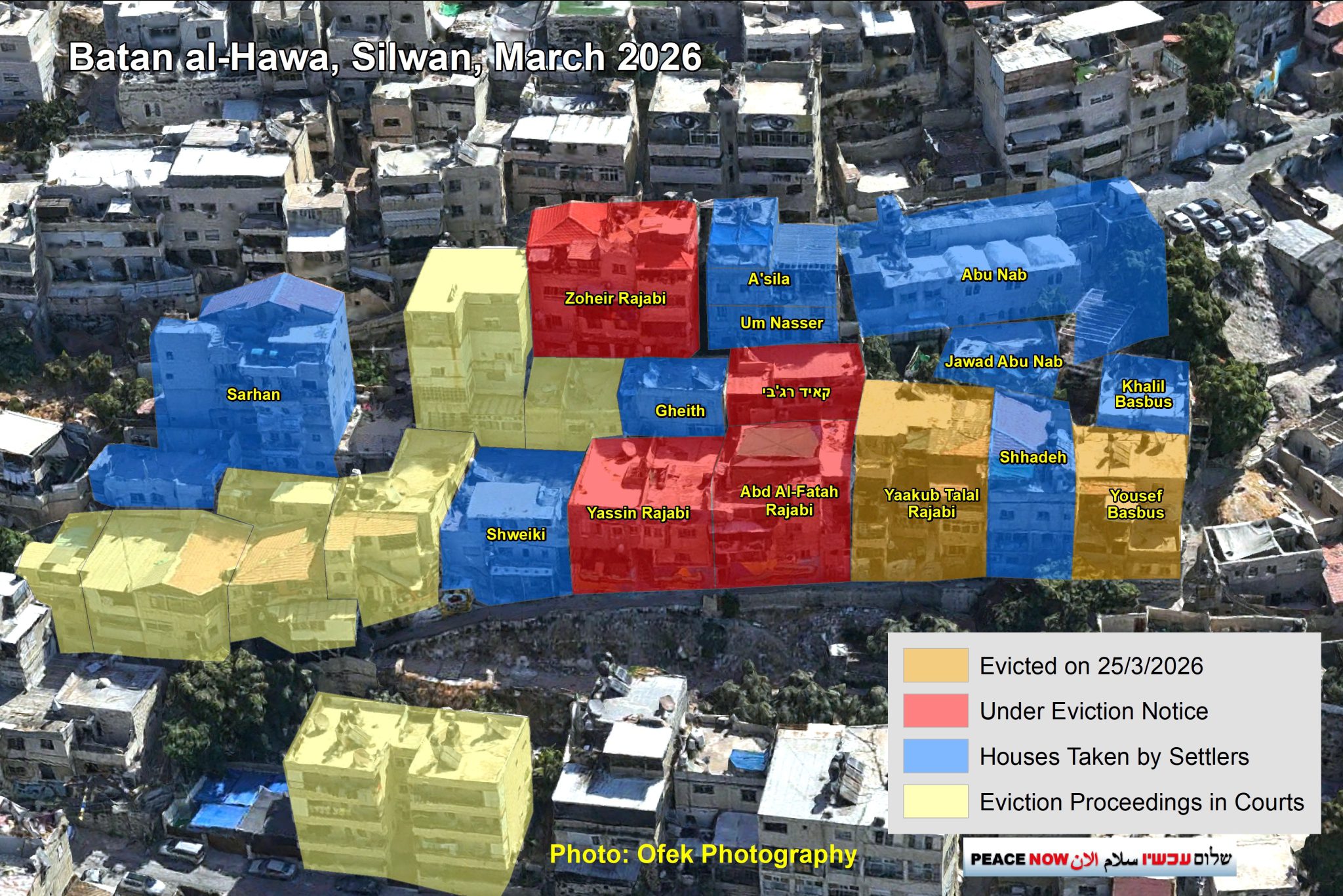 Over the past week, Israeli forces and settlers forcibly removed 15 Palestinian families from their homes in the Batan al-Hawa section of Silwan, clearing them and their belongings out so that the Ateret Cohanim settler organization can take possession of the buildings and Israeli settlers can move in. There are an additional 15 families under imminent threat of eviction on the basis of the same court decision.
Yosef Basbous, whose family was expelled this week said:
“Our family was expelled in 1948 and dispersed in refugee camps in the West Bank. I arrived in Silwan with my parents more than 60 years ago. I built this house stone by stone, brick by brick, nail by nail. Today they come to us and expel us again. They claim that the land belonged to a Yemeni waqf and that the custodian sold the land to settlers. The police say they are implementing the court’s decisions, according to the law. But what kind of law is this that can expel me, who has been here for more than 60 years.”
Another expelled resident, Jacob Rajabi told Haaretz:
“They came at 9 A.M., entered the house, took the children and women, and put us out on the street. This is the home where I was born, where I got married, raised children – my whole life is there.”
Peace Now said:
“Unfortunately, there is no other word to describe this than ethnic cleansing. Settlers, with the help of the government and a discriminatory legal system, are expelling an entire Palestinian community and replacing it with settlers. This is happening in the Jerusalem of 2026 and it is a stain that will not be erased from Israel.”
Ir Amim explains:
“These expulsions are part of an unprecedented escalation in forced displacement from Silwan that is tantamount to forcible transfer and involves multiple state institutions and entities working in collusion with settler groups and reinforced by a complicit judiciary. The amount of resources being allocated and deployed to carry out these measures during an ongoing war underscores the Israeli government’s resolve to exploit the circumstances to accelerate forcible transfer and solidify an irreversible apartheid reality. As detailed in a forthcoming Ir Amim report, a web of state and local authorities, statutory bodies, and laws converge into a single coordinated, multi-layered system of state-orchestrated dispossession and displacement of Palestinians in East Jerusalem, in flagrant violation of international law.”
B’Tselem details the history and context of Silwan, and explains:
“In Silwan, as in other Palestinian neighborhoods of Jerusalem and Palestinian villages across the West Bank, the Israeli regime uses every tool at its disposal to dispossess Palestinians of their land. The goal of removing Palestinians from their homes is pursued out in the open, the core features of Israel’s apartheid regime, via the court system, and in cooperation with settler organizations, with matching efforts to make Palestinians’ lives unbearable through systematic neglect and violence perpetrated by both official and unofficial actors. This is the reality of systematic, institutionalized violence in which Palestinian residents of Jerusalem live daily under Israel’s apartheid regime, stripped of their most basic rights. Confronting this reality requires urgent and immediate intervention by members of the international community.”
STATE-BACKED SETTLER TERRORISM
The pace of settler attacks is nearly impossible to keep track of. On March 21st (Eid weekend) settlers organized mass riots and attacks on Palestinian communities overnight, resulting in 17 pogroms across the West Bank completely undeterred by the IDF. The attacks were organized in reaction to the death of an 18-year old settler in a car accident, which settlers insisted was a terror attack despite unclear and at times contradictory facts. At the funeral for the settler, Finance Minister Bezalel Smotrich called for settlers to respond with settlement expansion, saying “We will erase the lines, the definitions, and the letters, and we will settle our land in all its expanses.” The father of the settler called him a “sacrifice“ for the settlements.
Settlers organized a second wave of terror campaigns on March 23rd, injuring at least 10. Five were reportedly arrested.
BONUS READS
- “How Israel’s strangulation of the West Bank is collapsing the Palestinian educational system” (Mondoweiss, 3/24/2026)
- “Israel’s Top Court Orders Compensation for Palestinian Family Whose Cattle Were Stolen by IDF Troops” (Haaretz, 3/25/2026)
- “32 Outposts, 10 Miles of Ground Barrier: IDF Builds New Border Line Inside Gaza. Here’s How It Looks” (Haaretz, 3/26/2025)
- “Netanyahu Coalition Pushes to Fast-track New Jewish Towns in Arab, Bedouin Areas” (Haaretz, 3/25/2026)
- “Vance’s office denies report VP raised anti-Palestinian riots with Netanyahu” (Cleveland News Journal)
- “The Iran War Is About Palestine” (Jewish Currents, 3/24/2026)
- “Israeli settlers are growing more violent in the West Bank” (The Economist, 3/26/2026)
- “Settlement of Land Title in the oPt: An International Law-Based Appraisal” (International Humanitarian Law Centre, 3/27/2026)
Welcome to FMEP’s Weekly Settlement & Annexation Report. To subscribe to this report, please click here.
February 13, 2026
- ANNEXATION: Cabinet Approves Annexation, Gov’t OKs “West Bank Heritage Authority”
- EAST JERUSALEM: Demolitions in al-Bustan
- WEST BANK SETTLEMENTS & OUTPOSTS: Settlers Bulldoze Houses, Land Seizure Near Qalqilya for New Settlement
- SETTLER & STATE TERRORISM: 54 Injured in Wave of Attacks
- BONUS READS
ANNEXATION
Cabinet Announces Sweeping Annexation Moves
On February 8th, the Israeli Security Cabinet approved seven new measures that result in the annexation of the entire West Bank, stripping powers from the Palestinian Authority and paving the way for massive settlement expansion and the continued ethnic cleansing of Palestinians from all areas of the West Bank. With the Security Cabinet decisions made and support from the Attorney General, the Israeli military is expected to quickly issue military orders duplicating the decisions in order for them to be a matter of law in the West Bank. In announcing the decisions, Israeli Ministers Katz and Smotrich issued a joint statement saying the moves are intended:
“to remove decades-old barriers, repeal discriminatory Jordanian legislation, and enable accelerated development of settlement on the ground,” the two ministers said in a joint statement.”
The seven significant acts of annexation are:
- LEGALIZING SETTLER LAND PURCHASES – The Cabinet decided to repeal a Jordanian-era law that restricted the sale of land in the West Bank to the local Palestinian population (individuals and companies), effectively legalizing the sale of West Bank land to Israelis. Now, settlers will be able to purchase land anywhere in the West Bank including in major Palestinian cities – possibly creating new enclaves that bring Israeli security installments with it, a reality that has transformed Hebron into an apartheid dystopia.
- REMOVING KEY OVERSIGHT OF LAND PURCHASES – The Security Cabinet repealed a law that requires individuals to obtain a special land purchase “transaction permit” from the Israeli Civil Administration, a law that was aimed at establishing oversight on to stem fraudulent claims of land purchases, which offered Palestinians some level of protection.
- PUBLISHING THE LAND REGISTRY – The Cabinet approved the publication of the West Bank land registry, something the settlement movement has pushed for in order to be able to identify landowners in all areas of the West Bank and approach them for purchase, which – with the repeal of the ban on the sale of land to non-Arabs – settlers can now do outright. Opening the land registry will help facilitate settler claims over disputed and/or unregistered lands, making Palestinians vulnerable to further settler harassment regarding the sale of land.
- REVIVING A “STATE LAND ACQUISITION COMMITTEE” – The Cabinet revived a “state land” acquisition committee to expand settlements. The revival of the committee is meant to facilitate the proactive government purchases of West Bank land for the purpose of settlement expansion and “to secure land reserves for settlement for generations to come.”
- EXTENDING ISRAELI CONTROL TO AREAS A & B – The Cabinet extended Israeli oversight and enforcement in Areas A & B with regard to water issues, archaeological sites, and environmental concerns. This means that the Israeli military will be able to demolish Palestinian homes and property if it determines the Palestinian presence interferes with the concerns under their purview – water, archaeology, and environment. Now, Areas A & B will be subject to the same weaponization of the planning code that is currently being used by the Civil Administration to clear Palestinians
- SEIZING HERITAGE SITE IN BETHLEHEM – The Cabinet voted to create a new municipal body to take control over the Rachel’s Tomb religious site, located within the municipal boundaries of Bethlehem. Seizing control over the site will allow the Israeli government to allocate state funds to renovating the site as well as a Jewish yeshiva next to it. Rachel’s Tomb is located just close to the heart of the city of Bethlehem, and with Israeli settlers in control over the space Mondoweiss reports that area is likely to be developed into a new settler enclave.
- SEIZING PLANNING POWERS IN HEBRON – The Security Cabinet stripped planning and building authorities from the Palestinian Municipal Authority in Hebron and transferred it to the Israeli Civil Administration. Now, the Israeli military will exercise full control over settlement construction and planning for the Cave of the Patriarchs/Il-Ibrahimi Mosque.
Finance Minister Smotrich celebrated, saying:
“We are deepening our roots in all parts of the Land of Israel and burying the idea of a Palestinian state.”
The settlement Yesha Council, which oversees all settler municipalities, said in a statement:
“The government of Israel announced today, in practice, that the Land of Israel belongs to the Nation of Israel,” the council said, adding that the decisions “rectified an injustice of many years and are entrenching Israeli sovereignty on the ground, de facto.”
Peace Now said in a statement:
“Netanyahu promised to topple Hamas in Gaza, but in practice he chose to topple the Palestinian Authority, cancel agreements that Israel signed, and impose de facto annexation on us—completely against the will of the public, Israel’s interests, and the clear position of President Trump. The cabinet’s decision shows that this is not about deepening annexation in Area C, but about dangerous and irresponsible sovereignty measures also in Areas A and B, and about breaking every possible barrier on the path to massive land theft in the West Bank. This is an extreme and irresponsible government dragging us toward disaster. All democratic forces in Israel must act now, in every possible way, to stop this!””
Palestinian analyst Nour Odeh warns:
“These Israeli decisions are not administrative or bureaucratic. They’re transformative. The only logical next steps would be dismantling Palestinian political representation & mass ethnic cleansing. The only remaining obstacle to greater Israel are the remaining Palestinians.”
Government Endorses Bill to Establish West Bank Heritage Authority
On February 8th, in addition to the seven decisions to annex the West Bank as described above the Ministerial Committee on Legislation decided to throw the governing coalition’s support behind a bill in the Knesset that create a statutory body within the Israeli government that would exercise broad authority over heritage sites in “the area” of the West Bank — an act of de facto annexation.
Emek Shaveh, Peace Now, and the Geneva Initiative highlight that, if passed, this would be the first instance of Israel applying domestic Israeli law to territory (land) rather than persons (settlers) in the West Bank. The coalition further warns that the bill does not currently provide a definition of what area the new body would have jurisdiction over, as Emek Shaveh details in its latest update:
“Previous iterations of the bill explicitly stated the intention to bring antiquities sites in Areas A, B and C under the Authority’s jurisdiction, and even included an express reference to extending its jurisdiction to Gaza. In the current version of the bill, however, following a closed-door committee session, all references to Areas A, B, C and Gaza were removed, and the question of defining the territorial scope of “the Area” was deferred to a committee discussion after the bill’s first reading in the plenum. Nevertheless, yesterday’s cabinet decision may render any future discussion concerning the definition of “the Area” in the bill redundant, as the legislation provides for the transfer of all powers and responsibilities currently vested in the Staff Officer for Archaeology within the Civil Administration (ICA) to the new statutory authority (see section 2 in annex 1 below).
Taken together, these developments constitute a fundamental turning point. Empowering an Israeli civilian authority to carry out enforcement measures, expropriations, and excavations deep inside Palestinian Authority Areas B and A effectively dismantles the framework established under the Oslo II Accords. Under that framework, responsibility for antiquities and archaeological sites in Areas A and B rests with the Palestinian Authority’s Ministry of Tourism and Antiquities, which operates pursuant to the Palestinian Authority’s Antiquities Law of 2018.”
EAST JERUSALEM
Large Scale Demolitions in al-Bustan, Silwan
Peace Now reports the Israeli government carried out extensive demolitions in the al-Bustan area of Silwan. The municipality destroyed walls between houses, a construction supply business site, and a parking structure. The demolition notices were delivered just minutes before the bulldozers arrived, depriving Palestinians of the chance to challenge the actions and/or remedy the issues cited on the notices. Residents filed an emergency injunction, and the Jerusalem District Court issued an injunction stopping the demolitions after three hours. While no homes were demolished in this instance, Israel recently issued demolition notices to 15 Palestinian homes in al-Bustan.
Peace Now explains how these demolitions are a part of a much larger scheme to replace Palestinians with Israeli settlers and tourist attractions which erase Palestinian heritage:
“Since the demolition of the Mughrabi Quarter in 1967 to make way for the Western Wall Plaza, Israel has not carried out the expulsion of an entire neighborhood. Now, the municipality, backed by the government and the police, is advancing the displacement of a whole neighborhood in order to establish a tourist-settlement park. This policy, which on the one hand virtually prevents Palestinians in Jerusalem from building homes and on the other hand demolishes their houses, is a cruel, settlement-driven policy with no limits. For years Israel has claimed that Jerusalem is a ‘united’ city, but its policy toward the Palestinian population shows that this is not ‘unity,’ but occupation.”
WEST BANK SETTLEMENTS & OUTPOSTS
Settlers Bulldoze 15 Palestinian Homes Near Jericho
Haaretz reports a group of about 30 settlers accompanied by IDF protection arrived in the village of Ein a-Duyuk a-Tahta, located near the Hasmonean Palaces antiquity site near Jericho, and proceeded to attack Palestinian residents and bulldoze 20 structures, including 15 homes. The IDF told Haaretz that the demolitions were not carried out by Israeli authorities (though eye witnesses said IDF troops were on site the whole time providing security), and said that the IDF is opening an investigation into the incident.
Israeli Heritage Minister Amichay Eliyahu said during a live video posted on X:
“We will destroy any [home] built on Jewish people’s heritage. We will return here, pave roads and make the place flourish. “We do not apologize for holding onto our land. Through hard work and the investment of millions, we are reclaiming our heritage sites and deepening our historical hold on the land of our forefathers for the sake of our children’s future…Here at the Hasmonean Palaces in Jericho, the gateway to the Land of Israel, we are raising the flag of our sovereignty.”
Israel Seizes Land Near Qalqilya
Peace Now reported that in early January 2026 the Civil Administration declared 694 dunams adjacent to the Wadi Qana nature reserve (east of Qalqilya in the central West Bank) as “state land.” The seizure, along with the purchase of land near the area by an Israeli developer, appears to indicate a new settlement, called “Dorot”, is being planned for the area.
Peace Now explains:
“In 2020, an outpost known as Nahal Qana Farm (sometimes referred to as “Dorot Farm”) was established in the area and began exerting pressure on nearby Palestinian residents and farmers. Those operating the farm grazed cattle inside Palestinian orchards and cultivated fields and forcibly prevented Palestinians from accessing hundreds of dunams in the vicinity of the outpost.
In recent years, private developers have begun marketing building plots to the public for a future city called “Dorot Illit,” intended for the ultra-Orthodox community, despite the absence of a government decision to establish a settlement in the area or an approved construction plan. As part of the land marketing, the development company presents a rendering of the planned settlement that includes all nearby Israeli settlements, while the surrounding Palestinian villages are effectively erased and are absent from the promotional materials.
It has now emerged that the government is joining the settlement planning effort: the Civil Administration has labeled the land declaration adjacent to the developers’ holdings as “Dorot.” This is not the first settlement to be established at the initiative of private developers claiming to have purchased land from Palestinians. In February 2023, the government formally approved the establishment of the settlement of Mishmar Yehuda, where state land was likewise designated adjacent to plots acquired by developers. Other settlements established in a similar manner in the past include Modi’in Illit, Revava, Avnei Hefetz and others.”
STATE-BACKED SETTLER TERRORISM
Mass Attack Leaves 54 Wounded
On Friday February 13th settlers and Israeli troops carried out a wave of attacks on Palestinians concentrated in the area south of Nablus but extending across the West Bank, leaving at least 54 wounded.
Al Jazeera reports the following attacks:
- Settlers fired live ammunition and tear gas at Palestinians near Talfit and Qusra, south of Nablus, shooting at least one man.
- Settlers stormed the Khillet as-Sadrah gathering near the town of Mikhmas, northeast of occupied Jerusalem.
- Near Ramallah in Turmus Aya, settlers cut down roughly 300 olive trees and bulldozed agricultural land, while military forces raided homes in the village and arrested multiple people.
- In the same area, the military stormed Deir Ghassaneh and Beit Rima, while forces also descended upon several towns near Jenin, including Jaba, Siris and Meithalun.
- In the Jordan Valley, settlers set fire to a building
In West Bank, Israel’s Goal is Expulsion
Israeli government policy facilitates and augments the continued settler terrorism that is resulting in the mass expulsion of Palestinians from the West Bank – a reality that is now regularly in the headlines. Now, the Israeli Shin Bet is criticizing the Israeli Police’s refusal to allocate needed police force to confront the rampant settler terrorism that is only escalating as settlers face zero consequences to their violent criminality.
Haaretz columnist Amira Hass writes in the West Bank:
“Israel has only one goal: not maintaining quiet but fomenting military and socioeconomic explosions that will encourage emigration or allow a forcible population transfer. The line separating expulsions from mass slaughter is thin to the point of invisibility, as the army has taught us in Gaza. This isn’t a prophecy but another desperate cry for the world to wake up.”
BONUS READS
- “2 settler activists cross into Lebanon to plant trees, are returned to Israel by IDF” (The Times of Israel, 2/12/2026)
- “PODCAST: Documenting the settler takeover of the West Bank” (+972 Magazine, 2/13/2026)
- “PODCAST: Entire Communities Fled: ‘The West Bank’s Area C Is Almost Completely Ethnically Cleansed‘” (Haaretz, 2/11/2026)
- “Bezalel Smotrich’s long struggle to annex the West Bank for Israel” (Al Jazeera, 2/12/2026)
- “Israel Escalates its Settlement Expansion in the Heart of a UNESCO World Heritage Site in Bethlehem: Battir” (Balasan Initiative, 2/5/2026)
- “Settlers Violence Doesn’t End With Palestinians in the West Bank” (Haaretz, 2/13/2026)
Welcome to FMEP’s Weekly Settlement & Annexation Report. To subscribe to this report, please click here.
October 17, 2025
- Settlers Establish New Outpost to Encircle Umm Al Kheir, Court Pauses Move-In
- Eviction Date Looms for Six Families Facing Displacement from Homes in Silwan
- As The Olive Harvest Starts, Settler Terrorism Reaches New Heights
- Israeli Commitment Against West Bank Annexation is Not in Final Ceasefire Deal
- International Crisis Group Report: “Sovereignty in All but Name: Israel’s Quickening Annexation of the West Bank”
- Bonus Reads
Settlers Establish New Outpost to Encircle Umm Al Kheir, Court Pauses Move-In
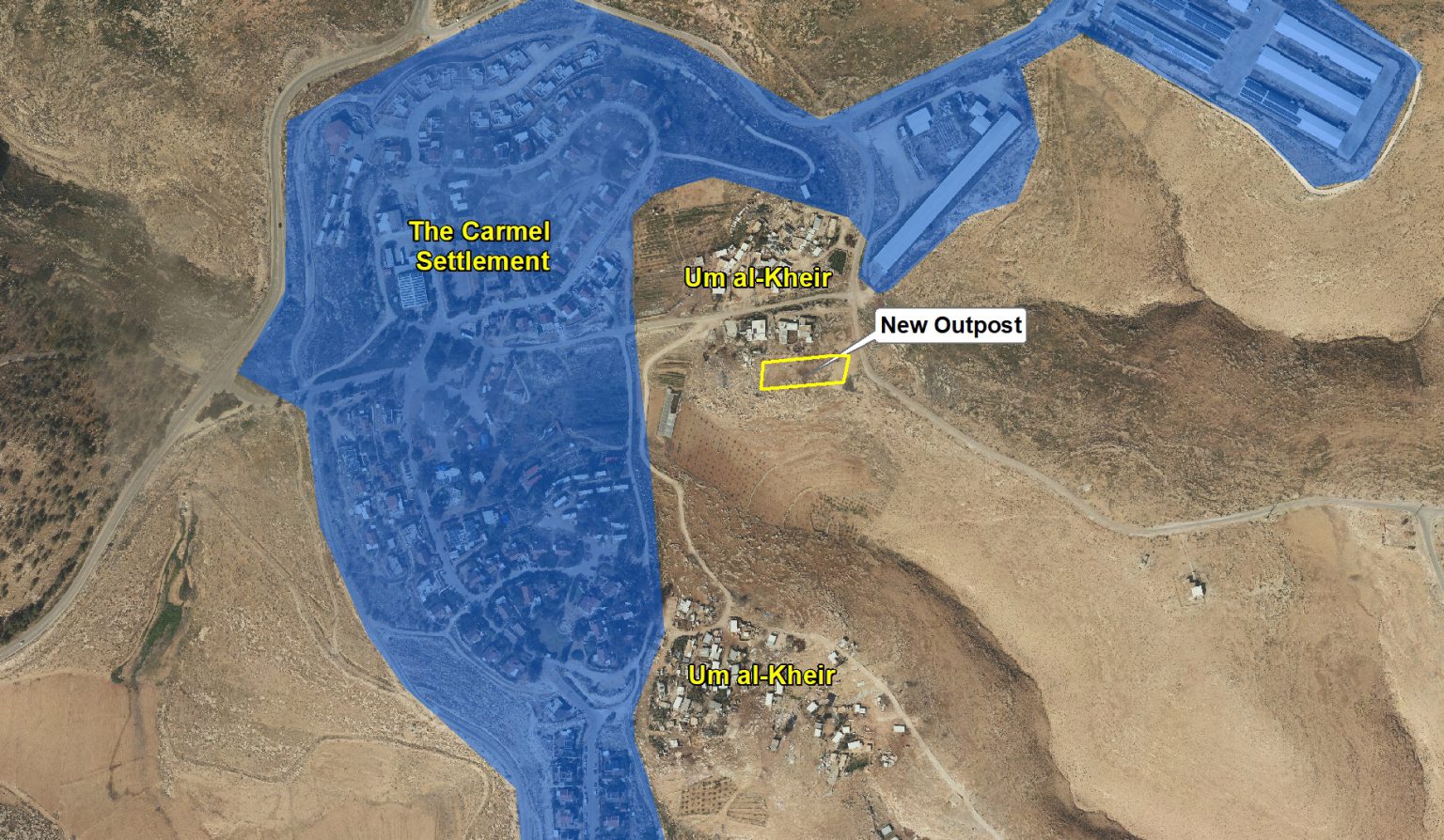 Two months ago, Israeli settlers began building yet another outpost surrounding the tiny Palestinian village of Umm al Khair in the South Hebron Hills, almost completing the encirclement of the 200 people who live in village by the Carmel settlement and its illegal outposts. The settlers cleared land and moved in caravans into the area, within spitting distance of Palestinian homes, as part of their years-long effort to expand their control of land in the area and compel/coerce the displacement of Umm al-Kheir. It was during the settlers illegal preparation of the land for this new outpost that Awdah Hathaleen, a prominent activist in the area and a protagonist in the critically acclaimed documentary No Other Land, was shot and killed by the internationally sanctioned settler Yinon Levy.
On October 12th, the Jerusalem District Court issued an order temporarily barred settlers’ from inhabiting the new outpost while the Court considers the underlying legal challenge which seeks to compel settlers to remove the caravans from the land. Settlers promptly violated the Court order, and moved more caravans into the area the very next day.
Peace Now said in a statement:
“For months, all enforcement authorities have known full well about the massive, blatantly illegal construction project taking place on the village’s land — and not only did they do nothing to stop it, they actually secured and assisted it in various ways. It is depressing and sad, though not surprising, that it takes a court order to make the army and the police do their duty. We hope the order will give the residents of Um al-Kheir, who are suffering under the settlers’ ongoing harassment, some space to breathe and live normal lives.”
Eviction Date Looms for Six Families Facing Displacement from Homes in Silwan
Six Palestinian families living in the Silwan neighborhood of East Jerusalem are facing an impending eviction date ordering them to vacate their longtime homes sometime between October 19 and November 4. If the families do not agree to their own displacement, Israeli police will remove them by force. At this point, all legal remedies have been exhausted and the Nasser, Rajabi, Shweiki, and Odeh families are set to be forcibly displaced under at the behest of Israeli settlers and the facilitation of Israeli legal courts, a system Ir Amim describes as: “proceedings [that] are underpinned by structural discrimination rooted in Jewish supremacy and a system rigged against Palestinians from the outset, which denies them equal access to justice.”
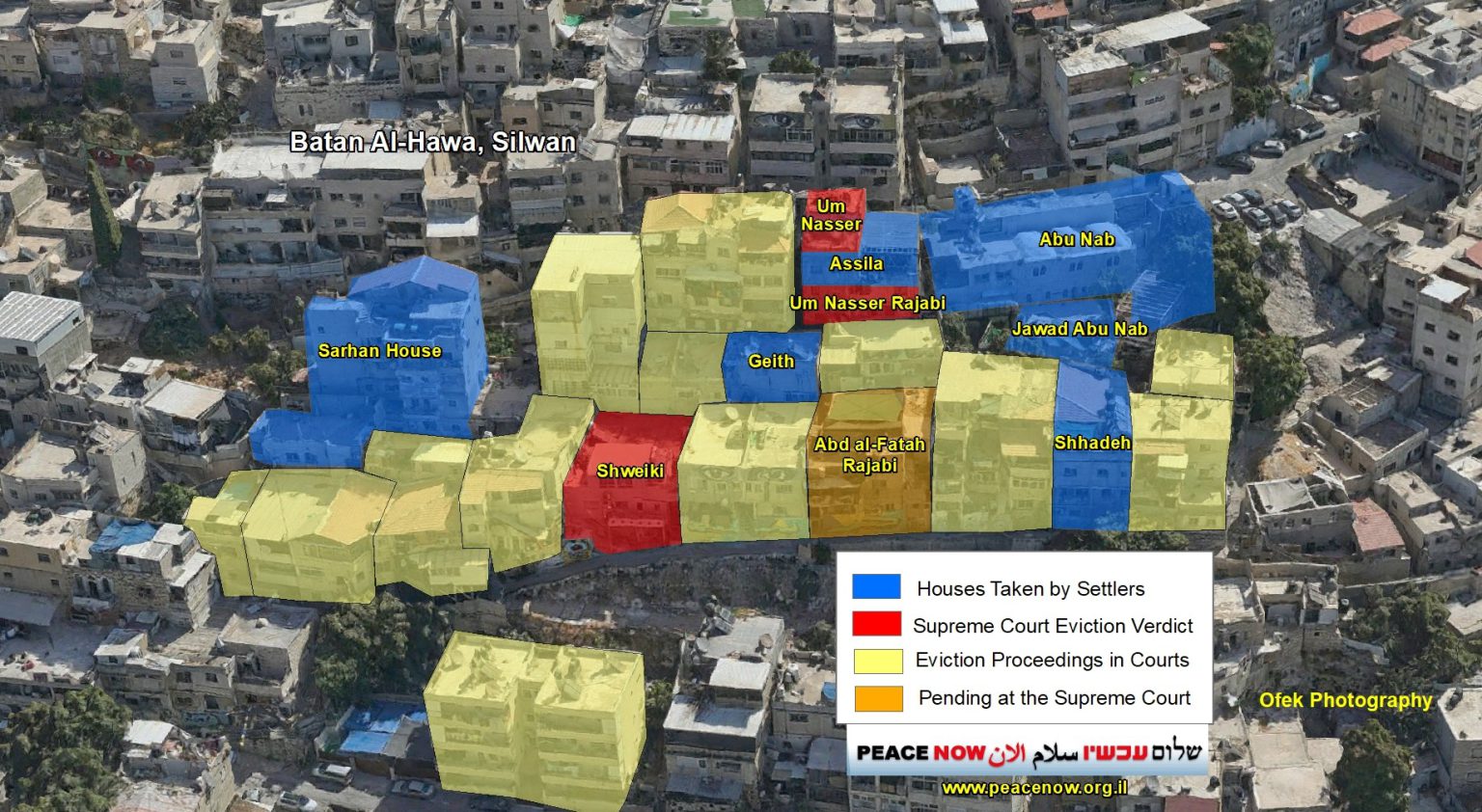 For more background on these cases, see Peace Now’s reporting.
Peace Now reports that 16 families have already been evicted from the Batan al-Hawa section of Silwan – 6 in this year alone – with settlers facilitating their displacement and taking up residence in the vacated homes. There are five additional cases affecting dozens of families that are at various stages in the Jerusalem Magistrate Court.
Peace Now said in a statement:
“This is a real emergency. If the government does not intervene, and if pressure is not brought to bear on it to act, we may witness in the coming weeks families literally thrown out into the street and settlers taking their place. This is a terrible injustice, based on discriminatory laws and on the ongoing exploitation and marginalization of East Jerusalem residents. The dispossession of Palestinians from their legally purchased homes in Silwan, under the guise of realizing a “right of return” for Jews, is an indelible stain on the State of Israel. The government can and must stop the forced expulsion of an entire community—the responsibility lies on its shoulders.”
As The Olive Harvest Starts, Settler Terrorism Reaches New Heights
The Palestinian olive harvest is now underway, and as in past years presents a massive target for violent settlers to terrorize Palestinians attempting to work their land – and in fact settler violence has rapidly increased from already high levels. Between 7 and 13 October, OCHA documented 71 Israeli settler attacks against Palestinians, 36 of which were directly connected to the olive harvest. As a result of the documented attacks, 99 Palestinians were injured and 1 killed. These attacks have included:
- On October 8th settlers were throwing stones at Palestinian cars near the village of Deir Jarir, located near Ramallah. One Palestinian was shot and killed when settlers opened fire on a group of people who had gathered to chase off the stone-throwers. This is the 12th settler attack on Deir Jarir this year, according to OCHA.
- On October 9th, settlers raided the village of Atara, near Ramallah, damaging homes and cars. Settlers established a new outpost near Atara in August 2025, and have since used the outpost as a launching point to routinely attack Atara. OCHA has counted at least 8 attacks so far.
- On October 10th, settlers attacked the Palestinians harvesting olives near Beita, resulting in an injury to an AFP photographer. Settlers further seized harvesting equipment and burned 12 vehicles.
- On October 12th, settlers staged a large-scale attack on the village of Burqa during which they cut down over 800 fruit trees (including olive trees, citrus trees, and grapevines).
- On October 13th, settlers accompanied by Israeli forces attacked Beit Fajjar, near Bethlehem. Settlers assaulted a family of six which was attempting to harvest grapes, and later assaulted the emergency responders who came to assist the victims. Settlers used sticks, molotov cocktails and dogs to injure the family, and later burned their vehicle.
- On October 13th, settlers attacked the village of Ein Yabrud, near Ramallah, and burned down a house.
- On October 16th, the two different groups of Paelstinians harvesting olives near Burin were attacked by settlers from the Yitzhar settlement. The harvesters were chased off and their farming equipment was stolen.
Israeli Commitment Against West Bank Annexation is Not in Final Ceasefire Deal
According to leaked reports, an earlier version of the Trump ceasefire deal included a commitment that Israel would not annex the West Bank. Despite Trump’s press conference weeks before where he said publicly that he will not allow Israel to annex the West Bank, ultimately the commitment was not included in the final ceasefire deal.
Nonetheless, The Times of Israel reports that the Knesset is set to reconvene from its summer break and immediately take up a few bills that would affect the annexation of the West Bank. A Knesset insider told The Times of Israel:
“there is a majority in the Knesset to annex today…The reason it’s not on the agenda is because Netanyahu has made it very clear that he’s not going to support anything of the sort. You can say it’s because of Trump. You can say it’s because of his own fear of global isolation or a regional war or whoever knows what it is that he’s thinking. But if there was a secret ballot in the Knesset today, a majority would definitely annex.”
The source further told the outlet that Netanyahu will find a way to postpone voting on the annexation bills, without outright opposing them, until the next election in October 2026.
International Crisis Group Report: “Sovereignty in All but Name: Israel’s Quickening Annexation of the West Bank”
The International Crisis Group (ICG) published a new report entitled, “Sovereignty in All but Name: Israel’s Quickening Annexation of the West Bank.” The report responds to European states offering recognition to the State of Palestine, a recognition with ICG calls a “strategy that should also have teeth,” taking seriously that “annexation is not a future threat – it is already under way.” The report urges international actors to do what they can to “halt the further consolidation of Israel’s annexation and to begin the difficult work of persuading Israel to reverse course.”
The Executive summary of the report ends:
“The impediments to a two-state solution to the Israel-Palestine conflict are longstanding and immense, and a body of informed commentary argues that they are indeed insurmountable. Perhaps they are, but there is no world in which the further progress of annexation will produce a better result for the Palestinian people – or, for that matter, for Israelis. Israel may never alter its posture in the West Bank, but if outside actors play a long game and act concertedly, they will optimise their chances of changing its behaviour. Absent that, the status quo, which denies the Palestinian people not just a state, but also basic rights, will only become further entrenched.”
Bonus Reads
- “Sweeping Israeli actions transform West Bank in shadow of Gaza war” (Washington Post, 9/28/25)
- “Ben-Gvir’s Aide Suspected of Preventing Weapon Seizure of Settler Who Shot at Palestinians” (Haaretz, 9/29/25)
- “Israel detains two Palestinian children in Hebron under claims of ‘espionage‘” (Middle East Eye, 10/1/25)
- “The Trump-Netanyahu Peace Deal Promises Indefinite Occupation” (The Intercept, 10/1/25)
- “Israeli bulldozers in West Bank carve up hopes for Palestinian state” (Reuters, 10/2/25)
- “Bureaucratic Antics for Three West Bank Villages Show How an Israeli Annexation Began Long Ago” (Haaretz, 10/12/25)
- “At This West Bank Checkpoint, ‘It’s Not Just Movement That’s Blocked. It’s Time Itself’” (Haaretz, 10/13/2025)
- “Israeli settlements close in on West Bank herding community” (Al-Monitor, 10/10/25)
- “Despite war’s end, Smotrich calls for renewed Jewish settlement in Gaza” (Ynet, 10/14/25)
Welcome to FMEP’s Weekly Settlement Report, covering everything you need to know about Israeli settlement and annexation activity this week.
To subscribe to this report, please click here.
January 17, 2025
- Settlement Advancement Continue on Weekly Basis
- Judge Rules on Five Cases, All in Favor of Settlers Claims in Batan al-Hawa
- New Bimkom-Ir Amim Report: Planning in East Jerusalem Completely Halted by New Protocol
- New Data Confirms: Settlers Face Virtually NO Accountability for Crimes Against Palestinians & Their Property
- Al-Haq and Partners File Additional Info on Booking.Com Settlement Business
- Trump Invites Settler Leaders to Attend Inauguration
- Bonus Reads
Settlement Advancement Continue on Weekly Basis
Peace Now reports the High Planning Council was scheduled to convene on January 15th to advance plans for 372 new settlement units, all planned for the Beitar Illit settlement. This is the seventh week in a row the HPC has met to approve settlement construction.
The HPC is scheduled to meet again next week, on January 22nd, for the eighth consecutive week. At that meeting, the HPC is expected to give final approval to a plan for the construction of 184 new settlement units in the Migdalim settlement.
Peace Now writes:
“Since the current Netanyahu government took office, record numbers of housing units have been advanced in the West Bank. In 2023, the HPC approved 12,349 housing units—a record high. In 2024, 9,884 housing units were approved. The transition to weekly planning approvals is the result of policy changes introduced by the Netanyahu-Smotrich government. One key decision, made in June 2023, abolished the requirement for the Defense Minister’s approval at every stage of advancing settlement plans. Previously, settlement construction plans required prior approval from the Defense Minister. In recent years, the Defense Minister limited settlement planning sessions to approximately four times a year, resulting in the approval of thousands of units in each session.
In recent weeks, however, a significant change has occurred, with the HPC convening every week to approve a few hundred housing units in each meeting. This systematic approach aims to normalize settlement planning and attract less public and international attention and criticism.”
Judge Rules on Five Cases, All in Favor of Settlers Claims in Batan al-Hawa
Peace Now reports that the Jerusalem Magistrate’s Court has ruled in favor of Israeli settlers in four cases (with a fifth ruling expected soon), resulting in the impending eviction of Palestinians from their longtime homes in the Batan al-Hawa section of the Silwan neighborhood in East Jerusalem in favor of the settlers. The five cases will result in 27 Palestinian families (131 individuals, mostly children) being forcibly displaced from their homes. The Court gave the families a six month deadline.
 The Court’s ruling accepts settlers’ claim to own the land on which the Palestinians’ homes are located, homes which the Court recognized were legally purchased by Palestinians in the 1960s. Regardless of the validity of the home ownership, the Court recognized the settler’s ownership of the land under a discriminatory Israeli law that allows Jews to “reclaim” property and land that was owned by Jews prior to 1948. This law is being used by settlers to achieve mass displacement of Palestinians across East Jerusalem.
Peace Now writes:
“This is an injustice and a crime against a vulnerable population living under occupation in East Jerusalem. The dispossession of Palestinians from their homes in Silwan, enabled by the application of the Jewish ‘right of return,’ represents an indelible stain on the State of Israel. The Israeli judicial system has failed to protect the fundamental rights of Palestinians to their homes, effectively endorsing the racist and messianic policies of the current Israeli government. A responsible government would halt the forced expulsions of this community. Tragically, our government demonstrates anything but responsibility in any regard. The International Court of Justice has explicitly addressed the discriminatory legal framework and Israel’s settlement policy in East Jerusalem in its advisory opinion, declaring these practices a violation of international law.”
Ir Amim writes:
“Since the outbreak of the war, there has been a dramatic spike in the number of court decisions authorizing evictions of Palestinian families in favor of settler groups. Over the past several months, the courts have ruled to evict a total of 17 families (households), numbering some 100 individuals–the majority of whom are from Batan al-Hawa.”
New Bimkom-Ir Amim Report: Planning in East Jerusalem Completely Halted by New Protocol
Ir Amim and Bimkom have released a new report examining the recent intensification of Israel systematical denial of the ability for Palestinians to plan for construction in East Jerusalem. In 2023 Israel replaced the traditional “Muktar Protocol” with a new process which has resulted in a near total freeze on planning for Palestinians on unregistered private property.
The report explains:
“In comparison to the “Mukhtar Protocol,” the new protocol has had a detrimental impact on private residential planning (and building) in East Jerusalem4. According to the new protocol, planning and building submissions are required to include Jordanian property tax certificates from the early 1960s or earlier (or Israeli property tax until the year 2000) along with records detailing the historical chain of ownership up to the present. These requirements, usually demanded only as part of SOLT procedures– which are problematic in themselves– are new to the planning process. Additionally, the new protocol requires that the District Planning Bureau approach state authorities, such as the Custodian of Absentee Property (CAP), the General Custodian (GC), the Israel Land Authority (ILA), the Municipality, and the SOLT registrar to check whether they have claims on the same land. In the past, the SOLT registrar was not on this list, and the Planning Bureau often did not wait for responses from the other entities to proceed.
Now, the SOLT registrar has been in effect given the right of veto within the planning process. The added requirements present East Jerusalem Palestinians with two difficulties – a bureaucratic and a fundamental one. The bureaucratic difficulty is related to the challenge of obtaining the necessary documents. The fundamental difficulty is the real danger of losing land under the Absentee Property Law, which is applied through the new protocol, as it is via SOLT.”
New Data Confirms: Settlers Face Virtually NO Accountability for Crimes Against Palestinians & Their Property
Yesh Din’s newly updated tracking shows that 94% of criminal investigations into ideological offenses committed by Israelis against Palestinians in the West Bank in the past 20 years have been closed without indictments. Further, Yesh Din has found insufficient investigations into 81% of the cases, displaying “a longstanding systemic and deliberate failure in law enforcement responses to ideologically motivated crime against Palestinians in the West Bank.”
Yesh Din further explains that the larger context of this data paints an even more dire picture. They find 66% of Palestinian victims chose not to file complaints against Israeli offenders at all – meaning the data does not tell the full story. Palestinians victims of Israeli violence routinely cite a lack of faith in the Israel Police and trust that the Israeli authorities in their decision not to file a complaint.
The picture is clear: violence is a policy. Settler violence is part of a systematic approach aimed at expanding control over West Bank territory by making Palestinian lives unbearable and pushing them off their lands.
Yesh Din writes:
“This reflects the ongoing failure of Israeli authorities to enforce the law against Israeli citizens who commit serious crimes against Palestinians and their property. For two decades, we have monitored this phenomenon and provided legal assistance to Palestinian victims. The new data underscores the lack of deterrence and the lenient policies of Israeli law enforcement toward ideological crimes. Most investigations are closed on grounds such as “unknown perpetrator” or “lack of evidence,” highlighting negligent and ineffective investigations. Only 3% of cases resulted in convictions, giving offenders a sense of immunity from accountability for their actions while Palestinians whose rights are violated remain unprotected by the law.”
Al-Haq and Partners File Additional Info on Booking.Com Settlement Business
Al-Haq and partners have filed additional evidence against Booking.com accusing the travel company of profiting from stolen land through its decision to promote rentals located in settlements in East Jerusalem and the West Bank. The new evidence, which was submitted to a court in the Netherlands where the case was filed in 2023, accuses Booking.com of adding to the number of listings it hosts in settlements – from 13 rentals to 39 rentals in East Jerusalem over the past year.
The complainants write:
“In our complaint, we argue that by promoting and listing properties in illegal settlements, Booking.com directly supports the normalisation and economic sustainability of these unlawful practices. The company provides financial backing to settlers and their enterprises, furthering the displacement of Palestinians and solidifying settlement expansion. This conduct sustains Israel’s settler-colonial regime and violations of international law, including the Fourth Geneva Convention, which prohibits population transfer into occupied territories. We have substantiated our claims thoroughly. For instance, the additional evidence builds on the July 2024 Advisory Opinion of the International Court of Justice, which reaffirmed the illegality of Israeli settlements and underscored the responsibility of states to prevent economic activities that perpetuate them.”
Trump Invites Settler Leaders to Attend Inauguration
Settlers leaders from the powerful Yesha Council are gleefully celebrating their invitation to attend the inauguration of Donald Trump, who is being sworn into office on January 20th. Yesha Council Chairman and Binyamin Regional Council Head Israel Ganz, Samaria Regional Council Head Yossi Dagan, Oranit Council Head Or Piron-Zomer, and Yesha Council CEO Omer Rahamim all plan to attend as official guests.
The Times of Israel reports the delegation plans to deliver a letter thanking Trump for “redeeming” Jerusalem and recognizing Israel’s annexation of the Golan Heights during his previous presidency.
Speaking about the delegations plans, a Yesha Council official told Israel Hayom:
“Our objective is to strengthen existing connections and forge new ones. Washington’s attention is elsewhere at present. Trump is focused on Greenland sovereignty matters, not Israel’s concerns in Judea and Samaria. Timing is crucial. We must proceed strategically and appropriately.”
In a statement to Israel Hayom, Yesha Council Chairman Israel Ganz said:
“We represent Judea and Samaria residents in standing with our allies and President-elect Trump at this historic moment. The administration’s invitation reflects our shared Biblical values with the US. We face a common moral challenge against global threats, with Judea and Samaria settlements serving as the frontline defense for Israel, America, and the free world. We envision achieving transformative progress that will ensure global stability for generations, and we support Trump’s leadership in this endeavor. Our ongoing dialogue with senior administration officials continues to advance these goals.”
Samaria Regional Council Head Yossi Dagan told Israel Hayom:
“Our delegation brings the blessing of the communities in Judea and Samaria to the new administration. Years of relationship-building with our newly elected American friends have created this pivotal opportunity for Israel, particularly its government, to achieve significant advances in strengthening our presence in the Land of Israel. Our unified approach underscores the importance of maintaining strong ties with the incoming American administration and bolstering support for the communities in Judea and Samaria, both internationally and among US Jewish communities.”
Bonus Reads
- “Defense Chief Cancels Detention Without Trial for Settlers Ahead of ‘Terrorists’ Release in Gaza Hostage Deal” (Haaretz)
- “Humanitarian Situation Update #256 | West Bank” (OCHA)
- “Israeli minister asks PM to back plan for a million Jews in Samaria” (JNS)
Welcome to FMEP’s Weekly Settlement Report, covering everything you need to know about Israeli settlement activity this week.
To subscribe to this report, please click here.
December 13, 2024
- More Demolitions in Silwan Imminent, Threatening Displacement and Replacement
- Israel Seizes Land Northwest of Jerusalem, Possibly to Expand Settlement
- Israel Demolishes Structures in “Agreed Upon Reserve” Near Bethlehem
- Weiss Details Work Towards Gaza Settlements
- Settlers Move on Plans to Settle South Lebanon & Syria
- U.S. Senator Intro’s Bill to Compel U.S. Adoption of Settler Terminology “Judea and Samaria”
- U.S. Democrats Introduce Bill to Codify Biden’s Sanctions on Violent Settlers
- Bonus Reads
More Demolitions in Silwan Imminent, Threatening Displacement and Replacement
Ir Amim and Peace Now continue to raise the alarm on the escalation in demolitions targeting Palestinians in Silwan, particularly in the Batan al-Hawa and al-Bustan sections of the neighborhood. In al-Bustan, it is particularly concerning that the Israeli government is rapidly pursuing its plans to displace the entire neighborhood in order to construct the “King’s Garden” tourist site.
Ir Amim explains:
“The entire neighborhood of Al Bustan, which contains approximately 115 houses and home to over 1500 Palestinians, is under threat of largescale demolition as a result of Israeli plans to establish a tourist and archaeological park in the area. Most of the homes are considered unauthorized by the Israeli authorities due to the inability to obtain building permits and therefore subject to demolition, which is a direct result of discrimination implicit within the Israeli planning system. For years, Al Bustan residents have engaged in negotiations with the Jerusalem Municipality in an attempt to secure an equitable housing solution for the community, which would legalize building and enable proper residential development. Yet, negotiations have recently broke down, and all legal channels have been exhausted, effectively removing all safeguards.”
Peace Now said in a statement:
“The Jerusalem Municipality has begun a systematic campaign to demolish an entire residential neighborhood in East Jerusalem to build a tourist park. This is an injustice that cannot go unnoticed. Instead of caring for the thousands of Jerusalem residents, the municipality is acting against them. The residents of al-Bustan invested years preparing a building plan to legalize their homes, but the municipality has refused to advance any plan. Jerusalem is not a unified city; it is a city of occupation, dispossession and discrimination.”
The demolition plans in Batan al-Hawa are no less cynical, and – like all over East Jerusalem – only one means by which settlers are displacing and replacing Palestinians. Ateret Cohanim has waged a complementary legal battle to gain ownership rights to homes in Silwan that were owned by Jews prior to 1948 – – though the homes are currently (and in some cases for generations) inhabited by Palestinians. In Batan al-Hawa, Ateret Cohanim recently won rights to the Gheith family home – and with the transfer of ownership imminent the house was burnt down allegedly by Palestinians.
Israel Seizes Land Northwest of Jerusalem, Possibly to Expand Settlement
Middle East Eye reports that Israel has seized control of Palestinian land historically belonging to the villages of Qatanna and Biddu. The land is located on the Israeli side of the separation barrier, which has been cut off from the villages for over two decades (meaning the Israeli state de-facto annexed this land already on the pretext of security). The land (5.5 hectares) was seized as “state land” and it is speculated that it will be allocated to the Har Adar settlement to enable its expansion.
Israel Demolishes Structures in “Agreed Upon Reserve” Near Bethlehem
On December 12th, Israeli forces demolished seven Palestinian structures on land near Bethlehem that was designated as Area B by the Oslo Accords, meaning the Palestinian Authority is supposed to have full control over the civil administration of the land – including building enforcement laws/regulations. These demolitions follow Israel’s decision in August 2024 to memorialize its formal control over construction enforcement in an area of land designated as an “Agreed Upon Reserve” as delineated by the Wye Agreement in 1998, at which time the Palestinian Authority was granted civilian control, much to the dismay of settlers and their government allies who have been agitating for control over an ever-increasing amount of land in the West Bank in order, at least in part, to demolish Palestinian construction in the area.
Weiss Details Work Towards Gaza Settlements
In a detailed and sourced thread on X, Yehuda Shaul (Founder of Ofek) details recent television program featuring Daniella Weiss, the leader of the Nachala Movement and the effort to establish settlements in Gaza. The program delved into Weiss’s 5-stage plan to establish GAza settlements, claiming to have already raised NIS 15 million for the effort (reportedly from Brazilian sources), some of which has been used to purchase 40 caravans, generators and furniture.
Nachala is already at work on all points of this plan, particularly what is labelled as phase 3, “establishing a temporary settlement on the Gaza border to serve as a jumping-off point for entering Gaza when the opportunity presents itself.” Shaul further highlights the role that the IDF’s current presence and entrenchment in Gaza play – Weiss plans to coop military infrastructure to sustain long term settlements.
Settlers Move on Plans to Settle South Lebanon & Syria
+972 Magazine reports on the efforts of various (and growing) settler groups to establish outposts in southern Lebanon and, now, south Syria as the Israeli military occupies these lands.
Last week, settlers succeeded in crossing into Southern Lebanon and erecting a few tents in an attempt to stay there. The IDF removed settlers rather quickly,, but that did not dash the hopes and plans of settlers to establish a long term presence there.
Amos Azaria, who founded the Uri Tsafon organization aimed at settling southern Lebanon, told +972 Magazine:
““The first time we’re evicted, we go…The second time, we stay longer. The [third] time, we stay the night. That’s how we’ll continue until there is a settlement. At first, [the army] demolishes it, and then they reach an agreement that there will be one settlement, and that’s it. In the meantime, we start working on the next settlement. It may not be realistic that the state will build a settlement [of its own accord], but that doesn’t mean the state has to demolish a community that we built. “
Earlier this year Uri Tsfon hosted a conference dedicated to planning the settlement of Lebanon, and in October it published flyers advertising homes for sale across the Israeli border, in sovereign Lebanese territory
On the Uri Tsafon Facebook page many people posted messages expressing urgency in settling territory in Syria. The Nachala Movement, headed by Daniella Weiss, even posted:
“Whoever still thinks it’s possible to leave our fate in the hands of a foreign actor — forsakes Israel’s security! Jewish settlement is the only thing that will bring about regional stability and security for the State of Israel, along with a stable economy, national resilience, and deterrence. In Gaza, in Lebanon, in the entire Golan Heights including the ‘Syrian Plateau,’ and in the entire Mount Hermon.”
U.S. Senator Intro’s Bill to Compel U.S. Adoption of Settler Terminology “Judea and Samaria”
FMEP’s Lara Friedman reports that Senator Tom Cotton (R-AR) introduced a bill to “prohibit the use of materials that use the term ‘West Bank’, and for other purposes.” If passed into law, the bill would remove all references to “West Bank” from U.S. government documents, replacing them with the biblical name used by Israeli settlers. This bill mirrors a bill introduced in the U.S. House of Representatives in March 2024. The House bill has made no progress and gained no new co-sponsors.
Friedman further explains:
“Notably, while both the Cotton bill and HR 7552 explicitly seek to compel the use of the terms “Judea and Samaria” to refer to the entire West Bank, the bills’ text specifies that it is referring to land “annexed by Israel from Jordan during the 1967 Six-Day War.” Which suggests either (a) very sloppy drafting on the part of whomever wrote the bill, (b) that Cotton and Tenney intend the word “annex” in a sense other than the legal one (since as of this writing Israel has not moved to formally annex any of the West Bank other than East Jerusalem and its West Bank environs; or (c) that the drafters of this bill are intentionally seeking to have the US formally recognize West Bank annexation by Israel in advance of – and in fact, irrespective of – a formal declaration of annexation by Israel.”
U.S. Democrats Introduce Bill to Codify Biden’s Sanctions on Violent Settlers
FMEP’s Lara Friedman reports that on December 10th a group of Democratic lawmakers in the Senate and the House of Representative introduced companion legislation that would “codify Executive Order 14115 imposing certain sanctions on persons undermining peace, security, and stability in the West Bank.” Over the past year the Biden Administration has issued a total of 33 sanctions targeting individuals and entities alleged to have participated in violence against Palestinians in the West Bank.
Since the election of Donald Trump (who takes office on January 20, 2025), settlers have prioritized lobbying for the repeal of Biden’s sanctions.
Bonus Reads
- “Intensification of Surveillance in East Jerusalem Since October 2023.” (7amleh)
- “West Bank Monthly Snapshot – Casualties, Property Damage and Displacement | November 2024” (OCHA OPT)
- “Katz orders IDF to prepare for Judea and Samaria escalation” (JNS)
Welcome to FMEP’s Weekly Settlement Report, covering everything you need to know about Israeli settlement activity this week.
To subscribe to this report, please click here.
September 20, 2024
- Israeli Supreme Court Orders Immediate Eviction in East Jerusalem, Fears of Mass Expulsion Grow
- Residents of Zanuta Return to Land to Find Destruction, Israel “Offers” Permanent Displacement as Solution
- UN Adopts on Resolution Calling for Israel to End Illegal Occupation of Palestinian Territory
- Blinken Calls on Israel to Changes Rules of Engagement in the West Bank
- Bonus Reads
Israeli Supreme Court Orders Immediate Eviction in East Jerusalem, Fears of Mass Expulsion Grow
On September 10th, the Israeli Supreme Court unanimously rejected a final appeal submitted by the Ghaith family (15 people), affirming the District Court’s ruling to evict the family from their longtime home in favor of the Ateret Cohanim settler organization. The Ghaith family was ordered by the Court to immediately leave their home located in the Batan al-Hawa section of the Silwan neighborhood of East Jerusalem, where 85 families face dispossession (details). Underscoring the struggle Palestinians face in Silwan to remain in their homes and on their land, in addition to the eviction cases threatening mass displacement, Israel is also carrying out an accelerated demolition campaign targeting Palestinians in Silwan over the past year.
Ir Amim reports that since October 7th there has been a dramatic spike in court decisions to evict Palestinians at the behest of settlers, with 14 families having been dispossessed in the past six months – including the Shehadeh family who were dispossessed of their home just one month ago. More – this is the second major case in the past two months that has seen a Palestinian family thrown out of their homes in Silwan – – setting an increasingly entrenched precedent for the cases that are still pending. All of these cases hinge on the settlers’ use of the discriminatory law (the 1970 Legal and Administrative Matters law) and the Court’s continued acceptance of that law as a weapon by which to replace Palestinians with Jews. The law provides a right for Jews to reclaim property that was owned prior to 1948, but abandoned during war. Palestinians are provided no such right and further, as Ir Amim explains, “to the contrary, the 1950 Absentee Property Law enshrines that Palestinians who were forced to abandon their homes and lands in what became Israel after the war of 1948 can never retrieve them.”
Ir Amim writes:
“Although the Israeli government often characterize these cases as private real estate disputes, they are rather part and parcel of a systematic campaign aimed to cement Israeli control over the Old City Basin, the most religiously and politically sensitive part of Jerusalem. These measures are reinforced by a constellation of settler-operated tourist sites, which together, serve to alter the character of the space and forge a ring of Israeli control around the Old City. This creates an irreversible reality on the ground that deliberately erodes conditions for an agreed political resolution on Jerusalem and the rest of the territory. Such actions severely violate the individual and collective rights of Palestinians in the city, while carrying an acute humanitarian impact on the affected families.”
Noting that both the Ghaith family case and the Shehadeh family case (which one month ago concluded wit the dispossession of the family in favor of settlers) have been ruled on by conservative Israeli Justice Sohlberg, Peace Now says in a statement:
“If this eviction is carried out, God forbid, it will be an injustice and a crime against a vulnerable population under occupation in East Jerusalem, leaving an indelible stain on the State of Israel. The government can and must stop the forced displacement of an entire community and the responsibility lies on its shoulders. The International Court of Justice (ICJ) specifically referred in its opinion to the system of discriminatory laws and the Israeli settlement policy in East Jerusalem and determined that it is a violation of international law. Although the matter is political and the legal process is only the tool for its realization, it is important to emphasize that Judge Solberg’s decision stands in contrast to the decisions of other judges in the Supreme Court who have granted permission to appeal in similar cases. It seems that Judge Solberg is using his powers to prevent the discussion from reaching judges whose position is different from his own, precisely two days before the state’s position on the issue is supposed to be given to the court.”
Residents of Zanuta Return to Land to Find Destruction, Israel “Offers” Permanent Displacement as Solution
It has been nearly a year since the residents of Zanuta – a remote herding community in the South Hebron Hills – has been forcibly displaced from the lands under the shadow of continuous settler violence and lack of any action by the IDF to stop the terrorism, which only escalated in the wake of October 7th. In July 2024 the Israeli High Court of Justice ruled that the State of Israel must facilitate their safe return to the land. Villagers started returning to the area in August to discover that in the intervening months, settlers have been allowed to enter the area and destroy nearly all of the houses, the small school, and the village’s health clinic. The village appeared ransacked. Only days after their initial return, the village was attacked by Yinon Levy (a settler under international sanctions for his involvement in violence) while the Israeli police and army watched.
With the legal assistance of Haqel, the villagers submitted a request with COGAT to restore and protect the village’s buildings. Instead of offering that small measure of justice, the Civil Administration responded by “offering” the villagers a chance to relocate their lives to land 2.5km away – land that Israel has declared to be “state land” but land that is adjacent to Areas A and B (not situated solidly in Area C, as the current village is). The letter also stated that the Civil Administration will not permit any new construction in the current village and intends to carry out enforcement against buildings that lack Israeli permits in 30 days.
Haqel issued the following statement in response to the absurd proposal:
“the state is threatening the residents with destruction of the remainder of the demolished building in the village if the residents accept the offer to evacuate the village and move to the area adjacent to areas A and B. There is no doubt that the state’s proposal at the present time, precisely with the return of the residents to their village by order of the High Court after the previous violent expulsion, is intended to formalize and complete the deportation of the residents of the village of Zanuta where the settlers began their efforts to ethnically cleanse Area C of its Palestinian residents. The state ignores any historical and proprietary connection of the residents to the village who have in their possession documents proving their rights to hundreds of dunams of private land in the village and forcing them to be displaced to an area in which they have no property rights and where there are other Palestinian landowners present.”
UN Adopts on Resolution Calling for Israel to End Illegal Occupation of Palestinian Territory
On September 18th, the United Nations General Assembly voted to adopt a resolution demanding that Israel end “its unlawful presence in the Occupied Palestinian Territory” within 12 months. The resolution further calls for member states to cease transferring arms to Israel that may be used in the occupied lands. Only 14 countries voted against the measure, including Israel and the United States. Kenneth Roth, founder and former director of Human Rights Watch, suggests that:
“The US government’s response suggests a refusal to recognize the new legal reality in which Israel now finds itself….The US government’s response to the general assembly resolution reflected (at least feigned) ignorance of the legal paradigm shift that has occurred. The Biden administration accused the general assembly of “ignoring Israel’s very real security concerns”, but that misses the point of the ICJ ruling. Those security concerns must be met from within Israel, not through occupation.”
While the resolution is non-binding, it provides decisive clarity that the majority of the world (124 out of 198) holds Israel’s occupation is illegal and should end. The resolution’s language is largely informed by the advisory opinion issued by the International Court of Justice some two months ago.
Blinken Calls on Israel to Changes Rules of Engagement in the West Bank
U.S. Secretary of State Antony Blinken called upon Israel to change its rules of engagement in the West Bank after an American citizen, Aysenur Ezgi Eygi, was shot in the head and killed by an IDF soldier while participating in a protest against the Evyatar outpost in the Palestinian village of Beita.
Eygi’s family said in a statement:
“Aysenur, an activist and volunteer, was peacefully standing for justice as an international observer and witness to Palestinian suffering. She was taking shelter in an olive grove when she was shot in the head and killed by a bullet from an Israeli soldier. This cannot be misconstrued as anything except a deliberate, targeted and precise attack by the military against an unarmed civilian.”
The family’s statement helps put the spotlight on the ongoing struggle of Palestinians from the area of Beita to stop the retroactive legalization of a violent outpost, which was established illegally by settlers on a strategic hilltop named Mount Sabih, located just south of Nablus on land historically belonging to nearby Palestinian villages Beita, Yatma, and Qablan. Palestinians have held weekly protests against the government’s plans and the continued presence of settlers in the area ever since – protests which have resulted in no fewer than seven Palestinian protesters dying as a result of the harsh and violent actions by the IDF to quash the protests. Then, on July 8, 2024, the Israeli government declared 16 acres (66 dunams) of land as Israeli “state land” in order to pave the way for the legalization of the Evyatar outpost. The declaration is the result of three years of “work” by Smotrich’s Settlements Administration to examine the status of the land in order to find a way for the state to take control of the land in order to legalize the outpost. The declaration was made one week after the Israeli Security of Cabinet decided in favor of legalizing the Evyatar outpost along with four other outposts.
Blinken said:
“We’ve long seen reports of the security forces looking the other way when extremist settlers use violence against Palestinians. We’ve seen reports of excessive force by Israeli security forces against Palestinians. It’s not acceptable. It has to change. And we’ll be making that clear to the senior-most members of the Israeli government.”
Bonus Reads
- “IDF expands Judea and Samaria security guards authority” (JNS)
- “A plan to liquidate northern Gaza is gaining steam” (+972 Magazine)
- “Annexation, Expulsion and Israeli Settlements: Netanyahu Gears Up for Next Phase of Gaza War” (Haaretz)
- “What Settler Violence Is Doing to Israel’ (The Atlantic)
- “How extremist settlers in the West Bank became the law” (Financial Times)
- “How the Israeli settlers movement shaped modern Israel” (The Conversation)
- “Israel’s Existential Threat from Within” (NYT The Daily Podcast)