Welcome to FMEP’s Weekly Settlement & Annexation Report. To subscribe to this report, please click here.
July 24, 2020
- Annexation Watch: Gantz Pushes for Status Quo, Bibi Hints at New Elections
- 2020 is on Track to Be Record Year for East Jerusalem Settlement Growth
- A Bump in the Road for Plans to for Settler Yeshiva in Sheikh Jarrah
- IDF Demolishes Outpost (After it was Relocated Near to Israeli Army Base)
- Israel Starts Construction to Expand the Ibei Hanachal Outpost
- Israeli Plans for Wadi Al-Joz in East Jerusalem, Including the “Silicon Wadi” Project, Expected to Advance
- Israel “Recovers” Religious Relic from Palestinian Village
- Greenblatt: Trump Plan has 60-80 Pages of Conditions on/for a Future Palestinian “State”
- Bonus Reads
Comments/questions? Contact Kristin McCarthy (kmccarthy@fmep.org)
Annexation Watch: Gantz Pushes for Status Quo, Bibi Hints at New Elections
Three weeks after July 1 – the date when it officially became open season for Israel to annex West Bank land – there has still been no movement toward a formal act of annexation by the Israeli government (though de facto annexation continues unabated). This week, two reports further churned up the “will it happen/won’t it happen” speculation machine.
First, a July 19th report suggests that Benny Gantz, Israel’s Alternate Prime Minister and Defense Minister, is pushing Netanyahu to delay annexation plans in order to focus all of the government’s efforts on combating the resurgence of the coronavirus across the country. The report further suggests Gantz is appealing for the government to focus on expanding existing settlements and building infrastructure that serves settlers (and theoretically Palestinians as well, though such projects serve to entrench the presence of settlers) — in effect, setting aside de jure annexation to pursue de facto annexation more energetically.
Second, reports on July 22nd circulated the rumor that Netanyahu intends to go to elections in November – a move which would collapse any cooperation with Gantz and potentially could hinder Netanyahu’s ability to advance annexation. On the other hand, such a move could also free Netanyahu from the constraints of the unity deal, as well as from the U.S. (alleged) condition that Gantz must consent to Netanyahu’s annexation plan before receiving a U.S. greenlight. Netanyahu denied this report later in the week.
2020 is on Track to Be Record Year for East Jerusalem Settlement Growth
Ir Amim published a review and analysis of official settlement data from the first six months of 2020, showing that a total of 3,514 settlement units were advanced for settlements in East Jerusalem. If this pace continues, Ir Amim reports that 2020 will set a new record for East Jerusalem settlement activity (the current record is held by 2012, the year Palestine was recognized as a non-member state by the United Nations General Assembly and Israel retaliated by accelerating its de facto annexation of Palestinian land via settlement growth, including in East Jerusalem).
Notably, the plans advanced so far this year include many of the most controversial settlements on the drawing board – like Givat Hamatos, E-1, and new enclaves within Palestinian East Jerusalem neighborhoods like Beit Hanina.
In Amim writes:
“The scope and significance of the plans that were advanced in the last six months shows Israel’s determination to consolidate its control – both in terms of demography and territory – over the whole of East Jerusalem and further into Greater Jerusalem. This is seen especially as settlement construction increases in the areas connecting East Jerusalem and Greater Jerusalem (ex: Har Homa E and Givat Hamatos) and the creation of massive facts on the ground such as in the case of the E-1 plans. Thus, Israel is laying the groundwork for the official annexation of Greater Jerusalem. In parallel, these facts on the ground serve to entrench the detachment of East Jerusalem from the West Bank and further fracture the Palestinian space in and around Jerusalem. Combined, these steps threaten to deal a death blow to Palestinian aspirations in Jerusalem, the possibility for two capitals in the city, and a two-state solution…[the number of settlement advancements] signal a leap in settlement advancement in East Jerusalem, both in terms of quantity of housing units as well as in the advancement of new settlements in the most sensitive areas where, for years, Israel had to refrain from doing so due to international pressure.”
See the paper for details on the plans advanced so far in 2020. The paper concludes with this brief recap of 2020 settlement activity:
- A tender for construction of 1,077 housing units in the new settlement Givat Hamatos was published.
- Master plans for adding 6,100 housing units in new settlements of Har Homa E and Givat Hamatos. For 500 of these housing units, a detailed outline plan was also advanced at the District Committee.
- Two detailed outline plans with a total of 144 housing units in two settlement compounds in the Palestinian neighborhood Beit Hanina were approved for deposit as well as a dormitory for dozens of Yeshiva students in Sheikh Jarrah.
- Nine detailed outline plans were advanced with a total of 2,870 housing units inside the built-up area of East Jerusalem settlements.
A Bump in the Road for Plans to for Settler Yeshiva in Sheikh Jarrah
Ir Amim reports that on July 21st, the Jerusalem District Planning Committee unexpectedly delayed making a final decision on settler plans for a new Jewish religious school (yeshiva) and dormitory – named the Glassman Campus project – at the entrance of the Palestinian neighborhood of Sheikh Jarrah, located in East Jerusalem. The Committee was expected to make a final decision on the plan at this meeting, but instead ordered a new report assessing the needs of the neighborhood, to be prepared within 60 days. The Court’s order comes after groups, including Ir Amim, submitted objections to the plan that detaied the classroom shortage in Palestinian neighborhoods, due in part to the lack of available land to build on.
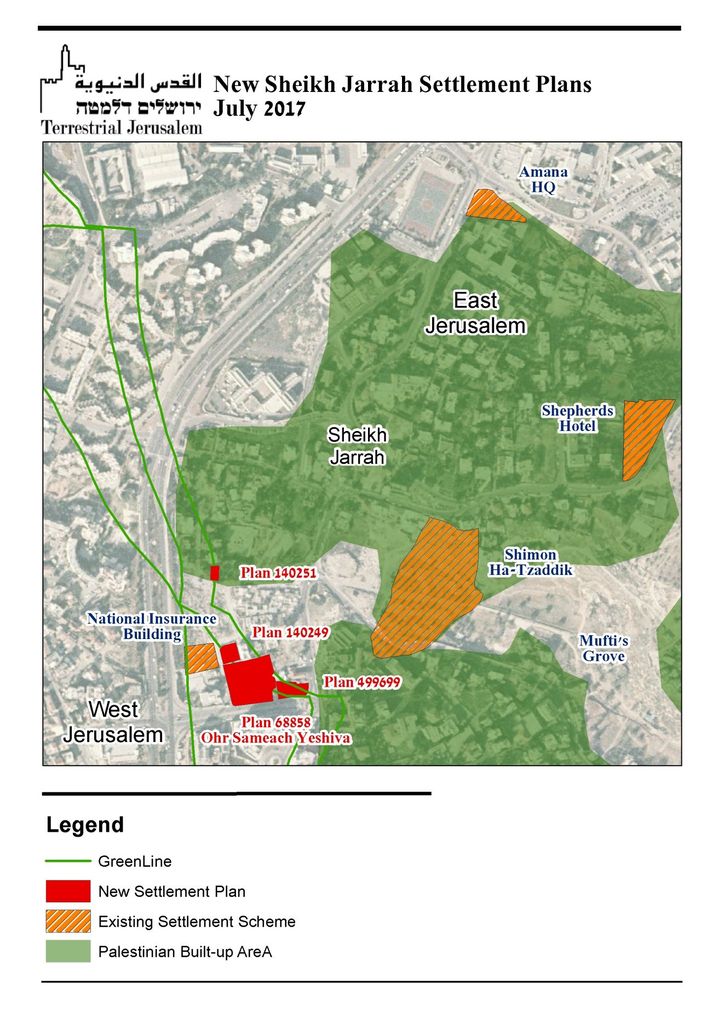
The plan to build the yeshiva and dormitory (which would house dozens of young religious settlers), as well as another project for a 6-story building in the same area, aim to strengthen Israeli settlers’ hold on the neighborhood. Once built, settlements will literally flank both sides of the road leading into Sheikh Jarrah, advancing the settlers’ goal of cementing the presence of the settlement enclaves inside of Sheikh Jarrah by connecting them more seamlessly to the neighborhood’s periphery and to West Jerusalem.
Ir Amim writes:
“This unexpected decision is of great importance. It creates a significant obstacle to the approval of the Yeshiva plan and requires the Municipality to describe in detail the needs of the Palestinian neighborhood. Also, the decision is a clear expression of the fact that settlements in East Jerusalem come directly at the expense of the basic needs of Palestinians in the city.”
Located just north of Jerusalem’s Old City, Sheikh Jarrah has endured years of aggressive settlement activity by radical settlers via various means, including using Israel’s court system to strip Palestinians of their ownership rights. Sheikh Jarrah’s plight was featured in a 2013 film by Just Vision, “My Neighborhood.” Just Vision also produced “Home Front,” a series of video interviews with the Palestinian residents and Israeli activists fighting together against settlement expansion in Sheikh Jarrah. For more on Sheikh Jarrah and the protest it sparked, 972+ Magazine has a compilation of resources online here.
IDF Demolishes Outpost (After it was Relocated Near to Israeli Army Base)
Following media reports about the IDF’s complicity in establishing an illegal outpost on privately owned Palestinian land near Nablus (FMEP reported on this last week), on July 19th the settlers relocated their outpost to an area declared by Israel to be “state land” next to an Israeli army base. While Israeli security forces had spent weeks tolerating and even assisting in the establishment of the new outpost when it was located on Palestinian land, after it was moved to the new site near the IDF base , the IDF moved to promptly demolish it on July 21st.
The settler who is behind this new outpost, Yedidya Meshulami, is well known for his eccentric, illegal, and dangerous (and, if committed by a Palestinian, undoubtedly arrest-worthy) acts. In 2019, Meshulami nearly flew his helicopter into an IDF transport plane conducting a training exercise in the Jordan Valley (he was charged with several crimes involved with illegally flying his helicopter and endangering lives in West Bank airspace, which is controlled by the Israeli military). A former IDF reserve pilot, in March 2018 Meshulami attempted to take control of the Qalandiya checkpoint in Ramallah by landing his helicopter nearby, declaring “I don’t care what they do to me, I’ll take it [the checkpoint] over.” Following his arrest and release to house arrest, the IDF confiscated two helicopters and an ultralight plane from Meshulami’s personal airstrip, which he built illegally in an outpost near the Itamar settlement, south of Nablus.
Meshulami lives in an unauthorized outpost called “Alumot” near the settlement of Itamar, south of Nablus. Meshulami helped establish the outpost in 1996 after serving in the Israeli Air Force and, despite lacking permits, he personally built an airstrip in the outpost in 2013. According to reports this week, Israeli security forces had previously revoked Meshulami’s pilot license for flying over the West Bank without a permit.
Israel Starts Construction to Expand the Ibei Hanachal Outpost
Middle East Eye reports that Israel – in the midst of fighting a surge of coronavirus cases, deciding on annexation, and possibly heading to elections again this fall – has begun clearing land for the expansion of the Ibei Hanachal outpost, located between Hebron and Bethlehem in the southern West Bank. Palestinian leaders from the village of Kasin, to which the land the outpost is built on historically belonged, told reporters that settlers have already moved caravans into the newly razed land and that new electricity poles have been recently installed.
Ibei Hanachal was established illegally by settlers in 1999, but was granted retroactive approval as a neighborhood of the Ma’ale Amos settlement by the Israeli government in August 2019. Declaring illegal outposts to be neighborhoods of settlements – even outposts that are not contiguous with the built up area of the settlement, as is the case with Ibei Hanachal – is one of the legal mechanisms that Israel has found to retroactively “legalize” illegal outposts – that in effect creates new settlements.
Israeli Plans for Wadi Al-Joz in East Jerusalem, Including the “Silicon Wadi” Project, Expected to Advance
In a new paper, Bimkom provides details on the status of two major projects Israel is advancing for the Wadi Al-Joz neighborhood of East Jerusalem..
The “Silicon Wadi” project – which made it into Israeli headlines a few weeks ago – is at a “conceptual phase” at this point, with little official data available. But it is known that the plan is being advanced as a Master Plan, a planning avenue that does not permit the public to offer objections. Master Plans also do not require the government to specify an exact number of units to be built, leaving open the possibility of further construction. This project is located in the northern section of Wadi al-Joz.
The second project being advanced in Wadi al-Joz is referred to as the “Eastern Business District,” to be located near the Old City walls. This project is in a much more advanced stage of the planning process, and Bimkom expects it to be deposited for public review in the near future. This project is in the heart of the Palestinian city center, and calls for awarding 80% of all planning rights in the area for commercial, tourism, and business development. The plan also grants legalization to unauthorized structures in the area, but does not allow for further residential development. On this, Bimkom explains:
“This ratio of mixed use is problematic because it does not address the housing crisis in Palestinian East Jerusalem, and moreover, it does not address the basic interest of citycenter planning: the creation of a balanced mixed-use environment, in which housing development is generally considered as an important stimulus for development. In other parts of the Jerusalem today, along the route of the light rail, a 50-50 ratio is the accepted policy.”
Explaining the significance of the two plans in context of Israel’s settlement activities across the city, Bimkom writes:
“The abovementioned plans, alongside other large scale plans currently under consideration for East Jerusalem (such as the plan for development alongside the American Road, see here), demonstrate the current Israeli Planning Policy in East Jerusalem: public uses are being addressed — and huge areas are being allotted for commerce and business — while residential needs are being left unanswered (if they are addressed they are generally unimplementable).”
Israel “Recovers” Religious Relic from Palestinian Village
In a covert pre-dawn operation on July 20th, the Israeli Civil Administration entered the Palestinian village of Tuqu’ and took a Byzantine-era baptismal font. The font was allegedly stolen by antiquity thieves in the year 2000 from an archeological site next to the Tekoa settlement (which was built on lands historically a part of Tuqu’), and retrieved in 2002 by Palestinian residents of Tuqu’. The font has been on open display next to the village Mayor’s home for the past 18 years, with Israel taking no interest in the matter until now.
Emek Shaveh explains important context of the Civil Administration’s sudden interest in the font:
“This operation follows on the heels of increased complaints by the settlers that the Civil Administration is not doing enough to prevent what they claim is systematic and ideologically driven antiquities theft. The settlers have been claiming that traces of a Jewish past in the area are being destroyed and that all antiquities sites should be placed under Israeli control. Emek Shaveh and the Mayor of Tuqu’ have written to the Civil Administration with a demand to return the antiquity to the village and its residents. The Civil Administration is responsible for the protecting the interests and welfare of the Palestinian residents of the West Bank and is not meant to act as an agent on behalf of the settlers who believe they should be the sole custodians of the areas’ antiquities.”
Adding to settler efforts described by Emek Shaveh, a new settler group calling itself “Shomrim Al Hanetzach” (“Guarding Eternity”) recently began surveying areas in the West Bank that Israel has designated as archeaological sites in order to call in Israeli authorities to demolish Palestinian construction in these areas. The new group communicates its findings to the Archaeology Unit in the Israeli Civil Administration (the military body by which the government of Israel regulates all planning and building in the West Bank). The Archaeology Unit, playing its part, then delivers eviction and demolition orders against Palestinians, claiming that the structures damage antiquities in the area. As a reminder, in 2017, Israel declared 1,000 new archaeological sites in Area C of the West Bank. The new group is, not coincidentally, an offshoot of the radical Regavim organization, which among other things works to push Israeli authorities to demolish Palestinian construction that lacks Israeli permits (permits that Israel virtually never grants).
The new group has also raised public alarm about the Trump Plan, alleging that hundreds of biblical sites in the West Bank are slated to become Palestinian territory. The group’s leaders accuse the Palestinian Authority of mismanaging the sites and they accuse Palestinians of looting them. The group is demanding that Israel annex all the sites.
In response to the theft of the font from Tuqu’, PLO Spokeswoman Hanan Ashrawi released a statement saying:
“A hallmark of Israel’s system of colonial occupation and oppression has been its disdainful attempts to erase Palestinian presence, culture and heritage, including the illegal appropriation and theft of heritage sites and artifacts. This systemic policy of plunder is a war crime that must not go unpunished. In the past weeks, Israel has taken other illegal steps targeting Palestinian heritage sites, including sealing off the entrance of Jabal Al-Fureidis (or so-called Herodium) in the Bethlehem District to restrict the access of Palestinians to the site, which Israel has illegally appropriated as an “Israeli National Park”. Israel has also repeatedly targeted other historical and archaeological sites, including UNESCO Heritage sites in Palestine such as the Old City of Jerusalem, the Battir terraces in Bethlehem, and the Ibrahimi mosque in Hebron. Israel must be held accountable for its egregious war on Palestinian heritage and its attempt to appropriate our history and pillage historical artifacts that are an integral part of Palestinian and world history. UNESCO and its Director General, Ms. Audrey Azoulay, have a moral and official duty to speak out and protect Palestinian heritage. Their continued silence in this regard is an unacceptable abdication of responsibility.”
Greenblatt: Trump Plan has 60-80 Pages of Conditions on/for a Future Palestinian “State”
In a new interview with Army Radio, former U.S. negotiator Jason Greenblatt proudly touted the fact that the Trump Plan has 60-80 pages of stipulations Palestinians must agree to and satisfy before it could meet the U.S. conditions for recognizing Palestine as a “state.” It’s always worth reiterating: the Trump Plan in no way provides for a real state in any sense of the term; it at best offers the Palestinians a conditional non-state entity over which Israel would enjoy almost total control. Greenblatt said:
“[the] phrase we used in the peace efforts is a realistic Palestinian state that complies with 60-80 pages of important criteria. [This criteria is what] differentiates the peace plan we released from the past efforts. There’s a lot of criteria for them to establish a state, as there should be.”
Bonus Reads
- “Two Palestinian Cyclists Injured in Alleged Assault by West Bank Settlers” (Haaretz)
- “B’Tselem investigation: Settlers assault Palestinians and file false reports against them; military arrests the victims” (B’Tselem)
Welcome to FMEP’s Weekly Settlement Report, covering everything you need to know about Israeli settlement activity this week.
To subscribe to this report, please click here.
February 28, 2020
- Fuel on the Fire: Netanyahu Advances E-1 Settlement Plans
- Making Good On Bibi’s Promise, Israel Issues Tenders for Givat Hamatos Settlement – And Plans for More
- High Planning Council Advances Plans for 1,739 Settlement Units, Including a New Industrial Zone
- Netanyahu Orders 12 Outposts Hooked Up to Israeli Infrastructure, with More to Follow
- Israel is Planning New West Bank Electricity Grid to Serve the Settlements
- Deputy Israeli AG Bemoans “Alarming Accumulation” Of Cases in Which Political Echelon Stops Outpost Evacuations
- Joint U.S.-Israeli Annexation Mapping Team Begin Work in Ariel
- Bonus Reads
Comments or questions – email Kristin McCarthy (kmccarthy@fmep.org).
Fuel on the Fire: Netanyahu Advances E-1 Settlement Plans
On February 26th, the High Planning Council of the Israeli Civil Administration deposited for public review two separate plans (for a combined total of 3,401 units) for the construction of the infamous E-1 settlement. This move sets in motion a 60-day public commenting period, after which the committee can grant final approval for construction. Long called a “doomsday” settlement by supporters of a two-state solution, construction of the E-1 settlement would sever the West Bank effectively in half, foreclosing the possibility of drawing a border between Israel and Palestine in a manner which preserves territorial contiguity between the northern and southern parts of the West Bank. It would likewise consolidate the isolation of Palestinian neighborhoods in East Jerusalem from the West Bank. In combination with the recent advancements on Givat Hamatos and new tenders for Har Homa, Prime Minister Netanyahu’s Greater Jerusalem settlement construction announcements – leading up to the third round of Israeli elections – have crossed red lines (in the eyes of the international community) that Netanyahu didn’t dare cross in the past.
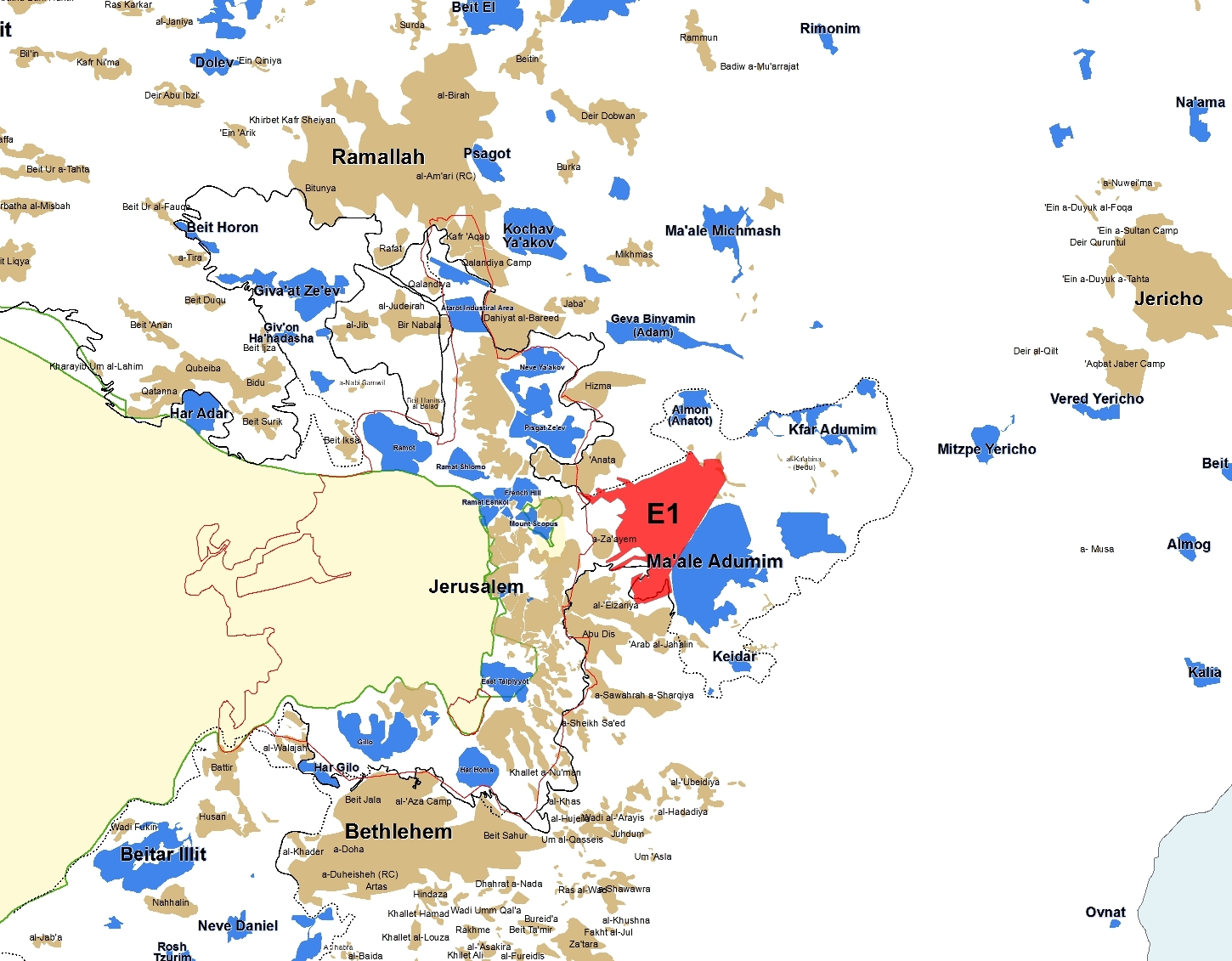
Map by Peace Now
The day before the High Planning Committee’s decision to deposit the plans, Netanyahu announced that he had lifted the freeze on E-1 that his government has imposed since 2012. Though the plans were approved for deposit in 2012, the administrative act of actually depositing the plans (which requires the plans to be published in at least three newspapers to inform the public) never occurred, largely as a result of intense international opposition to E-1. Under the recently released Trump Plan, the area where E-1 is located is slated to become part of Israel, meaning the long-held U.S. opposition to E-1 has transformed into apparent support.
Peace Now explains important context to Netanyahu’s flood of East Jerusalem settlement approvals:
“This move to promote settlement units in E1 should be understood in the context of government actions to promote settlement construction in Givat Hamatos and Har Homa to sever the Bethlehem-Jerusalem continuum, and the early promotion of a plan to turn the decommissioned Atarot Airport into a new Jerusalem settlement that would work toward severing the Ramallah-Jerusalem continuum. With E1 added to the mix, the pattern of severing the East Jerusalem and the West Bank is a clear policy direction of this government. While this announcement may be connected to the upcoming election, Netanyahu should be taken at his word and his comments should not be written off as campaign bluster. Indeed just this week he fulfilled a promise he made the week prior to publish tenders in Givat HaMatos, another area that was seen as a red line by the international community. It is likely that if moving on E1 is not met with deterring action domestically or abroad then it will further encourage settlement activity, seeing as E1 is the most recognized red line on settlement construction. The US, which has traditionally played a large role in deterring activity in E1, will likely not do so now with its current administration. Indeed, the Trump Plan envisions E1 as part of Israel, and allows for Israeli annexation pending coordination with the US and not negotiations with the Palestinians.”
Ir Amim adds:
“Although these advancements have taken place against the backdrop of the upcoming Israeli elections, they should also be seen as an alarm bell in the context of a new reality which has been created with the publication of the US Peace Plan. Carte blanche has essentially been given to Netanyahu and the Israeli government to further carry out unilateral measures in the Jerusalem area with little to no resistance. An acute exemplification of this major shift is the spate of new settlement plans (Atarot, Har Homa E, Givat Hamatos) being advanced over the Green Line in East Jerusalem, and now within the E1 area. After years of restraint due to international opposition, Israel is now set to advance construction in some of the most controversial areas in Jerusalem and along its perimeter. The realization of these plans will serve as an immense obstacle towards the future establishment of a Palestinian capital in the city and the prospect of a negotiated agreement based on a viable two-state framework.”
PLO Executive Committeewoman Hanan Ashrawi said in a statement:
“With the active participation and support of the current US administration, Israel is unilaterally and illegally annexing Palestinian territory and trampling on the Palestinian people’s most basic rights. These announcements are the practical translation of an extremist, ideologically-driven, and dangerous right-wing agenda that trounces Palestinian human rights and threatens to unravel the international order in favor of unilateralism, exceptionalism and political bullying.”
UN Special Coordinator for the Middle East Peace Process, Nikolay Mladenov, said:
“I am very concerned about Israel’s recent announcements regarding the advancement of settlement construction in Giv’at Hamatos and Har Homa, as well as the worrying plans for 3,500 units in the controversial E1 area of the occupied West Bank. All settlements are illegal under international law and remain a substantial obstacle to peace. If the E1 plan were to be implemented, it would sever the connection between northern and southern West Bank, significantly undermining the chances for establishing a viable and contiguous Palestinian state as part of a negotiated two-state solution. I urge the Israeli authorities to refrain from such unilateral actions that fuel instability and further erode the prospects for resuming Palestinian-Israeli negotiations on the basis of relevant UN resolutions, international law and bilateral agreements.”
Making Good On Bibi’s Promise, Israel Issues Tenders for Givat Hamatos Settlement – And Plans for More
As expected, on February 24th the Israeli Lands Authority published a tender for the construction of 1,077 housing units in the Givat Hamatos settlement. Haaretz reports that the tender relates to plans for “state land” and are intended to be sold as part of the the Treasury Ministry’s subsidized housing plan for young Jewish couples. Private companies will invited to bid on the project starting March 5th, with bidding set to close on June 22nd.
In addition to issuing tenders, the Jerusalem District Planning Committee met on February 27th to discuss the possibility of creating a new master plan for Givat Hamatos, in order to allow for more construction in the area. Ir Amim reports that the committee is considering a plan allowing for 6,500 residential units – which nearly doubles the total outlined in the current plan.
Ir Amim writes:
“This is the first time since the late 1990’s that Israel is constructing a new neighborhood/settlement in East Jerusalem. Furthermore, the location of Givat Hamatos means that its consturction will have dire consequences: It will serve to detach Bethlehem and the south of the West Bank from East Jerusalem while isolating the Palestinian neighborhood of Beit Safafa. For several years Netanyahu has abstained from publishing the Givat Hamatos tenders, serving as a source of frustration among rightwing parties. Netanyahu’s announcement therefore constitutes a break in the longstanding restraint. This dramatic change of policy should be seen in the context of his re-election campaign and against the backdrop of the formal release of the US Peace Plan.”
In announcing his support for the construction of the Givat Hamatos settlement last week, Netanyahu also mentioned plans to build 1,000 new homes for Palestinian residents of Beit Safafa – an East Jerusalem neighborhood which will be completely encircled by Israeli construction if/when the Givat Hamatos and Har Homa West settlement plans are implemented. According to Haaretz, the plan was/is to build 1,000 units on “Arab-owned” land — and that plan, in fact, is frozen.
In reaction to the tender for construction of the Givat Hamatos settlement, European Union High Representative Josep Borrell said in a statement:
“The Israeli authorities have announced an imminent decision regarding settlement construction in the Givat Hamatos and Har Homa neighbourhoods in East Jerusalem. Such steps would be deeply detrimental to a two-state-solution. As set out clearly on numerous occasions by the European Union, including in Council conclusions, such steps would cut the geographic and territorial contiguity between Jerusalem and Bethlehem, isolate Palestinian communities living in these areas, and threaten the viability of a two-state solution, with Jerusalem as capital of both states. Settlements are illegal under international law. The EU will not recognise any changes to the pre-1967 borders, including with regard to Jerusalem, other than those agreed by the parties. We call on Israel to reconsider these plans.”
High Planning Council Advances Plans for 1,739 Settlement Units, Including a New Industrial Zone
On February 27th, the High Planning Council – a body within the Israeli Civil Administration responsible for regulating all construction in the West Bank – approved the advancement of plans for 1,739 settlement units in the West Bank. These advancements come on the heels of the publication of tenders to build the E-1 settlement , the initiation of plans to massively expand the Har Homa settlement, and the recommitment of Israel to build a new massive new settlement in East Jerusalem, at the site of the disused Atarot airport. All of these plans deal with construction on the edges of Jerusalem and serve collectively to sever the connection between Palestinian neighborhoods of East Jerusalem and the West Bank (consolidating Israel’s uncontested sovereignty over “Greater Jerusalem”).
Of the total, 703 units received final approval, including:
- Plans to grant retroactive legalization to 620 units in the Eli settlement, a move which had been frozen by the High Court of Justice for the past 5 years while the Court considered a petition filed by Palestinians (with the assistance of Yesh Din and Bimkom) claiming to own the land. Last week, the High Court ruled against the Pallestinian petition and removed the injunction against the plans. The Eli settlement is located south of Nablus and southeast of the Ariel settlement in the central West Bank
- 48 units in the Har Bracha settlement, located just south of Nablus
- 35 units in the Givat Ze’ev settlement, located south west of Ramallah (north of Jerusalem).
Of the total, 1,036 units were approved for deposit for public review, including:
- A new industrial zone – called “Shaar Hashomron” – to be located south of the Palestinian village of Qalqilya (a town which is literally surrounded on three sides by the Israeli separation barrier – which in this area is, indeed, a massive wall). Peace Now reports: “[the new industrial zone is] close to Green Line, east of Salfit and South of Qalqilya, near the planned Nahal Rabah cemetery. In the area of Nahal Rabah, there existed a firing zone for years that prevented the use of the land. The land’s designation as a firing zone was lifted a few years ago, and the government’s Blue Line team set new boundaries for the state lands that comprised this area, all in preparation for a plan to build a new industrial zone. Industrial zones are a type of settlement in of themselves, and the planned cemetery is likely to be the first component toward establishing the new industrial zone. The plan for this new industrial park is separate from the 1,739 housing units advanced in the HPC announcement.”
- A winery in the Kiryat Arba settlement, located on the border of Hebron.
- 534 units in the Shvut Rachel settlement, located near the Shilo settlement in the central West Bank. Shvut Rachel only recently became an authorized settlement area when Israel extended the jurisdiction of the Shiloh settlement to include it as a “neighborhood” (along with three other outposts).
- Two plans for a total of 156 units in the Tzofim settlement, located just north of the Palestinian village of Qalqilya, a town completely encircled by Israel’s seperation barrier (except for a single road connecting it to the rest of the West Bank) – in the northern West Bank.
- 110 units in the Alon Shvut settlement, located south west of Bethlehem.
- 106 units in the Ma’aleh Shomron settlement, located east of the Palestinian village of Qalqilya.
- 105 units in Kfar Eldad (formally a part of the Nokdim settlement), located south of Bethlehem.
- 24 units in the Karnei Shomron settlement, located in the northern West Bank east of the Palestinian village of Qalqilya. Israel is planning to continue expanding Karnei Shomron with the stated goal of bringing 1 million settlers to live in the area surrounding the settlement.
The Times of Israel notes that this is the second time the High Planning Council has convened in as many months, marking an uptick in the frequency of such meetings, which until now have taken place quarterly (4x/year) since the Trump Administration came into power.
Peace Now said in a statement:
“The caretaker government, without a public and moral mandate, sets facts on the ground for a small and extreme minority, against the will of the majority. In the battle over the settler right-wing vote, Bennett and Netanyahu are dragging Israel to invest in thousands of harmful and unnecessary settlement units. This is how a cynical and irresponsible leadership that is willing to abandon the Israeli interest for its political survival behaves.”
Netanyahu Orders 12 Outposts Hooked Up to Israeli Infrastructure, with More to Follow
On February 23rd, Prime Minister Netanyahu announced that he had ordered 12 unauthorized outposts to be connected to Israeli infrastructure, and that his government was working to formally legalize over 100 outposts. Connecting outposts to Israeli water, sewer, power, garbage collection, and other municipal services entrenches the permanence of these outposts and furthers the de facto annexation of Palestinian land. It also copiously rewarding settlers for breaking Israeli law (by illegally building outposts), incentivizing further lawbreaking by Israel’s most radical and ideological settlers. 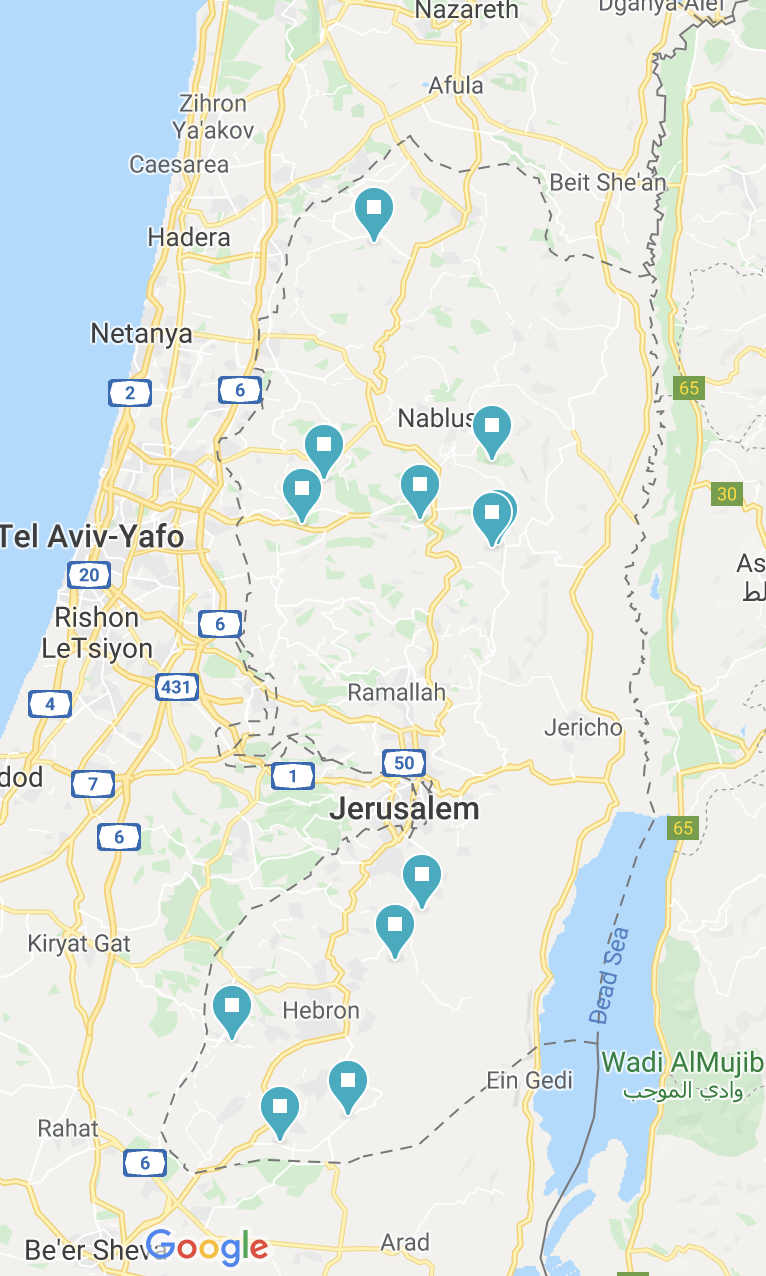
According to a letter from Netanyahu’s office, the 12 unauthorized outposts that will be connected to Israeli infrastructure were all built with “government encouragement” (though not formal approval or permits). In a perversion of the very notion of the “rule of law,” this unofficial encouragement for illegal actions is now treated by Israel as a valid legal basis for granting those outposts authorization.
The outposts slated for connection to Israeli municipal services are:
- The Nofei Nehemia outpost, located east of the Ariel settlement in the heart of the West Bank.
- The Havot Yair (Yair Farm) outpost, located west of Nablus.
- An outpost called “Hill 851”, located south east of Nablus in the central West Bank.
- The Maoz Zvi outpost, located in the northern West Bank.
- The Shaharit outpost, located in a string of settlements stretching from Israel proper to the Ariel settlement in the central West Bank, and going on to the Jordan Valley.
- The Pnei Kedem Farm outpost, located halfway between Bethlehem and Hebron in the southern West Bank.
- The Tekoa D outpost, located southeast of Bethlehem.
- The Negohot Farm outpost, located west of Hebron.
- The Avigayil outpost, located in the South Hebron Hills near the village of Susya.
- The Asa’el outpost, located east of the Palestinian village of Susiya in the southern tip of the West Bank.
- The Esh Kodesh outpost, located east of the Ariel and Shilo settlements, in a string of settlements stretching to the Jordan Valley.
- Ahiya, located in the Shilo Valley in the central West Bank.
David Elhayani, head of the umbrella settlement body called the Yesha Council, cheered Netanyahu’s announcement, saying:
“This is an important step for the benefit of young communities that have been suffering from electricity problems for years, and will now be able to receive electricity, just like any other citizen in the country.”
Since the passage of the Regulation Law in February 2017 and the invention of the “market regulation” principle by the Israeli Attorney General, the Netanyahu government has undertaken an energetic effort to grant retroactive legalization to outposts for which the Israeli government has not yet found a means to grant retroactive approval (though it has tried). The obstacle in all of these cases has been the fact that the outposts were built on privately owned Palestinian land. Following passage of the Regulation Law, Netanyahu immediately formed a committee tasked with finding a way to suspend the property rights of Palestinians; that committee produced the Zandberg Report in May 2018 — a report that, indeed, offers several justifications for the government to expropriate privately owned Palestinian land (one of the Report’s recommendations is to connect the outposts to Israeli municipal services). Following the publication of the Zandberg report, Netanyahu formed another committee tasked with implementing the report’s recommendations, by preparing individualized plans for each outpost to gain retroactive legalization. That taskforce, headed by notorious settler Pinchas Wallerstein. helped secure Cabinet approval for another bill to grant authorization to 66 outposts. All but two of the outposts named by Netanyahu this week (Hill 851 & Negohot) were part of a December 2018 bill to regulate 66 outposts – a fact that has drawn the wrath of settler leaders who bemoan Netanyahu’s delayed implementation.
FMEP tracks all events related to Israeli annexation and the drive to authorize outposts in its regularly updated Annexation Policy Tables.
Israel is Planning New West Bank Electricity Grid to Serve the Settlements
Haaretz reports that the Israeli government is close to approving a Master Plan for a new electricity grid in the West Bank, which will service Israel’s settlements. It may also serve Palestinian villages but only if — and it is a big if — the Palestinian Authority agrees to jointly implement the project. The plan is in the hands of Israel’s National Infrastructure, Energy and Water Ministry, which seeks to “provide a blueprint for the electricity market in the West Bank through 2040 and to develop infrastructure for Israeli settlements as well as for the Palestinians residing there.” However, the Israel-conceived plan calls upon the the Palestinian Authority to take responsibility over the Palestinian side of the equation, and the PA has refused to play that role and has condemned the plan.
In a statement, the Palestinian Authority’s Energy Authority said that the plan is designed:
“to establish Israeli sovereignty in the West Bank and to support the brutal presence of the settlements on our land.”
Settler leaders concurred with the PA’s assessment. Gush Etzion Regional Council chairman Shlomo Ne’eman told Haaretz:
“All moves point to sovereignty, and when we build infrastructure, there is also a basic understanding that the State of Israel is the sovereign. We are pleased that more and more government ministries have realized that this sovereignty is the reality.”
The plan, as reported by Haaretz, would see the Israeli Electric Company build a vast network of power lines across the West Bank. Israel will build six substations in Area C of the West Bank to distribute the high voltage power to settlements. Palestinians, if they are willing, are called upone to build eight substations in order to distribute power to Palestinian homes. The project is expected to cost between $870 million to $1.2 billion. The integration of settlements into Israel’s domestic planning schemes and the construction of massive infrastructure in the West Bank to service the settlements are significant advancements in Israel’s ongoing, de facto annexation of land in the West Bank.
Deputy Israeli AG Bemoans “Alarming Accumulation” Of Cases in Which Political Echelon Stops Outpost Evacuations
Haaretz reports that the Israeli Civil Administration planned to evacuate the unauthorized Mitzpe Yehuda outpost, located east of Jerusalem, in September 2019, but was directed to cancel the evacuation by one of Netanyahu’s personal aids in the Defense Ministry – Avi Roeh. The political interference was revealed in a High Court case filed by Palestinians claiming to own the land upon which the outpost was illegally constructed. The Palestinians are seeking to have the outpost immediately evacuated. Settlers claim to have purchased the land, and even submitted an application to have the outpost retroactively legalized by the government.
At the time of the scandal, Deputy Attorney General Erez Kaminitz wrote to Ronen Peretz, acting director of the Prime Minister’s Office, criticizing Roeh’s role in the Mitzpe Yehuda case, as well as the recurrence of political interference on behalf of the outposts. Citing several cases in which such interference occurred (Sde Ephraim, Givat Assaf, and Havat Negohot), Kaminitz wrote:
“This is a very alarming accumulation of cases that raises the specter of the emergence of a highly problematic trend that undermines the rule of law. It’s important to make clear that, as a rule, the political echelon is not authorized to intervene in decisions related to law enforcement.
Joint U.S.-Israeli Annexation Mapping Team Begin Work in Ariel
On February 24th, members of the U.S.-Israeli team tasked with mapping Israel’s annexation of West Bank land under the Trump Plan met for the first time to “explore the terrain.” At a vista near the Ariel settlement, Netanyahu underscored the significance of the project:
“The joint mapping process of the Israeli team and the American team is underway here in Ariel. This is a major mission. The area has an 800-km. perimeter. There is serious work, but we will work as quickly as possible to get it done…[the mapping process will] allow for the application of Israeli law [sovereignty] on these areas and later American recognition as well…[once complete] sovereignty can happen immediately.”
U.S. Ambassador David Friedman said:
“In Israel rain is a blessing, and I hope that our efforts should be blessed as much as the rain is coming down right now,” Friedman declared before the meeting started, the US Embassy in Jerusalem said in a statement. “We have our team here, and we’re going to get to work right away. We hope to complete it as soon as possible, and complete it the right way for the State of Israel.”
Ariel Mayor Eli Shaviro – one of the few settler leaders who publicly supports the Trump Plan – praised the mapping team, saying:
“The sovereignty ship is under way. As I have said in the past, I believe that the prime minister will advance the ‘Deal of the Century’ with President Trump and US officials. believe that the application of Israeli law in the Jordan Valley and in the communities of Judea and Samaria is closer than ever.”
Shaviro recently resigned from the settler Yesha Council over the group’s disavowal of the Trump Plan.
Bonus Reads + Resources
- “An Alternative Guide to City of David Archeological Park” (Emek Shaveh)
- “The Trump plan threatens the status quo at al-Haram al-Sharif” (Al Jazeera)
- “50 ex-European leaders and FMs condemn Trump plan, cite apartheid similarities” (The Times of Israel)
- “Planned Western Wall Train Will Threaten Historic Jerusalem Spring, Report Says” (Haaretz)
- “The Israelis fighting to keep the Jordan Valley Palestinian” (Al-Monitor)