Welcome to FMEP’s Weekly Settlement & Annexation Report. To subscribe to this report, please click here.
March 18, 2021
- Israel Municipality Asks Court to Ok Mass Demolitions in Silwan
- Israel Issues Demolition Order Against Home in Area B of the West Bank
- Palestinians Raise Alarm Over Impending East Jerusalem Dispossession
- Israeli Demolitions are Historically High
- Palestinians Call on UNESCO to Protect Archaeological Sites in the West Bank
- Settlers Once Again Invade Site of Evacuated Sa-Nur Settlement
- New Yesh Din Report Documents Another Category of West Bank Land Theft by Israel
- Bonus Reads
Comments/Questions? Contact Kristin McCarthy (kmccarthy@fmep.org)
Israel Municipality Asks Court to Ok Mass Demolitions in Silwan
Haaretz reports that three weeks ago, the Jerusalem Municipality petitioned the city courts to “reactivate” demolition orders for more than 70 Palestinian structures (home to more than 1,500 individuals) in the al-Bustan section of the Silwan neighborhood in East Jerusalem. [map]
The legal case around these 70 homes dates back to 2005, when the Israeli government unveiled a plan to establish a new archaeological/touristic park called “The King’s Garden” on privately owned Palestinian land in al-Bustan. Following international blowback the plan was dropped for a time, only to be revived by Jerusalem Mayor Nir Barkat in 2010, who once again began moving forward. To implement the plan, Israel issued demolition notices to Palestinian homes in the area — homes that Palestinians built (on their own land) but without the required Israeli-issued permits. This is, of course, a common circumstance for Palestinians in East Jerusalem and Israeli-controlled Area C of the West Bank, because Israel systematically denies planning and construction permissions to Palestinians.
Following another round of international outcry and an organized response by the Palestinian landowners, Israel (hoping to avoid more scrutiny) began quiet negotiations to provide the Palestinian land and home owners with alternative housing. After nearly seven years, the negotiations reportedly resulted in an agreement under which the city would defer demolition of the homes in question until after the Palestinians were able to build new homes (with permits) on adjacent plots.
According to Haaretz, the city has now decided it will no longer honor its commitment to defer those demolitions. The battle is now playing out in Court, with the city arguing that Palestinians have made no substantial progress on building the new homes. The Palestinians asked the court for a one year delay, saying that there has been progress that the city is not telling the court about.
Explaining the complexity of the situation facing Palestinians, Ir Amim wrote in an 2012 report:
“According to the Municipality’s plan, houses are intended to be demolished only after residents receive alternative housing. Consequently, condensation and construction will precede demolition—the reverse of normal procedure. But this proposed solution does not appear to be feasible. In order for the solution to be realized, the people evicted from the western part of Al-Bustan, against whose homes demolition orders are pending, will find themselves in the position of having to build alternative housing. In most cases, the space designated for alternative housing is on top of existing housing in the eastern part of the area; which is to say, in a built-up area, on the private land of other families. Such an arrangement could only be executed if the family currently on the land reaches agreement with the residents who have been evicted. Once an agreement is reached, the owners of the buildings in the eastern side of the area would have to request building permits, and only once said permits are obtained would the designated demolition of the houses in the western part of the plan take place and the buildings in the eastern part be legalized. The entire process would have to occur within a predetermined period; if not, the houses on both sides of the plan—the east and the west—would be torn down. However, as described above, obtaining building permits in this area is next to impossible. Requesting a building permit can jeopardize home owners on the east side who fear ownership of their current residences may be denied, as well as being a cost prohibitive process for most residents. Moreover, the negotiation challenges posed by evicted east side residents requesting to build on top of their neighbors on the west side all but preclude the likelihood of such arrangements.”
Ir Amim wrote in conclusion:
“As argued in a recent report by Bimkom, Planners for Planning Rights: “Despite the professional and apolitical facade of the planning and declaration of national parks, the picture appears to be more complex. In certain cases and places, it appears that the planning and declaration of national parks and nature reserves serves not only to protect natural and heritage assets and valuable open areas, but also serves as an instrument to limit the building and development of the Palestinian population. This phenomenon is widespread and particularly acute in the Palestinian neighborhoods of East Jerusalem.” The report goes on to state that one of the most salient features of existing plans for the Palestinian neighborhoods of East Jerusalem is the proliferation of “green areas” designated as open spaces, which constitute some 35% of the planned area (p. 6). The King’s Garden is another “green” area planned to be an open public space, though it is located in the middle of an overcrowded Palestinian neighborhood. That such a plan involves the massive demolition of Palestinian homes, and a drastic change of the neighborhood’s character from a Palestinian residential neighborhood to an archaeological park under Israeli control, raises more than reasonable concerns that the planning tool of “greening” is once again being used to establish political facts on the ground.”
The Haaretz Editorial Board intervened to plead for the municipality a return to negotiations, writing:
“Decision-makers must understand that a demolition order demolishes the lives of the inhabitants long before the bulldozer destroys their home. Anyone who hasn’t lived under the constant threat of their home’s destruction, who doesn’t panic every time a heavy vehicle rumbles down the street, or who has not seen the shadow of a bulldozer from the window of the children’s room, cannot understand the terror. Leon must come to his senses and bring the municipality back to the negotiating table, for the good of the residents of Silwan and all Jerusalemites. The success of the negotiations over the Bustan neighborhood and the construction of a new neighborhood next to the park will prove that Jerusalem has a mayor who truly works for the good of his residents and his city.”
Israel Issues Demolition Order Against Home in Area B of the West Bank
The Jerusalem Post reports that the IDF has issued a demolition order against a Palestinian home that is under construction in the Wadi al-Hummus village. The village in question is located just east of the Israel-declared municipal border of Jerusalem, but when Israel built its “separation barrier,” it left part of Wadi al-Hummus on the Israeli side (de facto annexing the land to Israel). The home that is now subject to demolition is thus in the odd position of being located simultaneously in Area B of the West Bank (as defined by the Oslo Accords), but inside Israel’s security barrier (the village of Wadi al-Hummus itself is cut up between East Jerusalem and Areas A, B, and C).
In the demolition notice handed to the homeowner, the IDF stated the house will be demolished because it lacks the proper building permits. However, according to the Palestinian news outlet WAFA, the owner obtained permits from the Palestinian Authority – which under Oslo has civil control (including planning) over Area B, where the home is located.
This is not the first time Israel has pursued the demolition of structures in areas outside of its Oslo-permitted control. In July 2019, Israeli forces demolished 13 large apartment buildings (approximately 70 units) in a section of Wadi al-Hummus, leaving the village looking like a war zone. Those buildings were located in Area A (where according to Oslo the PA has full civil and security control). Israel’s 2019 decision to demolish the buildings was given the official seal of approval by an Israeli Supreme Court decision. In its arguments, the Court held that the buildings posed an unacceptable security risk to the Israeli state because of their close proximity to Israel’s separation barrier (and that this risk over-rode the authorities granted under Oslo).
Palestinians Raise Alarm Over Impending East Jerusalem Dispossession
A coalition of 14 Palestinian civil society groups penned a joint letter asking the United Nations to intervene to stop the impending mass eviction of Palestinians from their homes in neighborhoods across East Jerusalem. The letter singles out the case of 15 Palestinian families (8 in Sheikh Jarrah and 7 in Silwan – for a total of 195 individuals) that are at risk of imminent eviction from their longtime homes in favor of settlers.
It’s worth recalling that, while the fate of 15 families is indeed in an urgent crisis, the legal underpinnings of these eviction cases stand to dispossess hundreds more Palestinians in East Jerusalem. Settler organizations, with state backing, are using Israeli law to take possession of Palestinian homes in key, sensitive neighborhoods in East Jerusalem to further consolidate Israeli hegemony over the city.
“At a time when people around the world are trying to survive the global pandemic, Palestinians in East Jerusalem continue to endure an ongoing Nakba, as they continue to be denied their inalienable rights of return and property restitution. In addition, they are subjected to an intensified coercive environment, exemplified in an array of policies including forced eviction thorough which they are again facing the threat of forced displacement and dispossession. They undergo a lengthy, exhausting, and unaffordable legal struggle to challenge the eviction lawsuits filed against them by settler organisations in Israeli courts. Given the discriminatory and untransparent nature of the Israeli legal system as applied in the occupied territory, they are effectively denied access to the rule of law. Many Palestinians have already been forcibly evicted under the same Israeli forcible transfer policy. In light of the above, this joint urgent appeal to the concerned United Nations (UN) Special Procedures underscores Israel’s establishment and maintenance of its apartheid regime over the Palestinian people as whole, and the intensified forcible transfer policies and measures in occupied East Jerusalem.”
Israeli Demolitions are Historically High
In its February 2021 report, OCHA (the United Nations Office for the Coordination of Humanitarian Affairs) notes that “Israeli authorities demolished, forced people to demolish, or seized 153 Palestinian-owned structures across the West Bank, including East Jerusalem: this is the fourth highest such figure recorded in a single month since OCHA began systematically documenting this practice in 2009, surpassed only by November 2020 (178), February (237) and March 2016 (179).” The 2021 monthly average number of structures demolished or seized is 117, compared to an average of 71 last year.
In February along, 305 individuals including 172 minors were affected by Israeli actions.
Palestinians Call on UNESCO to Protect Archaeological Sites in the West Bank
The Palestinian Foreign Ministry issued a statement calling on UNESCO to “protect all Palestinian archaeological and religious sites from Israeli violations, attacks and falsifications.” The statement went on to condemn Israeli actions in the West Bank and East Jerusalem which “serve the expansion of the illegal settlements,” saying that Israel’s seizure of antiquities in Palestinian-controlled areas are then put on “display …in their museums as evidence of its misleading colonial claims.”
Last week, on March 11th, settlers stormed the ancient site in Sebastia. Settlers have been openly agitating – with some success – for Israel to assert control over the archaeological site in Sebastia for years. In January 2021, Emek Shaveh (an Israeli NGO expert in – and focused on – archaeology) wrote on what is happening in Sebastia, saying:
“The archaeological site of Sebastia is identified with Samaria, the capital of the Kingdom of ancient Israel in 9-8 BCE. The site also features ruins from the Hellenistic, Roman and later periods. The village of Sebastia is situated within Area B while the site itself is located mainly in area C. Over the past few years, the Samaria Regional Council has been organizing tours to the site, particularly during the school holidays. Several times this year, the Civil Administration has removed a Palestinian flag from the village and the site. In the most recent incident, a flag was raised following renovation works funded by the Belgian government. In their response the regional council blamed the Palestinians for destroying a site central to Jewish history and UNESCO for supporting the Palestinians. Sebastia is on the tentative list of World Heritage sites in Palestine….the integration of ancient sites into an organized strategy designed to weaken Palestinian hold on Area C is worrying. The formalization of this approach is likely to result in a steep rise in actions over ancient sites and structures, from water cisterns found in many villages, to major sites such as Sebastia. The justification for preserving and developing ancient sites familiar to us from East Jerusalem is now being applied wholesale to hundreds of places in the West Bank to the detriment of the Palestinians living near the sites and to the multilayered heritage inherent in the ruins which will be distorted for political ends.”
As FMEP has chronicled, settlers and their allies have recently become hyper-focused on taking control of archaeological sites and artifacts under Palestinians control, claiming the sites are neglected and/or damaged. Last month settlers used a construction mishap to raise claims to the Mt. Ebal site.
In January 2021, the state of Israel committed funding to a new settler initiative to surveil archeological sites under Palestinian control. While the objective of protecting antiquities might appear uncontroversial and apolitical, the true objective behind this effort is to support yet another pretext to surveil and police Palestinians, and yet another means to dispossess them of their properties. It is the result of a campaign that has taken place over the past year in which settlers have been escalating their calls for the Israeli government to seize antiquities located in Palestinian communities across the West Bank, especially in Area C, which Israel today treats as virtually (and legally) indistinguishable from sovereign Israeli territory. The controversy that erupted over the Mt. Ebal archaeological site in February 2021 should be viewed in this context.
Previous victories for the settlers include the Israeli Civil Administration’s recent issuance of expropriation orders for two archaeological sites located on privately owned Palestinian property northwest of Ramallah. The expropriations – the first of their kind in 35 years – come amidst a new campaign by settlers lobbying the government to take control of such sites, based on the settlers’ claims that antiquities are being stolen and the sites are being mismanaged by Palestinians. The settlers’ pressure is also credited as the impetus behind the government’s clandestine raid of a Palestinian village in July 2020 to seize an ancient font. The Palestinian envoy to UNESCO, Mounir Anastas, recently called on the United Nations to pressure Israel into returning the font to the Palestinian authorities
In June 2020, a settler group calling itself “Shomrim Al Hanetzach” (“Guardians of Eternity”) began surveying areas in the West Bank that Israel has designated as archeaological sites in order to call in Israeli authorities to demolish Palestinian construction in these areas. The group communicates its findings to the Archaeology Unit of the Israeli Civil Administration (reminder: the Civil Administration is the arm of the Israeli Defense Ministry which since 1967 has functioned as the de facto sovereign over the West Bank). The Archaeology Unit, playing its part, then delivers eviction and demolition orders against Palestinians, claiming that the structures damage antiquities in the area. As a reminder, in 2017, Israel designated 1,000 new archaeological sites in Area C of the West Bank. The “Guardians of Eternity” group, not coincidentally, is an offshoot of the radical Regavim organization, which among other things works to push Israeli authorities to demolish Palestinian construction (on Palestinians’ own land) that lacks Israeli permits (permits that Israel virtually never grants). The group raised public alarm about the Trump Plan, alleging that hundreds of biblical sites in the West Bank are slated to become Palestinian territory.
Settlers Once Again Invade Site of Evacuated Sa-Nur Settlement
On March 16th, dozens of Israeli settler families illegally entered the site of the evacuated Sa-Nur settlement in the northern West Bank in an attempt to reestablish the area as a place of permanent Jewish settlement. Settlers have attempted the feat many times before, often with the active, in-person support of high-profile Israeli politicians, and always without punishment for their illegal actions.
After calling on Netanyahu to immediately authorize their presence at the site (a call that included the voice of prominent settler leader Yossi Dagan), the IDF evacuated the settlers once again.
The last time a group of settlers attempted this, in November 2020, MK Miki Zohar (Likud) persuaded the settlers to abandon their illegal campsite and leave the area, with the promise of raising the issue of Sa-Nur’s re establishment directly with Netanyahu.
MK Zohar is a staunch supporter of reestablishing Sa-Nur, along with three other settlements in the area that were likewise dismantled by the Israeli government in 2005 (Homesh, Ganim, and Kadim). Zohar has participated in previous visits to the site to support the settlers’ bid, frequently accompanied by his Likud colleagues, including former Speaker of the Knesset Yuli Edelstein. In July 2018, the Israeli Cabinet had the opportunity to lend government backing to a bill that would have cancelled the 2005 disengagement and allowed the settlers to rebuild those settlements – but the Cabinet blocked the bill.
As a reminder, even though Israel evacuated the four settlements in the West Bank, the IDF issued military orders barring Palestinians from entering the areas, preventing Palestinians from taking control over the area and building there. At the same time, settlers have regularly entered the areas and even repeatedly built a yeshiva at the Homesh site.
New Yesh Din Report Documents Another Category of West Bank Land Theft by Israel
In a new report entitled “Ill-Gotten Gains”, Yesh Din explains how the Israeli government has taken control of Palestinian land that was in the process of being formally titled and registered when Israeli occupied the West Bank in 1967. Yesh Din estimates that Israel has used its authority as the occupying power to declare as “state land” 41,000 dunans (~10,000 acres) of land that was, at the time, in the process of being registered as privately owned by Palestinians. That declaration precludes Palestinians from attempting to regain control of the land (by proving their ownership through a registration process).
Only one-third of West Bank land was registered and titled (under the British Mandatory government and then continued by Jordan) when Israel seized control of the West Bank. Upon assuming governance of the area the Israeli government issued a military order freezing the land registration process. The process remains frozen today, though there are rumblings from settlers pushing that state to resume the process (for their benefit).
Yesh Din writes:
“Israel’s policy of declaring “state land” in areas where settlement of title was halted is based on selective application of the legal mechanisms that regulate the land regime in the West Bank. Israel does so in violation of the rules of international law that apply to Israel as the occupying power in the West Bank. Such declarations also violate the local law in force in the West Bank and the military order issued by the Israeli military commander (Order Concerning Government Property). Above all, Israel’s policy infringes upon the right to property of Palestinians who took part in settlement of title and allows it to dispossess Palestinian individuals and communities of their land. In practice, Israel, which is and has been responsible for the land registry in the West Bank for over 53 years, is benefiting from this policy. Israel does not permit Palestinians who participated in settlement of title to complete the process and register title to their land, but it does declare these very same lands “state land” and transfers them to the exclusive use of the Israeli settlement enterprise in the West Bank.”
Bonus Reads
- “How Israeli industrial zones exploit Palestinian land and labour” (The New Arab)
- “Settler head urges vaccinating Palestinians, paid for by tax revenues sent to PA” (The Times of Israel)
- “Netanyahu pledges to legalize West Bank settler outposts if re-elected” (Jerusalem Post)
- “Why Some Voters in ‘Settler Heartland’ Are Ready to Turn Their Backs on Netanyahu” (Haaretz)
- “Netanyahu ups focus on settlements, as housing starts hit 10-year low” (Jerusalem Post)
- “‘The settler bashed my head with a pipe, and everything went dark’” (+972 Magazine)
- “The U.S. Billionaires Secretly Funding the Right-wing Effort to Reshape Israel” (Haaretz)
- “No One Is More Deserving of Israel’s Highest Honor Than Its Colonialist Settler Leaders” (Haaretz)
Welcome to FMEP’s Weekly Settlement Report, covering everything you need to know about Israeli settlement activity this week.
To subscribe to this report, please click here.
July 26, 2019
- Annexation By Demolition in East Jerusalem-adjacent area of West Bank
- High Court Rules Settlers Can Stay in Hebron Compound Owned by Palestinians
- Peace Now Report: Return of Rampant Outpost Construction is Ushering in Annexation & “A Permanent Single Undemocratic State”
- Settlement Construction Boom Preys on Vulnerable Palestinian Workers
- Settler Groups: We Want Israeli Annexation, But Not Israeli Law
- Regavim Ups Pressure on Candidates to Promise Annexation of Area C
- Settler-Palestinian “Business Council” Visits Dead Sea
- Bonus Reads
Questions or comments? Contact Kristin McCarthy at kmccarthy@fmep.org.
Annexation By Demolition in East Jerusalem-adjacent area of West Bank
On July 22nd, Israeli forces demolished 13 large apartment buildings (approximately 70 units) in the Wadi al-Hummus neighborhood, leaving the area – located in the West Bank just east of the Israel-declared municipal border of Jerusalem, but on the Israeli side of the separation barrier – looking like a war zone.
 Israel’s decision to demolish the buildings was given the official seal of approval by a Supreme Court decision (much to the comfort and pride of U.S. Ambassador David Friedman). It its arguments, the Court held that the buildings, located mostly in Area A — where the Palestinian Authority is supposed to have full control — posed an unacceptable security risk to the Israeli state because of their close proximity to Israel’s separation barrier.
In so ruling, the Supreme Court set an alarming precedent that puts thousands of additional Palestinian buildings located near the separation barrier at risk of demolition. In addition, the Court provided yet another legal tool in the service of Israel’s ongoing campaign of de facto annexation of Palestinian land.
This case demonstrates yet again, that the Israeli court system affords no meaningful measure of protection or justice for Paelstinians, a fact clearly illustrated in a recent B’Tselem report. B’Tselem said in a statement:
“The Supreme Court ruling, written by Justice Meni Mazuz, fully accepted the State’s framing of the issue as one of purely security matter… Like in many past cases, the judges did not discuss in their ruling the Israeli policy almost completely preventing Palestinian construction in East Jerusalem, with the purpose of forcing a Jewish demographic majority in the city – a policy that forces the residents to build without permits…Instead, the judges ruled that the home demolitions were necessary for security considerations, because construction near the fence ‘can provide hiding for terrorists or illegal aliens’ and enable ‘arms smuggling.’ The judgment also clarifies the extent to which the ‘transfer of powers’ to the Palestinian Authority in areas A and B as part of the interim agreements has no practical meaning – except for the need to promote Israeli propaganda. When it serves its own convenience, Israel relies on that ‘transfer of powers’ to cultivate the illusion that most of the residents of the West Bank do not really live under occupation, and that actually, the occupation is almost over. Whereas when it is not convenient for Israel, like in this case, it sets aside the appearance of ‘self-government,’ raises ‘security arguments,’ and realizes its full control of the entire territory and all of its residents.”
The Israeli NGO “Terrestrial Jerusalem” (led by Danny Seidemann) writes:
“This one case, unfolding in remote areas of the Jerusalem municipal boundary that few Israelis or Palestinians have ever heard of, illuminates the inherent absurdity of the mythical ‘undivided capital of Israel’ and the lack of correlation between the location of a village, the laws that apply to its residents and the authority that governs them. Hence, the residents of Wadi Hummus live on the Jerusalem side of the barrier, but with no rights in Israel, in an area where governance is vested in those with no formal power to govern, where the only “legitimate” use of governmental power is by an occupier whose authorities are based exclusively on military necessity.”
Daniel Sokatch, CEO of the New Israel Fund, writes:
“…we know that Israel’s policy of home demolitions is not just about security. It is an ongoing policy that has been carried out for years that is part of a deliberate planning regime designed to prevent Palestinian demographic growth in East Jerusalem. We know this because our grantees have systematically documented Israel’s policies in East Jerusalem for decades, designed to secure a Jewish majority in the city by diminishing the possibility of Palestinian life and growth…Israel’s demolition of unauthorized Palestinian structures has accelerated massively under President Donald Trump. That makes a lot of sense. Prime Minister Netanyahu and pro-annexationist government know a green light when they see one. Jason Greenblatt, President Trump’s special envoy for negotiations, recently said, that he ‘hasn’t found anything to criticize’ in Netanyahu’s policies.”
High Court Rules Settlers Can Stay in Hebron Compound Owned by Palestinians
On July 21st, a three-judge panel of the Israeli High Court of Justice ruled that Israeli settlers may continue squatting in two disputed Hebron properties while litigation regarding ownership of the property remains ongoing. The property – called the Zaatari Compound after its Palestinian owners, but called “Beit Rachel and “Beit Leah” by the settlers – is located in the heart of downtown Hebron on Shuhada Street, within sight of the Tomb of the Patriarchs/Al-Ibrahimi Mosque. Settlers claim that they purchased the property from the Zaatari family. The Zaatari family rejects that claim. The case remains under consideration in the High Court of Justice.
The new ruling is in response to the Zaatari family’s petition to have the settlers removed from the property, where the settlers have been squatting under the protection of the Israeli military since March 2018, when they broke into the homes. The settlers tried to pull off this stunt once before in 2016 to much less success; that time around, instead of validating the settlers’ theft by allowing them to stay put, a court ordered the Israeli police to evacuate the settlers.
In response to the March 2018 invasion, Peace Now said:
“The settlers’ recent break-in into the Zaatari compound constitutes just the latest in a slew of such unauthorized incidents in Hebron. Their strategy is clear. Since they have failed thus far to obtain the ownership rights legally, instead they must resort to illegal means to establish facts on the ground by squatting, knowing that the right-wing government will be reluctant to attract negative publicity from its base by evicting settlers, and will in turn attempt to delay the eviction or perhaps find a way to legalize the take-over. Fellow Israeli citizens must not give in to this emotional blackmail, and the authorities must evict these squatters without delay.”
Peace Now Report: Return of Rampant Outpost Construction is Ushering in Annexation & “A Permanent Single Undemocratic State”
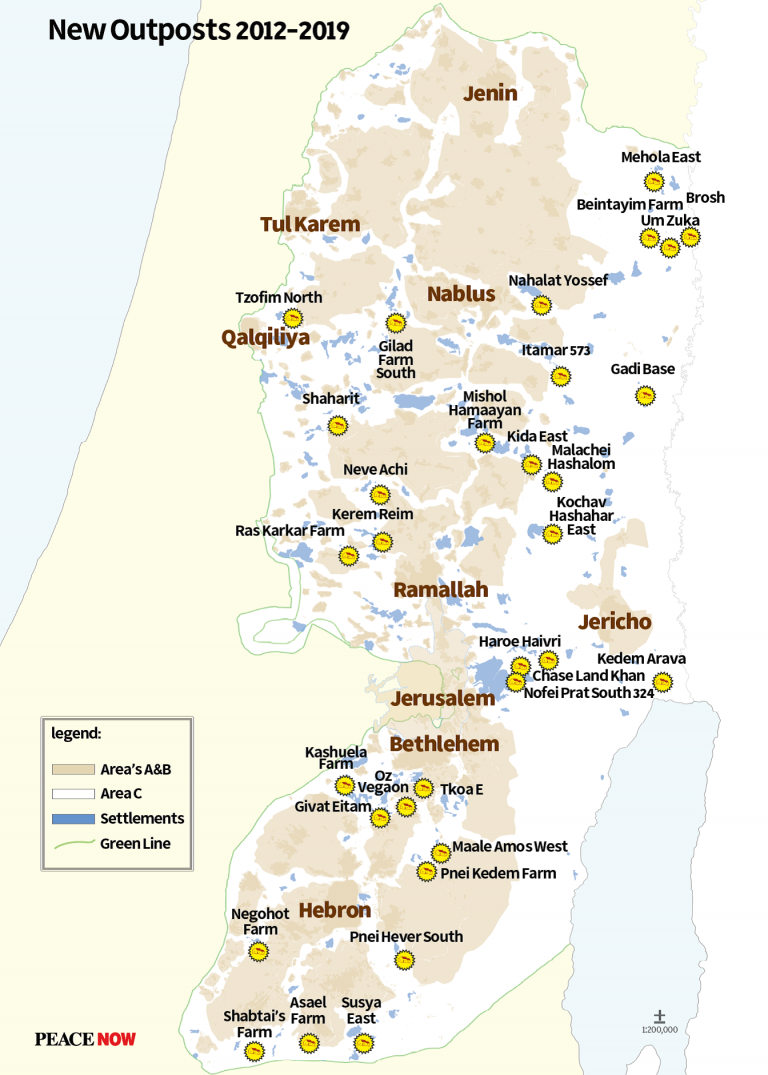 In a new report entitled, “Return of the Outpost Method,” the Israeli settlement watchdog group Peace Now documents the proliferation of new illegal outposts (i.e., new settlement sites established in contravention of Israeli law and regulations; according to international law, ALL settlement activity is illegal) in the West Bank over the past 7 years, with the direct assistance of the Israeli government. The report catalogues 32 new unauthorized outposts established deep in the West Bank since 2012; of those, 18 (56%) were established during the 2.5 years since President Trump took office.
Peace Now said in a statement accompanying the report:
“The Netanyahu government has established dozens of new settlement outposts quietly, without any public debate, in order to take over more territory and prevent the two-state solution. This comes despite talk of regulating the legal status of the more established outposts, in part to create a semblance of law enforcement in the West Bank. When the government and Knesset declare that they will do anything to legalize any unauthorized construction by settlers and even steal private land, settlers see this correctly as an incentive to build more outposts. This outpost method has consequently become a choice tactic in the process of de facto annexation of the West Bank, and it is leading us to a permanent single undemocratic state.”
For many years prior to 2012, settlers did not devote much effort towards establishing new outposts, a decision that bore in mind effective forms of international criticism of outpost construction in addition to the signals sent to the settlers by the Israel government’s decision to evacuate the unauthorized outposts. It was only after March 2011, when Netanyahu’s government declared its intention to legalize as many outposts as possible, that settlers once again set out to build outposts and claim more land in the West Bank. True to its word, the Netanyahu government has undertaken several legal projects aimed at retroactively legalizing these new outposts along with others, a campaign which FMEP has chronicled in detail (see here).
Additional key findings of the new Peace Now report include:
- Since 2012, 32 new outposts have been established, the majority after President Trump was elected. All of the new outposts (except one) are located deep inside the West Bank, in areas that Israel will likely have to evacuate within the framework of any imaginable permanent agreement.
- 21 of the outposts are agricultural farms, which take over large areas for pasturing and cultivation, while their settlers work to remove Palestinian shepherds and farmers from the vicinity.
- Around some of the new outposts there is an increase in violence and attacks against Palestinians.
- The outposts are established in an organized fashion with the involvement of the local settlement authorities, Amana and the Settlement Division of the World Zionist Organization.
- At the same time, the government is working to retroactively legalize existing outposts. To date, 15 outposts have been legalized (“regularized”) as independent settlements or “neighborhoods” in existing settlements. At least 35 additional outposts are undergoing the legalization process.
- One of the outposts established in 2012, Kerem Re’im, has already been legalized, thus becoming an official settlement with nearly 70 families living in dozens of permanent homes.
Settlement Construction Boom Preys on Vulnerable Palestinian Workers
Al-Monitor spoke with several Palestinian construction workers about the risks of participating in the surge of settlement construction that has unfolded in the Trump-Netanyahu era, which has spurred a 39% increase in Israeli spending on infrastructure in the West Bank. The surge has exacerbated an employment “catch-22” facing Palestinians: many Palestinians see no other option but to work in the settlements, but by working in the settlements, they facilitate the expansion and entrenchment of Israeli occupation that ensures there can be no normal Palestinian economic development within which they could find alternate employment.
In addition to that moral/political dilemma that settlement jobs present to an exploited and severely underemployed Palestinian workforce, Al-Monitor columnist Miriam Deprez explains:
“Settlement construction thrives off systemic labor rights abuses of the Palestinian workers by denying proper wages, insurance and basic personal protection equipment, complain the workers and a handful of organizations who try to protect them.”
One Palestinian laborer, Naser Qaswal, worked in a settlement for 25-years before he was forced to leave his job because of injuries he sustained due to the physical demands of the job, yet the settlement employer has not paid Qaswal any form of compensation. According to Qaswal, his cousin lost two fingers in an accident while working at an Israeli settlement, but he did not hold ask his employer for compensation or support in fear that Israel would withdraw his permit to work in Israel. Another laborer, Ahmed, explained how his father fell three stories off a crane while working at a settlement. The accident left him paralyzed from the neck down. The employer paid wages and caregiver fees to Ahmed’s family for the next two years, until his father passed away at the age of 52. The family was left with no income.
The absence of labor safety regulations in the settlements does not only affect Palestinians, as tragically illustrated on July 26th by the death of an Israeli two days after he fell off of a ladder while on the job at a construction site in Neriya settlement. Haaretz reports that the 2019 death toll for settlement laborers stands at 48.
Settler Groups: We Want Israeli Annexation, But Not Israeli Law
For years, settlers have been demanding that the Israel law treat the settlements exactly as part of Israel, with demands for Israeli law to apply and increasingly for outright annexation. Yet, now it seems settlers want to have their cake and eat it too, as illustrated by the Hebron Hills Regional Council – a settlement municipal association – which is fighting against a High Court petition that seeks to extend Israeli laws over settlements in its jurisdiction. Why? Because in this case, Israeli law would limit the Council’s ability to collect association fees from new homebuyers. The petition stems from a request by 26 settlers to who paid exorbitant fees to the association when they moved to the Eshkolot settlement, located in the southern tip of the West Bank but on the Israeli side of the separation barrier.
Haaretz writes:
“…the Hebron Hills Regional Council as well as the Eshkolot community association are arguing before the court that the rule on fees should not apply to [the West Bank]. The Hebron Hills Regional Council’s stand is particularly surprising because like other settler regional councils, it has been insistently calling for Israeli law to be applied in the settlements. Against this, the government is arguing that the rule applies to the settlements because it is a policy of the government’s Custodian for Government and Abandoned Property. What applies inside the Green Line, applies outside it and to Eshkolot.”
Regavim Ups Pressure on Candidates to Promise Annexation of Area
On July 19th, the radical settler group Regavim placed full-page newspaper ads warning: “A Terrorist State – Just Around the Corner.” The group accused the Israeli government of ignoring the alleged “Arab takeover” of Area C, some 60% of the West Bank that the Oslo Accords placed under (temporary) full Israeli control, as an interim stage towards negotiating permanent status of the West Bank and East Jerusalem. Specifically, Regavim accused the government of allowing the Palestinian Authority to build thousands of structures on “state-owned land in strategic locations,” construction which the settlers allege is funded by the European Union with the intention of propping up a “terrorist state” next of Israel. Regavim called on ministers and Knesset members to “take immediate action to prevent a terrorist state in our backyard.”
Settler-Palestinian “Business Council” Visits Dead Sea
On July 9th, leaders of the “Judea and Samaria Chamber of Commerce” took a field trip to the Dead Sea. Ashraf Jabari – one of the few Palestinians who attended the recent U.S.-convened “Peace to Prosperity” shindig and the only Palestinian given a speaking role on-stage at the event (also the only Palestinian to publicly praise the event) – said that the trip was a “direct continuation of the economic workshop in Bahrain,” and mentioned that the group was exploring opportunities to expand cooperation between Israeli and Palestinian business communities.
As FMEP has previously covered, Jabari has been slammed as a traitor by the Palestinian Authority, shunned and dismissed by his fellow Palestinian business people, and disowned by his family in light of his ongoing role with the Judea and Samaria Chamber of Commerce, an initiative Jabari runs alongside Israeli settlers.
Bonus Reads
- “The US Law Restricting Satellite Imagery of Palestine-Israel” (Al-Shabaka)
- “How the Goliath of the Jerusalem settler movement persuaded the world it’s really David” (Mondoweiss)
- “Amnesty International Requests TripAdvisor Employees to Delist Jewish Settlements” (Jerusalem Post)
- “In Bethlehem basement, Palestinian distiller is toasted with global acclaim” (Times of Israel)
- “I’m an Israeli settler. This is why I spoke with J Street’s first ‘alternative Birthright’ group.” (JTA)