Welcome to FMEP’s Weekly Settlement Report, covering everything you need to know about Israeli settlement activity this week.
To receive this report via email, please click here.
October 20, 2017
- Israel Advances 2,646 Settlement Units
- Construction of the Givat Hamatos Settlement in East Jerusalem is Underway
- Israel to Invest in $939 Million “Settler Security Package” for Settlements Across the West Bank
- Court Orders Evacuation of Settlers from “Machpelah House” in Hebron
- As Olive Harvest Begins, Settlers Steal and Destroy the Palestinian Crop
- Labor Chairman Shocks Israeli Left with Defense of Settlements
- Bonus Reads
Comments, questions, or suggestions? Email Kristin McCarthy at kmccarthy@fmep.org.
Israel Advances 2,646 Settlement Units
This week the Netanyahu government advanced plans for a total of 2,646 settlements units across the West Bank. According to Israel’s veteran settlement watch organization, Peace Now, the Israeli government has advanced plans for 6,742 new settlement units so far in 2017, a steep escalation from previous years.
As we reported last week, these advancements include several provocative plans that will “compensate” settlers who had built illegally in the West Bank (296 units in Beit El, 102 units in the brand-new settlement of Amichai, and 86 units in Kochav Yaakov), move towards retroactively legalizing an illegal outpost (the Netiv Ha’avot plan, which the High Planning Council called “improper” but approved anyway), enlarge settlement enclaves in Palestinian neighborhoods (31 units on Shuhada Street in Hebron – the first new settlement construction approved inside Hebron in more than a decade. Btselem’s short video documentary on Shuhada Street is here).
The anti-settlement watchdog group Peace Now said:
The Israeli government has lost all its inhibitions, while promoting settlement expansion in a record pace for recent years and distancing us daily from the possibility of a two state solution. The government is sending a clear message to settlers – build illegally and anywhere and we will find a solution for you. It is clear that Netanyahu is prioritizing his settler constituency over the rule of law and the possibility for peace.
The Palestinian Authority reacted with anger, calling on the international community and the Trump administration to intervene, saying “This settlement assault comes at a time when the administration of US President Donald Trump is exerting effort and creating the conditions that will pave the way for making a real peace.” The EU and key European nations strongly condemned the settlement approvals. Germany noted, “…each new housing unit cements a one-state reality…”
The White House issued the same talking points on settlement announcements it has since President Trump took office, expressing concern that unrestrained settlement activities does not advance the prospects for peace but saying past demands for a settlement freeze have not been helpful to negotiations.
Construction of the Givat Hamatos Settlement in East Jerusalem is Underway
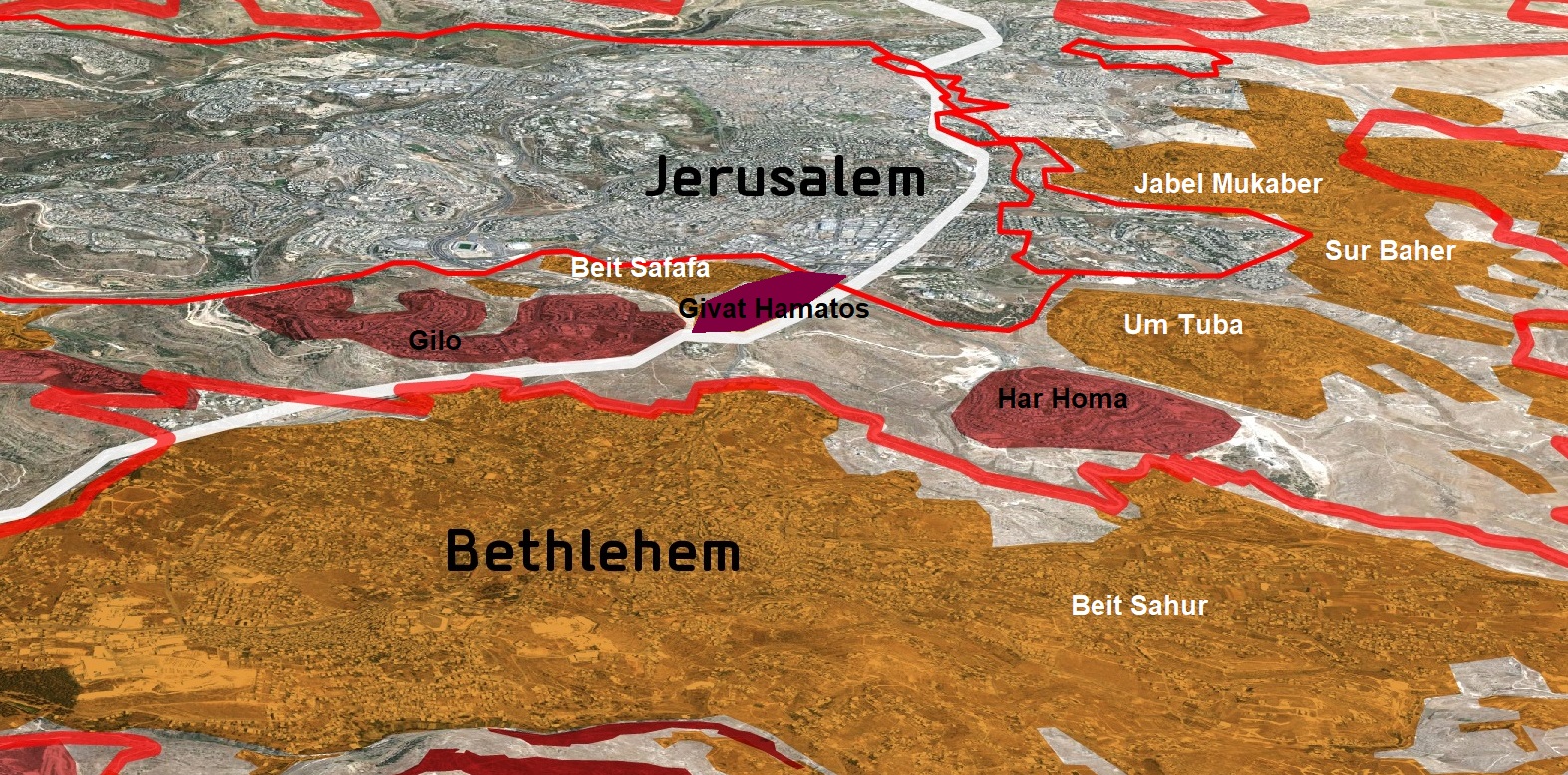
Map by Peace Now
In addition to the massive wave of settlement advancements this week, infrastructure work has started at the site of the long awaited (and much feared) Givat Hamatos settlement in East Jerusalem. Construction workers and machinery were spotted clearing the ground as the Israeli government prepares to issue the first tender for the settlement, which will green-light the construction of some 1,600 units. [image]
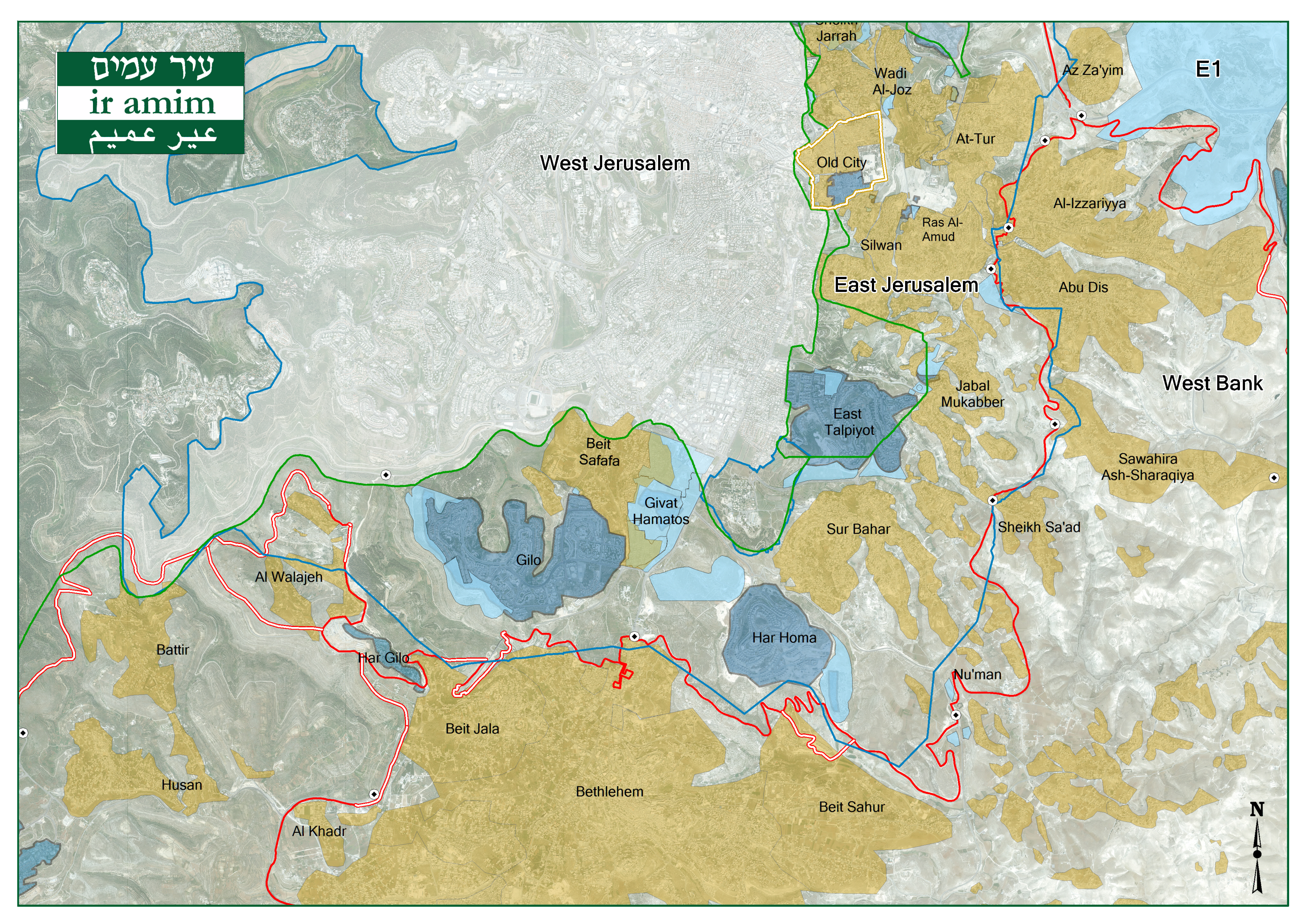
The construction of Givat Hamatos will be especially devastating to the two-state solution. It will complete a barrier of Israeli settlements between Jerusalem and Bethlehem; it will complete the encirclement and isolation of the Palestinian neighborhood of Beit Safafa; and, it will be the first new Israeli settlement in East Jerusalem in 20 years.
Ir Amim writes,
Construction of Givat Hamatos – prospectively, the first new [government-backed] settlement in East Jerusalem in two decades – would cap off a wave of simultaneous developments along the southern flank of East Jerusalem to complete consolidation of Israeli control of the southern perimeter and render the two state solution nonviable.
Peace Now writes:
The preparation for a tender in Givat Hamatos, together with Netanyahu’s statements last week regarding the construction of thousands of housing units in Ma’ale Adumim with heavy hints towards E1, are all a part of the government’s effort to create a de-facto annexation and prevent the possibility for two states on the ground. Netanyahu is taking far-reaching steps, which he has thus far avoided, and by doing so he risks the two state solution and the future of Israel.
The Givat Hamatos plan received final approval two years ago, but construction was delayed in light of international pressure including interventions by the Obama administration. As FMEP reported earlier this year, at the onset of the Trump administration, reports suggested a huge slate of Jerusalem area projects would now move forward – those rumored plans included Givat Hamatos, Atarot, Ramat Shlomo, and more (including E-1). Though an official announcement of advancement of those plans has not yet been made, the movement on Givat Hamatos piques concerns of additional major new settlement developments in the Jerusalem area.
Israel to Invest in $939 Million “Settler Security Package” for Settlements Across the West Bank
The Times of Israel reports that Defense Minister Avigdor Lieberman is planning to allocate $939 million for projects for settlers and settlements across the West Bank. Liberman’s plan addresses the complaints of settlers who staged a protest in front of Prime Minister Netanyahu’s private residence earlier this week demanding enhanced security measures. Settlers complained that Netanyahu had promised the infrastructure but had not yet allocated funds to effectuate the projects. According to the Times of Israel, the $939 million package will fund:
the installation of security cameras along roads throughout the West Bank; the installation of cell phone towers to improve reception for settlers who may need to call for help; the paving of bypass roads around Palestinian towns and settlements to allow the populations to avoid each other; the bolstering of armored buses that travel through the West Bank; and broad security improvements for each settlement that will include security cameras, “smart fences” and sensors to warn of attempts to sneak into settlements.
Court Orders Evacuation of Settlers from “Machpelah House” in Hebron
The Israeli High Court has ordered the evacuation of settlers from a disputed home in Hebron. Settlers broke into the “Machpelah House” nearly 3 months ago, despite an ongoing legal battle to determine ownership of the home. The evacuation of the squatters had been repeatedly delayed by the political echelons and by attempts by the settlers to delay their evacuation until the Court makes a final ruling on ownership of the Machpela House, as we have previously reported. It remains to be seen if this court order will be carried out or if further delaying tactics will be brought into play.
As the Olive Harvest Begins, Settlers Steal and Destroy the Palestinian Crop
Yesh Din has documented 10 cases of settlers destroying or stealing olives from Palestinian groves across the West Bank this week, in what has become a common occurrence this time each year. Rabbis for Human Rights has documented an additional four cases this week, calling it a “severe wave of olive theft.”
Israeli police routinely arrest, release, and forget the settlers who commit harvest-time crimes, as documented thoroughly by Yesh Din. In one incident this week, settlers were filmed stealing olives, arrested by the Israeli police, and released on the same day. Yesh Din writes:
Since 2005, we have documented around 280 investigation files dealing with damage to olive trees. Only in 6 cases were indictments served (2.2% of cases for which an investigation has been concluded). More than 93% of these cases were closed due to police failure to locate the perpetrators or to gather enough evidence to prosecute suspects.
Rabbis for Human Rights says:
These are ideologically driven hate crimes. Due to the fact that most of the thefts took place on Palestinian lands which the farmers are restricted by the Israeli army from entering, the army has an increased responsibility to protect these groves.
Labor Chairman Shocks Israeli Left with Defense of Settlements
Avi Gabbay, the relatively unknown political outsider who was elected to be Chairman of the Israeli Labor Party earlier this year, has set off a debate within the center-left party following a series of shocking comments on settlements this week. Most pertinently, Gabbay stated that he does not believe Israel should have to evacuate settlements as part of a peace agreement – a position that is at odds with members of his own party and of the position of the Zionist Union, of which the Labor Party is a major part. He later praised Israeli settlers, saying “The settlement [project] was and remains the beautiful and devoted face of Zionism….[the settlers are] the pioneers of our generations, people who act in the face of adversity, who cause the wilderness to bloom, who realize the impossible.”
Any initial hesitancy of MKs to disagree with the party leader eventually gave way to an onslaught of Labor officials publicly discrediting the chairman’s position on the evacuation of settlements. Tzipi Livni, a member of the Hatnua party and leader of the Zionist Union that unites Labor with other left and center-left political parties, took a simple and strong line saying, “The opposition to evacuating settlements is not the position of the Zionist Union.”
Gabbay’s hardline comments on settlements were not the only remarks that landed him in hot water over the last week. He also stated that he would not agree to form a (hypothetical) government with the Arab-Israeli Joint List because, as he said, “I do not see anything that connects us to them or allows us to be in the same government with them,” and, “I don’t deal with rights of Palestinians.”
The Times of Israel recounts the contextual history of the Labor Party on the issue of settlements and the Party’s important role in previous peace negotiations:
The center-left Labor party has long been the Israeli political standard bearer for reaching a peace agreement with the Palestinians — involving the relinquishing of most of the West Bank and many of the settlements — with former Labor prime ministers Yitzhak Rabin, Shimon Peres and Ehud Barak all investing considerable efforts to negotiate an accord.
Bonus Reads
- “In Jerusalem, Municipal Issues Have Political Overtones” (NPR)
- “In unprecedented move, eight European countries to demand compensation from Israel for West Bank demolitions” (Haaretz)
FMEP has long been a trusted resource on settlement-related issues, reflecting both the excellent work of our grantees on the ground and our own in-house expertise. FMEP’s focus on settlements derives from our commitment to achieving lasting Israeli-Palestinian peace, and our recognition of the fact that Israeli settlements – established for the explicit purpose of dispossessing Palestinians in the West Bank and East Jerusalem of land and resources, and depriving them of the very possibility of self-determination in their own state with borders based on the 1967 lines – are antithetical to that goal.
Welcome to FMEP’s Weekly Settlement Report, covering everything you need to know about Israeli settlement activity this week.
To receive this report via email, please click here.
October 12, 2017
- Bibi Approves Major Expansion of Settlements
- DETAILS: Thousands of Settlement Units to Advance Next Week with Netanyahu’s Permission
- U.S.: No Comment, No Change in Talking Points
- Bonus Reads
Comments, questions, or suggestions? Email Kristin McCarthy at kmccarthy@fmep.org.
Bibi Approves Major Expansion of Settlements
This week, the Israeli Prime Minister Netanyahu announced imminent approval of major new settlement construction across the West Bank, including in some especially sensitive/controversial areas.
How major? There has been debate and disagreement in the Israeli press about the number and what they exactly mean. Haaretz reports that, while Netanyahu listed plans totalling 3,736 settlement units, only 600 of those units will actually be approved for immediate construction (the rest are part of plans that are in earlier stages of the approval process). However, the Times of Israel counts 1,941 units being advanced, of which 1,197 units will receive final approval. The Peace Now Settlement Watch Project counts 3,400 units up for advancement, and tenders (the final step before construction) expected for 296 units.
This debate over the numbers should not obfuscate the fact that Netanyahu is orchestrating an acceleration of settlement growth, the totality of which we will have definitive knowledge of only after the High Planning Council meets next week.
Please note, there is no benign stage in the settlement planning process. No matter the stages of the planning process involved, Netanyahu’s announcement this week represents a huge wave of forthcoming settlement construction.
As Terrestrial Jerusalem’s founder Daniel Seidemann wrote in 2015,
There is no such thing as a “window of opportunity” in stopping settlement planning/approvals. When the world objects to settlement approvals, the answer from Israeli officials, invariably, is either, “It’s too early, it’s just a plan – what are you objecting to?” or “It’s too late, this was approved long ago – why are you bothering us now?” In truth, settlement plans can be stopped at almost any point on the road to implementation, and the earlier a plan is stopped, the lower the political costs.
With that in mind, we cover the plans expected to be advanced in detail below.
DETAILS: Thousands of Settlement Units to Advance Next Week with Netanyahu’s Permission
Prime Minister Netanyahu has publicly announced his permission for the High Planning Council to advance 3,736 of settlement units during the Council’s meeting next week (Oct. 17-18). If all of the reported plans are approved, the total number of settlement units promoted so far in 2017 will reach 6,500 by the end of the month, a significant increase compared to 2,629 for all of 2016, and 1,982 for all of 2015, according to Peace Now data. One Israeli official has promised the settlement numbers will reach 12,000 by the year’s end, bragging that the amount is four times the total promoted in 2016.

Graphic by Haaretz
Of the thousands of units slated for advancement, several plans are at the final stage of planning and will likely receive the green light to start construction. These plans fulfill specific promises to settlers Netanyahu has made over the years (and address some of his most acute domestic political pressure points). The following plans – all of which are in settlements located deep inside the West Bank and beyond the separation barrier – are expected to receive building permits, as reported by Haaretz:
- 31 units for the settlement enclave on Shuhada Street, in the heart of downtown Hebron. This is the first plan for new settlement units in downtown Hebron in the last 12 years; the Hebron Municipality is expected to mount a legal challenge against the plan’s implementation. Peace Now explains, “alongside additional developments in Hebron, including the creation of an independent administration and the entry to the Abu Rajab House, this can be seen as another effort by the government to strengthen the radical settlement in the heart of Hebron.”
- 296 units in the Beit El settlement, which are part of Netanyahu’s promise to compensate for the settlers evacuated from the Ulpana outpost in 2012.
- 86 units in the Kochav Yaakov settlement which are part of Netanyahu’s promise to compensate for the settlers evacuated from the Migron outpost also in 2012. The evacuation of the Migron outpost has lead to the construction of not one but two new settlements as compensation.
- 146 units in the Nokdim settlement, where Israeli Defense Minister Avigdor Liberman lives.
- 9 units in the Psagot settlement.
The Times of Israel reports additional units expected receive final approval:
- 459 units in Ma’ale Adumim.
- 102 units in the new settlement of Amichai, which was approved earlier this year as payoff for settlers evacuated from the unauthorized outpost of Amona. Haaretz suggests that construction of these units will remain stalled as the State responds to a petition filed against the Amichai settlement by the Israeli NGO Yesh Din, arguing that the settlement’s borders annex land that is privately owned by Palestinians. As reported in detail in past editions of the FMEP Settlement Report, Amichai is the first new settlement to receive government authorization in the past 25 years. It is to be located deep inside the Shilo Valley in an area that cannot, under any conceivable two state arrangement, be included inside the borders of an Israeli state in a way that preserves the territorial contiguity of a Palestinian state.
The High Planning Council will also consider depositing for public review (a last step before final approval) plans for 30 units in the Elon Shvut settlement that will expand the settlement borders to build the homes in order to compensate residents in the unauthorized outpost of Netiv Ha’avot, an outpost where the government is appealing to the High Court to save settlement homes that were partially constructed on land that is proven to be privately owned by Palestinians. The Court has ordered that the outpost be razed by March 2018.
To see all of the plans expected to be addressed next week, see Peace Now’s data table (link near the middle of this page). Peace Now issued an accompanying statement saying,
The government has gone wild with settlement plans deep in the West Bank for thousands of new settlers, whom Israel will have to evacuate in a two state solution agreement. Faced with the growing pressures and investigations, Netanyahu goes out of his way to prove how radical he is, without considering the consequences of massive settlement expansion on the future of the two state solution. The plans for Hebron and Nativ Ha’avot are particularly enraging, as they indicate to settlers that the rule of law does not apply to them and illustrate the government’s deteriorating legal standards when it comes to settlement expansion.
U.S.: No Comment, No Change in Talking Points
The Trump Administration has issued no statement regarding Netanyahu’s brazen settlement advancements. Instead, unnamed White House officials repeated the same talking points that have defined the Trump Administration’s settlement stance, saying,
President Trump has publicly and privately expressed his concerns regarding settlements, and the administration has made clear that unrestrained settlement activity does not advance the prospect for peace. At the same time, the administration recognizes that past demands for a settlement freeze have not helped advance peace talks.
Hagit Ofran, Director of Peace Now’s Settlement Watch Program, told the Washington Post, “This year is looking to maybe even be a record year… It’s without a doubt due to the fact that there have been changes in the White House.”
Bonus Reads
- “By Backing ‘Greater Jerusalem’ Bill, is PM leaning towards annexing settlements?” (Times of Israel)
- “The Transformation of Jerusalem” (Arab American Institute)
- “The Bedouin village where compassion ends” (+972 Magazine)
FMEP has long been a trusted resource on settlement-related issues, reflecting both the excellent work of our grantees on the ground and our own in-house expertise. FMEP’s focus on settlements derives from our commitment to achieving lasting Israeli-Palestinian peace, and our recognition of the fact that Israeli settlements – established for the explicit purpose of dispossessing Palestinians in the West Bank and East Jerusalem of land and resources, and depriving them of the very possibility of self-determination in their own state with borders based on the 1967 lines – are antithetical to that goal.
Welcome to FMEP’s Weekly Settlement Report, covering everything you need to know about Israeli settlement activity this week.
To receive this report via email, please click here.
September 13, 2017
- Don’t be Hoodwinked by Misleading Settlement Numbers
- Israel Government Sides with Illegal Outpost in Fight Against Demolition
- Netanyahu’s Promise to Build 300 New Units in Beit El Moves Forward (With Trickery)
- Updates: Clashes Ensue in Sheikh Jarrah Following Eviction; Amona Site is Now a “Closed Military Zone”; More Demolitions in Silwan
- Bonus Reads
Comments, questions, or suggestions? Email Kristin McCarthy at kmccarthy@fmep.org.
Don’t be Hoodwinked by Misleading Settlement Numbers
Israel’s Central Bureau of Statistics published data this week on new settlement starts in the second quarter of 2017 (April-June). The data, purportedly showing a dramatic decline (75%) in construction, compared to the same period in 2016.
Hagit Ofran, the Director of Peace Now’s Settlement Watch, set the record straight – noting that starts in any given period reflect planning that took place months and years before. Construction happening today, for example, reflects approvals and tenders from two to three years ago. In light of this reality, the relatively low number of starts in the second quarter of 2017 has nothing to do with overall settlement trends, or with current settlement policies. These current settlement policies, reflected in a huge massive wave of settlement approvals seen (so far) in 2017 – a wave the indicates the settlement floodgates have opened – will result in a corresponding spike in settlement starts down the line (at which point the Israeli government will claim “it’s not our fault, this was all approved long ago!”).
Israel Government Sides with Illegal Outpost in Fight Against Demolition
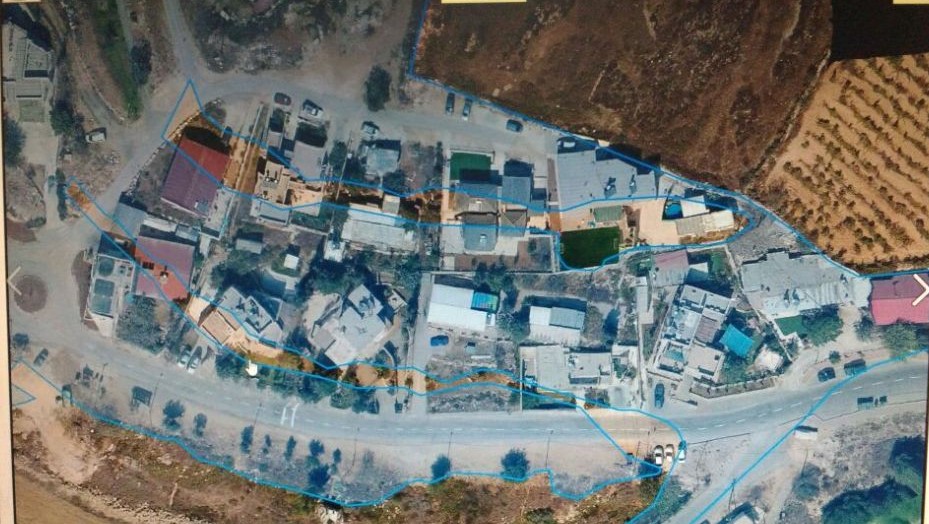
Map by Kerem Navot
The High Court of Justice has ordered the demolition of 15 structures located in the Netiv Ha’avot outpost, built on land recognized by Israel as privately owned by Palestinians. In response to a last minute petition the outpost’s leaders filed with the High Court of Justice, the Israeli government expressed its support for their proposal to save 6 of the buildings from complete demolition; instead, the proposal offers to demolish only the “problematic parts” of the structures – i.e., where they cross into the pockets of privately-owned Palestinian land that run through the middle of the outpost. The High Court is set to make a final ruling on the petition on September 13th.
It is worth pointing out that every structure in the Netiv Ha’avot outpost was built in violation of Israeli planning laws. The outpost is an unauthorized expansion of the Elazar settlement, located southwest of Bethlehem. Only the 15 buildings that were built on private Palestinian land face demolition; if Israel enforced its own planning laws, the entire outpost would be razed. Last month, the Attorney General ordered the Defense Ministry to create a special unit to enforce Israeli planning laws specifically in settlements and outposts (in conjunction with the passage of the Regulation law permitting legalization of most illegal settlement construction and land seizures).
Netanyahu’s Promise to Build 300 New Units in Beit El Moves Forward (With Trickery)

Map by Kerem Navot
Kerem Navot (aka, Naboth’s Vineyard – the organization founded by anti-settlement legend Dror Etkes) has a cheeky look at how Netanyahu’s promise to build new homes in the Beit El settlement by the end of this month is coming to fruition. According to the report, the settlement has conspired with the government to build a new Border Police base south of the settlement 0- based on alleged security needs of the settlers. And what about the existing Border Police station for the settlement? That’s where the new units will be built. Two birds with one stone: more settlement units for Beit El, plus more land taken for settlements, to accommodate the entirely unnecessary new police station.
The Beit El settlement was established in 1977, on land previously seized by Israel for military purposes. A second military seizure in 1979 enabled Beit El to expand. This method of establishing and expanding settlements has been repeatedly challenged in Israeli courts. The Israeli group Yesh Din led one such petition against Beit El, seeking to have the second seizure annulled; that petition was dismissed earlier this year. Yesh Din writes,
The State understood that it was impossible to legally defend the land theft that has been ongoing in Beit El for 40 years on land that was seized for arbitrary reasons, but it refrained, once again, from defending the rights of the weakest population, simply because they are Palestinians. Despite this, we at Yesh Din will continue to fight against the dispossession of Palestinians and the infringement of their rights.

Map by Haaretz
As a reminder, Beit El is the settlement that current U.S. Ambassador to Israel David Friedman personally donated to and fundraised for in his capacity as President of the American Friends of Beit El charity from 2011 until his appointment (he dedicated at least one building in the settlement which bears his name).
Beit El is also slated to have a security wall built between one side of the settlement and the al-Jalazoun Palestinian refugee camp.
Updates: Clashes Ensue in Sheikh Jarrah Following Eviction; Amona Site is Now a “Closed Military Zone”; More Demolitions in Silwan
- Last week, in the East Jerusalem neighborhood of Sheikh Jarrah, Palestinians participated in Friday prayers in front of the former home of the Shamasneh family, which was evicted last week by settlers. On the same day, 200 Israelis – including MK Ayman Odeh (Joint List) – marched from central Jerusalem to join the demonstration. Clashes broke out between settlers and the demonstrators, resulting in injury to 14 protestors.
- The illegal outpost of Amona was dismantled earlier this year, but the Kerem Navot organization has revealed that instead of being returned to the Palestinians who the court ruled were the rightful owners, the Israeli army has declared the area a “closed military zone” — keeping Palestinians off the land but permitting residents of the neighboring Ofra settlement to enter the area at will.
- Ma’an News has video of a home demolition in the Ras al-Amud, a Palestinian neighborhood just south of the Old City in Jerusalem. Ma’an also reports that Israel delivered several demolition orders to Palestinians in the Issawiya neighborhood of East Jerusalem earlier this week.
Bonus Reads
- “Red Cross Chief Blasts Settlements as ‘Key Humanitarian Challenge’” (Times of Israel)
- “We witness it daily in the West Bank and in East Jerusalem: [Israeli settlement] has enormous impact on people, on their freedom of movement, the social and economic fabric in the territories. It offers limited access to agricultural and other productive lands, has curtailed educational and employment opportunity; it makes water resource and water supply systems difficult for Palestinian communities. And the list could go on and on,” he [Red Cross Chief Peter Maurer] said.
- “Shin Bet Bypasses Court Again and Stiffens Release Terms of Teen Settler Activist” (Haaretz+)
- “Jerusalem Magistrate’s Court initially ordered him [a teen who is part of the extremist West Bank movement known as Hilltop Youth, had been detained without trial after violating a administrative order] released on the condition that he remain at home at night. But the Israel Defense Forces order requires him to be under house arrest 24 hours a day.”
- “In a First, Israel Will Penalize Amnesty International for Anti-Settlements Campaign.” (Haartez+)
- “Israel plans to punish Amnesty International for its recent campaign, which encourages people to lobby companies and governments to boycott settlement products, by denying tax benefits to Israelis who donate to the human rights organization. It is the first time the government will apply the so-called anti-boycott law, which penalizes organizations and individuals calling for a boycott of Israel or the settlements. The controversial law was passed in 2011.”
- “Reports Israeli government plans to retaliate against Amnesty International over settlements campaign” (Amnesty International)
- “Amnesty International has repeatedly emphasized that the very existence of Israeli settlements in the Occupied Palestinian Territories violates international law, a matter on which there is international consensus and is reflected in UN Security Council resolutions. Settlements have contributed to decades of mass suffering and violations in the Occupied Palestinian Territories.”
Welcome to FMEP’s Weekly Settlement Report, covering everything you need to know about Israeli settlement activity this week.
To receive this report via email, please click here.
August 31, 2017
- Netanyahu: Israel Will Not Withdraw from Settlements, Ever
- U.S. Refuses to State a Clear Position on Settlements
- Netanyahu Delays Settlement Advancements Until After September UNGA Session
- Palestinians & NGOs Launch Legal Challenge to New Settlement
- Settlers Ordered to Leave the Illegally-Occupied Building in Hebron, or be Evacuated
- Liberman Approves New Israeli Municipality for Settlers in Hebron
- Liberman Comes Out Against Regulation Law…Because It Could Undermine Settlements
- Beit El Settlement Will Get a Wall & New Homes This Year
- Bonus Reads
Comments, questions, or suggestions? Email Kristin McCarthy at kmccarthy@fmep.org.
Netanyahu: Israel Will Not Withdraw from Settlements, Ever
Israeli Prime Minister Benjamin Netanyahu continues to make the case that no Israeli government has been better for settlements than his own. This time around, he did so at an event held in a settlement, celebrating 50 years since took control of the West Bank (or, occupied and began illegally settling civilians in it).
At the event, Netanyahu pledged,
Map by Peace Now
We are here to stay, forever. There will be no more uprooting of settlements in the land of Israel. It has been proven that it does not help peace. We’ve uprooted settlements. What did we get? We received missiles. It will not happen anymore…So we will not fold. We are guarding Samaria against those who want to uproot us. We will deepen our roots, build, strengthen and settle.
At the same event, Minister of Education Naftali Bennett said, “We [Israelis] shouldn’t need permits, building in Judea and Samaria should be unrestricted. The freedom to build in our country.” Bennett is a leading figure in a powerful far-right faction of the Israeli government which is pushing Netanyahu to take radical, anti-democratic positions to advance settlements and sabotage the possibility of any future peace deal with Palestinians.
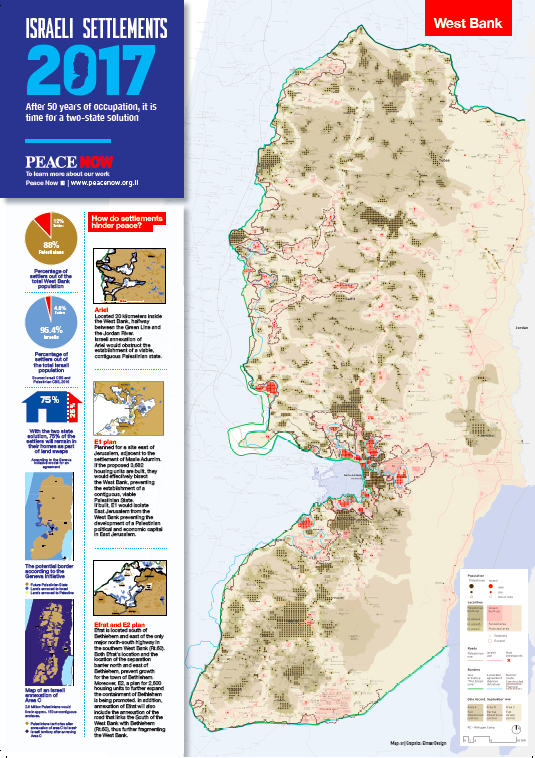
As a reminder, the Israeli settlement watchdog organization Peace Now documents 131 Israeli settlements and 97 outposts in the occupied West Bank, totaling 385,900 settlers. There are an additional 208,410 Israelis living in Palestinian East Jerusalem. There cannot be a viable, contiguous, independent Palestinian state if all of these settlements remains in place.
U.S. Refuses to State a Clear Position on Settlements
Despite a Palestinian pressure campaign last week to get the Trump Administration to publicly commit to a two-state solution and a settlement freeze while in the region, the U.S. delegation came and went without articulating support for either of those baselines for negotiations.
Immediately after the negotiation team departed, Palestinian news reported that Jared Kushner – who led the delegation – told President Abbas that the U.S. cannot call for a settlement freeze because the it would lead to the collapse of Prime Minister Netanyahu’s government. A senior White House official quickly, and vehemently, denied the report as “nonsense.”
These are just the latest reports adding to the confusion and concern about the Trump Administration’s changing position on settlements. To date, the U.S. has only (and repeatedly) stated that unrestrained settlement growth is not “helpful” to the peace process. President Trump and his spokespeople have refused to comment directly on any of the major settlement announcements Israel has made since Trump took office, including the approval of the first new official settlement in 25 years (Amichai, located far beyond the separation barrier and approved as a pay-off to settlers who defied Israeli law in building elsewhere) and alarming developments in East Jerusalem.
At first the White House even declined to comment on Netanyahu’s promise to never uproot another Israeli settlement (reported above); 24-hours later, an anonymous White House official commented to the Times of Israel that, “It is no secret what each side’s position is on this issue [settlements]. Our focus is on continuing our conversations with both parties and regional leaders to work towards facilitating a deal that factors in all substantive issues.”
Several FMEP grantees and U.S. civil society organizations have put out statements on the Administration’s position:
-
- J Street President Jeremy Ben-Ami writes, “It is no accident that the prime minister’s open rejection of the two-state solution has grown bolder since President Trump took office. By refusing to support two states or to seriously oppose settlement expansion, the Trump administration has given the Israeli government the green light to entrench the occupation and avoid meaningful negotiations. It is empowering the most extreme voices and positions on both sides.”
- Americans for Peace Now released a statement saying in part, “By refusing to publicly endorse a two-state solution to the Israeli-Palestinian conflict and suggesting that doing so would “bias one side over the other” regarding possible outcomes, the Trump Administration yesterday dropped a dangerous and unacceptable bombshell. The Administration turned its back on a core bipartisan foreign policy principle, thumbed its nose at an international consensus regarding the way to resolve the conflict, and handed a gift to extremists on both sides of the Israeli-Palestinian divide.”
Netanyahu Delays Settlement Advancements Until After September UNGA Session
The Times of Israel is reporting that the Civil Administration’s High Planning Committee has delayed a meeting scheduled for this week until the conclusion of the United Nations General Assembly (UNGA) session (taking place September 12-25 at UN headquarters in New York). The committee’s meeting was set to advance 3,000 settlement units first reported to be moving in June of this year. The units are expected to be advanced by the end of September, despite the short delay.
In addition, the Times of Israel report suggests Netanyahu’s government is moving to significantly shorten the settlement approval process by eliminating the number of authorizations each plan needs to obtain before being implemented.
Palestinians & NGOs Launch Legal Challenge to New Settlement
This week, a group of Palestinians and Israeli NGOs filed a legal challenge against the first settlement to be built in the West Bank in 25 years, Amichai. The petition claims that the settlement’s location will deny Palestinians access to their own private land – land on which they depend for farming and grazing. A construction plan for Amichai was approved earlier this year as payoff to families which the government was forced to evacuate from the illegal Amona outpost.
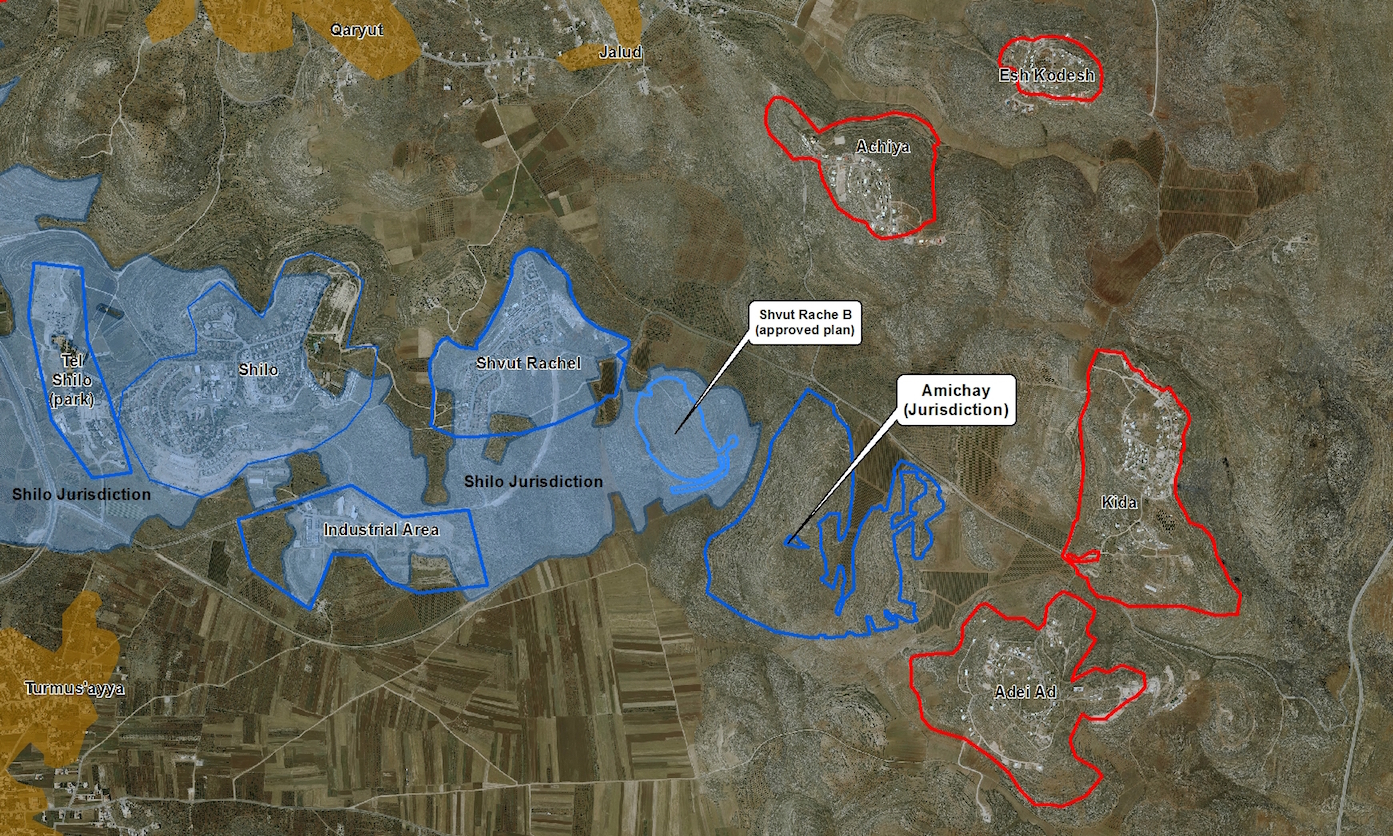
Map by Peace Now
The location of the new settlement, north of Ramallah and deep in the Shilo Valley, is a brazen challenge to Israeli planning laws. Bimkom, an Israeli NGO leading the new petition against Amichai, explains that the IDF has repeatedly demolished an illegal outpost on the very same hilltop on which Amichai is being built. Alon Cohen-Lifschitz of Bimkom says, “We [Bimkom] didn’t even file petitions against the outpost. The Defense Ministry simply understood that it was illegal and acted. But now they want to establish a settlement in that same problematic area…“there was no legitimacy to establish the settlement. They [the Israeli government] rushed through the entire process without gaining the necessary permits.”
The petition might delay the construction of the new settlement for several months while the court considers and demands a State response to the petitions’ claims. Such a delay would be i addition to the problems already facing the new settlement: after getting off to a fast start, construction on Amichai stopped at the end of July due to budget shortfalls, and so far has not resumed despite reports that Netanyahu’s government is seeking to triple the government’s contribution to the project.
Settlers Ordered to Leave the Illegally-Occupied Building in Hebron, or be Evacuated
On August 27th, Israeli Attorney General Avichai Mandleblit ordered Israeli settlers to voluntarily leave the building in Hebron they have dubbed the “Machpelah House” within the week, or face a forcible evacuation. Approximately 100 Israeli settlers broke into the property and took up residence on July 25th, over five weeks ago. The Attorney General’s order has put an end date on attempts by the Defense Ministry to negotiate a peaceful evacuation.
The Attorney General’s order came as the result of a petition filed by Palestinians who say they own the home. Legal ownership of the home is a complicated, fiercely disputed matter; what is neither complicated nor in disputed is the fact that the settlers broke Israeli law when the took over the site.
Hagit Ofran, the head of Peace Now’s Settlement Watch Project, said, “It’s truly a shame that the state needs a High Court petition in order to uphold the law.”
Liberman Approves New Israeli Municipality for Settlers in Hebron
On August 29th, Israeli Defense Minister Avigdor Liberman announced that the government had approved granting the status of an independent municipality to the loose cluster of settlements, home to around 1,000 Israeli settlers, located in Hebron’s city center. Until now, these settlements and their residents have technically fallen under the municipal jurisdiction of the Palestinian Authority while for all practical purposes operating as an enclave under full Israeli control and authority. That changed officially on Thursday, when the Israeli army signed an order to create a new municipal services administration for Jewish settlers.

Map by Mike King for the New York Review of Books
The creation of a municipal body is a major boon to the settlers, who will now enjoy far greater freedom and authority to administer their own affairs and promote their own agenda – which includes attempting to rewrite the city’s history and cultural identity to effectively erase the Palestinians – without having to deal with the Palestinian Authority.
Liberman’s decision, and the actions of the settlers, violate the 1997 Hebron Protocol signed by Arafat and Netanyahu, which divided Hebron into two security areas, H-1 controlled by Palestinians (80% of Hebron) and H-2 controlled by the Israeli army. That agreement stipulated that the Palestinian Authority would provide municipal services to all parts of the city, gave the PA control over all infrastructure, and specifically protected the Palestinian cultural identity of Hebron.
Commenting on this new development, Peace Now says:
By granting an official status to the Hebron settlers, the Israeli government is formalizing the apartheid system in the city. This step, which happened immediately following the announcement on the evacuation of the settlers who took over a house in Hebron [discussed above], is another illustration of the policy of compensating the most extreme settlers for their illegal actions.
Liberman Comes Out Against Regulation Law…Because It Could Undermine Settlements
To the surprise of many, this week Israeli Defense Minister Avigdor Liberman – himself a settler – railed against the Regulation Law, which was passed by the Knesset in order to retroactively legalize Israeli outposts in the West Bank.
Why would an ardent supporter of settlements do so? Liberman’s logic is clear: he is concerned that the law will provide the basis for legalizing not only illegal construction by settlers but that it could also lead to the legalization of “illegal” Palestinian construction. Unpacking the false symmetry built into this logic, Liberman fears that this law – designed to legalize the approximately 2,000 units settlers built on private Palestinian land, making them illegal even under Israeli law, will compel Israel to also legalize the approximately 10,000 units build by Palestinians on their own private land, but without Israeli permits (it is virtually impossible for Palestinians to obtain such permits in the more than 60% of the West Bank known as Area C, that under the Oslo Accords is under full Israeli control).
Liberman also criticized unauthorized construction in settlements, which his ministry was recently tasked with cracking down on – because, he argued, the lawlessness often brings land cases before the High Court and draws more legal scrutiny to the settlements. In addition, he called the violent Hilltop Youth movement “disturbed idiots,” leading the movement’s supporters to file a criminal complaint against the Defense Minister in order to “send a message that this is not how an elected official is supposed to behave.”
Beit El Settlement Will Get a Wall & New Homes This Year
This week the Israeli Defense Ministry confirmed that it is planning to build a wall around part of the Beit El settlement, located northeast of Ramallah. According to a Defense Ministry spokesman, the wall will be built along a portion of the settlement’s western side, separating it from the Palestinian Al-Jalazoun refugee camp, “based on security needs and circumstances.” The construction does not yet have the necessary permissions, but the spokesman said he expects building to begin in the coming weeks.
Map by Haaretz
Prime Minister Netanyahu has personally promised to approve 300 new housing units for Beit El by the end of September. There was significant outrage in pro-settlement quarters earlier this year, when new homes in the Beit El settlement were not included in the wave of settlement approvals that came out in July. That outrage was rewarded with the Prime Minister’s assurances that the units would, indeed, be built.
Beit El is the settlement with which current U.S. Ambassador to Israel David Friedman is most closely associated, having donated to and fundraised for prior to his appointment (in his capacity as the President of the American Friends of Beit El, reportedly from 2011 until he became ambassador). As of March 2017, Amb. Friedman’s son-in-law was still reportedly involved in fundraising for the settlement.
Bonus Reads
- “Jerusalem Stakeout Reveals ‘New Generation’ of Radical Jewish Settlers” (Haaretz+)
- “The Writing on the Wall: Signs of Occupation in Hebron” (The Forward)
- “Hobby Lobby Funds Israeli Settlement Archeology” (Al Jazeera)
- “How Palestinian students prepare for settler attacks” (Al Jazeera)
FMEP has long been a trusted resource on settlement-related issues, reflecting both the excellent work of our grantees on the ground and our own in-house expertise. FMEP’s focus on settlements derives from our commitment to achieving lasting Israeli-Palestinian peace, and our recognition of the fact that Israeli settlements – established for the explicit purpose of dispossessing Palestinians in the West Bank and East Jerusalem of land and resources, and depriving them of the very possibility of self-determination in their own state with borders based on the 1967 lines – are antithetical to that goal.
Welcome to FMEP’s Weekly Settlement Report, covering everything you need to know about Israeli settlement activity this week.
To receive this report via email, please click here.
July 7, 2017
- Israel Announces Thousands of New Settlement Units in East Jerusalem
- Settlement Watchdogs & Jerusalem Experts Sound the Alarm
- The U.S. Response
- Israeli AG says Accidental Land Theft is Legal
- The Beit El Spitting Match Continues
- Bonus Reads
For questions and comments please contact FMEP’s Director of Policy & Operations, Kristin McCarthy (kmccarthy@fmep.org).
Israel Announces Thousands of New Settlement Units in East Jerusalem
 This week the Israeli government announced the advancement of thousands of new settlement units across East Jerusalem. This includes plans inside large settlement neighborhoods like Gilo and Ramot, as well as unprecedented projects in the heart of Palestinian neighborhoods. The settlement floodgates in East Jerusalem are now officially open, and daringly so. The announcements this week will constitute the largest settlement expansion in East Jerusalem in many years, and it reveals the lengths to which this Israeli government will go to in order to increase Israeli control and claim over East Jerusalem, including changing the longstanding modus operandi governing settlement planning and construction to open new areas for construction and to build at far greater density.
For detailed reporting on the specific plans advancing this month, click to read comprehensive resources produced by:
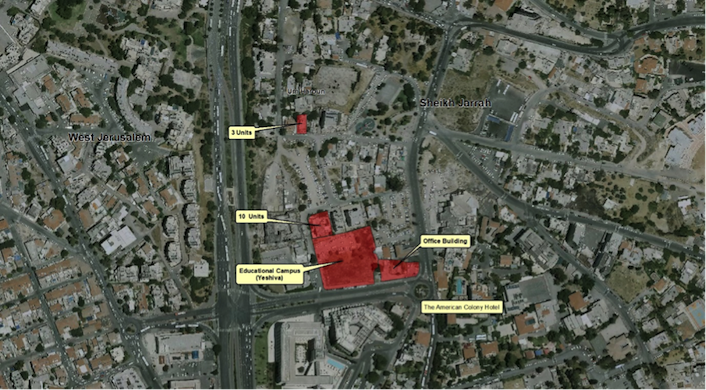
Map by Peace Now Israel
The most provocative projects (detailed extensively in all of the above resources) are in the heart of the Palestinian neighborhood of Sheikh Jarrah in East Jerusalem. Once approved, the projects will require the eviction of 5 Palestinian families. Another project, as we reported last week, will build a large yeshiva (Jewish religious school) at the entrance of Sheikh Jarrah.
The plans for Sheikh Jarrah – and many of the other plans being promoted this month – are efforts to irrevocably change facts on the ground in East Jerusalem by expanding settlement enclaves inside of densely populated Palestinian neighborhoods. These announcements are poison pills for any attempt to re-start a political process or negotiate a permanent status agreement on the contested future of Jerusalem.
Settlement Watchdogs & Jerusalem Experts Sound the Alarm
Hagit Ofran, Director of Peace Now’s Settlement Watch, writes: “The [Israeli] government is brutally attempting to destroy the possibility of the two-state solution, and this time it is by establishing a new settlement at the heart of a Palestinian neighbourhood in East Jerusalem and [by] promoting nearly 1,800 housing units beyond the Green Line.”
Danny Seidemann, founder of Terrestrial Jerusalem, writes: “This is not routine, either in scope or impact. Within a period of two weeks Israel will be approving more than 1,800 settlement units – an increase of 3.3% of all of the settlement units built in East Jerusalem since 1967.”
Betty Herschman, Director of International Relations & Advocacy at Ir Amim, writes: “The simultaneous lack of restraint in the Historic Basin through the revival of plans in Sheikh Jarrah is of paramount concern – signaling, as it does, the government’s continued determination to exert its sovereignty over the Historic Basin in advance of prospective negotiations.”
Following Israel’s announcement on Wednesday approving 800 units in East Jerusalem – the first East Jerusalem construction announcement under the Trump administration and just the first tranche of units expected to advance this month – the White House gave a statement to the press reiterating its policy on Israeli settlement activity. The statement reads, “unrestrained growth does not advance the prospect for peace,” adding, “at the same time, the administration recognizes that past demands for a settlement freeze have not helped advance peace talks.”
The statement suggests that the U.S. will likely not exert meaningful pressure on Israel to hold back on settlement growth, even in the most contentious areas in East Jerusalem.
Also this week, settler leaders were welcomed to Ambassador David Friedman’s party on the 4th of July at his official residence in Herziliyah. Ambassador Friedman’s invitation was celebrated by settlers as a “dramatic shift in policy.” This comes on the heels of Ambassador Friedman quietly attending a wedding in the West Bank settlement of Psagot at the end of May, as documented on Twitter by Rabbi Shmuley Boteach (it was the wedding of Boteach’s son), who tweeted a photo of himself with Ambassador Friedman caption, “With my friend US Ambassador to Israel David Friedman at a wedding in the Holy Land. Gd bless.”
Israeli AG says “Accidental” Land Theft is Legal
Hoping to prevent future “Amonas” (i.e., public relations nightmares where the nightly news broadcasts Israeli security forces forcibly removing Israeli settlers from hilltops on the West Bank because of court decisions), Israeli Attorney General Avichai Mendleblit has suggested a new legal basis for Israeli settlement construction on privately owned Palestinian land.
Israeli law currently forbids settlement construction on land recognized by Israel as “privately owned” by Palestinians (all settlement construction is illegal under international law). Despite the prohibition – and despite the fact that it is very difficult for Palestinians to get Israel to recognize their private ownership of land – the Israeli government and settlers have built on lands that even Israeli law recognizes as privately owned by Palestinians.
In an effort to find a fix to this problem that does not involve respecting the rule of law and the legal rights of Palestinians as landowners, last year the Attorney General brought up a 1967 government special order entitled, “Order Concerning Government Property.” That document says, in part, that settlers who bought land from the Israeli government believing that it was land the government claimed was “state land” should not face penalties, even if the land turns out to be privately owned by Palestinians.
Late last year, AG Mendleblit recommended using this special order to retroactively legalize illegal settlement construction, while simultaneously warning the government against passing the Regulation Law, which gives license to the Israeli government to legalize all illegal settlement construction and land seizures (it passed into law anyway). Mendleblit warned that the Regulation Law was unconstitutional, and suggested the 1967 special order as an alternative legal avenue to accomplish the same goal. Peace Now currently has a petition before the High Court of Justice challenging the constitutionality of the Regulation Law.
The Beit El Spitting Match Continues
Map by Haaretz
Last week we reported on ongoing controversy over building projects in the Beit El settlement, which in June Netanyahu had blocked from advancing. The subsequent tantrum thrown by settler leaders’ won a promise from Netanyahu that 300 settlement units will be built in Beit El by September 2017.
Not taking the PM at his word – or, as likely, seizing an opportunity to score more pro-settlement political points – far right-wing MK Bezalel Smotrich (Bayit Yehudi) introduced a bill last week that would force Netanyahu to build the units. That bill was scheduled to come up for vote this week, but Netanyahu intervened to prevent the bill from being considered. This does not mean Netanyahu will continue to block the Beit El plan as it moves through the normal settlement planning process governing Israeli construction in the West Bank (the plan is in the final stages of the approval process).
- “Settler Leader Used State Resources to Fund Illegal Outpost, While Israel Turned Blind Eye” (Haaretz, July 4, 2017)
- “A New Jewish settlement begins to rise in the West Bank” (Washington Post, July 1, 2017)
FMEP has long been a trusted resource on settlement-related issues, reflecting both the excellent work of our grantees on the ground and our own in-house expertise. FMEP’s focus on settlements derives from our commitment to achieving lasting Israeli-Palestinian peace, and our recognition of the fact that Israeli settlements – established for the explicit purpose of dispossessing Palestinians in the West Bank and East Jerusalem of land and resources, and depriving them of the very possibility of self-determination in their own state with borders based on the 1967 lines – are antithetical to that goal.
Welcome to FMEP’s Weekly Settlement Report, covering everything you need to know about Israeli settlement activity this week.
To receive this report via email, please click here.
- “Disappointment” So Far for Settlers in the Trump-Bibi Era, But…
- Sheikh Jarrah Project Recommended for Deposit for Public Review
- Long Delayed “Apartheid Road” Possibly Moving
- Beit El Housing to Advance After a Settlers Throw a Tantrum
- Bibi Vows that Israel will Keep Ariel
- Efrat and “How the Borders of Settlements Expand While No One is Watching”
- Yitzhar & Its “Hilltop Youth” Continue to Terrorize Nablus Area
- Bonus Reads
For questions and comments please contact FMEP’s Director of Policy & Operations, Kristin McCarthy (kmccarthy@fmep.org).
“Disappointment” So Far for Settlers in the Trump-Bibi Era, But…
Israeli Minister of Education Naftali Bennett – and staunch settlement advocate – expressed disappointment with the lack of settlement growth since Donald Trump assumed office. Bennett said, “Unfortunately from our perspective, he [Trump] is sort of going down the same unsuccessful path that his predecessors did…So yes, there is disappointment out there.” When Trump was elected, many settlers hoped that his administration would allow some, if not all, of the most problematic settlement plans to proceed. That includes several projects that, if built, would destroy the possibility of contiguous Palestinian state (Givat Hamatos, E1, etc). These projects have not moved forward…yet.
But Mr. Bennett need not be too disappointed. In fact, there has been a sharp rise in the number of settlement units and plans advanced and in construction so far in the Trump-Bibi settlement era, as detailed extensively by Peace Now and covered by FMEP in last week’s Settlement Round Up.
There are also new alarming developments this week that suggest the floodgates might be beginning to open….
Sheikh Jarrah Project Recommended for Deposit for Public Review
Ir Amim reports that plans for a 6-story Israeli commercial building at the entrance of the Palestinian East Jerusalem neighborhood of Sheikh Jarrah have been recommended for deposit for public review. The land designated for this project is adjacent to a plot designated for settlers to build a religious school and dormitories, known as the Glassman Campus project.
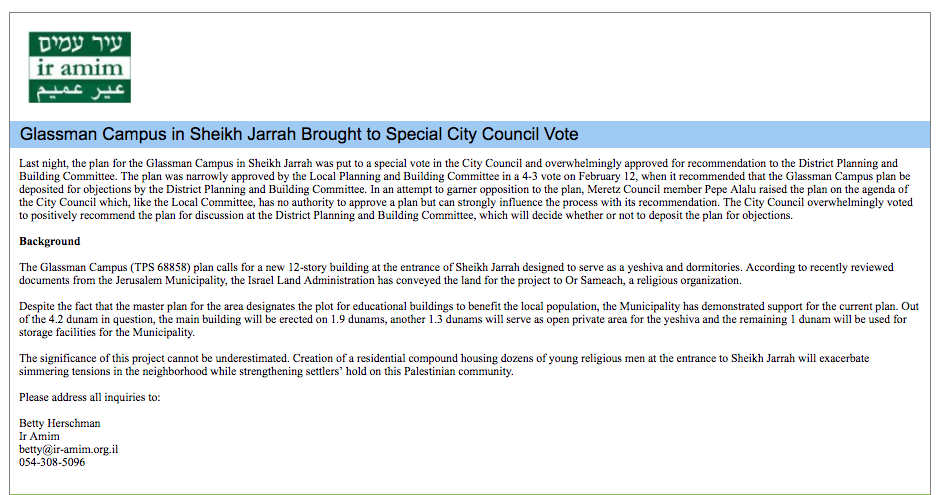

Map by Ir Amim
Located just north of Jerusalem’s Old City, Sheikh Jarrah has endured years of aggressive settlement activity by radical settlers, employing various means, including Israel’s court system to strip Palestinians of their ownership rights. Sheikh Jarrah’s plight was featured in a 2013 film by Just Vision, “My Neighborhood.” Just Vision also produced “Home Front,” a series of video interviews with the Palestinian residents and Israeli activists fighting together against settlement expansion in Sheikh Jarrah. For more on Sheikh Jarrah and the protest it sparked, 972+ Magazine has a compilation of resources online here.
Depositing settlement plans for public review is a significant step in the East Jerusalem planning process; it sends a signal that the political echelon may no longer be blocking the advancement of projects in the Jerusalem area that have been considered to be especially inflammatory to Palestinians and Muslims, and detrimental to peace negotiations. This could be an early sign of the opening floodgates.
Long Delayed “Apartheid Road” Possibly Moving
Ir Amim reports that a budget has been approved for construction of the northern part of the Jerusalem “Eastern Ring Road,” following years of delays and protests. If constructed according to existing plans, the northern section of the Eastern Ring Road will have separate lanes for Israeli settlers and Palestinians, with a physical barrier dividing the two. It will not allow the Palestinian lanes to access East Jerusalem. As noted in Haaretz, “This is the only highway in the West Bank that will have a separation wall running right down the middle. For that reason, the plan’s opponents are already dubbing it ‘Apartheid Road.’” Adalah, a legal group for minority rights in Israel, previously filed a petition to block the road’s construction.
Ir Amim notes that this is one of several projects that prepares the way for building in the E-1 area. E-1, as Jerusalem expert Danny Seidemann has long explained, is a “doomsday” project; if implemented, an E-1 settlement will end the possibility of a contiguous Palestinian state and completely sever East Jerusalem from the rest of the West Bank. The “Eastern Ring Road” seeks to “solve” one of these problems – by providing the Palestinians with “transportational contiguity” between the northern and southern West Bank – even as it would cement the cutting off of East Jerusalem from the West Bank.
Beit El Housing to Advance After Settlers Throw a Tantrum
Late last week, Netanyahu said he will approve the construction of 300 housing units in the Beit El settlement by September. The announcement came after a very public (and embarrassing) series of confrontations with members of his own political party as well as settlers. The leaders of the Beit El settlement threatened to petition the High Court over the issue, and staged a demonstration in front of the Prime Minister’s office to issue the threat. Beit El’s leaders replayed footage of Netanyahu promising to build the units in 2012, after several structures were taken down because they were built on land recognized even by Israel as privately owned by Palestinians.
The Beit El spat erupted after the Jerusalem Post reported an alleged freeze brokered between Israel and the U.S. The report suggested that Israel agreed to stop publishing construction tenders (the final step in the planning process) for all settlements through the end of 2017. The Beit El units had reached that final phase of planning, but would ostensibly not move forward if the report was true.
Beit El has deep connections to the current U.S. Ambassador to Israel, David Friedman; Friedman ran a U.S. fundraising effort for Beit El before being appointed Ambassador.
Bibi Vows that Israel will Keep Ariel
 At the ground-breaking ceremony for a new medical school in “Ariel University,” Prime Minister Netanyahu vowed, “Ariel will always be part of the State of Israel.” Alongside Education Minister Naftali Bennett, the Prime Minister Netanyahu attended a ceremony dedicating the school to American casino magnate and settlement financier, Sheldon Adelson – who donated funding for the new facility.
As explained last week, the future of Ariel has long been one of the greatest challenges to any possible peace agreement, since any plan to attach Ariel to Israel will cut the northern West Bank into pieces.
Efrat and “How the Borders of Settlements Expand While No One is Watching”
Three structures in the settlement of Efrat were found to have been built outside the border of the settlement’s jurisdiction. Dror Etkes (founder of Kerem Navot, a settlement watch group) petitioned Israel’s Civil Administration (the arm of the Israeli military that is effectively the sovereign authority in the West Bank, and therefore has authority over all construction ithere) over the buildings. This week the Civil Administration confirmed that the buildings were built without permits, had stop-work orders issued against them at the time, and might potentially be built on land recognized by Israel as privately owned by Palestinians. There are no reports of demolition orders against the illegal structures.
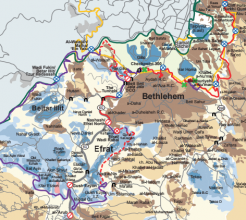
Map by B’Tselem
Located south of Bethlehem and west of the route of the separation barrier, Efrat poses many of the same challenges to a peace agreement as Ariel (discussed above). Connecting it to Israel means cutting deep into the West Bank, severing the route of Highway 60 between Jerusalem/Bethlehem and the southern West Bank, and contributing to the near total isolation of Bethlehem.
Yitzhar & Its “Hilltop Youth” Continue to Terrorize Nablus Area
Recent arrests of Yitzhar settlers have not deterred the terror coming from Yitzhar and/or its Hilltop Youth, with this week’s target being the Palestinian village of Burin. On Sunday, Rabbis for Human Rights documented 45 olive trees in Burin that were destroyed and spray painted with the words “revenge.” The suspected hate crime was precipitated by a violent clash between Yitzhar settlers and the Israeli army during the razing of an illegal structure in the settlement. On Wednesday, settlers from Yitzhar set fire to an olive grove – burning over 400 trees – according to the Israeli Army. Video of the incident shows masked settlers clashing with Israeli soldiers.
This week’s violence follows a warning to Yitzhar’s leaders from the Shin Bet earlier this month to keep the “Hilltop Youth” who call Yitzhar their home under control. In response, Yitzhar’s governing body has taken several actions, including forcing the youth to sign a code of conduct under threat of expulsion. But the code of conduct did not stop one Hilltop Youth religious leader and teacher at a yeshiva in Yitzhar – Rabbi Yitzchak Ginsburg – from urging his students to “cause a revolution” without getting caught because it is “a shame to waste time in prison.”
Israel’s Ynet news agency reports that the terror tactics of the Hilltop Youth are increasingly targeting Israeli security forces in the West Bank and Jerusalem. One Hilltop Youth whines, “all we want to do is sit on the hill. Just imagine how we feel each time a detective destroys our tent or confiscates our stuff. We have no peace and quiet.” And from a soldier’s perspective on his time serving in the Yitzhar area: “The scariest thing in the area was to clash with Jews. Give me an Arab terrorist and I’ll know how to deal with him. Give me a Jew who is throwing stones at me and I’ll simply flee.”
A lawyer with Yesh Din, an Israeli organization deeply involved in protecting the area from Yitzhar settlers, said “violence will not cease if there is no real deterrence, protection for Palestinians, a thorough investigation, prosecution of offenders and an imposition of significant penalties.” Though the Shin Bet has said it take the matter seriously, the violence continues. Yesh Din’s legal work documents the impunity with which settlers perpetrate crimes: A March 2017 report reveals only 8.2% of allegations of crimes committed by settlers in the West Bank result in indictments.
Bonus Reads
- “City on a Hilltop: American-Jewish Settlers“ w/ Dr. Sara Yael Hirschhorn, Ori Nir, and Lara Friedman (A podcast by Americans for Peace Now, June 25, 2017).
- Settlements: The Real Story, by Gershom Gorenberg (The American Prospect, Summer 2017)
Welcome to FMEP’s Weekly Settlement Report, covering everything you need to know about Israeli settlement activity this week.
To receive this report via email, please subscribe here.
June 9, 2017
- A New Settlement and Thousands of New Units Approved
- Bibi Abandons Talk of ‘Restraint’, Abbas Abandons Demand for ‘Freeze’
- No Statement [or Outreach] from U.S. State Department
- New Settlement Plans in the Works
- The New Norm: Blatant Walk Towards Annexation
For questions and comments please contact FMEP’s Director of Policy & Operations, Kristin McCarthy (kmccarthy@fmep.org).
A New Settlement and Thousands of New Units Approved
During the highly anticipated meeting this week, Israel’s High Planning Council approved the advancement of plans for nearly 3,000 new settlement units. The Jerusalem Post, Reuters, and Times of Israel reported the following details:
- The brand-new settlement of “Amichai”: The Council approved for deposit for public review (one of the last steps before final approval/implementation) plans for 102 homes in “Amichai,” which will be the first entirely new Israeli settlement established in the occupied West Bank in the past two decades. This new settlement, it should be recalled, is a pay-off for settlers who previously broke Israel law and built illegally elsewhere in the West Bank (Amona). When the government could find no possible way to legalize that illegal construction it removed the settlers but promised to (more than) compensate them with new “legal” homes elsewhere in the West Bank.
- Kerem Reim: The Council granted retroactive approval (by advancing for validation) to 255 units built illegally in the West Bank outpost of “Kerem Reim.” In effect, this maneuver legalizes the illegal outpost in the eyes of Israel law (it remains illegal under international law).
- Ariel: The Council approved plans for 839 new units.
- Ma’aleh Adumim: The Council advanced plans for 603 new units.
- Beit El: The Council approved the advancement of plans for 200 new units.
Bibi Abandons Talk of ‘Restraint’, Abbas Abandons Demand for ‘Freeze’
In addition to the approvals issued by the High Planning Council, several political statements made this week suggest that that status quo on settlements has changed for Israel and for the Palestinian Authority. On the Israeli side, these statements come amidst enormous pressure and disappointment (real or pretended) with the number of settlement plans Netanyahu allowed the High Planning Council to consider earlier in the week.
On June 5th, the Jerusalem Post quoted an anonymous source close to Prime Minister Netanyahu declaring the PM is not restricting settlement to the so-called “settlement blocs,” which was a policy position that was reportedly agreed upon by Bibi and President Trump in March.
On June 6th, Netanyahu, in a speech he delivered at celebration of the 50th anniversary of the 1967 Six Day War (when Israeli began its military occupation of Gaza and the West Bank), said, “No one will be uprooted from their home, I’m doing everything to protect the settlement enterprise…We decided to build in all parts of Judea and Samaria and we are building both inside and outside the settlements.”
On June 7th, Netanyahu met privately with several disgruntled settlement leaders about the state of settlement construction. Following the meeting, the settlers indicated no three are no immediate, concrete outcomes resulting form the “positive” meeting, but they expressed hope there would be soon.
On June 8th, Bloomberg News reported that Palestinian President Mahmoud Abbas is no longer demanding a settlement freeze as a precondition for resuming peace negotiations. A top Abbas advisor told Bloomberg, “we have not made the settlements an up-front issue this time.” This came after Netanyahu’s speech promising permanent settlement construction across all of the occupied territories, and after the High Planning Committee’s approval of the new Amichai on occupied territory (among other things).
No Statement [or Outreach] from U.S. State Department
Yesterday, U.S. Department of State Spokeswoman Heather Nauert made the following statement regarding the new settlement announcements:
We are aware of the announcement that the [Israeli] government made about 2,500 units in the West Bank. President Trump has talked about this consistently, and he has said, in his opinion, unrestrained settlement activity does not help advance the peace process. He’s been pretty clear about that. It doesn’t help the prospect for peace. That is something that the Israeli-Palestinian peace process is important to this administration, and they will keep promoting that.
Ms. Nauert said she is “not sure” if the administration will be releasing an official statement on the settlements (as has been customary following past settlement announcements) and she is “not aware of any diplomatic conversations” between the U.S. and Palestinian President Mahmoud Abbas regarding the report that he is willing to drop a total settlement freeze as a precondition for resuming talks.
New Settlement Plans in the Works
The settlers’ leadership body, known as the Yesha Council, presented plans for 67,000 more settlement units to the Knesset’s Interior Committee. A report commissioned by the Yesha Council found that there is “vacant” land between the Karnei Shomron and Ariel settlements able to hold 67,000 units for 340,000 settlers, which is what was subsequently proposed to the Knesset. 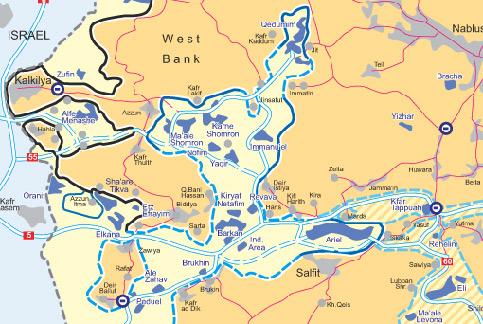 Settlement construction in the area would fortify the territorial linkage between Ariel – a settlement that extends so deep into the West Bank that in no circumstance could it be annexed by Israel if Palestinians are to have a contiguous state – and settlements located closer to the separation barrier and 1967 Green Line. It would further sever Palestinian communities from their land, resources, and important transportation routes to Nablus, Ramallah, and beyond.
The New Norm: Blatant Walk Towards Annexation
Israeli Justice Minister Ayelet Shaked issued a directive this week requiring all new Israeli laws to explicitly state whether or not they apply to Israeli settlements – and requiring those that do not apply to settlements to explain why. In effect, Shaked’s directive makes it a default position to apply Israel law inside the settlements, in contrast to the past 50 years of practice. (Israeli settlers enjoy the full rights and protections of Israeli law; the settlements, which are located in areas over which Israel has not formally extended its sovereignty, operate under Israeli military law). This is a significant move towards outright annexation of the settlements; and some of Shaked’s supporters are not shy about saying so. The Times of Israel quotes Jewish Home MK Shuli Moallem-Refaeli saying she “had ‘no desire to conceal’ the government’s intention to annex the West Bank. She added that the process must not be done in a ‘backdoor’ fashion, but rather openly.”
U.S. Ambassador to the United Nations Nikki Haley is reportedly pushing to annul the anti-settlement UN Security Council Resolution 2334, which passed last December, with the Obama administration abstaining. The resolution condemns Israeli settlements, stating that they have no legal validity. The resolution was an important reiteration of the imperative to differentiate between Israel and settlements. Haley is in Israel this week, on the heels of a stern warning she gave the UN Human Rights Council that the U.S. would leave if “Agenda item 7” (which censures Israel for its human rights abuses in the occupied territories) is not removed from their upcoming schedule.
Welcome to FMEP’s Weekly Settlement Report, covering everything you need to know about Israeli settlement activity this week.
To receive this report via email, please subscribe here.
June 2, 2017
- High Planning Council Announces Agenda for June 7th Meeting
- Plans Advance (Again) for New Settlement for Amona Families
- This Week in Settlement-Related Violence
- Bonus Reads: Archives, Fragments, and a Biography
Contact Kristin McCarthy (kmccarthy@fmep.org) with questions and comments.
High Planning Council Announces June 7th Meeting
This morning (June 2), the Israeli High Planning Council announced the highly anticipated agenda for its June 7th meeting. According to the agenda, the committee will consider plans to advance thousands of new housing units in the West Bank (Note: Haaretz is reporting 2,100 new units, Times of Israel is reporting as many as 2,600 new units, and the settler media outlet Arutz Sheva is reporting 2,600). This does not mean imminent construction of all of these new units. The majority of the plans before the council, though significant, have more procedural steps to take before building begins. Only 400 are up for final approval according to the Times of Israel.
Reportedly, 1,500 of the 2,100 units are in settlements located inside “settlement blocs”: Maaleh Adumim (on Jerusalem’s northeast flank) and Ariel (located in the heart of the northern part of the West Bank, between Nablus to the north, Ramallah to the south, and at almost exactly the midpoint between the Green Line and the Jordan border – for background on Ariel and the Ariel “bloc” see here). Plans for new units in the South Hebron Hills and the now infamous Beit El settlement, north of Ramallah, will also be considered. Haaretz also reports that the Council will move to retroactively legalize the Kerem Reim outpost, which is currently under a stop-work order thanks to a Peace Now Israel petition before the High Court of Justice.
The announcement of this agenda – and the approvals that will likely come out of the meeting – is significant, as it is the first indication of what Netanyahu’s policy of “restrained settlement growth” will mean, post-Trump’s visit. Ahead of the announcement, Netanyahu tried to temper expectations amongst his right wing coalition members who are heavily pressuring him for rapid settlement expansion. Netanyahu reportedly told Knesset members earlier in the week that Israel does not “have a blank check” from the U.S. to build in the West Bank. Following that, Haaretz reported that the Prime Minister’s Office stepped in on Thursday night to remove “thousands” of units from the meeting agenda. Predictably, settler leaders are disappointed with the total number of units up for discussion. As things stand, it appears that Trump will make the case that approving thousands of units is, in fact, an example of “restraint,” and that, as a result, this move should earn him credit rather than criticism from the Trump Administration and the world.
Plans Advance (Again) for New Settlement for Amona Families
Map by Peace Now Israel
Over the weekend, Israeli authorities approved a jurisdictional outline for the first entirely new Israeli settlement established with government permission since 1992. The settlement is being called Amichai, and it is situated on a hilltop near the highly problematic Shilo settlement, located deep in the northern West Bank heartland. Peace Now Israel covers the important history of how this settlement (and a second settlement) is being built as pay-off to the families who were evacuated from the illegal Amona outpost earlier this year (i.e., it represents a concrete reward for breaking Israeli law and an incentive for further settler law-breaking).
The approval of this new jurisdiction will likely speed up the projected completion date for the Amichai settlement, which was once thought to be on a three-year timetable. Despite the rapid pace the Amichai approval is now taking, the Amona lawbreakers are demanding permission to construct temporary shelters in the jurisdiction that was just created.
This Week in Settlement-Related Violence
An IDF soldier was lightly wounded in an alleged stabbing incident at the entrance gate of the Israeli settlement Mevo Dotan. Reportedly, a 16-year old Palestinian girl approached the main gate of Mevo Dotan and stabbed a soldier who was telling her to leave the area. The girl was shot and transported to a nearby hospital where she later died of her wounds. Mevo Dotan is in the northern tip of the West Bank, fairly close to the separation barrier’s route. Previously a small settlement of ~330 people, last year Mevo Dotan nearly doubled in size.
Bonus Reads: Archives, Fragments, and a Biography
Reuters recently picked up on the impressive archival work of Akevot, an Israeli NGO unearthing and preserving Israeli government documents. The story covers more than just archived documents relating to settlements, but here’s a real money quote:
Theodor Meron, one of the world’s leading jurists who was then legal adviser to the [Israeli] foreign ministry, wrote several memos in late 1967 and early 1968 laying out his position on settlements. In a covering letter to one secret memo sent to the [Israeli] prime minister’s political secretary, Meron said: “My conclusion is that civilian settlement in the administered territories contravenes explicit provisions of the Fourth Geneva Convention.”
The United Nations Office for the Coordination of Humanitarian Affairs – Occupied Palestinian Territories (OCHA oPt) put out a new report this week titled, “Fragmented Lives: Humanitarian Overview 2016. ” In it, OCHA highlights many important ways the Israeli settlement enterprise impacted Palestinian lives in 2016. These include settler violence, settler takeovers of Palestinian property in East Jerusalem, discriminatory planning practices, the movement and access restrictions in areas near settlements, and more.
Israel’s +972 Magazine ran a feature piece on prominent Israeli activist and settlement expert Dror Etkes. The story includes his work challenging the Amona outpost as well as a great explanation of the Ottoman era law that Israeli settlers are using to massively expand settlement growth.
FMEP has long been a trusted resource on settlement-related issues, reflecting both the excellent work of our grantees on the ground and our own in-house expertise. FMEP’s focus on settlements derives from our commitment to achieving lasting Israeli-Palestinian peace, and our recognition of the fact that Israeli settlements – established for the explicit purpose of dispossessing Palestinians in the West Bank and East Jerusalem of land and resources, and depriving them of the very possibility of self-determination in their own state with borders based on the 1967 lines – are antithetical to that goal.