Welcome to FMEP’s Weekly Settlement Report, covering everything you need to know about Israeli settlement activity this week.
To subscribe to this report, please click here.
July 19, 2024
- Historic ICJ Advisory Opinion Says Israel’s Occupation is Illegal, Calls for Settlements to be Dismantled
- Israel Grants Itself Civilian Control of An Additional 3% of West Bank Land
- Settlers Enter Abu Nab House in Batan al-Hawa, Silwan As Shehadeh Family Faces 20-Day Eviction Notice
- Palestinians Blast IDF Closure of Courtyard in Ibrahimi Mosque Complex
- New Outpost Established East of Ramallah
- European Union Issues New Sanctions on Israeli Settlers, Orgs, and Outposts
- U.S. Sanctions Two More Individuals, Including First Military Target
- Further Reading on Silwan, Masafer Yatta & More
- Bonus Reads
Historic ICJ Advisory Opinion Says Israel’s Occupation is Illegal, Calls for Settlements to be Dismantled
In an advisory opinion issued on July 19th, the International Court of Justice ruled that Israel’s occupation of East Jerusalem and the West Bank is illegal, and its policies constitute apartheid. The Court said that Israel should immediately end its occupation, make restitution to those damaged by it, including dismantling settlements, evacuating all settlers, and dismantling parts of the Separation Barrier that fall east of the 1967 Green Line. It also calls for the return of all Palestinians who were displaced from their homes as a result of Israel’s occupation.
In delivering the Court’s findings, ICJ President Nawaf Salam said:
“The sustained abuse of Israel of its position as an occupying power through annexation and an assertion of permanent control over the occupied Palestinian territory and continued frustration of the right of the Palestinian people to self-determination violates fundamental principles of international law and renders Israel’s presence in the occupied Palestinian territory unlawful.”
Further, the Court – which is the principal judicial organ of the United Nations – calls on all States “not to recognize as legal the situation arising from the unlawful presence of the State of Israel in the Occupied Palestinian Territory and not to render aid or assistance in maintaining the situation created by the continued presence of the State of Israel in the Occupied Palestinian Territory.” This includes banning trade and investments that touch Israel’s settlements. Though the advisory opinion is non-binding, the Court’s rulings hold legal and moral authority.
The Palestinian human rights group Al-Haq issued a detailed explainer in advance of the opinion’s release, which is a good resource for understanding the legal questions the Court was considering. Following the publication of the opinion, Al-Haq posted on X:
“This is a first step towards rectifying the generational harm of Israel’s illegal occupation, ongoing Nakba, settler-colonialism and apartheid to the Palestinian people, which must be ended, and all Israeli discriminatory measures and legislation repealed. Set against a backdrop of aggressive settlement expansion, increased settler attacks & the GazaGenocide the Advisory Opinion is a stark reminder to States and corporations alike of the need to take concrete action against Israel’s crimes and end Israeli presence in Palestine.”
Even in advance of the release of the ICJ’s advisory opinion, Israeli government officials were bracing for its findings. Smotrich even called on Netanyahu to annex the West Bank in retaliation, a demand he reiterated after the opinion was published.
Israel Grants Itself Civilian Control of An Additional 3% of West Bank Land
Peace Now reports that the Israeli Commander of the Central Command has signed two new orders granting the Israeli government vast planning authorities an additional 3% or 41,300 acres (167,000 dunams) of the West Bank, in the areas to the east of and between Bethlehem and Hebron. Previously, these lands were under the (theoretical) civilian control of the Palestinian Authority (areas A & B according to the Oslo Accords), much to the dismay of settlers and their government allies who have been agitating for control over an ever-increasing amount of land in the West Bank in order, at least in part, to demolish Palestinian construction in the area.
The first order granted Israeli authority to operate in these areas, and the second order made construction in the areas illegal – establishing guidelines for Israeli authorities to demolish any/all Palestinian buildings if they were built after 1998 (the Wye Agreement). Importantly, Bezalel Smotrich and his allies hold authority within the Civil Administration to pursue and enforce demolitions.
Peace Now said in a statement:
“There is no end to the desire for control and annexation by the settler government. The Israeli government is taking upon itself authorities that Netanyahu himself transferred to the Palestinians under the Wye Agreement in 1998. There is no Israeli interest in demolishing Palestinian homes in Area B, which will only harm Israel’s security and international standing, but it solely serves the interests of messianic settlers. It should be noted that the “Agreed-Upon Reserve” is not a genuine nature reserve. It is an Israeli invention born out of the Wye Agreement, where Netanyahu sought to prevent the implementation of agreements signed with the Palestinians and to avoid transferring authority to them in these territories. Therefore, they were defined as “reserves” so that the territories would be transferred to Palestinians but with a prohibition on Palestinian construction. However, they do not constitute an actual reserve.”
Settlers Enter Abu Nab House in Batan al-Hawa, Silwan As Shehadeh Family Faces 20-Day Eviction Notice
Peace Now reports that on July 16th settlers entered the home owned by the Palestinian Abu-Nab family in Silwan and immediately began construction work inside. Last week the Jerusalem District Court ruled in favor of the settlers claim to home and ordered the immediate dispossession of the Abu Nab family. Settlers acted fast to take possession of the home while the family was not home, even as the Abu Nab family lawyer prepared an appeal against the ruling.
On the same day that settlers entered the Abu Nab family home, the Shehadeh family (who lives next door to the Abu-Nabs) received an eviction notice giving them 20 days to leave their home or face forcible eviction. The Shehadeh family has already been denied an appeal by the Israeli Supreme Court.
Peace Now said in a statement:
“This is a real alarm. If the government does not intervene and if pressure is not applied on it to intervene, we may see Israeli police forcibly evicting Palestinian families from their homes in Silwan in the coming weeks, and settlers moving in instead. This is a terrible injustice based on discriminatory laws and the exploitation of the vulnerability of East Jerusalem residents, who are not equal citizens living under occupation in Jerusalem. This is part of a larger scheme to expel an entire Palestinian community to make way for settlements in East Jerusalem, and this crime must be stopped. Now.”
Palestinians Blast IDF Closure of Courtyard in Ibrahimi Mosque Complex
The Palestinian-run Hebron Municipality condemned the closure of a courtyard outside of the Ibrahimi Mosque in Hebron. The director of the Hebron Endowments, Ghassan Al-Rajabi, on July 11th Israeli troops used sheet metal to close off the courtyard area. Rajabi called it, “a blatant assault against the sanctity and status of the Mosque.”
The Hebron Municipality issued a statement saying:
“This assault comes as part of the statistical projects that seek to consecrate the honorable Abrahamic Shrine and its surroundings, and impose complete control over it by erecting tracks and an electric elevator earlier to facilitate the settlers’ access to the shrine, which will cause its historical and religious landmarks to be distorted and changed and violated the religious and cultural rights of the original owners of the land And the ability to exercise and access their religious rights freely and safely. Know that the occupation authorities had this plan for years and it has been objected and objected by the Ministry of Endowments and Religious Affairs, the owner of the legal, legal and administrative state on the shrine.”
New Outpost Established East of Ramallah
Palestinian sources report that settlers established a new outpost east of Ramallah on July 15th.
Hassan Mleihat, the general supervisor of the Al-Baidar Organization said at a press conference:
“A group of extremist settlers set up tents and placed barbed wire over land belonging to the village of Burqa, east of Ramallah…This area has seen rising conflicts between illegal settlers and Palestinians over land, and the new outpost is part of the occupation government’s plans to seize more land for settlement expansion.”
European Union Issues New Sanctions on Israeli Settlers, Orgs, and Outposts
On July 15th the European Union on Monday sanctioned five Israeli settlers, two outposts and one settler organization group that it deemed are “responsible for serious and systematic human rights abuses against Palestinians in the West Bank.” the European Council, the E.U. body that represents the heads of the member governments, said in a statement.
These sanctions duplicated some of the sanctions the U.S. has imposed already.
Israeli press reports that several additional countries – including the U.K. under new leadership – have warned Israeli officials that more sanctions should be expected should Smotrich continue his settlement and annexation activities. Haaretz reports that Israeli officials are concerned sanctions will be placed on the major settler groups Amana and Regavim.
U.S. Sanctions Two More Individuals, Including First Military Target
The United States made two announcements of new sanctions this week. First on July 17th the U.S. said it had designated Shlomo Yehezkel Hai Sarid, who is the head of the previously-sanctioned Tsav 9 settler organization. Then on July 18th the U.S. announced that it had sanctioned Elor Azaria, who is a former IDF sergeant who was filmed executing a wounded Palestinian in 2016. Azaria was convicted by an Israeli court and served only 18 months in prison.
So far, the U.S. has placed sanctions on 11 settlers and 11 settler entities who have perpetrated violence and disorder in the West Bank. Azaria is unique among the designated individuals in that he was sanctioned for his actions while serving in the Israeli IDF some eight years ago, not for his active participation in settler terrorism.
Further Reading on Silwan, Masafer Yatta & More
Following FMEP’s publication of the Settlement Report last eek, several new must-read resources have been published regarding stories that FMEP closely follows.
On the pending mass displacement of Palestinians from Silwan:
- Peace Now published a very detailed explainer on the four legal cases at the forefront of the fight currently underway.
On the ongoing settler terrorism that is making live untenable for Palestinians in the South Hebron Hills:
- AP published, “Mounting home demolitions and settler attacks plunge a Palestinian village into crisis” (AP)
On the every escalating campaign by settlers to weaponize archaeology in pursuit of displacing PAlestinians and seizing control over the West Bank:
- The Jerusalem Post published an op-ed claiming that the Palestinian Authority is directing the “wanton annihilation of Jewish heritage” in the West Bank and calling for the Israeli government to seize control over all sites in Area B.
Bonus Reads
- “The US held off sanctioning this Israeli army unit despite evidence of abuses. Now its forces are shaping the fight in Gaza” (CNN)
- “Some 100,000 Palestinian Residents of Jerusalem Receive Only 4-12 Hours of Running Water per Week” (Ir Amim)
- “Israel’s legalization of settlements in the northern West Bank, explained” (Mondoweiss)
- “Far-right groups that block aid to Gaza receive tax-deductible donations from US and Israel” (AP)
- “What life is like for Palestinians living under Israeli occupation” (Al Jazeera Video)
Welcome to FMEP’s Weekly Settlement Report, covering everything you need to know about Israeli settlement activity this week.
To subscribe to this report, please click here.
June 7, 2024
- Jerusalem Flag Parade Terrorizes Jerusalem, Ben Gvir Tests Temple Mount Status Quo
- IDF Demolishes Outpost, Ben Gvir Calls (Again) for Gallant to Be Dismissed
- Settlers & Knesset Call for Israel to Create “Special Regime” With Open Fire Directives to Fortify Settlement Safety
- Israeli Govt is Working with “Friends in the U.S.” To Cancel/Reduce Sanctions on Settlers
- Bonus Reads
Jerusalem Flag Parade Terrorizes Jerusalem, Ben Gvir Tests Temple Mount Status Quo
On June 5th, tens of thousands of Israelis – including ministers and Knesset members – took part in the annual Jerusalem Flag parade [of terror] through the Old City of Jerusalem, going from the Damascus Gate, through the Muslim Quarter, and culminating with a rally at the Western Wall Plaza. Demonstrating how inflammatory the march and many of its participants are each year, and how particularly frenzied and emboldened the participants were expected to be this year, 3,000 police officers were deployed along the parade route and throughout the city. In addition to the chants common for years (including “May your village burn,” “Death to Arabs” “Muhammad is dead,” and “May their name be erased”) marchers physically assaulted Palestinians, activists, and Israeli and Palestinian journalists – flaunting their incendiary, criminal behavior while police and military officers largely stood by (thirteen people were arrested, and five detained, including a Palestinian journalist who was attacked).
In addition, Haaretz reports that hundreds of Israelis were permitted entry to the Temple Mount on June 5th as part of the parade day, which posed a serious test of Netanyahu’s control over his National Security Minister Ben Gvir as well as Netanyahu’s commitment to upholding the delicate and ever-eroding Status Quo on the Temple Mount, which has been succinctly articulated by Bibi Netanyahu himself as: “Muslims pray on the Temple Mount, non-Muslims visit the Temple Mount”.
Ben Gvir, in his role as the Israeli National Security Minister, is ostensibly in charge of ensuring the security of Jerusalem and on the Temple Mount. True to his ideology and political commitments, Ben Gvir caused a serious panic as the parade began by saying that he had revoked the status quo and that Jews can freely pray on the Temple Mount (an incendiary demand by the Temple Mount Movement to which Ben Gvir subscribes). Netanyahu’s office countered by quickly issuing a statement that the Status Quo has not and will not change.
While the political drama swirled, Haaretz reported that some of the Jewish Israeli parade-goers who were permitted to go to the Temple Mount started to sing and pray, and then were stopped and removed by Israeli police. An activists who went to the Temple Mount told Arutz Sheva that dozens were removed.
After being overruled by Netanyahu, Ben Gvir did not back down, telling Army Radio after the march that “My policy is very clear on this matter: Jews can be anywhere in Jerusalem, pray anywhere.”
The Temple Mount issue is not the only headline Ben Gvir made that day. While arriving at the Damascus Gate to join the festivities (along with Smotrich), Ben Gvir he told reporters:
“I came here for one thing, to send a message to Hamas and every house in Gaza and also in the north. Jerusalem is ours. The Damascus Gate, Temple Mount is ours. Today, according to my policy, Jews entered the Old City freely. And also the Temple Mount where they prayed freely. We say in the simplest way, it’s ours. This is the message to Hamas. I pray for the wounded, pray for the release of the hostages. But I say Hamas and Hezbollah must be defeated in war, only in war! And this is ours, our Temple Mount, our Damascus Gate. Let the whole world know it.”
One of the journalists who was assaulted that day, Nir Hasson of Haaretz, later wrote:
“The Flag March on Jerusalem Day is an accurate thermometer of the condition of Israeli society. It measures the levels of hatred, racism and violence in the religious Zionist society and the tolerance of the police and the rest of society to these traits. This year’s diagnosis is terminal. Wednesday’s march was one of the most violent and ugliest I have seen – and I have witnessed every single one over the past 16 years.”
Ir Amim said in a statement calling for the parade to be re-routed away from the Muslim Quarter:
“Against the backdrop of the ongoing devastating war in Gaza and growing international criticism over Israel’s conduct, the Israeli authorities are preparing to mark Jerusalem Day on June 5, which commemorates the “liberation” of East Jerusalem and “re-unification” of the city. This year, the date on which Jerusalem Day is celebrated according to the Hebrew calendar falls on the exact date of the start of the 1967 War and marks 57 years of Israeli occupation and illegal annexation of East Jerusalem. Over the past nearly six decades, consecutive Israeli governments have continued to create irreversible facts on the ground to entrench Israeli control over Jerusalem in its entirety and foil any prospect of an agreed political resolution with two capitals in the city. As a result, it continues to cement a one-state reality of permanent occupation and systematic oppression of Palestinians.”
IDF Demolishes Outpost, Ben Gvir Calls (Again) for Gallant to Be Dismissed
On June 4th the IDF demolished an illegal outpost in the northern West Bank, which was built by settlers without permission on privately owned Palestinian land southwest of Nablus near the settlement called Yair’s Farm. The Israeli Civil Administration reports that a total of six structures were demolished.
The Civil Administration’s action against the outpost elicited the latest repudiation of Gallant by his fellow Minister Itamar Ben Gvir, who called on Netanyahu to fire Gallant over the outpost demolition. As a reminder, as a result of a power struggle between Gallant and Smotrich in forming the current government (circa February 2023), Defense Minister Gallant ceded most all authority over civilian matters in the West Bank to Smotrich – – except for the authority over building enforcement laws. However, the compromise was the Gallant had to notify Smotrich of any plans to demolish settlement/outpost construction. In March 2024, news leaked that Smotrich is actively trying to wrest demolition powers from Gallant, though the demolition this week makes clear that Gallant remains in control (because Smotrich is opposed to enforcing Israeli law if it means holding settlers accountable).
Settlers and their leaders are also furious over the demolition of the outpost, which they say was built in memory of Moti Shamir, who was killed during the Hamas attack on Israeli towns on October 7, 2023. Settlers also say that the land is not privately owned by Palestinians, instead they feel justified in building there because they expect the government to declare the land as “state land” soon.
Settlers & Knesset Call for Israel to Create “Special Regime” With Open Fire Directives to Fortify Settlement Safety
This week saw several media hits and a Knesset hearing pushing a call along similar lines for the Israeli government to drastically step up its military operations in the West Bank to protect settlements and outposts.
At a Knesset subcommittee hearing on June 2nd, settlers called for the military to undertake more proactive military operations against Palestinian population centers.
In an op-ed published in Israel Hayom on June 2nd, former national security advisor Meir Ben Shabbat urged the government to establish a “special regime” with “unique open-fire instructions for the Seam Zone”
Yigal Dilmoni had an op-ed published in The Jewish Press on May 28th, in which he warned that the IDF needs to increase its operations in the West Bank and for settlements to expand in order to prevent another October 7th.
Israeli Govt is Working with “Friends in the U.S.” To Cancel/Reduce Sanctions on Settlers
The Associated Press reports that Bezalel Smotrich said the Israeli government is working with “our friends in the U.S.” to cancel or reduce the Bedien Administrations sanctions on settlers and settler entities believed to be perpetrating violent attacks on Palestinians and activists in the West Bank. The AP’s reporting also demonstrates just how ineffectual those sanctions are, with one of the sanctioned individuals saying that it has only further emboldened him to continue his activities in the West Bank, and that he only experienced financial punishment for two months before the Israeli government and banking sector reopened his accounts, and crowd-funding campaigns raised tens of thousands on his behalf.
Bonus Reads
- “Worshipers who arrived at Mount Ebal detained by the IDF” (Arutz Sheva)
- “UN rights office criticises Israel over deaths of 500 Palestinians in West Bank” (Reuters)
- “In the West Bank, Guns and a Locked Gate Signal a Town’s New Residents” (The New York Times)
- “Rising violence strikes fear into West Bank school” (Al-Monitor)
- “Trump Is Desperate for Miriam Adelson’s Cash. Her Condition: West Bank Annexation” (Haaretz)
- “US sanctions Palestinian group under decree used to target Israeli settlers” (Al Jazeera)
Welcome to FMEP’s Weekly Settlement Report, covering everything you need to know about Israeli settlement activity this week.
To subscribe to this report, please click here.
May 31, 2024
- Gallant Further Rolls Back 2005 Disengagement Law to Allow Reestablish of Three More Settlements in Northern West Bank
- Israel Court Finalizes the Dispossession of Shehadeh Family in Silwan
- Activists Petition for Demolition of Violent Jordan Valley Outpost Under Int’l Sanctions
- Two New Outposts Reported
- Extensive Updates on the Continued Politicization of Archaeology in Service of Settlements
- 21 New Roadblocks & 8 Newly Closed Gates Propel Settler Takeover in Bethlehem Area
- Bonus Reads
Gallant Further Rolls Back 2005 Disengagement Law to Allow Reestablish of Three More Settlements in Northern West Bank
On May 22nd, Israeli Defence Minister Yoav Gallant announced that he had ordered the IDF to lift the military order barring Israeli citizens from entering the areas where the Sa-Nur, Ganim, and Kadim settlements once stood in the northern West Bank. Gallant said:
“The Jewish hold on Judea and Samaria guarantees security, the application of the law to cancel disengagement will lead to the development of settlement and provide security to residents of the area,”
 The Times of Israel reports that the head of the IDF Central Command, Maj. Gen. Yehuda Fox, signed lifted the military order as Gallant had ordered, but Fox also signed a new order making the three settlement sites closed military zones. Intimating the eventuality of the settlers’ return to the areas, a source in the Israeli military was quoted by Army Radio explaining that the IDF will need to plan and move additional forces to the area in order to provide security for the settlers. Peace Now further reports that over the past year, settlers have visited and held events in the evacuated settlement areas with coordination and security from the IDF.
As a reminder, the Israeli Knesset passed legislation repealing the 2005 Disengagement Law in order to clear the way for settlers to reestablish four settlements in the northern West Bank – Homesh, Sa-Nur, Kadim, and Ganim. The IDF then issued a military closure order against three of the settlements, allowing settlers to enter the Homesh area (where settlers had illegally built and continue to run a yeshiva).
Peace Now said in a statement:
“Instead of safeguarding Israel’s security and political interests, Gallant is catering to the extreme settler factions. The last thing Israel needs is more isolated and unnecessary settlements that will be a security burden and move us further away from a necessary and urgent political solution. Our political leadership must change direction, work to end the war and pursue a comprehensive regional agreement based on two states. Only this way will we bring security, return the hostages, and prevent international isolation. This is the real victory.”
Israel Court Finalizes the Dispossession of Shehadeh Family in Silwan
On May 26th, the Israeli Supreme Court rejected a last ditch appeal by the Shehadeh family against their eviction from their home in Silwan at the behest of the Ateret Cohanim settler organization. In dismissing the procedural appeal (which alleged that the presiding judge mishandled the case, seeking a retrial), the Court once again affirmed its April 2024 ruling that ordered the 15-member family to leave their home by June 1, 2024 – or face eviction by Israeli authorities.
The Shehadeh family has spent years fighting against their eviction from their home of 60 years in the Batan Al-Hawa section of Silwan at the behest of the Ateret Cohanim settler organization. The settler group’s claim to the home is based on having gained control of the historic Benvenisti Trust, which oversaw the assets of Yemenite Jews who lived in Silwan in the 19th century. In 2001 the Israeli Charitable Trust Registrar granted Ateret Cohanim permission to revive the trust and become its trustees, (following 63 years of dormancy). In 2002, the Israeli Custodian General transferred ownership of the land in Batan al-Hawa to the Trust (i.e., to Ateret Cohanim). Since then, Ateret Cohanim has accelerated its multi-pronged campaign to remove Palestinians from their homes, claiming that the Palestinians are illegal squatters. To date, 14 Palestinian families have been evicted under legal campaigns waged by Ateret Cohanim, with many more under threat.
Underscoring how the Israeli legal system is fundamentally unequal, Ir Amim writes:
“The Shehadeh family is among some 85 Palestinian families, numbering over 700 individuals, who face largescale displacement from Batan al-Hawa as a result of eviction demands filed by the Ateret Cohanim settler group, via the Benvenisti Trust…The eviction lawsuits are filed on the basis of the 1970 Legal and Administrative Matters law. Article 5 of this law exclusively affords Jews with land restitution rights for assets they allegedly owned in East Jerusalem before 1948 despite many of these properties now inhabited by Palestinians. This provision was established despite the fact that some Jews who lost properties in East Jerusalem in 1948 reportedly received compensation at the time by the state in the form of alterative property in West Jerusalem (formerly belonging to Palestinian refugees). No parallel legal mechanism exists for Palestinians to recover pre-1948 assets on the Israeli side of the Green Line, many of which are now inhabited by Jews. To the contrary, the 1950 Absentee Property Law enshrines that Palestinians who were forced to abandon their homes and lands in what became Israel after the war of 1948 can never retrieve them.”
The Supreme Court ruling ignores ongoing litigation initiated in 2020 by Ir Amim that challenges the legitimacy and legality of Ateret Cohanim’s control of the Benvenisti Trust. In response to the filing, the Israeli Registrar of Trusts (department within the Justice Ministry) announced that it will open an investigation into the allegations. Ir Amim is still awaiting news on the investigation.
Activists Petition for Demolition of Violent Jordan Valley Outpost Under Int’l Sanctions
Peace Now and activists in the Jordan Valley filed a petition with the Israeli High Court of Justice seeking the enforcement of existing demolition orders against the illegal outpost called “Moshe’s Farm.” The outpost is is illegal under Israeli law and has recently been subjected to international sanctions by states targeting settlers and associated organizations that perpetrate violence in the West Bank. The founder of the outpost, Moshe Sharvit, was also sanctioned.
The Israeli Civil Administration issued demolition orders against Moshe’s Farm in 2021 because it has been build without Israeli building permits. The demolition orders have never been enforced, allowing the outpost to take over more land, terrorize surrounding Palestinian communities, and expand the number of buildings and amenities – including a water and electricity supply for air conditioning, a pool, and enough infrastructure to support up to 100 people. The outpost also herds livestock in the area – which has proven to be and effective means for settlers to coerce the displacement of Palestinians and assert control a maximal amount of land with a minimal number of Israeli settlers.
Highlighting the impact the outpost has had on the area, Peace Now writes:
“Since the farm was established, the lives of the surrounding Palestinian shepherd communities have become unbearable, to the point that some have been forced to flee their homes. Moshe Sharvit and other young people from the farm go out daily to drive away Palestinian herds and prevent them from reaching grazing areas. The Jordan Valley Activists group, a group of Israeli volunteers who invest their time and energy in trying to assist and protect the Palestinian shepherd communities in the Jordan Valley, began accompanying the shepherd communities near Sharvit’s farm immediately after the farm was established. They go to the grazing areas with the Palestinian shepherds, document the harassment and attacks, try to prevent harm to the Palestinians and reach out to the police. The Jordan Valley activists have accumulated testimonies and videos of dozens, if not hundreds, of incidents of harassment and violence by the farm residents, for which dozens of complaints have been filed with the police.”
Two New Outposts Reported
Peace Now reports that settlers have illegally constructed a new outpost in the South Hebron Hills, near the Otniel settlement. From pictures, it looks like settlers have driven in at least six mobile homes onto a cleared plot of land. This outpost is the 200th illegal outpost that Peace Now has documented.
In addition, Wafa News also reported a new outpost north of Jericho in the Jordan Valley. According a local activist Ayman Gharib, “Around 15 illegal settlers brought building equipment and set up a new settlement outpost about 300 meters from Al-Auja water canal.” Gharib further reports that this is the second new outpost in the area in the same number of weeks and that the canal is a significant source of water for communities north of Jericho.
Extensive Updates on the Continued Politicization of Archaeology in Service of Settlements
Emek Shaveh provides extensive updates showing how antiquity continues to be weaponized by Isareli settlers in full cooperation with the government, including the following news:
- New Chief Executive Officer in the Ministry of Heritage. On Sunday May 5th the Israeli government approved the appointment of a new CEO for the Ministry of Heritage, Itay Granik, who is a right-wing political activist.
- Head of IAA is strengthening relationships with ultra nationalists. The Director General of the Israel Antiquities Authority (IAA) Eli Escusido gave a lecture at Ben Gvir’s Jewish Power party faction meeting in the Knesset. Emek Shaveh writes: “The fact that the IAA is deepening its partnership with political actors and ideological-messianic organizations represents a further shift away from the authority’s obligation to professionalism and public service. The choice to harness archaeology to the agenda of the extreme Right in Israel and their evangelical counterparts is a highly worrying departure from its professional and ethical foundations. Pursuing this path will no doubt result in the growing isolation of the entire Israeli archaeological community.”
- Tender for Jerusalem Cable Car possibly coming up. Emek Shaveh says, “The progress made by the JDA in recruiting multiple consultants lead us to believe that a tender for construction of the cable car will likely be published in the near future.”
- Hapoalim Bank Subsidizes Visits to Settler Sites in the West Bank: Bank Hapoalim and the Jewish National Fund (JNF) sponsored, advertised and subsidized tours/events for Israelis in settlement sites in the Greater Jerusalem area, including at a site operated by the Elad settler organization in the Hinnom Valley, in Nabi Samuel, and in collaboration with a settler organization called “Eshkolot“, which runs tourist centers for Israelis in the West Bank.
21 New Roadblocks & 8 Newly Closed Gates Propel Settler Takeover in Bethlehem Area
In a new report entitled, “An Israeli roadblock: How Israel Took Control Over the West Bethlehem area,” Kerem Navot takes a detailed look at how – in the wake of October 7, 2023 – Israeli settlers and the IDF have significantly entrenched and expanded their control over the areas to the south and east of Bethlehem through the restriction of freedom of movement and denial of access to agricultural land. Kerem Navot emphasizes that “the reality described [in this report] is the outcome of decades of planning and efforts aimed at taking control of lands and displacing their owners. These efforts have been greatly intensified since October 7.”
The report’s main findings are that, since October 7th:
- 21 roadblocks and barriers have been added on agricultural roads. Today, there are a total of 60 roadblocks and barriers. This means that over a third of the roadblocks and barriers in the area were installed in the seven months following the onset of the war. The new roadblocks and barriers in this area serve two interconnected purposes: 1) Preventing Palestinians from exiting their villages onto the bypass roads. 2) Blocking agricultural roads leading to agricultural lands, primarily situated west of Route 60.
- A roadblock on the Nahalin-Bethlehem road was relocated from its original location to a new location, in order to facilitate the settlers of Neve Daniel in taking control of an area west of the settlement.
- One metal gate was relocated and completely closed to the east of the illegal outpost of Sde Boaz, enabling the settlers to extend their control over additional areas surrounding the outpost.
- Three gates (two on the access roads to Husan village and one south of Nahalin village) that were open prior to the 7th of October have been completely closed ever since.
- Four gates that Palestinian farmers previously used to access their lands adjacent to the settlement of Efrat, have been completely sealed off to Palestinians. As a result, these lands remained uncultivated ever since.
The report was covered by Haaretz, in which Amira Hass wrote:
“The de facto expulsion of Palestinian farmers and shepherds is one of the means through which the army and the settlers have been preventing Palestinians across the West Bank from cultivating fields and vineyards, or from tending their flocks, more intensively so since October 7. Here, west of Bethlehem, in an area dotted with settlements and outposts in what is known as “Gush Etzion,” the expulsion of Palestinians from their lands is also achieved through an extensive network of locked iron gates, as well as 24 rock and earth barriers across agricultural roads. This is in addition to barriers across exits to main roads, meant to reduce the traffic of Palestinian vehicles….Theoretically, every roadblock requires some kind of land expropriation order. Etkes is unaware of any such order, and in truth, there are no supporting orders for the old roadblocks either. For a long time, it’s been hard to distinguish between local initiatives by settlers (military or civilian) to block access to Palestinians and temporary orders of the army. The boundaries are completely blurred”
Bonus Reads
- “PRESS RELEASE Booking.com sued for laundering profits from Israeli war crimes in Palestine” (Al-Haq, SOMO, ELSC, TRF)
- “Al-Aqsa ‘belongs only to Israel’, says Ben Gvir during ‘incendiary’ visit” (Middle East Eye)
- “Israel’s FM Cuts Ties Between Spanish Embassy and West Bank Palestinians After Recognition of Palestinian State” (Haaretz)
- “Opinion | The Polite Israeli Settlers, Courteously Dispossessing Palestinians” (Amira Hass, Haaretz)
- “Backing settlement, Ben Gvir says he’d be ‘very happy to live in Gaza’ after the war” (The Times of Israel)
Welcome to FMEP’s Weekly Settlement Report, covering everything you need to know about Israeli settlement activity this week.
To subscribe to this report, please click here.
April 19, 2024
- Israeli Courts Order Two Significant Evictions in East Jerusalem, Presaging Mass Forced Displacement in Sheikh Jarrah, Silwan
- Supreme Court Green Lights Eviction of Shehadeh Family from Batan Al-Hawa Home
- Israeli Court Orders Eviction of the Diab Family from Sheikh Jarrah Home
- Lower Aqueduct Settlement Plan Published Tender
- Ir Amim & Bimkom: Israel Has Accelerated East Jerusalem Settlement Building Since Oct 7th
- Ben Gvir Seizes Authority Over East Jerusalem Housing Demolitions
- New Plan to Massively/Strategically Expand the Ariel Settlement Industrial Zone
- Smotrich Designates Symbols for Four Outposts Previously Approved for Retroactive Legalization
- The U.S. & E.U Unveil New Sanctions Targeting Settlers & Settler Entities
- Bonus Reads
Israeli Courts Order Two Significant Evictions in East Jerusalem, Presaging Mass Forced Displacement in Sheikh Jarrah, Silwan
Over the past week – on the eve of Passover and in days after the end of Ramadan, while genocide continues in Gaza and violence escalates in the West Bank – two separate Israeli courts have ordered the eviction of Palestinian families from their longtime homes in East Jerusalem in favor of Israeli settlers; both cases set a terrifying precedent for dozens more Palestinian families fighting against settler groups on the same basis of argumentation. The mass dispossession and displacement of Palestinians from East Jerusalem is advancing. These cases put on full display the tight cooperation between settler entities and the Israeli state in advancing the displacement of Palestinians from East Jerusalem, and their replacement with Israeli Jews.
Ir Amim explains:
“Although the Israeli government often characterizes these cases as private real estate disputes, they are rather part and parcel of a systematic campaign to further entrench Israeli control of the most politically sensitive areas in East Jerusalem. The eviction claims are filed on the basis of a discriminatory Israeli law (see more below) by settler groups working in collaboration with the state to expand Jewish settlement in the heart of Palestinian neighborhoods. This thereby serves to foil any possibility of East Jerusalem serving as a future Palestinian capital.
…A common thread between these cases is that the eviction lawsuits were filed by settler groups based on the 1970 Legal and Administrative Matters law. Article 5 of this law exclusively affords Jews with land restitution rights for assets allegedly owned by Jews in East Jerusalem before 1948 despite many of these properties now inhabited by Palestinians. No parallel legal mechanism exists for Palestinians to recover pre-1948 assets on the Israeli side of the Green Line, many of which are now inhabited by Jews. To the contrary, the 1950 Absentee Property Law enshrines that Palestinians who were forced to abandon their homes and lands in what became Israel after the war of 1948 can never retrieve them…Settler organizations aided by state bodies act to secure ownership rights of these assets despite having no relation to the previous Jewish owners or occupants. Acquisition of these rights provides settler groups with the legal platform to “retrieve” the property from the General Custodian and initiate eviction lawsuits against Palestinian families through application of the 1970 law. A department within the Ministry of Justice, the General Custodian is the Israeli body responsible for managing abandoned property, including alleged pre-1948 Jewish assets in East Jerusalem until “reclaimed.” Between 1948-1967, these properties were administered by the Jordanian Custodian of Enemy Property and then transferred into the management of the Israeli General Custodian in 1967 following Israel’s occupation and annexation of East Jerusalem.”
Supreme Court Green Lights Eviction of Shehadeh Family from Batan Al-Hawa Home
On April 11th, the Israeli Supreme Court Justice Noam Sohleberg dismissed a final petition in the case of the Palestinian Shehadeh family, who has spent years fighting against their eviction from their home of 60 years in the Batan Al-Hawa section of Silwan at the behest of the Ateret Cohanim settler organization. Justice Sohlberg ordered the Shehadeh family to leave by June 1st or face forced eviction by Israeli authorities, and also ordered the family to pay legal fees for the settler group. The case has been ongoing since 2021, and the Supreme Court’s ruling last week marks the end of any potential avenues of further appeal. Ir Amim writes that only state intervention can halt the eviction.
The Shahadeh family is one of 85 families (700 people) in Batan al-Hawa facing displacement at the behest of Ateret Cohanim, a settler organization which has waged a years-long eviction campaign against Palestinians living in Silwan, on property the settler NGO claims to own. The group’s claim is based on having gained control of the historic Benvenisti Trust, which oversaw the assets of Yemenite Jews who lived in Silwan in the 19th century. In 2001 the Israeli Charitable Trust Registrar granted Ateret Cohanim permission to revive the trust and become its trustees, (following 63 years of dormancy). In 2002, the Israeli Custodian General transferred ownership of the land in Batan al-Hawa to the Trust (i.e., to Ateret Cohanim). Since then, Ateret Cohanim has accelerated its multi-pronged campaign to remove Palestinians from their homes, claiming that the Palestinians are illegal squatters.
The Supreme Court ruling ignores ongoing litigation initiated in 2020 by Ir Amim that challenges the legitimacy and legality of Ateret Cohanim’s control of the Benvenisti Trust. In response to the filing, the Israeli Registrar of Trusts (department within the Justice Ministry) announced that it will open an investigation into the allegations. Ir Amim is still awaiting news on the investigation.
Israeli Court Orders Eviction of the Diab Family from Sheikh Jarrah Home
On April 15th, the Jerusalem Magistrate’s Court ruled that the Palestinian Diab family (30 people) can be evicted from their home of 70 years in the Kerem al-Jaouni area of Sheikh Jarrah at the behest of the Nahalat Shimon settler group. The Court ruled that Nahalat Shimon owns the land based on the claim that it was owned by Jews before 1948, which Israeli law allows Jews to “reclaim.” The Diab family was ordered to leave by July 15th, or face forcible displacement by Israeli authorities. The family, who was also ordered to pay the legal fees of the settler group, can appeal this ruling to the Jerusalem District Court.
The Diab family is one of 30 Palestinian families in the Kerem al-Jaouni area of Sheikh Jarrah fighting against the settler group Nahalat Shimon, which is seeking their dispossession. Peace Now explains the

current context of evictions across all of Sheikh Jarrah:
“In 1948, the land, which was then without structures, came under Jordanian rule. The Jordanians designated the land for the rehabilitation of dozens of Palestinian refugee families, who exchanged their refugee status for homes in the newly built neighborhood in Sheikh Jarrah. After 1967, the Jewish associations recovered the ownership rights of the land based on the Legal and Administrative Matters Law (see below), and began to demand that the refugee families vacate their homes. To that extent, the associations were exercising the “right of return” of Jews to properties taken in 1948 (a right not afforded to Palestinians).
The [Israeli] settlement in Karem Ja’uni in Sheikh Jarrah began in 2008 when the al-Kurd family was evicted from their home, and in 2009 the Rawi, Hanoun and part of (another) al-Kurd families were evicted. Since then, settlers have filed at least 14 eviction cases against dozens of families of hundreds of people in Karem Ja’uni in Sheikh Jarrah. On the western side of the Sheikh Jarrah neighborhood, in Um Haroun, there are another few dozens of families facing eviction lawsuits by settlers, and in Batan Al-Hawa in Silwan there are almost 100 families at risk of eviction.
About two years ago, the Supreme Court ruled with regard to four of the Karem Ja’uni families, that they will be able to stay in their homes at least until the land registration procedure in the area is completed. Following this ruling, the Magistrate’s Court applied the same arrangement to two of the eviction cases. The cases of seven additional families is still pending in the Supreme Court, while the cases of the rest of the families are still ongoing in the Jerusalem Magistrate’s Court.”
Peace Now said in a statement:
“This is a heinous injustice based on a discriminatory system of laws. The story here is not legal but political. The court is only the tool by which settlers use with the close assistance of state authorities to commit the crime of displacing an entire community and replacing it with settlement. The Israeli government and settlers have no problem to displace thousands of Palestinians in the name of “the Right of Return” to properties before 1948, while they strongly claim that the millions of Israelis living in Palestinian properties before 1948 cannot be evicted. This injustice can and should be stopped by the government”.
Lower Aqueduct Settlement Plan Published Tender
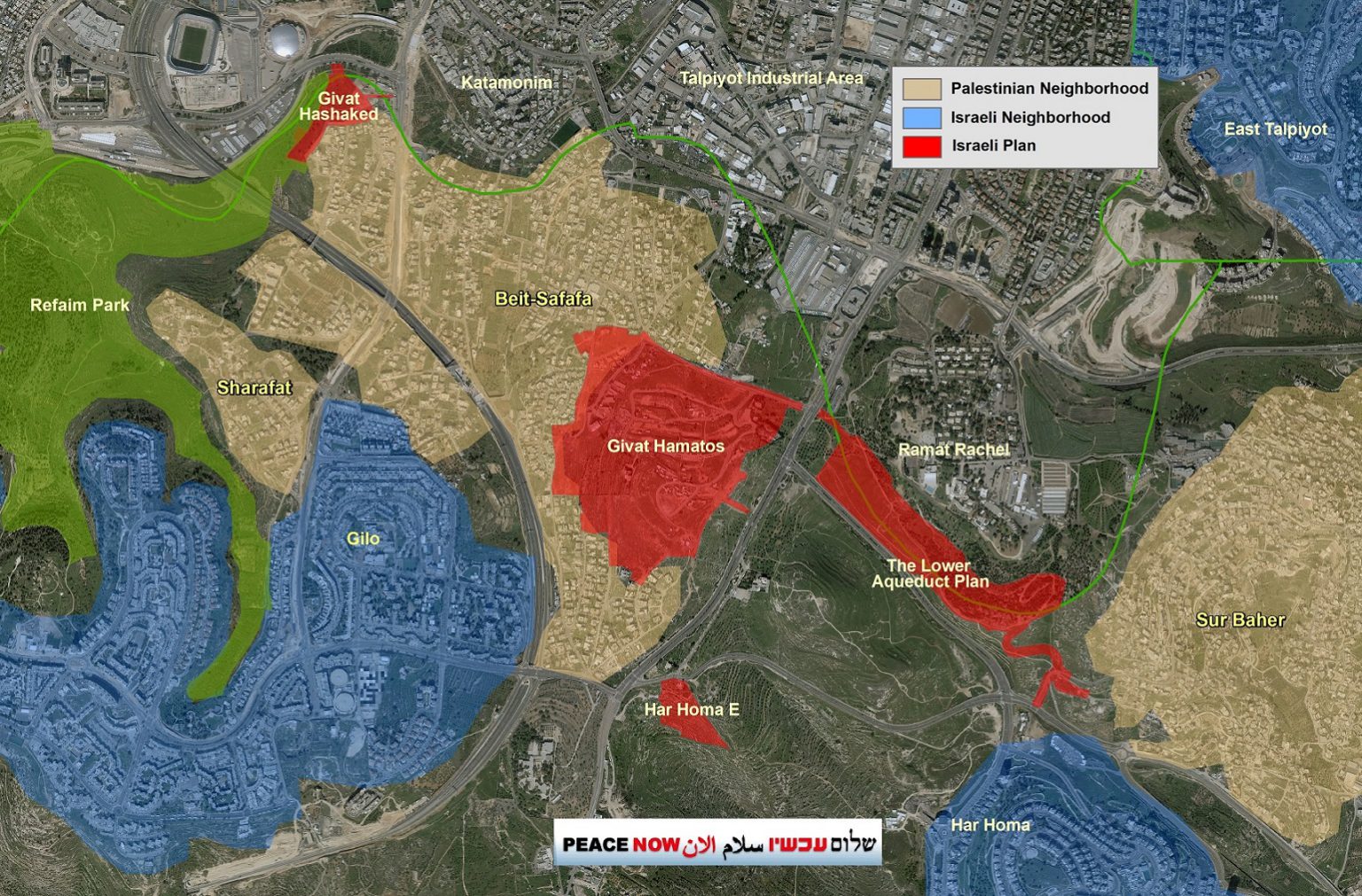 Peace Now reports that the Israeli Housing Ministry has published a tender for the construction of 1,047 settlement units constituting a new settlement in East Jerusalem called the Lower Aqueduct” plan. The settlement will be located on a sliver of land located between the controversial settlements of Givat Hamatos and Har Homa in East Jerusalem, adjacent to the Palestinian neighborhood of Umm Tuba and fall on both sides of the 1967 Green Line. The settlement is designed to connect the two settlements and seal East Jerusalem off from Bethlehem, and in so doing establish a huge, uninterrupted continuum of Israeli settlements on the southern rim of Jerusalem. According to Ir Amim, this is the first major new East Jerusalem settlement established by Israel since 2012.
Peace Now writes:
“The plan was promoted at an unprecedented speed from its inception to the tender issue: it was placed on the table of the District Planning Committee in July 2021, discussed in January 2022 by the District Committee which ordered revisions to the plan, and was approved for deposit in July 2022. That is, the tender was issued less than three years after the plans were submitted.
Politically, this is a strategic plan that will severely impact the possibility of a continuous urban Palestinian connection in East Jerusalem. In practice, the plan blocks the last corridor remaining for connecting Beit Safafa and Sur Baher with other parts of East Jerusalem. It should be noted that although about half of the plan’s area is beyond the Green Line, and half within it, its strategic location between Givat HaMatos and Har Homa makes it particularly problematic politically.”
Ir Amim has previously written:
“This plan carries serious ramifications on the political future of Jerusalem. If constructed, it will extend the Israeli settlement wedge along East Jerusalem’s southern border, further creating a sealing-off effect of East Jerusalem from the southern West Bank, while fracturing the Palestinian space and depleting more vacant land for Palestinian development….Beyond its geopolitical ramifications, the advancement of this plan underscores the systematic discrimination implicit in Israeli planning and building policy in Jerusalem. Since the beginning of 2023, over 18,500 housing units have been advanced for new or existing Israeli settlements in East Jerusalem, while residential development for Palestinians has been all but neglected. This is despite the fact that Palestinians constitute nearly 40% of Jerusalem’s population. 2023 is slated to join 2022 as being the two years with the highest number of settlement units advanced in the last decade in East Jerusalem. Such inequitable urban planning policy has long served as a driver of Palestinian displacement in service of solidifying a Jewish demographic majority in Jerusalem and further cementing Israeli territorial control to foil prospects for a just political resolution.”
Ir Amim & Bimkom: Israel Has Accelerated East Jerusalem Settlement Building Since Oct 7th
The Israeli anti-settlement NGOs Bimkom and Ir Amim have released a joint report reviewing the Israeli government’s wartime policies and how they have led to the acceleration of both settlement activity and home demolitions, posing an ever increasing threat to the rights and futures of Palestinian residents.
The report reads:
“Since the outbreak of the war six months ago, there has been a major surge in the promotion and fast-tracking of new settlement plans in East Jerusalem and a dramatic spike in the rate of demolitions of Palestinian homes. The Israeli government is clearly exploiting the war to create more facts on the ground to predetermine the final status of Jerusalem and thwart all prospects for a negotiated political agreement, while forcibly displacing Palestinians from their homes and the city.
Measures are being taken to establish eight brand-new settlements in East Jerusalem within or adjacent to Palestinian neighborhoods with a total of over 12,000 housing units. For details and analysis of these plans, click here or above for the full policy brief.
In juxtaposition to this major uptick in the advancement of new settlements, demolitions of Palestinian homes have reached unparalleled levels since the start of the war. This serves as a form of collective punishment and part of a series of repressive measures currently being employed by Israel against Palestinians under its control. Between October 7, 2023—March 10, 2024, 98 homes were demolished, which marks a nearly two-fold monthly increase compared to the period preceding the war. (Demolitions were halted during the month of Ramadan as in the past).”
Ben Gvir Seizes Authority Over East Jerusalem Housing Demolitions
On April 8th, the Israeli Cabinet decided to hand extremist minister Ben Gvir power over demolitions and housing enforcement in East Jerusalem. The CAbinet’s decision moved the Real Estate Enforcement Division from the Finance Ministry to the Ministry of National Security, which is controlled by Ben Gvir. The Real Estate Enforcement Division has the power to enforce against illegal construction in East Jerusalem and conducts demolitions and imposes fines alongside the Jerusalem municipality’s Building Supervision Department. It is important to note that the rate of demolitions in East Jerusalem during the Gaza war and in 2023 overall was higher than in other months or years, and it seems that transferring authority to Ben Gvir will only exacerbate this trend.
Daniel Seidemann, founder of Terrestrial Jerusalem, explained on X:
“In the eyes of the Palestinians in East Jerusalem, home demolitions are the most brutal & egregious manifestations of Israeli occupation. W/the exception of real or perceived threat to Al Aqsa, no issue in Jerusalem is more volatile & more incendiary than home demolitions. As per yesterday’s Cabinet Resolution, very broad powers will now be vested in Ben Gvir and an Authority or which he is responsible. these include administrative demolition orders, cease work orders, execution of judicial demolition orders, and much more. Ben Gvir has repeatedly declared his intent to carry out large scale home demolitions, particularly in E. Jerusalem. He then was opposed by the Police Chief, who now does his bidding. Ben Gvir has already expedited demolitions. However Ben Gvir had a problem: he had absolutely no statutory power in relation to demolitions. The role of the Police was to secure the demolitions ordered by the Jerusalem Municipality or Government of Israel (incl. judicial bodies). Bravado aside, he was a spectator.All that changed yesterday by means of the Cabinet Resolution. Having declared his intent “to show the Arabs of East Jerusalem who’s boss” by carrying out large scale demolitions. He will now have all the statutory powers and resources necessary to make good on his promise.”
Peace Now said in a statement:
“It has been unequivocally proven that law enforcement authorities under the responsibility of Itamar Ben Gvir exacerbate tension, violence, and hatred between the state and its citizens. The Real Estate Enforcement Division should operate with integrity and profound sensitivity to our political and social reality. However, it is highly doubtful that this will occur under the authority of Itamar Ben Gvir, the Minister of National Insecurity, who has previously been convicted of inciting racism and supporting a terrorist organization.”
New Plan to Massively/Strategically Expand the Ariel Settlement Industrial Zone
Peace Now reports that the Israeli Civil Administration’s High Planning Council convened on April 10th to consider 26 settlement plans, the most consequential of which is a plan to significantly expand the Ariel settlement industrial zone. This plan proposes to significantly expand the industrial zone eastward toward the new Ariel West settlement, which just began construction, connecting the two for all practical purposes.
Peace Now further explains the consequences of this plan:
“Expanding the industrial area eastward, on the one hand, and the establishment of the planned settlement of Ariel West, which infrastructure works for its establishment have recently begun, on the other hand, are intended to create a territorial continuum of settlements that will effectively block any possibility of development for Palestinian communities in the vicinity, including Salfit, Harres, and Kifl Harres. The plan essentially disconnects Salfit – the district town from the surrounding villages it serves.”
It’s worth revisiting the role settlement industrial zones play in perpetuating ISraeli occupation, annexation, and apartheid. For decades Israel has used industrial zones as another tool to expand and deepen control over West Bank land and natural resources. Industrial zones are part of Israel’s economic exploitation of occupied territory (including the local workforce, land, and other natural resources). Presented as benefiting both Israelis and Palestinians, it is in fact Orwellian to label such initiatives as “coexistence” programs, or to suggest that they offer the Palestinians benefits they should welcome. Importantly, jobs in industrial zones – often the only jobs available for Palestinians living under an Israeli occupation that prevents the development of any normal Palestinian economy – are widely viewed by Palestinians as a double-edged sword. The NGO Who Profits explained:
“Israeli Industrial Zones constitute a foundational pillar of the economy of the occupation. They contribute to the economic development of the settlements, which are in violation of international law and the Fourth Geneva Convention, while relying on the de-development of the Palestinian economy and the exploitation of Palestinian land and labor…The Industrial Zones in the oPt form part of a practice of ‘financial annexation’ which is an essential component of the broader policy of annexation taking place.”
Peace Now said in a statement:
“The government of Israel continues to build at an unprecedented pace in the Occupied Territories. Expanding an industrial area in the heart of the West Bank is not an Israeli interest, and certainly not a Palestinian interest. The industrial area west of Ariel does not promote economic growth, but rather harms both the Israeli and Palestinian economies alike.”
Smotrich Designates Symbols for Four Outposts Previously Approved for Retroactive Legalization
On April 6th, Finance Minister Smotrich (who also heads the Settlement Administration and a minister in the Defense Ministry) issued a statement announcing that he has designated “locality symbols” to four outposts that the government has previously approved to be retroactively legalized as new settlements: Mitzpe Yehuda, Beit Hogla, Shacharit, and Asa’el.
Peace Now explains:
“A ‘locality symbol’ is a serial number assigned by the Ministry of Interior to each official Israeli locality. For the government to allocate funds and resources for settlement development or to prepare construction plans, a settlement must have a “locality symbol.” Smotrich’s announcement aims to bolster his standing among his supporters as someone who does a lot for the settlements. Therefore, he exploits a bureaucratic maneuver and tries to present it as a new achievement.
The significance of assigning locality symbols to these four new settlements is that the government bureaucracy has already begun working to promote these settlements. It should be noted that since the government’s decision in February to establish nine new settlements, the commander of the military’s Central Command, Maj. Gen. Yehuda Fuchs has issued orders in recent months defining the jurisdictional areas of six of them: Mishmar Yehuda, Givat Haroeh. Apparently, defining the jurisdictional area of the remaining three settlements is delayed due to land ownership issues.”
The U.S. & E.U Unveil New Sanctions Targeting Settlers & Settler Entities
On April 19th the United States Department of State announced a third round of sanctions targeting one Israeli settler and two settler entities. The European Union announced sanctions on the same day, against four settlers and two settler entities. This round of sanctions is particularly notable because it expands the sanctions’ targets to include entities which fund settlers involved in violence, and because it targets a prominent political ally and confidant of Itamar Ben Gvir.
The U.S. sanctions target:
- Ben Zion (Bentzi) Gopstein – founder of the radical, violent Lehava settler organization, and “one of the closest confidants” of Kahanist Minister Itamar Ben Gvir. The U.S. State Department says that Lehava and its members “have been involved in acts or threats of violence against Palestinians, often targeting sensitive or volatile areas.” Gopstein was convicted in early 2024 for incitement to racism
- The Mount Hebron Fund – an organization leading a fundraising campaign for Yinon Levi, an Israeli settler previously sanctioned by the U.S. The U.S. group DAWN writes that the crowdfunding campaign had the declared intention of bypassing US sanctions. The AP reports the fundraising effort raised $140,000.
- Shlom Asiraich – an organization leading a fundraising campaign for David Chai Chasdai, an Israeli settler previously sanctioned by the U.S.. The AP reports the fundraising effort raised $31,000.
The European Union sanctions target:
- Lehava – the organization run by Ben Zion Gopstein (who the U.S. sanctioned as an individual, but did not sanction Lehava).
- The Hilltop Youth settler organization – a notoriously violent group based out of the Yitzhar settlement and involved in establishing illegal outposts throughout the West Bank. The Hilltop Youth have been called “the Jewish ISIS,” and regularly engage in violence against Palestinians, Israeli authorities, and activists.
- Neriya Ben Pazi – who was previously sanctioned by the U.S..
- Yinon Levi – who was previously sanctioned by the U.S..
- Meir Ettinger – who is the grandson of the late, extremist rabbi Meir Kahane, and a well-known leader of the Hilltop Youth leader.
- Elisha Yered – who previously served as a spokesperson for MK Limor Son Har-Melech, an ally of Ben Gvir.
Itamar Ben Gvir responded to the new sanction, saying:
“The harassment of the Lehava organization and dearest settlers, who never engaged in terrorism or harmed anyone, are the result of a blood libel by Israel-hating, antisemitic elements who for years have openly supported Hamas, Fatah, and other anarchist organizations that harm IDF soldiers.”
Bonus Reads
- On Settler Terrorism:
- “West Bank sees biggest settler rampage since war in Gaza began as Israeli teen’s body is found” (AP)
- “Al-Haq, Al Mezan and PCHR Urge the International Community to Intervene as Israeli Forces and Settler Violence Intensifies Across the West Bank” (read)
- “Homes burned, animals killed: Palestinians describe Israeli settler rampage” (Washington Post)
- “Israel Responsible for Rising Settler Violence” (Human Rights Watch)
- “Opinion | Dear President Biden, Are You Okay With Israeli Settlers Using American Weapons?” (Amira Hass in Haaretz)
- “Blinken Is Sitting on Staff Recommendations to Sanction Israeli Military Units Linked to Killings or Rapes” (Pro Publica)
- “Blinken says he’s made ‘determinations’ linked to human rights accusations against Israel” (The Times of Israel)
- “Ben Gvir forms police team targeting left-wing activists in the West Bank” (The Times of Israel)
- “Editorial | Goodbye, Green Line: The Israeli Government Goes All Out to Boost West Bank Settlements” (Haaretz Editorial Board)
- “Housing, Showers, Electricity: These Are the Outposts the Israeli Army Is Building in the Heart of Gaza” (Haaretz)
Welcome to FMEP’s Weekly Settlement Report, covering everything you need to know about Israeli settlement activity this week.
To subscribe to this report, please click here.
February 16, 2024
- Tenders Issued for Construction in Geva Binyamin and Karnei Shomron Settlements, Bringing 2024 Total to 523 Tenders
- Hebron Settler Council Launches Crowdfunding Campaign for U.S.-Sanctioned Settler & His Illegal Outpost
- New Outpost Near the Tekoa Settlement
- Israel Has Expedited East Jerusalem Settlement Planning & Home Demolitions in Wake of October 7th
- Israel to Pay Immigrants $550/Month to Move to Settlements
- East Jerusalem Cable Car Project Stalled as Israel Looks for Construction Company
- Settler Population Grew By 3% in 2023
- B’Tselem Details “Extreme Restrictions” on 2023 Olive Harvest
- Peace Now Launches New Settler Violence Hotline
- Israel to Buy 200 Armored Vehicles for Civilan Standby Units, Including in Settlements
- Israel Spying on U.S.-PA Settler Violence Channel
- News & Analysis of Sanctions on Settlers
- Bonus Reads
Tenders Issued for Construction in Geva Binyamin and Karnei Shomron Settlements, Bringing 2024 Total to 523 Tenders
Peace Now reports the Israeli Ministry of Housing published tenders on February 9th for the construction of 60 new settlement units, 12 new units in the Geva Binyamin settlement and 48 in the Karnei Shomron settlement, located in the northern West Bank, east of the Palestinian village of Qalqilya. Israel has openly declared its intention to continue expanding settlements in this area with the stated goal of bringing 1 million settlers to live in the area.
These tenders come just five days after the publication of tenders for 62 new units in the Efrat settlement.
So far in 2024, the Israeli government has issued tenders for the construction of 523 new settlement units in a total of eight settlements.
Peace Now said in a statement:
“The rapid pace and widespread scope of tender publications indicate a clear policy aimed at promoting extensive construction in the West Bank. The Israeli government is capitalizing on the international focus on the Gaza Strip to further entrench Israeli control deep in Palestinian territory, hindering the possibility of a two-state solution.”
Hebron Settler Council Launches Crowdfunding Campaign for U.S.-Sanctioned Settler & His Illegal Outpost
Peace Now reports that the settler municipal body in Hebron (the Har Hevron Regional Council) has launched a crowdfunding campaign to assist Yinon Levy and the illegal outpost he established (“Meitarim Farm”). The campaign was launched in response to the U.S. sanctioning Levy, who is purported to have engaged in violence against Palestinians in the West Bank that lead to the forcible displacement of four nearby Palestinians communities (approximately 300 people).
Peace Now makes the important point:
“The settlers on whom sanctions were imposed are not the story. Behind every violent settler lies an entire governmental system that supports and funds them. Settler violence is not an isolated incident but rather a part of an organized and financed strategy by the authorities to dispossess Palestinians of their lands in the Occupied Territories, and to undermine any potential political solution.”
Proving that point, the Har Hevron Regional Council’s commitment to Levy and his illegal outpost runs deep. In 2021 a coporation owned by the the municipality awarded Levy a contract to establish the outpost as an agricultural farm and to explicitly take control of the whole area. The contract states [emphasis added]:
“The Directorate wants the farmer to establish an agricultural farm … that will maintain a presence in the lands of the area and thus help to preserve the state’s lands and the seizure and preservation of the surrounding lands … The farmer will establish on the farm… a corral for the herd and housing residences near it and necessary additional facilities.”
New Outpost Near the Tekoa Settlement
Haaretz reports that settlers have undertaken a large-scale project to establish a new outpost near the Tekoa settlement, located south of Bethlehem. Photos of the outpost show that the land has been cleared, roads established, and power lines have been installed. A total of six trailers have been moved to the site already. A Defense source told Haaretz that it is “doubtful that the government will evacuate the outpost, which was built on state-controlled land.”
Israel Has Expedited East Jerusalem Settlement Planning & Home Demolitions in Wake of October 7th
Ir Amim and Bimkom jointly report that Israel has led a “stark rise” in home demolitions in EAst Jerusalem since October 7th and the start of Israel’s latest war on Gaza. The groups write:
“As the war rages on in Gaza, claiming the lives of tens of thousands of Palestinians and displacing nearly two million, Israel adds to the conflagration by accelerating demolitions across East Jerusalem. The recent home demolitions in al-Walaja are part of a major surge in demolitions in East Jerusalem since the start of the Israel-Hamas war, which has likewise profoundly impacted the community of Al Bustan, Silwan. Yesterday, the home of community leader and well-known activist, Fakhri Abu Diab, was demolished despite ongoing negotiations with the Jerusalem municipality and strong international outcry. Some 100 homes in Al Bustan are at risk of mass demolition with over 1500 Palestinians under threat of displacement due to Israeli plans to establish an Israeli tourist and archaeological park in the area
Since October 7, there has been a total of 94 demolitions in East Jerusalem, 63 of which were homes. This marks a nearly 70% increase in demolitions compared to the months preceding the war. Moreover, expected changes in the government ministry responsible for the National Enforcement Unit are likely to cause an even more dramatic rise in demolitions. According to recent news reports, on Sunday, the government is slated to approve the transfer of the National Enforcement Unit from the Ministry of Finance to the Ministry of National Security, placing it under the direct authority of ultranationalist and far-right Minister Itamar Ben Gvir. The transfer of the unit was included in coalition agreements during the formation of the government last year. Over the past year, Ben Gvir has made numerous statements calling for the intensification of demolitions. Such a move is cause for extreme alarm and will directly impact areas of East Jerusalem, including al-Walaja.”
While home demolitions are surging, so too are the advancement of settlement plans. Haaretz has fresh reporting on how Israel is expediting plans to build new settlements across Jerusalem, including Nofei Rachel, Givat HaShaked, Umm Lysoon, and Kidmat Zion. The article surveys the planning processes advancing these plans, including the secret land registration and settler interests involved.
Israel to Pay Immigrants $550/Month to Live in Settlements
The Israeli government announced plans to offer heightened financial incentives to new immigrants who settle in the West Bank, along with areas in the country’s northern and southern peripheries. The plan estimates a $19 million cost to provide $550/month for two years to new immigrants choosing to live in settlements or in the periphery areas, as compared to $100-$200/month for new immigrants living in central Israel or Haifa. These funds are dedicated to subsidizing housing costs.
The plan was announced on February 15th at a joint press conference held by Immigration and Integration Minister Ofir Sofer and Finance Minister Smotrich, who holds immense power in the West Bank in his role as a minister in the Defense Ministry with virtually unchecked authority of Area C civilian matters.
East Jerusalem Cable Car Project Stalled As Israel Looks for Construction Company
Haaretz reports that the Israeli government has struggled for 8 months to secure a qualified (and therefore foreign) construction company to build the settler-backed cable car project. Several companies have pulled out of consideration due to the political sensitivities invovled.
As a reminder, the Jerusalem cable car project is an initiative backed by the powerful, state-backed Elad settler group and advanced by the Israeli Tourism Ministry.
Emek Shaveh and other non-governmental organizations, including Who Profits and Terrestrial Jerusalem, have repeatedly challenged (and provided evidence discrediting) the government’s contention that the cable car will serve a legitimate transportation need in Jerusalem, and have clearly enumerated the obvious political drivers behind the plan, the archeological heresies it validates, and the severe negative impacts the cable car project will have on Palestinian residents of Silwan.
Despite lacking a qualified construction firm, Israel has already proceeded to issue 17 orders confiscating privately owned Palestinian land in highly sensitive East Jerusalem neighborhoods to prepare for the construction of the cable car line. Attorney Sami Arshid, who represents the Palestinian residents of Silwan, told Haaretz:
“This is the most unnecessary project in the history of the city. The residents of Silwan and the Old City, like most experts in Israel and around the world, see it as a serious hazard to the city’s urban heritage. The expropriation of properties and homes will cause severe harm to the residents and this in order to establish a megalomaniacal project that harms the history, urban heritage and landscape of the Old City of Jerusalem and its environs.”
Emek Shaveh told Jerusalem:
“The cable car is a political project that lacks feasibility and professional justification. Its goal is to strengthen [Jewish] settlement in Silwan and bring tourists to sites run by Elad. A year and a half after the High Court of Justice rejected petitions against the project, a tender has yet to be published, and now it turns out that even commercial companies whose sole purpose is to make money understand that they are better off staying away from this project. At a time when the State of Israel is facing huge deficits, we say frankly that this is a harmful and superfluous project that should be scrapped, the sooner, the better.”
Settler Population Grew By 3% in 2023
A pro-settler organization released data showing that the West Bank settler population increased by nearly 3% in 2023 (not including East Jerusalem). The population now stands at 517,407.
The report also forecasts “excellerated growth” in the aftermath of October 7th, claiming that “Serious cracks have indeed developed in the wall of opposition to Jewish settlement of the West Bank.”
B’Tselem Details “Extreme Restrictions” on 2023 Olive Harvest
In a new report, B’Tselem asserts that Israeli policies restricting the ability of Palestinians to harvest olive trees in the 2023 harvest season has resulted in financial harm to tens of thousands of Palestinian families. Those policies include canceling the allocation of harvest days to farmers whose land falls in Area C (access to which is regulated by the IDF), the closure of gates in the separation barrier that permit Palestinians to access their land in the “seam zone” (the IDF is solely able to open theses gates), and – of course – unmitigated settler violence.
B’Tselem writes:
“The systemic obstruction of the olive harvest this year, augmented by organized settler violence against harvesters and their property, is not unique to this time of war. It is part of Israel’s longstanding violent policy, which aims to cement the apartheid regime in the West Bank and allow continued expansion of settlements. Bezalel Smotrich, who serves as Minister of Finance and Minister in the Ministry of Defense, and MK Tzvi Sukkot, Chair of the Knesset Subcommittee on Judea and Samaria Affairs, have already said “sterile security spaces” should be created near settlements, where Palestinians would be denied entry altogether. This would clear the way for the state to take over this land and use it for its own purposes. “
Peace Now Launches New Settler Violence Hotline
Peace Now and Looking Occupation in the Eye have launched a dedicated hotline for Palestinians to report instances of settler violence. The groups reported the new initiative to the U.S. and other governments who have recently issued sanctions against four Israeli settlers believed to have participated in violence against Palestinians in the West Bank. A graphic urging people to report instances of violence says, “we will make sure it gets to the right people in the right places.”
Peace Now said in a statement:
“The state is not doing enough against an organized and dangerous attempt to turn the West Bank into a third front. This unequivocally constitutes terrorism and undermines our national interests, yet it is no longer condemned by the Israeli government. We must change the rules and exert all possible pressure. The lawlessness has ended, and those who harm will pay dearly. We will convey the reports to Israel’s friends and allies worldwide.”
Looking the Occupation in the Eye said in a statement:
“For years, we have been active in the occupied territories and have been dealing with terrorism by settlers, complaining to law enforcement authorities but receiving no response. Since October 7th, Jewish lawbreakers have been doing as they please throughout the West Bank, and no one stops them. Like in third-world countries – when a state does not deal with terrorism itself, the big brother across the ocean does it for them. Let’s help stop the process of turning us into a failed, disintegrating, and lawless state.”
Over the past week, many instances of settler violence have been reported on X and in the media. A small sampling includes:
- Settlers from Yitzhar (including the head of security and several wearing IDF uniforms) perpetrated several attacks on February 12th. The IDF was later deployed to the area but no arrests have been made.
- Fifteen settlers were filmed attacking Palestinian property in the village of Asira al-Qibliya on February 12th. Settlers set cars on fire, threw stones, and shooting a Palestinians. Three were injured.
- Settlers were filmed attacking Palestinian property in the village of Madama on February 12th. This followed settlers harassing a farmer and shooting at a tractor.
- Another group of Yitzhar settlers raided the village of Huwara and set cars on fire there.
- On February 11th, 15 settlers were documented throwing rocks and tear gassed at Palestinians near the Bazariya junction. A similar event happened last week as well.
Israel to Buy 200 Armored Vehicles for Civilian Standby Units, Including in Settlements
The JNS reports the Israel Defense Ministry has approved the purchase of more than 200 armored vehicles for civilian “standby units” – including the units based in settlements, the Gaza envelope, and on the Lebanon border. The vehicles will be delivered in the coming months.
Speaking about the purchase, the deputy director of the Defense Ministry said:
“Ordering the security vehicles is another step in the large-scale procurement we are undertaking for the standby squads, which also includes weapons and protective equipment.”
Israel Spying on U.S.-PA Settler Violence Channel
+972 Magazine published a report citing Israeli intelligence sources admitting that Israel is actively spying on reports on settler violence from the the Palestinian Authority to the the Office of U.S. Security Coordinator for Israel and the Palestinian Authority (USSC), with the aim of preventing that information from “developing into sanctions.” A source told +972 that “the Israelis are finding themselves embarrassed. The fact that we are being asked to look for the materials indicates that Israel has no good answers.” The source also said, “we’re working to help refute these allegations, or prevent them from developing into sanctions. The political echelon is concerned that all kinds of international moves will be taken that will force Israel to deal with this issue.”
News & Analysis of Sanctions on Settlers
There was an absolute torrent of news and analysis regarding the U.S. sanctions against four Israeli settlers, which the U.K. and France have replicated.
News/Reporting
- “Scoop: Bibi protests to Biden, criticizes order targeting Israeli settler violence” (Axios)
- “US could target Israel’s Ben-Gvir, Smotrich in latest sanctions” (The Jerusalem Post)
- “Israel Fears Additional Western Countries Will Follow Suit in Sanctioning Violent West Bank Settlers” (Haaretz)
- “Biden urged to include politicians in sanctions on violent Israeli settlers” (The Guardian)
- “France leads EU in sanctioning violent Israeli settlers” (Al-Monitor)
- “France follows UK, U.S. adopting sanctions against 28 ‘violent Israeli settlers’” (i24 News)
Key Analysis
- “Explaining Targeted U.S. Sanctions Under the West Bank Executive Order” (Human Rights First)
- “Palestinians see little solace in Western sanctions against some settlers” (Reuters)
- “Israeli settlements stand in the way of peace. Biden can defund them all” (Michael Schaeffer Omer-Man in The Guardian)
- “Next U.S. Sanctions May Target More Than Just ‘Rogue Elements,’ and Israel Only Has Itself to Blame” (Zvia Bar’el in Haaretz)
- “Biden’s sanctions set ominous precedent for the settlement enterprise” (Shuki Friedman in The Jerusalem Post)
- “The Sleight of Hand in Dismissing Settler Violence” (Michael Koplow for the Israel Policy Forum)
Bonus Reads
- “Israel’s Crackdown on Hebron” (Jewish Currents)
- “Meet the Israelis Who Are Trying to Physically Block the Ethnic Cleansing Unfolding in the West Bank” (Haaretz)
- “The special unit recruiting hilltop youth” (Israel Hayom)
- “Blinken demands investigation into reported killings of U.S. citizens in West Bank” (Washington Post)
- “US investigators visit homes of two Palestinian-American teens killed in the West Bank” (AP)
- “A Fanatical Israeli Settlement Is Funded by New York Suburbanites” (New Lines)
Welcome to FMEP’s Weekly Settlement Report, covering everything you need to know about Israeli settlement activity this week.
To subscribe to this report, please click here.
February 9, 2024
- State Begins Land Registration in the Armenian Quarter, Where Settlers Look to Win
- Tender Issued for Efrat Settlement
- Terrestrial Jerusalem Updates Settlement Tracking Tool
- Peace Now: Final Report on 2023 Settlement Activity
- U.S. Now Requires Countries to Certify Compliance with International Law as Condition for Military Aid
- Israeli Banks Respond to U.S. Sanctions on Four Settlers
- Bonus Reads
State Begins Land Registration in the Armenian Quarter, Where Settlers Look to Win
Ir Amim reports that the government of Israel has recently initiated land registration in the Armenian Quarter of the Old City of Jerusalem, where the state appears to be backing efforts by settlers to take control over a significant portion of land. Elsewhere in Jerusalem, it has become painfully obvious that the State has weaponized the land registration (also called settlement of land title) process to transfer ownership of strategic land wanted for settlement construction into the hands of settlers, thereby fueling the dispossession of Palestinians who have not had access to land registration
The specific tract of land undergoing land title registration proceedings is located in the heart of the Armenian Quarter, and is involved in a disputed land transaction between the Armenian Patriarchate and an Israeli real estate developer believed to be aligned with the Ateret Cohanim settler organization. For a detailed history of events, see Ir Amim’s reporting here.
Terrestrial Jerusalem has previously warned that these events are not a mere land dispute, and:
“are of such consequences as to jeopardize the viability of the Armenian community and the very character of Jerusalem…This purported sale of rights [by the Armenian Patriarchate to the Israeli real estate company] was done without legal authorization, and with the community intentionally uninformed as to what was happening.”
Ir Amim warns:
“Such a move threatens to solidify the company’s attempted seizure of the land and challenge the community’s right of standing to contest the deal. This should be seen within the larger context of state and settler efforts to Israelize the Old City and erode its historically multicultural and multireligious character, including the Christian presence in Jerusalem. Recent threats against the Christian population have been marked by attempted settler takeovers of properties, plans to expand a National Park onto church lands on the Mt. of Olives, and acts of desecration of Christian sites and cemeteries among other incidents of harassment.”
In a June 2023 report, entitled “The Grand Theft,” Ir Amim and Bimkom explain the history of land registration in East Jerusalem, unpacking how the entire legal land ownership situation Palestinian residents of East Jerusalem find themselves in today is an Israeli-imposed “Catch-22”, resulting directly from Israel’s annexation of East Jerusalem in 1967. The report explains:
“Although the lack of settlement of land title procedures has had detrimental consequences for Palestinian communities in East Jerusalem, its renewal carries far worse repercussions. After five years of monitoring the implementation of SOLT [settlement of land title] in East Jerusalem, its alarming nature has become clear. SOLT is being exploited as a new and potent tool of land theft, under the guise of a legitimate legal process to establish Palestinian property rights. It appears to have become the State of Israel’s main method to appropriate more land in East Jerusalem and advance the displacement and dispossession of Palestinians from areas of strategic interest to the State. SOLT is almost exclusively being initiated to finalize ownership rights in existing or planned Israeli settlements, settler enclaves in the heart of Palestinian neighborhoods, areas with state-deemed ‘Absentee Property,’ or property allegedly owned by Jews pre-1948.”
In September 2022, FMEP hosted a podcast with Ir Amim’s Amy Cohen on land registration, which you can listen to (or watch) here.
Tender Issued for Efrat Settlement
Peace Now reports that on February 4th, the Israeli Ministry of Houseing published a tender for the construction of 62 settlement units in the Efrat settlement. The Efrat settlement is located south of Bethlehem, inside a settlement block that cuts deep into the West Bank. Efrat’s location and the route of the barrier wall around it, have literally severed the route of Highway 60 south of Bethlehem, cutting off Bethlehem and Jerusalem from the southern West Bank. The economic, political, and social impacts of the closure of Highway 60 at the Efrat settlement (there is literally a wall built across the highway) have been severe for the Palestinian population.
Peace Now said in a statement:
“Advancing construction deep in Palestinian territory, adjacent to Palestinian population, undermines the chances for the establishment of a Palestinian state alongside the state of Israel and deepens the conflict. The current tender is a clear statement by the Israeli government that settlement construction continues unabated, and any political resolution is far from the goals of this government.”
Terrestrial Jerusalem Updates Settlement Tracking Tool
On February 6th, Terrestrial Jerusalem published an updated version of its detailed table tracking settlement plans in East Jerusalem. In the introduction to the table, Terrestrial Jerusalem writes:
“In recent months, the pace with which settlement schemes have been advancing through the statutory processes that advance them towards final approval and implementation has been frenetic. That pace has been so intense that even those who follow these developments have found it difficult to keep abreast of them. On occasion, significant development goes unnoticed. This in turn makes it more difficult to detect the underlying trends, to prioritize the plans that are most consequential and to identify means of engaging on them.
This report – a table of all of the significant settlement schemes in East Jerusalem that are being currently expedited – aspires to address these challenges. For those who monitor settlement activity with high granularity, it will draw attention to the relevant developments as they occur, accessing the relevant documentation and maps through links in the document. For those who track the settlement issues in East Jerusalem from a wider perspective, the table will serve as a reference, when needed, and allow for an overview of the more general trends that have emerged.
This is not a comprehensive list. We have selected only those town plans that we deem to be consequential in the context of the conflict that grips East Jerusalem. For example, numerous plans for adding stories to buildings in existing settlement neighborhoods are no less illegal than new settlements, but citing these in the current context would merely be a distraction. On the other hand, we do include statutory plans that are settlement-related, but not plans for new settlement units: plans for expanding roads, plans entailing large-scale demolitions of Palestinian homes and national parks are also included, provided that they directly serve the settlement enterprise .”
Peace Now: Final Report on 2023 Settlement Activity
Peace Now has issued a report reviewing the major settlement advancements of 2023, calling it the best year for the settlement enterprise since the Oslo Accords. The report’s key finding are:
- Establishment of new outposts and displacement of Palestinian communities – A record number of 26 new outposts were established during 2023, while 21 Palestinian communities were forcibly displaced from their homes.
- Advancement of construction plans – A record number of 12,349 housing units were promoted in settlements in the West Bank (East Jerusalem excluded).
- The legalization of 15 illegal outposts was advanced.
- Structural and administrative changes towards annexation of the Occupied Territories.
- Development and promotion of roads – Allocation of approximately 3 billion Shekels for roads in settlements, constituting around 20% of the total Israeli road investment.
U.S. Now Requires Countries to Certify Compliance with International Law as Condition for Military Aid
On February 8th, U.S. President Biden issued a new national security memorandum that requires all recipients (with no exception) of U.S. military assistance to submit a written certifications that they are complying with humanitarian and international law, and will cooperate with U.S. humanitarian aid efforts. Specifically for countries which are presently engaged in hostilities, the memo gives a 45-day deadline for those countries to provide these assurances to the U.S., or face the possibility of a suspension in aid. Israel is the largest recipient of U.S. military assistance.
The memo further requires that the White House provide periodic briefings and reports to Congress including “an assessment of any credible reports or allegations that such defense articles and, as appropriate, defense services, have been used in a manner not consistent with international law.” It also requires Congress to receive a formal notification when the measure is waived.
Israeli Banks Respond to U.S. Sanctions on Four Settlers
One week after the U.S. announced sanctions against four Israeli settlers accused of participating in violence in the West Bank, two Israeli banks have followed suit by closing the accounts for each of the designated individuals (reminder, these individuals are sanctioned by the U.S. but are not in Israeli jail or under criminal proceedings in Israel, the U.S. sanctions were announced in large part because the U.S. did not believe Israel was doing enough to prosecute criminal settlers and discourage violence in the West Bank).
In response to outcry against the Israeli banks which close the accounts, the Bank of Israel defended the banks, explaining:
“Banking corporations by virtue of their international activity must establish policies and procedures for the use of international sanctions lists and foreign countries’ national sanctions lists, and for engaging or carrying out actions with entities declared on such lists. Overriding such sanctions regimes can expose banking corporations to significant risks, including compliance risks, money laundering risks and terrorism financing, legal risks and reputation risks. Maintaining the proper management and regular activity of Israel’s banking corporations is necessary for maintaining the regular activity of the economy as a whole, maintaining a proper relationship with the global economy, and finally for the proper functioning of the Israeli economy.”
The U.S. investigative research and advocacy group DAWN issued a call for the U.S. Treasury Department to investigate and possibly sanction several other monetary bodies, including Israeli Bank Leumi, which DAWN discovered to be continuing to service U.S. sanctioned individuals. Notably, the Israeli bank Hapoalim continues to process payments for a crowd-funding campaign explicitly in support of a sanctioned individual and his family. Michael Schaeffer Omer-Man, director of research for Israel-Palestine at DAWN said in a statement:
“If the administration is serious about sanctioning violent Israeli settlers, it should ensure that it creates consequences for the Israeli banks and charities openly defying the sanctions rules. Sanctions against individuals without enforcement against the institutions helping them evade those sanctions only formalizes Israeli impunity.”
Finally, +972 Magazine published an in-depth look at each of the four sanctioned individuals – — David Chai Chasdai, Shalom Zicherman, Einan Tanjil, and Yinon Levi — revealing the failure of Israeli law enforcement against settlers and the far-reaching ramifications of the violence in which these individuals participate.
Bonus Reads
- “Silwan faces escalating home demolitions in fight against messianic settlers” (Mondoweiss)
- “Biden Executive Order on West Bank violence more likely to be used against Palestinians than Israeli settlers” (Mondoweiss)
- “First Settlers, Now Cyber: U.S. Threatens to Cancel Entry Visas for Spyware Makers” (Haaretz)
- “Biden’s Wake-up Call: Reminding Israelis That the West Bank Stands Apart From Israel” (Carolina Landsmann for Haaretz)
Welcome to FMEP’s Weekly Settlement Report, covering everything you need to know about Israeli settlement activity this week.
To subscribe to this report, please click here.
January 26, 2024
- Israel To Advance Plan for New Settlement in East Jerusalem
- IDF Considers Arming Settlers Militia Groups with Anti-Tank Missiles
- More on Settlements In Gaza
- Antiquities Theft in Gaza
- Bonus Reads
Israel To Advance Plan for New Settlement in East Jerusalem
Ir Amim reports that the Jerusalem District Planning Committee will convene on January 29th for a hearing on a plan to build a new settlement enclave in the small Palestinian East Jerusalem neighborhood of Umm Lysoon. At the hearing, the Committee could move to deposit the plan for public review. The plan calls for 450 settlement units to be built on a piece of land in the northern section of Umm Lysoon, abutting the Jabal Al Mukkaber neighborhood. Unsurprisingly, some of the same settlers who are pushing the Umm Lysoon plan not only live in Jabal Al-Mukaver, but have already succeeded in massively expanding the Nof Zion/Nof Zahaf settler enclave in that neighborhood.
Ir Amim explains:
“If constructed, the plan would constitute a major settlement within the heart of Umm Lysoon, which until now has remained untouched from the threat of setter presence or encroachment. As with other East Jerusalem neighborhoods, Umm Lysoon continues to suffer from a severe shortage in housing, public buildings, and basic infrastructure. Instead of promoting residential development to meet the needs of local residents, the plan is rather being advanced to establish a new Jewish settler enclave inside a Palestinian neighborhood on land marked in policy documents for the community’s development…It should be underscored that these settlement plans are being promoted on the remaining land reserves of each community, while ignoring the extreme housing crisis within these neighborhoods. In contrast to its robust residential development for Israelis across the city, the Israeli government continues to abdicate responsibility for providing housing opportunities for Palestinians despite them constituting nearly 40% of Jerusalem’s population.”
 In July 2023, Ir Amim and Bimkom first reported on Israel’s plans to build the new settlement enclave in the Umm Lysoon neighborhood in East Jerusalem, highlighting that the State was simultaneously carrying out land registration for the land where the enclave was designed for. Indeed, the plan for the new Umm Lysoon enclave hinges on the settlers’ work with the State to transfer ownership of the land into the hands of settlers using the land registration process – – which Ir Amim and Bimkom have shown to be a politically-driven tool used by the State to fuel the expansion of settlements across the city.
The land where the new enclave is being planned for has been managed by the Israeli Custodian General, the State body which acts as a caretaker for property abandoned by Israeli Jews as a result of the 1948 war, with the idea that the property will be returned to its original owners. Settlers have worked with the state to secure ownership rights to East Jerusalem land despite having no relation to the previous Jewish owners. Such is the case with the Umm Lysoon land, where the Israeli Custodian General is submitting the plans (even though it does not own the land, just manages it) for the new enclave alongside Topodia LTD, a settler-linked construction company. Topodia managed to acquire ownership of a very small percentage of the land within the enclaves planned borders, but the planning requires the willing participation of the Israeli Custodian General.
IDF Considers Arming Settlers Militia Groups with Anti-Tank Missiles
Haaretz reports that the Israeli military is close to approving a plan that will deliver anti-tank missiles to some of the 700 newly-created settler militia groups across the West Bank, specifically to groups located in isolated settlements close to Palestinian population centers.
The settler militia groups (also referred to as “security units” and “standby squads”) were established in the wake of Hamas’ attack on October 7th, and continue to operate under the authority and supervision of the IDF’s Central Command. So far, these militia units have received a large supply of weapons and munitions, including thousands of pistols, M-16 semiautomatic rifles and machine guns.
More on Settlements In Gaza
The campaign to reestablish settlements in Gaza continues to gain traction in the Israeli political arena. This week, Likud ministers Haim Katz (Tourism Minister) and Miki Zohar (Sports and Culture Minister ) have been vocally encouraging their fellow lawmakers and ministers to attend an upcoming conference entitled, “Only Settlement Will Bring Security”.
In addition to the two Likud ministers, confirmed participants include National Security Minister Itamar Ben Gvir; Minister for the Development of the Periphery, the Negev and the Galilee Yitzhak Wasserlauf; and Heritage Minister Amichai Eliyahu, all from the Otzma Yehudit party. Fellow party members MKs Limor Son Har Melch, Yitzhak Kroizer, Almog Cohen and Zvika Fogel will also attend, the report said. Religious Zionism MKs Moshe Salomon, Zvi Sukkot and Michal Woldiger are also planning to participate. Bezalel Smotrich is not reportedly confirmed as a participant, but has vocally supported the resettlement of Gaza in the recent past.
Pushing back on the increasingly mainstream endorsement of the resettlemetn of Gaza, the Haaretz Editorial Board writes:
“The racist/settler wing of the cabinet, the Knesset, and the public is endangering Israel’s existence. In the name of a zealous, messianic vision, it is knowingly intensifying hatred between the two peoples, distancing any possibility of reconciliation and turning Israel into a pariah in the enlightened world. This is additional proof of the urgent need to hold a general election as soon as possible and oust this disastrous government.”
Antiquities Theft in Gaza
Over the past week there have been reports and documentation from Gaza of IDF antiquity theft. While this is not squarely under the scope of this settlement report, FMEP has long tracked the weaponization of archaeology for the purpose of displacing Palestinians and replacing them with Israeli Jews. See the following reports on the IDF’s recent
- Emek Shaveh: “IDF Invites Israel Antiquities Authority to Gaza following “discovery” of Antiquities Storage Facility.”
- On Facebook, the Israel Antiquity Authority celebrates the “discovery” of an ancient lamp and mortar bowl by IDF soldiers in Gaza, confirming that the treasures have been transferred to Israel.
- “Israeli Forces Display Stolen Gaza Artifacts in Knesset – Reports” (Palestine Chronicle)
Bonus Reads
- “The West Bank economy has been hammered by war“ (NPR)
Welcome to FMEP’s Weekly Settlement Report, covering everything you need to know about Israeli settlement activity this week.
To subscribe to this report, please click here.
January 19, 2024
- Israel to Advance Plan for New Settlement in East Jerusalem, Extending Control of Southern Perimeter
- Settlers Establish Outpost on Privately Owned Land
- Settlers Ask PM to Treat Settlements Like Israel, & Prohibit Palestinian Laborers from Entering
- Bonus Reads
Israel to Advance Plan for New Settlement in East Jerusalem, Extending Control of Southern Perimeter
Ir Amim reports that the government of Israel is promoting plans for a new settlement on the southern slopes of the Sur Baher neighborhood in East Jerusalem. The plan for the new settlement – referred to as “Nofey Rachel” – calls for 650 settlement units built on land that directly borders the boundaries of the recently approved “Lower Aqueduct” settlement plan. Together, Ir Amim explains:
“these two settlements will isolate Sur Baher-Umm Tuba, fracturing it from the Palestinian space around it, inducing Beit Safafa to its northwest and Beit Sahour and Bethlehem in the West Bank to its south. As such, the new plan will extend the Israeli territorial continuum between Har Homa, the Lower Aqueduct, and Givat Hamatos, which further seals off the southern edge of East Jerusalem from Bethlehem and the southern West Bank.”
 The plans for the Nofey Rachel settlement is just the latest proof of Israel’s accelerating efforts to secretly officially register land to settlers and settler organizations, land which the state has exercised custodial management of since 1948, at which time the land was abandoned by Jewish refugees. Under Israeli law, the state is obligated to manage these land parcels and properties in the interest of their original (Jewish) owners until the owners and/or their descendants are located and reclaim the land. Palestinian refugees of war are denied this same right. Ir Amim and Bimkom published a recent report – “The Grand Land Theft” – documenting how settlers and the Israeli state have worked together to deliver these lands – via the settlement of land title process – into the hands of settlers, even though the original landowners have never been located.
Ir Amim explains:
“Similar to the cases in Givat Shaked, Nof Zahav, and Umm Lysoon among others, the settlement of land title (SOLT) process is being strategically promoted on the precise bloc of land (#31786) designated for the new settlement in Sur Baher-Umm Tuba. Based on ongoing monitoring, the process was first initiated in the area in January 2022 and is now in its final stage, just prior to completion, which will lead to the registration of ownership rights in the Tabu (land record). As was the process in the aforementioned areas, the timing suggests that the state and setters are utilizing the land registration procedures to finalize land rights in preparation for advancement of new settlements. This further confirms that the process is being exploited to register land in East Jerusalem in the name of Jews and/or the state for the promotion of settlements, while contradicting the government’s claim that it is intended to promote property rights of Palestinians.”
Settlers Establish Outpost on Privately Owned Land
Peace Now reports that over the past year settlers have illegally uprooted hundreds of olive trees belonging to the nearby village of Qusra, located south of Nablus in the heart of the northern West Bank. In the aftermath of October 7th, settlers sought to fortify their control over the land by moving four prefabricated buildings onto the cleared land (a new outpost) and calling on the IDF to prevent Palestinians from reaching the remaining olive groves close to the settlement and its new outpost. Since then, settlers have undertaken illegal construction to expand and build new access and bypass roads near the settlement, and in December 2023 the IDF blocked off the main entrance to Qusra village.
Peace Now also reports that settlers have begun cultivating new land east of the settlement, which is privately owned land belonging to the Jorish village.
Peace Now said in a statement:
“The isolated settlement of Migdalim is deep within Palestinian territory and poses a barrier to any future political agreement. The government does nothing to stop the ideological settlers who allow themselves to confiscate lands and damage Palestinian property, establishing facts on the ground that not only escalates security tensions in the area but also hinder any political solution between Israel and the Palestinians.”
Settlers Ask PM to Treat Settlements Like Israel, & Prohibit Palestinian Laborers from Entering
Fifty settler leaders penned an open letter to the Defense Minister Gallant and Prime Minister Netanyahu demanding that the severe entry restrictions on Palestinians laborers seeking to cross from the West Bank into Israel for work be extended to apply to Palstinians laborers seeking to enter the settlements for work. The call is for settlements to be treated as the legal equivalent of sovereign Israeli territory, making it not only openly racist but a call for de facto annexation.
At a Knesset meeting last week on this topic, MK Tzvi Sukkot said:
“l do not understand why there is still anyone who thinks that the lives of residents of Judea and Samaria are less important. Specifically in Judea and Samaria, workers are still allowed entry despite a report that 82% of them support terror and are themselves potential terrorists.”
In the immediate aftermath of the Hamas attack on October 7th, Israel banned all West Bank Palestinian laborers from entering Israel and Israeli settlements. In December 2023, the ban was partially lifted under pressure from factory and business owners located in the settlements. Between 8,000 and 10,000 Palestinians were then allowed to resume work in the settlements under enhanced security measures (conditions which treat every Palestinian as a would-be terrorist if not monitored incessantly). More than 150,000 Palestinian laborers worked in Israel proper prior to October 7th, and have not been allowed in since. This is having a massive impact on the West Bank economy, as well as Israeli economy.
Bonus Reads
- “Israel’s Army Drafted and Armed Thousands of Settlers. Accounts of Their Violence Are Piling Up” (Haaretz)
- “Palestinians struggle to rebuild their lives after West Bank settler pogroms” (+972 Magazine)
- “Israeli Wounded in Shooting Near West Bank Settlement, IDF Kills Three Terrorists” (Haaretz)
- “Editorial | Israel’s Settler Government Is Fueling a West Bank Blowup” (Haaretz)
- “Israel Wants a Palestinian Intifada in the West Bank” (Gideon Levy, Haaretz)
- “’On the Brink of Implosion’: Israeli Army Transfers Elite Unit Out of Gaza to West Bank” (Haaretz)
Welcome to FMEP’s Weekly Settlement Report, covering everything you need to know about Israeli settlement activity this week.
To subscribe to this report, please click here.
November 17, 2023
-
- West Bank Stats via OCHA (as of November 16th)
- Settlers Take Over Large Amount of Property in the Armenian Quarter
- Plan for New National Park in East Jerusalem Resurfaces (Mount Scopus Slopes National Park)
- “Lower Aqueduct” Settlement Plan on the Agenda Again
- Israel Opens Huwwara Road for Settlers, While Keeping Palestinians Under Lock Down
- Sheikh Jarrah Eviction Case Postponed
- Accountability as Settlers Terrorize South Hebron Hills
- B’Tselem: H-2 Area of Hebron Suffering Under Collective Punishment
- Bonus Reads
West Bank Stats via OCHA (as of November 16th)
OCHA reports that in the West Bank since October 7th:
- 248 settler attacks against Palestinians have been recorded, resulting in Palestinian casualties (30 incidents), damage to Palestinian-owned property (182 incidents), or both casualties and damage to property (36 incidents). This reflects a daily average of six incidents, compared with three since the beginning of the year. Over one-third of these incidents included threats with firearms, including shootings. In nearly half of all incidents, Israeli forces were either accompanying or actively supporting the attackers.
- At least 143 Palestinian households comprising 1,014 people, including 388 children, have been displaced amid settler violence and access restrictions. The displaced households are from 15 herding/Bedouin communities.
- 186 Palestinians, including 51 children, have been killed by Israeli forces; and an additional eight, including one child, have been killed by Israeli settlers in the West Bank, including East Jerusalem. Four Israelis have been killed in attacks by Palestinians.
- Israeli forces have injured 2,661 Palestinians, including at least 282 children, over half of them in the context of demonstrations. An additional 74 Palestinians have been injured by settlers. Some 33 per cent of those injuries have been caused by live ammunition.
- A total of 48 Palestinians, including 24 children, have been displaced since 7 October following punitive demolitions.
- An additional 135 Palestinians, including 66 children, have been following demolitions in Area C and East Jerusalem, due to lack of permits.
Settlers Take Over Large Amount of Property in the Armenian Quarter
Terrestrial Jerusalem reports that on November 16th a group of settlers guarded by Israeli police entered and took control over several tracts of strategically located land in the Armenian Quarter of the Old City of Jerusalem owned by the Armenian Patriarchate. The settlers assert that the lands were leased to them by the Armenian Patriarchate, a lease the Patriarchate contests the legality of and then formally canceled on October 26, 2023.
The Armenian Patriarchate of Jerusalem issued the following statement on Nov. 16th:
“The Armenian Patriarchate of Jerusalem is under possibly the greatest existential threat of its 16-century history. This existential-territorial threat fully extends to all the Christian communities of Jerusalem.
The Armenian Patriarchate has recently canceled a contract tainted with false representation, undue influence, and unlawful benefits.
Instead of providing a lawful response to the cancellation, the developers attempting to build on the Cow’s Garden have completely disregarded the legal posture of the PAtriarchate toward this issue, and instead have elected for provocation, aggression, and other harassing , incendiary tactics including destruction of property, the hiring of heavily armed provocateurs, and other instigation.
In recent days, the cast destruction and removal of asphalt on the grounds of the Armenian Quarter have been done without the presentation of permits from the municipality by neither the developer nor the police. Despite this fact, the police have chosen in the last few days to demand that all the members of the Armenian Community vacate the premises.
We plead with the entirety of the Christian communities of Jerusalem to stand with the Armenian Patriarchate in these unprecedented times as this is another clear step taken toward the endangerment of the Christian presence in Jerusalem and the Holy Land”
Rumors of this sale first surfaced in 2021, but it wasn’t until June 2023 the details of the sale were publicly reported. At the time, the Associated Press reported that the Armenian Orthodox Church signed a 99-year lease giving several church properties in the Old City of Jerusalem to an Australian-Israeli businessman, Danny Rothman (sometimes referred to as Danny Rubenstein). The lease reportedly includes the Hadiqat Al-Baqar (The Cows’ Garden) and its surrounding properties, including the Qishla building in Bab al-Khalil (Jaffa Gate), located in the Armenian Quarter. In total,
In June 2023, settlers placed a sign on one of the tracts saying the land is the property of Xana Capital, the company which Danny Rothman owns. According to a bishop involved in the sale, Rothman and his business Xana Capital plans to develop the land into a luxury resort managed by a Dubai-based company.
The Armenian Archbishop, Nourhan Manougian, alleged that the Church’s real estate official and priest – Baret Yeretsian – sold the land in a “fraudulent and deceitful” deal that he was unaware of. Yeretsian, in turn, said he carried out the deal at the direction of Manougian. Both Manougian and Yeretsian have been forced into hiding due to communal outrage.”
Terrestrial Jeruslame’s Danny Seidemann stresses the active role of the Israeli government in collaborating with settlers to take control of these properties, as in the case of other settler takeovers across the Old City. He writes.:
“We have seen this pattern all too often. In the past, both distant and recent, settlers succeeded to take over strategically located Church sites of great historical, religious and cultural value. These include enormously important Greek Orthodox properties only meters away: the Imperial and Petra Hotel at Jaffa Gate, the St. John’s Hospice in Muristan, adjacent too the Church of the Holy Sepulcher, etc…
The most important aspect is the least visible: the location suggests that this property has been singled out, and is likely an integral part of an ambitious and highly consequential Government plan. For many years, and under the radar, the Government of Israel has been implementing projects to encircle the Old City w/ Biblically motivated settlements and settlement-related projects: a planned Israeli National Park over the Christian holy sites on the Mount if Olives, a cable car from West Jerusalem to the settler headquarters n Silwan, the opening of an Israeli Night spot at the entrance to the Christian Quarter at New Gate, etc. are just a few, of the prominent examples. There are dozens more. More than a billion sheqels have been invested in this Government project. Its goals are to encircle the religious, historical and cultural core of Jerusalem with settlement enclaves, and projects that will etch the Biblically motivated settler narrative into the landscape and urban fabric.
This is no mere “bad thing”. The Government plan will radically undermine the character of Jerusalem, fragmenting Palestinian Jerusalem and marginalizing the already challenged Christian presence in the city. This is so impactful, that one prominent Christian cleric cautioned that the tome is not far off when Jerusalem will no longer be hospitable to Christians.”
Plan for New National Park in East Jerusalem Resurfaces (Mount Scopus Slopes National Park)
Ir Amim and Bimkom jointly report that the Israeli government appears to have renewed its efforts to designate the open area between the Palestinian neighborhoods of al-Isawiyyah and a-Tur in East Jeruasalem as a new national park, called the Mount Scopus Slopes National Park.
Ir Amim and Bimkom explain:
“The plan aims to turn the large vacant space between the aforementioned neighborhoods into a national park, which would extend eastward from Hebrew University towards the edge of the city and the E1 corridor. This will severely limit proper development of both neighborhoods, including the ability to adequately expand, which is essential. In addition, a large national park in this location would contribute to Israeli territorial contiguity between Jerusalem and the E1/Maaleh Adumim area. It will likewise serve as a form of touristic settlement, which increases Israeli control over more land and fractures the Palestinian space in the city.
The designation of areas as national parks and/or green spaces is a common practice in East Jerusalem used to alter the character of the space, fragment the Palestinian environs, and suppress urban planning, while enabling the seizure of their lands for Israeli interests.”
“Lower Aqueduct” Settlement Plan on the Agenda Again
Ir Amim reports that the JErusalem District Planning Committee is scheduled to meet on November 21st to discuss objections submitted against the “Lower Aqueduct” settlement plan, located in East Jerusalem. This plan would see a new settlement of 1,465 units built on a sliver of land located between the controversial settlements of Givat Hamatos and Har Homa – and is intended to connect the two. In so doing, it will establish a huge, uninterrupted continuum of Israeli settlements on the southern rim of Jerusalem, and will destroy Palestinian contiguity between the West Bank and East Jerusalem. For more background on the Lower Aqueduct plan, see resources by: Terrestrial Jerusalem and Ir Amim.
Adding insult to injury, two years ago the Jerusalem Municipality and the Ministry of Jerusalem Affairs initiated a plan to build a new Palestinian business center in the precise area targeted by the “lower aqueduct” plan, as part of an Israeli government initiative to reduce poverty in East Jerusalem. The Jerusalem Municipality subsequently abandoned the plan for the Palestinian business center under pressure from settlers, specifically from the Har Homa settlement which borders the area. Ir Amim comments:
“Not only is this yet another example of severe planning discrimination, but construction of this new neighborhood will serve to further create Israeli territorial contiguity along East Jerusalem’s southern perimeter while depleting more land reserves for Palestinian development.”
Peace Now notes that the majority of the land on which the new settlement will be built (half of which is in East Jerusalem and half in West Jerusalem) is privately owned, or managed by the Israeli Custodian General. Although recent reporting suggests the Custodian General is moving to advance settlement construction on lands it manages across East Jerusalem, its legal ability to do so is questionable (and doing so has historically not been its practice).
Israel Opens Huwwara Road for Settlers, While Keeping Palestinians Under Lock Down
Peace Now reports that the first section of the Huwara Bypass Road – near Nablus – opened for vehicular traffic on Sunday, November 12, 2023. Settlers – along with Bezalel Smotrich, who is effectively the governor of the West Bank – have pressed for this road to open for settlers since before the October 7th attacks. With the opening of the Huwara Bypass road, settlers now have exclusive use of two highways in the area, while Palestinans do not have access to either one.
The Huwwara Bypass Road is designed for residents of Nablus-area settlements to bypass the Palestinian village of Huwwara (which is an area with heavy traffic congestion from daily commuters), in order to more easily/directly access Jerusalem. This bypass road has long been a top priority for the settlers, who have complained about the long commute to Jerusalem and the limits this puts on the potential for growth of Nablus-area settlements. Building the road also gained urgency for the settlers after the release of the Trump Plan’s conceptual map, which left the area where the road is slated to be built within the borders a future Palestinian “state.” On October 6th (the day before Hamas’ heinous massacre of civilians in the south of Israel), Smotrich and settlers pressed for the road to be completed and opened after a spate of Palestinian attacks on Israeli persons and cars in the area.
Peace Now reports:
“Despite the ongoing war, the government is investing considerable efforts to open the road quickly, and construction continued even during the Gaza war, despite interruptions in other building and infrastructure projects during this period. The road’s trajectory required the confiscation of private Palestinian lands from the villages of Burin, Huwara, Beita, Awarta, Yasuf, Yatma, and A-Sawiya. The old Huwara Road, which until recently served both settlers and Palestinians, has been a central artery for Palestinian traffic from the Nablus area to Ramallah and southern West Bank. The road has been closed to Palestinian traffic since the beginning of the war. The Central Command Chief decided to reopen the road to Palestinians in parallel with the opening of the bypass road. However, settlers opposed its reopening, arguing that the old Huwara Road should also serve as a secure passage only for settlers. Eventually, the old Huwara Road was reopened to limited Palestinian traffic only on the evening of Sunday, November 12, 2023.”
Sheikh Jarrah Eviction Case Postponed
FMEP has been informed that the Israeli Enforcement and Collection Authority (ECA) has postponed its discussion of the eviction of the Salem family from their home of 60+ years in the Umm Haroud section of Sheikh Jarrah, which was scheduled for November 14th. The Salem family is one of approximately 40 Palestinian families under threat of forcible displacement by settlers from the Um Haroun section of Sheikh Jarrah.
The Salem family has been fighting efforts by settlers to evict them from their home since 1988. The individuals behind the years-long effort to evict the Salem family are Yonaten Yousef, a Jerusalem city councilmember, and former deputy mayor of Jerusalem Aryeh King. Yousef and King claim to have bought the house from the Jewish family that owned it before 1948 — based on an Israeli law known as the Legal and Administrative Matters Law of 1970. This law provides Jewish Israelis the right to “reclaim” properties lost in the 1948 War. In contrast, under Israeli law the Salem family lacks any legal basis to claim both its home in Sheikh Jarrah – where the family has lived since being displaced from their home inside the Green Line during the 1948 War – or to their original home inside Israel, which they lost in the 1948 War (Israel law recognizes no such property claims by Palestinians who fled or were otherwise absent from the areas that became Israel in the course of that war)/.
In February 2022 the Jerusalem Magistrate Court froze an impending eviction of the Salem family based on the family paying the court a $7,700 “guarantee”. Around that same time the Israeli government seized a piece of the Salem property, located adjacent to the home that is now under demolition threat. Itamar Ben Gvir (who is now serving as the National Security Minister, with authority over demolitions in East Jerusalem) subsequently set up a tent on that seized property and called it his parliamentary office – a deliberate provocation.
For further background on the Salem family’s case (including on the Israeli laws that were expressly designed to enable the eviction of Palestinians in favor of settlers), see reporting by Ir Amim and Peace Now.
Accountability as Settlers Terrorize South Hebron Hills
The intensification of settler terrorism and displacement efforts in the South Hebron Hills has continued to escalate. The Association for Civil Rights in Israel wrote an urgent appeal to the head of the IDF, calling for the IDF to intervene on behalf of Palestinians. Citing many specific incidents, ACRI writes:
“settlers living in outposts in the South Hebron Hills, have presented themselves in Palestinian communities dressed in military uniforms, sometimes masked, and intimidated residents, violently attacked them, damaged property and even ordered them to leave their homes.”
B’Tselem: H-2 Area of Hebron Suffering Under Collective Punishment
B’Tselem has called the IDF-imposed curfew on Palestinians living in the H-2 area of Hebron “collective punishment.” It also collected testimonies of families living in H-2 under highly restrictive and frightening conditions. B’Tselem writes:
“Since the war broke out on 7 October 2023, the military has been imposing a curfew on 11 neighborhoods in Area H2 in Hebron. Stores and businesses have been shut down and thousands of people, amounting to about 750 families, are imprisoned at home. Only after two weeks of full curfew, on 21 October 2023, did the military permit residents to leave home on Sundays, Tuesdays and Thursdays, for an hour in the morning and an hour in the evening.
Venturing out of the house requires crossing checkpoints and engaging with soldiers. This invariably involves humiliating treatment and meticulous body searches, and takes up most of the brief window of time allotted to the residents. As a result, many cannot get back in time to the checkpoint and have to stay out an entire day or night until it reopens. This prevents residents from getting what they need, and some are running low on food, water, medication and cooking gas.
The curfew has completely disrupted life in H2. Residents cannot get to work and school or visit family, and all the businesses are closed. They are living in complete uncertainty, without knowing when they will return to normal. Meanwhile, settlers in Hebron are enjoying full freedom of movement, which they use to harrass residents and damage their property.
There is no justification for keeping hundreds of people under a blanket movement ban, locked up at home for weeks on end. Israel is taking advantage of the fact that local and international attention is currently diverted from the West Bank to impose far-reaching measures that constitute collective punishment, which is prohibited under international law. This conduct is integral to Israel’s apartheid regime, which is at its most flagrant in Hebron.”
Bonus Reads
- “West Bank olive harvest ‘more dangerous than ever’ under shadow of war” (+972 Magazine)
- ”Coalition of 11 right-wing organizations unveils Gaza strip resettlement initiative” (Jerusalem Post)
- “From Montana to Samaria – The cowboys who came to help” (Arutz Sheva)
- “‘They Don’t Want People to Know We Exist’ Palestinians across the West Bank describe what life has been like since October 7.” (New York Magazine)
- “While It Bombs Gaza, Israel Is Now Shooting to Kill Palestinians in the West Bank” (Haaretz)
Welcome to FMEP’s Weekly Settlement Report, covering everything you need to know about Israeli settlement activity this week.
To subscribe to this report, please click here.
August 4, 2023
- High Court Dismisses Petition Against Homesh Outpost
- Israel to Advance More East Jerusalem Settlement Construction
- Israeli Government Funding “Red Heifer” Project that Will Obliterate Temple Mount Status Quo
- Yesh Din Makes Legal Case That Israel’s Occupation Has Lost Any Veneer of Temporality
- Bonus Reads
High Court Dismisses Petition Against Homesh Outpost
On August 2nd, the Israeli High Court dismissed a petition seeking the removal of the Homesh outpost and the return of the land to its Palestinian owners. The Court decided that the settlers’ relocation of the illegal outpost to a small sliver of nearby land that Israel considers to be “state land” has negated the basis for the petition to remove the outpost’s buildings from privately owned Palestinian land. This decision ignores the fact that the access road to the relocated outpost goes through privately owned Palestinian land, and the IDF protection of the Homesh outpost continues to deny Palestinian land owners access to their land.
Nasser Hijja, a village council member of Burqa – the Palestinian village which has historically owned the land on which Homesh settlement was built – told Reuters:
“This settlement is a nightmare for the residents of Burqa…[Israel] does not want any Palestinian presence on this land,” said Hijja.
Yesh Din, the Israeli human rights group which assisted Palestinian landowners in filing the petition, said in response:
“While Israelis everywhere are fighting to protect our High Court as a symbol of democracy, the justices yesterday have clearly reaffirmed what we already know: Palestinians in the West Bank are undeserving of protection under the law. This disgraceful ruling is yet another testament to the apartheid regime in the West Bank, which is being further entrenched every day and which the High Court has grown comfortable with normalizing.”
The Court’s rejection of the petition is yet another step towards granting retroactive legalization to the Homesh yeshiva, which settlers established in contravention of Israeli law on land that Israel had previously recognized as privately owned Palestinian land. The current Israeli government agreed to re-establish the Homesh settlement (which the government dismantled in 2005) as a matter of its founding coalition deals. Earlier this year, the Knesset repealed parts of the 2005 Disengagement Law in order to advance the Homesh project, and after the settlers moved the Homesh yeshiva’s buildings to a small sliver of “state land,” the government connected the outpost to water service.
Israel to Advance More East Jerusalem Settlement Construction
Peace Now reports that the Jerusalem District Planning Committee is scheduled to convene on August 7th and is expected to advance a number of East Jerusalem settlement plans, including:
- Nof Zion/”Nof Zahav” settlement enclave – a plan for 100 settlement units and two hotels (550 rooms total), located in the heart of the Palestinian neighborhood Jabal al-Mukaber. The construction projects are slated for the north eastern slope of the enclave in an area referred to by settlers as Nof Zahav. For more information, see FMEP’s previous reporting. At the upcoming meeting, the committee can decide to deposit this plan for public review.
- Ramat Alon settlement – two plans for a total of 1,918 new settlement units will be discussed for deposit. The Ramat Alon settlement is located northern Jerusalem
Israeli Government Funding “Red Heifer” Project that Will Obliterate Temple Mount Status Quo
The Israeli NGO Ir Amim has uncovered documentation showing that the Israeli government has been involved in securing special breed of cow (“red heifers”) from the United States that are intended to be used in a ritual sacrifice, a ceremony which Jewish law requires to be performed prior to entering and/or rebuilding the Jewish temple on the Haram Al-Sharif/Temple Mount. Ir Amim explains, “The quest to find a ‘red heifer’ has been long considered a fringe endeavor, yet the discovery of government involvement in such an initiative requires serious attention.”
Five cows believed to fit the criteria for the ritual sacrifice were imported from the U.S. to Israel in 2022, an endeavor which required special permission from the Bennett/Lapid government because it is illegal under Israeli law to import livestock from the U.S.. If there was any doubt that the government of Israel is aware of and supports the religious agenda behind the importation of these special cows, those doubts should be dismissed when considering that the government allowed the cows to be imported without inserting a tracking chip into their ears, which under Jewish law would defile the bovine.
Ir Amim further reports that the Director General of the Ministry of Jerusalem Affairs and Heritage attended and delivered a speech at the ceremony to welcome the cows’ arrival to Ben Gurion airport in September 2022. In the speech, it was revealed that the government funds the development of the ceremonial site intended to host the “red heifer ceremony.” The current government continues to support a scheme to build facilities for housing the cows at the Tel Shiloh archaeological site in the West Bank.
The project is being lead by the Temple Mount Movement and a U.S. Evangelical Christian group. The Temple Mount Movement used to be considered a radical, fringe interest group – which advocates for Jewish domination over the Holy Esplanade, the demolition of the Dome of the Rock, and for the Third Temple to be built. The U.S. evangelical group, Boneh Israel, was involved in sending the cows to Israel. Some evangelical Christians believe that the Messiah will return only after the “red heifer” ceremony kicks off the apocalypse.
The government’s involvement in such a scheme shows how flagrantly it disregards the status quo of the Temple Mount (for a more detailed explanation see here and listen here), and once again how what was once fringe is now official Israeli government policy. Case in point, a vocal supporter of the Temple Mount Movement, Amichai Eliyahu, serves as the Minister of Heritage and is active in advancing the Tel Shiloh project to house the cows. This week Eliyahu drew headlines for calling for the government to annex the entire West Bank, calling the “Green Line” fictitious.
For all the wild details of this story, see Ir Amim’s reporting.
Yesh Din Makes Legal Case That Israel’s Occupation Has Lost Any Veneer of Temporality
The Israeli NGO Yesh Din issued a new legal opinion arguing that the policies and practices of the Israeli government over the past 56 has transformed the legal status of its occupation, making it an illegal occupation that must be ended immediately. The paper analyzes key policies which demonstrate that Israel seeks to make its control of occupied Palestinian land permanent, most significantly through demographic engineering (the settlement enterprise), the creation of a nationality-based separation, both physically and legally, of individuals living in the occupied lands, and via the application of Israeli sovereignty.
The report’s summary reads:
“Throughout the 56 years of occupation, Israel pursued a policy aimed at demographically altering the West Bank (including East Jerusalem) and physically and legally separating between the protected Palestinian civilians and Jewish-Israeli settlers, all of this while belligerently and unilaterally asserting Israeli sovereignty over the territory. The cumulative effect of these policies is the perpetuation of Israeli control and the subversion of its temporary nature.
Additionally, the nature of the regime in the West Bank as described above, which is a “regime of systematic oppression and domination by one racial group over any other racial group,” and many actions taken by the Israeli authorities constituting “inhumane acts,” according to its meaning in international criminal law and taken with the aim of maintaining the aforementioned regime, lead to the conclusion that the crime of apartheid is being committed in the West Bank.
The opinion asserts that the fact that successive Israeli governments and authorities have abused the powers granted to them by the laws of occupation in order to violate the rights of the protected persons and exploit the occupied territory, attaching it to sovereign Israel with the tentacles of annexation renders the Israeli occupation of the West Bank an illegal occupation, i.e., control the occupier has an obligation to end immediately, and which the international community must take steps to immediately terminate.”
Bonus Reads
- “Annexation in the name of archeology” (+972 Magazine)
- “Israeli Soldiers Remove Palestinians, Permit Settlers at West Bank Well” (Haaretz)
- “Kafkaesque Rules Keep East Jerusalem Residents Away From Work” (Haaretz)
- “Israeli Settlers Break Into Palestinian Homes Accompanied by Soldiers” (Haaretz)
- “While Israelis were in the streets, Smotrich unveiled his annexation plans” (+972 Magazine)
- “Settlers and Protesters Have an Unusual Encounter in Illegal Outpost in Northern Israel” (Haaretz)
- “UN agency reports nearly 600 settler attacks over past six months” (The Times of Israel)