Welcome to FMEP’s Weekly Settlement Report, covering everything you need to know about Israeli settlement activity this week.
To subscribe to this report, please click here.
May 17, 2019
- TV Report: U.S. Peace Plan Allows for Israeli Annexation of All Settlements
- Peace Now Special Report, Part 1: Key 2018 Settlement Data & Analysis
- Peace Now Special Report, Part 2: Settlement Growth During 10 Years of Netanyahu
- Following Trump Election, Netanyahu Unleashed 39% Increase in Settlement Funding
- 11 Knesset Members Join Campaign to Cancel 2005 Disengagement Law & Re-establish Evacuated West Bank Settlements
- Bibi Pushes High Court Override Legislation During Coalition Negotiations
- Trump Envoy Praises US-Backed Economic “Coexistence” Group for Joint Settler-Palestinian Hebron Iftar
- Bonus Reads
TV Report: U.S. Peace Plan Allows for Israeli Annexation of All Settlements
According to an Israel TV report, the Trump Administration’s peace plan allows for Israel’s annexation of all settlements in the West Bank. Israel TV also reports that, independent of the fate of the peace deal, the U.S. will not object to Israel’s unilateral annexation of those settlements through the extension of Israeli law over them. Though the Trump Administration position on settlements has been made explicitly clear for some time, the reporting, if accurate, confirms that the U.S. “peace plan” is no more than a plan for permanent Israel control in the West Bank.
As FMEP has explained, institutionalizing the application of Israeli law over the settlements – which ends the legal distinctions between Israel and the settlements, as upheld by current Israeli law – would be tantamount to de facto annexation. FMEP has also documented, in great detail, Israel’s progress towards incrementally annexing the settlements in this manner, as various initiatives move through the Knesset, the Executive/Ministerial body, and the Courts. That data can be found on the second table on this document.
Settlers immediately celebrated the Israel TV report. Har Hevron Regional Council Chairman Yohai Damari said:
“I call on the prime minister to immediately announce, following the establishment of a government, that he will extend Israeli law to all the Jewish settlements as a basis for any offer that may come. We have to take advantage of this window of opportunity during the Trump administration in the wake of the transfer of the embassy to Jerusalem and the recognition of the Golan Heights. Now it is time for sovereignty in Judea and Samaria.”
Damari’s plea to the Prime Minister to act quickly to annex the settlements only adds to the growing crescendo pushing for the immediate, unilateral annexation, which U.S. Ambassador Friedman publicly urged on during his recent speech at the AIPAC national policy conference.
Peace Now Special Report, Part 1: Key 2018 Settlement Data & Analysis
In a special version of its annual report on settlement growth – entitled “Special Annual Settlement Construction Report 2018: A Glance at 10 Years Under Netanyahu” – the settlement watchdog group Peace Now published important data and analysis of settlement activity in 2018 (not including East Jerusalem).
According to the report, during 2018:
Israel began construction on 2,100 new settlement units.
- This represents a 9% increase from the annual average of the past 10 years.
- Of that 2,100 units,
- At least 10% (218 new units) are in illegal outposts;
- Nearly 73% (1,539 new units) are in settlements outside of the proposed Geneva Initiative border;
- At least 10 are located on privately owned Palestinian land.
Construction began on 2 new settlements.
- The government officially planned and approved the establishment of the new Amichai settlement, the first new government-backed settlement in over 20 years. Amichai is located in the heart of the West Bank on a hilltop that settlers chose in the hopes it will prevent the possibility of the two-state solution.
- In addition, developers began construction on 108 new units in an area east of the Avnei Hafez settlement and then marketed the new units as a new settlement, which they call “Kedem”. Developers built this settlement based on a construction plan approved in 1998.
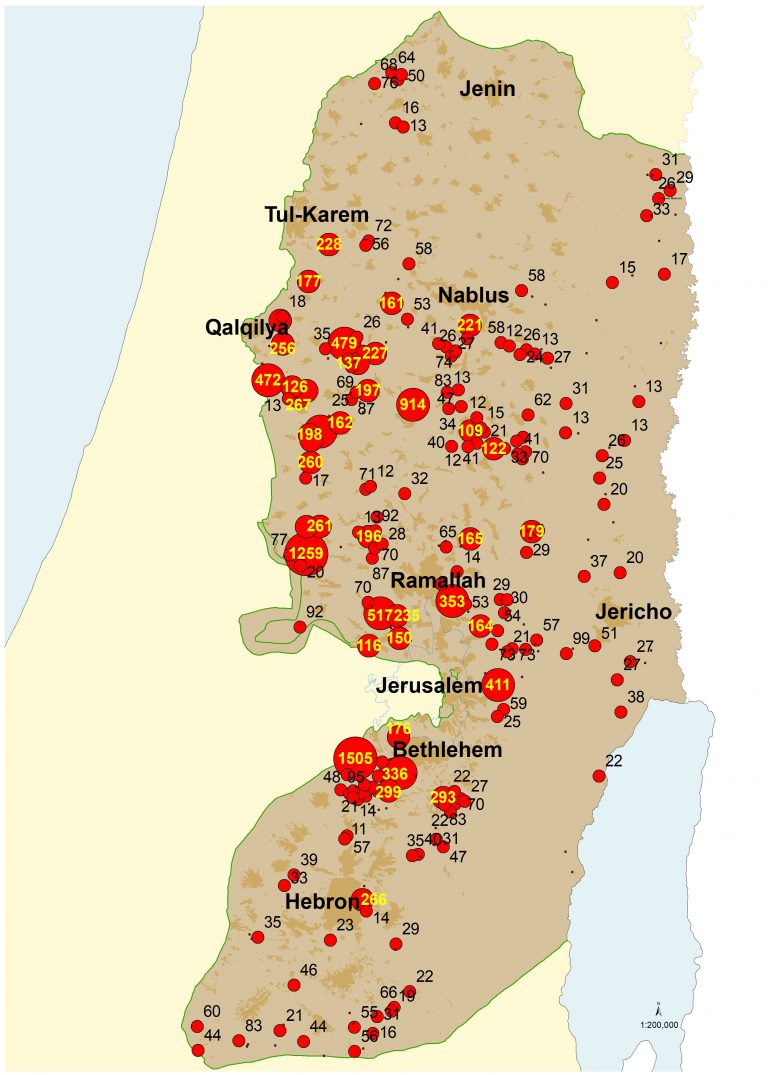
A total of 5,618 settlement units were advanced through plans in 79 settlements.
-
Map by Peace Now
Of that number, almost 83% (4,672 housing units) are planned in settlements east of the proposed Geneva Initiative border.
A total of 5,808 settlement construction tenders were published (but construction had not yet began)
- This was the highest annual total for settlement tenders in almost two decades.
- The Beitar Illit settlement saw the most construction starts in 2018, concentrated in a new neighborhood which significantly expands the footprint of the settlement.
Additional 2018 Key Data Points
- Israel continued to build up an Israeli settler presence on the land between the Elkana settlement and its surrounding settlements (Etz Efraim to its east and Shaarei Tikva to its west), effectively creating one large “super settlement” and building a contiguous settlement band towards the Ariel settlement in the heart of the West Bank.
- In addition to West Bank settlement tenders, tenders for 603 new settlement units in East Jerusalem were also published in 2018.
Peace Now Special Report, Part 2: Settlement Growth During 10 Years of Netanyahu

Peace Now writes:
“In the past decade, most of the construction was in isolated settlements that Israel will have to evacuate. The Peace Now count of housing construction starts reveals that 73 percent of the construction in 2018 (1,539 housing units) and 70 percent of construction during the decade of Netanyahu’s government (13,608 housing units) were implemented precisely in places that jeopardize a two-state agreement (east of the proposed border route of the Geneva Initiative). In this decade, close to 50,000 settlers have been added to these settlements, and the housing units built have the potential to add 60,000 settlers. This means that the Israeli government is digging the country a pit to fall in. Every house built in the settlements and every family that moves there will need to be brought back into Israel in a painful and difficult evacuation. Even if the government does not believe that peace can be achieved in the near future, there is no logic to expanding the settlements and making the solution impossible.”
Following Trump Election, Netanyahu Unleashed 39% Increase in Settlement Funding
After two years of repeatedly submitting freedom of information requests, the AP published results, based on documents turned over by Israel’s Finance Ministry. The documents reveal that the government unleashed at least a 39% funding increase – dubbed by the AP a “spending binge” – on settlement activities in the immediate aftermath of President Trump’s election.
According to the Finance Ministry data, in 2017 the Israeli government spent $459.8 million (NIS 1.65 billion) on roads, schools, and public buildings in settlements across the West Bank, compared to $333.2 million (NIS 1.19 billion) in 2016. AP notes that the new data does not include funds spent on police, education, health, and military, and completely omits government investments made in East Jerusalem settlement related activities — meaning the numbers actually undercount Israeli settlement-related spending (in both years).
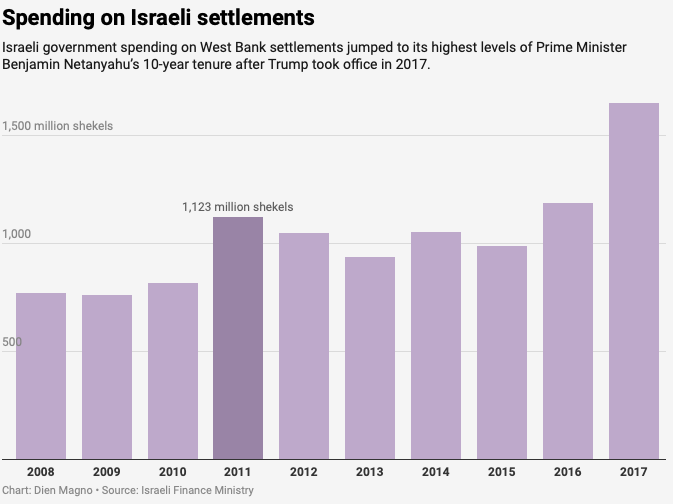 The 2017 figures are the highest amount of Israeli government funds invested in the settlements by the government of Israel during any year since Netanyahu became prime minister 10 years ago (and has remained in power since). The Israeli government tracks its own spending on settlement activities in order to report that total sum to the U.S. government, a practice which began under President George H.W. Bush – which in theory is supposed to deduct the sum from U.S. loan guarantees available to Israel (in reality, the U.S. has made only occasional and minimal deductions).
The areas with the highest growth rate in funding in 2017 were school construction (68% increase from 2016) and road construction (54% increase from 2016). Hagit Ofran, co-Director of the Settlement Watch project at Peace Now, explained the significance of Israeli investments in roads for the settlements:
“We see it very immediately, after the opening of a road, a big boom in construction along the road,” she said. “I think the investments we have these years in the roads are dramatic and will allow the expansion of settlements dramatically. That is very much worrying.”
Nabil Abu Rudaineh, spokesman for Palestinian President Mahmoud Abbas said:
“This proves that the current U.S. administration encouraged settlement activities.”
11 Knesset Members Join Campaign to Cancel 2005 Disengagement Law & Re-establish Evacuated West Bank Settlements
Eleven members of the Knesset, including Speaker of the Knesset Yuli Edelstein, participated in tour of one of the four settlements in the northern West Bank which Israel evacuated in 2005 as part of its Gaza Disengagement plan. The IDF had to provide special permission for the MKs to visit the Homesh settlement, because , even all these years later, it is a closed military zone. This is just the latest event in a settler-led campaign to pressure Netanyahu into canceling the 2005 Gaza Disengagement Plan and re-establishing those settlements.
After Israel’s evacuation of the four settlements in the West Bank – Homesh, Sa-Nur, Ganim, and Kadim – the IDF issued military orders barring Palestinians from entering the areas, let alone building in them. At the same time, settlers have regularly entered the areas and even repeatedly built a yeshiva at the Homesh site.
Bibi Pushes High Court Override Legislation During Coalition Negotiations
Haaretz reports that Prime Minister Netanyahu plans to promote the so-called High Court Override bill, which would empower the Knesset to effectively strip the High Court of its power to review and strike down legislation it deems unconstitutional, as well as overrule the Court’s administrative decisions – a new, and alarming, component of the long touted law. This new component is needed in order for Netanyahu to ensure his own immunity against criminal charges, but it will also empower the Knesset to ignore the Court’s administrative decisions issued in response to petitions – effectively giving elected and partisan government officials a veto over the only justice system accessible by Palestinians. As Haaretz explains: “for example, if a minister makes a decision that is overruled by the court in response to a petition – such as Netanyahu’s decision to ban the entry of Palestinian participants of a joint memorial day ceremony – the minister could reissue the decision anyway.”
Critical for FMEP reporting, if the law is passed the Knesset will be empowered to reinstate the settlement Regulation Law if the High Court rules against it, which it has long been expected to do. The law, passed in February 2017 and quickly frozen, directs the government to retroactively legalize a huge number of illegal outposts and settlement structures which were built on privately owned Palestinian land. Implementation of the Regulation Law was quickly frozen in light of petitions to the High Court challenging its constitutionality.
According to the Haaretz report, an agreement to promote the override bill will be included in the coalition agreement Netanyahu is negotiating to form the next government, and parties are engaged in debates over the specific form the law will take. The right-wing parties want to pass the law within 60 days after the new government takes over, and in a form that would totally negate the authority of the High Court to strike down decisions by elected officials or bodies like the cabinet, the ministers or the Knesset. The comparatively centrist Likud members support the principle of the override law but not the specifics proposed by negotiating partners. Likud members say they are reviewing various models for the law which tinker with the mechanism by which the Knesset can override High Court rulings and administrative decisions.
The override bill has been a key objective of Netanyahu’s negotiating partners, most prominently MK Bezalel Smotrich and Transportation Minister Yariv Levin, who are competing to become the next Justice Minister and whose negotiation demands FMEP analyzed some weeks back. FMEP has also documented the progress of the High Court Override bill in its Annexation Policies tables.
Trump Envoy Praises US-Backed Economic “Coexistence” Group for Joint Settler-Palestinian Hebron Iftar
On May 14th, U.S. peace envoy Jason Greenblatt tweeted his praise for a joint settler-Palestinian iftar event in Hebron, hosted by the “Judea and Samaria Chamber of Commerce,” a favorite group of the Trump Administration’s peace team. As has become a key mantra, Greenblatt said the event helps lay the “groundwork for peace” and said it was a “wonderful example of what could be possible.” As pointed out by many voices on Twitter, praise for the event ignores ignoring the apartheid conditions in Hebron under which Israeli policies deny Palestinian rights and well-being, for the benefit of some 800 Israeli settlers.
Palestinian businessman Sheikh Ashraf Jabari held the event in his Hebron home. Jabari recently launched a new Palestinian political party, the Reform and Development Party, advocating for a one-state solution because, Jabari argues, Palestinians have no other choice than to accept Israeli sovereignty over them. It is well known that Jabari has close ties to the Trump administration, which has very publicly embraced settler-Palestinian economic co-existence initiatives as a core U.S. priority on the ground and are seeking an alternative Palestinian leadership with which to make a deal.
Jabari told the Jerusalem Post about the iftar event and his broader aims:
“We want to build a united front, to create a breakthrough on the economic issue. We are issuing a clear call to separate between economics and politics, and hope to have fruitful cooperation on the subject. From our point of view, we need to strengthen the connection between the US legislature and activity that promotes economic equality here. This meal is meant to reinforce the growing trend in which economic-business connections can strengthen relations and friendship, by way of leading people to a more positive place.”
Along with Jabari, high profile event attendees – which included Samaria Regional Council head Yossi Dagan and Hebron Jewish community leader Yishai Fleisher – praised the business initiative as a model for peaceful relations.
Uri Karzen, the Director General of the settlers in Hebron and an attendee of the iftar, said in a tweet:
“First #Iftar in #Hebron with Kosher food. We are laying the groundwork for peace between people and economic prosperity for all.”
Heather Johnston, executive-director of the US-Israel Education Association which leads U.S. congressional delegation to settlements and runs camps in the Ariel settlement (no joke – to help Ethiopian Jews rediscover their roots), told the event attendees:
“Each of you have played a role in helping to build this integrated business movement. You have made sacrifices. You have gone into the unknown. You have been willing to take risks in business and in relationships. And this is what it takes to pioneer something that will one day be a humongous success. I have been involved in Samaria for the last 22 years. I believe there is more hope today for this important relationship to actually succeed than ever before.”
Chamber president Avi Zimmerman, of the Ariel settlement, said:
“We can measure progress at a people-to-people level, at every business transaction. Every time I get up and say ‘this is only about economics, it is not about peace,’ everyone starts talking about peace. Which makes me believe that if everyone keeps talking about peace when we speak of economics, that these incremental, measured steps toward mutual interest are actually what will birth the peace. They can birth a political process, but it will not happen the other way around,” he said. “We have learned for 70 years that it is not going to be the other way. It has to start this way.”
FMEP has repeatedly explained how initiatives like this perpetuate Israel’s economic exploitation of occupied territory (including the local workforce, land, and other natural resources), and that it is perverse to label such initiatives as “coexistence” programs, or to suggest that they offer the Palestinians benefits they should welcome. The New York Times quoted a spokesman for the Palestinian Authority explaining the Orwellian reality of settlement industrial zones:
“Somebody occupies your country, steals your land, steals your water, steals your resources, then says: ‘I’ll make a good deal for you if you come work for me. I’ll create jobs for you. We are not occupiers. We are employers.’ This is ridiculous. The colonial settlements are illegal in every sense of the word.”
Bonus Reads
- “Israel Okays Major West Bank Roads, Seizing Large Tracts of Palestinian Land” (Haaretz)
- “Israel Dismisses Complaint Against Lawmaker Who Called to Ban Arabs from Highway” (Haaretz)
Welcome to FMEP’s Weekly Settlement Report, covering everything you need to know about Israeli settlement activity this week.
To subscribe to this report, please click here.
March 21, 2019
- After 18 Years, Court Evicts Settlers from Stolen Home in Downtown Hebron
- Knesset Leader: U.S. Support for Annexation of Golan is First Step Towards West Bank Annexation
- Israeli Education Ministry Funds Group Behind Violent Outpost at Site of Dismantled Settlement
- Settler Excavations in Silwan Hit a Wall [Literally]
- Settlers Lobby Key U.S. Stakeholders to Protect Settlements from Trump’s “Peace Plan” & Promote Settler-Palestinian Business “Coexistence” Initiatives
- Palestinian-Americans Intervene in Lawsuit Against AirBnB, Bringing First Challenge Against Settlements to U.S. Courts
- Hoping to Avoid ICC Investigation, Pro-Settlement Groups Submit Defense of Settlements
- Bonus Reads
Questions/comments? Email kmccarthy@fmep.org
After 18 Years, Court Evicts Settlers from Stolen Home in Downtown Hebron
On March 12, 2019, the Jerusalem Magistrate Court ruled to evict settlers from a house in the heart of downtown Hebron (in the notorious Tel Rumeida section), that the settlers have illegally occupied since 2001. The court ruling gives the settlers 45 days to vacate the house, but the settlers are able to – and expected to based on the history of this case – appeal the ruling.
The Palestinian homeowners – the Bakri family – temporarily fled their home under constant settler harassment during the second intifada, a time when Tel Rumeida could be described as an “urban battlefield.” While the family was gone, settlers broke into the house, damaged it, destroyed the Bakri’s property, and ultimately took up residence there.
The Bakri family has spent the past 18 years petitioning Israeli police and the courts to remove the settlers — cases the Bakri family repeatedly won.
The settlers have managed to repeatedly delay their eviction by essentially exploiting every possible legal defense, no matter how absurd or contradictory. At different points over the past 18 yrs, settlers have argued in court that they had a rental agreement; that they purchased the home; that the plot of land was owned by a Jewish trust prior to 1948 and so they able to reclaim the property; and that because they had invested so much money in improving the land since taking it over, under Ottoman Law it now legally belongs to them. When at one point some years ago the courts ruled that the settlers had to evacuate, the settler occupants of the Bakri home did, indeed, leave, only to be immediately replaced by other settlers — at which point the Israeli Attorney General told the Bakri family that they had to start eviction proceedings anew. For a detailed timeline of the Bakri family’s saga, see this report from Peace Now.
Throughout the course of this saga, the settlers’ effort to hold on to the Bakri home was aided by the State’s unwillingness to implement court orders against the settlers. Peace Now said in a statement:
“This is not only a matter of cruelty, deceit and theft of settlers who are not loathe to take control of assets that are not theirs, but also a matter of the lack of government accountability. For 18 years the government did not enforce the law against the invading settlers, and even assisted them and allowed them to continue to steal the house and terrorize their Palestinian neighbors in Tel Rumeida. Furthermore, it should be remembered that Hebron is under Israeli occupation and the Palestinian residents cannot remove the settlers from their homes by appealing to the Palestinian Authority. The power lies in the hands of the Israeli government, which does nothing to fulfill its responsibilities to protect abandoned Palestinian property.”
Knesset Leader: U.S. Recognition of Israeli Sovereignty Over Golan is First Step Towards West Bank Annexation
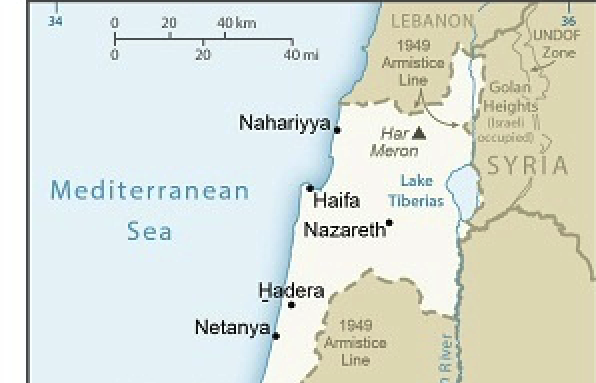
At a public event on March 17th in Tel Aviv, Israeli Speaker of the Knesset Yuli Edelstein (Likud) told an audience that U.S. recognition of Israeli sovereignty over the Golan Heights is the first step towards U.S. support for Israel’s annexation of the West Bank. Edelstein’s comments came shortly after the publication of the 2018 U.S. State Department’s annual Human Rights Report, which refers to the Golan Heights – under international law considered Israeli-occupied Syrian territory – as “the Israeli-controlled Golan.” Previous U.S. reports referred to the Golan is “Israeli-occupied.”
Edelstein also promised the audience that if the Likud does well in the upcoming elections, there will be a serious debate in the Knesset about annexing the West Bank.
Map by the CIA, as of 3/21/19
[NOTE: On March 21st, President Trump formally recognized (via tweet) Israeli sovereignty over the Golan Heights. Hours before this tweet, press reports suggested that the Trump Administration was planning to announce the new policy when Prime Minister Netanyahu was the White House, during meetings scheduled for March 25-26. It is also worth noting on February 26, resolutions were introduced in Congress, in both the House and Senate, seeking to make it U.S. policy to recognize Israeli sovereignty over the Golan.]
Israeli Education Ministry Funds Group Behind Violent Outpost at Site of Dismantled Settlement
Haaretz reports that the Israeli Education Ministry has been contributing significant funds to a non-governmental organization that is the driving force behind illegal settler activity at the of what was formerly the Homesh settlement in the northern West Bank.
Homesh was dismantled and its residents evicted by Israel in 2005, as part of the Gaza disengagement. Since then, settlers have been obsessed with the desire to re-establish Homesh, hosting religious events and protests at the site of Homesh, some of which have been attended by Israeli MKs and politicians.
As part of this movement to reclaim the site and re-establish Homesh, settlers associated with the violent “hilltop youth” settler movement have repeatedly attempted to establish an outpost on the site, only to have the IDF remove them again and again. The non-governmental organization – Midreseht Ma’amakim – widely publicize its efforts to build and maintain a outpost at the Homesh settlement site, and boasts about operating a religious school there (called the “Homesh yeshiva”) for the past 12 years. According to the new report, from 2014-2017, the Israeli Education Ministry transferred more than $6 million to the NGO — nearly $2.5 million (8.5 million shekels) in 2017, $1.9 million in 2016, and $1.7 million in 2015 and in 2014. The Ministry told Haaretz that the funds were provided in support of the organization’s educational activities, not its illegal activities.
Lior Amihai, Executive Director of Yesh Din, explained:
“The place remains a hostage of a violent and illegal yeshiva, which prevents Palestinian farmers and landowners from reaching the place. Now it turns out that the Education Ministry enable the presence of the yeshiva by funding an association that fundraises for it.”
Yesh Din has for years been working with leaders of the neighboring Palestinian village of Burqa in regards to the situation at the site of Homesh, built on lands owned by Palestinians and seized by Israel in 1978 for “security needs.” In 2011, Yesh Din and Palestinian landowners petitioned the Israeli government to revoke the 1978 military seizure order, which legally should at this point be moot: the IDF only used the land for approximately two years, after which settlers took over the site to establish the (civilian) Homesh settlement, which was allowed to remain and expand until it was dismantled in 2005. In 2013, Yesh Din’s petition succeeded, and the state of Israel took the unprecedented step of revoking the military seizure order.
Yet, while technically the Palestinian landowners are no longer barred by Israel from accessing their own lands, de facto the area is still off limits to them, policed by violent Israeli settlers who for all intents and purposes enjoy free reign in the area.
Settler Excavations in Silwan Hit a Wall [Literally]
Emek Shaveh reports that one of the ongoing excavation efforts in Silwan led by the radical settler group Elad might not be able to continue, having run into the foundation of a massive wall, believed to be part of an Umayyad palace dating back to the 7th century CE.
The discovery – one which serves to highlight the multiplicity of cultures, religions, and peoples who are deeply connected to Jerusalem – is not a welcome one for the settlers, whose ultimate goal is to dig a tunnel connecting settler-run tourist sites in Silwan to a settler-run tourist site in the Old City. Since the excavation project is being carried out by Elad in cooperation with (and with financing from) the Israeli Antiquities Authority (IAA), the government bureau will decided whether or not to continue the dig. According to Haaretz, the IAA is considering plans to dismantle the wall and create a large hole for tourist groups to walk through.
The archeological experts at Emek Shaveh explain:
“From a professional standpoint, the wall should be left in its proper place, but the practical significance of this is a halt to the excavation, which began as part of a government decision to connect Silwan with the excavations south of the Temple Mount/Haram al-Sharif…In the reality of Jerusalem, where remains of building are not only scientifically significant but have symbolic and emotional resonance as well, the damage caused by the tunnels excavations has a negative impact on the possibility of presenting the city’s many cultures and their histories in a balanced manner. This is not only an archaeology-tourism problem, but a political problem of ignoring and even erasing certain historical strata, in order to present Jerusalem in a manner that serves the settlement enterprise in the Old City basin.”
The IAA said in response to news of the wall:
“…due to the wish to give the millions of tourists who visit Jerusalem from all over the world a better travelling experience, roads and paths were developed over the past decades. In addition, several openings have been made to the Old City’s walls and in the foundations of the Umayyad buildings. The hole in question is a narrow opening that was made in the foundations of one of these buildings after meticulous archaeological examination and documenation [sic] were carried out. This opening enables tourists to move between the two parts of ancient Jerusalem on either side of the Old City walls. This project is part of the ‘Shalem program’ [i.e. whole in Hebrew]: A government-funded plan to unveil, preserve, research and develop the sites of ancient Jerusalem.”
Settlers Lobby Key U.S. Stakeholders to Protect Settlements from Trump’s “Peace Plan” & Promote Settler-Palestinian Business “Coexistence” Initiatives
While in Washington, D.C. for the upcoming AIPAC policy conference, a delegation of Israeli settlers held meetings with members of Congress members and White House officials in a bid to ensure that any American “peace plan” will not inconvenience Israel’s settlement enterprise. The delegation, which included Yossi Dagan (head of the Samaria Regional Council, a settlement municipal body) and Arnon Klein (CEO of the Barkan Industrial Zone, near the settlement of Ariel), also met with evangelical leaders – a key constituency which recently extracted assurances from the White House regarding the Trump plan. The settlers reportedly implored the group to:
“help to fight plans to freeze construction in Judea and Samaria. We cannot allow a plan which will destroy or harm Jewish communities in Judea and Samaria. Our task is to build. We have 36 communities and half a million Jews living in our forefathers’ home. We need your help. This is a very sensitive time. Especially now, when the US president is considered to be a friend of Israel, there is a huge risk that a diplomatic plan will include a division between settlements in blocs and outside of blocs, and that construction will be frozen. And we haven’t even talked about the worst – uprooting Jewish settlements and dividing Jerusalem – which may also on the table.”
In addition, the delegation pitched the centrality of business “coexistence” initiatives between settlers and Palestinians, an increasingly obvious part of the Trump Administration’s agenda on the ground, as a core objective. Writing last week, FMEP’s Lara Friedman pointed to the activities of Ambassador Friedman and Congressman Lankford (R-OK), in support of the the idea that:
“…peace would come from economic and business cooperation between Palestinians (living under Israeli occupation, governed by Israeli military and military law designed to promote the interests and needs of Israel, entirely disenfranchised from the powers that control their lives) and settlers (living in settlements built on land taken from Palestinians, enjoying all the entitlements and protections of Israeli citizenship and law, and with representatives and allies at every level of Israeli government). This approach…exemplifies a vision of ‘peace’ based on promises of improved quality of life for individual Palestinians, de-coupled from any pretense of helping Palestinians end an occupation that the United States no longer believes to exist, or achieve national self-determination that the United States no longer supports.”
Likewise, FMEP has previously explained how for decades Israel has used industrial zones as another tool to expand and deepen control over West Bank land and natural resources. Importantly, jobs in industrial zones – often the only jobs available for Palestinians living under an Israeli occupation that prevents the development of any normal Palestinian economy – are widely viewed by Palestinians as a double-edged sword.
Palestinian-Americans Intervene in Lawsuit Against AirBnB, Bringing First Challenge Against Settlements to U.S. Courts
In the first case of its kind in a U.S. federal court, the Center for Constitutional Rights (CCR) filed a lawsuit challenging the legality of the Israeli settlement enterprise. The case was filed on March 18th on behalf of two Palestinian Americans – Randa Wahbe and Ziad Alwan – and two Palestinian villages – Ein Yabroud and Jalud. Journalist Mairav Zonszein succinctly explained the complex backdrop of the new filing:
“The CCR’s claim is not a stand-alone lawsuit but an intervention in Silber v. Airbnb, a suit filed by a group of Jewish and Israeli-American citizens who either host or wish to rent homes on Airbnb; the claim is directed, not at Airbnb, but at the sub-group of settlers serving as hosts. These settlers filed suit against Airbnb in November 2018, days after the company announced it would be taking down about 200 rental listings located in Israeli settlements in the occupied West Bank…In intervening in the lawsuit, the CCR argues that it is the settler’s conduct—and not Airbnb’s attempt to reconcile its business practices with basic human-rights law and principles—that discriminates against their clients and millions of other Palestinians.”
CCR issued a press release stating:
“Today’s filing argues that the Israeli settlers who sued Airbnb have participated in war crimes by aiding in Israel’s seizure of land in occupied Palestinian territory, including the specific lands on which the Airbnb properties stand. The rentals are in Israeli-only settlements from which Palestinian residents of the West Bank are barred as per Israeli military orders, and which are sometimes surrounded by physical barriers, military bases, and security gates.”
Diala Shamas, a staff attorney at the CCR, said:
“The settlers who sued Airbnb are cynically using the language of discrimination in order to further their own unlawful ends,” said Center for Constitutional Rights Staff Attorney Diala Shamas. “Our clients’ experiences –Palestinians who are directly affected by these settlers’ actions – show where the real discrimination and illegality lies. This case puts the settlers on trial in a U.S. court.”
CCR’s filing – and accompanying videos – shines a bright light on at two stories that exemplify Palestinians’ lives under occupation, and make clear how the settlements infringe on their basic rights to property. One of the intervenors, Ziad Alwan, was born in the Palestinian village of Ein Yabroud and holds the title deed for part of the land on which the Ofra settlement was built, as registered by the Israel Land Registry. One of the settlers in the underlying lawsuit previously listed a property in the Ofra settlement on AirBnB — meaning that the settler and AirBnB were, in effect, profiting from the rental of a property located on land that rightfully belongs to Alwan, and moreover, which Alwan, despite being the rightful owner, cannot access and does not benefit from.
Residents of the Palestinian village of Jalud – a second intervenor – explain how Israeli settlements and unauthorized outposts have been built on the village’s land, making 80% of their farmland inaccessible. One of the outposts that took Jalud’s land is Adei Ad, an outpost established illegally under Israeli law, which the Israeli government announced its intention to retroactively legalize. One of the settlers in the underlying case runs a bed and breakfast in the Adei Ad outpost, meaning the settler and AirBnB are profiting from a business located on the historic land of Jalud, a business which Palestinians cannot access and do not benefit from. In their claim, residents of Jalud are challenging not only the claim that Airbnb’s decision to delist the settlers’ rental property is discriminatory, but also the claim that the settlers legally own the property in the first place.
The lawyer representing the settlers in the underlying case (which claims AirBnB’s decision violates the Fair Housing Act), said in response to CCR’s claim:
“There are those who say that the settlements are illegal. There are those who say they are not. This is the heartland of the Land of Israel.”
Randa Wahbe, one of the petitions, told The Nation:
“The fact that settlers are using the specific piece of legislation pushed through after Martin Luther King’s assassination to protect disenfranchised black communities, in order to discriminate against Palestinians, is what I find so horrifying.”
Hoping to Avoid ICC Investigation, Pro-Settlement Groups Submit Defense of Settlements
On March 14th, two well-known pro-settlement legal attack groups – UK Lawyers for Israel (UKFLI) and the Lawfare Project – submitted a brief to the International Criminal Court (ICC) arguing that the court is prohibited under the Rome Statute from investigating Israeli settlements. The ICC has been conducting a preliminary investigation into the possibility of opening a war crimes probe into Israel’s settlement for the past four years.
The brief argues that the Israeli High Court of Justice (HCJ) has sufficiently and genuinely investigated issues related to the settlements, making the matter inadmissible at the ICC because the Rome Statute’s regulations prohibit the court from taking on issues that national courts have adjudicated. The brief even proudly highlights the fact that Israel’s HCJ has ruled in favor of Palestinians, though as a recent report published by B’Tselem explains, the Israeli HCJ is complicit in the establishment and continuing expansion of the settlement enterprise (and therefore cannot conceivably carry out a genuine investigation of this enterprise).
The legal brief comes amidst a barrage of threats issued by Israel and the United States against the ICC in light of its consideration of opening this case. On March 17th, U.S. Secretary of State Mike Pompeo threatened ICC staff with travel restrictions and financial sanctions if the court opens a probe into Israel. In November 2018, Israeli Attorney General threatened to launch, according to the Jerusalem Post, a “public legal campaign, aggressively contesting its jurisdiction.”
In the brief, the authors also announced their intention to file further information with the court challenging its jurisdiction over the matter.
Bonus Reads
- “Natural Born Settlers” (New York Times)
- “Not Breaking News: Trump Administration Does Not Believe in Occupation” (LobeLog – by FMEP President Lara Friedman Part 1 of 2)
- “Erasing Occupation: The Pernicious Role of Congress” (LobeLog – by FMEP President Lara Friedman Part 2 of 2)
- “‘The entire world knows the settlers have declared war on us’” (+972 Mag)
- “Leading architects urge Israeli PM to cancel cable car plan” (Associated Press)