Welcome to FMEP’s Weekly Settlement Report, covering everything you need to know about Israeli settlement activity this week.
To subscribe to this report, please click here.
April 26, 2024
- Smotrich Directs Government to Prepare to Fund & Service 68 Illegal Outposts
- U.S. Balks on Designating Israeli Military Unit Named in Annual Human Rights Report
- U.S. Publishes 2023 Human Rights Report
- Bonus Reads
Smotrich Directs Government to Prepare to Fund & Service 68 Illegal Outposts
On April 20th Israel’s Channel 12 News reported that Bezalel Smotrich – in his capacity as a minister in the Defence Ministry – has ordered several ministries to begin the practical preparations to service 68 outposts, even though the legal process to grant the outposts retroactive legalization has not concluded (or even begun). The move essentially directs the government to treat the outposts as if they are settlements even though they are still illegal under Israeli law – which should be understand as an act of de facto annexation. Smotrich’s orders include a call for the preparation of budgets and service plans to extend utilities – including water, roads, state-funded medical clinics, schools, and more – to the outposts.
Peace Now explains further:
“For Peace Now’s understanding, this is in fact a ‘legalization bypass’ route, according to which the various authorities will treat these illegal outposts as if they were legal for the purposes of budgets and services and refrain from enforcing the demolition orders in them, even if the legalization procedures for those outposts have not yet begun or been completed…So far, the list of the 68 outposts destined to move to the status of “Sites under Legalization” has not been published and it is difficult to know which outposts are involved. A cautious assessment of Peace Now is that these are mostly relatively old outposts (as appears in the coalition agreement between Likud and Smotritch’s party (section 119), which referred to the legalization of outposts established before February 2011). At the same time, it’s plausible that the list also comprises outposts established later, like the Malachei Hashalom outpost, which was established in 2015 but the government has already decided on the intention to legalize it.”
The coalition agreements which brought the current Israeli government into power included a commitment to the full recognition and integration of outposts. The government has done a lot to fulfill this pledge, as seen in the actions taken to legalize the Homesh outpost, the Evyatar outpost, and the Israeli Cabinet’s February 2023 decision to legalize ten of the most isolated, legally complicated outposts. That decision also included approval of a clause that makes the remaining outposts eligible – right away, even as they remain illegal – to receive Israeli municipal services like water and electricity.
The United States criticized the Israeli government over these reports, with U.S. State Department Deputy Spokesperson Vedant Patel saying at a press briefing on April 24th:
“…these reports about directives to support illegal outposts in the West Bank, we believe that to be dangerous and reckless. Our policy, U.S. policy, remains that settlements are counterproductive to the cause of peace and the Government of Israel’s program is inconsistent with international law. And we’ll continue to urge Israeli officials to refrain from taking actions to fund outposts that have long been illegal under Israeli law. Actions or announcements seeking to expand outposts will only move the goal of peace and stability in the region further away.”
U.S. Balks on Designating Israeli Military Unit Named in Annual Human Rights Report
Despite reports earlier in the week, the U.S. has decided to not enforce the Leahy Law against the Netzah Yehuda battalion, which is a special IDF unit for ultra-orthodox soldiers stationed in the West Bank. The unit, which attracts members of the radical and violent Hilltop Youth settler movement, is alleged to have participated in gross human rights violations, including the causing the death of U.S. citizen Omar Assaf. and Secretary Blinken himself even hinted that actions against the battalion were imminently forthcoming.
By the end of the week, ABC News reported that the U.S. had reversed its plans to sanction IDF units, and that the U.S. will not announce sanctions while it reviews new information Israel has provided regarding its steps to remediate U.S. concerns. The Associated Press reports that Secretary Blinkin sent a letter to the Speaker of the U.S. House of Representatives explaining that while the government has determined the battalion engaged in gross misconduct, the U.S. will withhold sanctions. Blinken also assured the stridently pro-Israel Speaker of the House that, should any sanctions be announced in the future, it would not impede or delay the transfer of the $17 billion in military aid to Israel that the U.S. Congress just passed.
The U.S. Department of State has reportedly been investigating the Netzah Yehuda battalion as well as other units for over a year. The unit was named in the just released “2023 Country Reports on Human Rights Practices” in association with the death of Omar Assad in January 2022. The report also notes that Israel investigated Assad’s death and did not bring a single charge against the unit or its members.
This would be the first time the U.S. has ever (anywhere) enforced the Leahy Law against a foreign military. The designation would disqualify the sanctioned units from receiving U.S. military assistance or training, but it would not stop the units from using weapons purchased by Israel from the U.S. (a symbolic if not actually meaningful designation).
Noting the symbolic importance of the use of the Leahy Law to sanction Israeli military units, Haaretz columnist Alon Pinkas notes:
“While the impact of the sanctions the law stipulates may be very limited, the United States is essentially acknowledging a very inconvenient truth: A combat unit in the Israeli army is acting like a militia….Second, the United States is drawing a clear contrast between Israel and the West Bank. This shouldn’t be taken lightly or dismissed as an ad hoc technicality.”
U.S. Publishes 2023 Human Rights Report
On April 22nd, Secretary Blinken released the 2023 Country Reports on Human Rights Practices. As a reminder, the report is designed to provide an ostensibly objective synopsis of how governments across the world perpetrate and handle human rights abuses. However, the report’s treatment of Israel and its role in the West Bank, Gaza Strip, and East Jerusalem is consistently a matter of controversy. During Blinkin’s press briefing to mark the release of the new report, he had to defend the State Department against accusations of holding Israel to a lower standard than any other country.
The 101-page section on “Israel, West Bank, and Gaza” opens with a lengthy preface on the events of October 7, 2023 and following events, noting the record high level of settler violence against Palestinians in the West Bank that has followed. Beyond a few mentions of settler violence, the report does not discuss the Israeli settlement enterprise, which is the underlying context perpetuating the systematic violation of Palestinian human rights.
The report once again maintains the format imposed on the report by the Trump Administration, with a section entitled “Israel, West Bank, and Gaza.” Under this format, which the Biden Administration also used in its 2020 and 2021 reports, there is a section on Israel (looking at the practices of the Israeli government in sovereign Israeli territory, including East Jerusalem) and a separate section on the West Bank & Gaza (looking primarily at the practices of the Palestinian Authority, Hamas, and the “Israeli authorities in the West Bank”). Prior to the Trump era, the report and its sections were entitled “Israel and the Occupied Territories.” The Trump administration adopted the new section titles in its 2017 report and completed its elimination of the word “occupation” in its 2018 report. The Biden Administration’s decision to continue this new format was widely reported when the administration’s first report was released in early 2021. The Biden Administration re-introduced the word “occupation” in its first report.
Notably, the report does not cite any of the seven Palestinian NGOs that the Israeli government declared to be terrorist organizations in October 2021, including Al-Haq which is largely held to be the preeminent Palestinian human rights group.
Amnesty International published its own report recapping 2023 human rights concerns across the globe, in it taking shots at the U.S. and other countries’ failures to uphold and enforce international human rights law. The report’s overview explains that the report exposes the
“betrayal of human rights principles by today’s leaders and institutions. In the face of multiplying conflicts, the actions of many powerful states have further damaged the credibility of multilateralism and undermined the global rules-based order first established in 1945.
In a conflict that defined 2023 and shows no sign of abating, evidence of war crimes continues to mount as the Israeli government makes a mockery of international law in Gaza. Following the horrific attacks by Hamas and other armed groups on 7 October, Israeli authorities responded with unrelenting air strikes on populated civilian areas often wiping out entire families, forcibly displacing nearly 1.9 million Palestinians and restricting the access of desperately needed humanitarian aid despite growing famine in Gaza.
The report points to the USA’s brazen use of its veto to paralyse the UN Security Council for months on a much-needed resolution for a ceasefire, as it continues to arm Israel with munitions that have been used to commit what likely amounts to war crimes. It also highlights the grotesque double standards of European countries such as the UK and Germany, given their well-founded protestations about war crimes by Russia and Hamas, while they simultaneously bolster the actions of Israeli and US authorities in this conflict.
‘The confounding failure of the international community to protect thousands of civilians – a horrifically high percentage of them children – from being killed in the occupied Gaza Strip makes patently clear that the very institutions set up to protect civilians and uphold human rights are no longer fit for purpose. What we saw in 2023 confirms that many powerful states are abandoning the founding values of humanity and universality enshrined in the Universal Declaration of Human Rights,’ said Agnès Callamard.”
Bonus Reads
- “Less Than Quarter of Israeli Jews in Favor of Renewed Settlement in Gaza, Poll Finds” (Haaretz)
- “Israeli, U.S. Officials Say New Sanctions Due to Conduct of Ben-Gvir, Smotrich” (Haaretz)
- “Far-right Advisor to Ben-Gvir Sanctioned by U.S. Tries to Get Gas, Finds Credit Card Blocked” (Haaretz)
Welcome to FMEP’s Weekly Settlement Report, covering everything you need to know about Israeli settlement activity this week.
To subscribe to this report, please click here.
March 22, 2024
- Jordan Valley, Part 1: Israel Declares Massive Swathe of Land in Jordan Valley as “State Land”
- Jordan Valley, Part 2: Israel Expands Three West Bank Nature Reserves – Including an Outpost in the Jordan Valley
- Jordan Valley, Part 3: B’Tselem Documents Post-Oct 7th Acceleration of Settler-Terrorism in the Jordan Valley
- HR Group Petitions for the Demolition of Outpost Affiliated with U.S.-Sanctioned Settler
- Smotrich Moving to Appoint Settler as Top Dog on Outposts Demolitions, Over the Authority of High-Ranking Military Authorities
- Bonus Reads: Sanctions
- Bonus Reads
Jordan Valley, Part 1: Israel Declares Massive Swathe of Land in Jordan Valley as “State Land”
Peace Now reports that the Israeli Ministry of Defence is prepared to announce the declaration of 2,000 acres (8,000 dunams) in the northern Jordan Valley near the Yafit settlement as “state land”. According to Peace Now, this is the largest declaration of “state land” since the Oslo Accords were signed.
Peace Now explains:
“The declaration of state land is one of the main methods by which the State of Israel seeks to assert control over land in the occupied territories. Land declared as state land is no longer considered privately owned by Palestinians in the eyes of Israel, and they are prevented from using it. Additionally, the state leases state land exclusively to Israelis.”
This declaration comes just a few weeks after Israel issued another “state land” declaration, for 652 acres of land east of Jerusalem between the Ma’ale Adumim and Keidar settlements.
Jordan Valley, Part 2: Israel Expands Three West Bank Nature Reserves – Including an Outpost in the Jordan Valley
Haaretz reports that the Israeli Civil Administration has signed orders expanding the boundaries of three nature reserves in the West Bank, a move which not only closes off more West Bank land from Palestinians, but is also designed to include an illegal outpost. Under Israeli law, no construction is allowed to occur in areas designated as a nature reserve.
Two of the nature reserves – Umm Zuka and Petza’el, are located in the Jordan Valley. The third, Kana and Samar, is located near the northern shore of the Dead Sea.
The illegal outpost Havat Ori/Ori’s Farm is now included within the expanded boundaries of the Umm Zuka nature reserve in the northern Jordan Valley. Over the past few years, the outpost – which grazes herds of cattle – has already successfully forced Palestinians off of large amounts of land in its vicinity while facing no enforcement against its illegal construction. In the past, when the IDF has been called to assist Palestinian herders in their struggle to graze cattle in the area, Israeli soldiers have removed Paelstinians from their land and confiscated their cattle (a practice which Yesh Din has recently filed a petition with the High Court of Justice to stop). The settlers, even when entering a nearby firing zone, have been protected and allowed to continue taking over more land and entrenching their illegally constructed outpost.
The story is repeated throughout the Jordan Valley and the West Bank, as so-called “herding outposts” have proven to be extremely successful and efficient way for a small number of settlers (and their cattle) to take over a large amount of land.
In 2019, a group of Israeli human rights activists petitioned the Israeli High Court to revoke the special status of the Umm Zuka nature reserve and firing zone in the West Bank, saying the Israel’s designation of the land as a protected area has only served as a pretext to remove Palestinians and allow settlers to take over. Part of the petition cited the impacts of an unauthorized outpost near Umm Zaka, which had essentially turned the wilderness area into a private settler park where Palestinians are not allowed to enter. The Civil Administration spokesperson told Haaretz that it is undertaken unspecified “enforcement proceedings” against the unauthorized outpost.
After the petition was filed, Israeli lawyer Eitay Mack who made the filing, told Haaretz:
“the reserve and the firing zone have effectively become a private settler farm that receives personal security service from Israel Defense Forces soldiers and bars entry to the farm’s enormous territory on the basis of ethnicity, nationality, religion and political opinions.”
Jordan Valley, Part 3: B’Tselem Documents Post-Oct 7th Acceleration of Settler-Terrorism in the Jordan Valley
In a new paper and accompanying video, B’Tselem documents how settlers and the Israeli government have “ramped up efforts to drive Palestinian shepherding communities out of the northern Jordan Valley.” The paper documents testimonies from Palestinian communities at risk of forced displacement, and unpacks several methods employed by settlers and the Israeli government pushing their removal. Those methods are: land takeover, settler violence, travel restrictions, soldier violence, and harassment by the settler regional council.
B’Tselem writes:
“Since the Hamas attack on Israel on 7 October 2023, Israel has stepped up its efforts to drive dozens of Palestinian shepherding communities in the northern Jordan Valley out of their homes and lands. Through cooperation and collaboration among the military, police, settlers and the Jordan Valley Regional Council, Israel has reduced grazing areas available to Palestinians, blocked regular water supply and took measures to isolate the Jordan Valley from the rest of the West Bank. This policy is nothing new. Israel has been undermining these communities’ subsistence for decades, in part, by denying Palestinians’ access to nearly 80% of the Jordan Valley declared as firing zones, nature reserves or the municipal area of settlements. Israel uses these zoning declarations to justify its refusal to approve building plans that would allow residents of these pastoral communities to build homes legally and connect to water and electricity infrastructure. On top of this, with full backing and protection from the military and the police, settlers subject residents of these communities to severe violence on a daily basis. This policy imposes impossible living conditions on Palestinian residents of the Jordan Valley.”
HR Group Petitions for the Demolition of Outpost Affiliated with U.S.-Sanctioned Settler
While the reach and impact of U.S.-led sanctions against Israeli seven settlers and two illegal outposts continues to grow, the Israeli anti-settlement group Torat Tzedek and five Palestinian landowners have filed a petition with the High Court of Justice seeking the demolition of the HaMahoch Farm outpost, which is affiliated with an Israeli settler (Neriya Ben Pazi) who was recently sanctioned by the U.S. government. The outpost, located east of Ramallah, was not one of the two outposts also sanctioned.
Neriya Ben Pazi and his associates are alleged to have organized and participated in a particularly gruesome attack and subsequent torturing of Palestinians who were in the process of abandoning the Wadi al-Seeq village (having chosen to abandon their longtime homes in light of routine and severe harassment by settlers).
TIn addition to calling for the HaMahoch Farm outpost to be demolished, the petition asks the Court to order the IDF and Civil Administration to adopt a protocol that prioritizes enforcement actions (evacuation and demolition) of any/all outposts which are a staging ground for violent settlers should be a high priority for demolition. Though the IDF apparently has criteria for prioritizing along these lines, it has not translated to practice. The Times of Israel reports that in May 2023 Bezalel Smotrich intervened to stop the Israeli Civil Administration from demolishing the HaMahoch Farm outpost in May 2023.
Torat Tzedek, led by Rabbi Arik Ascherman, alleged in its petition:
“These settlers have constantly and daily attacked and harassed Palestinian residents who use private Palestinian lands in the area, harming them, their animals and their property, destroying trees and vegetation, and causing them to abandon the area after decades in which these territories were cultivated and used by Palestinians. Even after the departure, the settlers continue to harass and loot the property of the Palestinians, to invade the private lands and prevent the return of the Palestinians to the area.”
Rabbi Ascherman further explains:
“Because of him and the series of outposts he has set up since 2019, there are thousands of dunams of land where Bedouin who’ve lived there for 40 years are no longer there. What is new about this petition is that it challenges the standard defense by the state that it carries out the demolition of illegal structures according to a [pre-determined] timetable.”
Smotrich Moving to Appoint Settler as Top Dog on Outposts Demolitions, Over the Authority of High-Ranking Military Authorities
Haaretz reports that Bezalel Smotrich – who serves as a minister in the Defense Ministry who oversees the Settlement Administration, enjoying near unchecked authority over Area C -plans to install one of his allies as a Deputy head of the Civil Administration. The move is seen as a reaction to the Civil Administration’s enforcement of building law against unauthorized outposts, which Smotrich wants to protect and authorize as settlements. In recent weeks, the Civil Administration has dismantled two outposts (1, 2 and 3).
Haaretz explains that in tandem with the installation of his ally, Smotrich wants to force Israeli district brigade commanders to explain any/all decisions to demolish structures in settlements and outposts. This would subordinate high ranking IDF personnel to a civilian, political appointee.
That appointee is reportedly set to be Hillel Roth, who lives in the Yitzhar settlement – which is notoriously violent and defiant of Israeli enforcement actions against its illegal activities.
Bonus Reads: Sanctions
There was a tremendous amount of analysis and news regarding international sanctions on settlers and outposts. Including a few:
- “From Drones to Construction: U.S. Sanctions Liable to Hurt Donations to Illegal West Bank Outposts” (Haaretz)
- “The Settler-run Government Is Mortgaging Israel’s Future” (Haaretz Editorial Board) Excerpt: “These measures are highly significant. However, because the criminal settler infrastructure is deep, and it has many accomplices, these sanctions are only the start of dismantling the occupation and settlement enterprise.”
- “How will new US sanctions impact the illegal West Bank farming outposts they target?” (The Times of Israel)
- “Israeli minister calls for expanding West Bank settlement activity due to EU sanctions” (Al Andalou)
Bonus Reads
- “How Israeli settlers are expanding illegal outposts amid Gaza war” (Al Jazeera)
- “Israeli study says settlement policy in occupied West Bank’s ‘Area C’ has failed” (The New Arab)
- [INSANE headline alert] “The grandmother who wants to lead Israelis back to a Gaza without Palestinians” (CNN)
- “’Israeli Settlers Can Now Do Whatever They Please. They Want to Drive Off Those Who Live There’” (Haaretz)
- “Delayed Ambulances and Traffic Holdups: Israeli Army Blocks Entry to West Bank Villages Since Start of Gaza War” (Haaretz)
- “The Israeli public is dispirited. So why is the right euphoric?” (+972 Magazine)
Welcome to FMEP’s Weekly Settlement Report, covering everything you need to know about Israeli settlement activity this week.
To subscribe to this report, please click here.
March 15, 2024
- Yesh Din Files High Court Petition to Stop Jordan Valley Regional Council
- Construction Starts on New Settlement, Ariel West
- IDF Demolishes Outpost Near Ofra
- Subcommittee Hearing Defends Settler Violence, Points Finger at Human Rights Activists
- US Announces New Sanctions on Three Individuals & Two Outposts
- Bonus Reads
Yesh Din Files High Court Petition to Stop Jordan Valley Regional Council
On March 7th the Israeli NGO Yesh Din assisted Palestinians in the Jordan Valley to file a petition with the High Court of Justice seeking to force the IDF Central Command to prevent settlers and settler regional councils in the Jordan Valley from illegally seizing and ransoming herds of livestock belonging to Palestinians, and to return all livestock currently confiscated and funds paid to the regional council for the return of livestock. Since October 7th, Yesh Din has documented several instances of settlers conspiring with the Jordan Valley Regional Council to confiscate herds of livestock belonging to Palestinians based on the claim that they are illegally grazing in the Regional Council’s jurisdiction, and then demanding exorbitant fees for their return. Yesh Din identifies this not only as an illegal practice, but as a policy “designed to annex and take over Areas C while pushing Palestinians out…to force Palestinian communities from their homes.”
The IDF’s own legal council has recently issued a legal opinion confirming that settler municipalities do not have jurisdiction or authority to enforce any laws or regulations against Palestinians. But the settler regional council rejected this opinion, saying that its jurisdiction applies to an area of land – not just a certain type of people (i.e. Israeli settlers). As a reminder, the West Bank remains under Israeli military rule via the Israel Ministry of Defense and the IDF. Israel has extended its domestic laws to settlers, so that settlers are subject to Israeli domestic law and Palestinians remain under military rule. In this case, the settler regional argues that it has authority over land, and any Palestinians (and their property) who enter that land.
Yesh Din explains why this is a significant legal claim:
“The danger posed by the pretension of the regional council, which seeks to hold the power to regulate the grazing of Palestinian herders, has enormous ramifications. This is a new and predatory form of economic violence by settlers and an authority that has distinct annexationist aspects, as it expresses the degradation of the military commander’s responsibility in the occupied territory and the assignment of its authorities to civilian governmental bodies.”
Over the past six months, settlers have regional councils have repeatedly kidnapped herds of livestock and demanded exorbitant fees
Construction Starts on New Settlement, Ariel West
 Peace Now reports that Israel has begun construction of a new settlement, Ariel West, plans for which were first made public in November 2021 and tenders were issued in May 2023 — all under the guise of a plan to “expand” the Ariel settlement [for more on how this plan was kept quiet, see Peace Now’s detailed history]. The Ariel West settlement is being built on a hilltop located 1.2 miles away from Ariel, in an area that is non-contiguous with the built-up area of the current Ariel settlement. To perpetuate the framing of this new construction as the growth of an existing settlement rather than a new settlement – settlers and the government call Ariel West the“Amririm Neighborhood.” The new settlement will be directly adjacent to the Palestinian village of Salfit, further limiting the future development of Salfit and restricting Palestinian agricultural workers’ access to land, as illustrated in this video by Peace Now.
Peace Now said in a statement:
“The construction of Ariel West, a new settlement deep in the West Bank, just before Ramadan and amidst the imminent danger of escalation in the West Bank and East Jerusalem, is further proof that the Israeli government is seeking violent escalation and opening a third front of war. It is also further proof, for anyone still in doubt, that it is doing all it can to destroy the possibility of the two-state solution. Israeli citizens deserve a better government, and its actions and decisions are endangering the lives and futures of both Palestinians and Israelis, as well as that of the entire region. The construction of a new settlement is part of recent initiatives amidst the ongoing war, aimed at advancing thousands of housing units in the territories, declaring thousands of dunams as state land, and approving significant budgets for settlements in the 2024 budget.”
IDF Demolishes Outpost Near Ofra
The Times of Israel reports that on March 11th, the Israeli Civil Administration demolished an illegal outpost known as “Or Ahuvia,” located close to the Ofra settlement north east of Ramallah. The IDF forced settlers to leave the area, demolished a rudimentary house, and confiscated other materials – saying that the outpost was built illegally on privately owned Palestinian land.
The “Or Ahuvia” or “Ma’aleh Ahuvia” outpost was originally erected (and demolished) in 2022 in memory of Ahuvia Sandak, a settler “hilltop youth” who died when the car he was traveling crashed as it was fleeing Israeli police with a group of settler youth who allegedly has been stoning Palestinian cars. Settlers and their supporters have painted Israeli police as perpetrators of a crime of negligence (or worse) against the settler youth; the Knesset has taken up the issue; and Sandak has been memorialized as a hero and a martyr to the cause of Greater Israel.
Subcommittee Hearing Defends Settler Violence, Points Finger at Human Rights Activists
At the demand of settler groups, the Knesset Foreign Affairs and Defense Committee convened a subcommittee hearing on March 12th to hear testimony regarding the alleged “harassment” perpetrated by human rights defenders against Israeli security personal. MK Merav Michaeli denounced the hearing saying the chairman, Tzvi Succot, seeks to “present an upside down and false world.” MK Limor Son Har Melech (Otzma Yehudit) said at the hearing:
“They [pro-Palestinian activists] are aggressive to IDF soldiers, to settlers, they damage property, they blacken Israel’s name around the world, engage in the demonization and delegitimization of Israel and damage our image.”
The hearing turned out to be more than a smear campaign against human rights defenders, but also a defense of extremists settlers. The senior police commander in the West Bank perpetuated the claim that settler violence is over exaggerated, testifying to the committee that 50% of complaints regarding settler violence turn out to be false.
US Announces New Sanctions on Three Individuals & Two Outposts
On March 14th the U.S. government announced it had imposed sanctions on three Israeli settlers and two settlement outposts, adding to the four individuals it had previously sanctioned. This is the first time the U.S. has imposed sanctions on entities (the two outposts) in addition to individuals – demonstrating the possible far-reaching targets of U.S. sanction authority. The settlers and outposts were documented to have taken part in (or be a base of action for) acts of violence against Palestinians in the West Bank.
The two outposts sanctioned are known as “Moshe’s Farm” and “Zvi’s Farm” – and the individuals are the leaders of those outposts.
The U.S. Department of State said in a statement:
“Today, we are taking further action to promote accountability for those perpetuating violence and causing turmoil in the West Bank by imposing sanctions on three Israeli individuals and two associated entities involved in undermining stability in the West Bank. There is no justification for extremist violence against civilians or forcing families from their homes, whatever their national origin, ethnicity, race, or religion. The United States is committed to enduring peace and prosperity for Palestinians and Israelis alike and will continue to use all available tools to promote accountability for those engaging in actions that threaten the peace, security, and stability of the West Bank.”
Bonus Reads
- “Norway Advises Against Trade, Business With Israeli Settlements” (Bloomberg)
- “The government is tightening its grip on Israeli settlements – the Pole is considering stopping the sale” (NRK)
- “Israel deploys 15,000 troops in West Bank as Ramadan starts” (Mondoweiss)
Welcome to FMEP’s Weekly Settlement Report, covering everything you need to know about Israeli settlement activity this week.
To subscribe to this report, please click here.
March 1, 2024
- Israel Declares 652 Acres of “State Land” Near Ma’ale Adumim Settlement & E-1 Site
- Israel Approves Municipal Boundaries for Outpost to be Authorized as a New Settlement
- Defense Ministry Demolishes Two Outposts
- Settlers Enter Gaza During Rally at Erez Crossing
- Settler Head Calls for Genocide Against West Bank Palestinians – Akin to Gaza – In Response to Palestinian Attack Near Eli Settlement
- Blinken: New Israeli Settlements are Inconsistent with International Law
- Bonus Reads
Israel Declares 652 Acres of “State Land” Near Ma’ale Adumim Settlement & E-1 Site
 On February 29th, the Israeli Civil Administration announced that it had declared 652 acres of West Bank land south of the Ma’ale Adumim settlement to be “state land,” bringing it under the management of the Israeli state and preparing it for the possibility of settlement construction. The land had previously been designated as part of the E-1 settlement plan, even though Israeli law does not allow Israel to plan construction on land that is not under its management. Additionally, this land is located between the Ma’ale Adumim and the Kedar settlement to its south, if construction indeed takes place – the two settlements (which both received planning advancements last week) could be connected.
Palestinian landowners have 45 days to submit an objection to the Israeli military to challenge the declaration. The land previously belonged to the Palestinian towns of Abu Dis and Al-Azaria, but it had not been formally registered in the Land Registry at the time Israel suspended registration proceedings in 1968. The land was registered in the property tax books of the villages, but these records are not accepted by the state of Israel as proof of ownership unless the land has been continuously cultivated (which, in a lot of cases, is impossible given Israeli restrictions and settlements).
Three Palestinian bedouin communities currently live in the area – the Abu Nuwar, Wadi Abu Al-Suwan, and the Abu Hindi communities – totalling 1,000 people. Since arriving on these lands in the 1970s after being forced to flee their land in Israel, these communities have been regularly targeted by Israeli policies designed to force them to once again pack up and leave.
Peace Now said in a statement:
“Instead of planning for a future of peace and security, the Israeli government continues to further the occupation and dispossession by perpetuating the conflict and bloodshed. Expropriating thousands of dunams of land from Palestinian communities demonstrates how settlements are already negatively impacting Palestinian lives and are not just a future problem or obstacle to a political solution. Construction in settlements must be halted immediately, regardless of negotiations and political arrangements.”
Israel Approves Municipal Boundaries for Outpost to be Authorized as a New Settlement
 On February 27th Bezalel Smotrich announced the approval of municipal boundaries for the retroactive legalization of the illegal farming outpost known as Mitzpe Yehuda. The outpost-turned-settlement has been named Mishmar Yehuda, and is located east of Bethlehem and south of the Ma’ale Adumim settlement. Peace Now reports that the Israeli Ministry of Housing has already contracted architects and planners to continue advancing the settlement plans, which holds potential for over 13,000 new settlement units housing approximately 65,000 settlers. The next step in the planning process is for Smotrich’s “Settlement Administration” to prepare a Master Plan for the construction.
Celebrating the announcement, Smotrich said:
“We came to this land to build and to be built up in it. We will continue the settlement momentum throughout the land. Congratulations to Gush Etzion, congratulations to the settlements, and congratulations to the State of Israel.”
In February 2023, the Israeli Security Cabinet issued a decision to retroactively legalize ten illegal outposts including Mitzpe Yehuda. The approval of a jurisdiction is the carrying out of this order. At the time, Haaretz reported that a source said the Cabinet chose these outposts for authorization specifically because they are all located in remote or isolated locations — meaning they could not be “legalized” via expanding the borders of a nearby settlement and declaring the outposts to be merely neighborhoods of those “legal” settlements (a legal maneuver Israel has repeatedly used to expand settlements and retroactively legalize settlements). This means, among other things, that legalization of these 10 new settlements will likely lead to additional land seizures for related infrastructure work (work that was not legally possible until now).
Defense Ministry Demolishes Two Outposts
The Times of Israel reports that the IDF demolished two farming outposts this week: Sde Yonatan and Or Mier. Both are built on privately owned Palestinian land, and both have been repeatedly dismantled by the IDF.
Settlers Enter Gaza During Rally at Erez Crossing
On February 29th while dozens of Israeli settlers gathered at the Erez Crossing point into Gaza to rally for the reestablishment of Gaza settlements, several individuals “violently” broke through the IDF checkpoint and entered Gaza. Some of the settlers made it 500 meters past the IDF checkpoint before being caught by the IDF. Nine were arrested by Israeli police for violating a closed military order, though none have been charged.
Other settlers participating in the protest built two rudimentary structures, which they said are meant to be for “New Nisanit”, which settlers want to establish in northern Gaza in the area where the Nisanit settlement stood prior to 2005, when the Israeli government dismantled it along with 21 other settlements. The campaign to reestablish settlements in Gaza is being led by the Nachala organization, which called on its followers to bring “appropriate gear” and “sleeping bags” to the protest this week. As became clear in January 2024, the Nachala has thousands of supporters, including at least 12 Israeli government ministers and 15 members of Knesset – all of whom attended Nachala’s recent conference entitled “Conference for the Victory of Israel – Settlement Brings Security: Returning to the Gaza Strip and Northern Samaria.”
Israel has kept the Erez Crossing point closed, even to humanitarian aid, since October 7th – despite increasing international pressure to allow the entry of needed supplies.
Settler Head Calls for Genocide Against West Bank Palestinians – Akin to Gaza – In Response to Palestinian Attack Near Eli Settlement
On February 29th, two Israelis were killed by a Palestinian shooting in an attack near the Eli settlement. In addition to the typical responses from the Israeli government (calling for more settlements, more checkpoints, road closures, and retribution against the attackers family), the head of the Binyamin Regional Council, Israel Gantz, called for the Israeli government to launch a West Bank operation like the one it is waging in Gaza – which the International Court of Justice said is plausibly genocide.
Haaretz reports that Israel Gantz said:
“the terrorism here and in Gaza is the same terrorism, with the same terrorists and the same ambitions. It is necessary to mount a crushing attack on the West Bank, enter the city centers, destroy infrastructure and get rid of terrorists just like in Gaza.”
Blinken: New Israeli Settlements are Inconsistent with International Law
Responding to questions at a news conference in Buenos Aires on February 23rd, U.S. Secretary of State said that the Biden Administration believes new Israeli settlements are “inconsistent with international law” – a statement which is being widely interpreted as a reversal of the so-called “Pompeo Doctrine.” Blinken’s statement of illegality was in relation to new settlements, but he later went on to say that the Biden Administration “maintains firm opposition to settlement expansion,” explaining that it weakens Israeli security.
White House National Security Adviser John Kirby later said:
“We [the Biden Administration] are simply reaffirming the fundamental conclusion that these settlements are inconsistent with international law… this is a position that has been consistent over a range of Republican and Democratic administrations.”
Blinken was sharply criticized by former Secretary of State Mike Pompeo and former Ambassador to Israel under Trump, David Friedman. Friedman recently published a proposal outlining Israeli annexation of the West Bank “in accordance with biblical prophecy and values.” The plan calls for granting Palestinians permanent residency but no voting rights. Friedman cites the U.S. rule of Puerto Rico as an example.
Bonus Reads
- “Settler Colonial Spillover of the Gaza Genocide” (Al-Shabaka)
- LISTEN – “Settler Colonial Spillover in the West Bank with Fathi Nimer” (Rethinking Palestine by Al-Shabaka)
- “‘They took our home, our land, everything’: Palestinians displaced by illegal settlers tell their stories” (The Guardian)
- “The Israeli Settlers Attacking Their Palestinian Neighbors” (The New Yorker)
- “Sparking the Next War? Any Restrictions to Al Aqsa Imposed During Ramadan Will Violate Muslim Freedom of Worship & Liable to Foment Unrest” (Ir Amim)
- “In Israeli-occupied Hebron, Palestinians describe living in ‘a prison’” (Washington Post)
Welcome to FMEP’s Weekly Settlement Report, covering everything you need to know about Israeli settlement activity this week.
To subscribe to this report, please click here.
June 23, 2023
- Smotrich Receives Near Unilateral Power Over Shortened Settlement Planning Process
- Israel To Advance Plans for 4,799 New Settlement Units, Including Retroactive Authorization of an Outpost
- Netanyahu Announces 1,000 New Units for the Eli Settlement in “Response” Palestinian Attack
- Settlers Reoccupy Evyatar Outpost As Netanyahu Reportedly Decides to “Legalize” It & Ben Gvir Encourages More Illegal Settlement Activity
- With Assistance from IDF, Settlers Establish a New Outpost Near Eli
- Settler Violently Rampage Across West Bank with Little to No Repercussion
- Eviction of Palestinian Ghaith-Sub Laban Family Scheduled
- Bonus Reads
Smotrich Receives Near Unilateral Power Over Shortened Settlement Planning Process
On Sunday, June 18th the Israeli Cabinet approved a measure that immediately expands Bezalel Smotrich’s authority over construction in existing settlements by significantly shortening the planning process and removing almost any role for Israeli politicians in that process, a lever which – for decades – has been utilized by successive Israeli governments to intervene in settlement planning usually in consideration of pressure from the international diplomatic community. Under the new procedures, political approval is only needed once at the very beginning stage of the planning process, whereas for the past three decades political approval was needed at each and every phase.
In Haaretz, Israel lawyers Ronit Levine-Schnur and Michael Saliternik explain:
“The requirement of the defense minister’s approval at each stage reflected the understanding that settlement construction, which is illegal under international law, has major legal, diplomatic and security implications. This requirement enabled government officials to halt or postpone construction in the settlements based on the changing political and security situation, and sharpened the distinction between construction within the state’s sovereign borders and construction on occupied land under Israel’s temporary military control….This week’s decision…is designed to prevent or significantly reduce not only the government’s but also the public’s and international community’s oversight of settlement construction.”
Removing the role of political figures surrenders the power of settlement planning and construction to an avowed annexationist whose agenda, at least in part, is to double the number of settlers while further entrenching Israeli domestic rule over settlers and leaving Palestinians under Israeli military rule. The Israeli Cabinet decision advances both of these goals: it differentiates settlement planning from planning for Palestinians (which remains a more complicated political-bureaucratic process in which Smotrich and Defense Minister Gallant both have power); and, as Smotrich and his allies are framing it, this procedural change “normalizes” the laws governing settlers by aligning them with Israeli domestic rule. In the words of Peace Now, “From a planning perspective, there is no difference between the Tel Aviv district and the ‘Judea and Samaria’ district, except for the initial decision by Minister Smotrich.”
The change is celebrated by settler leadership. Yisrael Gantz, head of the Benjamin Regional Council, said:
“This government resolution brings the residents of Judea and Samaria to the regular situation of the entire State of Israel,” said Gantz, using the biblical name for the West Bank region. “This step will turn construction in the settlements into something that is not newsworthy but rather, routine.”
Yossi Dagan, head Head of the Samaria Regional Council, said:
“We must stop treating residents of Judea and Samaria as second-class citizens. It’s unthinkable that only residents of Judea and Samaria need approval from the political echelon in order to build a home or a kindergarten.”
It’s worth re-sharing the latest legal analysis and commentary arguing that Israel has, even without a formal declaration, annexed the West Bank via bureaucratic transformations such as this: “A Theory of Annexation” (Berda, Meggido, & Levin-Schner, January 2023 – SSSN); “Israel is Officially Annexing the West Bank” (Sfard, June 2023 – Foreign Policy); and, “Israel’s Annexation of the West Bank Has Already Begun” (Scheindlin & Berda, June 2023 – Foreign Affairs); “This Decision by Israel Is as Dramatic as Attempts at Constitutional Change” (Levine-Schnur & Saliternik, June 2023 – Haaretz)
Peace Now further comments:
“The implication of this decision is that once Minister Smotrich decides and approves the advancement of construction plans in West Bank settlements, the plans will go directly to the planning committees in the West Bank (the Higher Planning Council), and the political and military echelon will have no authority to delay or influence the planning stages or the submitted plans. This process will allow unrestricted construction in the West Bank, disregarding security and diplomatic considerations, and perpetuating de facto annexation in the West Bank.”
The Haaretz Editorial Board writes:
“The settlers’ patience has paid off. After 27 years, they have managed to bring about a change in the way the system operates. The government decided to give a messianic settler, one who favors Israeli sovereignty over the entire Land of Israel and supports Jewish supremacy, the power to speed up construction in the settlements…Smotrich and the settlers understood very well that Netanyahu’s utter dependence on the extreme right opened a historic window of opportunity for them, and they are exploiting every moment of it to take over more and more Palestinian land to build, alter the area irreversibly and entrench one large apartheid state between the Jordan River and the Mediterranean Sea. The crisis that Israel is mired in is a golden opportunity for the settlers and their destructive project.”
Israel To Advance Plans for 4,799 New Settlement Units, Including Retroactive Authorization of an Outpost
On the same day Smotrich was awarded new power to oversee settlement construction, the Israeli High Planning Council published an agenda for its June 26th meeting outlining plans for 4,799 settlement units which will be advanced, to include plans which would have the effect of retroactively legalizing the Palgei Maim outpost as a neighborhood of the Eli settlement. The June 26th meeting will be the second time the High Planning Council convenes this year, and could bring the total number of settlement units advanced in 2023 to 12,149 – – nearly three times more than in the entire 2022 year (4,427 units). Smotrich – who now has near unilateral authority over construction planning for settlements – gloated in a statement saying that 2023 has set “a record for the rate of settlement construction [planning] in the last decade” and:
“The construction boom in Judea and Samaria and in all parts of our country continues. As we promised, today we are advancing the construction of thousands more new units in Judea and Samaria… We will continue to develop the settlements and strengthen Israel’s hold on the territory.”
Peace Now said in a statement:
“The Israeli government is advancing us at an unprecedented pace towards the annexation of the West Bank. The promotion of nearly 5,000 housing units, including the authorization of a settlement in the heart of the West Bank, joins a series of destructive decisions that the government has advanced, including yesterday’s decision granting exclusive power to Minister Smotrich for promoting settlements in the occupied territories. As the world remains silent and public attention is focused on preventing the judicial coup, the government is rushing towards an annexation coup turning Israel into an apartheid state.”
Of the total number of units on the agenda, 1,434 units are set for final approval, including:
- Carmel – 42 units, expanding construction in the settlement towards the southeast. This settlement is located in the South Hebron Hills, where Palestinians are facing ongoing displacement and forcible relocation.
- Elkana – 351 housing units. Elkana is located in the northern West Bank in an area where the Israeli separation barrier cuts deeply into the land in order to keep settlements on the Israeli side of the barrier.
- Givat Ze’ev – three plans totalling 642 units. Givat Ze’ev is located north of Jerusalem.
- Revava – 399 housing units. Revava is located west of the Ariel settlement in the heart of the northern West Bank.
Of the total, 3,306 units will be approved for deposit (an earlier stages of the planning process):
- Adora – 310 housing units. If approved, this will triple the size of the Adora settlement. Adora is located west of Hebron.
- Beitar Illit – a total of 312 units in three plans. Beitar Illit is located west of Bethlehem.
- Eli – 142 units.
- Etz Efraim – 264 units in two plans. Etz Efraim is located near the Elkana settlement in the northern West Bank in an area where the Israeli separation barrier cuts deeply into the land in order to keep settlements on the Israeli side of the barrier.
- Givat Ze’ev – 228 units. Givat Ze’ev is located north of Jerusalem.
- Halamish (also called Neve Tzuf) – 330 units, which will significantly expand the Elisha “neighborhood” of the settlement, which began as an outpost that was retroactively legalized in 2015 as a neighborhood of Halamish. If approved, this will more than double the size of the Halamish settlement. Located between Ramallah and the Ariel settlement in the northern West Bank.
- Hashmonaim – 150 units. Hashmonaim is located just over the 1967 Green Line, west of the Modin Illit settlement in the northern West Bank.
- Karnei Shomron – 104 units in two plans. Karnei Shomron is located in the northern West Bank, east of the Palestinian village of Qalqilya. Israel has openly declared its intention to continue expanding settlements in this area with the stated goal of bringing 1 million settlers to live in the area.
- Ma’ale Adumim – 340 units. Located east of Jerusalem.
- Ma’ale Amos – 152 units. If approved, this will more than double the size of the Ma’ale Amos settlement, which is located between Bethlehem and Hebron.
- Metzad (Asfar) – 78 units.
- Kiryat Arba – 120 units. Located just outside of Hebron.
- Migdalim – 184 units. Located in the extreme south of the West Bank.
- Palgei Maim outpost – 347 units located within the Palgei Maim outpost. This plan will have the effect of retroactively legalizing the outpost as a neighborhood of the Eli settlement
Netanyahu Announces 1,000 New Units for the Eli Settlement in “Response” Palestinian Attack, Bringing Outpost Legalization Total to 3 This Week
In response to the murder of four Israelis by Palestinian gunmen near the settlement of Eli on June 21st, the Israeli government announced that it is advancing plans for 1,000 new settlement units in Eli, which come in addition to the 499 units expected to be advanced by the High Planning Council at its meeting next week (see the above section). The decision was made by Prime Minister Netanyahu, Defense Minister Gallant, and Finance Minister Smotrich. The trio said in a statement:
“Our response to terror is to hit it hard and build in our land.”
According to Peace Now, the plans for 1,000 units announced by Netanyahu include three discrete schemes, inlcuding two plans to grant retroactive legalization and add hundreds of units in two outposts associated with Eli – HaYovel and Nof Harim. The third plan is for a new neighborhood in the Eli settlement consisting of 650 units. Recall that that part of what the High Planning Council is expected to advance next week is a plan to retroactively legalize and expand yet another outpost of the Eli settlement, called Palgei Maim outpost, meaning that the Eli settlement could see three of its outposts legalized soon. Peace Now comments on the totality of plans to expand the Eli settlement:
“The implication of the government’s decisions in the past week is the doubling of the number of settlers residing at Eli while legalizing and expanding three outposts located at the edge of the settlement, in close proximity to the Palestinian villages of As-Sawiya (Palegi Mayim) and Karyut (Jubal).”
National Missions Orit Strock (Religious Zionism party) celebrated the announcement, saying:
“1,000 more Jewish families in the place where Jewish lives were cut short. Every terrorist must know that this was the Zionist price tag for murdering Jews. In the place from where they try to uproot us – there we will deepen our roots. Not instead of eliminating the terrorists, not instead of the checkpoints, and not instead of drying up the terror swamp. But absolutely, as a necessary and clear Zionist step.’’
Settlers Reoccupy Evyatar Outpost As Netanyahu Reportedly Decides to “Legalize” It & Ben Gvir Encourages More Illegal Settlement Activity
Hundreds of settlers moved into the illegal Evyatar outpost on June 21st in an effort to permanently reoccupy the outpost. The massive action only escalates the demand that the government expedite the implementation of its decision (as agreed to in its coalition deals) to grant retroactive authorization to the outpost, and is now framing that demand as part of the government’s response to the murder of four Israelis by Palestinian gunmen near the Eli settlement. According to Peace Now, Israeli press reports suggest that on June 21st Prime Minister Netanyahu made a final decision to grant retroactive authorization to the outpost.
The area of the Evyatar outpost – located east of the Ariel settlement, closer to the Jordan Valley than to sovereign Israeli territory – remains a closed military zone, where Israelis and Palestinians are barred from entering. Nonetheless, the IDF appears to have deliberately decided to allow the settlers to enter the outpost area, and are now providing security for the settlers entering and leaving the area. All of this suggests that the settlers will not be removed from the site.
National Security Minister Itamar Ben Gvir traveled to the Evyatar outpost on June 23rd, congratulating the settlers and encouraging them to continue to establish new outposts and urging more violent action against Palestinians. Ben Gvir said:
“Run to the hilltops. Here, there should be a full settlement, not only here, but in all the hills around us. We should settle the Land of Israel, and at the same time, launch a military operation, take down buildings and eliminate terrorists. Not just one or two, but dozens and hundreds and if needed, thousands.”
MK Zvi Sukkot participated in the demonstration on June 21st, saying:
“We’ve returned home to Evyatar…Terrorists should know that any attack will only deepen the Jewish hold on the territory. Two years after being evacuated, the time has come for us to return forever.”
As a reminder, Evyatar is an illegal outpost (established by settlers in violation of Israeli law, in addition to international law) built on a hilltop that Palestinians have long known as Mt. Sabih, land which has historically belonged to the nearby Palestinian villages of Beita, Yatma, and Qablan. The outpost was evacuated by the Israeli government in 2021 in the context of an agreement with settlers that left all construction at the site in place, maintained an IDF presence at the site, and made clear the government’s intent to legalize settlement at the site in the future. Since then, re-establishment/legalization of Evyatar has been a regular demand of settlers and their political backers, and was agreed to in writing as part of the coalition agreements that formed the current Israeli government.
In April 2023, settlers staged another march to demand Evyatar be reestablished, with march organizers hosting a carnival-like rally at the Evyatar site. Importantly and perhaps tellingly, Haaretz reports that the April march was the first time settlers have received approval to enter the Evyatar outpost since the aforementioned 2021 agreement.
For full background on the Evyatar outpost saga, see previous FMEP reporting here.
With Assistance from IDF, Settlers Establish a New Outpost Near Eli
On evening of June 21st, a group of settlers moved five mobile homes to land near the Eli settlement but belonging to the Palestinian villages of Sinjil and Lubban ash-Sharqiya (a village settlers violently attacked the night before) in order to establish a new outpost, which they are calling “HaMor”. The Wafa news outlet reports that the IDF assisted the settlers efforts by leveling the ground with a tractor prior to their arrival with the mobile homes.
Peace Now has published pictures of this new outpost and reported:
“It appears that the outpost was established deliberately in a predetermined location, receiving support and funding from institutional sources, enabling the transportation of relatively spacious caravans, heavy equipment, and the commencement of infrastructure work.”
Peace Now further comments:
“Netanyahu’s government’s complicity in allowing and supporting settler outposts fuels an already volatile situation in the occupied Palestinian territories, intensifying violence against innocent Palestinians by extremist settlers. This flagrant disregard for justice and human rights undermines the prospects for a political resolution. The international community must vehemently condemn these actions and hold Israel accountable for its role. Moreover, the alarming rise in settler violence further exacerbates the situation. Urgent measures are imperative to prevent and punish such acts, fostering a culture of accountability and ensuring the safety and well-being of Palestinians. While the world remains silent and Israeli public attention is focused on preventing a judicial coup, the government is hastily moving towards an annexation coup, which will ultimately transform Israel into an apartheid state.”
Settler Violently Rampage Across West Bank with Little to No Repercussion
On June 20th hundreds of settlers descended on the Palestinian village of Turmus Ayya in the northern West Bank where they attacked Palestinians and their property – injuring 11 and setting fires across the town that damaged 30 houses and 60 vehicles. When the IDF came to help the settlers leave the village after residents confronted them, IDF soldiers shot indiscriminately at Palestinians resulting in one death and several serious injuries.
Another group of settlers attacked Huwara, the village where settlers committed a pogrom earlier this year. Still another group of settlers attacked the village of Al Luban Al Sharqiya located near the Eli settlement. There, settlers attacked a 12-year old boy riding his bike, leaving him seriously injured.
The Times of Israel reports that four Israelis have been arrested in connection to these attacks. B’Tselem spokesperson Roy Yellin commented that, “We didn’t expect much…The rule is impunity from justice.” Yesh Din Executive Director Ziv Stahl called the arrests a “drop in the bucket” and told AP:
“(The army) had four months after (the attack in) Hawara to study how to deal with this and stop it,” she said. “But everything happened in broad daylight. They didn’t detain anyone on the scene. They allowed the settlers to do whatever they felt like doing.”
B’Tselem said in a statement:
“Responsibility for deadly West Bank pogrom wave lies with Israel, which arms settler gangs and encourages them to attack Palestinians. Right after the deadly shooting near the settlement of Eli yesterday afternoon, settlers backed by the state began rioting across the West Bank, attacking Palestinians and their property.The rioting continues today, with one Palestinian reported killed and three others wounded by live fire in the village of Turmusaya. These events are not a single, isolated failure of the military or state, but a clear expression of Israel’s policy in the OpT. As part of this policy, Israel arms gangs of settlers and allows and even encourages them to attack Palestinians.”
Eviction of Palestinian Ghaith-Sub Laban Family Scheduled
Living under imminent risk of dispossession since June 11th, this week the Ghaith-Sub Laban family received an order from the Israeli Enforcement and Collection Authority stating that the couple will be evicted anytime between June 28th and July 13th. Ir Amim reports that Israeli authorities oftentimes state a window for carrying out forced evictions in order to “maintain an element of surprise to reduce anticipated resistance and ensure the eviction is carried out without disruption.” Ir Amim reports that the family – consisting of an elderly couple, Nora Ghaith and Mustafa Sub Laban – are presently living under extreme conditions, writing:
“Over the course of the past few weeks, the Ghaith-Sub Laban family has been subject to ongoing harassment by the police, private security guards, and settlers in the area. On numerous occasions, Israeli security forces arrived to their home demanding information and IDs of those present in the apartment, including activists, journalists, and diplomats. Beyond the looming threat of displacement, the continued uncertainty has added to their severe psychological distress.”
The Ghaith-Sub Laban family has spent more than 45 years in a legal battle against settlers (and the State) over their home in the Muslim Quarter of the Old City of Jerusalem. Nora recently told Haaretz columnist Gideon Levy when asked if she has ever considered giving up her struggle:
“I will answer with a question. If you had been born in this house, and all your brothers and sisters had been born here, grown up in it, married in it, if your mother and father had died in it, your brother had been exiled from it – would you surrender and forsake it? I want an answer. Every minute that I remain in this house is another minute of protecting my childhood memories. Every minute is to feel embraced by family members who are no longer with us. I am never alone in this house, even when I am by myself – all my family and all my memories are always with me in this house. If they come to evict us, I will not open the door. But if I feel danger to myself and to my husband, I will surrender and forsake it in order to safeguard my family. If I am evicted, I will give the house to God. This house will remain a prison until it is liberated. I will return. And if not me, then my children. One day the occupation will end, and we will return.”
This family’s story is not unique, and the broader, systemic processes behind the forcible dispossession of Palestinians in Jerusalem is also discussed. In March 2023, FMEP hosted Rafat Sub Laban and Ir Amim’s Amy Cohen on a podcast – “‘We Are Determined to Stay”: One Palestinian Family’s Story of Dispossession in Jerusalem” – to discuss the Sub Laban case and how it relates to broader State-back settler efforts to dispossess Palestinians across Jerusalem.
A large consortium of Palestinian civil society groups released a joint statement on the Sub Laban family dispossession, which reads:
“Alarmed by the imminent forcible transfer of the Ghaith-Sub Laban family from their house in the Old City of Jerusalem, which is slated to occur sometime between 28 June and 13 July 2023, the Palestinian NGOs Network (PNGO) and the Palestinian Human Rights Organisations Council (PHROC) vociferously assert that such manifestation of the ongoing Palestinian Nakba is a result of the international community’s deliberate failure and unwillingness to take effective and meaningful measures to end Israel’s illegal occupation, and settler-colonial apartheid regime…….For over 45 years, the Ghaith-Sub Laban family has endured a lengthy, exhausting, and unaffordable legal struggle, actively resisting recurring lawsuits, harassment, and efforts by Israel and settler organisations to forcibly displace them and seize their home for the purpose of expanding settlements in the eastern part of occupied Jerusalem…Indeed, the Ghaith-Sub Laban’s case is not an isolated incident but rather emblematic of a larger widespread and systematic attack against the Palestinian civilian population. The Israeli occupying authorities – mobilising its discriminatory judicial system – have consistently employed similar methods and policies to forcibly transfer dozens of Palestinian families from the Old City, Silwan, Sheikh Jarrah and other neighbourhoods of the eastern part of occupied Jerusalem.”
Bonus Reads
- “As Israel seeks West Bank expansion, a controversial outpost is revived” (Washington Post)
- “In the West Bank, UNESCO site Battir could face a water shortage from a planned Israeli settlement” (AP)
- “We’ve Found Something Settlers and Palestinians Agree On: How Ugly This Construction Is” (Haaretz)
- “Israel’s annexation drive is behind escalations in the West Bank” (The New Arab)
- “Jerusalem Permits Building U.S. Embassy on Disputed Site as Washington Mulls Location” (Haaretz)
Welcome to FMEP’s Weekly Settlement Report, covering everything you need to know about Israeli settlement activity this week.
To subscribe to this report, please click here.
April 28, 2023
- Israel Introduces Second Plan to Expand Givat Hamatos Settlement in East Jerusalem
- State Tells Supreme Court: Timeline for Khan Al-Ahmar Demolition Should be Decided by Government
- Israeli Ministers & Settlers Celebrate Israel’s 75th by Storming Homesh Outpost
- Israeli Transportation Ministry Requests $960 Million for West Bank Projects
- Bonus Reads
Israel Established a New Settlement – Secretly – North of Ramallah

Map by Peace Now
Peace Now reports that the Civil Administration’s High Planning Committee secretly approved a plan to, in effect, establish a brand new settlement. The plan, which is framed as a new “neighborhood” of the settlement of Talmon, located northwest of Ramallah, allows for 189 settlement units to be built in an illegal outpost called “Zayit Raanan.” In reality, the site of the new “neighborhood” – on land designated by Israel as “state land” – is closer to the Palestinian villages of Beitillu and Deir Ammar than to the Talmon settlement, and the area between the outpost (now a de facto new settlement) and Talmon is crowded with three other settler outposts that were built illegally but later granted retroactive legalization by the Israeli government, also under the guise of “neighborhoods” of Talmon.
This new settlement is just one piece of a much larger story – – the story of how the Israeli government has established settlements and outposts as a means of expanding its control of land in a critical area of the West Bank, where there are many Palestinian population centers. Peace Now explains:
“From a political perspective, the establishment of the settlement of Zayit Raanan is part of a plan to create a ‘settlement bloc’, in an area adjacent to Ramallah from the west, with the aim of impeding the expansion of the Palestinian city and other Palestinian villages and towns around the area. Virtually, the bloc creates Palestinian enclaves surrounded by settlements from almost every direction, which negatively impacts Palestinian development and access to their lands. Another goal is to create a ‘finger’ of settlements from Modi’in Illit settlement, through the Nili settlements, all the way to the depth of the West Bank. The settlement bloc is composed of the settlements of Talmon, Dolev, and Nahliel, as well as numerous outposts, many of which have been legalized or are in the process of legalization (Harasha, Horesh Yaron, Kerem Re’im, Neriya), and through the seizure of additional lands along various roads, including agricultural farms (Eretz Zvi, Sde Ephraim), and tourist sites (Nabi Aner). The establishment of Zayit Raanan as an independent settlement adds to these efforts.”
State Tells Supreme Court: Timeline for Khan Al-Ahmar Demolition Should be Decided by Government
On April 24th, the Israeli government submitted its latest filing with the Supreme Court, seeking to again delay the court-ordered demolition of the Khan Al-Ahmar bedouin village on the outskirts of Jerusalem. In its filing, which was filed a day late because of internal dissent within the Israeli Security Cabinet, for the first time the State asked the Court not only to delay the forcible removal of Khan al-Ahmar but for the Court to withdraw its underlying order, arguing that the State should be able to decide when to carry out the demolition in light of “diplomatic and security” concerns (all the while affirming its commitment to the forcible dispossession of the bedouins who live there currently, which will be a war crime).
The filing submitted on April 24th also informed the Court that the State is conducting “negotiations” with the residents of Khan Al-Ahmar in an attempt to convince them to leave the area without force. The filing mentions that one possible plan was agreed to in 2022 (under the Bennett government), but shelved by the government when it was leaked to the public. Reports from 2022 suggested that the government’s plan was to relocate the Khan Al-Ahmar community to lands some 300 meters from where it currently stands.
The filing to the court was due on April 23rd, but Finance Minister Bezalel Smotrich caused a crisis, accusing Prime Minister Netanyahu of violating his coalition agreements by delaying the demolition of Khan Al-Ahmar, and saying that the government’s brief did not reflect his (Smotrich’s) policy and should not be submitted. Smotrich was reportedly not involved in drafting the brief, even though he has broad authority over construction matters in Area C of the West Bank, where Khan al Ahmar is located. It’s worth recalling that Smotrich is the former head of the right-wing organization Regavim. Regavim, it should be recalled, is the right-wing organization behind the underlying 2009 petition to force the government to destroy the village, based on the argument that the community lacks the required Israeli building permits (permits that are nearly impossible to receive from Israel).
Haaretz (very) recently published an article exploring the reach of Regavim and its principles, calling it “an organization waging total war on Palestinian construction.” The article lays out the breadth of Regavim’s political agenda – from demolitioning Khan Al-Ahmar to obstructing the recognition of Bedouin villages in the Negev, and issuing a blanket denial to any new Palestinian construction in Area C – and highlights how today key former Regavim officials have obtained top government positions overseeing official Israeli policy on the very issues on which Regavim works.
Israeli Ministers & Settlers Celebrate Israel’s 75th by Storming Homesh Outpost
On Israeli Independence Day (April 26th), hundreds of Israelis illegally entered the area where the Homesh settlement once stood, continuing their demand for the government to reestablish the settlement. Finance Minister and head of the Defense Ministry’s new Settlements Administration Bezalel Smotrich (effectively the sovereign authority in the West Bank), was in attendance.
At the event, Smotrich said:
“Just recently we passed the cancellation of the Disengagement Law…and now we are promoting the recognition of young settlements…We will continue to promote settlement in the coming years more vigorously.”
Israeli Transportation Ministry Requests $960 Million for West Bank Projects
JNS reports that the Israeli Ministry of Transport and Road Safety recently submitted a budget request in which $960 million is earmarked over 5 years for transportation projects in the West Bank – nearly 25% of the total Ministry’s total budget request. Over half of the total funds ($547 million) are for its project to widen Route 60, the main north-south highway in the West Bank.
Other projects specified in the budget include $55 million for a new bypass road for settlers that will circumvent the Palestinian village of Al Funduq; a $100 million to widen the access road leading to the Beit El settlement; and, $137 million to widen and expand the highway connecting the Ariel settlement to the Tapuah Junction. For a more detailed analysis of the roads budget, see this detailed analysis from Yehuda Shaul.
In a deeply researched report on how Israelis uses infrastructure projects (like roads) as a means for settlement expansion and annexation, Breaking the Silence explains:
“While Israeli authorities justify many of the projects…by claiming that they serve both the settler and the Palestinian populations in the West Bank, it is important to note that these roads are designed with Israeli, not Palestinian, interests in mind. Many of the roads that are technically open to Palestinian traffic are not intended to lead to locations that are useful to Palestinians. Instead, these roads are primarily designed to connect settlements to Israel proper (and thus employment and other services) via lateral roads, rather than to connect Palestinian communities to one another. Further, roads intended to connect Israeli settlements to Jerusalem (many of which are currently under construction) do not serve West Bank Palestinians outside of Jerusalem, as they are not allowed to enter Jerusalem without a permit. In addition, an extensive system of checkpoints and roadblocks allows Israel to control access to bypass roads and the main West Bank highways, and it can restrict Palestinian access when it so chooses.
This prejudice against Palestinian development is even starker when one considers that, according to an official Israeli projection, the expected Palestinian population in the West Bank (excluding East Jerusalem) in 2040 is 4,600,000 individuals. Even if the vision of settler leaders to arrive at 1,000,000 settlers is realized by 2040, the Palestinian population would still be four times the size of the settler one. Despite this discrepancy, priority is still given to settler infrastructure development.
West Bank road and transportation development creates facts on the ground that constitute a significant entrenchment of the de facto annexation already taking place in the West Bank and will enable massive settlement growth in the years to come. By strengthening Israel’s hold on West Bank territory, aiding settlement growth, and fragmenting Palestinian land, this infrastructure growth poses a significant barrier to ending the occupation and achieving an equitable and peaceful solution to the Israeli-Palestinian conflict.”
Bonus Reads
- “Israelis Use Palestinian Land Near the Separation Barrier as a Cattle Pasture” (Haaretz)
- “After Settler Attacks, a Palestinian Town Fears for Its Survival” (New York Times)
- “Religious, settler groups lead charge on Thursday’s pro-overhaul ‘Million March’” (The Times of Israel)
Welcome to FMEP’s Weekly Settlement Report, covering everything you need to know about Israeli settlement activity this week.
To subscribe to this report, please click here.
February 24, 2023
- With New Powers Given to Smotrich, Israel Annexes the West Bank (Even Without a Formal Declaration)
- Final Hearing on E-1 Settlement Set for March 27th
- Israel Advances More than 7k Settlement Units & Establishes 4 More New Settlements
- U.S.-Brokered Compromise at the UN: Bibi Makes – and then breaks – Promises to Biden Admin on Settlements, Outposts, Raids, and Demolitions
- Multiple East Jerusalem Evictions Expected in March
- New Report: Displacement via Bureaucracy in East Jerusalem
- Bonus Reads
With New Powers Given to Smotrich, Israel Annexes the West Bank (Even Without a Formal Declaration)
On February 23rd, Netanyahu reached a deal to change the way Israel exercises authority over the West Bank. This new arrangement represents the extension of Israeli civilian/domestic authority over the entire West Bank. As such, it represents Israeli annexation of the West Bank, even without formal declaration of annexation.
Specifically: from 1967 until this week, the Minister of Defense was the de facto sovereign in the West Bank, with total authority over matters related to both Palestinians and settlers. With the deal reached this week, authority in the West Bank will now be split between Defense Minister Yoav Gallant and Finance Minister Bezalel Smotrich (acting in his capacity as a “Minister in the Defense Ministry”).
While the agreement takes pains to leave a tiny amount of power over West Bank civilian affairs with the Defense Minister in order to maintain a thin veneer of compliance with international law (the only authority left to Gallant with respect to “civilian” affairs will be to demolish illegal settler activity “in case of security and irregular events,” and even then, Smotrich must be given advance notice of any such demolition), in effect Smotrich will become the new reigning sovereign over the West Bank. According to the deal, he will exercise his authority via the establishment of a new “Settlement Administration” within the Defense Ministry, that he will lead (and appoint his own deputy to assist in leading). This “Settlements Administration” will enjoy virtually total autonomy and unchecked power, with almost no accountability to anyone in the Israeli Ministry of Defense (Gallant in principle can overrule Smotrich’s decisions but must put his reasoning in writing after first meeting with Smotrich to hear his case, and even then, Gallant cannot issue any order to overrule Smotrich). Importantly, the agreement allows Smotrich to systematically apply Israeli law over the settlements.
Itay Epstein, a lawyer of humanitarian law and senior advisor to the Norwegian Refugee Council, explains the totality and impact of Smotich’s powers:
“Spatial planning in the West Bank will come under the authority of the Minister [Smotrich], including authority over the High Planning Council, responsible for establishing and expanding settlements as well as considering Palestinian spatial plans and permit applications in Area C…All matters related to the regularization of “informal” settlement outposts and satellite neighborhoods will come under the sole authority of the Minister, who can endorse 147 such outposts most disruptive to a contiguous future Palestinian State…The [Civil Administration] Enforcement Unit, responsible for the destruction of Palestinian-owned structures built in Area C, as well as the seizure and destruction of donor-funded humanitarian relief, will come under the sole authority of the Minister…The Minister will have the authority to declare new ‘natural reserves’, a primary tool in the appropriation of Palestinian land (in areas A through C) and exclusion of Palestinians from land use across the entire West Bank…All matters related to housing, land, and property rights, including land ownership settlement, surveying, and registration, will come under the sole authority of the Minister. This is the primary tool for expropriating land, and abrogating Palestinian ownership claims…The planning and implementation of infrastructure across the West Bank (areas A through C) will come under the exclusive authority of the Minster, including surface roads, water and sanitation, energy and renewable energy, telecommunications, and waste management.”
Renowned Israeli lawyer Michael Sfard tweets:
“this is a dramatic change in the structure of governance over the occupied territory. Very broad administrative authorities pertaining to the majority of the governing powers in the West Bank are being transferred into hands that are not of the military commander of the occupied territory. From now on, those powers will be held by the minister in the Ministry of Defense, who will de facto serve as the governor of the West Bank…
International laws of belligerent occupation state that an occupied territory will be temporarily administered by the occupying force (that is, the army) which, along with security considerations, will be obligated to promote the interests of the occupied people. Transferring powers to Israeli civilian hands is an act of de jure annexation because it entails removing power from the occupying military and placing it directly in the hands of the government – this is an expression of sovereignty. The bottom line is that the agreement signed today is simultaneously a giant leap of legal annexation of the West Bank and an act of perpetuating the regime’s apartheid nature.”
Further, the agreement attempts to clarify and carefully craft the new, divided chain of command, which – in the end – creates incredible confusion. This confusion is a feature, not a bug, enabling Gallant and Smotrich to publicly, and disingenuously, to claim that the West Bank remains under the administration of the Israeli army as a separate regime from that of the Israeli state, and to assert that “nothing in this document changes the legal status of the West Bank, the laws applied within, or the government’s authority over it.”
On this argument, Sfard comments:
“The agreement includes two clauses aimed at obfuscating the transfer of powers by presenting the governor’s alleged subordination to the Minister of Defense, but according to the document, the cases in which the Minister of Defense can override the governor are extreme cases and even when this is done, the military commander of the West Bank will be bypassed, as he no longer holds authority.
The agreement also states that the governor will work to deepen the powers of the Israeli governmental authorities in the areas of Israeli settlements a process which will promote the unification of government powers and geographically expand their direct legal authority in the West Bank. Or, in other words: stretching Israeli sovereignty beyond the Green Line. The agreement also states that the governor will lead a process of expanding the dual legal system so that Israeli legislation by the Knesset will be applied more fully than it is today to the Israelis in the West Bank.”
In addition, in trying to manage the egos of Smotrich and Gallant – and prepare for inevitable disagreements – the agreement makes Prime Minister Netanyahu the ultimate arbiter of disputes between the two, in effect doubling down on the de facto annexation by giving the Prime Minister authority over decisions military decisions related to West Bank civilian governance.
Final Hearing on E-1 Settlement Set for March 27th
On March 27th, a subcommittee of the Higher Planning Council will convene to discuss objections to the E-1 settlement plan — a final step in the approval of the plan. Final consideration of the E-1 plan has been delayed several times, most recently in September 2022, due to international opposition to the plan. The E-1 settlement is slated to be built in the West Bank on land abutting the border of Jerusalem to the northeast, and is considered by the international community to be a “doomsday” settlement, in what its construction would mean for the two-state solution.
This upcoming meeting promises to be a decisive one for the long-pending E-1 plan, and could very well result in the Committee – which is now under the authority of longtime settler advocate Bezalel Smotrich – granting final approval to the highly contentious plan. Barring intensive outside pressure, additional postponement of the hearing seems highly improbable, given the Israeli domestic politics and the upcoming national election.
As a reminder: in its current form, the E-1 plan provides for the construction of 3,412 new settlement units on a site located northeast of Jerusalem. The site is home to several Palestinian bedouin communities, comprising 3,000 people, including Khan al-Ahmar, which Israel has already undertaken to forcibly displace (many attempts). Long called a “doomsday” settlement by supporters of a two-state solution, construction of the E-1 settlement would sever East Jerusalem from its West Bank hinterland, preventing East Jerusalem from ever functioning as a viable Palestinian capital.
E-1 would also cut the West Bank effectively in half, isolating the northern West Bank from the southern West Bank and foreclosing the possibility of the establishment of a Palestinian state with territorial contiguity. Israel’s “answer” to this concern has long been to argue that Palestinians don’t need territorial contiguity, and that new roads can instead provide “transportational continuity.” To this end, Israel has already built the so-called “Sovereignty Road” – a sealed road that enables Palestinians to pass through, but not to enter, the E-1 area. That road is wholly under Israel’s control (meaning Israel can cut off Palestinian passage through it at any time). In January 2021, then-Prime Minister Netanyahu promised to increase funding for the “Sovereignty Road” as part of the drive to get E-1 built. Further, Netanayhu also recently pitched a room of French investors on a vision to build high speed tunnels throughout the West Bank to accomplish this task.
And another reminder: there have been attempts to promote the E-1 plan since the early 1990s, but due to wall-to-wall international opposition, the plan was not advanced until 2012, when Netaynuahu ordered it to be approved for deposit for public review (a key step in the approval process), ostensibly as payback for the Palestinians seeking recognition at the United Nations. Following an outcry from the international community, the plan again went into a sort of dormancy, only to be put back on the agenda by Netanyahu in February 2020, when he was facing his third round of elections in the two years. Also, as a reminder: under the Trump Plan (which the Biden Administration has yet to comment on), the area where E-1 is located is slated to become part of Israel.
Israel Advances More than 7k Settlement Units & Establishes 4 More New Settlements
Over the course of two days (Feb 22-23, 2023), the Israeli High Planning Council advanced plans for 7,287 new settlement units. With these approvals, Israel has advanced more plans in 2023 (7,287 units) than in 2022 (4,427 units) or 2021 (3,645 units).
In addition, during this same period the Council granted retroactive legalization to three outposts while advancing plans for the retroactive legalization of a fourth outpost. The Council’s decision to legalize (under Israeli law) these outposts comes in addition to the ten outposts “legalized” by the Israeli Security Cabinet last week — meaning that in less than 2 weeks the new Israeli government has (so far) approved the establishment of 14 new settlements.
Three of the four outposts legalized by the High Planning Council this week were authorized as “new neighborhoods” of existing settlements, but in reality these outposts – which are not contiguous with the built-up area of existing settlements – are new settlements. The outposts granted authorization by the Higher Planning Council are:
- Mevo’ot Yericho (181 units granted final approval) – which was authorized by the Security Cabinet over a year ago, but is only now receiving final approval for its master plan from the Higher Planning Council. This outpost is located near Jericho in the Jordan Valley. Peace Now reports that the outpost currently has 60 units built, so the approval of this plan triples the size of the settlement.
- Pnei Kedem (120 units granted final approval), authorized as a new neighborhood of Metzad settlement, located northeast of Hebron. This plan will triple the size of the existing outpost.
- Nofei Nehemia (212 units granted final approval, most of which were already built illegally), authorized as a neighborhood of the Rehelim settlement (which itself was once an outpost granted retroactive legalization), located south of Nablus. Importantly, the Nofei Nehemia outpost is separated from the Rehelim settlement by Route 60 – the major north-south highway in the West Bank.
- Netiv Ha’avot (433 units, approved for public deposit), authorized as a neighborhood of the Elazar settlement. Should this plan receive final approval, the government will have handed settlers not one but two new settlements as compensation for the demolition of 14 units in the Netiv Ha’avot outpost that were built partially on privately owned Palestinian land..
At the last minute, the committee decided to delay its consideration of a plan that would have “legalized” the Zayit Ra’anan outpost. That plan outlines 189 units to be authorized as a “neighborhood” of the Talmon settlement, located north of Ramallah. Peace Now reports this plan was put on the agenda “almost out of nowhere” and that there are only a few caravans at this outpost currently.
In addition to authorizing four new settlements, the Higher Planning Council also:
- Granted final approval for the construction of 1,900 units
- Approved plans for 5,257 units for public deposit.
Peace Now notes that these plans include the retroactive authorization of approximately 1,000 units which settlers have illegally built in settlements. For Peace Now’s data table tracking these approvals, please see here.
As a reminder, the High Planning Council is a body with the Defense Ministry’s Civil Administration, which is now under the control of Finance Minister Bezalel Smotrich, in his capacity “Minister in the Defense Ministry” who in that role now enjoys virtually total control over civilian/settlement matters in the West Bank (see the first section of this report for details).
Peace Now said in a statement:
“The Israeli government is carrying out in full swing an act of annexation of the occupied territories. Just as the judicial coup that the government is advancing is an existential threat to Israeli democracy, so too is this annexation. Advancing the construction of thousands of housing units in the settlements and authorizing 15 outposts within a week are acts of de facto annexation. Building settlements in the occupied territories is a war crime, and annexation without granting citizenship to Palestinians is considered a crime of apartheid. These actions are directed first and foremost against the Palestinians and are with the intention to prevent the establishment of a future Palestinian state by means of taking control of Area C.”
U.S.-Brokered Compromise at the UN: Bibi Makes – and then breaks – Promises to Biden Admin on Settlements, Outposts, Raids, and Demolitions
This week, the United States succeeded in convincing the Palestinian leadership to forgo its push for a Security Council vote on a resolution condemning Israel’s settlement activity, and instead settle for an exceedingly weak statement on the matter signed by the UN Security Council, including the United States.
In exchange for this significant downgrade of international action, Israel reportedly promised that it would not authorize any additional settlement plans or outpost legalizations for some time, with some outlets suggesting Israel committed to a six-month reprieve. This pause, of course, did not stop Israel from advancing 7,000+ plans this week, including the creation of 15 new settlements.
Israel further agreed to pause its concerted efforts to demolish and evict Palestinians from their homes in East Jerusalem and Area C of the West Bank, and to reduce military incursions into Palestinian cities. This of course did not stop Israel from conducted a massive mid-day raid into the old city of Nablus this week – killing 11 Palestinians, included a teenager and three elderly. Over one hundred Palesitians were hospitalized, including an 11-year old who was shot in the leg and got shrapnel wounds to his liver, all while going to the market to get a sandwich. Lastly, press reports that Israel committed to several economic measures to help the Palestinian Authority, including increasing tax revenues.
The U.S. also promised to invite Palestinian Authority President Mahmoud Abbas to the White House, and committed to submitting a request to Israel to reopen the U.S. Consulate in Jerusalem.
On February 20th, the UN Security Council released its statement, which did not strongly condemn Israeli settlement activity – only expressed “deep concern and dismay” at Israel’s recent settlement approvals. Instead, the statement called on all sides to deescalate and condemned acts of violence by all parties.
Notably, this is the first time in eight years the Security Council has produced a formal product related to Palestine, wit the last action being the 2016 resolution on settlements (which the U.S. abstained from). Palestinian diplomat Riyad Mansour told the Washington Post that 14 out of 15 members of the Security Council supported the draft resolution, clearly intimating the United States is the sole reason the resolution was dropped in favor of a statement.
Multiple East Jerusalem Evictions Expected in March
Ir Amim reports that there are four pending eviction cases threatening to displace 150 Palestinians in early March, coinciding with the holy month of Ramadan. Those cases, summarized by Ir Amim, are:
- Gaith-Sub Laban Family, Muslim Quarter, Old City – the family of veteran Ir Amim staff member, Ahmad Sub Laban, faces eviction…on March 15 following the Supreme Court’s decision to deny their request to appeal. All legal remedies have been exhausted, and hence the family is at risk of immediate eviction. Save for state intervention, there is no further recourse to prevent their displacement.
- Shehadeh Family, Batan al-Hawa, Silwan – The District Court ruled to evict the family by March 1. A request to appeal to the Supreme Court is currently pending.
- Salem Family, Um Haroun, Sheikh Jarrah – A decisive administrative hearing on their pending eviction is scheduled for March 9 at the Enforcement and Collections Authority. If authorized, the eviction could potentially be carried out by the end of March.
- Dajani, Daoud, Hammad Families, Kerem al Jaouni, Sheikh Jarrah – a Supreme Court hearing on their appeal is scheduled for March 29. While a similar ruling is expected to that of the one handed down last year in the cases of four other families from the neighborhood, the outcome is still not definitive.
For a deep dive into the legal cases of each family, please see Ir Amim’s comprehensive reporting.
As a reminder, Netanyahu has reportedly promised the United States that it will suspend evictions for a few months. However, Israel made several other promises the United States that it has already violated – including the legalization of more outposts and provocative, violent military actions in the West Bank.
Ir Amim writes:
“Evictions of Palestinian families and settler takeovers of their homes have increasingly been used as a strategy to cement Israeli hegemony of the Old City Basin, the most religiously and politically sensitive part of Jerusalem and a core issue of the conflict. These measures are reinforced by a constellation of settler-operated tourist sites, which together serve to alter the character of the space and forge a ring of Israeli control around the area. This creates an irreversible reality on the ground that deliberately subverts efforts towards an agreed political resolution on Jerusalem. Moreover, such actions severely violate the individual and collective rights of Palestinians in the city and contravenes International Law, while carrying an acute humanitarian impact on the affected families. Since the eviction claims are based on inherently discriminatory laws, the legal recourse is limited. The political nature of these measures hence requires state intervention as a result of concerted engagement.”

New Report: Displacement via Bureaucracy in East Jerusalem
In a new report, Who Profits explains how Israel – following its illegal annexation of East Jerusalem in 1967 – has weaponized government bureaucracy in order to expand settlement and displace Palestinians. Who Profits zooms in on two key levers of power that Israel wields to achieve these goals: land registration and residency permits.
On land registration, Who Profits provides an explanation of the history, the mechanisms, and the consequences of land registration on Palestinian. The entire report, but especially this section, is worth reading closely because it unpacks how the land registration process works. Who Profits explains the scale of potential harm involved:
“Around 90% of land in East Jerusalem (30% of all land in the city),31 was never registered, as Israel froze all land registration proceedings until the launch of this formal land drive in 2018. Although framed as part of a larger package to uplift East Jerusalem and its Palestinian inhabitants’ socio-economic conditions and development, land registration is a key part of Israel’s larger geopolitical agenda of Judaizing and strengthening Israeli governance on the ground, through which it can entrench “sovereignty over East Jerusalem,” as succinctly articulated by the then Minister of Justice, Ayelet Shaked. According to the Civic Coalition to Defend Palestinian Rights in Jerusalem, the land registration process may lead to the confiscation of around 60% of Palestinian land and mass Palestinian dispossession, in violation of international law.”
On residency rights, Who Profits digs into Israel’s “center of life” policy, under which Palestinians may lose their Jerusalem residency if the State believes that an individuals “center of life” is outside of the city. Who Profits writes: “The process imposed by the Israeli Ministry of Interior on Palestinians in Jerusalem to prove that Jerusalem is their “center of life” is deliberately convoluted, draconian, and time-consuming, functioning as an additional means to surveil Palestinian Jerusalemites’ everyday lives and ultimately push them out of their city.” Who Profits profiles three private companies which Israel has contracted with to conduct investigations in Palestinians lives, to support the revocation of residency rights.
This new Who Profits reports dovetails perfectly with the recent legal analysis “A Theory of Annexation” which examines how the Israeli state is similarly using bureaucracy to annex the West Bank. So, whether the goal be displacement or annexation, bureaucratic enforcement is clearly a major tool and tactic to achieve it.
Bonus Reads
- “Police arrest 5 settlers over clash with IDF soldiers, torching of Palestinian car” (The Times of Israel)
- “The White House Is Still Whitewashing Israel’s West Bank Settlement Project” (Haaretz)
- “Why Israel’s goal of pacifying the Palestinians is failing” (+972 Magazine)
Welcome to FMEP’s Weekly Settlement Report, covering everything you need to know about Israeli settlement activity this week.
To subscribe to this report, please click here.
February 17, 2023
- Israeli Government Announces Massive Settlement Expansion/De-Facto Annexation, Part 1: The Big Picture
- Israeli Government Announces Massive Settlement Expansion/De-Facto Annexation, Part 2: “Legalization” of Outposts
- Israeli Government Announces Massive Settlement Expansion/De-Facto Annexation, Part 3: Thousands of New Settlement Units
- Israeli Government Announces Massive Settlement Expansion/De-Facto Annexation, Part 4: International Responses
- Cabinet & Knesset Advance Bill to Repeal Parts of 2005 Disengagement, Reestablish Four Settlements Including Homesh
- Smotrich’s Plans to Take Over the West Bank
- Settler Olive Orchard & New Outpost Are Dismantled by Government, Causing Coalition Fight
- Settler Groups Convene Workshop on Jordan Valley Annexation
- Bonus Reads
Israeli Government Announces Massive Settlement Expansion/De-Facto Annexation, Part 1: The Big Picture
On February 12th, the Israeli Cabinet announced the single largest batch of settlement approvals in the past decade (and the first settlement announcement in more than a year). In announcing this huge wave of settlement activity, the Cabinet said it was doing so in response to a recent spate of Palestinian attacks on Israelis, most recently a car ramming attack in East Jerusalem.
As detailed below, the numbers of new settlement units and newly legalized outposts involved in this announcement are huge, but those numbers only tell a part of the entire story. With these approvals Israel is also laying the groundwork for massive infrastructure projects for the benefit of settlers and further entrenchment of Israeli security to protect these investments.
Moreover, there is no reason to believe this massive announcement is the end of the story with respect to new settlement approvals; it should be recalled that key members of the Security Cabinet – specifically Ben Gvir and Smotrich – reportedly pressed for an even bigger batch of settlement advancements, including the legalization of 77 outposts and approval of 14,000 new settlement units. The February 12th approvals will only whet the appetite of these ministers for more – and given the ongoing escalation of violence on the ground, there is every likelihood that future attacks against Israelis will be used as pretexts for meeting their demands.
Israeli Government Announces Massive Settlement Expansion/De-Facto Annexation, Part 2: “Legalization” of Outposts
In its Feb 12th decision, the Israeli Cabinet directed the relevant ministries to carry out the necessary steps to grant retroactive legalization to ten outposts located across the West Bank. In order to be fully legalized under Israeli law (but not under international law, according to which it is illegal for an occupying power to establish any civilian settlement/colony in any territory it is holding under military occupation is illegal) these outposts will need to have the status of the land clarified, then have a building plan completed, and then go through a 5-step approval process. Finance Minister Bezalel Smotrich made clear he intends to radically simplify and speed up this process when/if he is able to take control over West Bank planning bodies.
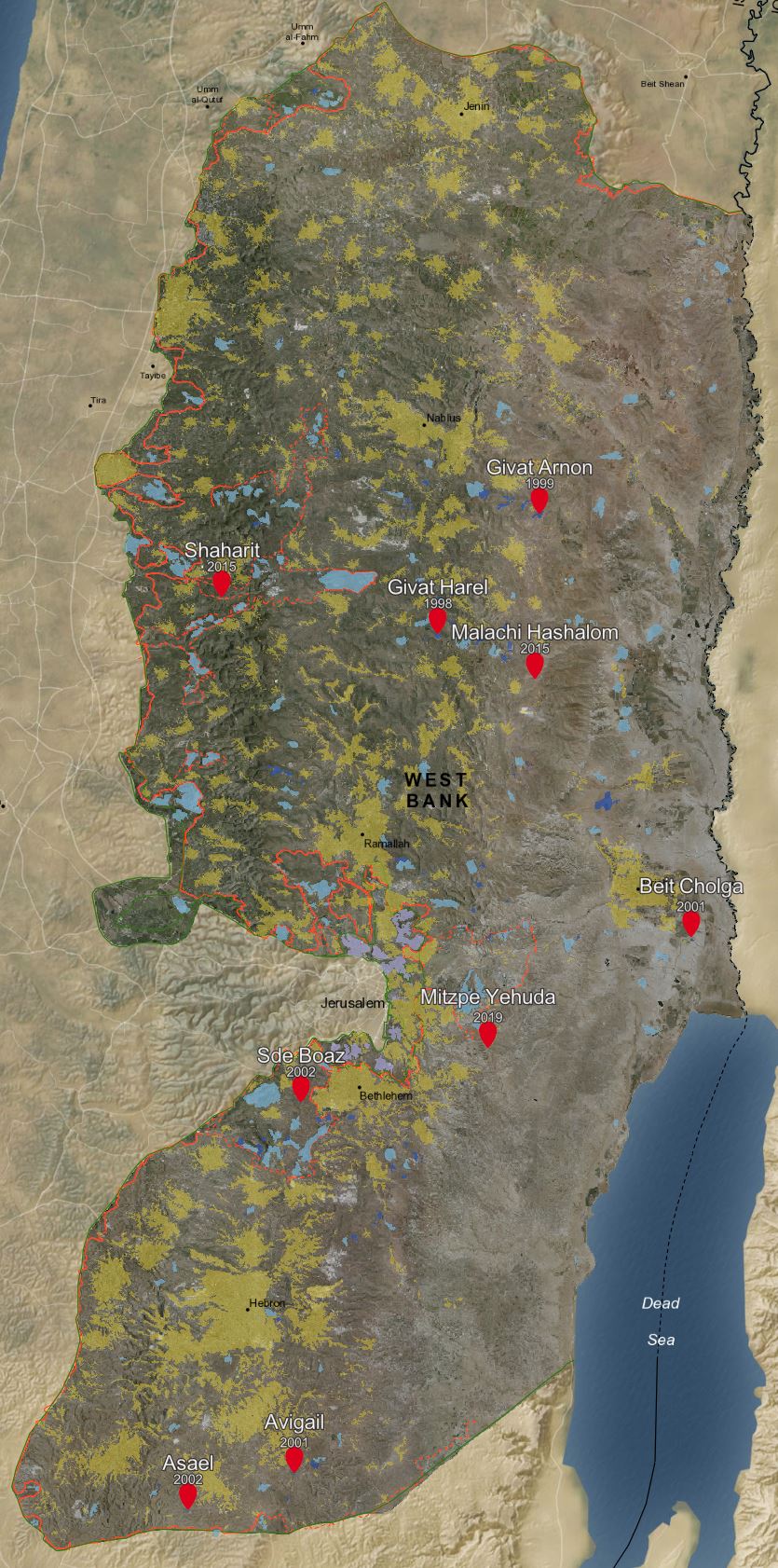
Importantly, Haaretz reports that a source said the Cabinet chose these outposts for authorization specifically because they are all located in remote or isolated locations — meaning they cannot be “legalized” via expanding the borders of a nearby settlement and declaring the outposts to be merely neighborhoods of those “legal” settlements (a legal maneuver Israel has repeatedly used to expand settlements and retroactively legalize settlements). This means, among other things, that legalization of these 10 new settlements will likely lead to additional land seizures for related infrastructure work (work that was not legally possible until now).
With respect to the remaining outposts that remain not-yet-legalized, the Cabinet approval included a clause that makes them eligible – right away, even as they remain illegal – to receive Israeli municipal services like water and electricity. Defense Minister Galant only has to sign an electricity order that was crafted under the previous government. If implemented, connecting illegal outposts to state infrastructure amounts to the de facto legalization of these outposts, even without a formal act to declare them legal.
The ten outposts slated to become official, “legal” new settlements are: Avigail, Asael, Shaharit, Givat Arnon, Givat Harel and Givat Haro’eh (which will be combined into one new settlement), Malachei Hashalom, Mitzpe Yehuda, Beit Hogla, and Sde Boaz. For further details on these outposts, please see Peace Now’s report.
Of note:
- Six of the outposts are located partially on land privately owned by Palestinians (Avigail, Givat Haroeh, Givat Harel, Givat Arnon, Mitzpe Yehuda, Malachei Hashalom).
- Three of the outposts (Avigail, Givat Arnon, and Malachei Hashalom) are located within Israel-designated firing zones, where under Israeli law any civilian presence, much less illegal civilian construction, is prohibited.
- Of particular note: the Avigail outpost is located in Firing Zone 918 in the South Hebron Hills. This is the same firing zone that is home to the Palestinian communities of Masafer Yatta — whose existence pre-dates Israel’s declaration of the area as a firing zone. Those communities are today in the process of being ethnically cleansed by Israel, based on the same law that Israel is ignoring in its legalization of the Avigail outpost.
- Two of the outposts (Avigail and Asael) have, illegally, built access roads on privately owned Palestinian land. Legalization of the outposts will undoubtedly also include the theft of the Palestinian-owned land these roads were illegally built on.
- Three of the outposts (Schacharit, Mitzpe Yehuda, and Malachei Hashalom)- are so-called “farming outposts.” That means they include very few buildings (3, 4, and 10, respectively), but a lot of land. The phenomenon of farming outposts, which have proven to be an incredibly efficient way for settlers to take over large areas of the West Bank with minimal investment in buildings and the involvement of very few people. This has been documented by the Israeli NGO Kerem Navot, which called the tactic “Israel’s most significant mechanism for dispossessing Palestinian communities.”
Minister Smotrich celebrated the announcement of the legalization of the 10 outposts and promised that there is more to come:
“That is what we as a government and as a people must do. Settlements thrive thanks to the pioneers, with much love and determination…We’ve authorized 10 outposts and we have the means to authorize more if required. My coalition partners understand this is the logical move. We’re also committed to removing all restrictions on settlement expansion in Judea and Samaria. This area must be managed in accordance with the Israeli law applicable in all parts of Israel.”
The Minister of the Negev, the Galilee and National Resilience, Yitzhak Wasserlauf, also celebrated the announcement as the start of things to come:
“Congratulations to the Security Cabinet that accepted Minister Ben-Gvir’s request and approved the communities. The dedicated settlers deserve to receive water, electricity, and public buildings. However, we will not be satisfied with just nine settlements, they are only the beginning, on the way to training more settlements, on the way to the fulfillment of the Zionist vision.”
As a reminder, Yitzhak Wasserful (a member of Ben Gvir’s Otzma Yehudit part) was granted an expanded portfolio as the Minister of the Negev and Galilee. He will now also oversee a new “young settlement department” (“young settlement” is a euphemism used by settlers for illegal outposts) that will be engaged in preparatory work for the legalization of outposts, and will also work on plans to deliver infrastructure to the outposts.
Israeli Government Announces Massive Settlement Expansion/De-Facto Annexation, Part 3: Thousands of New Settlement Units
As a result of the February 12th Israeli Security Cabinet meeting, the Civil Administration’s High Planning Council – the body that currently oversees all planning/building in the occupied West Bank – will convene in the coming days to advance plans for over 7,000 new settlement units (Minister Smotrich says 10,000 units will be advanced).
Of that total, Haaretz reports that 1,943 units are expected to immediately receive final approval for construction (including some units which have already been built but will be legalized); another 5,089 units are expected to be advanced in the planning process.
While there is no comprehensive list of all of the plans involved in these approvals and advancements, Haaretz reports that the plans expected to receive final approval will include new units in the following settlements: Rahelim, Neriya, Dolev, and Elon Moreh, Mevo’ot Yericho, and Elazar. Arutz Sheva further reports that 210 units in the Mevo Horon settlement will receive final approval, 100 of which were built illegally already.
Of particular note is a plan for 443 units in the Elazar settlement. This is, effectively, the reestablishment of the Netiv Ha’avot outpost, where five years ago the Israeli government demolished 17 structures because they were partially built on privately-owned Palestinian land (as compensation for those demolitions, the Israeli government built the evacuees an entirely new outpost near the Alon Shvut settlement, and then went about expanding the borders of the settlement to include the new buildings).
The plans not yet ready for final approvals but that are expected to be advanced in the planning process include plans for new construction in the Adam-Geva Binyamin settlement (356 units), the newly established Tel Zion settlement (627 units), the Kochav Yaakov settlement (160 units), and the Mitzpe Yericho settlement (350 units).
Israeli Government Announces Massive Settlement Expansion/De-Facto Annexation, Part 4: International Responses
Key members of the international community were quick to come out in (rhetorical) opposition to Israel’s massive settlement announcement. The U.S., U.K, France, Germany, and Italy released a joint statement “strongly opposing” the announcement saying they are “deeply troubled” by it – but none suggested they were entertaining any thoughts of imposing consequences.
The Palestinian Authority is reportedly pressing the United Nations Security Council to hold a vote in the coming days on a resolution calling on Israel to “immediately and completely” halt settlement activities. The U.S. has called the draft resolution “unhelpful” and is reported to be working against it (while also issuing public statements of dismay). Axios reports that Israeli officials believe the Palestinians are likely to secure enough support for such a resolution to pass if it is brought up for a vote, which would put the U.S. in the position of having to decide whether to vote in favor (inconceivable), abstain (improbable), or veto (likely). The U.S. is reportedly trying to convince the Palestinians to accept a statement from the Security Council in lieu of a vote.
Cabinet & Knesset Advance Bill to Repeal Parts of 2005 Disengagement, Reestablish Four Settlements Including Homesh
On February 14th, the Ministerial Committee for Legislation (a body of Ministers who decide whether to give government-backing to bills prior to their introduction to the Knesset) voted to give its approval to a bill that would repeal specific clauses of the 2005 Disengagement Law. These are the clauses that prohibit Israelis from living in the area of four settlements in the northern West Bank that were evacuated under Disengagement. If passed by the Knesset, the repeal of those clauses will allow the government to proceed with its plans to reestablish the Homesh settlement and retroactively legalize the yeshiva located there (as well as, in theory, allowing the reestablishment of the other three evacuated settlements).
Quickly following the Cabinet’s vote, the bill passed its preliminary reading in the Knesset on February 15th. It will need to pass three more readings before becoming law.
Peace Now explains the implications:
“From a human rights perspective, this will lead to a massive stealing of Palestinian land alongside increased settler violence and real danger to Palestinian lives. Homesh was primarily built on private Palestinian lands registered in the tabu (the Land Registration Office). Thus, this law will drive a final nail in the honest attempt of Palestinians to recover the massive land grab that was taken from them, and from the landowners in particular. In addition, although the Homesh settlement was evicted, a small Yeshiva located there has since been a source of violence from settlers who receive protection from the army while preventing Palestinian farmers from reaching their land. The lifting of the legal ban on the presence of Israelis in the area will provide an incentive for the arrival of more Israelis in the area. As a result, Palestinian lands will continue to be, at least de facto, expropriated.”
As a reminder, the retroactive legalization of the Homesh outpost was agreed to in coalition agreements that enabled the formation of the current Israeli government. Repealing the relevant parts of the 2005 Disengagement Law is the first step to implementing this commitment.
Also as a reminder: The government is currently facing a deadline from Israel’s High Court of Justice to submit its position on the court-ordered evacuation of the illegal yeshiva settlers built at the site of the dismantled Homesh settlement. The State has for nearly three years delayed its response to a 2019 petition filed by Yesh Din seeking both the removal of the illegal outpost and yeshiva at the site, as well as the site’s return to its Palestinian landowners. Despite Homesh being dismantled in 2005, Israel never permitted Palestinians to regain access to or control of the land, declaring it a closed military zone. That status has prevented Palestinians from entering the area, even as the IDF permitted settlers to routinely enter the area, to live (illegally, under Israeli law) at the site, and to illegally establish a yeshiva there. That yeshiva, according to the Israeli NGO Kerem Navot, has become one of the West Bank’s “hardcore centers of settler terror”. Settlers have also wreaked terror on nearby Palestinian villages, most notably Burqa and Sebastia. One Israeli politician even went so far as to say that settlers are “carrying out a pogrom” in Burqa.
Smotrich’s Plans to Take Over the West Bank
Haaretz obtained a draft government decision detailing plans to create a proposed “Settlement Administration” within the Defense Ministry. This plan would give Bezalel Smotrich – a minister in the Defense Ministry – authority, either directly or through his appointee, over the entire Civil Administration and, ipso facto, all civilian affairs in the West Bank. Smotrich proposes his new “ministry within a ministry” receive an initial budget of at least 80 million shekels.
The draft proposal was circulated to Ministers this week, but still faces opposition, including from Defense Minister Gallant – at whose expense Smotrich’s power grab would come. According to Haaretz, the proposed draft includes a carve-out for Gallant to overrule Smotrich’s authority over civil matters “in exceptional circumstances subject to the defense minister’s decision to change a specific decision or action in exceptional cases, with appropriate justification and subject to hearing the position of the other minister.”
The proposal is also opposed by IDF Chief of Staff Herzi Halevi, who reportedly told Prime Minister Netanyahu fears the plan would lead to a breakdown in the IDF chain of command.
Settler Olive Orchard & New Outpost Are Dismantled by Government, Causing Coalition Fight
A series of enforcement actions against illegal settlement activity in the West Bank has further driven a wedge between members of Netanyahu’s far-right coalition.
First, on February 12th Israeli forces dismantled a new outpost – dubbed “Gofna” by settlers – located in the northern West Bank. Six settler families arrived the previous night in an organized effort to quickly build several structures. Those buildings were demolished by the Israeli Border Police; settlers attempted to prevent the police from carrying out the evacuation. The Gofna outpost was previously established (and quickly dismantled) in July 2022 as part of a massive campaign led by the Nachala Movement to set up new outposts across the West Bank.
Then, on February 15th the Civil Administration uprooted over 800 olive trees that a settler illegally planted on land that the Israeli High Court has recognized as privately-owned Palestinian land, located near the Shilo settlement. The 2023 Court ruling concluded 15 years of litigation, but its enforcement has been repeatedly postponed. Dozens of settlers clashed violently with Israeli Border Police carrying out the tree removal; some of the settlers climbed the trees in hopes of stopping the bulldozers, and even some Knesset Members angrily tried to stop the officers from carrying out the law. Forty settlers/settler supporters were temporarily detained for their part in the violence; four Border Police officers were suspended after video footage captured them attacking one of the protestors.
Reports of the removal of the trees caused an immediate crisis in the government. Smotrich claimed that he had previously issued an order that vacated the court-ordered evacuation (in effect, Smotrich asserting the power to personally overrule the Israeli High Court). Any such order Smotrich may have issued was apparently overruled by Defense Minister Gallant – – with whom Smotrich is engaged in a power struggle (discussed above). Smotrich then wrote an urgent letter to Prime Minister Nentanyahu, who ordered the Civil Administration to halt the demolition hours after it began, though only a few trees remained in the ground at that point.
Smotrich later rehashed the turmoil, saying:
“To my astonishment, Defense Minister [Yoav Gallant] grossly violated the coalition agreement and reversed my decision…And, instead of implementing a settlement security policy, Gallant chose to continue the left-wing policy of former minister Benny Gantz and uproot the grove even though the claims against the grove were proven to be false in the legal proceedings…..violation of the [coalition] agreements will make it very difficult for the government and the coalition to conduct themselves properly.”
Later, on Twitter, Smotrich continued:
“Defense Minister Gallant’s denial of the unambiguous agreements and the prime minister’s foot dragging on the matter are unacceptable and they cannot continue…if Gallant has a problem, he’s welcome to hand in the keys. I’m sure there are lots of people in Likud who would be glad to take his place at the Defense Ministry.”
Minister Ben Gvir also vented his anger over law enforcement against illegal settler activities, saying:
“This isn’t what we signed up for when we agreed to join the Netanyahu government…We were promised a full-on right-wing government that can’t not evacuate Kahn al-Ahmar or avoid tearing down illegal buildings in East Jerusalem. A right-wing government doesn’t go only after Jews.”
Settler Groups Convene Workshop on Jordan Valley Annexation
Settler groups are continuing their push for Israel to annex the Jordan Valley. On February 12th, two settler advocacy groups held an event for lawmakers and security leaders in the Jordan Valley, starting with a tour of the region and a workshop to “discuss the challenges of sovereignty in the Valley and ways to deal with them.”
Yehudit Katsover and Nadia Matar, co-chairwomen of the Sovereignty Movement, and Nili Naouri, who heads the Israel Forever movement, who together hosted the event, said in a statement:
“sovereignty in the Jordan Valley is a necessary step for both the security, strategic and internal security aspects of the future of Israel, as expressed by prime ministers over the years, leaders of both Right and Left, which illustrates the broad national consensus behind taking the step of sovereignty in this area. Sovereignty in the Valley also does not constitute a demographic threat to the Jewish character of the State of Israel.”
MK Sharen Haskel, who attended the event and who has previously introduced annexation bills in the Knesset, said:
“The message that we’re trying to send is that this is the place where we have to apply sovereignty first. This is not just a question of sovereignty, this is also a question of security and defense of our country and of our people…We are here seeing the mountains on both sides from Jordan and the areas of Judea and Samaria, and we understand that this ground is a tactic ground that is meant to guard our security need of the state of Israel.”
Bonus Reads
- “Israel is Annexing the West Bank. Don’t be Misled by its Gaslighting” (Just Security)
- “Go West Bank: Israel Is Using the Housing Crisis to Lure Israelis Into Becoming Settlers” (Haaretz)
- “The Kohelet Tentacles: Inside the Web Surrounding the Right-wing Think Tank” (Haaretz)
- “Pompeo: Israel has Biblical claim to the land so it can’t be an occupier” (MEMO)
Welcome to FMEP’s Weekly Settlement Report, covering everything you need to know about Israeli settlement activity this week.
To subscribe to this report, please click here.
February 10, 2023
- Government Begins Forming Bureaucracy for Annexation
- Smotrich Says No Settlement Freeze, Asks Settlers to Hold Off on New Outposts
- A New Settlement: Israel Establishes Tel Zion as Independent Settlement
- Israeli Government Expected to Advance Atarot Settlement Plan
- Court Grants State Two-Month Delay in Khan Al-Ahmar Forced Displacement
- Israeli Cabinet Prepares for Vote to Amend 2005 Disengagement Law, Legalize Homesh Outpost & Yeshiva
- Bibi Pitches Massive Tunnel Construction in West Bank to French Investors
- Smotrich Resigns, Brings Criminal Settler into Knesset
- Bonus Reads
Government Begins Forming Bureaucracy for Annexation
As the new Israeli government continues to take shape, the bureaucratic mechanisms of annexation have come into focus.
Key components of this bureaucracy will reportedly include a new “Settlement Administration,” the creation of which is still pending an agreement between Smotrich and Defense Minister Gallant on how duties in the Defense Ministry will be divided (a division which is facing international opposition). In a meeting with settler leaders, Smotrich unveiled a plan for a new “settlement administration” that will attempt to centralize the Defense Ministry’s efforts accomplish several key objectives: to promote settlements, to take control of more land, to handle legal cases related to the settlements, and to advance Smotrich’s long-time goal of dismantling the Civil Administration in order to bring the settlements under the direct governance of the Israeli state (annexation).
According to Smotrich, this new administration will operate on a two year timeline to achieve its goals, ultimately working itself out of existence once all powers over the settlements are transferred from the Civil Administration to the various Israeli Ministries. According to Haaretz, Yehuda Eliyahu is likely to lead the settlement administration under the management of Smotrich. Smotrich and Eliyahu co-founded the Regavim settler group.
In addition, the Israeli government expanded the portfolio of the Minister of the Negev and Galilee, a post held by Otzma Yehudit member Yitzhak Wasserful. The expanded position will also have a new “young settlement department” (young settlement is a euphemism used by settlers for outposts). This department will be engaged in preparatory work for the legalization of outposts, and will also work on plans to deliver infrastructure to the outposts. Prior to this new department, this ministerial post did not have any authority in the West Bank (i.e. outside of Israel’s sovereign borders).
Haaretz details how these new bodies will interact:
“… if outposts are legalized, the process will likely be divided among three different agencies. The Civil Administration, which is under Smotrich’s control according to the coalition agreement, will be in charge of formal legalization. But responsibility for building or improving infrastructure in outposts will be divided between two other agencies. One is the National Missions Ministry, headed by Orit Strock (Religious Zionism). The other is the so-called young settlement department.”
Lastly, Emek Shaveh reports on a January 29th government decision which transferred the Israeli Antiquities Authority (IAA) from the Ministry of Culture to the Ministry of Heritage, which is now headed by Jewish Power MK Amihai Eliyahu. The IAA exercises authority over heritage and archaeological sites in Israel, including East Jerusalem, but has increasingly expanded its authorities into Area C of the West Bank, at the expense of the Staff Officer for Archaeology within the Civil Administration which has historically been in charge. The government also tasked Eliyahu with preparing an emergency plan to “safeguard” antiquity sites in the West Bank specifically, where settlers have spent years alleging neglect and destruction of heritage sites by Palestinians and the Palestinian Authority (which, turns out, has created a basis for the government to take control over those sites – go figure). The government allocated NIS 150 million to the effort.
Emek Shaveh reacts:
“After years of monitoring the process of weaponizing ancient sites in the service of the settlements in East Jerusalem and the West Bank, we are not surprised that the ultranationalist Jewish Power party demanded the heritage portfolio. An indication of the minister’s intentions was offered in January, when Eliyahu took over from outgoing minister of Heritage and Jerusalem Affairs, Ze’ev Elkin. At the ceremony he said: ‘Israel needs three pillars in order to stand strong: the security pillar, the economic pillar and a third pillar which is the pillar of significance.’ He added ‘The Ministry of Heritage will strengthen the third pillar. We will fortify our national resilience by encountering our heritage. We will protect the various heritage sites and devise programs to deepen Jewish identity’.”
For an overview of Israel’s weaponization of archaeology in its effort to take control of more land in Jerusalem and the West Bank, please see Emek Shaveh’s report.
Smotrich Says No Settlement Freeze, Asks Settlers to Hold Off on New Outposts
Following reports that Netanyahu had conceded to the U.S. request to freeze settlement construction in order to de-escalate tensions, Finance Minister Bezalel Smotrich repudiated the idea of any freeze, saying: “There will be no freeze on construction in Judea and Samaria. Period.”
Smotrich’s statement, however, did not contradict reports that he had asked settler leaders to stop efforts to establish new outposts, asking settlers leaders to coordinate all activity with the government. Smotrich publicly explained his request to pause outpost construction, saying at the weekly meeting of the Religious Zionism party:
“Our ambition is not to have to resort to illegal measures. We want the government to officially adopt a policy of recognizing all the communities in the settlements and also, of establishing new communities, in line with natural growth. None of us considers himself above the law. We are the government, and this will take more than a day or two, but I’m convinced that we’ll see substantial changes occurring in the near future.”
A New Settlement: Israel Establishes Tel Zion as Independent Settlement
On February 5th, the Israeli Cabinet approved a plan that will, once implemented, establish a new settlement, Tel Zion, by splitting off the Ultra-Orthodox section of the Kochav Yaakov settlement, located east of Jerusalem. The approval of this plan was delayed from consideration last month while U.S. National Security Advisor Jake Sullivan was in Israel.
The creation of the “Tel Zion” settlement is part of Netanyahu’s coalition deal with the ultra-Orthodox Shas Party, and is also supported by Defense Minister Gallant.
Israeli Government Expected to Advance Atarot Settlement Plan
Peace Now reports that the Netanyahu government appears likely to re-engage a plan to build the Atarot settlement.
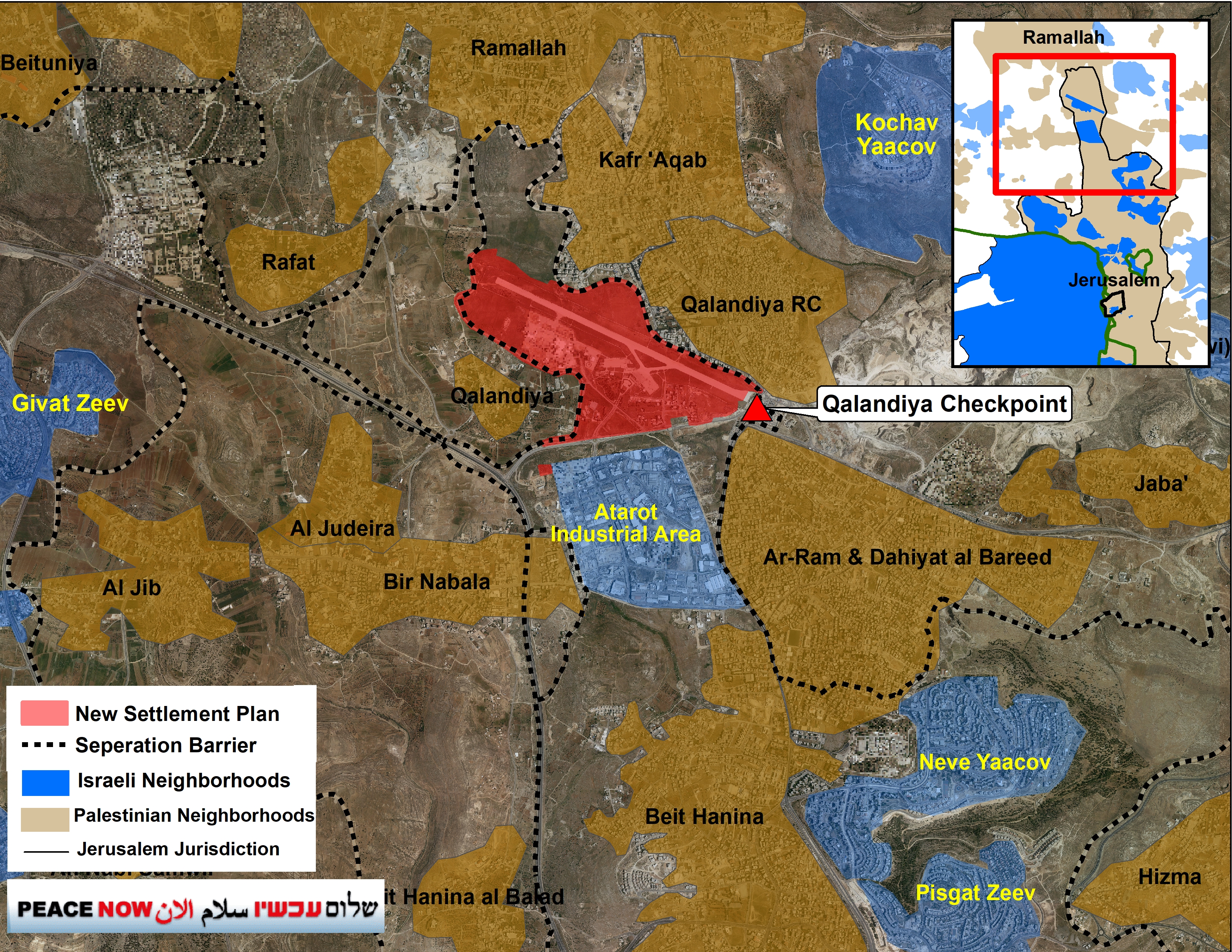 The plan for the Atarot settlement, which has existed since 2007, calls for a huge new settlement on the site of the defunct Qalandiya Airport, located on a sliver of land between Ramallah and Jerusalem. In its current form, the plan provides for up to 9,000 residential units for ultra-Orthodox Jews (assuming, conservatively, an average family size of 6, this means housing for 54,000 people), as well as synagogues, ritual baths (mikvehs), commercial properties, offices and work spaces, a hotel, and a water reservoir. If built, the Atarot settlement will effectively be an Israeli city surrounded by Palestinian East Jerusalem neighborhoods on three sides and Ramallah to its north. Geopolitically, it will have a similar impact to E-1 in terms of dismembering the West Bank and cutting it off from Jerusalem. For more on the Atarot settlement plan, please see here.
The Atarot settlement plan was last considered in 2021 when Naftali Bennet was Prime Minister, but was delayed from consideration by the planning committee – reportedly at the urging of U.S. Secretary of State Blinken. The Committee delayed advancement of the plan by ordering an environmental study which was expected to take about one year. Notably, in ordering the study, the Court made it clear that the environmental study is “standard practice” and expressed support for the underlying plan, saying it believes the plan represents a proper use of unutilized land reserves.
Peace Now said in a statement:
“This is a highly dangerous plan that could land a fatal blow to the prospect of peace and two states. The Atarot plan puts a wedge in the heart of the existing Palestinian urban continuum between Ramallah and East Jerusalem, thus preventing the possibility of establishing a Palestinian state with its capital in East Jerusalem. If the plan is not removed from the agenda of Israel´s far-right and pro-settler government, an eventual political resolution will become even harder to reach.”
Court Grants State Two-Month Delay in Khan Al-Ahmar Forced Displacement
On February 7th, the Israeli Supreme Court granted the State until April 2nd – a two month delay when the State had requested four months delay – to submit a plan to forcibly remove the Khan Al Ahmar bedouin community (a war crime) from its lands just outside of Jerusalem. The Court also set May 1st as the date for a final hearing on a petition submitted by the Regavim settler group demanding the immediate removal of Khan Al-Ahmar.
As with previous delays (there have been a total of 9), the Court expressed its extreme displeasure with the State’s foot dragging. Justice Noam Sohlberg said in his ruling:
“Suffice it to say that we are not at all satisfied with the conduct of the state…[the state’s behavior demonstrates] the existing situation is comfortable for it: Once every few months it files a request for an extension, which the petitioner opposes and the court accedes to through gritted teeth, and the world carries on as normal; deciding not to decide.”
In a statement revealing its ideological motivations, Regavim wrote:
“The government should formulate a working plan for the enforcement of the law in Khan al-Ahmar, as part of a fight against the Palestinian Authority’s institutionalized takeover of open areas in Judea and Samaria. The State of Israel must behave like the owner of the house, even in the face of American pressure, otherwise no one in the world will take it seriously.”
Israeli Cabinet Prepares for Vote to Amend 2005 Disengagement Law, Legalize Homesh Outpost & Yeshiva
The Israeli Cabinet’s Ministerial Committee on Legislation is expected to vote to amend the 2005 Disengagement Law at its February 12th meeting in order to pave the way for the reestablishment of four settlements in the northern West Bank. Jerusalem Post reports that the measure is expected to have enough support to be approved by the Cabinet and passed by the Knesset.
If passed, the bill will allow Israel to grant retroactive legalization to the Homesh outpost and yeshiva – reestablishing Homesh as a fully legal, under Israeli law, settlement. The retroactive legalization of Homesh was agreed to in coalition agreements that formed the current Israeli government.
The vote comes as the government faces a deadline from the High Court to submit its position on the court-ordered evacuation of the illegal yeshiva settlers built at the site of the dismantled Homesh outpost. The State has, for nearly three years, delayed its response to a 2019 petition filed by Yesh Din seeking the removal the illegal Homesh outpost and yeshiva, as well as guarantee the site’s return to its Palestinian landowners. Despite Homesh being dismantled in 2005, Israel never permitted Palestinians to regain access to or control of the land, declaring it a closed military zone. That status has prevented Palestinians from entering the area, while allowing settlers to routinely enter and (illegally, under Israeli law) inhabit the land, even (illegally) establishing a yeshiva there. That yeshiva, according to the Israeli NGO Kerem Navot, has become one of the West Bank’s “hardcore centers of settler terror”. Settlers have also wreaked terror on nearby Palestinian villages, most notably Burqa and Sebastia. One Israeli politician even went so far as to say that settlers are “carrying out a pogrom” in Burqa.
Bibi Pitches Massive Tunnel Construction in West Bank to French Investors
The Times of Israel reports that Netanyahu held a meeting with investors to pitch a massive construction project that would see highspeed tunnels be carved into the terrain throughout the West Bank in order to connect Israeli settlements together, and have more seamless access to Jerusalem and Tel Aviv. The underground highways would be designed in such a way to provide so-called “transportational contiguity” for both Israelis and Palestinians, in lieu of territorial contiguity for the latter (an idea endorsed in the Trump plan). The tunnel vision would effectively annex the settlements to Israel, and entrench a separate but unequal transportation grid that severely limits Palestinian freedom of movement, access to land, and more. The Israeli notion of “transportational contiguity” is put forward as an alternative to “territorial contiguity” which is no longer possible for Palestinians because of Israeli settlements, infrastructure, and control. The notion also gives permission to Israel for further settlement growth.
Smotrich Resigns, Brings Criminal Settler into Knesset
Finance Minister Bezalel Smotrich formally resigned his seat in the Knesset in order to focus his time on his Ministry postings, which not only include head of the Finance Ministry but also as a key minister within the Defense Ministry in control of the Civil Administration. Upon his resignation, the vacant Knesset seat has been filled by the next name on the Religious Zionist Party slate, and that happens to be Zvi Sukkot – a hardline settler who is one of the founders of Evyatar outpost.
Sukkot lives in the Yitzhar settlement – a hotbed of settler extremism and violence, the home of the notorious “Hilltop Youth” movement that has terrorized the Nablus region. He has been arrested on suspicion of arson in a 2010 attack on a Palestinian mosque. In 2012, he was temporarily banned from the West Bank on suspicion that he was orchestrating attacks on Palestinians.
Bonus Reads
- “In West Bank, Settlers Sense Their Moment After Far Right’s Rise” (New York Times)
- “Israel steps up Jerusalem home demolitions as violence rises” (AP)
- “From This Hill, You Can See the Next Intifada” (The Atlantic)
- “Threat Still Looms Despite Postponement of Largescale Wadi Qaddum Demolition” (Ir Amim)
- “ICJ sets July 25 for submission on illegality of Israel’s ‘occupation’” (Jerusalem Post)
Welcome to FMEP’s Weekly Settlement Report, covering everything you need to know about Israeli settlement activity this week.
To subscribe to this report, please click here.
January 13, 2023
- New Givat Hamatos Expansion Plan
- The IDF Has Prepped & Presented its Plan to Expel Palestinians from Masafer Yatta
- Israel Carries Out Demolitions in Area B
- MK Danon Unveils Jordan Valley Annexation Bill
- Settlers Demand Fast-Tracked “Regularization” of Outposts
- Biden Administration Commits to Doing Nothing More Than Issue Empty Statements in Response to Israel Expanding Settlements/Legalizing Outposts
- Peace Now Releases 2023 Settlement Map
- Adalah Publishes Detailed Analysis of New Israeli Coalition Deal
New Givat Hamatos Expansion Plan
Ir Amim reports that on March 2nd the Jerusalem Planning Committee will consider a brand new plan to expand the area of theGivat Hamatos settlement in East Jerusalem by 40% and to more than double the number of housing units slated to be built there. The new plan – called the “East Talpiyot Hill” plan – involves the construction of 3500 units and 1300 hotel rooms, to be built on a plot of land adjacent to the site where the Givat Hamatos settlement (planned for 2610 units) is slated to be built. As a reminder: tenders for the construction of those units were issued in January 2021 (just hours after PResident Biden was inaugurated), and the construction of the infrastructure for that project is already underway.
 The “East Talpiyot Hill” plan involves construction on a strategic strip of land that will expand the area of Givat Hamatos eastward, connecting it with another new settlement plan – the “Lower Aqueduct Plan.” These plans ultimately create a string of settlements — spanning from Gilo to Givat Hamatos to Har Homa — that, together with the planned “Givat HaShaked” settlement to its north, completely encircle the East Jerusalem Palestinian neighborhood of Beit Safafa with Israeli settlement construction. Ir Amim further warns that the inclusion of hotels in this new plan “will likely serve as a major source of competition with the tourism industry in Bethlehem, potentially diverting vital business from the Palestinian economy.”
This land on which the “East Talpiyot Hill”project will be built was owned by the Greek Orthodox Church until 2009 – when the church sold many of its most prized properties to settler entities. The Church has contested these sales, alleging fraud – but Israeli courts have rejected the Church’s objections and allowed the contested sales to stand. This particular tract of land was sold to an Israeli businessman and the New Talpiyot Hill company, which together initiated this new plan.
Importantly, Ir Amim notes that there are indications that Israel is carrying out land registration for plots located in the tract of land on which the “East Talpiyot Hill” project would be built. This is highly significant, as the registration appears to be happening in secret and – as revealed by Bimkom’s and Ir Amim’s ongoing monitoring and research, “settlement of land title proceedings are largely being used to dispossess Palestinians of their properties and seize more territory in East Jerusalem for Israeli settlement. “
The IDF Has Prepped & Presented its Plan to Expel Palestinians from Masafer Yatta
Haaretz reports that the Israeli Central Command has presented to the Israeli government its plan to expel some X,000 Palestinians from eight villages in Masafer Yatta in the South Hebron Hills – plans it had reportedly been working on for two months (i.e., even before the new government took power). Sources told Haaretz that the new government has not given the IDF the order to carry out the expulsions yet, but nonetheless the IDF saw fit to design a plan, using vans, to carry out the evictions. Israeli Defense Minister Yoav Galant has reportedly told the IDF that he “needs to study” the matter.
Israel Carries Out Demolitions in Area B
Haaretz has revealed that on November 24, 2022, the Israeli Civil Administration demolished two Palestinian structures in Area B of the West Bank — the area in which, under the Oslo Accords, Israel enjoys no jurisdiction over civil matters (such as building enforcement). The Civil Administration denies that the demolition violated the Oslo Accords, arguing that it was within its rights because it was acting to address alleged major damage caused to a nearby archaeological site, called Khirbet Tarfin. Israeli political figures were reportedly involved in the decision to carry out the demolitions.
In a statement to Haaretz regarding the demolitions, the Civil Administration stood proudly by its demolition, and committed to defending archaeological sites across the whole West Bank. The statement reads:
“The Civil Administration will continue to expend major efforts and resources in researching and preserving the archaeological sites in Judea and Samaria [the West Bank] in addition to pursuing enforcement activity against antiquities thieves and the building of illegal structures in the heart of archaeological sites.”
The Civil Administration’s statement – and Israel’s move to raze these two Palestinian structures – should be understood against the backdrop of the years-long campaign by settlers pushing the government to unilaterally take control over archaeological sites (defined expansively) throughout the West Bank. In this way settlers and their supporters are- with great success – weaponizing archaeology as a tool for the dispossession of Palestinians.
This effort should also be understood as an expansion of the settlers’ enormously successful tactics in getting the Israeli government to annex Area C – with Israeli policy now treating Area C as sovereign Israeli territory in virtually all ways (other than a public declaration of annexation). Now that the new governing coalition has announced a total freeze on Palestinian construction in Area C and has increased demolition of Palestinian “illegal” construction (i.e., Palestinian construction on their own private land, but lacking Israeli permits, due to the fact that Israel refuses to issue Palestinians permits to build) — and now that Netanyahu has declared Israel’s “exclusive and inalienable right to all parts of the Land of Israel” — it is not surprising, but is still alarming, to see the same land grab tactics that worked so well in Area C applied in Area B. Indeed, more Israeli actions/policies that further the erasure of any meaningful Oslo-era boundaries between West Bank areas should be anticipated.
MK Danon Unveils Jordan Valley Annexation Bill
MK Danny Danon (Likud) – who previously served as Israel’s Ambassador to the UN – has unveiled a bill that would have Israel unilaterally annex the Jordan Valley.
Jordan Valley annexation bills have been introduced into the Knesset for years, but have rarely if ever received real consideration, though support for such a measure is likely high. In September 2019, Netanyahu committed to annexing the Jordan Valley.
Settlers Demand Fast-Tracked “Regularization” of Outposts
The Forum for Young Settlements, an advocacy group by and for settlers, is pushing the new Israeli government to act swiftly to suspend the rule of law to “legalize” settlement outposts across the West Bank that were built in violation of Israeli law, and many of which are located on privately-owned Palestinian land. As part of the coalition agreements, the parties agreed to “legalize” the outposts within the first 60 days of the new government tenure- – but settlers apparently think this is too long, and are demanding that the government act immediately.
The Forum said in a statement:
“[The Forum] congratulate[s] the Prime Minister and the ministers for establishing a stable national right-wing government for the first time in years, and for introducing ‘Young Settlement Regulation’ into the coalition agreements….this is the time to approve the proposal of the decision-makers for regulation. The government’s decision is already prepared, and over 25,000 residents of the young settlements in the winter months cry out for a resolution to their humanitarian needs and immediately enable the connection of all the young settlements to electricity, water, and other infrastructures.”
Biden Administration Commits to Doing Nothing More Than Issue Empty Statements in Response to Israel Expanding Settlements/Legalizing Outposts
U.S. Ambassador to Israel Thomas Nides told the Israeli Kan news outlet that the U.S. opposes “massive settlement growth” — seeming to signal the Biden Administration’s acceptance of settlement construction on a less-than-massive scale (FMEP president Lara Friedman notes that this reminds her of an old joke: a couple celebrating their 50th wedding anniversary was asked, what made this marriage last so long? Partner 1 responded – “when we got married, we agreed that I get to make all the big decisions, and my partner gets to make all the small decisions; as it turns out, there has never been a big decision, so peace has reigned between us!”). Nides further said that the U.S. continues to oppose outpost legalization but does not have any “red lines” for the Israeli government.
Peace Now Releases 2023 Settlement Map
Peace Now has released an updated map of the West Bank, showing settlements, outposts and more. You can view and download the map here: https://peacenow.org.il/en/%d9%8dsettlements-map-2023
Adalah Publishes Detailed Analysis of New Israeli Coalition Deal
Adalah released a new report on the details contained within the new Israeli coalition deal. The paper examines the following 11 items:
- Deepened political control over law enforcement and policing;
- Accelerating the Judaization of the Naqab, Galilee, and beyond;
- Curbing the prohibition of discrimination in services and products;
- A new basic law on immigration;
- Discrimination in education;
- Impunity for the armed forces;
- Silencing criticism against Israel;
- Allowing candidates running for the Knesset to incite racism while undermining Palestinian political participation;
- Separate and unequal funding for Palestinian localities in Israel; (10) Limiting the Supreme Court’s authority; and
- De facto annexation of the West Bank.
On de facto annexation of the West Bank, Adalah writes:
“These appointments effectively give the RZP control over all settlement construction projects in the West Bank; authority over nearly all issues relating to the settlements: the building of homes, demolition of homes and other buildings, and all other aspects of daily life. This ministerial position will also no longer require the Prime Minister’s approval at various stages of West Bank settlement construction projects; instead, it will only be required once, during the initial stages. Smotrich has made clear that he intends to use this authority to de facto annex the West Bank by, in particular, dismantling the Israeli military’s Civil Administration over the Israeli Jewish settlers illegally residing there and instead putting their governance under Israeli civil domestic law, while continuing to keep Palestinians under military rule. This move will more deeply entrench the two separate systems of governance that already exist based on racial identity, an unquestionable hallmark of a system of apartheid.”