Welcome to FMEP’s Weekly Settlement Report, covering everything you need to know about Israeli settlement activity this week.
To subscribe to this report, please click here.
November 10, 2023
- Smotrich Calls for West Bank Land Grab To Create “Sterile” Areas Near Settlements
- After 30 Years, Israeli High Court Orders Settlers Off Palestinian Land
- With Settlers Acting as a West Bank Militia, U.S. Transfers 24,000 Rifles to Israel
- On Reestablishing Gaza Settlements
- Bonus Reads
Smotrich Calls for West Bank Land Grab To Create “Sterile” Areas Near Settlements
Bezalel Smotrich, the Israeli Finance Minister and deputy minister in the Defense Ministry who operates as the de facto governor of Area C in the West Bank – wrote a letter to PM Netanyahu and Defense Minister Gallant calling for the establishment of extensive “sterile security zones” (i.e. closed to Palestinians) to form a wide perimeter around settlements and key roads throughout the West Bank. The recommendation is tantamount to a call for unilateral annexation of more West Bank land to the settlements and a proposal for removing Palestinians from their land under the guise of security. This would include seizing actively cultivated agricultural land that is privately owned by Palestinians (ownership which is recognized by Israel).
Smotrich made a point to say that the “sterile security zones” would be used to stop Palestinians from harvesting their olives during peak season (now). Palestinian farmers in the West Bank are already struggling to harvest olives this season due to the near total military shutdown of the West Bank. Smotrich, in his proposal for creating these “sterile” zones around settlements and roads, also argued that the creation of these zones would accomplish “the removal of left-wing [Israeli] anarchist activists who set the area on fire.” Israeli and international activists have long accompanied Palestinians during the olive harvest season in part to offer protection to the farmers posed by settlers and the IDF.
Commenting on Smotrich’s proposal Jan Egeland, head of the Norwegian Refugee Committee, said on X:
“Israel’s Additional Minister of Defence Bezalel Smotrich has called to establish extensive closed military zones around illegal Israeli settlements + along major routes in occupied West Bank, which would prevent Palestinians freely moving & increase risk of forced displacement. In Gaza, we have witnessed the transfer, en masse, of Palestinians without any guarantees of their safety, survival, and eventual return to their homes. Public statements by Israeli officials are also calling for the deportation of millions to Egypt. Israel must not further perpetrate forcible transfer, and should allow the safe return and compensate for damages caused to displaced Palestinians in the West Bank and Gaza according to international law.”
After 30 Years, Israeli High Court Orders Settlers Off Palestinian Land
Haaretz reports that on November 8th, the Israeli High Court ordered settlers to vacate a land in the Jordan Valley that they had been given illegally and improperly by the State over 30 years ago. The judge sharply criticized how the State, which originally seized the privately owned land via a temporary military seizure, proceeded to allocate the privately owned land to the World Zionist Organization. The State was ordered to pay the legal fees of the petitioners and also intimated that the State could be liable to pay for its illegal profit off the land for the past 30 years.
This case dates back to a 1969 military seizure order for a vast tract of land in the Jordan Valley, including a parcel of land privately owned by Palestinians. Instead of canceling the seizure order and returning the land to its owners, the state instead gave control over that land to the World Zionist Organization. Then, on the 1980s, the World Zionist Organization allocated the land to settlers without any documentation of either having received control of the land from the government, or documentation allocating the land to the settlers. Since then, settlers have developed the land into profitable date farms. In 2018, several Palestinian landowners have filed a petition with the High Court of Justice to have the settlers removed from the area and the land returned to their control. In a contentious court hearing in June 2022, in which the State conceded that it does not know how or why the settlers were allocated the land in the first place, High Court Justice Esther Hayut told the State lawyer: “Given that you cannot explain how the land was given to those to whom it was given, does that give them the right to remain there forever?”
With Settlers Acting as a West Bank Militia, U.S. Transfers 24,000 Rifles to Israel
On November 7th, a coalition of 26 Palestinian human rights groups appealed to the third state parties to press for an immediate intervention to protect Palestinians in the West Bank and Jerusalem from state-backed settler violence. On the day the letter was sent, OCHA reported that Israeli settlers killed at least nine Palestinians, including at least one child, and injured 62. In addition, at least 905 Palestinians, including 356 children, have been forcibly displaced because of Israeli settler violence and access and movement restrictions. These numbers continue to grow. Since the Oct. 7th Hamas attack, there has been an average of seven settler attacks a day and the scale of displacement has escalated sharply, with nearly four times as many West Bank communities depopulated in the past month as in the preceding year and eight months combined.
In a rare public criticism, President Biden and the U.S. Secretary of State Blinken have both raised concern about the scale of settler violence in the West Bank in the wake of the October 7th massacre by Hamas and Israel’s war on Gaza. On Oct. 25 President Biden warned that settler violence was “pouring gasoline on fire,” and Secretary Blinken raised concerns while in Israel on November 3rd.
Nonetheless, the Biden Administration finalized the sale of 24,000 assault rifles to Israel despite the settler violence and loosened gun regulations in Israel. Before the sale was complete, the U.S. reportedly received assurances from the Netanyahu government that these particular guns will not end up in the hands of settlers policing Palestinians in the West Bank. The government said these guns would arm Israeli civilian response teams that operate within sovereign Israeli territory, under control of the Israeli police (which, it should be recalled, are under the control of Security Minister Itamar Ben Gvir).
In the wake of rare public concerns from the U.S. administration, on November 8th, PM Netanyahu convened a meeting with settler leaders during which he was reported to have told them that he would not tolerate a “handful of extremists[settlers]…[who] cause great damage to the State of Israel.”
In a new report on settler violence since Oct 7th, Peace Now writes:
“The war in Gaza has created a new reality where the security system in the West Bank increasingly relies on settlers within the framework of operational activities, becoming more dependent on them. Ideological and violent settlers leverage the war to coerce the military for their own goals of expulsion and harm to Palestinians, even interfering with IDF activities. This blurring of boundaries between the army and civilians, which has always been a significant problem in the Israeli occupation system in the territories, might cause a dire deterioration, potentially leading to the creation of a third front in the West Bank. Meanwhile, amid the war, a group of settlers managed to strengthen their hold over Area C, advocating for the coercive displacement of Palestinians and exacerbating the discriminatory practices and oppression against them in the West Bank. A decisive political decision to evacuate violent outposts not to disrupt security during wartime could prevent numerous attacks. Initiating law enforcement against violent settlers could restrain and deter others. Preventing the conscription of violent settlers into the reserves and the immediate dismissal of reservist soldiers involved in or enabling violence are essential steps, not mandating political decisions”
On Reestablishing Gaza Settlements
Several senior Israeli officials have been publicly proclaiming their hope to reestablish settlements in the Gaza Strip, which were removed by the Israeli government as part of the 2005 Disengagement Plan. In fact, members of Netanyahu’s Likud party have introduced a piece of legislation in the Knesset that would cancel the part of the Disengagement Law that bars Israelis from entering the Gaza Strip.
Amira Hass warns that these statements should be taken seriously, writing in Haaretz:
“As the last 50 years have shown, any single settler’s hallucination should be taken seriously, and treated as a plan of action by the next government, if not the current one. And when the hallucination is built on overt plans for total destruction and mass expulsion, wars are the most suitable ground for its realization.”
Bonus Reads
- ““‘Leave or Die’ An account from a Palestinian in the West Bank” (Slate)
- “Trending: Israeli Soldiers Document and Proudly Post Their Own Abuse of Palestinians” (Haaretz)
- “How a Campaign of Extremist Violence Is Pushing the West Bank to the Brink” (New York Times)
- “Local Construction Firm for Secret US Base in Israel Also Built an Illegal Settlement” (The Intercept)
- “The Gaza-fication of the West Bank” (The New Yorker, interview with Hagai El-Ad)
- “Kathy Hochul’s Israel Trip Bankrolled by Group Funding Illegal Settlements” (The Intercept)
Welcome to FMEP’s Weekly Settlement Report, covering everything you need to know about Israeli settlement activity this week.
To subscribe to this report, please click here.
March 17, 2023
- E-1 Final Hearing Postponed Until June 12
- Disengagement Repeal Law Passes First Reading
- Israel Delivers Demolition Order on Salem Family Home in Sheikh Jarrah, As International Community Calls on Israel to Stop Displacement
- Bonus Reads
E-1 Final Hearing Postponed Until June 12
On March 12th Israeli press reported that the High Planning Council has postponed its final consideration of the E-1 settlement plan. As noted previously in FMEP’s settlement report, a subcommittee of the Higher Planning Council was scheduled to convene to discuss objections to the E-1 settlement plan on March 27th. This discussion is a final step in the approval of the plan. That meeting has now reportedly been postponed until June 12th. This is the fourth time that final consideration of the E-1 plan has been delayed.
The press reports have so far not been confirmed by the Civil Administration, which houses the High Planning Council (under the authority of Finance Minister Smotrich). Notably, none of the most rabidly pro-settlement senior figures in the Israeli government (including Ben Gvir and Smotrich) have commented on these reports, nor has the settler Yesha Council. Previous postponements of the plan were the result of international opposition. As a reminder: the E-1 settlement is slated to be built in the West Bank on land abutting the border of Jerusalem to the northeast, and is considered by the international community to be a “doomsday” settlement, in what its construction would mean for the two-state solution.
Disengagement Repeal Law Passes First Reading
On March 13th, the Knesset approved a first reading of a bill that will repeal clauses of the 2005 Disengagement Law. Repeal of these clauses will pave the way for implementation of the government’s plan to reestablish settlements in the northern West Bank that were dismantled as part of then-Prime Minister Ariel Sharon’s disengagement initiative (including, most notably, the Homesh settlement). The bill must now pass two more readings before becoming law.
Underscoring the current government’s legislative style, the Knesset drafted and voted on the bill without receiving formal opinions on its substance and impact from the Israeli National Security Council, the Israel Defense Forces, the Foreign Ministry, or the Shin Bet. The Knesset is under pressure to pass this legislation quickly due to a court-ordered deadline for the government to explain to the Court why the illegal outpost established by settlers at the site of dismantled Homesh settlement has not yet been demolished and the land returned to its Palestinian owners. Once this law is passed, the government can (ostensibly) tell the Court that it intends to grant retroactive legalization to the Homesh outpost. Legalization of this outpost was explicitly agreed to in the coalition deals which formed the current Israeli government.
As a reminder, for nearly three years Israel has put off responding to a 2019 legal petition filed by Yesh Din, seeking the removal of the illegal outpost (including a yeshiva) at the Homesh site, as well as the site’s return to its Palestinian landowners. Despite Homesh being dismantled in 2005, Israel has never permitted Palestinians to regain access to or control of the land, instead declaring the site a closed military zone. That status has enabled the IDF to prevent Palestinians from entering the area, even as IDF soldiers have routinely permitted settlers not only to access the site, but to set up residence there (illegally, under Israeli law), and to illegally establish a yeshiva there. That yeshiva, according to the Israeli NGO Kerem Navot, has become one of the West Bank’s “hardcore centers of settler terror”. Settlers associated with the outpost have also reportedly wreaked terror on nearby Palestinian villages, most notably Burqa and Sebastia. One Israeli politician even went so far as to say that settlers at one point were “carrying out a pogrom” in Burqa.
After the disengagement repeal bill was approved in its first reading, MK Merav Michaeli (Labor) told Army Radio that the bill:
“gives the crazy settlers permission to do whatever they want in Judea and Samaria, and to hell with Israel’s security.”
The bill will repeal clauses from the 2005 Disengagement Law that prohibit Israeli entry into the area of four former settlements (Homesh, Ganim, Kadim, and Sa-Nur) in the northern West Bank, in effect bringing the status of those sites in line with the rest of Area C. Many lawmakers were pushing for the bill to also include articles that would give outright permission for the reestablishment of Israeli settlement in these areas – articles to permit Israelis to buy and own property/real estate there – but the final text did not include those articles. The law also does not apply any changes to the Gaza Strip.
Israel Delivers Demolition Order on Salem Family Home in Sheikh Jarrah, As International Community Calls on Israel to Stop Displacement
On March 13th, Israeli authorities posted a demolition order on the home of Hajja Fatima Salem in the Sheikh Jarrah neighborhood of East Jerusalem. One day later, on March 14th, twelve European governments issued a joint statement calling on Israel to reverse its decisions on eviction cases threatening the mass displacement of Palestinians from East Jerusalem, with six families under imminent threat.
 A little over a year ago – in February 2022 – the Jerusalem Magistrate Court froze the impending eviction of the Salem family (which had been initiated in 1988) based on the family paying the court a $7,700 “guarantee”. The case has not evolved since; however, around that same time the Israeli government seized a piece of the Salem property, located adjacent to the home that is now under demolition threat. Itamar Ben Gvir (who is now serving as the National Security Minister, with authority over demolitions in East Jerusalem) subsequently set up a tent on that seized property and called it his parliamentary office – a deliberate provocation.
The state violence doesn’t stop there, the men behind the years-long effort to evict the Salem family are Yonaten Yousef, a Jerusalem city councilmember, and former deputy mayor of Jerusalem Aryeh King. Yousef and King claim to have bought the house from the Jewish family that owned it before 1948 — based on an Israeli law known as the Legal and Administrative Matters Law of 1970. This law provides Jewish Israelis the right to “reclaim” properties lost in the 1948 War. In contrast, under Israeli law the Salem family lacks any legal basis to claim both its home in Sheikh Jarrah – where the family has lived since being displaced from their home inside the Green Line during the 1948 War – or to their original home inside Israel, which they lost in the 1948 War (Israel law recognizes no such property claims by Palestinians who fled or were otherwise absent from the areas that became Israel in the course of that war)/.
Bonus Reads
- “Bezalel Somtrich’s West Bank Takeover is What Annexation Looks Like” (Dr. Debra Sushan, J Street)
- “The Rapid and Predictable Rise of Israeli Settler Violence Against Palestinians” (Yara Asi, Arab Center DC)
- “From Huwara to Jerusalem and Washington” (Terrestrial Jerusalem podcast)
- “Measures which will Determine Calm or Escalation during Ramadan” (Ir Amim)
- “Sameh Aqtash Was an Aid Worker Who Had Settler Friends. It Didn’t Save Him From the Pogrom” (Haaretz)
- “Enforcing Apartheid in the West Bank” (Tareq Baconi, NY Book Review)
Welcome to FMEP’s Weekly Settlement Report, covering everything you need to know about Israeli settlement activity this week.
To subscribe to this report, please click here.
May 17, 2019
- TV Report: U.S. Peace Plan Allows for Israeli Annexation of All Settlements
- Peace Now Special Report, Part 1: Key 2018 Settlement Data & Analysis
- Peace Now Special Report, Part 2: Settlement Growth During 10 Years of Netanyahu
- Following Trump Election, Netanyahu Unleashed 39% Increase in Settlement Funding
- 11 Knesset Members Join Campaign to Cancel 2005 Disengagement Law & Re-establish Evacuated West Bank Settlements
- Bibi Pushes High Court Override Legislation During Coalition Negotiations
- Trump Envoy Praises US-Backed Economic “Coexistence” Group for Joint Settler-Palestinian Hebron Iftar
- Bonus Reads
TV Report: U.S. Peace Plan Allows for Israeli Annexation of All Settlements
According to an Israel TV report, the Trump Administration’s peace plan allows for Israel’s annexation of all settlements in the West Bank. Israel TV also reports that, independent of the fate of the peace deal, the U.S. will not object to Israel’s unilateral annexation of those settlements through the extension of Israeli law over them. Though the Trump Administration position on settlements has been made explicitly clear for some time, the reporting, if accurate, confirms that the U.S. “peace plan” is no more than a plan for permanent Israel control in the West Bank.
As FMEP has explained, institutionalizing the application of Israeli law over the settlements – which ends the legal distinctions between Israel and the settlements, as upheld by current Israeli law – would be tantamount to de facto annexation. FMEP has also documented, in great detail, Israel’s progress towards incrementally annexing the settlements in this manner, as various initiatives move through the Knesset, the Executive/Ministerial body, and the Courts. That data can be found on the second table on this document.
Settlers immediately celebrated the Israel TV report. Har Hevron Regional Council Chairman Yohai Damari said:
“I call on the prime minister to immediately announce, following the establishment of a government, that he will extend Israeli law to all the Jewish settlements as a basis for any offer that may come. We have to take advantage of this window of opportunity during the Trump administration in the wake of the transfer of the embassy to Jerusalem and the recognition of the Golan Heights. Now it is time for sovereignty in Judea and Samaria.”
Damari’s plea to the Prime Minister to act quickly to annex the settlements only adds to the growing crescendo pushing for the immediate, unilateral annexation, which U.S. Ambassador Friedman publicly urged on during his recent speech at the AIPAC national policy conference.
Peace Now Special Report, Part 1: Key 2018 Settlement Data & Analysis
In a special version of its annual report on settlement growth – entitled “Special Annual Settlement Construction Report 2018: A Glance at 10 Years Under Netanyahu” – the settlement watchdog group Peace Now published important data and analysis of settlement activity in 2018 (not including East Jerusalem).
According to the report, during 2018:
Israel began construction on 2,100 new settlement units.
- This represents a 9% increase from the annual average of the past 10 years.
- Of that 2,100 units,
- At least 10% (218 new units) are in illegal outposts;
- Nearly 73% (1,539 new units) are in settlements outside of the proposed Geneva Initiative border;
- At least 10 are located on privately owned Palestinian land.
Construction began on 2 new settlements.
- The government officially planned and approved the establishment of the new Amichai settlement, the first new government-backed settlement in over 20 years. Amichai is located in the heart of the West Bank on a hilltop that settlers chose in the hopes it will prevent the possibility of the two-state solution.
- In addition, developers began construction on 108 new units in an area east of the Avnei Hafez settlement and then marketed the new units as a new settlement, which they call “Kedem”. Developers built this settlement based on a construction plan approved in 1998.
A total of 5,618 settlement units were advanced through plans in 79 settlements.
-
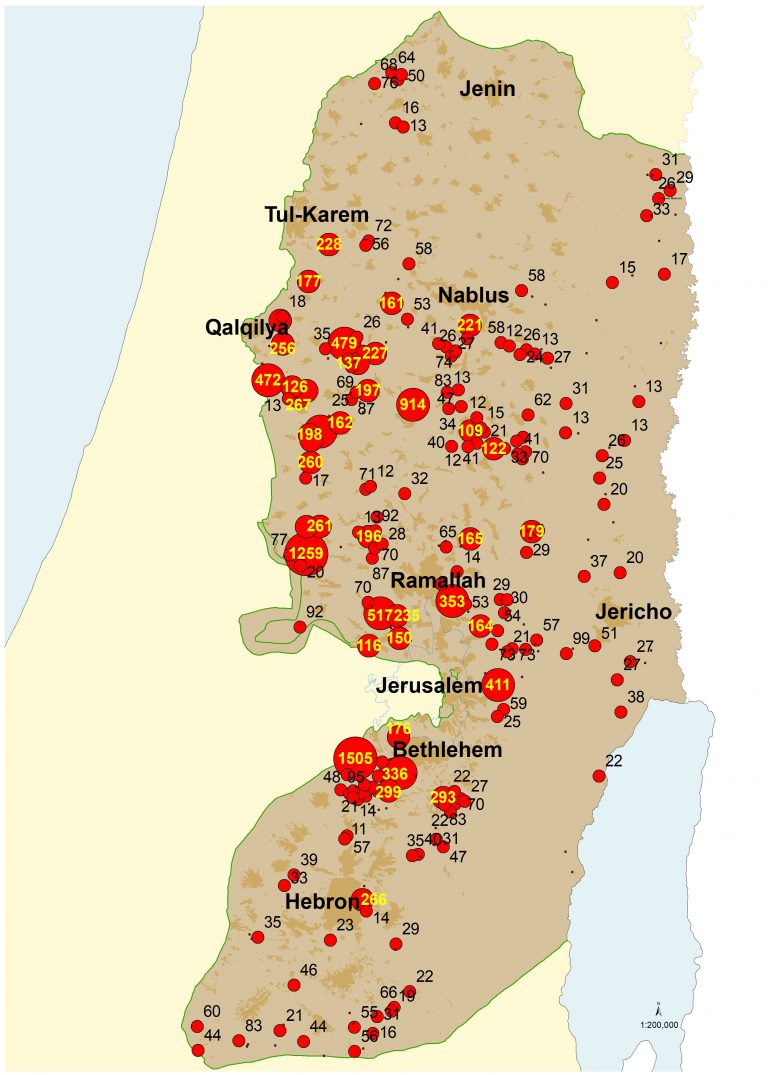
Map by Peace Now
Of that number, almost 83% (4,672 housing units) are planned in settlements east of the proposed Geneva Initiative border.
A total of 5,808 settlement construction tenders were published (but construction had not yet began)
- This was the highest annual total for settlement tenders in almost two decades.
- The Beitar Illit settlement saw the most construction starts in 2018, concentrated in a new neighborhood which significantly expands the footprint of the settlement.
Additional 2018 Key Data Points
- Israel continued to build up an Israeli settler presence on the land between the Elkana settlement and its surrounding settlements (Etz Efraim to its east and Shaarei Tikva to its west), effectively creating one large “super settlement” and building a contiguous settlement band towards the Ariel settlement in the heart of the West Bank.
- In addition to West Bank settlement tenders, tenders for 603 new settlement units in East Jerusalem were also published in 2018.
Peace Now Special Report, Part 2: Settlement Growth During 10 Years of Netanyahu

Peace Now writes:
“In the past decade, most of the construction was in isolated settlements that Israel will have to evacuate. The Peace Now count of housing construction starts reveals that 73 percent of the construction in 2018 (1,539 housing units) and 70 percent of construction during the decade of Netanyahu’s government (13,608 housing units) were implemented precisely in places that jeopardize a two-state agreement (east of the proposed border route of the Geneva Initiative). In this decade, close to 50,000 settlers have been added to these settlements, and the housing units built have the potential to add 60,000 settlers. This means that the Israeli government is digging the country a pit to fall in. Every house built in the settlements and every family that moves there will need to be brought back into Israel in a painful and difficult evacuation. Even if the government does not believe that peace can be achieved in the near future, there is no logic to expanding the settlements and making the solution impossible.”
Following Trump Election, Netanyahu Unleashed 39% Increase in Settlement Funding
After two years of repeatedly submitting freedom of information requests, the AP published results, based on documents turned over by Israel’s Finance Ministry. The documents reveal that the government unleashed at least a 39% funding increase – dubbed by the AP a “spending binge” – on settlement activities in the immediate aftermath of President Trump’s election.
According to the Finance Ministry data, in 2017 the Israeli government spent $459.8 million (NIS 1.65 billion) on roads, schools, and public buildings in settlements across the West Bank, compared to $333.2 million (NIS 1.19 billion) in 2016. AP notes that the new data does not include funds spent on police, education, health, and military, and completely omits government investments made in East Jerusalem settlement related activities — meaning the numbers actually undercount Israeli settlement-related spending (in both years).
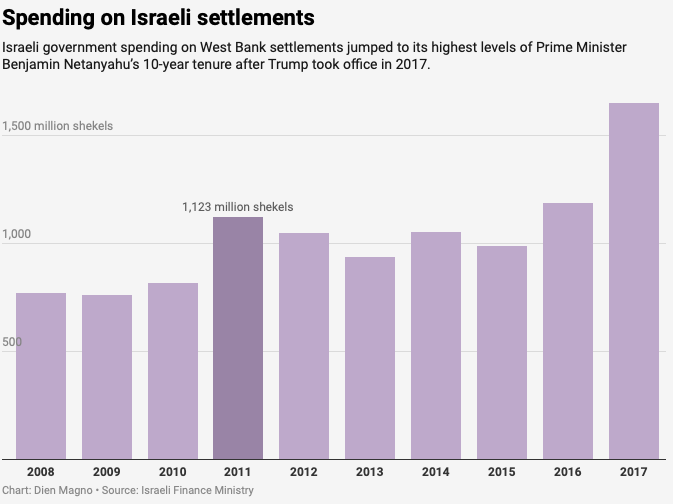 The 2017 figures are the highest amount of Israeli government funds invested in the settlements by the government of Israel during any year since Netanyahu became prime minister 10 years ago (and has remained in power since). The Israeli government tracks its own spending on settlement activities in order to report that total sum to the U.S. government, a practice which began under President George H.W. Bush – which in theory is supposed to deduct the sum from U.S. loan guarantees available to Israel (in reality, the U.S. has made only occasional and minimal deductions).
The areas with the highest growth rate in funding in 2017 were school construction (68% increase from 2016) and road construction (54% increase from 2016). Hagit Ofran, co-Director of the Settlement Watch project at Peace Now, explained the significance of Israeli investments in roads for the settlements:
“We see it very immediately, after the opening of a road, a big boom in construction along the road,” she said. “I think the investments we have these years in the roads are dramatic and will allow the expansion of settlements dramatically. That is very much worrying.”
Nabil Abu Rudaineh, spokesman for Palestinian President Mahmoud Abbas said:
“This proves that the current U.S. administration encouraged settlement activities.”
11 Knesset Members Join Campaign to Cancel 2005 Disengagement Law & Re-establish Evacuated West Bank Settlements
Eleven members of the Knesset, including Speaker of the Knesset Yuli Edelstein, participated in tour of one of the four settlements in the northern West Bank which Israel evacuated in 2005 as part of its Gaza Disengagement plan. The IDF had to provide special permission for the MKs to visit the Homesh settlement, because , even all these years later, it is a closed military zone. This is just the latest event in a settler-led campaign to pressure Netanyahu into canceling the 2005 Gaza Disengagement Plan and re-establishing those settlements.
After Israel’s evacuation of the four settlements in the West Bank – Homesh, Sa-Nur, Ganim, and Kadim – the IDF issued military orders barring Palestinians from entering the areas, let alone building in them. At the same time, settlers have regularly entered the areas and even repeatedly built a yeshiva at the Homesh site.
Bibi Pushes High Court Override Legislation During Coalition Negotiations
Haaretz reports that Prime Minister Netanyahu plans to promote the so-called High Court Override bill, which would empower the Knesset to effectively strip the High Court of its power to review and strike down legislation it deems unconstitutional, as well as overrule the Court’s administrative decisions – a new, and alarming, component of the long touted law. This new component is needed in order for Netanyahu to ensure his own immunity against criminal charges, but it will also empower the Knesset to ignore the Court’s administrative decisions issued in response to petitions – effectively giving elected and partisan government officials a veto over the only justice system accessible by Palestinians. As Haaretz explains: “for example, if a minister makes a decision that is overruled by the court in response to a petition – such as Netanyahu’s decision to ban the entry of Palestinian participants of a joint memorial day ceremony – the minister could reissue the decision anyway.”
Critical for FMEP reporting, if the law is passed the Knesset will be empowered to reinstate the settlement Regulation Law if the High Court rules against it, which it has long been expected to do. The law, passed in February 2017 and quickly frozen, directs the government to retroactively legalize a huge number of illegal outposts and settlement structures which were built on privately owned Palestinian land. Implementation of the Regulation Law was quickly frozen in light of petitions to the High Court challenging its constitutionality.
According to the Haaretz report, an agreement to promote the override bill will be included in the coalition agreement Netanyahu is negotiating to form the next government, and parties are engaged in debates over the specific form the law will take. The right-wing parties want to pass the law within 60 days after the new government takes over, and in a form that would totally negate the authority of the High Court to strike down decisions by elected officials or bodies like the cabinet, the ministers or the Knesset. The comparatively centrist Likud members support the principle of the override law but not the specifics proposed by negotiating partners. Likud members say they are reviewing various models for the law which tinker with the mechanism by which the Knesset can override High Court rulings and administrative decisions.
The override bill has been a key objective of Netanyahu’s negotiating partners, most prominently MK Bezalel Smotrich and Transportation Minister Yariv Levin, who are competing to become the next Justice Minister and whose negotiation demands FMEP analyzed some weeks back. FMEP has also documented the progress of the High Court Override bill in its Annexation Policies tables.
Trump Envoy Praises US-Backed Economic “Coexistence” Group for Joint Settler-Palestinian Hebron Iftar
On May 14th, U.S. peace envoy Jason Greenblatt tweeted his praise for a joint settler-Palestinian iftar event in Hebron, hosted by the “Judea and Samaria Chamber of Commerce,” a favorite group of the Trump Administration’s peace team. As has become a key mantra, Greenblatt said the event helps lay the “groundwork for peace” and said it was a “wonderful example of what could be possible.” As pointed out by many voices on Twitter, praise for the event ignores ignoring the apartheid conditions in Hebron under which Israeli policies deny Palestinian rights and well-being, for the benefit of some 800 Israeli settlers.
Palestinian businessman Sheikh Ashraf Jabari held the event in his Hebron home. Jabari recently launched a new Palestinian political party, the Reform and Development Party, advocating for a one-state solution because, Jabari argues, Palestinians have no other choice than to accept Israeli sovereignty over them. It is well known that Jabari has close ties to the Trump administration, which has very publicly embraced settler-Palestinian economic co-existence initiatives as a core U.S. priority on the ground and are seeking an alternative Palestinian leadership with which to make a deal.
Jabari told the Jerusalem Post about the iftar event and his broader aims:
“We want to build a united front, to create a breakthrough on the economic issue. We are issuing a clear call to separate between economics and politics, and hope to have fruitful cooperation on the subject. From our point of view, we need to strengthen the connection between the US legislature and activity that promotes economic equality here. This meal is meant to reinforce the growing trend in which economic-business connections can strengthen relations and friendship, by way of leading people to a more positive place.”
Along with Jabari, high profile event attendees – which included Samaria Regional Council head Yossi Dagan and Hebron Jewish community leader Yishai Fleisher – praised the business initiative as a model for peaceful relations.
Uri Karzen, the Director General of the settlers in Hebron and an attendee of the iftar, said in a tweet:
“First #Iftar in #Hebron with Kosher food. We are laying the groundwork for peace between people and economic prosperity for all.”
Heather Johnston, executive-director of the US-Israel Education Association which leads U.S. congressional delegation to settlements and runs camps in the Ariel settlement (no joke – to help Ethiopian Jews rediscover their roots), told the event attendees:
“Each of you have played a role in helping to build this integrated business movement. You have made sacrifices. You have gone into the unknown. You have been willing to take risks in business and in relationships. And this is what it takes to pioneer something that will one day be a humongous success. I have been involved in Samaria for the last 22 years. I believe there is more hope today for this important relationship to actually succeed than ever before.”
Chamber president Avi Zimmerman, of the Ariel settlement, said:
“We can measure progress at a people-to-people level, at every business transaction. Every time I get up and say ‘this is only about economics, it is not about peace,’ everyone starts talking about peace. Which makes me believe that if everyone keeps talking about peace when we speak of economics, that these incremental, measured steps toward mutual interest are actually what will birth the peace. They can birth a political process, but it will not happen the other way around,” he said. “We have learned for 70 years that it is not going to be the other way. It has to start this way.”
FMEP has repeatedly explained how initiatives like this perpetuate Israel’s economic exploitation of occupied territory (including the local workforce, land, and other natural resources), and that it is perverse to label such initiatives as “coexistence” programs, or to suggest that they offer the Palestinians benefits they should welcome. The New York Times quoted a spokesman for the Palestinian Authority explaining the Orwellian reality of settlement industrial zones:
“Somebody occupies your country, steals your land, steals your water, steals your resources, then says: ‘I’ll make a good deal for you if you come work for me. I’ll create jobs for you. We are not occupiers. We are employers.’ This is ridiculous. The colonial settlements are illegal in every sense of the word.”