Welcome to FMEP’s Weekly Settlement Report, covering everything you need to know about Israeli settlement activity this week.
To subscribe to this report, please click here.
October 13, 2022
- Nablus Region Broiling as Settlers Rampage
- Senior Israel Officials Preside Over Cornerstone-Laying Ceremony for New Settler Tourist Project in East Jerusalem
- Israel Antiquities Chief Releases Map of New Israeli National Park Near Jericho (in Area C)
- Amidst Violent Surge, Settlers Demand Establishment of Evyatar Settlement & Yeshiva
- Bonus Reads
Nablus Region Broiling as Settlers Rampage
As violence continues to escalate across the West Bank and in East Jerusalem, this week settlers have continued, seemingly uninhibited, to instigate clashes with and terrorize Palestinians in the West Bank. Some key examples include the following (for an even more thorough listing, see the Palestine Center for Human Rights’ weekly report):
- On October 11th, Israeli settlers staged a massive march – explicitly designed to provoke Palestinians and demonstrate Israeli dominance/impunity – near the Palestinian town of Sebastia, just north of Nablus. An Israeli soldier providing security to the settlers was shot and killed by a drive-by shooter as the march got underway. Following that shooting, the Palestinian militia group calling itself “Lion’s Den” claimed credit for the drive-by shooting, leading the Israeli army to completely shut down the city of Nablus – where the Lion’s Den is based – in response.
- Late in the evening on October 12th — while the Israeli army was keeping all the entrances and exits to Nablus closed in response to the October 11th shooting of an IDF soldier guarding a settler march — the IDF again provided security for settlers, this time enabling them to enter the city of Nablus (the IDF even transported settlers in military vehicles), ostensibly to visit Joseph’s Tomb and conduct religious prayer there (ostensibly because the timing/nature of the visit appeared to be largely if not entirely about provoking Palestinians). In the course of the operation, IDF soldiers exchanged gunfire with Palestinians; no injuries were reported on either side.
- The following morning, October 13th, settlers marauded through and terrorized the Palestinian town of Huwara, located just south of the Nablus. Video footage documents IDF soldiers actively protecting (and therefore enabling) settlers who were brazenly committing crimes and assaulting Palestinians. The Palestinian Red Crescent reports 53 people were injured.
It’s worth recalling that settlers have staged several protests and marches over the past few weeks, ostensibly to pressure the Israeli government to intensify its ongoing military operation in the West Bank – which Israel has dubbed “Break the Wave” – a reference to recent attacks against Israeli civilians (and IDF soldiers, bearing in mind that when IDF personnel are injured/killed in any context by Palestinains, Israel in effect counts those IDF personnel as civilian victims of terrorism). This operation involves Israel staging near daily raids into Palestinian cities in the West Bank — tactics that have led to numerous Palestinian deaths/injuries/detentions.
Notably, the settler march held on October 11th attracted nearly 10,000 people – including lawmakers Bezalel Smotrich and well-known Kahanist (who is likely to be a powerful plate in the next Israeli government) Itamar Ben-Gvir. The settlers paraded from the Shavei Shomron settlement to the nearby Palestinian town of Sebastia, where settlers have been engaged in an effort to take control over antiquity sites under Palestinian control in the city. At the conclusion of the march, settlers staged a festival in Sebastia with live music acts, speeches, and more.
Samaria Regional Council head Yossi Dagan stated:
“We came here today to wave the Israeli flag, to state that we won’t surrender to those who wish to kick us out of our land. We will continue to settle, march, and hike through our entire country. To answer terror we build the land of Israel. We are excited to see the thousands that are marching with us.”
Senior Israel Officials Preside Over Cornerstone-Laying Ceremony for New Settler Tourist Project in East Jerusalem
 Emek Shaveh reports that a ceremony was held on October 6th to lay the cornerstone of a new pedestrian footbridge over the Ben Hinnom Valley/Wadi Rababa in Jerusalem. The bridge is a project pushed by settler groups and will serve to connect two settler-operated tourist facilities located in two Palestinian neighborhoods on opposite sides of the valley – one in Abu Tor and the other in Silwan. The ceremony was held at one of those settler-run tourist facilities – known as the “House in the Valley”, operated by the Elad Foundation – and was presided over by Israeli Minister of Jerusalem Affairs Ze’ev Elkin, Israeli Transportation Minister Yoel Razvozov, Jerusalem Mayor Moshe Leon, and Israeli Antiquities Authority director general Eli Eskosido.
Emek Shaeh comments:
“The bridge is another project in a list of new projects which are transforming the valley, such as the cable car, and the Elad Foundation’s Farm in the Valley (also called Center for Ancient Agriculture). All of these are part of the larger strategy to establish a continuum of biblically themed tourism ventures and Jewish residential settlements in the Silwan-Hinnom Valley area using a variety of legal and administrative mechanisms to displace Palestinians from their homes, shrink their public spaces and downplay their heritage.”
At the cornerstone laying ceremony on October 6th, Minister Elkin confirmed the intent behind the bridge, saying:
“the suspension bridge is an important strategic project led by the Ministry for Jerusalem Affairs and other partners. We are working to turn the Hinnom Valley into a developed tourism zone and in so doing achieve two additional goals: one is to strengthen the sense of security and sovereignty in the area, the other is to ease access to the Old City.”
On the Abu Tor side of the bridge, the Elad settler organization runs and operates a cultural center and cafe named “House in the Valley,” which opened in 2019 after Elad evicted a Palestinian family and renovated the space. A week after Elad’s new cultural center was opened, the Jerusalem Municipality issued “gardening orders” to take control, for an initial period lasting 5 years (with the likelihood of extensions after that) of 12 nearby plots of privately-owned Palestinian land. “Gardening orders” allow Israel to “temporarily” take over privately owned land for what are ostensibly public purposes (like establishing a parking lot or public garden), based on the argument that the private owners are not presently using the land. In this case, Israel has in effect made rules that guarantee that the latter condition applies: as Emek Shaveh has noted, the 12 plots in question are located in an area declared by Israel to be a national park, meaning that private landowners are legally barred from using their own land.
On the Silwan side – a neighborhood where Elad (alongside other settler organizations, including Ateret Cohanim) is waging a house-by-house campaign to displace Palestinians in favor of settlers and settler-run tourist sites – the bridge will end near the Sambuski cemetery, which until recent years was a relatively unknown, neglected site that even Israel did not recognize as a holy site. Under the Trump “Peace to Prosperity” plan, the Sambuski cemetery was suddenly transformed into a place of prime historical and religious importance to Israel. The Emek Shaveh – which has a special expertise on archaeology and the weaponization of archaeology to serve the political agenda of the settlers and the state – wrote a report on exactly how the Trump “Vision” supports settler efforts to use Jerusalem’s history and antiquities to promote Israeli-Jewish hegemony and control over the city.
Israel Antiquities Chief Releases Map of New Israeli National Park Near Jericho (in Area C)
Emek Shaveh reports that Eli Eskosido, the Director General of the Israeli Antiquities Authority, has been sharing a map showing a new “Hasmonean Palaces National Park” on land located southwest of the Palestinian city of Jericho. Notably, the land in question is located in Area C of the West Bank – where the domestic Antiquities Authority does not, legally (under Israeli law and the Oslo Accords) have any jurisdiction.
The Hasmonean Palaces archaeological site was identified in the Oslo Accords as a place of “archaeological and historic importance to the Israeli side”, granting the Israelis control over this enclave of land within a Palestinian population center. However, the area has not been developed by the Israeli government. Emek Shaveh reports that while a National Park has been planned for the area, it does not currently exist.
Bizarrely, the map promoted by Eskosido is emblazoned with the logos of domestic Israeli government bureaus, which – again – do not have any jurisdiction in the West Bank. A settler group focused on weaponizing archaeology to advance Israeli annexation in the West Bank, “Guardians of Eternity,” alleges that the site has been subject to damage by Palestinians over the years. Emek Shaveh reports that the Binyamin Regional Council – the municipal association in charge of settlements in the area – is reportedly interested in taking over direct management of the site.
Emek Shaveh notes:
“The publication of the map by Mr. Eskosido is another manifestation of steps towards de facto annexation in the realm of antiquities which we wrote about earlier this year following the Knesset’s committee’s recommendation of expanding the Israel Antiquities Authority remit into Area C.
The investment in this site is an outcome of a persistent campaign by Guardians of Eternity (Regavim) and the Shiloh Forum which exploits historical, religious and cultural affinities of the Jewish people to sites in the West Bank with the aim of galvanizing the Israeli government to expand and deepen its control. This latest involvement by the IAA in the Hasmonean Palaces should be considered within this context. Although damage by Palestinians to the site is a problem, for the most part this takes the form of light construction. It is certainly not an expression of a Palestinian Authority led plan to destroy Jewish heritage in the West Bank as the settlers repeatedly claim.”
Amidst Violent Surge, Settlers Demand Establishment of Evyatar Settlement & Yeshiva
Over the Sukkot holiday, settlers in the northern West Bank staged a renewed push for the government, specifically Defense Minister Benny Gantz, to act in order to formally establish the Evyatar settlement and yeshiva, located on Palestinian lands just south of Nablus. In February 2022, the outgoing Israeli Attorney General issued an opinion that provides a basis for granting retroactive legalization to the Evyatar outpost (which would mean authorizing Evyatar as a fully-approved new settlement, “legal” under Israeli law). Since February 2022, Defense Minister Gantz has had the authority to declare the area as “state land” as the first (and most significant) step towards authorizing Evyatar. For reasons that remain unclear, Gantz has not (yet) made a move to do so.
The saga of the Evyatar outpost became a recurring headline news story over the past two years, mostly as a result of the determined effort by Palestinians from the nearby village of Beitar to protest the Evyatar outpost and to resist the Israeli government’s efforts to retroactively legalize it. Palestinians staged regular protests near the site of Evyatar outpost, which was built illegally by settlers on a hilltop that Palestinians have long known as Mt. Sabih, land which has historically belonged to the nearby Palestinian villages of Beita, Yatma, and Qablan. No fewer than seven Palestinian protestors died as a result of the harsh and violent attempt by the IDF to quash the protests.
Bonus Reads
- “Drones terrorized Gaza for years. Now they’ll do the same in the West Bank” (+972 Magazine) → “the army is calling for the use of drones to surveil refugee camps and strike militants, for installing remote-controlled gun turrets to secure high-volume checkpoints, and for employing biometric cameras to track civilians across the West Bank.”
- “The GOP’s Plan to Build the Third Temple” (Jewish Currents)
Welcome to FMEP’s Weekly Settlement Report, covering everything you need to know about Israeli settlement activity this week.
To subscribe to this report, please click here.
February 4, 2022
- Israeli Attorney General Approves Retroactive Legalization of the Evyatar Outpost (Final Decision to be Made by Government)
- Another Palestinian Family to Be Forcibly Dispossessed of its home in Jerusalem
- New Tender Issued for Settler Foot Bridge Over Ben Hinnom Valley
- Knesset Committee Recommends Expanding Israel Antiquities Authority Oversight into the West Bank
- Further Reading
Israeli Attorney General Approves Retroactive Legalization of the Evyatar Outpost (Final Decision to be Made by Government)
Haaretz reports that in the final hours of his tenure outgoing Israeli Attorney General Avichai Mandleblit issued a legal opinion that provides a basis for granting retroactive legalization to the Evyatar outpost (which would mean authorizing Evyator as a fully-approved new settlement, “legal” under Israeli law).
As a reminder: the Evyatar outpost was illegally built by settlers on land located just south of Nablus, in the very heart of the northern West Bank. The site of the outpost is known to Palestinians as Mount Sabih, and has historically belonged to the nearby Palestinian villages of Beita, Yatma, and Qablan. With this new opinion, the Israeli Attorney General has decided that enough of the land on which the illegal outpost was built can be declared as “state land,” which means the Israeli government can give the area to the settlers.
As another reminder, this time from Peace Now:
“the declaration of state lands is a procedure that was used by Israel since the 1980’s in order to take over nearly one million dunams in the occupied territories. The declaration is based on a draconian Israeli interpretation of the Ottoman Land Law according to which if land is not cultivated for a certain period it becomes public land and is managed by the state (and in the case of Israeli occupation of the territories, it is managed by the Civil Administration).”
With the legal opinion of the Attorney General, the Bennett government is now in a position to authorize Evyatar as a new settlement. If granted government approval, Defense Minister Benny Gantz can issue a formal declaration of “state land” (more on that process here). In January 2022, reports indicated that Gantz had agreed to the plan to legalize Evyatar.
That said, the Bennett government could, theoretically, still elect to not authorize the outposts, but that outcome is extremely unlikely, to say the least – notwithstanding the fact that Foreign Minister (and alternate Prime Minister) Yair Lapid has reportedly warned Prime Minister Bennett that authorizing Evyatar will damage Israel-U.S. relations. Also, the Israeli Labor and Meretz parties (both part of the governing coalition) oppose the legalization of Evyatar.
Palestinian Authority settlement officer Ghassan Daghlas told Haaretz:
“Israel is trying to establish facts on the ground and the timing of the announcement is not coincidental, a day after the publication of the Amnesty report.”
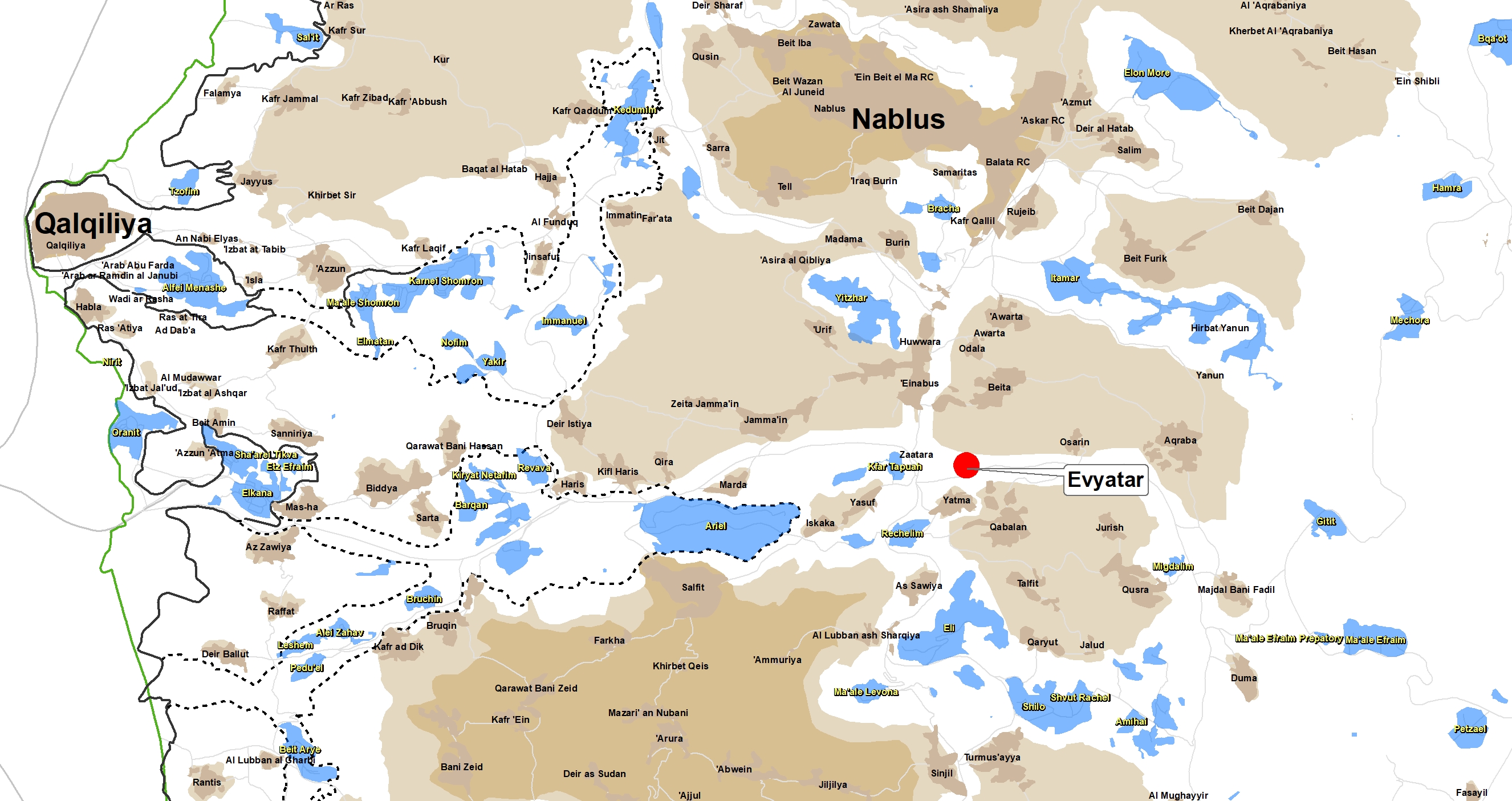
Map by Peace Now
In the very early days of the Bennett-Lapid coalition government, it was decided that the government would undertake an “investigation” into the status of the land on which the outpost was illegally established. That investigation was part of a package deal meant to both appease the settlers who were illegally squatting at the site and their allies. The package was also intended to quell Palestinian protests against the outpost and the international attention they were increasingly gaining – attention linked in larger part to the violent reaction against Palestinians by settlers and IDF soldiers, including most notably in Beita, which saw the death of several protestors, including children.
In addition to the “investigation,” the package also sought to balance bitter divisions within the Bennett government over whether to evacuate the outpost or grant it retroactive legalization. In the end, the government reached a “deal” which saw the settlers (temporarily) voluntarily vacate the outpost on July 2, 2021. In return, the government agreed to leave the settlers’ illegal construction at the site in place (i.e., did not demolish it) — including buildings and roads — while it carried out its investigation into the status of the land. In this way, the “compromise” left the outpost intact and allowed Israel to maintain complete control over the site during the “survey” process, clearly signalling that the government’s objective was never to enforce Israeli law, but, rather, was always about finding a legal and political “solution” to enable them to launder the settlers’ actions and accommodate their demands. Indeed, the terms of the Evyatar “compromise” made clear that the Bennet government was confident that it would find a pretext on which to assert that the land on which the outpost stands is “state land,” which can be used by the state as it sees fit (which nearly 100% of the time means, will be used to benefit the settlers)).
Peace Now said in a statement:
“Instead of stopping the ideological delinquency of a handful of settlers who allow themselves to establish facts on the ground against the law, and contrary to the Israeli interest, the government seeks to encourage them and give them a reward. The establishment of a new settlement in the depths of the West Bank is a security burden, and a threat to the chances for peace. Coalition members who oppose the occupation and support two states must demand that the Defense Minister stop the madness and not approve the settlement in Eviatar.”
Another Palestinian Family to Be Forcibly Dispossessed of its home in Jerusalem
Ir Amim reports that Israeli authorities have officially cleared the way for the Palestinian Salem family to be evicted from its longtime home in Sheikh Jarrah. The eviction can take place at any time between March 1st and April 1st. Once evicted, the Salem family home will be handed over to two settlers, one of whom is Jerusalem Deputy Mayor Aryeh King – suggesting that, at least in this case, the Israel government’s agenda and the settlers’ agenda are one and the same.
The Israeli registrar, in publishing its approval of the eviction window, also ordered the Salem family to pay 5,000 shekels (~$1,500 USD) for legal expenses.
The Salem family told WAFA news that they intend to appeal their eviction to the Israeli High Court, though a member of the family made it clear that the Israeli courts are part of a system designed to dispossess them:
“The Israeli court is biased. It only aims at emptying Jerusalem from Palestinians to give our place to settlers…even if we appeal, we don’t trust the Israeli court system. We depend only on solidarity in Palestine and beyond…We are three brothers living with our families, including seven children and our 74-year-old mother, Fatima Salem, the head of the family…We were all born here and have nowhere else to go. If they do expel us, we will continue to live in the street, right here”.
On the possibility of delaying the Salem family’s forcible displacement, Ir Amim notes:
“Although the Selam family’s legal representation may appeal the Enforcement and Collection Authority’s decision authorizing the family’s eviction and request an injunction to freeze it, there is no guarantee the court will approve such a request. The family’s attorney has hence made it clear that the remaining legal remedies are extremely limited. Therefore the only real effective means of preventing the family’s impending displacement is through state intervention.”
Israeli settlers and police had specifically requested a window in which to carry out the eviction to enable them to carry out the eviction by surprise — thereby (theoretically) making it harder for the family and protesters to prepare and for large crowds to gather. It must be understood that this flexible date is just the latest twist on the cruelty and hardship endured by the Salem family for years. It’s also worth recalling that earlier this month, in the context of a similar approval for the eviction of a Palestinian family living in the same neighborhood (the Salihiya family), Israel chose to implement the eviction in the dead of night, on one of the coldest nights of the year.
For further background on the Salem family’s case (including on the Israeli laws that were expressly designed to enable the eviction of Palestinians in favor of settlers), see reporting by Ir Amim and Peace Now.
New Tender Issued for Settler Foot Bridge Over Ben Hinnom Valley
Ir Amim reports that the Moriah Jerusalem Development Corporation issued a tender for a settler-initiated project to build a new pedestrian footbridge over the Ben Hinnom/Wadi Rababa Valley in Jerusalem. Bidding on the tender is set to close on February 28, 2022. An appeal against the plan, filed in 2018 by Israeli NGOs Peace Now and Emek Shaveh, was rejected by the Courts.
The bridge will serve to connect two settler-operated tourist facilities located on opposite sides of the valley – one in the in the Palestinian Abu Tor neighborhood and the other in the Silwan neighborhood.
On the Abu Tor side of the bridge, the Elad settler organization runs and operates a cultural center and cafe named “House in the Valley,” which opened in 2019 after Elad evicted a Palestinian family and renovated the space. A week after Elad’s new cultural center was opened, the Jerusalem Municipality issued “gardening orders” to take control, for a period lasting 5 years (with the likelihood of extensions after that), of 12 nearby plots of privately owned Palestinian land. “Gardening orders” allow Israel to “temporarily” take over privately owned land for what are ostensibly public purposes (like establishing a parking lot or public garden), based on the argument that the private owners are not presently using the land. In this case, Israel has in effect made rules that guarantee that the latter condition applies: as Emek Shaveh has noted, the 12 plots in question are located in an area declared by Israel to be a national park, meaning that private landowners are legally barred from using their own land.
On the Silwan side – a neighborhood where Elad (alongside other settler organizations, including Ateret Cohanim) is waging a house-by-house campaign to displace Palestinians in favor of settlers and settler-run tourist sites – the bridge will end near the Sambuski cemetery, which until recent years was a relatively unknown, neglected site that even Israel did not recognize as a holy site. Under the Trump “Peace to Prosperity” plan, the Sambuski cemetery suddenly became a place of prime historical and religious importance to Israel. The Israeli NGO Emek Shaveh – which has a special expertise on archaeology and the weaponization of archaeology to serve the political agenda of the settlers and the state – wrote a report on exactly how the Trump “Vision” supports settler efforts to use Jerusalem’s history and antiquities to promote Israeli-Jewish hegemony and control over the city.
Ir Amim writes:
“As part of the intensifying band of settlement around the Old City, the Wadi Rababa/Hinnom valley area is of particular significance as it stretches along the seam between Silwan and West Jerusalem and serves as the main entrance into the neighborhood from this direction. In recent years, there has been an increase of tourism projects in and around this location promoted by the government and the Elad settler organization, which together create a more seamless link between West Jerusalem and Elad’s constellation of settlement sites in Silwan.”
Knesset Committee Recommends Expanding Israel Antiquities Authority Oversight into the West Bank
On January 24th, the Knesset’s Education Committee held a hearing to discuss the alleged destruction of Jewish antiquity sites in the West Bank by Paelstinians and the Palestinian Authority, and what Israel should do to stop it. The Committee made several recommendations, including the suggestion for the government to expand the jurisdiction of the Israeli Antiquities Authority to include Area C, which would amount to yet another act of de facto annexation of some 60% of the West Bank. The Committee also recommended offering formal authorization for settler regional councils to “protect” and manage antiquity sites in Area C, which settlers are already doing on their own accord (with State funding and the help of the IDF in some cases). These archaeologically-focused annexation efforts run in parallel to other ongoing efforts by settlers and their political allies to unilaterally (and openly) annex Area C.
The hearing was based on a report on this very subject authored by a group calling itself the “Guardians of Eternity.” That group is an offshoot of the settler group Regavim. Emek Shaveh – an Israeli NGO focused on archaeology – called the report “highly questionable,” noting that the scientific editor of the report is anonymous, the report did not use acceptable archaeological methodology when surveying different sites, and the data on which the report based its conclusions and recommendations has not been made public.
Emek Shaveh’s Executive Director, Alon Arad, briefly addressed the Knesset Committee, urging the Members to understand the political agenda at play. Arad said:
“The destruction of antiquities should not constitute a pretext for political action and I think we should also refrain from camouflaging the political nature of this discussion as an archaeological act. Blurring the lines between archaeology and heritage on the one hand, and settlement and annexation, on the other endangers the future of archaeology.”
Emek Shaveh later said in a statement:
“There are approximately 6000 antiquity sites in the West Bank. The significance is that practically in every village or town there are archaeological remains of varying scale from a watering hole to a multilayered mound. It follows that there is always a tension between the need for modern development and the safeguarding of heritage sites. It is also clear that the problem of antiquity destruction is used by settlers and right-wing MKs as a justification for displacement…in just two years from 2017-2019, there was a 162% rise in demolition orders citing archaeology…Emek Shaveh believes that the destruction of antiquities should not be used as a justification for settlement expansion nor for promoting actions which advance de facto annexation. The appropriate approach to safeguarding antiquities in Area C must include the following: Israel must respect International Humanitarian Law and conventions which outline its duties vis-à-vis cultural heritage sites as the occupier in occupied territory, including maintaining separation between the IAA and the Staff Officer for Archaeology. Israel should promote cooperation with the Palestinian Authority on all levels: information sharing, oversight, and enforcement – something that was mutually agreed in the Oslo Accords. Israel must outlaw the trade in antiquities which gives impetus to antiquity theft.”
The Knesset Committee’s discussion of this subject comes on the heels of a decision by Israeli Minister of Heritage and Jerusalem Affairs, Ze’ev Elkin, to allocate $1.57 million (5 million NIS) towards “reconstruction” of the Sebastia archaeological site (located in the northern West Bank, near Nablus), pending approval from the Israeli Civil Administration. The Ministry further said that an additional $787,000 will be allocated towards the “rehabilitation” of other archaeological sites in the West Bank, as well as about $470,000 towards the Civil Administration’s ramped up efforts to “protect” West Bank archaeological sites.
As FMEP has chronicled, settlers and their allies are intent upon using claims of Palestinian damage/neglect as a pretext for Israel taking control of archaeological sites and artifacts across the West Bank. For example, in February 2021 settlers used a construction mishap to raise claims to the Mt. Ebal site.
Bonus Reads
- “Israeli soldiers force closure of Palestinian stores in Hebron’s Old City” (Basel al-Adra – +972 Magazine)
- “The purpose of settler terrorism” (Edo Konrad – +972 Magazine)
- THREAD: “During a discussion in the government about settler violence the Chief of Staff stated Israeli soldiers don’t have the authority to detain Israeli settlers who attacked Palestinians…” (Oren Ziv – Twitter)
Welcome to FMEP’s Weekly Settlement Report, covering everything you need to know about Israeli settlement activity this week.
To subscribe to this report, please click here.
March 20, 2020
- Israel Government Advances E-1 Plan to Next Stage
- Israel Starts Building on Private Palestinian Land in Silwan
- Likud MK Re-Introduces Jordan Valley Annexation Bill
- Peace Now: Israeli Settlement Planning & Construction Surged in 2019
- New Report Examines Impact of Settlers Digging on Palestinian Homes in Silwan
Comments or questions – email Kristin McCarthy (kmccarthy@fmep.org).
Israel Government Advances E-1 Plan to Next Stage
Despite the COVID-19 virtual shutdown of all normal activity in Israel, Ir Amim reports that on March 18th, the Israeli government officially advanced plans for construction of the E-1 settlement to the next step in the approval process, depositing them for public review. Under normal circumstances, after plans are deposited the public has a 60-day period to submit objections/affirmations of the plans. However, Ir Amim states that it is unclear if government closures due to the COVID-19 outbreak will impact the planning process, including the public review period. Assuming the E-1 plan is subject to the normal planning process, at the close of the 60-day public review period (which would be 60 days after March 18th), the planning committee will convene to discuss objections and then decide whether to give final approval to the plan or to require more information or changes to it.
Israel Starts Building on Private Palestinian Land in Silwan
 Despite the COVID-19 virtual shutdown of all normal activity in Israel, Emek Shaveh reports that on March 12th workers for Israel’s Nature and Parks Authority began development work on several plots of privately owned Palestinian land in the Ben Himmon Valley area, located just south of the Old City of Jerusalem between the Abu Tor and Silwan neighborhoods. These plots of land surround a cultural center and cafe run by the radical Elad settler group. They are part of an area over which Elad seeks to expand its control through elaborate plans involving touristic developments.
The legal status of the land in question has been the subject of an ongoing legal dispute for nearly a year — a dispute which has seen an Israeli judge revoke several of the “gardening orders” which the Jerusalem Municipality issued in order to seize the land.
Commenting on the action by the Municipality, Emek Shaveh said in a statement:
“Erasing the boundary between East and West Jerusalem is apparently vital and urgent for the economy. Otherwise it is unclear why when the entire country is in a state of emergency, thousands are quarantined and many have been instructed not to go to their work places, the Nature and Parks Authority has decided that this was the best time to carry out development work, the legality of which is being contested in court.”
In June 2019, the Jerusalem Municipality issued “gardening orders” to take control of 12 plots of privately owned Palestinian land near the Elad development, ostensibly to add new landscaping, new terraces and a new walking path. “Gardening orders” allow Israel to “temporarily” take over privately owned land for what are public purposes (like establishing a parking lot or public garden), based on the argument that the owners are not presently using the land. Importantly, as Emek Shaveh notes, the 12 plots in question are located in an area declared by Israel to be a national park, meaning that private landowners are legally barred from using their own land. Under these orders, this control would be for a period lasting 5 years, with the likelihood of extensions after that — tantamount to expropriation.
In short, this is an Orwellian situation wherein Israel has actively blocked Palestinains from using their own land, and is now using the fact that the Palestinians aren’t using their land as a pretext for seizing it. Adding insult to injury, the land is being taken ostensibly for public purposes – but the public the seizures are designed is Elad and its supporters, not the Palestinian residents of the area.
Likud MK Re-Introduces Jordan Valley Annexation Bill
Likud MK Miki Zohar submitted two bills to the Knesset on March 18th, one of which provides for the annexation of the Jordan Valley by applying Israeli sovereignty over the area (the other proposes the death penalty for Palestinian political prisoners). Commenting on the bills, Zohar said that he hopes the legislation will “embarrass” Likud rivals Benny Gantz and Avigdor Liberman, saying:
“Let’s see this wonderful cooperation between the Joint List, Yisrael Beiteinu and Blue and White. We will see how they will work together [with] those who work against the state. Shall we see [Gantz and Lieberman] oppose these legislations in order to please their new friends from the Joint List?”
Numerous bills to annex the Jordan Valley have been introduced in all of the recent Knesset sessions, but have not yet been procedurally advanced by the Netanyahu government. In September 2019 Netanyahu announced his own plan for annexing the Jordan Valley, but his plan was not submitted to the Knesset as a bill nor considered by the Israeli security cabinet.
FMEP tracks all annexation-related policies in its regularly updated Annexation Policy Tables.
Peace Now: Israeli Settlement Planning & Construction Surged in 2019
In a review of final 2019 settlement figures, Peace Now reports that Israeli settlement planning surged in 2019, growing from 2,100 units advanced in 2018 to 8,457 units advanced in 2019 (a 75% increase). Likewise, during the Trump-Netanyahu era (thus far), the average annual pace of settlement construction has been 25% higher than during the Obama era. Further, Peace Now notes that 2019 settlement planning and construction was “largely focused in isolated settlements and in areas that are highly problematic in terms of a two-state solution.” Peace Now’s Hagit Ofran notes:
“[the Israeli government is] trying to take advantage of the window of opportunity that they have under the Trump administration, knowing that it might change in a few months. There was no such supportive administration for the settlements previously, ever.”
Peace Now reports the following settlement-related developments that took place over the course of 2019:
New Outposts: 11 new outposts were established in contravention to stated Israeli law. Those outposts are:
- Tekoa E, located in the Bethlehem area
- Nofei Prat South (Hill 324), located east of Jerusalem
- Susiya East, located in the South Hebron Hills
- Mitzpe HaTorah, located east of Jerusalem
- Rimonim North, located east of Ramallah
- Maskiot South, in the northern Jordan Valley
- Nili West, located west of Ramallah
- Makhrour, located in the Bethlehem area
- Halamish East, located north of Ramallah
- Mitzpe Kramim East, located east of Ramallah
- Kedar East, located east of Jerusalem
New Residential Units in Settlements/Outposts: 1,917 new settlement units were constructed.
- 10% of the new units (195 housing units) were built illegally – i.e., in unauthorized outposts, without permits.
- 110 of these new settlement units were in the Jordan Valley.
New Non-Residential Construction in Settlements/Outposts: In addition to housing units, 2019 saw significant non-residential construction in settlements/outposts.
- Construction was started on 61 new public buildings (such as schools, synagogues etc.) in settlements;
- Construction was started on 87 new structures for industry or agriculture
- 53% of these new structures for industry or agriculture are located in illegal outposts.
Advancement of Plans for New Construction: Settlement planning surged in 2019, including:
- Plans for 8,457 settlement units — to be built across 58 settlements — were advanced through various stages of the planning process.
- Construction tenders were published for 1,761 settlement units
- 805 of the units under tenders are located in East Jerusalem settlements.
New Report Examines Impact of Settlers Digging on Palestinian Homes in Silwan
In a new report entitled, “Fissures and Cracks,” Emek Shaveh surveys the damage to Palestinian homes above the so-called “Pilgrims Road” in the Wadi Hilweh section of Silwan. Palestinians believe the damage is the result of the extensive archaeological digs led by the radical settler group Elad, in cooperation with the Israeli Antiquities Authority. The report shares the stories of Palestinian families who have suffered because of structural damage to their homes.
Emek Shaveh writes:
“For over a decade, Palestinian residents of the neighborhood of Wadi Hilweh in Silwan have reported damage to their homes. Almost all the complaints come from families living along Wadi Hilweh’s main street which is situated above the archaeological excavation of a central tunnel in an underground network of tunnels, named the ‘Pilgrims’ Road’ by the Elad Foundation. Over time, damage to homes in the neighborhood has amassed and increased. In 2019, Emek Shaveh attempted to map the homes which have shown cracks in the walls or where walls have collapsed, to gauge the scope of the phenomenon, learn of the nature of the damage, and the degree of. proximity between the excavations and the damaged homes…the documentation…does not purport to substitute a comprehensive engineering investigation. However, it raises questions regarding the responsibilities of the authorities working in the neighborhood. The Jerusalem Municipality, the Nature and Parks Authority, the Israel Antiquities Authority, and the Elad Foundation all boast of exciting archaeological discoveries, praising the stepped street excavations as one of the most important discoveries in recent times. In light of the touristic development and archaeological research, these bodies must recognize the collapses and detrimental effect to homes located at the heart of the antiquities site and examine how they were caused and whether they are linked to the excavations. The authorities must find a suitable solution for the dozens of families whose homes were damaged, whether inadvertently or not.”