Welcome to FMEP’s Weekly Settlement & Annexation Report. To subscribe to this report, please click here.
March 25, 2021
- Construction on Extension of “Apartheid Road” Slated to Begin Next Month as Israel Barrels Towards E-1 Settlement Construction
- Israel Opens National Park on Land Belonging to Al-Walaja
- Palestinians File Appeal Against “King’s Garden” Settlement Plan for Al-Bustan, Silwan
- Bonus Reads
Comments/Questions? Contact Kristin McCarthy (kmccarthy@fmep.org)
Construction on Extension of “Apartheid Road” Slated to Begin Next Month as Israel Barrels Towards E-1 Settlement Construction
The Israeli Civil Administration announced that construction will begin next week on a new section of Route 4370, aka, the Apartheid Road (having earned the nickname for the high cement wall running down the middle of the road, separating Israeli and Palestinian traffic). The work will expand the road to the south in order to connect to East Jerusalem. The new road, which Israel touts as a benefit for Palestinians, is designed to route Palestinian traffic around the E-1 settlement area – in preparation for that settlement’s eventual construction. According to Ir Amim, the construction of this new road segment “constitutes a major step in laying the groundwork for settlement building in the E1 area.”
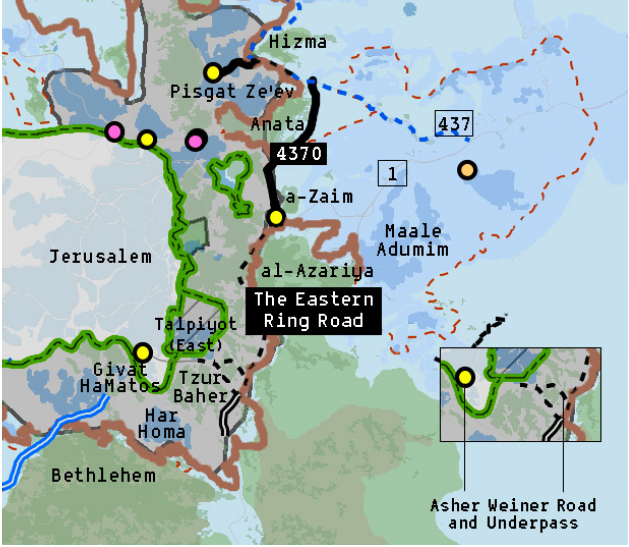
Map by Breaking the Silence
Ir Amim further explains:
“While portrayed as a road project to benefit Palestinians by expediting traffic and significantly reducing travel time between Ramallah and Bethlehem, it will in fact serve to completely reroute Palestinian traffic out of E1. Currently, the only road which facilitates Palestinian travel between the two West Bank centers runs through the E1 area. This limits Israel’s ability to carry out its massive settlement plans in the vicinity, which would require blocking Palestinian access to the area. This new road along with Route 4370 will create an alternative corridor between Ramallah and Bethlehem, which would eliminate the need for Palestinians to drive through E1 altogether. Diverting Palestinian traffic thus removes one of the obstacles to settlement construction in E1 and should signal cause for heightened vigilance.”
In a 2008 objection against the construction of the Apartheid Road, Adalah explained:
“The road further aims to consolidate and develop the Jewish settlements in East Jerusalem and the West Bank, and link them directly and conveniently to each other and to West Jerusalem. The road is simultaneously intended to isolate the Arab neighborhoods in East Jerusalem from the main route of the Eastern Ring Road, from each other and from the West Bank. It would thereby turn these neighborhoods into islands that are isolated – geographically, economically and in terms of transportation – from their immediate surroundings and would end Palestinian geographical contiguity within and around East Jerusalem, thereby precluding any future economic and social development or expansion of these neighborhoods. The plan stands to cut the owners of agricultural land off from their lands, to dramatically reduce the accessibility of schools, health services and workplaces for residents of these neighborhoods, and severely disrupt their family and social lives.”
Israeli officials have argued that the now-open road should resolve international objections to Israel building the E-1 settlement (a plan long criticized for effectively cutting the West Bank in half, rendering any future Palestinian state discontiguous and non-viable). In Israel’s view, the road replaces territorial contiguity for Palestinians in the West Bank with “transportational continuity,” i.e., the West Bank would still be cut in half, but the two halves are now inked by a road (albeit it a road that cuts Palestinians off from Jerusalem and that leaves travel between the northern and southern West Bank subject to Israeli control).
Israel Opens National Park on Land Belonging to Al-Walaja
Ir Amim reports that on March 23, the Israeli Nature & Parks Authority would be opening an Israeli national park in the area around the Ein Haniya spring. The spring is a historical part of the al-Walaja village, a Palestinian village located on the southern flank of Jerusalem, and long served as a main sources of water for households, farms, and recreational purposes for the village’s residents. Al-Walaja has long suffered due to its location and its complicated status (much of the village’s lands, including areas with homes, were annexed by Israel in 1967, but Israel never gave the villagers Jerusalem legal residency by Israel – meaning that under Israeli law, their mere presence in their homes is illegal). Today it is acutely suffering from a multi-prong effort by the Israeli government and settlers to grab more land for settlement expansion in pursuit of the “Greater Jerusalem” agenda. This land grab campaign includes past and pending home demolitions, the construction of the separation barrier and bypass roads in a way that seals off the village on three sides, and the denial of planning permits.
The history of this spring is just one example of how the Israeli government pursues land grabs with the facade of legality. As explained by Ir Amim:
“In 2013, in tandem with the construction of the barrier on al Walajeh lands, the Jerusalem District Committee approved an outline plan which designated the 1200 dunams of land as the Nahal Refaim national park in complete disregard of private Palestinian land ownership and traditional Palestinian agriculture in the area.
As a means of completely sealing off these lands from Palestinian access, including from village residents, the Jerusalem municipality began relocating the checkpoint between Jerusalem and al-Walajeh to a location closer to the village in February 2018. Construction on its relocation was suspended in March of the same year due to budgetary reasons and as a result, the Israeli authorities decided to keep the Ein Haniya site closed until the relocation is complete. Upon inquiry, however, Ir Amim was informed today that the plans for the checkpoint’s relocation have been terminated, and that Palestinian access to the area will remain unobstructed “unless security forces decide otherwise.”
Keeping the area open to Palestinian access is a significant achievement, which in no small part is due to al-Walajeh farmers’ perseverance despite the many obstacles and threats they continually face. In spite of this, the INPA’s plans include a variety of projects aimed at transforming al Walajeh’s agricultural terraces into an Israeli touristic and recreational destination, replete with hiking trails and outdoor activities, which creates the illusion of an entirely Israeli space.
The national park extends to the Jerusalem municipal border in close proximity to the area where Israel intends to establish a new settlement on al Walajeh’s lands (Har Gilo West) in the West Bank. In addition to creating contiguity between Jerusalem and the Gush Etzion settlement bloc around Bethlehem, the national park further isolates al Walajeh, turning it into an enclave detached from its Palestinian surroundings. In doing so, Israel advances its entrenchment of control along the southern perimeter, while undermining any prospect of a negotiated agreement in Jerusalem.”
Palestinians File Appeal Against “King’s Garden” Settlement Plan for Al-Bustan, Silwan
Ir Amim reports that Palestinians have filed an appeal to stop the demolition of 70 homes in the Al-Bustan section of the Silwan neighborhood in East Jerusalem. The Palestinians’ appeal responds to a surprising move by the Jerusalem Municipality, made in late February, to request permission from the Court to demolish the homes – demolition which had been frozen by the Courts since 2010 to allow for a negotiated resolution to the situation. For more on the history of this situation, see FMEP’s report from last week.
Additionally, Ir Amim has published a new, and more detailed, explainer on this case – highlighting the political context in which the Jerusalem Municipality made this decision. Ir Amim writes:
“The municipality’s plan called for the establishment of a touristic and archeological park (Plan 18000: “the King’s Garden”) replete with residential and commercial areas, including hotel space. This planned park would extend the existing national park in the City of David (the hub of Elad’s settler operations) southwards spanning the entire neighborhood of Al Bustan and towards the settler enclave in central Silwan (Batan al-Hawa) where the Ateret Cohanim settler organization is active. Since 2010, the plan has not advanced likely due to local and international opposition. However, the municipality’s objection to extension of the freeze signifies its intent to reactivate the plan, consistent with the acceleration of similar Israeli measures over the past year after being emboldened by the Trump Administration…
Beyond the severe humanitarian toll lie the acute demographic and political implications. The “King’s Garden” plan is yet another measure to transform the area into a sprawling Israeli tourist site, while further erasing its Palestinian presence. Silwan is one of the focal points of state-backed ideological settler activity. Settler groups threaten to displace over 800 Palestinians with the goal of establishing settler strongholds in the heart of Palestinian neighborhoods as a means to dismantle the viability of a political resolution on the city. Touristic settlement initiatives serve to reinforce residential settlement by connecting otherwise isolated settler compounds to create a contiguous ring of Israeli control (see map below for illustration), while artificially increasing the Israeli Jewish presence in the area via Israeli tourists visiting the sites. If advanced, the “King’s Garden” would essentially constitute a seamless extension of the City of David’s touristic attractions, further eroding the character of the neighborhood and its fabric of life, while leading to the forcible transfer of nearly an entire community.”
Bonus Reads
- “Samantha Power questioned over U.N. 2334 resolution at confirmation hearing” (Jewish Insider)
- “Save Sheikh Jarrah: Palestinians have a right to remain on their land” (Middle East Eye)
- “Palestinians in Hebron’s Old City build fence to prevent settlers’ attacks” (Al-Monitor)
Welcome to FMEP’s Weekly Settlement & Annexation Report. To subscribe to this report, please click here.
July 10, 2020
- Yesh Din Declares: Israel is Committing the Crime of Apartheid in the West Bank
- (FWIW) Mort Klein Says 50+% Chance Trump Approves Annexation Within Next 45-Days
- An “Off-the-Rack” Annexation Scenario
- Another Yitzhar Outpost Demolished, Another Violent Encounter Between IDF & Settlers
- Settlers & Settlement Minister Escalate Drive to Take Palestinians Land in Area C
- Greek Patriarchate Mobilizes Allies to Continue Fighting Settlers’ Acquisition of Jerusalem Properties
- Settlement Real Estate Market Heating Up?
- Bonus Reads
Comments/questions? Contact Kristin McCarthy (kmccarthy@fmep.org)
Yesh Din Declares: Israel is Committing the Crime of Apartheid in the West Bank
In a first for Israeli human rights groups, Yesh Din published a legal analysis, written by renowned Israeli human rights lawyer Michael Sfard, that concludes that Israel is committing the crime of apartheid in the West Bank, as defined by the International Convention on the Suppression and Punishment of the Crime of Apartheid AND the Rome Statute. The legal judgement closely analyzes the ways in which Israel’s current policies and actions in the West Bank constitute both the systematic oppression of one group and privileging of the other with the intent to maintain a regime of domination, and inhumane acts, including persecution and denial of rights.
Sfard finds Israel’s settlement project and “creeping legal annexation” of the West Bank to be indisputable evidence that Israel intends to maintain permanent control over the area. Safrd marks the February 2017 passage by Israel’s Knesset of Israel’s “Regulation Law” — a law governing land usage rights in the West Bank designed explicitly to take Palestinian land for the benefit of settlers — a “seminal moment” in the evolution of Israel’s West Bank regime into an apartheid system, noting that this was the first time that the Israeli Knesset passed a law to directly govern matters in the West Bank (read more here about the Regulation Law). FMEP has tracked the Knesset’s creeping legal annexation of the West Bank in its regularly updated Annexation Policy Tables, available here (Table #2).
Speaking to +972 Magazine, Sfard said that the goal of the legal opinion is to:
“change the internal Israeli discourse, and no longer talk about our presence in the West Bank as an occupation that is temporary, but as an illegitimate crime.”
Lior Amihai, executive director of Yesh Din, said in a statement:
“Apartheid is a crime against humanity, and it is a reality today, but we have the power and the responsibility to end it. We call on all people who wish to leave a better future for the coming generations of Palestinians and Israelis to demand that our decision makers act now to end apartheid and occupation. All Israeli and Palestinian children deserve a future of freedom and equality, free from apartheid.”
Further information: full Yesh Din legal report here; Executive Summary here; very thorough FAQ about apartheid in the West Bank here; Sfard’s interview with +972 Magazine here; Subscribe to receive Yesh Din updates here. Stay tuned for an FMEP webinar with Michael in the near future by signing up to receive FMEP event alerts here.
(FWIW) Mort Klein Says 50+% Chance Trump Approves Annexation Within Next 45-Days
This week, Mort Klein, the head of the far right-wing Zionist Organization of American (ZOA), told the Jerusalem Post that a U.S. official told him that there is “more than a 50% chance” chance that Trump team deciding on annexation will make their decision within 45 days. Klein — famous these days for Tweets and comments that get him accused regularly (sometimes daily) of being a racist, an Islamophobe, and of cozying up to antisemites — is also one of the rare members of the public known to have access in the Trump Administration, no doubt because the ZOA’s policies align neatly with those Trump officials responsible for Israel policy.
Trump’s Israel team – Jared Kushner, Avi Berkowitz, and Scott Leith – reportedly met (again) on July 8th, reconvening after meetings last week ended in no decision about annexation. A source told the Post that a decision this month (July) is “still possible,” despite repeated delays and a shift in focus in Israel and the U.S. to fighting a resurgence of the coronavirus.
An “Off-the-Rack” Annexation Scenario
In a new paper – entitled, “Is there a ‘Likeliest’ Annexation Scenario?” – Israel NGO Terrestrial Jerusalem, led by Jerusalem expert Daniel Seidemann, predicts that if Netanyahu follows through on his annexation pledge, there are two very compelling reasons to believe that he will do so by annexing the so-called “settlement blocs” closest to Jerusalem: Ma’ale Adumim, Givat Ze’ev, Beitar Illit, Efrat, and the entire Etzion Bloc.
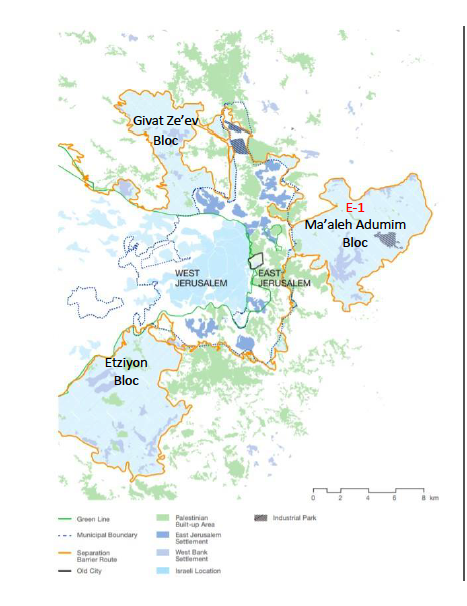 Laying out its logic, Terrestrial Jerusalem points to Netanyahu’s longstanding goal of uniting “Greater Jerusalem” by expanding the Jerusalem Municipality in order to annex as many nearby settlements as possible. The report details Netanayhu’s efforts to do so in detail, starting in 1997.
In addition, the “settlement blocs” doctrine – which has been prominently normalized by the likes of David Makovsky, Dennis Ross, and Michael Koplow – has provided Nentanyahu with an “off-the-rack” annexation option. This doctrine, on the basis of claimed “pragmatism,” has sought to allow Israel to continue unrestricted settlement expansion within large areas located near the Green Line (aka, the 1948 Armistice Line). After three decades of touting this doctrine, Netanyahu can now use it as the basis of his annexation.
Warning of the consequences of this “most likely” annexation scenario, Terrestrial Jerusalem writes:
“The annexation of one or more of the settlement blocs will have a devastating impact on the very possibility of any future agreement between Israel and Palestine. It will fragment the built-up Palestinian areas in greater Jerusalem, condemning the Palestinians to permanent occupation in an archipelago of disjointed, disconnected villages. The annexation of East Jerusalem, Ma’aleh Adumim, the Etzion Bloc and Givat Ze’ev alone would cumulatively seize 225 sq. km. of the landmass of the West Bank.”
Another Yitzhar Outpost Demolished, Another Violent Encounter Between IDF & Settlers
On July 10th, the IDF demolished an outpost that was illegally constructed by 30 settlers earlier that day. Settlers attempted to violently prevent the IDF soldiers from reaching the site of their outpost by setting up roadblocks using burning tires, and the attacking the troops with pepper spray and even threw punches during their assault on the troops.
The outpost squatters were from the radical and violent Yitzhar settlement, located in the heart of the West Bank just southeast of Nablus. The outpost – named “Kippah Sruga” by the settlers – was built in an area that the military commander marked as a “closed military zone” where civilians are not permitted to enter much less take up (illegal) residence.
Unsurprising, the leader of the Yitzhar settlement rushed to the defense of the settlers involved in the attack on the IDF. A spokesperson released a statement expressing regret that:
“some of the officers arrived at the scene without wearing masks [and] some did not have tags [identifying them as police]. The Border police officers used harsh violence against residents who did not do a thing. Of course we oppose stone-throwing and these incidents should have no place in Yitzhar.”
Settlers & Settlement Minister Escalate Drive to Take Palestinians Land in Area C
The radical settler group Regavim – which has dedicated itself to “helping” Israel police Palestinian construction in the West Bank – has filed a petition with the Jerusalem District Court asking the court to compel the demolition of Palestinian buildings located near the village of Nahalin, claiming that the newly built structures lack Israeli permits and that the Israeli Civil Administration has failed to act.
The group says Palestinians built 20 structures outside of the village, on land that is technically in Area C (the village of Nahalin is designated as Area B under the Olso Accords, but some village lands fall into Area C). Regavim asked the Civil Administration to take advantage of new powers it granted itself in June 2017 (via a military order) that allows it to demolish “new construction” a mere 96 hours after warning Palestinians of its intent (in effect depriving Palestinians of any meaningful opportunity to challenge the planned demolition).
Regavim Movement Director Meir Deutsch said:
“While our heads of state are debating whether and how sovereignty will be applied, the Palestinian Authority is hard at work, establishing facts on the ground. If we don’t wake up, in a few years we will find ourselves faced with an unchangeable reality – and the security and policy ramifications that come with it.”
Boosting Regavim’s mission, on July 7th newly crowned Settlement Affairs Minister Tzipi Hotovely toured the Mount Hebron Regional settlement council jurisdiction. Hotovely emphasized that part of her mission is to “prevent the Palestinian takeover of Area C” – an Orwellian framing suggesting that Israel is the victim of Palestinian aggressors seeking to steal Israeli land, when exactly the opposite is the case.
Hotovely said:
“At this time, it is very important to strengthen the settlement enterprise and prevent a Palestinian takeover of Area C. The Mount Hebron Regional Council has great potential for strengthening the Negev and the settlement. Applying sovereignty in this area will allow us to continue to develop the settlement in the Northern Negev and Mount Hebron.”
Greek Patriarchate Mobilizes Allies to Continue Fighting Settlers’ Acquisition of Jerusalem Properties
Since having its appeal rejected by the Jerusalem District Court on June 24th, the Greek Orthodox Patriarchate is continuing its fight to reclaim three prized properties in Jerusalem that were sold to the radical Ateret Cohanim settler organization under circumstances the Patriarchate claims are fraudulent.
In addition to planning to take its case to the Israeli Supreme Court, a spokesman for the Patriarchate, Father Issa Musleh, said that that Patriarchate will launch an international campaign in hopes of engaging the UN Security Council, Russia, Greece, Cyprus, and others to pressure Israel to return the properties to the church.
In addition, on July 7th, 13 Church leaders in Jerusalem issued a joint statement, saying:
“We, the Heads of the Churches and Christian Communities in Jerusalem, stand united in our commitment to safeguard the historical Status Quo of the Holy Sites and rights of the Churches which are universally recognized. The case of Jaffa Gate threatens this Status Quo. We are concerned by the recent judgment of the District Court of Jerusalem, which dismissed evidence demonstrating the Greek Orthodox Church’s case. We strongly support the efforts of the Greek Orthodox Church in their plea for justice…We don’t see this case as a mere property dispute. We see the undertaking of radical groups to take control of properties at Jaffa Gate as a systematic attempt to undermine the integrity of the Holy City, to obstruct the Christian pilgrim route and to weaken the Christian presence in Jerusalem.”
Settlement Real Estate Market Heating Up?
Israeli realtors hawking homes in the settlements are now talking up the possibility of a real estate boom in settlements because of the possibility of annexation.
Daniel Wach, who runs a real estate business out of the settlement of Eli — located deep inside the northern part of the West Bank — told AFP that he has done “as much business in the past two months as the last few years.” Wach said that Israeli families are buying now in anticipation of home prices rising after annexation. Post-annexation, Wach predicts will quickly rise 10-15%.
Another real estate agent who exclusively deals with settlements said: “Annexation will make a big difference…It’s gonna be a big market, we’ll need to get ready, work hard for this opportunity.”
Bonus Reads
- “Israel arrests Palestinian expert on settlements in Jerusalem” (MEMO)
- “Israel Will continue Its Campaign of Dividing and Conquering Palestinians, Annexation of Not” (Tania Hary // Haaretz)
- “Israel’s Possible Annexation of West Bank Areas: Frequently Asked Questions” (Congressional Research Service)
- “Ayelet Shaked submits candidacy to serve in Judicial Selection Committee” (Ynet)
- “Settlers and Palestinians unite in opposition to annexation” (The Times of Israel)
- “If Israel’s planned annexation goes ahead, can any response make a difference?” (Al-Shabaka)