Welcome to FMEP’s Weekly Settlement & Annexation Report. To subscribe to this report, please click here.
March 18, 2021
- Israel Municipality Asks Court to Ok Mass Demolitions in Silwan
- Israel Issues Demolition Order Against Home in Area B of the West Bank
- Palestinians Raise Alarm Over Impending East Jerusalem Dispossession
- Israeli Demolitions are Historically High
- Palestinians Call on UNESCO to Protect Archaeological Sites in the West Bank
- Settlers Once Again Invade Site of Evacuated Sa-Nur Settlement
- New Yesh Din Report Documents Another Category of West Bank Land Theft by Israel
- Bonus Reads
Comments/Questions? Contact Kristin McCarthy (kmccarthy@fmep.org)
Israel Municipality Asks Court to Ok Mass Demolitions in Silwan
Haaretz reports that three weeks ago, the Jerusalem Municipality petitioned the city courts to “reactivate” demolition orders for more than 70 Palestinian structures (home to more than 1,500 individuals) in the al-Bustan section of the Silwan neighborhood in East Jerusalem. [map]
The legal case around these 70 homes dates back to 2005, when the Israeli government unveiled a plan to establish a new archaeological/touristic park called “The King’s Garden” on privately owned Palestinian land in al-Bustan. Following international blowback the plan was dropped for a time, only to be revived by Jerusalem Mayor Nir Barkat in 2010, who once again began moving forward. To implement the plan, Israel issued demolition notices to Palestinian homes in the area — homes that Palestinians built (on their own land) but without the required Israeli-issued permits. This is, of course, a common circumstance for Palestinians in East Jerusalem and Israeli-controlled Area C of the West Bank, because Israel systematically denies planning and construction permissions to Palestinians.
Following another round of international outcry and an organized response by the Palestinian landowners, Israel (hoping to avoid more scrutiny) began quiet negotiations to provide the Palestinian land and home owners with alternative housing. After nearly seven years, the negotiations reportedly resulted in an agreement under which the city would defer demolition of the homes in question until after the Palestinians were able to build new homes (with permits) on adjacent plots.
According to Haaretz, the city has now decided it will no longer honor its commitment to defer those demolitions. The battle is now playing out in Court, with the city arguing that Palestinians have made no substantial progress on building the new homes. The Palestinians asked the court for a one year delay, saying that there has been progress that the city is not telling the court about.
Explaining the complexity of the situation facing Palestinians, Ir Amim wrote in an 2012 report:
“According to the Municipality’s plan, houses are intended to be demolished only after residents receive alternative housing. Consequently, condensation and construction will precede demolition—the reverse of normal procedure. But this proposed solution does not appear to be feasible. In order for the solution to be realized, the people evicted from the western part of Al-Bustan, against whose homes demolition orders are pending, will find themselves in the position of having to build alternative housing. In most cases, the space designated for alternative housing is on top of existing housing in the eastern part of the area; which is to say, in a built-up area, on the private land of other families. Such an arrangement could only be executed if the family currently on the land reaches agreement with the residents who have been evicted. Once an agreement is reached, the owners of the buildings in the eastern side of the area would have to request building permits, and only once said permits are obtained would the designated demolition of the houses in the western part of the plan take place and the buildings in the eastern part be legalized. The entire process would have to occur within a predetermined period; if not, the houses on both sides of the plan—the east and the west—would be torn down. However, as described above, obtaining building permits in this area is next to impossible. Requesting a building permit can jeopardize home owners on the east side who fear ownership of their current residences may be denied, as well as being a cost prohibitive process for most residents. Moreover, the negotiation challenges posed by evicted east side residents requesting to build on top of their neighbors on the west side all but preclude the likelihood of such arrangements.”
Ir Amim wrote in conclusion:
“As argued in a recent report by Bimkom, Planners for Planning Rights: “Despite the professional and apolitical facade of the planning and declaration of national parks, the picture appears to be more complex. In certain cases and places, it appears that the planning and declaration of national parks and nature reserves serves not only to protect natural and heritage assets and valuable open areas, but also serves as an instrument to limit the building and development of the Palestinian population. This phenomenon is widespread and particularly acute in the Palestinian neighborhoods of East Jerusalem.” The report goes on to state that one of the most salient features of existing plans for the Palestinian neighborhoods of East Jerusalem is the proliferation of “green areas” designated as open spaces, which constitute some 35% of the planned area (p. 6). The King’s Garden is another “green” area planned to be an open public space, though it is located in the middle of an overcrowded Palestinian neighborhood. That such a plan involves the massive demolition of Palestinian homes, and a drastic change of the neighborhood’s character from a Palestinian residential neighborhood to an archaeological park under Israeli control, raises more than reasonable concerns that the planning tool of “greening” is once again being used to establish political facts on the ground.”
The Haaretz Editorial Board intervened to plead for the municipality a return to negotiations, writing:
“Decision-makers must understand that a demolition order demolishes the lives of the inhabitants long before the bulldozer destroys their home. Anyone who hasn’t lived under the constant threat of their home’s destruction, who doesn’t panic every time a heavy vehicle rumbles down the street, or who has not seen the shadow of a bulldozer from the window of the children’s room, cannot understand the terror. Leon must come to his senses and bring the municipality back to the negotiating table, for the good of the residents of Silwan and all Jerusalemites. The success of the negotiations over the Bustan neighborhood and the construction of a new neighborhood next to the park will prove that Jerusalem has a mayor who truly works for the good of his residents and his city.”
Israel Issues Demolition Order Against Home in Area B of the West Bank
The Jerusalem Post reports that the IDF has issued a demolition order against a Palestinian home that is under construction in the Wadi al-Hummus village. The village in question is located just east of the Israel-declared municipal border of Jerusalem, but when Israel built its “separation barrier,” it left part of Wadi al-Hummus on the Israeli side (de facto annexing the land to Israel). The home that is now subject to demolition is thus in the odd position of being located simultaneously in Area B of the West Bank (as defined by the Oslo Accords), but inside Israel’s security barrier (the village of Wadi al-Hummus itself is cut up between East Jerusalem and Areas A, B, and C).
In the demolition notice handed to the homeowner, the IDF stated the house will be demolished because it lacks the proper building permits. However, according to the Palestinian news outlet WAFA, the owner obtained permits from the Palestinian Authority – which under Oslo has civil control (including planning) over Area B, where the home is located.
This is not the first time Israel has pursued the demolition of structures in areas outside of its Oslo-permitted control. In July 2019, Israeli forces demolished 13 large apartment buildings (approximately 70 units) in a section of Wadi al-Hummus, leaving the village looking like a war zone. Those buildings were located in Area A (where according to Oslo the PA has full civil and security control). Israel’s 2019 decision to demolish the buildings was given the official seal of approval by an Israeli Supreme Court decision. In its arguments, the Court held that the buildings posed an unacceptable security risk to the Israeli state because of their close proximity to Israel’s separation barrier (and that this risk over-rode the authorities granted under Oslo).
Palestinians Raise Alarm Over Impending East Jerusalem Dispossession
A coalition of 14 Palestinian civil society groups penned a joint letter asking the United Nations to intervene to stop the impending mass eviction of Palestinians from their homes in neighborhoods across East Jerusalem. The letter singles out the case of 15 Palestinian families (8 in Sheikh Jarrah and 7 in Silwan – for a total of 195 individuals) that are at risk of imminent eviction from their longtime homes in favor of settlers.
It’s worth recalling that, while the fate of 15 families is indeed in an urgent crisis, the legal underpinnings of these eviction cases stand to dispossess hundreds more Palestinians in East Jerusalem. Settler organizations, with state backing, are using Israeli law to take possession of Palestinian homes in key, sensitive neighborhoods in East Jerusalem to further consolidate Israeli hegemony over the city.
“At a time when people around the world are trying to survive the global pandemic, Palestinians in East Jerusalem continue to endure an ongoing Nakba, as they continue to be denied their inalienable rights of return and property restitution. In addition, they are subjected to an intensified coercive environment, exemplified in an array of policies including forced eviction thorough which they are again facing the threat of forced displacement and dispossession. They undergo a lengthy, exhausting, and unaffordable legal struggle to challenge the eviction lawsuits filed against them by settler organisations in Israeli courts. Given the discriminatory and untransparent nature of the Israeli legal system as applied in the occupied territory, they are effectively denied access to the rule of law. Many Palestinians have already been forcibly evicted under the same Israeli forcible transfer policy. In light of the above, this joint urgent appeal to the concerned United Nations (UN) Special Procedures underscores Israel’s establishment and maintenance of its apartheid regime over the Palestinian people as whole, and the intensified forcible transfer policies and measures in occupied East Jerusalem.”
Israeli Demolitions are Historically High
In its February 2021 report, OCHA (the United Nations Office for the Coordination of Humanitarian Affairs) notes that “Israeli authorities demolished, forced people to demolish, or seized 153 Palestinian-owned structures across the West Bank, including East Jerusalem: this is the fourth highest such figure recorded in a single month since OCHA began systematically documenting this practice in 2009, surpassed only by November 2020 (178), February (237) and March 2016 (179).” The 2021 monthly average number of structures demolished or seized is 117, compared to an average of 71 last year.
In February along, 305 individuals including 172 minors were affected by Israeli actions.
Palestinians Call on UNESCO to Protect Archaeological Sites in the West Bank
The Palestinian Foreign Ministry issued a statement calling on UNESCO to “protect all Palestinian archaeological and religious sites from Israeli violations, attacks and falsifications.” The statement went on to condemn Israeli actions in the West Bank and East Jerusalem which “serve the expansion of the illegal settlements,” saying that Israel’s seizure of antiquities in Palestinian-controlled areas are then put on “display …in their museums as evidence of its misleading colonial claims.”
Last week, on March 11th, settlers stormed the ancient site in Sebastia. Settlers have been openly agitating – with some success – for Israel to assert control over the archaeological site in Sebastia for years. In January 2021, Emek Shaveh (an Israeli NGO expert in – and focused on – archaeology) wrote on what is happening in Sebastia, saying:
“The archaeological site of Sebastia is identified with Samaria, the capital of the Kingdom of ancient Israel in 9-8 BCE. The site also features ruins from the Hellenistic, Roman and later periods. The village of Sebastia is situated within Area B while the site itself is located mainly in area C. Over the past few years, the Samaria Regional Council has been organizing tours to the site, particularly during the school holidays. Several times this year, the Civil Administration has removed a Palestinian flag from the village and the site. In the most recent incident, a flag was raised following renovation works funded by the Belgian government. In their response the regional council blamed the Palestinians for destroying a site central to Jewish history and UNESCO for supporting the Palestinians. Sebastia is on the tentative list of World Heritage sites in Palestine….the integration of ancient sites into an organized strategy designed to weaken Palestinian hold on Area C is worrying. The formalization of this approach is likely to result in a steep rise in actions over ancient sites and structures, from water cisterns found in many villages, to major sites such as Sebastia. The justification for preserving and developing ancient sites familiar to us from East Jerusalem is now being applied wholesale to hundreds of places in the West Bank to the detriment of the Palestinians living near the sites and to the multilayered heritage inherent in the ruins which will be distorted for political ends.”
As FMEP has chronicled, settlers and their allies have recently become hyper-focused on taking control of archaeological sites and artifacts under Palestinians control, claiming the sites are neglected and/or damaged. Last month settlers used a construction mishap to raise claims to the Mt. Ebal site.
In January 2021, the state of Israel committed funding to a new settler initiative to surveil archeological sites under Palestinian control. While the objective of protecting antiquities might appear uncontroversial and apolitical, the true objective behind this effort is to support yet another pretext to surveil and police Palestinians, and yet another means to dispossess them of their properties. It is the result of a campaign that has taken place over the past year in which settlers have been escalating their calls for the Israeli government to seize antiquities located in Palestinian communities across the West Bank, especially in Area C, which Israel today treats as virtually (and legally) indistinguishable from sovereign Israeli territory. The controversy that erupted over the Mt. Ebal archaeological site in February 2021 should be viewed in this context.
Previous victories for the settlers include the Israeli Civil Administration’s recent issuance of expropriation orders for two archaeological sites located on privately owned Palestinian property northwest of Ramallah. The expropriations – the first of their kind in 35 years – come amidst a new campaign by settlers lobbying the government to take control of such sites, based on the settlers’ claims that antiquities are being stolen and the sites are being mismanaged by Palestinians. The settlers’ pressure is also credited as the impetus behind the government’s clandestine raid of a Palestinian village in July 2020 to seize an ancient font. The Palestinian envoy to UNESCO, Mounir Anastas, recently called on the United Nations to pressure Israel into returning the font to the Palestinian authorities
In June 2020, a settler group calling itself “Shomrim Al Hanetzach” (“Guardians of Eternity”) began surveying areas in the West Bank that Israel has designated as archeaological sites in order to call in Israeli authorities to demolish Palestinian construction in these areas. The group communicates its findings to the Archaeology Unit of the Israeli Civil Administration (reminder: the Civil Administration is the arm of the Israeli Defense Ministry which since 1967 has functioned as the de facto sovereign over the West Bank). The Archaeology Unit, playing its part, then delivers eviction and demolition orders against Palestinians, claiming that the structures damage antiquities in the area. As a reminder, in 2017, Israel designated 1,000 new archaeological sites in Area C of the West Bank. The “Guardians of Eternity” group, not coincidentally, is an offshoot of the radical Regavim organization, which among other things works to push Israeli authorities to demolish Palestinian construction (on Palestinians’ own land) that lacks Israeli permits (permits that Israel virtually never grants). The group raised public alarm about the Trump Plan, alleging that hundreds of biblical sites in the West Bank are slated to become Palestinian territory.
Settlers Once Again Invade Site of Evacuated Sa-Nur Settlement
On March 16th, dozens of Israeli settler families illegally entered the site of the evacuated Sa-Nur settlement in the northern West Bank in an attempt to reestablish the area as a place of permanent Jewish settlement. Settlers have attempted the feat many times before, often with the active, in-person support of high-profile Israeli politicians, and always without punishment for their illegal actions.
After calling on Netanyahu to immediately authorize their presence at the site (a call that included the voice of prominent settler leader Yossi Dagan), the IDF evacuated the settlers once again.
The last time a group of settlers attempted this, in November 2020, MK Miki Zohar (Likud) persuaded the settlers to abandon their illegal campsite and leave the area, with the promise of raising the issue of Sa-Nur’s re establishment directly with Netanyahu.
MK Zohar is a staunch supporter of reestablishing Sa-Nur, along with three other settlements in the area that were likewise dismantled by the Israeli government in 2005 (Homesh, Ganim, and Kadim). Zohar has participated in previous visits to the site to support the settlers’ bid, frequently accompanied by his Likud colleagues, including former Speaker of the Knesset Yuli Edelstein. In July 2018, the Israeli Cabinet had the opportunity to lend government backing to a bill that would have cancelled the 2005 disengagement and allowed the settlers to rebuild those settlements – but the Cabinet blocked the bill.
As a reminder, even though Israel evacuated the four settlements in the West Bank, the IDF issued military orders barring Palestinians from entering the areas, preventing Palestinians from taking control over the area and building there. At the same time, settlers have regularly entered the areas and even repeatedly built a yeshiva at the Homesh site.
New Yesh Din Report Documents Another Category of West Bank Land Theft by Israel
In a new report entitled “Ill-Gotten Gains”, Yesh Din explains how the Israeli government has taken control of Palestinian land that was in the process of being formally titled and registered when Israeli occupied the West Bank in 1967. Yesh Din estimates that Israel has used its authority as the occupying power to declare as “state land” 41,000 dunans (~10,000 acres) of land that was, at the time, in the process of being registered as privately owned by Palestinians. That declaration precludes Palestinians from attempting to regain control of the land (by proving their ownership through a registration process).
Only one-third of West Bank land was registered and titled (under the British Mandatory government and then continued by Jordan) when Israel seized control of the West Bank. Upon assuming governance of the area the Israeli government issued a military order freezing the land registration process. The process remains frozen today, though there are rumblings from settlers pushing that state to resume the process (for their benefit).
Yesh Din writes:
“Israel’s policy of declaring “state land” in areas where settlement of title was halted is based on selective application of the legal mechanisms that regulate the land regime in the West Bank. Israel does so in violation of the rules of international law that apply to Israel as the occupying power in the West Bank. Such declarations also violate the local law in force in the West Bank and the military order issued by the Israeli military commander (Order Concerning Government Property). Above all, Israel’s policy infringes upon the right to property of Palestinians who took part in settlement of title and allows it to dispossess Palestinian individuals and communities of their land. In practice, Israel, which is and has been responsible for the land registry in the West Bank for over 53 years, is benefiting from this policy. Israel does not permit Palestinians who participated in settlement of title to complete the process and register title to their land, but it does declare these very same lands “state land” and transfers them to the exclusive use of the Israeli settlement enterprise in the West Bank.”
Bonus Reads
- “How Israeli industrial zones exploit Palestinian land and labour” (The New Arab)
- “Settler head urges vaccinating Palestinians, paid for by tax revenues sent to PA” (The Times of Israel)
- “Netanyahu pledges to legalize West Bank settler outposts if re-elected” (Jerusalem Post)
- “Why Some Voters in ‘Settler Heartland’ Are Ready to Turn Their Backs on Netanyahu” (Haaretz)
- “Netanyahu ups focus on settlements, as housing starts hit 10-year low” (Jerusalem Post)
- “‘The settler bashed my head with a pipe, and everything went dark’” (+972 Magazine)
- “The U.S. Billionaires Secretly Funding the Right-wing Effort to Reshape Israel” (Haaretz)
- “No One Is More Deserving of Israel’s Highest Honor Than Its Colonialist Settler Leaders” (Haaretz)
Welcome to FMEP’s Weekly Settlement & Annexation Report. To subscribe to this report, please click here.
February 25, 2021
- Jerusalem Cable Car Project Dealt Blow by Court
- Israel Breaks Ground on New Settler Bypass Road Near Nablus
- Israeli Army Chief Meets with Violent Settlers (Instead of Arresting them)
- Archaeological Accident Gives Pretext For Settler Takeover in Area B
- Bonus Material
Comments, questions? Email kmccarthy@fmep.org
Jerusalem Cable Car Project Dealt Blow by Court
On February 23rd, the Israeli High Court of Justice issued an order against the construction of the Jeruslame cable car, a project advanced by – and closely connected to – the Elad settler organization. The project is opposed by a broad coalition of city planners, archaeologists, and academics, who oppose it not only because it was advanced in a highly suspicious manner, but also because building a cable car over historic sites in Jerusalem would do irreparable damage to the integrity of the city’s history.

In its order, the High Court asked the State of Israel to answer five questions, the substance of which suggest that the Court is concerned about both the irregular planning process and the archeological heresies construction of the cable car would inflict.
The NGO Emek Shaveh, which opposes the plan, commented:
“The questions raised by the judges bring to light once again the many flaws of the project, particularly the irregular approval process through the National Infrastructure Committee, a fast-track body usually used to advance national transportation projects, rather than through the usual planning committees as well as its destructive ramifications for minority groups such as the Karaite community. The Cable Car project should never have seen the light of day. Jerusalemites and a long list of civil society organizations have for the past three years been asking the same questions put forward yesterday by the High Court but have been ignored. The flaws outlined by the High Court prove that Jerusalem must be protected from those who wish to destroy the city and harm its residents. We hope the developers of the project will demonstrate responsibility, internalize the criticism against the project and stop wasting valuable public resources on such a destructive vision for Jerusalem.”
As a reminder, the Jerusalem cable car project is an initiative backed by the powerful, state-backed Elad settler group and advanced by the Israeli Tourism Ministry. The State of Israel – which has pushed the project forward in the midst of the COVID-19 pandemic and despite commitments by the government to focus on public health matters only – was forced to publicly admit that the implementation of the cable car project will require the confiscation of privately owned Palestinian land in the Silwan neighborhood of East Jerusalem.
While public efforts to “sell” the cable car plan have focused on its purported role in helping to grow Jerusalem’s tourism industry or in serving supposedly vital transportation needs, in reality the purpose of the project is to further entrench settler control in Silwan, via archeology and tourism sites, while simultaneously delegitimizing, dispossessing, and erasing the Palestinian presence there. Notably, the cable car line is slated to terminate at the settler-run Kedem Center compound (Elad’s large tourism center, currently under construction at the entrance of the Silwan neighborhood, in the shadows of the Old City’s walls and Al-Aqsa Mosque).
Emek Shaveh and other non-governmental organizations, including Who Profits and Terrestrial Jerusalem, have repeatedly challenged (and provided evidence discrediting) the government’s contention that the cable car will serve a legitimate transportation need in Jerusalem, and have clearly enumerated the obvious political drivers behind the plan, the archeological heresies it validates, and the severe negative impacts the cable car project will have on Palestinian residents of Silwan.
Israel Breaks Ground on New Settler Bypass Road Near Nablus
The settlers’ news outlet Arutz Sheva reports that the State has begun construction on the Huwwara Bypass Road, a new route long pined for by settlers.
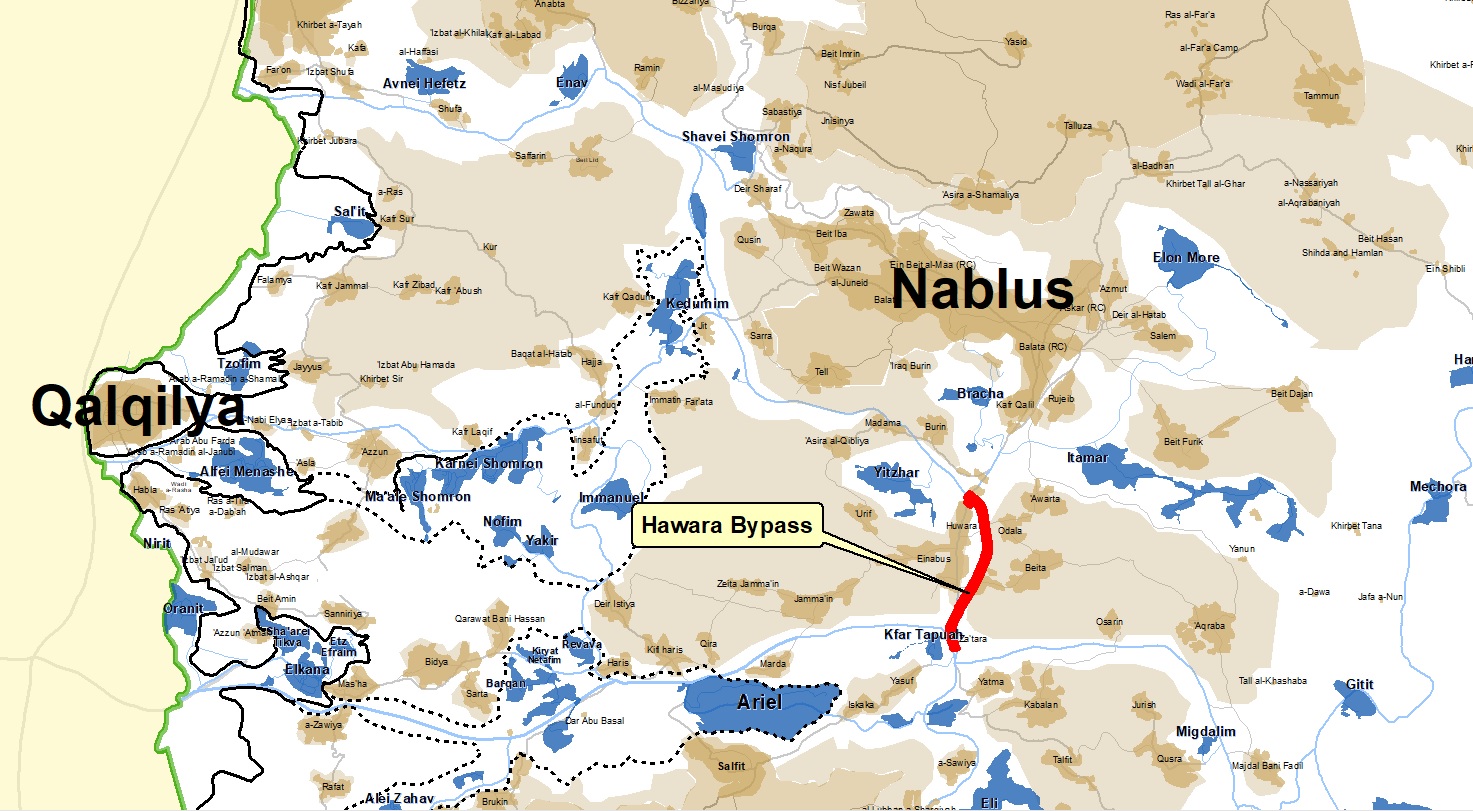 As reported last week, the Huwwara Bypass Road is designed to residents of Nablus-area settlements to bypass the Palestinian village of Huwwara (which is an area with heavy traffic congestion from daily commuters), in order to more easily/directly access Jerusalem. This bypass road has long been a top priority for the settlers, who have complained about the long commute to Jerusalem and the limits this puts on the potential for growth of Nablus-area settlements. Building the road also gained urgency for the settlers after the release of the Trump Plan’s conceptual map, which left the area where the road is slated to be built within the borders a future Palestinian “state.”
Arutz Sheva did not mince words about the importance of this road, writing this week:
“This is one of the most expensive and strategic projects in Judea and Samaria and its cost is estimated at ILS 260 million. The road is intended to connect the center of the country to the localities of Gav HaHar, Yitzhar, Itamar, Elon Moreh and Har Bracha, and will provide a safe trip for residents and passengers to these areas.”
Speaking at the ground breaking ceremony, settler leader Yossi Dagan also stressed the significance of this road to the settlers’ fight for sovereignty over the West Bank. Dagan said:
“This is a groundbreaking, historic moment for Samaria and the entire settlement effort. In about two years, the mountain settlements will become accessible to the center of the country. The road is expected to make traveling in the area safer for both Arabs and Jews, it is hoped that paving the road will lead to prosperity in the area.”
Dagan’s assertion that the road will benefit Palestinians in the area glosses over the fact that Palestinians were stripped of their property rights when Israel unilaterally expropriated private Palestinian land along the route of the road in preparation for construction. On this issue, Peace Now writes:
“A bypass road requires extensive expropriation of Palestinian land. All roads are planned from the Israeli interest toward the settlements and their development. Even if in some cases the Palestinians can benefit from these roads, they are not paved according to a planning conception of the Palestinian needs. This raises the question of Israel’s legal excuse to confiscate land in order to build roads in occupied territory by claiming that the roads will also serve the protected Palestinian population.”
Israeli Army Chief Meets with Violent Settlers (Instead of Arresting them)
Amidst a sharp spike in settler violence directed primarily at Palestinians and their property, but also at Israeli forces, two very senior Israeli security officials held a meeting with leaders in the violent “Hilltop Youth” settler movement, which has carried out a weeks-long crime spree following the death of one of its members. That member, Ahuvia Sandak, died as a result of a car crash while fleeing Israeli police who gave chase to a group of settlers who had been throwing rocks at Palestinian cars.
Haaretz reports that the two Israeli security officials – Central Command chief Maj. Gen. Tamir Yadai and Civil Administration head Brig. Gen. Fares Atila – wanted to “create rapprochement and calm things down.” An army source told Haaretz that “The general explained that the army is an agency that carries out the law of the State of Israel, and we’re trying to find common ground.”
Haaretz columnist Zvi Ba’arel writes of this meeting, and others that preceded it:
“When the head of Israel Defense Forces Central Command, Maj. Gen. Tamir Yadai, meets with “hilltop youth,” residents of the Maoz Esther outpost, in order to “create rapprochement and calm things down” in the words of a military representative, he is conducting negotiations with terrorists…For the “representatives of the outposts” – a new geopolitical term – who met with Yadai on Monday and last month, these meetings are a demonstration of power, not that of the IDF, but theirs…It’s the “representatives” who conduct the negotiations, who determine the rules, who decide if and when they will embark on the next terror activity, and who demand that the IDF understand and accept their motives and see them as a body no less legitimate than the IDF itself. If the army wants a tahadiya (cessation of hostilities) with the “outposts,” if it is begging that the thugs stop throwing stones at soldiers or setting police vans on fire, it must pay a political price. Or, as Prime Minister Benjamin Netanyahu often promises Hamas, “quiet will be answered with quiet.” The IDF, according to the “representatives of the outposts,” must stop chasing the gangs, refrain from demolishing outposts and primarily, preserve the status quo that has been rooted for decades and that maintains that attacks against Palestinians are an internal matter that concerns the relations between the gangs and the Palestinians. Those are the conditions for quiet. The IDF does not really control them.”
Archaeological Accident Gives Pretext For Settler Takeover in Area B
Following the accidental damage to an outer stone wall at the Mount Ebal archaeological site near Nablus, settlers are moving to assert control over the site, which is located in Area B of the West Bank — i.e., the 21% of the occupied territories which assigned to Palestinian civilian control (Israel maintains security control over that area). The incident furthers a settler strategy to use concern (real or feigned) for archeology as an impetus and justification for Israel to take control over more Palestinian land and even seize archeological relics in Palestinian possession.
The story of the recent drama over Mount Ebal – an historic site with stone features that date back to the 11th century BCE – started earlier this month, when a Palestinian construction crew building a new road (plans for which were approved by Israel) demolished a part of the archeological site without realizing the structure was significant. When the damage was detected, settlers and their allies went to the media to decry the incident and make larger claims about the Palestinian Authority’s allegedly malicious disregard for preserving archeological sites and relics under its control. Naftali Bennet went so far as to accuse the PA of an “Islamic State-like act” (suggesting, in effect, that the damage was intentional). Settlers and their allies openly suggested that lack of Israeli control over archeological sites in Area B is the problem, and ought to be changed – with Israeli Reuvin Rivlin calling for the IDF to take control of the Mount Ebal site outright.
Making further headlines, Samaria Regional Council Chairman Yossi Dagan staged a covert operation to “remedy” the damage at the Mount Ebal site, but the work Dagan facilitated was not overseen by a trained archaeologist, and the “restoration” was so problematic that even one of the archaeologists working for the settlers, Dr. Assaf Avraham, said:
“I don’t know what is more of a tragedy…the original destruction or the attempt at reconstruction.”
The Israeli NGO Emek Shaveh, which is composed of archaeologists and experts in West Bank heritage sites, said in response to the Mount Ebal drama:
“Contrary to how the destruction was presented by the settlers, the wall that was destroyed last week was an outer wall and not a part of the main structure. The contractor who paved the road thought it was a terrace and the mayor of town of Asira ash-Shamaliya’s said they were unaware that the wall was part of the site. However the settlers, right wing politicians and the Hebrew media used a clip from a video posted on the Asira ash-Shamaliya’s facebook page to claim that destruction was nationalistically motivated even though in the video, the contractor is merely describing his work practices and sharing with the residents the progress in paving the road. Some have gone as far as to claim that the destruction is akin to ISIS’ practices. Claiming the video is proof of a nationalistic motive behind the destruction of the wall serves the ongoing campaign to place antiquity sites in Area B under Israeli control. “
This incident comes one month after the state of Israel committed funding to a new settler initiative to surveil archeological sites under Palestinian control. While the objective of protecting antiquities might appear uncontroversial and apolitical, the true objective behind this effort is to support yet another pretext to surveil and police Palestinians, and yet another means to dispossess them of their properties. It is the result of a campaign that has taken place over the past year in which settlers have been escalating their calls for the Israeli government to seize antiquities located in Palestinian communities across the West Bank, especially in Area C, which Israel today treats as virtually (and legally) indistinguishable from sovereign Israeli territory.
The funding for the settlers to police Palestinians in the name of protecting antiquities is just the latest victory in the settlers’ campaign to use the issue of antiquities protection as a pretext to further squeeze Palestinians, especially in Area C. Previous victories include the Israeli Civil Administration’s recent issuance of expropriation orders for two archaeological sites located on privately owned Palestinian property northwest of Ramallah. The expropriations – the first of their kind in 35 years – come amidst a new campaign by settlers lobbying the government to take control of such sites, based on the settlers’ claims that antiquities are being stolen and the sites are being mismanaged by Palestinians. The settlers’ pressure is also credited as the impetus behind the government’s clandestine raid of a Palestinian village in July 2020 to seize an ancient font. The Palestinian envoy to UNESCO, Mounir Anastas, recently called on the United Nations to pressure Israel into returning the font to the Palestinian authorities.
A new settler group calling itself “Shomrim Al Hanetzach” (“Guardians of Eternity”) recently began surveying areas in the West Bank that Israel has designated as archeaological sites in order to call in Israeli authorities to demolish Palestinian construction in these areas. The group communicates its findings to the Archaeology Unit of the Israeli Civil Administration (reminder: the Civil Administration is the arm of the Israeli Defense Ministry which since 1967 has functioned as the de facto sovereign over the West Bank). The Archaeology Unit, playing its part, then delivers eviction and demolition orders against Palestinians, claiming that the structures damage antiquities in the area. As a reminder, in 2017, Israel designated 1,000 new archaeological sites in Area C of the West Bank.
This new group, not coincidentally, is an offshoot of the radical Regavim organization, which among other things works to push Israeli authorities to demolish Palestinian construction (on Palestinians’ own land) that lacks Israeli permits (permits that Israel virtually never grants). The group’s leaders accuse the Palestinian Authority of mismanaging the archeological sites, they accuse Palestinians of looting them, and they demand that Israel annex all the sites. The new group has also raised public alarm about the Trump Plan, alleging that hundreds of biblical sites in the West Bank are slated to become Palestinian territory.
Bonus Material
- “Selective Conservation Policy and Funding for Minority Heritage Sites in Israel” (Emek Shaveh)
- “The Europeans Don’t Really Care About the Palestinians Either” (Haaretz // Amira Hass)
- “Netanyahu’s battle for settler votes in Ma’aleh Adumim” (Jerusalem Post)
- “Settler movement takes over Jewish National Fund” (Al-Monitor)
- “Jews split over storied charity’s support for settlements” (AP)
Welcome to FMEP’s Weekly Settlement & Annexation Report. To subscribe to this report, please click here.
January 8, 2021
- Court Greenlights (Again) Settler Campaign for Mass Eviction of Palestinians from Silwan
- East Jerusalem Palestinians Petition High Court Against Implementation of Absentee Property Law
- Ir Amim Files Petition Against Ateret Cohanim, Citing Misconduct in Silwan
- Israeli Government Invests Millions to Escalate Settler Policing of West Bank Antiquities
- Regavim Launches Legal Petition to Overturn Jordanian Law Preventing Settlers from Directly Purchasing West Bank Land
- IDF Increases Presence in West Bank As Violence Continues to Escalate
- Greek Orthodox Church Rumored to Be Selling Bethlehem-Area Property to Settlers
- Straight from the Source: Regavim Explains Settler Agenda & 2020 Victories
- Bonus Reads
by Kristin McCarthy (kmccarthy@fmep.org)
Court Greenlights (Again) Settler Campaign for Mass Eviction of Palestinians from Silwan

Click to enlarge
On December 23, 2020 the Jerusalem Magistrate Court ruled in favor of the settler group Ateret Cohanim’s right to evict 22 Palestinians (two families) from their longtime home in the Batan al-Hawa section of the Silwan neighborhood of East Jerusalem. This case is part of a large scale campaign by Ateret Cohanim to take control over more properties in Silwan – a campaign which threatens the eviction of about 700 Palestinians. The Court once again upheld Ateret Cohanim’s ownership of those properties via its control of an ancient land trust, which the settlers recently revived in order to enable its eviction effort.
Israeli NGO Ir Amim, which focuses on Jerusalem-related matters, writes:
“It is critical to underscore that the cases in question cannot be characterized as isolated and individual disputes over land ownership between supposed landowners and residents that should be left to play out in the Israeli courts. Rather, there is a systematic campaign, driven by political and ideological objectives, being waged against the Palestinian population, with the end goal of forcibly transferring entire Palestinian communities. These evictions are being advanced by well-funded settler groups who are aided and abetted on all levels of the state and enjoy the complicity of the Israeli courts, which carry far-reaching implications on the future of Jerusalem.”
The most recent ruling builds on the Court’s issuance of eviction notices in early December 2020 and two significant court rulings in late November 2020. In both cases, Israeli courts sided with the Israeli settler group Ateret Cohanim, further consolidating the growing Israeli case law recognizing Ateret Cohanim as the legal owner of a significant amount of land in Silwan (and the buildings on it), entitling the group to pursue the eviction of as many as 700 Palestinians who in many cases have lived on that land for generations. If executed, this would be the largest displacement of Palestinians from East Jerusalem since 1967.
As a reminder, Ateret Cohanim has waged a years-long eviction campaign against Palestinians living in Silwan, on property the settler NGO claims to own. This claim is based on Ateret Cohanim having gained control of the historic Benvenisti Trust, which oversaw the assets of Yemenite Jews who lived in Silwan in the 19th century. Palestinians have challenged the legitimacy of the Benvenisti Trust’s claims to the currently existing buildings, saying that the trust only covered the old buildings (none of which remain standing) and not the land. Israeli Courts have continued to rule in support of Ateret Cohanim’s claims and against Paelstinians who have been living there for decades. Taking a different approach, in June 2020 Palestinians filed a new petition challenging the legality of the functional operations of the Trust/Ateret Cohanim, asserting that Ateret Cohanim is using the Benvenisti Trust as nothing more than an (illegal) front for displacing Palestinians, pointing out that the trust does not have a separate organizational structure, bank account, lawyer, or accountant – and that Ateret Cohanim has folded the operations of the trust into its own operations and there is no distinction between the management or assets of the two entities.
East Jerusalem Palestinians Petition High Court Against Implementation of Absentee Property Law
On December 27, 2020, the Israeli NGO Ir Amim and the Sheikh Jarrah Community Association jointly filed a petition with the Israeli High Court seeking to force the Israeli Custodian General to implement the Absentee Property Law in a more transparent, orderly, and ethical manner. While Ir Amim stresses that the Absentee Property Law is itself unconstitutional, due to its systematic discrimination against Palestinians and their property rights, the petition does not seek to overturn the law. Rather, it seeks only to compel the General Custodian to publish formal procedures and regulations concerning property management in East Jerusalem, and urges that those rules take into account the rights of Palestinian tenants.
As a reminder, Israel’s Absentee Property Law affords Jews the right to reclaim property they owned in East Jerusalem and the West Bank in the period before Israel became a state in 1948, and that they were forced to abandon as a result of the 1948 War. Israel’s law affords no such right to Palestinians who as the result of that same war were likewise forced to abandon property inside what became the State of Israel. After the war, Israel designated such properties “absentee properties” control over which was transferred wholesale to the Israeli state. Israel’s “Custodian General”- the division of the Israeli Justice Ministry which manages properties declared “absentee” under Israel’s Absentee Property Law – has a documented history of working directly with East Jerusalem settler groups and systematically transferring ownership of absentee properties in East Jerusalem to settlers and settler organizations, sometimes without any public disclosure to the Palestinians presently living in those properties. Use of the Absentee Property Law by settlers organizations with the willing participation of the Israeli government is the legal mechanism behind past, present, and future evictions of Palestinains from the most sensitive areas of East Jerusalem (like Sheikh Jarrah and Silwan) where Palestinians are facing mass eviction.
Ir Amim writes:
“For decades, ideological settler organizations have exploited these legal mechanisms and the support they enjoy from state bodies like the General Custodian to advance evictions of Palestinians and takeovers of their homes as a means to establish settler strongholds in the heart of Palestinian neighborhoods. The opening clauses of the petition underscore the unconstitutionality and systemic discrimination created under the auspices of the law through affording Jews the right to retrieve lost pre-1948 properties in East Jerusalem, while no parallel legal mechanism exists for Palestinians who lost assets in West Jerusalem. Instead, the 1950 Absentee Property Law enshrines that properties of Palestinians who were forced to abandon their homes due to the war are deemed absentee and therefore transferred into the possession of the state with no legal recourse to recover them. Although the petition stresses the implicit discrimination in the law, the petition itself does not address its unconstitutionality, but rather the General Custodian’s obligation to operate in a transparent, fair, and ethical manner within the existing framework…The aim of the petition is to therefore challenge, within the existing legal framework, the severe misconduct of the General Custodian in its complicity with settler-initiated eviction lawsuits and to ultimately facilitate the freeze of these eviction proceedings.”
Further reading on the Absentee Property Law and East Jerusalem: Why we need to speak about the Absentee Property Law (Times of Israel, July 5, 2020); Absentees against Their Will – Property Expropriation in East Jerusalem under the Absentee Property Law (Ir Amin, July 2020); Annex and Dispossess: Use of the Absentees’ Property Law to Dispossess Palestinians of their Property in East Jerusalem (Peace Now, July 7, 2020); This isn’t Israel’s first ‘land theft law,’ it won’t be the last (+972 Magazine, Feb. 8, 2019), The Absentee Property Law and itsImplementation in East Jerusalem – A Legal Guide and Analysis (Norwegian Refugee Council, May 2013)
Ir Amim Files Petition Against Ateret Cohanim, Citing Misconduct in Silwan
On December 17, 2020 Ir Amim filed a petition with an Israeli court challenging the issuance of a tender for the construction of a settler-backed “Yemenite cultural center” slated to be built in the Silwan neighborhood of East Jerusalem (i.e., a settlement project cloaked in the guise of a touristic/heritage site). The petition argues that the involvement of the Ateret Cohanim settler organization in the project violates conflict of interest laws and that, ultimately, the project (which is a government project) is using public funds to advance the settlers’ agenda.
Ir Amim explains:
“While the project for the Yemenite Jewish visitor center was officially launched and funded by the Ministry of Culture and the Ministry of Jerusalem Affairs, it is being carried out in close collaboration with the Benvenisti Trust and Ateret Cohanim with the joint purpose, among other things, of encouraging further Jewish settlement in Batan al-Hawa, an area once home to Yemenite Jews prior to 1948.”
Specifically, the petition argues that the East Jerusalem Development Company acted improperly in awarding a tender for the construction of the settlement project because it relied on (or allowed) Ateret Cohanim to drum up interest and provide tours for companies considering bidding for the tender. Further, a senior member of Ateret Cohanim is married to a member of the Board of Directors of the East Jerusalem Development Company.
Though the petition asked the Court to urgently freeze the tender, the Court ruled the same day (December 17th) against the petition. However, in its ruling against Ir Amim’s request, the Court asked the State to respond to Ir Amim’s claims by January 11, 2021.
Israeli Government Invests Millions to Escalate Settler Policing of West Bank Antiquities
Emek Shaveh reports that on January 4th, the Israeli Minister of Jerusalem and Heritage Rafi Peretz (who is on his way out of politics) transferred $7.5 million (NIS 24 million) to West Bank settler municipalities specifically “to add supervisors to the team of the Staff Officer for Archaeology, to improve the Civil Administration’s mechanisms for surveillance of the Palestinian population and for the preservation of archaeological sites located in strategic areas adjacent to Palestinian villages or on private Palestinian land.”
While the objective of protecting antiquities might appear uncontroversial and apolitical, the true objective behind this effort is to support yet another means to surveil, police, and dispossess Palestinians of their properties. It is the result of a campaign that has taken place over the past year in which settlers have been escalating their calls for the Israeli government to seize antiquities located in Palestinian communities across the West Bank, especially in Area C, which Israel treats today as virtually indistinguishable from sovereign Israeli territory.
Emek Shaveh responded:
“It seems that the plan that was unveiled on [January 4th] has very little to do with concern for archaeology and heritage. Antiquities ought to be preserved in partnership with the residents and not in conflict with them. After the Minister of Jerusalem and Heritage gave out tens of millions of shekels last week for strengthening the settlements in East Jerusalem, he is now allocating tens of millions of shekels to restrict Palestinian presence in Area C. It is a pity that the Israeli government, and Minister Peretz in particular, use archaeology for political purposes and do not leave the field of cultural heritage outside the conflict between the Palestinians and the settlers.”
This funding for the settlers to police Palestinians in the name of protecting antiquities is just the latest victory in the settlers’ campaign to use the issue of antiquities protection as a pretext to further squeeze Palestinians, especially in Area C. Previous victories include the Israeli Civil Administration’s recent issuance of expropriation orders for two archaeological sites located on privately owned Palestinian property northwest of Ramallah. The expropriations – the first of their kind in 35 years – come amidst a new campaign by settlers lobbying the government to take control of such sites, based on the settlers’ claims that antiquities are being stolen and the sites are being mis-managed by Palestinians. The settlers’ pressure is also credited as the impetus behind the government’s clandestine raid of a Palestinian village in July 2020 to seize an ancient font. The Palestinian envoy to UNESCO, Mounir Anastas, recently called on the United Nations to pressure Israel into returning the font to the Palestinian authorities.
A new settler group calling itself “Shomrim Al Hanetzach” (“Guardians of Eternity”) recently began surveying areas in the West Bank that Israel has designated as archeaological sites in order to call in Israeli authorities to demolish Palestinian construction in these areas. As a reminder, in 2017, Israel declared 1,000 new archaeological sites in Area C of the West Bank. The group communicates its findings to the Archaeology Unit of the Israeli Civil Administration (reminder: the Civil Administration is the arm of the Israeli Defense Ministry which since 1967 has functioned as the de facto sovereign over the West Bank). The Archaeology Unit, playing its part, then delivers eviction and demolition orders against Palestinians, claiming that the structures damage antiquities in the area.
This new group is, not coincidentally, an offshoot of the radical Regavim organization, which among other things works to push Israeli authorities to demolish Palestinian construction that lacks Israeli permits (permits that Israel virtually never grants). The group’s leaders accuse the Palestinian Authority of mismanaging the sites and they accuse Palestinians of looting them, and demands that Israel annex all the sites. The new group has also raised public alarm about the Trump Plan, alleging that hundreds of biblical sites in the West Bank are slated to become Palestinian territory.
Regavim Launches Legal Petition to Overturn Jordanian Law Preventing Settlers from Directly Purchasing West Bank Land
In late December 2020, the settler group Regavim filed a petition with the Israeli High Court of Justice seeking to overturn a 1953 Jordanian law that prevents land in the West Bank from being sold to any individual who is not of Arab descent. The Court gave the State 60 days to respond to Regavim’s petition.
For context – when Israel took control of the West Bank in 1967, it kept in place a variety of pre-existing laws, including a pre-1967 Jordanian law barring private land sales to non-Arabs. In September 2019, FMEP reported that the Israeli Defense Ministry and the Israeli army had reportedly drafted legal opinions in support of canceling this law in order to allow settlers to directly purchase West Bank land. Those opinions had been submitted for consideration by the Israeli Deputy Attorney General, who, according to Haaretz, was expected at that time to approve them with the backing of the Attorney General.
FMEP’s Lara Friedman weighed in to explain the background of this issue and the magnitude of the proposed change:
“In 1967, Israel established a military government apparatus to run the West Bank, that eventually became the ‘Civil Administration’ (an Orwellian name, since it is an arm of the Israeli military). Israeli military governance in the West Bank was set up, at least in principle and at the start, to operate in a manner consistent with international law. International law requires an occupying power to leave in force the existing laws in the territory it occupies, with limited leeway for that power to issue new administrative orders or laws, but only in cases of military necessity or for the benefit of the local population.
“Over the past 52 years of occupation, Israel has re-purposed this international law-based approach into a system of ‘rule by law’ (versus ‘rule of law’). Israel holds on to and enforces pre-1967 laws where those laws can be interpreted and used to serve Israeli objectives. Where those old laws obstruct or fail to sufficiently facilitate Israel’s objectives, Israel supplants them with IDF-promulgated rules, Israeli court rulings, and Israeli domestic laws (i.e., laws passed by the Knesset that apply inside sovereign Israel and are extended to the settlers – as citizens – and to matter that relate to settlers in the West Bank, in what increasingly constitutes a form of “legislative annexation.” [for more details, see Yesh Din’s excellent report, “Through the Lens of Israel’s Interests”: The Civil Administration in the West Bank].
As a result, since 1967, Palestinians in the West Bank have been governed by an ever-evolving legal system that includes: (1) pre-1967 laws (including exploitation of old Ottoman land laws as a means for Israel to declare huge areas of the West Bank to be ‘state land’); (2) international law of occupation (including exploitation of the Occupier’s right to use land for military necessity or the public good as a pretext for massive land expropriation and using land for the sole benefit of the IDF and settlers); (3) Israeli military orders (governing nearly every aspect of Palestinians’ day-to-day lives, including orders closing off access to land); (4) Israeli court rulings (like rulings that legitimize settlers taking over ‘disputed’ houses in Hebron); and (5) increasingly in recent years, Israeli laws, like the Regulation Law (passed by the Knesset and allowing Israel to transfer Palestinian private property to settlers who built on it illegally, based on the argument that the settlers were unaware that the land was privately owned by Palestinians).
Israel’s decision to leave the Jordanian-era law barring the sale of private land in the West Bank to settlers in place for the past 52 years should be understood as an Israeli government decision, reflecting Israel’s own calculation of what policy served its interests. Why would Israel want to limit the ability for settlers to buy West Bank land? For a number of reasons:
(a) security: wherever settlers move in the West Bank, their presence has the potential (even likelihood) of sparking violence and conflict that would compel an IDF response. Even absent such conflict, wherever there are settlers, the IDF is required to invest enormous resources in protecting them (including manpower, physical infrastructure). In short, if settlers can purchase land wherever they want, they can, in effect, hijack the IDF, at great expense to Israeli taxpayers and regardless of security considerations.
(b) international relations: settler activity in the West Bank has for most of the past 52 years been closely watched and sharply criticized by the international community, and especially the United States; so long as Israel maintained an official policy of being the sole authority that could permit the establishment of new settlements, it could limit (to some degree) wildcat settler activity and, where such activity did take place, it could disavow responsibility. Notably, in the earliest days of the settlement movement of the early 1970s, settlers did find a limited method of circumventing the Jordanian law (by purchasing property via front companies – a practice that continues to this day); while it is telling that the Israeli government did not at the time intervene to close this loophole in the law, it is equally tellingly that it did not dare use that loophole as pretext for annulling the law.
(c) diplomacy/peace process: unrestrained settler activity across the entire West Bank, undertaken at will and with an official green light from the Israeli government, contradicts even the thinnest pretense that Israel is not engaged in annexation — and annexation not just of settlement blocs, or Area C, or the Jordan Valley, but of the entire West Bank.
Today, all of these calculations appear to have changed. Israeli military and Defense Ministry advisers are reportedly advocating for Israel to change the law. To this end, they have come up with multiple legal arguments designed to forestall international criticism by arguing that such a change is, in fact, entirely consistent with international law. For example, they suggest playing cynical games with the requirement under international law that laws made by the occupying power be for the benefit of the local population. One idea is to argue that settlers are the “local population” and that Israel thus has an obligation under to adopt laws that are to their benefit (as FMEP has previously explained, in 2016 Israeli Supreme Court Justice Salim Joubran opened the door to including settlers in Israel’s understanding of what constitutes the “local population” of the West Bank). Another idea is to argue that allowing settlers to buy West Bank land would provide an economic benefit to Palestinians. And a third is to argue that Israel has the right as the occupier, under international law, to annul the Jordanian law simply on the basis that Israel views it as racist and discriminatory laws — and citing the actions of the United States in Iraq as a precedent.
In sum, after 52 years of using every legal strategy available to ignore the protection afforded to Palestinians and their land under international law, today Israel is resuscitating the idea of international law in the West Bank — but only as a pretext for a new policy that, if implemented, should put an end to any debate over whether there is any real difference, in practice, between Israeli policies of de facto annexation, and an Israeli policy of official annexation. Israeli authorities and political leaders from across most of the political spectrum no longer even feign commitment to negotiating the future of the land and talk openly of annexation; and it appears that Israeli concerns that settler actions will hijack the IDF are outweighed by the desire to take concrete steps that demonstrate that — even without a formal statement of annexation — Israel has shifted to openly treating the entire West Bank as part of Israel.”
Greek Orthodox Church Rumored to Be Selling Bethlehem-Area Property to Settlers
A Palestinian Christian group, the Orthodox Central Council in Palestine (OCCP), has accused the Orthodox Patriarchate of Jerusalem of planning to sell 27 acres of church-owned lands near Bethlehem to two Israeli development companies dedicated to settlement growth (“Talpiot Hadasha” and “Broeket Habsaga”). The sale will reportedly bring $39 million to the Patriarchate, while the land will be used by the Israeli companies to more seamlessly connect settlements in the area to Jerusalem.
OCCP spokesman Jalal Barham told Middle East Eye:
“This is a new deal, dating from last September, [that] aims to complete an Israeli settlement belt, extending from the Gilo settlement near the Palestinian town of Beit Jala, all the way to Talpiot in Jerusalem.”
Barham further reports that his group has faced backlash for the accusations, and the Palestinian Authority body responsible for church relations has thrown doubt onto the documents and accusation OCCP has led.
IDF Increases Presence in West Bank As Violence Continues to Escalate
Following the deaths of two Israeli settlers in the West Ban at the end of December 2020 – the alleged murder of a settler by a Palestinian and the death of a young settler in a car crash while fleeing Israeli police after allegedly stoning Palestinian cars – the Israeli IDF increased its presence in the occupied West Bank.
Prior to and after these incidents, settler violence against Palestinians and their property has continued to escalate — including a steep increase in attacks to “avenge” the death of the settler youth whose death settlers blame on Israeli police , but whose wrath is being focused equally if not more on Palestinians. However, the Israeli military made it explicitly clear that the increased IDF presence was to protect the settlements and roads, not Palestinians.
The matter of settler violence towards Palestinian was highlighted by two recent reports. In its year-end review, B’Tselem reports:
“[in 2020] B’Tselem’s field researchers documented 248 incidents of settler violence against Palestinians in the West Bank, including: 86 bodily assaults, in which 75 Palestinians were injured; 27 cases of stone-throwing at homes; 17 attacks on moving vehicles; 147 of the attacks were aimed at Palestinian farmers or their property, including 80 cases of damage to trees and crops owned by Palestinians, resulting in more than 3,000 trees vandalized. In 39 cases, the violent acts took place in the olive harvest season, which lasted this year from early October through late November.
Of these incidents, 72 took place in the presence of soldiers, police officers or DCO personnel, who did not intervene to stop the assault on the Palestinians or their property. In 28 cases, soldiers dispersed the Palestinian residents by firing tear gas, stun grenades and rubber-coated metal bullets, and in at least five cases, even live fire. Israeli authorities arrested at least 12 Palestinians during these altercations.
These violent acts could not take place without the sweeping support provided by the state. While security forces back the perpetrators in real time, the law enforcement system releases them from accountability: in almost all cases, no investigation is launched, and no one is held accountable for causing harm to Palestinians. The rare investigations that are launched usually end with no further measures taken. In the even rarer instance of an indictment – the charges fall far short of reflecting the gravity of the acts, and the sentences are ludicrous.”
Additionally, Al-Haq published a new report specifically looking at the Yitzhar settlement and its outposts as well known locusts of violence. Al-Haq documents several cases which exemplify the type of routine violence Yitzhar settlers inflict, writing in the report’s introduction:
“Following the continuous documentation by Al-Haq of settler violence, this Special Focus [Report] presents selected cases from July to October 2020, indicating the severity of violent attacks by the Yitzhar settlers and the gravity of the damage inflicted on Palestinian rights and livelihoods. The following cases further exemplify Israel’s institutionalised and systematic impunity, showcasing not only how the IOF stand by passively as Palestinians are targeted and attacked by Israeli settlers, but also how they further resort to using force against the targeted Palestinians”
Straight from the Source: Regavim Explains Settler Agenda & 2020 Victories
In a year-end email, Regavim (the largest and most influential settler group) boasted of its achievements in 2020 (with blurbs linked to longer posts categorized as “End 2020” on its website). Regavim’s message/posts provide a proud, defiant and, indeed, gloating settlers’ perspective on many of the developments on the ground and campaigns to influence Israeli policy that FMEP’s weekly settlement report tracked in 2020. Likewise, they make explicit how settler actions and campaigns are key to their drive to have Israel formally annex West Bank land, and the degree to which the Israeli government is complicit in implementing Regavim’s agenda.
Notably, Regavim recounted its successes in the two key areas:
- Restarting the government’s land registration process in the West Bank, as a means of allowing settlements to take more land. Regavim explained:
“After the liberation of Judea and Samaria in 1967, the IDF suspended the process of land registration and regulation that had been initiated by the Jordanians and continued by the British mandatory government. As a stop-gap replacement for this process, the IDF instituted a system of “declaration of ownership” for state land. The fact that only one-third of territory of Judea and Samaria had been fully registered at the time this new policy was implemented has created severe constraints for the development of Jewish communities and has enabled Arab land-grabs on a massive scale.
In 2020, Regavim focused on this problem through media and public awareness campaigns and intensive lobbying efforts. Our objective is to generate a much broader understanding that the only way to preserve vital national interests, promote Israeli jurisdiction, and protect individual rights of ownership in these areas is through the renewal of the land regulation and registration process by the State. We are happy to report that as a result of our efforts, both the defense establishment and the Civil Administration published opinion papers that reflect and reinforce our position, and we believe that this breakthrough represents a significant step toward the application of Israeli sovereignty in Judea and Samaria. Currently, we are working at the parliamentary level to promote a government decision renewing the regulation and registration process.”
- Increasing the government’s demolition of Palestinian structures in Area C. Regavim boasted of creating new networks of settlers tasked with policing and investigating the status of Palestinian construction, and then reporting it to the government. Based on this network’s findings, Regavim submitted 15 legal petitions seeking the demolition of Palestinian structures in Area C. As Regavim writes in another report:
“This intensive activity resulted in vastly increased enforcement, measured in hundreds of percent: Each month, engineering and excavation machinery was impounded in dozens of cases, and illegal activities were halted in dozens more. On a parallel track, we convened follow-up hearings in the Foreign Affairs and Defense Committee and in the Knesset plenum. We also established a forum of municipal land-protection coordinators in order to facilitate greater cooperation and formulation of shared operational objectives and procedures, and provided professional training in GIS software, a key tool for field observation and monitoring. In recent months, the Ministry of Settlement Affairs, headed by Minister Tzachi Hanegbi, began to take an active role, which we hope will bolster our efforts to win the battle for Area C. Because the State of Israel’s official response to this serious threat is still desperately insufficient in terms of resource and manpower allocation, Regavim’s activities, which combine an effective presence on the ground with relentless political pressure, continue to attempt to raise awareness and fill the void.”
For more from Regavim, follow the group’s Facebook page and newsletter. Regavim is very public about its agenda and efforts.
Bonus Reads
- “Settlers launch hunger strike, call on Netanyahu to legalize West Bank outposts” (Al-Monitor)
- “US policy of labeling West Bank products as ‘Made in Israel’ takes effect” (JNS)
- “Settlers Control the Drones. The Israeli Army Then Pulls the Trigger” (Haaretz)
- “Israeli settlement hits Palestinian dreams and memories of Jerusalem airport” (Middle East Eye)
- “Netanyahu planning to legalize Bedouin settlements in Negev” (Arutz Sheva)
- “In east Jerusalem, a battle over ‘every inch’ of land” (France 24)
- “Silence in the Face of Demolition and Pogroms” (Zehava Golan // Haaretz)
- “Israel’s demographic battle for Jerusalem leaves Palestinians struggling to survive” (The New Arab)
- “Guess Who is in Charge of the Settlements” (Haaretz)
Welcome to FMEP’s Weekly Settlement & Annexation Report. To subscribe to this report, please click here.
November 6, 2020
- Israel Moves Towards Destruction of 200+ Palestinian East Jerusalem Business to Make Way for “Silicon Wadi” Industrial Zone
- Israel Accelerates De Facto Annexation in Area C, Part 1: Israel Razes Entire Palestinian Community (a War Crime) on Eve of U.S. Election Drama
- Israel Accelerates De Facto Annexation in Area C, Part 2: Attorney General Approves Land Registration Process that Opens Another Door for Israel to Seize More Palestinian Land
- Israel Accelerates De Facto Annexation in Area C, Part 3: Tightening the Noose Around Khan Al-Ahmar
- Delayed for a Third Time, Israeli Government Silent on Givat Hamatos Tender
- Settler Campaign to Take Over West Bank Antiquity Sites/Objects Proceeds: Israel Fences Off More Land Near Herodium, Invades Sebastia Site
- Israel Begins Preparations for Construction of Settler-Backed Cable Car Line in Jerusalem, Despite Ongoing Court Case
- Knesset Land Caucus Plots Way Forward on Outpost Legalization
- Bonus Reads
Comments/questions? Contact Kristin McCarthy (kmccarthy@fmep.org)
Israel Moves Towards Destruction of 200+ Palestinian East Jerusalem Business to Make Way for “Silicon Wadi” Industrial Zone
Palestinian media reports that Israeli authorities have formally issued eviction notices to dozens of Palestinian business owners in the Wadi al-Joz district of East Jerusalem, as plans advance to level the entire area and replace it with a massive new business district, dubbed “Silicon Wadi.” The eviction notices instruct tenants to vacate by December 30th, after which time Israel will proceed with demolitions. The Jerusalem Post confirms that as part of the plan, “about 200 Palestinian-owned industrial buildings will have their tenants evicted and be demolished.” The Silicon Wadi project is projected to cost $600 million for construction covering 350,000 square meters to house high-tech companies, real estate, shopping centers, and hotels.
A PLO Spokeswoman said:
“Israel‘s focused and systematic plunder of occupied Jerusalem persists unabated, in violation of international law and proclaimed positions of states worldwide. In addition to a sharp increase in home demolitions and the displacement of many families in Jerusalem during the COVID-19 pandemic, the illegal Israeli ‘municipality’ has unveiled its plans to demolish decades-old Palestinian industrial area in the Wad al-Joz neighborhood and replace it with a gentrified settler neighborhood with the flashy name of ‘Silicon Wadi,’ This is an outrageous and criminal plan that will devastate 200 Palestinian businesses in the area and deprive hundreds of Palestinians of their sources of livelihood. It is a massive scheme that brings Israel’s displacement and replacement policy against the Palestinian people into sharp focus, especially in Jerusalem.”
In June 2020, when plans of the demolitions were revealed to the press, the chairman of East Jerusalem’s Arab Chamber of Commerce and Industry, Kamal Obeidat, called the planned demolitions a “racist order” to to change the character of the Palestinian city and use the land to build Israeli structures.
Grassroots Jerusalem explains the history and current reality facing the Wadi al-Joz neighborhood:
“Overlooking the Mount of Olives and the Kidron Valley, Wadi al-Joz was once the city’s industrial zone until the First and then the Second Intifada. The area is under the jurisdiction of Israeli civil law under the Jerusalem Municipality. As with many neighbourhoods in the area surrounding the Old City, Wadi al-Joz is experiencing severe challenges with the 2009 approved ‘Master Zone Plan’ and the subsequent aggressive expansion of Jewish presence in the area.”
Israel Accelerates De Facto Annexation in Area C, Part 1: Israel Razes Entire Palestinian Community (a War Crime) on Eve of U.S. Election Drama
Late in the evening of November 3rd, Israeli forces arrived at and proceeded to demolish the Palestinian community of Khirbet Humsah in the northern Jordan Valley, rendering 74 Palestinians homeless (of which 41 are minors). Palestinians report that they were given 10 minutes to vacate their tents before the bulldozers razed the herding community, in its entirety, to the ground. Levelling 76 structures in total, this was the largest single demolition by Israel in the past decade. Even prior to this massive demolition, Israel had already broken its own record for the most demolitions of Palestinian structures in a single year, the total now stands at 869 demolished Palestinian structures.
Yasser Abu al-Kbash, a resident of Khirbet Humsah, told NPR:
“I am 99% certain this was taking advantage of the U.S. elections. … There were no journalists around…Our bed is the ground. Our roof is the sky. We hope people will come and see our situation. They will see that Israel, which pretends to be a compassionate country, is chasing us.”
B’Tselem said in a statement:
“While the world deals with the coronavirus crisis, Israel has devoted time and effort to harassing Palestinians instead of helping protected residents living under its control. Israel tries to justify the demolitions with feeble excuses such as “law enforcement” or “building and planning considerations”, while deliberately creating a Kafkaesque reality that leaves Palestinians almost no way to build legally. While Israel has formally given up on annexing the West Bank, the demolition figures indicate that on the ground, reality remains unchanged and the de-facto annexation continues. Israel continues to treat the West Bank as its own – which includes preventing Palestinian development throughout the area (including East Jerusalem) so it can take over more and more land.”
Detailing Israel’s ongoing campaign against Palestinian life in Area C, B’Tselem writes:
“In the midst of an unprecedented health and economic crisis, more Palestinians in the West Bank (including East Jerusalem) lost their homes in the first 10 months of 2020 alone than in any full year since 2016 – the highest year on record since B’Tselem started collecting this data. As a result of Israel’s policy, 798 Palestinians have already lost their homes in 2020, including 404 minors who lived in 218 homes – compared to 677 Palestinians in all of 2019, 397 in 2018 and 521 in 2017….According to Civil Administration (CA) data, in the first 10 months of 2020 alone, the CA confiscated 242 prefabs from Palestinians, as opposed to six in all of 2015. In 2019, some 700 tractors and diggers were confiscated and about 7,500 trees uprooted in Area C. The CA even boasts that its figures show a decrease in international aid projects for Palestinians in Area C, such as setting up prefabs and laying infrastructure, to a mere 12 in 2019 compared to 75 in 2015.”
Yvonne Helle, a senior UN Development Programme official in the Palestinian territories, said about the demolition:
“So far in 2020, 689 structures have been demolished across the West Bank, including East Jerusalem, more than in any full year since 2016; rendering 869 Palestinians homeless. The lack of Israeli-issued building permits is typically cited as a reason, even though, due to the restrictive and discriminatory planning regime, Palestinians can almost never obtain such permits. Demolitions are a key means of creating an environment designed to coerce Palestinians to leave their homes. Located in the Jordan Valley, Humsa Al Bqai’a is one of 38 Bedouin and herding communities partially or fully located within Israeli-declared ‘firing zones.’ These are some of the most vulnerable communities in the West Bank, with limited access to education and health services, and to water, sanitation and electricity infrastructure. I remind all parties that the extensive destruction of property and the forcible transfer of protected people in an occupied territory are grave breaches of the Fourth Geneva Convention. While assuring that the humanitarian community stands ready to support all those who have been displaced or otherwise affected, I strongly reiterate our call to Israel to immediately halt unlawful demolitions.
The European Union said in a statement:
“Such developments constitute an impediment towards the two-state solution. The EU reiterates its call on Israel to halt all such demolitions, including of EU-funded structures, in particular in light of the humanitarian impact of the current coronavirus pandemic.”
Israel Accelerates De Facto Annexation in Area C, Part 2: Attorney General Approves Land Registration Process that Opens Another Door for Israel to Seize More Palestinian Land
Israeli news outlets report that the Israeli Attorney General supports a recent recommendation by COGAT – the Israeli authority responsible for coordinating civilian affairs in the West Bank – to resume the process of registering land in the West Bank. That recommendation came in response to an effort by MK Uzi Dayan (Likud), who contacted COGAT to push for the government to declare more of the West Bank as “state land.” In response, COGAT recommended the land registration process is a better option for taking control of more land, arguing that this would be faster, less expensive, and more final than having the state declare land in the West Bank to be “state land.” This is because declaration of state land can face legal challenges by Palestinians that may take years to resolve, whereas the land registration process affords Palestinians no such ability to challenge Israel’s decisions once they are made.
According to Israel Hayom, the Israeli land registration process would first require a survey of the land, after which time anyone claiming ownership could present documents to the Israeli government seeking to prove their ownership. In the case of land where Israel recognizes no valid ownership claims – including cases where Palestinians do not have documentation that Israel will accept – Haaretz reports that the process gives heavy weight to whomever currently controls the land (e.g., if a settler has built illegally on Palestinian land and lived there, under the protection of the IDF, the process will give weight to their claim absent overwhelming documentation, accepted by Israel, from the Palestinina owner). The registration decisions can be appealed, but once the claims are resolved by an Israeli official appointed to oversee the process, no further appeal is possible. Moreover, all “unclaimed” land – that is, land over which Israel does not recognize any legal ownership, will automatically become “state land.”
Shlomo Zacharia, a land lawyer working with Yesh Din, further explains how the process of Israeli-controlled land registration will dispossess Palestinians, saying:
“If a village has 30 plots, with [specific, documented] ownership claims on only 20 of those, the other ten automatically transfer to the state. If you haven’t filed a claim of ownership, it goes to the state. Period. The arrangement will primarily benefit the Civil Administration and the settlers, since most of the land allocated by the state goes to settlers, and because the arrangement process (in Israel and the West Bank) favors the person holding the land in practice.”
As a reminder, a 2018 report by Peace Now found that Israel almost exclusively allocates state land in the West Bank to Jewish Israeli settlers (99.76% of allocated state land) – meaning that Dayan’s push for state land declarations serves to benefit the expansion of settlement and settler infrastructure. At the time of is 2018 blockbuster report on Israel’s discriminatory land allocation, Peace Now said:
“The significance of the data is that the State of Israel, which has been in control of the West Bank for more than 50 years, allocates the land exclusively to Israelis, while allocating virtually no land for the unqualified benefit of the Palestinian population. Land is one of the most important public resources. Allocation of land for the use of only one population at the expense of another is one of the defining characteristics of apartheid. This is further proof that Israel’s continued control of the occupied territories over millions of Palestinian residents without rights and the establishment of hundreds of settlements on hundreds of thousands of dunams has no moral basis.”
Israel Accelerates De Facto Annexation in Area C, Part 3: Tightening the Noose Around Khan Al-Ahmar
On November 2nd, the Israeli state informed the High Court of Justice that it plans to delay carrying out the court-approved forcible transfer and demolition of Khan al-Ahmar (a war crime) for the coming months, asking the Court for more time to plan how the demolition will be implemented. The State was forced to file the affidavit in light of a petition by the Regavim settler group, which challenged the State’s delay in carrying out the demolition order, which was first issued ten years ago and then given the official greenlight by the Supreme Court in September 2018.
Notwithstanding the continued delay, the Israeli government said that it still “insists on the need to implement the demolition orders in the compound, and in this matter, there is no change in its position.”
Adv. Tawfiq Jabareen, the lawyer lawyer representing Khan al-Ahmar explained:
“The PM said they will try to negotiate with the village in order to evacuate them but if they have not reached an agreement within 4 months then they will begin thinking of evacuating them by force.”
Regarding the recent filing, the Globes news outlet reports (in Hebrew) that even though the filing was submitted jointly by the Defense Ministry and the Prime Minister’s office (signed by the Defense Ministry settler advisor Avi Roeh, who was previously found to have been funnelling government money to Regavim), there is a major disagreement between Gantz and Netanyahu on the matter. Perhaps surprising to those who expected Benny Gantz to moderate Netanyahu’s more extreme impulses, Gantz is reportedly pushing for the immediate demolition of Khan al-Ahmar, while Netanyahu prefers to delay.
B’Tselem spokesperson Sarit Michaeli tweeted:
“the international community is serious about defending the vestiges of its beloved 2 state solution, it must internalize that MoD Benny Gantz will not act of his own volition to prevent the war crime of demolishing Khan al-Ahmar. Only the prospect of real consequences will do.”
In response to the delay, the Director of Regavim slammed the government saying in a statement:
“The alleged commitment on the part of the state to enforce the law and to hold talks with the residents is no different from the previous times in which the state declared the exact same things to the High Court. Each time, another card is drawn from the pile of excuses that prevents the implementation of the state’s declarations. We wonder if Netanyahu has confused ‘cannot’ and ‘don’t want to.’”
Delayed for a Third Time, Israeli Government Silent on Givat Hamatos Tender
Ir Amim reports that, for the third time this year, the Israeli government refrained from opening bidding on the tender for the construction of the Givat Hamatos settlement, which had been scheduled for November 2nd. The tender was published in February 2020, but has yet to be made available online for bidding. Israeli authorities have not explained the delay or provided a new date for the tender to be opened.
In August, at the time of the second postponement, Ir Amim noted:
“Such recurring postponement of a tender is unprecedented. On the one hand, the delays are a sign that Israel is under strong pressure not to open the tender – which is seen as a red line by the international community; it may be that negotiations currently underway with Arab states under the auspices of the Trump administration are also a cause for the delay. On the other hand, the fact that Israel refuses to withdraw the tender and has repeatedly set new dates for its opening shows how determined the government is to begin construction in Givat Hamatos and therefore it is leaving the door open so that it can seize an opportunity once it feels able to do so.”
Givat Hamatos has long been regarded as a doomsday settlement by parties interested in preserving the possibility of a two-state solution. If the Givat Hamatos settlement is built, the Palestinian neighborhood of Beit Safafa in East Jerusalem will be completely surrounded by Israeli construction, severing its connection to the West Bank.
Settler Campaign to Take Over West Bank Antiquity Sites/Objects Proceeds: Israel Fences Off More Land Near Herodium, Invades Sebastia Site
Emek Shaveh reports that the Israeli Civil Administration is building a new fence around a section of the ancient site of Herodium, closing off the only available path by which Palestinians can freely access the site, located southeast of Bethlehem. Emek Shaveh has sent a letter to the Civil Administration requesting that the construction be stopped and that the new fence section be dismantled.
Emek Shaveh writes:
“The site is part of the fabric of their local heritage and residents of the villages used to tour the site freely and hold private and public events around the ruins. The fencing of lower Herodium follows closely after the expropriation of land at the sites of Deir Sam’an and Deir Kala’ northwest of Ramallah in September. These were the first expropriation orders for antiquity sites in the West Bank in 35 years. All of these developments attest to the increasing pressure by the settlers to clear Palestinians from antiquity sites in Area C of the West Bank.”
On November 5th, Palestinian media reported that Israeli soldiers accompanied by members of the IDF’s Corps of Engineers invaded the northern West Bank city of Sebastia, proceededing to close off the Sebastia archeological site. Shortly after, Israeli settlers visited the site. Sebastia is located in Area B of the West Bank, where the Palestinian Authority has a civilian authority, but Israel retains security control.
FMEP has covered the recent surge of settler pressure on the government to take control of archeological sites which are owned and/or controlled by Palestinians. Already racking up major victories, the Israeli Civil Administration issued expropriation orders for two archaeological sites in the West Bank located on privately owned Palestinian property northwest of Ramallah. The expropriations – the first of their kind in 35 years – come amidst a new campaign by settlers lobbying the government to take control of such sites, based on the settlers’ claims that antiquities are being stolen and the sites are being mis-managed by Palestinians. The settlers’ pressure is also credited as the impetus behind the government’s clandestine raid of a Palestinian village in July 2020 to seize an ancient font.The Palestinian envoy to UNESCO, Mounir Anastas, recently called on the United Nations to pressure Israel into returning the font to the Palestinian authorities.
A new settler group calling itself “Shomrim Al Hanetzach” (“Guardians of Eternity”) recently began surveying areas in the West Bank that Israel has designated as archeaological sites in order to call in Israeli authorities to demolish Palestinian construction in these areas. The group communicates its findings to the Archaeology Unit in the Israeli Civil Administration (reminder: the Civil Administration is the arm of the Israeli Defense Ministry which since 1967 has functioned as the de facto sovereign over the West Bank). The Archaeology Unit, playing its part, then delivers eviction and demolition orders against Palestinians, claiming that the structures damage antiquities in the area. As a reminder, in 2017, Israel declared 1,000 new archaeological sites in Area C of the West Bank. The new group is, not coincidentally, an offshoot of the radical Regavim organization, which among other things works to push Israeli authorities to demolish Palestinian construction that lacks Israeli permits (permits that Israel virtually never grants).
The new group has also raised public alarm about the Trump Plan, alleging that hundreds of biblical sites in the West Bank are slated to become Palestinian territory. The group’s leaders accuse the Palestinian Authority of mismanaging the sites and they accuse Palestinians of looting them. The group is demanding that Israel annex all the sites.
Israel Begins Preparations for Construction of Settler-Backed Cable Car Line in Jerusalem, Despite Ongoing Court Case
The Times of Israel reports that the Israeli government has approved the imminent implementation of two projects in preparation for the construction of a settler-backed cable car line slated to terminate in the Silwan neighborhood of East Jerusalem — despite the fact that an Israeli court has yet to make a final ruling on the fate of the cable car plan itself.
 First, the Jerusalem Development Authority received permission from the Agriculture Ministry’s Forest Commissioner’s Unit to cut down trees along the future route of the cable car route. The approval was quickly appealed by Emek Shaveh, which requested that the tree removal be delayed until the High Court rules on the legitimacy of the plan.
Then, on November 4th the director of the cable car project, Shmulik Tzabari, told a meeting of stakeholders that the excavation work would “soon commence,” including the relocation of underground infrastructure (water, sewage, phone/internet lines).
The cable car plan, touted by the radical Elad settler organizations as a tourist and project, is in reality intended to further entrench settler control in Silwan, via archeology and tourism sites, while simultaneously delegitimizing, dispossessing, and erasing the Palestinian presence there. Emek Shaveh and other non-governmental organizations, including Who Profits and Terrestrial Jerusalem, have repeatedly challenged (and provided evidence to discredit) the government’s contention that the cable car will serve as a legitimate tourist attraction and/or address a transportation need in Jerusalem, and have clearly enumerated the obvious political drivers behind the plan, the archeological heresies it validates, and the severe negative impacts the cable car project will have on Palestinian residents of Silwan.
Knesset Land Caucus Plots Way Forward on Outpost Legalization
The Land Caucus – a committee within the israeli Knesset – met on November 2nd to strategize how to push forward the retroactive legalization of unauthorized outposts in the coming months, worrying particularly about how the result of the U.S. election might derail future annexation plans.
The result of the meeting was a declaration calling on Netanyahu to grant authorization to all the outposts, but the caucus did not decide on whether it should spend its energy on advancing legislation to that end (the position of Ayelet Shaked), or should push for Netanyahu to issue a declaration (the position of Bezalel Smotrich).
Speaker of the Knesset Yariv Levin (Likud) urged the lawmakers to focus their efforts for the rest of the year on the 15 outposts located outside of the boundaries of Israeli annexation according to the Trump Plan.
Bonus Reads
- “Settlers Pray for Trump in Hebron” (The Times of Israel)
- “The Israeli Occupation Is Making the Most of One More Day of Trump” (Haaretz)
- “At the Foothills of an Israeli Settlement, Palestinians Are Used to Weekends of Terror” (Haaretz)
- “’I cry for my trees’: Israeli settler attacks wreck Palestinian olive harvest” (Haaretz)
- “A Small Palestinian Business Is Burglarized Over and Over, and Israeli Police Stand By” (Haaretz)
- “UN agencies and international NGOs call for the protection of Palestinian olive harvesters” (OCHA, OHCHR, AIDA)
- “Yossi Dagan: Sovereignty isn’t up to Washington – it’s up to us” (Arutz Sheva)
- “New chairman of Settlement Division prays at Temple Mount” (Jerusalem Post)