Welcome to FMEP’s Weekly Settlement Report, covering everything you need to know about Israeli settlement activity this week.
To subscribe to this report, please click here.
May 10, 2024
- Israeli High Court Order Investigation into Unauthorized Construction Financed by Settler Regional Counciln
- Israeli Supreme Court Suspends Four Evictions in Sheikh Jarrah
- Smotrich Threatens to Defy Netanyahu and Start Settlement Construction
- Gallant Calls for Establishment of a New Settlement East of Ariel
- Supreme Court Rules in Favor of Returning Palestinians to Khirbet Zanouta
- IDF Demolishes “Threatening” Palestinian Building Following Regavim Petition
- Yesh Din Wins Case After Citing International Sanctions on Settler
- Israel Tracks 1.9% Rise in Settler Population Over Last Year
- Bonus Reads
Israeli High Court Order Investigation into Unauthorized Construction Financed by Settler Regional Council
On May 9th the Israeli High Court ordered a criminal investigation into the illegal construction in the Hayovel outpost, located near the Eli settlement in the northern West Bank. This is the first time the High Court has ordered a criminal investigation into illegal settlement construction. The order was the result of the Court’s six year consideration of a petition filed by Peace Now, which included evidence that a new residential neighborhood was built in the Hayovel outpost without any approved plan and without building permits. The petition also documented the involvement of the Binyamin Regional Council and its funding of the illegal activity.
Following the 2017 publication of its investigative report “Unraveling the Mechanism Behind Illegal Outposts” – which included a comprehensive investigation of how the various authorities are involved, assist, and finance the construction of illegal outposts in the West Bank – Peace Now filed many petitions with the High Court demanding an investigation into illegal outpost construction and the state’s complicity. The State stalled the Court’s consideration of these cases by promising to create and direct a unit tasked with investigating these complaints. It’s unclear if the unit was ever established, and if it was what progress it made, but the unit was formally dissolved by Bezalel Smotrich when he assumed authority over West Bank construction. The Court’s decision this week comes in light of Smotrich’s dissolution of the investigative unit.
The investigation ordered into Hayovel this week is the first petition that has been ruled upon, potentially setting precedent for the rest, which include four similar petitions filed by Peace Now regarding illegal construction in the Haroeh outpost, the Karnei Shomron settlement, the Shvut Rachel settlement, and the Sde Boaz outpost.
Adv. Michael Sfard, one of the lawyers who represented Peace Now in this petition, said:
“The illegal construction in outposts and settlements is an organized crime on a huge scale. It’s time for the law enforcement authorities to do their job. It’s a shame that judicial intervention was needed to make it clear to the police and the prosecutor’s office that no one is above the law, even if they are settlers.”
Peace Now said in a statement:
“The illegal construction in the settlements is not a marginal phenomenon. There is a fraudulent mechanism involving official bodies and public funds, through which a small and organized group of settlers builds settlements, sets facts on the ground and imposes its vision on an entire country. Law enforcement authorities have been defending settler criminality for years, and today the court ordered them to stop this lawlessness.”
Israeli Supreme Court Suspends Four Evictions in Sheikh Jarrah
On May 9th, the Israeli Supreme Court annulled the evictions of three Palestinian families – Hammad, Daoudi and Dajani – from their longtime homes in Sheikh Jarrah.
According to lawyer and Jerusalem expert Daniel Seidemann, the Court relied upon precedent set in its 2022 decision to overturn the eviction of four other families in Sheikh Jarrah, the al-Kurd, al-Qassem, Iskafi and al-Ja‘ouni families. In that case, the High Court ruled that final ownership of the land has not been determined and must be revisited, and that until that determination is made (via the settlement of title and registration processes), the families are permitted to remain in their homes as legally “protected tenants,” paying rent into an escrow account managed by lawyers involved in the case – funds that won’t go to the settlers who claim ownership unless and until the title and registration processes conclude that the land does, in fact, belong to the settlers.
As a reminder: With its annexation of East Jerusalem following the 1967 war, Israel suspended the process of land registration and settlement of title in East Jerusalem. Israeli lawmakers have pointedly stated over the past two years their intentions to reinitiate these processes, and reports have suggested that Israel has begun to do so – secretively – in Sheikh Jarrah. The launching of an Israel-run process of registering ownership of land in East Jerusalem land will have far-reaching consequences for Palestinians, who have not had a formal, legal avenue for registering land ownership with the Israeli government since East Jerusalem was annexed by Israel in 1967 – meaning, for example, that if a property owner has died, his/her heirs have had no legal way to register as the current owners. As a consequence, such a process is liable to be used against Palestinians by settlers.
Smotrich Threatens to Defy Netanyahu and Start Settlement Construction
Smotrich has continued his criticism of Netanyahu over what he sees as a de-facto freeze on settlement construction, as detailed in last week’s settlement report. In a new letter to the Prime Minister this week, Smotrich gave a four day window to receive a response to his criticism threatening that, “Since the authority is mine, please notify me within four days that you are not allowing construction…If you do not send notification, I consider myself entitled to begin construction.”
Gallant made the speech while attending the opening of an expanded IDF checkpoint that leads from Israel into the West Bank along Route 5.
Gallant Calls for Establishment of a New Settlement East of Ariel
In a speech on May 9th, Israeli Defense Minister Yoav Gallant called for the establishment of a new settlement east of the Ariel settlement and support for building more roads for settlers in the norther West Bank. Gallant said, “logically, a significantly larger city should be developed [east of Ariel]….[the area is] the most central junction that allows us to divert the population of Israel to the east,”
Supreme Court Rules in Favor of Returning Palestinians to Khirbet Zanouta
OCHA OPT reports that on May 2nd the Israeli Supreme Court has ruled in favor of returning 360 Palestinians to their homes in Khirbet Zanouta, a herding community which was forcibly expelled from their lands in the South Hebron Hills by incessant settler violence. The ruling ordered the Israeli authorities to ensure the ability of the community to safely return to their land and homes.
One of the settlers who has led violent attacks on Khirbet Zanouta is Yinon Levi, who founded the illegal outpost Meitarim Farm near the herding community. Levi was recently sanctioned by the United States and others.
IDF Demolishes “Threatening” Palestinian Building Following Regavim Petition
The Israeli Civil Administration demolished a two-story building built along Route 398 – a settler bypass road – in the southern West Bank, a road which connects the nearby settlements of Tekoa, Kfar Eldad, and Nokdim to Jerusalem. The petition submitted by Regavim argued that the building was illegal and that it posed “a clear and imminent threat to thousands of motorists.”
Roi Drucker, a Field Coordinator for Regavim told the Jerusalem Post:
“We are encouraged when our efforts achieve results, and hope that small but significant victories like these will empower the Israeli government to change its approach and take a proactive stance toward protecting our Israel’s national interests and the security of its citizens…This road cannot be allowed to turn into a replica of Huwara. Israeli motorists must not be sitting ducks on the roads of Judea and Samaria.”
Yesh Din Wins Case After Citing International Sanctions on Settler
Yesh Din provided an update on a case it filed in December 2023 seeking the removal of a barrier that settlers had installed on an access road that Palestinian landowners relied upon to reach their land. The case had not progressed until Yesh Din supplemental response to the Court submitting that the United Kingdom recently sanctioned a settler, Zvi Bar Yosef, whos illegal outpost is located near the illegal barrier. In a small success (as there are hundreds of similar barriers installed by the military and settlers after October 7th that significantly harm Palestinians right to movement and property), the barrier was removed from the access road in March 2024.
Yesh Din said in a statement:
“Road barriers have become a widespread tool used by the Israeli military all over the West Bank since October 2023. Under the pretense of security needs – the military is violating Palestinians’ freedom of movement and severely harming everyday life of millions in the West Bank for over six months. The fact that once challenged, some obstructions (whether placed by the military or civilians) can be removed, proves that at least in some cases, they are arbitrary and unnecessary. More importantly, this case is an example of the impact that sanctioning violent settlers and outposts in the West Bank can have on the protection of human rights on the ground. The international community can and should take consequences such as these into account when making decisions regarding this issue.”
Israel Tracks 1.9% Rise in Settler Population Over Last Year
The Israel Central Bureau of Statistics published new demographic information showing a 1.9% growth in the West Bank settler population over the past year (figures do not include East Jerusalem settlements, which Israel illegally annexed).
Bonus Reads
- “West Bank: Israeli Forces’ Unlawful Killings of Palestinians” (Human Rights Watch)
- “A West Bank village feels helpless after Israeli settlers attack with fire and bullets” (ABC News)
- “Israel razes entire Bedouin village to expand a highway” (+972 Magazine)
- Thread on X regarding Noam Federman, a settler sanctioned by the Uk (Kerem Navot on X)
Welcome to FMEP’s Weekly Settlement Report, covering everything you need to know about Israeli settlement activity this week.
To subscribe to this report, please click here.
June 23, 2023
- Smotrich Receives Near Unilateral Power Over Shortened Settlement Planning Process
- Israel To Advance Plans for 4,799 New Settlement Units, Including Retroactive Authorization of an Outpost
- Netanyahu Announces 1,000 New Units for the Eli Settlement in “Response” Palestinian Attack
- Settlers Reoccupy Evyatar Outpost As Netanyahu Reportedly Decides to “Legalize” It & Ben Gvir Encourages More Illegal Settlement Activity
- With Assistance from IDF, Settlers Establish a New Outpost Near Eli
- Settler Violently Rampage Across West Bank with Little to No Repercussion
- Eviction of Palestinian Ghaith-Sub Laban Family Scheduled
- Bonus Reads
Smotrich Receives Near Unilateral Power Over Shortened Settlement Planning Process
On Sunday, June 18th the Israeli Cabinet approved a measure that immediately expands Bezalel Smotrich’s authority over construction in existing settlements by significantly shortening the planning process and removing almost any role for Israeli politicians in that process, a lever which – for decades – has been utilized by successive Israeli governments to intervene in settlement planning usually in consideration of pressure from the international diplomatic community. Under the new procedures, political approval is only needed once at the very beginning stage of the planning process, whereas for the past three decades political approval was needed at each and every phase.
In Haaretz, Israel lawyers Ronit Levine-Schnur and Michael Saliternik explain:
“The requirement of the defense minister’s approval at each stage reflected the understanding that settlement construction, which is illegal under international law, has major legal, diplomatic and security implications. This requirement enabled government officials to halt or postpone construction in the settlements based on the changing political and security situation, and sharpened the distinction between construction within the state’s sovereign borders and construction on occupied land under Israel’s temporary military control….This week’s decision…is designed to prevent or significantly reduce not only the government’s but also the public’s and international community’s oversight of settlement construction.”
Removing the role of political figures surrenders the power of settlement planning and construction to an avowed annexationist whose agenda, at least in part, is to double the number of settlers while further entrenching Israeli domestic rule over settlers and leaving Palestinians under Israeli military rule. The Israeli Cabinet decision advances both of these goals: it differentiates settlement planning from planning for Palestinians (which remains a more complicated political-bureaucratic process in which Smotrich and Defense Minister Gallant both have power); and, as Smotrich and his allies are framing it, this procedural change “normalizes” the laws governing settlers by aligning them with Israeli domestic rule. In the words of Peace Now, “From a planning perspective, there is no difference between the Tel Aviv district and the ‘Judea and Samaria’ district, except for the initial decision by Minister Smotrich.”
The change is celebrated by settler leadership. Yisrael Gantz, head of the Benjamin Regional Council, said:
“This government resolution brings the residents of Judea and Samaria to the regular situation of the entire State of Israel,” said Gantz, using the biblical name for the West Bank region. “This step will turn construction in the settlements into something that is not newsworthy but rather, routine.”
Yossi Dagan, head Head of the Samaria Regional Council, said:
“We must stop treating residents of Judea and Samaria as second-class citizens. It’s unthinkable that only residents of Judea and Samaria need approval from the political echelon in order to build a home or a kindergarten.”
It’s worth re-sharing the latest legal analysis and commentary arguing that Israel has, even without a formal declaration, annexed the West Bank via bureaucratic transformations such as this: “A Theory of Annexation” (Berda, Meggido, & Levin-Schner, January 2023 – SSSN); “Israel is Officially Annexing the West Bank” (Sfard, June 2023 – Foreign Policy); and, “Israel’s Annexation of the West Bank Has Already Begun” (Scheindlin & Berda, June 2023 – Foreign Affairs); “This Decision by Israel Is as Dramatic as Attempts at Constitutional Change” (Levine-Schnur & Saliternik, June 2023 – Haaretz)
Peace Now further comments:
“The implication of this decision is that once Minister Smotrich decides and approves the advancement of construction plans in West Bank settlements, the plans will go directly to the planning committees in the West Bank (the Higher Planning Council), and the political and military echelon will have no authority to delay or influence the planning stages or the submitted plans. This process will allow unrestricted construction in the West Bank, disregarding security and diplomatic considerations, and perpetuating de facto annexation in the West Bank.”
The Haaretz Editorial Board writes:
“The settlers’ patience has paid off. After 27 years, they have managed to bring about a change in the way the system operates. The government decided to give a messianic settler, one who favors Israeli sovereignty over the entire Land of Israel and supports Jewish supremacy, the power to speed up construction in the settlements…Smotrich and the settlers understood very well that Netanyahu’s utter dependence on the extreme right opened a historic window of opportunity for them, and they are exploiting every moment of it to take over more and more Palestinian land to build, alter the area irreversibly and entrench one large apartheid state between the Jordan River and the Mediterranean Sea. The crisis that Israel is mired in is a golden opportunity for the settlers and their destructive project.”
Israel To Advance Plans for 4,799 New Settlement Units, Including Retroactive Authorization of an Outpost
On the same day Smotrich was awarded new power to oversee settlement construction, the Israeli High Planning Council published an agenda for its June 26th meeting outlining plans for 4,799 settlement units which will be advanced, to include plans which would have the effect of retroactively legalizing the Palgei Maim outpost as a neighborhood of the Eli settlement. The June 26th meeting will be the second time the High Planning Council convenes this year, and could bring the total number of settlement units advanced in 2023 to 12,149 – – nearly three times more than in the entire 2022 year (4,427 units). Smotrich – who now has near unilateral authority over construction planning for settlements – gloated in a statement saying that 2023 has set “a record for the rate of settlement construction [planning] in the last decade” and:
“The construction boom in Judea and Samaria and in all parts of our country continues. As we promised, today we are advancing the construction of thousands more new units in Judea and Samaria… We will continue to develop the settlements and strengthen Israel’s hold on the territory.”
Peace Now said in a statement:
“The Israeli government is advancing us at an unprecedented pace towards the annexation of the West Bank. The promotion of nearly 5,000 housing units, including the authorization of a settlement in the heart of the West Bank, joins a series of destructive decisions that the government has advanced, including yesterday’s decision granting exclusive power to Minister Smotrich for promoting settlements in the occupied territories. As the world remains silent and public attention is focused on preventing the judicial coup, the government is rushing towards an annexation coup turning Israel into an apartheid state.”
Of the total number of units on the agenda, 1,434 units are set for final approval, including:
- Carmel – 42 units, expanding construction in the settlement towards the southeast. This settlement is located in the South Hebron Hills, where Palestinians are facing ongoing displacement and forcible relocation.
- Elkana – 351 housing units. Elkana is located in the northern West Bank in an area where the Israeli separation barrier cuts deeply into the land in order to keep settlements on the Israeli side of the barrier.
- Givat Ze’ev – three plans totalling 642 units. Givat Ze’ev is located north of Jerusalem.
- Revava – 399 housing units. Revava is located west of the Ariel settlement in the heart of the northern West Bank.
Of the total, 3,306 units will be approved for deposit (an earlier stages of the planning process):
- Adora – 310 housing units. If approved, this will triple the size of the Adora settlement. Adora is located west of Hebron.
- Beitar Illit – a total of 312 units in three plans. Beitar Illit is located west of Bethlehem.
- Eli – 142 units.
- Etz Efraim – 264 units in two plans. Etz Efraim is located near the Elkana settlement in the northern West Bank in an area where the Israeli separation barrier cuts deeply into the land in order to keep settlements on the Israeli side of the barrier.
- Givat Ze’ev – 228 units. Givat Ze’ev is located north of Jerusalem.
- Halamish (also called Neve Tzuf) – 330 units, which will significantly expand the Elisha “neighborhood” of the settlement, which began as an outpost that was retroactively legalized in 2015 as a neighborhood of Halamish. If approved, this will more than double the size of the Halamish settlement. Located between Ramallah and the Ariel settlement in the northern West Bank.
- Hashmonaim – 150 units. Hashmonaim is located just over the 1967 Green Line, west of the Modin Illit settlement in the northern West Bank.
- Karnei Shomron – 104 units in two plans. Karnei Shomron is located in the northern West Bank, east of the Palestinian village of Qalqilya. Israel has openly declared its intention to continue expanding settlements in this area with the stated goal of bringing 1 million settlers to live in the area.
- Ma’ale Adumim – 340 units. Located east of Jerusalem.
- Ma’ale Amos – 152 units. If approved, this will more than double the size of the Ma’ale Amos settlement, which is located between Bethlehem and Hebron.
- Metzad (Asfar) – 78 units.
- Kiryat Arba – 120 units. Located just outside of Hebron.
- Migdalim – 184 units. Located in the extreme south of the West Bank.
- Palgei Maim outpost – 347 units located within the Palgei Maim outpost. This plan will have the effect of retroactively legalizing the outpost as a neighborhood of the Eli settlement
Netanyahu Announces 1,000 New Units for the Eli Settlement in “Response” Palestinian Attack, Bringing Outpost Legalization Total to 3 This Week
In response to the murder of four Israelis by Palestinian gunmen near the settlement of Eli on June 21st, the Israeli government announced that it is advancing plans for 1,000 new settlement units in Eli, which come in addition to the 499 units expected to be advanced by the High Planning Council at its meeting next week (see the above section). The decision was made by Prime Minister Netanyahu, Defense Minister Gallant, and Finance Minister Smotrich. The trio said in a statement:
“Our response to terror is to hit it hard and build in our land.”
According to Peace Now, the plans for 1,000 units announced by Netanyahu include three discrete schemes, inlcuding two plans to grant retroactive legalization and add hundreds of units in two outposts associated with Eli – HaYovel and Nof Harim. The third plan is for a new neighborhood in the Eli settlement consisting of 650 units. Recall that that part of what the High Planning Council is expected to advance next week is a plan to retroactively legalize and expand yet another outpost of the Eli settlement, called Palgei Maim outpost, meaning that the Eli settlement could see three of its outposts legalized soon. Peace Now comments on the totality of plans to expand the Eli settlement:
“The implication of the government’s decisions in the past week is the doubling of the number of settlers residing at Eli while legalizing and expanding three outposts located at the edge of the settlement, in close proximity to the Palestinian villages of As-Sawiya (Palegi Mayim) and Karyut (Jubal).”
National Missions Orit Strock (Religious Zionism party) celebrated the announcement, saying:
“1,000 more Jewish families in the place where Jewish lives were cut short. Every terrorist must know that this was the Zionist price tag for murdering Jews. In the place from where they try to uproot us – there we will deepen our roots. Not instead of eliminating the terrorists, not instead of the checkpoints, and not instead of drying up the terror swamp. But absolutely, as a necessary and clear Zionist step.’’
Settlers Reoccupy Evyatar Outpost As Netanyahu Reportedly Decides to “Legalize” It & Ben Gvir Encourages More Illegal Settlement Activity
Hundreds of settlers moved into the illegal Evyatar outpost on June 21st in an effort to permanently reoccupy the outpost. The massive action only escalates the demand that the government expedite the implementation of its decision (as agreed to in its coalition deals) to grant retroactive authorization to the outpost, and is now framing that demand as part of the government’s response to the murder of four Israelis by Palestinian gunmen near the Eli settlement. According to Peace Now, Israeli press reports suggest that on June 21st Prime Minister Netanyahu made a final decision to grant retroactive authorization to the outpost.
The area of the Evyatar outpost – located east of the Ariel settlement, closer to the Jordan Valley than to sovereign Israeli territory – remains a closed military zone, where Israelis and Palestinians are barred from entering. Nonetheless, the IDF appears to have deliberately decided to allow the settlers to enter the outpost area, and are now providing security for the settlers entering and leaving the area. All of this suggests that the settlers will not be removed from the site.
National Security Minister Itamar Ben Gvir traveled to the Evyatar outpost on June 23rd, congratulating the settlers and encouraging them to continue to establish new outposts and urging more violent action against Palestinians. Ben Gvir said:
“Run to the hilltops. Here, there should be a full settlement, not only here, but in all the hills around us. We should settle the Land of Israel, and at the same time, launch a military operation, take down buildings and eliminate terrorists. Not just one or two, but dozens and hundreds and if needed, thousands.”
MK Zvi Sukkot participated in the demonstration on June 21st, saying:
“We’ve returned home to Evyatar…Terrorists should know that any attack will only deepen the Jewish hold on the territory. Two years after being evacuated, the time has come for us to return forever.”
As a reminder, Evyatar is an illegal outpost (established by settlers in violation of Israeli law, in addition to international law) built on a hilltop that Palestinians have long known as Mt. Sabih, land which has historically belonged to the nearby Palestinian villages of Beita, Yatma, and Qablan. The outpost was evacuated by the Israeli government in 2021 in the context of an agreement with settlers that left all construction at the site in place, maintained an IDF presence at the site, and made clear the government’s intent to legalize settlement at the site in the future. Since then, re-establishment/legalization of Evyatar has been a regular demand of settlers and their political backers, and was agreed to in writing as part of the coalition agreements that formed the current Israeli government.
In April 2023, settlers staged another march to demand Evyatar be reestablished, with march organizers hosting a carnival-like rally at the Evyatar site. Importantly and perhaps tellingly, Haaretz reports that the April march was the first time settlers have received approval to enter the Evyatar outpost since the aforementioned 2021 agreement.
For full background on the Evyatar outpost saga, see previous FMEP reporting here.
With Assistance from IDF, Settlers Establish a New Outpost Near Eli
On evening of June 21st, a group of settlers moved five mobile homes to land near the Eli settlement but belonging to the Palestinian villages of Sinjil and Lubban ash-Sharqiya (a village settlers violently attacked the night before) in order to establish a new outpost, which they are calling “HaMor”. The Wafa news outlet reports that the IDF assisted the settlers efforts by leveling the ground with a tractor prior to their arrival with the mobile homes.
Peace Now has published pictures of this new outpost and reported:
“It appears that the outpost was established deliberately in a predetermined location, receiving support and funding from institutional sources, enabling the transportation of relatively spacious caravans, heavy equipment, and the commencement of infrastructure work.”
Peace Now further comments:
“Netanyahu’s government’s complicity in allowing and supporting settler outposts fuels an already volatile situation in the occupied Palestinian territories, intensifying violence against innocent Palestinians by extremist settlers. This flagrant disregard for justice and human rights undermines the prospects for a political resolution. The international community must vehemently condemn these actions and hold Israel accountable for its role. Moreover, the alarming rise in settler violence further exacerbates the situation. Urgent measures are imperative to prevent and punish such acts, fostering a culture of accountability and ensuring the safety and well-being of Palestinians. While the world remains silent and Israeli public attention is focused on preventing a judicial coup, the government is hastily moving towards an annexation coup, which will ultimately transform Israel into an apartheid state.”
Settler Violently Rampage Across West Bank with Little to No Repercussion
On June 20th hundreds of settlers descended on the Palestinian village of Turmus Ayya in the northern West Bank where they attacked Palestinians and their property – injuring 11 and setting fires across the town that damaged 30 houses and 60 vehicles. When the IDF came to help the settlers leave the village after residents confronted them, IDF soldiers shot indiscriminately at Palestinians resulting in one death and several serious injuries.
Another group of settlers attacked Huwara, the village where settlers committed a pogrom earlier this year. Still another group of settlers attacked the village of Al Luban Al Sharqiya located near the Eli settlement. There, settlers attacked a 12-year old boy riding his bike, leaving him seriously injured.
The Times of Israel reports that four Israelis have been arrested in connection to these attacks. B’Tselem spokesperson Roy Yellin commented that, “We didn’t expect much…The rule is impunity from justice.” Yesh Din Executive Director Ziv Stahl called the arrests a “drop in the bucket” and told AP:
“(The army) had four months after (the attack in) Hawara to study how to deal with this and stop it,” she said. “But everything happened in broad daylight. They didn’t detain anyone on the scene. They allowed the settlers to do whatever they felt like doing.”
B’Tselem said in a statement:
“Responsibility for deadly West Bank pogrom wave lies with Israel, which arms settler gangs and encourages them to attack Palestinians. Right after the deadly shooting near the settlement of Eli yesterday afternoon, settlers backed by the state began rioting across the West Bank, attacking Palestinians and their property.The rioting continues today, with one Palestinian reported killed and three others wounded by live fire in the village of Turmusaya. These events are not a single, isolated failure of the military or state, but a clear expression of Israel’s policy in the OpT. As part of this policy, Israel arms gangs of settlers and allows and even encourages them to attack Palestinians.”
Eviction of Palestinian Ghaith-Sub Laban Family Scheduled
Living under imminent risk of dispossession since June 11th, this week the Ghaith-Sub Laban family received an order from the Israeli Enforcement and Collection Authority stating that the couple will be evicted anytime between June 28th and July 13th. Ir Amim reports that Israeli authorities oftentimes state a window for carrying out forced evictions in order to “maintain an element of surprise to reduce anticipated resistance and ensure the eviction is carried out without disruption.” Ir Amim reports that the family – consisting of an elderly couple, Nora Ghaith and Mustafa Sub Laban – are presently living under extreme conditions, writing:
“Over the course of the past few weeks, the Ghaith-Sub Laban family has been subject to ongoing harassment by the police, private security guards, and settlers in the area. On numerous occasions, Israeli security forces arrived to their home demanding information and IDs of those present in the apartment, including activists, journalists, and diplomats. Beyond the looming threat of displacement, the continued uncertainty has added to their severe psychological distress.”
The Ghaith-Sub Laban family has spent more than 45 years in a legal battle against settlers (and the State) over their home in the Muslim Quarter of the Old City of Jerusalem. Nora recently told Haaretz columnist Gideon Levy when asked if she has ever considered giving up her struggle:
“I will answer with a question. If you had been born in this house, and all your brothers and sisters had been born here, grown up in it, married in it, if your mother and father had died in it, your brother had been exiled from it – would you surrender and forsake it? I want an answer. Every minute that I remain in this house is another minute of protecting my childhood memories. Every minute is to feel embraced by family members who are no longer with us. I am never alone in this house, even when I am by myself – all my family and all my memories are always with me in this house. If they come to evict us, I will not open the door. But if I feel danger to myself and to my husband, I will surrender and forsake it in order to safeguard my family. If I am evicted, I will give the house to God. This house will remain a prison until it is liberated. I will return. And if not me, then my children. One day the occupation will end, and we will return.”
This family’s story is not unique, and the broader, systemic processes behind the forcible dispossession of Palestinians in Jerusalem is also discussed. In March 2023, FMEP hosted Rafat Sub Laban and Ir Amim’s Amy Cohen on a podcast – “‘We Are Determined to Stay”: One Palestinian Family’s Story of Dispossession in Jerusalem” – to discuss the Sub Laban case and how it relates to broader State-back settler efforts to dispossess Palestinians across Jerusalem.
A large consortium of Palestinian civil society groups released a joint statement on the Sub Laban family dispossession, which reads:
“Alarmed by the imminent forcible transfer of the Ghaith-Sub Laban family from their house in the Old City of Jerusalem, which is slated to occur sometime between 28 June and 13 July 2023, the Palestinian NGOs Network (PNGO) and the Palestinian Human Rights Organisations Council (PHROC) vociferously assert that such manifestation of the ongoing Palestinian Nakba is a result of the international community’s deliberate failure and unwillingness to take effective and meaningful measures to end Israel’s illegal occupation, and settler-colonial apartheid regime…….For over 45 years, the Ghaith-Sub Laban family has endured a lengthy, exhausting, and unaffordable legal struggle, actively resisting recurring lawsuits, harassment, and efforts by Israel and settler organisations to forcibly displace them and seize their home for the purpose of expanding settlements in the eastern part of occupied Jerusalem…Indeed, the Ghaith-Sub Laban’s case is not an isolated incident but rather emblematic of a larger widespread and systematic attack against the Palestinian civilian population. The Israeli occupying authorities – mobilising its discriminatory judicial system – have consistently employed similar methods and policies to forcibly transfer dozens of Palestinian families from the Old City, Silwan, Sheikh Jarrah and other neighbourhoods of the eastern part of occupied Jerusalem.”
Bonus Reads
- “As Israel seeks West Bank expansion, a controversial outpost is revived” (Washington Post)
- “In the West Bank, UNESCO site Battir could face a water shortage from a planned Israeli settlement” (AP)
- “We’ve Found Something Settlers and Palestinians Agree On: How Ugly This Construction Is” (Haaretz)
- “Israel’s annexation drive is behind escalations in the West Bank” (The New Arab)
- “Jerusalem Permits Building U.S. Embassy on Disputed Site as Washington Mulls Location” (Haaretz)
Welcome to FMEP’s Weekly Settlement Report, covering everything you need to know about Israeli settlement activity this week.
To subscribe to this report, please click here.
January 25, 2019
- A 45-person Palestinian Family Will Be Evicted from Home in Sheikh Jarrah for the Benefit of Settlers
- Bidding War Between Settlers and Palestinians Drives $3.27 Million Price for Sheikh Jarrah House
- Settlers Impose Sabbath Closure on Palestinian Residents of Silwan; High Court Asks: Why?
- Israel to “Examine” Two Cases of lllegal Outpost Construction
- MK Bezalel Smotrich – A Radical Settler – Elected to Lead National Union Party
- European Union Statement Lambasts “Givat Eitam/E-2” Settlement Plan
- Bonus Reads
Questions/comments? Email kmccarthy@fmep.org
A 45-person Palestinian Family Will Be Evicted from Home in Sheikh Jarrah for the Benefit of Settlers
With the Israeli Supreme Court’s decision to refuse consideration of new information in the Sabbagh family eviction case, the Court has given a greenlight for Israeli settlers and their allies to not only evict the Sabbaghs but to continue pursuing the large-scale eviction of Palestinians from their homes in East Jerusalem based on the discriminatory “Legal and Administrative Matters Law of 1970.” The Sabbaghs were ordered to vacate their home by January 23, 2019; as of publication, there have been no news about the status of the Sabbagh’s. United Nations officials Jamie McGoldrick (Humanitarian Coordinator), Gwyn Lewis (Director of West Bank Operations for UNRWA), and James Heenan (Head of OHCHR in the occupied Palestinian territory) released a statement calling on Israel to halt the eviction of the Sabbagh family “to prevent further displacement of these refugees, cease settlement construction, and abide by their obligations as an occupying power under international humanitarian law and international human rights law.”
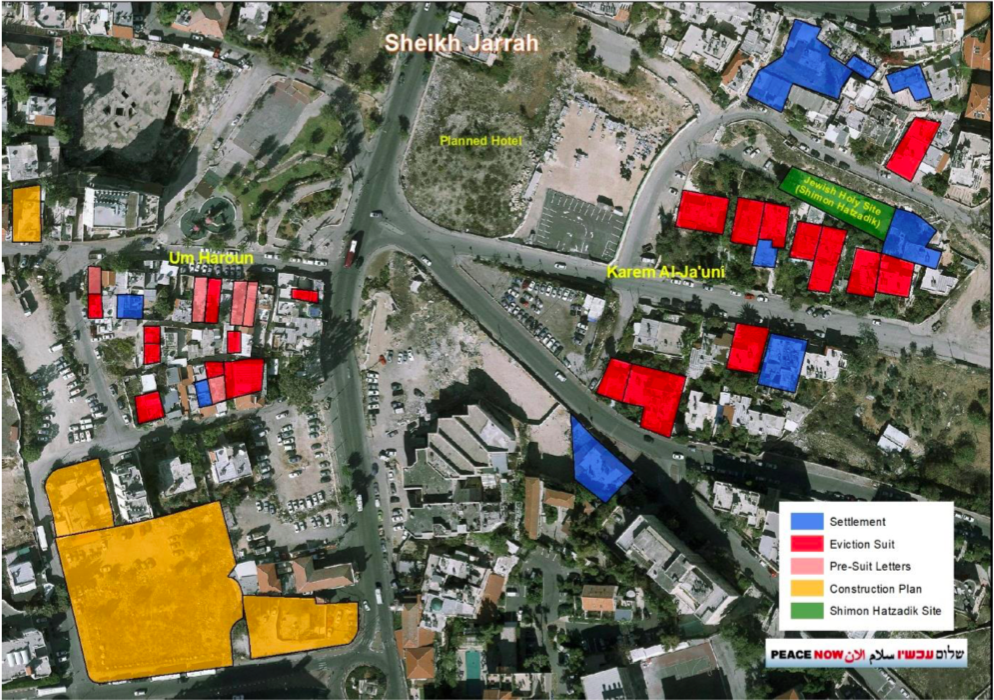 According to Peace Now, the Sabbagh family is one of 175 Palestinian families in East Jerusalem that face eviction under the discriminatory law: 75 families in the Sheikh Jarrah neighborhood and 100 families in the Silwan neighborhood (specifically in the Batan al-Hawa section, where several Palestinian residents were recently handed eviction notices). What’s more, the Sabbagh family was believed to have the best chance at escaping eviction based on historic Ottoman documents relating to the land obtained by the family’s lawyer. These are the documents that Supreme Court Chief Justice Esther Hayut declined to consider this week. The Sabbagh family lawyer told Haaretz:
“Once again, families from Sheikh Jarrah are facing eviction and a second refugeehood. In Israeli courts, which refrain from hearing the residents’ just and substantive arguments, people are sentenced to refugeehood on procedural grounds.”
In advance of the Sabbagh’s eviction, protests erupted, and have continued for a second straight day, in support of the family and against Israeli settlement activity in East Jerusalem. Israeli and international protestors marched from the center of Jerusalem to Sheikh Jarrah, where they were joined by Palestinians in front of one of the homes where Palestinians are facing eviction. Daniel Roth, one of the protestors told +972 Mag:
“At the core of this whole thing is the idea that all people have a right to a home, and what’s going on here is that the powers that be are taking homes from some people because of their national identity, period. What we’re looking at is racist policy and action around people’s very homes, and that should wake people up to stand up with these folks.”
Under the “Legal and Administrative Matters Law of 1970,” which is being used to evict the Sabbagh family, Jewish owners are afforded a legal avenue to reclaim property that they owned prior to the 1948 war which, as a result of the war, came under Jordanian rule. It should be noted that Palestinian refugees from that same war – who lost property in what became Israel – are not afforded an equivalent right to reclaim their abandoned property, creating a dual legal system in which ethnicity is the sole determinant factor when it comes to rights.
Exploiting the special standing granted to historic Jewish property owners, the settler group “Nahalat Shimon” has undertaken a campaign to track down the Jewish owners of coveted land in East Jerusalem that was under Jordanian rule, in order to purchase from them the property rights and then evict Palestinian tenants, most of whom have lived in these properties for more than 50 years. This is the context against which the 45-member Sabbagh family (who are themselves refugees of the 1948 war, but are not allowed to legally reclaim their family property in Jaffa) is being forced to leave their home of 60+ years. Following the Supreme Court’s January 10th decision to refuse the family’s request to consider new evidence in the case (based on the argument that it was too late), Israeli authorities delivered an eviction notice telling the family to leave before January 23rd.
Peace Now writes:
“This is part of an organized and systematic campaign of settlers, with the assistance of government agencies, to expel entire communities in East Jerusalem and to establish settlements in their stead. Dozens of other families face the risk of eviction by legal proceedings in which settlers and government officials exploit discriminatory laws that allow Jews to return to pre-1948 assets yet forbid Palestinians from doing the same. In this way, settlers seek to create a buffer inside the Palestinian neighborhood and make it difficult to reach a territorial compromise in Jerusalem so essential to a two-state solution.”
Bidding War Between Settlers and Palestinians Drives $3.27 Million Price for Sheikh Jarrah House
A bidding war erupted over a house in the Sheikh Jarrah neighborhood of East Jerusalem, pitting the Palestinian family living in the building against Aryeh King, a radical settler impresario behind many settlement schemes across East Jerusalem. When the price hit $3.27 million (12 million shekels), King decided to withdraw his bid – allowing the Palestinian Abdel Razeq family to purchase the home, should they be able to raise the necessary funds.
If the family is able to raise the funds to buy the house, this would be a rare, albeit astronomically expensive, victory for Palestinians fighting to remain in their homes against an ongoing campaign by Israeli settler groups to “reclaim” Jewish property in East Jerusalem that was abandoned during the 1948 war.
As discussed above, under Israeli law, Jewish property owners are entitled to reclaim property in East Jerusalem that was abandoned during the war, while Palestinians who lost property in what became Israel have no similar right. King and other pro-settler activists take advantage of this law by tracking down Jews who owned property in sensitive areas of East Jerusalem prior to 1948 (Sheikh Jarrah being a key target), and convincing the owners (or their heirs) to sign over the property rights – all in order to evict current Palestinian tenants and move in Israeli settlers.
The case involving the Abdel Razeq family’s house did not go according to the settlers’ script. A dispute broke out between members of the Jewish family who, under Israeli law, are heirs to the property. The case went to a Family Court, which ruled that the house should be sold through a public bidding process, with the proceeds to be split amongst the heirs.
Explaining his decision to drop out of the bidding, King took to social media to attack the Jewish family that is selling the property, saying:
“[it is] a black day for the Jewish people. A Jewish family is negotiating with the enemies of the Jewish people to sell a property that the family’s grandfather purchased a hundred years ago in East Jerusalem….I am full of shame that people act this way about a place that their grandfather bought out of Zionist motives and a place where soldiers paid with their lives and were wounded, and they sell it just to make another profit.”
King’s perspective on this – in essence, that Jews should sell only to other Jews – is notable, given recent controversy over a Palestinian who sold property to settlers. Israel and many supporters of Israel were outraged at what they saw as the anti-Semitic demand that Palestinians not sell property to settlers. In this latest case, the seller was arrested by the PA, leading the U.S. Ambassador to Israel, David Friedman, to tweet: “The Pal Authority has been holding US citizen Isaam Akel in prison for ~2 months. His suspected ‘crime’? Selling land to a Jew. Akel’s incarceration is antithetical to the values of the US & to all who advocate the cause of peaceful coexistence. We demand his immediate release.”
Settlers Impose Sabbath Closure on Palestinian Residents of Silwan; High Court Asks: Why?
On January 16th, the Israeli High Court of Justice ordered the Israel Nature and Parks Authority (INPA) and the radical Elad settler group to defend its practice of closing parts of the “City of David National Park” – a name that Israel has applied to an area that includes a large Palestinian residential section of Silwan – on the Jewish Sabbath, evenings, and on Jewish holidays. The closures deny Palestinians, including residents of Silwan, access to parts of the neighborhood.
 As FMEP has repeatedly covered, the radical Elad settler group has managed the City of David National Park on behalf of the INPA since 2001. This arrangement that gives the settler group authority over not only areas controlled by settlers – whose interests Elad shares and promotes – but also thousands of Palestinians, to whom Elad has no legal responsibility and whose very presence is part of a “demographic balance” Elad is working actively to flip.
The petition which prompted the Court’s order was filed by the residents of Silwan and the Israeli nongovernmental archaeological group Emek Shaveh. Explaining the situation caused by Elad’s mismanagement of the City of David National Park, Emek Shaveh writes:
“The City of David National Park is situated at the heart of a populated, urban space. Extensive areas in the park are public spaces in a neighborhood that suffers from a chronic deficiency of such spaces. In 2015, the Elad Foundation placed gates and closed archaeological areas known as Area E and Area G (No. 6 and 7 and No. 3 on the map). These public spaces had been open to the residents at least as far back as the British Mandate. The gates that were placed are locked at closing time, thus blocking passage between two neighborhoods within the village. The site closes on the Sabbath and on Holidays as the Elad Foundation observes the Sabbath, thus restricting the local residents’ freedom of movement and use of public spaces. As most of Silwan’s residents work in West Jerusalem, Shabbat (Saturday) is their day of rest, yet it is on this day that the nearby green public areas are closed off to them.”
Elad and the INPA have previously tried to defend the park closures on security grounds – citing alleged incidents of vandalism on park grounds. That defense was rejected by the Israeli Attorney General, who noted that no formal complaints about vandalism had been filed, and neither the Israeli police nor the Israel Antiquities Authority had be informed about the problem or Elad’s decision to close the park on religious occasions. Following the January 19th court order, Elad and the INPA have 60 days to submit a new defense.
Israel to “Examine” Two Cases of Illegal Outpost Construction
In response to petitions filed by Peace Now, on January 7th the State of Israel announced that it will “examine” two specific cases of illegal (under Israeli law) outpost construction: the Kerem Reim case and the Hayovel case, both located in the area controlled by the Binyamin Regional Council (the Israeli government-funded settlement municipal authority in charge of the area located north of Jerusalem stretching to north of Ramallah). The examination will be led by a police anti-fraud unit and the State Prosecutor’s Office.
As summarized in a recent report, Peace Now has previously filed numerous complaints and has provided evidence to the State Prosecutor’s office regarding the involvement of the Binyamin Regional Council and the Amana settler organization in the illegal construction of outposts and settlement structures.
Given the State’s demonstrated refusal to promptly respond to the complaints by opening an official investigation into the criminal activity, Peace Now cautions that this latest move to “examine” the cases is problematic, saying:
“an examination is an ambiguous, non-legal term that comes in lieu of a proper, legal investigation. An ‘examination’ may just be the state’s tactic to mollify the High Court by showing that it is serious looking into the matter, though without actually taking any substantive action.”
In addition to Peace Now’s documentation, the Israeli State Comptroller’s office published a July 2018 report exposing the criminal involvement of the Binyamin Regional Council and the Amana settler organization in illegal settlement construction.
Peace Now also released an official statement saying:
“For 50 years now, a handful of settlers have been using public funds through the settlement councils and Amana to put facts on the ground that affect the future of all of us in violation of the law and of the government’s decisions. The hesitation of the State Prosecutor’s Office and the police to investigate the organized crime of illegal construction in the settlements is tantamount to granting immunity to the offenders and shows a lack of respect for the rule of law. The message the government is sending to the settlers is that they are above the law.”
In 2017, Peace Now published a comprehensive report outlining how government and private entities are systematically using Israeli taxpayer money to establish new settlements and outposts.
MK Bezalel Smotrich – A Radical Settler – Elected to Lead National Union Party
MK Bezalel Smotrich has been elected to take the reins of the extreme right-wing nationalist political faction, called the National Union Party. With leadership secured, Smotrich aims to next be chosen to lead Habayit Hayehudi – an umbrella group which unites the far-right factions into a single voting bloc – following Naftali Bennett’s decision to leave Habayit Hayehudi and form a new political party alongside Ayelet Shaked.
Smotrich currently lives in the Kedumim settlement, but his house is located inside of an enclave of privately owned Palestinian land that is not included in the settlement’s Master Plan, making it illegal even under Israeli law.
Smotrich is a co-founder of Regavim, a radical settler group that works to dispossess Palestinians of their land and property in the West Bank by “helping” the Israeli government to enforce planning and building laws. Like Smotrich, many of Regavim’s key staff live in illegally built settlement units, but instead of seeking to enforce Israeli law against their own illegal building, Regavim and Smotrich are working to retroactively legalize their own homes through legislation.
Beyond the headlines, Smotrich has been an extremely active member of the Knesset, and is behind many of the boldest and most brazen legislative attempts at annexation. Some of Smotrich’s recent efforts include:
- Introducing the “Young Settlements Bill,” which would direct the government to treat 66 illegal outposts built on privately owned Palestinian land as legal settlements, while giving the government 2 years to find a way to retroactively legalize those outposts. The bill would also freeze any/all legal proceedings against the outposts and requires the government to connect the outposts to state infrastructure including water and electricity; provide garbage removal; and approve budgets for them. The law also allows the finance minister to guarantee mortgages for settlers seeking to buy units in these outposts, even before the legal status of the land is resolved (a remarkable state-directed violation of normal practices in the mortgage industry). The bill received government backing on December 16, 2018, and will next need to be introduced in the Knesset, where it must pass three readings to become law.
- Calling for the Israeli Civil Administration to be disbanded, in a scheme that would annex the entire West Bank to Israel, leaving the Palestinians bantustans to be governed by “Regional Liaison Committees.”
- Leading the charge for the Knesset to fund a new municipal body for Israeli settlers in Hebron, despite a court injunction freezing government plans to create such a body.
- Introducing a bill that would hand over more land in Area C of the West Bank to the World Zionist Organization.
European Union Statement Lambasts “Givat Eitam/E-2” Settlement Plan
On January 22, 2019, the European Union presented a statement at the United Nations Security Council Open Debate representing the view of its member states that:
“Today there is a risk of further escalation that would move Israelis and Palestinians further away from an end to the conflict. This risk is compounded by the advancement in December 2018 of Israeli plans for over two thousand settlement units and renewed plans to “legalise” West Bank outposts. The allocation of an area south of Bethlehem for the purpose of planning a new settlement (Givat Eitam) constitutes a serious blow to the viability of a two-state solution. The European Union’s position on Israeli settlement policy – including eviction of Palestinians – for example in Sheikh Jarrah – and related activities in the occupied Palestinian territory is clear and remains unchanged: all settlement activity is illegal under international law and it erodes the viability of the two-state solution and the prospects for a lasting peace – as reaffirmed by UNSCR 2334.”
For FMEP reporting on the Givat Eitam/E-2 settlement, see the January 4th edition of the Settlement Report.
Bonus Reads
- “The Israeli-Palestinian Conflict is Not a Bankruptcy Sale” (Lawfare Blog)
- “When Freud Visits Israeli Civil Administration in the West Bank” (Haaretz)
- “A Guided Tour of Hebron, From Two Sides of the Occupation” (The New Yorker)
- “Another Step Toward the Annexation of the West Bank” (Haaretz)
- “Israel’s Apartheid Road is About More Than Segregation” (+972 Mag)