Welcome to FMEP’s Weekly Settlement & Annexation Report. To subscribe to this report, please click here.
March 4, 2021
- ICC Opens Investigation Into Palestine
- JNF Board Approves $11.5 Million for Settlement Expansion
- Report: Netanyahu Offered Construction of Atarot Settlement in Return for Votes
- In Hebron, Economic “Coexistence” Group Reportedly Working on Plan for New Hospital
- Bonus Reads
Comments or questions? Contact Kristin McCarthy (kmccarthy@fmep.org)
ICC Opens Investigation Into Palestine
On March 3, 2021, International Criminal Court (ICC) Chief Prosecutor Fatou Bensouda formally opened an investigation into the “Situation in Palestine,” an investigation which is expected to look at war crimes committed by Israelis involved in the settlement enterprise (as well as other alleged war crimes committed by both Israelis and Palestinians). Notably, Bensouda is leaving her post in June 2021; her replacement, U.K. prosecutor Karim Khan, will have the ability to end the investigation if he so chooses (which Israel hopes is a real possibility).
Bensouda’s move to open an investigation comes after almost five years of considering doing so. Over that time, Bensouda oversaw a lengthy pre-investigation inquiry (Bensouda announced in December 2019 that this inquiry had found grounds to open an investigation), and a special pre-trial chamber ruling, issued on February 5, 2021, that affirmed the ICC’s jurisdiction over crimes committed in Palestine.
According to Haaretz, the ICC is expected to send formal notification of its decision to open an investigation to the leaders of Israel and the Palestinian Authority. Israel and the PA then have a 30-day window within which to tell the Court if they intend to investigate the alleged criminal activities within their own judicial systems. If they inform the Court that they will do so, Bensouda will need approval from the Court to proceed with the ICC’s investigation. It’s unclear how much of this can be expected to happen prior to Bensouda’s departure from the Court in June.
Assuming the investigation does go forward, it is expected to take years to complete, and will reportedly look at bringing charges against both Israeli and Palestinian individuals involved in the commission of crimes — including the crime of genocide, crimes against humanity, war crimes and the crime of aggression — in the West Bank, East Jerusalem, and the Gaza Strip, going back to 2014 up to the present day. This could include the prosecution of Israeli officials involved in establishing settlements in the occupied territory – which is illegal under international law.
For a rich discussion of this case and the complexities involved in it, watch this recent FMEP webinar, ”Israel-Palestine at the International Criminal Court: What Next?”
In response to the ICC’s announcement, the U.S. Department of State issued a statement saying the Biden Administration “firmly opposes and is deeply disappointed by this decision.”
Reiterating his prior assertion that the ICC investigation is antisemitic, Prime Minister Netanyahu said in a video message: “The decision of the International Court to open an investigation against Israel today for war crimes is absurd. It’s undiluted antisemitism and the height of hypocrisy.”
Palestinian Prime Minister Shtayyeh called the ICC’s decision a “victory for justice and humanity, for the values of truth, fairness and freedom, and for the blood of the victims and their families.”
A coalition of Palestinian civil society groups – Al-Haq, Al Mezan Center for Human Rights, the Palestinian Centre for Human Right and Al Dameer – said in a statement:
“This investigation represents a critically important step towards ending impunity and upholding the international rule of law, while ensuring the dignity of the Palestinian people who continue to be denied their right to self-determination and who are subjected to a criminal regime of apartheid, forced displacement, population transfer, extensive destruction and appropriation of property, pillage, wilful killings, and persecution, amongst other crimes within the jurisdiction of the Court. Investigating war crimes related to the settlement enterprise in the West Bank, including East Jerusalem, as well as Israel’s subjection of Palestinian civilians in Gaza to the inhumane closure and brutal military offensives, and apartheid as a crime against humanity, will require the Court to engage both with the conduct of individual soldiers and military commanders, and the entire military and civilian hierarchies embedded in and advancing the Israeli occupation.”
JNF Board Approves $11.5 Million for Settlement Expansion
Immediately following the March 23rd elections in Israel, the Jewish National Fund will hold a vote on whether to adopt a new policy explicitly supporting the purchase of West Bank land for the purpose of settlement expansion. Despite that vote not yet having been taken, on February 25th, the Israeli Board of the Jewish National Fund (JNF-KKL) voted to allocate $11.5 million (38 million shekels) towards the purchase of land in the West Bank in order to expand settlements. The Jerusalem Post reports that proponents of the new policy might have used the funding vote to “strong arm” the organization into moving forward with the policy prior to a final vote.
A group of JNF Board members who oppose the new policy has filed a petition demanding that the February 25th funding allocation vote be annulled, citing alleged malpractice by the Board Chairman. The petition says that the Chair, Avi Duvdevani, “muted certain members on the Zoom meeting and prevented others from answering questions before rushing the vote” and deliberately withheld legal opinions critical of the new policy.
The day prior to the vote on funding allocation, Israeli attorney Shachar Ben-Meir sent a legal analysis of the proposed policy to the JNF Board. In it, Ben-Meir argued that the JNF would need approval from the Israeli Justice Minister (currently Benny Gantz) in order to make a necessary amendment to the organization’s founding agreements to allow for activity in the West Bank.
Pushing in the other direction, Israeli MK Bezalel Smotrich wrote to the JNF Board Chairman to demand that the new policy avoid limiting the JNF’s settlement dealings to Area C, arguing that the JNF ought to be buying land throughout the West Bank, especially in Hebron.
Notwithstanding the significant controversy the JNF’s potential explicit embrace of settlements has provoked, the reality is that the JNF has long worked in support of settlements. What is different now is that, where in the past the JNF preferred to leave its settlement-related activities deliberately obscured, under the new policy the JNF would openly claim and promote its support for settlements. As such, the shift under consideration is not so much in policy as in public relations (a public relations approach that does not shy away from blatant racism, evidenced by the JNF Chairman’s recent TV appearance in which he said that the JNF’s goal is to stop land from ending up in Arab hands).
Report: Netanyahu Offered Construction of Atarot Settlement in Return for Votes
In early January 2021, Netanyahu allegedly attempted to secure a merger of parties to his right by offering to advance the construction of the Atarot settlement – a planned settlement to be located just north of Jerusalem on the site of the former Qalandiya airport – which has been designated for ultra-Orthodox housing. According to reporting, the deal was not agreed to, though that does not mean Netanyahu will not advance the plan (in December 2020 the plan for the Atarot settlement was reportedly ready to be scheduled for discussion, an early phase in the planning process).
According to Jerusalem expert Daniel Seidemann of Terrestrial Jerusalem, the plan faces significant legal obstacles and he predicts that the plan will not come to fruition “anytime soon.” It’s worth noting, Israel is well underway with other settlement projects in the area, most notably construction of a new bypass tunnel road that will go underneath the Qalandiya checkpoint which is immediately adjacent to the area where the Atarot settlement is planned for.
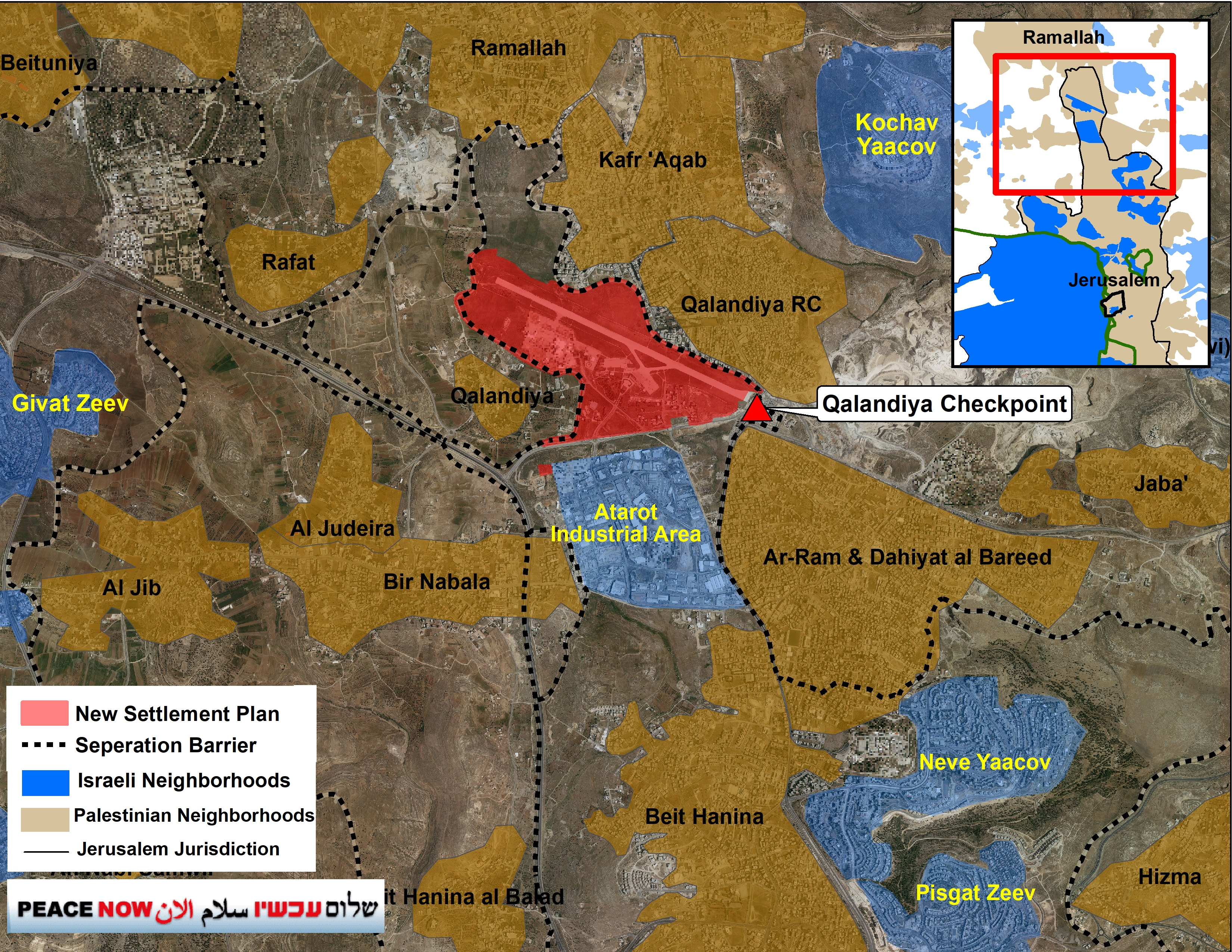 The Atarot settlement plan dates back to 2007; it was pursued by the Israeli government in 2012 but shelved under pressure from the Obama administration. The plan came back into consideration in April 2017 (a few months following the inauguration of President Trump) when it was rumored to be included on Netanyahu’s master blueprint of settlements for which he was seeking U.S. approval. In February 2020, following the publication of the Trump Plan – which designated the area that would be used for the settlement as a “special tourist zone” for Palestinians – the Atarot settlement plan was formally introduced.
In its current form, the plan provides for up to 9,000 residential units for ultra-Orthodox Jews (assuming, conservatively, an average family size of 6, this means housing for 54,000 people), as well as synagogues, ritual baths (mikvehs), commercial properties, offices and work spaces, a hotel, and a water reservoir. If built, the Atarot settlement will effectively be an Israeli enclave surrounded by Palestinian East Jerusalem neighborhoods on three sides and Ramallah to its north.
There are currently 15 Palestinian families living in buildings on the land slated for the settlement, part of which is privately owned by Palestinians. Other land in the area has been declared “state land” by Israel or belongs to the Jewish National Fund. To solve the problem of Palestinian land owners, the Israeli government will need to evict the Palestinians living there and demolish their homes — a step that will be facilitated by the fact that all of the homes lack Israeli-issued building permits (which are essentially impossible for Palestinians to receive). The private Palestinian landowners will then be subjected to a non-consensual process of reparcelization, in which Israel will unilaterally reparcel and then redistribute the land amongst its owners on the basis of the value of the land (as determined by Israel) and the percentage of their ownership claim.
The Atarot airport site is an important commodity and, during past negotiations, it was previously promised to the Palestinians for their state’s future international gateway. Israeli development of the site as a settlement would — by design — not only deprive a future Palestinian state of the only airport in the West Bank, but also dismember Palestinian neighborhoods in the northern part of the city, and sever East Jerusalem from a Palestinian state on this northern flank of the city (acting like E-1 on Jerusalem’s northeast flank, and like Givat Hamatos on Jerusalem’s southern flank).
In Hebron, Economic “Coexistence” Group Reportedly Working on Plan for New Hospital
According to a glowing profile and interview in the Jewish News Syndicate, a right-wing media outlet, Palestinian businessman Ashraf Jabari is in talks with the settler leaders in Hebron to open a new hospital as a joint project. The new JNS interview provides fascinating insights into Jabari’s acceptance of Israeli settlements and settlers as a permanent feature in the West Bank, and into his dismissal of the prevailing formulation of a two-state solution. Jabari even suggests that Palestinians would prefer to live under full Israeli control, for economic reasons.
As a reminder, Jabari has long been the darling of settlers and Greater Israel advocates. He publicly welcomed and participated in Trump’s “Deal of the Century” (he was the only Palestinian on-stage at the “Peace to Prosperity’ summit convened by the Trump Administration in June 2019) and has been actively working with settlers to establish “joint” economic initiatives in the West Bank through a group called the Judea and Samaria Chamber of Commerce (JSCC). For his role in the JSCC and his close ties to the Trump Administration, Jabari has been slammed as a traitor by the Palestinian Authority, shunned as a pariah by his fellow Palestinian business people, and disowned by his family.
As FMEP has repeatedly explained, economic “coexistence” initiatives like the Judea and Samaria Chamber of Commerce (JSCC) seek to normalize, entrench, and reward Israeli settlements while perpetuating Israel’s economic exploitation of occupied territory (including the local workforce, land, and other natural resources). Congressional support for such initiatives could mean U.S. taxpayer dollars going directly (and publicly) to the settlements.
Bonus Material
- “Can Silwan’s rekindled protests beat back Israel’s eviction threats?” (+972 Magazine)
- “The road to nowhere: Israel tarmacs over peace with the Palestinians” (The Prospect // Donald Macintyre)
- “Not Just a Few Bad Apples, Violent Settlement Outposts Pose a Danger to Israel” (Haaretz)
- “Jewish Groups Call to Reverse Trump Policy of Labeling Settlement Products ‘Made in Israel’” (J Street)
- “Israel Is Recreating the Nakba, Without Putting Palestinians on Trucks” (Haaretz)
- “Trump’s $3 billion Abraham Fund may be tapped out before staking a dime” (The Times of Israel
- “Al-Haq Field Report on Human Rights Violations in 2020” (Al-Haq)
- “Judge, Jury, & Occupier” (War on Want)
Welcome to FMEP’s Weekly Settlement & Annexation Report. To subscribe to this report, please click here.
February 12, 2021
- ICC Confirms Jurisdiction Over (Israeli and Palestinian) War Crimes Committed in OPT
- ICC Investigation Expected to Take On Settlements, Potentially Exposing Untold Number of Israeli Government Officials to Criminal Liability
- Jewish National Fund to Start (Openly) Purchasing West Bank Land for Settlement Expansion
- Israel Rejects Development Plan for al-Walajah, Paving the Way for Further Demolitions
- Israel Demolishes Khirbet Humsa for Third Time this Month, Highlighting Discriminatory Enforcement in Jordan Valley as Path to Israeli Annexation
- Israeli Court Hears Appeal to Stop Mass Dispossession in Sheikh Jarrah
- Who Profits Report: “Infrastructures of Dispossession and Control Transport Development in East Jerusalem”
- Bonus Reads
Comments, questions? Email kmccarthy@fmep.org
ICC Confirms Jurisdiction Over (Israeli and Palestinian) War Crimes Committed in OPT
In a ruling published on February 5, 2021, a three judge pretrial chamber of the International Criminal Court confirmed that the Court’s jurisdiction extends over the occupied Palestinian territories (the West Bank, East Jerusalem, & Gaza Strip). As a reminder, the Court’s jurisdiction is over individuals (not states) and includes jurisdiction over war crimes committed by both Israeli combatants and Palestinian combatants. With this ruling, the ICC’s Chief Prosecutor Fatou Bensouda will need to decide whether and when to formally open an investigation into potential war crimes. According to an official statement from Bensouda’s office welcoming the decision, her office is “carefully analyzing the decision & will then decide its next step.”
The pretrial chamber was convened by Bensouda in December 2019 to make a final determination on the highly disputed issue of the Court’s jurisdiction in Palestine. Bensouda herself submitted a brief to the chamber in April 2020 articulating her belief that the Oslo Accords – signed by the PLO and Israel – are a credible legal basis for establishing Palestine as an internationally recognized state. Her brief refuted arguments made in amicus curiae briefs filed by several countries, including Germany (the second largest funder of the ICC), insisting that Palestine is not a state and that the Court therefore cannot have jurisdiction. The Czech Republic, Austria, Australia, Hungary, Brazil and Uganda also filed briefs along those lines. Bensouda’s brief — well worth reading in full — also systematically rebutted the raft of arguments made by various international lawfare organizations asserting that the Court has no right to investigate. As a reminder: in June 2020, President Trump signed an Executive Order authorizing sanctions against ICC officials; in September 2020, the Trump Administration used that Executive Order to impose sanctions on Bensouda and another ICC official; in January 2021, a US court blocked those sanctions..
In response to the decision of the pretrial chamber, the Biden Administration promptly stated its opposition. State Department spokesperson Ned Price said in a statement that the U.S. has “serious concerns about the ICC’s attempts to exercise its jurisdiction over Israeli personnel” – statement that was on the one hand categorical and on the other hand far more restrained than what had previously come out of the Trump Administration or the Israeli government (objecting to the decision but not attacking the court itself). It’s worth noting that the Biden Administration has yet to reverse sanctions imposed on ICC officials by former President Trump (including the revocation of Fatou Bensourd’s entry visa to the United States) or revoke Trump’s anti-ICC executive order.
In response to the White House statement, +972 Magazine Editor Amjad Iraqi wrote:
“The fact that the White House rejects this mission at The Hague is further proof that the United States is not really interested in an independent Palestinian state. If Israel prefers apartheid, then Washington will stand behind it, even at the cost of its own proclaimed policy. The Biden administration should either admit this fact or begin backing up its two-state vision with meaningful action. If neither, then it should step back and let the court do its job.”
ICC Investigation Expected to Take On Settlements, Potentially Exposing Untold Number of Israeli Government Officials to Criminal Liability
Having now established its jurisdictional authority to proceed, the International Criminal Court is expected to take up, in addition to other alleged crimes, the criminal acts perpetrated by individuals who participated in the establishment of Israeli settlements in the West Bank. The basis for investigating such persons is international law, according to which the transfer of a civilian population into occupied territory is prohibited.
Yuval Shany, Israel Democracy Institute, told AP:
“The settlement issue is really the biggest issue. This is the elephant in the room. This exposes basically the entire Israeli political elite that has been part of a settlement policy to criminal proceedings before the court. This is a significant setback.”
Yesh Din, an Israeli NGO deeply involved in fighting settlement expansion and defending Palestinian rights in the West Bank, said in response to the ICC’s jurisdictional ruling and the investigation into settlement construction:
“Yesh Din has, for many years, also exposed, challenged and petitioned to the HCJ regarding settlement expansion and takeover of Palestinian lands, an official policy and long-standing practice by successive Israeli governments, despite being a clear violation of international law. We have, time and again, seen that even when a degree of legal remedy is occasionally achieved, too often, failures of enforcement or other mechanisms are applied to prevent Palestinians from truly returning to their lands (see HCJ 88/19 and HCJ 9948/09).
Furthermore, the HCJ has served to enable the establishment and expansion of settlements (HCJ 4481/19) and even approved the State’s efforts to retroactively authorize, or ‘regularize,’ outposts and settlement construction considered illegal even under Israeli law, such as in ongoing proceedings regarding illegal construction in the Netiv Ha’avot (HCJ 5480/15) and Adei Ad outposts (8395/14), among others. The HCJ has further failed to halt creeping annexation, leading to today’s situation of de-facto annexation already in place.
These failures in Israel’s law enforcement and judicial processes reflect a lack of will to hold perpetrators responsible, willingly turning a blind eye to offenses committed within the broader context of a clear intention to expand control over Palestinian lives, land and resources.
As such, Yesh Din welcomes the ICC’s jurisdiction to open an investigation into potential war crimes in the hopes for greater accountability and a future in which international law will be respected and upheld and, ultimately, in which the fundamental human rights of Palestinians and Israelis alike will be protected.”
Jewish National Fund to Start (Openly) Purchasing West Bank Land for Settlement Expansion
According to Axios, the Board of Directors of the Jewish National Fund is expected to approve a new policy on Sunday (February 14) allowing the organization to in directly purchase land in Area C of the West Bank for the purposes of facilitating settlement expansion (which is illegal under international law and opposed by governments the world over as a violation of Palestinian rights). If this new policy is indeed adopted, the JNF will officially make financing the Israeli settlement enterprise a loud and proud part of its mission. This would be a shift not so much in policy as in public relations, given that the JNF has long worked in support of settlements, but until this point has left settlement-related activities deliberately obscured. The shift in approach that will culminate in Sunday’s vote is in line with the JNF’s new right-wing, settler leadership (which effectively took control of the organization in October 2020).
According to the report, the proposed JNF policy – which could see hundreds of millions of dollars invested in the settlement enterprise – includes directives for the organization to purchase land subject to the following conditions:
- The land is privately owned by Palestinians.
- The land will be used to expand existing settlements, not build new ones (this presumptively includes purchasing land to build outposts).
- The land is in Area C (some 60% of the West Bank), not land in Areas A and B.
- The land is located inside of a settlement’s jurisdiction or adjacent to it.
- Focus will be on purchasing land in areas identified as a priority, including the Jordan Valley, the Etzion settlement bloc, areas around Jerusalem, the Binyamin region north of Jerusalem, the South Hebron Hills, and areas adjacent to the pre-1967 border. The draft specifically says that no land shall be purchased in the Nablus or Jenin areas.
- Foreign donations will only be used to purchase land in the West Bank if the laws of the donor’s country permit it.
Commenting on the report, Peace Now put it bluntly:
“The Israeli Jewish National Fund has long had a dark side in discreetly facilitating settlement expansion. This latest news on it intending to purchase private Palestinian land is a decision to bring it into the open. Make no mistake. This isn’t about whether Jews can live wherever. KKL-JNF purchasing land in the West Bank is meant for Israel to keep the land. It’s not like it intends for Jews and these land plots to be in a Palestinian state.”
When asked for comment, the spokesperson for the U.S. Department of State, Ned Price, said:
“Well, I think there is a broad point at play here, and that point is this: We believe it is critical to refrain from unilateral steps that exacerbate tensions and that undercut efforts to advance a negotiated, two-state solution. And unilateral steps might include annexation of territory, settlement activity, demolitions, incitement to violence, the provision of compensation for individuals imprisoned for acts of terrorism. We have continued to emphasize that it is critical to refrain from all those activities.”
Established in 1901, the JNF devoted itself to buying land for Jews. Today, the JNF owns about 15% of all the land inside the Green Line. In addition, the JNF has also used two subsidiary companies – both called Himanuta – to purchase land in the West Bank, even though stated JNF policy (until now) did not support such purchases . The JNF and Himanuta used middle men in order to allow the JNF to deny a direct role in West Bank land purchases, which JNF leadership feared would hurt the organization’s fundraising potential. Peace Now reports that the JNF, via its subsidiary Himanuta, has already purchased over 160,000 acres (65,000 dunams) across the West Bank; settlements established on some of those lands include Itamar, Alfei Menashe, Einav, Kedumim, Givat Ze’ev, Metzadot Yehuda (Beit Yatir), Otniel and more. At the same time, the JNF and the settler group Elad have been partnering together to pursue the mass eviction of Palestinians from East Jerusalem neighborhoods, including Silwan.
Israel Rejects Development Plan for al-Walajah, Paving the Way for Further Demolitions
 On January 25th, the Jerusalem District Planning Board rejected a Palestinian-proposed outline plan for the village of al-Walajah, located on the southern flank of Jerusalem. For at least 15 years, al-Walajah residents have attempted to gain Israeli approval for an outline plan – which is a key planning document that establishes land usage and provides for the future development of the community. Without an outline plan, no building permits can even be considered, leading to a situation where Palestinians are forced to build illegally to meet the basic needs of a growing community.
Due to its location and unique political situation (both discussed below) Al-Walajah is already the focus of a years-long campaign of demolitions and land confiscations. By rejecting the outline plan, the Planning Board has cleared the way for an additional 38 homes in al-Walajah to be demolished because they lack Israeli-issued building permits.
Ir Amim reports important detail on context of the Board’s decision:
“The planning committee rejected the outline plan based on various dubious claims, including on the basis of nature and environmental conservation, yet plans for massive Israeli settlement construction and expansion in the same area have all been approved. Not only is this a prime example of the rampant housing discrimination against Palestinians in Jerusalem, but the committee’s citation that the area’s traditional and historical agricultural assets must be preserved entirely overlooks the village’s exclusive role in this centuries-old preservation. Without the homes and the farmers to build and cultivate the land as they have for generations, there will be nothing left to preserve.”
Haaretz reports that, prior to its ruling in January, the Jerusalem District Planning Board refused to discuss this outline plan. The Board was forced to consider the plan when al-Walajah residents petitioned the Isareli Supreme Court. Attorney Jiat Nasser, who is representing the villagers, told Haaretz:
“The district board’s decision is discriminatory and dripping with malice. It feels like the hearings were fixed, as if they want the residents to leave… We didn’t expect inhumanity would reach such proportions.”
Al-Walajah is a village besieged by Israel from every angle. In the words of Danny Seidemann:
“ Since 1967, Walajeh’s inhabitants have lived in a Kafka-esque situation, with their village technically located inside Israel’s expanded borders, but with villagers never given Israeli residency (they are considered West Bankers and thus are not permitted inside Jerusalem). As a result, the villagers’ presence in their own village is, under Israeli law, illegal, and their homes there are, by definition, illegal.”
For decades, the Israeli government has carried out a multi-prong effort to push Palestinians off of their land in al-Walajah. This has included demolition campaigns, construction of the separation barrier along a route that encircles the village and cuts residents off from their land, refusal to grant building permits, and the declaration of state parks over lands on which Palestinians have lived for generations.
In October 2020, it was revealed that Israel, in order to build the Har Gilo West settlement, plans to extend the separation barrier to completely encircle al-Walajah, which is already surrounded on three sides by the separation wall. The new section of the barrier will be a 7-meter high concrete slab along the western edge of the built-up area of Al-Walajah.
Israel Demolishes Khirbet Humsa for Third Time this Month, Highlighting Discriminatory Enforcement in Jordan Valley as Path to Israeli Annexation
On February 8th, Israel forces returned to the Palestinian Bedouin community of Khirbet Humsa in the Jordan Valley for the third time this month to demolish structures and confiscate the property of the ~65 Palestinians who continue to live there despite Israeli attempts at forced relocation. This was the fourth time that the community has been demolished.
Khirbet Humsa is located in Area C of the West Bank, in an area of the Jordan Valley that Israel declared a closed military zone even though Palestinians had been living there, and using the land for agriculture and herding, for decades. Israel has long used the pretext of military firing zones to pursue the forcible displacement of Palestinians, while simultaneously ignoring (and in some cases openly assisting) settlers to establish a presence in the very same areas.
B’Tselem documented the demolitions of Khirbet Humsa, and responded:
“These demolitions are part of Israel’s policy, enacted throughout the West Bank, to make Palestinians’ lives unbearable, in order to force them to leave their homes, concentrate them in enclaves and take over their land. This policy constitutes an attempt at forcible transfer — which is defined as a war crime under international humanitarian law. The responsibility for its execution lies first and foremost with the political decision-makers leading it, the senior military command carrying it out, and the Supreme Court lending it a legal stamp of approval.”
In telling the story of another Palestinian village in the Jordan Valley facing a similar fate (the village of Jibneh), Yuval Abraham wrote in +972 Magazine:
“Israel has declared about 18 percent of the West Bank as firing zones for military training. This is roughly as large as the West Bank area under full Palestinian control. During a 2014 Knesset subcommittee meeting on “illegal Palestinian construction in Area C,” Col. Einav Shalev, then operations officer of Central Command, admitted that one of the main reasons for increasing military training in these firing zones is to prevent Palestinian construction.
It is important to stress that these are villages that have existed for many decades. The residents have no way of building legally because the Civil Administration, the arm of Israel’s military responsible for governing Palestinians in the occupied West Bank, denies more than 98 percent of permit requests filed by Palestinians in Area C. To even discuss this issue in terms of legal compliance is absolutely ridiculous, since the law is clearly based on ethnic bias…
Increasing governance, meaning, amplifying Israel’s pressure to expel local communities like Jinbeh, that live in areas the state wants to Judaize. Israel is currently focusing on three West Bank areas: the Jordan Valley, south Hebron Hills, and an area known as E1, which connects East Jerusalem to the West Bank. There, Israel systematically denies building permits to Palestinians in order to force them to leave.”
Last week, prior to the demolition on February 5th, a large delegation of European diplomats visited Khirbet Humsa to witness what was taking place. One participant on the delegation, Sven Kuehn von Burgsdorff, said:
“We express our strong concern regarding the policy of demolishing residential structures of Bedouin communities who have been residing here for decades. And our concern is very simple. We are here to uphold international law, including international military law which forbids demolitions of residential structures in occupied territories. It’s contrary to the obligations [of Israel] under the 4th Geneva Convention evictions or forcible transfer likewise. Here we’re talking about 100 people, of whom 40 to 50 are children. We’re in the midst of a pandemic we are in the midst of winter-time. Where do these people go facing homelessness, facing winter?”
Israeli Court Hears Appeal to Stop Mass Dispossession in Sheikh Jarrah
On February 9, the Jerusalem District Court held a hearing to consider an appeal submitted by four Palestinian families – including the El-Kurd family – facing eviction from their homes in Sheikh Jarrah, a neighborhood of East Jerusalem in the shadow of the Old City. The appeal holds significance beyond the families directly involved, as it threatens to cement a legal precedent that can be used by settler groups to carry out a mass eviction in Sheikh Jarrah.
The evictions being challenged in Court are part of an ongoing campaign to throw Palestinians out of their homes in Sheikh Jarrah and replace them with Israeli settlers. It is led by the Ateret Cohanim settler group (and others), with the evictions based on Israel’s Absentee Property Law – a law that allows Jews to reclaim property that was abandoned in the 1948 war. To take advantage of that law, Ateret Cohanim has tracked down Jews (or their heirs) who before 1948 owned homes in highly desirable East Jerusalem neighborhoods, convincing them to make a claim on the property, and then working with them or on their behalf to evict Palestinians who have been living – legally – in the homes or on the property, in some cases for more than half a century.
On the day of the Court hearing, Palestinians led a protest (which included Israeli and international activists) outside of the Jerusalem District Court. Along with protests on the ground, international diplomatic pressure appears to be picking up. A group of 81 Members of the British Parliament penned a letter to their own foreign secretary asking for the country’s leadership to engage on the issue of Sheikh Jarrah. The letter asked the secretary to “make clear to its [the UK government’s] Israeli counterpart that relations cannot continue as normal in the event of such transgressions,” stating:
“All measures should be considered including reducing diplomatic engagement and banning trade in settlement products in full conformity with international law obligations in order to challenge the settler economy that profits from the occupation.”
Just Vision – which shared one Sheikh Jarrah family’s story in the docuseries “My Neighborhood,” said in a November 2020 email drawing attention to these evictions:
“While the cases in Sheikh Jarrah are thinly veiled as a legal matter, the political motivations are clear. This latest round of evictions is part of a broader attempt by the Israeli state to forcibly displace Palestinians from their homes in East Jerusalem and the West Bank. The process is methodical and impacts thousands of lives on a daily basis. In the past month alone, Israel hid under the US election media frenzy to undertake the largest demolition of Palestinian homes and structures in a decade, and just yesterday, announced a new settlement, Givat Hamatos, that would effectively cut East Jerusalem off from Bethlehem. This all happens under the United States’ watch – subsequent US administrations have done little to hold the Israeli government to account, and the latest administration has given a carte-blanche for unjust activity like this.”
Who Profits Report: “Infrastructures of Dispossession and Control Transport Development in East Jerusalem”
In a new report, Who Profits expertly surveys major infrastructure projects in East Jerusalem that are part of the Israeli government’s drive to dispossess Palestinians and facilitate a stronger Jewish presence and control across the entire city. Providing an overview of the report, Who Profits writes:
“Transport infrastructure, which regulates not only space but the movement of people and goods across space, offers a powerful organizing instrument for an occupying power. Together with the Wall and the checkpoints, Israel’s transport network in the occupied Palestinian territory (oPt) works to manage and control both land and population in accordance with Israeli interests.
For Israel’s illegal settlement enterprise, infrastructure development provides a lifeline, enhancing settler connectivity, supporting economic development and normalizing Israeli presence on occupied land.
For the occupied Palestinian population, these infrastructure development projects are intimately tied to the processes of dispossession and facilitate land grabs. In this way transport projects are a means of annexing land, fragmenting and isolating communities and destroying agrarian livelihoods by separating farmers from their agricultural lands.
This flash report focuses on five large scale transport infrastructure projects in East Jerusalem currently at various stages of development, and exposes the private corporations involved in their implementation. All companies profiled herein were contacted prior to publication. To date, no responses have been received. The projects surveyed are: (1) the expansion of the Tunnel Road, a section of Route 60 south of Jerusalem; (2) the construction of the American Road, a north-south highway that cuts through East Jerusalem’s Palestinian neighborhoods; (3) the construction of an underpass and grade separation at the Qalandia checkpoint on the outskirts of Ramallah, north of Jerusalem; (4) the construction of grade separation in the French Hill settlement neighborhood and (5) the expansion of the Jerusalem Light Rail Network.
Our research shows that although the projects themselves are carried out by Jerusalem’s municipal development arm, the Moriah Jerusalem Development Corporation (hereafter: Moriah) and located largely within municipal lines, they target not only the settlement neighborhoods of illegally annexed East Jerusalem—but also the occupied West Bank as a whole. The transport projects examined in this publication are part and parcel of a broader Israeli strategy to promote the economic and spatial integration of the West Bank in terms of dispossession, segregation and control.”
Bonus Reads
- “Settlers stop Palestine TV documenting settlement activities in West Bank” (MEMO)
- “Concern rises over takeover of hundreds of dunums of West Bank village land as Israelis survey the area” (WAFA)
- “Sa’ar says West Bank Annexation still a goal, even if not implemented now” (Jerusalem Post)
- “Biden must prevent Israel’s march toward annexation” (Responsible Statecraft)
- “David Friedman: We left the world a better place” (Arutz Sheva)
- “In assertion of sovereignty, Palestinians launch postcodes in West Bank” (The Times of Israel)
Welcome to FMEP’s Weekly Settlement Report, covering everything you need to know about Israeli settlement activity this week.
To subscribe to this report, please click here.
January 10, 2020
- ICC Opens Formal Investigation into Israeli War Crimes, Including Israeli Settlements
- Israel to ICC: You Do Not Have Jurisdiction & You Will Not Stop Us from Advancing Settlements and Annexation
- Following ICC Announcement, Israel Advances Plans for Nearly 2,000 Settlement Units
- Following ICC Announcement, Israel Begins Planning Jordan Valley Annexation
- Plans Advance in East Jerusalem, Part 1: New Settlement Enclave in Palestinian Neighborhood
- Plans Advance in East Jerusalem, Part 2: Reports on Har Homa & Rumors on Givat Hamatos
- Plan Advance in East Jerusalem, Part 3: Israel Approves Plans for Two More Settler-Run Tourist Sites in East Jerusalem
- Plans Advance in East Jerusalem, Part 4: Tenders for Pisgat Zeev and Gilo
- For Second Time, Israeli Court Rules Against Settler Claim to Bakri House in Hebron
- Peace Now Wins Interim Decision Against Secretive Public Funding to Amana
- Israeli Court Dismisses Palestinian Landowners’ Petition Against the Ofra Settlement
- Bennett Launches Initiative to More Aggressively Police Palestinians in Area C
- Bennett Appoints Key Settler Ally to Lead New Government Task Force on Area C Annexation Plans, Immediately Announces Plan to Legalize Settlements
- Following ICC Announcement, Pompeo Says Israel Has “Fundamental Rights” to Land
- Pro-Settlement Legal Forum Conference Draws Big Names, Big Promises
- Bonus Reads
Comments/questions? Email Kristin McCarthy (kmccarthy@fmep.org)
ICC Opens Formal Investigation into Israeli War Crimes, Including Israeli Settlements
On December 20, 2019 the Chief Prosecutor of the International Criminal Court (ICC) Fatou Bensouda announced that the court has found a reasonable basis upon which to open an investigation into Israeli war crimes against Palestinians in the West Bank, East Jerusalem, and Gaza. Bensouda said that the preliminary investigation, launched five years ago, established sufficient evidence of war crimes, citing Israeli settlements and Israel’s conduct during its 2014 incursion into the Gaza Strip, which Israel gave the title “Operation Protective Edge”. The statement said that the Court found evidence that Hamas and armed Palestinian groups also committed war crimes during the 50 days of hostilities in 2014.
Before proceeding with a formal investigation, Bensouda requested a pre-trial chamber to rule on the Court’s territorial jurisdiction, as outlined in the Rome Statute, over the West Bank, East Jerusalem, and Gaza Strip. Bensouda requested a ruling on the matter within 120 days. Bensouda has previously articulated her opinion on the matter, suggesting that questions regarding Palestinian statehood do not necessarily need to be resolved because Palestine acceded to the Rome Statute and formally became a “State Party” to the court.
Israel to ICC: You Do Not Have Jurisdiction & You Will Not Stop Us from Advancing Settlements and Annexation
Prior to Bensouda’s announcement on December 20th that the ICC will proceed with an investigation into Israeli war crimes in the West Bank, East Jerusalem, and Gaza, Israeli Attorney General Avichai Mandleblit published a 34-page legal opinion arguing that the Court does not have jurisdiction over those territories because Palestine does not meet the criteria for statehood, and non-sovereign entities cannot confer jurisdiction to the Court. Notably, that opinion doesn’t address (let alone dispute or challenge) the assertion that Israeli actions might constitute war crimes.
Going beyond Mandleblit’s legal arguments, Netanyahu launched a disingenuous attack on Bensouda’s criticism of Israeli settlements, saying:
“[Bensouda] says it is a crime, a war crime, for Jews to live in their homeland, the land of the Bible, the land of our forefathers.”
Netanyahu later said:
“This will not deter us — not in the slightest”
Netanyahu is riding a wave of defiant, ultra-confident language following his Dec. 27th victory in the Likud primaries, after which he promised to secure U.S. recognition for Israeli sovereignty over the Jordan Valley and all settlements in the West Bank. In his victory speech, Netanyahu laid out a 6-point plan he will implement if he goes on to win the March 2020 elections:
“First, we will finalize our borders; second, we will push the US to recognize our sovereignty in the Jordan Valley and the northern Dead Sea; third, we will push for US recognition of our extension of sovereignty over all the communities in Judea and Samaria, all of them without exception; fourth, we will push for a historic defense alliance with the US that will preserve Israeli freedom of action; fifth, stop Iran and its allies decisively; and sixth, push for normalization and agreements that will lead to peace accords with Arab countries. The opportunities are within reach.”
Demonstrating that Netanyahu means what he says, shortly following the ICC’s announcement his government advanced plans for nearly 2,000 settlement units and launched the planning process for annexing the Jordan Valley. Both of these items – in addition to several other significant settlement advancements which were not explicitly linked to the ICC’s announcement – are covered in detail below.
Following ICC Announcement, Israel Advances Plans for Nearly 2,000 Settlement Units
Over the course of a two-day meeting Jan 5-6, 2020, the Israeli Civil Administration’s High Planning Committee approved plans for 1,936 settlement units, of which 786 units received final approval for construction. The Israeli Civil Administration is the body of the Defense Ministry which regulates all construction in the West Bank, both Palestinian and Israeli settler.
The Civil Administration granted final approval to the following plans:
- A plan for 258 units in the unauthorized Haresha outpost, located east of Ramallah, to take them to the final stage of the approval process. If granted final approval, the plan will have the effect of retroactively legalizing the Haresha outpost. This outpost has been one of several test cases for the Israel government’s evolving legal justifications for granting retroactive approval to unauthorized outposts built on privately owned Palestinian land. In the case of Haresha, an outpost built on an island of “state land” surrounded by privately owned Palestinian land, then-Israeli Justice Minister Ayelet Shaked issued a new legal opinion in December 2018 outlining a legal basis for temporarily seizing the private Palestinian land for the construction of a tunnel road underneath it (essentially holding that Palestinian land rights – which can be temporarily infringed upon at any time for the sake of the settlements – do not extend below the ground’s surface). The tunnel road has not yet been constructed, an important qualification that Israel, to this point, has generally required outposts to meet prior to legalization.
- 147 units in the Mitzpe Yericho settlement, located just west of the Palestinian city of Jericho in the Jordan Valley. The plan will have the effect of retroactively legalizing existing illegal construction in the settlement.
- 120 units in the Karnei Shomron settlement, located in the northern West Bank east of the Palestinian village of Qalqilya. Israel is planning to continue expanding Karnei Shomron with the stated goal of bringing 1 million settlers to live in the area surrounding the settlement.
- 107 units in the Elon Moreh settlement, located east of Nablus.
- 100 units in the Halamish settlement, (where settlers have built a strategic outpost, with the protection of the IDF, in order to further restrict Palestinian access to the area);
- 25 units in the Peduel settlement, located in the northern West Bank and part of a string of settlements and unauthorized outposts – most notably Ariel – extending from the Green Line into the very heart of the West Bank and on towards the Jordan Valley.
- 12 units in the Ariel settlement, located in the central West Bank.
- 10 units in the Etz Efraim settlement, located in the northern West Bank, one of several settlements slated to become a “super settlement” area.
- 7 units in the Rechelim settlement, located east of the Ariel settlement and south of Nablus, in the heart of the West Bank.
The Civil Administration advanced the following plans:
- 224 units in the Talmon settlement, located west of Ramallah.
- 204 units in the Shilo settlement, located in the central West Bank.
- A plan for 180 units in the unauthorized Mitzpe Danny outpost, located east of Ramallah. If approved, the plan will have the effect of retroactively legalizing the outpost, which was built without Israeli permission in 1999 in an area that includes privately owned Palestinian land. The Binyamin Regional Council – a settler body acting as the municipal government for settlements in the central West Bank – has been angling to retroactively legalize Mitzpe Danny for some time. As part of that effort, the regional council successfully lobbied for approval of a plan to build an educational campus for settlers that will create a territorial link between the Maale Mikhmash settlement (which has official recognition from the government) and the outpost. That plan received final approval in January 2019.
- 160 units in the Kochav Yaakov settlement, located between Jerusalem and Ramallah.
- 92 units in the Tzofim settlement, one of the settlements that flank the Palestinian city of Qalqilya in the northern West Bank.
- 91 units in the Almon settlement, located northeast of Jerusalem.
- 136 units in the Givat Zeev settlement, located south of Ramallah.
- 63 units in the Maale Adumim settlement, located just east of Jerusalem.
- A plan for 204 new units in the Shvut Rachel settlement, which only recently became an authorized settlement area when Israel extended the jurisdiction of the Shiloh settlement to include it as a “neighborhood” (along with three other outposts).
Peace Now said in a statement:
“Despite lacking a clear mandate, for this caretaker government it’s business as usual – Continue the massive promotion of harmful and unnecessary construction in occupied territory and in places that Israel will have to evacuate. Netanyahu continues to sabotage the prospects of peace, dragging Israel into an anti-democratic one-state reality resembling apartheid.”
The Yesha Council, an umbrella group representing all the settlements, celebrated the approvals, saying in a statement:
“To our delight, construction in Judea, Samaria and the Jordan Valley is commonplace and we are pleased to see that every few months plans are up in the Supreme Planning Council. The time has come for extremist Leftist organizations to accept that the U.S. has also declared that settling in Judea, Samaria, and the Jordan Valley is not contrary to international law and that applying Israeli sovereignty is a consensus in the State of Israel. After eight years of unprecedented construction freeze, the government regularly approves construction and we strengthen the hands of the Prime Minister and Defense Minister on their blessed work. We need more and more construction to promote the prosperity and growth of settlement.”
The head of the Binyamin Regional Council, Yisrael Gantz, spoke happily about the settlement advancements but also kept focused on the settlement movement’s ultimate demand: annexation. Gantz told Arutz Sheva:
“This is undoubtedly an important and significant step. I hope we will soon be able to applaud the application of full Israeli sovereignty and the closure of the Civil Administration in order to truly develop the regions of our amazing country, in the same way that it is possible in the entire State of Israel.”
Despite the celebratory remarks, settlers were disappointed with the final number of settlement units, which fell short of the 3,000 units Netanyahu promised to advance on the eve of the Likud primary leadership vote (which went in Netanyahu’s favor). When promising the 3,000 units, Netanyahu also promised:
“We are going to bring [secure] US recognition for our sovereignty in the Jordan Valley [and] in all the settlements, those in the blocs and those that are beyond it.”
Following ICC Announcement, Israel Begins Planning Jordan Valley Annexation
On January 5th, the inter-ministerial committee created to plan the annexation of the Jordan Valley held its first meeting, in an effort to prepare an official proposal for how Israel can annex the Jordan Valley. The committee – dubbed the “Sovereignty Committee” – is headed by the Prime Minister’s Office Director General Ronen Peretz and includes representatives from the Foreign Ministry, the Israel Defense Forces, and the National Security Council.
The meeting took place despite (or perhaps because of) reports that Netanayhu put Jordan Valley annexation plans in a “deep freeze” following ICC Chief Prosecutor Fatou Bensouda’s announcement on Dec. 20th that the Court will open an investigation into war crimes committed by Israel in the West Bank, East Jerusalem, and Gaza. Following those reports, the head of the Yesha Council, the settler umbrella group, David ElHayani spoke to Netanyahu on the phone to gain reassurance that the annexation plan was not frozen, which Netanyahu reportedly gave him.
Haaretz reports:
“Sources familiar with the establishment of the inter-ministerial committee told Haaretz that the insistence on moving forward with the discussions are mainly to show that the idea has not been abandoned due to international pressure.”
Plans Advance in East Jerusalem, Part 1: New Settlement Enclave in Palestinian Neighborhood
On January 8th the Jerusalem District Planning Committee granted final approval to a new 75-unit settlement compound to be built in the heart of the Palestinian East Jerusalem neighborhood of Beit Hanina. If built, it will be the first-ever authorized settlement project in Beit Hanina, located north of the Old City.
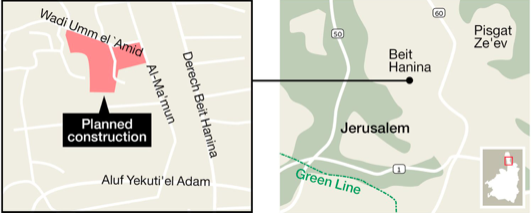
May by Haaretz
The Beit Hanina settlement plan – as FMEP has previously reported – is backed and promoted by settlement impresario Aryeh King, and it provides for the construction of a total of 150 new units in the southern end of the Beit Hanina neighborhood. The land slated for the 150 units is privately owned, 53% of the land is owned by an Israeli who is supportive of the plan, and 47% by a Palestinian company who objects to the plan and has fought against it. Because the land has not been surveyed to demarcate the split ownership, Israeli planning authorities decided that the settlement plan is designated for the entire property, with construction rights split evenly between the parties, meaning the 75 units granted final approval on January 8th represent the Israeli-controlled half of the project.
Ir Amim notes the larger picture of Isreali settlement activity north of the Old City:
“In close proximity to Ramat Shlomo to the southwest and Pisgat Zeev to the northeast, construction of this new compound may signal the beginning of a move to create contiguity between the two settlements, while fracturing the contiguous space between Bet Hanina and Shuafat. As exemplified by the ring of state-sponsored settlement strongholds throughout the Old City Basin, the establishment of a settler enclave in the midst of Beit Hanina will not only impact the fabric of this community, but will further erode opening conditions for a political solution to the conflict based on two capitals in Jerusalem.”
Ir Amim explains essential context:
“the plan will enable an ideologically driven settler outpost in the heart of Beit Hanina, a neighborhood located on the northern perimeter of East Jerusalem that has remained relatively untouched by Israeli settlement within its limits. Since the land in question is not far from Ramat Shlomo to the south-west and Pisgat Zeev to the north-east of it, its construction may mark the beginning of a far sweeping move to create contiguity between the two settlements, while driving a wedge between Bet Hanina and Shuafat.”
Plans Advance in East Jerusalem, Part 2: Reports on Har Homa & Rumors on Givat Hamatos
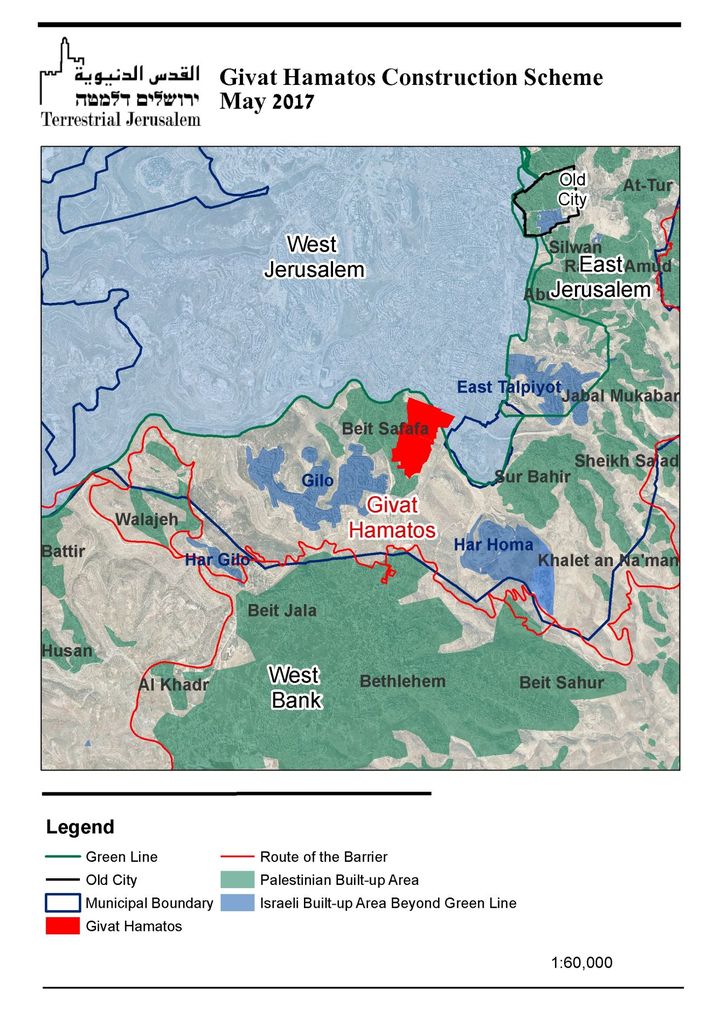 On January 7th, the popular Isareli broadcaster network Kan reported that the Prime Minister’s office has blocked a plan to build 2,000 new settlement units in the settlement of Har Homa, citing “diplomatic difficulties.” In response to an inquiry, the office did not deny the report, but issued the following statement:
“Israel has built in Jerusalem, is building in Jerusalem and will continue building in Jerusalem — while exercising judgment.”
Jerusalem expert Daniel Seidemann raised a key question and larger concerns about the reports concerning Har Homa, saying:
“The construction potential at Har Homa has been exhausted, and it’s not possible to build anything near 2,000 units. So what are they talking about? Something is clearly going on. Three possibilities come to mind, all problematic…Possibility no. 1: the nearby planned doomsday settlement of Givat Hamatos, which is awaiting tenders. Possibility no. 2: Hirbet Mazmoriyya, to the northeast of Har Homa. The lands owned by Palestinians that will have to be expropriated. Not likely. Too complicated and controversial. Possibility no. 3: the area wedged betw. Mar Elias Monastery, the Hebron Road, the 300 Checkpoint, dubbed Bethlehem Gate or Har Homa West. The land is ownership is a mixture of Palestinian &Church lands, along with settlement developers.”
Ir Amim notes that, while reportedly stalling the Har Homa plan, Netanyahu is – in fact – simultaneously facing mounting pressure to issue tenders for the construction of the Givat Hamatos settlement, the site for which is the northern border of Har Homa. Ir Amim writes:
“Last week, rightwing groups launched a coordinated campaign to exert pressure on Prime Minister Netanyahu to advance construction in the area of Givat Hamatos, which has been essentially frozen for the past six years. While the approval of the plan for 2,610 housing units in the area was formally published in 2014, there has been no announcement of tenders since then. This has been largely attributed to international opposition, namely from the United States and Germany. Likely attempting to ratchet up pressure on Netanyahu in lead-up to the upcoming elections in March, the campaign has been spearheaded on a public level by rightwing organizations. Several prominent rabbis known for supporting the settler movement penned a letter to the Prime Minister calling on him to announce the tenders for Givat Hamatos, while rightwing media outlets have published daily articles demanding an ‘end to the freeze.’ A rightwing institute likewise published a lengthy paper on the significance of establishing a new settlement in the area as a means of thwarting any potential future division of Jerusalem within the framework of a resumed peace process.”
Plan Advance in East Jerusalem, Part 3: Israel Approves Plans for Two More Settler-Run Tourist Sites in East Jerusalem
On December 25, 2019 the Jerusalem Local Planning approved two significant settler-backed schemes in East Jerusalem:
- The committee approved the Israeli government’s plan to seize land in the Palestinian East Jerusalem neighborhood of Sheikh Jarrah, in order to establish a park adjacent to the infamous Shepherd Hotel, an historic/iconic building that was taken over by the radical Ateret Chohanim settler organization in 2011. The new park – called “Hakidron Park” has been discussed and considered by Israeli governments for the past 15 years.
- The committee also approved the Israeli government’s plan to confiscate land in the Ras al-Amud neighborhood of East Jerusalem, for the purpose of opening a tourist and religious services center on the Mount of Olives, adjacent to the Jewish cemetery. The Jerusalem Municipality hired an architect, Arie Rahamivov, who is also employed by the radical Elad settler group for the planning and construction of their crown jewel: the Kedem Center in Silwan. The new center in Ras al Amud will be yet another tourist center under the management of Elad, which already operates another visitors center on the Mount of Olives.
Ir Amim writes:
“Approval of the aforementioned land expropriations would signal intent to begin construction at both sites and will help to further solidify the settlement ring around the Old City Basin. While both plans can be posited as innocuous municipal initiatives to serve local residents and visitors to the areas, such touristic projects play an integral role in expanding the scope of settlement strongholds in the area and creating a more contiguous Israeli space, while diffusing the political agenda behind these efforts.”
Plans Advance in East Jerusalem, Part 4: Tenders for Pisgat Zeev and Gilo
Ir Amim reports that the Israel Lands Authority published construction tenders for the following East Jerusalem settlements in early January:
- 3 tenders for a total of 461 new settlement units in the Pisgat Zeev
- 1 tender for commercial buildings in the Gilo settlement, located
For Second Time, Israeli Court Rules Against Settler Claim to Bakri House in Hebron
On December 23rd, the Jerusalem District Court ruled that the Palestinian Bakri family are the rightful owners of a disputed property in Hebron. This ruling should deal a final blow to the 18-year long legal battle settlers have waged to gain control of the Bakri family house (“should”, not “will”, because the settlers have repeated been dealt defeats in court and each time are able to manufacture a new claim or appeal) .
The ruling – which affirmed a March 2019 ruling by the Magistrate court, which the settlers had appealed – called for the immediate evacuation of the settlers whom Israel has permitted to illegally squat in the house while the legal processes were ongoing. For a full history of the Bakri house saga, see here.
Following the ruling, Peace Now said:
“[the] court again ruled that the settlers had forged [documents] and lied all along… We hope that after [almost] two decades of violence, lies and terror, justice will be carried out and the invaders will be evicted.”
Peace Now Wins Interim Decision Against Secretive Public Funding to Amana
In response to a Peace Now petition, on December 31st the Israeli High Court issued an interim decision that requires state bodies to request approval from the court before transferring funds to Amana, a settlement body which is known to undertake illegal settlement activities across the West Bank. Peace Now filed the petition after discovering that state bodies have been secretly funneling money to Amana.
Peace Now said in a statement:
“Amana is the most significant organization operating in the settlements. For decades, it has overseen the establishment of dozens of illegal outposts and neighborhoods with the help of massive budgets, some of which have been transferred from Israeli taxpayer money through local settlement authorities in violation of the law. The judges’ decision is a dramatic yet necessary step that limits, for the time being, this illicit transfer of funds to illegal projects in the settlements and outposts. We hope that in this spirit, the court will rule that public funds should no longer be transferred to Amana via subsidy procedures. This situation in which the State of Israel backs illegal activities with public funds is unconscionable, and we urge the Israeli government to put an end to it.”
Israeli Court Dismisses Palestinian Landowners’ Petition Against the Ofra Settlement
On January 6th, the Israeli High Court of Justice dismissed a petition filed by Palestinian landowners challenging the legality of the Ofra settlement. The petition was based on the fact that the settlement is partially built on privately owned Palestinian land. The court ruled that the majority of the settlement had been built on land expropriated by Israel, and that the minority of land that Palestinians claim ownership over was not enough to invalidate the entire Master Plan for the settlement. Further, the court stated that the settlement structures built on the privately owned Palestinian land were built by settlers “in good faith,” under the mistaken belief that land had also been expropriated by the Israeli government.
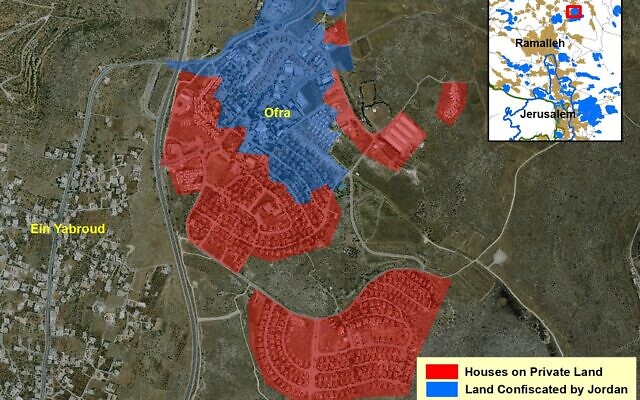
Map by Peace Now
This High Court ruling does not fix the legal status of Ofra settlement buildings, but it is nonetheless significant because it continues to deny Palestinians their property rights. Likewise, it gives a green light to the use of the “market regulation” principle to expropriate land in order to retroactively legalize the structures. As a reminder, the “market regulation” principle – which was invented by the Israeli Attorney General – holds that if settlers acted “in good faith” when they built on privately owned Palestinian land, the state can expropriate that land, thereby making what was illegal before, now perfectly legal.
The Ofra settlement’s legal situation has long been an issue that the Israeli government has tried to fix. Ofra was first established by settlers on land that the Jordanian government had expropriated in 1966, in order to build a military base (which was never built). The Israeli government used this pretext to expropriate the land in 1977, in order to recognize the Ofra settlement, which had been established illegally but with tacit cooperation of the government on the site two years earlier. However, the settlers built the majority of the Ofra settlement on land that was not expropriated by Israel in 1977 — land that was in fact registered to Palestinians from the nearby village of Ein Yabroud. In light of the legal status of the land, no Israeli government has since found a way to fix the legal status of these homes (not for lack of trying) – meaning that the majority of the structures in Ofra were built without permits, making them illegal under Israeli law.
Peace Now elaborates on what is at stake in the Ofra settlement case:
“Most of the houses built in Ofra (approximately 413 out of 625) were built on an area of 550 dunams of privately owned Palestinian land. In addition, hundreds of dunams of Palestinian private land were seized for roads in Ofra, as well as infrastructure and agricultural lands for the settlers. The only way to regulate the theft of these lands would be to expropriate them from the Palestinian landowners for the benefit of the settlers, in complete contradiction to the positions of previous Israeli governments and legal advisors, and contrary to binding rulings of the High Court. Although the current legal advisor (Avichai Mandelblit) allowed land expropriation in some places for settlement purposes (for example, in Haresha), in the regulation of massive land theft such as in Ofra the Israeli government would be crossing a new red line.”
FMEP documents the government’s efforts to expropriate Palestinian land for the settlements in its Annexation Policy Tables.
Bennett Launches Initiative to More Aggressively Demolish Palestinian Construction in Area C
Making the most of his appointment as Israeli Defense Minister in the current caretaker government, Naftali Bennett is pushing an initiative to annex Area C and to aggressively demolish Palestinian construction in the area (reminder: Area C constitutes nearly 60% of the West Bank; it is land that under Oslo II was supposed to have been “gradually transferred to Palestinian jurisdiction”).
As part of his efforts, Bennett has launched legal research into how Israeli can bring settlement building in Area C under the direct authority of the Justice Ministry, cutting out the Civil Administration. This Civil Administration, it should be recalled, is the arm of the Israeli Defense Ministry which acts as the sovereign power over the West Bank, in a system of governance Israel created based on its recognition of the different legal status of the area. Bennett has called for that system to be disbanded (in addition to annexing Area C). To be clear: transferring the construction and planning processes in Area C to domestic Israeli jurisdiction would by any definition constitute the Israeli state extending its sovereignty over area — an act of annexation.
Bennett has requested that Defense Ministry officials present several legal options for how Israel can bring planning processes under the Justice Ministry (integrating the settlements into the normal planning process). The settler-run Arutz Sheva outlet attributes the following quote Bennett in a private meeting:
“We are in essence discussing applying procedural sovereignty only. Full sovereignty is under the authority of the political echelon, but this is a step in the right direction. There is no reason that residents of Judea and Samaria should continue being discriminated against. We must stop this. Residents of Beit El and Ariel are no less Zionist than residents of Kfar Saba and Tel Aviv. They pay taxes and serve in the army, and they need to receive the same services from the government.”
Bennett is also advancing several initiatives that will empower and compel the Civil Administration to more aggressively enforce demolition orders against Palestinian construction in Area C (based on Israel’s policy of not granting permits to Palestinians in Area C, nearly every Palestinian structure in this territory has a demolition order pending against it). Bennett is also eyeing ways to combat what he considers illegitimate and nefarious funding from the European Union to Palestinian communities living in Area C. Israel Hayom reports:
“Bennett’s plan to stop the Palestinians from chipping away at Area C demands action in four areas: Operational, economic, legal, and PR. He wants to change enforcement priorities to put an emphasis on eradicating illegal buildings in strategic locations rather than by numbers. For example, home demolitions would be carried out in accordance with Israeli interests, prioritizing illegal buildings next to roads or settlements. Bennett also instructed the Central Command and the Civil Administration to work more closely to implement his plan and asked that the Civil Administration report to him monthly to update him on progress. Meanwhile, the defense minister is weighing the possibility of allocating more resources to the Civil Administration for enforcement, which would entail hiring more personnel. Bennett also wants to take steps to stop the flow of European money that funds the illegal Palestinian construction in the first place, allowing the “Fayyad Plan” to flourish.”
Bennett Appoints Key Settler Ally to Lead New Government Task Force on Area C Annexation Plans, Immediately Announces Plan to Legalize Settlements
In addition to his new initiative targeting Palestinian construction in Area C, Israeli Defense Minister Naftali Bennett announced that he has created an inter-ministerial taskforce to develop settlement and annexation plans for the future of Area C in the West Bank.
Bennett’s chief of staff, Itay Hershkowitz, has been in weeks-long consultations with key settler leaders to decide what items to act on immediately. Haaretz reports their agenda includes:
- Allowing Jews to privately purchase land in the West Bank. [See here for a detailed explanation of this complicated matter]
- Connecting unauthorized outposts to water and electricity.
- Granting official recognition to unauthorized outposts that are located near established settlements by recognizing them as “neighborhoods” of the settlement.
- Repealing a military order that empowers the Civil Administration to evict settlers from privately owned Palestinian land with or without a Palestinian-initiated petition to have the settlers removed.
- Legalizing 30 sheep farms in the West Bank that are under pending demolition orders.
On Thursday, Bennett announced that he has appointed West Bank settler Koby Eliraz to lead the new taskforce. Calling Eliraz a “bulldozer,”Bennett said:
“The territorial future of the Land of Israel is at stake. The State of Israel has simply not been up to the task of stopping [Palestinian construction]. We are changing direction and embarking on a battle that Israel must win… The defense establishment will fight for this territory, and it is essential for someone to lead this campaign.”
Eliraz previously served as Netanyahu’s settlement advisor, but was fired by the Prime Minister in June 2019 reportedly because he was believed to be allied too closely to Netanyahu rival Avigdor Liberman, who Netanyahu also dismissed. At the time of Eliraz’s firing, settler leaders were outraged and published a letter asking Netanyahu to reverse Eliraz’s firing, suggesting that Eliraz’s absence will hinder government efforts to retroactively legalize outposts. The letter noted:
“Kobi has taken care of Israeli settlement and its residents with great professionalism. He is credited for many advancements [on our behalf] in the fields of construction, infrastructure development, security and more.”
The Times of Israel observed, significantly, that the Yesha Council was able to get every single settlement Mayor to sign the letter in support of Eliraz, explaining:
“The Yesha Council in recent years has struggled to get all of its members on board with its initiative, but the umbrella group’s ability to gather the signatures of every Israeli mayor beyond the Green Line is testament to the broad respect that Eliraz holds among settler leader.”
Following ICC Announcement, Pompeo Says Israel Has “Fundamental Rights” to Land
At a press briefing on December 22nd, U.S. Secretary of State Mike Pompeo did not specifically address the ICC announcement, but made lengthy comments regarding statements from European countries and the European Union that were critical of the new U.S. position on settlements (that they are not “per se illegal” under international law). Pompeo’s comments hold relevance to the U.S. position on the ICC case and more generally on the U.S. approach to the Israeli-Palestinian conflict:
“First, the legal analysis that the EU performed [on settlements] we just think is wrong. We think they have an improper analysis of the international law surrounding this. So as the technical legal matter, [EU Foreign Minister] Ms. Mogherini just – she’s just wrong. And so we are doing our level best to demonstrate to them our legal theory, our understandings, and why it is that we’re convinced that under international law these settlements are not per se illegal. So we’re working that element of it as well. But at another level, and perhaps at the level that will lead to the right outcome, which is why we did this, this has to be resolved through political means, and we hope that all nations, including member nations inside of the EU and the EU itself and countries all over the world, will come to recognize the fundamental rights that the Israeli people have to this land, to this space. There are real security needs. The risk that is presented from the world as anti-Semitism is on the rise, we hope that every nation will recognize that and weigh in on this conflict in a way that is constructive, that will ultimately lead to the peace that is so desperately needed.” [Emphasis added by editor]
Pro-Settlement Legal Forum Conference Draws Big Names, Big Promises
The Kohelet Policy Forum, a right-wing advocacy organization that has enormous influence with senior Israeli – and increasingly American – government figures, hosted a “Conference on the Pompeo Doctrine” in Jerusalem, Jan. 7-8, 2020. The conference served as a gleeful celebration and forward-looking projection of what the new U.S. settlement policy towards settlements means for Israel. The conference drew participation from all the leading Israeli politicians and several senior members of the Trump Administration, including Secretary of State. Pompeo. Key quotes from the conference speakers are copied below.
U.S. Secretary of State Mike Pompeo:
“We’re recognizing that these settlements don’t inherently violate international law. That is important. We’re disavowing the deeply flawed 1978 Hansell memo, and we’re returning to a balanced and sober Reagan-era approach. “In doing so, we’re advancing the cause of peace between Israelis and Palestinians.”
U.S. Ambassador David Friedman:
“…when we came into office the lingering issues included three of significant importance: the status of 1) Jerusalem, 2) the Golan Heights and 3) Judea and Samaria. We have approached them in ascending order of complexity…I thank God that President Trump had the courage and the wisdom to recognize Jerusalem as the capital of Israel and move our embassy to Jerusalem from Tel Aviv…In recognizing Israel’s sovereignty over the Golan Heights, President Trump, evaluating the continuous malign and barbarous threats posed by Syria, concluded that no northern boundary for Israel would be secure except a boundary that incorporated the Golan. He acted well within the language of 242. [Judea and Samaria] is certainly the most complicated of the issues because of the large indigenous Palestinian population. Over the years before we came into office, it’s only gotten more complicated and more challenging. The proverbial goalposts have moved and moved – to the point today where they are no longer even on the field….The Pompeo Doctrine does not resolve the conflict over Judea and Samaria. But it does move the goalposts back onto the field. It does not obfuscate the very real issue that 2 million or more Palestinians reside in Judea and Samaria, and we all wish that they live in dignity, in peace, and with independence, pride and opportunity. We are committed to find a way to make that happen. The Pompeo Doctrine says clearly that Israelis have a right to live in Judea and Samaria. But it doesn’t say that Palestinians don’t….it calls for a practical negotiated resolution of the conflict that improves lives on both sides.”
Israeli Prime Minister Netanyahu said:
“I will not let any settlements be uprooted in any diplomatic plan. This idea of ethnic cleansing… it won’t happen. There is a window of opportunity. It opened, but it could close…There was no West Bank separate from the rest of the land. It was seen as the heart of the land. We never lost our right to live in Judea and Samaria. The only thing we lost temporarily was the ability to exercise the right. When Israel returned to the West Bank We didn’t return to a foreign land. That is a distortion of history. Jews lived in Jerusalem and Hebron for thousands of years consecutively…The Pompeo declaration about the status of the towns [in Judea and Samaria] establishes the truth that we are not strangers in our land. In a clearly defensive war, we returned… to the land where our forefathers put down roots thousands of years ago…Unlike some in Europe who think the Pompeo declaration distances peace, I think it will promote peace, because peace must be based on truth, not lies. Settlements are not the root of the conflict. We are standing with justice and the truth. It is a great struggle.”
Israeli Defense Minister Naftali Bennett on Area C annexation and his initiatives in that regard:
“Our aim is that within a decade a million Israeli citizens will live in Judea and Samaria” and later “Our objective is that within a short amount of time, and we will work for it, we will apply [Israeli] sovereignty to all of Area C, not just the settlements, not just this bloc or another. We are embarking on a real and immediate battle for the future of the Land of Israel and the future of Area C. It started a month ago and I am announcing it here today. A month ago, I convened a meeting and I explained the clear directive, the State of Israel will do everything to ensure that these territories [Area C] will be part of the State of Israel.”
Likud MK and former Mayor of Jerusalem Nir Barkat said:
“I am confident that Secretary Pompeo’s statement is an integral part of the American plan and is closely linked to Jared Kushner’s proposal advanced in Bahrain promoting significant economic investment in the Palestinian economy…Now is a perfect opportunity to similarly grow the communities throughout Judea and Samaria at a pace like never before. This declaration is a recognition of the legal and historic right of the Jewish people to live wherever we wish. This is how it should be in other parts of the world and certainly here in the Jewish State. This declaration is therefore an exceptional opportunity for Israel to ensure our continued growth and expansion throughout these areas. Israel needs to set a goal for the settlement of two million people in Judea and Samaria within fifty years. This is a commitment which requires that we already now lay the framework to make that possible and this is an investment which will also benefit the Palestinian people” [Editor’s note: Barkat has been working with Harvard Professor Michael Porter to promote an economic peace scheme, most recently speaking at Harvard about the plan in December 2019]
Eugene Kontorovich, Director of International Law at the Jerusalem-based Kohelet Policy Forum and a key shaper of anti-BDS/pro-settlement legislation in U.S. Congress and across state governments, said:
“American Policy is now clearer than ever, Jews living in Judea and Samaria is not a crime. For decades, the obscure Carter-era memo was used as justification for anti-Israel policies despite the fact that its conclusions were rejected by subsequent administrations. Sec. Pompeo’s statement at the Kohelet conference today makes clear the U.S.’s wholesale rejection of the legal theory that holds that international law restricts Israeli Jews from moving into areas from which Jordan had ethnically cleansed them in 1949.”
Bonus Reads
- “The Atarot Exception? Business and Human Rights Under Colonization” (Marya Farah in Jerusalem Quarterly)
- “The Decade Israel Erased the Green Line” (+972 Magazine)
- “Settlers are seizing ‘empty’ land. The Palestinian owners are fighting back” (+972)
- “Israeli Right Wants to End Peace with Jordan” (Haaretz)
- “Security official says police, courts scuttling efforts to curb settler violence” (The Times of Israel)