Welcome to FMEP’s Weekly Settlement & Annexation Report. To subscribe to this report, please click here.
August 21, 2026
- WEST BANK: E-1 Tender Published; Kadim Settlement Reestablished; Groups File Petition to Stop West Bank Land Registration; Ben Gvir Wants WB Powers
- STATE-BACKED SETTLER TERRORISM: Qusra, Al-Mughayyir, Sa’ir
- BONUS READS
WEST BANK
Israel Publishes Construction Tender for Dooms-Day E-1 Settlement
On August 18th, the Israeli Lands Authority published one tender for the construction of 1,234 settlement units in the E-1 settlement, planned to be built on a stretch of land east of Jerusalem that would split the West Bank in half and entirely surround East Jerusalem with Israeli settlement areas. Now, construction companies will bid on the construction project, with the bidding set to end on October 19th – just 8 days before the scheduled Israeli elections.
A petition against the E-1 settlement plan remains pending at the Jerusalem District Court, a petition which was filed on behalf of the bedouin communities living on the lands where E-1 is planned and which stand to be forcibly displaced to make way for the new settlement. Ir Imim explains that as part of the ongoing proceedings the State is required to provide notices to the petitioners ahead of the publication of tenders on the project, but the State provided no such notice ahead of the publication of one tender on August 18th. Ir Amim speculates that
“The 1,234 units represent nearly half of the 3,401 units approved for the E1 project. Rather than opening the existing tender (No. 460/2025) which covers the entire approved number of housing units, the State has just issued a new and separate tender for only part of the overall total and opened it immediately for bidding. This move appears to have been intentionally designed to mislead the public and circumvent the State’s commitment to provide advance notice made in ongoing court proceedings.
It it should be underscored that even this partial implementation would create irreversible facts on the ground, fundamentally altering the geographic and strategic character of the area — severing the northern West Bank from the south and isolating East Jerusalem.”
The bedouin petitioners, which are represented and joined by several Israeli groups including Peace Now, Ir Amim, and Bimkom, have filed a request that the Jerusalem District Court issue an interim injunction to freeze the tender and to prevent the government from issuing any additional tenders until the petition has been settled by the Court.An array of Western governments have also stepped up their efforts to pressure Israel to stop the construction. Most notably, the European Union is reported to have prepared a slate of sanctions against Israeli commerce, academics and security companies and will start demanding products from Israel be labelled as “Made in Israel” in addition to its existing requirements that settlement producers be labelled clearly “Product from the West Bank (Israeli settlement).”
Peace Now explains the significance of the E-1 plan:
“When announcing the E1 plan in August 2025, Bezalel Smotrich was explicit: ‘This reality definitively buries the idea of a Palestinian state.’
E1 sits at one of the most strategically consequential points in the West Bank, between East Jerusalem and Ma’ale Adumim.
Building there would connect Ma’ale Adumim more closely to Jerusalem, cut East Jerusalem off from the rest of the West Bank, and fracture Palestinian territorial continuity between north and south.
That is why E1 has been treated for decades as a red line. Once built, it would reshape the West Bank’s geography in a way that could make a viable two-state agreement much harder to achieve.”
Ministers Celebrate Re-Establishment of Kadim Settlement, Completing Erasure of 2005 Disengagement from Northern West Bank
Settler leaders continued the string of celebrations at new settlements in the northern West Bank, this time at the settlement of Kadim – one of the four settlements dismantled by the Israeli government in 2005 but now, after years of settler advocacy and legal backbending, are being re-established. Kadim is the last of the four settlements to be reestablished, and Ynet reports thirty families moved into the Kadim settlement this week. Kadim is located east of Jenin, and is amongst the 19 new settlements between Jenin and Nablus, which are designed to affect the total fragmentation of the northern West Bank.
Speaking at a ceremony attended by Finance Minister Bezalel Smotrich, Justice Minister Yariv Levin, Knesset Speaker Amir Ohana a, settler leader Yossi Dagan said:
“The spirit of settlement and the people of Israel are stronger than any withdrawal/ We are not only bringing life back to Kadim, but rewriting the future of northern Samaria through construction, expansion and a firm hold on our land. This is a determined Zionist response that makes clear: We have returned home, and this time to stay and grow twentyfold. We are raising the flag again, closing the circle and continuing to build Samaria with full force.”
Groups File Petition to Stop West Bank Land Registration
Yesh Din reports that it joined Bimkom and ACRI to file a petition against the Israeli government’s plan to conduct land registration – via a process called Settlement of Land Title (SOLT) – in the West Bank and East Jerusalem. Specifically the petition, filed in June 2026, challenges the government’s move to outsource the registration process to a private company by opening a tender for the job. The petition came weeks after the government announced that it launched an electronic registration system for the “Land Registry and Settlement of Rights” for Area C of the West Bank. The online system is an instrument for the implementation of a February 2026 decision by the Israeli Security Cabinet to publish the West Bank land registry and to revive a “State Land Acquisition Committee.” These moves are best understood as a way to annex the West Bank, to help facilitate settler claims over disputed and/or unregistered land, and to spur the proactive government purchases of West Bank land for the purpose of settlement expansion.
Yesh Din explains:
“The petition challenges the tender arguing that the Ministry of Justice lacks any legal authority to conduct land registration in the West Bank, much less authority to delegate this power to other parties, where such powers remain under the military commander as per prescribed International Humanitarian Law (IHL). Moreover, land registration proceedings in the West Bank have been suspended since 1968 and the tender seeks to implement a future government policy before the necessary legal changes have been enacted.
The petition further argues that the tender is unlawful on several grounds. First, it constitutes the privatization of core governmental powers by transferring public functions to a private entity. Second, it discriminates against Palestinians residing in the West Bank by unlawfully excluding them from participating as it is conducted under Israeli domestic procurement law rather than the military legal framework under IHL. The petition contends that comprehensive land registration may only take place with permanent sovereign authority and risks facilitating the appropriation of Palestinian land.
Alongside these principal claims, the petition requested an interim injunction to freeze the tender process before contracts are awarded and irreversible facts are created on the ground. Although the District Court acknowledged that the petition raises distinct legal questions, it postponed ruling on the injunction pending developments in those separate proceedings. Unfortunately, the HCJ has also decided not to issue an injunction at this time, thus, allowing the tender process to continue and create irreversible administrative and legal realities before the courts have had an opportunity to determine its legality.”
Following Katz’s Call for Civilian Policing in West Bank, Ben-Gvir Wants Even More Power
Following his call last week to transfer all civilian law enforcement powers with regard to Israeli settlers from the domain of the Civil Administration to the Israeli police, Israel’s Minister of National Security Itamar Ben Gvir (who is the head of the Israeli police) has upped the stakes – and called assume total responsibility for the West Bank, specifically asking for authority to hold enemies of the state in detention without trial (administrative detention).
STATE-BACKED SETTLER TERRORISM
Major Settler Attacks this Week: Qusra, Al-Mughayyir, Sa’ir
Settlers continued to terrorize the West Bank, including major attacks on the following towns:
- Qusra: Settlers continued their no 13-day siege on several Palestinian homes in the village of Qusra.The situation of the Palestinian families trapped in their homes with little to no ability to receive visitors and supplies continues to deteriorate.
- Al-Mughayyir: Settlers attacked the village of Al-Mughayyir near Ramallah, leaving six Palestinians injured. According to reports, dozens of settlers attacked Palestinians working their land by firing tear gas at them. Al-Mughayyir has been near constantly terrorized by settlers, leading +972 Magazine to call the village “a laboratory of Israeli ethnic cleansing.”
- Sa’ir: Settlers opened fire on Palestinians, killing one Palestinian teenager and wounding another man. The settlers were reportedly on a “hike” in the area (which is in Area B) and Palestinians gathered to throw stones at the settlers to get them to leave. Settlers also allegedly set fire to one building in Sa’ir. Some reports suggest that Israeli security officials might have fired the deadly shot.
- Taybeh: Settlers and uniformed Israeli soldiers have continued to regularly terrorize the village of Taybeh, where the Israeli army has issued a closed military order on the whole village. In practice, this order has allowed the IDF to prevent activists and humanitarians from entering the village while still allowing settlers to carry out their violence.
BONUS READS
- “Israel-Backed Settler Violence Drives Displacement: Record Year for Settler Attacks on Palestinians” (Human Rights Watch, 8/21/2026)
- “Israel’s roadblocks are choking emergency care in the West Bank” (972 Magazine, 8/13/2026)
- “‘Destroying agriculture is the purpose’: How Israel is drying up the West Bank’s most fertile farmlands” (Mondoweiss, 8/18/2026)
- “There Is No Israeli Settlement Without Violence – Even the ‘Mainstream’ Ones” (Haaretz, 8/17/2026)
- “Violent Israeli settlers want to provoke a Palestinian uprising” (The Economist, 8/17/2026)
- “Besieged by Israeli settlers and cut off from the outside world, Palestinian families on a West Bank hilltop refuse to leave” (Mondoweiss, 8/21/2026)
Welcome to FMEP’s Weekly Settlement Report, covering everything you need to know about Israeli settlement activity this week.
To subscribe to this report, please click here.
May 31, 2024
- Gallant Further Rolls Back 2005 Disengagement Law to Allow Reestablish of Three More Settlements in Northern West Bank
- Israel Court Finalizes the Dispossession of Shehadeh Family in Silwan
- Activists Petition for Demolition of Violent Jordan Valley Outpost Under Int’l Sanctions
- Two New Outposts Reported
- Extensive Updates on the Continued Politicization of Archaeology in Service of Settlements
- 21 New Roadblocks & 8 Newly Closed Gates Propel Settler Takeover in Bethlehem Area
- Bonus Reads
Gallant Further Rolls Back 2005 Disengagement Law to Allow Reestablish of Three More Settlements in Northern West Bank
On May 22nd, Israeli Defence Minister Yoav Gallant announced that he had ordered the IDF to lift the military order barring Israeli citizens from entering the areas where the Sa-Nur, Ganim, and Kadim settlements once stood in the northern West Bank. Gallant said:
“The Jewish hold on Judea and Samaria guarantees security, the application of the law to cancel disengagement will lead to the development of settlement and provide security to residents of the area,”
 The Times of Israel reports that the head of the IDF Central Command, Maj. Gen. Yehuda Fox, signed lifted the military order as Gallant had ordered, but Fox also signed a new order making the three settlement sites closed military zones. Intimating the eventuality of the settlers’ return to the areas, a source in the Israeli military was quoted by Army Radio explaining that the IDF will need to plan and move additional forces to the area in order to provide security for the settlers. Peace Now further reports that over the past year, settlers have visited and held events in the evacuated settlement areas with coordination and security from the IDF.
As a reminder, the Israeli Knesset passed legislation repealing the 2005 Disengagement Law in order to clear the way for settlers to reestablish four settlements in the northern West Bank – Homesh, Sa-Nur, Kadim, and Ganim. The IDF then issued a military closure order against three of the settlements, allowing settlers to enter the Homesh area (where settlers had illegally built and continue to run a yeshiva).
Peace Now said in a statement:
“Instead of safeguarding Israel’s security and political interests, Gallant is catering to the extreme settler factions. The last thing Israel needs is more isolated and unnecessary settlements that will be a security burden and move us further away from a necessary and urgent political solution. Our political leadership must change direction, work to end the war and pursue a comprehensive regional agreement based on two states. Only this way will we bring security, return the hostages, and prevent international isolation. This is the real victory.”
Israel Court Finalizes the Dispossession of Shehadeh Family in Silwan
On May 26th, the Israeli Supreme Court rejected a last ditch appeal by the Shehadeh family against their eviction from their home in Silwan at the behest of the Ateret Cohanim settler organization. In dismissing the procedural appeal (which alleged that the presiding judge mishandled the case, seeking a retrial), the Court once again affirmed its April 2024 ruling that ordered the 15-member family to leave their home by June 1, 2024 – or face eviction by Israeli authorities.
The Shehadeh family has spent years fighting against their eviction from their home of 60 years in the Batan Al-Hawa section of Silwan at the behest of the Ateret Cohanim settler organization. The settler group’s claim to the home is based on having gained control of the historic Benvenisti Trust, which oversaw the assets of Yemenite Jews who lived in Silwan in the 19th century. In 2001 the Israeli Charitable Trust Registrar granted Ateret Cohanim permission to revive the trust and become its trustees, (following 63 years of dormancy). In 2002, the Israeli Custodian General transferred ownership of the land in Batan al-Hawa to the Trust (i.e., to Ateret Cohanim). Since then, Ateret Cohanim has accelerated its multi-pronged campaign to remove Palestinians from their homes, claiming that the Palestinians are illegal squatters. To date, 14 Palestinian families have been evicted under legal campaigns waged by Ateret Cohanim, with many more under threat.
Underscoring how the Israeli legal system is fundamentally unequal, Ir Amim writes:
“The Shehadeh family is among some 85 Palestinian families, numbering over 700 individuals, who face largescale displacement from Batan al-Hawa as a result of eviction demands filed by the Ateret Cohanim settler group, via the Benvenisti Trust…The eviction lawsuits are filed on the basis of the 1970 Legal and Administrative Matters law. Article 5 of this law exclusively affords Jews with land restitution rights for assets they allegedly owned in East Jerusalem before 1948 despite many of these properties now inhabited by Palestinians. This provision was established despite the fact that some Jews who lost properties in East Jerusalem in 1948 reportedly received compensation at the time by the state in the form of alterative property in West Jerusalem (formerly belonging to Palestinian refugees). No parallel legal mechanism exists for Palestinians to recover pre-1948 assets on the Israeli side of the Green Line, many of which are now inhabited by Jews. To the contrary, the 1950 Absentee Property Law enshrines that Palestinians who were forced to abandon their homes and lands in what became Israel after the war of 1948 can never retrieve them.”
The Supreme Court ruling ignores ongoing litigation initiated in 2020 by Ir Amim that challenges the legitimacy and legality of Ateret Cohanim’s control of the Benvenisti Trust. In response to the filing, the Israeli Registrar of Trusts (department within the Justice Ministry) announced that it will open an investigation into the allegations. Ir Amim is still awaiting news on the investigation.
Activists Petition for Demolition of Violent Jordan Valley Outpost Under Int’l Sanctions
Peace Now and activists in the Jordan Valley filed a petition with the Israeli High Court of Justice seeking the enforcement of existing demolition orders against the illegal outpost called “Moshe’s Farm.” The outpost is is illegal under Israeli law and has recently been subjected to international sanctions by states targeting settlers and associated organizations that perpetrate violence in the West Bank. The founder of the outpost, Moshe Sharvit, was also sanctioned.
The Israeli Civil Administration issued demolition orders against Moshe’s Farm in 2021 because it has been build without Israeli building permits. The demolition orders have never been enforced, allowing the outpost to take over more land, terrorize surrounding Palestinian communities, and expand the number of buildings and amenities – including a water and electricity supply for air conditioning, a pool, and enough infrastructure to support up to 100 people. The outpost also herds livestock in the area – which has proven to be and effective means for settlers to coerce the displacement of Palestinians and assert control a maximal amount of land with a minimal number of Israeli settlers.
Highlighting the impact the outpost has had on the area, Peace Now writes:
“Since the farm was established, the lives of the surrounding Palestinian shepherd communities have become unbearable, to the point that some have been forced to flee their homes. Moshe Sharvit and other young people from the farm go out daily to drive away Palestinian herds and prevent them from reaching grazing areas. The Jordan Valley Activists group, a group of Israeli volunteers who invest their time and energy in trying to assist and protect the Palestinian shepherd communities in the Jordan Valley, began accompanying the shepherd communities near Sharvit’s farm immediately after the farm was established. They go to the grazing areas with the Palestinian shepherds, document the harassment and attacks, try to prevent harm to the Palestinians and reach out to the police. The Jordan Valley activists have accumulated testimonies and videos of dozens, if not hundreds, of incidents of harassment and violence by the farm residents, for which dozens of complaints have been filed with the police.”
Two New Outposts Reported
Peace Now reports that settlers have illegally constructed a new outpost in the South Hebron Hills, near the Otniel settlement. From pictures, it looks like settlers have driven in at least six mobile homes onto a cleared plot of land. This outpost is the 200th illegal outpost that Peace Now has documented.
In addition, Wafa News also reported a new outpost north of Jericho in the Jordan Valley. According a local activist Ayman Gharib, “Around 15 illegal settlers brought building equipment and set up a new settlement outpost about 300 meters from Al-Auja water canal.” Gharib further reports that this is the second new outpost in the area in the same number of weeks and that the canal is a significant source of water for communities north of Jericho.
Extensive Updates on the Continued Politicization of Archaeology in Service of Settlements
Emek Shaveh provides extensive updates showing how antiquity continues to be weaponized by Isareli settlers in full cooperation with the government, including the following news:
- New Chief Executive Officer in the Ministry of Heritage. On Sunday May 5th the Israeli government approved the appointment of a new CEO for the Ministry of Heritage, Itay Granik, who is a right-wing political activist.
- Head of IAA is strengthening relationships with ultra nationalists. The Director General of the Israel Antiquities Authority (IAA) Eli Escusido gave a lecture at Ben Gvir’s Jewish Power party faction meeting in the Knesset. Emek Shaveh writes: “The fact that the IAA is deepening its partnership with political actors and ideological-messianic organizations represents a further shift away from the authority’s obligation to professionalism and public service. The choice to harness archaeology to the agenda of the extreme Right in Israel and their evangelical counterparts is a highly worrying departure from its professional and ethical foundations. Pursuing this path will no doubt result in the growing isolation of the entire Israeli archaeological community.”
- Tender for Jerusalem Cable Car possibly coming up. Emek Shaveh says, “The progress made by the JDA in recruiting multiple consultants lead us to believe that a tender for construction of the cable car will likely be published in the near future.”
- Hapoalim Bank Subsidizes Visits to Settler Sites in the West Bank: Bank Hapoalim and the Jewish National Fund (JNF) sponsored, advertised and subsidized tours/events for Israelis in settlement sites in the Greater Jerusalem area, including at a site operated by the Elad settler organization in the Hinnom Valley, in Nabi Samuel, and in collaboration with a settler organization called “Eshkolot“, which runs tourist centers for Israelis in the West Bank.
21 New Roadblocks & 8 Newly Closed Gates Propel Settler Takeover in Bethlehem Area
In a new report entitled, “An Israeli roadblock: How Israel Took Control Over the West Bethlehem area,” Kerem Navot takes a detailed look at how – in the wake of October 7, 2023 – Israeli settlers and the IDF have significantly entrenched and expanded their control over the areas to the south and east of Bethlehem through the restriction of freedom of movement and denial of access to agricultural land. Kerem Navot emphasizes that “the reality described [in this report] is the outcome of decades of planning and efforts aimed at taking control of lands and displacing their owners. These efforts have been greatly intensified since October 7.”
The report’s main findings are that, since October 7th:
- 21 roadblocks and barriers have been added on agricultural roads. Today, there are a total of 60 roadblocks and barriers. This means that over a third of the roadblocks and barriers in the area were installed in the seven months following the onset of the war. The new roadblocks and barriers in this area serve two interconnected purposes: 1) Preventing Palestinians from exiting their villages onto the bypass roads. 2) Blocking agricultural roads leading to agricultural lands, primarily situated west of Route 60.
- A roadblock on the Nahalin-Bethlehem road was relocated from its original location to a new location, in order to facilitate the settlers of Neve Daniel in taking control of an area west of the settlement.
- One metal gate was relocated and completely closed to the east of the illegal outpost of Sde Boaz, enabling the settlers to extend their control over additional areas surrounding the outpost.
- Three gates (two on the access roads to Husan village and one south of Nahalin village) that were open prior to the 7th of October have been completely closed ever since.
- Four gates that Palestinian farmers previously used to access their lands adjacent to the settlement of Efrat, have been completely sealed off to Palestinians. As a result, these lands remained uncultivated ever since.
The report was covered by Haaretz, in which Amira Hass wrote:
“The de facto expulsion of Palestinian farmers and shepherds is one of the means through which the army and the settlers have been preventing Palestinians across the West Bank from cultivating fields and vineyards, or from tending their flocks, more intensively so since October 7. Here, west of Bethlehem, in an area dotted with settlements and outposts in what is known as “Gush Etzion,” the expulsion of Palestinians from their lands is also achieved through an extensive network of locked iron gates, as well as 24 rock and earth barriers across agricultural roads. This is in addition to barriers across exits to main roads, meant to reduce the traffic of Palestinian vehicles….Theoretically, every roadblock requires some kind of land expropriation order. Etkes is unaware of any such order, and in truth, there are no supporting orders for the old roadblocks either. For a long time, it’s been hard to distinguish between local initiatives by settlers (military or civilian) to block access to Palestinians and temporary orders of the army. The boundaries are completely blurred”
Bonus Reads
- “PRESS RELEASE Booking.com sued for laundering profits from Israeli war crimes in Palestine” (Al-Haq, SOMO, ELSC, TRF)
- “Al-Aqsa ‘belongs only to Israel’, says Ben Gvir during ‘incendiary’ visit” (Middle East Eye)
- “Israel’s FM Cuts Ties Between Spanish Embassy and West Bank Palestinians After Recognition of Palestinian State” (Haaretz)
- “Opinion | The Polite Israeli Settlers, Courteously Dispossessing Palestinians” (Amira Hass, Haaretz)
- “Backing settlement, Ben Gvir says he’d be ‘very happy to live in Gaza’ after the war” (The Times of Israel)
Welcome to FMEP’s Weekly Settlement Report, covering everything you need to know about Israeli settlement activity this week.
To subscribe to this report, please click here.
May 17, 2019
- TV Report: U.S. Peace Plan Allows for Israeli Annexation of All Settlements
- Peace Now Special Report, Part 1: Key 2018 Settlement Data & Analysis
- Peace Now Special Report, Part 2: Settlement Growth During 10 Years of Netanyahu
- Following Trump Election, Netanyahu Unleashed 39% Increase in Settlement Funding
- 11 Knesset Members Join Campaign to Cancel 2005 Disengagement Law & Re-establish Evacuated West Bank Settlements
- Bibi Pushes High Court Override Legislation During Coalition Negotiations
- Trump Envoy Praises US-Backed Economic “Coexistence” Group for Joint Settler-Palestinian Hebron Iftar
- Bonus Reads
TV Report: U.S. Peace Plan Allows for Israeli Annexation of All Settlements
According to an Israel TV report, the Trump Administration’s peace plan allows for Israel’s annexation of all settlements in the West Bank. Israel TV also reports that, independent of the fate of the peace deal, the U.S. will not object to Israel’s unilateral annexation of those settlements through the extension of Israeli law over them. Though the Trump Administration position on settlements has been made explicitly clear for some time, the reporting, if accurate, confirms that the U.S. “peace plan” is no more than a plan for permanent Israel control in the West Bank.
As FMEP has explained, institutionalizing the application of Israeli law over the settlements – which ends the legal distinctions between Israel and the settlements, as upheld by current Israeli law – would be tantamount to de facto annexation. FMEP has also documented, in great detail, Israel’s progress towards incrementally annexing the settlements in this manner, as various initiatives move through the Knesset, the Executive/Ministerial body, and the Courts. That data can be found on the second table on this document.
Settlers immediately celebrated the Israel TV report. Har Hevron Regional Council Chairman Yohai Damari said:
“I call on the prime minister to immediately announce, following the establishment of a government, that he will extend Israeli law to all the Jewish settlements as a basis for any offer that may come. We have to take advantage of this window of opportunity during the Trump administration in the wake of the transfer of the embassy to Jerusalem and the recognition of the Golan Heights. Now it is time for sovereignty in Judea and Samaria.”
Damari’s plea to the Prime Minister to act quickly to annex the settlements only adds to the growing crescendo pushing for the immediate, unilateral annexation, which U.S. Ambassador Friedman publicly urged on during his recent speech at the AIPAC national policy conference.
Peace Now Special Report, Part 1: Key 2018 Settlement Data & Analysis
In a special version of its annual report on settlement growth – entitled “Special Annual Settlement Construction Report 2018: A Glance at 10 Years Under Netanyahu” – the settlement watchdog group Peace Now published important data and analysis of settlement activity in 2018 (not including East Jerusalem).
According to the report, during 2018:
Israel began construction on 2,100 new settlement units.
- This represents a 9% increase from the annual average of the past 10 years.
- Of that 2,100 units,
- At least 10% (218 new units) are in illegal outposts;
- Nearly 73% (1,539 new units) are in settlements outside of the proposed Geneva Initiative border;
- At least 10 are located on privately owned Palestinian land.
Construction began on 2 new settlements.
- The government officially planned and approved the establishment of the new Amichai settlement, the first new government-backed settlement in over 20 years. Amichai is located in the heart of the West Bank on a hilltop that settlers chose in the hopes it will prevent the possibility of the two-state solution.
- In addition, developers began construction on 108 new units in an area east of the Avnei Hafez settlement and then marketed the new units as a new settlement, which they call “Kedem”. Developers built this settlement based on a construction plan approved in 1998.
A total of 5,618 settlement units were advanced through plans in 79 settlements.
-
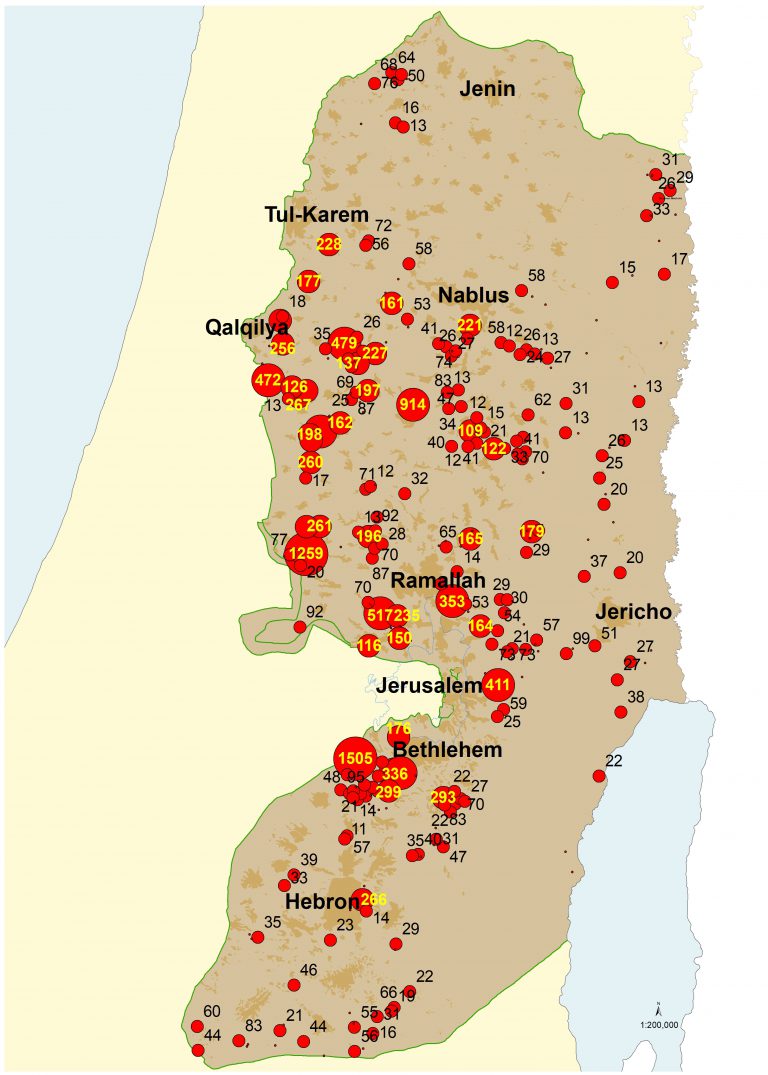
Map by Peace Now
Of that number, almost 83% (4,672 housing units) are planned in settlements east of the proposed Geneva Initiative border.
A total of 5,808 settlement construction tenders were published (but construction had not yet began)
- This was the highest annual total for settlement tenders in almost two decades.
- The Beitar Illit settlement saw the most construction starts in 2018, concentrated in a new neighborhood which significantly expands the footprint of the settlement.
Additional 2018 Key Data Points
- Israel continued to build up an Israeli settler presence on the land between the Elkana settlement and its surrounding settlements (Etz Efraim to its east and Shaarei Tikva to its west), effectively creating one large “super settlement” and building a contiguous settlement band towards the Ariel settlement in the heart of the West Bank.
- In addition to West Bank settlement tenders, tenders for 603 new settlement units in East Jerusalem were also published in 2018.
Peace Now Special Report, Part 2: Settlement Growth During 10 Years of Netanyahu

Peace Now writes:
“In the past decade, most of the construction was in isolated settlements that Israel will have to evacuate. The Peace Now count of housing construction starts reveals that 73 percent of the construction in 2018 (1,539 housing units) and 70 percent of construction during the decade of Netanyahu’s government (13,608 housing units) were implemented precisely in places that jeopardize a two-state agreement (east of the proposed border route of the Geneva Initiative). In this decade, close to 50,000 settlers have been added to these settlements, and the housing units built have the potential to add 60,000 settlers. This means that the Israeli government is digging the country a pit to fall in. Every house built in the settlements and every family that moves there will need to be brought back into Israel in a painful and difficult evacuation. Even if the government does not believe that peace can be achieved in the near future, there is no logic to expanding the settlements and making the solution impossible.”
Following Trump Election, Netanyahu Unleashed 39% Increase in Settlement Funding
After two years of repeatedly submitting freedom of information requests, the AP published results, based on documents turned over by Israel’s Finance Ministry. The documents reveal that the government unleashed at least a 39% funding increase – dubbed by the AP a “spending binge” – on settlement activities in the immediate aftermath of President Trump’s election.
According to the Finance Ministry data, in 2017 the Israeli government spent $459.8 million (NIS 1.65 billion) on roads, schools, and public buildings in settlements across the West Bank, compared to $333.2 million (NIS 1.19 billion) in 2016. AP notes that the new data does not include funds spent on police, education, health, and military, and completely omits government investments made in East Jerusalem settlement related activities — meaning the numbers actually undercount Israeli settlement-related spending (in both years).
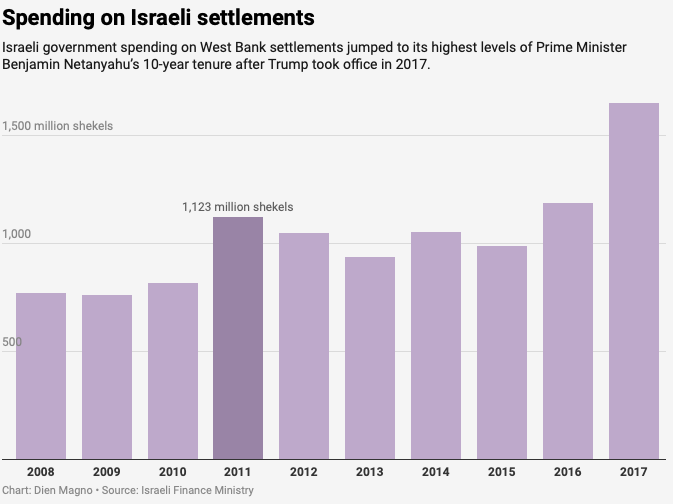 The 2017 figures are the highest amount of Israeli government funds invested in the settlements by the government of Israel during any year since Netanyahu became prime minister 10 years ago (and has remained in power since). The Israeli government tracks its own spending on settlement activities in order to report that total sum to the U.S. government, a practice which began under President George H.W. Bush – which in theory is supposed to deduct the sum from U.S. loan guarantees available to Israel (in reality, the U.S. has made only occasional and minimal deductions).
The areas with the highest growth rate in funding in 2017 were school construction (68% increase from 2016) and road construction (54% increase from 2016). Hagit Ofran, co-Director of the Settlement Watch project at Peace Now, explained the significance of Israeli investments in roads for the settlements:
“We see it very immediately, after the opening of a road, a big boom in construction along the road,” she said. “I think the investments we have these years in the roads are dramatic and will allow the expansion of settlements dramatically. That is very much worrying.”
Nabil Abu Rudaineh, spokesman for Palestinian President Mahmoud Abbas said:
“This proves that the current U.S. administration encouraged settlement activities.”
11 Knesset Members Join Campaign to Cancel 2005 Disengagement Law & Re-establish Evacuated West Bank Settlements
Eleven members of the Knesset, including Speaker of the Knesset Yuli Edelstein, participated in tour of one of the four settlements in the northern West Bank which Israel evacuated in 2005 as part of its Gaza Disengagement plan. The IDF had to provide special permission for the MKs to visit the Homesh settlement, because , even all these years later, it is a closed military zone. This is just the latest event in a settler-led campaign to pressure Netanyahu into canceling the 2005 Gaza Disengagement Plan and re-establishing those settlements.
After Israel’s evacuation of the four settlements in the West Bank – Homesh, Sa-Nur, Ganim, and Kadim – the IDF issued military orders barring Palestinians from entering the areas, let alone building in them. At the same time, settlers have regularly entered the areas and even repeatedly built a yeshiva at the Homesh site.
Bibi Pushes High Court Override Legislation During Coalition Negotiations
Haaretz reports that Prime Minister Netanyahu plans to promote the so-called High Court Override bill, which would empower the Knesset to effectively strip the High Court of its power to review and strike down legislation it deems unconstitutional, as well as overrule the Court’s administrative decisions – a new, and alarming, component of the long touted law. This new component is needed in order for Netanyahu to ensure his own immunity against criminal charges, but it will also empower the Knesset to ignore the Court’s administrative decisions issued in response to petitions – effectively giving elected and partisan government officials a veto over the only justice system accessible by Palestinians. As Haaretz explains: “for example, if a minister makes a decision that is overruled by the court in response to a petition – such as Netanyahu’s decision to ban the entry of Palestinian participants of a joint memorial day ceremony – the minister could reissue the decision anyway.”
Critical for FMEP reporting, if the law is passed the Knesset will be empowered to reinstate the settlement Regulation Law if the High Court rules against it, which it has long been expected to do. The law, passed in February 2017 and quickly frozen, directs the government to retroactively legalize a huge number of illegal outposts and settlement structures which were built on privately owned Palestinian land. Implementation of the Regulation Law was quickly frozen in light of petitions to the High Court challenging its constitutionality.
According to the Haaretz report, an agreement to promote the override bill will be included in the coalition agreement Netanyahu is negotiating to form the next government, and parties are engaged in debates over the specific form the law will take. The right-wing parties want to pass the law within 60 days after the new government takes over, and in a form that would totally negate the authority of the High Court to strike down decisions by elected officials or bodies like the cabinet, the ministers or the Knesset. The comparatively centrist Likud members support the principle of the override law but not the specifics proposed by negotiating partners. Likud members say they are reviewing various models for the law which tinker with the mechanism by which the Knesset can override High Court rulings and administrative decisions.
The override bill has been a key objective of Netanyahu’s negotiating partners, most prominently MK Bezalel Smotrich and Transportation Minister Yariv Levin, who are competing to become the next Justice Minister and whose negotiation demands FMEP analyzed some weeks back. FMEP has also documented the progress of the High Court Override bill in its Annexation Policies tables.
Trump Envoy Praises US-Backed Economic “Coexistence” Group for Joint Settler-Palestinian Hebron Iftar
On May 14th, U.S. peace envoy Jason Greenblatt tweeted his praise for a joint settler-Palestinian iftar event in Hebron, hosted by the “Judea and Samaria Chamber of Commerce,” a favorite group of the Trump Administration’s peace team. As has become a key mantra, Greenblatt said the event helps lay the “groundwork for peace” and said it was a “wonderful example of what could be possible.” As pointed out by many voices on Twitter, praise for the event ignores ignoring the apartheid conditions in Hebron under which Israeli policies deny Palestinian rights and well-being, for the benefit of some 800 Israeli settlers.
Palestinian businessman Sheikh Ashraf Jabari held the event in his Hebron home. Jabari recently launched a new Palestinian political party, the Reform and Development Party, advocating for a one-state solution because, Jabari argues, Palestinians have no other choice than to accept Israeli sovereignty over them. It is well known that Jabari has close ties to the Trump administration, which has very publicly embraced settler-Palestinian economic co-existence initiatives as a core U.S. priority on the ground and are seeking an alternative Palestinian leadership with which to make a deal.
Jabari told the Jerusalem Post about the iftar event and his broader aims:
“We want to build a united front, to create a breakthrough on the economic issue. We are issuing a clear call to separate between economics and politics, and hope to have fruitful cooperation on the subject. From our point of view, we need to strengthen the connection between the US legislature and activity that promotes economic equality here. This meal is meant to reinforce the growing trend in which economic-business connections can strengthen relations and friendship, by way of leading people to a more positive place.”
Along with Jabari, high profile event attendees – which included Samaria Regional Council head Yossi Dagan and Hebron Jewish community leader Yishai Fleisher – praised the business initiative as a model for peaceful relations.
Uri Karzen, the Director General of the settlers in Hebron and an attendee of the iftar, said in a tweet:
“First #Iftar in #Hebron with Kosher food. We are laying the groundwork for peace between people and economic prosperity for all.”
Heather Johnston, executive-director of the US-Israel Education Association which leads U.S. congressional delegation to settlements and runs camps in the Ariel settlement (no joke – to help Ethiopian Jews rediscover their roots), told the event attendees:
“Each of you have played a role in helping to build this integrated business movement. You have made sacrifices. You have gone into the unknown. You have been willing to take risks in business and in relationships. And this is what it takes to pioneer something that will one day be a humongous success. I have been involved in Samaria for the last 22 years. I believe there is more hope today for this important relationship to actually succeed than ever before.”
Chamber president Avi Zimmerman, of the Ariel settlement, said:
“We can measure progress at a people-to-people level, at every business transaction. Every time I get up and say ‘this is only about economics, it is not about peace,’ everyone starts talking about peace. Which makes me believe that if everyone keeps talking about peace when we speak of economics, that these incremental, measured steps toward mutual interest are actually what will birth the peace. They can birth a political process, but it will not happen the other way around,” he said. “We have learned for 70 years that it is not going to be the other way. It has to start this way.”
FMEP has repeatedly explained how initiatives like this perpetuate Israel’s economic exploitation of occupied territory (including the local workforce, land, and other natural resources), and that it is perverse to label such initiatives as “coexistence” programs, or to suggest that they offer the Palestinians benefits they should welcome. The New York Times quoted a spokesman for the Palestinian Authority explaining the Orwellian reality of settlement industrial zones:
“Somebody occupies your country, steals your land, steals your water, steals your resources, then says: ‘I’ll make a good deal for you if you come work for me. I’ll create jobs for you. We are not occupiers. We are employers.’ This is ridiculous. The colonial settlements are illegal in every sense of the word.”