Welcome to FMEP’s Weekly Settlement Report, covering everything you need to know about Israeli settlement activity this week.
To subscribe to this report, please click here.
July 12, 2024
- A Stunning, Expansive Time for Israel’s West Bank Annexation
- Civil Admin Seizes Patchwork of Plots as “State Land” in Order to Legalize the Evyatar Outpost
- Government Establishes Jurisdiction for New Settlement on World Heritage Site Near Bethlehem
- Settlers Takeover New Building in Hebron
- Historic Year for Land Grabs: Israel Seizes Over 3,000 Acres in the Jordan Valley as “State Land”
- Civil Admin Advances Plans to Legalize Three Outposts & Build 5k New Units Across West Bank
- Israeli Cabinet Gives Civil Admin Authority Over Antiquity Sites in Area B
- Israeli Cabinet Supports Knesset Considers Bill to Transfer West Bank Antiquities Control from Civil Admin to Domestic Body
- U.S. Issues New Round of Sanctions Against Settlers & Settler Organizations
- Israeli Court Orders 11 Families Out of Homes in Batan al-Hawa, Silwan
- Israeli Court Rules to Demolish Wadi Hilweh Info Center in Silwan
- Israeli Court Tells Settlers To Leave Khalidi Library in Old City of Jerusalem
- Israel to Advance 6,000+ Settlement Units in East Jerusalem in Coming Weeks
- Amidst Wave of Violence, Settlers Lead Progrom On Massafer Yatta Region
- Ariel Settlers Close Access Road to Palestinians
- IDF Demolishes Outposts, Clashes With Settlers
- Bonus Reads
A Stunning, Expansive Time for Israel’s West Bank Annexation
Over the past two weeks, Israel has unleashed a flurry of settlement activity that makes its annexation of the West Bank complete. Even a small sampling of those acts, detailed below along with other news, are stunning when taken together. Indeed, Israeli National Missions Minister Orti Strock called this “a miraculous time,” referring to the control her and her allies have over key government bodies and how easy it is for them to fund settlement construction. Strock is a member of the Religious Zionism party, along with Bezalel Smotrich.
Renowned Israeli human rights lawyer Michael Sfard encapsulates this time powerfully in an article entitled, “Smotrich Has Completed Israel’s Annexation of the West Bank”:
“The only thing the annexationist criminals must be saying to themselves now is: why did we wait for 57 years? It’s so easy.”
Civil Admin Seizes Patchwork of Plots as “State Land” in Order to Legalize the Evyatar Outpost
On July 8th, the Israeli government declared 16 acres (66 dunams) of land south of Nablus as Israeli “state land” in order to pave the way for the legalization of the Evyatar outpost. Palestinians who have private ownership claims to the land have 45 days in which to submit an appeal. The declaration is the result of three years of “work” by Smotrich’s Settlements Administration to examine the status of the land in order to find a way for the state to take control of the land in order to legalize the outpost. The declaration comes one week after the Israeli Security of Cabinet decided in favor of legalizing the Evyatar outpost along with four other outposts.
The Evyatar outpost was illegally built by settlers on a strategic hilltop named Mount Sabih, located just south of Nablus on land historically belonging to nearby Palestinian villages Beita, Yatma, and Qablan. It was evacuated by the Israeli government in 2021 in the context of an agreement with settlers that left all construction at the site in place, maintained an IDF presence at the site, and made clear the government’s intent to legalize settlement at the site in the future – a goal which was made more than official when it was agreed to in writing as part of the coalition agreements that formed the current Israeli government.
 To underscore the absurdity which has characterized the State’s blatant intent to legalize Evyatar even though Israeli law makes that an impossibility because parts of the land are recognized by the State as privately owned by Palestinians (which is the only reason Evyatar has yet to be legalized), the State’s new declaration of “state land” is a complete patchwork. The order does not include the land on which the central square of the outpost is built, nor does it include 11 buildings, or, very importantly, the access road leading from the main road to the outpost. The implications of this patchwork is that even though the privately owned land was not seized, Palestinians will remain unable to access the land and will, in practice, lose that land as well as land abutting the settlement as it grows, expands, and establishes control over the area with the assistance of the IDF.
Peace Now reports that this is the fifth “state land” declaration so far in 2024 bringing the total land in the West Bank taken into Israeli control this year to 5,879 acres (23,572 dunams), breaking all previous annual records combined. Israel invented the concept of “state land” in order to find means by which to confiscate land in the occupied West Bank, and to do so Israel cites Ottoman law which provided that land which has not been cultivated in consecutives years becomes the property of the sovereign. Peace Now explains:
“The declaration process is essentially a legal maneuver developed by Israel to circumvent the prohibition in international law against expropriating private property of the occupied population for the benefit of the occupying power. To “convert” private land into public land (termed “state land”) without expropriating it, Israel claims that it is not changing the land’s status but merely “declaring” it officially.
According to Israel’s interpretation of Ottoman land law, which underpins the land laws in the occupied territories, if a landowner does not cultivate their land for several years, the land is no longer theirs and becomes public property. To this end, the mapping personnel of the Civil Administration, now operating under the Settlements Administration with legal counsel under Minister Smotrich, examine aerial photographs to identify uncultivated lands and mark them as “state land.”
The declaration map for the Evyatar outpost shows that there were indeed several cultivated lands, even by Israel’s stringent interpretation. For example, the declaration creates an enclave of about 3.5 dunams in the middle of the area designated for the settlement, considered private land. In principle, Israel would argue that it is not expropriating this area and that the Palestinian landowners are still recognized as the owners. However, as in hundreds of similar cases, it is clear that they will not have access to their land and no possibility of using it when it is located in the middle of an Israeli settlement.
To enable an access road connecting the outpost to the main road without crossing private land, the map’s designers managed to “find” an 11-meter-long and 1.5-meter-wide corridor of land that they claim was uncultivated and thus considered state land. This interpretation of Ottoman law brings it to absurdity.
According to this, if a person has a plot and cultivates it intensively, but there is a small uncultivated strip on the edges, say a rock that cannot be plowed, that small part of the plot is not owned by the landowner. This interpretation is far removed from the purpose of the Ottoman law, which was to encourage the empire’s subjects to cultivate the lands to increase its tax revenues.
Regarding the access road – in any case, for modern vehicles, a road 1.5 meters wide is insufficient, and it is clear that to allow access to the settlement, the state will encroach on private Palestinian lands (requiring another legal maneuver). Thus, it can be said that this entire declaration of state land is essentially an unlawful expropriation under international law.”
Government Establishes Jurisdiction for New Settlement on World Heritage Site Near Bethlehem
On July 9th, the IDF Commander signed an order establishing the jurisdiction for a new settlement on the lands just west of Bethlehem, lands that are recognized as a World Heritage Site by UNESCO. Notably, the jurisdiction for the new settlement, called “Nahal Heletz”, does not include the land on which two illegal outposts already exist on Battir’s land. The new settlement is being planned for land that is between Bethlehem and several villages to its west (Walaja, Battir, and Husan) – meaning that construction on this land will sever the territorial continuity of Palestinian land in the Bethlehem region, and, in the words of Peace Now: “turn them [the villages] into an enclave within Israeli territory.”
There are several extraordinary facts about this land and Israel’s legal acrobatics to establish a new settlement at this location:
-
- The status of the land within the new jurisdiction is unclear, and quite possibly includes privately owned Palestinian land. The Israeli Blue Line Team (a government effort to precisely map the boundaries of state land in the West Bank) has prepared updated maps to show the boundaries of state land in the area, but has yet to release it – meaning that the status of the land is unclear. The jurisdiction appears to stretch beyond the previously understood boundaries of land that Israel seized as “state land” in the 1980s, onto land that is privately owned by Palestinians. The updated boundaries might change that fact in the eyes of the Israeli government. But,once the new Blue Line in the area is made public, Palestinians will/should be able to contest it.
- There is no access road to the area, and it is surrounded by privately owned Palestinian land. Israel will have to unilaterally expropriate privately owned Palestinian land in order to pave a road to the new settlement – – an extraordinary act which Israel has done in the past (having invented a legal basis on which to do it, a concept which considers Israeli settlers as part of the “local population” of the West Bank).
- The jurisdictional area established by this new order is too small for real development – just under 30 acres (120 dunams). Peace Now explains that “small settlements severely impact open spaces, require substantial resources for infrastructure and transportation, and contradict fundamental planning principles. The sole reason for establishing such a settlement is political: the desire to prevent a Palestinian territorial continuity in the Bethlehem area and the possibility of a viable Palestinian state.”
- The jurisdiction is a stones throw away from Palestinian houses and Area B.
Settlers Takeover New Building in Hebron
Peace Now reports that in early June 2024 settlers have taken over a building (“Beit HaTkuma”) in Hebron and established a new settlement enclave there. The house, which settlers illegally entered once before but were removed under the Bennet-Lapid government, on the main road leading from the Kiryat Arba settlement to the Tomb of the Patriarchs/Al-Ibrahimi Mosque.
Settlers claim to have purchased the house, which is a three-story building, from its Palestinians owners, and report that the Civil Administration has recently issued them a permit to begin the registration process. The timing of this permit coincides with the first days of Hillel Roth’s assumption of his role in the Defense Ministry as the civilian in charge of all land matters in the West Bank. Upon receiving the permit (allegedly), the settlers decided to enter and occupy the building although the permit does not provide for that. [map]
Historic Year for Land Grabs: Israel Seizes Over 3,000 Acres in the Jordan Valley as “State Land”
 On June 25th, the head of the IDF signed an order declaring 3,138 acres (12,700 dunams) of land in the Jordan Valley as “state land” – the largest state land seizure since the Oslo Accords were signed in 1993. This is the first declaration enacted under the authority of Hillel Roth, the new civilian deputy in the Civil Administration responsible for land policy in Area C of the West Bank. Peace Now reports that the legal opinion supporting this massive declaration of state land was crafted by lawyers in the Department of Defense and not legal advisors with the IDF.
Peace Now further reports:
“A significant part of the area that was declared as state land was previously defined as a nature reserve, and also as a “fire area”, for military use, for decades. Today’s announcement completes the Israeli takeover of this area that has been done so far through the declaration of the area as a military area and as a nature reserve – something that imposed many restrictions on the Palestinians’ ability to use their lands. The declaration creates a territorial continuity between the settlements in the Jordan Valley (Yifit and Masu’a) and the settlements at the eastern end of the mountainside (Gitit and Ma’ale Efraim).”
So far in 2024, Israel has declared 5,852 acres as “state land” a figure eclipsing any other year since the Oslo Accords were signed in 1993. The highest previous total was in 2014, and it was for 1,181 acres.
Civil Admin Advances Plans to Legalize Three Outposts & Build 5k New Units Across West Bank
On July 4th, the Israeli Civil Administration approved the advancement of plans for 5,295 settlement units, including plans which would in effect legalize three outposts under the guise of being “neighborhoods” of existing settlements. This is the first time the Civil Administration’s High Planning Council has met since it came under the authority of a civilian official, Hillel Roth, who was appointed by Bezalel Smotrich. The HPC last met in March 2024. The Associated Press has called Israel’s advancement of plans a “turbo charged settlement drive [that] threatens to further stoke tensions on the West Bank.”
The three outposts that are now on their way to legalization, once given final approval, are:
- Mahane Gadi – to be legalized as a neighborhood of the Masu’a settlement in the northern Jordan Valley. This outpost was built in 2018 on an abandoned Isareli military camp. The outpost currently functions as an educational campus and pre-military academy. Plans advanced this week are for the construction of 260 settlement units. Masu’a settlement, and its outpost satellites, were recently benefitted by the Israeli government’s massive declaration of state land that borders Masu’a.
- Givat Hanan (Susya East) – to be legalized as a neighborhood of the Susya settlement located in the South Hebron Hills.
- Kedem Arava – it appears that the Kedem Arava outpost was legalized along with Beit Hogla in February 2023 (previously unclear), located south east of Jericho. Plans advanced this week are for 316 settlement units in the Kedem Arava outpost area, but filed as if they are plans for the Beit Hogla settlement.
The settlement plans that were approved for validation (a near final step in the West Bank planning process) are:
- Beitar Illit – 298 settlement units. An additional 453 units were approved for deposit (751 settlement units total).
- Givat Zeev – 452 settlement units
- Mitzpe Yericho – 365 settlement units
- Nokdim – 290 settlement units
- Immanuel – 266 settlement units
- Elon Moreh – 186 settlement units
- Kiryat Arba – 165 settlement units
- Negohot – 158 settlement units
- Tzofim – 74 settlement units
- Ganei Modiin – 46 settlement units
- Etz Efraim – 12 settlement units. An additional 24 units were approved for deposit (36 units total)
- Eli – 24 settlement units
- Mitzad (Asfar) – 6 settlement units
The settlement plans that were approved for deposit (an earlier step in the West Bank planning process) are:
- Neria – 436 settlement units
- Modin Illit – 300 settlement units
- Gva’ot – 250 settlement units. There were over 1,000 plans for the Gva’ot settlement on the High Planning Council’s agenda, but only one plan was advanced, the rest continue to be worked on.
- Yakir – 168 settlement units. Haaretz reports that these units are slated to be built on land that is discontiguous from the built up area of the Yakir settlement, on the far side of the settlement’s access road, effectively building a new settlement. The construction of these units requires the evacuation of a military base.
- Kiryat Netafim – 136 settlement units
- Hagai – 135 settlement units
- Maale Shomron (Elamatan) – 120 settlement units
- Almon (Anatot) – 91 settlement units
- Shilo – 90 settlement units
- Pduel – 37 settlement units
- Revava – 16 settlement units
- Elkana – 8 settlement units
- Shaarei Tikva – 6 settlement units
Peace Now said in a statement:
“Netanyahu and Smotrich’s agenda became evident through the decisions of the Planning Council: approval for thousands of housing units, the establishment of three new settlements, and strategic appointments of Smotrich’s allies in key roles instead of military personnel underscore the annexation occurring in the West Bank. Our government continues to change the rules of the game in the occupied West Bank, leading to irreversible harm. While the north is neglected and citizens across the country are abandoned, with 120 hostages still in Gaza, the process of annexation and land theft continues to expand, contrary to Israeli interests. This annexationist government severely undermines the security and future of both Israelis and Palestinians, and the cost of this recklessness will be paid for generations to come. We must bring down the government before it’s too late.”
Israeli Cabinet Gives Civil Admin Authority Over Antiquity Sites in Area B
In late June, the Israeli Cabinet approved several punitive measures against the Palestinian Authority, measures which included usurping the Palestinian Authority’s singular responsibility for antiquity sites in Area B. Under the decision passed last week, the Civil Administration was granted enforcement powers over antiquity sites in Area B that are alleged to be damaged.
Emek Shaveh explains why this is incredibly significant:
“Approximately 6,000 archaeological sites have been identified in the West Bank. Almost every village or settlement contains archaeological and historical remains that require archaeological supervision to prevent damage to sites, structures, or findings. Thousands of sites are located in Areas A and B…expanding the powers of the [Civil Administration] into these areas represents another Israeli departure from the Oslo Accords. The implications of the decision for Palestinian residents are far reaching. The Staff Officer for Archaeology [in the Civil Administration], which derives its authority from the antiquities law effective in the West Bank (the Jordanian Antiquities Law of 1966), will now be empowered to perform various enforcement actions in Area B including:
- Declaration of archaeological sites, determining their boundaries.
- Issuing work stoppage orders for any development within the boundaries of a declared site or a site suspected of containing archaeological remains.
- Imposing fines for damage to an antiquity site, whether the site is declared or not.
- Demolishing structures located within a declared archaeological site or one that will be declared in the future.
- Collecting information, investigating, and requesting the arrest of suspects in antiquities theft or illegal antiquities trade.
This decision taken together with other decisions for Area B aimed at promoting annexation will dramatically reduce Palestinian space. It should be noted that the SOA consistently avoids enforcing the law when it comes to heritage site destruction by settlers (this is true in Hebron, Battir, and in other places)….
The expansion of archaeological activity into the oPt, especially as reflected in this cabinet decision, indicates the government’s intention to promote annexation by any means. It also fundamentally challenges the possibility of conducting impartial archaeological-scientific activity as long as it operates as part of an oppressive mechanism under military auspices. Israeli archaeological activity in the West Bank necessarily becomes an act of land appropriation and a deepening of Israel’s hold on the West Bank. This action violates international law and ethics, disregards the existence of the Palestinian community, and serves as a weapon for oppression.
The destruction of sites cannot and should not serve as a pretext for political action, and political action should not be disguised as archaeological activity. Blurring the distinction between heritage preservation and settlement and annexation activities turns the practice of archaeology into a weapon of oppression while undermining its professional legitimacy.”
Notably, Israel Hayom credits this Cabinet action to a settler group called “Keepers of the Eternal,” (or, “Guardians of Eternity” – an offshoot of Regavim) the leader of which called the new powers granted to the Civil Administration “dramatic.” FMEP has reported on this group repeatedly as it has increased its pressure on and work with the government to take control of West Bank antiquity sites. Dating back to June 2020, the “Guardians of Eternity” began surveying areas in the West Bank that Israel has designated as archaeological sites, looking for Palestinian construction (barred by Israel in such areas) that they could then use as a pretext to demand that Israeli authorities demolish it. The group systematically began communicating its findings to the Archaeology Unit of the Israeli Civil Administration.
Then in January 2021, the Israeli government committed funding to a settler initiative to surveil archeological sites under Palestinian control. While the objective of protecting antiquities might appear uncontroversial and apolitical, the true (and transparently self-evident) objectives behind this effort are: to support yet another pretext to surveil and police Palestinians; to establish and exploit yet another means to dispossess Palestinians of their properties; to expand/deepen Israeli control across the West Bank; and to further entrench Israeli technical, bureaucratic and legal paradigms that treat the West Bank as sovereign Israeli territory. It is the result of a campaign that has taken place over the past year in which settlers have escalated their calls for the Israeli government to seize antiquities and “heritage sites” located in Palestinian communities across the West Bank, especially in Area C, which Israel today treats as functionally (and legally) indistinguishable from sovereign Israeli territory.
Israeli Cabinet Supports Knesset Considers Bill to Transfer West Bank Antiquities Control from Civil Admin to Domestic Body
Emek Shaveh reports that the Israeli cabinet gave its support to a bill in the Knesset that would transfer authority over West Bank antiquity sites from the Defense Ministry’s Civil Administration to the domestic Israeli Antiquities Authority, bringing the cultural, heritage, and archaeological sites in the West Bank under the direct control of the Israeli government in which West Bank Palestinians have no rights.
The bill, as proposed by Likud’s Amit Halevi, explains that the move is justifiable because the West Bank antiquity sites (unbelievably) “have no historical or other connection to the Palestinian Authority.” The bill passed a preliminary vote in the Knesset on July 10th.
U.S. Issues New Round of Sanctions Against Settlers & Settler Organizations
On July 11th, the United States announced another round of sanctions targeting Israeli settlers and settler organizations it asserts are perpetrating violent crimes against Palestinians and Israeli solidarity activists in the West Bank. These sanctions expand the web or already sanctioned individuals and entities.
The individuals and entities sanctioned by the U.S. this week are:
- 1 settler organization:
- Lehava – a settler group led by Benzi Gopstein, who is already under U.S. sanctions.
- 3 individuals:
- Issachar Manne – who established the Manne’s Farm outpost.
- Reut Ben Haim – the co-head of the Tzav 9 settler group, which is already under U.S. sanctions;
- Shlomo Sari – the co-head of the Tzav 9 settler group, which is already under U.S. sanctions;
- Four illegal outposts:
- Meitarim Farm (established by Yinon Levi, who is already under U.S. sanctions);
- HaMahoch Farm (established by Neria Ben Pazi, who is already under U.S. sanctions);
- Neria’s Farm (established by Neria Ben Pazi, who is already under U.S. sanctions); and,
- Manne’s Farm, established by Issachar Manne, who came under sanctions this week, and located in the South Herbon Hills.
Notably, The Times of Israel has previously reported that in 2021 a corporation owned by the Har Hebron Regional Council signed a legally binding contract with Yinon Levi (a previously sanctioned individual) to establish Meitarim Farm. This legal connection exposes the settlement municipality to US sanctions as well.
Aaron David Miler, a former state department Middle East negotiator now a senior fellow at the Carnegie Endowment for International Peace, tells The Guardian that the expanding targets of U.S. sanctions are creeping closer towards the Israeli government, saying:
“It appears that [the U.S. State Department] not just targeted extremist settlers but … introduced a linkage to territoriality by citing illegal outposts…It doesn’t take much imagination to conclude that the next target would be [Israeli] government financing for illegal outposts. And that would be a new departure to be sure.”
Sara Yager, Washington director of Human Rights Watch, said:
“In this case we’re pleased that the Biden administration is going farther than before with the alert…Now it’s time for sanctions against the Israeli authorities that are approving and inciting. We want to see the US, UK, Canada and others focus on power behind all this in the West Bank.”
Israeli Court Orders 11 Families Out of Homes in Batan al-Hawa, Silwan
This week the Jerusalem District Court ruled on two significant cases affecting 11 Palestinian families in Silwan facing forcible eviction from their homes at the hands of the Ateret Cohanim settler organization. Both cases were found in favor of the settlers, leaving 11 families at risk of imminent mass displacement from East Jerusalem. The Palestinians plan to appeal the ruling to the Israeli Supreme Court – though it was only a month ago that the Supreme Court rejected an appeal by the Shehadeh family whose case is similar to those decided this week.
On July 9th, the Israeli court rejected the final appeal of the Gheith and Abu Nab families (4 family units totalling 22 individuals) and ordered their immediate eviction. The families were also ordered to pay the legal fees incurred by Ateret Cohanim.
On July 10th, the Israeli court rejected the final appeal of the Rajabi family (7 family units, 65 individuals), ruling that the 66-member family must vacate their longtime home by January 2025.
In both cases, Ateret Cohanim claims ownership of the buildings becuase it gained control of the historic Benvenisti Trust, which oversaw the assets of Yemenite Jews who lived in Silwan in the 19th century. In 2001 the Israeli Charitable Trust Registrar granted Ateret Cohanim permission to revive the trust and become its trustees following 63 years of dormancy. In 2002, the Israeli Custodian General transferred ownership of the land in Batan al-Hawa to the Trust (i.e., to Ateret Cohanim). Since then, Ateret Cohanim has accelerated its multi-pronged campaign to remove Palestinians from their homes, claiming that the Palestinians are illegal squatters. Silwan is just one site of Ateret Cohanim’s work to establish Jewish enclaves inside densely populated Palestinian neighborhoods of East Jerusalem, for the explicit purpose of “reclaiming” Palestinian parts of Jerusalem for Jews.
Ir Amim explains:
“These families are among some 85 Palestinian families, consisting of over 700 individuals, who face largescale displacement and settler takeovers of their homes in Batan al-Hawa. This is a result of eviction claims filed by a Jewish trust established in the 19th century, which is now controlled by the Ateret Cohanim settler group who is exploiting it to take over Palestinian homes.
While carried out under a veneer of legitimacy, the proceedings are underpinned by discriminatory laws, political motivations, and a system that is rigged against Palestinians from the outset which deprives them of equal access to justice. Moreover, theses measures are a violation of international law and could amount to a form of forcible transfer.
Rather than adjudicating these cases from a broader perspective, which includes moral, geopolitical, and humanitarian considerations, as well as international law, the Israeli judiciary is instead complicit with these moves.
These cases are part and parcel of a coordinated and systematic political campaign aimed at uprooting Palestinians and expanding Jewish settlement in the heart of Palestinian neighborhoods. While the eviction claims themselves are initiated by settlers, they are aided and abetted on all levels of the state, which carry far-reaching implications on the future of Jerusalem and the conflict as a whole.”
Israeli Court Rules to Demolish Wadi Hilweh Info Center in Silwan
On July 3rd, the Jerusalem Court of Local Affairs ruled that the Wadi Hilweh Information Center will be demolished within a year, and fined the Center over $5,000 (NIS 20,000). The Wadi Hilweh Information Center is run by prominent activist Jawad Siyam, who along with the center is a fixture in Silwan and an important interlocutor with diplomats and alternative tourism who are seeking to learn about Palestinian history in the area and current struggles to remain there while enduring state + settler harassment and displacement.
The Center was opened in 2009, at which time the Jerusalem Municipality issued a warning notice demanding the demolition of part of the building that was recently “renovated” (the roof was repaired) because the Center did not obtain an Israeli-issued building permit to do the work. The Center says that the building itself predates Israel’s control of the area in 1967. It currently stands in the shadow of the massive “City of David Visitors Center” complex that the Elad settler organization has built over the years.
Peace Now said in a statement:
“Instead of taking care of all the residents of Jerusalem, Jews and Arabs, the Jerusalem Municipality works to harm the Palestinian residents and make their lives difficult. The tourist settlement in the Palestinian neighborhoods around the Old City, which is massively supported by the government, is aiming at erasing the Palestinian presence from the public space in East Jerusalem. The pressures exerted by the municipality against the Wadi Hilweh Information Center in Silwan and the intention to demolish it, are for the political purpose of not allowing the residents to organize and make their voices heard in the public domain.”
Israeli Court Tells Settlers To Leave Khalidi Library in Old City of Jerusalem
On June 30th, the Jerusalem District Court made a group of settlers vacate ta building in the Khalidi Library complex located in the Old City of Jerusalem after they broke into the building and occupied it three days prior. The library is within eyesight of the Western/Wailing Wall plaza (Kotel Plaza), on Chain Gate Road, which leads to the Haram al-Sharif. There is an IDF checkpoint right outside of the door, reflecting what an intensely sensitive area it is in.
The settlers had forged documents claiming to have purchased the building, but upon review of the Khalidi families’ own documents which show the family has owned the building for at least 160 years, the Court ordered the settlers to leave. There is another hearing set in the coming weeks which will allow the settlers, if they choose, to make their case.
Listen to Rashid Khalidi explain the history of the Khalidi Library, the current situation and its importance, and the ongoing fears of settler takeover in a conversation with FMEP Fellow Peter Beinart on a recent episode of FMEP’s “Occupied Thoughts” podcast.
In a statement, the Khalidi family said:
“Despite this temporary success, there is an ongoing fear of settler violence and the chilling effect of the occupation. Two of the settlers involved have been identified as Eli Attal ad Erez Zaka, the former linked to previous takeovers of Palestinian properties in the old city. After today’s ruling, scores of settlers remain lingering outside the house and on the rooftops filming and occasionally bagining on the doors and windows, posing a threat of breaking and entry and further illegal actions.”
Israel to Advance 6,000+ Settlement Units in East Jerusalem in Coming Weeks
Ir Amim reports that within the next two weeks Israel is planning to advance plans for 6,700 new settlement units in East Jerusalem. Plans to be advanced include:
-
- Givat Hamatos – plans for 3,500 new units, 1,300 new hotel rooms, five synagogues, and two mikvahs (ritual baths). This plan wouldl double the number of units in the settlement and expand its size by nearly 40%;
- Gilo – two plans for a total of 1,288 new settlement units, expanding hte settlement to the south east, further choking the Palestinian neighborhood of Beit Safafa and severing neighborhoods in southern Jerusalem from the Bethlehem area;
- Ramot – plans for 800 new settlement units.
Details of the plans slated for advancement are reported here by Ir Amim, and will be reported by FMEP in more detail when they are advanced.
Amidst Wave of Violence, Settlers Lead Progrom On Massafer Yatta Region
Palestinian residents in Masafer Yatta, an area of small villages in the South Hebron Hills, have been live streaming the frequent and intensifying terror that Israeli settlers have been inflicting on them for years. The terror peaked to unimaginable levels over the last weeks when, on multiple occasions, armed settlers descended on villages in the area inflicting terror, violence, and intimidation.
Eid Suleman, a prominent activist in Umm al-Khair, told the Associated Press:
“We know what this is. They’re trying to expel us out of here. The military did the dirty job last week and now the settlers are following up.”
Some of the events that have transpired include:
On June 26th, the IDF arrived in Umm al-Khair early in the morning and proceeded to demolish a third of Umm al-Khair’s structures (11 homes), leaving 38 people (30 children) homeless).
On July 1st, armed settlers descended on Umm al-Khair, some dressed as IDF officers, and fired live ammunition toward Palestinians, deployed tear gas, and attacked people with wooden sticks. Israel soldiers and police were nearby but did not intervene.
On July 2nd, settlers were accompanied by Isreali soldiers as the entered the village of Umm al-Khair and built a tent in the center square, where 40 settlers gathered in a sort of celebration. When they eventually left, the settlers cut the water pipes supplying the village and warned of their plans to return the next day.
On July 3rd, settlers descended on the nearby village of Khalled al-Daba’a and set agricultural crops and trees on fire. The settlers then proceeded to march on the homes in the village carrying cans of gasoline and guns.
On July 4th, Palestinian residents reported that 100 settlers attacked the village of Khaled al-Daba, setting fire to fruit trees and shooting live ammunition directly towards Palestinians. Settlers proceeded to beat villages with sticks. Israeli forces arrested one Palestinian.
Settlers then moved to Mufagarah, a nearby village, where they destroyed vehicles and prevented emergency medical workers from reaching Palestinians and internationals in need. Palestinians report several Palestinians and two internationals were injured by the settlers.
On July 7th, the IDF arrested members of the Hureini family – who are all prominent activists in the area – who had called the police to report that settlers had shepherded flocks of sheep onto the Hureini’s land.
The Center for Jewish Nonviolence (which maintains a protective presence in Masafer Yatta and closely allied with the local population there) reports that “the attacks on Umm al-Khair after the demolition on Wednesday are being led by a settler named Shimon Atiya (or Atia), a leader of the nearby illegal outpost, Havat Shorashim (or “Roots Farm” in English). For months, he has been one of countless settlers acting with impunity while wreaking havoc on Palestinian communities across Area C.”
The events in Massafer Yatta bring into stark relief the intensity and persistence of settler terrorism in the West Bank, especially since October 7, 2023. AIDA (Association of International Development Agencies) has recorded 1,000 incidents of settler violence since October 7th.
The outgoing head of the Israeli Army’s Central Command, Yehuda Fuchs, used his farewell speech to criticize Israel policy makers for their failure to deter settler terrorism in the West Bank.
Ariel Settlers Close Access Road to Palestinians
The Mayor of the Ariel settlement has blockaded on the main access road leading to the nearby Palestinian village ofSalfit, boasting about his actions in an Instagram post. In addition to building a blockade of boulders and a welded gate, workers also destroyed parts of the road. The Civil Administration has attempted to remove the blockades and restore use of the road, but each time the settlers have re-constructed the blockade.
The Ariel settlement Mayor, Yair Chetboun, said in the video:
“Security is foremost upon us, upon the city. We trust the IDF, love the IDF, but if the senior levels don’t understand the importance of blockading this route – which led to attacks and enables car theft. We won’t permit such a reality. We are also operating on the political front but also on the ground.”
IDF Demolishes Outposts, Clashes With Settlers
On July 3rd, settlers clashed with Israeli authorities as they attempted to demolish the illegal outpost “Oz Zion B.” Haaretz reports that five settlers were arrested for violence against Israeli Border Police, and four were quickly released without questioning or restrictions. One settler who pepper sprayed an officer was brought to court for a hearing but later released and forbidden from going near the outpost.
The demolition of the outpost was reportedly ok’d by Prime Minister Netanyahu – going over the head of Bezalel Smotrich and the Settlement Administration, which has seized control of building enforcement in the West Bank. The outpost, according to the Shin Bet, was the source of violent terror.
Bonus Reads
- “Road to Redemption: How Israel’s War Against Hamas Turned Into a Springboard for Jewish Settlement in Gaza” (Haaretz)
- “A look at how settlements have grown in the West Bank over the years” (AP)
- “West Bank Annexation and Destabilization in the Shadow of the Israel-Hamas War” (J Street)
- “The Status of De Jure West Bank Annexation” (Israel Policy Forum)
- “Mounting International Sanctions Against Powerful Israeli Settler Group Could Be Earth-shattering” (Haaretz)
- “A warm relationship is being built between Judea, Samaria and America” (JNS)
- “Why there is no uprising in the West Bank – yet” (Mondoweiss)
- “In His Retirement Speech, Israel’s Top Officer in the West Bank Revealed the Hidden Truth” (Haaretz)
- “The Companies Making it Easy to Buy in the West Bank” (The Intercept)
Welcome to FMEP’s Weekly Settlement Report, covering everything you need to know about Israeli settlement activity this week.
To subscribe to this report, please click here.
June 23, 2023
- Smotrich Receives Near Unilateral Power Over Shortened Settlement Planning Process
- Israel To Advance Plans for 4,799 New Settlement Units, Including Retroactive Authorization of an Outpost
- Netanyahu Announces 1,000 New Units for the Eli Settlement in “Response” Palestinian Attack
- Settlers Reoccupy Evyatar Outpost As Netanyahu Reportedly Decides to “Legalize” It & Ben Gvir Encourages More Illegal Settlement Activity
- With Assistance from IDF, Settlers Establish a New Outpost Near Eli
- Settler Violently Rampage Across West Bank with Little to No Repercussion
- Eviction of Palestinian Ghaith-Sub Laban Family Scheduled
- Bonus Reads
Smotrich Receives Near Unilateral Power Over Shortened Settlement Planning Process
On Sunday, June 18th the Israeli Cabinet approved a measure that immediately expands Bezalel Smotrich’s authority over construction in existing settlements by significantly shortening the planning process and removing almost any role for Israeli politicians in that process, a lever which – for decades – has been utilized by successive Israeli governments to intervene in settlement planning usually in consideration of pressure from the international diplomatic community. Under the new procedures, political approval is only needed once at the very beginning stage of the planning process, whereas for the past three decades political approval was needed at each and every phase.
In Haaretz, Israel lawyers Ronit Levine-Schnur and Michael Saliternik explain:
“The requirement of the defense minister’s approval at each stage reflected the understanding that settlement construction, which is illegal under international law, has major legal, diplomatic and security implications. This requirement enabled government officials to halt or postpone construction in the settlements based on the changing political and security situation, and sharpened the distinction between construction within the state’s sovereign borders and construction on occupied land under Israel’s temporary military control….This week’s decision…is designed to prevent or significantly reduce not only the government’s but also the public’s and international community’s oversight of settlement construction.”
Removing the role of political figures surrenders the power of settlement planning and construction to an avowed annexationist whose agenda, at least in part, is to double the number of settlers while further entrenching Israeli domestic rule over settlers and leaving Palestinians under Israeli military rule. The Israeli Cabinet decision advances both of these goals: it differentiates settlement planning from planning for Palestinians (which remains a more complicated political-bureaucratic process in which Smotrich and Defense Minister Gallant both have power); and, as Smotrich and his allies are framing it, this procedural change “normalizes” the laws governing settlers by aligning them with Israeli domestic rule. In the words of Peace Now, “From a planning perspective, there is no difference between the Tel Aviv district and the ‘Judea and Samaria’ district, except for the initial decision by Minister Smotrich.”
The change is celebrated by settler leadership. Yisrael Gantz, head of the Benjamin Regional Council, said:
“This government resolution brings the residents of Judea and Samaria to the regular situation of the entire State of Israel,” said Gantz, using the biblical name for the West Bank region. “This step will turn construction in the settlements into something that is not newsworthy but rather, routine.”
Yossi Dagan, head Head of the Samaria Regional Council, said:
“We must stop treating residents of Judea and Samaria as second-class citizens. It’s unthinkable that only residents of Judea and Samaria need approval from the political echelon in order to build a home or a kindergarten.”
It’s worth re-sharing the latest legal analysis and commentary arguing that Israel has, even without a formal declaration, annexed the West Bank via bureaucratic transformations such as this: “A Theory of Annexation” (Berda, Meggido, & Levin-Schner, January 2023 – SSSN); “Israel is Officially Annexing the West Bank” (Sfard, June 2023 – Foreign Policy); and, “Israel’s Annexation of the West Bank Has Already Begun” (Scheindlin & Berda, June 2023 – Foreign Affairs); “This Decision by Israel Is as Dramatic as Attempts at Constitutional Change” (Levine-Schnur & Saliternik, June 2023 – Haaretz)
Peace Now further comments:
“The implication of this decision is that once Minister Smotrich decides and approves the advancement of construction plans in West Bank settlements, the plans will go directly to the planning committees in the West Bank (the Higher Planning Council), and the political and military echelon will have no authority to delay or influence the planning stages or the submitted plans. This process will allow unrestricted construction in the West Bank, disregarding security and diplomatic considerations, and perpetuating de facto annexation in the West Bank.”
The Haaretz Editorial Board writes:
“The settlers’ patience has paid off. After 27 years, they have managed to bring about a change in the way the system operates. The government decided to give a messianic settler, one who favors Israeli sovereignty over the entire Land of Israel and supports Jewish supremacy, the power to speed up construction in the settlements…Smotrich and the settlers understood very well that Netanyahu’s utter dependence on the extreme right opened a historic window of opportunity for them, and they are exploiting every moment of it to take over more and more Palestinian land to build, alter the area irreversibly and entrench one large apartheid state between the Jordan River and the Mediterranean Sea. The crisis that Israel is mired in is a golden opportunity for the settlers and their destructive project.”
Israel To Advance Plans for 4,799 New Settlement Units, Including Retroactive Authorization of an Outpost
On the same day Smotrich was awarded new power to oversee settlement construction, the Israeli High Planning Council published an agenda for its June 26th meeting outlining plans for 4,799 settlement units which will be advanced, to include plans which would have the effect of retroactively legalizing the Palgei Maim outpost as a neighborhood of the Eli settlement. The June 26th meeting will be the second time the High Planning Council convenes this year, and could bring the total number of settlement units advanced in 2023 to 12,149 – – nearly three times more than in the entire 2022 year (4,427 units). Smotrich – who now has near unilateral authority over construction planning for settlements – gloated in a statement saying that 2023 has set “a record for the rate of settlement construction [planning] in the last decade” and:
“The construction boom in Judea and Samaria and in all parts of our country continues. As we promised, today we are advancing the construction of thousands more new units in Judea and Samaria… We will continue to develop the settlements and strengthen Israel’s hold on the territory.”
Peace Now said in a statement:
“The Israeli government is advancing us at an unprecedented pace towards the annexation of the West Bank. The promotion of nearly 5,000 housing units, including the authorization of a settlement in the heart of the West Bank, joins a series of destructive decisions that the government has advanced, including yesterday’s decision granting exclusive power to Minister Smotrich for promoting settlements in the occupied territories. As the world remains silent and public attention is focused on preventing the judicial coup, the government is rushing towards an annexation coup turning Israel into an apartheid state.”
Of the total number of units on the agenda, 1,434 units are set for final approval, including:
- Carmel – 42 units, expanding construction in the settlement towards the southeast. This settlement is located in the South Hebron Hills, where Palestinians are facing ongoing displacement and forcible relocation.
- Elkana – 351 housing units. Elkana is located in the northern West Bank in an area where the Israeli separation barrier cuts deeply into the land in order to keep settlements on the Israeli side of the barrier.
- Givat Ze’ev – three plans totalling 642 units. Givat Ze’ev is located north of Jerusalem.
- Revava – 399 housing units. Revava is located west of the Ariel settlement in the heart of the northern West Bank.
Of the total, 3,306 units will be approved for deposit (an earlier stages of the planning process):
- Adora – 310 housing units. If approved, this will triple the size of the Adora settlement. Adora is located west of Hebron.
- Beitar Illit – a total of 312 units in three plans. Beitar Illit is located west of Bethlehem.
- Eli – 142 units.
- Etz Efraim – 264 units in two plans. Etz Efraim is located near the Elkana settlement in the northern West Bank in an area where the Israeli separation barrier cuts deeply into the land in order to keep settlements on the Israeli side of the barrier.
- Givat Ze’ev – 228 units. Givat Ze’ev is located north of Jerusalem.
- Halamish (also called Neve Tzuf) – 330 units, which will significantly expand the Elisha “neighborhood” of the settlement, which began as an outpost that was retroactively legalized in 2015 as a neighborhood of Halamish. If approved, this will more than double the size of the Halamish settlement. Located between Ramallah and the Ariel settlement in the northern West Bank.
- Hashmonaim – 150 units. Hashmonaim is located just over the 1967 Green Line, west of the Modin Illit settlement in the northern West Bank.
- Karnei Shomron – 104 units in two plans. Karnei Shomron is located in the northern West Bank, east of the Palestinian village of Qalqilya. Israel has openly declared its intention to continue expanding settlements in this area with the stated goal of bringing 1 million settlers to live in the area.
- Ma’ale Adumim – 340 units. Located east of Jerusalem.
- Ma’ale Amos – 152 units. If approved, this will more than double the size of the Ma’ale Amos settlement, which is located between Bethlehem and Hebron.
- Metzad (Asfar) – 78 units.
- Kiryat Arba – 120 units. Located just outside of Hebron.
- Migdalim – 184 units. Located in the extreme south of the West Bank.
- Palgei Maim outpost – 347 units located within the Palgei Maim outpost. This plan will have the effect of retroactively legalizing the outpost as a neighborhood of the Eli settlement
Netanyahu Announces 1,000 New Units for the Eli Settlement in “Response” Palestinian Attack, Bringing Outpost Legalization Total to 3 This Week
In response to the murder of four Israelis by Palestinian gunmen near the settlement of Eli on June 21st, the Israeli government announced that it is advancing plans for 1,000 new settlement units in Eli, which come in addition to the 499 units expected to be advanced by the High Planning Council at its meeting next week (see the above section). The decision was made by Prime Minister Netanyahu, Defense Minister Gallant, and Finance Minister Smotrich. The trio said in a statement:
“Our response to terror is to hit it hard and build in our land.”
According to Peace Now, the plans for 1,000 units announced by Netanyahu include three discrete schemes, inlcuding two plans to grant retroactive legalization and add hundreds of units in two outposts associated with Eli – HaYovel and Nof Harim. The third plan is for a new neighborhood in the Eli settlement consisting of 650 units. Recall that that part of what the High Planning Council is expected to advance next week is a plan to retroactively legalize and expand yet another outpost of the Eli settlement, called Palgei Maim outpost, meaning that the Eli settlement could see three of its outposts legalized soon. Peace Now comments on the totality of plans to expand the Eli settlement:
“The implication of the government’s decisions in the past week is the doubling of the number of settlers residing at Eli while legalizing and expanding three outposts located at the edge of the settlement, in close proximity to the Palestinian villages of As-Sawiya (Palegi Mayim) and Karyut (Jubal).”
National Missions Orit Strock (Religious Zionism party) celebrated the announcement, saying:
“1,000 more Jewish families in the place where Jewish lives were cut short. Every terrorist must know that this was the Zionist price tag for murdering Jews. In the place from where they try to uproot us – there we will deepen our roots. Not instead of eliminating the terrorists, not instead of the checkpoints, and not instead of drying up the terror swamp. But absolutely, as a necessary and clear Zionist step.’’
Settlers Reoccupy Evyatar Outpost As Netanyahu Reportedly Decides to “Legalize” It & Ben Gvir Encourages More Illegal Settlement Activity
Hundreds of settlers moved into the illegal Evyatar outpost on June 21st in an effort to permanently reoccupy the outpost. The massive action only escalates the demand that the government expedite the implementation of its decision (as agreed to in its coalition deals) to grant retroactive authorization to the outpost, and is now framing that demand as part of the government’s response to the murder of four Israelis by Palestinian gunmen near the Eli settlement. According to Peace Now, Israeli press reports suggest that on June 21st Prime Minister Netanyahu made a final decision to grant retroactive authorization to the outpost.
The area of the Evyatar outpost – located east of the Ariel settlement, closer to the Jordan Valley than to sovereign Israeli territory – remains a closed military zone, where Israelis and Palestinians are barred from entering. Nonetheless, the IDF appears to have deliberately decided to allow the settlers to enter the outpost area, and are now providing security for the settlers entering and leaving the area. All of this suggests that the settlers will not be removed from the site.
National Security Minister Itamar Ben Gvir traveled to the Evyatar outpost on June 23rd, congratulating the settlers and encouraging them to continue to establish new outposts and urging more violent action against Palestinians. Ben Gvir said:
“Run to the hilltops. Here, there should be a full settlement, not only here, but in all the hills around us. We should settle the Land of Israel, and at the same time, launch a military operation, take down buildings and eliminate terrorists. Not just one or two, but dozens and hundreds and if needed, thousands.”
MK Zvi Sukkot participated in the demonstration on June 21st, saying:
“We’ve returned home to Evyatar…Terrorists should know that any attack will only deepen the Jewish hold on the territory. Two years after being evacuated, the time has come for us to return forever.”
As a reminder, Evyatar is an illegal outpost (established by settlers in violation of Israeli law, in addition to international law) built on a hilltop that Palestinians have long known as Mt. Sabih, land which has historically belonged to the nearby Palestinian villages of Beita, Yatma, and Qablan. The outpost was evacuated by the Israeli government in 2021 in the context of an agreement with settlers that left all construction at the site in place, maintained an IDF presence at the site, and made clear the government’s intent to legalize settlement at the site in the future. Since then, re-establishment/legalization of Evyatar has been a regular demand of settlers and their political backers, and was agreed to in writing as part of the coalition agreements that formed the current Israeli government.
In April 2023, settlers staged another march to demand Evyatar be reestablished, with march organizers hosting a carnival-like rally at the Evyatar site. Importantly and perhaps tellingly, Haaretz reports that the April march was the first time settlers have received approval to enter the Evyatar outpost since the aforementioned 2021 agreement.
For full background on the Evyatar outpost saga, see previous FMEP reporting here.
With Assistance from IDF, Settlers Establish a New Outpost Near Eli
On evening of June 21st, a group of settlers moved five mobile homes to land near the Eli settlement but belonging to the Palestinian villages of Sinjil and Lubban ash-Sharqiya (a village settlers violently attacked the night before) in order to establish a new outpost, which they are calling “HaMor”. The Wafa news outlet reports that the IDF assisted the settlers efforts by leveling the ground with a tractor prior to their arrival with the mobile homes.
Peace Now has published pictures of this new outpost and reported:
“It appears that the outpost was established deliberately in a predetermined location, receiving support and funding from institutional sources, enabling the transportation of relatively spacious caravans, heavy equipment, and the commencement of infrastructure work.”
Peace Now further comments:
“Netanyahu’s government’s complicity in allowing and supporting settler outposts fuels an already volatile situation in the occupied Palestinian territories, intensifying violence against innocent Palestinians by extremist settlers. This flagrant disregard for justice and human rights undermines the prospects for a political resolution. The international community must vehemently condemn these actions and hold Israel accountable for its role. Moreover, the alarming rise in settler violence further exacerbates the situation. Urgent measures are imperative to prevent and punish such acts, fostering a culture of accountability and ensuring the safety and well-being of Palestinians. While the world remains silent and Israeli public attention is focused on preventing a judicial coup, the government is hastily moving towards an annexation coup, which will ultimately transform Israel into an apartheid state.”
Settler Violently Rampage Across West Bank with Little to No Repercussion
On June 20th hundreds of settlers descended on the Palestinian village of Turmus Ayya in the northern West Bank where they attacked Palestinians and their property – injuring 11 and setting fires across the town that damaged 30 houses and 60 vehicles. When the IDF came to help the settlers leave the village after residents confronted them, IDF soldiers shot indiscriminately at Palestinians resulting in one death and several serious injuries.
Another group of settlers attacked Huwara, the village where settlers committed a pogrom earlier this year. Still another group of settlers attacked the village of Al Luban Al Sharqiya located near the Eli settlement. There, settlers attacked a 12-year old boy riding his bike, leaving him seriously injured.
The Times of Israel reports that four Israelis have been arrested in connection to these attacks. B’Tselem spokesperson Roy Yellin commented that, “We didn’t expect much…The rule is impunity from justice.” Yesh Din Executive Director Ziv Stahl called the arrests a “drop in the bucket” and told AP:
“(The army) had four months after (the attack in) Hawara to study how to deal with this and stop it,” she said. “But everything happened in broad daylight. They didn’t detain anyone on the scene. They allowed the settlers to do whatever they felt like doing.”
B’Tselem said in a statement:
“Responsibility for deadly West Bank pogrom wave lies with Israel, which arms settler gangs and encourages them to attack Palestinians. Right after the deadly shooting near the settlement of Eli yesterday afternoon, settlers backed by the state began rioting across the West Bank, attacking Palestinians and their property.The rioting continues today, with one Palestinian reported killed and three others wounded by live fire in the village of Turmusaya. These events are not a single, isolated failure of the military or state, but a clear expression of Israel’s policy in the OpT. As part of this policy, Israel arms gangs of settlers and allows and even encourages them to attack Palestinians.”
Eviction of Palestinian Ghaith-Sub Laban Family Scheduled
Living under imminent risk of dispossession since June 11th, this week the Ghaith-Sub Laban family received an order from the Israeli Enforcement and Collection Authority stating that the couple will be evicted anytime between June 28th and July 13th. Ir Amim reports that Israeli authorities oftentimes state a window for carrying out forced evictions in order to “maintain an element of surprise to reduce anticipated resistance and ensure the eviction is carried out without disruption.” Ir Amim reports that the family – consisting of an elderly couple, Nora Ghaith and Mustafa Sub Laban – are presently living under extreme conditions, writing:
“Over the course of the past few weeks, the Ghaith-Sub Laban family has been subject to ongoing harassment by the police, private security guards, and settlers in the area. On numerous occasions, Israeli security forces arrived to their home demanding information and IDs of those present in the apartment, including activists, journalists, and diplomats. Beyond the looming threat of displacement, the continued uncertainty has added to their severe psychological distress.”
The Ghaith-Sub Laban family has spent more than 45 years in a legal battle against settlers (and the State) over their home in the Muslim Quarter of the Old City of Jerusalem. Nora recently told Haaretz columnist Gideon Levy when asked if she has ever considered giving up her struggle:
“I will answer with a question. If you had been born in this house, and all your brothers and sisters had been born here, grown up in it, married in it, if your mother and father had died in it, your brother had been exiled from it – would you surrender and forsake it? I want an answer. Every minute that I remain in this house is another minute of protecting my childhood memories. Every minute is to feel embraced by family members who are no longer with us. I am never alone in this house, even when I am by myself – all my family and all my memories are always with me in this house. If they come to evict us, I will not open the door. But if I feel danger to myself and to my husband, I will surrender and forsake it in order to safeguard my family. If I am evicted, I will give the house to God. This house will remain a prison until it is liberated. I will return. And if not me, then my children. One day the occupation will end, and we will return.”
This family’s story is not unique, and the broader, systemic processes behind the forcible dispossession of Palestinians in Jerusalem is also discussed. In March 2023, FMEP hosted Rafat Sub Laban and Ir Amim’s Amy Cohen on a podcast – “‘We Are Determined to Stay”: One Palestinian Family’s Story of Dispossession in Jerusalem” – to discuss the Sub Laban case and how it relates to broader State-back settler efforts to dispossess Palestinians across Jerusalem.
A large consortium of Palestinian civil society groups released a joint statement on the Sub Laban family dispossession, which reads:
“Alarmed by the imminent forcible transfer of the Ghaith-Sub Laban family from their house in the Old City of Jerusalem, which is slated to occur sometime between 28 June and 13 July 2023, the Palestinian NGOs Network (PNGO) and the Palestinian Human Rights Organisations Council (PHROC) vociferously assert that such manifestation of the ongoing Palestinian Nakba is a result of the international community’s deliberate failure and unwillingness to take effective and meaningful measures to end Israel’s illegal occupation, and settler-colonial apartheid regime…….For over 45 years, the Ghaith-Sub Laban family has endured a lengthy, exhausting, and unaffordable legal struggle, actively resisting recurring lawsuits, harassment, and efforts by Israel and settler organisations to forcibly displace them and seize their home for the purpose of expanding settlements in the eastern part of occupied Jerusalem…Indeed, the Ghaith-Sub Laban’s case is not an isolated incident but rather emblematic of a larger widespread and systematic attack against the Palestinian civilian population. The Israeli occupying authorities – mobilising its discriminatory judicial system – have consistently employed similar methods and policies to forcibly transfer dozens of Palestinian families from the Old City, Silwan, Sheikh Jarrah and other neighbourhoods of the eastern part of occupied Jerusalem.”
Bonus Reads
- “As Israel seeks West Bank expansion, a controversial outpost is revived” (Washington Post)
- “In the West Bank, UNESCO site Battir could face a water shortage from a planned Israeli settlement” (AP)
- “We’ve Found Something Settlers and Palestinians Agree On: How Ugly This Construction Is” (Haaretz)
- “Israel’s annexation drive is behind escalations in the West Bank” (The New Arab)
- “Jerusalem Permits Building U.S. Embassy on Disputed Site as Washington Mulls Location” (Haaretz)
Welcome to FMEP’s Weekly Settlement Report, covering everything you need to know about Israeli settlement activity this week.
To subscribe to this report, please click here.
October 22, 2021
- Israel to Advance Plans for Nearly 3,000 Settlement Units & 1,300 Palestinian Homes in Area C
- Israeli Supreme Court to Hold Hearing on Batan al-Hawa, Silwan Dispossession Cases Next Week; AG Declines Intervention
- Israel Begins Construction on New Settlement in Downtown Hebron
- Israel Advances “Silicon Wadi” Project in East Jerusalem
- Recap: Israel Advances Settlement Plans Across Greater Jerusalem Area
- Recap: Court Pushes for Palestinians to “Compromise” with Settlers in Sheikh Jarrah
- New Report: State-Backed Settler “Tourism” Projects in East Jerusalem
- Bonus Reads
Israel to Advance Plans for Nearly 3,000 Settlement Units & 1,300 Palestinian Homes in Area C
The Israeli Civil Administration’s High Planning Council will convene next week — for the first time since Bennett and Biden took over leadership in Israel and the U.S., respectively — to advance the construction of 2,862 new settlement units (of which 1,231 will be eligible to receive final approval). These plans include the retroactive legalization of two unauthorized outposts (Mitzpe Danny and Haroeh Haivri), which should be properly understood as the creation of two new settlements.
Peace Now data
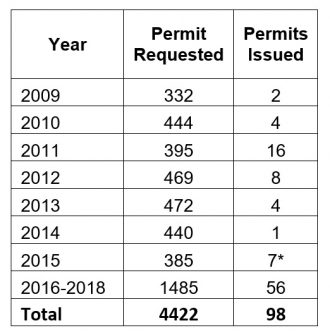
In addition, reports suggest that Israel will also advance plans for 1,303 Palestinian homes in Area C – about half of which, importantly, are already built. A majority of these units have been awaiting Israeli approval for many, many years. If approved, the permits under consideration next week for Palestinians will be the first of any significant quantity issued by Israel since, at least, 2009 (data from before this period has not been released by the Israeli government). Between 2009 and 2018, Israel issued a total of 98 building permits to Palestinians according to data released by the Israeli government in response to a freedom of information request submitted by Bimkom.
As a reminder, Area C is the 60% of the West Bank over which Israel enjoys absolute authority. For years Israel has systematically denied Palestinians the right to build on land in Area C that even Israel recognizes is privately owned by them, At the same time, it has continuously promoted the expansion of settlements and unauthorized outposts, while systematically demolishing Palestinian private construction. In terms of numbers: between 2016 to 2018, Israel issued only 21 building permits to Palestinians in Area C, while issuing 2,147 demolition orders against Palestinians during.
Commenting on the Planning Council agenda’s Peace Now observed:
“The approval of a handful of plans for the Palestinians is only a fig leaf intended to try to reduce criticism of the government. For years, Israel has pursued a policy of blatant discrimination that does not allow almost any construction for Palestinians in Area C, while in the settlements it encourages and promotes the construction of thousands of housing units each year for Israelis. The approval of a few hundred housing units for Palestinians can not cover up discrimination and does not change the fact that Israel maintains an illegal regime of occupation and discrimination in the territories.”
It is worth noting that many of the settlement units and Palestinian permits on next week’s agenda were expected to have been advanced earlier this year, in August 2021, but the High Planning Council never convened to do so.
Below are lists of settlement plans expected to be given final approval and plans expected to be advanced next week (italicized plans represent those which appear to have been added to the slate of plans that were expected to be advanced in August 2021).
Settlement plans expected to be granted final approval include:
- 629 units, including the retroactive legalization of 61 units, in the Eli settlement – located south of Nablus and southeast of the Ariel settlement in the central West Bank. Though the Eli settlement previously received Israeli government approval, a “Master Plan” – which officially zones land for distinct purposes (residential, commercial, public) – has never been issued for Eli, meaning all construction there is illegal under Israeli law;
- 286 units in the Har Bracha settlement, located south of Nablus. If implemented, these new units will double the size of Har Bracha;
- 224 units in the Talmon settlement, located west of Ramallah;
- 146 units in the Kfar Etzion settlement, located between Bethlehem and Hebron and on the Israeli side of the planned route of the barrier (which is not yet built in this area);
- 110 units in the Alon Shvut settlement, located just north of the Kfar Etzion settlement and between Bethlehem and Hebron;
- 82 units in the Karnei Shomron settlement, located in the northern West Bank, east of the Palestinian village of Qalqilya. Israel has openly declared its intention to continue expanding settlements in this area with the stated goal of bringing 1 million settlers to live in the area.;
- 52 units in the Beit El settlement, located in the heart of the northern West Bank [as a reminder, former US Ambassador to Israel David Friedman has deep ties to the Beit El settlement]; Construction on 350 new units in Beit El began earlier this year;
- 42 units in the Givat Zeev settlement, located south of Ramallah in an area that is on the Israeli side of the barrier;
- 24 units in the Haroeh Haivri outpost, a plan that will effectively grant retroactive legalization to this outpost. The Haroeh Haivri outpost is located just east of Jerusalem, within eyesight of the Khan al-Ahmar community, which Israel is threatening to demolish (forcibly relocating the Palestinian bedouin community that has lived there since the 1950s) — ostensibly because the structures in Khan al Ahmar were built without necessary Israeli approvals. The Haroah Haivri outpost was also built without the necessary Israeli approvals, but instead of demolishing the construction, Israel is moving to retroactively legalize it — demonstrating once again that, when it comes to administering the occupation, Israel prefers “rule by law” – where law is turned into a tool to elevate the rights/interests of one party over another, over the democratic rule of law.;
- 14 units in the Ma’aleh Mikhmash settlement, a plan that will effectively grant retroactive legalization to one of Ma’aleh Mikhmash’s outposts – – Mitzpe Danny;
- 10 units in the Barkan settlement, located about half way between the Ariel settlement and the cluster of settlements slated to be united into a “super settlement” area (Oranit, Elkana, Shiva Tikva, and others);
- 5 units in the Shima’a settlement, located in the southern tip of the West Bank;
- 7 units in the Peduel settlement, located in the northern West Bank and part of a string of settlements and unauthorized outposts – most notably Ariel – extending from the Green Line into the very heart of the West Bank and on towards the Jordan Valley.
Settlement plans expected to be approved for deposit (an earlier stage in the planning process) include:
- 399 units in the Revava settlement, located just east of the Barkan settlement and west of the Ariel settlement, in a string of settlements and unauthorized outposts – most notably Ariel – extending from the Green Line into the very heart of the West Bank and on towards the Jordan Valley.
- 380 units in the Kedumim settlement, located just east of Nablus. Israeli MK Bezalel Smotrich lives in the Kedumim settlement on a section of land in the settlement that has been found to be privately owned by Palestinians.;
- 100 units in the Elon Moreh settlement, located east of Nablus (for background on the significance of the Elon Moreh settlement, please see here);
- 100 units in the Sansana settlement, located on the southern tip of the West Bank on the Israeli side of the separation barrier;
- 73 units in the Givat Zeev settlement, which is also expected to receive final approval for 42 units. Givat Zeev is located south of Ramallah in an area that is on the Israeli side of the barrier;
- 68 units in the Tene settlement, located on the southern tip of the West Bank;
- 45 units in the Vered Yericho settlement, located just west of the Palestinian city of Jericho in the Jordan Valley;
- 27 units in the Karnei Shomron settlement, which is also expected to receive final approval for 82 units. Karnei Shomron is located in the northern West Bank, east of the Palestinian village of Qalqilya. Israel has openly declared its intention to continue expanding settlements in this area with the stated goal of bringing 1 million settlers to live in the area.;
- 18 units in the Alon Shvut settlement, which is also expected to receive final approval for 110 units. Alon Shvut is located just north of the Kfar Etzion settlement and between Bethlehem and Hebron;
- 10 units in the Tal Menashe settlement, located located on the tip of the northern West Bank, inside the “seam zone” between the 1967 Green Line and the Israel separation barrier, which was constructed along a route designed to keep as many settlements and as much adjacent land as possible on the Israeli side of the wall/fence.
- 7 units in the Hermesh settlement, located in the northern West Bank;
- 4 units in the Efrat settlement, located south of Bethlehem, inside a settlement block that cuts deep into the West Bank. Efrat’s location and the route of the barrier wall around it, have literally severed the route of Highway 60 south of Bethlehem, cutting off Bethlehem and Jerusalem from the southern West Bank. The economic, political, and social impacts of the closure of Highway 60 at the Efrat settlement (there is literally a wall built across the highway) have been severe for the Palestinian population.
Peace Now reports that the Planning Council will also consider advancing the following plans for Palestinian homes:
- 270 houses in the Bir al-Bash village, located south of Jenin in the northern West Bank;
- 270 houses in the Al-Ma’asara village, located south of Bethlehem;
- 233 houses in the the Almasqufa village, located near Tulkarem in the northern West Bank;
- 200 houses in the Dkeika village in the South Hebron Hills;
- 170 houses in the Khirbet Abdallah Younas village, located in the Jenin area;
- 160 houses in the Abba a-Sharqiya village, also located south of Jenin in the northern West Bank;
Israeli Supreme Court to Hold Hearing on Batan al-Hawa, Silwan Dispossession Cases Next Week; AG Declines Intervention
On October 25th, the Israeli Supreme Court is scheduled to hold an important hearing on the case of the Palestinian Duweik family which is under threat of being dispossessed of their longtime home in the Batan al-Hawa section of the Silwan neighborhood in East Jerusalem by the Ateret Cohanim settler organization.
In advance of that hearing – and after repeated extensions on a Court-ordered deadline – the Israeli Attorney General finally submitted his position on the case to the Court. The document submitted by the Attorney General was only 1 page, and simply stated that the case does not merit intervention either on the specific case of the Duweik family or regarding the wider legal principle at stake, which threatens an additional 85 families living under threat of eviction in Batan al-Hawa.
Ir Amim writes:
“Among the 85 families facing eviction, the Duweik family case is the first to reach the Supreme Court level, and its outcome will inevitably set a precedent, significantly impacting the rest of the cases in the neighborhood…As in the eviction cases in Sheikh Jarrah, the Attorney General and by extension, the government, was given a rare opportunity to take a moral stand by providing a legal opinion and policy position to help prevent the mass displacement of these families. Yet, at this point, the Attorney General’s response appears to imply that he has declined to intervene. Now, the decision concerning the fate of these families seems to lie solely in the hands of the Supreme Court. The rights of Palestinians to housing and shelter and the right to family and community life are fundamental and must be upheld. The same discriminatory legal system, which led to the confiscation of these families’ original homes in 1948, is now being exploited 73 years later to displace them for a second time from their current homes in which they have lived for decades. The Supreme Court has the power to make a principled and just decision to uphold the rights of these families to remain safely in their homes, free from the constant threat of being forcibly uprooted and driven from their homes and communities.”
Peace Now said in response to the AG’s decision to not intervene:
“The Attorney General’s response actually says that for the Israeli government, there is no problem to kick hundreds of residents out from their homes, on the basis of a discriminatory law, in favor of a settlement. The government was given an opportunity here to try to prevent moral injustice and political folly, but instead of taking a stand, it chose to remain on the sidelines, as if Silwan’s story, like that of Sheikh Jarrah, was a legal matter and not a political one.”
In July 2021, Peace Now assembled a coalition of Israeli lawyers to submit an amicus brief to the Court regarding the Duweik case. Peace Now summarizes:
“The brief addresses an approach that has emerged in international jurisprudence on human rights law which puts an emphasis on group vulnerability of occupants facing eviction and institutional, systemic discrimination against them. Where these are present, in certain circumstances, the occupants’ rights, stemming from the human right to housing and specifically, to live in their home and their family’s home – trump the right of the original owner or their substitute to regain possession of the property.
The brief reaches the conclusion that in the Duweik case, the occupants’ property rights and their right to housing supersede the right of the settlers acting on behalf of the pre-1948 original owners to receive possession of the property, based on the following:
1 – The fact that Palestinian residents of East Jerusalem are underprivileged, vulnerable and subjected to discrimination in every aspect of life, and particularly the fact that Israeli law on the restitution of property that changed hands due to wars, openly and deliberately discriminates against them;
2 – The fact that the family entered the property in good faith and/or in accordance with the law applicable at the time, and has developed a legitimate expectation to continue residing in it permanently and without interruption;
3 – The imbalance between the devastating harm the family would suffer and the minor damage the Benvenisti charitable endowment (represented by the settlers), which claims ownership of the property, would sustain, which clearly tips the scales in favor of the family.
In other words, according to the brief, even if the court finds the settlers do, in fact, have ownership, they are not necessarily entitled to remedy in the form of the families’ eviction from their homes, but rather to compensation from the state.”
Israel Begins Construction on New Settlement in Downtown Hebron
Peace Now reports that construction has begun on 31 new settlement units at the site of an old bus station previously repurposed as an IDF base, located in the heart of the Old City of Hebron on the infamous Shuhada street. This is a new settler enclave in the city and is, in effect, a new urban settlement, disconnected from already existing settlements in the city. It will be the first new settlement construction approved in downtown Hebron – where Palestinians already live under apartheid conditions – since 2002.
Peace Now said in a statement:
“The government is acting like an annexation government, not as a change government. Since the 1980s, no government has dared to build a new settlement in the heart of the largest Palestinian city in the West Bank, with the exception of one building built under the auspices of the second intifada in 2001. The Defense Minister has to stop construction, even if the plan was approved by the previous government. The settlement in Hebron is the ugly face of Israeli control of the territories. The moral and political price of having a settlement in Hebron is unbearable.”
As a reminder: in October 2017, the Israeli Civil Administration approved a building permit for the 31 units, on the condition that the Palestinian municipality of Hebron and others would have the opportunity to file objections to the plan. Soon after, two appeals were filed with the Defense Ministry: one by the Palestinian municipality of Hebron and one by the Israeli settlement watchdog Peace Now. The legal objections were based on the legally questionable process by which Israel made land in downtown Hebron available for settlement construction. Located in the Israeli-controlled H-2 area of Hebron (where 500 Israeli settlers live amongst 40,000 Palestinians), Israel seized the land in the 1980s from the Hebron Municipality, for military purposes. In 2007, the Civil Administration’s Legal Advisor issued an opinion stating that once Israel is done using the land for military purposes, it must be returned to the Hebron Municipality, which has protected tenancy rights to the land. Nonetheless, in 2015, the Israeli Civil Administration, with the consent of the Minister of Defense, quietly authorized the Housing Ministry to plan the area for Israeli settlement use, paving the way for that same ministry to subsequently present the plan for the 31 units.
In October 2018, with the legal challenges still pending, the Israeli Cabinet voted to expedite the planning of the new settlement and allocated approximately $6.1 million (NIS 22 million) for the project, which will require Israel to significantly renovate the bus station/military base in order to build the 31 new settlement housing units, as well as a kindergarten, and “public areas” for the new settler residents. Peace Now explains:
“The approval of the building permit in the heart of Hebron is an extraordinary move not only because it is a new settlement in Hebron for the first time since 2001, but because it indicates a significant change in Israeli legal interpretation of what is allowed and forbidden in occupied territory. The area in question was owned by Jews before 1948, and it was leased by the Jordanian government in protected tenancy to the Hebron municipality for the purpose of establishing the central bus station. Since 1967, the Israeli authorities managed the land and continued the lease to the Hebron municipality, until in the 1980s when the area was seized for military purposes, the bus station was closed and a military base was established there. A legal opinion of the Judea and Samaria Attorney General on the issue in 2007 emphatically stated that by law the municipality’s protected lease must not be revoked.”
Israel Advances “Silicon Wadi” Project in East Jerusalem
On October 13th, the Jerusalem Local Planning Committee met to initiate the planning process for the “Silicon Wadi” project, which was initiated by the Jerusalem Municipality and outlines plans to build a large industrial zone for hi-tech, commercial, and hospitality businesses in the heart of East Jerusalem’s Wadi Joz neighborhood. The project requires the demolition of some 200 Palestinian-owned businesses that currently operate in the area; dozens of demolition notices for which were issued in November 2020.
Ir Amim writes:
“Beyond the devastating impact of widespread demolitions of existing businesses and structures, the plan also raises concerns that the Israeli authorities will exploit the planning procedures to locate alleged Palestinian absentee properties and transfer lands into the hands of the State. It should also be noted that while Israel focuses on bolstering employment and economic activity in East Jerusalem, it simultaneously continues to suppress residential development in Palestinian neighborhoods. As with nearly all outline plans advanced in East Jerusalem in recent years, the Wadi Joz business park plan only allocates a marginal amount for residential use, which hardly meets the acute housing needs of the Palestinian population. Rather than undertaking measures to rectify the housing crisis, these plans only exacerbate the current situation and perpetuate the residential planning stranglehold, which ultimately serves to push Palestinians out of the city.”
Recap: Israel Advances Settlement Plans Across Greater Jerusalem Area
Over the past two weeks, the government of Israel has advanced four highly controversial and politically consequential settlement plans in the Greater Jerusalem area:
- The Givat Hamatos Settlement: On October 13th, the Jerusalem Local Planning Committee approved the expropriation of lands designated for public use in the Givat Hamatos area for the construction of roads, public buildings and the development of open space for the planned new settlement/neighborhood. For more on the Givat Hamatos settlement plan, please see here.
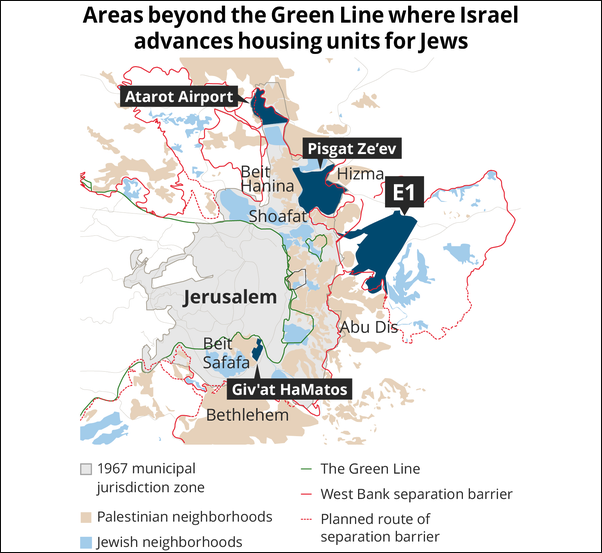
Map by Haaretz
- The E-1 Settlement: The Israel Civil Administration moved forward with advancing plans for the construction of the E-1 settlement, setting a date for a third hearing to discuss public objections to the plan (now set for November 8th). The first hearing was held on October 4th, but Palestinians were denied the ability to participate in that hearing (which was held virtually, making it inaccessible to the many Palestinians affected by the plan who do not have internet access). As a result, the Court scheduled this 3rd hearing (to allow the participation of Palestinians). The second hearing was held on October 18th; at that hearing three objections were presented (one by the Palestinian village of Anata, a second by the Palestinian village of Al-Azariya, and a third joint submission filed by Ir Amim and Peace Now). Ir Amim reports that there was no substantive discussion of these objections, with the Civil Administration panel offering no questions or comments on them. For more on the E-1 settlement plan, please see Terrestrial Jeruaslem’s excellent and thorough reporting.
- The Atarot Settlement: The Jerusalem District Planning Committee formally signaled that it will proceed with a hearing on the Atarot settlement plan – scheduled for December 6th – to build a huge new settlement on the site of the former Qalandiya airport (located at the northern tip of East Jerusalem). In its current form, the plan provides for up to 9,000 residential units for ultra-Orthodox Jews (assuming, conservatively, an average family size of 6, this means housing for 54,000 people), as well as synagogues, ritual baths (mikvehs), commercial properties, offices and work spaces, a hotel, and a water reservoir. If built, the Atarot settlement will effectively be a small Israeli city surrounded by Palestinian East Jerusalem neighborhoods on three sides and Ramallah to its north. Geopolitically, it will have a similar impact to E-1 in terms of dismembering the West Bank and cutting it off from Jerusalem. For more on the Atarot settlement plan, please see here.
- The Pisgat Ze’ev Settlement: The Israeli government advanced plans for 470 new settlement units in Pisgat Ze’ev, the largest settlement located in East Jerusalem.


Recap: Court Pushes for Palestinians to “Compromise” with Settlers in Sheikh Jarrah
The Israeli Supreme Court has set November 2nd as the deadline for Palestinian families living at risk of forced displacement in Shiekh Jarrah to decide wether or not to accept a Court-authored deal which would help them – at least temporarily – avoid eviction from their homes, in part by requiring them to recognize settler ownership over the properties.
Under the terms of the Court’s deal, which it is pressuring both parties to accept, the following would take place:
- The settler group Nahalat Shimon will be recognized as the owners of the site.
- The Palestinians will be recognized as protected tenants and be required to pay an nominal annual rental fee to the attorney of the settlers (in effect recognizing the settlers as the owners) but
- The Palestinians will be able to continue pursuing legal challenges to the underlying ownership of the land
- The Palestinians are permitted to renovate the properties without interference
- Settlers will be able to instigate eviction proceedings against Palestinians if they are in violation of the Court’s compromise agreement or in violation of Israel’s tenancy laws.
Terrestrial Jerusalem writes:
“The most problematic element of the settlement relates to the settlers’ ability to institute evictions even if the residents are not in violation of the agreement or of the tenancy laws. The settlers will be entitled to institute such proceedings in the event that the ownership rights are conclusively awarded to them, or after 15 years, the earlier of the two. This can be done if the settlers either wish to personally use the property or to demolish and rebuild. Under these circumstances, the settlers will need to offer the residents alternative equivalent quarters. Palestinian residents might hope settlers reject the deal to avoid having to make an ‘excruciatingly painful decision.’”
According to Terrestrial Jerusalem, the Court has signaled that further negotiations are acceptable, but that if either party rejects the agreement a decision on the eviction cases will be handed down swiftly.
New Report: State-Backed Settler “Tourism” Projects in East Jerusalem
In a new report entitled, “The Valley of Hinnom: Trees and Flowerbeds in the Political Struggle over East Jerusalem,” the Israeli NGO Emek Shaveh surveys the multitude of recent “tourism” projects jointly undertaken by the Elad settler organization and the Israeli government in the Ben Hinnom Valley — a strategic area between East and West Jerusalem (stretching past the 1967 Green Line), and located within the area designated by Israel as the Jerusalem “Walls National Park”.
Emek Shaveh writes:
“The nature of the tourism-settlement activity in the Valley of Hinnom conducted jointly by Elad and government authorities is familiar to us from the City of David/Silwan. The series of joint ventures such as the café, the Center for Ancient Agriculture and the cable car in effect hand over large expanses of land to the settlers of the Elad Foundation under the guise of tourism. Although unlike Silwan, the valley is sparsely populated, the activity there must be viewed as an integral part of the struggle for the Old City Basin of Jerusalem and as a means to clear this highly strategic area from the presence of Palestinians.”
In conclusion, we wish to emphasize the following points:
1 – Development in East Jerusalem is almost always driven by political objectives. Recent developments in the Valley of Hinnom are part of the grand plan to change the character and the landscape of the Old City Basin and ought to be considered an integral component of the settlement enterprise in the Palestinian neighborhoods surrounding the Old City.
2 – Halting the destructive development schemes in the areas surrounding the Old City is vital in order to preserve Jerusalem as a multicultural historic city and is indirectly essential for safeguarding the status quo at the holy places.
3 – The Palestinian protests against the expansion of the settlers’ grip over the open spaces such as the Hinnom Valley is part of the struggle by the residents of Silwan and the surrounding neighborhoods to preserve the character of their neighborhoods. In our view, one ought to view the various activities by the settlers and the authorities in the Historic Basin such as the expulsion of residents from their homes, taking over land and the shaping of a historic narrative as part of the same general bid to cement their control over the Historic Basin.”
Bonus Reads
- “[PODCAST] The Occupation & the Biden Administration” (FMEP ft. Danny Seidemann and Yehuda Shaul with Lara Friedman and Khaled Elgindy)
- “How offshore accounts turned the British Virgin Islands into an east Jerusalem landlord” (JTA)
- “Beita residents reach lands for first time since settler takeover” (Al Jazeera)
- “After Years of Neighborly Relations, Settlers Try to Foil Recognition of Palestinian Hamlet” (Haaretz)
- “Palestinian protests turn deadly as Israel considers the future of a new settlement” (NPR)
- “These Palestinian Families Face Eviction From Their East Jerusalem Homes” (Haaretz)
- “When Settler Becomes Native” (Jewish Currents)