Welcome to FMEP’s Weekly Settlement & Annexation Report. To subscribe to this report, please click here.
March 13, 2026
- WEST BANK: Mount Ebal, Sha’arei Tikva Expansion, Court Rejects One “Relocation” Plan
- SETTLER & STATE TERRORISM
- Further Reading
WEST BANK
Settlers Take Up Residence in New Settlement on Mount Ebal
Settlers have moved residential structures (pre-fab homes) into the area of the new settlement on Mount Ebal, on a hilltop overlooking the Palestinian city of Nablus and surrounding villages. Settlers have also reportedly prepared to move to the settlement in the coming weeks. T
The settlement on Mount Ebal was approved by the Israeli government in May of 2025, along with 21 other settlements including Homesh and Sa-Nur. Despite its location in Area B, the Israeli Central Command signed off on a jurisdiction area for the settlement composed of several non-contiguous pockets of “state land.”
Settlers have agitated and organized for a settlement on Mount Ebal for years. Mt.Ebal/el-Burnat is purported to be an antiquity site where the biblical prophet Joshua built an altar, originally identified as such in the 1980s by an Israeli archaeologist though the majority of professional archaeologists do not support that conclusion. Emek Shaveh, an Israeli NGO with expertise in archaeology, called the settler campaign to seize Mt. Ebal as a “watershed in Israeli archaeology.” In July 2023, Emek Shaveh reported that a triad composed of settlers, an American Christian evangelical organization, and the Israeli army collaborated on a recent unlicensed excavation on Mount Ebal, which Emek Shaveh called antiquity theft. Further, the groups transferred some 80 cubic meters of soil from Mount Ebal to the Shavei Shomron settlement, where settlers then promoted an opportunity for members of the public to join the archaeologists in sifting through the materials (thereby promoting tourism to the settlements). Haaretz called the excavation “is mainly used as a tourist attraction to the West Bank and is of little scientific significance.”
Civil Admin Advances Plans for Expansion of Sha’arei Tikva Settlement
The Israeli High Planning Council met on March 11th and advanced planning for 126 new settlement units in the Sha’arei Tikva settlement.
In 2018, the settler-aligned Arutz Sheva media outlet reported that Sha’arei Tikva was one of a number of settlements (Elkana, Sha’arei Tikva, Etz Efraim, and Oranit) that agreed to a plan to unite multiple settlements in the area into one “super settlement” and build the largest-ever settlement industrial zone. By uniting the settlements, Israel will significantly increase the footprint of developed land, allowing for massive projects like the industrial zone. The four settlements and the land between them are located in the “seam-line” zone, the area created by the weaving route of the Israeli separation barrier that was built to keep many settlements on the Israeli side of the barrier despite being east of the 1967 Green Line.
Israeli High Court Rejects State’s Plan for “Relocation” of Palestinian Village, Demands State Planning
The Israeli High Court rejected a plan by the State to relocate – – aka ethnically cleanse — the Palestinian village of Arab al-Ramadin from its land on the Israeli side of the Separation Barrier to a new location on the West Bank side. In a surprising position – the Court actually ordered the State to explain why it has not advanced planning for the Palestinian village, though such plans have been professionally prepared and proposed by the village residents with help from the Israeli NGO Bimkom.
Alon Cohen-Lifshitz of Bimkom told Haaretz:
“the state’s outrageous proposal for the forced transfer of Arab al-Ramadin was met with a wall by the Supreme Court, which is unprecedentedly demanding planning for the village in the place where it has been for many decades…The Israeli government must change its approach of ignoring the human rights of Palestinians in the West Bank and fulfill its duty to enable them to live safe lives with a future.”
IDF Demolishes Two Outpost While More Are Set Up
The IDF reportedly demolished the Shirat Zion outpost this week, located near Nablus.
It’s also reported that settlers established at least two new outposts:
- A new outpost near Nablus on the lands between the Palestinian villages of al-Lubban ash-Sharqiya, south of Nablus, and Yasuf, east of Salfit. Reports say settlers brough in a movil home and are working to establish a road to the area.
- A new outpost northwest of Jerusalem on the lands of Beit Iksa. Reports say 40 settlers were accompanied by the IDF while they brought in bulldozers and trucks to clear the land.
STATE BACKED SETTLER TERRORISM
It’s been another horrific week in the West Bank as settlers and IDF continue to terrorize Palestinians, with at least six Palestinians killed by settlers since Israel and the U.S. launched their war on Iran and at least 109 incidents of settler violence documented by Yesh Din as of March 11th. Key events over the past weeks include:
- Four Killed in Settler Pogrom on Khirbet Abu Falah (March 8th). Masked settlers raided the town at 2:00a, and, when Palestinians emerged from their beds to get the settlers to leave, the settlers shot and killed three. When the IDF arrived on scene, soldiers fired tear gas towards Palestinians, resulting in the death of a fourth man from suffocation. Khirbet Abu Falah is located northwest of Ramallah.
- Uniformed Settler Shoots, Kills One in Masafer Yatta region (March 7th). A settler-soldier serving on a regional defense reserve unit opened fire towards Palestinians in Wadi al-Rakhim who were attempting to herd settler livestock off of their privately owned fields. Two Palestinian brothers were hit, one died on scene and the other was transferred to a hospital in serious condition with a gunshot. Five days after the murder, settlers ransacked the family’s home. Kerem Navot documents the history of the settler, Luria Luski, who fired the kill shots,
- Settlers Set Fire to Homes in Masafer Yatta (March 11). Settlers set several structures on fire in the Khalwa village in the Masafer Yatta region south of Hebron. Palestinians report the settlers had raided the village earlier in the day, bringing flocks of sheep and a camel.
- Settlers raid Khirbet Homsa in the Jordan Valley (March 13), attacking Palestinian residents and activists. Activists report 30-40 settlers arrived in the middle of the night, handcuffed and beat people, and then stole 350 sheep. Settlers reportedly retreated to the nearby Beqaot settlement.
- Settlers ran over a young girl in Umm al-Khair (March 13). The girl was sent to the hospital with a head injury. The settler who allegedly ran her over was filmed leaving the scene.
- In Qusra, settlers filmed brutally assaulting a Palestinian man (March 13).
- Reserve soldiers filmed shooting at Palestinians in the village of Sa’ir (March 13), near Hebron. IDF arrived and allowed the shooters to leave without consequence.
Breaking the Silence writes:
“On Saturday, settler terrorists targeted Masafer Yatta, killing 28-year-old Amerr Shnaran, a father of two, near Susya. Later that night, between Saturday and Sunday, settler terrorists attacked Khirbet Abu Falah, killing two residents: 24-year-old Thaer Hamayel and 57-year-old Fare’e Hamayel. When the IDF arrived in Khirbet Abu Falah, it fired tear gas at Palestinians, killing 55-year-old Mohammad Marra, who suffocated from the gas. The attacks in Qaryut, Masafer Yatta, and Khirbet Abu Falah follow a disturbingly similar pattern: settler terrorists, often wearing IDF uniforms, enter Palestinian villages with firearms and kill people. Afterwards, instead of stopping the terrorists, the IDF punishes the very people whom they attacked.
Critically, the line between the IDF and the settlers is becoming increasingly blurred, with many attackers wearing IDF uniforms, serving in regional defence units, or using IDF-issued weapons. These attacks are yet another tragic piece of evidence of a coordinated effort by the IDF, the state of Israel, and settler terrorists to drive Palestinians from their land. On Thursday, these coordinated efforts forced the last families of the Bedouin community on the outskirts of Duma, Nablus district. To learn more about the eroding line between violent settlers and the IDF, see the new report by our partners at Yesh Din: “Settlers in Uniform: Violence Against Palestinians by Israelis in Military Uniforms.”
MK Ayman Odeh posted on X:
“Amid Netanyahu’s survival war, gangs of settlers move from village to village, sometimes alongside the army, and kill Palestinians simply because they are Palestinians.”
All of this occurs under the army’s protection and with government encouragement. This is an official, deliberate policy aimed at ethnic cleansing in the West Bank and the realization of the government’s messianic and fascist vision: more occupation, more killings and pogroms, more expulsions, and more annexation. The war with Iran will end, but as long as the occupation continues, the bloodshed will continue.”
Haaretz columnist Amira Hass writes:
“behind every scruffy teen or cowboy with a tzitzit and a gun is a long line of well-dressed lawyers and planners who graduated from the best universities, cabinet ministers and Jewish National Fund clerks, military commanders and heads and inspectors of the Civil Administration. The ones who for years pretended that “security” was the sole reason for declaring firing zones and prohibitions on land cultivation. The ones who, in the name of law enforcement, ordered the destruction of water cisterns and prohibited Palestinian communities from connecting to water and electricity. The ones who drafted and are drafting laws and orders that stipulate, in crude military language or in grandiloquent legalese, that public land will be allocated only to Jews. They are the ones who designed and authorized separation walls and highways so as to devour as much Palestinian farmland and future building lots as possible – on both sides of the Green Line, in the Negev and in the West Bank, including East Jerusalem. The Jewish holy terror, which reaches new heights every day, only greatly accelerates the bureaucratic violence and dispossession that the state has carried out for decades.”
BONUS READS
- “The Netanyahu Government Approves Hundreds of Millions for Settlements in Coalition Funds” (Peace Now, 3/11/2026)
- “Dirty Work by Nathan Thrall” (The New York Review, 3/26/2026 Issue)
- “In This Palestinian Village, There’s Nowhere to Hide From Iranian Missiles or Settler Pogroms” (Haaretz, 3/7/2026)
- “Sanctions on Israeli settlements are working – even without the US” (The Guardian, 3/10/2026)
- “Humanitarian Situation Report | 6 March 2026” (OCHA, 3/6/2026)
- “A Message to All IDF Soldiers: You May Rampage, Assault and Abuse, and You Will Never Be Punished” (Haaretz, 3/13/2026).
Welcome to FMEP’s Weekly Settlement Report, covering everything you need to know about Israeli settlement activity this week.
To subscribe to this report, please click here.
December 15, 2023
- Israel Expropriates More Land in Silwan For the Settler-Backed Cable Car Project
- Key Hearing on Givat Shaked Settlement Scheduled for Next Week
- Israel Government Planning Decision to Extend Domestic Construction Laws to Settlements (An Act of De Facto Annexation)
- Hamoked Seam Zone Petition Rejected by Supreme Court
- US Delays Rifles to Israel Over Settler Violence
- International Bans on Violent Settlers Grow, Even as Criteria is Unclear
- Bonus Reads
Israel Expropriates More Land in Silwan For the Settler-Backed Cable Car Project
According to reports, on December 10th the Jerusalem Municipality announced the expropriation of 10 dunams (~3 acres) of land in the East Jerusalem neighborhood of Silwan in order to enable the construction of the cable car project, which is promoted by (and designed to benefit) the Elad settler organization. Peace Now reports that the new expropriations are supposed to be “temporary”, and will expire in eight years, in order to allow the Municipality to survey and test the land to determine the final location of the giant pillars which will support the cable car. Once the location for the pillars is determined, that land will be permanently expropriated.

Image by Peace Now
Palestinian landowners were given 60 days to file objections to the “temporary” and future expropriation of their land.
As a reminder, the Jerusalem cable car project is an initiative backed by the powerful, state-backed Elad settler group and advanced by the Israeli Tourism Ministry. While public efforts to “sell” the cable car plan focused on its purported role in helping to grow Jerusalem’s tourism industry or in serving supposedly vital transportation needs, in reality the purpose of the project is to further entrench settler control in Silwan, via archeology and tourism sites, while simultaneously delegitimizing, dispossessing, and erasing the Palestinian presence there. The State of Israel was forced to publicly admit that the implementation of the cable car project will require the confiscation of privately owned Palestinian land in the Silwan neighborhood of East Jerusalem.
Notably, the cable car line is slated to terminate at the settler-run Kedem Center compound (Elad’s large tourism center, currently under construction at the entrance of the Silwan neighborhood, in the shadows of the Old City’s walls and Al-Aqsa Mosque).
The cable car project received final approval in May 2022, but the tender for construction has yet to be issued. Emek Shaveh speculates that the cable car tender might be issued on Jerusalem Day – which will be celebrated with ultranationalist, racist parades through the Old City next week — on May 18th and 19th. Emek Shaveh further warns that several other settler projects in East Jerusalem, including the Ben Hinnom suspension bridge and the zip line over the Peace Forest, are nearing completion and might also be part of Jerusalem Day celebrations.
Emek Shaveh and other non-governmental organizations, including Who Profits and Terrestrial Jerusalem, have repeatedly challenged (and provided evidence discrediting) the government’s contention that the cable car will serve a legitimate transportation need in Jerusalem, and have clearly enumerated the obvious political drivers behind the plan, the archeological heresies it validates, and the severe negative impacts the cable car project will have on Palestinian residents of Silwan. All objections to the plan were dismissed in May 2022.
Following the recent expropriation, Daniel Seidemann of Terrestrial Jerusalem says:
”Before relating to the significant geopolitical impact of the plan it is important to emphasize: the cable car is a crime against Jerusalem, regardless of who rules the city. Only those utterly detached from Jerusalem and its precious unique character could consider acting in a manner that will contribute to the transformation of Jerusalem into a Biblically themed theme park – the disneyfication of Jerusalem. The cable car was initiated by the settlers in Silwan, who were actively involved in promoting the plan.The cable car is part of a much broader scheme to seamlessly integrate occupied East Jerusalem into pr-1967 Israel, by surrounding the religious and historical core of the city with biblically motivated settlements and settlement-related projects. The settlers aspire by these means to transform their settlement enclave into an extension of pre-’67 Israel so as to include the settlement in the Palestinian neighborhood of Silwan.”
Key Hearing on Givat Shaked Settlement Scheduled for Next Week
Ir Amim reports that the Jerusalem District Planning Committee is scheduled to meet on December 19th for a hearing on objections to the Givat Shaked settlement submitted by the public. This hearing is one step towards the approval of the settlement plan, which outlines 700 settlement units (in 4 high-rise towers and several six-story buildings), a school, and commercial buildings, all to be built on a highly sensitive and geopolitically critical sliver of land located within the Palestinian neighborhood of Beit Safafa. Ir Amim further notes that the plan is advancing at a rapid pace, with this hearing coming just days after the close of the objection period. 
The plan for Givat HaShaked is unprecedented, according to the Israeli NGO Terrestrial Jerusalem, in that it is the first settlement of this size that that Israeli government will establish within a Palestinian neighborhood. Beit Safafa is already in the process of being completely surrounded by Israeli development (for Jewish Israelis) — most notably the new Givat Hamatos settlement, which the government is expanding.
The Israeli NGOs Bimkom and Ir Amim filed a joint objection to the Givat Shaked plan, contesting two factors:
- That the plan itself is unjust and discriminatory, the land designated for the settlement is inside of the Palestinian neighborhood Beit Safafa and should be used to address the severe housing crisis faced and lack of schools by Palestinian East Jerusalemites.
- The improper and exceptional role that the Israeli General Custodian has played in initiating a settlement plan for land which it does not own, but which it is a caretaker until the heirs of the land are located (more below).
As a reminder, the Israeli government has been sitting on plans for Givat HaShaked for decades, but has refrained from implementing them because doing so would require the government to seize a sizeable amount of land in East Jerusalem, some of which is privately owned by Palestinian residents of Sharafat (a section of the Palestinian neighborhood of Beit Safafa). Other parts of the land proposed to be used for the Givat HaShaked settlement plan are managed by the Israeli General Custodian (but neither owned or claimed by the government of Israel) – a fact Ir Amim calls “highly unusual and seemingly marks a new phenomenon.” The Israeli General Custodian is empowered by the State to act as a caretaker of land that has unknown ownership until the heirs are located. In an attempt to explain why the General Custodian has the authority to approve a plan for construction on land that the State does not own, the Israeli Justice Ministry told Haaretz that the plan for Givat HaShaked increased the value of the land and that “by law, the administrator general is obligated to care for the assets under his management in a way that will benefit their private owners.” This answer implies, bizarrely, that if and when Palestinian heirs are located, they will be somehow better off with their land having been used to build a settlement.
Another important facet of how Givat HaShaked is being advanced now is the decision by the Israeli government in late 2020 to initiate a (typically secret) registration process for land in East Jerusalem, including in the Sharafat area. At this time, it is unknown whether the land managed by the General Custodian in Sharafat (and designated for the new settlement) has been – or is in the process of being – registered. On that uncertainty, Ir Amim writes:
“…in the event that it is the same location [where formal land registration has taken place], this move would constitute yet another brazen example of how the settlement of title procedures are repeatedly being used to aid state authorities and settler groups in taking over more land in East Jerusalem…Although portrayed as a measure to ostensibly benefit Palestinian residents, there has been grave alarm that these [land registration and settlement of title] procedures would in fact be exploited to confiscate Palestinian land for political purposes, leading to the expansion of Jewish settlement and widespread Palestinian dispossession in the city.”
For a deep dive into land registration in East Jerusalem, please listen to a new FMEP podcast featuring Kristin McCarthy (FMEP) in conversation with Amy Cohen (Ir Amim).
Israel Government Planning Decision to Extend Domestic Construction Laws to Settlements (An Act of De Facto Annexation)
On X, Itay Ephstein (Senior Humanitarian Law and Policy Consultant and Special Advisor to the Norwegian Refugee Council) reports that the Israeli government is preparing to present within 30 days a detailed ordinance which, if approved, would extend Israel’s domestic planning and construction law to its settlements the West Bank. This would further Israel’s de facto and bureaucratic annexation of the West Bank through the application of Israeli domestic law in the occupied territory, and it would likely lead to a massive construction boom in the settlements. Currently, planning and construction in the West Bank is governed by the Israeli Defense Ministry within which Bezalel Smotrich serves as a civilian ministry in charge of all construction matters in Area C of the West Bank.
Hamoked Seam Zone Petition Rejected by Supreme Court
Hamoked reports that the Israeli Supreme Court has rejected two (1, 2) of its recent petitions seeking relief for Palestinian landowners and farmers who have been denied access to their agricultural land in the Seam Zone, the sizeable amount of West Bank land trapped between the Israeli separation wall the 1967 Green Line (i.e. land that was de facto annexed to Israel when Israel built the separation wall along a route the cuts deeply into the West Bank). The Court rejected the petitions in agreement with the State’s contention that, given the events of October 7th and after, it is dangerous to let Palestinians cross the wall and the military cannot supply the necessary troops to operate the designated gates where farmers can cross through the wall and access their land.
Hamoked reports that the Court accepted the security argument without dispute, and did not even discuss Israel’s legal obligations, under both Israeli and international law. Beyond the legal infringement on the rights of landowners, the inability of PAlstinians to harvest their crops not only deprives them of profit this year, but crops can suffer if not harvested – impacting production for years to come.
US Delays Rifles to Israel Over Settler Violence
Axios reports that the Biden Administration is slow-walking the sale of >20,000 M-16 rifles to the Israeli state amidst concern the rifles will end up in the hands of settlers and pressure on Israel to mitigate settler violence in the West Bank.
Despite holding up the sale of rifles, the Biden Administration has simultaneously bypassed Congress to finalize the sale of 14,000 tank shells to Israel for its war on Gaza (worth $106 million). According to Politico, the sale transfers not only 14,000 120mm M830A1 High Explosive Anti-Tank Multi-Purpose with Tracer tank cartridges, but also includes the provision of U.S. support, engineering and logistics.
The juxtaposition of these sales tracks with the Biden Administration’s increasingly focal concern for settler terrorism in the West Bank alongside its tight embrace of Israeli military actions in Gaza and in the West Bank.
International Bans on Violent Settlers Grow, Even as Criteria is Unclear
The United Kingdom is the latest government to announce that it will ban Israeli settlers who participate in violent crimes in the West Bank. European Union Foreign Minister Josep Borrell also announced his support for the EU imposing such a ban.
Though the number of countries to announce a settler ban policy, the mechanics for creating a list of sanctioned settlers is very murky. Haaretz reports that the countries who have announced the new ban policy are struggling with creating the criteria by which names can be added to a list of banned settlers. The U.S. appears to be operating independently of its allies’ complementary efforts to decided criteria and create a list. Part of the impetus behind the actions of these governments is the lack of prosecution and accountability by the Israeli government for settlers who have been involved in violent crimes, so relying on Israeli government actions cannot reasonably serve as a basis for action. And as the Israeli NGO Yesh Din has thoroughly documented for years – only 7% of crimes by settlers that are reported by Palestinians to the Israeli police (which is likely only a fraction of all the crimes) results in an indictment, even though video footage of settler crimes is now commonplace.
In its December 14th report, OCHA documents the following data on settler violence since October 7th
- Settlers are responsible for the death of 8 Paletinians and injuries to 85.
- Settlers have perpetrated at least 343 attacks against Palestinians, resulting in Palestinian casualties (35 incidents), damage to Palestinian-owned property (263 incidents), or both casualties and damage to property (45 incidents);
- Settler violence has contributed to the displacement of at least 189 Palestinian households comprising 1,257 people, including 582 children;
Bonus Reads
- ”Far-right minister calls for Israel to ‘fully occupy’ Gaza, reestablish settlements” (The Times of Israel)
- “How Israeli settler violence is forcing Palestinians to flee their homes – video” (The Guardian)
- “European Financial Institutions’ Continued Complicity in the Illegal Israeli Settlement Enterprise” (Don’t Buy Into Occupation)
Welcome to FMEP’s Weekly Settlement Report, covering everything you need to know about Israeli settlement activity this week.
To subscribe to this report, please click here.
November 5, 2021
- Sheikh Jarrah Families Reject Court-Proposed “Deal” with Settlers; Eviction Orders Expected Soon
- Supreme Court Rules Sheikh Jarrah Businesses – Built on Privately-Owned Palestinian Land But Near Settler Sites – Will Be Demolished
- Israel Demolishes East Jerusalem Muslim Cemetery, In Order to Make Way for Public Garden (& Increase Israeli Control Over Old City Perimeter
- Israeli Court OKs Refusal of Israeli Custodian of Absentee Properties to Disclose Extent of Control Over Palestinian Properties
- New Report from HaMoked: The ‘Seam Zone’ & Israel’s Ongoing Dispossession/Annexation
- Bonus Reads
Sheikh Jarrah Families Reject Court-Proposed “Deal” with Settlers; Eviction Orders Expected Soon
On Tuesday, November 2nd, four families facing imminent eviction from their longtime homes in Sheikh Jarrah in favor of settlers released a statement rejecting a Court-authored “compromise” that would have allowed the families to temporarily remain in their homes as “protected tenants” paying rent to settlers, whose ultimate ownership over the properties would be made official (but technically – though not realistically – still open to legal challenge by the Palestinians). You can review the full terms of the deal here.
The Court ordered both parties to respond to the “deal” by November 2nd. It was only after the Palestinians put forth their statement that we learned that the settlers reportedly accepted the terms, as relayed by Jerusalem Deputy Mayor Arieh King, a staunch supporter and prolific financier of settlements in East Jerusalem, to the AP (this information remains unconfirmed, as the settler-submitted position has not been published).
It’s important to point out — as the Palestinian families note in their statement — that the Court’s handling of the case neatly constructed a lose-lose scenario for the Palestinians. If they had accepted the deal they would have been painted as legitimizing the theft of their property and the claims of the settlers. When they instead refused it, they were immediately painted as rejectionists, in contrast to the settlers who — having waited for Palestinians to reject the deal — positioned themselves as the “reasonable” party in the eyes of the Court.
Both parties were under pressure from the Court to accept the deal. According to Terrestrial Jerusalem, the Court has previously indicated that if either party rejects the deal, the Court would move to swiftly issue a final decision on the cases. Peace Now’s analysis of the Supreme Court’s position predicts that the Court will now rule in favor of the settlers (leading to the eviction of the Palestinian families), like lower Courts have done.
Jerusalem expert Daniel Seidemann also predicts that the Court will rule against the settlers, further speculating:
“There will likely be an eviction verdict [against] the Palestinians soon. Bennett/Lapid will say “we won’t carry out the eviction”. They will likely be sincere – and wrong. One coalition crisis, one terror attack and they will be evicted. This is very bad indeed.”
The statement of rejection from the Palestinians families (the El Kurd, Jaouni, Abu Hasna, and Askafi families) is worth reading in full:
“We reject the ‘proposal’ by the ‘Israeli Supreme Court’ which would have rendered us ‘protected tenants’ at the mercy of settler organizations. We stand firm in our refusal to compromise on our rights despite the lack of institutional guarantees that would protect our presence as Palestinians in occupied Jerusalem.
The Israeli justiciary is circumventing its duty to adjudicate the case and is forcing us instead to choose between our own dispossession or submitting to an oppressive agreement. Naturally, we refuse to commit someone else’s crimes.
Such ‘compromises’ create the illusion of the ball in our court, fabricating a farming in which we reject a ‘generous deal,’ in a situation where our dispossession would still be imminent and our homes would still be regarded as someone else’s. Such ‘deals’ distract from the crime at hand: ethnic cleansing perpetrated by a settler-colonial judiciary and its settlers.
The international community has long maintained that settler expansion and forced expulsion in Sheikh Jarrah are war crimes. Thus it must respond to grave international law violations with real diplomatic and political repercussions. The culture of inaction and impunity must not be maintained.
It is time for our Nakba to end. Our family deserve to live in peace without the looming ghost of imminent dispossession.”
On November 10th, Ir Amim is hosting a briefing with MK and lawyer Gaby Lasky on the Sheikh Jarrah and Silwan cases. RSVP here.
Supreme Court Rules Sheikh Jarrah Businesses – Built on Privately-Owned Palestinian Land But Near Settler Sites – Will Be Demolished
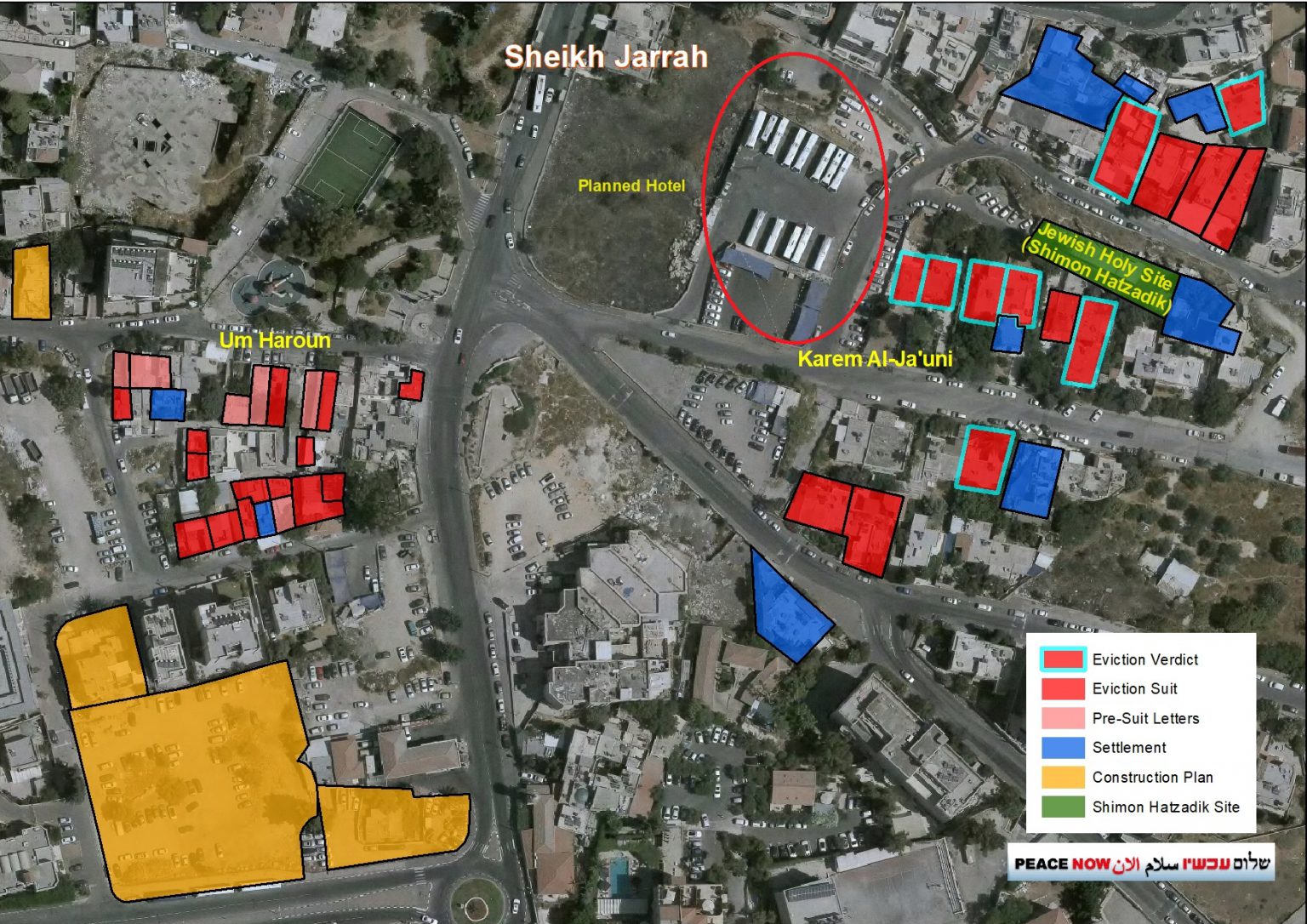
Map by Peace Now
On October 31st, the Israeli Supreme Court rejected the appeals of Palestinian business owners seeking to save their establishments located in the Sheikh Jarrah neighborhood from demolition. The businesses – a bus parking lot and a carwash – are now cleared to be demolished in order to make way for a “public garden” as well as a driveway that will service an as-of-yet-unbuilt Israeli hotel in the neighborhood. Notably, the businesses are located very close to the tomb of Shimon the Righteous, which is a religious site closely associated with the settler enclave in Sheikh Jarrah.
The Jerusalem Municipality previously expropriated the land — which was privately owned by Palestinians – on which the businesses exist. The land was expropriated “for public use,” a tactic that Israeli law permits the State to use in order to confiscate even privately owned land ostensibly to benefit the “public” (a “public” that it seems never includes Palestinians in East Jerusalem), if the State finds it necessary.
Offering critical context, Peace Now raises several absurdities regarding the land expropriation order:
“The decision to expropriate raises several questions. First, the timing. As far as we know to date, no application has been opened for a construction permit for the construction of the hotel. That means there do not appear to be any procedures for starting construction of the hotel soon. The designation for open public space is directly related to the hotel, so it is not clear why it was urgent for the municipality to act right now. We will also mention that the State Comptroller recently remarked to the Ministry of Transportation about the severe shortage of hundreds of parking spaces for buses in Jerusalem, and now the Municipality is cancelling parkings of dozens of buses.
Another issue to wonder about is the proximity of the area to the area of the tomb of Shimon the Righteous (Shimon Ha’tzadik), which is a pilgrimage site for Jews, especially ultra-Orthodox, throughout the year. It is possible that the municipality’s desire to carry out the expropriation is related to the desire to act for the benefit of Jewish visitors to the neighborhood and to allow the Israeli grip of the neighborhood to expand, even if it is formally an open public space intended for the entire Israeli and Palestinian public. Another issue to wonder about is the proximity of the area to the area of the tomb of Shimon the Righteous (Shimon Ha’tzadik), which is a pilgrimage site for Jews, especially ultra-Orthodox, throughout the year. It is possible that the municipality’s desire to carry out the expropriation is related to the desire to act for the benefit of Jewish visitors to the neighborhood and to allow the Israeli grip of the neighborhood to expand, even if it is formally an open public space intended for the entire Israeli and Palestinian public.”
While the court case that will lead to the demolition of the Palestinian businesses in Sheikh Jarrah is not formally linked to the ongoing effort to forcibly dispossess four Palestinian families of their homes in this same neighborhood, radical Kahanist Itamar Ben Gvir did not shy away from making the (obvious) connection between the two cases, commenting that the demolition of the businesses is a:
“necessary step, and now is the time to also evacuate the families of Sheikh Jarrah.”
Israel Demolishes East Jerusalem Muslim Cemetery, In Order to Make Way for Public Garden (& Increase Israeli Control Over Old City Perimeter)
For over ten consecutive days, the Jerusalem Municipality and the Israeli Parks and Nature Authority have been demolishing parts of the Yusufiya cemetery near the Al-Aqsa Mosque in order to turn the area into yet another “public park”. The area in question includes a monument to, and graves of, Palestinians and Jordanians who fought in the 1967 war. Palestinians, many of whom fear that their relatives’ graves will be demolished and exhumed (fears that the Jerusalem Municipality has sought – and failed – to assuage) have protested and clashed with Israeli authorities as they attempt to stop the desecration of the cemetery, the erasure of Arab history, and denial of Palestinian life in the city.
Aviv Tatarsky, a researcher at the Ir Amim, explained:
“The park in question is part of a series of government-funded projects which aim to link settler compounds in the Old City Basin…Similar projects are taking place on the Mount of Olives, [in] Silwan and [in] Sheikh Jarrah…The incidents at the Yusufiya Cemetery are an extreme example of the Israeli government’s lack of respect toward Palestinian property rights, heritage and holy places and its determination to make over the Old City Basin.”
The Grand Mufti of Jerusalem, Muhammad Hussein, told Al-Monitor:
“The cemeteries are part of the identity of the holy city and its narrative, and evidence of the Arab and Islamic presence in the city for thousands of years. Obliterating the city’s landmarks is in the interest of the Jewish settlement project and the Israeli narrative, which is embodied by changing the names of Arab cities, neighborhoods, and streets, and the Judaization of public places and landmarks.”
Hamza Quttaineh, a lawyer advocating for the Martyrs’ Cemetery before the Israeli courts, told Middle East Eye:
“There are huge machinations undertaken by the occupation municipality, along with the Israel Nature and Parks Authority and the judicial system, that provide the legal coverage needed for the Judaisation project encompassing the historical wall of Jerusalem’s Old City.”
Israeli Court OKs Refusal of Israeli Custodian of Absentee Properties to Disclose Extent of Control Over Palestinian Properties
Haaretz has in-depth reporting on a recent freedom of information case relating to the Israeli Custodian of Absentee Properties. The Custodian of Absentee Properties is a government body within the Israeli Finance Ministry that has possession of properties in East Jerusalem that under Israel’s “Absentee Property Law” were “abandoned” by Palestinians during and after the 1948 war, becoming the property of the Israeli state.
In response to a freedom of information request, the Custodian refused to disclose the number of “absentee” properties that it currently controls. The Custodian – Ronen Baruch, who has held the position since 2005 – gave multiple excuses for refusing the request, asserting at different points that his office doesn’t know how many properties it controls, that the process of gathering that information is too complicated, and that revealing this information may compromise the country’s foreign relations (ultimately the winning argument).
During the subsequent Court hearing on the freedom of information request, a senior official from the Israeli Foreign Ministry was granted permission to privately brief the judge, after which the judge ruled against the freedom of information request – a ruling the petitioners intend to appeal. The judge wrote,
“I have been convinced that the disclosure of the requested information may jeopardize the state’s foreign relations…I am satisfied that delivery of the information will cause an unreasonable allocation of resources… Which may disrupt and even paralyze the Custodian’s work.”
The two Israeli lawyers who filed the freedom of information request (Amir Adika and Ram Cohen) told Haaretz:
“What harms the state’s foreign relations? Revealing the information, or the very existence of the law, over 70 years after the country’s founding?…This law is very powerful in regard to the state’s authority over people’s private property…There is public and economic importance in knowing how it conducts itself with this power, how many such properties there are, how many they release, how many they sell. This is a very unconventional law. The impression is that they’re either presenting a very imprecise picture, or that they’re not managing at all.”
As a reminder, Israel’s Absentee Property Law affords Jews the right to reclaim property they owned in East Jerusalem and the West Bank in the period before Israel became a state in 1948, and that they were forced to abandon as a result of the 1948 War. Israel’s law affords no such right to Palestinians who as the result of that same war were likewise forced to abandon property inside what became the State of Israel. After the war, Israel designated such properties “absentee properties” control over which was transferred wholesale to the Israeli state. Use of the Absentee Property Law by settlers organizations with the willing participation of the Israeli government is a key legal mechanism behind past, present, and future evictions of Palestinains from the most sensitive areas of East Jerusalem (like Sheikh Jarrah and Silwan) where Palestinians are facing mass eviction.
New Report from HaMoked: The ‘Seam Zone’ & Israel’s Ongoing Dispossession & Annexation
In a new report, entitled “Creeping Dispossession: Israeli Restrictions on Palestinian Farming Beyond the Barrier,” the Israeli NGO HaMoked takes an in-depth look at the Israeli military bureaucracy which governs – – and systematically infringes upon — the right of Palestinian landowners and farmers to access and effectively cultivate their land which falls in the “Seam Zone” (i.e. the West Bank land that, when Israel constructed its Seperation Barrier along a route that cuts deeply into the West Bank, was left on the Israeli side of the wall/fence).
This important topic shows just how Israel’s policies work to systematically dispossess these Palestinians of their land. The report sarts with an important reminder about the “original sin” involved in this dispossession — Israel’s choice to build its separation barrier not along the 1967 Green Line (which, at the time of the barriers conception in 2002 was an internationally agreed upon divider between Israeli territory and occupied territory) but instead along a route that, for the sake of keeping settlements (and land upon which to expand settlements) on the Israeli side of the barrier, de facto annexed some 9.4% of West Bank land to Israel. [map] The West Bank lands which fell on the Isareli side of the barrier – the “Seam Zone” – were declared “closed military zones,” requiring Palestinians who live on the other side of the barrier to traverse a complicated Israeli bureaucracy in hopes of obtaining access their land (or the land upon which they are employed to cultivate). The matter gets even more complicated from there.
HaMoked writes in conclusion:
“Nearly two decades since the construction of the Barrier, we see the logic of a creeping dispossession – more and more restrictions on Palestinians trying to access areas trapped between the Barrier and the Green Line, and as a result, fewer and fewer people willing to navigate the permit bureaucracy Israel has put in place. Any agricultural community will tell you that land is not merely functional. The land is a source of produce and income, but its benefits cannot be quantified solely in monetary terms. The land is also a site for family and community events, and connection to the land is integral to the local culture. For dozens of Palestinian communities, and tens of thousands of people, all of this has been destroyed by the Separation Barrier. Even those who receive permits to cross the gates during their limited opening hours cannot have a picnic with their family or a spontaneous outing to their land as they once did.
The permit regime reverses the basic logic of international law, that individuals enjoy freedom of movement within their own country, and that movement can only be restricted with just cause. For Palestinians living near the Separation Barrier that Israel built on a route that cuts through the West Bank, free movement is the exception, and the restriction on movement is the rule. And whereas initially Israel promised access to lands behind the Barrier except when security needs warrant precluding access, now no security need is required to deny access. Instead, the premise of the permit regime is now that only Palestinians who prove a need to enter these areas will be allowed to do so. Furthermore, the military periodically amends its definition of “need” to be more and more narrow.
HaMoked has had success in overcoming some of the restrictions: individuals who were denied permits eventually received them following litigation; some restrictive policies have been reversed and others are still under judicial review. However, none of this changes the overall picture emerging from this report: steadily increasing restrictions on Palestinians’ access to the areas of the West Bank known as the Seam Zone have decimated the livelihoods of individuals, families and entire communities.”
Bonus Reads
- “Israel OKs Palestinian homes after advancing settlements” (AP)
- “Israeli forces demolish Palestinian-owned house in occupied Jerusalem” (Quds News Network)
- “Thirty Years On: The Ruse of the Middle East Peace Process” (Inez Abdel Razek for Al-Shabaka)
- “Israel Moves to Silence the Stalwarts of Palestinian Civil Society” (Zena Agha in The New York Times)