Welcome to FMEP’s Weekly Settlement Report, covering everything you need to know about Israeli settlement activity this week.
To subscribe to this report, please click here.
May 1, 2020
- International Criminal Court Chief Prosecutor Concludes: YES, Palestine is a State & Court has Jurisdiction to Investigate Alleged Israeli (and Hamas) War Crimes
- Netanyahu: Annexation Will Happen in “A Couple Months”; US again Signals UNCONDITIONAL Support
- Leading East Jerusalem Settler Poised to Become Deputy Mayor of Jerusalem
- Updates on Three Settler-Backed Projects in Silwan
- Joe Biden Says He Will Keep Embassy in Jerusalem, [kind of] Re-Open the Consulate, & Recommit to the Two-State Solution
- Bonus Reads
Comments/questions? Contact Kristin McCarthy (kmccarthy@fmep.org).
International Criminal Court Chief Prosecutor Concludes: YES, Palestine is a State & Court has Jurisdiction to Investigate Alleged Israeli (and Hamas) War Crimes
On April 30th, the Chief Prosecutor of the International Criminal Court, Fatou Bensouda, filed her opinion with an Pre-Trial Chamber arguing that Palestine can be considered a state and therefore the Court does have jurisdiction over alleged crimes committed by parties in Palestine. Previously, in January 2020, Bensouda determined that there was reasonable basis upon which to open an investigation, but convened a Pre-Trial Chamber to rule on the issue of the Court’s jurisdiction. If the pre-trial Chamber determines that the Court has jurisdiction, a case can be opened into the matter of alleged Israeli war crimes in the West Bank, East Jerusalem, and Gaza Strip, as well as alleged crimes committed by Hamas in Gaza. The Pre-Trial Chamber does not have a deadline for making their ruling, but is expected to do so in the next 120 days.
Bensouda’s detailed (60-page) decision concludes that the Oslo Accords – signed by the Palestinian Authority and Israel – are a credible legal basis for establishing Palestine as an internationally recognized state. Her influential legal opinion also directly and systematically refutes the amicus curiae briefs filed by several countries, including Germany (the second largest funder of the ICC), arguing that Palestine is not a state and that the Court does not have jurisdiction. Czech Republic, Austria, Australia, Hungary, Brazil and Uganda also filed briefs along those lines. The brief also systematically rebuts the raft of arguments made by various international lawfare organizations asserting that the Court has no right to investigate (the decision is well worth reading in full).
Netanyahu: Annexation Will Happen in “A Couple Months”; US again Signals UNCONDITIONAL Support
On April 26th, Prime Minister Netanyahu announced his belief that annexation will be realized in “a couple months” and that he is “confident” that President Trump will recognize that annexation. Under the recent coalition agreement signed by Netanyahu and Benny Gantz, annexation will have to wait until at least July 1st.
Netanyahu’s confidence in the Trump Administration’s support for Israeli annexation plans rests on solid footing. As a reminder, on April 22nd Secretary of State Mike Pompeo called annexation an “Israeli decision.” The remarks drew attention because of the existence of a joint U.S.-Israeli mapping committee, which suggests an active U.S. role in deciding the extent of Israel’s annexation, and which gives the appearance, at least, that the Trump Plan is something less than a carte blanche for Israel to annex whatever it chooses.
On April 27th, a spokesperson for the Department of State elaborated on Secretary Pompeo’s remarks in a statement to The Times of Israel:
“As we have made consistently clear, we are prepared to recognize Israeli actions to extend Israeli sovereignty and the application of Israeli law to areas of the West Bank that the vision foresees as being part of the State of Israel…in the context of the Government of Israel agreeing to negotiate with the Palestinians along the lines set forth in President Trump’s Vision…The annexation would be in the context of an offer to the Palestinians to achieve statehood based upon specific terms, conditions, territorial dimensions and generous economic support. This is an unprecedented and highly beneficial opportunity for the Palestinians.”
These remarks drew dramatic headlines suggesting that now, after more than three years of statements and policies aligned with Israel’s pro-annexation right, Trump is pumping the brakes by making U.S. support conditional on Israel agreeing in principle to the establishment of a Palestinian state (which, under the Trump Plan is, would be a non-autonoumous/non-sovereign entity). Unsurprisingly, within 24 hours of the first headline offering this analysis, an official at the U.S. Embassy in Jerusalem clarified the policy, making it emphatically clear that U.S. support for Israel’s annexation of West Bank territory is in no way connected to, or conditioned on, the issue of a future Palestinian state. The official said:
“Our position has not changed. As we have made consistently clear, we are prepared to recognize Israeli actions to extend Israeli sovereignty and the application of Israeli law to areas of the West Bank that the [Trump peace plan] foresees as being part of the State of Israel. This will give the Palestinians an opportunity to come to the table and negotiate a peace agreement that will result in the establishment of a state of their own. The United States stands ready and willing to offer wide-ranging assistance to facilitate a final peace agreement.”
While it was clearly a stretch to read the State Department remarks as the unveiling of a new U.S. policy conditioning approval of annexation on some kind of concession to the Palestinians or on the two-state solution, the difference in tone/content of the two statements highlights the longstanding disconnect between the U.S. State Department and the Embassy in the Trump era. This disconnect is largely attributable to the close relationship and direct line that U.S. Ambassador David Friedman enjoys to the White House, to the exclusion of the State Department. Friedman — who is a key member of the joint mapping committee, a key architect of the Trump Plan, and whose views and statements have consistently been more indicative of the direction of U.S. policy than those of the State Department’s spokespersons — has publicly disregarded the necessity of Palestinian involvement in implementing the Trump Plan, in contrast with the State Department’s statement this week. For a refresher on Friedman’s anti-two-state, anti-Palestinian views, recall this excellent list of quotes compiled by APN.
In the context of Amb. Friedman’s centrality in setting U.S. policy on annexation, a recent tweet from Friedman in celebration of the 100th anniversary of the San Remo Resolution is notable. The resolution gave Great Britain a mandate to rule the historic region of Palestine and formally conferred recognition to the Jewish people’s right to establish a national homeland there. Haaretz explains that the San Remo Resolution is increasingly cited by “Greater Israel” advocates as a legal basis for Israeli claims to the entire area at the expense of Palesttinian national aspirations, based on the fact that the British mandate was over all the land, including the West Bank and Gaza Strip. Friedman tweeted:
“Recalling today the 100th anniversary of the San Remo Resolution, whereby the world powers recognized the ancient connection of the Jewish people to the Land of Israel and the right of the Jewish people to a national home on that land was given the force of International Law.”
Leading East Jerusalem Settler Poised to Become Deputy Mayor of Jerusalem
Jerusalem’s Mayor Moshe Leon is seeking approval to appoint notorious settlement empresario Arieh King to be his Deputy Mayor, a move which will further empower King – who has served as a city councilman since 2013 – to promote ideologically-motivated settlement projects throughout East Jerusalem.
King openly calls for the “Judaization of Jerusalem,” and is behind many unprecedented, ideological settlement plans, including currently advancing plans to build the first-ever settlement enclave inside of the Beit Hanina neighborhood of East Jerusalem. Most infamously, King has led and financed a longtime effort to evict Palestinians from their homes in the Sheikh Jarrah neighborhood in East Jerusalem. In this effort he sometimes uses Arab middle-men and at other times he has found and convinced Jewish heirs to Sheikh Jarrah properties to “reclaim” the property under Israel’s Absentee Property Law and then to transfer the properties for use by settlers.
King is also behind the ongoing drive to build new, official settlements in Sheikh Jarrah, for which he has received expedited approvals from the city planning committees. King is also involved with plans to expand the settlement enclave of Nof Zion in the Jabal al-Mukhaber neighborhood of East Jerusalem.
A member of the City Council from the Meretz Party, Laura Wharton, threatened to quit the city’s governing coalition over King’s appointment. King responded by making clear that as Deputy Mayor he would, indeed, continue to focus on settlement in East Jerusalem – and snarkily suggested that for this very reason, the Meretz member should support him. King told Haaretz:
“I’m very surprised that Laura Wharton is threatening to leave. After all, she knows full well that she will have no better partner than I in improving the infrastructure in East Jerusalem, and in listening to the needs of its residents. I hope the Meretz branch [whose members] I consider staunch political opponents will step up and see the advantages in my becoming deputy mayor, by which East Jerusalem will undoubtedly receive more attention from the municipality…”
Updates on Three Settler-Backed Projects in Silwan
Emek Shaveh this week provided updates on three settler-backed projects in Silwan, two of which have continued progressing despite the nation-wide lockdown to stop the spread of the coronavirus.
First, Emek Shaveh reports that construction on the “stepped street” section of the archeological site called the “Pilgrim’s Road” continued throughout the months of March and April. The project is driven by the radical Elad settler group, and is located beneath the Wadi Hilweh section of Silwan, a Palestinian neighborhood in East Jerusalem adjacent to the Temple Mount/Haram Al-Sharif. Infamously, U.S. Ambassador David Friedman and then-White House advisor Jason Greenblatt took part in the opening of the site in June 2019, including a gratuitous photo-op – a sign that made clear the Trump Administration’s support not only for settlement schemes, but for their larger agenda of consolidating Israeli sovereignty over even the most contentious areas of East Jerusalem.
Elad launched its excavation of the “Pilgrim’s Road” in 2007, with the full support of the Israel Antiquities Authority (IAA). For more background on the tunnels and how radical Israeli settlers have exploited excavation, tourism, and the ancient character of Jerusalem in order to serve their ideological agenda – see the comprehensive reporting by Emek Shaveh.
Second, Emek Shaveh reports that Elad has continued construction on transforming a house located in Jerusalem’s “Peace Forest” into a tourism center that will be used as the base for a settler-run tourism project — a zipline slated to traverse the Forest’s canopy. The zipline will connect the “Peace Forest” in the Abu Tor neighborhood to another popular tourism site, the Armon Hanatziv promenade. Coming in at 2,570 feet, this will be Israel’s longest zipline and will travel over the Palestinian neighborhood Jabal al-Mukaber. Renovations of the house are paid for by the Israeli Ministry of Housing, which allocated 43 million NIS ($12.38 million USD) for the project. The House – which the settlers have named “Beit Shatz” – was purchased by Elad as part of Elad’s broader efforts to use tourist projects as a means for taking control over the area, which is situated in a national park.
The behavior of Elad and the Israeli government in the Peace Forest underscores the the systematic discrimination in planning policies and enforcement facing Palestinians in Jerusalem. The several Palestinian families living in the “Peace Forest” and are prohibited from building or expanding/renovating their homes because of the strict building prohibitions for national parks. Elad managed to circumvent those same restrictions by pushing the Jerusalem Municipality to request that the area they are targeting be designated as an “open public space,” which would allow the project to advance. In December 2019, Jerusalem planning authorities granted the settler-backed request. That same month, Israel pursued demolition orders against Palestinian homes in the Peace Forest that lacked building permits, despite the fact that in some cases Palestinians have repeatedly applied for and been denied permits.
Third, Emek Shaveh also reports that progress on the controversial East Jerusalem cable car project has been stalled due to the coronavirus shutdown. Emek Shaveh reports:
“Following its approval by the National Infrastructure Committee in June 2019, and the 200 million NIS government allocation, the project was to enter the tender phase. However the bidding process for an international company specializing in the construction of cable cars has been hampered by the pandemic. Our [Emek Shaveh’s] appeal to the High Court against the project is scheduled for June.”
Joe Biden Says He Will Keep Embassy in Jerusalem, [kind of] Re-Open the Consulate, & Recommit to the Two-State Solution
Speaking at a virtual fundraising event on April 29th, presumptive Democratic presidential nominee Joe Biden told supporters that he would keep the U.S. Embassy in Jerusalem despite the fact he disagrees with the Trump Administration’s decision to move the embassy there from Tel Aviv. As a reminder, in February 2020 the New York Times published the results of its survey of Democratic candidates policies vis-a-vis Israel. In response to the question, “Should the United States Embassy in Israel be moved from Jerusalem back to Tel Aviv?” Biden – like every candidate other than Sanders and Warren – responded with a clear answer: “No.”
Biden also told supporters that he would “re-open” the U.S. Consulate in Jerusalem in order to facilitate talks with the Palestinians toward a two-state solution. As a reminder: shortly after the Trump Administration moved the Embassy from Tel Aviv to Jerusalem, it closed the U.S. Consulate and Ambassador Friedman began converting the compound into his personal residence. Simultaneously, Friedman created a “Palestinian Affairs” unit in the new Embassy, signaling that henceforth the U.S. would treat Palestinians and Palestinian-related matters not as merely as a subset of issues between the U.S. and Israel, rather than part of a U.S.-Palestinian bilateral relationship. the U.S. was represented in Jerusalem by a Consulate General from 1844 until the mission was closed by the Trump Administration in March 2019. From the start of the peace process in the 1990s until its closure, the Consulate served as the de facto U.S. diplomatic mission to the Palestinians, and was a central player in advancing U.S. efforts to broker a negotiated end to the conflict. Notably, Biden’s comments this week suggest that he may not be talking about a re-opening of the Consulate to function as it had in the past, so much as a re-purposing of the Consulate to serve a specific, limited function.
While Biden reportedly did not say anything about annexation during his fundraising call (and has conspicuously refrained from commenting on the issue since the Israeli unity government agreement made annexation an imminent reality), on April 28th his senior foreign policy advisor Tony Blinken told a group of supporters that Biden opposes annexation on the basis that it contradicts the two-state solution and would be bad for Israel. According to Blinken, Biden has said:
“on the record several times [that] unilateral steps taken by either side that make the prospect of a negotiated two-state outcome less likely is something he opposes, and that includes annexation. In many ways, pulling the plug on a two-state solution is pulling the plug, potentially, on an Israel that is not only secure but is Jewish and democratic — for the future. That’s not something any of us, who are ardent supporters of Israel, would want to see.”
Bonus Reads
- “Can Anyone Stop Netanyahu’s Annexation Plans?” (Al-Monitor)
- “Arab League slams West Bank annexation plans as ‘war crime’” (Al-Monitor)
- “Lots of bark, some actual bite? How the world will react to West Bank annexation” (The Times of Israel)
- “Europeans formally protest West Bank sovereignty plans” (Jerusalem Post)
- “Israel doesn’t need ‘advice’ against annexation — it needs consequences” (+972 Magazine)
- “WEBINAR: The Legal Impacts of Annexation w/ Michael Sfard” (J Street)
- “Israeli annexation plans would lead to ‘cascade of bad human rights consequences’, says UN expert” (UN)
- “How should Palestinians respond to Israeli threats of annexation?” (Al Jazeera)
- “Lots of bark, some actual bite? How the world will react to West Bank annexation” (The Times of Israel)
Welcome to FMEP’s Weekly Settlement Report, covering everything you need to know about Israeli settlement activity this week.
To subscribe to this report, please click here.
April 17, 2020
- Abbas Warns that Israel & U.S. Will Annex While World is Dealing with Coronavirus
- Work of U.S.-Israeli Mapping Committee Continues, Israel Readying Requests for More Land and Roads in West Bank
- “Hilltop Youth” Settlers Attack Palestinians, Leave Quarantine Outpost with Stolen IDF Gear
- More Reports of Settlers Taking Advantage of the the COVID Shut Down
- Israel Prioritizes Undermining PA over Fighting COVID in East Jerusalem
- Who Profits Resource: VIRAL OCCUPATION
- New Analysis by Ir Amim: “Trump Plan” Accelerates Apartheid Reality
- Bonus Reads
Comments or questions – email Kristin McCarthy (kmccarthy@fmep.org).
Abbas Warns that Israel & U.S. Will Annex While World is Dealing with Coronavirus
Palestinian Authority President Mahmoud Abbas has called the heads of several Arab governments – Saudi Arabia, Qatar, Bahrain, Kuwait – to beseesch them to intervene to stop possible annexation of parts of the West Bank by Israel. Abbas called upon the governments to urgently express their opposition to annexation to their Israeli counterparts.
Another senior Palestinian official warned about moves to implement annexation while the world’s attention is focused on the COVID-19 crisis. PA Social Affairs Minister Ahmad Majdalani said in a statement:
“Uncovered reports that Washington and Tel Aviv are about to agree on the maps of annexation – at a time the world is preoccupied with the war on coronavirus – falls within the framework of the US plan to implement the ‘deal of the century”
Following Abbas’ calls, Secretary of the Arab League, Mr. Ahmad Aboul Gheit, sent letters to leaders around the world – including the United Nations Secretary General, U.S. Secretary of State Mike Pompeo, the Foreign Ministers of Russia, Britain, China and Germany, as well as the Foreign Policy Representative of the European Union (EU). The letters warned of severe repercussions if annexation goes forward, and urged the international actors to prevent it.
Work of U.S.-Israeli Mapping Committee Continues, Israel Readying Requests for More Land and Roads in West Bank
Ronen Peretz, the Director-General of the Prime Minister’s office, told a right-wing Israeli newspaper that the joint US-Israeli committee tasked with mapping Israel’s annexation of West Bank land as part of the Trump plan is continuing its work, despite the COVID-19 pandemic. Peretz, who is a member of the joint mapping committee, said that the Israeli side is working on a set of proposed amendments to the U.S. conceptual map, seeking to expand the amount of land annexed by Israel.
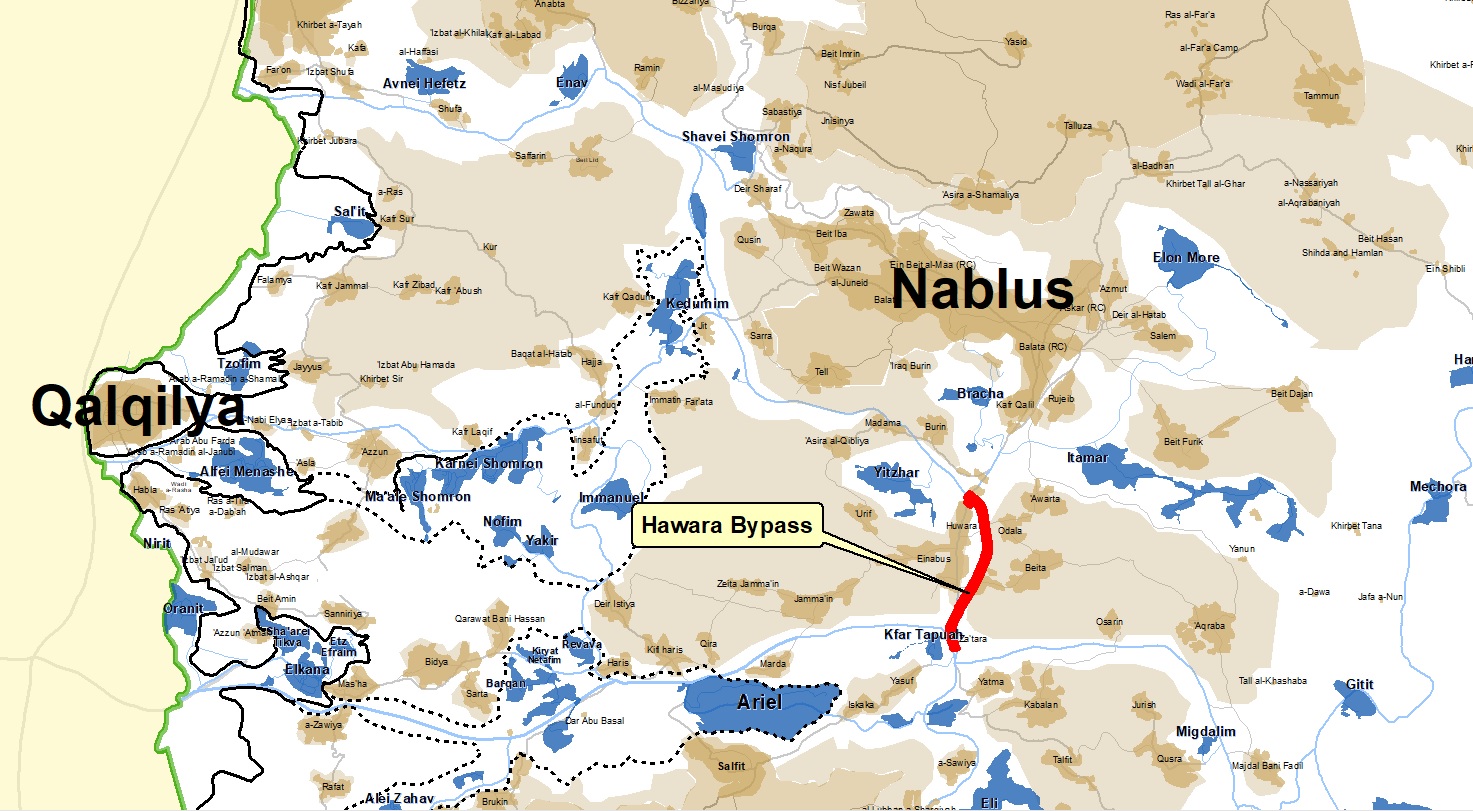
Map by Peace Now
For example, Peretz said that Israel will ensure that a new bypass road for settlers, planned to be built near the Palestinians city of Nablus deep in the central West Bank, is annexed to Israel. In the Trump Plan conceptual map, the area where the road will be falls within the borders a future Palestinian “state.” Approved for construction in April 2019, the Huwwara bypass road is designed by Israel to more seamlessly connect settlements in the Nablus area to Jerusalem. The road is built on land belonging to the Palestinian villages of Huwwara and Beita, which Israel seized for “security reasons”. Earlier this year, the Israeli authorities informed heads of the nearby Palestinian villages that construction was slated to begin soon.
Peretz also addressed the Trump Plan’s proposal to leave isolated Jewish outposts as sovereign Israeli enclaves within the Palestinian state, connected to Israeli borders by roads (that are also under Israeli sovereignty). Peretz rejected this proposal is unexceptable, assuring the right-wing interviewer:
“It is impossible for a settlement to be choked in the heart of Palestinian territory, it will not happen. We are working on these things now.”
“Hilltop Youth” Settlers Attack Palestinians, Leave Quarantine Outpost with Stolen IDF Gear
Last week FMEP reported on the group of “Hilltop Youth” settlers for whom the IDF set up a special “temporary” outpost in the Jordan Valley for them to quarantine together, after the youth rioted en route to a regular quarantine facility inside Israel. This week, those same youth allegedly broke out of their quarantine to terrorize Palestinians in the area. The attack occurred on April 14th, when a group of masked Israeli settlers approached a group of three people (2 Palestinians, 1 Israeli) camping on land near the temporary quarantine outpost. The settlers threw rocks at the group and pepper-sprayed their victims, and then set fire to two cars before retreating.
An anonymous Israeli official commented:
“Terrorism against Border Police in Yitzhar, terrorism against innocent minorities tonight in Metzoke Dragot – this is how the ‘hilltop activists’ express their thanks to Israel for taking care of them during the corona crisisl.. [the episode is] more proof that this is a violent, radical, and racist group that carries out terrorism wherever they are. Security forces will bring the perpetrators to justice.’”
Subsequently, these same settler youth left the quarantine (apparently at the end of the required quarantine period), but absconded with some of the Israeli army’s tents used to establish the outpost.
Commenting on all of this, Defense Minister Naftali Bennet said in a statement:
“Vandalizing the compound set up by the military and setting ablaze Palestinian cars is an abomination, which has crossed every red line. This disgrace is unheard of, and we have no intention of letting this slide. I refuse to accept any act of violence, especially now, when the IDF and Israel’s defense establishment have enlisted to overcome the coronavirus crisis. We’ve instructed security forces to track down the suspects and bring them to justice, so that the following message is loud and clear: There’s a price for violence.”
Contrary to Bennett’s statement, this violence from the Hilltop Youth is not “unheard of.” Rather, violence towards Palestinians and their property is a key tool of settlers, both “Hilltop Youth” members and others.
The army told Haaretz that two suspects have been arrested over the theft of the tents, estimated to be worth tens of thousands of shekels. It is not clear if the IDF is pursuing any of the remaining 18 settlers who might have also been involved in the theft and the attack on Palestinians.
More Reports of Settlers Taking Advantage of the the COVID Shut Down
There are numerous reports of settlers taking advantage of the focus on the COVID-19 crisis to establish new facts on the ground in various parts of the West Bank. These include:
- The Palestinian Wafa news agency reports that settlers placed a mobile home on Palestinian land southeast of Nablus in a bid to establish a new outpost there. According to that same report, settlers in Hebron attempted to raid the offices of Youth Against Settlements, a Palestinian organization which mobilizes opposition to Israeli settlements in Hebron.
- North of Hebron, Palestinian farmers report that settlers are intentionally dumping sewage on their farmland.
- Outside of Bethlehem, settlers reportedly cut down 50 olive trees near the Palestinian village of al-Khader.
Israel Prioritizes Undermining PA over Fighting COVID in East Jerusalem
This week, the coronavirus has been confirmed to be spreading among Palestinian East Jerusalemites – with at least 80 confirmed cases. Around half of these cases are in Silwan, with others in the besieged neighborhood of Isawiyah, and one confirmed case – predictably and alarmingly – in the isolated, densely populated, and impoverished Shuafat Refugee Camp.
While the virus has been spreading, this week the Israeli government shut down a testing clinic in the Silwan neighborhood because the Palestinian Authority was reportedly involved in coordinating its operations. Israel prohibits any Palestinian Authority operations/presence in East Jerusalem, and recently arrested both the Palestinian governor of Jerusalem (a PA official) and the PA’s Minister for Jerusalem Affairs (both of whom are Jerusalem residents). In addition, on March 31st, Isareli authorities stopped a Palestinian food supply truck in East Jerusalem on the suspicion that the effort was organized by the Palestinian Authority. In fact, the supplies had been donated by Palestinians citizens of Israel for needy families in the East Jerusalem neighborhood of Sur Baher.
While denying hte PA any ability to help Palestinian East Jerusalemites, Israel has been heavily criticized for its failure to deliver aid to in these areas. Prior to a petition filed by Adalah, Israel had opened only 1 testing facility in East Jerusalem, in the Jabal al-Mukaber neighborhood. In response to Adalah’s petition, Israel announced that it intends to open three more testing clinics in East Jerusalem, in Silwan, Kafr Aqab, and the Shuafat Refugee Camp.
Notably, Jerusalem mayor Moshe Leon has been outspoken in his own criticism of the Israeli government’s neglect of East Jerusalem during the Coronavirus crisis, going so far as to write a letter to the Director General of Israel’s Health Ministry warning about “the serious shortage of medical equipment at the hospitals in East Jerusalem, particularly protective equipment and equipment to conduct coronavirus testing. This is despite repeated promises on the part of your [ministry].”
Who Profits Resource: VIRAL OCCUPATION
In a new dynamic, regularly updated resource entitled “Viral Occupation” the Israeli NGO Who Profits is compiling important reporting and analysis (its own and others) of how the COVID-19 crisis is playing out in the occupied Palestinian territories. In the accompanying introduction, Who Profits makes four critically important points:
- “COVID-19 is not operating in a vacuum. As it spreads through Israeli-occupied Palestinian and Syrian land, it is interacting with the structures of occupation which, while far from novel, are every bit as adaptive, resistant and continually mutating as any member of the corona family.
- “COVID-19 will not function as a ‘Great Equalizer’ – The myth that a pandemic does not discriminate between the rich and the poor, the powerful and the dispossessed, is patently false. An occupied and besieged population and a systematically de-developed economy are particularly vulnerable to both COVID-19 and the economic fallout.
- “Desperate times legitimize repressive measures. Declaring a state of emergency often provides the pretext for the introduction of new repressive and exploitative measures and the entrenchment and legitimization of existing ones.
- “What happens in Palestine does not stay in Palestine. A key reason Israel is continually looking to diversify its portfolio of repression is that it can later turn it outward for economic profit and political gains.”
New Analysis by Ir Amim: “Trump Plan” Accelerates Apartheid Reality
In a new report, Ir Amim takes a close look at nine Jerusalem-related elements of the Trump Plan, examining the details as well as their political and human ramifications.
Ir Amim concludes in part:
“In close coordination with the current American administration, Israel is advancing a policy of annexation and separation of ‘Greater Jerusalem.’ A large portion of the Trump plan is not a basis for negotiation or peace, but rather constitutes a fleshed-out work plan, which both echoes and advances measures already being implemented on the ground. It likewise further entrenches Israeli control of East Jerusalem and the majority of the West Bank, while foiling any prospect for a just and agreed resolution to the conflict. As both US Ambassador Friedman and Prime Minister Netanyahu stated, an agreement has been reached between the US and Israel concerning the advancement of Israeli moves regardless of Palestinian position or consent. This policy will not only impact the future of Jerusalem, but also the entire Israeli-Palestinian conflict and will consign both Israelis and Palestinians alike to an accelerating apartheid reality. In Jerusalem, the uprooting of approximately one-third or more of the Palestinians living in East Jerusalem from the city and their confinement to neglected enclaves along with further isolation and suppression of those who remain within the city will fracture the urban fabric and liable to increase confrontation between the two populations of the city.”
Bonus Reads
- “Israeli annexation talks threaten ties with Arab world” (Al Monitor)
- “Abandoned by Israel, Jerusalem’s refugee camp is left to fight COVID-19 alone” (+972 Magazine)
Welcome to FMEP’s Weekly Settlement Report, covering everything you need to know about Israeli settlement activity this week.
To subscribe to this report, please click here.
March 13, 2020
- Bennet Approves Plans for “Sovereignty Road” In Move Toward Construction of E-1, Annexation of Ma’aleh Adumim Settlement Bloc
- Israeli Planning Committee Asks for Changes, More Info on Har Homa & Givat Hamatos Plans
- Palestinian Minor Killed by IDF During Clash Over Settlers Entering Palestinian Land Near Nablus
- 2019 U.S. State Department Human Rights Report Further Erases Occupation, Denies Palestinian Identity, Affirms Golan Annexation
- Reports: U.S. Will OK Annexation “Within Months” Unless Palestinians Negotiate on Basis of Trump Plan (i.e., Palestinians Either Agree to Annexation, or They Get Annexation Anyway)
- Bonus Reads
Comments or questions – email Kristin McCarthy (kmccarthy@fmep.org).
Bennet Approves Plans for “Sovereignty Road” In Move Toward Construction of E-1, Annexation of Ma’aleh Adumim Settlement Bloc
On March 9th, Israeli Defense Minister Naftali Bennet approved a plan for the construction of a controversial road designed to facilitate Israeli annexation of a huge area of West Bank territory located between Jerusalem and Jericho. The purpose of the road is to enable Palestinians to travel between the northern and southern West Bank through what would be the new massive Israel settlement bloc just east of Jerusalem, while preventing them from entering Israel’s (expanded) territory. The road represents a key element in Israel’s broader plan to annex the settlement of Ma’aleh Adumim, the planned settlement of E-1 settlement, and surrounding territory.
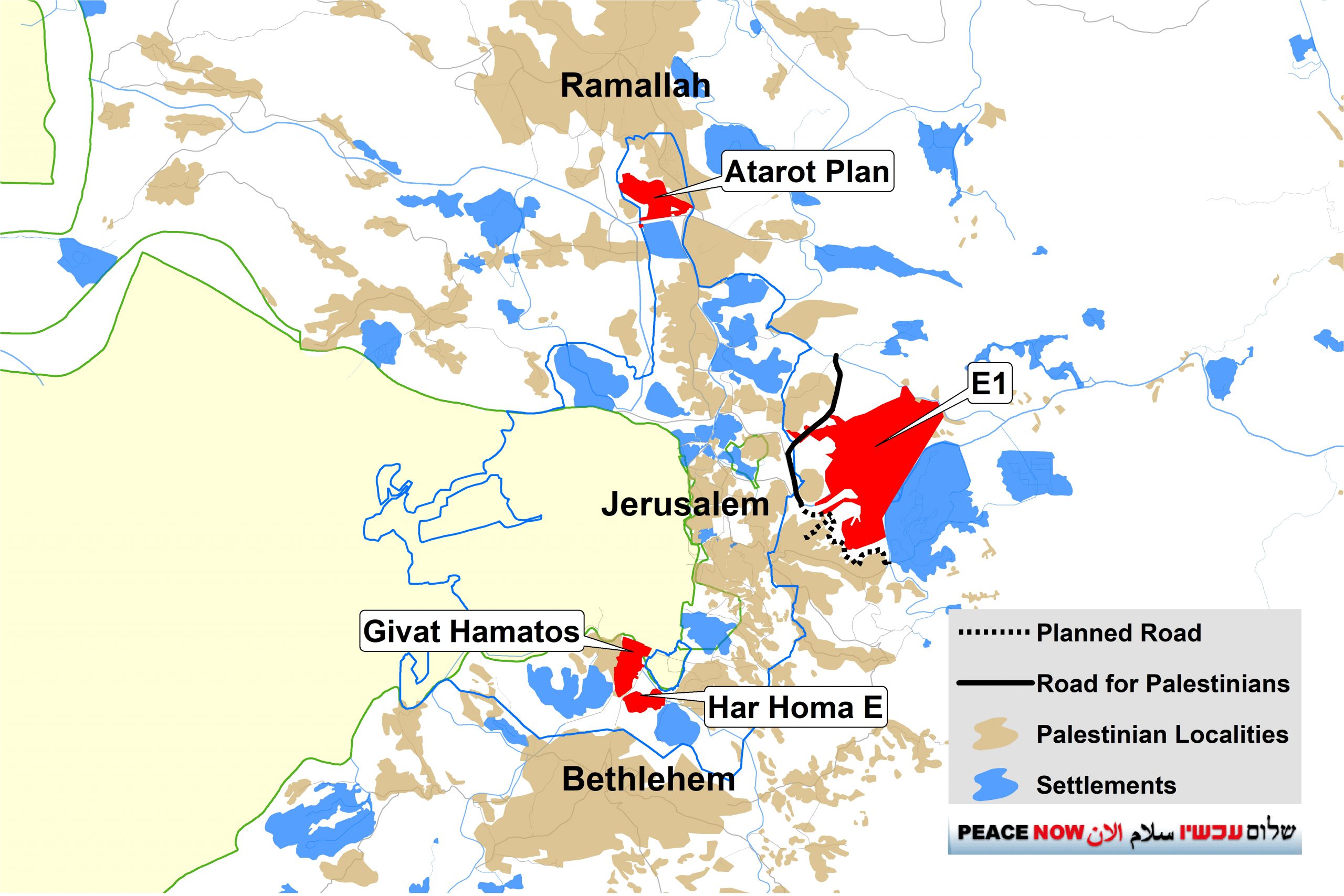
Map by Peace Now
For decades, construction of the E-1 settlement – which is now actively advancing through the planning process – has been adamantly opposed by the international community. A key criticism of that plan is that it would effectively cut the West Bank in half – preventing any two-state solution. The new road has long been Israel’s answer to that criticism, with Israel arguing that it will replace territorial contiguity with limited “transportational continuity” – via a sealed road that is under Israel’s total control. With Minister Bennett’s support and green light, the plan for that road can now be submitted to the Israel Defense Ministry’s High Planning Council for consideration.
If built, a section of the Palestinian-only road is projected to run under the separation barrier (which is not currently built in this area). The rest of the road will run relatively adjacent to the route of the future seperation barrier, in order to prevent Palestinian traffic from coming “near Jewish communities,” in the words of Defense Minister Bennet. This new section of road connects to the infamous “apartheid road” (aka, the Eastern Ring Road) which was opened for Paelstinian traffic in January 2019, and has a high wall dividing Israeli and Palestinian traffic.
In a statement announcing his plan, Bennet gave lip service to the idea that the plan will benefit Palestinians (even as it further cuts them off from Jerusalem, takes more land, and cuts the West Bank in half) while also making clear his real objective:
“[the road] will improve the quality of life for residents in the area, avoid unnecessary friction [for Israelis] with the Palestinian population and most importantly — allow for continued [settlement] construction. We’re applying sovereignty [to the West Bank] in deeds, not in words.”
Peace Now explains the issue with Israel’s design:
“The new road is intended to allow Palestinians to pass under the route of the separation barrier, and to travel ‘inside’ the Adumim Bloc along a wall without entering the ‘Israeli’ side, as in a kind of tunnel. Once the road is paved, Israel can then claim that construction in E1, and the construction of the barrier around the Adumim bloc does not sever the West Bank because the Palestinians have an alternative transport route. This argument is preposterous. A thin line of road connecting separate territorial sections–transportational contiguity–does not meet the needs for territorial viability for the development and livelihoods of Palestinians in the critical Ramallah-Jerusalem-Bethlehem metropolitan area. Without actual territorial contiguity, an independent Palestinian state cannot be established and prosper, and therefore a two-state solution cannot be reached.”
Further, Peace Now said in a statement:
“This is bad news for Israel as it enables annexation toward rendering a two-state solution insoluble. The planned road would allow Israel to cut the West Bank in half, build up E1 and the West Bank barrier, and shut down the possibility of developing a viable Palestinian state.The only roads Israel paved for Palestinians in its 52 years of control over the Territories were designed to allow Israel to build settlements or barriers that block existing Palestinian routes. There is no desire here to improve Palestinian transport, only to expand the settlements.”
Israeli Planning Committee Asks for Changes, More Info on Har Homa & Givat Hamatos Plans
Ir Amim reports that at a March 8th meeting, the Jerusalem Planning and Building Committee asked for several modifications and required that additional surveys be completed before they approve plans for the construction of the Har Homa and Givat Hamatos settlement plans.
Ir Amim explains:
“There is a big gap between Netanyahu’s far reaching declarations regarding ‘the advancement of thousands of housing units in Har Homa and Givat Hamatos’ and the actual result of the discussions at the committee. It is unclear whether this gap is a result of real planning considerations that have to be resolved or is it a sign that despite Netanyahu’s dramatic announcements the Israeli government nevertheless needs to restrain itself. Ir Amim will try to inquire into the issue.
In any case the advancement of the three plans [2 relating to Har Homa, 1 relating to Givat Hamatos] in one of the most sensitive areas of East Jerusalem after years during which the Israeli government refrained from advancing them is a cause for great concern. If constructed, these new settlements will essentially connect the existing Gilo and Har Homa neighborhoods/settlements and create a contiguous Israeli built-up area along the southern perimeter of East Jerusalem. This will serve to detach Bethlehem and the south of the West Bank from East Jerusalem while isolating the Palestinian neighborhood of Beit Safafa. Constituting a long term strategy of Israeli governments, construction of large settlements is employed as a means to fracture the Palestinian space and unilaterally determine the boundaries of Jerusalem to prevent the future establishment of a Palestinian capital in the city.
The fact that the discussion of all three plans ended without a decision to advance any of them is not the norm. But in a few months, the surveys and modifications requested by the committee may be completed and the plans will be discussed again and this time be advanced.
It is important to remember that the Israel Land Authority has also published (on February 24th) a tender for 1,077 housing units in Givat Hamatos A (on the area of TPS 14295). The tender has not yet opened for bidding and this is currently scheduled to happen on May 3rd. This tender is not contingent upon developments of the Givat Hamatos masterplan described above and can open for bids regardless of whether or not the plan is approved. If the tender does open for bids in May leading to future construction this will be a most negative development with a new settlement in one of the most sensitive places in East Jerusalem.”
Palestinian Minor Killed by IDF During Clash Over Settlers Entering Palestinian Land Near Nablus
A 15-year old Palestinian boy was shot and killed by Israeli military forces on March 11th. The forces were deployed to protect a group of Israeli settlers from the nearby Itamar settlement who had entered Palestinian land to “tour” an area which is believed to be the site of an ancient fortress. The site – “Jabal al-Orma” in Arabic and “Tel Aroma” in Hebrew – is located in Area B of the West Bank, which under the Oslo Accords is under Palestinian civil control and Israeli security control.
Two months ago, the Palestinian Municipality responsible for the area designated the site as a tourist destination and began building infrastructure to enhance it. Settler groups accused Palestinians of “taking over” the fortress (reminder: it is located in Area B) and destroying it. The settler “tour group” that instigated the clash had, in fact, established a temporary encampment at the site a day earlier. The next day, 300 Palestinians arrived at the site to protest. The IDF arrived and reportedly began firing tear gas at the protestors. The ensuing clash resulted in the death of the one Palestinian minor, injuries to 16 other Palestinians (2 serious), and a head injury to one of the settlers.
In a joint report on Israel’s use of archeology as a means for dispossession and pretext for annexation, the NGO’s Emek Shaveh and Yesh Din write:
“In addition to the takeover of archaeological sites by official entities via ostensibly legal means, there is also a phenomenon of invasion and illegal takeover of historic sites by settlers. As part of the overall negligence on the part of the Israeli enforcement authorities with regards to the dispossession of Palestinians of their land by Israeli civilians, there is also a clear failure on the part of the authorities to remove invaders, enforce the law and protect Palestinian rights in cases where historic sites have been invaded or taken over. The enforcement failures in these cases endanger the antiquities, because unqualified persons perform work on these sites without plans and building permits and without supervision.”
2019 U.S. State Department Human Rights Report Further Erases Occupation, Denies Palestinian Identity, Affirms Golan Annexation
The U.S. State Department recently published its “2019 Country Reports on Human Rights Practices: Israel, West Bank, and Gaza.”
Building on the significant changes to the structure, tone, and coverage of the 2018 report (text) — which removed the word “occupation” entirely from the report — the 2019 report also:
- Normalizes Israeli control over the Area C of the West Bank, adding new language which reads:
“The government of Israel maintained a West Bank security presence through the Israeli Defense Force (IDF), the Israeli Security Agency, the Israeli National Police, and the Border Guard. Israel maintained effective civilian control of its security forces throughout the West Bank and Gaza. West Bank Palestinian population centers mostly fall into Area A, as defined by the Oslo-era agreements. The PA has formal responsibility for security in Area A, but Israeli security forces (ISF) regularly conducted security operations there, at times without coordinating with the PASF. The PA and Israel maintain joint security control of Area B in the West Bank. Israel retains full security control of Area C and has designated the majority of Area C land as either closed military zones or settlement zoning areas.”
- Ceases to refer to Jerusalem’s Palestinian population as “Palestinians” – instead referring to them as “Arab residents.” This change is consistent with the Trump Administration’s ongoing efforts to de-nationalize the Palestinians people and its attempts to undermine their national claim to Jerusalem.
- Re-affirms the legitimacy of Israel’s annexation of the Golan Heights (which the U.S. officially recognized in March 2019). Whereas the 2018 report included a section entitled, “Israel and the Golan Heights” (alongside a separate section entitled, “West Bank and Gaza”), the 2019 report no longer differentiates between Israel and the Golan Heights at all (as in, the two sections are now entitled, “Israel” and “West Bank and Gaza”).
Reports: U.S. Will OK Annexation “Within Months” Unless Palestinians Negotiate on Basis of Trump Plan (i.e., Palestinians Either Agree to Annexation, or They Get Annexation Anyway)
On March 5th, an Israeli news program quoted a senior White House official suggesting that the United States is prepared to approve Israel’s unilateral annexation of 30% of the West Bank “within months” if the Palestinians do not agree to participate in U.S.-led negotiations over the details of the Trump Plan.
The day before, Senior White House Advisor and Trump Plan architect Jared Kushner reportedly told U.S. Senators during a closed-door briefing that the work of the joint Israeli-American committee mapping will take “several more months,” which would appear to align with the comments and timeline laid out by the anonymous White House source. The source further said:
“Nobody can say we didn’t give the Palestinians an opportunity to return to the negotiating table. If they want to come back and talk we are ready for that and we believe we could improve the plan for them. But if they don’t, we will continue moving ahead without them.”
Kushner’s closed-door briefing members for Congress included a powerpoint presentation, slides of which were subsequently leaked. Notably, Kushner’s presentation appeared to argue that the continual expansion of Israeli settlements is one of two factors that has made peace impossible to obtain to this point (the other being the increasing amount international aid to the Palestinian people).
FMEP President Lara Friedman has a fun Twitter thread commenting on the double-speak in the slides.
Bonus Reads
- “Israeli AG’s objection to ICC jurisdiction in Palestine divorced from reality” (B’Tselem)
- “Another push to make Qalandia Airport a Jewish settlement” (Al-Monitor)
- “‘You Want to Kill Me?’ Totally, He Said. ‘Leftists Are Worse Than the Arabs’: Election Day at a Settlement” (Haaretz)
- “Palestinian villagers ask why company exploiting West Bank quarry isn’t it on UN list” (Middle East Eye)
- “Hebron settlers hold Purim parade while Palestinians locked down for coronavirus” (+972 Magazine)
Welcome to FMEP’s Weekly Settlement Report, covering everything you need to know about Israeli settlement activity this week.
To subscribe to this report, please click here.
February 14, 2020
- United Nations Releases Database of Businesses Operating in Settlements
- Notable Reactions to the Publication of the UN Database (Including Israel’s Pledge to Interfere In U.S. Politics to Undermine Constitutionally Protected Speech)
- Also at the UN this Week, Kushner Out-Maneuvers Abbas in the Security Council
- Netanyahu Says His Government Is Nearly Done Mapping Annexation, based on Trump Plan
- Judge Appoints Settler Lawyer to Manage Petra Hotel During Ongoing Bankruptcy, Ownership Battle
- The Israel Land Authority is Already Annexing West Bank Land
- Acquiescing to Settlers’ Pressure, Civil Administration Pushes Palestinians Off Land — By Citing British Mandate Regulations
- Terrestrial Jerusalem: The Trump Plan’s “Doublespeak” on Jerusalem
- Peace Now Details the Roles of the WZO & the Jewish National Fund in Driving the Settlement Agenda
- Bonus Reads
Questions/comments? Contact Kristin McCarthy (kmccarthy@fmep.org).
United Nations Releases Database of Businesses Operating in Settlements
On February 12th, following nearly four years of delay, the United Nations Human Rights Council finally published a (non-comprehensive) database of businesses involved in building, maintaining, securing, and servicing Israeli settlements in the West Bank, East Jerusalem, and the Golan Heights. The database was requested by members of the Human Rights Council in March 2016 in order to assist member states in complying with international legal obligations with regards to doing business with companies involved in activities which violate the human rights of people around the world.
The database lists 112 companies found to be conducting business with Israeli settlements. Key facts about these businesses:
- 94 companies are based in Israel (see list). The listed Israeli companies include all major banks, state-owned transportation companies Egged and Israel Railways Corporation, and telecommunications giants Bezeq, HOT and Cellcom.
- 6 companies are based in the United States: AirBnB, TripAdvisor, Expedia, Booking Holdings Inc., General Mills Inc, and Motorola Solutions Inc. General Mills explained that it was included on the database because a manufacturing facility “uses natural resources, in particular water and land, for business purposes.” For a review of how AirBnB has changed (for the worse) its policy of operating in the West Bank and East Jerusalem, see here. For reports on the actions of tourism companies promoting and operating in the settlements, see: Human Rights Watch’s report, “Bed and Breakfast on Stolen Land,” and Amnesty International’s report “Destination: Occupation”
- 4 companies are based in the Netherlands: Booking.com, Tahal Group International B.V., Altice Europe N.V., Kardan N.V.
- 3 companies are based in France: Egis Rail, Alstom S.A, Egis S.A.
- 3 companies are based in the United Kingdom: JC Bamford Excavators Ltd., Opodo Ltd., Greenkote P.L.C.
- 1 is based in Luxembourg: eDreams ODIGEO S.A.
- 1 is based in Thailand: Indorama Ventures P.C.L.
The publication of the database has repeatedly been delayed due to heavy pressure from Israel and the United States, neither of which are current members of the Human Rights Council. Even before its publication, Israel and the U.S. argued that the database would by definition be anti-Israel and antisemitic. From the start they also labeled the database a “blacklist,” even though the database itself neither calls for nor imposes any punitive consequences on the listed businesses. Indeed, as FMEP’s Lara Friedman has pointed out – and as former U.S. official Jason Greenblatt has suggested- that the database can just as easily serve as a list for settlement-supporters to shop from as it can serve as information based upon which someone might choose to boycott.
Notable Reactions to the Publication of the UN Database (Including Israel’s Pledge to Interfere In U.S. Politics to Undermine Constitutionally Protected Speech)
The most eye-catching reaction to the publication of the UN database came from Prime Minister Benjamin Netanyahu, who took to Twitter to claim credit for anti-BDS/pro-settlement legislation in U.S. states (some of which has been declared unconstitutional in U.S. courts) that penalizes those who boycotts Israel or settlements. That same day, the Israeli Foreign Ministry instructed diplomats serving in its U.S. consulates to work with state governors to get them to publicly condemn the UN database. Analysts quickly noted the audaciousness of this boasting by Israeli of interfering in domestic political affairs in the United States — boasting that only confirmed what researchers have known for years: the state of Israel has been pushing anti-democratic, unconstitutional laws in the United States.
Many Members of Congress issued statements denouncing the UN for publishing the database. Such statements suggest that there will likely soon be a move to pass legislation pending in the U.S. House which seeks to criminalize BDS, called the Israel Anti-Boycott Act.
In Israel, political figures from across the spectrum condemned the publication of the database. Prime Minister Netanyahu said that when the world recognizes Israeli sovereignty in the West Bank and in settlements, “this list will become void.” President Rivlin shockingly suggesting that the Human Rights Council’s publication of the database is reminiscent of the Holocaust. Even Amir Peretz, the leader of Israel’s left-wing coalition (which includes Meretz), condemned the database and vowed to work to compel the UN to repeal it. In addition, the Israeli Foreign Ministry announced it was freezing ties with the office of the UN High Commissioner for Human Rights.
A group of settlers leading the Samaria Regional Council (a municipal body representing and servicing settlements in the northern region of the West Bank) announced that it will file a class action lawsuit against the United Nations. Yossi Dagan, the organization’s head, said:
“Not only will we not break, we will fight – at the beginning of the week the Samaria Regional Council together with representatives of factories in the Barkan Industrial Zone will file a lawsuit against the boycott of human rights council officials, led by United Nations High Commissioner for Human Rights Michelle Bachelet and Secretary-General of the United Nations Antonio Guterres, as well as against other leftist organizations, and we will demand to receive compensation, as was decided by the Jerusalem District Court under the honorable Judge Yosef Shapiro, that there is no immunity from civil lawsuits and there is no way to hide behind immunity. We will not only claim damages that may be incurred, but we will also sue for the honor of the State of Israel and the slandering of its name.”
Palestinians welcomed the publication of the database, and quickly called for the listed businesses to change their practices. Prime Minister Shtayyeh said that the Palestinian Authority will pursue legal action against the businesses in order to force the issue, noting that businesses could fix the situation by re-locating to areas under Palestinian control. Shtayyeh said:
“We will pursue the companies listed in the report legally through international legal institutions and through the courts in their countries for their role in violating human rights…We will demand compensation for illegally using our occupied lands and for engaging in economic activity in our lands without submitting to Palestinian laws and paying taxes.”
Saeb Erekat, veteran Palestinian statesman and negotiator, said:
“While this list does not include all the companies profiting from Israel’s illegal colonial-settlement enterprise in occupied Palestine, it’s a crucial first step to restore hope in multilateralism and international law..[The list] should serve as a reminder to the international community on the importance of strengthening the tools to implement international law at a time when the illegality of Israeli settlements is being challenged.”
Also at the UN this Week, Kushner Out-Maneuvers Abbas in the Security Council
Prior to the UNHRC’s publication of the database, the United Nations Security Council played host to an Israel-Palestine drama of its own, in which a cast of key players from each side sought to persuade UNSC members to support/reject the Trump Plan.
Jared Kushner met with Security Council members on February 7th to sell the plan. The representative from Tunisia (who drafted a resolution critical of Kushner’s work) did not attend the meeting, and was later fired by Tunisia’s president. Palestinian Authority President Mahmoud Abbas visited the Security Council on February 11th in an attempt to rally opposition to the Trump Plan. His efforts – punctuated by a speech in front of the Council – cannot be considered a request. The Tunisian-lead draft resolution critical of the Trump Plan was abandoned by its drafters, in move celebrated by U.S. officials as a major victory in the Security Council, which the Trump Administration and Israel regularly characterizes as anti-Israel.
Netanyahu Says His Government Is Nearly Done Mapping Annexation, based on Trump Plan
On February 9th, Prime Minister Benjamin Netanyau announced that Israel has started mapping the area it intends to annex in accordance with the Trump Plan, saying “it won’t take too long.” The Israeli mapping team – which includes Minister Yariv Levin, Israeli Ambassador to Washington Ron Dermer, and a National Security Council representative – is being directly overseen by Prime Minister’s Office Director, General Ronen Peretz. The National Security Council has a representative on the team as well. saying “it won’t take too long.” Netanyahu made the remarks at a campaign event in the Maale Adumim settlement, located just east of Jerusalem in a highly coveted area which the Trump Plan delivers to Israel. Consistent with the Trump Plan, Netanyahu said that Israel will annex all of its settlements, the Jordan Valley, and East Jerusalem.
Netanyahu’s announcement can be viewed as part of his continued efforts to placate the large portion of his political base that is up in arms over Netanyahu’s acquiescence to the U.S. demand that annexation not be advanced until after the next elections (March 2nd). Furthering that cause, Netanyahu tried to make lemons out of lemonade – saying:
“The U.S. and [Israel] agreed that when this entire process is completed we’ll bring it to the government [for approval]. But the Americans are saying in the clearest manner: ‘We want to give you recognition and we’ll give you it when the entire process is complete.’ Recognition is the main thing. We brought this, I brought this/ We don’t want to endanger this, we are working responsibility and intelligently.”
U.S. Ambassador David Friedman – who initially said that Israel does not need to wait to annex West Bank land – took to Twitter to publicly caution Netanyahu against pushing annexation before the March 2nd elections, warning that there would be consequences if Israel moves unilaterally. Later that day, Amb. Friedman then tweeted the following statement in support of Netanyahu (smoothing over the previous rebuke), as well re-aligning his own public position to match that of Jared Kushner:
“President Trump’s Vision for Peace is the product of more than three years of close consultations among the President, PM Netanyahu and their respective senior staff. As we have stated, the application of Israeli law to the territory which the Plan provides to be part of Israel is subject to the completion of a mapping process by a joint Israeli-American committee. Any unilateral action in advance of the completion of the committee process endangers the Plan & American recognition.”
Netanyahu and Friedman’s remarks appear to further anger already indignant settler leaders.
Jordan Valley Regional Council chairman David Elhayani, who also serves as the chairman of the Yesha Council, said:
“The United States cannot prevent Israel from doing anything. [Netanyahu needs] to fulfill his commitment to the residents of Judea, Samaria and the Jordan Valley to apply sovereignty before the elections, and to do this as soon as possible.”
Samaria Regional Council chairman Yossi Dagan said:
“Sometimes even dear friends need to be put in their place and told that… we are a sovereign country and sovereignty will be extended to Judea and Samaria as the public in the State of Israel expects.”
Beit El Local Council chairman Shai Alon said:
“the United States should respect us as a state and not determine when Israel will assert sovereignty over Judea and Samaria.”
Watching this argument, FMEP’s Lara Friedman offered an important reminder:
“This spat is about a distinction (over timing/credit) without a difference (over substance/objective/outcome). That is the real story here. Making it a story about inter-extremist bickering only normalizes their shared annexationist agenda.”
Judge Appoints Settler Lawyer to Manage Petra Hotel During Ongoing Bankruptcy, Ownership Battle
According to Haaretz, a judge has appointed a lawyer for the radical settler group Ateret Cohanim as the legal custodian of the Petra Hotel – located just inside the Jaffa Gate to the Old City of Jerusalem – during an ongoing bankruptcy case against the Palestinian company currently operating the hotel. The lawyer, Avraham Moshe Segal, has taken over the debt that the Palestinian company owes – giving Segal leverage to oust the current operators, a goal he has tried to accomplish through various legal maneuvers over the years.
In addition to awarding the coveted property to a lawyer for a radical settler group, the appointment of Segal as the legal “receiver” is extraordinarily alarming because Ateret Cohanim is a party to the legal case involving ownership of the Petra Hotel. Since 2004, Ateret Cohanim has used shell companies to wage a battle against the Greek Orthodox Patriarchate, from which Ateret Cohanim claims to have purchased the hotel (along with two other coveted Old City properties). In June 2019, an Israeli judge awarded Ateret Cohanim ownership of the properties. The ruling was appealed by the Greek Orthodox Church, after it discovered new evidence showing Ateret Cohanim’s forgery of key documents and its payment of bribes to obtain the property. The case was officially reopened in November 2019.
Haaretz reports that a source at the Justice Ministry said that the appointment of Ateret Cohanim’s lawyer “demands an inquiry to determine whether there may be a conflict of interest”.
The Greek Orthodox Church requested the dismissal of Segal as the “receiver,” telling the court:
“The job holder in question [i.e., Segal] has been involved as part of his role in more than a few legal processes against the company and they have taken place in every legal instance, over a number of years, enough to enable us to say and even determine that there is more than a fear of a conflict of interests here.”
The Israel Land Authority is Already Annexing West Bank Land
The Israel Lands Authority is the governmental body which controls 90% of the land in Israel, and thus controls the supply and zoning of land for development, including land in the West Bank used for settlement construction. A new report revealed that in January 2020, some 66% (two-thirds) of the total amount of land auctioned by the Israel Lands Authority was located in the occupied territory. The report noted:
“All told, the ILA last month advertised land designated for 3,254 housing units, 2,136 of them in settlements, including Karnei Shomron, Givat Ze’ev, Ma’aleh Adumim and Efrat.”
While the data is only for a single month, the disproportionate focus in the ILA on developing land in the West Bank, as opposed to inside Israel, where housing prices are rising, is notable. Likewise, the data highlights the fact that notwithstanding ongoing discussion of when Israel might annex parts of the West Bank, consistent with the Trump plan, the fact is that Israel has already de facto annexed the area — evidenced by the fact that an Israeli domestic body has the authority to issue tenders for Israeli development inside the West Bank.
Acquiescing to Settlers’ Pressure, Civil Administration Pushes Palestinians Off Land — By Citing British Mandate Regulations
Reversing decades of practice, the Israeli Civil Administration recently denied Palestinian farmers access to their land outside of Ramallah and confiscated their tractor.. The denial was based on the argument that the area was deemed an antiquities site in the British Mandate period and therefore the Palestinians cannot receive permits to work it. The famers, two brothers, told Haaretz that the Civil Administration has not prevented them from accessing their lands for the last 50 years, and they were unaware that they needed a permit to continue doing so. Relatives of the famers suggest that the Civil Administration was pressured to close the area by settlers living in a nearby illegal settlement outpost, called “Malachei Hashalom.” The outpost is relatively news, established in 2015 on an abandoned military base, and has a reputation for harassing Palestinians and their flocks.
The brothers’ lawyer said of the Civil Administration’s change of policy:
“It’s another method of driving the Palestinians from their lands. Working the land does not harm antiquities, and the state also never made such an allegation. The archaeological claim was only invented after the establishment of the outpost.”
One of the farmers, Nader Abu Aleiyeh, told Haaretz:
“Everyone knows we work the land and they never told us anything. Soldiers in the past would come and drink tea with us while we were working the land.”
Terrestrial Jerusalem: The Trump Plan’s “Doublespeak” on Jerusalem
In its latest edition of Insider’s Jerusalem, Terrestrial Jerusalem experts examine at length the components of the Trump Administration’s plan related to Jerusalem, outlining the many delusional notions about Israel’s annexation of the city and its holy sites. Terrestrial Jerusalem writes:
“There is a common denominator in the portrayal of the stark realities of Jerusalem and the terminology used to describe them. By a systematic use of doublespeak, Palestinian residents of East Jerusalem aren’t Palestinians, Jerusalem is undivided, refugees don’t exist, Abu Dis is (wink, wink) Jerusalem but can’t be called as such, the status quo can be maintained even as it is violated, and Jerusalem is an open city ‘accessible’ to all, which denies access to the residents of the West Bank and Gaza. The Jerusalem of the Trump proposal does not exist in Jerusalem, but rather in the ideology of the settler right in Israel, and of the end-of-days Evangelicals in the US, where myths trump the facts.”
On the change to the status quo on the Temple Mount in the Trump Plan:
“As noted, the Proposal explicitly supports allowing Jewish prayer on Haram al Sharif/the Temple Mount. In doing so, the Trump administrations has adopted policies that have been rejected by every Israeli government since 1967. This radical change in the status quo is so problematic, that since the release of the Proposal, the Trump team has begun to walk it back. In a telephonic press briefing conducted by the US team days after the publication of the Proposal on January 28, Ambassador Friedman offered the following response to a press inquiry:
‘The status quo, in the manner that it is observed today, will continue absent an agreement to the contrary. So there’s nothing in the – there’s nothing in the plan that would impose any alteration of the status quo that’s not subject to agreement of all the parties. So don’t expect to see anything different in the near future, or maybe in the future at all.’
Even if taken at face value, there are three problems with Friedman’s clarification.
Firstly, Friedman’s statement contradicts the literal meaning of the text (‘People of every faith should be permitted to pray on the Temple Mount/Haram al-Sharif’). If Friedman’s clarification is to be taken seriously, no response to a question in a press briefing can serve as an alternative to a formal amendment to the Proposal’s text, or at the very least, an official announcement by the State Department revising the wording.
Secondly, the explicit change in the status quo appearing in the text of the Proposal is the equivalent of “shouting it from the rooftops”. Friedman’s statement was made almost by stealth, as though the drafters of this text do not want their clarification to be noticed. In the past, Netanyahu would issue his statements regarding the status quo in a similar manner: he would issue them in English only, late on a Saturday night, and then relegating the text to some obscure location on the Prime Minister’s website.
Finally, even if, as stated by Friedman, this change will not take place anytime soon, what has been said cannot be unsaid. The activists in the Temple Mount movement are ecstatic, flaunting their success on social media and promising to take advantage of the new situation. Instead of having a moderating influence on the various stakeholders on the Mount, this original text emboldens those who are already dangerously pushing the limits of the status quo. Anything less than an unequivocal and highly visible revision is tantamount to playing with matches at one of the most volatile locations on the planet. The prospect of an event leading to an eruption of violence is more likely today than it was before the release of the Proposal.”
On the list of holy sites in the Trump Plan:
“This selective sanctity on display in this list is quite significant and reflects a very specific, highly developed biblically driven narrative… The settlers of East Jerusalem make no bones about their objectives: they seek to establish an ancient Biblical realm in and around Jerusalem’s Old City, one in which real and purported sacred, historical and archeological sites establish the hegemony of their biblically motivated narrative. In doing so, they marginalize the equities of Muslims, and turn the Palestinian residents in the targeted areas into communities at risk…Just as the proposed change in the status quo reveals that the Trump administration has adopted the views of the extreme Temple Mount movement, its views regarding the epicenter of the conflict of between Israelis and Palestinians – the Old City and its visual basin – are virtually indistinguishable from those of East Jerusalem’s extreme settler organization, in general, and of the Elad settlers in particular. As with the settlers of East Jerusalem, in the Jerusalem of the Trump Proposal, even mundane or questionable Jewish history is sacred, while Arab and Muslim history does not exist.”
On the special tourist zone in Atarot (a wild concept not widely or accurately covered by press) Terrestrial Jerusalem writes:
“The Proposal stipulates that Israel create a special tourist zone [for Palestinian use] at Atarot, currently an industrial park several miles to the north of the city center, and which is to remain part Israel. This is to become a Special Tourist Area, even though there is nothing in the area which ends itself to tourism, nor are there sites of historic value. From this location, access to the Muslim Holy Shrines will be streamlined, with Palestinian tour guides licensed to lead tours. It is noteworthy that the Palestinians’ permission to conduct tours is limited to the Old City, and to Christian and Muslim sites elsewhere in the city. A Joint Tourist Development Authority will be created to allow Palestine to accrue some of the economic benefits of that tourism. This is the only example in the Proposal in which the Palestinians of the West Bank have any palpable stake in Jerusalem. However, even here, Israel is the arbiter of what tourists guided by Palestinian tour guides may see, and that is limited in scope.”
On the de-nationalization of Palestinians in East Jerusalem:
“The residents of East Jerusalem have individual rights as Arabs, not as Palestinians. They have religious rights in the city as Muslims, but not as Palestinians. They have material rights as tour guides and tourists (provided they limit their tourism to the sites Israel deems to be important to them). …By all acceptable measures, be it under international law or based on the empirical realities on the ground, East Jerusalem is occupied. However, in no way does the Proposal attempt to end occupation, for the simple reason that in their operative conceptual worlds, occupation simply does not exist. The proposal offers Palestinians of East Jerusalem a devil’s bargain: shed your national identity and your aspirations for a life within a Palestinian national collective, and you will be rewarded with certain privileges.”
For full analysis from Terrestrial Jerusalem, click here.
Peace Now Details the Roles of the WZO & the Jewish National Fund in Driving the Settlement Agenda
In anticipation of the World Zionist Organization (WZO) elections this October, Peace Now has published a two-page reminder about the group’s role in driving the illegal expansion of Israel’s settlement and outpost enterprise, which it did through it Settlement Division, in coordination with the Jewish National Fund. Peace Now Settlement Watch co-Director Hagit Ofran also recorded a webinar to discuss the new paper and the importance of the upcoming WZO elections.
The Settlement Division is a body within the WZO established in 1971 and fully funded by the Israeli government. Its mission was, and remains, to provide a channel by which the government can establish settlements – legally and illegally – in the occupied territories, while avoiding the pesky rules, regulations, and transparency requirements to which government entities are bound. The Israel government assigned management responsibilities to the WZO for over 60% of the land in the West Bank which the government declared to be “state land” (90,000 acres/400,000 dumans). The WZO has given that land to settlers to build settlements and secretly funnel government money to illegal outposts.
For its part, the Jewish National Fund (referred to as Keren Kayemeth LeIsrael-Jewish National Fund, or the KKL-JNF) started purchasing land in the West Bank in the early 1900s, for the explicit purpose of resettling Jews there. After 1967 and the commencement of Israel’s occupation of the West Bank, the KKL-JNF role changed to supporting the establishment and growth of settlements across the West Bank, and the eviction of Paelstinians from their homes in East Jerusalem in favor of Israeli settlers (including tthe recent eviction of the Sumarin family in Silwan).
A recent tweet by U.S. Ambassador David Friedman included a picture of him planting an olive tree on the grounds of the former U.S. Consulate in Jerusalem (now used as the Ambassador’s residence), standing alongside an agent of the KKL-JNF.
Bonus Reads
- “How do settlers takeover “ (+972 Magazine)
- “Trump’s Middle East Peace Plan Isn’t New. It Plagiarized a 40-Year Old Israeli Initiative” (Foreign Policy)
- “Israel’s Rejection of UN List of Companies Tied to Settlements Reveals Stark Truth About Annexation” (Haaretz)
- “Facing Blowback From Annexation” (Haaretz)
- “What is Donald Trump’s Vision for Jerusalem?” (Jerusalem Post)
- “Turkey hands Palestinians Ottoman land archive” (Middle East Monitor)
Welcome to FMEP’s Weekly Settlement Report, covering everything you need to know about Israeli settlement activity this week.
To subscribe to this report, please click here.
February 6, 2020
- Netanyahu Wavers on Timing of West Bank Annexation [Reminder: Israel is Annexing Land Every Day, & Has Been for Decades]
- Israeli Court Grants Ateret Cohanim Third Victory in its Silwan Mass Displacement Campaign
- Peace Now on Annexation, Jerusalem, & Populated Land Swaps Under the Trump Plan
- Emek Shaveh on Jerusalem Antiquities & The Trump Plan’s Embrace of the Settlers’ Agenda
- Kerem Navot on the Trump Administration’s “Settlement Enclaves”
- Kushner’s Media Blitz Further Clarifies U.S. Support for Israeli Settlement Enterprise, Contempt for Palestinians
- UN Security Council Drafts Resolution on Trump Plan & Prepares for Meetings with Kushner, Abbas
- European Union Chief Says Israeli Annexation Will “Not Pass Unchallenged” (And Other European Moves)
- Bonus Reads
Questions/comments? Contact Kristin McCarthy (kmccarthy@fmep.org).
Netanyahu Wavers on Timing of West Bank Annexation [Reminder: Israel is Annexing Land Every Day, & Has Been for Decades]
Following the very poorly coordinated annexation announcements from Israel and the U.S. last week, Prime Minister Netanyahu is sending contradicting public messages on his timeline for annexing 30% of the West Bank, as prescribed by the American “Vision.”
After clearly stating his intention to move ahead immediately with annexation just a week earlier, on February 5th Netanyahu hinted that he will fall in line with Jared Kushner’s demand to wait until after the next round of Israeli elections. Speaking at a campaign event in Beit Shemesh, Netanyahu said:
“If we win, when we win, we’ll continue to make history. As soon as we win, we’ll apply Israeli law to all of the Jewish communities in the Jordan Valley and in Judea and Samaria. We, the Likud, won’t let this great opportunity slip from our grasp. But in order to guarantee it, in order to guarantee Israel’s borders, in order to guarantee the future of Israel, I need every Likud member this time around to go out and vote and get others out to vote. This time we’re getting everyone out of the house, we’re not leaving anyone behind.” [emphasis added by author]
Netanyahu’s suggestion that annexation will wait until after elections should not ease any sense of alarm. As Israeli political analyst Gayil Talshir tells the New York Times, the scuffle over immediate annexation has left Netanyahu bruised and vulnerable heading into the next round of elections. In order to win back his angered base of settlers and right-wing fans, Talshir says, Netanyahu might be considering promoting a more limited annexation bill ahead of the March voting date – a means of feeding his base red meat without flagrantly crossing swords with the Trump administration.
Further, on February 6th the pro-Netanyahu Israel Hayom paper (owned by Trump backer Sheldon Adelson) printed a front-page story reporting that Netanyahu is in deliberations with the Trump Administration about implementing annexation ahead of elections.
If you need a reminder about Israel’s ongoing annexation of West Bank land, check out FMEP’s Annexation Policy Tables.
Israeli Court Grants Ateret Cohanim Third Victory in its Silwan Mass Displacement Campaign
On February 6th, the Jerusalem Magistrate’s Court ruled in favor of another petition filed by the radical settler organization Ateret Cohanim, to evict Palestinians from their homes in a building in the Batan al-Hawa section of Silwan. The ruling was based on the Court’s acceptance of the setter group’s claim to own the land on which the building stands. The court ordered two Palestinian families living in the building to vacate the property by August 17th.

Map by Peace Now
This is the third time in as many weeks that the Magistrate’s Court has ruled in favor of Ateret Cohanim’s petitions seeking the eviction of Palestinians in Silwan. Ateret Cohanim has nearly a dozen additional petitions still in process, threatening the mass displacement of around 700 Palestinians from the tiny section of Silwan known as Batan al-Hawa, located just outside the southern wall of the Old City.
Previously, on January 19th the Court ruled in favor of the Ateret Cohanim’s petition to evict the Palestinian Rajabi family from their home home of 45 years in Batan al-Hawa. In so doing, the court accepted Ateret Cohanim’s claim to own the tract of land in Silwan upon which the Rajabi home was built. The court ordered that the family must vacate their 3-story apartment building by July 1st; however, the eviction might be delayed as the Rajabi family announced that the family intends to file an appeal against the decision with the Jerusalem District Court.
Subsequently, on January 26th the Jerusalem Magistrate’s Court ruled to evict the Palestinian Dweik family from their home (also located in the Batan al-Hawa section of Silwan) based on a petition filed by Ateret Cohanim on the same basis as the Rajabi petition. The Dwieks were ordered to vacate the building by August 2nd.
Peace Now on Annexation, Jerusalem, & Populated Land Swaps Under the Trump Plan
Peace Now analyzed the details of the proposed annexation and populated land swaps found in the Trump Administration’s “Vision”.
On annexation and Jerusalem, Peace Now found that the Vision green lights:
- Israel’s annexation of 30% of land in the West Bank, bringing a total of 647,072 Israeli settlers into the state’s borders.
- 412,798 of the total number of settlers will remain living in West Bank settlements that will become territorially contiguous with the state of Israel.
- 220,000 of the total number of settlers are currently living in East Jerusalem and will remain there. All East Jerusalem neighborhoods on the Israeli side of the separation barrier (i.e. all Israeli settlements in East Jerusalem and the surrounding areas) will become part of the State of Israel.
- 14,274 settlers will find themselves in “settlement enclaves,” surrounded by what would nominally be called the state of Palestine (assuming Palestinians met all preconditions and ongoing conditions) but connected to the State of Israel by Israeli-secured roads/tunnels/bridges.
On the annexation plan, Peace Now writes:
“Annexation of settlements would require Israel to secure a line of defense around the West Bank five times greater than the Green Line. Further added to this immense security burden would be the costs building a security barrier around it, as well as to secure Israeli enclaves inside Palestinian territory for less than a mere 15,000 Israelis. Annexation is a unilateral move that critically undermines the goodwill needed for fruitful negotiations… The issue of Jerusalem and its holy sites is among the focal points of the conflict. The US proposal not only denies Palestinians of their symbolic national and religious capital, but it also permanently leaves hundreds of thousands of Palestinians severed from a Palestinian state, under Israeli sovereignty. Previous negotiations have proven that the conflict cannot be resolved without finding a solution for Jerusalem. Israel’s previous attempt to do so at Camp David in 2000, in proposing that the Palestinian capital be located in Abu Dis, led to the derailing of talks and contributed in part to the national-religious tensions over the ownership of parts of Jerusalem that precipitated the outbreak of the Second Intifada.”
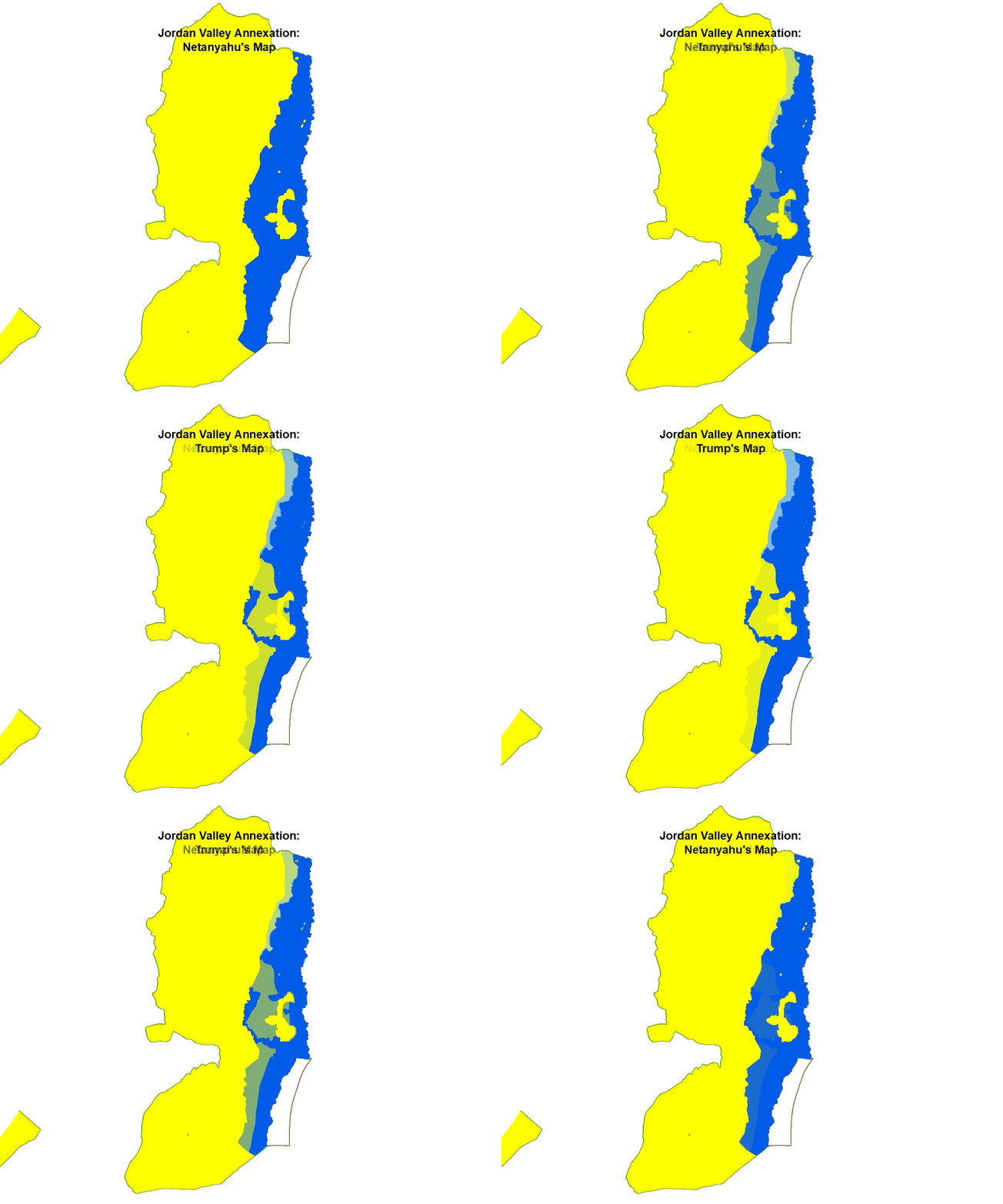 Specifically on the annexation of land in the Jordan Valley, Peace Now found that the map accompanying the “Vision” does not match the map Prime Minister Netanyahu published in September 2019 when he unveiled his own plan to annex the Jordan Valley. The main differences is that the Trump map provides for Israel’s annexation of less land and fewer Palestinians than Netanyahu’s map.
On the “Vision”’s proposal for populated land swaps, Peace Now finds:
- In exchange for the annexation of 30% of the West Bank land, Israel would “give” the future State of Palestine land that equal in size to 13.5% of the West Bank (including land that can by no measure be viewed as comparable on quality).
- Observing a discrepancy, Peace Now notes that:
- According to the Trump map, 132,028 Palestinian citizens of Israel will be transferred into the borders of the future State of Palestine.
- According to the “Vision”’s explanatory paragraph (which lists specific communities to be transferred), 257,050 Palestinian citizens of Israel will be transferred into the borders of the future State of Palestine.
- In addition, 120,000 East Jerusalem Palestinian non-citizen permanent residents are designated to become a part of the future State of Palestine.
On populated land swaps, Peace Now writes:
“Depriving Arab citizens of citizenship and a place in Israel is shameful, legally questionable, and reeks of ethnic cleansing.”
Emek Shaveh on Jerusalem Antiquities & The Trump Plan’s Embrace of the Settlers’ Agenda
A new Emek Shaveh publication provides specific details on exactly how the Trump “Vision” lends support to settler initiatives to use Jerusalem’s history and antiquities to promote Israeli-Jewish hegemony and control over the city. Though there are hundreds of recognized holy sites in Jerusalem, the “Vision” lists just 31 sites (17 Christian, 13 Jewish, just 1 Muslim, in addition to the Temple Mount/Haram Al-Sharif – which is identified as of joint Jewish-Muslim significance. The list notably omits Al Aqsa Mosque). Sprinkled among the holy sites, the “Vision” lists sites which are neither holy nor widely known, including several sites either owned or managed by the radical Elad settler group.
On this point, Emek Shaveh writes:
“It appears that beyond indicating the city’s sanctity, the list of sites is indicative of how dangerous it is for Jerusalem to remain under the sovereignty of one party which has an interest in underscoring and enhancing its own religious and historical connection to the city. Emek Shaveh’s publication Selectively Sacred: Holy Sites in Jerusalem and its Environs (2016), details how Israel has recognized Jewish sites as holy, without formally recognizing Christian or Muslim sites. In our opinion, the assumption articulated in President Trump’s plan, according to which Israel optimally or equitably protects historical and holy sites, is mistaken. Over the past 20 years we have witnessed the opposite phenomenon, in which the Jewish narrative at heritage sites has been highlighted while non-Jewish connections to sites have been played down or ignored. Settler organizations and the Israeli government have initiated several plans, most notably the Shalem Plan, which aims to reinforce the Jewish connection to Jerusalem through archaeological excavations and tourism. To our knowledge, no projects exist that aim to strengthen Christian or Muslim connections to the city.”
Emek Shaveh goes on to list and explain the antiquity sites listed in the “Vision,” drawing critical distinctions that the ”Vision” obscures in a manner that benefits the settlers’ agenda and erodes Jerusalem’s multi-faith character. Emek Shaveh highlights the following antiquities cites listed in the “Vision” which are connected to settler initiatives:
- “Mount Scopus,” which the state of Israel has never defined as a sacred site.
- The ‘Path of the Pilgrims,’ which is an archaeological excavation site in Silwan funded by the radical Elad organization. The excavation of this road has caused severe damage to the Palestinian homes above ground. Emek Shaveh notes “The excavations are still ongoing and no scientific reports have been published. Identification of the site remains unclear, therefore its branding as the ‘Path of the Pilgrims’ has not been backed by any publicized research.” Moreover, Israel does not recognize this as a holy site.
- The “Gihon Spring/Ein Umm Al-Daraj/the Pool of Siloam”, which is a way to refer to the Jewish, Christian and Muslim holy site located in the neighborhood of Silwan, where the Elad settler organization has financed archeological excavations for 25 years. Further, the state of Israel, which officially recognizes this site as holy to Jews, Christians, and Muslims, has entrusted Elad to manage the City of David national park, which covers this area and the antiquities there.
- ‘The Tombs of the Prophets Haggai, Zecharia, and Malachi’ (on the Mt. of Olives), which has not been scientifically identified and located. Israeli settlers have adopted this site into their agenda by citing rare Christian traditions which associate the site with the tombs, but that claim has not been corroborated by scholars and is not supported by many clerics.
- Other sites which are not holy and/or not well known:
- The Sambuski Cemetery (not recognized as holy by Israel)
- The Hurva Synagogue (not recognized as holy by Israel)
- In addition, settler organizations are applying pressure to shift the status quo on some of the Christian holy sites, such as the “Room of the Last Supper” among others. To date, authorities in control of those sites have managed overall to preserve their properties and status.
All of these facts are the basis for Emek Shaveh’s conclusion that the authors of the Trump Plan lack the essential knowledge regarding “the city’s diverse traditions, and a familiarity with archaeological research and the sociopolitical changes that have occurred over the past several decade.” [Another equally likely conclusions: they have the knowledge and don’t care, preferring to weaponize the notion of “holy sites” for political purposes.]
Read Emek Shaveh’s full analysis here.
Kerem Navot on the Trump Administration’s “Settlement Enclaves”
In an extended Twitter thread, Kerem Navot founder Dror Etkes uses the Ma’ale Shomron settlement and a neighboring outpost to explain how the Trump Administration’s “Vision” for Israeli-Palestinian “peace” is nothing short of rewarding war crimes. Etkes writes:
“Last week the Trump admin published its plan predicated on the idea that none of the 130 or so Israeli settlements in the West Bank will be dismantled. Israeli settlements are illegal. They are war crimes. Trump’s one-sided proposal fails to recognize this.
One of these settlements is Ma’ale Shomron – located between the Palestinian cities of Qalqilya and Nablus. Notably, it is home to the Honorable [Dani Dayan], Israel’s Consul in New York. Next to Ma’ale Shomron there is a small Palestinian village (often referred to in Arabic as a ‘khirbeh’) that Dayan doesn’t want anyone to know about. Dayan especially doesn’t want people outside of Israel, to whom he loves to tell his story that ‘settlements are actually good for the Arabs!’ to know about this Khirbeh. So we’ll tell you about it ourselves!
Long before Dayan started to represent the State of (Greater) Israel overseas, he moved to Ma’ale Shomron – located about 10 kms east of the Green Line, just south of the Qalqiliya-Nablus Road (Road 55). Ma’ale Shomron was established in 1980, on land belonging to the Palestinian village of Kafr Thulth. How was it established? Israel declared more than 5,000 acres in this area as ‘state land,’ of which about 500 acres were given to the settlers of Ma’ale Shomron. The settlement was in fact built in the heart of a British-era pine tree forest, in which half of the trees were cut down for its construction. Here you can see two images, 1 from 1979 & the other from 1983. [map] The rest of the newly-declared ‘state land’ was given to other settlements — Karnei Shomron, Nofim and Yakir — located along Wadi Qana, a tributary of the Yarkon River that runs through the northern West Bank.
The land Israel took wasn’t uninhabited. In the mid-1940s, 2 Palestinian families moved from Al-Shaykh Munis (on which Tel Aviv Univ is built) to what became a Palestinian Khirbeh called Ayoun Kafr Kara, located southeast of where Ma’ale Shomron would be established.
With time & enormous investment by the Israeli government and taxpayers, residents of Ma’ale Shomron built permanent homes. Dani and Einat Dayan, like their neighbors, built a generously sized home in the heart of what became a gentrified settlement.
What about Khirbet Ayoun Kafr Kara? Did Israeli authorities, as they invested heavily in Ma’ale Shomron, also provide for basic necessities – water, electricity, roads – for its Palestinian neighbors, whose residence there pre-dated the arrival of the Dayans by decades? Stop wasting time with silly, provocative questions.
Instead, let’s fast-forward to the end of the 1990s, when illegal outposts – that is, new proto-settlements established by settlers in violation of Israeli law – started popping up all over the West Bank. Residents of Ma’ale Shomron wanted an outpost of their own. They decided to locate that new outpost to their south, on land that the military had allocated to settlements but for which no construction planning or permissions was granted. Forging ahead on their own, in 1999 Ma’ale Shomron settlers began (illegally) paving a road, with the intention to establish a new outpost on the southernmost part of the land. Their plan came to fruition in 2002, with the establishment of an outpost they called ‘El-Matan.’ As with most outposts, El-Matan was populated by a group of people who, even as compared to the general settler population, are political and ideological extremists. What subsequently happened to El-Matan is linked to the fate of all the outposts.
Over the years, the Israeli High Court wrestled with the challenge illegal actions by settlers posed to Israel’s rule of law. The Court, rather than hold settlers accountable, encouraged the govt to find creative ways to retroactively legalize the illegal acts of settlers. One of the ways the government developed was to categorize outposts, post-facto, as “neighborhoods” of existing, ‘legal’ settlements. This is what happened to El-Matan, which in 2015 was defined as a “neighborhood” of the settlement of Ma’ale Shomron, located a km away.
In Dec 2014 Ayala Shapira, an Israeli child residing in the outpost, was badly injured by a Molotov cocktail thrown by a Palestinian. As a result, Israel’s government allocated tens of millions of shekels to pave a ‘security road’ for the 15 families in El-Matan.The construction of the ‘security road,’ completed in 2017, severely damaged the historic road connecting the nearby Palestinian Khirbeh, home to around 100 people, to the larger village of Kafr Thulth, where they went for shopping, schools, medical care, etc.
Shortly after the opening of the new road to El-Matan, the Palestinian Authority began, in coordination with the Israeli military, to fix and upgrade that critical route. But guess who didn’t like this road project? The settlers, who are experienced with these kinds of things, managed with just a little pressure and a couple of protests to get the Israeli military to shut down access for all Palestinian vehicles on the road. But even that wasn’t enough for the Ma’ale Shomron settlers!
Over the past few months the settlers have been demanding that the military block the historic access road even further away from El-Matan in order to prevent Palestinians from coming in with tractors and cars to their own olive groves, located east of Kafr Thulth. While writing this thread, we remembered that a few years back, Dani Dayan said: ‘The prime minister & defense minister have to act as if they are facing a virtual sign that reads, What have we done to facilitate a dignified life for the Palestinians today?’ Clearly, Dayan’s ideas for benevolent Israeli control don’t apply to those Palestinians unlucky enough to be his neighbors. Likewise, this same worldview – under which Palestinian rights are non-existent – is the foundation of Trump’s Vision for Peace.”
Kushner’s Media Blitz Further Clarifies U.S. Support for Israeli Settlement Enterprise, Contempt for Palestinians
In a series of interviews, White House Senior Advisor Jared Kushner spoke without hesitation about his support for Israel’s annexation of West Bank land and settlements, and about his contempt for the Palestinians.
Kushner highlights include:
To Al Jazeera: “With regards to the boundaries, we took the time and we tried to draw a map, this is something – between the settlements and the growth of Israel – that has been going on for many years, and we tried to carve out a way with land swaps and with bridges and tunnels to create a Palestinian state that can be contiguous. Where you can drive from the top, with tunnels and bridges and land and highways, all the way to the bottom….that was something that was very, very hard to do. Quite frankly, if we don’t do this today, at the rate at which Israel is growing, I think that it will never be able to be done. So we see this as the last chance for the Palestinians to have a state…What’s more important than what happened in 1967 is what the ground looks like today in 2020…the map that we have drawn is in the spirit of UN Resolution 242…We also recognized the reality that we do not want to uproot any Jews or Palestinians to make sure that all people have the ability to live in as good of an areas as possible…Under this plan, what we’ve done is we’ve capped the growth of the Israeli settlements for four years. So, there’s never been a four-year freeze before, Israel has agreed to do that in exchange for us recognizing those settlements. But the reality is that those settlements are never being uprooted and if we don’t do this then the settlements will continue growing. [Asked about the specific conditions of the settlement growth freeze] Look, we have outlined a map… and what we are prepared to do is recognize the reality of the map. If there is ever going to be a two state solution, I believe this is the only map that can work. Now, is there flexibility? Yeah, there are different areas you can move a line here, you can move a line there but that can only happen through negotiations, but the Palestinian Authority would rather complain which quite frankly shows they are not ready to have a state. If you are ready to have a state you don’t go and call for ‘days of rage.’… what we’ve done is try to unscramble the eggs to the best degree possible and put this in a position where you can have Israelis and Palestinians living side by side in a construct that can work.” And later with regard to Jerusalem, “The Palestinians have been lied to for so many years. They’ve been promised things and there has been no counter to the promises that have been made to them.So, if they have certain expectations that are not realistic, I feel bad for them. They’ve been lied to by their leadership, they’ve been lied to by a lot of people, and they’ve been used as pawns in the Muslim, in the Middle East, ok?…If people want to have better futures, if they want to have better opportunities for them and their children, if they want to get jobs, it’s time to let go of past fairy tales that quite frankly will never happen.”
To El-Hakaya, an Egyptian news show: “What’s been happening for many years is that Israel has been expanding as they’ve been negotiating and negotiating and there has not been a resolution to the conflict. This is land that they [the Israelis] are never going to leave anyway because they have their people there.” Kushner said, clarifying that the US recognition would be “in exchange for them [Israelis] stopping growing.”
To Fareed Zakaria on CNN: “What they did is they rejected this before it came out. They called for a day of rage, and they’re saying, we want a state. But people who are ready to get a state aren’t calling for days of rage and then marching in the street…What we’ve tried to do is take a pragmatic approach to it. We’ve tried to do it differently, and I think that for the first time there’s a real offer on the table to break the logjam. And it’s really up to the Palestinians to see if they have the opportunity to pursue it.”
To Christiane Amanpour on CNN: “It was very, very difficult to draw these lines… This is something we inherited.” And later, “This is something that we inherited, the situation where Israel continues to grow and grow…“You have 5 million Palestinians who are really trapped because of bad leadership. So what we have done is we’ve created an opportunity for their leadership to either seize or not. If they screw up this opportunity, which again, they have a perfect track record of missing opportunities. If they screw this up, I think that they will have a very hard time looking the international community in the face, saying they’re victims, saying they have rights. This is a great deal for them…They’re calling for a Day of Rage. Who do you know that runs a state that when they don’t get what they want, they call for a Day of Rage?…Again, the Palestinian leadership have to ask themselves a question: do they want to have a state? Do they want to have a better life? If they do, we have created a framework for them to have it and we are going to treat them in a very respectful manner. If they don’t, they’re going to screw up another opportunity like they’ve screwed up every other opportunity that they’ve ever had in their existence.”
UN Security Council Drafts Resolution on Trump Plan & Prepares for Meetings with Kushner, Abbas
The United Nations will host White House Senior Advisor Jared Kushner for a closed meeting of the Security Council on February 6th, and then Palestinian Authority President Mahmoud Abbas on Feb 11th. Both will speak to the Security Council specifically about the recently published U.S. “Vision.”
According to reports, Tunisia and Indonesia have drafted and are currently circulating a Security Council resolution critical of the Trump Administration’s plan, emphasizing that annexation is illegal, and reaffirming international commitments to the parameters of a two-state solution.
Tunisia is the only Arab state currently with a seat on the Security Council.
The United States, which is a permanent member of the Security Council, will undoubtedly veto such a resolution, at which point the Palestinians (in their capacity as a non-member observer state) can take the draft text to a vote in the 193-member U.N. General Assembly.
European Union Chief Says Israeli Annexation Will “Not Pass Unchallenged” (And Other European Moves)
Failing to broker unanimous support among European Union member states for a statement against the Trump Vision, on February 4th EU Vice President Josep Borrell issued the following statement:
“The EU recalls its commitment to a negotiated two-State solution, based on 1967 lines, with equivalent land swaps, as may be agreed between the parties, with the State of Israel and an independent, democratic, contiguous, sovereign and viable State of Palestine, living side by side in peace, security and mutual recognition – as set out in the Council Conclusions of July 2014. The US initiative, as presented on 28 January, departs from these internationally agreed parameters. To build a just and lasting peace, the unresolved final status issues must be decided through direct negotiations between both parties. This includes notably the issues related to borders, the status of Jerusalem, security and the refugee question. The European Union calls on both sides to re-engage and to refrain from any unilateral actions contrary to international law that could exacerbate tensions. We are especially concerned by statements on the prospect of annexation of the Jordan Valley and other parts of the West Bank. In line with international law and relevant UN Security Council resolutions, the EU does not recognise Israel’s sovereignty over the territories occupied since 1967. Steps towards annexation, if implemented, could not pass unchallenged. The European Union will continue to support all efforts aimed at reviving a political process in line with international law, which ensures equal rights and which is acceptable to both parties. The EU will engage with both parties, with actors in the region and all international partners. In this context, the European Union reiterates its fundamental commitment to the security of Israel, including with regard to current and emerging threats in the region.”
Israeli press reported that six countries – Italy, Hungary, Austria, the Czech Republic, and at least two other unnamed member states – did not agree to a draft of a joint statement. However, later reports suggested that Hungary was the only member blocking the resolution, and doing so on the basis of “timing.” A short time later, Hungary’s Foreign Minister met with White House Senior Advisor Jared Kushner.
Also making news this week, Estonia’s representative in the European Parliament tabled a motion to support the Trump Administration’s “Vision,” and claimed to have support from 27 Members of the European Parliament. This rep, Jaak Madison, has an alarming, anti-immigrant and virulently homophobic recent history. The European Parliament has scheduled a debate on the Trump Plan – entitled “US Middle East plan: EU response in line with international law” – on Feb. 11th.
One positive/helpful European reaction (there are not many) came from Ireland, where the two largest political parties have both promised to pass a piece of legislation which will ban the import of goods produced in Israeli settlements. Ireland’s general elections will be held this Sunday, Feb. 9th.
Bonus Reads
- “Can the Netanyahu Government Annex Parts of the West Bank?” (Lawfare Blog)
- “Trump aide ties Israeli settlements to rising anti-Semitism” (AP)
- “Trump peace plan offers land without people to people who don’t want the land“ (The Times of Israel)
- “Trump’s ‘peace plan’ rewards settler violence” (Al-Monitor)
- “Kushner Does Not See the Brutal Occupation I Helped Carry Out” (+972 Magazine)
- “For Settlers Like Me, Trump’s Plan is a Losing Proposition” (The Times of Israel Blog)
- “Netanyahu sought deal with US, Morocco to allow normalization of ties” (The Times of Israel)
- “Netanyahu’s Land of the Settlers” (Al-Monitor)
Welcome to FMEP’s Weekly Settlement Report, covering everything you need to know about Israeli settlement activity this week.
To subscribe to this report, please click here.
January 31, 2020
1. Trump Lays Out Vision for Sweeping Israeli Annexation
> Annexation of Settlements & Land
> In A Single Line, U.S. Vision Obliterates Palestine Property Rights
> U.S. Vision Endorses Population Transfer
> The Vision Supports Settlement Endeavors in Silwan
> U.S. Calls for a 4-Year “Pause” of *SOME* Israeli Settlement Expansion
> The Terms of Palestinian Surrender of Jerusalem
2. Netanyahu Promises, Then Delays, Rapid Approval of Bill to Annex All Settlements & the Jordan Valley
3. U.S. & Israel to Form Technical Teams to Plan Israeli Annexation
4. Invited to Washington, Prominent Settler Welcome Plan But Utterly Reject Vision for (a Non-Sovereign, Non-Autonomous) Future State of Palestine
5. In Two Rulings, the Jerusalem Magistrate’s Court Sets Precedent for Massive Displacement of Palestinians in Silwan
6. Israel Issues Eviction Orders to 30 Palestinian Families Living in the Old City of Jerusalem
7. Bonus Reads
Comments/questions? Contact Kristin McCarthy (kmccarthy@fmep.org).
Trump Lays Out Vision for Sweeping Israeli Annexation
On January 28th, after three years of deliberations with its Israeli partners, the Trump Administration released its so-called “Deal of the Century” (hereafter called the “Vision”), along with a “conceptual map.” The Vision and map delineates Israeli sovereignty over all of West Bank settlements/outposts and all of the Jordan Valley, while stiplulating conditions for a non-autonoumous/non-sovereign Palestinian state in the remaining disconnected enclaves of land (for which the only appropriate word is “bantustan”). Under the plan, no Israeli settlers or Palestinians are slated to be moved, meaning that the Vision is a proposal to make the current reality of occupation permanent – in effect, formalizing an apartheid reality but calling it a two-state solution.
This report will only address the points of the Vision that are directly relevant for settlement and annexation watchers, and which directly relate to FMEP’s ongoing coverage of Israeli annexation policies. The Vision in its entirety is available here.
Annexation of Settlements & Land
The Vision provides for Israeli sovereignty over all West Bank settlements. Most of the settlements/settlers are in large areas of the West Bank that the U.S. will recognize as part of Israel – in effect whittling away large swathes of West Bank land to the north, south, and West, as well as the entire Jordan Valley.
 In addition, the Vision’s conceptual map lists the names of 15 specific settlements – all of them located within the areas that are designated for a hypothetical Palestinian state – that will become “Israeli enclaves.” Notably, the map key includes an asterisk next to the words “Israeli enclaves” noting that the list is “not all-inclusive.” The map offers no further explanation, leaving the meaning unclear, perhaps by design. To those who understand the way settlements have been placed and expanded in the areas in question, the qualification suggests that unauthorized outposts in these areas will be consolidated into the listed “enclaves.” It also suggests a readiness to adapt the plan to accommodate any additional Israeli demand on this score.
Looking at the map, it is difficult to fully grasp the implications of what is being proposed – mainly because the Trump Administration omitted the 1967 lines (so it is not possible to compare what is being proposed to what the map looked like before). Likewise, the Trump Administration elected to place on the map disproportionately large markers for hypothetical roads/bridges/tunnels that will hypothetically turn the isolated islands of Palestinian territory into a coherent state. These markers serve both to obfuscate the fact that the Palestinian areas are completely disjointed, and to visually inflate the size of the proposed Palestinian areas. Israeli mapping expert and analyst Dan Rothem, after superimposing the 1967 borders and removing the markers, was able to analyze the underlying map. He estimates that the disjointed islands of territory left to the Palestinians by the Vision amount to just 70% of the West Bank.
With respect to the 15 (*number not all-inclusive*) settlements that will become enclaves within the Palestinian bantustans, these settlements are home to roughly 3% of the total Israeli settler population Of them (the following data taken from American for Peace Now’s “Facts on the Ground” mobile app):
-
- 8 are located in the southern half of the West Bank, mostly clustered around Hebron:
- Ma’ale Amos – located north east of Hebron, established in 1981 with approximately 421 settlers currently living there. There is one unauthorized outpost associated with Ma’ale Amos, Ibei Hanachal, which the Israeli government has advanced plans to retroactively legalize as a neighborhood of Ma’ale Amos.
- Asfar – located north east of Hebron, established in 1983, with approximately 729 settlers currently living there. There is one unauthorize outpost associated with Asfar (Pnei Kedem).
- Karmei Tzur – located north of Hebron, established in 1984, with approximately 1,037 settlers currently living there. There is one unauthorized outpost associated with Karmei Tzur (Tzur Shalem).
- Telem – located west of Hebron, established in 1982, with approximately 391 settlers currently living there.
- Adora – located west of Hebron (just south of the Telem settlement), established in 1984, with approximately 440 settlers currently living there.
- Negohot – located south west of Hebron, established in 1999, with approximately 332 settlers currently living there. Negohot has two unauthorized outposts associated with it.
- Beit Haggai – located immediately south of Hebron, established in 1984, with approximately 596 settlers currently living there.
- Otniel – located south of Hebron, established in 1983, with 1003 settlers currently living there. This is the settlement where Israeli MK Yehuda Glick lives.
- 2 are located in the northern West Bank:
- Hermesh – located west of Jenin, established in 1982 with approximately 215 settlers currently living there.
- Mevo Dotan – located west of Jenin, established in 1978, with approximately 393 settlers currently living there. The is one unauthorized outpost associated with Mevo Dotan (Maoz Zvi).
- 4 are clustered around Nablus in the central West Bank:
- Elon Moreh – located east of Nablus, established in 1979, with 1,912 settlers currently living there. This settlement is widely known for its relation to a landmark Israeli court ruling – the 1979 Elon Moreh ruling – in which the court said that Israel is explicitly prohibited from building settlements on land expropriated for military purposes.
- Itamar – located south east of Nablus, established in 1984 with 1,199 settlers currently living there. Itamar has 5 large unauthorized outposts associated with it, stretching the string of settlements towards the Jordan Valley. This cluster of settlers are known to be violent. Following the unveiling of the Vision, Netanyahu singled out Itamar in celebration, saying “Tel Aviv will be treated like Itamar.”
- Yitzhar – the most notoriously violent of Israel’s settlements, and the home base of the “Hilltop Youth” (dubbed “The Jewish ISIS”). Yitzhar is located south of Nablus, established in 1983, with 1,553 settlers currently living there. The Yitzhar settlement has at least 7 unauthorized outposts associated with it.
- Har Bracha (Berakha) – located south of Nablus (just north of Yitzhar settlement), established in 1983, with 2,4689 settlers currently living there. Har Bracha has 2 unauthorized outposts associated with it.
- 8 are located in the southern half of the West Bank, mostly clustered around Hebron:

Map by Dan Rothem (click to visit original)
According to the Vision, Israel will take whatever land it deems necessary to build and secure roads to those enclaves. Dan Rothem points out that, in order to keep the enclaves, Israel is creating a mess:
“Lengthy ‘fingers’ of Israeli annexation expand deep into the West Bank from all sides, practically dividing the Palestinian state to 6 large cantons (2 WB, 1 Gaza, 2 Negev). These ‘fingers’ create an impossibly-long border for Israel: about 1370 km! Tactically this is anti-security. Patrols will inevitably travel along inferior routes and subject themselves to many threats. All in the sake of retaining isolated, small settlements.”
It is worth observing – as Haaretz laid out – that the lack of territorial continuity the Vision offers the Palestinians will be further degraded by Israeli checkpoints associated with the “Israeli enclaves.” This means that Palestinians will conceivably by subjected to Israeli checkpoints not only along their “state’s” borders, but within the “state’s” own territory. The checkpoints issue is just one example of the further concessions that will be forced upon Palestinians, if the Vision is implemented.
In A Single Line, U.S. Vision Obliterates Palestine Property Rights
In a single – albeit tortured – sentence, the U.S. Vision essentially endorsed Israeli judicial sovereignty over any/all Palestinian property claims on land designated to Israel by the Vision. The Vision reads (page 13):
“The drawing of borders pursuant to the Conceptual Map shall be without prejudice to individual claims of title or rights of possession traditionally litigated within the Israeli judicial system.”
This line gives Israeli domestic courts sole and final authority to decide whether Palestinian landowners retain any legal claim to land stolen by settlements, or to land annexted by Israel in the implementation of the Trump Vision.
It’s also worth noting that the Vision does not mention Israel’s unauthorized outposts scattered across the West Bank, suggesting that the authors do not distinguish between official settlements (legal under Israeli law) and outposts (built in violation of Israeli law). Bolster this interpretation is the fact that, in addition to the language set forth in the Vision, Secretary of State Mike Pompeo’s settlement doctrine also supported the jurisdiction of Israeli courts to decide whether outposts are legal or illegal. It’s also worth remembering that Israel is currently undertaking a concerted procedural/legislative/bureaucratic effort to grant retroactive legalization to unauthorized outposts (most of which or built partially or fully on privately owned Palestinian land). FMEP tracks these efforts in its Annexation Policy Tables.
U.S. Vision Endorses Population Transfer
As set out on page 13, the Vision reads, “Land swaps provided by the State of Israel could include both populated and unpopulated areas.” The document goes on to endorse the possibility of transferring 300,000 Palestinian citizens of Israel (living in the Wadi Ara region, an area known as “the triangle,” near Haifa) to the future Palestine state. In effect this is a call for gerrymandering Israel’s borders for the purpose of expelling non-Jewish citizens – an open version of ethnic cleansing long championed by Defense Minister Avigdor Liberman and his allies, many of whom have been insisting that, at its base, the conflict between Israeli and Palestinians is a demographic battle, not a struggle over land. As Daniel Levy, a former Israeli peace negotiator and analyst, puts it: “The plan endorses the ethnocracy-over-democracy logic of Israel’s recently passed Nation State Law.”
The Jerusalem Post published many responses to this concept from the people who would be affected.
U.S. Calls for a 4-Year “Pause” of *SOME* Israeli Settlement Expansion
The U.S. Vision proposes a four-year period during which Israel and the Palestinians would negotiate the details of a final agreement, on the basis of the “Vision” and its accompanying map. For the duration of that period, the Vision calls for Israel to refrain from building new settlements in the parts of the West Bank designated for a possible future Palestinian state, as well as to hold off on expanding the footprint of “Israeli enclaves,” and demolishing existing Palestinian structures in those same areas — unless they pose a safety risk to Israel or the demolition is undertaken as a punitive response to Palestinian violence (a massive loophole that will allow Israel to continue, in effect, to demolish at will).
Netanyahu subsequently asserted that this temporary “pause” does not restrict any Israeli settlement construction because it only applies to areas where there are no settlements, and it allows for building in the Israeli enclaves as long as it does not expand the footprint of those enclaves (a massive, and familiar loophole that essentially greenlights construction). Settler leaders, including some living in the future “Israeli enclaves, also rejected any notion of a freeze.
The Terms of Palestinian Surrender of Jerusalem
The Vision places a laundry lists of conditions which Palestinians must meet in order to be granted “statehood” (notwithstanding the fact that the future Palestinian state outlined in the Vision has no resemblance to an actual state).
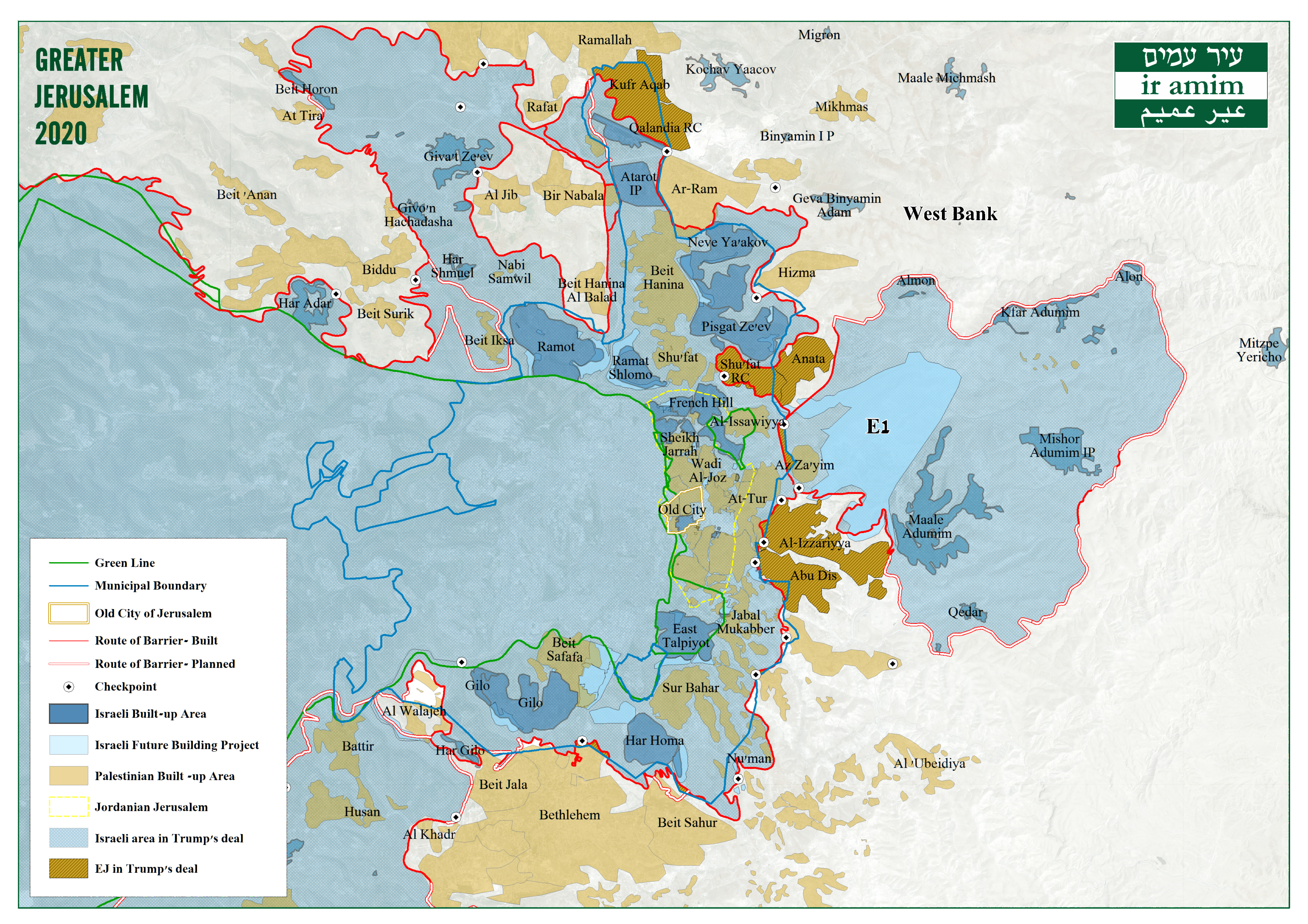
Map by Ir Amim (Click to open in new window)
Several of these conditions relate to abandoning the longtime Palestinian demand to have Jerusalem as the state capital. The Vision explicitly states that Jerusalem will be the unified capital of Israel while giving Palestinians the option of using areas east of the separation wall (Kufr Aqab, Shuafat refugee camp and Abu Dis) as a future capital, which it generously allows them to call “Al Quds” if they desire. It should be recalled that these areas are isolated and impoverished suburbs of Jerusalem (they are in fact outlying areas that Israel added to the Jerusalem municipality after it captured the city in 1967), and that under this Vision, the Palestinains not only don’t get a capital in the area that is what is truly East Jerusalem (i.e., Jerusalem pre-1967), but they are cut off from it entirely. This point affirms what has long been obvious to many: planning and building the separation wall in Jerusalem was an act of de facto annexation of all the land on the Israeli side of the wall.
On this point, Ir Amim writes:
“According to the plan, a theoretical Palestinian capital would be established in the areas beyond the barrier, which would include Kufr Aqab, the Shuafat refugee camp area, as well as Abu Dis (see linked map). Abu Dis has repeatedly appeared in various Israeli proposals as a substitute outside of Jerusalem for a Palestinian capital and consistently rejected by the Palestinians. It is likewise important to note there is no territorial contiguity between the two areas beyond the barrier and Abu Dis, rendering it an even more artificial construct.” Ir Amim goes on to predict, “The US plan significantly reflects Israeli efforts in recent years to officially uproot the neighborhoods beyond the barrier from Jerusalem. This is liable to cause a wave of Palestinian residents back into the core of East Jerusalem, increasing the already existing burden on the massive housing shortage and failing infrastructure and leading to even greater chaos within the Palestinian neighborhoods on both sides of the barrier. Likewise, it is possible there will be an increase in requests for Israeli citizenship particularly among Palestinian residents living beyond the barrier in order to secure their status in the city.”
FMEP will provide more in-depth coverage of the Jerusalem aspects of the plan – including the U.S. green light (which has subsequently been changed, at least in public statements, to yellow, but will be understood by the Israelis, correctly, as remaining green) as major change to the status quo on the Temple Mount – as more analysis is published (which FMEP knows is coming!).
The Vision Supports Settlement Endeavors in Silwan
In one of the sections addressing Jerusalem, the Vision lists specific holy sites in Jerusalem which Israel currently controls. That list includes many, many Jewish sites, many Christian holy sites (though notably omitting the Garden Tomb), but just two Muslim sites (Haram al-Sharif and an ambiguous “Muslim Holy Shrines”). Most incredibly, the list of holy sites includes several archeological sites run by the Elad settler organization in the Palestinian East Jerusalem neighborhood of Silwan. Elevating these sites – which have been cultivated as part of the settlers’ mission to increase the Jewish presence in and hegemony over the historic basin of the Old City, most notably Silwan and Sheikh Jarrah – to the status of “holy sites” is a full endorsement of that agenda. This should come as no surprise to anyone, given Amb. Friedman’s now infamous hammer-wielding appearance in the tunnel of an Elad archeological site in July 2019.
Ir Amim explains the significance:
“The plan calls to safeguard Jerusalem’s religious and holy sites and ensure freedom of access for worshippers of all faiths. It subsequently lists various holy sites in Jerusalem. Save for the Haram al-Sharif and a general reference to Muslim holy shrines, there is no other inclusion of sacred Muslim sites on the list, while at the same time it includes a significant number of Jewish and Christian sites. Among the Jewish sites listed, there are various archeological sites which Israel has never before officially regarded or recognized as holy. It should be noted that these sites are located in and around Silwan and constitute the locus of the Elad settler organization’s touristic settlement operations in the area.” Ir Amim later concludes that because of the Vision, “State-sponsored settlement campaigns in the Old City Basin, including settler-initiated evictions of Palestinians, takeovers of their homes, and touristic initiatives are expected to accelerate.”
Netanyahu Promises, Then Delays, Rapid Approval of Bill to Annex All Settlements & the Jordan Valley
Following his side-by-side press conference with President Trump, the Israeli PM told reporters that he will ask his Security Cabinet to vote on bill to annex the Jordan Valley and all settlements (approximately 30% of the West Bank) this Sunday, February 3rd – but also said that his government will “need to do some work to define exactly [what we will annex].” Following his initial promise, several rounds of new reports suggested, and then un-suggested, and then re-suggested that Netanyahu would delay/soften/reframe this promise to bring annexation to a vote At the time of publication, the latest press reports suggest that Netanyahu decided to cancel the weekly Security Cabinet meeting on Sunday, with no new date set.
Netanyahu’s changing position, at least in part, reflects the conflicting messages coming from Washington, DC. Immediately following the unveiling of the Vision, U.S. Ambassador David Friedman offered the Trump Administration’s full support for Israel’s immediate annexation of lands that the Vision transfers to Israel. A short time later, Jared Kushner – breaking with Friedman – publicly cautioned against such a move before the next Israeli election. The Israeli government then went to the media to insist on the message that there is/was no disagreement between the Israeli and American governments (who wrote the Vision together), and that the seemingly uncoordinated annexation plans were simply a “technical” disagreement, with Israel’s wishing to annex in three chunks, and the Americans preferring for Israel to annex everything at one time.
Netanyahu’s promise to hold an annexation vote so quickly should also (perhaps primarily?) be viewed in the context of the premiership-or-prison election scenario he has been facing for the past year. The pressure to annex, and annex immediately, has reached a fever pitch amongst both Netanyahu’s rivals and his most strategic allies.
When a government source hinted to the press that Bibi might delay his promise to call up an annexation bill on Feb. 3rd in order to allow the Attorney General to issue an opinion on the matter, Bibi’s rivals and allies pounced, offering pointed criticism of Bibi’s leadership and stressing the urgency of annexing the land immediately. In the past, Attorney General Avichai Mandleblit has expressed concern that a transitional government cannot take such dramatic steps (notably, the AG is only worried about the timing of annexation, not the validity of it). Recently, however, he softened – nearly reversed – his opposition to the plan. Bibi’s critics were not assuaged even when the Ynet news outlet cited an unnamed government source saying that Mandleblit is prepared to approve an annexation bill.
Even before reports of a delay in order to allow the Attorney General to weigh in, Benny Gantz, took part in a testy Twitter exchange, responding to Netanyahu by saying:
“You can apply Israeli law in the Jordan Valley in a cabinet decision within two hours, without any Knesset discussion. Let’s see you.”
Gantz has also promised to bring the Vision itself up for a vote in the Israeli Knesset next week.
MK Avigdor Liberman (who played the role of kingmaker/bloc-breaker in the past two election rounds, and might do so again) wrote on Facebook:
“You don’t care one whit about the Jordan Valley. The only thing you care about is immunity.”
On January 22nd, Defense Minister Naftali Bennett (a member of Netanyahu’s very fragile political alliance) publicly called on Netanyahu to stop delaying annexation of the Jordan Valley, and “do it now.”
Transportation Minister Bezalel Smotrich penned a letter to Netanyahu calling on him to bring a bill to annex the Jordan Valley to a vote next week. Smotrich wrote:
“Yisrael Beytenu and Blue and White think that important and fundamental decisions can be made during a transitional government. I am in favor of this. But not for politics, but for essential matters. Applying sovereignty over the Jordan Valley is one of the important Zionist measures that are on the agenda and if Blue and White wink at the right, it will be given the chance to prove it. The political timing is ripe to back such a move. With a true friend of Israel, President Donald Trump, combined with the ‘urgent’ plenary conference on Tuesday, this is a historic opportunity. We have no excuse for missing it. There are those who demand a plenary convening for populist needs of immunity, we must take advantage of this to implement an historic historic step in the Jordan Valley.”
Interior Minister Aryeh Deri (the leader of the Shas Party, also part of Netanyahu’s political alliance) tried to defend the Prime Minister’s delay, saying that the government is already advancing annexation as an administrative fact. Speaking at a Jordan Valley settlement, Deri said:
“As interior minister, I’m telling you that on the municipal side, we’re already starting to prepare the administrative work. There are many challenges that must be dealt with.”
The picture that emerges from the Israeli political scene is one of nearly consensus support for annexation of the Jordan VAlley and all the settlements, with only the Joint List and Meretz Party challenging the overwhelming support for annexation and the Trump Admin Vision within Israeli politics.
U.S. & Israel to Form Technical Teams to Plan Israeli Annexation
Israel and the U.S. are not wasting any time in implementing the annexation portion of the Vision.
Following the unveiling of the Vision, U.S. Ambassador Friedman told the press that there is no “waiting period” preventing Israel from annexing West Bank land and that, anticipating such a move, he intends to set up a committee (presumably in the State Department and/or Embassy) “as soon as possible” to examine any Israeli annexation plan to make sure it is in line with the Vision. Speaking on annexation, Friedman said:
“It’s a process that requires effort, accuracy and calibration and you have to make sure that the annexation matches the map in our plan. We will look at the Israeli proposal and examine it and make sure it is in line with our plan. We will set up the committee as soon as possible and work on it immediately and try to end quickly but I do not know how long it will take.”
Acting Israeli Defense Minister Naftali Bennett also announced that he Israel will establish a new governmental body to lead the annexation effort. Bennet said:
“I will be clear: Whatever is postponed until after the elections will never happen. We all understand this. Therefore, I am announcing this morning that I ordered the formation of a special team to apply and carry out the implementation of Israeli law and sovereignty over all Jewish settlements in Judea and Samara, over the Jordan Valley, and the hotels around the Dead Sea.”
This is the third annexation body the Bennet has announced the creation of during his short time as the Israeli Defense Minister during the current transition government. Though it is not clear if any/all of these government bodies overlap, Bennet announced the creation of:
- The “special team” detailed in the Bennet quote above [Announced January 29, 2020]
- An inter-ministerial taskforce to develop settlement and annexation plans for the future of Area C in the West Bank. [Announced January 9, 2020]
- A research team to survey and then present several legal options for how Israel can bring the settlement planning processes under the Justice Ministry (integrating the settlements into the domestic Israeli planning process, and act of annexation). [Announced December 12, 2019]
Invited to Washington, Prominent Settler Welcome Plan But Utterly Reject Vision for (a Non-Sovereign, Non-Autonomous) Future State of Palestine
Several of the most prominent settler leaders accepted an invitation from Prime Minister Netanyahu to accompany him on a mission to Washington, DC for the unveiling of the Trump Administration’s “Deal of the Century.” The leaders were invited to attend in order to receive briefings about the contents of the plan, or, as they put in a statement:
“We came to strengthen the prime minister and to clearly present to the White House the voice of all the settlements. It was important for us to hear the information in person rather than relying on rumors.”
Ahead of the public release, David Elhayani (Chairman of the Yesha Council, an umbrella group, and chairman of the Jordan Valley Regional Council) told the press that he wasn’t getting much sleep due to worry about the plans’ contents, specifically that it would be “horrible for settlements.” Having reportedly heard from Netanayhu that the plan will outline the possiblitiy of a Palestinian state on 70% of the West Bank, Elhayani said:
“We cannot accept a plan that would include the establishment of a Palestinian state, which would pose a threat to the State of Israel. We will also not allow for the establishment of a Palestinian state, even if that means giving up on enacting sovereignty in Judea and Samaria and the Jordan Valley [for now]. We call on the prime minister and members of Knesset not to accept a comprehensive agreement within which a Palestinian state can be established in any form.”
Upon seeing the plan – which awarded the settlers nearly everything on their wish list short of the ethnic cleansing of the West Bank – the settler leaders’ opposition calcified with two major objections: 1) the hint of a settlement construction freeze in the “Israeli enclaves,” (which, as described above, is not a meaningful freeze) and 2) the possibility of a future state of Palestine (which, as described above, is not a future state but a few islands of Palestinian land completely encircled and controlled by Israel). The rejection leads one to ask, what do the settlers want to do with the Palestinians?
In Two Rulings, the Jerusalem Magistrate’s Court Sets Precedent for Massive Displacement of Palestinians in Silwan
The Jerusalem Magistrate’s Court handed down two rulings in the past 10 days that order the eviction of Palestinian families from their homes in the Batan al-Hawa section of the Silwan neighborhood of East Jerusalem. Both petitions were initiated by the Ateret Cohanim settler group, which claims to own the land upon which the homes are built. By accepting Ateret Cohanim’s ownership claim in these two cases – which the settler group asserts based on its management of a 19th century trust – the court has set a significant precedent for nearly a dozen additional petitions initiated by Ateret Cohanim to evict some 700 more Palestinians from their East Jerusalem homes. [map]
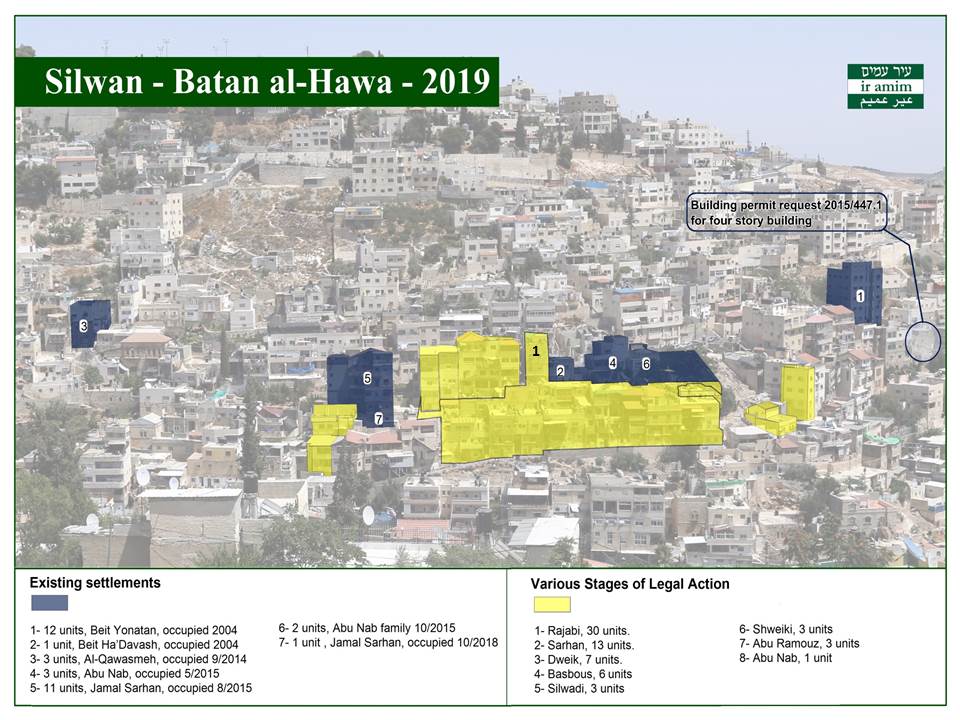
First, on January 19th the Jerusalem Magistrate Court ruled in favor of the radical settler group Ateret Cohanim to evict the Palestinian Rajabi family from their home home of 45 years in the Batan al-Hawa section of Silwan, located just south of the walls of the Old City of Jerusalem. In so doing, the court accepted Ateret Cohanim’s claim to own the tract of land in Silwan upon which the Rajabi home was built. The court ordered that the family must vacate their 3-story apartment building by July 1st; however, the eviction might be delayed as the Rajabi family announced that the family intends to file an appeal against the decision with the Jerusalem District Court. Nasser Rajabi, head of the family, told Haaretz:
“My father bought this house and I was born in this house. We didn’t take it from anyone. We’d never even heard about the Yemenites until they sued us. I’m not leaving the house, where would I go? We will die before they get us out.”
Second, on January 26th the Jerusalem Magistrate’s Court ruled to evict the Palestinian Dweik family from their home (also located in the Batan al-Hawa section of Silwan) based on a petition filed by Ateret Cohanim on the same basis as the Rajabi petition. The Dwieks were ordered to vacate the building by August 2nd.
Peace Now said in a statement:
“This is an attempt to displace a Palestinian community and to replace it with an Israeli one, in the heart of a Palestinian neighborhood in East Jerusalem. The settlers could not have succeeded without the Israeli authorities’ close support and assistance. In addition to the hard blow to the prospects for a two-state solution by preventing a Palestinian capital in East Jerusalem, this is an injustice and an act of cruelty to throw out families who have lived lawfully in their homes for decades.”
Ir Amim said:
“The Ateret Cohanim settler organization is waging one of the most comprehensive settler takeover campaigns in East Jerusalem through initiating mass eviction proceedings against Palestinian families in Batan al-Hawa. Seventeen families have already been evicted with over 80 other households facing eviction demands, placing some 600-700 individuals of one community at risk of displacement. See Ir Amim’s and Peace Now’s joint report, “Broken Trust” for further details and analysis.”
As FMEP has detailed, Ateret Cohanim is a settler organization which works to establish Jewish enclaves inside densely populated Palestinian neighborhoods of East Jerusalem. In Silwan, it is working largely based on its contention that land in Silwan was once owned by Jews and can now, under Israeli law, be reclaimed. Specifically, Ateret Cohanim contends that land belonging to a Jewish trust (named the Benvenisti Trust) in the 19th century is now the property of Ateret Cohanim, which took control of the trust in 2001. In 2002, the Israeli Custodian General agreed to transfer land in Batan al-Hawa to the Trust/Ateret Cohanim. Since then, Ateret Cohanim has accelerated its multifaceted campaign to remove Palestinians from their homes, claiming that the Palestinians are illegally squatting on sacred religious land owned by the Trust.
Haaretz columnist Nir Hasson tells the story:
“The neighborhood of Batan al-Hawa is an extreme example stressing the difference between how Arab property was dealt with as opposed to Jewish property. A Jewish neighborhood that had been built for immigrants from Yemen with funds raised by the philanthropic organization Ezrat Nidahim lay in the Batan al-Hawa area until 1938. The homes in the neighborhood were owned by an Ottoman-era land trust that was registered in the name of Rabbi Moshe Benvenisti. In 2001, more than a century after the land trust had been established, the Jerusalem District Court approved the request by three members of Ateret Cohanim to become trustees of the land. With this brief decision that takes up half a page, and a subsequent decision by the Custodian General, the state placed 700 Palestinians, along with their property, under the control of Ateret Cohanim, which seeks to increase Jewish presence in Jerusalem’s Old City.”
Israel Issues Eviction Orders to 30 Palestinian Families Living in the Old City of Jerusalem
On January 20th, Israeli authorities delivered eviction orders to 30 Palestinian homes in East Jerusalem, including 22 houses in the Old City neighborhood of Bab al-Silsila – or Chain Gate. If implemented, the eviction orders will render almost 200 Palestinians homeless. Reports mention that all of the homes have sustained structural damage because of Israeli excavations under the Old City, but no further details are reported concerning the predicate for eviction.
Bonus Reads
- “Expansion of jurisdiction brings change for settlers” (Ynet)
- “Ottoman archives help Palestinians reclaim their land” (Al-Monitor)
- “Israel Rejects 98% of of Palestinian Building Permit Requests in West Bank’s Area C” (Haaretz)
- “Bennett looks to demolish illegal Palestinian businesses at Ariel Junction“ (Jerusalem Post)
- “Go ahead, annex the West Bank” (+972 Magazine)
- “Prejudices and ignorance among Israeli settlers in the West Bank” (Jerusalem Post)
- “Here’s What Happens if Israel Annexes the West Bank and Lets Palestinians Vote” (Haaretz)
- “A Designer Villa With a Sprawling View of the Occupation” (Haaretz)
- “Illegal Settlement Growth, Widespread Hopelessness among Youth Eroding Middle East Peace Prospects, Under-Secretary-General Tells Security Council” (United Nations)