Welcome to FMEP’s Weekly Settlement Report, covering everything you need to know about Israeli settlement activity this week.
To subscribe to this report, please click here.
July 21, 2023
- “Dizzying” East Jerusalem Settlement Activity Continues: Israel Approves Givat Hamatos Building Permits & Schedules Discussion to Double Its Size
- Israel Expands West Bank Annexation via Archaeology, Including Construction of 4-7 New Settler Tourism Sites
- Smotrich Prepping Plans to Expand Campaign Against Palestinian Construction, With Aim to Expand Authority to Areas A & B
- Israel Opens First High Tech Campus in “Silicon Wadi” East Jerusalem Project
- Knesset Pushes Bill to Directly Fund Settlements
- Another Palestinian Bedouin Community Coerced to Leave Homes By Settler & State Terrorism
- In the Press: Bibi Denies Reports of “Settlement Freeze” Promise to Biden, Talks His Vision of Peace
- Smotrich Claims Credit for U.S.-Israeli Tensions
- Bonus Reads
“Dizzying” East Jerusalem Settlement Activity Continues: Israel Approves Givat Hamatos Building Permits & Schedules Discussion to Double Its Size
Ir Amim reports that Israel has continued its “dizzying pace” of settlement advancements in East Jerusalem, this week granting approval to four building permits for the yet-to-be-built Givat Hamatos settlement, and take an irregular step to advance a new plan – called “New Talpiot” – that would serve to massively expand the fully-approved plan for Givat Hamatos settlement.
The four building permits were issued on July 16th and will allow the foundation to be laid for several buildings in the Givat Hamatos settlement – which, if built, will be the first new settlement to be built in East Jerusalem in over two decades. The buildings (which will require separate building permits to be issued) will have a total of 900 units. The Israeli government has approved a plan to build a total of 2,610 settlement units in the Givat Hamatos settlement.
 In addition, the Jerusalem District Planning Committee is set to convene on Monday, July 24th to discuss a plan referred to as “New Talpiot Hill” that will, if approved and constructed, expand double the number of housing units in the Givat Hamatos settlement and increase its land mass by 40%, stretching Givat Hamatos eastward towards the settlement of Har Homa. The Givat Hamatos A project is directly adjacent to the area of the New Talpiot Hill project. The plan provides for 3,500 new settlement units and 1,300 hotel rooms – the latter posing a direct competition to the Palestinian tourism industry in nearby Bethlehem. The plan also calls for five synagogues and two mikvehs, clearly showing that the construction is designed to serve Israeli Jews although the neighboring Palestinian communities are suffering an acute housing crisis.
Ir Amim further notes that Israel is carrying out land registration on plots of land implicated by the New Talpiot Hill plan, a process which Israel has weaponized as a tool of settlement expansion.
Ir Amim writes:
“Together, Givat Hamatos A and New Talpiyot Hill along with concurrent settlement advancements in the area are cumulatively sealing off East Jerusalem’s southern perimeter from Bethlehem and the southern West Bank. These measures likewise further fracture the Palestinian space and deplete all remaining land reserves in the area for Palestinian development. Such conditions severely undermine the prospects of an agreed political future of Jerusalem, while depriving Palestinians of their fundamental right to housing and shelter.”
Israel Expands West Bank Annexation via Archaeology, Including Construction of 6-7 New Settler Tourism Sites
On July 17th the Israeli government approved a three-year $33 million (NIS 120 million) plan to take control over archaeological sites throughout the West Bank, including plans to establish 4-7 new settlement tourist sites. The approval of this plan is the fulfillment of a commitment made in the government’s coalition deal, which called for
The plan has several alarming components, including:
- Nearly $3million allocation of monitoring alleged antiquity destruction by PAlestinians and the Palestinian Authority, as well as for enforcement activities such as demolitioning Palestinian construction near antiquity sites.
- The construction of 4-7 new tourist installments at archaeological sites throughout the West Bank – the first being a new site at the “Hasmonean Pools” near Jericho. On this, Peace Now explains:
“The Hasmonean Palaces are located in Area C, adjacent to the Palestinian city of Jericho, which mostly falls under Areas A and B. Currently, access to the site passes through Area A. Beyond the site development, the goal of the program is also to enable access and regulate the movement of Israeli visitors from Area C into the site itself. In the past, there have been reports of plans to build a bridge over Area A to allow Israelis to reach the site.”
- The construction of a heritage center to showcase West Bank artifacts, with the possibility of building a new archaeological museum somewhere in the West Bank (location not determined).
- Surveys and excavatations.
Emek Shaveh and Peace Now both note that this new $33 million project comes in addition to the $9 million dollars in funding that the government approved in May 2023 to develop and “renovate” the archaeological site of Sebastia, located near the Palestinian village of Sebastia, north of Nablus in the heart of the West Bank. The project includes plans to pave a new access road for Israelis to reach the site, which they currently have to access by traveling through the Palestinian village of Sebastia, which will increase and entrench Israeli control not only over the site itself but the surrounding area – effectively weaponizing archaeology as a tool for dispossession.
Emek Shaveh said in a statement:
“With Bezalel Smotrich responsible for the Civil Administration and Jewish Power in charge of the Ministry of Heritage, the archaeological sites are weaponized more than ever before as a means for justifying ‘touristic settlements’, significantly entrenching and expanding the occupation and have become a central component in the present government’s steps towards advancing annexation. Along with massive settlement expansions, settler violence and legislation, the development of heritage sites in the West Bank will give control over substantial public areas and transform the multi-layered historical character of the area beyond recognition.
Although the plan is titled “an emergency plan for protection of antiquities”, only 10 million NIS of a budget of 120 million NIS are actually earmarked for defending sites against antiquity theft. Most of the budget is allocated to acts that constitute de facto annexation of the West Bank in complete violation of international law and the Oslo Accords. It is quite clear that for the current government the plan is yet another component in its efforts to thwart any possibility for a two-state solution and establish a biblical theocracy. We call on the international community to hold the State of Israel accountable to its own commitments under the Oslo accords, to the Two States Solution and to international law.”
Peace Now said in a statement:
“The Israeli government continues to settle in the West Bank in every possible way and continues to strengthen the friction with the Palestinian population. Investing over 150 million NIS in new tourist settlements implies exploiting archaeology in the West Bank to promote settlements and adversely affect Palestinians. Instead of investing in archaeological and tourism sites within Israel, the Israeli government continues to prioritize the settler minority over millions of Israelis. Investing in new settlements under the guise of heritage in the West Bank is a divisive move that harms Palestinians, distances peace and the two-state solution, and also undermines Israel’s tourism potential.”
As background, in January 2021, the Israeli government committed funding to a new settler initiative to surveil archeological sites under Palestinian control. While the objective of protecting antiquities might appear uncontroversial and apolitical, the true (and transparently self-evident) objectives behind this effort are: to support yet another pretext to surveil and police Palestinians; to establish and exploit yet another means to dispossess Palestinians of their properties; to expand/deepen Israeli control across the West Bank; and to further entrench Israeli technical, bureaucratic and legal paradigms that treat the West Bank as sovereign Israeli territory. It is the result of a campaign that has taken place over the past year in which settlers have escalated their calls for the Israeli government to seize antiquities and “heritage sites” located in Palestinian communities across the West Bank, especially in Area C, which Israel today treats as functionally (and legally) indistinguishable from sovereign Israeli territory. Funding committed by Israel for West Bank “heritage sites” should be understood in this context
Previous victories for the settlers in this same arena include the Israeli Civil Administration’s issuance in 2020 of expropriation orders – the first of their kind in 35 years – for two archaeological sites located on privately owned Palestinian property northwest of Ramallah. The settlers’ pressure is also credited as the impetus behind the government’s clandestine raid of a Palestinian village in July 2020 to seize an ancient font.
In June 2020, the “Guardians of Eternity” group began surveying areas in the West Bank that Israel has designated as archaeological sites, looking for Palestinian construction (barred by Israel in such areas) that they could then use as a pretext to demand that Israeli authorities demolish it. The group communicates its findings to the Archaeology Unit of the Israeli Civil Administration (reminder: the Civil Administration is the arm of the Israeli Defense Ministry which since 1967 has functioned as the de facto sovereign over the West Bank). The Archaeology Unit, playing its part, then delivers eviction and demolition orders against Palestinians, claiming that the structures damage antiquities in the area.
And one more reminder: in 2017, Israel designated 1,000 new archaeological sites in Area C of the West Bank. The “Guardians of Eternity” group, not coincidentally, is an offshoot of the radical Regavim organization, which among other things works to push Israeli authorities to demolish Palestinian construction (on Palestinians’ own land) that lacks Israeli permits (permits that Israel virtually never grants).
Smotrich Prepping Plans to Expand Campaign Against Palestinian Construction, With Aim to Expand Authority to Areas A & B
At a meeting of the Knesset Foreign Affairs and Defense Committee, Bezalel Smotrich revealed several plans that intensify and expand Israel’s annexation of the West Bank,, including plans to extend Israeli civilian operations – specifically the demolition of Palestinian construction – into Areas A & B.
Most drastically, Smotrich said that he is preparing a plan – expected to be approved within a month – that would allow him to direct the demolition of Palestinian buildings in Areas A & B which are determined to be a “security threat.” Smotrich told the Knesset that Israel’s ability to operate in Areas A & B are “key” to national security, and that he is working on plans to create a new unit within the Border Police which will be assigned specifically to construction law enforcement. This would be yet another advancement of Israel’s de facto annexation of the entire West Bank, which is increasingly focused not just on solidifying Israeli sovereignty over Area C but on Areas A & B as well. Haaretz notes that the Knesset Committee spent more time discussing Areas A & B than Area C. It should be noted that the Knesset Committee was convened to discuss what the Israeli government and the settlers believe to be “The Palestinian Authority’s takeover of open areas in Judea and Samaria” — a completely warped narrative of what is transpiring in the West Bank, where Israeli settlements are expanding while Palestinian are facing apartheid conditions. As admitted by an Army officer at the hearing, the Israeli military rejects 90-95% of Palestinian building requests while granting 60-70% of settler building requests
During a discussion of the Palestinian construction, Smotrich said his plan would also see Israel declare activities by Palestinian Authority to be a “foreign hostile activity,” which would prompt Israel to seize funds from the PA.
Smotrich also discussed two projects being prepared by the Jewish National Fund to plant trees on 2,500 acres of West Bank land. Smotrich talked about this tree-planting operation as a means of annexation, saying: “The [PA] actively works to seize lands. We need to do the same thing….[This means] legalization, construction, agriculture. “ This news comes the same week Israeli operated tractors were filmed uprooting Palestinian owned olive trees near the village of Tarkumiya.
As a reminder, in his role as a civilian minister in the Defense Ministry in charge of the Civil Administration, Smotrich is already empowered to order demolitions in Area C (powers which had previously been held by Israel’s military) — powers which he has wielded aggressively. As defined by the Oslo Accords, Areas A & B constitute 40% of the West Bank where the Palestinian Authority is assigned responsibility for civilian administration matters, like construction. Smotrich’s moves only underscore Israel’s erasure of any meaningful distinction between these areas, which has also been evidenced by routine military incursions into Nablus and Jenin, Israeli activity around antiquity sites under PA control, and more.
Israel Opens First High Tech Campus in “Silicon Wadi” East Jerusalem Project
The Times of Israel reports that Israel celebrated the opening of its inaugural high tech workspace that is part of the “Silicon Wadi” project, under which Israel aims to establish a major high-tech hub along the western side of East Jerusalem’s Wadi Joz neighborhood. While touted as a plan that will benefit Palestinians, its implementation has required the eviction of many Palestinian businesses in the area.
The new $2.8million (NIS 10 million) tech campus is a free workspace for Israeli and international high tech companies, and it has the capacity to host 250 workers with workstations, meeting spaces, and other available services. Four companies have already began working out of the new building.
You can read Ir Amim’s in-depth reporting on the Silicon Wadi project here.
Knesset Pushes Bill to Directly Fund Settlements
The Israeli Knesset is advancing a bill that will allow Israel to transfer tax revenue to the settlements, therefore bringing the settlements under direct Israeli law (an act of de facto annexation, illegal under international law) and further subsidizing the settlement enterprise. Even though the Israeli government has funded settlements from the outset, it has not permitted tax revenue sharing and has typically tried to hide other direct lines of funding to the settlements through non profits and other intermediaries.
The Combatants for Peace told Haaretz:
“The Netanyahu government has already ceased even trying to hide the institutionalization of apartheid. MK Asher’s reckless bill is another way to transfer budgets and to support the settlement enterprise and perpetuate the oppression and dispossession of Palestinians. What they can’t get in through the door, they’re trying to get in through the window – the main thing is to keep building.”
Another Palestinian Bedouin Community Coerced to Leave Homes By Settler & State Terrorism
B’Tselem reports that the al-Baq’ah Palestinian bedouin village was forced to abandon its village lands located west of Hebron under daily violence inflicted upon it by nearby settler outposts, and decades of harassment by the Israeli state.
The village’s decision to leave comes less than one week after the IDF demolished a water cistern used by all six families living in al-Baq’ah for personal and agricultural work. The villages told B’Tselem researchers that they are fleeing the village in fear of their lives.
B’Tselem writes:
“Al-Baq’ah joins the nearby communities of Ras a-Tin and ‘Ein Samia, which have already been driven off their lands over the past year under the same circumstances: Israel’s policy creates oppressive, unreasonable living conditions that leave residents of these communities with no choice but to abandon them. Relying on more official means (settlement building, extreme restrictions on Palestinian construction, a prohibition on infrastructure and demolitions), and on less official ones (settler violence against Palestinians), the policy has one goal: taking over more and more Palestinian lands and handing them over to Jewish hands, and it is applied against other communities still living in the area. Forcible transfer is a war crime, even if the state perpetrates it not by forcing people onto trucks but by putting so much pressure on them that their lives become unbearable and they cannot help but leave their homes and lands.”
In the Press: Bibi Denies Reports of “Settlement Freeze” Promise to Biden, Talks His Vision of Peace
Axios reports that on a July 17th call, Netanyahu informed President Biden that he does not expect to advance any more settlement planning, construction, or outpost “legalization” through the end of the 2023 year. Netanyahu issued a statement denying these reports, however Haaretz reports that Netanyahu contradicted that statement during private briefings for members of his staff and foreign journalists.
Separately, in an interview with podcaster Lex Fridman, Netanyahu provided a fresh look at what his vision of a “peace” deal is, explicitly saying that no settlements or settlers (no matter their location) would be uprooted, and that settlers would remain under Israeli sovereignty. He went on to reject Palestinian sovereignty.
Smotrich Claims Credit for U.S.-Israeli Tensions
In an interview with the settler-allied Arutz Sheva outlet (aka Israel National News), Smotrich made a few eye-opening remarks on his policies and motivations, saying:
“Our mission first and foremost is to provide security to the citizens of Israel in the settlements and all over the country. When we talk about the fight against terrorism there are two legs: the first is the development of the settlements and strengthening our grip on the territories of the Land of Israel. After all, terrorism is designed to weaken our grip – and our true answer that will eradicate it and make terrorism futile – will be further construction. When you look at Judea and Samaria, this government is building, regulating, developing, both in construction and in infrastructure on an unprecedented scale….quite a lot of the tensions that exist between the American administration and the Israeli government – and these are tensions between friends and partners and we manage these disputes with respect – stem from the policy that I am leading as a minister in the Ministry of Defense in the settlements with the full backing of the Prime Minister and the Minister of Defense.”
Bonus Reads
- “How settlers justify their pogroms” (Shabtay Bendet in +972 Magazine)
- “I was handcuffed and blindfolded for reporting on settler violence” (Basel Adra in +972 Magazine)
- “‘The escalation is frightening’: Jerusalem Christians fear for their future“ (+972 Magazine)
- “Israeli Soldiers Protect the Settlers, Then Attack Us Activists” (Illana Hammerman in Haaretz)
Welcome to FMEP’s Weekly Settlement Report, covering everything you need to know about Israeli settlement activity this week.
To subscribe to this report, please click here.
July 14, 2023
- Settlers Move In After Israel Forcibly Evicts Ghaith-Sub Laban Family
- Israel Starts Planning New East Jerusalem Settlement Enclave Via Weaponization of the Land Registration Process
- Settlers Takeover Another Palestinian Home on Shuhada Street in Hebron, Potentially with IDF Help
- Settlers Lead State-Backed Archaeological “Excavation” in Area B
- Government Admits it Deliberately Permitted Illegal Construction at Homesh Outpost
- Bonus Reads
Settlers Move In After Israel Forcibly Evicts Ghaith-Sub Laban Family
On the early morning of July 11th, a large contingent of Israeli police arrived at the home of Nora Ghaith and Mustafa Sub Laban to forcibly remove the elderly couple from their apartment in the Muslim Quarter of the Old City of Jerusalem. The apartment was handed over to settlers, who moved in as soon as the Ghaith-Sub Labans were removed.
Twelve human rights activists were arrested by Israeli police during protests held in solidarity with the Gaith-Sub Laban family. The eviction was widely panned by the international community.
The Ghaith-Sub Laban family has spent more than 45 years in a legal battle against settlers (and the State) over their home in the Muslim Quarter of the Old City of Jerusalem. This family’s story is not unique, and the broader, systemic processes behind the forcible dispossession of Palestinians in Jerusalem is also discussed. In March 2023, FMEP hosted Rafat Sub Laban and Ir Amim’s Amy Cohen on a podcast – “‘We Are Determined to Stay”: One Palestinian Family’s Story of Dispossession in Jerusalem” – to discuss the Sub Laban case and how it relates to broader State-back settler efforts to dispossess Palestinians across Jerusalem.
Ir Amim explains the Israeli legal system which aids settlers in taking possession of Palestinian properties across East Jerusalem, including the Sub Laban home:
“… lawsuits were filed by settler groups on the basis of the 1970 Legal and Administrative Matters law. This discriminatory law exclusively affords Jews with land restitution rights for assets allegedly owned by Jews in East Jerusalem prior to 1948 despite many of these properties now inhabited by Palestinian refugees. No parallel legal mechanism exists for Palestinians to recover pre-1948 assets on the Israeli side of the Green Line now inhabited by Jews. To the contrary, the 1950 Absentee Property Law enshrines that Palestinians who were forced to abandon their homes in what became Israel due to the war of 1948 cannot retrieve them.
Settler organizations aided by state bodies act to secure ownership rights of these assets through various means despite having no relation to the previous Jewish owners or occupants. Acquisition of these rights provides settler groups with the legal platform to then “retrieve” the property from the General Custodian and initiate eviction lawsuits against Palestinian families through application of the 1970 law.
A department within the Ministry of Justice, the General Custodian is the Israeli body responsible for managing pre-1948 Jewish assets in East Jerusalem until “reclaimed.” It should be noted that the General Custodian has become one of the leading state institutions who works in cooperation with settler groups to facilitate evictions of Palestinians and seizure of their homes in East Jerusalem. Many of the families facing eviction are Palestinian refugees who lost homes on the Israeli side of the Green Line in 1948 and now stand to be displaced for a second or even third time.”
For a comprehensive overview of the Sub Laban family’s legal battle, as well as other East Jerusalem eviction cases, please see Ir Amim’s report.
Israel Starts Planning New East Jerusalem Settlement Enclave Via Weaponization of the Land Registration Process
Ir Amim and Bimkom report that Israel has initiated the planning process on a new settlement enclave in the Umm Lysoon neighborhood in East Jerusalem, and in order to facilitate the new enclave the State is simultaneously carrying out land registration for the land where the enclave will be built. The plans for the settlement enclave call for the construction of 450 settlement units, on an open piece of land between Umm Lysoon and the adjacent neighborhood of Jabal Mukkhaber, one of the only open land reserves in the area where Palestinians face a severe housing Crisis. Unsurprisingly, some of the same settlers who are pushing the Umm Lysoon plan not only live in Jabal Al-Mukaver, but have already succeeded in massively expanding the Nof Zion/Nof Zahaf settler enclave in that neighborhood.
 The plan for the new Umm Lysoon enclave hinges on the settlers’ work with the State to transfer ownership of the land into the hands of settlers using the land registration process – – which Ir Amim and Bimkom have shown to be a politically-driven tool used by the State to fuel the expansion of settlements across the city.
The land where the new enclave is being planned for has been managed by the Israeli Custodian General, the State body which acts as a caretaker for property abandoned by Israeli Jews as a result of the 1948 war, with the idea that the property will be returned to its original owners. Settlers have worked with the state to secure ownership rights to East Jerusalem land despite having no relation to the previous Jewish owners. Such is the case with the Umm Lysoon land, where the Israeli Custodian General is submitting the plans (even though it does not own the land, just manages it) for the new enclave alongside Topodia LTD, a settler-linked construction company. Topodia managed to acquire ownership of a very small percentage of the land within the enclaves planned borders, but the planning requires the willing participation of the Israeli Custodian General.
The plan for Umm Lysoon is the third settlement plan in the last 1.5 years that has been promoted not only on lands managed by the General Custodian, but also with its direct involvement – the others being the Givat HaShaked and Kidmat Zion settlement plans.
Ir Amim and Bimkom write:
“If constructed, it would constitute a major settlement within the heart of Umm Lysoon, which until now has remained untouched from the threat of setter presence or encroachment. As with other East Jerusalem neighborhoods, Umm Lysoon continues to suffer from a severe shortage in housing, public buildings, infrastructure, and basic services. Instead of promoting residential development and urban planning to meet the needs of local residents, the plan is rather being advanced to establish a new Jewish settlement inside a Palestinian neighborhood on land marked in policy documents for the community’s development.”
Settlers Takeover Another Palestinian Home on Shuhada Street in Hebron, Potentially with IDF Help
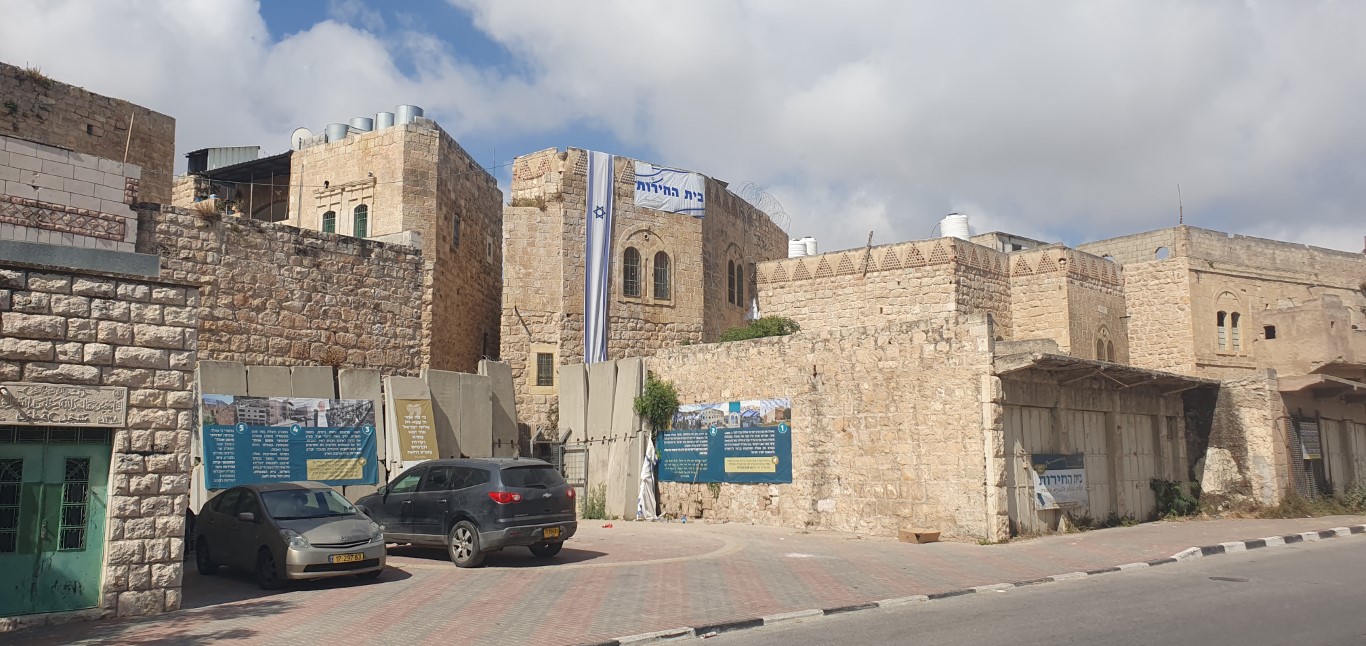 Peace Now reports that settlers have illegally moved into a Palestinian-owned property in the heart of Hebron on Shuhada Street, just south of the Cave of the Patriarchs, in an area of downtown Hebron where no other Israeli settlers live. The settlers appear to have accessed the home, which until recently was blockaded by concrete barriers, with the assistance of the IDF and further claim to have purchased the home. This location – and the alleged purchase of the home – is hugely significant both on the ground and in the Israeli government’s brazen support facilitation of settlement expansion, as explained by Peace Now:
“Hebron is perhaps the most scattered city in the West Bank. Any change in ownership of a store, courtyard, and especially a structure means establishing a new settlement in the city. Many houses and properties in the part of the city controlled by Israel have remained vacant and abandoned over the past decades and serve as a target for settlers’ takeover. Until recently, approvals for the settlement of new houses by the settlers required the approval of the Minister of Defense and the Prime Minister. As part of the transfer of civilian authority to Bezalel Smotrich, it was decided that in Hebron, the approval of settlement would be in the hands of Smotrich in coordination with Minister Yoav Gallant. The settlers’ entry into the house openly indicates that both ministers agreed to establish the new settlement. The new settlement is located on Shuhada Street (the settlers changed its name to King David Street), between the Pool of Siloam and the neighborhood of Avraham Avinu. This is an area populated by Palestinians and far from the existing settlements in the city. The new settlement is, in fact, an entry into a new area in the city.”
Years ago, the IDF installed concrete barriers preventing anyone from accessing the house, and evicted settlers from the home last year when they used a ladder to climb over the barriers. Those concrete barriers were recently removed (which can only be done with heavy equipment), suggesting that the IDF is planed to allow the settlers to enter (and likely remain) in the house.
The home is owned by the Palestinian Jariwi family, which petitioned the Israeli High Court of Justice to evict the settlers. The state initially responded to the petition saying that the settlers had already been evicted (clearly not true), and the State is now facing a July 30th deadline with the Court to submit an updated response given that the settlers are still squatting in the house illegally.
Photo of the new enclave found at: https://peacenow.org.il/en/a-new-settlement-was-established-in-hebron-with-the-return-of-settlers-to-a-house-that-the-idf-evicted-a-year-ago
Settlers Lead State-Backed Archaeological “Excavation” in Area B
Emek Shaveh reports that a triad composed of settlers, an American Christian evangelical organization, and the Israeli army collaborated on a recent unlicensed excavation on Mount Ebal – located north of Nablus near the Palestinian town of a-Sira al-Shaliya in Area B of the West Bank (where Israel does not have civilian authorities, according to the Oslo Accords). The excavation was approved by the Israeli Civil Administration under pressure from settlers, but given the location of the site in Area B and the lack of any license to carry out the excavation – Emek Shaveh states that this could be considered antiquity theft.
The groups transferred some 80 cubic meters of soil from Mount Ebal to the Shavei Shomron settlement, where settlers then promoted an opportunity for members of the public to join the archaeologists in sifting through the materials (thereby promoting tourism to the settlements). Haaretz called the excavation “is mainly used as a tourist attraction to the West Bank and is of little scientific significance.”
Emek Shaveh’s explained the significance of what is happening on Mount Ebal:
“The archaeological site at Mount Ebal is becoming a watershed in Israeli archaeology. The activity on the site has turned from a pirate operation led by a group of Messianic Jews and Christians into a state sponsored operation under the auspices of the Civil Administration led by Minister Bezalel Smotrich.This is yet another violation of the Oslo Accords and suspected violation of domestic and international law that is whitewashed by Israeli authorities and intended to serve as a method for advancing the annexation of the West Bank to Israel.In addition to the alleged violation of the law, the excavation constitutes an ethical failure by the entire archaeological community in Israel whose silence continues to grant legitimacy to such projects. A comprehensive and immediate investigation is required by all the relevant parties as well as independently by the Israeli Archaeological Association.”
Government Admits it Deliberately Permitted Illegal Construction at Homesh Outpost
In response to a petition submitted by Yesh Din, the Israel state formally confirmed reports Defense Minister Yoav Gallant ordered the Israeli army to stand down when it arrived in May 2023 to stop settlers’ attempt to relocated the Homesh outpost onto a small sliver of “state land” in the area of the former Homesh settlement in the northern West Bank. Gallant’s intervention only served to confirm the unapologetic determination of the Israeli government to reestablish the Homesh settlement on the “state land,” despite the fact that the land is surrounded by privately owned Palestinian property belonging to the nearby village of Burqa. (spoiler: In 2018, Israel established basis in its legal books for violating the private property rights of Palestinians in order to build an access road to the Haresha outpost).
In the weeks since settlers were permitted to illegally move into the area, the outpost has been connected to the state water grid.
On July 7th, a group of ~400 Israeli, Palestinian, and international activists attended a Peace Now protest march intended to start in Burqa and end at the Homesh outpost, in an effort to call on the government of Israel to stop the establishment of a settlement there. Though the marchers had requested and received a permit to hold the march, the IDF used force to stop the march from approaching Burqa. One marcher was detained and later released.
As a reminder – the legalization of Homesh was explicitly agreed to in the coalition deals which formed the current Israeli government. And despite the message to the U.S. behind closed doors, Israeli lawmakers and settler leaders hailed the Israeli government’s moves on Homesh as concrete steps toward the realization of this commitment. Otzma Yehudit MK and settlement activist Limor Son Har Melech hailed the news and said that the real goal is to reestablish all four settlements located near the Homesh outpost which were dismantled by the Israeli government in 2005 (the order issued by the IDF Commander on May 18th that allows Israelis to enter to the Homesh area did not extend to the areas of the other three settlements – Sa-Nur, Ganim, and Kadim).
Bonus Reads
- “Four Palestinians said wounded in settler attack in West Bank” (The Times of Israel)
- “Smotrich wants one million West Bank settlers. That’s not so far-fetched” (+972 Magazine)
- “Senate Foreign Relations Committee set for debate over Biden guidance on Israeli cooperative funding” (Jewish Insider)
- “Israeli Human Rights Violations in the Occupied Palestinian Territory – Weekly Update: 06-12 July 2023” (PCHR)
Welcome to FMEP’s Weekly Settlement Report, covering everything you need to know about Israeli settlement activity this week.
To subscribe to this report, please click here.
May 26, 2023
- IDF & Settlers Move Ahead with Re-Establishment of Homesh Settlement
- Israeli Authorities Approve New East Jerusalem Settlement of “Kidmat Zion”
- State & Settler Violence Coerce the Forcible Transfer of Ein Samia Bedouin Community
- Israel Attempts to Assuage U.S. Concern Over Smotrich’s “Double the Settlers” Planning
- Israeli State Budget Awards “Several Billion” Shekels to Settlements & Outposts
- Government Gives Settler Group $41 Million for East Jerusalem Archaeological Projects
- Annexation, End of Civil Society on the Government’s Agenda This Weekend
- Bonus Reads
IDF & Settlers Move Ahead with Re-Establishment of Homesh Settlement
On May 18th the IDF Commander signed a military order that finalizes the Knesset’s recent repeal of key sections of the 2005 Disengagement Law, allowing Israelis to enter the area in the northern West Bank where the Homesh settlement stood before it was dismantled by the Israeli government in 2005 as part of Disengagement. In parallel, the Israeli Defense Minister announced that the government plans to relocate the Homesh outpost – a yeshiva (that is, a Jewish religious school) established illegally by settlers as part of their drive to re-establish the Homesh settlement – from its current location, which is on land that Israeli courts have recognized as private Palestinian property, to a small plot of nearby “state land.” The Times of Israel further reports that the IDF Commander signed additional orders on May 15th that temporarily bar Israelis from entering the existing Homesh outpost until the outpost’s yeshiva is relocated to the “state land” plot, and that add the Homesh outpost as an official community under the umbrella of the Shomron Regional Council (a settlement municipal body).
Following the IDF Commander’s order, Yesh Din said in a statement:
“The Homesh outpost is on private land belonging to residents of the Palestinian village of Burqa. The entry of Israelis into the area is an additional tool in the expulsion of residents from their lands. The process of authorizing the outpost is a prize and an incentive for criminals and a violation of international law.”
On May 25th, Haaretz published photos of settlers using tractors to clear the plot of “state land” for construction, ostensibly in preparation for the relocation of the existing Homesh outpost/yeshiva. Israel’s plan to relocate the outpost is an attempt to sidestep a pending petition filed in 2009 by the Palestinian landowners and Yesh Din seeking removal of the Homesh outpost/yeshiva from the Palestinians’ land and providing for the landowners to access the area (discussed in greater detail below). To state the obvious, moving the Homesh settlement to the tiny plot of “state land” in the area will not cure any of the underlying infringements on Palestinian rights. Yesh Din explains “Israel is well aware that as long as there is an Israeli presence in the area, the Palestinian landowners will not be able to access their lands safely and the violation of their rights will continue.”
This land clearing by settlers is taking place despite the fact that, according to Haaretz, the settlers do not have the permits legally required by Israel to carry out work at the site, resulting in the IDF attempting to stop the illegal work. Reportedly Defense Minister Gallant and Minister Smotrich ordered the IDF to back off and allow the settlers land-clearing to continue, lack of permits notwithstanding. On May 24th Yesh Din submitted an urgent appeal with the Israeli Central Command to stop the settlers’ work at the site; the appeal is still pending, even as the settlers’ work continues because the Israeli government has instructed the IDF to allow it.
Israeli actions on the ground send strong signals that Israel will soon act to transform the Homesh outpost, relocated to its new site, into an official new (or in this case, resuscitated) settlement. Yet, following U.S. criticism of its policies and actions vis à vis Homesh, the Israeli government reportedly sought to assuage U.S. concerns by drawing a (manufactured, meaningless) distinction between establishing a settlement and relocating an existing outpost. Axios reports that “the Israeli side made it clear to the Biden administration that it has no intention of rebuilding the Homesh settlement and stressed the new order was signed only to allow the moving of the Homesh outpost from private land to state land.”
As a reminder – the legalization of Homesh was explicitly agreed to in the coalition deals which formed the current Israeli government. And despite the message to the U.S. behind closed doors, Israeli lawmakers and settler leaders hailed the Israeli government’s moves on Homesh as concrete steps toward the realization of this commitment. Otzma Yehudit MK and settlement activist Limor Son Har Melech hailed the news and said that the real goal is to reestablish all four settlements located near the Homesh outpost which were dismantled by the Israeli government in 2005 (the order issued by the IDF Commander on May 18th that allows Israelis to enter to the Homesh area did not extend to the areas of the other three settlements – Sa-Nur, Ganim, and Kadim).
Kerem Navot adds more detail to the settlers’ grand ambition in this area of the West Bank – between the major cities of Nablus and Jenin where there is currently no official Israeli settlement or control. Kerem Navot writes:
“the settlers have already made it clear that from their perspective, returning to Homesh is only the beginning. And that it is their intention to also re-establish the settlement of Sa-Nur, which was located on a hill a few kilometers to the north, next to the Nablus-Jenin road. At the same time as the takeovers of these sites, the settlers have also been pursuing a plan to take over the Al-Mas’udiyya train station, which is located north of the violent and isolated settlement of Shavei Shomron. As we reported here last September, they intend to establish the “Settlement Museum” there…the racist and violent settler right that, in practice, controls the Israeli government, plans on taking over an area where there haven’t been settlements since 2005. At this stage, the intention is to 1. Re-establish two settlements (Homesh and Sa-Nur) that were evacuated in 2005. 2. Take over two new spots (the archeological site in Sebastiya and the Al-Mas’udiyya train station), by turning them into tourist sites. The wider Israeli public will provide the money and the soldiers required to realize this plan. And the land, and most of the blood that will be spilled in order to realise this plan, will, as always, be supplied by the Palestinians.”
And a further reminder: The Israeli government has for nearly three years delayed its response to a 2019 petition filed by Yesh Din seeking both the removal of the illegal outpost and yeshiva at the site of the dismantled Homesh settlement, as well as the site’s return to its Palestinian landowners. Despite Homesh being dismantled in 2005, Israel never permitted Palestinians to regain access to or control of the land, declaring it a closed military zone. That status has prevented Palestinians from entering the area, even as the IDF permitted settlers to routinely enter the area, to live (illegally, under Israeli law) at the site, and to illegally establish a yeshiva there. That yeshiva, according to Kerem Navot, has become one of the West Bank’s “hardcore centers of settler terror”. Settlers have also wreaked terror on nearby Palestinian villages, most notably Burqa and Sebastia. One Israeli politician even went so far as to say that settlers are “carrying out a pogrom” in Burqa.
Proving Kerem Navot’s point, on May 24th, on the heels of a visit to the area by foreign diplomats, a group of settlers attacked Burqa, near the Homesh site, throwing stones and setting homes on fire.
Israeli Authorities Approve New East Jerusalem Settlement of “Kidmat Zion”
The Jerusalem District Planning Authority gave initial approval to a plan to build a new settlement enclave, “Kidmat Zion,” to be located between the Ras al-Amud neighborhood and the Israeli separation barrier, with the Abu Dis neighborhood on the other side of the wall. The settlement enclave will be accessible only by driving through densely populated areas of Ras Al-Amud.
The plan – which calls for 400 settlement units [translating, conservatively, to at least 2,000 settlers] – is being promoted by the Ateret Cohanim settler organization. Speaking publicly about the plan, Ateret Cohanim said it will:
“change the map of the eastern part of the city. The neighborhood sits in a strategic location, and can gradually change its image to Jewish and prevent the Arab takeover of the city’s eastern neighborhoods.”
Construction of this settlement could well achieve the considerable geopolitical consequences the settlers hope for — most notably by complicating if not outright blocking any future division of Jerusalem (or sharing agreement) under any possible Israeli-Palestinian peace agreement. It is worth recalling that Abu Dis has been repeatedly suggested by Israel and its allies (including in the Trump Plan) as the capital of a future Palestinian state (as a substitute for Jerusalem), and an unfinished building in Abu Dis was designed to be the future home of a Palestinian parliament. This settlement plan would scuttle all such ideas. Indeed, in the planning documents Ateret Cohanim explained:
“Palestinian institutions in Abu Dis were built with the vision of turning the town into the capital city of Palestine and building a corridor and passage to the center of Jerusalem, and thus promoting the takeover of the entire city…The significance of establishing and developing the neighborhood is to create a shield for Jerusalem against Palestinian ambitions. The neighborhood will disturb the contiguity [of the area] and protect us from dividing the city.”
The new settlement enclave will also further solidify the infrastructure connecting settlements south of Jerusalem to the city. Kidmat Zion will be located adjacent to the so-called “American Road,” which will tunnel underneath parts of Abu Dis. The “American Road” is a section of north-south highway that is meant to seamlessly connect settlements located in the north and south of Jerusalem to one another, and to serve as a bypass for settler traffic to cut through East Jerusalem’s Palestinian neighborhoods. While the road will be accessible to Palestinians (a fact touted by Israel as proof of Israeli good intentions), the obvious primary purpose is to entrench Israel settlements, expand Israeli control over all of East Jerusalem, and close off Palestinian East Jerusalem neighborhoods from the rest of the West Bank, thereby (further) torpedoing Palestinian hopes of one day establishing a capital in East Jerusalem.
State & Settler Violence Coerce the Forcible Transfer of Ein Samia Bedouin Community
On May 22nd, the approximately 200 residents (27 families, including 80 children) of the Ein Samia bedouin community were forcibly coerced to leave their homes and abandon their land. The community faced nearly constant and often violent harassment by settlers from a nearby settlement, Kochav HaShachar and its shepherding outpost, as well as state-backed violence, including the looming demolition of the community’s only school.
The Ein Samia community lived on the land for 40 years, and its residents have endured violence and oppression for decades. However, as +972 journalist Basel Adra reports, the community has been living through a true nightmare over the past week. Adra writes:
“Residents say they were compelled to leave after a fierce spate of violence over the previous five days, during which settlers attacked them at night, blocked the roads to the village, and threw stones at the old homes. The mental toll of the attacks, especially on the children, was the decisive factor in the residents’ choice to destroy the village and move away…‘Ein Samia is located next to the Kochav HaShachar settlement and is east of Tzir Alon, an area settlers have been attempting to take over in recent years. It is one of 180 Palestinian villages in Area C of the West Bank that are “unrecognized” by the Israeli authorities and whose residents are denied permits for any construction or connection to basic utilities, like water and electricity.”
Yesh Din said in a statement:
“Yesterday, a Bedouin Palestinian family was forced to leave their home in Ein Samia due to escalating settler violence. This heartbreaking incident is not an isolated case. Rather, it has become a distressing phenomenon in the West Bank, growing worse with each passing day. In Ein Samia – like other areas in the west bank – the plight of Bedouin communities has been unfolding for decades. For approximately 60 years, Bedouin communities have resided and worked on the agricultural lands surrounding Kafr Malik – an area called Ein Samia. These families were first displaced in the 1960s and have since relied on these lands for their livelihoods. They have endured hardships and harassment, but recent events have taken a sinister turn. The establishment of ‘Micha Farm,’ a settler shepherding outpost, marked a turning point. (5/10) It not only disrupted the lives of the Bedouin communities but sparked a surge in violence. With increasing frequency, settlers armed with guns and attack dogs invade their lands, stealing livestock, damaging crops, and subjecting Palestinian residents to physical assaultsThe situation has become unbearable. The attached photo captures the heartbreaking moment when a family had no choice but to pack their belongings, forced out of their home by the constant terror they could no longer endure.”
B’Tselem said in a statement:
“Israel’s policy, whose goal is to allow the state to take over more and more Palestinian land to be used by Jews, is applied across the West Bank against dozens of Palestinian communities. This policy is illegal. Forcible transfer is a war crime.”
Israel Attempts to Assuage U.S. Concern Over Smotrich’s “Double the Settlers” Planning
Last week it was reported that Bezalel Smotrich, who has been granted vast authority over civil affairs in the West Bank, has set out to initiate wide-scale planning with the goal of adding 500,000 new settlers within the next two years. This week, Haaretz reports that Israeli government officials told the Biden Administration that, notwithstanding Smotrich’s intentions and plans, the government does not have an official policy seeking to add 500,000 new settlers in the next two years.
Israeli State Budget Awards “Several Billion” Shekels to Settlements & Outposts
On May 24th, the Knesset approved a state budget which, among other things, provides (at least) several billion (yes, with a “b”) shekels for settlements and outposts.
In particular, the State budget invests massively in West Bank infrastructure projects. Fully one-fourth of the total Transportation Ministry’s budget is for projects in the West Bank, even though settlers are just X% of the total Israeli population. Specifically, the budget provides the Transportation Ministry with NIS 3.5 billion ($941 million) to invest in upgrading and paving new roads in the West Bank over the next two years. The Times of Israel details the settlement-related budgets and projects that this funding includes:
- NIS 2 billion ($538 million) will go to upgrading Highway 60, the main north-south highway which runs from Jerusalem to Hebron;
- NIS 500 million ($134 million) will go toward expanding a road between the Ariel settlement and Tapuach Junction in the northern West Bank;
- NIS 366 million ($98 million) will go to upgrading the access road to the Beit El Regional Council area;
- NIS 300 million ($81 million) will pay for a new road between the Migron settlement and Qalandia north of Jerusalem;
- NIS 200 million ($54 million) for a road circumventing the Palestinian village of Al-Funduq in the northern West Bank west of Nablus; and,
- NIS 150 million ($40 million) for a road in the Alfei Menashe settlement.
- Hundreds of millions more were allocated for roads in and around East Jerusalem.
The newly created Settlements and National Missions Ministry, headed by Religious Zionism MK Orit Strock (a longtime settler activist from the Hebron settlements) received NIS 268 million ($72 million) in funding, including NIS 399 million ($107 million) that will be funneled to the World Zionist Organization’s Settlement Division and NIS 74 million ($20 million) to support settlement municipal authorities in their efforts to monitor “illegal” Palestinian construction in Area C.
Yoni Mizrachi, a researcher with Peace Now told The Times of Israel:
“All Israeli governments prioritize the West Bank settlements in the budget, but this government has gone even further and has taken money from core funds and given it to a small group living in the West Bank which in a political agreement with the Palestinians Israel will leave. We are seeing an effort here to deepen Israel’s presence in the West Bank.”
Government Gives Settler Group $41 Million for East Jerusalem Archaeological Projects
On May 21st, at a ceremonial cabinet meeting held in the Western Wall tunnels of the Old City of Jerusalem (timed to coincide with Jerusalem Day celebrations), the Israeli government approved 41 million shekels ($11 million) for archaeological sites in East Jerusalem, almost all of which are managed by the Elad settler organization. Another 6 million shekels ($1.6 million) were budgeted for programs which bring Israeli soldiers and students to Jerusalem’s archaeological sites. The Chairman of Elad, David Be’eri, attended the meeting.
Emek Shaveh, an association of left-wing archaeologists, said in a statement:
“The government will invest millions of shekels in developing tourism and promoting an ideology dictated by the radical settler organization Elad. This year, large swaths of the funding were also earmarked for bringing students and soldiers to participate in archeological and tourist settler activities. Consequently, not only will our taxes go toward Judaizing East Jerusalem, but so will our children.”
Peace Now said in a statement:
“Like in every year, the Israeli government celebrates Jerusalem Day by transferring funds to settlers in East Jerusalem. The cabinet meeting in the Western Wall tunnels is a direct continuation of the hate march we witnessed last week on Jerusalem Day. Both of these actions are intended to increase hostility, tension, and hatred between Israelis and Palestinians in the city, rather than finding a peaceful solution between the peoples.”
Annexation, End of Civil Society on the Government’s Agenda This Weekend
The Israeli Ministerial Committee on Legislative Affairs (a body of ministers who decide whether or not the government will back legislative proposals in the Knesset) is set to meet on Sunday, May 28th to vote on multiple bills that are particularly concerning for settlement watchers.
The committee may (rumor has it the government is reconsidering) vote on a resolution, authored by Galilee and National Resilience Minister Yitzhak Wasserlauf (Otzma Yehudit), that seeks to make the commit the whole of the Israeli government to advancing “Zionist values” as described in the Nation-State law. The Times of Israel reports the resolution is specifically aimed at promoting settlement growth across the West Bank, and the resolution’s language uses “The Land of Israel” to refer to the entirety of the land between the Jordan River and the Mediterranean Sea. The Times of Israel further details:
“Wasserlauf’s proposed resolution appears to be expressly focused on the issue of advancing the Jewish presence in the West Bank and throughout Israel, with the text of the resolution stating that it is applicable to government agencies involved in land allocation and construction planning, such as the Israel Land Authority and the National Council for Planning and Construction…It appears likely that a central objective of Wasserlauf’s resolution will be to further expand the West Bank settlements.”
The committee is also expected to vote on a bill to de facto annex national parks and nature reserves in the West Bank. The bill, proposed by Likud MK Danny Danon, seeks to transfer the power to declare “national sites” in the West Bank from the Defense Ministry (which is hte occupation government) to the Interior Ministry (an entirely domestic body), which is currently headed by acting Minister is Michael Malchieli (Shas). Revealing the bill’s true goal – to bring every archaeological and heritage site in the West Bank under Israeli control – the explanatory note filed with the bill reads:
“The lands of Judea and Samaria [the West Bank] are full of heritage sites of great national and historical importance to the development of settlement in the Land of Israel. In these lands, our forefathers walked, established their homes, and were exiled from these places twice in history. After nearly 2,000 years of exile, the people of Israel have returned to their land, and during the Six Day War, the lands of Judea and Samaria were liberated as well. We must recognize the history of the Jewish people that can be found in every clod of earth in Judea and Samaria.”
Amid international outcry, the committee is also expected to vote on an extremely dangerous bill targeting civil society organizations and, in particular, the human rights sector. The legislation would in effect remove the tax-exempt status of these groups and replace it with an onerous, and quite openly punitive, vindictive tax rate of 65% applied to the groups’ income and/or endowments. Please listen to a new FMEP podcast with Lara Friedman, Jessica Montell (HaMoked) and Francesca Albanese (UN Rapporteur), entitled “Israel’s new anti-NGO legislation: An Effort to Eradicate Opponents of Illiberalism”
Another bill seeks to penalize students flying the Palestinian flag on Israeli school campuses, making it a punishable offense with suspension and/or expulsion.
Bonus Reads
- “The Palestinian Village in Smotrich’s Sights” (Jewish Currents)
- “Opinion | Israel’s Absent Finance Minister Serves the Settlements” (Nehemiah Shtrasler, Haaretz)
Welcome to FMEP’s Weekly Settlement Report, covering everything you need to know about Israeli settlement activity this week.
To subscribe to this report, please click here.
May 19, 2023
- Peace Now Reports: 613 New Settlement Units Advanced, Including Tender for A New Settlement – “Ariel West”
- March of Flags Expanded Route
- Gallant Orders IDF To Allow Israeli Jews to Reestablish Homesh Outpost & Yeshiva
- Smotrich is Leading a Push to Double Settler Population
- Al Walajah Checkpoint Construction Blocks Palestinians from Land
- Settler Visit to Joseph’s Tomb Causes Conflict
- MKs Oppose New Section of Security Wall, Say it Will Divide Settlements from Israel
- Bonus Reads
Peace Now Reports: 613 New Settlement Units Advanced, Including Tender for A New Settlement – “Ariel West”
Peace Now reports that Israeli planning authorities convened on May 17th to advance plans for a total of 613 new settlement units, including a move by the Israeli Ministry of Housing and Construction to re-publish a tender for the construction of 58 units constituting a new “neighborhood” of the Ariel settlement which is, in effect, a new settlement. The Civil Administration’s High Planning Committee also convened on the 17th and is expected to have issued final approval to a plan for 552 units in the Givat Ze’ev settlement, and also to have deposited for public review a plan for 2 more units in Givat Ze’ev as well as a plan for 1 new unit in the Itamar settlement (final confirmation of the Committee’s decision was not available at the time of publication). Peace Now warns that construction could commence quickly on the plan to build 552 new units in the Givat Ze’ev settlement because a contractor has already been selected. Givat Ze’ev is located south of Ramallah in an area that is on the Israeli side of the barrier. 
The Ministry of Housing and Construction’s issuance of a tender to build 58 units in the Ariel settlement is final approval to build a brand new settlement, dubbed “Ariel West.” Plans for the Ariel West settlement were first made public in November 2021, after the tenders were issued under the guise of a plan to “expand” the Ariel settlement [for more on how this plan was kept quiet, see Peace Now’s detailed history]. The units for the new Ariel West settlement will be built on a hilltop located 1.2 miles away from Ariel, in an area that is non-contiguous with the built-up area of the current Ariel settlement. The new settlement will be directly adjacent to the Palestinian village of Salfit, further limiting the future development of Salfit and restricting Palestinian agricultural workers’ access to land, as illustrated in this video by Peace Now. [map]
Peace Now said in a statement:
“It is clear that annexing the West Bank is the main agenda of the Israeli government. Promoting more than 600 housing units in settlements, among them a tender for the construction ‘Ariel West’, an entirely new settlement established under the official guise of a neighborhood an Ariel settlement, joins previous devastating annexationist decisions advancing annexation, made by the government, such the decision to legalise 15 outposts, the advancement of nearly 10,000 housing units in settlements, the cancelation of the disengagement law from the North part of the West Bank, the promotion of the apartheid road east of Jerusalem and the transfer of powers from the military to Minister Smotrich. Each decision alone demonstrates that the government is acting with an intention to annex the occupied territory, prevent the possibility of establishing a viable Palestinian State, and to escalate tensions between Palestinians and Israel.”
March of Flags Expanded Route
Tens of thousands of ultra-nationalist extremist Israeli Jews participated in the annual Jerusalem Day “Flag March” through Jerusalem in celebration of Israel’s (illegal) annexation of East Jerusalem in 1967. The parade drew security support from over 3,200 Israeli security forces and aerial drones, which sealed off the route of the parade and shuttered large parts of Jerusalem for Palestinians. The parade poses an annual threat of erupting into large-scale violence because it is a direct provocation – which Israeli lawmakers egg on and participate in – against Palestinians in Jerusalem. Israeli Jews participating in the parade chant Jewish Supremacist slogans and anti-Palestinian slurs including “Death to Arabs” and “May Your Village Burn,” the latter of which is particularly horrific given the pogrom Israeli settlers committed against the Palestinian village of Huwara earlier this year.
This year the Israeli government extended the route of the Flag March, which Haaretz estimated to impact at least an additional 50,000 Palestinian residents of East Jerusalem. The longer route will include stops at two East Jerusalem settlement compounds, bringing the parade for the first time through the Palestinian neighborhood of A-Tur and near the village of Ras Al-Amud. Haaretz also reports that march organizers will hold tours in Sheikh Jarrah.
Ir Amim’s Yudith Oppenheimer explained the motivation of the marchers:
“At the parade’s core lies an ideology that Palestinians ought to be humiliated and pushed to their limit; they should be reminded at every moment that they live in an occupied city where they have no authority and no place; every reaction by Palestinians must be exploited to justify increased use of force and establish more facts on the ground.This is why the parade organizers and their sponsors insist on the route going through Damascus Gate and the Muslim Quarter. And if necessary, may our city burn just to prove it.”
The Haaretz Editorial Board wrote:
“The essence of the Flag March is to poke a finger in the eye of the city’s Palestinian inhabitants, to humiliate them and to drive home the fact that 40 percent of the residents of Israel’s capital live under occupation. Absurdly, the march actually underscores the fragility of Israeli sovereignty over East Jerusalem. It takes place under heavy security provided by thousands of police officers, after the police impose severe restrictions on the Palestinian public and merchants.”
Gallant Orders IDF To Allow Israeli Jews to Reestablish Homesh Outpost & Yeshiva
On Wednesday May 17th, Defense Minister Yoav Gallant issued an order instructing the head of the IDF Central Command – Yehuda Fuchs – to sign a military order that makes it legal for Israeli Jews to enter and reside in the area of the Homesh settlement in the northern West Bank, including the Homesh settlement which settlers have been pushing to reestablish. The military order is needed even after the Knesset repealed clauses of the 2005 Disengagement Law in March 2023, which it did explicitly in order to facilitate the reestablishment of the Homesh settlement which was dismantled under the law, along with three other settlements in the area.
The Knesset’s repeal of the Disengagement Law faced international criticism, which Prime Minister Netanyahu, at the time, assuaged by issuing a statement that his government has ““no intention of establishing new settlements in the area.”
The U.S. State Department issued a statement to Israel Hayom in reaction to Gallant;s order, reiterating opposition to the reestablishment of Homesh, saying:
“The United States strongly urges Israel to refrain from allowing the return of Israeli settlers to the area covered by the legislation passed in March, consistent with both former PM [Ariel] Sharon’s and the current Israeli government’s commitments to the United States…We have been clear that advancing settlements is an obstacle to peace and the achievement of a two-state solution. This certainly includes creating new settlements, building or legalizing outposts, or allowing building of any kind on private Palestinian land or deep in the West Bank adjacent to Palestinian communities”
Further reports suggest Gallant and Smotrich are working on a plan to build the Homesh settlement on a small plot of “state land” in the settlement’s former location, which was built almost entirely on land that belongs to (and is recognized by Israel as registered as belonging to) Palestinian owners. The Israeli NGO Yesh Din noted that the repeal of clauses related to Homesh in the Disengagement Law did not change the legal status of the land, and did not create a legal option for reestablishing the Homesh settlement there. Smotrich and Gallant are apparently advancing a plan to build Homesh on the small parcel of “state land” in the area, which in effect will allow settlers – and the security apparatus that enables, accompanies, and entrenches their presence – to retain total control over the Homesh area even though the land is privately owned by Paelstinians.
As a reminder, even after the Homesh settlement was dismantled in 2005, control over the land was never returned to its owners. The area was instead declared by the Israeli army to be a closed military zone, with Palestinains, including the owners of the land, barred from access. The Palestinians owners have been fighting for the right to access their own land since 2009, with no success. At the same time, the Israeli army allowed Jewish Israeli settlers to access the area regularly, and even permitted the settlers to illegally (under Israeli law) establish a religious school and settlement outpost at the site. Rather than enforce Israel’s own laws against the settlers, the current Israeli government has agreed to grant retroactive approval to the settlers’ illegal presence, the first step towards doing so being the aforementioned repeal of clauses in the Disengagement Law that make any Israeli presence there illegal. A
Smotrich is Leading a Push to Double Settler Population
Haaretz reports that since Bezalel Smotrich was granted vast authority over civil affairs in the West Bank, he has set out to initiate wide-scale planning to add 500,000 new settlers, essentially doubling the current number of Isarelis living in the West Bank (not including East Jerusalem). This push includes orders to improve the infrastructure for every settlement and outposts (regardless of legal status) within the next two years. Smotrich is also pursuing ways by which to make it easier for settlers to cross into Israel without the hassle imposed on currently by the checkpoint system.
Haaretz further reports that Defense officials are expected to oppose Smotrich’s planning, even though detailed information has not yet been provided. In addition to security challenges to Smotrich’s plan, he also lacks the massive budget that such an effort would require.
Al Walajah Checkpoint Construction Blocks Palestinians from Land
Ir Amim reports that the Jerusalem Municipality has formally announced the start of work on a project to relocate a key IDF checkpoint leading to the Palestinian village of Al-Walajah, a village which is located on (and partially within) the southern perimeter of Jerusalem’s expanded municipal borders. The effort to move the checkpoint closer to the built-up area of Al-Walajah is part of the Israeli government’s long running effort to take control over an increasing amount of land – and importantly, the Ein Haniya spring – that historically belongs to Al-Walajah.
By relocating the checkpoint to a point closer to Al-Walajah, Palestinians from the village will no longer have unfettered access to approximately 1200 dunams of agricultural land, including the site of the Ein Haniya springs. The Ein Al-Hanya spring, which the Jerusalem Municipality declared a national park in 2013 and then spent years and millions of dollars renovating into a tourist destination, is located on land historically part of Al-Walajah and it long served as a main source of water for households, farms, and recreational purposes for the village’s residents.
Since 1967, Al-Walajah has suffered due to its location and its complicated status (much of the village’s lands, including areas with homes, were annexed by Israel in 1967, but Israel never gave the villagers Jerusalem legal residency by Israel – meaning that under Israeli law, their mere presence in their homes is illegal). Today it is acutely suffering from a multi-prong effort by the Israeli government and settlers to grab more land for settlement expansion in pursuit of the “Greater Jerusalem” agenda. This land grab campaign includes home demolitions (four homes in Al-Walajah were demolished by Israel on November 2, 2022, for example), the construction of the separation barrier and bypass roads in a way that seals off the village on three sides, and the systematic denial of planning permits.
You can join a webinar entitled “What’s Next for al-Walaja”on May 24th at 12pm eastern to learn more about al-Walajah (hosted by Ameinu, Peace Now, T’ruah, and Telos on May 24th at 12pm eastern. Register here.
Settler Visit to Joseph’s Tomb Causes Conflict
On the night of May 17th, thousands of Israeli Jews – including at least two elected officials – staged a trip to the Joseph’s Tomb site in Nablus under the heavy protection of the IDF, which attempted to enforce a curfew on nearby Palestinian neighborhoods. Clashes erupted as Palestinian confronted the parade of settlers, resulting in at least two injuries.
In response to the violence, settler leader Yossi Dagan called on Israel to take complete control over the site, to build a yeshiva there, and to “restore the ISraeli flag at this holy site and show everyone, both ourselves and our enemies, that we are not afraid.”
The tomb is located within Area A of the West Bank (where Israel does not, under the Oslo Accords, have direct control). However, Joseph’s Tomb is one of two sites in Area A which the Oslo Accords stipulate are under the control of the Israeli military. As such, it has been a perennial flashpoint, largely due to deliberately provocative actions by settlers. The whole circumstance – of settlers visiting Joseph’s Tomb – was recently called “absurd” by former IDF Major General Gadi Shamni.
MKs Oppose New Section of Security Wall, Say it Will Divide Settlements from Israel
Israel Hayom reports that the Israeli Defense Ministry is moving towards the start of construction on a very controversial section of the West Bank separation barrier near the Etzion settlement bloc. This particular section has not been built since its initial approval in 2006 because of fierce opposition to the proposed route that, even though the barrier’s route cuts deeply into the West Bank in order to keep the majority of settlements in the Etzion Bloc on the “Israeli side” of the barrier, it leaves a few settlements including Nokdim on the “Palestinian side.”
The IDF said in a statement that the project does not include the construction of concrete walls, but will feature different types of construction that cater to wildlife and the area’s topography – to include “special monitoring technology and sensors.”
Israeli lawmakers reacted negatively to the news of this project, saying that it has the potential to create a “de facto border” between the settlements and Israel proper and that it would turn settlements in the area into enclaves. This opposition is in line with the right wing demands to annex the West Bank to Israel, in which context building a barrier is viewed as conceding land to Palestinians.
For background on the separation barrier, please see B’Tselem’s explainer.
Bonus Reads
- “The Settler Terrorists in Palestinian Vineyards” (Amira Hass, Haaretz)
- “A precious resource: how Israel uses water to control the West Bank” (The Guardian)
- “When Israel’s Highest Court Assaults Human Rights” (Jessica Montell, Haaretz)
Welcome to FMEP’s Weekly Settlement Report, covering everything you need to know about Israeli settlement activity this week.
To subscribe to this report, please click here.
May 12, 2023
Israeli Government Funds the De-Facto Annexation of Sebastia Archaeological Site
On May 7, 2023, the Israeli government approved nearly $9 million (NIS 32 million) for a project to develop and “renovate” the archaeological site of Sebastia, located near the Palestinian village of Sebastia, north of Nablus in the heart of the West Bank. The project includes plans to pave a new access road for Israelis to reach the site, which they currently have to access by traveling through the Palestinian village of Sebastia, which will increase and entrench Israeli control not only over the site itself but the surrounding area – effectively weaponizing archaeology as a tool for dispossession.
Emek Shaveh calls this new project “a considerable investment,” saying it “takes Israel’s unilateral actions at heritage sites in the West Bank to a new level.” The investment is in line with the current government’s coalition agreements which include a commitment to invest $40 million into a “National Emergency Plan” under which Israel must take control of heritage sites across the totality of the West Bank, without regard to the Oslo-defined Areas A, B, and C. The Sebastia archaeological site straddles the line designating Areas B and C, with most of the site is in Area C. The Palestinian village of Sebastia – which settlers travel through to reach the site – is in Area B entirely.
Settlers have been openly agitating for Israel to assert control over the archaeological site in Sebastia for years, and the settler Samaria Regional Council organizes regular tours to the site. To secure the settlers’ visits, the IDF shuts down the town of Sebastia, closing Palestinian streets and businesses. As in other cases across the West Bank, settlers allege that Palestinians are damaging the Sebastia site and that the Israeli government needs to intervene. In 2021 amidst intensifying settler efforts related to the site, the Palestinian Foreign Ministry called on UNESCO to “protect all Palestinian archaeological and religious sites from Israeli violations, attacks and falsifications.” The archaeological site of Sebastia is on the tentative list of World Heritage sites in Palestine.
As a reminder: in January 2023 the Israeli government took a decision to transfer the Israeli Antiquities Authority (IAA) from the Ministry of Culture to the Ministry of Heritage, which is now headed by MK Amihai Eliyahu (Jewish Power). The IAA exercises authority over heritage and archaeological sites in Israel, including East Jerusalem, but has increasingly expanded its authorities into Area C of the West Bank, at the expense of the Staff Officer for Archaeology within the Civil Administration, who has historically been in charge. The government also tasked Eliyahu with preparing an emergency plan to “safeguard” antiquity sites in the West Bank specifically. Settlers have spent years alleging that Palestinians and the Palestinian Authority neglect and damage heritage sites, allegations which, turns out, have created a basis for the government to take control over those sites. The government allocated NIS 150 million to the effort.
Emek Shaveh further explains the history and politicization of this archaeological site:
“The battle over Sebastia is also played out in the narratives each side presents to the public. The informational material distributed by the PA does not include an explicit reference to the Kingdom of Israel or to the Hasmonean connection. On the other hand, in recent years the settlers have been rehabilitating the figure of Omri, a King of the Kingdom of Israel, in an effort to imbue Sebastia with greater nationalist significance. Sebastia also holds a special place in recent history for the settlers because it is the place where the leaders of Gush Emunim, the group that first fought for the establishment of settlements in the West Bank in the 1970s, celebrated the government’s agreement to establish the first settlement in the area in 1975.
In tandem with the growing campaign of recent years to apply full Israeli control over Sebastia, larger numbers of Israelis visit the site every week in buses organized by the Samaria Regional Council and accompanied by soldiers.
Sebastia, is a declared national park. National parks and nature reserves in Area C of the West Bank are managed by the Civil Administration and are referred to as “parks”. Their total area spans approximately 500,000 dunams and constitutes roughly 14.5% of Area C. Palestinians’ rights are violated in these territories through various means. In the Ein Prat Nature Reserve, for example, landowners cannot cultivate their land as their access is restricted. In Herodion National Park and Nabi Samuel, residents can neither construct nor renovate their homes.”
Emek Shaveh Warns Israel Is Moving Towards Start of East Jerusalem Cable Car Construction
Emek Shaveh warns that over the past several months a planning committee has approved several contracts that indicate the committee is barrelling towards issuing the long-anticipated (and long-feared) tender for the construction of the East Jerusalem Cable Car project, possibly as soon as next week.
As a reminder, the Jerusalem cable car project is an initiative backed by the powerful, state-backed Elad settler group and advanced by the Israeli Tourism Ministry. While public efforts to “sell” the cable car plan focused on its purported role in helping to grow Jerusalem’s tourism industry or in serving supposedly vital transportation needs, in reality the purpose of the project is to further entrench settler control in Silwan, via archeology and tourism sites, while simultaneously delegitimizing, dispossessing, and erasing the Palestinian presence there. The State of Israel was forced to publicly admit that the implementation of the cable car project will require the confiscation of privately owned Palestinian land in the Silwan neighborhood of East Jerusalem.
Notably, the cable car line is slated to terminate at the settler-run Kedem Center compound (Elad’s large tourism center, currently under construction at the entrance of the Silwan neighborhood, in the shadows of the Old City’s walls and Al-Aqsa Mosque).
The cable car project received final approval in May 2022, but the tender for construction has yet to be issued. Emek Shaveh speculates that the cable car tender might be issued on Jerusalem Day – which will be celebrated with ultranationalist, racist parades through the Old City next week — on May 18th and 19th. Emek Shaveh further warns that several other settler projects in East Jerusalem, including the Ben Hinnom suspension bridge and the zip line over the Peace Forest, are nearing completion and might also be part of Jerusalem Day celebrations.
Emek Shaveh and other non-governmental organizations, including Who Profits and Terrestrial Jerusalem, have repeatedly challenged (and provided evidence discrediting) the government’s contention that the cable car will serve a legitimate transportation need in Jerusalem, and have clearly enumerated the obvious political drivers behind the plan, the archeological heresies it validates, and the severe negative impacts the cable car project will have on Palestinian residents of Silwan. All objections to the plan were dismissed in May 2022.
Supreme Court Dismisses Regavim Effort to Force Immediate Demolition of Khan Al Ahmar
On May 7th, the Israeli High Court dismissed a new petition submitted by the Regavim settler organization (which Bezalel Smotrich, a top official in the current government, co-founded) seeking to force the government to immediately demolish the Khan Al Ahmar bedouin community. The Court granted the government yet another delay in demolitioning the village, saying that the delay was granted due to “diplomatic and security matters of the highest level.” In requesting this most recent delay, the Israeli government reassured the Court that it fully intends to demolish Khan Al Ahmar in the future and is in “negotiations” with its residents regarding their forcible removal.
In response, Regavim called the current government a “disgrace.”
Bezalel Smotrich, who serves as both the Finance Minister and a minister in the Defense Ministry with broad, unchecked authorities over civil affairs in the West Bank, made a remarkable statement, saying the quiet part out loud:
“Khan al-Ahmar will be evicted not because its illegal. (But because)it sits in a strategic area…this is the area that will determine if God forbid there will be an Arab territorial continuum”
While the Israeli government has taken a cautious approach to demolishing Khan Al-Ahmar – largely in consideration of international pressure – the government showed no restraint in demolishing an EU-funded school near Bethlehem. The school served 60 Palestinian children.
Regavim is also behind this demolition, which was carried out by the government in defiance of a request from the EU to not do so. In a statement, the EU said that demolitions like this are:
“illegal under international law, and children’s right to education must be respected. The EU calls on Israel to halt all demolitions and evictions, which will only increase the suffering of the Palestinian population and risk inflaming tensions on the ground.”
Welcome to FMEP’s Weekly Settlement Report, covering everything you need to know about Israeli settlement activity this week.
To subscribe to this report, please click here.
March 10, 2023
- As Part of Nof Zion Settlement Expansion, Israel Approves PlanNew Police Complex in East Jerusalem
- Prime Minister Convenes Summit on Evyatar Outpost Legalization, No Decision Made (Yet)
- Knesset Finalizes Draft of Bill to Reestablish Four Settlements in Northern West Bank
- Key Developments on De Facto Annexation via Archaeology
- Bonus Reads
→ Listen to FMEP’s Kristin McCarthy speak with Rafat Sub Laban (human rights lawyer) and Amy Cohen (Ir Amim) about the Sub Laban eviction case. On March 15th or anytime after, the Sub Laban family can be forcibly displaced from their home of 60+ year at the behest of settlers with the support of the State. You can listen, or watch, the conversation here.
As Part of Nof Zion Settlement Expansion, Israel Approves PlanNew Police Complex in East Jerusalem
As anticipated, in its meeting on March 8th, the Jerusalem District Planning Committee approved a plan to build a massive new Israeli security headquarters on the border of the Jabal Mukaber neighborhood, where the Nof Zion settlement enclave is located. The construction of the new police installment will allow the old station – currently located in Jabal Mukaber – to be handed over to the Nof Zion settlement enclave for the already-approved expansion of that settlement, which includes the construction of a hotel on the site of the former police installment.
The new station faced opposition both Palestinians, anti-settlement groups (the station will be located over the Green Line) as well as ecological groups, the latter because the hill on which the new station will be built is known for its rare flowers as well as panoramic views of Jerusalem. The committee dismissed all objections to the plan, saying that the station is necessary for Israel’s security.
Prime Minister Convenes Summit on Evyatar Outpost Legalization, No Decision Made (Yet)
Channel 13 News reports that on March 5th, Prime Minister Netanyahu convened a high level meeting to discuss the government’s plan to reestablish the Evyatar outpost and yeshiva, a promise made by the Prime Minister to Ben Gvir in their coalition deal. The meeting disbanded without a final decision, much to the dismay of Ben Gvir, Smotrich and the settlers who regularly (and illegally) go to the Evyatar site.
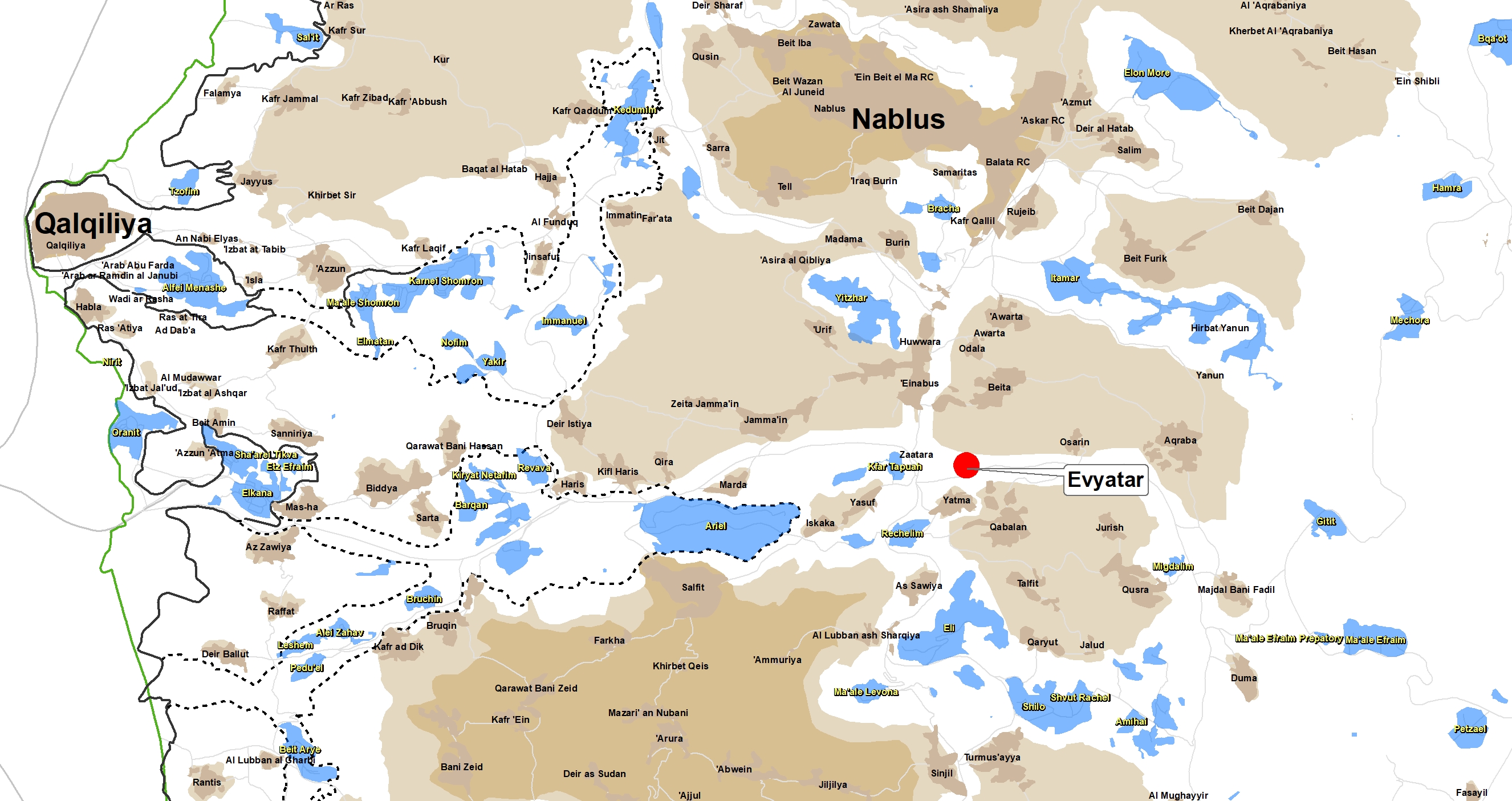
Map by Peace Now
In attendance,was National Security Minister Itamar Ben Gvir, Finance Minister and Minister in the Ministry of Defense Bezalel Smotrich, Defense Minister Yoav Gallant, Chief of Staff Major General Herzi Halevi, Coordinator of Government Activities in the Territories Colonel Ghasan Alyan, and other senior defense officials. Gallant and his allies opposed an immediate decision on Evyatar, citing security risks and rising tensions – especially with Ramadan around the corner.
Settlers attempted to visit the Evyatar outpost to celebrate the Jewish holiday of Purim, but were removed by Israeli security forces.
As a reminder, settlers agreed to temporarily leave the site of the Evyatar outpost in 2021 under terms of a government-brokered deal in which the government promised to undertake an “investigation” into the status of the land. That investigation has reportedly been concluded, and found that part of the land the outpost was illegally built on is “state land,” and part is privately owned by Palestinians. This report agrees with a 2022 opinion issued by then Attorney General Avichai Mandelblit supporting the retroactive authorization of Evyatar. The government deal with settlers also stipulated that the settlers’ illegal construction at the site would be left in place (i.e., did not demolish it) — including buildings and roads — while the government carried out its investigation into the status of the land. In this way, the “compromise” left the outpost intact and allowed Israel to maintain complete control over the site during the “survey” process, clearly signaling that the government’s objective was never to enforce Israeli law, but, rather, was always about finding a legal and political “solution” to enable it to launder the settlers’ illegal actions and accommodate their demands. Indeed, the terms of the Evyatar “compromise” made clear that the government was confident that it would find a pretext on which to assert that the land on which the outpost stands is “state land,” which can be used by the state as it sees fit (which nearly 100% of the time means, will be used to benefit the settlers).
The Evyatar outpost was built illegally by settlers on a hilltop that Palestinians have long known as Mt. Sabih, land which has historically belonged to the nearby Palestinian villages of Beita, Yatma, and Qablan. Evyatar became a recurring headline news story mostly as a result of the determined effort by Palestinians from the nearby village of Beitar to protest the outpost and to resist the Israeli government’s efforts to retroactively legalize it. Palestinians staged regular protests near the site of Evyatar outpost, which resulted in no fewer than seven Palestinian protesters dying as a result of the harsh and violent actions by the IDF to quash the protests.
Knesset Finalizes Draft of Bill to Reestablish Four Settlements in Northern West Bank
On March 9th, a Knesset panel finalized a draft bill that will repeal clauses of the 2005 Disengagement Law, which is required for the government’s plan to reestablish settlements in the northern West Bank that it dismantled as part of the disengagement deal (most notably, the Homesh settlement). The bill is now ready for its first reading and vote in the Knesset.
The agreed-upon draft will repeal clauses from the 2005 Disengagement Law that prohibit Israeli entry into the area of the former settlements, which brings the status of the land in line with the rest of Area C. Many lawmakers were pushing for the bill to also include articles that would give outright permission for the reestablishment of the areas – articles to permit Israelis to buy and own property/real estate – but the final text did not include those articles, nor does it apply any of the changes to Gaza.
Key Developments on De Facto Annexation via Archaeology
Emek Shaveh issued an update on several important issues that show how the Israeli government is continuing and in some cases accelerating the politicization of archaeology as a means to dispossess Palestinians and achieve the de facto annexation of lands in East Jerusalem and the West Bank.
First, Emek Shave reports on structural changes in the ISraeli government that put some of the most radical members of the ruling coalition in charge of key archaeological portfolios with authority over West Bank heritage sites. A government decision transferred power over the Israel Antiquities Authority (IAA) from Ministry of Culture to the Ministry of Heritage, which is headed by a member of Ben Gvir’s radical party (Amihai Eliyahu) – signaling “another step towards the extreme politicization of the authority.” In tandem, Amihai Eliyahu was given bureaucratic responsibility over the Civil Administration’s Staff Officer for Archaeology (SOA), effectively bringing this official (who is seated in the Defense Ministry) under a civilian authority. The SOA is responsible for overseeing all antiquity sites in Area C of the West Bank.
Emek Shaveh explains:
“It is not surprising that the far-right party would choose the heritage portfolio. According to the coalition agreement, the purpose of the Ministry of Heritage ‘is to care for national heritage assets, engage in the exposure, conservation and reconstruction of these assets alongside entrenching Jewish and Zionist heritage.’ Indeed, the plans and structural changes within the ministries show that consolidating heritage governance on both sides of the Green Line under the Ministry of Heritage indicates a strategic decision to use all the available statutory mechanisms in order to apply full Israeli control over ancient sites in the Occupied Territories.”
Second, Emek Shaveh reports that the IAA – as part of its expanding activities in the West Bank – conducted an excavation in the southern West Bank and announced its plan to display its findings in an Israeli museum (both of which are illegal under international law). Further, Emek Shaveh warns that archaeological digs such as the one conducted recently have served historically as a pretext for the establishment of new settlements – like in the case of the Shiloh and Amona settlements. Emek Shaveh writes:
“Even if the initial intention does not include turning the site into a settlement, the establishment of a camp is a means of laying hold to an area and displacing Palestinians from their land. It goes without saying that once a[n archaeological] camp is established, military presence is needed to guard the Israelis staying on site. We can assume that this trend will only intensify under the current minister of heritage.”
You can read the full update by Emek Shaveh, which discusses further news, here.
Bonus Reads
- “Six killed in Israeli raid on Jenin as settlers attack Palestinian town again” (Washington Post)
- “Police minister clowns around with settlers for Purim in flashpoint Hebron” (The Times of Israel)
- “West Bank, Gaza Palestinians to be banned from entering Israel during Purim” (The Times of Israel)
- “Shrinking the Conflict: Debunking Israel’s New Strategy” (Wallid Habbas, Al-Shabaka – March 6, 2023)
Welcome to FMEP’s Weekly Settlement Report, covering everything you need to know about Israeli settlement activity this week.
To subscribe to this report, please click here.
February 10, 2023
- Government Begins Forming Bureaucracy for Annexation
- Smotrich Says No Settlement Freeze, Asks Settlers to Hold Off on New Outposts
- A New Settlement: Israel Establishes Tel Zion as Independent Settlement
- Israeli Government Expected to Advance Atarot Settlement Plan
- Court Grants State Two-Month Delay in Khan Al-Ahmar Forced Displacement
- Israeli Cabinet Prepares for Vote to Amend 2005 Disengagement Law, Legalize Homesh Outpost & Yeshiva
- Bibi Pitches Massive Tunnel Construction in West Bank to French Investors
- Smotrich Resigns, Brings Criminal Settler into Knesset
- Bonus Reads
Government Begins Forming Bureaucracy for Annexation
As the new Israeli government continues to take shape, the bureaucratic mechanisms of annexation have come into focus.
Key components of this bureaucracy will reportedly include a new “Settlement Administration,” the creation of which is still pending an agreement between Smotrich and Defense Minister Gallant on how duties in the Defense Ministry will be divided (a division which is facing international opposition). In a meeting with settler leaders, Smotrich unveiled a plan for a new “settlement administration” that will attempt to centralize the Defense Ministry’s efforts accomplish several key objectives: to promote settlements, to take control of more land, to handle legal cases related to the settlements, and to advance Smotrich’s long-time goal of dismantling the Civil Administration in order to bring the settlements under the direct governance of the Israeli state (annexation).
According to Smotrich, this new administration will operate on a two year timeline to achieve its goals, ultimately working itself out of existence once all powers over the settlements are transferred from the Civil Administration to the various Israeli Ministries. According to Haaretz, Yehuda Eliyahu is likely to lead the settlement administration under the management of Smotrich. Smotrich and Eliyahu co-founded the Regavim settler group.
In addition, the Israeli government expanded the portfolio of the Minister of the Negev and Galilee, a post held by Otzma Yehudit member Yitzhak Wasserful. The expanded position will also have a new “young settlement department” (young settlement is a euphemism used by settlers for outposts). This department will be engaged in preparatory work for the legalization of outposts, and will also work on plans to deliver infrastructure to the outposts. Prior to this new department, this ministerial post did not have any authority in the West Bank (i.e. outside of Israel’s sovereign borders).
Haaretz details how these new bodies will interact:
“… if outposts are legalized, the process will likely be divided among three different agencies. The Civil Administration, which is under Smotrich’s control according to the coalition agreement, will be in charge of formal legalization. But responsibility for building or improving infrastructure in outposts will be divided between two other agencies. One is the National Missions Ministry, headed by Orit Strock (Religious Zionism). The other is the so-called young settlement department.”
Lastly, Emek Shaveh reports on a January 29th government decision which transferred the Israeli Antiquities Authority (IAA) from the Ministry of Culture to the Ministry of Heritage, which is now headed by Jewish Power MK Amihai Eliyahu. The IAA exercises authority over heritage and archaeological sites in Israel, including East Jerusalem, but has increasingly expanded its authorities into Area C of the West Bank, at the expense of the Staff Officer for Archaeology within the Civil Administration which has historically been in charge. The government also tasked Eliyahu with preparing an emergency plan to “safeguard” antiquity sites in the West Bank specifically, where settlers have spent years alleging neglect and destruction of heritage sites by Palestinians and the Palestinian Authority (which, turns out, has created a basis for the government to take control over those sites – go figure). The government allocated NIS 150 million to the effort.
Emek Shaveh reacts:
“After years of monitoring the process of weaponizing ancient sites in the service of the settlements in East Jerusalem and the West Bank, we are not surprised that the ultranationalist Jewish Power party demanded the heritage portfolio. An indication of the minister’s intentions was offered in January, when Eliyahu took over from outgoing minister of Heritage and Jerusalem Affairs, Ze’ev Elkin. At the ceremony he said: ‘Israel needs three pillars in order to stand strong: the security pillar, the economic pillar and a third pillar which is the pillar of significance.’ He added ‘The Ministry of Heritage will strengthen the third pillar. We will fortify our national resilience by encountering our heritage. We will protect the various heritage sites and devise programs to deepen Jewish identity’.”
For an overview of Israel’s weaponization of archaeology in its effort to take control of more land in Jerusalem and the West Bank, please see Emek Shaveh’s report.
Smotrich Says No Settlement Freeze, Asks Settlers to Hold Off on New Outposts
Following reports that Netanyahu had conceded to the U.S. request to freeze settlement construction in order to de-escalate tensions, Finance Minister Bezalel Smotrich repudiated the idea of any freeze, saying: “There will be no freeze on construction in Judea and Samaria. Period.”
Smotrich’s statement, however, did not contradict reports that he had asked settler leaders to stop efforts to establish new outposts, asking settlers leaders to coordinate all activity with the government. Smotrich publicly explained his request to pause outpost construction, saying at the weekly meeting of the Religious Zionism party:
“Our ambition is not to have to resort to illegal measures. We want the government to officially adopt a policy of recognizing all the communities in the settlements and also, of establishing new communities, in line with natural growth. None of us considers himself above the law. We are the government, and this will take more than a day or two, but I’m convinced that we’ll see substantial changes occurring in the near future.”
A New Settlement: Israel Establishes Tel Zion as Independent Settlement
On February 5th, the Israeli Cabinet approved a plan that will, once implemented, establish a new settlement, Tel Zion, by splitting off the Ultra-Orthodox section of the Kochav Yaakov settlement, located east of Jerusalem. The approval of this plan was delayed from consideration last month while U.S. National Security Advisor Jake Sullivan was in Israel.
The creation of the “Tel Zion” settlement is part of Netanyahu’s coalition deal with the ultra-Orthodox Shas Party, and is also supported by Defense Minister Gallant.
Israeli Government Expected to Advance Atarot Settlement Plan
Peace Now reports that the Netanyahu government appears likely to re-engage a plan to build the Atarot settlement.
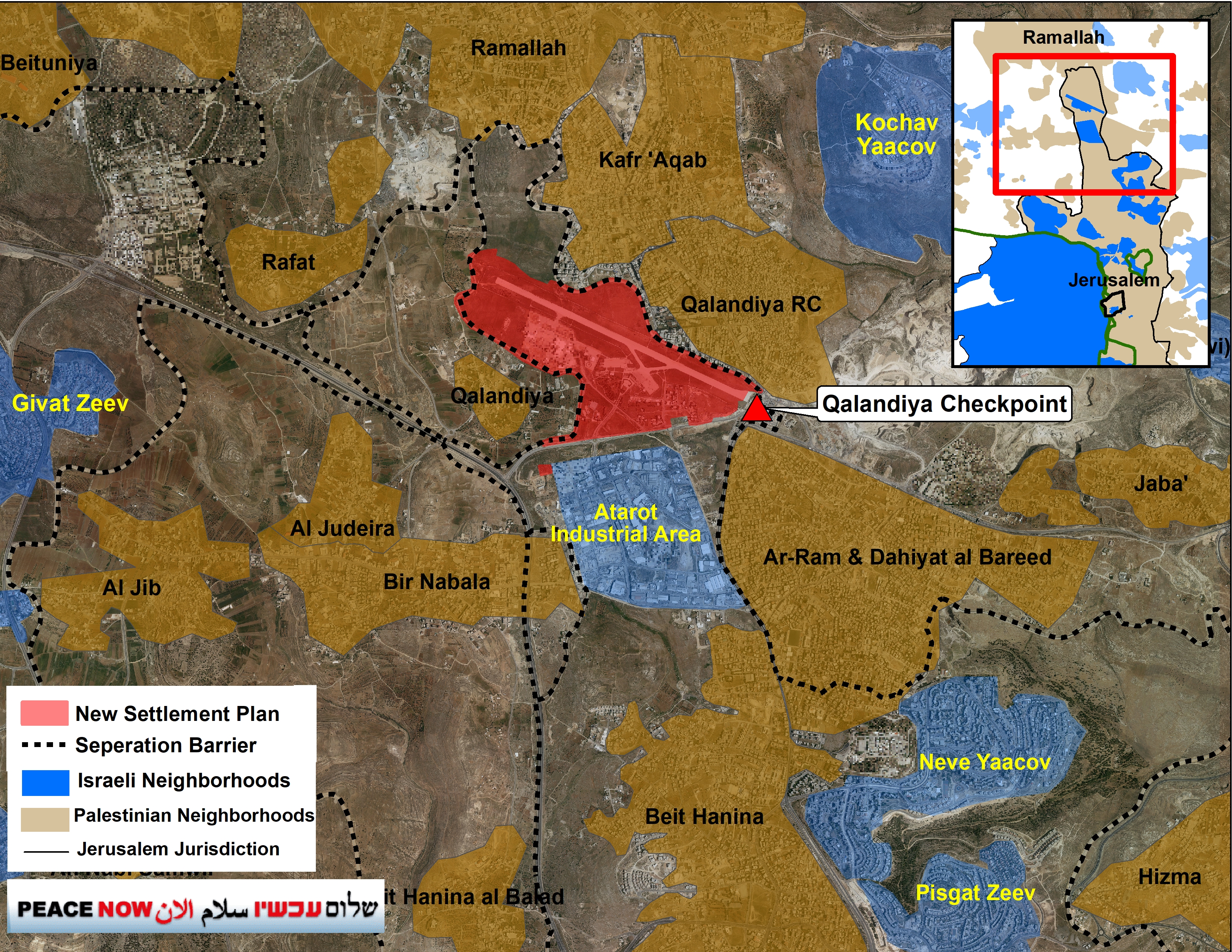 The plan for the Atarot settlement, which has existed since 2007, calls for a huge new settlement on the site of the defunct Qalandiya Airport, located on a sliver of land between Ramallah and Jerusalem. In its current form, the plan provides for up to 9,000 residential units for ultra-Orthodox Jews (assuming, conservatively, an average family size of 6, this means housing for 54,000 people), as well as synagogues, ritual baths (mikvehs), commercial properties, offices and work spaces, a hotel, and a water reservoir. If built, the Atarot settlement will effectively be an Israeli city surrounded by Palestinian East Jerusalem neighborhoods on three sides and Ramallah to its north. Geopolitically, it will have a similar impact to E-1 in terms of dismembering the West Bank and cutting it off from Jerusalem. For more on the Atarot settlement plan, please see here.
The Atarot settlement plan was last considered in 2021 when Naftali Bennet was Prime Minister, but was delayed from consideration by the planning committee – reportedly at the urging of U.S. Secretary of State Blinken. The Committee delayed advancement of the plan by ordering an environmental study which was expected to take about one year. Notably, in ordering the study, the Court made it clear that the environmental study is “standard practice” and expressed support for the underlying plan, saying it believes the plan represents a proper use of unutilized land reserves.
Peace Now said in a statement:
“This is a highly dangerous plan that could land a fatal blow to the prospect of peace and two states. The Atarot plan puts a wedge in the heart of the existing Palestinian urban continuum between Ramallah and East Jerusalem, thus preventing the possibility of establishing a Palestinian state with its capital in East Jerusalem. If the plan is not removed from the agenda of Israel´s far-right and pro-settler government, an eventual political resolution will become even harder to reach.”
Court Grants State Two-Month Delay in Khan Al-Ahmar Forced Displacement
On February 7th, the Israeli Supreme Court granted the State until April 2nd – a two month delay when the State had requested four months delay – to submit a plan to forcibly remove the Khan Al Ahmar bedouin community (a war crime) from its lands just outside of Jerusalem. The Court also set May 1st as the date for a final hearing on a petition submitted by the Regavim settler group demanding the immediate removal of Khan Al-Ahmar.
As with previous delays (there have been a total of 9), the Court expressed its extreme displeasure with the State’s foot dragging. Justice Noam Sohlberg said in his ruling:
“Suffice it to say that we are not at all satisfied with the conduct of the state…[the state’s behavior demonstrates] the existing situation is comfortable for it: Once every few months it files a request for an extension, which the petitioner opposes and the court accedes to through gritted teeth, and the world carries on as normal; deciding not to decide.”
In a statement revealing its ideological motivations, Regavim wrote:
“The government should formulate a working plan for the enforcement of the law in Khan al-Ahmar, as part of a fight against the Palestinian Authority’s institutionalized takeover of open areas in Judea and Samaria. The State of Israel must behave like the owner of the house, even in the face of American pressure, otherwise no one in the world will take it seriously.”
Israeli Cabinet Prepares for Vote to Amend 2005 Disengagement Law, Legalize Homesh Outpost & Yeshiva
The Israeli Cabinet’s Ministerial Committee on Legislation is expected to vote to amend the 2005 Disengagement Law at its February 12th meeting in order to pave the way for the reestablishment of four settlements in the northern West Bank. Jerusalem Post reports that the measure is expected to have enough support to be approved by the Cabinet and passed by the Knesset.
If passed, the bill will allow Israel to grant retroactive legalization to the Homesh outpost and yeshiva – reestablishing Homesh as a fully legal, under Israeli law, settlement. The retroactive legalization of Homesh was agreed to in coalition agreements that formed the current Israeli government.
The vote comes as the government faces a deadline from the High Court to submit its position on the court-ordered evacuation of the illegal yeshiva settlers built at the site of the dismantled Homesh outpost. The State has, for nearly three years, delayed its response to a 2019 petition filed by Yesh Din seeking the removal the illegal Homesh outpost and yeshiva, as well as guarantee the site’s return to its Palestinian landowners. Despite Homesh being dismantled in 2005, Israel never permitted Palestinians to regain access to or control of the land, declaring it a closed military zone. That status has prevented Palestinians from entering the area, while allowing settlers to routinely enter and (illegally, under Israeli law) inhabit the land, even (illegally) establishing a yeshiva there. That yeshiva, according to the Israeli NGO Kerem Navot, has become one of the West Bank’s “hardcore centers of settler terror”. Settlers have also wreaked terror on nearby Palestinian villages, most notably Burqa and Sebastia. One Israeli politician even went so far as to say that settlers are “carrying out a pogrom” in Burqa.
Bibi Pitches Massive Tunnel Construction in West Bank to French Investors
The Times of Israel reports that Netanyahu held a meeting with investors to pitch a massive construction project that would see highspeed tunnels be carved into the terrain throughout the West Bank in order to connect Israeli settlements together, and have more seamless access to Jerusalem and Tel Aviv. The underground highways would be designed in such a way to provide so-called “transportational contiguity” for both Israelis and Palestinians, in lieu of territorial contiguity for the latter (an idea endorsed in the Trump plan). The tunnel vision would effectively annex the settlements to Israel, and entrench a separate but unequal transportation grid that severely limits Palestinian freedom of movement, access to land, and more. The Israeli notion of “transportational contiguity” is put forward as an alternative to “territorial contiguity” which is no longer possible for Palestinians because of Israeli settlements, infrastructure, and control. The notion also gives permission to Israel for further settlement growth.
Smotrich Resigns, Brings Criminal Settler into Knesset
Finance Minister Bezalel Smotrich formally resigned his seat in the Knesset in order to focus his time on his Ministry postings, which not only include head of the Finance Ministry but also as a key minister within the Defense Ministry in control of the Civil Administration. Upon his resignation, the vacant Knesset seat has been filled by the next name on the Religious Zionist Party slate, and that happens to be Zvi Sukkot – a hardline settler who is one of the founders of Evyatar outpost.
Sukkot lives in the Yitzhar settlement – a hotbed of settler extremism and violence, the home of the notorious “Hilltop Youth” movement that has terrorized the Nablus region. He has been arrested on suspicion of arson in a 2010 attack on a Palestinian mosque. In 2012, he was temporarily banned from the West Bank on suspicion that he was orchestrating attacks on Palestinians.
Bonus Reads
- “In West Bank, Settlers Sense Their Moment After Far Right’s Rise” (New York Times)
- “Israel steps up Jerusalem home demolitions as violence rises” (AP)
- “From This Hill, You Can See the Next Intifada” (The Atlantic)
- “Threat Still Looms Despite Postponement of Largescale Wadi Qaddum Demolition” (Ir Amim)
- “ICJ sets July 25 for submission on illegality of Israel’s ‘occupation’” (Jerusalem Post)
Welcome to FMEP’s Weekly Settlement Report, covering everything you need to know about Israeli settlement activity this week.
To subscribe to this report, please click here.
January 27, 2023
-
- De Facto Annexation in action: Bibi Confirms that Smotrich Now Runs the West Bank
- With Top U.S. Official In Country, Netanyahu Delays New Settlement Plan
- Coalition Deal Includes Unilateral Annexation of West Bank Archaeological Sites
- Concern Grows that New Gov Will Proceed with Mount of Olives “Park” Plan
- Palestinians Protest Settler Cultivating Land Near Ramallah
- Bonus Reads
De Facto Annexation in action: Bibi Confirms that Smotrich Now Runs the West Bank
The battle over a newly-established illegal outpost has provided the first concrete look at the extent to which the new Israeli government has handed authority over the West Bank to radical, pro-annexationist Minister of Finance Bezalel Smotrich (Religious Zionism party).
The outpost was established January 19th, ostensibly to honor the recently deceased Rabbi Chaim Druckman, a longtime leader of the settler movement and a defender of violent Jewish extremists. It was established near the Migdalim settlement in the northern West Bank, to the east of the Ariel settlement.
On January 20th the outpost was dismantled by the IDF at the direction of Defense Minister Yoav Gallant (Likud) with the approval of Prime Minister Netanyahu. Notably, that same day Netanyahu was hosting U.S. National Security Advisor Jake Sullivan. That dismantling took place in defiance of an order from Bezalel Smotrich, acting in his capacity as a key official in the Defense Ministry with vast powers over the Civil Administration specifically over civilian matters such as illegal construction (in addition to his role as Finance Minister). Smotrich’s order, which was overruled by Gallant, sought to leave the outpost untouched while the situation was debated by government officials.
In response to the outpost being dismantled not once but twice (hundreds of settlers reestablished the outpost within 2 days of the first demolition), Smotrich and his allies boycotted the weekly Cabinet meeting, forcing Netanyahu to convene at least two separate meetings (on January 23 and 24) to resolve the clash between Gallant and Smotrich.
With the visit of a top U.S. official over, reports on January 26th suggest that Netanyahu is now siding with Smotrich. In so doing, Netanyu is confirming his support for a new status quo in the Defense Ministry in which authority in the West Bank is divided between Smotrich and Gallant. Smotrich will be in charge of “civilian” matters — including the fate of illegal outposts, issues related to settlements, and, of course, all aspects of the lives of Palestinians; Gallant’s authority in the West Bank will be over “security” matters. Minister Gallant has made it clear that he opposes this new division of authority within his ministry, and Defense Ministry legal advisors have cautioned Netanyahu that transferring powers to Smotrich could be seen by the international community as annexation. In response, Netanyahu has ordered a legal opinion on the proposed division.
Smotrich has been clear regarding his intention to use the powers he appears to now enjoy within the Defense Ministry to reduce Israeli enforcement against illegal settler construction, and to increase Israeli enforcement against “illegal” Palestinian construction [as a reminder: Israel only rarely gives Palestinians permission to build on their own private land in Area C, meaning that in the eyes of Israeli authorities, virtually all Palestinian construction in Area C is illegal and can/should be demolished].
In addition to laying bare a fight over authority in the new government, the battle over this whole ordeal also re-affirmed the consensus – and enthusiasm – in Israel’s ruling class, both those in and those in opposition – in support of demolishing Palestinian construction in Area C. Indeed, in a revealing Twitter exchange, Netanyahu and former Defense Minister Benny Gantz literally fought for credit for demolishing the more Palestinian structures.
With Top U.S. Official In Country, Netanyahu Delays New Settlement Plan
On January 19th – while U.S. National Security Advisor Jake Sullivan was in Israel for talks with Netanyahu – the Israeli government removed an item from its weekly agenda consideration of the approval of a new settlement on the periphery of Jerusalem. The new settlement is to be created by splitting off an ultra-Orthodox neighborhood of the Kochav Yaakov settlement, and turning it into its own settlement, to be called “Tel Zion.” The creation of the “Tel Zion” settlement is part of Netanyahu’s coalition deal with the ultra-Orthodox Shas Party. The Times of Israel suggests the plan – which in addition to being agreed to by Netanyahu is also supported by Defense Minister Gantz – was removed from last week’s agenda apparently to avoid friction with the U.S., meaning that with Sullivan gone, the plan is likely to be brought forward for approval imminently.
Coalition Deal Includes Unilateral Annexation of West Bank Archaeological Sites
Emek Shaveh reports new details on the coalition deal between the Likud and Jewish Power parties, including the allocation of over $40 million (NIS 150 million) to fund a “National Emergency Plan” under which Israel must take control of heritage sites across the totality of the West Bank, without regard to the Oslo-defined Areas A, B, and C.
Settler groups, including the “Guardians of the Eternity” and the “Shiloh Forum”, have been pushing the government to proceed with taking control of heritage sites, which the groups claim are being vandalized and destroyed by Palestinians.
Emek Shaveh said in a statement:
“Netanyahu’s government, with the aid of the Shiloh Forum (and Kohelet), continues to confuse science with messianism, heritage with rightful ownership, and cultural affinity with ethnic supremacy. The destruction of sites, whether genuine or imagined, must not be used as rationale for political action, and political action must not be disguised as heritage conservation. We will make clear that blurring the boundaries between research and protection (of sites) and settlement and annexation, constitutes a gross violation of the prevailing ethics in the field heritage and the stipulations in international law regarding cultural property in occupied territories. Such violations not only endanger the future of heritage sites, but also expose Israel to professional and political isolation.”
As FMEP has chronicled, settlers and their allies are intent upon using claims of Palestinian damage/neglect as a pretext for Israel taking control of archaeological sites and artifacts across the West Bank. For example, in February 2021 settlers used a construction mishap to raise claims to the Mt. Ebal site.
And as a reminder: in January 2021, the Israeli government committed funding to a new settler initiative to surveil archeological sites under Palestinian control. While the objective of protecting antiquities might appear uncontroversial and apolitical, the true (and transparently self-evident) objectives behind this effort are: to support yet another pretext to surveil and police Palestinians; to establish and exploit yet another means to dispossess Palestinians of their properties; to expand/deepen Israeli control across the West Bank; and to further entrench Israeli technical, bureaucratic and legal paradigms that treat the West Bank as sovereign Israeli territory. It is the result of a campaign that has taken place over the past year in which settlers have escalated their calls for the Israeli government to seize antiquities and “heritage sites” located in Palestinian communities across the West Bank, especially in Area C, which Israel today treats as functionally (and legally) indistinguishable from sovereign Israeli territory. Funding committed by Israel for West Bank “heritage sites” should be understood in this context.
Previous victories for the settlers in this same arena include the Israeli Civil Administration’s issuance in 2020 of expropriation orders – the first of their kind in 35 years – for two archaeological sites located on privately owned Palestinian property northwest of Ramallah. The settlers’ pressure is also credited as the impetus behind the government’s clandestine raid of a Palestinian village in July 2020 to seize an ancient font.
In June 2020, the “Guardians of Eternity” group began surveying areas in the West Bank that Israel has designated as archaeological sites, looking for Palestinian construction (barred by Israel in such areas) that they could then use as a pretext to demand that Israeli authorities demolish it. The group communicates its findings to the Archaeology Unit of the Israeli Civil Administration (reminder: the Civil Administration is the arm of the Israeli Defense Ministry which since 1967 has functioned as the de facto sovereign over the West Bank). The Archaeology Unit, playing its part, then delivers eviction and demolition orders against Palestinians, claiming that the structures damage antiquities in the area.
And one more reminder: in 2017, Israel designated 1,000 new archaeological sites in Area C of the West Bank. The “Guardians of Eternity” group, not coincidentally, is an offshoot of the radical Regavim organization, which among other things works to push Israeli authorities to demolish Palestinian construction (on Palestinians’ own land) that lacks Israeli permits (permits that Israel virtually never grants).
Concern Grows that New Gov Will Proceed with Mount of Olives “Park” Plan
+972 Magazine reports that activists and experts are increasingly concerned that the new Israeli government will resurrect a plan to declare vast areas of East Jerusalem – including prized religious sites on the Mount of Olives and entire Palestinian neighborhoods – as part of an Israeli national park, with huge consequences for churches and Palestinians. Activists fear that, in addition to the immediate consequences for residents and property owners, the government intends to subcontract management of the new national park to the radical settler group Elad. This is precisely what the government of Israel did with so-called City of David National Park, which, under Elad’s stewardship, has had devastating impacts on Silwan residents.
Sari Kronish, and urban planning expert with the NGO Bimkom explained:
“Of course a national park is not a bad thing in principle, but in East Jerusalem the designation is used as a tool to prevent development of Palestinian neighborhoods”
The plan to create the Mount of Olives National Park was first revealed in February 2022, but postponed by the government at the time, with a promise that the plan will not proceed until the Churches with equities in the area have been consulted. The Israel Nature and Parks Authority told +972 Magazine that these consultations have begun but are not complete. The agenda item has not been totally shelved, but instead repeatedly delayed, landing the item on the August 2023 agenda (barring further delay).
Jerusalem expert Daniel Seidemann told +972:
“There is no innocent interpretation as to why to put a national park [on the Mount of Olives], except for the fact that the settlers in general, and the settler movement Elad in particular, covet the properties and areas in the visual basin around the Old City. This all comes within a context … [of] an attempt by the government of Israel, together with the settlement movement … to create an Israeli land bridge from the [state-protected] ‘green area’ on Mt. Scopus through Sheikh Jarrah, with biblically-motivated settlements and settlement activities. We have already seen that on the north flanks with the encirclement of the Sheikh Jarrah area.”
Palestinians Protest Settler Cultivating Land Near Ramallah
Haaretz reports that a settler from the Ofra settlement has recently begun illegally cultivating a large plot of land (130 dunams/32 acres) near Ramallah, on the West Bank side of the Israeli separation barrier. In a statement to Haaretz, the Civil Administration said that it had not permitted any activity on the land and would investigate.
The settler’s actions have sparked a significant response from the local Palestinian community because, in order to reach the land, the settler and the heavy equipment being used to work the land must travel through Palestinian villages. Palestinians have begun staging weekly protests at the site, and the village council of the Palestinian village of Qalandiya issued a warning that it would report the names of Palestinians found working at the site to the Palestinian Authority.
The plot of land in question is land that pre-1948 had a Jewish owner. It was taken over by the Israeli government in 1967; the Israeli government gave it to the World Zionist Organization in 1997; the WZO then gave it to the Ofra settlement, which never used or cultivated the land, but in 2019 purportedly gave the land to one of its residents, Assaf Shapira. Notwithstanding that action by the settlement, in July 2022 the Civil Administration notified Ofra that the allocation of the land to the settlement had been canceled.
Dror Etkes – the founder of the settlement watchdog group Kerem Navot – told Haaretz:
“Ofra’s settlers waited four decades before taking control of these lands. The timing isn’t a coincidence and reflects the spirit of the sixth Netanyahu government. It’s an apartheid government that will continue to act in full force in this enterprise which seeks to make the West Bank and its residents work for the benefit of a violent minority of settlers.”
Bonus Reads
- “Israel’s Knesset Extends West Bank Emergency Orders by Another Five Years” (Haaretz)
Welcome to FMEP’s Weekly Settlement Report, covering everything you need to know about Israeli settlement activity this week.
To subscribe to this report, please click here.
January 13, 2023
- New Givat Hamatos Expansion Plan
- The IDF Has Prepped & Presented its Plan to Expel Palestinians from Masafer Yatta
- Israel Carries Out Demolitions in Area B
- MK Danon Unveils Jordan Valley Annexation Bill
- Settlers Demand Fast-Tracked “Regularization” of Outposts
- Biden Administration Commits to Doing Nothing More Than Issue Empty Statements in Response to Israel Expanding Settlements/Legalizing Outposts
- Peace Now Releases 2023 Settlement Map
- Adalah Publishes Detailed Analysis of New Israeli Coalition Deal
New Givat Hamatos Expansion Plan
Ir Amim reports that on March 2nd the Jerusalem Planning Committee will consider a brand new plan to expand the area of theGivat Hamatos settlement in East Jerusalem by 40% and to more than double the number of housing units slated to be built there. The new plan – called the “East Talpiyot Hill” plan – involves the construction of 3500 units and 1300 hotel rooms, to be built on a plot of land adjacent to the site where the Givat Hamatos settlement (planned for 2610 units) is slated to be built. As a reminder: tenders for the construction of those units were issued in January 2021 (just hours after PResident Biden was inaugurated), and the construction of the infrastructure for that project is already underway.
The “East Talpiyot Hill” plan involves construction on a strategic strip of land that will expand the area of Givat Hamatos eastward, connecting it with another new settlement plan – the “Lower Aqueduct Plan.” These plans ultimately create a string of settlements — spanning from Gilo to Givat Hamatos to Har Homa — that, together with the planned “Givat HaShaked” settlement to its north, completely encircle the East Jerusalem Palestinian neighborhood of Beit Safafa with Israeli settlement construction. Ir Amim further warns that the inclusion of hotels in this new plan “will likely serve as a major source of competition with the tourism industry in Bethlehem, potentially diverting vital business from the Palestinian economy.”
This land on which the “East Talpiyot Hill”project will be built was owned by the Greek Orthodox Church until 2009 – when the church sold many of its most prized properties to settler entities. The Church has contested these sales, alleging fraud – but Israeli courts have rejected the Church’s objections and allowed the contested sales to stand. This particular tract of land was sold to an Israeli businessman and the New Talpiyot Hill company, which together initiated this new plan.
Importantly, Ir Amim notes that there are indications that Israel is carrying out land registration for plots located in the tract of land on which the “East Talpiyot Hill” project would be built. This is highly significant, as the registration appears to be happening in secret and – as revealed by Bimkom’s and Ir Amim’s ongoing monitoring and research, “settlement of land title proceedings are largely being used to dispossess Palestinians of their properties and seize more territory in East Jerusalem for Israeli settlement. “
The IDF Has Prepped & Presented its Plan to Expel Palestinians from Masafer Yatta
Haaretz reports that the Israeli Central Command has presented to the Israeli government its plan to expel some X,000 Palestinians from eight villages in Masafer Yatta in the South Hebron Hills – plans it had reportedly been working on for two months (i.e., even before the new government took power). Sources told Haaretz that the new government has not given the IDF the order to carry out the expulsions yet, but nonetheless the IDF saw fit to design a plan, using vans, to carry out the evictions. Israeli Defense Minister Yoav Galant has reportedly told the IDF that he “needs to study” the matter.
Israel Carries Out Demolitions in Area B
Haaretz has revealed that on November 24, 2022, the Israeli Civil Administration demolished two Palestinian structures in Area B of the West Bank — the area in which, under the Oslo Accords, Israel enjoys no jurisdiction over civil matters (such as building enforcement). The Civil Administration denies that the demolition violated the Oslo Accords, arguing that it was within its rights because it was acting to address alleged major damage caused to a nearby archaeological site, called Khirbet Tarfin. Israeli political figures were reportedly involved in the decision to carry out the demolitions.
In a statement to Haaretz regarding the demolitions, the Civil Administration stood proudly by its demolition, and committed to defending archaeological sites across the whole West Bank. The statement reads:
“The Civil Administration will continue to expend major efforts and resources in researching and preserving the archaeological sites in Judea and Samaria [the West Bank] in addition to pursuing enforcement activity against antiquities thieves and the building of illegal structures in the heart of archaeological sites.”
The Civil Administration’s statement – and Israel’s move to raze these two Palestinian structures – should be understood against the backdrop of the years-long campaign by settlers pushing the government to unilaterally take control over archaeological sites (defined expansively) throughout the West Bank. In this way settlers and their supporters are- with great success – weaponizing archaeology as a tool for the dispossession of Palestinians.
This effort should also be understood as an expansion of the settlers’ enormously successful tactics in getting the Israeli government to annex Area C – with Israeli policy now treating Area C as sovereign Israeli territory in virtually all ways (other than a public declaration of annexation). Now that the new governing coalition has announced a total freeze on Palestinian construction in Area C and has increased demolition of Palestinian “illegal” construction (i.e., Palestinian construction on their own private land, but lacking Israeli permits, due to the fact that Israel refuses to issue Palestinians permits to build) — and now that Netanyahu has declared Israel’s “exclusive and inalienable right to all parts of the Land of Israel” — it is not surprising, but is still alarming, to see the same land grab tactics that worked so well in Area C applied in Area B. Indeed, more Israeli actions/policies that further the erasure of any meaningful Oslo-era boundaries between West Bank areas should be anticipated.
MK Danon Unveils Jordan Valley Annexation Bill
MK Danny Danon (Likud) – who previously served as Israel’s Ambassador to the UN – has unveiled a bill that would have Israel unilaterally annex the Jordan Valley.
Jordan Valley annexation bills have been introduced into the Knesset for years, but have rarely if ever received real consideration, though support for such a measure is likely high. In September 2019, Netanyahu committed to annexing the Jordan Valley.
Settlers Demand Fast-Tracked “Regularization” of Outposts
The Forum for Young Settlements, an advocacy group by and for settlers, is pushing the new Israeli government to act swiftly to suspend the rule of law to “legalize” settlement outposts across the West Bank that were built in violation of Israeli law, and many of which are located on privately-owned Palestinian land. As part of the coalition agreements, the parties agreed to “legalize” the outposts within the first 60 days of the new government tenure- – but settlers apparently think this is too long, and are demanding that the government act immediately.
The Forum said in a statement:
“[The Forum] congratulate[s] the Prime Minister and the ministers for establishing a stable national right-wing government for the first time in years, and for introducing ‘Young Settlement Regulation’ into the coalition agreements….this is the time to approve the proposal of the decision-makers for regulation. The government’s decision is already prepared, and over 25,000 residents of the young settlements in the winter months cry out for a resolution to their humanitarian needs and immediately enable the connection of all the young settlements to electricity, water, and other infrastructures.”
Biden Administration Commits to Doing Nothing More Than Issue Empty Statements in Response to Israel Expanding Settlements/Legalizing Outposts
U.S. Ambassador to Israel Thomas Nides told the Israeli Kan news outlet that the U.S. opposes “massive settlement growth” — seeming to signal the Biden Administration’s acceptance of settlement construction on a less-than-massive scale (FMEP president Lara Friedman notes that this reminds her of an old joke: a couple celebrating their 50th wedding anniversary was asked, what made this marriage last so long? Partner 1 responded – “when we got married, we agreed that I get to make all the big decisions, and my partner gets to make all the small decisions; as it turns out, there has never been a big decision, so peace has reigned between us!”). Nides further said that the U.S. continues to oppose outpost legalization but does not have any “red lines” for the Israeli government.
Peace Now Releases 2023 Settlement Map
Peace Now has released an updated map of the West Bank, showing settlements, outposts and more. You can view and download the map here: https://peacenow.org.il/en/%d9%8dsettlements-map-2023
Adalah Publishes Detailed Analysis of New Israeli Coalition Deal
Adalah released a new report on the details contained within the new Israeli coalition deal. The paper examines the following 11 items:
- Deepened political control over law enforcement and policing;
- Accelerating the Judaization of the Naqab, Galilee, and beyond;
- Curbing the prohibition of discrimination in services and products;
- A new basic law on immigration;
- Discrimination in education;
- Impunity for the armed forces;
- Silencing criticism against Israel;
- Allowing candidates running for the Knesset to incite racism while undermining Palestinian political participation;
- Separate and unequal funding for Palestinian localities in Israel; (10) Limiting the Supreme Court’s authority; and
- De facto annexation of the West Bank.
On de facto annexation of the West Bank, Adalah writes:
“These appointments effectively give the RZP control over all settlement construction projects in the West Bank; authority over nearly all issues relating to the settlements: the building of homes, demolition of homes and other buildings, and all other aspects of daily life. This ministerial position will also no longer require the Prime Minister’s approval at various stages of West Bank settlement construction projects; instead, it will only be required once, during the initial stages. Smotrich has made clear that he intends to use this authority to de facto annex the West Bank by, in particular, dismantling the Israeli military’s Civil Administration over the Israeli Jewish settlers illegally residing there and instead putting their governance under Israeli civil domestic law, while continuing to keep Palestinians under military rule. This move will more deeply entrench the two separate systems of governance that already exist based on racial identity, an unquestionable hallmark of a system of apartheid.”
Welcome to FMEP’s Weekly Settlement Report, covering everything you need to know about Israeli settlement activity this week.
To subscribe to this report, please click here.
October 13, 2022
- Nablus Region Broiling as Settlers Rampage
- Senior Israel Officials Preside Over Cornerstone-Laying Ceremony for New Settler Tourist Project in East Jerusalem
- Israel Antiquities Chief Releases Map of New Israeli National Park Near Jericho (in Area C)
- Amidst Violent Surge, Settlers Demand Establishment of Evyatar Settlement & Yeshiva
- Bonus Reads
Nablus Region Broiling as Settlers Rampage
As violence continues to escalate across the West Bank and in East Jerusalem, this week settlers have continued, seemingly uninhibited, to instigate clashes with and terrorize Palestinians in the West Bank. Some key examples include the following (for an even more thorough listing, see the Palestine Center for Human Rights’ weekly report):
- On October 11th, Israeli settlers staged a massive march – explicitly designed to provoke Palestinians and demonstrate Israeli dominance/impunity – near the Palestinian town of Sebastia, just north of Nablus. An Israeli soldier providing security to the settlers was shot and killed by a drive-by shooter as the march got underway. Following that shooting, the Palestinian militia group calling itself “Lion’s Den” claimed credit for the drive-by shooting, leading the Israeli army to completely shut down the city of Nablus – where the Lion’s Den is based – in response.
- Late in the evening on October 12th — while the Israeli army was keeping all the entrances and exits to Nablus closed in response to the October 11th shooting of an IDF soldier guarding a settler march — the IDF again provided security for settlers, this time enabling them to enter the city of Nablus (the IDF even transported settlers in military vehicles), ostensibly to visit Joseph’s Tomb and conduct religious prayer there (ostensibly because the timing/nature of the visit appeared to be largely if not entirely about provoking Palestinians). In the course of the operation, IDF soldiers exchanged gunfire with Palestinians; no injuries were reported on either side.
- The following morning, October 13th, settlers marauded through and terrorized the Palestinian town of Huwara, located just south of the Nablus. Video footage documents IDF soldiers actively protecting (and therefore enabling) settlers who were brazenly committing crimes and assaulting Palestinians. The Palestinian Red Crescent reports 53 people were injured.
It’s worth recalling that settlers have staged several protests and marches over the past few weeks, ostensibly to pressure the Israeli government to intensify its ongoing military operation in the West Bank – which Israel has dubbed “Break the Wave” – a reference to recent attacks against Israeli civilians (and IDF soldiers, bearing in mind that when IDF personnel are injured/killed in any context by Palestinains, Israel in effect counts those IDF personnel as civilian victims of terrorism). This operation involves Israel staging near daily raids into Palestinian cities in the West Bank — tactics that have led to numerous Palestinian deaths/injuries/detentions.
Notably, the settler march held on October 11th attracted nearly 10,000 people – including lawmakers Bezalel Smotrich and well-known Kahanist (who is likely to be a powerful plate in the next Israeli government) Itamar Ben-Gvir. The settlers paraded from the Shavei Shomron settlement to the nearby Palestinian town of Sebastia, where settlers have been engaged in an effort to take control over antiquity sites under Palestinian control in the city. At the conclusion of the march, settlers staged a festival in Sebastia with live music acts, speeches, and more.
Samaria Regional Council head Yossi Dagan stated:
“We came here today to wave the Israeli flag, to state that we won’t surrender to those who wish to kick us out of our land. We will continue to settle, march, and hike through our entire country. To answer terror we build the land of Israel. We are excited to see the thousands that are marching with us.”
Senior Israel Officials Preside Over Cornerstone-Laying Ceremony for New Settler Tourist Project in East Jerusalem
 Emek Shaveh reports that a ceremony was held on October 6th to lay the cornerstone of a new pedestrian footbridge over the Ben Hinnom Valley/Wadi Rababa in Jerusalem. The bridge is a project pushed by settler groups and will serve to connect two settler-operated tourist facilities located in two Palestinian neighborhoods on opposite sides of the valley – one in Abu Tor and the other in Silwan. The ceremony was held at one of those settler-run tourist facilities – known as the “House in the Valley”, operated by the Elad Foundation – and was presided over by Israeli Minister of Jerusalem Affairs Ze’ev Elkin, Israeli Transportation Minister Yoel Razvozov, Jerusalem Mayor Moshe Leon, and Israeli Antiquities Authority director general Eli Eskosido.
Emek Shaeh comments:
“The bridge is another project in a list of new projects which are transforming the valley, such as the cable car, and the Elad Foundation’s Farm in the Valley (also called Center for Ancient Agriculture). All of these are part of the larger strategy to establish a continuum of biblically themed tourism ventures and Jewish residential settlements in the Silwan-Hinnom Valley area using a variety of legal and administrative mechanisms to displace Palestinians from their homes, shrink their public spaces and downplay their heritage.”
At the cornerstone laying ceremony on October 6th, Minister Elkin confirmed the intent behind the bridge, saying:
“the suspension bridge is an important strategic project led by the Ministry for Jerusalem Affairs and other partners. We are working to turn the Hinnom Valley into a developed tourism zone and in so doing achieve two additional goals: one is to strengthen the sense of security and sovereignty in the area, the other is to ease access to the Old City.”
On the Abu Tor side of the bridge, the Elad settler organization runs and operates a cultural center and cafe named “House in the Valley,” which opened in 2019 after Elad evicted a Palestinian family and renovated the space. A week after Elad’s new cultural center was opened, the Jerusalem Municipality issued “gardening orders” to take control, for an initial period lasting 5 years (with the likelihood of extensions after that) of 12 nearby plots of privately-owned Palestinian land. “Gardening orders” allow Israel to “temporarily” take over privately owned land for what are ostensibly public purposes (like establishing a parking lot or public garden), based on the argument that the private owners are not presently using the land. In this case, Israel has in effect made rules that guarantee that the latter condition applies: as Emek Shaveh has noted, the 12 plots in question are located in an area declared by Israel to be a national park, meaning that private landowners are legally barred from using their own land.
On the Silwan side – a neighborhood where Elad (alongside other settler organizations, including Ateret Cohanim) is waging a house-by-house campaign to displace Palestinians in favor of settlers and settler-run tourist sites – the bridge will end near the Sambuski cemetery, which until recent years was a relatively unknown, neglected site that even Israel did not recognize as a holy site. Under the Trump “Peace to Prosperity” plan, the Sambuski cemetery was suddenly transformed into a place of prime historical and religious importance to Israel. The Emek Shaveh – which has a special expertise on archaeology and the weaponization of archaeology to serve the political agenda of the settlers and the state – wrote a report on exactly how the Trump “Vision” supports settler efforts to use Jerusalem’s history and antiquities to promote Israeli-Jewish hegemony and control over the city.
Israel Antiquities Chief Releases Map of New Israeli National Park Near Jericho (in Area C)
Emek Shaveh reports that Eli Eskosido, the Director General of the Israeli Antiquities Authority, has been sharing a map showing a new “Hasmonean Palaces National Park” on land located southwest of the Palestinian city of Jericho. Notably, the land in question is located in Area C of the West Bank – where the domestic Antiquities Authority does not, legally (under Israeli law and the Oslo Accords) have any jurisdiction.
The Hasmonean Palaces archaeological site was identified in the Oslo Accords as a place of “archaeological and historic importance to the Israeli side”, granting the Israelis control over this enclave of land within a Palestinian population center. However, the area has not been developed by the Israeli government. Emek Shaveh reports that while a National Park has been planned for the area, it does not currently exist.
Bizarrely, the map promoted by Eskosido is emblazoned with the logos of domestic Israeli government bureaus, which – again – do not have any jurisdiction in the West Bank. A settler group focused on weaponizing archaeology to advance Israeli annexation in the West Bank, “Guardians of Eternity,” alleges that the site has been subject to damage by Palestinians over the years. Emek Shaveh reports that the Binyamin Regional Council – the municipal association in charge of settlements in the area – is reportedly interested in taking over direct management of the site.
Emek Shaveh notes:
“The publication of the map by Mr. Eskosido is another manifestation of steps towards de facto annexation in the realm of antiquities which we wrote about earlier this year following the Knesset’s committee’s recommendation of expanding the Israel Antiquities Authority remit into Area C.
The investment in this site is an outcome of a persistent campaign by Guardians of Eternity (Regavim) and the Shiloh Forum which exploits historical, religious and cultural affinities of the Jewish people to sites in the West Bank with the aim of galvanizing the Israeli government to expand and deepen its control. This latest involvement by the IAA in the Hasmonean Palaces should be considered within this context. Although damage by Palestinians to the site is a problem, for the most part this takes the form of light construction. It is certainly not an expression of a Palestinian Authority led plan to destroy Jewish heritage in the West Bank as the settlers repeatedly claim.”
Amidst Violent Surge, Settlers Demand Establishment of Evyatar Settlement & Yeshiva
Over the Sukkot holiday, settlers in the northern West Bank staged a renewed push for the government, specifically Defense Minister Benny Gantz, to act in order to formally establish the Evyatar settlement and yeshiva, located on Palestinian lands just south of Nablus. In February 2022, the outgoing Israeli Attorney General issued an opinion that provides a basis for granting retroactive legalization to the Evyatar outpost (which would mean authorizing Evyatar as a fully-approved new settlement, “legal” under Israeli law). Since February 2022, Defense Minister Gantz has had the authority to declare the area as “state land” as the first (and most significant) step towards authorizing Evyatar. For reasons that remain unclear, Gantz has not (yet) made a move to do so.
The saga of the Evyatar outpost became a recurring headline news story over the past two years, mostly as a result of the determined effort by Palestinians from the nearby village of Beitar to protest the Evyatar outpost and to resist the Israeli government’s efforts to retroactively legalize it. Palestinians staged regular protests near the site of Evyatar outpost, which was built illegally by settlers on a hilltop that Palestinians have long known as Mt. Sabih, land which has historically belonged to the nearby Palestinian villages of Beita, Yatma, and Qablan. No fewer than seven Palestinian protestors died as a result of the harsh and violent attempt by the IDF to quash the protests.
Bonus Reads
- “Drones terrorized Gaza for years. Now they’ll do the same in the West Bank” (+972 Magazine) → “the army is calling for the use of drones to surveil refugee camps and strike militants, for installing remote-controlled gun turrets to secure high-volume checkpoints, and for employing biometric cameras to track civilians across the West Bank.”
- “The GOP’s Plan to Build the Third Temple” (Jewish Currents)