Welcome to FMEP’s Weekly Settlement Report, covering everything you need to know about Israeli settlement activity this week.
To subscribe to this report, please click here.
April 12, 2019
- In Largest Settlement Surge Since Trump, Israel Advances Plans for 3,659 Settlement Units – Including Plan to Retroactively Legalize the Haresha Outpost
- Housing Ministry Publishes Tenders for 956 Settlement Units
- Ariel Medical School Gets Approval, But Faces Two High Court Petitions
- Settlers Celebrate Right-Wing Election Victory
- AirBnb Reverses Settlement Policy
- U.S. Ambassador Friedman Touts East Jerusalem Settlement Business as “Path to Peace”
- Bonus Reads
Questions/comments? Email kmccarthy@fmep.org
In Largest Settlement Surge Since Trump, Israel Advances Plans for 3,659 Settlement Units – Including Plan to Retroactively Legalize the Haresha Outpost
Following up on FMEP’s reporting last week, on April 4th the Israeli Civil Administration Higher Planning Council (the body responsible for regulating all construction in the occupied West Bank) advanced plans for at least 3,659 settlement units, including a plan to retroactively legalize homes in the unauthorized Haresha outpost.
This is the largest batch of settlement plans advanced at one meeting by the High Planning Council since President Trump took office in January 2017; previous High Planning Council meetings (which happen every three months, per a reported agreement with the U.S. Administration) advanced plans on the order of 1,000 to 2,000 units.
Of the total units advanced on April 4th, the High Planning Council granted final approval for 1,226 new settlement, to be built entirely on the west side of the Israeli separation wall. These are:
- In Beitar Illit:
- 31 new units
- A 100 room building for the elderly, or a hotel
-
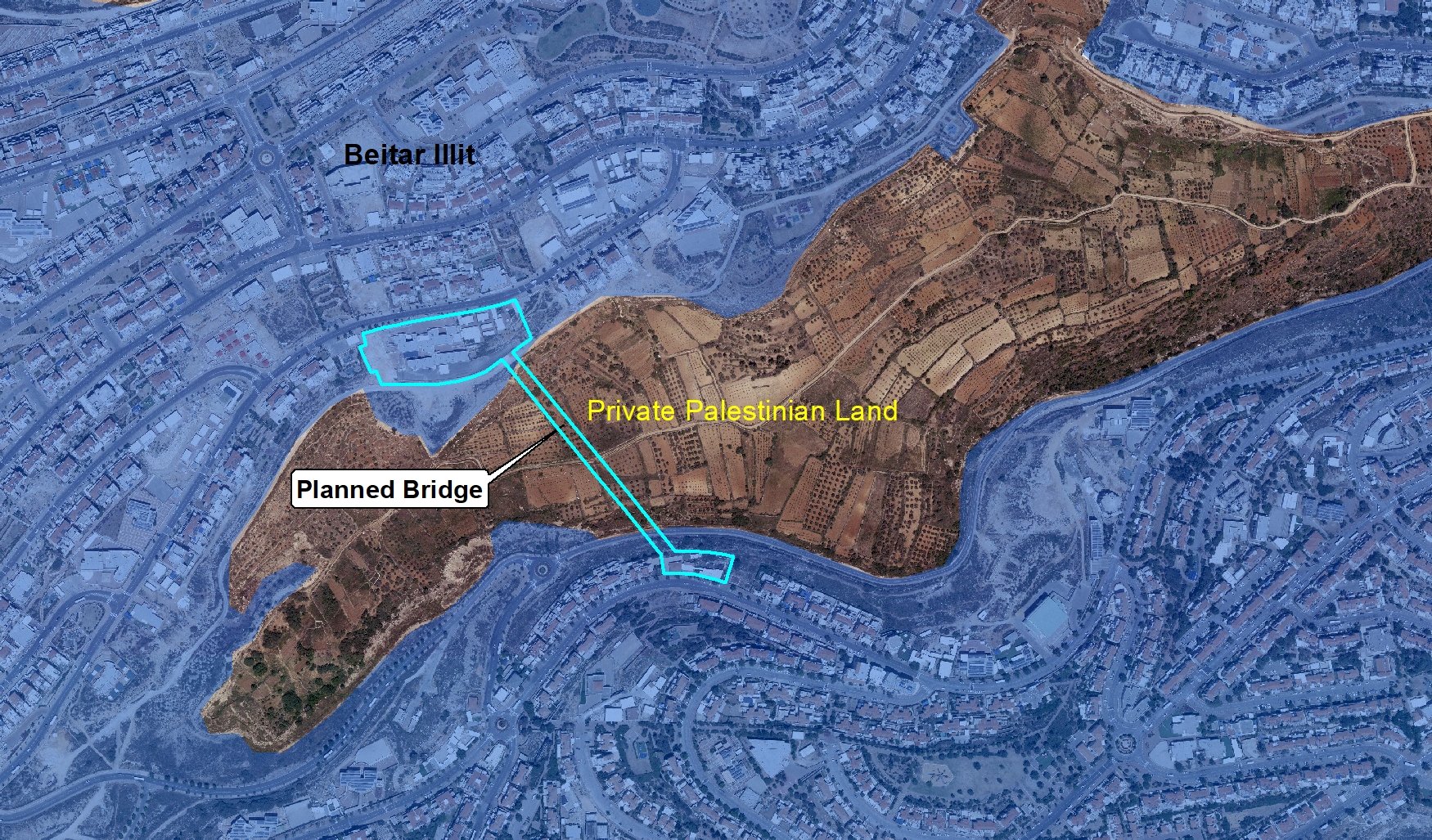
Map by Peace Now
A new pedestrian bridge over privately owned Palestinian land for Israeli settlers to use on the Sabbath (when observant Jews do not drive, and had to walk a long route in order to reach other parts of the settlement).
- 603 new units in Maale Adumim
- A plan to retroactively legalize residential units in the Sde Bar settlement; Peace Now has not yet verified how many units are involved in this plan. Sde Bar was first established as an outpost of the Nokdim settlement in 1998, but Israel granted full approval to that outpost, recognizing it as an educational institute and a full-fledged settlement, in 2005. Settlers recently built a residential neighborhood there without Israeli authorization. The plan approved by the council on April 4th will grant retroactive authorization to those residential settlement units.
- 289 new units in the Alon settlement, located on the Palestinian side of the separation wall within sight of the Khan al-Ahmar bedouin village that Israel is prepared to forcibly relocate. There are plans to expand the neighboring Kfar Adumim settlement to takeover the land where Khan al-Ahmar currently stands.
- 110 new units in the Givat Zeev settlement.
- 108 new units in the Etz Efraim settlement.
- 85 new units in the Karnei Shomron settlement.
Of the total units advanced on April 4th, the High Planning Council also approved for deposit for public review plans for 2,433 new settlement units, the majority of which (1,198) will be built on the east side of the Israeli separation barrier, including:
- 1000 units in Efrat
- A plan to retroactively legalize 720 units in the Haresha outpost. This is part of the Israeli government’s ongoing efforts to retroactively legalize the outpost, which hinges on Israel’s ability to build a legal access road to the outpost. The Israeli government has found several creative solutions to that problem – like building a tunnel or building a bridge – all of which will undoubtedly infringe on the property rights and livelihoods of the Palestinian land owners.
- 210 units in Shiloh – expanding the footprint of the settlement to its north
- 147 units in Ariel.
- 147 units in Mitzpe Yericho.
- 114 units in Elon Moreh.
- 73 new units in Beitar Illit (in addition to the final approvals covered previously).
- 66 units in Oranit.
- 42 more units in Givat Zeev.
- 32 units in Beit Arie.
- 7 new units in Rehelim.
- An unverified number of new units in the following settlements: Paduel, Karnei Shomron, and Elkana.
Peace Now said in response:
“Netanyahu has decided, officially or unofficially, to annex the West Bank to Israel, otherwise one cannot explain the promotion of thousands of units for Israelis in the Occupied Territories. The construction of the settlements only makes it harder to end the occupation and to get to a two states peace agreement and is bad for the Israeli interest to remain a democratic and secured state.”
Housing Ministry Publishes Tenders for 956 Settlement Units
On April 4th the Israeli Ministry of Housing and the Israel Lands Authority met and published tenders for the construction of 956 new settlement units, including commercial complexes; 106 tenders are for plans in settlements east of the separation barrier. These units are in addition to the 3,659 units advanced this week by the Civil Administration’s High Planning Council (discussed above).
The published tenders are:
- 250 units in the Elkana settlement.
- 195 units in the Ariel settlement.
- 118 units in the Ofarim settlement.
- 112 in the Alfei Menashe settlement.
- 111 units in the Oranit settlement.
- 62 in the Adam (Geva Binyamin) settlement, located east of the separation barrier.
- 50 in the Emmanuel settlement.
- 44 units in the Maale Ephraim settlement, located east of the separation barrier.
- 14 units in the Beitar Illit settlement
As Peace Now explains, “some of the tenders are for units that were published in previous tenders but were not sold. The new tenders mean that the government is currently seeking to promote and build those units although failed to do so in the past.”
Ariel Medical School Gets Approval, But Faces High Court Petition
On April 12th, the Israel Higher Education Council voted to approve a new medical school in Ariel University, located in the West Bank settlement of Ariel. This approval contravenes the normal practice of the council, in that it ignores a vote to reject the school by the Higher Education Council’s own professional subcommittee. The medical school is slated to open this fall with significant financing from American casino magnate (and Trump supporter/financial backer) Sheldon Adelson.
However, the High Court of Justice is set to hear a petition regarding the unusual and scandal-ridden process by which the school gained approval at various stages of the planning process. The petition was filed by two Israeli academics – Prof. David Harel of the Weizmann Institute of Science and Prof. Alon Harel of the Hebrew University of Jerusalem – asserting that the approval “casts a heavy shadow on the decision making process in higher education.” It is unclear how the outcome of the petitions might affect the newly approved plan to open the medical school this fall.
Settlers Celebrate Right-Wing Election Victory
Settlers are mostly celebrating the results of Israel’s April 9th elections (in which West Bank and East Jerusalem Palestinians could not vote), which delivered incumbent Prime Minister Netanyahu an opportunity to form and lead the next government.
As has come to be expected, Netanyahu made an 11th hour election pitch by promising to start the process of annexation if he was reelected. Settlers received Netanyahu’s annexation promise and his reelection with predictable enthusiasm. The Yesha Council released a congratulatory statement saying:
“This morning we can say with certainty: In the face of all the campaigns and manipulations, the people of Israel chose the right. The people expressed their loyalty to the Land of Israel and chose in favor of applying Israeli sovereignty over Judea, Samaria and the Jordan Valley. We congratulate Prime Minister Benjamin Netanyahu on his election, and look forward to the establishment of a strong and broad right-wing government. In the next Knesset, too, we will continue to build, expand, legalize and jointly develop Israeli communities in the region.”
Not all settlers believe that Netanyahu will deliver on his promise to annex the settlements, but generally speaking, settlers dismiss the “will he/won’t he” debate (perhaps correctly) as a political decision that does not impact the reality of their presence on the ground.
Peace Now issued a sharp statement on the election results:
“Now the settlement lobby and its re-elected backers in the Knesset are doing what they know best – extorting and manipulating to save Netanyahu from prosecution in exchange for his compliance in working toward annexation. We at Peace Now were never relying on the election to change reality, but rather see grassroots public engagement as the only way to build pressure on the government. Now that Netanyahu has let the annexation genie out of the bag with his pre-election rhetoric, we stand even more equipped to go on the offense by showing fellow Israelis the bleak future the settler lobby and its Knesset backers are leading us, and what viable alternative path Israel can take toward a more prosperous, democratic, secure future.”
AirBnb Reverses Settlement Policy
On April 9th, AirBnB announced that it had reversed its decision to remove rental listings located inside of Israeli settlements in the occupied West Bank, despite previously acknowledging that settlements “are at the core of the dispute between Israelis and Palestinians,” and that the listings there “contribute to existing human suffering.”
AirBnB’s new announcement acknowledges (again) that settlements are “central to ongoing tensions,” but says it will nonetheless continue to allow those listings to remain on their website. Giving a nod to the controversial nature of this decision, AirBnB promised to donate all profits derived from West Bank settlement listings to humanitarian groups, but it conspicuously specified that these will be humanitarian groups working in other parts of the world (as opposed to with the Palestinians).
Omar Shakir, the Israel/Palestine Director at Human Rights Watch – which issued a significant and damning report on the issue of tourism being used to normalize occupation – tweeted in reaction:
“Disappointing @Airbnb decision reverses their stance to fully respect rights. Donating profits from unlawful settlement listings does nothing to remedy ‘human suffering’ they’ve acknowledged causing. By continuing to do business in settlements, they remain complicit in abuses.”
Along with AirBnB’s policy reversal, it settled several lawsuits filed against AirBnB in U.S. courts. FMEP President Lara Friedman tweeted on this important element:
“And just like that, US courts let themselves becomes weapons used to legitimize the violation of intl law, the re-definition of ‘lsrael’ to mean ‘all the land between the river and the sea,’ & the re-definition of ‘anti-Semitism’ to mean ‘refusal to endorse/normalize occupation.’ This is part of a broader trend that very few people are paying any attention to, which is a dangerous mistake. By the time folks wake up it will likely be too late. [link to: https://forward.com/opinion/417058/opinion-the-surprising-new-battleground-in-the-war-against-palestinian/]”
The Center for Constitutional Rights – which recently intervened in the legal cases involving AirBnB – issued a response saying:
“We are dismayed that Airbnb has caved to the legal bullying of Israeli settlers and re-listed properties in illegal settlements in occupied Palestinian territory. Airbnb’s decision reflects an alarming lack of commitment to human rights. When we filed counterclaims on behalf of the Palestinians who actually own the land the listed properties unlawfully sit on, we laid out the international and domestic law violations committed by the settlers, including war crimes and crimes against humanity. In backing down from its decision not to list properties in occupied Palestinian territory, Airbnb is in breach of its international human rights obligations, and is discriminating against Palestinians.”
Amnesty International – which also published a report on the complicity of online rental companies who list properties in East Jerusalem and the West Bank – said in response to AirBnB:
“Airbnb’s decision to continue to allow accommodation listings in illegal Israeli settlements in the occupied West Bank is a reprehensible and cowardly move that will be another devastating blow for the human rights of Palestinians…Airbnb are trying to absolve themselves by stating they will donate the profits from these listings to charity, but that fails to change the fact that by continuing to drive tourism to illegal settlements they are helping to boost the settlement economy. In doing so, they are directly contributing to the maintenance and expansion of illegal settlements, a breach of the Geneva Conventions and a war crime under Rome Statute of the International Criminal Court. Airbnb had a clear opportunity to make the right decision to uphold human rights and use their influence to set a precedent in the tourism industry. Instead, they have chosen to bury their heads in the sand – ignoring blatant evidence that they are helping to fuel violations that cause immense suffering to Palestinians. Airbnb’s reversal demonstrates why we can’t just rely on companies to take the right decisions, and that we need governments to fulfil their obligations by intervening and passing laws obliging their companies to respect human rights.”
U.S. Ambassador Friedman Touts East Jerusalem Settlement Business as “Path to Peace”
U.S. Ambassador David Friedman tweeted his support for the new Rami Levy mall, located in the Atarot settlement industrial zone within sight of Ramallah but inside the security barrier and within Israel’s municipal border, as expanded by Israel after the 1967 war.
Friedman said:
“Great morning at the new Atarot Mall in northern Jerusalem, anchored by a Rami Levy Supermarket. Was given a tour by Rami Levy himself. Israelis and Palestinians working, shopping and doing business together — a simple path to peace!”
FMEP President Lara Friedman tweeted in response:
“Amb Friedman & co’s special notion of peace, based on racist notion that unlike Jews who for 1000s of years refused to forsake their history/narrative, Palestinians will be beaten into submission or bribed into giving up basic human demand for freedom & equal rights.”
When the Rami Levy mall opened in January 2019, FMEP explained:
“The massive new mall is the crown jewel of the shopping empire built by Israeli businessman Rami Levy, who already operates a network of supermarkets in settlements. Like all of Levy’s projects (and settlement industrial zones in general), the new mall is branded as a socially-conscience, ‘coexistence’-building business initiative, with Levy and government officials praising the fact that the new mall will attract both Israeli and Palestinian shoppers and be home not only to Israeli businesses, but to to a few Palestinian-owned/operated businesses as well.”
The ‘coexistence’ argument is dismantled by the Israeli watchdog group Who Profits, which explained:
“The Jerusalem mall would mark a new stage in Levy’s involvement in the occupation economy…[which] began with providing services to Israeli settlers and continued with the exploitation of Palestinians as a cheap labor force in his supermarkets. He now appears to be turning his attention to massive construction projects on occupied Palestinian land and the exploitation of a Palestinian captive market in the East Jerusalem…Rami Levy is in a position that would allow him establish a large mall on “virgin land” because the Israeli authorities have prevented Palestinian businesses from competing with Israelis. Levy’s plan would take advantage of the fact that Palestinians do not have other large-scale retail facilities. A flourishing market in Bir Nabala was destroyed by Israel’s wall in the West Bank. And venturing into West Jerusalem is not an option for Palestinians, most of whom live below the poverty line. Although there is every likelihood that the Israeli authorities will portray Levy’s mall as beneficial to Palestinians, there are important facts to be remembered. Palestinians entering his mall will not be exercising the right of a consumer to informed choice. Rather, they will be captive clients — belonging to an occupied people.”
Bonus Reads
- “Democracy, Israeli Style” (New York Times)
- “Jerusalem is Finally Unified, In Opposition to this Plan” (Haaretz)
Welcome to FMEP’s Weekly Settlement Report, covering everything you need to know about Israeli settlement activity this week.
To subscribe to this report, please click here.
September 28, 2018
- Following Murder of Ari Fuld, Settlers Start Building “Givat Eitam/E-2” Settlement
- Undermining Any Claim of “Good Faith,” Reports Shows Israel & WZO Knew Land Was Stolen Before Giving to Settlers
- Palestinians Demand $360 Million in Back Taxes on Businesses Operating in Israeli Settlements
- UNSC & UNGA Round-Up: Notable Activities & Statements Related to Settlements
Comments, questions, or suggestions? Email Kristin McCarthy at kmccarthy@fmep.org.
Following Murder of Ari Fuld, Settlers Start Building “Givat Eitam/E-2” Settlement
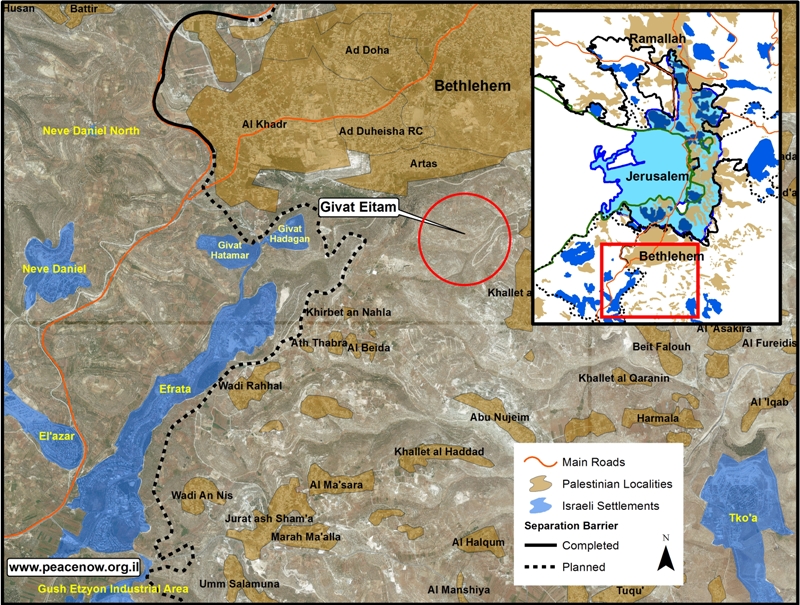 In response to the terrorist attack that resulted in the death of Israeli-American settler Ari Fuld, the local council of the Efrat settlement (where Fuld resided) has directed the start of (unauthorized) construction at the highly consequential “Givat Eitam” settlement site (nicknamed by settlement watchers “E-2” for its resemblance, in terms of dire geopolitical implications, to the infamous E-1 settlement plan). Located east of the separation barrier on a strategic hilltop overlooking the Palestinian city of Bethlehem to its north, Givat Eitam/E-2 is located within the municipal borders of the Efrat settlement but is not contiguous with its built-up area, making Givat Eitam/E-2 effectively a new settlement that, according to Peace Now, will:
“block Bethlehem from the south, and prevent any development in the only direction that has not yet been blocked by settlements (the city is already blocked from the North by the East Jerusalem settlements of Gilo and Har Homa, and from the West by the Gush Etzion Settlements) or bypass roads (that were paved principally for Israeli settlers). The planned building in area E2 would likely finalize the cutting off of Bethlehem city from the southern West Bank, delivering a crushing blow to the Two States solution.”
A small group of settlers are currently living in makeshift shelters at the site, under the protection of the Israeli army. The Israeli Civil Administration – which is responsible for enforcing planning and building laws in the occupied territory – has acknowledged the unauthorized construction at the Givat Eitam/E-2 site but has not announced any intention to remove the settlers or their illegal structures.
The head of the Efrat Local Council, Oded Revivi, took credit for the establishment of the outpost and acknowledging a long effort to build at the site, saying:
“Less than 24 hours after the murder of our friend Ari Fuld, the Efrat local council is offering a suitable Zionist response and building a new point of settlement in the Land of Israel – Givat Eitam – a strategic hill that connects the center of Gush Etzion to the eastern part. After many attempts and a lot of work, and a great deal of pressure from all sides, we’re on our way there. The residents of Efrat are with us, behind us, in cars, accompanying us. We will arrive in just a few moments and will be able to recite the blessing: “Blessed be He who establishes the border of the widow.”
Settlers have tried to build, legally and illegally, on the hilltop for over a decade. In 2004, Israel declared the area as “state land” and put it under the municipal jurisdiction of the Efrat settlement. Palestinians challenged the declaration, providing deeds to the land, but the High Court of Justice rejected the majority of the petitioner’s arguments and sent the case back to the appeals court to reconsider its previous ruling against the Palestinians. Since then, Israel and the settlers have acted unilaterally on the assumption that the area is theirs to build on. Settlers built an illegal outpost on the exact hilltop in 2011 and again in 2013; both times the Civil Administration removed the outposts after some time. In 2014, the settlers were allowed to build an access road to the Givat Eitam/E-2 site. In 2015, the Civil Administration – apparently accepting the settlers’ argument that the land belongs to Israel – destroyed Palestinian wheat crops that were planted there.
The new outpost of Efrat serves to magnify the territorial issues presented by the Efrat settlement, which is located inside a settlement enclave that cuts deep into the West Bank. Efrat’s location and the route of the barrier wall around it, have literally severed the route of Highway 60 south of Bethlehem, cutting off Bethlehem and Jerusalem from the southern West Bank. The economic, political, and social impacts of the closure of Highway 60 at the Efrat settlement (there is literally a wall built across the highway) have been severe for the Palestinian population. The concentrated settlement growth in Efrat (Efrat saw more construction starts in 2016 than any other settlement and has financed illegal construction projects to expand its borders) exacerbates all of these problems and further entrenches what settlement expert Lara Friedman calls “the trend of ‘canonization’ of the West Bank.”
Undermining Any Claim of “Good Faith,” Reports Shows Israel & WZO Knew Land Was Stolen Before Giving to Settlers
A new Haaretz report challenges the legal basis for the recent and monumental Jerusalem District Court ruling which held that the Mitzpe Kramim outpost can be retroactively legalized because the State, the World Zionist Organization, and the settlers all acted “in good faith” in the course of events that lead to the establishment of the unauthorized outpost on privately owned Palestinian land. Legal and bank documents seen by Haaretz show that the World Zionist Organization (WZO) transferred ownership rights to settlers two months after the State was informed that the land belongs to Palestinians. The sequence of events fundamentally calls into question the Jerusalem District Court’s holding that the State and WZO acted “in good faith.”
In early 2011, Palestinians filed petitions with the High Court of Justice asserting ownership of the land in question. The State responded to the Court regarding the petition, claiming that it mistakenly thought the land was under State control when it was granted to the WZO (an admission that the land should not be under WZO control). On February 6, 2011 the High Court of Justice ordered a temporary injunction against construction on the land until the ownership issues were resolved. Despite the legal proceedings and the State’s acknowledgement that the land should not be in the hands of the WZO, newly revealed documents show that the WZO transferred land rights to Israeli settlers in a series of transactions in the months after the Court order (from March to July 2011). In bank documents submitted in August 2011 (six months after the Court ruling) the WZO attested to to the settlers’ ownership of the land, paving the way for the bank to issue mortgages to the settlers, despite the unresolved ownership issues about which the WZO was aware.
Dror Etkes, the founder of the NGO Kerem Navot, who discovered the bank documents, said:
“So this is what ‘good faith’ looks like in Mitzpeh Kramim: the Settlement Division, the settlers, Amana, and the banks, worked together in a cold and calculated manner during the first few months after the petition was submitted – when there couldn’t have been the slightest doubt that construction was being illegally conducted on privately owned land – to present decisive facts before the High Court of Justice and prevent their eviction.”
The case regarding Mitzpe Kramim is now before the High Court of Justice, which will issue a final ruling about the future of the outpost, and potentially render a final verdict regarding the “good faith” of the State and WZO, and the rights of the Palestinian landowners.
Palestinians Demand $360 Million in Back Taxes on Businesses Operating in Israeli Settlements
First reported by i24 News, in a new report the Palestinian Authority documents what it estimates to be $360 million in “fiscal leakages” – monies have been denied to the PA by Israeli control over Area C, and which the PA is seeking to recoup. The PA reportedly planned to present the findings to international donors at a meeting on the sidelines of this week’s UN General Assembly meeting in New York.
The PA report asserts that since 2000 (at which time Israel ceased informing the PA about commercial activity in Area C), Israel has collected an estimated $1.7 million each month from about 2,000 businesses operating in settlements in the occupied territories. The PA argues that according to the 1994 Paris Protocol (which the report extensively cites), all these funds should be transferred to the PA by Israel, and that going forward Israel should transfer the monthly sum to the PA.
UNSC & UNGA Round-Up: Notable Activities & Statements Related to Settlements
On September 27, 2018 Palestinian Authority President Mahmoud Abbas addressed the United Nations General Assembly. Abbas twice stated that the Trump administration’s policy vis a vis settlement construction is a verdict on the final status issue of land, Abbas said:
“I renew my call to President Trump to rescind his decisions and decrees regarding Jerusalem, refugees and settlements, which contravene international law and UN resolutions, as well as the understandings among us, in order to salvage the prospects for peace and to achieve stability and security for the future generations in our region….We awaited his peace initiative with utmost patience, but were shocked by decisions and actions he undertook that completely contradict the role and commitment of the United States towards the peace process. In November 2017, his administration issued a decision to close the PLO office in Washington, DC. He then announced his recognition of Jerusalem as the capital of Israel and transferred his country’s embassy from Tel Aviv to Jerusalem, and boasts that he has removed the issues of Jerusalem, refugees, settlements and security off the negotiation table. All such decisions threaten the Palestinian national cause and constitute an assault on international law and relevant United Nations resolutions. The US administration went even further in its assault by cutting assistance to the Palestinian National Authority, UNRWA and Palestinian hospitals in occupied East Jerusalem.”
On September 27th, 2018 Israeli Prime Minister Benjamin Netanyahu also addressed the United Nations General Assembly. Netanyahu’s speech did not address settlements.
On September 27th, U.S. Special Representative for International Negotiations Jason Greenblatt, gave a speech defending U.S. funding cuts to Palestinians and humanitarian projects. As part of that speech Greenblatt noted that the U.S. decision was motivated in part by the Palestinian Authority’s refusal to cooperate with Israeli businesses, which might be pointing towards industrial zone projects inside Israeli settlements – an “economic peace” scheme the U.S. administration recently promised to support. Greenblatt said in his speech that PA leaders:
“refuse opportunities to build the economy due to an anti-normalization prejudice towards doing business with Israelis. (…) The United States will not use the hard-earned tax dollars of its citizens to subsidize anti-normalization”.
At a September 26th press conference during UNGA that the U.S. preferences a two-state solution, President Trump articulated support for a two-state solution. Commenting on Trump’s statement, Husam Zomlot – until recently the PLO Ambassador to the U.S. – said:
“[Trump’s] statements contradict his actions. His policy is destroying any chance for peace.”
J Street has the following reaction:
“If President Trump truly supports a two-state solution, then he should reverse the many actions by his administration that have made it much harder to achieve. He should stop claiming that he has taken the issue of Jerusalem “off the table,” and stop the cruel and destructive cuts in humanitarian aid and assistance to the Palestinian people. He should instruct the US ambassador to Israel to stop condoning Israeli settlement expansion in the West Bank. President Trump and his administration should be judged by actions, not words, and their actions have made clear: they have no interest in promoting genuine peace between Israelis and Palestinians. Until those destructive actions change, the idea that they are formulating a credible ‘peace plan’ is absurd.”
Also on September 26th, President of the Palestinian Authority, Mahmoud Abbas, held a meeting to gather support for an alternative model for negotiations – a model that replaces U.S. leadership in the process with a multilateral approach. The meeting was attended by foreign ministers of Turkey, Ireland, and Japan, UK Minister for the Middle East Alistair Burt, and diplomats from Germany, Norway, Spain, Morocco, Egypt, Ethiopia, and Indonesia, among others. UN Special Coordinator for the Middle East Peace Process Nickolay Mladenov and Under-Secretary-General for Political Affairs Rosemary DiCarlo also attended the event.
On September 20, 2018, the UN Special Coordinator for Middle East Peace Nickolay Mladenov provided an update on the implementation of UN Res 2334 to the United Nations Security Council (UNSC), chaired by U.S. Ambassador to the UN Nikki Haley. Mladenov began his update saying:
“No steps have been taken during the reporting period to ‘cease all settlement activity in the occupied Palestinian territory, including East Jerusalem’, as required by the resolution.”
Mladenov’s report goes on to document the number of settlement units approved for construction. He concludes with broad observations about the context and consequences of Israeli settlement activity, starting with:
“The expansion of Israeli settlements is illegal under international law and continues to erode the viability of a two-state solution. Particularly alarming are legal and administrative steps which could consolidate and expand settlement activity deep in the West Bank, further undermining the contiguity of a future Palestinian state.”
Welcome to FMEP’s Weekly Settlement Report, covering everything you need to know about Israeli settlement activity this week.
To receive this report via email, please click here.
June 28, 2018
- Israeli Govt Advances Plans for 1,064 New Settlement Units in East Jerusalem
- Justice Minister Pushes Bill to Further Politicize Legal Environment
- New Moves Make Bad Situation Worse for al-Walajah
- Israeli Ministry Funds Settlement Farm Schools Built on Private Palestinian Land
- Israeli Anthropological Association Rejects Annexation-By-Academia
- Bonus Reads
Comments, questions, or suggestions? Email Kristin McCarthy at kmccarthy@fmep.org.
Israeli Govt Advances Plans for 1,064 New Settlement Units in East Jerusalem

Map by Ir Amim
The Israeli government in recent days deposited for public review six plans to expand the East Jerusalem settlement of Pisgat Ze’ev, totaling 1,064 new settlement units. After being deposited, the public has 60 days to submit objections, which will then be considered by the High Planning Council which will either recommend changes to the plan or validate it (meaning, give it final approval).
Ir Amim reports:
“Most of the plans will expand Pisgat Ze’ev to the west, pushing it further to the limits of Beit Hanina, and east toward Hizma [two Palestinian neighborhoods in the norther part of East Jerusalem]. The narrowing proximity of Israeli and Palestinian neighborhoods along the northern perimeter increases tensions on the ground, throwing into stark relief the endemic discrimination between planning and resource investment in Palestinian and Israeli neighborhoods. Further, enduring discrimination in the planning process – the suppression of detailed outline plans (requisite for access to building permits) for Palestinian residents alongside continued growth and expansion of Israeli neighborhoods/settlements in East Jerusalem – serves as a powerful Palestinian displacement mechanism in support of Israel’s demographic goals.”
Justice Minister Pushes Bill to Further Politicize Legal Environment
On June 25th, the Knesset Constitution, Law, and Justice Committee considered a bill, introduced by Justice Minister Ayelet Shaked (Jewish Home), that would empower Cabinet Ministers to select their own ministerial legal advisors. Historically non-political positions, the ministerial legal advisors, referred to as “gatekeepers,” work to ensure that ministerial activities are taken up and implemented in accordance with Israeli law. This move is just the latest Shaked effort to politicize elements of the Israeli legal environment in favor of the de facto annexation of settlements.
Under current Israeli law, legal advisors are appointed through a public tender process that ministers cannot influence. Under Shaked’s bill, each ministry would create a selection committee to the fill the position. The members of the selection committee would be chosen by the relevant minister, and the committee’s decision on a candidate would then require the approval of the relevant minister and the Attorney General. The proposal would effectively allow each minister to choose the legal advisor he or she wants. Haaretz explains:
“The ‘selection committee’ would exist in name only, a way to whitewash the complete politicization of the position of ministry counsel. In the name of governability, Shaked seeks to eliminate the gatekeeper function of the legal adviser, protecting human and minority rights and fighting corruption and damage to proper public administration.”
Current Attorney General Avichai Mandelblit submitted an 11-page brief to the Knesset ahead of the hearing, which he attended in person to argue against the bill. He was joined by two former Attorneys General, Yitzhak Zamir and Elyakim Rubinstein, who also argued against the bill in the Knesset on June 25th. Zamir told the committee, “the entire legal community,” opposes the politicization of the ministerial legal advisor position as proposed in the bill.
Shortly after assuming office in 2015, Shaked hired a private lawyer, Amir Fisher (who also represents the settler group Regavim), to essentially write the State’s responses to petitions before the High court that deal with settlements. In June 2017, Shaked announced that all Knesset bill’s seeking government backing must include a legal opinion explaining the method by which the bill can be applied to the settlements (by Military Order or directly). In January 2018, Shaked announced that she had reorganized the Justice Ministry in order to create a new unit tasked with coordinating the application of Israeli laws in the settlements across government ministries. In February 2018, the Ministerial Committee for Legislation voted to give government backing to a bill introduced by Shaked which would transfer jurisdiction over certain West Bank legal petitions (including Palestinian petitions relating to land disputes, travel permits, and building permits) from the High Court of Justice to the Jerusalem District Court – where Shaked installed a pro-settlement judge. The bill received government backing in February 2018 and passed its first reading in the Knesset May 2018. In April 2018, Shaked and Education Minister Naftali Bennett (Jewish Home) advanced a bill that would allow the Knesset to reinstate a law that the High Court of Justice overturned (the Ministerial Committee on Legislation, of which Shaked and Bennett are members, voted to give government backing to the bill in May 2018).
FMEP tracks all these developments in the Israeli legal system with regards to settlements and annexation in its regularly-updated annexation policy tables.
New Moves Make Bad Situation Worse for al-Walajah
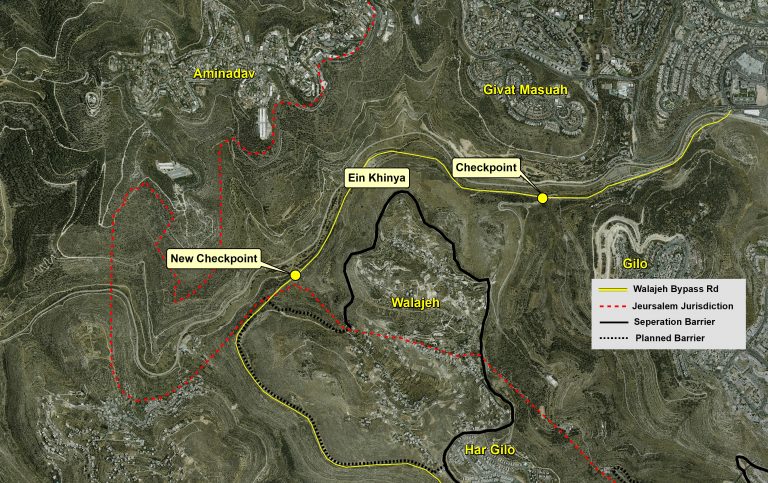
Map by Peace Now
Haaretz reports that that the Jerusalem District Planning Committee gave final approval to a plan to relocate the “Ein Yael” checkpoint, which controls traffic into and out of the Palestinian village of al-Walajah. By moving the checkpoint, Israel will be able to prevent Palestinian access to the recently renovated Ein Haniya spring and further consolidate Israeli control over the village’s access to Jerusalem.
FMEP has covered the relocation of the Ein Yael checkpoint previously, first and most extensively in February 2018, when construction on the new checkpoint began, and then in March 2018 when the Israeli government admitted in court that construction permits for work on the new checkpoint had been issued illegally. Since them, all the necessary authorizations have been properly issued and construction of the new checkpoint can resume.

Map by Ir Amim
Haaretz observes that the relocation of the checkpoint, coupled with the June 15th advancement of a plan to build the Har Gilo West settlement (see FMEP reporting here) will completely isolate al-Walajah and create an “unbroken stretch of Jewish construction from Jerusalem to Bethlehem in the West Bank.”
Ir Amim research Aviv Tatarsky said:
“Har Gilo’s expansion and the checkpoint’s relocation give us an opportunity to see the true significance of the greater Jerusalem plan. The expansion will create contiguity between Jerusalem and the settlements near Bethlehem, and also strangle Al-Walaja. These are two sides of the same coin. The situation in which Israel chooses to expand settlements in a way meant to perpetuate its control over millions of Palestinians without citizenship cannot be sustainable. But when the day we finally understand this arrives, the price of fixing it will be much higher.”
FMEP has repeatedly documented various Israeli efforts to seal off al-Walajah from Jerusalem. Residents of al-Walajah have fought the growing encroachment by the nearby Etzion settlement bloc and the Israeli government’s attempt to de facto annex the bloc as part of “Greater Jerusalem.” Ir Amim explains several prongs of this effort, including a particularly unbelievable section of Israel’s separation barrier planned to almost completely encircle the village, to turn its valuable agricultural land into an urban park for Jerusalem, and construction of a highway that will connect the Etzion settlement bloc to Jerusalem with Israeli-only bypass roads.
Israeli Ministry Funds Settlement Farm Schools Built on Private Palestinian Land
Haaretz reports that the Israeli Education Ministry is supporting two farm schools built on privately owned Palestinian land in the West Bank. The farms in questions – one near the Efrat settlement and one near the Geva Benyamin settlement – were built by local settlement councils for “ecological agricultural education,” and are officially supported by the Education Ministry. In 2017, the Efrat settlement received $274,000 USD from the government to build the farm (the settlement’s budget did not specify which ministry transferred the funds).
The Efrat local council argued that their farm school is located on state land (and therefore, even if built improperly, is eligible for retroactive legalization). However, the council acknowledges the school is outside of the so-called “blue line,” which is the Israeli government’s demarcation of land in the West Bank that it has granted to settlements. The council’s disregard for the blue line’s relevance adds to the call to disband the IDF team responsible for accurately demarcating the “blue line.” If the blue line team is disbanded, Israel will cease making any effort to identify if and where settlement boundaries include private Palestinian land, let alone retroactively returning such land to the control of its owners. Israeli Attorney General Avichai Mandelblit has reportedly already agreed to this recommendation.
Israeli Anthropological Association Rejects Annexation-By-Academia
The Israeli Anthropological Association voted 49-25 to stop cooperating with institutes of higher education based in the occupied West Bank, a ban which extends to holding “conferences and workshops or any general interaction.” The Association states that the decision is applied only to institutions, not students or professors associated with the institutes.
In a statement, the Israeli Anthropological Association said:
“Putting Ariel University, Herzog College, and Orot Israel College [all in West Bank settlements] harms both Israeli society and the academy (and…) it undercuts the Council’s position as a barrier to the politicization of the Israeli academy, science, and higher education, and drags academics working in Israeli academic institutions into supporting the occupation and annexation efforts.”
The decision follows the February 2018 passage of a bill to extend Israeli domestic law over universities and colleges in the settlements. Know as the “Ariel Bill,” it effectively annexes colleges and universities in settlements by bringing them under the authority of the domestic Israeli Council for Higher Education.
Bonus Reads
- “As Israel Pushes to Build, Bedouin Homes and School Face Demolition” (New York Times)
- “In memory of Felicia Langer, the first lawyer to bring the occupation to court” (+972 Mag)
- “Trump and Netanyahu have not learned from history – they are repeating it” (+972 Mag)
- “Donald Trump’s Policies are Hurting Palestinians and Middle East Peace Prospects” (Sen. Dianne Feinstein, USA Today)
- “Israeli settlers burn 300 Palestinian olive trees in Nablus District” (Maan)
Welcome to FMEP’s Weekly Settlement Report, covering everything you need to know about Israeli settlement activity this week.
To receive this report via email, please click here.
May 10, 2018
- Israeli Government Task Force Recommends Massive, Unlimited Land Theft to “Legalize” 1000s of Unauthorized Settlement Buildings
- DETAILS: Zandberg Report Recommendations (as reported in English-language media)
- REACTIONS to Zandberg: Some Celebrate, Others Sound the Alarm
- Efrat Becomes First Settlement to Acquire Private Drone to Police Palestinians
- Financing Occupation: World Zionist Organization Offers Cheap Rent in Settlements
- Israeli Cabinet Votes to Back Legislation Stripping High Court of Significant Power
- Former Top Military Prosecutor – Current NGO Monitor Employee – Lives in House Built on Stolen Palestinian Land
- Bonus Reads
Comments, questions, or suggestions? Email Kristin McCarthy at kmccarthy@fmep.org.
Israeli Government Task Force Recommends Massive, Unlimited Land Theft to “Legalize” 1000s of Unauthorized Settlement Buildings
Last year, the Israeli government formed a task force to develop new legal solutions that will save settlement buildings and outposts that were built without Israeli authorization on privately owned Palestinian land in the West Bank.The committee’s final report mapping out a menu of options to accomplish that end – called the “Zandberg Report” after the committee’s chair, Dr. Haya Zandberg – was published (in Hebrew) on Friday, May 4th. Soon after its publication, Defense Minister Avigdor Liberman announced he will be introducing a plan “within weeks” that will operationalize the report’s recommendations.
Described by the The Jerusalem Post as “the latest attempt by settler leaders, right-wing politicians and judicial experts to normalize settlement building in Area C of the West Bank by divorcing it from existing legal constraints,” it is clear that the recommendations toss out even a pretense of respect for the rule of law in order to entrench and expand Israeli settlements, rewarding Israeli settlers who broke Israeli law. If implemented, the recommendations will “legalize” the outright theft of land recognized by Israel as privately owned by Palestinians and will lay the groundwork for continued, additional expropriation of privately-owned land for settlement-related construction.
DETAILS: Zandberg Report Recommendations (as reported in English-language media)
The report opens by stating that “the State of Israel, as the state of the Jewish people, has a right and claim over areas whose status is disputed in the Land of Israel.” The contents of the report make clear that the drafters define “the Land of Israel” as including all of the West Bank.
The authors go on to offer a number of unprecedented legal arguments and recommendations. Those include:
1 – Calling for wholesale implementation of the “Market Regulation” principle, and additional, similar actions. “Market Regulation” is a recently invented Israeli legal principle that involves granting post-facto legitimacy to illegally built settlement construction in cases where settlers built “in good faith,” i.e., they do so under the belief that their actions were correct and legal. FMEP has covered the “Market Regulation” principle several times in the past, and tracks the operationalization of it in real time on our annexation policy tables. Attorney General Avichai Mandelblit first introduced the “Market Regulation” argument in late 2016 as an alternative legal basis to the one that was eventually adopted by the Knesset in the Regulation Law. In November 2017, the government embraced Mandelblit’s “Market Regulation” principle when it submitted a brief to the High Court of Justice announcing its plan to retroactively legalize the settlers’ construction on privately owned Palestinian land near the Ofra settlement by expropriating that land.
In addition, the report recommends legalizing illegal construction in cases where settlements have expanded beyond their borders onto private land, and where that structures in question “were built over a decade ago, without any protest and with the support of the state.”
2 – Endorsing the expropriation of privately owned Palestinian land for “public use.” As an occupying power, Israel technically has the right to expropriate land for public use — meaning, for the benefit of the public that resides in the territories held under occupation. Since 1967, Israel has interpreted that authority in a manner that is both legally questionable and which discloses a very clear political and territorial agenda, using “public use” as the basis for expropriating West Bank land for the exclusive benefit of Israel and Israeli settlers. The Zandberg report makes this explicit, endorsing expropriations for the purpose of building new roads that connect isolated outposts and settlements to more developed areas. Defending this self-serving interpretation of “public use,” the report cites an opinion by (now retired) High Court Justice Salim Joubran, which held that settlers are legally a part of the “local population” of the West Bank and that the IDF is obligated to provide for their welfare. As another means of connecting isolated settlements and outposts, the report also recommends that the State consider building tunnels or bridges through privately owned Palestinian land to connect isolated settlement areas to more developed areas. The report argues “the ownership underground and [in the air] above the ground belongs to the state.”
FMEP has repeatedly reported on the events related to the legal basis created by Justice Joubran’s opinion, and FMEP tracks the operationalization of the legal basis on our annexation policy tables. Joubran’s opinion was made public in October 2017, prompting the Israeli NGO Yesh Din to file a new petition regarding the case it was related to – the Amona outpost case. Then, in November 2017 the High Court accepted the “local population” argument as an adequate legal basis for expropriating Palestinian land near the unauthorized outpost of Haresha in order to legalize an access road that had illegally been built on the private land.
3- Recommending a principle of flexibility in defining “adjacent areas.” The basis of this recommendation is the idea that Israel’s right to use land that is immediately adjacent to authorized settlements cannot be questioned, and that by interpreting the concept of “adjacent areas” broadly, Israel can justify taking large swathes of West Bank land located around and between settlements, including private land. Doing so would enable Israel to incorporate unauthorized outposts as “daughter neighborhoods” of existing settlements, even when located a great distance away. Doing so would also allow private Palestinian land surrounding isolated outposts to be seized and zoned for settlement construction and expansion (some outposts are located on pockets of territory designated by Israel as “state land,” prohibiting, under current law, the outpost to expand).
4 – Calling for the establishment of new, official settlements. The report endorses the establishment of independent new settlements for satellite outposts that are not connected to the main settlement area, like what Israel is in the process of doing for the Havat Gilad outpost.
5 – Recommending an end to the work of the “Blue Line Team.” This is the team within the Israeli Defense Forces which was tasked with examining and correcting the demarcation of land in the West Bank that Israel has granted to settlements. Ending the work of the team means Israel will cease making any effort to identify if and where settlement boundaries include private Palestinian land, let alone retroactively returning such land to the control of its owners. Israeli Attorney General Avichai Mandelblit has reportedly already agreed to this recommendation.
6 – Calling for Regional Settlement Councils to be allowed to provide municipal services to (currently) unauthorized outposts. Many unauthorized outposts – being outside the jurisdiction of regional councils (because they are not officially recognized by the government) – lack connections to the Israeli power grid and water supply. This recommendation will allow settlement Regional Councils to hook up outposts to the Israeli grid, an ability which had already been extended to local settlement councils.
REACTIONS to Zandberg: Some Celebrate, Others Sound the Alarm
Justice Minister Ayelet Shaked: “The end of the era of uprooting settlements without purpose in Judea and Samaria, was led by a team that found legal ways to regulate settlements in Judea and Samaria and to end the shame of evacuating settlements for no real reason. The report gives legal tools that are compatible with international law, for the settlement of settlements in Judea and Samaria.”
Education Minister Naftali Bennett (Jewish Home): “We act responsibly and creatively and within a few weeks we will present a comprehensive and systematic plan of action for the legalization of outposts in Judea and Samaria.”
Agricultural Minister Uri Ariel (Jewish Home): “The Settlement Committee was established in order to find a solution for thousands of houses in settlements that are in danger because of petitions by radical leftist parties and the Palestinian Authority, which exploit the judicial system to harm and sabotage Jewish settlement in Judea and Samaria. The report sets before us, the government, the simple truth that it is possible and necessary to settle settlement in Judea and Samaria after 50 years of settlement. I call on the prime minister to immediately adopt the report and put an end to the unnecessary and painful demolition and destruction of homes and settlements in Judea and Samaria established with the encouragement and support of successive Israeli governments.”
MK Ksenia Svetlova (Zionist Union): “Because the government was unable to implement the Levy report, they need to be able to show some sort of result on this issue…It will give a tailwind to settlers to continue building illegally…” She referred to the report as a “legal carte blanche,” providing another avenue for advancing the so-called “Regulation Law.” She added, “I believe in international legitimacy, and nobody has recognized our sovereignty in the West Bank.”
Peace Now: “This is a serious and dangerous report, which recommends that Israel blatantly violate international law and trample on the protected needs and rights of the Palestinian population…the implementation of its recommendations would lead to apartheid in practice.
Talia Sasson (author of the 2005 Sasson Report and current head of The New Israel Fund): The report was written “on the basis that the political debate over the West Bank is over…Their legal attitude to issues of land ownership is one of ‘we don’t want to know.’ ”
Michael Sfard (human rights lawyer): Referring to a 1979 court ruling that held Palestinian land could not be confiscated by the state for the use of settlement building, Sfard said: “The adoption of this report would signify the end of that ruling. It has been abused quite regularly on the ground, but never before at the legal level.”
[Updated post-publication with new statements]
Efrat Becomes First Settlement to Acquire Private Drone to Police Palestinians
The Efrat settlement, located south of Bethlehem, recently became the first settlement to have its own drone to police the skies. The settlement held a demonstration of the drone’s capabilities over the weekend, stressing that the drone is able to quickly identify Palestinians on the ground.
The purchase of the drone was supported by a $37,000 donation from the International Fellowship of Christians and Jews, an organization which claims to be the “largest Christian-supported humanitarian agency helping Israel and the Jewish people around the world,” counting 1.6 million Christian donors who contribute a total of $140 million annually. The group’s founder, Rabbi Yechiel Eckstein, told the Jerusalem Post that he plans on equipping more settlements with their own private drones.
Military-grade drones have long been a part of the Israeli military’s blockade of Gaza, and Gaza residents have long noted with despair the audible buzzing of drones above them. The Washington Post wrote that the buzz of drones is the “the most enduring reminder of Israel’s unblinking vigilance and its unfettered power to strike at a moment’s notice.” Just last week, and for the first time ever, Israel used drones to drop tear gas on Palestinians participating in protests along the fence separating Israel from the Gaza Strip.
The privatization of drones follows the diffusion of drone technology throughout the Israeli armed forces; as of last year, Israel had furnished camera-equipped drones to hundreds of IDF units.
Financing Occupation: World Zionist Organization Offers Cheap Rent in Settlements
A freedom of information request filed by two Israeli NGOs has revealed that the Settlement Division of the World Zionist Organization (WZO) offers mobile homes for rent in West Bank settlements for 20-30% cheaper than in Israel proper. According to the data, 37% of the division’s rental properties are located inside of West Bank settlements.
The Settlement Division is technically part of the World Zionist Organization, but in practice the unit is fully funded by the Israeli government and even splits its real estate profits with the Israeli Housing and Construction Ministry. Together, the WZO and the Israeli government work in coordination to develop West Bank settlements and encourage Jews to move into them.
From the beginning of the Israeli settlement movement, the Israeli government has provided significant economic subsidies to encourage its citizens to move to the West Bank (subsidies which is not offered to citizens living in Israel proper, where a housing shortage has been front-page news for years).
Israeli Cabinet Votes to Back Legislation Stripping High Court of Significant Power
On May 6, 2018, the Israeli Cabinet voted to support legislation that, if passed by the Knesset, will empower the Knesset to reinstate laws struck down by the High Court with a bare-bones majority vote (61 of 120). This move by the Cabinet sends the bill – known as the override law – to the Knesset, where it appears to have been put on ice due to opposition within the governing coalition.
The Cabinet’s decision to vote on the bill and send it to the Knesset took place entirely at the insistence of Jewish Home leaders Naftali Bennett and Ayelet Shaked, in defiance of a request from Prime Minister Netanyahu’s (Likud) to delay the Cabinet vote until the Ministers could reach a compromise on the text of the bill. Instead, Bennett and Shaked plowed ahead with their own version of the bill without consensus in the Cabinet. The Jewish Home version is the most extreme: it would allow the Knesset to reinstate bills with just 61-votes, a threshold so low that it would effectively allow governing coalitions to pass laws that are immune to judicial review. Chief Justice Esther Hayut warned that the 61-vote version sets the bar too low, calling it a “danger to democracy and to the court.”
As of this writing, Netanyahu has not yet weighed in on the Cabinet’s action on the bill, which leaves Likud faction votes uncertain. Finance Minister Moshe Kahlon – who heads the Kulanu Party, the second largest party in the governing coalition – has promised to instruct his faction to vote against the bill should it be brought up, a move which could shelve the bill for six months according to Knesset procedures. Kahlon, who was not present during the Cabinet’s discussion or vote, said:
“The passage of the bill in the Ministerial Committee of Legislation is a violation of the coalition agreements and a blow to law enforcement. The Kulanu faction will continue to struggle against the override powers clause and we will fight. We will not allow extreme elements to lead the daily agenda in the State of Israel.”
Adding to the dissent, a spokesman for Israeli Attorney General Avichai Mandelblit reiterated the AG’s opposition to all versions of the bill currently under consideration. As an alternative, Mandelblit has recommended a bill that would require a majority vote in the High Court (6 out of 9) to overturn a bill, and then a vote of 70 MKs to reinstate any bill that was struck down.
Former Top Military Prosecutor – Current NGO Monitor Employee – Lives in House Built on Stolen Palestinian Land
Dror Etkes – founder of the anti-settlement watchdog group Kerem Navot – revealed that Maurice Hirsch, Israel’s former chief military prosecutor in the West Bank – lives in a house that the Israeli Defense Ministry has admitted was built on privately owned Palestinian land. Hirsch is currently employed by NGO Monitor, a group dedicated to quashing activisim critical of Israel or Israeli policies.
Bonus Reads
- “Ultra-Orthodox population grows in Israeli settlements” (i24 News)
- “Israeli forces expel Palestinian families from homes in Jordan Valley for army training” (Maan News)
- “How the U.S. State Department Deleted the Occupied Territories” (Haaretz)
Welcome to FMEP’s Weekly Settlement Report, covering everything you need to know about Israeli settlement activity this week.
To receive this report via email, please click here.
August 16, 2017
- Israel Demolishes Buildings in Key East Jerusalem Areas
- Bedouin are Powerless in E-1 Area as Settlement Plans Loom
- Jewish National Fund Resumes Targeting Land in the Occupied West Bank
- Settlers in Israeli Government Turn Blind Eye to Settlers Breaking Israeli Law
- Former Israeli AG Says Sheikh Jarrah Property Should be Given to Palestinians
- Three New Outposts Near Nablus
- Updates: Al-Walajah, Sheikh Jarrah, Amichai Settlement
- Bonus Reads
Comments, questions, or suggestions? Email Kristin McCarthy at kmccarthy@fmep.org.
Israel Demolishes Buildings in Key East Jerusalem Areas
The Israeli government demolished eight Palestinian structures in the East Jerusalem neighborhoods of Silwan, Beit Hanina, Jabal Mukaber, and Isawiyyah. According to Ir Amim, the two apartments demolished in the al-Bustan area of Silwan are the first demolitions to be carried out there since 2008. Looking at East Jerusalem as a whole, Ir Amim writes, “[these] demolitions bring the 2017 total to 128, including 84 residential units and 44 non-residential units. These numbers are on well on target to meet or surpass the total number of 203 demolitions executed in East Jerusalem last year.”
Bedouin are Powerless in E-1 Area as Settlement Plans Loom
According to B’Tselem, last week Israeli officials confiscated solar panels that were providing electricity to a Bedouin community’s school in the controversial area adjacent to Jerusalem known as “E-1.” The confiscation happened despite a temporary court-ordered injunction against it. The Israeli government has long refused to connect the Bedouin to a power grid; the solar panels confiscated this week were donated only a month ago by a humanitarian organization.

Map by the Economist
The E-1 area has long been slated for Israeli settlement construction, but plans have been continuously delayed by the Israeli political echelon – due in large part to pressure from U.S. administrations and others in the international community. If E-1 is developed it will seal Palestinian East Jerusalem off from the West Bank to its east, and create a land bridge from Jerusalem to the Maale Adumim settlement. The settlement will render the two-state solution impossible because it would preclude the ability to draw contiguous borders for a future Palestinian state with a capital in East Jerusalem.
East Jerusalem expert Danny Seidemann has issued several warnings this year that E-1 – a “doomsday settlement” – might be slated for advancement under the current settlement policy of the Netanyahu government and with no discernable counter-pressure from the Trump Administration. Seidemann warned in January, “The main obstacle preventing a green light for E-1 has, until now, been wall-to-wall opposition from the international community, led by the United States (dating back to the era of President Clinton).”
The Bedouin community living in the E-1 area has long been threatened with forcible relocation (which would amount to population transfer). The 18 Bedouin tribes that live in the vicinity of Maale Adumim and E-1, totaling approximately 3,000 people, have already endured numerous emolitions this year alone.
Jewish National Fund Resumes Targeting Land in the Occupied West Bank
According to Peace Now, the Jewish National Fund (JNF) is set to resume its practice of purchasing land in the West Bank for use by Israeli settlers, after abandoning the effort many years ago. In the past, many of the JNF’s land purchases reportedly involved fraud, extortion, and/or forgery on the part of middlemen.
Peace Now writes, “Through purchasing lands in the occupied territories, JNF serves the settlers, hurts the possibility to arrive at a two state solution, and jeopardizes the future of Israel as a Jewish and democratic state.”
The JNF – which collects donations internationally, including in the United States – currently owns land (through its Israeli subsidiary) in numerous settlements, including Itamar, Alfei Menashe, Enav, Kedumim, Givat Ze’ev, Metzadot Yehuda, and Otniel.
Settlers in Israeli Government Turn Blind Eye to Settlers Breaking Israeli Law
There have been several recent reports about structures inside of settlements that were built (or are being built) without the legally-necessary permissions, as Israeli officials turn a blind eye.

Map of the Hayovel outpost by Times of Israel Red encircles site construction, arrow points to the house of Liberman’s settlement affairs advisor.
Notably, one report identifies dozens of unauthorized homes being built in the outpost of Hayovel (which is effectively an extension of the settlement of Eli), despite a stop-work order issued by Civil Administration (the arm of the Ministry of Defense that is sovereign in the West Bank). The construction is taking place virtually across the street from the home of Israeli Defense Minister Avigdor Liberman’s own adviser on settlement affairs, who is himself a resident of the illegal outpost (Liberman is also a settler, residing in the settlement of Nokdim). The illegal construction will double the size of the outpost.
Another report reveals that Shlomo Ne’eman, the head of the Gush Etzion Regional Council – which promotes the expansion of settlements in the Etzion bloc – lives in an illegal outpost. The Regional Council insists that the outpost is a “neighborhood” of the Karmei Tzur settlement, but aerial images show it is outside of the settlement’s municipal border. The Israeli Civil Administration has ordered the structures there to be demolished but has not carried out those orders. Settlement watchdog Kerem Naboth says, “Ne’eman has joined the list of elected officials and politicos among the settlers who are not only assisting others in stealing land, but are also doing it themselves.”
Haaretz notes that these two are part of a longer list of elected officials and senior civil servants living in illegal outposts, Also on that list far right-wing Knesset Member Bezalel Smotrich (Habayit Hayehudi), who lives in an illegally-built home in Kedumim (not coincidentally, Smotrich was one of the key backers of a law passed earlier this year to “legalize” such settlement illegalities). Likewise, a January report revealed that the head of the Finance Ministry’s department of building regulations enforcement, Avi Cohen, lives in an illegal outpost of the Eli settlement. At the time of the report in January, Rabbis for Human Rights said, “A situation in which the system responsible for enforcing building laws is headed by someone living in an outpost demonstrates contempt for the system and Israel’s values.”

Image by Kerem Naboth
Another report documents how in the Efrat settlement (in the Etzion settlement bloc) a school was recently expanded, illegally, on private Palestinian land located land outside of the settlement’s border. Funding for the project was raised by an organization, called the Ohr Torah Stone, which operates a branch in the United States and is eligible to receive tax-deductible donations from U.S. donors. According to settlement watchdog Kerem Naboth, the Efrat settlement itself was built on land that the Palestinian village of al-Khadr had long cultivated. Kerem Naboth reports, “aerial photographs from the 1980s indicate that in the past there was a vineyard on site.”
Former Israeli AG Says Sheikh Jarrah Property Should be Given to Palestinians
Speaking in Sheikh Jarrah, former Israeli Attorney General Michael Ben-Yair called on the Israeli government to intervene to stop the eviction of the Shamasneh family from their longtime family home. Ben- Yair served as the AG from 1993-1997, under prime ministers Rabin and Netanyahu.
Ben-Yair, whose family lived in Sheikh Jarrah until 1948, suggested he would be ready to reclaim his family’s property and then transfer it to the Palestinians currently living there – and called on the government to adopt a policy to do exactly that, across the board. He said, ”If the Israeli government would have acted decently toward all its residents, including you [the Arab residents], it would have appropriated the properties in the neighborhood [from their Jewish owners who lived there before the War of Independence] and given these properties to the Palestinians who live there today.”
The former AG also noted that Jews who lost property in the 1948 war were already compensated – at the expense of Palestinians. Ben-Yair said, “My family and the family of my cousin who were forced to leave the neighborhood in January 1948 got properties of Palestinians refugees on Jaffa Road and in the Katamon neighborhood in west Jerusalem. They were worth much more than the properties that we left in Sheikh Jarrah.
Since we covered the Shamasneh family’s story last week, a temporary injunction against the eviction expired on Sunday, August 13th. The family’s lawyer requested a second injunction, but the petition is still pending. As of this writing the family is still living in the home.
Three New Outposts Near Nablus
The Palestinian Authority is reporting that settlers from the radical Yitzhar settlement, south of Nablus, have moved 11 mobile homes to an area outside of the settlement, a move which would expand the settlement’s footprint. In addition, nine mobile homes were reportedly placed near the Palestinian village of Qusin, which is a few miles east of Nablus, and another nine were placed near the border of the Einav settlement, a few miles east of Qusin.
Updates: Al-Walajah, Sheikh Jarrah, Amichai Settlement
Updates from last week’s Settlement Report:
- Residents of the village of Al-Walajah were able to stop the demolition of one home last week by forming a human barrier around it, blocking a bulldozer from tearing it down. Approximately one third of the village is inside of Jerusalem’s municipal boundary. In this area specifically, Ir Amim estimates that 50% of the homes are under threat of demolition. Al-Walajah residents say the Israeli government has recently increased the rate of home demolitions significantly and has also resumed construction of the separation barrier around the village.
- UNRWA has weighed in on the pending eviction of the Shamasneh family from their home in Sheikh Jarrah. UNRWA spokesman Christopher Gunness states, “The members of the Shamasneh family are long-standing Palestine refugee residents in East Jerusalem, which is occupied territory and affected by continued settlement expansion contrary to international law. It is a matter of deep concern that Palestine refugees who have already endured multiple displacements should be subject to the humiliation of the kind inflicted by forced evictions.” The statement calls on the Israeli government to reconsider the eviction ruling.
- Construction on the first new settlement in 25 years, Amichai, remains stalled due to lack of government funding. After nearly three weeks of inactivity on the construction site, the families who the settlement is being built for are preparing to move to the area with semi-permanent structures and take up residence. On plans to move to the site while construction is stalled, one settler told Ynet News, “It is clear that when we do go there [to the site of Amichai], thousands of youths will join us. When we do, it will be to stay for good.”
Bonus Reads
- “Adalah opposes mandate of Israeli Interior Ministry borders cmte. weighing annexation of West Bank land to settlements” (August 13, 2017)
FMEP has long been a trusted resource on settlement-related issues, reflecting both the excellent work of our grantees on the ground and our own in-house expertise. FMEP’s focus on settlements derives from our commitment to achieving lasting Israeli-Palestinian peace, and our recognition of the fact that Israeli settlements – established for the explicit purpose of dispossessing Palestinians in the West Bank and East Jerusalem of land and resources, and depriving them of the very possibility of self-determination in their own state with borders based on the 1967 lines – are antithetical to that goal.
Welcome to FMEP’s Weekly Settlement Report, covering everything you need to know about Israeli settlement activity this week.
To receive this report via email, please click here.
July 28, 2017
- Bibi Embraces “Population Transfer” – Asks for US OK
- The Knesset & Bibi Move to Gerrymander Jerusalem
- Settlers Set Up Outpost, Seek to Expand Settlement as “Response” to Murders
- Settlers Seize Contested Building in Hebron
- Construction on New Settlement in Shilo Valley Stalled (Due to Lack of Funds)
- High-Ranking Government Officials Defend Outpost from Demolition
- Bonus Reads
Comments, questions, or suggestions? Email Kristin McCarthy at kmccarthy@fmep.org
Bibi Embraces “Population Transfer” – Asks for US OK
According to a report from Israel’s Channel 2 News, Prime Minister Netanyahu recently asked U.S. Ambassador David Friedman and Special Envoy Jason Greenblatt to support a populated land-swap as part of a future peace deal.
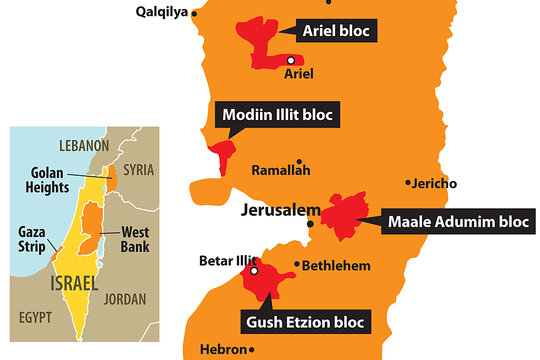
Map in CSMonitor
The swap in question would transfer 300,000 Palestinian citizens of Israel (living in the Wadi Ara region, an area known as “the triangle,” near Haifa) to the Palestinians, in exchange for Israel’s annexation of settlements in the Etzion bloc. The plan – which was previously championed by Defense Minister Avigdor Liberman, who even proposed it at the United Nations – is in effect a population transfer that would allow Israel to get rid of a large cluster of Palestinian cities, including the city where the two terrorists who attacked guards at the Haram al-Sharif/Temple Mount last week grew up.
An unnamed White House official made a statement in response to the report saying, “This may have been one of many ideas discussed several weeks ago in the context of a peace agreement and not in the context of a separate annexation.”
FMEP President Lara Friedman commented on what message Bibi’s endorsement of this idea sends: for the current Israeli government, “citizenship of Jews is inalienable right; citizenship of Arabs is revocable privilege.”
Arab Israeli MK Aida Touma-Suliman responded to the report saying, “The cat is out of the bag and Netanyahu has shown his true colors regarding the Arab population…the [Wadi] Ara residents are not only Israeli citizens, they’re also indigenous people who dwell on their land, and are not to be compared with settlers dwelling on another nation’s land. We the Arab citizens aren’t part of any such equation and aren’t willing to pay the price again for Israel’s policy of occupation and settlements.”
When Avigdor Liberman promoted the idea back in 2014, then-President Shimon Peres said, “Israel cannot take away its citizens’ citizenship simply because they’re Arab.” Then-Interior Minister Gideon Sa’ar said, “An Israeli citizen is not an object and not transferable as part of a framework political agreement.” Netanyahu has never expressed support for the plan prior to this news report, but the plan has allegedly come up in negotiations before.
The area of settlements known as the “Etzion Bloc” is home to over 22 settlements and 75,000 Israeli settlers. The loose cluster of settlements is located south of Jerusalem, extending from the 1967 Green Line deep into the West Bank; most of the settlements are on the Israeli side of the separation barrier. The major traffic junction in the area has recently seen numerous car-ramming and stabbing attacks by Palestinians targeting Israeli settlers and soldiers in the area, including an attack today that resulted in the death of the attacker and no other reported injuries.
The Knesset & Bibi Move to Gerrymander Jerusalem
In tandem with the Temple Mount/Haram al-Sharif crisis is, three important bills regarding Jerusalem’s future have advanced in the Knesset:
-

Map by Haaretz
Prime Minister Netanyahu announced his support for a bill in the Knesset that would allow 130,000 Israeli settlers living four West Bank settlements to vote in Jerusalem’s municipal elections while effectively excluding around 100,000 Palestinians from the Jerusalem municipality (most obviously the Shuafat refugee camp and Kafr Aqab, which are located outside the separation barrier). The four settlements are Maale Adumim, Givat Ze’ev, Beitar Illit, and Efrat, the last of which is six miles from Jerusalem. All are illegal under international law. Netanyahu’s support for this bill means that it is set to move forward when the Knesset’s reconvenes from its 3-month summer recess in November.
- Another bill (introduced a few days before the one described above) would allow the Israeli government to transfer Palestinian neighborhoods of Jerusalem outside the barrier to a separate, new municipality, created especially for this purpose. This bill and the one above aim to remove from the municipal area of Israel’s eternal, united capital those areas that threaten the Jewish demographic majority in Jerusalem, relegating them to a separate authority.
- These bills are complementary to a bill voted on last week that seeks to prevent the Israeli government from transferring parts of Jerusalem to a foreign power (i.e. the Palestinian government) in a future peace deal.
Settlers Set Up Outpost, Seek to Expand Settlement as “Response” to Murders
Following the horrific murder of three Israelis living in the Halamish settlement, the settlement’s leaders are seeking to consolidate and expand their illegal presence in the West Bank.
Map by Peace Now Israel
Within hours of the murder, hundreds of Halamish residents set up a campsite and a blockade of the eastern road leading to the settlement. The campsite is being called “Yad Ahi,” or “My Brother’s Hand” in memory of the three family members who were slain by a Palestinian youth last Friday. Settlers are rotating shifts inhabiting the campsite, aiming to make it an official outpost of the settlement and permanently close the road to Palestinians.
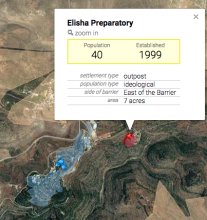
Halamish leaders are also demanding the government allow the expansion the settlement’s borders. A spokesman of the Binyamin Regional Council (which represents and provides municipal services to settlements in the Halamish region) called on the government to approve construction plans connecting the Halamish settlement to a nearby outpost called Tzofit, in order to “create a bigger security area and allow building neighborhoods that have already received zoning approvals.” Tzofit (also known as “Zufit” and/or “Elisha Preparatory”) is an illegal outpost that was established in 2007.
U.S. Ambassador David Friedman and Special Envoy Jason Greenblatt went to the illegal Halamish settlement this week to offer their condolences to the victims of the murder.
Halamish is located northwest of Ramallah, deep inside the West Bank. When the settlement was founded in the 1970s, Palestinian residents from the nearby towns of Deir Nidham and Nabi Saleh sued to stop the settlement’s construction, claiming it was being built on their villages’ land. The Israeli Supreme Court ruled in favor of the settlers, declaring the area to be state land. The Halamish settlement and its ever-growing encroachment on surrounding Palestinian villages has inspired weekly protests in Deir Nidham and Nabi Saleh, which has become infamous for weekly demonstrations – often involving clashes with the IDF – in recent years, often with international participation.
Settlers Seize Contested Building in Hebron
On the evening of July 25th — while events in Jerusalem were dominating the attention of the region and the world — 120 settlers broke into and illegally occupied a contested building near the Tomb of the Patriarchs/Ibrahimi Mosque in Hebron. The Israeli army immediately surrounded the building and on the morning of July 26th the area was declared a “closed military zone.” Prime Minister Netanyahu ordered the Defense Ministry to allow the settlers to stay as negotiations on their fate and ownership of the building continue.
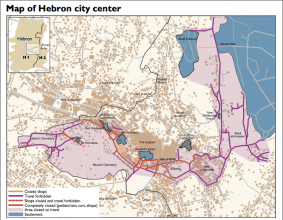
Map by B’Tselem
The Times of Israel reports that, “sources close to the prime minister said that Netanyahu was looking to avoid having to evacuate the families.” On the other hand, Yesh Atid chairman Yair Lapid called for their immediate evacuation. As of this writing, the settlers are still being allowed to illegally squat in the property.
Peace Now warned that the settler’s action can “ignite the region” and called on the government to, “follow the law and the Israeli interest and evacuate the trespassers without delay.”
J Street issued a statement calling on the U.S. government and international actors to pressure Israel to remove the settlers, saying “the Hebron settlers and their allies clearly believe that they can take advantage of the present crisis and push their long-term expansionist agenda by creating new ‘facts on the ground.’ It is vital that the prime minister and defense minister act in the best interests of Israeli security and uphold the rule of law by swiftly removing these families from the property.”
Hebron’s settlers have for some time been waging in a legal struggle to prove they legally purchased the building, known as the Machpela House. Palestinians contend they did not purchase it from the legal owners. While proceedings are ongoing, the settlers have once before broken into and occupied the building; when they did so in 2012, they were allowed to stay in the house for a week before being evacuated at the urging of the then-Attorney General of Israel who argued that it was necessary to preserve the rule of law.
Construction on New Settlement in Shilo Valley Stalled (Due to Lack of Funds)
A month after construction began on the first new settlement authorized by Israel in 25 years, the project has come to a halt – no over politics but due to insufficient government funds. The government had promised to bankroll the settlement’s construction but has not contributed to costs yet, according to the Binyamin Regional Council, which is currently footing the bill. The spokesman for the Binyamin Regional Council speculated on July 25th that the issue will be resolved quickly and expressed confidence in the government’s commitment to the project. Prime Minister Netanyahu reportedly gave orders to ensure construction is resumed quickly. As of this writing, there is no reporting to suggest construction has resumed.
High-Ranking Israeli Officials Defend Outpost from Demolition
Last week we reported on an impending demolition order against the Netiv Ha’avot outpost (near Bethlehem), along with the public relations efforts settlers were leading to elicit government intervention in their favor. The settlers got a helping hand this week when Israeli Education Minister Naftali Bennett and Yair Lapid (who heads the Yesh Atid political party) attended an event at the outpost. The Haaretz report suggests Bennett engaged in a conversation with the outpost’s leaders on how to “deal with” the demolition order and impending deadline.
Bonus Reads
- “This Synagogue Furniture Factory Is Actually a Sweatshop That Tramples Palestinians’ Rights” (July 26, 2017, Haaretz+)
- “The Settler Leader Who’s Even Charming Liberals as Israel’s Top Man in New York” (July 27, 2017, Haaretz+)
- “A Rare Glimpse: Shabak Agent Recruiting Hilltop Youth” (July 3, 2017, Jewish Press)
Welcome to FMEP’s Weekly Settlement Report, covering everything you need to know about Israeli settlement activity this week.
To receive this report via email, please click here.
- “Disappointment” So Far for Settlers in the Trump-Bibi Era, But…
- Sheikh Jarrah Project Recommended for Deposit for Public Review
- Long Delayed “Apartheid Road” Possibly Moving
- Beit El Housing to Advance After a Settlers Throw a Tantrum
- Bibi Vows that Israel will Keep Ariel
- Efrat and “How the Borders of Settlements Expand While No One is Watching”
- Yitzhar & Its “Hilltop Youth” Continue to Terrorize Nablus Area
- Bonus Reads
For questions and comments please contact FMEP’s Director of Policy & Operations, Kristin McCarthy (kmccarthy@fmep.org).
“Disappointment” So Far for Settlers in the Trump-Bibi Era, But…
Israeli Minister of Education Naftali Bennett – and staunch settlement advocate – expressed disappointment with the lack of settlement growth since Donald Trump assumed office. Bennett said, “Unfortunately from our perspective, he [Trump] is sort of going down the same unsuccessful path that his predecessors did…So yes, there is disappointment out there.” When Trump was elected, many settlers hoped that his administration would allow some, if not all, of the most problematic settlement plans to proceed. That includes several projects that, if built, would destroy the possibility of contiguous Palestinian state (Givat Hamatos, E1, etc). These projects have not moved forward…yet.
But Mr. Bennett need not be too disappointed. In fact, there has been a sharp rise in the number of settlement units and plans advanced and in construction so far in the Trump-Bibi settlement era, as detailed extensively by Peace Now and covered by FMEP in last week’s Settlement Round Up.
There are also new alarming developments this week that suggest the floodgates might be beginning to open….
Sheikh Jarrah Project Recommended for Deposit for Public Review
Ir Amim reports that plans for a 6-story Israeli commercial building at the entrance of the Palestinian East Jerusalem neighborhood of Sheikh Jarrah have been recommended for deposit for public review. The land designated for this project is adjacent to a plot designated for settlers to build a religious school and dormitories, known as the Glassman Campus project.

Map by Ir Amim
Located just north of Jerusalem’s Old City, Sheikh Jarrah has endured years of aggressive settlement activity by radical settlers, employing various means, including Israel’s court system to strip Palestinians of their ownership rights. Sheikh Jarrah’s plight was featured in a 2013 film by Just Vision, “My Neighborhood.” Just Vision also produced “Home Front,” a series of video interviews with the Palestinian residents and Israeli activists fighting together against settlement expansion in Sheikh Jarrah. For more on Sheikh Jarrah and the protest it sparked, 972+ Magazine has a compilation of resources online here.
Depositing settlement plans for public review is a significant step in the East Jerusalem planning process; it sends a signal that the political echelon may no longer be blocking the advancement of projects in the Jerusalem area that have been considered to be especially inflammatory to Palestinians and Muslims, and detrimental to peace negotiations. This could be an early sign of the opening floodgates.
Long Delayed “Apartheid Road” Possibly Moving
Ir Amim reports that a budget has been approved for construction of the northern part of the Jerusalem “Eastern Ring Road,” following years of delays and protests. If constructed according to existing plans, the northern section of the Eastern Ring Road will have separate lanes for Israeli settlers and Palestinians, with a physical barrier dividing the two. It will not allow the Palestinian lanes to access East Jerusalem. As noted in Haaretz, “This is the only highway in the West Bank that will have a separation wall running right down the middle. For that reason, the plan’s opponents are already dubbing it ‘Apartheid Road.’” Adalah, a legal group for minority rights in Israel, previously filed a petition to block the road’s construction.
Ir Amim notes that this is one of several projects that prepares the way for building in the E-1 area. E-1, as Jerusalem expert Danny Seidemann has long explained, is a “doomsday” project; if implemented, an E-1 settlement will end the possibility of a contiguous Palestinian state and completely sever East Jerusalem from the rest of the West Bank. The “Eastern Ring Road” seeks to “solve” one of these problems – by providing the Palestinians with “transportational contiguity” between the northern and southern West Bank – even as it would cement the cutting off of East Jerusalem from the West Bank.
Beit El Housing to Advance After Settlers Throw a Tantrum
Late last week, Netanyahu said he will approve the construction of 300 housing units in the Beit El settlement by September. The announcement came after a very public (and embarrassing) series of confrontations with members of his own political party as well as settlers. The leaders of the Beit El settlement threatened to petition the High Court over the issue, and staged a demonstration in front of the Prime Minister’s office to issue the threat. Beit El’s leaders replayed footage of Netanyahu promising to build the units in 2012, after several structures were taken down because they were built on land recognized even by Israel as privately owned by Palestinians.
The Beit El spat erupted after the Jerusalem Post reported an alleged freeze brokered between Israel and the U.S. The report suggested that Israel agreed to stop publishing construction tenders (the final step in the planning process) for all settlements through the end of 2017. The Beit El units had reached that final phase of planning, but would ostensibly not move forward if the report was true.
Beit El has deep connections to the current U.S. Ambassador to Israel, David Friedman; Friedman ran a U.S. fundraising effort for Beit El before being appointed Ambassador.
Bibi Vows that Israel will Keep Ariel
 At the ground-breaking ceremony for a new medical school in “Ariel University,” Prime Minister Netanyahu vowed, “Ariel will always be part of the State of Israel.” Alongside Education Minister Naftali Bennett, the Prime Minister Netanyahu attended a ceremony dedicating the school to American casino magnate and settlement financier, Sheldon Adelson – who donated funding for the new facility.
As explained last week, the future of Ariel has long been one of the greatest challenges to any possible peace agreement, since any plan to attach Ariel to Israel will cut the northern West Bank into pieces.
Efrat and “How the Borders of Settlements Expand While No One is Watching”
Three structures in the settlement of Efrat were found to have been built outside the border of the settlement’s jurisdiction. Dror Etkes (founder of Kerem Navot, a settlement watch group) petitioned Israel’s Civil Administration (the arm of the Israeli military that is effectively the sovereign authority in the West Bank, and therefore has authority over all construction ithere) over the buildings. This week the Civil Administration confirmed that the buildings were built without permits, had stop-work orders issued against them at the time, and might potentially be built on land recognized by Israel as privately owned by Palestinians. There are no reports of demolition orders against the illegal structures.
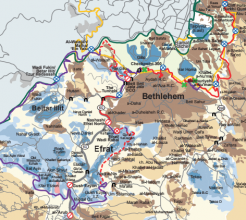
Map by B’Tselem
Located south of Bethlehem and west of the route of the separation barrier, Efrat poses many of the same challenges to a peace agreement as Ariel (discussed above). Connecting it to Israel means cutting deep into the West Bank, severing the route of Highway 60 between Jerusalem/Bethlehem and the southern West Bank, and contributing to the near total isolation of Bethlehem.
Yitzhar & Its “Hilltop Youth” Continue to Terrorize Nablus Area
Recent arrests of Yitzhar settlers have not deterred the terror coming from Yitzhar and/or its Hilltop Youth, with this week’s target being the Palestinian village of Burin. On Sunday, Rabbis for Human Rights documented 45 olive trees in Burin that were destroyed and spray painted with the words “revenge.” The suspected hate crime was precipitated by a violent clash between Yitzhar settlers and the Israeli army during the razing of an illegal structure in the settlement. On Wednesday, settlers from Yitzhar set fire to an olive grove – burning over 400 trees – according to the Israeli Army. Video of the incident shows masked settlers clashing with Israeli soldiers.
This week’s violence follows a warning to Yitzhar’s leaders from the Shin Bet earlier this month to keep the “Hilltop Youth” who call Yitzhar their home under control. In response, Yitzhar’s governing body has taken several actions, including forcing the youth to sign a code of conduct under threat of expulsion. But the code of conduct did not stop one Hilltop Youth religious leader and teacher at a yeshiva in Yitzhar – Rabbi Yitzchak Ginsburg – from urging his students to “cause a revolution” without getting caught because it is “a shame to waste time in prison.”
Israel’s Ynet news agency reports that the terror tactics of the Hilltop Youth are increasingly targeting Israeli security forces in the West Bank and Jerusalem. One Hilltop Youth whines, “all we want to do is sit on the hill. Just imagine how we feel each time a detective destroys our tent or confiscates our stuff. We have no peace and quiet.” And from a soldier’s perspective on his time serving in the Yitzhar area: “The scariest thing in the area was to clash with Jews. Give me an Arab terrorist and I’ll know how to deal with him. Give me a Jew who is throwing stones at me and I’ll simply flee.”
A lawyer with Yesh Din, an Israeli organization deeply involved in protecting the area from Yitzhar settlers, said “violence will not cease if there is no real deterrence, protection for Palestinians, a thorough investigation, prosecution of offenders and an imposition of significant penalties.” Though the Shin Bet has said it take the matter seriously, the violence continues. Yesh Din’s legal work documents the impunity with which settlers perpetrate crimes: A March 2017 report reveals only 8.2% of allegations of crimes committed by settlers in the West Bank result in indictments.
Bonus Reads
- “City on a Hilltop: American-Jewish Settlers“ w/ Dr. Sara Yael Hirschhorn, Ori Nir, and Lara Friedman (A podcast by Americans for Peace Now, June 25, 2017).
- Settlements: The Real Story, by Gershom Gorenberg (The American Prospect, Summer 2017)
Welcome to FMEP’s Weekly Settlement Report, covering everything you need to know about what is happening this week related to Israeli settlement activity.
To receive this report via email, please subscribe here.
May 26, 2017
- The High Stakes of Trump’s Silence on Settlements While in Israel
- Israel Forms New Outpost Legalization Committee, Kerem Reim Plans Advance
- New Report from Peace Now Israel Shows Over 30% Increase in Settlement Activities
- IDF Makes Arrests in Huwara, Deploys More Troops to West Bank Hot Spots
Contact Kristin McCarthy (kmccarthy@fmep.org) with questions and comments.
The High Stakes of Trump’s Silence on Settlements While in Israel
President Trump’s 28-hour trip to Israel and the occupied West Bank did not include any specific policy pronouncements (click for transcripts of Pres. Trump’s public speeches: 1, 2, 3, 4). The lack of public pressure on Israel to stop settlement growth comes at a time when Netanyahu’s government is reportedly advancing plans to build new, peace-killing settlements & infrastructure in East Jerusalem and across the West Bank. Netanyahu is also under pressure by his own coalition – which apparently understands President Trump to be supportive of the Israeli settlement enterprise – to escalate the building pace even more, some have even called for outright annexation.
Following Trump’s departure from Israel, Defense Minister Avigdor Liberman said bluntly, “Israel doesn’t need a green light from Washington for settlement building.” According to Liberman, the High Planning Council – the body that approves plans for all Israeli construction in the West Bank – may meet on June 7th to consider plans for “several thousand” new settlement units. While the details of which plans the High Planning Council’s upcoming meeting will handle are not known, Liberman specifically mentioned the massive Jerusalem-area settlement Ma’ale Adumim as well as the South Hebron Hills.
Israel Forms New Outpost Legalization Committee, Kerem Reim Plans Advance
The Times of Israel reports the Israeli Security Cabinet created a new committee this week to “advance the legalization of West Bank outposts and illegal settler homes.” According to the same report, the committee will include the Prime Minister’s Office, the Defense Ministry, and the Civil Administration. With the Knesset’s passage of the Legalization Law (or “Regulation Law”) earlier this year, several cases related to the retroactive legalization of outposts have landed in the High Court of Justice.
One of those cases, stemming from a petition Peace Now filed that resulted in a stop-work order issued against the illegal outpost of Kerem Reim, is awaiting government response due to the High Court of Justice by May 30th. Americans for Peace Now reports that this week the Israeli government has acted to advance 3-year old plans for construction in Kerem Reim in the hopes of having the stop-work order lifted.
New Report from Peace Now Israel Shows Over 30% Increase in Settlement Activities
The settlement watchdog group Peace Now released an important new report on 2016 settlement growth. Several alarming facts we noted:
- There has been a 34% increase in construction starts in 2016, 70% of which was outside of the so-called “settlement blocs”
- There has been a 33% increase in planning advanced by the Israeli government, 60% of which was outside so-called “settlement blocs”
- The Efrat settlement saw the most construction in 2016. South of Bethlehem, west of the separation barrier, Efrat is inside a settlement enclave that cuts deep into the West Bank. Efrat’s location and the route of the barrier wall that grabs it, have literally severed the route of Highway 60 between Jerusalem and Bethlehem – Highway 60 is the sole major roadway providing north/south contiguity to the West Bank for Palestinians. The economic, political, and social impacts of the closure of Highway 60 at the Efrat settlement (there is literally a wall built across the highway) have been severe for the Palestinian population. The concentrated settlement growth in Efrat exacerbates all of these problems and further entrenches what settlement expert Lara Friedman called “the trend of ‘canonization’ of the West Bank.”
- On outposts, Peace Now writes, “While in recent years, most of the construction in outposts was done by individuals who initiated the construction of their own houses, in 2016 we saw more organized construction projects in outposts, with massive infrastructure works which requires funding and investment. Such investment must require the active, or at least passive, involvement of the authorities, and the settlement municipal councils in particular. The mechanism of the governmental involvement in illegal construction in the West Bank was exposed by Peace Now in our latest report, can be found here.”
IDF Makes Arrests in Huwara, Deploys More Troops to West Bank Hot Spots
Arrests were made following a violent incident in Huwara that left 1 Palestinian dead last week. Three Palestinians are reportedly in custody, including a Red Crescent ambulance driver.
Following an upsurge in settler violence in the Nablus area and elsewhere, the IDF is reportedly deploying hundreds of more troops into “known friction points, sensitive sites, and Palestinian cities.”
FMEP has long been a trusted resource on settlement-related issues, reflecting both the excellent work of our grantees on the ground and our own in-house expertise. FMEP’s focus on settlements derives from our commitment to achieving lasting Israeli-Palestinian peace, and our recognition of the fact that Israeli settlements – established for the explicit purpose of dispossessing Palestinians in the West Bank and East Jerusalem of land and resources, and depriving them of the very possibility of self-determination in their own state with borders based on the 1967 lines – are antithetical to that goal.