Welcome to FMEP’s Weekly Settlement Report, covering everything you need to know about Israeli settlement activity this week.
To subscribe to this report, please click here.
March 15, 2024
- Yesh Din Files High Court Petition to Stop Jordan Valley Regional Council
- Construction Starts on New Settlement, Ariel West
- IDF Demolishes Outpost Near Ofra
- Subcommittee Hearing Defends Settler Violence, Points Finger at Human Rights Activists
- US Announces New Sanctions on Three Individuals & Two Outposts
- Bonus Reads
Yesh Din Files High Court Petition to Stop Jordan Valley Regional Council
On March 7th the Israeli NGO Yesh Din assisted Palestinians in the Jordan Valley to file a petition with the High Court of Justice seeking to force the IDF Central Command to prevent settlers and settler regional councils in the Jordan Valley from illegally seizing and ransoming herds of livestock belonging to Palestinians, and to return all livestock currently confiscated and funds paid to the regional council for the return of livestock. Since October 7th, Yesh Din has documented several instances of settlers conspiring with the Jordan Valley Regional Council to confiscate herds of livestock belonging to Palestinians based on the claim that they are illegally grazing in the Regional Council’s jurisdiction, and then demanding exorbitant fees for their return. Yesh Din identifies this not only as an illegal practice, but as a policy “designed to annex and take over Areas C while pushing Palestinians out…to force Palestinian communities from their homes.”
The IDF’s own legal council has recently issued a legal opinion confirming that settler municipalities do not have jurisdiction or authority to enforce any laws or regulations against Palestinians. But the settler regional council rejected this opinion, saying that its jurisdiction applies to an area of land – not just a certain type of people (i.e. Israeli settlers). As a reminder, the West Bank remains under Israeli military rule via the Israel Ministry of Defense and the IDF. Israel has extended its domestic laws to settlers, so that settlers are subject to Israeli domestic law and Palestinians remain under military rule. In this case, the settler regional argues that it has authority over land, and any Palestinians (and their property) who enter that land.
Yesh Din explains why this is a significant legal claim:
“The danger posed by the pretension of the regional council, which seeks to hold the power to regulate the grazing of Palestinian herders, has enormous ramifications. This is a new and predatory form of economic violence by settlers and an authority that has distinct annexationist aspects, as it expresses the degradation of the military commander’s responsibility in the occupied territory and the assignment of its authorities to civilian governmental bodies.”
Over the past six months, settlers have regional councils have repeatedly kidnapped herds of livestock and demanded exorbitant fees
Construction Starts on New Settlement, Ariel West
 Peace Now reports that Israel has begun construction of a new settlement, Ariel West, plans for which were first made public in November 2021 and tenders were issued in May 2023 — all under the guise of a plan to “expand” the Ariel settlement [for more on how this plan was kept quiet, see Peace Now’s detailed history]. The Ariel West settlement is being built on a hilltop located 1.2 miles away from Ariel, in an area that is non-contiguous with the built-up area of the current Ariel settlement. To perpetuate the framing of this new construction as the growth of an existing settlement rather than a new settlement – settlers and the government call Ariel West the“Amririm Neighborhood.” The new settlement will be directly adjacent to the Palestinian village of Salfit, further limiting the future development of Salfit and restricting Palestinian agricultural workers’ access to land, as illustrated in this video by Peace Now.
Peace Now said in a statement:
“The construction of Ariel West, a new settlement deep in the West Bank, just before Ramadan and amidst the imminent danger of escalation in the West Bank and East Jerusalem, is further proof that the Israeli government is seeking violent escalation and opening a third front of war. It is also further proof, for anyone still in doubt, that it is doing all it can to destroy the possibility of the two-state solution. Israeli citizens deserve a better government, and its actions and decisions are endangering the lives and futures of both Palestinians and Israelis, as well as that of the entire region. The construction of a new settlement is part of recent initiatives amidst the ongoing war, aimed at advancing thousands of housing units in the territories, declaring thousands of dunams as state land, and approving significant budgets for settlements in the 2024 budget.”
IDF Demolishes Outpost Near Ofra
The Times of Israel reports that on March 11th, the Israeli Civil Administration demolished an illegal outpost known as “Or Ahuvia,” located close to the Ofra settlement north east of Ramallah. The IDF forced settlers to leave the area, demolished a rudimentary house, and confiscated other materials – saying that the outpost was built illegally on privately owned Palestinian land.
The “Or Ahuvia” or “Ma’aleh Ahuvia” outpost was originally erected (and demolished) in 2022 in memory of Ahuvia Sandak, a settler “hilltop youth” who died when the car he was traveling crashed as it was fleeing Israeli police with a group of settler youth who allegedly has been stoning Palestinian cars. Settlers and their supporters have painted Israeli police as perpetrators of a crime of negligence (or worse) against the settler youth; the Knesset has taken up the issue; and Sandak has been memorialized as a hero and a martyr to the cause of Greater Israel.
Subcommittee Hearing Defends Settler Violence, Points Finger at Human Rights Activists
At the demand of settler groups, the Knesset Foreign Affairs and Defense Committee convened a subcommittee hearing on March 12th to hear testimony regarding the alleged “harassment” perpetrated by human rights defenders against Israeli security personal. MK Merav Michaeli denounced the hearing saying the chairman, Tzvi Succot, seeks to “present an upside down and false world.” MK Limor Son Har Melech (Otzma Yehudit) said at the hearing:
“They [pro-Palestinian activists] are aggressive to IDF soldiers, to settlers, they damage property, they blacken Israel’s name around the world, engage in the demonization and delegitimization of Israel and damage our image.”
The hearing turned out to be more than a smear campaign against human rights defenders, but also a defense of extremists settlers. The senior police commander in the West Bank perpetuated the claim that settler violence is over exaggerated, testifying to the committee that 50% of complaints regarding settler violence turn out to be false.
US Announces New Sanctions on Three Individuals & Two Outposts
On March 14th the U.S. government announced it had imposed sanctions on three Israeli settlers and two settlement outposts, adding to the four individuals it had previously sanctioned. This is the first time the U.S. has imposed sanctions on entities (the two outposts) in addition to individuals – demonstrating the possible far-reaching targets of U.S. sanction authority. The settlers and outposts were documented to have taken part in (or be a base of action for) acts of violence against Palestinians in the West Bank.
The two outposts sanctioned are known as “Moshe’s Farm” and “Zvi’s Farm” – and the individuals are the leaders of those outposts.
The U.S. Department of State said in a statement:
“Today, we are taking further action to promote accountability for those perpetuating violence and causing turmoil in the West Bank by imposing sanctions on three Israeli individuals and two associated entities involved in undermining stability in the West Bank. There is no justification for extremist violence against civilians or forcing families from their homes, whatever their national origin, ethnicity, race, or religion. The United States is committed to enduring peace and prosperity for Palestinians and Israelis alike and will continue to use all available tools to promote accountability for those engaging in actions that threaten the peace, security, and stability of the West Bank.”
Bonus Reads
- “Norway Advises Against Trade, Business With Israeli Settlements” (Bloomberg)
- “The government is tightening its grip on Israeli settlements – the Pole is considering stopping the sale” (NRK)
- “Israel deploys 15,000 troops in West Bank as Ramadan starts” (Mondoweiss)
Welcome to FMEP’s Weekly Settlement Report, covering everything you need to know about Israeli settlement activity this week.
To subscribe to this report, please click here.
March 1, 2024
- Israel Declares 652 Acres of “State Land” Near Ma’ale Adumim Settlement & E-1 Site
- Israel Approves Municipal Boundaries for Outpost to be Authorized as a New Settlement
- Defense Ministry Demolishes Two Outposts
- Settlers Enter Gaza During Rally at Erez Crossing
- Settler Head Calls for Genocide Against West Bank Palestinians – Akin to Gaza – In Response to Palestinian Attack Near Eli Settlement
- Blinken: New Israeli Settlements are Inconsistent with International Law
- Bonus Reads
Israel Declares 652 Acres of “State Land” Near Ma’ale Adumim Settlement & E-1 Site
 On February 29th, the Israeli Civil Administration announced that it had declared 652 acres of West Bank land south of the Ma’ale Adumim settlement to be “state land,” bringing it under the management of the Israeli state and preparing it for the possibility of settlement construction. The land had previously been designated as part of the E-1 settlement plan, even though Israeli law does not allow Israel to plan construction on land that is not under its management. Additionally, this land is located between the Ma’ale Adumim and the Kedar settlement to its south, if construction indeed takes place – the two settlements (which both received planning advancements last week) could be connected.
Palestinian landowners have 45 days to submit an objection to the Israeli military to challenge the declaration. The land previously belonged to the Palestinian towns of Abu Dis and Al-Azaria, but it had not been formally registered in the Land Registry at the time Israel suspended registration proceedings in 1968. The land was registered in the property tax books of the villages, but these records are not accepted by the state of Israel as proof of ownership unless the land has been continuously cultivated (which, in a lot of cases, is impossible given Israeli restrictions and settlements).
Three Palestinian bedouin communities currently live in the area – the Abu Nuwar, Wadi Abu Al-Suwan, and the Abu Hindi communities – totalling 1,000 people. Since arriving on these lands in the 1970s after being forced to flee their land in Israel, these communities have been regularly targeted by Israeli policies designed to force them to once again pack up and leave.
Peace Now said in a statement:
“Instead of planning for a future of peace and security, the Israeli government continues to further the occupation and dispossession by perpetuating the conflict and bloodshed. Expropriating thousands of dunams of land from Palestinian communities demonstrates how settlements are already negatively impacting Palestinian lives and are not just a future problem or obstacle to a political solution. Construction in settlements must be halted immediately, regardless of negotiations and political arrangements.”
Israel Approves Municipal Boundaries for Outpost to be Authorized as a New Settlement
 On February 27th Bezalel Smotrich announced the approval of municipal boundaries for the retroactive legalization of the illegal farming outpost known as Mitzpe Yehuda. The outpost-turned-settlement has been named Mishmar Yehuda, and is located east of Bethlehem and south of the Ma’ale Adumim settlement. Peace Now reports that the Israeli Ministry of Housing has already contracted architects and planners to continue advancing the settlement plans, which holds potential for over 13,000 new settlement units housing approximately 65,000 settlers. The next step in the planning process is for Smotrich’s “Settlement Administration” to prepare a Master Plan for the construction.
Celebrating the announcement, Smotrich said:
“We came to this land to build and to be built up in it. We will continue the settlement momentum throughout the land. Congratulations to Gush Etzion, congratulations to the settlements, and congratulations to the State of Israel.”
In February 2023, the Israeli Security Cabinet issued a decision to retroactively legalize ten illegal outposts including Mitzpe Yehuda. The approval of a jurisdiction is the carrying out of this order. At the time, Haaretz reported that a source said the Cabinet chose these outposts for authorization specifically because they are all located in remote or isolated locations — meaning they could not be “legalized” via expanding the borders of a nearby settlement and declaring the outposts to be merely neighborhoods of those “legal” settlements (a legal maneuver Israel has repeatedly used to expand settlements and retroactively legalize settlements). This means, among other things, that legalization of these 10 new settlements will likely lead to additional land seizures for related infrastructure work (work that was not legally possible until now).
Defense Ministry Demolishes Two Outposts
The Times of Israel reports that the IDF demolished two farming outposts this week: Sde Yonatan and Or Mier. Both are built on privately owned Palestinian land, and both have been repeatedly dismantled by the IDF.
Settlers Enter Gaza During Rally at Erez Crossing
On February 29th while dozens of Israeli settlers gathered at the Erez Crossing point into Gaza to rally for the reestablishment of Gaza settlements, several individuals “violently” broke through the IDF checkpoint and entered Gaza. Some of the settlers made it 500 meters past the IDF checkpoint before being caught by the IDF. Nine were arrested by Israeli police for violating a closed military order, though none have been charged.
Other settlers participating in the protest built two rudimentary structures, which they said are meant to be for “New Nisanit”, which settlers want to establish in northern Gaza in the area where the Nisanit settlement stood prior to 2005, when the Israeli government dismantled it along with 21 other settlements. The campaign to reestablish settlements in Gaza is being led by the Nachala organization, which called on its followers to bring “appropriate gear” and “sleeping bags” to the protest this week. As became clear in January 2024, the Nachala has thousands of supporters, including at least 12 Israeli government ministers and 15 members of Knesset – all of whom attended Nachala’s recent conference entitled “Conference for the Victory of Israel – Settlement Brings Security: Returning to the Gaza Strip and Northern Samaria.”
Israel has kept the Erez Crossing point closed, even to humanitarian aid, since October 7th – despite increasing international pressure to allow the entry of needed supplies.
Settler Head Calls for Genocide Against West Bank Palestinians – Akin to Gaza – In Response to Palestinian Attack Near Eli Settlement
On February 29th, two Israelis were killed by a Palestinian shooting in an attack near the Eli settlement. In addition to the typical responses from the Israeli government (calling for more settlements, more checkpoints, road closures, and retribution against the attackers family), the head of the Binyamin Regional Council, Israel Gantz, called for the Israeli government to launch a West Bank operation like the one it is waging in Gaza – which the International Court of Justice said is plausibly genocide.
Haaretz reports that Israel Gantz said:
“the terrorism here and in Gaza is the same terrorism, with the same terrorists and the same ambitions. It is necessary to mount a crushing attack on the West Bank, enter the city centers, destroy infrastructure and get rid of terrorists just like in Gaza.”
Blinken: New Israeli Settlements are Inconsistent with International Law
Responding to questions at a news conference in Buenos Aires on February 23rd, U.S. Secretary of State said that the Biden Administration believes new Israeli settlements are “inconsistent with international law” – a statement which is being widely interpreted as a reversal of the so-called “Pompeo Doctrine.” Blinken’s statement of illegality was in relation to new settlements, but he later went on to say that the Biden Administration “maintains firm opposition to settlement expansion,” explaining that it weakens Israeli security.
White House National Security Adviser John Kirby later said:
“We [the Biden Administration] are simply reaffirming the fundamental conclusion that these settlements are inconsistent with international law… this is a position that has been consistent over a range of Republican and Democratic administrations.”
Blinken was sharply criticized by former Secretary of State Mike Pompeo and former Ambassador to Israel under Trump, David Friedman. Friedman recently published a proposal outlining Israeli annexation of the West Bank “in accordance with biblical prophecy and values.” The plan calls for granting Palestinians permanent residency but no voting rights. Friedman cites the U.S. rule of Puerto Rico as an example.
Bonus Reads
- “Settler Colonial Spillover of the Gaza Genocide” (Al-Shabaka)
- LISTEN – “Settler Colonial Spillover in the West Bank with Fathi Nimer” (Rethinking Palestine by Al-Shabaka)
- “‘They took our home, our land, everything’: Palestinians displaced by illegal settlers tell their stories” (The Guardian)
- “The Israeli Settlers Attacking Their Palestinian Neighbors” (The New Yorker)
- “Sparking the Next War? Any Restrictions to Al Aqsa Imposed During Ramadan Will Violate Muslim Freedom of Worship & Liable to Foment Unrest” (Ir Amim)
- “In Israeli-occupied Hebron, Palestinians describe living in ‘a prison’” (Washington Post)
Welcome to FMEP’s Weekly Settlement Report, covering everything you need to know about Israeli settlement activity this week.
To subscribe to this report, please click here.
February 23, 2024
- Israel Announces Plans for 3,000+ New Settlement Units In Retaliation for Terror Attack Near Ma’ale Adumim; Ben Gvir Pushes for More Retaliatory Measures
- U.S. Reportedly Consider More Sanctions on Settlers, Revoking “Pompeo Doctrine”
- ICJ Hears Arguments on Israeli Occupation
- Peace Now Dissects Proposed 2024 State Budget
- Bonus Reads
Israel Announces Plans for 3,000+ New Settlement Units In Retaliation for Terror Attack Near Ma’ale Adumim; Ben Gvir Pushes for More Retaliatory Measures
On February 22nd, Bezalel Smotrich – who is both the Israeli Finance Minister and the de facto governor of West Bank settlements – announced that he is advancing plans for over 3,000 new settlement units in response to a terror attack perpetrated by three Palestinians near the Ma’ale Adumim settlement just east of Jerusalem. Smotrich said that he will convene the High Planning Committee next week to advance the plans, calling the settlement announcements a “security response to the attacks.”
Smotrich said that the government has greenlighted plans for:
- 2,350 new units in the Ma’ale Adumim settlement located just east of Jerusalem;
- 300 new units in the Kedar settlement, just east of Ma’ale Adumim; and,
- 694 new units in the Efrat settlement – units which can receive final approval. Efrat is located south of Bethlehem, inside a settlement block that cuts deep into the West Bank. Efrat’s location and the route of the barrier wall around it, have literally severed the route of Highway 60 south of Bethlehem, cutting off Bethlehem and Jerusalem from the southern West Bank. The economic, political, and social impacts of the closure of Highway 60 at the Efrat settlement (there is literally a wall built across the highway) have been severe for the Palestinian population.; and,
In his announcement, Smotrich emphasized the annexation intent behind these announcements, saying:
“May every terrorist planning to harm us know that lifting a finger against Israeli citizens will be met with a death blow and destruction in addition to the deepening of our eternal grip on the entire Land of Israel.”
As a reminder, Smotrich is in effect the reigning sovereign over the West Bank via the newly established “Settlement Administration” within the Defense Ministry, which he appointed Yehuda Eliahu to lead (Eliahu and Smotrich co-founded the radical settler group Regavim) . This “Settlements Administration” enjoys virtually total autonomy and unchecked power, with almost no accountability to anyone in the Israeli Ministry of Defense. In June 2023 the Israeli Cabinet approved a measure to expand Bezalel Smotrich’s authority over construction in existing settlements by significantly shortening the planning process and removing almost any role for Israeli politicians in that process, a lever which – for decades – has been utilized by successive Israeli governments to intervene in settlement planning usually in consideration of pressure from the international diplomatic community. Under the new procedures, political approval is only needed once at the very beginning stage of the planning process, whereas for the past three decades political approval was needed at each and every phase.
Israeli National Security Minister Ben Gvir pushed for the government to respond with more than just settlement approvals, calling for more restrictions on Palestinian movement in the West Bank in addition to more weapons for Israeli citizens. Speaking at the scene of the attack, Ben Gvir said:
“The right to life for Jewish residents in the West Bank is more important than the freedom of movement for residents of the Palestinian Authority. I expect there to be more and more barriers here, there will be restrictions. We need to come to an understanding that our enemies are not looking for excuses. They only want to harm. I will fight for restrictions – it’s good that the prime minister accepts my principled position.” And on weapons: “A very big disaster was avoided here thanks to the fact that all the police officers have weapons and the citizens have weapons. There were those who criticised me for that, but I think that today everyone understands that weapons save lives.”
U.S. Reportedly Consider More Sanctions on Settlers, Revoking “Pompeo Doctrine”
According to press reports, the United States is preparing to issue sanctions against “several” more Israeli settlers, after having sanctioned four settlers earlier this month. A source told The Times of Israel that the next round of sanctions will target “higher-profiled Israeli extremists” but not Israeli government officials.
Two U.S. officials further leaked that the Administration is also considering revoking the so-called “Pompeo Doctrine” in response to Israeli steps to significantly expand its footprint in the West Bank (i.e. land on which settlements are constructed). The “Pompeo Doctrine” established as U.S. policy that Israeli settlements are not “per se inconsistent with international law.” It was issued by former U.S. Secretary of State Mike Pompeo in November 2019 in a reversal of decades of American policy.
ICJ Hears Arguments on Israeli Occupation
Starting on February 19th, the International Court of Justice opened six days of hearings on the legality of Israel’s occupation of Palestinian territories including the West Bank, East Jerusalem and Gaza (unrelated to the recent genocide case). After the hearings conclude, the Court is expected to finalize a nonbinding, advisory opinion on the legality of Israel’s occupation – which will likely take several months.
Israel has rejected the validity of the ICJ’s case, and has refused to participate – though the Deputy Legal Advisor for the Israeli Foreign Ministry is in attendance. Fifty other states are expected to participate – including the United States, Britain, and Germany launching defenses of Israel’s actions, and South Africa, Algeria, Belgium, and the Palestinians arguing that the occupation is illegal. South Africa – which lodged a new complaint accusing Israel of genocide in Gaza weeks ago – argued that Israeli control over the West Bank is colonial and amounts to Apartheid, saying that Israel should dismantle its settlements and pay reparations to Palestinians. All states arguing that Israel’s occupation is illegal highlight that the occupation has lost any illusion of being temporary.
To further unpack this case and its impacts (as well as the distinction between the ongoing case against Israeli officials lodged at the ICC), you can listen to FMEP’s podcast, “The Quest for Justice for Palestine at the ICC and ICJ: Where Things Stand Today & Why it Matters” featuring Lara Friedman (FMEP) and Vito Todeschini i (legal expert in human rights law, international humanitarian law and international accountability, focusing on Palestine/Israel and the wider MENA region). [3/29/2023]
Peace Now Dissects Proposed 2024 State Budget
Peace Now reports that the Israeli government is poised to approve a 2024 state budget that allocates a substantial amount of state funding to the settlement enterprise. Peace Now examined the only available draft – which is incomplete and not detailed – that the proposal includes:
- $203 million (737 million NIS) in budget allocations to the settlements (a $107 million increase from last year);
- An additional $112 million (409 million NIS) for specific settlement plans, which are:
- The Sebastia archaeological site;
- Elad tourists sites in East Jerusalem;
- The “preservation of antiquities” in the West Bank; and,
- A plan to strengthen Israeli control over the Old City Basin
- $1 million (3.6 billion NIS) for roads in the West Bank servicing settlements. This is 20% of all funds allocated to Israeli road development);
- $3 million (12 million NIS) for “special grants” to settler municipal authorities;
- $5.5 (20 million NIS) for agricultural farms, many of which are illegal outposts in the West Bank; and,
- Additional funds for further specific settlement projects including:
- A “Heritage Center” at the Sebastian train station;
- Developing the Hirbet Arqed archaeological site;
- Development of the Hasmonean Palaces site and related projects;
- Compensation for Israeli settlers who face higher export fees than their colleagues based in internationally recognized Israeli territory;
- Security for 3,000 settlers located in East Jerusalem settlement enclaves inside of Palestinian neighborhoods.
Please see Peace Now’s report for more granual detail on the plans contained within these budget categories.
Bonus Reads
- “East Jerusalem on the Eve of Ramadan and Municipal Elections” (Peace Now)
- “Olive harvest 2023: hindered access afflicts Palestinian farmers in the West Bank” (OCHA)
- “Netanyahu vows to maintain security control over Gaza, West Bank” (Al Andalou)
- “Online fundraisers for violent West Bank settlers raised thousands, despite international sanctions” (AP)
Welcome to FMEP’s Weekly Settlement Report, covering everything you need to know about Israeli settlement activity this week.
To subscribe to this report, please click here.
February 9, 2024
- State Begins Land Registration in the Armenian Quarter, Where Settlers Look to Win
- Tender Issued for Efrat Settlement
- Terrestrial Jerusalem Updates Settlement Tracking Tool
- Peace Now: Final Report on 2023 Settlement Activity
- U.S. Now Requires Countries to Certify Compliance with International Law as Condition for Military Aid
- Israeli Banks Respond to U.S. Sanctions on Four Settlers
- Bonus Reads
State Begins Land Registration in the Armenian Quarter, Where Settlers Look to Win
Ir Amim reports that the government of Israel has recently initiated land registration in the Armenian Quarter of the Old City of Jerusalem, where the state appears to be backing efforts by settlers to take control over a significant portion of land. Elsewhere in Jerusalem, it has become painfully obvious that the State has weaponized the land registration (also called settlement of land title) process to transfer ownership of strategic land wanted for settlement construction into the hands of settlers, thereby fueling the dispossession of Palestinians who have not had access to land registration
The specific tract of land undergoing land title registration proceedings is located in the heart of the Armenian Quarter, and is involved in a disputed land transaction between the Armenian Patriarchate and an Israeli real estate developer believed to be aligned with the Ateret Cohanim settler organization. For a detailed history of events, see Ir Amim’s reporting here.
Terrestrial Jerusalem has previously warned that these events are not a mere land dispute, and:
“are of such consequences as to jeopardize the viability of the Armenian community and the very character of Jerusalem…This purported sale of rights [by the Armenian Patriarchate to the Israeli real estate company] was done without legal authorization, and with the community intentionally uninformed as to what was happening.”
Ir Amim warns:
“Such a move threatens to solidify the company’s attempted seizure of the land and challenge the community’s right of standing to contest the deal. This should be seen within the larger context of state and settler efforts to Israelize the Old City and erode its historically multicultural and multireligious character, including the Christian presence in Jerusalem. Recent threats against the Christian population have been marked by attempted settler takeovers of properties, plans to expand a National Park onto church lands on the Mt. of Olives, and acts of desecration of Christian sites and cemeteries among other incidents of harassment.”
In a June 2023 report, entitled “The Grand Theft,” Ir Amim and Bimkom explain the history of land registration in East Jerusalem, unpacking how the entire legal land ownership situation Palestinian residents of East Jerusalem find themselves in today is an Israeli-imposed “Catch-22”, resulting directly from Israel’s annexation of East Jerusalem in 1967. The report explains:
“Although the lack of settlement of land title procedures has had detrimental consequences for Palestinian communities in East Jerusalem, its renewal carries far worse repercussions. After five years of monitoring the implementation of SOLT [settlement of land title] in East Jerusalem, its alarming nature has become clear. SOLT is being exploited as a new and potent tool of land theft, under the guise of a legitimate legal process to establish Palestinian property rights. It appears to have become the State of Israel’s main method to appropriate more land in East Jerusalem and advance the displacement and dispossession of Palestinians from areas of strategic interest to the State. SOLT is almost exclusively being initiated to finalize ownership rights in existing or planned Israeli settlements, settler enclaves in the heart of Palestinian neighborhoods, areas with state-deemed ‘Absentee Property,’ or property allegedly owned by Jews pre-1948.”
In September 2022, FMEP hosted a podcast with Ir Amim’s Amy Cohen on land registration, which you can listen to (or watch) here.
Tender Issued for Efrat Settlement
Peace Now reports that on February 4th, the Israeli Ministry of Houseing published a tender for the construction of 62 settlement units in the Efrat settlement. The Efrat settlement is located south of Bethlehem, inside a settlement block that cuts deep into the West Bank. Efrat’s location and the route of the barrier wall around it, have literally severed the route of Highway 60 south of Bethlehem, cutting off Bethlehem and Jerusalem from the southern West Bank. The economic, political, and social impacts of the closure of Highway 60 at the Efrat settlement (there is literally a wall built across the highway) have been severe for the Palestinian population.
Peace Now said in a statement:
“Advancing construction deep in Palestinian territory, adjacent to Palestinian population, undermines the chances for the establishment of a Palestinian state alongside the state of Israel and deepens the conflict. The current tender is a clear statement by the Israeli government that settlement construction continues unabated, and any political resolution is far from the goals of this government.”
Terrestrial Jerusalem Updates Settlement Tracking Tool
On February 6th, Terrestrial Jerusalem published an updated version of its detailed table tracking settlement plans in East Jerusalem. In the introduction to the table, Terrestrial Jerusalem writes:
“In recent months, the pace with which settlement schemes have been advancing through the statutory processes that advance them towards final approval and implementation has been frenetic. That pace has been so intense that even those who follow these developments have found it difficult to keep abreast of them. On occasion, significant development goes unnoticed. This in turn makes it more difficult to detect the underlying trends, to prioritize the plans that are most consequential and to identify means of engaging on them.
This report – a table of all of the significant settlement schemes in East Jerusalem that are being currently expedited – aspires to address these challenges. For those who monitor settlement activity with high granularity, it will draw attention to the relevant developments as they occur, accessing the relevant documentation and maps through links in the document. For those who track the settlement issues in East Jerusalem from a wider perspective, the table will serve as a reference, when needed, and allow for an overview of the more general trends that have emerged.
This is not a comprehensive list. We have selected only those town plans that we deem to be consequential in the context of the conflict that grips East Jerusalem. For example, numerous plans for adding stories to buildings in existing settlement neighborhoods are no less illegal than new settlements, but citing these in the current context would merely be a distraction. On the other hand, we do include statutory plans that are settlement-related, but not plans for new settlement units: plans for expanding roads, plans entailing large-scale demolitions of Palestinian homes and national parks are also included, provided that they directly serve the settlement enterprise .”
Peace Now: Final Report on 2023 Settlement Activity
Peace Now has issued a report reviewing the major settlement advancements of 2023, calling it the best year for the settlement enterprise since the Oslo Accords. The report’s key finding are:
- Establishment of new outposts and displacement of Palestinian communities – A record number of 26 new outposts were established during 2023, while 21 Palestinian communities were forcibly displaced from their homes.
- Advancement of construction plans – A record number of 12,349 housing units were promoted in settlements in the West Bank (East Jerusalem excluded).
- The legalization of 15 illegal outposts was advanced.
- Structural and administrative changes towards annexation of the Occupied Territories.
- Development and promotion of roads – Allocation of approximately 3 billion Shekels for roads in settlements, constituting around 20% of the total Israeli road investment.
U.S. Now Requires Countries to Certify Compliance with International Law as Condition for Military Aid
On February 8th, U.S. President Biden issued a new national security memorandum that requires all recipients (with no exception) of U.S. military assistance to submit a written certifications that they are complying with humanitarian and international law, and will cooperate with U.S. humanitarian aid efforts. Specifically for countries which are presently engaged in hostilities, the memo gives a 45-day deadline for those countries to provide these assurances to the U.S., or face the possibility of a suspension in aid. Israel is the largest recipient of U.S. military assistance.
The memo further requires that the White House provide periodic briefings and reports to Congress including “an assessment of any credible reports or allegations that such defense articles and, as appropriate, defense services, have been used in a manner not consistent with international law.” It also requires Congress to receive a formal notification when the measure is waived.
Israeli Banks Respond to U.S. Sanctions on Four Settlers
One week after the U.S. announced sanctions against four Israeli settlers accused of participating in violence in the West Bank, two Israeli banks have followed suit by closing the accounts for each of the designated individuals (reminder, these individuals are sanctioned by the U.S. but are not in Israeli jail or under criminal proceedings in Israel, the U.S. sanctions were announced in large part because the U.S. did not believe Israel was doing enough to prosecute criminal settlers and discourage violence in the West Bank).
In response to outcry against the Israeli banks which close the accounts, the Bank of Israel defended the banks, explaining:
“Banking corporations by virtue of their international activity must establish policies and procedures for the use of international sanctions lists and foreign countries’ national sanctions lists, and for engaging or carrying out actions with entities declared on such lists. Overriding such sanctions regimes can expose banking corporations to significant risks, including compliance risks, money laundering risks and terrorism financing, legal risks and reputation risks. Maintaining the proper management and regular activity of Israel’s banking corporations is necessary for maintaining the regular activity of the economy as a whole, maintaining a proper relationship with the global economy, and finally for the proper functioning of the Israeli economy.”
The U.S. investigative research and advocacy group DAWN issued a call for the U.S. Treasury Department to investigate and possibly sanction several other monetary bodies, including Israeli Bank Leumi, which DAWN discovered to be continuing to service U.S. sanctioned individuals. Notably, the Israeli bank Hapoalim continues to process payments for a crowd-funding campaign explicitly in support of a sanctioned individual and his family. Michael Schaeffer Omer-Man, director of research for Israel-Palestine at DAWN said in a statement:
“If the administration is serious about sanctioning violent Israeli settlers, it should ensure that it creates consequences for the Israeli banks and charities openly defying the sanctions rules. Sanctions against individuals without enforcement against the institutions helping them evade those sanctions only formalizes Israeli impunity.”
Finally, +972 Magazine published an in-depth look at each of the four sanctioned individuals – — David Chai Chasdai, Shalom Zicherman, Einan Tanjil, and Yinon Levi — revealing the failure of Israeli law enforcement against settlers and the far-reaching ramifications of the violence in which these individuals participate.
Bonus Reads
- “Silwan faces escalating home demolitions in fight against messianic settlers” (Mondoweiss)
- “Biden Executive Order on West Bank violence more likely to be used against Palestinians than Israeli settlers” (Mondoweiss)
- “First Settlers, Now Cyber: U.S. Threatens to Cancel Entry Visas for Spyware Makers” (Haaretz)
- “Biden’s Wake-up Call: Reminding Israelis That the West Bank Stands Apart From Israel” (Carolina Landsmann for Haaretz)
Welcome to FMEP’s Weekly Settlement Report, covering everything you need to know about Israeli settlement activity this week.
To subscribe to this report, please click here.
February 2, 2024
- Israel’s High Planning Council Convenes for First Time in 2024, Promotes Plan for Expanding Givat Ze’ev
- Conference Planning for Gaza Resettlement Draws Israeli Ministers
- Biden Issues Executive Order on Settler Violence
- Bonus Reads
Israel’s High Planning Council Convenes for First Time in 2024, Promotes Plan for Expanding Givat Zeev
Peace now reports that the High Planning Council – the body within the Israeli Defense Ministry which oversees planning and construction in the West Bank, and is under the authority by minister Bezalel Smotrich – met for two days this week, January 31st and February 1st, marking its first meeting in 2024.
On February 1st, the Council reportedly considered a plan to build 68 new settlement units in the Givat Ze’ev settlement, located south of Ramallah in an area that is on the Israeli side of the barrier.
In 2023, the High Planning Council promoted plans for 12,349 new settlement units (not including East Jerusalem) which was a record high since Peace Now began systematically recording such figures in 2012. Bezalel Smotrich gained nearly unilateral authority over the High Planning Council in 2023, while also receiving approval from the Israeli Cabinet to significantly shorten the planning process for settlement construction. Importantly, the shortened planning process removed any significant role for Israeli politicians to intervene – a lever which designed and used successive Israeli governments to throttle settlement planning in response to internal and/or international pressure.
Peace Now said in a statement:
“The Netanyahu-Smotrich-Ben Gvir government continues its destructive construction in the West Bank, adding to the illegal construction widespread throughout the West Bank in the past year and an unrestrained development across all areas of the Occupied Territories. The government of Israel begins 2024 with a clear signal that it is heading towards eliminating the two-state solution, despite the clear understanding that only this solution can halt the cycle of violence.”
Conference Planning for Gaza Resettlement Draws Israeli Ministers
On January 28th over 3,000 people – including no less than 12 Israeli government ministers and 15 members of Knesset – attended the “Conference for the Victory of Israel – Settlement Brings Security: Returning to the Gaza Strip and Northern Samaria,” held in Jerusalem. The conference was organized by the Nahala settler organization, which was founded and continues to be ran by Daniella Weiss. At the conference, Weiss suggested Palestinians will eventually choose to leave Gaza after Israel withholds food long enough, saying Palestinians have “lost the right” to live there.
As the title suggests, the conference featured speakers calling for – and actually planning in detail – the reestablishment of Israeli settlements in the Gaza strip, and for the permanent removal (ethnic cleansing) of Palestinians from the area. The conference included maps showing where settlers aim to reestablish communities, including in Gaza City, and vendors offered chances for attendees to sign up for relocating to specific settlements.
This was by no means a fringe event. The speakers included not only the far-right ministers like Smotrich and Ben-Gvir, but Likud ministers like Haim Katz who said Israel has “opportunity to rebuild and expand the land of Israel” in Gaza. In fact, one third of Netanyahu’s cabinet members attended.
Analyst and pollster Dahlia Scheindlin said:
“We can no longer look at this as some kind of fringe phenomena Even if the idea [of settling Gaza] sounds far-fetched right now, we have to realize that over time, Israel has developed a tradition of beginning with what seem like extreme policies on the margins and [them] then creeping into the mainstream. I would expect that this government over the next number of years will make efforts to increasingly legitimize the idea of Israel occupying the Gaza Strip and rebuilding settlements, and then little by little, try to lay the groundwork to do it.”
Haaretz columnist Alon Pinkas wrote:
“This was not a fringe opposition group: it was the government of Israel in all its political splendor, unabashedly showing its true colors. This was the governing coalition in an orgy of anti-state and antidemocratic euphoria…What you saw was messianic ecstasy and religious fervor in a position of power. What you saw was not merely a theocratic-fascist strain in Israeli society and politics but almost half of Mr. Netanyahu’s coalition (27 lawmakers), including five ministers in his government.”
Prime Minister Netanyahu did not attend nor publicly criticize the conference. Indeed, Netanyahu has called for Israel to retain security control over Gaza following the its current war – which the International Court of Justice recently ruled constitutes plausible genocide.
The conference was, however, condemned by left wing members of the Israeli opposition, including Benny Gantz, who said the conference ““harmed Israeli society during wartime, harmed our legitimacy in the world, harmed efforts to create a framework for the return of our hostages.” Opposition Leader Yair Lapid said the conference “poses an international damage, undermines potential negotiations, endangers IDF soldiers, and reflects a grave lack of responsibility.”
The conference – which received widespread international media coverage – was roundly criticized by key Israeli allies, including the United States, France, and Germany.
Biden Issues Executive Order on Settler Violence
On February 1st, the Biden Administration issued an executive order aimed at punishing Israeli settlers involved in violence in the West Bank, including East Jerusalem. The order allows the U.S. to sanction any Israeli found to be “directing, enacting, implementing and enforcing or failing to enforce policies that threaten the peace, security and stability in the West Bank.” The Administration simultaneously announced sanctions against four Israeli settlers, all of whose participation in violence against Palestinians and Jewish activists in the West Bank has been recently documented. Haaretz calls the EO the “most punitive measure ever taken from the U.S. government against Israeli citizens.”
This is an escalation of the U.S. decision to issue visa bans to several dozen violent settlers December 2023. In addition to being banned from traveling to the U.S., the four settlers sanctioned this week will have their assets and bank accounts in the U.S. (if they have any) frozen, and they will be locked out of the U.S. financial system and unable to engage in any commerce with people in the United States.
Axios reports that the U.S. had considered sanctioning Israeli government ministers Bezalel Smotrich and Itamar Ben-Gvir, but ultimately did not. U.S. officials have denied this. Smotrich called the new order an “antisemitic lie.”
Reaction to the Executive Order has been mixed.
Voicin skepticism, political analyst Yousef Munayyer posted on X:
“First, this is significant because it represents, as far as I can recall, the US effort to sanction Israelis over their violations of Palestinian rights.That said, the extent to which it is effective depends a lot on the political will to designate violent Israeli settlers. If done honestly, it could have a significant impact not just on the violent settlers themselves but an entire transnational financing network. That is the test that will tell us whether this is a serious effort at addressing a real problem on the ground or an unserious effort at trying to save face for Biden in an election year with voters appalled at his handling of Palestine.Settler violence has long been a major problem and politically it is among the easiest for the admin to address given the US’s history of opposing settlements in its public statements. But it has taken years for even this action which we still should doubt will be enforced.More of a problem however is that this fits into a liberal Zionist understand of the settlers, not the state, being the problem. It is an off ramp that puts the onus on the settlers while ignoring the elephant in the room; The settlement enterprise is a state enterprise. It won’t take long to find out whether this is a fig leaf or a genuine effort and the designations and the designation process will tell us a lot. However, if the Biden admin thinks that taking lukewarm measures on an issue they should have seriously addressed years ago is going to make voters forget about the genocide they are backing in Gaza they are sorely mistaken.”
Articulating the potential power of the EO, Joel Braunold, Managing Director of the S. Danny Abraham Center, posted on X:
“This is a weapon of mass destruction in the sanctions world and the targeting is extremely broad in who the Sec of State and Treasury have authorities to hit – and by large I mean gigantic. Reports says they will start with a scalpel. Authority gives them ability to target heads of government entities who threaten the peace security and stability of the West Bank or who plan order or direct acts of violence targeting civilians, place civilians in reasonable fear of violence including property destruction or seizure by private actors – this includes leaders of government agencies. The sanction power applies also to U.S. citizens so having a passport doesn’t get you out of it. It’s a full spectrum material support ban meaning any FX, credits payments by or through banks securities etc that touch US jurisdiction. The level of banking risk for anyone in the West Bank who is Israeli just jumped up into a different stratosphere. All Israeli banks are tied into the SWIFT system and have U.S. branches so can’t run afoul. For foundations who have been supporting settlements calls your lawyers. Starting from the moment the State department lists you need significant material support statue vetting and the risk of others being added will have a freezing effect in major ways. More then differentiation this EO opens up possibilities of full sanctioning of major parts of settlement movement up to and including ministers and gov departments should admin go that route.”
Matt Duss, Executive Vice President of Center for International Policy, told Time Magazine:
“Steps like this are a good way to show that they are serious this time. Consequences for Israeli violence against Palestinians—whether in the form of just physical violence, settlement growth, expulsion of families, demolition of homes—that has always been a missing piece in the U.S.-led peace process. There have always and only been consequences imposed on one side, the weaker side, the Palestinian side. So what I think the administration is importantly signaling here is that’s going to change.”
Bonus Reads
- “Israeli Settler Rampage: Hundreds of Olives Almond, Vine Trees Destroyed in West Bank” (Palestine Chronicle)
- “ The War in Gaza Brings Severe Poverty and Despair to the West Bank” (Haaretz)
- “In the West Bank, Palestinians Struggle to Adjust to a New Reality” (The New York Times)
- “‘We Are Not Very Far From an Explosion’” (The New York Times)
Welcome to FMEP’s Weekly Settlement Report, covering everything you need to know about Israeli settlement activity this week.
To subscribe to this report, please click here.
December 15, 2023
- Israel Expropriates More Land in Silwan For the Settler-Backed Cable Car Project
- Key Hearing on Givat Shaked Settlement Scheduled for Next Week
- Israel Government Planning Decision to Extend Domestic Construction Laws to Settlements (An Act of De Facto Annexation)
- Hamoked Seam Zone Petition Rejected by Supreme Court
- US Delays Rifles to Israel Over Settler Violence
- International Bans on Violent Settlers Grow, Even as Criteria is Unclear
- Bonus Reads
Israel Expropriates More Land in Silwan For the Settler-Backed Cable Car Project
According to reports, on December 10th the Jerusalem Municipality announced the expropriation of 10 dunams (~3 acres) of land in the East Jerusalem neighborhood of Silwan in order to enable the construction of the cable car project, which is promoted by (and designed to benefit) the Elad settler organization. Peace Now reports that the new expropriations are supposed to be “temporary”, and will expire in eight years, in order to allow the Municipality to survey and test the land to determine the final location of the giant pillars which will support the cable car. Once the location for the pillars is determined, that land will be permanently expropriated.

Image by Peace Now
Palestinian landowners were given 60 days to file objections to the “temporary” and future expropriation of their land.
As a reminder, the Jerusalem cable car project is an initiative backed by the powerful, state-backed Elad settler group and advanced by the Israeli Tourism Ministry. While public efforts to “sell” the cable car plan focused on its purported role in helping to grow Jerusalem’s tourism industry or in serving supposedly vital transportation needs, in reality the purpose of the project is to further entrench settler control in Silwan, via archeology and tourism sites, while simultaneously delegitimizing, dispossessing, and erasing the Palestinian presence there. The State of Israel was forced to publicly admit that the implementation of the cable car project will require the confiscation of privately owned Palestinian land in the Silwan neighborhood of East Jerusalem.
Notably, the cable car line is slated to terminate at the settler-run Kedem Center compound (Elad’s large tourism center, currently under construction at the entrance of the Silwan neighborhood, in the shadows of the Old City’s walls and Al-Aqsa Mosque).
The cable car project received final approval in May 2022, but the tender for construction has yet to be issued. Emek Shaveh speculates that the cable car tender might be issued on Jerusalem Day – which will be celebrated with ultranationalist, racist parades through the Old City next week — on May 18th and 19th. Emek Shaveh further warns that several other settler projects in East Jerusalem, including the Ben Hinnom suspension bridge and the zip line over the Peace Forest, are nearing completion and might also be part of Jerusalem Day celebrations.
Emek Shaveh and other non-governmental organizations, including Who Profits and Terrestrial Jerusalem, have repeatedly challenged (and provided evidence discrediting) the government’s contention that the cable car will serve a legitimate transportation need in Jerusalem, and have clearly enumerated the obvious political drivers behind the plan, the archeological heresies it validates, and the severe negative impacts the cable car project will have on Palestinian residents of Silwan. All objections to the plan were dismissed in May 2022.
Following the recent expropriation, Daniel Seidemann of Terrestrial Jerusalem says:
”Before relating to the significant geopolitical impact of the plan it is important to emphasize: the cable car is a crime against Jerusalem, regardless of who rules the city. Only those utterly detached from Jerusalem and its precious unique character could consider acting in a manner that will contribute to the transformation of Jerusalem into a Biblically themed theme park – the disneyfication of Jerusalem. The cable car was initiated by the settlers in Silwan, who were actively involved in promoting the plan.The cable car is part of a much broader scheme to seamlessly integrate occupied East Jerusalem into pr-1967 Israel, by surrounding the religious and historical core of the city with biblically motivated settlements and settlement-related projects. The settlers aspire by these means to transform their settlement enclave into an extension of pre-’67 Israel so as to include the settlement in the Palestinian neighborhood of Silwan.”
Key Hearing on Givat Shaked Settlement Scheduled for Next Week
Ir Amim reports that the Jerusalem District Planning Committee is scheduled to meet on December 19th for a hearing on objections to the Givat Shaked settlement submitted by the public. This hearing is one step towards the approval of the settlement plan, which outlines 700 settlement units (in 4 high-rise towers and several six-story buildings), a school, and commercial buildings, all to be built on a highly sensitive and geopolitically critical sliver of land located within the Palestinian neighborhood of Beit Safafa. Ir Amim further notes that the plan is advancing at a rapid pace, with this hearing coming just days after the close of the objection period. 
The plan for Givat HaShaked is unprecedented, according to the Israeli NGO Terrestrial Jerusalem, in that it is the first settlement of this size that that Israeli government will establish within a Palestinian neighborhood. Beit Safafa is already in the process of being completely surrounded by Israeli development (for Jewish Israelis) — most notably the new Givat Hamatos settlement, which the government is expanding.
The Israeli NGOs Bimkom and Ir Amim filed a joint objection to the Givat Shaked plan, contesting two factors:
- That the plan itself is unjust and discriminatory, the land designated for the settlement is inside of the Palestinian neighborhood Beit Safafa and should be used to address the severe housing crisis faced and lack of schools by Palestinian East Jerusalemites.
- The improper and exceptional role that the Israeli General Custodian has played in initiating a settlement plan for land which it does not own, but which it is a caretaker until the heirs of the land are located (more below).
As a reminder, the Israeli government has been sitting on plans for Givat HaShaked for decades, but has refrained from implementing them because doing so would require the government to seize a sizeable amount of land in East Jerusalem, some of which is privately owned by Palestinian residents of Sharafat (a section of the Palestinian neighborhood of Beit Safafa). Other parts of the land proposed to be used for the Givat HaShaked settlement plan are managed by the Israeli General Custodian (but neither owned or claimed by the government of Israel) – a fact Ir Amim calls “highly unusual and seemingly marks a new phenomenon.” The Israeli General Custodian is empowered by the State to act as a caretaker of land that has unknown ownership until the heirs are located. In an attempt to explain why the General Custodian has the authority to approve a plan for construction on land that the State does not own, the Israeli Justice Ministry told Haaretz that the plan for Givat HaShaked increased the value of the land and that “by law, the administrator general is obligated to care for the assets under his management in a way that will benefit their private owners.” This answer implies, bizarrely, that if and when Palestinian heirs are located, they will be somehow better off with their land having been used to build a settlement.
Another important facet of how Givat HaShaked is being advanced now is the decision by the Israeli government in late 2020 to initiate a (typically secret) registration process for land in East Jerusalem, including in the Sharafat area. At this time, it is unknown whether the land managed by the General Custodian in Sharafat (and designated for the new settlement) has been – or is in the process of being – registered. On that uncertainty, Ir Amim writes:
“…in the event that it is the same location [where formal land registration has taken place], this move would constitute yet another brazen example of how the settlement of title procedures are repeatedly being used to aid state authorities and settler groups in taking over more land in East Jerusalem…Although portrayed as a measure to ostensibly benefit Palestinian residents, there has been grave alarm that these [land registration and settlement of title] procedures would in fact be exploited to confiscate Palestinian land for political purposes, leading to the expansion of Jewish settlement and widespread Palestinian dispossession in the city.”
For a deep dive into land registration in East Jerusalem, please listen to a new FMEP podcast featuring Kristin McCarthy (FMEP) in conversation with Amy Cohen (Ir Amim).
Israel Government Planning Decision to Extend Domestic Construction Laws to Settlements (An Act of De Facto Annexation)
On X, Itay Ephstein (Senior Humanitarian Law and Policy Consultant and Special Advisor to the Norwegian Refugee Council) reports that the Israeli government is preparing to present within 30 days a detailed ordinance which, if approved, would extend Israel’s domestic planning and construction law to its settlements the West Bank. This would further Israel’s de facto and bureaucratic annexation of the West Bank through the application of Israeli domestic law in the occupied territory, and it would likely lead to a massive construction boom in the settlements. Currently, planning and construction in the West Bank is governed by the Israeli Defense Ministry within which Bezalel Smotrich serves as a civilian ministry in charge of all construction matters in Area C of the West Bank.
Hamoked Seam Zone Petition Rejected by Supreme Court
Hamoked reports that the Israeli Supreme Court has rejected two (1, 2) of its recent petitions seeking relief for Palestinian landowners and farmers who have been denied access to their agricultural land in the Seam Zone, the sizeable amount of West Bank land trapped between the Israeli separation wall the 1967 Green Line (i.e. land that was de facto annexed to Israel when Israel built the separation wall along a route the cuts deeply into the West Bank). The Court rejected the petitions in agreement with the State’s contention that, given the events of October 7th and after, it is dangerous to let Palestinians cross the wall and the military cannot supply the necessary troops to operate the designated gates where farmers can cross through the wall and access their land.
Hamoked reports that the Court accepted the security argument without dispute, and did not even discuss Israel’s legal obligations, under both Israeli and international law. Beyond the legal infringement on the rights of landowners, the inability of PAlstinians to harvest their crops not only deprives them of profit this year, but crops can suffer if not harvested – impacting production for years to come.
US Delays Rifles to Israel Over Settler Violence
Axios reports that the Biden Administration is slow-walking the sale of >20,000 M-16 rifles to the Israeli state amidst concern the rifles will end up in the hands of settlers and pressure on Israel to mitigate settler violence in the West Bank.
Despite holding up the sale of rifles, the Biden Administration has simultaneously bypassed Congress to finalize the sale of 14,000 tank shells to Israel for its war on Gaza (worth $106 million). According to Politico, the sale transfers not only 14,000 120mm M830A1 High Explosive Anti-Tank Multi-Purpose with Tracer tank cartridges, but also includes the provision of U.S. support, engineering and logistics.
The juxtaposition of these sales tracks with the Biden Administration’s increasingly focal concern for settler terrorism in the West Bank alongside its tight embrace of Israeli military actions in Gaza and in the West Bank.
International Bans on Violent Settlers Grow, Even as Criteria is Unclear
The United Kingdom is the latest government to announce that it will ban Israeli settlers who participate in violent crimes in the West Bank. European Union Foreign Minister Josep Borrell also announced his support for the EU imposing such a ban.
Though the number of countries to announce a settler ban policy, the mechanics for creating a list of sanctioned settlers is very murky. Haaretz reports that the countries who have announced the new ban policy are struggling with creating the criteria by which names can be added to a list of banned settlers. The U.S. appears to be operating independently of its allies’ complementary efforts to decided criteria and create a list. Part of the impetus behind the actions of these governments is the lack of prosecution and accountability by the Israeli government for settlers who have been involved in violent crimes, so relying on Israeli government actions cannot reasonably serve as a basis for action. And as the Israeli NGO Yesh Din has thoroughly documented for years – only 7% of crimes by settlers that are reported by Palestinians to the Israeli police (which is likely only a fraction of all the crimes) results in an indictment, even though video footage of settler crimes is now commonplace.
In its December 14th report, OCHA documents the following data on settler violence since October 7th
- Settlers are responsible for the death of 8 Paletinians and injuries to 85.
- Settlers have perpetrated at least 343 attacks against Palestinians, resulting in Palestinian casualties (35 incidents), damage to Palestinian-owned property (263 incidents), or both casualties and damage to property (45 incidents);
- Settler violence has contributed to the displacement of at least 189 Palestinian households comprising 1,257 people, including 582 children;
Bonus Reads
- ”Far-right minister calls for Israel to ‘fully occupy’ Gaza, reestablish settlements” (The Times of Israel)
- “How Israeli settler violence is forcing Palestinians to flee their homes – video” (The Guardian)
- “European Financial Institutions’ Continued Complicity in the Illegal Israeli Settlement Enterprise” (Don’t Buy Into Occupation)
Welcome to FMEP’s Weekly Settlement Report, covering everything you need to know about Israeli settlement activity this week.
To subscribe to this report, please click here.
December 8, 2023
- Israel Approves First New East Jerusalem Settlement Since 2012 – the “Lower Aqueduct plan”
- “Kahanist” March Calls for Israeli Control Over Western Wall, Clash With Israeli Police
- In Armenian Quarter, Settler Group Believed to Be Behind Disputed Land Deal
- U.S. & Belgium Imposes Visa Ban on Dozens of Settlers, Criticizes Israel’s Lack of Action
- Miftah Reports on “State Sponsored Settler Terrorism”
- A Roundup of Settler Violence
- Bonus Reads
Israel Approves First New East Jerusalem Settlement Since 2012 – the “Lower Aqueduct plan”
On December 4, 2023 the Jerusalem District Planning Committee approved a plan to build a new settlement – called the “Lower Aqueduct” plan – on a sliver of land located between the controversial settlements of Givat Hamatos and Har Homa in East Jerusalem. The settlement will be adjacent to the Palestinian neighborhood of Umm Tuba and fall on both sides of the 1967 Green Line. Its location is intended to connect the two and in so doing, it will establish a huge, uninterrupted continuum of Israeli settlements on the southern rim of Jerusalem, and will destroy Palestinian contiguity between the West Bank and East Jerusalem. [map]
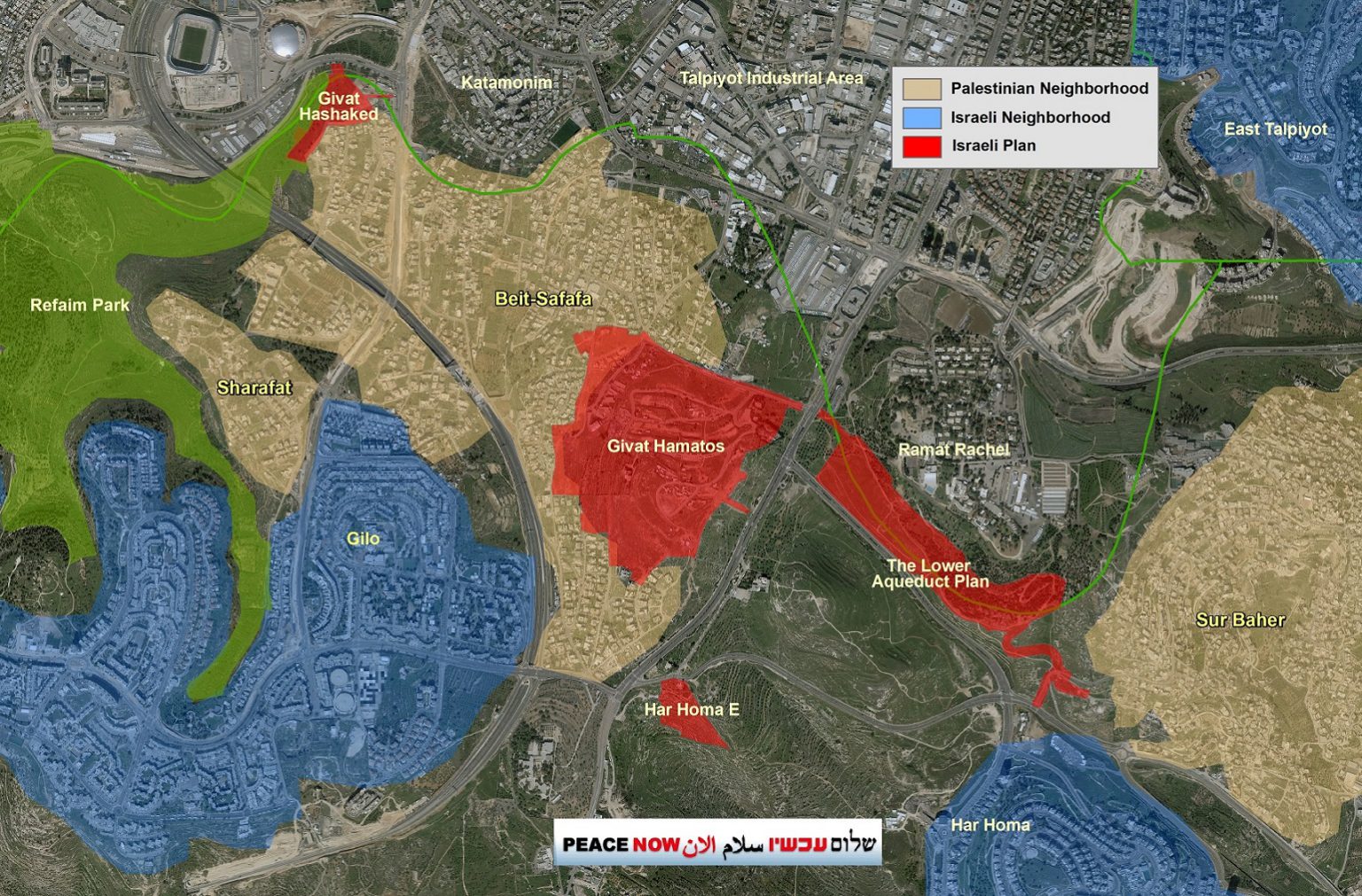
The final approved plan provides for the construction of 1,792 settlement units. According to Ir Amim, this is the first major new East Jerusalem settlement established by Israel since 2012.
Ir Amim says:
“This plan carries serious ramifications on the political future of Jerusalem. If constructed, it will extend the Israeli settlement wedge along East Jerusalem’s southern border, further creating a sealing-off effect of East Jerusalem from the southern West Bank, while fracturing the Palestinian space and depleting more vacant land for Palestinian development….Beyond its geopolitical ramifications, the advancement of this plan underscores the systematic discrimination implicit in Israeli planning and building policy in Jerusalem. Since the beginning of 2023, over 18,500 housing units have been advanced for new or existing Israeli settlements in East Jerusalem, while residential development for Palestinians has been all but neglected. This is despite the fact that Palestinians constitute nearly 40% of Jerusalem’s population. 2023 is slated to join 2022 as being the two years with the highest number of settlement units advanced in the last decade in East Jerusalem. Such inequitable urban planning policy has long served as a driver of Palestinian displacement in service of solidifying a Jewish demographic majority in Jerusalem and further cementing Israeli territorial control to foil prospects for a just political resolution.”
Peace Now said in a statement:
“The Israeli government continues to undermine any viable two-state solution. While the IDF is engaged in the Gaza Strip, and hundreds of Israelis living in border areas in the north and south are uncertain about when they can return to their homes, the government is advancing construction beyond the Green Line, further jeopardizing the security of all Israeli residents seeking a hopeful future with secure borders.”
“Kahanist” March Calls for Israeli Control Over Western Wall, Clash With Israeli Police
On the first night of Hanukkah, approximately 150 far right wing Israelis gathered for a planned march through the Old City of Jerusalem calling for Israeli control over the Temple Mount. Israeli police – which had previously approved the march (likely with the knowledge and approval of Netanyahu) and its route – ultimately stopped the march from leaving its convening point, resulting in clashes and at least one arrest.
The point of the march was to call on Israel to “restore full Jewish control over the Temple Mount and Jerusalem,” an inflammatory message that threatens to further undermine the very delicate status quo. Indeed, the march’s organizers dubbed the march the “Maccabi March,” referencing an important Jewish revolt that ended in the rededication of the Temple. An the night of the march, attendees were shouting racist slogans and raising racist signs.
Israeli Opposition Leader Yair Lapid said in a tweet that the march is:
“A blatant Kahanist attempt to set other [war] fronts on fire and to bring about more destruction and death.”
Daniel Seidemann, founder of Terrestrial Jerusalem, said:
“If there is any provocation more dangerous, more incendiary and more likely to trigger an eruption of violence in East Jerusalem and/or the West Bank and/or the Lebanese border, I can’t think of one.”
In Armenian Quarter, Settler Group Believed to Be Behind Disputed Land Deal
Ir Amim reports that senior executives of the Ateret Cohanim settler groups have recently been seen meeting with representatives of the real estate company behind the controversial purchase of a significant amount of land in the Armenian Quarter of the Old City of Jerusalem. The reports appear to confirm suspicion that Xana Gardens is actively collaborating with settlers in, according to Ir Amim, “attempts to Israelize the Old City and erode its historically multicultural and multireligious character.”
For a background on this case, please see reporting by Ir Amim and Terrestrial Jerusalem.
U.S. & Belgium Imposes Visa Ban on Dozens of Settlers, Criticizes Israel’s Lack of Action
On December 5th, the U.S. Department of State announced that it has placed visa restrictions on dozens of settlers believed to be complicit in violent attacks on Palestinians in the West Bank. The U.S. also imposed visa bans on several dozen Palestinians believed to have perpetrated violence against Israelis.
U.S. Secretary of State Antony Blinken said in announcing the new policy:
“Last week in Israel, I made clear that the United States is ready to take action using our own authorities. Today, the State Department is implementing a new visa restriction policy targeting individuals believed to have been involved in undermining peace, security, or stability in the West Bank, including through committing acts of violence or taking other actions that unduly restrict civilians’ access to essential services and basic necessities. Immediate family members of such persons also may be subject to these restrictions.”
The list of individuals affected by this effort is not expected to be made public, but individuals will be notified if their visas are being revoked. Settlers who are U.S. citizens will not be affected. Axios reports that the last time the U.S. imposed such restrictions was under the Clinton administration.
It is unclear what process the U.S. government is undertaking to identify acts of violence and the individuals involved in them. On December 6th, OCHA reported that since October 7th settlers have launched 318 attacks against Palestinians, resulting in:
- 8 Palestinians have been killed by Israeli settlers;
- 84 Palestinians have been injured by settlers;
- 241 incidents resulting in damage to Palestinian-owned property;
- 1,014 people, including 388 children, have been displaced amid settler violence and access restrictions. The displaced households are from 15 herding/Bedouin communities.
Israel, for its part, is currently holding four settlers and two Israeli (non-settlers) in administrative detention who are believed to have perpetrated violence against Palestinians since October 7th. In announcing the visa bans, U.S. Secretary of State Antony Blinken said that the U.S. continues to push the Israeli government to “do more to hold accountable extremist settlers who have committed violent attacks against Palestinians in the West Bank.”
Soon after the U.S.’s announcement, Belgium announced a similar policy banning settlers suspected of engaging in violence from entering the country. Belgium Prime Minister said in a tweet that he will work with the U.S. in implementing this policy.
Last week, the spokesperson for the French Foreign Ministry publicly stated that the European Union should also consider sanctions on violent settlers. The comments were in support of U.S. President Biden’s op-ed in which he had threatened to impose visa bans, a week before the policy was implemented.
Miftah Reports on “State Sponsored Settler Terrorism”
The Palestinian NGO Miftah has published a short new report on settler violence, saying “settler violence and terror is a systematic state policy pursued by every Israeli government past and present, and the whole government apparatus is complicit and responsible for such terrorism.”
The report calls on the international community to “muster the courage and political will to hold Israel accountable with effective measures.” Specifically, it calls on the International Criminal Court to investigate war crimes in Palestine, label settlement products, impose a complete ban on trade with settlements, blacklist settler groups on terrorists lists, freeze assets of individuals and companies involved in the settlement enterprise, and more.
You can read the full report here.
A Roundup of Settler Violence
The following are a few examples of settler violence that have been picked up by major media outlets over the past two weeks:
- “Left-wing Israeli Activists Attacked While Protecting Settler-targeted West Bank Village” (Haaretz – Dec. 4th)
- “Homes and EU-funded school in West Bank village wrecked after threats by settlers” (The Times of Israel – Dec. 4th)
- “Israeli Soldiers Documented Shooting Disabled Palestinian in West Bank” (Haaretz – Dec. 7th)
- “Two Palestinians Killed in Separate Incidents in West Bank” (Haaretz – Dec. 3rd)
Bonus Reads
- “Return to Gush Katif: A determined movement emerges to resettle Israelis in Gaza” (The Times of Israel)
- “With All Eyes on Gaza, West Bank Palestinians Are Facing Unprecedented Violence” (Haaretz)
- Israeli Army Mulls Shutting Down Unit of Settler ‘Hilltop Youth’ Amid Violent Incidents Against Palestinians““ (Haaretz)
- “A Bitter Season in the West Bank” (The New York Review)
- “Northern Israeli Kibbutz Residents Prevent Palestinians From Harvesting Their Olives” (Haaretz)
- “West Bank settlers unwavering in support for Israeli government” (Al-Monitor)
- “Amid a Settler Onslaught, Protective Presence Activism Falters” (Jewish Currents)
Welcome to FMEP’s Weekly Settlement Report, covering everything you need to know about Israeli settlement activity this week.
To subscribe to this report, please click here.
March 24, 2023
-
- Israel Reaffirms Commitment to Short Settlement Pause – Then Immediately Violates it, Publishing Tenders for 1,029 New Settlement Units
- Knesset Repeals Clauses of 2005 Disengagement Law, Allowing for Reestablishment of Four West Bank Settlements
- Netanyahu Contradicts Coalition Agreements in Attempt to Pacify International Outcry Over Disengagement Law Repeal
- Knesset Initiates Bill for West Bank “Admission Committees”
- U.S. State Department Issues Its 2022 Human Rights Report
- Bonus Reads
Israel Reaffirms Commitment to Short Settlement Pause – Then Immediately Violates it, Publishing Tenders for 1,029 New Settlement Units
At a second summit in the last month, Israeli and Palestinian officials signed a second joint communique brokered by Egypt, Jordan, and the United States. In it, the Israeli government once again pledged to pause discussion of new settlement units for four months and postpone the authorization of outposts for six months.
On March 22nd, three days after the second communique was signed, the Israel Land Authority (ILA) published tenders for the construction of 1,029 new settlement units. Those units are as follows:
- 89 units in the East Jerusalem settlement of Gilo, located in southern Jerusalem between the isolated Palestinian East Jerusalem neighborhood of Beit Safafa and the West Bank city of Bethlehem;
- 193 units in the Efrat settlement located south of Bethlehem, inside a settlement block that cuts deep into the West Bank. Efrat’s location and the route of the barrier wall around it, have literally severed the route of Highway 60 south of Bethlehem, cutting off Bethlehem and Jerusalem from the southern West Bank. The economic, political, and social impacts of the closure of Highway 60 at the Efrat settlement (there is literally a wall built across the highway) have been severe for the Palestinian population.; and,
- 747 units in the Beitar Illit settlement, a massive ultra-orthodox settlement located west of Bethlehem.
On the publication of tenders for 1,029 settlement units, Peace Now said:
“This is yet another harmful and unnecessary construction initiative, as part of the messianic coup that is unfolding alongside the regime coup. The most extreme right-wing government in the history of the country is not only trampling on democracy but also on the possibility of a future political agreement, and on our relations with the US and friendly countries. Lies and violations of these commitments are a sure way to turn Israel into an isolated country.”
Further eroding the credibility of Israeli assurances, on the day after the summit concluded – a summit that was called in order to calm tensions that have been mounting across the West Bank and Israel – Israeli Finance Minister Bezalel Smotrich made an inflammatory speech in France, during which he said:
“There is no such thing as a Palestinian nation. There is no Palestinian history. There is no Palestinian language.”
Smotrich delivered these remarks while standing at a podium bearing the flag of the Jewish Irgun, bearing a map of Israel that includes the West Bank and parts of Jordan. The map – and its meaning – was reaffirmed in Smotrich’s speech in which he reiterated his belief that Israeli Jews have a God-given, exclusive right to the land.
Smotrich has been roundly condemned for his incitement, including by the U.S. State Department spokesperson Vedant Patel, who said:
“The comments, which were delivered at a podium adorned with an inaccurate and provocative map, are offensive, they are deeply concerning, and, candidly, they’re dangerous. The Palestinians have a rich history and culture, and the United States greatly values our partnership with the Palestinian people.”
Palestinian Prime Minister Mohammad Shtayyeh said Smotrich’s remarks are: “conclusive evidence of the extremist, racist Zionist ideology that governs the parties of the current Israeli government.”
Knesset Repeals Clauses of 2005 Disengagement Law, Allowing for Reestablishment of Four West Bank Settlements
On March 21st, the Israeli Knesset passed a law repealing parts of the 2005 Disengagement Law (which legislated Israel’s dismantling of all settlements in the Gaza Strip and four settlements in the northern West Bank). The repeal of these clauses enables the reestablishment of all four of the settlements in the northern West Bank that were dismantled by the Israeli government as part of the 2005 Disengagement initiative – Homesh, Sa-Nur, Ganim and Kadim. The bill repealing these clauses in the Disengagement law — an act which sets the stage for efforts to more broadly undo Israel’s 2005 Disengagement — was supported even by members of the Israeli opposition.
With the law amended, the government can now advance its plan to reestablish the Homesh settlement (see FMEP’s previous reporting on the efforts to reestablish Homesh). In the longer term, the repeal of these provisions will undoubtedly give rise to pressure to reestablish the other three dismantled settlements; and in the immediate aftermath of the repeal of these clauses, one right-wing minister in the current government is already raising the demand for Israel to reestablish settlements in the Gaza Strip, and MK Limor Son Har-Melec said shortly after the law was passed:
“We must not rest on our laurels and bask in the euphoria, and we must charge at the next two tasks that lie ahead of us tomorrow: the re-establishment of the four settlements that were evacuated [in the northern West Bank], and return home to the [evacuated Gaza settlement Gush Katif] that … became a nest of terror.”
As a reminder, the Homesh settlement was built almost entirely on land that belongs to (and is recognized by Israel as registered as belonging to Palestinian owners. Yet, after the Homesh settlement was dismantled in 2005, control over the land was never returned to its owners. The area was instead declared by the Israeli army to be a closed military zone, with Palestinains, including the owners of the land, barred from access. The Palestinians owners have been fighting for the right to access their own land since 2009, with no success. At the same time, the Israeli army has allowed Jewish Israeli settlers to access the area regularly, and even permitted the settlers to illegally (under Israeli law) establish a religious school and settlement outpost at the site. Rather than enforce Israel’s own laws against the settlers, the current Israeli government has agreed to grant retroactive approval to the settlers’ illegal presence.
The Times of Israel notes that, even with the new law, the head of the IDF will have to sign a new military order that allows Israelis to enter the area. This will likely not be a problem, given that for years – long before this new law – the IDF has allowed Israelis to access and stay at the site. Moreover, Bezalel Smotrich, who is in effect the ruling sovereign over the West Bank after being handed vast powers within the Defense Ministry, tweeted that the repeal of the 2005 Disengagement Law “advances the regularisation of our presence at Homesh.” Note that “regularization” is a euphemism for retroactive legalization, granting post-facto approval to illegal settlement activity, which has the effect of establishing a new settlement.
Settlers [who are the government] have moved quickly to press for next steps on the retroactive legalization of the Homesh yeshiva. On March 22nd, approximately 150 settlers invaded the site of Homesh and set up camp there.
Finally, the Israeli NGO Yesh Din, which closely documents settler- and settlement-related developments, notes that repealing the West Bank-related clauses in the Disengagement Law does not change the legal status of the land, which Israel has recognized as privately owned by Palestinians. This means, according to Yesh Din, that Israel still has “no legal option for legalizing the [Homesh] outpost.” Based on the commitments made by this new government, it seems probable that this legal “problem” will be just one more challenge to be overcome.
Netanyahu Contradicts Coalition Agreements in Attempt to Pacify International Outcry Over Disengagement Law Repeal
After days of international criticism over the repeal of clauses in the 2005 Disengagement Law, Prime Minister Netanyahu issued a statement saying that the Israeli government has “no intention of establishing new settlements in the area.” Axios reports that the U.S. and several other European nations attempted to persuade Netanyahu to block the bill or postpone the Knesset’s vote, but Netanyahu said it was part of his commitments to his ruling partners.
The United States took a lead role in reprimanding the Israeli government for amending the 2005 Disengagement Law. U.S. criticism included a summons for Israeli Ambassador to the U.S. Michael Herzog to attend an impromptu, reportedly tense, meeting with U.S. Deputy Secretary of State Wendy Sherman, as well as a lengthy statement by the U.S. Department of State Spokesperson, Vedant Patel, which ended with the announcement that the U.S. is considering several options in response to Israel’s West Bank policy.
Knesset Initiates Bill for West Bank “Admission Committees”
Mondoweiss reports that on March 20th in a preliminary reading, the Knesset Economic Affairs Committee approved a bill that would allow Israel “admission committees” to be established for areas where settlement expansion is proceeding, including the South Hebron Hills, the Jordan Valley, and the Galilee. These “Admission Committees” are already established in Israel proper, so this new bill will allow extend Israeli domestic law into the West Bank.
Explaining the Admissions Committee law, Adalah writes:
“The Admissions Committees Law legalizes “Admission Committees” that operate in hundreds of small community towns built on state land in the Naqab (Negev) and Galilee. The law gives Admission Committees, bodies that select applicants for housing units and plots of land, almost full discretion to accept or reject individuals from living in these towns. The Committees include a representative from the Jewish Agency or the World Zionist Organization, quasi-governmental entities. The Committees, in practice, filter out Arab Palestinian applicants and others from marginalized groups.
While one of the law’s provisions states a duty to respect the right to equality and prevent discrimination, the law allows these Committees to reject applicants deemed “unsuitable to the social life of the community… or the social and cultural fabric of the town,” thereby legitimizing the exclusion of entire groups. The law also authorizes Admissions Committees to adopt criteria determined by individual community towns themselves based on their “special characteristics”, including those community towns that have defined themselves as having a “Zionist vision”.”
U.S. State Department Issues Its 2022 Human Rights Report
The U.S. Department of State published its annual report on human rights conditions in every country in the world. The publication is always notable because of the ever-evolving treatment of the occupied Palestinian territories, and for the closely scrutinized statements regarding Israel’s treatment of Palestinians living under Israel’s military occupation.
Notable inclusions and omissions include:
1 – The Biden State Department opted to maintain the new format imposed on the report by the Trump Administration, with a section entitled “Israel, West Bank, and Gaza.” Under this format, which the Biden Administration also used in its 2020 and 2021 reports, there is a section on Israel (looking at the practices of the Israeli government in sovereign Israeli territory, including East Jerusalem) and a separate section on the West Bank & Gaza (looking primarily at the practices of the Palestinian Authority, Hamas, and the “Israeli authorities in the West Bank”). Prior to the Trump era, the report and its sections were entitled “Israel and the Occupied Territories.” The Trump administration adopted the new section titles in its 2017 report and completed its elimination of the word “occupation” in its 2018 report. The Biden Administration’s decision to continue this new format was widely reported when the administration’s first report was released in early 2021.
2 – The report acknowledged, but did not take a position on, Israel’s declaration of six Palestinian organizations as terrorist entities. The report says, “Israeli authorities cited laws against terrorism or protecting national security to arrest or punish critics of the government or deter criticism of government policies or officials.” This is notable because the Biden Administration has come under intense pressure to mirror Israel’s terrorist designation of these organizations, but thus far has refrained from doing so. The Biden Administration has also not contradicted or criticized Israel’s declarations, and has instead repeatedly stated that it is investigating the matter and reviewing information on the groups’ alleged ties to terrorism that the Israeli government has presented to the U.S., and has explicitly left the door open for Israel to continue to provide more “evidence” (incentivizing Israel to continue to violate the rights of Palestinian human rights defenders, including by arresting people and in effect threatening to hold them indefinitely without due process unless they confess to crimes or incriminate others — all of which is then offered as new “evidence.”).
3 – In reporting on the killing of Palestinian-American journalist Shireen Abu Akleh, the report deferred to an Israel account which said that it was a “high possibility” that Abu Akleh – who was wearing a flak jackets that clearly marked her as “press” — was hit by Israeli gunfire “accidentally,” but not deliberately. This narrative is contradicted by Palestinian eyewitness accounts, in addition to forensic scientists’ reconstruction of the events leading up to her death which show conclusively that Abu Akleh was killed by IDF gunfire and that it is improbable in the extreme that the shooting was not deliberate. Notably, the report included mention of Abu Akleh’s death under the “freedom of expression” section, not under the section where extrajudicial killings were covered.
4 – The report, like in years past, does not explicitly criticize settlement construction, which has been shown to be the driving force behind the systematic human rights abuses against Palestinians.
Bonus Reads
- “Protection of Civilians Report | 28 February – 13 March 2023” (OCHA)
- “This Is the Disturbing Reality of Israeli Land Theft and Right-wing Rule” (Amira Hass, Haaretz)
- “Editorial | They Frequented West Bank Hilltops and Interrogation Rooms. Now They Set Police Policy” (Haaretz)
- “Ben-Gvir’s Chief of Staff Bosses Police Around Despite Not Being Employed as Civil Servant” (Haaretz)
- “Armed settlers break into Palestinian family home under cover of darkness” (+972 Magazine)
Welcome to FMEP’s Weekly Settlement Report, covering everything you need to know about Israeli settlement activity this week.
To subscribe to this report, please click here.
January 13, 2023
- New Givat Hamatos Expansion Plan
- The IDF Has Prepped & Presented its Plan to Expel Palestinians from Masafer Yatta
- Israel Carries Out Demolitions in Area B
- MK Danon Unveils Jordan Valley Annexation Bill
- Settlers Demand Fast-Tracked “Regularization” of Outposts
- Biden Administration Commits to Doing Nothing More Than Issue Empty Statements in Response to Israel Expanding Settlements/Legalizing Outposts
- Peace Now Releases 2023 Settlement Map
- Adalah Publishes Detailed Analysis of New Israeli Coalition Deal
New Givat Hamatos Expansion Plan
Ir Amim reports that on March 2nd the Jerusalem Planning Committee will consider a brand new plan to expand the area of theGivat Hamatos settlement in East Jerusalem by 40% and to more than double the number of housing units slated to be built there. The new plan – called the “East Talpiyot Hill” plan – involves the construction of 3500 units and 1300 hotel rooms, to be built on a plot of land adjacent to the site where the Givat Hamatos settlement (planned for 2610 units) is slated to be built. As a reminder: tenders for the construction of those units were issued in January 2021 (just hours after PResident Biden was inaugurated), and the construction of the infrastructure for that project is already underway.
 The “East Talpiyot Hill” plan involves construction on a strategic strip of land that will expand the area of Givat Hamatos eastward, connecting it with another new settlement plan – the “Lower Aqueduct Plan.” These plans ultimately create a string of settlements — spanning from Gilo to Givat Hamatos to Har Homa — that, together with the planned “Givat HaShaked” settlement to its north, completely encircle the East Jerusalem Palestinian neighborhood of Beit Safafa with Israeli settlement construction. Ir Amim further warns that the inclusion of hotels in this new plan “will likely serve as a major source of competition with the tourism industry in Bethlehem, potentially diverting vital business from the Palestinian economy.”
This land on which the “East Talpiyot Hill”project will be built was owned by the Greek Orthodox Church until 2009 – when the church sold many of its most prized properties to settler entities. The Church has contested these sales, alleging fraud – but Israeli courts have rejected the Church’s objections and allowed the contested sales to stand. This particular tract of land was sold to an Israeli businessman and the New Talpiyot Hill company, which together initiated this new plan.
Importantly, Ir Amim notes that there are indications that Israel is carrying out land registration for plots located in the tract of land on which the “East Talpiyot Hill” project would be built. This is highly significant, as the registration appears to be happening in secret and – as revealed by Bimkom’s and Ir Amim’s ongoing monitoring and research, “settlement of land title proceedings are largely being used to dispossess Palestinians of their properties and seize more territory in East Jerusalem for Israeli settlement. “
The IDF Has Prepped & Presented its Plan to Expel Palestinians from Masafer Yatta
Haaretz reports that the Israeli Central Command has presented to the Israeli government its plan to expel some X,000 Palestinians from eight villages in Masafer Yatta in the South Hebron Hills – plans it had reportedly been working on for two months (i.e., even before the new government took power). Sources told Haaretz that the new government has not given the IDF the order to carry out the expulsions yet, but nonetheless the IDF saw fit to design a plan, using vans, to carry out the evictions. Israeli Defense Minister Yoav Galant has reportedly told the IDF that he “needs to study” the matter.
Israel Carries Out Demolitions in Area B
Haaretz has revealed that on November 24, 2022, the Israeli Civil Administration demolished two Palestinian structures in Area B of the West Bank — the area in which, under the Oslo Accords, Israel enjoys no jurisdiction over civil matters (such as building enforcement). The Civil Administration denies that the demolition violated the Oslo Accords, arguing that it was within its rights because it was acting to address alleged major damage caused to a nearby archaeological site, called Khirbet Tarfin. Israeli political figures were reportedly involved in the decision to carry out the demolitions.
In a statement to Haaretz regarding the demolitions, the Civil Administration stood proudly by its demolition, and committed to defending archaeological sites across the whole West Bank. The statement reads:
“The Civil Administration will continue to expend major efforts and resources in researching and preserving the archaeological sites in Judea and Samaria [the West Bank] in addition to pursuing enforcement activity against antiquities thieves and the building of illegal structures in the heart of archaeological sites.”
The Civil Administration’s statement – and Israel’s move to raze these two Palestinian structures – should be understood against the backdrop of the years-long campaign by settlers pushing the government to unilaterally take control over archaeological sites (defined expansively) throughout the West Bank. In this way settlers and their supporters are- with great success – weaponizing archaeology as a tool for the dispossession of Palestinians.
This effort should also be understood as an expansion of the settlers’ enormously successful tactics in getting the Israeli government to annex Area C – with Israeli policy now treating Area C as sovereign Israeli territory in virtually all ways (other than a public declaration of annexation). Now that the new governing coalition has announced a total freeze on Palestinian construction in Area C and has increased demolition of Palestinian “illegal” construction (i.e., Palestinian construction on their own private land, but lacking Israeli permits, due to the fact that Israel refuses to issue Palestinians permits to build) — and now that Netanyahu has declared Israel’s “exclusive and inalienable right to all parts of the Land of Israel” — it is not surprising, but is still alarming, to see the same land grab tactics that worked so well in Area C applied in Area B. Indeed, more Israeli actions/policies that further the erasure of any meaningful Oslo-era boundaries between West Bank areas should be anticipated.
MK Danon Unveils Jordan Valley Annexation Bill
MK Danny Danon (Likud) – who previously served as Israel’s Ambassador to the UN – has unveiled a bill that would have Israel unilaterally annex the Jordan Valley.
Jordan Valley annexation bills have been introduced into the Knesset for years, but have rarely if ever received real consideration, though support for such a measure is likely high. In September 2019, Netanyahu committed to annexing the Jordan Valley.
Settlers Demand Fast-Tracked “Regularization” of Outposts
The Forum for Young Settlements, an advocacy group by and for settlers, is pushing the new Israeli government to act swiftly to suspend the rule of law to “legalize” settlement outposts across the West Bank that were built in violation of Israeli law, and many of which are located on privately-owned Palestinian land. As part of the coalition agreements, the parties agreed to “legalize” the outposts within the first 60 days of the new government tenure- – but settlers apparently think this is too long, and are demanding that the government act immediately.
The Forum said in a statement:
“[The Forum] congratulate[s] the Prime Minister and the ministers for establishing a stable national right-wing government for the first time in years, and for introducing ‘Young Settlement Regulation’ into the coalition agreements….this is the time to approve the proposal of the decision-makers for regulation. The government’s decision is already prepared, and over 25,000 residents of the young settlements in the winter months cry out for a resolution to their humanitarian needs and immediately enable the connection of all the young settlements to electricity, water, and other infrastructures.”
Biden Administration Commits to Doing Nothing More Than Issue Empty Statements in Response to Israel Expanding Settlements/Legalizing Outposts
U.S. Ambassador to Israel Thomas Nides told the Israeli Kan news outlet that the U.S. opposes “massive settlement growth” — seeming to signal the Biden Administration’s acceptance of settlement construction on a less-than-massive scale (FMEP president Lara Friedman notes that this reminds her of an old joke: a couple celebrating their 50th wedding anniversary was asked, what made this marriage last so long? Partner 1 responded – “when we got married, we agreed that I get to make all the big decisions, and my partner gets to make all the small decisions; as it turns out, there has never been a big decision, so peace has reigned between us!”). Nides further said that the U.S. continues to oppose outpost legalization but does not have any “red lines” for the Israeli government.
Peace Now Releases 2023 Settlement Map
Peace Now has released an updated map of the West Bank, showing settlements, outposts and more. You can view and download the map here: https://peacenow.org.il/en/%d9%8dsettlements-map-2023
Adalah Publishes Detailed Analysis of New Israeli Coalition Deal
Adalah released a new report on the details contained within the new Israeli coalition deal. The paper examines the following 11 items:
- Deepened political control over law enforcement and policing;
- Accelerating the Judaization of the Naqab, Galilee, and beyond;
- Curbing the prohibition of discrimination in services and products;
- A new basic law on immigration;
- Discrimination in education;
- Impunity for the armed forces;
- Silencing criticism against Israel;
- Allowing candidates running for the Knesset to incite racism while undermining Palestinian political participation;
- Separate and unequal funding for Palestinian localities in Israel; (10) Limiting the Supreme Court’s authority; and
- De facto annexation of the West Bank.
On de facto annexation of the West Bank, Adalah writes:
“These appointments effectively give the RZP control over all settlement construction projects in the West Bank; authority over nearly all issues relating to the settlements: the building of homes, demolition of homes and other buildings, and all other aspects of daily life. This ministerial position will also no longer require the Prime Minister’s approval at various stages of West Bank settlement construction projects; instead, it will only be required once, during the initial stages. Smotrich has made clear that he intends to use this authority to de facto annex the West Bank by, in particular, dismantling the Israeli military’s Civil Administration over the Israeli Jewish settlers illegally residing there and instead putting their governance under Israeli civil domestic law, while continuing to keep Palestinians under military rule. This move will more deeply entrench the two separate systems of governance that already exist based on racial identity, an unquestionable hallmark of a system of apartheid.”
Welcome to FMEP’s Weekly Settlement Report, covering everything you need to know about Israeli settlement activity this week.
To subscribe to this report, please click here.
November 18, 2022
- Jerusalem Planning Committee to Discuss (Another) Plan to Significantly Expand Nof Zion Settlement Enclave
- As Court Tries to Avoid Underlying Issue of Land Allocation Practices in the West Bank, Palestinians Reject “Deal” that Would Allow Construction of Givat Eitam/E-2 Settlement,
- Mass Displacement/Dispossession in Silwan Advances, Court Rejects Shahadeh Family Petition
- Elad Continues Illegal Work in East Jerusalem Cemetery
- Bibi’s Coalition Promises on Settlement: Outposts, Homesh, Evyatar, Infrastructure, Override Clause, & More
- Settler Violence Continues to Surge
- U.S Ambassador Visits a Settlement, Less Than a Year After Saying He Won’t
- Bonus Reads
Jerusalem Planning Committee to Discuss (Another) Plan to Significantly Expand Nof Zion Settlement Enclave
Ir Amim reports that on November 23rd the Jerusalem District Planning Committee is scheduled to discuss a plan to expand the Nof Zion settlement enclave, located in the heart of the Palestinan neighborhood of Jabal Mukaber in East Jerusalem. The plan would allow for 100 new residential units and 275 hotel rooms in the settlement enclave, and is part of a larger scheme to connect the enclave to the built-up area of East Talpiot – a scheme which would cut deeply into the Jabal Mukaber neighborhood and entrench the expanding continuum of Israeli settlements surrounding Jerusalem.
Commenting on the plan, the Israeli NGO Ir Amim writes:
“Beyond its geopolitical implications, this is yet another example of the severe discrimination in urban planning and housing in East Jerusalem. Despite the plan being slated for the entrance of Jabal Mukabber, it is not designated for the community’s development needs but rather for the expansion of a Jewish settlement in the middle of a Palestinian neighborhood. It should be noted that Jabal Mukabber is among the Palestinian neighborhoods in East Jerusalem with the highest number of demolitions per year.”
Specifically, the Nof Zion expansion plan to be discussed by the Jerusalem District Planning Committee on November 23rd is interconnected with another plan (last discussed by the Committee in January 2022). That plan seeks to move an Israeli police station [the Oz station] currently located on the border of Jabal Mukaber, to a new site across the street (where it will become a massive Israeli security headquarters), leaving its current location free for the planned expansion of Nof Zion. Ir Amim filed a petition against the police station plan, saying that it is an affront to the planning needs of the local community and continues Israel’s systematic, city-wide discrimination against the housing, educational, and service-based needs of Palestinian neighborhoods. A decision on the police station relocation plan is expected soon.
Ir Amim further explains the impact of these plans:
“Expanding the settlement towards the main entrance of Jabal Mukabber will infringe on the residents’ freedom of movement and further disrupt the fabric of life in the neighborhood. Prior experience show that during clashes and periods of tension and instability, Israel rushes to impose collective restrictions under the pretext of protecting Israeli settlers.”
These plans are just the latest efforts to expand and entrench the Nof Zion settlement enclave. Prior plans include:
- In 2017, the Israeli government approved a plan to build a new synagogue and mikveh for the settlement, to be located on private Palestinian land that had been expropriated form Jabal Mukaber the year before.
- In April 2019, after two years of rumors, the Israeli government issued 176 building permits for the already-approved project to build . According to Ir Amim, those permits were ultimately issued in April 2019.
- In 2019, construction began on a plan to triple the size of the settlement enclave, making it the largest such enclave in East Jerusalem. After a two-year stall, construction on the expansion resumed in 2021 with new financing.
As Court Tries to Avoid Underlying Issue of Land Allocation Practices in the West Bank, Palestinians Reject “Deal” that Would Allow Construction of Givat Eitam/E-2 Settlement
On November 14th, Peace Now tweeted updates from a courtroom where the Israeli Supreme Court was attempting to resolve the ongoing petition against the allocation of “state land” for the construction of the Givat Eitam/E-2 settlement, slated to be build on a strategic hilltop – which Palestinians know as a-Nahle – located just south of Bethlehem. The construction of Givat Eitam/E-2 would significantly expand the Efrat settlement in the direction of Bethlehem. It would also effectively cut Bethlehem off from the southern West Bank and complete the city’s encirclement by Israeli settlements.
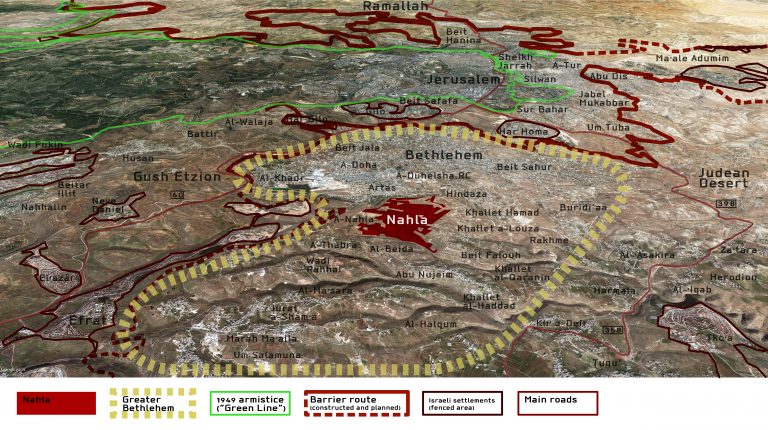 In the hearing, the State of Israel proposed a deal to the Palestinian petitioners, according to which the State would allocate to them a total of 54 dunams (out of the 1,400 dunams originally planned for the construction of the new settlement). The Palestinian landowners rejected the deal, with their lawyer Michael Sfard noting:
“The main problem is that the solution proposed by the court…does not remove the evil of the decree from their heads, and therefore we oppose this proposal…that offer, whether it is 50 or 100 dunams, does not help the Palestinian communities. Since we, and everyone who sits around here, knows that if this neighborhood is built, it’s likely that they won’t even be able to cultivate those acres.”
Peace Now tweeted its sense of where the judges opinions might land, writing:
“The hearing is over. The petitioners rejected the state’s offer. It seems that the judges are trying to avoid a decision on the central question regarding the entire land – whether it should be allocated to the settlements or the Palestinians. The judges keep trying to walk between the drops. On the one hand, they cannot ignore the blatant discrimination in Israel’s land allocation policy. On the other hand, they are trying to avoid the fundamental question of the legality of this land allocation to the settlement.”
The High Court held a hearing in June 2021 on this same petition. Peace Now’s Hagit Ofran told FMEP that at the conclusion of that hearing the Court had given the government of Israel 90 days to respond to a proposal to either allocate to the individual petitioners some of the “state land” directly involved in the case, or to allocate to them “state land” nearby. This decision by the Court purposely narrowed the scope of Peace Now’s legal challenge by addressing only the case of the land in a-Nahle and the individual petitioners involved, thereby dodging the more fundamental question put forth in the petition challenging Israel’s discriminatory practice of allocating 99.8% of “state land” for settlement purposes. This is the first time the issue of state land allocations to settlements is being challenged in an Israel court.
Mass Displacement/Dispossession in Silwan advances, as Court Rejects Shahadeh Family Petition
On November 13th, the Jerusalem District Court announced that it had rejected an appeal by the Palestinian Shehadeh family seeking to cancel eviction orders that seek to dispossess them of their longtime homes in the Batan al-Hawa section of Silwan in favor of the Ateret Cohanim settler organization. The announcement follows a hearing the Court held on the appeal on November 9th.
As a reminder: the Shahadeh family is one of 85 families in Batan al-Hawa facing displacement at the behest of Ateret Cohanim. The legal fate of all of the families is bound together, with the Duweik family’s case being the furthest advanced and setting a dangerous precedent for the Shehadehs and others. Indeed, this week the Supreme Court discussed several of the decisions made in regards to the Duweik family, and their relation to the Shehadehs’ case. Notably, in July 2022 a 3-judge panel of the Supreme Court could not agree on the Duwiek’s family’s petition, which resulted in the petition being sent back to the Jerusalem Magistrate’s Court – where it currently awaits further consideration. One of the judges accepted the argument that the family should be allowed to continue living in their homes because a statute of limitations prohibits Ateret Cohanim – through its management of an historic land trust – from making a claim to the land after such a long period of absence.
As a reminder, Ateret Cohanim has waged a years-long eviction campaign against Palestinians living in Silwan, on property the settler NGO claims to own. In total, Ateret Cohanim’s campaign stands to ultimately dispossess 700 Palestinians (85 families) in Silwan. The group’s claim is based on having gained control of the historic Benvenisti Trust, which oversaw the assets of Yemenite Jews who lived in Silwan in the 19th century. In 2001 the Israeli Charitable Trust Registrar granted Ateret Cohanim permission to revive the trust and become its trustees, (following 63 years of dormancy). In 2002, the Israeli Custodian General transferred ownership of the land in Batan al-Hawa to the Trust (i.e., to Ateret Cohanim). Since then, Ateret Cohanim has accelerated its multi-pronged campaign to remove Palestinians from their homes, claiming that the Palestinians are illegal squatters.
Elad Continues Illegal Work in East Jerusalem Cemetery
Emek Shaveh & Ir Amim tweeted footage of construction work at the site of the Sambuski cemetery, an ancient Jewish cemetery located in the Ben Hinnom Valley in East Jerusalem. The Elad settler group – which is paid by the Israeli government to manage and expand a web of settler-tourist sites and the City of David National Park – has been conducting work on the Sambuski Cemetery despite apparently lacking a permit. Emek Shaveh – an Israeli NGO with expertise in archaeology – notes that any construction within a national park should be heavily scrutinized by professionals and the public before being implemented.
In August 2022, Elad unilaterally closed the main access road leading to the Palestinian neighborhood of Wadi Rababa, which travels past the Sambuski cemetery. 150 families were trapped in the neighborhood while Elad worked on the site.
The Sambuski cemetery was a relatively unknown, neglected site until recent years – but it is deeply integrated into Elad’s overarching, comprehensive plan to take control of the Silwan neighborhood. In 2020, the-president Trump’s “Peace to Prosperity” plan identified the Sambuski cemetery as a place of prime historical and religious importance to Israel, elevating the status of the cemetery. The Israeli NGO Emek Shaveh – which has special expertise on archaeology and the way archeology has been weaponized to serve the political agenda of the settlers and the state of Israel – wrote a report on exactly how the Trump plan supports settler efforts to use Jerusalem’s history and antiquities to promote Israeli-Jewish hegemony and control over the city.
Emek Shaveh explains how the cemetery is connected to other settler endeavors in Silwan:
“For the Elad Foundation the cemetery is a strategic site as it links together two important focal points of its enterprise – the neighborhood of Silwan, home to the City of David archaeological park and specifically to the Pool of Siloam at the southern tip of the site, and the Hinnom Valley an area which Elad has been developing for the past two years (more below).”
Bibi’s Coalition Promises on Settlement: Outposts, Homesh, Evyatar, Infrastructure, Override Clause, & More
Netanyahu continues to negotiate a final coalition agreement in order to form a new government, and has reportedly committed to virtually all of the main demands of the settler movement (short of outright annexation of all the land between the river and the sea), including:
- Passage of the Supreme Court Override Clause (see this new explainer by ACRI). This law would obliviate judicial oversight in Israel, giving ultimate power to the Knesset. Under the new Israeli government and with the current Knesset, this law would likely be used to reinstate the Settlement Regulation Law – the law that seeks to establish a legal basis for Israel to retroactively legalize outposts and settlement structures which are built on land that Israel acknowledges is privately owned by Palestinians. As a reminder, that law was overturned by the Israeli Supreme Court in June 2020. Peace Now estimates that the law stands to convert some 55 unauthorized outposts into official, authorized settlements, seizing some 8,000 dunams of privately owned Palestinian land in the process.
- Full recognition & integration of outposts (i.e., retroactive legalization and de facto annexation). This was reportedly promised to Bezalel Smotrich, who has authored Knesset legislation to grant full status to outposts irregardless of the status of the land on which the outposts were built illegally. Separately, Netanyahu agreed with Itamar Ben Gvir that the outposts would be provided infrastructure services within 60 days of the new government being sworn in.
- The reestablishment of the Homesh Settlement. Netanyahu reportedly committed to Itamar Ben Gvir, a longtime supporter/devotee of Rabbi Meir Kahane, that the settlement of Homesh will be reestablished on the land where it stood prior to being dismantled by the Israeli government in 2005. To do so would require the government to amend the 2005 Disengagement Law that not only ordered the dismantling of the Homesh settlement along with three others in the northern West Bank, but provided for Israel’s withdrawal from Gaza. For more on the long-running campaign by settlers and their allies to reestablish the Homesh settlement – and its consequences for Palestinians who live nearby and own the land on which Homesh once stood – see here.
- The legalization of a yeshiva at the Evyatar Outpost. Netanayhu and Ben Gvir agreed to grant retroactive authorization to a yeshiva established at the Evyator outpost. For more on the Evyatar outpost & yeshiva saga – see here.
- A commitment to expanding settler road infrastructure across the West Bank. Netanyahu agreed with Ben Gvir to allocate $434 million ($1.5 billion shekels) for the paving of new and expanded bypass roads in the West Bank and for the expansion of Highway 60, and to expedite the planning process for doing so. For more analysis on how infrastructure such as roads contribute to Israel’s de facto annexation of the West Bank, see this report by Breaking the Silence.
In addition, Netanyahu is coming under increasing pressure from inside his coalition to name far right-wing MK Bezalel Smotrich as the next Defense Minister. Haaretz reports that Itamar Ben Gvir supports Smotrich’s demand because it will,
“help implement a full right-wing policy, establish new settlements in the West Bank, approve construction of thousands of new housing units in them, stop Palestinian construction in Area C and halt the evictions of illegal outposts.”
Of note, in 2021 Smotrich suggested that a “solution” to Palestinian “illegal” construction in Area C (construction by Palestinians on their own land, but without Israeli-required building permits, that Israeli makes it nearly impossible to obtain) could be to give settlements the authority to demolish Palestinian construction they believe to be unauthorized.
American officials, including Ambassador Nides, have expressed concern over Smotrich’s potential appointment to such a key – and powerful – post. In addition to his pro-settlement, pro-annexation positions, Smotrich is also a self-proclaimed homophobe and has lobbied for the expulsion of Palestinians from Israel.
Lastly, and underscoring the extent to which the settlers’ agenda and the governing coalition’s agenda are one and the same: a newly elected Member of the Knesset, Limor Son Har-Melech of the Religious Zionism coalition, has appointed a member of the radical hilltop youth movement to serve as his spokesperson. Har-Melech’s new spokesman, Elisha Yered, lives in the outpost of Ramat Migron in the northern West Bank, and is under ongoing investigation following his arrest in August 2022 for “racist conspiracy” — amongst other charges for crimes against Palestinians. Yered is quoted as saying:
“the hills are the scene of a war that according to Jewish law one is required to wage…what the hills do is to bring Jewish control to hundreds of dunams – that is something that no soldier in the greatest reconnaissance unit can do during his service.”
Settler Violence Continues to Surge
Following a Palestinian stabbing attack near the Ariel settlement that left 3 Israelis dead and 3 injured, settlers across the West Bank rampaged to take their revenge, committing over 20 attacks against Palestinian and their property, as well as Israeli soldiers, in the 24 hours that followed.
In addition, in its weekly report on Israeli human rights violations covering Nov. 10-16, the Palestinian Centre for Human Rights reports that settlers conducted 4 attacks on Palestinians’ vehicles in different areas in the West Bank during the reporting period Nov. 10-16.
“On 14 November 2022, Israeli settlers moved into Haris village in Salfit, north of the West Bank, and burned four vehicles belonging to the villagers.
On 15 November 2022, Israeli settlers attacked and set fire to a vehicle belonging to a
Palestinian who was in his way back from ‘Attil village in northern Tulkarm to Nablus.On the same day, Israeli settlers intercepted a bus for a women’s trip in Hebron and
prevented it from moving for few hours, enticing fear among the passengers.On 16 November 2022, Israeli settlers threw stones at four vehicles near Ramin village, east of Tulkarm, breaking their windows. On the same day, Israeli settlers damaged a vehicle belonging to a Palestinian doctor near Jit village in Qalqilya.”
PCHR concludes, noting: “Since the beginning of the year, settlers conducted at least 236 attacks. In two of the attacks, 2 Palestinians were killed.”
U.S Ambassador Visits a Settlement, Less Than a Year After Saying He Won’t
This week U.S. Ambassador to Israel Thomas Nides visited the West Bank settlement of Kiryat Netafim to offer his condolences to the grieving family of a victim of Sunday’s stabbing attack that killed three and wounded three. Nides’ trip marks the first time any representative of the Biden Administration has undertaken official travel to any Israeli settlement. A U.S. Embassy spokesperson said that “the shiva visit in no way signals a change in US policy toward settlements”
In January 2022 Ambassador Nides was quoted as saying he “will absolutely not” visit a settlement. It’s worth recalling that the Biden Administration has not reversed or publicly rejected the Trump Administration’s “Pompeo Doctrine,” which made it U.S. policy to view Israeli settlements as not “per se inconsistent with international law.”
Kiryat Netafim is located about half way between the Ariel settlement and the cluster of settlements close to the 1967 Green Line that are slated to be united into a “super settlement” area (Oranit, Elkana, Shiva Tikva, and others). The string of settlements creates a contiguous corridor of Israeli construction and control stretching from sovereign Israeli territory to Ariel. As FMEP has repeatedly pointed out, the Ariel settlement is located in the heart of the northern West Bank, reaching literally to the midpoint between the Green Line and the Jordan border. The future of Ariel has long been one of the greatest challenges to any possible peace agreement, since any plan to attach Ariel to Israel (with a finger of land running through settlements like Kiryat Netafim) will cut the northern West Bank in half..
Bonus Reads
- “Gantz approves upgrade to stretch of West Bank barrier after spate of terror attacks” (The Times of Israel)
- On the U.N.:
- “Key UN committee seeks legal opinion on Israel’s occupation” (Washington Post)
- “Opinion | Israel’s Chutzpah at the United Nations” (Haaretz / Noa Landau)
- “Lapid, Gantz slam UN panel’s call on ICJ to probe Israeli ‘occupation, annexation’” (The Times of Israel)
- “Adalah and Center for Constitutional Rights demand US cancel its plan to build embassy compound in Jerusalem on private Palestinian land” (Adalah)
- “Expulsion by Other Means: Israel’s Campaign Against Palestinians in Masafer Yatta” (J Street)
- “Ben & Jerry’s board bemoans West Bank, east Jerusalem sales” (AP News)
- “Wild boars in Palestine are being weaponized by Israeli colonialism” (Mondoweiss)
- “IDF soldier suspended for cursing left-wing activist in Hebron: ‘You’re a traitor’” (The Times of Israel)