Welcome to FMEP’s Weekly Settlement Report, covering everything you need to know about Israeli settlement activity this week.
To subscribe to this report, please click here.
April 12, 2019
- In Largest Settlement Surge Since Trump, Israel Advances Plans for 3,659 Settlement Units – Including Plan to Retroactively Legalize the Haresha Outpost
- Housing Ministry Publishes Tenders for 956 Settlement Units
- Ariel Medical School Gets Approval, But Faces Two High Court Petitions
- Settlers Celebrate Right-Wing Election Victory
- AirBnb Reverses Settlement Policy
- U.S. Ambassador Friedman Touts East Jerusalem Settlement Business as “Path to Peace”
- Bonus Reads
Questions/comments? Email kmccarthy@fmep.org
In Largest Settlement Surge Since Trump, Israel Advances Plans for 3,659 Settlement Units – Including Plan to Retroactively Legalize the Haresha Outpost
Following up on FMEP’s reporting last week, on April 4th the Israeli Civil Administration Higher Planning Council (the body responsible for regulating all construction in the occupied West Bank) advanced plans for at least 3,659 settlement units, including a plan to retroactively legalize homes in the unauthorized Haresha outpost.
This is the largest batch of settlement plans advanced at one meeting by the High Planning Council since President Trump took office in January 2017; previous High Planning Council meetings (which happen every three months, per a reported agreement with the U.S. Administration) advanced plans on the order of 1,000 to 2,000 units.
Of the total units advanced on April 4th, the High Planning Council granted final approval for 1,226 new settlement, to be built entirely on the west side of the Israeli separation wall. These are:
- In Beitar Illit:
- 31 new units
- A 100 room building for the elderly, or a hotel
-
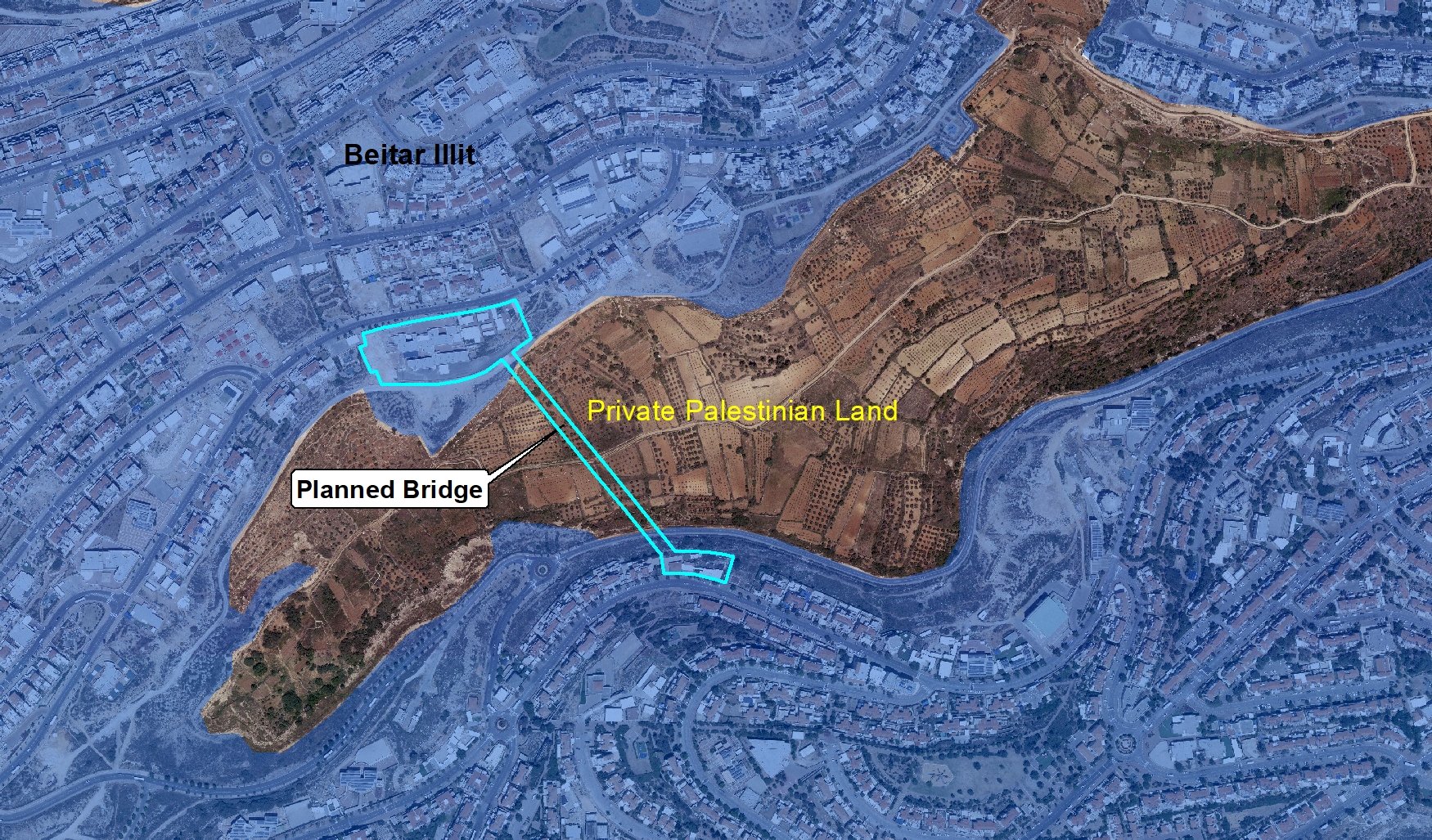
Map by Peace Now
A new pedestrian bridge over privately owned Palestinian land for Israeli settlers to use on the Sabbath (when observant Jews do not drive, and had to walk a long route in order to reach other parts of the settlement).
- 603 new units in Maale Adumim
- A plan to retroactively legalize residential units in the Sde Bar settlement; Peace Now has not yet verified how many units are involved in this plan. Sde Bar was first established as an outpost of the Nokdim settlement in 1998, but Israel granted full approval to that outpost, recognizing it as an educational institute and a full-fledged settlement, in 2005. Settlers recently built a residential neighborhood there without Israeli authorization. The plan approved by the council on April 4th will grant retroactive authorization to those residential settlement units.
- 289 new units in the Alon settlement, located on the Palestinian side of the separation wall within sight of the Khan al-Ahmar bedouin village that Israel is prepared to forcibly relocate. There are plans to expand the neighboring Kfar Adumim settlement to takeover the land where Khan al-Ahmar currently stands.
- 110 new units in the Givat Zeev settlement.
- 108 new units in the Etz Efraim settlement.
- 85 new units in the Karnei Shomron settlement.
Of the total units advanced on April 4th, the High Planning Council also approved for deposit for public review plans for 2,433 new settlement units, the majority of which (1,198) will be built on the east side of the Israeli separation barrier, including:
- 1000 units in Efrat
- A plan to retroactively legalize 720 units in the Haresha outpost. This is part of the Israeli government’s ongoing efforts to retroactively legalize the outpost, which hinges on Israel’s ability to build a legal access road to the outpost. The Israeli government has found several creative solutions to that problem – like building a tunnel or building a bridge – all of which will undoubtedly infringe on the property rights and livelihoods of the Palestinian land owners.
- 210 units in Shiloh – expanding the footprint of the settlement to its north
- 147 units in Ariel.
- 147 units in Mitzpe Yericho.
- 114 units in Elon Moreh.
- 73 new units in Beitar Illit (in addition to the final approvals covered previously).
- 66 units in Oranit.
- 42 more units in Givat Zeev.
- 32 units in Beit Arie.
- 7 new units in Rehelim.
- An unverified number of new units in the following settlements: Paduel, Karnei Shomron, and Elkana.
Peace Now said in response:
“Netanyahu has decided, officially or unofficially, to annex the West Bank to Israel, otherwise one cannot explain the promotion of thousands of units for Israelis in the Occupied Territories. The construction of the settlements only makes it harder to end the occupation and to get to a two states peace agreement and is bad for the Israeli interest to remain a democratic and secured state.”
Housing Ministry Publishes Tenders for 956 Settlement Units
On April 4th the Israeli Ministry of Housing and the Israel Lands Authority met and published tenders for the construction of 956 new settlement units, including commercial complexes; 106 tenders are for plans in settlements east of the separation barrier. These units are in addition to the 3,659 units advanced this week by the Civil Administration’s High Planning Council (discussed above).
The published tenders are:
- 250 units in the Elkana settlement.
- 195 units in the Ariel settlement.
- 118 units in the Ofarim settlement.
- 112 in the Alfei Menashe settlement.
- 111 units in the Oranit settlement.
- 62 in the Adam (Geva Binyamin) settlement, located east of the separation barrier.
- 50 in the Emmanuel settlement.
- 44 units in the Maale Ephraim settlement, located east of the separation barrier.
- 14 units in the Beitar Illit settlement
As Peace Now explains, “some of the tenders are for units that were published in previous tenders but were not sold. The new tenders mean that the government is currently seeking to promote and build those units although failed to do so in the past.”
Ariel Medical School Gets Approval, But Faces High Court Petition
On April 12th, the Israel Higher Education Council voted to approve a new medical school in Ariel University, located in the West Bank settlement of Ariel. This approval contravenes the normal practice of the council, in that it ignores a vote to reject the school by the Higher Education Council’s own professional subcommittee. The medical school is slated to open this fall with significant financing from American casino magnate (and Trump supporter/financial backer) Sheldon Adelson.
However, the High Court of Justice is set to hear a petition regarding the unusual and scandal-ridden process by which the school gained approval at various stages of the planning process. The petition was filed by two Israeli academics – Prof. David Harel of the Weizmann Institute of Science and Prof. Alon Harel of the Hebrew University of Jerusalem – asserting that the approval “casts a heavy shadow on the decision making process in higher education.” It is unclear how the outcome of the petitions might affect the newly approved plan to open the medical school this fall.
Settlers Celebrate Right-Wing Election Victory
Settlers are mostly celebrating the results of Israel’s April 9th elections (in which West Bank and East Jerusalem Palestinians could not vote), which delivered incumbent Prime Minister Netanyahu an opportunity to form and lead the next government.
As has come to be expected, Netanyahu made an 11th hour election pitch by promising to start the process of annexation if he was reelected. Settlers received Netanyahu’s annexation promise and his reelection with predictable enthusiasm. The Yesha Council released a congratulatory statement saying:
“This morning we can say with certainty: In the face of all the campaigns and manipulations, the people of Israel chose the right. The people expressed their loyalty to the Land of Israel and chose in favor of applying Israeli sovereignty over Judea, Samaria and the Jordan Valley. We congratulate Prime Minister Benjamin Netanyahu on his election, and look forward to the establishment of a strong and broad right-wing government. In the next Knesset, too, we will continue to build, expand, legalize and jointly develop Israeli communities in the region.”
Not all settlers believe that Netanyahu will deliver on his promise to annex the settlements, but generally speaking, settlers dismiss the “will he/won’t he” debate (perhaps correctly) as a political decision that does not impact the reality of their presence on the ground.
Peace Now issued a sharp statement on the election results:
“Now the settlement lobby and its re-elected backers in the Knesset are doing what they know best – extorting and manipulating to save Netanyahu from prosecution in exchange for his compliance in working toward annexation. We at Peace Now were never relying on the election to change reality, but rather see grassroots public engagement as the only way to build pressure on the government. Now that Netanyahu has let the annexation genie out of the bag with his pre-election rhetoric, we stand even more equipped to go on the offense by showing fellow Israelis the bleak future the settler lobby and its Knesset backers are leading us, and what viable alternative path Israel can take toward a more prosperous, democratic, secure future.”
AirBnb Reverses Settlement Policy
On April 9th, AirBnB announced that it had reversed its decision to remove rental listings located inside of Israeli settlements in the occupied West Bank, despite previously acknowledging that settlements “are at the core of the dispute between Israelis and Palestinians,” and that the listings there “contribute to existing human suffering.”
AirBnB’s new announcement acknowledges (again) that settlements are “central to ongoing tensions,” but says it will nonetheless continue to allow those listings to remain on their website. Giving a nod to the controversial nature of this decision, AirBnB promised to donate all profits derived from West Bank settlement listings to humanitarian groups, but it conspicuously specified that these will be humanitarian groups working in other parts of the world (as opposed to with the Palestinians).
Omar Shakir, the Israel/Palestine Director at Human Rights Watch – which issued a significant and damning report on the issue of tourism being used to normalize occupation – tweeted in reaction:
“Disappointing @Airbnb decision reverses their stance to fully respect rights. Donating profits from unlawful settlement listings does nothing to remedy ‘human suffering’ they’ve acknowledged causing. By continuing to do business in settlements, they remain complicit in abuses.”
Along with AirBnB’s policy reversal, it settled several lawsuits filed against AirBnB in U.S. courts. FMEP President Lara Friedman tweeted on this important element:
“And just like that, US courts let themselves becomes weapons used to legitimize the violation of intl law, the re-definition of ‘lsrael’ to mean ‘all the land between the river and the sea,’ & the re-definition of ‘anti-Semitism’ to mean ‘refusal to endorse/normalize occupation.’ This is part of a broader trend that very few people are paying any attention to, which is a dangerous mistake. By the time folks wake up it will likely be too late. [link to: https://forward.com/opinion/417058/opinion-the-surprising-new-battleground-in-the-war-against-palestinian/]”
The Center for Constitutional Rights – which recently intervened in the legal cases involving AirBnB – issued a response saying:
“We are dismayed that Airbnb has caved to the legal bullying of Israeli settlers and re-listed properties in illegal settlements in occupied Palestinian territory. Airbnb’s decision reflects an alarming lack of commitment to human rights. When we filed counterclaims on behalf of the Palestinians who actually own the land the listed properties unlawfully sit on, we laid out the international and domestic law violations committed by the settlers, including war crimes and crimes against humanity. In backing down from its decision not to list properties in occupied Palestinian territory, Airbnb is in breach of its international human rights obligations, and is discriminating against Palestinians.”
Amnesty International – which also published a report on the complicity of online rental companies who list properties in East Jerusalem and the West Bank – said in response to AirBnB:
“Airbnb’s decision to continue to allow accommodation listings in illegal Israeli settlements in the occupied West Bank is a reprehensible and cowardly move that will be another devastating blow for the human rights of Palestinians…Airbnb are trying to absolve themselves by stating they will donate the profits from these listings to charity, but that fails to change the fact that by continuing to drive tourism to illegal settlements they are helping to boost the settlement economy. In doing so, they are directly contributing to the maintenance and expansion of illegal settlements, a breach of the Geneva Conventions and a war crime under Rome Statute of the International Criminal Court. Airbnb had a clear opportunity to make the right decision to uphold human rights and use their influence to set a precedent in the tourism industry. Instead, they have chosen to bury their heads in the sand – ignoring blatant evidence that they are helping to fuel violations that cause immense suffering to Palestinians. Airbnb’s reversal demonstrates why we can’t just rely on companies to take the right decisions, and that we need governments to fulfil their obligations by intervening and passing laws obliging their companies to respect human rights.”
U.S. Ambassador Friedman Touts East Jerusalem Settlement Business as “Path to Peace”
U.S. Ambassador David Friedman tweeted his support for the new Rami Levy mall, located in the Atarot settlement industrial zone within sight of Ramallah but inside the security barrier and within Israel’s municipal border, as expanded by Israel after the 1967 war.
Friedman said:
“Great morning at the new Atarot Mall in northern Jerusalem, anchored by a Rami Levy Supermarket. Was given a tour by Rami Levy himself. Israelis and Palestinians working, shopping and doing business together — a simple path to peace!”
FMEP President Lara Friedman tweeted in response:
“Amb Friedman & co’s special notion of peace, based on racist notion that unlike Jews who for 1000s of years refused to forsake their history/narrative, Palestinians will be beaten into submission or bribed into giving up basic human demand for freedom & equal rights.”
When the Rami Levy mall opened in January 2019, FMEP explained:
“The massive new mall is the crown jewel of the shopping empire built by Israeli businessman Rami Levy, who already operates a network of supermarkets in settlements. Like all of Levy’s projects (and settlement industrial zones in general), the new mall is branded as a socially-conscience, ‘coexistence’-building business initiative, with Levy and government officials praising the fact that the new mall will attract both Israeli and Palestinian shoppers and be home not only to Israeli businesses, but to to a few Palestinian-owned/operated businesses as well.”
The ‘coexistence’ argument is dismantled by the Israeli watchdog group Who Profits, which explained:
“The Jerusalem mall would mark a new stage in Levy’s involvement in the occupation economy…[which] began with providing services to Israeli settlers and continued with the exploitation of Palestinians as a cheap labor force in his supermarkets. He now appears to be turning his attention to massive construction projects on occupied Palestinian land and the exploitation of a Palestinian captive market in the East Jerusalem…Rami Levy is in a position that would allow him establish a large mall on “virgin land” because the Israeli authorities have prevented Palestinian businesses from competing with Israelis. Levy’s plan would take advantage of the fact that Palestinians do not have other large-scale retail facilities. A flourishing market in Bir Nabala was destroyed by Israel’s wall in the West Bank. And venturing into West Jerusalem is not an option for Palestinians, most of whom live below the poverty line. Although there is every likelihood that the Israeli authorities will portray Levy’s mall as beneficial to Palestinians, there are important facts to be remembered. Palestinians entering his mall will not be exercising the right of a consumer to informed choice. Rather, they will be captive clients — belonging to an occupied people.”
Bonus Reads
- “Democracy, Israeli Style” (New York Times)
- “Jerusalem is Finally Unified, In Opposition to this Plan” (Haaretz)
Welcome to FMEP’s Weekly Settlement Report, covering everything you need to know about Israeli settlement activity this week.
To subscribe to this report, please click here.
April 5, 2019
- Israel Expected to Advance Nearly 5,000 Settlement Units
- Glassman/Or Sameach Yeshiva Project at Entrance of Sheikh Jarrah Neighborhood Approved for Public Deposit
- Also in Sheikh Jarrah, The Sabbagh Family Receives Another Eviction Notice
- New Settler Bypass Road Gets Go-Ahead After Deadly, Disputed Incident at Huwwara Interchange
- Settlers Are Cultivating Palestinian Farmland Taken by the Construction of Israel’s Separation Wall
- Transportation Ministry Voices New Concern About Elad’s Zipline Project in East Jerusalem
- Yesh Din Issues Authoritative Report on Israel’s “Racist Endeavor” to Retroactively Authorize Outposts
- Al-Haq Report: Israel Appropriated ‘Ein Fara Spring; TripAdvisor Now Promotes It as an Israeli Tourist Destination
- Settler Leader: “Settlements are a Bridge to Socio Economic Peace”
- Bonus Reads
Questions/comments? Email kmccarthy@fmep.org
Israel Expected to Advance Nearly 5,000 Settlement Units
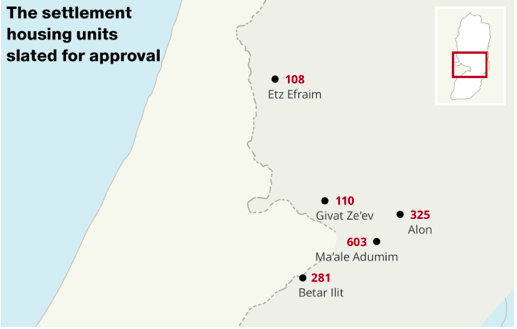
Map by Haaretz
According to reports last week, Israeli planning bodies were expected to meet and advance plans for nearly 5,000 new settlement units at a meeting on April 1st. However, that meeting appears to have been delayed.
Nonetheless, it is worth reviewing the leaked details of the settlement plans slated to be advanced, of which 1,427 are reportedly set to receive final approval from the High Planning Council, including
- 603 new units in the Ma’aleh Adumim settlement just east of Jerusalem;
- 325 new units in the Alon settlement, near the disputed Palestinian village of Khan al-Ahmar east of Jerusalem;
- 108 new units in the Etz Efraim settlement, in the northern West Bank, one of several settlements slated to become a “super settlement” area;
- 110 new units in the Givat Ze’ev settlement just north of Jerusalem;
- 281 new units in the Beitar Illit settlement.
A subcommittee of the Israeli Civil Administration was also set to meet on April 1st (no press reports indicate that the meeting actually happened), and was expected to advance plans for 3,474 new settlement units for public deposit, an earlier stage of the settlement planning process (reminder: all stages of the settlement planning process are significant, as each step through the publication of tenders is a political act of the Israeli government). The plans slated to be approved for public deposit include plans in settlement across the West Bank, reportedly include the following settlements:
- Elon Moreh, located east of Nablus in the central West Bank;
- Karnei Shomron, in the northern West Bank;
- Elkana and Oranit, which along with Etz Efraim, are slated to become a part of a “super settlement” area;
- Ariel in the central West Bank;
- Beit Aryeh northwest of Ramallah;
- Shiloh in the central West Bank;
- Talmon north of Ramallah.
- Peduel, in the northern West Bank but on the Israeli side of the separation barrier; and,
- Mitzpeh Yericho, just west of Jericho.
Glassman/Or Sameach Yeshiva Project at Entrance of Sheikh Jarrah Neighborhood Approved for Public Deposit
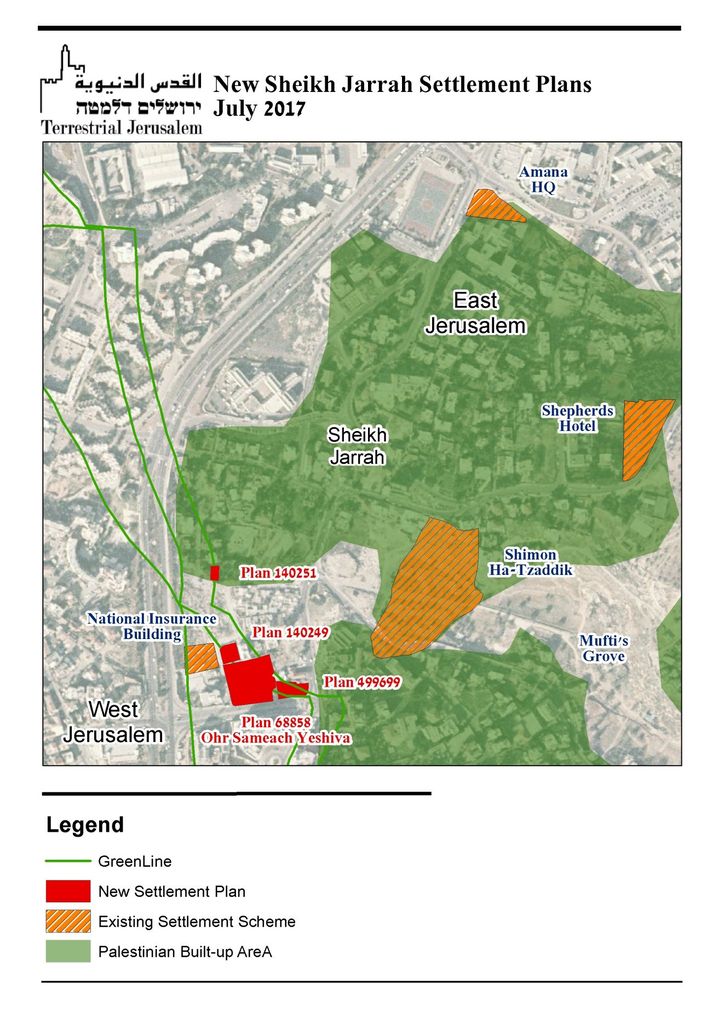 On April 2nd, the Jerusalem District Planning and Building Committee approved the Glassman/Or Sameach yeshiva project for public deposit. The plan, as FMEP has repeatedly covered, seeks to build a Jewish religious school (a yeshiva) at the entrance of the Sheikh Jarrah neighborhood of East Jerusalem. The yeshiva is one of several settlement projects set to flank the road leading into the Sheikh Jarrah neighborhood, designed to strengthen Israeli settlers’ hold on the neighborhood and seamlessly connect the growing settler enclave in Sheikh Jarrah with West Jerusalem.
Ir Amim warns and explains:
“[The Glassman/Or Sameach yeshiva] plan should be seen as an alarm bell in the context of Israel’s ramped up efforts to deepen its circle of control around the Old City Basin. The plan (Plan No. 68858) calls for construction of an eleven-story building with eight levels above ground and three below, including a dormitory for hundreds of students and housing for faculty, to be located at the mouth of Sheikh Jarrah. It was submitted by the Ohr Somayach Institutions, to which the Israel Land Authority has already allotted land without a transparent tender process, and approved for deposit by the District Planning and Building Committee in July 2017.”
In a detailed report on the Glassman yeshiva project, Terrestrial Jerusalem described it as:
“a clear effort to exploit Torah study to expand and normalize occupation in East Jerusalem (including by making the site politically untouchable, as it will now be linked with religious activities).”
Also in Sheikh Jarrah, The Sabbagh Family Receives Another Eviction Notice
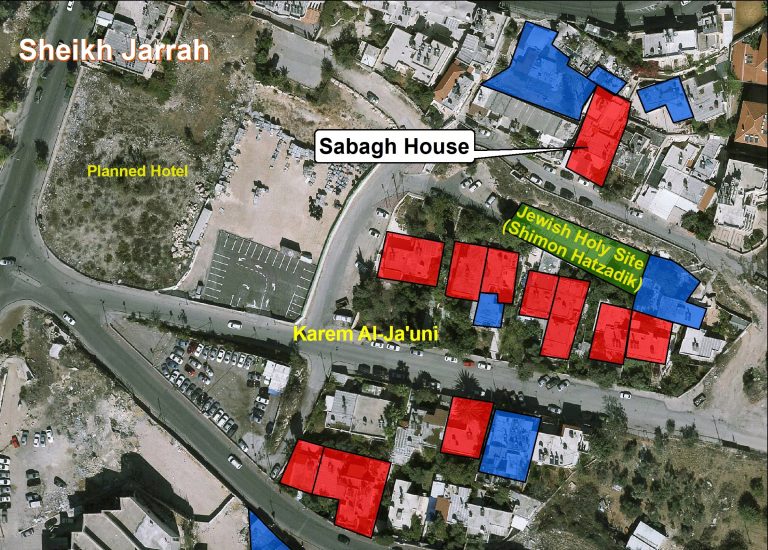
Map by Peace Now
On March 31st, the Palestinians Sabbagh family was handed another eviction notice, weeks after Israeli authorities rejected the family’s latest petition to reconsider the legal authority by which settlers are seeking to evict them from their home of 60+ years. Peace Now reports that the Sabbagh family is still attempting to delay their eviction, but is unlikely to succeed.
In a comprehensive briefing on the Sabbagh family’s protracted legal struggle, Ir Amim and Peace Now write:
“Increasingly, settler initiated, state-backed evictions of Palestinian families are being used as a strategy to help cement Israeli control over the area. Given their strategic location as gateways to the Old City, Sheikh Jarrah to the north of the Old City and Silwan to the south are the two neighborhoods under greatest pressure from Israeli settler groups. Some 150 families in these two areas alone are under threat of eviction…The Sabbagh family is only the latest family threatened with eviction in the Kerem Alja’oni section of Sheikh Jarrah. If evicted, their home will be the tenth to be seized by settlers. Roughly 30 Palestinian families are under threat of eviction and at least eleven have open court cases. Those cases were suspended pending the Supreme Court decision on the Sabbagh case; the recent removal of that stopgap could usher in a wave of new evictions. On the other side of Nablus road, in the Um Haroun section of Sheik Jarrah, an additional 40 or so families face the threat of eviction.”
New Settler Bypass Road Gets Go-Ahead After Deadly, Disputed Incident at Huwwara Interchange
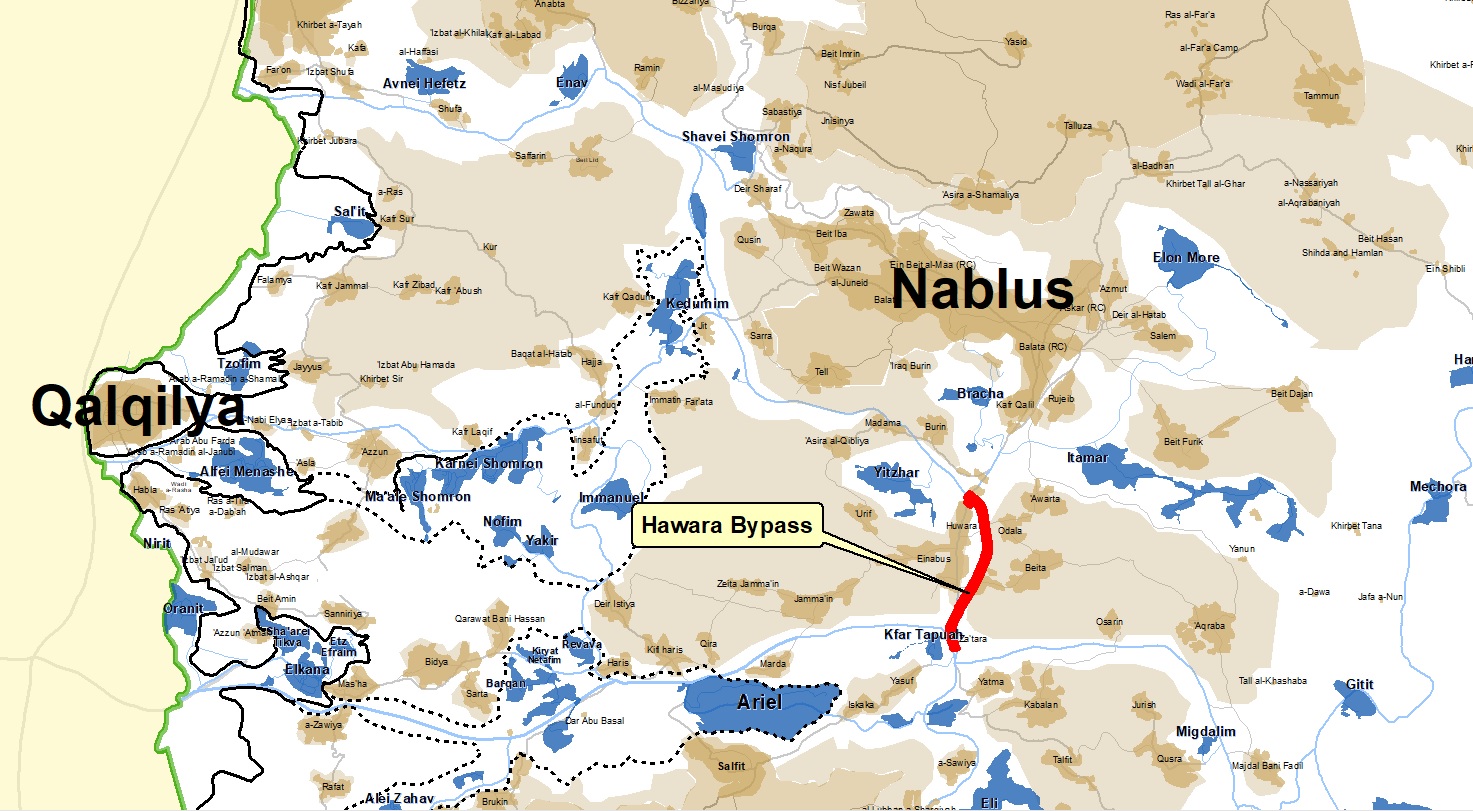
Map by Peace Now
The Israeli Defense Ministry announced that it approved the construction of a new bypass road to divert settler traffic around the Palestinian village of Huwwara. The new road will allow settlers to avoid the Huwwara interchange, a perpetually congested section of the main West Bank highway, Route 60, and an area that has been a site of Palestinian violence against the settlers, including a recent incident where a settler shot and killed a Palestinian teenager allegedly attacking the settler. Dubbed the “Huwwara Bypass,” the new road will be built on land historically a part of the Palestinian villages of Huwwara and Beita, which Israel seized for security reasons.
This road is one of five new bypass roads that Prime Minister Netanyahu promised to build under immense pressure from the settler lobby, known as the Yesha Council. It was one part of a massive security package that the Netanyahu government funded to the tune of $228 million in 2017. Peace Now detailed each of the five bypass roads slated for construction, and wrote:
“The planned roads…are meant to serve settlements located deep in the West Bank, which will not be a part of Israeli in the framework of an agreement according to the Geneva Initiative’s proposed border.Historically, the paving of bypass roads has led to an acceleration of the development of the adjacent settlements…Additionally, paving new roads in the West Bank entails the confiscation of private Palestinian lands. All of the roads are built due to needs of settlers rather than the needs of the Palestinians. In certain cases the roads can also be useful for Palestinians, but the majority of these roads are hardly used by Palestinians at all. This fact puts into question the Israeli legal argument behind the confiscation, as according to international law, the confiscation of lands must serve the local population, meaning the Palestinians.”
Transportation Ministry Voices New Concern About Elad’s Zipline Project in East Jerusalem
An official from the Israeli Transportation Ministry voiced reservations regarding the Elad settlement organization’s request to re-zone the “Peace Forest” as a “public use space” in order to allow for the construction of its zipline project there. At a meeting on April 1st (a previous meeting was covered by FMEP last week) to consider the request, a transportation official expressed concern that the project is a private commercial endeavor, not a public use project – meaning that the project might not be legal even if the forest were to be re-zoned for public use. The official said:
“[A zipline] constitutes commercial use: It’s not going to be operated by the municipality or a youth group. This alone is a reason not to approve the plan.”
The Haaretz report on the April 1st meeting also provides historical context on Elad’s illegal activities in the “Peace Forest” (which was established by the Jewish National Fund on privately owned land in East Jerusalem following the 1967 war) over the past 14 years. Haaretz writes:
“At first the NGO simply trespassed and built illegal structures there. But things changed and gradually various local and national bodies – including the Jerusalem Municipality, the Israel Land Authority, the Tourism Ministry and the JNF – began to grant Elad assistance. This assistance has included granting building permits retroactively, allocating land to the group without a proper bidding process, and generous funding to the tune of tens of millions of shekels…Most of Elad’s current focus is on managing and developing the City of David National Park in the Palestinian neighborhood of Silwan, and purchasing homes for Jews from the Arabs living there. But the NGO isn’t neglecting its other projects: It has been sponsoring activities in the Peace Forest since 2005, despite the fact that it has no ownership rights there or permits from the ILA (the legal owner of the land, which was expropriated from private Palestinian owners). These activities are essentially expanding Elad’s reach from Silwan into the entire historic basin of Jerusalem’s Old City, from the Mount of Olives to the Armon Hanatziv promenade (which actually consists of several different walkways, projects of the Jerusalem Foundation).”
Settlers Are Cultivating Palestinian Farmland Taken by the Construction of Israel’s Separation Wall
For the past six years, Israeli farmers have been farming Palestinian land that was left on the Israeli side of the separation barrier, an area Palestinian landowners are largely barred from entering.
When the separation wall was constructed in the early 2000s, it confiscated 35,000 acres (140,000 dunams) of Palestinian land as a result of its circuitous route that snakes deep inside of the West Bank. The land between the wall and the 1967 Green Line is commonly referred to as the “seam zone.”
Kerem Navot founder Dror Etkes – who obtained aerial photography documenting settler activity in the area – explained:
“One of the same plots to which landowners are barred from entering is located west of the Palestinian village of Nuba, about 15 kilometers northwest of Hebron. Nearly half of the village’s land was lost in 1948 because it remained west of the Green Line, and with the construction of the separation barrier in the area from 2005-2006, residents lost another 1,000 dunams that remained on the other side of the barrier. Although there’s an agricultural gate on site that was supposed to be used by landowners to reach their territory to the west, their entry has not been possible since the barrier was constructed. This ‘vacuum’ was identified by the ‘Mateh Yehuda Agricultural Association,’ which cultivates vast swaths of land that were transferred to Israeli moshavim in the area, including those west of the Green Line. After a few years in which the villagers didn’t access their land, the Agricultural Association decided that it was time to take over of one of the wadis in the area.”
Etkes separately told Haaretz:
“This story allows a peek into the jungle Israel created in areas left between the barrier and the Green Line. This area, called ‘the seam’ by Israel, is gradually becoming a looting ground for anyone who can grab a plot while exploiting a reality in which tens of thousands of West Bank residents are unable to reach their lands. All this proves that the route along which the barrier was built passes mostly through the West Bank, serving political interests, as anyone with eyes in his head saw and understood as the barrier was being built.”
Yesh Din Issues Authoritative Report on Israel’s “Racist Endeavor” to Retroactively Authorize Outposts
In a new report, the Israeli NGO Yesh Din analyzes the legal pretexts Israel has created to systematically legalize outposts across the West Bank that were built in contravention of Israeli law and on privately owned Palestinian land.
The report reviews and rebutts the findings of the “Zandberg Report” – which (approvingly) outlined various legal tactics and tools the state can use to save those outposts.
Yesh Din found that the Zandberg Report’s recommendations allow for 99% of all unauthorized outposts to be retroactively approved within 2-3 years, anticipating that the government will declare 20 new settlements in the process.
Yesh Din’s report also examines how Israel has already undertaken the first step in this effort, by introducing the “market regulation” principle into the courts. If validated by the courts, the “market regulation” principle will provids legal cover to ‘regularize’ 2,700-3,000 illegal structures built on privately owned Palestinian land.
Yesh Din writes:
“The Zandberg Committee aids a racist endeavor whose essence is the dispossession of Palestinians from their land on the basis of ethnicity. The euphemisms used in the report and the legal terminology it employs do nothing to hide the fact that the ‘Regularization Committee’ report is, in fact, an expropriation report which provides the government more methods for normalizing and deepening the iniquity of Israel’s settlement policy: one area, the West Bank, with two populations – privileged Israeli citizens and Palestinians living under military rule, dispossessed and oppressed.”
Analyzing the Zandberg Report as an alternative to the settlement “Regulation Law,” Yesh Din states:
“The Zandberg Committee seemingly offers a more restrained framework for ‘regularization’ or retroactive authorization that purports to be less injurious than the ‘Regularization Law’ and relies on legal doctrines. In truth, however, the report cloaks landgrab, dispossession and expropriation on an extremely large scale – approaching that of the Regularization Law – in a shroud of legality.”
Al-Haq Report: Israel Appropriated ‘Ein Fara Spring; TripAdvisor Now Promotes It as an Israeli Tourist Destination
Al-Haq, the preeminent Palestinian human rights group, published a report documenting Israel’s appropriation of the ‘Ein Fara spring, located on the lands of the Palestinian village of Anata northeast of Jerusalem. The spring historically served as the primary source of drinking water and agricultural water for Anata and several surrounding villages.
Since 1967, Israel has appropriated the spring and its waters, and built five settlement on the surrounding land.
Israel renamed the spring the “En Prat Nature Reserve” and promotes religious tourism at the site, as does TripAdvisor.
Al-Haq writes:
“The appropriation of village lands, confiscation of water resources and continued denied access to Palestinians violates the right to self-determination, further breaches the prohibition of discrimination, the right to life including the duty to ensure access to water, the right to water, the rights of freedom of movement, the right to a livelihood, and cultural rights related to the integral use of the ‘Ein Fara spring to communal village life. Al-Haq reminds that Trip Advisor is advertising ‘En Prat Nature Reserve’ a settler tourism service, on its internet platform. Al-Haq stresses that Trip Advisor is providing an economic service for the benefit of Israeli settlements, which may amount to an involvement in settlement related activities.”
Settler Leader: “Settlements are a Bridge to Socio Economic Peace”
Writing in the Jewish News Syndicate, Yochai Dimri (chairman of Har Hevron Regional Council) makes a pitch for the Israeli public and elected officials to drop hopes of a “peace deal” in favor of socio-economic “co-existence” initiatives that normalize the settlements.
As FMEP has documented, this message lines up exactly with the activities and priorities of the Trump Administration, particularly with Amb. David Friedman who has been in partnership with the Har Hevron Regional Council to promote the Judea and Samaria Chamber of Commerce as an Israeli-Palestinian business cooperative.
In a piece entitled – “Settlements are a Bridge to SocioEconomic Peace” – Dimri writes:
“The Barkan Industrial Park near Ariel is an outstanding model for collaboration between Jews and Arabs, and is the wellspring of local employment for both populations. A similar industrial area in Har Hevron is currently in the planning stages, and flourishing businesses and factories are expected to be established there to benefit the residents of Har Hevron and the Negev…The need of the hour is to expand collaborations to include health, education and other necessary areas as well—not through international initiatives, but through Israeli ones. Once Israel learns to view the settlement communities in Judea and Samaria as an asset and not a liability, as an impetus for change and not a roadblock, it will discover that they are not an obstacle to peace, but rather a bridge to achieving economic and social peace.”
FMEP’s Lara Friedman reacted to this notion in a recent op-ed:
“Last October, Friedman participated in a public event convened in the settlement of Ariel. The event, which featured Israeli settlers and a handful of Palestinians, promoted the view that the key to peace is not political agreements or negotiations. Rather, peace would come from economic and business cooperation between Palestinians (living under Israeli occupation, governed by Israeli military and military law designed to promote the interests and needs of Israel, entirely disenfranchised from the powers that control their lives) and settlers (living in settlements built on land taken from Palestinians, enjoying all the entitlements and protections of Israeli citizenship and law, and with representatives and allies at every level of Israeli government). This approach, not coincidentally, exemplifies a vision of ‘peace’ based on promises of improved quality of life for individual Palestinians, de-coupled from any pretense of helping Palestinians end an occupation that the United States no longer believes to exist, or achieve national self-determination that the United States no longer supports. Tweeting about that event, Friedman suggested that this kind of cooperation was precisely the kind of opportunity that the Palestinian people truly want and could have, if only their leadership would listen.”
Bonus Reads
- “How Israel is Working to Remove Palestinians from Jerusalem” (The National)
- “Annexation Will Free Israel from the Fake Commitment to Liberty and Equality” (Haaretz)