Welcome to FMEP’s Weekly Settlement Report, covering everything you need to know about Israeli settlement activity this week.
To subscribe to this report, please click here.
July 6, 2023
- Israel Advances Plans for 5,700 New Settlement Units, Making 2023 (after just 6 months) A Record Year for Settlement Growth
- No Surprise – Settlers Get Away with More Illegal Construction Under Smotrich
- UN Updates Database of Companies Doing Business in the Settlements
- Peace Now Report on Effect of Smotrich’s “Settlement Administration”
- Who Profits Documents Role of Israeli National Water Company in Perpetuating Occupation
- Bonus Reads
Knesset Members Establish “Jordan Valley Sovereignty Lobby”
Settlers continue to build on their campaign to annex the Jordan Valley. At an event held at the Knesset on June 28th, a group of Israeli lawmakers launched the “Jordan Valley Sovereignty” lobby, aimed at passing legislation during the current Knesset term that will annex the Jordan Valley to Israel. Three ministers participated in the event, Minister of Agriculture Avi Dichter, Minister of Settlement and National Mission Orit Struk, and Minister of the Negev and Galilee and National Resilience Yitzhak Wasserlauf. The effort was encouraged on by the head of the World Zionist Organization, Yaakov Hagoel, who said: “We need to implement sovereignty…the sooner the better,”
The group, led by MKs Dan Illouz (Likud) and Yossi Taieb (Shas), presented a plan for annexation written by Kobi Eliraz and Atty. Eran Ben-Ari. No details of the plan have been reported. Eliraz previously served as an adviser on settlement affairs to the Israeli Defense Minister from 2015-2019, but was fired by Prime Minister Netanayhu, a move which upset settlers who broadly respected and trusted Eliraz to advance their agenda.
Minister of Settlement and National Missions Orit Struk said at the event:
“Our government is doing a great deal to develop the Jordan Valley in many areas, but our goal, ultimately, is sovereignty over the Jordan Valley, and this is anchored in the coalition agreements; it all depends on this lobby’s resolute action, and I trust you to act in such a way that they will set the wheel in motion so that it will be impossible not to apply sovereignty over the Jordan Valley. We will be here to support you and stand behind you so that you will succeed in this goal, G-d willing.”
Head of Jordan Valley Council David Elhayani said:
“In December 1981, the Begin government approved, in one day, in three readings in the plenum, the law applying Israel’s law and jurisdiction over the Golan Heights, when the government actually established sovereignty over the Golan Heights. The law passed with a majority of 63 members of the Knesset, eight of whom were members of the opposition. In today’s situation, I cannot help but wonder why this is not happening now. In the present government, there are 64 members of the Knesset from the Right; it is years since we have had such a right-wing government committed to its electorate. I tell you, do not miss this historic opportunity. Apply sovereignty over the Jordan Valley in the present Knesset. This is your duty.”
As a reminder, annexation of the Jordan Valley has, in the past, garnered serious effort from the Israeli government. During his 2019 campaign, Netanyahu announced that he would immediately annex the Jordan Valley if reelected, and presented an error-ridden map explaining how he would annex the area without annexing a single Palestinian. His plan called for the annexation of an area which constitutes nearly a quarter of the area of the West Bank (22.3%) where (at the time) 30 settlements and 18 outposts had been established. Peace Now estimated 20% of the targeted land (62,000 acres) is privately owned by Palestinians – a fact that Netanyahu did not even mention, much less explain how he would address. After being elected, Netanyahu faced international opposition to the plan, and in order to quiet the criticism while saving face with his base – Netanyahu formed an inter-ministerial task force dubbed the “Sovereignty Committee” to design a plan for the annexation of the Jordan Valley.
No Surprise – Settlers Get Away with More Illegal Construction Under Smotrich
Haaretz reports that ever since Bezalel Smotrich became responsible for civil affairs in the West Bank, the Israeli military has almost entirely abandoned its already paltry efforts to curtail illegal settlement construction. In 2022, Israeli authorities demolished an average of 25 buildings per month, but since February 2023 (when Smotrich took power), that figure dropped to just 2. The trend is hardly a surprise, given Smotrich’s long standing support for the outposts, and his open encouragement of granting retroactive legalization to every outpost (thereby rewarding illegal settler construction instead of punishing it) since taking office.
Since taking power, Smotrich has routinely also intervened on a number of occasions to prevent the IDF from carrying out outpost evacuations, most recently in the case of the outpost called HaMor. Haaretz reports Smotrich also intervened in several other cases in order to stop the IDF from evacuating and demolishing illegal settler construction, including:
- In February 2023, Smotrich temporarily halted the evacuation of a vineyard near the settlement of Shiloh.
- In May, Smotrich stopped the demolition of new illegal construction at the Adei-Ad outpost.
- Also in May, the demolition of a structure that settlers built at the Ein Rashash spring in the Jordan Valley was stopped by Smotrich’s associates, a structure which was likely built by the settlers in an attempt to take over control of the spring from Palestinian shepherds.
An anonymous official in the Defense Ministry told Haaretz:
“For a while now, there has effectively been no Israeli enforcement. Once, enforcement was an internal IDF issue. Now almost everything gets sent to the Settlements Administration.”
As a reminder, in February 2023, Netanyahu reached a coalition deal to change the way Israel exercises authority over the West Bank. The new arrangement represents the extension of Israeli civilian/domestic authority over the entire West Bank. As such, it represents Israeli annexation of the West Bank, even without formal declaration of annexation. Specifically, authority in the West Bank will no longer be the hands of the Isareli Defense Minister, but is now split between Defense Minister Yoav Gallant and Finance Minister Bezalel Smotrich (acting in his capacity as a “Minister in the Defense Ministry”). While the agreement takes pains to leave a tiny amount of power over West Bank civilian affairs with the Defense Minister in order to maintain a thin veneer of compliance with international law (the only authority left to Gallant with respect to “civilian” affairs will be to demolish illegal settler activity “in case of security and irregular events,” and even then, Smotrich must be given advance notice of any such demolition), in effect Smotrich is the new reigning sovereign over the West Bank via the newly established “Settlement Administration” within the Defense Ministry, which he appointed Yehuda Eliahu to lead (Eliahu and Smotrich co-founded the radical settler group Regavim) . This “Settlements Administration” enjoys virtually total autonomy and unchecked power, with almost no accountability to anyone in the Israeli Ministry of Defense (Gallant in principle can overrule Smotrich’s decisions but must put his reasoning in writing after first meeting with Smotrich to hear his case, and even then, Gallant cannot issue any order to overrule Smotrich). Importantly, the agreement allows Smotrich to systematically apply Israeli law over the settlements.
UN Updates Database of Companies Doing Business in the Settlements
On June 30th, the United Nations Office of the High Commission on Human Rights released an update to its 2020 database identifying businesses involved in building, maintaining, securing, and servicing Israeli settlements in the West Bank, East Jerusalem, and the Golan Heights. The original database listed 112 companies found to be conducting business with Israeli settlements, the updated database removed 15 companies and did not add any new companies.
In a statement on the update, Al-Haq, Amnesty International, Cairo Institute for Human Rights Studies, Human Rights Watch, and International Service for Human Rights said:
“…we welcome the fact that the Office of the High Commissioner has finally published an update on 30 June. We are heartened to see that, according to the report’s analysis, fifteen businesses may have ceased conducting reportable activity during the reporting period, though note that some companies may have adjusted their business structures to avoid falling within the definition of reportable activity. Indeed, this demonstrates the significant impact the database can have in encouraging and promoting compliance with international law. We are concerned, however, that the Office of the High Commissioner has not undertaken the work to identify new businesses that began, during the reporting period, to conduct reportable activity. Such a one-sided approach is not consistent with the mandate of providing a comprehensive update to the Council and runs the risk of being abused by business actors seeking to avoid listing.”
As a reminder, on February 12, 2020, following nearly four years of delay, the UNHRC published a (non-comprehensive) database of businesses involved in building, maintaining, securing, and servicing Israeli settlements in the West Bank, East Jerusalem, and the Golan Heights. The database was requested by members of the Council in March 2016, in order to assist member states in complying with international legal obligations with regards to doing business with companies involved in activities which violate the human rights of people around the world.
Peace Now Report on Effect of Smotrich’s “Settlement Administration”
Peace Now has published a new report that reveals the exact details of the agreement signed by Bezalel Smotrich, Yoav Gallant, and Netanyahu to create the new “Settlement Administration” for Smotrich to take control over settlement affairs. The extent of Smotrich’s power has until now been unclear, but as Peace Now writes there is a larger significance to the establishment of this new body which wields such vast authority, writing:
“…beyond the personal question of who is responsible for the mechanism and who will implement it, and what their political obligations are, the establishment of the Settlements Administration is not merely a symbolic or political process but instead constitutes as annexation of the oPt and their direct management by the Israeli government. Moreover, it involves a nationally-based separation within the same governing entity between Israeli settlers, who are managed by one body, and Palestinian residents, who are managed by another body. This is one of the characteristics of an apartheid regime.”
The report – entitled “Annexation Under the Radar: The Establishment of the Settlements Administration under Minister Bezalel Smotrich” – is available online.
Who Profits Documents Role of Israeli National Water Company in Perpetuating Occupation
In a new report entitled, “Dried Up: Mekorot’s Involvement in the Israeli Occupation”, Who Profits examines the role Israel’s nationa water company plays in facilitating the dispossession and displacement of Palestinian communities on both sides of the Green Line, and its role in facilitating settlement expansion in service of an Israeli water sector contingent on the exploitation of occupied natural resources, and the violation of Palestinian and Syrian rights.
Who Profits writes:
“Israel’s national water company, Mekorot, is a central facilitator of this embedded dispossession, systematically denying adequate Palestinian access to water, leading to structured dependency and the captivity of the Palestinian water sector. In a world increasingly concerned by the disastrous impact of global warming and water scarcity, Mekorot plays an integral role in the development of the Israeli occupation economy by positioning Israel as a global leader in the development of innovative technological solutions to global issues.”
Bonus Reads
- “73 Home Demolitions in East Jerusalem for First Half of 2023 Mark Highest Number since 2018” (Ir Amim)
- “Israeli settlers burn Palestinian crops in Hebron: PA” (Al-Monitor)
- “US Embassy invites Binyamin Council head to July 4 celebration” (Arutz Sheva)
Welcome to FMEP’s Weekly Settlement Report, covering everything you need to know about Israeli settlement activity this week.
To subscribe to this report, please click here.
June 23, 2023
- Smotrich Receives Near Unilateral Power Over Shortened Settlement Planning Process
- Israel To Advance Plans for 4,799 New Settlement Units, Including Retroactive Authorization of an Outpost
- Netanyahu Announces 1,000 New Units for the Eli Settlement in “Response” Palestinian Attack
- Settlers Reoccupy Evyatar Outpost As Netanyahu Reportedly Decides to “Legalize” It & Ben Gvir Encourages More Illegal Settlement Activity
- With Assistance from IDF, Settlers Establish a New Outpost Near Eli
- Settler Violently Rampage Across West Bank with Little to No Repercussion
- Eviction of Palestinian Ghaith-Sub Laban Family Scheduled
- Bonus Reads
Smotrich Receives Near Unilateral Power Over Shortened Settlement Planning Process
On Sunday, June 18th the Israeli Cabinet approved a measure that immediately expands Bezalel Smotrich’s authority over construction in existing settlements by significantly shortening the planning process and removing almost any role for Israeli politicians in that process, a lever which – for decades – has been utilized by successive Israeli governments to intervene in settlement planning usually in consideration of pressure from the international diplomatic community. Under the new procedures, political approval is only needed once at the very beginning stage of the planning process, whereas for the past three decades political approval was needed at each and every phase.
In Haaretz, Israel lawyers Ronit Levine-Schnur and Michael Saliternik explain:
“The requirement of the defense minister’s approval at each stage reflected the understanding that settlement construction, which is illegal under international law, has major legal, diplomatic and security implications. This requirement enabled government officials to halt or postpone construction in the settlements based on the changing political and security situation, and sharpened the distinction between construction within the state’s sovereign borders and construction on occupied land under Israel’s temporary military control….This week’s decision…is designed to prevent or significantly reduce not only the government’s but also the public’s and international community’s oversight of settlement construction.”
Removing the role of political figures surrenders the power of settlement planning and construction to an avowed annexationist whose agenda, at least in part, is to double the number of settlers while further entrenching Israeli domestic rule over settlers and leaving Palestinians under Israeli military rule. The Israeli Cabinet decision advances both of these goals: it differentiates settlement planning from planning for Palestinians (which remains a more complicated political-bureaucratic process in which Smotrich and Defense Minister Gallant both have power); and, as Smotrich and his allies are framing it, this procedural change “normalizes” the laws governing settlers by aligning them with Israeli domestic rule. In the words of Peace Now, “From a planning perspective, there is no difference between the Tel Aviv district and the ‘Judea and Samaria’ district, except for the initial decision by Minister Smotrich.”
The change is celebrated by settler leadership. Yisrael Gantz, head of the Benjamin Regional Council, said:
“This government resolution brings the residents of Judea and Samaria to the regular situation of the entire State of Israel,” said Gantz, using the biblical name for the West Bank region. “This step will turn construction in the settlements into something that is not newsworthy but rather, routine.”
Yossi Dagan, head Head of the Samaria Regional Council, said:
“We must stop treating residents of Judea and Samaria as second-class citizens. It’s unthinkable that only residents of Judea and Samaria need approval from the political echelon in order to build a home or a kindergarten.”
It’s worth re-sharing the latest legal analysis and commentary arguing that Israel has, even without a formal declaration, annexed the West Bank via bureaucratic transformations such as this: “A Theory of Annexation” (Berda, Meggido, & Levin-Schner, January 2023 – SSSN); “Israel is Officially Annexing the West Bank” (Sfard, June 2023 – Foreign Policy); and, “Israel’s Annexation of the West Bank Has Already Begun” (Scheindlin & Berda, June 2023 – Foreign Affairs); “This Decision by Israel Is as Dramatic as Attempts at Constitutional Change” (Levine-Schnur & Saliternik, June 2023 – Haaretz)
Peace Now further comments:
“The implication of this decision is that once Minister Smotrich decides and approves the advancement of construction plans in West Bank settlements, the plans will go directly to the planning committees in the West Bank (the Higher Planning Council), and the political and military echelon will have no authority to delay or influence the planning stages or the submitted plans. This process will allow unrestricted construction in the West Bank, disregarding security and diplomatic considerations, and perpetuating de facto annexation in the West Bank.”
The Haaretz Editorial Board writes:
“The settlers’ patience has paid off. After 27 years, they have managed to bring about a change in the way the system operates. The government decided to give a messianic settler, one who favors Israeli sovereignty over the entire Land of Israel and supports Jewish supremacy, the power to speed up construction in the settlements…Smotrich and the settlers understood very well that Netanyahu’s utter dependence on the extreme right opened a historic window of opportunity for them, and they are exploiting every moment of it to take over more and more Palestinian land to build, alter the area irreversibly and entrench one large apartheid state between the Jordan River and the Mediterranean Sea. The crisis that Israel is mired in is a golden opportunity for the settlers and their destructive project.”
Israel To Advance Plans for 4,799 New Settlement Units, Including Retroactive Authorization of an Outpost
On the same day Smotrich was awarded new power to oversee settlement construction, the Israeli High Planning Council published an agenda for its June 26th meeting outlining plans for 4,799 settlement units which will be advanced, to include plans which would have the effect of retroactively legalizing the Palgei Maim outpost as a neighborhood of the Eli settlement. The June 26th meeting will be the second time the High Planning Council convenes this year, and could bring the total number of settlement units advanced in 2023 to 12,149 – – nearly three times more than in the entire 2022 year (4,427 units). Smotrich – who now has near unilateral authority over construction planning for settlements – gloated in a statement saying that 2023 has set “a record for the rate of settlement construction [planning] in the last decade” and:
“The construction boom in Judea and Samaria and in all parts of our country continues. As we promised, today we are advancing the construction of thousands more new units in Judea and Samaria… We will continue to develop the settlements and strengthen Israel’s hold on the territory.”
Peace Now said in a statement:
“The Israeli government is advancing us at an unprecedented pace towards the annexation of the West Bank. The promotion of nearly 5,000 housing units, including the authorization of a settlement in the heart of the West Bank, joins a series of destructive decisions that the government has advanced, including yesterday’s decision granting exclusive power to Minister Smotrich for promoting settlements in the occupied territories. As the world remains silent and public attention is focused on preventing the judicial coup, the government is rushing towards an annexation coup turning Israel into an apartheid state.”
Of the total number of units on the agenda, 1,434 units are set for final approval, including:
- Carmel – 42 units, expanding construction in the settlement towards the southeast. This settlement is located in the South Hebron Hills, where Palestinians are facing ongoing displacement and forcible relocation.
- Elkana – 351 housing units. Elkana is located in the northern West Bank in an area where the Israeli separation barrier cuts deeply into the land in order to keep settlements on the Israeli side of the barrier.
- Givat Ze’ev – three plans totalling 642 units. Givat Ze’ev is located north of Jerusalem.
- Revava – 399 housing units. Revava is located west of the Ariel settlement in the heart of the northern West Bank.
Of the total, 3,306 units will be approved for deposit (an earlier stages of the planning process):
- Adora – 310 housing units. If approved, this will triple the size of the Adora settlement. Adora is located west of Hebron.
- Beitar Illit – a total of 312 units in three plans. Beitar Illit is located west of Bethlehem.
- Eli – 142 units.
- Etz Efraim – 264 units in two plans. Etz Efraim is located near the Elkana settlement in the northern West Bank in an area where the Israeli separation barrier cuts deeply into the land in order to keep settlements on the Israeli side of the barrier.
- Givat Ze’ev – 228 units. Givat Ze’ev is located north of Jerusalem.
- Halamish (also called Neve Tzuf) – 330 units, which will significantly expand the Elisha “neighborhood” of the settlement, which began as an outpost that was retroactively legalized in 2015 as a neighborhood of Halamish. If approved, this will more than double the size of the Halamish settlement. Located between Ramallah and the Ariel settlement in the northern West Bank.
- Hashmonaim – 150 units. Hashmonaim is located just over the 1967 Green Line, west of the Modin Illit settlement in the northern West Bank.
- Karnei Shomron – 104 units in two plans. Karnei Shomron is located in the northern West Bank, east of the Palestinian village of Qalqilya. Israel has openly declared its intention to continue expanding settlements in this area with the stated goal of bringing 1 million settlers to live in the area.
- Ma’ale Adumim – 340 units. Located east of Jerusalem.
- Ma’ale Amos – 152 units. If approved, this will more than double the size of the Ma’ale Amos settlement, which is located between Bethlehem and Hebron.
- Metzad (Asfar) – 78 units.
- Kiryat Arba – 120 units. Located just outside of Hebron.
- Migdalim – 184 units. Located in the extreme south of the West Bank.
- Palgei Maim outpost – 347 units located within the Palgei Maim outpost. This plan will have the effect of retroactively legalizing the outpost as a neighborhood of the Eli settlement
Netanyahu Announces 1,000 New Units for the Eli Settlement in “Response” Palestinian Attack, Bringing Outpost Legalization Total to 3 This Week
In response to the murder of four Israelis by Palestinian gunmen near the settlement of Eli on June 21st, the Israeli government announced that it is advancing plans for 1,000 new settlement units in Eli, which come in addition to the 499 units expected to be advanced by the High Planning Council at its meeting next week (see the above section). The decision was made by Prime Minister Netanyahu, Defense Minister Gallant, and Finance Minister Smotrich. The trio said in a statement:
“Our response to terror is to hit it hard and build in our land.”
According to Peace Now, the plans for 1,000 units announced by Netanyahu include three discrete schemes, inlcuding two plans to grant retroactive legalization and add hundreds of units in two outposts associated with Eli – HaYovel and Nof Harim. The third plan is for a new neighborhood in the Eli settlement consisting of 650 units. Recall that that part of what the High Planning Council is expected to advance next week is a plan to retroactively legalize and expand yet another outpost of the Eli settlement, called Palgei Maim outpost, meaning that the Eli settlement could see three of its outposts legalized soon. Peace Now comments on the totality of plans to expand the Eli settlement:
“The implication of the government’s decisions in the past week is the doubling of the number of settlers residing at Eli while legalizing and expanding three outposts located at the edge of the settlement, in close proximity to the Palestinian villages of As-Sawiya (Palegi Mayim) and Karyut (Jubal).”
National Missions Orit Strock (Religious Zionism party) celebrated the announcement, saying:
“1,000 more Jewish families in the place where Jewish lives were cut short. Every terrorist must know that this was the Zionist price tag for murdering Jews. In the place from where they try to uproot us – there we will deepen our roots. Not instead of eliminating the terrorists, not instead of the checkpoints, and not instead of drying up the terror swamp. But absolutely, as a necessary and clear Zionist step.’’
Settlers Reoccupy Evyatar Outpost As Netanyahu Reportedly Decides to “Legalize” It & Ben Gvir Encourages More Illegal Settlement Activity
Hundreds of settlers moved into the illegal Evyatar outpost on June 21st in an effort to permanently reoccupy the outpost. The massive action only escalates the demand that the government expedite the implementation of its decision (as agreed to in its coalition deals) to grant retroactive authorization to the outpost, and is now framing that demand as part of the government’s response to the murder of four Israelis by Palestinian gunmen near the Eli settlement. According to Peace Now, Israeli press reports suggest that on June 21st Prime Minister Netanyahu made a final decision to grant retroactive authorization to the outpost.
The area of the Evyatar outpost – located east of the Ariel settlement, closer to the Jordan Valley than to sovereign Israeli territory – remains a closed military zone, where Israelis and Palestinians are barred from entering. Nonetheless, the IDF appears to have deliberately decided to allow the settlers to enter the outpost area, and are now providing security for the settlers entering and leaving the area. All of this suggests that the settlers will not be removed from the site.
National Security Minister Itamar Ben Gvir traveled to the Evyatar outpost on June 23rd, congratulating the settlers and encouraging them to continue to establish new outposts and urging more violent action against Palestinians. Ben Gvir said:
“Run to the hilltops. Here, there should be a full settlement, not only here, but in all the hills around us. We should settle the Land of Israel, and at the same time, launch a military operation, take down buildings and eliminate terrorists. Not just one or two, but dozens and hundreds and if needed, thousands.”
MK Zvi Sukkot participated in the demonstration on June 21st, saying:
“We’ve returned home to Evyatar…Terrorists should know that any attack will only deepen the Jewish hold on the territory. Two years after being evacuated, the time has come for us to return forever.”
As a reminder, Evyatar is an illegal outpost (established by settlers in violation of Israeli law, in addition to international law) built on a hilltop that Palestinians have long known as Mt. Sabih, land which has historically belonged to the nearby Palestinian villages of Beita, Yatma, and Qablan. The outpost was evacuated by the Israeli government in 2021 in the context of an agreement with settlers that left all construction at the site in place, maintained an IDF presence at the site, and made clear the government’s intent to legalize settlement at the site in the future. Since then, re-establishment/legalization of Evyatar has been a regular demand of settlers and their political backers, and was agreed to in writing as part of the coalition agreements that formed the current Israeli government.
In April 2023, settlers staged another march to demand Evyatar be reestablished, with march organizers hosting a carnival-like rally at the Evyatar site. Importantly and perhaps tellingly, Haaretz reports that the April march was the first time settlers have received approval to enter the Evyatar outpost since the aforementioned 2021 agreement.
For full background on the Evyatar outpost saga, see previous FMEP reporting here.
With Assistance from IDF, Settlers Establish a New Outpost Near Eli
On evening of June 21st, a group of settlers moved five mobile homes to land near the Eli settlement but belonging to the Palestinian villages of Sinjil and Lubban ash-Sharqiya (a village settlers violently attacked the night before) in order to establish a new outpost, which they are calling “HaMor”. The Wafa news outlet reports that the IDF assisted the settlers efforts by leveling the ground with a tractor prior to their arrival with the mobile homes.
Peace Now has published pictures of this new outpost and reported:
“It appears that the outpost was established deliberately in a predetermined location, receiving support and funding from institutional sources, enabling the transportation of relatively spacious caravans, heavy equipment, and the commencement of infrastructure work.”
Peace Now further comments:
“Netanyahu’s government’s complicity in allowing and supporting settler outposts fuels an already volatile situation in the occupied Palestinian territories, intensifying violence against innocent Palestinians by extremist settlers. This flagrant disregard for justice and human rights undermines the prospects for a political resolution. The international community must vehemently condemn these actions and hold Israel accountable for its role. Moreover, the alarming rise in settler violence further exacerbates the situation. Urgent measures are imperative to prevent and punish such acts, fostering a culture of accountability and ensuring the safety and well-being of Palestinians. While the world remains silent and Israeli public attention is focused on preventing a judicial coup, the government is hastily moving towards an annexation coup, which will ultimately transform Israel into an apartheid state.”
Settler Violently Rampage Across West Bank with Little to No Repercussion
On June 20th hundreds of settlers descended on the Palestinian village of Turmus Ayya in the northern West Bank where they attacked Palestinians and their property – injuring 11 and setting fires across the town that damaged 30 houses and 60 vehicles. When the IDF came to help the settlers leave the village after residents confronted them, IDF soldiers shot indiscriminately at Palestinians resulting in one death and several serious injuries.
Another group of settlers attacked Huwara, the village where settlers committed a pogrom earlier this year. Still another group of settlers attacked the village of Al Luban Al Sharqiya located near the Eli settlement. There, settlers attacked a 12-year old boy riding his bike, leaving him seriously injured.
The Times of Israel reports that four Israelis have been arrested in connection to these attacks. B’Tselem spokesperson Roy Yellin commented that, “We didn’t expect much…The rule is impunity from justice.” Yesh Din Executive Director Ziv Stahl called the arrests a “drop in the bucket” and told AP:
“(The army) had four months after (the attack in) Hawara to study how to deal with this and stop it,” she said. “But everything happened in broad daylight. They didn’t detain anyone on the scene. They allowed the settlers to do whatever they felt like doing.”
B’Tselem said in a statement:
“Responsibility for deadly West Bank pogrom wave lies with Israel, which arms settler gangs and encourages them to attack Palestinians. Right after the deadly shooting near the settlement of Eli yesterday afternoon, settlers backed by the state began rioting across the West Bank, attacking Palestinians and their property.The rioting continues today, with one Palestinian reported killed and three others wounded by live fire in the village of Turmusaya. These events are not a single, isolated failure of the military or state, but a clear expression of Israel’s policy in the OpT. As part of this policy, Israel arms gangs of settlers and allows and even encourages them to attack Palestinians.”
Eviction of Palestinian Ghaith-Sub Laban Family Scheduled
Living under imminent risk of dispossession since June 11th, this week the Ghaith-Sub Laban family received an order from the Israeli Enforcement and Collection Authority stating that the couple will be evicted anytime between June 28th and July 13th. Ir Amim reports that Israeli authorities oftentimes state a window for carrying out forced evictions in order to “maintain an element of surprise to reduce anticipated resistance and ensure the eviction is carried out without disruption.” Ir Amim reports that the family – consisting of an elderly couple, Nora Ghaith and Mustafa Sub Laban – are presently living under extreme conditions, writing:
“Over the course of the past few weeks, the Ghaith-Sub Laban family has been subject to ongoing harassment by the police, private security guards, and settlers in the area. On numerous occasions, Israeli security forces arrived to their home demanding information and IDs of those present in the apartment, including activists, journalists, and diplomats. Beyond the looming threat of displacement, the continued uncertainty has added to their severe psychological distress.”
The Ghaith-Sub Laban family has spent more than 45 years in a legal battle against settlers (and the State) over their home in the Muslim Quarter of the Old City of Jerusalem. Nora recently told Haaretz columnist Gideon Levy when asked if she has ever considered giving up her struggle:
“I will answer with a question. If you had been born in this house, and all your brothers and sisters had been born here, grown up in it, married in it, if your mother and father had died in it, your brother had been exiled from it – would you surrender and forsake it? I want an answer. Every minute that I remain in this house is another minute of protecting my childhood memories. Every minute is to feel embraced by family members who are no longer with us. I am never alone in this house, even when I am by myself – all my family and all my memories are always with me in this house. If they come to evict us, I will not open the door. But if I feel danger to myself and to my husband, I will surrender and forsake it in order to safeguard my family. If I am evicted, I will give the house to God. This house will remain a prison until it is liberated. I will return. And if not me, then my children. One day the occupation will end, and we will return.”
This family’s story is not unique, and the broader, systemic processes behind the forcible dispossession of Palestinians in Jerusalem is also discussed. In March 2023, FMEP hosted Rafat Sub Laban and Ir Amim’s Amy Cohen on a podcast – “‘We Are Determined to Stay”: One Palestinian Family’s Story of Dispossession in Jerusalem” – to discuss the Sub Laban case and how it relates to broader State-back settler efforts to dispossess Palestinians across Jerusalem.
A large consortium of Palestinian civil society groups released a joint statement on the Sub Laban family dispossession, which reads:
“Alarmed by the imminent forcible transfer of the Ghaith-Sub Laban family from their house in the Old City of Jerusalem, which is slated to occur sometime between 28 June and 13 July 2023, the Palestinian NGOs Network (PNGO) and the Palestinian Human Rights Organisations Council (PHROC) vociferously assert that such manifestation of the ongoing Palestinian Nakba is a result of the international community’s deliberate failure and unwillingness to take effective and meaningful measures to end Israel’s illegal occupation, and settler-colonial apartheid regime…….For over 45 years, the Ghaith-Sub Laban family has endured a lengthy, exhausting, and unaffordable legal struggle, actively resisting recurring lawsuits, harassment, and efforts by Israel and settler organisations to forcibly displace them and seize their home for the purpose of expanding settlements in the eastern part of occupied Jerusalem…Indeed, the Ghaith-Sub Laban’s case is not an isolated incident but rather emblematic of a larger widespread and systematic attack against the Palestinian civilian population. The Israeli occupying authorities – mobilising its discriminatory judicial system – have consistently employed similar methods and policies to forcibly transfer dozens of Palestinian families from the Old City, Silwan, Sheikh Jarrah and other neighbourhoods of the eastern part of occupied Jerusalem.”
Bonus Reads
- “As Israel seeks West Bank expansion, a controversial outpost is revived” (Washington Post)
- “In the West Bank, UNESCO site Battir could face a water shortage from a planned Israeli settlement” (AP)
- “We’ve Found Something Settlers and Palestinians Agree On: How Ugly This Construction Is” (Haaretz)
- “Israel’s annexation drive is behind escalations in the West Bank” (The New Arab)
- “Jerusalem Permits Building U.S. Embassy on Disputed Site as Washington Mulls Location” (Haaretz)
Welcome to FMEP’s Weekly Settlement Report, covering everything you need to know about Israeli settlement activity this week.
To subscribe to this report, please click here.
June 16, 2023
- E-1 Hearing Canceled, Israel Announces Plan for 4,570 of New Settlement Units
- Ir Amim Warns Plans for 7,000+ East Jerusalem Settlement Are on the Agenda
- Homesh Outpost Connected to State Water Grid
- Settlers Press for Jordan Valley Annexation
- Israel Begins Work on New Industrial Zone Near Ramallah
- Ghaith Sub Laban Family Under Eviction Order
- New Report Shows Nearly Half of West Bank Land Taken By Israel “For Public Purposes” Has Gone for Exclusive Use of Settlers
- Adalah Spells Out What Annexation Looks Like, Calls for Urgent Intervention
- Bonus Reads
E-1 Hearing Canceled, Israel Announces Plan for 4,500 of New Settlement Units
Haaretz reports that Prime Minister Netanyahu intervened to postpone a decisive hearing on plans to build the E-1 settlement that was set to take place on June 12th, with no new date set. The delay followed the typical international opposition to the E-1 settlement, which for decades has been viewed as a “dooms-day” settlement and treated a red line for countries pushing diplomatic efforts towards a two state solution. E-1 is also vehemently opposed by Palestinians and human rights activists because of the impact it will have on thousands of bedouin who live in the area slated for the settlements’ construction, just east of Jerusalem.
Daniel Seidemann – founder of Terrestrial Jerusalem and an expert on all things Jerusalem – commented on the cancellation of the E-1 hearing:
“This not at all trivial. But there is an iron-clad rule. Any time that Netanyahu does anything that can be seen as conciliatory, he compensates by doing other outrages, especially in Jerusalem, sometimes the West Bank.”
True to the format, some three days later, on June 12th, news broke that the Israeli government plans to advance 4,570 new settlement units at an upcoming meeting of the Civil Administration’s High Planning Council, set to convene near the end of June.
Preliminary reports on what will be on the agenda indicates that 1,000 units will be up for final approval, including:
- 500 units in Givat Ze’ev
- 300+ units in Elkana
- 300+ units in Revava
Settlements plan which might be advanced through earlier stages of the planning process include:
- Givat Ze’ev (in addition to the 500 units up for final approval)
- Ma’ale Adumim
- Kiryat Arba
- Beitar Illit
- And a dozen more.
This will be the second time the High Planning Council meets this year, and will come some four months after Israel signed the Aqaba Agreement – in which Israel agreed to a four month freeze. Of course, there has been no such freeze in settlement planning, construction, and other annexation activities across the West Bank (as this weekly report has chronicled – all accomplished without convening the High Planning Council. As a reminder, in its first meeting in February 2023, the High Planning Council advanced the largest slate of settlement plans – 7,287 units – in the past decade, including granting retroactive legalization to ten outposts.
Ir Amim Warns Plans for 7,000+ East Jerusalem Settlement Are on the Agenda
Ir Amim warns that – in addition to the actions that the High Planning Council might take in the West Bank – various other domestic Israeli authorities are poised to advance plans for over 7,000 new settlement units across East Jerusalem.
East Jerusalem settlement plans that are on the agenda of planning authorities include:
- Givat Hamatos A (“Tzmerot” Plan) – scheduled for June 12th, but no updates are available at the time of publication. This plan aims to massively expand the current construction outline for the Givat Hamatos settlement in East Jerusalem by adding an additional 1,200 units to the existing plan, bringing the total number of settlement units to be built in Givat Hamatos to 3,810 (assuming, conservatively, an average family size of 5, this means housing for an additional nearly 20,000 Israelis).
- Givat Hamatos / New Talpiyot Hill – scheduled to be discussed by the Jerusalem Local Planning Committee on June 28th. This plan will expand the area of the Givat Hamatos settlement in East Jerusalem by 40%, more than doubling the number of housing units slated to be built there. It involves the construction of 3500 units and 1300 hotel rooms, to be built on a strategic strip of land that will expand the area of Givat Hamatos eastward, connecting it with another new settlement plan – the “Lower Aqueduct Plan.”
- Kidmat Zion – scheduled to be discussed by the Jerusalem Local Planning Council on July 12th. Kidmat Zion will be located between the Ras al-Amud neighborhood and the Israeli separation barrier, with the Abu Dis neighborhood on the other side of the wall. The settlement enclave will be accessible only by driving through densely populated areas of Ras Al-Amud; and,
- Ramot A and B -scheduled for discussion and approval for deposit for objections on June 26. These two plans, outlining a total of 1,918 units, for deposit for public review. Both plans will expand the existing settlement of Ramot northeastward towards the Palestinian town of Bir Nabala. See more details from Ir Amim here.
There are several additional plans for East Jerusalem settlements that, though unscheduled at the moment, are also important to watch: Givat HaShaked, Lower Aqueduct Plan, Nof Zahav, and the Wadi Joz (“Silicon Wadi”) project.
Ir Amim writes:
“Although the E1 plans were again halted due reportedly to international pressure, a spate of other detrimental settlement plans are moving forward at full force in East Jerusalem which require immediate attention.
Against the backdrop of the 56th year anniversary of the Israeli occupation and illegal annexation of East Jerusalem, it is clear that such developments only continue to cement a one-state reality of permanent occupation and systematic oppression whereby one group is afforded full human and civil rights and the other is deprived of those rights.
In Jerusalem, one of the most severe expressions of this reality is the Israeli urban planning policy which aims to engineer Jewish demographic dominance, while pushing significant parts of the Palestinian population out of the city. In contrast to the thousands of housing units advanced annually for Israeli settlements in East Jerusalem, residential development in Palestinian areas is systematically suppressed and neglected, which undermines Palestinian rights to housing and serves as a lever of displacement.
In the absence of equitable urban planning and housing solutions, Palestinians are either forced out of Jerusalem or compelled to construct homes without building permits, which subjects them to the threat of demolition. Between January 1-June 15, 2023, there have been 68 home demolitions across East Jerusalem under the pretext of lacking building permits. This marks a significant rise from 2022 for the same period.”
Homesh Outpost Connected to State Water Grid As Settlers Move In
Weeks after being moved some one hundred yards from its original location – – to a small island of land Israel believes to be “state land” amidst privately owned Palestinian land – – Homesh settlers have swiftly worked to build a more “permanent” yeshiva, which is already hosting 40-50 religious students. The illegal Homesh yeshiva is now connected to the Israel water system – becoming what Haaretz called an “irreversible reality.” Settlers are now agitating for the state to pave access roads, which will necessarily require the expropriation of private Palestinian land.
 Settlers have carried out their work to build a new Homesh yeshiva with the unofficial permission of the Israeli government (and an obedient IDF) even though their construction is illegal. Over the past few months, the Israeli government has taken several radical steps towards establishing a new settlement in the area of the former Homesh settlement – including the repeal of relevant clauses in the Disengagement Law and the issuance of a military order to allow an Israeli civilian presence in the area. Haaretz further revealed that a state-funded organization – B’nai Horin-Neriya – has acted as a conduit to obscure the investment of state funds into the Homesh outpost. The organization has paid salaries of two Homesh yeshiva teachers since at least 2020.
Homesh was built on lands historically belonging to the Palestinian village of Burqa. The land was never returned to its Palestinian owners even after the settlement was dismantled in 2005.
In a new website promoting a campaign to stop the establishment of Homesh, Yesh Din – an Israeli NGO which has assisted Palestinians’ legal efforts to regain access to their land – writes:
“For 45 years Israel has denied residents of the Palestinian village Burqa in the West Bank access to their privately-owned land where the Israeli settlement Homesh once stood. The private Palestinian lands were expropriated in 1978 through a military seizure order for ‘security’ needs and two years later the settlement of Homesh was erected there. For 25 years, several dozen Israeli families lived in the settlement until Israel evacuated Homesh in 2005 as part of the disengagement plan. Almost continuously since the evacuation, an illegal Israeli outpost has been present in this area. For over a decade, Yesh Din has been assisting the residents of Burqa in their persistent legal battle aimed at evacuating the outpost that was established on their lands and allowing them free and safe access to them.”
Settlers are celebrating their triumph at Homesh, and have continued to openly discuss their goals of reestablishing the three other settlements dismantled by the Israeli government as a result of the 2005 Disengagement Law.
Shmuel Wende, executive director of the Homesh Yeshivah for the past three-and-a-half year, told JNS:
“We moved into our new permanent structure but had to do so in the middle of the night so as not to make a fuss. We are calling on the government to make this area 100% official, to pave roads, and go back to the way it was before the expulsion [disengagement].”
On the B’nai Horin-Neriya website – the state-funded organization which pays Homesh salaries and raises money to support constructions there – boasts:
“It’s not often in history that we get to see history taking shape in front of our eyes… this is one of the greatest events of the settlement enterprise to have taken place! The State of Israel is returning to northern Samaria!”
Settlers Press for the Annexation of the Jordan Valley
With a mounting number of victories, parts of the settler lobby are once again centering a longtime demand to annex the Jordan Valley. Justice Minister Levin and several other ministers offered supportive speeches and videos at a recent youth conference hosted by the “Sovereignty Movement”.
The Sovereignty Movement’s co-chair, Yehudit Katsover, said at the conference:
“We are beginning with the Jordan Valley. This is the eastern wall of the State of Israel and it must be strong. There is a broad consensus regarding the Jordan Valley. It is not an issue of Right and Left, It is clear to everyone that we must be here. Gantz also spoke about it at the time, the Prime Minister spoke about it, and opposition Knesset members proposed legislation on this issue. The Jordan Valley will be, with God’s help, under Israeli sovereignty, it’s only a matter of time. Of course, we are not relinquishing Judea and Samaria, but we are taking one step forward because the chance is greater in the Jordan Valley.”
Justice Minister Yariv Levin (Likud) said in a video sent to the conference:
“The Land of Israel, did, does, and will always belong to the people of Israel, as its name indicates. I am convinced that the joint effort that we have been exerting over the years to promote and strengthen our hold in the country and responsibly facilitate the application of Israeli law throughout the Land of Israel will ultimately produce results.”
Settlement and National Missions Minister, Orit Struk (Religious Zionism) said:
“The Jordan Valley is the most important place for the application of Sovereignty because it is, in fact, the place that secures our current eastern border. Therefore, your gathering here today and your continued activity are crucial. It is important that you know that our government established the issue of sovereignty as part of its agenda. It is found in the guidelines of the government and it is found in its political program as an objective when it will become politically possible. There is an excellent chance that we are on the way to achieving that objective.”
Annexation of the Jordan Valley has, in the past, garnered serious effort from the Israeli government. During his 2019 campaign, Netanyahu announced that he would immediately annex the Jordan Valley if reelected, and presented an error-ridden map explaining how he would annex the area without annexing a single Palestinian. His plan called for the annexation of an area which constitutes nearly a quarter of the area of the West Bank (22.3%) where (at the time) 30 settlements and 18 outposts had been established. Peace Now estimated 20% of the targeted land (62,000 acres) is privately owned by Palestinians – a fact that Netanyahu did not even mention, much less explain how he would address. After being elected, Netanyahu faced international opposition to the plan, and in order to quiet the criticism while saving face with his base – Netanyahu formed an inter-ministerial task force dubbed the “Sovereignty Committee” to design a plan for the annexation of the Jordan Valley.
Israel Begins Work on New Industrial Zone Near Ramallah
Kerem Navot shares photographs of bulldozers appearing to begin clearing land just west of Ramallah, a site where Israel intends to build a new industrial zone. The new industrial zone was fully approved in 2016, and will be constructed along the “Apartheid Road” route. In addition to a commercial area, the development will include public buildings, stores, roads, a parking lot and open space.
Ghaith Sub Laban Family Under Eviction Order
On Sunday June 11th an eviction order came into effect allowing for the removal, at any moment, of the Ghaith Sub Laban family from their longtime home in the Old City of Jerusalem. The forcible removal of the couple was not carried out as of publication, and it is reported that the settlers behind the eviction have requested a flexible timeline for carrying out the eviction – normally two weeks. Meaning the Ghait h Sub Laban family is living under constant insecurity.
Since then, their streets outside of their home have been a near constant scene of protest and solidarity, with activists organizing to stop any attempts to forcibly remove the couple from their home.
The Ghaith-Sub Laban family has spent the past 40-years in a legal battle against settlers (and the State) over their home in the Muslim Quarter of the Old City of Jerusalem. This family’s story is not unique, and the broader, systemic processes behind the forcible dispossession of Palestinians in Jerusalem is also discussed. In March 2023, FMEP hosted Rafat Sub Laban and Ir Amim’s Amy Cohen on a podcast – “‘We Are Determined to Stay”: One Palestinian Family’s Story of Dispossession in Jerusalem” – to discuss the Sub Laban case and how it relates to broader State-back settler efforts to dispossess Palestinians across Jerusalem.
Ir Amim explains:
“The family of veteran Ir Amim staff member, Ahmad Sub Laban, has been embroiled in a 45-year legal battle against persistent attempts by the state and settler groups to displace them and takeover their home for Jewish settlement. The family rented the house in 1953 from the Hashemite Kingdom of Jordan and as such was afforded protected tenancy rights. After 45 years of recurring lawsuits and harassment by the Israeli authorities and settler organizations, the Supreme Court recently ruled to terminate the family’s protected tenancy status and evict them from their home.”
For a comprehensive overview of the Sub Laban family’s legal battle, as well as other East Jerusalem eviction cases, please see Ir Amim’s report.
New Report Shows Nearly Half of West Bank Land Taken By Israel “For Public Purposes” Has Gone for Exclusive Use of Settlers
In a first of its kind report published by the Israeli NGOs Kerem Navot and Haqel – entitled, “For the Common Good” – military orders from 1967-2022 are examined to show how the Israeli government has mis-used expropriation orders that are issued “for the public good” to give land to settlements and outposts.
After a thorough legal examination of Israel’s ability to expropriate West Bank land, the report closely examines all 313 expropriation orders, finding that out of a total of 74,000 dunams seized (over 18,000 acres):
- 50% of the land (37,000 dunams / 9,142 acres) now serves both Palestinians and Israelis. These orders were issued mainly to pave shared roads throughout the West Bank;
- 48% of the land (36,000 dunams / 8,895 acres) now serves Israeli settlers exclusively. Much of the land was eventually handed over for the construction of settlements and/or access roads to settlements;
- 2% (1,532 dunams / 378 acres) are now used by Palestinians only.
The authors write:
“The conclusion of this study is evident: under the guise of its legal obligation to ensure the wellbeing of the Palestinian population in the West Bank, Israel has nevertheless expropriated extensive areas of land to promote the settlement project beginning in 1967. In some cases, it has done so while completely and blatantly ignoring its duty to ensure that the expropriated area is for the use of the Palestinian population, and in other, more sophisticated cases, it has done so by creating a dependency between the mutual interests of both Palestinian and settler populations.”
The issue of Israel’s use of expropriate orders to further the settlement movement is highly relevant to the events unfolding in the West Bank today, particularly in light of the government’s undisguised efforts to grant retroactive legalization to outposts that were built on land determined to be privately owned Palestinian land. On this score, the report offers this important history (p.22):
“Recently, the issue of expropriation for settlement purposes has been raised again when Attorney General Avichai Mandelblit approved the expropriation of private land in order to pave a road leading to the illegal outpost of Harasha. His legal opinion relied, among other things, on the verdict of Justice Salim Jubran in the HCJ Ziada case, which referred to settlers as part of the area’s ‘local population,’ rendering their welfare as the concern of the military commander. This position, as stated by the Attorney General, diverged from ‘the traditional legal position accepted for many years, according to which the expropriation of private land for public purposes that serve Israeli settlement may be allowed only when it also serves the Palestinian population”. In the summary of his opinion he stated that in light of the final verdict, there is no longer any legal principle that impedes the promotion of a regulated access road to the Harasha outpost by way of expropriation for public purposes, subject to criteria based on proportionality and reasonability. Note that afterwards, as part of a request for an additional hearing in the HCJ Ziada case given its precedents, including the allowance to take possession of private Palestinian land for the exclusive benefit of settlers, Supreme Court President Esther Hayut stated that “indeed, as noted by the plaintiffs, it appears that the verdict contradicts previous law in this context, and presents both renewal and difficulty”.
After the hearing in the HCJ Ziada case, the court addressed this issue directly as part of the petitions against the Regulation Law. Supreme Court President Hayut ruled with the majority opinion:
‘Indeed, as this court ruled, the military commander is entitled by the power of his authority according to Article 43 of the Hague Regulations to consider the benefit of the local population in its entirety as well, including the Israeli population in the area (the Abu Safia issue, in paragraph 20). However, as far as we are concerned with the question of “public purpose” according to the expropriation laws applicable in the area, I do not find that these allow the expropriation of private land owned by Palestinians or claimed to have proprietary relations, for the purpose of building and expanding Israeli settlements, and for that purpose alone.’
Thus, the court reverted to the traditional legal position whereby Palestinians’ private land must not be expropriated to serve the needs of the Israeli settler population exclusively.”
Adalah Spells Out What Annexation Looks Like, Calls for Urgent Intervention
The Palestinian NGO Adalah issued a blistering paper showing the ongoing ways in which the Israeli government is annexing Palestinians lands in the West Bank. The short and to the point document calls on the international community to intervene to stop Israel’s actions.
Joining a chorus of other analysts asserting that annexation is happening via bureaucratic changes within the Israeli government, Adalah’s analysis offers a detailed accounting of how the current Israeli government has brought the West Bank under the control of its civilian government.
The report concludes:
“The Israeli government is working systematically to implement the policy goals declared in its coalition agreements. Its actions express an intention to continue to entrench a regime of Jewish supremacy that grants the Jewish people an exclusive right to self-determination, as enshrined in the 2018 Basic Law: Israel- the Nation-State of the Jewish People, and to extend it beyond the Green Line into occupied Palestinian territory. All of the government’s declarations and actions demonstrate that its stated intention is not merely de facto annexation camouflaged in the framework of a temporary occupation but annexation de jure, in flagrant violation of international law.
The measures adopted by the government and the legislation approved by the Knesset thus far clearly reveal the trend of transferring parts of the military regime’s sphere of operation associated with the settlements to various Israeli government offices. The concept regarding the unification of laws between the localities in Israel and the settlements is expressed in a most alarming way in the aforementioned decisions.
These measures and laws deepen and expand the subjugation and oppression of the Palestinian people and express the total denial of their right to self-determination in their homeland, while implementing laws and institutional measures which, in practice, bypass the applicability of IHL and replace it with domestic Israeli law.
These decisions constitute annexation of parts of the West Bank, wherein a variety of government ministries will administer the settlements and, in practice, manage occupied territories as if they were an integral part of Israeli territory. Hence, these decisions will lead to the deepening of the de facto annexation of occupied territories and could be considered part of a de jure annexation process, in absolute violation of the laws of occupation.”
Bonus Reads
Welcome to FMEP’s Weekly Settlement Report, covering everything you need to know about Israeli settlement activity this week.
To subscribe to this report, please click here.
May 26, 2023
- IDF & Settlers Move Ahead with Re-Establishment of Homesh Settlement
- Israeli Authorities Approve New East Jerusalem Settlement of “Kidmat Zion”
- State & Settler Violence Coerce the Forcible Transfer of Ein Samia Bedouin Community
- Israel Attempts to Assuage U.S. Concern Over Smotrich’s “Double the Settlers” Planning
- Israeli State Budget Awards “Several Billion” Shekels to Settlements & Outposts
- Government Gives Settler Group $41 Million for East Jerusalem Archaeological Projects
- Annexation, End of Civil Society on the Government’s Agenda This Weekend
- Bonus Reads
IDF & Settlers Move Ahead with Re-Establishment of Homesh Settlement
On May 18th the IDF Commander signed a military order that finalizes the Knesset’s recent repeal of key sections of the 2005 Disengagement Law, allowing Israelis to enter the area in the northern West Bank where the Homesh settlement stood before it was dismantled by the Israeli government in 2005 as part of Disengagement. In parallel, the Israeli Defense Minister announced that the government plans to relocate the Homesh outpost – a yeshiva (that is, a Jewish religious school) established illegally by settlers as part of their drive to re-establish the Homesh settlement – from its current location, which is on land that Israeli courts have recognized as private Palestinian property, to a small plot of nearby “state land.” The Times of Israel further reports that the IDF Commander signed additional orders on May 15th that temporarily bar Israelis from entering the existing Homesh outpost until the outpost’s yeshiva is relocated to the “state land” plot, and that add the Homesh outpost as an official community under the umbrella of the Shomron Regional Council (a settlement municipal body).
Following the IDF Commander’s order, Yesh Din said in a statement:
“The Homesh outpost is on private land belonging to residents of the Palestinian village of Burqa. The entry of Israelis into the area is an additional tool in the expulsion of residents from their lands. The process of authorizing the outpost is a prize and an incentive for criminals and a violation of international law.”
On May 25th, Haaretz published photos of settlers using tractors to clear the plot of “state land” for construction, ostensibly in preparation for the relocation of the existing Homesh outpost/yeshiva. Israel’s plan to relocate the outpost is an attempt to sidestep a pending petition filed in 2009 by the Palestinian landowners and Yesh Din seeking removal of the Homesh outpost/yeshiva from the Palestinians’ land and providing for the landowners to access the area (discussed in greater detail below). To state the obvious, moving the Homesh settlement to the tiny plot of “state land” in the area will not cure any of the underlying infringements on Palestinian rights. Yesh Din explains “Israel is well aware that as long as there is an Israeli presence in the area, the Palestinian landowners will not be able to access their lands safely and the violation of their rights will continue.”
This land clearing by settlers is taking place despite the fact that, according to Haaretz, the settlers do not have the permits legally required by Israel to carry out work at the site, resulting in the IDF attempting to stop the illegal work. Reportedly Defense Minister Gallant and Minister Smotrich ordered the IDF to back off and allow the settlers land-clearing to continue, lack of permits notwithstanding. On May 24th Yesh Din submitted an urgent appeal with the Israeli Central Command to stop the settlers’ work at the site; the appeal is still pending, even as the settlers’ work continues because the Israeli government has instructed the IDF to allow it.
Israeli actions on the ground send strong signals that Israel will soon act to transform the Homesh outpost, relocated to its new site, into an official new (or in this case, resuscitated) settlement. Yet, following U.S. criticism of its policies and actions vis à vis Homesh, the Israeli government reportedly sought to assuage U.S. concerns by drawing a (manufactured, meaningless) distinction between establishing a settlement and relocating an existing outpost. Axios reports that “the Israeli side made it clear to the Biden administration that it has no intention of rebuilding the Homesh settlement and stressed the new order was signed only to allow the moving of the Homesh outpost from private land to state land.”
As a reminder – the legalization of Homesh was explicitly agreed to in the coalition deals which formed the current Israeli government. And despite the message to the U.S. behind closed doors, Israeli lawmakers and settler leaders hailed the Israeli government’s moves on Homesh as concrete steps toward the realization of this commitment. Otzma Yehudit MK and settlement activist Limor Son Har Melech hailed the news and said that the real goal is to reestablish all four settlements located near the Homesh outpost which were dismantled by the Israeli government in 2005 (the order issued by the IDF Commander on May 18th that allows Israelis to enter to the Homesh area did not extend to the areas of the other three settlements – Sa-Nur, Ganim, and Kadim).
Kerem Navot adds more detail to the settlers’ grand ambition in this area of the West Bank – between the major cities of Nablus and Jenin where there is currently no official Israeli settlement or control. Kerem Navot writes:
“the settlers have already made it clear that from their perspective, returning to Homesh is only the beginning. And that it is their intention to also re-establish the settlement of Sa-Nur, which was located on a hill a few kilometers to the north, next to the Nablus-Jenin road. At the same time as the takeovers of these sites, the settlers have also been pursuing a plan to take over the Al-Mas’udiyya train station, which is located north of the violent and isolated settlement of Shavei Shomron. As we reported here last September, they intend to establish the “Settlement Museum” there…the racist and violent settler right that, in practice, controls the Israeli government, plans on taking over an area where there haven’t been settlements since 2005. At this stage, the intention is to 1. Re-establish two settlements (Homesh and Sa-Nur) that were evacuated in 2005. 2. Take over two new spots (the archeological site in Sebastiya and the Al-Mas’udiyya train station), by turning them into tourist sites. The wider Israeli public will provide the money and the soldiers required to realize this plan. And the land, and most of the blood that will be spilled in order to realise this plan, will, as always, be supplied by the Palestinians.”
And a further reminder: The Israeli government has for nearly three years delayed its response to a 2019 petition filed by Yesh Din seeking both the removal of the illegal outpost and yeshiva at the site of the dismantled Homesh settlement, as well as the site’s return to its Palestinian landowners. Despite Homesh being dismantled in 2005, Israel never permitted Palestinians to regain access to or control of the land, declaring it a closed military zone. That status has prevented Palestinians from entering the area, even as the IDF permitted settlers to routinely enter the area, to live (illegally, under Israeli law) at the site, and to illegally establish a yeshiva there. That yeshiva, according to Kerem Navot, has become one of the West Bank’s “hardcore centers of settler terror”. Settlers have also wreaked terror on nearby Palestinian villages, most notably Burqa and Sebastia. One Israeli politician even went so far as to say that settlers are “carrying out a pogrom” in Burqa.
Proving Kerem Navot’s point, on May 24th, on the heels of a visit to the area by foreign diplomats, a group of settlers attacked Burqa, near the Homesh site, throwing stones and setting homes on fire.
Israeli Authorities Approve New East Jerusalem Settlement of “Kidmat Zion”
The Jerusalem District Planning Authority gave initial approval to a plan to build a new settlement enclave, “Kidmat Zion,” to be located between the Ras al-Amud neighborhood and the Israeli separation barrier, with the Abu Dis neighborhood on the other side of the wall. The settlement enclave will be accessible only by driving through densely populated areas of Ras Al-Amud.
The plan – which calls for 400 settlement units [translating, conservatively, to at least 2,000 settlers] – is being promoted by the Ateret Cohanim settler organization. Speaking publicly about the plan, Ateret Cohanim said it will:
“change the map of the eastern part of the city. The neighborhood sits in a strategic location, and can gradually change its image to Jewish and prevent the Arab takeover of the city’s eastern neighborhoods.”
Construction of this settlement could well achieve the considerable geopolitical consequences the settlers hope for — most notably by complicating if not outright blocking any future division of Jerusalem (or sharing agreement) under any possible Israeli-Palestinian peace agreement. It is worth recalling that Abu Dis has been repeatedly suggested by Israel and its allies (including in the Trump Plan) as the capital of a future Palestinian state (as a substitute for Jerusalem), and an unfinished building in Abu Dis was designed to be the future home of a Palestinian parliament. This settlement plan would scuttle all such ideas. Indeed, in the planning documents Ateret Cohanim explained:
“Palestinian institutions in Abu Dis were built with the vision of turning the town into the capital city of Palestine and building a corridor and passage to the center of Jerusalem, and thus promoting the takeover of the entire city…The significance of establishing and developing the neighborhood is to create a shield for Jerusalem against Palestinian ambitions. The neighborhood will disturb the contiguity [of the area] and protect us from dividing the city.”
The new settlement enclave will also further solidify the infrastructure connecting settlements south of Jerusalem to the city. Kidmat Zion will be located adjacent to the so-called “American Road,” which will tunnel underneath parts of Abu Dis. The “American Road” is a section of north-south highway that is meant to seamlessly connect settlements located in the north and south of Jerusalem to one another, and to serve as a bypass for settler traffic to cut through East Jerusalem’s Palestinian neighborhoods. While the road will be accessible to Palestinians (a fact touted by Israel as proof of Israeli good intentions), the obvious primary purpose is to entrench Israel settlements, expand Israeli control over all of East Jerusalem, and close off Palestinian East Jerusalem neighborhoods from the rest of the West Bank, thereby (further) torpedoing Palestinian hopes of one day establishing a capital in East Jerusalem.
State & Settler Violence Coerce the Forcible Transfer of Ein Samia Bedouin Community
On May 22nd, the approximately 200 residents (27 families, including 80 children) of the Ein Samia bedouin community were forcibly coerced to leave their homes and abandon their land. The community faced nearly constant and often violent harassment by settlers from a nearby settlement, Kochav HaShachar and its shepherding outpost, as well as state-backed violence, including the looming demolition of the community’s only school.
The Ein Samia community lived on the land for 40 years, and its residents have endured violence and oppression for decades. However, as +972 journalist Basel Adra reports, the community has been living through a true nightmare over the past week. Adra writes:
“Residents say they were compelled to leave after a fierce spate of violence over the previous five days, during which settlers attacked them at night, blocked the roads to the village, and threw stones at the old homes. The mental toll of the attacks, especially on the children, was the decisive factor in the residents’ choice to destroy the village and move away…‘Ein Samia is located next to the Kochav HaShachar settlement and is east of Tzir Alon, an area settlers have been attempting to take over in recent years. It is one of 180 Palestinian villages in Area C of the West Bank that are “unrecognized” by the Israeli authorities and whose residents are denied permits for any construction or connection to basic utilities, like water and electricity.”
Yesh Din said in a statement:
“Yesterday, a Bedouin Palestinian family was forced to leave their home in Ein Samia due to escalating settler violence. This heartbreaking incident is not an isolated case. Rather, it has become a distressing phenomenon in the West Bank, growing worse with each passing day. In Ein Samia – like other areas in the west bank – the plight of Bedouin communities has been unfolding for decades. For approximately 60 years, Bedouin communities have resided and worked on the agricultural lands surrounding Kafr Malik – an area called Ein Samia. These families were first displaced in the 1960s and have since relied on these lands for their livelihoods. They have endured hardships and harassment, but recent events have taken a sinister turn. The establishment of ‘Micha Farm,’ a settler shepherding outpost, marked a turning point. (5/10) It not only disrupted the lives of the Bedouin communities but sparked a surge in violence. With increasing frequency, settlers armed with guns and attack dogs invade their lands, stealing livestock, damaging crops, and subjecting Palestinian residents to physical assaultsThe situation has become unbearable. The attached photo captures the heartbreaking moment when a family had no choice but to pack their belongings, forced out of their home by the constant terror they could no longer endure.”
B’Tselem said in a statement:
“Israel’s policy, whose goal is to allow the state to take over more and more Palestinian land to be used by Jews, is applied across the West Bank against dozens of Palestinian communities. This policy is illegal. Forcible transfer is a war crime.”
Israel Attempts to Assuage U.S. Concern Over Smotrich’s “Double the Settlers” Planning
Last week it was reported that Bezalel Smotrich, who has been granted vast authority over civil affairs in the West Bank, has set out to initiate wide-scale planning with the goal of adding 500,000 new settlers within the next two years. This week, Haaretz reports that Israeli government officials told the Biden Administration that, notwithstanding Smotrich’s intentions and plans, the government does not have an official policy seeking to add 500,000 new settlers in the next two years.
Israeli State Budget Awards “Several Billion” Shekels to Settlements & Outposts
On May 24th, the Knesset approved a state budget which, among other things, provides (at least) several billion (yes, with a “b”) shekels for settlements and outposts.
In particular, the State budget invests massively in West Bank infrastructure projects. Fully one-fourth of the total Transportation Ministry’s budget is for projects in the West Bank, even though settlers are just X% of the total Israeli population. Specifically, the budget provides the Transportation Ministry with NIS 3.5 billion ($941 million) to invest in upgrading and paving new roads in the West Bank over the next two years. The Times of Israel details the settlement-related budgets and projects that this funding includes:
- NIS 2 billion ($538 million) will go to upgrading Highway 60, the main north-south highway which runs from Jerusalem to Hebron;
- NIS 500 million ($134 million) will go toward expanding a road between the Ariel settlement and Tapuach Junction in the northern West Bank;
- NIS 366 million ($98 million) will go to upgrading the access road to the Beit El Regional Council area;
- NIS 300 million ($81 million) will pay for a new road between the Migron settlement and Qalandia north of Jerusalem;
- NIS 200 million ($54 million) for a road circumventing the Palestinian village of Al-Funduq in the northern West Bank west of Nablus; and,
- NIS 150 million ($40 million) for a road in the Alfei Menashe settlement.
- Hundreds of millions more were allocated for roads in and around East Jerusalem.
The newly created Settlements and National Missions Ministry, headed by Religious Zionism MK Orit Strock (a longtime settler activist from the Hebron settlements) received NIS 268 million ($72 million) in funding, including NIS 399 million ($107 million) that will be funneled to the World Zionist Organization’s Settlement Division and NIS 74 million ($20 million) to support settlement municipal authorities in their efforts to monitor “illegal” Palestinian construction in Area C.
Yoni Mizrachi, a researcher with Peace Now told The Times of Israel:
“All Israeli governments prioritize the West Bank settlements in the budget, but this government has gone even further and has taken money from core funds and given it to a small group living in the West Bank which in a political agreement with the Palestinians Israel will leave. We are seeing an effort here to deepen Israel’s presence in the West Bank.”
Government Gives Settler Group $41 Million for East Jerusalem Archaeological Projects
On May 21st, at a ceremonial cabinet meeting held in the Western Wall tunnels of the Old City of Jerusalem (timed to coincide with Jerusalem Day celebrations), the Israeli government approved 41 million shekels ($11 million) for archaeological sites in East Jerusalem, almost all of which are managed by the Elad settler organization. Another 6 million shekels ($1.6 million) were budgeted for programs which bring Israeli soldiers and students to Jerusalem’s archaeological sites. The Chairman of Elad, David Be’eri, attended the meeting.
Emek Shaveh, an association of left-wing archaeologists, said in a statement:
“The government will invest millions of shekels in developing tourism and promoting an ideology dictated by the radical settler organization Elad. This year, large swaths of the funding were also earmarked for bringing students and soldiers to participate in archeological and tourist settler activities. Consequently, not only will our taxes go toward Judaizing East Jerusalem, but so will our children.”
Peace Now said in a statement:
“Like in every year, the Israeli government celebrates Jerusalem Day by transferring funds to settlers in East Jerusalem. The cabinet meeting in the Western Wall tunnels is a direct continuation of the hate march we witnessed last week on Jerusalem Day. Both of these actions are intended to increase hostility, tension, and hatred between Israelis and Palestinians in the city, rather than finding a peaceful solution between the peoples.”
Annexation, End of Civil Society on the Government’s Agenda This Weekend
The Israeli Ministerial Committee on Legislative Affairs (a body of ministers who decide whether or not the government will back legislative proposals in the Knesset) is set to meet on Sunday, May 28th to vote on multiple bills that are particularly concerning for settlement watchers.
The committee may (rumor has it the government is reconsidering) vote on a resolution, authored by Galilee and National Resilience Minister Yitzhak Wasserlauf (Otzma Yehudit), that seeks to make the commit the whole of the Israeli government to advancing “Zionist values” as described in the Nation-State law. The Times of Israel reports the resolution is specifically aimed at promoting settlement growth across the West Bank, and the resolution’s language uses “The Land of Israel” to refer to the entirety of the land between the Jordan River and the Mediterranean Sea. The Times of Israel further details:
“Wasserlauf’s proposed resolution appears to be expressly focused on the issue of advancing the Jewish presence in the West Bank and throughout Israel, with the text of the resolution stating that it is applicable to government agencies involved in land allocation and construction planning, such as the Israel Land Authority and the National Council for Planning and Construction…It appears likely that a central objective of Wasserlauf’s resolution will be to further expand the West Bank settlements.”
The committee is also expected to vote on a bill to de facto annex national parks and nature reserves in the West Bank. The bill, proposed by Likud MK Danny Danon, seeks to transfer the power to declare “national sites” in the West Bank from the Defense Ministry (which is hte occupation government) to the Interior Ministry (an entirely domestic body), which is currently headed by acting Minister is Michael Malchieli (Shas). Revealing the bill’s true goal – to bring every archaeological and heritage site in the West Bank under Israeli control – the explanatory note filed with the bill reads:
“The lands of Judea and Samaria [the West Bank] are full of heritage sites of great national and historical importance to the development of settlement in the Land of Israel. In these lands, our forefathers walked, established their homes, and were exiled from these places twice in history. After nearly 2,000 years of exile, the people of Israel have returned to their land, and during the Six Day War, the lands of Judea and Samaria were liberated as well. We must recognize the history of the Jewish people that can be found in every clod of earth in Judea and Samaria.”
Amid international outcry, the committee is also expected to vote on an extremely dangerous bill targeting civil society organizations and, in particular, the human rights sector. The legislation would in effect remove the tax-exempt status of these groups and replace it with an onerous, and quite openly punitive, vindictive tax rate of 65% applied to the groups’ income and/or endowments. Please listen to a new FMEP podcast with Lara Friedman, Jessica Montell (HaMoked) and Francesca Albanese (UN Rapporteur), entitled “Israel’s new anti-NGO legislation: An Effort to Eradicate Opponents of Illiberalism”
Another bill seeks to penalize students flying the Palestinian flag on Israeli school campuses, making it a punishable offense with suspension and/or expulsion.
Bonus Reads
- “The Palestinian Village in Smotrich’s Sights” (Jewish Currents)
- “Opinion | Israel’s Absent Finance Minister Serves the Settlements” (Nehemiah Shtrasler, Haaretz)
Welcome to FMEP’s Weekly Settlement Report, covering everything you need to know about Israeli settlement activity this week.
To subscribe to this report, please click here.
April 7, 2023
- In Rare Ruling, Israeli High Court Rejects JNF/Settler Effort to Evict Palestinian Family from their Home in Silwan
- Israel Advances Plans for 6,500 New Settlement Units in East Jerusalem
- Israel Doubles Funding of Settler Surveillance of Palestinians
- Bonus Reads
In Rare Ruling, Israeli High Court Rejects JNF/Settler Effort to Evict Palestinian Family from their Home in Silwan
 On April 3rd, a three-judge panel of the Israeli Supreme Court ruled against the Jewish National Fund, which has pursued a 32-year legal battle to evict the Palestinian Sumreen family from their longtime home in the Silwan neighborhood of East Jerusalem. In its ruling the Court criticized the government for declaring the Sumreen home to be absentee property “without any basis in law.” The Court further ruled that the JNF’s subsidiary Himnuta (which was created to take the lead for JNF in litigating aggressive settlement takeover cases like this) must compensate the family with 20,000 shekels ($5,560).
The case to evict the Sumreen family has been viewed as a key test of the State’s use of the Absentee Property Law to seize Palestinian homes in East Jerusalem, with the fate of the Sumreen case likely to set a precedent that could impact the many other ongoing eviction cases brought by settlers against Palestinians in Silwan.
Reacting to the ruling, the Sumreen family lawyer told Haaretz:
“This decision is precedential and just. The Supreme Court brought justice after two proceedings in which [the court] ordered the eviction of several families from their homes. The decision includes criticism of how the authorities behaved on this matter and the declaration of absentee property despite the fact that the owner is a living resident of Jerusalem.”
The Free Jerusalem activist movement said in a statement:
“There are few moments in which we feel like a bit of justice has been done in the reality of the occupation. This is one of those movements. Amal Sumreen and her children have lived in their home in Silwan for decades. For the first time in those decades, Amal will be able to sleep soundly tonight” and vowed to continue working “until this racist law, which allows the seizure of homes, is struck down, until the occupation ends, until there is full equality for all.”
The Sumreen family home is located in the middle of what today has been designated by Israel “the City of David National Park” (the home existed long before that designation). The Israeli government has handed over management of the area to the radical Elad settler organization, which for years has also been pursuing the eviction of Palestinians from the homes in Silwan. For nearly three decades, the Sumreen family has been forced to battle for legal ownership of their home, after the state of Israel, prompted repeatedly by the JNF, declared the home to be “absentee” property”. As a reminder, that law (as summarized by the Israeli legal NGO Adalah),
“Defines persons who were expelled, fled, or who left the country after 29 November 1947, mainly due to the war, as well as their movable and immovable property (mainly land, houses and bank accounts etc.), as ‘absentee’. Property belonging to absentees was placed under the control of the State of Israel with the Custodian for Absentees’ Property. The Absentees’ Property Law was the main legal instrument used by Israel to take possession of the land belonging to the internal and external Palestinian refugees, and Muslim Waqf properties across the state.”
Based on that designation – which was not communicated to the Sumreen family, which of course was not “absentee” but was living in the home – Israeli law permitted the state to take over the rights to the building. The state then sold the rights to the home to the JNF in 1991. The JNF has pursued the eviction of the Sumreen family ever since, with the secret funding/backing of the Elad settler group.
Israeli courts ruled in favor of the Sumreen family’s ownership claims to the home for years. This changed, arguably as a direct result of a deliberate policy (led by then-Justice Minister Ayelet Shaked) to pack the courts with right-wing judges) in September 2019, when the Jerusalem Magistrate’s Court tossed out the previous rulings to grant ownership of the family’s home to the JNF — a decision the family immediately appealed to the Jerusalem District Court. Notably: in 2020, the JNF came under considerable international scrutiny for its handling of the Sumreen case, and was pressured to call off its eviction campaign (it did not).
In 2022, the Israeli Attorney General issued a legal opinion supporting the JNF’s legal claim to the home and the eviction of the Sumreens. In his opinion, the Attorney General did not address the broader political context of widespread dispossession of Palestinians in Silwan, or the legally dubious actions on the part of the Elad settler group and the Jewish National Fund in having the property declared to be absentee in order to take control over it. Instead, the Attorney General decided simply that there is no new basis on which to overturn the JNF’s ownership of the home, and therefore the Sumreen family does not have a legal right to reside there.
A full history of the saga involving the Sumreen family – which is similar to dozens of other Palestinian homes in Silwan that were declared Absentee Property in the 1990s – can be found on the Peace Now website here. For more on the collusion of the JNF and the Elad settler group, see reporting by +972 Magazine.
Israel Advances Plans for 6,500 New Settlement Units in East Jerusalem
Ir Amim reports that over the past week various Israeli agencies have advanced plans for a total of 6,500 new settlement units slated for incredibly sensitive areas of East Jerusalem.
On March 29th, the Jerusalem Local Planning Committee took the following actions:
- Wadi Joz Business Center (Silicon Wadi) – the Committee discussed and rejected all objections submitted against this plan, recommending the plan for final approval. The “Silicon Wadi” plan seeks to establish a major high-tech hub along the western side of East Jerusalem’s Wadi Joz neighborhood. While touted as a plan that will benefit Palestinians, its implementation will require the eviction of many Palestinian businesses in the area. You can read Ir Amim’s in-depth reporting on the Silicon Wadi project here.
- Lower Aqueduct Plan – the Committee discussed and rejected all objections submitted against this plan, recommending the plan for final approval. This plan would see a new settlement of 1,465 units built on a sliver of land located between the controversial settlements of Givat Hamatos and Har Homa – and is intended to connect the two. In so doing, it will establish a huge, uninterrupted continuum of Israeli settlements on the southern rim of Jerusalem, and will destroy Palestinian contiguity between the West Bank and East Jerusalem. For more background on the Lower Aqueduct plan, see resources by: Terrestrial Jerusalem and Ir Amim.
- Ramot North A and B – The Committee recommended these two plans, outlining a total of 1,918 units, for deposit for public review. Both plans will expand the existing settlement of Ramot northeastward towards the Palestinian town of Bir Nabala. See more details from Ir Amim here.
On April 3rd, the Jerusalem District Planning Committee was slated to advance the following plans (final confirmation of the committee’s actions has not been reported as of publication on April 6th)
- French Hill/Mount Scopus – The committee was slated to possibly review amendments to two plans for a total of 1,539 new settlement units to be built in the area of French Hill and the premises of Hebrew University’s Mount Scopus campus, most of which would be located beyond the Green Line. One of the plans – called the “Bronfman Dormitory Complex” – will encircle a Palestinian residential area on the Mount of Olives.
- Givat HaShaked – This plan outlines 700 housing units (in 4 high-rise towers and several six-story buildings), a school, and commercial buildings, all to be built on a highly sensitive and geopolitically critical sliver of land located within the Palestinian neighborhood of Beit Safafa. It was approved for public deposit in September 2022. Ir Amim reports, “although approved for deposit, the plan has not yet been formally deposited for public review. An internal session was scheduled […] to amend the decision on the plan. Although the details regarding this amendment are unknown at present, the assumption is that the modification is a technical issue.” For more information on this new settlement, see previous FMEP reporting.
- Pisgat Ze’ev – The committee was slated to possibly review amendments to a plan for 730 new settlement units that would expand the Pisgat Ze’ev settlement eastwards towards the Separation Barrier and the area of the Palestinian town of Hizma, depleting the few remaining open land reserves in the area.
- Ramot – A plan for 240 new units in the settlement of Ramot was slated to be reviewed by the committee for the first time.
Israel Doubles Funding of Settler Surveillance of Palestinians
Haaretz reports that the Israeli government budget request includes $11.1 million for a program that organizes and equips settlers to surveil Palestinian construction in the West Bank, doubling the government budget from 2022. Haaretz explains:
“Recent years have seen the formation of ‘land departments’ in West Bank settlements, which track Palestinian construction and cultivation and report such activity to the Civil Administration and the Israeli military. These departments have no enforcement authority, but its inspectors serve as an additional source of pressure on the Civil Administration in Area C…Settlement authorities could use these budgets to hire members of their inspection units, to purchase aerial photos, drones, tablets and vehicles. For larger settlements, the funds could be enough to hire four full-time inspectors and another four part-time ones. In addition, the funds could be used to pay youths doing their national service, and to hold public diplomacy conferences on the matter.”
It’s worth recalling that Bezalel Smotrich – who today is effectively the sovereign power ruling over the West Bank – has previously suggested empowering settlemers, on their own judgment and authority, to demolish Palestinian construction they believe lacks Israeli-required authorizations. As FMEP has repeatedly explained, Israel has long denied Palestinians the ability to build (on land that Israel recognizes they legally own) in Area C, resulting in many Palestinian structures — including homes, schools, and agricultural structures — being built without the required Israeli-issued permits. To fully understand what is happening, see B’Tselem’s excellent explainer.
The program for which the new Israeli government is doubling funding is only one of the ways in which settlers act as a surveillance mechanism of the Israeli state. In November 2020 the Israeli Civil Administration created a hotline for settlers wishing to report their suspicions of “illegal” Palestinian construction in the West Bank (on the Kochav Ya’akov settlement website, the new phone service is called a “snitch line”). In November 2021, Breaking the Silence and the Washington Post revealed that settlers have been helping the IDF build a facial photo database of West Bank Palestinians. The database serves to buttress the facial recognition capabilities of the Israeli army, as part of its pervasive surveillance arsenal, including a growing network of cameras and smartphones.
Bonus Reads
- “Mount of Olives becomes latest target in fight for control of Jerusalem” (The Guardian)
- “Why the Netanyahu Government’s Disengagement Repeal is so Problematic for the Biden Administration” (Dr. Deborah Shushan, J Street)
- “Israeli Settlements in the Ramallah & Al-Bireh Governorate” (PLO NAD)
- “Israeli Settlers Descend on West Bank Village of Hawara, Injuring Six Palestinians” (Haaretz)
- “As Israel’s Crises Pile Up, a Far-Right Minister Is a Common Thread” (New York Times)
- “To Understand the Settler Mindset, Read This Eulogy” (Avi Garfinkel, Haaretz)
Welcome to FMEP’s Weekly Settlement Report, covering everything you need to know about Israeli settlement activity this week.
To subscribe to this report, please click here.
March 24, 2023
-
- Israel Reaffirms Commitment to Short Settlement Pause – Then Immediately Violates it, Publishing Tenders for 1,029 New Settlement Units
- Knesset Repeals Clauses of 2005 Disengagement Law, Allowing for Reestablishment of Four West Bank Settlements
- Netanyahu Contradicts Coalition Agreements in Attempt to Pacify International Outcry Over Disengagement Law Repeal
- Knesset Initiates Bill for West Bank “Admission Committees”
- U.S. State Department Issues Its 2022 Human Rights Report
- Bonus Reads
Israel Reaffirms Commitment to Short Settlement Pause – Then Immediately Violates it, Publishing Tenders for 1,029 New Settlement Units
At a second summit in the last month, Israeli and Palestinian officials signed a second joint communique brokered by Egypt, Jordan, and the United States. In it, the Israeli government once again pledged to pause discussion of new settlement units for four months and postpone the authorization of outposts for six months.
On March 22nd, three days after the second communique was signed, the Israel Land Authority (ILA) published tenders for the construction of 1,029 new settlement units. Those units are as follows:
- 89 units in the East Jerusalem settlement of Gilo, located in southern Jerusalem between the isolated Palestinian East Jerusalem neighborhood of Beit Safafa and the West Bank city of Bethlehem;
- 193 units in the Efrat settlement located south of Bethlehem, inside a settlement block that cuts deep into the West Bank. Efrat’s location and the route of the barrier wall around it, have literally severed the route of Highway 60 south of Bethlehem, cutting off Bethlehem and Jerusalem from the southern West Bank. The economic, political, and social impacts of the closure of Highway 60 at the Efrat settlement (there is literally a wall built across the highway) have been severe for the Palestinian population.; and,
- 747 units in the Beitar Illit settlement, a massive ultra-orthodox settlement located west of Bethlehem.
On the publication of tenders for 1,029 settlement units, Peace Now said:
“This is yet another harmful and unnecessary construction initiative, as part of the messianic coup that is unfolding alongside the regime coup. The most extreme right-wing government in the history of the country is not only trampling on democracy but also on the possibility of a future political agreement, and on our relations with the US and friendly countries. Lies and violations of these commitments are a sure way to turn Israel into an isolated country.”
Further eroding the credibility of Israeli assurances, on the day after the summit concluded – a summit that was called in order to calm tensions that have been mounting across the West Bank and Israel – Israeli Finance Minister Bezalel Smotrich made an inflammatory speech in France, during which he said:
“There is no such thing as a Palestinian nation. There is no Palestinian history. There is no Palestinian language.”
Smotrich delivered these remarks while standing at a podium bearing the flag of the Jewish Irgun, bearing a map of Israel that includes the West Bank and parts of Jordan. The map – and its meaning – was reaffirmed in Smotrich’s speech in which he reiterated his belief that Israeli Jews have a God-given, exclusive right to the land.
Smotrich has been roundly condemned for his incitement, including by the U.S. State Department spokesperson Vedant Patel, who said:
“The comments, which were delivered at a podium adorned with an inaccurate and provocative map, are offensive, they are deeply concerning, and, candidly, they’re dangerous. The Palestinians have a rich history and culture, and the United States greatly values our partnership with the Palestinian people.”
Palestinian Prime Minister Mohammad Shtayyeh said Smotrich’s remarks are: “conclusive evidence of the extremist, racist Zionist ideology that governs the parties of the current Israeli government.”
Knesset Repeals Clauses of 2005 Disengagement Law, Allowing for Reestablishment of Four West Bank Settlements
On March 21st, the Israeli Knesset passed a law repealing parts of the 2005 Disengagement Law (which legislated Israel’s dismantling of all settlements in the Gaza Strip and four settlements in the northern West Bank). The repeal of these clauses enables the reestablishment of all four of the settlements in the northern West Bank that were dismantled by the Israeli government as part of the 2005 Disengagement initiative – Homesh, Sa-Nur, Ganim and Kadim. The bill repealing these clauses in the Disengagement law — an act which sets the stage for efforts to more broadly undo Israel’s 2005 Disengagement — was supported even by members of the Israeli opposition.
With the law amended, the government can now advance its plan to reestablish the Homesh settlement (see FMEP’s previous reporting on the efforts to reestablish Homesh). In the longer term, the repeal of these provisions will undoubtedly give rise to pressure to reestablish the other three dismantled settlements; and in the immediate aftermath of the repeal of these clauses, one right-wing minister in the current government is already raising the demand for Israel to reestablish settlements in the Gaza Strip, and MK Limor Son Har-Melec said shortly after the law was passed:
“We must not rest on our laurels and bask in the euphoria, and we must charge at the next two tasks that lie ahead of us tomorrow: the re-establishment of the four settlements that were evacuated [in the northern West Bank], and return home to the [evacuated Gaza settlement Gush Katif] that … became a nest of terror.”
As a reminder, the Homesh settlement was built almost entirely on land that belongs to (and is recognized by Israel as registered as belonging to Palestinian owners. Yet, after the Homesh settlement was dismantled in 2005, control over the land was never returned to its owners. The area was instead declared by the Israeli army to be a closed military zone, with Palestinains, including the owners of the land, barred from access. The Palestinians owners have been fighting for the right to access their own land since 2009, with no success. At the same time, the Israeli army has allowed Jewish Israeli settlers to access the area regularly, and even permitted the settlers to illegally (under Israeli law) establish a religious school and settlement outpost at the site. Rather than enforce Israel’s own laws against the settlers, the current Israeli government has agreed to grant retroactive approval to the settlers’ illegal presence.
The Times of Israel notes that, even with the new law, the head of the IDF will have to sign a new military order that allows Israelis to enter the area. This will likely not be a problem, given that for years – long before this new law – the IDF has allowed Israelis to access and stay at the site. Moreover, Bezalel Smotrich, who is in effect the ruling sovereign over the West Bank after being handed vast powers within the Defense Ministry, tweeted that the repeal of the 2005 Disengagement Law “advances the regularisation of our presence at Homesh.” Note that “regularization” is a euphemism for retroactive legalization, granting post-facto approval to illegal settlement activity, which has the effect of establishing a new settlement.
Settlers [who are the government] have moved quickly to press for next steps on the retroactive legalization of the Homesh yeshiva. On March 22nd, approximately 150 settlers invaded the site of Homesh and set up camp there.
Finally, the Israeli NGO Yesh Din, which closely documents settler- and settlement-related developments, notes that repealing the West Bank-related clauses in the Disengagement Law does not change the legal status of the land, which Israel has recognized as privately owned by Palestinians. This means, according to Yesh Din, that Israel still has “no legal option for legalizing the [Homesh] outpost.” Based on the commitments made by this new government, it seems probable that this legal “problem” will be just one more challenge to be overcome.
Netanyahu Contradicts Coalition Agreements in Attempt to Pacify International Outcry Over Disengagement Law Repeal
After days of international criticism over the repeal of clauses in the 2005 Disengagement Law, Prime Minister Netanyahu issued a statement saying that the Israeli government has “no intention of establishing new settlements in the area.” Axios reports that the U.S. and several other European nations attempted to persuade Netanyahu to block the bill or postpone the Knesset’s vote, but Netanyahu said it was part of his commitments to his ruling partners.
The United States took a lead role in reprimanding the Israeli government for amending the 2005 Disengagement Law. U.S. criticism included a summons for Israeli Ambassador to the U.S. Michael Herzog to attend an impromptu, reportedly tense, meeting with U.S. Deputy Secretary of State Wendy Sherman, as well as a lengthy statement by the U.S. Department of State Spokesperson, Vedant Patel, which ended with the announcement that the U.S. is considering several options in response to Israel’s West Bank policy.
Knesset Initiates Bill for West Bank “Admission Committees”
Mondoweiss reports that on March 20th in a preliminary reading, the Knesset Economic Affairs Committee approved a bill that would allow Israel “admission committees” to be established for areas where settlement expansion is proceeding, including the South Hebron Hills, the Jordan Valley, and the Galilee. These “Admission Committees” are already established in Israel proper, so this new bill will allow extend Israeli domestic law into the West Bank.
Explaining the Admissions Committee law, Adalah writes:
“The Admissions Committees Law legalizes “Admission Committees” that operate in hundreds of small community towns built on state land in the Naqab (Negev) and Galilee. The law gives Admission Committees, bodies that select applicants for housing units and plots of land, almost full discretion to accept or reject individuals from living in these towns. The Committees include a representative from the Jewish Agency or the World Zionist Organization, quasi-governmental entities. The Committees, in practice, filter out Arab Palestinian applicants and others from marginalized groups.
While one of the law’s provisions states a duty to respect the right to equality and prevent discrimination, the law allows these Committees to reject applicants deemed “unsuitable to the social life of the community… or the social and cultural fabric of the town,” thereby legitimizing the exclusion of entire groups. The law also authorizes Admissions Committees to adopt criteria determined by individual community towns themselves based on their “special characteristics”, including those community towns that have defined themselves as having a “Zionist vision”.”
U.S. State Department Issues Its 2022 Human Rights Report
The U.S. Department of State published its annual report on human rights conditions in every country in the world. The publication is always notable because of the ever-evolving treatment of the occupied Palestinian territories, and for the closely scrutinized statements regarding Israel’s treatment of Palestinians living under Israel’s military occupation.
Notable inclusions and omissions include:
1 – The Biden State Department opted to maintain the new format imposed on the report by the Trump Administration, with a section entitled “Israel, West Bank, and Gaza.” Under this format, which the Biden Administration also used in its 2020 and 2021 reports, there is a section on Israel (looking at the practices of the Israeli government in sovereign Israeli territory, including East Jerusalem) and a separate section on the West Bank & Gaza (looking primarily at the practices of the Palestinian Authority, Hamas, and the “Israeli authorities in the West Bank”). Prior to the Trump era, the report and its sections were entitled “Israel and the Occupied Territories.” The Trump administration adopted the new section titles in its 2017 report and completed its elimination of the word “occupation” in its 2018 report. The Biden Administration’s decision to continue this new format was widely reported when the administration’s first report was released in early 2021.
2 – The report acknowledged, but did not take a position on, Israel’s declaration of six Palestinian organizations as terrorist entities. The report says, “Israeli authorities cited laws against terrorism or protecting national security to arrest or punish critics of the government or deter criticism of government policies or officials.” This is notable because the Biden Administration has come under intense pressure to mirror Israel’s terrorist designation of these organizations, but thus far has refrained from doing so. The Biden Administration has also not contradicted or criticized Israel’s declarations, and has instead repeatedly stated that it is investigating the matter and reviewing information on the groups’ alleged ties to terrorism that the Israeli government has presented to the U.S., and has explicitly left the door open for Israel to continue to provide more “evidence” (incentivizing Israel to continue to violate the rights of Palestinian human rights defenders, including by arresting people and in effect threatening to hold them indefinitely without due process unless they confess to crimes or incriminate others — all of which is then offered as new “evidence.”).
3 – In reporting on the killing of Palestinian-American journalist Shireen Abu Akleh, the report deferred to an Israel account which said that it was a “high possibility” that Abu Akleh – who was wearing a flak jackets that clearly marked her as “press” — was hit by Israeli gunfire “accidentally,” but not deliberately. This narrative is contradicted by Palestinian eyewitness accounts, in addition to forensic scientists’ reconstruction of the events leading up to her death which show conclusively that Abu Akleh was killed by IDF gunfire and that it is improbable in the extreme that the shooting was not deliberate. Notably, the report included mention of Abu Akleh’s death under the “freedom of expression” section, not under the section where extrajudicial killings were covered.
4 – The report, like in years past, does not explicitly criticize settlement construction, which has been shown to be the driving force behind the systematic human rights abuses against Palestinians.
Bonus Reads
- “Protection of Civilians Report | 28 February – 13 March 2023” (OCHA)
- “This Is the Disturbing Reality of Israeli Land Theft and Right-wing Rule” (Amira Hass, Haaretz)
- “Editorial | They Frequented West Bank Hilltops and Interrogation Rooms. Now They Set Police Policy” (Haaretz)
- “Ben-Gvir’s Chief of Staff Bosses Police Around Despite Not Being Employed as Civil Servant” (Haaretz)
- “Armed settlers break into Palestinian family home under cover of darkness” (+972 Magazine)
Welcome to FMEP’s Weekly Settlement Report, covering everything you need to know about Israeli settlement activity this week.
To subscribe to this report, please click here.
February 24, 2023
- With New Powers Given to Smotrich, Israel Annexes the West Bank (Even Without a Formal Declaration)
- Final Hearing on E-1 Settlement Set for March 27th
- Israel Advances More than 7k Settlement Units & Establishes 4 More New Settlements
- U.S.-Brokered Compromise at the UN: Bibi Makes – and then breaks – Promises to Biden Admin on Settlements, Outposts, Raids, and Demolitions
- Multiple East Jerusalem Evictions Expected in March
- New Report: Displacement via Bureaucracy in East Jerusalem
- Bonus Reads
With New Powers Given to Smotrich, Israel Annexes the West Bank (Even Without a Formal Declaration)
On February 23rd, Netanyahu reached a deal to change the way Israel exercises authority over the West Bank. This new arrangement represents the extension of Israeli civilian/domestic authority over the entire West Bank. As such, it represents Israeli annexation of the West Bank, even without formal declaration of annexation.
Specifically: from 1967 until this week, the Minister of Defense was the de facto sovereign in the West Bank, with total authority over matters related to both Palestinians and settlers. With the deal reached this week, authority in the West Bank will now be split between Defense Minister Yoav Gallant and Finance Minister Bezalel Smotrich (acting in his capacity as a “Minister in the Defense Ministry”).
While the agreement takes pains to leave a tiny amount of power over West Bank civilian affairs with the Defense Minister in order to maintain a thin veneer of compliance with international law (the only authority left to Gallant with respect to “civilian” affairs will be to demolish illegal settler activity “in case of security and irregular events,” and even then, Smotrich must be given advance notice of any such demolition), in effect Smotrich will become the new reigning sovereign over the West Bank. According to the deal, he will exercise his authority via the establishment of a new “Settlement Administration” within the Defense Ministry, that he will lead (and appoint his own deputy to assist in leading). This “Settlements Administration” will enjoy virtually total autonomy and unchecked power, with almost no accountability to anyone in the Israeli Ministry of Defense (Gallant in principle can overrule Smotrich’s decisions but must put his reasoning in writing after first meeting with Smotrich to hear his case, and even then, Gallant cannot issue any order to overrule Smotrich). Importantly, the agreement allows Smotrich to systematically apply Israeli law over the settlements.
Itay Epstein, a lawyer of humanitarian law and senior advisor to the Norwegian Refugee Council, explains the totality and impact of Smotich’s powers:
“Spatial planning in the West Bank will come under the authority of the Minister [Smotrich], including authority over the High Planning Council, responsible for establishing and expanding settlements as well as considering Palestinian spatial plans and permit applications in Area C…All matters related to the regularization of “informal” settlement outposts and satellite neighborhoods will come under the sole authority of the Minister, who can endorse 147 such outposts most disruptive to a contiguous future Palestinian State…The [Civil Administration] Enforcement Unit, responsible for the destruction of Palestinian-owned structures built in Area C, as well as the seizure and destruction of donor-funded humanitarian relief, will come under the sole authority of the Minister…The Minister will have the authority to declare new ‘natural reserves’, a primary tool in the appropriation of Palestinian land (in areas A through C) and exclusion of Palestinians from land use across the entire West Bank…All matters related to housing, land, and property rights, including land ownership settlement, surveying, and registration, will come under the sole authority of the Minister. This is the primary tool for expropriating land, and abrogating Palestinian ownership claims…The planning and implementation of infrastructure across the West Bank (areas A through C) will come under the exclusive authority of the Minster, including surface roads, water and sanitation, energy and renewable energy, telecommunications, and waste management.”
Renowned Israeli lawyer Michael Sfard tweets:
“this is a dramatic change in the structure of governance over the occupied territory. Very broad administrative authorities pertaining to the majority of the governing powers in the West Bank are being transferred into hands that are not of the military commander of the occupied territory. From now on, those powers will be held by the minister in the Ministry of Defense, who will de facto serve as the governor of the West Bank…
International laws of belligerent occupation state that an occupied territory will be temporarily administered by the occupying force (that is, the army) which, along with security considerations, will be obligated to promote the interests of the occupied people. Transferring powers to Israeli civilian hands is an act of de jure annexation because it entails removing power from the occupying military and placing it directly in the hands of the government – this is an expression of sovereignty. The bottom line is that the agreement signed today is simultaneously a giant leap of legal annexation of the West Bank and an act of perpetuating the regime’s apartheid nature.”
Further, the agreement attempts to clarify and carefully craft the new, divided chain of command, which – in the end – creates incredible confusion. This confusion is a feature, not a bug, enabling Gallant and Smotrich to publicly, and disingenuously, to claim that the West Bank remains under the administration of the Israeli army as a separate regime from that of the Israeli state, and to assert that “nothing in this document changes the legal status of the West Bank, the laws applied within, or the government’s authority over it.”
On this argument, Sfard comments:
“The agreement includes two clauses aimed at obfuscating the transfer of powers by presenting the governor’s alleged subordination to the Minister of Defense, but according to the document, the cases in which the Minister of Defense can override the governor are extreme cases and even when this is done, the military commander of the West Bank will be bypassed, as he no longer holds authority.
The agreement also states that the governor will work to deepen the powers of the Israeli governmental authorities in the areas of Israeli settlements a process which will promote the unification of government powers and geographically expand their direct legal authority in the West Bank. Or, in other words: stretching Israeli sovereignty beyond the Green Line. The agreement also states that the governor will lead a process of expanding the dual legal system so that Israeli legislation by the Knesset will be applied more fully than it is today to the Israelis in the West Bank.”
In addition, in trying to manage the egos of Smotrich and Gallant – and prepare for inevitable disagreements – the agreement makes Prime Minister Netanyahu the ultimate arbiter of disputes between the two, in effect doubling down on the de facto annexation by giving the Prime Minister authority over decisions military decisions related to West Bank civilian governance.
Final Hearing on E-1 Settlement Set for March 27th
On March 27th, a subcommittee of the Higher Planning Council will convene to discuss objections to the E-1 settlement plan — a final step in the approval of the plan. Final consideration of the E-1 plan has been delayed several times, most recently in September 2022, due to international opposition to the plan. The E-1 settlement is slated to be built in the West Bank on land abutting the border of Jerusalem to the northeast, and is considered by the international community to be a “doomsday” settlement, in what its construction would mean for the two-state solution.
This upcoming meeting promises to be a decisive one for the long-pending E-1 plan, and could very well result in the Committee – which is now under the authority of longtime settler advocate Bezalel Smotrich – granting final approval to the highly contentious plan. Barring intensive outside pressure, additional postponement of the hearing seems highly improbable, given the Israeli domestic politics and the upcoming national election.
As a reminder: in its current form, the E-1 plan provides for the construction of 3,412 new settlement units on a site located northeast of Jerusalem. The site is home to several Palestinian bedouin communities, comprising 3,000 people, including Khan al-Ahmar, which Israel has already undertaken to forcibly displace (many attempts). Long called a “doomsday” settlement by supporters of a two-state solution, construction of the E-1 settlement would sever East Jerusalem from its West Bank hinterland, preventing East Jerusalem from ever functioning as a viable Palestinian capital.
E-1 would also cut the West Bank effectively in half, isolating the northern West Bank from the southern West Bank and foreclosing the possibility of the establishment of a Palestinian state with territorial contiguity. Israel’s “answer” to this concern has long been to argue that Palestinians don’t need territorial contiguity, and that new roads can instead provide “transportational continuity.” To this end, Israel has already built the so-called “Sovereignty Road” – a sealed road that enables Palestinians to pass through, but not to enter, the E-1 area. That road is wholly under Israel’s control (meaning Israel can cut off Palestinian passage through it at any time). In January 2021, then-Prime Minister Netanyahu promised to increase funding for the “Sovereignty Road” as part of the drive to get E-1 built. Further, Netanayhu also recently pitched a room of French investors on a vision to build high speed tunnels throughout the West Bank to accomplish this task.
And another reminder: there have been attempts to promote the E-1 plan since the early 1990s, but due to wall-to-wall international opposition, the plan was not advanced until 2012, when Netaynuahu ordered it to be approved for deposit for public review (a key step in the approval process), ostensibly as payback for the Palestinians seeking recognition at the United Nations. Following an outcry from the international community, the plan again went into a sort of dormancy, only to be put back on the agenda by Netanyahu in February 2020, when he was facing his third round of elections in the two years. Also, as a reminder: under the Trump Plan (which the Biden Administration has yet to comment on), the area where E-1 is located is slated to become part of Israel.
Israel Advances More than 7k Settlement Units & Establishes 4 More New Settlements
Over the course of two days (Feb 22-23, 2023), the Israeli High Planning Council advanced plans for 7,287 new settlement units. With these approvals, Israel has advanced more plans in 2023 (7,287 units) than in 2022 (4,427 units) or 2021 (3,645 units).
In addition, during this same period the Council granted retroactive legalization to three outposts while advancing plans for the retroactive legalization of a fourth outpost. The Council’s decision to legalize (under Israeli law) these outposts comes in addition to the ten outposts “legalized” by the Israeli Security Cabinet last week — meaning that in less than 2 weeks the new Israeli government has (so far) approved the establishment of 14 new settlements.
Three of the four outposts legalized by the High Planning Council this week were authorized as “new neighborhoods” of existing settlements, but in reality these outposts – which are not contiguous with the built-up area of existing settlements – are new settlements. The outposts granted authorization by the Higher Planning Council are:
- Mevo’ot Yericho (181 units granted final approval) – which was authorized by the Security Cabinet over a year ago, but is only now receiving final approval for its master plan from the Higher Planning Council. This outpost is located near Jericho in the Jordan Valley. Peace Now reports that the outpost currently has 60 units built, so the approval of this plan triples the size of the settlement.
- Pnei Kedem (120 units granted final approval), authorized as a new neighborhood of Metzad settlement, located northeast of Hebron. This plan will triple the size of the existing outpost.
- Nofei Nehemia (212 units granted final approval, most of which were already built illegally), authorized as a neighborhood of the Rehelim settlement (which itself was once an outpost granted retroactive legalization), located south of Nablus. Importantly, the Nofei Nehemia outpost is separated from the Rehelim settlement by Route 60 – the major north-south highway in the West Bank.
- Netiv Ha’avot (433 units, approved for public deposit), authorized as a neighborhood of the Elazar settlement. Should this plan receive final approval, the government will have handed settlers not one but two new settlements as compensation for the demolition of 14 units in the Netiv Ha’avot outpost that were built partially on privately owned Palestinian land..
At the last minute, the committee decided to delay its consideration of a plan that would have “legalized” the Zayit Ra’anan outpost. That plan outlines 189 units to be authorized as a “neighborhood” of the Talmon settlement, located north of Ramallah. Peace Now reports this plan was put on the agenda “almost out of nowhere” and that there are only a few caravans at this outpost currently.
In addition to authorizing four new settlements, the Higher Planning Council also:
- Granted final approval for the construction of 1,900 units
- Approved plans for 5,257 units for public deposit.
Peace Now notes that these plans include the retroactive authorization of approximately 1,000 units which settlers have illegally built in settlements. For Peace Now’s data table tracking these approvals, please see here.
As a reminder, the High Planning Council is a body with the Defense Ministry’s Civil Administration, which is now under the control of Finance Minister Bezalel Smotrich, in his capacity “Minister in the Defense Ministry” who in that role now enjoys virtually total control over civilian/settlement matters in the West Bank (see the first section of this report for details).
Peace Now said in a statement:
“The Israeli government is carrying out in full swing an act of annexation of the occupied territories. Just as the judicial coup that the government is advancing is an existential threat to Israeli democracy, so too is this annexation. Advancing the construction of thousands of housing units in the settlements and authorizing 15 outposts within a week are acts of de facto annexation. Building settlements in the occupied territories is a war crime, and annexation without granting citizenship to Palestinians is considered a crime of apartheid. These actions are directed first and foremost against the Palestinians and are with the intention to prevent the establishment of a future Palestinian state by means of taking control of Area C.”
U.S.-Brokered Compromise at the UN: Bibi Makes – and then breaks – Promises to Biden Admin on Settlements, Outposts, Raids, and Demolitions
This week, the United States succeeded in convincing the Palestinian leadership to forgo its push for a Security Council vote on a resolution condemning Israel’s settlement activity, and instead settle for an exceedingly weak statement on the matter signed by the UN Security Council, including the United States.
In exchange for this significant downgrade of international action, Israel reportedly promised that it would not authorize any additional settlement plans or outpost legalizations for some time, with some outlets suggesting Israel committed to a six-month reprieve. This pause, of course, did not stop Israel from advancing 7,000+ plans this week, including the creation of 15 new settlements.
Israel further agreed to pause its concerted efforts to demolish and evict Palestinians from their homes in East Jerusalem and Area C of the West Bank, and to reduce military incursions into Palestinian cities. This of course did not stop Israel from conducted a massive mid-day raid into the old city of Nablus this week – killing 11 Palestinians, included a teenager and three elderly. Over one hundred Palesitians were hospitalized, including an 11-year old who was shot in the leg and got shrapnel wounds to his liver, all while going to the market to get a sandwich. Lastly, press reports that Israel committed to several economic measures to help the Palestinian Authority, including increasing tax revenues.
The U.S. also promised to invite Palestinian Authority President Mahmoud Abbas to the White House, and committed to submitting a request to Israel to reopen the U.S. Consulate in Jerusalem.
On February 20th, the UN Security Council released its statement, which did not strongly condemn Israeli settlement activity – only expressed “deep concern and dismay” at Israel’s recent settlement approvals. Instead, the statement called on all sides to deescalate and condemned acts of violence by all parties.
Notably, this is the first time in eight years the Security Council has produced a formal product related to Palestine, wit the last action being the 2016 resolution on settlements (which the U.S. abstained from). Palestinian diplomat Riyad Mansour told the Washington Post that 14 out of 15 members of the Security Council supported the draft resolution, clearly intimating the United States is the sole reason the resolution was dropped in favor of a statement.
Multiple East Jerusalem Evictions Expected in March
Ir Amim reports that there are four pending eviction cases threatening to displace 150 Palestinians in early March, coinciding with the holy month of Ramadan. Those cases, summarized by Ir Amim, are:
- Gaith-Sub Laban Family, Muslim Quarter, Old City – the family of veteran Ir Amim staff member, Ahmad Sub Laban, faces eviction…on March 15 following the Supreme Court’s decision to deny their request to appeal. All legal remedies have been exhausted, and hence the family is at risk of immediate eviction. Save for state intervention, there is no further recourse to prevent their displacement.
- Shehadeh Family, Batan al-Hawa, Silwan – The District Court ruled to evict the family by March 1. A request to appeal to the Supreme Court is currently pending.
- Salem Family, Um Haroun, Sheikh Jarrah – A decisive administrative hearing on their pending eviction is scheduled for March 9 at the Enforcement and Collections Authority. If authorized, the eviction could potentially be carried out by the end of March.
- Dajani, Daoud, Hammad Families, Kerem al Jaouni, Sheikh Jarrah – a Supreme Court hearing on their appeal is scheduled for March 29. While a similar ruling is expected to that of the one handed down last year in the cases of four other families from the neighborhood, the outcome is still not definitive.
For a deep dive into the legal cases of each family, please see Ir Amim’s comprehensive reporting.
As a reminder, Netanyahu has reportedly promised the United States that it will suspend evictions for a few months. However, Israel made several other promises the United States that it has already violated – including the legalization of more outposts and provocative, violent military actions in the West Bank.
Ir Amim writes:
“Evictions of Palestinian families and settler takeovers of their homes have increasingly been used as a strategy to cement Israeli hegemony of the Old City Basin, the most religiously and politically sensitive part of Jerusalem and a core issue of the conflict. These measures are reinforced by a constellation of settler-operated tourist sites, which together serve to alter the character of the space and forge a ring of Israeli control around the area. This creates an irreversible reality on the ground that deliberately subverts efforts towards an agreed political resolution on Jerusalem. Moreover, such actions severely violate the individual and collective rights of Palestinians in the city and contravenes International Law, while carrying an acute humanitarian impact on the affected families. Since the eviction claims are based on inherently discriminatory laws, the legal recourse is limited. The political nature of these measures hence requires state intervention as a result of concerted engagement.”

New Report: Displacement via Bureaucracy in East Jerusalem
In a new report, Who Profits explains how Israel – following its illegal annexation of East Jerusalem in 1967 – has weaponized government bureaucracy in order to expand settlement and displace Palestinians. Who Profits zooms in on two key levers of power that Israel wields to achieve these goals: land registration and residency permits.
On land registration, Who Profits provides an explanation of the history, the mechanisms, and the consequences of land registration on Palestinian. The entire report, but especially this section, is worth reading closely because it unpacks how the land registration process works. Who Profits explains the scale of potential harm involved:
“Around 90% of land in East Jerusalem (30% of all land in the city),31 was never registered, as Israel froze all land registration proceedings until the launch of this formal land drive in 2018. Although framed as part of a larger package to uplift East Jerusalem and its Palestinian inhabitants’ socio-economic conditions and development, land registration is a key part of Israel’s larger geopolitical agenda of Judaizing and strengthening Israeli governance on the ground, through which it can entrench “sovereignty over East Jerusalem,” as succinctly articulated by the then Minister of Justice, Ayelet Shaked. According to the Civic Coalition to Defend Palestinian Rights in Jerusalem, the land registration process may lead to the confiscation of around 60% of Palestinian land and mass Palestinian dispossession, in violation of international law.”
On residency rights, Who Profits digs into Israel’s “center of life” policy, under which Palestinians may lose their Jerusalem residency if the State believes that an individuals “center of life” is outside of the city. Who Profits writes: “The process imposed by the Israeli Ministry of Interior on Palestinians in Jerusalem to prove that Jerusalem is their “center of life” is deliberately convoluted, draconian, and time-consuming, functioning as an additional means to surveil Palestinian Jerusalemites’ everyday lives and ultimately push them out of their city.” Who Profits profiles three private companies which Israel has contracted with to conduct investigations in Palestinians lives, to support the revocation of residency rights.
This new Who Profits reports dovetails perfectly with the recent legal analysis “A Theory of Annexation” which examines how the Israeli state is similarly using bureaucracy to annex the West Bank. So, whether the goal be displacement or annexation, bureaucratic enforcement is clearly a major tool and tactic to achieve it.
Bonus Reads
- “Police arrest 5 settlers over clash with IDF soldiers, torching of Palestinian car” (The Times of Israel)
- “The White House Is Still Whitewashing Israel’s West Bank Settlement Project” (Haaretz)
- “Why Israel’s goal of pacifying the Palestinians is failing” (+972 Magazine)
Welcome to FMEP’s Weekly Settlement Report, covering everything you need to know about Israeli settlement activity this week.
To subscribe to this report, please click here.
February 17, 2023
- Israeli Government Announces Massive Settlement Expansion/De-Facto Annexation, Part 1: The Big Picture
- Israeli Government Announces Massive Settlement Expansion/De-Facto Annexation, Part 2: “Legalization” of Outposts
- Israeli Government Announces Massive Settlement Expansion/De-Facto Annexation, Part 3: Thousands of New Settlement Units
- Israeli Government Announces Massive Settlement Expansion/De-Facto Annexation, Part 4: International Responses
- Cabinet & Knesset Advance Bill to Repeal Parts of 2005 Disengagement, Reestablish Four Settlements Including Homesh
- Smotrich’s Plans to Take Over the West Bank
- Settler Olive Orchard & New Outpost Are Dismantled by Government, Causing Coalition Fight
- Settler Groups Convene Workshop on Jordan Valley Annexation
- Bonus Reads
Israeli Government Announces Massive Settlement Expansion/De-Facto Annexation, Part 1: The Big Picture
On February 12th, the Israeli Cabinet announced the single largest batch of settlement approvals in the past decade (and the first settlement announcement in more than a year). In announcing this huge wave of settlement activity, the Cabinet said it was doing so in response to a recent spate of Palestinian attacks on Israelis, most recently a car ramming attack in East Jerusalem.
As detailed below, the numbers of new settlement units and newly legalized outposts involved in this announcement are huge, but those numbers only tell a part of the entire story. With these approvals Israel is also laying the groundwork for massive infrastructure projects for the benefit of settlers and further entrenchment of Israeli security to protect these investments.
Moreover, there is no reason to believe this massive announcement is the end of the story with respect to new settlement approvals; it should be recalled that key members of the Security Cabinet – specifically Ben Gvir and Smotrich – reportedly pressed for an even bigger batch of settlement advancements, including the legalization of 77 outposts and approval of 14,000 new settlement units. The February 12th approvals will only whet the appetite of these ministers for more – and given the ongoing escalation of violence on the ground, there is every likelihood that future attacks against Israelis will be used as pretexts for meeting their demands.
Israeli Government Announces Massive Settlement Expansion/De-Facto Annexation, Part 2: “Legalization” of Outposts
In its Feb 12th decision, the Israeli Cabinet directed the relevant ministries to carry out the necessary steps to grant retroactive legalization to ten outposts located across the West Bank. In order to be fully legalized under Israeli law (but not under international law, according to which it is illegal for an occupying power to establish any civilian settlement/colony in any territory it is holding under military occupation is illegal) these outposts will need to have the status of the land clarified, then have a building plan completed, and then go through a 5-step approval process. Finance Minister Bezalel Smotrich made clear he intends to radically simplify and speed up this process when/if he is able to take control over West Bank planning bodies.
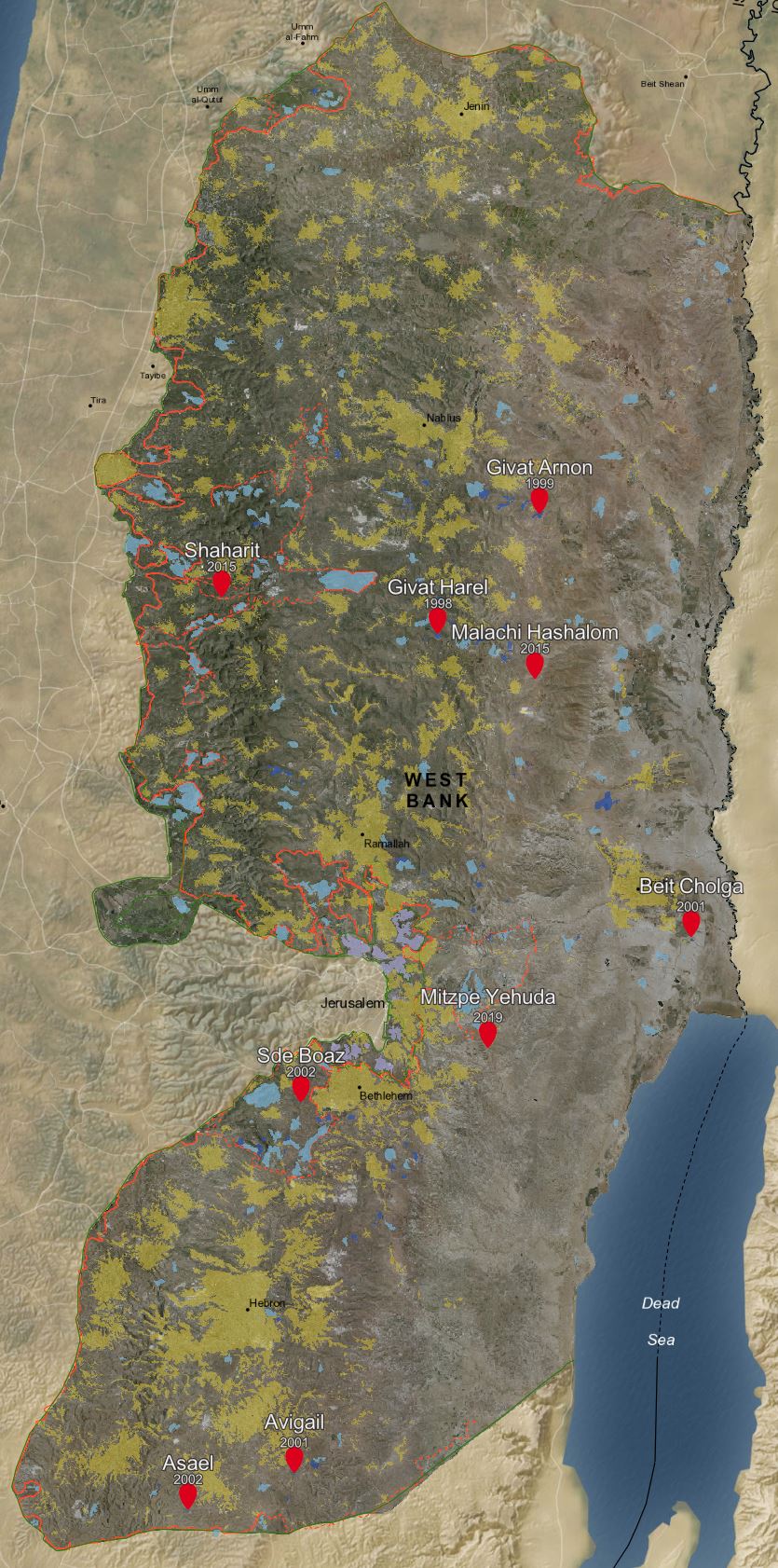
Importantly, Haaretz reports that a source said the Cabinet chose these outposts for authorization specifically because they are all located in remote or isolated locations — meaning they cannot be “legalized” via expanding the borders of a nearby settlement and declaring the outposts to be merely neighborhoods of those “legal” settlements (a legal maneuver Israel has repeatedly used to expand settlements and retroactively legalize settlements). This means, among other things, that legalization of these 10 new settlements will likely lead to additional land seizures for related infrastructure work (work that was not legally possible until now).
With respect to the remaining outposts that remain not-yet-legalized, the Cabinet approval included a clause that makes them eligible – right away, even as they remain illegal – to receive Israeli municipal services like water and electricity. Defense Minister Galant only has to sign an electricity order that was crafted under the previous government. If implemented, connecting illegal outposts to state infrastructure amounts to the de facto legalization of these outposts, even without a formal act to declare them legal.
The ten outposts slated to become official, “legal” new settlements are: Avigail, Asael, Shaharit, Givat Arnon, Givat Harel and Givat Haro’eh (which will be combined into one new settlement), Malachei Hashalom, Mitzpe Yehuda, Beit Hogla, and Sde Boaz. For further details on these outposts, please see Peace Now’s report.
Of note:
- Six of the outposts are located partially on land privately owned by Palestinians (Avigail, Givat Haroeh, Givat Harel, Givat Arnon, Mitzpe Yehuda, Malachei Hashalom).
- Three of the outposts (Avigail, Givat Arnon, and Malachei Hashalom) are located within Israel-designated firing zones, where under Israeli law any civilian presence, much less illegal civilian construction, is prohibited.
- Of particular note: the Avigail outpost is located in Firing Zone 918 in the South Hebron Hills. This is the same firing zone that is home to the Palestinian communities of Masafer Yatta — whose existence pre-dates Israel’s declaration of the area as a firing zone. Those communities are today in the process of being ethnically cleansed by Israel, based on the same law that Israel is ignoring in its legalization of the Avigail outpost.
- Two of the outposts (Avigail and Asael) have, illegally, built access roads on privately owned Palestinian land. Legalization of the outposts will undoubtedly also include the theft of the Palestinian-owned land these roads were illegally built on.
- Three of the outposts (Schacharit, Mitzpe Yehuda, and Malachei Hashalom)- are so-called “farming outposts.” That means they include very few buildings (3, 4, and 10, respectively), but a lot of land. The phenomenon of farming outposts, which have proven to be an incredibly efficient way for settlers to take over large areas of the West Bank with minimal investment in buildings and the involvement of very few people. This has been documented by the Israeli NGO Kerem Navot, which called the tactic “Israel’s most significant mechanism for dispossessing Palestinian communities.”
Minister Smotrich celebrated the announcement of the legalization of the 10 outposts and promised that there is more to come:
“That is what we as a government and as a people must do. Settlements thrive thanks to the pioneers, with much love and determination…We’ve authorized 10 outposts and we have the means to authorize more if required. My coalition partners understand this is the logical move. We’re also committed to removing all restrictions on settlement expansion in Judea and Samaria. This area must be managed in accordance with the Israeli law applicable in all parts of Israel.”
The Minister of the Negev, the Galilee and National Resilience, Yitzhak Wasserlauf, also celebrated the announcement as the start of things to come:
“Congratulations to the Security Cabinet that accepted Minister Ben-Gvir’s request and approved the communities. The dedicated settlers deserve to receive water, electricity, and public buildings. However, we will not be satisfied with just nine settlements, they are only the beginning, on the way to training more settlements, on the way to the fulfillment of the Zionist vision.”
As a reminder, Yitzhak Wasserful (a member of Ben Gvir’s Otzma Yehudit part) was granted an expanded portfolio as the Minister of the Negev and Galilee. He will now also oversee a new “young settlement department” (“young settlement” is a euphemism used by settlers for illegal outposts) that will be engaged in preparatory work for the legalization of outposts, and will also work on plans to deliver infrastructure to the outposts.
Israeli Government Announces Massive Settlement Expansion/De-Facto Annexation, Part 3: Thousands of New Settlement Units
As a result of the February 12th Israeli Security Cabinet meeting, the Civil Administration’s High Planning Council – the body that currently oversees all planning/building in the occupied West Bank – will convene in the coming days to advance plans for over 7,000 new settlement units (Minister Smotrich says 10,000 units will be advanced).
Of that total, Haaretz reports that 1,943 units are expected to immediately receive final approval for construction (including some units which have already been built but will be legalized); another 5,089 units are expected to be advanced in the planning process.
While there is no comprehensive list of all of the plans involved in these approvals and advancements, Haaretz reports that the plans expected to receive final approval will include new units in the following settlements: Rahelim, Neriya, Dolev, and Elon Moreh, Mevo’ot Yericho, and Elazar. Arutz Sheva further reports that 210 units in the Mevo Horon settlement will receive final approval, 100 of which were built illegally already.
Of particular note is a plan for 443 units in the Elazar settlement. This is, effectively, the reestablishment of the Netiv Ha’avot outpost, where five years ago the Israeli government demolished 17 structures because they were partially built on privately-owned Palestinian land (as compensation for those demolitions, the Israeli government built the evacuees an entirely new outpost near the Alon Shvut settlement, and then went about expanding the borders of the settlement to include the new buildings).
The plans not yet ready for final approvals but that are expected to be advanced in the planning process include plans for new construction in the Adam-Geva Binyamin settlement (356 units), the newly established Tel Zion settlement (627 units), the Kochav Yaakov settlement (160 units), and the Mitzpe Yericho settlement (350 units).
Israeli Government Announces Massive Settlement Expansion/De-Facto Annexation, Part 4: International Responses
Key members of the international community were quick to come out in (rhetorical) opposition to Israel’s massive settlement announcement. The U.S., U.K, France, Germany, and Italy released a joint statement “strongly opposing” the announcement saying they are “deeply troubled” by it – but none suggested they were entertaining any thoughts of imposing consequences.
The Palestinian Authority is reportedly pressing the United Nations Security Council to hold a vote in the coming days on a resolution calling on Israel to “immediately and completely” halt settlement activities. The U.S. has called the draft resolution “unhelpful” and is reported to be working against it (while also issuing public statements of dismay). Axios reports that Israeli officials believe the Palestinians are likely to secure enough support for such a resolution to pass if it is brought up for a vote, which would put the U.S. in the position of having to decide whether to vote in favor (inconceivable), abstain (improbable), or veto (likely). The U.S. is reportedly trying to convince the Palestinians to accept a statement from the Security Council in lieu of a vote.
Cabinet & Knesset Advance Bill to Repeal Parts of 2005 Disengagement, Reestablish Four Settlements Including Homesh
On February 14th, the Ministerial Committee for Legislation (a body of Ministers who decide whether to give government-backing to bills prior to their introduction to the Knesset) voted to give its approval to a bill that would repeal specific clauses of the 2005 Disengagement Law. These are the clauses that prohibit Israelis from living in the area of four settlements in the northern West Bank that were evacuated under Disengagement. If passed by the Knesset, the repeal of those clauses will allow the government to proceed with its plans to reestablish the Homesh settlement and retroactively legalize the yeshiva located there (as well as, in theory, allowing the reestablishment of the other three evacuated settlements).
Quickly following the Cabinet’s vote, the bill passed its preliminary reading in the Knesset on February 15th. It will need to pass three more readings before becoming law.
Peace Now explains the implications:
“From a human rights perspective, this will lead to a massive stealing of Palestinian land alongside increased settler violence and real danger to Palestinian lives. Homesh was primarily built on private Palestinian lands registered in the tabu (the Land Registration Office). Thus, this law will drive a final nail in the honest attempt of Palestinians to recover the massive land grab that was taken from them, and from the landowners in particular. In addition, although the Homesh settlement was evicted, a small Yeshiva located there has since been a source of violence from settlers who receive protection from the army while preventing Palestinian farmers from reaching their land. The lifting of the legal ban on the presence of Israelis in the area will provide an incentive for the arrival of more Israelis in the area. As a result, Palestinian lands will continue to be, at least de facto, expropriated.”
As a reminder, the retroactive legalization of the Homesh outpost was agreed to in coalition agreements that enabled the formation of the current Israeli government. Repealing the relevant parts of the 2005 Disengagement Law is the first step to implementing this commitment.
Also as a reminder: The government is currently facing a deadline from Israel’s High Court of Justice to submit its position on the court-ordered evacuation of the illegal yeshiva settlers built at the site of the dismantled Homesh settlement. The State has for nearly three years delayed its response to a 2019 petition filed by Yesh Din seeking both the removal of the illegal outpost and yeshiva at the site, as well as the site’s return to its Palestinian landowners. Despite Homesh being dismantled in 2005, Israel never permitted Palestinians to regain access to or control of the land, declaring it a closed military zone. That status has prevented Palestinians from entering the area, even as the IDF permitted settlers to routinely enter the area, to live (illegally, under Israeli law) at the site, and to illegally establish a yeshiva there. That yeshiva, according to the Israeli NGO Kerem Navot, has become one of the West Bank’s “hardcore centers of settler terror”. Settlers have also wreaked terror on nearby Palestinian villages, most notably Burqa and Sebastia. One Israeli politician even went so far as to say that settlers are “carrying out a pogrom” in Burqa.
Smotrich’s Plans to Take Over the West Bank
Haaretz obtained a draft government decision detailing plans to create a proposed “Settlement Administration” within the Defense Ministry. This plan would give Bezalel Smotrich – a minister in the Defense Ministry – authority, either directly or through his appointee, over the entire Civil Administration and, ipso facto, all civilian affairs in the West Bank. Smotrich proposes his new “ministry within a ministry” receive an initial budget of at least 80 million shekels.
The draft proposal was circulated to Ministers this week, but still faces opposition, including from Defense Minister Gallant – at whose expense Smotrich’s power grab would come. According to Haaretz, the proposed draft includes a carve-out for Gallant to overrule Smotrich’s authority over civil matters “in exceptional circumstances subject to the defense minister’s decision to change a specific decision or action in exceptional cases, with appropriate justification and subject to hearing the position of the other minister.”
The proposal is also opposed by IDF Chief of Staff Herzi Halevi, who reportedly told Prime Minister Netanyahu fears the plan would lead to a breakdown in the IDF chain of command.
Settler Olive Orchard & New Outpost Are Dismantled by Government, Causing Coalition Fight
A series of enforcement actions against illegal settlement activity in the West Bank has further driven a wedge between members of Netanyahu’s far-right coalition.
First, on February 12th Israeli forces dismantled a new outpost – dubbed “Gofna” by settlers – located in the northern West Bank. Six settler families arrived the previous night in an organized effort to quickly build several structures. Those buildings were demolished by the Israeli Border Police; settlers attempted to prevent the police from carrying out the evacuation. The Gofna outpost was previously established (and quickly dismantled) in July 2022 as part of a massive campaign led by the Nachala Movement to set up new outposts across the West Bank.
Then, on February 15th the Civil Administration uprooted over 800 olive trees that a settler illegally planted on land that the Israeli High Court has recognized as privately-owned Palestinian land, located near the Shilo settlement. The 2023 Court ruling concluded 15 years of litigation, but its enforcement has been repeatedly postponed. Dozens of settlers clashed violently with Israeli Border Police carrying out the tree removal; some of the settlers climbed the trees in hopes of stopping the bulldozers, and even some Knesset Members angrily tried to stop the officers from carrying out the law. Forty settlers/settler supporters were temporarily detained for their part in the violence; four Border Police officers were suspended after video footage captured them attacking one of the protestors.
Reports of the removal of the trees caused an immediate crisis in the government. Smotrich claimed that he had previously issued an order that vacated the court-ordered evacuation (in effect, Smotrich asserting the power to personally overrule the Israeli High Court). Any such order Smotrich may have issued was apparently overruled by Defense Minister Gallant – – with whom Smotrich is engaged in a power struggle (discussed above). Smotrich then wrote an urgent letter to Prime Minister Nentanyahu, who ordered the Civil Administration to halt the demolition hours after it began, though only a few trees remained in the ground at that point.
Smotrich later rehashed the turmoil, saying:
“To my astonishment, Defense Minister [Yoav Gallant] grossly violated the coalition agreement and reversed my decision…And, instead of implementing a settlement security policy, Gallant chose to continue the left-wing policy of former minister Benny Gantz and uproot the grove even though the claims against the grove were proven to be false in the legal proceedings…..violation of the [coalition] agreements will make it very difficult for the government and the coalition to conduct themselves properly.”
Later, on Twitter, Smotrich continued:
“Defense Minister Gallant’s denial of the unambiguous agreements and the prime minister’s foot dragging on the matter are unacceptable and they cannot continue…if Gallant has a problem, he’s welcome to hand in the keys. I’m sure there are lots of people in Likud who would be glad to take his place at the Defense Ministry.”
Minister Ben Gvir also vented his anger over law enforcement against illegal settler activities, saying:
“This isn’t what we signed up for when we agreed to join the Netanyahu government…We were promised a full-on right-wing government that can’t not evacuate Kahn al-Ahmar or avoid tearing down illegal buildings in East Jerusalem. A right-wing government doesn’t go only after Jews.”
Settler Groups Convene Workshop on Jordan Valley Annexation
Settler groups are continuing their push for Israel to annex the Jordan Valley. On February 12th, two settler advocacy groups held an event for lawmakers and security leaders in the Jordan Valley, starting with a tour of the region and a workshop to “discuss the challenges of sovereignty in the Valley and ways to deal with them.”
Yehudit Katsover and Nadia Matar, co-chairwomen of the Sovereignty Movement, and Nili Naouri, who heads the Israel Forever movement, who together hosted the event, said in a statement:
“sovereignty in the Jordan Valley is a necessary step for both the security, strategic and internal security aspects of the future of Israel, as expressed by prime ministers over the years, leaders of both Right and Left, which illustrates the broad national consensus behind taking the step of sovereignty in this area. Sovereignty in the Valley also does not constitute a demographic threat to the Jewish character of the State of Israel.”
MK Sharen Haskel, who attended the event and who has previously introduced annexation bills in the Knesset, said:
“The message that we’re trying to send is that this is the place where we have to apply sovereignty first. This is not just a question of sovereignty, this is also a question of security and defense of our country and of our people…We are here seeing the mountains on both sides from Jordan and the areas of Judea and Samaria, and we understand that this ground is a tactic ground that is meant to guard our security need of the state of Israel.”
Bonus Reads
- “Israel is Annexing the West Bank. Don’t be Misled by its Gaslighting” (Just Security)
- “Go West Bank: Israel Is Using the Housing Crisis to Lure Israelis Into Becoming Settlers” (Haaretz)
- “The Kohelet Tentacles: Inside the Web Surrounding the Right-wing Think Tank” (Haaretz)
- “Pompeo: Israel has Biblical claim to the land so it can’t be an occupier” (MEMO)
Welcome to FMEP’s Weekly Settlement Report, covering everything you need to know about Israeli settlement activity this week.
To subscribe to this report, please click here.
February 10, 2023
- Government Begins Forming Bureaucracy for Annexation
- Smotrich Says No Settlement Freeze, Asks Settlers to Hold Off on New Outposts
- A New Settlement: Israel Establishes Tel Zion as Independent Settlement
- Israeli Government Expected to Advance Atarot Settlement Plan
- Court Grants State Two-Month Delay in Khan Al-Ahmar Forced Displacement
- Israeli Cabinet Prepares for Vote to Amend 2005 Disengagement Law, Legalize Homesh Outpost & Yeshiva
- Bibi Pitches Massive Tunnel Construction in West Bank to French Investors
- Smotrich Resigns, Brings Criminal Settler into Knesset
- Bonus Reads
Government Begins Forming Bureaucracy for Annexation
As the new Israeli government continues to take shape, the bureaucratic mechanisms of annexation have come into focus.
Key components of this bureaucracy will reportedly include a new “Settlement Administration,” the creation of which is still pending an agreement between Smotrich and Defense Minister Gallant on how duties in the Defense Ministry will be divided (a division which is facing international opposition). In a meeting with settler leaders, Smotrich unveiled a plan for a new “settlement administration” that will attempt to centralize the Defense Ministry’s efforts accomplish several key objectives: to promote settlements, to take control of more land, to handle legal cases related to the settlements, and to advance Smotrich’s long-time goal of dismantling the Civil Administration in order to bring the settlements under the direct governance of the Israeli state (annexation).
According to Smotrich, this new administration will operate on a two year timeline to achieve its goals, ultimately working itself out of existence once all powers over the settlements are transferred from the Civil Administration to the various Israeli Ministries. According to Haaretz, Yehuda Eliyahu is likely to lead the settlement administration under the management of Smotrich. Smotrich and Eliyahu co-founded the Regavim settler group.
In addition, the Israeli government expanded the portfolio of the Minister of the Negev and Galilee, a post held by Otzma Yehudit member Yitzhak Wasserful. The expanded position will also have a new “young settlement department” (young settlement is a euphemism used by settlers for outposts). This department will be engaged in preparatory work for the legalization of outposts, and will also work on plans to deliver infrastructure to the outposts. Prior to this new department, this ministerial post did not have any authority in the West Bank (i.e. outside of Israel’s sovereign borders).
Haaretz details how these new bodies will interact:
“… if outposts are legalized, the process will likely be divided among three different agencies. The Civil Administration, which is under Smotrich’s control according to the coalition agreement, will be in charge of formal legalization. But responsibility for building or improving infrastructure in outposts will be divided between two other agencies. One is the National Missions Ministry, headed by Orit Strock (Religious Zionism). The other is the so-called young settlement department.”
Lastly, Emek Shaveh reports on a January 29th government decision which transferred the Israeli Antiquities Authority (IAA) from the Ministry of Culture to the Ministry of Heritage, which is now headed by Jewish Power MK Amihai Eliyahu. The IAA exercises authority over heritage and archaeological sites in Israel, including East Jerusalem, but has increasingly expanded its authorities into Area C of the West Bank, at the expense of the Staff Officer for Archaeology within the Civil Administration which has historically been in charge. The government also tasked Eliyahu with preparing an emergency plan to “safeguard” antiquity sites in the West Bank specifically, where settlers have spent years alleging neglect and destruction of heritage sites by Palestinians and the Palestinian Authority (which, turns out, has created a basis for the government to take control over those sites – go figure). The government allocated NIS 150 million to the effort.
Emek Shaveh reacts:
“After years of monitoring the process of weaponizing ancient sites in the service of the settlements in East Jerusalem and the West Bank, we are not surprised that the ultranationalist Jewish Power party demanded the heritage portfolio. An indication of the minister’s intentions was offered in January, when Eliyahu took over from outgoing minister of Heritage and Jerusalem Affairs, Ze’ev Elkin. At the ceremony he said: ‘Israel needs three pillars in order to stand strong: the security pillar, the economic pillar and a third pillar which is the pillar of significance.’ He added ‘The Ministry of Heritage will strengthen the third pillar. We will fortify our national resilience by encountering our heritage. We will protect the various heritage sites and devise programs to deepen Jewish identity’.”
For an overview of Israel’s weaponization of archaeology in its effort to take control of more land in Jerusalem and the West Bank, please see Emek Shaveh’s report.
Smotrich Says No Settlement Freeze, Asks Settlers to Hold Off on New Outposts
Following reports that Netanyahu had conceded to the U.S. request to freeze settlement construction in order to de-escalate tensions, Finance Minister Bezalel Smotrich repudiated the idea of any freeze, saying: “There will be no freeze on construction in Judea and Samaria. Period.”
Smotrich’s statement, however, did not contradict reports that he had asked settler leaders to stop efforts to establish new outposts, asking settlers leaders to coordinate all activity with the government. Smotrich publicly explained his request to pause outpost construction, saying at the weekly meeting of the Religious Zionism party:
“Our ambition is not to have to resort to illegal measures. We want the government to officially adopt a policy of recognizing all the communities in the settlements and also, of establishing new communities, in line with natural growth. None of us considers himself above the law. We are the government, and this will take more than a day or two, but I’m convinced that we’ll see substantial changes occurring in the near future.”
A New Settlement: Israel Establishes Tel Zion as Independent Settlement
On February 5th, the Israeli Cabinet approved a plan that will, once implemented, establish a new settlement, Tel Zion, by splitting off the Ultra-Orthodox section of the Kochav Yaakov settlement, located east of Jerusalem. The approval of this plan was delayed from consideration last month while U.S. National Security Advisor Jake Sullivan was in Israel.
The creation of the “Tel Zion” settlement is part of Netanyahu’s coalition deal with the ultra-Orthodox Shas Party, and is also supported by Defense Minister Gallant.
Israeli Government Expected to Advance Atarot Settlement Plan
Peace Now reports that the Netanyahu government appears likely to re-engage a plan to build the Atarot settlement.
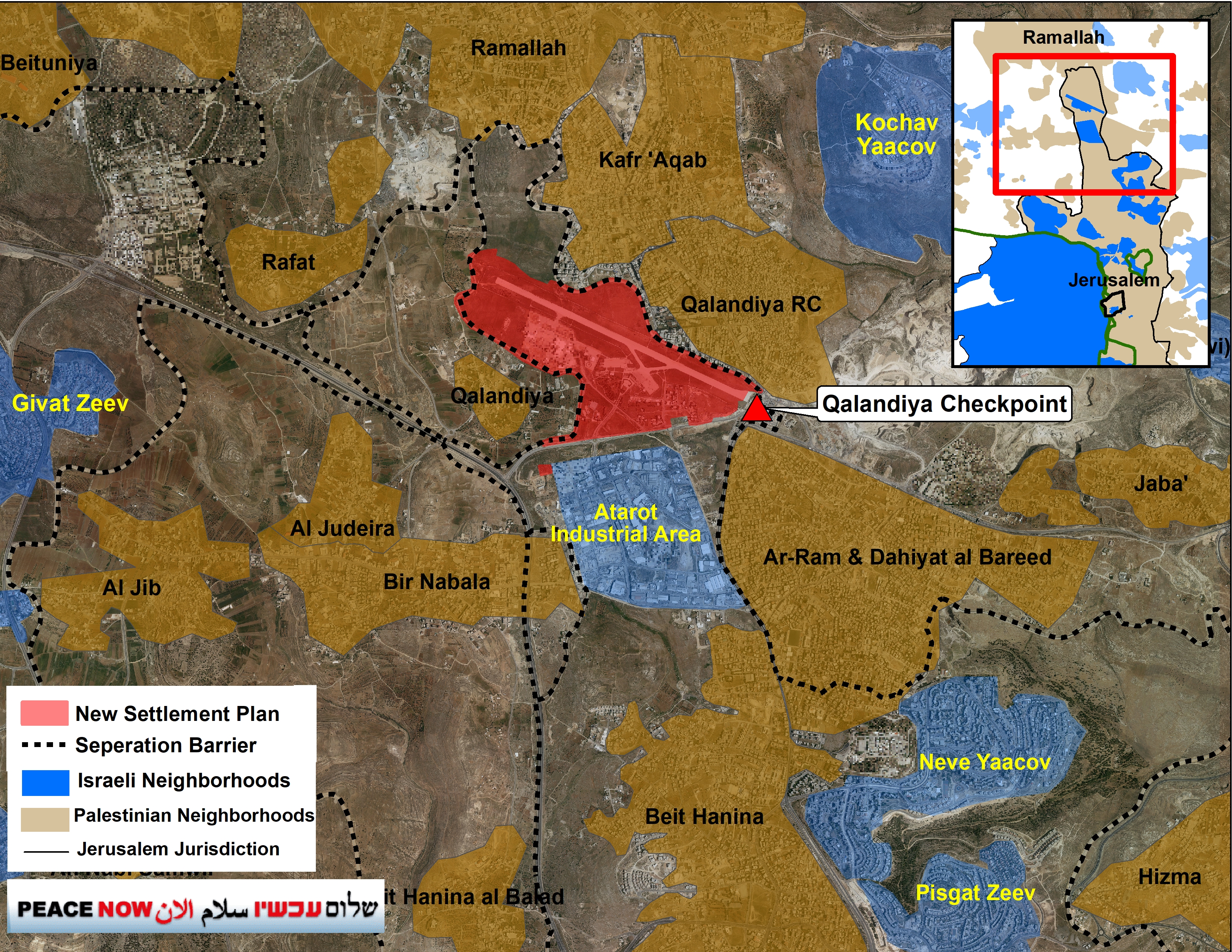 The plan for the Atarot settlement, which has existed since 2007, calls for a huge new settlement on the site of the defunct Qalandiya Airport, located on a sliver of land between Ramallah and Jerusalem. In its current form, the plan provides for up to 9,000 residential units for ultra-Orthodox Jews (assuming, conservatively, an average family size of 6, this means housing for 54,000 people), as well as synagogues, ritual baths (mikvehs), commercial properties, offices and work spaces, a hotel, and a water reservoir. If built, the Atarot settlement will effectively be an Israeli city surrounded by Palestinian East Jerusalem neighborhoods on three sides and Ramallah to its north. Geopolitically, it will have a similar impact to E-1 in terms of dismembering the West Bank and cutting it off from Jerusalem. For more on the Atarot settlement plan, please see here.
The Atarot settlement plan was last considered in 2021 when Naftali Bennet was Prime Minister, but was delayed from consideration by the planning committee – reportedly at the urging of U.S. Secretary of State Blinken. The Committee delayed advancement of the plan by ordering an environmental study which was expected to take about one year. Notably, in ordering the study, the Court made it clear that the environmental study is “standard practice” and expressed support for the underlying plan, saying it believes the plan represents a proper use of unutilized land reserves.
Peace Now said in a statement:
“This is a highly dangerous plan that could land a fatal blow to the prospect of peace and two states. The Atarot plan puts a wedge in the heart of the existing Palestinian urban continuum between Ramallah and East Jerusalem, thus preventing the possibility of establishing a Palestinian state with its capital in East Jerusalem. If the plan is not removed from the agenda of Israel´s far-right and pro-settler government, an eventual political resolution will become even harder to reach.”
Court Grants State Two-Month Delay in Khan Al-Ahmar Forced Displacement
On February 7th, the Israeli Supreme Court granted the State until April 2nd – a two month delay when the State had requested four months delay – to submit a plan to forcibly remove the Khan Al Ahmar bedouin community (a war crime) from its lands just outside of Jerusalem. The Court also set May 1st as the date for a final hearing on a petition submitted by the Regavim settler group demanding the immediate removal of Khan Al-Ahmar.
As with previous delays (there have been a total of 9), the Court expressed its extreme displeasure with the State’s foot dragging. Justice Noam Sohlberg said in his ruling:
“Suffice it to say that we are not at all satisfied with the conduct of the state…[the state’s behavior demonstrates] the existing situation is comfortable for it: Once every few months it files a request for an extension, which the petitioner opposes and the court accedes to through gritted teeth, and the world carries on as normal; deciding not to decide.”
In a statement revealing its ideological motivations, Regavim wrote:
“The government should formulate a working plan for the enforcement of the law in Khan al-Ahmar, as part of a fight against the Palestinian Authority’s institutionalized takeover of open areas in Judea and Samaria. The State of Israel must behave like the owner of the house, even in the face of American pressure, otherwise no one in the world will take it seriously.”
Israeli Cabinet Prepares for Vote to Amend 2005 Disengagement Law, Legalize Homesh Outpost & Yeshiva
The Israeli Cabinet’s Ministerial Committee on Legislation is expected to vote to amend the 2005 Disengagement Law at its February 12th meeting in order to pave the way for the reestablishment of four settlements in the northern West Bank. Jerusalem Post reports that the measure is expected to have enough support to be approved by the Cabinet and passed by the Knesset.
If passed, the bill will allow Israel to grant retroactive legalization to the Homesh outpost and yeshiva – reestablishing Homesh as a fully legal, under Israeli law, settlement. The retroactive legalization of Homesh was agreed to in coalition agreements that formed the current Israeli government.
The vote comes as the government faces a deadline from the High Court to submit its position on the court-ordered evacuation of the illegal yeshiva settlers built at the site of the dismantled Homesh outpost. The State has, for nearly three years, delayed its response to a 2019 petition filed by Yesh Din seeking the removal the illegal Homesh outpost and yeshiva, as well as guarantee the site’s return to its Palestinian landowners. Despite Homesh being dismantled in 2005, Israel never permitted Palestinians to regain access to or control of the land, declaring it a closed military zone. That status has prevented Palestinians from entering the area, while allowing settlers to routinely enter and (illegally, under Israeli law) inhabit the land, even (illegally) establishing a yeshiva there. That yeshiva, according to the Israeli NGO Kerem Navot, has become one of the West Bank’s “hardcore centers of settler terror”. Settlers have also wreaked terror on nearby Palestinian villages, most notably Burqa and Sebastia. One Israeli politician even went so far as to say that settlers are “carrying out a pogrom” in Burqa.
Bibi Pitches Massive Tunnel Construction in West Bank to French Investors
The Times of Israel reports that Netanyahu held a meeting with investors to pitch a massive construction project that would see highspeed tunnels be carved into the terrain throughout the West Bank in order to connect Israeli settlements together, and have more seamless access to Jerusalem and Tel Aviv. The underground highways would be designed in such a way to provide so-called “transportational contiguity” for both Israelis and Palestinians, in lieu of territorial contiguity for the latter (an idea endorsed in the Trump plan). The tunnel vision would effectively annex the settlements to Israel, and entrench a separate but unequal transportation grid that severely limits Palestinian freedom of movement, access to land, and more. The Israeli notion of “transportational contiguity” is put forward as an alternative to “territorial contiguity” which is no longer possible for Palestinians because of Israeli settlements, infrastructure, and control. The notion also gives permission to Israel for further settlement growth.
Smotrich Resigns, Brings Criminal Settler into Knesset
Finance Minister Bezalel Smotrich formally resigned his seat in the Knesset in order to focus his time on his Ministry postings, which not only include head of the Finance Ministry but also as a key minister within the Defense Ministry in control of the Civil Administration. Upon his resignation, the vacant Knesset seat has been filled by the next name on the Religious Zionist Party slate, and that happens to be Zvi Sukkot – a hardline settler who is one of the founders of Evyatar outpost.
Sukkot lives in the Yitzhar settlement – a hotbed of settler extremism and violence, the home of the notorious “Hilltop Youth” movement that has terrorized the Nablus region. He has been arrested on suspicion of arson in a 2010 attack on a Palestinian mosque. In 2012, he was temporarily banned from the West Bank on suspicion that he was orchestrating attacks on Palestinians.
Bonus Reads
- “In West Bank, Settlers Sense Their Moment After Far Right’s Rise” (New York Times)
- “Israel steps up Jerusalem home demolitions as violence rises” (AP)
- “From This Hill, You Can See the Next Intifada” (The Atlantic)
- “Threat Still Looms Despite Postponement of Largescale Wadi Qaddum Demolition” (Ir Amim)
- “ICJ sets July 25 for submission on illegality of Israel’s ‘occupation’” (Jerusalem Post)
Welcome to FMEP’s Weekly Settlement Report, covering everything you need to know about Israeli settlement activity this week.
To subscribe to this report, please click here.
January 27, 2023
-
- De Facto Annexation in action: Bibi Confirms that Smotrich Now Runs the West Bank
- With Top U.S. Official In Country, Netanyahu Delays New Settlement Plan
- Coalition Deal Includes Unilateral Annexation of West Bank Archaeological Sites
- Concern Grows that New Gov Will Proceed with Mount of Olives “Park” Plan
- Palestinians Protest Settler Cultivating Land Near Ramallah
- Bonus Reads
De Facto Annexation in action: Bibi Confirms that Smotrich Now Runs the West Bank
The battle over a newly-established illegal outpost has provided the first concrete look at the extent to which the new Israeli government has handed authority over the West Bank to radical, pro-annexationist Minister of Finance Bezalel Smotrich (Religious Zionism party).
The outpost was established January 19th, ostensibly to honor the recently deceased Rabbi Chaim Druckman, a longtime leader of the settler movement and a defender of violent Jewish extremists. It was established near the Migdalim settlement in the northern West Bank, to the east of the Ariel settlement.
On January 20th the outpost was dismantled by the IDF at the direction of Defense Minister Yoav Gallant (Likud) with the approval of Prime Minister Netanyahu. Notably, that same day Netanyahu was hosting U.S. National Security Advisor Jake Sullivan. That dismantling took place in defiance of an order from Bezalel Smotrich, acting in his capacity as a key official in the Defense Ministry with vast powers over the Civil Administration specifically over civilian matters such as illegal construction (in addition to his role as Finance Minister). Smotrich’s order, which was overruled by Gallant, sought to leave the outpost untouched while the situation was debated by government officials.
In response to the outpost being dismantled not once but twice (hundreds of settlers reestablished the outpost within 2 days of the first demolition), Smotrich and his allies boycotted the weekly Cabinet meeting, forcing Netanyahu to convene at least two separate meetings (on January 23 and 24) to resolve the clash between Gallant and Smotrich.
With the visit of a top U.S. official over, reports on January 26th suggest that Netanyahu is now siding with Smotrich. In so doing, Netanyu is confirming his support for a new status quo in the Defense Ministry in which authority in the West Bank is divided between Smotrich and Gallant. Smotrich will be in charge of “civilian” matters — including the fate of illegal outposts, issues related to settlements, and, of course, all aspects of the lives of Palestinians; Gallant’s authority in the West Bank will be over “security” matters. Minister Gallant has made it clear that he opposes this new division of authority within his ministry, and Defense Ministry legal advisors have cautioned Netanyahu that transferring powers to Smotrich could be seen by the international community as annexation. In response, Netanyahu has ordered a legal opinion on the proposed division.
Smotrich has been clear regarding his intention to use the powers he appears to now enjoy within the Defense Ministry to reduce Israeli enforcement against illegal settler construction, and to increase Israeli enforcement against “illegal” Palestinian construction [as a reminder: Israel only rarely gives Palestinians permission to build on their own private land in Area C, meaning that in the eyes of Israeli authorities, virtually all Palestinian construction in Area C is illegal and can/should be demolished].
In addition to laying bare a fight over authority in the new government, the battle over this whole ordeal also re-affirmed the consensus – and enthusiasm – in Israel’s ruling class, both those in and those in opposition – in support of demolishing Palestinian construction in Area C. Indeed, in a revealing Twitter exchange, Netanyahu and former Defense Minister Benny Gantz literally fought for credit for demolishing the more Palestinian structures.
With Top U.S. Official In Country, Netanyahu Delays New Settlement Plan
On January 19th – while U.S. National Security Advisor Jake Sullivan was in Israel for talks with Netanyahu – the Israeli government removed an item from its weekly agenda consideration of the approval of a new settlement on the periphery of Jerusalem. The new settlement is to be created by splitting off an ultra-Orthodox neighborhood of the Kochav Yaakov settlement, and turning it into its own settlement, to be called “Tel Zion.” The creation of the “Tel Zion” settlement is part of Netanyahu’s coalition deal with the ultra-Orthodox Shas Party. The Times of Israel suggests the plan – which in addition to being agreed to by Netanyahu is also supported by Defense Minister Gantz – was removed from last week’s agenda apparently to avoid friction with the U.S., meaning that with Sullivan gone, the plan is likely to be brought forward for approval imminently.
Coalition Deal Includes Unilateral Annexation of West Bank Archaeological Sites
Emek Shaveh reports new details on the coalition deal between the Likud and Jewish Power parties, including the allocation of over $40 million (NIS 150 million) to fund a “National Emergency Plan” under which Israel must take control of heritage sites across the totality of the West Bank, without regard to the Oslo-defined Areas A, B, and C.
Settler groups, including the “Guardians of the Eternity” and the “Shiloh Forum”, have been pushing the government to proceed with taking control of heritage sites, which the groups claim are being vandalized and destroyed by Palestinians.
Emek Shaveh said in a statement:
“Netanyahu’s government, with the aid of the Shiloh Forum (and Kohelet), continues to confuse science with messianism, heritage with rightful ownership, and cultural affinity with ethnic supremacy. The destruction of sites, whether genuine or imagined, must not be used as rationale for political action, and political action must not be disguised as heritage conservation. We will make clear that blurring the boundaries between research and protection (of sites) and settlement and annexation, constitutes a gross violation of the prevailing ethics in the field heritage and the stipulations in international law regarding cultural property in occupied territories. Such violations not only endanger the future of heritage sites, but also expose Israel to professional and political isolation.”
As FMEP has chronicled, settlers and their allies are intent upon using claims of Palestinian damage/neglect as a pretext for Israel taking control of archaeological sites and artifacts across the West Bank. For example, in February 2021 settlers used a construction mishap to raise claims to the Mt. Ebal site.
And as a reminder: in January 2021, the Israeli government committed funding to a new settler initiative to surveil archeological sites under Palestinian control. While the objective of protecting antiquities might appear uncontroversial and apolitical, the true (and transparently self-evident) objectives behind this effort are: to support yet another pretext to surveil and police Palestinians; to establish and exploit yet another means to dispossess Palestinians of their properties; to expand/deepen Israeli control across the West Bank; and to further entrench Israeli technical, bureaucratic and legal paradigms that treat the West Bank as sovereign Israeli territory. It is the result of a campaign that has taken place over the past year in which settlers have escalated their calls for the Israeli government to seize antiquities and “heritage sites” located in Palestinian communities across the West Bank, especially in Area C, which Israel today treats as functionally (and legally) indistinguishable from sovereign Israeli territory. Funding committed by Israel for West Bank “heritage sites” should be understood in this context.
Previous victories for the settlers in this same arena include the Israeli Civil Administration’s issuance in 2020 of expropriation orders – the first of their kind in 35 years – for two archaeological sites located on privately owned Palestinian property northwest of Ramallah. The settlers’ pressure is also credited as the impetus behind the government’s clandestine raid of a Palestinian village in July 2020 to seize an ancient font.
In June 2020, the “Guardians of Eternity” group began surveying areas in the West Bank that Israel has designated as archaeological sites, looking for Palestinian construction (barred by Israel in such areas) that they could then use as a pretext to demand that Israeli authorities demolish it. The group communicates its findings to the Archaeology Unit of the Israeli Civil Administration (reminder: the Civil Administration is the arm of the Israeli Defense Ministry which since 1967 has functioned as the de facto sovereign over the West Bank). The Archaeology Unit, playing its part, then delivers eviction and demolition orders against Palestinians, claiming that the structures damage antiquities in the area.
And one more reminder: in 2017, Israel designated 1,000 new archaeological sites in Area C of the West Bank. The “Guardians of Eternity” group, not coincidentally, is an offshoot of the radical Regavim organization, which among other things works to push Israeli authorities to demolish Palestinian construction (on Palestinians’ own land) that lacks Israeli permits (permits that Israel virtually never grants).
Concern Grows that New Gov Will Proceed with Mount of Olives “Park” Plan
+972 Magazine reports that activists and experts are increasingly concerned that the new Israeli government will resurrect a plan to declare vast areas of East Jerusalem – including prized religious sites on the Mount of Olives and entire Palestinian neighborhoods – as part of an Israeli national park, with huge consequences for churches and Palestinians. Activists fear that, in addition to the immediate consequences for residents and property owners, the government intends to subcontract management of the new national park to the radical settler group Elad. This is precisely what the government of Israel did with so-called City of David National Park, which, under Elad’s stewardship, has had devastating impacts on Silwan residents.
Sari Kronish, and urban planning expert with the NGO Bimkom explained:
“Of course a national park is not a bad thing in principle, but in East Jerusalem the designation is used as a tool to prevent development of Palestinian neighborhoods”
The plan to create the Mount of Olives National Park was first revealed in February 2022, but postponed by the government at the time, with a promise that the plan will not proceed until the Churches with equities in the area have been consulted. The Israel Nature and Parks Authority told +972 Magazine that these consultations have begun but are not complete. The agenda item has not been totally shelved, but instead repeatedly delayed, landing the item on the August 2023 agenda (barring further delay).
Jerusalem expert Daniel Seidemann told +972:
“There is no innocent interpretation as to why to put a national park [on the Mount of Olives], except for the fact that the settlers in general, and the settler movement Elad in particular, covet the properties and areas in the visual basin around the Old City. This all comes within a context … [of] an attempt by the government of Israel, together with the settlement movement … to create an Israeli land bridge from the [state-protected] ‘green area’ on Mt. Scopus through Sheikh Jarrah, with biblically-motivated settlements and settlement activities. We have already seen that on the north flanks with the encirclement of the Sheikh Jarrah area.”
Palestinians Protest Settler Cultivating Land Near Ramallah
Haaretz reports that a settler from the Ofra settlement has recently begun illegally cultivating a large plot of land (130 dunams/32 acres) near Ramallah, on the West Bank side of the Israeli separation barrier. In a statement to Haaretz, the Civil Administration said that it had not permitted any activity on the land and would investigate.
The settler’s actions have sparked a significant response from the local Palestinian community because, in order to reach the land, the settler and the heavy equipment being used to work the land must travel through Palestinian villages. Palestinians have begun staging weekly protests at the site, and the village council of the Palestinian village of Qalandiya issued a warning that it would report the names of Palestinians found working at the site to the Palestinian Authority.
The plot of land in question is land that pre-1948 had a Jewish owner. It was taken over by the Israeli government in 1967; the Israeli government gave it to the World Zionist Organization in 1997; the WZO then gave it to the Ofra settlement, which never used or cultivated the land, but in 2019 purportedly gave the land to one of its residents, Assaf Shapira. Notwithstanding that action by the settlement, in July 2022 the Civil Administration notified Ofra that the allocation of the land to the settlement had been canceled.
Dror Etkes – the founder of the settlement watchdog group Kerem Navot – told Haaretz:
“Ofra’s settlers waited four decades before taking control of these lands. The timing isn’t a coincidence and reflects the spirit of the sixth Netanyahu government. It’s an apartheid government that will continue to act in full force in this enterprise which seeks to make the West Bank and its residents work for the benefit of a violent minority of settlers.”
Bonus Reads
- “Israel’s Knesset Extends West Bank Emergency Orders by Another Five Years” (Haaretz)