Welcome to FMEP’s Weekly Settlement & Annexation Report. To subscribe to this report, please click here.
August 14, 2025
- Israel to Approve E-1 Settlement Next Week
- Israel Published Tenders for Huge Expansion of Ma’ale Adumim Settlement
- Israel Publishes Tenders for Construction of a New Settlement, Ariel West
- Plan for Yeshiva in Sheikh Jarrah Advances Again As Israel Seeks New Ways to Expel Palestinian Residents
- Plan for Yeshiva in Sheikh Jarrah Advances Again As Israel Seeks New Ways to Expel Palestinian Residents
- Another West Bank Communities Have Been Expelled By Settler Terrorism
- Bonus Reads
Israel to Approve E-1 Settlement Next Week
 On August 13th, the High Planning Council published its decision to reject all objections to the plan for the E-1 settlement, clearing the way for the Israeli government to grant final approval to the highly controversial plan at a meeting scheduled in less than one week, on August 20th. Peace Now warns that if the planning process continues to move as quickly as it has over the past weeks, construction on E-1 could conceivably begin within a few months.
Bezalel Smotrich, in what has been described as a “victory lap,” held a press conference at the site of the future E-1 settlement where he claimed that U.S. President Trump has approved the plan, though the White House declined to confirm. At the event, which was held prior to formal confirmation of approval, Smotrich said:
“The approval of construction in the E1 area undermines the idea of a Palestinian state and is part of the broader steps we are taking as part of our de facto sovereignty plan, which began with the formation of this government. After decades of international pressure and freezing of projects, we are defying conventions and cementing the connection between Ma’aleh Adumim and Jerusalem.”
The governments of Jordan and Qatar issued a statement condemning Smotrich’s announcement and the plan for the E-1 settlement. The statements come in addition to previous day condemnations of Netanyahu’s public profession that he has a deep “connection” to the vision of Greater Israel as described in the Bible.
Peace Now said in a statement:
“The E1 plan is deadly for the future of Israel and for any chance of achieving a peaceful two-state solution. We are standing at the edge of an abyss, and the government is driving us forward at full speed. There is a solution to the Israeli-Palestinian conflict and to the terrible war in Gaza — the establishment of a Palestinian state alongside Israel — and it will ultimately come. The government’s annexation moves are taking us further away from this solution and guaranteeing many more years of bloodshed.”
Israel Published Tenders for Huge Expansion of Ma’ale Adumim Settlement
On August 12th, the Israeli Land Authority published tenders for the construction of 3,300 new settlement units that would connect the Ma’ale Aduminm settlement to the Mishor Adumim industrial zone to its east. Increasing the size of the settlement by 33%. The construction will be on land immediately south of the future E-1 settlement, compounding Israel’s total control of the highly sensitive area. Peace Now further notes that Ma’ale Adumim does not appear to need new construction, as the population growth has been stagnant for a decade.
Israel Publishes Tenders for Construction of a New Settlement, Ariel West
On August 12th, the Israeli Ministry of Housing published tenders for 730 units to build a new “neighborhood” of the Ariel settlement (called the “Amririm Neighborhood”). In reality, the new units will be built on a hilltop located 1.2 miles away from Ariel in an area that is non-contiguous with the built up area of the current Ariel settlement – meaning that a new settlement has been approved for construction. The new tenders join a previously issued batch of tenders issued in 2021 for 731 units, though the tenders have not yet been opened for bidding. Regardless, infrastructure work on the hilltop was reported to have begun in March 2024.
 The hilltop is located on land declared by Israel to be “state land” inside of the jurisdictional boundaries of the Ariel settlement, as authorized by the Israeli government. The jurisdictional boundaries of Ariel include several non-contiguous land areas — due to the fact that the area is dotted with land that even Israel recognizes to be legally owned by Palestinians (leaving Palestinian land in some places nearly completely surrounded by land given to the settlement).
The new settlement will further exacerbate the limitations that the settlements inflict on Palestinian agricultural workers in addition to the future development of the nearby Palestinian town of Salfit, as illustrated in this video by Peace Now. Even before the “expansion” plan, Ariel’s jurisdictional area was identified as a direct hindrance on the future development of Salfit.
Plan for Yeshiva in Sheikh Jarrah Advances Again As Israel Seeks New Ways to Expel Palestinian Residents
Ir Amim reports the Jerusalem District Planning Committee has accepted modifications to plans for the construction of the Glassman Yeshiva at the entrance to the Sheikh Jarrah neighborhood of East Jerusalem. The Committee also republished the updated plan, starting a 30-day clock for the public to submit objections to the plan.
The plan calls for the construction of an 11-story building (3 stories below ground) which will include a religious school and dormitories for students and faculty. There are several settler enclaves in Sheikh Jarrah currently, while Palestinians are facing concerted eviction efforts by settlers and the government.
The yeshiva is slated to be built on a patch of land that was expropriated from Palestinian owners for “public needs”; in 2007 the land was transferred by the Israeli government to the Ohr Somayach Institutions, an international organization which is promoting the yeshiva plan. Ir Amim reports that in 2023, the Ohr Somayach Institutions received over 6 million NIS from its U.S. branch and its donors.
At the same time, Ir Amim reports that a settler owned company has applied for a building permit in the Um Haroun section of Sheikh Jarrah, which if granted will result in the expulsion of five members of the Saou family even though they are considered “protected tenants” even under Israeli law. Ir Amim explains why this is novel, and hugely consequential:
“This is the first attempt to evict Palestinians with protected tenancy status under the guise of urban renewal (pinoi binui). In the past, protected tenancy status successfully protected certain families in Sheikh Jarrah from attempted evictions. If settlers successfully evict the Saou family as part of an “urban renewal” project, this can set a dangerous precedent for many other Um Haroun residents. Settler activists are already preparing to request a building permit which will allow them to tear down an additional building in Um Haroun and evict its Palestinian residents. Almost all the other homes in Um Haroun are threatened by an urban renewal plan which is in the preliminary stages of its approval process.”
Israel Advances Plan for New Settlement “Nofey Rachel” in East Jerusalem
 Ir Amim reports that the Jerusalem District Committee has submitted for public review a plan for the construction of a new settlement – Nofey Rachel – in East Jerusalem. Once the plan is published, there is a 60 day period for the public to submit objections to the plan.
The new settlement plan calls for 650 settlement units to be built on land on the southern slopes of the Sur Baher neighborhood in East Jerusalem, directly bordering the boundaries of the “Lower Aqueduct” settlement plan. Together, Ir Amim explains:
“these two settlements will isolate Sur Baher-Umm Tuba, fracturing it from the Palestinian space around it, inducing Beit Safafa to its northwest and Beit Sahour and Bethlehem in the West Bank to its south. As such, the new plan will extend the Israeli territorial continuum between Har Homa, the Lower Aqueduct, and Givat Hamatos, which further seals off the southern edge of East Jerusalem from Bethlehem and the southern West Bank.”
For more information regarding the plan see Ir Amim’s previous alert.
Another West Bank Communities Have Been Expelled By Settler Terrorism
The Ein Ayoub bedouin community (19 households, 102 people) has been expelled from their land near Ramallah as a result of unabated settler terrorism which has included arson, violent attacks, poisoned livestock, and drones surveilling their homes. Settlers built a new outpost near the community in the weeks preceding the expulsion.
On August 8th settlers and IDF soldiers entered the communities and threatened residents, telling them to leave within 24hours. The next morning, armed settlers returned to the village, standing guard in an act of intimidation and threat. The IDF arrived in the village on Sunday night and ordered the community to leave the village because of a new military order declaring the area a “closed military zone”. After facing international attention, the IDF later said that the soldiers evicted the community in error due to a “misunderstanding” and that the order was not meant to be applied to the bedouin. The community residents decided to leave the community, citing the fear of lawlessness and violence they face daily. One resident told Haaretz that he asked IDF soldiers if they would protect the community if they decided to say, to which the soldier replied: “I don’t protect Bedouin.”
Ein Ayoub is the third community expelled from the land in the past two monts by the coercive violence of settlers.
Bonus Reads
- “West Bank faces rising wave of settler violence against IDF and police” (Ynet, 8/11/25)
- “With Arson and Land Grabs, Israeli Settler Attacks in West Bank Hit Record High” (New York Times, 8/14/25)
- “Israel builds new settlement road northeast of occupied East Jerusalem” (MEMO, 8/10/25)
- “IDF to remain in Samaria camps through 2025” (JNS, 8/10/25)
- “Bowen: Israeli settlers intensify campaign to drive out West Bank Palestinians” (BBC, 8/10/25)
- ”U.S. to Reportedly Soften Criticism of Israel, Judicial Coup in Annual Human Rights Report ” (Haaretz, 8/10/25)
Welcome to FMEP’s Weekly Settlement Report, covering everything you need to know about Israeli settlement activity this week.
To subscribe to this report, please click here.
April 19, 2024
- Israeli Courts Order Two Significant Evictions in East Jerusalem, Presaging Mass Forced Displacement in Sheikh Jarrah, Silwan
- Supreme Court Green Lights Eviction of Shehadeh Family from Batan Al-Hawa Home
- Israeli Court Orders Eviction of the Diab Family from Sheikh Jarrah Home
- Lower Aqueduct Settlement Plan Published Tender
- Ir Amim & Bimkom: Israel Has Accelerated East Jerusalem Settlement Building Since Oct 7th
- Ben Gvir Seizes Authority Over East Jerusalem Housing Demolitions
- New Plan to Massively/Strategically Expand the Ariel Settlement Industrial Zone
- Smotrich Designates Symbols for Four Outposts Previously Approved for Retroactive Legalization
- The U.S. & E.U Unveil New Sanctions Targeting Settlers & Settler Entities
- Bonus Reads
Israeli Courts Order Two Significant Evictions in East Jerusalem, Presaging Mass Forced Displacement in Sheikh Jarrah, Silwan
Over the past week – on the eve of Passover and in days after the end of Ramadan, while genocide continues in Gaza and violence escalates in the West Bank – two separate Israeli courts have ordered the eviction of Palestinian families from their longtime homes in East Jerusalem in favor of Israeli settlers; both cases set a terrifying precedent for dozens more Palestinian families fighting against settler groups on the same basis of argumentation. The mass dispossession and displacement of Palestinians from East Jerusalem is advancing. These cases put on full display the tight cooperation between settler entities and the Israeli state in advancing the displacement of Palestinians from East Jerusalem, and their replacement with Israeli Jews.
Ir Amim explains:
“Although the Israeli government often characterizes these cases as private real estate disputes, they are rather part and parcel of a systematic campaign to further entrench Israeli control of the most politically sensitive areas in East Jerusalem. The eviction claims are filed on the basis of a discriminatory Israeli law (see more below) by settler groups working in collaboration with the state to expand Jewish settlement in the heart of Palestinian neighborhoods. This thereby serves to foil any possibility of East Jerusalem serving as a future Palestinian capital.
…A common thread between these cases is that the eviction lawsuits were filed by settler groups based on the 1970 Legal and Administrative Matters law. Article 5 of this law exclusively affords Jews with land restitution rights for assets allegedly owned by Jews in East Jerusalem before 1948 despite many of these properties now inhabited by Palestinians. No parallel legal mechanism exists for Palestinians to recover pre-1948 assets on the Israeli side of the Green Line, many of which are now inhabited by Jews. To the contrary, the 1950 Absentee Property Law enshrines that Palestinians who were forced to abandon their homes and lands in what became Israel after the war of 1948 can never retrieve them…Settler organizations aided by state bodies act to secure ownership rights of these assets despite having no relation to the previous Jewish owners or occupants. Acquisition of these rights provides settler groups with the legal platform to “retrieve” the property from the General Custodian and initiate eviction lawsuits against Palestinian families through application of the 1970 law. A department within the Ministry of Justice, the General Custodian is the Israeli body responsible for managing abandoned property, including alleged pre-1948 Jewish assets in East Jerusalem until “reclaimed.” Between 1948-1967, these properties were administered by the Jordanian Custodian of Enemy Property and then transferred into the management of the Israeli General Custodian in 1967 following Israel’s occupation and annexation of East Jerusalem.”
Supreme Court Green Lights Eviction of Shehadeh Family from Batan Al-Hawa Home
On April 11th, the Israeli Supreme Court Justice Noam Sohleberg dismissed a final petition in the case of the Palestinian Shehadeh family, who has spent years fighting against their eviction from their home of 60 years in the Batan Al-Hawa section of Silwan at the behest of the Ateret Cohanim settler organization. Justice Sohlberg ordered the Shehadeh family to leave by June 1st or face forced eviction by Israeli authorities, and also ordered the family to pay legal fees for the settler group. The case has been ongoing since 2021, and the Supreme Court’s ruling last week marks the end of any potential avenues of further appeal. Ir Amim writes that only state intervention can halt the eviction.
The Shahadeh family is one of 85 families (700 people) in Batan al-Hawa facing displacement at the behest of Ateret Cohanim, a settler organization which has waged a years-long eviction campaign against Palestinians living in Silwan, on property the settler NGO claims to own. The group’s claim is based on having gained control of the historic Benvenisti Trust, which oversaw the assets of Yemenite Jews who lived in Silwan in the 19th century. In 2001 the Israeli Charitable Trust Registrar granted Ateret Cohanim permission to revive the trust and become its trustees, (following 63 years of dormancy). In 2002, the Israeli Custodian General transferred ownership of the land in Batan al-Hawa to the Trust (i.e., to Ateret Cohanim). Since then, Ateret Cohanim has accelerated its multi-pronged campaign to remove Palestinians from their homes, claiming that the Palestinians are illegal squatters.
The Supreme Court ruling ignores ongoing litigation initiated in 2020 by Ir Amim that challenges the legitimacy and legality of Ateret Cohanim’s control of the Benvenisti Trust. In response to the filing, the Israeli Registrar of Trusts (department within the Justice Ministry) announced that it will open an investigation into the allegations. Ir Amim is still awaiting news on the investigation.
Israeli Court Orders Eviction of the Diab Family from Sheikh Jarrah Home
On April 15th, the Jerusalem Magistrate’s Court ruled that the Palestinian Diab family (30 people) can be evicted from their home of 70 years in the Kerem al-Jaouni area of Sheikh Jarrah at the behest of the Nahalat Shimon settler group. The Court ruled that Nahalat Shimon owns the land based on the claim that it was owned by Jews before 1948, which Israeli law allows Jews to “reclaim.” The Diab family was ordered to leave by July 15th, or face forcible displacement by Israeli authorities. The family, who was also ordered to pay the legal fees of the settler group, can appeal this ruling to the Jerusalem District Court.
The Diab family is one of 30 Palestinian families in the Kerem al-Jaouni area of Sheikh Jarrah fighting against the settler group Nahalat Shimon, which is seeking their dispossession. Peace Now explains the

current context of evictions across all of Sheikh Jarrah:
“In 1948, the land, which was then without structures, came under Jordanian rule. The Jordanians designated the land for the rehabilitation of dozens of Palestinian refugee families, who exchanged their refugee status for homes in the newly built neighborhood in Sheikh Jarrah. After 1967, the Jewish associations recovered the ownership rights of the land based on the Legal and Administrative Matters Law (see below), and began to demand that the refugee families vacate their homes. To that extent, the associations were exercising the “right of return” of Jews to properties taken in 1948 (a right not afforded to Palestinians).
The [Israeli] settlement in Karem Ja’uni in Sheikh Jarrah began in 2008 when the al-Kurd family was evicted from their home, and in 2009 the Rawi, Hanoun and part of (another) al-Kurd families were evicted. Since then, settlers have filed at least 14 eviction cases against dozens of families of hundreds of people in Karem Ja’uni in Sheikh Jarrah. On the western side of the Sheikh Jarrah neighborhood, in Um Haroun, there are another few dozens of families facing eviction lawsuits by settlers, and in Batan Al-Hawa in Silwan there are almost 100 families at risk of eviction.
About two years ago, the Supreme Court ruled with regard to four of the Karem Ja’uni families, that they will be able to stay in their homes at least until the land registration procedure in the area is completed. Following this ruling, the Magistrate’s Court applied the same arrangement to two of the eviction cases. The cases of seven additional families is still pending in the Supreme Court, while the cases of the rest of the families are still ongoing in the Jerusalem Magistrate’s Court.”
Peace Now said in a statement:
“This is a heinous injustice based on a discriminatory system of laws. The story here is not legal but political. The court is only the tool by which settlers use with the close assistance of state authorities to commit the crime of displacing an entire community and replacing it with settlement. The Israeli government and settlers have no problem to displace thousands of Palestinians in the name of “the Right of Return” to properties before 1948, while they strongly claim that the millions of Israelis living in Palestinian properties before 1948 cannot be evicted. This injustice can and should be stopped by the government”.
Lower Aqueduct Settlement Plan Published Tender
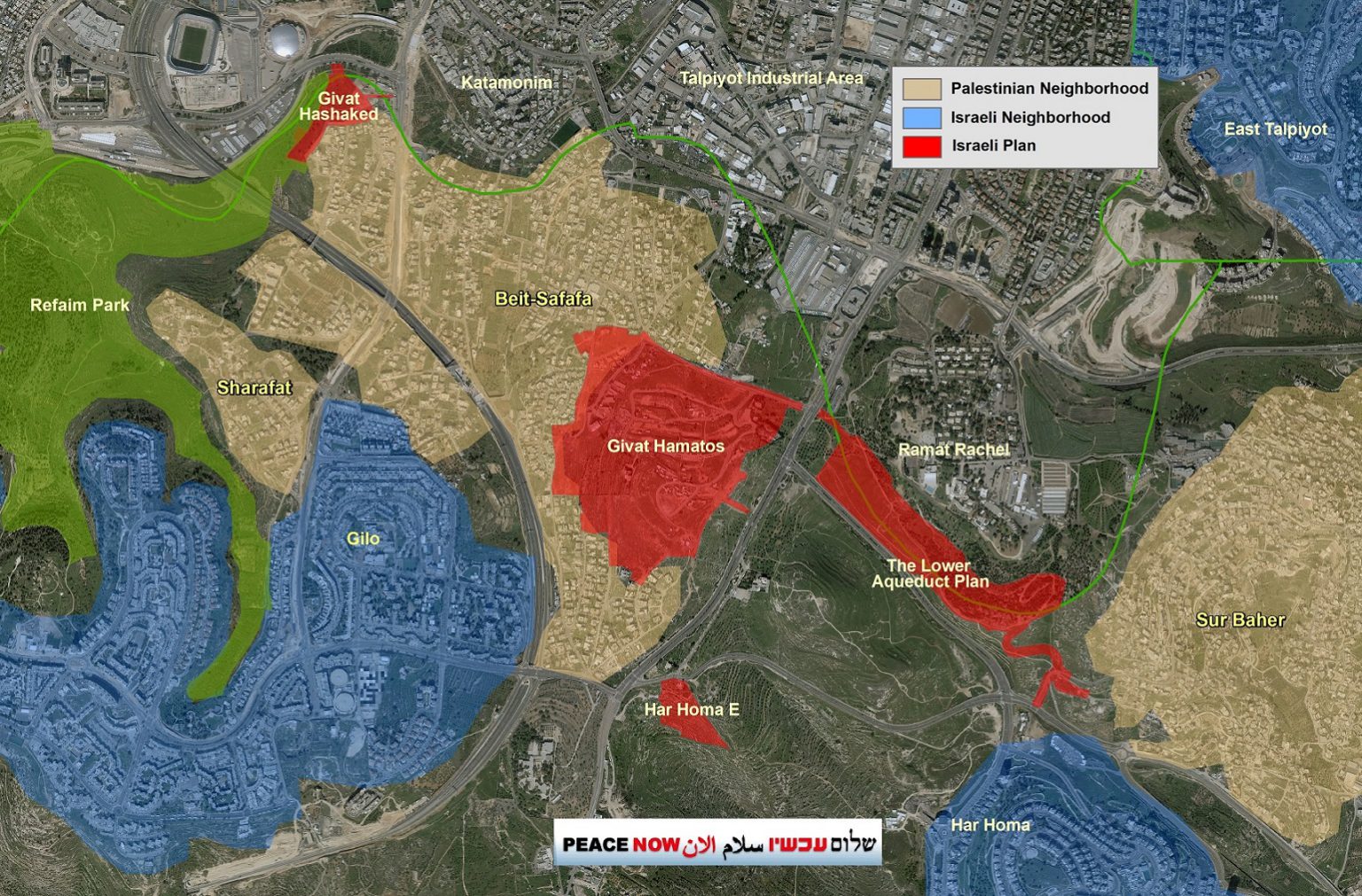 Peace Now reports that the Israeli Housing Ministry has published a tender for the construction of 1,047 settlement units constituting a new settlement in East Jerusalem called the Lower Aqueduct” plan. The settlement will be located on a sliver of land located between the controversial settlements of Givat Hamatos and Har Homa in East Jerusalem, adjacent to the Palestinian neighborhood of Umm Tuba and fall on both sides of the 1967 Green Line. The settlement is designed to connect the two settlements and seal East Jerusalem off from Bethlehem, and in so doing establish a huge, uninterrupted continuum of Israeli settlements on the southern rim of Jerusalem. According to Ir Amim, this is the first major new East Jerusalem settlement established by Israel since 2012.
Peace Now writes:
“The plan was promoted at an unprecedented speed from its inception to the tender issue: it was placed on the table of the District Planning Committee in July 2021, discussed in January 2022 by the District Committee which ordered revisions to the plan, and was approved for deposit in July 2022. That is, the tender was issued less than three years after the plans were submitted.
Politically, this is a strategic plan that will severely impact the possibility of a continuous urban Palestinian connection in East Jerusalem. In practice, the plan blocks the last corridor remaining for connecting Beit Safafa and Sur Baher with other parts of East Jerusalem. It should be noted that although about half of the plan’s area is beyond the Green Line, and half within it, its strategic location between Givat HaMatos and Har Homa makes it particularly problematic politically.”
Ir Amim has previously written:
“This plan carries serious ramifications on the political future of Jerusalem. If constructed, it will extend the Israeli settlement wedge along East Jerusalem’s southern border, further creating a sealing-off effect of East Jerusalem from the southern West Bank, while fracturing the Palestinian space and depleting more vacant land for Palestinian development….Beyond its geopolitical ramifications, the advancement of this plan underscores the systematic discrimination implicit in Israeli planning and building policy in Jerusalem. Since the beginning of 2023, over 18,500 housing units have been advanced for new or existing Israeli settlements in East Jerusalem, while residential development for Palestinians has been all but neglected. This is despite the fact that Palestinians constitute nearly 40% of Jerusalem’s population. 2023 is slated to join 2022 as being the two years with the highest number of settlement units advanced in the last decade in East Jerusalem. Such inequitable urban planning policy has long served as a driver of Palestinian displacement in service of solidifying a Jewish demographic majority in Jerusalem and further cementing Israeli territorial control to foil prospects for a just political resolution.”
Ir Amim & Bimkom: Israel Has Accelerated East Jerusalem Settlement Building Since Oct 7th
The Israeli anti-settlement NGOs Bimkom and Ir Amim have released a joint report reviewing the Israeli government’s wartime policies and how they have led to the acceleration of both settlement activity and home demolitions, posing an ever increasing threat to the rights and futures of Palestinian residents.
The report reads:
“Since the outbreak of the war six months ago, there has been a major surge in the promotion and fast-tracking of new settlement plans in East Jerusalem and a dramatic spike in the rate of demolitions of Palestinian homes. The Israeli government is clearly exploiting the war to create more facts on the ground to predetermine the final status of Jerusalem and thwart all prospects for a negotiated political agreement, while forcibly displacing Palestinians from their homes and the city.
Measures are being taken to establish eight brand-new settlements in East Jerusalem within or adjacent to Palestinian neighborhoods with a total of over 12,000 housing units. For details and analysis of these plans, click here or above for the full policy brief.
In juxtaposition to this major uptick in the advancement of new settlements, demolitions of Palestinian homes have reached unparalleled levels since the start of the war. This serves as a form of collective punishment and part of a series of repressive measures currently being employed by Israel against Palestinians under its control. Between October 7, 2023—March 10, 2024, 98 homes were demolished, which marks a nearly two-fold monthly increase compared to the period preceding the war. (Demolitions were halted during the month of Ramadan as in the past).”
Ben Gvir Seizes Authority Over East Jerusalem Housing Demolitions
On April 8th, the Israeli Cabinet decided to hand extremist minister Ben Gvir power over demolitions and housing enforcement in East Jerusalem. The CAbinet’s decision moved the Real Estate Enforcement Division from the Finance Ministry to the Ministry of National Security, which is controlled by Ben Gvir. The Real Estate Enforcement Division has the power to enforce against illegal construction in East Jerusalem and conducts demolitions and imposes fines alongside the Jerusalem municipality’s Building Supervision Department. It is important to note that the rate of demolitions in East Jerusalem during the Gaza war and in 2023 overall was higher than in other months or years, and it seems that transferring authority to Ben Gvir will only exacerbate this trend.
Daniel Seidemann, founder of Terrestrial Jerusalem, explained on X:
“In the eyes of the Palestinians in East Jerusalem, home demolitions are the most brutal & egregious manifestations of Israeli occupation. W/the exception of real or perceived threat to Al Aqsa, no issue in Jerusalem is more volatile & more incendiary than home demolitions. As per yesterday’s Cabinet Resolution, very broad powers will now be vested in Ben Gvir and an Authority or which he is responsible. these include administrative demolition orders, cease work orders, execution of judicial demolition orders, and much more. Ben Gvir has repeatedly declared his intent to carry out large scale home demolitions, particularly in E. Jerusalem. He then was opposed by the Police Chief, who now does his bidding. Ben Gvir has already expedited demolitions. However Ben Gvir had a problem: he had absolutely no statutory power in relation to demolitions. The role of the Police was to secure the demolitions ordered by the Jerusalem Municipality or Government of Israel (incl. judicial bodies). Bravado aside, he was a spectator.All that changed yesterday by means of the Cabinet Resolution. Having declared his intent “to show the Arabs of East Jerusalem who’s boss” by carrying out large scale demolitions. He will now have all the statutory powers and resources necessary to make good on his promise.”
Peace Now said in a statement:
“It has been unequivocally proven that law enforcement authorities under the responsibility of Itamar Ben Gvir exacerbate tension, violence, and hatred between the state and its citizens. The Real Estate Enforcement Division should operate with integrity and profound sensitivity to our political and social reality. However, it is highly doubtful that this will occur under the authority of Itamar Ben Gvir, the Minister of National Insecurity, who has previously been convicted of inciting racism and supporting a terrorist organization.”
New Plan to Massively/Strategically Expand the Ariel Settlement Industrial Zone
Peace Now reports that the Israeli Civil Administration’s High Planning Council convened on April 10th to consider 26 settlement plans, the most consequential of which is a plan to significantly expand the Ariel settlement industrial zone. This plan proposes to significantly expand the industrial zone eastward toward the new Ariel West settlement, which just began construction, connecting the two for all practical purposes.
Peace Now further explains the consequences of this plan:
“Expanding the industrial area eastward, on the one hand, and the establishment of the planned settlement of Ariel West, which infrastructure works for its establishment have recently begun, on the other hand, are intended to create a territorial continuum of settlements that will effectively block any possibility of development for Palestinian communities in the vicinity, including Salfit, Harres, and Kifl Harres. The plan essentially disconnects Salfit – the district town from the surrounding villages it serves.”
It’s worth revisiting the role settlement industrial zones play in perpetuating ISraeli occupation, annexation, and apartheid. For decades Israel has used industrial zones as another tool to expand and deepen control over West Bank land and natural resources. Industrial zones are part of Israel’s economic exploitation of occupied territory (including the local workforce, land, and other natural resources). Presented as benefiting both Israelis and Palestinians, it is in fact Orwellian to label such initiatives as “coexistence” programs, or to suggest that they offer the Palestinians benefits they should welcome. Importantly, jobs in industrial zones – often the only jobs available for Palestinians living under an Israeli occupation that prevents the development of any normal Palestinian economy – are widely viewed by Palestinians as a double-edged sword. The NGO Who Profits explained:
“Israeli Industrial Zones constitute a foundational pillar of the economy of the occupation. They contribute to the economic development of the settlements, which are in violation of international law and the Fourth Geneva Convention, while relying on the de-development of the Palestinian economy and the exploitation of Palestinian land and labor…The Industrial Zones in the oPt form part of a practice of ‘financial annexation’ which is an essential component of the broader policy of annexation taking place.”
Peace Now said in a statement:
“The government of Israel continues to build at an unprecedented pace in the Occupied Territories. Expanding an industrial area in the heart of the West Bank is not an Israeli interest, and certainly not a Palestinian interest. The industrial area west of Ariel does not promote economic growth, but rather harms both the Israeli and Palestinian economies alike.”
Smotrich Designates Symbols for Four Outposts Previously Approved for Retroactive Legalization
On April 6th, Finance Minister Smotrich (who also heads the Settlement Administration and a minister in the Defense Ministry) issued a statement announcing that he has designated “locality symbols” to four outposts that the government has previously approved to be retroactively legalized as new settlements: Mitzpe Yehuda, Beit Hogla, Shacharit, and Asa’el.
Peace Now explains:
“A ‘locality symbol’ is a serial number assigned by the Ministry of Interior to each official Israeli locality. For the government to allocate funds and resources for settlement development or to prepare construction plans, a settlement must have a “locality symbol.” Smotrich’s announcement aims to bolster his standing among his supporters as someone who does a lot for the settlements. Therefore, he exploits a bureaucratic maneuver and tries to present it as a new achievement.
The significance of assigning locality symbols to these four new settlements is that the government bureaucracy has already begun working to promote these settlements. It should be noted that since the government’s decision in February to establish nine new settlements, the commander of the military’s Central Command, Maj. Gen. Yehuda Fuchs has issued orders in recent months defining the jurisdictional areas of six of them: Mishmar Yehuda, Givat Haroeh. Apparently, defining the jurisdictional area of the remaining three settlements is delayed due to land ownership issues.”
The U.S. & E.U Unveil New Sanctions Targeting Settlers & Settler Entities
On April 19th the United States Department of State announced a third round of sanctions targeting one Israeli settler and two settler entities. The European Union announced sanctions on the same day, against four settlers and two settler entities. This round of sanctions is particularly notable because it expands the sanctions’ targets to include entities which fund settlers involved in violence, and because it targets a prominent political ally and confidant of Itamar Ben Gvir.
The U.S. sanctions target:
- Ben Zion (Bentzi) Gopstein – founder of the radical, violent Lehava settler organization, and “one of the closest confidants” of Kahanist Minister Itamar Ben Gvir. The U.S. State Department says that Lehava and its members “have been involved in acts or threats of violence against Palestinians, often targeting sensitive or volatile areas.” Gopstein was convicted in early 2024 for incitement to racism
- The Mount Hebron Fund – an organization leading a fundraising campaign for Yinon Levi, an Israeli settler previously sanctioned by the U.S. The U.S. group DAWN writes that the crowdfunding campaign had the declared intention of bypassing US sanctions. The AP reports the fundraising effort raised $140,000.
- Shlom Asiraich – an organization leading a fundraising campaign for David Chai Chasdai, an Israeli settler previously sanctioned by the U.S.. The AP reports the fundraising effort raised $31,000.
The European Union sanctions target:
- Lehava – the organization run by Ben Zion Gopstein (who the U.S. sanctioned as an individual, but did not sanction Lehava).
- The Hilltop Youth settler organization – a notoriously violent group based out of the Yitzhar settlement and involved in establishing illegal outposts throughout the West Bank. The Hilltop Youth have been called “the Jewish ISIS,” and regularly engage in violence against Palestinians, Israeli authorities, and activists.
- Neriya Ben Pazi – who was previously sanctioned by the U.S..
- Yinon Levi – who was previously sanctioned by the U.S..
- Meir Ettinger – who is the grandson of the late, extremist rabbi Meir Kahane, and a well-known leader of the Hilltop Youth leader.
- Elisha Yered – who previously served as a spokesperson for MK Limor Son Har-Melech, an ally of Ben Gvir.
Itamar Ben Gvir responded to the new sanction, saying:
“The harassment of the Lehava organization and dearest settlers, who never engaged in terrorism or harmed anyone, are the result of a blood libel by Israel-hating, antisemitic elements who for years have openly supported Hamas, Fatah, and other anarchist organizations that harm IDF soldiers.”
Bonus Reads
- On Settler Terrorism:
- “West Bank sees biggest settler rampage since war in Gaza began as Israeli teen’s body is found” (AP)
- “Al-Haq, Al Mezan and PCHR Urge the International Community to Intervene as Israeli Forces and Settler Violence Intensifies Across the West Bank” (read)
- “Homes burned, animals killed: Palestinians describe Israeli settler rampage” (Washington Post)
- “Israel Responsible for Rising Settler Violence” (Human Rights Watch)
- “Opinion | Dear President Biden, Are You Okay With Israeli Settlers Using American Weapons?” (Amira Hass in Haaretz)
- “Blinken Is Sitting on Staff Recommendations to Sanction Israeli Military Units Linked to Killings or Rapes” (Pro Publica)
- “Blinken says he’s made ‘determinations’ linked to human rights accusations against Israel” (The Times of Israel)
- “Ben Gvir forms police team targeting left-wing activists in the West Bank” (The Times of Israel)
- “Editorial | Goodbye, Green Line: The Israeli Government Goes All Out to Boost West Bank Settlements” (Haaretz Editorial Board)
- “Housing, Showers, Electricity: These Are the Outposts the Israeli Army Is Building in the Heart of Gaza” (Haaretz)
Welcome to FMEP’s Weekly Settlement Report, covering everything you need to know about Israeli settlement activity this week.
To subscribe to this report, please click here.
March 15, 2024
- Yesh Din Files High Court Petition to Stop Jordan Valley Regional Council
- Construction Starts on New Settlement, Ariel West
- IDF Demolishes Outpost Near Ofra
- Subcommittee Hearing Defends Settler Violence, Points Finger at Human Rights Activists
- US Announces New Sanctions on Three Individuals & Two Outposts
- Bonus Reads
Yesh Din Files High Court Petition to Stop Jordan Valley Regional Council
On March 7th the Israeli NGO Yesh Din assisted Palestinians in the Jordan Valley to file a petition with the High Court of Justice seeking to force the IDF Central Command to prevent settlers and settler regional councils in the Jordan Valley from illegally seizing and ransoming herds of livestock belonging to Palestinians, and to return all livestock currently confiscated and funds paid to the regional council for the return of livestock. Since October 7th, Yesh Din has documented several instances of settlers conspiring with the Jordan Valley Regional Council to confiscate herds of livestock belonging to Palestinians based on the claim that they are illegally grazing in the Regional Council’s jurisdiction, and then demanding exorbitant fees for their return. Yesh Din identifies this not only as an illegal practice, but as a policy “designed to annex and take over Areas C while pushing Palestinians out…to force Palestinian communities from their homes.”
The IDF’s own legal council has recently issued a legal opinion confirming that settler municipalities do not have jurisdiction or authority to enforce any laws or regulations against Palestinians. But the settler regional council rejected this opinion, saying that its jurisdiction applies to an area of land – not just a certain type of people (i.e. Israeli settlers). As a reminder, the West Bank remains under Israeli military rule via the Israel Ministry of Defense and the IDF. Israel has extended its domestic laws to settlers, so that settlers are subject to Israeli domestic law and Palestinians remain under military rule. In this case, the settler regional argues that it has authority over land, and any Palestinians (and their property) who enter that land.
Yesh Din explains why this is a significant legal claim:
“The danger posed by the pretension of the regional council, which seeks to hold the power to regulate the grazing of Palestinian herders, has enormous ramifications. This is a new and predatory form of economic violence by settlers and an authority that has distinct annexationist aspects, as it expresses the degradation of the military commander’s responsibility in the occupied territory and the assignment of its authorities to civilian governmental bodies.”
Over the past six months, settlers have regional councils have repeatedly kidnapped herds of livestock and demanded exorbitant fees
Construction Starts on New Settlement, Ariel West
 Peace Now reports that Israel has begun construction of a new settlement, Ariel West, plans for which were first made public in November 2021 and tenders were issued in May 2023 — all under the guise of a plan to “expand” the Ariel settlement [for more on how this plan was kept quiet, see Peace Now’s detailed history]. The Ariel West settlement is being built on a hilltop located 1.2 miles away from Ariel, in an area that is non-contiguous with the built-up area of the current Ariel settlement. To perpetuate the framing of this new construction as the growth of an existing settlement rather than a new settlement – settlers and the government call Ariel West the“Amririm Neighborhood.” The new settlement will be directly adjacent to the Palestinian village of Salfit, further limiting the future development of Salfit and restricting Palestinian agricultural workers’ access to land, as illustrated in this video by Peace Now.
Peace Now said in a statement:
“The construction of Ariel West, a new settlement deep in the West Bank, just before Ramadan and amidst the imminent danger of escalation in the West Bank and East Jerusalem, is further proof that the Israeli government is seeking violent escalation and opening a third front of war. It is also further proof, for anyone still in doubt, that it is doing all it can to destroy the possibility of the two-state solution. Israeli citizens deserve a better government, and its actions and decisions are endangering the lives and futures of both Palestinians and Israelis, as well as that of the entire region. The construction of a new settlement is part of recent initiatives amidst the ongoing war, aimed at advancing thousands of housing units in the territories, declaring thousands of dunams as state land, and approving significant budgets for settlements in the 2024 budget.”
IDF Demolishes Outpost Near Ofra
The Times of Israel reports that on March 11th, the Israeli Civil Administration demolished an illegal outpost known as “Or Ahuvia,” located close to the Ofra settlement north east of Ramallah. The IDF forced settlers to leave the area, demolished a rudimentary house, and confiscated other materials – saying that the outpost was built illegally on privately owned Palestinian land.
The “Or Ahuvia” or “Ma’aleh Ahuvia” outpost was originally erected (and demolished) in 2022 in memory of Ahuvia Sandak, a settler “hilltop youth” who died when the car he was traveling crashed as it was fleeing Israeli police with a group of settler youth who allegedly has been stoning Palestinian cars. Settlers and their supporters have painted Israeli police as perpetrators of a crime of negligence (or worse) against the settler youth; the Knesset has taken up the issue; and Sandak has been memorialized as a hero and a martyr to the cause of Greater Israel.
Subcommittee Hearing Defends Settler Violence, Points Finger at Human Rights Activists
At the demand of settler groups, the Knesset Foreign Affairs and Defense Committee convened a subcommittee hearing on March 12th to hear testimony regarding the alleged “harassment” perpetrated by human rights defenders against Israeli security personal. MK Merav Michaeli denounced the hearing saying the chairman, Tzvi Succot, seeks to “present an upside down and false world.” MK Limor Son Har Melech (Otzma Yehudit) said at the hearing:
“They [pro-Palestinian activists] are aggressive to IDF soldiers, to settlers, they damage property, they blacken Israel’s name around the world, engage in the demonization and delegitimization of Israel and damage our image.”
The hearing turned out to be more than a smear campaign against human rights defenders, but also a defense of extremists settlers. The senior police commander in the West Bank perpetuated the claim that settler violence is over exaggerated, testifying to the committee that 50% of complaints regarding settler violence turn out to be false.
US Announces New Sanctions on Three Individuals & Two Outposts
On March 14th the U.S. government announced it had imposed sanctions on three Israeli settlers and two settlement outposts, adding to the four individuals it had previously sanctioned. This is the first time the U.S. has imposed sanctions on entities (the two outposts) in addition to individuals – demonstrating the possible far-reaching targets of U.S. sanction authority. The settlers and outposts were documented to have taken part in (or be a base of action for) acts of violence against Palestinians in the West Bank.
The two outposts sanctioned are known as “Moshe’s Farm” and “Zvi’s Farm” – and the individuals are the leaders of those outposts.
The U.S. Department of State said in a statement:
“Today, we are taking further action to promote accountability for those perpetuating violence and causing turmoil in the West Bank by imposing sanctions on three Israeli individuals and two associated entities involved in undermining stability in the West Bank. There is no justification for extremist violence against civilians or forcing families from their homes, whatever their national origin, ethnicity, race, or religion. The United States is committed to enduring peace and prosperity for Palestinians and Israelis alike and will continue to use all available tools to promote accountability for those engaging in actions that threaten the peace, security, and stability of the West Bank.”
Bonus Reads
- “Norway Advises Against Trade, Business With Israeli Settlements” (Bloomberg)
- “The government is tightening its grip on Israeli settlements – the Pole is considering stopping the sale” (NRK)
- “Israel deploys 15,000 troops in West Bank as Ramadan starts” (Mondoweiss)
Welcome to FMEP’s Weekly Settlement Report, covering everything you need to know about Israeli settlement activity this week.
To subscribe to this report, please click here.
May 19, 2023
- Peace Now Reports: 613 New Settlement Units Advanced, Including Tender for A New Settlement – “Ariel West”
- March of Flags Expanded Route
- Gallant Orders IDF To Allow Israeli Jews to Reestablish Homesh Outpost & Yeshiva
- Smotrich is Leading a Push to Double Settler Population
- Al Walajah Checkpoint Construction Blocks Palestinians from Land
- Settler Visit to Joseph’s Tomb Causes Conflict
- MKs Oppose New Section of Security Wall, Say it Will Divide Settlements from Israel
- Bonus Reads
Peace Now Reports: 613 New Settlement Units Advanced, Including Tender for A New Settlement – “Ariel West”
Peace Now reports that Israeli planning authorities convened on May 17th to advance plans for a total of 613 new settlement units, including a move by the Israeli Ministry of Housing and Construction to re-publish a tender for the construction of 58 units constituting a new “neighborhood” of the Ariel settlement which is, in effect, a new settlement. The Civil Administration’s High Planning Committee also convened on the 17th and is expected to have issued final approval to a plan for 552 units in the Givat Ze’ev settlement, and also to have deposited for public review a plan for 2 more units in Givat Ze’ev as well as a plan for 1 new unit in the Itamar settlement (final confirmation of the Committee’s decision was not available at the time of publication). Peace Now warns that construction could commence quickly on the plan to build 552 new units in the Givat Ze’ev settlement because a contractor has already been selected. Givat Ze’ev is located south of Ramallah in an area that is on the Israeli side of the barrier.
The Ministry of Housing and Construction’s issuance of a tender to build 58 units in the Ariel settlement is final approval to build a brand new settlement, dubbed “Ariel West.” Plans for the Ariel West settlement were first made public in November 2021, after the tenders were issued under the guise of a plan to “expand” the Ariel settlement [for more on how this plan was kept quiet, see Peace Now’s detailed history]. The units for the new Ariel West settlement will be built on a hilltop located 1.2 miles away from Ariel, in an area that is non-contiguous with the built-up area of the current Ariel settlement. The new settlement will be directly adjacent to the Palestinian village of Salfit, further limiting the future development of Salfit and restricting Palestinian agricultural workers’ access to land, as illustrated in this video by Peace Now. [map]
Peace Now said in a statement:
“It is clear that annexing the West Bank is the main agenda of the Israeli government. Promoting more than 600 housing units in settlements, among them a tender for the construction ‘Ariel West’, an entirely new settlement established under the official guise of a neighborhood an Ariel settlement, joins previous devastating annexationist decisions advancing annexation, made by the government, such the decision to legalise 15 outposts, the advancement of nearly 10,000 housing units in settlements, the cancelation of the disengagement law from the North part of the West Bank, the promotion of the apartheid road east of Jerusalem and the transfer of powers from the military to Minister Smotrich. Each decision alone demonstrates that the government is acting with an intention to annex the occupied territory, prevent the possibility of establishing a viable Palestinian State, and to escalate tensions between Palestinians and Israel.”
March of Flags Expanded Route
Tens of thousands of ultra-nationalist extremist Israeli Jews participated in the annual Jerusalem Day “Flag March” through Jerusalem in celebration of Israel’s (illegal) annexation of East Jerusalem in 1967. The parade drew security support from over 3,200 Israeli security forces and aerial drones, which sealed off the route of the parade and shuttered large parts of Jerusalem for Palestinians. The parade poses an annual threat of erupting into large-scale violence because it is a direct provocation – which Israeli lawmakers egg on and participate in – against Palestinians in Jerusalem. Israeli Jews participating in the parade chant Jewish Supremacist slogans and anti-Palestinian slurs including “Death to Arabs” and “May Your Village Burn,” the latter of which is particularly horrific given the pogrom Israeli settlers committed against the Palestinian village of Huwara earlier this year.
This year the Israeli government extended the route of the Flag March, which Haaretz estimated to impact at least an additional 50,000 Palestinian residents of East Jerusalem. The longer route will include stops at two East Jerusalem settlement compounds, bringing the parade for the first time through the Palestinian neighborhood of A-Tur and near the village of Ras Al-Amud. Haaretz also reports that march organizers will hold tours in Sheikh Jarrah.
Ir Amim’s Yudith Oppenheimer explained the motivation of the marchers:
“At the parade’s core lies an ideology that Palestinians ought to be humiliated and pushed to their limit; they should be reminded at every moment that they live in an occupied city where they have no authority and no place; every reaction by Palestinians must be exploited to justify increased use of force and establish more facts on the ground.This is why the parade organizers and their sponsors insist on the route going through Damascus Gate and the Muslim Quarter. And if necessary, may our city burn just to prove it.”
The Haaretz Editorial Board wrote:
“The essence of the Flag March is to poke a finger in the eye of the city’s Palestinian inhabitants, to humiliate them and to drive home the fact that 40 percent of the residents of Israel’s capital live under occupation. Absurdly, the march actually underscores the fragility of Israeli sovereignty over East Jerusalem. It takes place under heavy security provided by thousands of police officers, after the police impose severe restrictions on the Palestinian public and merchants.”
Gallant Orders IDF To Allow Israeli Jews to Reestablish Homesh Outpost & Yeshiva
On Wednesday May 17th, Defense Minister Yoav Gallant issued an order instructing the head of the IDF Central Command – Yehuda Fuchs – to sign a military order that makes it legal for Israeli Jews to enter and reside in the area of the Homesh settlement in the northern West Bank, including the Homesh settlement which settlers have been pushing to reestablish. The military order is needed even after the Knesset repealed clauses of the 2005 Disengagement Law in March 2023, which it did explicitly in order to facilitate the reestablishment of the Homesh settlement which was dismantled under the law, along with three other settlements in the area.
The Knesset’s repeal of the Disengagement Law faced international criticism, which Prime Minister Netanyahu, at the time, assuaged by issuing a statement that his government has ““no intention of establishing new settlements in the area.”
The U.S. State Department issued a statement to Israel Hayom in reaction to Gallant;s order, reiterating opposition to the reestablishment of Homesh, saying:
“The United States strongly urges Israel to refrain from allowing the return of Israeli settlers to the area covered by the legislation passed in March, consistent with both former PM [Ariel] Sharon’s and the current Israeli government’s commitments to the United States…We have been clear that advancing settlements is an obstacle to peace and the achievement of a two-state solution. This certainly includes creating new settlements, building or legalizing outposts, or allowing building of any kind on private Palestinian land or deep in the West Bank adjacent to Palestinian communities”
Further reports suggest Gallant and Smotrich are working on a plan to build the Homesh settlement on a small plot of “state land” in the settlement’s former location, which was built almost entirely on land that belongs to (and is recognized by Israel as registered as belonging to) Palestinian owners. The Israeli NGO Yesh Din noted that the repeal of clauses related to Homesh in the Disengagement Law did not change the legal status of the land, and did not create a legal option for reestablishing the Homesh settlement there. Smotrich and Gallant are apparently advancing a plan to build Homesh on the small parcel of “state land” in the area, which in effect will allow settlers – and the security apparatus that enables, accompanies, and entrenches their presence – to retain total control over the Homesh area even though the land is privately owned by Paelstinians.
As a reminder, even after the Homesh settlement was dismantled in 2005, control over the land was never returned to its owners. The area was instead declared by the Israeli army to be a closed military zone, with Palestinains, including the owners of the land, barred from access. The Palestinians owners have been fighting for the right to access their own land since 2009, with no success. At the same time, the Israeli army allowed Jewish Israeli settlers to access the area regularly, and even permitted the settlers to illegally (under Israeli law) establish a religious school and settlement outpost at the site. Rather than enforce Israel’s own laws against the settlers, the current Israeli government has agreed to grant retroactive approval to the settlers’ illegal presence, the first step towards doing so being the aforementioned repeal of clauses in the Disengagement Law that make any Israeli presence there illegal. A
Smotrich is Leading a Push to Double Settler Population
Haaretz reports that since Bezalel Smotrich was granted vast authority over civil affairs in the West Bank, he has set out to initiate wide-scale planning to add 500,000 new settlers, essentially doubling the current number of Isarelis living in the West Bank (not including East Jerusalem). This push includes orders to improve the infrastructure for every settlement and outposts (regardless of legal status) within the next two years. Smotrich is also pursuing ways by which to make it easier for settlers to cross into Israel without the hassle imposed on currently by the checkpoint system.
Haaretz further reports that Defense officials are expected to oppose Smotrich’s planning, even though detailed information has not yet been provided. In addition to security challenges to Smotrich’s plan, he also lacks the massive budget that such an effort would require.
Al Walajah Checkpoint Construction Blocks Palestinians from Land
Ir Amim reports that the Jerusalem Municipality has formally announced the start of work on a project to relocate a key IDF checkpoint leading to the Palestinian village of Al-Walajah, a village which is located on (and partially within) the southern perimeter of Jerusalem’s expanded municipal borders. The effort to move the checkpoint closer to the built-up area of Al-Walajah is part of the Israeli government’s long running effort to take control over an increasing amount of land – and importantly, the Ein Haniya spring – that historically belongs to Al-Walajah.
By relocating the checkpoint to a point closer to Al-Walajah, Palestinians from the village will no longer have unfettered access to approximately 1200 dunams of agricultural land, including the site of the Ein Haniya springs. The Ein Al-Hanya spring, which the Jerusalem Municipality declared a national park in 2013 and then spent years and millions of dollars renovating into a tourist destination, is located on land historically part of Al-Walajah and it long served as a main source of water for households, farms, and recreational purposes for the village’s residents.
Since 1967, Al-Walajah has suffered due to its location and its complicated status (much of the village’s lands, including areas with homes, were annexed by Israel in 1967, but Israel never gave the villagers Jerusalem legal residency by Israel – meaning that under Israeli law, their mere presence in their homes is illegal). Today it is acutely suffering from a multi-prong effort by the Israeli government and settlers to grab more land for settlement expansion in pursuit of the “Greater Jerusalem” agenda. This land grab campaign includes home demolitions (four homes in Al-Walajah were demolished by Israel on November 2, 2022, for example), the construction of the separation barrier and bypass roads in a way that seals off the village on three sides, and the systematic denial of planning permits.
You can join a webinar entitled “What’s Next for al-Walaja”on May 24th at 12pm eastern to learn more about al-Walajah (hosted by Ameinu, Peace Now, T’ruah, and Telos on May 24th at 12pm eastern. Register here.
Settler Visit to Joseph’s Tomb Causes Conflict
On the night of May 17th, thousands of Israeli Jews – including at least two elected officials – staged a trip to the Joseph’s Tomb site in Nablus under the heavy protection of the IDF, which attempted to enforce a curfew on nearby Palestinian neighborhoods. Clashes erupted as Palestinian confronted the parade of settlers, resulting in at least two injuries.
In response to the violence, settler leader Yossi Dagan called on Israel to take complete control over the site, to build a yeshiva there, and to “restore the ISraeli flag at this holy site and show everyone, both ourselves and our enemies, that we are not afraid.”
The tomb is located within Area A of the West Bank (where Israel does not, under the Oslo Accords, have direct control). However, Joseph’s Tomb is one of two sites in Area A which the Oslo Accords stipulate are under the control of the Israeli military. As such, it has been a perennial flashpoint, largely due to deliberately provocative actions by settlers. The whole circumstance – of settlers visiting Joseph’s Tomb – was recently called “absurd” by former IDF Major General Gadi Shamni.
MKs Oppose New Section of Security Wall, Say it Will Divide Settlements from Israel
Israel Hayom reports that the Israeli Defense Ministry is moving towards the start of construction on a very controversial section of the West Bank separation barrier near the Etzion settlement bloc. This particular section has not been built since its initial approval in 2006 because of fierce opposition to the proposed route that, even though the barrier’s route cuts deeply into the West Bank in order to keep the majority of settlements in the Etzion Bloc on the “Israeli side” of the barrier, it leaves a few settlements including Nokdim on the “Palestinian side.”
The IDF said in a statement that the project does not include the construction of concrete walls, but will feature different types of construction that cater to wildlife and the area’s topography – to include “special monitoring technology and sensors.”
Israeli lawmakers reacted negatively to the news of this project, saying that it has the potential to create a “de facto border” between the settlements and Israel proper and that it would turn settlements in the area into enclaves. This opposition is in line with the right wing demands to annex the West Bank to Israel, in which context building a barrier is viewed as conceding land to Palestinians.
For background on the separation barrier, please see B’Tselem’s explainer.
Bonus Reads
- “The Settler Terrorists in Palestinian Vineyards” (Amira Hass, Haaretz)
- “A precious resource: how Israel uses water to control the West Bank” (The Guardian)
- “When Israel’s Highest Court Assaults Human Rights” (Jessica Montell, Haaretz)
Welcome to FMEP’s Weekly Settlement Report, covering everything you need to know about Israeli settlement activity this week.
To subscribe to this report, please click here.
August 19, 2022
- Ir Amim on East Jerusalem Land Registration & State Land Seizures
- Israel Advances Plan to Build New Settlement “Ariel West”
- IDF Razes “Ramat Migron” Outpost for Second Time in a Week
- Ultra-Orthodox Settlers Establish Their First-Ever Outpost
- Israel Pauses to “Rethink” Plan to Build on Historic Site of Lifta
- Bonus Reads
Ir Amim on East Jerusalem Land Registration & State Land Seizures
In an alert issued August 11th, Ir Amim adds important information and analysis of Israel’s seizure of a plot of land in East Jerusalem last week. Importantly, Ir Amim explains how Israel is using the process of land registration to (sometimes covertly) take control over more and more land in the most sensitive areas in East Jerusalem.
Ir Amim writes:
“The area between Jabal Mukkaber and Abu Dis has long been targeted by the state and settlers due to its strategic location…Upon investigation, Ir Amim discovered that 12 dunams of land (bloc 31735) situated in the same location referred to in the article were recently registered under the management of the General Custodian in the Land Registration Office…Rights, bloc 31735 recently underwent settlement of land title procedures (formal land registration). Initiated on May 31, 2021, the settlement of land title process was swiftly completed in just over a year with little to no transparency and formally registered in the Tabu (land record) on July 14, 2022. The official order transferring the respective plot of land into the management of the General Custodian was issued on June 8, 2021—a mere days after the announcement of the settlement of title process on the same bloc of land. It should be underscored that the General Custodian is one of the state institutions formally and integrally involved in the settlement of title process. The timing is certainly not coincidental, and it was clearly carried out as a means to assert Jewish ownership claims of the land. In contrast, the process has yet to be initiated on the adjacent thousands of dunams of land owned by Palestinians in the same area.
Such a move constitutes yet another cynical exploitation of the settlement of land title procedures which are being conducted in the framework of Government Decision 3790—a decision aimed at ostensibly improving the well-being of Palestinians in East Jerusalem. As reported previously, an examination of the locations where the procedures have been completed or currently underway reveals the driving rationale: settlement of land title is largely being promoted in areas where the state and/or settlers have a particular interest and have some capacity to lay claim to the land in the framework of the proceedings. As such, these procedures are being used as yet another mechanism to seize more territory in East Jerusalem under the guise of a decision and budgets earmarked for Palestinians.”
Israel Advances Plan to Build New Settlement “Ariel West”
On August 18th, the Israeli Civil Administration discussed an amended plan to build an access road leading to an area of land where Israel is intending to build a new settlement, dubbed “Ariel West.” At the time of publication, it is unclear the outcome of the discussion is not yet known. We do know that Israel was forced to amend its original plan to build the access road to the new settlement site when it was proven that the route went through privately owned Palestinian land belonging to the village of Salfit.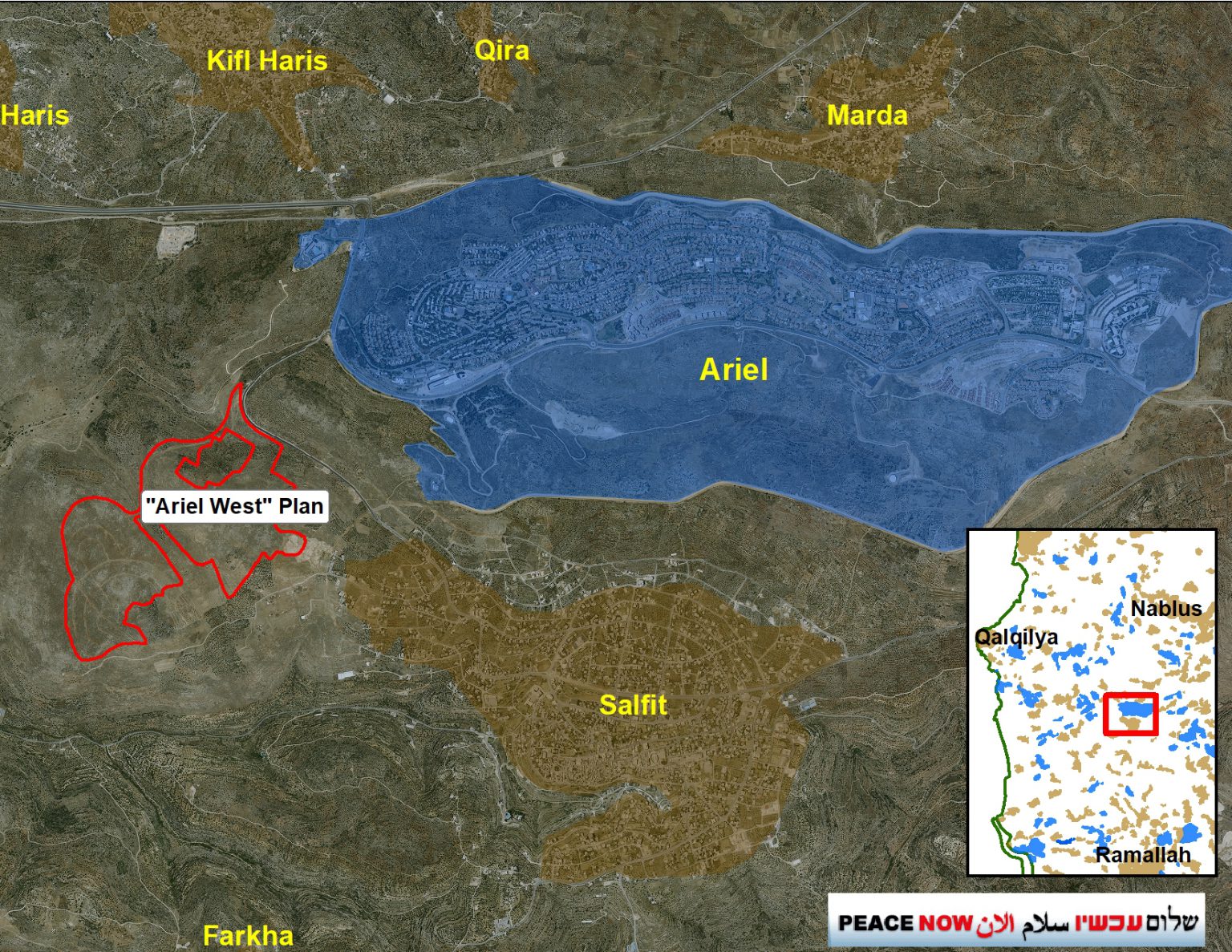
The plan for “Ariel West” was first discovered in November 2021, after the Israeli Ministry of Construction issued tenders (on October 24, 2021) for the new settlement, under the guise of a plan to “expand” the Ariel settlement, located south of Bethlehem. Under the plan, 731 new settlement units will be built on a hilltop located 1.2 miles away from Ariel, in an area that is non-contiguous with the built-up area of the current Ariel settlement.
Peace Now said in a statement:
“The government has been given another opportunity here to stop the establishment of the new settlement. After the Ministry of Housing rushed to issue tenders for the sale of the building rights, construction can still be halted if the defense minister stops the planning process. The “Ariel West” plan is not just a plan for thousands of housing units, but it is a new settlement designed to block the town of Salfit and prevent the development of Palestinian space in the area. Road comprise the infrastructure of the occupation, and the undercurrents of apartheid in the occupied West Bank. This dangerous plan must be stopped.”
“Ariel West” is one of many clear illustrations of how Israel systematically rewards unauthorized/illegal construction undertaken by settlers. In this case, settlers established an unauthorized outpost (i.e., illegal even under Israeli law) called “Nof Avi”on the hilltop where the new settlement is slated for construction. The Israeli government has allowed that outpost to remain in place for the past year, and thereby restrict Palestinians’ access to agricultural lands they rightfully own.
The hilltop and the Nof Avi outpost is located on land declared by Israel to be “state land” inside of the jurisdictional boundaries of the Ariel settlement, as authorized by the Israeli government. The jurisdictional boundaries of Ariel include several non-contiguous land areas — due to the fact that the area is dotted with land that even Israel recognizes to be legally owned by Palestinians (de facto annexing private Palestinian land to the settlement by leaving it in some places nearly completely surrounded by land controlled by the settlement).
The new settlement will further exacerbate the limitations that the settlements inflict on Palestinian agricultural workers, in addition to the future development of the nearby Palestinian town of Salfit, as illustrated in this video by Peace Now. Even before the “expansion” plan, Ariel’s jurisdictional area was identified as a direct hindrance on the future development of Salfit.
With news of the new settlement in October 2021, the Mayor of Salfit – Abdullah Kamil – explained to Haaretz:
“Salfit is slated for expansion. It has a university and there are plans to add 10,000 students over the next few years. The city’s master plan will have to be enlarged, and the site where the new settlement is planned is exactly the direction toward which we wanted to expand. This situation will explode. We also told the Israelis this; it will open a new front and it will harm Israeli security. It’s clear that part of the plan’s purpose is to eliminate any chance of a political solution.”
IDF Razes “Ramat Migron” Outpost for Second Time in a Week
On August 14th Israeli forces once again cleared settlers and their property off of a hilltop where the settlers are attempting to establish a permanent outpost, which the settlers call Ramat Migron. Israeli forces cleared the site just four days prior, but settlers quickly re-occupied the area.
As a reminder, in 2012 an illegal outpost known as Migron was dismantled by the Israeli government when the Israeli High Court ruled the land is privately owned by Palestinians. Since then settlers have continually sought to reestablish a settlement there. Israeli forces have razed outposts at the site at least 10 times in the past 10 years — all the while denying Palestinians the ability to reclaim control over land that an Israeli court affirmed they own.
In addition to the IDF retaining control over the Migron outpost site, Israel rewarded the settlers it forcibly removed from the Migron outpost by promising to establish two new official settlements: “New Migron” as well as 184 housing units to be built east of the settlement of Adam (aka, Geva Binyamin). Construction of the “New Migron” settlement was completed in July 2020. All said, the two new settlements and temporary housing for the evicted settlers cost Israeli taxpayers millions of dollars – sending a clear message that settler law-breaking pays.
Ultra-Orthodox Settlers Establish Their First-Ever Outpost
On August 16th, a group of 15 settler families announced the establishment of a new outpost near the settlement of Metzad, located in the southern West Bank. The settlers, notably, are ultra-orthodox Jews – making this the first outpost established by ultra-orthodox settlers. The settlers, who are calling the outpost “Derech Emunah,” have built 15 makeshift structures already at the site, which they are using as a yeshiva, synagogue, and homes.
A leader of the group, Moshe Rotman, said:
“The establishment of Derech Emunah is designed to increase awareness within the ultra-Orthodox community of the religious commandment of settling the land, as well as showing that the housing crisis in the community can be resolved through settlement construction in Judea and Samaria.”
The Ultra-Orthdox have long been viewed as distinct from religious-nationalistic settlers. Most ultra-Orthodox settlers moved to homes in the settlements for cheap housing (and their desire to live in homogenous communities) rather than out of a religious or nationalistic belief that Israel has a right and/or obligation to reclaim all of the land between the river and the sea. The establishment of this outpost challenges that understanding. Rotman called the Ultra-Orthodox a “dormant volcano,” insisting that the new outpost was established not merely by members from the fringe of the ultra-Orthodox community, and suggesting that many more ultra-Orthodox settlers will follow suit.
Peace Now said in response:
“Security forces must demonstrate zero tolerance to the outpost criminals, whether they are ultra-Orthodox, Zionist ultra-Orthodox or just criminals. Defense Minister Benny Gantz is avoiding evacuating the Homesh outpost. We call on him to instruct today, to demolish the new outpost. Any minute that the outpost is still standing shows that all he (Gantz) cares about is pleasing [right-wing Justice Minister Gideon] Saar and [right-wing Knesset member] Matan Kahana. It shows that he tries pleasing the ultra-Orthodox parties at the expense of the State of Israel.”
It’s also worth noting that Rotman said that the outpost was established in response to what his group perceives as the Israeli government’s selective enforcement against illegal construction by Israelis and the Palestinians in Area C of the West Bank. As FMEP has routinely covered, settlers and their allies in the Israeli government have perpetuated a false narrative – which at this point is deeply held by settler leadership – that the Israeli government is failing to thwart an alleged campaign by the Palestinian Authority to take over land in Area C via “illegal” construction – referring to construction by Palestinians on their own land, but without Israeli-required permits that Israel systematically refuses to issue. Settlers are using this story to push the government to more swiftly and systematically demolish any/all Palestinian construction in Area C.
Playing on this narrative, settler leader Tzvi Succot, who plans to run for the pro-settler Religious-Zionist (Orthodox) party Knesset list primaries, said:
“It is very exciting to see how members of the ultra-Orthodox community join with dedication to the holy mission of settling the land of Israel, breaking through the choking ring placed on the settlement enterprise in the West Bank. I hope the state of Israel won’t play a discrimination game and won’t demolish the new community, while all around it are hundreds of Arab-constructed illegal buildings that are not subjected to the law.”
Israel Pauses to “Rethink” Plan to Build on Historic Site of Lifta
The Times of Israel reports that the Jerusalem Municipality and the Israel Lands Authority have agreed to “rethink” their plans to build a luxury housing development on the ruins of the historic Palestinian village of Lifta, located in West Jerusalem. Lifta is the last Palestinian village in West Jerusalem to remain partially intact. Israel has prevented Palestinian refugees and landowners from returning to it, but has not yet demolished all the original structures (55 out of the original 400 structures still remain). In 2017 the ruins of Lifta were named by the World Monuments Fund as one of 25 at-risk sites around the world, and Lifta on the list of UNESCO’s tentative World Heritage Sites for bearing “unique testimony of the traditional village life.”
The Times of Israel further reports that after visiting the site, Israel’s Mayor of Jerusalem Moshe Leon is considering a plan to “preserve the village and turn it into a World Heritage Site.” However, in commenting on the Mayor’s new directive, the Israeli Municipality erased Palestinians, their history and their culture, from the story of Lifta. In a statement, the Jerusalem Municipality said:
“[Lifta] serves as an important heritage symbol for Jerusalemites, Israelis and all those who come to Jerusalem. In the past, a plan to build housing units on the site was approved. The mayor discovered that this plan does not consider the preservation needs to the proper degree and in his opinion, is not appropriate at all. Therefore, in coordination with the ILA, it was decided not to market [the project] and to have a rethink. At the heart of the new thinking is the preservation of Lifta and its transformation into a world heritage site.”
Israel’s plans to build on top of Lifta’s ruins surfaced In May 2021, when Israel announced it planned to open bidding on a tender for the construction of 259 luxury housing units, commercial buildings, and a hotel. The announcement spurred a strong reaction, including daily protests on the land and several legal petitions. A lawyer representing a group of Palestinians refugees from Lifta submitted a petition against the plan in August 2021. In addition, the Israeli NGO Emek Shaveh submitted a petition against the plan, including three expert opinions with its submission, one from a civil engineer, a second from an ecologist, and a third written by a team of five architects and conservation planners.
While FMEP’s settlement and annexation report focuses on settlement building in areas located over the 1967 Green Line, the story of Lifta – and of other Palestinian villages forcibly depopulated by Israeli forces in the 1948 – is another facet of the Israeli government’s policy of erasure of Palestinians via the establishment of Jewish Israeli communities. You can read one Palestinian’s account of forced her forced displacement from Lifta, here.
Bonus Reads
- “Jerusalem girls school repaints iconic Homesh water tower” (Arutz Sheva)
- “Israel recovers rare findings from alleged antiquities traffickers in West Bank” (The Times of Israel)
- “Peace Now is taking direct action against settler outposts. Can it succeed?” (+972 Magazine)
- “Why did the army shut down a Palestinian village? So settlers could pray in it” (+972 Magazine)
- “Extreme left opposes Mosh Ben Ari’s performance in the Hinnom Valley in Jerusalem“ (Arutz Sheva)
Welcome to FMEP’s Weekly Settlement Report, covering everything you need to know about Israeli settlement activity this week.
To subscribe to this report, please click here.
November 19, 2021
- Israeli Government Advances A New Settlement Under Guise of Ariel “Expansion”
- In Order to Advance Construction of Givat Hamatos, Israel Court Rules For the First Time that Palestinians Can Apply to Live There Too
- IDF Evacuates Two Illegal Settler Outposts in the Shiloh Valley
- As Settler Terrorism Continues, Gantz Takes a Look at the Data
- Settler Participation in Israel’s Mass Surveillance of Palestinians
- Terrestrial Jerusalem Warnings & Predictions on Key East Jerusalem Settlement Crises
- New B’Tselem Report: Settler Violence Accomplishes State’s Goals
- Ir Amim: Israel’s 2040 Plan for Jerusalem Will Displace More Palestinians
- Bonus Reads
Israeli Government Advances A New Settlement Under Guise of Ariel “Expansion”
On November 15, Peace Now reported details on the Israeli Ministry of Construction’s issuance of tenders for a new settlement, called “Ariel West,” in the heart of the West Bank — under the guise of a plan to “expand” the Ariel settlement. Under the plan, 731 new settlement units will be built on a hilltop located 1.2 miles away from Ariel, in an area that is non-contiguous with the built up area of the current Ariel settlement. These tenders were issued on October 24th by the Construction Ministry, without public debate. 
The scope and impact of the new project is only now coming into focus, and is just the latest illustration of how Israel systematically rewards unauthorized/illegal construction undertaken by settlers. In this case, settlers established an unauthorized outpost (i.e., illegal even under Israeli law) called “Nof Avi”on the hilltop where the new settlement is slated for construction. The Israeli government has allowed that outpost to remain, and restrict Palestinians’ access to agricultural lands they rightfully own, for the past year.
The hilltop and the Nof Avi outpost is located on land declared by Israel to be “state land” inside of the jurisdictional boundaries of the Ariel settlement, as authorized by the Israeli government. The jurisdictional boundaries of Ariel include several non-contiguous land areas — due to the fact that the area is dotted with land that even Israel recognizes to be legally owned by Palestinians (leaving Palestinian land in some places nearly completely surrounded by land given to the settlement). 
The new settlement will further exacerbate the limitations that the settlements inflict on Palestinian agricultural workers in addition to the future development of the nearby Palestinian town of Salfit, as illustrated in this video by Peace Now. Even before the “expansion” plan, Ariel’s jurisdictional area was identified as a direct hindrance on the future development of Salfit.
With news of the new settlement, the Mayor of Salfit – Abdullah Kamil – explained to Haaretz:
“Salfit is slated for expansion. It has a university and there are plans to add 10,000 students over the next few years. The city’s master plan will have to be enlarged, and the site where the new settlement is planned is exactly the direction toward which we wanted to expand. This situation will explode. We also told the Israelis this; it will open a new front and it will harm Israeli security. It’s clear that part of the plan’s purpose is to eliminate any chance of a political solution.”
Peace Now said in a statement:
“It is hard to believe that this tender would have been published if it had been brought for government approval or to any public discussion. The Ministry of Housing took advantage of a plan approved 30 years ago to dramatically change the heart of the West Bank. The “Ariel West” plan is not just a plan for thousands of housing units, but it is a new settlement designed to block the town of Salfit and prevent the development of Palestinian space in the area. This is not only a severe damage to the lives of thousands of Palestinians in the area, but also to the chance of reaching peace and two states in the future.”
In Order to Advance Construction of Givat Hamatos, Israel Court Rules For the First Time that Palestinians Can Apply to Live There Too
In response to a petition filed by the Israel anti-settlement watchdog Ir Amim, the Israeli government updated key eligibility requirements related to future residents of the Givat Hamatos settlement in East Jerusalem. With this petition threatening to slow the project, the government elected to eliminate a discriminatory requirement and thereby make Palestinian permanent residents of East Jerusalem eligible, for the first time ever, to participate in a lottery for government subsidized housing in the new settlement, slated for imminent construction on the southern perimeter of East Jerusalem.
Until this point, all such housing lotteries were open only to Israeli citizens, in effect prevent the 90+% of Palestinian Jerusalemites – who Israel classifies as “permanent residents” – from eligibility. Some 40% of the 1,257+ settlement units awaiting construction in Givat Hamatos are designated as part of the relevant government-subsidized housing program.
Following the government’s offer to change the eligibility criteria for the subsidized housing program, the Jerusalem District Court dismissed Ir Amim’s petition. In dismissing the petition, the judge failed to require the government to acquiesce to two key demands of the Ir Amim petition: that the government reserve some of the new housing units in Givat Hamatos specifically for Paelstinian residents of Beit Safafa (a neighborhood which the new settlement will complete the encirclement of), and that the government be required to publish an Arabic language announcement regarding the change in policy. The judge on the case did, however, require the Jerusalem municipality to pay Ir Amim $1,600 in expenses.
IDF Evacuates Two Illegal Settler Outposts in the Shiloh Valley
On November 17th, the Israeli army removed two settler families from the illegal (even under Israeli law) outpost called “Guelat Zion,” located in the Shiloh Valley, demolishing the four structures standing there. Predictably, settlers reacted violently, resulting in the arrest of three settlers. This is not the first time the IDF demolished Geulat Zion, the last time being in 2018. Established in 2011, the outpost is adjacent to the new “Amichai” settlement, which Israel built as a pay-off to settlers it was forced by the courts to remove from the illegal Amona outpost.
Following the evacuation of the Geulat Zion outpost on November 17th, the IDF also razed the nearby Ramat Migron outpost. Five additional settlers were arrested for throwing stones and assaulting Israel troops.
As Settler Terrorism Continues, Gantz Takes a Look at the Data
On November 18th, Israeli Defense Minister Benny Gantz – the man who recently designated six Palesitnian human rights groups to be “terrorist organizations” – held a meeting at the Defense Ministry to hear data on the rise of settler violence against Palestinians. Gantz – who referred to settler violence as “hate crimes” and “a grave phenomenon” – appointed Deputy Defense Minister Alon Schuster as the point person in a new Israeli effort to “address locations in the West Bank that are flash points of friction or that have been in the past” which can include the deployment of “special units to address the issue.” Haaretz reports that Gantz also called for the “forces on the ground to be provided with the necessary legal resources,” though it is unclear what that entails.
As a reminder, settler violence against Palestinians has been well documented for years, and continues on a weekly or even daily basis. Gantz’s plan to reduce friction does not address the core mechanism by which settlers are permitted to terrorize Palestinians – as detailed by the recent B’Tselem report entitled “State Business: Israel’s misappropriation of land in the West Bank through settler violence,” which is summarized below.
Incidents of settler terrorism in the past week alone include:
- On November 15th, Palestinians were attacked by settlers while attempting to access their land near the dismantled settlement of Homesh in the northern West Bank. Though the vacant site of the Homesh settlement is a closed military zone, settlers have continued to visit the site and maintain an outpost with a yeshiva there (though the IDF has intermittently intervened to clear them out). A group of 15 masked settlers launched a brutal attack on the Palestinians. As a reminder: Homesh is one of four settlements in the northern West Bank that Israel dismantled in 2005 under the Disengagement Law, which primarily removed all Israeli settlers from the Gaza Strip. After Israel removed settlers from these four sites, the IDF issued military orders barring Palestinians from entering the areas, let alone building in them. At the same time, settlers have regularly entered the areas and even repeatedly built a yeshiva at the Homesh site. Settlers have been openly obsessed with the desire to re-establish Homesh, hosting religious events and protests at the site of Homesh, some of which have been attended by Israeli MKs and politicians.
- On November 12th, a group of 12 settlers launched an attack on Palestinian olive harvesters and Israeli activitists near the settlement of Bat Ayn, located south west of Bethlehem. According to one of the Israeli solidarity activists, Gil Marshall, the Israeli IDF was present on the scene earlier in the day, but suddenly left which allowed the settlers an opportunity to attack. Afterwards, the IDF declared the area — a Palestinian olive farm — to be a closed military zone for one months time, which will require Palestinians (and, theoretically, the settlers) to request permission from the IDF in order to access the land – resulting in more land loss for Palestinian olive farmers. The attack resulted in injuries to three Israeli activists – including the prominent solidarity activists Rabbi Arik Ascherman, who wrote about the experience here. The Israeli military reportedly arrested three settlers in connection to the attack.
Basil al-Adraa, a Palestinian journalist for +972 Magazine and community youth organizer in the South Hebron Hills, wrote a new account of the settler terrorism he experienced on November 10th. In a piece entitled, “The soldiers got into their jeeps — and left us with a settler militia,” al-Adraa writes:
“Until that moment there were no casualties, and the army was still present in the area. In the darkness of the desert, I could count dozens of settlers. They were holding rifles, batons, and slingshots. They waved their rifles from behind the soldiers’ backs, as if to scare the Palestinians.
Then, suddenly, the soldiers got into their jeeps and left — leaving behind a militia of armed settlers. With the soldiers gone, the settlers advanced in our direction.
From that moment on, everything became blurry. I heard screaming and saw young people trying to block the settlers from advancing to the village with their bodies. Then the gunshots started. It took me several seconds to even realize they were directly firing live rounds in our direction…On the phone, Quamar Mashraqi-Assad, a Palestinian Jerusalem-based lawyer who helps the residents of the area, told me that she was in contact with the army, who were telling her that the soldiers were at Khallet a-Daba’. But it was a lie. A minute later, another young man was hit by settler gunfire. We were completely alone. Only after about 40 minutes of carnage did the army return to the scene. The settlers retreated and continued throwing stones, while the soldiers pushed and cursed the Palestinians…
The attack on Khallet a-Daba’ is only the tip of the iceberg. Residents, activists, and human rights groups have witnessed an alarming increase in settler violence in the West Bank in recent months. Most of these events are either not documented or filmed from a distance for safety reasons. In contrast to the settler pogrom that took place in the village of Mufagara in broad daylight in late September, this time in Khallet a-Daba’, the darkness prevented Palestinians from filming what took place. In the South Hebron Hills, the backing these attacks receive from the army is part of a concerted effort to create a sense of friction in the run-up to the High Court’s decision on the legality of the firing zone, in order to create a “justification” for military presence in the area.”
Settler Participation in Israel’s Mass Surveillance of Palestinians
According to new reporting by the Washington Post, based on testimonies compiled by Breaking the Silence, settlers have been helping the IDF build a facial photo database of West Bank Palestinians. The database serves to buttress the facial recognition capabilities of the Israeli army, as part of its pervasive surveillance arsenal, including a growing network of cameras and smartphones.
As reported by the Washington Post, settlers use a smartphone app called “White Wolf” to scan the identification cards of Palestinians, and the data is then uploaded to the army’s surveillance system. The photos and information gleaned by White Wolf are then added to the IDF’s larger system, called “Blue Wolf,” which “captures photos of Palestinians’ faces and matches them to a database of images so extensive that one former soldier described it as the army’s secret ‘Facebook for Palestinians.’ The phone app flashes in different colors to alert soldiers if a person is to be detained, arrested or left alone.”
The “Blue Wolf” system is itself a mobile-friendly version of Israel’s even larger database of Palestinian faces and identities, called “Wolf Pack.” Former soliders told The Post that “Wolf Pack…contains profiles of virtually every Palestinian in the West Bank, including photographs of the individuals, their family histories, education and a security rating for each person.”
Breaking the Silence Executive Director Avner Gvaryahu said:
“Whilst surveillance and privacy are at the forefront of the global public discourse, we see here another disgraceful assumption by the Israeli government and military that when it comes to Palestinians, basic human rights are simply irrelevant.”
Roni Pelli of ACRI told The Post:
“While developed countries around the world impose restrictions on photography, facial recognition and surveillance, the situation described [in Hebron] constitutes a severe violation of basic rights, such as the right to privacy, as soldiers are incentivized to collect as many photos of Palestinian men, women and children as possible in a sort of competition… [the Israeli] military must immediately desist.”
Terrestrial Jerusalem Warnings & Predictions on Key East Jerusalem Settlement Crises
In a new report, Terrestrial Jerusalem (TJ) reviews and analyzes the state-of-play regarding four key settlement issues that are quickly approaching decision points. Those issues and relevant insights from Terrestrial Jerusalem (TJ) are:
- Evictions in Batan al-Hawa, Silwan: Though not able to predict the outcome of the Court’s final judgement regarding the Dweik family case, TJ says the judgment can be handed down at any time.
- Construction of the Atarot Settlement: In anticipation of a key hearing on December 6th to discuss depositing the plan for public review, Terrestrial Jerusalem warns: “The deposit of the plan for public review marks the beginning of the serious stages of the planning process, turning what has been until now a distant concept into a an operational plan being seriously pursued. There is no room for complacency, and the earlier the Israeli authorities are engaged on this the greater the chances that such a dangerous plan can be stopped.”
- Construction of the E-1 Settlement: Ahead of the last and final hearing on E-1 scheduled for December 13th, TJ cautions: “After the hearings, we will be only one decision away from the final approval of the plan, which will basically rest on the Defense Minister’s decision to convene the Higher Planning Council.”
- Evictions in Sheikh Jarrah: Following the Palestinians’ choice to reject a Court-authored “compromise,” TJ writes: “Given the court’s pace in hearing the case until now, we believe a verdict is likely to be handed down before year’s end. While anticipating the content of future court rulings is fraught with dangers and uncertainty, it appears more rather than less likely that the Supreme Court will not overrule the rulings of the lower courts, and the eviction orders will stand. There is no further appeal.”
In conclusion, Terrestrial Jerusalem warns:
“If our analysis and projections are correct, by year’s end or shortly thereafter there will likely be a Supreme Court verdict against the Palestinian families in Silwan, and the sub-Committee of the Higher Planning Board will approve E-1. Thereafter, the evictions can take place at any time, and the only step required for the final statutory approval of E-1 is its ratification by means of the signatures of the Minister of Defense, both technicalities which can be performed within a matter of hours. In the weeks to come, we will likely hear from the senior members of the Bennett government: “don’t worry, we will not evict anyone in Sheikh Jarrah, nor will we build in E-1”. They will be very convincing, because they will likely be sincere. Yet, all it will take is a coalition crisis, a new election, or a terror attack with numerous casualties and the evictions will happen, and E-1 will be approved. The evictions in Sheikh Jarrah can be greenlighted at any time, and all it will take is one or two strokes of the pen – signatures on a dotted line by Defense Minister Benny Gantz – and E-1 will be approved. There will be no trip wire, no advanced warning.”
In a separate – and equally excellent – article dealing with these developments, in addition to several other key political elements (including the pending fate of reopening a U.S. Consulate in Jerusalem), Terrestrial Jerusalem founder Daniel Seidemann writes:
“In the weeks to come, we will likely hear senior members of the Bennett-Lapid government deliver lines such as: “Fear not, we will not evict anyone in Sheikh Jarrah, nor will we build in E-1.” They will be very convincing, but dead wrong. It is enough to have a coalition crisis, a new election, or a terror attack for the government to move forward with its plans. All it will take is two strokes of the pen — signatures on a dotted line by Defense Minister Benny Gantz — and E-1 would be approved, and the expulsions in Sheikh Jarrah can commence. There will be no trip wire, no advanced warning.”
New B’Tselem Report: Settler Violence Accomplishes State’s Goals
In a new report entitled “State Business: Israel’s misappropriation of land in the West Bank through settler violence”, B’Tselem details how systematic and ongoing settler violence is in effect a policy of the State of Israel, and a tool that the State uses to take over more and more land in the West Bank. The report presents five cases of settler violence – of lands in/near the Jordan Valley, the South Hebron Hills, Ramallah, and Nablus – and land takeover, drawing an alarming picture of how the State of Israel aids and abets settlers in their targeted violence, and then rewards those settlers with control over more land.
In a striking passage, B’Tselem writes:
“From the beginning of 2020 to the end of September 2021, B’Tselem documented 451 settler attacks on Palestinians and on their property – 245 were directed at Palestinian farmers. This figure excludes the Jordan Valley, where violence takes place on a daily basis. Of the 451 attacks recorded, in 27 cases settlers fired live ammunition, 180 included physical assault, 145 included damage to private property, 77 included attacks on homes, and 35 attacks on passing vehicles. 123 cases included damage to trees and crops, and in 59 settlers damaged farming equipment. The presence of Israeli security forces was recorded in 183 of these incidents: In 66 forces were present and did nothing, in 104 they participated in the attack, usually using rubber-coated metal bullets, tear gas, and stun grenades. In 22 incidents, security forces arrested Palestinians who had been attacked by settlers. In addition, five Palestinians were killed during joint attacks by settlers and soldiers.19 Rather than preventing violent actions against Palestinian farmers, the military has developed a “coordination” system that treats settler violence as a given. This system ostensibly enables Palestinian farmers to access their land, but in fact denies them almost any possibility to do so by limiting their access to a handful of days a year. Even on these days, if settlers violently prevent the farmers from cultivating their land, the military will remove the latter. Settlers, meanwhile, have unfettered access to Palestinian land all year round. Under this system, Palestinian farmers are consigned to partial cultivation of their land that keeps them from maximizing its potential, if they are able to extract anything from the land at all.”
And in conclusion, B’Tselem writes:
“Settler attacks against Palestinians are a strategy employed by the Israeli apartheid regime, which seeks to advance and complete its misappropriation of more and more Palestinian land. As such, settler violence is a form of government policy, permitted and aided by official state authorities with their active participation. The state legitimizes this reality in two complementary ways. It allows settlers to live, farm and graze livestock on land from which Palestinians have been violently ejected, and to that end pays for security, paves roads, provides infrastructure and supports financial enterprises in these outposts through various government ministries. At the same time, it gives settlers free rein to commit violent acts against Palestinians. The military does not confront violent settlers. It does not prevent the attacks, and in some cases, soldiers even participate in them. The Israeli law enforcement system does not take action against settlers who harm Palestinians after the fact and whitewashes the few cases it is called upon to address. “
Ir Amim: Israel’s 2040 Plan for Jerusalem Will Displace More Palestinians
In a new report, entitled “Planned Negligence: How Palestinian Neighborhoods Disappeared from Jerusalem’s Current and Future Urban Planning Policies,” Ir Amim analyzes how Israel’s “Jerusalem 2040 Strategic Plan” projects the continuation of decades-old policies of deliberate under-development and suppression of urban planning in Palestinian neighborhoods, in favor of the expansion and prosperity of Jewish Israeli neighborhoods. The report looks in detail at three planning policies adopted by Israel – for the benefit of Israeli Jews – in Jerusalem:
- The framework agreement between the Jerusalem Municipality and the Israel Land Authority, which provides funding for 23,000 housing units in Israeli neighborhoods, yet does not include construction in a single Palestinian neighborhood;
- The plan’s urban renewal project that outlines a potential for 30,000 more housing units, designated exclusively for Jewish Israeli neighborhoods; and
- The light rail densification project, which is estimated to provide an additional 25,000 housing units which by definition will be limited almost entirely to Jewish Israeli neighborhoods (because the current and planned routes of the light rail are either located in or pass almost exclusively through Israeli neighborhoods).
The report concludes that the implementation of the “Jerusalem 2040 Strategic Plan” will result in further displacement of Palestinians from the homes in East Jerusalem. In Ir Amim’s words, Israel’s plan has
“…essentially sentenced hundreds of thousands of Palestinian residents of Jerusalem to the ever-worsening planning chokehold. The Israel 2040 Strategic Plan will drastically exacerbate the crisis beyond the already-astronomical cost that planning discrimination currently exacts from East Jerusalem’s residents.”
In conclusion, Ir Amim writes:
“Ongoing planning discrimination is creating a crippling housing crisis that is violating East Jerusalem residents’ basic right to a home, and is displacing them from the city. Those who are forced to relocate away from Jerusalem will face growing environmental problems, remain plagued by housing shortages and issues of inadequate infrastructure that continue to worsen. The government’s new planning policy is transforming the existing planning discrimination against East Jerusalem residents into a pre-determined, quasi-professional policy quagmire which will shape the planning landscape for decades to come. There is an essential and urgent need to act imminently to amend these government decisions to include tailored solutions for Palestinian neighborhoods and to provide for the housing needs of East Jerusalem residents.”
Bonus Reads
- “Israeli Defense Minister’s New Settlement Aide Isn’t a Settler, in First Since 2015” (Haaretz)
- “Sheikh Jarrah families ‘determined’ despite lingering uncertainty” (Al Jazeera)
- “EU-funded Palestinian school faces Israeli demolition” (Al Jazeera)
- “We don’t just live through one home demolition — we live through them all” (+972 Magazine)