Welcome to FMEP’s Weekly Settlement Report, covering everything you need to know about Israeli settlement activity this week.
To subscribe to this report, please click here.
November 11, 2022
- Israel Gives Settler Group $7.8 Million for East Jerusalem Projects
- Israel Supreme Court Holds Hearing on Silwan Displacement Case
- Israeli Lawmakers Join Settlers on Provocative Visit to Joseph’s Tomb; 1 Palestinian Killed
- Peace Now Video Shows Impact and Tragedy of the Planned E-2 /Givat Eitam Settlement
- A New Israeli Government: Implications for Settlements & Annexation
- Bonus Reads
Israel Gives Settler Group $7.8 Million for East Jerusalem Projects
A Haaretz investigation has revealed that various arms of the Israeli government have transferred a combined total of $7.8 million to the Elad settler organization to develop and manage new tourist projects in the Ben Hinnom Valley in East Jerusalem. This figure is double the State’s original budget for Elad – a settler organization which Israel also pays to manage the City of David National Park.
The additional funding came from three sources: the Jerusalem Affairs & Heritage Ministry, the Israel Lands Authority, and the Jerusalem Municipality. All funds were used to fuel the expansion of integrated tourism projects which underpin Elad’s control over land in the Ben Hinnom Valley, located near Silwan. This is an area where most of the land is privately owned by Palestinians and rich with olive groves. Over the past few years Israel has begun seizing land – plot by plot – mainly via the issuance of ”landscaping” (or “gardening”) orders which allow the government to take control of and develop any land that it deems “neglected.” The land, once seized, is then handed over to Elad..
The Israeli NGO Emek Shaveh responded:
“The settlement project of Elad, one of the richest nonprofits in Israel, is being funded by the citizens of the State of Israel and the residents of the poorest city in Israel – out of their own pockets! But the real price and the irreversible damage will be paid by the heritage sites of Jerusalem. At the end of the day, the ancient landscapes of the Hinnom Valley will become a playground, with a suspension bridge, a cable car and a biblical farm for ancient agriculture with sprinklers, an artificial waterfall and an electric outdoor oven – all in order to push the Palestinians out of the valley.”
In addition to its increasing control of the Ben Hinnom Valley, Elad and the Israel Nature and Parks Authority have had a contract, since 2020, to transfer the management and development of the City of David National Park to Elad. Elad carries out this contract with brutal implications for Palestinians who live inside the borders of this national park – borders Israel imposed on Palestinians residents, many of whom had been living in the areas for generations, with what appears to be total disdain/disinterest in their rights or welfare. Elad’s management of the park also weaponizes archaeology in the service of its explicit agenda: increasing Israeli control and imposing an exclusively Jewish religious and historical narrative over the entire city of Jerusalem. Elad is also a main actor behind the widespread house-by-house dispossession of Palestinians living in Silwan. In addition, Elad is pioneering a never growing slate of touristic settlement projects which increase Israeli control over the area and help reinforce a settler narrative of the city of Jerusalem which emphasizes its Jewish history while erasing past, present, and future Palestinian heritage.
Israel Supreme Court Holds Hearing on Silwan Displacement Case
Ir Amim reports that on November 9th, the Israeli Supreme Court held a hearing on an appeal against the pending eviction of the Shahadeh family from their longtime home in the Batan al-Hawa section of Silwan. A decision is expected to be issued by the Court within a few weeks.
The Shahadeh family is one of 85 families in Batan al-Hawa facing displacement at the behest of the Ateret Cohanim settler organization. The legal fate of all of the families is bound together, with the Duweik family’s case being the furthest advanced and setting an dangerous precedent for the Shehadehs and others. Indeed, this week the Supreme Court discussed several of the decisions made in regards to the Duweik family, and their relation to the Shehadehs’ case. Notably, in July 2022 a 3-judge panel of the Supreme Court could not agree on the Duwiek’s family’s petition, which resulted in the petition being sent back to the Jerusalem Magistrate’s Court – where it currently awaits further consideration. One of the judges accepted the argument that the family should be allowed to continue living in their homes because a statute of limitations prohibits Ateret Cohanim – through its management of an historic land trust – from making a claim to the land after such a long period of absence.
As a reminder, Ateret Cohanim has waged a years-long eviction campaign against Palestinians living in Silwan, on property the settler NGO claims to own. In total, Ateret Cohanim’s campaign stands to ultimately dispossess 700 Palestinians (85 families) in Silwan. The group’s claim is based on having gained control of the historic Benvenisti Trust, which oversaw the assets of Yemenite Jews who lived in Silwan in the 19th century. In 2001 the Israeli Charitable Trust Registrar granted Ateret Cohanim permission to revive the trust and become its trustees, (following 63 years of dormancy). In 2002, the Israeli Custodian General transferred ownership of the land in Batan al-Hawa to the Trust (i.e., to Ateret Cohanim). Since then, Ateret Cohanim has accelerated its multi-pronged campaign to remove Palestinians from their homes, claiming that the Palestinians are illegal squatters.
Israeli Lawmakers Join Settlers on Provocative Visit to Joseph’s Tomb; 1 Palestinian Killed
On November 9th, a Palestinian teenager was killed in Nablus during clashes between Palestinians and the IDF. These clashes resulted from a deliberately provocative visit carried out by settlers and Israeli lawmakers – under IDF protection – to the site of Joseph’s Tomb, which is located inside of Nablus. The settlers and eight current and incoming members of the Knesset visited the site despite a public threat to attack the delegation which was issued the day before by a Palestinian armed faction.
On a monthly basis (and sometimes more often) the IDF arranges for settlers to visit Joseph’s Tomb. The tomb is located within Area A of the West Bank (where Israel does not, under the Oslo Accords, have direct control). However, Joseph’s Tomb is one of two sites in Area A which the Oslo Accords stipulate are under the control of the Israel military. As such, it has been a perennial flashpoint, largely due to deliberately provocative actions by settlers. The whole circumstance – of settlers visiting Joseph’s Tomb – was recently called “absurd” by former IDF Major General Gadi Shamni.
While some Jewish Israelis may want to visit the site of Joseph’s Tomb for non-politically-motivated religious purposes, this latest story should be viewed in the larger context of settlers weaponizing claims to sites like Joseph’s Tomb, and archaeology in general, to expand Israel control over (i.e., de facto annexation of) parts of the West Bank that per the Oslo Accords are under Palestinian Authority control.
Peace Now Video Shows Impact and Tragedy of the Planned E-2 /Givat Eitam Settlement
In advance of a High Court hearing scheduled for Nov. 14th, Peace Now has released a 10 minute video explaining the unfolding tragedy of E-2/Givat Eitam. Peace Now is leading the petition alongside the Palestinian landowners.
The Supreme Court – courtesy of a petition filed by Palestinian landowners with the assistance of Peace Now – is due to continue its consideration of the Palestinians’ challenge to the allocation of “state land” to the Israeli Ministry of Housing for the construction of a new settlement called Givat Eitam on a strategic hilltop – which Palestinians call a-Nahle – located just south of Bethlehem.
As a reminder, the High Court held a hearing in June 2021 on this same petition. Peace Now’s Hagit Ofran told FMEP that at the conclusion of that hearing the Court had given the government of Israel 90 days to respond to a proposal to either allocate to the individual petitioners some of the “state land” directly involved in the case, or to allocate to them “state land” nearby. This decision by the Court purposely narrowed the scope of Peace Now’s legal challenge by addressing only the case of the land in a-Nahle and the individual petitioners involved, thereby dodging the more fundamental question put forth in the petition challenging Israel’s discriminatory practice of allocating 99.8% of “state land” for settlement purposes. This is the first time the issue of state land allocations to settlements is being challenged in an Israel court.
A New Israeli Government: Implications for Settlements & Annexation
Likud Party leader and Israel’s longest-serving (over multiple tenures in office) Prime Minister Benjamin Netanyahu is once again poised to lead the Israeli government, this time relying on a governing coalition that includes extremist/racist/Islamophobic/homophobic Jewish supremacist figures like Itamar Ben Gvir (a longtime supporter/devotee of Rabbi Meir Kahane) and Bezalel Smotrich. Settlers are giddy, with notable settler leaders Daniela Weiss describing the election results as a “revolution,” and saying there will certainly be an acceleration in settlement growth.
Here are key demands being made of Netanyahu that will likely define the new government and influence its policies on settlements and annexation:
- Itamar Ben Gvir – who has called for the expulsion of Palestinian citizens of Israel, who was disqualified from IDF service for his extreme views, and who is closely allied with the settlers in Sheikh Jarrah – is demanding to be named the Minister of Public Security. This would put him in charge of the Israeli police and their power over Palestinians living in Israel and East Jerusalem. The Ministry would also hand Ben Gvir a large role over security at the Temple Mount, which Ben Gvir has advocated for Israel to take unilateral control over – a dangerous proposition. Ben Gvir has also publicly proclaimed that, should he be appointed, he will change the rules of engagement so that Israeli soldiers have broader leeway to shoot at Palestinians (for reasons as minimal as suspected stone-throwing), and he will push for broad immunity for Israeli security officials (which combined appear to be a directive to kill Palestinians under the promise of immunity).
- Bezalel Smotrich – who continues to demand either the Defense, Finance, or Justice Ministries – is making two key legislative demands:
- Passage of the Override Clause, which would allow a simple majority in the Knesset to vote to reinstate any law that the Supreme Court rules is unconstitutional. This is particularly relevant for the Settlement Regulation Law, which the Court struck down by the Court in 2020. The Knesset had passed the Settlement Regulation Law in order to create a legal basis to allow Israel to retroactively legalize outposts and settlement structures which had been built on land that Israel acknowledges is privately owned by Palestinians. Smotrich and many of the coalition members have been longtime supporters of the Override Clause in order to reinstate this law in particular.
- Annexation of settlements. Smotrich is demanding that settlements come under domestic Israeli law, which would implement the annexation of the settlements to Israel. This is also a widely-popular initiative, with Yariv Levin – Netanyahu’s Likud partymate – recently saying that annexation is high on the government’s agenda.
Bonus Reads
- “West Bank Settler Accused of Terrorism After Attacking Palestinian in East Jerusalem” (Haaretz)
- “Israel Resumes Construction of Jewish Town Planned Over Ruins of Yet-to-be-demolished Bedouin Village” (Haaretz)
Welcome to FMEP’s Weekly Settlement Report, covering everything you need to know about Israeli settlement activity this week.
To subscribe to this report, please click here.
October 13, 2022
- Nablus Region Broiling as Settlers Rampage
- Senior Israel Officials Preside Over Cornerstone-Laying Ceremony for New Settler Tourist Project in East Jerusalem
- Israel Antiquities Chief Releases Map of New Israeli National Park Near Jericho (in Area C)
- Amidst Violent Surge, Settlers Demand Establishment of Evyatar Settlement & Yeshiva
- Bonus Reads
Nablus Region Broiling as Settlers Rampage
As violence continues to escalate across the West Bank and in East Jerusalem, this week settlers have continued, seemingly uninhibited, to instigate clashes with and terrorize Palestinians in the West Bank. Some key examples include the following (for an even more thorough listing, see the Palestine Center for Human Rights’ weekly report):
- On October 11th, Israeli settlers staged a massive march – explicitly designed to provoke Palestinians and demonstrate Israeli dominance/impunity – near the Palestinian town of Sebastia, just north of Nablus. An Israeli soldier providing security to the settlers was shot and killed by a drive-by shooter as the march got underway. Following that shooting, the Palestinian militia group calling itself “Lion’s Den” claimed credit for the drive-by shooting, leading the Israeli army to completely shut down the city of Nablus – where the Lion’s Den is based – in response.
- Late in the evening on October 12th — while the Israeli army was keeping all the entrances and exits to Nablus closed in response to the October 11th shooting of an IDF soldier guarding a settler march — the IDF again provided security for settlers, this time enabling them to enter the city of Nablus (the IDF even transported settlers in military vehicles), ostensibly to visit Joseph’s Tomb and conduct religious prayer there (ostensibly because the timing/nature of the visit appeared to be largely if not entirely about provoking Palestinians). In the course of the operation, IDF soldiers exchanged gunfire with Palestinians; no injuries were reported on either side.
- The following morning, October 13th, settlers marauded through and terrorized the Palestinian town of Huwara, located just south of the Nablus. Video footage documents IDF soldiers actively protecting (and therefore enabling) settlers who were brazenly committing crimes and assaulting Palestinians. The Palestinian Red Crescent reports 53 people were injured.
It’s worth recalling that settlers have staged several protests and marches over the past few weeks, ostensibly to pressure the Israeli government to intensify its ongoing military operation in the West Bank – which Israel has dubbed “Break the Wave” – a reference to recent attacks against Israeli civilians (and IDF soldiers, bearing in mind that when IDF personnel are injured/killed in any context by Palestinains, Israel in effect counts those IDF personnel as civilian victims of terrorism). This operation involves Israel staging near daily raids into Palestinian cities in the West Bank — tactics that have led to numerous Palestinian deaths/injuries/detentions.
Notably, the settler march held on October 11th attracted nearly 10,000 people – including lawmakers Bezalel Smotrich and well-known Kahanist (who is likely to be a powerful plate in the next Israeli government) Itamar Ben-Gvir. The settlers paraded from the Shavei Shomron settlement to the nearby Palestinian town of Sebastia, where settlers have been engaged in an effort to take control over antiquity sites under Palestinian control in the city. At the conclusion of the march, settlers staged a festival in Sebastia with live music acts, speeches, and more.
Samaria Regional Council head Yossi Dagan stated:
“We came here today to wave the Israeli flag, to state that we won’t surrender to those who wish to kick us out of our land. We will continue to settle, march, and hike through our entire country. To answer terror we build the land of Israel. We are excited to see the thousands that are marching with us.”
Senior Israel Officials Preside Over Cornerstone-Laying Ceremony for New Settler Tourist Project in East Jerusalem
 Emek Shaveh reports that a ceremony was held on October 6th to lay the cornerstone of a new pedestrian footbridge over the Ben Hinnom Valley/Wadi Rababa in Jerusalem. The bridge is a project pushed by settler groups and will serve to connect two settler-operated tourist facilities located in two Palestinian neighborhoods on opposite sides of the valley – one in Abu Tor and the other in Silwan. The ceremony was held at one of those settler-run tourist facilities – known as the “House in the Valley”, operated by the Elad Foundation – and was presided over by Israeli Minister of Jerusalem Affairs Ze’ev Elkin, Israeli Transportation Minister Yoel Razvozov, Jerusalem Mayor Moshe Leon, and Israeli Antiquities Authority director general Eli Eskosido.
Emek Shaeh comments:
“The bridge is another project in a list of new projects which are transforming the valley, such as the cable car, and the Elad Foundation’s Farm in the Valley (also called Center for Ancient Agriculture). All of these are part of the larger strategy to establish a continuum of biblically themed tourism ventures and Jewish residential settlements in the Silwan-Hinnom Valley area using a variety of legal and administrative mechanisms to displace Palestinians from their homes, shrink their public spaces and downplay their heritage.”
At the cornerstone laying ceremony on October 6th, Minister Elkin confirmed the intent behind the bridge, saying:
“the suspension bridge is an important strategic project led by the Ministry for Jerusalem Affairs and other partners. We are working to turn the Hinnom Valley into a developed tourism zone and in so doing achieve two additional goals: one is to strengthen the sense of security and sovereignty in the area, the other is to ease access to the Old City.”
On the Abu Tor side of the bridge, the Elad settler organization runs and operates a cultural center and cafe named “House in the Valley,” which opened in 2019 after Elad evicted a Palestinian family and renovated the space. A week after Elad’s new cultural center was opened, the Jerusalem Municipality issued “gardening orders” to take control, for an initial period lasting 5 years (with the likelihood of extensions after that) of 12 nearby plots of privately-owned Palestinian land. “Gardening orders” allow Israel to “temporarily” take over privately owned land for what are ostensibly public purposes (like establishing a parking lot or public garden), based on the argument that the private owners are not presently using the land. In this case, Israel has in effect made rules that guarantee that the latter condition applies: as Emek Shaveh has noted, the 12 plots in question are located in an area declared by Israel to be a national park, meaning that private landowners are legally barred from using their own land.
On the Silwan side – a neighborhood where Elad (alongside other settler organizations, including Ateret Cohanim) is waging a house-by-house campaign to displace Palestinians in favor of settlers and settler-run tourist sites – the bridge will end near the Sambuski cemetery, which until recent years was a relatively unknown, neglected site that even Israel did not recognize as a holy site. Under the Trump “Peace to Prosperity” plan, the Sambuski cemetery was suddenly transformed into a place of prime historical and religious importance to Israel. The Emek Shaveh – which has a special expertise on archaeology and the weaponization of archaeology to serve the political agenda of the settlers and the state – wrote a report on exactly how the Trump “Vision” supports settler efforts to use Jerusalem’s history and antiquities to promote Israeli-Jewish hegemony and control over the city.
Israel Antiquities Chief Releases Map of New Israeli National Park Near Jericho (in Area C)
Emek Shaveh reports that Eli Eskosido, the Director General of the Israeli Antiquities Authority, has been sharing a map showing a new “Hasmonean Palaces National Park” on land located southwest of the Palestinian city of Jericho. Notably, the land in question is located in Area C of the West Bank – where the domestic Antiquities Authority does not, legally (under Israeli law and the Oslo Accords) have any jurisdiction.
The Hasmonean Palaces archaeological site was identified in the Oslo Accords as a place of “archaeological and historic importance to the Israeli side”, granting the Israelis control over this enclave of land within a Palestinian population center. However, the area has not been developed by the Israeli government. Emek Shaveh reports that while a National Park has been planned for the area, it does not currently exist.
Bizarrely, the map promoted by Eskosido is emblazoned with the logos of domestic Israeli government bureaus, which – again – do not have any jurisdiction in the West Bank. A settler group focused on weaponizing archaeology to advance Israeli annexation in the West Bank, “Guardians of Eternity,” alleges that the site has been subject to damage by Palestinians over the years. Emek Shaveh reports that the Binyamin Regional Council – the municipal association in charge of settlements in the area – is reportedly interested in taking over direct management of the site.
Emek Shaveh notes:
“The publication of the map by Mr. Eskosido is another manifestation of steps towards de facto annexation in the realm of antiquities which we wrote about earlier this year following the Knesset’s committee’s recommendation of expanding the Israel Antiquities Authority remit into Area C.
The investment in this site is an outcome of a persistent campaign by Guardians of Eternity (Regavim) and the Shiloh Forum which exploits historical, religious and cultural affinities of the Jewish people to sites in the West Bank with the aim of galvanizing the Israeli government to expand and deepen its control. This latest involvement by the IAA in the Hasmonean Palaces should be considered within this context. Although damage by Palestinians to the site is a problem, for the most part this takes the form of light construction. It is certainly not an expression of a Palestinian Authority led plan to destroy Jewish heritage in the West Bank as the settlers repeatedly claim.”
Amidst Violent Surge, Settlers Demand Establishment of Evyatar Settlement & Yeshiva
Over the Sukkot holiday, settlers in the northern West Bank staged a renewed push for the government, specifically Defense Minister Benny Gantz, to act in order to formally establish the Evyatar settlement and yeshiva, located on Palestinian lands just south of Nablus. In February 2022, the outgoing Israeli Attorney General issued an opinion that provides a basis for granting retroactive legalization to the Evyatar outpost (which would mean authorizing Evyatar as a fully-approved new settlement, “legal” under Israeli law). Since February 2022, Defense Minister Gantz has had the authority to declare the area as “state land” as the first (and most significant) step towards authorizing Evyatar. For reasons that remain unclear, Gantz has not (yet) made a move to do so.
The saga of the Evyatar outpost became a recurring headline news story over the past two years, mostly as a result of the determined effort by Palestinians from the nearby village of Beitar to protest the Evyatar outpost and to resist the Israeli government’s efforts to retroactively legalize it. Palestinians staged regular protests near the site of Evyatar outpost, which was built illegally by settlers on a hilltop that Palestinians have long known as Mt. Sabih, land which has historically belonged to the nearby Palestinian villages of Beita, Yatma, and Qablan. No fewer than seven Palestinian protestors died as a result of the harsh and violent attempt by the IDF to quash the protests.
Bonus Reads
- “Drones terrorized Gaza for years. Now they’ll do the same in the West Bank” (+972 Magazine) → “the army is calling for the use of drones to surveil refugee camps and strike militants, for installing remote-controlled gun turrets to secure high-volume checkpoints, and for employing biometric cameras to track civilians across the West Bank.”
- “The GOP’s Plan to Build the Third Temple” (Jewish Currents)
Welcome to FMEP’s Weekly Settlement Report, covering everything you need to know about Israeli settlement activity this week.
To subscribe to this report, please click here.
February 25, 2022
- The Israeli Plans to Expand “National Park” Onto Church (& Palestinian) Property in East Jerusalem
- Israel Freezes Salem Family Eviction in Sheikh Jarrah
- U.S. Ambassador Nides Reiterates His No-Visiting-Settlements Policy, Invites Settlers to Meet with Him
- Further Reading
The Israeli Plans to Expand “National Park” Onto Church (& Palestinian) Property in East Jerusalem
News broke this week that the Jerusalem Local Planning Committee was scheduled to take up at its April 10th meeting a plan to take control of more land in East Jerusalem – including church-owned land on the Mt. of Olives, where many sacred Christian sites are located, as well as privately-owned Palestinian land. Following widespread outcry, the Israeli government postponed (but by no means permanently abandoned) the Committee’s consideration of the plan, after the Israeli National Parks Authority, which has authority over the initiative, announced that the plan is no longer considered ready for discussion.

Map by Haaretz
First reported by Terrestrial Jerusalem, the plan was initiated over a year ago and outlines a significant expansion of the boundaries of the territory designated as the “Jerusalem Walls National Park” — to add land on the Mt. of Olives, in the Ben Hinnom Valley, and in the Kidron Valley. Christian church leaders (who are already in conflict with the Israeli government over settler actions) immediately protested, with the heads of three major Christian churches – the Greek Orthodox Patriarch Theophilos III, the Catholic Custos Francesco Patton and the Armenian Patriarch Nurhan Manougian – writing an unusually pointed letter to Israeli Minister of Environmental Protection Tamar Zandberg (Meretz), stating:
“In recent years we cannot help but feel that various entities are seeing to minimize, not to say eliminate, any non-Jewish characteristics of the Holy City by attempting to alter the status quo on this holy mountain. They have failed due to the objection and lack of cooperation from the Churches. After their attempts failed, they resorted to statutory powers by advancing a plan to declare vast parts of the mountain as a national park…This is a brutal measure that constitutes a direct and premeditated attack on the Christians in the Holy Land, on the churches and on their ancient, internationally guaranteed rights in the Holy City. Under the guise of protecting green spaces, the plan appears to serve an ideological agenda that denies the status and rights of Christians in Jerusalem.”
In addition to the impact on church-owned properties, the plan has enormous significance for the viability and contiguity of Palestinians in Jerusalem, as Terrestrial Jerusalem explained:
“The ramifications of this plan are not routine. While the ringing of the Old City on the north and the south is proceeding apace by means of settlement expansion in Sheikh Jarrah and Silwan, respectively, the expansion of the National Park will remove the remaining obstacles for the development of settlement-related activities to the East. By doing so, it will complete the total encirclement of the Old City by means of settlements and settlement-related projects that are fragmenting the Christian and Palestinian expanses in the visual basin surrounding it.”
Terrestrial Jerusalem then predicted, correctly:
“the Plan will no doubt be interpreted as part of a systematic Israeli policy that seeks to engrave the increasingly hegemonic Jewish-Biblical narrative of East Jerusalem settlers on the landscape surrounding the Old City. This will marginalize both the Christian and Islam equities in that landscape.”
Indeed, the Israeli government has already outsourced a significant part of the operations of the Jerusalem Walls National Park to the settler group Elad, specifically in the Silwan neighborhood where Elad is establishing touristic settlements while waging a house-by-house campaign to evict Palestinians from their homes in favor of Jewish Israeli settlers.
Regarding the relationship between (and goals of) the Israeli government and Elad, Terrestrial Jerusalem explains:
“For many years, the Israel Nature and Parks Authority (“the INPA”) together with other similar governmental bodies, such as the Israel Antiquities Authority, served as the long arm and subcontractors of the East Jerusalem settler organizations. The objective of these symbiotic relationships are clear and coherent:
– encompassing of the Old City through settler-controlled built-up areas, national and municipal parks and trails towards the end of securing the territorial integration of the Old City and its visual basin into the borders of pre-1967 Israel;
– creating a public domain in which the landscape is embedded with distinct expressions of the pseudo-Biblical ideology of the East Jerusalem settlers, while marginalizing the Christian and Muslim presence and ties to Jerusalem;
– fragmenting the urban fabric of Palestinian East Jerusalem in a manner that further undermines the very possibility of a future permanent status agreement.
“These policies are not new and have driven the actions of Israel in and around Jerusalem’s Old City for many years. What IS new is the aggressive application of these policies to Jerusalem’s holy sites, in the framework of a strategic thrust to galvanize sole Israeli control and rule over all of Jerusalem, East and West. The Plan is not an isolated event. One of the major manifestations of these policies may be found in numerous Israeli projects currently being implemented in and around the settlement enclaves to the north of the Old City, in Sheikh Jarrah, and to its south in Silwan. This entails a number of major government and settler projects that aspire to create a pincer maneuver that will surround the Old City with settlements and a settler-inspired public domain, effectively cutting off the Old City and its visual basin from the rest of East Jerusalem.”
A number of Israeli peace and human rights organizations — Bimkom, Emek Shaveh, Ir Amim and Peace Now — issued a joint statement laying out how this “national park” expansion plan fits into other settlement related developments and policies in Jerusalem:
“There is a direct link between what is happening in Sheikh Jarrah [the ongoing evictions of Palestinian families from their homes] and the expansion plan. These are various mechanisms used by Israel in East Jerusalem to entrench its sovereignty, to marginalize non-Jewish presence and to prevent much needed development of Palestinian neighborhoods hereby increasing the pressure to push them out of the Old City basin. This plan is part of a process of transforming the symbolic and political importance of the Historic Basin, by increasing the Jewish religious and national significance of this area while increasing the pressure on the Palestinian residents. We object to the cynical misuse of heritage and environment protection as a tool by Israeli authorities for justifying settlement expansion, for re-shaping the historical narrative and for determining ownership over the historical basin.”
Israel Freezes Salem Family Eviction in Sheikh Jarrah
On February 22nd the Jerusalem Magistrate Court published a decision that would temporarily freeze the eviction orders against the a Palestinian family living in Sheikh Jarrah (the Salem family) as soon as the family deposits a 25,000 shekel ($7,700) “guarantee” with the Court related to a new petition it has filed.
The Salem family has been fighting efforts by settlers to evict them from their longtime home in the Sheikh Jarrah neighborhood of East Jerusalem. The settlers claim to have bought the house from the Jewish family that owned it before 1948 — based on an Israeli law that gave Jewish Israelis the right to “reclaim” properties lost in the 1948 War. In contrast, the Salem family, under Israel law, lacks legal claim both to the home in Sheikh Jarrah where they have lived since being displaced from their home inside the Green Line during the 1948 War, and to their original home inside Israel. With Israeli law fully on their side, the settlers obtained a court-order for the eviction of the Salem family, scheduled by the Court to happen sometime between March 1st and April 1st (the exact date was left vague, in order to give security forces the element of surprise, thereby preventing Palestinians from organizing any protest). That eviction order is now considered frozen until the Court rules on an appeal submitted by the Salem family.
Meanwhile, Kahanist Israeli lawmaker Itamar Ben Gvir continues to operate a makeshift “parliamentary office” on a plot of land directly adjacent to the Salem family home — a deliberate provocation that has succeeded in stoking tensions and conflict in Sheikh Jarrah.
For further background on the Salem family’s case (including on the Israeli laws that were expressly designed to enable the eviction of Palestinians in favor of settlers), see reporting by Ir Amim and Peace Now.
U.S. Ambassador Nides Reiterates His No-Visiting-Settlements Policy, Invites Settlers to Meet with Him
In a meeting with the Conference of Presidents of Major Jewish Organizations on February 21st, U.S. Ambassador to Israel Thomas Nides reiterated that he will not travel to Israel’s illegal settlements. Instead, Nides declared that he will meet with “anyone who wants to meet with me,” and invited settlers to visit the Embassy [note: this is a return to the pre-Trump/Friedman status quo]. Nides went on to note that he had gone out for drinks with a right-wing rabbi who had taken offense to earlier comments Nides made on his decision to not travel to the settlements. This week Nides also appeared to downplay any policy implications of such a travel ban, saying instead that traveling to a settlement with a large motorcade would stoke controversy.
Bonus Reads
- “Palestinian Teen Suffers Head Wound by Rubber-tipped Bullet During West Bank Protests” (Haaretz)
- “The Palestinian village squeezed dry by Israel’s tight water control“ (Middle East Eye)
- “Two Unprecedented Scenarios Emerge in Battle for Control of Jewish Agency” (Haaretz)
Welcome to FMEP’s Weekly Settlement Report, covering everything you need to know about Israeli settlement activity this week.
To subscribe to this report, please click here.
February 4, 2022
- Israeli Attorney General Approves Retroactive Legalization of the Evyatar Outpost (Final Decision to be Made by Government)
- Another Palestinian Family to Be Forcibly Dispossessed of its home in Jerusalem
- New Tender Issued for Settler Foot Bridge Over Ben Hinnom Valley
- Knesset Committee Recommends Expanding Israel Antiquities Authority Oversight into the West Bank
- Further Reading
Israeli Attorney General Approves Retroactive Legalization of the Evyatar Outpost (Final Decision to be Made by Government)
Haaretz reports that in the final hours of his tenure outgoing Israeli Attorney General Avichai Mandleblit issued a legal opinion that provides a basis for granting retroactive legalization to the Evyatar outpost (which would mean authorizing Evyator as a fully-approved new settlement, “legal” under Israeli law).
As a reminder: the Evyatar outpost was illegally built by settlers on land located just south of Nablus, in the very heart of the northern West Bank. The site of the outpost is known to Palestinians as Mount Sabih, and has historically belonged to the nearby Palestinian villages of Beita, Yatma, and Qablan. With this new opinion, the Israeli Attorney General has decided that enough of the land on which the illegal outpost was built can be declared as “state land,” which means the Israeli government can give the area to the settlers.
As another reminder, this time from Peace Now:
“the declaration of state lands is a procedure that was used by Israel since the 1980’s in order to take over nearly one million dunams in the occupied territories. The declaration is based on a draconian Israeli interpretation of the Ottoman Land Law according to which if land is not cultivated for a certain period it becomes public land and is managed by the state (and in the case of Israeli occupation of the territories, it is managed by the Civil Administration).”
With the legal opinion of the Attorney General, the Bennett government is now in a position to authorize Evyatar as a new settlement. If granted government approval, Defense Minister Benny Gantz can issue a formal declaration of “state land” (more on that process here). In January 2022, reports indicated that Gantz had agreed to the plan to legalize Evyatar.
That said, the Bennett government could, theoretically, still elect to not authorize the outposts, but that outcome is extremely unlikely, to say the least – notwithstanding the fact that Foreign Minister (and alternate Prime Minister) Yair Lapid has reportedly warned Prime Minister Bennett that authorizing Evyatar will damage Israel-U.S. relations. Also, the Israeli Labor and Meretz parties (both part of the governing coalition) oppose the legalization of Evyatar.
Palestinian Authority settlement officer Ghassan Daghlas told Haaretz:
“Israel is trying to establish facts on the ground and the timing of the announcement is not coincidental, a day after the publication of the Amnesty report.”
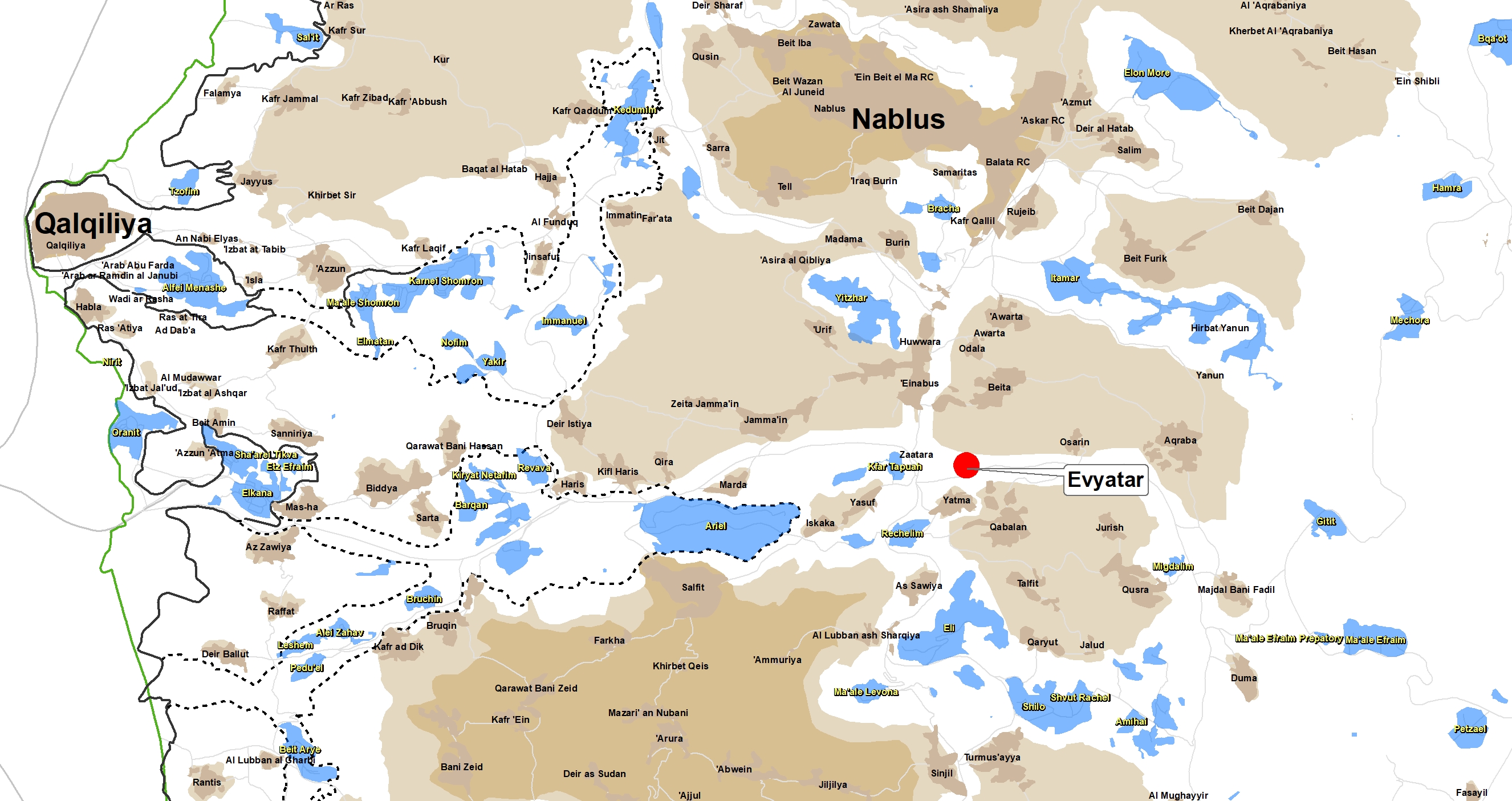
Map by Peace Now
In the very early days of the Bennett-Lapid coalition government, it was decided that the government would undertake an “investigation” into the status of the land on which the outpost was illegally established. That investigation was part of a package deal meant to both appease the settlers who were illegally squatting at the site and their allies. The package was also intended to quell Palestinian protests against the outpost and the international attention they were increasingly gaining – attention linked in larger part to the violent reaction against Palestinians by settlers and IDF soldiers, including most notably in Beita, which saw the death of several protestors, including children.
In addition to the “investigation,” the package also sought to balance bitter divisions within the Bennett government over whether to evacuate the outpost or grant it retroactive legalization. In the end, the government reached a “deal” which saw the settlers (temporarily) voluntarily vacate the outpost on July 2, 2021. In return, the government agreed to leave the settlers’ illegal construction at the site in place (i.e., did not demolish it) — including buildings and roads — while it carried out its investigation into the status of the land. In this way, the “compromise” left the outpost intact and allowed Israel to maintain complete control over the site during the “survey” process, clearly signalling that the government’s objective was never to enforce Israeli law, but, rather, was always about finding a legal and political “solution” to enable them to launder the settlers’ actions and accommodate their demands. Indeed, the terms of the Evyatar “compromise” made clear that the Bennet government was confident that it would find a pretext on which to assert that the land on which the outpost stands is “state land,” which can be used by the state as it sees fit (which nearly 100% of the time means, will be used to benefit the settlers)).
Peace Now said in a statement:
“Instead of stopping the ideological delinquency of a handful of settlers who allow themselves to establish facts on the ground against the law, and contrary to the Israeli interest, the government seeks to encourage them and give them a reward. The establishment of a new settlement in the depths of the West Bank is a security burden, and a threat to the chances for peace. Coalition members who oppose the occupation and support two states must demand that the Defense Minister stop the madness and not approve the settlement in Eviatar.”
Another Palestinian Family to Be Forcibly Dispossessed of its home in Jerusalem
Ir Amim reports that Israeli authorities have officially cleared the way for the Palestinian Salem family to be evicted from its longtime home in Sheikh Jarrah. The eviction can take place at any time between March 1st and April 1st. Once evicted, the Salem family home will be handed over to two settlers, one of whom is Jerusalem Deputy Mayor Aryeh King – suggesting that, at least in this case, the Israel government’s agenda and the settlers’ agenda are one and the same.
The Israeli registrar, in publishing its approval of the eviction window, also ordered the Salem family to pay 5,000 shekels (~$1,500 USD) for legal expenses.
The Salem family told WAFA news that they intend to appeal their eviction to the Israeli High Court, though a member of the family made it clear that the Israeli courts are part of a system designed to dispossess them:
“The Israeli court is biased. It only aims at emptying Jerusalem from Palestinians to give our place to settlers…even if we appeal, we don’t trust the Israeli court system. We depend only on solidarity in Palestine and beyond…We are three brothers living with our families, including seven children and our 74-year-old mother, Fatima Salem, the head of the family…We were all born here and have nowhere else to go. If they do expel us, we will continue to live in the street, right here”.
On the possibility of delaying the Salem family’s forcible displacement, Ir Amim notes:
“Although the Selam family’s legal representation may appeal the Enforcement and Collection Authority’s decision authorizing the family’s eviction and request an injunction to freeze it, there is no guarantee the court will approve such a request. The family’s attorney has hence made it clear that the remaining legal remedies are extremely limited. Therefore the only real effective means of preventing the family’s impending displacement is through state intervention.”
Israeli settlers and police had specifically requested a window in which to carry out the eviction to enable them to carry out the eviction by surprise — thereby (theoretically) making it harder for the family and protesters to prepare and for large crowds to gather. It must be understood that this flexible date is just the latest twist on the cruelty and hardship endured by the Salem family for years. It’s also worth recalling that earlier this month, in the context of a similar approval for the eviction of a Palestinian family living in the same neighborhood (the Salihiya family), Israel chose to implement the eviction in the dead of night, on one of the coldest nights of the year.
For further background on the Salem family’s case (including on the Israeli laws that were expressly designed to enable the eviction of Palestinians in favor of settlers), see reporting by Ir Amim and Peace Now.
New Tender Issued for Settler Foot Bridge Over Ben Hinnom Valley
Ir Amim reports that the Moriah Jerusalem Development Corporation issued a tender for a settler-initiated project to build a new pedestrian footbridge over the Ben Hinnom/Wadi Rababa Valley in Jerusalem. Bidding on the tender is set to close on February 28, 2022. An appeal against the plan, filed in 2018 by Israeli NGOs Peace Now and Emek Shaveh, was rejected by the Courts.
The bridge will serve to connect two settler-operated tourist facilities located on opposite sides of the valley – one in the in the Palestinian Abu Tor neighborhood and the other in the Silwan neighborhood.
On the Abu Tor side of the bridge, the Elad settler organization runs and operates a cultural center and cafe named “House in the Valley,” which opened in 2019 after Elad evicted a Palestinian family and renovated the space. A week after Elad’s new cultural center was opened, the Jerusalem Municipality issued “gardening orders” to take control, for a period lasting 5 years (with the likelihood of extensions after that), of 12 nearby plots of privately owned Palestinian land. “Gardening orders” allow Israel to “temporarily” take over privately owned land for what are ostensibly public purposes (like establishing a parking lot or public garden), based on the argument that the private owners are not presently using the land. In this case, Israel has in effect made rules that guarantee that the latter condition applies: as Emek Shaveh has noted, the 12 plots in question are located in an area declared by Israel to be a national park, meaning that private landowners are legally barred from using their own land.
On the Silwan side – a neighborhood where Elad (alongside other settler organizations, including Ateret Cohanim) is waging a house-by-house campaign to displace Palestinians in favor of settlers and settler-run tourist sites – the bridge will end near the Sambuski cemetery, which until recent years was a relatively unknown, neglected site that even Israel did not recognize as a holy site. Under the Trump “Peace to Prosperity” plan, the Sambuski cemetery suddenly became a place of prime historical and religious importance to Israel. The Israeli NGO Emek Shaveh – which has a special expertise on archaeology and the weaponization of archaeology to serve the political agenda of the settlers and the state – wrote a report on exactly how the Trump “Vision” supports settler efforts to use Jerusalem’s history and antiquities to promote Israeli-Jewish hegemony and control over the city.
Ir Amim writes:
“As part of the intensifying band of settlement around the Old City, the Wadi Rababa/Hinnom valley area is of particular significance as it stretches along the seam between Silwan and West Jerusalem and serves as the main entrance into the neighborhood from this direction. In recent years, there has been an increase of tourism projects in and around this location promoted by the government and the Elad settler organization, which together create a more seamless link between West Jerusalem and Elad’s constellation of settlement sites in Silwan.”
Knesset Committee Recommends Expanding Israel Antiquities Authority Oversight into the West Bank
On January 24th, the Knesset’s Education Committee held a hearing to discuss the alleged destruction of Jewish antiquity sites in the West Bank by Paelstinians and the Palestinian Authority, and what Israel should do to stop it. The Committee made several recommendations, including the suggestion for the government to expand the jurisdiction of the Israeli Antiquities Authority to include Area C, which would amount to yet another act of de facto annexation of some 60% of the West Bank. The Committee also recommended offering formal authorization for settler regional councils to “protect” and manage antiquity sites in Area C, which settlers are already doing on their own accord (with State funding and the help of the IDF in some cases). These archaeologically-focused annexation efforts run in parallel to other ongoing efforts by settlers and their political allies to unilaterally (and openly) annex Area C.
The hearing was based on a report on this very subject authored by a group calling itself the “Guardians of Eternity.” That group is an offshoot of the settler group Regavim. Emek Shaveh – an Israeli NGO focused on archaeology – called the report “highly questionable,” noting that the scientific editor of the report is anonymous, the report did not use acceptable archaeological methodology when surveying different sites, and the data on which the report based its conclusions and recommendations has not been made public.
Emek Shaveh’s Executive Director, Alon Arad, briefly addressed the Knesset Committee, urging the Members to understand the political agenda at play. Arad said:
“The destruction of antiquities should not constitute a pretext for political action and I think we should also refrain from camouflaging the political nature of this discussion as an archaeological act. Blurring the lines between archaeology and heritage on the one hand, and settlement and annexation, on the other endangers the future of archaeology.”
Emek Shaveh later said in a statement:
“There are approximately 6000 antiquity sites in the West Bank. The significance is that practically in every village or town there are archaeological remains of varying scale from a watering hole to a multilayered mound. It follows that there is always a tension between the need for modern development and the safeguarding of heritage sites. It is also clear that the problem of antiquity destruction is used by settlers and right-wing MKs as a justification for displacement…in just two years from 2017-2019, there was a 162% rise in demolition orders citing archaeology…Emek Shaveh believes that the destruction of antiquities should not be used as a justification for settlement expansion nor for promoting actions which advance de facto annexation. The appropriate approach to safeguarding antiquities in Area C must include the following: Israel must respect International Humanitarian Law and conventions which outline its duties vis-à-vis cultural heritage sites as the occupier in occupied territory, including maintaining separation between the IAA and the Staff Officer for Archaeology. Israel should promote cooperation with the Palestinian Authority on all levels: information sharing, oversight, and enforcement – something that was mutually agreed in the Oslo Accords. Israel must outlaw the trade in antiquities which gives impetus to antiquity theft.”
The Knesset Committee’s discussion of this subject comes on the heels of a decision by Israeli Minister of Heritage and Jerusalem Affairs, Ze’ev Elkin, to allocate $1.57 million (5 million NIS) towards “reconstruction” of the Sebastia archaeological site (located in the northern West Bank, near Nablus), pending approval from the Israeli Civil Administration. The Ministry further said that an additional $787,000 will be allocated towards the “rehabilitation” of other archaeological sites in the West Bank, as well as about $470,000 towards the Civil Administration’s ramped up efforts to “protect” West Bank archaeological sites.
As FMEP has chronicled, settlers and their allies are intent upon using claims of Palestinian damage/neglect as a pretext for Israel taking control of archaeological sites and artifacts across the West Bank. For example, in February 2021 settlers used a construction mishap to raise claims to the Mt. Ebal site.
Bonus Reads
- “Israeli soldiers force closure of Palestinian stores in Hebron’s Old City” (Basel al-Adra – +972 Magazine)
- “The purpose of settler terrorism” (Edo Konrad – +972 Magazine)
- THREAD: “During a discussion in the government about settler violence the Chief of Staff stated Israeli soldiers don’t have the authority to detain Israeli settlers who attacked Palestinians…” (Oren Ziv – Twitter)