Welcome to FMEP’s Weekly Settlement Report, covering everything you need to know about Israeli settlement activity this week.
To receive this report via email, please click here.
August 9, 2018
- Israel Plans to Use “Nation-State Law” to Defend Settlement “Regulation Law”
- Israel Moves to Approve a New Settlement…By Expanding An Existing One (An Old Trick)
- Israeli Govt is Funding a Settler School Squatting in a Palestinian Home
- Transferring Israeli Trash to the West Bank
- Settler Regional Council Funds Activities Aimed at Undermining Israeli Law
- Bonus Read
Comments, questions, or suggestions? Email Kristin McCarthy at kmccarthy@fmep.org.
Israel Plans to Use “Nation-State Law” to Defend Settlement “Regulation Law”
The Israel State’s private attorney tasked with defending the settlement “Regulation Law,” Harel Arnon, told reporters that the recent passage of the Nation-State law (declaring Israel the nation-state of the Jewish people alone) will strengthen his efforts to keeping the Regulation Law on the books (an effort which is widely expected to fail). The settlement “Regulation Law” was passed by the Knesset in February 2017, as a means to allow Israel to expropriate privately owned Palestinian land for the exclusive use/benefit of settlers. The High Court of Justice is currently weighing petitions against the settlement “Regulation Law,” which has been frozen since August 2017.
Arnon said:
“The nation-state law certainly impacts the Regulation Law. There is no question. If until now, the argument in defense of the Regulation Law was that it seeks to balance the individual rights of Israeli residents (in the West Bank) with those of the Arab residents… what the nation-state law does is raise the status of Jewish settlement to one of constitutional value.”
The Nation-State law was passed by the Knesset on July 19th, and has since sparked condemnation and protest for the way it demotes the standing of minority communities in Israel. The law says “the state views the development of Jewish settlement as a national value and will act to encourage and promote its establishment and consolidation.” Nothing in the text suggests a distinction between “Jewish settlement” within Israel’s sovereign borders, and settlement in the occupied territories.
Yossi Alpher – former senior Mossad official and IDF intelligence officer) predicted as much in his weekly explainer for Americans for Peace Now. Deconstructing recent quotes by Prime Minister Netanyahu (“Without the Nation State law it would be impossible to ensure Israel’s future as a Jewish state for the coming generations”) and Tourism Minister Yariv Levin (“The hysterics of the political left prove that this is an excellent law. Once the composition of the [High Court] judges is changed, we can get what we wanted”), Alpher deduced:
“…the ultra-nationalist right, currently Israel’s political mainstream, intends to continue absorbing the land of the West Bank into Israel. Simultaneously it seeks, in one form or another, to disenfranchise more than three million Palestinians living there lest they become Israeli citizens and tilt the demographic balance away from ‘Jewish’ and (with a combined population including 45 percent Arabs but still excluding Gaza) toward ‘bi-national’. A Jewish nation state in which only Jews determine the country’s constitutional nature is the perfect ‘legal’ legislative vehicle for taking the necessary apartheid-like measures to make this happen.”
Israel Moves to Approve a New Settlement…By Expanding An Existing One (An Old Trick)
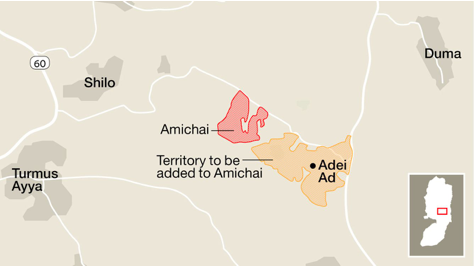
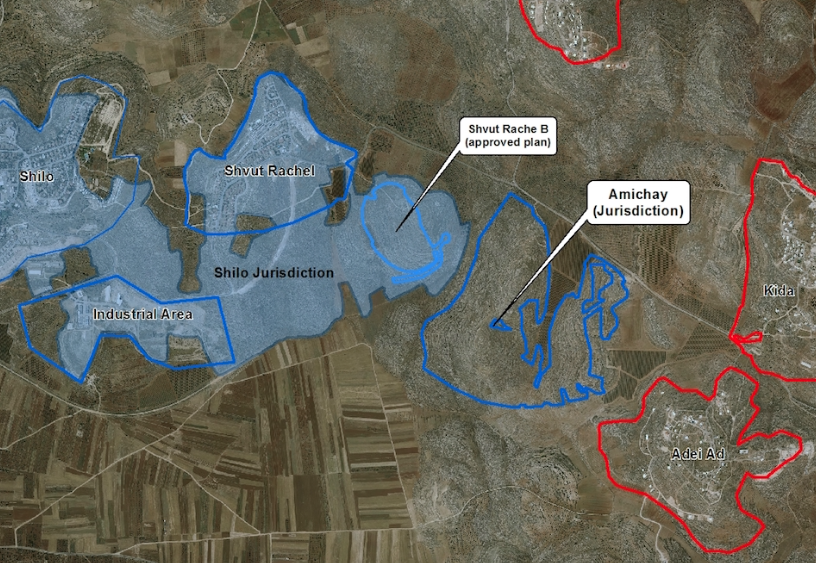
On August 8th, the Israeli Civil Administration announced that it is planning to retroactively legalize the Adei Ad outpost by massively expanding the borders of the (brand new) Amichai settlement to turn Adei Ad into a (non-contiguous) neighborhood of Amichai. In effect, this is a stealth operation by Israel to turn the Adei Ad outpost into an entirely new official, legal settlement.
Map by Haaretz
The massive expansion of the Amichai settlement and the transformation of Adei Ad into a brand new settlement, if implemented, will be a significant step towards creating an uninterrupted corridor of settlements connecting sovereign Israel to the Ariel settlement, through the isolated Shiloh Valley settlements, all the way to the Jordan Valley. In so doing, It will completely bisect the northern part of the West Bank.
The plan takes into account a Civil Administration “Blue Line” survey in 2017, which found that the strip of land between the Amichai settlement and the Adei Ad outpost is privately owned Palestinian land. It seems that the Civil Administration is opting (for now) not to use its newly endowed tools for expropriating privately owned land for the use of settlements, and is instead moving forward with a plan that will effectively leave Adei Ad – ostensibly now a neighborhood of Amichai – physically disconnected from its new parent settlement. The strip of Palestinian land in between the two will almost certainly become inaccessible to its Palestinian owners, as is much of the Palestinian land near Adei Ad, a notoriously radical and violent outpost. It is highly likely that at a later date the land will be expropriated.
The Civil Administration unveiled the new plan in a letter addressed to Israeli NGO Yesh Din, in response to a 2014 petition against the Adei Ad outpost filed by the group on behalf of Palestinian landowners. The Civil Administration’s letter claimed the 2017 “Blue Line” land survey determined that Adei Ad is built on “state land” and is therefore eligible for retroactive legalization (despite having been built there entirely illegally). Yesh Din and its clients have formally appealed the findings of that survey, contending that Adei Ad is partially on private land.
After the Amichai borders are expanded to give cover for the legalization of Adei Ad, the Israeli Civil Administration is set to transfer administrative responsibilities over the expanded settlement (including the Adei Ad “neighborhood”) to the Binyamin Regional Council – the municipal body responsible for administering services and enforcing building laws in settlements within its jurisdiction (though it rarely moves to enforce laws against the illegal settler construction). As Haaretz notes:
“Except in the rarest cases, the council does not enforce the law against illegal construction in its jurisdiction…As a result of the transfer of administrative powers to municipal authorities at Amichai, the settlers will be able to build new structures illegally without effective enforcement.”
Yesh Din’s attorney, Shlomi Zecharia, told Haaretz:
“The inhabitants of the villages near the outpost have become hostages to the policy that abundantly rewards prizes and gifts to ideological criminals. Cutting off farmlands by means of a false [expansion of] jurisdiction is extreme, disproportionate and needless, and in fact is intended to perpetuate restrictions on and infringement of Palestinian property, this time under the official auspices of the government.”
Map by Peace Now
Additionally worth noting, the Amichai expansion/Adei Ad legalization plan will represent yet another reward to settler law-breakers who evacuated from the unauthorized Amona outpost. Previously, the pay-off to settlers included the approval and construction of the Amichai settlement, which was the first new settlement to be built with government authorization in 25 years. It included, too, the approval of Shvut Rachel East, an outpost which – just like Adei Ad – became a non-contiguous “neighborhood” of an existing settlement (Shilo). The Amona pay-off package can now count a third settlement, Adei Ad. As FMEP documented at the time, the Trump Administration reportedly accepted the Amichai plan as an exception to its settlement policy which, at that time, was described in the media as President Trump asking Netanayahu “hold back on settlements for a little bit.”
Yesh Din comments on the Adei Ad scheme:
“Viewed in a broader context, this retroactive authorization is a major step towards fulfillment of Israel’s plan to annex Area C: retroactively authorizing unauthorized outposts at any price so as to ‘normalize’ them and render them permanent settlements; and creating continuous settler presence across the West Bank, from west to east, in order to facilitate the annexation, while dispossessing Palestinians of land that is their source of livelihood and in blatant disregard of international law and of the rights of Palestinian residents.”
Israeli Govt is Funding a Settler School Squatting in a Palestinian Home
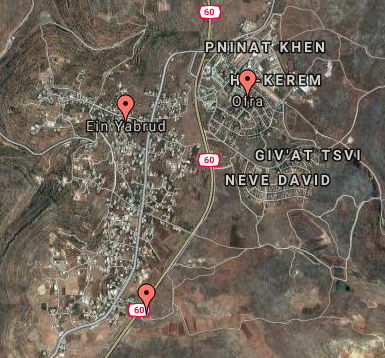
The Times of Israel has a detailed report on a government-funded religious school that for years has been operating illegally in a privately owned Palestinian home near the Ofra settlement, in the center of the West Bank. The Mishpatei Eretz Institute, which is operating the school, receives around USD $55,000 annually from the Israeli Culture Ministry, and has received a total of USD $214,039 from government bodies over the past three years alone.
Map by Google, markers by The Times of Israel
In the mid 1990s the home was physically cut off from the Palestinian village to which it belongs when Israel paved Route 60, the major north-south highway in the West Bank. In 2003, Israeli settlers broke into the home while its owners, the Shehadeh family, were on a day trip to Ramallah. After invading the home, settlers produced forged documents claiming that the Al-Watan settler organization purchased the building, and then spent years trying to prove that the purchase was legitimate in order to have the building registered with the Civil Administration. The Shehadeh family also spent years trying to force the IDF to evict the squatters, but nothing was ever done. In the meantime, Al-Watan donated the building – even without having legally established ownership of it – to the Mishpatei Eretz Institute, which then began operating a religious school in the building with government funding.
In 2013, the Jerusalem District Court ruled against Al-Watan’s claim to the building (slamming the organization and its officers for engaging in rampant fraudulent activity), deciding that the documents had been forged and recognizing the original Palestinian owners’ rights. Ten days after the ruling, the IDF Central Command issued a military order seizing the plot of land the home sits on, claiming “security purposes.” The IDF also built a fence around the area. The military order seizing the land will remain in force until 2019.
When contacted about the story, the IDF acknowledged the 2013 Court ruling but did not offer an explanation for any of its actions dating to either before or after the court ruling. A lawyer representing the Palestinian owners told The Times of Israel that the family will soon petition the High Court of Justice to have the settlers, and their school, evicted.
The anti-settlement watchdog Kerem Navot told reporters:
“We see here another example that reveals the corrupt system that Israel maintains in the West Bank. Rather than enforce the law, and evict and punish the settlers who invaded the property, the IDF issued a corrupt military order based on security needs that de facto enables them to stay there. On top of that, we now discover that the government is generously funding criminal bodies like the Mishpatei Eretz Institute.”
Transferring Israeli Trash to the West Bank
Haaretz reports that the Israeli government is close to finalizing a new plan to transfer waste from Jerusalem to the West Bank. Under the scheme, Israel will build a waste treatment facility east of the Ma’ale Adumim settlement to handle waste from Jerusalem. The facility will recycle or burn as much of the waste as possible, and then transfer the resulting ash and any remaining waste back into Israel.
Since the West Bank is under a military occupation, environmental regulation standards are considerably lower than in sovereign Israeli territory, making the West Bank an ideal spot for Israel to dump/treat its waste on the cheap, a practice extensively documented in a 2017 report by B’Tselem. The report asserts:
“Waste treatment in the West Bank is simply one more facet of the exploitative policy Israel has practiced consistently for fifty years now, using Palestinian space and people to further its own interests. As part of this policy, Israel treats the West Bank – and particularly Area C, where it retained full control under the Oslo Accords – as an area meant to serve its needs exclusively, as if it were its sovereign territory.”
Echoing the B’Tselem report, MK Mossi Raz (Meretz) notes that the plan, though sold as an environmentally friendly solution, is part of Israel’s de facto annexation of the West Bank, saying:
“Although at first glance it looks as though the ministry wants to protect the environment, the government plans clearly demonstrate that the goal is to prepare the ground for annexation. The building of infrastructure in the occupied territories by the state, without cooperation from the PA, deepends Israeli control in the territories, and thereby in effect is bringing us even closer to the day when the Israeli government will annex the territories.”
The Israeli Defense Ministry is slowing down the implementation of the plan, which has broad support across other government ministries, for technical reasons — mainly having to do with a dispute about how the facility will be staffed.
Settler Regional Council Funds Activities Aimed at Undermining Israeli Law
In 2017 the Gush Etzion Regional Council contributed hundreds of thousands of shekels to illegal settlement and outpost construction in its jurisdiction, and heavily invested in projects connected to defending the unauthorized Netiv Ha’avot outpost against demolition. Data obtained by the Movement for Freedom of Information and analyzed by Peace Now show that the Gush Etzion Regional Council, which is supposed to be enforcing Israeli laws in areas under its jurisdiction, instead invested hundreds of thousands of shekels trying to help the illegal Netiv Ha’avot outpost skirt the law. The Council’s 2017 projects connected to Netiv Ha’avot included:
- The construction of a new, unauthorized observation tower (a memorial site) in the outpost. Construction of the tower moved forward after the High Court of Justice ruled that 17 buildings in Netiv Ha’avot were built partially on Palestinian land and must be demolished.
- A public campaign to save buildings in the Netiv Ha’avot outpost from demolition, including a payment to the radical Regavim settler organization in connection to the campaign (which is working to selectively enforce building laws against Palestinians in the West Bank). By the end of 2017, the council spent NIS 164,688 on the campaign – which, as Peace Now notes, became an even more active effort in 2018.
- Building a new (at that point unauthorized) outpost for those settlers facing evacuation from buildings in the Netiv Ha’avot outpost. The Council was able to recoup some of those expenses when the government later approved an NIS 60 million package to provide compensation for the settlers who were evacuated as well as funds for the Council.
In addition to the Netiv Ha’avot outpost expenditures, and other unauthorized settlement projects, the Gush Etzion Regional Council spent NIS 1,755 on an ATV tour for MK Yehuda Glick to conduct a “survey on the application of sovereignty over (i.e., annexation of) Gush Etzion.”
Peace Now says:
“It is time for official authorities that are obligated to act according to the law to stop funding illegal activities, attacking the High Court and evading enforcement of the law, especially when using public funds. The Interior Ministry must put an end to this sinister exploitation of the public coffers, and must get our taxpayers’ money back.”
Bonus Read
- “Fact and Fiction About the Amendment of the Israeli Supreme Court’s Jurisdiction Over West Bank Cases” (Lawfare Blog)
Welcome to FMEP’s Weekly Settlement Report, covering everything you need to know about Israeli settlement activity this week.
To receive this report via email, please click here.
February 22, 2018
- Caravans Move Into New Shiloh Valley Settlement
- State Requests Delay of Demolitions in Netiv Ha’avot Outpost
- Process Begins for Major Expansion of Gilo Settlement in East Jerusalem
- Construction of New Checkpoint Near al-Walajah Proceeds, Despite Lacking Permit
- High Court Issues Injunction Against Construction & Sale of Homes in Shvut Rachel “Neighborhood”
- Israel Evacuates Outpost, Again
- Jordan Valley Annexation?
- U.S. Ambassador: “Settlers are Here to Stay”; Settler Leader Credits Trump for Settlement Growth
- Bonus Must-Reads
Comments, questions, or suggestions? Email Kristin McCarthy at kmccarthy@fmep.org.
Caravans Move Into New Shiloh Valley Settlement
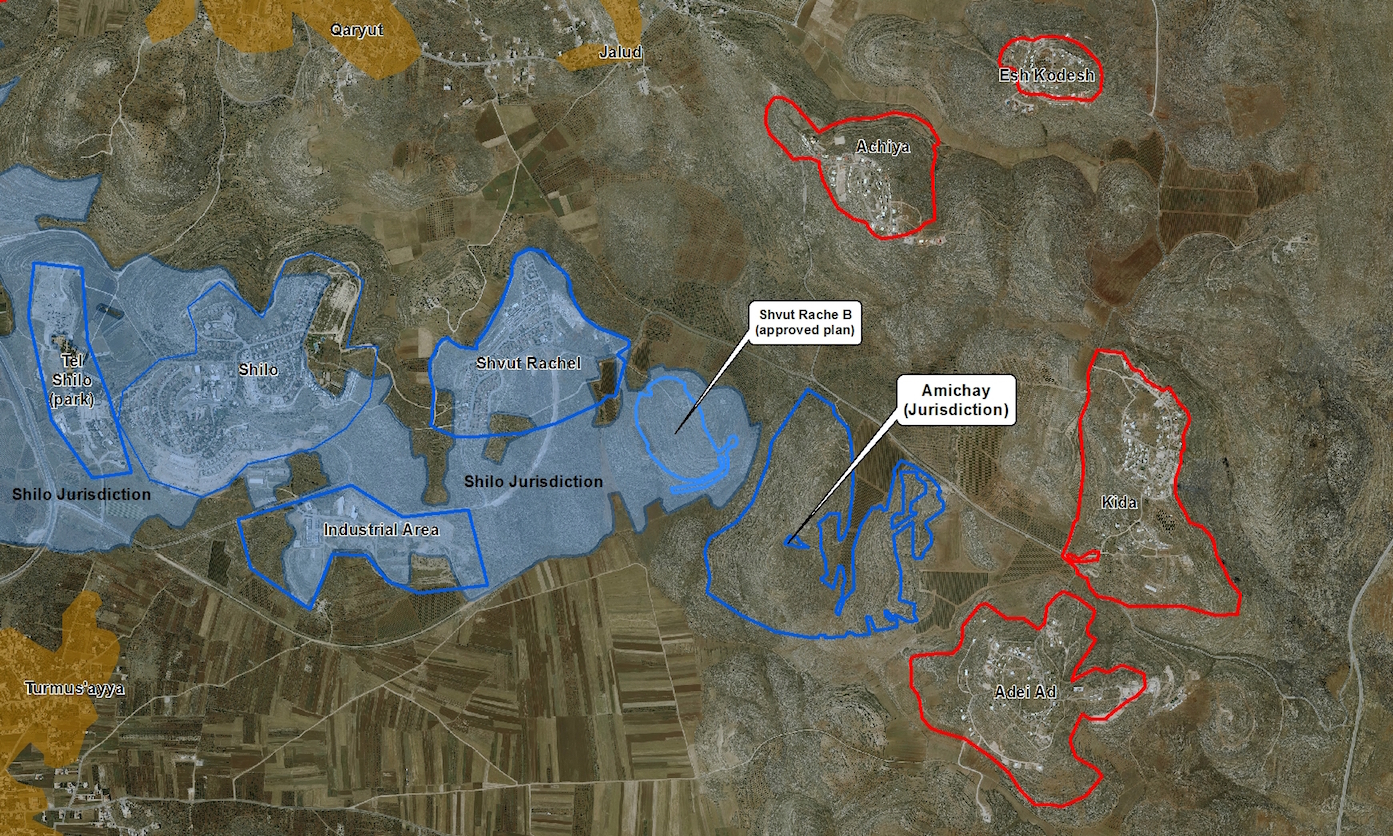
This week, the delayed construction of the Amichai settlement in the Shiloh Valley got a temporary fix: the Israeli Civil Administration (a branch of the Israeli Defense Ministry that is the sovereign power ruling over the West Bank) began installing 36 trailers for settlers to move into while the permanent settlement is being built. The construction of Amichau has hit many snags since the government green-lighted the project. Budgetary fights led to repeated delays, and several NGOs have filed legal petitions on behalf of nearby villages whose land the settlement will steal.
Map by Peace Now
As we have written about many times in the past, Amichai is the first of two new settlements approved by the Israeli government in early 2017 as pay-off to settlers forced to evacuate the Amona outpost by the High Court of Justice. That Amona outpost was established without authorization from the Israeli government and on private Palestinian land; the government of Israel fought for years to legalize it post-facto, but eventually was forced by the High Court to evacuate its residents (evacuation that some residents resisted violently). The establishment of Amichai clearly demonstrates that settler law-breaking not only goes unpunished, but is handsomely rewarded by the Israeli government, and that establishing illegal outposts is an effective route to establishing new settlements.
The Amona settlers have been some of the most vocal and demanding advocates for ever more concessions from the Israeli government, including the installation of these temporary mobile homes on their preferred site. With the approval of that demand, a spokesman for the Amona evacuees said triumphantly:
“Beyond the Regulation Law, the legalizing of thousands of homes in Judea and Samaria (West Bank), the establishment of a new settlement after decades of drought, the great thing that the people of Amona have achieved in their uncompromising struggle is a change in discourse and consciousness.”
Peace Now – which has filed one of the petitions against the construction of Amichai – said:
“42 families, which the court ruled had stolen private land, are extorting the government…”
State Requests Delay of Demolitions in Netiv Ha’avot Outpost
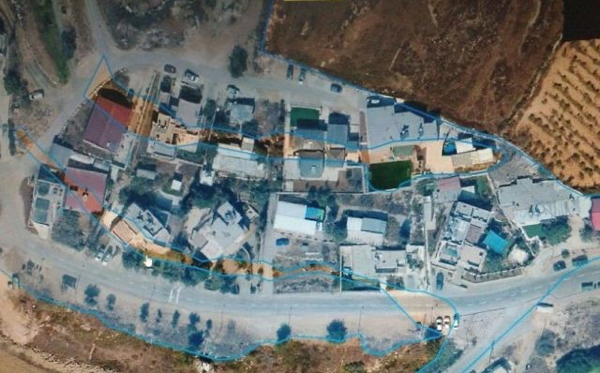
Two weeks ahead of the slated demolition of 15 structures in the Netiv Ha’avot outpost – structures built on privately owned Palestinian land – the state of Israel is urging the High Court of Justice to delay the demolition for three additional months. The reason? To allow more time for another outpost to be constructed for the settlers to move in to (plans for which were approved last week).
Map by Times of Israel
The delay will also allow more time for settlers to advance plans to save seven of the 15 structures ordered to be demolished; settlers have proposed saving the seven buildings by demolitioning only the parts of the buildings that sit on Palestinian land, leaving the rest intact.
While the Netiv Ha’avot settlers are trying to stay put, Israeli press reports this week suggest that Netanyahu has asked his Cabinet to approve a payout of millions of shekels to the settlers, in advance of their evacuation, ostensibly to to facilitate a public-relations friendly demolition of the targeted 15 structures. Cabinet ministers are now seeking funds from their ministry budgets to help fund Netanyahu’s Netiv Ha’avot bribe. The bribe money will come in addition to the estimated $14 million to $17 million it will cost Israeli taxpayers to dismantle the 15 structures slated to be demolished in Netiv Ha’avot.
Once again, the establishment of a new outpost for setters who built illegally on land recognized by Israel as privately owned by Palestinians, plus a huge financial pay-off to them, demonstrates clearly that settler law-breaking not only goes unpunished but is actively rewarded and incentivized by the Israeli government.
Process Begins for Major Expansion of Gilo Settlement in East Jerusalem
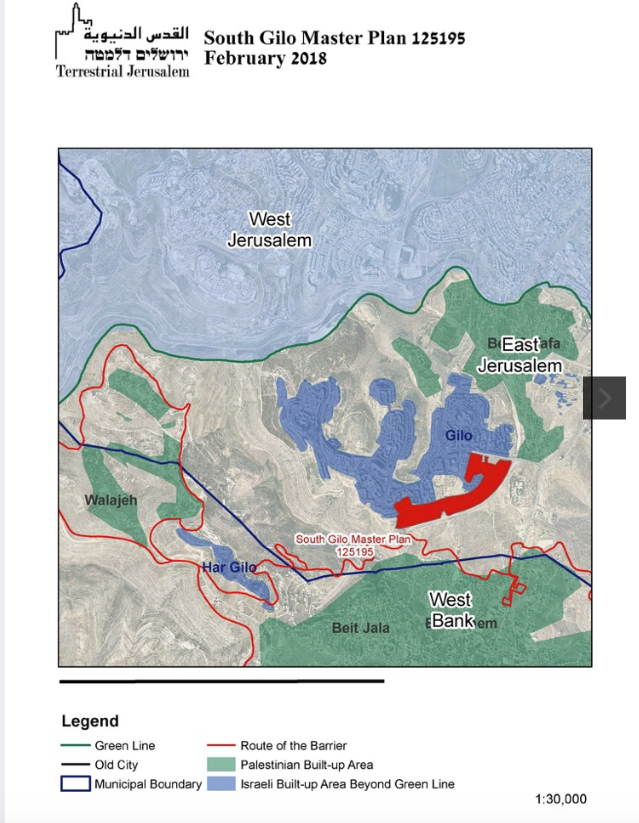 Jerusalem expert Daniel Seidemann’s NGO, Terrestrial Jerusalem, reports that the Jerusalem planning authorities met on February 21st to initiate the planning process for a new neighborhood of the Gilo settlement in East Jerusalem. The plan seeks to significantly expand the footprint of Gilo in the direction of Bethlehem (the Gilo settlement literally looms over Bethlehem; the new plan will develop the southern slope leading down into the Palestinian city). The plan calls for building 2,992 new units.
Terrestrial Jerusalem writes:
“In 1995, Israel made a commitment to the U.S. government that no additional land in East Jerusalem would be expropriated for the purposes of building or expanding settlement neighborhoods. That commitment has guided the boundaries of Israeli settlement expansion in East Jerusalem in the ensuing years. While the scope of the expropriations under this scheme will be limited, this significantly contravenes the spirit of that undertaking, significantly expanding the built-up footprint of the Gilo settlement.”
Ir Amim writes:
“The Gilo Southeast plan is yet one more link in a chain of developments designed to seal off the southern perimeter of East Jerusalem from the West Bank, nullifying prospects for a two state solution. Advancing a new plan for 3,000 units on land near Givat Hamatos indicates that the Israeli government will continue to do everything just short of taking action on Givat Hamatos to fill in any remaining gaps along the southern flank of the city.”
Construction of New Checkpoint Near al-Walajah Proceeds, Despite Lacking Permit
Map by Peace Now
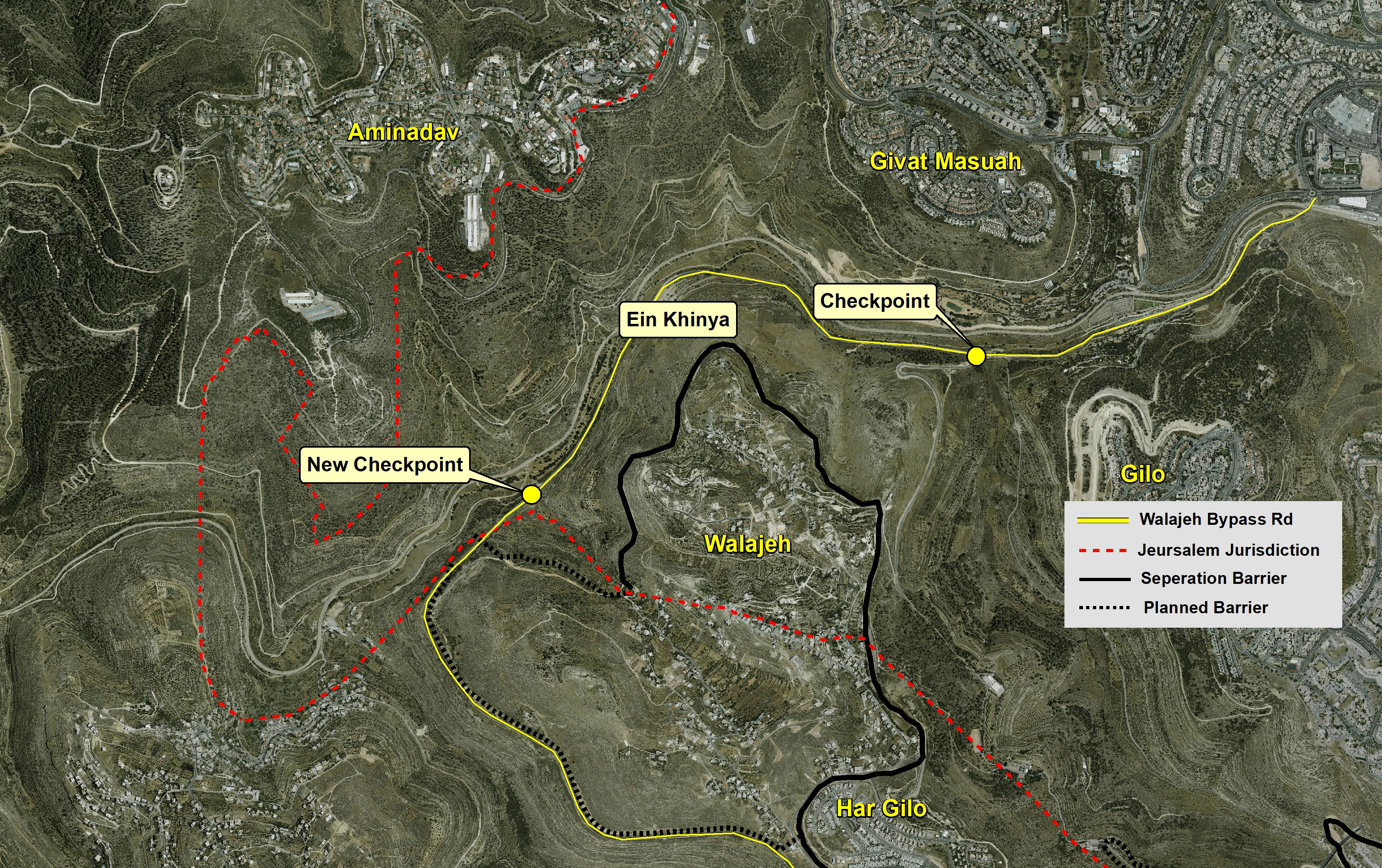
The Jerusalem Municipality recently began (and has nearly completed) the construction of a new checkpoint that will further isolate and imprison the Palestinian city of al-Walajah, which is surrounded on three sides by the Israeli separation barrier. The construction of the checkpoint is going ahead despite the fact that it lacks the legally required permit and in contravention of an Israeli court order.
The new checkpoint is meant to replace the current one, located further down the road. The current arrangement allows al-Walajah residents to access an important and historic natural spring without passing through a military checkpoint. The new checkpoint will block the village’s access to the spring and it will advance the consolidation of Israeli control of the village’s only remaining access point to Jerusalem.
Terrestrial Jerusalem provides background on the spring, which is now inside of an area Israel has declared an Israeli national park, and Israeli actions to consolidate control over it:
“The move comes as part of the Municipality’s decision, supported by the government, to designate the area as an Israeli national park. The decision to move the Ein Yael checkpoint is designed, deliberately, to prevent el-Walajeh’s resident from accessing the park (for further background on the national park project, see our previous report here). Following the inauguration of the area as a national park by Jerusalem Mayor Nir Barkat and Tourism Minister Ze’ev Elkin (Likud), construction works for the relocation of the checkpoint started on February 12, 2018, without a permit being issued and in contravention of a court order requiring the Municipality to suspend all work in order to enable el-Walajeh’s residents to appeal the Municipality’s decision.”
Ir Amim further explains the drama that ensued when the Jerusalem Municipality began the construction illegally, against the orders of the court:
“On February 12, the District Committee approved a permit for construction, rejecting separate objections from residents of Al-Walaja and the Har Gilo settlement. Despite the committee granting a week for the attorney for the residents of Al-Walaja to submit an appeal, the Municipality – which initiated and is funding the multi-million shekel project – launched construction two days later. The director general of the Municipality, Amnon Merhav, personally supervised the illegal construction, refusing to halt the equipment when confronted by the residents’ attorney and Ir Amim field researcher, Aviv Tatarsky. Tatarsky was arrested and jailed on his way to work the following morning for disrupting the peace.”
Peace Now adds even more color to the late-night legal proceedings and wacky defenses that the Jerusalem Municipality deployed in order to continue the construction. In the end, the presiding judge decided to nullify the 1-week injunction to allow the construction to proceed, a ruling that accepted the Municipality’s argument that stopping the construction would endanger motorists. The judge will hear complaints filed by al-Walajah residents on March 6th.
High Court Issues Injunction Against Construction & Sale of Homes in Shvut Rachel “Neighborhood”
On February 18th, the High Court of Justice issued an injunction freezing the construction and sale of new homes in the Shvut Rachel “neighborhood” of the Shiloh settlement. Importantly, Shvut Rachel is not actually a neighborhood of Shiloh: it is located outside of Shiloh’s boundaries and is correctly termed an illegal outpost. The injunction follows a petition launched by Peace Now against the illegal construction, filed at the end of January 2018. This is not the first time Peace Now has challenged illegal/unauthorized construction in this area. The first such petition was filed in 2010, but the illegal construction was nonetheless allowed to advance in fits and starts, with the government of Israel fully aware of the crime. Now, the project is nearly complete and ready for sale. And once again, the actions of the Israeli government in allowing the illegal construction to reach this point demonstrate that settler law-breaking not only goes unpunished but pays off.
Israel Evacuates Outpost, Again
The Israeli army removed settlers from an encampment set up near the Tapuah settlement in the northern West Bank, just south of Nablus, as they have done several times over the past 5 years. Settlers reacted violently – throwing stones, burning tires, and pouring oil on roads – in order to deter the Israeli army’s dismantlement of the mobile home camp. Two Israeli youths were arrested in the incident.
After the army left, the settlers marched towards the nearby Tapuah settlement, encountering and attacking two Palestinian vehicles and a Rabbi for Human Rights activist along the way.
Jordan Valley Annexation?
The settler-aligned Arutz Sheva media outlet is reporting that the Ministerial Committee for Legislation (a committee of Cabinet members who decide if the government will support legislative proposals) will consider endorsing a bill to annex the Jordan Valley at its weekly meeting.
The bill was introduced by Likud MK Sharren Haskel, who recently said:
“The support we are receiving in the international arena from our friend the United States proves that there has not been and will not be a better time…With the support of the Likud members who demand the necessary change, with the support of the government where we have the majority needed to pass the bill, together with my friends Motti Yogev and Miki Zohar, I am proud to lead the bill to apply Israeli law in the Jordan Valley”
The Arutz Sheva report suggests the Netanyahu might block the bill from coming up for a vote (a suggestion that is likely part of the effort to pressure Netanyahu not to block it). The same report notes that the Likud-inspired annexation bill will be postponed for cabinet consideration for another week.
U.S. Ambassador: “Settlers Are Here to Stay”; Settler leader: “thank God” for Trump
Veteran Haaretz columnist Barak Ravid reported remarks made by U.S. Ambassador David Friedman during a meeting with the Conference of Presidents of Major Jewish American Organizations earlier this week. Friedman reportedly said that Israeli settlements will not need to evacuated under a U.S. peace plan, noting specifically, “the settlers aren’t going anywhere.” Given the public record of Friedman’s policy positions, this is not a surprising statement or U.S. policy manifestation.
Notably, the Trump Administration (White House and State Department) offered no substantive correction.
At the same time, the Associated Press ran a story this week (which got picked up by several major outlets including the Washington Post, TIME, ABC News, and Voice of America) quoting the braggadocious remarks of settler leader, Yaakov Katz. Katz has ties to a prominent settler organization, “Bet El Institutions,” which, as noted by Haaretz, has ties to U.S. negotiators (as in, David Friedman was the longtime leader of the U.S. fundraising arm of Bet El, and both he and the Kushner family have donated to Bet El). Hailing the “success” of the settlement enterprise in 2017, Katz quipped:
“This is the first time, after years, that we are surrounded by people who really like us, love us, and they are not trying to be objective…We have to thank God he sent Trump to be president of the United States.”
Katz also said (among other things):
“We are changing the map. The idea of the two-state solution is over. It is irreversible.”
Katz’s excitement is a marked contrast from the January reaction of the Yesha Council (the umbrella organization of municipal councils of Jewish settlements) to 2017 population growth data. The Yesha Council lamented declining growth in settlements and blamed it on what a purported “quiet freeze” on settlement construction in 2017, despite the fact that Peace Now chronicled an alarming acceleration of settlement activity in 2017.
As FMEP explained in January, 2017 Israeli government data (covering 150 West Bank settlements and outposts, but not East Jerusalem) shows that the settler growth rate has decreased for the sixth consecutive year, from 3.9% in 2016 to 3.4% in 2017 (the growth rate hit a high in 2008, at 5.8%). Even with this decline, the 3.4% settler population growth rate still outpaces Israel’s national average, which comes in at 2%. Moreover, the data show that settler population is far younger than the population inside the Green Line, with 47% of settlers being below the age of 18, compared to 27% of Israelis inside the Green Line.
Bonus Must-Reads
- “Israel’s Latest Attempts to Alter Geopolitical Realities in Jerusalem” (Al-Shabaka) *This is a short policy memo drawing from a brief which will be published in March 2018.
- “The End of Israel’s ‘Enlightened Occupation’ “ (+972 Mag)
- “Netanyahu’s Real Crime: Plundering Land from Palestinians” (Al-Monitor)
- “Netanyahu’s West Bank Annexation Talk Was No Gaffe” (American Conservative)
FMEP has long been a trusted resource on settlement-related issues, reflecting both the excellent work of our grantees on the ground and our own in-house expertise. FMEP’s focus on settlements derives from our commitment to achieving lasting Israeli-Palestinian peace, and our recognition of the fact that Israeli settlements – established for the explicit purpose of dispossessing Palestinians in the West Bank and East Jerusalem of land and resources, and depriving them of the very possibility of self-determination in their own state with borders based on the 1967 lines – are antithetical to that goal.
Welcome to FMEP’s Weekly Settlement Report, covering everything you need to know about Israeli settlement activity this week.
To receive this report via email, please click here.
June 23, 2017
- Coordination? Test #1: Kushner & Greenblatt Arrive as Construction Begins on New Settlement of “Amichai”
- Coordination? Test #2: Bibi Reportedly Ok’s 5,000 East Jerusalem Units After Blocking Them for Years
- Coordination? Test #3: 70% Rise in Settlement Construction Starts Over Past Year
- Ariel University – Located in the settlement of Ariel – Set to Double in Size
- Cleared from Baladim Outpost, “Hilltop Youth” Radicals Stir More Trouble in Yitzhar
- Bonus Reads
For questions and comments please contact FMEP’s Director of Policy & Operations, Kristin McCarthy (kmccarthy@fmep.org).
Coordination? Test #1: Kushner & Greenblatt Arrive as Construction Begins on New Settlement of Amichai
Israeli Defense Minister Avigdor Liberman raised eyebrows late last week with a wide-ranging English language interview with the Times of Israel. When asked if Israel is “coordinating its [settlement] building starts with the United States,” Liberman casually responded, “of course.” Though headlines ran with his confirmation of coordination, it should be noted that when Liberman was pushed to give a more concrete picture of what that coordination entails, he said that Israel and the U.S. do not coordinate on “every 10 houses” but that the U.S. generally respects Israel’s approach and vision for “Jewish settlements in Judea and Samaria.”
That respect was put to the test this week as President Trump’s chief Middle East envoys – Jared Kushner and Jason Greenblatt – visited Israel and Palestine to “to continue the discussion about the possibility of peace.” Kushner’s arrival coincided with the commencement of construction of the first official new settlement in 25 years; the coincidence maintained a long tradition of greeting U.S. envoys with new settlement construction, dating back to the early 1990s and the era of Secretary of State James Baker, whose every visit to Israel was seemingly marked by the establishment of expansion of new settlements.
The Trump administration indicated it won’t object to this new settlement, sometimes referred to as the “Amona exception” (i.e., the rule is still that Israel doesn’t establish new settlements, but Amichai is a one-time exception, as a pay-off to settlers who illegally established the Amona outpost on privately owned Palestinian land and were forcibly evacuated earlier this year). But the timing, which may be entirely coincidental, is nonetheless politically provocative. While Kushner was en route, the State Department reiterated the only policy it has communicated publicly on the issue, saying “unrestrained settlement activity is not helpful to the peace process.” The Palestinian Authority also issued a statement on the timing of the new settlement’s ground-breaking, saying that it shows “Israel is not interested in the U.S. efforts, and is serious about thwarting them as it has with previous U.S. administrations.”
On June 22nd, the Israeli NGO Yesh Din filed a petition, together with residents of the Palestinian village of Jalud, to Israel’s High Court of Justice (equivalent to the U.S. Supreme Court) challenging the establishment of the new settlement of Amichai and demanding transparency in the process of demarcating land for settlement. According to the petition, the jurisdiction granted to the new settlement includes enclaves of privately-owned Palestinian land.
But Amichai isn’t the only construction happening near Jalud. Palestinian officials have reported that construction work has also begun on Shvut Rachel East, a new “neighborhood” of the Shilo settlement (in fact, not a neighborhood but rather a new settlement, as explained by Peace Now). Shvut Rachel East was the original Amona pay-off plan, but Amona evacuees held out for a different plan on a different hilltop – and they got it with the approval of Amichai, to be built literally adjacent to Shvut Rachel East. But what the world might have assumed would be a choice of “this site or that site” became, instead, a jackpot for settlers of “this site AND that site,” and the Shvut Rachel East neighborhood plan was also approved. Meaning that rather than paying a price for breaking the law (and then resisting evacuation), the government rewarded Amona settlers with not one but two new settlements – both located deep inside the West Bank, in an area that Israel could not possibly retain in any land swap agreement, and, both at the expense of Palestinians residing in the area around the settlement of Shilo. And meaning that the government of Israel is, through this policy, continuing to actively incite and incentivize settler law-breaking.Coordination? Test #2: Bibi Reportedly Ok’s 5,000 East Jerusalem Units After Blocking Them for Years
On June 21st – the very day Trump envoy Jared Kushner arrived in Israel and was meeting with Netanyahu – news broke that Netanyahu was lifting his alleged hold on plans for the construction of 5,000 of new settlement units in East Jerusalem. This news comes on the heels of a June 19th report by Israel’s Army Radio that it had seen secret government documents showing that Prime Minister Netanyahu had imposed a building freeze in East Jerusalem settlements over the past few years. The documents – which were not released by Army Radio – allegedly identify specific projects totalling 6,000 units in Gilo, Pisgat Zeev, and Har Homa, that Netanyahu reportedly froze under intense pressure from the Obama administration. The 5,000 units for which Netanyahu has now reportedly given a green light are part of these 6,000 units, although there are few additional details thus far. Jerusalem Online suggests that some of the units are part of plans that were previously but have expired and need re-approval, and that the Jerusalem local planning committee will convene in short order to re-approve these plans.
It’s worth revisiting the dangerous East Jerusalem construction roller coaster ride of 2017. In January, Netanyahu announced, “I’ve decided to remove the political limitations on construction in East Jerusalem.” The worst was feared, including implementation of Givat Hamatos and/or E1, either of which would have devastating impact on the viability of the two-state solution. Nothing happened until April when rumors frantically swirled suggesting Netanyahu was planning a 15,000-unit construction surge in East Jerusalem. The formal announcement was expected to coincide with Jerusalem Day – and President Trump’s first visit – in May, but nothing was announced. A short time later, on June 6th, the Civil Administration’s High Planning Council advanced 603 units for the massive settlement of Maale Adumim, located just across the Green Line on the northeast border of East Jerusalem.
Coordination? Test #3: 70% Rise in Settlement Construction Starts Over Past Year
Ariel University – Located in the settlement of Ariel – Set to Double in Size
 Israeli Education Minister Naftali Bennett presented a plan to the Knesset that will double the size of “Ariel University,” an Israeli institution of higher education located in the settlement of Ariel settlement. The centerpiece of Bennett’s plan, which will be implemented over the next five years, is a medical center to be named for Sheldon Adelson, who is a major American settlement financier. Adelson is said to be contributing $20 million to the medical school, making good on a commitment made in 2014. The plans still need to secure addition approvals before proceeding.
Ariel is located in the heart of the northern West Bank, reaching literally to the midpoint between the Green Line and the Jordan border. The future of Ariel has long been one of the greatest challenges to any possible peace agreement, since any plan to attach Ariel to Israel will cut the northern West Bank into pieces. Ariel University became an accredited Israeli university in 2012, following significant controversy and opposition, including from Israeli academics. It has since been the focus of additional controversy, linked to what is a clear Israeli-government-backed agenda of exploiting academia to normalize settlements.
Cleared from Baladim Outpost, “Hilltop Youth” Radicals Stir More Trouble in Yitzhar
Earlier this month, the IDF evacuated dozens of radical Israeli settlers from the illegal “Baladim” outpost in the Jordan Valley. Baladim was the most notorious and established outpost in the region, a frequent source of terror for Palestinians and the Israeli army alike. The radical “Hilltop Youth” that camp-out in Baladim have been evacuated dozens of times before, but each time the they return to live illegally in the area.
According to a Haartez report, this time the IDF approached the leaders of the radical settlement of Yitzhar – from which many of Baladim radicals hail – before the outpost’s evacuation. The IDF reportedly warn them about the likely influx of Hilltop Youth to Yitzhar following the evacuation.
The interplay between Yitzhar and the Hilltop Youth is one to watch, particularly after an attack this week on Israeli Army vehicles at Yitzhar’s gate. The settlement’s leaders are claiming that the Hilltop Youth are responsible for perpetrating the attack. Haaretz writes, “Yitzhar is considered an ideological focal point of the radical settler right, yet a large number of residents who spoke to Haaretz condemned the recent stone throwing and the extremist ideology of the Baladim settlers.” Shin Bet officials reportedly met with Yitzhar leaders this week to push them to do more to “calm” the young, violent, and extremely problematic radicals. Yitzhar settlers might be trying to distance themselves from the Baladim (which is problematic given that the Hilltop Youth who have fought for Baladim are from Yitzhar), as the Shin Bet has been more aggressively moving against members of the “Hilltop Youth”, which we covered in last week’s settlement report.
Bonus Reads
- “Who Are You Calling a Settler? Meet the young Israelis living in the West Bank” (Haaretz)
- “Settlement tours: a new frontline in Israel’s ideological conflict” (Reuters)
- “Americans disproportionately leading the charge in settling the West Bank” (Haaretz)
FMEP has long been a trusted resource on settlement-related issues, reflecting both the excellent work of our grantees on the ground and our own in-house expertise. FMEP’s focus on settlements derives from our commitment to achieving lasting Israeli-Palestinian peace, and our recognition of the fact that Israeli settlements – established for the explicit purpose of dispossessing Palestinians in the West Bank and East Jerusalem of land and resources, and depriving them of the very possibility of self-determination in their own state with borders based on the 1967 lines – are antithetical to that goal.