Welcome to FMEP’s Weekly Settlement Report, covering everything you need to know about Israeli settlement activity this week.
To subscribe to this report, please click here.
July 21, 2023
- “Dizzying” East Jerusalem Settlement Activity Continues: Israel Approves Givat Hamatos Building Permits & Schedules Discussion to Double Its Size
- Israel Expands West Bank Annexation via Archaeology, Including Construction of 4-7 New Settler Tourism Sites
- Smotrich Prepping Plans to Expand Campaign Against Palestinian Construction, With Aim to Expand Authority to Areas A & B
- Israel Opens First High Tech Campus in “Silicon Wadi” East Jerusalem Project
- Knesset Pushes Bill to Directly Fund Settlements
- Another Palestinian Bedouin Community Coerced to Leave Homes By Settler & State Terrorism
- In the Press: Bibi Denies Reports of “Settlement Freeze” Promise to Biden, Talks His Vision of Peace
- Smotrich Claims Credit for U.S.-Israeli Tensions
- Bonus Reads
“Dizzying” East Jerusalem Settlement Activity Continues: Israel Approves Givat Hamatos Building Permits & Schedules Discussion to Double Its Size
Ir Amim reports that Israel has continued its “dizzying pace” of settlement advancements in East Jerusalem, this week granting approval to four building permits for the yet-to-be-built Givat Hamatos settlement, and take an irregular step to advance a new plan – called “New Talpiot” – that would serve to massively expand the fully-approved plan for Givat Hamatos settlement.
The four building permits were issued on July 16th and will allow the foundation to be laid for several buildings in the Givat Hamatos settlement – which, if built, will be the first new settlement to be built in East Jerusalem in over two decades. The buildings (which will require separate building permits to be issued) will have a total of 900 units. The Israeli government has approved a plan to build a total of 2,610 settlement units in the Givat Hamatos settlement.
 In addition, the Jerusalem District Planning Committee is set to convene on Monday, July 24th to discuss a plan referred to as “New Talpiot Hill” that will, if approved and constructed, expand double the number of housing units in the Givat Hamatos settlement and increase its land mass by 40%, stretching Givat Hamatos eastward towards the settlement of Har Homa. The Givat Hamatos A project is directly adjacent to the area of the New Talpiot Hill project. The plan provides for 3,500 new settlement units and 1,300 hotel rooms – the latter posing a direct competition to the Palestinian tourism industry in nearby Bethlehem. The plan also calls for five synagogues and two mikvehs, clearly showing that the construction is designed to serve Israeli Jews although the neighboring Palestinian communities are suffering an acute housing crisis.
Ir Amim further notes that Israel is carrying out land registration on plots of land implicated by the New Talpiot Hill plan, a process which Israel has weaponized as a tool of settlement expansion.
Ir Amim writes:
“Together, Givat Hamatos A and New Talpiyot Hill along with concurrent settlement advancements in the area are cumulatively sealing off East Jerusalem’s southern perimeter from Bethlehem and the southern West Bank. These measures likewise further fracture the Palestinian space and deplete all remaining land reserves in the area for Palestinian development. Such conditions severely undermine the prospects of an agreed political future of Jerusalem, while depriving Palestinians of their fundamental right to housing and shelter.”
Israel Expands West Bank Annexation via Archaeology, Including Construction of 6-7 New Settler Tourism Sites
On July 17th the Israeli government approved a three-year $33 million (NIS 120 million) plan to take control over archaeological sites throughout the West Bank, including plans to establish 4-7 new settlement tourist sites. The approval of this plan is the fulfillment of a commitment made in the government’s coalition deal, which called for
The plan has several alarming components, including:
- Nearly $3million allocation of monitoring alleged antiquity destruction by PAlestinians and the Palestinian Authority, as well as for enforcement activities such as demolitioning Palestinian construction near antiquity sites.
- The construction of 4-7 new tourist installments at archaeological sites throughout the West Bank – the first being a new site at the “Hasmonean Pools” near Jericho. On this, Peace Now explains:
“The Hasmonean Palaces are located in Area C, adjacent to the Palestinian city of Jericho, which mostly falls under Areas A and B. Currently, access to the site passes through Area A. Beyond the site development, the goal of the program is also to enable access and regulate the movement of Israeli visitors from Area C into the site itself. In the past, there have been reports of plans to build a bridge over Area A to allow Israelis to reach the site.”
- The construction of a heritage center to showcase West Bank artifacts, with the possibility of building a new archaeological museum somewhere in the West Bank (location not determined).
- Surveys and excavatations.
Emek Shaveh and Peace Now both note that this new $33 million project comes in addition to the $9 million dollars in funding that the government approved in May 2023 to develop and “renovate” the archaeological site of Sebastia, located near the Palestinian village of Sebastia, north of Nablus in the heart of the West Bank. The project includes plans to pave a new access road for Israelis to reach the site, which they currently have to access by traveling through the Palestinian village of Sebastia, which will increase and entrench Israeli control not only over the site itself but the surrounding area – effectively weaponizing archaeology as a tool for dispossession.
Emek Shaveh said in a statement:
“With Bezalel Smotrich responsible for the Civil Administration and Jewish Power in charge of the Ministry of Heritage, the archaeological sites are weaponized more than ever before as a means for justifying ‘touristic settlements’, significantly entrenching and expanding the occupation and have become a central component in the present government’s steps towards advancing annexation. Along with massive settlement expansions, settler violence and legislation, the development of heritage sites in the West Bank will give control over substantial public areas and transform the multi-layered historical character of the area beyond recognition.
Although the plan is titled “an emergency plan for protection of antiquities”, only 10 million NIS of a budget of 120 million NIS are actually earmarked for defending sites against antiquity theft. Most of the budget is allocated to acts that constitute de facto annexation of the West Bank in complete violation of international law and the Oslo Accords. It is quite clear that for the current government the plan is yet another component in its efforts to thwart any possibility for a two-state solution and establish a biblical theocracy. We call on the international community to hold the State of Israel accountable to its own commitments under the Oslo accords, to the Two States Solution and to international law.”
Peace Now said in a statement:
“The Israeli government continues to settle in the West Bank in every possible way and continues to strengthen the friction with the Palestinian population. Investing over 150 million NIS in new tourist settlements implies exploiting archaeology in the West Bank to promote settlements and adversely affect Palestinians. Instead of investing in archaeological and tourism sites within Israel, the Israeli government continues to prioritize the settler minority over millions of Israelis. Investing in new settlements under the guise of heritage in the West Bank is a divisive move that harms Palestinians, distances peace and the two-state solution, and also undermines Israel’s tourism potential.”
As background, in January 2021, the Israeli government committed funding to a new settler initiative to surveil archeological sites under Palestinian control. While the objective of protecting antiquities might appear uncontroversial and apolitical, the true (and transparently self-evident) objectives behind this effort are: to support yet another pretext to surveil and police Palestinians; to establish and exploit yet another means to dispossess Palestinians of their properties; to expand/deepen Israeli control across the West Bank; and to further entrench Israeli technical, bureaucratic and legal paradigms that treat the West Bank as sovereign Israeli territory. It is the result of a campaign that has taken place over the past year in which settlers have escalated their calls for the Israeli government to seize antiquities and “heritage sites” located in Palestinian communities across the West Bank, especially in Area C, which Israel today treats as functionally (and legally) indistinguishable from sovereign Israeli territory. Funding committed by Israel for West Bank “heritage sites” should be understood in this context
Previous victories for the settlers in this same arena include the Israeli Civil Administration’s issuance in 2020 of expropriation orders – the first of their kind in 35 years – for two archaeological sites located on privately owned Palestinian property northwest of Ramallah. The settlers’ pressure is also credited as the impetus behind the government’s clandestine raid of a Palestinian village in July 2020 to seize an ancient font.
In June 2020, the “Guardians of Eternity” group began surveying areas in the West Bank that Israel has designated as archaeological sites, looking for Palestinian construction (barred by Israel in such areas) that they could then use as a pretext to demand that Israeli authorities demolish it. The group communicates its findings to the Archaeology Unit of the Israeli Civil Administration (reminder: the Civil Administration is the arm of the Israeli Defense Ministry which since 1967 has functioned as the de facto sovereign over the West Bank). The Archaeology Unit, playing its part, then delivers eviction and demolition orders against Palestinians, claiming that the structures damage antiquities in the area.
And one more reminder: in 2017, Israel designated 1,000 new archaeological sites in Area C of the West Bank. The “Guardians of Eternity” group, not coincidentally, is an offshoot of the radical Regavim organization, which among other things works to push Israeli authorities to demolish Palestinian construction (on Palestinians’ own land) that lacks Israeli permits (permits that Israel virtually never grants).
Smotrich Prepping Plans to Expand Campaign Against Palestinian Construction, With Aim to Expand Authority to Areas A & B
At a meeting of the Knesset Foreign Affairs and Defense Committee, Bezalel Smotrich revealed several plans that intensify and expand Israel’s annexation of the West Bank,, including plans to extend Israeli civilian operations – specifically the demolition of Palestinian construction – into Areas A & B.
Most drastically, Smotrich said that he is preparing a plan – expected to be approved within a month – that would allow him to direct the demolition of Palestinian buildings in Areas A & B which are determined to be a “security threat.” Smotrich told the Knesset that Israel’s ability to operate in Areas A & B are “key” to national security, and that he is working on plans to create a new unit within the Border Police which will be assigned specifically to construction law enforcement. This would be yet another advancement of Israel’s de facto annexation of the entire West Bank, which is increasingly focused not just on solidifying Israeli sovereignty over Area C but on Areas A & B as well. Haaretz notes that the Knesset Committee spent more time discussing Areas A & B than Area C. It should be noted that the Knesset Committee was convened to discuss what the Israeli government and the settlers believe to be “The Palestinian Authority’s takeover of open areas in Judea and Samaria” — a completely warped narrative of what is transpiring in the West Bank, where Israeli settlements are expanding while Palestinian are facing apartheid conditions. As admitted by an Army officer at the hearing, the Israeli military rejects 90-95% of Palestinian building requests while granting 60-70% of settler building requests
During a discussion of the Palestinian construction, Smotrich said his plan would also see Israel declare activities by Palestinian Authority to be a “foreign hostile activity,” which would prompt Israel to seize funds from the PA.
Smotrich also discussed two projects being prepared by the Jewish National Fund to plant trees on 2,500 acres of West Bank land. Smotrich talked about this tree-planting operation as a means of annexation, saying: “The [PA] actively works to seize lands. We need to do the same thing….[This means] legalization, construction, agriculture. “ This news comes the same week Israeli operated tractors were filmed uprooting Palestinian owned olive trees near the village of Tarkumiya.
As a reminder, in his role as a civilian minister in the Defense Ministry in charge of the Civil Administration, Smotrich is already empowered to order demolitions in Area C (powers which had previously been held by Israel’s military) — powers which he has wielded aggressively. As defined by the Oslo Accords, Areas A & B constitute 40% of the West Bank where the Palestinian Authority is assigned responsibility for civilian administration matters, like construction. Smotrich’s moves only underscore Israel’s erasure of any meaningful distinction between these areas, which has also been evidenced by routine military incursions into Nablus and Jenin, Israeli activity around antiquity sites under PA control, and more.
Israel Opens First High Tech Campus in “Silicon Wadi” East Jerusalem Project
The Times of Israel reports that Israel celebrated the opening of its inaugural high tech workspace that is part of the “Silicon Wadi” project, under which Israel aims to establish a major high-tech hub along the western side of East Jerusalem’s Wadi Joz neighborhood. While touted as a plan that will benefit Palestinians, its implementation has required the eviction of many Palestinian businesses in the area.
The new $2.8million (NIS 10 million) tech campus is a free workspace for Israeli and international high tech companies, and it has the capacity to host 250 workers with workstations, meeting spaces, and other available services. Four companies have already began working out of the new building.
You can read Ir Amim’s in-depth reporting on the Silicon Wadi project here.
Knesset Pushes Bill to Directly Fund Settlements
The Israeli Knesset is advancing a bill that will allow Israel to transfer tax revenue to the settlements, therefore bringing the settlements under direct Israeli law (an act of de facto annexation, illegal under international law) and further subsidizing the settlement enterprise. Even though the Israeli government has funded settlements from the outset, it has not permitted tax revenue sharing and has typically tried to hide other direct lines of funding to the settlements through non profits and other intermediaries.
The Combatants for Peace told Haaretz:
“The Netanyahu government has already ceased even trying to hide the institutionalization of apartheid. MK Asher’s reckless bill is another way to transfer budgets and to support the settlement enterprise and perpetuate the oppression and dispossession of Palestinians. What they can’t get in through the door, they’re trying to get in through the window – the main thing is to keep building.”
Another Palestinian Bedouin Community Coerced to Leave Homes By Settler & State Terrorism
B’Tselem reports that the al-Baq’ah Palestinian bedouin village was forced to abandon its village lands located west of Hebron under daily violence inflicted upon it by nearby settler outposts, and decades of harassment by the Israeli state.
The village’s decision to leave comes less than one week after the IDF demolished a water cistern used by all six families living in al-Baq’ah for personal and agricultural work. The villages told B’Tselem researchers that they are fleeing the village in fear of their lives.
B’Tselem writes:
“Al-Baq’ah joins the nearby communities of Ras a-Tin and ‘Ein Samia, which have already been driven off their lands over the past year under the same circumstances: Israel’s policy creates oppressive, unreasonable living conditions that leave residents of these communities with no choice but to abandon them. Relying on more official means (settlement building, extreme restrictions on Palestinian construction, a prohibition on infrastructure and demolitions), and on less official ones (settler violence against Palestinians), the policy has one goal: taking over more and more Palestinian lands and handing them over to Jewish hands, and it is applied against other communities still living in the area. Forcible transfer is a war crime, even if the state perpetrates it not by forcing people onto trucks but by putting so much pressure on them that their lives become unbearable and they cannot help but leave their homes and lands.”
In the Press: Bibi Denies Reports of “Settlement Freeze” Promise to Biden, Talks His Vision of Peace
Axios reports that on a July 17th call, Netanyahu informed President Biden that he does not expect to advance any more settlement planning, construction, or outpost “legalization” through the end of the 2023 year. Netanyahu issued a statement denying these reports, however Haaretz reports that Netanyahu contradicted that statement during private briefings for members of his staff and foreign journalists.
Separately, in an interview with podcaster Lex Fridman, Netanyahu provided a fresh look at what his vision of a “peace” deal is, explicitly saying that no settlements or settlers (no matter their location) would be uprooted, and that settlers would remain under Israeli sovereignty. He went on to reject Palestinian sovereignty.
Smotrich Claims Credit for U.S.-Israeli Tensions
In an interview with the settler-allied Arutz Sheva outlet (aka Israel National News), Smotrich made a few eye-opening remarks on his policies and motivations, saying:
“Our mission first and foremost is to provide security to the citizens of Israel in the settlements and all over the country. When we talk about the fight against terrorism there are two legs: the first is the development of the settlements and strengthening our grip on the territories of the Land of Israel. After all, terrorism is designed to weaken our grip – and our true answer that will eradicate it and make terrorism futile – will be further construction. When you look at Judea and Samaria, this government is building, regulating, developing, both in construction and in infrastructure on an unprecedented scale….quite a lot of the tensions that exist between the American administration and the Israeli government – and these are tensions between friends and partners and we manage these disputes with respect – stem from the policy that I am leading as a minister in the Ministry of Defense in the settlements with the full backing of the Prime Minister and the Minister of Defense.”
Bonus Reads
- “How settlers justify their pogroms” (Shabtay Bendet in +972 Magazine)
- “I was handcuffed and blindfolded for reporting on settler violence” (Basel Adra in +972 Magazine)
- “‘The escalation is frightening’: Jerusalem Christians fear for their future“ (+972 Magazine)
- “Israeli Soldiers Protect the Settlers, Then Attack Us Activists” (Illana Hammerman in Haaretz)
Welcome to FMEP’s Weekly Settlement Report, covering everything you need to know about Israeli settlement activity this week.
To subscribe to this report, please click here.
July 14, 2023
- Settlers Move In After Israel Forcibly Evicts Ghaith-Sub Laban Family
- Israel Starts Planning New East Jerusalem Settlement Enclave Via Weaponization of the Land Registration Process
- Settlers Takeover Another Palestinian Home on Shuhada Street in Hebron, Potentially with IDF Help
- Settlers Lead State-Backed Archaeological “Excavation” in Area B
- Government Admits it Deliberately Permitted Illegal Construction at Homesh Outpost
- Bonus Reads
Settlers Move In After Israel Forcibly Evicts Ghaith-Sub Laban Family
On the early morning of July 11th, a large contingent of Israeli police arrived at the home of Nora Ghaith and Mustafa Sub Laban to forcibly remove the elderly couple from their apartment in the Muslim Quarter of the Old City of Jerusalem. The apartment was handed over to settlers, who moved in as soon as the Ghaith-Sub Labans were removed.
Twelve human rights activists were arrested by Israeli police during protests held in solidarity with the Gaith-Sub Laban family. The eviction was widely panned by the international community.
The Ghaith-Sub Laban family has spent more than 45 years in a legal battle against settlers (and the State) over their home in the Muslim Quarter of the Old City of Jerusalem. This family’s story is not unique, and the broader, systemic processes behind the forcible dispossession of Palestinians in Jerusalem is also discussed. In March 2023, FMEP hosted Rafat Sub Laban and Ir Amim’s Amy Cohen on a podcast – “‘We Are Determined to Stay”: One Palestinian Family’s Story of Dispossession in Jerusalem” – to discuss the Sub Laban case and how it relates to broader State-back settler efforts to dispossess Palestinians across Jerusalem.
Ir Amim explains the Israeli legal system which aids settlers in taking possession of Palestinian properties across East Jerusalem, including the Sub Laban home:
“… lawsuits were filed by settler groups on the basis of the 1970 Legal and Administrative Matters law. This discriminatory law exclusively affords Jews with land restitution rights for assets allegedly owned by Jews in East Jerusalem prior to 1948 despite many of these properties now inhabited by Palestinian refugees. No parallel legal mechanism exists for Palestinians to recover pre-1948 assets on the Israeli side of the Green Line now inhabited by Jews. To the contrary, the 1950 Absentee Property Law enshrines that Palestinians who were forced to abandon their homes in what became Israel due to the war of 1948 cannot retrieve them.
Settler organizations aided by state bodies act to secure ownership rights of these assets through various means despite having no relation to the previous Jewish owners or occupants. Acquisition of these rights provides settler groups with the legal platform to then “retrieve” the property from the General Custodian and initiate eviction lawsuits against Palestinian families through application of the 1970 law.
A department within the Ministry of Justice, the General Custodian is the Israeli body responsible for managing pre-1948 Jewish assets in East Jerusalem until “reclaimed.” It should be noted that the General Custodian has become one of the leading state institutions who works in cooperation with settler groups to facilitate evictions of Palestinians and seizure of their homes in East Jerusalem. Many of the families facing eviction are Palestinian refugees who lost homes on the Israeli side of the Green Line in 1948 and now stand to be displaced for a second or even third time.”
For a comprehensive overview of the Sub Laban family’s legal battle, as well as other East Jerusalem eviction cases, please see Ir Amim’s report.
Israel Starts Planning New East Jerusalem Settlement Enclave Via Weaponization of the Land Registration Process
Ir Amim and Bimkom report that Israel has initiated the planning process on a new settlement enclave in the Umm Lysoon neighborhood in East Jerusalem, and in order to facilitate the new enclave the State is simultaneously carrying out land registration for the land where the enclave will be built. The plans for the settlement enclave call for the construction of 450 settlement units, on an open piece of land between Umm Lysoon and the adjacent neighborhood of Jabal Mukkhaber, one of the only open land reserves in the area where Palestinians face a severe housing Crisis. Unsurprisingly, some of the same settlers who are pushing the Umm Lysoon plan not only live in Jabal Al-Mukaver, but have already succeeded in massively expanding the Nof Zion/Nof Zahaf settler enclave in that neighborhood.
 The plan for the new Umm Lysoon enclave hinges on the settlers’ work with the State to transfer ownership of the land into the hands of settlers using the land registration process – – which Ir Amim and Bimkom have shown to be a politically-driven tool used by the State to fuel the expansion of settlements across the city.
The land where the new enclave is being planned for has been managed by the Israeli Custodian General, the State body which acts as a caretaker for property abandoned by Israeli Jews as a result of the 1948 war, with the idea that the property will be returned to its original owners. Settlers have worked with the state to secure ownership rights to East Jerusalem land despite having no relation to the previous Jewish owners. Such is the case with the Umm Lysoon land, where the Israeli Custodian General is submitting the plans (even though it does not own the land, just manages it) for the new enclave alongside Topodia LTD, a settler-linked construction company. Topodia managed to acquire ownership of a very small percentage of the land within the enclaves planned borders, but the planning requires the willing participation of the Israeli Custodian General.
The plan for Umm Lysoon is the third settlement plan in the last 1.5 years that has been promoted not only on lands managed by the General Custodian, but also with its direct involvement – the others being the Givat HaShaked and Kidmat Zion settlement plans.
Ir Amim and Bimkom write:
“If constructed, it would constitute a major settlement within the heart of Umm Lysoon, which until now has remained untouched from the threat of setter presence or encroachment. As with other East Jerusalem neighborhoods, Umm Lysoon continues to suffer from a severe shortage in housing, public buildings, infrastructure, and basic services. Instead of promoting residential development and urban planning to meet the needs of local residents, the plan is rather being advanced to establish a new Jewish settlement inside a Palestinian neighborhood on land marked in policy documents for the community’s development.”
Settlers Takeover Another Palestinian Home on Shuhada Street in Hebron, Potentially with IDF Help
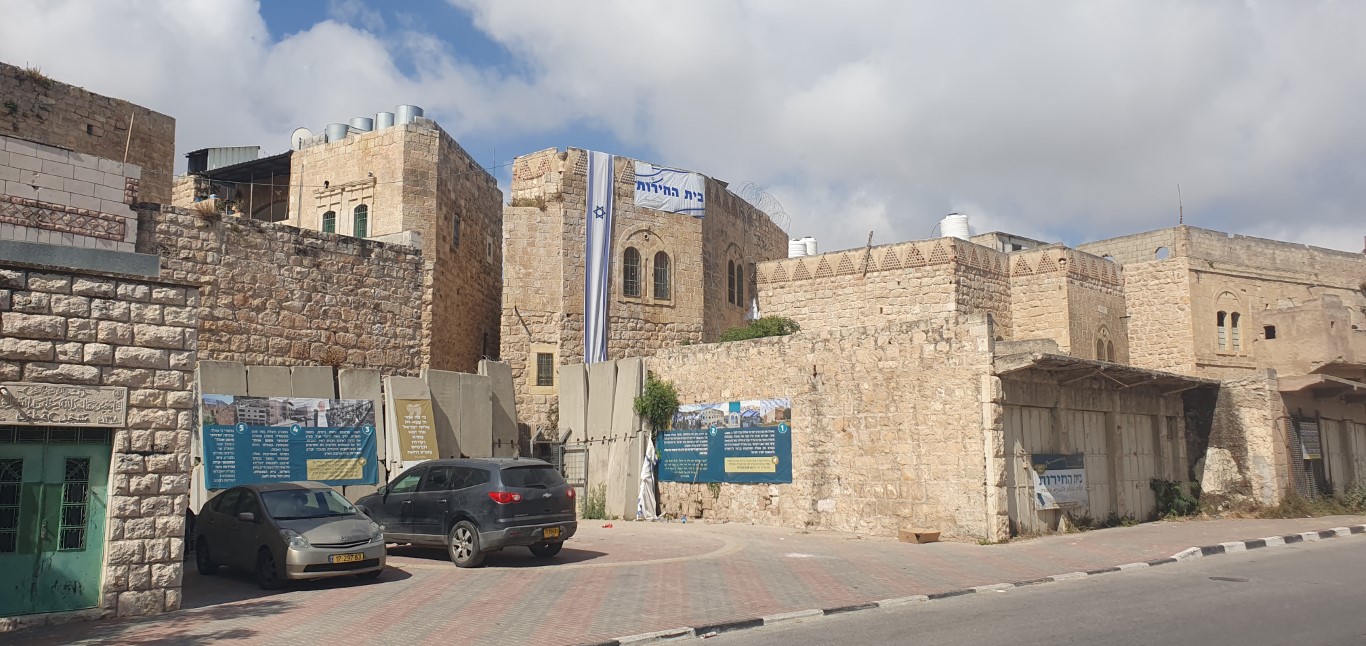 Peace Now reports that settlers have illegally moved into a Palestinian-owned property in the heart of Hebron on Shuhada Street, just south of the Cave of the Patriarchs, in an area of downtown Hebron where no other Israeli settlers live. The settlers appear to have accessed the home, which until recently was blockaded by concrete barriers, with the assistance of the IDF and further claim to have purchased the home. This location – and the alleged purchase of the home – is hugely significant both on the ground and in the Israeli government’s brazen support facilitation of settlement expansion, as explained by Peace Now:
“Hebron is perhaps the most scattered city in the West Bank. Any change in ownership of a store, courtyard, and especially a structure means establishing a new settlement in the city. Many houses and properties in the part of the city controlled by Israel have remained vacant and abandoned over the past decades and serve as a target for settlers’ takeover. Until recently, approvals for the settlement of new houses by the settlers required the approval of the Minister of Defense and the Prime Minister. As part of the transfer of civilian authority to Bezalel Smotrich, it was decided that in Hebron, the approval of settlement would be in the hands of Smotrich in coordination with Minister Yoav Gallant. The settlers’ entry into the house openly indicates that both ministers agreed to establish the new settlement. The new settlement is located on Shuhada Street (the settlers changed its name to King David Street), between the Pool of Siloam and the neighborhood of Avraham Avinu. This is an area populated by Palestinians and far from the existing settlements in the city. The new settlement is, in fact, an entry into a new area in the city.”
Years ago, the IDF installed concrete barriers preventing anyone from accessing the house, and evicted settlers from the home last year when they used a ladder to climb over the barriers. Those concrete barriers were recently removed (which can only be done with heavy equipment), suggesting that the IDF is planed to allow the settlers to enter (and likely remain) in the house.
The home is owned by the Palestinian Jariwi family, which petitioned the Israeli High Court of Justice to evict the settlers. The state initially responded to the petition saying that the settlers had already been evicted (clearly not true), and the State is now facing a July 30th deadline with the Court to submit an updated response given that the settlers are still squatting in the house illegally.
Photo of the new enclave found at: https://peacenow.org.il/en/a-new-settlement-was-established-in-hebron-with-the-return-of-settlers-to-a-house-that-the-idf-evicted-a-year-ago
Settlers Lead State-Backed Archaeological “Excavation” in Area B
Emek Shaveh reports that a triad composed of settlers, an American Christian evangelical organization, and the Israeli army collaborated on a recent unlicensed excavation on Mount Ebal – located north of Nablus near the Palestinian town of a-Sira al-Shaliya in Area B of the West Bank (where Israel does not have civilian authorities, according to the Oslo Accords). The excavation was approved by the Israeli Civil Administration under pressure from settlers, but given the location of the site in Area B and the lack of any license to carry out the excavation – Emek Shaveh states that this could be considered antiquity theft.
The groups transferred some 80 cubic meters of soil from Mount Ebal to the Shavei Shomron settlement, where settlers then promoted an opportunity for members of the public to join the archaeologists in sifting through the materials (thereby promoting tourism to the settlements). Haaretz called the excavation “is mainly used as a tourist attraction to the West Bank and is of little scientific significance.”
Emek Shaveh’s explained the significance of what is happening on Mount Ebal:
“The archaeological site at Mount Ebal is becoming a watershed in Israeli archaeology. The activity on the site has turned from a pirate operation led by a group of Messianic Jews and Christians into a state sponsored operation under the auspices of the Civil Administration led by Minister Bezalel Smotrich.This is yet another violation of the Oslo Accords and suspected violation of domestic and international law that is whitewashed by Israeli authorities and intended to serve as a method for advancing the annexation of the West Bank to Israel.In addition to the alleged violation of the law, the excavation constitutes an ethical failure by the entire archaeological community in Israel whose silence continues to grant legitimacy to such projects. A comprehensive and immediate investigation is required by all the relevant parties as well as independently by the Israeli Archaeological Association.”
Government Admits it Deliberately Permitted Illegal Construction at Homesh Outpost
In response to a petition submitted by Yesh Din, the Israel state formally confirmed reports Defense Minister Yoav Gallant ordered the Israeli army to stand down when it arrived in May 2023 to stop settlers’ attempt to relocated the Homesh outpost onto a small sliver of “state land” in the area of the former Homesh settlement in the northern West Bank. Gallant’s intervention only served to confirm the unapologetic determination of the Israeli government to reestablish the Homesh settlement on the “state land,” despite the fact that the land is surrounded by privately owned Palestinian property belonging to the nearby village of Burqa. (spoiler: In 2018, Israel established basis in its legal books for violating the private property rights of Palestinians in order to build an access road to the Haresha outpost).
In the weeks since settlers were permitted to illegally move into the area, the outpost has been connected to the state water grid.
On July 7th, a group of ~400 Israeli, Palestinian, and international activists attended a Peace Now protest march intended to start in Burqa and end at the Homesh outpost, in an effort to call on the government of Israel to stop the establishment of a settlement there. Though the marchers had requested and received a permit to hold the march, the IDF used force to stop the march from approaching Burqa. One marcher was detained and later released.
As a reminder – the legalization of Homesh was explicitly agreed to in the coalition deals which formed the current Israeli government. And despite the message to the U.S. behind closed doors, Israeli lawmakers and settler leaders hailed the Israeli government’s moves on Homesh as concrete steps toward the realization of this commitment. Otzma Yehudit MK and settlement activist Limor Son Har Melech hailed the news and said that the real goal is to reestablish all four settlements located near the Homesh outpost which were dismantled by the Israeli government in 2005 (the order issued by the IDF Commander on May 18th that allows Israelis to enter to the Homesh area did not extend to the areas of the other three settlements – Sa-Nur, Ganim, and Kadim).
Bonus Reads
- “Four Palestinians said wounded in settler attack in West Bank” (The Times of Israel)
- “Smotrich wants one million West Bank settlers. That’s not so far-fetched” (+972 Magazine)
- “Senate Foreign Relations Committee set for debate over Biden guidance on Israeli cooperative funding” (Jewish Insider)
- “Israeli Human Rights Violations in the Occupied Palestinian Territory – Weekly Update: 06-12 July 2023” (PCHR)
Welcome to FMEP’s Weekly Settlement Report, covering everything you need to know about Israeli settlement activity this week.
To subscribe to this report, please click here.
June 16, 2023
- E-1 Hearing Canceled, Israel Announces Plan for 4,570 of New Settlement Units
- Ir Amim Warns Plans for 7,000+ East Jerusalem Settlement Are on the Agenda
- Homesh Outpost Connected to State Water Grid
- Settlers Press for Jordan Valley Annexation
- Israel Begins Work on New Industrial Zone Near Ramallah
- Ghaith Sub Laban Family Under Eviction Order
- New Report Shows Nearly Half of West Bank Land Taken By Israel “For Public Purposes” Has Gone for Exclusive Use of Settlers
- Adalah Spells Out What Annexation Looks Like, Calls for Urgent Intervention
- Bonus Reads
E-1 Hearing Canceled, Israel Announces Plan for 4,500 of New Settlement Units
Haaretz reports that Prime Minister Netanyahu intervened to postpone a decisive hearing on plans to build the E-1 settlement that was set to take place on June 12th, with no new date set. The delay followed the typical international opposition to the E-1 settlement, which for decades has been viewed as a “dooms-day” settlement and treated a red line for countries pushing diplomatic efforts towards a two state solution. E-1 is also vehemently opposed by Palestinians and human rights activists because of the impact it will have on thousands of bedouin who live in the area slated for the settlements’ construction, just east of Jerusalem.
Daniel Seidemann – founder of Terrestrial Jerusalem and an expert on all things Jerusalem – commented on the cancellation of the E-1 hearing:
“This not at all trivial. But there is an iron-clad rule. Any time that Netanyahu does anything that can be seen as conciliatory, he compensates by doing other outrages, especially in Jerusalem, sometimes the West Bank.”
True to the format, some three days later, on June 12th, news broke that the Israeli government plans to advance 4,570 new settlement units at an upcoming meeting of the Civil Administration’s High Planning Council, set to convene near the end of June.
Preliminary reports on what will be on the agenda indicates that 1,000 units will be up for final approval, including:
- 500 units in Givat Ze’ev
- 300+ units in Elkana
- 300+ units in Revava
Settlements plan which might be advanced through earlier stages of the planning process include:
- Givat Ze’ev (in addition to the 500 units up for final approval)
- Ma’ale Adumim
- Kiryat Arba
- Beitar Illit
- And a dozen more.
This will be the second time the High Planning Council meets this year, and will come some four months after Israel signed the Aqaba Agreement – in which Israel agreed to a four month freeze. Of course, there has been no such freeze in settlement planning, construction, and other annexation activities across the West Bank (as this weekly report has chronicled – all accomplished without convening the High Planning Council. As a reminder, in its first meeting in February 2023, the High Planning Council advanced the largest slate of settlement plans – 7,287 units – in the past decade, including granting retroactive legalization to ten outposts.
Ir Amim Warns Plans for 7,000+ East Jerusalem Settlement Are on the Agenda
Ir Amim warns that – in addition to the actions that the High Planning Council might take in the West Bank – various other domestic Israeli authorities are poised to advance plans for over 7,000 new settlement units across East Jerusalem.
East Jerusalem settlement plans that are on the agenda of planning authorities include:
- Givat Hamatos A (“Tzmerot” Plan) – scheduled for June 12th, but no updates are available at the time of publication. This plan aims to massively expand the current construction outline for the Givat Hamatos settlement in East Jerusalem by adding an additional 1,200 units to the existing plan, bringing the total number of settlement units to be built in Givat Hamatos to 3,810 (assuming, conservatively, an average family size of 5, this means housing for an additional nearly 20,000 Israelis).
- Givat Hamatos / New Talpiyot Hill – scheduled to be discussed by the Jerusalem Local Planning Committee on June 28th. This plan will expand the area of the Givat Hamatos settlement in East Jerusalem by 40%, more than doubling the number of housing units slated to be built there. It involves the construction of 3500 units and 1300 hotel rooms, to be built on a strategic strip of land that will expand the area of Givat Hamatos eastward, connecting it with another new settlement plan – the “Lower Aqueduct Plan.”
- Kidmat Zion – scheduled to be discussed by the Jerusalem Local Planning Council on July 12th. Kidmat Zion will be located between the Ras al-Amud neighborhood and the Israeli separation barrier, with the Abu Dis neighborhood on the other side of the wall. The settlement enclave will be accessible only by driving through densely populated areas of Ras Al-Amud; and,
- Ramot A and B -scheduled for discussion and approval for deposit for objections on June 26. These two plans, outlining a total of 1,918 units, for deposit for public review. Both plans will expand the existing settlement of Ramot northeastward towards the Palestinian town of Bir Nabala. See more details from Ir Amim here.
There are several additional plans for East Jerusalem settlements that, though unscheduled at the moment, are also important to watch: Givat HaShaked, Lower Aqueduct Plan, Nof Zahav, and the Wadi Joz (“Silicon Wadi”) project.
Ir Amim writes:
“Although the E1 plans were again halted due reportedly to international pressure, a spate of other detrimental settlement plans are moving forward at full force in East Jerusalem which require immediate attention.
Against the backdrop of the 56th year anniversary of the Israeli occupation and illegal annexation of East Jerusalem, it is clear that such developments only continue to cement a one-state reality of permanent occupation and systematic oppression whereby one group is afforded full human and civil rights and the other is deprived of those rights.
In Jerusalem, one of the most severe expressions of this reality is the Israeli urban planning policy which aims to engineer Jewish demographic dominance, while pushing significant parts of the Palestinian population out of the city. In contrast to the thousands of housing units advanced annually for Israeli settlements in East Jerusalem, residential development in Palestinian areas is systematically suppressed and neglected, which undermines Palestinian rights to housing and serves as a lever of displacement.
In the absence of equitable urban planning and housing solutions, Palestinians are either forced out of Jerusalem or compelled to construct homes without building permits, which subjects them to the threat of demolition. Between January 1-June 15, 2023, there have been 68 home demolitions across East Jerusalem under the pretext of lacking building permits. This marks a significant rise from 2022 for the same period.”
Homesh Outpost Connected to State Water Grid As Settlers Move In
Weeks after being moved some one hundred yards from its original location – – to a small island of land Israel believes to be “state land” amidst privately owned Palestinian land – – Homesh settlers have swiftly worked to build a more “permanent” yeshiva, which is already hosting 40-50 religious students. The illegal Homesh yeshiva is now connected to the Israel water system – becoming what Haaretz called an “irreversible reality.” Settlers are now agitating for the state to pave access roads, which will necessarily require the expropriation of private Palestinian land.
 Settlers have carried out their work to build a new Homesh yeshiva with the unofficial permission of the Israeli government (and an obedient IDF) even though their construction is illegal. Over the past few months, the Israeli government has taken several radical steps towards establishing a new settlement in the area of the former Homesh settlement – including the repeal of relevant clauses in the Disengagement Law and the issuance of a military order to allow an Israeli civilian presence in the area. Haaretz further revealed that a state-funded organization – B’nai Horin-Neriya – has acted as a conduit to obscure the investment of state funds into the Homesh outpost. The organization has paid salaries of two Homesh yeshiva teachers since at least 2020.
Homesh was built on lands historically belonging to the Palestinian village of Burqa. The land was never returned to its Palestinian owners even after the settlement was dismantled in 2005.
In a new website promoting a campaign to stop the establishment of Homesh, Yesh Din – an Israeli NGO which has assisted Palestinians’ legal efforts to regain access to their land – writes:
“For 45 years Israel has denied residents of the Palestinian village Burqa in the West Bank access to their privately-owned land where the Israeli settlement Homesh once stood. The private Palestinian lands were expropriated in 1978 through a military seizure order for ‘security’ needs and two years later the settlement of Homesh was erected there. For 25 years, several dozen Israeli families lived in the settlement until Israel evacuated Homesh in 2005 as part of the disengagement plan. Almost continuously since the evacuation, an illegal Israeli outpost has been present in this area. For over a decade, Yesh Din has been assisting the residents of Burqa in their persistent legal battle aimed at evacuating the outpost that was established on their lands and allowing them free and safe access to them.”
Settlers are celebrating their triumph at Homesh, and have continued to openly discuss their goals of reestablishing the three other settlements dismantled by the Israeli government as a result of the 2005 Disengagement Law.
Shmuel Wende, executive director of the Homesh Yeshivah for the past three-and-a-half year, told JNS:
“We moved into our new permanent structure but had to do so in the middle of the night so as not to make a fuss. We are calling on the government to make this area 100% official, to pave roads, and go back to the way it was before the expulsion [disengagement].”
On the B’nai Horin-Neriya website – the state-funded organization which pays Homesh salaries and raises money to support constructions there – boasts:
“It’s not often in history that we get to see history taking shape in front of our eyes… this is one of the greatest events of the settlement enterprise to have taken place! The State of Israel is returning to northern Samaria!”
Settlers Press for the Annexation of the Jordan Valley
With a mounting number of victories, parts of the settler lobby are once again centering a longtime demand to annex the Jordan Valley. Justice Minister Levin and several other ministers offered supportive speeches and videos at a recent youth conference hosted by the “Sovereignty Movement”.
The Sovereignty Movement’s co-chair, Yehudit Katsover, said at the conference:
“We are beginning with the Jordan Valley. This is the eastern wall of the State of Israel and it must be strong. There is a broad consensus regarding the Jordan Valley. It is not an issue of Right and Left, It is clear to everyone that we must be here. Gantz also spoke about it at the time, the Prime Minister spoke about it, and opposition Knesset members proposed legislation on this issue. The Jordan Valley will be, with God’s help, under Israeli sovereignty, it’s only a matter of time. Of course, we are not relinquishing Judea and Samaria, but we are taking one step forward because the chance is greater in the Jordan Valley.”
Justice Minister Yariv Levin (Likud) said in a video sent to the conference:
“The Land of Israel, did, does, and will always belong to the people of Israel, as its name indicates. I am convinced that the joint effort that we have been exerting over the years to promote and strengthen our hold in the country and responsibly facilitate the application of Israeli law throughout the Land of Israel will ultimately produce results.”
Settlement and National Missions Minister, Orit Struk (Religious Zionism) said:
“The Jordan Valley is the most important place for the application of Sovereignty because it is, in fact, the place that secures our current eastern border. Therefore, your gathering here today and your continued activity are crucial. It is important that you know that our government established the issue of sovereignty as part of its agenda. It is found in the guidelines of the government and it is found in its political program as an objective when it will become politically possible. There is an excellent chance that we are on the way to achieving that objective.”
Annexation of the Jordan Valley has, in the past, garnered serious effort from the Israeli government. During his 2019 campaign, Netanyahu announced that he would immediately annex the Jordan Valley if reelected, and presented an error-ridden map explaining how he would annex the area without annexing a single Palestinian. His plan called for the annexation of an area which constitutes nearly a quarter of the area of the West Bank (22.3%) where (at the time) 30 settlements and 18 outposts had been established. Peace Now estimated 20% of the targeted land (62,000 acres) is privately owned by Palestinians – a fact that Netanyahu did not even mention, much less explain how he would address. After being elected, Netanyahu faced international opposition to the plan, and in order to quiet the criticism while saving face with his base – Netanyahu formed an inter-ministerial task force dubbed the “Sovereignty Committee” to design a plan for the annexation of the Jordan Valley.
Israel Begins Work on New Industrial Zone Near Ramallah
Kerem Navot shares photographs of bulldozers appearing to begin clearing land just west of Ramallah, a site where Israel intends to build a new industrial zone. The new industrial zone was fully approved in 2016, and will be constructed along the “Apartheid Road” route. In addition to a commercial area, the development will include public buildings, stores, roads, a parking lot and open space.
Ghaith Sub Laban Family Under Eviction Order
On Sunday June 11th an eviction order came into effect allowing for the removal, at any moment, of the Ghaith Sub Laban family from their longtime home in the Old City of Jerusalem. The forcible removal of the couple was not carried out as of publication, and it is reported that the settlers behind the eviction have requested a flexible timeline for carrying out the eviction – normally two weeks. Meaning the Ghait h Sub Laban family is living under constant insecurity.
Since then, their streets outside of their home have been a near constant scene of protest and solidarity, with activists organizing to stop any attempts to forcibly remove the couple from their home.
The Ghaith-Sub Laban family has spent the past 40-years in a legal battle against settlers (and the State) over their home in the Muslim Quarter of the Old City of Jerusalem. This family’s story is not unique, and the broader, systemic processes behind the forcible dispossession of Palestinians in Jerusalem is also discussed. In March 2023, FMEP hosted Rafat Sub Laban and Ir Amim’s Amy Cohen on a podcast – “‘We Are Determined to Stay”: One Palestinian Family’s Story of Dispossession in Jerusalem” – to discuss the Sub Laban case and how it relates to broader State-back settler efforts to dispossess Palestinians across Jerusalem.
Ir Amim explains:
“The family of veteran Ir Amim staff member, Ahmad Sub Laban, has been embroiled in a 45-year legal battle against persistent attempts by the state and settler groups to displace them and takeover their home for Jewish settlement. The family rented the house in 1953 from the Hashemite Kingdom of Jordan and as such was afforded protected tenancy rights. After 45 years of recurring lawsuits and harassment by the Israeli authorities and settler organizations, the Supreme Court recently ruled to terminate the family’s protected tenancy status and evict them from their home.”
For a comprehensive overview of the Sub Laban family’s legal battle, as well as other East Jerusalem eviction cases, please see Ir Amim’s report.
New Report Shows Nearly Half of West Bank Land Taken By Israel “For Public Purposes” Has Gone for Exclusive Use of Settlers
In a first of its kind report published by the Israeli NGOs Kerem Navot and Haqel – entitled, “For the Common Good” – military orders from 1967-2022 are examined to show how the Israeli government has mis-used expropriation orders that are issued “for the public good” to give land to settlements and outposts.
After a thorough legal examination of Israel’s ability to expropriate West Bank land, the report closely examines all 313 expropriation orders, finding that out of a total of 74,000 dunams seized (over 18,000 acres):
- 50% of the land (37,000 dunams / 9,142 acres) now serves both Palestinians and Israelis. These orders were issued mainly to pave shared roads throughout the West Bank;
- 48% of the land (36,000 dunams / 8,895 acres) now serves Israeli settlers exclusively. Much of the land was eventually handed over for the construction of settlements and/or access roads to settlements;
- 2% (1,532 dunams / 378 acres) are now used by Palestinians only.
The authors write:
“The conclusion of this study is evident: under the guise of its legal obligation to ensure the wellbeing of the Palestinian population in the West Bank, Israel has nevertheless expropriated extensive areas of land to promote the settlement project beginning in 1967. In some cases, it has done so while completely and blatantly ignoring its duty to ensure that the expropriated area is for the use of the Palestinian population, and in other, more sophisticated cases, it has done so by creating a dependency between the mutual interests of both Palestinian and settler populations.”
The issue of Israel’s use of expropriate orders to further the settlement movement is highly relevant to the events unfolding in the West Bank today, particularly in light of the government’s undisguised efforts to grant retroactive legalization to outposts that were built on land determined to be privately owned Palestinian land. On this score, the report offers this important history (p.22):
“Recently, the issue of expropriation for settlement purposes has been raised again when Attorney General Avichai Mandelblit approved the expropriation of private land in order to pave a road leading to the illegal outpost of Harasha. His legal opinion relied, among other things, on the verdict of Justice Salim Jubran in the HCJ Ziada case, which referred to settlers as part of the area’s ‘local population,’ rendering their welfare as the concern of the military commander. This position, as stated by the Attorney General, diverged from ‘the traditional legal position accepted for many years, according to which the expropriation of private land for public purposes that serve Israeli settlement may be allowed only when it also serves the Palestinian population”. In the summary of his opinion he stated that in light of the final verdict, there is no longer any legal principle that impedes the promotion of a regulated access road to the Harasha outpost by way of expropriation for public purposes, subject to criteria based on proportionality and reasonability. Note that afterwards, as part of a request for an additional hearing in the HCJ Ziada case given its precedents, including the allowance to take possession of private Palestinian land for the exclusive benefit of settlers, Supreme Court President Esther Hayut stated that “indeed, as noted by the plaintiffs, it appears that the verdict contradicts previous law in this context, and presents both renewal and difficulty”.
After the hearing in the HCJ Ziada case, the court addressed this issue directly as part of the petitions against the Regulation Law. Supreme Court President Hayut ruled with the majority opinion:
‘Indeed, as this court ruled, the military commander is entitled by the power of his authority according to Article 43 of the Hague Regulations to consider the benefit of the local population in its entirety as well, including the Israeli population in the area (the Abu Safia issue, in paragraph 20). However, as far as we are concerned with the question of “public purpose” according to the expropriation laws applicable in the area, I do not find that these allow the expropriation of private land owned by Palestinians or claimed to have proprietary relations, for the purpose of building and expanding Israeli settlements, and for that purpose alone.’
Thus, the court reverted to the traditional legal position whereby Palestinians’ private land must not be expropriated to serve the needs of the Israeli settler population exclusively.”
Adalah Spells Out What Annexation Looks Like, Calls for Urgent Intervention
The Palestinian NGO Adalah issued a blistering paper showing the ongoing ways in which the Israeli government is annexing Palestinians lands in the West Bank. The short and to the point document calls on the international community to intervene to stop Israel’s actions.
Joining a chorus of other analysts asserting that annexation is happening via bureaucratic changes within the Israeli government, Adalah’s analysis offers a detailed accounting of how the current Israeli government has brought the West Bank under the control of its civilian government.
The report concludes:
“The Israeli government is working systematically to implement the policy goals declared in its coalition agreements. Its actions express an intention to continue to entrench a regime of Jewish supremacy that grants the Jewish people an exclusive right to self-determination, as enshrined in the 2018 Basic Law: Israel- the Nation-State of the Jewish People, and to extend it beyond the Green Line into occupied Palestinian territory. All of the government’s declarations and actions demonstrate that its stated intention is not merely de facto annexation camouflaged in the framework of a temporary occupation but annexation de jure, in flagrant violation of international law.
The measures adopted by the government and the legislation approved by the Knesset thus far clearly reveal the trend of transferring parts of the military regime’s sphere of operation associated with the settlements to various Israeli government offices. The concept regarding the unification of laws between the localities in Israel and the settlements is expressed in a most alarming way in the aforementioned decisions.
These measures and laws deepen and expand the subjugation and oppression of the Palestinian people and express the total denial of their right to self-determination in their homeland, while implementing laws and institutional measures which, in practice, bypass the applicability of IHL and replace it with domestic Israeli law.
These decisions constitute annexation of parts of the West Bank, wherein a variety of government ministries will administer the settlements and, in practice, manage occupied territories as if they were an integral part of Israeli territory. Hence, these decisions will lead to the deepening of the de facto annexation of occupied territories and could be considered part of a de jure annexation process, in absolute violation of the laws of occupation.”
Bonus Reads
Welcome to FMEP’s Weekly Settlement Report, covering everything you need to know about Israeli settlement activity this week.
To subscribe to this report, please click here.
June 1, 2023
-
- Ghaith-Sub Laban Family Face June 11th Eviction from Old City Home
- Construction of Homesh Settlement Continues
- A New Look at Israel’s Annexation & Slow Erasure of Palestinians in Nabi Samwil
- 7amleh Analyzes Israeli Social Media Hate Speech on Huwara, Leading to Pogrom
- New, Comprehensive Report on Children in the Israeli Military Court System
- New Report Details Big Tech Companies’ Facilitation of Occupation
- Bonus Reads
Ghaith-Sub Laban Family Face June 11th Eviction from Old City Home
 Ir Amim reports that the Palestinian Ghaith-Sub Laban family have been issued a new eviction notice ordering them to vacate their decades-long home in the Old City of Jerusalem by June 11, 2023, or else be forcibly evicted. The elderly Ghaith-Sub Laban couple – who have steadfastly remained in their home despite unimaginable challenges and harassment by settlers – report that they expect the eviction to be forcibly carried out as soon as June 11.
The Ghaith-Sub Laban family has spent the past 40-years in a legal battle against settlers (and the State) over their home in the Muslim Quarter of the Old City of Jerusalem. This family’s story is not unique, and the broader, systemic processes behind the forcible dispossession of Palestinians in Jerusalem is also discussed. In March 2023, FMEP hosted Rafat Sub Laban and Ir Amim’s Amy Cohen on a podcast – “‘We Are Determined to Stay”: One Palestinian Family’s Story of Dispossession in Jerusalem” – to discuss the Sub Laban case and how it relates to broader State-back settler efforts to dispossess Palestinians across Jerusalem.
Ir Amim explains:
“The family of veteran Ir Amim staff member, Ahmad Sub Laban, has been embroiled in a 45-year legal battle against persistent attempts by the state and settler groups to displace them and takeover their home for Jewish settlement. The family rented the house in 1953 from the Hashemite Kingdom of Jordan and as such was afforded protected tenancy rights. After 45 years of recurring lawsuits and harassment by the Israeli authorities and settler organizations, the Supreme Court recently ruled to terminate the family’s protected tenancy status and evict them from their home.”
For a comprehensive overview of the Sub Laban family’s legal battle, as well as other East Jerusalem eviction cases, please see Ir Amim’s report.
Construction of Homesh Settlement Continues
The Palestinian Centre for Human Rights reports that non May 29th settlers brought caravans and heavy equipment to the site where they are building permanent infrastructure for the Homesh settlement. Though the Israeli government has not issued building permits or completed planning for the reestablishment of the Homesh settlement, the IDF continues to obey orders to allow the settlers to proceed with construction.
As a reminder, On May 18th the IDF Commander signed a military order that finalized the Knesset’s recent repeal of key sections of the 2005 Disengagement Law, allowing Israelis to enter the area in the northern West Bank where the Homesh settlement stood before it was dismantled by the Israeli government in 2005 as part of Disengagement. In parallel, the Israeli Defense Minister announced that the government plans to relocate the Homesh outpost – a yeshiva (that is, a Jewish religious school) established illegally by settlers as part of their drive to re-establish the Homesh settlement – from its current location, which is on land that Israeli courts have recognized as private Palestinian property, to a small plot of nearby “state land” a few hundred of meters away. The Times of Israel further reports that the IDF Commander signed additional orders on May 15th that temporarily bar Israelis from entering the existing Homesh outpost until the outpost’s yeshiva is relocated to the “state land” plot, and that add the Homesh outpost as an official community under the umbrella of the Shomron Regional Council (a settlement municipal body), which allows the planning of the settlement to begin.
Yesh Din – an Israeli NGO which has led petitions to return the land on which Homesh was built to its Palestinian owners – told Haaretz:
“Moving the yeshiva is adding sin to crime. Its new location still doesn’t allow Palestinians to reach their land and continues their dispossession. Instead of evacuating the outpost immediately, Israel is rewarding serious criminals.”
PCHR further reports that on 30 May 2023, settlers known to be working on the Homesh settlement attacked a home in the Burqa village, and smashed the rear window of the house owner’s vehicle.
Haaretz columnist Amos Harel explained why the government’s actions vis a vis Homesh reveal the true nature of the coalition, saying
“The Homesh affair reiterates the true balance of power within the government, which is controlled by the far-right and ultra-Orthodox parties. The Homesh yeshiva’s relocation was essentially orchestrated by the head of the Samaria Regional Council, Yossi Dagan, who was provided cover from the government by Finance Minister Bezalel Smotrich.”
A New Look at Israel’s Annexation & Slow Erasure of Palestinians in Nabi Samwil
A new Haaretz piece looks at the history of the Palestinian village of Nabu Samwil, located on a strategic hilltop between Jerusalem and Ramallah. This location places the village’s residents — who remain in the eyes of the Israeli government residents of the West Bank, for whom access to Jerusalem is forbidden without a special permit — in a Kafka-esque situation: they are cut off from the West Bank by the separation barrier but barred entry to Jerusalem. They are legally forbidden from taking the one road out of the village because it passes through Jerusalem, and the West Bank is accessible to them only via a circuitous route that passes through an Israeli checkpoint (for background see: The Palestinian village where Israel forbids everything, and this Twitter thread of resources curated by Lara Friedman). The suffocation of Nabi Samwil is in line with Israel’s long-time ambitions to completely de-populate the village and take control of the land.
Palestinian refugees of Nabi Samwil, in conjunction with activists, have held protests to demand recognition from the Israeli government, in order to be able to build legal structures and be granted permits to enter Jerusalem. Refugees have petitioned the Israeli government for over 20 years to accept a formal building plan for the village, in order to allow the buildings to be deemed legal, but the government has refused. Instead, in 2021 the Israeli government greenlit a major project to renovate an archeological and holy site in Nabi Samwil. The plan will see the construction of a new access road, a visitors area, a restaurant, a learning center for tour groups, a shop, and a conference room.
7amleh Analyzes Israeli Social Media Hate Speech on Huwara, Leading to Pogrom
The Palestinian NGO 7amleh: The Arab Center for the Advancement of Social Media has issued a new report – “An Analysis of the Israeli Inciteful speech against the Village of ‘Huwara’ on Twitter” – documenting the social media frenzy that preceded settler-perpetrated pogrom on Huwara on February 27, 2023. The report identified a total of 15,250 Hebrew tweets containing hashtags related to Huwara, of which 80.2% of these tweets contained negative content against the village and its residents. The intensity of incitement and hate speech peaked before and after the attack. During this time, an average of 188 negative tweets per day targeting Huwara were published by approximately 158 accounts on Twitter.
The report recommends that social media companies take decisive measures to prevent the spread of incitement, racism, and violence against Arabs and Palestinians on their platforms. It suggests the development of a lexicon of hate speech in Hebrew for monitoring purposes, the implementation of content management policies for Israeli content in Hebrew, and an end to discriminatory double standards between Palestinian and Israeli content.
New, Comprehensive Report on Children in the Israeli Military Court System
Defense for Children International – Palestinian has released a new report – “Arbitrary by Default: Palestinian children in the Israeli military court system” – comprehensively examining the systemic denial of fair trial rights inherent in Israeli forces’ practice of arrest, detention, interrogation, and prosecution of Palestinian children in the Israeli military courts.
Building on years of documentation, the report’s main findings based on hard evidence are:
- Israeli military courts do not meet the standards of independence and impartiality when dealing with civilians, including children.
- Palestinian children detained and prosecuted in the Israeli military court system are denied the right to a fair hearing by a competent, independent, and impartial tribunal.
- Israeli authorities frequently arrest Palestinian children without issuing arrest warrants, failing to establish a legal basis for detention.
- Israeli authorities rarely provide explanations or information to the child or their family regarding the reasons for arrest.
- Palestinian children are denied prompt access to legal assistance and the presence of a family member during interrogation.
- Israeli forces’ systematic non-compliance with the prohibition of torture or cruel, inhuman, or degrading treatment constitutes arbitrary detention.
New Report Details Big Tech Companies’ Facilitation of Occupation
Who Profits has issued updated company profiles for Microsoft, Cisco Systems, IBM, and Dell Technologies – all of which are Multinational Companies (MCs) which support the Israeli occupation economy through the provision of infrastructure, technology, knowledge, and products to both civil and military institutions. The report highlights the extensive and diverse involvement of these companies in bolstering the capacity of the Israeli occupation economy and its ability to exert control and surveillance over Palestinians on both sides of the Green Line.
Please use the following links to read more on the role and activities of each company:
Bonus Reads
- “Israel Is on a Mission to Supersize Its West Bank Settlements” (Hagit Ofran, Haaretz)
- “Is Judicial Reform a Trojan Horse for West Bank Annexation?” (Yaakov Or, Haaretz)
- “Jewish residents hold morning prayers at entrance to Arab village to protest attacks” (Arutz Sheva)
- “After backlash, conference drops Israeli archeologist for settlement university ties” (+972 Magazine)
Welcome to FMEP’s Weekly Settlement Report, covering everything you need to know about Israeli settlement activity this week.
To subscribe to this report, please click here.
May 19, 2023
- Peace Now Reports: 613 New Settlement Units Advanced, Including Tender for A New Settlement – “Ariel West”
- March of Flags Expanded Route
- Gallant Orders IDF To Allow Israeli Jews to Reestablish Homesh Outpost & Yeshiva
- Smotrich is Leading a Push to Double Settler Population
- Al Walajah Checkpoint Construction Blocks Palestinians from Land
- Settler Visit to Joseph’s Tomb Causes Conflict
- MKs Oppose New Section of Security Wall, Say it Will Divide Settlements from Israel
- Bonus Reads
Peace Now Reports: 613 New Settlement Units Advanced, Including Tender for A New Settlement – “Ariel West”
Peace Now reports that Israeli planning authorities convened on May 17th to advance plans for a total of 613 new settlement units, including a move by the Israeli Ministry of Housing and Construction to re-publish a tender for the construction of 58 units constituting a new “neighborhood” of the Ariel settlement which is, in effect, a new settlement. The Civil Administration’s High Planning Committee also convened on the 17th and is expected to have issued final approval to a plan for 552 units in the Givat Ze’ev settlement, and also to have deposited for public review a plan for 2 more units in Givat Ze’ev as well as a plan for 1 new unit in the Itamar settlement (final confirmation of the Committee’s decision was not available at the time of publication). Peace Now warns that construction could commence quickly on the plan to build 552 new units in the Givat Ze’ev settlement because a contractor has already been selected. Givat Ze’ev is located south of Ramallah in an area that is on the Israeli side of the barrier. 
The Ministry of Housing and Construction’s issuance of a tender to build 58 units in the Ariel settlement is final approval to build a brand new settlement, dubbed “Ariel West.” Plans for the Ariel West settlement were first made public in November 2021, after the tenders were issued under the guise of a plan to “expand” the Ariel settlement [for more on how this plan was kept quiet, see Peace Now’s detailed history]. The units for the new Ariel West settlement will be built on a hilltop located 1.2 miles away from Ariel, in an area that is non-contiguous with the built-up area of the current Ariel settlement. The new settlement will be directly adjacent to the Palestinian village of Salfit, further limiting the future development of Salfit and restricting Palestinian agricultural workers’ access to land, as illustrated in this video by Peace Now. [map]
Peace Now said in a statement:
“It is clear that annexing the West Bank is the main agenda of the Israeli government. Promoting more than 600 housing units in settlements, among them a tender for the construction ‘Ariel West’, an entirely new settlement established under the official guise of a neighborhood an Ariel settlement, joins previous devastating annexationist decisions advancing annexation, made by the government, such the decision to legalise 15 outposts, the advancement of nearly 10,000 housing units in settlements, the cancelation of the disengagement law from the North part of the West Bank, the promotion of the apartheid road east of Jerusalem and the transfer of powers from the military to Minister Smotrich. Each decision alone demonstrates that the government is acting with an intention to annex the occupied territory, prevent the possibility of establishing a viable Palestinian State, and to escalate tensions between Palestinians and Israel.”
March of Flags Expanded Route
Tens of thousands of ultra-nationalist extremist Israeli Jews participated in the annual Jerusalem Day “Flag March” through Jerusalem in celebration of Israel’s (illegal) annexation of East Jerusalem in 1967. The parade drew security support from over 3,200 Israeli security forces and aerial drones, which sealed off the route of the parade and shuttered large parts of Jerusalem for Palestinians. The parade poses an annual threat of erupting into large-scale violence because it is a direct provocation – which Israeli lawmakers egg on and participate in – against Palestinians in Jerusalem. Israeli Jews participating in the parade chant Jewish Supremacist slogans and anti-Palestinian slurs including “Death to Arabs” and “May Your Village Burn,” the latter of which is particularly horrific given the pogrom Israeli settlers committed against the Palestinian village of Huwara earlier this year.
This year the Israeli government extended the route of the Flag March, which Haaretz estimated to impact at least an additional 50,000 Palestinian residents of East Jerusalem. The longer route will include stops at two East Jerusalem settlement compounds, bringing the parade for the first time through the Palestinian neighborhood of A-Tur and near the village of Ras Al-Amud. Haaretz also reports that march organizers will hold tours in Sheikh Jarrah.
Ir Amim’s Yudith Oppenheimer explained the motivation of the marchers:
“At the parade’s core lies an ideology that Palestinians ought to be humiliated and pushed to their limit; they should be reminded at every moment that they live in an occupied city where they have no authority and no place; every reaction by Palestinians must be exploited to justify increased use of force and establish more facts on the ground.This is why the parade organizers and their sponsors insist on the route going through Damascus Gate and the Muslim Quarter. And if necessary, may our city burn just to prove it.”
The Haaretz Editorial Board wrote:
“The essence of the Flag March is to poke a finger in the eye of the city’s Palestinian inhabitants, to humiliate them and to drive home the fact that 40 percent of the residents of Israel’s capital live under occupation. Absurdly, the march actually underscores the fragility of Israeli sovereignty over East Jerusalem. It takes place under heavy security provided by thousands of police officers, after the police impose severe restrictions on the Palestinian public and merchants.”
Gallant Orders IDF To Allow Israeli Jews to Reestablish Homesh Outpost & Yeshiva
On Wednesday May 17th, Defense Minister Yoav Gallant issued an order instructing the head of the IDF Central Command – Yehuda Fuchs – to sign a military order that makes it legal for Israeli Jews to enter and reside in the area of the Homesh settlement in the northern West Bank, including the Homesh settlement which settlers have been pushing to reestablish. The military order is needed even after the Knesset repealed clauses of the 2005 Disengagement Law in March 2023, which it did explicitly in order to facilitate the reestablishment of the Homesh settlement which was dismantled under the law, along with three other settlements in the area.
The Knesset’s repeal of the Disengagement Law faced international criticism, which Prime Minister Netanyahu, at the time, assuaged by issuing a statement that his government has ““no intention of establishing new settlements in the area.”
The U.S. State Department issued a statement to Israel Hayom in reaction to Gallant;s order, reiterating opposition to the reestablishment of Homesh, saying:
“The United States strongly urges Israel to refrain from allowing the return of Israeli settlers to the area covered by the legislation passed in March, consistent with both former PM [Ariel] Sharon’s and the current Israeli government’s commitments to the United States…We have been clear that advancing settlements is an obstacle to peace and the achievement of a two-state solution. This certainly includes creating new settlements, building or legalizing outposts, or allowing building of any kind on private Palestinian land or deep in the West Bank adjacent to Palestinian communities”
Further reports suggest Gallant and Smotrich are working on a plan to build the Homesh settlement on a small plot of “state land” in the settlement’s former location, which was built almost entirely on land that belongs to (and is recognized by Israel as registered as belonging to) Palestinian owners. The Israeli NGO Yesh Din noted that the repeal of clauses related to Homesh in the Disengagement Law did not change the legal status of the land, and did not create a legal option for reestablishing the Homesh settlement there. Smotrich and Gallant are apparently advancing a plan to build Homesh on the small parcel of “state land” in the area, which in effect will allow settlers – and the security apparatus that enables, accompanies, and entrenches their presence – to retain total control over the Homesh area even though the land is privately owned by Paelstinians.
As a reminder, even after the Homesh settlement was dismantled in 2005, control over the land was never returned to its owners. The area was instead declared by the Israeli army to be a closed military zone, with Palestinains, including the owners of the land, barred from access. The Palestinians owners have been fighting for the right to access their own land since 2009, with no success. At the same time, the Israeli army allowed Jewish Israeli settlers to access the area regularly, and even permitted the settlers to illegally (under Israeli law) establish a religious school and settlement outpost at the site. Rather than enforce Israel’s own laws against the settlers, the current Israeli government has agreed to grant retroactive approval to the settlers’ illegal presence, the first step towards doing so being the aforementioned repeal of clauses in the Disengagement Law that make any Israeli presence there illegal. A
Smotrich is Leading a Push to Double Settler Population
Haaretz reports that since Bezalel Smotrich was granted vast authority over civil affairs in the West Bank, he has set out to initiate wide-scale planning to add 500,000 new settlers, essentially doubling the current number of Isarelis living in the West Bank (not including East Jerusalem). This push includes orders to improve the infrastructure for every settlement and outposts (regardless of legal status) within the next two years. Smotrich is also pursuing ways by which to make it easier for settlers to cross into Israel without the hassle imposed on currently by the checkpoint system.
Haaretz further reports that Defense officials are expected to oppose Smotrich’s planning, even though detailed information has not yet been provided. In addition to security challenges to Smotrich’s plan, he also lacks the massive budget that such an effort would require.
Al Walajah Checkpoint Construction Blocks Palestinians from Land
Ir Amim reports that the Jerusalem Municipality has formally announced the start of work on a project to relocate a key IDF checkpoint leading to the Palestinian village of Al-Walajah, a village which is located on (and partially within) the southern perimeter of Jerusalem’s expanded municipal borders. The effort to move the checkpoint closer to the built-up area of Al-Walajah is part of the Israeli government’s long running effort to take control over an increasing amount of land – and importantly, the Ein Haniya spring – that historically belongs to Al-Walajah.
By relocating the checkpoint to a point closer to Al-Walajah, Palestinians from the village will no longer have unfettered access to approximately 1200 dunams of agricultural land, including the site of the Ein Haniya springs. The Ein Al-Hanya spring, which the Jerusalem Municipality declared a national park in 2013 and then spent years and millions of dollars renovating into a tourist destination, is located on land historically part of Al-Walajah and it long served as a main source of water for households, farms, and recreational purposes for the village’s residents.
Since 1967, Al-Walajah has suffered due to its location and its complicated status (much of the village’s lands, including areas with homes, were annexed by Israel in 1967, but Israel never gave the villagers Jerusalem legal residency by Israel – meaning that under Israeli law, their mere presence in their homes is illegal). Today it is acutely suffering from a multi-prong effort by the Israeli government and settlers to grab more land for settlement expansion in pursuit of the “Greater Jerusalem” agenda. This land grab campaign includes home demolitions (four homes in Al-Walajah were demolished by Israel on November 2, 2022, for example), the construction of the separation barrier and bypass roads in a way that seals off the village on three sides, and the systematic denial of planning permits.
You can join a webinar entitled “What’s Next for al-Walaja”on May 24th at 12pm eastern to learn more about al-Walajah (hosted by Ameinu, Peace Now, T’ruah, and Telos on May 24th at 12pm eastern. Register here.
Settler Visit to Joseph’s Tomb Causes Conflict
On the night of May 17th, thousands of Israeli Jews – including at least two elected officials – staged a trip to the Joseph’s Tomb site in Nablus under the heavy protection of the IDF, which attempted to enforce a curfew on nearby Palestinian neighborhoods. Clashes erupted as Palestinian confronted the parade of settlers, resulting in at least two injuries.
In response to the violence, settler leader Yossi Dagan called on Israel to take complete control over the site, to build a yeshiva there, and to “restore the ISraeli flag at this holy site and show everyone, both ourselves and our enemies, that we are not afraid.”
The tomb is located within Area A of the West Bank (where Israel does not, under the Oslo Accords, have direct control). However, Joseph’s Tomb is one of two sites in Area A which the Oslo Accords stipulate are under the control of the Israeli military. As such, it has been a perennial flashpoint, largely due to deliberately provocative actions by settlers. The whole circumstance – of settlers visiting Joseph’s Tomb – was recently called “absurd” by former IDF Major General Gadi Shamni.
MKs Oppose New Section of Security Wall, Say it Will Divide Settlements from Israel
Israel Hayom reports that the Israeli Defense Ministry is moving towards the start of construction on a very controversial section of the West Bank separation barrier near the Etzion settlement bloc. This particular section has not been built since its initial approval in 2006 because of fierce opposition to the proposed route that, even though the barrier’s route cuts deeply into the West Bank in order to keep the majority of settlements in the Etzion Bloc on the “Israeli side” of the barrier, it leaves a few settlements including Nokdim on the “Palestinian side.”
The IDF said in a statement that the project does not include the construction of concrete walls, but will feature different types of construction that cater to wildlife and the area’s topography – to include “special monitoring technology and sensors.”
Israeli lawmakers reacted negatively to the news of this project, saying that it has the potential to create a “de facto border” between the settlements and Israel proper and that it would turn settlements in the area into enclaves. This opposition is in line with the right wing demands to annex the West Bank to Israel, in which context building a barrier is viewed as conceding land to Palestinians.
For background on the separation barrier, please see B’Tselem’s explainer.
Bonus Reads
- “The Settler Terrorists in Palestinian Vineyards” (Amira Hass, Haaretz)
- “A precious resource: how Israel uses water to control the West Bank” (The Guardian)
- “When Israel’s Highest Court Assaults Human Rights” (Jessica Montell, Haaretz)
Welcome to FMEP’s Weekly Settlement Report, covering everything you need to know about Israeli settlement activity this week.
To subscribe to this report, please click here.
May 12, 2023
Israeli Government Funds the De-Facto Annexation of Sebastia Archaeological Site
On May 7, 2023, the Israeli government approved nearly $9 million (NIS 32 million) for a project to develop and “renovate” the archaeological site of Sebastia, located near the Palestinian village of Sebastia, north of Nablus in the heart of the West Bank. The project includes plans to pave a new access road for Israelis to reach the site, which they currently have to access by traveling through the Palestinian village of Sebastia, which will increase and entrench Israeli control not only over the site itself but the surrounding area – effectively weaponizing archaeology as a tool for dispossession.
Emek Shaveh calls this new project “a considerable investment,” saying it “takes Israel’s unilateral actions at heritage sites in the West Bank to a new level.” The investment is in line with the current government’s coalition agreements which include a commitment to invest $40 million into a “National Emergency Plan” under which Israel must take control of heritage sites across the totality of the West Bank, without regard to the Oslo-defined Areas A, B, and C. The Sebastia archaeological site straddles the line designating Areas B and C, with most of the site is in Area C. The Palestinian village of Sebastia – which settlers travel through to reach the site – is in Area B entirely.
Settlers have been openly agitating for Israel to assert control over the archaeological site in Sebastia for years, and the settler Samaria Regional Council organizes regular tours to the site. To secure the settlers’ visits, the IDF shuts down the town of Sebastia, closing Palestinian streets and businesses. As in other cases across the West Bank, settlers allege that Palestinians are damaging the Sebastia site and that the Israeli government needs to intervene. In 2021 amidst intensifying settler efforts related to the site, the Palestinian Foreign Ministry called on UNESCO to “protect all Palestinian archaeological and religious sites from Israeli violations, attacks and falsifications.” The archaeological site of Sebastia is on the tentative list of World Heritage sites in Palestine.
As a reminder: in January 2023 the Israeli government took a decision to transfer the Israeli Antiquities Authority (IAA) from the Ministry of Culture to the Ministry of Heritage, which is now headed by MK Amihai Eliyahu (Jewish Power). The IAA exercises authority over heritage and archaeological sites in Israel, including East Jerusalem, but has increasingly expanded its authorities into Area C of the West Bank, at the expense of the Staff Officer for Archaeology within the Civil Administration, who has historically been in charge. The government also tasked Eliyahu with preparing an emergency plan to “safeguard” antiquity sites in the West Bank specifically. Settlers have spent years alleging that Palestinians and the Palestinian Authority neglect and damage heritage sites, allegations which, turns out, have created a basis for the government to take control over those sites. The government allocated NIS 150 million to the effort.
Emek Shaveh further explains the history and politicization of this archaeological site:
“The battle over Sebastia is also played out in the narratives each side presents to the public. The informational material distributed by the PA does not include an explicit reference to the Kingdom of Israel or to the Hasmonean connection. On the other hand, in recent years the settlers have been rehabilitating the figure of Omri, a King of the Kingdom of Israel, in an effort to imbue Sebastia with greater nationalist significance. Sebastia also holds a special place in recent history for the settlers because it is the place where the leaders of Gush Emunim, the group that first fought for the establishment of settlements in the West Bank in the 1970s, celebrated the government’s agreement to establish the first settlement in the area in 1975.
In tandem with the growing campaign of recent years to apply full Israeli control over Sebastia, larger numbers of Israelis visit the site every week in buses organized by the Samaria Regional Council and accompanied by soldiers.
Sebastia, is a declared national park. National parks and nature reserves in Area C of the West Bank are managed by the Civil Administration and are referred to as “parks”. Their total area spans approximately 500,000 dunams and constitutes roughly 14.5% of Area C. Palestinians’ rights are violated in these territories through various means. In the Ein Prat Nature Reserve, for example, landowners cannot cultivate their land as their access is restricted. In Herodion National Park and Nabi Samuel, residents can neither construct nor renovate their homes.”
Emek Shaveh Warns Israel Is Moving Towards Start of East Jerusalem Cable Car Construction
Emek Shaveh warns that over the past several months a planning committee has approved several contracts that indicate the committee is barrelling towards issuing the long-anticipated (and long-feared) tender for the construction of the East Jerusalem Cable Car project, possibly as soon as next week.
As a reminder, the Jerusalem cable car project is an initiative backed by the powerful, state-backed Elad settler group and advanced by the Israeli Tourism Ministry. While public efforts to “sell” the cable car plan focused on its purported role in helping to grow Jerusalem’s tourism industry or in serving supposedly vital transportation needs, in reality the purpose of the project is to further entrench settler control in Silwan, via archeology and tourism sites, while simultaneously delegitimizing, dispossessing, and erasing the Palestinian presence there. The State of Israel was forced to publicly admit that the implementation of the cable car project will require the confiscation of privately owned Palestinian land in the Silwan neighborhood of East Jerusalem.
Notably, the cable car line is slated to terminate at the settler-run Kedem Center compound (Elad’s large tourism center, currently under construction at the entrance of the Silwan neighborhood, in the shadows of the Old City’s walls and Al-Aqsa Mosque).
The cable car project received final approval in May 2022, but the tender for construction has yet to be issued. Emek Shaveh speculates that the cable car tender might be issued on Jerusalem Day – which will be celebrated with ultranationalist, racist parades through the Old City next week — on May 18th and 19th. Emek Shaveh further warns that several other settler projects in East Jerusalem, including the Ben Hinnom suspension bridge and the zip line over the Peace Forest, are nearing completion and might also be part of Jerusalem Day celebrations.
Emek Shaveh and other non-governmental organizations, including Who Profits and Terrestrial Jerusalem, have repeatedly challenged (and provided evidence discrediting) the government’s contention that the cable car will serve a legitimate transportation need in Jerusalem, and have clearly enumerated the obvious political drivers behind the plan, the archeological heresies it validates, and the severe negative impacts the cable car project will have on Palestinian residents of Silwan. All objections to the plan were dismissed in May 2022.
Supreme Court Dismisses Regavim Effort to Force Immediate Demolition of Khan Al Ahmar
On May 7th, the Israeli High Court dismissed a new petition submitted by the Regavim settler organization (which Bezalel Smotrich, a top official in the current government, co-founded) seeking to force the government to immediately demolish the Khan Al Ahmar bedouin community. The Court granted the government yet another delay in demolitioning the village, saying that the delay was granted due to “diplomatic and security matters of the highest level.” In requesting this most recent delay, the Israeli government reassured the Court that it fully intends to demolish Khan Al Ahmar in the future and is in “negotiations” with its residents regarding their forcible removal.
In response, Regavim called the current government a “disgrace.”
Bezalel Smotrich, who serves as both the Finance Minister and a minister in the Defense Ministry with broad, unchecked authorities over civil affairs in the West Bank, made a remarkable statement, saying the quiet part out loud:
“Khan al-Ahmar will be evicted not because its illegal. (But because)it sits in a strategic area…this is the area that will determine if God forbid there will be an Arab territorial continuum”
While the Israeli government has taken a cautious approach to demolishing Khan Al-Ahmar – largely in consideration of international pressure – the government showed no restraint in demolishing an EU-funded school near Bethlehem. The school served 60 Palestinian children.
Regavim is also behind this demolition, which was carried out by the government in defiance of a request from the EU to not do so. In a statement, the EU said that demolitions like this are:
“illegal under international law, and children’s right to education must be respected. The EU calls on Israel to halt all demolitions and evictions, which will only increase the suffering of the Palestinian population and risk inflaming tensions on the ground.”
Welcome to FMEP’s Weekly Settlement Report, covering everything you need to know about Israeli settlement activity this week.
To subscribe to this report, please click here.
April 7, 2023
- In Rare Ruling, Israeli High Court Rejects JNF/Settler Effort to Evict Palestinian Family from their Home in Silwan
- Israel Advances Plans for 6,500 New Settlement Units in East Jerusalem
- Israel Doubles Funding of Settler Surveillance of Palestinians
- Bonus Reads
In Rare Ruling, Israeli High Court Rejects JNF/Settler Effort to Evict Palestinian Family from their Home in Silwan
 On April 3rd, a three-judge panel of the Israeli Supreme Court ruled against the Jewish National Fund, which has pursued a 32-year legal battle to evict the Palestinian Sumreen family from their longtime home in the Silwan neighborhood of East Jerusalem. In its ruling the Court criticized the government for declaring the Sumreen home to be absentee property “without any basis in law.” The Court further ruled that the JNF’s subsidiary Himnuta (which was created to take the lead for JNF in litigating aggressive settlement takeover cases like this) must compensate the family with 20,000 shekels ($5,560).
The case to evict the Sumreen family has been viewed as a key test of the State’s use of the Absentee Property Law to seize Palestinian homes in East Jerusalem, with the fate of the Sumreen case likely to set a precedent that could impact the many other ongoing eviction cases brought by settlers against Palestinians in Silwan.
Reacting to the ruling, the Sumreen family lawyer told Haaretz:
“This decision is precedential and just. The Supreme Court brought justice after two proceedings in which [the court] ordered the eviction of several families from their homes. The decision includes criticism of how the authorities behaved on this matter and the declaration of absentee property despite the fact that the owner is a living resident of Jerusalem.”
The Free Jerusalem activist movement said in a statement:
“There are few moments in which we feel like a bit of justice has been done in the reality of the occupation. This is one of those movements. Amal Sumreen and her children have lived in their home in Silwan for decades. For the first time in those decades, Amal will be able to sleep soundly tonight” and vowed to continue working “until this racist law, which allows the seizure of homes, is struck down, until the occupation ends, until there is full equality for all.”
The Sumreen family home is located in the middle of what today has been designated by Israel “the City of David National Park” (the home existed long before that designation). The Israeli government has handed over management of the area to the radical Elad settler organization, which for years has also been pursuing the eviction of Palestinians from the homes in Silwan. For nearly three decades, the Sumreen family has been forced to battle for legal ownership of their home, after the state of Israel, prompted repeatedly by the JNF, declared the home to be “absentee” property”. As a reminder, that law (as summarized by the Israeli legal NGO Adalah),
“Defines persons who were expelled, fled, or who left the country after 29 November 1947, mainly due to the war, as well as their movable and immovable property (mainly land, houses and bank accounts etc.), as ‘absentee’. Property belonging to absentees was placed under the control of the State of Israel with the Custodian for Absentees’ Property. The Absentees’ Property Law was the main legal instrument used by Israel to take possession of the land belonging to the internal and external Palestinian refugees, and Muslim Waqf properties across the state.”
Based on that designation – which was not communicated to the Sumreen family, which of course was not “absentee” but was living in the home – Israeli law permitted the state to take over the rights to the building. The state then sold the rights to the home to the JNF in 1991. The JNF has pursued the eviction of the Sumreen family ever since, with the secret funding/backing of the Elad settler group.
Israeli courts ruled in favor of the Sumreen family’s ownership claims to the home for years. This changed, arguably as a direct result of a deliberate policy (led by then-Justice Minister Ayelet Shaked) to pack the courts with right-wing judges) in September 2019, when the Jerusalem Magistrate’s Court tossed out the previous rulings to grant ownership of the family’s home to the JNF — a decision the family immediately appealed to the Jerusalem District Court. Notably: in 2020, the JNF came under considerable international scrutiny for its handling of the Sumreen case, and was pressured to call off its eviction campaign (it did not).
In 2022, the Israeli Attorney General issued a legal opinion supporting the JNF’s legal claim to the home and the eviction of the Sumreens. In his opinion, the Attorney General did not address the broader political context of widespread dispossession of Palestinians in Silwan, or the legally dubious actions on the part of the Elad settler group and the Jewish National Fund in having the property declared to be absentee in order to take control over it. Instead, the Attorney General decided simply that there is no new basis on which to overturn the JNF’s ownership of the home, and therefore the Sumreen family does not have a legal right to reside there.
A full history of the saga involving the Sumreen family – which is similar to dozens of other Palestinian homes in Silwan that were declared Absentee Property in the 1990s – can be found on the Peace Now website here. For more on the collusion of the JNF and the Elad settler group, see reporting by +972 Magazine.
Israel Advances Plans for 6,500 New Settlement Units in East Jerusalem
Ir Amim reports that over the past week various Israeli agencies have advanced plans for a total of 6,500 new settlement units slated for incredibly sensitive areas of East Jerusalem.
On March 29th, the Jerusalem Local Planning Committee took the following actions:
- Wadi Joz Business Center (Silicon Wadi) – the Committee discussed and rejected all objections submitted against this plan, recommending the plan for final approval. The “Silicon Wadi” plan seeks to establish a major high-tech hub along the western side of East Jerusalem’s Wadi Joz neighborhood. While touted as a plan that will benefit Palestinians, its implementation will require the eviction of many Palestinian businesses in the area. You can read Ir Amim’s in-depth reporting on the Silicon Wadi project here.
- Lower Aqueduct Plan – the Committee discussed and rejected all objections submitted against this plan, recommending the plan for final approval. This plan would see a new settlement of 1,465 units built on a sliver of land located between the controversial settlements of Givat Hamatos and Har Homa – and is intended to connect the two. In so doing, it will establish a huge, uninterrupted continuum of Israeli settlements on the southern rim of Jerusalem, and will destroy Palestinian contiguity between the West Bank and East Jerusalem. For more background on the Lower Aqueduct plan, see resources by: Terrestrial Jerusalem and Ir Amim.
- Ramot North A and B – The Committee recommended these two plans, outlining a total of 1,918 units, for deposit for public review. Both plans will expand the existing settlement of Ramot northeastward towards the Palestinian town of Bir Nabala. See more details from Ir Amim here.
On April 3rd, the Jerusalem District Planning Committee was slated to advance the following plans (final confirmation of the committee’s actions has not been reported as of publication on April 6th)
- French Hill/Mount Scopus – The committee was slated to possibly review amendments to two plans for a total of 1,539 new settlement units to be built in the area of French Hill and the premises of Hebrew University’s Mount Scopus campus, most of which would be located beyond the Green Line. One of the plans – called the “Bronfman Dormitory Complex” – will encircle a Palestinian residential area on the Mount of Olives.
- Givat HaShaked – This plan outlines 700 housing units (in 4 high-rise towers and several six-story buildings), a school, and commercial buildings, all to be built on a highly sensitive and geopolitically critical sliver of land located within the Palestinian neighborhood of Beit Safafa. It was approved for public deposit in September 2022. Ir Amim reports, “although approved for deposit, the plan has not yet been formally deposited for public review. An internal session was scheduled […] to amend the decision on the plan. Although the details regarding this amendment are unknown at present, the assumption is that the modification is a technical issue.” For more information on this new settlement, see previous FMEP reporting.
- Pisgat Ze’ev – The committee was slated to possibly review amendments to a plan for 730 new settlement units that would expand the Pisgat Ze’ev settlement eastwards towards the Separation Barrier and the area of the Palestinian town of Hizma, depleting the few remaining open land reserves in the area.
- Ramot – A plan for 240 new units in the settlement of Ramot was slated to be reviewed by the committee for the first time.
Israel Doubles Funding of Settler Surveillance of Palestinians
Haaretz reports that the Israeli government budget request includes $11.1 million for a program that organizes and equips settlers to surveil Palestinian construction in the West Bank, doubling the government budget from 2022. Haaretz explains:
“Recent years have seen the formation of ‘land departments’ in West Bank settlements, which track Palestinian construction and cultivation and report such activity to the Civil Administration and the Israeli military. These departments have no enforcement authority, but its inspectors serve as an additional source of pressure on the Civil Administration in Area C…Settlement authorities could use these budgets to hire members of their inspection units, to purchase aerial photos, drones, tablets and vehicles. For larger settlements, the funds could be enough to hire four full-time inspectors and another four part-time ones. In addition, the funds could be used to pay youths doing their national service, and to hold public diplomacy conferences on the matter.”
It’s worth recalling that Bezalel Smotrich – who today is effectively the sovereign power ruling over the West Bank – has previously suggested empowering settlemers, on their own judgment and authority, to demolish Palestinian construction they believe lacks Israeli-required authorizations. As FMEP has repeatedly explained, Israel has long denied Palestinians the ability to build (on land that Israel recognizes they legally own) in Area C, resulting in many Palestinian structures — including homes, schools, and agricultural structures — being built without the required Israeli-issued permits. To fully understand what is happening, see B’Tselem’s excellent explainer.
The program for which the new Israeli government is doubling funding is only one of the ways in which settlers act as a surveillance mechanism of the Israeli state. In November 2020 the Israeli Civil Administration created a hotline for settlers wishing to report their suspicions of “illegal” Palestinian construction in the West Bank (on the Kochav Ya’akov settlement website, the new phone service is called a “snitch line”). In November 2021, Breaking the Silence and the Washington Post revealed that settlers have been helping the IDF build a facial photo database of West Bank Palestinians. The database serves to buttress the facial recognition capabilities of the Israeli army, as part of its pervasive surveillance arsenal, including a growing network of cameras and smartphones.
Bonus Reads
- “Mount of Olives becomes latest target in fight for control of Jerusalem” (The Guardian)
- “Why the Netanyahu Government’s Disengagement Repeal is so Problematic for the Biden Administration” (Dr. Deborah Shushan, J Street)
- “Israeli Settlements in the Ramallah & Al-Bireh Governorate” (PLO NAD)
- “Israeli Settlers Descend on West Bank Village of Hawara, Injuring Six Palestinians” (Haaretz)
- “As Israel’s Crises Pile Up, a Far-Right Minister Is a Common Thread” (New York Times)
- “To Understand the Settler Mindset, Read This Eulogy” (Avi Garfinkel, Haaretz)
Welcome to FMEP’s Weekly Settlement Report, covering everything you need to know about Israeli settlement activity this week.
To subscribe to this report, please click here.
February 24, 2023
- With New Powers Given to Smotrich, Israel Annexes the West Bank (Even Without a Formal Declaration)
- Final Hearing on E-1 Settlement Set for March 27th
- Israel Advances More than 7k Settlement Units & Establishes 4 More New Settlements
- U.S.-Brokered Compromise at the UN: Bibi Makes – and then breaks – Promises to Biden Admin on Settlements, Outposts, Raids, and Demolitions
- Multiple East Jerusalem Evictions Expected in March
- New Report: Displacement via Bureaucracy in East Jerusalem
- Bonus Reads
With New Powers Given to Smotrich, Israel Annexes the West Bank (Even Without a Formal Declaration)
On February 23rd, Netanyahu reached a deal to change the way Israel exercises authority over the West Bank. This new arrangement represents the extension of Israeli civilian/domestic authority over the entire West Bank. As such, it represents Israeli annexation of the West Bank, even without formal declaration of annexation.
Specifically: from 1967 until this week, the Minister of Defense was the de facto sovereign in the West Bank, with total authority over matters related to both Palestinians and settlers. With the deal reached this week, authority in the West Bank will now be split between Defense Minister Yoav Gallant and Finance Minister Bezalel Smotrich (acting in his capacity as a “Minister in the Defense Ministry”).
While the agreement takes pains to leave a tiny amount of power over West Bank civilian affairs with the Defense Minister in order to maintain a thin veneer of compliance with international law (the only authority left to Gallant with respect to “civilian” affairs will be to demolish illegal settler activity “in case of security and irregular events,” and even then, Smotrich must be given advance notice of any such demolition), in effect Smotrich will become the new reigning sovereign over the West Bank. According to the deal, he will exercise his authority via the establishment of a new “Settlement Administration” within the Defense Ministry, that he will lead (and appoint his own deputy to assist in leading). This “Settlements Administration” will enjoy virtually total autonomy and unchecked power, with almost no accountability to anyone in the Israeli Ministry of Defense (Gallant in principle can overrule Smotrich’s decisions but must put his reasoning in writing after first meeting with Smotrich to hear his case, and even then, Gallant cannot issue any order to overrule Smotrich). Importantly, the agreement allows Smotrich to systematically apply Israeli law over the settlements.
Itay Epstein, a lawyer of humanitarian law and senior advisor to the Norwegian Refugee Council, explains the totality and impact of Smotich’s powers:
“Spatial planning in the West Bank will come under the authority of the Minister [Smotrich], including authority over the High Planning Council, responsible for establishing and expanding settlements as well as considering Palestinian spatial plans and permit applications in Area C…All matters related to the regularization of “informal” settlement outposts and satellite neighborhoods will come under the sole authority of the Minister, who can endorse 147 such outposts most disruptive to a contiguous future Palestinian State…The [Civil Administration] Enforcement Unit, responsible for the destruction of Palestinian-owned structures built in Area C, as well as the seizure and destruction of donor-funded humanitarian relief, will come under the sole authority of the Minister…The Minister will have the authority to declare new ‘natural reserves’, a primary tool in the appropriation of Palestinian land (in areas A through C) and exclusion of Palestinians from land use across the entire West Bank…All matters related to housing, land, and property rights, including land ownership settlement, surveying, and registration, will come under the sole authority of the Minister. This is the primary tool for expropriating land, and abrogating Palestinian ownership claims…The planning and implementation of infrastructure across the West Bank (areas A through C) will come under the exclusive authority of the Minster, including surface roads, water and sanitation, energy and renewable energy, telecommunications, and waste management.”
Renowned Israeli lawyer Michael Sfard tweets:
“this is a dramatic change in the structure of governance over the occupied territory. Very broad administrative authorities pertaining to the majority of the governing powers in the West Bank are being transferred into hands that are not of the military commander of the occupied territory. From now on, those powers will be held by the minister in the Ministry of Defense, who will de facto serve as the governor of the West Bank…
International laws of belligerent occupation state that an occupied territory will be temporarily administered by the occupying force (that is, the army) which, along with security considerations, will be obligated to promote the interests of the occupied people. Transferring powers to Israeli civilian hands is an act of de jure annexation because it entails removing power from the occupying military and placing it directly in the hands of the government – this is an expression of sovereignty. The bottom line is that the agreement signed today is simultaneously a giant leap of legal annexation of the West Bank and an act of perpetuating the regime’s apartheid nature.”
Further, the agreement attempts to clarify and carefully craft the new, divided chain of command, which – in the end – creates incredible confusion. This confusion is a feature, not a bug, enabling Gallant and Smotrich to publicly, and disingenuously, to claim that the West Bank remains under the administration of the Israeli army as a separate regime from that of the Israeli state, and to assert that “nothing in this document changes the legal status of the West Bank, the laws applied within, or the government’s authority over it.”
On this argument, Sfard comments:
“The agreement includes two clauses aimed at obfuscating the transfer of powers by presenting the governor’s alleged subordination to the Minister of Defense, but according to the document, the cases in which the Minister of Defense can override the governor are extreme cases and even when this is done, the military commander of the West Bank will be bypassed, as he no longer holds authority.
The agreement also states that the governor will work to deepen the powers of the Israeli governmental authorities in the areas of Israeli settlements a process which will promote the unification of government powers and geographically expand their direct legal authority in the West Bank. Or, in other words: stretching Israeli sovereignty beyond the Green Line. The agreement also states that the governor will lead a process of expanding the dual legal system so that Israeli legislation by the Knesset will be applied more fully than it is today to the Israelis in the West Bank.”
In addition, in trying to manage the egos of Smotrich and Gallant – and prepare for inevitable disagreements – the agreement makes Prime Minister Netanyahu the ultimate arbiter of disputes between the two, in effect doubling down on the de facto annexation by giving the Prime Minister authority over decisions military decisions related to West Bank civilian governance.
Final Hearing on E-1 Settlement Set for March 27th
On March 27th, a subcommittee of the Higher Planning Council will convene to discuss objections to the E-1 settlement plan — a final step in the approval of the plan. Final consideration of the E-1 plan has been delayed several times, most recently in September 2022, due to international opposition to the plan. The E-1 settlement is slated to be built in the West Bank on land abutting the border of Jerusalem to the northeast, and is considered by the international community to be a “doomsday” settlement, in what its construction would mean for the two-state solution.
This upcoming meeting promises to be a decisive one for the long-pending E-1 plan, and could very well result in the Committee – which is now under the authority of longtime settler advocate Bezalel Smotrich – granting final approval to the highly contentious plan. Barring intensive outside pressure, additional postponement of the hearing seems highly improbable, given the Israeli domestic politics and the upcoming national election.
As a reminder: in its current form, the E-1 plan provides for the construction of 3,412 new settlement units on a site located northeast of Jerusalem. The site is home to several Palestinian bedouin communities, comprising 3,000 people, including Khan al-Ahmar, which Israel has already undertaken to forcibly displace (many attempts). Long called a “doomsday” settlement by supporters of a two-state solution, construction of the E-1 settlement would sever East Jerusalem from its West Bank hinterland, preventing East Jerusalem from ever functioning as a viable Palestinian capital.
E-1 would also cut the West Bank effectively in half, isolating the northern West Bank from the southern West Bank and foreclosing the possibility of the establishment of a Palestinian state with territorial contiguity. Israel’s “answer” to this concern has long been to argue that Palestinians don’t need territorial contiguity, and that new roads can instead provide “transportational continuity.” To this end, Israel has already built the so-called “Sovereignty Road” – a sealed road that enables Palestinians to pass through, but not to enter, the E-1 area. That road is wholly under Israel’s control (meaning Israel can cut off Palestinian passage through it at any time). In January 2021, then-Prime Minister Netanyahu promised to increase funding for the “Sovereignty Road” as part of the drive to get E-1 built. Further, Netanayhu also recently pitched a room of French investors on a vision to build high speed tunnels throughout the West Bank to accomplish this task.
And another reminder: there have been attempts to promote the E-1 plan since the early 1990s, but due to wall-to-wall international opposition, the plan was not advanced until 2012, when Netaynuahu ordered it to be approved for deposit for public review (a key step in the approval process), ostensibly as payback for the Palestinians seeking recognition at the United Nations. Following an outcry from the international community, the plan again went into a sort of dormancy, only to be put back on the agenda by Netanyahu in February 2020, when he was facing his third round of elections in the two years. Also, as a reminder: under the Trump Plan (which the Biden Administration has yet to comment on), the area where E-1 is located is slated to become part of Israel.
Israel Advances More than 7k Settlement Units & Establishes 4 More New Settlements
Over the course of two days (Feb 22-23, 2023), the Israeli High Planning Council advanced plans for 7,287 new settlement units. With these approvals, Israel has advanced more plans in 2023 (7,287 units) than in 2022 (4,427 units) or 2021 (3,645 units).
In addition, during this same period the Council granted retroactive legalization to three outposts while advancing plans for the retroactive legalization of a fourth outpost. The Council’s decision to legalize (under Israeli law) these outposts comes in addition to the ten outposts “legalized” by the Israeli Security Cabinet last week — meaning that in less than 2 weeks the new Israeli government has (so far) approved the establishment of 14 new settlements.
Three of the four outposts legalized by the High Planning Council this week were authorized as “new neighborhoods” of existing settlements, but in reality these outposts – which are not contiguous with the built-up area of existing settlements – are new settlements. The outposts granted authorization by the Higher Planning Council are:
- Mevo’ot Yericho (181 units granted final approval) – which was authorized by the Security Cabinet over a year ago, but is only now receiving final approval for its master plan from the Higher Planning Council. This outpost is located near Jericho in the Jordan Valley. Peace Now reports that the outpost currently has 60 units built, so the approval of this plan triples the size of the settlement.
- Pnei Kedem (120 units granted final approval), authorized as a new neighborhood of Metzad settlement, located northeast of Hebron. This plan will triple the size of the existing outpost.
- Nofei Nehemia (212 units granted final approval, most of which were already built illegally), authorized as a neighborhood of the Rehelim settlement (which itself was once an outpost granted retroactive legalization), located south of Nablus. Importantly, the Nofei Nehemia outpost is separated from the Rehelim settlement by Route 60 – the major north-south highway in the West Bank.
- Netiv Ha’avot (433 units, approved for public deposit), authorized as a neighborhood of the Elazar settlement. Should this plan receive final approval, the government will have handed settlers not one but two new settlements as compensation for the demolition of 14 units in the Netiv Ha’avot outpost that were built partially on privately owned Palestinian land..
At the last minute, the committee decided to delay its consideration of a plan that would have “legalized” the Zayit Ra’anan outpost. That plan outlines 189 units to be authorized as a “neighborhood” of the Talmon settlement, located north of Ramallah. Peace Now reports this plan was put on the agenda “almost out of nowhere” and that there are only a few caravans at this outpost currently.
In addition to authorizing four new settlements, the Higher Planning Council also:
- Granted final approval for the construction of 1,900 units
- Approved plans for 5,257 units for public deposit.
Peace Now notes that these plans include the retroactive authorization of approximately 1,000 units which settlers have illegally built in settlements. For Peace Now’s data table tracking these approvals, please see here.
As a reminder, the High Planning Council is a body with the Defense Ministry’s Civil Administration, which is now under the control of Finance Minister Bezalel Smotrich, in his capacity “Minister in the Defense Ministry” who in that role now enjoys virtually total control over civilian/settlement matters in the West Bank (see the first section of this report for details).
Peace Now said in a statement:
“The Israeli government is carrying out in full swing an act of annexation of the occupied territories. Just as the judicial coup that the government is advancing is an existential threat to Israeli democracy, so too is this annexation. Advancing the construction of thousands of housing units in the settlements and authorizing 15 outposts within a week are acts of de facto annexation. Building settlements in the occupied territories is a war crime, and annexation without granting citizenship to Palestinians is considered a crime of apartheid. These actions are directed first and foremost against the Palestinians and are with the intention to prevent the establishment of a future Palestinian state by means of taking control of Area C.”
U.S.-Brokered Compromise at the UN: Bibi Makes – and then breaks – Promises to Biden Admin on Settlements, Outposts, Raids, and Demolitions
This week, the United States succeeded in convincing the Palestinian leadership to forgo its push for a Security Council vote on a resolution condemning Israel’s settlement activity, and instead settle for an exceedingly weak statement on the matter signed by the UN Security Council, including the United States.
In exchange for this significant downgrade of international action, Israel reportedly promised that it would not authorize any additional settlement plans or outpost legalizations for some time, with some outlets suggesting Israel committed to a six-month reprieve. This pause, of course, did not stop Israel from advancing 7,000+ plans this week, including the creation of 15 new settlements.
Israel further agreed to pause its concerted efforts to demolish and evict Palestinians from their homes in East Jerusalem and Area C of the West Bank, and to reduce military incursions into Palestinian cities. This of course did not stop Israel from conducted a massive mid-day raid into the old city of Nablus this week – killing 11 Palestinians, included a teenager and three elderly. Over one hundred Palesitians were hospitalized, including an 11-year old who was shot in the leg and got shrapnel wounds to his liver, all while going to the market to get a sandwich. Lastly, press reports that Israel committed to several economic measures to help the Palestinian Authority, including increasing tax revenues.
The U.S. also promised to invite Palestinian Authority President Mahmoud Abbas to the White House, and committed to submitting a request to Israel to reopen the U.S. Consulate in Jerusalem.
On February 20th, the UN Security Council released its statement, which did not strongly condemn Israeli settlement activity – only expressed “deep concern and dismay” at Israel’s recent settlement approvals. Instead, the statement called on all sides to deescalate and condemned acts of violence by all parties.
Notably, this is the first time in eight years the Security Council has produced a formal product related to Palestine, wit the last action being the 2016 resolution on settlements (which the U.S. abstained from). Palestinian diplomat Riyad Mansour told the Washington Post that 14 out of 15 members of the Security Council supported the draft resolution, clearly intimating the United States is the sole reason the resolution was dropped in favor of a statement.
Multiple East Jerusalem Evictions Expected in March
Ir Amim reports that there are four pending eviction cases threatening to displace 150 Palestinians in early March, coinciding with the holy month of Ramadan. Those cases, summarized by Ir Amim, are:
- Gaith-Sub Laban Family, Muslim Quarter, Old City – the family of veteran Ir Amim staff member, Ahmad Sub Laban, faces eviction…on March 15 following the Supreme Court’s decision to deny their request to appeal. All legal remedies have been exhausted, and hence the family is at risk of immediate eviction. Save for state intervention, there is no further recourse to prevent their displacement.
- Shehadeh Family, Batan al-Hawa, Silwan – The District Court ruled to evict the family by March 1. A request to appeal to the Supreme Court is currently pending.
- Salem Family, Um Haroun, Sheikh Jarrah – A decisive administrative hearing on their pending eviction is scheduled for March 9 at the Enforcement and Collections Authority. If authorized, the eviction could potentially be carried out by the end of March.
- Dajani, Daoud, Hammad Families, Kerem al Jaouni, Sheikh Jarrah – a Supreme Court hearing on their appeal is scheduled for March 29. While a similar ruling is expected to that of the one handed down last year in the cases of four other families from the neighborhood, the outcome is still not definitive.
For a deep dive into the legal cases of each family, please see Ir Amim’s comprehensive reporting.
As a reminder, Netanyahu has reportedly promised the United States that it will suspend evictions for a few months. However, Israel made several other promises the United States that it has already violated – including the legalization of more outposts and provocative, violent military actions in the West Bank.
Ir Amim writes:
“Evictions of Palestinian families and settler takeovers of their homes have increasingly been used as a strategy to cement Israeli hegemony of the Old City Basin, the most religiously and politically sensitive part of Jerusalem and a core issue of the conflict. These measures are reinforced by a constellation of settler-operated tourist sites, which together serve to alter the character of the space and forge a ring of Israeli control around the area. This creates an irreversible reality on the ground that deliberately subverts efforts towards an agreed political resolution on Jerusalem. Moreover, such actions severely violate the individual and collective rights of Palestinians in the city and contravenes International Law, while carrying an acute humanitarian impact on the affected families. Since the eviction claims are based on inherently discriminatory laws, the legal recourse is limited. The political nature of these measures hence requires state intervention as a result of concerted engagement.”

New Report: Displacement via Bureaucracy in East Jerusalem
In a new report, Who Profits explains how Israel – following its illegal annexation of East Jerusalem in 1967 – has weaponized government bureaucracy in order to expand settlement and displace Palestinians. Who Profits zooms in on two key levers of power that Israel wields to achieve these goals: land registration and residency permits.
On land registration, Who Profits provides an explanation of the history, the mechanisms, and the consequences of land registration on Palestinian. The entire report, but especially this section, is worth reading closely because it unpacks how the land registration process works. Who Profits explains the scale of potential harm involved:
“Around 90% of land in East Jerusalem (30% of all land in the city),31 was never registered, as Israel froze all land registration proceedings until the launch of this formal land drive in 2018. Although framed as part of a larger package to uplift East Jerusalem and its Palestinian inhabitants’ socio-economic conditions and development, land registration is a key part of Israel’s larger geopolitical agenda of Judaizing and strengthening Israeli governance on the ground, through which it can entrench “sovereignty over East Jerusalem,” as succinctly articulated by the then Minister of Justice, Ayelet Shaked. According to the Civic Coalition to Defend Palestinian Rights in Jerusalem, the land registration process may lead to the confiscation of around 60% of Palestinian land and mass Palestinian dispossession, in violation of international law.”
On residency rights, Who Profits digs into Israel’s “center of life” policy, under which Palestinians may lose their Jerusalem residency if the State believes that an individuals “center of life” is outside of the city. Who Profits writes: “The process imposed by the Israeli Ministry of Interior on Palestinians in Jerusalem to prove that Jerusalem is their “center of life” is deliberately convoluted, draconian, and time-consuming, functioning as an additional means to surveil Palestinian Jerusalemites’ everyday lives and ultimately push them out of their city.” Who Profits profiles three private companies which Israel has contracted with to conduct investigations in Palestinians lives, to support the revocation of residency rights.
This new Who Profits reports dovetails perfectly with the recent legal analysis “A Theory of Annexation” which examines how the Israeli state is similarly using bureaucracy to annex the West Bank. So, whether the goal be displacement or annexation, bureaucratic enforcement is clearly a major tool and tactic to achieve it.
Bonus Reads
- “Police arrest 5 settlers over clash with IDF soldiers, torching of Palestinian car” (The Times of Israel)
- “The White House Is Still Whitewashing Israel’s West Bank Settlement Project” (Haaretz)
- “Why Israel’s goal of pacifying the Palestinians is failing” (+972 Magazine)
Welcome to FMEP’s Weekly Settlement Report, covering everything you need to know about Israeli settlement activity this week.
To subscribe to this report, please click here.
January 27, 2023
-
- De Facto Annexation in action: Bibi Confirms that Smotrich Now Runs the West Bank
- With Top U.S. Official In Country, Netanyahu Delays New Settlement Plan
- Coalition Deal Includes Unilateral Annexation of West Bank Archaeological Sites
- Concern Grows that New Gov Will Proceed with Mount of Olives “Park” Plan
- Palestinians Protest Settler Cultivating Land Near Ramallah
- Bonus Reads
De Facto Annexation in action: Bibi Confirms that Smotrich Now Runs the West Bank
The battle over a newly-established illegal outpost has provided the first concrete look at the extent to which the new Israeli government has handed authority over the West Bank to radical, pro-annexationist Minister of Finance Bezalel Smotrich (Religious Zionism party).
The outpost was established January 19th, ostensibly to honor the recently deceased Rabbi Chaim Druckman, a longtime leader of the settler movement and a defender of violent Jewish extremists. It was established near the Migdalim settlement in the northern West Bank, to the east of the Ariel settlement.
On January 20th the outpost was dismantled by the IDF at the direction of Defense Minister Yoav Gallant (Likud) with the approval of Prime Minister Netanyahu. Notably, that same day Netanyahu was hosting U.S. National Security Advisor Jake Sullivan. That dismantling took place in defiance of an order from Bezalel Smotrich, acting in his capacity as a key official in the Defense Ministry with vast powers over the Civil Administration specifically over civilian matters such as illegal construction (in addition to his role as Finance Minister). Smotrich’s order, which was overruled by Gallant, sought to leave the outpost untouched while the situation was debated by government officials.
In response to the outpost being dismantled not once but twice (hundreds of settlers reestablished the outpost within 2 days of the first demolition), Smotrich and his allies boycotted the weekly Cabinet meeting, forcing Netanyahu to convene at least two separate meetings (on January 23 and 24) to resolve the clash between Gallant and Smotrich.
With the visit of a top U.S. official over, reports on January 26th suggest that Netanyahu is now siding with Smotrich. In so doing, Netanyu is confirming his support for a new status quo in the Defense Ministry in which authority in the West Bank is divided between Smotrich and Gallant. Smotrich will be in charge of “civilian” matters — including the fate of illegal outposts, issues related to settlements, and, of course, all aspects of the lives of Palestinians; Gallant’s authority in the West Bank will be over “security” matters. Minister Gallant has made it clear that he opposes this new division of authority within his ministry, and Defense Ministry legal advisors have cautioned Netanyahu that transferring powers to Smotrich could be seen by the international community as annexation. In response, Netanyahu has ordered a legal opinion on the proposed division.
Smotrich has been clear regarding his intention to use the powers he appears to now enjoy within the Defense Ministry to reduce Israeli enforcement against illegal settler construction, and to increase Israeli enforcement against “illegal” Palestinian construction [as a reminder: Israel only rarely gives Palestinians permission to build on their own private land in Area C, meaning that in the eyes of Israeli authorities, virtually all Palestinian construction in Area C is illegal and can/should be demolished].
In addition to laying bare a fight over authority in the new government, the battle over this whole ordeal also re-affirmed the consensus – and enthusiasm – in Israel’s ruling class, both those in and those in opposition – in support of demolishing Palestinian construction in Area C. Indeed, in a revealing Twitter exchange, Netanyahu and former Defense Minister Benny Gantz literally fought for credit for demolishing the more Palestinian structures.
With Top U.S. Official In Country, Netanyahu Delays New Settlement Plan
On January 19th – while U.S. National Security Advisor Jake Sullivan was in Israel for talks with Netanyahu – the Israeli government removed an item from its weekly agenda consideration of the approval of a new settlement on the periphery of Jerusalem. The new settlement is to be created by splitting off an ultra-Orthodox neighborhood of the Kochav Yaakov settlement, and turning it into its own settlement, to be called “Tel Zion.” The creation of the “Tel Zion” settlement is part of Netanyahu’s coalition deal with the ultra-Orthodox Shas Party. The Times of Israel suggests the plan – which in addition to being agreed to by Netanyahu is also supported by Defense Minister Gantz – was removed from last week’s agenda apparently to avoid friction with the U.S., meaning that with Sullivan gone, the plan is likely to be brought forward for approval imminently.
Coalition Deal Includes Unilateral Annexation of West Bank Archaeological Sites
Emek Shaveh reports new details on the coalition deal between the Likud and Jewish Power parties, including the allocation of over $40 million (NIS 150 million) to fund a “National Emergency Plan” under which Israel must take control of heritage sites across the totality of the West Bank, without regard to the Oslo-defined Areas A, B, and C.
Settler groups, including the “Guardians of the Eternity” and the “Shiloh Forum”, have been pushing the government to proceed with taking control of heritage sites, which the groups claim are being vandalized and destroyed by Palestinians.
Emek Shaveh said in a statement:
“Netanyahu’s government, with the aid of the Shiloh Forum (and Kohelet), continues to confuse science with messianism, heritage with rightful ownership, and cultural affinity with ethnic supremacy. The destruction of sites, whether genuine or imagined, must not be used as rationale for political action, and political action must not be disguised as heritage conservation. We will make clear that blurring the boundaries between research and protection (of sites) and settlement and annexation, constitutes a gross violation of the prevailing ethics in the field heritage and the stipulations in international law regarding cultural property in occupied territories. Such violations not only endanger the future of heritage sites, but also expose Israel to professional and political isolation.”
As FMEP has chronicled, settlers and their allies are intent upon using claims of Palestinian damage/neglect as a pretext for Israel taking control of archaeological sites and artifacts across the West Bank. For example, in February 2021 settlers used a construction mishap to raise claims to the Mt. Ebal site.
And as a reminder: in January 2021, the Israeli government committed funding to a new settler initiative to surveil archeological sites under Palestinian control. While the objective of protecting antiquities might appear uncontroversial and apolitical, the true (and transparently self-evident) objectives behind this effort are: to support yet another pretext to surveil and police Palestinians; to establish and exploit yet another means to dispossess Palestinians of their properties; to expand/deepen Israeli control across the West Bank; and to further entrench Israeli technical, bureaucratic and legal paradigms that treat the West Bank as sovereign Israeli territory. It is the result of a campaign that has taken place over the past year in which settlers have escalated their calls for the Israeli government to seize antiquities and “heritage sites” located in Palestinian communities across the West Bank, especially in Area C, which Israel today treats as functionally (and legally) indistinguishable from sovereign Israeli territory. Funding committed by Israel for West Bank “heritage sites” should be understood in this context.
Previous victories for the settlers in this same arena include the Israeli Civil Administration’s issuance in 2020 of expropriation orders – the first of their kind in 35 years – for two archaeological sites located on privately owned Palestinian property northwest of Ramallah. The settlers’ pressure is also credited as the impetus behind the government’s clandestine raid of a Palestinian village in July 2020 to seize an ancient font.
In June 2020, the “Guardians of Eternity” group began surveying areas in the West Bank that Israel has designated as archaeological sites, looking for Palestinian construction (barred by Israel in such areas) that they could then use as a pretext to demand that Israeli authorities demolish it. The group communicates its findings to the Archaeology Unit of the Israeli Civil Administration (reminder: the Civil Administration is the arm of the Israeli Defense Ministry which since 1967 has functioned as the de facto sovereign over the West Bank). The Archaeology Unit, playing its part, then delivers eviction and demolition orders against Palestinians, claiming that the structures damage antiquities in the area.
And one more reminder: in 2017, Israel designated 1,000 new archaeological sites in Area C of the West Bank. The “Guardians of Eternity” group, not coincidentally, is an offshoot of the radical Regavim organization, which among other things works to push Israeli authorities to demolish Palestinian construction (on Palestinians’ own land) that lacks Israeli permits (permits that Israel virtually never grants).
Concern Grows that New Gov Will Proceed with Mount of Olives “Park” Plan
+972 Magazine reports that activists and experts are increasingly concerned that the new Israeli government will resurrect a plan to declare vast areas of East Jerusalem – including prized religious sites on the Mount of Olives and entire Palestinian neighborhoods – as part of an Israeli national park, with huge consequences for churches and Palestinians. Activists fear that, in addition to the immediate consequences for residents and property owners, the government intends to subcontract management of the new national park to the radical settler group Elad. This is precisely what the government of Israel did with so-called City of David National Park, which, under Elad’s stewardship, has had devastating impacts on Silwan residents.
Sari Kronish, and urban planning expert with the NGO Bimkom explained:
“Of course a national park is not a bad thing in principle, but in East Jerusalem the designation is used as a tool to prevent development of Palestinian neighborhoods”
The plan to create the Mount of Olives National Park was first revealed in February 2022, but postponed by the government at the time, with a promise that the plan will not proceed until the Churches with equities in the area have been consulted. The Israel Nature and Parks Authority told +972 Magazine that these consultations have begun but are not complete. The agenda item has not been totally shelved, but instead repeatedly delayed, landing the item on the August 2023 agenda (barring further delay).
Jerusalem expert Daniel Seidemann told +972:
“There is no innocent interpretation as to why to put a national park [on the Mount of Olives], except for the fact that the settlers in general, and the settler movement Elad in particular, covet the properties and areas in the visual basin around the Old City. This all comes within a context … [of] an attempt by the government of Israel, together with the settlement movement … to create an Israeli land bridge from the [state-protected] ‘green area’ on Mt. Scopus through Sheikh Jarrah, with biblically-motivated settlements and settlement activities. We have already seen that on the north flanks with the encirclement of the Sheikh Jarrah area.”
Palestinians Protest Settler Cultivating Land Near Ramallah
Haaretz reports that a settler from the Ofra settlement has recently begun illegally cultivating a large plot of land (130 dunams/32 acres) near Ramallah, on the West Bank side of the Israeli separation barrier. In a statement to Haaretz, the Civil Administration said that it had not permitted any activity on the land and would investigate.
The settler’s actions have sparked a significant response from the local Palestinian community because, in order to reach the land, the settler and the heavy equipment being used to work the land must travel through Palestinian villages. Palestinians have begun staging weekly protests at the site, and the village council of the Palestinian village of Qalandiya issued a warning that it would report the names of Palestinians found working at the site to the Palestinian Authority.
The plot of land in question is land that pre-1948 had a Jewish owner. It was taken over by the Israeli government in 1967; the Israeli government gave it to the World Zionist Organization in 1997; the WZO then gave it to the Ofra settlement, which never used or cultivated the land, but in 2019 purportedly gave the land to one of its residents, Assaf Shapira. Notwithstanding that action by the settlement, in July 2022 the Civil Administration notified Ofra that the allocation of the land to the settlement had been canceled.
Dror Etkes – the founder of the settlement watchdog group Kerem Navot – told Haaretz:
“Ofra’s settlers waited four decades before taking control of these lands. The timing isn’t a coincidence and reflects the spirit of the sixth Netanyahu government. It’s an apartheid government that will continue to act in full force in this enterprise which seeks to make the West Bank and its residents work for the benefit of a violent minority of settlers.”
Bonus Reads
- “Israel’s Knesset Extends West Bank Emergency Orders by Another Five Years” (Haaretz)
Welcome to FMEP’s Weekly Settlement Report, covering everything you need to know about Israeli settlement activity this week.
To subscribe to this report, please click here.
October 13, 2022
- Nablus Region Broiling as Settlers Rampage
- Senior Israel Officials Preside Over Cornerstone-Laying Ceremony for New Settler Tourist Project in East Jerusalem
- Israel Antiquities Chief Releases Map of New Israeli National Park Near Jericho (in Area C)
- Amidst Violent Surge, Settlers Demand Establishment of Evyatar Settlement & Yeshiva
- Bonus Reads
Nablus Region Broiling as Settlers Rampage
As violence continues to escalate across the West Bank and in East Jerusalem, this week settlers have continued, seemingly uninhibited, to instigate clashes with and terrorize Palestinians in the West Bank. Some key examples include the following (for an even more thorough listing, see the Palestine Center for Human Rights’ weekly report):
- On October 11th, Israeli settlers staged a massive march – explicitly designed to provoke Palestinians and demonstrate Israeli dominance/impunity – near the Palestinian town of Sebastia, just north of Nablus. An Israeli soldier providing security to the settlers was shot and killed by a drive-by shooter as the march got underway. Following that shooting, the Palestinian militia group calling itself “Lion’s Den” claimed credit for the drive-by shooting, leading the Israeli army to completely shut down the city of Nablus – where the Lion’s Den is based – in response.
- Late in the evening on October 12th — while the Israeli army was keeping all the entrances and exits to Nablus closed in response to the October 11th shooting of an IDF soldier guarding a settler march — the IDF again provided security for settlers, this time enabling them to enter the city of Nablus (the IDF even transported settlers in military vehicles), ostensibly to visit Joseph’s Tomb and conduct religious prayer there (ostensibly because the timing/nature of the visit appeared to be largely if not entirely about provoking Palestinians). In the course of the operation, IDF soldiers exchanged gunfire with Palestinians; no injuries were reported on either side.
- The following morning, October 13th, settlers marauded through and terrorized the Palestinian town of Huwara, located just south of the Nablus. Video footage documents IDF soldiers actively protecting (and therefore enabling) settlers who were brazenly committing crimes and assaulting Palestinians. The Palestinian Red Crescent reports 53 people were injured.
It’s worth recalling that settlers have staged several protests and marches over the past few weeks, ostensibly to pressure the Israeli government to intensify its ongoing military operation in the West Bank – which Israel has dubbed “Break the Wave” – a reference to recent attacks against Israeli civilians (and IDF soldiers, bearing in mind that when IDF personnel are injured/killed in any context by Palestinains, Israel in effect counts those IDF personnel as civilian victims of terrorism). This operation involves Israel staging near daily raids into Palestinian cities in the West Bank — tactics that have led to numerous Palestinian deaths/injuries/detentions.
Notably, the settler march held on October 11th attracted nearly 10,000 people – including lawmakers Bezalel Smotrich and well-known Kahanist (who is likely to be a powerful plate in the next Israeli government) Itamar Ben-Gvir. The settlers paraded from the Shavei Shomron settlement to the nearby Palestinian town of Sebastia, where settlers have been engaged in an effort to take control over antiquity sites under Palestinian control in the city. At the conclusion of the march, settlers staged a festival in Sebastia with live music acts, speeches, and more.
Samaria Regional Council head Yossi Dagan stated:
“We came here today to wave the Israeli flag, to state that we won’t surrender to those who wish to kick us out of our land. We will continue to settle, march, and hike through our entire country. To answer terror we build the land of Israel. We are excited to see the thousands that are marching with us.”
Senior Israel Officials Preside Over Cornerstone-Laying Ceremony for New Settler Tourist Project in East Jerusalem
 Emek Shaveh reports that a ceremony was held on October 6th to lay the cornerstone of a new pedestrian footbridge over the Ben Hinnom Valley/Wadi Rababa in Jerusalem. The bridge is a project pushed by settler groups and will serve to connect two settler-operated tourist facilities located in two Palestinian neighborhoods on opposite sides of the valley – one in Abu Tor and the other in Silwan. The ceremony was held at one of those settler-run tourist facilities – known as the “House in the Valley”, operated by the Elad Foundation – and was presided over by Israeli Minister of Jerusalem Affairs Ze’ev Elkin, Israeli Transportation Minister Yoel Razvozov, Jerusalem Mayor Moshe Leon, and Israeli Antiquities Authority director general Eli Eskosido.
Emek Shaeh comments:
“The bridge is another project in a list of new projects which are transforming the valley, such as the cable car, and the Elad Foundation’s Farm in the Valley (also called Center for Ancient Agriculture). All of these are part of the larger strategy to establish a continuum of biblically themed tourism ventures and Jewish residential settlements in the Silwan-Hinnom Valley area using a variety of legal and administrative mechanisms to displace Palestinians from their homes, shrink their public spaces and downplay their heritage.”
At the cornerstone laying ceremony on October 6th, Minister Elkin confirmed the intent behind the bridge, saying:
“the suspension bridge is an important strategic project led by the Ministry for Jerusalem Affairs and other partners. We are working to turn the Hinnom Valley into a developed tourism zone and in so doing achieve two additional goals: one is to strengthen the sense of security and sovereignty in the area, the other is to ease access to the Old City.”
On the Abu Tor side of the bridge, the Elad settler organization runs and operates a cultural center and cafe named “House in the Valley,” which opened in 2019 after Elad evicted a Palestinian family and renovated the space. A week after Elad’s new cultural center was opened, the Jerusalem Municipality issued “gardening orders” to take control, for an initial period lasting 5 years (with the likelihood of extensions after that) of 12 nearby plots of privately-owned Palestinian land. “Gardening orders” allow Israel to “temporarily” take over privately owned land for what are ostensibly public purposes (like establishing a parking lot or public garden), based on the argument that the private owners are not presently using the land. In this case, Israel has in effect made rules that guarantee that the latter condition applies: as Emek Shaveh has noted, the 12 plots in question are located in an area declared by Israel to be a national park, meaning that private landowners are legally barred from using their own land.
On the Silwan side – a neighborhood where Elad (alongside other settler organizations, including Ateret Cohanim) is waging a house-by-house campaign to displace Palestinians in favor of settlers and settler-run tourist sites – the bridge will end near the Sambuski cemetery, which until recent years was a relatively unknown, neglected site that even Israel did not recognize as a holy site. Under the Trump “Peace to Prosperity” plan, the Sambuski cemetery was suddenly transformed into a place of prime historical and religious importance to Israel. The Emek Shaveh – which has a special expertise on archaeology and the weaponization of archaeology to serve the political agenda of the settlers and the state – wrote a report on exactly how the Trump “Vision” supports settler efforts to use Jerusalem’s history and antiquities to promote Israeli-Jewish hegemony and control over the city.
Israel Antiquities Chief Releases Map of New Israeli National Park Near Jericho (in Area C)
Emek Shaveh reports that Eli Eskosido, the Director General of the Israeli Antiquities Authority, has been sharing a map showing a new “Hasmonean Palaces National Park” on land located southwest of the Palestinian city of Jericho. Notably, the land in question is located in Area C of the West Bank – where the domestic Antiquities Authority does not, legally (under Israeli law and the Oslo Accords) have any jurisdiction.
The Hasmonean Palaces archaeological site was identified in the Oslo Accords as a place of “archaeological and historic importance to the Israeli side”, granting the Israelis control over this enclave of land within a Palestinian population center. However, the area has not been developed by the Israeli government. Emek Shaveh reports that while a National Park has been planned for the area, it does not currently exist.
Bizarrely, the map promoted by Eskosido is emblazoned with the logos of domestic Israeli government bureaus, which – again – do not have any jurisdiction in the West Bank. A settler group focused on weaponizing archaeology to advance Israeli annexation in the West Bank, “Guardians of Eternity,” alleges that the site has been subject to damage by Palestinians over the years. Emek Shaveh reports that the Binyamin Regional Council – the municipal association in charge of settlements in the area – is reportedly interested in taking over direct management of the site.
Emek Shaveh notes:
“The publication of the map by Mr. Eskosido is another manifestation of steps towards de facto annexation in the realm of antiquities which we wrote about earlier this year following the Knesset’s committee’s recommendation of expanding the Israel Antiquities Authority remit into Area C.
The investment in this site is an outcome of a persistent campaign by Guardians of Eternity (Regavim) and the Shiloh Forum which exploits historical, religious and cultural affinities of the Jewish people to sites in the West Bank with the aim of galvanizing the Israeli government to expand and deepen its control. This latest involvement by the IAA in the Hasmonean Palaces should be considered within this context. Although damage by Palestinians to the site is a problem, for the most part this takes the form of light construction. It is certainly not an expression of a Palestinian Authority led plan to destroy Jewish heritage in the West Bank as the settlers repeatedly claim.”
Amidst Violent Surge, Settlers Demand Establishment of Evyatar Settlement & Yeshiva
Over the Sukkot holiday, settlers in the northern West Bank staged a renewed push for the government, specifically Defense Minister Benny Gantz, to act in order to formally establish the Evyatar settlement and yeshiva, located on Palestinian lands just south of Nablus. In February 2022, the outgoing Israeli Attorney General issued an opinion that provides a basis for granting retroactive legalization to the Evyatar outpost (which would mean authorizing Evyatar as a fully-approved new settlement, “legal” under Israeli law). Since February 2022, Defense Minister Gantz has had the authority to declare the area as “state land” as the first (and most significant) step towards authorizing Evyatar. For reasons that remain unclear, Gantz has not (yet) made a move to do so.
The saga of the Evyatar outpost became a recurring headline news story over the past two years, mostly as a result of the determined effort by Palestinians from the nearby village of Beitar to protest the Evyatar outpost and to resist the Israeli government’s efforts to retroactively legalize it. Palestinians staged regular protests near the site of Evyatar outpost, which was built illegally by settlers on a hilltop that Palestinians have long known as Mt. Sabih, land which has historically belonged to the nearby Palestinian villages of Beita, Yatma, and Qablan. No fewer than seven Palestinian protestors died as a result of the harsh and violent attempt by the IDF to quash the protests.
Bonus Reads
- “Drones terrorized Gaza for years. Now they’ll do the same in the West Bank” (+972 Magazine) → “the army is calling for the use of drones to surveil refugee camps and strike militants, for installing remote-controlled gun turrets to secure high-volume checkpoints, and for employing biometric cameras to track civilians across the West Bank.”
- “The GOP’s Plan to Build the Third Temple” (Jewish Currents)