Welcome to FMEP’s Weekly Settlement Report, covering everything you need to know about Israeli settlement activity this week.
To subscribe to this report, please click here.
March 8, 2024
- Israel Advances Plans for 3,400 Settlement Units
- A Must-Watch WSJ Feature on Outposts & Illegal Settlement Roads
- Bonus Reads
Israel Advances Plans for 3,400 Settlement Units
As anticipated, the Israel Higher Planning Committee convened on March 6, 2024 and issued approvals for the advancement of plans to build a total of 3,476 new settlement units in three settlements. The advancements are:
- 2,452 new units in the Ma’ale Adumim settlement;
- 694 new units in the Efrat settlement; and,
- 330 new units in the Kedar settlement.
Notably, last week the Israeli government declared the land between the Kedar and Ma’ale Adumim settlements to be “state land,” which would allow the two settlements to be connected with future settlement construction. The plans approved this week are not designated for this newly expropriated land, where Palestinian bedouin communities are living under threat of forced displacement.
The United States criticized the announcement, alongside global condemnation. The UN High Commissioner for Human Rights Volker Turk called settlements a war crime.
A Must-Watch WSJ Feature on Outposts & Illegal Settlement Roads
This week the Wall Street Journal published a must-watch video examining the illegal construction of roads and entrenchment of outposts in the aftermath of October 7th.
The investigation features Dror Etkes, founder of Kerem Navot, and a deeper dive into the strength, funding, and a strategy of the agricultural farming outposts. The role of the Israeli government in funding and permitting these illegal activities is also highlighted.
Bonus Reads
- “Israel Surrounds Itself With Ruins in Gaza for the Sake of ‘The Land of Israel’’ (Alon Arad and Rafael Greenberg in Haaretz)
- “Israeli settlers cross into Gaza, build ‘symbolic’ outpost” (+972 Magazine)
- “West Bank Mayor’s Ambassadorship Revoked Following Italian Government Opposition” (Haaretz)
- “NY congresswoman introduces bill requiring US refer to West Bank as ‘Judea and Samaria’ (ABC)
- “I met the Israeli settlers Biden placed sanctions on. They’re bad – but part of a rotten system” (Zak Witus in The Guardian)
- “Understanding Biden’s Settler Sanctions Strategy” (Jewish Currents)
- “Ambiguity of Netanyahu’s Recent Statement on Muslim Access to Al Aqsa during Ramadan Leaves Room for the Imposition of Restrictions” (Ir Amim)
Welcome to FMEP’s Weekly Settlement Report, covering everything you need to know about Israeli settlement activity this week.
To subscribe to this report, please click here.
February 23, 2024
- Israel Announces Plans for 3,000+ New Settlement Units In Retaliation for Terror Attack Near Ma’ale Adumim; Ben Gvir Pushes for More Retaliatory Measures
- U.S. Reportedly Consider More Sanctions on Settlers, Revoking “Pompeo Doctrine”
- ICJ Hears Arguments on Israeli Occupation
- Peace Now Dissects Proposed 2024 State Budget
- Bonus Reads
Israel Announces Plans for 3,000+ New Settlement Units In Retaliation for Terror Attack Near Ma’ale Adumim; Ben Gvir Pushes for More Retaliatory Measures
On February 22nd, Bezalel Smotrich – who is both the Israeli Finance Minister and the de facto governor of West Bank settlements – announced that he is advancing plans for over 3,000 new settlement units in response to a terror attack perpetrated by three Palestinians near the Ma’ale Adumim settlement just east of Jerusalem. Smotrich said that he will convene the High Planning Committee next week to advance the plans, calling the settlement announcements a “security response to the attacks.”
Smotrich said that the government has greenlighted plans for:
- 2,350 new units in the Ma’ale Adumim settlement located just east of Jerusalem;
- 300 new units in the Kedar settlement, just east of Ma’ale Adumim; and,
- 694 new units in the Efrat settlement – units which can receive final approval. Efrat is located south of Bethlehem, inside a settlement block that cuts deep into the West Bank. Efrat’s location and the route of the barrier wall around it, have literally severed the route of Highway 60 south of Bethlehem, cutting off Bethlehem and Jerusalem from the southern West Bank. The economic, political, and social impacts of the closure of Highway 60 at the Efrat settlement (there is literally a wall built across the highway) have been severe for the Palestinian population.; and,
In his announcement, Smotrich emphasized the annexation intent behind these announcements, saying:
“May every terrorist planning to harm us know that lifting a finger against Israeli citizens will be met with a death blow and destruction in addition to the deepening of our eternal grip on the entire Land of Israel.”
As a reminder, Smotrich is in effect the reigning sovereign over the West Bank via the newly established “Settlement Administration” within the Defense Ministry, which he appointed Yehuda Eliahu to lead (Eliahu and Smotrich co-founded the radical settler group Regavim) . This “Settlements Administration” enjoys virtually total autonomy and unchecked power, with almost no accountability to anyone in the Israeli Ministry of Defense. In June 2023 the Israeli Cabinet approved a measure to expand Bezalel Smotrich’s authority over construction in existing settlements by significantly shortening the planning process and removing almost any role for Israeli politicians in that process, a lever which – for decades – has been utilized by successive Israeli governments to intervene in settlement planning usually in consideration of pressure from the international diplomatic community. Under the new procedures, political approval is only needed once at the very beginning stage of the planning process, whereas for the past three decades political approval was needed at each and every phase.
Israeli National Security Minister Ben Gvir pushed for the government to respond with more than just settlement approvals, calling for more restrictions on Palestinian movement in the West Bank in addition to more weapons for Israeli citizens. Speaking at the scene of the attack, Ben Gvir said:
“The right to life for Jewish residents in the West Bank is more important than the freedom of movement for residents of the Palestinian Authority. I expect there to be more and more barriers here, there will be restrictions. We need to come to an understanding that our enemies are not looking for excuses. They only want to harm. I will fight for restrictions – it’s good that the prime minister accepts my principled position.” And on weapons: “A very big disaster was avoided here thanks to the fact that all the police officers have weapons and the citizens have weapons. There were those who criticised me for that, but I think that today everyone understands that weapons save lives.”
U.S. Reportedly Consider More Sanctions on Settlers, Revoking “Pompeo Doctrine”
According to press reports, the United States is preparing to issue sanctions against “several” more Israeli settlers, after having sanctioned four settlers earlier this month. A source told The Times of Israel that the next round of sanctions will target “higher-profiled Israeli extremists” but not Israeli government officials.
Two U.S. officials further leaked that the Administration is also considering revoking the so-called “Pompeo Doctrine” in response to Israeli steps to significantly expand its footprint in the West Bank (i.e. land on which settlements are constructed). The “Pompeo Doctrine” established as U.S. policy that Israeli settlements are not “per se inconsistent with international law.” It was issued by former U.S. Secretary of State Mike Pompeo in November 2019 in a reversal of decades of American policy.
ICJ Hears Arguments on Israeli Occupation
Starting on February 19th, the International Court of Justice opened six days of hearings on the legality of Israel’s occupation of Palestinian territories including the West Bank, East Jerusalem and Gaza (unrelated to the recent genocide case). After the hearings conclude, the Court is expected to finalize a nonbinding, advisory opinion on the legality of Israel’s occupation – which will likely take several months.
Israel has rejected the validity of the ICJ’s case, and has refused to participate – though the Deputy Legal Advisor for the Israeli Foreign Ministry is in attendance. Fifty other states are expected to participate – including the United States, Britain, and Germany launching defenses of Israel’s actions, and South Africa, Algeria, Belgium, and the Palestinians arguing that the occupation is illegal. South Africa – which lodged a new complaint accusing Israel of genocide in Gaza weeks ago – argued that Israeli control over the West Bank is colonial and amounts to Apartheid, saying that Israel should dismantle its settlements and pay reparations to Palestinians. All states arguing that Israel’s occupation is illegal highlight that the occupation has lost any illusion of being temporary.
To further unpack this case and its impacts (as well as the distinction between the ongoing case against Israeli officials lodged at the ICC), you can listen to FMEP’s podcast, “The Quest for Justice for Palestine at the ICC and ICJ: Where Things Stand Today & Why it Matters” featuring Lara Friedman (FMEP) and Vito Todeschini i (legal expert in human rights law, international humanitarian law and international accountability, focusing on Palestine/Israel and the wider MENA region). [3/29/2023]
Peace Now Dissects Proposed 2024 State Budget
Peace Now reports that the Israeli government is poised to approve a 2024 state budget that allocates a substantial amount of state funding to the settlement enterprise. Peace Now examined the only available draft – which is incomplete and not detailed – that the proposal includes:
- $203 million (737 million NIS) in budget allocations to the settlements (a $107 million increase from last year);
- An additional $112 million (409 million NIS) for specific settlement plans, which are:
- The Sebastia archaeological site;
- Elad tourists sites in East Jerusalem;
- The “preservation of antiquities” in the West Bank; and,
- A plan to strengthen Israeli control over the Old City Basin
- $1 million (3.6 billion NIS) for roads in the West Bank servicing settlements. This is 20% of all funds allocated to Israeli road development);
- $3 million (12 million NIS) for “special grants” to settler municipal authorities;
- $5.5 (20 million NIS) for agricultural farms, many of which are illegal outposts in the West Bank; and,
- Additional funds for further specific settlement projects including:
- A “Heritage Center” at the Sebastian train station;
- Developing the Hirbet Arqed archaeological site;
- Development of the Hasmonean Palaces site and related projects;
- Compensation for Israeli settlers who face higher export fees than their colleagues based in internationally recognized Israeli territory;
- Security for 3,000 settlers located in East Jerusalem settlement enclaves inside of Palestinian neighborhoods.
Please see Peace Now’s report for more granual detail on the plans contained within these budget categories.
Bonus Reads
- “East Jerusalem on the Eve of Ramadan and Municipal Elections” (Peace Now)
- “Olive harvest 2023: hindered access afflicts Palestinian farmers in the West Bank” (OCHA)
- “Netanyahu vows to maintain security control over Gaza, West Bank” (Al Andalou)
- “Online fundraisers for violent West Bank settlers raised thousands, despite international sanctions” (AP)
Welcome to FMEP’s Weekly Settlement Report, covering everything you need to know about Israeli settlement activity this week.
To subscribe to this report, please click here.
February 9, 2024
- State Begins Land Registration in the Armenian Quarter, Where Settlers Look to Win
- Tender Issued for Efrat Settlement
- Terrestrial Jerusalem Updates Settlement Tracking Tool
- Peace Now: Final Report on 2023 Settlement Activity
- U.S. Now Requires Countries to Certify Compliance with International Law as Condition for Military Aid
- Israeli Banks Respond to U.S. Sanctions on Four Settlers
- Bonus Reads
State Begins Land Registration in the Armenian Quarter, Where Settlers Look to Win
Ir Amim reports that the government of Israel has recently initiated land registration in the Armenian Quarter of the Old City of Jerusalem, where the state appears to be backing efforts by settlers to take control over a significant portion of land. Elsewhere in Jerusalem, it has become painfully obvious that the State has weaponized the land registration (also called settlement of land title) process to transfer ownership of strategic land wanted for settlement construction into the hands of settlers, thereby fueling the dispossession of Palestinians who have not had access to land registration
The specific tract of land undergoing land title registration proceedings is located in the heart of the Armenian Quarter, and is involved in a disputed land transaction between the Armenian Patriarchate and an Israeli real estate developer believed to be aligned with the Ateret Cohanim settler organization. For a detailed history of events, see Ir Amim’s reporting here.
Terrestrial Jerusalem has previously warned that these events are not a mere land dispute, and:
“are of such consequences as to jeopardize the viability of the Armenian community and the very character of Jerusalem…This purported sale of rights [by the Armenian Patriarchate to the Israeli real estate company] was done without legal authorization, and with the community intentionally uninformed as to what was happening.”
Ir Amim warns:
“Such a move threatens to solidify the company’s attempted seizure of the land and challenge the community’s right of standing to contest the deal. This should be seen within the larger context of state and settler efforts to Israelize the Old City and erode its historically multicultural and multireligious character, including the Christian presence in Jerusalem. Recent threats against the Christian population have been marked by attempted settler takeovers of properties, plans to expand a National Park onto church lands on the Mt. of Olives, and acts of desecration of Christian sites and cemeteries among other incidents of harassment.”
In a June 2023 report, entitled “The Grand Theft,” Ir Amim and Bimkom explain the history of land registration in East Jerusalem, unpacking how the entire legal land ownership situation Palestinian residents of East Jerusalem find themselves in today is an Israeli-imposed “Catch-22”, resulting directly from Israel’s annexation of East Jerusalem in 1967. The report explains:
“Although the lack of settlement of land title procedures has had detrimental consequences for Palestinian communities in East Jerusalem, its renewal carries far worse repercussions. After five years of monitoring the implementation of SOLT [settlement of land title] in East Jerusalem, its alarming nature has become clear. SOLT is being exploited as a new and potent tool of land theft, under the guise of a legitimate legal process to establish Palestinian property rights. It appears to have become the State of Israel’s main method to appropriate more land in East Jerusalem and advance the displacement and dispossession of Palestinians from areas of strategic interest to the State. SOLT is almost exclusively being initiated to finalize ownership rights in existing or planned Israeli settlements, settler enclaves in the heart of Palestinian neighborhoods, areas with state-deemed ‘Absentee Property,’ or property allegedly owned by Jews pre-1948.”
In September 2022, FMEP hosted a podcast with Ir Amim’s Amy Cohen on land registration, which you can listen to (or watch) here.
Tender Issued for Efrat Settlement
Peace Now reports that on February 4th, the Israeli Ministry of Houseing published a tender for the construction of 62 settlement units in the Efrat settlement. The Efrat settlement is located south of Bethlehem, inside a settlement block that cuts deep into the West Bank. Efrat’s location and the route of the barrier wall around it, have literally severed the route of Highway 60 south of Bethlehem, cutting off Bethlehem and Jerusalem from the southern West Bank. The economic, political, and social impacts of the closure of Highway 60 at the Efrat settlement (there is literally a wall built across the highway) have been severe for the Palestinian population.
Peace Now said in a statement:
“Advancing construction deep in Palestinian territory, adjacent to Palestinian population, undermines the chances for the establishment of a Palestinian state alongside the state of Israel and deepens the conflict. The current tender is a clear statement by the Israeli government that settlement construction continues unabated, and any political resolution is far from the goals of this government.”
Terrestrial Jerusalem Updates Settlement Tracking Tool
On February 6th, Terrestrial Jerusalem published an updated version of its detailed table tracking settlement plans in East Jerusalem. In the introduction to the table, Terrestrial Jerusalem writes:
“In recent months, the pace with which settlement schemes have been advancing through the statutory processes that advance them towards final approval and implementation has been frenetic. That pace has been so intense that even those who follow these developments have found it difficult to keep abreast of them. On occasion, significant development goes unnoticed. This in turn makes it more difficult to detect the underlying trends, to prioritize the plans that are most consequential and to identify means of engaging on them.
This report – a table of all of the significant settlement schemes in East Jerusalem that are being currently expedited – aspires to address these challenges. For those who monitor settlement activity with high granularity, it will draw attention to the relevant developments as they occur, accessing the relevant documentation and maps through links in the document. For those who track the settlement issues in East Jerusalem from a wider perspective, the table will serve as a reference, when needed, and allow for an overview of the more general trends that have emerged.
This is not a comprehensive list. We have selected only those town plans that we deem to be consequential in the context of the conflict that grips East Jerusalem. For example, numerous plans for adding stories to buildings in existing settlement neighborhoods are no less illegal than new settlements, but citing these in the current context would merely be a distraction. On the other hand, we do include statutory plans that are settlement-related, but not plans for new settlement units: plans for expanding roads, plans entailing large-scale demolitions of Palestinian homes and national parks are also included, provided that they directly serve the settlement enterprise .”
Peace Now: Final Report on 2023 Settlement Activity
Peace Now has issued a report reviewing the major settlement advancements of 2023, calling it the best year for the settlement enterprise since the Oslo Accords. The report’s key finding are:
- Establishment of new outposts and displacement of Palestinian communities – A record number of 26 new outposts were established during 2023, while 21 Palestinian communities were forcibly displaced from their homes.
- Advancement of construction plans – A record number of 12,349 housing units were promoted in settlements in the West Bank (East Jerusalem excluded).
- The legalization of 15 illegal outposts was advanced.
- Structural and administrative changes towards annexation of the Occupied Territories.
- Development and promotion of roads – Allocation of approximately 3 billion Shekels for roads in settlements, constituting around 20% of the total Israeli road investment.
U.S. Now Requires Countries to Certify Compliance with International Law as Condition for Military Aid
On February 8th, U.S. President Biden issued a new national security memorandum that requires all recipients (with no exception) of U.S. military assistance to submit a written certifications that they are complying with humanitarian and international law, and will cooperate with U.S. humanitarian aid efforts. Specifically for countries which are presently engaged in hostilities, the memo gives a 45-day deadline for those countries to provide these assurances to the U.S., or face the possibility of a suspension in aid. Israel is the largest recipient of U.S. military assistance.
The memo further requires that the White House provide periodic briefings and reports to Congress including “an assessment of any credible reports or allegations that such defense articles and, as appropriate, defense services, have been used in a manner not consistent with international law.” It also requires Congress to receive a formal notification when the measure is waived.
Israeli Banks Respond to U.S. Sanctions on Four Settlers
One week after the U.S. announced sanctions against four Israeli settlers accused of participating in violence in the West Bank, two Israeli banks have followed suit by closing the accounts for each of the designated individuals (reminder, these individuals are sanctioned by the U.S. but are not in Israeli jail or under criminal proceedings in Israel, the U.S. sanctions were announced in large part because the U.S. did not believe Israel was doing enough to prosecute criminal settlers and discourage violence in the West Bank).
In response to outcry against the Israeli banks which close the accounts, the Bank of Israel defended the banks, explaining:
“Banking corporations by virtue of their international activity must establish policies and procedures for the use of international sanctions lists and foreign countries’ national sanctions lists, and for engaging or carrying out actions with entities declared on such lists. Overriding such sanctions regimes can expose banking corporations to significant risks, including compliance risks, money laundering risks and terrorism financing, legal risks and reputation risks. Maintaining the proper management and regular activity of Israel’s banking corporations is necessary for maintaining the regular activity of the economy as a whole, maintaining a proper relationship with the global economy, and finally for the proper functioning of the Israeli economy.”
The U.S. investigative research and advocacy group DAWN issued a call for the U.S. Treasury Department to investigate and possibly sanction several other monetary bodies, including Israeli Bank Leumi, which DAWN discovered to be continuing to service U.S. sanctioned individuals. Notably, the Israeli bank Hapoalim continues to process payments for a crowd-funding campaign explicitly in support of a sanctioned individual and his family. Michael Schaeffer Omer-Man, director of research for Israel-Palestine at DAWN said in a statement:
“If the administration is serious about sanctioning violent Israeli settlers, it should ensure that it creates consequences for the Israeli banks and charities openly defying the sanctions rules. Sanctions against individuals without enforcement against the institutions helping them evade those sanctions only formalizes Israeli impunity.”
Finally, +972 Magazine published an in-depth look at each of the four sanctioned individuals – — David Chai Chasdai, Shalom Zicherman, Einan Tanjil, and Yinon Levi — revealing the failure of Israeli law enforcement against settlers and the far-reaching ramifications of the violence in which these individuals participate.
Bonus Reads
- “Silwan faces escalating home demolitions in fight against messianic settlers” (Mondoweiss)
- “Biden Executive Order on West Bank violence more likely to be used against Palestinians than Israeli settlers” (Mondoweiss)
- “First Settlers, Now Cyber: U.S. Threatens to Cancel Entry Visas for Spyware Makers” (Haaretz)
- “Biden’s Wake-up Call: Reminding Israelis That the West Bank Stands Apart From Israel” (Carolina Landsmann for Haaretz)
Welcome to FMEP’s Weekly Settlement Report, covering everything you need to know about Israeli settlement activity this week.
To subscribe to this report, please click here.
March 24, 2023
-
- Israel Reaffirms Commitment to Short Settlement Pause – Then Immediately Violates it, Publishing Tenders for 1,029 New Settlement Units
- Knesset Repeals Clauses of 2005 Disengagement Law, Allowing for Reestablishment of Four West Bank Settlements
- Netanyahu Contradicts Coalition Agreements in Attempt to Pacify International Outcry Over Disengagement Law Repeal
- Knesset Initiates Bill for West Bank “Admission Committees”
- U.S. State Department Issues Its 2022 Human Rights Report
- Bonus Reads
Israel Reaffirms Commitment to Short Settlement Pause – Then Immediately Violates it, Publishing Tenders for 1,029 New Settlement Units
At a second summit in the last month, Israeli and Palestinian officials signed a second joint communique brokered by Egypt, Jordan, and the United States. In it, the Israeli government once again pledged to pause discussion of new settlement units for four months and postpone the authorization of outposts for six months.
On March 22nd, three days after the second communique was signed, the Israel Land Authority (ILA) published tenders for the construction of 1,029 new settlement units. Those units are as follows:
- 89 units in the East Jerusalem settlement of Gilo, located in southern Jerusalem between the isolated Palestinian East Jerusalem neighborhood of Beit Safafa and the West Bank city of Bethlehem;
- 193 units in the Efrat settlement located south of Bethlehem, inside a settlement block that cuts deep into the West Bank. Efrat’s location and the route of the barrier wall around it, have literally severed the route of Highway 60 south of Bethlehem, cutting off Bethlehem and Jerusalem from the southern West Bank. The economic, political, and social impacts of the closure of Highway 60 at the Efrat settlement (there is literally a wall built across the highway) have been severe for the Palestinian population.; and,
- 747 units in the Beitar Illit settlement, a massive ultra-orthodox settlement located west of Bethlehem.
On the publication of tenders for 1,029 settlement units, Peace Now said:
“This is yet another harmful and unnecessary construction initiative, as part of the messianic coup that is unfolding alongside the regime coup. The most extreme right-wing government in the history of the country is not only trampling on democracy but also on the possibility of a future political agreement, and on our relations with the US and friendly countries. Lies and violations of these commitments are a sure way to turn Israel into an isolated country.”
Further eroding the credibility of Israeli assurances, on the day after the summit concluded – a summit that was called in order to calm tensions that have been mounting across the West Bank and Israel – Israeli Finance Minister Bezalel Smotrich made an inflammatory speech in France, during which he said:
“There is no such thing as a Palestinian nation. There is no Palestinian history. There is no Palestinian language.”
Smotrich delivered these remarks while standing at a podium bearing the flag of the Jewish Irgun, bearing a map of Israel that includes the West Bank and parts of Jordan. The map – and its meaning – was reaffirmed in Smotrich’s speech in which he reiterated his belief that Israeli Jews have a God-given, exclusive right to the land.
Smotrich has been roundly condemned for his incitement, including by the U.S. State Department spokesperson Vedant Patel, who said:
“The comments, which were delivered at a podium adorned with an inaccurate and provocative map, are offensive, they are deeply concerning, and, candidly, they’re dangerous. The Palestinians have a rich history and culture, and the United States greatly values our partnership with the Palestinian people.”
Palestinian Prime Minister Mohammad Shtayyeh said Smotrich’s remarks are: “conclusive evidence of the extremist, racist Zionist ideology that governs the parties of the current Israeli government.”
Knesset Repeals Clauses of 2005 Disengagement Law, Allowing for Reestablishment of Four West Bank Settlements
On March 21st, the Israeli Knesset passed a law repealing parts of the 2005 Disengagement Law (which legislated Israel’s dismantling of all settlements in the Gaza Strip and four settlements in the northern West Bank). The repeal of these clauses enables the reestablishment of all four of the settlements in the northern West Bank that were dismantled by the Israeli government as part of the 2005 Disengagement initiative – Homesh, Sa-Nur, Ganim and Kadim. The bill repealing these clauses in the Disengagement law — an act which sets the stage for efforts to more broadly undo Israel’s 2005 Disengagement — was supported even by members of the Israeli opposition.
With the law amended, the government can now advance its plan to reestablish the Homesh settlement (see FMEP’s previous reporting on the efforts to reestablish Homesh). In the longer term, the repeal of these provisions will undoubtedly give rise to pressure to reestablish the other three dismantled settlements; and in the immediate aftermath of the repeal of these clauses, one right-wing minister in the current government is already raising the demand for Israel to reestablish settlements in the Gaza Strip, and MK Limor Son Har-Melec said shortly after the law was passed:
“We must not rest on our laurels and bask in the euphoria, and we must charge at the next two tasks that lie ahead of us tomorrow: the re-establishment of the four settlements that were evacuated [in the northern West Bank], and return home to the [evacuated Gaza settlement Gush Katif] that … became a nest of terror.”
As a reminder, the Homesh settlement was built almost entirely on land that belongs to (and is recognized by Israel as registered as belonging to Palestinian owners. Yet, after the Homesh settlement was dismantled in 2005, control over the land was never returned to its owners. The area was instead declared by the Israeli army to be a closed military zone, with Palestinains, including the owners of the land, barred from access. The Palestinians owners have been fighting for the right to access their own land since 2009, with no success. At the same time, the Israeli army has allowed Jewish Israeli settlers to access the area regularly, and even permitted the settlers to illegally (under Israeli law) establish a religious school and settlement outpost at the site. Rather than enforce Israel’s own laws against the settlers, the current Israeli government has agreed to grant retroactive approval to the settlers’ illegal presence.
The Times of Israel notes that, even with the new law, the head of the IDF will have to sign a new military order that allows Israelis to enter the area. This will likely not be a problem, given that for years – long before this new law – the IDF has allowed Israelis to access and stay at the site. Moreover, Bezalel Smotrich, who is in effect the ruling sovereign over the West Bank after being handed vast powers within the Defense Ministry, tweeted that the repeal of the 2005 Disengagement Law “advances the regularisation of our presence at Homesh.” Note that “regularization” is a euphemism for retroactive legalization, granting post-facto approval to illegal settlement activity, which has the effect of establishing a new settlement.
Settlers [who are the government] have moved quickly to press for next steps on the retroactive legalization of the Homesh yeshiva. On March 22nd, approximately 150 settlers invaded the site of Homesh and set up camp there.
Finally, the Israeli NGO Yesh Din, which closely documents settler- and settlement-related developments, notes that repealing the West Bank-related clauses in the Disengagement Law does not change the legal status of the land, which Israel has recognized as privately owned by Palestinians. This means, according to Yesh Din, that Israel still has “no legal option for legalizing the [Homesh] outpost.” Based on the commitments made by this new government, it seems probable that this legal “problem” will be just one more challenge to be overcome.
Netanyahu Contradicts Coalition Agreements in Attempt to Pacify International Outcry Over Disengagement Law Repeal
After days of international criticism over the repeal of clauses in the 2005 Disengagement Law, Prime Minister Netanyahu issued a statement saying that the Israeli government has “no intention of establishing new settlements in the area.” Axios reports that the U.S. and several other European nations attempted to persuade Netanyahu to block the bill or postpone the Knesset’s vote, but Netanyahu said it was part of his commitments to his ruling partners.
The United States took a lead role in reprimanding the Israeli government for amending the 2005 Disengagement Law. U.S. criticism included a summons for Israeli Ambassador to the U.S. Michael Herzog to attend an impromptu, reportedly tense, meeting with U.S. Deputy Secretary of State Wendy Sherman, as well as a lengthy statement by the U.S. Department of State Spokesperson, Vedant Patel, which ended with the announcement that the U.S. is considering several options in response to Israel’s West Bank policy.
Knesset Initiates Bill for West Bank “Admission Committees”
Mondoweiss reports that on March 20th in a preliminary reading, the Knesset Economic Affairs Committee approved a bill that would allow Israel “admission committees” to be established for areas where settlement expansion is proceeding, including the South Hebron Hills, the Jordan Valley, and the Galilee. These “Admission Committees” are already established in Israel proper, so this new bill will allow extend Israeli domestic law into the West Bank.
Explaining the Admissions Committee law, Adalah writes:
“The Admissions Committees Law legalizes “Admission Committees” that operate in hundreds of small community towns built on state land in the Naqab (Negev) and Galilee. The law gives Admission Committees, bodies that select applicants for housing units and plots of land, almost full discretion to accept or reject individuals from living in these towns. The Committees include a representative from the Jewish Agency or the World Zionist Organization, quasi-governmental entities. The Committees, in practice, filter out Arab Palestinian applicants and others from marginalized groups.
While one of the law’s provisions states a duty to respect the right to equality and prevent discrimination, the law allows these Committees to reject applicants deemed “unsuitable to the social life of the community… or the social and cultural fabric of the town,” thereby legitimizing the exclusion of entire groups. The law also authorizes Admissions Committees to adopt criteria determined by individual community towns themselves based on their “special characteristics”, including those community towns that have defined themselves as having a “Zionist vision”.”
U.S. State Department Issues Its 2022 Human Rights Report
The U.S. Department of State published its annual report on human rights conditions in every country in the world. The publication is always notable because of the ever-evolving treatment of the occupied Palestinian territories, and for the closely scrutinized statements regarding Israel’s treatment of Palestinians living under Israel’s military occupation.
Notable inclusions and omissions include:
1 – The Biden State Department opted to maintain the new format imposed on the report by the Trump Administration, with a section entitled “Israel, West Bank, and Gaza.” Under this format, which the Biden Administration also used in its 2020 and 2021 reports, there is a section on Israel (looking at the practices of the Israeli government in sovereign Israeli territory, including East Jerusalem) and a separate section on the West Bank & Gaza (looking primarily at the practices of the Palestinian Authority, Hamas, and the “Israeli authorities in the West Bank”). Prior to the Trump era, the report and its sections were entitled “Israel and the Occupied Territories.” The Trump administration adopted the new section titles in its 2017 report and completed its elimination of the word “occupation” in its 2018 report. The Biden Administration’s decision to continue this new format was widely reported when the administration’s first report was released in early 2021.
2 – The report acknowledged, but did not take a position on, Israel’s declaration of six Palestinian organizations as terrorist entities. The report says, “Israeli authorities cited laws against terrorism or protecting national security to arrest or punish critics of the government or deter criticism of government policies or officials.” This is notable because the Biden Administration has come under intense pressure to mirror Israel’s terrorist designation of these organizations, but thus far has refrained from doing so. The Biden Administration has also not contradicted or criticized Israel’s declarations, and has instead repeatedly stated that it is investigating the matter and reviewing information on the groups’ alleged ties to terrorism that the Israeli government has presented to the U.S., and has explicitly left the door open for Israel to continue to provide more “evidence” (incentivizing Israel to continue to violate the rights of Palestinian human rights defenders, including by arresting people and in effect threatening to hold them indefinitely without due process unless they confess to crimes or incriminate others — all of which is then offered as new “evidence.”).
3 – In reporting on the killing of Palestinian-American journalist Shireen Abu Akleh, the report deferred to an Israel account which said that it was a “high possibility” that Abu Akleh – who was wearing a flak jackets that clearly marked her as “press” — was hit by Israeli gunfire “accidentally,” but not deliberately. This narrative is contradicted by Palestinian eyewitness accounts, in addition to forensic scientists’ reconstruction of the events leading up to her death which show conclusively that Abu Akleh was killed by IDF gunfire and that it is improbable in the extreme that the shooting was not deliberate. Notably, the report included mention of Abu Akleh’s death under the “freedom of expression” section, not under the section where extrajudicial killings were covered.
4 – The report, like in years past, does not explicitly criticize settlement construction, which has been shown to be the driving force behind the systematic human rights abuses against Palestinians.
Bonus Reads
- “Protection of Civilians Report | 28 February – 13 March 2023” (OCHA)
- “This Is the Disturbing Reality of Israeli Land Theft and Right-wing Rule” (Amira Hass, Haaretz)
- “Editorial | They Frequented West Bank Hilltops and Interrogation Rooms. Now They Set Police Policy” (Haaretz)
- “Ben-Gvir’s Chief of Staff Bosses Police Around Despite Not Being Employed as Civil Servant” (Haaretz)
- “Armed settlers break into Palestinian family home under cover of darkness” (+972 Magazine)
Welcome to FMEP’s Weekly Settlement Report, covering everything you need to know about Israeli settlement activity this week.
To subscribe to this report, please click here.
October 22, 2021
- Israel to Advance Plans for Nearly 3,000 Settlement Units & 1,300 Palestinian Homes in Area C
- Israeli Supreme Court to Hold Hearing on Batan al-Hawa, Silwan Dispossession Cases Next Week; AG Declines Intervention
- Israel Begins Construction on New Settlement in Downtown Hebron
- Israel Advances “Silicon Wadi” Project in East Jerusalem
- Recap: Israel Advances Settlement Plans Across Greater Jerusalem Area
- Recap: Court Pushes for Palestinians to “Compromise” with Settlers in Sheikh Jarrah
- New Report: State-Backed Settler “Tourism” Projects in East Jerusalem
- Bonus Reads
Israel to Advance Plans for Nearly 3,000 Settlement Units & 1,300 Palestinian Homes in Area C
The Israeli Civil Administration’s High Planning Council will convene next week — for the first time since Bennett and Biden took over leadership in Israel and the U.S., respectively — to advance the construction of 2,862 new settlement units (of which 1,231 will be eligible to receive final approval). These plans include the retroactive legalization of two unauthorized outposts (Mitzpe Danny and Haroeh Haivri), which should be properly understood as the creation of two new settlements.
Peace Now data
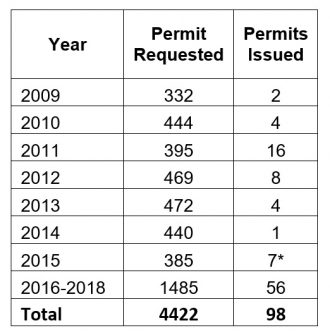
In addition, reports suggest that Israel will also advance plans for 1,303 Palestinian homes in Area C – about half of which, importantly, are already built. A majority of these units have been awaiting Israeli approval for many, many years. If approved, the permits under consideration next week for Palestinians will be the first of any significant quantity issued by Israel since, at least, 2009 (data from before this period has not been released by the Israeli government). Between 2009 and 2018, Israel issued a total of 98 building permits to Palestinians according to data released by the Israeli government in response to a freedom of information request submitted by Bimkom.
As a reminder, Area C is the 60% of the West Bank over which Israel enjoys absolute authority. For years Israel has systematically denied Palestinians the right to build on land in Area C that even Israel recognizes is privately owned by them, At the same time, it has continuously promoted the expansion of settlements and unauthorized outposts, while systematically demolishing Palestinian private construction. In terms of numbers: between 2016 to 2018, Israel issued only 21 building permits to Palestinians in Area C, while issuing 2,147 demolition orders against Palestinians during.
Commenting on the Planning Council agenda’s Peace Now observed:
“The approval of a handful of plans for the Palestinians is only a fig leaf intended to try to reduce criticism of the government. For years, Israel has pursued a policy of blatant discrimination that does not allow almost any construction for Palestinians in Area C, while in the settlements it encourages and promotes the construction of thousands of housing units each year for Israelis. The approval of a few hundred housing units for Palestinians can not cover up discrimination and does not change the fact that Israel maintains an illegal regime of occupation and discrimination in the territories.”
It is worth noting that many of the settlement units and Palestinian permits on next week’s agenda were expected to have been advanced earlier this year, in August 2021, but the High Planning Council never convened to do so.
Below are lists of settlement plans expected to be given final approval and plans expected to be advanced next week (italicized plans represent those which appear to have been added to the slate of plans that were expected to be advanced in August 2021).
Settlement plans expected to be granted final approval include:
- 629 units, including the retroactive legalization of 61 units, in the Eli settlement – located south of Nablus and southeast of the Ariel settlement in the central West Bank. Though the Eli settlement previously received Israeli government approval, a “Master Plan” – which officially zones land for distinct purposes (residential, commercial, public) – has never been issued for Eli, meaning all construction there is illegal under Israeli law;
- 286 units in the Har Bracha settlement, located south of Nablus. If implemented, these new units will double the size of Har Bracha;
- 224 units in the Talmon settlement, located west of Ramallah;
- 146 units in the Kfar Etzion settlement, located between Bethlehem and Hebron and on the Israeli side of the planned route of the barrier (which is not yet built in this area);
- 110 units in the Alon Shvut settlement, located just north of the Kfar Etzion settlement and between Bethlehem and Hebron;
- 82 units in the Karnei Shomron settlement, located in the northern West Bank, east of the Palestinian village of Qalqilya. Israel has openly declared its intention to continue expanding settlements in this area with the stated goal of bringing 1 million settlers to live in the area.;
- 52 units in the Beit El settlement, located in the heart of the northern West Bank [as a reminder, former US Ambassador to Israel David Friedman has deep ties to the Beit El settlement]; Construction on 350 new units in Beit El began earlier this year;
- 42 units in the Givat Zeev settlement, located south of Ramallah in an area that is on the Israeli side of the barrier;
- 24 units in the Haroeh Haivri outpost, a plan that will effectively grant retroactive legalization to this outpost. The Haroeh Haivri outpost is located just east of Jerusalem, within eyesight of the Khan al-Ahmar community, which Israel is threatening to demolish (forcibly relocating the Palestinian bedouin community that has lived there since the 1950s) — ostensibly because the structures in Khan al Ahmar were built without necessary Israeli approvals. The Haroah Haivri outpost was also built without the necessary Israeli approvals, but instead of demolishing the construction, Israel is moving to retroactively legalize it — demonstrating once again that, when it comes to administering the occupation, Israel prefers “rule by law” – where law is turned into a tool to elevate the rights/interests of one party over another, over the democratic rule of law.;
- 14 units in the Ma’aleh Mikhmash settlement, a plan that will effectively grant retroactive legalization to one of Ma’aleh Mikhmash’s outposts – – Mitzpe Danny;
- 10 units in the Barkan settlement, located about half way between the Ariel settlement and the cluster of settlements slated to be united into a “super settlement” area (Oranit, Elkana, Shiva Tikva, and others);
- 5 units in the Shima’a settlement, located in the southern tip of the West Bank;
- 7 units in the Peduel settlement, located in the northern West Bank and part of a string of settlements and unauthorized outposts – most notably Ariel – extending from the Green Line into the very heart of the West Bank and on towards the Jordan Valley.
Settlement plans expected to be approved for deposit (an earlier stage in the planning process) include:
- 399 units in the Revava settlement, located just east of the Barkan settlement and west of the Ariel settlement, in a string of settlements and unauthorized outposts – most notably Ariel – extending from the Green Line into the very heart of the West Bank and on towards the Jordan Valley.
- 380 units in the Kedumim settlement, located just east of Nablus. Israeli MK Bezalel Smotrich lives in the Kedumim settlement on a section of land in the settlement that has been found to be privately owned by Palestinians.;
- 100 units in the Elon Moreh settlement, located east of Nablus (for background on the significance of the Elon Moreh settlement, please see here);
- 100 units in the Sansana settlement, located on the southern tip of the West Bank on the Israeli side of the separation barrier;
- 73 units in the Givat Zeev settlement, which is also expected to receive final approval for 42 units. Givat Zeev is located south of Ramallah in an area that is on the Israeli side of the barrier;
- 68 units in the Tene settlement, located on the southern tip of the West Bank;
- 45 units in the Vered Yericho settlement, located just west of the Palestinian city of Jericho in the Jordan Valley;
- 27 units in the Karnei Shomron settlement, which is also expected to receive final approval for 82 units. Karnei Shomron is located in the northern West Bank, east of the Palestinian village of Qalqilya. Israel has openly declared its intention to continue expanding settlements in this area with the stated goal of bringing 1 million settlers to live in the area.;
- 18 units in the Alon Shvut settlement, which is also expected to receive final approval for 110 units. Alon Shvut is located just north of the Kfar Etzion settlement and between Bethlehem and Hebron;
- 10 units in the Tal Menashe settlement, located located on the tip of the northern West Bank, inside the “seam zone” between the 1967 Green Line and the Israel separation barrier, which was constructed along a route designed to keep as many settlements and as much adjacent land as possible on the Israeli side of the wall/fence.
- 7 units in the Hermesh settlement, located in the northern West Bank;
- 4 units in the Efrat settlement, located south of Bethlehem, inside a settlement block that cuts deep into the West Bank. Efrat’s location and the route of the barrier wall around it, have literally severed the route of Highway 60 south of Bethlehem, cutting off Bethlehem and Jerusalem from the southern West Bank. The economic, political, and social impacts of the closure of Highway 60 at the Efrat settlement (there is literally a wall built across the highway) have been severe for the Palestinian population.
Peace Now reports that the Planning Council will also consider advancing the following plans for Palestinian homes:
- 270 houses in the Bir al-Bash village, located south of Jenin in the northern West Bank;
- 270 houses in the Al-Ma’asara village, located south of Bethlehem;
- 233 houses in the the Almasqufa village, located near Tulkarem in the northern West Bank;
- 200 houses in the Dkeika village in the South Hebron Hills;
- 170 houses in the Khirbet Abdallah Younas village, located in the Jenin area;
- 160 houses in the Abba a-Sharqiya village, also located south of Jenin in the northern West Bank;
Israeli Supreme Court to Hold Hearing on Batan al-Hawa, Silwan Dispossession Cases Next Week; AG Declines Intervention
On October 25th, the Israeli Supreme Court is scheduled to hold an important hearing on the case of the Palestinian Duweik family which is under threat of being dispossessed of their longtime home in the Batan al-Hawa section of the Silwan neighborhood in East Jerusalem by the Ateret Cohanim settler organization.
In advance of that hearing – and after repeated extensions on a Court-ordered deadline – the Israeli Attorney General finally submitted his position on the case to the Court. The document submitted by the Attorney General was only 1 page, and simply stated that the case does not merit intervention either on the specific case of the Duweik family or regarding the wider legal principle at stake, which threatens an additional 85 families living under threat of eviction in Batan al-Hawa.
Ir Amim writes:
“Among the 85 families facing eviction, the Duweik family case is the first to reach the Supreme Court level, and its outcome will inevitably set a precedent, significantly impacting the rest of the cases in the neighborhood…As in the eviction cases in Sheikh Jarrah, the Attorney General and by extension, the government, was given a rare opportunity to take a moral stand by providing a legal opinion and policy position to help prevent the mass displacement of these families. Yet, at this point, the Attorney General’s response appears to imply that he has declined to intervene. Now, the decision concerning the fate of these families seems to lie solely in the hands of the Supreme Court. The rights of Palestinians to housing and shelter and the right to family and community life are fundamental and must be upheld. The same discriminatory legal system, which led to the confiscation of these families’ original homes in 1948, is now being exploited 73 years later to displace them for a second time from their current homes in which they have lived for decades. The Supreme Court has the power to make a principled and just decision to uphold the rights of these families to remain safely in their homes, free from the constant threat of being forcibly uprooted and driven from their homes and communities.”
Peace Now said in response to the AG’s decision to not intervene:
“The Attorney General’s response actually says that for the Israeli government, there is no problem to kick hundreds of residents out from their homes, on the basis of a discriminatory law, in favor of a settlement. The government was given an opportunity here to try to prevent moral injustice and political folly, but instead of taking a stand, it chose to remain on the sidelines, as if Silwan’s story, like that of Sheikh Jarrah, was a legal matter and not a political one.”
In July 2021, Peace Now assembled a coalition of Israeli lawyers to submit an amicus brief to the Court regarding the Duweik case. Peace Now summarizes:
“The brief addresses an approach that has emerged in international jurisprudence on human rights law which puts an emphasis on group vulnerability of occupants facing eviction and institutional, systemic discrimination against them. Where these are present, in certain circumstances, the occupants’ rights, stemming from the human right to housing and specifically, to live in their home and their family’s home – trump the right of the original owner or their substitute to regain possession of the property.
The brief reaches the conclusion that in the Duweik case, the occupants’ property rights and their right to housing supersede the right of the settlers acting on behalf of the pre-1948 original owners to receive possession of the property, based on the following:
1 – The fact that Palestinian residents of East Jerusalem are underprivileged, vulnerable and subjected to discrimination in every aspect of life, and particularly the fact that Israeli law on the restitution of property that changed hands due to wars, openly and deliberately discriminates against them;
2 – The fact that the family entered the property in good faith and/or in accordance with the law applicable at the time, and has developed a legitimate expectation to continue residing in it permanently and without interruption;
3 – The imbalance between the devastating harm the family would suffer and the minor damage the Benvenisti charitable endowment (represented by the settlers), which claims ownership of the property, would sustain, which clearly tips the scales in favor of the family.
In other words, according to the brief, even if the court finds the settlers do, in fact, have ownership, they are not necessarily entitled to remedy in the form of the families’ eviction from their homes, but rather to compensation from the state.”
Israel Begins Construction on New Settlement in Downtown Hebron
Peace Now reports that construction has begun on 31 new settlement units at the site of an old bus station previously repurposed as an IDF base, located in the heart of the Old City of Hebron on the infamous Shuhada street. This is a new settler enclave in the city and is, in effect, a new urban settlement, disconnected from already existing settlements in the city. It will be the first new settlement construction approved in downtown Hebron – where Palestinians already live under apartheid conditions – since 2002.
Peace Now said in a statement:
“The government is acting like an annexation government, not as a change government. Since the 1980s, no government has dared to build a new settlement in the heart of the largest Palestinian city in the West Bank, with the exception of one building built under the auspices of the second intifada in 2001. The Defense Minister has to stop construction, even if the plan was approved by the previous government. The settlement in Hebron is the ugly face of Israeli control of the territories. The moral and political price of having a settlement in Hebron is unbearable.”
As a reminder: in October 2017, the Israeli Civil Administration approved a building permit for the 31 units, on the condition that the Palestinian municipality of Hebron and others would have the opportunity to file objections to the plan. Soon after, two appeals were filed with the Defense Ministry: one by the Palestinian municipality of Hebron and one by the Israeli settlement watchdog Peace Now. The legal objections were based on the legally questionable process by which Israel made land in downtown Hebron available for settlement construction. Located in the Israeli-controlled H-2 area of Hebron (where 500 Israeli settlers live amongst 40,000 Palestinians), Israel seized the land in the 1980s from the Hebron Municipality, for military purposes. In 2007, the Civil Administration’s Legal Advisor issued an opinion stating that once Israel is done using the land for military purposes, it must be returned to the Hebron Municipality, which has protected tenancy rights to the land. Nonetheless, in 2015, the Israeli Civil Administration, with the consent of the Minister of Defense, quietly authorized the Housing Ministry to plan the area for Israeli settlement use, paving the way for that same ministry to subsequently present the plan for the 31 units.
In October 2018, with the legal challenges still pending, the Israeli Cabinet voted to expedite the planning of the new settlement and allocated approximately $6.1 million (NIS 22 million) for the project, which will require Israel to significantly renovate the bus station/military base in order to build the 31 new settlement housing units, as well as a kindergarten, and “public areas” for the new settler residents. Peace Now explains:
“The approval of the building permit in the heart of Hebron is an extraordinary move not only because it is a new settlement in Hebron for the first time since 2001, but because it indicates a significant change in Israeli legal interpretation of what is allowed and forbidden in occupied territory. The area in question was owned by Jews before 1948, and it was leased by the Jordanian government in protected tenancy to the Hebron municipality for the purpose of establishing the central bus station. Since 1967, the Israeli authorities managed the land and continued the lease to the Hebron municipality, until in the 1980s when the area was seized for military purposes, the bus station was closed and a military base was established there. A legal opinion of the Judea and Samaria Attorney General on the issue in 2007 emphatically stated that by law the municipality’s protected lease must not be revoked.”
Israel Advances “Silicon Wadi” Project in East Jerusalem
On October 13th, the Jerusalem Local Planning Committee met to initiate the planning process for the “Silicon Wadi” project, which was initiated by the Jerusalem Municipality and outlines plans to build a large industrial zone for hi-tech, commercial, and hospitality businesses in the heart of East Jerusalem’s Wadi Joz neighborhood. The project requires the demolition of some 200 Palestinian-owned businesses that currently operate in the area; dozens of demolition notices for which were issued in November 2020.
Ir Amim writes:
“Beyond the devastating impact of widespread demolitions of existing businesses and structures, the plan also raises concerns that the Israeli authorities will exploit the planning procedures to locate alleged Palestinian absentee properties and transfer lands into the hands of the State. It should also be noted that while Israel focuses on bolstering employment and economic activity in East Jerusalem, it simultaneously continues to suppress residential development in Palestinian neighborhoods. As with nearly all outline plans advanced in East Jerusalem in recent years, the Wadi Joz business park plan only allocates a marginal amount for residential use, which hardly meets the acute housing needs of the Palestinian population. Rather than undertaking measures to rectify the housing crisis, these plans only exacerbate the current situation and perpetuate the residential planning stranglehold, which ultimately serves to push Palestinians out of the city.”
Recap: Israel Advances Settlement Plans Across Greater Jerusalem Area
Over the past two weeks, the government of Israel has advanced four highly controversial and politically consequential settlement plans in the Greater Jerusalem area:
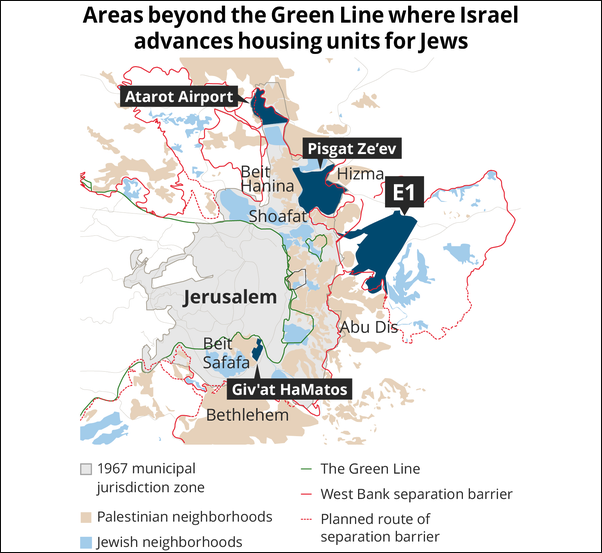
- The Givat Hamatos Settlement: On October 13th, the Jerusalem Local Planning Committee approved the expropriation of lands designated for public use in the Givat Hamatos area for the construction of roads, public buildings and the development of open space for the planned new settlement/neighborhood. For more on the Givat Hamatos settlement plan, please see here.
Map by Haaretz
- The E-1 Settlement: The Israel Civil Administration moved forward with advancing plans for the construction of the E-1 settlement, setting a date for a third hearing to discuss public objections to the plan (now set for November 8th). The first hearing was held on October 4th, but Palestinians were denied the ability to participate in that hearing (which was held virtually, making it inaccessible to the many Palestinians affected by the plan who do not have internet access). As a result, the Court scheduled this 3rd hearing (to allow the participation of Palestinians). The second hearing was held on October 18th; at that hearing three objections were presented (one by the Palestinian village of Anata, a second by the Palestinian village of Al-Azariya, and a third joint submission filed by Ir Amim and Peace Now). Ir Amim reports that there was no substantive discussion of these objections, with the Civil Administration panel offering no questions or comments on them. For more on the E-1 settlement plan, please see Terrestrial Jeruaslem’s excellent and thorough reporting.
- The Atarot Settlement: The Jerusalem District Planning Committee formally signaled that it will proceed with a hearing on the Atarot settlement plan – scheduled for December 6th – to build a huge new settlement on the site of the former Qalandiya airport (located at the northern tip of East Jerusalem). In its current form, the plan provides for up to 9,000 residential units for ultra-Orthodox Jews (assuming, conservatively, an average family size of 6, this means housing for 54,000 people), as well as synagogues, ritual baths (mikvehs), commercial properties, offices and work spaces, a hotel, and a water reservoir. If built, the Atarot settlement will effectively be a small Israeli city surrounded by Palestinian East Jerusalem neighborhoods on three sides and Ramallah to its north. Geopolitically, it will have a similar impact to E-1 in terms of dismembering the West Bank and cutting it off from Jerusalem. For more on the Atarot settlement plan, please see here.
- The Pisgat Ze’ev Settlement: The Israeli government advanced plans for 470 new settlement units in Pisgat Ze’ev, the largest settlement located in East Jerusalem.

Recap: Court Pushes for Palestinians to “Compromise” with Settlers in Sheikh Jarrah
The Israeli Supreme Court has set November 2nd as the deadline for Palestinian families living at risk of forced displacement in Shiekh Jarrah to decide wether or not to accept a Court-authored deal which would help them – at least temporarily – avoid eviction from their homes, in part by requiring them to recognize settler ownership over the properties.
Under the terms of the Court’s deal, which it is pressuring both parties to accept, the following would take place:
- The settler group Nahalat Shimon will be recognized as the owners of the site.
- The Palestinians will be recognized as protected tenants and be required to pay an nominal annual rental fee to the attorney of the settlers (in effect recognizing the settlers as the owners) but
- The Palestinians will be able to continue pursuing legal challenges to the underlying ownership of the land
- The Palestinians are permitted to renovate the properties without interference
- Settlers will be able to instigate eviction proceedings against Palestinians if they are in violation of the Court’s compromise agreement or in violation of Israel’s tenancy laws.
Terrestrial Jerusalem writes:
“The most problematic element of the settlement relates to the settlers’ ability to institute evictions even if the residents are not in violation of the agreement or of the tenancy laws. The settlers will be entitled to institute such proceedings in the event that the ownership rights are conclusively awarded to them, or after 15 years, the earlier of the two. This can be done if the settlers either wish to personally use the property or to demolish and rebuild. Under these circumstances, the settlers will need to offer the residents alternative equivalent quarters. Palestinian residents might hope settlers reject the deal to avoid having to make an ‘excruciatingly painful decision.’”
According to Terrestrial Jerusalem, the Court has signaled that further negotiations are acceptable, but that if either party rejects the agreement a decision on the eviction cases will be handed down swiftly.
New Report: State-Backed Settler “Tourism” Projects in East Jerusalem
In a new report entitled, “The Valley of Hinnom: Trees and Flowerbeds in the Political Struggle over East Jerusalem,” the Israeli NGO Emek Shaveh surveys the multitude of recent “tourism” projects jointly undertaken by the Elad settler organization and the Israeli government in the Ben Hinnom Valley — a strategic area between East and West Jerusalem (stretching past the 1967 Green Line), and located within the area designated by Israel as the Jerusalem “Walls National Park”.
Emek Shaveh writes:
“The nature of the tourism-settlement activity in the Valley of Hinnom conducted jointly by Elad and government authorities is familiar to us from the City of David/Silwan. The series of joint ventures such as the café, the Center for Ancient Agriculture and the cable car in effect hand over large expanses of land to the settlers of the Elad Foundation under the guise of tourism. Although unlike Silwan, the valley is sparsely populated, the activity there must be viewed as an integral part of the struggle for the Old City Basin of Jerusalem and as a means to clear this highly strategic area from the presence of Palestinians.”
In conclusion, we wish to emphasize the following points:
1 – Development in East Jerusalem is almost always driven by political objectives. Recent developments in the Valley of Hinnom are part of the grand plan to change the character and the landscape of the Old City Basin and ought to be considered an integral component of the settlement enterprise in the Palestinian neighborhoods surrounding the Old City.
2 – Halting the destructive development schemes in the areas surrounding the Old City is vital in order to preserve Jerusalem as a multicultural historic city and is indirectly essential for safeguarding the status quo at the holy places.
3 – The Palestinian protests against the expansion of the settlers’ grip over the open spaces such as the Hinnom Valley is part of the struggle by the residents of Silwan and the surrounding neighborhoods to preserve the character of their neighborhoods. In our view, one ought to view the various activities by the settlers and the authorities in the Historic Basin such as the expulsion of residents from their homes, taking over land and the shaping of a historic narrative as part of the same general bid to cement their control over the Historic Basin.”
Bonus Reads
- “[PODCAST] The Occupation & the Biden Administration” (FMEP ft. Danny Seidemann and Yehuda Shaul with Lara Friedman and Khaled Elgindy)
- “How offshore accounts turned the British Virgin Islands into an east Jerusalem landlord” (JTA)
- “Beita residents reach lands for first time since settler takeover” (Al Jazeera)
- “After Years of Neighborly Relations, Settlers Try to Foil Recognition of Palestinian Hamlet” (Haaretz)
- “Palestinian protests turn deadly as Israel considers the future of a new settlement” (NPR)
- “These Palestinian Families Face Eviction From Their East Jerusalem Homes” (Haaretz)
- “When Settler Becomes Native” (Jewish Currents)
Welcome to FMEP’s Weekly Settlement & Annexation Report. To subscribe to this report, please click here.
October 16, 2020
- No Annexation, No Problem – Israel Advances Nearly 5,000 New Settlement Plans, Including New Settlement South of Jerusalem
- Plan for 570 Units in East Jerusalem Settlement Approved for Deposit
- Israel Approves Construction of Elevator at Tomb of the Patriarchs
- Israel Delivers Confiscation Notices to Palestinians Living in the Heart of Hebron
- Palestinians Report Newly Established Outposts & Land Confiscations
- Targeting Palestinians Construction in Area C: State Devotes $6 million to Mapping Program
- In First, Palestinian Authority Courts to Hear Lawsuits Against Settlers
- NF, Elad Face International Heat Over Sumarin Family Eviction Case – Will it Matter?
- Report: U.S. Will Not Back De Jure Annexation Until 2024 [Friedman Says 2021 in Play]
- Bonus Reads
Comments/questions? Contact Kristin McCarthy (kmccarthy@fmep.org)
No Annexation, No Problem – Israel Advances Nearly 5,000 New Settlement Plans, Including New Settlement South of Jerusalem
During meetings held October 14th and 15th, the Israeli High Planning Council advanced plans for a total of 4,948 new settlement units. Of that total, plans for 2,688 units were granted final approval and plans for 2,260 units were approved to be deposited for public review (a late stage in the planning process). The latter approvals include a plan to build a new settlement, “Har Gilo West,” just beyond Jerusalem’s southern border. In addition, the Council granted retroactive approval to 340 existing illegally-built settlement units in the unauthorized outposts of Peni Kedem and Tapuach West, paving the establishment of two new official West Bank settlements (through post-facto legalization of the illegal outposts).
These were the first meetings of the High Planning Council since February 2020, at which time settlement planning was put on pause in favor of attempting to implement annexation plans as designed by Trump’s “Deal of the Century.” Under annexation, authority over the settlement planning/approval process could have been shifted from the Israeli Civil Administration (the branch of the Israeli Defense Ministry, in charge of the administration of affairs in the West Bank, – i.e., Israel’s occupation) into Israel domestic planning mechanism. Such a shift has long been a goal of settlers and their political allies.
In addition to advancing construction of new residential settlement units, the High Planning Council also advanced plans for the construction of new settlement projects that support tourism, further entrench the permanency of settlements, and that continue the exploitation of West Bank land and resources.
Record-Setting Settlement Activity in 2020
With the huge advancement of settlement plans this week, the Israeli government has advanced plans for 12,159 settlement units so far in 2020. With over two months to go, the settlement watchdog group Peace Now reports that this is already the highest total number settlement advancements in any year since Peace Now began tracking totals in 2012. Peace Now also reports that it is possible that the High Planning Council will convene one more time before the year ends.
Har Gilo West Approved for Deposit w/ Plan to Seal Off Al-Walajah
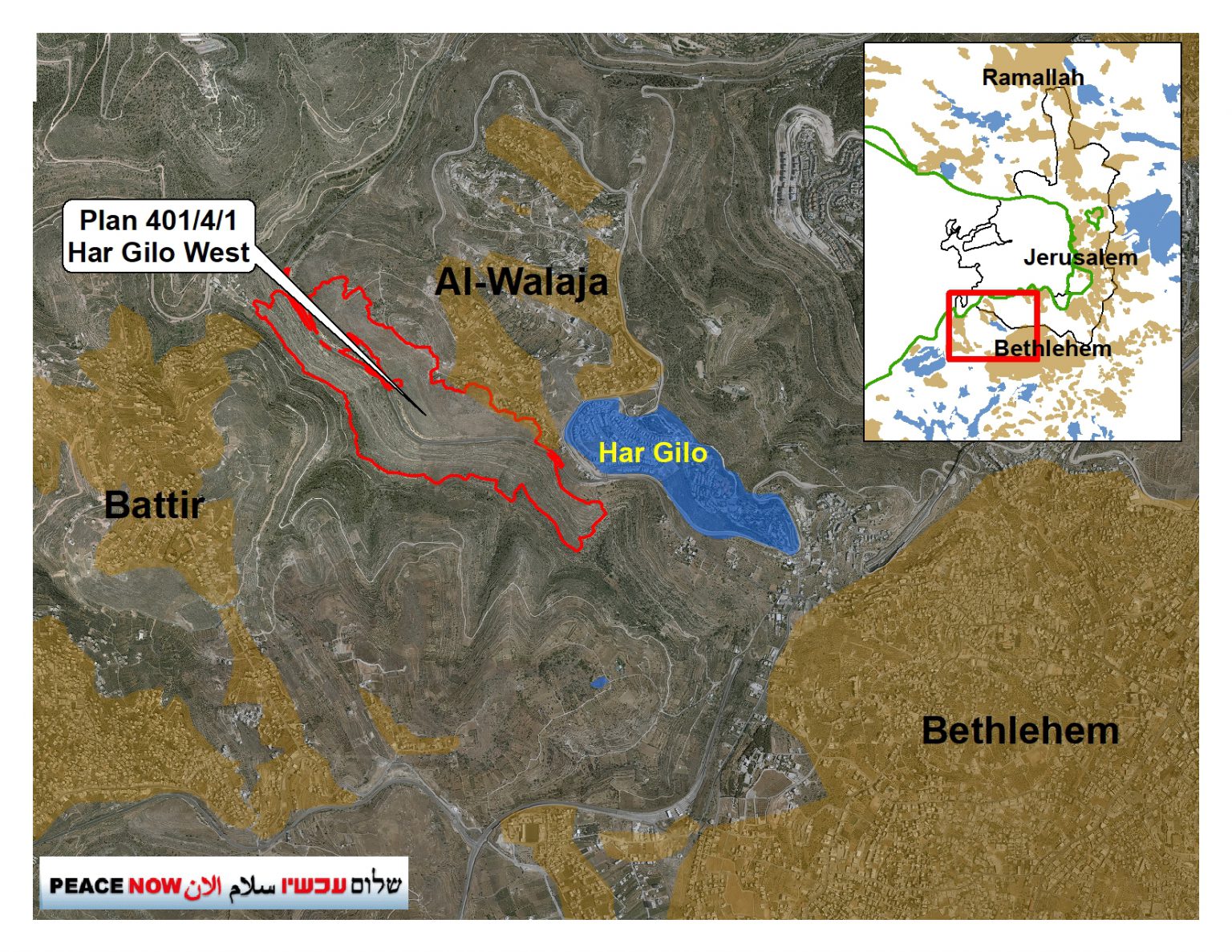 The High Planning Council approved for public deposit a plan to build 560 units at the Har Gilo West settlement site, located just south of Jerusalem. The Council is treating this plan as merely an expansion of the existing Har Gilo settlement, but in actuality it represents the construction of a new settlement on Jerusalem’s southern border, as the two areas of construction (Har Gilo and Har Gilo West) would not be contiguous. The plan for 560 units in Har Gilo West is part of a larger plan to construct around 952 units in the new settlement, extending the its borders right up to the Jerusalem municipal boundary, with dire consequences for the long-beleaguered Palestinian village of Al-Walajah.
The discussion on October 14th further revealed that, in order to build Har Gilo West, Israel plans to extend the separation barrier in that area to completely encircle al-Walajah, which is surrounded on three sides by the separation wall already. The new section of the barrier would be a 7-meters high concrete slab along the western edge of the built-up area of Al-Walajah. That would leave Al-Walajah completely encircled by the separation barrier and Israeli construction beyond it.
Ir Amim explains:
“In the past decade a series of Israeli moves have taken over more and more of Al-Walaja land and gradually isolating it. These are now culminating with the intention to construct the new settlement on the land reserves on the western side of Al-Walaja and to extend the separation barrier so as to complete the encircling of the village. As Al-Walaja will turn into an isolated enclave which lacks an outline plan its residents will be especially vulnerable to increasing home demolitions and other Israeli sanctions. Since the village will separate the new settlement from the existing Har Gilo we are likely to see increasing Israeli actions against Al-Walaja and its residents which will put their future existence at risk.”
Peace Now writes:
“The current plan of 952 housing units to be advanced will create a brand new neighborhood that will be larger than the existing settlement, and will exploit the land cut off by the West Bank barrier to further break up the western Bethlehem metropolitan area, including the land connecting al-Walaja and the town of Battir, as well as Battir and Bethlehem. This land also constitutes some of the only uninhabited fertile land reserves for Bethlehem, which currently is cut off by the West Bank barrier to its immediate north and west.“
FMEP has repeatedly documented various Israeli efforts to seal off al-Walajah from Jerusalem. Residents of al-Walajah have fought the growing encroachment by the nearby Etzion settlement bloc and the Israeli government’s attempt to de facto annex the bloc as part of “Greater Jerusalem.” Ir Amim explains several prongs of this effort, including a particularly unbelievable section of Israel’s separation barrier planned to almost completely encircle the village, to turn its valuable agricultural land into an urban park for Jerusalem, and construction of a highway that will connect the Etzion settlement bloc to Jerusalem with Israeli-only bypass roads.
Two Outposts Advance Towards Retroactive Legalization
The High Planning Council approved for deposit two plans that would, if implemented, have the effect of retroactively legalizing two outposts – bestowing upon those outposts legitimacy in the eyes of Israeli law and, in effect, establishing two new, official settlements. Those plans are:
- Pnei Kedem: A plan to grant retroactive legalization to 120 units in the Pnei Kedem farm outpost by recognizing the outpost as a “neighborhood” of the Metzad/Asfar settlement. This is despite the fact that the two areas of construction are non-contiguous. Pnei Kedem is located halfway between Bethlehem and Hebron in the southern West Bank. Settlers were particularly gleeful about this plan being advanced
- Tapuach West: A plan to grant retroactive legalization to 133 units in the Tapuach West outpost, located south of Bethlehem.
Not Just Residential Units – Council Advances Settler Tourism & Infrastructure Projects
The High Planning Council also advanced plans for the construction of new settlement projects that support tourism, further entrench the permanency of settlements, and that continue the exploitation of West Bank land and resources.
The Council granted final approval to:
- A plan for new shops and an educational site (to include an agricultural farm) in the Kochav Yaakov settlement – located between Jerusalem and Ramallah; and,
- A plan to grant retroactive authorization to a motor park and 120 hotel rooms in the Petza’el settlement, located in the Jordan Valley. As FMEP has covered in the past, this state-of-the-at racetrack and hotel complex is being built partially on land that the Israeli army previously declared a closed firing zone, a designation which resulted in the forcible displacement of Palestinians who lived there. The land remains under this designation today. Rather than halting the construction of this complex, the Israeli authorities instead created a Master Plan for the area in order to enable even more construction in the area.
Plans the Council granted final approval for public deposit include:
- A plan for an industrial zone near the Mishor Adumim settlement; and,
- A plan to build a new commercial area and 50 hotel rooms in the Maale Adumim settlement;
Map by Ben White (@benabyad)
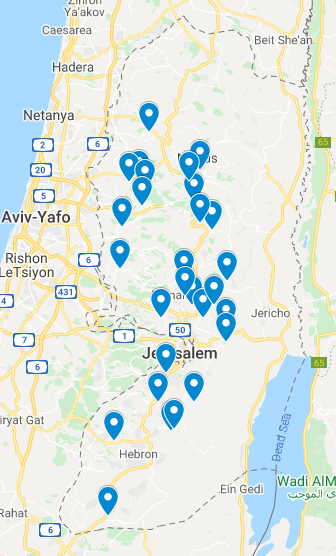
Included in the total number of units receiving final approval and/or retroactive legalization (3,028 units) are (in descending order of number of units): [map]
- 382 units in the Beit El settlement, located in the heart of the northern West Bank. This includes retroactive legalization for 36 units which had been previously built without authorization and the construction of 346 units in highrise buildings with 9 or 10 floors (building up, not out in Beit El) [as a reminder, US Ambassador to Israel David Friedman has deep ties to the Beit El settlement];
- 357 units in the Geva Benyamin (Adam) settlement, located just north east of Jerusalem, just beyond the separation barrier. Israel has been steadily building the Adam settlement in a manner meant to unite the settlement more seamlessly with East Jerusalem settlements and infrastructure, erasing the Green Line;
- 354 units in the Nili settlement, located in the northern West Bank;
- 213 units in the Shiloh settlement, including the retroactive legalization of 21 units built without required approvals. The Shiloh settlement is located in the central West Bank;
- 211 units in the radical and violent Yitzhar settlement, including some retroactive authorizations (exact number not specified) as well as approval for public buildings. Yitzhar, located just south of Nablus, is associated with the Hilltop Youth movement – and a string of illegal outposts in the area associated with repeated attacks on Palestinians and their property;
- 205 units in the Nokdim settlement (actually approved for the Kfar Eldad settlement, which is officially within the jurisdiction of Nokdim), located south of Bethlehem;
- 200 units in the Metzad settlement (also known as Asfar), including the retroactive legalization of an unspecified number of existing units built without necessary approvals;
- 160 units in the Kochav Yaacov settlement, located east of Ramallah;
- 140 units in Kerem Reim settlement – located north west of Ramallah. Peace Now has repeatedly challenged the illegal construction of the Kerem Reim outpost, which the Israeli government retroactively legalized by declaring it a neighborhood of the Talmon settlement even though the areas are non-contiguous. Though a court rejected one Peace Now petition, there is an ongoing case against the Amana settler organization which Peace Now alleges engaged in illegal activities to build the outpost;
- 132 units in Kfar Adumim settlement – located east of Jerusalem and less than one mile from the Khan al-Ahmar bedouin community which the state of Israel is seeking to demolish;
- 106 units in the Ma’ale Shomron settlement, located east of the Palestinian village of Qalqilya;
- 84 new units in the Shima settlement, including retroactive legalization of 14 existing units;
- 74 units in the Yakir settlement – located in the northern West Bank and part of a string of settlements and unauthorized outposts – most notably Ariel – extending from the Green Line deep into the West Bank;
- 64 units in the Telem settlement – located west of Hebron;
- Retroactive legalization of 18 units in the Psagot settlement – located east of Ramallah, and home to the Psagot Winery;
- Retroactive legalization of 2 units in the “Givon Hadasha” settlement;
Plans which were approved for deposit for public review include (in descending order of number of units):
- 629 units in the Eli settlement, including the retroactive legalization of 61 units – located south of Nablus and southeast of the Ariel settlement in the central West Bank. Though the Eli settlement previously received Israeli government approval, a “Master Plan” – which officially zones land for distinct purposes (residential, commercial, public) – has never been issued for Eli, meaning all construction there is illegal under Israeli law;
- 560 units in the Har Gilo settlement located just south of Jerusalem (covered in detail above);
- 286 units in the Har Bracha settlement – located just south of Nablus. If implemented, these new units will double the size of Har Bracha;
- 179 units in the Einav settlement – located northwest of Nablus;
- 148 units in the Rimonim settlement – located between Ramallah and Jericho in the Jordan Valley;
- A plan to grant retroactive legalization to 133 units in the Tapuach West outpost, thereby granting approval to the outpost itself (discussed above);
- A plan to grant retroactive legalization to 120 units in the Pnei Kedem outpost by recognizing the outpost as a “neighborhood” of the Metzad/Asfar settlement although the two areas of construction are non-contiguous. Pnei Kedem is located between Bethlehem and Hebron in the southern West Bank;
- 82 units in the Karnei Shomron settlement – located in the northern West Bank east of the Palestinian village of Qalqilya. Israel is planning to continue expanding Karnei Shomron with the stated goal of bringing 1 million settlers to live in the area surrounding the settlement.;
- 75 units in the Shimaa settlement, including the legalization of 14 units previously built without authorization;
- 52 units received retroactive legalization in the Kfar Adumim settlement;
- 35 units in the Efrat settlement – located south of Bethlehem. As a reminder, Efrat is located inside a settlement block that cuts deep into the West Bank. Efrat’s location and the route of the barrier wall around it, have literally severed the route of Highway 60 south of Bethlehem, cutting off Bethlehem and Jerusalem from the southern West Bank. The economic, political, and social impacts of the closure of Highway 60 at the Efrat settlement (there is literally a wall built across the highway) have been severe for the Palestinian population;
- 14 units (in one building) in the Maale Mikmash settlement – located east of Ramallah;
- 10 units in the Barkan settlement – located about half way between the Ariel settlement and the cluster of settlements slated to be united into a “super settlement” area (Oranit, Elkana, Shiva Tikva, and others).
- 7 units in the Peduel settlement – located in the northern West Bank and part of a string of settlements and unauthorized outposts – most notably Ariel – extending from the Green Line into the very heart of the West Bank and on towards the Jordan Valley; and,
The High Planning Council met only after settlers, who represent a key ally of the embattled Prime Minister, pressured Netanyahu to allow it. Settlers have spent months decrying what they understood to be a freeze on settlement constructed inflicted upon them by Netanyahu. Gush Etzion Regional Council Head Shlomo Ne’eman said:
“Sometimes we take our prime minister to task, which we feel is justified as a result of our disappointment in postponing the application of sovereignty over our country. But now something tangible is happening – we are building and developing our communities, and of course, the highlight of today is the full registration in the Land Authority of the young community of Pnei Kedem, 20 years since it was established.”
Samaria Regional Council head Yossi Dagan said:
“This is a happy day for Samaria. [New construction] in Har Bracha, Yitzhar, Einav and Tapuach is another step on the way to a million residents in this beautiful region of the country…While we’re very content with today’s developments, I call on the Prime Minister not to stop here. We’re overfilled with joy, but it is a drop in the ocean with sovereignty falling off the agenda. The expectation now is that construction and strengthening of the settlement movement will increase tenfold.”
Peace Now responded to the approvals in a statement saying:
“While Israel reels from its second lockdown and economic distress, Netanyahu is promoting construction in isolated settlements that Israel will have to evacuate. Instead of taking advantage of the agreements with the Gulf states and promoting peace with the Palestinians, he is distorting Israel’s priorities and catering to a fringe minority for these settlement unit approvals that will continue to harm future prospects for peace. We call on the Defense Minister and the Alternative Prime Minister Benny Gantz to veto these plans. Far from a ‘settlement freeze,’ the right has been complaining about, the expected settlement approvals announcement next week prove that the settlement enterprise under Netanyahu is moving ahead at full steam toward solidifying the de facto annexation of the West Bank. The move also will be the first major demonstration of Defense Minister Benny Gantz’s bowing to the ‘Greater Israel’ settlement agenda that would in reality bring about a permanent undemocratic one-state reality. By doing so, Israel will be signaling to the world its bi-partisan support for the end to the concept of a two-state solution and a Palestinian state – the paradigm that until now has largely shielded Israel from formal pressure over its 53-year occupation. The settlement enterprise is not in Israel’s national or security interest, and is a strategic mistake at the international level.”
Palestinian Prime Minister Mohammed Shtayyeh denounced the approvals, saying:
“Every settler unit constitutes a plan to annex our land.”
Palestinian Authority spokesman Nabil Abu Rudeineh said in a statement:
“We warn against this Israeli policy that will lead the region to the brink of the abyss, and we call on the international community to intervene immediately and urgently to pressure the Netanyahu government to stop this settlement madness that totally eliminates any real opportunity to achieve a just and comprehensive peace to end the occupation and establish the independent Palestinian state with East Jerusalem as its capital on the 1967 borders.”
UN High Representative Josep Borrell said in a statement:
“In recent days, Israel has announced a significant expansion of settlements in the occupied West Bank, in areas in and around Jerusalem. These plans, which foresee the construction of close to 5.000 housing units, jeopardise the viability and territorial contiguity of a future Palestinian State as the outcome of a negotiated two-state solution, in line with the internationally agreed parameters. Settlements are illegal under international law. As stated consistently, the EU will not recognise any changes to the pre-1967 borders, including with regard to Jerusalem, other than those agreed by the parties. Settlement activity threatens current efforts to rebuild trust, to resume civil and security cooperation between Palestinians and Israelis and to prepare the ground for an eventual resumption of meaningful and direct negotiations. The Government of Israel should reverse these decisions and halt all continued settlement expansion, including in East Jerusalem and sensitive areas such as Har Homa, Givat Hamatos and E1. The period from March to August 2020 also saw a spike in demolitions or confiscations of Palestinian-owned structures in the West Bank in spite of the COVID-19 pandemic. The EU reiterates its call on Israel to halt all such demolitions, including of EU-funded structures, in particular in light of the humanitarian impact of the current pandemic. Against the background of normalization of relations between Israel, UAE and Bahrain, Israelis and Palestinians should seize this opportunity and take urgent steps to build confidence and restore cooperation along the line of previous agreements and in full respect of international law.”
A spokesperson for UN Secretary-General Antonio Guterres issued a statement flagging concern over the advancements, saying:
“We are concerned about the reports of Israel’s settlement advancements in the occupied West Bank and will continue to follow developments closely, as the Israeli High Planning Committee finalizes its meetings tomorrow. The Secretary-General has consistently reiterated that all settlements are illegal under international law and remain a substantial obstacle to peace. We urge the Israeli authorities to refrain from such unilateral actions that fuel instability and further erode the prospects for resuming Palestinian-Israeli negotiations on the basis of relevant UN resolutions, international law and bilateral agreements.”
Plan for 570 Units in East Jerusalem Settlement Approved for Deposit
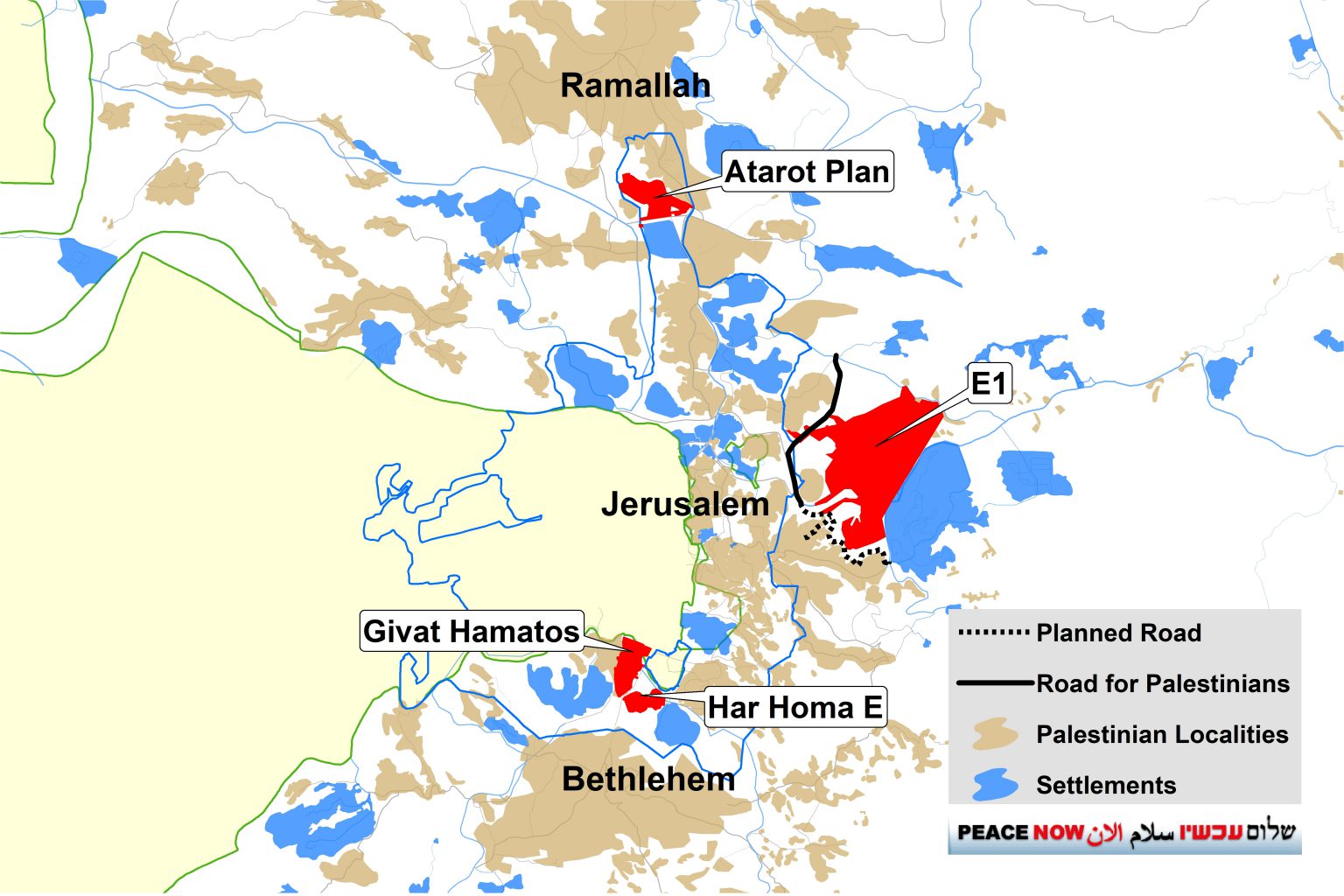 Ir Amim reports that on September 22nd, the Jerusalem District Committee approved for deposit for public review a detailed plan providing for the construction of 570 units in the Har Homa E settlement, located in East Jerusalem. Taken together with the pending construction of the nearby Har Gilo West settlement (discussed in the section above), the Palestinian village of al-Walajah stands to be completely encircled by Israeli settlements.
If implemented, this plan will extend the Har Homa settlement westward, in the direction of the site of the as-of-yet-unbuilt Givat Hamatos settlement. Ir Amim explains:
“If realized, Har Homa E together with construction in Givat Hamatos will connect Har Homa to Gilo creating a contiguous Israeli settlement area that will disconnect East Jerusalem from Bethlehem and the south of the West Bank.”
Ir Amim also reminds us that the Jerusalem District Committee previously approved a Master Plan for a total of 2,200 units in Har Homa E. The plan for 570 units approved for deposit in late September represents the first detailed plan under this Master Plan allows for. Plans to build the remaining units permitted under the Master Plan are not yet being advanced.
Israel Approves Construction of Elevator at Tomb of the Patriarchs
Emek Shaveh reports that on September 29th the Civil Administration granted final approval to a plan to build accessible infrastructure, including an elevator, at the Ibrahimi Mosque/Tomb of the Patriarch in Hebron — a plan which requires Israel to seize land from the Islamic Waqf. As of this writing, Emek Shaveh is considering whether to challenge that approval.
Regarding the significance of the plan, Emek Shaveh said:
“One need not be an archaeologist or architect to review the council’s plan and understand that it is destructive in a manner which is unprecedented. We are convinced that the plan, as approved, would never have been promoted had it not been driven by political motives.”
Emek Shaveh has previously provided critical context as to why this plan is not really, or not fully, being advanced out of humanitarian concerns, explaining:
“Israel’s decision to seize responsibility for the site from the Hebron municipality and the Palestinians sends a clear political message that Israel is reneging on agreements that were signed with the Palestinians in Hebron. Beyond the precedent that will enable the settlers in the future to demand additional changes at the Tomb of the Patriarchs/Ibrahimi Mosque, this is also a precedent that could play out at other sites under the responsibility of the Islamic Waqf. Experience has shown us that what begins in Hebron percolates into other places including Jerusalem. It begins with a seemingly rational demand to benefit the disabled or the general public and evolves into a new status quo. The expected change in Hebron has not escaped the attention of members of the Temple movement and they will know how to present their demands to the government. If Israel can repudiate agreements with the Palestinians in Hebron and expropriate land from the Waqf, it would seem that accepting what appears to be the far more modest demands by the Temple movement to pray or to walk about the Temple Mount complex freely is not so far-fetched. In the reality of Hebron and East Jerusalem, a change involving only several meters at a historic or holy place is not free of political considerations and often it is part of long-term strategy. While it is necessary to tend to the needs and interests of persons with disabilities, the extremists who presume to speak on their behalf must be prevented from forging Israeli policy, even if it is only a matter of a lift and an access path.”
Read Emek Shaveh’s full analysis here: “Humanitarianism Hebron Style.”
Israel Delivers Confiscation Notices to Palestinians Living in the Heart of Hebron
The Palestinian media outlet WAFA news reports that several Palestinians living in the Tel Rumeida section of downtown Hebron were handed confiscation notices from the Israeli authorities, informing them that the State of Israel had confiscated 17 plots of land, including land privately owned by Palestinians.
Tel Rumeida is a part of Hebron located directly in the city center, considered H2 by the Hebron Accords giving Israel full control of security in that area. B’Tselem estimates that there are around 700 settlers living in enclaves amongst approximately 34,000 Palestinians in H2. The Israeli army heavily protects those settlers, and has implemented an apartheid system of segregated movement and checkpoints, most notably in the area of Shuhada Street.
Palestinians Report Newly Established Outposts & Land Confiscations
The Palestinian news outlet WAFA reports that settlers have installed three new outposts over the past month – one near Nablus and a second near Hebron, and a third in the Jordan Valley.
Near Nablus, Palestinians report that the settlers installed mobile homes and a small farm in an attempt to establish a permanent presence on a new plot of land. The settlers are reportedly in the process of connecting the new outpost to the Elon Moreh settlement via roads and water supply. Ghassan Daghlas, who monitors Israeli settlements on behalf of the PLO, told WAFA that the specific area has seen even wider road construction recently, which he sees as an effort to create more seamless contiguity between settlements in the Nablus area and the Jordan Valley. The construction comes at the direct expense of the Palestinian village of Beit Dajani, which has historically owned the land where the outpost and roads are being built.
Near Hebron, WAFA reports that an Israeli settler erected a tent with and Israeli flag on privately owned Palestinian land near the Birin village.
In the Jordan Valley, WAFA reports that settlers set up a caravan on land on which they began planting trees about three months ago. The settlers also reportedly dug a well at the site.
On October 15th, Israel reportedly announced its intention to confiscate large tracts of land (11,000 dunums) adjacent to the Jordan Valley settlements of Rotem, Maskiyot, and Mesovah. This confiscation, according to Palestinian settlement watcher Qasem Awwad, was presented by the Israeli authorities as a move to add land to natural reserve areas, but seems clearly to be linked to efforts to expand settlements and their control over land in the area.
Targeting Palestinians Construction in Area C: State Devotes $6 million to Mapping Program
Despite COVID and the suspension of Israeli’s unilateral annexation of vast tracts of land in the West Bank, the Israeli government — at the urging of settlers and their allies — is continuing its push to consolidate its control over all aspects of life in Area C (the over 60% of the West Bank that is under full Israeli control).
OCHA has documented an acceleration in the Civil Administration’s demolition of Palestinian structures in the West Bank over the summer, documenting the demolition of 389 Palestinian-owned structures in Area C of the West Bank. As a result of those demolitions, 442 Palestinians were made homeless. OCHA further reported that In just the month of August, 205 Palestinians lost their homes, the highest single month total since January 2017. In addition, Israel continues to issue more demolition notices, including against Palestinians living in a cave near Jenin, and against a newly constructed school for bedouin children located east of Ramallah.
To further this effort, on September 10th the Israeli government allocated $6 million USD (20 million NIS) for the newly created Settlement Affairs Ministry to survey and map unauthorized Palestinian construction in Area C of the West Bank, which Israel and its settlers have been aggressively demolishing in an effort to rid the area of Palestinians. Haaretz reports that this is the first time that the state budget has included funds specifically for a land survey in the West Bank. The state also allocated an additional $2.8 million (9.5 million NIS) to an existing grant program specifically for settlement municipalities to cash in on. As a reminder, virtually all Palestinian construction in Area C of the West Bank is unauthorized, because Israel almost universally refuses to give Palestinians permission to build in Area C even on land that Israel recognizes as owned by Palestinians.
The Settlement Affairs Ministry is a new creation of the current coalition government, and is headed by Tzachi Hanegbi (Likud). The funding for the Settlement Affairs Ministry to conduct a survey of unauthorized Palestinian construction in Area C further empowers a domestic Israeli body to exert extraterritorial sovereignty over Area C – in effect, treating the area as land already de facto annexed by Israel. While technically the occupied territories are administered by the Israeli Civil Administration (a body within the Defense Ministry), Israel has spent decades bringing the administration of the territories (specifically the settlements and Area C) ever more directly under direct Israeli sovereignty (de facto annexation).
In the lead up to the allocation of funds for this new survey of Palestinians life in Area C, the Knesset hosted two committee discussions the political outlook of which was clearly indicated in the stated subject of the meetings: “the Palestinian takeover of Area C.” Consistent with this framing (which is predicated on the idea that Area C belongs to Israel), and pushed by outside groups, many members of the Knesset have criticized the Israeli government’s allegedly lackadaisical approach to preserving State interests in Area C (i.e., clearing out Palestinians, expanding settlements, consolidating state infrastructure). Reportedly, Foreign Affairs Minister Gabi Ashkenazi (Blue & White) sent a letter to the committee specifically addressing the Knesset’s outrage over European humanitarian assistance projects for Palestinians in Area C. In the letter, Ashkenazi not only celebrated the reduction of European projects over the past year, but validated settlers’ insinuations regarding the nefarious nature of European assistance for Palestinians, saying that any European activity in the West Bank lacking Israeli permission is “an attempt to define a border.” Ashkenazi also said that Israel will not compensate European donors for confiscated equipment or the demolition of European-funded projects that lack Israeli permission (like in the case of schools built with European funding, and solar panels donated to bedouin communities lacking power).
At one Knesset hearing, MK Bezalel Smotrich (Yamina) suggested that a solution could be to empower the settlements with the ability to demolish Palestinian construction they believe to be unauthorized. Smotrich’s partymate Ayelet Shaked (former Justice Minister) suggested that the government should appoint a project manager tasked with preventing a Palestinian takeover of Area C.
As noted above, Israel has long denied Palestinians the ability to build in Area C. To fully understand what is happening, it is worth reviewing B’Tselem’s excellent explainer:
“Israel’s planning and building policy in the West Bank is aimed at preventing Palestinian development and dispossessing Palestinians of their land. This is masked by use of the same professional and legal terms applied to development in settlements and in Israel proper, such as “planning and building laws”, “urban building plans (UBPs)”, “planning proceedings” and “illegal construction”. However, while the planning and building laws benefit Jewish communities by regulating development and balancing different needs, they serve the exact opposite purpose when applied to Palestinian communities in the West Bank. There, Israel exploits the law to prevent development, thwart planning and carry out demolitions. This is part of a broader political agenda to maximize the use of West Bank resources for Israeli needs, while minimizing the land reserves available to Palestinians….
In the West Bank, the potential for urban, agricultural and economic development remains in Area C. Israel uses its control over the area to quash Palestinian planning and building. In about 60% of Area C – 36% of the West Bank – Israel has blocked Palestinian development by designating large swathes of land as state land, survey land, firing zones, nature reserves and national parks; by allocating land to settlements and their regional councils; or by introducing prohibitions to the area now trapped between the Separation Barrier and the Green Line (the boundary between Israel’s sovereign territory and the West Bank).
Even in the remaining 40% of Area C, Israel restricts Palestinian construction by seldom approving requests for building permits, whether for housing, for agricultural or public uses, or for laying infrastructure. The Civil Administration (CA) – the branch of the Israeli military designated to handle civil matters in Area C – refuses to prepare outline plans for the vast majority of Palestinian communities there. As of November 2017, the Civil Administration had drafted and approved plans for only 16 of the 180 communities which lie in their entirety in Area C. The plans cover a total of 17,673 dunams (1 dunam = 1,000 square meters), less than 1% of Area C, most of which are already built-up. The plans were drawn up without consulting the communities and do not meet international planning standards. Their boundaries run close to the built-up areas of the villages, leaving out land for farming, grazing flocks and future development. Since 2011, seeing that the Civil Administration did not draft plans as it is obliged to do, dozens of Palestinian communities – with the help of Palestinian and international organizations and in coordination with the PA – drafted their own plans. Some of the plans covered communities or villages located in full in Area C and others covered places only partly in Area C. As of September 2018, 102 plans had been submitted to the Civil Administration’s planning bodies, but by the end of 2018, a mere five plans – covering an area of about 1,00 dunams (or about 0.03% of Area C) – had received approval.
The odds of a Palestinian receiving a building permit in Area C – even on privately owned land – are slim to none. Given the futility of the effort, many Palestinians forgo requesting a permit altogether. Without any possibility of receiving a permit and building legally, the needs of a growing population leave Palestinians no choice but to develop their communities and build homes without permits. This, in turn, forces them to live under the constant threat of seeing their homes and businesses demolished.
The impact of this Israeli policy extends beyond Area C, to the hundreds of Palestinians communities located entirely or partially in Areas A and B, as the land reserves for many of these communities lie in Area C and are subject to Israeli restrictions there.
The demand for land for development has grown considerably since the 1995 division of the West Bank: The Palestinian population has nearly doubled, and the land reserves in Areas A and B have been nearly exhausted. Due to the housing shortage, much land still available in these areas is used for residential construction, even if it is more suited for other uses, such as agriculture.
Without land for construction, local Palestinian authorities cannot supply public services that require new structures, such as medical clinics and schools, nor can they plan open spaces for recreation within communities. Realizing the economic potential of Area C – in branches such as agriculture, quarrying for minerals and stone for construction, industry, tourism and community development – is essential to the development of the entire West Bank, including creating jobs and reducing poverty. Area C is also vital for regional planning, including laying infrastructure and connecting Palestinian communities throughout the West Bank.
In contrast to the restrictive planning for Palestinian communities, Israeli settlements – all of which are located in Area C – are allocated vast tracts of land, drawn up detailed plans, connected to advanced infrastructure, and the authorities turn a blind eye to illegal construction in them. Detailed, modern plans have been drawn up for the settlements, including public areas, green zones and, often, spacious residential areas. They enjoy a massive amount of land, including farmland that can serve for future development.
Israel’s policy in Area C is based on the assumption that the area is primarily meant to serve Israeli needs, and on the ambition to annex large parts of it to the sovereign territory of Israel. To that end, Israel works to strengthen its hold on Area C, to further exploit the area’s resources and achieve a permanent situation in which Israeli settlements thrive and Palestinian presence is negligible. In doing so, Israel has de facto annexed Area C and created circumstances that will leverage its influence over the final status of the area.”
In First, Palestinian Authority Courts to Hear Lawsuits Against Settlers
For the first time since the Palestinian Authority was established in 1994, it will allow Palestinians to bring lawsuits against Isareli settlers in Palestinian courts. The Palestinian Authority’s Justice Minister Mohammed al-Shalaldeh announced that the PA had formed a national team to handle these cases, and the team was already working to collect evidence and file suits against settlers who have committed crimes against Palestinians in Hebron and in the village of Burin, located just south of Nablus.
Until this point, no Israeli citizen has been tried in a Palestinian court. Under the Oslo Accords (which established the Palestinian Authority), the Palestinian Authority holds no jurisdication over Israeli citizens – including Israeli citizens living in the West Bank. In May 2020, PA President Mahmoud Abbas announced that the PA considers all accords and agreements with Israel to be void following Israel’s announcement that it intends to annex large parts of the West Bank in accordance with the Trump Plan. Shalaldeh said that the announcement this week flows directly from Abbas’s decision to free the PA from the Oslo Accords’ provisions.
Explaining how these cases might work, Shalaldeh said:
“The Israeli side will be notified as an occupying power to appear before the Palestinian court…If the [Israeli] side refuses the jurisdiction of the Palestinian courts, formal procedures will be followed and in absentia rulings will be issued, in accordance with Palestinian laws.”
JNF, Elad Face International Heat Over Sumreen Family Eviction Case – Will it Matter?
Over the past month, international audiences have directed heightened scrutiny towards the radical settler group Elad and the Jewish National Fund (JNF) for the role both organizations have played in spearheading the effort to evict the Palestinian Sumreen family from their home in the Silwan neighborhood of East Jerusalem. Due to the new attention, the JNF is reportedly reconsidering whether or not to carry out the eviction of the Sumreens – an eviction which the organization has pursued since 1991.

Map by Haaretz
JNF donors – along with activists, religious leaders, members of Congress, and Israel prize winners – reportedly began to express concern and outrage over the JNF’s role in the Sumreen case following the September 2020 ruling by Jerusalem Magistrate’s Court against the Sumreen’s claim to the home. In response to the criticism, the JNF (via actions by the Board of its subsidiary organization, Himnuta, which was created to take the lead for JNF in litigating aggressive settlement takeover cases like this) has acted to freeze the eviction process internally, and was scheduled to consider a proposal for freezing the formal legal proceedings against the Sumreens this past week. Himnuta’s decision and deliberations caused conflict with Elad, which had the Jerusalem Magistrate’s Court intervene to postpone Himnuta’s Board meeting to discuss the proposal. Elad argues that Himnuta transferred all legal authority over the Sumreen case to their organization, and cannot now interfere in the proceedings. The meeting was subsequently postponed at the request of the Court.
Elad is also coming under new international scrutiny following the revelation that Roman Abramovitch – a Russian oligarch and naturalized Israeli citizen who also is one of the owners of the renowned Chelsea football club – is Elad’s single largest donor, having anonymously donated over $100 million to the settler group over the past 13 years. The BBC produced an investigative feature report on Abramovitch’s connection to Elad, pointing out that over the past 15 years more than half of Elad’s funding has come from offshore companies in the Caribbean, which are now known to be owned or controlled by Abramovitch. The BBC feature connects Elad to the settlers’ struggle to evict the Sumreen family, and the larger effort to replace Palestinians in Silwan with Jewish Israelis.
Peace Now writes:
“The news about Abramovich’s involvement highlights the injustice Palestinians face at the hands of these settlement groups. Impoverished families are up against the financial weight of a Russian oligarch. NGOs trying to protect these families are delegitimized and their work dismissed for receiving funding from democratic European aid agencies while settler groups rake in vast sums of non-transparent money from offshore Caribbean shell companies. And the JNF is profiting off of all of this. We can’t force Abramovich to stop his funding or the JNF to stop abetting Elad in its settling campaign, but we can make them worry about their reputation. Peace Now has been conducting a campaign inside Israel to call Abramovich out for his devious funding.”
Regarding the revelations of Elad’s funding source, Emek Shaveh writes:
“…the Elad Foundation, through a combined strategy of sponsoring excavations, developing tourism and settling in Palestinian homes, succeeded in recreating Silwan as the Jewish neighbourhood of Ir David (City of David) and one of the most popular tourist destinations in the country. The exploitation of archaeological tourism by the Elad Foundation has become a number one strategy for entrenching Israeli sovereignty over historic Jerusalem. “
The Sumreen family home is located in the middle of what today has been designed by Israel “the City of David National Park.” The area is managed by the radical Elad settler organization, which for years has also been pursuing the eviction of Palestinians from the homes in Silwan. For nearly three decades, the Sumreen family has been forced to battle for legal ownership of their home, after the state of Israel, prompted repeatedly by the JNF, declared the Sumreen’s home to be “absentee” property. After that designation – which was not communicated to the Sumreen family – Israeli law permitted the state to take over the rights to the building. The state then sold the rights to the home to the JNF in 1991. The JNF has pursued the eviction of the Sumreen family ever since. Israeli courts ruled in favor of the Sumreen family’s ownership claims to the home for years, until a September 2019 ruling by the Jerusalem Magistrate’s Court granted ownership of the family’s home to the JNF, a decision the family immediately appealed to the Jerusalem District Court.
A full history of the saga involving the Sumreen family – which is similar to dozens of other Palestinian homes in Silwan that were declared Absentee Property in the 1990s – can be found on the Peace Now website here.
Report: U.S. Will Not Back De Jure Annexation Until 2024 [But Friedman Says 2021 Is in Play]
A series of reports in mid-September suggested that, as part of its commitment to the U.A.E. in exchange for normalization with Israel, the U.S. promised to withhold its recognition of Israeli annexation until January 2024, at the earliest.
The 2024 timeline harkens back to a concept in Trump’s “Deal of the Century” which gave (oh so generously) the Palestinians a four year window to enter into negotiations with Israel on the basis of the Trump Plan’s conceptual map.
Following these reports regarding a 2024 timeline for the U.S. greenlighting Israeli annexation, U.S. Ambassador David Friedman (who has been a champion of annexation) told Israel’s Army Radio that annexation can happen next year. Friedman, pushing back on U.A.E. press leaks seeking to promote the notion that the Abraham Accords stopped annexation, said:
“We said in our statement that sovereignty will be postponed, and this does not mean that it has been abolished, but rather that it has stopped. It has been suspended for a year, maybe more, but it has not been cancelled.”
Bonus
- “Tourism in the Service of Occupation” (Al-Shabaka)
- “The Status Quo on the Temple Mount/Haram Al Sharif: Dodging a Bullet (For Now)” (Terrestrial Jerusalem)
- “How Evangelicals Working in Settlements Bypassed Israel’s COVID-19 Entry Ban” (Haaretz)
- “ The March of Folly in the Settlements Continues” (Haaretz)
- “Israeli Students in State-funded Scholarship Program Guard Illegal West Bank Outposts” (Haaretz)
Welcome to FMEP’s Weekly Settlement Report, covering everything you need to know about Israeli settlement activity this week.
To subscribe to this report, please click here.
May 8, 2020
- Israel Green Lights Givat Eitam/E-2 Settlement
- Givat Hamatos Tender is Delayed, as Settlers Agitate for Action
- Israel Exploits “Humanitarian” Access Issue to Flex its Muscles at Key Hebron Site
- HaMoked Continues Battle on Behalf of Palestinians Landowners Who Cannot Reach Their Land
- Amb. Friedman Gives Two Interviews Clarifying (Once Again) Total Support for Annexation; Pompeo To Visit Israel Soon
- Yesha Settlement Council Head Pushes For Annexation Vote Immediately, As Settlers Continue to Be Wary of Bibi’s Plans & Critical of the Trump Plan
- Bonus Reads
Questions/comments? Email kmccarthy@fmep.org
Israel Green Lights Givat Eitam/E-2 Settlement
On May 6th, Israel’s outgoing Defense Minister Naftali Bennett announced the approval of plans for the construction of 7,000 new units in the Efrat settlement, in what is, in effect, approval of a brand-new settlement adjacent to Efrat (both Efrat and the planned new settlement are located east of Israel’s separation barrier).
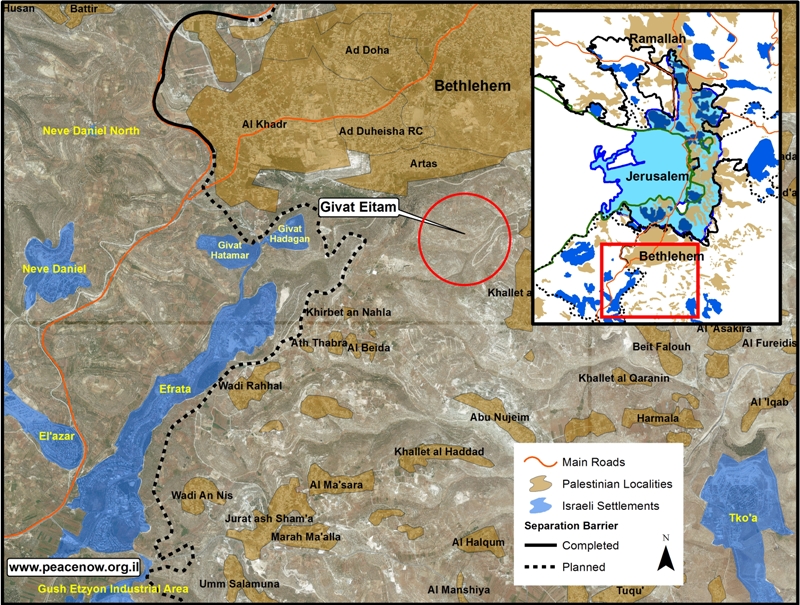
Map by Peace Now
The Givat Eitam settlement site – known to Palestinians as A-Nahle – is located on a strategic hilltop south of the Palestinian city of Bethlehem. The construction of Givat Eitam would significantly expand Efrat in the direction of Bethlehem, effectively cutting off Bethlehem off from the southern West Bank, completing the city’s encirclement by Israeli settlement construction. The Givat Eitam settlement plan has long been nicknamed “E-2” by settlement watchdogs, for its dire geopolitical implications for any future Palestinian state (similar to those of the E-1 settlement on Jerusalem’s eastern flank).
Earlier, on May 3rd, the Israeli Civil Administration dismissed Palestinian petitions challenging the allocation of an additional 1,100 dunams (225 acres) of land to the Efrat settlement – a decision that paved the way for Bennett’s announcement. That land allocation doubles the size of the Efrat settlement, and, more significantly, it allows for the construction of what will effectively be a new settlement to be called “Givat Eitam” — to be built within Efrat’s (expanded) borders but at a site that is not contiguous with the built-up area of Efrat. In its May 3rd ruling, the Civil Administration ruled that additional land was necessary for Efrat’s growth and development, and that the Givat Eitam site is the only land available (disregarding Palestinian needs for land for Bethlehem’s growth and development).
In 2004, the Israeli government designated the land to be used to build Givat Eitam as “state land,” despite the fact that Palestinians claim to have been actively cultivating the land for generations. Palestinians land owners assisted by the Israeli NGO Peace Now waged a 16-year legal battle to challenge the declaration of state land (which they lost), followed by a legal battle challenging the decision to allocate this “state land” for settlement purposes (which culminated with the May 3rd ruling).
Peace Now has declared its intention to escalate its petition against the land allocation to the High Court of Justice, and laid out its three-part legal argument:
- Allocating “state land” to build a settlement contravenes Israel’s duty to protect the land for the local Palestinian population according to international law;
- Allocating “state land” for the needs of Israelis (over those of Palestinians) is tainted by discrimination, as is clear from the fact that since 1967, Israel has allocated 99.8% of “state land” in the West Bank land primarily for the benefit of Israel/Israelis; and
- The Palestinian need for the land in question is far greater than that of the Efrat settlement, as a Peace Now spatial planning analysis confirms.
Addressing Bennett’s announcement of approval of the Givat Eitam plan, Peace Now said in a statement:
“This is a cynical move by a caretaker defense minister at the end of his mandate while the nation is still reeling from the corona crisis to advance a dangerous plan aimed at entrenching permanent Israeli domination in the southern West Bank and harming the prospect of a two-state solution. The right thing to do is to allocate the land for Palestinian construction, but the Ministry of Defense is currently run by an irresponsible politician willing to cross any red line in the name of his anti-democratic ideology.”
Following his announcement, Defense Minister Bennett tweeted:
“The building momentum in the country must not be stopped, even for a second.”
In September 2018, FMEP reported that the local council of the Efrat settlement, in response to a Palestinian terror attack, encouraged the start of (unauthorized) construction of an outpost at the Givat Eitam/E-2 site (presuming that any such illegal construction would be retroactively legalized by the government). Since then, the Civil Administration has allowed the settlers to build and maintain an agricultural farm there.
Givat Hamatos Tender is Delayed, as Settlers Agitate for Action
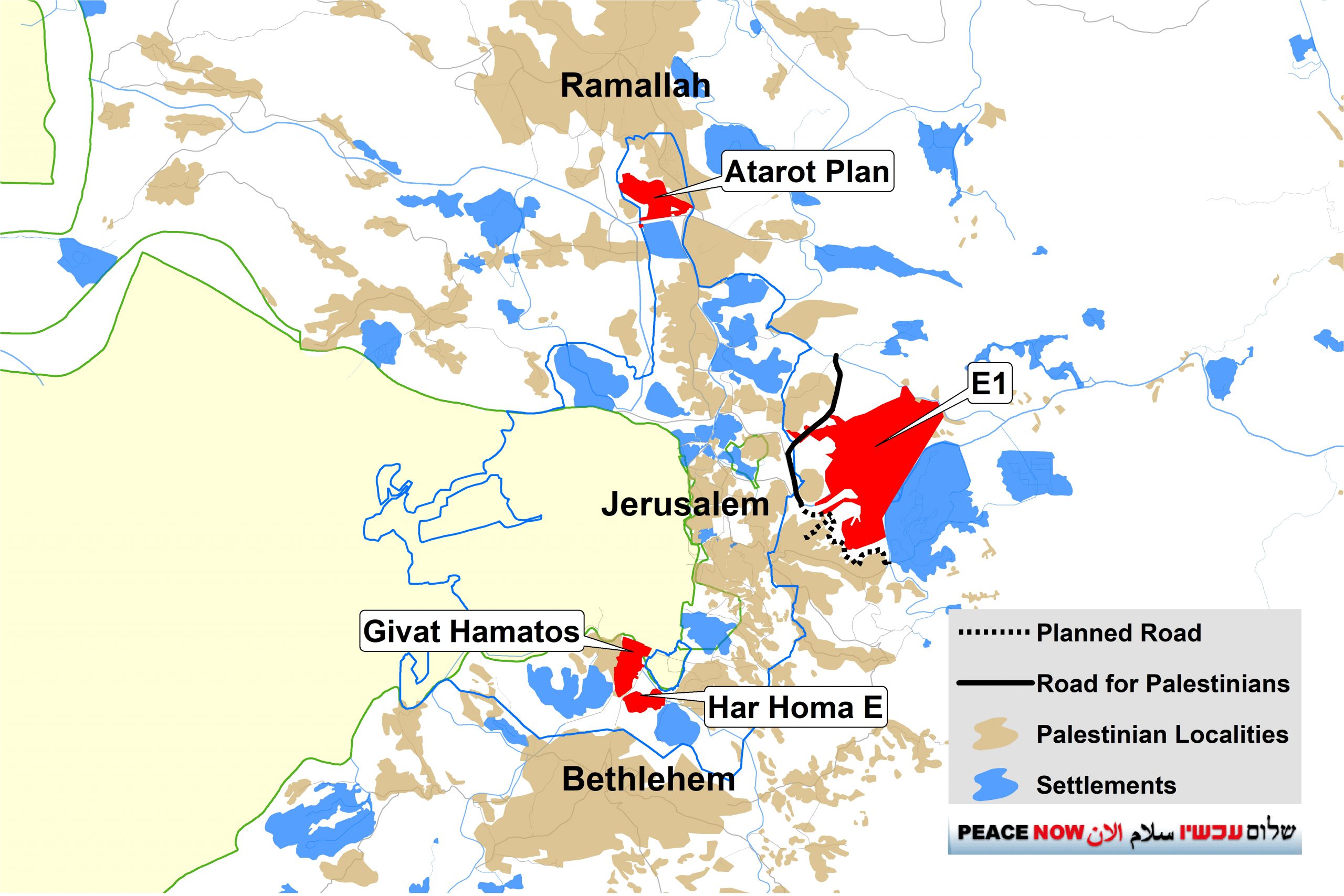 Ir Amim reports that the Israeli Land Authority did not open bidding on a tender for the construction of 1,077 units in the Givat Hamatos settlement, as it was scheduled to do on May 3rd. The ILA has proactively announced the postponement of several tenders that were scheduled for publication and/opening, but made no such announcement with regards to the highly sensitive and controversial Givat Hamatos tender. The delay has not pleased East Jerusalem settlement empresario Aryeh King (who is poised to become the Deputy Mayor of Jerusalem), who posted a message on Facebook pressing for action.
Ir Amim speculates that the Israeli government may be exercising caution on sensitive East Jerusalem plans like Givat Hamatos and Har Homa (plans for which were taken off of the agenda of the Jerusalem District Committee’s April 27th meeting), in light of international criticism of those plans specifically.
Ir Amim writes:
“Israeli right-wing groups are likely to demand that the tender must not be postponed regardless of any economic considerations. For example, Jerusalem right-wing council member Arye King who works to promote settlements in East Jerusalem has already posted on Facebook a reminder that the tender is due to open today.”
As a reminder, the Givat Hamatos settlement has been fully approved but not constructed. Located in the southern part of East Jerusalem, plans for the Givat Hamatos settlement have long been called a doomsday settlement by parties interested in preserving the possibility of a two-state solution. If the Givat Hamatos settlement is built, the Palestinian neighborhood of Beit Safafa in East Jerusalem will be completely surrounded by Israeli construction, severing its connection to the West Bank.
Over the past year of seemingly endless campaigning, Netanyahu faced intense and prolonged pressure from settler leaders and his political rivals to move ahead with plans for Givat Hamatos, a pressure point he alleviated in February 2020 when he announced that he had lifted the freeze on those plans.
Israel Exploits “Humanitarian” Access Issue to Flex its Muscles at Key Hebron Site
Outgoing Israeli Defense Minister Naftali Bennett has granted approval for a plan to expropriate land from the Islamic Waqf, ostensibly in order to make the Tomb of the Patriarchs/Ibrahimi Mosque wheelchair accessible. The decision sparked anger and controversy — it was slammed by the Palestinian Authority — both because it involves the expropriation of Waqf-held land, and because it directly violates arrangements Israel agreed to in the Oslo Accords, which give the Palestinian-run Municipality of Hebron planning authority over the site. The plan still needs to receive final approval from the Israeli Civil Administration’s High Planning Council, but it already enjoys the support of Prime Minister Netanyahu and the Justice Ministry. In addition, the Israeli Attorney General issued an opinion holding that Israel is legally permitted to expropriate the land for this humanitarian cause.
Providing critical context for why this plan is not really, or not fully, being advanced out of humanitarian concerns, the Israeli nonprofit Emek Shaveh – which is composed of archeological professionals – explains:
“Israel’s decision to seize responsibility for the site from the Hebron municipality and the Palestinians sends a clear political message that Israel is reneging on agreements that were signed with the Palestinians in Hebron. Beyond the precedent that will enable the settlers in the future to demand additional changes at the Tomb of the Patriarchs/Ibrahimi Mosque, this is also a precedent that could play out at other sites under the responsibility of the Islamic Waqf. Experience has shown us that what begins in Hebron percolates into other places including Jerusalem. It begins with a seemingly rational demand to benefit the disabled or the general public and evolves into a new status quo. The expected change in Hebron has not escaped the attention of members of the Temple movement and they will know how to present their demands to the government. If Israel can repudiate agreements with the Palestinians in Hebron and expropriate land from the Waqf, it would seem that accepting what appears to be the far more modest demands by the Temple movement to pray or to walk about the Temple Mount complex freely is not so far-fetched. In the reality of Hebron and East Jerusalem, a change involving only several meters at a historic or holy place is not free of political considerations and often it is part of long-term strategy. While it is necessary to tend to the needs and interests of persons with disabilities, the extremists who presume to speak on their behalf must be prevented from forging Israeli policy, even if it is only a matter of a lift and an access path.”
Read Emek Shaveh’s full analysis here: “Humanitarianism Hebron Style.”
HaMoked Continues Battle on Behalf of Palestinians Landowners Who Cannot Reach Their Land
Since March 2020, HaMoked has been fighting for the rights of Palestinian landowners to access their land located in the “seam zone” (i.e., in the West Bank but on the Israeli side of the separation barrier). Israel requires these landowners to coordinate with the Israeli military in order to obtain permits to go beyond the barrier. With the outbreak of the Coronavirus pandemic, the IDF began severely limiting the issuance of permits, and has now reportedly suspended all entry permits indefinitely. The IDF claims that the restrictions are meant to stop the spread of the virus.
These restrictions have severe implications for Palestinians, in addition to violating their property rights. For instance, HaMoked reports that the closure affects commercial activity and has shuttered businesses for several weeks. There are also about 100 Palestinians in the northern West Bank who are literally trapped, since their homes are located within the seam zone (in a section of the village of Nazlat ‘Isa, in the Tulkarm District, that lies beyond the separation barrier).
On May 4th HaMoked sent a new letter to the military demanding that access be reinstated in accordance with existing regulations.
Amb. Friedman Gives Two Interviews Clarifying (Once Against) Total Support for Annexation; Pompeo To Visit Israel Soon
In two separate interviews with Israeli outlets this week in commemoration of the two year anniversary of moving the U.S. Embassy to Jerusalem, U.S. Ambassador David Friedman again clarified that the Trump Administration is prepared to recognize annexation as soon as Israel moves forward, which Friedman says can happen in the coming weeks.
In a May 6th interview with Israel Hayom – the free, right-wing Israeli daily newspaper financed by Sheldon Adelson – Friedman stressed that the U.S. has not conditioned its support for Israeli annexation. The only “requirement” – which cannot be fairly described as such – of the Israeli government is that Netanyahu commits to the principle of negotiating with the Palestinians “in good faith” on the basis of the Trump Plan, if the Palestinian leadership first accepts that and decides to come to the table within the next four years. Friedman told Israel Hayom that Netanyahu has already met this “requirement.” Setting aside the fact that no Palestinian leader will agree to negotiate with Israel on the basis of a plan that, in advance, gives Israel almost everything that was supposed to be on the table in negotiations, the “requirement” is still entirely hollow. Even if Netanyahu were to commit to negotiate with the Palestinians on this basis, there is no way to compel a future Israeli leader to honor that commitment.
Friedman made this even clearer in a second interview with the Jerusalem Post:
“The expectation is that the prime minister will agree to negotiate — and if the Palestinians show up, he will negotiate in good faith based on this plan…I don’t see this as anything more than a commitment by the prime minister…[and] I’m not going to prejudge what good faith means.”
Friedman also sought to clarify that any notion that the Trump Plan calls for a “construction freeze” outside annexed areas is incorrect. Rather, all Israeli settlements and outposts outside the annexed areas will become part of enclaves – connected to Israel by access roads. Construction in these areas can continue but but should not expand beyond a given enclave’s “territorial footprint.” That condition will apply only to 10,000-15,000 settlers, according to Friedman, living in the enclaves.
Friedman repeatedly stressed that the U.S. is a passive actor when it comes to annexation: i.e., that annexation is Israel’s move to make, and the U.S. stands ready to recognize Israel’s decision. In his interview with the Jerusalem Post, he again used the phrase “Israel’s decision” and made a point of giving credit to U.S. Secretary of State Mike Pompeo with that turn of phrase. Pompeo is reportedly due to travel to Israel in the coming week.
Yesha Settlement Council Head Pushes For Annexation Vote Immediately, As Settlers Continue to Be Wary of Bibi’s Plans & Critical of the Trump Plan
On May 3rd, David Elhayani, chairman of the settler Yesha Council (an umbrella group representing all Israeli settlements), demanded that the Knesset take its first vote on annexation immediately. Elhayani threw his support behind a bill that will extend Israeli sovereignty (an act of de facto annexation) over the entire Jordan Valley and all settlements and outposts. The bill was introduced in March 2020 by Likud Knesset Member May Golan, with backing from the senior figures in the Likud Party.
Elhayani explains his support for the bill, which he believes would enjoy broad backing:
“The bill will apply sovereignty to Judea and Samaria and the Jordan Valley without recognition of a Palestinian state that would endanger the future of the state of Israel.”
Elhayani remark is an implicit attack on the Trump Plan (and the new unity government which appears set to implement that plan as soon as July 1st), as well as a challenge to Netanyahu’s public commitment to enacting annexation – a commitment about which settlers continue to be skeptical. As Elhayani sees it, Netanyahu’s approach hold out the possibility of the establishment of a Palestinian state, which he thinks is an existential threat to the security of the Israeli state. Elhayani has also publicly (and repeatedly) criticized the Trump Plan, saying just this week that the plan is a “scam.” Elhayani said:
“Representatives of the US government are [trying to] sell Plan A under the guise of Plan B. There is no greater scam than this…While the county is preoccupied with the coronavirus, the U.S. government is preparing the ground for the establishment of a Palestinian terrorist state and the well-oiled American public information machine will not stop for a moment as it tries to advance Trump’s peace plan in any way possible. There is a lot of text in the plan meant to confuse the public.”
Yossi Dagan – the head of the settlement Samaria Regional Council – joined Elhayani in his public opposition to the Trump Plan, saying:
“We will not agree to the establishment of a Palestinian state as part of the process of [enacting Israeli] sovereignty [in the West Bank]. Sovereignty is important to Israel’s security, but it is not worth damaging even a centimeter of the State of Israel and establishing a terror state in the heartland of the country. David Friedman [the United States Ambassador to Israel] is a warm and loving Jew. I know him, and I understand that he is doing everything possible to safeguard Israel’s interests. But with all the appreciation I have for Friedman, no American ambassador should worry about us. We chose Netanyahu, not the Americans.”
In response to remarks made by Amb. David Friedman this week (detailed above), the head of the Mount Hevron Regional Council, Yochai Damari, voiced support for the Plan, as well as his concern:
“Under Ambassador Friedman’s leadership, the sovereignty plan is progressing and we welcome it. We support the ambassador who, together with the prime minister and President Trump, are pushing for sovereignty and recognition of settlements as part of the State of Israel, thus bringing forth historical justice. The plan does, however, have red lines. We are concerned about the enclave provisions and unfortunately, we have not received clarifications about it. We will not allow thousands of families to be abandoned to the mercy of the terrorists.”
The mayor of the Efrat settlement, Oded Ravivi, urged the new unity government to act quickly on annexation, saying:
“this is a test not only for the new government, which is supposed to include applying sovereignty [to the area] by July, but also a test for the Israeli Right and the settlers’ leadership. Do they prefer having one bird in their hand or two in a tree? I believe we are facing a formative period and if we miss [this chance] we may lose the opportunity to change the future of a generation. I say yes to the plan!”
The mayor of the Beit El settlement, Shai Alon, said:
“Washington already understands the historical significance of Beit El and Judea and Samaria have for the people of Israel. It’s unthinkable that Jerusalem not do the same. It’s time to apply sovereignty. It’s time to leave this debate behind us and make Israel control over Judea and Samaria a fact.”
Bonus Reads
- “The day after annexation: Israel, Palestine and the one-state reality” (The New Arab)
- “The Dark Side of Annexing the Jordan Valley (Haaretz)
- “Palestinian Stiffen Battle Against Annexation at UN Security Council” (Jerusalem Post)
- “UK lawmakers urge Johnson to sanction Israel if West Bank annexation goes ahead“ (The Times for Israel)
- “Palestinians in Israeli-controlled West Bank Fall Through Cracks of Coronavirus Response” (Haaretz)
- “Israeli annexation plans would lead to ‘cascade of bad human rights consequences’, says UN expert” (OHCHR)
- “Israeli settler attacks on Palestinians increase under coronavirus lockdown” (Middle East Eye)
Welcome to FMEP’s Weekly Settlement Report, covering everything you need to know about Israeli settlement activity this week.
To subscribe to this report, please click here.
February 14, 2020
- United Nations Releases Database of Businesses Operating in Settlements
- Notable Reactions to the Publication of the UN Database (Including Israel’s Pledge to Interfere In U.S. Politics to Undermine Constitutionally Protected Speech)
- Also at the UN this Week, Kushner Out-Maneuvers Abbas in the Security Council
- Netanyahu Says His Government Is Nearly Done Mapping Annexation, based on Trump Plan
- Judge Appoints Settler Lawyer to Manage Petra Hotel During Ongoing Bankruptcy, Ownership Battle
- The Israel Land Authority is Already Annexing West Bank Land
- Acquiescing to Settlers’ Pressure, Civil Administration Pushes Palestinians Off Land — By Citing British Mandate Regulations
- Terrestrial Jerusalem: The Trump Plan’s “Doublespeak” on Jerusalem
- Peace Now Details the Roles of the WZO & the Jewish National Fund in Driving the Settlement Agenda
- Bonus Reads
Questions/comments? Contact Kristin McCarthy (kmccarthy@fmep.org).
United Nations Releases Database of Businesses Operating in Settlements
On February 12th, following nearly four years of delay, the United Nations Human Rights Council finally published a (non-comprehensive) database of businesses involved in building, maintaining, securing, and servicing Israeli settlements in the West Bank, East Jerusalem, and the Golan Heights. The database was requested by members of the Human Rights Council in March 2016 in order to assist member states in complying with international legal obligations with regards to doing business with companies involved in activities which violate the human rights of people around the world.
The database lists 112 companies found to be conducting business with Israeli settlements. Key facts about these businesses:
- 94 companies are based in Israel (see list). The listed Israeli companies include all major banks, state-owned transportation companies Egged and Israel Railways Corporation, and telecommunications giants Bezeq, HOT and Cellcom.
- 6 companies are based in the United States: AirBnB, TripAdvisor, Expedia, Booking Holdings Inc., General Mills Inc, and Motorola Solutions Inc. General Mills explained that it was included on the database because a manufacturing facility “uses natural resources, in particular water and land, for business purposes.” For a review of how AirBnB has changed (for the worse) its policy of operating in the West Bank and East Jerusalem, see here. For reports on the actions of tourism companies promoting and operating in the settlements, see: Human Rights Watch’s report, “Bed and Breakfast on Stolen Land,” and Amnesty International’s report “Destination: Occupation”
- 4 companies are based in the Netherlands: Booking.com, Tahal Group International B.V., Altice Europe N.V., Kardan N.V.
- 3 companies are based in France: Egis Rail, Alstom S.A, Egis S.A.
- 3 companies are based in the United Kingdom: JC Bamford Excavators Ltd., Opodo Ltd., Greenkote P.L.C.
- 1 is based in Luxembourg: eDreams ODIGEO S.A.
- 1 is based in Thailand: Indorama Ventures P.C.L.
The publication of the database has repeatedly been delayed due to heavy pressure from Israel and the United States, neither of which are current members of the Human Rights Council. Even before its publication, Israel and the U.S. argued that the database would by definition be anti-Israel and antisemitic. From the start they also labeled the database a “blacklist,” even though the database itself neither calls for nor imposes any punitive consequences on the listed businesses. Indeed, as FMEP’s Lara Friedman has pointed out – and as former U.S. official Jason Greenblatt has suggested- that the database can just as easily serve as a list for settlement-supporters to shop from as it can serve as information based upon which someone might choose to boycott.
Notable Reactions to the Publication of the UN Database (Including Israel’s Pledge to Interfere In U.S. Politics to Undermine Constitutionally Protected Speech)
The most eye-catching reaction to the publication of the UN database came from Prime Minister Benjamin Netanyahu, who took to Twitter to claim credit for anti-BDS/pro-settlement legislation in U.S. states (some of which has been declared unconstitutional in U.S. courts) that penalizes those who boycotts Israel or settlements. That same day, the Israeli Foreign Ministry instructed diplomats serving in its U.S. consulates to work with state governors to get them to publicly condemn the UN database. Analysts quickly noted the audaciousness of this boasting by Israeli of interfering in domestic political affairs in the United States — boasting that only confirmed what researchers have known for years: the state of Israel has been pushing anti-democratic, unconstitutional laws in the United States.
Many Members of Congress issued statements denouncing the UN for publishing the database. Such statements suggest that there will likely soon be a move to pass legislation pending in the U.S. House which seeks to criminalize BDS, called the Israel Anti-Boycott Act.
In Israel, political figures from across the spectrum condemned the publication of the database. Prime Minister Netanyahu said that when the world recognizes Israeli sovereignty in the West Bank and in settlements, “this list will become void.” President Rivlin shockingly suggesting that the Human Rights Council’s publication of the database is reminiscent of the Holocaust. Even Amir Peretz, the leader of Israel’s left-wing coalition (which includes Meretz), condemned the database and vowed to work to compel the UN to repeal it. In addition, the Israeli Foreign Ministry announced it was freezing ties with the office of the UN High Commissioner for Human Rights.
A group of settlers leading the Samaria Regional Council (a municipal body representing and servicing settlements in the northern region of the West Bank) announced that it will file a class action lawsuit against the United Nations. Yossi Dagan, the organization’s head, said:
“Not only will we not break, we will fight – at the beginning of the week the Samaria Regional Council together with representatives of factories in the Barkan Industrial Zone will file a lawsuit against the boycott of human rights council officials, led by United Nations High Commissioner for Human Rights Michelle Bachelet and Secretary-General of the United Nations Antonio Guterres, as well as against other leftist organizations, and we will demand to receive compensation, as was decided by the Jerusalem District Court under the honorable Judge Yosef Shapiro, that there is no immunity from civil lawsuits and there is no way to hide behind immunity. We will not only claim damages that may be incurred, but we will also sue for the honor of the State of Israel and the slandering of its name.”
Palestinians welcomed the publication of the database, and quickly called for the listed businesses to change their practices. Prime Minister Shtayyeh said that the Palestinian Authority will pursue legal action against the businesses in order to force the issue, noting that businesses could fix the situation by re-locating to areas under Palestinian control. Shtayyeh said:
“We will pursue the companies listed in the report legally through international legal institutions and through the courts in their countries for their role in violating human rights…We will demand compensation for illegally using our occupied lands and for engaging in economic activity in our lands without submitting to Palestinian laws and paying taxes.”
Saeb Erekat, veteran Palestinian statesman and negotiator, said:
“While this list does not include all the companies profiting from Israel’s illegal colonial-settlement enterprise in occupied Palestine, it’s a crucial first step to restore hope in multilateralism and international law..[The list] should serve as a reminder to the international community on the importance of strengthening the tools to implement international law at a time when the illegality of Israeli settlements is being challenged.”
Also at the UN this Week, Kushner Out-Maneuvers Abbas in the Security Council
Prior to the UNHRC’s publication of the database, the United Nations Security Council played host to an Israel-Palestine drama of its own, in which a cast of key players from each side sought to persuade UNSC members to support/reject the Trump Plan.
Jared Kushner met with Security Council members on February 7th to sell the plan. The representative from Tunisia (who drafted a resolution critical of Kushner’s work) did not attend the meeting, and was later fired by Tunisia’s president. Palestinian Authority President Mahmoud Abbas visited the Security Council on February 11th in an attempt to rally opposition to the Trump Plan. His efforts – punctuated by a speech in front of the Council – cannot be considered a request. The Tunisian-lead draft resolution critical of the Trump Plan was abandoned by its drafters, in move celebrated by U.S. officials as a major victory in the Security Council, which the Trump Administration and Israel regularly characterizes as anti-Israel.
Netanyahu Says His Government Is Nearly Done Mapping Annexation, based on Trump Plan
On February 9th, Prime Minister Benjamin Netanyau announced that Israel has started mapping the area it intends to annex in accordance with the Trump Plan, saying “it won’t take too long.” The Israeli mapping team – which includes Minister Yariv Levin, Israeli Ambassador to Washington Ron Dermer, and a National Security Council representative – is being directly overseen by Prime Minister’s Office Director, General Ronen Peretz. The National Security Council has a representative on the team as well. saying “it won’t take too long.” Netanyahu made the remarks at a campaign event in the Maale Adumim settlement, located just east of Jerusalem in a highly coveted area which the Trump Plan delivers to Israel. Consistent with the Trump Plan, Netanyahu said that Israel will annex all of its settlements, the Jordan Valley, and East Jerusalem.
Netanyahu’s announcement can be viewed as part of his continued efforts to placate the large portion of his political base that is up in arms over Netanyahu’s acquiescence to the U.S. demand that annexation not be advanced until after the next elections (March 2nd). Furthering that cause, Netanyahu tried to make lemons out of lemonade – saying:
“The U.S. and [Israel] agreed that when this entire process is completed we’ll bring it to the government [for approval]. But the Americans are saying in the clearest manner: ‘We want to give you recognition and we’ll give you it when the entire process is complete.’ Recognition is the main thing. We brought this, I brought this/ We don’t want to endanger this, we are working responsibility and intelligently.”
U.S. Ambassador David Friedman – who initially said that Israel does not need to wait to annex West Bank land – took to Twitter to publicly caution Netanyahu against pushing annexation before the March 2nd elections, warning that there would be consequences if Israel moves unilaterally. Later that day, Amb. Friedman then tweeted the following statement in support of Netanyahu (smoothing over the previous rebuke), as well re-aligning his own public position to match that of Jared Kushner:
“President Trump’s Vision for Peace is the product of more than three years of close consultations among the President, PM Netanyahu and their respective senior staff. As we have stated, the application of Israeli law to the territory which the Plan provides to be part of Israel is subject to the completion of a mapping process by a joint Israeli-American committee. Any unilateral action in advance of the completion of the committee process endangers the Plan & American recognition.”
Netanyahu and Friedman’s remarks appear to further anger already indignant settler leaders.
Jordan Valley Regional Council chairman David Elhayani, who also serves as the chairman of the Yesha Council, said:
“The United States cannot prevent Israel from doing anything. [Netanyahu needs] to fulfill his commitment to the residents of Judea, Samaria and the Jordan Valley to apply sovereignty before the elections, and to do this as soon as possible.”
Samaria Regional Council chairman Yossi Dagan said:
“Sometimes even dear friends need to be put in their place and told that… we are a sovereign country and sovereignty will be extended to Judea and Samaria as the public in the State of Israel expects.”
Beit El Local Council chairman Shai Alon said:
“the United States should respect us as a state and not determine when Israel will assert sovereignty over Judea and Samaria.”
Watching this argument, FMEP’s Lara Friedman offered an important reminder:
“This spat is about a distinction (over timing/credit) without a difference (over substance/objective/outcome). That is the real story here. Making it a story about inter-extremist bickering only normalizes their shared annexationist agenda.”
Judge Appoints Settler Lawyer to Manage Petra Hotel During Ongoing Bankruptcy, Ownership Battle
According to Haaretz, a judge has appointed a lawyer for the radical settler group Ateret Cohanim as the legal custodian of the Petra Hotel – located just inside the Jaffa Gate to the Old City of Jerusalem – during an ongoing bankruptcy case against the Palestinian company currently operating the hotel. The lawyer, Avraham Moshe Segal, has taken over the debt that the Palestinian company owes – giving Segal leverage to oust the current operators, a goal he has tried to accomplish through various legal maneuvers over the years.
In addition to awarding the coveted property to a lawyer for a radical settler group, the appointment of Segal as the legal “receiver” is extraordinarily alarming because Ateret Cohanim is a party to the legal case involving ownership of the Petra Hotel. Since 2004, Ateret Cohanim has used shell companies to wage a battle against the Greek Orthodox Patriarchate, from which Ateret Cohanim claims to have purchased the hotel (along with two other coveted Old City properties). In June 2019, an Israeli judge awarded Ateret Cohanim ownership of the properties. The ruling was appealed by the Greek Orthodox Church, after it discovered new evidence showing Ateret Cohanim’s forgery of key documents and its payment of bribes to obtain the property. The case was officially reopened in November 2019.
Haaretz reports that a source at the Justice Ministry said that the appointment of Ateret Cohanim’s lawyer “demands an inquiry to determine whether there may be a conflict of interest”.
The Greek Orthodox Church requested the dismissal of Segal as the “receiver,” telling the court:
“The job holder in question [i.e., Segal] has been involved as part of his role in more than a few legal processes against the company and they have taken place in every legal instance, over a number of years, enough to enable us to say and even determine that there is more than a fear of a conflict of interests here.”
The Israel Land Authority is Already Annexing West Bank Land
The Israel Lands Authority is the governmental body which controls 90% of the land in Israel, and thus controls the supply and zoning of land for development, including land in the West Bank used for settlement construction. A new report revealed that in January 2020, some 66% (two-thirds) of the total amount of land auctioned by the Israel Lands Authority was located in the occupied territory. The report noted:
“All told, the ILA last month advertised land designated for 3,254 housing units, 2,136 of them in settlements, including Karnei Shomron, Givat Ze’ev, Ma’aleh Adumim and Efrat.”
While the data is only for a single month, the disproportionate focus in the ILA on developing land in the West Bank, as opposed to inside Israel, where housing prices are rising, is notable. Likewise, the data highlights the fact that notwithstanding ongoing discussion of when Israel might annex parts of the West Bank, consistent with the Trump plan, the fact is that Israel has already de facto annexed the area — evidenced by the fact that an Israeli domestic body has the authority to issue tenders for Israeli development inside the West Bank.
Acquiescing to Settlers’ Pressure, Civil Administration Pushes Palestinians Off Land — By Citing British Mandate Regulations
Reversing decades of practice, the Israeli Civil Administration recently denied Palestinian farmers access to their land outside of Ramallah and confiscated their tractor.. The denial was based on the argument that the area was deemed an antiquities site in the British Mandate period and therefore the Palestinians cannot receive permits to work it. The famers, two brothers, told Haaretz that the Civil Administration has not prevented them from accessing their lands for the last 50 years, and they were unaware that they needed a permit to continue doing so. Relatives of the famers suggest that the Civil Administration was pressured to close the area by settlers living in a nearby illegal settlement outpost, called “Malachei Hashalom.” The outpost is relatively news, established in 2015 on an abandoned military base, and has a reputation for harassing Palestinians and their flocks.
The brothers’ lawyer said of the Civil Administration’s change of policy:
“It’s another method of driving the Palestinians from their lands. Working the land does not harm antiquities, and the state also never made such an allegation. The archaeological claim was only invented after the establishment of the outpost.”
One of the farmers, Nader Abu Aleiyeh, told Haaretz:
“Everyone knows we work the land and they never told us anything. Soldiers in the past would come and drink tea with us while we were working the land.”
Terrestrial Jerusalem: The Trump Plan’s “Doublespeak” on Jerusalem
In its latest edition of Insider’s Jerusalem, Terrestrial Jerusalem experts examine at length the components of the Trump Administration’s plan related to Jerusalem, outlining the many delusional notions about Israel’s annexation of the city and its holy sites. Terrestrial Jerusalem writes:
“There is a common denominator in the portrayal of the stark realities of Jerusalem and the terminology used to describe them. By a systematic use of doublespeak, Palestinian residents of East Jerusalem aren’t Palestinians, Jerusalem is undivided, refugees don’t exist, Abu Dis is (wink, wink) Jerusalem but can’t be called as such, the status quo can be maintained even as it is violated, and Jerusalem is an open city ‘accessible’ to all, which denies access to the residents of the West Bank and Gaza. The Jerusalem of the Trump proposal does not exist in Jerusalem, but rather in the ideology of the settler right in Israel, and of the end-of-days Evangelicals in the US, where myths trump the facts.”
On the change to the status quo on the Temple Mount in the Trump Plan:
“As noted, the Proposal explicitly supports allowing Jewish prayer on Haram al Sharif/the Temple Mount. In doing so, the Trump administrations has adopted policies that have been rejected by every Israeli government since 1967. This radical change in the status quo is so problematic, that since the release of the Proposal, the Trump team has begun to walk it back. In a telephonic press briefing conducted by the US team days after the publication of the Proposal on January 28, Ambassador Friedman offered the following response to a press inquiry:
‘The status quo, in the manner that it is observed today, will continue absent an agreement to the contrary. So there’s nothing in the – there’s nothing in the plan that would impose any alteration of the status quo that’s not subject to agreement of all the parties. So don’t expect to see anything different in the near future, or maybe in the future at all.’
Even if taken at face value, there are three problems with Friedman’s clarification.
Firstly, Friedman’s statement contradicts the literal meaning of the text (‘People of every faith should be permitted to pray on the Temple Mount/Haram al-Sharif’). If Friedman’s clarification is to be taken seriously, no response to a question in a press briefing can serve as an alternative to a formal amendment to the Proposal’s text, or at the very least, an official announcement by the State Department revising the wording.
Secondly, the explicit change in the status quo appearing in the text of the Proposal is the equivalent of “shouting it from the rooftops”. Friedman’s statement was made almost by stealth, as though the drafters of this text do not want their clarification to be noticed. In the past, Netanyahu would issue his statements regarding the status quo in a similar manner: he would issue them in English only, late on a Saturday night, and then relegating the text to some obscure location on the Prime Minister’s website.
Finally, even if, as stated by Friedman, this change will not take place anytime soon, what has been said cannot be unsaid. The activists in the Temple Mount movement are ecstatic, flaunting their success on social media and promising to take advantage of the new situation. Instead of having a moderating influence on the various stakeholders on the Mount, this original text emboldens those who are already dangerously pushing the limits of the status quo. Anything less than an unequivocal and highly visible revision is tantamount to playing with matches at one of the most volatile locations on the planet. The prospect of an event leading to an eruption of violence is more likely today than it was before the release of the Proposal.”
On the list of holy sites in the Trump Plan:
“This selective sanctity on display in this list is quite significant and reflects a very specific, highly developed biblically driven narrative… The settlers of East Jerusalem make no bones about their objectives: they seek to establish an ancient Biblical realm in and around Jerusalem’s Old City, one in which real and purported sacred, historical and archeological sites establish the hegemony of their biblically motivated narrative. In doing so, they marginalize the equities of Muslims, and turn the Palestinian residents in the targeted areas into communities at risk…Just as the proposed change in the status quo reveals that the Trump administration has adopted the views of the extreme Temple Mount movement, its views regarding the epicenter of the conflict of between Israelis and Palestinians – the Old City and its visual basin – are virtually indistinguishable from those of East Jerusalem’s extreme settler organization, in general, and of the Elad settlers in particular. As with the settlers of East Jerusalem, in the Jerusalem of the Trump Proposal, even mundane or questionable Jewish history is sacred, while Arab and Muslim history does not exist.”
On the special tourist zone in Atarot (a wild concept not widely or accurately covered by press) Terrestrial Jerusalem writes:
“The Proposal stipulates that Israel create a special tourist zone [for Palestinian use] at Atarot, currently an industrial park several miles to the north of the city center, and which is to remain part Israel. This is to become a Special Tourist Area, even though there is nothing in the area which ends itself to tourism, nor are there sites of historic value. From this location, access to the Muslim Holy Shrines will be streamlined, with Palestinian tour guides licensed to lead tours. It is noteworthy that the Palestinians’ permission to conduct tours is limited to the Old City, and to Christian and Muslim sites elsewhere in the city. A Joint Tourist Development Authority will be created to allow Palestine to accrue some of the economic benefits of that tourism. This is the only example in the Proposal in which the Palestinians of the West Bank have any palpable stake in Jerusalem. However, even here, Israel is the arbiter of what tourists guided by Palestinian tour guides may see, and that is limited in scope.”
On the de-nationalization of Palestinians in East Jerusalem:
“The residents of East Jerusalem have individual rights as Arabs, not as Palestinians. They have religious rights in the city as Muslims, but not as Palestinians. They have material rights as tour guides and tourists (provided they limit their tourism to the sites Israel deems to be important to them). …By all acceptable measures, be it under international law or based on the empirical realities on the ground, East Jerusalem is occupied. However, in no way does the Proposal attempt to end occupation, for the simple reason that in their operative conceptual worlds, occupation simply does not exist. The proposal offers Palestinians of East Jerusalem a devil’s bargain: shed your national identity and your aspirations for a life within a Palestinian national collective, and you will be rewarded with certain privileges.”
For full analysis from Terrestrial Jerusalem, click here.
Peace Now Details the Roles of the WZO & the Jewish National Fund in Driving the Settlement Agenda
In anticipation of the World Zionist Organization (WZO) elections this October, Peace Now has published a two-page reminder about the group’s role in driving the illegal expansion of Israel’s settlement and outpost enterprise, which it did through it Settlement Division, in coordination with the Jewish National Fund. Peace Now Settlement Watch co-Director Hagit Ofran also recorded a webinar to discuss the new paper and the importance of the upcoming WZO elections.
The Settlement Division is a body within the WZO established in 1971 and fully funded by the Israeli government. Its mission was, and remains, to provide a channel by which the government can establish settlements – legally and illegally – in the occupied territories, while avoiding the pesky rules, regulations, and transparency requirements to which government entities are bound. The Israel government assigned management responsibilities to the WZO for over 60% of the land in the West Bank which the government declared to be “state land” (90,000 acres/400,000 dumans). The WZO has given that land to settlers to build settlements and secretly funnel government money to illegal outposts.
For its part, the Jewish National Fund (referred to as Keren Kayemeth LeIsrael-Jewish National Fund, or the KKL-JNF) started purchasing land in the West Bank in the early 1900s, for the explicit purpose of resettling Jews there. After 1967 and the commencement of Israel’s occupation of the West Bank, the KKL-JNF role changed to supporting the establishment and growth of settlements across the West Bank, and the eviction of Paelstinians from their homes in East Jerusalem in favor of Israeli settlers (including tthe recent eviction of the Sumarin family in Silwan).
A recent tweet by U.S. Ambassador David Friedman included a picture of him planting an olive tree on the grounds of the former U.S. Consulate in Jerusalem (now used as the Ambassador’s residence), standing alongside an agent of the KKL-JNF.
Bonus Reads
- “How do settlers takeover “ (+972 Magazine)
- “Trump’s Middle East Peace Plan Isn’t New. It Plagiarized a 40-Year Old Israeli Initiative” (Foreign Policy)
- “Israel’s Rejection of UN List of Companies Tied to Settlements Reveals Stark Truth About Annexation” (Haaretz)
- “Facing Blowback From Annexation” (Haaretz)
- “What is Donald Trump’s Vision for Jerusalem?” (Jerusalem Post)
- “Turkey hands Palestinians Ottoman land archive” (Middle East Monitor)
Welcome to FMEP’s Weekly Settlement Report, covering everything you need to know about Israeli settlement activity this week.
To subscribe to this report, please click here.
August 9, 2019
- Summary: Another Week, Another Round of Major Settlement Approvals
- Israeli Annexation via Settlement Construction Unleashed, Part 1: Three Outposts are “Legalized”
- Israeli Annexation via Settlement Construction Unleashed, Part 2: Final Approval for 648 New Settlement Units
- Israeli Annexation via Settlement Construction Unleashed, Part 3: Plans Advanced for 1,466 New Settlement Units (With More to Come)
- Israeli Annexation via Settlement Construction Unleashed, Part 4: Reactions
- Following Murder of Settler Youth, Netanyahu Doubles Down on Commitment to Settlements
- Latin Patriarchate Files Suit Claiming New Proof of Fraud Behind Settler Takeover of Old City Hotel Properties
- Education Minister Strips Key Committee Membership from Professor Who Objected to Authorization of Settlement Medical School
- Bimkom Report: Israel’s “No Construction Zone” Adjacent to the Separation Barrier Has Little To Do With Security
- Ir Amim: Israel’s Crackdown in Issawiya Advances Settlement Project in East Jerusalem
- Terrestrial Jerusalem In-Depth Report: The Silwan Tunnel Project
- Bonus Reads
Questions or comments? Contact Kristin McCarthy at kmccarthy@fmep.org.
Summary: Another Week, Another Round of Major Settlement Approvals
During its quarterly convening on August 5th and 6th, the Israeli Defense Ministry’s High Planning Council advanced plans for a total of 2,304 new settlement units. This includes:
- the approval of plans legalizing 190 units that have the effect of retroactively legalizing 3 unauthorized outposts;
- final approval for the construction of 648 settlement units; and
- interim approval (i.e., a step toward final approval) for the construction of 1,466 new settlement units
These approvals comes on the heels of the Israeli Security Cabinet’s decision to issue 6,000 building permits for settlement units last week (details of which are still unpublished). The past week of massive settlement advancements is a clearer-than-ever indication that Israel (with very public backing from top U.S. officials) is not holding back its illegal settlement activities and its ongoing annexation of the West Bank, particularly in Area C.
Details of this week’s approvals are broken down below.
Israeli Annexation via Settlement Construction Unleashed, Part 1: Three Outposts are “Legalized”
Plans advanced August 5-6 by the Israeli Defense Ministry’s High Planning Council In its decisions taken August 5th and 6th include at least 190 units in three illegal outposts — which have the effect of retroactively legalizing those three outposts. The outposts that gained retroactive approval this week are:
- Haroah Haivri – The council approved a plan for an educational institute and accompanying housing for students and staff. Most extraordinarily, Haroah Haivri, located just east of Jerusalem, is within eyesight of the Khan al-Ahmar community, which Israel is planning to demolish (forcibly relocating the Palestinian bedouin community that has lived there since the 1950s) — ostensibly because the structures in Khan al Ahmar were built without necessary Israeli approvals. The Haroah Haivri outpost was also built without the necessary Israeli approvals, but instead of demolishing the construction, Israel has retroactively legalized it — demonstrating once again that, when it comes to administering the occupation, Israel prefers “rule by law” – where law is turned into a tool to elevate the rights/interests of one party over another, over the democratic rule of law.
- Ibei Hanachal – The Council approved 96 units in this outpost, located southeast of Bethlehem, turning it into a “neighborhood” of the Maale Amos settlement. In reality, the outpost is not contiguous with the built-up area of the Maale Amos settlement, meaning that the implementation of this plan will, in effect, create a distinct new settlement (for coverage of this plan, see here) .
- Givat Salit – The Council approved 94 units in this outpost, located in the northern Jordan Valley, as part of turning it into a “neighborhood” of the nearby Mechola settlement.
The legalization of these three outposts only adds to the success of Israel’s ongoing and increasingly successful effort to retroactively legalize all illegal settler construction in the West Bank (that is, construction undertaken illegally under Israel law; all settlement construction is illegal under international law). The lengths to which Israel has gone to in order to achieve that goal include inventing new legal grounds — some outlined by the government’s “Zandberg report” and another – the “market regulation principle” identified by the Isareli Attorney General — that in effect allow Israel to suspend the rule of law and erase private property rights of Palestinians. For the past 2.5 years, FMEP has documented this campaign in detail in its Annexation Policies Tables – regularly updated and available online.
Israeli Annexation via Settlement Construction Unleashed, Part 2: Final Approval for 648 New Settlement Units
The actions taken this week by the High Planning Council include issuing final approval for 648 settlement units – mostly new construction but also some approval of existing construction that had been undertaken without approval (all of this is in addition to the 190 units in outposts legalized retroactively). Details of these approvals for new settlement construction are as follows:
-
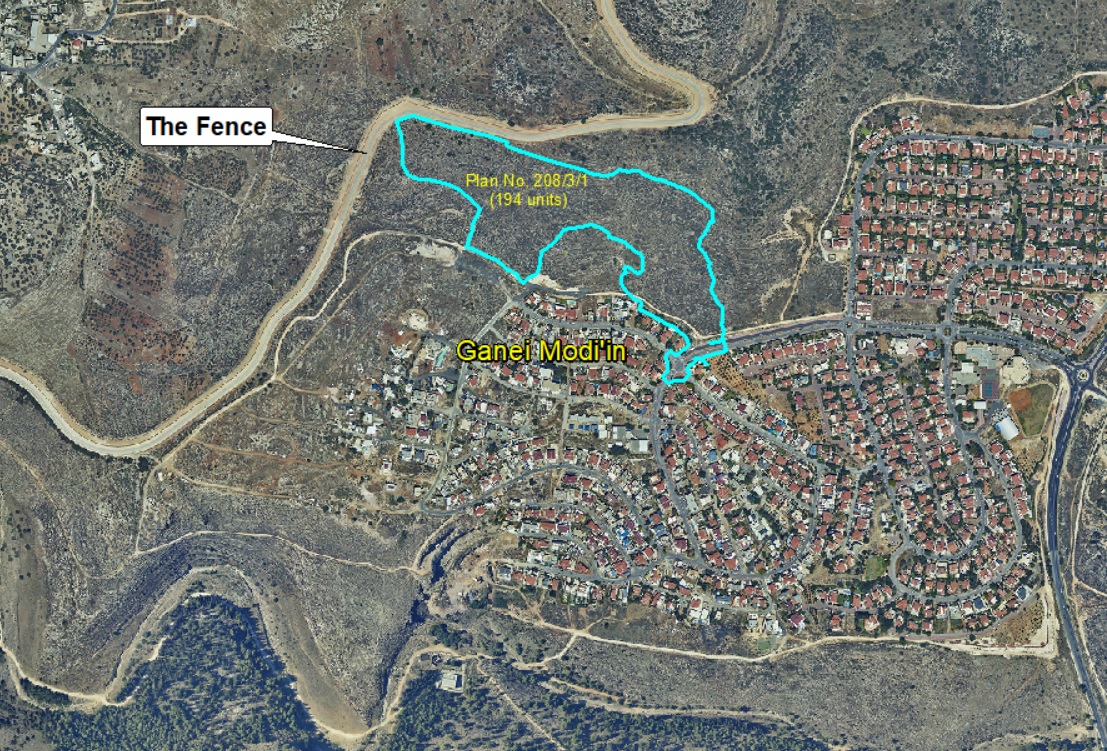
Map by Peace Now
194 units in the Ganei Modlin settlement, located in the northern “seam line zone” in the West Bank but on the Israeli side of the security barrier (by design of the Israeli government). The plan for 194 new units will bring the settlement’s built-up area directly up to the separation barrier, a particularly notable plan given Israel’s recent demolition of 70 Palestinian homes in the West Bank, based on the argument that the construction within a 200-250 foot Israeli-imposed “no construction zone” on either side of the barrier poses an unacceptable security risk to Israel. Israel rejected an offer by Palestinians to privately finance the construction of new and higher wall near the buildings; developers behind the Ganei Modlin project also offered to finance the construction of high wall near the construction, an offer the courts saw fit to accept – resolving the matter in the eyes of the High Planning Council, which approved the plan.
- 96 units in the Kiryat Netafim settlement, located in the northern West Bank and part of a string of settlements and unauthorized outposts – most notably Ariel – extending from the Green Line into the very heart of the West Bank and on towards the Jordan Valley.
- 76 units in the Beit Hagai settlement, located just south of Hebron,
- 66 units in the Efrat settlement, located south of Bethlehem. Efrat had already received final permission for 1,000 new settlement units at the most recent High Planning Council meeting, in April 2019. As a reminder, Efrat is located inside a settlement enclave that cuts deep into the West Bank. Efrat’s location and the route of the barrier wall around it, have literally severed the route of Highway 60 south of Bethlehem, cutting off Bethlehem and Jerusalem from the southern West Bank. The economic, political, and social impacts of the closure of Highway 60 at the Efrat settlement (there is literally a wall built across the highway) have been severe for the Palestinian population.
- 61 units attached to an educational institute in the Gva’ot settlement, located south of Bethlehem. The Gva’ot (Gevaot) settlement was established as an outpost of mobile homes, and later benefited from Israel’s unilateral, mass expropriation of Palestinian land in 2014 (which Israeli officials explictly said was done in response to a Palestinian terror attack). At the time, Peace Now reported that the move constituted the largest single expropriation of Palestinian land by the Israeli state in over 30 years.
- 51 units in Shvut Rachel, which only recently became an authorized settlement area when Israel extended the jurisdiction of the Shiloh settlement to include it as a “neighborhood” (along with three other outposts). The plans approved this week will retroactive legalize existing units and permit the construction of a few news one.
- 29 units in the Otniel settlement, located in the South Hebron Hills area. The plans serve to retroactively legalize existing units.
- 27 units in the Maskiyot settlement, located in the northern Jordan Valley. These units are part of a plan allowing the construction of a “bed and breakfast” with 27 additional rooms (and calling to mind Amnesty International’s recent report on the role tourism plays in supporting the occupation).
- 19 units in the Peduel settlement, located in the northern West Bank and part of a string of settlements and unauthorized outposts – most notably Ariel – extending from the Green Line into the very heart of the West Bank and on towards the Jordan Valley.
- 18 units and a park in the Ma’ale Adumim settlement.
- 11 units in the Einav settlement, located northwest of Nablus.
In addition, the Council gave retroactive approval for a controversial archeological site in the Shiloh settlement, located in the center of the northern West Bank. The Israeli government has devoted a significant amount of money and political energy towards building the tourist site, which is now drawing upwards of 60,000 evangelical tourists each year. For background on the site, see this Emek Shaveh report from 2014 and this brief from 2017, when the government approved the commercialization of the site. For analysis on how the site fits into a bigger pattern of Israeli efforts to normalize the settlements through tourism, see this report by Amnesty International.
Israeli Annexation via Settlement Construction Unleashed, Part 3: Plans Advanced for 1,466 New Settlement Units (With More to Come)
Actions taken August 5-6 by the Israeli Defense Ministry’s High Planning Council include advancing plans that, when they eventually receive final approval, will allow for the construction of 1,466 settlement units (details of the various steps of the planning/approval process are laid out by Peace Now here). Specifically, the Higher Planning Council this week approved the following plans for deposit for public review:
- 382 units in the Beit El settlement, located north of Ramallah. The plans include the retroactive legalization of 36 units; the remaining 346 are new units. As a reminder, Beit El is the settlement closely associated with U.S. Ambassador to Israel David Friedman, who among other things was the President of the “Friends of Beit El” organization, which raised money on its behalf.
- 354 in the Nili settlement, located in the northern West Bank;
- 200 units in the Asfar settlement, located northeast of Hebron. If approved, this plan will triple the size of the Asfar settlement.
- 168 units in the Talmon settlement, located north west of Ramallah. In December 2018, FMEP reported on a deadly encounter between neighboring Palestinians and settlers from Talmon and/or the many unauthorized outposts associated with it. The settlers had been attempting to takeover another hilltop on the outskirts of the Palestinian village of al-Mazra’ah al-Qibliyah. When Palestinians staged an attempt to stop the settlers from entering the area, a scuffle ensued and Israeli soldiers shot and killed two Palestinians.
- 132 units in the Kfar Adumim settlement, located east of Jerusalem and less than one mile from the Khan al-Ahmar bedouin community which the state of Israel is seeking to demolish.
- 84 units in the Shima settlement, located in the southern tip of the West Bank.
- 74 units in the Yakir settlement, located in the northern West Bank and part of a string of settlements and unauthorized outposts – most notably Ariel – extending from the Green Line deep into the West Bank.
- 48 units in the Bracha settlement, located south of Nablus.
- A recreational area in the Kochav Yaakov settlement, located just south of Ramallah.
In addition to the plans approved and advanced detailed above, the High Planning Council delayed consideration of two additional plans, which are:
- A plan that would effectively legalize another outpost, known as Brosh. Similar to the Haroah Haivri plan, discussed above, the plans relating to Brosh serve to retroactively legalize an existing educational institute. Approval of the plan was delayed because the Council had not resolved objections that were filed against the plan, including an objection filed by Peace Now.
A plan for 207 settlement units in the Bracha settlement, located near Nablus (these plans are in addition to the plans for 48 units approved to be deposited for public review, covered above). Though plan was on the Council’s schedule, it could not be approved because the Council first needs to approve the extension of Har Bracha’s existing settlement jurisdiction to include the area units are to be built. Since the plan calls for the construction of units outside of the existing area of jurisdiction, the plan could not be approved.
Israeli Annexation via Settlement Construction Unleashed, Part 4: Reactions
Following this week’s advancement of plans for 2,304 settlement units, settlement watchers and key members and bodies of the international community issued sharp criticism and sounded the annexation alarm bells. In contrast, there was glaring – and very, very, very predictable – silence came from the U.S. administration. A few notable reactions are included below.
Peace Now said in a statement:
“The approval of settlement plans is part of a disastrous government policy designed to prevent the possibility of peace and a two-state solution, and to annex part or all of the West Bank. The linkage of thousands of housing permits for settlers and a negligible number of housing units for Palestinians cannot hide the government’s discrimination policy. As a result, we see for example an approval of the illegal outpost (Haroeh Haivri) built for Israelis adjacent to the Palestinian bedouin village of Khan Al-Ahmar, for which the government refuses to approve any construction permits and instead seeks to transfer. Or we see, the approval of the construction of a new settlement neighborhood adjacent to the separation barrier after demolishing 72 housing units built adjacent to the separation barrier in Wadi Hummus, despite offering to fund security measures.”
The European Union issued a statement which reads:
“The EU expects the Israeli authorities to fully meet their obligations as an occupying power under International Humanitarian Law, and to cease the policy of settlement construction and expansion, of designating land for exclusive Israeli use, and of denying Palestinian development.”
United Nations Special Coordinator for the Middle East Peace Process Nickolay Mladenov said in a statement:
“The expansion of settlements has no legal effect and constitutes a flagrant violation of international law. By advancing the effective annexation of the West Bank, it undermines the chances for establishing a Palestinian state based on relevant UN resolutions, as part of a negotiated two-state solution.”
British Foreign Secretary Dominic Raab urged Israel to stop what he called:
“the effective annexation of the West Bank.”
Leilani Farha, the United Nations Special Rapporteur for the right to housing, and Michael Lynk, the United Nations Special Rapporteur for human rights in the Palestinian territory occupied since 1967, said in a statement:
“These settlement housing units are clearly meant to solidify the Israeli claim of sovereignty over the West Bank. Building civilian settlements in occupied territory is illegal, as is the annexation of territory. The international community has spoken out against the Israeli settlements, but it has not imposed effective consequences for the country’s defiance of international law. Israel’s actions indicate it plans to remain permanently and advance a claim of sovereignty. The Israeli Prime Minister made this clear when he said recently that: ‘No settlement and no settlers will ever be uprooted.’ Should we not take him at his word that Israel has no intention of complying with international law? Criticism without consequences is hollow. The international community has a wide menu of commonly-used countermeasures to push recalcitrant states into compliance with their international duties. If the international community is serious about its support for Palestinian self-determination and its opposition to Israeli settlements then, surely, the time has come for meaningful action.”
Israeli settlers, on the other hand, we filled with glee. Gush Etzion Regional Council Head Shlomo Ne’eman said in a statement:
“Thank God today we received approval from the Higher Planning Council for new housing units in Gush Etzion. Congratulations to all of our residents on the 200 units in Metzad, which is historic in that it will triple the size of the community. Congratulations on the final approvals for the Sadna institution, which works towards integration and is located in Gevaot, and will enable permanent construction of tens of units. Another major breakthrough is the final approval for Ibei Hanachal, which essentially fully legalizes the community and includes the construction of 96 permanent homes. These are major accomplishments for southeastern Gush Etzion, for the Jewish communities in the Judean Desert, and of course for all of Judea and Samaria. This is an opportunity for me to thank Prime Minister Netanyahu on this impressive accomplishment. Let’s hope that the trend of development and construction in Judea and Samaria continues full speed ahead.”
Following Murder of Settler Youth, Netanyahu Doubles Down on Commitment to Settlements
Following the murder of a 19-year old Israeli settler, Prime Minister Netanyahu vowed once again that he will promote settlement construction in all areas of the West Bank. Speaking at a ceremony marking the establishment of a new neighborhood of 650 units in the settlement of Beit El (which just saw plans for 382 new units advance, see above) Bibi said:
“We promised to build hundreds of housing units. Today we are doing it, both because we promised and because our mission is to establish the nation of Israel in our country. We know that the Land of Israel is bought in agony. Today another one of our sons fell. He was from a family that has already made a heavy sacrifice for the Land of Israel. These vicious terrorists: They come to uproot, we come to plant. They come to destroy, we come to build. Our hands will reach out and we will deepen our roots in our homeland – in all parts of it.”
Bibi’s words — which suggest an intention to continue/expand settlement construction across the entirely of the West Bank — did not satisfy many of his challengers on the Israeli right (against whom he is squaring off against in the upcoming election). Ayelet Shaked – who is leading a union of right wing parties – called directly for annexation. She said:
“We have to apply sovereignty to Judea and Samaria. Gush Etzion is in consensus and there is no reason not to apply sovereignty there.”
Knesset Speaker Yuli Edelstein (Likud) said:
“our response to the murder has to be [to] apply sovereignty on the settlements, starting with Gush Etzion.”
And the Sovereignty Movement – is an offshoot of the Women in Green organization, and has been working to formalize its expanding influence over Israeli politicians and public discourse by pushing for the establishment of a Knesset committee devoted to the cause of Israeli annexation of the West Bank – issued a statement saying:
“It is either us or them! This is a 52-year-old struggle that must be resolved. Sovereignty will bring resolution and will erase the hope of pushing us out of here through terror attacks. The resolution must be clear and unambiguous – we have returned to the heritage of our fathers, we will bring another million Jews here, we will build dozens of communities. The Arabs are invited to live under our sovereignty as individuals and enjoy a prosperous life as residents.”
Latin Patriarchate Files Suit Claiming New Proof of Fraud Behind Settler Takeover of Old City Hotel Properties
On August 5th, the Greek Orthodox Patriarchate in Jerusalem filed a request to reopen the underlying case in Jerusalem District Court which awarded the radical settler group Ateret Cohanim the ownership rights to three historic church properties in the Old City of Jerusalem. The Patriarchate’s appeal is based on new evidence of fraud committed by the Jerusalem settler organization Ateret Cohanim – with the aid of church officials – during the sale of the properties. The original Jerusalem District Court ruling acknowledged that there were problems in the transaction, but found that the church failed to prove its allegations of bribery and corruption.
The allegations of fraud rely on the testimony of Ted Bloomfield, a man who managed the Petra Hotel in the 1990s. Bloomfield reportedly told the Greek Patriarchate that Ateret Cohanim paid him to help persuade the Palestinian protected tenants to sell their rights. The lawsuit says these actions are “extraordinary in their severity” and include fraud, forgery of legal documents, and bribery – including alleged attempted sexual bribery. The church’s complaint also alleges that the settler group obstructed justice in deliberately concealing documents during legal proceedings.
Haaaretz recently published a moving video testimony of one Palestinian man, Abu-Walid Dajani, whose family has run the New Imperial Hotel, one of the targeted properties, since 1949. Dajani is now facing eviction.
Education Minister Strips Key Committee Membership from Professor Who Objected to Authorization of Settlement Medical School
The Haaretz Editorial Board penned a sharp criticism of newly appointed (and interim) Israeli Education Minister Rafi Peretz, who recently removed Professor Yossi Shain from the Planning & Budgeting Committee of the Higher Education Council. Shain was one of the members of the key professional committee – which essentially serves as the gatekeeper for schools hoping to join the ranks of accredited Isareli education institutions – who objected to the rushed and politicized process by which, in contravention to the Council’s normal practice, a medical school located in the settlement of Ariel received approval from the Higher Education Council.
The Editorial Board writes:
“The ‘revenge’ taken by Peretz against someone acting according to his professional judgment is a worrisome sign. The message conveyed by the education minister’s bureau is crystal clear: In education and academia, loyalty to the occupation and annexation project has become a decisive criterion.”
Bimkom Report: Israel’s “No Construction Zone” Adjacent to the Separation Barrier Has Little To Do With Security
In a new report, the Israeli NGO Bimkom sheds light on the very problematic regulation that was the legal pretext behind Israel’s recent demolition of 70 Palestinian homes in Wadi Hummos – i.e., the argument that the construction was located too close to Israel’s separation barrier.
Bimkom explains that in 2011, the Israeli military issued a “no construction order” to prevent construction close to the separation barrier, ostensibly on the basis of security considerations. The zone defined by the order ranges from ranges from 30 meters to 700 meters in different areas (on both sides of the barrier). Given that much of the barrier passes through the West Bank (meaning the land on both sides is Palestinian land), the cumulative impact on the Palestinians is significant. According to Bimkon, the total area affected by the no-construction order is approximately 195,000 dunams [48,185 acres/195km2] of land, belonging to 115 Palestinian villages.
While the order also (theoretically) impacts 15,000 dunams of land in areas where there are settlements located close to the barrier, the perimeter of the zone and enforcement against construction within it follows a predictable logic in favor of the settlements.
Bimkom writes:
“Similar to the barrier route, the no-construction order is determined such that its impact on settlement construction is minimal, but its impact on Palestinian villages is enormous. The negative impact of the physical barrier on hundreds of thousands of Palestinians is intensified expanded to hundreds of meters in which Palestinian construction is prevented. The potential for Palestinian development in Area C is already very limited, and the no-construction zone only serves to exacerbate the situation. In summary, it can be seen that the security considerations which are supposedly behind the construction ban are often questionable, and this also applies to Wadi al-Hummus. The obvious conclusion is that the security considerations according to which buildings in Areas A and B were demolished are a smoke-screen for political considerations whose purpose is to reduce the Palestinian population in the seam zone, especially in the Jerusalem region, or even to punish them for unrest in the area, according to army reports. The threat of demolition still hangs over Wadi al-Hummus, as there are a large number of other buildings that have received demolition orders and the court is scheduled to discuss their case in the coming months.”
Also, as detailed above, the inconsistency of Israeli policy when it comes to enforcing the “no-construction zone” was on display this week, as Israel approved the construction of 194 units in the Ganei Modlin settlement, right up to the barrier (discussed above). Whereas Israel rejected an offer by Palestinians in Wadi Hummos to privately finance the construction of new and higher wall near their buildings (and went ahead and demolished them), Israel authorities accepted an offer by developers behind the Ganei Modlin project to finance the construction of high wall near the construction, allowing expansion of a settlement to move ahead.
Ir Amim: Israel’s Crackdown in Issawiya Advances Settlement Project in East Jerusalem
In +972 Mag, Ir Amim researcher Aviv Tartarsky published a superb analysis of the ongoing campaign of daily harassment and intimidation Israeli authorities have unleashed against Palestinians living in the Issawiya neighborhood of East Jerusalem. Tatarsky writes:
“The campaign against Issawiya signals a new stage in Israel’s oppressive policies in East Jerusalem, and is part of the overall change in Israeli policy toward the Palestinians with the backing of the Trump administration. In the past, Israel primarily focused on settlement construction in the eastern part of the city. By building so-called ‘facts on the ground,’ the government intended to make it as difficult as possible to draw a border along the Green Line and create two capitals in Jerusalem. Today that focus has dangerously shifted to breaking apart Palestinian Jerusalem. Israel is pouring hundreds of millions of shekels into projects that will take over large parts of the the Old City and its surrounding neighborhoods, while fragmenting Palestinian territory and jeopardizing the Palestinian population. Neighborhoods such as Silwan, A-Tur and Sheikh Jarrah have seen an intensification of home demolitions and evictions on the one hand, while on the other the municipality has built promenades, heritage centers, and other tourist attractions for the Jewish settlers living inside Palestinian neighborhoods. Meanwhile, Israel is aiming to redraw the city’s municipal borders so as to push 120,000 Palestinians — more than a third of the city’s Palestinian population — out of the city. According to legislation advanced last year by Jerusalem Affairs Minister Ze’ev Elkin, neighborhoods such as Kufr Aqab, Ras Hamis and the Shuafat refugee camp — already separated from the rest of the city by the separation wall — will be drawn out of the municipal boundaries. Issawiya, then, portends what Israel has in store for the remaining Palestinian neighborhoods of Jerusalem: continual violence that has no aim other than oppressing and making life miserable for all who live there.”
Terrestrial Jerusalem In-Depth Report: The Silwan Tunnel Project
Terrestrial Jerusalem produced an essential in-depth report on Israeli and U.S. policy towards Silwan, offering important context and shedding new light on the significance of Ambassador Friedman and Jason Greenblatt’s political stunt alongside Elad in the tunnels underneath the neighborhood.
Danny Seidemann writes in the report’s introduction:
“The event was not merely dramatic. The choreography illuminated at one critical moment and in one critical space two apparently disparate dimensions of the Israel-Palestine conflict, and their current dynamics: the territorial skirmishing and the battle over narrative in Jerusalem. More than anywhere else, the settlement in Silwan embodies the significant changes taking place in the Old City of Jerusalem and its immediate environs. The opening tunnel was, superficially, a minor routine event that disclosed developments that are anything but routine. As such, it requires an in-depth analysis that takes a hard look at the event, its background and its consequences. In our three sectioned report, we will begin by examining the background and significance of the settlement in Silwan. In Part II, we will examine the tunnel, its archeological, historical and ideological significance and the context in which it was excavated. Part III will deal with the nature of the shift in US policy regarding Silwan, its sources and its ramifications.”
Bonus Reads
- “Goodbye withdrawal, hello sovereignty: The triumph of the settlers” (Times of Israel)
- “Peace Cast: Housing Rather than Ideology” (Americans for Peace Now)
- “How Ayelet Shaked, a secular woman, came to dominate the right-wing religious camp in Israel” (JTA)
- “India’s Settler-Colonial Project in Kashmir Takes a Disturbing Turn” (Washington Post)
Welcome to FMEP’s Weekly Settlement Report, covering everything you need to know about Israeli settlement activity this week.
To subscribe to this report, please click here.
August 2, 2019
- Consolidating Annexation of Area C, Part 1: Israel Issues Permits for 715 Palestinian Structures
- Consolidating Annexation of Area C, Part 2: Israel Issues Permits for 6,000 New Settlement Units
- Consolidating Annexation of Area C, Part 3: Big Promises for Efrat, Jordan Valley
- Canadian Judge: Settlements Are Not Israel (All Remaining International Law Supporters: AMEN!)
- Bonus Reads
Questions or comments? Contact Kristin McCarthy at kmccarthy@fmep.org.
Consolidating Annexation of Area C, Part 1: Israel Issues Permits for 715 Palestinian Structures
On July 30th, in an exceedingly rare move, the Israeli Cabinet unanimously approved the issuance of building permits for 715 Palestinian structures in Area C of the West Bank. How rare? Between 2009 and 2016 Israel issued only 66 building permits to Palestinians in Area C (more than offset by demolitions — over the past 2 years alone, Israel has demolished at least 400 Palestinian structures in Area C because they were built without the impossible to obtain Israeli permits).
The approval of even this comparatively small number of permits for Palestinians angered Israeli settlers and their supporters. They expressed outrage at what they characterized as Israeli government “support” for any Palestinian presence in Area C, the 60% of the West Bank settlers have been pressuring the government to unilaterally annex.
Statements made around the approval, however, make clear that the decision to issue the permits for Palestinian construction is not a concession or gift to the Palestinians. One Israeli security cabinet member who voted for the plan, far-right-wing Transportation Minister Bezalel Smotrich (Tkuma), stated in a Facebook post that Israel’s decision to issue the permits actually advances annexation, writing:
“In the last ten years, since the launch of the Fayyad program, the Arab vision of establishing a terrorist state in Area C has been fulfilled in practice. An area under full Israeli security and civil responsibility.
For the first time, the State of Israel will make sure that in Area C, there will only be construction for the Arabs who were original residents of the area since 1994 and not Arabs who came later from Areas A and B.
For the first time, the State of Israel will determine in a clear and unmistakable manner that original inhabitants of the area will be able to build and develop only in places that do not harm the settlement enterprise and security, and do not create territorial contiguity or a de facto Palestinian state. Places that do not serve the national interests of the Arabs, rather the national strategic interests of the State of Israel.
For the first time ever, the State of Israel will implement its sovereignty over the entire territory and take responsibility for what happens inside it. Gone are the days of construction plans pushed by the PA that serve its interests. For the first time, the State of Israel will create a tool basket for real enforcement that will be enacted to neutralize the Palestinian takeover plan.”
As Smotrich made clear, by approving the permits Israel aims to entrench and normalize its complete sovereign control over Area C and the 200k-300k Palestinians who have managed to continue living in that area (again, an area that accounts for 60% of the West Bank land mass), despite the coercive environment Israel has created designed to systematically push out Palestinians.
Peace Now writes:
“The goal of the construction plan is ultimately to serve the settlers, and not out of some sincere concern for the needs of the Palestinian population. The Israeli government is making a significant step toward annexing and applying sovereignty over the territories, and thereby severely damaging the prospect of reaching a political agreement to end this occupation of more than 52 years.”
Notably, an anonymous Israeli official attributed Israel’s approval of the Palestinian permits to American pressure to allow some Palestinan construction in Area C – a theory U.S. Ambassador Friedman denied. However, the theory that there was U.S. involvement in the decision is seemingly backed by two facts: first, U.S. Ambassador David Friedman (extraordinarily) attended the Israeli cabinet meeting at which the permits were approved; and second, the approvals were announced just one day ahead of Jared Kushner’s arrival to Israel. The theory is likewise bolstered by the reality that, as already noted, this issuance of 715 permits for Palestinian structures in Area C is not a generous gift to the Palestinians but rather a move designed to entrench and normalize Israeli control over Area C (60% of the West Bank) – an objective the Trump Administration has clearly embraced.
Consolidating Annexation of Area C, Part 2: Israel Issues Permits for 6,000 New Settlement Units
On July 30th, the Israeli Cabinet unanimously ALSO approved the issuance of permits for 6,000 new settlement units. This massive approval must not be overshadowed by the news of Israel’s rare (and clearly cynical) decision to issue 715 construction permits to the Palestinians (discussed above).
Though details of the settlement plans have not yet been published, if the 6,000 figure is accurate, the cabinet will have in one fell swoop approved around double the number of units Israel has advanced so far this year (which previously stood at 3,691) — bringing the total number of new settlement units approved to a whopping 9,691 – the most in a single year over the past (at least) four years – and the year is only two-thirds over. Assuming (conservatively) a family size of 5, this equals housing for nearly 50k new settlers.
Commenting on the issuance of the permits by Israel and the settlement approvals, Palestinian Prime Minister Mohammed Shtayyeh rejected the current status quo in Area C, in which Israel decides what Palestinians can and cannot do with their own land. He said:
“We do not need permission from the occupying power to build our homes on our lands. Building on land classified as ‘C’ is a right for Palestinians that is not up for exchange with settlements or to treat both as the same. [The Israeli security cabinet’s decision] is aimed at deceiving international public opinion, legitimizing the settlements and attempting to equate Palestinian construction on their lands with the colonial settlement construction that steals the land, the water and the air. The settlements are illegitimate and illegal and will end as they ended in many countries and our right to our land will prevail despite all these decisions.”
Consolidating Annexation of Area C, Part 3: Big Promises for Efrat, Jordan Valley
In addition to the 6,000 units approved this week, during a campaign stop at the Efrat settlement on July 31st, Netanyahu promised to advance plans for 8,250 new housing units in Efrat. Netanyahu also reiterated his (now common) refrain that he will not allow a single settler to be removed, saying:
“No settlement or settler will be uprooted. That is over…What you’re doing here is forever.”
Meanwhile, one of Netanyahu’s biggest rivals in the September elections Benny Gantz (Blue & White) toured the Jordan Valley settlements where he proclaimed that Israeli will never cede control over the border region.
Canadian Judge: Settlements Are Not Israel (All Remaining International Law Supporters: AMEN!)
On July 29th, Candian Judge Anne Maktavish ruled that it is “false, misleading, and deceptive” to label wine from Israeli settlements as “Made in Israel.” The ruling, if effect, rebuffs the international campaign Israel and its defenders are waging to erase any/all distinction that foreign countries make between Israel and Israeli settlements built in the occupied territories, which are illegal under international law.
Naturally, the Candian judge’s ruling upset settlement defenders, who immediately announced their intention to request an appeal.
With this ruling, Canada has aligned itself with a small but significant chorus insisting on a policy which differentiates between Israel and its settlements. In June 2019, a senior advisor to the European Court of Justice issued a strong legal opinion advising the court that under EU rules, labels must make it clear if products originate from Israeli settlements in the occupied territories. Now, the onus is on the EU and its member states to implement the legal opinion.
In response to the Candian judgement this week, PLO Executive Committeewoman Hanan Ashrawi said:
“This is an important first step for Canada and beyond, as this landmark ruling is an affirmation of the supremacy of the law and Canada’s obligation to respect international law, which considers settlements illegal and does not recognize them as part of Israel.”
She also called out the EU, noting:
“It is long overdue for the EU to take the minimal step of properly labeling products originating from Israel’s illegal settlements and to ensure that its partnership agreements do not further enable or favor the continued looting of Palestinian natural resources and the profiteering from the commission is a war crime, as defined in the Rome Statute. Israel’s illegal settlement regime is the embodiment of its colonial agenda in Palestine and its determined efforts to deny the Palestinian people their inalienable rights to self-determination and freedom. The obligation of all states to respect international law and the Palestinian people’s national rights is absolute. Such respect can only be ensured by practical steps that deny Israel and complicit companies the ability to profiteer from the colonial occupation and the flagrant violations of international law. Accountability is the shortest and most assured path to justice”
In the U.S., Israel has benefitted from legislation passed into law by Congress and state governments that directly or indirectly defines “Israel” to include settlements. That legislative onslaught is chronicled and analyzed by FMEP’s Lara Friedman in tables tracking federal and state efforts (with specific focus on the inclusion of settlements).
Bonus Reads
- “What Israel’s Demolition of 70 Palestinian Homes Was Really About” (Haaretz)
- “Digging in the Holy Land: Evangelicals are excavating occupied soil to help their cause, and Israel’s” (The National)
- “Strange Bedfellows: Can Settlers and Leftists Work Together for Peace?” (Partners for a Progressive Israel)
- “With Settlements Strong on Israeli Agenda, Haredi Nationalists Pick Up the Fight for ‘Family Values’” (Haaretz)
- “US Amb: Not Ready to Talk About Palestinian State” (CNN)
- “America Joins Israel’s Campaign to Smear and Silence Palestinians” (Haaretz)