Welcome to FMEP’s Weekly Settlement Report, covering everything you need to know about Israeli settlement activity this week.
To subscribe to this report, please click here.
May 31, 2019
- Israel Publishes Tenders for 805 Settlement Units in East Jerusalem; More May Be Coming
- The World Zionist Organization Continues to Finance Illegal Settlement Construction
- Yitzhar Settlers Attack Israeli Police Officers, Again
- Israel Cut-Off & Trapped a Palestinian Family on the Israeli Side of the Wall, Then Banned Them from Entering Israel
- Palestinians React to Latest Annexation Rumors Amidst Israeli Government Chaos
- Florida Governor Leads Headline-Grabbing Trade Delegation to West Bank Settlements
- Scheindlin: Israel’s Democratic Decay is Happening for the Sake of Annexation
- Bonus Reads
For questions and/or comments contact Kristin McCarthy – kmccarthy@fmep.org.
Israel Publishes Tenders for 805 Settlement Units in East Jerusalem; More May Be Coming
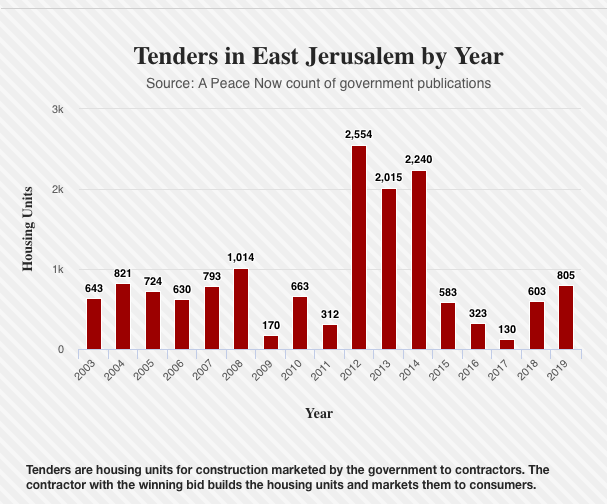 On May 30th, the Israel Land Authority published tenders for a total of 805 new settlement units in East Jerusalem, a decisive step towards the start of construction. The 805 tenders were issued for 345 units in the Ramot settlement and 460 new units in the Pisgat Ze’ev settlement. These are the first tenders published for East Jerusalem settlement construction since April 2018, and collectively are the most tenders published in a single year (let alone simultaneously) since 2014. Moreover, as Jerusalem expert Daniel Seidemann explains, this batch of tenders allows for more construction in East Jerusalem settlements than the government has approved for East Jerusalem Palestinian neighborhoods since Israel gained control of East Jerusalem in 1967.
Furthermore, the Jerusalem settlement watchdog group Ir Amim warns that this batch of tenders may only be the first of an oncoming wave:
“For several years after the collapse of the Kerry initiative in April 2014, there was a significant decrease in the approval of master plans in East Jerusalem and as a result, few tenders were announced. This dramatically changed in 2017 and 2018 with the advancement of master plans reaching near record levels. Today’s tenders are primarily a result of plan approvals from last year, potentially signaling impending large-scale announcements of tenders based on additional plans which have been approved over the last year.”
Peace Now, the veteran settlement monitoring organization, said in a statement:
“Continued construction in East Jerusalem does not contribute to Jerusalem and does not contribute to Israel. As long as we have not reached a permanent agreement with the Palestinians on Israel’s borders, building beyond the Green Line is illegitimate and only harms the prospects for peace and trust between the sides.”
The World Zionist Organization Continues to Finance Illegal Settlement Construction
According to documents acquired by Israel’s Movement for Freedom of Information, over the past two years the Settlement Division of the World Zionist Organization continued to finance illegal settlement construction while simultaneously trying to hide this information from the public.
As a reminder, the Settlement Division is technically part of the World Zionist Organization, but in practice the unit was created by the Israeli government in 1968 and is funded entirely by the Israeli government (and Israeli taxpayers). Its mandate is to manage West Bank land expropriated by Israel, in order to facilitate the settlement of Israeli Jews in the occupied territories. To make this possible, the Israeli government has allocated approximately 60% of all “state land” in the West Bank to the WZO’s Settlement Division [over the past 50 years Israel has declared huge areas of the West Bank to be “state land,” including more than 40% of Area C, where most of the settlements are located]. Together, the WZO and the Israeli government work in coordination to develop West Bank settlements and encourage Jews to move into them, working together so closely that the Settlement Division even splits its real estate profits with the Israeli Housing and Construction Ministry.
According to the WZO’s financial documents for 2017-2018, the WZO subsided settlement projects that are illegal under Israeli law — to the tune of $734,577 USD (NIS 2,668,427).
In addition, the WZO failed to specify how it spent an additional USD $16 million (NIS 58 million) in support of new construction projects, leaving the exact location and legal status of the construction unknown. This represents 43% of the WZO’s overall budget for subsidizing projects.
The settlement projects known to have been subsidized by the WZO in 2017-2018 include:
-
- $640,000 USD (NIS 2,330,973) for the establishment of a community center in the Eli settlement. Though the Eli settlement previously received Israeli government approval, a “Master Plan” – which officially zones land for distinct purposes (residential, commercial, public) – has never been issued for Eli, meaning all construction there is illegal under Israeli law.
- $85,816 USD (NIS 311,736) on projects in the unauthorized Brosh outpost (the Israeli government is advancing a plan that would legalize Brosh retroactively, but until it does, all projects in it are illegal).
- $42,000 USD (NIS 153,127) for infrastructure development in the unauthorized Givat Eitam/E-2 outpost, which according to Peace Now appears had not been transferred as of the end of 2018. FMEP has covered the settlers efforts to establish the Givat Eitam/E-2 outpost and the government’s plan to retroactively authorize it as an official settlement in detail. It is worth recalling that the location of the Givat Eitam/E-2 has dire geopolitical consequences for the fate of the two state solution as well as the development of Palestinian communities just south of Bethlehem.
- $6,000 USD (NIS 22,445) for projects in the unauthorized Mitzpe Kramim outpost. Funding for Mitzpe Kramim over the past two years is particularly galling, given ongoing litigation that has included evidence that the Settlement Division knowingly gave land privately owned by Palestinians to settlers in order to build the outpost.
- $900 USD (NIS 3,273) for renovation of illegal structures in the unauthorized outpost of Haresha. The Israeli government has successfully used the Haresha outpost as a test case for new legal tools the government of Israel developed in order to justify the expropriation of privately owned Palestinian land in order to retroactively legalize outposts. Using these tools, the government has found a way to “legally” build an access road to the settlement through privately owned Palestinian land; once the road is built, there is nothing preventing the government from retroactively legalizing Haresha.
Peace Now said in a statement:
“The Settlement Division is a body that was born in sin immediately after 1967 in order to carry out the dubious works of building settlements for the government. It turns out that even today, after regulating the activities of the Settlement Division, it still operates without transparency and continues to finance illegal activity. The time has come to dismantle the Settlement Division and to restore to the government the governmental activities it has privatized.”
Despite the WZO’s ongoing defiance of Israeli planning and building laws — or perhaps in light of its direct and very effective role in entrenching and expanding the settlements — the Israeli government is actively seeking to transfer more West Bank land to the WZO for management. In the last Knesset session, a government-backed bill to expedite the transfer of more land to the WZO was stalled by the Israeli Attorney General only because the bill, in the view of the Attorney General, was duplicative of his own efforts to enrich the Settlement Division at the administrative level.
Yitzhar Settlers Attack Israeli Police Officers, Again
On May 26th, dozens of masked Israeli settlers violently attacked Israeli police officers who approached an illegal outpost near the settlement of Yitzhar, forcing the Israeli army to intervene in order to get the police officers to safety.
Not a single settler was arrested for the attack.
The event started when Israeli police arrived at the Kippah Sruga outpost in response to calls saying that clashes had broken out between Palestinians and Israelis in the area. According to Israeli police, when they arrived masked settlers began launching stones at them and slashed their car tires with a knife.
Haaretz reporting on this incident reminds readers:
“Over the past several weeks, settlers from Yizhar and surrounding settlements have been involved in several altercations, yet police have not arrested a single suspect. Last week, Israelis and Palestinians reported a field set ablaze and clashes in the Palestinian towns of Burin, Urief and Asira al-Qibliya. In a video disseminated by Asira al-Qibliya’s council, settlers are seen throwing stones at Palestinians, while soldiers nearby do nothing to arrest them. In response to the video, the IDF spokesman said that ‘Palestinians started a fire near Asira al-Qibliya. The IDF, the Border Police and civilian volunteers worked to extinguish the fire, which was spreading towards a military position and the edge of Yitzhar.’ After a B’Tselem video surfaced, showing settlers setting fire to fields, the army revised its response and confirmed that Jewish settlers also took part in setting fires.”
Israel Cut-Off & Trapped a Palestinian Family on the Israeli Side of the Wall, Then Banned Them from Entering Israel
On May 27th, Haaretz published a gut wrenching profile of the Hajajla family who lives on the Israeli side of the separation wall that cut them off from their hometown of al-Walajah, a Palestinian village just south of Jerusalem. Two days after publication of the profile – which FMEP shares in brief below – Israel issued an order banning the patriarch of the family, Omar Hajajala, from entering Israel, though he lives on the Israeli side of the wall in a spot where the route of the wall juts into the West Bank.
Before jumping into the full story, here is a reminder about the situation facing all of the residents of al-Walajah, in the words of Danny Seidemann:
“Walajeh is a village on Jerusalem’s southern flank that is entirely surrounded by the separation barrier. Since 1967, Walajeh’s inhabitants have lived in a Kafka-esque situation, with their village technically located inside Israel’s expanded borders, but with villagers never given Israeli residency (they are considered West Bankers and thus are not permitted inside Jerusalem). As a result, the villagers’ presence in their own village is, under Israeli law, illegal, and their homes there are, by definition, illegal.”
The Hajajla family was the only home in al-Walajah disconnected from the village when the separation barrier was built, leaving the family home on the Israeli side of the wall since 2014. The family refused to abandon their home despite the coercive and legal efforts by Israel to force them to do so. In 2014, after a petition before the High Court of Justice, the Defense Ministry opted to build the family a special passage underneath the barrier so it could reach the village, at a cost $1.1 million USD (NIS 4 million).
After the tunnel was constructed, the Israeli government began to impose new, burdensome, and compounding restrictions on the family regarding its use of the passageway. In 2017, the government decided to install a locked gate at one end of the passageway to control who enters and exits, which could be opened only by a single remote control given to the family. That single remote meant that whenever one member of the family left the home (impossible without taking the remote control with them), the rest of the family was left trapped, literally, until the remote-holder returned.
To make the situation more workable, Omar Hajajla, the family’s patriarch rigged an electric bell near the gate so that the single remote control can stay at the house while family members leave and return (the bell enables someone in the home to know that someone is at the gate needing to be let in). The bell has been in place for over a year, but only recently the Israeli Border police opted to make it an issue. This month, the police took Omar in for questioning and changed the lock so that the family could not open the gate at all. Omar Hajajla was ultimately fined and released, but the lock on the gate remained — until Haaretz filed an inquiry on May 26, 2019.
Omar Hajajla speculates that a recent court ruling in his family’s favor prompted the Israeli Border police to escalate their harassment of the family and make an issue of the bell. About a month ago, the Jerusalem Magistrate’s Court rejected the state’s assertion that the family’s home is illegal – allowing the Hajajla family to stay put.(Note: The state of Israel has initiated demolition proceedings against dozens of homes in al-Walajah claiming that they were built without Israeli building permits – which are next to impossible for Palestinians to obtain, let alone Palestinians on coveted land like al-Walajah) –
In response to the May 27th Haaretz profile, Israeli police stated:
“At issue is a security passage that provides a short passage for the family from their home in Israeli territory to the Palestinian Authority areas. As you can see from the attached video and photos, the gate was shut last Monday to repair security cameras that were broken, to repair damage to the gate and to remove an electric bell that the father of the family had installed against the law, by attaching an unapproved electric wire from his home, a distance of dozens of meters from the passage. After the repair the passage was opened on Wednesday but when the father was seen exploiting it to illegally allow Palestinians to enter it was shut again and the suspect was taken for questioning. The passage was opened again yesterday, but because of a technical problem that was discovered it was shut again and we are working to fix it quickly. The Israel Police will not allow any damage to the security passages it is responsible for and will bring to justice anyone who vandalizes them and tries to harm the State of Israel’s security.”
The treatment of the Hajajla family should be seen in context of Israeli efforts to seal off al-Walajah from Jerusalem. As FMEP has previously reported, residents of al-Walajah have long been struggling against the growing encroachment the nearby Etzion settlement bloc and the Israeli government’s attempt to de facto annex the bloc as part of “Greater Jerusalem.” Ir Amim explains several prongs of this effort, including a particularly problematic section of the separation barrier around al-Walajah that has been planned in order to (a) almost completely encircle the village, (b) turn its valuable agricultural land into an urban park for Jerusalem, and (c) enable construction of a highway that will connect the Etzion settlement bloc to Jerusalem with Israeli-only bypass roads.
Palestinians React to Latest Annexation Rumors Amidst Israeli Government Chaos
Al-Monitor reports reactions from Palestinian leaders who are increasingly fearful that rumors about Israeli annexation of the settlements will be acted upon. Those rumors – as FMEP wrote last week – suggest that Israel will strip the Israel Civil Administration of its authority over the settlements and bring all settlements under Israeli domestic law, making settlement affairs the responsibility of the various Israeli ministries.
Wasel Abu Youssef, member of the PLO Executive Committee in the West Bank, told Al-Monitor:
“Expanding the powers of the Israeli ministries at the expense of the civil administration is an attempt to impose occupation and establish it in the West Bank, to end the [idea of a] two-state solution and prevent the establishment of a Palestinian state, which falls within the framework of denying the Palestinian people their rights to freedom and independence. These efforts mean practically annexing parts of the West Bank to Israel. Unfortunately, this comes with the blessing of the administration of US President Donald Trump, who doesn’t recognize the option of a two-state solution and gives Israel the green light to do whatever it wants in the West Bank.”
Walid Assaf, head of the Colonization and Wall Resistance Commission, told Al-Monitor:
“The efforts to transfer the powers of the civil administration to the Israeli ministries directly mean the annexation of the West Bank settlements to Israel. This will lead to annexing Area C — which amounts to over 60% of the entire area of the West Bank — to Israeli sovereignty…Annexing West Bank settlements to Israel would pave the way for Israel to perpetuate a policy of ethnic cleansing against the Palestinians, and this will push the Palestinians in Area C to migrate to PA-controlled Areas A and B.”
Hanna Issa, an international law professor at Al-Quds University in Abu Dis, told Al-Monitor:
“The Israeli occupation has always been there. It is essential that the Palestinian territories [including the Israeli settlements] remain administered through the civil administration of the Israeli army [in cooperation with the Palestinians] until this occupation ends…“Limiting the powers of this administration and giving its responsibilities to the Israeli ministries is a dangerous step aimed at annexing occupied areas under international law.”
Scheindlin: Israel’s Democratic Decay is Happening for the Sake of Annexation
In a new paper for The Century Foundation, Israeli pollster and political analyst Dahlia Scheindlin writes an important analysis regarding Israel’s path to annexation:
“This report argues that Israel’s slide into illiberal democracy can only be understood as part of an attempt to go beyond military or physical control and establish a political and legal foundation for permanent annexation of both land and people. The assault on Israel’s democratic norms over the past decade initially appeared only indirectly related to a future of permanent annexation, as they suppressed the mechanisms of dissent and undermined the basis for minority rights. Then, in the recent elections, Prime Minister Benjamin Netanyahu made explicit his goal to annex occupied territory in the West Bank, which represented the culmination (to date) of increasingly open policies and legislative initiatives from the previous term that explicitly advance annexation.”
The entire paper is worth reading, and is available online here.
Florida Governor Leads Headline-Grabbing Trade Delegation to West Bank Settlements
From May 25-31, Florida Governor Ron DeSantis led a trade mission – purposefully and prominently also visiting settlements in the West Bank. While on the ground, DeSantis made headlines by blasting BDS, endorsing Israeli settlements, and gloating about Florida’s role in AirBnB’s reversal of its decision to remove rental listing located in Israeli settlements.
DeSantis signed several formal partnerships between Florida universities and Israeli schools, most notably including an agreement between Florida Atlantic University and Ariel University – the first such deal between a U.S. school and an Israeli school located in a settlement. In recognition of the historic deal, Ariel University presented DeSantis with an Honorary Fellowship Award at an event in the settlement, attended by U.S. casino magnates and settlement financiers Sheldon Adelson and Dr. Miriam Adelson. In his acceptance speech, the Governor invoked the Bible to lend his support for Israel’s permanent control of the West Bank, saying:
“We are now in the heart of the Holy Land of Israel. When you think about Israel’s history and the tradition that connects Israel and the U.S., it’s inspiring. On my last visit to Israel in 2014, the U.S. embassy was in Tel Aviv and we were on the verge of signing a destructive agreement with Iran, and I am happy that today we have achieved real progress. We have an American embassy in Jerusalem with an American acceptance of the sovereignty of the State of Israel on the Golan Heights and the agreement with Iran has been removed from the stage of history. I, personally, have fought Airbnb’s discriminatory policy against Jewish-owned properties in Judea and Samaria, and only recently have they changed their discriminatory policy. I say here: BDS has no place in Florida. The memorandum of understanding signed today between the University of Ariel and Florida State University is a blessed agreement that will bring these two institutions forward. I am happy to say that Florida is a very diverse state, but not when it comes to its unequivocal support for the State of Israel.”
U.S. Ambassador to Israel David Friedman also hosted DeSantis for a reception and Israel’s Minister of Public Security Gilad Erdan joined DeSantis on a visit to additional West Bank settlements, this time in Gush Etzion, for a briefing about the fight against BDS. Friedman said:
“Israel has no greater friend in all the 50 governor mansions than Ron DeSantis. I welcome you and the Cabinet members and your delegation to this small but incredibly important country.”
As mentioned by Ambassador Friedman, DeSantis was joined by members of the Florida Cabinet on the trade mission, including Florida Attorney General Ashley Moody and Florida Agricultural Commissioner Nikki Fried. In a controversial move, DeSantis convened a Florida cabinet meeting on May 29th at the Embassy in Jerusalem, despite a lawsuit filed in Florida seeking to stop him from doing so. The lawsuit was filed by a government watchdog group and several news outlets, arguing that convening the Cabinet in Israel violated a state law that requires government meetings to be accessible to the public. The lawsuit was dismissed because the court could not serve paperwork to DeSantis and the other named defendants – who were, obviously, in Israel.
At the Cabinet meeting on may 29th, DeSantis signed a bill to prohibit anti-Semitism in Florida’s public schools and universities. The new law wrongly conflates anti-Semitism with criticism of Israel by including in the definition of anti-Semitism, “drawing comparisons of contemporary Israeli policy to that of the Nazis,” ″blaming Israel for all interreligious or political tensions,” and/or “requiring behavior of Israel that is not expected or demanded of any other democratic nation.”
The next day, DeSantis met with Prime Minister Netanyahu while the larger delegation visited the City of David national park, which is run by the radical Elad settler group.
Bonus Reads
- “Israel’s High Court Seeks Order, Not Justice” (Haaretz)
- “Another Company Withdraws from Israeli Light Rail Project” (IMEMC)
Welcome to FMEP’s Weekly Settlement Report, covering everything you need to know about Israeli settlement activity this week.
To subscribe to this report, please click here.
February 1, 2019
- Jerusalem Cable Car Plan Advances Again, Despite Israel’s Refusal to Release Report Justifying its Necessity
- Bibi Tells Settlers: Evacuating Illegal Outpost Was A “Mishap,” Will Never Happen Again
- Bibi Cancels Mandate for International Observer Force in Hebron
- WZO Caught Giving Mortgages for Illegally Built Settlement Homes, Again
- Amnesty International: Online Tourism Companies Are Enabling and Profiting from Occupation
- Israel Arrests Settler for 2018 Murder of Palestinian Woman; Settlers Respond with More Attacks on Palestinians
- Roseanne Barr’s 2019 Israel Victory (and Settlement Propaganda) Tour
- Bonus Reads
Questions/comments? Email kmccarthy@fmep.org
Jerusalem Cable Car Plan Advances Again, Despite Israel’s Refusal to Release Report Justifying its Necessity
The Israeli Interior Ministry announced its plan to deposit the Jerusalem cable car plan for public review on February 1st, which will mark the beginning of a 60-day public commenting period. At the close of the public commenting period (appx. April 1st), the National Infrastructure Committee (NIC) will consider objections submitted against the plan as part of the process of granting it final approval.

Map by Terrestrial Jerusalem
As FMEP has previously covered, the Jerusalem cable car project is an initiative of the Elad settler organization (which is building a massive tourism center – the Kedem Center – in the Silwan neighborhood, which will be a stop along the cable car’s route). The cable car project is intended to further entrench settler activities and tourism sites inside the Silwan neighborhood of East Jerusalem while simultaneously delegitimizing, dispossessing, and erasing the Palestinian presence there.
The NIC is a body within the Finance Ministry that fast-tracks projects deemed a national priority, circumventing the scrutiny and delays that are part of the normal planning processes for non-priority plans. In order to justify the cable car line, the Israeli government has advanced the project as a public transportation “solution” to address traffic congestion in and around the Old City and to serve the needs of everyday residents of Jerusalem (the government actually changed a law in order to give the NIC jurisdiction over its planning process). The government has so far refused to release an internal economic feasibility report supposedly backing up that claim.
Israeli experts counter that the plan manifestly has nothing to do with the transportation needs of the city and its residents. Non-governmental groups like Emek Shaveh, Who Profits, and Terrestrial Jerusalem have repeatedly discredited the government’s line, and have clearly enumerated the obvious political drivers behind the plan, the archeological heresies it validates, and the severe impacts the cable car project will have on Palestinian residents of Silwan if implemented.
Emek Shaveh released a statement this week once again explaining:
“The cable car plan is a political ploy aimed at strengthening the Elad [settler] association in Silwan and the tourist sites that present the Jewish past, like these sites, the cable car will contribute to rendering the Palestinian presence in the region invisible. The passengers and tourists arriving at the Western Wall by cable car will descend at the station of Elad’s Kedem Center and from there continue through an underground passage to the Western Wall, thus moving from one Jewish area to another without seeing and sensing the presence of Palestinian residents and the Arab spaces of Jerusalem. Although the entrepreneurs tend to present the cable car as a transportation initiative, to the best of our understanding, based on the extensive information we have gathered, the plan will not provide a transportation solution at all. It is not coordinated with the Ministry of Transportation and, by its very nature, cannot serve as part of the mass transportation system for Jerusalem, which is under the jurisdiction of the Ministry. These basic facts refute the entrepreneurs’ claims that the cable car will constitute a transportation solution. Furthermore, the actual plan that was deposited lacked any content by which it could be considered a transportation plan…We at Emek Shaveh, together with a coalition of organizations and individuals, will not be deterred from the struggle against the cable car project. As we have stated in the past, this is a destructive plan for Jerusalem. The cable car clashes with the character and uniqueness of Jerusalem as a historical and religious city for the three religions and promotes the political interests of the settlers in Jerusalem’s Arab neighborhoods.”
Following the public deposit of the plan, Jerusalem expert Daniel Seidemann, who has also written extensive critiques of the cable car project, wrote:
“this project is part of the government’s and settlers’ joint efforts to aggressively promote an agenda that seeks to marginalize and to the greatest extent possible over-write the Palestinian presence in Old City and Historic Basin, replacing it with a Biblical-Jewish Disneyland. Both the project itself and the context of its approval – celebrating the ‘reunification’ of the city in a location that is at the core of the tensions between Israel and the Palestinians – are blunt statements that Israel is determined to take ownership over Jerusalem holy sites, in total denial of the sensitive nature of the place for faiths other than the Jewish one.”
The Israeli non-governmental organization Who Profits – which produced a detailed brief on the cable car project and the French engineering company that has been contracted to design it – also released a statement, saying:
“If carried out, the cable car project would give a major boost to the settlement tourism industry in East Jerusalem and strengthen the ongoing Judaization and ethnic cleansing of the Palestinian neighborhoods of Silwan and the Old City.”
Bibi Tells Settlers: Evacuating Illegal Outpost Was A “Mishap,” Will Never Happen Again
Hitting the campaign trail, Prime Minister Benjamin Netanyahu promised that Israel will never evacuate settlements or outposts again. His promise was notable not only for its content, but also for when and where he delivered it: during a meeting with settlers as part of a high-profile visit to the site of an illegal outpost.
The outpost in question, Netiv Ha’avot, was the center of a lengthy battle which culminated in the Israeli government evicting settlers from a number structures, after the Israeli High Court ruled the structures were built on land privately owned by Palestinians.
Addressing the settlers (ones living in structures also built illegally, but permitted to remain in place since the land on which they were built is not recognized by Israel as privately owned by Palestinians), Netanyahu called the court-ordered evacuation and demolitions in the outpost as a “mishap” that would not happen again. Netanyahu went on to say.
“As far as I am concerned, there will not be any more uprooting of communities or the cessation of (building in) communities, but rather the exact opposite. The Land of Israel is ours and it will remain ours. What has fallen will be rebuilt. It is ours. We are building here, and you are living here.”
Indeed – Israeli lawmakers are working assiduously to prevent any future court-ordered evacuations of outposts and illegal settlement structures, as FMEP details in its comprehensive tracking of such moves. The Israeli cabinet recently endorsed a bill that gives the government 2 years to retroactively legalize 66 outposts across the West Bank, including Netiv Ha’avot. The bill also directs the government to immediately begin treating those outposts as if they are legal, meaning that if the bill becomes law, the illegal outposts will be connected to Israel water and electricity grids, receive municipal services, and receive government-approved and government-funded budgets. The bill also allows the finance minister to guarantee mortgages in the outposts.
The Israeli government is also planning to retroactively legalize and expand the Netiv Ha’avot outpost – proving once again that Israel not only doesn’t punish settler law-breaking, it rewards it. FMEP has previously covered how the Israeli government has exploited the evacuation of settlers from 15 homes in the Netiv Ha’avot outpost as an opportunity not only to advance construction in another settlement (Elazar), but also to build an entirely new outpost as “temporary” housing for the settlers. The “temporary” outpost – where 15 mobile homes have been placed and are connected to Israeli water, power, sewage, roads, and other infrastructure – is located outside the borders of the Alon Shvut settlement. That fact did not stop the High Planning Council (a body within the Israeli Civil Administration, which regulates planning and building in the West Bank) from approving the plan, noting that “the plan is improper, but we will have to approve it as a temporary solution.” As part of its approval of the plan, the Council ordered the government to take steps towards expanding the borders of the Alon Shvut settlement to include the outpost, underscoring the meaninglessness of the word “temporary” in this context.
Bibi Cancels Mandate for International Observer Force in Hebron
On January 28th, Prime Minister Netanyahu announced that he will not renew the mandate allowing the Temporary International Presence in Hebron (TIPH) to continue to operate. The TIPH has been observing and documenting incidents between Palestinians, settlers, and the Israeli army in Hebron since 1997 – when Netanyahu (who was then in his first stint as Prime Minister) signed the Hebron Protocols which laid out arrangements for a divided Hebron. Many Israeli lawmakers, including Netanyahu, have levied heavy criticism against the TIPH over the past year, particularly after an internal TIPH report was leaked in December 2018 that detailed Israel’s “severe and regular” breaches of international law in Hebron.
Peace Now said:
“Netanyahu is frightened. He is so afraid of the settlers that he gives in to a fringe agenda that only harms Israel. The removal of TIPH whose only role is to observe, puts Israel in line with countries like Iran and China, which are afraid of criticism and have something to hide”
Senior Israeli politicians have ratcheted up calls for annexation of Hebron. Most recently Knesset Speaker Yuli Edelstein participated in a conference focused on the goal of establishing Israeli hegemony over Hebron.
Avner Gvaryahu, President of Breaking the Silence – a group which regularly guides tours for tourists willing to see the impact of Israelis settlers and policies in Hebron – told Al-Monitor:
“This isn’t just about the observers. It is part of a much broader and bigger effort…There is a deep-rooted process underway to empty downtown Hebron of its Palestinian residents and turn it into a ghost town.”
Indeed, over the past year Israel advanced numerous settlement plans entrenching and expanding the Israeli settler presence in the city’s most sensitive areas, including plans for the first new settlement construction in Hebron in 16 years. Those settlement plans are:
- Advancing a plan for a new settlement industrial zone inside of the boundaries of the Kiryat Arba settlement, but in a location that is not contiguous with the built-up area of the settlement (expanding the footprint of the settlement on the ground).
- Advancing plans for a new settlement to be located above the historic Palestinian vegetable market in downtown Hebron.
- Approving a plan to build a new 31-unit settlement at the site of an Israeli army base in downtown Hebron.
- Creating and funding a new settler municipal body for the settlers living in small enclaves in downtown Hebron.
WZO Caught Giving Mortgages for Illegally Built Settlement Homes, Again
The Israeli settlement watchdog NGO Kerem Navot discovered yet another case where the World Zionist Organization (WZO) provided a mortgage for an illegally built settlement structure, in this case a house in the Eli settlement, “owned” by a settler named Gilad Ach. Ach heads the radical Ad Kan organization which is known for infiltrating organizations that are working to end the occupation in order to undermine them. FMEP has repeatedly covered reports of evidence that the Settlement Division of the WZO (which is entirely funded by Israeli taxpayer money) engages breaks Israeli law in order to advance the settlement enterprise; this latest report continues to add to that body of evidence.
In the case of Ach’s house in Eli, the WZO decided to issue the mortgage despite the fact that not a single structure in the Eli settlement is legal. Though the Eli settlement has received Israeli government approval, a “Master Plan” – which officially zones land for distinct purposes (residential, commercial, public) – has never been issued. Meaning, Ach’s house lacks a valid building permit.
Kerem Navot told Haaretz:
“As is known, Gilad Ach works energetically to promote law enforcement and transparency, and therefore we are certain that he would be pleased to know that in the settlement of Eli, where he lives, the Settlement Division is granting mortgages for the purchase of homes in violation of the law. We are convinced that Ach and his organization, Ad Kan, will act diligently to eliminate this serious phenomenon as they have done in other instances in the past in which there has been suspected violation of the law.”
Despite the WZO’s criminal track record, the Israeli government is actively transferring more land in the West Bank over to the WZO for management. A government-backed bill to expedite the transfer more land to the WZO was recently stalled in the Knesset by the Israeli Attorney General, who assured the Knesset that the legislation was unnecessary because the transfer was already proceeding at the administrative level.
As a reminder, the WZO’s Settlement Division was created by the Israeli government in 1968 and is funded entirely by Israeli taxpayers. Its mandate is to manage West Bank land expropriated by Israel, in order to facilitate the settlement of Israeli Jews in the occupied territories. To make this possible, the Israeli government has allocated approximately 60% of all “state land” in the West Bank to the WZO’s Settlement Division [over the past 50 years Israel has declared huge areas of the West Bank to be “state land,” including more than 40% of Area C, where most of the settlements are located].
Amnesty International: Online Tourism Companies Are Enabling and Profiting from Occupation
Amnesty International (AI) published a new report – entitled “Destination: Occupation” – outlining how AirBnb, Booking.com, TripAdvisor, and Expedia (the largest global online booking and travel companies) are fueling human rights violations and the expansion of settlements through their decision to list rental properties located in Israeli settlements in the occupied West Bank and East Jerusalem.
In a press release about the report, Seema Joshi, AI’s Director of Global Thematic Issues, said:
“Israel’s unlawful seizure of Palestinian land and expansion of settlements perpetuates immense suffering, pushing Palestinians out of their homes, destroying their livelihoods and depriving them of basics like drinking water. Airbnb, Booking.com, Expedia and TripAdvisor model themselves on the idea of sharing and mutual trust, yet they are contributing to these human rights violations by doing business in the settlements. The Israeli government uses the growing tourism industry in the settlements as a way of legitimizing their existence and expansion, and online booking companies are playing along with this agenda. It’s time for these companies to stand up for human rights by withdrawing all of their listings in illegal settlements on occupied land. War crimes are not a tourist attraction.”
AirBnB, one of the companies scrutinized both by AI and in a complementary report published by Human Rights Watch, announced in November 2018 that it would no longer list properties located in Israeli settlements in the West Bank, excluding about 100 listings in East Jerusalem settlements. The AI report calls on AirBnB to extend its decision to East Jerusalem settlement listings. The report goes on to detail settler activities in the East Jerusalem neighborhood of Silwan, showing how TripAdvisor in particular is supporting settlers and their initiatives. The report observes:
“…at the time of writing, TripAdvisor featured the City of David and Elad prominently. TripAdvisor did not just provide its standard listings and page for reviews (where the City of David is ranked ‘#15 of 318 things to do in Jerusalem’), but also promoted four tours which feature the City of David and are managed by Elad. These include tickets to an underground tour for US$11, a ‘Night-Time Spectacular Show’ for US$18 and a “2 hour Segway tour” for US$43. TripAdvisor allowed users to book and pay for these attractions through its site and charged a fee when a booking was made. By actively encouraging users to visit the City of David and take guided tours of the site, TripAdvisor has boosted Elad’s business and derived a profit itself from every booking made through its site. In this way, the company has contributed to the illegal situation created by the presence and growth of settlement enclaves in East Jerusalem. The company has also been a key participant in the expansion plans of the Israeli government and Elad in the city, which are putting the human rights of Palestinians at risk. It has also, arguably, heightened the risk of forced evictions.”
Israel Arrests Settler for 2018 Murder of Palestinian Woman; Settlers Respond with More Attacks on Palestinians
Despite political interference, on January 24th the Israeli Shin Bet announced that it had filed an indictment charging a settler with manslaughter, for the 2018 murder of Aisha al-Rabih. Rabih, a Palestinian mother living in the West Bank, was killed by a large rock thrown through the windshield of a car she was riding in with her family. The settler charged with the crime – based on DNA evidence – is a 16-year-old from the Rehelim settlement, where he attended yeshiva (Jewish religious school).
Following the indictment, violently skirmishes erupted in hotspots in the West Bank known for the activities of radical settlers.
- On January 26th, settlers living in the Adei Ad outpost reportedly approached the Palestinian village of al-Mughayir, resulting in clashes during which the settlers are believed to have shot and killed Hamdi Nassan. The murder resulted in widespread international attention and concern, though Israel has reportedly not yet questioned settlers who were present at the crime scene.
- On January 26th, video cameras caught settlers vandalizing property in Turmusaya – located within sight of the Adei Ad outpost in the Shiloh Valley.
- Clashes between IDF forces and Palestinians also erupted on January 27th at the entrance of Turmusaya. That morning, Israeli forces erected a new checkpoint along the road leading to Turmusaya in anticipation of a funeral parade for Hamdi Nassan, killed by settlers in al-Mughayir the day before. During the clashes, Israeli forces reportedly fired live ammunition, tear gas, and stun grenades at the Palestinians.
As a reminder, the illegal Adei Ad outpost is built on land that has historically belonged to Turmusaya. Yesh Din published a lengthy report chronicling how Adei Ad outpost settlers use violence as a means of land confiscation. Rewarding their criminality, in August 2018 the Israeli government approved a plan to included the Adei Ad outpost within the expanded borders of the Amichai settlement, the first new government-backed settlement in 25 years. The massive expansion of the Amichai settlement and the transformation of Adei Ad into a brand new settlement, if implemented, will be a significant step towards creating an uninterrupted corridor of settlements connecting sovereign Israel to the Ariel settlement, through the isolated Shiloh Valley settlements, all the way to the Jordan Valley. In so doing, It will completely bisect the northern part of the West Bank.
In response to the violence and the escalation in Israeli settlement planning, Michael Lynk, the United Nations Special Rapporteur for human rights in the occupied Palestinian territory, issued a statement on Wednesday saying in part:
“…Israeli forces, obligated to protect the Palestinian population under international humanitarian law, stand idly by while olive trees are destroyed, livelihoods are damaged, and even while people are injured or, at worst, killed. The events in the West Bank village of Al Mughayyir on 26 January are a sobering example of this extremely troubling phenomenon, where a Palestinian villager was shot dead in the presence of Israeli settlers and soldiers. These incidents not only violate numerous human rights such as the rights to life, security of the person, and freedom of movement of Palestinians, but also serve to expand the area of land over which Israeli settlers have control. It is impossible to square the international community’s rhetorical support for a genuine two-state solution with its persistent unwillingness to confront Israel with any meaningful injunctions to halt and reverse these steps towards annexation. The Israeli settlements are the engine of the 51-year long occupation. This occupation will not die of old age, but only with the resolute imposition of consequences on Israel for ignoring international law and numerous United Nations resolutions.”
Roseanne Barr’s 2019 Israel Victory (and Settlement Propaganda) Tour
Disgraced American actress Roseanne Barr was shepherded on a tour of Israeli settlements and settler installations by Rabbi Shmuley Boteach, a prominent American activist and settlement supporter. The two were accompanied by fawning senior Israeli politicians, including Culture and Sports Minister Miri Regev. Barr’s trip was funded by Rabbi Boteach’s group, World Values Network.
Barr’s tour – which she said was aimed at pushing back against the growing calls to boycott Israel and/or its settlements – included several public speaking engagements, a visit to the West Bank settlement of Peduel (a history of the Peduel settlement can be found here), a visit to the Muslim Quarter of the Old City to visit a home owned by the radical settler group Ateret Cohanim.
At one event, Barr compared the BDS movement to Nazi boycotts against Jews. Drawing headlines at another event, Barr said:
“There is no occupation. The only occupation I see is they built a dome on top of our Temple and I’m not allowed to pray at my holiest site.”
At a media spray at the Peduel settlement, Barr told the settlers:
“You are pioneers. The people of Samaria are standing on the front line of the State of Israel.”
Barr was famously fired from her eponymous tv show after she posted racist public comments posted to Twitter. Commenting on her firing to an Israeli audience, Barr joked that she was “BDSed by ABC,” suggesting that the real reason she was fired was Hollywood’s intolerance for her support for Trump (who is widely loved in Israel) and her Zionism.
Bonus Reads
- “Israel’s Growing Settlement Force Stark Choices About Its Future” (The Economist)
- “Can the Shin Bet Stop Hilltop Youths’ March to Armageddon?” (Al-Monitor)
- “Education According to Bennett: More Judaism, Less Democracy” (Haaretz)
- “I Was a Settler. I Know How Settlers Become Killers” (Haaretz)
- “Helipad Completed in Liberman’s Settlement, After His Exit From Defense Ministry” (Times of Israel)
Welcome to FMEP’s Weekly Settlement Report, covering everything you need to know about Israeli settlement activity this week.
To subscribe to this report, please click here.
August 31, 2018
- Setting a New Legal Precedent, Court Accepts “Market Regulation” Principle As Basis for Legalizing Outpost
- Shaked & Regavim Take Credit for Precedent-Setting Outpost Legalization Victory
- Another New Outpost – Continuing the Trend of Unannounced, Unopposed, & Highly Consequential Settlement Expansion
- Special U.S. Regulations Protect Israel’s Settlement Enterprise from Quality Aerial Documentation
- Bonus Reads
Comments, questions, or suggestions? Email Kristin McCarthy at kmccarthy@fmep.org. To subscribe to this report, please click here.
Setting a New Legal Precedent, Court Accepts “Market Regulation” Principle As Basis for Legalizing Outpost
Jerusalem District Court Ruling
On August 18th, Jerusalem District Court Judge Arnon Darel ruled in favor of retroactively legalizing the Mitzpe Kramim outpost, holding that privately owned Palestinian land can (and should) be expropriated for the settlements in instances where Israeli settlers built “in good faith” and with government support – a rationale called the “market regulation” principle. According to the ruling, the Court held that the parties responsible for the outpost – the Israeli government, the World Zionist Organization, and the settlers – all acted in “good faith.” Specifically, the Court held that the State acted in “good faith” even though it was negligent in its responsibility to protect the rights of Palestinians and correctly record/manage the status of land in the West Bank; and, that the settlers acted in “good faith,” even though they built the outpost without government authorization, without building permits, and without a master plan.
This is the first time an Israeli court has accepted the “market regulation” principle as a valid basis for legalizing outposts, setting a monumental new precedent according to which outposts that the government had previously been unable to legalize (because they were built on land recognized by Israel as privately owned by Palestinians) to petition for authorization. With this judgment, the public got a first glimpse of the incredibly broad interpretation of “good faith” that the Jerusalem District Court (now the court of first jurisdiction for land disputes in the West Bank) is inclined to apply on behalf of law-breaking settlers.
Peace Now released a statement saying:
“The court today chose to ‘align’ with the project of annexation and dispossession of the Israeli government led by the Netanyahu and the Jewish Home. It is absurd to attribute ‘good faith’ to the settlers of an illegal outpost whose homes were built illegally and without permits on private Palestinians land, because of a ‘mistake’ made by the authorities in allocating the land. The Israeli Authorities should protect the properties of the people under their control, and failing to do so cannot be used as an excuse to take the land from the Palestinian owners. Let us hope that the Supreme Court will erase this shame.”
Background on the Mitzpe Kramim Case
 The outpost at the center of the case – Mitzpe Kramim – was built in 1999 without government authorization on land near the Kochav Hashachar settlement, located deep inside the West Bank, closer to the Jordan River than sovereign Israeli territory. In the 1970s, land in the area was taken by the State of Israel by military order; subsequently, the land on which the outpost was built was allocated to the World Zionist Organization (WZO), apparently based on the (mistaken) assumption that the land in question was part of that military seizure. The WZO then gave the land to settlers, even issuing a certificate of ownership in their names. However, the land in question was not included in the military seizure of the 1970s, but was/is In fact recorded in the Land Registry as privately owned by Palestinians from the village of Deir Jarir. This fact should, under Israeli law, invalidate the government’s allocation of the land to the WZO, and the WZO’s grant of the land to the settlers.
In 2011, the registered Palestinian landowners filed a petition with the High Court of Justice to have the Mitzpe Kramim outpost removed from their land, only to see the settlers file their own petition in 2013 with the Jerusalem District Court (which froze the High Court’s consideration of the Palestinians’ petition), seeking to be registered as the rightful landowners. In their petition, the settlers – who are represented by Harel Arnon, the same lawyer hired to represent the Israeli government in its defense of the “Regulation Law” – argued that they are innocent victims of a mistake by the government, and as such should not be forced to bear the consequences of having built their homes on someone else’s land. Originally the Israeli government, admitting that the Civil Administration had made a mistake in mapping the area, argued that the settlers should be removed. In July 2018, the State completely reversed its stance, submitting a new argument to the Court citing the “market regulation” principle in defense of expropriating the land for the settlers.
In its ruling this week, the Jerusalem District Court gave legal validity to the newly invented “market regulation” basis for taking Palestinian land that had previously been impossible for the State to legally expropriate.
What’s Next?
Now that the Jerusalem District Court has ruled in favor of the settlers’ claim, the High Court of Justice is set to take up the original petition filed by the Palestinian landowners to have the outpost removed. Part of the High Court’s deliberations will now have to grapple with the new jurisprudence established by the Jerusalem District Court on the “market regulation” principle.
Regardless of whether or not the High Court allows the Jerusalem District Court’s ruling to stand, that ruling has already energized pro-settlement, pro-annexation Israeli policymakers and influencers, who (unsurprisingly) have lauded the ruling and urged more outpost legalization cases forward. The ruling also legitimizes the longstanding arrangement between Israel and the settlers: the government turns a blind eye to illegal settlement activity (including rebuffing efforts by settlement watchdogs to force it to take action, and when forced by the courts to take action, drags its feet to allow illegal activities to become more deeply entrenched), only to go to any lengths to authorize the illegal actions post-facto. This modus operandi allows Israel to circumvent the limitations of Israeli law, bureaucracy and international criticism, all of which would otherwise restrain (to some extent) unfettered settlement construction and land theft in the West Bank.
FMEP tracks the ongoing legislative, political, and legal transformations happening in the Israeli government to justify the expropriation of Palestinian land for the settlements in its Annexation Policy Tables. As a reminder, the “market regulation” principle was promoted by Israeli Attorney General Avichai Mandelblit, who offered it as an alternative to the legal basis provided in the “Regulation Law” to legalize unauthorized outposts and settlement construction.
Shaked & Regavim Take Credit for Precedent-Setting Outpost Legalization Victory
Celebrating the Jerusalem District Court’s ruling on the Mitzpe Kramim outpost case (covered above), Justice Minister Ayelet Shaked (Likud) said:
“The District Court today clearly stated that whoever settled [the land] with the state’s approval and in good faith, would not be evacuated. The injustice done in the evacuations of the Amona and Netiv Ha’avot [outposts] should not be repeated. The court should not be a party to the political debate between the Right and Left. That should be left to the ballot box. Through joint and intensive work, we have brought about a policy change in the state’s responses to the High Court of Justice. Now we are seeing a change in the district court.” [emphasis added]
Indeed, Justice Minister Shaked has led a years-long effort to re-make the judicial branch, injecting pro-settlement policies and figures into key positions within the Court system, with the explicit goal of protecting all Israeli settlements and outposts from any legal accountability for illegal actions. Part of that effort was her decision in 2015 to hire a private lawyer, Amir Fisher (who also represents the settler group Regavim), to essentially write the State’s responses to petitions before the High Court that deal with settlements.
As noted in the section above, the state of Israel reversed its own position vis a vis the future of Mitzpe Kramim in its 2018 submission to the Court, a reversal that happened after Fisher and Shaked were firmly in control of the State’s handling of outpost legalization cases. What’s more, Shaked installed a pro-settlement judge on the Jerusalem District Court (which issued the precedent-setting ruling this week), and then promoted legislation that strips the High Court of Justice of its primary jurisdiction over certain West Bank legal petitions (including Palestinian petitions relating to land disputes, travel permits, and building permits) and gave that jurisdiction to the Jerusalem District Court. Shaked is currently promoting another bill which would allowed the Knesset to reinstate any law struck down by the High Court of Justice. The Ministerial Committee on Legislation, of which Shaked and Education Minister Naftali Bennett are members, voted to give government backing to the bill in May 2018. The totality of Shaked’s efforts are documented, on an ongoing basis, in FMEP’s Annexation Policy Tables.
Shaked’s fellow travelers at Regavim released a statement following the Jerusalem District court ruling, emphasizing the far-reaching implications:
“This is a product of a long legal battle, run by the settlements and settling bodies. They asked to legalize outposts that were established by the State of Israel. This blessed decision is a historic one. We call upon the attorney general to apply the principles of this decision to all other outposts in Judea and Samaria that need regularization.”
The fruits of Shaked and Regavim’s work was applauded by many others in the government, including Education Minister Naftali Bennett (Jewish Home), who said the ruling was a:
“victory for decency and common sense, another step toward legalizing the settlements in Judea and Samaria and turning them into an integral part of the State of Israel.”
Culture Minister Miri Regev (Likud) said she was:
“happy that common sense and justice prevailed over cold formalism..[the ruling sends] a clear-cut message to the Palestinians and their collaborators from far-left organizations, that you don’t destroy and evacuate communities in the Land of Israel.”
Agriculture Minister Uri Ariel (Jewish Home) said:
“This is a blessed month of settlement, and after the decision of the Housing Cabinet to establish three new towns [in the Negev], comes the court’s decision regarding Mitzpeh Kramim. Such significant decisions strengthen and expand the settlement of the Land of Israel.”
Knesset speaker Yuli Edenstein (Likud) said:
“The determination and strong spirit of the people of Mitzpeh Kramim proved themselves. I welcome this just, requisite ruling from the District Court in Jerusalem. We will continue to strengthen settlement in Israel!”
Another New Outpost – Continuing the Trend of Unannounced, Unopposed, & Highly Consequential Settlement Expansion
Haaretz reports that settlers have built a strategic new outpost deep inside the West Bank near the settlement of Eli, in a bid to eventually annex privately owned Palestinian land that falls between Eli and pockets of “state land” in the area. The new outpost was built without Israeli permits on the outer edge of newly declared “state land,” some of which had been used as farmland by Palestinians. Haaretz notes a trend:
“Around the West Bank, settlers have been setting up farms near the outer edge of state-owned land, as in the case near Eli, in an effort to expand existing settlements. Even though they have been established without permission, no legal action has been taken against them.”
The Israeli Civil Administration – responsible for enforcing building laws in the occupied territory – told Haaretz that it is unaware of the new outpost. The Head of the Binyamin Regional Council (an Israeli municipal body responsible for settlements in the northern West Bank – recently proven to be bankrolling new outposts), Avi Roeh, denied that the Council was involved with the new outpost.
Map by WINEP
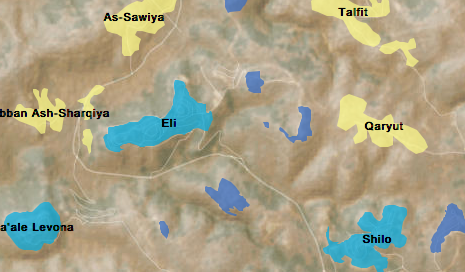
The new outpost is the fifth illegal satellite of the Eli settlement, stretching the band of Israeli settlements further and further east towards the Jordan Valley. Eli is located between the Ariel and Shilo settlements (both of which have seen tremendous growth and government support over the past two years – Ariel with its new medical school and Shilo with the promotion of the new Amichai settlement to its immediate east), in an area where settlers are working to connect settlements and outposts into a contiguous band of settlement stretching from sovereign Israeli territory all the way to the Jordan Valley.
As evidenced this week in the Israeli court system, the government – which consistently turns a blind eye to illegal outpost construction – is willing to go to great lengths to retroactively legalize outposts, even when the cost to Israeli taxpayers is enormous and even when doing so contradicts any notion of justice under the law.
Special U.S. Regulations Protect Israel’s Settlement Enterprise from Quality Aerial Documentation
Al-Shabaka published a new report this week detailing a little-known U.S. law that restricts companies from producing high quality satellite imagery of the West Bank. Al-Shabaka explains the significance of that limitation on U.S. companies like Google:
“Although the legislation was implemented under the pretense of protecting Israel’s national security, it is better characterized as an act of censorship. By deliberately blurring aerial images of Palestine-Israel, the [The Kyl-Bingaman Amendment (KBA) to the US National Defense Authorization Act] hinders the work of archaeologists, environmentalists, geographers, and humanitarians. It poses serious obstacles, not only for the preservation of cultural heritage, but also for holding Israel to account for land grabs, home demolitions, and settlement activity….While the legislation only applies to US companies, their hegemony in the commercial market for satellite imagery has elevated the legislation to de facto institutionalization on a global scale, affecting the access of researchers worldwide.”
The report can be accessed here.
Bonus Reads
- “The West Bank Model is a Failure” (The New York Times)
- “Israeli Taxpayers Bear Financial Burden of Evicting Illegal West Bank Outposts, And Sometimes, Making them Legal” (Haaretz)
Welcome to FMEP’s Weekly Settlement Report, covering everything you need to know about Israeli settlement activity this week.
To receive this report via email, please click here.
August 16, 2017
- Israel Demolishes Buildings in Key East Jerusalem Areas
- Bedouin are Powerless in E-1 Area as Settlement Plans Loom
- Jewish National Fund Resumes Targeting Land in the Occupied West Bank
- Settlers in Israeli Government Turn Blind Eye to Settlers Breaking Israeli Law
- Former Israeli AG Says Sheikh Jarrah Property Should be Given to Palestinians
- Three New Outposts Near Nablus
- Updates: Al-Walajah, Sheikh Jarrah, Amichai Settlement
- Bonus Reads
Comments, questions, or suggestions? Email Kristin McCarthy at kmccarthy@fmep.org.
Israel Demolishes Buildings in Key East Jerusalem Areas
The Israeli government demolished eight Palestinian structures in the East Jerusalem neighborhoods of Silwan, Beit Hanina, Jabal Mukaber, and Isawiyyah. According to Ir Amim, the two apartments demolished in the al-Bustan area of Silwan are the first demolitions to be carried out there since 2008. Looking at East Jerusalem as a whole, Ir Amim writes, “[these] demolitions bring the 2017 total to 128, including 84 residential units and 44 non-residential units. These numbers are on well on target to meet or surpass the total number of 203 demolitions executed in East Jerusalem last year.”
Bedouin are Powerless in E-1 Area as Settlement Plans Loom
According to B’Tselem, last week Israeli officials confiscated solar panels that were providing electricity to a Bedouin community’s school in the controversial area adjacent to Jerusalem known as “E-1.” The confiscation happened despite a temporary court-ordered injunction against it. The Israeli government has long refused to connect the Bedouin to a power grid; the solar panels confiscated this week were donated only a month ago by a humanitarian organization.

Map by the Economist
The E-1 area has long been slated for Israeli settlement construction, but plans have been continuously delayed by the Israeli political echelon – due in large part to pressure from U.S. administrations and others in the international community. If E-1 is developed it will seal Palestinian East Jerusalem off from the West Bank to its east, and create a land bridge from Jerusalem to the Maale Adumim settlement. The settlement will render the two-state solution impossible because it would preclude the ability to draw contiguous borders for a future Palestinian state with a capital in East Jerusalem.
East Jerusalem expert Danny Seidemann has issued several warnings this year that E-1 – a “doomsday settlement” – might be slated for advancement under the current settlement policy of the Netanyahu government and with no discernable counter-pressure from the Trump Administration. Seidemann warned in January, “The main obstacle preventing a green light for E-1 has, until now, been wall-to-wall opposition from the international community, led by the United States (dating back to the era of President Clinton).”
The Bedouin community living in the E-1 area has long been threatened with forcible relocation (which would amount to population transfer). The 18 Bedouin tribes that live in the vicinity of Maale Adumim and E-1, totaling approximately 3,000 people, have already endured numerous emolitions this year alone.
Jewish National Fund Resumes Targeting Land in the Occupied West Bank
According to Peace Now, the Jewish National Fund (JNF) is set to resume its practice of purchasing land in the West Bank for use by Israeli settlers, after abandoning the effort many years ago. In the past, many of the JNF’s land purchases reportedly involved fraud, extortion, and/or forgery on the part of middlemen.
Peace Now writes, “Through purchasing lands in the occupied territories, JNF serves the settlers, hurts the possibility to arrive at a two state solution, and jeopardizes the future of Israel as a Jewish and democratic state.”
The JNF – which collects donations internationally, including in the United States – currently owns land (through its Israeli subsidiary) in numerous settlements, including Itamar, Alfei Menashe, Enav, Kedumim, Givat Ze’ev, Metzadot Yehuda, and Otniel.
Settlers in Israeli Government Turn Blind Eye to Settlers Breaking Israeli Law
There have been several recent reports about structures inside of settlements that were built (or are being built) without the legally-necessary permissions, as Israeli officials turn a blind eye.

Map of the Hayovel outpost by Times of Israel Red encircles site construction, arrow points to the house of Liberman’s settlement affairs advisor.
Notably, one report identifies dozens of unauthorized homes being built in the outpost of Hayovel (which is effectively an extension of the settlement of Eli), despite a stop-work order issued by Civil Administration (the arm of the Ministry of Defense that is sovereign in the West Bank). The construction is taking place virtually across the street from the home of Israeli Defense Minister Avigdor Liberman’s own adviser on settlement affairs, who is himself a resident of the illegal outpost (Liberman is also a settler, residing in the settlement of Nokdim). The illegal construction will double the size of the outpost.
Another report reveals that Shlomo Ne’eman, the head of the Gush Etzion Regional Council – which promotes the expansion of settlements in the Etzion bloc – lives in an illegal outpost. The Regional Council insists that the outpost is a “neighborhood” of the Karmei Tzur settlement, but aerial images show it is outside of the settlement’s municipal border. The Israeli Civil Administration has ordered the structures there to be demolished but has not carried out those orders. Settlement watchdog Kerem Naboth says, “Ne’eman has joined the list of elected officials and politicos among the settlers who are not only assisting others in stealing land, but are also doing it themselves.”
Haaretz notes that these two are part of a longer list of elected officials and senior civil servants living in illegal outposts, Also on that list far right-wing Knesset Member Bezalel Smotrich (Habayit Hayehudi), who lives in an illegally-built home in Kedumim (not coincidentally, Smotrich was one of the key backers of a law passed earlier this year to “legalize” such settlement illegalities). Likewise, a January report revealed that the head of the Finance Ministry’s department of building regulations enforcement, Avi Cohen, lives in an illegal outpost of the Eli settlement. At the time of the report in January, Rabbis for Human Rights said, “A situation in which the system responsible for enforcing building laws is headed by someone living in an outpost demonstrates contempt for the system and Israel’s values.”

Image by Kerem Naboth
Another report documents how in the Efrat settlement (in the Etzion settlement bloc) a school was recently expanded, illegally, on private Palestinian land located land outside of the settlement’s border. Funding for the project was raised by an organization, called the Ohr Torah Stone, which operates a branch in the United States and is eligible to receive tax-deductible donations from U.S. donors. According to settlement watchdog Kerem Naboth, the Efrat settlement itself was built on land that the Palestinian village of al-Khadr had long cultivated. Kerem Naboth reports, “aerial photographs from the 1980s indicate that in the past there was a vineyard on site.”
Former Israeli AG Says Sheikh Jarrah Property Should be Given to Palestinians
Speaking in Sheikh Jarrah, former Israeli Attorney General Michael Ben-Yair called on the Israeli government to intervene to stop the eviction of the Shamasneh family from their longtime family home. Ben- Yair served as the AG from 1993-1997, under prime ministers Rabin and Netanyahu.
Ben-Yair, whose family lived in Sheikh Jarrah until 1948, suggested he would be ready to reclaim his family’s property and then transfer it to the Palestinians currently living there – and called on the government to adopt a policy to do exactly that, across the board. He said, ”If the Israeli government would have acted decently toward all its residents, including you [the Arab residents], it would have appropriated the properties in the neighborhood [from their Jewish owners who lived there before the War of Independence] and given these properties to the Palestinians who live there today.”
The former AG also noted that Jews who lost property in the 1948 war were already compensated – at the expense of Palestinians. Ben-Yair said, “My family and the family of my cousin who were forced to leave the neighborhood in January 1948 got properties of Palestinians refugees on Jaffa Road and in the Katamon neighborhood in west Jerusalem. They were worth much more than the properties that we left in Sheikh Jarrah.
Since we covered the Shamasneh family’s story last week, a temporary injunction against the eviction expired on Sunday, August 13th. The family’s lawyer requested a second injunction, but the petition is still pending. As of this writing the family is still living in the home.
Three New Outposts Near Nablus
The Palestinian Authority is reporting that settlers from the radical Yitzhar settlement, south of Nablus, have moved 11 mobile homes to an area outside of the settlement, a move which would expand the settlement’s footprint. In addition, nine mobile homes were reportedly placed near the Palestinian village of Qusin, which is a few miles east of Nablus, and another nine were placed near the border of the Einav settlement, a few miles east of Qusin.
Updates: Al-Walajah, Sheikh Jarrah, Amichai Settlement
Updates from last week’s Settlement Report:
- Residents of the village of Al-Walajah were able to stop the demolition of one home last week by forming a human barrier around it, blocking a bulldozer from tearing it down. Approximately one third of the village is inside of Jerusalem’s municipal boundary. In this area specifically, Ir Amim estimates that 50% of the homes are under threat of demolition. Al-Walajah residents say the Israeli government has recently increased the rate of home demolitions significantly and has also resumed construction of the separation barrier around the village.
- UNRWA has weighed in on the pending eviction of the Shamasneh family from their home in Sheikh Jarrah. UNRWA spokesman Christopher Gunness states, “The members of the Shamasneh family are long-standing Palestine refugee residents in East Jerusalem, which is occupied territory and affected by continued settlement expansion contrary to international law. It is a matter of deep concern that Palestine refugees who have already endured multiple displacements should be subject to the humiliation of the kind inflicted by forced evictions.” The statement calls on the Israeli government to reconsider the eviction ruling.
- Construction on the first new settlement in 25 years, Amichai, remains stalled due to lack of government funding. After nearly three weeks of inactivity on the construction site, the families who the settlement is being built for are preparing to move to the area with semi-permanent structures and take up residence. On plans to move to the site while construction is stalled, one settler told Ynet News, “It is clear that when we do go there [to the site of Amichai], thousands of youths will join us. When we do, it will be to stay for good.”
Bonus Reads
- “Adalah opposes mandate of Israeli Interior Ministry borders cmte. weighing annexation of West Bank land to settlements” (August 13, 2017)
FMEP has long been a trusted resource on settlement-related issues, reflecting both the excellent work of our grantees on the ground and our own in-house expertise. FMEP’s focus on settlements derives from our commitment to achieving lasting Israeli-Palestinian peace, and our recognition of the fact that Israeli settlements – established for the explicit purpose of dispossessing Palestinians in the West Bank and East Jerusalem of land and resources, and depriving them of the very possibility of self-determination in their own state with borders based on the 1967 lines – are antithetical to that goal.