Welcome to FMEP’s Weekly Settlement & Annexation Report. To subscribe to this report, please click here.
October 24, 2025
- Knesset Votes to Advance Two West Bank Annexation Bill
- Israel Advances 248 New Settlement Units
- Settlers Take Over Cave in South Hebron Hills & Are Building New Outpost
- Settler Terrorism Targets the Olive Harvest
- Bonus Reads
Knesset Votes to Advance Two West Bank Annexation Bill
Two annexation bills got a preliminary nod from the Israeli Knesset this week.
The first, a bill calling for annexation of “settlement spaces”, passed its preliminary reading with the Knesset voting to advance the bill with a bare majority of 25-24. The bill will now proceed through three further rounds of voting. It is not totally clear how expansive the bill is as it calls to annex “settlement spaces in Judea and Samaria” but does not map out what that means (other than the fact it does not include Palestinians). Area C of the West Bank – where the majority of Israeli settlements are – is some 60% of the West Bank, but outside of Area C there is expansive amounts of Israeli infrastructure (roads, services, etc) serving the settlements in addition to settlement outposts.
Notably, Likud Minister Yuli Edelstein broke ranks with his Party to vote in favor of the bill despite opposition from Likud’s head of party, Prime Minister Netanyahu. Other members of the Likud party abstained from voting. Edelstein, who was Speaker of the Knesset from 2013-2020, was later removed from his role on the powerful Foreign Affairs & Defense Committee as a result of his vote and Prime Minister Netanyahu issued a statement calling Edelstein “disgruntled”. The Likud Party released a statement explaining why it opposed the bill, making it clear it supports annexation but wants to achieve it differently. The statement read:
“Real sovereignty will not be achieved through a showpiece law for the record, but through proper work on the ground and creating the political conditions for recognition of our sovereignty.”
A second bill calling for annexation of the Maale Adumim settlement also passed the preliminary reading vote with a large majority vote of 32-9.
The Knesset’s actions elicited a strong reaction from the Trump Administration, which has been engaged in near constant shuttle diplomacy to Israel over the past week in the hopes of preventing Israel from completely walking away from the Gaza ceasefire deal. The Knesset held its vote on the annexation bills while U.S. Vice President JD Vance was in Israel, leading Vance to tell reporters he was “insulted” by the decision to hold the vote, saying the “policy of the Trump administration is that the West Bank will not be annexed by Israel.” On his way to Israel, U.S. Secretary of State Marco Rubio also confirmed the U.S. does not support Israel’s annexation of West Bank land “right now.” President Trump made his position on annexation clear to Time Magazine in a recent interview which was published this week, saying:
“It won’t happen. It won’t happen. It won’t happen because I gave my word to the Arab countries. And you can’t do that now. We’ve had great Arab support. It won’t happen because I gave my word to the Arab countries. It will not happen. Israel would lose all of its support from the United States if that happened.””
In addition to the White House’s opposition, 46 of 47 Democratic senators signed a letter opposing Israeli annexation of the West Bank, settlement expansion, and any measures that would block Palestinian statehood. Pennsylvania Sen. John Fetterman was the only Democrat who did not sign the letter.
Qatar also issued a statement condemning the vote.
Israel Advances 248 New Settlement Units
Peace Now reports the Israeli High Planning Council (a body within the Israeli Defense Ministry which currently oversees construction planning in Areas C of the West Bank) met on October 22nd to consider the following plans to expand settlements:
- One plan for 102 new settlement units in the Rotem settlement, located in the northern Jordan Valley;
- One plan for 4 new settlement units in the Shiloh settlement, located in the northern West Bank in a string of Israeli settlements reaching from the Green Line to the Ariel, Eli, and Amichai settlements that bisect the northern West Bank and reach through to the Jordan Valley;
- Two plans for a total of 128 new settlement units in the Eli settlement, located between Nablus and Ramallah in the northern West Bank as part of a string of Israeli settlements reaching from the Green Line to the Ariel, Eli, and Amichai settlements that bisect the northern West Bank and reach through to the Jordan Valley;;
- Two plans for a total of 14 new settlement units in the Givat Zeev settlement north of Jerusalem.
Peace Now reminds:
“Since November 2024, the Higher Planning Council has been holding weekly meetings to advance housing projects in the settlements. The shift to a weekly approval process not only normalizes construction in the territories but also accelerates it. Since the beginning of 2025, including the plans slated for approval this week, the council has advanced a total of 25,129 housing units. All time record.”
Settlers Take Over Cave in South Hebron Hills & Are Building New Outpost
On October 20th a group of settlers broke into a locked cave in the village of Sarura, located in the Masafer Yatta region of the South Hebron Hills. Settlers proceeded to move furnishings, belongings, and food into the cave clearly planning to stay. The settlers sprayed graffiti and erected a Start of David, showing their domination of the area. The settlers proceeded to violently threaten Palestinians and solidarity activists who approached the surrounding land.
The owner of the cave attempted to contact Israeli authorities but it took several days for the military to issue an order closing the area to settlers, though the order was not enforced and so the settlers remained. The military issued a second order affecting a larger area, and in response, the settlers left the cave only to return hours later with construction equipment. The settlers are now expanding their new outpost.
Caves are historic and cherished parts of the Palestinian community in Masafer Yatta. In fact, Palestinians started a concerted effort to preserve, restore, and defend the caves from settler takeover via an initiative called “Youth of Sumud.” Volunteers with Youth of Sumud have restored several caves, including many caves in Sarura one of which the group used as a community center to host education events and other programs for youth and women. The Israeli army issued a demolition order against the community center in 2022.
Settler Terrorism Targets the Olive Harvest
Over the second week of the olive harvest season, settler terrorism has continued to intensify with OCHA documenting 86 settler attacks across 50 villages and towns since early October. Those attacks have injured at least 112 Palestinians and damaged more than 3,000 trees and saplings. Haaretz published a harrowing, interactive expose on the reign of terror settlers have been allowed to carry out, showing just how effective settler violence is at coercing Palestinians into leaving their lands.
Some of the settler violence over the past week included:
- October 19th: Settlers attacked Turmus Ayya, violently clubbing a defenseless elderly woman while she lay on the ground and injuring many others. Settlers set Palestinian cars aflame. Settlers scared off olive harvesters and then began picking olives themselves. After the video of the attack on the elderly woman went viral, it was reported that the Israeli police issued an arrest warrant for the settler filmed attacking the woman.
- October 19th: Setters attacked the village of Taybeh, closing off the villages’ main entry/exit road.
- October 20th: A group of female settlers calling themselves “Hill Girls” (perhaps referencing the notoriously violent Hilltop Youth settler terror group) filmed themselves harvesting olives in Palestinian groves located west of Bethlehem.
In Gaza, where the olive harvest will be devastated for the third year – Palestinians estimate that Israel has destroyed 1 million olive trees, leaving only 100,000 trees left. The head of the Palestinian Olive Council, Fayyad Fayyad, told Drop Site:
“There is no olive season this year. We estimate that nearly one million of Gaza’s 1.1 million olive trees have been destroyed.” In 2022, Gaza produced about 50,000 tons of olives. This year, Fayyad said, the total will be well under a thousand. “The destruction is deliberate,” he said. “Israel aims to eliminate the agricultural sector, including olives. What remains are scattered trees—not groves, not production.”
One olive grower told Drop Site through tears:
“The olive season was our happiest time of year. We would gather to pick, sing, and eat together. Now that joy is gone—like everything else this war has taken.”
Another Palestinian olive farmer said:
“We could hardly water the trees. The land was next to Israeli tank positions for months….For my father, it’s not just oil—it’s identity. We want to taste oil from our own trees, not from somewhere we don’t trust. The olive tree tells us we are still alive.”
Bonus Reads
- “West Bank: Impunity deepens the occupation amid increasing restrictions on aid” (Norwegian Refugee Council, 10/23/25)
- “Can Israel annex the West Bank if the US says no?” (Al Jazeera, 10/24/25)
Welcome to FMEP’s Weekly Settlement Report, covering everything you need to know about Israeli settlement activity this week.
To subscribe to this report, please click here.
December 5, 2024
-
- End of Year Rush: High Planning Council Set to Meet Twice to Advance Settlement Plans
- Settlers Violently Storm Palestinian Towns After Outpost Evacuation
- Israel Gives Settler Power Over Palestinian Property in East Jerusalem
- Settlement Construction Group is Working in North Gaza, As Israeli Govt Officials Meet with Gaza Settlement Activists
- Emek Shaveh Challenges Military Construction at Sebastia Site
- Recapping Knesset Debate on Annexation via Archaeology
- Settlers Set Operational Plan for Trump Administration
- Don’t Miss: New Reports from B’Tselem & Yesh Din
End of Year Rush: High Planning Council Set to Meet Twice to Advance Settlement Plans
Peace Now reports that the Civil Administration’s High Planning Council met on Nov. 4th and is scheduled to meet again on Nov. 11th to consider advancing plans for a total of 501 new settlement units. In total, Peace Now reports that Israel has advanced plans for a total of 8,720 new settlement units in the West Bank in 2024.
The following plans for a total of 274 units were listed on the agenda for November 4th, with all slated to be deposited for public review (a latter stage of the planning process):
- 83 new units in Elon Moreh settlement, located east of Nablus (for background on the significance of the Elon Moreh settlement, please see here);
- 79 new units in the Mitzpe Yishai settlement; and,
- 112 new units in the Ma’ale Amos settlement, located between Bethlehem and Hebron.
The Committee is set to meet again on November 11th with the following plans for a total of 227 new settlement units on the agenda:
- 196 units in the Telem settlement – ready for final approval. The Telem settlement is located north of Hebron;
- 21 units in the Eli settlement – ready for deposit. The Eli settlement is located southeast of the Ariel settlement in the central West Bank. Though the Eli settlement previously received Israeli government approval, a “Master Plan” – which officially zones land for distinct purposes (residential, commercial, public) – has never been issued for Eli, meaning all construction there is illegal under Israeli law; and,
- 10 units in the Givat Ze’ev settlement – ready for final approval. Givat Zeev is located south of Ramallah in an area that is on the Israeli side of the barrier.
Peace Now said in a statement:
“The Israeli government is expanding settlements in the occupied West Bank as part of its broader plan to entrench Israeli control over the territories, thereby harming any chances for a political solution. After more than a year of war, Israelis and Palestinians do not need more settlement expansion but rather hope for peace and a future free from the horrors of war and occupation.”
Settlers Violently Storm Palestinian Towns After Outpost Evacuation
In the early morning hours of December 4th, dozens of settlers marauded two Palestinian cities near Nablus, and were stopped by the IDF from raiding a third. While storming through Huawara and Beit Furik, settlers threw Molotov cocktails setting at least one home and two cars on fire, and violently attacking at least one person with stones and sticks, fracturing his skull. Israeli police said that eight people have been arrested.
The attackers reportedly came from the Yitzhar settlement, and was launched as a response to the IDF’s removal of settlers from a nearby outpost called Hill 617.
In an Editorial entitled, “Israel’s Government Instigates Settler Pogroms Against Palestinians,” the Haaretz Editorial Board writes:
“When Defense Minister Israel Katz announced when he took office that would stop the use of administrative detention orders against settlers, the lawbreakers in the occupied territories immediately understood they had been given a green light to run amok. The spirit of the new commander is that there is no commander, that the extremist settlers are above the law, that the military, the Shin Bet security service and the police must obey them, that the blood of the Palestinians can be shed and that their land and assets are there for the taking. Aware of Katz’s new policy, on Wednesday, dozens of settlers threw Molotov cocktails and set fire to homes and vehicles in the towns of Beit Furik and Hawara, near Nablus.”
Beit Furik has been a repeated target of settler attacks, including a major incursion last month.
Israel Gives Settler Power Over Palestinian Property in East Jerusalem
The Israeli government has appointed Hananel Gurfinkel as the head of a newly established position of Adminstrator General of the Custodian of Absentee Property Division in the Finance Ministry. This role holds the important and powerful task for managing absentee property owned by Palestinians in East Jerusalem.
Gurfinkel lives in the Nof Zion settlement enclave in East Jerusalem, and is the founder of an organization (Boneh Yerushalayim) dedicated to building settlements in East Jerusalem.
For the past ten years, Gurfinkel has worked in the Justice Ministry’s Custodian General’s office, where he managed Jewish-owned absentee property. In that role, Haaretz reports Gurfinkel:
“used his position to aid settler organizations seeking to control Palestinian-owned properties and promote new settlement projects in the city. He facilitated the sale of land in the Silwan area to the pro-settler group Ateret Cohanim, and hired attorneys affiliated with the group and other right-wing organizations to represent the state in eviction cases targeting Palestinian families. Gurfinkel also actively supported right-wing efforts to expand Jewish settlement and reshape the demographic landscape of East Jerusalem.
Before Gurfinkel took his post, the Custodian General’s Office rarely initiated construction plans for properties under its authority. His tenure, however, marked a significant shift, culminating in a collaboration between the Justice Ministry, Ateret Cohanim and a right-wing-managed real estate company, to advance plans for three new Jewish settlements near Palestinian neighborhoods in East Jerusalem.
Hundreds of homes for Jews are set to be built in each of these new neighborhoods, adjacent to or even inside Palestinian communities.
The construction plans include the neighborhoods of Givat Shaked near the Palestinian Arab neighborhood of Sharafat, Kdmat Zion near Ras al-Amud and another neighborhood between the Palestinian villages of Umm Lison and Jabal Mukkaber…
According to Palestinian residents of Sheikh Jarrah, Gurfinkel has been enthusiastic about evicting them.”
Settlement Construction Group is Working in North Gaza, As Israeli Govt Officials Meet with Gaza Settlement Activists
Drop Site news reports that Israel has contracted with private companies specializing in settlement construction to work in northern Gaza. It is reported to be the first confirmation that Israel has hired private contractors to conduct demolitions and construction work in northern Gaza (previously documented in Rafah) – an arrangement which brings Israeli civilians to an area outside of Israel’s internationally recognized borders.
One of the confirmed private construction companies working in northern Gaza, Libi Constriction and Infrastructure Ltd., is owned by settlers and participates widely in settlement construction, including reportedly the Adei Ad outpost, the Itamar settlement, the Revava outpost. The company’s founder (Harel Libi) has a documented criminal history of illegal construction in the West Bank and has been subjected to a removal order in 2012 after participating in violent attacks on Palestinians in the West Bank.For more details on Harel Libi and his construction company, read Drop Site’s reporting.
As Israel’s actions in Gaza continue to come under increased scrutiny (with Amnesty International recognizing it as genocide this week), Israeli government officials and actions on the ground point to a long term Israeli presence. The New York Times documents how the Israeli military has entrenched its presence in Netzarim Corridor – which has been cleared of any signs of life prior to the military’s arrival. Satellite images show at least 19 large IDF bases, 12 of which have been built or expanded since September. There are also dozens of small bases in the area. Israel’s Minister of for Food Security Avi Dichter – who also services on the Isreali Security Cabinet – said at a press conference this week:
“I think most people understand that [Israel] will be [for] years in some kind of West Bank situation where you go in and out and maybe you remain along Netzarim [corridor].”
Israeli Finance Minister Bezalel Smotrich recently advocated for the Palestinian population in Gaza to be “thinned” by half within two years.
Meanwhile, Israeli Housing Minister Yitzhak Goldknopf was photographed on the Gaza border meeting with prominent settlement activists Daniella Weiss, who was seen showing Goldknopf a map of Gaza showing where she plans to establish Israeli settlements.
Goldknopf stated;
“Jewish settlement here is the answer to the terrible massacre and the answer to the international court in The Hague which, instead of caring about the 101 hostages, chose to issue warrants against the Prime Minister and (former) Defense Minister.”
Appearing on Israeli TV last week, Weiss said:
“The moment that entry is possible, we enter,” she said. “We don’t wait for water supply infrastructure, generators or any other preparations. If 300 people enter at once, evacuating them would require 1,000 soldiers.”
Emek Shaveh Challenges Development of Sebastia
In November 2024, Emek Shaveh joined Palestinian landowners and the Sebastia municipality to file a petition against the construction of a military facility g at the summit of the Sebastia archaeological site. The petition complains that the plans violate private property rights and that the Isareli Staff Officer for Archaeology in the Civil Administration did not submit an opinion regarding the potential impact of a military facility on the ancient site.
The plans for construction were disclosed only months after the Israeli army issued a military order seizing the plot of land, and a year after the Israeli government passed a $9 million (NIS 32 million) plan designed to impose Israeli control over the site both logistically and in the narrative about the site’s history. E
Settlers have been openly agitating for Israel to assert control over the archaeological site in Sebastia for years, and the settler Samaria Regional Council organizes regular tours to the site. To secure the settlers’ visits, the IDF shuts down the town of Sebastia, closing Palestinian streets and businesses.
As in other cases across the West Bank, settlers allege that Palestinians are damaging the Sebastia site and that the Israeli government needs to intervene. In 2021 amidst intensifying settler efforts related to the site, the Palestinian Foreign Ministry called on UNESCO to “protect all Palestinian archaeological and religious sites from Israeli violations, attacks and falsifications.” The archaeological site of Sebastia is on the tentative list of World Heritage sites in Palestine.
Recapping Knesset Debate on Annexation via Archaeology
On November 27th, the Knesset’s Education, Culture, and Sports Committee discussed a proposed bill to expand the Israel Antiquities Authority’s jurisdiction into the West Bank, effectively annexing West Bank antiquity sites to Israeli control. This bill is being prepared for a first reading soon.
The discussion, as summarized by Emek Shaveh, included the strong objections to the bill from the Israeli archaeological community, which stressed the move would be tantamount to annexation and have repercussions for Israel. The Committee’s own legal advisor said that the bill is “incompatible with the region’s laws.”
Emek Shaven Director Alon Arad said:
“Advancing this legislative proposal amounts to the annexation of parts of the West Bank and is contrary to international law and agreements to which the State of Israel is a signatory. This is a bad and dangerous legislative proposal that reflects an extreme and messianic Jewish supremacist ideology. It is being promoted against the opinions of professionals and will inevitably harm the State of Israel, its foreign relations, its political horizon, and put its academic community at risk while hollowing out the field [of archaeology] and turning it into nothing more than a political tool.”
Settlers Set Operational Plan for Trump Administration
At the end of November, the settler Yesha Council convened a high-level meeting in Jerusalem to develop a “operational strategy” to implement the expansion of settlements and annexation of the West Bank during the Trump Administration.
The meeting reportedly proposed a plan that would establish 3-4 new settlements and expand the jurisdiction of regional councils over all of the West Bank land, including Palestinian areas (current jurisdictions only include settler populations). In tandem, the group proposes removing he Palestinian Authority from a position of any control and hinting at dismantling it altogether. Israel Hayom reports that MK Boaron explains:
“Instead [of the PA], the Arab population in the West Bank would be under self-governing municipal authorities. These would receive and pay for services from Israel, with residents holding status similar to Jerusalem’s Arab residents. Their national orientation would mirror the pre-1967 arrangement under Jordanian administration.””
MK Boaron also called for transforming the Jordan Valley into a “power generation huib” by building many power stations there. Plans for the two new power stations were recently announced by Israeli Energy Minister Eli Cohen.
Likud MK Avihai Boaron, who attended the meeting, said:
“We are at a critical juncture – a window of opportunity that we can utilize either wisely or squander. Taking the foolish path would merely result in 700,000 residents and additional housing units four years from now. The wise approach would establish conditions to make Judea, Samaria, and the Jordan Valley inseparable from Israel – not just by creating demographic facts on the ground, but by fundamentally transforming the region’s administrative framework.”
Don’t Miss: New Reports from B’Tselem & Yesh Din
On December 3rd, B’Tselem released a new report on the escalation of brutal policing of Palestinians in Hebron, including patterns of arbitrary arrests, severe beatings and zero accountability. The report presents over 20 testimonies collected between May and August 2024. Victims describe being randomly seized by soldiers, mostly as they were walking down the streets of the city, going about their daily affairs. They were beaten and subjected to severe abuse by soldiers, sometimes in the street, and at other times inside military outposts where they were taken.
In November, Yesh Din released a report documenting at the Abu Awwad family’s case and the severe (and insane) movement restrictions facing the family in the village of Turmusaya in the central West Bank. The family’s sole access to their residential compound, located on the outskirts of the town, was blocked by an earth mound of dirt and stones placed by soldiers and settlers in October 2023. This was only the start of a year of increasing imposition of restrictions imposed on the family by Israeli soldiers. Yesh Din has accompanied the family in filing a petition with the Israeli High Court of Justice to have the earth mound removed.
Welcome to FMEP’s Weekly Settlement Report, covering everything you need to know about Israeli settlement activity this week.
To subscribe to this report, please click here.
July 12, 2024
- A Stunning, Expansive Time for Israel’s West Bank Annexation
- Civil Admin Seizes Patchwork of Plots as “State Land” in Order to Legalize the Evyatar Outpost
- Government Establishes Jurisdiction for New Settlement on World Heritage Site Near Bethlehem
- Settlers Takeover New Building in Hebron
- Historic Year for Land Grabs: Israel Seizes Over 3,000 Acres in the Jordan Valley as “State Land”
- Civil Admin Advances Plans to Legalize Three Outposts & Build 5k New Units Across West Bank
- Israeli Cabinet Gives Civil Admin Authority Over Antiquity Sites in Area B
- Israeli Cabinet Supports Knesset Considers Bill to Transfer West Bank Antiquities Control from Civil Admin to Domestic Body
- U.S. Issues New Round of Sanctions Against Settlers & Settler Organizations
- Israeli Court Orders 11 Families Out of Homes in Batan al-Hawa, Silwan
- Israeli Court Rules to Demolish Wadi Hilweh Info Center in Silwan
- Israeli Court Tells Settlers To Leave Khalidi Library in Old City of Jerusalem
- Israel to Advance 6,000+ Settlement Units in East Jerusalem in Coming Weeks
- Amidst Wave of Violence, Settlers Lead Progrom On Massafer Yatta Region
- Ariel Settlers Close Access Road to Palestinians
- IDF Demolishes Outposts, Clashes With Settlers
- Bonus Reads
A Stunning, Expansive Time for Israel’s West Bank Annexation
Over the past two weeks, Israel has unleashed a flurry of settlement activity that makes its annexation of the West Bank complete. Even a small sampling of those acts, detailed below along with other news, are stunning when taken together. Indeed, Israeli National Missions Minister Orti Strock called this “a miraculous time,” referring to the control her and her allies have over key government bodies and how easy it is for them to fund settlement construction. Strock is a member of the Religious Zionism party, along with Bezalel Smotrich.
Renowned Israeli human rights lawyer Michael Sfard encapsulates this time powerfully in an article entitled, “Smotrich Has Completed Israel’s Annexation of the West Bank”:
“The only thing the annexationist criminals must be saying to themselves now is: why did we wait for 57 years? It’s so easy.”
Civil Admin Seizes Patchwork of Plots as “State Land” in Order to Legalize the Evyatar Outpost
On July 8th, the Israeli government declared 16 acres (66 dunams) of land south of Nablus as Israeli “state land” in order to pave the way for the legalization of the Evyatar outpost. Palestinians who have private ownership claims to the land have 45 days in which to submit an appeal. The declaration is the result of three years of “work” by Smotrich’s Settlements Administration to examine the status of the land in order to find a way for the state to take control of the land in order to legalize the outpost. The declaration comes one week after the Israeli Security of Cabinet decided in favor of legalizing the Evyatar outpost along with four other outposts.
The Evyatar outpost was illegally built by settlers on a strategic hilltop named Mount Sabih, located just south of Nablus on land historically belonging to nearby Palestinian villages Beita, Yatma, and Qablan. It was evacuated by the Israeli government in 2021 in the context of an agreement with settlers that left all construction at the site in place, maintained an IDF presence at the site, and made clear the government’s intent to legalize settlement at the site in the future – a goal which was made more than official when it was agreed to in writing as part of the coalition agreements that formed the current Israeli government.
 To underscore the absurdity which has characterized the State’s blatant intent to legalize Evyatar even though Israeli law makes that an impossibility because parts of the land are recognized by the State as privately owned by Palestinians (which is the only reason Evyatar has yet to be legalized), the State’s new declaration of “state land” is a complete patchwork. The order does not include the land on which the central square of the outpost is built, nor does it include 11 buildings, or, very importantly, the access road leading from the main road to the outpost. The implications of this patchwork is that even though the privately owned land was not seized, Palestinians will remain unable to access the land and will, in practice, lose that land as well as land abutting the settlement as it grows, expands, and establishes control over the area with the assistance of the IDF.
Peace Now reports that this is the fifth “state land” declaration so far in 2024 bringing the total land in the West Bank taken into Israeli control this year to 5,879 acres (23,572 dunams), breaking all previous annual records combined. Israel invented the concept of “state land” in order to find means by which to confiscate land in the occupied West Bank, and to do so Israel cites Ottoman law which provided that land which has not been cultivated in consecutives years becomes the property of the sovereign. Peace Now explains:
“The declaration process is essentially a legal maneuver developed by Israel to circumvent the prohibition in international law against expropriating private property of the occupied population for the benefit of the occupying power. To “convert” private land into public land (termed “state land”) without expropriating it, Israel claims that it is not changing the land’s status but merely “declaring” it officially.
According to Israel’s interpretation of Ottoman land law, which underpins the land laws in the occupied territories, if a landowner does not cultivate their land for several years, the land is no longer theirs and becomes public property. To this end, the mapping personnel of the Civil Administration, now operating under the Settlements Administration with legal counsel under Minister Smotrich, examine aerial photographs to identify uncultivated lands and mark them as “state land.”
The declaration map for the Evyatar outpost shows that there were indeed several cultivated lands, even by Israel’s stringent interpretation. For example, the declaration creates an enclave of about 3.5 dunams in the middle of the area designated for the settlement, considered private land. In principle, Israel would argue that it is not expropriating this area and that the Palestinian landowners are still recognized as the owners. However, as in hundreds of similar cases, it is clear that they will not have access to their land and no possibility of using it when it is located in the middle of an Israeli settlement.
To enable an access road connecting the outpost to the main road without crossing private land, the map’s designers managed to “find” an 11-meter-long and 1.5-meter-wide corridor of land that they claim was uncultivated and thus considered state land. This interpretation of Ottoman law brings it to absurdity.
According to this, if a person has a plot and cultivates it intensively, but there is a small uncultivated strip on the edges, say a rock that cannot be plowed, that small part of the plot is not owned by the landowner. This interpretation is far removed from the purpose of the Ottoman law, which was to encourage the empire’s subjects to cultivate the lands to increase its tax revenues.
Regarding the access road – in any case, for modern vehicles, a road 1.5 meters wide is insufficient, and it is clear that to allow access to the settlement, the state will encroach on private Palestinian lands (requiring another legal maneuver). Thus, it can be said that this entire declaration of state land is essentially an unlawful expropriation under international law.”
Government Establishes Jurisdiction for New Settlement on World Heritage Site Near Bethlehem
On July 9th, the IDF Commander signed an order establishing the jurisdiction for a new settlement on the lands just west of Bethlehem, lands that are recognized as a World Heritage Site by UNESCO. Notably, the jurisdiction for the new settlement, called “Nahal Heletz”, does not include the land on which two illegal outposts already exist on Battir’s land. The new settlement is being planned for land that is between Bethlehem and several villages to its west (Walaja, Battir, and Husan) – meaning that construction on this land will sever the territorial continuity of Palestinian land in the Bethlehem region, and, in the words of Peace Now: “turn them [the villages] into an enclave within Israeli territory.”
There are several extraordinary facts about this land and Israel’s legal acrobatics to establish a new settlement at this location:
-
- The status of the land within the new jurisdiction is unclear, and quite possibly includes privately owned Palestinian land. The Israeli Blue Line Team (a government effort to precisely map the boundaries of state land in the West Bank) has prepared updated maps to show the boundaries of state land in the area, but has yet to release it – meaning that the status of the land is unclear. The jurisdiction appears to stretch beyond the previously understood boundaries of land that Israel seized as “state land” in the 1980s, onto land that is privately owned by Palestinians. The updated boundaries might change that fact in the eyes of the Israeli government. But,once the new Blue Line in the area is made public, Palestinians will/should be able to contest it.
- There is no access road to the area, and it is surrounded by privately owned Palestinian land. Israel will have to unilaterally expropriate privately owned Palestinian land in order to pave a road to the new settlement – – an extraordinary act which Israel has done in the past (having invented a legal basis on which to do it, a concept which considers Israeli settlers as part of the “local population” of the West Bank).
- The jurisdictional area established by this new order is too small for real development – just under 30 acres (120 dunams). Peace Now explains that “small settlements severely impact open spaces, require substantial resources for infrastructure and transportation, and contradict fundamental planning principles. The sole reason for establishing such a settlement is political: the desire to prevent a Palestinian territorial continuity in the Bethlehem area and the possibility of a viable Palestinian state.”
- The jurisdiction is a stones throw away from Palestinian houses and Area B.
Settlers Takeover New Building in Hebron
Peace Now reports that in early June 2024 settlers have taken over a building (“Beit HaTkuma”) in Hebron and established a new settlement enclave there. The house, which settlers illegally entered once before but were removed under the Bennet-Lapid government, on the main road leading from the Kiryat Arba settlement to the Tomb of the Patriarchs/Al-Ibrahimi Mosque.
Settlers claim to have purchased the house, which is a three-story building, from its Palestinians owners, and report that the Civil Administration has recently issued them a permit to begin the registration process. The timing of this permit coincides with the first days of Hillel Roth’s assumption of his role in the Defense Ministry as the civilian in charge of all land matters in the West Bank. Upon receiving the permit (allegedly), the settlers decided to enter and occupy the building although the permit does not provide for that. [map]
Historic Year for Land Grabs: Israel Seizes Over 3,000 Acres in the Jordan Valley as “State Land”
 On June 25th, the head of the IDF signed an order declaring 3,138 acres (12,700 dunams) of land in the Jordan Valley as “state land” – the largest state land seizure since the Oslo Accords were signed in 1993. This is the first declaration enacted under the authority of Hillel Roth, the new civilian deputy in the Civil Administration responsible for land policy in Area C of the West Bank. Peace Now reports that the legal opinion supporting this massive declaration of state land was crafted by lawyers in the Department of Defense and not legal advisors with the IDF.
Peace Now further reports:
“A significant part of the area that was declared as state land was previously defined as a nature reserve, and also as a “fire area”, for military use, for decades. Today’s announcement completes the Israeli takeover of this area that has been done so far through the declaration of the area as a military area and as a nature reserve – something that imposed many restrictions on the Palestinians’ ability to use their lands. The declaration creates a territorial continuity between the settlements in the Jordan Valley (Yifit and Masu’a) and the settlements at the eastern end of the mountainside (Gitit and Ma’ale Efraim).”
So far in 2024, Israel has declared 5,852 acres as “state land” a figure eclipsing any other year since the Oslo Accords were signed in 1993. The highest previous total was in 2014, and it was for 1,181 acres.
Civil Admin Advances Plans to Legalize Three Outposts & Build 5k New Units Across West Bank
On July 4th, the Israeli Civil Administration approved the advancement of plans for 5,295 settlement units, including plans which would in effect legalize three outposts under the guise of being “neighborhoods” of existing settlements. This is the first time the Civil Administration’s High Planning Council has met since it came under the authority of a civilian official, Hillel Roth, who was appointed by Bezalel Smotrich. The HPC last met in March 2024. The Associated Press has called Israel’s advancement of plans a “turbo charged settlement drive [that] threatens to further stoke tensions on the West Bank.”
The three outposts that are now on their way to legalization, once given final approval, are:
- Mahane Gadi – to be legalized as a neighborhood of the Masu’a settlement in the northern Jordan Valley. This outpost was built in 2018 on an abandoned Isareli military camp. The outpost currently functions as an educational campus and pre-military academy. Plans advanced this week are for the construction of 260 settlement units. Masu’a settlement, and its outpost satellites, were recently benefitted by the Israeli government’s massive declaration of state land that borders Masu’a.
- Givat Hanan (Susya East) – to be legalized as a neighborhood of the Susya settlement located in the South Hebron Hills.
- Kedem Arava – it appears that the Kedem Arava outpost was legalized along with Beit Hogla in February 2023 (previously unclear), located south east of Jericho. Plans advanced this week are for 316 settlement units in the Kedem Arava outpost area, but filed as if they are plans for the Beit Hogla settlement.
The settlement plans that were approved for validation (a near final step in the West Bank planning process) are:
- Beitar Illit – 298 settlement units. An additional 453 units were approved for deposit (751 settlement units total).
- Givat Zeev – 452 settlement units
- Mitzpe Yericho – 365 settlement units
- Nokdim – 290 settlement units
- Immanuel – 266 settlement units
- Elon Moreh – 186 settlement units
- Kiryat Arba – 165 settlement units
- Negohot – 158 settlement units
- Tzofim – 74 settlement units
- Ganei Modiin – 46 settlement units
- Etz Efraim – 12 settlement units. An additional 24 units were approved for deposit (36 units total)
- Eli – 24 settlement units
- Mitzad (Asfar) – 6 settlement units
The settlement plans that were approved for deposit (an earlier step in the West Bank planning process) are:
- Neria – 436 settlement units
- Modin Illit – 300 settlement units
- Gva’ot – 250 settlement units. There were over 1,000 plans for the Gva’ot settlement on the High Planning Council’s agenda, but only one plan was advanced, the rest continue to be worked on.
- Yakir – 168 settlement units. Haaretz reports that these units are slated to be built on land that is discontiguous from the built up area of the Yakir settlement, on the far side of the settlement’s access road, effectively building a new settlement. The construction of these units requires the evacuation of a military base.
- Kiryat Netafim – 136 settlement units
- Hagai – 135 settlement units
- Maale Shomron (Elamatan) – 120 settlement units
- Almon (Anatot) – 91 settlement units
- Shilo – 90 settlement units
- Pduel – 37 settlement units
- Revava – 16 settlement units
- Elkana – 8 settlement units
- Shaarei Tikva – 6 settlement units
Peace Now said in a statement:
“Netanyahu and Smotrich’s agenda became evident through the decisions of the Planning Council: approval for thousands of housing units, the establishment of three new settlements, and strategic appointments of Smotrich’s allies in key roles instead of military personnel underscore the annexation occurring in the West Bank. Our government continues to change the rules of the game in the occupied West Bank, leading to irreversible harm. While the north is neglected and citizens across the country are abandoned, with 120 hostages still in Gaza, the process of annexation and land theft continues to expand, contrary to Israeli interests. This annexationist government severely undermines the security and future of both Israelis and Palestinians, and the cost of this recklessness will be paid for generations to come. We must bring down the government before it’s too late.”
Israeli Cabinet Gives Civil Admin Authority Over Antiquity Sites in Area B
In late June, the Israeli Cabinet approved several punitive measures against the Palestinian Authority, measures which included usurping the Palestinian Authority’s singular responsibility for antiquity sites in Area B. Under the decision passed last week, the Civil Administration was granted enforcement powers over antiquity sites in Area B that are alleged to be damaged.
Emek Shaveh explains why this is incredibly significant:
“Approximately 6,000 archaeological sites have been identified in the West Bank. Almost every village or settlement contains archaeological and historical remains that require archaeological supervision to prevent damage to sites, structures, or findings. Thousands of sites are located in Areas A and B…expanding the powers of the [Civil Administration] into these areas represents another Israeli departure from the Oslo Accords. The implications of the decision for Palestinian residents are far reaching. The Staff Officer for Archaeology [in the Civil Administration], which derives its authority from the antiquities law effective in the West Bank (the Jordanian Antiquities Law of 1966), will now be empowered to perform various enforcement actions in Area B including:
- Declaration of archaeological sites, determining their boundaries.
- Issuing work stoppage orders for any development within the boundaries of a declared site or a site suspected of containing archaeological remains.
- Imposing fines for damage to an antiquity site, whether the site is declared or not.
- Demolishing structures located within a declared archaeological site or one that will be declared in the future.
- Collecting information, investigating, and requesting the arrest of suspects in antiquities theft or illegal antiquities trade.
This decision taken together with other decisions for Area B aimed at promoting annexation will dramatically reduce Palestinian space. It should be noted that the SOA consistently avoids enforcing the law when it comes to heritage site destruction by settlers (this is true in Hebron, Battir, and in other places)….
The expansion of archaeological activity into the oPt, especially as reflected in this cabinet decision, indicates the government’s intention to promote annexation by any means. It also fundamentally challenges the possibility of conducting impartial archaeological-scientific activity as long as it operates as part of an oppressive mechanism under military auspices. Israeli archaeological activity in the West Bank necessarily becomes an act of land appropriation and a deepening of Israel’s hold on the West Bank. This action violates international law and ethics, disregards the existence of the Palestinian community, and serves as a weapon for oppression.
The destruction of sites cannot and should not serve as a pretext for political action, and political action should not be disguised as archaeological activity. Blurring the distinction between heritage preservation and settlement and annexation activities turns the practice of archaeology into a weapon of oppression while undermining its professional legitimacy.”
Notably, Israel Hayom credits this Cabinet action to a settler group called “Keepers of the Eternal,” (or, “Guardians of Eternity” – an offshoot of Regavim) the leader of which called the new powers granted to the Civil Administration “dramatic.” FMEP has reported on this group repeatedly as it has increased its pressure on and work with the government to take control of West Bank antiquity sites. Dating back to June 2020, the “Guardians of Eternity” began surveying areas in the West Bank that Israel has designated as archaeological sites, looking for Palestinian construction (barred by Israel in such areas) that they could then use as a pretext to demand that Israeli authorities demolish it. The group systematically began communicating its findings to the Archaeology Unit of the Israeli Civil Administration.
Then in January 2021, the Israeli government committed funding to a settler initiative to surveil archeological sites under Palestinian control. While the objective of protecting antiquities might appear uncontroversial and apolitical, the true (and transparently self-evident) objectives behind this effort are: to support yet another pretext to surveil and police Palestinians; to establish and exploit yet another means to dispossess Palestinians of their properties; to expand/deepen Israeli control across the West Bank; and to further entrench Israeli technical, bureaucratic and legal paradigms that treat the West Bank as sovereign Israeli territory. It is the result of a campaign that has taken place over the past year in which settlers have escalated their calls for the Israeli government to seize antiquities and “heritage sites” located in Palestinian communities across the West Bank, especially in Area C, which Israel today treats as functionally (and legally) indistinguishable from sovereign Israeli territory.
Israeli Cabinet Supports Knesset Considers Bill to Transfer West Bank Antiquities Control from Civil Admin to Domestic Body
Emek Shaveh reports that the Israeli cabinet gave its support to a bill in the Knesset that would transfer authority over West Bank antiquity sites from the Defense Ministry’s Civil Administration to the domestic Israeli Antiquities Authority, bringing the cultural, heritage, and archaeological sites in the West Bank under the direct control of the Israeli government in which West Bank Palestinians have no rights.
The bill, as proposed by Likud’s Amit Halevi, explains that the move is justifiable because the West Bank antiquity sites (unbelievably) “have no historical or other connection to the Palestinian Authority.” The bill passed a preliminary vote in the Knesset on July 10th.
U.S. Issues New Round of Sanctions Against Settlers & Settler Organizations
On July 11th, the United States announced another round of sanctions targeting Israeli settlers and settler organizations it asserts are perpetrating violent crimes against Palestinians and Israeli solidarity activists in the West Bank. These sanctions expand the web or already sanctioned individuals and entities.
The individuals and entities sanctioned by the U.S. this week are:
- 1 settler organization:
- Lehava – a settler group led by Benzi Gopstein, who is already under U.S. sanctions.
- 3 individuals:
- Issachar Manne – who established the Manne’s Farm outpost.
- Reut Ben Haim – the co-head of the Tzav 9 settler group, which is already under U.S. sanctions;
- Shlomo Sari – the co-head of the Tzav 9 settler group, which is already under U.S. sanctions;
- Four illegal outposts:
- Meitarim Farm (established by Yinon Levi, who is already under U.S. sanctions);
- HaMahoch Farm (established by Neria Ben Pazi, who is already under U.S. sanctions);
- Neria’s Farm (established by Neria Ben Pazi, who is already under U.S. sanctions); and,
- Manne’s Farm, established by Issachar Manne, who came under sanctions this week, and located in the South Herbon Hills.
Notably, The Times of Israel has previously reported that in 2021 a corporation owned by the Har Hebron Regional Council signed a legally binding contract with Yinon Levi (a previously sanctioned individual) to establish Meitarim Farm. This legal connection exposes the settlement municipality to US sanctions as well.
Aaron David Miler, a former state department Middle East negotiator now a senior fellow at the Carnegie Endowment for International Peace, tells The Guardian that the expanding targets of U.S. sanctions are creeping closer towards the Israeli government, saying:
“It appears that [the U.S. State Department] not just targeted extremist settlers but … introduced a linkage to territoriality by citing illegal outposts…It doesn’t take much imagination to conclude that the next target would be [Israeli] government financing for illegal outposts. And that would be a new departure to be sure.”
Sara Yager, Washington director of Human Rights Watch, said:
“In this case we’re pleased that the Biden administration is going farther than before with the alert…Now it’s time for sanctions against the Israeli authorities that are approving and inciting. We want to see the US, UK, Canada and others focus on power behind all this in the West Bank.”
Israeli Court Orders 11 Families Out of Homes in Batan al-Hawa, Silwan
This week the Jerusalem District Court ruled on two significant cases affecting 11 Palestinian families in Silwan facing forcible eviction from their homes at the hands of the Ateret Cohanim settler organization. Both cases were found in favor of the settlers, leaving 11 families at risk of imminent mass displacement from East Jerusalem. The Palestinians plan to appeal the ruling to the Israeli Supreme Court – though it was only a month ago that the Supreme Court rejected an appeal by the Shehadeh family whose case is similar to those decided this week.
On July 9th, the Israeli court rejected the final appeal of the Gheith and Abu Nab families (4 family units totalling 22 individuals) and ordered their immediate eviction. The families were also ordered to pay the legal fees incurred by Ateret Cohanim.
On July 10th, the Israeli court rejected the final appeal of the Rajabi family (7 family units, 65 individuals), ruling that the 66-member family must vacate their longtime home by January 2025.
In both cases, Ateret Cohanim claims ownership of the buildings becuase it gained control of the historic Benvenisti Trust, which oversaw the assets of Yemenite Jews who lived in Silwan in the 19th century. In 2001 the Israeli Charitable Trust Registrar granted Ateret Cohanim permission to revive the trust and become its trustees following 63 years of dormancy. In 2002, the Israeli Custodian General transferred ownership of the land in Batan al-Hawa to the Trust (i.e., to Ateret Cohanim). Since then, Ateret Cohanim has accelerated its multi-pronged campaign to remove Palestinians from their homes, claiming that the Palestinians are illegal squatters. Silwan is just one site of Ateret Cohanim’s work to establish Jewish enclaves inside densely populated Palestinian neighborhoods of East Jerusalem, for the explicit purpose of “reclaiming” Palestinian parts of Jerusalem for Jews.
Ir Amim explains:
“These families are among some 85 Palestinian families, consisting of over 700 individuals, who face largescale displacement and settler takeovers of their homes in Batan al-Hawa. This is a result of eviction claims filed by a Jewish trust established in the 19th century, which is now controlled by the Ateret Cohanim settler group who is exploiting it to take over Palestinian homes.
While carried out under a veneer of legitimacy, the proceedings are underpinned by discriminatory laws, political motivations, and a system that is rigged against Palestinians from the outset which deprives them of equal access to justice. Moreover, theses measures are a violation of international law and could amount to a form of forcible transfer.
Rather than adjudicating these cases from a broader perspective, which includes moral, geopolitical, and humanitarian considerations, as well as international law, the Israeli judiciary is instead complicit with these moves.
These cases are part and parcel of a coordinated and systematic political campaign aimed at uprooting Palestinians and expanding Jewish settlement in the heart of Palestinian neighborhoods. While the eviction claims themselves are initiated by settlers, they are aided and abetted on all levels of the state, which carry far-reaching implications on the future of Jerusalem and the conflict as a whole.”
Israeli Court Rules to Demolish Wadi Hilweh Info Center in Silwan
On July 3rd, the Jerusalem Court of Local Affairs ruled that the Wadi Hilweh Information Center will be demolished within a year, and fined the Center over $5,000 (NIS 20,000). The Wadi Hilweh Information Center is run by prominent activist Jawad Siyam, who along with the center is a fixture in Silwan and an important interlocutor with diplomats and alternative tourism who are seeking to learn about Palestinian history in the area and current struggles to remain there while enduring state + settler harassment and displacement.
The Center was opened in 2009, at which time the Jerusalem Municipality issued a warning notice demanding the demolition of part of the building that was recently “renovated” (the roof was repaired) because the Center did not obtain an Israeli-issued building permit to do the work. The Center says that the building itself predates Israel’s control of the area in 1967. It currently stands in the shadow of the massive “City of David Visitors Center” complex that the Elad settler organization has built over the years.
Peace Now said in a statement:
“Instead of taking care of all the residents of Jerusalem, Jews and Arabs, the Jerusalem Municipality works to harm the Palestinian residents and make their lives difficult. The tourist settlement in the Palestinian neighborhoods around the Old City, which is massively supported by the government, is aiming at erasing the Palestinian presence from the public space in East Jerusalem. The pressures exerted by the municipality against the Wadi Hilweh Information Center in Silwan and the intention to demolish it, are for the political purpose of not allowing the residents to organize and make their voices heard in the public domain.”
Israeli Court Tells Settlers To Leave Khalidi Library in Old City of Jerusalem
On June 30th, the Jerusalem District Court made a group of settlers vacate ta building in the Khalidi Library complex located in the Old City of Jerusalem after they broke into the building and occupied it three days prior. The library is within eyesight of the Western/Wailing Wall plaza (Kotel Plaza), on Chain Gate Road, which leads to the Haram al-Sharif. There is an IDF checkpoint right outside of the door, reflecting what an intensely sensitive area it is in.
The settlers had forged documents claiming to have purchased the building, but upon review of the Khalidi families’ own documents which show the family has owned the building for at least 160 years, the Court ordered the settlers to leave. There is another hearing set in the coming weeks which will allow the settlers, if they choose, to make their case.
Listen to Rashid Khalidi explain the history of the Khalidi Library, the current situation and its importance, and the ongoing fears of settler takeover in a conversation with FMEP Fellow Peter Beinart on a recent episode of FMEP’s “Occupied Thoughts” podcast.
In a statement, the Khalidi family said:
“Despite this temporary success, there is an ongoing fear of settler violence and the chilling effect of the occupation. Two of the settlers involved have been identified as Eli Attal ad Erez Zaka, the former linked to previous takeovers of Palestinian properties in the old city. After today’s ruling, scores of settlers remain lingering outside the house and on the rooftops filming and occasionally bagining on the doors and windows, posing a threat of breaking and entry and further illegal actions.”
Israel to Advance 6,000+ Settlement Units in East Jerusalem in Coming Weeks
Ir Amim reports that within the next two weeks Israel is planning to advance plans for 6,700 new settlement units in East Jerusalem. Plans to be advanced include:
-
- Givat Hamatos – plans for 3,500 new units, 1,300 new hotel rooms, five synagogues, and two mikvahs (ritual baths). This plan wouldl double the number of units in the settlement and expand its size by nearly 40%;
- Gilo – two plans for a total of 1,288 new settlement units, expanding hte settlement to the south east, further choking the Palestinian neighborhood of Beit Safafa and severing neighborhoods in southern Jerusalem from the Bethlehem area;
- Ramot – plans for 800 new settlement units.
Details of the plans slated for advancement are reported here by Ir Amim, and will be reported by FMEP in more detail when they are advanced.
Amidst Wave of Violence, Settlers Lead Progrom On Massafer Yatta Region
Palestinian residents in Masafer Yatta, an area of small villages in the South Hebron Hills, have been live streaming the frequent and intensifying terror that Israeli settlers have been inflicting on them for years. The terror peaked to unimaginable levels over the last weeks when, on multiple occasions, armed settlers descended on villages in the area inflicting terror, violence, and intimidation.
Eid Suleman, a prominent activist in Umm al-Khair, told the Associated Press:
“We know what this is. They’re trying to expel us out of here. The military did the dirty job last week and now the settlers are following up.”
Some of the events that have transpired include:
On June 26th, the IDF arrived in Umm al-Khair early in the morning and proceeded to demolish a third of Umm al-Khair’s structures (11 homes), leaving 38 people (30 children) homeless).
On July 1st, armed settlers descended on Umm al-Khair, some dressed as IDF officers, and fired live ammunition toward Palestinians, deployed tear gas, and attacked people with wooden sticks. Israel soldiers and police were nearby but did not intervene.
On July 2nd, settlers were accompanied by Isreali soldiers as the entered the village of Umm al-Khair and built a tent in the center square, where 40 settlers gathered in a sort of celebration. When they eventually left, the settlers cut the water pipes supplying the village and warned of their plans to return the next day.
On July 3rd, settlers descended on the nearby village of Khalled al-Daba’a and set agricultural crops and trees on fire. The settlers then proceeded to march on the homes in the village carrying cans of gasoline and guns.
On July 4th, Palestinian residents reported that 100 settlers attacked the village of Khaled al-Daba, setting fire to fruit trees and shooting live ammunition directly towards Palestinians. Settlers proceeded to beat villages with sticks. Israeli forces arrested one Palestinian.
Settlers then moved to Mufagarah, a nearby village, where they destroyed vehicles and prevented emergency medical workers from reaching Palestinians and internationals in need. Palestinians report several Palestinians and two internationals were injured by the settlers.
On July 7th, the IDF arrested members of the Hureini family – who are all prominent activists in the area – who had called the police to report that settlers had shepherded flocks of sheep onto the Hureini’s land.
The Center for Jewish Nonviolence (which maintains a protective presence in Masafer Yatta and closely allied with the local population there) reports that “the attacks on Umm al-Khair after the demolition on Wednesday are being led by a settler named Shimon Atiya (or Atia), a leader of the nearby illegal outpost, Havat Shorashim (or “Roots Farm” in English). For months, he has been one of countless settlers acting with impunity while wreaking havoc on Palestinian communities across Area C.”
The events in Massafer Yatta bring into stark relief the intensity and persistence of settler terrorism in the West Bank, especially since October 7, 2023. AIDA (Association of International Development Agencies) has recorded 1,000 incidents of settler violence since October 7th.
The outgoing head of the Israeli Army’s Central Command, Yehuda Fuchs, used his farewell speech to criticize Israel policy makers for their failure to deter settler terrorism in the West Bank.
Ariel Settlers Close Access Road to Palestinians
The Mayor of the Ariel settlement has blockaded on the main access road leading to the nearby Palestinian village ofSalfit, boasting about his actions in an Instagram post. In addition to building a blockade of boulders and a welded gate, workers also destroyed parts of the road. The Civil Administration has attempted to remove the blockades and restore use of the road, but each time the settlers have re-constructed the blockade.
The Ariel settlement Mayor, Yair Chetboun, said in the video:
“Security is foremost upon us, upon the city. We trust the IDF, love the IDF, but if the senior levels don’t understand the importance of blockading this route – which led to attacks and enables car theft. We won’t permit such a reality. We are also operating on the political front but also on the ground.”
IDF Demolishes Outposts, Clashes With Settlers
On July 3rd, settlers clashed with Israeli authorities as they attempted to demolish the illegal outpost “Oz Zion B.” Haaretz reports that five settlers were arrested for violence against Israeli Border Police, and four were quickly released without questioning or restrictions. One settler who pepper sprayed an officer was brought to court for a hearing but later released and forbidden from going near the outpost.
The demolition of the outpost was reportedly ok’d by Prime Minister Netanyahu – going over the head of Bezalel Smotrich and the Settlement Administration, which has seized control of building enforcement in the West Bank. The outpost, according to the Shin Bet, was the source of violent terror.
Bonus Reads
- “Road to Redemption: How Israel’s War Against Hamas Turned Into a Springboard for Jewish Settlement in Gaza” (Haaretz)
- “A look at how settlements have grown in the West Bank over the years” (AP)
- “West Bank Annexation and Destabilization in the Shadow of the Israel-Hamas War” (J Street)
- “The Status of De Jure West Bank Annexation” (Israel Policy Forum)
- “Mounting International Sanctions Against Powerful Israeli Settler Group Could Be Earth-shattering” (Haaretz)
- “A warm relationship is being built between Judea, Samaria and America” (JNS)
- “Why there is no uprising in the West Bank – yet” (Mondoweiss)
- “In His Retirement Speech, Israel’s Top Officer in the West Bank Revealed the Hidden Truth” (Haaretz)
- “The Companies Making it Easy to Buy in the West Bank” (The Intercept)
Welcome to FMEP’s Weekly Settlement Report, covering everything you need to know about Israeli settlement activity this week.
To subscribe to this report, please click here.
February 2, 2024
- Israel’s High Planning Council Convenes for First Time in 2024, Promotes Plan for Expanding Givat Ze’ev
- Conference Planning for Gaza Resettlement Draws Israeli Ministers
- Biden Issues Executive Order on Settler Violence
- Bonus Reads
Israel’s High Planning Council Convenes for First Time in 2024, Promotes Plan for Expanding Givat Zeev
Peace now reports that the High Planning Council – the body within the Israeli Defense Ministry which oversees planning and construction in the West Bank, and is under the authority by minister Bezalel Smotrich – met for two days this week, January 31st and February 1st, marking its first meeting in 2024.
On February 1st, the Council reportedly considered a plan to build 68 new settlement units in the Givat Ze’ev settlement, located south of Ramallah in an area that is on the Israeli side of the barrier.
In 2023, the High Planning Council promoted plans for 12,349 new settlement units (not including East Jerusalem) which was a record high since Peace Now began systematically recording such figures in 2012. Bezalel Smotrich gained nearly unilateral authority over the High Planning Council in 2023, while also receiving approval from the Israeli Cabinet to significantly shorten the planning process for settlement construction. Importantly, the shortened planning process removed any significant role for Israeli politicians to intervene – a lever which designed and used successive Israeli governments to throttle settlement planning in response to internal and/or international pressure.
Peace Now said in a statement:
“The Netanyahu-Smotrich-Ben Gvir government continues its destructive construction in the West Bank, adding to the illegal construction widespread throughout the West Bank in the past year and an unrestrained development across all areas of the Occupied Territories. The government of Israel begins 2024 with a clear signal that it is heading towards eliminating the two-state solution, despite the clear understanding that only this solution can halt the cycle of violence.”
Conference Planning for Gaza Resettlement Draws Israeli Ministers
On January 28th over 3,000 people – including no less than 12 Israeli government ministers and 15 members of Knesset – attended the “Conference for the Victory of Israel – Settlement Brings Security: Returning to the Gaza Strip and Northern Samaria,” held in Jerusalem. The conference was organized by the Nahala settler organization, which was founded and continues to be ran by Daniella Weiss. At the conference, Weiss suggested Palestinians will eventually choose to leave Gaza after Israel withholds food long enough, saying Palestinians have “lost the right” to live there.
As the title suggests, the conference featured speakers calling for – and actually planning in detail – the reestablishment of Israeli settlements in the Gaza strip, and for the permanent removal (ethnic cleansing) of Palestinians from the area. The conference included maps showing where settlers aim to reestablish communities, including in Gaza City, and vendors offered chances for attendees to sign up for relocating to specific settlements.
This was by no means a fringe event. The speakers included not only the far-right ministers like Smotrich and Ben-Gvir, but Likud ministers like Haim Katz who said Israel has “opportunity to rebuild and expand the land of Israel” in Gaza. In fact, one third of Netanyahu’s cabinet members attended.
Analyst and pollster Dahlia Scheindlin said:
“We can no longer look at this as some kind of fringe phenomena Even if the idea [of settling Gaza] sounds far-fetched right now, we have to realize that over time, Israel has developed a tradition of beginning with what seem like extreme policies on the margins and [them] then creeping into the mainstream. I would expect that this government over the next number of years will make efforts to increasingly legitimize the idea of Israel occupying the Gaza Strip and rebuilding settlements, and then little by little, try to lay the groundwork to do it.”
Haaretz columnist Alon Pinkas wrote:
“This was not a fringe opposition group: it was the government of Israel in all its political splendor, unabashedly showing its true colors. This was the governing coalition in an orgy of anti-state and antidemocratic euphoria…What you saw was messianic ecstasy and religious fervor in a position of power. What you saw was not merely a theocratic-fascist strain in Israeli society and politics but almost half of Mr. Netanyahu’s coalition (27 lawmakers), including five ministers in his government.”
Prime Minister Netanyahu did not attend nor publicly criticize the conference. Indeed, Netanyahu has called for Israel to retain security control over Gaza following the its current war – which the International Court of Justice recently ruled constitutes plausible genocide.
The conference was, however, condemned by left wing members of the Israeli opposition, including Benny Gantz, who said the conference ““harmed Israeli society during wartime, harmed our legitimacy in the world, harmed efforts to create a framework for the return of our hostages.” Opposition Leader Yair Lapid said the conference “poses an international damage, undermines potential negotiations, endangers IDF soldiers, and reflects a grave lack of responsibility.”
The conference – which received widespread international media coverage – was roundly criticized by key Israeli allies, including the United States, France, and Germany.
Biden Issues Executive Order on Settler Violence
On February 1st, the Biden Administration issued an executive order aimed at punishing Israeli settlers involved in violence in the West Bank, including East Jerusalem. The order allows the U.S. to sanction any Israeli found to be “directing, enacting, implementing and enforcing or failing to enforce policies that threaten the peace, security and stability in the West Bank.” The Administration simultaneously announced sanctions against four Israeli settlers, all of whose participation in violence against Palestinians and Jewish activists in the West Bank has been recently documented. Haaretz calls the EO the “most punitive measure ever taken from the U.S. government against Israeli citizens.”
This is an escalation of the U.S. decision to issue visa bans to several dozen violent settlers December 2023. In addition to being banned from traveling to the U.S., the four settlers sanctioned this week will have their assets and bank accounts in the U.S. (if they have any) frozen, and they will be locked out of the U.S. financial system and unable to engage in any commerce with people in the United States.
Axios reports that the U.S. had considered sanctioning Israeli government ministers Bezalel Smotrich and Itamar Ben-Gvir, but ultimately did not. U.S. officials have denied this. Smotrich called the new order an “antisemitic lie.”
Reaction to the Executive Order has been mixed.
Voicin skepticism, political analyst Yousef Munayyer posted on X:
“First, this is significant because it represents, as far as I can recall, the US effort to sanction Israelis over their violations of Palestinian rights.That said, the extent to which it is effective depends a lot on the political will to designate violent Israeli settlers. If done honestly, it could have a significant impact not just on the violent settlers themselves but an entire transnational financing network. That is the test that will tell us whether this is a serious effort at addressing a real problem on the ground or an unserious effort at trying to save face for Biden in an election year with voters appalled at his handling of Palestine.Settler violence has long been a major problem and politically it is among the easiest for the admin to address given the US’s history of opposing settlements in its public statements. But it has taken years for even this action which we still should doubt will be enforced.More of a problem however is that this fits into a liberal Zionist understand of the settlers, not the state, being the problem. It is an off ramp that puts the onus on the settlers while ignoring the elephant in the room; The settlement enterprise is a state enterprise. It won’t take long to find out whether this is a fig leaf or a genuine effort and the designations and the designation process will tell us a lot. However, if the Biden admin thinks that taking lukewarm measures on an issue they should have seriously addressed years ago is going to make voters forget about the genocide they are backing in Gaza they are sorely mistaken.”
Articulating the potential power of the EO, Joel Braunold, Managing Director of the S. Danny Abraham Center, posted on X:
“This is a weapon of mass destruction in the sanctions world and the targeting is extremely broad in who the Sec of State and Treasury have authorities to hit – and by large I mean gigantic. Reports says they will start with a scalpel. Authority gives them ability to target heads of government entities who threaten the peace security and stability of the West Bank or who plan order or direct acts of violence targeting civilians, place civilians in reasonable fear of violence including property destruction or seizure by private actors – this includes leaders of government agencies. The sanction power applies also to U.S. citizens so having a passport doesn’t get you out of it. It’s a full spectrum material support ban meaning any FX, credits payments by or through banks securities etc that touch US jurisdiction. The level of banking risk for anyone in the West Bank who is Israeli just jumped up into a different stratosphere. All Israeli banks are tied into the SWIFT system and have U.S. branches so can’t run afoul. For foundations who have been supporting settlements calls your lawyers. Starting from the moment the State department lists you need significant material support statue vetting and the risk of others being added will have a freezing effect in major ways. More then differentiation this EO opens up possibilities of full sanctioning of major parts of settlement movement up to and including ministers and gov departments should admin go that route.”
Matt Duss, Executive Vice President of Center for International Policy, told Time Magazine:
“Steps like this are a good way to show that they are serious this time. Consequences for Israeli violence against Palestinians—whether in the form of just physical violence, settlement growth, expulsion of families, demolition of homes—that has always been a missing piece in the U.S.-led peace process. There have always and only been consequences imposed on one side, the weaker side, the Palestinian side. So what I think the administration is importantly signaling here is that’s going to change.”
Bonus Reads
- “Israeli Settler Rampage: Hundreds of Olives Almond, Vine Trees Destroyed in West Bank” (Palestine Chronicle)
- “ The War in Gaza Brings Severe Poverty and Despair to the West Bank” (Haaretz)
- “In the West Bank, Palestinians Struggle to Adjust to a New Reality” (The New York Times)
- “‘We Are Not Very Far From an Explosion’” (The New York Times)
Welcome to FMEP’s Weekly Settlement Report, covering everything you need to know about Israeli settlement activity this week.
To subscribe to this report, please click here.
June 23, 2023
- Smotrich Receives Near Unilateral Power Over Shortened Settlement Planning Process
- Israel To Advance Plans for 4,799 New Settlement Units, Including Retroactive Authorization of an Outpost
- Netanyahu Announces 1,000 New Units for the Eli Settlement in “Response” Palestinian Attack
- Settlers Reoccupy Evyatar Outpost As Netanyahu Reportedly Decides to “Legalize” It & Ben Gvir Encourages More Illegal Settlement Activity
- With Assistance from IDF, Settlers Establish a New Outpost Near Eli
- Settler Violently Rampage Across West Bank with Little to No Repercussion
- Eviction of Palestinian Ghaith-Sub Laban Family Scheduled
- Bonus Reads
Smotrich Receives Near Unilateral Power Over Shortened Settlement Planning Process
On Sunday, June 18th the Israeli Cabinet approved a measure that immediately expands Bezalel Smotrich’s authority over construction in existing settlements by significantly shortening the planning process and removing almost any role for Israeli politicians in that process, a lever which – for decades – has been utilized by successive Israeli governments to intervene in settlement planning usually in consideration of pressure from the international diplomatic community. Under the new procedures, political approval is only needed once at the very beginning stage of the planning process, whereas for the past three decades political approval was needed at each and every phase.
In Haaretz, Israel lawyers Ronit Levine-Schnur and Michael Saliternik explain:
“The requirement of the defense minister’s approval at each stage reflected the understanding that settlement construction, which is illegal under international law, has major legal, diplomatic and security implications. This requirement enabled government officials to halt or postpone construction in the settlements based on the changing political and security situation, and sharpened the distinction between construction within the state’s sovereign borders and construction on occupied land under Israel’s temporary military control….This week’s decision…is designed to prevent or significantly reduce not only the government’s but also the public’s and international community’s oversight of settlement construction.”
Removing the role of political figures surrenders the power of settlement planning and construction to an avowed annexationist whose agenda, at least in part, is to double the number of settlers while further entrenching Israeli domestic rule over settlers and leaving Palestinians under Israeli military rule. The Israeli Cabinet decision advances both of these goals: it differentiates settlement planning from planning for Palestinians (which remains a more complicated political-bureaucratic process in which Smotrich and Defense Minister Gallant both have power); and, as Smotrich and his allies are framing it, this procedural change “normalizes” the laws governing settlers by aligning them with Israeli domestic rule. In the words of Peace Now, “From a planning perspective, there is no difference between the Tel Aviv district and the ‘Judea and Samaria’ district, except for the initial decision by Minister Smotrich.”
The change is celebrated by settler leadership. Yisrael Gantz, head of the Benjamin Regional Council, said:
“This government resolution brings the residents of Judea and Samaria to the regular situation of the entire State of Israel,” said Gantz, using the biblical name for the West Bank region. “This step will turn construction in the settlements into something that is not newsworthy but rather, routine.”
Yossi Dagan, head Head of the Samaria Regional Council, said:
“We must stop treating residents of Judea and Samaria as second-class citizens. It’s unthinkable that only residents of Judea and Samaria need approval from the political echelon in order to build a home or a kindergarten.”
It’s worth re-sharing the latest legal analysis and commentary arguing that Israel has, even without a formal declaration, annexed the West Bank via bureaucratic transformations such as this: “A Theory of Annexation” (Berda, Meggido, & Levin-Schner, January 2023 – SSSN); “Israel is Officially Annexing the West Bank” (Sfard, June 2023 – Foreign Policy); and, “Israel’s Annexation of the West Bank Has Already Begun” (Scheindlin & Berda, June 2023 – Foreign Affairs); “This Decision by Israel Is as Dramatic as Attempts at Constitutional Change” (Levine-Schnur & Saliternik, June 2023 – Haaretz)
Peace Now further comments:
“The implication of this decision is that once Minister Smotrich decides and approves the advancement of construction plans in West Bank settlements, the plans will go directly to the planning committees in the West Bank (the Higher Planning Council), and the political and military echelon will have no authority to delay or influence the planning stages or the submitted plans. This process will allow unrestricted construction in the West Bank, disregarding security and diplomatic considerations, and perpetuating de facto annexation in the West Bank.”
The Haaretz Editorial Board writes:
“The settlers’ patience has paid off. After 27 years, they have managed to bring about a change in the way the system operates. The government decided to give a messianic settler, one who favors Israeli sovereignty over the entire Land of Israel and supports Jewish supremacy, the power to speed up construction in the settlements…Smotrich and the settlers understood very well that Netanyahu’s utter dependence on the extreme right opened a historic window of opportunity for them, and they are exploiting every moment of it to take over more and more Palestinian land to build, alter the area irreversibly and entrench one large apartheid state between the Jordan River and the Mediterranean Sea. The crisis that Israel is mired in is a golden opportunity for the settlers and their destructive project.”
Israel To Advance Plans for 4,799 New Settlement Units, Including Retroactive Authorization of an Outpost
On the same day Smotrich was awarded new power to oversee settlement construction, the Israeli High Planning Council published an agenda for its June 26th meeting outlining plans for 4,799 settlement units which will be advanced, to include plans which would have the effect of retroactively legalizing the Palgei Maim outpost as a neighborhood of the Eli settlement. The June 26th meeting will be the second time the High Planning Council convenes this year, and could bring the total number of settlement units advanced in 2023 to 12,149 – – nearly three times more than in the entire 2022 year (4,427 units). Smotrich – who now has near unilateral authority over construction planning for settlements – gloated in a statement saying that 2023 has set “a record for the rate of settlement construction [planning] in the last decade” and:
“The construction boom in Judea and Samaria and in all parts of our country continues. As we promised, today we are advancing the construction of thousands more new units in Judea and Samaria… We will continue to develop the settlements and strengthen Israel’s hold on the territory.”
Peace Now said in a statement:
“The Israeli government is advancing us at an unprecedented pace towards the annexation of the West Bank. The promotion of nearly 5,000 housing units, including the authorization of a settlement in the heart of the West Bank, joins a series of destructive decisions that the government has advanced, including yesterday’s decision granting exclusive power to Minister Smotrich for promoting settlements in the occupied territories. As the world remains silent and public attention is focused on preventing the judicial coup, the government is rushing towards an annexation coup turning Israel into an apartheid state.”
Of the total number of units on the agenda, 1,434 units are set for final approval, including:
- Carmel – 42 units, expanding construction in the settlement towards the southeast. This settlement is located in the South Hebron Hills, where Palestinians are facing ongoing displacement and forcible relocation.
- Elkana – 351 housing units. Elkana is located in the northern West Bank in an area where the Israeli separation barrier cuts deeply into the land in order to keep settlements on the Israeli side of the barrier.
- Givat Ze’ev – three plans totalling 642 units. Givat Ze’ev is located north of Jerusalem.
- Revava – 399 housing units. Revava is located west of the Ariel settlement in the heart of the northern West Bank.
Of the total, 3,306 units will be approved for deposit (an earlier stages of the planning process):
- Adora – 310 housing units. If approved, this will triple the size of the Adora settlement. Adora is located west of Hebron.
- Beitar Illit – a total of 312 units in three plans. Beitar Illit is located west of Bethlehem.
- Eli – 142 units.
- Etz Efraim – 264 units in two plans. Etz Efraim is located near the Elkana settlement in the northern West Bank in an area where the Israeli separation barrier cuts deeply into the land in order to keep settlements on the Israeli side of the barrier.
- Givat Ze’ev – 228 units. Givat Ze’ev is located north of Jerusalem.
- Halamish (also called Neve Tzuf) – 330 units, which will significantly expand the Elisha “neighborhood” of the settlement, which began as an outpost that was retroactively legalized in 2015 as a neighborhood of Halamish. If approved, this will more than double the size of the Halamish settlement. Located between Ramallah and the Ariel settlement in the northern West Bank.
- Hashmonaim – 150 units. Hashmonaim is located just over the 1967 Green Line, west of the Modin Illit settlement in the northern West Bank.
- Karnei Shomron – 104 units in two plans. Karnei Shomron is located in the northern West Bank, east of the Palestinian village of Qalqilya. Israel has openly declared its intention to continue expanding settlements in this area with the stated goal of bringing 1 million settlers to live in the area.
- Ma’ale Adumim – 340 units. Located east of Jerusalem.
- Ma’ale Amos – 152 units. If approved, this will more than double the size of the Ma’ale Amos settlement, which is located between Bethlehem and Hebron.
- Metzad (Asfar) – 78 units.
- Kiryat Arba – 120 units. Located just outside of Hebron.
- Migdalim – 184 units. Located in the extreme south of the West Bank.
- Palgei Maim outpost – 347 units located within the Palgei Maim outpost. This plan will have the effect of retroactively legalizing the outpost as a neighborhood of the Eli settlement
Netanyahu Announces 1,000 New Units for the Eli Settlement in “Response” Palestinian Attack, Bringing Outpost Legalization Total to 3 This Week
In response to the murder of four Israelis by Palestinian gunmen near the settlement of Eli on June 21st, the Israeli government announced that it is advancing plans for 1,000 new settlement units in Eli, which come in addition to the 499 units expected to be advanced by the High Planning Council at its meeting next week (see the above section). The decision was made by Prime Minister Netanyahu, Defense Minister Gallant, and Finance Minister Smotrich. The trio said in a statement:
“Our response to terror is to hit it hard and build in our land.”
According to Peace Now, the plans for 1,000 units announced by Netanyahu include three discrete schemes, inlcuding two plans to grant retroactive legalization and add hundreds of units in two outposts associated with Eli – HaYovel and Nof Harim. The third plan is for a new neighborhood in the Eli settlement consisting of 650 units. Recall that that part of what the High Planning Council is expected to advance next week is a plan to retroactively legalize and expand yet another outpost of the Eli settlement, called Palgei Maim outpost, meaning that the Eli settlement could see three of its outposts legalized soon. Peace Now comments on the totality of plans to expand the Eli settlement:
“The implication of the government’s decisions in the past week is the doubling of the number of settlers residing at Eli while legalizing and expanding three outposts located at the edge of the settlement, in close proximity to the Palestinian villages of As-Sawiya (Palegi Mayim) and Karyut (Jubal).”
National Missions Orit Strock (Religious Zionism party) celebrated the announcement, saying:
“1,000 more Jewish families in the place where Jewish lives were cut short. Every terrorist must know that this was the Zionist price tag for murdering Jews. In the place from where they try to uproot us – there we will deepen our roots. Not instead of eliminating the terrorists, not instead of the checkpoints, and not instead of drying up the terror swamp. But absolutely, as a necessary and clear Zionist step.’’
Settlers Reoccupy Evyatar Outpost As Netanyahu Reportedly Decides to “Legalize” It & Ben Gvir Encourages More Illegal Settlement Activity
Hundreds of settlers moved into the illegal Evyatar outpost on June 21st in an effort to permanently reoccupy the outpost. The massive action only escalates the demand that the government expedite the implementation of its decision (as agreed to in its coalition deals) to grant retroactive authorization to the outpost, and is now framing that demand as part of the government’s response to the murder of four Israelis by Palestinian gunmen near the Eli settlement. According to Peace Now, Israeli press reports suggest that on June 21st Prime Minister Netanyahu made a final decision to grant retroactive authorization to the outpost.
The area of the Evyatar outpost – located east of the Ariel settlement, closer to the Jordan Valley than to sovereign Israeli territory – remains a closed military zone, where Israelis and Palestinians are barred from entering. Nonetheless, the IDF appears to have deliberately decided to allow the settlers to enter the outpost area, and are now providing security for the settlers entering and leaving the area. All of this suggests that the settlers will not be removed from the site.
National Security Minister Itamar Ben Gvir traveled to the Evyatar outpost on June 23rd, congratulating the settlers and encouraging them to continue to establish new outposts and urging more violent action against Palestinians. Ben Gvir said:
“Run to the hilltops. Here, there should be a full settlement, not only here, but in all the hills around us. We should settle the Land of Israel, and at the same time, launch a military operation, take down buildings and eliminate terrorists. Not just one or two, but dozens and hundreds and if needed, thousands.”
MK Zvi Sukkot participated in the demonstration on June 21st, saying:
“We’ve returned home to Evyatar…Terrorists should know that any attack will only deepen the Jewish hold on the territory. Two years after being evacuated, the time has come for us to return forever.”
As a reminder, Evyatar is an illegal outpost (established by settlers in violation of Israeli law, in addition to international law) built on a hilltop that Palestinians have long known as Mt. Sabih, land which has historically belonged to the nearby Palestinian villages of Beita, Yatma, and Qablan. The outpost was evacuated by the Israeli government in 2021 in the context of an agreement with settlers that left all construction at the site in place, maintained an IDF presence at the site, and made clear the government’s intent to legalize settlement at the site in the future. Since then, re-establishment/legalization of Evyatar has been a regular demand of settlers and their political backers, and was agreed to in writing as part of the coalition agreements that formed the current Israeli government.
In April 2023, settlers staged another march to demand Evyatar be reestablished, with march organizers hosting a carnival-like rally at the Evyatar site. Importantly and perhaps tellingly, Haaretz reports that the April march was the first time settlers have received approval to enter the Evyatar outpost since the aforementioned 2021 agreement.
For full background on the Evyatar outpost saga, see previous FMEP reporting here.
With Assistance from IDF, Settlers Establish a New Outpost Near Eli
On evening of June 21st, a group of settlers moved five mobile homes to land near the Eli settlement but belonging to the Palestinian villages of Sinjil and Lubban ash-Sharqiya (a village settlers violently attacked the night before) in order to establish a new outpost, which they are calling “HaMor”. The Wafa news outlet reports that the IDF assisted the settlers efforts by leveling the ground with a tractor prior to their arrival with the mobile homes.
Peace Now has published pictures of this new outpost and reported:
“It appears that the outpost was established deliberately in a predetermined location, receiving support and funding from institutional sources, enabling the transportation of relatively spacious caravans, heavy equipment, and the commencement of infrastructure work.”
Peace Now further comments:
“Netanyahu’s government’s complicity in allowing and supporting settler outposts fuels an already volatile situation in the occupied Palestinian territories, intensifying violence against innocent Palestinians by extremist settlers. This flagrant disregard for justice and human rights undermines the prospects for a political resolution. The international community must vehemently condemn these actions and hold Israel accountable for its role. Moreover, the alarming rise in settler violence further exacerbates the situation. Urgent measures are imperative to prevent and punish such acts, fostering a culture of accountability and ensuring the safety and well-being of Palestinians. While the world remains silent and Israeli public attention is focused on preventing a judicial coup, the government is hastily moving towards an annexation coup, which will ultimately transform Israel into an apartheid state.”
Settler Violently Rampage Across West Bank with Little to No Repercussion
On June 20th hundreds of settlers descended on the Palestinian village of Turmus Ayya in the northern West Bank where they attacked Palestinians and their property – injuring 11 and setting fires across the town that damaged 30 houses and 60 vehicles. When the IDF came to help the settlers leave the village after residents confronted them, IDF soldiers shot indiscriminately at Palestinians resulting in one death and several serious injuries.
Another group of settlers attacked Huwara, the village where settlers committed a pogrom earlier this year. Still another group of settlers attacked the village of Al Luban Al Sharqiya located near the Eli settlement. There, settlers attacked a 12-year old boy riding his bike, leaving him seriously injured.
The Times of Israel reports that four Israelis have been arrested in connection to these attacks. B’Tselem spokesperson Roy Yellin commented that, “We didn’t expect much…The rule is impunity from justice.” Yesh Din Executive Director Ziv Stahl called the arrests a “drop in the bucket” and told AP:
“(The army) had four months after (the attack in) Hawara to study how to deal with this and stop it,” she said. “But everything happened in broad daylight. They didn’t detain anyone on the scene. They allowed the settlers to do whatever they felt like doing.”
B’Tselem said in a statement:
“Responsibility for deadly West Bank pogrom wave lies with Israel, which arms settler gangs and encourages them to attack Palestinians. Right after the deadly shooting near the settlement of Eli yesterday afternoon, settlers backed by the state began rioting across the West Bank, attacking Palestinians and their property.The rioting continues today, with one Palestinian reported killed and three others wounded by live fire in the village of Turmusaya. These events are not a single, isolated failure of the military or state, but a clear expression of Israel’s policy in the OpT. As part of this policy, Israel arms gangs of settlers and allows and even encourages them to attack Palestinians.”
Eviction of Palestinian Ghaith-Sub Laban Family Scheduled
Living under imminent risk of dispossession since June 11th, this week the Ghaith-Sub Laban family received an order from the Israeli Enforcement and Collection Authority stating that the couple will be evicted anytime between June 28th and July 13th. Ir Amim reports that Israeli authorities oftentimes state a window for carrying out forced evictions in order to “maintain an element of surprise to reduce anticipated resistance and ensure the eviction is carried out without disruption.” Ir Amim reports that the family – consisting of an elderly couple, Nora Ghaith and Mustafa Sub Laban – are presently living under extreme conditions, writing:
“Over the course of the past few weeks, the Ghaith-Sub Laban family has been subject to ongoing harassment by the police, private security guards, and settlers in the area. On numerous occasions, Israeli security forces arrived to their home demanding information and IDs of those present in the apartment, including activists, journalists, and diplomats. Beyond the looming threat of displacement, the continued uncertainty has added to their severe psychological distress.”
The Ghaith-Sub Laban family has spent more than 45 years in a legal battle against settlers (and the State) over their home in the Muslim Quarter of the Old City of Jerusalem. Nora recently told Haaretz columnist Gideon Levy when asked if she has ever considered giving up her struggle:
“I will answer with a question. If you had been born in this house, and all your brothers and sisters had been born here, grown up in it, married in it, if your mother and father had died in it, your brother had been exiled from it – would you surrender and forsake it? I want an answer. Every minute that I remain in this house is another minute of protecting my childhood memories. Every minute is to feel embraced by family members who are no longer with us. I am never alone in this house, even when I am by myself – all my family and all my memories are always with me in this house. If they come to evict us, I will not open the door. But if I feel danger to myself and to my husband, I will surrender and forsake it in order to safeguard my family. If I am evicted, I will give the house to God. This house will remain a prison until it is liberated. I will return. And if not me, then my children. One day the occupation will end, and we will return.”
This family’s story is not unique, and the broader, systemic processes behind the forcible dispossession of Palestinians in Jerusalem is also discussed. In March 2023, FMEP hosted Rafat Sub Laban and Ir Amim’s Amy Cohen on a podcast – “‘We Are Determined to Stay”: One Palestinian Family’s Story of Dispossession in Jerusalem” – to discuss the Sub Laban case and how it relates to broader State-back settler efforts to dispossess Palestinians across Jerusalem.
A large consortium of Palestinian civil society groups released a joint statement on the Sub Laban family dispossession, which reads:
“Alarmed by the imminent forcible transfer of the Ghaith-Sub Laban family from their house in the Old City of Jerusalem, which is slated to occur sometime between 28 June and 13 July 2023, the Palestinian NGOs Network (PNGO) and the Palestinian Human Rights Organisations Council (PHROC) vociferously assert that such manifestation of the ongoing Palestinian Nakba is a result of the international community’s deliberate failure and unwillingness to take effective and meaningful measures to end Israel’s illegal occupation, and settler-colonial apartheid regime…….For over 45 years, the Ghaith-Sub Laban family has endured a lengthy, exhausting, and unaffordable legal struggle, actively resisting recurring lawsuits, harassment, and efforts by Israel and settler organisations to forcibly displace them and seize their home for the purpose of expanding settlements in the eastern part of occupied Jerusalem…Indeed, the Ghaith-Sub Laban’s case is not an isolated incident but rather emblematic of a larger widespread and systematic attack against the Palestinian civilian population. The Israeli occupying authorities – mobilising its discriminatory judicial system – have consistently employed similar methods and policies to forcibly transfer dozens of Palestinian families from the Old City, Silwan, Sheikh Jarrah and other neighbourhoods of the eastern part of occupied Jerusalem.”
Bonus Reads
- “As Israel seeks West Bank expansion, a controversial outpost is revived” (Washington Post)
- “In the West Bank, UNESCO site Battir could face a water shortage from a planned Israeli settlement” (AP)
- “We’ve Found Something Settlers and Palestinians Agree On: How Ugly This Construction Is” (Haaretz)
- “Israel’s annexation drive is behind escalations in the West Bank” (The New Arab)
- “Jerusalem Permits Building U.S. Embassy on Disputed Site as Washington Mulls Location” (Haaretz)
Welcome to FMEP’s Weekly Settlement Report, covering everything you need to know about Israeli settlement activity this week.
To subscribe to this report, please click here.
May 19, 2023
- Peace Now Reports: 613 New Settlement Units Advanced, Including Tender for A New Settlement – “Ariel West”
- March of Flags Expanded Route
- Gallant Orders IDF To Allow Israeli Jews to Reestablish Homesh Outpost & Yeshiva
- Smotrich is Leading a Push to Double Settler Population
- Al Walajah Checkpoint Construction Blocks Palestinians from Land
- Settler Visit to Joseph’s Tomb Causes Conflict
- MKs Oppose New Section of Security Wall, Say it Will Divide Settlements from Israel
- Bonus Reads
Peace Now Reports: 613 New Settlement Units Advanced, Including Tender for A New Settlement – “Ariel West”
Peace Now reports that Israeli planning authorities convened on May 17th to advance plans for a total of 613 new settlement units, including a move by the Israeli Ministry of Housing and Construction to re-publish a tender for the construction of 58 units constituting a new “neighborhood” of the Ariel settlement which is, in effect, a new settlement. The Civil Administration’s High Planning Committee also convened on the 17th and is expected to have issued final approval to a plan for 552 units in the Givat Ze’ev settlement, and also to have deposited for public review a plan for 2 more units in Givat Ze’ev as well as a plan for 1 new unit in the Itamar settlement (final confirmation of the Committee’s decision was not available at the time of publication). Peace Now warns that construction could commence quickly on the plan to build 552 new units in the Givat Ze’ev settlement because a contractor has already been selected. Givat Ze’ev is located south of Ramallah in an area that is on the Israeli side of the barrier. 
The Ministry of Housing and Construction’s issuance of a tender to build 58 units in the Ariel settlement is final approval to build a brand new settlement, dubbed “Ariel West.” Plans for the Ariel West settlement were first made public in November 2021, after the tenders were issued under the guise of a plan to “expand” the Ariel settlement [for more on how this plan was kept quiet, see Peace Now’s detailed history]. The units for the new Ariel West settlement will be built on a hilltop located 1.2 miles away from Ariel, in an area that is non-contiguous with the built-up area of the current Ariel settlement. The new settlement will be directly adjacent to the Palestinian village of Salfit, further limiting the future development of Salfit and restricting Palestinian agricultural workers’ access to land, as illustrated in this video by Peace Now. [map]
Peace Now said in a statement:
“It is clear that annexing the West Bank is the main agenda of the Israeli government. Promoting more than 600 housing units in settlements, among them a tender for the construction ‘Ariel West’, an entirely new settlement established under the official guise of a neighborhood an Ariel settlement, joins previous devastating annexationist decisions advancing annexation, made by the government, such the decision to legalise 15 outposts, the advancement of nearly 10,000 housing units in settlements, the cancelation of the disengagement law from the North part of the West Bank, the promotion of the apartheid road east of Jerusalem and the transfer of powers from the military to Minister Smotrich. Each decision alone demonstrates that the government is acting with an intention to annex the occupied territory, prevent the possibility of establishing a viable Palestinian State, and to escalate tensions between Palestinians and Israel.”
March of Flags Expanded Route
Tens of thousands of ultra-nationalist extremist Israeli Jews participated in the annual Jerusalem Day “Flag March” through Jerusalem in celebration of Israel’s (illegal) annexation of East Jerusalem in 1967. The parade drew security support from over 3,200 Israeli security forces and aerial drones, which sealed off the route of the parade and shuttered large parts of Jerusalem for Palestinians. The parade poses an annual threat of erupting into large-scale violence because it is a direct provocation – which Israeli lawmakers egg on and participate in – against Palestinians in Jerusalem. Israeli Jews participating in the parade chant Jewish Supremacist slogans and anti-Palestinian slurs including “Death to Arabs” and “May Your Village Burn,” the latter of which is particularly horrific given the pogrom Israeli settlers committed against the Palestinian village of Huwara earlier this year.
This year the Israeli government extended the route of the Flag March, which Haaretz estimated to impact at least an additional 50,000 Palestinian residents of East Jerusalem. The longer route will include stops at two East Jerusalem settlement compounds, bringing the parade for the first time through the Palestinian neighborhood of A-Tur and near the village of Ras Al-Amud. Haaretz also reports that march organizers will hold tours in Sheikh Jarrah.
Ir Amim’s Yudith Oppenheimer explained the motivation of the marchers:
“At the parade’s core lies an ideology that Palestinians ought to be humiliated and pushed to their limit; they should be reminded at every moment that they live in an occupied city where they have no authority and no place; every reaction by Palestinians must be exploited to justify increased use of force and establish more facts on the ground.This is why the parade organizers and their sponsors insist on the route going through Damascus Gate and the Muslim Quarter. And if necessary, may our city burn just to prove it.”
The Haaretz Editorial Board wrote:
“The essence of the Flag March is to poke a finger in the eye of the city’s Palestinian inhabitants, to humiliate them and to drive home the fact that 40 percent of the residents of Israel’s capital live under occupation. Absurdly, the march actually underscores the fragility of Israeli sovereignty over East Jerusalem. It takes place under heavy security provided by thousands of police officers, after the police impose severe restrictions on the Palestinian public and merchants.”
Gallant Orders IDF To Allow Israeli Jews to Reestablish Homesh Outpost & Yeshiva
On Wednesday May 17th, Defense Minister Yoav Gallant issued an order instructing the head of the IDF Central Command – Yehuda Fuchs – to sign a military order that makes it legal for Israeli Jews to enter and reside in the area of the Homesh settlement in the northern West Bank, including the Homesh settlement which settlers have been pushing to reestablish. The military order is needed even after the Knesset repealed clauses of the 2005 Disengagement Law in March 2023, which it did explicitly in order to facilitate the reestablishment of the Homesh settlement which was dismantled under the law, along with three other settlements in the area.
The Knesset’s repeal of the Disengagement Law faced international criticism, which Prime Minister Netanyahu, at the time, assuaged by issuing a statement that his government has ““no intention of establishing new settlements in the area.”
The U.S. State Department issued a statement to Israel Hayom in reaction to Gallant;s order, reiterating opposition to the reestablishment of Homesh, saying:
“The United States strongly urges Israel to refrain from allowing the return of Israeli settlers to the area covered by the legislation passed in March, consistent with both former PM [Ariel] Sharon’s and the current Israeli government’s commitments to the United States…We have been clear that advancing settlements is an obstacle to peace and the achievement of a two-state solution. This certainly includes creating new settlements, building or legalizing outposts, or allowing building of any kind on private Palestinian land or deep in the West Bank adjacent to Palestinian communities”
Further reports suggest Gallant and Smotrich are working on a plan to build the Homesh settlement on a small plot of “state land” in the settlement’s former location, which was built almost entirely on land that belongs to (and is recognized by Israel as registered as belonging to) Palestinian owners. The Israeli NGO Yesh Din noted that the repeal of clauses related to Homesh in the Disengagement Law did not change the legal status of the land, and did not create a legal option for reestablishing the Homesh settlement there. Smotrich and Gallant are apparently advancing a plan to build Homesh on the small parcel of “state land” in the area, which in effect will allow settlers – and the security apparatus that enables, accompanies, and entrenches their presence – to retain total control over the Homesh area even though the land is privately owned by Paelstinians.
As a reminder, even after the Homesh settlement was dismantled in 2005, control over the land was never returned to its owners. The area was instead declared by the Israeli army to be a closed military zone, with Palestinains, including the owners of the land, barred from access. The Palestinians owners have been fighting for the right to access their own land since 2009, with no success. At the same time, the Israeli army allowed Jewish Israeli settlers to access the area regularly, and even permitted the settlers to illegally (under Israeli law) establish a religious school and settlement outpost at the site. Rather than enforce Israel’s own laws against the settlers, the current Israeli government has agreed to grant retroactive approval to the settlers’ illegal presence, the first step towards doing so being the aforementioned repeal of clauses in the Disengagement Law that make any Israeli presence there illegal. A
Smotrich is Leading a Push to Double Settler Population
Haaretz reports that since Bezalel Smotrich was granted vast authority over civil affairs in the West Bank, he has set out to initiate wide-scale planning to add 500,000 new settlers, essentially doubling the current number of Isarelis living in the West Bank (not including East Jerusalem). This push includes orders to improve the infrastructure for every settlement and outposts (regardless of legal status) within the next two years. Smotrich is also pursuing ways by which to make it easier for settlers to cross into Israel without the hassle imposed on currently by the checkpoint system.
Haaretz further reports that Defense officials are expected to oppose Smotrich’s planning, even though detailed information has not yet been provided. In addition to security challenges to Smotrich’s plan, he also lacks the massive budget that such an effort would require.
Al Walajah Checkpoint Construction Blocks Palestinians from Land
Ir Amim reports that the Jerusalem Municipality has formally announced the start of work on a project to relocate a key IDF checkpoint leading to the Palestinian village of Al-Walajah, a village which is located on (and partially within) the southern perimeter of Jerusalem’s expanded municipal borders. The effort to move the checkpoint closer to the built-up area of Al-Walajah is part of the Israeli government’s long running effort to take control over an increasing amount of land – and importantly, the Ein Haniya spring – that historically belongs to Al-Walajah.
By relocating the checkpoint to a point closer to Al-Walajah, Palestinians from the village will no longer have unfettered access to approximately 1200 dunams of agricultural land, including the site of the Ein Haniya springs. The Ein Al-Hanya spring, which the Jerusalem Municipality declared a national park in 2013 and then spent years and millions of dollars renovating into a tourist destination, is located on land historically part of Al-Walajah and it long served as a main source of water for households, farms, and recreational purposes for the village’s residents.
Since 1967, Al-Walajah has suffered due to its location and its complicated status (much of the village’s lands, including areas with homes, were annexed by Israel in 1967, but Israel never gave the villagers Jerusalem legal residency by Israel – meaning that under Israeli law, their mere presence in their homes is illegal). Today it is acutely suffering from a multi-prong effort by the Israeli government and settlers to grab more land for settlement expansion in pursuit of the “Greater Jerusalem” agenda. This land grab campaign includes home demolitions (four homes in Al-Walajah were demolished by Israel on November 2, 2022, for example), the construction of the separation barrier and bypass roads in a way that seals off the village on three sides, and the systematic denial of planning permits.
You can join a webinar entitled “What’s Next for al-Walaja”on May 24th at 12pm eastern to learn more about al-Walajah (hosted by Ameinu, Peace Now, T’ruah, and Telos on May 24th at 12pm eastern. Register here.
Settler Visit to Joseph’s Tomb Causes Conflict
On the night of May 17th, thousands of Israeli Jews – including at least two elected officials – staged a trip to the Joseph’s Tomb site in Nablus under the heavy protection of the IDF, which attempted to enforce a curfew on nearby Palestinian neighborhoods. Clashes erupted as Palestinian confronted the parade of settlers, resulting in at least two injuries.
In response to the violence, settler leader Yossi Dagan called on Israel to take complete control over the site, to build a yeshiva there, and to “restore the ISraeli flag at this holy site and show everyone, both ourselves and our enemies, that we are not afraid.”
The tomb is located within Area A of the West Bank (where Israel does not, under the Oslo Accords, have direct control). However, Joseph’s Tomb is one of two sites in Area A which the Oslo Accords stipulate are under the control of the Israeli military. As such, it has been a perennial flashpoint, largely due to deliberately provocative actions by settlers. The whole circumstance – of settlers visiting Joseph’s Tomb – was recently called “absurd” by former IDF Major General Gadi Shamni.
MKs Oppose New Section of Security Wall, Say it Will Divide Settlements from Israel
Israel Hayom reports that the Israeli Defense Ministry is moving towards the start of construction on a very controversial section of the West Bank separation barrier near the Etzion settlement bloc. This particular section has not been built since its initial approval in 2006 because of fierce opposition to the proposed route that, even though the barrier’s route cuts deeply into the West Bank in order to keep the majority of settlements in the Etzion Bloc on the “Israeli side” of the barrier, it leaves a few settlements including Nokdim on the “Palestinian side.”
The IDF said in a statement that the project does not include the construction of concrete walls, but will feature different types of construction that cater to wildlife and the area’s topography – to include “special monitoring technology and sensors.”
Israeli lawmakers reacted negatively to the news of this project, saying that it has the potential to create a “de facto border” between the settlements and Israel proper and that it would turn settlements in the area into enclaves. This opposition is in line with the right wing demands to annex the West Bank to Israel, in which context building a barrier is viewed as conceding land to Palestinians.
For background on the separation barrier, please see B’Tselem’s explainer.
Bonus Reads
- “The Settler Terrorists in Palestinian Vineyards” (Amira Hass, Haaretz)
- “A precious resource: how Israel uses water to control the West Bank” (The Guardian)
- “When Israel’s Highest Court Assaults Human Rights” (Jessica Montell, Haaretz)
Welcome to FMEP’s Weekly Settlement Report, covering everything you need to know about Israeli settlement activity this week.
To subscribe to this report, please click here.
October 22, 2021
- Israel to Advance Plans for Nearly 3,000 Settlement Units & 1,300 Palestinian Homes in Area C
- Israeli Supreme Court to Hold Hearing on Batan al-Hawa, Silwan Dispossession Cases Next Week; AG Declines Intervention
- Israel Begins Construction on New Settlement in Downtown Hebron
- Israel Advances “Silicon Wadi” Project in East Jerusalem
- Recap: Israel Advances Settlement Plans Across Greater Jerusalem Area
- Recap: Court Pushes for Palestinians to “Compromise” with Settlers in Sheikh Jarrah
- New Report: State-Backed Settler “Tourism” Projects in East Jerusalem
- Bonus Reads
Israel to Advance Plans for Nearly 3,000 Settlement Units & 1,300 Palestinian Homes in Area C
The Israeli Civil Administration’s High Planning Council will convene next week — for the first time since Bennett and Biden took over leadership in Israel and the U.S., respectively — to advance the construction of 2,862 new settlement units (of which 1,231 will be eligible to receive final approval). These plans include the retroactive legalization of two unauthorized outposts (Mitzpe Danny and Haroeh Haivri), which should be properly understood as the creation of two new settlements.
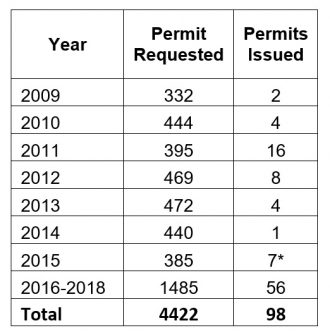
Peace Now data
In addition, reports suggest that Israel will also advance plans for 1,303 Palestinian homes in Area C – about half of which, importantly, are already built. A majority of these units have been awaiting Israeli approval for many, many years. If approved, the permits under consideration next week for Palestinians will be the first of any significant quantity issued by Israel since, at least, 2009 (data from before this period has not been released by the Israeli government). Between 2009 and 2018, Israel issued a total of 98 building permits to Palestinians according to data released by the Israeli government in response to a freedom of information request submitted by Bimkom.
As a reminder, Area C is the 60% of the West Bank over which Israel enjoys absolute authority. For years Israel has systematically denied Palestinians the right to build on land in Area C that even Israel recognizes is privately owned by them, At the same time, it has continuously promoted the expansion of settlements and unauthorized outposts, while systematically demolishing Palestinian private construction. In terms of numbers: between 2016 to 2018, Israel issued only 21 building permits to Palestinians in Area C, while issuing 2,147 demolition orders against Palestinians during.
Commenting on the Planning Council agenda’s Peace Now observed:
“The approval of a handful of plans for the Palestinians is only a fig leaf intended to try to reduce criticism of the government. For years, Israel has pursued a policy of blatant discrimination that does not allow almost any construction for Palestinians in Area C, while in the settlements it encourages and promotes the construction of thousands of housing units each year for Israelis. The approval of a few hundred housing units for Palestinians can not cover up discrimination and does not change the fact that Israel maintains an illegal regime of occupation and discrimination in the territories.”
It is worth noting that many of the settlement units and Palestinian permits on next week’s agenda were expected to have been advanced earlier this year, in August 2021, but the High Planning Council never convened to do so.
Below are lists of settlement plans expected to be given final approval and plans expected to be advanced next week (italicized plans represent those which appear to have been added to the slate of plans that were expected to be advanced in August 2021).
Settlement plans expected to be granted final approval include:
- 629 units, including the retroactive legalization of 61 units, in the Eli settlement – located south of Nablus and southeast of the Ariel settlement in the central West Bank. Though the Eli settlement previously received Israeli government approval, a “Master Plan” – which officially zones land for distinct purposes (residential, commercial, public) – has never been issued for Eli, meaning all construction there is illegal under Israeli law;
- 286 units in the Har Bracha settlement, located south of Nablus. If implemented, these new units will double the size of Har Bracha;
- 224 units in the Talmon settlement, located west of Ramallah;
- 146 units in the Kfar Etzion settlement, located between Bethlehem and Hebron and on the Israeli side of the planned route of the barrier (which is not yet built in this area);
- 110 units in the Alon Shvut settlement, located just north of the Kfar Etzion settlement and between Bethlehem and Hebron;
- 82 units in the Karnei Shomron settlement, located in the northern West Bank, east of the Palestinian village of Qalqilya. Israel has openly declared its intention to continue expanding settlements in this area with the stated goal of bringing 1 million settlers to live in the area.;
- 52 units in the Beit El settlement, located in the heart of the northern West Bank [as a reminder, former US Ambassador to Israel David Friedman has deep ties to the Beit El settlement]; Construction on 350 new units in Beit El began earlier this year;
- 42 units in the Givat Zeev settlement, located south of Ramallah in an area that is on the Israeli side of the barrier;
- 24 units in the Haroeh Haivri outpost, a plan that will effectively grant retroactive legalization to this outpost. The Haroeh Haivri outpost is located just east of Jerusalem, within eyesight of the Khan al-Ahmar community, which Israel is threatening to demolish (forcibly relocating the Palestinian bedouin community that has lived there since the 1950s) — ostensibly because the structures in Khan al Ahmar were built without necessary Israeli approvals. The Haroah Haivri outpost was also built without the necessary Israeli approvals, but instead of demolishing the construction, Israel is moving to retroactively legalize it — demonstrating once again that, when it comes to administering the occupation, Israel prefers “rule by law” – where law is turned into a tool to elevate the rights/interests of one party over another, over the democratic rule of law.;
- 14 units in the Ma’aleh Mikhmash settlement, a plan that will effectively grant retroactive legalization to one of Ma’aleh Mikhmash’s outposts – – Mitzpe Danny;
- 10 units in the Barkan settlement, located about half way between the Ariel settlement and the cluster of settlements slated to be united into a “super settlement” area (Oranit, Elkana, Shiva Tikva, and others);
- 5 units in the Shima’a settlement, located in the southern tip of the West Bank;
- 7 units in the Peduel settlement, located in the northern West Bank and part of a string of settlements and unauthorized outposts – most notably Ariel – extending from the Green Line into the very heart of the West Bank and on towards the Jordan Valley.
Settlement plans expected to be approved for deposit (an earlier stage in the planning process) include:
- 399 units in the Revava settlement, located just east of the Barkan settlement and west of the Ariel settlement, in a string of settlements and unauthorized outposts – most notably Ariel – extending from the Green Line into the very heart of the West Bank and on towards the Jordan Valley.
- 380 units in the Kedumim settlement, located just east of Nablus. Israeli MK Bezalel Smotrich lives in the Kedumim settlement on a section of land in the settlement that has been found to be privately owned by Palestinians.;
- 100 units in the Elon Moreh settlement, located east of Nablus (for background on the significance of the Elon Moreh settlement, please see here);
- 100 units in the Sansana settlement, located on the southern tip of the West Bank on the Israeli side of the separation barrier;
- 73 units in the Givat Zeev settlement, which is also expected to receive final approval for 42 units. Givat Zeev is located south of Ramallah in an area that is on the Israeli side of the barrier;
- 68 units in the Tene settlement, located on the southern tip of the West Bank;
- 45 units in the Vered Yericho settlement, located just west of the Palestinian city of Jericho in the Jordan Valley;
- 27 units in the Karnei Shomron settlement, which is also expected to receive final approval for 82 units. Karnei Shomron is located in the northern West Bank, east of the Palestinian village of Qalqilya. Israel has openly declared its intention to continue expanding settlements in this area with the stated goal of bringing 1 million settlers to live in the area.;
- 18 units in the Alon Shvut settlement, which is also expected to receive final approval for 110 units. Alon Shvut is located just north of the Kfar Etzion settlement and between Bethlehem and Hebron;
- 10 units in the Tal Menashe settlement, located located on the tip of the northern West Bank, inside the “seam zone” between the 1967 Green Line and the Israel separation barrier, which was constructed along a route designed to keep as many settlements and as much adjacent land as possible on the Israeli side of the wall/fence.
- 7 units in the Hermesh settlement, located in the northern West Bank;
- 4 units in the Efrat settlement, located south of Bethlehem, inside a settlement block that cuts deep into the West Bank. Efrat’s location and the route of the barrier wall around it, have literally severed the route of Highway 60 south of Bethlehem, cutting off Bethlehem and Jerusalem from the southern West Bank. The economic, political, and social impacts of the closure of Highway 60 at the Efrat settlement (there is literally a wall built across the highway) have been severe for the Palestinian population.
Peace Now reports that the Planning Council will also consider advancing the following plans for Palestinian homes:
- 270 houses in the Bir al-Bash village, located south of Jenin in the northern West Bank;
- 270 houses in the Al-Ma’asara village, located south of Bethlehem;
- 233 houses in the the Almasqufa village, located near Tulkarem in the northern West Bank;
- 200 houses in the Dkeika village in the South Hebron Hills;
- 170 houses in the Khirbet Abdallah Younas village, located in the Jenin area;
- 160 houses in the Abba a-Sharqiya village, also located south of Jenin in the northern West Bank;
Israeli Supreme Court to Hold Hearing on Batan al-Hawa, Silwan Dispossession Cases Next Week; AG Declines Intervention
On October 25th, the Israeli Supreme Court is scheduled to hold an important hearing on the case of the Palestinian Duweik family which is under threat of being dispossessed of their longtime home in the Batan al-Hawa section of the Silwan neighborhood in East Jerusalem by the Ateret Cohanim settler organization.
In advance of that hearing – and after repeated extensions on a Court-ordered deadline – the Israeli Attorney General finally submitted his position on the case to the Court. The document submitted by the Attorney General was only 1 page, and simply stated that the case does not merit intervention either on the specific case of the Duweik family or regarding the wider legal principle at stake, which threatens an additional 85 families living under threat of eviction in Batan al-Hawa.
Ir Amim writes:
“Among the 85 families facing eviction, the Duweik family case is the first to reach the Supreme Court level, and its outcome will inevitably set a precedent, significantly impacting the rest of the cases in the neighborhood…As in the eviction cases in Sheikh Jarrah, the Attorney General and by extension, the government, was given a rare opportunity to take a moral stand by providing a legal opinion and policy position to help prevent the mass displacement of these families. Yet, at this point, the Attorney General’s response appears to imply that he has declined to intervene. Now, the decision concerning the fate of these families seems to lie solely in the hands of the Supreme Court. The rights of Palestinians to housing and shelter and the right to family and community life are fundamental and must be upheld. The same discriminatory legal system, which led to the confiscation of these families’ original homes in 1948, is now being exploited 73 years later to displace them for a second time from their current homes in which they have lived for decades. The Supreme Court has the power to make a principled and just decision to uphold the rights of these families to remain safely in their homes, free from the constant threat of being forcibly uprooted and driven from their homes and communities.”
Peace Now said in response to the AG’s decision to not intervene:
“The Attorney General’s response actually says that for the Israeli government, there is no problem to kick hundreds of residents out from their homes, on the basis of a discriminatory law, in favor of a settlement. The government was given an opportunity here to try to prevent moral injustice and political folly, but instead of taking a stand, it chose to remain on the sidelines, as if Silwan’s story, like that of Sheikh Jarrah, was a legal matter and not a political one.”
In July 2021, Peace Now assembled a coalition of Israeli lawyers to submit an amicus brief to the Court regarding the Duweik case. Peace Now summarizes:
“The brief addresses an approach that has emerged in international jurisprudence on human rights law which puts an emphasis on group vulnerability of occupants facing eviction and institutional, systemic discrimination against them. Where these are present, in certain circumstances, the occupants’ rights, stemming from the human right to housing and specifically, to live in their home and their family’s home – trump the right of the original owner or their substitute to regain possession of the property.
The brief reaches the conclusion that in the Duweik case, the occupants’ property rights and their right to housing supersede the right of the settlers acting on behalf of the pre-1948 original owners to receive possession of the property, based on the following:
1 – The fact that Palestinian residents of East Jerusalem are underprivileged, vulnerable and subjected to discrimination in every aspect of life, and particularly the fact that Israeli law on the restitution of property that changed hands due to wars, openly and deliberately discriminates against them;
2 – The fact that the family entered the property in good faith and/or in accordance with the law applicable at the time, and has developed a legitimate expectation to continue residing in it permanently and without interruption;
3 – The imbalance between the devastating harm the family would suffer and the minor damage the Benvenisti charitable endowment (represented by the settlers), which claims ownership of the property, would sustain, which clearly tips the scales in favor of the family.
In other words, according to the brief, even if the court finds the settlers do, in fact, have ownership, they are not necessarily entitled to remedy in the form of the families’ eviction from their homes, but rather to compensation from the state.”
Israel Begins Construction on New Settlement in Downtown Hebron
Peace Now reports that construction has begun on 31 new settlement units at the site of an old bus station previously repurposed as an IDF base, located in the heart of the Old City of Hebron on the infamous Shuhada street. This is a new settler enclave in the city and is, in effect, a new urban settlement, disconnected from already existing settlements in the city. It will be the first new settlement construction approved in downtown Hebron – where Palestinians already live under apartheid conditions – since 2002.
Peace Now said in a statement:
“The government is acting like an annexation government, not as a change government. Since the 1980s, no government has dared to build a new settlement in the heart of the largest Palestinian city in the West Bank, with the exception of one building built under the auspices of the second intifada in 2001. The Defense Minister has to stop construction, even if the plan was approved by the previous government. The settlement in Hebron is the ugly face of Israeli control of the territories. The moral and political price of having a settlement in Hebron is unbearable.”
As a reminder: in October 2017, the Israeli Civil Administration approved a building permit for the 31 units, on the condition that the Palestinian municipality of Hebron and others would have the opportunity to file objections to the plan. Soon after, two appeals were filed with the Defense Ministry: one by the Palestinian municipality of Hebron and one by the Israeli settlement watchdog Peace Now. The legal objections were based on the legally questionable process by which Israel made land in downtown Hebron available for settlement construction. Located in the Israeli-controlled H-2 area of Hebron (where 500 Israeli settlers live amongst 40,000 Palestinians), Israel seized the land in the 1980s from the Hebron Municipality, for military purposes. In 2007, the Civil Administration’s Legal Advisor issued an opinion stating that once Israel is done using the land for military purposes, it must be returned to the Hebron Municipality, which has protected tenancy rights to the land. Nonetheless, in 2015, the Israeli Civil Administration, with the consent of the Minister of Defense, quietly authorized the Housing Ministry to plan the area for Israeli settlement use, paving the way for that same ministry to subsequently present the plan for the 31 units.
In October 2018, with the legal challenges still pending, the Israeli Cabinet voted to expedite the planning of the new settlement and allocated approximately $6.1 million (NIS 22 million) for the project, which will require Israel to significantly renovate the bus station/military base in order to build the 31 new settlement housing units, as well as a kindergarten, and “public areas” for the new settler residents. Peace Now explains:
“The approval of the building permit in the heart of Hebron is an extraordinary move not only because it is a new settlement in Hebron for the first time since 2001, but because it indicates a significant change in Israeli legal interpretation of what is allowed and forbidden in occupied territory. The area in question was owned by Jews before 1948, and it was leased by the Jordanian government in protected tenancy to the Hebron municipality for the purpose of establishing the central bus station. Since 1967, the Israeli authorities managed the land and continued the lease to the Hebron municipality, until in the 1980s when the area was seized for military purposes, the bus station was closed and a military base was established there. A legal opinion of the Judea and Samaria Attorney General on the issue in 2007 emphatically stated that by law the municipality’s protected lease must not be revoked.”
Israel Advances “Silicon Wadi” Project in East Jerusalem
On October 13th, the Jerusalem Local Planning Committee met to initiate the planning process for the “Silicon Wadi” project, which was initiated by the Jerusalem Municipality and outlines plans to build a large industrial zone for hi-tech, commercial, and hospitality businesses in the heart of East Jerusalem’s Wadi Joz neighborhood. The project requires the demolition of some 200 Palestinian-owned businesses that currently operate in the area; dozens of demolition notices for which were issued in November 2020.
Ir Amim writes:
“Beyond the devastating impact of widespread demolitions of existing businesses and structures, the plan also raises concerns that the Israeli authorities will exploit the planning procedures to locate alleged Palestinian absentee properties and transfer lands into the hands of the State. It should also be noted that while Israel focuses on bolstering employment and economic activity in East Jerusalem, it simultaneously continues to suppress residential development in Palestinian neighborhoods. As with nearly all outline plans advanced in East Jerusalem in recent years, the Wadi Joz business park plan only allocates a marginal amount for residential use, which hardly meets the acute housing needs of the Palestinian population. Rather than undertaking measures to rectify the housing crisis, these plans only exacerbate the current situation and perpetuate the residential planning stranglehold, which ultimately serves to push Palestinians out of the city.”
Recap: Israel Advances Settlement Plans Across Greater Jerusalem Area
Over the past two weeks, the government of Israel has advanced four highly controversial and politically consequential settlement plans in the Greater Jerusalem area:
- The Givat Hamatos Settlement: On October 13th, the Jerusalem Local Planning Committee approved the expropriation of lands designated for public use in the Givat Hamatos area for the construction of roads, public buildings and the development of open space for the planned new settlement/neighborhood. For more on the Givat Hamatos settlement plan, please see here.
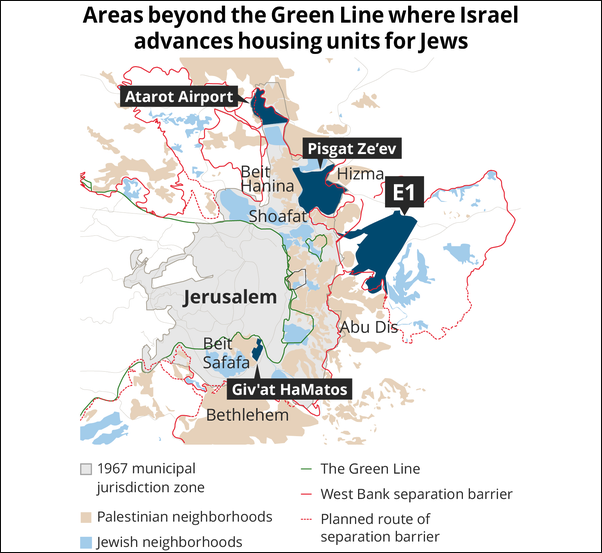
Map by Haaretz
- The E-1 Settlement: The Israel Civil Administration moved forward with advancing plans for the construction of the E-1 settlement, setting a date for a third hearing to discuss public objections to the plan (now set for November 8th). The first hearing was held on October 4th, but Palestinians were denied the ability to participate in that hearing (which was held virtually, making it inaccessible to the many Palestinians affected by the plan who do not have internet access). As a result, the Court scheduled this 3rd hearing (to allow the participation of Palestinians). The second hearing was held on October 18th; at that hearing three objections were presented (one by the Palestinian village of Anata, a second by the Palestinian village of Al-Azariya, and a third joint submission filed by Ir Amim and Peace Now). Ir Amim reports that there was no substantive discussion of these objections, with the Civil Administration panel offering no questions or comments on them. For more on the E-1 settlement plan, please see Terrestrial Jeruaslem’s excellent and thorough reporting.
- The Atarot Settlement: The Jerusalem District Planning Committee formally signaled that it will proceed with a hearing on the Atarot settlement plan – scheduled for December 6th – to build a huge new settlement on the site of the former Qalandiya airport (located at the northern tip of East Jerusalem). In its current form, the plan provides for up to 9,000 residential units for ultra-Orthodox Jews (assuming, conservatively, an average family size of 6, this means housing for 54,000 people), as well as synagogues, ritual baths (mikvehs), commercial properties, offices and work spaces, a hotel, and a water reservoir. If built, the Atarot settlement will effectively be a small Israeli city surrounded by Palestinian East Jerusalem neighborhoods on three sides and Ramallah to its north. Geopolitically, it will have a similar impact to E-1 in terms of dismembering the West Bank and cutting it off from Jerusalem. For more on the Atarot settlement plan, please see here.
- The Pisgat Ze’ev Settlement: The Israeli government advanced plans for 470 new settlement units in Pisgat Ze’ev, the largest settlement located in East Jerusalem.


Recap: Court Pushes for Palestinians to “Compromise” with Settlers in Sheikh Jarrah
The Israeli Supreme Court has set November 2nd as the deadline for Palestinian families living at risk of forced displacement in Shiekh Jarrah to decide wether or not to accept a Court-authored deal which would help them – at least temporarily – avoid eviction from their homes, in part by requiring them to recognize settler ownership over the properties.
Under the terms of the Court’s deal, which it is pressuring both parties to accept, the following would take place:
- The settler group Nahalat Shimon will be recognized as the owners of the site.
- The Palestinians will be recognized as protected tenants and be required to pay an nominal annual rental fee to the attorney of the settlers (in effect recognizing the settlers as the owners) but
- The Palestinians will be able to continue pursuing legal challenges to the underlying ownership of the land
- The Palestinians are permitted to renovate the properties without interference
- Settlers will be able to instigate eviction proceedings against Palestinians if they are in violation of the Court’s compromise agreement or in violation of Israel’s tenancy laws.
Terrestrial Jerusalem writes:
“The most problematic element of the settlement relates to the settlers’ ability to institute evictions even if the residents are not in violation of the agreement or of the tenancy laws. The settlers will be entitled to institute such proceedings in the event that the ownership rights are conclusively awarded to them, or after 15 years, the earlier of the two. This can be done if the settlers either wish to personally use the property or to demolish and rebuild. Under these circumstances, the settlers will need to offer the residents alternative equivalent quarters. Palestinian residents might hope settlers reject the deal to avoid having to make an ‘excruciatingly painful decision.’”
According to Terrestrial Jerusalem, the Court has signaled that further negotiations are acceptable, but that if either party rejects the agreement a decision on the eviction cases will be handed down swiftly.
New Report: State-Backed Settler “Tourism” Projects in East Jerusalem
In a new report entitled, “The Valley of Hinnom: Trees and Flowerbeds in the Political Struggle over East Jerusalem,” the Israeli NGO Emek Shaveh surveys the multitude of recent “tourism” projects jointly undertaken by the Elad settler organization and the Israeli government in the Ben Hinnom Valley — a strategic area between East and West Jerusalem (stretching past the 1967 Green Line), and located within the area designated by Israel as the Jerusalem “Walls National Park”.
Emek Shaveh writes:
“The nature of the tourism-settlement activity in the Valley of Hinnom conducted jointly by Elad and government authorities is familiar to us from the City of David/Silwan. The series of joint ventures such as the café, the Center for Ancient Agriculture and the cable car in effect hand over large expanses of land to the settlers of the Elad Foundation under the guise of tourism. Although unlike Silwan, the valley is sparsely populated, the activity there must be viewed as an integral part of the struggle for the Old City Basin of Jerusalem and as a means to clear this highly strategic area from the presence of Palestinians.”
In conclusion, we wish to emphasize the following points:
1 – Development in East Jerusalem is almost always driven by political objectives. Recent developments in the Valley of Hinnom are part of the grand plan to change the character and the landscape of the Old City Basin and ought to be considered an integral component of the settlement enterprise in the Palestinian neighborhoods surrounding the Old City.
2 – Halting the destructive development schemes in the areas surrounding the Old City is vital in order to preserve Jerusalem as a multicultural historic city and is indirectly essential for safeguarding the status quo at the holy places.
3 – The Palestinian protests against the expansion of the settlers’ grip over the open spaces such as the Hinnom Valley is part of the struggle by the residents of Silwan and the surrounding neighborhoods to preserve the character of their neighborhoods. In our view, one ought to view the various activities by the settlers and the authorities in the Historic Basin such as the expulsion of residents from their homes, taking over land and the shaping of a historic narrative as part of the same general bid to cement their control over the Historic Basin.”
Bonus Reads
- “[PODCAST] The Occupation & the Biden Administration” (FMEP ft. Danny Seidemann and Yehuda Shaul with Lara Friedman and Khaled Elgindy)
- “How offshore accounts turned the British Virgin Islands into an east Jerusalem landlord” (JTA)
- “Beita residents reach lands for first time since settler takeover” (Al Jazeera)
- “After Years of Neighborly Relations, Settlers Try to Foil Recognition of Palestinian Hamlet” (Haaretz)
- “Palestinian protests turn deadly as Israel considers the future of a new settlement” (NPR)
- “These Palestinian Families Face Eviction From Their East Jerusalem Homes” (Haaretz)
- “When Settler Becomes Native” (Jewish Currents)
Welcome to FMEP’s Weekly Settlement Report, covering everything you need to know about Israeli settlement activity this week.
To subscribe to this report, please click here.
August 13, 2021
- The First Bennett/Biden Settlement Wave, Part 1: Israel Set to Advance 2,259 Settlement Units
- The First Bennett/Biden Settlement Wave, Part 2: Israel Announces Intention to Issue 863 Building Permits for Palestinians in Area C
- The First Bennett/Biden Settlement Wave, Part 3: Observations on Settlement Policy Coordination Between Governments
- Jerusalem District Court Orders 16 Homes to Be Demolished While Delaying – for 6 months – Demolition of Others in Silwan
- Israel Begins Work on Settler-Back Project at the Ibrahimi Mosque/Tomb of the Patriarchs
- Atarot Settlement Plan to Be Discussed on December 6th
- Bonus Reads
Questions/comments? Email kmccarthy@fmep.org
The First Bennett/Biden Settlement Wave, Part 1: Israel Set to Advance 2,259 Settlement Units
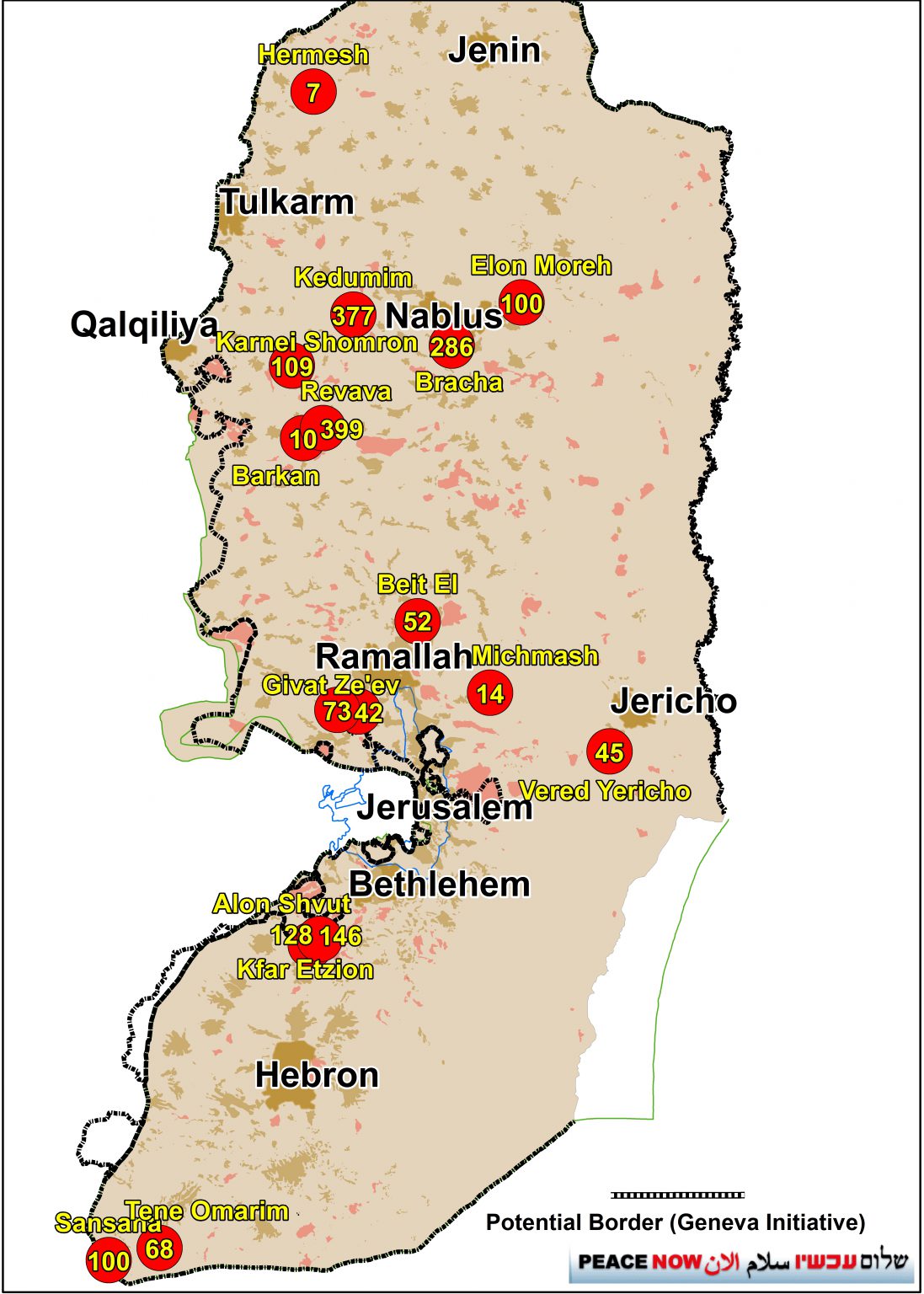 On August 12th, Israeli Defense Minister Benny Gantz announced that the High Planning Council will convene on August 18th to advance 2,259 new settlement units, as part of projects across the West Bank. Of these, 908 units are slated to receive final approval, including many units in areas beyond Israel’s security barrier. This will be the first time that the High Planning Council (HPC) has convened in 10 months, and it will be the first time a large number of settlement units has been advanced since Biden entered the White House. As a reminder, the HPC is a body within the Israeli Civil Administration (which is a part of the Israeli Ministry of Defense) that has authority over construction planning and approvals for both settlers and Palestinians in the West Bank (the HPC does not have authority with respect to settlement construction in East Jerusalem; since Israel annexed the area in 1967, Israeli domestic Israeli planning authorities are in charge there).
The plans expected to receive final approval include:
- 286 units in the Har Bracha settlement, located south of Nablus. If implemented, these new units will double the size of Har Bracha;
- 146 units in the Kfar Etzion settlement, located between Bethlehem and Hebron and on the Israeli side of the planned route of the barrier (which is not yet built in this area);
- 110 units in the Alon Shvut settlement, located just north of the Kfar Etzion settlement and between Bethlehem and Hebron;
- 82 units in the Karnei Shomron settlement, located in the northern West Bank, east of the Palestinian village of Qalqilya. Israel has openly declared its intention to continue expanding settlements in this area with the stated goal of bringing 1 million settlers to live in the area.;
- 52 units in the Beit El settlement, located in the heart of the northern West Bank [as a reminder, former US Ambassador to Israel David Friedman has deep ties to the Beit El settlement]; Construction on 350 new units in Beit El began earlier this year;
- 42 units in the Givat Zeev settlement, located south of Ramallah in an area that. is on the Israeli side of the barrier;
- 14 units in the Ma’aleh Mikhmash settlement, located east of Ramallah;
- 10 units in the Barkan settlement, located about half way between the Ariel settlement and the cluster of settlements slated to be united into a “super settlement” area (Oranit, Elkana, Shiva Tikva, and others).;
Peace Now said:
“The approval of thousands of housing units in the settlements harms the Israeli interest and the chances of reaching peace. It seems that the approval of a handful of plans for the Palestinians is only intended to try to reduce criticism of the government and to please the US administration ahead of Prime Minister Bennett’s expected visit to Washington in the coming weeks. For years, Israel has pursued a policy of blatant discrimination that does not allow almost any construction for Palestinians in Area C, while in the settlements it encourages and promotes the construction of thousands of housing units each year for Israelis. The approval of a few hundred housing units for Palestinians can not cover up discrimination and does not change the fact that Israel maintains an illegal regime of occupation and discrimination in the territories.”
The First Bennett/Biden Settlement Wave, Part 2: Israel Announces Intention to Issue 863 Building Permits for Palestinians in Area C
In announcing plans to advance over 2,000 new settlement units, Defense Minister Gantz also announced his intention to issue permits for 863 houses – some of which will be issued for existing structures – for Palestinians living in Area C. Haaretz reports that the permits are being advanced in order to buy the consent of the few members of the Israeli governing coalition that oppose settlement construction, and as “calculated risk” with respect to the Biden administration.
As a reminder, Area C is the 60% of the West Bank where Israel enjoys absolute authority and has systematically denied Palestinian building rights, while promoting the expansion of settlements and unauthorized outposts. If issued, these permits for Palestinians will be the first issued by Israel in years, and the first of any significant size. Only 21 building permits were issued to Palestinians between 2016 to 2018, while 2,147 demolition orders were issued in the same period.
Commenting on the announcement of the planned permits (which, given past experience, there is no reason to assume will ever be issued) Peace Now said:
“It is a very small expansion of the Palestinian villages and a drop in the ocean in terms of real Palestinian development needs.”
Peace Now reports that these permits, if they are ever issued, might be for:
- 270 houses in the Bir al-Bash village, located south of Jenin in the northern West Bank;
- 233 houses in the the Almasqufa village, located near Tulkarem in the norhtern West Bank;
- 160 houses in the Abba a-Sharqiya village, also located south of Jenin in the northern West Bank;
- 150 houses in the Al-Ma’asara village, located south of Bethlehem; and,
- 50 houses in the Khirbet Zakariya, also located south of Bethlehem.
The First Bennett/Biden Settlement Wave, Part 3: Observations on Settlement Policy Coordination Between Governments
In reporting over the past week, Axios journalist Barak Ravid has documented the efforts by the Israeli and U.S. governments to square conflicting positions with regards to settlement growth.
On the U.S. side, the Biden Administration has appeared to take pains to make room in its official discourse to begrudgingly tolerate settlement construction. While the U.S. has criticized the new batch of settlement advancements, until this week the U.S. had reportedly identified three actions it has asked Israel to refrain from, notably not including settlement expansion. Those three actions are: the demolition of Palestinian homes, the eviction of Palestinians from their homes, and the establishment of new outposts in the West Bank. The U.S. is also reportedly asking Israel to take positive steps to stabilize the Palestinian Authority, which is suffering from economic shortfalls and crashing levels of popular support.
For it’s part, Israeli press suggests that the Bennett government reduced the number of upcoming settlement advancements in order to appease the Biden Administration. The Israelis wanted to advance 3,623 plans, but announced a total of 2,259 (a 39% cut according to Jerusalem Post). Axios also reports that the Israeli government is assertively framing its settlement policy as one of restraint, prioritizing settlement projects that address the supposed “natural growth” needs of existing settlements.
“Natural growth” has been used many times in the past by the Israeli government as an argument for why settlements must be allowed to expand. FMEP’s Lara Friedman has debunked this argument many times in the past, explaining:
“While ‘natural growth’ has no formal definition, it has generally been used in the settler context to mean population growth due to births, as contrasted to growth due to immigration from Israel or other places. But in numerical terms (according to Israeli official statistics), taking into account deaths and people migrating out of settlements, births inside the settlements account for approximately 60% of the annual population growth in settlements, while around 40% is immigration from inside Israel or abroad. So clearly population growth in settlements is not simply a matter of births. Perhaps this is why some excuse-makers have expanded ‘natural growth’ to include other ways that families can grow, from non-settler spouses to aged non-settler relatives moving in.
“Regardless of what definition people want to use, the fact is that ‘natural growth’ is not a legitimate argument against a complete freeze in settlement construction. Yes, settlers, like people everywhere, indeed have the right to have babies, and yes, their children indeed have the right to grow up and have families and homes of their own. But nowhere in the world – not in New York, or Paris, or Tel Aviv – do people have an inalienable right to live exactly where they want – in the size home they want, in the neighborhood they want – irrespective of real estate market factors, or any political, economic, zoning, or other considerations that may come into play (including in this case, considerations about actual land ownership). Inside Israel, just like in other countries, people regularly face difficult decisions about where to live, given that major cities like Tel Aviv and Jerusalem are crowded and little affordable housing is available.
“Settlers have the right to have babies and to take in their parents or grandparents. When settler children grow up they have the right to start families and have homes of their own. But the settlers must do what people everywhere must do: reconcile their needs as best as possible to the housing market, which is affected not only by demand but by a myriad of other variables – including, in this case, the fact that settlers have knowingly and voluntarily chosen to make their lives on land that is the subject of a political dispute of global proportions.”
Axios quotes an Israeli government official saying:
“The Biden administration knows we are going to build. We know they don’t like it, and both sides don’t want to reach a confrontation around this issue.”
An Israeli government source summarized the dance going on between the respective governments by saying:
“[The U.S.] will express opposition to this move, but everyone wants this impossible coalition in Israel to hold out… It was clear for Bennett he would not have been able to advance this move after his meeting with [U.S. President Joe] Biden at the end of the month, so as not to damage their relations, and that’s why he had to announce it as early as he did.
Jerusalem District Court Orders 16 Homes to Be Demolished While Delaying – for 6 months – Demolition of Others in Silwan
On August 12th, a Jerusalem Court granted a six-month freeze on demolition orders affecting dozens of Palestinian homes in the al-Bustan section in the Silwan neighborhood of East Jerusalem. At the same time, the Court cleared the way for the immediate demolition of 16 Palestinian homes in the same area.
A lawyer representing the Palestinians involved in these demolition cases said his clients intend to file for permits for the structures, which were built on land that Palestinians assert they own. Israel argues that the land is public land.
Israel Begins Work on Settler-Back Project at the Ibrahimi Mosque/Tomb of the Patriarchs
This week, an Israeli crew began construction on a new elevator leading to the Ibrahimi Mosque/Tomb of the Patriarchs in Hebron, arguably one of the most sensitive religious sites outside of Jerusalem. The project to install accessible infrastructure at the site has been backed and pushed by settlers for over two decades and provides a means by which the State of Israel has increased its control over the site. The project is roundly opposed by Palestinians along with archaeologists and other experts. The Israeli archeology group Emek Shaveh explains its opposition:
“We claim that while the plan is couched in terms of concern for the disabled and elderly worshippers, in actual fact it is unilaterally advancing changes to a site mired in deep political controversy…The size and characteristics of the structure demonstrate that at issue is not simply a lift for persons with disabilities, but a significant change to the compound. The lift will constitute a change in the status quo and a strengthening of the settlers’ control of the holy site. Ignoring the fact that the site falls under the auspices of the Hebron Municipality is evidence that Israel is further reneging on its commitments to agreements signed in the past with Palestinians.”
Atarot Settlement Plan to Be Discussed on December 6th
As expected, the Jerusalem District Planning and Building Committee has set a date – December 6th – for the advancement of the Atarot settlement plan. This plan would allow for the construction of 9,000 settlement units, to be built on the site of the former Qalandiya airport (located at the northern tip of East Jerusalem).
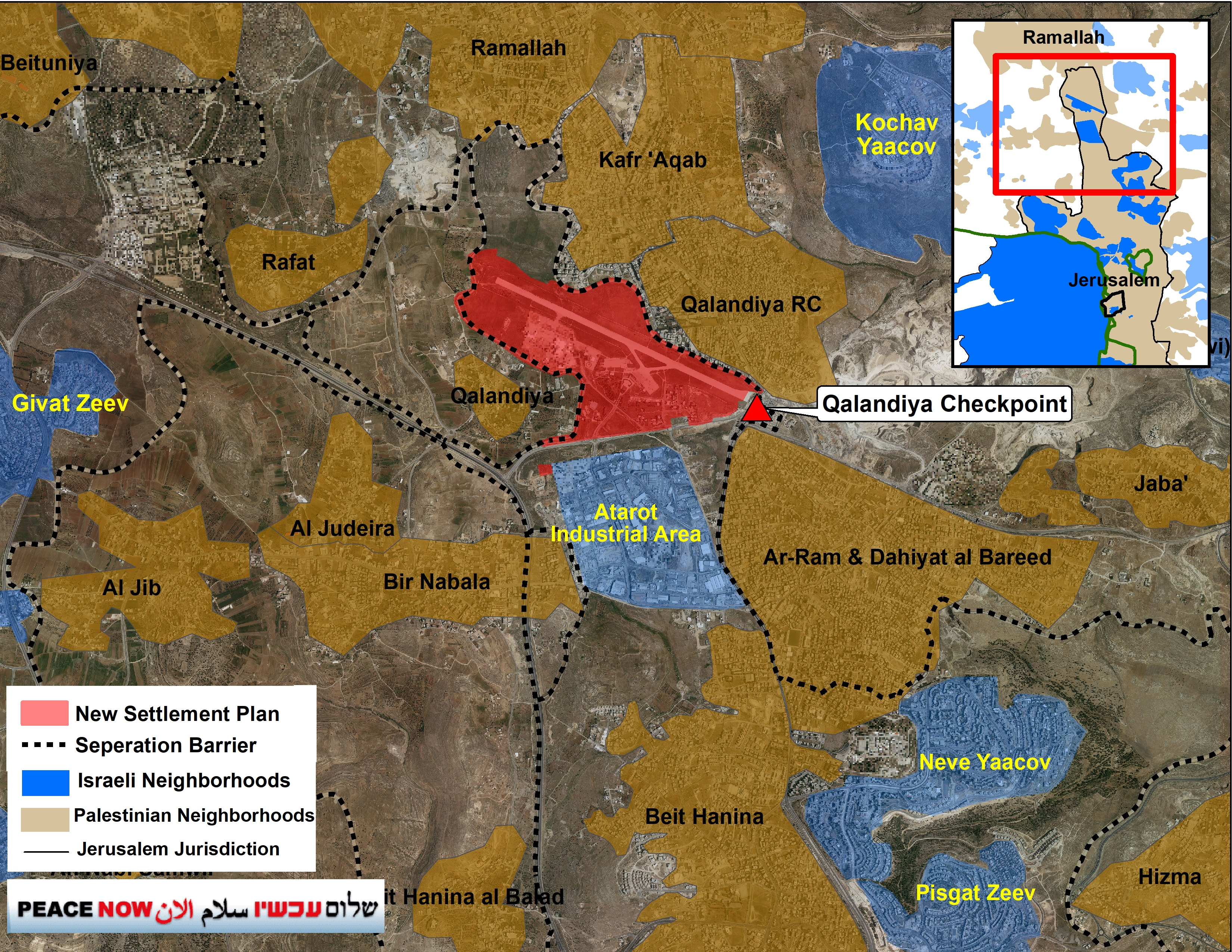 The Atarot settlement plan dates back to 2007. It was pursued by the Israeli government in 2012 but shelved under pressure from the Obama administration. The plan came back into consideration in April 2017 (a few months following the inauguration of President Trump) when it was rumored to be included on Netanyahu’s master blueprint of settlements for which he was seeking U.S. approval. In February 2020, following the publication of the Trump Plan – which designated the area that would be used for the settlement as a “special tourist zone” for Palestinians – the Atarot settlement plan was formally introduced. In January 2021 then-Prime Minister Netanyahu dangled the advancement of the plan as an incentive for parties to join his flagging coalition in order to remain in power.
In its current form, the plan provides for up to 9,000 residential units for ultra-Orthodox Jews (assuming, conservatively, an average family size of 6, this means housing for 54,000 people), as well as synagogues, ritual baths (mikvehs), commercial properties, offices and work spaces, a hotel, and a water reservoir. If built, the Atarot settlement will effectively be a small Israeli city surrounded by Palestinian East Jerusalem neighborhoods on three sides and Ramallah to its north.
There are currently 15 Palestinian families living in buildings on the land slated for the settlement, part of which is privately owned by Palestinians. Other land in the area has been declared “state land” by Israel or belongs to the Jewish National Fund. To solve the problem of Palestinian land owners, the Israeli government will need to evict the Palestinians living there and demolish their homes — a step that will be facilitated by the fact that all of the homes lack Israeli-issued building permits (which are essentially impossible for Palestinians to receive). The private Palestinian landowners will then be subjected to a non-consensual process of “reparcelization,” in which Israel will unilaterally reparcel and then redistribute the land amongst its owners on the basis of the value of the land (as determined by Israel) and the percentage of their ownership claim.
The Atarot airport site is an important commodity and, during past negotiations, it was promised to the Palestinians for their state’s future international gateway. Israeli development of the site as a settlement would — by design — not only deprive a future Palestinian state of the only airport in a Palestinian area, but also dismember Palestinian neighborhoods in the northern part of the Jerusalem, and sever East Jerusalem from a Palestinian state on this northern flank of the city (acting like E-1 on Jerusalem’s northeast flank, and like Givat Hamatos on Jerusalem’s southern flank).
Bonus Reads
- “Case Study: How a Settler Law-Breaker Became the #2 Official in Israel’s Ministry of the Interior” (FMEP // Lara Friedman w/ Dror Etkes)
- “Senior Israeli Official’s Appointment Approved Despite Demolition Order for His Settlement Home” (Haaretz)
- “In Sheikh Jarrah, anonymous actors and an absent state have created a powder keg” (The Times of Israel)
- “The Fight for Palestine’s Sheikh Jarrah Isn’t Over” (Jacobin)
- “ICC Mulls Probing Israel Over Razing Palestinian Homes in Jordan Valley” (Haaretz)
- “81 Palestinian homes demolished by Israel in East Jerusalem in 2021” (Middle East Monitor)
- “Jewish claim of land ownership in occupied East Jerusalem neighborhood displaces five Palestinian families” (WAFA)
Welcome to FMEP’s Weekly Settlement Report, covering everything you need to know about Israeli settlement activity this week.
To subscribe to this report, please click here.
February 28, 2020
- Fuel on the Fire: Netanyahu Advances E-1 Settlement Plans
- Making Good On Bibi’s Promise, Israel Issues Tenders for Givat Hamatos Settlement – And Plans for More
- High Planning Council Advances Plans for 1,739 Settlement Units, Including a New Industrial Zone
- Netanyahu Orders 12 Outposts Hooked Up to Israeli Infrastructure, with More to Follow
- Israel is Planning New West Bank Electricity Grid to Serve the Settlements
- Deputy Israeli AG Bemoans “Alarming Accumulation” Of Cases in Which Political Echelon Stops Outpost Evacuations
- Joint U.S.-Israeli Annexation Mapping Team Begin Work in Ariel
- Bonus Reads
Comments or questions – email Kristin McCarthy (kmccarthy@fmep.org).
Fuel on the Fire: Netanyahu Advances E-1 Settlement Plans
On February 26th, the High Planning Council of the Israeli Civil Administration deposited for public review two separate plans (for a combined total of 3,401 units) for the construction of the infamous E-1 settlement. This move sets in motion a 60-day public commenting period, after which the committee can grant final approval for construction. Long called a “doomsday” settlement by supporters of a two-state solution, construction of the E-1 settlement would sever the West Bank effectively in half, foreclosing the possibility of drawing a border between Israel and Palestine in a manner which preserves territorial contiguity between the northern and southern parts of the West Bank. It would likewise consolidate the isolation of Palestinian neighborhoods in East Jerusalem from the West Bank. In combination with the recent advancements on Givat Hamatos and new tenders for Har Homa, Prime Minister Netanyahu’s Greater Jerusalem settlement construction announcements – leading up to the third round of Israeli elections – have crossed red lines (in the eyes of the international community) that Netanyahu didn’t dare cross in the past.
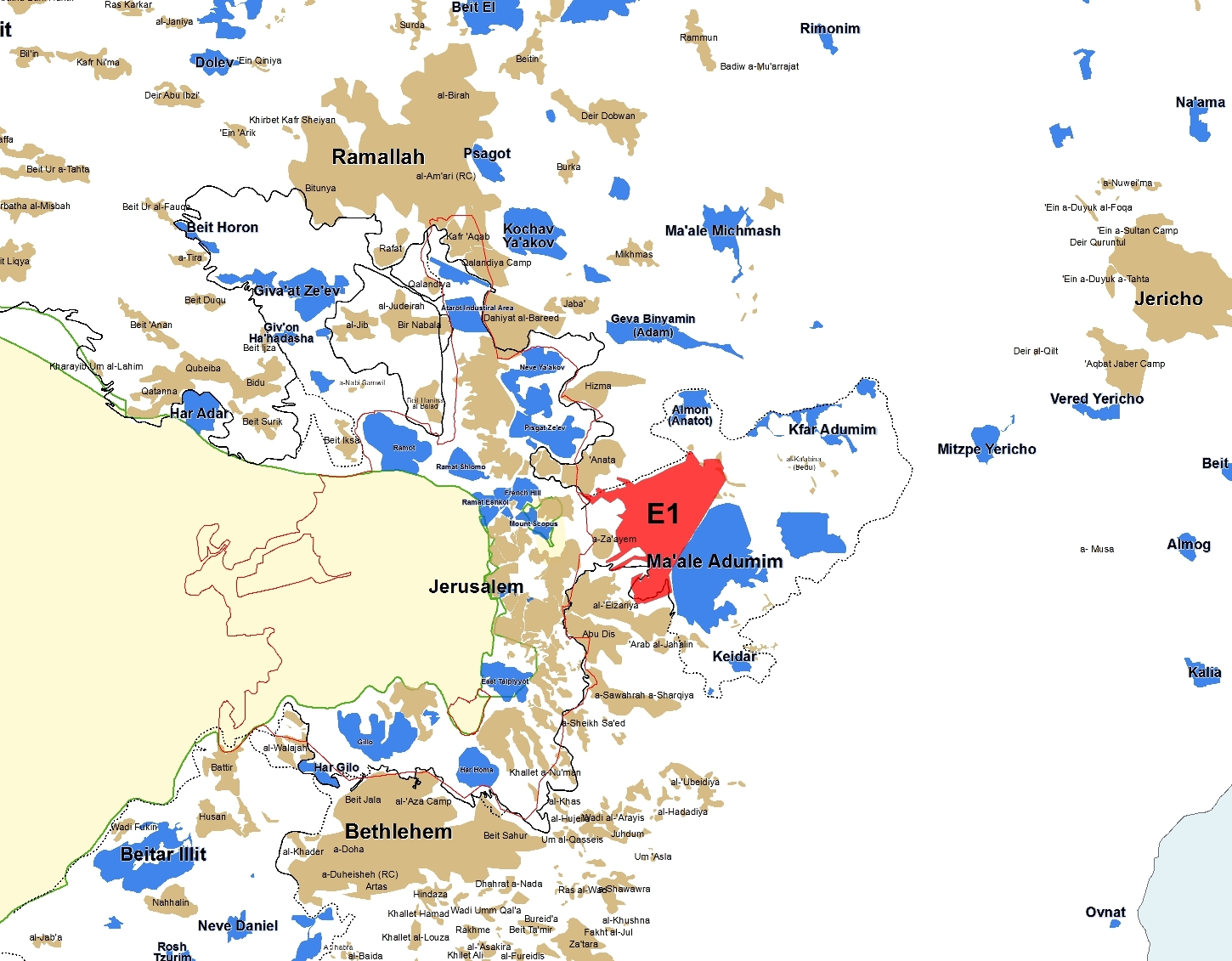
Map by Peace Now
The day before the High Planning Committee’s decision to deposit the plans, Netanyahu announced that he had lifted the freeze on E-1 that his government has imposed since 2012. Though the plans were approved for deposit in 2012, the administrative act of actually depositing the plans (which requires the plans to be published in at least three newspapers to inform the public) never occurred, largely as a result of intense international opposition to E-1. Under the recently released Trump Plan, the area where E-1 is located is slated to become part of Israel, meaning the long-held U.S. opposition to E-1 has transformed into apparent support.
Peace Now explains important context to Netanyahu’s flood of East Jerusalem settlement approvals:
“This move to promote settlement units in E1 should be understood in the context of government actions to promote settlement construction in Givat Hamatos and Har Homa to sever the Bethlehem-Jerusalem continuum, and the early promotion of a plan to turn the decommissioned Atarot Airport into a new Jerusalem settlement that would work toward severing the Ramallah-Jerusalem continuum. With E1 added to the mix, the pattern of severing the East Jerusalem and the West Bank is a clear policy direction of this government. While this announcement may be connected to the upcoming election, Netanyahu should be taken at his word and his comments should not be written off as campaign bluster. Indeed just this week he fulfilled a promise he made the week prior to publish tenders in Givat HaMatos, another area that was seen as a red line by the international community. It is likely that if moving on E1 is not met with deterring action domestically or abroad then it will further encourage settlement activity, seeing as E1 is the most recognized red line on settlement construction. The US, which has traditionally played a large role in deterring activity in E1, will likely not do so now with its current administration. Indeed, the Trump Plan envisions E1 as part of Israel, and allows for Israeli annexation pending coordination with the US and not negotiations with the Palestinians.”
Ir Amim adds:
“Although these advancements have taken place against the backdrop of the upcoming Israeli elections, they should also be seen as an alarm bell in the context of a new reality which has been created with the publication of the US Peace Plan. Carte blanche has essentially been given to Netanyahu and the Israeli government to further carry out unilateral measures in the Jerusalem area with little to no resistance. An acute exemplification of this major shift is the spate of new settlement plans (Atarot, Har Homa E, Givat Hamatos) being advanced over the Green Line in East Jerusalem, and now within the E1 area. After years of restraint due to international opposition, Israel is now set to advance construction in some of the most controversial areas in Jerusalem and along its perimeter. The realization of these plans will serve as an immense obstacle towards the future establishment of a Palestinian capital in the city and the prospect of a negotiated agreement based on a viable two-state framework.”
PLO Executive Committeewoman Hanan Ashrawi said in a statement:
“With the active participation and support of the current US administration, Israel is unilaterally and illegally annexing Palestinian territory and trampling on the Palestinian people’s most basic rights. These announcements are the practical translation of an extremist, ideologically-driven, and dangerous right-wing agenda that trounces Palestinian human rights and threatens to unravel the international order in favor of unilateralism, exceptionalism and political bullying.”
UN Special Coordinator for the Middle East Peace Process, Nikolay Mladenov, said:
“I am very concerned about Israel’s recent announcements regarding the advancement of settlement construction in Giv’at Hamatos and Har Homa, as well as the worrying plans for 3,500 units in the controversial E1 area of the occupied West Bank. All settlements are illegal under international law and remain a substantial obstacle to peace. If the E1 plan were to be implemented, it would sever the connection between northern and southern West Bank, significantly undermining the chances for establishing a viable and contiguous Palestinian state as part of a negotiated two-state solution. I urge the Israeli authorities to refrain from such unilateral actions that fuel instability and further erode the prospects for resuming Palestinian-Israeli negotiations on the basis of relevant UN resolutions, international law and bilateral agreements.”
Making Good On Bibi’s Promise, Israel Issues Tenders for Givat Hamatos Settlement – And Plans for More
As expected, on February 24th the Israeli Lands Authority published a tender for the construction of 1,077 housing units in the Givat Hamatos settlement. Haaretz reports that the tender relates to plans for “state land” and are intended to be sold as part of the the Treasury Ministry’s subsidized housing plan for young Jewish couples. Private companies will invited to bid on the project starting March 5th, with bidding set to close on June 22nd.
In addition to issuing tenders, the Jerusalem District Planning Committee met on February 27th to discuss the possibility of creating a new master plan for Givat Hamatos, in order to allow for more construction in the area. Ir Amim reports that the committee is considering a plan allowing for 6,500 residential units – which nearly doubles the total outlined in the current plan.
Ir Amim writes:
“This is the first time since the late 1990’s that Israel is constructing a new neighborhood/settlement in East Jerusalem. Furthermore, the location of Givat Hamatos means that its consturction will have dire consequences: It will serve to detach Bethlehem and the south of the West Bank from East Jerusalem while isolating the Palestinian neighborhood of Beit Safafa. For several years Netanyahu has abstained from publishing the Givat Hamatos tenders, serving as a source of frustration among rightwing parties. Netanyahu’s announcement therefore constitutes a break in the longstanding restraint. This dramatic change of policy should be seen in the context of his re-election campaign and against the backdrop of the formal release of the US Peace Plan.”
In announcing his support for the construction of the Givat Hamatos settlement last week, Netanyahu also mentioned plans to build 1,000 new homes for Palestinian residents of Beit Safafa – an East Jerusalem neighborhood which will be completely encircled by Israeli construction if/when the Givat Hamatos and Har Homa West settlement plans are implemented. According to Haaretz, the plan was/is to build 1,000 units on “Arab-owned” land — and that plan, in fact, is frozen.
In reaction to the tender for construction of the Givat Hamatos settlement, European Union High Representative Josep Borrell said in a statement:
“The Israeli authorities have announced an imminent decision regarding settlement construction in the Givat Hamatos and Har Homa neighbourhoods in East Jerusalem. Such steps would be deeply detrimental to a two-state-solution. As set out clearly on numerous occasions by the European Union, including in Council conclusions, such steps would cut the geographic and territorial contiguity between Jerusalem and Bethlehem, isolate Palestinian communities living in these areas, and threaten the viability of a two-state solution, with Jerusalem as capital of both states. Settlements are illegal under international law. The EU will not recognise any changes to the pre-1967 borders, including with regard to Jerusalem, other than those agreed by the parties. We call on Israel to reconsider these plans.”
High Planning Council Advances Plans for 1,739 Settlement Units, Including a New Industrial Zone
On February 27th, the High Planning Council – a body within the Israeli Civil Administration responsible for regulating all construction in the West Bank – approved the advancement of plans for 1,739 settlement units in the West Bank. These advancements come on the heels of the publication of tenders to build the E-1 settlement , the initiation of plans to massively expand the Har Homa settlement, and the recommitment of Israel to build a new massive new settlement in East Jerusalem, at the site of the disused Atarot airport. All of these plans deal with construction on the edges of Jerusalem and serve collectively to sever the connection between Palestinian neighborhoods of East Jerusalem and the West Bank (consolidating Israel’s uncontested sovereignty over “Greater Jerusalem”).
Of the total, 703 units received final approval, including:
- Plans to grant retroactive legalization to 620 units in the Eli settlement, a move which had been frozen by the High Court of Justice for the past 5 years while the Court considered a petition filed by Palestinians (with the assistance of Yesh Din and Bimkom) claiming to own the land. Last week, the High Court ruled against the Pallestinian petition and removed the injunction against the plans. The Eli settlement is located south of Nablus and southeast of the Ariel settlement in the central West Bank
- 48 units in the Har Bracha settlement, located just south of Nablus
- 35 units in the Givat Ze’ev settlement, located south west of Ramallah (north of Jerusalem).
Of the total, 1,036 units were approved for deposit for public review, including:
- A new industrial zone – called “Shaar Hashomron” – to be located south of the Palestinian village of Qalqilya (a town which is literally surrounded on three sides by the Israeli separation barrier – which in this area is, indeed, a massive wall). Peace Now reports: “[the new industrial zone is] close to Green Line, east of Salfit and South of Qalqilya, near the planned Nahal Rabah cemetery. In the area of Nahal Rabah, there existed a firing zone for years that prevented the use of the land. The land’s designation as a firing zone was lifted a few years ago, and the government’s Blue Line team set new boundaries for the state lands that comprised this area, all in preparation for a plan to build a new industrial zone. Industrial zones are a type of settlement in of themselves, and the planned cemetery is likely to be the first component toward establishing the new industrial zone. The plan for this new industrial park is separate from the 1,739 housing units advanced in the HPC announcement.”
- A winery in the Kiryat Arba settlement, located on the border of Hebron.
- 534 units in the Shvut Rachel settlement, located near the Shilo settlement in the central West Bank. Shvut Rachel only recently became an authorized settlement area when Israel extended the jurisdiction of the Shiloh settlement to include it as a “neighborhood” (along with three other outposts).
- Two plans for a total of 156 units in the Tzofim settlement, located just north of the Palestinian village of Qalqilya, a town completely encircled by Israel’s seperation barrier (except for a single road connecting it to the rest of the West Bank) – in the northern West Bank.
- 110 units in the Alon Shvut settlement, located south west of Bethlehem.
- 106 units in the Ma’aleh Shomron settlement, located east of the Palestinian village of Qalqilya.
- 105 units in Kfar Eldad (formally a part of the Nokdim settlement), located south of Bethlehem.
- 24 units in the Karnei Shomron settlement, located in the northern West Bank east of the Palestinian village of Qalqilya. Israel is planning to continue expanding Karnei Shomron with the stated goal of bringing 1 million settlers to live in the area surrounding the settlement.
The Times of Israel notes that this is the second time the High Planning Council has convened in as many months, marking an uptick in the frequency of such meetings, which until now have taken place quarterly (4x/year) since the Trump Administration came into power.
Peace Now said in a statement:
“The caretaker government, without a public and moral mandate, sets facts on the ground for a small and extreme minority, against the will of the majority. In the battle over the settler right-wing vote, Bennett and Netanyahu are dragging Israel to invest in thousands of harmful and unnecessary settlement units. This is how a cynical and irresponsible leadership that is willing to abandon the Israeli interest for its political survival behaves.”
Netanyahu Orders 12 Outposts Hooked Up to Israeli Infrastructure, with More to Follow
On February 23rd, Prime Minister Netanyahu announced that he had ordered 12 unauthorized outposts to be connected to Israeli infrastructure, and that his government was working to formally legalize over 100 outposts. Connecting outposts to Israeli water, sewer, power, garbage collection, and other municipal services entrenches the permanence of these outposts and furthers the de facto annexation of Palestinian land. It also copiously rewarding settlers for breaking Israeli law (by illegally building outposts), incentivizing further lawbreaking by Israel’s most radical and ideological settlers. 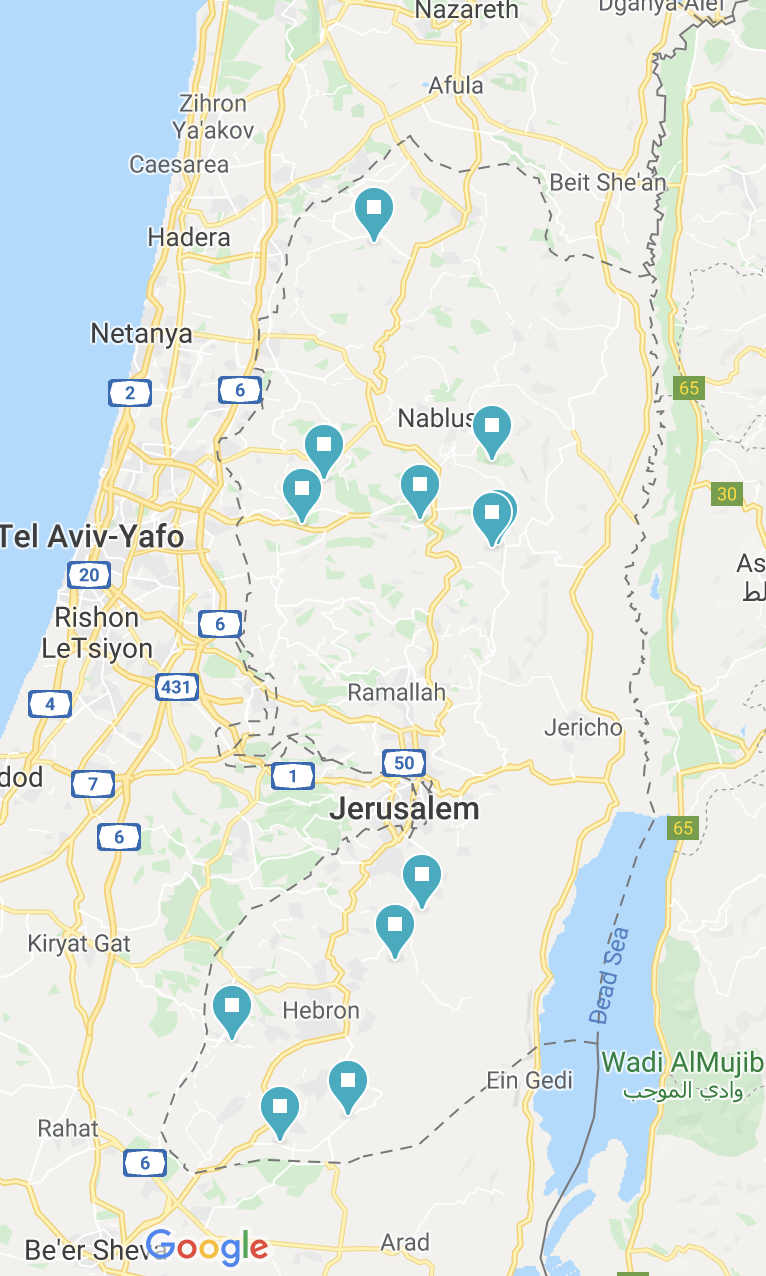
According to a letter from Netanyahu’s office, the 12 unauthorized outposts that will be connected to Israeli infrastructure were all built with “government encouragement” (though not formal approval or permits). In a perversion of the very notion of the “rule of law,” this unofficial encouragement for illegal actions is now treated by Israel as a valid legal basis for granting those outposts authorization.
The outposts slated for connection to Israeli municipal services are:
- The Nofei Nehemia outpost, located east of the Ariel settlement in the heart of the West Bank.
- The Havot Yair (Yair Farm) outpost, located west of Nablus.
- An outpost called “Hill 851”, located south east of Nablus in the central West Bank.
- The Maoz Zvi outpost, located in the northern West Bank.
- The Shaharit outpost, located in a string of settlements stretching from Israel proper to the Ariel settlement in the central West Bank, and going on to the Jordan Valley.
- The Pnei Kedem Farm outpost, located halfway between Bethlehem and Hebron in the southern West Bank.
- The Tekoa D outpost, located southeast of Bethlehem.
- The Negohot Farm outpost, located west of Hebron.
- The Avigayil outpost, located in the South Hebron Hills near the village of Susya.
- The Asa’el outpost, located east of the Palestinian village of Susiya in the southern tip of the West Bank.
- The Esh Kodesh outpost, located east of the Ariel and Shilo settlements, in a string of settlements stretching to the Jordan Valley.
- Ahiya, located in the Shilo Valley in the central West Bank.
David Elhayani, head of the umbrella settlement body called the Yesha Council, cheered Netanyahu’s announcement, saying:
“This is an important step for the benefit of young communities that have been suffering from electricity problems for years, and will now be able to receive electricity, just like any other citizen in the country.”
Since the passage of the Regulation Law in February 2017 and the invention of the “market regulation” principle by the Israeli Attorney General, the Netanyahu government has undertaken an energetic effort to grant retroactive legalization to outposts for which the Israeli government has not yet found a means to grant retroactive approval (though it has tried). The obstacle in all of these cases has been the fact that the outposts were built on privately owned Palestinian land. Following passage of the Regulation Law, Netanyahu immediately formed a committee tasked with finding a way to suspend the property rights of Palestinians; that committee produced the Zandberg Report in May 2018 — a report that, indeed, offers several justifications for the government to expropriate privately owned Palestinian land (one of the Report’s recommendations is to connect the outposts to Israeli municipal services). Following the publication of the Zandberg report, Netanyahu formed another committee tasked with implementing the report’s recommendations, by preparing individualized plans for each outpost to gain retroactive legalization. That taskforce, headed by notorious settler Pinchas Wallerstein. helped secure Cabinet approval for another bill to grant authorization to 66 outposts. All but two of the outposts named by Netanyahu this week (Hill 851 & Negohot) were part of a December 2018 bill to regulate 66 outposts – a fact that has drawn the wrath of settler leaders who bemoan Netanyahu’s delayed implementation.
FMEP tracks all events related to Israeli annexation and the drive to authorize outposts in its regularly updated Annexation Policy Tables.
Israel is Planning New West Bank Electricity Grid to Serve the Settlements
Haaretz reports that the Israeli government is close to approving a Master Plan for a new electricity grid in the West Bank, which will service Israel’s settlements. It may also serve Palestinian villages but only if — and it is a big if — the Palestinian Authority agrees to jointly implement the project. The plan is in the hands of Israel’s National Infrastructure, Energy and Water Ministry, which seeks to “provide a blueprint for the electricity market in the West Bank through 2040 and to develop infrastructure for Israeli settlements as well as for the Palestinians residing there.” However, the Israel-conceived plan calls upon the the Palestinian Authority to take responsibility over the Palestinian side of the equation, and the PA has refused to play that role and has condemned the plan.
In a statement, the Palestinian Authority’s Energy Authority said that the plan is designed:
“to establish Israeli sovereignty in the West Bank and to support the brutal presence of the settlements on our land.”
Settler leaders concurred with the PA’s assessment. Gush Etzion Regional Council chairman Shlomo Ne’eman told Haaretz:
“All moves point to sovereignty, and when we build infrastructure, there is also a basic understanding that the State of Israel is the sovereign. We are pleased that more and more government ministries have realized that this sovereignty is the reality.”
The plan, as reported by Haaretz, would see the Israeli Electric Company build a vast network of power lines across the West Bank. Israel will build six substations in Area C of the West Bank to distribute the high voltage power to settlements. Palestinians, if they are willing, are called upone to build eight substations in order to distribute power to Palestinian homes. The project is expected to cost between $870 million to $1.2 billion. The integration of settlements into Israel’s domestic planning schemes and the construction of massive infrastructure in the West Bank to service the settlements are significant advancements in Israel’s ongoing, de facto annexation of land in the West Bank.
Deputy Israeli AG Bemoans “Alarming Accumulation” Of Cases in Which Political Echelon Stops Outpost Evacuations
Haaretz reports that the Israeli Civil Administration planned to evacuate the unauthorized Mitzpe Yehuda outpost, located east of Jerusalem, in September 2019, but was directed to cancel the evacuation by one of Netanyahu’s personal aids in the Defense Ministry – Avi Roeh. The political interference was revealed in a High Court case filed by Palestinians claiming to own the land upon which the outpost was illegally constructed. The Palestinians are seeking to have the outpost immediately evacuated. Settlers claim to have purchased the land, and even submitted an application to have the outpost retroactively legalized by the government.
At the time of the scandal, Deputy Attorney General Erez Kaminitz wrote to Ronen Peretz, acting director of the Prime Minister’s Office, criticizing Roeh’s role in the Mitzpe Yehuda case, as well as the recurrence of political interference on behalf of the outposts. Citing several cases in which such interference occurred (Sde Ephraim, Givat Assaf, and Havat Negohot), Kaminitz wrote:
“This is a very alarming accumulation of cases that raises the specter of the emergence of a highly problematic trend that undermines the rule of law. It’s important to make clear that, as a rule, the political echelon is not authorized to intervene in decisions related to law enforcement.
Joint U.S.-Israeli Annexation Mapping Team Begin Work in Ariel
On February 24th, members of the U.S.-Israeli team tasked with mapping Israel’s annexation of West Bank land under the Trump Plan met for the first time to “explore the terrain.” At a vista near the Ariel settlement, Netanyahu underscored the significance of the project:
“The joint mapping process of the Israeli team and the American team is underway here in Ariel. This is a major mission. The area has an 800-km. perimeter. There is serious work, but we will work as quickly as possible to get it done…[the mapping process will] allow for the application of Israeli law [sovereignty] on these areas and later American recognition as well…[once complete] sovereignty can happen immediately.”
U.S. Ambassador David Friedman said:
“In Israel rain is a blessing, and I hope that our efforts should be blessed as much as the rain is coming down right now,” Friedman declared before the meeting started, the US Embassy in Jerusalem said in a statement. “We have our team here, and we’re going to get to work right away. We hope to complete it as soon as possible, and complete it the right way for the State of Israel.”
Ariel Mayor Eli Shaviro – one of the few settler leaders who publicly supports the Trump Plan – praised the mapping team, saying:
“The sovereignty ship is under way. As I have said in the past, I believe that the prime minister will advance the ‘Deal of the Century’ with President Trump and US officials. believe that the application of Israeli law in the Jordan Valley and in the communities of Judea and Samaria is closer than ever.”
Shaviro recently resigned from the settler Yesha Council over the group’s disavowal of the Trump Plan.
Bonus Reads + Resources
- “An Alternative Guide to City of David Archeological Park” (Emek Shaveh)
- “The Trump plan threatens the status quo at al-Haram al-Sharif” (Al Jazeera)
- “50 ex-European leaders and FMs condemn Trump plan, cite apartheid similarities” (The Times of Israel)
- “Planned Western Wall Train Will Threaten Historic Jerusalem Spring, Report Says” (Haaretz)
- “The Israelis fighting to keep the Jordan Valley Palestinian” (Al-Monitor)
Welcome to FMEP’s Weekly Settlement Report, covering everything you need to know about Israeli settlement activity this week.
To subscribe to this report, please click here.
February 14, 2020
- United Nations Releases Database of Businesses Operating in Settlements
- Notable Reactions to the Publication of the UN Database (Including Israel’s Pledge to Interfere In U.S. Politics to Undermine Constitutionally Protected Speech)
- Also at the UN this Week, Kushner Out-Maneuvers Abbas in the Security Council
- Netanyahu Says His Government Is Nearly Done Mapping Annexation, based on Trump Plan
- Judge Appoints Settler Lawyer to Manage Petra Hotel During Ongoing Bankruptcy, Ownership Battle
- The Israel Land Authority is Already Annexing West Bank Land
- Acquiescing to Settlers’ Pressure, Civil Administration Pushes Palestinians Off Land — By Citing British Mandate Regulations
- Terrestrial Jerusalem: The Trump Plan’s “Doublespeak” on Jerusalem
- Peace Now Details the Roles of the WZO & the Jewish National Fund in Driving the Settlement Agenda
- Bonus Reads
Questions/comments? Contact Kristin McCarthy (kmccarthy@fmep.org).
United Nations Releases Database of Businesses Operating in Settlements
On February 12th, following nearly four years of delay, the United Nations Human Rights Council finally published a (non-comprehensive) database of businesses involved in building, maintaining, securing, and servicing Israeli settlements in the West Bank, East Jerusalem, and the Golan Heights. The database was requested by members of the Human Rights Council in March 2016 in order to assist member states in complying with international legal obligations with regards to doing business with companies involved in activities which violate the human rights of people around the world.
The database lists 112 companies found to be conducting business with Israeli settlements. Key facts about these businesses:
- 94 companies are based in Israel (see list). The listed Israeli companies include all major banks, state-owned transportation companies Egged and Israel Railways Corporation, and telecommunications giants Bezeq, HOT and Cellcom.
- 6 companies are based in the United States: AirBnB, TripAdvisor, Expedia, Booking Holdings Inc., General Mills Inc, and Motorola Solutions Inc. General Mills explained that it was included on the database because a manufacturing facility “uses natural resources, in particular water and land, for business purposes.” For a review of how AirBnB has changed (for the worse) its policy of operating in the West Bank and East Jerusalem, see here. For reports on the actions of tourism companies promoting and operating in the settlements, see: Human Rights Watch’s report, “Bed and Breakfast on Stolen Land,” and Amnesty International’s report “Destination: Occupation”
- 4 companies are based in the Netherlands: Booking.com, Tahal Group International B.V., Altice Europe N.V., Kardan N.V.
- 3 companies are based in France: Egis Rail, Alstom S.A, Egis S.A.
- 3 companies are based in the United Kingdom: JC Bamford Excavators Ltd., Opodo Ltd., Greenkote P.L.C.
- 1 is based in Luxembourg: eDreams ODIGEO S.A.
- 1 is based in Thailand: Indorama Ventures P.C.L.
The publication of the database has repeatedly been delayed due to heavy pressure from Israel and the United States, neither of which are current members of the Human Rights Council. Even before its publication, Israel and the U.S. argued that the database would by definition be anti-Israel and antisemitic. From the start they also labeled the database a “blacklist,” even though the database itself neither calls for nor imposes any punitive consequences on the listed businesses. Indeed, as FMEP’s Lara Friedman has pointed out – and as former U.S. official Jason Greenblatt has suggested- that the database can just as easily serve as a list for settlement-supporters to shop from as it can serve as information based upon which someone might choose to boycott.
Notable Reactions to the Publication of the UN Database (Including Israel’s Pledge to Interfere In U.S. Politics to Undermine Constitutionally Protected Speech)
The most eye-catching reaction to the publication of the UN database came from Prime Minister Benjamin Netanyahu, who took to Twitter to claim credit for anti-BDS/pro-settlement legislation in U.S. states (some of which has been declared unconstitutional in U.S. courts) that penalizes those who boycotts Israel or settlements. That same day, the Israeli Foreign Ministry instructed diplomats serving in its U.S. consulates to work with state governors to get them to publicly condemn the UN database. Analysts quickly noted the audaciousness of this boasting by Israeli of interfering in domestic political affairs in the United States — boasting that only confirmed what researchers have known for years: the state of Israel has been pushing anti-democratic, unconstitutional laws in the United States.
Many Members of Congress issued statements denouncing the UN for publishing the database. Such statements suggest that there will likely soon be a move to pass legislation pending in the U.S. House which seeks to criminalize BDS, called the Israel Anti-Boycott Act.
In Israel, political figures from across the spectrum condemned the publication of the database. Prime Minister Netanyahu said that when the world recognizes Israeli sovereignty in the West Bank and in settlements, “this list will become void.” President Rivlin shockingly suggesting that the Human Rights Council’s publication of the database is reminiscent of the Holocaust. Even Amir Peretz, the leader of Israel’s left-wing coalition (which includes Meretz), condemned the database and vowed to work to compel the UN to repeal it. In addition, the Israeli Foreign Ministry announced it was freezing ties with the office of the UN High Commissioner for Human Rights.
A group of settlers leading the Samaria Regional Council (a municipal body representing and servicing settlements in the northern region of the West Bank) announced that it will file a class action lawsuit against the United Nations. Yossi Dagan, the organization’s head, said:
“Not only will we not break, we will fight – at the beginning of the week the Samaria Regional Council together with representatives of factories in the Barkan Industrial Zone will file a lawsuit against the boycott of human rights council officials, led by United Nations High Commissioner for Human Rights Michelle Bachelet and Secretary-General of the United Nations Antonio Guterres, as well as against other leftist organizations, and we will demand to receive compensation, as was decided by the Jerusalem District Court under the honorable Judge Yosef Shapiro, that there is no immunity from civil lawsuits and there is no way to hide behind immunity. We will not only claim damages that may be incurred, but we will also sue for the honor of the State of Israel and the slandering of its name.”
Palestinians welcomed the publication of the database, and quickly called for the listed businesses to change their practices. Prime Minister Shtayyeh said that the Palestinian Authority will pursue legal action against the businesses in order to force the issue, noting that businesses could fix the situation by re-locating to areas under Palestinian control. Shtayyeh said:
“We will pursue the companies listed in the report legally through international legal institutions and through the courts in their countries for their role in violating human rights…We will demand compensation for illegally using our occupied lands and for engaging in economic activity in our lands without submitting to Palestinian laws and paying taxes.”
Saeb Erekat, veteran Palestinian statesman and negotiator, said:
“While this list does not include all the companies profiting from Israel’s illegal colonial-settlement enterprise in occupied Palestine, it’s a crucial first step to restore hope in multilateralism and international law..[The list] should serve as a reminder to the international community on the importance of strengthening the tools to implement international law at a time when the illegality of Israeli settlements is being challenged.”
Also at the UN this Week, Kushner Out-Maneuvers Abbas in the Security Council
Prior to the UNHRC’s publication of the database, the United Nations Security Council played host to an Israel-Palestine drama of its own, in which a cast of key players from each side sought to persuade UNSC members to support/reject the Trump Plan.
Jared Kushner met with Security Council members on February 7th to sell the plan. The representative from Tunisia (who drafted a resolution critical of Kushner’s work) did not attend the meeting, and was later fired by Tunisia’s president. Palestinian Authority President Mahmoud Abbas visited the Security Council on February 11th in an attempt to rally opposition to the Trump Plan. His efforts – punctuated by a speech in front of the Council – cannot be considered a request. The Tunisian-lead draft resolution critical of the Trump Plan was abandoned by its drafters, in move celebrated by U.S. officials as a major victory in the Security Council, which the Trump Administration and Israel regularly characterizes as anti-Israel.
Netanyahu Says His Government Is Nearly Done Mapping Annexation, based on Trump Plan
On February 9th, Prime Minister Benjamin Netanyau announced that Israel has started mapping the area it intends to annex in accordance with the Trump Plan, saying “it won’t take too long.” The Israeli mapping team – which includes Minister Yariv Levin, Israeli Ambassador to Washington Ron Dermer, and a National Security Council representative – is being directly overseen by Prime Minister’s Office Director, General Ronen Peretz. The National Security Council has a representative on the team as well. saying “it won’t take too long.” Netanyahu made the remarks at a campaign event in the Maale Adumim settlement, located just east of Jerusalem in a highly coveted area which the Trump Plan delivers to Israel. Consistent with the Trump Plan, Netanyahu said that Israel will annex all of its settlements, the Jordan Valley, and East Jerusalem.
Netanyahu’s announcement can be viewed as part of his continued efforts to placate the large portion of his political base that is up in arms over Netanyahu’s acquiescence to the U.S. demand that annexation not be advanced until after the next elections (March 2nd). Furthering that cause, Netanyahu tried to make lemons out of lemonade – saying:
“The U.S. and [Israel] agreed that when this entire process is completed we’ll bring it to the government [for approval]. But the Americans are saying in the clearest manner: ‘We want to give you recognition and we’ll give you it when the entire process is complete.’ Recognition is the main thing. We brought this, I brought this/ We don’t want to endanger this, we are working responsibility and intelligently.”
U.S. Ambassador David Friedman – who initially said that Israel does not need to wait to annex West Bank land – took to Twitter to publicly caution Netanyahu against pushing annexation before the March 2nd elections, warning that there would be consequences if Israel moves unilaterally. Later that day, Amb. Friedman then tweeted the following statement in support of Netanyahu (smoothing over the previous rebuke), as well re-aligning his own public position to match that of Jared Kushner:
“President Trump’s Vision for Peace is the product of more than three years of close consultations among the President, PM Netanyahu and their respective senior staff. As we have stated, the application of Israeli law to the territory which the Plan provides to be part of Israel is subject to the completion of a mapping process by a joint Israeli-American committee. Any unilateral action in advance of the completion of the committee process endangers the Plan & American recognition.”
Netanyahu and Friedman’s remarks appear to further anger already indignant settler leaders.
Jordan Valley Regional Council chairman David Elhayani, who also serves as the chairman of the Yesha Council, said:
“The United States cannot prevent Israel from doing anything. [Netanyahu needs] to fulfill his commitment to the residents of Judea, Samaria and the Jordan Valley to apply sovereignty before the elections, and to do this as soon as possible.”
Samaria Regional Council chairman Yossi Dagan said:
“Sometimes even dear friends need to be put in their place and told that… we are a sovereign country and sovereignty will be extended to Judea and Samaria as the public in the State of Israel expects.”
Beit El Local Council chairman Shai Alon said:
“the United States should respect us as a state and not determine when Israel will assert sovereignty over Judea and Samaria.”
Watching this argument, FMEP’s Lara Friedman offered an important reminder:
“This spat is about a distinction (over timing/credit) without a difference (over substance/objective/outcome). That is the real story here. Making it a story about inter-extremist bickering only normalizes their shared annexationist agenda.”
Judge Appoints Settler Lawyer to Manage Petra Hotel During Ongoing Bankruptcy, Ownership Battle
According to Haaretz, a judge has appointed a lawyer for the radical settler group Ateret Cohanim as the legal custodian of the Petra Hotel – located just inside the Jaffa Gate to the Old City of Jerusalem – during an ongoing bankruptcy case against the Palestinian company currently operating the hotel. The lawyer, Avraham Moshe Segal, has taken over the debt that the Palestinian company owes – giving Segal leverage to oust the current operators, a goal he has tried to accomplish through various legal maneuvers over the years.
In addition to awarding the coveted property to a lawyer for a radical settler group, the appointment of Segal as the legal “receiver” is extraordinarily alarming because Ateret Cohanim is a party to the legal case involving ownership of the Petra Hotel. Since 2004, Ateret Cohanim has used shell companies to wage a battle against the Greek Orthodox Patriarchate, from which Ateret Cohanim claims to have purchased the hotel (along with two other coveted Old City properties). In June 2019, an Israeli judge awarded Ateret Cohanim ownership of the properties. The ruling was appealed by the Greek Orthodox Church, after it discovered new evidence showing Ateret Cohanim’s forgery of key documents and its payment of bribes to obtain the property. The case was officially reopened in November 2019.
Haaretz reports that a source at the Justice Ministry said that the appointment of Ateret Cohanim’s lawyer “demands an inquiry to determine whether there may be a conflict of interest”.
The Greek Orthodox Church requested the dismissal of Segal as the “receiver,” telling the court:
“The job holder in question [i.e., Segal] has been involved as part of his role in more than a few legal processes against the company and they have taken place in every legal instance, over a number of years, enough to enable us to say and even determine that there is more than a fear of a conflict of interests here.”
The Israel Land Authority is Already Annexing West Bank Land
The Israel Lands Authority is the governmental body which controls 90% of the land in Israel, and thus controls the supply and zoning of land for development, including land in the West Bank used for settlement construction. A new report revealed that in January 2020, some 66% (two-thirds) of the total amount of land auctioned by the Israel Lands Authority was located in the occupied territory. The report noted:
“All told, the ILA last month advertised land designated for 3,254 housing units, 2,136 of them in settlements, including Karnei Shomron, Givat Ze’ev, Ma’aleh Adumim and Efrat.”
While the data is only for a single month, the disproportionate focus in the ILA on developing land in the West Bank, as opposed to inside Israel, where housing prices are rising, is notable. Likewise, the data highlights the fact that notwithstanding ongoing discussion of when Israel might annex parts of the West Bank, consistent with the Trump plan, the fact is that Israel has already de facto annexed the area — evidenced by the fact that an Israeli domestic body has the authority to issue tenders for Israeli development inside the West Bank.
Acquiescing to Settlers’ Pressure, Civil Administration Pushes Palestinians Off Land — By Citing British Mandate Regulations
Reversing decades of practice, the Israeli Civil Administration recently denied Palestinian farmers access to their land outside of Ramallah and confiscated their tractor.. The denial was based on the argument that the area was deemed an antiquities site in the British Mandate period and therefore the Palestinians cannot receive permits to work it. The famers, two brothers, told Haaretz that the Civil Administration has not prevented them from accessing their lands for the last 50 years, and they were unaware that they needed a permit to continue doing so. Relatives of the famers suggest that the Civil Administration was pressured to close the area by settlers living in a nearby illegal settlement outpost, called “Malachei Hashalom.” The outpost is relatively news, established in 2015 on an abandoned military base, and has a reputation for harassing Palestinians and their flocks.
The brothers’ lawyer said of the Civil Administration’s change of policy:
“It’s another method of driving the Palestinians from their lands. Working the land does not harm antiquities, and the state also never made such an allegation. The archaeological claim was only invented after the establishment of the outpost.”
One of the farmers, Nader Abu Aleiyeh, told Haaretz:
“Everyone knows we work the land and they never told us anything. Soldiers in the past would come and drink tea with us while we were working the land.”
Terrestrial Jerusalem: The Trump Plan’s “Doublespeak” on Jerusalem
In its latest edition of Insider’s Jerusalem, Terrestrial Jerusalem experts examine at length the components of the Trump Administration’s plan related to Jerusalem, outlining the many delusional notions about Israel’s annexation of the city and its holy sites. Terrestrial Jerusalem writes:
“There is a common denominator in the portrayal of the stark realities of Jerusalem and the terminology used to describe them. By a systematic use of doublespeak, Palestinian residents of East Jerusalem aren’t Palestinians, Jerusalem is undivided, refugees don’t exist, Abu Dis is (wink, wink) Jerusalem but can’t be called as such, the status quo can be maintained even as it is violated, and Jerusalem is an open city ‘accessible’ to all, which denies access to the residents of the West Bank and Gaza. The Jerusalem of the Trump proposal does not exist in Jerusalem, but rather in the ideology of the settler right in Israel, and of the end-of-days Evangelicals in the US, where myths trump the facts.”
On the change to the status quo on the Temple Mount in the Trump Plan:
“As noted, the Proposal explicitly supports allowing Jewish prayer on Haram al Sharif/the Temple Mount. In doing so, the Trump administrations has adopted policies that have been rejected by every Israeli government since 1967. This radical change in the status quo is so problematic, that since the release of the Proposal, the Trump team has begun to walk it back. In a telephonic press briefing conducted by the US team days after the publication of the Proposal on January 28, Ambassador Friedman offered the following response to a press inquiry:
‘The status quo, in the manner that it is observed today, will continue absent an agreement to the contrary. So there’s nothing in the – there’s nothing in the plan that would impose any alteration of the status quo that’s not subject to agreement of all the parties. So don’t expect to see anything different in the near future, or maybe in the future at all.’
Even if taken at face value, there are three problems with Friedman’s clarification.
Firstly, Friedman’s statement contradicts the literal meaning of the text (‘People of every faith should be permitted to pray on the Temple Mount/Haram al-Sharif’). If Friedman’s clarification is to be taken seriously, no response to a question in a press briefing can serve as an alternative to a formal amendment to the Proposal’s text, or at the very least, an official announcement by the State Department revising the wording.
Secondly, the explicit change in the status quo appearing in the text of the Proposal is the equivalent of “shouting it from the rooftops”. Friedman’s statement was made almost by stealth, as though the drafters of this text do not want their clarification to be noticed. In the past, Netanyahu would issue his statements regarding the status quo in a similar manner: he would issue them in English only, late on a Saturday night, and then relegating the text to some obscure location on the Prime Minister’s website.
Finally, even if, as stated by Friedman, this change will not take place anytime soon, what has been said cannot be unsaid. The activists in the Temple Mount movement are ecstatic, flaunting their success on social media and promising to take advantage of the new situation. Instead of having a moderating influence on the various stakeholders on the Mount, this original text emboldens those who are already dangerously pushing the limits of the status quo. Anything less than an unequivocal and highly visible revision is tantamount to playing with matches at one of the most volatile locations on the planet. The prospect of an event leading to an eruption of violence is more likely today than it was before the release of the Proposal.”
On the list of holy sites in the Trump Plan:
“This selective sanctity on display in this list is quite significant and reflects a very specific, highly developed biblically driven narrative… The settlers of East Jerusalem make no bones about their objectives: they seek to establish an ancient Biblical realm in and around Jerusalem’s Old City, one in which real and purported sacred, historical and archeological sites establish the hegemony of their biblically motivated narrative. In doing so, they marginalize the equities of Muslims, and turn the Palestinian residents in the targeted areas into communities at risk…Just as the proposed change in the status quo reveals that the Trump administration has adopted the views of the extreme Temple Mount movement, its views regarding the epicenter of the conflict of between Israelis and Palestinians – the Old City and its visual basin – are virtually indistinguishable from those of East Jerusalem’s extreme settler organization, in general, and of the Elad settlers in particular. As with the settlers of East Jerusalem, in the Jerusalem of the Trump Proposal, even mundane or questionable Jewish history is sacred, while Arab and Muslim history does not exist.”
On the special tourist zone in Atarot (a wild concept not widely or accurately covered by press) Terrestrial Jerusalem writes:
“The Proposal stipulates that Israel create a special tourist zone [for Palestinian use] at Atarot, currently an industrial park several miles to the north of the city center, and which is to remain part Israel. This is to become a Special Tourist Area, even though there is nothing in the area which ends itself to tourism, nor are there sites of historic value. From this location, access to the Muslim Holy Shrines will be streamlined, with Palestinian tour guides licensed to lead tours. It is noteworthy that the Palestinians’ permission to conduct tours is limited to the Old City, and to Christian and Muslim sites elsewhere in the city. A Joint Tourist Development Authority will be created to allow Palestine to accrue some of the economic benefits of that tourism. This is the only example in the Proposal in which the Palestinians of the West Bank have any palpable stake in Jerusalem. However, even here, Israel is the arbiter of what tourists guided by Palestinian tour guides may see, and that is limited in scope.”
On the de-nationalization of Palestinians in East Jerusalem:
“The residents of East Jerusalem have individual rights as Arabs, not as Palestinians. They have religious rights in the city as Muslims, but not as Palestinians. They have material rights as tour guides and tourists (provided they limit their tourism to the sites Israel deems to be important to them). …By all acceptable measures, be it under international law or based on the empirical realities on the ground, East Jerusalem is occupied. However, in no way does the Proposal attempt to end occupation, for the simple reason that in their operative conceptual worlds, occupation simply does not exist. The proposal offers Palestinians of East Jerusalem a devil’s bargain: shed your national identity and your aspirations for a life within a Palestinian national collective, and you will be rewarded with certain privileges.”
For full analysis from Terrestrial Jerusalem, click here.
Peace Now Details the Roles of the WZO & the Jewish National Fund in Driving the Settlement Agenda
In anticipation of the World Zionist Organization (WZO) elections this October, Peace Now has published a two-page reminder about the group’s role in driving the illegal expansion of Israel’s settlement and outpost enterprise, which it did through it Settlement Division, in coordination with the Jewish National Fund. Peace Now Settlement Watch co-Director Hagit Ofran also recorded a webinar to discuss the new paper and the importance of the upcoming WZO elections.
The Settlement Division is a body within the WZO established in 1971 and fully funded by the Israeli government. Its mission was, and remains, to provide a channel by which the government can establish settlements – legally and illegally – in the occupied territories, while avoiding the pesky rules, regulations, and transparency requirements to which government entities are bound. The Israel government assigned management responsibilities to the WZO for over 60% of the land in the West Bank which the government declared to be “state land” (90,000 acres/400,000 dumans). The WZO has given that land to settlers to build settlements and secretly funnel government money to illegal outposts.
For its part, the Jewish National Fund (referred to as Keren Kayemeth LeIsrael-Jewish National Fund, or the KKL-JNF) started purchasing land in the West Bank in the early 1900s, for the explicit purpose of resettling Jews there. After 1967 and the commencement of Israel’s occupation of the West Bank, the KKL-JNF role changed to supporting the establishment and growth of settlements across the West Bank, and the eviction of Paelstinians from their homes in East Jerusalem in favor of Israeli settlers (including tthe recent eviction of the Sumarin family in Silwan).
A recent tweet by U.S. Ambassador David Friedman included a picture of him planting an olive tree on the grounds of the former U.S. Consulate in Jerusalem (now used as the Ambassador’s residence), standing alongside an agent of the KKL-JNF.
Bonus Reads
- “How do settlers takeover “ (+972 Magazine)
- “Trump’s Middle East Peace Plan Isn’t New. It Plagiarized a 40-Year Old Israeli Initiative” (Foreign Policy)
- “Israel’s Rejection of UN List of Companies Tied to Settlements Reveals Stark Truth About Annexation” (Haaretz)
- “Facing Blowback From Annexation” (Haaretz)
- “What is Donald Trump’s Vision for Jerusalem?” (Jerusalem Post)
- “Turkey hands Palestinians Ottoman land archive” (Middle East Monitor)