Welcome to FMEP’s Weekly Settlement & Annexation Report. To subscribe to this report, please click here.
January 15, 2021
- Tender for Givat Hamatos Settlement Construction Delayed
- Israel Expected to Advance Plans for (At Least) 684 Settlement Units, Grant Retroactive Approval to Outposts
- Netanyahu Promises to Boost Funds for “Sovereignty Road”
- Settlers Escalate Campaign for Outposts Legalization
- Israel Sets Up New Hotline to Assist Settler Surveillance of Palestinian Construction in Area C
- Key Quotes from U.S. Amb. Friedman on His Way Out the Door
- Bonus Reads
by Kristin McCarthy (kmccarthy@fmep.org)
Tender for Givat Hamatos Settlement Construction Delayed
On January 15th, the Jerusalem District Court issued a temporary injunction against the issuance of the tender for construction of 1,257 units in the Givat Hamatos settlement, slated to be built in East Jerusalem. Givat Hamatos has long been regarded as a doomsday settlement by parties interested in preserving the possibility of a two-state solution, assuming that Jerusalem will need to be divided and shared. If the Givat Hamatos settlement is built, the Palestinian neighborhood of Beit Safafa in East Jerusalem will be completely surrounded by Israeli construction, severing its connection to the West Bank.
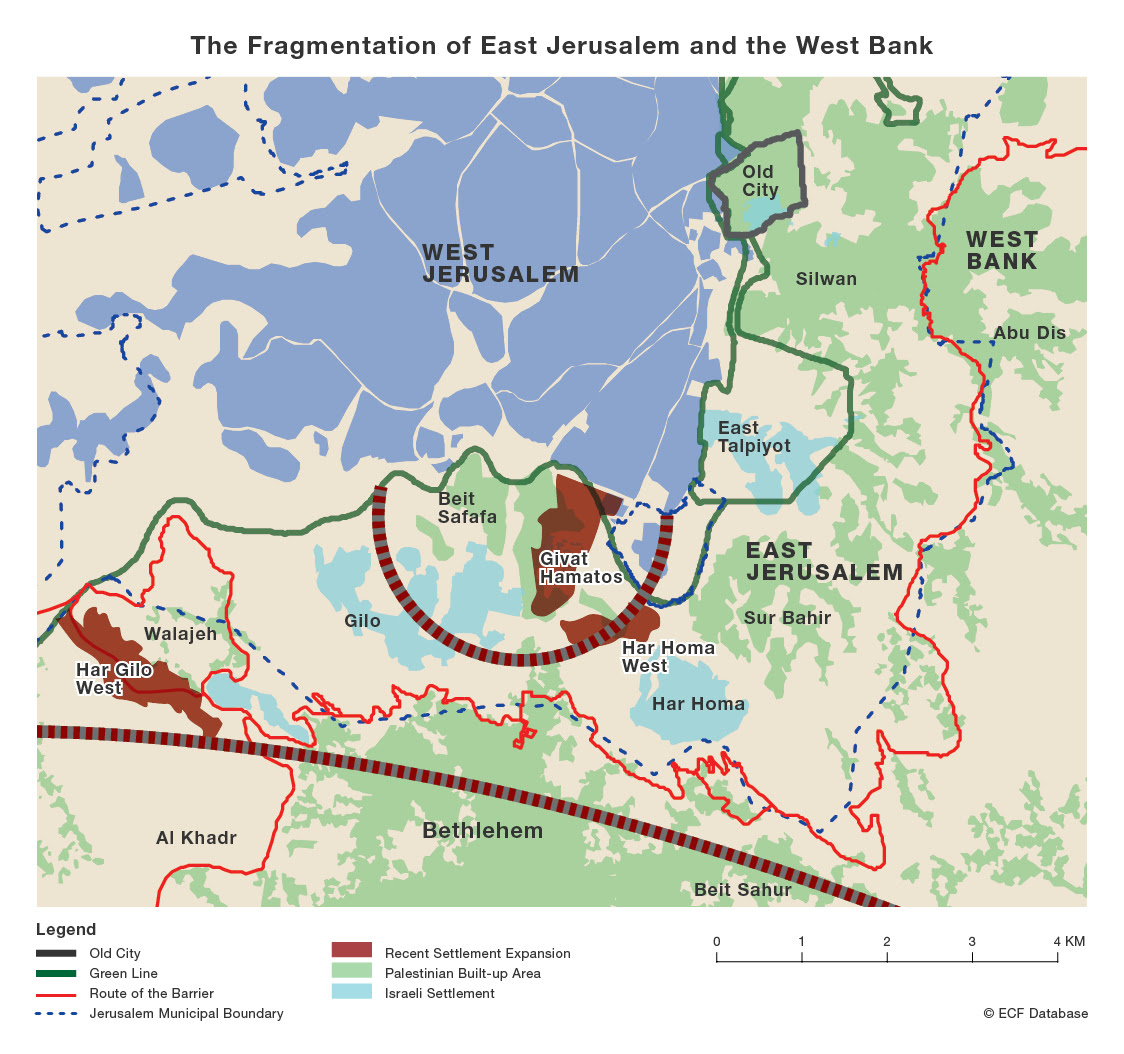
Map by Terrestrial Jerusalem
The injunction comes in response to an emergency petition submitted on January 14th by 25 Palestinian residents of East Jerusalem with the assistance of the Israeli NGO Ir Amim. The petition argues that the conditions of the tender represent “severe housing discrimination” in that non-Isareli citizens are ineligible for the government subsidized housing planned for Givat Hamatos. Rather than seeking to stop the construction of Givat Hamatos, the petition asks the government to correct these discriminatory conditions so that Palestinian residents are also welcome to purchase homes in Givat Hamatos.
The tender was scheduled to be published on January 18th (2 days before the inauguration of Joe Biden as the new U.S. president). The injunction delays that publication and orders the government to respond to Ir Amim’s petition by January 21st.
Ir Amim explains the petition’s claims in detail:
“40% of the homes [planned for Givat Hamatos] will be allocated to individuals who are eligible for a government subsidized housing scheme. To qualify, individuals must be a non- homeowner and an Israeli citizen, which entirely precludes EJ Palestinians, as the vast majority do not hold citizenship but rather permanent residency. Not only are they excluded from an affordable subsidized housing option, but only 60% of the apartment supply offered to an Israeli citizen is available to a Palestinian resident, which discriminates on two planes. The petition therefore calls for the following remedies:
1 – to grant Palestinian residents eligibility to qualify for the subsidized apartments on Givat Hamatos,
2 – Instruct the state to consider equitably allocating a significant number of affordable apartments to Palestinian residents of Jerusalem,
3 – Postpone the apartment marketing process for a period of no less than six months to allow for interested Palestinian Jerusalem residents to apply for eligibility for the subsidized housing scheme, or
4 – To cancel the subsidized housing scheme and rather sell all apartments on the free market, making them accessible to all…
East Jerusalem Palestinians already suffer from acute housing shortages and suppression of residential development stemming from long-standing discriminatory planning and building policies. Since East Jerusalem’s annexation in 1967, not one neighborhood has been built for Palestinians, while only 8.5 % of Jerusalem is zoned for their residential use despite them constituting nearly 40% of the city’s population. 1/3 of the land in East Jerusalem was confiscated to build Israeli neighborhoods/settlements. If and when residential outline plans are approved for existing Palestinian neighborhoods, they only allow for a few hundred housing units versus thousands of housing units in Israeli neighborhoods across the city.”
Terrestrial Jerusalem’s Daniel Seidemann comments:
“This is far from over, and one can never estimate the life expectancy of an injunction like this, but this is very good news. As matters stand the tender process regarding Givart Hamatos will NOT end on January 18, and the bids will not open.”
Israel Expected to Advance Plans for (At Least) 684 Settlement Units, Grant Retroactive Approval to Outposts
The Israeli Defense Ministry’s Higher Planning Council (which oversees all construction in the occupied West Bank) is expected to meet on January 17th to advance plans for at least 684 – but potentially 850 or more – settlement units across the West Bank, while also advancing the retroactive legalization of two outposts. These approvals will come only days before the inauguration of Joe Biden as the new President of the United States, a changing of the guards expected to temper U.S. support and approval for settlement construction.
An additional report by Middle East Eye reports that on January 13th the Israeli planning authorities in Jerusalem advanced plans for 400 units in the Gilo settlement and 130 units in the Ramat Shlomo settlement, both located in East Jerusalem. FMEP will provide more details when those reports are confirmed.
FMEP will confirm the details of the Civil Administration’s High Planning Council meeting in next week’s Settlement Report. Based on what is known today, the settlement units expected to receive final approval include:
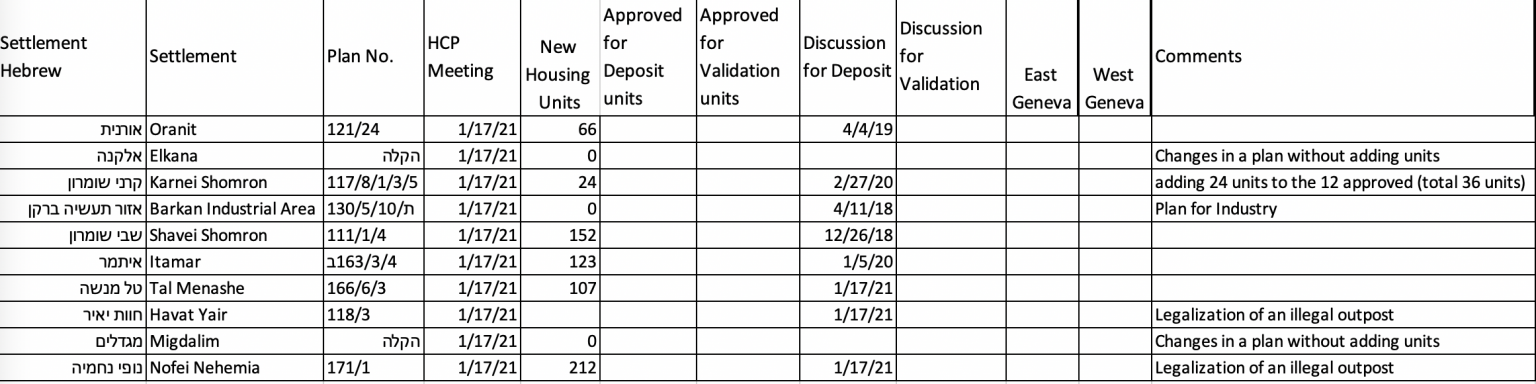
- 152 new units in the Shavei Shomron settlement, located in the northern West Bank – northwest of Nablus;
- 123 new units in the Itamar settlement, located southeast of Nablus in a cluster of notoriously violent settlements and outposts;
- 66 new settlements units in the Oranit settlement, located in the northern West Bank, in the “seam zone” between the 1967 Green Line and the Israel separation barrier (constructed along a route designed to keep as many settlements as possible on the Israeli side of the wall/fence);
- 24 new units in the Karnei Shomron settlement, located in the northern West Bank east of the Palestinian village of Qalqilya. Israel is planning to continue expanding Karnei Shomron with the stated goal of bringing 1 million settlers to live in the area surrounding the settlement;
- Expansion of the Barkan Settlement Industrial Zone, located in the northern West Bank and a part of a strand of settlements leading from Israel proper all the way to the Ariel settlement in the very heart of the northern West Bank, reaching literally to the midpoint between the Green Line and the Jordan border. The future of Ariel and the settlements between Ariel and Israel proper have long been one of the greatest challenges to any possible peace agreement, since any plan to connect Ariel to Israel will cut the northern West Bank into pieces. For background on this industrial zone and others, see here.
The settlement units slated to be advanced to the planning stage of depositing for public review include:
- The retroactive legalization of 212 existing units in the Nofei Nehemia outpost, which if implemented would have the effect of retroactively legalizing the outpost as a neighborhood of the Rehelim settlement. The Nofei Nehemia outpost is a fair distance from the Rehelim settlement and is not contiguous with the built up area of Rehelim, making Nofei Nehemia – if authorized – more properly understood as a brand new settlement rather than an expansion of an existing settlement (as the Israeli government would want one to believe). The Nofei Nehemia outpost is located east of the Ariel settlement in the very heart of the northern West Bank.
- 107 new units in the Tal Menashe settlement, located on the tip of the northern West Bank. Tal Menashe is technically a neighborhood of the Hinanit settlement, though the built up areas do not connect. Notably, the plans for 107 units would, if implemented, “dramatically increase” the size of the Tal Menashe settlement, which is the settlement where Esther Horgan – who was murdered by a Palestinian in late December 2020 – lived. Israeli government officials have made it a clear policy to advance settlement construction in response to deadly attacks on settlers by Palestinians, an approach publicly endorsed by current U.S. Ambassador David Friedmam. Tal Menashe is situated in the “seam zone” between the 1967 Green Line and the Israel separation barrier, which was constructed along a route designed to keep as many settlements as possible on the Israeli side of the wall/fence.
- An unknown number of units in the Havot Yair outpost with the intention of granting retroactive legalization (under Israeli law) to the entire outpost. The Havat Yair outpost is located near the Karnei Shomron settlement in the northern West Bank, east of the Palestinian village of Qalqilya.
Wasel Abu Youssef, a member of the Executive Committee of the Palestine Liberation Organization told Reuters:
“[Israel’s advancement of settlement construction] is an attempt to race against time and benefit from the last days of the current U.S. administration.”
Peace Now said in a statement:
“By promoting hundreds of settlement units, Prime Minister Netanyahu is once again putting his personal political interests over those of the country. Not only will this settlement activity erode the possibility for a conflict-ending resolution with the Palestinians in the long-term, but in the short-term it needlessly sets Israel on a collision course with the incoming Biden administration. For eight years as vice president, Biden and the rest of the Obama administration gradually became more irritated and willing to spar with Israel over settlements, and for the past four years Biden has watched Netanyahu stroke Trump’s ego to promote policies meant to undermine the very foundations for a two-state solution. Although supporting more settlement activity may be a shrewd way to attract votes over the increasing number of rivals to his right, Netanyahu is gambling with Israel’s all-important relationship with its US ally.”
It’s worth noting that current Israeli Defense Minister (and increasingly disgraced Blue & White party leader) Benny Gantz, following the publication of the High Planning Council’ agenda for settlement construction, announced that his office had taken “preliminary steps” towards the approval of Palestinian construction plans in communities located in Area C of the West Bank (some 60% of the West Bank which Israel exercises unilateral civil and security control over, and which is the focus of the most intense settler campaigns for de jure annexation). The Times of Israel reports that those plans include: the expansion of the Palestinian village of Al-Walaja (located south of Jerusalem and surrounded on three sides by the Israeli separation barrier), the expansion of Hizma (located on the northern border of the Jerusalem municipal boundary), approval of a new hotel in the Bethlehem area (note: Bethlehem itself is not in Area C), a hearing on plans for a hotel in Beit Jala (located on the eastern border of Bethlehem, 75% of land belonging to Beit Jala was designated as Area C under the Oslo Accords), and a hearing on the retroactive legalization of farming buildings in al-Fara (located in the northern West Bank). Commenting on Gantz’s announcement of these Palestinian plans, Bimkom researcher Alon Cohen-Lifshitz told told The Times of Israel:
“This is like mocking the poor. Most of the plans are from 2012. They’re all very small in terms of their land use and do not allow for [further] development.”
Predictably, settlers responded with vitriol to the rumor of plans to regulate (i.e., post-facto legalize) Palestinian construction in Area C. A spokesman for the Young Settlements Forum (“young settlements” is a new euphemism for illegal outposts that has been catching on in Israeli politics) said:
“There is no limit to this cynicism. The defense minister and the prime minister want to legitimize the illegal Palestinian takeover of Area C in violation of political agreements, and remove from the agenda the regulation of Israeli settlements that have been built on state land.”
Netanyahu Promises to Boost Funds for “Sovereignty Road”
According to the Jerusalem Post, Prime Minister Netanyahu has promised to allocate an additional $4 million USD (NIS 14 million) or more to the construction of the so-called “Sovereignty Road.” The road is a key element in Israel’s plan to build the E-1 settlement east of Jerusalem and its larger ambition to annex (de facto or de jure) a huge area of West Bank territory located between Jerusalem and Jericho.
According to the Jerusalem Post, Netanyahu met with Benny Kashriel, mayor of the Ma’ale Adumim settlement (located adjacent to the E-1 site), along with Transportation Minister Miri Regev and Finance Minister Israel Katz to discuss the matter this week. During the meeting, Bibi made the verbal commitment to allocating additional funds to see that the road is built.
Peace Now responded to the news:
“Netanyahu’s election campaign is costing Israel a very heavy price. Once again, he is using the election period to try to impress key Likud supporters by promoting a plan that could eliminate the possibility of a two-state solution. The planned road will allow Israel to cut the West Bank in two, build E1 and the separation barrier, and close the door on the possibility of developing a sustainable Palestinian state.”
For decades, construction of the E-1 settlement – which is now actively advancing through the planning process – has been adamantly opposed by the international community. A key criticism of the plan is that it would effectively cut the West Bank in half — thereby preventing any two-state solution. The “Sovereignty Road” has long been Israel’s answer to that criticism, with Israel arguing that it will replace territorial contiguity with limited “transportational continuity” – via a sealed road that is under Israel’s total control (meaning they can cut off passage through it at any time).
If built, a section of the Palestinian-only road is projected to run under the separation barrier (which is not currently built in this area). The rest of the road will run relatively adjacent to the route of the planned separation barrier, in order – in the words of former Defense Minister Bennet – to prevent Palestinian traffic from coming “near Jewish communities.” This new section of road connects to the infamous “apartheid road” (aka, the Eastern Ring Road) which has a high wall down the middle dividing Israeli and Palestinian traffic, and which was opened for Palestinian traffic in January 2019.
In March 2020, then Defense Minister Naftali Bennet gave final approval for the “Sovereignty Road” plan, at the time giving lip service to the idea that the plan will benefit Palestinians (even as it further cuts them off from Jerusalem, takes more land, and cuts the West Bank in half). At the same time, he made clear his real objective. stating:
“[the road] will improve the quality of life for residents in the area, avoid unnecessary friction [for Israelis] with the Palestinian population and most importantly — allow for continued [settlement] construction. We’re applying sovereignty [to the West Bank] in deeds, not in words.”
Peace Now has previously explained the issue with Israel’s design:
“The new road is intended to allow Palestinians to pass under the route of the separation barrier, and to travel ‘inside’ the Adumim Bloc along a wall without entering the ‘Israeli’ side, as in a kind of tunnel. Once the road is paved, Israel can then claim that construction in E1, and the construction of the barrier around the Adumim bloc does not sever the West Bank because the Palestinians have an alternative transport route. This argument is preposterous. A thin line of road connecting separate territorial sections–transportational contiguity–does not meet the needs for territorial viability for the development and livelihoods of Palestinians in the critical Ramallah-Jerusalem-Bethlehem metropolitan area. Without actual territorial contiguity, an independent Palestinian state cannot be established and prosper, and therefore a two-state solution cannot be reached.”
Settlers Escalate Campaign for Outposts Legalization
Kan radio reported that Defense Minister Benny Gantz told settlers that he remains opposed to issuing retroactive authorization to dozens of outposts in one fell swoop, but will instead prefers that each outpost go through a legal process individually in order to gain legalization.
Settlers have been encamped in front of the Prime Minister’s office for nearly two weeks demanding for the passage of a government decision for large scale retroactive legalization of as many as 70 outposts. That decision has been drafted but has been held up by Defense Minister Gantz; In December 2020, Knesset introduced a bill to circumvent Gantz’s opposition and grant authorization to 65 outposts.
Some of the protesting settlers began a hunger strike in hopes of escalating their demands for outpost authorization. Numerous politicians and officials have visited the encamped settlers to show solidarity, including aspiring Prime Minister Naftali Bennett visited the encamped hunger strikers, saying:
“Netanyahu, authorize the young settlements [outposts] now in these coming 10 days. If you don’t do it, when I am the prime minister, I will do it.”
Israel Sets Up New Hotline to Assist Settler Surveillance of Palestinian Construction in Area C
Haaretz reports that in November 2020 the Israeli Civil Administration (the body within the Israeli Defense Ministry tasked with coordinating all civilian affairs in the occupied West Bank) created a new hotline for settlers wishing to report their suspicions of “illegal” Palestinian construction in the West Bank (on the Kochav Ya’akov settlement website, the new phone service is called a “snitch line”).
Amira Hass reports in Haaretz that the Civil Administration’s announcement of the “snitch line” said:
“Have you seen Palestinian construction work that looks to you to be suspicious and unauthorized? Have you encountered a sanitation hazard created by Palestinians who disdain the law? From now on you have a ‘snitch-line’ of your own. Call at any hour of the day and submit a complaint about it. Every day there will be a summary of the complaints and a display of what was examined and what was confiscated in the event that there was improper conduct. Good luck.”
Testing whether the new hotline was exclusively for Israeli settlers reporting on Palestinians, the Palestinian-led NGO Haqel tried reporting illegal construction by the settlers. In response, the Civil Administration said that the “coordination office representatives sent someone to check what’s going on.”
The new hotline is yet another victory in the campaign by settlers to stop Palestinian construction in Area C, and push Palestinians out altogether. In November 2020, in addition to razing an entire Palestinian community, Khirbet Humsa, and tightening the noose on Khan Al-Ahmar – the Israeli government advanced plans to begin a land registration process in Area C as a means by which the state can declare more West Bank land to be “state land,” a way to retroactively legalize unauthorized settlement construction there (as well as put more land off limits to Palestinain construction and even render some existing Palestinian construction illegal).
Additionally, on September 10th the Israeli government allocated $6 million USD (20 million NIS) for the newly created Settlement Affairs Ministry to survey and map unauthorized (by Israel) Palestinian construction in Area C of the West Bank, which Israel – egged on by settlers – has been aggressively demolishing in an effort to rid the area of Palestinians. Haaretz reports that this is the first time that the state budget has included funds specifically for a land survey in the West Bank. The state also allocated an additional $2.8 million (9.5 million NIS) to an existing grant program specifically for settlement municipalities to cash in on. As a reminder, virtually all Palestinian construction in Area C of the West Bank is “unauthorized,” because Israel almost universally refuses to give Palestinians permission to build in Area C even on land that Israel recognizes as owned by Palestinians.
The Settlement Affairs Ministry is a new creation of the current coalition government, and is headed by Tzachi Hanegbi (Likud). The funding for the Settlement Affairs Ministry to conduct a survey of unauthorized Palestinian construction in Area C further empowers a domestic Israeli body to exert extraterritorial sovereignty over Area C – in effect, treating the area as land already de facto annexed by Israel. While technically the occupied territories are administered by the Israeli Civil Administration (a body within the Defense Ministry), Israel has spent decades bringing the administration of the territories (specifically the settlements and Area C) ever more directly under direct Israeli law (de facto annexation).
The Knesset has also repeatedly hosted forums to discuss “the Palestinian takeover of Area C.” Consistent with this framing (which is predicated on the idea that Area C belongs to Israel), and pushed by outside groups, many members of the Knesset have criticized the Israeli government’s allegedly lackadaisical approach to defending Israel’s rights/ interests in Area C (i.e., preventing “illegal” Palestinian construction, preventing foreign projects that support Palestinians’ presence in the area, clearing out Palestinians, expanding settlements, consolidating state infrastructure). Reportedly, Foreign Affairs Minister Gabi Ashkenazi (Blue & White) sent a letter to the committee in October 2020 specifically addressing the Knesset’s outrage over European humanitarian assistance projects for Palestinians in Area C. In the letter, Ashkenazi not only celebrated the reduction of European projects over the past year, but validated settlers’ insinuations regarding the nefarious nature of European assistance for Palestinians, saying that any European activity in the West Bank lacking Israeli permission is “an attempt to define a border.”
At one Knesset hearing, MK Bezalel Smotrich (Yamina) suggested that a solution could be to empower the settlements with the ability to demolish Palestinian construction they believe to be unauthorized. Smotrich’s partymate Ayelet Shaked (former Justice Minister) suggested that the government should appoint a project manager tasked with preventing a “Palestinian takeover” of Area C.
As noted above, Israel has long denied Palestinians the ability to build in Area C, resulting in many Palestinian structures (including homes, schools, farms, etc) being built without the required Israeli-issued permits. To fully understand what is happening, see B’Tselem’s excellent explainer.
Key Quotes from U.S. Amb. Friedman on His Way Out the Door
Please read the New York Times feature on David Friedman in its entirety, and the two separate threads (one and two) journalist David Halbfinger tweeted with supplemental material from the interview. A few key quotes regarding U.S. settlement and annexation policy over the past four years are copied below.
On internal Israeli annexation negotiations between Netanyahu and his government coalition partners:
“I was invited.”
On the future of Israel’s de jure annexation of West Bank land:
“They [Israel] can act unilaterally. It’s suboptimal, but at some point, it’s just sort of necessary just to move on.”
On how the U.S. settlement policy over the past four years:
“he agreed with the Israelis that they should build ‘from the inside out’ — to expand settlements ‘with the least amount of damage to the overall footprint. And that’s how they’ve been operating over the last four years’.”
On the opposition to settlement construction by previous U.S. administrations:
“just to kind of virtue-signal that we think the Palestinians should have something more, made no sense to me…[What Israel does inside or outside the settlements is] an internal decision.” And also on the idea of asking for a settlement freeze: “for them [Israel], I think a freeze of construction is the acknowledgment that the land doesn’t belong to them.”
On criticisms of the Trump Plan map:
“We spent months working on ways to achieve contiguity. You can drive from Hebron to Nablus and never see an Israeli. “I used to take the Midtown Tunnel to work every day. If you tell me that there’s a river, that I go under a river, I don’t know that. I never saw the river once. I drove under that thing for 30 years, never saw a river. So I take it on faith that there’s an East River. I’m just saying that we created enough contiguity so that Palestinians could go throughout the West Bank without ever coming face-to-face with the Israelis.”
On the role Israelis played in creating the Trump Plan and map:
“The editorial control was always ours. This was entirely authored by us and almost entirely conceptualized by us.”
On how to get Israelis to buy into future peace talks:
“Peace talks would only gain traction with the Israeli right, he ‘without the accusation that somehow it’s a thief and being asked to return things that it stole. Israel will not and should not come to the table on the basis of being an illegal occupier of stolen land’”
On the current status quo (in which Israel occupies the West Bank and blocakes the Gaza Strip):
“the status quo is not unsustainable, but I think the status quo is suboptimal and should be.”
On the dangers posed to Israeli democracy by permanent occupation:
“I don’t think it has anything to do with Israel’s democracy because Israel’s democracy is the function of the citizens, and these are not citizens of Israel.”
Friedman confirmed that the Trump Plan and normalization deals between Israel and the UAE and Bahrain held out the “aspiration” of a massive change to the status quo on the Temple Mount in which non-Muslim prayer would be allowed at all areas except Al Aqsa Mosque.
Dismissing any remaining doubt that normalization deals between Israel and Arab countries were contingent on Israel’s permanent suspension of annexation:
“I don’t think it would’ve been appropriate for Israel to, especially without the consensus of the Israeli population, to just give up territory permanently for any agreement with another country,”
He blamed the Israeli left for a tense moment in 2010 between then Vice President Biden and the Israeli government, when Biden arrived in Israel on the same day Isreal announced settlement construction plans:
“The reality here is whenever under the last administration somebody of significance came to visit, the Israeli left would immediately publicize whatever they could find in terms of settlement expansion, to create that friction,”
On his future plans:
“I’m going to stay American-only for at least four years. I want to give myself every opportunity to return to government.” And later, “Finally, there’s talk of his forming an Israel-based pro-settlement group. He hinted: ‘I will stay in the space somehow, but I just don’t know how,’ he said. ‘I’ll try to maintain a voice. I mean, it’s a huge drop-off when you no longer have access to the president’.”
Bonus Reads
- “[Webinar] ‘Raided and Razed’: West Bank Education under Attack” (FMEP & NRC)
- “‘Does someone have to die for West Bank outposts to be legalized?’” (Jerusalem Post)
- “Land of wine and honey? Israeli settlers export to UAE, to Palestinian chagrin” (Reuters)
Welcome to FMEP’s Weekly Settlement & Annexation Report. To subscribe to this report, please click here.
December 18, 2020
- Draft Government Decision on Outposts Provides for Expropriating Private Palestinian Land for the Settlements & Retroactively Legalization of 43 Outposts
- Knesset Advances Bill to Grant Retroactive Legalization to 65 Outposts
- Tender Published for 290 Units in the Gilo Settlement, More to Come
- New Evidence Showing Settler Council Funds Illegal Outposts via Amana; Petition on Amana Funding to be Heard by High Court in Coming Days
- Israel Sovereignty Movement Launches New Campaign for Annexation
- Israel’s Escalating Assault on Palestinian Life in Area C
- Bonus Reads
by Kristin McCarthy (kmccarthy@fmep.org)
Draft Government Decision on Outposts Provides for Expropriating Private Palestinian Land for the Settlements & Retroactively Legalization of 43 Outposts
Peace Now has reported the details of a draft government decision on outposts, which Alternate Prime Minister Benny Gantz is currently holding back from coming up for a Cabinet vote (despite the fact that one of his key advisors reportedly helped draft the decision). With the measure blocked in the Cabinet, proponents of the legalization effort may try to bypass the government by going for Knesset approval of a bill to accomplish a similar goal (see below).
With respect to the details of the initiative: contrary to previous reporting on the matter, the effort does not relate to outposts built illegally on “state land,” but rather deals with 43 illegal outposts built either entirely or partially on land that is privately owned by Palestinians. According to Peace Now, the draft government decision seeks to:
- Establish a new mechanism for expropriating privately owned Palestinian land for the outposts/settlements. The decision calls for the recruitment of 17 staff (5 real estate coordinators, 3 legal advisers, 2 real estate department workers, 5 planning bureau workers and 2 coordinators) who would be tasked with finding legal means by which to declare private Palestinian land to be “state land” if there is an outpost built on it. According to Peace Now, the new staff will use recommendations from the Zandberg report and of Attorney General Mandelblit to accomplish this goal. To review, the 2018 Zandberg report suggested that, in order to legalize outposts, the government can and should (thorough explanation of these points can be found here):
- Implement the “market regulation” principle to its fullest extent.
- Expropriate of privately owned Palestinian land for “public use.”
- Adopt a principle of flexibility in defining “adjacent areas.”
- Establish new, official settlements (in the case where outposts cannot be regulated based on the prior three points).
- End the work of the Israeli “Blue Line Team,” which maps the legal status of land in the West Bank.
- Allow regional Settlement Councils to provide municipal services to (currently) unauthorized outposts.
- Approve 31 outposts as “neighborhoods” of existing settlements that are fully authorized by the Israel government. By doing so, Israel hopes it might avoid international consternation involved in establishing new settlements. Despite the legal turn of tongue, the authorization of outposts as new neighborhoods of existing settlements should be understood as the establishment of new settlements, especially but not solely because in many if not most cases the outposts are not contiguous with the built up part of settlements or even within the recognized borders of settlements’ Master Plans. For a list of these outposts, see the Peace Now report.
- Approve the authorization of 12 independent outposts, creating 11 fully fledged new settlements. For a list of these outposts, see the Peace Now report.
Peace Now said in a statement:
“The proposed resolution awards a prize for systematic delinquency and gives the green light for the continued takeover of Palestinian land in a way that would never have been considered legal within Israel proper. Beyond the value and moral damage that the decision produces, it promotes the de facto annexation of the West Bank, without public debate and against the wishes of most Israeli citizens who breathed a sigh of relief with the cancellation of the annexation plans. The fact that the government found it appropriate to allocate tens of millions of shekels for the move, precisely in the midst of an economic crisis, also shows how flawed and distorted its priorities are, as well as its contempt for the electorate. It can still be stopped. We hope that the government will show responsibility and avoid the move. ”
Knesset Advances Bill to Grant Retroactive Legalization to 65 Outposts
In light of Benny Gantz’s delay in granting approval to a draft government decision on outposts, the Knesset has advanced a bill to grant retroactive legalization to 65 outposts (distinct from the initiative described above). The bill – introduced by far right-wing MK Bezalel Smotrich (Tkuma) and the Land of Israel Lobby (which he chairs), passed its first reading on December 16th. It will need to pass three more readings before becoming law. Smotrich said he hopes to expedite the next three readings before the year’s end (i.e. next week), while continuing to call on Prime Minister Netanyahu to approve a government decision on the matter.
The legislation would, if passed, require the government to treat the 65 outposts as if they were legal – and would direct the government to complete the formal legalization process for the outposts within two years. In the interim, the state would be obligated to connect the outposts to Israeli municipal utilities like water, internet, phone, and also allow the granting of mortgages to settlers living on land.
Notably, the bill enjoys broad support in the Knesset and passed by a 60 to 40 vote. Support for the bill includes Netanyahu’s Likud Party, Naftali Bennet’s Yamina Party, and Avigdor Liberman’s Yisrael Beytenu Party. And, despite official opposition to the bill, Gantz allowed four members of his Blue & White Party to vote in its favor – showing that there might be an even broader base of support. As part of its campaign to push the bill forward, a Knesset committee devoted to legalizing all outposts ran a survey of 502 Israeli adults that found 73% of respondents who identify as “centrist” or support the Blue & White party are in favor of the outpost legalization bill.
Commenting on passage of the bill in its first reading, the Land of Israel Lobby said:
“A huge majority of the elected Knesset members support the moral and humane process of regulating the young settlements.”
Tender Published for 290 Units in the Gilo Settlement, More to Come
Ir Amim reports that the Israel Lands Authority published a tender for the construction of 290 new units in the Gilo settlement, located in southern Jerusalem between the isolated Palestinian East Jerusalem neighborhood of Beit Safafa and the West Bank city of Bethlehem. Ir Amim reports that the proposed new units will be built within the built-up area of the settlement, meaning that this plan will not expand the footprint of the Gilo settlement.
Ir Amim further reports that Israeli authorities are advancing two more plans to expand Gilo:
- On December 21st, the Jerusalem District Planning Committee discussed a plan to build 253 new settlement units in Gilo. If implemented, the construction would expand the footprint of Gilo eastwards towards the West Bank city of Beit Jala.
- Another plan for 464 units in the Gilo settlement has been scheduled for final discussion on January 4, 2021. This plan would replace and add to existing apartments in the settlement.
New Evidence Showing Settler Council Funds Illegal Outposts via Amana; Petition on Amana Funding to be Heard by High Court in Coming Days
Days before the High Court will once again takes up a petition seeking to bar governmental funding from going to the radical Amana settler group – which is engaged in illegal outpost activity – a new trove of documents has once again proven that settler councils have been secretly funneling money to Amana, explicitly to support the establishment and development of illegal outposts.
This week, after a year-long battle led by the Movement for Freedom of Information in Israel, the Gush Etzion Regional Council (a settler body governing settlement affairs in part of the southern West Bank) was forced to release documents that revealed its financial relationship with Amana, the largest and most powerful settler organization devoted to advancing settlements across the West Bank and East Jerusalem. Those documents show how the Council diverted nearly $500,000 (1.6 million shekels) in 2018 and 2019 to Amana directly in support of the establishment and development of illegal outposts.
The financial relationship between settler councils and Amana is not entirely new information (see here), but these newly-released documents specifically reveal that Amana is behind the recent trend of establishing farming outposts. As Peace Now has previously explained, these agricultural/farm-based outposts enable a small number of settlers, with few resources, to take over large tracts of land by grazing cattle in the area. These settlers often push Palestinians off that land, sometimes violently. Peace Now has documented the establishment of at least 35 such agricultural outposts since 2006.
The new documents show that the Council’s funds were earmarked specifically to support these farming outposts, including over $250,000 (900,000 shekels) for their development. The docs also show that the Council paid 20% of the salary of a full time Amana staff “coordinator” for these outposts. The documents further showed the Council directed ~$195,000 (NIS 632,065) to the Makhrour outpost, ~$31,000 (NIS 100,733) in the Tekoa agricultural outpost, and ~$16,000 (NIS 52,650) in the Pnei Kedem agricultural outpost (for the purchase of a truck).
The data comes at an interesting time, given the expectation that the High Court will soon hold a hearing on a petition regarding government funding to Amana. To review, in February 2019, Peace Now submitted a petition seeking to bar settler regional councils from funding Amana, arguing that Amana engages in illegal activity and should therefore not be eligible to receive funds from the government whose laws it is violating. The petition also notes that legally, public entities cannot transfer money to private organizations like Amana. In December 2019, the High Court said that while this petition is pending any government funding of Amana must receive the Court’s approval first. The case is scheduled for a hearing this Sunday, December the 20th.
Peace Now wrote:
“Amana and the regional councils in the territories have established a sophisticated mechanism to exploit the public coffers for illegal activity and to create facts on the ground. There is no limit to the chutzpah of the settlement heads. On one hand, they build outposts, with far-reaching diplomatic consequences, with public funds, and on the other hand, they cry to the government and ask for their criminality ==to be retroactively legalized. What a responsible and fair government needs to do is shut the spigot to Amana and immediately evacuate the illegal outposts.” And, “the regional councils and Amana go to great efforts to hide the information about their financial sources and illegal activities. Even with the legal process in Peace Now’s petition against granting support money to Amana, the councils have refused to provide basic information on the amount of funds transferred to Amana and their use. Amana received tens of millions of shekels from the regional councils every year, and the information received about the activities in Gush Etzion in 2018 and 2019 is just the tip of the iceberg. Peace Now uncovered the mechanism behind the illegal outposts in its “Unraveling the Mechanism behind Illegal Outposts” report which describes the operation by local authorities in the West Bank, together with Amana and the Settlement Division, to support illegal outposts and construction in the settlements, but not all financial sources have been clarified. The support by the Gush Etzion Regional Council is only a small part of Amana’s multi-million shekels operation in this illegal activity, with far-reaching ramifications for Israel’s future.”
Or Sadan, a lawyer with the Movement for Freedom of Information in Israel, said in a statement:
“The information that was received from the Gush Etzion Regional Council emphasizes, once again, the importance of the Israeli Freedom of Information Law. The information shows how public funds are being transferred to activities beyond the Green Line, with questionable legality. The fight against this kind of activity must be based on solid information directly from public authorities.”
Israel Sovereignty Movement Launches New Campaign for Annexation
The Israeli Sovereignty Movement – an Israeli nongovernmental organization- has launched a new campaign pushing for Israel to move ahead with unilateral annexation of the West Bank before the inauguration of a new U.S. president. On the first night of Hanukkah, the Sovereignty Movement co-hosted a virtual event titled “Lighting Sovereignty over the Jordan Valley,” drawing participation of 30 government officials, including the government’s coalition chairman Miki Zohar (Likud). The event was also sponsored by the US-based Zionist Organization of America, the settler group Regavim, the Israel Forever Foundation, and Americans for a Safe Israel.
At the event, the hosts touted new polling that shows 56% of the general Israeli public supports the annexation of the Jordan Valley, including 80% of respondents who identify as “right-wing.”
The Sovereignty Movement – an offshoot of the Women in Green organization – has established and expanded its influence over Israeli politicians and public discourse over the past two years. Nadia Matar, one of the co-founders, told JNS:
“[the] overwhelming majority of the Israeli public believes that sovereignty should be applied over the Jordan Valley, and now that the left is once again raising the issue of the ‘two-state solution,’ the focus should be on the application of sovereignty.”
At the event, MK Zohar said:
“I think that Israel should work towards applying sovereignty over the Jordan Valley and also take the opportunity to advance the application of sovereignty over many communities in Judea and Samaria, if not all of them. It’s an opportunity that might not present itself again.”
Israel’s Escalating Assault on Palestinian Life in Area C
Directly from OCHA [emphasis added by FMEP]:
“In November, the Israeli authorities demolished, forced people to demolish, or seized 178 Palestinian-owned structures across the West Bank: this is the highest such figure in a single month since OCHA began systematically documenting this practice in 2009. This month’s incidents resulted in the displacement of 158 people and otherwise affected the livelihoods or access to services of over 1,000 others. All structures, except for one demolished on punitive grounds, were located in Area C or East Jerusalem and were targeted due to a lack of building permits, which are nearly impossible for Palestinians to obtain.
Of the affected structures, 43 had been provided as humanitarian aid, for a total cost of 82,000 euros. It is the largest number of EU-funded structures targeted in a single month since January 2017, bringing the total number of such structures demolished or seized since the start of 2020 to 114.
About 50 per cent of all structures targeted this month were in small herding communities in sections of Area C designated closed for Israeli military training (‘firing zones’). The largest such incident took place on 3 November in Humsa Al Bqai’a, in the northern Jordan Valley, where the Israeli authorities demolished 83 structures, or about three-quarter of the community, including 29 structures provided as humanitarian aid. A total of 73 people, including 41 children were displaced as a result, but have been able to remain in the area following the delivery of emergency shelters and other assistance.
Additional 13 structures were targeted in the Massafer Yatta area of Hebron, most of which is also declared a ‘firing zone’. This included a donor-funded water network, part of which had already been dismantled in October, which served some 700 people from four communities. This incident took place on 25 November on the basis of an expedited procedure (Military Order 1797), while legal partners were presenting the case in court, to try and halt the removal of the network.
Nearly 30 per cent of Area C, where 38 Palestinian communities (5,000 people) are located, is designated as ‘firing zones’. These communities, many of which have existed in the area since prior to the start of the Israeli occupation, have limited access to basic services and are at heightened risk of forcible transfer. At east ten unauthorized Israeli settlement outposts are also located either partially or completely in ‘firing zones’.”
Read the full OCHA report here.
Bonus Reads
- “Deprived a Voice: An Investigation into Shrinking Space in Area C” (Al-Haq)
- “After 60 years, East Jerusalem Palestinians face eviction under Israeli settler rulings” (Reuters)
- “Palestine’s Cultural Property and the Israeli Occupation” (PLO-NAD)
- “Tourism and Israel’s Settler Colonial Project Seeking Ethical Alternatives” (Al-Shabaka)
- “‘Temporarily Uprooted’ Gaza Settlements Among ‘Miracles’ in Israeli Learning Kits” (Haaretz)
Welcome to FMEP’s Weekly Settlement & Annexation Report. To subscribe to this report, please click here.
December 11, 2020
- Israel Expected to Advance Plan for Yeshiva at Entrance to Sheikh Jarrah
- Gantz Weighing Vote in Cabinet to Legalize 40+ Outposts
- MK Planning to Call Vote on Bill to Prevent Future Evacuation of Any/All Settlements & Outposts (De Facto Annexation West Bank)
- Annexation via Internet
- Annexation via Roads & Infrastructure
- Bahrain Backtracks On Annexation Recognition…As UAE Openly Embraces Settlers
- Bonus Reads
Israel Expected to Advance Plan for Yeshiva at Entrance to Sheikh Jarrah
Ir Amim reports that at the next meeting of the Jerusalem District Planning Committee the Committee, scheduled for December 16, is expected to advance a highly inflammatory plan to build a Jewish religious school (a yeshiva) and dormitory at the entrance of the East Jerusalem neighborhood of Sheikh Jarrah.
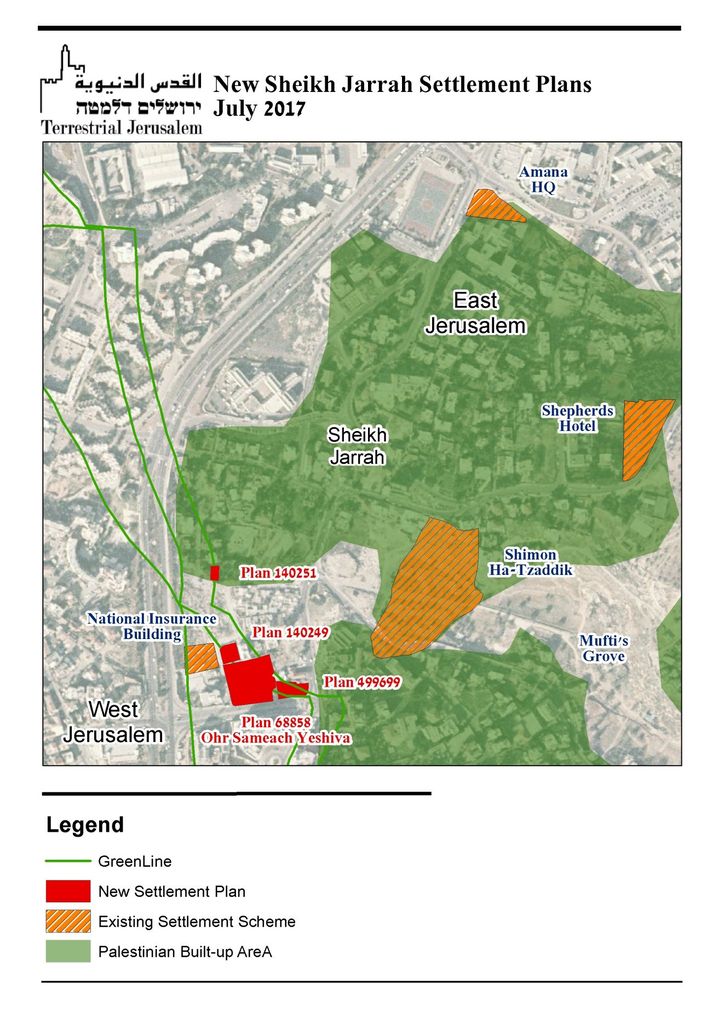 The District Planning Committee was expected to grant approval to this plan in July 2020, but – based on data submitted by Ir Amim – unexpectedly ordered a new survey on the needs of the Sheikh Jarrah community. It is unclear at this time whether that survey has been completed, and if it has been completed, what the conclusions/findings were and if the Committee is now satisfied. The December 16th Committee meeting is closed to the public.
The plan to build the yeshiva and dormitory, which would house dozens of young religious settlers, as well as another project for a 6-story building in the same area, aims to strengthen Israeli settlers’ hold on the neighborhood. Once built, settlements will literally flank both sides of the road leading into Sheikh Jarrah, advancing the settlers’ goal of cementing the presence of the settlement enclaves inside of Sheikh Jarrah and connecting them more seamlessly to the neighborhood’s periphery and to West Jerusalem.
Ir Amim writes:
“If approved, the construction of the yeshiva will significantly bolster the efforts of state-sponsored settler organizations to transform large portions of Sheikh Jarrah into a large Israeli settlement through evictions of Palestinians and settler takeovers of their homes. Over the past few months, the Israeli courts have upheld eviction demands against 12 Palestinian families, including the Sabbagh family, from the Kerem Al’ajoni section of Sheikh Jarrah, ruling on behalf of settler groups. Various appeals and legal proceedings have only temporarily halted the families forced removal from their homes.”
Just this week, FMEP hosted a webinar on Sheikh Jarrah and the impending dispossession of Palestinians from their longtime homes.
Gantz Weighing Vote in Cabinet to Legalize 40+ Outposts
The Jerusalem Post reports that Defense Minister Benny Gantz (Blue & White) is holding up – for unreported reasons – the Security Cabinet’s consideration of a draft decision to grant authorization to dozens of Isareli outposts across the West Bank. Gantz has not (yet) issued his approval for the draft text to be discussed and voted on at the Cabinet level, though he has allowed a senior Defense Minister, Michael Biton, to work with Settlement Minister Tzachi Hanegbi (Likud) on crafting that text over the past several weeks.
Speaking to the Knesset Foreign Affairs and Defense subcommittee on December 9th, Hanegbi said that a draft decision is “almost 100% complete,” and that he expects it to provide for the retroactive authorization of 40-45 outposts. Hanegbi said he had hoped to craft a decision that could apply to 69 outposts, but his negotiations with Biton limited its scope. Last week, Biton and Gantz made it clear that the party would support granting authorization to outposts which were built on “state land,” but not outposts which have a more complicated land status, including private Palestinian ownership claims.
According to Peace Now, there are a total of 124 outposts in the West Bank. There is a new urgency around granting a sweeping government authorization to outposts as Israel anticipates a closing window of opportunity to do so with the looming exit of President Trump and his openly pro-settlement, pro-outpost, pro-annexation policy.
The push to grant retroactive legalization to all of the outposts is nothing new, nor is the more limited goal of granting authorization to outposts that were built on land that has been declared by Israel to be state land – a status which the Israeli government regards as less complicated than cases where the outposts were built on land that have recognized ownership claims from Palestinians. In addition to the myriad problems with how Israel has used its authority as an occupier to declare land as “state land” and subsequently designates that land for the sole use of settlers, the fact remains that outposts built on that land were built illegally even under Israeli law (though in many cases with the tacit support or active encouragement of the government). For years, Israel has openly sought to find creative bureaucratic and legal means to grant retroactive “legal” status to as many outposts as possible.
In 2012, a government-commissioned report – called the “Levy Report” (after its author, retired High Court Justice Edmund Levy) declared Israeli’s occupation of the West Bank to be legal and recommended that outposts built on state land can be easily authorized (legalized) through the planning process without a government decision (i.e., outside of the influence of political or diplomatic considerations). The Israeli government, though it did not formally adopt the report, has nonetheless proceeded to implement its recommendation to grant retroactive legalization to many of these outposts. According to a 2019 Peace Now report – 15 outposts have since been legalized and 35 are in the process of being legalized between 2012 and 2019. At the same time, 32 new outposts have been established.
The outposts that, to this point, have not been legalized have spurred new legal thinking in Israel – like the Regulation Law and the “market regulation” principle – to find new bases by which to legalize the outposts under Israeli law (aka, to suspend the rule of law to deprive Palestinians of recognized land ownership and legalize illegal actions).
MK Planning to Call Vote on Bill to Prevent Future Evacuation of Any/All Settlements & Outposts (De Facto Annexation West Bank)
MK Tzvi Hauser (Derech Eretz) announced that he intends to bring to a vote in the Knesset a bill that would amount to the de facto annexation of the West Bank. The bill aims at preventing the Israeli government from ever evacuating any settlements or outposts, and it does so by expanding the application of an existing Israeli law to include the West Bank. That law, passed in 2014, requires that any proposed withdrawal/evacuation of territory in Jerusalem or the Golan Heights be approved in a national referendum or receive a supermajority of 80 votes in the Knesset. The logic behind this effort is that even if political leaders some day were interested in negotiating a two-state agreement with the Palestinains, the law would make implementation of any agreement politically difficult if not impossible (a situation which would in effect tell the Palestinians, formally, that they have no hope of ever ending the occupation via negotiations).
The bill was submitted to the Knesset in August, and can be brought up for a vote by a member at any time.
Various versions of this same bill have been repeatedly introduced to the Knesset, but not yet called up for a vote. For details, see Yesh Din’s handy database of annexation legislation here. Explaining a 2017 version of the bill introduced by MK Yehuda Glick (then a Likud party member), Yesh Din wrote:
“The bill addresses the West Bank territory as part of the State of Israel, and seeks to equate the legal standing of sovereign Israel and territories not subject to Israeli sovereignty.”
Annexation via Internet
On December 8, Israeli Communications Minister Yoaz Hendel (Derech Eretz Party) accompanied settler leaders on a tour of the Etzion settlement bloc region in the southern West Bank. Speaking to reporters, Hendel reiterated his promise to deliver modern communications infrastructure, including high speed internet and fiber optics, to settlers living in the area.
Perfectly explaining why this is part of Israel’s entrenchment of the settlements and de facto annexation of the West Bank, Shlomo Ne’em (head of the settler Gush Etzion Regional Council) said:
“Adding communications infrastructure in Gush Etzion is equivalent to de facto sovereignty. Until we bring full national sovereignty, the residents here can live on par with 21 century standards.”
Annexation via Roads & Infrastructure
Breaking the Silence and the Israeli Centre for Public Affairs this week issued a new report entitled “Highway to Annexation: Israeli Road and Infrastructure Development in the West Bank.” The report lays out how Israel has, for decades, been implementing de facto annexation of the West Bank not only through the growth of the settlements, but through the construction of roads, water, electricity, and other infrastructure in the West Bank which in turn allows for the growth of the settlements.
In addition to providing a history lesson on Israel’s construction of infrastructure in the West Bank from the earliest days of the occupation, the report provides analysis of ongoing and likely infrastructure projects that are a key part of the ongoing annexation-through-infrastructure reality. Those projects, which are designed solely with the interest of the settlements in mind (though the GOI says that Palestinians will be able to use them as well), include:
-
- Expanding Lateral Roads, including: Highway 55 (running from Israel to the Kedumim settlement), Highway 5/505 (running from Israel through the Ariel settlement and on to the Jordan Valley), Highway 456 (running between Ramallah and Salfit), Highway 367 (in the western Etzion bloc). As explained in the report, lateral roads in the West Bank serve two goals: connecting settlements to Israel proper and restricting the growth potential of Palestinian communities.
- Expanding and renovating roads in the Jerusalem Metropolis, including the following –
- To Jerusalem’s south: doubling the size of Highway 60 (the “Tunnels Road”) as an entrance to Jerusalem from the south;
- To Jerusalem’s east: extending the Eastern Ring Road (aka the “Apartheid Road”), building an underpasses for the Talpiot and French Hill settlements and an overpass for the Ramat Shlomo settlement – all of which will allow settlers to more directly (without hitting a single traffic light) enter Jerusalem.
- To Jerusalem’s north: tunneling under the Qalandiya checkpoint (for settlers only) and connecting that tunnel via a new sections of several highways in the area (Highway 45, Highway 443, Highway 935). This will allow settlers (only) to bypass the notoriously congested Hizma checkpoint.
- And, expanding the Jerusalem light rail to service East Jerusalem settlements.
- Building the “Sovereignty Road” near Ma’ale Adumim. This road would be for Palestinians, designed to divert Palestinian traffic around the Maale Adumim and E1 settlement areas in preperation for massive settlement growth. This road has emerged as the Israeli government’s defense for its plans to build the E-1 settlement, which critics say will sever the West Bank in two. Israel, via this road plan, argues that Palestinians will continue to have “transportational contiguity” despite losing territorial contiguity.
For a full reporting on all of the infrastructure projects being advanced by Israel in the West Bank, see the full report.
The authors write:
“ The ultimate vision of the road and transportation projects currently planned and underway in the West Bank involve entrenching the segregation between Israeli settlers and Palestinians. These infrastructure projects, of course, do not provide for “separate but equal” development but are rather guided primarily by the interests of the settler population and come at the expense of Palestinian development… West Bank road and transportation development creates facts on the ground that constitute a significant entrenchment of the de facto annexation already taking place in the West Bank and will enable massive settlement growth in the years to come. By strengthening Israel’s hold on West Bank territory, aiding settlement growth, and fragmenting Palestinian land, this infrastructure growth poses a significant barrier to ending the occupation and achieving an equitable and peaceful solution to the Israeli-Palestinian conflict.“
Bahrain Backtracks On Annexation Recognition…As UAE Openly Embraces Settlers
This week, Bahrain clarified that it will not import goods produced in Israeli settlements in the West Bank or Golan Heights (making the question of how such products are labeled moot). The policy clarification reverses comments made by a Bahraini trade official late last week that seemed to offer Bahrain’s de facto recognition of Israeli sovereignty over the settlements, and follows significant backlash for those comments.
Taking a different approach, this week the UAE — which previously welcomed a high-profile visit by a settler delegation — doubled down on its approach of actively embracing commercial ties with settlements. On December 8th, the Jerusalem Post reported that the UAE-based FAM Holding company has signed a deal with a settlement vineyard – the first time such a deal has been made between a UAE business and the settlements. The deal provides for the UAE to import goods from the Tura Winery (in the Rehelim settlement), the Har Bracha Winery (in the Har Bracha settlement), and the Arnon Winery (near the Itamar settlement), as well as Paradise Honey.
Yossi Dagan, the head of the settler Samaria Regional Council, called the deal “a national-strategic achievement for the State of Israel” saying it is a:
“significant part of a strategic process to strengthen Samaria — in the number of residents, in infrastructure and culture. We’re working hard, consistently, and in any location, to turn Samaria into an economic powerhouse — another glass ceiling shattered!”
Discussing/rationalizing the deal, the head of Dubai’s Chamber of Commerce and Industry adopted longstanding hasbara talking points that paint doing business with settlements as a way of helping the Palestinians. According to the Times of Israel, he:
“noted that Israeli factories provide work for tens of thousands of Palestinians and said the hope is to assist the Palestinians economy rather than harm it.”
As a reminder, “benevolent occupation” is an old hasbara argument founded on the view that Palestinian should appreciate the opportunities settlements provide for employment, even as those same settlements and the occupation deny them dignity, human and civil rights, freedom of movement and access to their own lands, and self-determination –and in parallel, deny them any chance to develop a productive Palestinain economy that could provide them employment and economic opportunities. For a an examination of this old hasbara line, see: Sodastream, ScarJo, and the Myth of Benevolent Occupation
Along these same lines, Avi Zimmerman – leader of the “Judea and Samaria Chamber of Commerce & Industry” – is once again touting the fiction that the success of settlement businesses benefits Palestinians. According to the Times of Israel’s reporting, Zimmerman said that, “in the spirit of symmetry” he is working to:
“find opportunities for Palestinian businesses to benefit from the accords as well, in the short term through partnerships with Israeli businesses and in the long term through large-scale environmental and infrastructure projects that incorporate both populations.”
Again, as a reminder, economic “coexistence” initiatives like the “Judea and Samaria Chamber of Commerce & Industry” are, in fact, efforts to normalize, entrench, and reward Israeli settlements while perpetuating Israel’s economic exploitation of occupied territory (including the local workforce, land, and other natural resources). Labelling such initiatives as “coexistence” programs or suggesting that Palestinians should welcome the benefits of settlement economies is perverse.
Bonus Reads
- “Israel’s Tony Soprano Policies in the West Bank“ (Haaretz // Michael Sfard)
- “Firing zones, Highway 10 to open to hikers on Hanukkah” (Jerusalem Post)
- “Highways to Annexation: Across the West Bank, Israel Is Bulldozing a Bright Future for Jewish Settlers” (Haaretz)
- “Peace for Peace? Israel-Morocco Deal Is Occupation in Exchange for Occupation” (Haaretz)
Welcome to FMEP’s Weekly Settlement & Annexation Report. To subscribe to this report, please click here.
December 4, 2020
- Israeli Courts OK (Again) Settlers’ Mass Displacement of Palestinians from Silwan, Eviction Notices Issued to 8 Palestinian Families
- Har Homa E Settlement Plan Approved for Deposit
- High Court Rules Against Ottoman Land Registration Laws, Paving Way for More Retroactive Legalizations and Presaging Ugly Land Registration Battle
- Planning Committee Rejects Appeal Against Overtly Political Hebron Elevator Project
- Likud Minister Calls For Israel to Enforce “Symmetry” of Construction in Area B + C of West Bank
- Benny Gantz Make Clear His Support for Retroactive Legalization of Outposts on “State Land”
- Bahrain: No Annexation. Also Bahrain: Settlements Are Israel
- Aid to Amb. Friedman Appointed to Key Post, Will Stay In Control of U.S. Normalization Programs
- Bonus Reads
Questions/Comments? Email Kristin McCarthy (kmccarthy@fmep.org).
Israeli Courts OK (Again) Settlers’ Mass Displacement of Palestinians from Silwan, Eviction Notices Issued to 8 Palestinian Families
On November 30th, eight Palestinian families (45 individuals) received eviction notices ordering them them to vacate their longtime family homes as early as December 18, 2020, and if they do not they may be forcibly removed by Israeli forces any time between December 18, 2020-January 1, 2021. Ir Amim reports that the families intend to appeal to the Israeli Supreme Court, but there is no guarantee that the Court will agree to hear the case.
 The issuance of eviction notices follow two significant court rulings on cases in late November 2020. In both cases, Israeli courts sided with the Israeli settler group Ateret Cohanim in seeking the eviction of a total of eight Palestinian families (45 individuals) from their long time homes in the Batan al-Hawa section of Silwan, located on the southern slope just outside of the Old City in East Jerusalem. The rulings further consolidate growing Israeli case law recognizing Ateret Cohanim as the legal owner of a significant amount of land in Silwan (and the buildings on it), entitling the group to pursue the eviction of as many as 700 Palestinians who in many cases have lived on that land for generations. If executed, this would be the largest displacement of Palestinians from East Jerusalem since 1967.
Ir Amim explains:
“The Ateret Cohanim settler organization is waging one of the most comprehensive state-backed settler takeover campaigns in East Jerusalem through initiating mass eviction proceedings against Palestinian families in Batan al-Hawa. Eighteen families have already lost their homes with over 80 other households facing eviction demands, placing some 600-700 individuals of one community at risk of displacement. See Ir Amim’s and Peace Now’s joint report, “Broken Trust” for further details and analysis.
Peace Now said:
“This is an attempt to displace a Palestinian community and to replace it with an Israeli one, in the heart of a Palestinian neighborhood in East Jerusalem. The settlers could not have succeeded without the Israeli authorities’ close support and assistance. In addition to the hard blow to the prospects for a two-state solution by preventing a Palestinian capital in East Jerusalem, this is an injustice and an act of cruelty to throw out families who have lived lawfully in their homes for decades. For every dunam in East Jerusalem that was owned by Jews and had been lost in the 1948 war, there are tens of thousands of dunams in Israel that were owned by Palestinians who lost them in the 1948 war. The settlers’ demand to disposes the Palestinians based on pre-1948 ownership is a strategic threat on the moral justification of hundreds of thousands of Israelis living on lands that were owned by Palestinians.”
As a reminder, Ateret Cohanim has waged a years-long eviction campaign against Palestinians living in Silwan, on property the settler NGO claims to own. This claim is based on Ateret Cohanim having gained control of the historic Benvenisti Trust, which oversaw the assets of Yemenite Jews who lived in Silwan in the 19th century. Palestinians have challenged the legitimacy of the Benvenisti Trust’s claims to the currently existing buildings, saying that the trust only covered the old buildings (none of which remain standing) and not the land. Israeli Courts have continued to rule in support of Ateret Cohanim’s claims and against Paelstinians who have been living there for decades. Taking a different approach, in June 2020 Palestinians filed a new petition challenging the legality of the functional operations of the Trust/Ateret Cohanim, asserting that Ateret Cohanim is using the Benvenisti Trust as nothing more than an (illegal) front for displacing Palestinians, pointing out that the trust does not have a separate organizational structure, bank account, lawyer, or accountant – and that Ateret Cohanim has folded the operations of the trust into its own operations and there is no distinction between the management or assets of the two entities.
As a reminder, in 2001 the Israeli Charitable Trust Registrar granted Ateret Cohanim permission to revive the trust and become its trustees, (following 63 years of dormancy). In 2002, the Israeli Custodian General transferred ownership of the land in Batan al-Hawa to the Trust/Ateret Cohanim. Since then, Ateret Cohanim has accelerated its multifaceted campaign to remove Palestinians from their homes, claiming that the Palestinians are illegally squatting on land owned by the trust.
Har Homa E Settlement Plan Approved for Deposit
As expected, the Jerusalem District Planning Committee approved for deposit for public review the Har Homa E settlement plan which provides for the construction of 540 units on an open area of land which will significantly expand the Har Homa settlement to its west, tightening the noose around the Palestinian neighborhood of Beit Safafa in East Jerusalem. 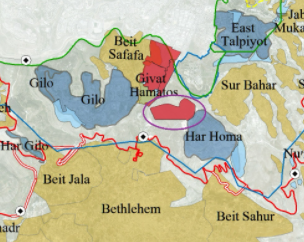
The plan has been approved for deposit but as of this writing not yet deposited; Ir Amim predicts the Committee will deposit the plan in short order in light of the impending U.S. presidential transition. Once deposited, a sixty day comment period begins after which the Committee can reconvene to issue final approval for the plan. Ir Amim writes:
“As demonstrated by the swift developments in plans for Givat Hamatos and Har Homa E, it is likely that Israel will continue to exploit this narrow window of time before the US presidential inauguration to advance further measures the Biden administration is anticipated to oppose, including advancements in the E1 area.”
The plan for 570 units currently set for deposit represents the first detailed plan under a much larger Master Plan for Har Homa E, which involves a total of 2,200 units. Plans to build the remaining units permitted under the Master Plan are not yet being advanced.
The construction in Har Homa E will solidify a continuum of Israeli settlement construction within the southern perimeter of East Jerusalem – from Har Homa, to Givat Hamatos, to Gilo – detaching East Jerusalem from Bethlehem and completing the encirclement of the Palestinian East Jerusalem neighborhood of Beit Safafa.
High Court Rules Against Ottoman Land Registration Laws, Paving Way for More Retroactive Legalizations and Presaging Ugly Land Registration Battle
On December 1st, the Israeli High Court of Justice issued a ruling that provides yet another basis on which the State is permitted to grant retroactive legalization to outposts and settlement structures built on Palestinian land in the West Bank. The ruling also, and perhaps even more significantly, establishes the Court’s willingness to sidestep Ottoman and Jordanian land registration practices when deciding land ownership claims (which since 1967 Israel has recognized as applicable in the West Bank and East Jerusalem) . This latter fact is particularly alarming given Israel’s reported intention to begin a new land registration process in the West Bank and East Jerusalem.
The specific case before the Court related to structures in the Kochav Yaakov settlement built on land that was declared to be “state land” by Israel in 2013. Palestinians petitioned the Court to reverse the state land declaration, arguing that they are the rightful owners of land. Their ownership claims are based on their having cultivated the land for at least ten years prior to 1967, and the fact that they were in the process formally registering their ownership of that land through the Jordanian real estate registration procedure – a procedure that was frozen by Israel shortly after it occupied the West Bank.
The lawyer representing the Kochav Yaakov settlement, Harel Arnon, argued that the Court should care more about what has happened on the land since the Jordanian land registration process was frozen, not on what existed at the moment the law was frozen. This argument, by design, favors the settlements and the settlers, who have been able – with the backing of the state and the permission of the Courts – to illegally establish settlements and outposts while also preventing Palestinians from accessing their land.
Rejecting the significance of the Palestinians’ attempt to register their ownership of the land under Jordanian law (which was still in process and not complete at the time the process was frozen by Israel), the Court ruled on the basis of aerial photos which showed the land was not cultivated between 1969-1980. The ruling punishes Palestinians who, having cultivated land during the period before Israel’s occupation of the West Bank, did not (and likely could not) continue to cultivate that land following the 1967 war. It establishes a new legal precedent according to which Palestinians who established land ownership under Ottoman law through the cultivation of that land for 10 years, can now have that ownership declared “lost” if they have subsequently left the land uncultivated for three or more years.
Shlomi Zacharia, a lawyer from Yesh Din that is representing the Palestinian petitioners, explained:
“The ruling offers a wide opening for a huge takeover of Palestinian land, and in effect this is a cancellation of Jordanian regularization procedures, just at a time when Israel is interested in renewing regularization procedures. The ruling contradicts itself on numerous points, and fails to address the huge complexity of the issue, certainly in light of the fact that the area is occupied territory. The undermining of Palestinian rights, with an emphasis on absentees, but not exclusively, is major, and it is evident that the court is aware of that but chooses nevertheless to approve a practice that already four decades ago was ruled illegal.”
After the court decision on Tuesday, Israel was reportedly planning to legalize two additional outposts, Netiv Ha’avot and Sde Boaz, as well as structures in as many as 20 settlements, using the same legal basis.
The Netiv Ha’avot outpost, in particular, has a long history of being at the forefront of Israel’s hand-wringing over its desire to retroactively legalize even outposts clearly built on land that even Israel recognizes is privately owned by Palestinians. See Peace Now’s comprehensive recap of the Netiv Ha’avot saga, in addition to FMEP’s reporting.
Planning Committee Rejects Appeal Against Overtly Political Hebron Elevator Project
On November 19th, the Israeli Civil Administration’s High Planning Council rejected two appeals against a plan to build accessible infrastructure, including an elevator, at the Ibrahimi Mosque/Tomb of the Patriarch in Hebron — a plan which requires Israel to seize land from the Islamic Waqf. The Israeli NGO Emek Shaveh, which was behind one of the rejected petitions, raised several objections to the plan’s archeological and planning deficits. The Palestinian Municipality of Hebron submitted a second objection (now rejected) citing how the plan and Israel’s advancement of it violates agreements signed by Israel relating to governance and planning in Hebron.
Emek Shaveh announced that it will not pursue further legal appeals against the plan, citing the consequences of a law passed by the Knesset in July 2018 which brought West Bank land disputes under the domestic jurisdiction of the Jerusalem District Court. Before the passage of that law (and since 1967), the court of first jurisdiction for cases related to Palestinians living in the West Bank — such as cases in which Palestinians want to challenge State actions (and inactions) regarding planning and construction, travel permits, freedom of information, and freedom of movement — was the Israeli High Court of Justice, reflecting the extraordinariness of Israeli judges issuing extra-territorial legal rulings. The 2018 law stripped Palestinians of this direct avenue to the High Court of Justice and compelled Palestinians living in the West Bank to file petitions with the Jerusalem District Court. The High Court of Justice now only hears Palestinians’ cases on appeal from the district court, adding more time and higher costs to any potential appellant. In a statement, Emek Shaveh said that it fears that if it brings this specific case to the Jerusalem District Court – which has a clear pro-settlements bent, openly manufactured by former Justice Minister Ayelet Shaked – it risks setting a “dangerous precedent for building at holy sites.”
Emek Shaveh further said:
“Following a prolonged process which revealed that the plan to build a lift at the most important ancient site in the West Bank was approved without serious attention to the historical, archaeological, and architectural aspects, the Civil Administration has decided to approve the plan. The frequent statements by politicians that they had instructed the planning bodies and the Civil Administration to approve the plan as soon as possible, and the speed of the approval process do not leave any room for doubt that political motivations were driving of this decision. The decision to violate the status quo of the fragile arrangements between Israel and the Palestinians may have long-term implications. Unfortunately what happens in Hebron does not remain in Hebron. Often, the dynamics at the Tomb of the Patriarch correspond with developments at the Temple Mount/Haram al-Sharif in Jerusalem. The approval of the plan and the involvement of politicians in the planning processes could constitute a precedent that will impact other sites. We have looked into our legal options and decided not to pursue a petition to the Jerusalem District Court. In the past, petitions pertaining to the West Bank were discussed at the High Court of Justice, but this is no longer the case. It is our understanding that a hearing at the Jerusalem District Court will not improve our chances of reversing the plan and may even create a dangerous precedent for building at holy sites.”
Benny Gantz Make Clear His Support for Retroactive Legalization of Outposts on “State Land”
Two noteworthy events over the past week have led Israeli Defense Minister Benny Gantz (Blue & White) to clarify his position with respect to support for granting retroactive authorization to some of the 124 outposts and settlement structures that were built without Israeli authorization. The events highlight a growing division within the Blue & White Party, which was previously seen as representing a liberal-centrists ideology within the currency (crumbling) coalition government.
First, on November 25th, Israeli Community Affairs Minister Tzachi Hanegbi (Likud) announced that he is working with Blue & White Defense Ministry official Michael Biton to prepare a government decision to grant authorization to the outposts. Hanegbi’s insinuation that Blue & White is advancing a plan to issue a broad authorization for illegal outposts elicited a contradiction from Biton, who quickly distanced himself (and his party) from Hanegbi’s comments, insisting that he would only consider a decision that has the support of Israeli Attorney General Avichai Mandelblit and that Hanegbi did not coordinate the announcement of that project with him.
Following that incident, Israeli Minister of Diaspora Affairs Omer Yankelevich (Blue & White) caused even more controversy when she not only offered her support for the retroactive authorization of settlements to a crowd of pro-settlement protestors, but also told the protestors – who were gathered outside of the Prime Minister’s office to push for outpost regulation – that Benny Gantz supports the move as well.
Yankelevich’s comments resulted in a discussion of the matter at the recent Blue & White faction meeting, during which Gantz reportedly clarified for members of his party that he only supports granting retroactive legalization to outposts built on “state land.” Gantz also said that Michael Biton’s work concerns sorting out what outposts are built on state land and which have more complicated land ownership claims (i.e., outposts built on land that even Israel has been forced to recognize is privately owned by Palestinians).
The statements and reports about Blue & White party members over the past week suggest that Gantz’s party has lined up behind the position of Attorney General Avichai Mandleblit (known as “market regulation”) which is not as sweeping as most settlers would like to see, but nonetheless stands to see some 2,000 illegal structures magically become legal.
Adding to the crescendo of voices pushing for Netanyahu to act on outpost legalization, longtime right-wing settlement supporter and Yamina party leader Naftali Bennett called on Netanyahu to issue the approval swiftly. Politically, Bennett is on the ascent according to Israeli public polling, and is predicted to gain seats for his right wing alliance if new elections are indeed held. Clearly politicizing his position, Bennett said:
“There are more than 60 fledgling settlement communities…The Prime Minister promised in public to apply sovereignty over every settlement, but in practice hasn’t extended sovereignty over a single inch [of Judea and Samaria]….Don’t be afraid. They tried to scare me off of approving the establishment of a new neighborhood in Hebron, but I made the decision, ending 20 years of a building freeze. We are currently in a window of opportunity that will be closing. For years we heard all sorts of excuses. But the truth is, the decision is up to the prime minister.”
Likud Minister Calls For Israel to Enforce “Symmetry” of Construction in Area B + C of West Bank
During a tour of Area C in the West Bank – where settlers and their allies allege that the Palestinian Authority is orchestrating a brilliantly effective campaign to “steal” land from Israel – Likud MK and former Mayor of Jerusalem Nir Barkat said that Israel should not only undertake a concerted effort to stop Palestinian construction in Area C but should enforce “symmetry” in Area B construction as well, enabling equal construction by settlers and Palestinians.
As a reminder, Area B (in which Israel retains security control, but the Palestinians have civilian control) makes up some 21% of the West Bank; Area C (in which Israel retains full control) accounts for around 60% of the West Bank. In effect, Barkat is calling for Israel to treat Area B the same as it treats Area C — that is, to assert settlers’ right to build on fully 81% of the West Bank (meaning all of the West Bank except Area A, the 18% of the West Bank comprised of the narrowly-defined built-up area of Palestinian cities and adjacent villages).
Barkat said:
“Today’s tour showed me that we need to perform a large series of actions to make sure that in the open areas, both in Area C and in Area B and in Judea and Samaria in general, there is symmetry between the activities we do and those of the Palestinians. It cannot be that one side blatantly builds in the open spaces and the other side converges inward into the settlements. This is unthinkable. In Jerusalem I was very strict about symmetry. What is good for Jews is good for Arabs. When you go up here you can also go up there. This symmetry is the key to success in looking ahead. I’m glad I was here today on the tour. I’m happy about the determination and what I saw. I will do everything I can with the tools I have, to see how they take the plan I made, the Barkat development plan for two million people for settlement. On this plan should now be added a second phase. Make sure the open spaces aren’t no man’s land. That Israelis and Palestinians use it appropriately – either no one uses or both sides use it symmetrically. This will be a key to what we need to do going forward.”
Bahrain: No Annexation. Also Bahrain: Settlements Are Israel
In a not-so-surprising yet shocking announcement, a senior Bahraini official announced that Bahrain will not differentiate between Israel and its settlements, in effect recognizing Israeli sovereignty in the West Bank. The Bahraini announcement – which relates to how Bahrain will require Israel to label goods imported into the country – follows the significant shift in U.S. policy on labelling a few weeks ago. With respect to settlement products, Bahraini Industry, Commerce and Tourism Minister Zayed bin Rashid Al Zayani said:
“we will recognize them as Israeli products. And all Bahraini products, hopefully, will be recognized in Israel as Bahraini products. I don’t see, frankly, a distinction on which part or which city or which region it was manufactured or sourced from.”
Efrat settlement leader Oded Revivi rejoiced at Bahrain’s support for settlements, saying:
“Now we must adopt this view with our neighbors within and without Israeli borders. Buying products from Judea and Samaria strengthens the joint industrial areas, brings together cultures and actually strengthens peace. This is a message to Israelis and the world.”
Aid to Amb. Friedman Appointed to Key Post, Will Stay In Control of U.S. Normalization Programs
Rabbi Aryeh Lightstone – who has served as a key aide to Ambassador David Friedman – has been installed as the Director of the Abraham Fund, a new investment fund that is the direct outgrowth of the normalization agreement signed by the U.S, Israel, and the UAE. Prior to serving in government, Lightstone was a prominent fundraiser for the radical far-right, proto-fascist Israeli group Im Tirtzu. Im Tirtzu makes it its business to attack and smear human rights organizations, accusing groups like the New Israel Fund and Breaking the Silence (and the individuals who work there) of being anti-Israel and seeking to defund them.
The fund is supposed to serve as the vehicle by which the U.S. advances business ties and investments between Israel, the U.S., and the Arab world – and has already raised $3 billion. The Fund, according to JTA, has been directly attached to the U.S. International Development Finance Corp (DFC), the U.S. government’s development bank. The relationship between the Fund and the DFC has already alarmed at least one Democratic Senate aide, who told JTA that the DFC must act in a strictly non-political manner, whereas the Abraham Fund is already engaging in highly political issues with its first project devoted to “modernizing” checkpoints across the West Bank.
JTA reports that Democrats in Congress are alarmed at Lightstone’s appointment to this post because it is a career government role, not a position which can be easily replaced by the incoming Biden Administration. Lightstone’s leadership at the Abraham Fund is clearly an effort to ensure that the Trump Administration’s legacy of pro-settlement, pro-annexationist policies will continue to be a part of how the U.S. will engage the region.
Bonus Reads
- “Trump administration to name political appointee with ties to Israel’s right wing to Middle East development post” (JTA)
- “Inside Trump and Netanyahu’s ‘end of season’ settlement bonanza” (+972 Magazine)
- “Israel and PA push for control of West Bank’s Area C via land registration” (Jerusalem Post)
- “Eight climate activists arrested in protest against new West Bank industrial zone” (+972 Magazine)
- “Palestinians voice concern over new colonial settlement in Hebron’s Old City” (Wafa)
- “Jerusalem cable car taken to Israel’s highest court” (Al-Monitor)
- Would Trump Recognize Israeli Sovereignty in East Jerusalem? – analysis” (Jerusalem Post)
- “Trump-Heights settlement in Golan here to stay” (Al-Monitor)
- “A Life Exposed: Military invasions of Palestinian homes in the West Bank” (Yesh Din, Physicians for Human Rights – Israel, Breaking the Silence)
Welcome to FMEP’s Weekly Settlement & Annexation Report. To subscribe to this report, please click here.
November 6, 2020
- Israel Moves Towards Destruction of 200+ Palestinian East Jerusalem Business to Make Way for “Silicon Wadi” Industrial Zone
- Israel Accelerates De Facto Annexation in Area C, Part 1: Israel Razes Entire Palestinian Community (a War Crime) on Eve of U.S. Election Drama
- Israel Accelerates De Facto Annexation in Area C, Part 2: Attorney General Approves Land Registration Process that Opens Another Door for Israel to Seize More Palestinian Land
- Israel Accelerates De Facto Annexation in Area C, Part 3: Tightening the Noose Around Khan Al-Ahmar
- Delayed for a Third Time, Israeli Government Silent on Givat Hamatos Tender
- Settler Campaign to Take Over West Bank Antiquity Sites/Objects Proceeds: Israel Fences Off More Land Near Herodium, Invades Sebastia Site
- Israel Begins Preparations for Construction of Settler-Backed Cable Car Line in Jerusalem, Despite Ongoing Court Case
- Knesset Land Caucus Plots Way Forward on Outpost Legalization
- Bonus Reads
Comments/questions? Contact Kristin McCarthy (kmccarthy@fmep.org)
Israel Moves Towards Destruction of 200+ Palestinian East Jerusalem Business to Make Way for “Silicon Wadi” Industrial Zone
Palestinian media reports that Israeli authorities have formally issued eviction notices to dozens of Palestinian business owners in the Wadi al-Joz district of East Jerusalem, as plans advance to level the entire area and replace it with a massive new business district, dubbed “Silicon Wadi.” The eviction notices instruct tenants to vacate by December 30th, after which time Israel will proceed with demolitions. The Jerusalem Post confirms that as part of the plan, “about 200 Palestinian-owned industrial buildings will have their tenants evicted and be demolished.” The Silicon Wadi project is projected to cost $600 million for construction covering 350,000 square meters to house high-tech companies, real estate, shopping centers, and hotels.
A PLO Spokeswoman said:
“Israel‘s focused and systematic plunder of occupied Jerusalem persists unabated, in violation of international law and proclaimed positions of states worldwide. In addition to a sharp increase in home demolitions and the displacement of many families in Jerusalem during the COVID-19 pandemic, the illegal Israeli ‘municipality’ has unveiled its plans to demolish decades-old Palestinian industrial area in the Wad al-Joz neighborhood and replace it with a gentrified settler neighborhood with the flashy name of ‘Silicon Wadi,’ This is an outrageous and criminal plan that will devastate 200 Palestinian businesses in the area and deprive hundreds of Palestinians of their sources of livelihood. It is a massive scheme that brings Israel’s displacement and replacement policy against the Palestinian people into sharp focus, especially in Jerusalem.”
In June 2020, when plans of the demolitions were revealed to the press, the chairman of East Jerusalem’s Arab Chamber of Commerce and Industry, Kamal Obeidat, called the planned demolitions a “racist order” to to change the character of the Palestinian city and use the land to build Israeli structures.
Grassroots Jerusalem explains the history and current reality facing the Wadi al-Joz neighborhood:
“Overlooking the Mount of Olives and the Kidron Valley, Wadi al-Joz was once the city’s industrial zone until the First and then the Second Intifada. The area is under the jurisdiction of Israeli civil law under the Jerusalem Municipality. As with many neighbourhoods in the area surrounding the Old City, Wadi al-Joz is experiencing severe challenges with the 2009 approved ‘Master Zone Plan’ and the subsequent aggressive expansion of Jewish presence in the area.”
Israel Accelerates De Facto Annexation in Area C, Part 1: Israel Razes Entire Palestinian Community (a War Crime) on Eve of U.S. Election Drama
Late in the evening of November 3rd, Israeli forces arrived at and proceeded to demolish the Palestinian community of Khirbet Humsah in the northern Jordan Valley, rendering 74 Palestinians homeless (of which 41 are minors). Palestinians report that they were given 10 minutes to vacate their tents before the bulldozers razed the herding community, in its entirety, to the ground. Levelling 76 structures in total, this was the largest single demolition by Israel in the past decade. Even prior to this massive demolition, Israel had already broken its own record for the most demolitions of Palestinian structures in a single year, the total now stands at 869 demolished Palestinian structures.
Yasser Abu al-Kbash, a resident of Khirbet Humsah, told NPR:
“I am 99% certain this was taking advantage of the U.S. elections. … There were no journalists around…Our bed is the ground. Our roof is the sky. We hope people will come and see our situation. They will see that Israel, which pretends to be a compassionate country, is chasing us.”
B’Tselem said in a statement:
“While the world deals with the coronavirus crisis, Israel has devoted time and effort to harassing Palestinians instead of helping protected residents living under its control. Israel tries to justify the demolitions with feeble excuses such as “law enforcement” or “building and planning considerations”, while deliberately creating a Kafkaesque reality that leaves Palestinians almost no way to build legally. While Israel has formally given up on annexing the West Bank, the demolition figures indicate that on the ground, reality remains unchanged and the de-facto annexation continues. Israel continues to treat the West Bank as its own – which includes preventing Palestinian development throughout the area (including East Jerusalem) so it can take over more and more land.”
Detailing Israel’s ongoing campaign against Palestinian life in Area C, B’Tselem writes:
“In the midst of an unprecedented health and economic crisis, more Palestinians in the West Bank (including East Jerusalem) lost their homes in the first 10 months of 2020 alone than in any full year since 2016 – the highest year on record since B’Tselem started collecting this data. As a result of Israel’s policy, 798 Palestinians have already lost their homes in 2020, including 404 minors who lived in 218 homes – compared to 677 Palestinians in all of 2019, 397 in 2018 and 521 in 2017….According to Civil Administration (CA) data, in the first 10 months of 2020 alone, the CA confiscated 242 prefabs from Palestinians, as opposed to six in all of 2015. In 2019, some 700 tractors and diggers were confiscated and about 7,500 trees uprooted in Area C. The CA even boasts that its figures show a decrease in international aid projects for Palestinians in Area C, such as setting up prefabs and laying infrastructure, to a mere 12 in 2019 compared to 75 in 2015.”
Yvonne Helle, a senior UN Development Programme official in the Palestinian territories, said about the demolition:
“So far in 2020, 689 structures have been demolished across the West Bank, including East Jerusalem, more than in any full year since 2016; rendering 869 Palestinians homeless. The lack of Israeli-issued building permits is typically cited as a reason, even though, due to the restrictive and discriminatory planning regime, Palestinians can almost never obtain such permits. Demolitions are a key means of creating an environment designed to coerce Palestinians to leave their homes. Located in the Jordan Valley, Humsa Al Bqai’a is one of 38 Bedouin and herding communities partially or fully located within Israeli-declared ‘firing zones.’ These are some of the most vulnerable communities in the West Bank, with limited access to education and health services, and to water, sanitation and electricity infrastructure. I remind all parties that the extensive destruction of property and the forcible transfer of protected people in an occupied territory are grave breaches of the Fourth Geneva Convention. While assuring that the humanitarian community stands ready to support all those who have been displaced or otherwise affected, I strongly reiterate our call to Israel to immediately halt unlawful demolitions.
The European Union said in a statement:
“Such developments constitute an impediment towards the two-state solution. The EU reiterates its call on Israel to halt all such demolitions, including of EU-funded structures, in particular in light of the humanitarian impact of the current coronavirus pandemic.”
Israel Accelerates De Facto Annexation in Area C, Part 2: Attorney General Approves Land Registration Process that Opens Another Door for Israel to Seize More Palestinian Land
Israeli news outlets report that the Israeli Attorney General supports a recent recommendation by COGAT – the Israeli authority responsible for coordinating civilian affairs in the West Bank – to resume the process of registering land in the West Bank. That recommendation came in response to an effort by MK Uzi Dayan (Likud), who contacted COGAT to push for the government to declare more of the West Bank as “state land.” In response, COGAT recommended the land registration process is a better option for taking control of more land, arguing that this would be faster, less expensive, and more final than having the state declare land in the West Bank to be “state land.” This is because declaration of state land can face legal challenges by Palestinians that may take years to resolve, whereas the land registration process affords Palestinians no such ability to challenge Israel’s decisions once they are made.
According to Israel Hayom, the Israeli land registration process would first require a survey of the land, after which time anyone claiming ownership could present documents to the Israeli government seeking to prove their ownership. In the case of land where Israel recognizes no valid ownership claims – including cases where Palestinians do not have documentation that Israel will accept – Haaretz reports that the process gives heavy weight to whomever currently controls the land (e.g., if a settler has built illegally on Palestinian land and lived there, under the protection of the IDF, the process will give weight to their claim absent overwhelming documentation, accepted by Israel, from the Palestinina owner). The registration decisions can be appealed, but once the claims are resolved by an Israeli official appointed to oversee the process, no further appeal is possible. Moreover, all “unclaimed” land – that is, land over which Israel does not recognize any legal ownership, will automatically become “state land.”
Shlomo Zacharia, a land lawyer working with Yesh Din, further explains how the process of Israeli-controlled land registration will dispossess Palestinians, saying:
“If a village has 30 plots, with [specific, documented] ownership claims on only 20 of those, the other ten automatically transfer to the state. If you haven’t filed a claim of ownership, it goes to the state. Period. The arrangement will primarily benefit the Civil Administration and the settlers, since most of the land allocated by the state goes to settlers, and because the arrangement process (in Israel and the West Bank) favors the person holding the land in practice.”
As a reminder, a 2018 report by Peace Now found that Israel almost exclusively allocates state land in the West Bank to Jewish Israeli settlers (99.76% of allocated state land) – meaning that Dayan’s push for state land declarations serves to benefit the expansion of settlement and settler infrastructure. At the time of is 2018 blockbuster report on Israel’s discriminatory land allocation, Peace Now said:
“The significance of the data is that the State of Israel, which has been in control of the West Bank for more than 50 years, allocates the land exclusively to Israelis, while allocating virtually no land for the unqualified benefit of the Palestinian population. Land is one of the most important public resources. Allocation of land for the use of only one population at the expense of another is one of the defining characteristics of apartheid. This is further proof that Israel’s continued control of the occupied territories over millions of Palestinian residents without rights and the establishment of hundreds of settlements on hundreds of thousands of dunams has no moral basis.”
Israel Accelerates De Facto Annexation in Area C, Part 3: Tightening the Noose Around Khan Al-Ahmar
On November 2nd, the Israeli state informed the High Court of Justice that it plans to delay carrying out the court-approved forcible transfer and demolition of Khan al-Ahmar (a war crime) for the coming months, asking the Court for more time to plan how the demolition will be implemented. The State was forced to file the affidavit in light of a petition by the Regavim settler group, which challenged the State’s delay in carrying out the demolition order, which was first issued ten years ago and then given the official greenlight by the Supreme Court in September 2018.
Notwithstanding the continued delay, the Israeli government said that it still “insists on the need to implement the demolition orders in the compound, and in this matter, there is no change in its position.”
Adv. Tawfiq Jabareen, the lawyer lawyer representing Khan al-Ahmar explained:
“The PM said they will try to negotiate with the village in order to evacuate them but if they have not reached an agreement within 4 months then they will begin thinking of evacuating them by force.”
Regarding the recent filing, the Globes news outlet reports (in Hebrew) that even though the filing was submitted jointly by the Defense Ministry and the Prime Minister’s office (signed by the Defense Ministry settler advisor Avi Roeh, who was previously found to have been funnelling government money to Regavim), there is a major disagreement between Gantz and Netanyahu on the matter. Perhaps surprising to those who expected Benny Gantz to moderate Netanyahu’s more extreme impulses, Gantz is reportedly pushing for the immediate demolition of Khan al-Ahmar, while Netanyahu prefers to delay.
B’Tselem spokesperson Sarit Michaeli tweeted:
“the international community is serious about defending the vestiges of its beloved 2 state solution, it must internalize that MoD Benny Gantz will not act of his own volition to prevent the war crime of demolishing Khan al-Ahmar. Only the prospect of real consequences will do.”
In response to the delay, the Director of Regavim slammed the government saying in a statement:
“The alleged commitment on the part of the state to enforce the law and to hold talks with the residents is no different from the previous times in which the state declared the exact same things to the High Court. Each time, another card is drawn from the pile of excuses that prevents the implementation of the state’s declarations. We wonder if Netanyahu has confused ‘cannot’ and ‘don’t want to.’”
Delayed for a Third Time, Israeli Government Silent on Givat Hamatos Tender
Ir Amim reports that, for the third time this year, the Israeli government refrained from opening bidding on the tender for the construction of the Givat Hamatos settlement, which had been scheduled for November 2nd. The tender was published in February 2020, but has yet to be made available online for bidding. Israeli authorities have not explained the delay or provided a new date for the tender to be opened.
In August, at the time of the second postponement, Ir Amim noted:
“Such recurring postponement of a tender is unprecedented. On the one hand, the delays are a sign that Israel is under strong pressure not to open the tender – which is seen as a red line by the international community; it may be that negotiations currently underway with Arab states under the auspices of the Trump administration are also a cause for the delay. On the other hand, the fact that Israel refuses to withdraw the tender and has repeatedly set new dates for its opening shows how determined the government is to begin construction in Givat Hamatos and therefore it is leaving the door open so that it can seize an opportunity once it feels able to do so.”
Givat Hamatos has long been regarded as a doomsday settlement by parties interested in preserving the possibility of a two-state solution. If the Givat Hamatos settlement is built, the Palestinian neighborhood of Beit Safafa in East Jerusalem will be completely surrounded by Israeli construction, severing its connection to the West Bank.
Settler Campaign to Take Over West Bank Antiquity Sites/Objects Proceeds: Israel Fences Off More Land Near Herodium, Invades Sebastia Site
Emek Shaveh reports that the Israeli Civil Administration is building a new fence around a section of the ancient site of Herodium, closing off the only available path by which Palestinians can freely access the site, located southeast of Bethlehem. Emek Shaveh has sent a letter to the Civil Administration requesting that the construction be stopped and that the new fence section be dismantled.
Emek Shaveh writes:
“The site is part of the fabric of their local heritage and residents of the villages used to tour the site freely and hold private and public events around the ruins. The fencing of lower Herodium follows closely after the expropriation of land at the sites of Deir Sam’an and Deir Kala’ northwest of Ramallah in September. These were the first expropriation orders for antiquity sites in the West Bank in 35 years. All of these developments attest to the increasing pressure by the settlers to clear Palestinians from antiquity sites in Area C of the West Bank.”
On November 5th, Palestinian media reported that Israeli soldiers accompanied by members of the IDF’s Corps of Engineers invaded the northern West Bank city of Sebastia, proceededing to close off the Sebastia archeological site. Shortly after, Israeli settlers visited the site. Sebastia is located in Area B of the West Bank, where the Palestinian Authority has a civilian authority, but Israel retains security control.
FMEP has covered the recent surge of settler pressure on the government to take control of archeological sites which are owned and/or controlled by Palestinians. Already racking up major victories, the Israeli Civil Administration issued expropriation orders for two archaeological sites in the West Bank located on privately owned Palestinian property northwest of Ramallah. The expropriations – the first of their kind in 35 years – come amidst a new campaign by settlers lobbying the government to take control of such sites, based on the settlers’ claims that antiquities are being stolen and the sites are being mis-managed by Palestinians. The settlers’ pressure is also credited as the impetus behind the government’s clandestine raid of a Palestinian village in July 2020 to seize an ancient font.The Palestinian envoy to UNESCO, Mounir Anastas, recently called on the United Nations to pressure Israel into returning the font to the Palestinian authorities.
A new settler group calling itself “Shomrim Al Hanetzach” (“Guardians of Eternity”) recently began surveying areas in the West Bank that Israel has designated as archeaological sites in order to call in Israeli authorities to demolish Palestinian construction in these areas. The group communicates its findings to the Archaeology Unit in the Israeli Civil Administration (reminder: the Civil Administration is the arm of the Israeli Defense Ministry which since 1967 has functioned as the de facto sovereign over the West Bank). The Archaeology Unit, playing its part, then delivers eviction and demolition orders against Palestinians, claiming that the structures damage antiquities in the area. As a reminder, in 2017, Israel declared 1,000 new archaeological sites in Area C of the West Bank. The new group is, not coincidentally, an offshoot of the radical Regavim organization, which among other things works to push Israeli authorities to demolish Palestinian construction that lacks Israeli permits (permits that Israel virtually never grants).
The new group has also raised public alarm about the Trump Plan, alleging that hundreds of biblical sites in the West Bank are slated to become Palestinian territory. The group’s leaders accuse the Palestinian Authority of mismanaging the sites and they accuse Palestinians of looting them. The group is demanding that Israel annex all the sites.
Israel Begins Preparations for Construction of Settler-Backed Cable Car Line in Jerusalem, Despite Ongoing Court Case
The Times of Israel reports that the Israeli government has approved the imminent implementation of two projects in preparation for the construction of a settler-backed cable car line slated to terminate in the Silwan neighborhood of East Jerusalem — despite the fact that an Israeli court has yet to make a final ruling on the fate of the cable car plan itself.
 First, the Jerusalem Development Authority received permission from the Agriculture Ministry’s Forest Commissioner’s Unit to cut down trees along the future route of the cable car route. The approval was quickly appealed by Emek Shaveh, which requested that the tree removal be delayed until the High Court rules on the legitimacy of the plan.
Then, on November 4th the director of the cable car project, Shmulik Tzabari, told a meeting of stakeholders that the excavation work would “soon commence,” including the relocation of underground infrastructure (water, sewage, phone/internet lines).
The cable car plan, touted by the radical Elad settler organizations as a tourist and project, is in reality intended to further entrench settler control in Silwan, via archeology and tourism sites, while simultaneously delegitimizing, dispossessing, and erasing the Palestinian presence there. Emek Shaveh and other non-governmental organizations, including Who Profits and Terrestrial Jerusalem, have repeatedly challenged (and provided evidence to discredit) the government’s contention that the cable car will serve as a legitimate tourist attraction and/or address a transportation need in Jerusalem, and have clearly enumerated the obvious political drivers behind the plan, the archeological heresies it validates, and the severe negative impacts the cable car project will have on Palestinian residents of Silwan.
Knesset Land Caucus Plots Way Forward on Outpost Legalization
The Land Caucus – a committee within the israeli Knesset – met on November 2nd to strategize how to push forward the retroactive legalization of unauthorized outposts in the coming months, worrying particularly about how the result of the U.S. election might derail future annexation plans.
The result of the meeting was a declaration calling on Netanyahu to grant authorization to all the outposts, but the caucus did not decide on whether it should spend its energy on advancing legislation to that end (the position of Ayelet Shaked), or should push for Netanyahu to issue a declaration (the position of Bezalel Smotrich).
Speaker of the Knesset Yariv Levin (Likud) urged the lawmakers to focus their efforts for the rest of the year on the 15 outposts located outside of the boundaries of Israeli annexation according to the Trump Plan.
Bonus Reads
- “Settlers Pray for Trump in Hebron” (The Times of Israel)
- “The Israeli Occupation Is Making the Most of One More Day of Trump” (Haaretz)
- “At the Foothills of an Israeli Settlement, Palestinians Are Used to Weekends of Terror” (Haaretz)
- “’I cry for my trees’: Israeli settler attacks wreck Palestinian olive harvest” (Haaretz)
- “A Small Palestinian Business Is Burglarized Over and Over, and Israeli Police Stand By” (Haaretz)
- “UN agencies and international NGOs call for the protection of Palestinian olive harvesters” (OCHA, OHCHR, AIDA)
- “Yossi Dagan: Sovereignty isn’t up to Washington – it’s up to us” (Arutz Sheva)
- “New chairman of Settlement Division prays at Temple Mount” (Jerusalem Post)
Welcome to FMEP’s Weekly Settlement & Annexation Report. To subscribe to this report, please click here.
October 23, 2020
- Trump Admin Recognizes Israel’s De Facto Annexation of the Settlements
- U.S. Takes Another Step to Recognize Israeli Sovereignty Over All of Jerusalem
- Israel to Issue Tenders for 31 Settlement Units in the Heart of Hebron — Despite Pending Court Case
- Israel Advances Planning for Settler-Backed Cable Car Project in Jerusalem — Despite Ongoing Legal Case
- Settlers Push Bibi to Authorize All Outposts As Compensation for Delay in De Jure Annexation
- Bonus Reads
Comments/questions? Contact Kristin McCarthy (kmccarthy@fmep.org)
Trump Admin Recognizes Israel’s De Facto Annexation of the Settlements
On October 28th, U.S. Ambassador to Israel David Friedman signed an amendment to several scientific agreements, removing geographical restrictions limiting the application of the agreements to inside the Green Line. In practice, those restrictions barred Israeli educational institutions located in West Bank settlements and in the Golan Heights (outside of Israel’s recognized borders) from participating in the U.S. taxpayer-funded science programs. This amendment, in effect, confers U.S. recognition of Israeli sovereignty over settlements, defining settlements as a part of the sovereign state of Israel.
Regarding the behind the scenes moves leading up to this change, Axios reporter Barak Ravid says:
“This is a substantial shift in U.S. policy. Until today the U.S. government was not allowed to spend tax payers money in the Israeli settlements in the West Bank and East Jerusalem. The new agreements will allow it…Israeli official told me this U.S. policy shift was led by U.S. ambassador to Israel David Friedman. The official said Friedman wanted to make this move as a gesture for Netanyahu & the settlers after [West Bank] annexation was halted as part of the normalization deal with the UAE.”
FMEP’s Lara Friedman commented in a tweet, cited by the Jerusalem Post:
“To be clear: this is, in effect, the Trump admin[istration’s] official recognition of Israeli sovereignty over [the] West Bank.”
Hanan Ashrawi declared the move:
“a clear recognition of Israel’s annexation of Palestinian territory.”
Putting it rather succinctly, Kohelet Forum scholar Euguene Kontorovich – who has been arguing for the legality of Israel’s settlements for years – told the Washington Post:
“This historic international agreement cements U.S. policy that Israeli settlements are not illegal, and puts money behind it.”
The agreements were signed by Amb. Friedman and PM Netanyahu at a ceremony held in the Ariel settlement – the location of a new medical school funded largely by U.S. casino magnate and Trump mega-supporter Sheldon Adelson, (who was reportedly also behind the push to amend the agreements). Israel has already de facto annexed the university, as a matter of Israeli law, through a drawn out process over the past three years which culminated in Ariel’s university being treated, under Israeli law, as exactly the same as a university located inside the Green Line. The signing of the amendments this week means that the medical school will be able to receive U.S. funding to participate in U.S.-Israeli cooperative projects. It is also worth recalling that the Ariel settlement is located in the heart of the northern West Bank, reaching literally to the midpoint between the Green Line and the Jordan border. The future of Ariel has long been one of the greatest challenges to any possible peace agreement, since any plan to connect Ariel to Israel will cut the northern West Bank into pieces.
In a statement, the U.S. Embassy gloated over the significance of removing geographical restrictions, saying explicitly:
“These geographic restrictions are no longer consistent with U.S. policy following (i) the Administration’s opposition to the provisions of United Nations Security Council Resolution 2334, (ii) the Administration’s recognition of Jerusalem as Israel’s capital and moving the U.S. Embassy from Tel Aviv to Jerusalem, (iii) the Administration’s recognition of Israel’s sovereignty over the Golan Heights, and (iv) the Administration’s announcement that the U.S. will no longer consider that the establishment of civilian settlements in the West Bank is per se inconsistent with international law.”
At the signing ceremony – which many settler leaders who have been critical of the Trump Plan were not invited to – Amb. Friedman added yet another rationale for expanding the agreements to include the settlements, saying that the Trump Administration places:
“great value on academic, cultural, commercial and diplomatic engagement as the best path to peace, whether between Israel and its neighboring states, or between Israel and the Palestinians.”
This “economic peace” rationale was lauded by U.S. Senator James Lankford, who has been pushing U.S. legislation that will fund joint Israeli-Palestinian business projects in the West Bank. See FMEP’s Lara Friedman response to Lankford’s reasoning here. As FMEP has explained many times, economic “coexistence” initiatives are in fact efforts to normalize, entrench, and reward Israeli settlements while perpetuating Israel’s economic exploitation of occupied territory (including the local workforce, land, and other natural resources). Congressional support for such initiatives could mean U.S. taxpayer dollars going directly (and publicly) to the settlements.
Though U.S. recognition of de fact Israeli annexation of its settlements is hugely significant, a key member of the Trump team, Avi Berkowitz, reminded Army Radio that the Trump Administration also supports de jure annexation – at a later time. Berkowitz said:
“annexation is not off the table, just pushed off for now.”
U.S. Takes Another Step to Recognize Israeli Sovereignty Over All of Jerusalem
On October 29th, the U.S. State Department announced that the Embassy will begin allowing U.S. citizens born in Jerusalem to list Israel as their country of birth on their passports, in effect recognizing Israeli sovereignty over all Jerusalem (even settlements in East Jerusalem). The U.S. will now allow individuals to choose whether to have “Jerusalem” or “Jerusalem, Israel” – but not “Jerusalem, Palestine” – listed on their U.S. passports. This is no small matter, evidenced by the decades of lobbying in the U.S. in support of exactly this policy change.
This change builds upon the Trump Administration’s December 2017 recognition of Jerusalem as the capital of Israel.
Jerusalem Deputy Mayor Fleur Hassan-Nahoum told the Jerusalem Post:
“We are happy that today the US has kept its promise to Israel and completed the process of recognizing Jerusalem as Israel’s capital. American citizens born in our capital city will finally be able to have Israel written as their country of birth. It is long overdue, and we are grateful to President Trump and Ambassador Friedman for their leadership on this.”
Israel to Issue Tenders for 31 Settlement Units in the Heart of Hebron — Despite Pending Court Case
Israeli authorities have informed the Jerusalem District Court that they intend to issue tenders in the coming days for the construction of 31 new settlement units on Shuhada Street in downtown Hebron, despite the fact that the Court ordered a stop on the settlement project until a pending egal challenge is resolved. The Court’s next hearing regarding the petition is scheduled for January 31, 2021.
If built, the units would create a new settler enclave in the city (in effect, a new urban settlement, disconnected from already existing settlements in the city). It will be the first new settlement construction approved in downtown Hebron – where Palestinians already live under apartheid conditions – since 2002.
Defending the move, Israeli authorities claim that they are able to issue the tenders without violating the Court order because the order only bars actual construction (not preparations for it). It should be noted that award of tenders is considered a point of not return in the pre-construction process, since tenders involve third-party financial interests (meaning that canceling them can mean lawsuits from developers and individuals).
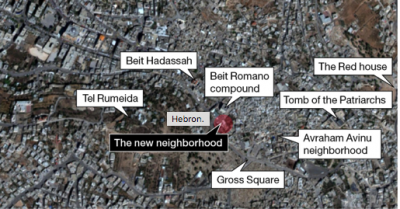
Map by Haaretz
As a reminder: in October 2017, the Israeli Civil Administration approved a building permit for the 31 units, on the condition that the Palestinian municipality of Hebron and others would have the opportunity to file objections to the plan. Soon after, two appeals were filed with the Defense Ministry: one by the Palestinian municipality of Hebron and one by the Israeli settlement watchdog Peace Now. The legal objections to the plan stem from the problematic process by which Israel made land in downtown Hebron available for settlement construction. Located in the Israeli-controlled H-2 area of Hebron (where 500 Israeli settlers live amongst 40,000 Palestinians), Israel seized the land in the 1980s from the Hebron Municipality, for military purposes. In 2007, the Civil Administration’s Legal Advisor issued an opinion stating that once Israel is done using the land for military purposes, it must be returned to the Hebron Municipality, which has protected tenancy rights to the land. Nonetheless, in 2015, the Israeli Civil Administration, with the consent of the Minister of Defense, quietly authorized the Housing Ministry to plan the area for Israeli settlement use, paving the way for that same ministry to subsequently present the plan for 31 units.
In October 2018, with the legal challenges still pending, the Israeli Cabinet voted to expedite the planning of the new settlement and allocated approximately $6.1 million (NIS 22million) for the project, which will require Israel to significantly renovate a military base in order to build the 31 new settlement units, a kindergarten, and “public areas.”
Peace Now said in a statement:
“The state was quick to issue the building permit even though the court has explicitly ruled that work should not start until the… hearing takes place….The attempt to squeeze in this construction of 31 settlement units before the U.S. election is an unscrupulous act that threatens Israel’s national interest and relations on the world stage.”
Israel Advances Planning for Settler-Backed Cable Car Project in Jerusalem — Despite Ongoing Legal Case
On October 25th, the Israeli-run Jerusalem Development Authority — a joint agency of the government and the Jerusalem Municipality — held the first of two meetings for developers interested in bidding on a settler-backed project to build a cable car in East Jerusalem, despite the fact that the Israeli Supreme Court has not yet issued a final ruling on whether or not the state is permitted to expropriate the privately owned Palestinian land that is needed to carry out its construction (for background, see recent reporting in the Settlement Report). A second meeting for prospective developers is reportedly scheduled for next week.
The High Court is actively considering the cable car case, having ordered the state to offer a factual explanation for how the cable car line will boost tourism in the city – an explanation that the state has struggled to articulate convincingly. In response, the State recently submitted an 81-page explanation of the project regurgitating the same arguments it has previously made. The Court is now awaiting response from the petitioners to the State’s latest filings.
Settlers Push Bibi to Authorize All Outposts As Compensation for Delay in De Jure Annexation
The Jerusalem Post reports that settler leadership is pressuring Prime Minister Netanyahu to immediately grant retroactive approval to the hundreds of Israeli outposts in the West Bank that are illegal under Israeli law (and for which Israel has been unable, despite an all-out effort, to find a way to legalize, short of simply declaring that rule of law is irrelevant). The Knesset Land of Israel Caucus is also preparing legislation to achieve this end.
The Post reports that settlers, having impatiently waited as the government has delayed action on many outpost authorizations — as successive elections and then the U.S. promise of annexation have come and gone (for now) — are upping the pressure on Netanyahu to act in a decisive manner on the outposts. Peace Now notes that, despite the settlers’ allegations of foot-dragging, over the past two years the Israeli government has managed to grant retroactive legalization to 21 outposts. with 9 more in process. Instead of considering each outposts’ legal status in a piecemeal manner, the settlers want Netanyahu to grant authorizations in one swift and blanked act – regardless of the facts of each outpost (like private Palestinian ownership of the land on which some outposts have been constructed).
Settlers apparently view this as urgent, given the fact that the Trump Plan leaves around 15 outposts as enclaves within the borders of what is envisioned as a future Palestinian non-state entity. Settlers also view this as just, asserting that Netanyahu owes the settler movement this as “compensation for his failure to to fulfill his annexation pledge.”
The Jerusalem Post article also does a surprisingly great job of explaining Israeli efforts over the past two decades to approve these outposts, which entered a new phase in 2017 with the passage of the Settlement Regulation Law – passed by the Knesset to allow provide a new legal basis by which the government can grant outpost approvals. FMEP has also comprehensively tracked [Table #3] Israel’s efforts over the past two years to retroactively legalize the outposts.
Bonus Reads
- “US amb. to Israel: Change of administration can damage Abraham Accords” (Jerusalem Post)
- “The Annexation That Was and Still Is” (B’Tselem)
- “Muslim Pilgrimage to Haram al Sharif/the Temple Mount: Tinkering with Explosives” (Terrestrial Jerusalem)
- [Thread] “The issue of the ultra-Orthodox sector, which recently caught the public’s attention again in light of the corona crisis, demands discussion about what is happening with the ultra-Orthodox community in the context of the settlements, for two reasons” (@nabothVin)
- “In East Jerusalem, the settler project is expanding underground“ (+972 Magazine)
- “Israelis Who Pillage Palestinian Olive Harvesters Are Not My Brothers” (Haaretz)
Welcome to FMEP’s Weekly Settlement & Annexation Report. To subscribe to this report, please click here.
August 7, 2020
- U.S. “Source”: Annexation is Still on the Table
- Givat Hamatos Settlement Tender Delayed (Again)
- Emek Shaveh: Civil Administration Hearing on Hebron Settlement Project is a “Farce”
- Minister Presides Over Celebration of Completion of New Migron settlement
- On 15-Year Anniversary of Disengagement, Israeli MKs Vow No More Settlement Evacuations
- Settlers Say Israel’s Mismanagement of West Bank Land Registry Has Enabled Palestinian Theft of Land in Area C
- State Comptroller Report Re-Centers Long Standing Settler Safety Complaints As Grounds for More De Facto Annexation
- Near Nablus, Palestinians Take on IDF & Settlers to Stop Land Theft
- Israel’s Short-Lived Settlement Affairs Ministry Shipped to London
- West Bank Realities No Longer Hidden by U.S. Satellite Imagery Prohibition
- Bonus Reads
Comments/questions? Contact Kristin McCarthy (kmccarthy@fmep.org)
U.S. “Source”: Annexation is Still on the Table
Annexation rumors were kept alive this week with an August 3rd report that a “well placed source” told The Times of Israel that Avi Berkowitz (an assistant to President Trump and Special Representative for International Negotiations) continues his work to get Trump’s sign-off on Israel’s plan to annex of a massive portion of the West Bank. The source said that more negotiations between the U.S. and Israel are needed, and that the U.S. is demanding that Israel make some kind of gesture to the Palestinians. In weeks past, it has been suggested that this “gesture” could be Israel giving Palestinians some degree of control over a small part of Area C.
Also on August 3rd, Prime Minister Netanyahu commented to his fellow Likud Party members that the Trump Plan was not off the table, but that the decision and movement around the plan was in the U.S. arena.
Speaking on August 5th, Foreign Minister Gabi Ashkenazi (a key leader of the Blue & White Party) appeared to contradict Netanyahu, saying:
“Right now [annexation is] not on the agenda, because everyone is busy” [but also making clear his support for the Trump Plan and annexation, noting “as we stated, it’s a framework to solve the conflict. We prefer to do to in dialogue with our neighbors, we prefer to do to it without interfering with the existing past peace agreements [with Egypt and Jordan], and future ones. We are fully aware of the consequences of this vision and we would like to do it in a responsible way.”
Givat Hamatos Settlement Tender Delayed (Again)
Scheduled to be open for bidding on August 2nd, Ir Amim reported on August 3rd that (as of that date) the tender for the construction of the Givat HaMatos settlement in East Jerusalem (1,077 units) had not yet been opened online. The Israeli government has not offered an explanation for the delay (the second delay in this opening for bids) or timetable for when the bidding will be opened.
Though the plan for Givat Hamatos has been fully approved, construction of the settlement has yet to start. Givat Hamatos has long been regarded as a doomsday settlement by parties interested in preserving the possibility of a two-state solution. If the Givat Hamatos settlement is built, the Palestinian neighborhood of Beit Safafa in East Jerusalem will be completely surrounded by Israeli construction, severing its connection to the West Bank.
In anticipation of the bidding window opening, 15 European Union members issued a rebuke of the plan during a video conference, with the French Embassy in Israel later tweeting its disapproval of Israel’s advancement of both the E1 and Givat Hamatos settlements. Peace Now also delivered a letter to Benny Gantz and Gabi Ashkenazi beseeching them to stop those two settlement plans from moving forward.
Hanan Ashraw sharply responded to the outcry against E-1 and Givat Hamatos from the EU countries, saying:
“Rhetorical opposition has not deterred Israel. In fact, Israel is emboldened to escalate its criminal actions precisely because it is confident that opposition will not move from the verbal to the practical. If implemented, these Israeli plans would completely sever occupied Jerusalem from its natural Palestinian surrounding and cut the occupied West Bank in half. While the international community is concerned with the “possibility” of annexation, Israel is implementing its annexation scheme on the ground without any deterrence.”
Emek Shaveh: Civil Administration Hearing on Hebron Settlement Project is a “Farce”
On August 4th, the Israeli Civil Administration’s High Planning Committee held a public hearing to discuss objections submitted against its plan to build accessible infrastructure, including an elevator, at the al-Ibrahimi Mosque/Tomb of the Patriarch in Hebron — a plan which requires Israel to seize from the Islamic Waqf.
Described as “unprofessional” and “a farce” by Emek Shaveh (an Israeli NGO with deep expertise in archaeology and the preservation of historic sites), the hearing began with the Council chairman stating that the government had already determined that it will build the elevator regardless of any objections to the plan. The Chairperson said:
′′We [the members of the planning committee] all decided, it is an important program that must be promoted…What is this attitude, you came to resist. Why resist?””
Emek Shaveh raised several objections to the plan’s archeological and planning deficits, and the Palestinian Municipality of Hebron submitted objections to Israel’s violation of agreements, signed by Israel, relating to governance and planning in Hebron.
Emek Shaveh said in its statement:
“The most important historical, archaeological and holy site in the West Bank has been subject to reckless and amatuer planning and is the victim of politically motivated, unprofessional decision making.”
Minister Presides Over Celebration of Completion of New Migron settlement
On July 27th, Health Minister Yuli Edelstein spoke at an event to celebrate the end of construction on the new Migron settlement, which will house 50 settler families.
The new Migron site is located a little over one mile away from the original site of the outpost bearing the same name – which settlers were forced by Israel to evacuate. The new site is on a hilltop that is technically within the jurisdiction of the Kochav Ya’acov settlement, but is not contiguous with its built up area. As such, it is properly understood as a new settlement. The fact that the site is within the territory allocated to Kochav Ya’acov allowed Israel to approval of New Migron as if it were merely a neighborhood of an existing settlement rather than a new settlement.
In 2011, the Israeli High Court ruled that (old) Migron – an illegal outpost – must be evacuated because it was built on privately owned Palestinian land. Most of the illegal outpost’s residents were evacuated and most of the outpost’s buildings were demolished in 2012. Determined to demonstrate its support for settlers in the face of this court-compelled evacuation, the government promised to establish two new settlements: “New Migron” (the settlement officially inaugurated this week), as well as 184 housing units to be built east of the settlement of Adam (aka, Geva Binyamin). All said, the two new settlements and temporary housing for the evicted settlers cost Israeli taxpayers millions of dollars – sending a clear message that settler law-breaking pays off.
At last week’s ceremony, which was also attended by Ronen Peretz, a senior aid to Netanyahu, Minister Edelstein said:
“This is an important national moment…this is the response [to Disengagement]. This is what provides hope…With God’s help, the application of sovereignty over Judea and Samaria will give an even more determinative response.”
Edelstein’s reference to the “Disengagement” refers to Israel’s unilateral move in 2005 to evacuate its settlements in the Gaza strip and a small number of settlements in the northern West Bank (which took place almost 15 years ago to the date the celebration of New Migron).
On 15-Year Anniversary of Disengagement, Israeli MKs Vow No More Settlement Evacuations
On August 4th, a coalition of Knesset Members led by Bezalel Smotrich (Yamina) and Miki Zohar (Likud) introduced a bill meant to prevent the government from evacuating settlements under any circumstances. The bill was introduced on the anniversary of Israel’s 2005 unilateral move to evacuate 21 settlements in the Gaza Strip and four settlements in the northern West Bank.
Minister of Diaspora Affairs Omer Yankelevich (Blue & White) also took the opportunity to state her opposition to settlement evacuation, making the following remark during a tour of settlements in the northern West Bank:
“Settlement evacuation brings terror, not peace…Judea and Samaria are an inheritance from our forefathers. There are those who speak of these areas in terms of cost versus benefit but we need to remind them that we are talking about our land and not to be ashamed of this fact. Extension of sovereignty over these areas is our desire at the end of the day, under the right conditions,”
In addition, Gilad Sharon (son of former Prime Minister Ariel Sharon who devised and implemented the 2005 disengagement) added his voice to the anti-evacuation chorus. While defending his father’s actions and bashing the Palestinians, Sharon said:
“What we could afford in the Gaza Strip, in an isolated area squeezed between the desert and the sea, we cannot do in Judea and Samaria. This is the heart of the land, Judea and Samaria. When the world sees what happened in Gaza, because they got billions of dollars. What did they do with the money? [Did they build] any housing, factories, something? Only rockets and terror tunnels. That’s what they did, so everyone understands that that’s how they behave when they are left alone. What you can afford for yourself in an isolated corner, you cannot do in the heart of Tel Aviv, in the suburbs of Tel Aviv, in the heart of the country. I don’t think we should evacuate anything. Gaza was a very unique case, nothing to do with Judea and Samaria, which we have to hold forever.”
Settlers Say Israel’s Mismanagement of West Bank Land Registry Has Enabled Palestinian Theft of Land in Area C
A new report published by the Israeli State Comptroller chided the Israeli Defense Ministry for its incomplete land registry documenting land ownership (Palestinian and Israeli) in Area C of the West Bank. The radical settler group Regavim used the report as yet another opportunity to perpetuate the myth that the Palestinian Authority is orchestrating a campaign to steal Area C land from Israel. As a reminder, Area C land is not Israeli land; it is land occupied by Israel that, under the Oslo Accords, came under temporary Israel civilian and security control under arrangements that were supposed to last only a short period of time before a permanent status agreement was reached between the parties – an agreement that was supposed to be reached within 5 years.
Regavim Director-General Meir Deutsch said:
“The painstaking, glacial pace of handwritten record keeping is fertile ground for forgery, and leads to further violation of property rights, making it nearly impossible to conduct property transactions in a normal fashion. The failure to carry out the necessary registration and regulation of land in these areas has enabled the Palestinian Authority to carry out a well-planned, carefully-timed and well-funded land-seizure program.”
State Comptroller Report Re-Centers Long Standing Settler Safety Complaints As Grounds for More De Facto Annexation
A new report published by the Israeli State Comptroller blamed the Israeli Defense Forces for putting settlers in danger by failing to secure roads in Area C for the settlers. The report explained that part of the IDF’s failure was due to bad communication and conflict over which Israeli ministry – Defense or Transportation – was actually in charge. This framing is significant given that the Israeli Civil Administration – the body which effectively is the occupying government of the West Bank – is part of the Defense Ministry, while the Transportation Ministry does not have legal planning authority in the West Bank (it is a part of Israel’s own government, meaning that giving it authority in the West Bank amounts to de facto annexation). The report also called out the Defense Ministry for the poor quality and incompleteness of the West Bank land registry (as discussed above).
Efrat Council Chairman Oded Revivi said that the report demonstrates why Israel needs to annex the settlements.
As a reminder: settlers are Israeli civilians who have chosen, for a variety of reasons, to live in an area under military occupation where their “safety” must be actively attended to by the Israeli army. The issue of security for settlers and settlement infrastructure has in the past translated to massive investments of government resources into projects that entrench and expand Israel’s de facto annexation of the West Bank. For example, following months of intense pressure from settlers, in October 2017, then-Defense Minister Avigdor Liberman promised to allocate $939 million for projects for settlers and settlements across the West Bank. According to the Times of Israel, the $939 million package was dedicated to funding:
“the installation of security cameras along roads throughout the West Bank; the installation of cell phone towers to improve reception for settlers who may need to call for help; the paving of bypass roads around Palestinian towns and settlements to allow the populations to avoid each other; the bolstering of armored buses that travel through the West Bank; and broad security improvements for each settlement that will include security cameras, “smart fences” and sensors to warn of attempts to sneak into settlements.”
The following year (2018), Israel inaugurated several new bypass roads In partial fulfillment of the 2017 funding commitment to a settler security package. In 2019, Israel issued permits for the construction of an additional two bypass roads.
Near Nablus, Palestinians Take on IDF & Settlers to Stop Land Theft
On August 6th, Wafa reports that Palestinians clashed with IDF just west of Nablus, at the site of a new outpost that settlers were attempting to establish near a well on privately-owned Palestinian land. The report says Palestinians were attacked by the IDF when they attempted to reach the area where settlers had set up a tent and a caravan.
Palestinians reportedly planned to continue their struggle to challenge the settlers’ effort to take over the site by staging Friday prayers there.
Israel’s Short-Lived Settlement Affairs Ministry Shipped to London
After serving for around four months as Israel’s first Settlement Affairs Minister, Tzipi Hotovely (Likud) has now moved on to be Israel’s Ambassador to the United Kingdom. There is no word on her replacement.
Hotovely is regarded as a rising star in the Likud Party (which some suggest is why she is being sent abroad, noting that Netayahu has a pattern of using ambassadorship to put some distance between himself and those he sees as posing the greatest challenge to him politically). Hotovely is well known for her radical views — racist, homophobic, and pro-annexation — as well as her denial of the existence of the Palestinian people.
West Bank Realities No Longer Hidden by U.S. Satellite Imagery Prohibition
Al-Shabaka policy fellow Zena Agha writes in Foreign Policy about the repercussions and importance of a recent change in U.S. policy regarding satellite imagery. This change eliminates the longstanding prohibition on American satellite imagery companies producing high-resolution photos of the West Bank. Agha writes:
“Significantly, the reversal empowers humanitarian groups working to hold Israel accountable for its violations of international law, including unlawful killings and settlement construction (which, under the fourth Geneva Convention, constitutes a war crime). It is perhaps for this reason that the KBA’s reversal has already caused some disquiet in Israeli military quarters. The reversal also has geopolitical implications. Satellite images of the border areas of Jordan, Syria, Lebanon, and Egypt have thus far been both downsampled and poorly covered (with many operators wary of capturing any Israeli territory). The change in legislation will provide uncensored images of these areas and allow for their monitoring and investigation, particularly around environmental issues such as water extraction. Finally, from the perspective of historical justice and accountability, uncensored, high-resolution images enable Palestinians to accurately catalog the remnants of villages and towns destroyed during the events of 1948 and beyond. The democratizing power of the reform will allow Palestinians to use technology to rediscover an erased past and to imagine an alternative future.”
Bonus Reads
- “Court override bill dead in the water as Haredim, Liberman rule out support
- “ (The Times of Israel)
- “Peace Now asks Gantz, Ashkenazi to halt east Jerusalem Givat Hamatos homes” (Jerusalem Post)
- “What Comes First, an Israeli Army Firing Zone or Palestinian Villages?” (Haaretz)
- “Netanyahu’s decline benefits pro-settler Bennett” (Al-Monitor)
- “Israel Offers Money to Palestinian family for Killing by Settler” (Ynet)
Welcome to FMEP’s Weekly Settlement & Annexation Report. To subscribe to this report, please click here.
July 31, 2020
- Knesset Convenes to Consider “Significant Move” to Annex Area C
- Settlers Step Up Effort to Build New Outpost on Strategic Land Between Bethlehem & Battir
- High Court Demands Evidence that Jerusalem Cable Car Project Will Boost Tourism
- Bonus Reads
Comments/questions? Contact Kristin McCarthy (kmccarthy@fmep.org)
Knesset Convenes to Consider “Significant Move” to Annex Area C
On July 29th, the Knesset Foreign Affairs & Defense Committee convened, for the first time since the new government was formed, for a hearing “on the battle for Area C and illegal, European funded Palestinian Authority construction in areas under full Israeli jurisdiction.” The hearing was called by committee chair Likud MK Zvi Hauser after Hauser participated in a West Bank tour led by the the radical settler group Regavim, which (among other things) works to consolidate Israeli control over the West Bank. The setter-run Arutz Sheva media outlet reports that the goal in convening the hearing was to have the committee “initiate a significant move” to annex all of Area C.
The Director General of Regavim made his expectation of the Knesset hearing’s significance explicit, saying:
“We are confident that today’s hearing will be a significant step toward creating a comprehensive government strategy for facing this challenge.”
As framed by Regavim and its prominent allies in the Knesset, including MK Hauser, Palestinians are engaged in an illegal campaign to “take over” Area C (this, of course, is an Orwellian notion given Israeli de facto annexation policies in Area C, some 60% of the West Bank). The Yamina Party is also a prominent supporter of the push for unilateral annexation of Area C. Yamina MK Matan Kahane recently accused Netanyahu of conspiring with Trump to create a Palestinian state in Area C by overlooking illegal Palestinian construction in the area.
Settlers Step Up Effort to Build New Outpost on Strategic Land Between Bethlehem & Battir
+972 Magazine reports that over the past month, armed settlers from the unauthorized outpost of “Neve Ori” have been working to establish a new unauthorized outpost near the Palestinian village of Battir (a UNESCO World Heritage Site), on land Israel claimed as “state land” that is strategically situated on high ground between Battir and Bethlehem. 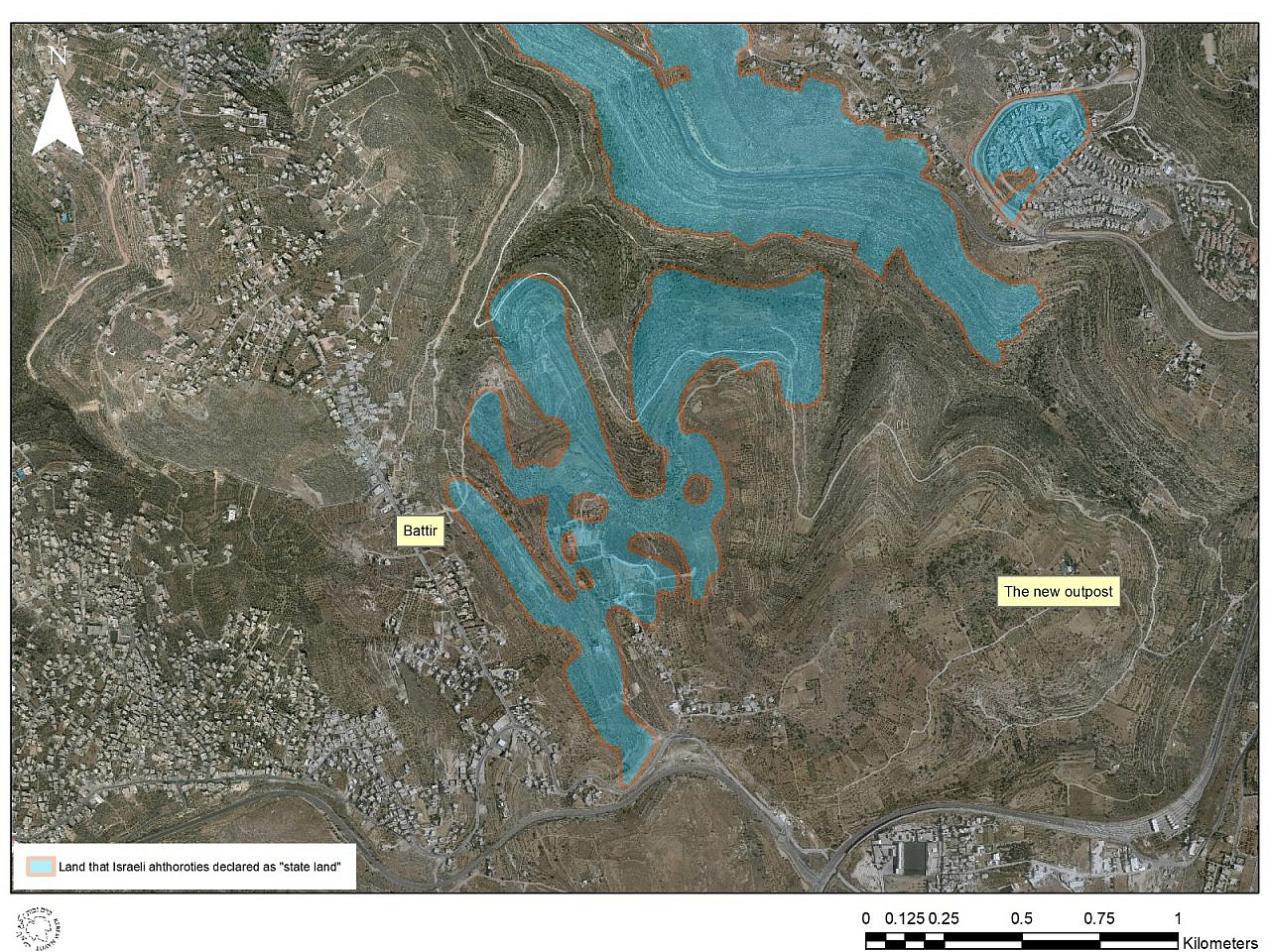
The land was historically a part of the village of Battir and privately owned for generations by the Alyan family (which has an Ottoman-era deed showing their ownership). It was nonetheless declared “state land” by Israel in 1982 under the pretense that the land was not being actively cultivated – despite the fact that the owner of the land, Ghassan Alyan, was only taking a planned break from working that area in order to switch the crops he was growing there. Alyan has repeatedly tried to reclaim the land, but has been prevented from doing so by the Civil Administration.
Palestinians report that a group of eight armed settlers appeared on the land for the first time one month ago, and have since visited the area weekly with the increasingly obvious intent to build an outpost. Last week, a settler named Lior Tal (who told +972 Magazine that “I want all of Battir to go to hell…the State of Israel belongs to the Jewish people”), began knocking on the doors of several homes in Battir demanding that farmers produce documents proving their ownership of the land.
The IDF has responded to reports about the settlers’ armed incursions into Palestinian land, but has failed to remove the settlers and prevent them from returning to the area. Last week, the IDF not only failed to remove the lawbreaking settlers but actually put the weight of the IDF behind in the settlers’ efforts. An IDF soldier told Alyan that he was now forbidden from accessing that land, that the settlers are permitted to be there, and that in order to change the situation Alyan must take his complaints to the Civil Administration and prove his ownership.
Khaled Muammar, a resident of Battir, told +972 about the strategic importance of the land, saying:
“They [the settlers] want to take over this area for three reasons: first of all, because of its elevation; it overlooks the region. Secondly, it separates [Battir from] al-Walajeh; settling there creates a wedge between two Palestinian villages. And thirdly, because it creates geographical continuity between [the Israeli settlement] Har Homa and Jerusalem.”
Settlement expert and founder of Kerem Navot, Dror Etkes, added to the context for the settlers’ actions in Battir:
“Why? Because of the Trump plan. This area, according to the plan, is supposed to be Palestinian territory. They want to take over the area now, before the government signals that it is going to accept the plan. To create facts on the ground.”
Palestinian ecologist Vivien Sansour said:
“The land taken by this settler is Battir’s last room to breathe. People are being forced to emigrate to Bethlehem because they do not allow us to build here.”
The Neve Ori outpost was established in 2019 by Lior Tal, the settler leading the effort against Battir. That outpost also started as a small effort by a handful of settlers who built structures illegally. The Civil Administration told +972 Magazine that it is aware of the outpost and that with respect to dealing with these illegal structures, “on-site enforcement will be carried out in accordance with the authorities and procedures and subject to [the Administration’s] priorities” (based on long experience, demolition of “illegal” Palestinian construction — that is, constuction by Palestinains on their own land, but without Israel’s permission, since it will rarely give permission — is at the top of the Civil Administration’s priorities, while dealing with illegal settler construction is rarely even makes the list).
High Court Demands Evidence that Jerusalem Cable Car Project Will Boost Tourism
One month after the Israeli High Court of Justice heard arguments regarding the State’s plans to build a cable car line in East Jerusalem, the Court has ordered the State to submit a report by September 9th substantiating its claim that the cable car has the potential to be a tourist attraction in the city. According to Emek Shaveh, if the State fails to adequately explain how the cable car will attract tourism, then the Court may invalidate the plan, based on the argument that it was advanced improperly through an expedited planning process reserved for infrastructure projects of national importance.
Emek Shaveh said in a statement:
“This query calls the project’s entire approval process into question. We view the High Court’s demand as an opportunity to approach Minister of Tourism Asaf Zamir about the issue again after he had expressed support for the plan last month. We believe the court’s decision is an opportunity to explain to Zamir that the factual basis for advancing the cable car as a transportation project with touristic value is flimsy at best, and that the cable car project is not a touristic project but a damaging plan which will be highly deleterious to Jerusalem and its landscape.”
As a reminder, the Jerusalem cable car project is an initiative backed by the Elad settler group and advanced by the Israeli Tourism Ministry. Last month, when the High Court heard objections to the plan, the State publicly admitted that the implementation of the cable car project will require the confiscation of privately owned Palestinian land in the Silwan neighborhood of East Jerusalem. The cable car line is slated to terminate at the settler-run Kedem Center compound (Elad’s large tourism center currently under construction at the entrance of the Silwan neighborhood, in the shadows of the Old City’s walls and Al-Aqsa Mosque).
While efforts to “sell” the cable car plan have focused on its supposed role in growing Jerusalem’s tourism industry or serving transportation needs, in reality the purpose of the project is to further entrench settler control in Silwan, via archeology and tourism sites, while simultaneously delegitimizing, dispossessing, and erasing the Palestinian presence there. Emek Shaveh and other non-governmental organizations, including Who Profits and Terrestrial Jerusalem, have repeatedly challenged (and provided evidence to discredit) the government’s contention that the cable car will serve a legitimate transportation need in Jerusalem, and have clearly enumerated the obvious political drivers behind the plan, the archeological heresies it validates, and the severe negative impacts the cable car project will have on Palestinian residents of Silwan.
Bonus Reads
- “European states denounce ‘illegal’ Israeli building plans in Jerusalem area 15 countries and EU again submit protest letter to Fore” (The Times of Israel)
- “They live on West Bank’s only all-girl hilltop, but don’t call them feminists“ (The Times of Israel)
- “Peace Now warns of de facto annexation as E1 planning” (Jerusalem Post)
- “Israel’s Second Coronavirus Wave Stalled Annexation, but Netanyahu Still Wants It” (Haaretz)
Welcome to FMEP’s Weekly Settlement & Annexation Report. To subscribe to this report, please click here.
July 24, 2020
- Annexation Watch: Gantz Pushes for Status Quo, Bibi Hints at New Elections
- 2020 is on Track to Be Record Year for East Jerusalem Settlement Growth
- A Bump in the Road for Plans to for Settler Yeshiva in Sheikh Jarrah
- IDF Demolishes Outpost (After it was Relocated Near to Israeli Army Base)
- Israel Starts Construction to Expand the Ibei Hanachal Outpost
- Israeli Plans for Wadi Al-Joz in East Jerusalem, Including the “Silicon Wadi” Project, Expected to Advance
- Israel “Recovers” Religious Relic from Palestinian Village
- Greenblatt: Trump Plan has 60-80 Pages of Conditions on/for a Future Palestinian “State”
- Bonus Reads
Comments/questions? Contact Kristin McCarthy (kmccarthy@fmep.org)
Annexation Watch: Gantz Pushes for Status Quo, Bibi Hints at New Elections
Three weeks after July 1 – the date when it officially became open season for Israel to annex West Bank land – there has still been no movement toward a formal act of annexation by the Israeli government (though de facto annexation continues unabated). This week, two reports further churned up the “will it happen/won’t it happen” speculation machine.
First, a July 19th report suggests that Benny Gantz, Israel’s Alternate Prime Minister and Defense Minister, is pushing Netanyahu to delay annexation plans in order to focus all of the government’s efforts on combating the resurgence of the coronavirus across the country. The report further suggests Gantz is appealing for the government to focus on expanding existing settlements and building infrastructure that serves settlers (and theoretically Palestinians as well, though such projects serve to entrench the presence of settlers) — in effect, setting aside de jure annexation to pursue de facto annexation more energetically.
Second, reports on July 22nd circulated the rumor that Netanyahu intends to go to elections in November – a move which would collapse any cooperation with Gantz and potentially could hinder Netanyahu’s ability to advance annexation. On the other hand, such a move could also free Netanyahu from the constraints of the unity deal, as well as from the U.S. (alleged) condition that Gantz must consent to Netanyahu’s annexation plan before receiving a U.S. greenlight. Netanyahu denied this report later in the week.
2020 is on Track to Be Record Year for East Jerusalem Settlement Growth
Ir Amim published a review and analysis of official settlement data from the first six months of 2020, showing that a total of 3,514 settlement units were advanced for settlements in East Jerusalem. If this pace continues, Ir Amim reports that 2020 will set a new record for East Jerusalem settlement activity (the current record is held by 2012, the year Palestine was recognized as a non-member state by the United Nations General Assembly and Israel retaliated by accelerating its de facto annexation of Palestinian land via settlement growth, including in East Jerusalem).
Notably, the plans advanced so far this year include many of the most controversial settlements on the drawing board – like Givat Hamatos, E-1, and new enclaves within Palestinian East Jerusalem neighborhoods like Beit Hanina.
In Amim writes:
“The scope and significance of the plans that were advanced in the last six months shows Israel’s determination to consolidate its control – both in terms of demography and territory – over the whole of East Jerusalem and further into Greater Jerusalem. This is seen especially as settlement construction increases in the areas connecting East Jerusalem and Greater Jerusalem (ex: Har Homa E and Givat Hamatos) and the creation of massive facts on the ground such as in the case of the E-1 plans. Thus, Israel is laying the groundwork for the official annexation of Greater Jerusalem. In parallel, these facts on the ground serve to entrench the detachment of East Jerusalem from the West Bank and further fracture the Palestinian space in and around Jerusalem. Combined, these steps threaten to deal a death blow to Palestinian aspirations in Jerusalem, the possibility for two capitals in the city, and a two-state solution…[the number of settlement advancements] signal a leap in settlement advancement in East Jerusalem, both in terms of quantity of housing units as well as in the advancement of new settlements in the most sensitive areas where, for years, Israel had to refrain from doing so due to international pressure.”
See the paper for details on the plans advanced so far in 2020. The paper concludes with this brief recap of 2020 settlement activity:
- A tender for construction of 1,077 housing units in the new settlement Givat Hamatos was published.
- Master plans for adding 6,100 housing units in new settlements of Har Homa E and Givat Hamatos. For 500 of these housing units, a detailed outline plan was also advanced at the District Committee.
- Two detailed outline plans with a total of 144 housing units in two settlement compounds in the Palestinian neighborhood Beit Hanina were approved for deposit as well as a dormitory for dozens of Yeshiva students in Sheikh Jarrah.
- Nine detailed outline plans were advanced with a total of 2,870 housing units inside the built-up area of East Jerusalem settlements.
A Bump in the Road for Plans to for Settler Yeshiva in Sheikh Jarrah
Ir Amim reports that on July 21st, the Jerusalem District Planning Committee unexpectedly delayed making a final decision on settler plans for a new Jewish religious school (yeshiva) and dormitory – named the Glassman Campus project – at the entrance of the Palestinian neighborhood of Sheikh Jarrah, located in East Jerusalem. The Committee was expected to make a final decision on the plan at this meeting, but instead ordered a new report assessing the needs of the neighborhood, to be prepared within 60 days. The Court’s order comes after groups, including Ir Amim, submitted objections to the plan that detaied the classroom shortage in Palestinian neighborhoods, due in part to the lack of available land to build on.
The plan to build the yeshiva and dormitory (which would house dozens of young religious settlers), as well as another project for a 6-story building in the same area, aim to strengthen Israeli settlers’ hold on the neighborhood. Once built, settlements will literally flank both sides of the road leading into Sheikh Jarrah, advancing the settlers’ goal of cementing the presence of the settlement enclaves inside of Sheikh Jarrah by connecting them more seamlessly to the neighborhood’s periphery and to West Jerusalem.
Ir Amim writes:
“This unexpected decision is of great importance. It creates a significant obstacle to the approval of the Yeshiva plan and requires the Municipality to describe in detail the needs of the Palestinian neighborhood. Also, the decision is a clear expression of the fact that settlements in East Jerusalem come directly at the expense of the basic needs of Palestinians in the city.”
Located just north of Jerusalem’s Old City, Sheikh Jarrah has endured years of aggressive settlement activity by radical settlers via various means, including using Israel’s court system to strip Palestinians of their ownership rights. Sheikh Jarrah’s plight was featured in a 2013 film by Just Vision, “My Neighborhood.” Just Vision also produced “Home Front,” a series of video interviews with the Palestinian residents and Israeli activists fighting together against settlement expansion in Sheikh Jarrah. For more on Sheikh Jarrah and the protest it sparked, 972+ Magazine has a compilation of resources online here.
IDF Demolishes Outpost (After it was Relocated Near to Israeli Army Base)
Following media reports about the IDF’s complicity in establishing an illegal outpost on privately owned Palestinian land near Nablus (FMEP reported on this last week), on July 19th the settlers relocated their outpost to an area declared by Israel to be “state land” next to an Israeli army base. While Israeli security forces had spent weeks tolerating and even assisting in the establishment of the new outpost when it was located on Palestinian land, after it was moved to the new site near the IDF base , the IDF moved to promptly demolish it on July 21st.
The settler who is behind this new outpost, Yedidya Meshulami, is well known for his eccentric, illegal, and dangerous (and, if committed by a Palestinian, undoubtedly arrest-worthy) acts. In 2019, Meshulami nearly flew his helicopter into an IDF transport plane conducting a training exercise in the Jordan Valley (he was charged with several crimes involved with illegally flying his helicopter and endangering lives in West Bank airspace, which is controlled by the Israeli military). A former IDF reserve pilot, in March 2018 Meshulami attempted to take control of the Qalandiya checkpoint in Ramallah by landing his helicopter nearby, declaring “I don’t care what they do to me, I’ll take it [the checkpoint] over.” Following his arrest and release to house arrest, the IDF confiscated two helicopters and an ultralight plane from Meshulami’s personal airstrip, which he built illegally in an outpost near the Itamar settlement, south of Nablus.
Meshulami lives in an unauthorized outpost called “Alumot” near the settlement of Itamar, south of Nablus. Meshulami helped establish the outpost in 1996 after serving in the Israeli Air Force and, despite lacking permits, he personally built an airstrip in the outpost in 2013. According to reports this week, Israeli security forces had previously revoked Meshulami’s pilot license for flying over the West Bank without a permit.
Israel Starts Construction to Expand the Ibei Hanachal Outpost
Middle East Eye reports that Israel – in the midst of fighting a surge of coronavirus cases, deciding on annexation, and possibly heading to elections again this fall – has begun clearing land for the expansion of the Ibei Hanachal outpost, located between Hebron and Bethlehem in the southern West Bank. Palestinian leaders from the village of Kasin, to which the land the outpost is built on historically belonged, told reporters that settlers have already moved caravans into the newly razed land and that new electricity poles have been recently installed.
Ibei Hanachal was established illegally by settlers in 1999, but was granted retroactive approval as a neighborhood of the Ma’ale Amos settlement by the Israeli government in August 2019. Declaring illegal outposts to be neighborhoods of settlements – even outposts that are not contiguous with the built up area of the settlement, as is the case with Ibei Hanachal – is one of the legal mechanisms that Israel has found to retroactively “legalize” illegal outposts – that in effect creates new settlements.
Israeli Plans for Wadi Al-Joz in East Jerusalem, Including the “Silicon Wadi” Project, Expected to Advance
In a new paper, Bimkom provides details on the status of two major projects Israel is advancing for the Wadi Al-Joz neighborhood of East Jerusalem..
The “Silicon Wadi” project – which made it into Israeli headlines a few weeks ago – is at a “conceptual phase” at this point, with little official data available. But it is known that the plan is being advanced as a Master Plan, a planning avenue that does not permit the public to offer objections. Master Plans also do not require the government to specify an exact number of units to be built, leaving open the possibility of further construction. This project is located in the northern section of Wadi al-Joz.
The second project being advanced in Wadi al-Joz is referred to as the “Eastern Business District,” to be located near the Old City walls. This project is in a much more advanced stage of the planning process, and Bimkom expects it to be deposited for public review in the near future. This project is in the heart of the Palestinian city center, and calls for awarding 80% of all planning rights in the area for commercial, tourism, and business development. The plan also grants legalization to unauthorized structures in the area, but does not allow for further residential development. On this, Bimkom explains:
“This ratio of mixed use is problematic because it does not address the housing crisis in Palestinian East Jerusalem, and moreover, it does not address the basic interest of citycenter planning: the creation of a balanced mixed-use environment, in which housing development is generally considered as an important stimulus for development. In other parts of the Jerusalem today, along the route of the light rail, a 50-50 ratio is the accepted policy.”
Explaining the significance of the two plans in context of Israel’s settlement activities across the city, Bimkom writes:
“The abovementioned plans, alongside other large scale plans currently under consideration for East Jerusalem (such as the plan for development alongside the American Road, see here), demonstrate the current Israeli Planning Policy in East Jerusalem: public uses are being addressed — and huge areas are being allotted for commerce and business — while residential needs are being left unanswered (if they are addressed they are generally unimplementable).”
Israel “Recovers” Religious Relic from Palestinian Village
In a covert pre-dawn operation on July 20th, the Israeli Civil Administration entered the Palestinian village of Tuqu’ and took a Byzantine-era baptismal font. The font was allegedly stolen by antiquity thieves in the year 2000 from an archeological site next to the Tekoa settlement (which was built on lands historically a part of Tuqu’), and retrieved in 2002 by Palestinian residents of Tuqu’. The font has been on open display next to the village Mayor’s home for the past 18 years, with Israel taking no interest in the matter until now.
Emek Shaveh explains important context of the Civil Administration’s sudden interest in the font:
“This operation follows on the heels of increased complaints by the settlers that the Civil Administration is not doing enough to prevent what they claim is systematic and ideologically driven antiquities theft. The settlers have been claiming that traces of a Jewish past in the area are being destroyed and that all antiquities sites should be placed under Israeli control. Emek Shaveh and the Mayor of Tuqu’ have written to the Civil Administration with a demand to return the antiquity to the village and its residents. The Civil Administration is responsible for the protecting the interests and welfare of the Palestinian residents of the West Bank and is not meant to act as an agent on behalf of the settlers who believe they should be the sole custodians of the areas’ antiquities.”
Adding to settler efforts described by Emek Shaveh, a new settler group calling itself “Shomrim Al Hanetzach” (“Guarding Eternity”) recently began surveying areas in the West Bank that Israel has designated as archeaological sites in order to call in Israeli authorities to demolish Palestinian construction in these areas. The new group communicates its findings to the Archaeology Unit in the Israeli Civil Administration (the military body by which the government of Israel regulates all planning and building in the West Bank). The Archaeology Unit, playing its part, then delivers eviction and demolition orders against Palestinians, claiming that the structures damage antiquities in the area. As a reminder, in 2017, Israel declared 1,000 new archaeological sites in Area C of the West Bank. The new group is, not coincidentally, an offshoot of the radical Regavim organization, which among other things works to push Israeli authorities to demolish Palestinian construction that lacks Israeli permits (permits that Israel virtually never grants).
The new group has also raised public alarm about the Trump Plan, alleging that hundreds of biblical sites in the West Bank are slated to become Palestinian territory. The group’s leaders accuse the Palestinian Authority of mismanaging the sites and they accuse Palestinians of looting them. The group is demanding that Israel annex all the sites.
In response to the theft of the font from Tuqu’, PLO Spokeswoman Hanan Ashrawi released a statement saying:
“A hallmark of Israel’s system of colonial occupation and oppression has been its disdainful attempts to erase Palestinian presence, culture and heritage, including the illegal appropriation and theft of heritage sites and artifacts. This systemic policy of plunder is a war crime that must not go unpunished. In the past weeks, Israel has taken other illegal steps targeting Palestinian heritage sites, including sealing off the entrance of Jabal Al-Fureidis (or so-called Herodium) in the Bethlehem District to restrict the access of Palestinians to the site, which Israel has illegally appropriated as an “Israeli National Park”. Israel has also repeatedly targeted other historical and archaeological sites, including UNESCO Heritage sites in Palestine such as the Old City of Jerusalem, the Battir terraces in Bethlehem, and the Ibrahimi mosque in Hebron. Israel must be held accountable for its egregious war on Palestinian heritage and its attempt to appropriate our history and pillage historical artifacts that are an integral part of Palestinian and world history. UNESCO and its Director General, Ms. Audrey Azoulay, have a moral and official duty to speak out and protect Palestinian heritage. Their continued silence in this regard is an unacceptable abdication of responsibility.”
Greenblatt: Trump Plan has 60-80 Pages of Conditions on/for a Future Palestinian “State”
In a new interview with Army Radio, former U.S. negotiator Jason Greenblatt proudly touted the fact that the Trump Plan has 60-80 pages of stipulations Palestinians must agree to and satisfy before it could meet the U.S. conditions for recognizing Palestine as a “state.” It’s always worth reiterating: the Trump Plan in no way provides for a real state in any sense of the term; it at best offers the Palestinians a conditional non-state entity over which Israel would enjoy almost total control. Greenblatt said:
“[the] phrase we used in the peace efforts is a realistic Palestinian state that complies with 60-80 pages of important criteria. [This criteria is what] differentiates the peace plan we released from the past efforts. There’s a lot of criteria for them to establish a state, as there should be.”
Bonus Reads
- “Two Palestinian Cyclists Injured in Alleged Assault by West Bank Settlers” (Haaretz)
- “B’Tselem investigation: Settlers assault Palestinians and file false reports against them; military arrests the victims” (B’Tselem)
Welcome to FMEP’s Weekly Settlement Report, covering everything you need to know about Israeli settlement activity this week.
To subscribe to this report, please click here.
April 24, 2020
- The Facts on the Bibi/Gantz Annexation Agreement
- The World Responds (or doesn’t) to Formation of Annexation Government
- Gantz Takes Over Defense Ministry – Including Authority Over Settlement Construction (at least until July 1st)
- Settlers, Yamina Party Dissatisfied with & Suspicious of Netanyahu’s Annexation Plans
- Plans Advance for Two New Settlement Enclaves in the Beit Hanina Neighborhood
- B’Tselem: With IDF Backing, Settlers are Violently Stealing Land During COVID-19 Crisis
- Coming Soon: Plans for Har Homa Expansion Scheduled for Discussion on April 27th
- Coming Soon: Israel To Open Bidding on “Doomsday” Givat Hamatos Settlement Tender on May 3rd
- IDF Demolishes Outpost Structures, Including in Outpost From Which the Criminal “Hilltop Youth” Group Hail
- Yesh Din Outlines Potential Impact of Annexation on Palestinian Human Rights (Spoiler: It’s Bad)
- Bonus Reads
Comments or questions – email Kristin McCarthy (kmccarthy@fmep.org).
The Facts on the Bibi/Gantz Annexation Agreement
Under the new emergency unity government agreement, the issue of annexation is at the total discretion of Prime Minister Netanyahu. Per the coalition agreement signed by Netanyahu and Gantz on April 20th, the stipulations related to annexation are:
- The U.S. must give its “full agreement” to the annexation plan, including on the maps of West Bank land Israeli legislation will specify for annexation. Reminder: the U.S. and Israel have already formed a joint mapping committee aimed at translating the conceptual map appended to the Trump Plan into a detailed plan. The U.S. has signalled that it will give its approval to the resulting map and to date, the Trump Administration has only offered its total support for Israeli annexation – including Secretary Pompeo in a April 22nd press conference.
- Netanyahu and Gantz must “engage in dialogue” with (but are not obligated to secure any form of consent from) the international community, “with the aim of preserving the security and strategic interests of Israel including maintaining regional stability, preserving existing peace agreements and working towards future peace agreements.” During the negotiations that paved the way for the unity agreement, international coordination as a condition for any annexation was reportedly one of Gantz’s key demands, with particular insistence on the king of Jordan being consulted; as is clear from the agreement, Gantz totally folded on this point (among others).
- On July 1, 2020, Prime Minister Netanyahu can bring the U.S-approved annexation plan up for discussion in the Cabinet and/or for a vote in the Knesset, – without the support/approval of Gantz. The unity agreement consists of a six-month “emergency period” during which Netanyahu is prohibited from introducing any legislation unrelated to Israel’s fight against the Coronavirus. Annexation legislation is the one and only exception from this prohibition, with the agreement allowing Netanyahu to move annexation legislation as of July 1 (the delay until July representing the empty “concession” extracted by Gantz in negotiations). Indeed, by providing two separate ways to move annexation – via the Cabinet or via the Knesset – the agreement ensures Netanyahu will be able to pass the bill even if he does not have a majority in the Cabinet (seats on which will be split equally between Netanyahu and Gantz appointees in the new government).
- Only a Likud member of the Knesset is permitted to introduce an annexation plan in the Knesset, provided that the plan is identical to the one promoted by Prime Minister Netanyahu. This stipulation prevents more radical annexation plans from being moved in the Knesset by members of other political parties, and also eliminates any role of Gantz in Knesset proceedings.
- Once introduced into the Knesset, the annexation legislation cannot be delayed or vetoed. By accepting this clause, Gantz has agreed in advance that he cannot block the bill from passage. At the same time, the agreement magnanimously allows Gantz and his fellow Blue & White Members of the Knesset to “vote their conscience” and oppose the annexation bill (FMEP has previously explained the political strategy behind this). Under the unity agreement, this is the only matter on which Gantz agreed to forfeit his veto power.
The World Responds (or doesn’t) to Formation of Annexation Government
The Palestinians were vocal in their opposition of the new government and its annexation plan, with Palestinian Authority President Mahmoud Abbas threatening to cancel all agreements with Israel and the United States if annexation plans proceed.
Unsurprisingly, the U.S. government welcomed the unity government agreement and, with Secretary of State Pompeo stating he was “happy” that the sides had reached an agreement and noting:
“As for the annexation of the West Bank, the Israelis will ultimately make those decisions. That’s an Israeli decision. And we will work closely with them to share with them our views of this in (a) private setting.”
The government of France issued the most notably strong statement (so far) rejecting annexation, saying:
“Such steps if implemented would not pass unchallenged and shall not be overlooked in our relationship with Israel.”
An European Union’s foreign affairs spokesman stated that “If this proceeds, it will not be left unanswered.” Separately. the EU’s Chief of Foreign Affairs, Josep Borrell, issued a statement vowing to “closely monitor” annexation efforts, reiterating that the EU holds annexation as a “serious violation of international law.” Remarkably, 8 of 27 EU member states opposed Borrell’s statement, signalling a fractured and therefore weak EU stance against annexation. During discussions with member states, Borrell reportedly argued for including a threat of sanctions against Israel if annexation is advanced, a point which drew opposition. Other states were reportedly hesitant over the timing of the statement, claiming to be concerned about preemptively souring relations with the new government, and particularly Gantz.
In response, Israeli Foreign Minister Yisrael Katz attacked Burrell and praised EU states that opposed the EU statement, including:
“It is unfortunate to read that Joseph Burrell, who claims to be trusted with the EU’s foreign relations, chooses to welcome the new government of a central partner of the EU in this way, and prefers to see the relationship between Israel and the EU through the prism of the pandemic and the ‘status of the territories.’ Given the depth of the relationship and in light of the fact that this announcement did not receive the support of the EU member states yesterday, we wonder which policies the honorable gentleman is choosing to represent, and not for the first time.”
Ireland’s Foreign Minister Simon Coveney made a strong statement warning Israel against annexation:
“Annexation of territory by force is prohibited under international law, including the UN Charter, whenever and wherever it occurs, in Europe’s neighbourhood or globally. This is a fundamental principle in the relations of states and the rule of law in the modern world. No one state can set it aside at will. Ireland remains committed to a negotiated two-state solution that ends the occupation that began in 1967, with Jerusalem as the capital of both States, on the basis of international law, the internationally-agreed parameters and relevant UN Security Council resolutions.”
Germany’s mission to the UN tweeted:
“Germany strongly advises against the annexation of occupied Palestinian territories. This would have serious, negative repercussions on the viability of the two-state solution, the entire peace process, regional stability and ISR standing within the international community.”
The UK Deputy Permanent Representative to the UN, Ambassador James Roscoe, delivered a statement in the UN Security Council noting:
“we are deeply concerned by reports that the new Israeli government coalition has reached an agreement which paves the way for annexation of parts of the West Bank. The UK position is clear: any unilateral moves towards annexation of parts of the West Bank by Israel would be damaging to efforts to restart peace negotiations and would be contrary to international law.”
The UN’s special Middle East envoy, Nickolay Mladenov, said that annexation would,
“deal a devastating blow to the two-state solution, close the door to a renewal of negotiations, and threaten efforts to advance regional peace.”
Gantz Takes Over Defense Ministry – Including Authority Over Settlement Construction (at least until July 1st)
The newly signed unity government agreement will see Benny Gantz appointed as the Defense Minister of Israel, taking over the post from Yamina MK Naftali Bennet. As Defense Minister, Gantz will take control of the Civil Administration, which is a body within the Defense Ministry which serves as the sovereign authority in the occupied territories. For as long as the Civil Administration exists and Israel has not formally annexed the West Bank, Gantz will hold enormous power over decisions related to land seizures and allocations, settlement construction and enforcement of Israeli building regulations in the West Bank (of course, even without annexation, Netanyahu – as the highest official in the government, will retain important if not decisive authority in all settlement-related decisions).
The objective of annexation, of course, is to fully normalize and permanently integrate the settlements into the state of Israel, bringing them fully under the laws and governance of Israel’s government. If and when such annexation is implemented, the current system of governance over the settlements — which since 1967 has run through the Defense Ministry, reflecting the fact that the land is held by Israel under a status even the Israeli High Court has recognized as “belligerent military occupation” — will perforce be dismantled. In the event of partial annexation, areas annexed to Israel would perforce no longer be under Civil Administration authority.
Nonetheless, we have seen what a determined Defense Minister can accomplish over a short period of time. Over the course of his 6 months as Defense Minister, Naftali Bennet aggressively exercised the significant power of that office to promote numerous settlement plans, including controversial plans that required careful legal maneuvering. Among his accomplishments are:
- The issuance of a new legal opinion to enable settlement construction above the old vegetable market in Hebron;
- The approval of plans to build a controversial new road near Jerusalem, dubbed by the settlers the “sovereignty road” — an important step towards building the E-1 settlement;
- The announcement of seven new “nature reserves” in the West Bank, and the expansion of 12 existing reserves;
- The launching of legal research into how Israeli can bring settlement building in Area C under the direct authority of the Justice Ministry, cutting out the Civil Administration;
- The creation of an inter-ministerial taskforce to develop settlement and annexation plans for the future of Area C in the West Bank. Reports indicate the taskforce agenda includes:
- Allowing Jews to privately purchase land in the West Bank. [See here for a detailed explanation of this complicated matter];
- connecting unauthorized outposts to water and electricity;
- granting official recognition to unauthorized outposts that are located near established settlements by recognizing them as “neighborhoods” of the settlement;
- repealing a military order that empowers the Civil Administration to evict settlers from privately owned Palestinian land with or without a Palestinian-initiated petition to have the settlers removed;
- legalizing 30 sheep farms in the West Bank that are under pending demolition orders.
It is worth noting, however, that other ministries also have authorities with respect to support for an governance over settlements, a messy situation which is the result of Israel’s creeping annexation via the extension of Israeli domestic laws and regulations over the settlements/settlers [FMEP maintains a compendium of these laws and regulations]. The Israeli Education Ministry recently brought settlement colleges and universities under its authority. The Transportation Ministry has funded the construction of hotels and other tourist infrastructure in the settlements. The Agricultural Ministry facilitates the sharing of egg quotas between settlements and Israeli cities. The Interior Ministry facilitates tax sharing and redistribution between the settlements and Israeli communities. And of course the Justice Ministry has a central role in defending settlement activity in the West Bank, and is playing a key role in the bid to find new legal mechanisms for granting retroactive authorization to illegal outposts and expropriating privately owned Palestinian land.
Under the new governing agreement, the ministries are set to be divided between Likud and Blue & White. With respect to ministries that have direct involvement in settlements, Israeli media reports suggest that in addition to the Defense Ministry, Blue & White will get the Justice Ministry (with Avi Nissenkorn reportedly set to be the next ministry), the Ministry of Economy, and the Ministry of Agriculture. For its part, in addition to maintaining the position of Prime Minister for at least 18 months, Likud will get the Housing & Construction Ministry (which has a central role in West Bank settlement construction), the Finance Ministry, the Transportation Ministry, the Ministry of the Interior, the Education Ministry, the Ministry of Public Security, and will appoint the next Speaker of the Knesset (expected to be Yariv Levin) who will serve for the entire 18 months of the unity government’s duration.
The Times of Israel suggests that this division amongst parties might result in incoherent policies on the settlements:
“Take for example the West Bank settlements that will seek to capitalize on any Israeli declaration of sovereignty in the coming months to encourage a growth in population and economic development. The heads of controversial outlying settlements will undoubtedly find a sympathetic ear in the right-wing-led ministries of transportation or housing — both vital to their development — but will face a colder reception in the ministries of agriculture and economy, on which their livelihoods depend and which are slated to be led by the Gantz bloc’s Blue and White and Labor respectively in the new cabinet. Will the new government support those settlements or try to limit their growth? Both.”
Settlers, Yamina Party Dissatisfied with & Suspicious of Netanyahu’s Annexation Plans
Having been left out of any leadership role in the new unity government, the Yamina party – an alliance of far-right parties led by Naftali Bennett, Ayelet Shaked, and Bezalel Smotrich – has not yet decided whether to remain part of Netanyahu’s alliance or become an opposition party to the newly formed unity government. The faction’s central grievance concerns Netanyahu’s concessions on judicial appointees (which leave Yamina completely out of that important government process), and Yamina’s continued suspicion over Netanyahu’s intentions on annexation.
Throughout the negotiations, Shaked and Bennett continued to express their rejection to the Trump Plan, based on their opposition to that plan holding out even the pretense of allowing for the establishment of a (discontiguous, powerless, politically and economically non-viable) Palestinian state in the future. In an attempt to cast doubt on whether the Prime Minister intends to implement the annexation path laid out in the unity deal, Bennett threw punches at Netanyahu, calling him “all talk” on the matter of annexation. Shortly after the deal was signed Bennett told the press:
“This is a left-wing government led by Netanyahu. All the things we care about are going to the [Blue and White-led] bloc. The agreement doesn’t leave us any way to have influence.”
While many settler leaders welcomed the new government, most withheld a full-throated celebration over the annexation clause – either because some settlers are dissatisfied with the Trump Plan (like Yamina) or because settlers distrust Netanyahu’s promises. Like Yamina, settlers are pushing for an even more expansive annexation than the one laid out in the Trump plan. U.S. Secretary of State Mike Pompeo’s recent comment that annexation is an Israeli decision gave settler leaders even more ammunition with which to threaten Netanyahu. Beit El Council head Shai Alon said:
“There are no more excuses. It’s time for action. The ball is in the new government’s court. If sovereignty doesn’t happen now, who knows when the next opportunity will come around.”
Prior to the agreement being finalized, Yesha Council head David Elhayani told The Jerusalem Post:
“I don’t think that the US will go against us [Israel] when Trump is president…You have to throw this [Trump] plan into the trash and the State of Israel has to decide to make the right decision. That decision is to apply sovereignty to the Jordan Valley, the northern Dead Sea and [all] the settlements…”
Samaria Regional Council chairman Yossi Dagan said in a statement:
“I congratulate the prime minister and MK Benny Gantz on reaching an agreement…We will work with the government, in partnership and, when necessary, in a forceful manner, in order to advance sovereignty in the coming period and to expand construction and development in Judea and Samaria.”
While the unity agreement means that Yamina will not have power in the new government, its impact on the unity agreement and on the course of Israel’s future under this government should not be underestimated. The dogged pressure on Netanyahu exerted by Shaked, Bennett and their settler friends may have helped him secure concessions from Gantz in negotiations, but in so doing it also put Netanyahu in corner, depriving him of any politically easy way to delay annexation, should he want to do so (that said, the idea that he would want to do so is increasingly far-fetched — according to Barak Ravid, Netanyahu sees annexation as his main legacy as Prime Minister). Indeed, under the coalition agreement Netanyahu’s only excuse for delaying or preventing annexation would be U.S. opposition — and the Trump administration is already on the record (with the Trump Plan and in statements) in support of annexation.
Plans Advance for Two New Settlement Enclaves in the Beit Hanina Neighborhood
Ir Amim reports that on April 22nd, the Jerusalem Local Planning Committee recommended the advancement of plans to build two new settlement enclaves inside the Beit Hanina neighborhood of East Jerusalem. With the committee’s recommendation, the plans advance to the Jerusalem District Planning Committee for discussion. In January 2020, the Jerusalem District Planning Committee granted final approval to plans for another enclave in Beit Hanina, marking the first time the Israeli government granted authorization for settlement construction in Beit Hanina.
The plans for the two new enclaves are closely linked to East Jerusalem settlement empresario and Jerusalem municipal councilman Aryeh King. Ir Amim notes the role King has played behind the scenes and the potential impact of the enclaves:
“Although originally scheduled to be discussed at the Local Planning Committee on March 18, they were subsequently omitted from the agenda. The plans likewise reappeared on the agenda for discussions on April 1 and again removed. For a third time, the plans re-emerged on the agenda for today’s discussions at the Local Planning Committee and were subsequently taken off and then immediately placed back on. Such moves indicate concerted pressure to advance these plans by prominent settler figures, including Arieh King, longstanding settler activist and Jerusalem Municipal Councilman who is behind the promotion of these projects. The establishment of more settler enclaves in the heart of Beit Hanina will not only impact the fabric of this community and fracture its space, but will further erode opening conditions for a political solution to the conflict based on two capitals in Jerusalem.”
Ir Amim previously provided essential context to Beit Hanina settlement schemes:
“the plan will enable an ideologically driven settler outpost in the heart of Beit Hanina, a neighborhood located on the northern perimeter of East Jerusalem that has remained relatively untouched by Israeli settlement within its limits. Since the land in question is not far from Ramat Shlomo to the south-west and Pisgat Zeev to the north-east of it, its construction may mark the beginning of a far sweeping move to create contiguity between the two settlements, while driving a wedge between Bet Hanina and Shuafat.”
B’Tselem: With IDF Backing, Settlers are Violently Stealing Land During COVID-19 Crisis
B’Tselem documented 23 attacks by settlers on Palestinians and/or Palestinian property in the first three weeks of April 2020, continuing what is now a two-month trend of increased settler violence during the coronavirus shutdown which began in mid-March.
The violence centered around well-known hotspots:
- The Shilo Valley, were settlers terrorized the Palestinian villages of al-Mughayir, Turmusaya, Qaryut and Qusrah;
- The South Hebron Hills, particularly near the outpost of Havat Ma’on as well as near the settlements of Rimonim and Kochav Hashahar; and
- The area around the Halamish settlement, where another new outpost was recently erected.
B’Tselem also notes that settlers In the Jordan Valley harrass Palestinian herders on a daily basis, but these incidents are not counted in the violent attack data.
B’Tselem underscores the state support for such violence and its goal: the dispossession of Palestinians. It writes:
“These actions are part of a joint strategy by the settlers and Israeli authorities to systematically block Palestinian access to land – one acre, field, fertile plot, grove or pasture at a time – for decades on end, and take effective control of it. This way the state transfers the means of livelihood of Palestinians into the hands of Israelis. Settler violence is the state’s unofficial, privatized arm that serves to gradually achieve this goal. The state’s full support for this violence is evident in the actions of Israeli security forces on the ground. Five of eight attacks on Palestinian homes in March occurred in the presence of soldiers, who not only allowed the settlers to do as they pleased but took action against Palestinians trying to protect their families and homes. In some cases, soldiers arrested residents, and in at least three incidents fired tear gas canisters at residents. In three incidents, the soldiers arrived with the marauding settlers or joined them early on in the assault. Similar incidents occurred in April, with soldiers firing rubber-coated metal bullets and tear gas canisters at residents, as has happened in the villages of Qusrah and a-Shuyukh on 6 April. In the Qatash brothers’ case, after the assault, the settlers handed ‘Issa Qatash over to soldiers, who did not give him any medical assistance or help him get back to his family. Instead, they simply abandoned him in the field with a fractured leg. For years, Israel has allowed settlers to attack Palestinians and damage their property virtually unimpeded, as a matter of policy. This includes provision of military protection for the attackers, and in some cases soldiers’ active participation in the assault. The police, meanwhile, hold back from enforcing the law on the offenders. This is part of Israel’s strategy to encourage the dispossession of Palestinians from growing areas throughout the West Bank, which paves the state’s way to take over more land and resources. The fact that this violence has exacerbated during a global pandemic adds another layer of brutality to Israel’s policy.”
Coming Soon: Plans for Har Homa Expansion Scheduled for Discussion on April 27th
According to Ir Amim, the Jerusalem District Committee is scheduled to discuss two plans for a total of 2,500 new settlement units in Har Homa E (also called Har Homa West) settlement on April 27th. The two plans were last discussed in February 2020, following Prime Minister’s Netanayhu’s lifting of a freeze on contentious East Jerusalem settlements (a development which also saw the E-1 settlement plans advance). At the time, the Har Homa plans were delayed for technical reasons.
Ir Amim explains:
“The resubmission of these plans for discussion only two months following the committee’s decision not to advance them and likewise amid the COVID-19 pandemic with its accompanied government restrictions and limitations highlights the pressure being applied to promote these plans. Construction in Har Homa E will serve as another step in connecting the existing Gilo and Har Homa neighborhoods/settlements and create a contiguous Israeli built-up area along the southern perimeter of East Jerusalem. This will likewise detach Bethlehem and the southern West Bank from East Jerusalem while isolating the Palestinian neighborhood of Beit Safafa. In line with the new reality created by the Trump Plan and its unilateral recognition of Israeli sovereignty of East Jerusalem, these developments will constitute a major obstacle towards the future establishment of a Palestinian capital in the city and the prospect of a viable two-state framework.”
For further details on the two Har Homa E plans – one of which is a master plan – see Ir Amim’s excellent analysis.
Coming Soon: Israel To Open Bidding on “Doomsday” Givat Hamatos Settlement Tender on May 3rd
According to Ir Amim, the Israeli government will open the Givat Hamatos settlement tender for bidding starting May 3rd, despite the fact that the government has delayed opening bidding on several other tenders due to the ongoing COVID-19 state of emergency.
The tender appeared on the Israel Land Authority’s website on February 24th, but it was unclear whether or not the bidding timeline would be delayed. Ir Amim writes:
“It is reasonable to assert that voices on the political right are racking up pressure to ensure the tender is open for bidding on May 3 despite the current circumstances. Constituting a longstanding international red line, Israeli building in Givat Hamatos will seal off the southern perimeter of East Jerusalem from Bethlehem and the southern West Bank, effectively eroding conditions necessary for the establishment of a Palestinian capital in the city within a viable two-state framework. If the tender is indeed published, it would significantly decrease the potentiality to effectively block Israeli building in the area. Concerted opposition and pressure to freeze the tender is therefore vital in this limited window of time in lead-up to May 3.”
IDF Demolishes Outpost Structures, Including in Outpost From Which the Criminal “Hilltop Youth” Group Hail
On April 22nd, hundreds of Israeli Border Police deployed to outposts associated with the radical and violent Yitzhar settlement in order to demolish six structures in three different outposts in the area. The demolitions included 2 structures in the Kumi Ori outpost, which serves as the home turf of the 20 extremist “Hilltop Youth” settlers who were recently quarantined in a new outpost established by the IDF especially for the group, from which the settlers violently attacked Palestinians nearby and absconded with Israeli army gear. The other demolished structures were located in the nearby Kipa Sruga and Tekuma outposts.
A lawyer representing the settlers filed a petition in an attempt to stop the demolitions, arguing that the Israeli Defense Ministry announced that it would not be implementing home demolition orders while battling the COVID-19 outbreak (though the Kumi Ori settlers clearly have no regard for Israeli policy meant to stop the spread of the virus).
While the violent and illegal actions of the quarantined settler youth drew major headlines and condemnation even from the likes of devoted settler supporter Defense Minister Nafatli Bennett, this week’s demolition of two structures in the Kumi Ori outpost – one of which was the residence of the notorious and violent settler Neria Zarog – is part of a multi-year battle between the state of Israel and settlers over the outpost. Israel has demolished structures at the Kumi Ori site more than 10 times – most recently in January 2020 – and the IDF declared the area a “closed military zone” just six months ago. Kumi Ori settlers not only refuse to comply with IDF orders but have violently attacked Israeli forces, including an incident in March 2020 when settlers threw molotov cocktails at an IDF vehicle which arrived at the outpost site. During the demolition this week, two settlers were arrested, including Zarog, who refused to leave the building slated for demolition.
Yesh Din Outlines Potential Impact of Annexation on Palestinian Human Rights (Spoiler: It’s Bad)
In a new report, entitled “The Potential Impact of West Bank Annexation by Israel on the Human Rights of Palestinian Residents,” the Israeli NGO Yesh Din lays out four of the most alarming implications of annexation. In its last point, Yesh Din argues that annexation along the lines of the Trump Plan will reveal the operational reality in the West Bank: Apartheid. Yes Din writes:
“Annexation will pull the rug from under the argument, currently prevalent in many circles, that while Apartheid, or at least an Apartheid-like regime, is currently practiced in the West Bank, the sovereign State of Israel is a democracy. Applying Israeli sovereignty to the West Bank would be tantamount to a declaration that there is one regime, rather than separate administrations.”
Other impacts will include the mass expropriation of privately owned Palestinian land (violating property rights), even more limitations on freedom of movement, the expansion of settlements and outposts which systematically violate Palestinians’ human rights, the expulsion of communities living in unrecognized villages in the areas annexed by Israel, and consolidating Isarel’s control over natural resources.
Bonus Reads
- “Whoever Thinks West Bank Annexation Will Pass Quietly, Better Think Again” (Haaretz)
- “COVID-19 shows how reckless Jordan Valley annexation would be” (The Times of Israel)
- “Isareli-Palestinian Virus Cooperations Imperiled Amid Unity Gov’t, Annexation Bid” (Times of Israel)
- “Coronavirus and Political Inaction on the Conflict” (The Times of Israel)
- “Israel’s Memorial Day gift to bereaved families: Olive oil from a West Bank settlement” (+972 Magazine)
- “From Settlements to Annexation” (Canadian Friends of Peace Now – webinar)
- “COVID-19 Emergency Situation Report 5 (14 – 20 April 2020)” (OCHA)