Welcome to FMEP’s Weekly Settlement Report, covering everything you need to know about Israeli settlement activity this week.
To subscribe to this report, please click here.
December 15, 2023
- Israel Expropriates More Land in Silwan For the Settler-Backed Cable Car Project
- Key Hearing on Givat Shaked Settlement Scheduled for Next Week
- Israel Government Planning Decision to Extend Domestic Construction Laws to Settlements (An Act of De Facto Annexation)
- Hamoked Seam Zone Petition Rejected by Supreme Court
- US Delays Rifles to Israel Over Settler Violence
- International Bans on Violent Settlers Grow, Even as Criteria is Unclear
- Bonus Reads
Israel Expropriates More Land in Silwan For the Settler-Backed Cable Car Project
According to reports, on December 10th the Jerusalem Municipality announced the expropriation of 10 dunams (~3 acres) of land in the East Jerusalem neighborhood of Silwan in order to enable the construction of the cable car project, which is promoted by (and designed to benefit) the Elad settler organization. Peace Now reports that the new expropriations are supposed to be “temporary”, and will expire in eight years, in order to allow the Municipality to survey and test the land to determine the final location of the giant pillars which will support the cable car. Once the location for the pillars is determined, that land will be permanently expropriated.

Image by Peace Now
Palestinian landowners were given 60 days to file objections to the “temporary” and future expropriation of their land.
As a reminder, the Jerusalem cable car project is an initiative backed by the powerful, state-backed Elad settler group and advanced by the Israeli Tourism Ministry. While public efforts to “sell” the cable car plan focused on its purported role in helping to grow Jerusalem’s tourism industry or in serving supposedly vital transportation needs, in reality the purpose of the project is to further entrench settler control in Silwan, via archeology and tourism sites, while simultaneously delegitimizing, dispossessing, and erasing the Palestinian presence there. The State of Israel was forced to publicly admit that the implementation of the cable car project will require the confiscation of privately owned Palestinian land in the Silwan neighborhood of East Jerusalem.
Notably, the cable car line is slated to terminate at the settler-run Kedem Center compound (Elad’s large tourism center, currently under construction at the entrance of the Silwan neighborhood, in the shadows of the Old City’s walls and Al-Aqsa Mosque).
The cable car project received final approval in May 2022, but the tender for construction has yet to be issued. Emek Shaveh speculates that the cable car tender might be issued on Jerusalem Day – which will be celebrated with ultranationalist, racist parades through the Old City next week — on May 18th and 19th. Emek Shaveh further warns that several other settler projects in East Jerusalem, including the Ben Hinnom suspension bridge and the zip line over the Peace Forest, are nearing completion and might also be part of Jerusalem Day celebrations.
Emek Shaveh and other non-governmental organizations, including Who Profits and Terrestrial Jerusalem, have repeatedly challenged (and provided evidence discrediting) the government’s contention that the cable car will serve a legitimate transportation need in Jerusalem, and have clearly enumerated the obvious political drivers behind the plan, the archeological heresies it validates, and the severe negative impacts the cable car project will have on Palestinian residents of Silwan. All objections to the plan were dismissed in May 2022.
Following the recent expropriation, Daniel Seidemann of Terrestrial Jerusalem says:
”Before relating to the significant geopolitical impact of the plan it is important to emphasize: the cable car is a crime against Jerusalem, regardless of who rules the city. Only those utterly detached from Jerusalem and its precious unique character could consider acting in a manner that will contribute to the transformation of Jerusalem into a Biblically themed theme park – the disneyfication of Jerusalem. The cable car was initiated by the settlers in Silwan, who were actively involved in promoting the plan.The cable car is part of a much broader scheme to seamlessly integrate occupied East Jerusalem into pr-1967 Israel, by surrounding the religious and historical core of the city with biblically motivated settlements and settlement-related projects. The settlers aspire by these means to transform their settlement enclave into an extension of pre-’67 Israel so as to include the settlement in the Palestinian neighborhood of Silwan.”
Key Hearing on Givat Shaked Settlement Scheduled for Next Week
Ir Amim reports that the Jerusalem District Planning Committee is scheduled to meet on December 19th for a hearing on objections to the Givat Shaked settlement submitted by the public. This hearing is one step towards the approval of the settlement plan, which outlines 700 settlement units (in 4 high-rise towers and several six-story buildings), a school, and commercial buildings, all to be built on a highly sensitive and geopolitically critical sliver of land located within the Palestinian neighborhood of Beit Safafa. Ir Amim further notes that the plan is advancing at a rapid pace, with this hearing coming just days after the close of the objection period. 
The plan for Givat HaShaked is unprecedented, according to the Israeli NGO Terrestrial Jerusalem, in that it is the first settlement of this size that that Israeli government will establish within a Palestinian neighborhood. Beit Safafa is already in the process of being completely surrounded by Israeli development (for Jewish Israelis) — most notably the new Givat Hamatos settlement, which the government is expanding.
The Israeli NGOs Bimkom and Ir Amim filed a joint objection to the Givat Shaked plan, contesting two factors:
- That the plan itself is unjust and discriminatory, the land designated for the settlement is inside of the Palestinian neighborhood Beit Safafa and should be used to address the severe housing crisis faced and lack of schools by Palestinian East Jerusalemites.
- The improper and exceptional role that the Israeli General Custodian has played in initiating a settlement plan for land which it does not own, but which it is a caretaker until the heirs of the land are located (more below).
As a reminder, the Israeli government has been sitting on plans for Givat HaShaked for decades, but has refrained from implementing them because doing so would require the government to seize a sizeable amount of land in East Jerusalem, some of which is privately owned by Palestinian residents of Sharafat (a section of the Palestinian neighborhood of Beit Safafa). Other parts of the land proposed to be used for the Givat HaShaked settlement plan are managed by the Israeli General Custodian (but neither owned or claimed by the government of Israel) – a fact Ir Amim calls “highly unusual and seemingly marks a new phenomenon.” The Israeli General Custodian is empowered by the State to act as a caretaker of land that has unknown ownership until the heirs are located. In an attempt to explain why the General Custodian has the authority to approve a plan for construction on land that the State does not own, the Israeli Justice Ministry told Haaretz that the plan for Givat HaShaked increased the value of the land and that “by law, the administrator general is obligated to care for the assets under his management in a way that will benefit their private owners.” This answer implies, bizarrely, that if and when Palestinian heirs are located, they will be somehow better off with their land having been used to build a settlement.
Another important facet of how Givat HaShaked is being advanced now is the decision by the Israeli government in late 2020 to initiate a (typically secret) registration process for land in East Jerusalem, including in the Sharafat area. At this time, it is unknown whether the land managed by the General Custodian in Sharafat (and designated for the new settlement) has been – or is in the process of being – registered. On that uncertainty, Ir Amim writes:
“…in the event that it is the same location [where formal land registration has taken place], this move would constitute yet another brazen example of how the settlement of title procedures are repeatedly being used to aid state authorities and settler groups in taking over more land in East Jerusalem…Although portrayed as a measure to ostensibly benefit Palestinian residents, there has been grave alarm that these [land registration and settlement of title] procedures would in fact be exploited to confiscate Palestinian land for political purposes, leading to the expansion of Jewish settlement and widespread Palestinian dispossession in the city.”
For a deep dive into land registration in East Jerusalem, please listen to a new FMEP podcast featuring Kristin McCarthy (FMEP) in conversation with Amy Cohen (Ir Amim).
Israel Government Planning Decision to Extend Domestic Construction Laws to Settlements (An Act of De Facto Annexation)
On X, Itay Ephstein (Senior Humanitarian Law and Policy Consultant and Special Advisor to the Norwegian Refugee Council) reports that the Israeli government is preparing to present within 30 days a detailed ordinance which, if approved, would extend Israel’s domestic planning and construction law to its settlements the West Bank. This would further Israel’s de facto and bureaucratic annexation of the West Bank through the application of Israeli domestic law in the occupied territory, and it would likely lead to a massive construction boom in the settlements. Currently, planning and construction in the West Bank is governed by the Israeli Defense Ministry within which Bezalel Smotrich serves as a civilian ministry in charge of all construction matters in Area C of the West Bank.
Hamoked Seam Zone Petition Rejected by Supreme Court
Hamoked reports that the Israeli Supreme Court has rejected two (1, 2) of its recent petitions seeking relief for Palestinian landowners and farmers who have been denied access to their agricultural land in the Seam Zone, the sizeable amount of West Bank land trapped between the Israeli separation wall the 1967 Green Line (i.e. land that was de facto annexed to Israel when Israel built the separation wall along a route the cuts deeply into the West Bank). The Court rejected the petitions in agreement with the State’s contention that, given the events of October 7th and after, it is dangerous to let Palestinians cross the wall and the military cannot supply the necessary troops to operate the designated gates where farmers can cross through the wall and access their land.
Hamoked reports that the Court accepted the security argument without dispute, and did not even discuss Israel’s legal obligations, under both Israeli and international law. Beyond the legal infringement on the rights of landowners, the inability of PAlstinians to harvest their crops not only deprives them of profit this year, but crops can suffer if not harvested – impacting production for years to come.
US Delays Rifles to Israel Over Settler Violence
Axios reports that the Biden Administration is slow-walking the sale of >20,000 M-16 rifles to the Israeli state amidst concern the rifles will end up in the hands of settlers and pressure on Israel to mitigate settler violence in the West Bank.
Despite holding up the sale of rifles, the Biden Administration has simultaneously bypassed Congress to finalize the sale of 14,000 tank shells to Israel for its war on Gaza (worth $106 million). According to Politico, the sale transfers not only 14,000 120mm M830A1 High Explosive Anti-Tank Multi-Purpose with Tracer tank cartridges, but also includes the provision of U.S. support, engineering and logistics.
The juxtaposition of these sales tracks with the Biden Administration’s increasingly focal concern for settler terrorism in the West Bank alongside its tight embrace of Israeli military actions in Gaza and in the West Bank.
International Bans on Violent Settlers Grow, Even as Criteria is Unclear
The United Kingdom is the latest government to announce that it will ban Israeli settlers who participate in violent crimes in the West Bank. European Union Foreign Minister Josep Borrell also announced his support for the EU imposing such a ban.
Though the number of countries to announce a settler ban policy, the mechanics for creating a list of sanctioned settlers is very murky. Haaretz reports that the countries who have announced the new ban policy are struggling with creating the criteria by which names can be added to a list of banned settlers. The U.S. appears to be operating independently of its allies’ complementary efforts to decided criteria and create a list. Part of the impetus behind the actions of these governments is the lack of prosecution and accountability by the Israeli government for settlers who have been involved in violent crimes, so relying on Israeli government actions cannot reasonably serve as a basis for action. And as the Israeli NGO Yesh Din has thoroughly documented for years – only 7% of crimes by settlers that are reported by Palestinians to the Israeli police (which is likely only a fraction of all the crimes) results in an indictment, even though video footage of settler crimes is now commonplace.
In its December 14th report, OCHA documents the following data on settler violence since October 7th
- Settlers are responsible for the death of 8 Paletinians and injuries to 85.
- Settlers have perpetrated at least 343 attacks against Palestinians, resulting in Palestinian casualties (35 incidents), damage to Palestinian-owned property (263 incidents), or both casualties and damage to property (45 incidents);
- Settler violence has contributed to the displacement of at least 189 Palestinian households comprising 1,257 people, including 582 children;
Bonus Reads
- ”Far-right minister calls for Israel to ‘fully occupy’ Gaza, reestablish settlements” (The Times of Israel)
- “How Israeli settler violence is forcing Palestinians to flee their homes – video” (The Guardian)
- “European Financial Institutions’ Continued Complicity in the Illegal Israeli Settlement Enterprise” (Don’t Buy Into Occupation)
Welcome to FMEP’s Weekly Settlement Report, covering everything you need to know about Israeli settlement activity this week.
To subscribe to this report, please click here.
May 19, 2023
- Peace Now Reports: 613 New Settlement Units Advanced, Including Tender for A New Settlement – “Ariel West”
- March of Flags Expanded Route
- Gallant Orders IDF To Allow Israeli Jews to Reestablish Homesh Outpost & Yeshiva
- Smotrich is Leading a Push to Double Settler Population
- Al Walajah Checkpoint Construction Blocks Palestinians from Land
- Settler Visit to Joseph’s Tomb Causes Conflict
- MKs Oppose New Section of Security Wall, Say it Will Divide Settlements from Israel
- Bonus Reads
Peace Now Reports: 613 New Settlement Units Advanced, Including Tender for A New Settlement – “Ariel West”
Peace Now reports that Israeli planning authorities convened on May 17th to advance plans for a total of 613 new settlement units, including a move by the Israeli Ministry of Housing and Construction to re-publish a tender for the construction of 58 units constituting a new “neighborhood” of the Ariel settlement which is, in effect, a new settlement. The Civil Administration’s High Planning Committee also convened on the 17th and is expected to have issued final approval to a plan for 552 units in the Givat Ze’ev settlement, and also to have deposited for public review a plan for 2 more units in Givat Ze’ev as well as a plan for 1 new unit in the Itamar settlement (final confirmation of the Committee’s decision was not available at the time of publication). Peace Now warns that construction could commence quickly on the plan to build 552 new units in the Givat Ze’ev settlement because a contractor has already been selected. Givat Ze’ev is located south of Ramallah in an area that is on the Israeli side of the barrier. 
The Ministry of Housing and Construction’s issuance of a tender to build 58 units in the Ariel settlement is final approval to build a brand new settlement, dubbed “Ariel West.” Plans for the Ariel West settlement were first made public in November 2021, after the tenders were issued under the guise of a plan to “expand” the Ariel settlement [for more on how this plan was kept quiet, see Peace Now’s detailed history]. The units for the new Ariel West settlement will be built on a hilltop located 1.2 miles away from Ariel, in an area that is non-contiguous with the built-up area of the current Ariel settlement. The new settlement will be directly adjacent to the Palestinian village of Salfit, further limiting the future development of Salfit and restricting Palestinian agricultural workers’ access to land, as illustrated in this video by Peace Now. [map]
Peace Now said in a statement:
“It is clear that annexing the West Bank is the main agenda of the Israeli government. Promoting more than 600 housing units in settlements, among them a tender for the construction ‘Ariel West’, an entirely new settlement established under the official guise of a neighborhood an Ariel settlement, joins previous devastating annexationist decisions advancing annexation, made by the government, such the decision to legalise 15 outposts, the advancement of nearly 10,000 housing units in settlements, the cancelation of the disengagement law from the North part of the West Bank, the promotion of the apartheid road east of Jerusalem and the transfer of powers from the military to Minister Smotrich. Each decision alone demonstrates that the government is acting with an intention to annex the occupied territory, prevent the possibility of establishing a viable Palestinian State, and to escalate tensions between Palestinians and Israel.”
March of Flags Expanded Route
Tens of thousands of ultra-nationalist extremist Israeli Jews participated in the annual Jerusalem Day “Flag March” through Jerusalem in celebration of Israel’s (illegal) annexation of East Jerusalem in 1967. The parade drew security support from over 3,200 Israeli security forces and aerial drones, which sealed off the route of the parade and shuttered large parts of Jerusalem for Palestinians. The parade poses an annual threat of erupting into large-scale violence because it is a direct provocation – which Israeli lawmakers egg on and participate in – against Palestinians in Jerusalem. Israeli Jews participating in the parade chant Jewish Supremacist slogans and anti-Palestinian slurs including “Death to Arabs” and “May Your Village Burn,” the latter of which is particularly horrific given the pogrom Israeli settlers committed against the Palestinian village of Huwara earlier this year.
This year the Israeli government extended the route of the Flag March, which Haaretz estimated to impact at least an additional 50,000 Palestinian residents of East Jerusalem. The longer route will include stops at two East Jerusalem settlement compounds, bringing the parade for the first time through the Palestinian neighborhood of A-Tur and near the village of Ras Al-Amud. Haaretz also reports that march organizers will hold tours in Sheikh Jarrah.
Ir Amim’s Yudith Oppenheimer explained the motivation of the marchers:
“At the parade’s core lies an ideology that Palestinians ought to be humiliated and pushed to their limit; they should be reminded at every moment that they live in an occupied city where they have no authority and no place; every reaction by Palestinians must be exploited to justify increased use of force and establish more facts on the ground.This is why the parade organizers and their sponsors insist on the route going through Damascus Gate and the Muslim Quarter. And if necessary, may our city burn just to prove it.”
The Haaretz Editorial Board wrote:
“The essence of the Flag March is to poke a finger in the eye of the city’s Palestinian inhabitants, to humiliate them and to drive home the fact that 40 percent of the residents of Israel’s capital live under occupation. Absurdly, the march actually underscores the fragility of Israeli sovereignty over East Jerusalem. It takes place under heavy security provided by thousands of police officers, after the police impose severe restrictions on the Palestinian public and merchants.”
Gallant Orders IDF To Allow Israeli Jews to Reestablish Homesh Outpost & Yeshiva
On Wednesday May 17th, Defense Minister Yoav Gallant issued an order instructing the head of the IDF Central Command – Yehuda Fuchs – to sign a military order that makes it legal for Israeli Jews to enter and reside in the area of the Homesh settlement in the northern West Bank, including the Homesh settlement which settlers have been pushing to reestablish. The military order is needed even after the Knesset repealed clauses of the 2005 Disengagement Law in March 2023, which it did explicitly in order to facilitate the reestablishment of the Homesh settlement which was dismantled under the law, along with three other settlements in the area.
The Knesset’s repeal of the Disengagement Law faced international criticism, which Prime Minister Netanyahu, at the time, assuaged by issuing a statement that his government has ““no intention of establishing new settlements in the area.”
The U.S. State Department issued a statement to Israel Hayom in reaction to Gallant;s order, reiterating opposition to the reestablishment of Homesh, saying:
“The United States strongly urges Israel to refrain from allowing the return of Israeli settlers to the area covered by the legislation passed in March, consistent with both former PM [Ariel] Sharon’s and the current Israeli government’s commitments to the United States…We have been clear that advancing settlements is an obstacle to peace and the achievement of a two-state solution. This certainly includes creating new settlements, building or legalizing outposts, or allowing building of any kind on private Palestinian land or deep in the West Bank adjacent to Palestinian communities”
Further reports suggest Gallant and Smotrich are working on a plan to build the Homesh settlement on a small plot of “state land” in the settlement’s former location, which was built almost entirely on land that belongs to (and is recognized by Israel as registered as belonging to) Palestinian owners. The Israeli NGO Yesh Din noted that the repeal of clauses related to Homesh in the Disengagement Law did not change the legal status of the land, and did not create a legal option for reestablishing the Homesh settlement there. Smotrich and Gallant are apparently advancing a plan to build Homesh on the small parcel of “state land” in the area, which in effect will allow settlers – and the security apparatus that enables, accompanies, and entrenches their presence – to retain total control over the Homesh area even though the land is privately owned by Paelstinians.
As a reminder, even after the Homesh settlement was dismantled in 2005, control over the land was never returned to its owners. The area was instead declared by the Israeli army to be a closed military zone, with Palestinains, including the owners of the land, barred from access. The Palestinians owners have been fighting for the right to access their own land since 2009, with no success. At the same time, the Israeli army allowed Jewish Israeli settlers to access the area regularly, and even permitted the settlers to illegally (under Israeli law) establish a religious school and settlement outpost at the site. Rather than enforce Israel’s own laws against the settlers, the current Israeli government has agreed to grant retroactive approval to the settlers’ illegal presence, the first step towards doing so being the aforementioned repeal of clauses in the Disengagement Law that make any Israeli presence there illegal. A
Smotrich is Leading a Push to Double Settler Population
Haaretz reports that since Bezalel Smotrich was granted vast authority over civil affairs in the West Bank, he has set out to initiate wide-scale planning to add 500,000 new settlers, essentially doubling the current number of Isarelis living in the West Bank (not including East Jerusalem). This push includes orders to improve the infrastructure for every settlement and outposts (regardless of legal status) within the next two years. Smotrich is also pursuing ways by which to make it easier for settlers to cross into Israel without the hassle imposed on currently by the checkpoint system.
Haaretz further reports that Defense officials are expected to oppose Smotrich’s planning, even though detailed information has not yet been provided. In addition to security challenges to Smotrich’s plan, he also lacks the massive budget that such an effort would require.
Al Walajah Checkpoint Construction Blocks Palestinians from Land
Ir Amim reports that the Jerusalem Municipality has formally announced the start of work on a project to relocate a key IDF checkpoint leading to the Palestinian village of Al-Walajah, a village which is located on (and partially within) the southern perimeter of Jerusalem’s expanded municipal borders. The effort to move the checkpoint closer to the built-up area of Al-Walajah is part of the Israeli government’s long running effort to take control over an increasing amount of land – and importantly, the Ein Haniya spring – that historically belongs to Al-Walajah.
By relocating the checkpoint to a point closer to Al-Walajah, Palestinians from the village will no longer have unfettered access to approximately 1200 dunams of agricultural land, including the site of the Ein Haniya springs. The Ein Al-Hanya spring, which the Jerusalem Municipality declared a national park in 2013 and then spent years and millions of dollars renovating into a tourist destination, is located on land historically part of Al-Walajah and it long served as a main source of water for households, farms, and recreational purposes for the village’s residents.
Since 1967, Al-Walajah has suffered due to its location and its complicated status (much of the village’s lands, including areas with homes, were annexed by Israel in 1967, but Israel never gave the villagers Jerusalem legal residency by Israel – meaning that under Israeli law, their mere presence in their homes is illegal). Today it is acutely suffering from a multi-prong effort by the Israeli government and settlers to grab more land for settlement expansion in pursuit of the “Greater Jerusalem” agenda. This land grab campaign includes home demolitions (four homes in Al-Walajah were demolished by Israel on November 2, 2022, for example), the construction of the separation barrier and bypass roads in a way that seals off the village on three sides, and the systematic denial of planning permits.
You can join a webinar entitled “What’s Next for al-Walaja”on May 24th at 12pm eastern to learn more about al-Walajah (hosted by Ameinu, Peace Now, T’ruah, and Telos on May 24th at 12pm eastern. Register here.
Settler Visit to Joseph’s Tomb Causes Conflict
On the night of May 17th, thousands of Israeli Jews – including at least two elected officials – staged a trip to the Joseph’s Tomb site in Nablus under the heavy protection of the IDF, which attempted to enforce a curfew on nearby Palestinian neighborhoods. Clashes erupted as Palestinian confronted the parade of settlers, resulting in at least two injuries.
In response to the violence, settler leader Yossi Dagan called on Israel to take complete control over the site, to build a yeshiva there, and to “restore the ISraeli flag at this holy site and show everyone, both ourselves and our enemies, that we are not afraid.”
The tomb is located within Area A of the West Bank (where Israel does not, under the Oslo Accords, have direct control). However, Joseph’s Tomb is one of two sites in Area A which the Oslo Accords stipulate are under the control of the Israeli military. As such, it has been a perennial flashpoint, largely due to deliberately provocative actions by settlers. The whole circumstance – of settlers visiting Joseph’s Tomb – was recently called “absurd” by former IDF Major General Gadi Shamni.
MKs Oppose New Section of Security Wall, Say it Will Divide Settlements from Israel
Israel Hayom reports that the Israeli Defense Ministry is moving towards the start of construction on a very controversial section of the West Bank separation barrier near the Etzion settlement bloc. This particular section has not been built since its initial approval in 2006 because of fierce opposition to the proposed route that, even though the barrier’s route cuts deeply into the West Bank in order to keep the majority of settlements in the Etzion Bloc on the “Israeli side” of the barrier, it leaves a few settlements including Nokdim on the “Palestinian side.”
The IDF said in a statement that the project does not include the construction of concrete walls, but will feature different types of construction that cater to wildlife and the area’s topography – to include “special monitoring technology and sensors.”
Israeli lawmakers reacted negatively to the news of this project, saying that it has the potential to create a “de facto border” between the settlements and Israel proper and that it would turn settlements in the area into enclaves. This opposition is in line with the right wing demands to annex the West Bank to Israel, in which context building a barrier is viewed as conceding land to Palestinians.
For background on the separation barrier, please see B’Tselem’s explainer.
Bonus Reads
- “The Settler Terrorists in Palestinian Vineyards” (Amira Hass, Haaretz)
- “A precious resource: how Israel uses water to control the West Bank” (The Guardian)
- “When Israel’s Highest Court Assaults Human Rights” (Jessica Montell, Haaretz)
Welcome to FMEP’s Weekly Settlement Report, covering everything you need to know about Israeli settlement activity this week.
To subscribe to this report, please click here.
August 9, 2019
- Summary: Another Week, Another Round of Major Settlement Approvals
- Israeli Annexation via Settlement Construction Unleashed, Part 1: Three Outposts are “Legalized”
- Israeli Annexation via Settlement Construction Unleashed, Part 2: Final Approval for 648 New Settlement Units
- Israeli Annexation via Settlement Construction Unleashed, Part 3: Plans Advanced for 1,466 New Settlement Units (With More to Come)
- Israeli Annexation via Settlement Construction Unleashed, Part 4: Reactions
- Following Murder of Settler Youth, Netanyahu Doubles Down on Commitment to Settlements
- Latin Patriarchate Files Suit Claiming New Proof of Fraud Behind Settler Takeover of Old City Hotel Properties
- Education Minister Strips Key Committee Membership from Professor Who Objected to Authorization of Settlement Medical School
- Bimkom Report: Israel’s “No Construction Zone” Adjacent to the Separation Barrier Has Little To Do With Security
- Ir Amim: Israel’s Crackdown in Issawiya Advances Settlement Project in East Jerusalem
- Terrestrial Jerusalem In-Depth Report: The Silwan Tunnel Project
- Bonus Reads
Questions or comments? Contact Kristin McCarthy at kmccarthy@fmep.org.
Summary: Another Week, Another Round of Major Settlement Approvals
During its quarterly convening on August 5th and 6th, the Israeli Defense Ministry’s High Planning Council advanced plans for a total of 2,304 new settlement units. This includes:
- the approval of plans legalizing 190 units that have the effect of retroactively legalizing 3 unauthorized outposts;
- final approval for the construction of 648 settlement units; and
- interim approval (i.e., a step toward final approval) for the construction of 1,466 new settlement units
These approvals comes on the heels of the Israeli Security Cabinet’s decision to issue 6,000 building permits for settlement units last week (details of which are still unpublished). The past week of massive settlement advancements is a clearer-than-ever indication that Israel (with very public backing from top U.S. officials) is not holding back its illegal settlement activities and its ongoing annexation of the West Bank, particularly in Area C.
Details of this week’s approvals are broken down below.
Israeli Annexation via Settlement Construction Unleashed, Part 1: Three Outposts are “Legalized”
Plans advanced August 5-6 by the Israeli Defense Ministry’s High Planning Council In its decisions taken August 5th and 6th include at least 190 units in three illegal outposts — which have the effect of retroactively legalizing those three outposts. The outposts that gained retroactive approval this week are:
- Haroah Haivri – The council approved a plan for an educational institute and accompanying housing for students and staff. Most extraordinarily, Haroah Haivri, located just east of Jerusalem, is within eyesight of the Khan al-Ahmar community, which Israel is planning to demolish (forcibly relocating the Palestinian bedouin community that has lived there since the 1950s) — ostensibly because the structures in Khan al Ahmar were built without necessary Israeli approvals. The Haroah Haivri outpost was also built without the necessary Israeli approvals, but instead of demolishing the construction, Israel has retroactively legalized it — demonstrating once again that, when it comes to administering the occupation, Israel prefers “rule by law” – where law is turned into a tool to elevate the rights/interests of one party over another, over the democratic rule of law.
- Ibei Hanachal – The Council approved 96 units in this outpost, located southeast of Bethlehem, turning it into a “neighborhood” of the Maale Amos settlement. In reality, the outpost is not contiguous with the built-up area of the Maale Amos settlement, meaning that the implementation of this plan will, in effect, create a distinct new settlement (for coverage of this plan, see here) .
- Givat Salit – The Council approved 94 units in this outpost, located in the northern Jordan Valley, as part of turning it into a “neighborhood” of the nearby Mechola settlement.
The legalization of these three outposts only adds to the success of Israel’s ongoing and increasingly successful effort to retroactively legalize all illegal settler construction in the West Bank (that is, construction undertaken illegally under Israel law; all settlement construction is illegal under international law). The lengths to which Israel has gone to in order to achieve that goal include inventing new legal grounds — some outlined by the government’s “Zandberg report” and another – the “market regulation principle” identified by the Isareli Attorney General — that in effect allow Israel to suspend the rule of law and erase private property rights of Palestinians. For the past 2.5 years, FMEP has documented this campaign in detail in its Annexation Policies Tables – regularly updated and available online.
Israeli Annexation via Settlement Construction Unleashed, Part 2: Final Approval for 648 New Settlement Units
The actions taken this week by the High Planning Council include issuing final approval for 648 settlement units – mostly new construction but also some approval of existing construction that had been undertaken without approval (all of this is in addition to the 190 units in outposts legalized retroactively). Details of these approvals for new settlement construction are as follows:
-
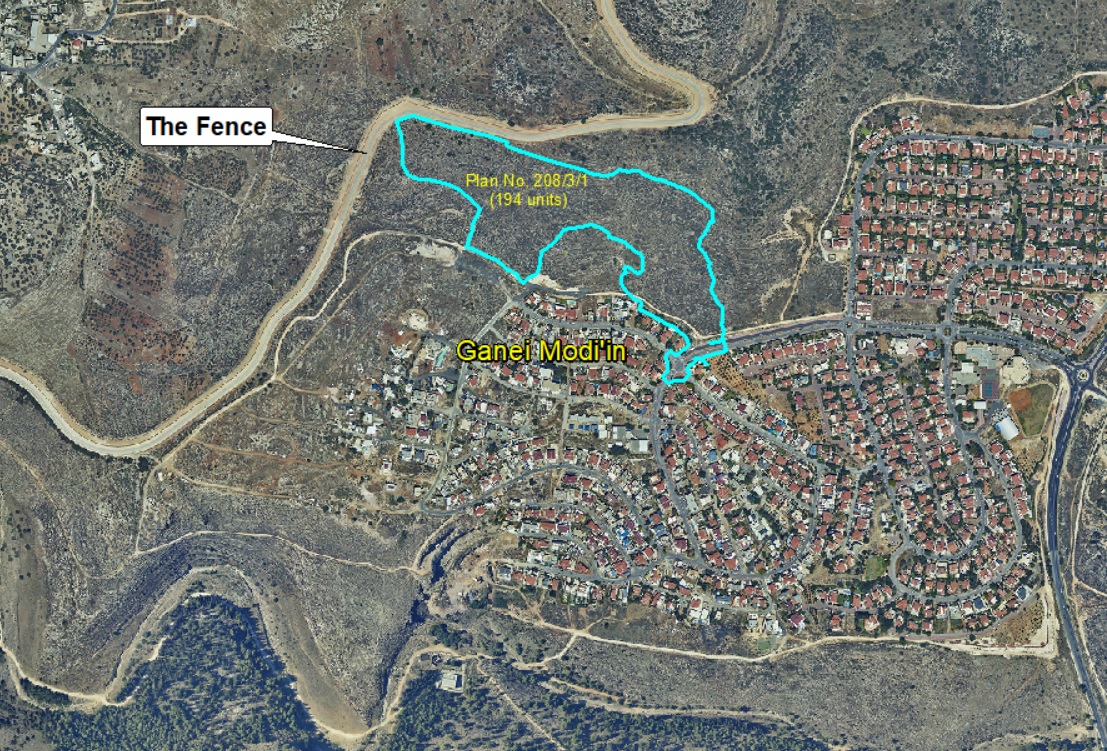
Map by Peace Now
194 units in the Ganei Modlin settlement, located in the northern “seam line zone” in the West Bank but on the Israeli side of the security barrier (by design of the Israeli government). The plan for 194 new units will bring the settlement’s built-up area directly up to the separation barrier, a particularly notable plan given Israel’s recent demolition of 70 Palestinian homes in the West Bank, based on the argument that the construction within a 200-250 foot Israeli-imposed “no construction zone” on either side of the barrier poses an unacceptable security risk to Israel. Israel rejected an offer by Palestinians to privately finance the construction of new and higher wall near the buildings; developers behind the Ganei Modlin project also offered to finance the construction of high wall near the construction, an offer the courts saw fit to accept – resolving the matter in the eyes of the High Planning Council, which approved the plan.
- 96 units in the Kiryat Netafim settlement, located in the northern West Bank and part of a string of settlements and unauthorized outposts – most notably Ariel – extending from the Green Line into the very heart of the West Bank and on towards the Jordan Valley.
- 76 units in the Beit Hagai settlement, located just south of Hebron,
- 66 units in the Efrat settlement, located south of Bethlehem. Efrat had already received final permission for 1,000 new settlement units at the most recent High Planning Council meeting, in April 2019. As a reminder, Efrat is located inside a settlement enclave that cuts deep into the West Bank. Efrat’s location and the route of the barrier wall around it, have literally severed the route of Highway 60 south of Bethlehem, cutting off Bethlehem and Jerusalem from the southern West Bank. The economic, political, and social impacts of the closure of Highway 60 at the Efrat settlement (there is literally a wall built across the highway) have been severe for the Palestinian population.
- 61 units attached to an educational institute in the Gva’ot settlement, located south of Bethlehem. The Gva’ot (Gevaot) settlement was established as an outpost of mobile homes, and later benefited from Israel’s unilateral, mass expropriation of Palestinian land in 2014 (which Israeli officials explictly said was done in response to a Palestinian terror attack). At the time, Peace Now reported that the move constituted the largest single expropriation of Palestinian land by the Israeli state in over 30 years.
- 51 units in Shvut Rachel, which only recently became an authorized settlement area when Israel extended the jurisdiction of the Shiloh settlement to include it as a “neighborhood” (along with three other outposts). The plans approved this week will retroactive legalize existing units and permit the construction of a few news one.
- 29 units in the Otniel settlement, located in the South Hebron Hills area. The plans serve to retroactively legalize existing units.
- 27 units in the Maskiyot settlement, located in the northern Jordan Valley. These units are part of a plan allowing the construction of a “bed and breakfast” with 27 additional rooms (and calling to mind Amnesty International’s recent report on the role tourism plays in supporting the occupation).
- 19 units in the Peduel settlement, located in the northern West Bank and part of a string of settlements and unauthorized outposts – most notably Ariel – extending from the Green Line into the very heart of the West Bank and on towards the Jordan Valley.
- 18 units and a park in the Ma’ale Adumim settlement.
- 11 units in the Einav settlement, located northwest of Nablus.
In addition, the Council gave retroactive approval for a controversial archeological site in the Shiloh settlement, located in the center of the northern West Bank. The Israeli government has devoted a significant amount of money and political energy towards building the tourist site, which is now drawing upwards of 60,000 evangelical tourists each year. For background on the site, see this Emek Shaveh report from 2014 and this brief from 2017, when the government approved the commercialization of the site. For analysis on how the site fits into a bigger pattern of Israeli efforts to normalize the settlements through tourism, see this report by Amnesty International.
Israeli Annexation via Settlement Construction Unleashed, Part 3: Plans Advanced for 1,466 New Settlement Units (With More to Come)
Actions taken August 5-6 by the Israeli Defense Ministry’s High Planning Council include advancing plans that, when they eventually receive final approval, will allow for the construction of 1,466 settlement units (details of the various steps of the planning/approval process are laid out by Peace Now here). Specifically, the Higher Planning Council this week approved the following plans for deposit for public review:
- 382 units in the Beit El settlement, located north of Ramallah. The plans include the retroactive legalization of 36 units; the remaining 346 are new units. As a reminder, Beit El is the settlement closely associated with U.S. Ambassador to Israel David Friedman, who among other things was the President of the “Friends of Beit El” organization, which raised money on its behalf.
- 354 in the Nili settlement, located in the northern West Bank;
- 200 units in the Asfar settlement, located northeast of Hebron. If approved, this plan will triple the size of the Asfar settlement.
- 168 units in the Talmon settlement, located north west of Ramallah. In December 2018, FMEP reported on a deadly encounter between neighboring Palestinians and settlers from Talmon and/or the many unauthorized outposts associated with it. The settlers had been attempting to takeover another hilltop on the outskirts of the Palestinian village of al-Mazra’ah al-Qibliyah. When Palestinians staged an attempt to stop the settlers from entering the area, a scuffle ensued and Israeli soldiers shot and killed two Palestinians.
- 132 units in the Kfar Adumim settlement, located east of Jerusalem and less than one mile from the Khan al-Ahmar bedouin community which the state of Israel is seeking to demolish.
- 84 units in the Shima settlement, located in the southern tip of the West Bank.
- 74 units in the Yakir settlement, located in the northern West Bank and part of a string of settlements and unauthorized outposts – most notably Ariel – extending from the Green Line deep into the West Bank.
- 48 units in the Bracha settlement, located south of Nablus.
- A recreational area in the Kochav Yaakov settlement, located just south of Ramallah.
In addition to the plans approved and advanced detailed above, the High Planning Council delayed consideration of two additional plans, which are:
- A plan that would effectively legalize another outpost, known as Brosh. Similar to the Haroah Haivri plan, discussed above, the plans relating to Brosh serve to retroactively legalize an existing educational institute. Approval of the plan was delayed because the Council had not resolved objections that were filed against the plan, including an objection filed by Peace Now.
A plan for 207 settlement units in the Bracha settlement, located near Nablus (these plans are in addition to the plans for 48 units approved to be deposited for public review, covered above). Though plan was on the Council’s schedule, it could not be approved because the Council first needs to approve the extension of Har Bracha’s existing settlement jurisdiction to include the area units are to be built. Since the plan calls for the construction of units outside of the existing area of jurisdiction, the plan could not be approved.
Israeli Annexation via Settlement Construction Unleashed, Part 4: Reactions
Following this week’s advancement of plans for 2,304 settlement units, settlement watchers and key members and bodies of the international community issued sharp criticism and sounded the annexation alarm bells. In contrast, there was glaring – and very, very, very predictable – silence came from the U.S. administration. A few notable reactions are included below.
Peace Now said in a statement:
“The approval of settlement plans is part of a disastrous government policy designed to prevent the possibility of peace and a two-state solution, and to annex part or all of the West Bank. The linkage of thousands of housing permits for settlers and a negligible number of housing units for Palestinians cannot hide the government’s discrimination policy. As a result, we see for example an approval of the illegal outpost (Haroeh Haivri) built for Israelis adjacent to the Palestinian bedouin village of Khan Al-Ahmar, for which the government refuses to approve any construction permits and instead seeks to transfer. Or we see, the approval of the construction of a new settlement neighborhood adjacent to the separation barrier after demolishing 72 housing units built adjacent to the separation barrier in Wadi Hummus, despite offering to fund security measures.”
The European Union issued a statement which reads:
“The EU expects the Israeli authorities to fully meet their obligations as an occupying power under International Humanitarian Law, and to cease the policy of settlement construction and expansion, of designating land for exclusive Israeli use, and of denying Palestinian development.”
United Nations Special Coordinator for the Middle East Peace Process Nickolay Mladenov said in a statement:
“The expansion of settlements has no legal effect and constitutes a flagrant violation of international law. By advancing the effective annexation of the West Bank, it undermines the chances for establishing a Palestinian state based on relevant UN resolutions, as part of a negotiated two-state solution.”
British Foreign Secretary Dominic Raab urged Israel to stop what he called:
“the effective annexation of the West Bank.”
Leilani Farha, the United Nations Special Rapporteur for the right to housing, and Michael Lynk, the United Nations Special Rapporteur for human rights in the Palestinian territory occupied since 1967, said in a statement:
“These settlement housing units are clearly meant to solidify the Israeli claim of sovereignty over the West Bank. Building civilian settlements in occupied territory is illegal, as is the annexation of territory. The international community has spoken out against the Israeli settlements, but it has not imposed effective consequences for the country’s defiance of international law. Israel’s actions indicate it plans to remain permanently and advance a claim of sovereignty. The Israeli Prime Minister made this clear when he said recently that: ‘No settlement and no settlers will ever be uprooted.’ Should we not take him at his word that Israel has no intention of complying with international law? Criticism without consequences is hollow. The international community has a wide menu of commonly-used countermeasures to push recalcitrant states into compliance with their international duties. If the international community is serious about its support for Palestinian self-determination and its opposition to Israeli settlements then, surely, the time has come for meaningful action.”
Israeli settlers, on the other hand, we filled with glee. Gush Etzion Regional Council Head Shlomo Ne’eman said in a statement:
“Thank God today we received approval from the Higher Planning Council for new housing units in Gush Etzion. Congratulations to all of our residents on the 200 units in Metzad, which is historic in that it will triple the size of the community. Congratulations on the final approvals for the Sadna institution, which works towards integration and is located in Gevaot, and will enable permanent construction of tens of units. Another major breakthrough is the final approval for Ibei Hanachal, which essentially fully legalizes the community and includes the construction of 96 permanent homes. These are major accomplishments for southeastern Gush Etzion, for the Jewish communities in the Judean Desert, and of course for all of Judea and Samaria. This is an opportunity for me to thank Prime Minister Netanyahu on this impressive accomplishment. Let’s hope that the trend of development and construction in Judea and Samaria continues full speed ahead.”
Following Murder of Settler Youth, Netanyahu Doubles Down on Commitment to Settlements
Following the murder of a 19-year old Israeli settler, Prime Minister Netanyahu vowed once again that he will promote settlement construction in all areas of the West Bank. Speaking at a ceremony marking the establishment of a new neighborhood of 650 units in the settlement of Beit El (which just saw plans for 382 new units advance, see above) Bibi said:
“We promised to build hundreds of housing units. Today we are doing it, both because we promised and because our mission is to establish the nation of Israel in our country. We know that the Land of Israel is bought in agony. Today another one of our sons fell. He was from a family that has already made a heavy sacrifice for the Land of Israel. These vicious terrorists: They come to uproot, we come to plant. They come to destroy, we come to build. Our hands will reach out and we will deepen our roots in our homeland – in all parts of it.”
Bibi’s words — which suggest an intention to continue/expand settlement construction across the entirely of the West Bank — did not satisfy many of his challengers on the Israeli right (against whom he is squaring off against in the upcoming election). Ayelet Shaked – who is leading a union of right wing parties – called directly for annexation. She said:
“We have to apply sovereignty to Judea and Samaria. Gush Etzion is in consensus and there is no reason not to apply sovereignty there.”
Knesset Speaker Yuli Edelstein (Likud) said:
“our response to the murder has to be [to] apply sovereignty on the settlements, starting with Gush Etzion.”
And the Sovereignty Movement – is an offshoot of the Women in Green organization, and has been working to formalize its expanding influence over Israeli politicians and public discourse by pushing for the establishment of a Knesset committee devoted to the cause of Israeli annexation of the West Bank – issued a statement saying:
“It is either us or them! This is a 52-year-old struggle that must be resolved. Sovereignty will bring resolution and will erase the hope of pushing us out of here through terror attacks. The resolution must be clear and unambiguous – we have returned to the heritage of our fathers, we will bring another million Jews here, we will build dozens of communities. The Arabs are invited to live under our sovereignty as individuals and enjoy a prosperous life as residents.”
Latin Patriarchate Files Suit Claiming New Proof of Fraud Behind Settler Takeover of Old City Hotel Properties
On August 5th, the Greek Orthodox Patriarchate in Jerusalem filed a request to reopen the underlying case in Jerusalem District Court which awarded the radical settler group Ateret Cohanim the ownership rights to three historic church properties in the Old City of Jerusalem. The Patriarchate’s appeal is based on new evidence of fraud committed by the Jerusalem settler organization Ateret Cohanim – with the aid of church officials – during the sale of the properties. The original Jerusalem District Court ruling acknowledged that there were problems in the transaction, but found that the church failed to prove its allegations of bribery and corruption.
The allegations of fraud rely on the testimony of Ted Bloomfield, a man who managed the Petra Hotel in the 1990s. Bloomfield reportedly told the Greek Patriarchate that Ateret Cohanim paid him to help persuade the Palestinian protected tenants to sell their rights. The lawsuit says these actions are “extraordinary in their severity” and include fraud, forgery of legal documents, and bribery – including alleged attempted sexual bribery. The church’s complaint also alleges that the settler group obstructed justice in deliberately concealing documents during legal proceedings.
Haaaretz recently published a moving video testimony of one Palestinian man, Abu-Walid Dajani, whose family has run the New Imperial Hotel, one of the targeted properties, since 1949. Dajani is now facing eviction.
Education Minister Strips Key Committee Membership from Professor Who Objected to Authorization of Settlement Medical School
The Haaretz Editorial Board penned a sharp criticism of newly appointed (and interim) Israeli Education Minister Rafi Peretz, who recently removed Professor Yossi Shain from the Planning & Budgeting Committee of the Higher Education Council. Shain was one of the members of the key professional committee – which essentially serves as the gatekeeper for schools hoping to join the ranks of accredited Isareli education institutions – who objected to the rushed and politicized process by which, in contravention to the Council’s normal practice, a medical school located in the settlement of Ariel received approval from the Higher Education Council.
The Editorial Board writes:
“The ‘revenge’ taken by Peretz against someone acting according to his professional judgment is a worrisome sign. The message conveyed by the education minister’s bureau is crystal clear: In education and academia, loyalty to the occupation and annexation project has become a decisive criterion.”
Bimkom Report: Israel’s “No Construction Zone” Adjacent to the Separation Barrier Has Little To Do With Security
In a new report, the Israeli NGO Bimkom sheds light on the very problematic regulation that was the legal pretext behind Israel’s recent demolition of 70 Palestinian homes in Wadi Hummos – i.e., the argument that the construction was located too close to Israel’s separation barrier.
Bimkom explains that in 2011, the Israeli military issued a “no construction order” to prevent construction close to the separation barrier, ostensibly on the basis of security considerations. The zone defined by the order ranges from ranges from 30 meters to 700 meters in different areas (on both sides of the barrier). Given that much of the barrier passes through the West Bank (meaning the land on both sides is Palestinian land), the cumulative impact on the Palestinians is significant. According to Bimkon, the total area affected by the no-construction order is approximately 195,000 dunams [48,185 acres/195km2] of land, belonging to 115 Palestinian villages.
While the order also (theoretically) impacts 15,000 dunams of land in areas where there are settlements located close to the barrier, the perimeter of the zone and enforcement against construction within it follows a predictable logic in favor of the settlements.
Bimkom writes:
“Similar to the barrier route, the no-construction order is determined such that its impact on settlement construction is minimal, but its impact on Palestinian villages is enormous. The negative impact of the physical barrier on hundreds of thousands of Palestinians is intensified expanded to hundreds of meters in which Palestinian construction is prevented. The potential for Palestinian development in Area C is already very limited, and the no-construction zone only serves to exacerbate the situation. In summary, it can be seen that the security considerations which are supposedly behind the construction ban are often questionable, and this also applies to Wadi al-Hummus. The obvious conclusion is that the security considerations according to which buildings in Areas A and B were demolished are a smoke-screen for political considerations whose purpose is to reduce the Palestinian population in the seam zone, especially in the Jerusalem region, or even to punish them for unrest in the area, according to army reports. The threat of demolition still hangs over Wadi al-Hummus, as there are a large number of other buildings that have received demolition orders and the court is scheduled to discuss their case in the coming months.”
Also, as detailed above, the inconsistency of Israeli policy when it comes to enforcing the “no-construction zone” was on display this week, as Israel approved the construction of 194 units in the Ganei Modlin settlement, right up to the barrier (discussed above). Whereas Israel rejected an offer by Palestinians in Wadi Hummos to privately finance the construction of new and higher wall near their buildings (and went ahead and demolished them), Israel authorities accepted an offer by developers behind the Ganei Modlin project to finance the construction of high wall near the construction, allowing expansion of a settlement to move ahead.
Ir Amim: Israel’s Crackdown in Issawiya Advances Settlement Project in East Jerusalem
In +972 Mag, Ir Amim researcher Aviv Tartarsky published a superb analysis of the ongoing campaign of daily harassment and intimidation Israeli authorities have unleashed against Palestinians living in the Issawiya neighborhood of East Jerusalem. Tatarsky writes:
“The campaign against Issawiya signals a new stage in Israel’s oppressive policies in East Jerusalem, and is part of the overall change in Israeli policy toward the Palestinians with the backing of the Trump administration. In the past, Israel primarily focused on settlement construction in the eastern part of the city. By building so-called ‘facts on the ground,’ the government intended to make it as difficult as possible to draw a border along the Green Line and create two capitals in Jerusalem. Today that focus has dangerously shifted to breaking apart Palestinian Jerusalem. Israel is pouring hundreds of millions of shekels into projects that will take over large parts of the the Old City and its surrounding neighborhoods, while fragmenting Palestinian territory and jeopardizing the Palestinian population. Neighborhoods such as Silwan, A-Tur and Sheikh Jarrah have seen an intensification of home demolitions and evictions on the one hand, while on the other the municipality has built promenades, heritage centers, and other tourist attractions for the Jewish settlers living inside Palestinian neighborhoods. Meanwhile, Israel is aiming to redraw the city’s municipal borders so as to push 120,000 Palestinians — more than a third of the city’s Palestinian population — out of the city. According to legislation advanced last year by Jerusalem Affairs Minister Ze’ev Elkin, neighborhoods such as Kufr Aqab, Ras Hamis and the Shuafat refugee camp — already separated from the rest of the city by the separation wall — will be drawn out of the municipal boundaries. Issawiya, then, portends what Israel has in store for the remaining Palestinian neighborhoods of Jerusalem: continual violence that has no aim other than oppressing and making life miserable for all who live there.”
Terrestrial Jerusalem In-Depth Report: The Silwan Tunnel Project
Terrestrial Jerusalem produced an essential in-depth report on Israeli and U.S. policy towards Silwan, offering important context and shedding new light on the significance of Ambassador Friedman and Jason Greenblatt’s political stunt alongside Elad in the tunnels underneath the neighborhood.
Danny Seidemann writes in the report’s introduction:
“The event was not merely dramatic. The choreography illuminated at one critical moment and in one critical space two apparently disparate dimensions of the Israel-Palestine conflict, and their current dynamics: the territorial skirmishing and the battle over narrative in Jerusalem. More than anywhere else, the settlement in Silwan embodies the significant changes taking place in the Old City of Jerusalem and its immediate environs. The opening tunnel was, superficially, a minor routine event that disclosed developments that are anything but routine. As such, it requires an in-depth analysis that takes a hard look at the event, its background and its consequences. In our three sectioned report, we will begin by examining the background and significance of the settlement in Silwan. In Part II, we will examine the tunnel, its archeological, historical and ideological significance and the context in which it was excavated. Part III will deal with the nature of the shift in US policy regarding Silwan, its sources and its ramifications.”
Bonus Reads
- “Goodbye withdrawal, hello sovereignty: The triumph of the settlers” (Times of Israel)
- “Peace Cast: Housing Rather than Ideology” (Americans for Peace Now)
- “How Ayelet Shaked, a secular woman, came to dominate the right-wing religious camp in Israel” (JTA)
- “India’s Settler-Colonial Project in Kashmir Takes a Disturbing Turn” (Washington Post)