Legalized Discrimination: How Israel’s “Citizenship & Entry” law harms Palestinian families by design
Co-hosted with Adalah: the Legal Center for Arab Minority Rights in Israel
Tuesday, April 26, 2022
Listen to this event as a podcast.
featuring Member of Knesset Aida Touma-Sliman (Hadash/Joint List), Dr. Morad El Sana (American University) and Dr. Hassan Jabareen (Adalah) in conversation with Lara Friedman
Please see below for Resources shared during this event.
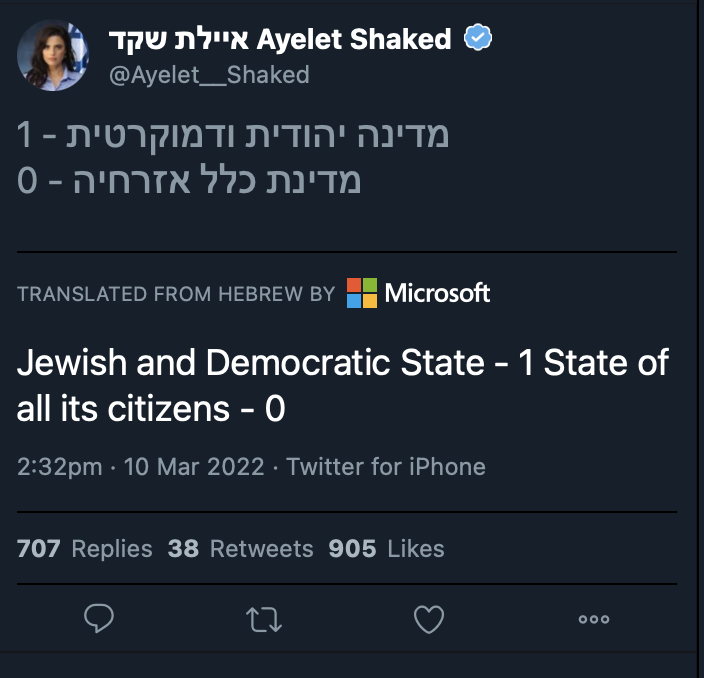
Last month, the Israeli Knesset passed a new version of Israel’s infamous “Citizenship and Entry into Israel Law.” This law denies to Palestinian citizens of Israel a fundamental right that Israel’s Jewish citizens take for granted (and, indeed, citizens around the world hold dear): the right to make a life together with one’s chosen spouse, in the country where one hold’s citizenship. Adopted originally by the Knesset in 2003 as a “temporary” measure ostensibly for “security” reasons, the law has been repeatedly renewed for almost 20 years, most recently in March 2022. The renewed law includes explicit provisions referring to its “demographic” purpose, leading Adalah to call it “one of the most racist and discriminatory laws in the world.” In March, Israel’s Minister of Interior Ayelet Shaked celebrated the law’s passage on Twitter, saying; “Jewish & Democratic State – 1; State for all its citizens – 0”. [Hebrew original here].
This webinar features Dr. Morad El Sana, who was among the first petitioners against this law when his family was directly impacted by it; Dr. Hassan Jabareen, who leads Adalah’s challenges against this law at the Israeli Supreme Court; Member of Knesset Aida Touma-Sliman, who has fought against this law since its first passage – all in conversation with FMEP’s Lara Friedman. We discuss the concrete implications of this law for Palestinian citizens and residents, as well as what the law’s renewal – and the discourse around it in Israel – discloses about contemporary Israeli political and legal dynamics and the impact of the 2018 Jewish Nation State Law. We also look at what these dynamics suggest about the future, the evolving discourse on “national security” with respect to Palestinian citizens, and the continued framing of Palestinians as a “demographic threat” to Jewish supremacy in Israel/Palestine.
Resources shared in this event:
Follow our panelists:
- Dr. Hassan Jabareen → @AdalahEnglish
- MK Aida Touma-Sliman → @AidaTuma
- Dr. Morad El Sana → https://www.american.edu/cas/faculty/melsana.cfm
- Adalah → www.adalah.org
- Lara Friedman → @LaraFriedmanDC
Resources from Adalah:
- “The Citizenship Law is one of the Most Racist and Discriminatory Laws in the World; Opposing the Extension of the Temporary Ban that Prevents Palestinian Family Unification is a Moral Obligation.” To read about the legal history of the ban on Palestinian family unification → https://www.adalah.org/en/content/view/10373
- Adalah’s explainer of the Jewish Nation-State Law: https://www.adalah.org/en/content/view/9569
- To read about Adalah’s new petition to the Supreme Court, March 2022 → https://www.adalah.org/en/content/view/10581
- Introduction of the petition [English] → https://www.adalah.org/uploads/uploads/Introduction_Petition_Family_Unification_160322.pdf
- Citizenship and Entry into Israel Law (Temporary Order) – 2022 (Unofficial Translation) → https://www.adalah.org/uploads/uploads/The_Citizenship_and_Entry_into_Israel_Law_Eng_150322.pdf
- How the Law of Return Creates One Legal Order in Palestine, published in Theoretical Inquiries in Law by Dr. Hassan Jabareen, 2020 → https://www.academia.edu/45076803/How_the_Law_of_Return_Creates_One_Legal_Order_in_Palestine?email_work_card=view-paper
Ayelet Shaked’s March 10, 2022 Tweet: “Jewish & Democratic State – 1; State for all its citizens – 0” → https://fmep.org/wp-content/uploads/Screen-Shot-2022-03-17-at-12.01.04-PM.png
Some background articles & analysis:
- “Once again, Israel throws up an unlawful barrier to Palestinian family reunification” by Dr. Carol Daniel Kasbari → https://www.mei.edu/publications/once-again-israel-throws-unlawful-barrier-palestinian-family-reunification
- “The law tearing Palestinian families apart” by Samah Salaime → https://www.972mag.com/citizenship-law-israel-palestinian-families/
- Al Jazeera: “‘Devastating’: How Israel is pulling Palestinian families apart” → https://www.aljazeera.com/features/2022/3/15/devastating-how-israel-is-pulling-palestinian-families-apart
- Al Monitor: “Israeli citizenship law blocks Palestinian family reunification” → https://www.al-monitor.com/originals/2022/03/israeli-citizenship-law-blocks-palestinian-family-reunification
- “Family Unification Bill Meant to Stop Palestinian ‘Creeping Right of Return,’ Israel’s Shaked Says” (Haaretz): “While officially, the amendment to the Citizenship Law restrictions is based on security concerns, senior officials admit it is a tool aimed at ensuring a Jewish majority in Israel” → https://www.haaretz.com/israel-news/shaked-family-unification-bill-meant-to-stop-palestinian-creeping-right-of-return-1.10601224
For more on the applicability of the Rome Statute, see this 2021 FMEP webinar, “Israel-Palestine at the International Criminal Court: What’s Next?” featuring Dr. Hassan Jabareen and other experts in international law: https://fmep.org/resource/israel-palestine-at-the-international-criminal-court-what-next/
Participant Bios
Dr. Morad El Sana is a visiting professor at the American University, Washington DC., where he teaches the History of Colonialism in the Middle East, the Arabs in Israel, among other courses. From 2001-2009, he worked as a staff attorney for Adalah and then he led Adalah’s office in the Naqab. Morad and his wife were among the first petitioners in Adalah’s 2003 Supreme Court challenge against the ban on Palestinian family unification.
Dr. Hassan Jabareen is the founder and General Director of Adalah. For almost 30 years, he has litigated scores of landmark constitutional law cases regarding the rights of Palestinian citizens of Israel, and international humanitarian law cases concerning Palestinians living in the 1967 Occupied Territory before the Israeli Supreme Court. Hassan has led Adalah’s legal teams challenging the law banning Palestinian family unification before the Israeli Supreme Court since 2003. Adalah tweets at @AdalahEnglish.
Aida Touma-Sliman has been a member of the Israeli Knesset since 2015, representing the Hadash/Jabha faction of the Joint List. Aida is the chair of the Committee on the Status of Women and Gender Equality. She has beenan activist for many years, fighting to end violence against women, the Israeli occupation, and to ensure justice for the Paelestinian community within Israel. Aida has spoken out strongly over the last 20 years against the ban on Palestinian family unification and its adverse effects on Palestinian women. She tweets at @AidaTuma.
Lara Friedman is the President of the Foundation for Middle East Peace (FMEP). With more than 25 years working in the Middle East foreign policy arena, Lara is a leading authority on U.S. foreign policy in the Middle East, with particular expertise on the Israeli-Arab conflict, Israeli settlements, Jerusalem, and the role of the U.S. Congress. Lara tweets at @LaraFriedmanDC.
In this episode of the Occupied Thoughts podcast, FMEP’s Lara Friedman speaks with Amnesty International’s Saleh Hijazi about the root causes of the violence currently in the headlines — i.e., Israel’s policy of apartheid, and the structural violence they impose against Palestinians. and why Amnesty International is calling for an end to the “cycle of impunity” that supports and enables it.
Saleh Hijazi is Amnesty International (UK)’s Deputy Regional Director for the Middle East and North Africa. He is also advisor to Al-Quds University Human Rights Clinic where he worked as academic coordinator and lecturer, and a fellow at Al-Shabaka. Saleh holds a master’s degree in human rights from the University of Essex and a bachelor’s degree in philosophy and political science from Lawrence University.
Lara Friedman is the President of the Foundation for Middle East Peace (FMEP).
Subscribe to “Occupied Thoughts” on iTunes | Soundcloud |Spotify
Also see:
Amnesty International, Feb. 1, 2022: Israel’s apartheid against Palestinians: Cruel system of domination and crime against humanity
+972 Magazine interview with Saleh Hijazi Feb. 1, 2022: Why Amnesty is taking aim at the ‘root causes’ of Israeli apartheid
Policing the Narrative: Israel & Apartheid in the US Debate
Wednesday, March 30th, 2022
featuring Paul O’Brien (Amnesty International), Dr. Maha Nassar (University of Arizona), and Peter Beinart (CUNY), in conversation with Lara Friedman (FMEP)
Listen to this event as a podcast
Last month, Amnesty International published a detailed and thorough report examining Israel’s treatment of Palestinians and concluding that it meets the legal definition of the crime of apartheid. With this conclusion, Amnesty joined the ranks of international and Israeli NGOs, including Human Rights Watch, B’Tselem, and Yesh Din, as well as Palestinian organizations and advocates, including Al Haq and Al Mezan, who have likewise concluded that that Israel’s treatment of Palestinians amounts to the crime of apartheid. And just last week, UN Special Rapporteur Michael Lynk articulated the same conclusion in an official report to the UN Security Council.
FMEP has held a number of events exploring the meaning and implications of “apartheid” for understanding the Israeli regime and its treatment of Palestinians: “Talking About Apartheid,” “Gaza, Apartheid, and Challenging Israeli Impunity,” Calling the Thing by its Proper Name: “Apartheid” Between the Jordan River & the Mediterranean Sea,” and “Israeli Apartheid & the Climate Crisis.”
In this week’s webinar, we explored another aspect of this issue: the dynamics and tactics (some new, some old) on display in the responses from defenders of the status quo to the growing use and acceptance of the apartheid framing — including deflection and misdirection aimed at shifting focus away from factual findings and delegitimization and demonization of human rights defenders and Palestinian rights activists.
Participants:
Paul O’Brien is the Executive Director at Amnesty International USA, based in Washington, DC. Previously, Paul was at Oxfam America. During the pandemic, Paul co-led Oxfam’s worldwide influencing network’s efforts to change government policies, corporate practice and public opinion. For the last decade, he oversaw Oxfam America’s advocacy with the US government and corporations. He has been an advisor to the President of Afghanistan, the Africa Policy Advisor for CARE, and an organizer in Nairobi’s informal urban settlements. He co-founded a community organizing institution in Kenya and a human rights research consortium in Afghanistan. He was the President of the Echoing Green Foundation, a litigator in New York for Cravath, Swaine and Moore. He has a JD from Harvard Law School and has published on power and rights for more than three decades. He recently published “Power Switch” How We Can Reverse Extreme Inequality.”
Dr. Maha Nassar is an associate professor in the School of Middle Eastern and North African Studies at the University of Arizona, where she specializes in the cultural and intellectual history of the modern Arab world, and 2022 Fellow at the Foundation for Middle East Peace. Her award-winning book, Brothers Apart: Palestinian Citizens of Israel and the Arab World (Stanford University Press, 2017), examines how Palestinian intellectuals connected to global decolonization movements during the mid-twentieth century. A 2018 Public Voices Fellow with the OpEd Project, Dr. Nassar’s analysis and opinion pieces have appeared in numerous publications, including The Washington Post, +972 Magazine, The Conversation, and The Hill. She lives in Tucson, Arizona, with her husband, son, and daughter, and she is working on her next book, a global history of Palestine’s people. Follow Dr. Nassar on Twitter here: @mtnassar
Peter Beinart teaches national reporting and opinion writing at the Newmark J-School and political science at the CUNY Graduate Center. He is editor-at-large for Jewish Currents, a CNN political commentator, and a fellow at the Foundation for Middle East Peace. He is also a nonfiction author and former Rhodes Scholar. His first book, The Good Fight, was published by Harper Collins in 2006. His second book, The Icarus Syndrome, was published by HarperCollins in 2010. His third, The Crisis of Zionism, was published by Times Books in 2012. Twitter: @PeterBeinart
Lara Friedman is the President of the Foundation for Middle East Peace (FMEP). With more than 25 years working in the Middle East foreign policy arena, Lara is a leading authority on U.S. foreign policy in the Middle East, with particular expertise on the Israeli-Arab conflict, Israeli settlements, Jerusalem, and the role of the U.S. Congress. She is published widely in the U.S. and international press and is regularly consulted by members of Congress and their staffs, by Washington-based diplomats, by policy-makers in capitals around the world, and by journalists in the U.S. and abroad. In addition to her work at FMEP, Lara is a Contributing Writer at Jewish Currents and a non-resident fellow at the U.S./Middle East Project (USMEP). Prior to joining FMEP, Lara was the Director of Policy and Government Relations at Americans for Peace Now, and before that she was a U.S. Foreign Service Officer, serving in Jerusalem, Washington, Tunis and Beirut. She holds a B.A. from the University of Arizona and a Master’s degree from Georgetown’s School of Foreign Service; in addition to English, Lara speaks French, Arabic, Spanish, (weak) Italian, and muddles through in Hebrew. Lara tweets @LaraFriedmanDC
Resources shared in the webinar:
Follow our participants on social media:
- Follow Dr. Nassar on Twitter here: @mtnassar
- Peter Beinart on Twitter: @PeterBeinart
- Peter Beinart on Substack: peterbeinart.substack.com
- Lara Friedman tweets @LaraFriedmanDC
- Paul O’Brien on Twitter @dpaulobrien
Human Rights Organizations’ reports on Apartheid:
Amnesty International:
- “Israel Apartheid Against Palestinians: A Look into Decades of Oppression and Domination” → https://www.amnesty.org/en/latest/campaigns/2022/02/israels-system-of-apartheid/
- Amnesty’s course, “Deconstructing Israel’s Apartheid Against Palestinians” —> https://academy.amnesty.org/learn/course/external/view/elearning/239/apartheid-course
- “Myanmar: Rohingya trapped in dehumanising apartheid regime” —> https://www.amnesty.org/en/latest/news/2017/11/myanmar-rohingya-trapped-in-dehumanising-apartheid-regime/
Al Haq: “The Legal Architecture of Apartheid” by Al Haq: https://www.alhaq.org/advocacy/18181.html; “Al-Haq Highlights Israel’s Apartheid Regime and Calls for Accountability at the 46th Session of the Human Rights Council” → https://www.alhaq.org/advocacy/18174.html
Al Mezan: “The Gaza Bantustan: Israeli Apartheid in the Gaza Strip” —> https://www.mezan.org/en/post/24083
B’Tselem: “A Regime of Jewish Supremacy from the Jordan River to the Mediterranean Sea: This is Apartheid” —> https://www.btselem.org/publications/fulltext/202101_this_is_apartheid
Yesh Din: “The Occupation of the West Bank and the Crime of Apartheid: Legal Opinion” → https://www.yesh-din.org/en/the-occupation-of-the-west-bank-and-the-crime-of-apartheid-legal-opinion/
Human Rights Watch: “A Threshold Crossed: Israeli Authorities and the Crimes of Apartheid and Persecution” → https://www.hrw.org/report/2021/04/27/threshold-crossed/israeli-authorities-and-crimes-apartheid-and-persecution
A few FMEP events on Apartheid:
“Talking About Apartheid,” “Gaza, Apartheid, and Challenging Israeli Impunity,” Calling the Thing by its Proper Name: “Apartheid” Between the Jordan River & the Mediterranean Sea,” and “Israeli Apartheid & the Climate Crisis.”
For more, see our Events Index.
Palestinian critiques of the apartheid framing:
- Lana Tatour: “Amnesty report: The limits of the apartheid framework” → https://www.middleeasteye.net/opinion/israel-amnesty-apartheid-report-limits-framework
- Adam Horowitz interviews Lana Tatour: “Settler-colonialism and the limits of the apartheid framework” → https://mondoweiss.net/2022/02/settler-colonialism-and-the-limits-of-the-apartheid-framework/
- Rethinking Palestine Podcast: “Limitations and Possibilities of the Apartheid Framework with Lana Tatour” and Yara Hawari → https://podcasts.apple.com/us/podcast/limitations-and-possibilities-of-the/id1537774938?i=1000507182508
- “Dismantle What? Amnesty’s Conflicted Messaging on Israeli Apartheid” by Soheir Asaad & Rania Muhareb” → https://www.palestine-studies.org/en/node/1652565#
Peter Beinart’s articles:
- “I No Longer Believe in a Jewish State” in the NYT → https://www.nytimes.com/2020/07/08/opinion/israel-annexation-two-state-solution.html
- “Yavne: A Jewish Case for Equality in Israel-Palestine” in Jewish Currents → https://jewishcurrents.org/yavne-a-jewish-case-for-equality-in-israel-palestine
- “There Is No Right to a State” in Jewish Currents → https://jewishcurrents.org/there-is-no-right-to-a-state
Paul O’Brien at the Woman’s National Democratic Club:
- Video: https://www.youtube.com/watch?v=8e8gWWdJDEE
- Transcript that Jewish Insider published: https://jewishinsider.com/2022/03/amnesty-usa-director-paul-obriens-remarks-to-the-womens-national-democratic-club/
- Paul O’Brien’s Twitter thread response: https://twitter.com/dpaulobrien/status/1502698175789993990
Misc:
Some resources on Israel Apartheid Week: http://apartheidweek.org/ and https://bdsmovement.net/iaw
Ayelet Shaked tweet: “Jewish & Democratic State – 1; State for all its citizens – 0” –> https://fmep.org/wp-content/uploads/Screen-Shot-2022-03-17-at-12.01.04-PM.png
On AIPAC’s endorsements, see this piece by Mitchell Plitnick on +972 —> https://www.972mag.com/aipac-republicans-capitol-riot-israel/
The Benjamin Wittes Twitter thread on Ukrainian sovereignty & the Russian invasion → https://twitter.com/benjaminwittes/status/1508765976703217665 and Mehdi Hassan’s response: “I don’t necessarily disagree with this take but I do find it amusing given how many years “Westerners” have insisted to Palestinians that they “negotiate” a solution to the end of their occupation (and also give up their land in the process!)” → https://twitter.com/mehdirhasan/status/1508795773378510855
Israeli Apartheid, the Supreme Court, and Land Confiscation: The Case of Masafer Yatta
Wednesday, March 9, 2022
featuring Ali Awad (writer & activist from Tuba, Masafer Yatta) and Maya Rosen (Jerusalem-based activist) with Dr. Sarah Anne Minkin (FMEP)
Listen to this conversation as a podcast
On March 15, 2022, the Israeli Supreme Court is expected to render a decision on whether the state of Israel will be permitted to carry out a large expulsion of Palestinians in the West Bank. The Palestinians in question live in an area of the South Hebron Hills called Masafer Yatta, residing for many generations in small, shepherding-based villages. In the early 1980s, in violation of international law, the IDF declared the area a firing zone (“Firing Zone 918”) — an action viewed by experts as taken with the clear Israeli objective of displacing the Palestinian residents of the area and taking control of the land. Consistent with that analysis, for decades, Palestinians living in Masafer Yatta have faced constant threat of expulsion, home demolitions, confiscation of their property, harassment and violence at the hands of both the Israeli army and Israeli settlers.
Ali Awad, a writer and activist from Tuba in Masafer Yatta and Maya Rosen, a Jerusalem-based Palestine solidarity activist, join FMEP’s Sarah Anne Minkin for a discussion of how Palestinians in Masafer Yatta continue to build their lives despite the constant existential threat they are under such threat, what they expect from the Israeli Supreme Court, and the international campaign they have launched to save their villages. We’ll also discuss the role of the Israeli judiciary in enabling Israeli apartheid and Israel’s use of the “firing zone” designation as a means of confiscating Palestinian land.
Participants
Ali Awad is a writer and activist from the village of Tuba in the South Hebron Hills.
Maya Rosen is a graduate student studying history at the Hebrew University. She lives in Jerusalem and is a Palestine solidarity activist.
Sarah Anne Minkin, PhD, is FMEP’s Director of Programs & Partnerships.
Resources shared in the webinar:
- Follow Ali on Twitter: https://twitter.com/Ali_awad1998
- Follow Sarah Anne on Twitter: https://twitter.com/saminkin
Read Ali’s writing:
- Ali’s article archive on +972: https://www.972mag.com/writer/ali-awad/
- Ali Awad in Haaretz: “Opinion | For 17 Years, Stone-throwing Settlers Have Terrorized Palestinian Children. I Was One of Them” – https://www.haaretz.com/israel-news/.premium-for-17-years-settlers-have-terrorized-palestinian-children-i-was-one-of-them-1.10292655
- Ali in Haaretz: Opinion | Why Israeli Settlers Are Targeting Palestinian Kids’ Playgrounds – https://www.haaretz.com/israel-news/.premium.HIGHLIGHT-palestinians-israel-settlers-idf-violence-west-bank-1.10516297
- January 2021 FMEP podcast with Ali: “‘We don’t have another place to go’: Dispossession, Settler Violence, and Resistance in Masafer Yatta” – https://fmep.org/resource/we-dont-have-another-place-to-go-threats-settler-violence-and-resistance-in-masafer-yatta/
About Masafer Yatta + the Save Masafer Yatta campaign:
- Save Masafer Yatta: https://savemasaferyatta.com/en/
- “Portraits of Resistance in Masafer Yatta,” published in Jewish Currents with an introduction from Maya Rosen https://jewishcurrents.org/portraits-of-resistance-in-masafer-yatta
- ACRI’s most updated explainer, “Prevent Expulsion of Palestinians from Hebron Hills” – https://www.english.acri.org.il/post/__205
- B’Tselem: “Firing Zone 918” – https://www.btselem.org/publications/fulltext/918
- B’Tselem’s map of the South Hebron Hills which shows the Firing Zone: https://www.btselem.org/download/southern_hebron_hills_map_eng.pdf
- +972 Archives on Firing Zone 918: https://www.972mag.com/topic/firing-zone-918/
- +972 South Hebron Hills archive: https://www.972mag.com/topic/south-hebron-hills/
- Akevot: “Document exposed by Akevot: Ariel Sharon instructed IDF to create training zone to displace Palestinians” – https://www.akevot.org.il/en/news-item/document-revealed-by-akevot-ariel-sharon-instructed-idf-to-create-training-zone-to-displace-palestinians/
- Info Sheet from ACRI, “The 12 Villages of Firing Zone 918 in the South Hebron Hills” – https://law.acri.org.il/en/2016/02/21/firing-zone-918-infosheet/
- Al Haq: “Virtual Field Visit: Firing Zone 918” – https://www.alhaq.org/advocacy/6684.html
On Israel’s use of Firing Zones:
- Kerem Navot’s “A Locked Garden: Declaration of Closed Areas in the West Bank” – https://www.keremnavot.org/a-locked-garden
- OCHA on the humanitarian impact of firing zones: https://www.ochaopt.org/sites/default/files/ocha_opt_firing_zone_factsheet_august_2012_english.pdf
- “Life in a Jordan Valley firing zone” (Al Jazeera) – https://www.aljazeera.com/gallery/2016/10/1/life-in-a-jordan-valley-firing-zone
- Moving Nowhere: Firing Zones and Forcible Transfer in the Jordan Valley → https://reliefweb.int/report/occupied-palestinian-territory/moving-nowhere-firing-zones-and-forcible-transfer-jordan
- Sealed Off and Forgotten: What You Should Know about Israel’s ‘Firing Zones’ in the West Bank (Middle East Monitor) – https://www.middleeastmonitor.com/20200113-sealed-off-and-forgotten-what-you-should-know-about-israels-firing-zones-in-the-west-bank/
- “When Home became a military firing zone” (DCI-P) – https://www.dci-palestine.org/when_home_becomes_an_israeli_military_firing_zone
- “Israel displaces 11 Palestinian families in Jordan Valley” – due to military drills (Al Monitor) – https://www.al-monitor.com/originals/2021/07/israel-displaces-11-palestinian-families-jordan-valley#ixzz7N3r4vjas
- Israel again tears down contested Palestinian hamlet in Jordan Valley (Times of Israel) – https://www.timesofisrael.com/israel-again-tears-down-contested-palestinian-hamlet-in-jordan-valley/
Settlements in Firing Zones:
- IDF Earmarking West Bank Firing Zones for Settler Expansion, Figures Show (Haaretz) – https://www.haaretz.com/.premium-idf-eyes-w-bank-firing-zones-for-settlers-1.5342902
- IDF Cancels Status of Firing Zone to Enable Expansion of Nearby Settlement (Haaretz) – https://www.haaretz.com/.premium-idf-cancels-firing-zone-to-expand-settlement-1.5333505
The recent FMEP webinar on state-backed settler violence: “Apartheid & Dispossession: Views from the West Bank” – with Eid and Basel al-Adraa from Masafer Yatta – https://fmep.org/resource/apartheid-dispossession-views-from-the-west-bank/
B’Tselem: “The Supreme Court of the Occupation” – https://www.btselem.org/supreme_court_of_occupation
Recorded on Tuesday, March 8, 2022
featuring Jessica Anderson (Visualizing Palestine), Khalil Abu Yahia (Gaza-based scholar), and Manal Shqair (Stop the Wall Campaign) with Dr. Sarah Anne Minkin (FMEP)
Listen to this conversation as a podcast
As evidence of the current & future climate crisis continues to mount, join FMEP and key activists & researchers as we look at the dynamics of climate change for Palestinians. How do the realities of apartheid in Israel/Palestine, and additionally Israel’s siege and recurring bombardment of Gaza, affect Palestinians’ access to clean water, sustainable land, consistent electricity, and food security? What bearing do these Israeli-imposed environmental limitations have on Palestinians’ ability to stay on their land? And what does “climate justice” mean, and what could it look like for Palestinians?
See below for panelist bios and resources shared during the webinar.
Panelists
Jessica Anderson is Deputy Director of Visualizing Impact (VI), a team dedicated to creating data-led, visual stories for social justice. Visualizing Palestine, VI’s first and largest project, has formed the core of Jessica’s work as a researcher, writer, and project manager since 2013. Most recently, she initiated “Between a Rising Tide and Apartheid,” VP’s series on environmental justice in Palestine released in January 2022. She has also been involved in projects related to digital rights and freedom of expression.
Khalil Abu Yahia is an academic writer and researcher in Postcolonial, literary and cultural studies. He is a Gaza-based English teacher at the Palestinian Ministry of Higher Education. He holds a Master in Arts (translation, narration and decolonization), BA in English literature, and a diploma in public policies and strategic thinking. He has participated in international events worldwide and has written and co-written various pieces about several issues; the last one was about climate justice in Palestine. He has also been involved in community oral history and drama in education.
Manal Shqair is a climate activist, researcher and the international advocacy officer of Stop the Wall Campaign, Palestine. She tweets @shqair_manal
Moderator
Sarah Anne Minkin, PhD, is FMEP’s Director of Programs & Partnerships. She is an expert on the intersection between Israeli civil society and Palestinian civil rights and human rights advocacy as well as the ways that Jewish Americans approach the Israeli-Palestinian conflict. She leads FMEP’s programming, works to deepen FMEP’s relationships with existing and potential grantees, and builds relationships with new partners in the philanthropic community. She is an affiliated faculty member at University of California, Berkeley’s Center for Right-Wing Studies. She tweets @saminkin.
RESOURCES
Please follow our participants:
- Manal Shqair: https://twitter.com/shqair_manal and Stop the Wall: https://www.stopthewall.org/
- Jessica Anderson: Visualizing Palestine: https://twitter.com/visualizingpal and Visualizing Palestine: https://visualizingpalestine.org/
- Sarah Anne Minkin: https://twitter.com/saminkin
- Visualizing Palestine’s new “Between a Rising Tide & Apartheid” visuals and this extraordinary document with all of the sources they used: https://visualizingpalestine.org/visuals/between-rising-tide-and-apartheid.
- “Gaza’s Race Against Climate Breakdown,” co-authored by Khalil Abu Yahia, Natasha Westheimer, and Mor Gilboa: https://www.972mag.com/gaza-climate-breakdown-siege/
On Water Apartheid, from Stop the Wall:
- Stop the Wall, “The Right to Water” : https://www.stopthewall.org/right2water/
- Short video: https://www.facebook.com/watch/?v=1076198409616925&ref=sharing
- On the Jordan Valley & Water, two short videos: https://oxfam.app.box.com/s/ygbwk54ltratvq7yg8wlbablz1ft0ro3 and on the farmer Mohammed: https://www.facebook.com/Stop-Water-Apartheid-105505495307525/videos/3265721966996693/
- On Susiya, Masafer Yatta: https://www.facebook.com/watch/?v=332851818603633&ref=sharing
- Stop Water Apartheid: Facebook page: https://www.facebook.com/Stop-Water-Apartheid-105505495307525
- Stop Water Apartheid: Instagram: https://www.instagram.com/stopwaterapartheid/
- Stop Water Apartheid: Twitter: https://twitter.com/s_aparthied?s=11
- Stop the Wall’s Factsheet about Israeli water apartheid & de facto annexation (published in 2020, still relevant as little has changed on the ground): https://www.stopthewall.org/resources/factsheet-cutting-lifeline-stop-annexation-palestinian-water/
On environmental degradation in Gaza:
- “Land in eastern Gaza declared a disaster zone due to Israel use of herbicides” (Middle East Monitor) — https://www.middleeastmonitor.com/20200204-land-in-eastern-gaza-declared-a-disaster-zone-due-to-israel-use-of-herbicides/
- “Gaza’s water – Gaza’s undrinkable water ‘slowly poisoning’ Palestinians — Human rights organisations have warned for years about the deteriorating water situation in the Gaza Strip, exacerbated by Israel’s attack in May.” – Al Jazeera: https://www.aljazeera.com/news/2021/10/12/gaza-undrinkable-water-slowly-poisoning-people
- “Gaza: Population ‘slowly poisoned’ by water unfit for human consumption” (Middle East Eye) —https://www.middleeasteye.net/news/gaza-israel-water-pollution-slow-poisoning-population
- “Israel Resumes Spraying Herbicides Along Gaza Border After Yearlong Halt – The herbicides damaged 14,000 dunams of agricultural land in Gaza from 2014 through 2018, destroying all crops sown there, says Palestinian Agriculture Ministry” (Haaretz)— https://www.haaretz.com/israel-news/.premium-israel-resumes-spraying-pesticides-along-gaza-border-after-yearlong-halt-1.8433456
- Forensic Architecture – Herbicidal Warfare in Gaza — https://forensic-architecture.org/investigation/herbicidal-warfare-in-gaza
- Re cancer rates in Gaza: from Al-Monitor —”Gaza Cancer Rates on Rise – After each Israeli offensive on the Gaza Strip, cancer rates soar among Gazans as a result of increased radiation in the environment, reports Asmaa al-Ghoul.” –https://www.al-monitor.com/originals/2013/03/cancer-rates-soar-gaza-war.html
On the Black Goats:
- “‘Black goat’ to thrive again in Israel – Breed has been heavily limited since 1950 for causing environmental damage, but lawmakers now say its eating habits can help reduce fire risks” — https://www.timesofisrael.com/black-goat-to-thrive-again-in-israel/
- “What the Land of Israel Looked Like Before Zionism — Water buffalo were wiped out, fruit bats were exterminated and black goats were almost completely eradicated. The story of animals of the Land of Israel that were eliminated under Zionism is now being told at the Venice Biennale “ — https://www.haaretz.com/israel-news/.premium.HIGHLIGHT.MAGAZINE-what-the-land-of-israel-looked-like-before-zionism-1.9851498
On Toxic Occupation
- “Israel’s Ecological Apartheid in the Occupied Palestinian Territory” — https://opiniojuris.org/2021/10/22/israels-ecological-apartheid-in-the-occupied-palestinian-territory/
- “New B’Tselem report reveals Israel is exploiting the West Bank to process waste produced in Israel” — https://www.btselem.org/press_releases/201712_made_in_israel
- Times of Israel – “A deadly trash trade is poisoning Palestinians in the West Bank” — https://www.timesofisrael.com/a-deadly-trash-trade-is-poisoning-palestinians-in-the-west-bank/
On JNF and on the Naqab/Negev
- NYT 1978, re “Green Patrol — The Storm Over the Negev: Bedouins of Israel Are Victims of Progress” — https://www.nytimes.com/1978/06/20/archives/new-jersey-pages-the-storm-over-the-negev-bedouins-of-israel-are.html
- “Making the desert bloom? How Israel is greenwashing its land theft in the Negev” (The New Arab) — https://english.alaraby.co.uk/analysis/making-desert-bloom-israels-greenwashing-negev
- “‘Green Zionism’ Buries Palestinian Memory Through Forestation” — https://insidearabia.com/green-zionism-buries-palestinian-memory-through-forestation/
- JNF Greenwashing as a Means to Hide Ethnic Cleansing in Palestine – https://politicstoday.org/jnf-greenwashing-in-palestine/
On Colonial Extraction
- From Who Profits: “Greenwashing the Occupation The Solar Energy Industry and the Israeli Occupation” –https://www.whoprofits.org/report/greenwashing-the-occupation-the-solar-energy-industry-and-the-israeli-occupation/
- From Yesh Din – “The Great Drain: Israeli quarries in the West Bank: High Court Sanctioned Institutionalized Theft” — https://www.yesh-din.org/en/great-drain-israeli-quarries-west-bank-high-court-sanctioned-institutionalized-theft/
- “Expel and Exploit: A new B’Tselem report surveys the Israeli practice of taking over rural Palestinian land” — https://www.btselem.org/press_releases/20161205_expel_and_exploit
On Climate Justice
- Muna Dajani’s “Challenging Israel’s Climate Apartheid in Palestine” : https://al-shabaka.org/memos/challenging-israels-climate-apartheid-in-palestine/
- Muna Dajani: “How Palestine’s climate apartheid is being depoliticized” : https://www.opendemocracy.net/en/north-africa-west-asia/how-palestines-climate-apartheid-is-being-depoliticised/
- Palestine is a climate justice issue (Al Jazeera) – https://www.aljazeera.com/opinions/2019/11/28/palestine-is-a-climate-justice-issue
- “‘The House Is Burning’: Palestinian Activists Pick Up the Climate Justice Gauntlet” (Haaretz) – https://www.haaretz.com/israel-news/.premium.MAGAZINE-the-house-is-burning-palestinian-activists-pick-up-the-climate-justice-gauntlet-1.9945165
- “Environmental Justice in Palestine: Rights of Natives to Their Environment Versus Colonial Onslaught” – Mazin Qumsiyeh — https://www.thebeirutforum.com/qumsiyeh
- “Israel’s climate justice movement has a colonialism problem” (+972) — https://www.972mag.com/israel-climate-justice-colonialism/
- ‘If you’re for justice for Palestinians, you’re for climate justice’: Zena Agha on climate change and the future of Palestine — https://mondoweiss.net/2019/04/justice-palestinians-palestine/
- “An Environmental Nakba: The Palestinian Environment Under Israeli Colonization” By Mazin B. Qumsiyeh and Mohammed A. Abusarhan — https://magazine.scienceforthepeople.org/vol23-1/an-environmental-nakba-the-palestinian-environment-under-israeli-colonization/
- Al Haq’s report on Human Rights & Climate Change : https://www.alhaq.org/advocacy/19287.html
In this episode of Occupied Thoughts, FMEP’s Lara Friedman speaks with Inès Abdel Razek and Munir Nusseibeh about developments in Jerusalem and their broader context and implications. Inès is the Advocacy Director for the Palestine Institute for Public Diplomacy, PIPD. Munir is a human rights lawyer and academic based in Al-Quds University in Jerusalem.
Subscribe to “Occupied Thoughts” on iTunes | Soundcloud |Spotify
Click here to watch this conversation on YouTube
Recorded February 23, 2022
Apartheid & Dispossession: Views from the West Bank
Thursday, February 17th, 2022
featuring Basil al-Adraa (journalist & activist), Eid (photographer), Eyal Hareuveni (B’Tselem), and Sarit Michaeli (B’Tselem) in conversation with Lara Friedman (FMEP)
Listen to this conversation as a podcast
Palestinians face a growing matrix of mechanisms geared towards removing them from their land, dispersing their communities, and threatening their livelihoods. Join FMEP and B’Tselem to discuss the situation on the ground: what Palestinians in Area C (and increasingly in Area B) are facing and how they live under the shadow of dispossession, at the hands of the Israeli government, its security forces, its courts, and its private citizens.
Panelists
This webinar featured two Palestinians from Masafer Yatta in the South Hebron hills, an area in Area C whose residents are under particularly heightened threats and regular attacks, as well as video interviews with additional Palestinians living under threat.
- Basil al-Adraa is an activist, journalist, and photographer from the village of A’Twani. Twitter: @basel_adra
- Eid is a photographer.
In addition, Sarit Michaeli (@saritm0) and Eyal Hareuveni of B’Tselem, the Israeli Information Center for Human Rights in the Occupied Territories — joined the webinar and speak about B’Tselem’s recent report, “State Business: Israel’s misappropriation of land in the West Bank through settler violence.”FMEP President Lara Friedman (@larafriedmanDC) moderated the discussion.
Resources shared during the webinar:
Follow our participants:
- Lara Friedman → https://twitter.com/LaraFriedmanDC
- Sarit Michaeli → https://twitter.com/saritm0
- B’Tselem → https://twitter.com/btselem
- Eid → https://twitter.com/eidsuleman
- Eid’s artist website → https://eidworkshop.wordpress.com/
- Basel al-Adraa → https://twitter.com/basel_adra
The new B’Tselem report: State Business: Israel’s misappropriation of land in the West Bank through settler violence
New videos from B’Tselem, which we shared during the webinar:
- Khirbet Zanutah near Settler“farms”
- Khirbet Tuba, Masafer Yatta – life in the shadow of state-backed settler violence
Some resources on Umm al Khair:
- “Israeli police shattered this Palestinian elder’s bones — and drove away,” by Ali Awad & Awdah Hathaleen
- “My village is under threat. I’m not giving up hope” by Awdah Hathaleen
- “We don’t just live through one home demolition — we live through them all” by Awdah Hathaleen
A few resources from / about Basel al-Adraa:
- Basel publishes regularly in +972 Magazine; see Basel al-Adraa’s archives at +972 magazine
- B’Tselem post on the settler & military harassment of Basel, “Apartheid’s Watchdogs”
- FMEP’s recent podcast with Basel al-Adraa about a particularly horrifying settler assault on Palestinians in Masafer Yatta: “Occupied Thoughts: Pogrom in Mufagara and ‘Fighting for our justice’”
Yochai Damri, chair of the Mt Hebron Regional Council, “A settler’s vision: The Palestinians are trespassers, their homes must be demolished.” Speaking of Palestinian residents of the South Hebron Hills: Damri said: “They must not only have their homes demolished, but also be placed in prison. There are small communities that must be taken apart.”
Breaking news on Twitter by Itay Epshtein: “BREAKING: According to @cogatonline, in the last five years, #Palestinians in Area C were granted 33 building permits, while during the same period, settlers – transferred to occupied territory in violation of #IHL – were granted over 16,500 building permits. Annexation de facto.”
Hear more from Eid in this upcoming webinar, “Determined to Stay: Life in the South Hebron Hills,” with Eid, Maya Mark, and Gili Getz about the South Hebron Hills:
Save Masafer Yatta campaign: https://savemasaferyatta.com/en/
Subscribe to “Occupied Thoughts” on iTunes | Soundcloud |Spotify
Click here to watch this conversation on YouTube
Recorded January 12, 2022
In this episode of “Occupied Thoughts,” FMEP’s Lara Friedman speaks with Nuriya Oswald (International Legal and Advocacy Director at Al Mezan Center for Human Rights, the Palestinian human rights NGO founded in 1999 and based in the Gaza Strip) and Yael Stein (Director of Research for B’Tselem, Israel’s preeminent human rights organization) about how manifestations of Israel’s apartheid regime with respect to the Gaza Strip, both in general and specifically in the context of the Great March of Return. NOTE: In December 2021, Al Mezan issued a new report, “The Gaza Bantustan: Israeli Apartheid in the Gaza Strip,” and BTselem, together with the Palestinian Centre for Human Rights, issued a new report, “Unwilling and Unable: Israel’s Whitewashed Investigations of the Great March of Return Protests.”
Bios
Nuriya Oswald is the International Legal and Advocacy Director at Al Mezan Center for Human Rights.Nuriya is a human rights advocate with ten years of experience in advocacy and coordinating legal initiatives. At Al Mezan, Nuriya manages various activities with the objective of bringing justice to victims of international law violations and informing international stakeholders of the human rights situation on the ground. She has lived in Gaza and Ramallah and has been working in Palestine for over a decade. She holds an LLM in international humanitarian law, an MA in human rights and a BA in political science and French studies. She previously worked for Medical Aid for Palestinians and ChildFund International. Nuriya has appeared in the New York Times, Al Jazeera and other media outlets. You can follow Al Mezan on Twitter @AlMezanCenter.
Yael Stein is the Research Director of B’Tselem. She holds an LLB from the Hebrew University of Jerusalem and an MA in human rights from the Institute of Commonwealth Studies at the University of London. Yael has authored several of B’Tselem reports, including The Occupation’s Fig Leaf (2016), Getting Off Scot-Free (2017) and Fake Justice (2019). You can follow B’Tselem on Twitter @btselem.
Lara Friedman is the President of the Foundation for Middle East Peace (FMEP). She is a leading authority on U.S. foreign policy in the Middle East, with particular expertise on the Israeli-Arab conflict, Israeli settlements, Jerusalem, and the role of the U.S. Congress. She is published widely in the U.S. and international press and is regularly consulted by members of Congress and their staffs, by Washington-based diplomats, by policy-makers in capitals around the world, and by journalists in the U.S. and abroad. In addition to her work at FMEP, Lara is a Contributing Writer at Jewish Currents and a non-resident fellow at the U.S./Middle East Project (USMEP). Prior to joining FMEP, Lara was the Director of Policy and Government Relations at Americans for Peace Now, and before that she was a U.S. Foreign Service Officer, serving in Jerusalem, Washington, Tunis and Beirut. She tweets @LaraFriedmanDC.
Additional Resources:
- B’Tselem’s January 2021 report: A regime of Jewish supremacy from the Jordan River to the Mediterranean Sea: This is apartheid
- OHCHR February 2019: Report of the UN Commission of Inquiry on the 2018 protests in the OPT
- B’Tselem January 2020: Shoot and abandon: 155 amputees and 27 paralyzed in two years: How Israel punishes those who dare protest the siege of the Gaza Strip
- Gisha report January 2022: Red Lines, Gray Lists –Israel’s dual-use policy and the Gaza Reconstruction Mechanism
- New York Times 30 Oct 2019: Israeli Soldier Gets One-Month Sentence Over Killing of Gaza Teenager
- Adalah 25 May 2018: Israeli Supreme Court gives green light to continued use of live fire, snipers against Gaza protesters
< Scroll down for resources shared during this webinar >
“Medical Apartheid”: COVID Vaccinations Under Occupation
Recorded April 7, 2021
Featuring
Ghada Majadli (Physicians for Human Rights – Israel)
Yara Asi (Al-Shabaka & Arab Center Washington DC)
Moderated by
Kristin McCarthy (FMEP)
Israel’s program of vaccinating its citizens against COVID-19 has been touted worldwide as a great success. Yet, Israel has rejected any responsibility for providing or even facilitating vaccines for the millions of Palestinians living in the West Bank and Gaza Strip, despite the fact that from1967 through the present day Israel exercises overarching control over these areas (and despite the fact that Israel has provided vaccines for its own citizens living in illegal West Bank settlements).
The results speak for themselves. Israel today is reopening its economy, schools, and airport. Meanwhile, the Palestinian Authority, facing all the obstacles that Israeli occupation entails, continues to struggle to obtain vaccines and to roll out a vaccination program of its own, while the West Bank is undergoing yet another lockdown and the Gaza Strip is being ravaged by a second COVID wave. Experts are aptly describing the situation as “medical apartheid.”
Panelist Biographies
Yara M. Asi, PhD, is a Post-Doctoral Scholar at the University of Central Florida. She is a 2020-2021 Fulbright US Scholar to the West Bank, a Policy Member of Al Shabaka, and a Non-resident Fellow at the Arab Center Washington DC. Her research agenda focuses on global health and development in fragile and conflict-affected populations. Along with multiple journal articles, her work has been featured in many outlets such as The Washington Post, The Conversation, NPR, Al Jazeera, and +972 Magazine. Dr. Asi has a book forthcoming with Johns Hopkins University Press about the threats war and conflict pose to public health and human security.
Kristin McCarthy is the Director of Grants & Operations at the Foundation for Middle East Peace, and also authors FMEP’s weekly Settlement Report. Prior to joining FMEP, Kristin was the Policy Director at the Arab American Institute where she served from 2014-2017. Before that, she worked with Israeli and Palestinian human rights experts to do advocacy in Washington, D.C. Kristin has travelled extensively throughout the Middle East She is a graduate of Seattle Pacific University.
RESOURCES
Follow our panelists and organizations:
- Yara Asi → @Yara_M_Asi | https://twitter.com/Yara_M_Asi
- Ghada Majadli → @GMajadli | https://twitter.com/GMajadli
- Physicians for Human Rights – Israel —> https://www.phr.org.il/en/ & https://twitter.com/PHRIsrael
On Israel’s Vaccination Drive for its Citizens
“How Israel Delivered the World’s Fastest Vaccine Rollout” —> https://www.wsj.com/articles/how-israel-delivered-the-worlds-fastest-vaccine-rollout-11616080968
“Vaccines For Data: Israel’s Pfizer Deal Drives Quick Rollout — And Privacy Worries” —> https://www.npr.org/2021/01/31/960819083/vaccines-for-data-israels-pfizer-deal-drives-quick-rollout-and-privacy-worries
On COVID in the West Bank, Gaza, and East Jerusalem
COVID #s in Palestine on April 7, 2021: http://english.wafa.ps/Pages/Details/123983
“COVID-19 and the Systematic Neglect of East Jerusalem” – by Al Haq —> https://www.alhaq.org/publications/17118.html
PHR-I has numerous reports on COVID in the occupied territories, including: “Cancer Patients in the Gaza Strip During COVID Time | Update” —> https://www.phr.org.il/en/cancer-patients-in-the-gaza-strip-during-the-covid-time-update/?pr=12558
For background on COVID & the health care systems in Israel, the West Bank, and Gaza, check out this webinar series hosted by FMEP and MEI in March 2020:
- Part 1 – Gaza: https://fmep.org/event/covid-19-the-healthcare-systems-in-israel-palestine-part-1-gaza/
- Part 2 – West Bank & East Jerusalem: https://fmep.org/event/covid-19-the-healthcare-systems-in-israel-palestine-part-2-west-bank-e-jerusalem/
- Part 3 – Israel: https://fmep.org/event/covid-19-the-healthcare-systems-in-israel-palestine-part-3-israel/
On Israel’s Limited Interventions to Vaccinate Palestinians
For more on Israel’s move to vaccinate 100,000 Palestinians who work in Israel –> https://www.972mag.com/israel-covid-palestinian-workers-vaccines/
Read about Nadiaa Saabana, the Palestlnian student at Tel Aviv University who was denied a vaccine through the schools vaccination drive, and was explicitly told that the vaccines were not available for Palestinian students: https://www.972mag.com/tau-palestinian-student-vaccine/
“5 Israeli & Palestinian Organizations: Demanding Israel Immediately Secure a Uniform Supply of Vaccines to the Palestinian Population” —> https://www.phr.org.il/en/5-israeli-palestinian-organizations-demanding-israel-immediately-secure-a-uniform-supply-of-vaccines-to-the-palestinian-population/?pr=7749
“Israel’s Vaccine Discrimination against Palestinians Must End” —> https://www.phr.org.il/en/israels-vaccine-discrimination-against-palestinians-must-end/?pr=9258
The Palestinian Authority’s Vaccination Efforts
Where is the PA getting vaccines from? https://www.timesofisrael.com/palestinian-authority-receives-100000-doses-of-chinas-sinopharm-vaccine
On vaccinations for Gaza traders: https://www.ynetnews.com/health_science/article/B1sIZ8gr00
Key Analysis
“Israel’s vaccine efforts are incomplete until they include Palestinians” by Yara Asi https://www.washingtonpost.com/opinions/2021/01/15/israels-vaccine-efforts-are-incomplete-until-they-include-palestinians/
Diana Buttu wrote on Israel’s medical apartheid for Al Jazeera – https://www.aljazeera.com/opinions/2021/3/23/covid-19-vaccinations-are-proof-of-israels-medical-apartheid
The Foundation for Middle East Peace (FMEP) invites you to attend
Calling the Thing by its Proper Name: “Apartheid” Between the Jordan River & the Mediterranean Sea
Thursday, January 21, 2021
featuring
Hagai El-Ad (B’Tselem)
Nathan Thrall (Author, journalist)
Sawsan Zaher (Adalah Legal Center for Minority Rights in Israel)
with
Lara Friedman (Foundation for Middle East Peace)
It has long been debated whether the term “Apartheid” has a place in discussion of Israel’s rule over Palestinians on one side of the Green Line – or both. While many Palestinian analysts and activists have for decades used Black South Africans’ struggles against apartheid as a legal and moral touchstone in their challenges to Israeli policies, defenders of Israel have long rejected this framing as inaccurate and irrelevant to the Israeli context, attacking those using the term “Apartheid” – even with respect to only the situation in the Occupied Territories – as anti-Israel and even antisemitic.
Is it time to recognize Israel – on both sides of the Green Line – as an apartheid state? With the occupation – and the separate-and-unequal regimes it involves – now in its 54th year, and with the 28 year-old peace process paradigm and its two-state solution rendered obsolete by Israeli facts on the ground (established expressly for that purpose), and with the Nation-State law codifying discrimination against Palestinians as a constitutional principle of the state of Israel, the question has salience today, both with respect to injecting honesty into the discussion around Israel-Palestine and to injecting energy, focus, and urgency into the fight for justice, human rights, freedom, and peace.
To discuss this question, FMEP is proud to host Hagai El-Ad, Executive Director of Israel’s premier human rights organization B’tselem, which recently published a ground-breaking paper entitled, “A regime of Jewish supremacy from the Jordan River to the Mediterranean Sea: This is apartheid;” Sawsan Zaher, Deputy General Director of Adalah, the Legal Center for Arab Minority Rights in Israel and who was part of Adalah’s legal team presenting oral arguments before the Israeli High Court of Justice in the petition against the Nation-State Law; and Nathan Thrall, an author and journalist who recently published an essay entitled, “The Separate Regimes Delusion.”
Resources shared in this webinar:
Follow our panelists on Twitter and online:
- Hagai El-Ad: @@HagaiElAd, https://twitter.com/HagaiElAd
- B’Tselem: @BTselem
- www.btselem.org
- Sawsan Zaher from Adalah: @AdalahEnglish, https://twitter.com/AdalahEnglish
- https://www.adalah.org/en
- Nathan Thrall: @NathanThrall
- nathanthrall.com
B’Tselem’s resources:
- Full B’Tselem position paper: https://www.btselem.org/publications/fulltext/202101_this_is_apartheid
- Short illustrated explainer: https://thisisapartheid.btselem.org/eng/#1
Palestinian responses to the B’Tselem publication:
- Al-Haq Welcomes B’Tselem’s Recognition of Israeli Apartheid: https://www.alhaq.org/advocacy/17806.html
- Dr. Rafeef Ziadah: “Israel has been described as an ‘apartheid regime’ – this will not come as news to ordinary Palestinians”: https://www.independent.co.uk/voices/israel-palestine-apartheid-netanyahu-b1786178.html
- Lana Tatour: “Why Calling Israel an Apartheid State is Not Enough”: https://www.middleeasteye.net/opinion/why-calling-israel-apartheid-state-not-enough
Discussions of B’Tselem’s publication on apartheid:
- “Occupied Lands” podcast discussion between Peter Beinart and Hagai El-Ad: https://fmep.org/resource/podcast-occupied-thoughts-this-is-apartheid-with-peter-beinart-and-hagai-el-ad/
- +972 (Orly Noy): Why B’Tselem is calling Israel an apartheid regime, from the river to the sea: https://www.972mag.com/btselem-israel-apartheid-supremacy/
- Guardian: We are Israel’s largest human rights group – and we are calling this apartheid: https://www.theguardian.com/commentisfree/2021/jan/12/israel-largest-human-rights-group-apartheid
- Haaretz: The Education Minister Is Afraid of the Truth: Israel Is an Apartheid State: https://www.haaretz.com/opinion/.premium-the-education-minister-is-afraid-of-the-truth-israel-is-an-apartheid-state-1.9465288
- Biden Must Face the Facts: Israel is an Apartheid Regime: https://www.thenation.com/article/world/biden-must-face-the-facts-israel-is-an-apartheid-regime/
From Adalah:
- Adalah’s Discriminatory Laws Database: https://www.adalah.org/en/content/view/7771
- Sawsan Zaher: Nation-State Law Essentially Establishes Apartheid Regime: https://www.haaretz.com/israel-news/.premium-a-cat-guarding-the-cream-of-self-determination-1.9390971
- Adalah takes on Israel’s Jewish Nation-State Law in Israel’s Supreme Court: https://www.adalah.org/en/content/view/10203
- Adalah’s Jewish Nation-State Law Petition to the High Court of Justice (English):
- https://www.adalah.org/uploads/uploads/Jewish_Nation_State_Law_Petition_English_Final_October_2018.pdf
From Nathan Thrall:
- Nathan Thrall’s “The Separate Regimes Delusion” on Israel’s Apartheid: https://lrb.co.uk/the-paper/v43/n02/nathan-thrall/the-separate-regimes-delusion
- How the Battle Over Israel and Anti-Semitism Is Fracturing American Politics: https://www.nytimes.com/2019/03/28/magazine/battle-over-bds-israel-palestinians-antisemitism.html
- BDS: how a controversial non-violent movement has transformed the Israeli-Palestinian debate: https://www.theguardian.com/news/2018/aug/14/bds-boycott-divestment-sanctions-movement-transformed-israeli-palestinian-debate
On antisemitism and apartheid:
- “‘Squad’ Member Rashida Tlaib says ‘Israel is a racist state’”: https://www.foxnews.com/world/squad-member-rashida-tlaib-says-israel-is-a-racist-state
- FMEP’s Resources on the IHRA antisemitism definition
Panelists
Hagai El-Ad is the executive director of B’Tselem בצלם بتسيلم, the Israeli Information Center for Human Rights in the Occupied Palestinian Territories. Previously he was director of the Association for Civil Rights in Israel (ACRI, 2008–2014) and the Jerusalem Open House for Pride and Tolerance (JOH, 2000–2006). In 2014, El-Ad was among Foreign Policy’s “100 Leading Global Thinkers.” In 2016 and again in 2018, he spoke before the United Nations Security Council calling for international action in order to end the occupation. He lives in Jerusalem and tweets at @HagaiElAd.
Sawsan Zaher is a Palestinian feminist and human rights lawyer, based in Haifa, Israel. She is the Deputy General Director and senior litigator at Adalah, the Legal Center for Arab Minority Rights in Israel. She has litigated several landmark cases before the Israeli Supreme Court challenging discriminatory laws and policies against Palestinians including the recent Jewish Nation State Basic Law. She was selected as a Young Global Leader (2015); a Yale World Fellow (2013); a fellow at the Women in Public Service Project at Wellesley College, M.A., (2012); and a Fellow of the Public Law Program in the Public Interest Law Institute in Colombia University, NYC (2008).
Nathan Thrall is the author of The Only Language They Understand: Forcing Compromise in Israel and Palestine (Metropolitan/Henry Holt). He is a contributor to The New York Times Magazine, the London Review of Books, and The New York Review of Books. His writing has also appeared in GQ, The Guardian Long Read, The New Republic, and The New York Times, and has been translated into more than a dozen languages. He is the former Director of the Arab-Israeli Project at the International Crisis Group, where he spent a decade covering Israel, the West Bank, Gaza, and Israel’s relations with its neighbors, from 2010 to 2020. He lives in Jerusalem with his wife and three daughters.
Moderator
Lara Friedman is the President of the Foundation for Middle East Peace (FMEP) and a leading authority on U.S. foreign policy in the Middle East, with particular expertise on the Israeli-Arab conflict, Israeli settlements, Jerusalem, and the role of the U.S. Congress. She is published widely in the U.S. and international press and is regularly consulted by members of Congress and their staffs, by Washington-based diplomats, by policy-makers in capitals around the world, and by journalists in the U.S. and abroad. In addition to her work at FMEP, Lara is a Contributing Writer at Jewish Currents and a non-resident fellow at the U.S./Middle East Project (USMEP).