Welcome to FMEP’s Weekly Settlement & Annexation Report. To subscribe to this report, please click here.
July 9, 2021
- Palestinians Submit Petition Against Settler-Government “Deal” Regarding Evyatar Outpost
- Settlers Take Over House in Wadi Hilweh, Silwan [East Jerusalem]
- In Ongoing Attempt at Erasure, Israel Demolishes Khirbet Humsa for the Sixth Time
- Israel Moves to Dismiss Petitions Delaying Mass Demolitions in Al-Walajah
- Construction to Begin on New Units in Nof Zion Settlement Enclave Inside Jabal Al-Mukaber [East Jerusalem]
- New Israeli Government, Same Settlement Policy, Despite Including the “Left”
- Bonus Reads
Comments or questions? Email Kristin McCarthy – kmccarthy@fmep.org.
Palestinians Submit Petition Against Settler-Government “Deal” Regarding Evyatar Outpost
On July 8th, Palestinians submitted a petition with the Israeli High Court of Justice that challenges key agreements the Israeli government and settlers struck last week regarding the Evyatar outpost – which was built by settlers illegally (even under Israeli law) on land Palestinians know as Jabal Sabih. Under the terms of that deal, settlers agreed to leave the outpost on July 9th while the government examines the legal status of the land; the settler-built structures and roads will remain in place while that examination takes place. If the state decides, pursuant to the investigation, that it has a basis on which to declare the site to be “state land,” the settlers will be allowed to return and resume the establishment of what would from that point no longer be an illegal outpost, but a new “legal” settlement.
The petition against the deal is led by the local councils of Beita, Yatma and Qabalan (whose land is impacted by the outpost) and a group of nine individual Palestinian landowners. The petitioners seeks the demolition of all illegal settler structures and infrastructure at Jabal Sabih, and the lifting of a military seizure order for the land issued by the Israeli army in the early 1980s (in order to build a military base at the site, a strategic hilltop in the middle of Beita, Yamta, and Qablan). The petition further seeks an investigation into the officials and entities that assisted the settlers in establishing the outpost, including Defense Minister Gantz, the Israeli Civil Administration, and the settler regional council governing the area (the Shomron Regional Council).
The petitioners also seek to prove to the Court that they are the rightful owners of the Jabal Sabih land. Since the land was not registered under the Jordanian government at the time Israel took control over the West Bank (after which Israel promptly froze the land registration process, making it impossible for Palestinian to register land), the petitioners are using Ottoman tax records as well as aerial photos to document and demonstrate that they own the land and cultivated it prior to the time the area was seized by the Israeli army in the 1980s – based on Israeli security needs, not on declaring the area “state land.” Though by the 1990s the army no longer used Jabal Sabih as an army base, Israel continued to define the area as a closed military zone and continued to actively prevent Palestinians from accessing and cultivating their land. Now, as Palestinians seek to have Israel recognize their ownership, the fact that Israel has forcibly prevented them from cultivating the land might become the basis for Israel declaring that the land qualifies as “state land”, since it has not been actively cultivated for a period of at least 10 years.
Sliman Shahin, one of the two attorneys representing the petitioners, told Haaretz:
“The new government is continuing its predecessors’ policy with a vengeance, encouraging the culture of taking over Palestinian lands in the West Bank. With this agreement the state is enlisting the army as a trustee for the squatters to protect the illegal structures at the outpost.”
Alaa Mahajna, the second attorney involved, added:
“In Evyatar’s case, the government intervened on behalf of the squatters and forced an unprecedented, corrupt mechanism that spits in the face of the law. The government has signaled to the settlers that it’s possible to act like the West Bank is the Wild West.”
Settlers Take Over New Property in Wadi Hilweh, Silwan
On the night of July 1st, Israeli police accompanied a large group of Israeli settlers as they moved into a Palestinian home in the Wadi Hilweh neighborhood of Silwan, in East Jerusalem. Reports suggest that the large piece of property – including the home, stores, a plot of land, and another building that is currently under construction – was sold by its Palestinian owners to a Palestinian citizen of Israel, who in turn sold it to individuals associated with the Elad settler organization. Those owners had denied selling the home in the days prior to the takeover; the Palestinian citizen of Israel involved as the middle man confirmed buying the house, but claimed he intended to renovate it into a clinic and denied selling it to Elad. The Wadi Hilweh Information Center obtained footage of the Palestinians who lived in the home leaving in a hurry in the early morning hours of July 1st – suggesting that they did indeed sell the home and knew of the transfer of the home to the settlers later that day.

Map by Peace Now
Peace Now, noted the importance of the broader significance of this new settler-controlled site in Silwan, as well as the context in which Palestinians “sell” homes to settlers, writing:
“A settlement within Palestinian neighborhoods in Jerusalem is harmful to Jerusalem and harmful to Israel. Settler houses in the heart of Palestinian neighborhoods make it difficult to reach a future peace agreement and a compromise in Jerusalem, and they severely damage Jerusalem’s delicate fabric and regional stability. The so-called “purchase” of Palestinian properties, is an ugly and despicable matter, almost always involves the exploitation of the structural inequalities and the fact that Palestinian residents are discriminated against in all areas of life in Jerusalem…
“Elad has dozens of properties in Wadi Hilweh in Silwan, and the government has handed over the management of one of the most important and sensitive tourist sites in Israel, the “City of David” site. With the help of archeology and tourism as legitimating mechanisms, Elad association gains control of a vast area of Silwan and hundreds of thousands of visitors a year. For more information, see: Settlement under the guise of tourism.
“These days are very tense days in East Jerusalem. More than a thousand residents in Silwan (Batan Al-Hawa) and Sheikh Jarrah are facing eviction claims by settlers; More than a thousand residents of Bustan in Silwan are under threat of demolition of their homes because of government plans to build the “King’s Garden” park on the site. On Tuesday, the municipality demolished a store in the Bustan neighborhood (about 700 meters from the new house that the settlers entered today), and in protest of the residents after the demolition, several residents were arrested a dozen wounded by police sponge bullets and stun grenades.”
In Ongoing Attempt at Erasure, Israel Demolishes Khirbet Humsa for the Sixth Time
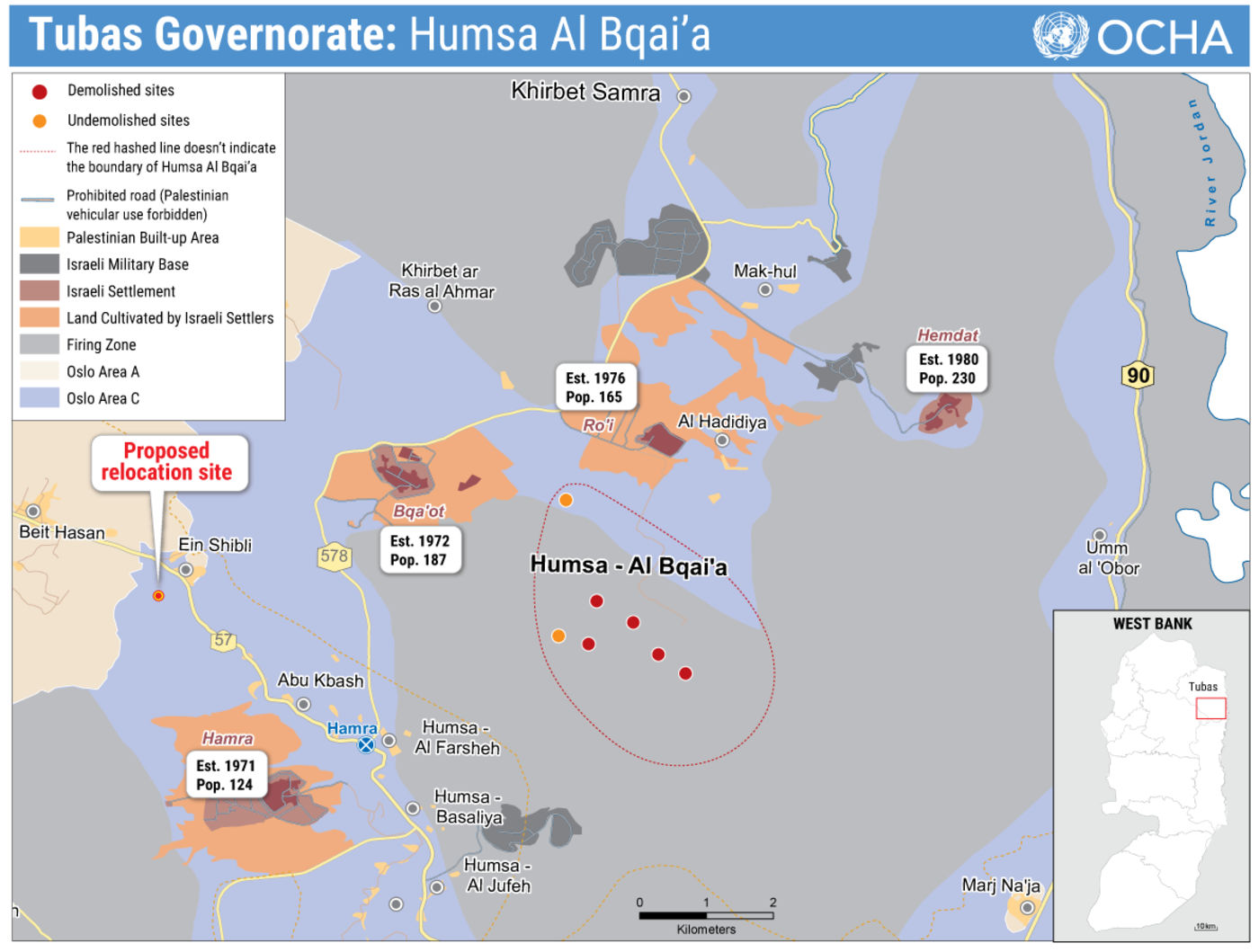
Map by OCHA
On July 7th, Israeli border police demolished the tiny Palestinian village of Khirbet Humsa, located in the northern Jordan Valley. The bulldozers leveled some 27 tent homes in addition to all of the village’s agricultural structures. Israeli forces also seized the remnants of those tents and their residents’ personal belongings, in addition to the community’s water tanks and food parcels. This demolition left 70 Palestinians – including 36 children – homeless, and left them and their livestock without shelter, shade, food, or water in the hot summer heat (expected to reach 102/39 degrees that day). This is the sixth time in less than a year that Israel has demolished Khirbet Humsa, the last time being in February.
The Israeli Civil Administration proceeded to dump the confiscated items at the site where the Israeli government has proposed relocating the Khirbet Humsa community, a place called Ein Shibli. The community has continually rejected and resisted this plan for their forced displacement.
B’Tselem writes:
“House demolitions in this community are part of the policy Israel employs throughout the West Bank in an effort to create unbearable living conditions with the ultimate aim of pushing Palestinians to leave their homes, concentrating them in enclaves and taking over their lands. This policy is an attempted forcible transfer of the residents – a war crime under international humanitarian law. The responsibility for this policy lies primarily with the government, which directs it, the top military command, which implements it, and the justices of the Supreme Court, who lend it legal legitimacy. Israel’s actions are also a badge of shame for the international community, which has absolved itself of the obligation to demand Israel respect the human rights of Palestinians living under its control and allowed itself to be satisfied with empty rebukes lacking any practical consequences.”
Khirbet Humsa is located in Area C of the West Bank, in an area of the Jordan Valley that Israel declared a closed military zone even though Palestinians had been living there for decades, and using the land for agriculture and herding. Israel has long used the pretext of military firing zones to pursue the forcible displacement of Palestinians, while simultaneously ignoring (and in some cases openly assisting) settlers to establish a presence in the very same areas. Firing zones constitute nearly 30% of Area C, including the native lands and current homes of 38 Palestinian Bedouin and herding communities.
Israel Moves to Dismiss Petitions Delaying Mass Demolitions in Al-Walajah
Ir Amim reports that the state of Israel filed a motion seeking the dismissal of appeals that have delayed the demolition of 38 homes — housing around 300 people — in the Palestinian village of al-Walajah, located just south of Jerusalem (a small part of the city actually within the expanded municipal borders of Jerusalem), based on the argument the houses were built without the required Israeli permits. The Court has given the Palestinians until July 11th to file a response to the State’s motion to dismiss.
The state’s motion comes four months after it rejected a proposed outline plan for al-Walajah, which was developed by experts working with the community. The plan would have provided a way for the 38 homes facing demolition to retroactively receive Israeli building permits. Israel rarely issues such permits to Palestinians anywhere in Area C. For residents of al-Walajah the situation is even worse: given the fact that the Israeli government has refused to approve an official outline plan for the area, they have zero hope of obtaining the permits required to build on their own land, as without an outline plan permits simply cannot be issued.
In an effort to overcome this obstacle, Palestinians, with the help of planning experts, initiated their own outline plan for this section of Al-Walajah in the hopes of getting it approved by Israeli authorities — to no avail. Israeli authorities have repeatedly refused to approve the resident-backed plan, and have also refrained from initiating their own planning process. The result: Al-Walajah’s residents were left in limbo – that is, until the Jerusalem District Committee, as part of a January 25, 2021 ruling against an outline plan proposed by residents, deemed the area in question — where Palestinians have lived for decades — an “agricultural area” where no building would ever be permitted.
Construction to Begin on New Units in Nof Zion Settlement Enclave Inside Jabal Al-Mukaber [East Jerusalem]
Peace Now reports that on the evening of July 8th, a cornerstone laying ceremony was scheduled to be held to mark the beginning of construction on hundreds of new units in the settlement enclave called Nof Zion, which is located in the center of the Jabal al-Mukaber Palestinian neighborhood in East Jerusalem. Jerusalem Mayor Moshe Leon was scheduled to partake in the celebration
Preliminary work on the expansion of Nof Zion – a project that will triple its size and make it the largest settlement enclave in East Jerusalem – first began in December 2019. The project will add 182 homes to the existing 91 units that were approved for construction in 1994 (and built in the early 2000s). The Israeli government originally approved plans for a total of 395 units but the first phase of construction bankrupted the developer and the remaining building 304 permits were never issued. A drama ensued over the fate of the project, after a Palestinian-American made a bid to buy the development rights. His winning bid was ultimately blocked by right-wing Israelis [with a key role played by Jerusalem settler impresario Aryeh King], who objected to the sale of the property – in a Palestinian neighborhood – to an Arab. Plans then stalled until settlers were able to recruit Australian billionaire Kevin Braimster and Israeli entrepreneur Rami Levy (read about Levy’s settlement superstore empire here), to fund and acquire the rights to the project — preventing its transfer to Palestinians.
Nof Zion received significant investment from the Israeli government in 2017, when the government approved a plan to build a new synagogue and mikveh on private Palestinian land that was expropriated from the Jabel Mukaber neighborhood in 2016. Then, in September 2017, rumors emerged that the government was set to issue 176 building permits for the already-approved project. According to Ir Amim, those permits were ultimately issued in April 2019.
Peace Now, in its appeal to Mayor Leon to cancel his attendance at the ceremony, writes:
“Nof Zion is a failed settlement project in the heart of the Palestinian neighborhood of Jabel Mukaber. The first incarnation of the settlement proved that the vast majority of Israelis are not interested in buying houses in the heart of Palestinian neighborhoods and the only ones willing to live there are a minority driven by ideological motives. It so happened, as is well known, that in the end the entrepreneurial company of the project went bankrupt. The fact that the current project is funded by philanthropists is the clear proof that the new project has no economic or real estate interest and does not constitute anything in line for the city’s residents, but only another political attempt to prevent the possibility of compromise and coexistence in Jerusalem.”
New Israeli Government, Same Settlement Policy, Despite Including the “Left”
Interior Minister Ayelet Shaked (Yamina) recently told settler leaders that the new Israeli government, led by Prime Minister Naftali Bennett (Yamina) and alternate Prime Minister Yair Lapid (Yesh Atid), will continue the same basic practices of the recent Netanyahu government when it comes to settlement policy. That includes planning to convene the Civil Administration’s High Planning Council (within the Defense Ministry) once per quarter in order to consider settlement construction plans. Israeli Defense Minister, Benny Gantz (Blue & White), publicly criticized Shaked for telling settler leaders about decisions that fall under the authority of his Ministry.
When asked to confirm Shaked’s announcement that the High Planning Council will meet once per quarter, as was the agreed arrangement between Netanyahu and Trump, a spokesperson for the Defense Ministry said:
“We will run things as we see fit. [The council] didn’t meet once a quarter in the previous administration. There has been no decision.”
Shaked and Gantz recently clashed over the fate of the unauthorized Evyatar outpost, with Shaked advocating for the community’s permanent settlement and Gantz pushing for enforcement of Israeli law and, thus, the demolition of the outpost. Shaked ultimately won out (see above for details of the Israeli government’s “compromise” with settlers that likely paves the way for Evyatar to become a brand new, “legal” settlement).
Bonus Reads
- “The draconian law used by Israel to steal Palestinian land” (Al Jazeera)
- “’With God’s Help, We Will Return Legally’: Israeli Settlers Quietly Leave Illegal Outpost” (Haaretz)
- “In order to expand settlement, Israelis fence off tract of Palestinian land southwest of Bethlehem” (WAFA)
- “Apartheid, the Green Line, and the Need to Overcome Palestinian Fragmentation” (EJIL:Talk // Rania Muhareb)
- “US freezes Abraham Fund, as Israel-UAE business ties falter” (Globes)
- “Israeli-UAE investment projects in uncertainty as US indefinitely ends support for Abraham Fund” (The New Arab)
- “How Israel is automating the occupation of Palestine” (The New Arab)
- “U.S. Slams Israel for Razing Home of Palestinian-American Who Murdered an Israeli” (Haaretz)
Welcome to FMEP’s Weekly Settlement & Annexation Report. To subscribe to this report, please click here.
March 25, 2021
- Construction on Extension of “Apartheid Road” Slated to Begin Next Month as Israel Barrels Towards E-1 Settlement Construction
- Israel Opens National Park on Land Belonging to Al-Walaja
- Palestinians File Appeal Against “King’s Garden” Settlement Plan for Al-Bustan, Silwan
- Bonus Reads
Comments/Questions? Contact Kristin McCarthy (kmccarthy@fmep.org)
Construction on Extension of “Apartheid Road” Slated to Begin Next Month as Israel Barrels Towards E-1 Settlement Construction
The Israeli Civil Administration announced that construction will begin next week on a new section of Route 4370, aka, the Apartheid Road (having earned the nickname for the high cement wall running down the middle of the road, separating Israeli and Palestinian traffic). The work will expand the road to the south in order to connect to East Jerusalem. The new road, which Israel touts as a benefit for Palestinians, is designed to route Palestinian traffic around the E-1 settlement area – in preparation for that settlement’s eventual construction. According to Ir Amim, the construction of this new road segment “constitutes a major step in laying the groundwork for settlement building in the E1 area.”
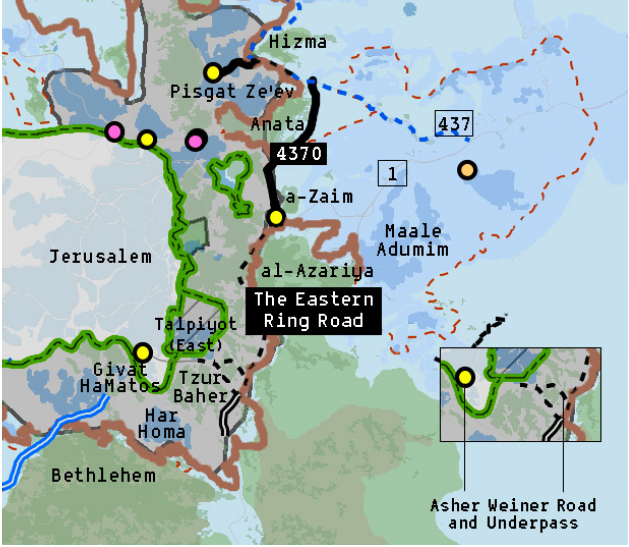
Map by Breaking the Silence
Ir Amim further explains:
“While portrayed as a road project to benefit Palestinians by expediting traffic and significantly reducing travel time between Ramallah and Bethlehem, it will in fact serve to completely reroute Palestinian traffic out of E1. Currently, the only road which facilitates Palestinian travel between the two West Bank centers runs through the E1 area. This limits Israel’s ability to carry out its massive settlement plans in the vicinity, which would require blocking Palestinian access to the area. This new road along with Route 4370 will create an alternative corridor between Ramallah and Bethlehem, which would eliminate the need for Palestinians to drive through E1 altogether. Diverting Palestinian traffic thus removes one of the obstacles to settlement construction in E1 and should signal cause for heightened vigilance.”
In a 2008 objection against the construction of the Apartheid Road, Adalah explained:
“The road further aims to consolidate and develop the Jewish settlements in East Jerusalem and the West Bank, and link them directly and conveniently to each other and to West Jerusalem. The road is simultaneously intended to isolate the Arab neighborhoods in East Jerusalem from the main route of the Eastern Ring Road, from each other and from the West Bank. It would thereby turn these neighborhoods into islands that are isolated – geographically, economically and in terms of transportation – from their immediate surroundings and would end Palestinian geographical contiguity within and around East Jerusalem, thereby precluding any future economic and social development or expansion of these neighborhoods. The plan stands to cut the owners of agricultural land off from their lands, to dramatically reduce the accessibility of schools, health services and workplaces for residents of these neighborhoods, and severely disrupt their family and social lives.”
Israeli officials have argued that the now-open road should resolve international objections to Israel building the E-1 settlement (a plan long criticized for effectively cutting the West Bank in half, rendering any future Palestinian state discontiguous and non-viable). In Israel’s view, the road replaces territorial contiguity for Palestinians in the West Bank with “transportational continuity,” i.e., the West Bank would still be cut in half, but the two halves are now inked by a road (albeit it a road that cuts Palestinians off from Jerusalem and that leaves travel between the northern and southern West Bank subject to Israeli control).
Israel Opens National Park on Land Belonging to Al-Walaja
Ir Amim reports that on March 23, the Israeli Nature & Parks Authority would be opening an Israeli national park in the area around the Ein Haniya spring. The spring is a historical part of the al-Walaja village, a Palestinian village located on the southern flank of Jerusalem, and long served as a main sources of water for households, farms, and recreational purposes for the village’s residents. Al-Walaja has long suffered due to its location and its complicated status (much of the village’s lands, including areas with homes, were annexed by Israel in 1967, but Israel never gave the villagers Jerusalem legal residency by Israel – meaning that under Israeli law, their mere presence in their homes is illegal). Today it is acutely suffering from a multi-prong effort by the Israeli government and settlers to grab more land for settlement expansion in pursuit of the “Greater Jerusalem” agenda. This land grab campaign includes past and pending home demolitions, the construction of the separation barrier and bypass roads in a way that seals off the village on three sides, and the denial of planning permits.
The history of this spring is just one example of how the Israeli government pursues land grabs with the facade of legality. As explained by Ir Amim:
“In 2013, in tandem with the construction of the barrier on al Walajeh lands, the Jerusalem District Committee approved an outline plan which designated the 1200 dunams of land as the Nahal Refaim national park in complete disregard of private Palestinian land ownership and traditional Palestinian agriculture in the area.
As a means of completely sealing off these lands from Palestinian access, including from village residents, the Jerusalem municipality began relocating the checkpoint between Jerusalem and al-Walajeh to a location closer to the village in February 2018. Construction on its relocation was suspended in March of the same year due to budgetary reasons and as a result, the Israeli authorities decided to keep the Ein Haniya site closed until the relocation is complete. Upon inquiry, however, Ir Amim was informed today that the plans for the checkpoint’s relocation have been terminated, and that Palestinian access to the area will remain unobstructed “unless security forces decide otherwise.”
Keeping the area open to Palestinian access is a significant achievement, which in no small part is due to al-Walajeh farmers’ perseverance despite the many obstacles and threats they continually face. In spite of this, the INPA’s plans include a variety of projects aimed at transforming al Walajeh’s agricultural terraces into an Israeli touristic and recreational destination, replete with hiking trails and outdoor activities, which creates the illusion of an entirely Israeli space.
The national park extends to the Jerusalem municipal border in close proximity to the area where Israel intends to establish a new settlement on al Walajeh’s lands (Har Gilo West) in the West Bank. In addition to creating contiguity between Jerusalem and the Gush Etzion settlement bloc around Bethlehem, the national park further isolates al Walajeh, turning it into an enclave detached from its Palestinian surroundings. In doing so, Israel advances its entrenchment of control along the southern perimeter, while undermining any prospect of a negotiated agreement in Jerusalem.”
Palestinians File Appeal Against “King’s Garden” Settlement Plan for Al-Bustan, Silwan
Ir Amim reports that Palestinians have filed an appeal to stop the demolition of 70 homes in the Al-Bustan section of the Silwan neighborhood in East Jerusalem. The Palestinians’ appeal responds to a surprising move by the Jerusalem Municipality, made in late February, to request permission from the Court to demolish the homes – demolition which had been frozen by the Courts since 2010 to allow for a negotiated resolution to the situation. For more on the history of this situation, see FMEP’s report from last week.
Additionally, Ir Amim has published a new, and more detailed, explainer on this case – highlighting the political context in which the Jerusalem Municipality made this decision. Ir Amim writes:
“The municipality’s plan called for the establishment of a touristic and archeological park (Plan 18000: “the King’s Garden”) replete with residential and commercial areas, including hotel space. This planned park would extend the existing national park in the City of David (the hub of Elad’s settler operations) southwards spanning the entire neighborhood of Al Bustan and towards the settler enclave in central Silwan (Batan al-Hawa) where the Ateret Cohanim settler organization is active. Since 2010, the plan has not advanced likely due to local and international opposition. However, the municipality’s objection to extension of the freeze signifies its intent to reactivate the plan, consistent with the acceleration of similar Israeli measures over the past year after being emboldened by the Trump Administration…
Beyond the severe humanitarian toll lie the acute demographic and political implications. The “King’s Garden” plan is yet another measure to transform the area into a sprawling Israeli tourist site, while further erasing its Palestinian presence. Silwan is one of the focal points of state-backed ideological settler activity. Settler groups threaten to displace over 800 Palestinians with the goal of establishing settler strongholds in the heart of Palestinian neighborhoods as a means to dismantle the viability of a political resolution on the city. Touristic settlement initiatives serve to reinforce residential settlement by connecting otherwise isolated settler compounds to create a contiguous ring of Israeli control (see map below for illustration), while artificially increasing the Israeli Jewish presence in the area via Israeli tourists visiting the sites. If advanced, the “King’s Garden” would essentially constitute a seamless extension of the City of David’s touristic attractions, further eroding the character of the neighborhood and its fabric of life, while leading to the forcible transfer of nearly an entire community.”
Bonus Reads
- “Samantha Power questioned over U.N. 2334 resolution at confirmation hearing” (Jewish Insider)
- “Save Sheikh Jarrah: Palestinians have a right to remain on their land” (Middle East Eye)
- “Palestinians in Hebron’s Old City build fence to prevent settlers’ attacks” (Al-Monitor)
Welcome to FMEP’s Weekly Settlement & Annexation Report. To subscribe to this report, please click here.
March 11, 2021
- Al-Walajah is One Month Away From Potential Mass Displacement
- Regavim Moves to Cut Off Palestinians in Area C from Israel’s Power Grid
- New Report: “This Is Ours – And This, Too : Israel’s Settlement Policy in the West Bank”
- Bonus Reads
Comments/Questions? Contact Kristin McCarthy (kmccarthy@fmep.org)
Al-Walajah is One Month Away From Potential Mass Displacement
Ir Amim and Bimkom report that on March 8th the Jerusalem District Planning Committee rejected the most recent proposal for an outline plan for the Palestinian village of Al-Walajah – leaving 38 houses at risk of demolition next month (April 2021).

click to enlarge
The homes facing demolition are in the northern section of the village, where they were built by Palestinians (on their own private land) without the necessary permits from the Israeli government. Setting aside the fact that Israel rarely issues permits for Palestinians to build, these villagers have zero hope of obtaining the necessary permits given the fact that the Israeli government has refused to approve an official outline plan for the area – and without an outline plan, permits cannot be issued.
In an effort to overcome this obstacle, Palestinians, with the help of planning experts, initiated their own outline plan for this section of Al-Walajah in the hopes of getting it approved by Israeli authorities — to no avail. Israeli authorities have repeatedly refused to approve the resident-backed plan, and have also refrained from initiating their own planning process. The result: Al-Walajah’s residents were left in limbo – that is, until the Jerusalem District Committee, as part of a January 25, 2021 ruling against an outline plan proposed by residents, deemed the area in question — where Palestinians have lived for decades — an “agricultural area” where no building would ever be permitted.
Explaining why that ruling is significant, Ir Amim and Bimkom writes:
“The designation of areas as national parks, nature reserves, and/or green spaces is a common practice of Israeli authorities in East Jerusalem to suppress Palestinian planning and residential development while allowing for the seizure of their lands to serve Israeli interests. Although the planning committee dismissed the village’s outline plan for the purpose of ostensibly promoting nature conservation, plans for Israeli settlement construction in the same area on lands confiscated from al-Walajeh have all been advanced. This includes expansion of the Gilo neighborhood/settlement (to the east of the village), the al-Walajeh Bypass Road and the new settlement of Har Gilo West (see more below). Not only does this reveal the baseless nature of the committee’s claims concerning environmental considerations, but also underscores the rampant planning and housing discrimination leveled against Palestinians in Jerusalem. Likewise, the committee’s citation that the area’s traditional and historical agricultural assets must be preserved explicitly overlooks the village’s essential role in this centuries-old preservation. Continued cultivation of the land and conservation of the surrounding landscape is inextricably tied to the existence of the village and the close proximity of their homes to their agricultural lands.”
It’s also worth re-reading the brief synopsis of the saga provided in the report to understand the story of the 38 homes under present threat of demolition in the context of Israel’s decades-long campaign to make life in Al-Walajah untenable:
“After being uprooted from its lands on the Israeli side of the Green Line in 1948, al-Walajeh was rebuilt on village lands which remained on the West Bank side of the Green Line. In 1967, the northern section of the village was annexed to Israel and absorbed into Jerusalem. Today, this part of the village is a small community of roughly 150 homes, which were mostly built after 1967 and considered illegal by the Israeli authorities due to the impossibility of procuring building permits. Over the years, dozens of homes have been razed in the annexed part of the village. Since 2016, there has been a significant rise in the number of home demolitions in this area of al-Walajeh as a result of increased enforcement and penalization of building offenses in Palestinian residential areas in Jerusalem. More than 20 houses have been demolished in the past five years. While 38 homes currently face pending demolition orders, many others are at risk of receiving them, subjecting nearly the entire community to the threat of widespread demolition and displacement.“
Regavim Moves to Cut Off Palestinians in Area C from Israel’s Power Grid
On March 8th, the settler group Regavim filed a petition with the Jerusalem District Court seeking data that could shed light on the number of Palestinian homes in Area C of the West Bank that are connected to an Israeli power company (the East Jerusalem Electric Company). The Civil Administration has already rebuffed Regavim’s freedom of information request for the data, so Regavim has turned to the Court to force the issue.
Regavim reportedly wants to know how the East Jerusalem Electric Company received permission to connect to several Palestinian homes near the Efrat settlement, and whether there is an approved electricity plan that includes the Palestinian homes (which Regavim asserts were built illegally – i.e., without the almost impossible-to-obtain Israeli building permissions). A senior Regavim staffer made clear to Jewish Press that this initiative is about promoting total Israeli control over Area C.
This latest legal initiative from Regavim should be understood as part of the ongoing campaign — by settlers and the Israeli government — to entrench and expand Israel’s control over (and de facto annexation of) the entirety of Area C, which represents around 60% of the West Bank. Notably, in September 2020 the Israeli government allocated 20 million NIS ($6 million USD) for the newly created Settlement Affairs Ministry to survey and map unauthorized (by Israel) Palestinian construction in Area C (which Israel has been aggressively demolishing). This funding further empowers a domestic Israeli body to exert extraterritorial sovereignty over Area C – in effect, treating the area as land already annexed by Israel.
The Knesset has also repeatedly hosted forums to discuss the alleged (by settlers and their allies/advocates) “Palestinian takeover of Area C.” Consistent with this framing (which is predicated on the idea that Area C belongs to Israel and must be defended against Palestinian efforts to steal it), and pushed by outside groups, many members of the Knesset have criticized the Israeli government’s alleged failure to robustly “defend” Israel’s rights/ interests in Area C (e.g., preventing “illegal” Palestinian construction, preventing foreign projects that support Palestinians’ presence in the area, clearing out Palestinians, expanding settlements, consolidating state-built settlement infrastructure).
New Report: “This Is Ours – And This, Too : Israel’s Settlement Policy in the West Bank”
Two venerable Israeli NGOs – B’Tselem and Kerem Navot – released a new report entitled “This Is Ours – And This, Too : Israel’s Settlement Policy in the West Bank.” The report covers two main areas of interest:
- The ways by which the Israeli government has encouraged Jews to move to settlements, most importantly the financial incentives and benefits extended to individuals (like housing subsidies), as well as the settlements/industrial zones/outposts and business operating in the settlements (like tax benefits, grants, subsidies, land, etc).
- The spatial impact of two blocks of Israeli settlement: the first is the settlements encircling Bethlehem in the southern West Bank; the second is in the central West Bank including Ariel, Rehelim, Eli, Ma’ale Levona, and Shilo.
The report, which readers are encouraged to read in the context of B’Tselem’s recent position paper on Apartheid – concludes:
“While de-jure annexation of the West Bank may have been shelved, this is immaterial in practice – as the report demonstrates yet again. Construction and infrastructure work has recently been carried out in the West Bank on a scale not seen in decades. This large-scale development is designed to facilitate another significant spike in the number of settlers living in the West Bank, which settlement leaders predict will reach one million in the near future. This massive investment further entrenches Israel’s hold on the West Bank, clearly demonstrating the regime’s long-term plans. These include cementing the position of millions of Palestinians as subjects denied rights and protection, who are deprived of any ability to influence their own future and forced to live in disconnected, dwindling, economically suppressed enclaves. They are forced to look on as they are dispossessed of more and more land, while communities and infrastructure are built for Jewish citizens. Two decades into the 21st century, Israel appears more determined than ever to continue upholding and perpetuating an apartheid regime throughout the area under its control, well into the coming decades.”
Bonus Reads
- “THREAD “Israeli Army officers arresting children at the request of settlers. This is what occupation and apartheid look like.” (Twitter / Sarit Michaeli)
- “Palestinians appeal to Jordan, PA to prevent Israel from evicting them” (MEMO)
- “There’s no reason for Israel not to apply sovereignty over Judea and Samaria” (Israel Hayom)
- “Michaeli: No one thinks half a million settlers will be evacuated” (Jerusalem Post)
Welcome to FMEP’s Weekly Settlement & Annexation Report. To subscribe to this report, please click here.
February 12, 2021
- ICC Confirms Jurisdiction Over (Israeli and Palestinian) War Crimes Committed in OPT
- ICC Investigation Expected to Take On Settlements, Potentially Exposing Untold Number of Israeli Government Officials to Criminal Liability
- Jewish National Fund to Start (Openly) Purchasing West Bank Land for Settlement Expansion
- Israel Rejects Development Plan for al-Walajah, Paving the Way for Further Demolitions
- Israel Demolishes Khirbet Humsa for Third Time this Month, Highlighting Discriminatory Enforcement in Jordan Valley as Path to Israeli Annexation
- Israeli Court Hears Appeal to Stop Mass Dispossession in Sheikh Jarrah
- Who Profits Report: “Infrastructures of Dispossession and Control Transport Development in East Jerusalem”
- Bonus Reads
Comments, questions? Email kmccarthy@fmep.org
ICC Confirms Jurisdiction Over (Israeli and Palestinian) War Crimes Committed in OPT
In a ruling published on February 5, 2021, a three judge pretrial chamber of the International Criminal Court confirmed that the Court’s jurisdiction extends over the occupied Palestinian territories (the West Bank, East Jerusalem, & Gaza Strip). As a reminder, the Court’s jurisdiction is over individuals (not states) and includes jurisdiction over war crimes committed by both Israeli combatants and Palestinian combatants. With this ruling, the ICC’s Chief Prosecutor Fatou Bensouda will need to decide whether and when to formally open an investigation into potential war crimes. According to an official statement from Bensouda’s office welcoming the decision, her office is “carefully analyzing the decision & will then decide its next step.”
The pretrial chamber was convened by Bensouda in December 2019 to make a final determination on the highly disputed issue of the Court’s jurisdiction in Palestine. Bensouda herself submitted a brief to the chamber in April 2020 articulating her belief that the Oslo Accords – signed by the PLO and Israel – are a credible legal basis for establishing Palestine as an internationally recognized state. Her brief refuted arguments made in amicus curiae briefs filed by several countries, including Germany (the second largest funder of the ICC), insisting that Palestine is not a state and that the Court therefore cannot have jurisdiction. The Czech Republic, Austria, Australia, Hungary, Brazil and Uganda also filed briefs along those lines. Bensouda’s brief — well worth reading in full — also systematically rebutted the raft of arguments made by various international lawfare organizations asserting that the Court has no right to investigate. As a reminder: in June 2020, President Trump signed an Executive Order authorizing sanctions against ICC officials; in September 2020, the Trump Administration used that Executive Order to impose sanctions on Bensouda and another ICC official; in January 2021, a US court blocked those sanctions..
In response to the decision of the pretrial chamber, the Biden Administration promptly stated its opposition. State Department spokesperson Ned Price said in a statement that the U.S. has “serious concerns about the ICC’s attempts to exercise its jurisdiction over Israeli personnel” – statement that was on the one hand categorical and on the other hand far more restrained than what had previously come out of the Trump Administration or the Israeli government (objecting to the decision but not attacking the court itself). It’s worth noting that the Biden Administration has yet to reverse sanctions imposed on ICC officials by former President Trump (including the revocation of Fatou Bensourd’s entry visa to the United States) or revoke Trump’s anti-ICC executive order.
In response to the White House statement, +972 Magazine Editor Amjad Iraqi wrote:
“The fact that the White House rejects this mission at The Hague is further proof that the United States is not really interested in an independent Palestinian state. If Israel prefers apartheid, then Washington will stand behind it, even at the cost of its own proclaimed policy. The Biden administration should either admit this fact or begin backing up its two-state vision with meaningful action. If neither, then it should step back and let the court do its job.”
ICC Investigation Expected to Take On Settlements, Potentially Exposing Untold Number of Israeli Government Officials to Criminal Liability
Having now established its jurisdictional authority to proceed, the International Criminal Court is expected to take up, in addition to other alleged crimes, the criminal acts perpetrated by individuals who participated in the establishment of Israeli settlements in the West Bank. The basis for investigating such persons is international law, according to which the transfer of a civilian population into occupied territory is prohibited.
Yuval Shany, Israel Democracy Institute, told AP:
“The settlement issue is really the biggest issue. This is the elephant in the room. This exposes basically the entire Israeli political elite that has been part of a settlement policy to criminal proceedings before the court. This is a significant setback.”
Yesh Din, an Israeli NGO deeply involved in fighting settlement expansion and defending Palestinian rights in the West Bank, said in response to the ICC’s jurisdictional ruling and the investigation into settlement construction:
“Yesh Din has, for many years, also exposed, challenged and petitioned to the HCJ regarding settlement expansion and takeover of Palestinian lands, an official policy and long-standing practice by successive Israeli governments, despite being a clear violation of international law. We have, time and again, seen that even when a degree of legal remedy is occasionally achieved, too often, failures of enforcement or other mechanisms are applied to prevent Palestinians from truly returning to their lands (see HCJ 88/19 and HCJ 9948/09).
Furthermore, the HCJ has served to enable the establishment and expansion of settlements (HCJ 4481/19) and even approved the State’s efforts to retroactively authorize, or ‘regularize,’ outposts and settlement construction considered illegal even under Israeli law, such as in ongoing proceedings regarding illegal construction in the Netiv Ha’avot (HCJ 5480/15) and Adei Ad outposts (8395/14), among others. The HCJ has further failed to halt creeping annexation, leading to today’s situation of de-facto annexation already in place.
These failures in Israel’s law enforcement and judicial processes reflect a lack of will to hold perpetrators responsible, willingly turning a blind eye to offenses committed within the broader context of a clear intention to expand control over Palestinian lives, land and resources.
As such, Yesh Din welcomes the ICC’s jurisdiction to open an investigation into potential war crimes in the hopes for greater accountability and a future in which international law will be respected and upheld and, ultimately, in which the fundamental human rights of Palestinians and Israelis alike will be protected.”
Jewish National Fund to Start (Openly) Purchasing West Bank Land for Settlement Expansion
According to Axios, the Board of Directors of the Jewish National Fund is expected to approve a new policy on Sunday (February 14) allowing the organization to in directly purchase land in Area C of the West Bank for the purposes of facilitating settlement expansion (which is illegal under international law and opposed by governments the world over as a violation of Palestinian rights). If this new policy is indeed adopted, the JNF will officially make financing the Israeli settlement enterprise a loud and proud part of its mission. This would be a shift not so much in policy as in public relations, given that the JNF has long worked in support of settlements, but until this point has left settlement-related activities deliberately obscured. The shift in approach that will culminate in Sunday’s vote is in line with the JNF’s new right-wing, settler leadership (which effectively took control of the organization in October 2020).
According to the report, the proposed JNF policy – which could see hundreds of millions of dollars invested in the settlement enterprise – includes directives for the organization to purchase land subject to the following conditions:
- The land is privately owned by Palestinians.
- The land will be used to expand existing settlements, not build new ones (this presumptively includes purchasing land to build outposts).
- The land is in Area C (some 60% of the West Bank), not land in Areas A and B.
- The land is located inside of a settlement’s jurisdiction or adjacent to it.
- Focus will be on purchasing land in areas identified as a priority, including the Jordan Valley, the Etzion settlement bloc, areas around Jerusalem, the Binyamin region north of Jerusalem, the South Hebron Hills, and areas adjacent to the pre-1967 border. The draft specifically says that no land shall be purchased in the Nablus or Jenin areas.
- Foreign donations will only be used to purchase land in the West Bank if the laws of the donor’s country permit it.
Commenting on the report, Peace Now put it bluntly:
“The Israeli Jewish National Fund has long had a dark side in discreetly facilitating settlement expansion. This latest news on it intending to purchase private Palestinian land is a decision to bring it into the open. Make no mistake. This isn’t about whether Jews can live wherever. KKL-JNF purchasing land in the West Bank is meant for Israel to keep the land. It’s not like it intends for Jews and these land plots to be in a Palestinian state.”
When asked for comment, the spokesperson for the U.S. Department of State, Ned Price, said:
“Well, I think there is a broad point at play here, and that point is this: We believe it is critical to refrain from unilateral steps that exacerbate tensions and that undercut efforts to advance a negotiated, two-state solution. And unilateral steps might include annexation of territory, settlement activity, demolitions, incitement to violence, the provision of compensation for individuals imprisoned for acts of terrorism. We have continued to emphasize that it is critical to refrain from all those activities.”
Established in 1901, the JNF devoted itself to buying land for Jews. Today, the JNF owns about 15% of all the land inside the Green Line. In addition, the JNF has also used two subsidiary companies – both called Himanuta – to purchase land in the West Bank, even though stated JNF policy (until now) did not support such purchases . The JNF and Himanuta used middle men in order to allow the JNF to deny a direct role in West Bank land purchases, which JNF leadership feared would hurt the organization’s fundraising potential. Peace Now reports that the JNF, via its subsidiary Himanuta, has already purchased over 160,000 acres (65,000 dunams) across the West Bank; settlements established on some of those lands include Itamar, Alfei Menashe, Einav, Kedumim, Givat Ze’ev, Metzadot Yehuda (Beit Yatir), Otniel and more. At the same time, the JNF and the settler group Elad have been partnering together to pursue the mass eviction of Palestinians from East Jerusalem neighborhoods, including Silwan.
Israel Rejects Development Plan for al-Walajah, Paving the Way for Further Demolitions
 On January 25th, the Jerusalem District Planning Board rejected a Palestinian-proposed outline plan for the village of al-Walajah, located on the southern flank of Jerusalem. For at least 15 years, al-Walajah residents have attempted to gain Israeli approval for an outline plan – which is a key planning document that establishes land usage and provides for the future development of the community. Without an outline plan, no building permits can even be considered, leading to a situation where Palestinians are forced to build illegally to meet the basic needs of a growing community.
Due to its location and unique political situation (both discussed below) Al-Walajah is already the focus of a years-long campaign of demolitions and land confiscations. By rejecting the outline plan, the Planning Board has cleared the way for an additional 38 homes in al-Walajah to be demolished because they lack Israeli-issued building permits.
Ir Amim reports important detail on context of the Board’s decision:
“The planning committee rejected the outline plan based on various dubious claims, including on the basis of nature and environmental conservation, yet plans for massive Israeli settlement construction and expansion in the same area have all been approved. Not only is this a prime example of the rampant housing discrimination against Palestinians in Jerusalem, but the committee’s citation that the area’s traditional and historical agricultural assets must be preserved entirely overlooks the village’s exclusive role in this centuries-old preservation. Without the homes and the farmers to build and cultivate the land as they have for generations, there will be nothing left to preserve.”
Haaretz reports that, prior to its ruling in January, the Jerusalem District Planning Board refused to discuss this outline plan. The Board was forced to consider the plan when al-Walajah residents petitioned the Isareli Supreme Court. Attorney Jiat Nasser, who is representing the villagers, told Haaretz:
“The district board’s decision is discriminatory and dripping with malice. It feels like the hearings were fixed, as if they want the residents to leave… We didn’t expect inhumanity would reach such proportions.”
Al-Walajah is a village besieged by Israel from every angle. In the words of Danny Seidemann:
“ Since 1967, Walajeh’s inhabitants have lived in a Kafka-esque situation, with their village technically located inside Israel’s expanded borders, but with villagers never given Israeli residency (they are considered West Bankers and thus are not permitted inside Jerusalem). As a result, the villagers’ presence in their own village is, under Israeli law, illegal, and their homes there are, by definition, illegal.”
For decades, the Israeli government has carried out a multi-prong effort to push Palestinians off of their land in al-Walajah. This has included demolition campaigns, construction of the separation barrier along a route that encircles the village and cuts residents off from their land, refusal to grant building permits, and the declaration of state parks over lands on which Palestinians have lived for generations.
In October 2020, it was revealed that Israel, in order to build the Har Gilo West settlement, plans to extend the separation barrier to completely encircle al-Walajah, which is already surrounded on three sides by the separation wall. The new section of the barrier will be a 7-meter high concrete slab along the western edge of the built-up area of Al-Walajah.
Israel Demolishes Khirbet Humsa for Third Time this Month, Highlighting Discriminatory Enforcement in Jordan Valley as Path to Israeli Annexation
On February 8th, Israel forces returned to the Palestinian Bedouin community of Khirbet Humsa in the Jordan Valley for the third time this month to demolish structures and confiscate the property of the ~65 Palestinians who continue to live there despite Israeli attempts at forced relocation. This was the fourth time that the community has been demolished.
Khirbet Humsa is located in Area C of the West Bank, in an area of the Jordan Valley that Israel declared a closed military zone even though Palestinians had been living there, and using the land for agriculture and herding, for decades. Israel has long used the pretext of military firing zones to pursue the forcible displacement of Palestinians, while simultaneously ignoring (and in some cases openly assisting) settlers to establish a presence in the very same areas.
B’Tselem documented the demolitions of Khirbet Humsa, and responded:
“These demolitions are part of Israel’s policy, enacted throughout the West Bank, to make Palestinians’ lives unbearable, in order to force them to leave their homes, concentrate them in enclaves and take over their land. This policy constitutes an attempt at forcible transfer — which is defined as a war crime under international humanitarian law. The responsibility for its execution lies first and foremost with the political decision-makers leading it, the senior military command carrying it out, and the Supreme Court lending it a legal stamp of approval.”
In telling the story of another Palestinian village in the Jordan Valley facing a similar fate (the village of Jibneh), Yuval Abraham wrote in +972 Magazine:
“Israel has declared about 18 percent of the West Bank as firing zones for military training. This is roughly as large as the West Bank area under full Palestinian control. During a 2014 Knesset subcommittee meeting on “illegal Palestinian construction in Area C,” Col. Einav Shalev, then operations officer of Central Command, admitted that one of the main reasons for increasing military training in these firing zones is to prevent Palestinian construction.
It is important to stress that these are villages that have existed for many decades. The residents have no way of building legally because the Civil Administration, the arm of Israel’s military responsible for governing Palestinians in the occupied West Bank, denies more than 98 percent of permit requests filed by Palestinians in Area C. To even discuss this issue in terms of legal compliance is absolutely ridiculous, since the law is clearly based on ethnic bias…
Increasing governance, meaning, amplifying Israel’s pressure to expel local communities like Jinbeh, that live in areas the state wants to Judaize. Israel is currently focusing on three West Bank areas: the Jordan Valley, south Hebron Hills, and an area known as E1, which connects East Jerusalem to the West Bank. There, Israel systematically denies building permits to Palestinians in order to force them to leave.”
Last week, prior to the demolition on February 5th, a large delegation of European diplomats visited Khirbet Humsa to witness what was taking place. One participant on the delegation, Sven Kuehn von Burgsdorff, said:
“We express our strong concern regarding the policy of demolishing residential structures of Bedouin communities who have been residing here for decades. And our concern is very simple. We are here to uphold international law, including international military law which forbids demolitions of residential structures in occupied territories. It’s contrary to the obligations [of Israel] under the 4th Geneva Convention evictions or forcible transfer likewise. Here we’re talking about 100 people, of whom 40 to 50 are children. We’re in the midst of a pandemic we are in the midst of winter-time. Where do these people go facing homelessness, facing winter?”
Israeli Court Hears Appeal to Stop Mass Dispossession in Sheikh Jarrah
On February 9, the Jerusalem District Court held a hearing to consider an appeal submitted by four Palestinian families – including the El-Kurd family – facing eviction from their homes in Sheikh Jarrah, a neighborhood of East Jerusalem in the shadow of the Old City. The appeal holds significance beyond the families directly involved, as it threatens to cement a legal precedent that can be used by settler groups to carry out a mass eviction in Sheikh Jarrah.
The evictions being challenged in Court are part of an ongoing campaign to throw Palestinians out of their homes in Sheikh Jarrah and replace them with Israeli settlers. It is led by the Ateret Cohanim settler group (and others), with the evictions based on Israel’s Absentee Property Law – a law that allows Jews to reclaim property that was abandoned in the 1948 war. To take advantage of that law, Ateret Cohanim has tracked down Jews (or their heirs) who before 1948 owned homes in highly desirable East Jerusalem neighborhoods, convincing them to make a claim on the property, and then working with them or on their behalf to evict Palestinians who have been living – legally – in the homes or on the property, in some cases for more than half a century.
On the day of the Court hearing, Palestinians led a protest (which included Israeli and international activists) outside of the Jerusalem District Court. Along with protests on the ground, international diplomatic pressure appears to be picking up. A group of 81 Members of the British Parliament penned a letter to their own foreign secretary asking for the country’s leadership to engage on the issue of Sheikh Jarrah. The letter asked the secretary to “make clear to its [the UK government’s] Israeli counterpart that relations cannot continue as normal in the event of such transgressions,” stating:
“All measures should be considered including reducing diplomatic engagement and banning trade in settlement products in full conformity with international law obligations in order to challenge the settler economy that profits from the occupation.”
Just Vision – which shared one Sheikh Jarrah family’s story in the docuseries “My Neighborhood,” said in a November 2020 email drawing attention to these evictions:
“While the cases in Sheikh Jarrah are thinly veiled as a legal matter, the political motivations are clear. This latest round of evictions is part of a broader attempt by the Israeli state to forcibly displace Palestinians from their homes in East Jerusalem and the West Bank. The process is methodical and impacts thousands of lives on a daily basis. In the past month alone, Israel hid under the US election media frenzy to undertake the largest demolition of Palestinian homes and structures in a decade, and just yesterday, announced a new settlement, Givat Hamatos, that would effectively cut East Jerusalem off from Bethlehem. This all happens under the United States’ watch – subsequent US administrations have done little to hold the Israeli government to account, and the latest administration has given a carte-blanche for unjust activity like this.”
Who Profits Report: “Infrastructures of Dispossession and Control Transport Development in East Jerusalem”
In a new report, Who Profits expertly surveys major infrastructure projects in East Jerusalem that are part of the Israeli government’s drive to dispossess Palestinians and facilitate a stronger Jewish presence and control across the entire city. Providing an overview of the report, Who Profits writes:
“Transport infrastructure, which regulates not only space but the movement of people and goods across space, offers a powerful organizing instrument for an occupying power. Together with the Wall and the checkpoints, Israel’s transport network in the occupied Palestinian territory (oPt) works to manage and control both land and population in accordance with Israeli interests.
For Israel’s illegal settlement enterprise, infrastructure development provides a lifeline, enhancing settler connectivity, supporting economic development and normalizing Israeli presence on occupied land.
For the occupied Palestinian population, these infrastructure development projects are intimately tied to the processes of dispossession and facilitate land grabs. In this way transport projects are a means of annexing land, fragmenting and isolating communities and destroying agrarian livelihoods by separating farmers from their agricultural lands.
This flash report focuses on five large scale transport infrastructure projects in East Jerusalem currently at various stages of development, and exposes the private corporations involved in their implementation. All companies profiled herein were contacted prior to publication. To date, no responses have been received. The projects surveyed are: (1) the expansion of the Tunnel Road, a section of Route 60 south of Jerusalem; (2) the construction of the American Road, a north-south highway that cuts through East Jerusalem’s Palestinian neighborhoods; (3) the construction of an underpass and grade separation at the Qalandia checkpoint on the outskirts of Ramallah, north of Jerusalem; (4) the construction of grade separation in the French Hill settlement neighborhood and (5) the expansion of the Jerusalem Light Rail Network.
Our research shows that although the projects themselves are carried out by Jerusalem’s municipal development arm, the Moriah Jerusalem Development Corporation (hereafter: Moriah) and located largely within municipal lines, they target not only the settlement neighborhoods of illegally annexed East Jerusalem—but also the occupied West Bank as a whole. The transport projects examined in this publication are part and parcel of a broader Israeli strategy to promote the economic and spatial integration of the West Bank in terms of dispossession, segregation and control.”
Bonus Reads
- “Settlers stop Palestine TV documenting settlement activities in West Bank” (MEMO)
- “Concern rises over takeover of hundreds of dunums of West Bank village land as Israelis survey the area” (WAFA)
- “Sa’ar says West Bank Annexation still a goal, even if not implemented now” (Jerusalem Post)
- “Biden must prevent Israel’s march toward annexation” (Responsible Statecraft)
- “David Friedman: We left the world a better place” (Arutz Sheva)
- “In assertion of sovereignty, Palestinians launch postcodes in West Bank” (The Times of Israel)
Welcome to FMEP’s Weekly Settlement & Annexation Report. To subscribe to this report, please click here.
October 16, 2020
- No Annexation, No Problem – Israel Advances Nearly 5,000 New Settlement Plans, Including New Settlement South of Jerusalem
- Plan for 570 Units in East Jerusalem Settlement Approved for Deposit
- Israel Approves Construction of Elevator at Tomb of the Patriarchs
- Israel Delivers Confiscation Notices to Palestinians Living in the Heart of Hebron
- Palestinians Report Newly Established Outposts & Land Confiscations
- Targeting Palestinians Construction in Area C: State Devotes $6 million to Mapping Program
- In First, Palestinian Authority Courts to Hear Lawsuits Against Settlers
- NF, Elad Face International Heat Over Sumarin Family Eviction Case – Will it Matter?
- Report: U.S. Will Not Back De Jure Annexation Until 2024 [Friedman Says 2021 in Play]
- Bonus Reads
Comments/questions? Contact Kristin McCarthy (kmccarthy@fmep.org)
No Annexation, No Problem – Israel Advances Nearly 5,000 New Settlement Plans, Including New Settlement South of Jerusalem
During meetings held October 14th and 15th, the Israeli High Planning Council advanced plans for a total of 4,948 new settlement units. Of that total, plans for 2,688 units were granted final approval and plans for 2,260 units were approved to be deposited for public review (a late stage in the planning process). The latter approvals include a plan to build a new settlement, “Har Gilo West,” just beyond Jerusalem’s southern border. In addition, the Council granted retroactive approval to 340 existing illegally-built settlement units in the unauthorized outposts of Peni Kedem and Tapuach West, paving the establishment of two new official West Bank settlements (through post-facto legalization of the illegal outposts).
These were the first meetings of the High Planning Council since February 2020, at which time settlement planning was put on pause in favor of attempting to implement annexation plans as designed by Trump’s “Deal of the Century.” Under annexation, authority over the settlement planning/approval process could have been shifted from the Israeli Civil Administration (the branch of the Israeli Defense Ministry, in charge of the administration of affairs in the West Bank, – i.e., Israel’s occupation) into Israel domestic planning mechanism. Such a shift has long been a goal of settlers and their political allies.
In addition to advancing construction of new residential settlement units, the High Planning Council also advanced plans for the construction of new settlement projects that support tourism, further entrench the permanency of settlements, and that continue the exploitation of West Bank land and resources.
Record-Setting Settlement Activity in 2020
With the huge advancement of settlement plans this week, the Israeli government has advanced plans for 12,159 settlement units so far in 2020. With over two months to go, the settlement watchdog group Peace Now reports that this is already the highest total number settlement advancements in any year since Peace Now began tracking totals in 2012. Peace Now also reports that it is possible that the High Planning Council will convene one more time before the year ends.
Har Gilo West Approved for Deposit w/ Plan to Seal Off Al-Walajah
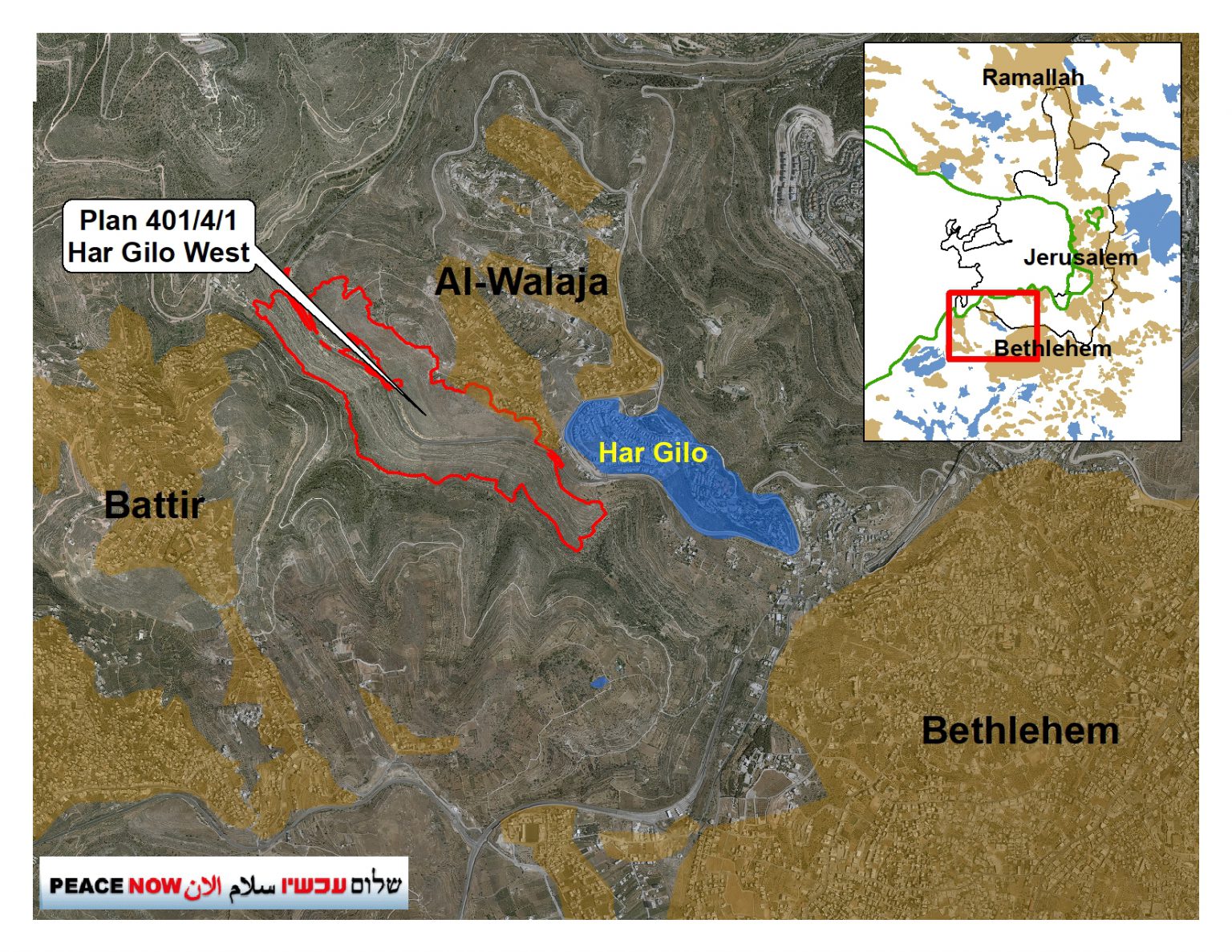 The High Planning Council approved for public deposit a plan to build 560 units at the Har Gilo West settlement site, located just south of Jerusalem. The Council is treating this plan as merely an expansion of the existing Har Gilo settlement, but in actuality it represents the construction of a new settlement on Jerusalem’s southern border, as the two areas of construction (Har Gilo and Har Gilo West) would not be contiguous. The plan for 560 units in Har Gilo West is part of a larger plan to construct around 952 units in the new settlement, extending the its borders right up to the Jerusalem municipal boundary, with dire consequences for the long-beleaguered Palestinian village of Al-Walajah.
The discussion on October 14th further revealed that, in order to build Har Gilo West, Israel plans to extend the separation barrier in that area to completely encircle al-Walajah, which is surrounded on three sides by the separation wall already. The new section of the barrier would be a 7-meters high concrete slab along the western edge of the built-up area of Al-Walajah. That would leave Al-Walajah completely encircled by the separation barrier and Israeli construction beyond it.
Ir Amim explains:
“In the past decade a series of Israeli moves have taken over more and more of Al-Walaja land and gradually isolating it. These are now culminating with the intention to construct the new settlement on the land reserves on the western side of Al-Walaja and to extend the separation barrier so as to complete the encircling of the village. As Al-Walaja will turn into an isolated enclave which lacks an outline plan its residents will be especially vulnerable to increasing home demolitions and other Israeli sanctions. Since the village will separate the new settlement from the existing Har Gilo we are likely to see increasing Israeli actions against Al-Walaja and its residents which will put their future existence at risk.”
Peace Now writes:
“The current plan of 952 housing units to be advanced will create a brand new neighborhood that will be larger than the existing settlement, and will exploit the land cut off by the West Bank barrier to further break up the western Bethlehem metropolitan area, including the land connecting al-Walaja and the town of Battir, as well as Battir and Bethlehem. This land also constitutes some of the only uninhabited fertile land reserves for Bethlehem, which currently is cut off by the West Bank barrier to its immediate north and west.“
FMEP has repeatedly documented various Israeli efforts to seal off al-Walajah from Jerusalem. Residents of al-Walajah have fought the growing encroachment by the nearby Etzion settlement bloc and the Israeli government’s attempt to de facto annex the bloc as part of “Greater Jerusalem.” Ir Amim explains several prongs of this effort, including a particularly unbelievable section of Israel’s separation barrier planned to almost completely encircle the village, to turn its valuable agricultural land into an urban park for Jerusalem, and construction of a highway that will connect the Etzion settlement bloc to Jerusalem with Israeli-only bypass roads.
Two Outposts Advance Towards Retroactive Legalization
The High Planning Council approved for deposit two plans that would, if implemented, have the effect of retroactively legalizing two outposts – bestowing upon those outposts legitimacy in the eyes of Israeli law and, in effect, establishing two new, official settlements. Those plans are:
- Pnei Kedem: A plan to grant retroactive legalization to 120 units in the Pnei Kedem farm outpost by recognizing the outpost as a “neighborhood” of the Metzad/Asfar settlement. This is despite the fact that the two areas of construction are non-contiguous. Pnei Kedem is located halfway between Bethlehem and Hebron in the southern West Bank. Settlers were particularly gleeful about this plan being advanced
- Tapuach West: A plan to grant retroactive legalization to 133 units in the Tapuach West outpost, located south of Bethlehem.
Not Just Residential Units – Council Advances Settler Tourism & Infrastructure Projects
The High Planning Council also advanced plans for the construction of new settlement projects that support tourism, further entrench the permanency of settlements, and that continue the exploitation of West Bank land and resources.
The Council granted final approval to:
- A plan for new shops and an educational site (to include an agricultural farm) in the Kochav Yaakov settlement – located between Jerusalem and Ramallah; and,
- A plan to grant retroactive authorization to a motor park and 120 hotel rooms in the Petza’el settlement, located in the Jordan Valley. As FMEP has covered in the past, this state-of-the-at racetrack and hotel complex is being built partially on land that the Israeli army previously declared a closed firing zone, a designation which resulted in the forcible displacement of Palestinians who lived there. The land remains under this designation today. Rather than halting the construction of this complex, the Israeli authorities instead created a Master Plan for the area in order to enable even more construction in the area.
Plans the Council granted final approval for public deposit include:
- A plan for an industrial zone near the Mishor Adumim settlement; and,
- A plan to build a new commercial area and 50 hotel rooms in the Maale Adumim settlement;
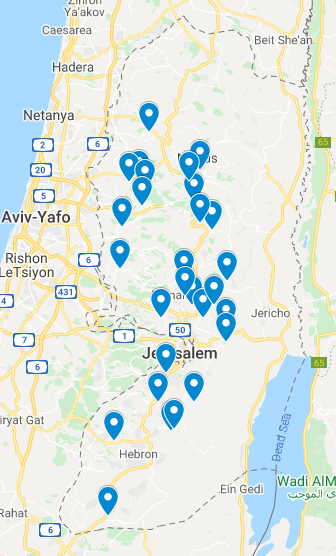
Map by Ben White (@benabyad)
Included in the total number of units receiving final approval and/or retroactive legalization (3,028 units) are (in descending order of number of units): [map]
- 382 units in the Beit El settlement, located in the heart of the northern West Bank. This includes retroactive legalization for 36 units which had been previously built without authorization and the construction of 346 units in highrise buildings with 9 or 10 floors (building up, not out in Beit El) [as a reminder, US Ambassador to Israel David Friedman has deep ties to the Beit El settlement];
- 357 units in the Geva Benyamin (Adam) settlement, located just north east of Jerusalem, just beyond the separation barrier. Israel has been steadily building the Adam settlement in a manner meant to unite the settlement more seamlessly with East Jerusalem settlements and infrastructure, erasing the Green Line;
- 354 units in the Nili settlement, located in the northern West Bank;
- 213 units in the Shiloh settlement, including the retroactive legalization of 21 units built without required approvals. The Shiloh settlement is located in the central West Bank;
- 211 units in the radical and violent Yitzhar settlement, including some retroactive authorizations (exact number not specified) as well as approval for public buildings. Yitzhar, located just south of Nablus, is associated with the Hilltop Youth movement – and a string of illegal outposts in the area associated with repeated attacks on Palestinians and their property;
- 205 units in the Nokdim settlement (actually approved for the Kfar Eldad settlement, which is officially within the jurisdiction of Nokdim), located south of Bethlehem;
- 200 units in the Metzad settlement (also known as Asfar), including the retroactive legalization of an unspecified number of existing units built without necessary approvals;
- 160 units in the Kochav Yaacov settlement, located east of Ramallah;
- 140 units in Kerem Reim settlement – located north west of Ramallah. Peace Now has repeatedly challenged the illegal construction of the Kerem Reim outpost, which the Israeli government retroactively legalized by declaring it a neighborhood of the Talmon settlement even though the areas are non-contiguous. Though a court rejected one Peace Now petition, there is an ongoing case against the Amana settler organization which Peace Now alleges engaged in illegal activities to build the outpost;
- 132 units in Kfar Adumim settlement – located east of Jerusalem and less than one mile from the Khan al-Ahmar bedouin community which the state of Israel is seeking to demolish;
- 106 units in the Ma’ale Shomron settlement, located east of the Palestinian village of Qalqilya;
- 84 new units in the Shima settlement, including retroactive legalization of 14 existing units;
- 74 units in the Yakir settlement – located in the northern West Bank and part of a string of settlements and unauthorized outposts – most notably Ariel – extending from the Green Line deep into the West Bank;
- 64 units in the Telem settlement – located west of Hebron;
- Retroactive legalization of 18 units in the Psagot settlement – located east of Ramallah, and home to the Psagot Winery;
- Retroactive legalization of 2 units in the “Givon Hadasha” settlement;
Plans which were approved for deposit for public review include (in descending order of number of units):
- 629 units in the Eli settlement, including the retroactive legalization of 61 units – located south of Nablus and southeast of the Ariel settlement in the central West Bank. Though the Eli settlement previously received Israeli government approval, a “Master Plan” – which officially zones land for distinct purposes (residential, commercial, public) – has never been issued for Eli, meaning all construction there is illegal under Israeli law;
- 560 units in the Har Gilo settlement located just south of Jerusalem (covered in detail above);
- 286 units in the Har Bracha settlement – located just south of Nablus. If implemented, these new units will double the size of Har Bracha;
- 179 units in the Einav settlement – located northwest of Nablus;
- 148 units in the Rimonim settlement – located between Ramallah and Jericho in the Jordan Valley;
- A plan to grant retroactive legalization to 133 units in the Tapuach West outpost, thereby granting approval to the outpost itself (discussed above);
- A plan to grant retroactive legalization to 120 units in the Pnei Kedem outpost by recognizing the outpost as a “neighborhood” of the Metzad/Asfar settlement although the two areas of construction are non-contiguous. Pnei Kedem is located between Bethlehem and Hebron in the southern West Bank;
- 82 units in the Karnei Shomron settlement – located in the northern West Bank east of the Palestinian village of Qalqilya. Israel is planning to continue expanding Karnei Shomron with the stated goal of bringing 1 million settlers to live in the area surrounding the settlement.;
- 75 units in the Shimaa settlement, including the legalization of 14 units previously built without authorization;
- 52 units received retroactive legalization in the Kfar Adumim settlement;
- 35 units in the Efrat settlement – located south of Bethlehem. As a reminder, Efrat is located inside a settlement block that cuts deep into the West Bank. Efrat’s location and the route of the barrier wall around it, have literally severed the route of Highway 60 south of Bethlehem, cutting off Bethlehem and Jerusalem from the southern West Bank. The economic, political, and social impacts of the closure of Highway 60 at the Efrat settlement (there is literally a wall built across the highway) have been severe for the Palestinian population;
- 14 units (in one building) in the Maale Mikmash settlement – located east of Ramallah;
- 10 units in the Barkan settlement – located about half way between the Ariel settlement and the cluster of settlements slated to be united into a “super settlement” area (Oranit, Elkana, Shiva Tikva, and others).
- 7 units in the Peduel settlement – located in the northern West Bank and part of a string of settlements and unauthorized outposts – most notably Ariel – extending from the Green Line into the very heart of the West Bank and on towards the Jordan Valley; and,
The High Planning Council met only after settlers, who represent a key ally of the embattled Prime Minister, pressured Netanyahu to allow it. Settlers have spent months decrying what they understood to be a freeze on settlement constructed inflicted upon them by Netanyahu. Gush Etzion Regional Council Head Shlomo Ne’eman said:
“Sometimes we take our prime minister to task, which we feel is justified as a result of our disappointment in postponing the application of sovereignty over our country. But now something tangible is happening – we are building and developing our communities, and of course, the highlight of today is the full registration in the Land Authority of the young community of Pnei Kedem, 20 years since it was established.”
Samaria Regional Council head Yossi Dagan said:
“This is a happy day for Samaria. [New construction] in Har Bracha, Yitzhar, Einav and Tapuach is another step on the way to a million residents in this beautiful region of the country…While we’re very content with today’s developments, I call on the Prime Minister not to stop here. We’re overfilled with joy, but it is a drop in the ocean with sovereignty falling off the agenda. The expectation now is that construction and strengthening of the settlement movement will increase tenfold.”
Peace Now responded to the approvals in a statement saying:
“While Israel reels from its second lockdown and economic distress, Netanyahu is promoting construction in isolated settlements that Israel will have to evacuate. Instead of taking advantage of the agreements with the Gulf states and promoting peace with the Palestinians, he is distorting Israel’s priorities and catering to a fringe minority for these settlement unit approvals that will continue to harm future prospects for peace. We call on the Defense Minister and the Alternative Prime Minister Benny Gantz to veto these plans. Far from a ‘settlement freeze,’ the right has been complaining about, the expected settlement approvals announcement next week prove that the settlement enterprise under Netanyahu is moving ahead at full steam toward solidifying the de facto annexation of the West Bank. The move also will be the first major demonstration of Defense Minister Benny Gantz’s bowing to the ‘Greater Israel’ settlement agenda that would in reality bring about a permanent undemocratic one-state reality. By doing so, Israel will be signaling to the world its bi-partisan support for the end to the concept of a two-state solution and a Palestinian state – the paradigm that until now has largely shielded Israel from formal pressure over its 53-year occupation. The settlement enterprise is not in Israel’s national or security interest, and is a strategic mistake at the international level.”
Palestinian Prime Minister Mohammed Shtayyeh denounced the approvals, saying:
“Every settler unit constitutes a plan to annex our land.”
Palestinian Authority spokesman Nabil Abu Rudeineh said in a statement:
“We warn against this Israeli policy that will lead the region to the brink of the abyss, and we call on the international community to intervene immediately and urgently to pressure the Netanyahu government to stop this settlement madness that totally eliminates any real opportunity to achieve a just and comprehensive peace to end the occupation and establish the independent Palestinian state with East Jerusalem as its capital on the 1967 borders.”
UN High Representative Josep Borrell said in a statement:
“In recent days, Israel has announced a significant expansion of settlements in the occupied West Bank, in areas in and around Jerusalem. These plans, which foresee the construction of close to 5.000 housing units, jeopardise the viability and territorial contiguity of a future Palestinian State as the outcome of a negotiated two-state solution, in line with the internationally agreed parameters. Settlements are illegal under international law. As stated consistently, the EU will not recognise any changes to the pre-1967 borders, including with regard to Jerusalem, other than those agreed by the parties. Settlement activity threatens current efforts to rebuild trust, to resume civil and security cooperation between Palestinians and Israelis and to prepare the ground for an eventual resumption of meaningful and direct negotiations. The Government of Israel should reverse these decisions and halt all continued settlement expansion, including in East Jerusalem and sensitive areas such as Har Homa, Givat Hamatos and E1. The period from March to August 2020 also saw a spike in demolitions or confiscations of Palestinian-owned structures in the West Bank in spite of the COVID-19 pandemic. The EU reiterates its call on Israel to halt all such demolitions, including of EU-funded structures, in particular in light of the humanitarian impact of the current pandemic. Against the background of normalization of relations between Israel, UAE and Bahrain, Israelis and Palestinians should seize this opportunity and take urgent steps to build confidence and restore cooperation along the line of previous agreements and in full respect of international law.”
A spokesperson for UN Secretary-General Antonio Guterres issued a statement flagging concern over the advancements, saying:
“We are concerned about the reports of Israel’s settlement advancements in the occupied West Bank and will continue to follow developments closely, as the Israeli High Planning Committee finalizes its meetings tomorrow. The Secretary-General has consistently reiterated that all settlements are illegal under international law and remain a substantial obstacle to peace. We urge the Israeli authorities to refrain from such unilateral actions that fuel instability and further erode the prospects for resuming Palestinian-Israeli negotiations on the basis of relevant UN resolutions, international law and bilateral agreements.”
Plan for 570 Units in East Jerusalem Settlement Approved for Deposit
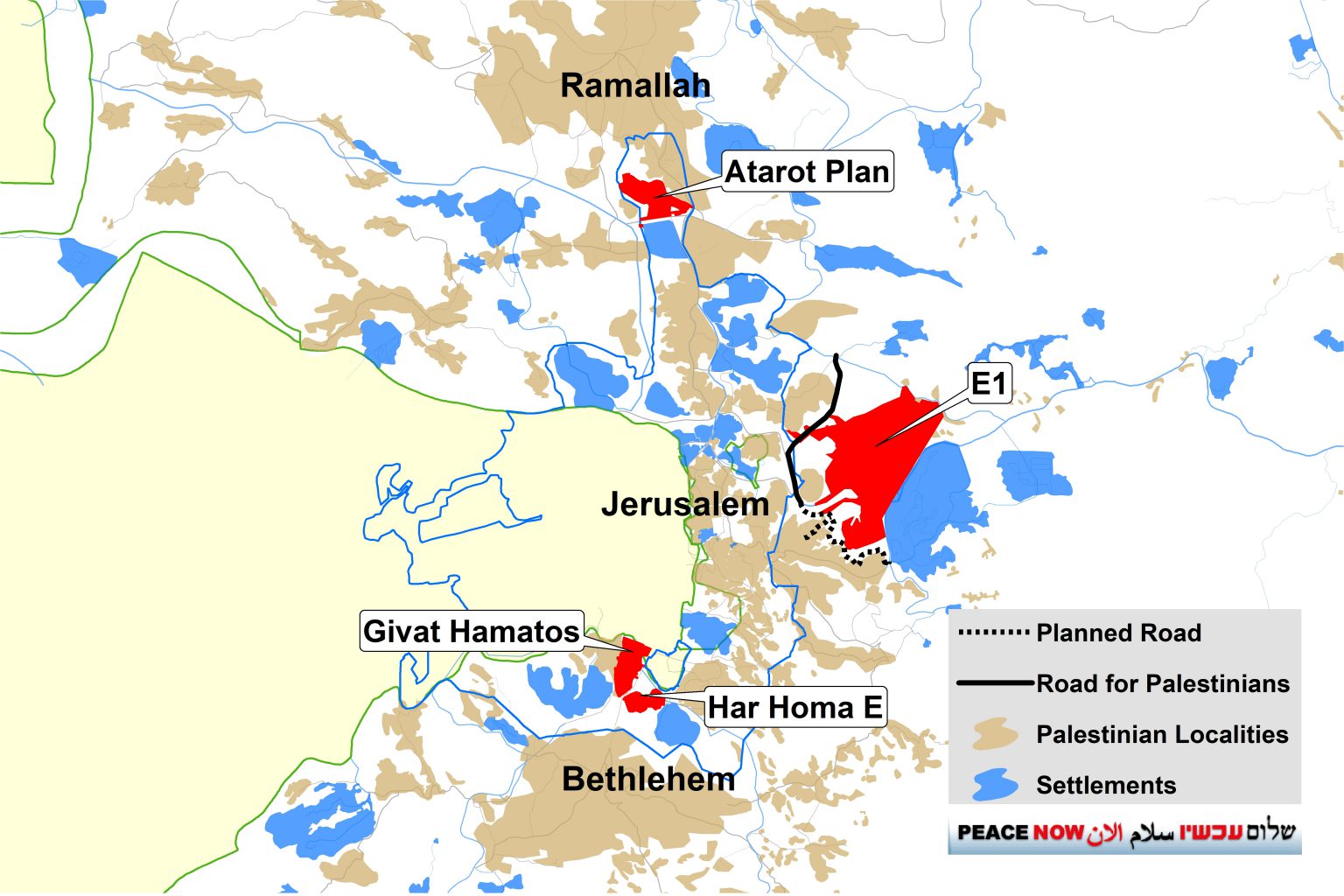 Ir Amim reports that on September 22nd, the Jerusalem District Committee approved for deposit for public review a detailed plan providing for the construction of 570 units in the Har Homa E settlement, located in East Jerusalem. Taken together with the pending construction of the nearby Har Gilo West settlement (discussed in the section above), the Palestinian village of al-Walajah stands to be completely encircled by Israeli settlements.
If implemented, this plan will extend the Har Homa settlement westward, in the direction of the site of the as-of-yet-unbuilt Givat Hamatos settlement. Ir Amim explains:
“If realized, Har Homa E together with construction in Givat Hamatos will connect Har Homa to Gilo creating a contiguous Israeli settlement area that will disconnect East Jerusalem from Bethlehem and the south of the West Bank.”
Ir Amim also reminds us that the Jerusalem District Committee previously approved a Master Plan for a total of 2,200 units in Har Homa E. The plan for 570 units approved for deposit in late September represents the first detailed plan under this Master Plan allows for. Plans to build the remaining units permitted under the Master Plan are not yet being advanced.
Israel Approves Construction of Elevator at Tomb of the Patriarchs
Emek Shaveh reports that on September 29th the Civil Administration granted final approval to a plan to build accessible infrastructure, including an elevator, at the Ibrahimi Mosque/Tomb of the Patriarch in Hebron — a plan which requires Israel to seize land from the Islamic Waqf. As of this writing, Emek Shaveh is considering whether to challenge that approval.
Regarding the significance of the plan, Emek Shaveh said:
“One need not be an archaeologist or architect to review the council’s plan and understand that it is destructive in a manner which is unprecedented. We are convinced that the plan, as approved, would never have been promoted had it not been driven by political motives.”
Emek Shaveh has previously provided critical context as to why this plan is not really, or not fully, being advanced out of humanitarian concerns, explaining:
“Israel’s decision to seize responsibility for the site from the Hebron municipality and the Palestinians sends a clear political message that Israel is reneging on agreements that were signed with the Palestinians in Hebron. Beyond the precedent that will enable the settlers in the future to demand additional changes at the Tomb of the Patriarchs/Ibrahimi Mosque, this is also a precedent that could play out at other sites under the responsibility of the Islamic Waqf. Experience has shown us that what begins in Hebron percolates into other places including Jerusalem. It begins with a seemingly rational demand to benefit the disabled or the general public and evolves into a new status quo. The expected change in Hebron has not escaped the attention of members of the Temple movement and they will know how to present their demands to the government. If Israel can repudiate agreements with the Palestinians in Hebron and expropriate land from the Waqf, it would seem that accepting what appears to be the far more modest demands by the Temple movement to pray or to walk about the Temple Mount complex freely is not so far-fetched. In the reality of Hebron and East Jerusalem, a change involving only several meters at a historic or holy place is not free of political considerations and often it is part of long-term strategy. While it is necessary to tend to the needs and interests of persons with disabilities, the extremists who presume to speak on their behalf must be prevented from forging Israeli policy, even if it is only a matter of a lift and an access path.”
Read Emek Shaveh’s full analysis here: “Humanitarianism Hebron Style.”
Israel Delivers Confiscation Notices to Palestinians Living in the Heart of Hebron
The Palestinian media outlet WAFA news reports that several Palestinians living in the Tel Rumeida section of downtown Hebron were handed confiscation notices from the Israeli authorities, informing them that the State of Israel had confiscated 17 plots of land, including land privately owned by Palestinians.
Tel Rumeida is a part of Hebron located directly in the city center, considered H2 by the Hebron Accords giving Israel full control of security in that area. B’Tselem estimates that there are around 700 settlers living in enclaves amongst approximately 34,000 Palestinians in H2. The Israeli army heavily protects those settlers, and has implemented an apartheid system of segregated movement and checkpoints, most notably in the area of Shuhada Street.
Palestinians Report Newly Established Outposts & Land Confiscations
The Palestinian news outlet WAFA reports that settlers have installed three new outposts over the past month – one near Nablus and a second near Hebron, and a third in the Jordan Valley.
Near Nablus, Palestinians report that the settlers installed mobile homes and a small farm in an attempt to establish a permanent presence on a new plot of land. The settlers are reportedly in the process of connecting the new outpost to the Elon Moreh settlement via roads and water supply. Ghassan Daghlas, who monitors Israeli settlements on behalf of the PLO, told WAFA that the specific area has seen even wider road construction recently, which he sees as an effort to create more seamless contiguity between settlements in the Nablus area and the Jordan Valley. The construction comes at the direct expense of the Palestinian village of Beit Dajani, which has historically owned the land where the outpost and roads are being built.
Near Hebron, WAFA reports that an Israeli settler erected a tent with and Israeli flag on privately owned Palestinian land near the Birin village.
In the Jordan Valley, WAFA reports that settlers set up a caravan on land on which they began planting trees about three months ago. The settlers also reportedly dug a well at the site.
On October 15th, Israel reportedly announced its intention to confiscate large tracts of land (11,000 dunums) adjacent to the Jordan Valley settlements of Rotem, Maskiyot, and Mesovah. This confiscation, according to Palestinian settlement watcher Qasem Awwad, was presented by the Israeli authorities as a move to add land to natural reserve areas, but seems clearly to be linked to efforts to expand settlements and their control over land in the area.
Targeting Palestinians Construction in Area C: State Devotes $6 million to Mapping Program
Despite COVID and the suspension of Israeli’s unilateral annexation of vast tracts of land in the West Bank, the Israeli government — at the urging of settlers and their allies — is continuing its push to consolidate its control over all aspects of life in Area C (the over 60% of the West Bank that is under full Israeli control).
OCHA has documented an acceleration in the Civil Administration’s demolition of Palestinian structures in the West Bank over the summer, documenting the demolition of 389 Palestinian-owned structures in Area C of the West Bank. As a result of those demolitions, 442 Palestinians were made homeless. OCHA further reported that In just the month of August, 205 Palestinians lost their homes, the highest single month total since January 2017. In addition, Israel continues to issue more demolition notices, including against Palestinians living in a cave near Jenin, and against a newly constructed school for bedouin children located east of Ramallah.
To further this effort, on September 10th the Israeli government allocated $6 million USD (20 million NIS) for the newly created Settlement Affairs Ministry to survey and map unauthorized Palestinian construction in Area C of the West Bank, which Israel and its settlers have been aggressively demolishing in an effort to rid the area of Palestinians. Haaretz reports that this is the first time that the state budget has included funds specifically for a land survey in the West Bank. The state also allocated an additional $2.8 million (9.5 million NIS) to an existing grant program specifically for settlement municipalities to cash in on. As a reminder, virtually all Palestinian construction in Area C of the West Bank is unauthorized, because Israel almost universally refuses to give Palestinians permission to build in Area C even on land that Israel recognizes as owned by Palestinians.
The Settlement Affairs Ministry is a new creation of the current coalition government, and is headed by Tzachi Hanegbi (Likud). The funding for the Settlement Affairs Ministry to conduct a survey of unauthorized Palestinian construction in Area C further empowers a domestic Israeli body to exert extraterritorial sovereignty over Area C – in effect, treating the area as land already de facto annexed by Israel. While technically the occupied territories are administered by the Israeli Civil Administration (a body within the Defense Ministry), Israel has spent decades bringing the administration of the territories (specifically the settlements and Area C) ever more directly under direct Israeli sovereignty (de facto annexation).
In the lead up to the allocation of funds for this new survey of Palestinians life in Area C, the Knesset hosted two committee discussions the political outlook of which was clearly indicated in the stated subject of the meetings: “the Palestinian takeover of Area C.” Consistent with this framing (which is predicated on the idea that Area C belongs to Israel), and pushed by outside groups, many members of the Knesset have criticized the Israeli government’s allegedly lackadaisical approach to preserving State interests in Area C (i.e., clearing out Palestinians, expanding settlements, consolidating state infrastructure). Reportedly, Foreign Affairs Minister Gabi Ashkenazi (Blue & White) sent a letter to the committee specifically addressing the Knesset’s outrage over European humanitarian assistance projects for Palestinians in Area C. In the letter, Ashkenazi not only celebrated the reduction of European projects over the past year, but validated settlers’ insinuations regarding the nefarious nature of European assistance for Palestinians, saying that any European activity in the West Bank lacking Israeli permission is “an attempt to define a border.” Ashkenazi also said that Israel will not compensate European donors for confiscated equipment or the demolition of European-funded projects that lack Israeli permission (like in the case of schools built with European funding, and solar panels donated to bedouin communities lacking power).
At one Knesset hearing, MK Bezalel Smotrich (Yamina) suggested that a solution could be to empower the settlements with the ability to demolish Palestinian construction they believe to be unauthorized. Smotrich’s partymate Ayelet Shaked (former Justice Minister) suggested that the government should appoint a project manager tasked with preventing a Palestinian takeover of Area C.
As noted above, Israel has long denied Palestinians the ability to build in Area C. To fully understand what is happening, it is worth reviewing B’Tselem’s excellent explainer:
“Israel’s planning and building policy in the West Bank is aimed at preventing Palestinian development and dispossessing Palestinians of their land. This is masked by use of the same professional and legal terms applied to development in settlements and in Israel proper, such as “planning and building laws”, “urban building plans (UBPs)”, “planning proceedings” and “illegal construction”. However, while the planning and building laws benefit Jewish communities by regulating development and balancing different needs, they serve the exact opposite purpose when applied to Palestinian communities in the West Bank. There, Israel exploits the law to prevent development, thwart planning and carry out demolitions. This is part of a broader political agenda to maximize the use of West Bank resources for Israeli needs, while minimizing the land reserves available to Palestinians….
In the West Bank, the potential for urban, agricultural and economic development remains in Area C. Israel uses its control over the area to quash Palestinian planning and building. In about 60% of Area C – 36% of the West Bank – Israel has blocked Palestinian development by designating large swathes of land as state land, survey land, firing zones, nature reserves and national parks; by allocating land to settlements and their regional councils; or by introducing prohibitions to the area now trapped between the Separation Barrier and the Green Line (the boundary between Israel’s sovereign territory and the West Bank).
Even in the remaining 40% of Area C, Israel restricts Palestinian construction by seldom approving requests for building permits, whether for housing, for agricultural or public uses, or for laying infrastructure. The Civil Administration (CA) – the branch of the Israeli military designated to handle civil matters in Area C – refuses to prepare outline plans for the vast majority of Palestinian communities there. As of November 2017, the Civil Administration had drafted and approved plans for only 16 of the 180 communities which lie in their entirety in Area C. The plans cover a total of 17,673 dunams (1 dunam = 1,000 square meters), less than 1% of Area C, most of which are already built-up. The plans were drawn up without consulting the communities and do not meet international planning standards. Their boundaries run close to the built-up areas of the villages, leaving out land for farming, grazing flocks and future development. Since 2011, seeing that the Civil Administration did not draft plans as it is obliged to do, dozens of Palestinian communities – with the help of Palestinian and international organizations and in coordination with the PA – drafted their own plans. Some of the plans covered communities or villages located in full in Area C and others covered places only partly in Area C. As of September 2018, 102 plans had been submitted to the Civil Administration’s planning bodies, but by the end of 2018, a mere five plans – covering an area of about 1,00 dunams (or about 0.03% of Area C) – had received approval.
The odds of a Palestinian receiving a building permit in Area C – even on privately owned land – are slim to none. Given the futility of the effort, many Palestinians forgo requesting a permit altogether. Without any possibility of receiving a permit and building legally, the needs of a growing population leave Palestinians no choice but to develop their communities and build homes without permits. This, in turn, forces them to live under the constant threat of seeing their homes and businesses demolished.
The impact of this Israeli policy extends beyond Area C, to the hundreds of Palestinians communities located entirely or partially in Areas A and B, as the land reserves for many of these communities lie in Area C and are subject to Israeli restrictions there.
The demand for land for development has grown considerably since the 1995 division of the West Bank: The Palestinian population has nearly doubled, and the land reserves in Areas A and B have been nearly exhausted. Due to the housing shortage, much land still available in these areas is used for residential construction, even if it is more suited for other uses, such as agriculture.
Without land for construction, local Palestinian authorities cannot supply public services that require new structures, such as medical clinics and schools, nor can they plan open spaces for recreation within communities. Realizing the economic potential of Area C – in branches such as agriculture, quarrying for minerals and stone for construction, industry, tourism and community development – is essential to the development of the entire West Bank, including creating jobs and reducing poverty. Area C is also vital for regional planning, including laying infrastructure and connecting Palestinian communities throughout the West Bank.
In contrast to the restrictive planning for Palestinian communities, Israeli settlements – all of which are located in Area C – are allocated vast tracts of land, drawn up detailed plans, connected to advanced infrastructure, and the authorities turn a blind eye to illegal construction in them. Detailed, modern plans have been drawn up for the settlements, including public areas, green zones and, often, spacious residential areas. They enjoy a massive amount of land, including farmland that can serve for future development.
Israel’s policy in Area C is based on the assumption that the area is primarily meant to serve Israeli needs, and on the ambition to annex large parts of it to the sovereign territory of Israel. To that end, Israel works to strengthen its hold on Area C, to further exploit the area’s resources and achieve a permanent situation in which Israeli settlements thrive and Palestinian presence is negligible. In doing so, Israel has de facto annexed Area C and created circumstances that will leverage its influence over the final status of the area.”
In First, Palestinian Authority Courts to Hear Lawsuits Against Settlers
For the first time since the Palestinian Authority was established in 1994, it will allow Palestinians to bring lawsuits against Isareli settlers in Palestinian courts. The Palestinian Authority’s Justice Minister Mohammed al-Shalaldeh announced that the PA had formed a national team to handle these cases, and the team was already working to collect evidence and file suits against settlers who have committed crimes against Palestinians in Hebron and in the village of Burin, located just south of Nablus.
Until this point, no Israeli citizen has been tried in a Palestinian court. Under the Oslo Accords (which established the Palestinian Authority), the Palestinian Authority holds no jurisdication over Israeli citizens – including Israeli citizens living in the West Bank. In May 2020, PA President Mahmoud Abbas announced that the PA considers all accords and agreements with Israel to be void following Israel’s announcement that it intends to annex large parts of the West Bank in accordance with the Trump Plan. Shalaldeh said that the announcement this week flows directly from Abbas’s decision to free the PA from the Oslo Accords’ provisions.
Explaining how these cases might work, Shalaldeh said:
“The Israeli side will be notified as an occupying power to appear before the Palestinian court…If the [Israeli] side refuses the jurisdiction of the Palestinian courts, formal procedures will be followed and in absentia rulings will be issued, in accordance with Palestinian laws.”
JNF, Elad Face International Heat Over Sumreen Family Eviction Case – Will it Matter?
Over the past month, international audiences have directed heightened scrutiny towards the radical settler group Elad and the Jewish National Fund (JNF) for the role both organizations have played in spearheading the effort to evict the Palestinian Sumreen family from their home in the Silwan neighborhood of East Jerusalem. Due to the new attention, the JNF is reportedly reconsidering whether or not to carry out the eviction of the Sumreens – an eviction which the organization has pursued since 1991.

Map by Haaretz
JNF donors – along with activists, religious leaders, members of Congress, and Israel prize winners – reportedly began to express concern and outrage over the JNF’s role in the Sumreen case following the September 2020 ruling by Jerusalem Magistrate’s Court against the Sumreen’s claim to the home. In response to the criticism, the JNF (via actions by the Board of its subsidiary organization, Himnuta, which was created to take the lead for JNF in litigating aggressive settlement takeover cases like this) has acted to freeze the eviction process internally, and was scheduled to consider a proposal for freezing the formal legal proceedings against the Sumreens this past week. Himnuta’s decision and deliberations caused conflict with Elad, which had the Jerusalem Magistrate’s Court intervene to postpone Himnuta’s Board meeting to discuss the proposal. Elad argues that Himnuta transferred all legal authority over the Sumreen case to their organization, and cannot now interfere in the proceedings. The meeting was subsequently postponed at the request of the Court.
Elad is also coming under new international scrutiny following the revelation that Roman Abramovitch – a Russian oligarch and naturalized Israeli citizen who also is one of the owners of the renowned Chelsea football club – is Elad’s single largest donor, having anonymously donated over $100 million to the settler group over the past 13 years. The BBC produced an investigative feature report on Abramovitch’s connection to Elad, pointing out that over the past 15 years more than half of Elad’s funding has come from offshore companies in the Caribbean, which are now known to be owned or controlled by Abramovitch. The BBC feature connects Elad to the settlers’ struggle to evict the Sumreen family, and the larger effort to replace Palestinians in Silwan with Jewish Israelis.
Peace Now writes:
“The news about Abramovich’s involvement highlights the injustice Palestinians face at the hands of these settlement groups. Impoverished families are up against the financial weight of a Russian oligarch. NGOs trying to protect these families are delegitimized and their work dismissed for receiving funding from democratic European aid agencies while settler groups rake in vast sums of non-transparent money from offshore Caribbean shell companies. And the JNF is profiting off of all of this. We can’t force Abramovich to stop his funding or the JNF to stop abetting Elad in its settling campaign, but we can make them worry about their reputation. Peace Now has been conducting a campaign inside Israel to call Abramovich out for his devious funding.”
Regarding the revelations of Elad’s funding source, Emek Shaveh writes:
“…the Elad Foundation, through a combined strategy of sponsoring excavations, developing tourism and settling in Palestinian homes, succeeded in recreating Silwan as the Jewish neighbourhood of Ir David (City of David) and one of the most popular tourist destinations in the country. The exploitation of archaeological tourism by the Elad Foundation has become a number one strategy for entrenching Israeli sovereignty over historic Jerusalem. “
The Sumreen family home is located in the middle of what today has been designed by Israel “the City of David National Park.” The area is managed by the radical Elad settler organization, which for years has also been pursuing the eviction of Palestinians from the homes in Silwan. For nearly three decades, the Sumreen family has been forced to battle for legal ownership of their home, after the state of Israel, prompted repeatedly by the JNF, declared the Sumreen’s home to be “absentee” property. After that designation – which was not communicated to the Sumreen family – Israeli law permitted the state to take over the rights to the building. The state then sold the rights to the home to the JNF in 1991. The JNF has pursued the eviction of the Sumreen family ever since. Israeli courts ruled in favor of the Sumreen family’s ownership claims to the home for years, until a September 2019 ruling by the Jerusalem Magistrate’s Court granted ownership of the family’s home to the JNF, a decision the family immediately appealed to the Jerusalem District Court.
A full history of the saga involving the Sumreen family – which is similar to dozens of other Palestinian homes in Silwan that were declared Absentee Property in the 1990s – can be found on the Peace Now website here.
Report: U.S. Will Not Back De Jure Annexation Until 2024 [But Friedman Says 2021 Is in Play]
A series of reports in mid-September suggested that, as part of its commitment to the U.A.E. in exchange for normalization with Israel, the U.S. promised to withhold its recognition of Israeli annexation until January 2024, at the earliest.
The 2024 timeline harkens back to a concept in Trump’s “Deal of the Century” which gave (oh so generously) the Palestinians a four year window to enter into negotiations with Israel on the basis of the Trump Plan’s conceptual map.
Following these reports regarding a 2024 timeline for the U.S. greenlighting Israeli annexation, U.S. Ambassador David Friedman (who has been a champion of annexation) told Israel’s Army Radio that annexation can happen next year. Friedman, pushing back on U.A.E. press leaks seeking to promote the notion that the Abraham Accords stopped annexation, said:
“We said in our statement that sovereignty will be postponed, and this does not mean that it has been abolished, but rather that it has stopped. It has been suspended for a year, maybe more, but it has not been cancelled.”
Bonus
- “Tourism in the Service of Occupation” (Al-Shabaka)
- “The Status Quo on the Temple Mount/Haram Al Sharif: Dodging a Bullet (For Now)” (Terrestrial Jerusalem)
- “How Evangelicals Working in Settlements Bypassed Israel’s COVID-19 Entry Ban” (Haaretz)
- “ The March of Folly in the Settlements Continues” (Haaretz)
- “Israeli Students in State-funded Scholarship Program Guard Illegal West Bank Outposts” (Haaretz)
Welcome to FMEP’s Weekly Settlement & Annexation Report. To subscribe to this report, please click here.
August 14, 2020
- Bibi (Temporarily) “Suspends” Annexation as Part of UAE-Israel Normalization Agreement
- Forging Ahead with De Facto Annexation: Israel Starts Construction on Two New Settlement Projects
- Israel Advances Plans for More Bypass Roads for Jerusalem-Area Settlements
- Settlers Continue to Escalate Terror Campaign Against Palestinians, Israeli Police
- Bonus Reads
Comments/questions? Contact Kristin McCarthy (kmccarthy@fmep.org)
Bibi (Temporarily) “Suspends” Annexation as Part of UAE-Israel Normalization Agreement
On August 13th, the United Arab Emirates and Israel announced the signing of a U.S.-brokered “peace deal” that will fully normalize relations between the two countries – in effect bringing barely hidden secretive relations between the two nations out into the open. In a statement on the deal tweeted by President Trump, the countries have agreed to pause the implementation of Trump’s “Deal of the Century,” with Israel committing – at the request of President Trump – to suspend its plans to annex the West Bank. However (and predictably), Netanyahu quickly clarified that annexation is still very much on his agenda, saying during a televised address:
“There is no change to our plans to apply sovereignty over Judea and Samaria, in coordination with the US. I remain committed to that” and that he will “never give up on our rights in our land.””
U.S. Ambassador David Friedman – who travelled to Washington this week to participate in talks – quickly backed Netanyahu’s refusal to shelve annexation. The Jerusalem Post reports the following:
“US Ambassador to the US David Friedman clarified that the word which had been chosen to describe the [annexation] situation was “suspended” and that word had been chosen “very carefully” because it means a temporary halt. Sovereignty, Friedman said was “off the table” not but not “off the table permanently.” But at an earlier stage in the conference Friedman noted that the application of sovereignty to West Bank settlements was incompatible with the overall goal of normalized ties between Israel and the Arab world. Friedman has been one of the strongest supporters of Jewish communities in Judea and Samaria. On Thursday night, as he spoke with Trump in Washington, he said, however, “we are putting our eggs into the basket of peace. The US Ambassador explained that, “we have an agreement with the Emirates. We are going to nail all the details, embassies, overflights, commercial. Then we are going to extrapolate that to the rest of the region. “How long that takes, I cannot tell you. But we have prioritized peace over the sovereignty movement. It’s not off the table, it’s just something that has been deferred until we have given peace every single chance.” When asked if a deal with the UAE could have been reached without Netanyahu’s decision to suspend annexation. “I think you can’t do both at the same time,” Friedman said. “Prioritize peace. Sovereignty after peace is given every opportunity.”
The Palestinian Authority denounced the UAE-Israel agreement, stating that “The UAE is not entitled to speak on behalf of the Palestinian people,” and calling for an urgent meeting of the Arab League. PLO Executive Committee member Hanan Ashrawi tweeted:
“Israel got rewarded for not declaring openly what it’s been doing to Palestine illegally & persistently since the beginning of the occupation. The UAE has come out in the open on its secret dealings/normalization with Israel. Please don’t do us a favor. We are nobody’s fig leaf!”
For more reaction from Palestinian factions, see this helpful Twitter thread from Ben White.
The UAE-Israel normalization deal serves many, many purposes for the three parties involved – the Trump Administration, the UAE government, and Netanyahu. For the U.S., it gives Donald Trump a foreign policy “victory” heading into the November elections. For the UAE, it is presented as a political “victory” that stops Israeli de jure annexation (even if only temporarily), while simultaneously allowing for the expansion of security and diplomatic cooperation (not to mention dividends from the U.S. that may become known later). And for Israel, it allows Netanyahu to claim a significant foreign policy victory, at a moment when he is facing the possibility of another election, while also providing a new rationale for why he has not yet advanced annexation of the settlements.
Notably, none of these purposes has anything to do with the rights and future of the Palestinian people. To the contrary, the deal facilitates the continuation of the current situation, in which Israel continues with settlement expansion, de facto annexation of the West Bank, and denial/violation of Palestinian rights, and at best temporarily delays the move by Israel toward formal, de jure annexation.
Al-Shabaka analyst and expert Tareq Baconi explained:
“This is not a “historic peace agreement” but a repackaging of an ongoing reality of normalisation between the UAE and Israel against the backdrop of de facto annexation and occupation of Palestinian territories. Repackaging reality and selling it as a diplomatic breakthrough is a show we’ve seen from the Trump administration before. Deal of the century to sell apartheid anyone? It’s not diplomacy, its marketing spin. But, this is also not inconsequential business as usual. The UAE’s decision to proceed in this way is a dangerous precedent in the post-Arab Peace Initiative era, where official normalization has become possible despite continued Palestinian subjugation. Bahrain next? This is the latest in a long history of Arab leaders selling the Palestinian issue or manipulating the Palestinian struggle to further their own interests, from the very inception of the PLO on. Sadat? Two ways to read Bibi. 1. Annexation may have always been a house of mirrors. Now he can be rewarded for not annexing: peace for occupation. 2. This is an admission of defeat; he was unable to annex, and needs a shiny new object to detract attention…Two things are certain. First, this agreement is one more step in the effort to formalise a new vision for the Middle East that is even further away from the calls of the Arab street that resonated in 2011. Second, this is another indication that the Palestinian leadership remains a spectator to events that determine their fate, unable to influence the unfolding trends. And finally, after a whole lot of fanfare around annexation, where are we now? Everyone breathing a sigh of relief that Israel continues to control the same territory.”
Adding to that analysis, FMEP’s Lara Friedman noted:
“…3rd option: annexation temporarily “suspended” for sake of normalization w/ UAE (& others?), but still on table. Given Trump Admin Greater Israel predilections & Evangelical voters, expect some concrete move before Nov elex.”
Palestinian expert Omar Baddar of the Institute for Middle East Understanding tweeted:
“ 1) There is nothing “historic” or “groundbreaking” about this agreement: Israel & the UAE have been strong allies under the table for many years! This is merely making that friendship public (which is still interesting). Israel didn’t “halt” the annexation for the West Bank (annexation is ALREADY a de facto reality on the ground). Israel merely “suspended” its announcement of a reality it has already illegally imposed on Palestinians. It is FALSE to say Israel suspended it at the UAE’s request. Israel suspended (put off) its annexation announcement after realizing it was going to be costly to Israel, with many US Democrats threatening for the first time to cut off military aid to Israel. The suspension came long before this UAE deal was reached. The claim that the UAE deal is responsible for halting Israel’s annexation announcement is merely a PR stunt for the UAE government, which knows full well that normalization with Israel WHILE Israel continues to brutalize Palestinians is extremely unpopular in the region. The Arab Peace Initiative already promised full normalization of relations between Israel and all Arab countries in exchange for ending Israel’s illegal occupation of the Palestinian territories to allow a tiny Palestinian state to exist. Israel rejected this generous offer. Some Arab governments see “the Palestinian cause” as a burden, feigning concern for their human rights while secretly working with Israel on “more important” partnerships: economic, intelligence, undermining Iran’s influences in the region…etc. Israel may be able to normalize w/these dictatorial governments w/out treating Palestinian like human beings who deserve basic rights, but Israel will never be truly accepted by the PEOPLE of the region so long as Palestinians live without freedom under the boot of occupation.”
Former Vice President and current Democratic presidential nominee Joe Biden released a statement praising the deal, and reiterating his opposition to annexation (conspicuously not acknowledging occupation and ongoing de facto annexation):
“Annexation would be a body blow to the cause of peace, which is why I oppose it now and would oppose it as president. It would virtually end any chance of a two-state solution that would secure Israel’s future as a Jewish and democratic state and uphold the right of Palestinians to a state of their own. By forestalling that possibility and replacing it with the hope of greater connection and integration in the regions, the UAE and Israel have pointed a path toward a more peaceful, stable Middle East.”
U.S. Congresswoman Rashida Tlaib tweeted:
“We won’t be fooled by another Trump/Netanyahu deal. We won’t celebrate Netanyahu for not stealing land he already controls in exchange for a sweetheart business deal. The heart of the issue has never been planned, formal annexation, but ongoing, devastating apartheid. The focus needs to be on promoting solidarity between Palestinians & Israelis who are joining together in struggle to end an apartheid system. We must stand with the people. This Trump/Netanyahu deal will not alleviate Palestinian suffering—it will further normalize it.”
Former Obama Administration official Ben Rhodes commented:
“This agreement enshrines what has been the emerging status quo in the region for a long time (including the total exclusion of Palestinians). Dressed up as an election eve achievement from two leaders who want Trump to win.”
B’Tselem Director Hagai El-Ad tweeted:
“Now that Israel has magnanimously agreed to “suspend declaring sovereignty”, all can calmly get back to underwriting Israel’s tried-and-tested perpetual oppression of Palestinians: arbitrary killings, land theft, controlling every aspect of an entire people’s life. Biz-as-usual.”
Netanyahu is already receiving criticism from staunch pro-annexation forces to his right, which largely feel betrayed by Netanyahu.
Yamin MK Naftali Bennet (whose popularity is soaring), said:
“it’s sad [Prime Minister Benjamin] Netanyahu missed a once-in-a-century opportunity to extend Israeli sovereignty over the Jordan Valley… and the rest of Israeli settlements [in the West Bank]. It’s tragic Netanyahu hasn’t seized the moment and hasn’t had the courage to extend sovereignty even over an inch of the Land of Israel.”
Israeli Transportation Minister Miri Regev said:
“This is a historic agreement on every level, security, economic, business — but it can’t come at the expense of sovereignty that the prime minister and all of us have committed to.”
David Elhayani, head of the Yesha Council of settlers said:
“He [Netnayahu] deceived us. He has deceived half a million residents of the area and hundreds of thousands of voters.”
Notably, Egypt, Oman, and Bahrain came out with statements welcoming the agreement.
Forging Ahead with De Facto Annexation: Israel Starts Construction on Two New Settlement Projects
Over the past week, Palestinian media has documented the start of the construction on two significant new settlement projects.
On August 12th, Wafa News reports that Israeli construction crews began leveling land near the Palestinian villages of Iskaka and Yasuf in preparation for expanding the nearby unauthorized outpost of Nofei Nehemia. The area is located east of the Ariel settlement in the heart of the northern West Bank. ActiveStills documented this construction project as it continued on August 13th.
On August 13th, Wafa News reports that Israel began construction on a new settler bypass road near the Kafr al-Labad village, located east of Tulkarm in the northern West Bank.
Israel Advances Plans for More Bypass Roads for Jerusalem-Area Settlements
Ir Amim reports that the High Planning Council recently advanced a massive outline plan for expanding the road infrastructure for settlers in the West Bank, with the goal of more seamlessly integrating the settlements into the Jerusalem metropolitan area. Ir Amim detailed the plans for three new bypass roads in the Greater Jerusalem area, which were deposited for public review on July 3rd:
1 – A new road that will allow settler traffic to bypass the Qalandiya checkpoint via a new tunnel. This plan specifically serves a cluster of settlements – located deep inside the West Bank, in an area that under any reasonable sense of a two-state solution cannot become part of Israel — that Netanyahu has recently dubbed a “fourth settlement bloc.” In so doing, Netanyahu is in effect defining these settlements as forming an area over which Israel will never relinquish control. This “bloc” includes the settlements of Adam, Kochav Yaakov, Ofra, and Beit El. Ir Amim writes:
“The planned road will create a quick and smooth connection for settler traffic entering Jerusalem from the northeast… it will enhance the contiguity between Jerusalem and the so called ‘fourth settlement bloc’ and enable the expansion of settlement construction. The planned road will also cut through the A-Ram and Qalandia area between A-Ram and Ramallah. Today there are no settlements in this area nor is settler traffic passing through it. It is telling that during the discussion the planners explained that the route of the road was designed to pass a distance away from the Kochav Yaakov settlement and close to the town of A-Ram. As in many other cases, this means that the road leaves a large area next to the settlements enabling its future expansion, while its construction will serve to limit the possibility of A-Ram’s future development. For the construction of the road, private Palestinian land will have to be expropriated. According to rulings of the Israeli courts based on International Law, private Palestinian land cannot be seized for the purpose of settlements and settler traffic, therefore the Civil Administration claims that the road will also serve Palestinian traffic and for that purpose an interchange nearby Qalandia will connect it to the road to Ramallah. But when examining the schedule for construction of the road, it is clear that this interchange is scheduled to be operational only in the year 2040- many years after the road serving settler traffic is scheduled to open. The fact that Israel is advancing large scale plans for 20 years into the future demonstrates Israeli intentions regarding its control of the area for decades to come.
2 – Expansion of an existing bypass road leading from the Adam settlement into Jerusalem. This plan will likewise serve settler traffic connecting the “fourth settlement bloc” to Jerusalem. This project will also require the expropriation of privately owned Palestinian land. Ir Amim writes: “The committee claims to justify the expropriation by stating that the road serves Palestinian traffic as well, yet it is doubtful if there is any significant Palestinian public transportation on the road.”
3 – A new bypass road near the Palestinian village of al-Walajeh, connecting the Etzion settlement block to Jerusalem. Ir Amim notes that this road is a prerequisite for Israel’s expansion of the Har Gilo settlement. This plan will require the expropriation of privately owned Palestinian land. Ir Amim writes: “the Israeli Civil Administration wishes to justify its confiscation of Palestinian private lands needed for the construction of the road by claiming that it will also serve Palestinian traffic. This claim would clearly be false as the road only leads into Jerusalem along a route from which Palestinian traffic is blocked by Israeli checkpoints…The planned expansion of Har Gilo by 560 housing units – an addition which will more than double the current size of Har Gilo – is located adjacent to Al-Walaja from the west and will result in the village’s complete isolation.”
Commenting on the plans as a whole, Ir Amim notes:
“These plans for road infrastructure are part of the huge investments of the Israeli government into the de-facto annexation of Greater Jerusalem through furthering large-scale, unilateral, facts on the ground. If realized, these projects will dramatically change the landscape around Jerusalem and deep into the West Bank, allowing for rapid settlement expansion and further fragmentation of the Palestinian space. These moves will deal a death blow to the prospect of a two state solution and lay the ground for the formal annexation of Greater Jerusalem whether through a ‘minor’ or ‘major’ scope of annexation.”
Settlers Continue to Escalate Terror Campaign Against Palestinians, Israeli Police
Rights groups and media outlets have documented several instances of settler-perpetrated violence in the vicinity of the Yitzhar settlement over the last week:
- On August 11th, B’Tselem reports that settlers threw stones at Palestinians in two separate incidents.
- On August 12th, dozens of masked settlers violently clashed with Israeli police while the police attempted to dismantle the unauthorized Shevach Haaretz outpost near Yitzhar, located just south of Nablus. The settlers deployed pepper spray, threw paint cans, and punctured car tires during the incident. One police officer needed medical attention, and additional forces were deployed to the area before the riot was dispersed. No arrests were reported.
- On August 13th, Yesh Din reports that a group of settlers set a bulldozer on fire at a Palestinian quarry in the Nablus region, near the radical Yitzhar settlement (home of the Hilltop Youth settler movement).
- The Palestinian villages of Asira al Kabalia and Urif were vandalized with hateful graffiti spray painted in the villages and damage to vehicles.
Bonus Reads
- “Normalization Deal Between Israel and the UAE Signals a Shift in the Region” (Foreign Policy)
- “These Settler Farmers Are All About Peace and Love – Just Don’t Mention Land Theft” (Haaretz)
- “’The Left Made Israel More Moral, but Their Mistakes Made Them Irrelevant’” (Haaretz)
Welcome to FMEP’s Weekly Settlement Report, covering everything you need to know about Israeli settlement activity this week.
To subscribe to this report, please click here.
May 22, 2020
- New Israeli Government Sworn In: Gantz & Netanyahu Continue to Back Annexation & the Trump Plan
- New Israeli Government Sworn In: The Cast of Ministers Relevant to Settlements/Annexation
- Settler Groups in Public Disagreement Over Trump Plan
- ICYMI: Sec. State Pompeo Went to Israel Last Week
- Israel Expropriates Land, Green Lights Building Permits for “Humanitarian Access” to Hebron’s Tomb of the Patriarchs/Ibrahimi Mosque
- Israeli Demolitions in al-Walajah, Displacing Palestinians to Make Way for New Israeli Park
- High Court Rejects Regulation Incentivizing Artists Performing in Settlements
- Violence on the Rise
- Breaking the Silence Breaks Down What Annexation Will Mean on the Ground
- Al-Haq Report: Israeli Annexation of Jerusalem Since 1948
- B’Tselem Report: Jewish Supremacy on Display in Issawiya
- Human Rights Watch Report: Israeli Land Policies Strangle Palestinian Communities in Israel
- Bonus Reads
Questions/comments? Email Kristin McCarthy (kmccarthy@fmep.org)
New Israeli Government Sworn In: Gantz & Netanyahu Continue to Back Annexation & the Trump Plan
The new Israeli government was sworn in on Sunday, May 17th. The message from the government’s leaders – Netanyahu and Gantz – remains that they are firmly and unequivocally behind the plan to advance annexation, in accordance with the Trump Plan.
In his inaugural address, Prime Minister Netanyahu said:
“The time has come to apply sovereignty to Jewish communities in Judea and Samaria. This won’t distance peace, it will bring it closer. The truth is — and everybody knows it — that the hundreds of thousands of settlers living in Judea and Samaria will remain there, no matter what arrangement is reached. The only reason the whole issue of sovereignty is on the agenda is because I promoted it personally for the last three years, both overtly and covertly.”
In his inaugural address, Alternate (and, theoretically, future) Prime Minister Benny Gantz said:
“Alongside this and for its sake, we will maintain our strength, to seize regional opportunities in general, and to advance the US government and US President Trump’s peace plan and everything it contains.”
New Israeli Government Sworn In: The Cast of Ministers Relevant to Settlements/Annexation
In addition to Netanyahu and Gantz, key figures in the new government’s drive for annexation will likely be:
- Tzipi Hotovely (Likud), who is Israel’s “Settlements Minister.” This is a new cabinet position invented by Netanyahu and Gantz. Hotovely will serve in this role for the first nine months of the government and then be replaced by Tzachi Hanegbi (Likud) for the second nine months (of course, if Israel annexes all the settlements, this role either won’t need to exist anymore or its mandate will have to change). It is unclear if this ministry will take power away from the Defense Ministry (and its Civil Administration), which has typically been the central address for managing most issues related to the settlements.
- Gilad Erdan (Likud), who is Israel’s new Ambassador to both the United Nations and the United States. Erdan will hold both offices simultaneously for the first nine months of the government. Shortly following his swearing in, Erdan reiterated his well-established support for annexation, saying he believes Israel has a “biblical right” to the land.
- Avi Nissenkorn (Blue & White) who is Israel’s new Justice Minister. Israel’s Justice Minister has historically played an important role in issuing legal opinions which provide Israel a domestic legal rationale for land seizures and settlement activities. The Justice Ministry is also a key because it has been (at least in recent years) increasingly oppositional to the role of the Israeli Supreme Court. Netanyahu has directly confronted the Supreme Court, and former Justice Minister Ayelet Shaked accused the Court of (among other things) being “overly concerned” with Palestinian rights.
- Gabi Ashkenazi (Blue & White), who is Israel’s new Foreign Minister, and who will theoretically take over the job of Defense Minister during the second nine months of the government (assuming Gantz rotates over to become Prime Minister). Ashkenazi has made clear his support for annexation, even while giving lip service to concerns about relations with allies and in the region. On May 18th he, said: “We’re facing significant regional opportunities, primarily President [Donald] Trump’s peace initiative. I consider this plan a significant milestone. President Trump presented us with a historic opportunity to shape the future of the State of Israel and its boundaries for decades to come…The plan will be advanced responsibly, with full coordination with the United States and maintaining all of the State of Israel’s peace agreements and strategic interests.”
Key Government Figures Outside of the Coalition
- Naftali Bennett, Ayelet Shaked, Bezalel Smotrich (Yamina Party). Relegated to the opposition, Bennett and company have come out swinging – taking shots at Netanyahu for allegedly betraying right wing values and vowing to fight tooth and nail against the Trump Plan. Bennett has charged that Netanyahu is making a fatal mistake by supporting the Trump Plan because it would mean that Israel has acknowledged and accepted the concept of a Palestinian state (notwithstanding that, under the Trump Plan, what is available to the Palestinians does not meet even the most modest definition of a state). Bennett said that recognition “is a point of no return. One can’t recognize and then un-recognize Palestinian statehood. It’s like un-cooking scrambled eggs…I will oppose anything that allows for acceptance or recognition of a Palestinian state.”
Settler Groups in Public Disagreement Over Trump Plan
Settler leaders form a key interest group outside of the central government (though many settler leaders serve on municipal councils) — a group that will play a key role in the deliberations around annexation. And with the swearing in of the new government that embraces the Trump Plan, disagreements among settler leaders are beginning to become more clear.
Like the Yamina Party, the official settler leadership body – known as the Yesha Council – passed a resolution on May 21st criticizing several aspects of the Trump Plan, without stating its outright opposition to it. While acknowledging it as a “positive change in U.S. policy towards settlements,” the resolution goes on to:
- Assert that annexation does not require American approval;
- Reject recognition of – or agreement to recognize in the future – a Palestinian state;
- Reject any construction freeze in any of the settlements and outposts;
- Reject the creation of enclaves.
Following the passage of the resolution, Yesha Council chairman David Elhayani said:
“For years, the Yesha Council has been working to apply sovereignty [in the West Bank], and we’ve gone from a situation in which almost no one talked about the subject or was aware of it to the unprecedented situation where the prime minister and the US president discuss an agreement that includes sovereignty. However, we will not agree to the establishment of a Palestinian state in the heart of the Land of Israel. If the result of the [Trump] agreement is to establish a terror state in Judea and Samaria (the West Bank), include the creation of isolated enclaves and a freeze on construction, we are ready to give up sovereignty, despite all the hard work and resources we have invested in the issue in recent years.”
In opposition to the Yesha council’s statement, a group of settler mayors – representing major settlements like Efrat and Ariel, as well as settlements that, due to their population, have extra weight politically (like Alfei Menashe, which is home to many retired senior IDF officers) — organized their own statement calling for support of the Trump Plan. The statement – led by Efrat Mayor Oded Revivi – was signed by the mayor/chairmen of Ariel, Megilot, Oranit, Alfei Menashe, Elkana, and Har Adar.
ICYMI: Sec. State Pompeo Went to Israel Last Week
On Wednesday, May 13th, U.S. Secretary of State Mike Pompeo travelled to Israel for an 8-hour visit to meet with leaders of the new Israeli government (which was set to be sworn in the next day, though that was delayed until Sunday the 17th). In response to an unconvincing statement by the State Department concerning the trip’s purpose – which was officially about coordination on fighting COVID-19 and Iran – an avalanche of speculative media coverage preceded and trailed Pompeo’s trip, trying to suss out what the trip was truly about, with many focusing on annexation or confronting Israel’s growing ties to China. In response, a State Department official who travelled with Pompeo told the press after Pompeo departed: “[we can] dispel the notion that we flew halfway around the world to talk about annexation…that was not the purpose of the trip…This wasn’t the top line.”
Media speculation that annexation was on Pompeo’s agenda was fueled by an interview Pompeo gave to Israel Hayom one day prior to his trip. When asked directly by a reporter if he planned to ask Israel to delay annexation, Pompeo declined to answer but reiterated his prior comments stressing that annexation is an Israeli decision. And then, on the day that Pompeo arrived in Israel, an anonymous “senior U.S. official” told Israel’s Channel 13 news that the U.S. had passed a message to Israeli leaders that annexation does not have to happen on July 1st.
In a press conference following their meeting, Pompeo appeared to again suggesting that Israel could (or should) delay annexation. Appearing alongside Netanyahu, Pompeo said (to Bibi):
“We’re now some months on from the day that you came to Washington when President Trump announced that Vision for Peace when you were there. There remains work yet to do, and we need to make progress on that. I’m looking forward to it.”
Not long after, Pompeo told the press:
“We spoke of ways to advance the peace plan, Trump’s peace plan.”
Reading into these comments, the New York Times ran pieces suggesting that Pompeo told Netanyahu that the U.S. wants him to delay annexation. In the article, Crisis Group analyst Ofer Zalzberg suggested that Pompeo sought to re-establish a role for Benny Gantz in the government’s consideration of annexation (after Gantz forfeit such a role as part of the coalition deal). Adding to the chatter around delay, Channel 13 News in Israel even reported that Gantz and Ashkenazi voiced concerns about annexation during their meeting with Pompeo, though both Gantz and Ashkenzi have continued to publicly promote the plan (see section above).
Israel Expropriates Land, Green Lights Building Permits for “Humanitarian Access” to Hebron’s Tomb of the Patriarchs/Ibrahimi Mosque
On May 13th, the IDF Commander issued an expropriation order to take control of an area outside of Hebron’s Tomb of the Patriarchs/Ibrahimi Mosque in order to build an elevator and wheelchair ramp leading to the site. The land is owned by the Islamic Waqf and is under the municipal jurisdiction of the Palestinian-run Hebron Municipality, according to multiple agreements signed by Israel and the Palestinians concerning the governance of the site. Israel’s expropriation order violates the terms of the Hebron Protocols.
Four days later, on May 17th, the Israeli Civil Administration deposited for public review plans for the project, starting the clock on a 60-day period during which the public can submit objections to the plan.
Emek Shaveh writes:
“The project is presented as a response to a humanitarian need but the settlers and the government are in fact creating a precedent of expropriation from the Waqf and construction at a shared holy site. Moreover, according to the Oslo Accords, the tomb comes under the auspices of the Hebron Municipality who have not consented to the plan.”
Palestinian Authority Minister for the Civilian Affairs Hussein al-Shiekh tweeted in response:
“today the so-called Israeli Minister of Defense signed a decision to confiscate [and] annex parts of the Ibrahimi campus in Hebron, which is a violation of the Hebron protocol, an end of the agreement signed between the PLO and Israel [and] a continuation of the #annexation project in the [West Bank and] #Jerusalem”
Israeli Demolitions in al-Walajah, Displacing Palestinians to Make Way for New Israeli Park
On May 18, Israeli forces demolished six structures (three homes and three agricultural buildings) in the Palestinian village of al-Walajah, in an area of the village that is within the expanded Israeli municipal borders of Jerusalem and also inside ofthe Nahal Rephaim National Park. Israel established the park in 2013 on al-Walajah’s land. Ir Amim reports that the demolitions are part of the Israeli government’s plans to open a new visitors center in the park for Israelis in the near future.
The demolitions were carried out by Israeli authorities, despite circumstances that should have required them to be delayed — including the fact that the Palestinian homeowners were unaware that demolition orders had been issued against their property. Moreover, on March 18th the Israeli Justice Ministry declared that residential demolitions would be suspended during the coronavirus crisis (and such has been the case for the past 2 months in East Jerusalem). Further, Israel customarily pauses demolition orders during the month of Ramadan (which is about to end).
For decades, the Israeli government has carried out a multi-prong effort to push Palestinians off of their land in al-Walajah. This has included demolition campaigns, construction of the separation barrier along a route that encircles the village and cuts residents off from their land, refusal to grant building permits, and the declaration of state parks over lands on which Palestinians have lived for generations.
High Court Rejects Regulation Incentivizing Artists Performing in Settlements
On May 13th, the Israeli High Court of Justice overturned a controversial government regulation which conditioned the amount of federal funding for arts and cultural institutions (orchestras, theaters, choirs, etc) on their willingness to perform in West Bank settlements. The program was put in place by former Culture Minister Miri Regev. It incentivized arts institutions to perform in the settlements (an act of normalization and de facto annexation) by offering a 10% bonus to cultural groups which perform in the settlements, while reducing grants by 33% for groups unwilling to perform in the settlements.
The Court’s ruling came in response to a 2016 petition filed by the Association for Civil Rights in Israel (ACRI); the petition claimed the regulation violated the right to freedom of expression and conscience.
Justice Hanan Melcer said:
“Refraining from appearing in a controversial region constitutes an expression of opinion and such an expression merits protection. The right to freedom of expression obligates the authorities not to discriminate between people or institutions on the basis of their views and requires them to remain neutral.”
For a fantastic re-telling of Miri Regev’s controversial and dramatic tenure as Culture Minister, see this article by Al-Monitor. In the new unity government, Regev was sworn in to serve as Israel’s Minister of Transportation for the first nine months, and will then serve as Israel Foreign Minister. Regev will be a member of the Israeli security cabinet for the entire duration of the government (18 months).
Violence on the Rise
On the evening of May 21st, settlers from the radical Yitzhar settlement – homebase of the violent “Hilltop Youth” – instigated clashes with Palestinians from the nearby village of Hawwara. The settlers were throwing rocks at Palestinian vehicles along the main road to the village, and Palestinians then gathered and responded by throwing rocks at the settlers. Israeli police arrived to disperse the crowd, directing stun gun fire at the Palestinians.
The head of the Hawwara village council told Haaretz that Palestinian property, including cars and store fronts, were damaged by the settlers.
The incident follows an apparent Palestinian-perpetrated attack (or attempted attack) on Israeli forces near Hawwara earlier this week. Many analysts are now noting the persistent occurrence of violent clashes throughout the WEst Bank, including the death of an Israeli soldier during an IDF night raid in Jenin, the death of a Palestinian youth in Hebron also during a nighttime raid by the IDF, an apparent car-ramming attack, and now the events this week.
Breaking the Silence Breaks Down What Annexation Will Mean on the Ground
In a policy paper, Breaking the Silence co-founder Yehuda Shaul answers several key questions about what annexation might look like, and how the legal structure of Israel’s control over Palestinian life in the West Bank will be transformed. Read the full paper here.
Shaul explains that following annexation:
- Planning and construction for the settlements will no longer be regulated by the Defense Ministry, where political considerations at times intervened to stop controversial settlement plans. When settlement construction comes under Israel’s domestic bureaucratic procedures, plans for expansion of settlements are expected to move more quickly.
- The state of Israel will no longer have an existing legal basis for removing settlers from the West Bank (in the hypothetical scenario in which the state should choose to do so). Since 1948, the state has said (at least formally) that the settlements are “temporary” and that they fulfill a “military need.” When Israel evacuated its Gaza settlements, it did so pursuant to a military order saying that the settlements no longer serve a military need, and can be removed. The Court was then able to violate the civil rights Israel affords to its settlers in order to carry out the evacuation. Following annexation, the settlements will no longer be connected to any “military need” and will certainly no longer be held as a “temporary” endeavor, removing power from the government to carry out evacuations should it so choose.
- Settler municipal bodies will enjoy increased autonomy and power over Palestinians living in annexed land. This means that Palestinians could be paying taxes to the settler bodies, and relying on their benevolence for construction planning, building permits, and other services, etc. Palestinians would likely enjoy no representation in those municipal bodies, which would also have the authority to enforce demolition orders against Palestinians.
- The bureaucratic process of combining two regimes (the Israeli government and the Israeli military command) to govern the newly annexed territory will take a lot of legislation and it will require Israel to form a complex and massive structure to police the borders of Israeli territory.
- The Absentee Property’s Law and declarations of newly annexed land for “public use” will be the key legal tools Israel uses to take privately owned Palestinian land on a massive scale.
The paper also establishes that annexation of West Bank land will mean apartheid. Annexation under the Trump Plan would leave Palestinians living in fragmented enclaves within the Israeli state, without any rights in Israel (i.e. Apartheid). Even if Israel grants some rights to the subset of Palestinians living in the territory annexed to Israel (the report details 5 scenarios Israel might consider), that does not change the overall legal status of the new regime as an apartheid system, where people are granted or not granted rights primarily based on ethnicity.
Al-Haq Report: Israeli Annexation of Jerusalem Since 1948
In a new report, entitled “Annexing A City: Israel’s Illegal Measures to Annex Jerusalem Since 1948,” Al-Haq examines Israel’s annexation of West Jerusalem in 1948 and East Jerusalem in 1967, and the many Israeli policies which have sought to shore up those annexations in the intervening years.
Al-Haq writes:
“Indeed, Israel’s actions towards the city, from beginning to move its Government ministries to West Jerusalem in 1949, to redrawing the municipal boundaries of the city in 1967, have all been aimed at establishing irreversible facts on the ground before concrete action is taken by the international community. Accordingly, Israel’s policies and practices imposed today in occupied East Jerusalem, ranging from residency revocations to house demolitions, form part of a continuing effort to displace and dispossess Palestinians in Jerusalem, thereby feeding into Israel’s calculated efforts to alter the legal status, character, and demographic composition of the city, in violation of its protected status under international law.”
B’Tselem Report: Jewish Supremacy on Display in Issawiya
In a new report, entitled “This is Jerusalem: Violence and Dispossession in al- ‘Esawiyah,” B’Tselem describes life in the Palestinian East Jerusalem neighborhood of Issawiya (aka al-‘Esawiyah). In it, B’Tselem analyzes how Israeli policies have aimed and succeeded at dispossessing Palestinians in Issawiya through deliberate neglect, lack of planning, and an ongoing police campaign in the neighborhood aimed at harassing residents.
B’Tselem writes:
“Since annexing East Jerusalem, Israel has viewed the Palestinians who live there as an unwanted addition. The policy it implements in these neighborhoods – which is particularly blatant in al-‘Esawiyah – is aimed at incessantly pressuring the residents. In the short term, this is meant to oppress Palestinians in the city, control them and keep them poor, underprivileged and in a state of constant anxiety. Given Israel’s declared intention to ensure a Jewish demographic supremacy in Jerusalem, the long-term goal of this cruel policy appears to be to drive Palestinians to breaking point, so that they “choose” to desert their homes and leave the city. This conduct clearly demonstrates the demographic considerations that guide Israel’s actions: preferring Jewish citizens over unwanted Palestinian residents. Accordingly, the Israeli authorities incessantly harass the entire Palestinian population of Jerusalem, including the blatant example reviewed in this report: the 22,000 people who live in al-‘Esawiyah. This abuse, which is the result of an ongoing policy led by all Israeli governments since 1967, lays bare Israel’s priorities in the only part of the West Bank it has – as yet – taken the trouble to formally annex: no equality, no rights, and not even reasonable municipal services. Instead, state authorities use their power in the annexed territory to cement the superiority of one group over another.”
Human Rights Watch Report: Israeli Land Policies Strangle Palestinian Communities in Israel
In a new report – entitled “Israel: Discriminatory Land Policies Hem in Palestinians” Human Rights Watch documents how policies which have Israel’s occupation policy extened beyond the occupied territories – and also serve to tighly constrict the growth and development of Palestinian cities inside of Israeli borders.
Eric Goldstein, acting Middle East executive director at Human Rights Watch, said in a statement:
“Israeli policy on both sides of the Green Line restricts Palestinians to dense population centers while maximizing the land available for Jewish communities. These practices are well-known when it comes to the occupied West Bank, but Israeli authorities are also enforcing discriminatory land practices inside Israel.”
Bonus Reads
- “Annexation is not just about stealing land — it’s about expelling Palestinians“ (+972 Magazine)
- “Land grab and deportation: A leading Israeli lawyer’s annexation prediction” (Middle East Eye)
- “Jerusalem Day Obscures The Reality of Modern Jerusalem” (Daniel Seidemann for T’ruah)
- “What’s the Real Purpose of Israel’s Annexation Plan?” (Hagai El-Ad in Haaretz)
- “For Medicinal Purposes The Israeli Military Sector and the Coronavirus Crisis” (Who Profits)
- “EU Countries Mull Slapping Sanctions on Israel to Deter West Bank Annexation” (Haaretz)
- “Israel expands settlement projects around Hebron’s mosque” (Al-Monitor)
Welcome to FMEP’s Weekly Settlement Report, covering everything you need to know about Israeli settlement activity this week.
To subscribe to this report, please click here.
October 25, 2019
- Yitzhar Settlers Escalate Campaign of Terror Against Nablus-Area Palestinians
- Israel Re-Opens (for Israelis) the Natural Spring in Jerusalem that it Stole from Palestinians
- Friedman Reiterates Promise that U.S. Plan Will Not Require Settlement Evacuations
- Bonus Reads
Yitzhar Settlers Escalate Campaign of Terror Against Nablus-Area Palestinians
Over the last month – which marks the beginning of the annual olive harvest – Israeli settlers have perpetrated numerous violent “price-tag” attacks on Palestinians, their olive groves, and their communities.
On October 16th, Palestinians in the Deir Ammar village woke up to find car tires slashed and hate graffiti spray painted on cars and homes. Later in the day, a group of about 30 masked settlers, apparently from the Yitzhar settlement, attacked a group of Palestinians accompanied by volunteers organized by Rabbis for Human Rights who were picking olives. The settlers uprooted several olive trees, set the grove on fire (Yesh Din estimates that hundreds of acres were burned as a result), and attacked the volunteers, injuring five and beating one volunteer, an Israeli citizen, with an iron rod to the point that he “feared for his life.” A statement from Yitzhar settlement later Wednesday blamed the incident on “provocations caused by extreme-left activists.” One settler from Yitzhar was arrested in connection to the violent assault and arson. The first-person account from the Israel who was beaten, who is himself an observant Jews, is here.
Yitzhar and the surrounding outposts have long been a hotbed of violence against Palestinians – in an important July 2019 report, Yesh Din explained and documented how Yitzhar settlers have used violence to take over more and more land from the surrounding Palestinian villages. The Yitzhar settlement plays host to the “Hilltop Youth” settler movement (which has been compared to “a Jewish ISIS”), which bases its operations out of the settlement. This has given the extremist group a perch from which to perpetrate frequent attacks on Palestinians, their property, and their agricultural land (including most notably the 2015 arson/murder in the village of Duma, which killed a Palestinian infant and both parents).
The violence coming from Yitzhar – which is at this point has become a regular trial facing Palestinians – rarely breaks through the Israeli public consciousness, reflecting the Israeli public’s general disinterest (and even hostility) to news about the plight of the Palestinians or activists who work with them. That changed in recent days, following instances where settlers targeted Israeli soldiers (with video evidence of their deeds).
First, on October 19th, settlers blocked an IDF vehicle from entering Yitzhar, with a settler forcing his way into the vehicle and verbally threatening IDF soldiers inside. Then, on October 20th, a group of 30 settlers staged a riot near Yitzhar, during which the settlers punctured vehicle tires, and threw stones at Israeli soldiers, resulting in the injury of one soldier. The settlers were rioting in response to the arrest of two Hilltop Youth members, one arrested following the October 16 assault, and a second arrested for issuing a threat to an IDF soldier.
In response to the riot, Israeli Prime Minister Netanyahu said: “there will be no tolerance for lawbreakers who raise a hand to our soldiers” — a categorical statement that is contradicted by longstanding Israeli government policy vis-a-vis settler violence.
A defense official told Haaretz:
“This is simply weakness on the part of the state, a lack of desire to deal forcefully with this problem…It stems mainly from the desire to avoid friction with the settlers…The violence is the end result of the whole problem of the hilltop youth. It begins with ignoring the illegal outposts, attacks on Palestinians, attacks on Palestinian property, arson and vandalism. When it relates to Arabs, it’s easier to ignore it. But when soldiers are attacked, it comes up again.”
In response to the violence, the Israeli army increased the number of soldiers stationed in the areas around Yitzhar (note: there is no Israeli police station in Yitzhar; though one is badly needed for security reasons, it is vehemently opposed by Yitzhar’s leaders, who have succeeded in preventing one’s establishment). On October 24th, the Israeli army razed two illegal structures recently built in an unauthorized outpost near Yitzhar, and declared the hilltop area a closed military zone.
Reacting to the demolition of the illegal structures, the Yitzhar settlement released a statement:
“[the] community has expressed its firm stance against harming soldiers, and precisely because of this stance the decision to demolish structures as an act of punishment is wrong and destructive. This move does nothing but inflame the situation instead of calming it.”
Indeed, the increased security presence around Yitzhar has not yet deterred the violent settlers. The morning of October 25th revealed that overnight, Yitzhar settlers had set a newly erected police tent on fire. The IDF had installed the tent on the hilltop where the outpost was located to enforce the closed military zone order. October 25th also revealed that settlers once again invaded a nearby Palestinian village, this time Yatma, to spray paint cars with messages referencing Yitzhar and the IDF’s demolition of outpost structures and closure of the hilltop.
Israel Re-Opens (for Israelis) the Natural Spring in Jerusalem that it Stole from Palestinians
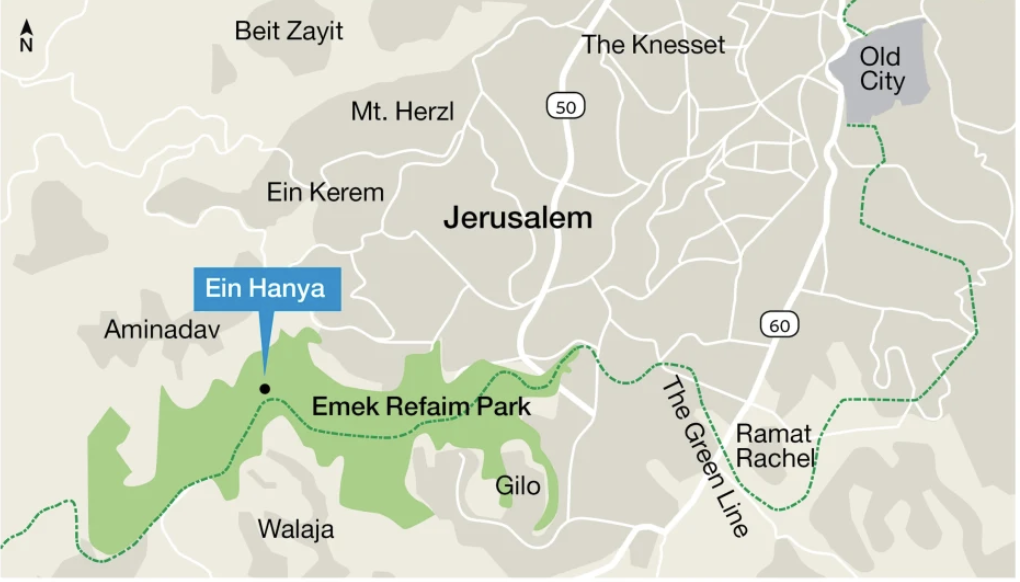
Map by Haaretz
After several delays, on October 15th the Israeli police permitted the Ein Al-Hanya spring to be opened for Israeli visitors on the condition that Palestinians would not be allowed to enter the site. On the first day open, hundreds of Israelis visited the site under the heavy security presence of the Israeli Border Police.
The Ein Al-Hanya spring, which the Jerusalem Municipality first declared a national park and then spent years renovating and millions of dollars into a tourist destination, is located on land historically a part of al-Walajah. Al-Walajah is a Palestinian village that currently finds itself inside of Israel expanded municipal borders of Jerusalem and almost completely surrounded by the Isareli seperation barrier.
Aviv Tatarsky, a researcher for Ir Amim explained Israel’s choice to declare the area a national park:
“Since we are in the territory of Jerusalem, and building another settler neighborhood could cause a stir, they are building a national park, which will serve the same purpose. The national park will Judaize the area once and for all. Gilo is five minutes away. If you live there, you will have a park right next door and feel like it’s yours.”
Haaretz columnists Gideon Levy and Alexx Levac also give a succinct context to Israel’s ongoing theft of Al-Walaja land:
“the story of Walaja, where this absurdity took place, contains everything – except humor: the flight from and evacuation of the village in 1948; refugee-hood and the establishment of a new village adjacent to the original one; the bisection of the village between annexed Jerusalem and the occupied territories in 1967; the authorities’ refusal to issue blue Israeli IDs to residents, even though their homes are in Jerusalem; the demolition of many structures built without a permit in a locale that has no master construction plan; the appropriation of much of its land to build the Gilo neighborhood and the Har Gilo settlement; the construction of the separation barrier that turned the village into an enclave enclosed on all sides; the decision to turn villagers’ remaining lands into a national park for the benefit of Gilo’s residents and others in the area”
Since taking the land under the guise of establishing a national park, Israel has implemented several policies aimed at preventing Palestinians from accessing the spring and surrounding lands, including illegally moving a police checkpoint to further choke off al-Walajah from Jerusalem. As detailed in Haaretz, the plan for the park includes three pools filled by the spring – two for Israelis and tourists, and one for al-Walajah residents to water their crops and flocks. However, that third pool for Palestinians has not been built, and the water “merely spills into the nearby wadi.” The other pools, like the park, are currently empty and fenced off.
FMEP has repeatedly documented various Israeli efforts to seal off al-Walajah from Jerusalem. Residents of al-Walajah have fought the growing encroachment by the nearby Etzion settlement bloc and the Israeli government’s attempt to de facto annex the bloc as part of “Greater Jerusalem.” Ir Amim explains several prongs of this effort, including a particularly unbelievable section of Israel’s separation barrier planned to almost completely encircle the village, to turn its valuable agricultural land into an urban park for Jerusalem, and construction of a highway that will connect the Etzion settlement bloc to Jerusalem with Israeli-only bypass roads.
Friedman Reiterates Promise that U.S. Plan Will Not Require Settlement Evacuations
In an interview on October 16th, U.S. Ambassador David Friedman told Arutz Sheva (a pro-settlement media outlet headquartered in the Ariel settlement) that the U.S. peace plan will not require a single settler to leave his/her home. Friedman said:
“Having seen the experience of the evacuation of Gaza [in the summer of 2005], I don’t believe that there is a realistic plan that can be implemented that would require anyone — Jew or Arab — to be forced to leave their home. We think that’s just a recipe for disaster. It almost caused a civil war on much less aggressive circumstances in Gaza, compared to Judea and Samaria [the West Bank]. And so we are not of the view that any forced evacuations are achievable.”
Friedman’s remarks only reiterate what the Trump policy – as it has been implemented on the ground from day 1 of the administration – has looked like: a full-throated endorsement of the Greater Israel ambitions of ideological settlers.
Bonus Reads
- “There Will Be a One-State Solution” (Foreign Affairs)
Welcome to FMEP’s Weekly Settlement Report, covering everything you need to know about Israeli settlement activity this week.
To subscribe to this report, please click here.
May 31, 2019
- Israel Publishes Tenders for 805 Settlement Units in East Jerusalem; More May Be Coming
- The World Zionist Organization Continues to Finance Illegal Settlement Construction
- Yitzhar Settlers Attack Israeli Police Officers, Again
- Israel Cut-Off & Trapped a Palestinian Family on the Israeli Side of the Wall, Then Banned Them from Entering Israel
- Palestinians React to Latest Annexation Rumors Amidst Israeli Government Chaos
- Florida Governor Leads Headline-Grabbing Trade Delegation to West Bank Settlements
- Scheindlin: Israel’s Democratic Decay is Happening for the Sake of Annexation
- Bonus Reads
For questions and/or comments contact Kristin McCarthy – kmccarthy@fmep.org.
Israel Publishes Tenders for 805 Settlement Units in East Jerusalem; More May Be Coming
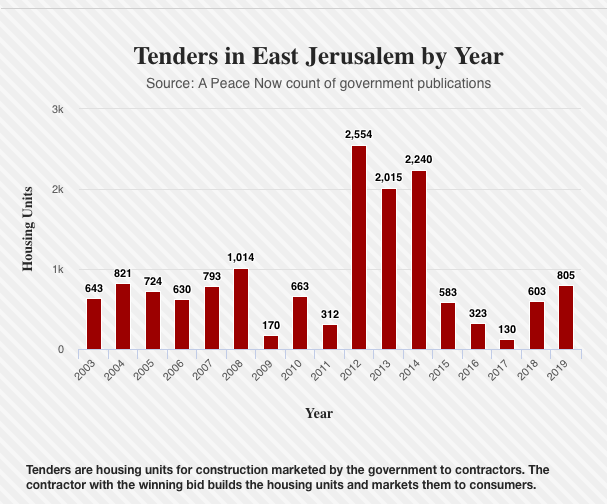 On May 30th, the Israel Land Authority published tenders for a total of 805 new settlement units in East Jerusalem, a decisive step towards the start of construction. The 805 tenders were issued for 345 units in the Ramot settlement and 460 new units in the Pisgat Ze’ev settlement. These are the first tenders published for East Jerusalem settlement construction since April 2018, and collectively are the most tenders published in a single year (let alone simultaneously) since 2014. Moreover, as Jerusalem expert Daniel Seidemann explains, this batch of tenders allows for more construction in East Jerusalem settlements than the government has approved for East Jerusalem Palestinian neighborhoods since Israel gained control of East Jerusalem in 1967.
Furthermore, the Jerusalem settlement watchdog group Ir Amim warns that this batch of tenders may only be the first of an oncoming wave:
“For several years after the collapse of the Kerry initiative in April 2014, there was a significant decrease in the approval of master plans in East Jerusalem and as a result, few tenders were announced. This dramatically changed in 2017 and 2018 with the advancement of master plans reaching near record levels. Today’s tenders are primarily a result of plan approvals from last year, potentially signaling impending large-scale announcements of tenders based on additional plans which have been approved over the last year.”
Peace Now, the veteran settlement monitoring organization, said in a statement:
“Continued construction in East Jerusalem does not contribute to Jerusalem and does not contribute to Israel. As long as we have not reached a permanent agreement with the Palestinians on Israel’s borders, building beyond the Green Line is illegitimate and only harms the prospects for peace and trust between the sides.”
The World Zionist Organization Continues to Finance Illegal Settlement Construction
According to documents acquired by Israel’s Movement for Freedom of Information, over the past two years the Settlement Division of the World Zionist Organization continued to finance illegal settlement construction while simultaneously trying to hide this information from the public.
As a reminder, the Settlement Division is technically part of the World Zionist Organization, but in practice the unit was created by the Israeli government in 1968 and is funded entirely by the Israeli government (and Israeli taxpayers). Its mandate is to manage West Bank land expropriated by Israel, in order to facilitate the settlement of Israeli Jews in the occupied territories. To make this possible, the Israeli government has allocated approximately 60% of all “state land” in the West Bank to the WZO’s Settlement Division [over the past 50 years Israel has declared huge areas of the West Bank to be “state land,” including more than 40% of Area C, where most of the settlements are located]. Together, the WZO and the Israeli government work in coordination to develop West Bank settlements and encourage Jews to move into them, working together so closely that the Settlement Division even splits its real estate profits with the Israeli Housing and Construction Ministry.
According to the WZO’s financial documents for 2017-2018, the WZO subsided settlement projects that are illegal under Israeli law — to the tune of $734,577 USD (NIS 2,668,427).
In addition, the WZO failed to specify how it spent an additional USD $16 million (NIS 58 million) in support of new construction projects, leaving the exact location and legal status of the construction unknown. This represents 43% of the WZO’s overall budget for subsidizing projects.
The settlement projects known to have been subsidized by the WZO in 2017-2018 include:
-
- $640,000 USD (NIS 2,330,973) for the establishment of a community center in the Eli settlement. Though the Eli settlement previously received Israeli government approval, a “Master Plan” – which officially zones land for distinct purposes (residential, commercial, public) – has never been issued for Eli, meaning all construction there is illegal under Israeli law.
- $85,816 USD (NIS 311,736) on projects in the unauthorized Brosh outpost (the Israeli government is advancing a plan that would legalize Brosh retroactively, but until it does, all projects in it are illegal).
- $42,000 USD (NIS 153,127) for infrastructure development in the unauthorized Givat Eitam/E-2 outpost, which according to Peace Now appears had not been transferred as of the end of 2018. FMEP has covered the settlers efforts to establish the Givat Eitam/E-2 outpost and the government’s plan to retroactively authorize it as an official settlement in detail. It is worth recalling that the location of the Givat Eitam/E-2 has dire geopolitical consequences for the fate of the two state solution as well as the development of Palestinian communities just south of Bethlehem.
- $6,000 USD (NIS 22,445) for projects in the unauthorized Mitzpe Kramim outpost. Funding for Mitzpe Kramim over the past two years is particularly galling, given ongoing litigation that has included evidence that the Settlement Division knowingly gave land privately owned by Palestinians to settlers in order to build the outpost.
- $900 USD (NIS 3,273) for renovation of illegal structures in the unauthorized outpost of Haresha. The Israeli government has successfully used the Haresha outpost as a test case for new legal tools the government of Israel developed in order to justify the expropriation of privately owned Palestinian land in order to retroactively legalize outposts. Using these tools, the government has found a way to “legally” build an access road to the settlement through privately owned Palestinian land; once the road is built, there is nothing preventing the government from retroactively legalizing Haresha.
Peace Now said in a statement:
“The Settlement Division is a body that was born in sin immediately after 1967 in order to carry out the dubious works of building settlements for the government. It turns out that even today, after regulating the activities of the Settlement Division, it still operates without transparency and continues to finance illegal activity. The time has come to dismantle the Settlement Division and to restore to the government the governmental activities it has privatized.”
Despite the WZO’s ongoing defiance of Israeli planning and building laws — or perhaps in light of its direct and very effective role in entrenching and expanding the settlements — the Israeli government is actively seeking to transfer more West Bank land to the WZO for management. In the last Knesset session, a government-backed bill to expedite the transfer of more land to the WZO was stalled by the Israeli Attorney General only because the bill, in the view of the Attorney General, was duplicative of his own efforts to enrich the Settlement Division at the administrative level.
Yitzhar Settlers Attack Israeli Police Officers, Again
On May 26th, dozens of masked Israeli settlers violently attacked Israeli police officers who approached an illegal outpost near the settlement of Yitzhar, forcing the Israeli army to intervene in order to get the police officers to safety.
Not a single settler was arrested for the attack.
The event started when Israeli police arrived at the Kippah Sruga outpost in response to calls saying that clashes had broken out between Palestinians and Israelis in the area. According to Israeli police, when they arrived masked settlers began launching stones at them and slashed their car tires with a knife.
Haaretz reporting on this incident reminds readers:
“Over the past several weeks, settlers from Yizhar and surrounding settlements have been involved in several altercations, yet police have not arrested a single suspect. Last week, Israelis and Palestinians reported a field set ablaze and clashes in the Palestinian towns of Burin, Urief and Asira al-Qibliya. In a video disseminated by Asira al-Qibliya’s council, settlers are seen throwing stones at Palestinians, while soldiers nearby do nothing to arrest them. In response to the video, the IDF spokesman said that ‘Palestinians started a fire near Asira al-Qibliya. The IDF, the Border Police and civilian volunteers worked to extinguish the fire, which was spreading towards a military position and the edge of Yitzhar.’ After a B’Tselem video surfaced, showing settlers setting fire to fields, the army revised its response and confirmed that Jewish settlers also took part in setting fires.”
Israel Cut-Off & Trapped a Palestinian Family on the Israeli Side of the Wall, Then Banned Them from Entering Israel
On May 27th, Haaretz published a gut wrenching profile of the Hajajla family who lives on the Israeli side of the separation wall that cut them off from their hometown of al-Walajah, a Palestinian village just south of Jerusalem. Two days after publication of the profile – which FMEP shares in brief below – Israel issued an order banning the patriarch of the family, Omar Hajajala, from entering Israel, though he lives on the Israeli side of the wall in a spot where the route of the wall juts into the West Bank.
Before jumping into the full story, here is a reminder about the situation facing all of the residents of al-Walajah, in the words of Danny Seidemann:
“Walajeh is a village on Jerusalem’s southern flank that is entirely surrounded by the separation barrier. Since 1967, Walajeh’s inhabitants have lived in a Kafka-esque situation, with their village technically located inside Israel’s expanded borders, but with villagers never given Israeli residency (they are considered West Bankers and thus are not permitted inside Jerusalem). As a result, the villagers’ presence in their own village is, under Israeli law, illegal, and their homes there are, by definition, illegal.”
The Hajajla family was the only home in al-Walajah disconnected from the village when the separation barrier was built, leaving the family home on the Israeli side of the wall since 2014. The family refused to abandon their home despite the coercive and legal efforts by Israel to force them to do so. In 2014, after a petition before the High Court of Justice, the Defense Ministry opted to build the family a special passage underneath the barrier so it could reach the village, at a cost $1.1 million USD (NIS 4 million).
After the tunnel was constructed, the Israeli government began to impose new, burdensome, and compounding restrictions on the family regarding its use of the passageway. In 2017, the government decided to install a locked gate at one end of the passageway to control who enters and exits, which could be opened only by a single remote control given to the family. That single remote meant that whenever one member of the family left the home (impossible without taking the remote control with them), the rest of the family was left trapped, literally, until the remote-holder returned.
To make the situation more workable, Omar Hajajla, the family’s patriarch rigged an electric bell near the gate so that the single remote control can stay at the house while family members leave and return (the bell enables someone in the home to know that someone is at the gate needing to be let in). The bell has been in place for over a year, but only recently the Israeli Border police opted to make it an issue. This month, the police took Omar in for questioning and changed the lock so that the family could not open the gate at all. Omar Hajajla was ultimately fined and released, but the lock on the gate remained — until Haaretz filed an inquiry on May 26, 2019.
Omar Hajajla speculates that a recent court ruling in his family’s favor prompted the Israeli Border police to escalate their harassment of the family and make an issue of the bell. About a month ago, the Jerusalem Magistrate’s Court rejected the state’s assertion that the family’s home is illegal – allowing the Hajajla family to stay put.(Note: The state of Israel has initiated demolition proceedings against dozens of homes in al-Walajah claiming that they were built without Israeli building permits – which are next to impossible for Palestinians to obtain, let alone Palestinians on coveted land like al-Walajah) –
In response to the May 27th Haaretz profile, Israeli police stated:
“At issue is a security passage that provides a short passage for the family from their home in Israeli territory to the Palestinian Authority areas. As you can see from the attached video and photos, the gate was shut last Monday to repair security cameras that were broken, to repair damage to the gate and to remove an electric bell that the father of the family had installed against the law, by attaching an unapproved electric wire from his home, a distance of dozens of meters from the passage. After the repair the passage was opened on Wednesday but when the father was seen exploiting it to illegally allow Palestinians to enter it was shut again and the suspect was taken for questioning. The passage was opened again yesterday, but because of a technical problem that was discovered it was shut again and we are working to fix it quickly. The Israel Police will not allow any damage to the security passages it is responsible for and will bring to justice anyone who vandalizes them and tries to harm the State of Israel’s security.”
The treatment of the Hajajla family should be seen in context of Israeli efforts to seal off al-Walajah from Jerusalem. As FMEP has previously reported, residents of al-Walajah have long been struggling against the growing encroachment the nearby Etzion settlement bloc and the Israeli government’s attempt to de facto annex the bloc as part of “Greater Jerusalem.” Ir Amim explains several prongs of this effort, including a particularly problematic section of the separation barrier around al-Walajah that has been planned in order to (a) almost completely encircle the village, (b) turn its valuable agricultural land into an urban park for Jerusalem, and (c) enable construction of a highway that will connect the Etzion settlement bloc to Jerusalem with Israeli-only bypass roads.
Palestinians React to Latest Annexation Rumors Amidst Israeli Government Chaos
Al-Monitor reports reactions from Palestinian leaders who are increasingly fearful that rumors about Israeli annexation of the settlements will be acted upon. Those rumors – as FMEP wrote last week – suggest that Israel will strip the Israel Civil Administration of its authority over the settlements and bring all settlements under Israeli domestic law, making settlement affairs the responsibility of the various Israeli ministries.
Wasel Abu Youssef, member of the PLO Executive Committee in the West Bank, told Al-Monitor:
“Expanding the powers of the Israeli ministries at the expense of the civil administration is an attempt to impose occupation and establish it in the West Bank, to end the [idea of a] two-state solution and prevent the establishment of a Palestinian state, which falls within the framework of denying the Palestinian people their rights to freedom and independence. These efforts mean practically annexing parts of the West Bank to Israel. Unfortunately, this comes with the blessing of the administration of US President Donald Trump, who doesn’t recognize the option of a two-state solution and gives Israel the green light to do whatever it wants in the West Bank.”
Walid Assaf, head of the Colonization and Wall Resistance Commission, told Al-Monitor:
“The efforts to transfer the powers of the civil administration to the Israeli ministries directly mean the annexation of the West Bank settlements to Israel. This will lead to annexing Area C — which amounts to over 60% of the entire area of the West Bank — to Israeli sovereignty…Annexing West Bank settlements to Israel would pave the way for Israel to perpetuate a policy of ethnic cleansing against the Palestinians, and this will push the Palestinians in Area C to migrate to PA-controlled Areas A and B.”
Hanna Issa, an international law professor at Al-Quds University in Abu Dis, told Al-Monitor:
“The Israeli occupation has always been there. It is essential that the Palestinian territories [including the Israeli settlements] remain administered through the civil administration of the Israeli army [in cooperation with the Palestinians] until this occupation ends…“Limiting the powers of this administration and giving its responsibilities to the Israeli ministries is a dangerous step aimed at annexing occupied areas under international law.”
Scheindlin: Israel’s Democratic Decay is Happening for the Sake of Annexation
In a new paper for The Century Foundation, Israeli pollster and political analyst Dahlia Scheindlin writes an important analysis regarding Israel’s path to annexation:
“This report argues that Israel’s slide into illiberal democracy can only be understood as part of an attempt to go beyond military or physical control and establish a political and legal foundation for permanent annexation of both land and people. The assault on Israel’s democratic norms over the past decade initially appeared only indirectly related to a future of permanent annexation, as they suppressed the mechanisms of dissent and undermined the basis for minority rights. Then, in the recent elections, Prime Minister Benjamin Netanyahu made explicit his goal to annex occupied territory in the West Bank, which represented the culmination (to date) of increasingly open policies and legislative initiatives from the previous term that explicitly advance annexation.”
The entire paper is worth reading, and is available online here.
Florida Governor Leads Headline-Grabbing Trade Delegation to West Bank Settlements
From May 25-31, Florida Governor Ron DeSantis led a trade mission – purposefully and prominently also visiting settlements in the West Bank. While on the ground, DeSantis made headlines by blasting BDS, endorsing Israeli settlements, and gloating about Florida’s role in AirBnB’s reversal of its decision to remove rental listing located in Israeli settlements.
DeSantis signed several formal partnerships between Florida universities and Israeli schools, most notably including an agreement between Florida Atlantic University and Ariel University – the first such deal between a U.S. school and an Israeli school located in a settlement. In recognition of the historic deal, Ariel University presented DeSantis with an Honorary Fellowship Award at an event in the settlement, attended by U.S. casino magnates and settlement financiers Sheldon Adelson and Dr. Miriam Adelson. In his acceptance speech, the Governor invoked the Bible to lend his support for Israel’s permanent control of the West Bank, saying:
“We are now in the heart of the Holy Land of Israel. When you think about Israel’s history and the tradition that connects Israel and the U.S., it’s inspiring. On my last visit to Israel in 2014, the U.S. embassy was in Tel Aviv and we were on the verge of signing a destructive agreement with Iran, and I am happy that today we have achieved real progress. We have an American embassy in Jerusalem with an American acceptance of the sovereignty of the State of Israel on the Golan Heights and the agreement with Iran has been removed from the stage of history. I, personally, have fought Airbnb’s discriminatory policy against Jewish-owned properties in Judea and Samaria, and only recently have they changed their discriminatory policy. I say here: BDS has no place in Florida. The memorandum of understanding signed today between the University of Ariel and Florida State University is a blessed agreement that will bring these two institutions forward. I am happy to say that Florida is a very diverse state, but not when it comes to its unequivocal support for the State of Israel.”
U.S. Ambassador to Israel David Friedman also hosted DeSantis for a reception and Israel’s Minister of Public Security Gilad Erdan joined DeSantis on a visit to additional West Bank settlements, this time in Gush Etzion, for a briefing about the fight against BDS. Friedman said:
“Israel has no greater friend in all the 50 governor mansions than Ron DeSantis. I welcome you and the Cabinet members and your delegation to this small but incredibly important country.”
As mentioned by Ambassador Friedman, DeSantis was joined by members of the Florida Cabinet on the trade mission, including Florida Attorney General Ashley Moody and Florida Agricultural Commissioner Nikki Fried. In a controversial move, DeSantis convened a Florida cabinet meeting on May 29th at the Embassy in Jerusalem, despite a lawsuit filed in Florida seeking to stop him from doing so. The lawsuit was filed by a government watchdog group and several news outlets, arguing that convening the Cabinet in Israel violated a state law that requires government meetings to be accessible to the public. The lawsuit was dismissed because the court could not serve paperwork to DeSantis and the other named defendants – who were, obviously, in Israel.
At the Cabinet meeting on may 29th, DeSantis signed a bill to prohibit anti-Semitism in Florida’s public schools and universities. The new law wrongly conflates anti-Semitism with criticism of Israel by including in the definition of anti-Semitism, “drawing comparisons of contemporary Israeli policy to that of the Nazis,” ″blaming Israel for all interreligious or political tensions,” and/or “requiring behavior of Israel that is not expected or demanded of any other democratic nation.”
The next day, DeSantis met with Prime Minister Netanyahu while the larger delegation visited the City of David national park, which is run by the radical Elad settler group.
Bonus Reads
- “Israel’s High Court Seeks Order, Not Justice” (Haaretz)
- “Another Company Withdraws from Israeli Light Rail Project” (IMEMC)
Welcome to FMEP’s Weekly Settlement Report, covering everything you need to know about Israeli settlement activity this week.
To subscribe to this report, please click here.
September 7, 2018
- Israel Advances Plan for New Settlement in East Jerusalem
- Even More East Jerusalem Settlement Plans Advanced
- Israel Demolishes Homes in al-Walajah, Advancing “Greater Jerusalem” Project
- State Admits to High Court it Built Settler Road on Palestinian Private Land
- Prominent Human Rights Activists Arrested While Leading Tour of Hebron Region
- Government Official Claims Jerusalem Cable Car Project Will Benefit Palestinians in Silwan
- BonusReads
Comments, questions, or suggestions? Email Kristin McCarthy at kmccarthy@fmep.org. To subscribe to this report, please click here.
Israel Advances Plan for New Settlement in East Jerusalem
On September 5th, the Jerusalem Local Planning and Building Committee advanced a plan to build a large new settlement enclave (150 units) within yet another Palestinian neighborhood of East Jerusalem. The project – a pet project of Jerusalem settlement financier (and since 2013, Jerusalem city council member) Aryeh King – would be the first-ever authorized settlement project in the Beit Hanina neighborhood of East Jerusalem, located north of the Old City.
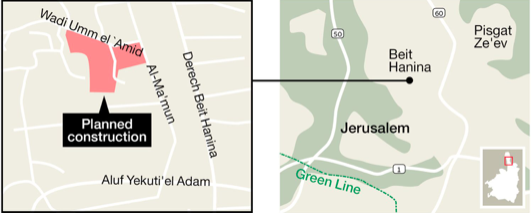
Map by Haaretz
The plan would build housing for approximately 75 settler families (which, based on a conservative estimate, would mean a population of around 500 settlers in Beit Hanina). If built, it would be one of the largest Israeli settlement enclaves inside any Palestinian neighborhood in East Jerusalem.
According to the plan, 75 units units would theoretically be earmarked for Palestinians – a point used by the plan’s supporters to suggest that it is actually benevolent. The key word here, however, is: theoretically. As noted by Jerusalem expert Danny Seidemann in another context:
“Since 1967, the Government of Israel has directly engaged in the construction of 55,000 units for Israelis in East Jerusalem; in contrast, fewer than 600 units have been built for Palestinians in East Jerusalem, the last of which were built 40 years ago.”
In announcing the approval of the plan, Israel’s deputy mayor made clear what part of the plan the Municipality is actually focused on:
“We’re happy to announce today that we’ve approved construction of 150 housing units in Beit Hanina, and especially that 75 Jewish families can now live there.”
Notably, the Jerusalem Local Planning and Building Committee advanced the plan through the first stage of the planning process, despite an objection filed by the private Palestinian company that owns 45% of the land upon which the new units would be built (ownership that the Israeli government tried – and so far failed – to cancel, through efforts to rescind the sale of the land to that company). The Committee explained its decision to ignore the objection by asserting that it was only discussing planning schemes and not ownership issues. The Jerusalem Municipality also weighed in, suggesting that the Palestinian company is too late in asserting its rights, saying that the ownership issue was “examined as part of the examination of the plan’s preconditions.”
Director of the Peace Now Settlement Watch program, Hagit Ofran, rejected that argument, saying:
“this is not a real estate project but a project of defiance and settlement. The fact that Israeli entrepreneurs, who own only half of the land, have prepared a plan without consulting Palestinian owners [of the other half] indicates that they have no intention of coexistence and peace.”
 A handful Israeli settlers already live in Beit Hanina, having directly acquired private property in the heart of the neighborhood. This small group of settlers clearly benefit from the plan, both because it lends legitimacy to their presence in and broader claims to the neighborhood, and because the new project would create a territorial linkage between the new settlement in Beit Hanina and the large ultra-Orthodox settlement of Ramat Shlomo to its south.
The historic nature of the Beit Hanina settlement plan is being hailed by pro-settlement media and activists. The Deputy Mayor of Jerusalem, Yossi Deitch, said, “I hope approval of the units will be the sign and signal that construction in the city will be unfrozen next year throughout the city and for all sectors. I’ll do everything possible to thaw the construction freeze in Jerusalem.”
Israel has increased home demolitions across East Jerusalem, including Beit Hanina, over the past year. In Beit Hanina, many homes are under the threat of demolition because they lack Israeli-issued building permits – permits that Palestinians find all but impossible to secure. Just this week, Israel demolished the Farrah family home in Beit Hanina, built over 16 years ago – despite the fact that the family has spent years attempting to obtain the necessary permits and has paid 250,000 shekel ($69,362) fine to the Israeli government.
Even More East Jerusalem Settlement Plans Advanced
In addition to the Beit Hanina settlement plan, Ir Amim reports that Jerusalem authorities have advanced several other inflammatory settlement projects in East Jerusalem over the past week:
- The Local Planning and Building Committee discussed issuing a permit to retroactively legalize unauthorized settlement construction – several shops and offices – in Silwan, located at the entrance of the settler-run City of David National Park. The buildings were constructed, without permits, under the direction of the radical Elad settler group, which is contracted by the Israel National Parks Authority to run the City of David National Park. As a reminder, Elad’s mission is to establish a permanent Jewish presence in Palestinian neighborhoods of East Jerusalem. The retroactive permit, in addition to legalizing the current buildings, would also allow the group to build an additional story to one of the buildings, to serve a”lookout” point. Demonstrating government collusion with the settlement enterprise in Jerusalem, the permit request was filed by the Israel National Parks Authority, not Elad.
- The Local Planning and Building Committee committee discussed public objections filed against a plan to build a 6-story office building for settlers at the entrance of the Sheikh Jarrah neighborhood. The office building, if approved, would be located adjacent to the site of a planned Jewish religious school to also be built in Sheikh Jarrah – called the Glassman Yeshiva. That school, once it is built, will house dozens of young religious settlers. Together, the two projects will flank the road leading into Sheikh Jarrah and become part of a settlement bridge/corridor connecting the isolated settlement enclaves in the heart of Sheikh Jarrah to West Jerusalem. Ir Amim notes that both settlement projects have been advanced “despite the area being zoned for public buildings for a Palestinian neighborhood sorely lacking in social services.” This latest advancement was anticipated and noted in last week’s Settlement Report.
- The Jerusalem Local Committee advanced two plans to increase the number of new units authorized to be built in the Gilo and Neve Ya’akov settlements. In both instances, the Local Committee discussed plans that increase the number of units permitted to be built under already-approved plans (adding an additional 48 units in both cases, bringing the Neve Ya’akov project to 86 units total and the Gilo project to 148 units total).
Israel Demolishes Homes in al-Walajah, Advancing “Greater Jerusalem” Project
On September 3rd, Israeli officials demolished four buildings in the al-Walajah village, on the pretext that they lack required Israel-issued building permits. Israeli security forces fired tear gas and rubber-coated steel bullets at a crowd of protestors who gathered to try to stop the demolition, injuring several.
The demolitions were in the Ein Juweza neighborhood of the village – an area that is technically located within the municipal borders of Jerusalem (the border runs through the village, leaving the rest of al-Walajah in the West Bank), and therefore subject to Israeli planning and building laws. An additional 189 homes in al-Walajah have demolition orders issued against them.
The lawyer representing al-Walajah residents in this case said,
“The residents’ attempts to submit a master plan [without which it is impossible for residents to even apply for permits to build on their own land] were thwarted by the objection of the state and subsequently, the planning authorities. In this situation of criminal neglect of the village and its residents, the only service the state gives them is ‘home demolition service.’ This is an impossible, illegal situation that contradicts the most minimal fairness.”
Ir Amim reports:
“While refusing to allow building in Walajeh, in the area around the village Israel is promoting construction of thousands of housing units for Israelis on lands – some of which were confiscated from Walajeh – in the settlements of Gilo and Har Gilo. To the north of the village, within the Green Line and on lands that belonged to Walajeh until 1948, a construction plan of over 4,000 housing units is being advanced. These construction plans, together with the national park declared on al-Walajeh land in 2013, are meant to create an Israeli continuum between Jerusalem and the Gush Etzion settlements surrounding Bethlehem. This morning’s demolitions in Walajeh are an inherent part of the policy to transform this area into an Israeli space.”
As FMEP has previously reported, residents of al-Walajah have long been struggling against the growing encroachment the nearby Etzion settlement bloc and the Israeli government’s attempt to de facto annex the bloc as part of “Greater Jerusalem.” Ir Amim explains several prongs of this effort, including a particularly problematic section of the separation barrier around al-Walajah that has been planned in order to (a) almost completely encircle the village, (b) turn its valuable agricultural land into an urban park for Jerusalem, and (c) enable construction of a highway that will connect the Etzion settlement bloc to Jerusalem with Israeli-only bypass roads.
State Admits to High Court it Built Settler Road on Palestinian Private Land
The Israeli government admitted to the High Court of Justice that it cut and paved a road on land that is privately owned by Palestinians in the South Hebron Hills. The State claimed it did so by mistake, believing the land in question, which had been included in construction plan for the settlement of Shima – despite the fact that Palestinian owners objected as soon as construction started in 2015. Even after the objections were lodged against the construction, Israeli authorities took months before issuing a stop work order, allowing the road to be completed/paved in the meantime.
In the brief submitted this week, the State asked the High Court to dismiss the case regarding the road, explaining that the Civil Administration had already taken action to correct the borders of the Shima settlement to, in effect, return the land to is owners (now paved with a road for the settlers). The State says that action was prompted in 2015 when the Civil Administration “Blue Line” team released new mapping of the area, which clarified that the land is indeed privately owned by Palestinians.
Commenting on the story, a spokesperson for Rabbis for Human Rights told Haaretz:
“The state acted like the ‘hilltop youth’ [a radical settler group]. You can’t explain this away using the excuse of an innocent mistake, given that even after our warnings it took a long and embarrassing legal procedure to get them to do the obvious: check who actually owns the land.”
Prominent Human Rights Activists Arrested While Leading Tour of the Hebron Region
Israeli security forces arrested three prominent human rights activists while they were leading a sizeable group on a tour of settlements and outposts in the Hebron/South Hebron Hills area. Avner Gvaryahu (Executive Director of Breaking the Silence), Michael Sfard (a prominent Israeli human rights lawyer), and Achiya Schatz (Communications Director for Breaking the Silence) were released after three hours of detention.
The men were arrested near the Mitzpe Yair outpost in Hebron, the same spot where activists from Taayush – “Israelis & Palestinians striving together to end the Israeli occupation and to achieve full civil equality through daily non-violent direct-action” – were violently attacked by settlers the previous week, with at least four wounded seriously enough to be evacuated to for medical treatment. In that attack, IDF soldiers reportedly stood by and did nothing (and in its aftermath, the Israeli government and senior officials, including Netanyahu, said nothing).
Breaking the Silence related the events, saying:
“As we drove up the road leading to the outpost, we were blocked by a Border Police jeep. Within minutes, we were presented with a ‘closed military zone’ order, signed by the brigade commander. We were given one minute to evacuate a group of 120 participants, some of whom weren’t so young. When we asked for more time to get everyone on the buses, the arrests started. As was reported in the media, the arrests were aimed at the leaders of the tour, which reinforced our suspicion that they were initially meant to sabotage the tour….Upon arriving at the police station, Avner, Achiya, and Michael had been told that they were in fact not arrested but rather detained, and that there was no immediate need for investigations or arrests. They were then told to return in a month and a half for further investigation.”
The group’s email to supporters ends:
“we refuse to cave in to settler violence and to surrender to their intimidation, incitement, and violence directed against those who oppose the immoral reality of the occupied territories.”
Government Official Claims Jerusalem Cable Car Project Will Benefit Palestinians in Silwan
On September 5th, the Society for the Protection of Nature held a public forum to discuss the planned cable car project in Jerusalem, which is slated to have its final stop at the settler-run Kedem Center in Silwan. The Kedem Center is a project of the radical Elad settler group, which works to settle Jewish Israelis inside Palestinian neighborhoods of East Jerusalem.
Sami Arsheid, a lawyer representing Palestinian residents of Silwan (who will be deeply impacted by the project), attended the town hall event to raise their concerns. Arsheid said that Palestinians had not been consulted and noted that the invitation to the meeting was written in Hebrew only.
A Israeli government official responsible for planning the cable car project, Aner Ozeri, stressed how the project will ease movement and alleviate transportation pressures, and insisted that the project will, in fact, benefit Palestinian residents of Silwan. Even if that claim turns out to be true, it glosses over the fact that, assuming the most benign intent, the Israeli government is engaging in planning in Silwan that rejects/ignores the views of the vast majority of the residents (i.e., the only residents of Silwan whose voices are listened to in this process are the settlers). Moreover, in the case of this plan the intent, entirely unhidden by planners, is by no means benign: the purpose of the cable car project has nothing to do with the interests of Palestinian residents – rather, its purpose is to facilitate tourist visits to Jewish sites in East Jerusalem, in a manner that prevents tourists from seeing or encountering Palestinians.
The meeting was also attended by government officials tasked with explaining and defending the project, as well as architects, academics, preservation experts, and tourism professionals who criticized the plan on a myriad of bases – mostly highlighting how the project will damage the historic landscape of Jerusalem.
Bonus Reads
- “In West Bank Settlements, It’s a Bull Housing Market” (Haaretz)
- “Israeli right wing party aims at one million settlers” (Al-Monitor)