Welcome to FMEP’s Weekly Settlement & Annexation Report. To subscribe to this report, please click here.
September 19, 2025
- Israel Advances Plans for 1,276 New Settlement Units
- Israel Tells PA It Will Act Unilaterally on Al-Ibrahimi Mosque/Cave of the Patriarchs in Hebron
- Escalating Attacks, Violence, Dispossession and Takeover in Ramallah Area
- U.S. Secretary of State Attends Settler Archaeology Event in Silwan
- Bonus Reads
Israel Advances Plans for 1,276 New Settlement Units
The Israeli Civil Administration’s Higher Planning Council met on September 17th and advanced plans for the construction of 1,276 new settlement units in the West Bank.
The approved plans include:
- Elaazar: 66 new settlement units
- Ma’ale Amos: 371 new settlement units
- Ariel: 280 new settlement units
- Gitit: 281 new settlement units
- Avigail – 278 new settlement units were approved for deposit. Avigail was an illegal outpost until 2023, when the Israeli government afforded it official recognition along with nine other outposts.
- Plans for a new industrial zone in the Omerim settlement were authorized for deposit.
Israel Tells PA It Will Act Unilaterally on Al-Ibrahimi Mosque/Cave of the Patriarchs in Hebron
Peace Now reports that on September 15th the Israeli Civil Administration finalized an order that seizes, for the first time, space inside the upper prayer floor in the Al-Ibrahimi Mosque/Cave of the Patriarchs in order to erect a new roof over the inner courtyard. This was all done over the objections of the Palestinian Authority, which violates agreements for managing the site set out in the 1997 Hebron Protocol, which assigns planning and construction authority at the site to the Palestinian Authority. According to the settler-run Arutz Sheva outlet, the Civil Administration informed the PA about the order and insisted that the status quo arrangement is still in affect.
Peace Now reports further detail:
“The expropriation order was made possible after the Defense Ministry’s legal advisory office, recently reshaped under Minister Bezalel Smotrich, approved it. While presented as a technical step regarding an open space, in reality it constitutes a major structural change to a historic religious site, and another stage in the erosion of the fragile arrangements that safeguard access and worship at holy places. This process began four years ago, when Israel constructed an elevator at the site, despite significant public opposition, including from Israelis, and after a prolonged legal battle.”
The upper prayer hall of the Tomb of the Patriarchs contains the tombs of six religious figures: Abraham, Isaac, Jacob, Sarah, Rebecca, and Leah, alongside a Muslim prayer area. The open courtyard at its center connects the tombs and worship spaces. The existing structure was built during the Mamluk period (13th–16th centuries), on foundations dating back to Herod’s time in the 1st century BCE.
The annexationist government is playing with fire and with the security of us all. The Cave of the Patriarchs is regarded as the fourth holiest site in Islam, following Al-Aqsa Mosque, and any unilateral change is perceived by millions of Muslims as a humiliation and an attack on a sacred place. Documents recently exposed by intelligence services revealed the central role that messianic provocations on the Temple Mount — backed by the government — played in Hamas’s preparations for October 7. The government is dragging us into a religious war in the name of a messianic fringe. Anyone who truly cares about the Cave of the Patriarchs should seek an agreement with the Palestinians that would allow for consensual changes to holy sites, with the consent of all parties involved.”
Escalating Attacks, Violence, Dispossession and Takeover in Ramallah Area
The areas surrounding Ramallah have been increasingly volatile as settlers terrorize villages on the outskirts of the Palestinians’ de facto capital city.
Settlers attacked the village of Jaba’ on September 13th, just the latest in a long line of attacks since the settlers established an illegal outpost nearby in February 2025. Palestinians report setting up a night watch because of the regularity of settler arson attacks on their homes, lands and livestocks. The IDF has demolished the outpost six times, but settlers are not prevented from reestablishing it – which they do.
Last week settlers clashed with Palestinians near Deir Jarir, located northeast of Ramallah, during which a 21-year old Palestinian was shot and killed (either by settlers or an IDF soldier, reports are disputed).
The week before, settlers attacked the village of Atara, setting vehicles on first and spraying hateful graffiti.
U.S. Secretary of State Attends Settler Archaeology Event in Silwan
 On September 16th, U.S. Secretary of State participated in a private ceremony inaugurating a new section of the “Pilgrim’s Road,” the excavation of which is a settler-run project in the Silwan neighborhood of East Jerusalem, located in the shadow of the Old City. Rubio’s visit lends U.S. support for state-backed settler domination over the Silwan neighborhood, where settlers have conspired with the state to weaponize archaeology as a tool for mass displacement of Palestinians.
Indeed, the Pilgrim’s Road runs under the homes of residents in Silwan, and according to Emek Shaveh:
“The gradated street (no. 10 on the map) was dug as a tunnel by the Antiquities Authority and it is part of the Israeli governments’ Shalem Plan which is intended to strengthen Israeli presence in the Old City basin through extensive tourism development and archaeological excavations in Silwan and the Old City….The use of archaeology by Israel and the settlers as a political tool is a part of a strategy to shape the historic city and unilaterally entrench Israeli sovereignty over ancient Jerusalem. It is a process which is likely to produce devastating results for both Israel and the Palestinians. It is inexcusable to ignore the Palestinian residents of Silwan, carrying out extensive excavations of an underground city and to use such excavations as part of an effort to tell a historic story that is exclusively Jewish in a 4,000 year-old city with a rich and diverse cultural and religious past.”
Fakhri Abu Diab, an activist from Silwan, said told Al-Monitor:
“This act by the United States gives the green light for more settlement expansion, demolitions, ethnic cleansing, and all the practices carried out by Israel.”
Bonus Reads
- “Israel Demolishes Palestinian Village Attacked by Settlers in West Bank” (Haaretz, 9/18/25)
- “How Israel’s Education Minister Is Using School Trips to Push a Far-right Agenda” (Haaretz, 9/15/25)
- “‘An Imposition of a Political Stance’ Israeli Principals Slam Plan to Give More Funding to West Bank School Trips Over Domestic Trips” (Haaretz, 9/17/25)
- “Oscar-winning Palestinian director Basel Adra says his home in West Bank raided by Israeli soldiers” (AP, 9/14/25)
- “EU Proposes Sanctions on Israel: Suspending Trade Benefits, Targeting Far-right Ministers” (Haaretz, 9/17/25)
- “In the West Bank, Trump Is Not Standing in Israel’s Way” (New York Times, 9/19/25)
- “Editorial: Israel’s ‘Real Estate Bonanza’ Involves Wiping Gaza Off the Face of the Earth” (Haaretz, 9/19/25)
- “EU Proposes Sanctions on Israel: Suspending Trade Benefits, Targeting Far-right Ministers” (Haaretz, 9/17/25)
- “Ambassador Huckabee receives honorary Samaria citizenship” (Arutz Sheva, 9/17/25)
Welcome to FMEP’s Weekly Settlement Report, covering everything you need to know about Israeli settlement activity this week.
To subscribe to this report, please click here.
February 24, 2023
- With New Powers Given to Smotrich, Israel Annexes the West Bank (Even Without a Formal Declaration)
- Final Hearing on E-1 Settlement Set for March 27th
- Israel Advances More than 7k Settlement Units & Establishes 4 More New Settlements
- U.S.-Brokered Compromise at the UN: Bibi Makes – and then breaks – Promises to Biden Admin on Settlements, Outposts, Raids, and Demolitions
- Multiple East Jerusalem Evictions Expected in March
- New Report: Displacement via Bureaucracy in East Jerusalem
- Bonus Reads
With New Powers Given to Smotrich, Israel Annexes the West Bank (Even Without a Formal Declaration)
On February 23rd, Netanyahu reached a deal to change the way Israel exercises authority over the West Bank. This new arrangement represents the extension of Israeli civilian/domestic authority over the entire West Bank. As such, it represents Israeli annexation of the West Bank, even without formal declaration of annexation.
Specifically: from 1967 until this week, the Minister of Defense was the de facto sovereign in the West Bank, with total authority over matters related to both Palestinians and settlers. With the deal reached this week, authority in the West Bank will now be split between Defense Minister Yoav Gallant and Finance Minister Bezalel Smotrich (acting in his capacity as a “Minister in the Defense Ministry”).
While the agreement takes pains to leave a tiny amount of power over West Bank civilian affairs with the Defense Minister in order to maintain a thin veneer of compliance with international law (the only authority left to Gallant with respect to “civilian” affairs will be to demolish illegal settler activity “in case of security and irregular events,” and even then, Smotrich must be given advance notice of any such demolition), in effect Smotrich will become the new reigning sovereign over the West Bank. According to the deal, he will exercise his authority via the establishment of a new “Settlement Administration” within the Defense Ministry, that he will lead (and appoint his own deputy to assist in leading). This “Settlements Administration” will enjoy virtually total autonomy and unchecked power, with almost no accountability to anyone in the Israeli Ministry of Defense (Gallant in principle can overrule Smotrich’s decisions but must put his reasoning in writing after first meeting with Smotrich to hear his case, and even then, Gallant cannot issue any order to overrule Smotrich). Importantly, the agreement allows Smotrich to systematically apply Israeli law over the settlements.
Itay Epstein, a lawyer of humanitarian law and senior advisor to the Norwegian Refugee Council, explains the totality and impact of Smotich’s powers:
“Spatial planning in the West Bank will come under the authority of the Minister [Smotrich], including authority over the High Planning Council, responsible for establishing and expanding settlements as well as considering Palestinian spatial plans and permit applications in Area C…All matters related to the regularization of “informal” settlement outposts and satellite neighborhoods will come under the sole authority of the Minister, who can endorse 147 such outposts most disruptive to a contiguous future Palestinian State…The [Civil Administration] Enforcement Unit, responsible for the destruction of Palestinian-owned structures built in Area C, as well as the seizure and destruction of donor-funded humanitarian relief, will come under the sole authority of the Minister…The Minister will have the authority to declare new ‘natural reserves’, a primary tool in the appropriation of Palestinian land (in areas A through C) and exclusion of Palestinians from land use across the entire West Bank…All matters related to housing, land, and property rights, including land ownership settlement, surveying, and registration, will come under the sole authority of the Minister. This is the primary tool for expropriating land, and abrogating Palestinian ownership claims…The planning and implementation of infrastructure across the West Bank (areas A through C) will come under the exclusive authority of the Minster, including surface roads, water and sanitation, energy and renewable energy, telecommunications, and waste management.”
Renowned Israeli lawyer Michael Sfard tweets:
“this is a dramatic change in the structure of governance over the occupied territory. Very broad administrative authorities pertaining to the majority of the governing powers in the West Bank are being transferred into hands that are not of the military commander of the occupied territory. From now on, those powers will be held by the minister in the Ministry of Defense, who will de facto serve as the governor of the West Bank…
International laws of belligerent occupation state that an occupied territory will be temporarily administered by the occupying force (that is, the army) which, along with security considerations, will be obligated to promote the interests of the occupied people. Transferring powers to Israeli civilian hands is an act of de jure annexation because it entails removing power from the occupying military and placing it directly in the hands of the government – this is an expression of sovereignty. The bottom line is that the agreement signed today is simultaneously a giant leap of legal annexation of the West Bank and an act of perpetuating the regime’s apartheid nature.”
Further, the agreement attempts to clarify and carefully craft the new, divided chain of command, which – in the end – creates incredible confusion. This confusion is a feature, not a bug, enabling Gallant and Smotrich to publicly, and disingenuously, to claim that the West Bank remains under the administration of the Israeli army as a separate regime from that of the Israeli state, and to assert that “nothing in this document changes the legal status of the West Bank, the laws applied within, or the government’s authority over it.”
On this argument, Sfard comments:
“The agreement includes two clauses aimed at obfuscating the transfer of powers by presenting the governor’s alleged subordination to the Minister of Defense, but according to the document, the cases in which the Minister of Defense can override the governor are extreme cases and even when this is done, the military commander of the West Bank will be bypassed, as he no longer holds authority.
The agreement also states that the governor will work to deepen the powers of the Israeli governmental authorities in the areas of Israeli settlements a process which will promote the unification of government powers and geographically expand their direct legal authority in the West Bank. Or, in other words: stretching Israeli sovereignty beyond the Green Line. The agreement also states that the governor will lead a process of expanding the dual legal system so that Israeli legislation by the Knesset will be applied more fully than it is today to the Israelis in the West Bank.”
In addition, in trying to manage the egos of Smotrich and Gallant – and prepare for inevitable disagreements – the agreement makes Prime Minister Netanyahu the ultimate arbiter of disputes between the two, in effect doubling down on the de facto annexation by giving the Prime Minister authority over decisions military decisions related to West Bank civilian governance.
Final Hearing on E-1 Settlement Set for March 27th
On March 27th, a subcommittee of the Higher Planning Council will convene to discuss objections to the E-1 settlement plan — a final step in the approval of the plan. Final consideration of the E-1 plan has been delayed several times, most recently in September 2022, due to international opposition to the plan. The E-1 settlement is slated to be built in the West Bank on land abutting the border of Jerusalem to the northeast, and is considered by the international community to be a “doomsday” settlement, in what its construction would mean for the two-state solution.
This upcoming meeting promises to be a decisive one for the long-pending E-1 plan, and could very well result in the Committee – which is now under the authority of longtime settler advocate Bezalel Smotrich – granting final approval to the highly contentious plan. Barring intensive outside pressure, additional postponement of the hearing seems highly improbable, given the Israeli domestic politics and the upcoming national election.
As a reminder: in its current form, the E-1 plan provides for the construction of 3,412 new settlement units on a site located northeast of Jerusalem. The site is home to several Palestinian bedouin communities, comprising 3,000 people, including Khan al-Ahmar, which Israel has already undertaken to forcibly displace (many attempts). Long called a “doomsday” settlement by supporters of a two-state solution, construction of the E-1 settlement would sever East Jerusalem from its West Bank hinterland, preventing East Jerusalem from ever functioning as a viable Palestinian capital.
E-1 would also cut the West Bank effectively in half, isolating the northern West Bank from the southern West Bank and foreclosing the possibility of the establishment of a Palestinian state with territorial contiguity. Israel’s “answer” to this concern has long been to argue that Palestinians don’t need territorial contiguity, and that new roads can instead provide “transportational continuity.” To this end, Israel has already built the so-called “Sovereignty Road” – a sealed road that enables Palestinians to pass through, but not to enter, the E-1 area. That road is wholly under Israel’s control (meaning Israel can cut off Palestinian passage through it at any time). In January 2021, then-Prime Minister Netanyahu promised to increase funding for the “Sovereignty Road” as part of the drive to get E-1 built. Further, Netanayhu also recently pitched a room of French investors on a vision to build high speed tunnels throughout the West Bank to accomplish this task.
And another reminder: there have been attempts to promote the E-1 plan since the early 1990s, but due to wall-to-wall international opposition, the plan was not advanced until 2012, when Netaynuahu ordered it to be approved for deposit for public review (a key step in the approval process), ostensibly as payback for the Palestinians seeking recognition at the United Nations. Following an outcry from the international community, the plan again went into a sort of dormancy, only to be put back on the agenda by Netanyahu in February 2020, when he was facing his third round of elections in the two years. Also, as a reminder: under the Trump Plan (which the Biden Administration has yet to comment on), the area where E-1 is located is slated to become part of Israel.
Israel Advances More than 7k Settlement Units & Establishes 4 More New Settlements
Over the course of two days (Feb 22-23, 2023), the Israeli High Planning Council advanced plans for 7,287 new settlement units. With these approvals, Israel has advanced more plans in 2023 (7,287 units) than in 2022 (4,427 units) or 2021 (3,645 units).
In addition, during this same period the Council granted retroactive legalization to three outposts while advancing plans for the retroactive legalization of a fourth outpost. The Council’s decision to legalize (under Israeli law) these outposts comes in addition to the ten outposts “legalized” by the Israeli Security Cabinet last week — meaning that in less than 2 weeks the new Israeli government has (so far) approved the establishment of 14 new settlements.
Three of the four outposts legalized by the High Planning Council this week were authorized as “new neighborhoods” of existing settlements, but in reality these outposts – which are not contiguous with the built-up area of existing settlements – are new settlements. The outposts granted authorization by the Higher Planning Council are:
- Mevo’ot Yericho (181 units granted final approval) – which was authorized by the Security Cabinet over a year ago, but is only now receiving final approval for its master plan from the Higher Planning Council. This outpost is located near Jericho in the Jordan Valley. Peace Now reports that the outpost currently has 60 units built, so the approval of this plan triples the size of the settlement.
- Pnei Kedem (120 units granted final approval), authorized as a new neighborhood of Metzad settlement, located northeast of Hebron. This plan will triple the size of the existing outpost.
- Nofei Nehemia (212 units granted final approval, most of which were already built illegally), authorized as a neighborhood of the Rehelim settlement (which itself was once an outpost granted retroactive legalization), located south of Nablus. Importantly, the Nofei Nehemia outpost is separated from the Rehelim settlement by Route 60 – the major north-south highway in the West Bank.
- Netiv Ha’avot (433 units, approved for public deposit), authorized as a neighborhood of the Elazar settlement. Should this plan receive final approval, the government will have handed settlers not one but two new settlements as compensation for the demolition of 14 units in the Netiv Ha’avot outpost that were built partially on privately owned Palestinian land..
At the last minute, the committee decided to delay its consideration of a plan that would have “legalized” the Zayit Ra’anan outpost. That plan outlines 189 units to be authorized as a “neighborhood” of the Talmon settlement, located north of Ramallah. Peace Now reports this plan was put on the agenda “almost out of nowhere” and that there are only a few caravans at this outpost currently.
In addition to authorizing four new settlements, the Higher Planning Council also:
- Granted final approval for the construction of 1,900 units
- Approved plans for 5,257 units for public deposit.
Peace Now notes that these plans include the retroactive authorization of approximately 1,000 units which settlers have illegally built in settlements. For Peace Now’s data table tracking these approvals, please see here.
As a reminder, the High Planning Council is a body with the Defense Ministry’s Civil Administration, which is now under the control of Finance Minister Bezalel Smotrich, in his capacity “Minister in the Defense Ministry” who in that role now enjoys virtually total control over civilian/settlement matters in the West Bank (see the first section of this report for details).
Peace Now said in a statement:
“The Israeli government is carrying out in full swing an act of annexation of the occupied territories. Just as the judicial coup that the government is advancing is an existential threat to Israeli democracy, so too is this annexation. Advancing the construction of thousands of housing units in the settlements and authorizing 15 outposts within a week are acts of de facto annexation. Building settlements in the occupied territories is a war crime, and annexation without granting citizenship to Palestinians is considered a crime of apartheid. These actions are directed first and foremost against the Palestinians and are with the intention to prevent the establishment of a future Palestinian state by means of taking control of Area C.”
U.S.-Brokered Compromise at the UN: Bibi Makes – and then breaks – Promises to Biden Admin on Settlements, Outposts, Raids, and Demolitions
This week, the United States succeeded in convincing the Palestinian leadership to forgo its push for a Security Council vote on a resolution condemning Israel’s settlement activity, and instead settle for an exceedingly weak statement on the matter signed by the UN Security Council, including the United States.
In exchange for this significant downgrade of international action, Israel reportedly promised that it would not authorize any additional settlement plans or outpost legalizations for some time, with some outlets suggesting Israel committed to a six-month reprieve. This pause, of course, did not stop Israel from advancing 7,000+ plans this week, including the creation of 15 new settlements.
Israel further agreed to pause its concerted efforts to demolish and evict Palestinians from their homes in East Jerusalem and Area C of the West Bank, and to reduce military incursions into Palestinian cities. This of course did not stop Israel from conducted a massive mid-day raid into the old city of Nablus this week – killing 11 Palestinians, included a teenager and three elderly. Over one hundred Palesitians were hospitalized, including an 11-year old who was shot in the leg and got shrapnel wounds to his liver, all while going to the market to get a sandwich. Lastly, press reports that Israel committed to several economic measures to help the Palestinian Authority, including increasing tax revenues.
The U.S. also promised to invite Palestinian Authority President Mahmoud Abbas to the White House, and committed to submitting a request to Israel to reopen the U.S. Consulate in Jerusalem.
On February 20th, the UN Security Council released its statement, which did not strongly condemn Israeli settlement activity – only expressed “deep concern and dismay” at Israel’s recent settlement approvals. Instead, the statement called on all sides to deescalate and condemned acts of violence by all parties.
Notably, this is the first time in eight years the Security Council has produced a formal product related to Palestine, wit the last action being the 2016 resolution on settlements (which the U.S. abstained from). Palestinian diplomat Riyad Mansour told the Washington Post that 14 out of 15 members of the Security Council supported the draft resolution, clearly intimating the United States is the sole reason the resolution was dropped in favor of a statement.
Multiple East Jerusalem Evictions Expected in March
Ir Amim reports that there are four pending eviction cases threatening to displace 150 Palestinians in early March, coinciding with the holy month of Ramadan. Those cases, summarized by Ir Amim, are:
- Gaith-Sub Laban Family, Muslim Quarter, Old City – the family of veteran Ir Amim staff member, Ahmad Sub Laban, faces eviction…on March 15 following the Supreme Court’s decision to deny their request to appeal. All legal remedies have been exhausted, and hence the family is at risk of immediate eviction. Save for state intervention, there is no further recourse to prevent their displacement.
- Shehadeh Family, Batan al-Hawa, Silwan – The District Court ruled to evict the family by March 1. A request to appeal to the Supreme Court is currently pending.
- Salem Family, Um Haroun, Sheikh Jarrah – A decisive administrative hearing on their pending eviction is scheduled for March 9 at the Enforcement and Collections Authority. If authorized, the eviction could potentially be carried out by the end of March.
- Dajani, Daoud, Hammad Families, Kerem al Jaouni, Sheikh Jarrah – a Supreme Court hearing on their appeal is scheduled for March 29. While a similar ruling is expected to that of the one handed down last year in the cases of four other families from the neighborhood, the outcome is still not definitive.
For a deep dive into the legal cases of each family, please see Ir Amim’s comprehensive reporting.
As a reminder, Netanyahu has reportedly promised the United States that it will suspend evictions for a few months. However, Israel made several other promises the United States that it has already violated – including the legalization of more outposts and provocative, violent military actions in the West Bank.
Ir Amim writes:
“Evictions of Palestinian families and settler takeovers of their homes have increasingly been used as a strategy to cement Israeli hegemony of the Old City Basin, the most religiously and politically sensitive part of Jerusalem and a core issue of the conflict. These measures are reinforced by a constellation of settler-operated tourist sites, which together serve to alter the character of the space and forge a ring of Israeli control around the area. This creates an irreversible reality on the ground that deliberately subverts efforts towards an agreed political resolution on Jerusalem. Moreover, such actions severely violate the individual and collective rights of Palestinians in the city and contravenes International Law, while carrying an acute humanitarian impact on the affected families. Since the eviction claims are based on inherently discriminatory laws, the legal recourse is limited. The political nature of these measures hence requires state intervention as a result of concerted engagement.”

New Report: Displacement via Bureaucracy in East Jerusalem
In a new report, Who Profits explains how Israel – following its illegal annexation of East Jerusalem in 1967 – has weaponized government bureaucracy in order to expand settlement and displace Palestinians. Who Profits zooms in on two key levers of power that Israel wields to achieve these goals: land registration and residency permits.
On land registration, Who Profits provides an explanation of the history, the mechanisms, and the consequences of land registration on Palestinian. The entire report, but especially this section, is worth reading closely because it unpacks how the land registration process works. Who Profits explains the scale of potential harm involved:
“Around 90% of land in East Jerusalem (30% of all land in the city),31 was never registered, as Israel froze all land registration proceedings until the launch of this formal land drive in 2018. Although framed as part of a larger package to uplift East Jerusalem and its Palestinian inhabitants’ socio-economic conditions and development, land registration is a key part of Israel’s larger geopolitical agenda of Judaizing and strengthening Israeli governance on the ground, through which it can entrench “sovereignty over East Jerusalem,” as succinctly articulated by the then Minister of Justice, Ayelet Shaked. According to the Civic Coalition to Defend Palestinian Rights in Jerusalem, the land registration process may lead to the confiscation of around 60% of Palestinian land and mass Palestinian dispossession, in violation of international law.”
On residency rights, Who Profits digs into Israel’s “center of life” policy, under which Palestinians may lose their Jerusalem residency if the State believes that an individuals “center of life” is outside of the city. Who Profits writes: “The process imposed by the Israeli Ministry of Interior on Palestinians in Jerusalem to prove that Jerusalem is their “center of life” is deliberately convoluted, draconian, and time-consuming, functioning as an additional means to surveil Palestinian Jerusalemites’ everyday lives and ultimately push them out of their city.” Who Profits profiles three private companies which Israel has contracted with to conduct investigations in Palestinians lives, to support the revocation of residency rights.
This new Who Profits reports dovetails perfectly with the recent legal analysis “A Theory of Annexation” which examines how the Israeli state is similarly using bureaucracy to annex the West Bank. So, whether the goal be displacement or annexation, bureaucratic enforcement is clearly a major tool and tactic to achieve it.
Bonus Reads
- “Police arrest 5 settlers over clash with IDF soldiers, torching of Palestinian car” (The Times of Israel)
- “The White House Is Still Whitewashing Israel’s West Bank Settlement Project” (Haaretz)
- “Why Israel’s goal of pacifying the Palestinians is failing” (+972 Magazine)
Welcome to FMEP’s Weekly Settlement Report, covering everything you need to know about Israeli settlement activity this week.
To subscribe to this report, please click here.
February 17, 2023
- Israeli Government Announces Massive Settlement Expansion/De-Facto Annexation, Part 1: The Big Picture
- Israeli Government Announces Massive Settlement Expansion/De-Facto Annexation, Part 2: “Legalization” of Outposts
- Israeli Government Announces Massive Settlement Expansion/De-Facto Annexation, Part 3: Thousands of New Settlement Units
- Israeli Government Announces Massive Settlement Expansion/De-Facto Annexation, Part 4: International Responses
- Cabinet & Knesset Advance Bill to Repeal Parts of 2005 Disengagement, Reestablish Four Settlements Including Homesh
- Smotrich’s Plans to Take Over the West Bank
- Settler Olive Orchard & New Outpost Are Dismantled by Government, Causing Coalition Fight
- Settler Groups Convene Workshop on Jordan Valley Annexation
- Bonus Reads
Israeli Government Announces Massive Settlement Expansion/De-Facto Annexation, Part 1: The Big Picture
On February 12th, the Israeli Cabinet announced the single largest batch of settlement approvals in the past decade (and the first settlement announcement in more than a year). In announcing this huge wave of settlement activity, the Cabinet said it was doing so in response to a recent spate of Palestinian attacks on Israelis, most recently a car ramming attack in East Jerusalem.
As detailed below, the numbers of new settlement units and newly legalized outposts involved in this announcement are huge, but those numbers only tell a part of the entire story. With these approvals Israel is also laying the groundwork for massive infrastructure projects for the benefit of settlers and further entrenchment of Israeli security to protect these investments.
Moreover, there is no reason to believe this massive announcement is the end of the story with respect to new settlement approvals; it should be recalled that key members of the Security Cabinet – specifically Ben Gvir and Smotrich – reportedly pressed for an even bigger batch of settlement advancements, including the legalization of 77 outposts and approval of 14,000 new settlement units. The February 12th approvals will only whet the appetite of these ministers for more – and given the ongoing escalation of violence on the ground, there is every likelihood that future attacks against Israelis will be used as pretexts for meeting their demands.
Israeli Government Announces Massive Settlement Expansion/De-Facto Annexation, Part 2: “Legalization” of Outposts
In its Feb 12th decision, the Israeli Cabinet directed the relevant ministries to carry out the necessary steps to grant retroactive legalization to ten outposts located across the West Bank. In order to be fully legalized under Israeli law (but not under international law, according to which it is illegal for an occupying power to establish any civilian settlement/colony in any territory it is holding under military occupation is illegal) these outposts will need to have the status of the land clarified, then have a building plan completed, and then go through a 5-step approval process. Finance Minister Bezalel Smotrich made clear he intends to radically simplify and speed up this process when/if he is able to take control over West Bank planning bodies.
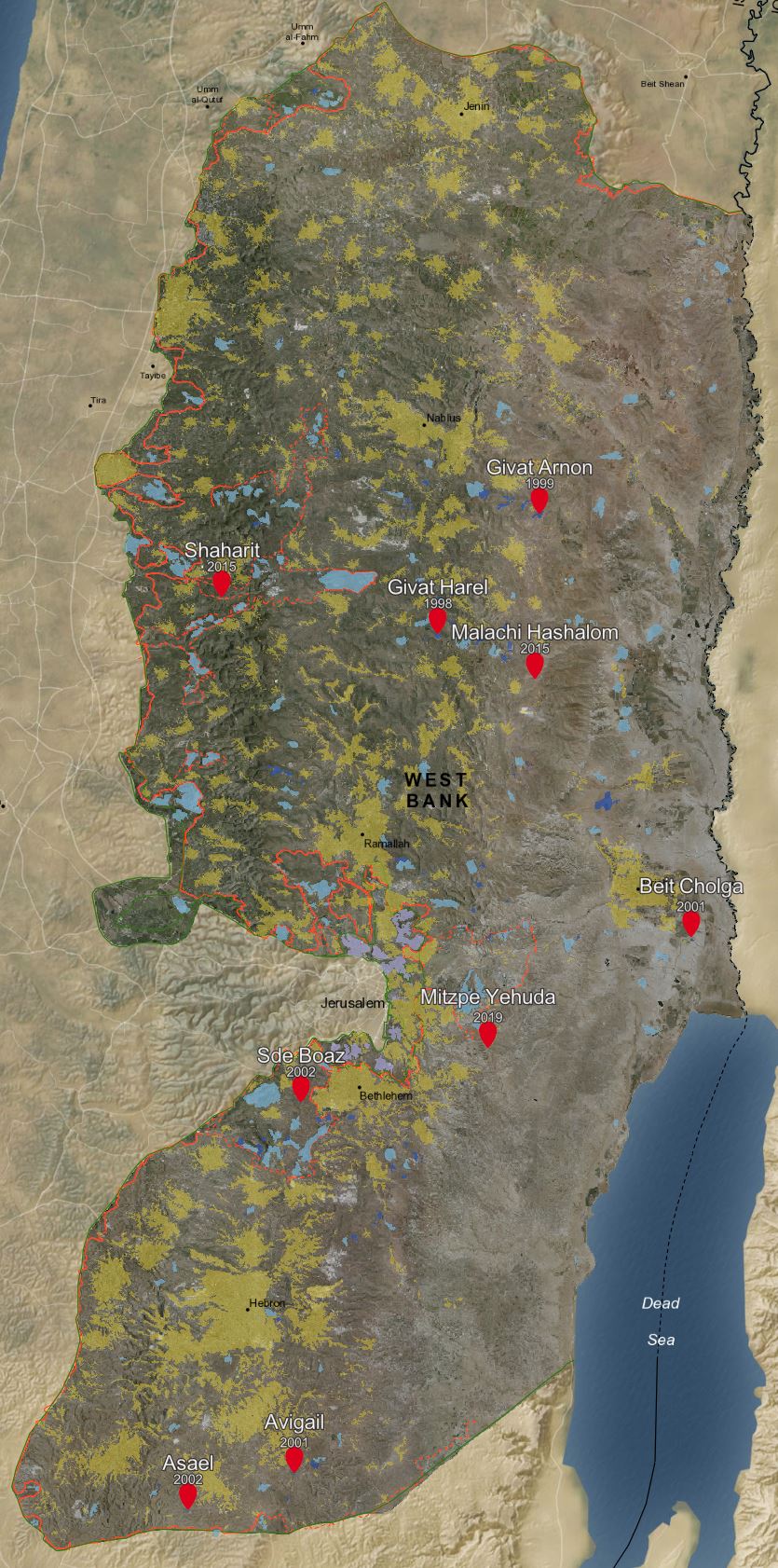
Importantly, Haaretz reports that a source said the Cabinet chose these outposts for authorization specifically because they are all located in remote or isolated locations — meaning they cannot be “legalized” via expanding the borders of a nearby settlement and declaring the outposts to be merely neighborhoods of those “legal” settlements (a legal maneuver Israel has repeatedly used to expand settlements and retroactively legalize settlements). This means, among other things, that legalization of these 10 new settlements will likely lead to additional land seizures for related infrastructure work (work that was not legally possible until now).
With respect to the remaining outposts that remain not-yet-legalized, the Cabinet approval included a clause that makes them eligible – right away, even as they remain illegal – to receive Israeli municipal services like water and electricity. Defense Minister Galant only has to sign an electricity order that was crafted under the previous government. If implemented, connecting illegal outposts to state infrastructure amounts to the de facto legalization of these outposts, even without a formal act to declare them legal.
The ten outposts slated to become official, “legal” new settlements are: Avigail, Asael, Shaharit, Givat Arnon, Givat Harel and Givat Haro’eh (which will be combined into one new settlement), Malachei Hashalom, Mitzpe Yehuda, Beit Hogla, and Sde Boaz. For further details on these outposts, please see Peace Now’s report.
Of note:
- Six of the outposts are located partially on land privately owned by Palestinians (Avigail, Givat Haroeh, Givat Harel, Givat Arnon, Mitzpe Yehuda, Malachei Hashalom).
- Three of the outposts (Avigail, Givat Arnon, and Malachei Hashalom) are located within Israel-designated firing zones, where under Israeli law any civilian presence, much less illegal civilian construction, is prohibited.
- Of particular note: the Avigail outpost is located in Firing Zone 918 in the South Hebron Hills. This is the same firing zone that is home to the Palestinian communities of Masafer Yatta — whose existence pre-dates Israel’s declaration of the area as a firing zone. Those communities are today in the process of being ethnically cleansed by Israel, based on the same law that Israel is ignoring in its legalization of the Avigail outpost.
- Two of the outposts (Avigail and Asael) have, illegally, built access roads on privately owned Palestinian land. Legalization of the outposts will undoubtedly also include the theft of the Palestinian-owned land these roads were illegally built on.
- Three of the outposts (Schacharit, Mitzpe Yehuda, and Malachei Hashalom)- are so-called “farming outposts.” That means they include very few buildings (3, 4, and 10, respectively), but a lot of land. The phenomenon of farming outposts, which have proven to be an incredibly efficient way for settlers to take over large areas of the West Bank with minimal investment in buildings and the involvement of very few people. This has been documented by the Israeli NGO Kerem Navot, which called the tactic “Israel’s most significant mechanism for dispossessing Palestinian communities.”
Minister Smotrich celebrated the announcement of the legalization of the 10 outposts and promised that there is more to come:
“That is what we as a government and as a people must do. Settlements thrive thanks to the pioneers, with much love and determination…We’ve authorized 10 outposts and we have the means to authorize more if required. My coalition partners understand this is the logical move. We’re also committed to removing all restrictions on settlement expansion in Judea and Samaria. This area must be managed in accordance with the Israeli law applicable in all parts of Israel.”
The Minister of the Negev, the Galilee and National Resilience, Yitzhak Wasserlauf, also celebrated the announcement as the start of things to come:
“Congratulations to the Security Cabinet that accepted Minister Ben-Gvir’s request and approved the communities. The dedicated settlers deserve to receive water, electricity, and public buildings. However, we will not be satisfied with just nine settlements, they are only the beginning, on the way to training more settlements, on the way to the fulfillment of the Zionist vision.”
As a reminder, Yitzhak Wasserful (a member of Ben Gvir’s Otzma Yehudit part) was granted an expanded portfolio as the Minister of the Negev and Galilee. He will now also oversee a new “young settlement department” (“young settlement” is a euphemism used by settlers for illegal outposts) that will be engaged in preparatory work for the legalization of outposts, and will also work on plans to deliver infrastructure to the outposts.
Israeli Government Announces Massive Settlement Expansion/De-Facto Annexation, Part 3: Thousands of New Settlement Units
As a result of the February 12th Israeli Security Cabinet meeting, the Civil Administration’s High Planning Council – the body that currently oversees all planning/building in the occupied West Bank – will convene in the coming days to advance plans for over 7,000 new settlement units (Minister Smotrich says 10,000 units will be advanced).
Of that total, Haaretz reports that 1,943 units are expected to immediately receive final approval for construction (including some units which have already been built but will be legalized); another 5,089 units are expected to be advanced in the planning process.
While there is no comprehensive list of all of the plans involved in these approvals and advancements, Haaretz reports that the plans expected to receive final approval will include new units in the following settlements: Rahelim, Neriya, Dolev, and Elon Moreh, Mevo’ot Yericho, and Elazar. Arutz Sheva further reports that 210 units in the Mevo Horon settlement will receive final approval, 100 of which were built illegally already.
Of particular note is a plan for 443 units in the Elazar settlement. This is, effectively, the reestablishment of the Netiv Ha’avot outpost, where five years ago the Israeli government demolished 17 structures because they were partially built on privately-owned Palestinian land (as compensation for those demolitions, the Israeli government built the evacuees an entirely new outpost near the Alon Shvut settlement, and then went about expanding the borders of the settlement to include the new buildings).
The plans not yet ready for final approvals but that are expected to be advanced in the planning process include plans for new construction in the Adam-Geva Binyamin settlement (356 units), the newly established Tel Zion settlement (627 units), the Kochav Yaakov settlement (160 units), and the Mitzpe Yericho settlement (350 units).
Israeli Government Announces Massive Settlement Expansion/De-Facto Annexation, Part 4: International Responses
Key members of the international community were quick to come out in (rhetorical) opposition to Israel’s massive settlement announcement. The U.S., U.K, France, Germany, and Italy released a joint statement “strongly opposing” the announcement saying they are “deeply troubled” by it – but none suggested they were entertaining any thoughts of imposing consequences.
The Palestinian Authority is reportedly pressing the United Nations Security Council to hold a vote in the coming days on a resolution calling on Israel to “immediately and completely” halt settlement activities. The U.S. has called the draft resolution “unhelpful” and is reported to be working against it (while also issuing public statements of dismay). Axios reports that Israeli officials believe the Palestinians are likely to secure enough support for such a resolution to pass if it is brought up for a vote, which would put the U.S. in the position of having to decide whether to vote in favor (inconceivable), abstain (improbable), or veto (likely). The U.S. is reportedly trying to convince the Palestinians to accept a statement from the Security Council in lieu of a vote.
Cabinet & Knesset Advance Bill to Repeal Parts of 2005 Disengagement, Reestablish Four Settlements Including Homesh
On February 14th, the Ministerial Committee for Legislation (a body of Ministers who decide whether to give government-backing to bills prior to their introduction to the Knesset) voted to give its approval to a bill that would repeal specific clauses of the 2005 Disengagement Law. These are the clauses that prohibit Israelis from living in the area of four settlements in the northern West Bank that were evacuated under Disengagement. If passed by the Knesset, the repeal of those clauses will allow the government to proceed with its plans to reestablish the Homesh settlement and retroactively legalize the yeshiva located there (as well as, in theory, allowing the reestablishment of the other three evacuated settlements).
Quickly following the Cabinet’s vote, the bill passed its preliminary reading in the Knesset on February 15th. It will need to pass three more readings before becoming law.
Peace Now explains the implications:
“From a human rights perspective, this will lead to a massive stealing of Palestinian land alongside increased settler violence and real danger to Palestinian lives. Homesh was primarily built on private Palestinian lands registered in the tabu (the Land Registration Office). Thus, this law will drive a final nail in the honest attempt of Palestinians to recover the massive land grab that was taken from them, and from the landowners in particular. In addition, although the Homesh settlement was evicted, a small Yeshiva located there has since been a source of violence from settlers who receive protection from the army while preventing Palestinian farmers from reaching their land. The lifting of the legal ban on the presence of Israelis in the area will provide an incentive for the arrival of more Israelis in the area. As a result, Palestinian lands will continue to be, at least de facto, expropriated.”
As a reminder, the retroactive legalization of the Homesh outpost was agreed to in coalition agreements that enabled the formation of the current Israeli government. Repealing the relevant parts of the 2005 Disengagement Law is the first step to implementing this commitment.
Also as a reminder: The government is currently facing a deadline from Israel’s High Court of Justice to submit its position on the court-ordered evacuation of the illegal yeshiva settlers built at the site of the dismantled Homesh settlement. The State has for nearly three years delayed its response to a 2019 petition filed by Yesh Din seeking both the removal of the illegal outpost and yeshiva at the site, as well as the site’s return to its Palestinian landowners. Despite Homesh being dismantled in 2005, Israel never permitted Palestinians to regain access to or control of the land, declaring it a closed military zone. That status has prevented Palestinians from entering the area, even as the IDF permitted settlers to routinely enter the area, to live (illegally, under Israeli law) at the site, and to illegally establish a yeshiva there. That yeshiva, according to the Israeli NGO Kerem Navot, has become one of the West Bank’s “hardcore centers of settler terror”. Settlers have also wreaked terror on nearby Palestinian villages, most notably Burqa and Sebastia. One Israeli politician even went so far as to say that settlers are “carrying out a pogrom” in Burqa.
Smotrich’s Plans to Take Over the West Bank
Haaretz obtained a draft government decision detailing plans to create a proposed “Settlement Administration” within the Defense Ministry. This plan would give Bezalel Smotrich – a minister in the Defense Ministry – authority, either directly or through his appointee, over the entire Civil Administration and, ipso facto, all civilian affairs in the West Bank. Smotrich proposes his new “ministry within a ministry” receive an initial budget of at least 80 million shekels.
The draft proposal was circulated to Ministers this week, but still faces opposition, including from Defense Minister Gallant – at whose expense Smotrich’s power grab would come. According to Haaretz, the proposed draft includes a carve-out for Gallant to overrule Smotrich’s authority over civil matters “in exceptional circumstances subject to the defense minister’s decision to change a specific decision or action in exceptional cases, with appropriate justification and subject to hearing the position of the other minister.”
The proposal is also opposed by IDF Chief of Staff Herzi Halevi, who reportedly told Prime Minister Netanyahu fears the plan would lead to a breakdown in the IDF chain of command.
Settler Olive Orchard & New Outpost Are Dismantled by Government, Causing Coalition Fight
A series of enforcement actions against illegal settlement activity in the West Bank has further driven a wedge between members of Netanyahu’s far-right coalition.
First, on February 12th Israeli forces dismantled a new outpost – dubbed “Gofna” by settlers – located in the northern West Bank. Six settler families arrived the previous night in an organized effort to quickly build several structures. Those buildings were demolished by the Israeli Border Police; settlers attempted to prevent the police from carrying out the evacuation. The Gofna outpost was previously established (and quickly dismantled) in July 2022 as part of a massive campaign led by the Nachala Movement to set up new outposts across the West Bank.
Then, on February 15th the Civil Administration uprooted over 800 olive trees that a settler illegally planted on land that the Israeli High Court has recognized as privately-owned Palestinian land, located near the Shilo settlement. The 2023 Court ruling concluded 15 years of litigation, but its enforcement has been repeatedly postponed. Dozens of settlers clashed violently with Israeli Border Police carrying out the tree removal; some of the settlers climbed the trees in hopes of stopping the bulldozers, and even some Knesset Members angrily tried to stop the officers from carrying out the law. Forty settlers/settler supporters were temporarily detained for their part in the violence; four Border Police officers were suspended after video footage captured them attacking one of the protestors.
Reports of the removal of the trees caused an immediate crisis in the government. Smotrich claimed that he had previously issued an order that vacated the court-ordered evacuation (in effect, Smotrich asserting the power to personally overrule the Israeli High Court). Any such order Smotrich may have issued was apparently overruled by Defense Minister Gallant – – with whom Smotrich is engaged in a power struggle (discussed above). Smotrich then wrote an urgent letter to Prime Minister Nentanyahu, who ordered the Civil Administration to halt the demolition hours after it began, though only a few trees remained in the ground at that point.
Smotrich later rehashed the turmoil, saying:
“To my astonishment, Defense Minister [Yoav Gallant] grossly violated the coalition agreement and reversed my decision…And, instead of implementing a settlement security policy, Gallant chose to continue the left-wing policy of former minister Benny Gantz and uproot the grove even though the claims against the grove were proven to be false in the legal proceedings…..violation of the [coalition] agreements will make it very difficult for the government and the coalition to conduct themselves properly.”
Later, on Twitter, Smotrich continued:
“Defense Minister Gallant’s denial of the unambiguous agreements and the prime minister’s foot dragging on the matter are unacceptable and they cannot continue…if Gallant has a problem, he’s welcome to hand in the keys. I’m sure there are lots of people in Likud who would be glad to take his place at the Defense Ministry.”
Minister Ben Gvir also vented his anger over law enforcement against illegal settler activities, saying:
“This isn’t what we signed up for when we agreed to join the Netanyahu government…We were promised a full-on right-wing government that can’t not evacuate Kahn al-Ahmar or avoid tearing down illegal buildings in East Jerusalem. A right-wing government doesn’t go only after Jews.”
Settler Groups Convene Workshop on Jordan Valley Annexation
Settler groups are continuing their push for Israel to annex the Jordan Valley. On February 12th, two settler advocacy groups held an event for lawmakers and security leaders in the Jordan Valley, starting with a tour of the region and a workshop to “discuss the challenges of sovereignty in the Valley and ways to deal with them.”
Yehudit Katsover and Nadia Matar, co-chairwomen of the Sovereignty Movement, and Nili Naouri, who heads the Israel Forever movement, who together hosted the event, said in a statement:
“sovereignty in the Jordan Valley is a necessary step for both the security, strategic and internal security aspects of the future of Israel, as expressed by prime ministers over the years, leaders of both Right and Left, which illustrates the broad national consensus behind taking the step of sovereignty in this area. Sovereignty in the Valley also does not constitute a demographic threat to the Jewish character of the State of Israel.”
MK Sharen Haskel, who attended the event and who has previously introduced annexation bills in the Knesset, said:
“The message that we’re trying to send is that this is the place where we have to apply sovereignty first. This is not just a question of sovereignty, this is also a question of security and defense of our country and of our people…We are here seeing the mountains on both sides from Jordan and the areas of Judea and Samaria, and we understand that this ground is a tactic ground that is meant to guard our security need of the state of Israel.”
Bonus Reads
- “Israel is Annexing the West Bank. Don’t be Misled by its Gaslighting” (Just Security)
- “Go West Bank: Israel Is Using the Housing Crisis to Lure Israelis Into Becoming Settlers” (Haaretz)
- “The Kohelet Tentacles: Inside the Web Surrounding the Right-wing Think Tank” (Haaretz)
- “Pompeo: Israel has Biblical claim to the land so it can’t be an occupier” (MEMO)
Welcome to FMEP’s Weekly Settlement Report, covering everything you need to know about Israeli settlement activity this week.
To subscribe to this report, please click here.
January 11, 2019
- Israel Opens “Apartheid Road” – Divided Road Eases Settlers’ Access to Jerusalem, Routes Palestinians Around the City, Significant Step Towards Advancing E-1 Settlement Construction
- Israeli Businessman Opens Huge Mall in East Jerusalem Settlement Industrial Zone
- In Parting Gift to Settlers, Housing Minister Greenlights Construction of New Settlement Units for Outpost Evacuees
- Settlers Blame Obama for Slowed Israeli Population Growth in the West Bank
- Israeli Justice Minister Stands with Families of Suspects in Deadly Jewish Terror Attack
- Breaking the Silence Launches New Tour of Central West Bank Settlements
- Bonus Reads
Questions/comments? Email kmccarthy@fmep.org
Israel Opens “Apartheid Road” – Divided Road Eases Settlers’ Access to Jerusalem, Routes Palestinians Around the City, Significant Step Towards Advancing E-1 Settlement Construction
A key section of the “Eastern Ring Road” (Route 4370), located in the West Bank on the eastern flank of Jerusalem in the area of the planned E-1 settlement, officially opened to traffic on January 10th. Dubbed the “Apartheid Road” because a concrete wall runs literally down the middle of the highway, separating Palestinian and Israeli traffic, the road allows Israeli-approved traffic from the West Bank (i.e., settlers and the small number of Palestinians who have Israeli-issued permits) to more easily access Jerusalem than ever before — advancing the seamless integration of settlements into Israel proper and the erasure of the Green Line; the other side of the road is sealed, shunting traffic between the northern and southern parts of the West Bank while preventing any access to Jerusalem (East or West).

Map by Haaretz
Ir Amim warns that the opening of this section of the road may signals that Israel is on the verge of issuing building permits for the E-1 settlement plan, which received final approval but has been held up by the political echelon for years due to international pressure. The international community has long opposed E-1, in part based on the argument that territorially, it cuts the West Bank in half, preventing the possibility of a viable, contiguous Palestinian state.
Israeli officials have argued that the now-open road should resolve international objections to building the E-1 settlement, since it preserves “transportational continuity” by providing a route for Palestinians to travel between between the northern and southern parts of the West Bank, as a substitute for territorial contiguity of a future Palestinian state).
When construction on the road resumed in 2017 after being stalled for a long period, Peace Now explained:
“If the road will be completed…Israel will be able to argue that Israeli construction in the area does not separate the West Bank because there is a transportation route for Palestinians. This argument, of course, is baseless because a thin line of road that connects separated territorial sections (creating ‘transportational continuity’) does not meet the need for the territorial contiguity essential for the development of East Jerusalem and the Palestinian metropolis. Without these territories, a viable independent Palestinian state cannot be built and prosper, and this could mean the death of the two-state solution.”
In a 2008 objection against the road that was rejected by the Israeli High Court of Justice, Adalah explained:
“The road further aims to consolidate and develop the Jewish settlements in East Jerusalem and the West Bank, and link them directly and conveniently to each other and to West Jerusalem. The road is simultaneously intended to isolate the Arab neighborhoods in East Jerusalem from the main route of the Eastern Ring Road, from each other and from the West Bank. It would thereby turn these neighborhoods into islands that are isolated – geographically, economically and in terms of transportation – from their immediate surroundings and would end Palestinian geographical contiguity within and around East Jerusalem, thereby precluding any future economic and social development or expansion of these neighborhoods. The plan stands to cut the owners of agricultural land off from their lands, to dramatically reduce the accessibility of schools, health services and workplaces for residents of these neighborhoods, and severely disrupt their family and social lives.”
Ir Amim researcher Aviv Tartarsky said:
“Anyone with eyes in his head understands that it is impossible for years to maintain such a separation regime — it is immoral and impractical.”
At the ceremony marking the opening of the road this week, several senior Israeli government official boasted about the importance of the road. The newly inaugurated Mayor of Jerusalem, Moshe Leon, said:
“the road is a true blessing for residents of Pisgat Ze’ev and French Hill [Israel settlements in East Jerusalem]. Opening this road during high congestion periods will distribute more evenly some of the pressure on existing highways, leading to significant easing…in addition to solving traffic congestion problems, we are strengthening the Binyamin Regional Council [the settlement council in the area north of Jerusalem] and inaugurating the natural link between this area and Jerusalem.”
Israeli Transportation Minister Yisrael Katz said the road is:
“an important step in linking Binyamin Council residents [settlers living north of Jerusalem] to Jerusalem and in strengthening metropolitan Jerusalem.”
The Jerusalem Municipality – whose public infrastructure company recently renovated the road, despite the fact that the road is located outside Jerusalem’s Municipal borders (not to mention outside of Israel’s sovereign territory) – issued a statement saying:
“this was a transportation project that came about as a result of cooperation between itself, the Binyamin Regional Council and the Transportation Ministry. The road was rehabilitated by Moriah, with funding from the ministry. It will serve Arab residents, especially those living in the Shoafat refugee camp. It will ease congestion in the Pisgat Ze’ev and French Hill neighborhoods, distributing traffic more evenly.”
Israeli Businessman Opens Huge Mall in East Jerusalem Settlement Industrial Zone
A new Israeli-owned shopping mall opened in the Atarot settlement industrial zone in East Jerusalem, located in sight of Ramallah but inside the security barrier and within Israel’s municipal border, as expanded by Israel after the 1967 war.
The massive new mall is the crown jewel of the shopping empire built by Israeli businessman Rami Levy, who already operates a network of supermarkets in settlements. Like all of Levy’s projects (and settlement industrial zones in general), the new mall is branded as a socially-conscience, “coexistence”-building business initiative, with Levy and government officials praising the fact that the new mall will attract both Israeli and Palestinian shoppers and be home not only to Israeli businesses, but to to a few Palestinian-owned/operated businesses as well.
Levy recently told The Times of Israel:
“I see things from a social angle. What I have built, I built with the social aspect in mind. My instincts and my gut tell me this will be the most prosperous place in the country. There is very high demand for the project due to the size of the surrounding population. I’m not afraid of the security situation… When we started marketing there was a reluctance on the part of the (Israeli) chains because of the location of the project, but at the end of the day they understood the great commercial potential.”
Back when the project was first unveiled, the Israeli watchdog group Who Profits explained the falseness of this “coexistence” branding:
“The Jerusalem mall would mark a new stage in Levy’s involvement in the occupation economy…[which] began with providing services to Israeli settlers and continued with the exploitation of Palestinians as a cheap labor force in his supermarkets. He now appears to be turning his attention to massive construction projects on occupied Palestinian land and the exploitation of a Palestinian captive market in the East Jerusalem…Rami Levy is in a position that would allow him establish a large mall on “virgin land” because the Israeli authorities have prevented Palestinian businesses from competing with Israelis. Levy’s plan would take advantage of the fact that Palestinians do not have other large-scale retail facilities. A flourishing market in Bir Nabala was destroyed by Israel’s wall in the West Bank. And venturing into West Jerusalem is not an option for Palestinians, most of whom live below the poverty line. Although there is every likelihood that the Israeli authorities will portray Levy’s mall as beneficial to Palestinians, there are important facts to be remembered. Palestinians entering his mall will not be exercising the right of a consumer to informed choice. Rather, they will be captive clients — belonging to an occupied people.”
The Palestinian human rights group Al-Haq also wrote in advance of the project’s completion:
“Al-Haq further calls attention to the severe impact that the ‘Rami Levy’ project will have on local residents… and the economy as a whole. Because Israeli authorities rarely issue building permits for Palestinians, individuals living in East Jerusalem neighborhoods near Atarot, like Beit Hanina and Shu’fat, do not and will not have comparable large retail facilities. Smaller businesses will likely be unable to compete with the settlement mall. Al-Haq reminds business owners that businesses benefiting from Israel’s illegal settlement enterprise, and the violations of international humanitarian and human rights law that it propagates, may be found complicit in aiding and abetting these violations even where they do not positively assist in orchestrating the abuse.”
All of Levy’s stores are a target of Palestinian-led boycott campaign against Israeli goods in the occupied territories. Palestinian businessman Munib al-Masri has recently come under fire for a July 2018 meeting with Levy at one of his settlement supermarkets to discuss the Arab Peace Initiative. Masri defended the meeting, saying that he has undertaken an effort to revive the API to Israelis outside of the traditional peace camp. The Palestinian Boycott National Committee released a statement saying:
“The warm relationship revealed recently between a segment of Palestinian capital and Israeli capital is among the worst kinds of normalization. It gives the occupation-state a fig leaf with which to cover its continued occupation, ethnic cleansing, and racism.”
In Parting Gift to Settlers, Housing Minister Greenlights Construction of New Settlement Units for Outpost Evacuees
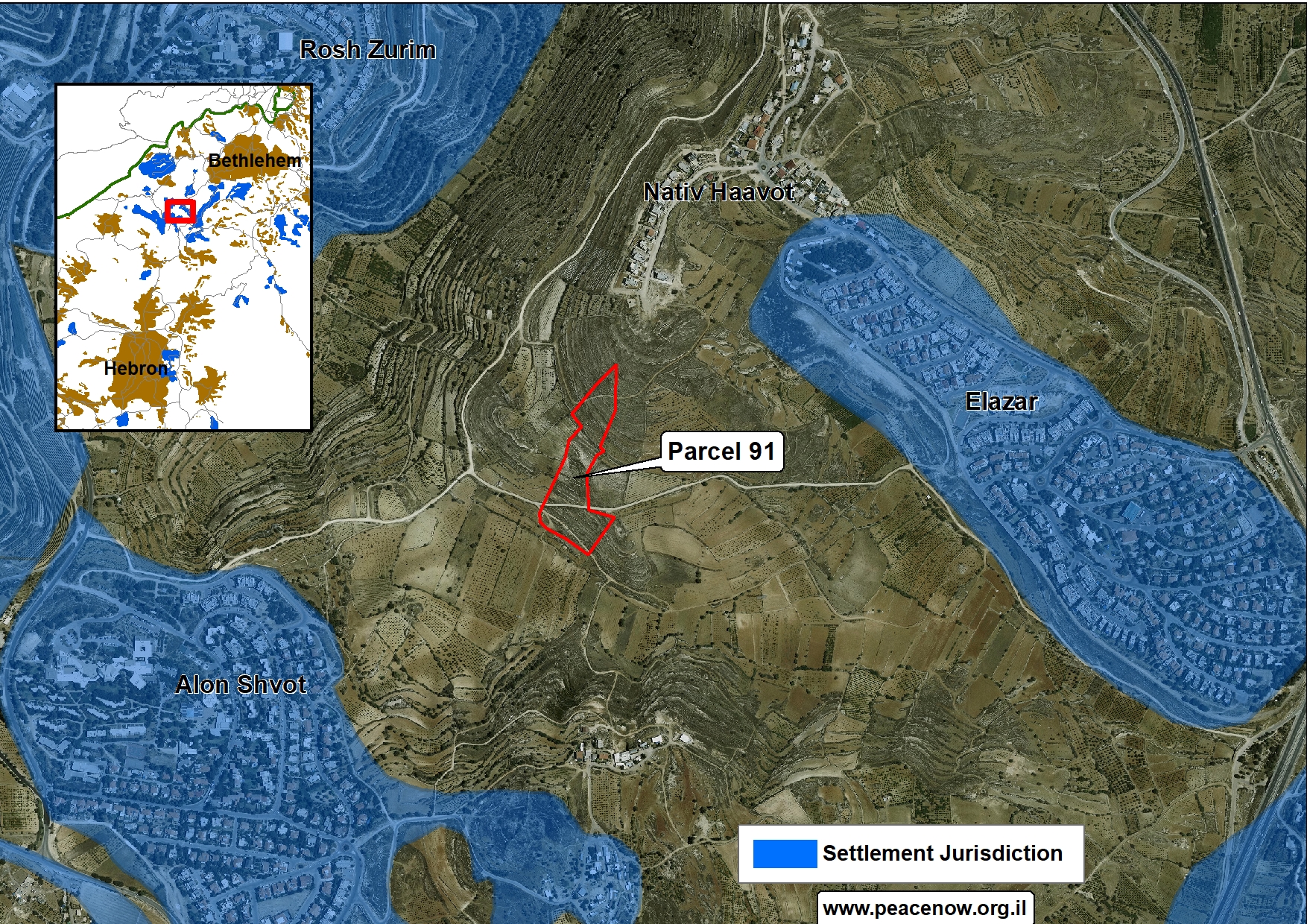
In June 2018, despite high profile political opposition and violent resistance by settlers and their allies, the Israeli IDF implemented a High Court order to demolish 17 structures (15 residential units) in the Netiv Ha’avot outpost, which were built without Israeli authorization on land that the High Court ruled is privately owned by Palestinians (leaving most of the illegal outpost still standing).
This week, with Israeli elections in sight, Israeli Housing Minister Yoav Gallant resigned from the Kulanu Party and joined Prime Minister Netanyahu’s Likud party (and in doing so, forfeited his position as Housing Minister). Before resigning, Gallant delivered a parting gift to Netiv Ha’avot settlers: a last minute decision to fast-track the construction of new settlement units for them in the Elazar settlement.
Map by Peace Now
In addition to Peace Now’s comprehensive recap of the Netiv Ha’avot saga, FMEP has covered the efforts of the Israeli government to exploit the evacuation of settlers from 15 homes in the Netiv Ha’avot outpost as an opportunity not only to advance construction in the Elazar settlement, but also to build an entirely new outpost as “temporary” housing for the settlers. The “temporary” outpost – where 15 mobile homes are parked – and connected to Israeli water, power, sewage, roads, and other infrastructure – is located outside of the borders of the Alon Shvut settlement. That fact did not stop the High Planning Council (a body within the Israeli Civil Administration which regulates planning and building in the West Bank) from approving the plan, noting that “the plan is improper, but we will have to approve it as a temporary solution.” As part of its approval of the plan, the Council ordered the government to take steps towards expanding the borders of the Alon Shvut settlement to include the area on which the outpost has been established, underscoring the meaninglessness of the word “temporary” in this context.
In addition to the new outpost/expansion of the Alon Shvut settlement, the State is also planning to retroactively legalize and expand the Netiv Ha’avot outpost – proving once again that Israel does not punish settler law-breaking, but instead handsomely rewards it.
Settlers Blame Obama for Slowed Israeli Population Growth in the West Bank
According to new data published by the Council of Jewish Communities in Judea and Samaria, the 2018 settler growth rate came in at 3%, compared to 3.4% in 2017. This is the tenth consecutive year that the settler growth rate has declined. In explaining the numbers, settlers are pointing fingers at former U.S. President Barack Obama, citing his policies opposing settlement construction (which was in line with the policies of every previous U.S. president since 1967) as the reason for the decline in the settler population growth rate. The head of the Council, Hananel Dorani, said:
“We’re happy to see that the number of residents in the area is growing, but in recent years there hasn’t been enough construction in the settlements…the relatively slow rate of construction is the result of, among other things, an eight-year construction freeze [there was no such freeze], and today only small-scale plans are being approved [demonstrably incorrect]. These figures are a shout out to the next government: We will be demanding more of an effort to clear obstacles to construction in Judea and Samaria and the Jordan Valley. This is the way to continue promoting the settlements and even increase the housing available in Israel, and as a result lowering [housing] prices.”
Israeli Justice Minister Stands with Families of Suspects in Deadly Jewish Terror Attack
Five Israeli settlers from the Rehelim settlement were arrested in connection with the murder of a Palestinian woman in October 2018. The suspects – who are minors and therefore unidentified in the press – are alleged to be responsible for throwing stones at a Palestinian vehicle, resulting in the death of Aisha Rabi, a mother of nine. The Israeli Shin Bet has since come under fire from Israeli politicians for the way it has handled the case, and settler leaders have offered blanket public support for the suspects and their families while leveling harsh criticism at the Shin Bet for its work to close the case. Israeli Justice Minister Ayelet Shaked went as far as to meet with the suspects’ parents in a display of solidarity with the families’ in their accusations against the Shin Bet’s work on the case.
Meretz chairwoman and Member of Knesset Tamar Zandberg sharply criticized Minister Shaked for the meeting, saying that Shaked has:
“different standards for Jews and Arabs…Instead of doing soul searching, (Shaked) is making an electoral calculation and running into the arms of families accused of terror.”
Breaking the Silence Launches New Tour of Central West Bank Settlements
The Israeli organization Breaking the Silence has launched a new political tour of the West Bank, focusing on settlements, Israeli government policy, and the goal of the occupation. After previewing the new tour, Haaretz columnists Gideon Levy and Alex Lavec write:
“during this seven-hour journey, an unvarnished picture emerges: The goals of the occupation were determined immediately after the 1967 war. Every Israeli government since, without exception, has worked to realize them. The aim: to prevent the establishment of any Palestinian entity between the Jordan River and the Mediterranean Sea, by carving up the West Bank and shattering it into shards of territory. The methods have varied, but the goal remains unwavering: eternal Israeli rule. That goal hasn’t been implemented only by right-wing zealots, but by the very establishment of Israel, its governmental agencies, with the backing of the judiciary and the media. On the road to a million settlers, the first million – all means were justified. Now, as that target draws closer, the central goal is the development of infrastructures. The separate roads, deceptive with their bypass routes, the tunnels and the interchanges, all of these are more fateful than another flood of settlers. They allow every settler to live in relative security, not to see Palestinians and not to hear about their existence, to live cheaply and to get to work in Israel fast. That’s the secret that’s made it possible for 650,000 Israelis to violate international law and norms of justice, to live in occupied areas and feel good about themselves. The occasional few bones that the occupier throws the occupied allows life under the boot to continue without excessive resistance.”
Breaking the Silence continues to run its flagship tours of Hebron and the south Hebron Hills, which attract approximately 5,000 participants each year to see the impact of Israeli occupation policies and radical settlers living in Hebron. Breaking the Silence staff are veteran combatants who speak out about the reality of what it means to serve as an occupying power over the Palestinians. Breaking the Silence has been a central target of the Israeli government in attempts to silence groups critical of Israeli policies by cutting their funding, criminalizing and restricting their operations, and waging smear campaigns against staff members.
Bonus Reads
- “Expanding the Limits of Jewish Sovereignty: A Brief History of Israeli Settlements” (Haaretz)
- “Israeli Housing Project in West Bank Would Surround Bethlehem with Settlements” (Haaretz)
- “Palestinians Are Right to Outlaw Selling Land to Settlers” (The Forward)
- “How Israel Usurps Palestinian Land In Calculated Stages” (Haaretz)
- “Peace Cast: West Bank Settlements” (Americans for Peace Now)
- “Minister Shaked says she changed the judicial system’s mindset” (World Israel News)
Welcome to FMEP’s Weekly Settlement Report, covering everything you need to know about Israeli settlement activity this week.
To receive this report via email, please click here.
February 15, 2018
- Longtime Settler Leader Appointed to Head Government Team to Legalize Outposts
- Plans Advance for Settlement Expansion, Including “Unusual” Plan for the Netiv Ha’avot Outpost
- De Facto Annexation: Israel Extend Domestic Law to Settlement Colleges & Universities
- Bibi Blocks Settlement Annexation Bill, But Signals Something Bigger
- Updates on Jerusalem Settlement Activity
- Lara Friedman: Stop Parsing Trump’s ‘Word Salad’ on Settlements
- Bonus Must-Reads
Comments, questions, or suggestions? Email Kristin McCarthy at kmccarthy@fmep.org.
Longtime Settler Leader Appointed to Head Government Team to Legalize Outposts
Despite criticism from the High Court of Justice, this week the Prime Minister’s office finalized the appointment of settler leader Pinchas Wallerstein to head a government team tasked with leading the process of retroactively legalizing illegal outposts across the West Bank. As FMEP reported when Wallerstein’s appointment was first announced in late October 2017, Wallerstein has been prosecuted for knowingly violating Israeli law by building a sewage plant near the Ofra settlement on private Palestinian land; has admitted to issuing forged building permits for settlement construction without the authority to do so; and has admitted to lying (again) to government authorities to expedite the construction of the (since evacuated) building the Amona outpost.
The team Wallerstein will now lead is tasked with developing legal cases – likely based on new legal precedents and opinions (here, here, and most recently here) established by Israeli Attorney General Avichai Mandelblit that support the appropriation of private Palestinian land for a public good – to “regularize” outposts (i.e., convert outposts built in violation of Israeli law into official “legal” settlements). The government has already begun to the lay the groundwork for Wallerstein’s work: a leaked recording that surfaced in mid-January revealed that a small team within the Defense Ministry has spent months identifying 70 outposts across the West Bank that it believes can be retroactively legalized.
With this appointment, Wallerstein — who has worked full-time to strengthen settlements since 1979 — will lead government-backed effort to shape the ever-evolving legal mechanisms for justifying, in the eyes of Israeli courts, the appropriation of as much private Palestinian land as possible in order to expand and entrench Israeli settlements and outposts. And notably, the legalization of these outposts will mean, in effect, that while for years Israel committed to not establish new settlements, new settlements were in reality being established continuously through unofficial means.
Plans Advance for Settlement Expansion, Including “Unusual” Plan for the Netiv Ha’avot Outpost
This week, the High Planning Council of the Israeli Civil Administration (the arm of the Israeli Defense Ministry that is the sovereign over the West Bank, governing all aspects of life) advanced several plans to expand settlements and outposts across the West Bank.
Settlement watchdog Peace Now notes that the approvals include plans both for the creation of new settlement “areas” (expanding the footprint of settlements in the West Bank) and expansion within the existing footprints:
- A plan to build a hotel and race track for tourists in the Jordan Valley, near the Petza’el settlement (approved for deposit for public review).
- A plan to build a gas station and school in the outpost of Mitzpe Danny, located east of Ramallah, in the middle of the West Bank (approved for validation).
- A new outpost to “temporarily” house mobile homes for the residents of the Netiv Ha’avot outpost (approved the validation) – more below).
- A plan for 68 new units in the Elazar settlement near Bethlehem (approved the validation).
- A plan for a new cemetery to be located south of Qalqiliya (discussed but decision to deposit for public review postponed).
The Defense Ministry tried to minimize the significance of these approvals, calling them “non-residential” or “less significant,” because the High Planning Council is only supposed to convene a few times a year, per a reported agreement with the United States. The High Planning Council met once already this year, and is not due for another (what the Defense Ministry might call “significant”) meeting until April.
Peace Now responded to the plans the Defense Ministry’s claim with a statement saying,
“The government is building new settlement areas under the guise of ‘insignificant’ plans that will not include housing units. This is an old trick used to establish new settlements without calling them that by name. All of these plans—the construction of a hotel and tourist complex in the Jordan Valley, an educational campus in an illegal outpost, and even a cemetery as the first stage in the construction of a new industrial zone—in actuality create new settlements. The Netanyahu government has lost all the brakes on the road to de facto annexation of the West Bank, and it continues to distance Israel from the prospects for peace and the two-state solution.”
The plan for the Netiv Ha’avot outpost bears further explanation:
-
Map by Peace Now
As noted above, the High Planning Council this week approved the validation of a plan to establish a new settlement site to “temporarily” house residents of the Netiv Ha’avot outpost who are facing a court-ordered eviction from Netiv Ha’avot because the outpost was built without permits, and sits partially on private Palestinian land.
- The plan moved ahead after Israeli authorities dismissed an objection brought by Peace Now and Palestinian residents of the village of Al-Khader, whose land the plan affects.
- According to the approved plan, Israel will place 15 mobile homes at the selected site — connected to Israeli water, power, sewage, roads, and other infrastructure — located near, but not within, the borders of the Alon Shvut settlement.
- When the High Planning Council initially approved the advancement of this plan in October 2017, it noted that “the plan is improper, but we will have to approve it as a temporary solution.” At the time, the Council ordered the government to go about expanding the borders of the Alon Shvut settlement to include the land.
- Because the mobile homes will be put on land that is outside of any settlement border, the plan in effect creates a new outpost.
- Under the approved plan, the new homes will be allowed to stay in that location for three years. However, based on past practice, it can be expected that within that time, or at the end of those three years, the site will “regulated” by Israel to become a permanent area of Israeli settlement.
FMEP has covered the many unfolding storylines in the Netiv Ha’avot drama repeatedly and in detail, but as a reminder: in 2016 the Israeli High Court of Justice ordered the demolition of the Netiv Ha’avot outpost. As of now, 15 structures in the outpost are scheduled to be demolished next month, though efforts are still ongoing to save the structures from complete demolition. High ranking officials in the Israeli government, including Yesh Atid’s leader Yair Lapid, have supported the outposts campaign not only to save the 15 structures but to retroactively legalize the entire outpost. If the latter campaign succeeds, it will mean that the newly approved mobile home site will be available for additional settlers to inhabit for at least three years.
De Facto Annexation: Israel Extend Domestic Law to Settlement Colleges & Universities
The Knesset this week passed a bill that extends the state’s jurisdiction outside of its borders, bringing colleges and universities in settlements under the authority of the Israeli Council for Higher Education, among other things paving the way for establishment of a medical school funded by US settlement backer (and key Netanyahu and Trump supporter) Sheldon Adelson. FMEP previously reported on this bill and its implications on Feb. 1, 2018 when it passed first reading in the Knesset (a signal that the ruling coalition had approved its passage). Though limited in its direct impact, the bill’s authors and supporters have effectively created the rhetorical and legislative space in which the extraterritorial application of Israeli law is no longer questioned, nor is the ultimate end goal of annexing as much West Bank land as possible.
Unsurprisingly, the Trump Administration offered no criticism of the move.
Making clear the underlying goal of the initiative, Environmental Protection Minister Ze’ev Elkin (Likud) said:
“From the application of sovereignty on Ariel University [let us proceed] to the application of sovereignty on Jewish communities in Judea and Samaria!”
Similarly, a leader of the Yesha Council (the umbrella organization representing Israeli settlements), Shiloh Adler, said:
“Just as there is no reason why Ariel University should be managed by a different council for higher education, we hope that the Jewish communities in Judea, Samaria and the Jordan Valley will soon be placed under Israeli sovereignty just like all other Jewish communities in the State of Israel”
PLO Spokeswoman Hanan Ashrawi responded with a statement saying the bill:
“…represents another dangerous step in the annexation of the occupied West Bank…All settlements are illegal and constitute a war crime under the Rome Statute of the International Criminal Court and a direct violation of international law and conventions, including UNSC resolution 2334. Israel is thereby demonstrating its intent to prolong and consolidate its military occupation by working to ‘legalize’ the presence of extremist Jewish settlers, institutions and settlements in the occupied Palestinian territory.”
Bibi Blocks Settlement Annexation Bill, But Signals Something Bigger
Prime Minister Benjamin Netanyahu this week intervened to block a vote in the Israeli cabinet on whether to lend government support to a bill in the Knesset that seeks to extend Israeli domestic law to “areas of settlement in Judea and Samaria.” The bill is modelled on a resolution adopted in January, with Netanyahu’s support, by the Likud Central Committee. That resolution calling for the formal annexation of the settlements.
In explaining his decision to block the vote at a Likud faction meeting, Netanyahu pleaded with his party to hold off on settlement annexation while he coordinated the matter with the White House, stating that he has been in discussions with the Trump Administration about “applying sovereignty” to the settlements for “some time.” A White House spokesman for Jared Kushner (who officially leads the Trump Administration’s Israel-Palestine peace efforts) strongly denied that the U.S. had engaged in any discussions with Israel about plans to annex the West Bank. The statement did not weigh in on those plans, instead reaffirming the U.S. commitment to brokering peace. Reportedly, U.S. officials privately told the Israeli government to put out a correction of Netanyahu’s statement and a senior Israeli official later released a statement partially walking back Netanyahu’s claim, suggesting instead that Netanyahu has kept the U.S. informed about various proposals in the Knesset (there are several annexation proposals that have already passed and some that are still pending).
Ignoring the kerfuffle, several MKs called on Netanyahu to ignore U.S. statements and proceed with annexation.
Americans for Peace Now released a statement saying,
“The Trump Administration must be unequivocal in both its public statements and its private discussions with Israeli officials that the United States regards annexation as entirely unacceptable.”
J Street released a statement saying,
“It would be completely irresponsible for the Trump administration to contemplate endorsing unilateral annexation in any way. US officials should be strongly warning Israel that such a move would be unacceptable — not holding discussions that could give annexation the green light.”
Updates on Jerusalem Settlement Activity
Ir Amim reports that the Jerusalem Local Planning and Building Committee met last week to privately discuss three plans for new East Jerusalem settlement projects, all on the Mount of Olives. The three plans were all drafted by the head architect of the Elad settler organization [learn more about Elad, here]. The meeting was an attempt to circumvent the standard planning process that governs construction projects in Jerusalem – a process which requires public hearings.
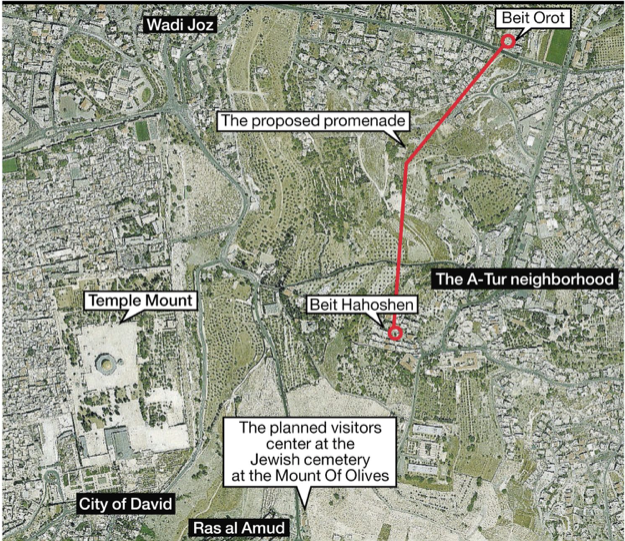
Map by Haaretz
Two of the plans relate to the proposal for a new promenade connecting two settlement enclaves (Beit Orot and Beith Hahoshen) located inside the Palestinian neighborhood of A-Tur, the construction of which will require the expropriation of private Palestinian land.
The third plan is for a visitors’ center (to be run by Elad) abutting the Mount of Olives Cemetery – a plan rumored to be moving forward in June 2017. At that time, Peace Now slammed the plan, saying:
“Dragged by settler organizations, the Israeli government is willing to go out of its way to approve this sensitive plan through a highly unusual procedure. In the current political context, to establish a visitor center next to a mosque and 300 meters away from Temple Mount/Al-Haram A-Sharif is to play with fire. A visitor center in this sensitive area could have far reaching implications on the future of the two state solution and the possibility for a compromise in Jerusalem.”
Ir Amim researcher Aviv Tatarsky told Haaretz:
“Over the past two years we have witnessed increased settlement activity under the guise of tourism and heritage initiatives around the Old City. The Old City and the neighborhoods around it are the home of 100,000 Palestinians…On one hand the authorities make it hard for residents to get building permits and deny them adequate services. On the other, they are advancing in dubious ways initiatives aimed at serving the settlement organizations in the eastern part of the city.”
Lara Friedman: Stop Parsing Trump’s ‘Word Salad’ on Settlements
In an interview with Adelson-financed Israeli daily newspaper Israel Hayom, President Trump said, “The settlements are something that very much complicates and always have complicated making peace, so I think Israel has to be very careful with the settlements.”
When asked about the significance of Trump’s criticism of settlements, FMEP President Lara Friedman said:
“He didn’t raise the issue of settlements, he was asked about it and gave a word salad response that implies nothing….There was nothing that indicated that there will be any pressure on Israel in response to the settlements. Since this administration came in, what they say has matched what their feet are doing. They are suggesting policies that are sympathetic to the Israeli right and far-right. There is nothing in [the interview] that contradicts their policy.”
Bonus Must-Reads
- [Op-ed] “Take a look around. This is what annexation looks like” (+972 Mag)
- [Op-ed] “No chance for peace while settlers dream of holy war” (Al-Monitor)
FMEP has long been a trusted resource on settlement-related issues, reflecting both the excellent work of our grantees on the ground and our own in-house expertise. FMEP’s focus on settlements derives from our commitment to achieving lasting Israeli-Palestinian peace, and our recognition of the fact that Israeli settlements – established for the explicit purpose of dispossessing Palestinians in the West Bank and East Jerusalem of land and resources, and depriving them of the very possibility of self-determination in their own state with borders based on the 1967 lines – are antithetical to that goal.
Welcome to FMEP’s Weekly Settlement Report, covering everything you need to know about Israeli settlement activity this week.
To receive this report via email, please click here.
July 21, 2017
- In Jerusalem’s North: The “Adam-Neve Ya’akov” Plan Resurfaces
- In Jerusalem’s South: The “Gilo Southeast” Plan Expected to Advance
- In the Shadow of Jerusalem’s Old City: Settler-Run Visitor Center is Approved
- In the Heart of East Jerusalem: Alarming Plans Advance As Expected
- U.S. Department of State: Settlements & Settlers Provoke Violence
- Settlement Outpost Near Bethlehem is Angling to Avoid Demolition
- Court Wants Settlers/Palestinians to “Negotiate” Land Theft Ex-Post Facto
- Bonus Reads
Comments, questions, or suggestions? Email Kristin McCarthy at kmccarthy@fmep.org
In Jerusalem’s North: The “Adam-Neve Ya’akov” Plan Resurfaces
The Israeli Construction & Housing Ministry announced impending plans for a 1,100 unit housing project to Jerusalem’s immediate northeast.
Map by Ir Amim
The plan aims to connect large settlements in East Jerusalem (Neveh Ya’akov and Pisgat Zeev) with an isolated settlement in the West Bank (Adam, aka Geva Binyamin). The land identified for the project is within the municipal boundaries of Adam, but on the Israeli side of the separation barrier (the route of the separation barrier in this area cuts deep into the West Bank). If implemented, the Adam settlement would have built up areas on both sides of the barrier.
Israeli Housing Minister Yoav Galant’s office issued a statement explaining, “We will be everywhere that it is possible to build and to provide solutions to the housing shortage, particularly, as in the case of Adam, in the vicinity of Jerusalem. In Greater Jerusalem, there is also particular security importance in Israeli [territorial] contiguity from the Gush Etzion Bloc in the south to Atarot in the north, and from Ma’aleh Adumim in the east to Givat Ze’ev in the west.”
Ir Amim writes that the plan would, “further fracture a future Palestinian state by… breaking contiguity from north to south… while isolating the southern perimeter of Ramallah from East Jerusalem, the future capital of the Palestinian state. Advancing a project of this size, given its extreme geo-political ramifications, would have a fatal impact on the two-state solution.”
The same plan was developed in the early 2000s and explored in 2007 and again in 2008, but shelved because of its political sensitivity and international concern for the future of Jerusalem and the prospects for a two-state solution. Jerusalem expert Daniel Seidemann of Terrestrial Jerusalem writes, “What is different now than in the past is talk of the plan comes in the context of an opening of the settlement floodgates in East Jerusalem, including green lights and expediting of plans the implementation of which, for any number of reasons, in the past was far-fetched or even inconceivable. Consequently, it is important to flag this scheme as early as possible, and to monitor in vigilantly.”
In Jerusalem’s South: The “Gilo Southeast” Plan Expected to Advance
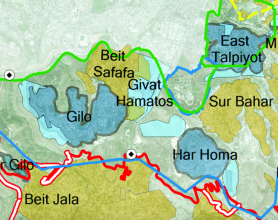
Map by Ir Amim
The Israeli government is set to advance a plan to expand the borders of the Gilo settlement (between Jerusalem and Bethlehem) in order to build 3,000 new units. This plan, called “Gilo Southeast,” is expected to be considered at a meeting on July 26th.
If implemented, Gilo Southeast would further surround the Palestinian city of Beit Safafa, severing the town from the West Bank. An area of intense Israeli settlement infrastructure growth (a settler-only freeway divides the community, and the area has been the focus of demolitions of Palestinian homes), Beit Safafa’s Palestinian residents describe a life under siege.
Gilo Southeast is just one of several alarming plans threatening to sever Palestinian contiguity between East Jerusalem and the southern West Bank:
- Gilo Southeast would abut the border of the Givat Hamatos doomsday plan, which is only waiting for the publication of tenders to begin construction. The Givat Hamatos plan has remained blocked under the previous political calculations, but can be tendered at any moment.
- The plan would also connect Gilo to Har Homa, a fast growing settlement that was built with the Netanyahu’s approval in 1997 – the last official settlement to be built until the recent approval of the Amichai settlement.
Ir Amim writes that Gilo Southeast would create “one more link in a chain of developments designed to seal off the southern perimeter of Jerusalem from the West Bank, nullifying prospects for a two state solution.”
In the Shadow of Jerusalem’s Old City: Settler-Run Visitor Center is Approved

Map by Emek Shaveh
Last week the controversial Visitor’s Center in the Palestinian neighborhood of Silwan (known to Israelis as the “City of David” and located just outside the walls of Jerusalem’s Old City in the shadow of the Temple Mount/Haram al-Sharif) took another important step forward in the final stages of the planning process. According to the Israeli NGO Emek Shaveh, the plan “awaits final approval by the Israel Antiquities Authority, which will only be granted once the archaeological excavations at the site are completed. In our assessment this should happen soon.”
Known as the “Kedem Center,” the building is being financed and promoted by the settler-run Elad Foundation, whose goal is to establish Jewish hegemony over all of Jerusalem (i.e. erase all Palestinian presence, history, and any visibility in the city). The Center will be the largest, state-of-the-art tourism center in Jerusalem and will also serve as a station for the new cable car line approved this year, a cable car line that is designed to facilitate tourists visits to Jewish sites in East Jerusalem while preventing tourists from encountering Palestinians.
Emek Shaveh issued a statement saying, “this project will change the landscape in the area between the Old City and the village of Silwan, and will have a considerable impact on the identity of the Historic Basin. The purpose of the Kedem Center is first and foremost political – to Judaize Silwan and prevent a political solution for Jerusalem.”
The Jerusalem Post reports the Kedem Center plan was approved by Prime Minister Netanyahu as a defiant gesture following UNESCO’s decision to designate sites in Hebron as World Heritage Sites, which Netanyahu incorrectly says deny Jewish history.
In the Heart of East Jerusalem: Plans Advance as Expected
In addition to the north, south, and center settlements plans detailed above, previously reported settlement plans targeting East Jerusalem were all approved for deposit for public review at a government meeting last week. We reported extensively on these in our last edition, here. The plans approved for deposit for public review include the incendiary plans in the Palestinian East Jerusalem neighborhood of Sheikh Jarrah, and more.
Though the plans were all approved for deposit for public review, as of this writing none have been deposited (yet). Like almost every step in the Israeli settlement planning process, actually depositing the plans for public comment is itself a political decision.
U.S. Department of State: Settlements & Settlers Provoke Violence
In the recently released 2016 Country Reports on Terrorism, Secretary Tillerson’s State Department writes, “Continued drivers of violence included a lack of hope in achieving Palestinian statehood, Israeli settlement construction in the West Bank, settler violence against Palestinians in the West Bank, the perception that the Israeli government was changing the status quo on the Haram Al Sharif/Temple Mount, and IDF tactics that the Palestinians considered overly aggressive.” [emphasis added]
Notably, the 2015 Country Reports on Terrorism (an Obama Administration document) did not focus on the role of settlements or identify settlements/settlers as a “driver of violence.” The 2015 document simply noted a handful of terrorist incidents, including the trend of “price-tag attacks,” committed by settlers and committed by Palestinians near settlements.
Settlement Outpost Near Bethlehem is Angling to Avoid Demolition
A settlement outpost near Bethlehem – built illegally even under Israeli law – is fighting a decision by the Israeli Supreme Court to demolish 17 buildings that were found to have been built on land owned by Palestinians. A 2016 decision ruled that buildings in the center of the outpost sit partially on Palestinian land and must be demolished by March 2018. The NGO Yesh Din has an additional, broader petition before the High Court that seeks to prove that the whole outpost is on Palestinian land.

Map by Peace Now
The Netiv Ha’avot outpost was built in 2001 as an additional “neighborhood” of the Elazar settlement southwest of Bethlehem, but was in fact built on a hilltop near the outskirts of the settlement, on land located beyond the settlement’s borders. Forty Israeli settler families currently live there, 15 of which will be affected by the demolition orders.
The outposts’ residents are aggressively pressuring Prime Minister Netanyahu to intervene in their favor (Netanyahu has already caved to vociferous settler protests several times this year). At a demonstration in support of the outpost, signs read “This destruction too is on your watch” (referring to the Amona evacuation) and “Bibi wake up and intervene.”
Court Wants Settlers/Palestinians to “Negotiate” Land Theft Ex-Post Facto
The Israeli Supreme Court made an unusual move to try to avoid having to return private land to Palestinians. The ruling pertains to a case in the Jordan Valley, where the Israeli military seized Palestinian private land for military uses, and subsequently (and improperly, according to Israeli law) gave the land to settlers. Rather than compel the settlers to return the stolen land to its owners, the court wants the Palestinians to negotiate with the settlers for compensation. The court’s move – which is in response to a 2013 petition – is an attempt to resolve the issue without having to rule on the validity of the land seizure, and without having to compel Israel to forfeit the land and evict the settlers (even if doing so requires suspending even the pretense of the rule of law).
Haaretz explains how we got here, “After the Israeli occupation of the West Bank began in 1967, the army issued an order prohibiting Palestinians from entering the area between the border fence and the Jordan River. At the beginning of the ‘80s, the government decided to encourage farmers to work the fields to create a buffer zone with Jordan. The World Zionist Organization was given the land and leased it to settlers.”
- “In Israel’s ‘eternal capital’ anti-Palestinian discrimination is built-in” (July 16, 2017; +972 Mag)
- “Black is the New Orange: 30% of Settlers are Haredim” (July 18, 2017; Times of Israel)
- “Why Adelson is Pouring Millions of Dollars Into an Army-run Israeli University in the West Bank” (July 19, 2017; Haaretz+)
- “The Biggest Attack in Jerusalem” (July 18, 2017; Haaretz+)
- REPORT: “Insurance against political risk: Settlements and the Yanai governmental insurance corporation” (Akevot, July 21, 2017)
Overview: “Archival records, now declassified at Akevot’s request, tell the story of the financial safety net Israeli government provided for commercial companies and settlement agencies beyond the Green Line. Referred to as a “political guarantee” or “political insurance”, it protected settlers and investors in the occupied territories against such “political risks” as Israel’s evacuation from the occupied territories, policy changes or boycotts. As use of the government guarantees gradually expanded, a government insurance corporation was created, to sell insurance policies against these political risks. This is the story of the political guarantee in the occupied territories and the Yanai insurance corporation.”
FMEP has long been a trusted resource on settlement-related issues, reflecting both the excellent work of our grantees on the ground and our own in-house expertise. FMEP’s focus on settlements derives from our commitment to achieving lasting Israeli-Palestinian peace, and our recognition of the fact that Israeli settlements – established for the explicit purpose of dispossessing Palestinians in the West Bank and East Jerusalem of land and resources, and depriving them of the very possibility of self-determination in their own state with borders based on the 1967 lines – are antithetical to that goal.