Welcome to FMEP’s Weekly Settlement Report, covering everything you need to know about Israeli settlement activity this week.
To subscribe to this report, please click here.
September 1, 2023
- Israel Allocates Lands to WZO in order to Expand Two Settlements
- Government Delays Smotrich’s New $185 Million Plan to Expand Settlements
- During Time as Tourism Minister, Yariv Levin Poured Money into Settlement Projects
- Bonus Reads
Israel Allocates Lands to WZO in order to Expand Two Settlements
Peace Now reports that on August 27, 2023, the Israeli government directed the allocation of state lands near two settlements (Mevo’ot Yericho and Amichai) to the Settlement Division of the World Zionist Organization, which will, in turn, allocate the lands to the settlements for expansion. In addition to the concerning expansion of the two settlements, the might signal the government’s intention to formalize the authority of the Settlement Division – a private, non-state entity – to manage the legal process of allocating state lands to settlements and outposts across the West Bank to settlements.
As a reminder, the Settlement Division is a body within the WZO established in 1971 and fully funded by the Israeli government. It serves as a channel by which the government can establish settlements – legally and illegally – in the occupied territories, while avoiding the rules, regulations, and transparency requirements to which government entities are bound. The Israeli government assigned management responsibilities to the WZO for over 60% of the land in the West Bank which the government declared to be “state land” (90,000 acres/400,000 dunams). The WZO has then given that land to settlers to build settlements and secretly funnel government money to illegal outposts. However, Peace Now reports that in recent years the government has “refrained from granting new lands to the Settlement Division, opting for limited and specific allocations instead. The recent decision signifies a noteworthy shift, indicating the government’s intent to formalize the process of land management in the territories by officially outsourcing it to the Settlement Division.”
Peace Now reminds that the Israeli government has attempted once before to formalize the role of the WZO’s Settlement Division as a legal entity charged with managing and allocating West Bank land. When a bill proposing that move was discussed in the Knesset, it was strongly criticized by then Israeli Deputy Attorney Dina Zilber who said:
“This is about relinquishing the state’s fiduciary obligations in the region and effectively elevating the Settlement Division to a governing body with sweeping authority over land in Judea and Samaria. Land management is one of the most significant authorities that should remain under state control… given that we’re operating in an area controlled by the military commander, an area defined as under belligerent occupation in international law… this territory should be managed by the military commander with consideration for both short-term dynamics and the interests of the protected population, which, in the majority of cases in Judea and Sam aria, happens to be the Palestinian population. Consequently, there’s a collision between short-term considerations and permanent settlements. When a clear governmental authority, originally the responsibility of a proper governmental body, shifts to a non-governmental entity, it’s a concerning change. Here, significant funding is also in play… at the moment, we’re in a situation where the same entity serves as a vital resource manager, funded by the government, but lacks oversight and transparency, providing reports only in hindsight. It wields control over hundreds of thousands of dunams.”
Peace Now said in a statement:
“Allowing the Settlement Division to manage these lands in the occupied territories is comparable to entrusting a fox with guarding the henhouse. This essentially amounts to privatizing land management, which is inconsistent with democratic governance and is unlawful within occupied territories according to international law. The Settlement Division has previously been directly implicated in the appropriation of Palestinian private lands and continues to assist settlers in acquiring extensive lands within the territories, often without public tenders and behind closed doors. It operates autonomously, ignoring the governmental oversight bodies that are supposed to supervise its activities. Despite facing severe criticism from the State Comptroller and the Legal Advisor to the Government in the past, the Netanyahu-Smotrich administration has opted to persist in this direction and formalize the process.”
The settlements that are set to expand – Amichai and Mevo’ot Jericho – are especially notable settlements because of their political contexts and sensitive locations.
The Amichai settlement was approved for construction in 2017, making it (at that time) the first new settlement formally approved by the Israeli government in 25 years. The settlement is located in the heart of the northern West Bank, in the Shiloh Valley, in an area of settlements that are designed to form an uninterrupted corridor of Israeli control connecting sovereign Israel to the Ariel settlement, through the isolated Shiloh Valley settlements, all the way to the Jordan Valley. In so doing, It will completely bisect the northern part of the West Bank. Aerial imagery from 2021 show the massive growth Amichai has enjoyed in the years that followed its establishment, a previously empty hilltop with cultivated fields nearby have been transformed into a sizable suburban neighborhood. In addition to new construction, Amichai was also massively expanded, subsequent to its initial construction, when the Israeli Civil Administration announced that its plan to retroactively legalize the Adei Ad outpost by significantly expanding the borders of the Amichai settlement to turn Adei Ad into a (non-contiguous) neighborhood. In effect, this was a slight-of-hand by Israel to turn the Adei Ad outpost into an entirely new official, legal settlement. Now, the settlement is set to expand yet again, at the continued cost to Palestinians from the nearby village of Turmus Ayya on whose land Amichai was established and whom settlers from the Amichai outpost and others nearby routinely harass and terrorize.
The Mevo’ot Yericho settlement is located in the Jordan Valley just north of Jericho. Established illegally as an outpost, the Israeli government granted retroactive legalization to it 2019, just two days before an election. One of Netanyahu’s most prominent campaign pitches was to unilaterally annex the Jordan Valley, of which the legalization of Mevo’ot Yericho was a part. Prior to the government’s decision to legalize Mevo’ot Yericho, Israeli Attorney General Mandleblit had to rescind his earlier objection to the timing of the approval (during an election campaign), apparently having been convinced that granting retroactive legalization to the outpost was an “urgent” matter. According to a source who spoke to The Times of Israel, Netanyahu convinced Mandleblit of the plan’s urgency by informing him that the Trump’s “Deal of the Century” will put outposts, including Mevo’ot Yericho, at risk for evacuation, and that Israel must “combat” the plan before it is published.
Government Delays Smotrich’s New $185 Million Plan to Expand Settlements
Ynet reports that the Israeli government has temporarily paused consideration of a proposal by Bezalel Smotrich to invest some $185million (700 million NIS) into a variety of projects that will enable the rapid growth of settlements, including establishing new settlements, the retroactive legalization of 155 outposts, and building an airport in the northern West Bank.
Ynet further reports that the faces opposition from the Israeli Shin Bet as well as the United States..
During Time as Tourism Minister, Yariv Levin Poured Money into Settlement Projects
Peace Now has published data and analysis on Yariv Levin’s four year tenure as the Israeli Minister of Tourism (2016-2019), during which time he oversaw the investment of $245 million (NIS 929 million) into “tourism” projects in the West Bank. The amount of funds invested in settlement projects amounted to close to half (46%) of the tourism budget for the entire country.
As a reminder, Israel’s development of tourism sites in the West Bank is part and parcel of its settlement enterprise, and perpetuates land theft, annexation, and the systematic violation of Palestinian rights.
The Peace Now report finds:
- Over 37% of the development budget, nearly 350 million shekels, was allocated to projects associated with the right-wing and settler organization of Elad, operating in Palestinian neighborhoods in East Jerusalem.
- 84.3% of the investments in Jerusalem went to the Elad settler organization.
- In the settlements (excluding East Jerusalem), approximately 70% of the funds submitted for approval to the Ministry of Tourism were approved, while in Israel, only 20% were approved.
For a detailed examination of the projects Levin invested in, please see Peace Now’s report.
Bonus Reads
- “Smotrich Takes to PR to Publicize Israeli Demolitions of Palestinian Structures in West Bank” (Haaretz)
- “Settlers Killing Palestinians: A History of Impunity” (Haaretz)
- “Palestinians blame settler attacks for emptying of 3 West Bank villages” (The Times of Israel)
- “Palestinian fears grow amid rising Israeli settler attacks” (BBC)
Welcome to FMEP’s Weekly Settlement Report, covering everything you need to know about Israeli settlement activity this week.
To subscribe to this report, please click here.
November 8, 2019
- Israel Advances Plans for 2,342 New Settlement Units
- Israeli Government Approves Settler-Initiated Plans for Cable Car in Jerusalem — Despite Professional, Human Rights Objections
- Israel Plans to Build a New Waste Treatment Plant (to serve Israelis) in the West Bank
- No More Waiting: MKs Introduce Annexation Bills Despite Political Deadlock
- Annexation-via-New Roads (the new Smotrich Plan)
- Annexation-via-Movies (Govt-Funded Settlement Hasbara)
- Annexation-via-Education (Ambassador Friedman’s Favorite Medical School)
- Settler Leaders Elect New Chairman of the Yesha Council
- Israeli Official Calls on Evangelicals to Defend Settlements, Fight BDS, and Support “Economic Peace”
- Bonus Reads
Questions/comments? Contact Kristin at kmccarthy@fmep.org
Israel Advances Plans for 2,342 New Settlement Units
With little attention, on October 10th the High Planning Council – a body within the Israeli Defense Ministry’s Civil Administration, responsible for regulating all construction in the West Bank – advanced plans for 2,342 new settlement units, as well as for two additional settlement projects. Of that total, 719 units were approved for validation (the penultimate step in the planning process), and 1,623 settlement units were approved for deposit for public review (an earlier but decisive stage in the planning process).
The 719 units which received final approved for validation comprise:
- 207 units in the Bracha (aka Har Bracha) settlement, located south of Nablus. In September 2019, the Israeli Central Command signed an order that expanded the settlment’s jurisdiction, a move which paved the way for the approval of these new units (see our September 2019 report). According to Peace Now, this plan – if implemented – will significantly expand both settlement’s population and its physical footprint.
- 206 units in the Tzofim settlement, located north of the Palestinian town of Qalqilya – a town completely encircled by Israel’s seperation barrier (except for a single road connecting it to the rest of the West Bank) – in the northern West Bank.
- 166 units in the Alei Zahav settlement, located in a string of settlements stretching across the northern West Bank. Alei Zahav and its settlement neighbors create a contiguous Israeli populated areas linking Israel proper (west of the Green Line) all the way to the Ariel settlement, located in the heart of the West Bank (the eastern end of Ariel is closer to the Jordan border than to the Green Line). Notably, Alei Zahav is one of the settlements in which the “market principle” has been applied to legalize settlers theft of land recognized by Israel as belonging to Palestinians (see our July 2019 report).
- 140 units in the Mezadot Yehuda settlement, located at the very southern tip of the West Bank, just south of the Palestinian village of Susya, which the Israeli government has been threatening to demolish for years. This plan would nearly double the number of authorized units in the settlement.
Also receiving final approval for validation:
- A plan to retroactively legalize the illegal Brosh outpost in the Jordan Valley. According to Peace Now, the Brosh settlement serves as an educational institution that houses hundreds of students and families of staff members.
- A plan to build a tourist/visitors center in the Shilo settlement – where settlers and the Israeli government have been investing in developing tourism sites for Jewish and evangelical tourists.
The 1,623 units which were deposited for public review include:
- 609 units in the Beitar Illit settlement, located west of Bethlehem, near the Green Line. Beitar Illit is a massive, fast-growing ultra-Orthodox settlement.
- 382 housing units in the Dolev settlement, located west of Ramallah. This is a significant plan for Dolev, as it will more than double the number of existing units. Prime Minister Netanyahu previously promised to build 300 new units in Dolev in response to a Palestinian-perpetrated bombing at a spring (which settlers had taken over from Palestinians) near the settlement that killed a 17-year old Israeli and injured several others.
- 182 units in the Mevo’ot Yericho settlement, located north of Jericho in the Jordan Valley. The validation of this plan is the actualization of the Israeli security cabinet decision to grant the illegal outpost of Mevo’ot Yericho retroactive legalization, an action for which the security cabinet urgently convened on the eve of the September 19th elections. The plan approved by the High Planning Council on Oct. 10th granted legalization to the existing 20 existing units and, if implemented, will allow the settlement to significantly expand.
- 146 units in the Kfar Etzion settlement, located southwest of Bethlehem.
- 140 units in the Kerem Reim outpost located north west of Ramallah. Peace Now has repeatedly challenged the illegal construction of the Kerem Reim outpost, which the Israeli government retroactively legalized by declaring it a neighborhood of the Talmon settlement even though the areas are non-contiguous. Though a court rejected one Peace Now petition, there is an ongoing case against the Amana settler organization which Peace Now alleges engaged in illegal activities to build the outpost.
- 100 units in the Nokdim settlement, located southeast of Bethlehem. Former Israeli Defense Minister Avigdor Liberman – currently one of the most important figures in the race to form a governing coalition – lives in Nokdim.
- 64 units in the Telem settlement, located west of Hebron.
- A plan to build new shops and services in the Kochav Yakov settlement, located between Jerusalem and Ramallah.
Peace Now said in a statement:
“The figures speak for themselves. Netanyahu continues to sabotage the possibility of a political agreement with the Palestinians by promoting more settlement construction in the West Bank, including in places where Israel may have to evacuate as part of a future agreement. This is yet another dangerous step for both Israel and the Palestinians, led by a transitional prime minister whom the public did not trust in his policies. The next government must put a freeze on the development of settlements and to strive for immediate resumption of negotiations with the Palestinians without preconditions and to end the bloody conflict based on the principle of two states for two peoples.”
The European Union issued a statement criticizing the approvals, saying:
“The European Union’s position on Israeli settlement policy in the occupied Palestinian territory is clear and remains unchanged: all settlement activity is illegal under international law and it erodes the viability of the two-state solution and the prospects for a lasting peace, as reaffirmed by UN Security Council Resolution 2334. Israeli authorities also approved a building permit for the construction of a new tunnel road, which bypasses Bethlehem to the west. The progressive construction of a separate road network, connecting settlements and outposts to each other and to the road network in Israel while circumventing Palestinian towns and communities, is entrenching the fragmentation of the West Bank. The EU calls on Israel to end all settlement activity, in line with its obligations as an occupying power. The EU will continue to support a resumption of a meaningful process towards a negotiated two-state solution, the only realistic and viable way to fulfil the legitimate aspirations of both parties.”
Israeli Government Approves Settler-Initiated Plans for Cable Car in Jerusalem — Despite Professional, Human Rights Objections
On November 4th, the Israeli Housing Cabinet approved a settler-initiated plans to build a cable car line in East Jerusalem, despite the fact that the Israeli Attorney General has not yet rendered a decision on whether plans for such a significant and sensitive project can be advanced by a caretaker Israeli government. Emek Shaveh – an Israeli NGO fighting the politicization of archeology in Jerusalem – announced that it intends to appeal the approval to the Israeli Supreme Court.
As FMEP has repeatedly covered, this Jerusalem cable car project is an initiative of the Elad settler organization (which is building a massive tourism center – the Kedem Center – in the Silwan neighborhood, which will be a stop along the cable car’s route). The scheme is intended to further entrench settler control, via archeology and tourism sites, inside the Silwan neighborhood of East Jerusalem, while simultaneously delegitimizing, dispossessing, and erasing the Palestinian presence there. Non-governmental organizations like Emek Shaveh, Who Profits, and Terrestrial Jerusalem have repeatedly discredited the government’s contention that the cable car serves a legitimate transportation need in Jerusalem, and have clearly enumerated the obvious political drivers behind the plan, the archeological heresies it validates, and the severe impacts the cable car project will have on Palestinian residents of Silwan.
Ir Amim field researcher Aviv Tartarsky told Middle East Eye:
‘The project is a way to whitewash Israel’s taking of areas in Silwan to use for archaeological and touristic reasons…If someone wants to go to the Western Wall of the Old City, they have to go through the ELAD activity centre. This project will give ELAD legitimacy and influence, as it is taking part in a governmental project. This is the political reason for why the government is doing this project,’ Tatarsky said.”
Israel Plans to Build a New Waste Treatment Plant (to serve Israelis) in the West Bank
In October 2019 the Israeli government issued a construction tender to build a waste-to-energy plant in the West Bank, on an area of land that is within the jurisdiction of the Ma’ale Adumim settlement where several Palestinian Bedouin communities live. The plant – which is expected to cost USD $284 million (1 billion NIS) – will treat Israeli-generated waste.
B’Tselem – which previously published a comprehensive report criticizing the illegal Israeli practice of exporting its waste to the occupied territories – writes:
“For many years, Israel has been taking advantage of its power as occupier to transfer the treatment of waste (including hazardous waste) and sewage from its sovereign territory to the West Bank. To that end, it has created a situation in which environmental legislation in the West Bank is much laxer than inside Israel, conveniently overlooking the long-term impact of environmental hazards on the Palestinian population and on natural resources, and neglecting to prepare future rehabilitation plans. This has created a financial incentive to transfer the treatment of environmental hazards from Israel to the West Bank. The Palestinians who live in the occupied territory are the ones to pay the price for this environmental damage, even though they were never asked their opinion on the matter and although, as a population under occupation, they have no political power and no real ability to resist.”
B’Tselem also takes aim at the European Union (EU), which has invested millions in the implementation of the Isareli Ministry of Environmental Protection’s 2030 strategic plan, of which the waste-to-energy treatment plant is a part. B’Tselem writes:
“In 2019, Israel and the EU signed an agreement as part of the EU’s twinning instrument, which establishes cooperation with the EU’s neighboring countries, guaranteeing Israel approximately 1.5 million euros over the next two years to support the Ministry of Environmental Protection’s implementation of its 2030 strategic plan. In the agreement, Israel committed to creating a legal framework that adopts European practices and standardization for sustainable waste treatment. As in every agreement between the EU and Israel, it contains a territorial clause that stipulates that it will not apply beyond Israel’s 1967 borders. Yet the EU’s support for the ministry’s strategic plan – which defines the establishment of the plant at Ma’ale Adumim as a goal and presents the exploitation of West Bank land to resolve environmental problems as a matter of course – empties this annex of meaning. By supporting this plan, the EU will be supplying Israel with knowledge and experience that will help deepen its exploitation of Palestinian land resources and bolster the economic status of the Ma’ale Adumim settlement.”
No More Waiting: MKs Introduce Annexation Bills Despite Political Deadlock
Israeli political figures appear to be done waiting for a new government to be formed before acting on the loud signals from the Trump Administration supporting Israeli annexation of West Bank land.
On November 4th, Yamina party leader Ayelet Shaked filed a bill with the Knesset to unilaterally annex the Jordan Valley, the Ma’ale Adumim settlement just east of Jerusalem, and all 22 settlements and 75,000 Israeli settlers in what is broadly termed the Etzion “settlement bloc” located south of Bethlehem. Shaked’s bill calls for Israel to “apply sovereignty” to these settlements, which in practice would constitute the annexation of the settlements. Applying Israel law to areas outside of Israel’s sovereign borders is de facto annexation, as FMEP has explained and documented.
Shaked urged expeditious consideration of the bill, saying:
“There is a diplomatic window of opportunity and willingness on the part of the US for this kind of annexation that will not return. We cannot afford to hesitate or wait. We must take advantage of this window of opportunity immediately and begin to apply sovereignty over these areas. It is for this reason that the State of Israel cannot be dragged into another election cycle.”
On November 3rd, Likud MK Sharren Haskel submitted a draft bill for the annexation of the Jordan Valley, a bill she has introduced previously without success. Haskel said:
“It’s time to make the residents of the Jordan Valley legal Israeli citizens, thus kick-starting the development and prosperity of the region.The communities of the Jordan Valley and their residents are a strategic resource of the highest order for Israel. There is a wide consensus today about the region, following the long-awaited U.S. president’s recognition of the Golan Heights as under Israeli sovereignty. It is time to do the same with the Jordan Valley. After Blue and White leader Benny Gantz proposed to do the same, I call upon him and my fellow party members to support my proposal.”
In March 2019, ahead of the first round of Israeli elections this year, leaked reports suggested that U.S. diplomats were engaged in discussions with Israel about the latter’s intention to annex several “settlement blocs” – even more so-called blocs than called for by Shaked’s latest plan – following the elections. The reports were not corroborated by U.S. sources, but in the intervening time U.S. Ambassador to Israel David Friedman has made repeated statements to the press (in addition to speculative reporting about a forthcoming U.S. political plan) in support of Israel’s right to annex territory in the West Bank – cues the Israeli government has enthusiastically welcomed. In the lead-up to the September elections, Netanyahu vowed to annex the Jordan Valley should he be reelected, a plan endorsed by his rival Benny Gantz and supported by then-U.S. National Security Advisor John Bolton.
As a reminder, over the years there has been no shortage of attempts to normalize the idea that Israel will retain “settlement blocs” in any negotiated peace agreement — logic that originally applied narrowly to the Etzion bloc (defined on much less expansive terms), Maale Adumim, and, in the eyes of some, Ariel. The terminology has been exploited for decades by the Israeli government to convey legitimacy to building in the so-called “blocs.” Over the years the definition of what is a “bloc” has been twisted to include a much larger idea of the Etzion bloc, as well as the entire Jordan Valley. The implied idea regarding what the blocs are and the fact that they are inarguably Israel’s to keep, is incredibly misleading. The term “settlement blocs” has no formal definition or legal standing, and the future of the blocs – no matter how they are defined – is indisputably a matter at the heart of what will one day be negotiations aimed at a two-state solution (if there is ever to be such a solution). For more context, see resources from Americans for Peace Now here and here. (NOTE: A Haaretz investigation last year estimated that a total of 380,000 Israeli settlers live in the West Bank, of which 170,000 live outside of the so-called blocs, as defined by Haaretz).
Annexation-via-New Roads (the new Smotrich Plan)
On November 1st, Israeli Minister of Transportation Bezalel Smotrich unveiled a new government plan to advance Israeli “sovereignty through transportation.” The plan calls for massive investment (USD $283 million) in new/expanded roads and rails lines, for the express purpose of more seamlessly integrating Israeli settlements into Israel proper. Smotrich made clear that his ultimate goal is the complete integration of the West Bank into the national planning mechanisms of Israel proper. The move will erase the government’s current distinction between transportation projects in the West Bank (across the Green Line) and Israel proper [fun note: the Israeli Ministry of Foreign Affairs has an official map posted on its website entitled, “Transportation and Built-Up Areas” that includes the entire West Bank as part of Israel).
Touting the significance of his plan, Smotrich said:
“I do not give preference to Judea and Samaria [the West Bank] but also am not willing to continue the discrimination. These areas will receive treatment just like anywhere else in Israel. While it is only about roads and trains, it has political significance.”
Smotrich created a new bureau for “Judea and Samaria Planning” within the Transportation Ministry to oversee the implementation of this project, and more generally ensure that the ministry is geared towards serving the settlements as a matter of normal business. The institutionalization of such bureaucratic structures within the Israeli government is a significant, and often overlooked, mechanism by which the Israeli government has been engaging in annexation for years. The new bureau – much like parallel structures former Minister Ayelet Shaked set up in the Justice Ministry – is a formal and public statement that the Israeli government is pursuing (and allocating resources to) annexing the settlements.
It should be noted that Israel has used infrastructure projects in the West Bank to advance its settlement agenda, and to further fragment Palestinian life – two completementary goals powerfully explained by B’Tselem in a recently released interactive: “Conquer and Divide: The Shattering of Palestinian Space by Israel.”
FMEP tracks developments related to the ongoing annexation of West Bank land in its Annexation Policies Tables.
Annexation-via-Movies (Govt-Funded Settlement Hasbara)
On November 6th, Israeli Cultural & Sports Minister Miri Regev announced new government funding for film projects initiated by Israeli settlers. According to the guidelines, the new funding will support Israeli citizens living in West Bank settlements who want to make documentaries and films.It is widely understood that the goal is to encourage the creation of more pro-settlement propaganda.
Celebrating her new initiative, Regev essentially admitted that annexation was her motive, saying:
“I made a promise and I am keeping my promise! We are making history today. The Culture and Sports Ministry will support the regional production of films in the north, and for the first time in Judea and Samaria too, and in the hope that in the near future also in the south… The wheels of cultural justice, which bring to expression the range of voices in Israeli society, have worked quickly and now another stage in correcting the cultural map in Israel has been completed. The artists from the periphery, the north and from Judea and Samaria, will become more and more in the center of things, not just on stage but also on the screens. Soon we will allow them to express their ability and talent.”
One critic of the fund, Israeli producer Liran Atzmor, nailed why the new fund is highly problematic and a tool of de facto annexation:
“Setting up a fund that supports filmmaking in the occupied territories with Israeli taxpayers’ money amounts to creeping annexation, which is happening in many areas, obviously, but is happening now more forcefully in the realm of culture, thanks to this fund. As long as the fate of those territories has not been determined, one cannot accept the fact that public funds are distributed there to people of only one color, one nationality and one religion.”
Shlomo Eldar writes:
“…And that is the whole point, to show life in the settlements in a positive light, as a Zionist enterprise glorifying the State of Israel. Head of the Samaria Regional Council Yossi Dagan described the fund as a ‘giant piece of good news. … I believe this move will bring the story of Judea and Samaria to the big screen. … I call on all artists to take part in this party, to come and film in Judea and Samaria and tell its story, so that we can present the public with other faces and other stories that have yet to be seen on the screen’.”
Libby Lenkinski, Vice President of the New Israel Fund, explained in a tweet:
“Creeping annexation and normalization of settlements is not just happening on the land, it’s also a narrative strategy that uses arts and culture funding to move forward. #StopAnnexation”
Annexation-Via-Education (Ambassador Friedman’s Favorite Medical School)
Despite delays and scandals, the sparkling new medical school at Ariel University has officially launched its first school year, with a ceremony attended by a who’s-who of settlement financiers and supporter rejoicing in the opening of the school and in the implications of its opening for the Greater Israel enterprise.
Dr. Miriam Adelson and her husband, Trump-backer/U.S. casino magnate Sheldon Adelson, were in attendance. The Adelsons donated $20 million to the medical school, which was named after Miriam. Addressing the crowd, Dr. Adelson said:
“In Israel, being Israel, we also had to withstand our tribulations. In Israel, being Israel, there were opponents who tried to block the establishment of a critical institution on ancient Jewish land and to deny us legitimacy. But we won, Zionism won, the truth won.”
U.S. Ambassador David Friedman recited the “shehecheyanu,” a prayer of gratitude to God, as part of his speech, also exclaiming:
“A new medical school has opened in Samaria. It’s worth saying that again: A new medical school has opened in Samaria! How many people ever thought those words would be spoken?…The United States Embassy enjoys warm relations with Ariel University, and we are inspired by its contributions to Israeli society and to the scientific world.” [NOTE: “Samaria” is a biblical name used mainly by settlers and their allies to refer to the northern part of the West Bank]
MK Naftali Bennet put an even finer point on the significance of opening a medical school in Ariel settlement, saying:
“No longer is there a Green Line. We are one [united] Israel and that is how it should be. We are going to serve everyone here.”
There are 70 Israeli students enrolled to attend the settlement university. Even though classes are set to begin, the medical school still does not have an approved budget for the 2020 school year.
As a reminder, the Ariel settlement is located in the heart of the northern West Bank, reaching literally to the midpoint between the Green Line and the Jordan border. The future of Ariel has long been one of the greatest challenges to any possible peace agreement, since any plan to attach Ariel to Israel will cut the northern West Bank into pieces. Nonetheless, in February 2018, the Israeli Knesset passed a law extending the jurisdiction of the Israeli Council on Higher Education to universities in the settlements (beyond Israel’s sovereign borders) – an act of de facto annexation. The law was necessary to ensure that the Ariel settlement medical school (and its graduates) would be entitled to all the same rights, privileges, and certifications as schools and students in sovereign Israel. FMEP has tracked this process, and all other annexation policies in its Annexation Policy tables. A fuller history of the Ariel Medical School saga can be found here.
Settler Leaders Elect New Chairman of the Yesha Council
David Elhayani was narrowly elected to serve as the next Chairman of the powerful settler Yesha Council – an umbrella body representing all the settlement regional councils. Elhayani is a well known personality, having served for 10 years as the head of the Jordan Valley Regional Council (a quasi municipal body serving the needs and interests of settlements in the Jordan Valley).
The Times of Israel’s settlement correspondent Jacob Magid explains the relevant politics involved behind Elhayani’s narrow victory over Yigal Lahav, a younger, more radical voice:
“Elhayani and Lahav represented opposite sides of an intensifying rift between an older generation of settler leaders that is closely aligned with Prime Minister Benjamin Netanyahu and a younger group of council chairmen who believe in acting more aggressively on behalf of the movement, even if that means being at odds with right-wing governments that the Likud chief has led. Elhayani, from the old-timer’s camp, edged out Lahav 13-12 after the votes of 24 West Bank council chairman plus settler elder Zeev ‘Zambish’ Hever were counted.”
Elhayani addressed the dynamics of the old guard (of which he is a part) vs. new, more radical, guard ahead of the elections, saying:
“There’s a crisis of trust in the Yesha Council where many council chairmen don’t see the body as being capable of serving the needs of their residents. Many council chairmen don’t show up to Yesha meetings at all.”
Elhayani promised a more “aggressive” demeanor so that those the Council represents will see that they “finally have someone who will fight for them.” So, despite being what some settlers may consider the “mainstream,” i.e. less willing to aggressively challenge the perceived slow-walking of settlement expansion and annexation by the Israeli government, Elhayani is still best understood as an ideologue in his own right.
Ahead of the vote, Elhayani did offer strong criticism of what he sees to be the Isareli government’s discrimination against the settlements, saying that he will fight for better “quality of life”for the settlements – making infrastructure as a core part of his agenda:
“Our residents are sick of the poor infrastructure that has led to power outages, water shortages and traffic jams. It is the responsibility of settler leadership to provide adequate services. You cannot improve quality of life until you improve infrastructure. We still need to be aggressive in demanding infrastructure improvements in the meantime, in addition to preventing a Palestinian takeover of Area C so that there will be something to [annex] when the time comes.”
Israeli Official Calls on Evangelicals to Defend Settlements, Fight BDS, and Support “Economic Peace”
Speaking to an audience of leaders in the evangelical media world, a top Netanyahu aid asked the crowd to join Israeli government efforts to defend the legitimacy and permanence of the settlements, and coached the crowd on how to frame settlements in a way that advances their normalization.
This was the third annual “Christian Media Summit” hosted by the Israeli Government Press Office to develop the group into “ambassadors for Israel.” According to Haaretz, the 2019 event was attended by approximately 150 journalists, mostly from the United States, working for Christian media outlets from 30 different countries. Entitled, “Between Jerusalem and the Golan: International Recognition,” the event featured addresses by Benjamin Netanyahu and President Reuven Rivlin. U.S. Ambassador David Friedman attended as well.
Speaking to the group, Deputy Chief of Foreign Affairs Reuven Azar said:
“The return of Jews to Judea and Samaria is not a curse, it’s a blessing for all the residents of the area…Calling for their expulsion is a recipe for destruction and for chaos… Look what happened when we went out of Gaza. Our presence in Judea and Samaria [the West Bank], and in Jerusalem brings stability… because we bring security by fighting the bad guys…We must partner in embracing our brothers and sisters who live in Judea and Samaria, and fight against those who claim their presence is illegal, or try to dehumanize them through different means. Help us to fight boycotts, they are not just, and they hurt us and they hurt our neighbors even more. ‘The revival of the Jewish people in the land of Israel is a divine promise being fulfilled…It is a blessing for our people, our region, for the world. A force for good, a force for peace, prosperity and happiness’.”
Following his remarks, the Front for the Protection of Democracy – an Israeli NGO – filed a complaint with the Civil Service Commission seeking disciplinary action against Azar. The Prime Minister’s Office quickly came to Azar’s defense, saying: “Political adviser Reuven Azar expressed government policy.”
Azar repeatedly referred to settlements as “communities” – a term that erases the illegality of those “communities” under international law. This pro-settlement framing was recently endorsed by outgoing U.S. advisor Jason Greenblatt. Azar also touted the now familiar but Orwellian claim that settlements are an economic gift to the Palestinians, claiming that “communities [settlements] in Judea and Samaria [the West Bank] provide opportunities, and jobs…” Azar invited the audience to visit the Barkan industrial zone, stating: “The best paying jobs for Palestinians are in Barkan.”
As FMEP has previously explained, for decades Israel has used industrial zones as another tool to expand and deepen control over West Bank land and natural resources. Industrial zones perpetuate Israel’s economic exploitation of occupied territory (including the local workforce, land, and other natural resources), and that it is Orwellian to label such initiatives as “coexistence” programs, or to suggest that they offer the Palestinians benefits they should welcome. Importantly, jobs in industrial zones – often the only jobs available for Palestinians living under an Israeli occupation that prevents the development of any normal Palestinian economy – are widely viewed by Palestinians as a double-edged sword.
Bonus Reads
- “Five Settlers Arrested on Suspicion of Attacking Israeli Policemen at West Bank Outpost” (Haaretz)
- “Israel’s Right New Bank – The Jewish National Fund” (Haaretz)
- “Why did Microsoft fund an Israeli firm that surveils West Bank Palestinians?” (NBC News)
- “Israeli Schools Teach Pro-settler Religious Nationalism Is the Only Way to Be Jewish” (Haaretz)
- “A Wall, Arrests and Close Surveillance: How Israel Fences in a Palestinian Family” (Haaretz)
- “Hilltop Youth Battle The IDF Over Expulsion Order “ (JNS)
- “Welcomed, then Attacked by Yitzhar” (New Voices)
Welcome to FMEP’s Weekly Settlement Report, covering everything you need to know about Israeli settlement activity this week.
To subscribe to this report, please click here.
September 27, 2019
- Israeli Cabinet Votes to Legalize the Mevo’ot Yericho Outpost, Pledges to Legalize More
- Israel Evicts Another Palestinian Family from its Home in East Jerusalem’s Silwan
- On Israel’s Agenda: Letting Settlers Directly Purchase West Bank land
- A Jerusalem Suburb is Building a Cemetery in the West Bank
- New B’Tselem Report: Apartheid in Hebron
- New Al-Haq Report: Israel Means to Crush Palestinian Life in the Old City of Jerusalem
- Bonus Reads
Questions/Comments? Email Kristin McCarthy (kmccarthy@fmep.org)
Israeli Cabinet Votes to Legalize the Mevo’ot Yericho Outpost, Pledges to Legalize More
On September 15th – two days before elections — the Israeli security cabinet voted to start the process of legalizing the Mevo’ot Yericho outpost, located just north of Jericho in the Jordan Valley. If given final authorization by the next Israeli government, Mevo’ot Yericho will be the sixth official new settlement established by the state of Israel since it signed the Oslo Accords in 1993.
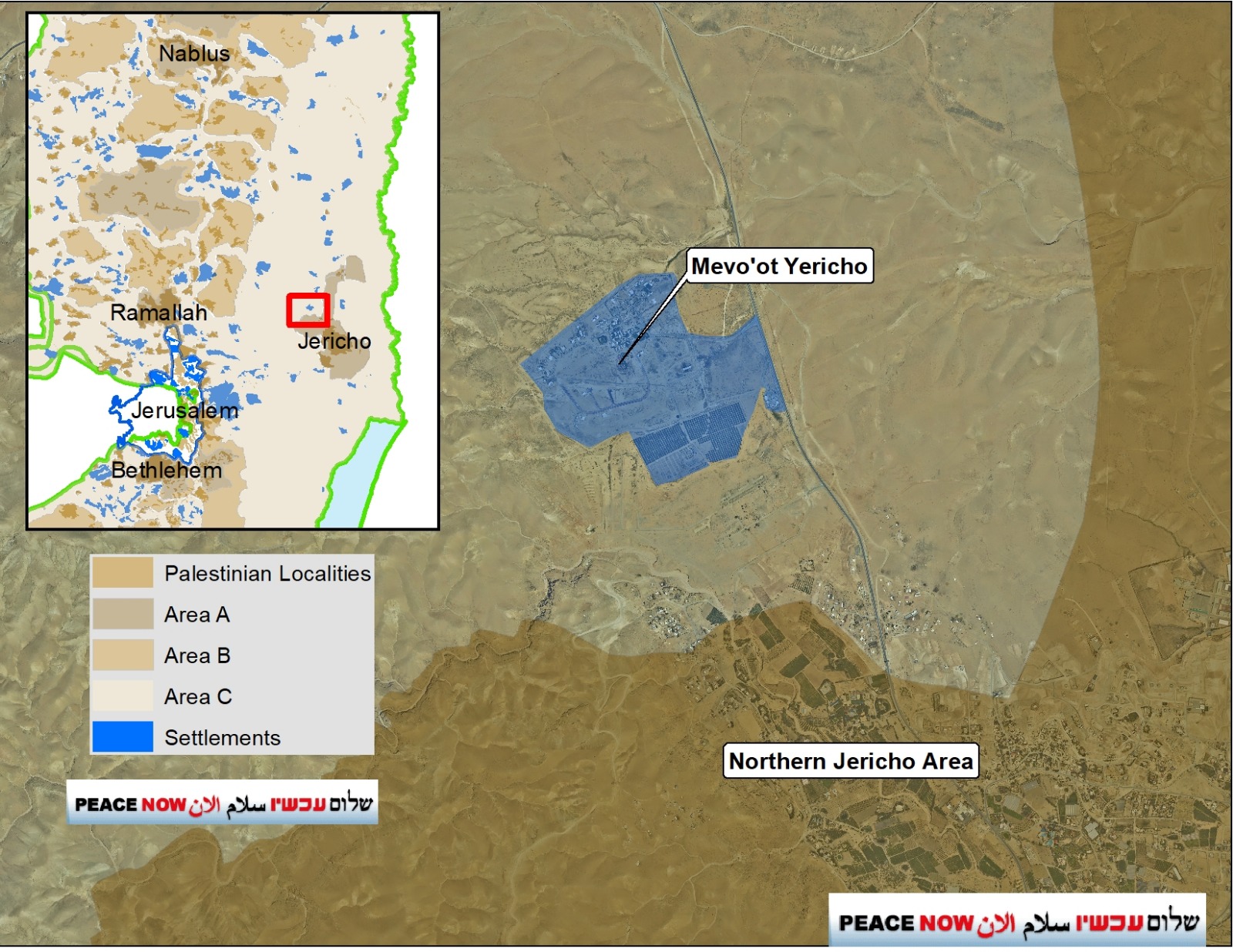
Map by Peace Now
The Israeli Cabinet approved the plan during a meeting held, exceptionally, in a Jordan Valley settlement. The choice of the location for the meeting, which is a de facto expression of Israeli sovereignty over the area, is especially notable given Netanyahu’s recent promise to annex the majority of land in the Jordan Valley. Dismissed by some as a campaign stunt, the idea was nonetheless supported in principle by Benny Gantz, leader of the Blue & White party, who claimed that the idea was his first. The Cabinet’s choice to legalize the outpost and meet in the Jordan Valley was condemned by Palestinians and senior Jordanian government officials.
Peace Now said in a statement:
“This official establishment of another settlement proves yet again that the government is unencumbered by the thought of international backlash or the end to Israeli democracy on its way to annex Area C. The government continues to show blatant disregard for reaching a two-state conflict-ending agreement with the Palestinians. Instead, it prefers to take new strides in formalizing the acquisition of occupied territory and to control the area’s resources while permanently keeping the Palestinian population confined without full rights in isolated cantons.”
Paving the way for the Cabinet to approve the plan, Israeli Attorney General Mandleblit rescinded his earlier objection to the timing of the approval, apparently having been convinced that granting retroactive legalization to the outpost was an “urgent” matter. According to a source who spoke to The Times of Israel, Netanyahu convinced Mandleblit of the plan’s urgency by informing him that the Trump’s “Deal of the Century” will put outposts, including Mevo’ot Yericho, at risk for evacuation, and that Israel must “combat” the plan before it is published.
Israel’s move to legalize Mevo’ot Yericho is just the latest in the state’s efforts to effect the mass retroactive legalization of outposts that were built in the West Bank without required legal approvals of the Israeli government and its planning authorities. FMEP has documented this effort, and the legal manipulations that make it possible, in its Annexation Policy Tables. As Israeli calls for annexation become more common, this repository of policies is an illustrative, living archive of how Israel has already acted (and continues to act) to annex land in the West Bank.
Israel Evicts Another Palestinian Family from its Home in East Jerusalem’s Silwan
On September 20th, a Jerusalem Magistrate judge ruled to evict the Palestinian Sumreen family from its longtime home in the Silwan neighborhood of East Jerusalem. The ruling is the latest boon to two powerful organizations, the Jewish National Fund (JNF) and the Elad settler organization, which have for nearly 30 years been trying to evict the 18-member Sumreen family.
The Sumreens are expected to continue their fight to stay in their home, by appealing the latest eviction order to the District Court (and then, if necessary, the High Court of Justice).
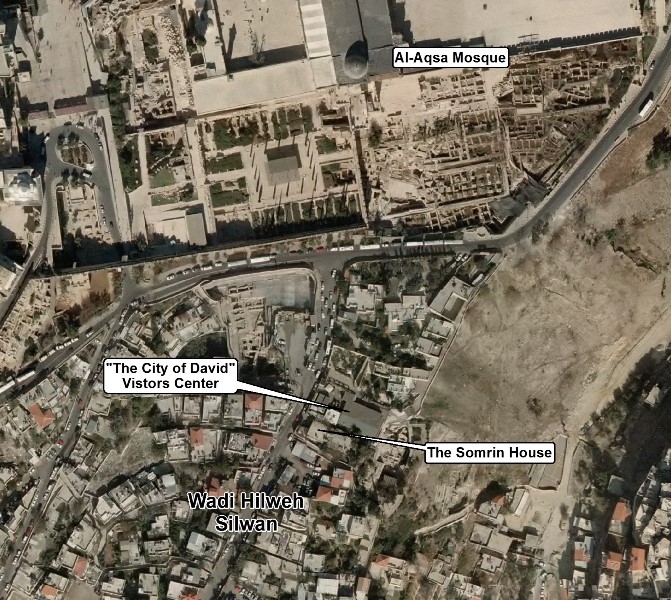
Map by Peace Now
The Sumreen family has been forced into the battle over its legal ownership of the home after the state of Israel, prompted repeatedly by the JNF, declared that the Sumreen’s home as an “absentee” property. After that designation – which was not communicated to the Sumreen family – Israeli law permitted the state to take over the rights to the building, after which the state sold the rights to the JNF in 1991. Since then, the JNF has been working to evict the members of the Sumreen family who continued to live there. The JNF ran into many obstacles in their pursuit, and for years Israeli courts ruled in favor of the Sumreen family’s ownership claims to the home. A full history of the saga involving the Sumreen family – which is similar to dozens of other Paelstinian homes in Silwan that were declared Absentee Property in the 1990s – can be found on the Peace Now website here.
Peace Now said in a statement:
“This is a cruel story that did not need to happen. KKL-Jewish National Fund has become a settler fund. It has repeatedly tried to throw a Palestinian family out of its home by exploiting a legal method that is stacked against Palestinians, and has not let go for nearly 30 years even after losing in court. This is part of an ugly process of using absentee property law based on questionable evidence to take Palestinian assets and give them to settlers, and to destroy the delicate fabric of life in Jerusalem.”
As Peace Now mentioned, the JNF’s activities in Silwan have been a source of repeated misery for the Paelstinians. For background, see this report on +972, as well as this commentary from Peace Now’s Hagit Ofran. Notably, controversy over the issue in 2009 prompted the JNF to issue a denial of any role in the efforts; this denial was contradicted by the facts, including the actual wording of the eviction order.
On Israel’s Agenda: Letting Settlers Directly Purchase West Bank land
When Israel took control of the West Bank in 1967, it kept in place a pre-1967 Jordanian law barring private land sales to non-Arabs. Now, the Israeli Defense Ministry and the Israeli army have reportedly drafted legal opinions in support of canceling this law in order to allow settlers to directly purchase West Bank land. Those opinions have been submitted for consideration by the Israeli Deputy Attorney General, who, according to Haaretz, is expected to approve them with the backing of the Attorney General.
FMEP’s Lara Friedman weighs in here to explain the background of this issue and the magnitude of the proposed change:
“In 1967, Israel established a military government apparatus to run the West Bank, that eventually became the ‘Civil Administration’ (an Orwellian name, since it is an arm of the Israeli military). Israeli military governance in the West Bank was set up, at least in principle and at the start, to operate in a manner consistent with international law. International law requires an occupying power to leave in force the existing laws in the territory it occupies, with limited leeway for that power to issue new administrative orders or laws, but only in cases of military necessity or for the benefit of the local population.
Over the past 52 years of occupation, Israel has re-purposed this international law-based approach into a system of ‘rule by law’ (versus ‘rule of law’). Israel holds on to and enforces pre-1967 laws where those laws can be interpreted and used to serve Israeli objectives. Where those old laws obstruct or fail to sufficiently facilitate Israel’s objectives, Israel supplants them with IDF-promulgated rules, Israeli court rulings, and Israeli domestic laws (i.e., laws passed by the Knesset that apply inside sovereign Israel and are extended to the settlers – as citizens – and to matter that relate to settlers in the West Bank, in what increasingly constitutes a form of “legislative annexation.” [for more details, see Yesh Din’s excellent report, “Through the Lens of Israel’s Interests”: The Civil Administration in the West Bank].
As a result, since 1967, Palestinians in the West Bank have been governed by an ever-evolving legal system that includes: (1) pre-1967 laws (including exploitation of old Ottoman land laws as a means for Israel to declare huge areas of the West Bank to be ‘state land’); (2) international law of occupation (including exploitation of the Occupier’s right to use land for military necessity or the public good as a pretext for massive land expropriation and using land for the sole benefit of the IDF and settlers); (3) Israeli military orders (governing nearly every aspect of Palestinians’ day-to-day lives, including orders closing off access to land); (4) Israeli court rulings (like rulings that legitimize settlers taking over ‘disputed’ houses in Hebron); and (5) increasingly in recent years, Israeli laws, like the Regulation Law (passed by the Knesset and allowing Israel to transfer Palestinian private property to settlers who built on it illegally, based on the argument that the settlers were unaware that the land was privately owned by Palestinians).
Israel’s decision to leave the Jordanian-era law barring the sale of private land in the West Bank to settlers in place for the past 52 years should be understood as an Israeli government decision, reflecting Israel’s own calculation of what policy served its interests. Why would Israel want to limit the ability for settlers to buy West Bank land? For a number of reasons:
(a) security: wherever settlers move in the West Bank, their presence has the potential (even likelihood) of sparking violence and conflict that would compel an IDF response. Even absent such conflict, wherever there are settlers, the IDF is required to invest enormous resources in protecting them (including manpower, physical infrastructure). In short, if settlers can purchase land wherever they want, they can, in effect, hijack the IDF, at great expense to Israeli taxpayers and regardless of security considerations.
(b) international relations: settler activity in the West Bank has for most of the past 52 years been closely watched and sharply criticized by the international community, and especially the United States; so long as Israel maintained an official policy of being the sole authority that could permit the establishment of new settlements, it could limit (to some degree) wildcat settler activity and, where such activity did take place, it could disavow responsibility. Notably, in the earliest days of the settlement movement of the early 1970s, settlers did find a limited method of circumventing the Jordanian law (by purchasing property via front companies – a practice that continues to this day); while it is telling that the Israeli government did not at the time intervene to close this loophole in the law, it is equally tellingly that it did not dare use that loophole as pretext for annulling the law.
(c) diplomacy/peace process: unrestrained settler activity across the entire West Bank, undertaken at will and with an official green light from the Israeli government, contradicts even the thinnest pretense that Israel is not engaged in annexation — and annexation not just of settlement blocs, or Area C, or the Jordan Valley, but of the entire West Bank.
Today, all of these calculations appear to have changed. Israeli military and Defense Ministry advisers are reportedly advocating for Israel to change the law. To this end, they have come up with multiple legal arguments designed to forestall international criticism by arguing that such a change is, in fact, entirely consistent with international law. For example, they suggest playing cynical games with the requirement under international law that laws made by the occupying power be for the benefit of the local population. One idea is to argue that settlers are the “local population” and that Israel thus has an obligation under to adopt laws that are to their benefit (as FMEP has previously explained, in 2016 Israeli Supreme Court Justice Salim Joubran opened the door to including settlers in Israel’s understanding of what constitutes the “local population” of the West Bank). Another idea is to argue that allowing settlers to buy West Bank land would provide an economic benefit to Palestinians. And a third is to argue that Israel has the right as the occupier, under international law, to annul the Jordanian law simply on the basis that Israel views it as racist and discriminatory laws — and citing the actions of the United States in Iraq as a precedent.
In sum, after 52 years of using every legal strategy available to ignore the protection afforded to Palestinians and their land under international law, today Israel is resuscitating the idea of international law in the West Bank — but only as a pretext for a new policy that, if implemented, should put an end to any debate over whether there is any real difference, in practice, between Israeli policies of de facto annexation, and an Israeli policy of official annexation. Israeli authorities and political leaders from across most of the political spectrum no longer even feign commitment to negotiating the future of the land and talk openly of annexation; and it appears that Israeli concerns that settler actions will hijack the IDF are outweighed by the desire to take concrete steps that demonstrate that — even without a formal statement of annexation — Israel has shifted to openly treating the entire West Bank as part of Israel.”
A Jerusalem Suburb is Building a Cemetery in the West Bank
With conditional approval from the Israeli army, the West Jerusalem neighborhood of Mevasseret Zion is moving ahead with plans to build a cemetery in the West Bank. The Israeli army had to give its sign off on new cemetery because there is a standing no-construction order – issued by Israel – for the areas adjacent to separation barrier (which was recently used as a legal pretext to demolish 13 Palestinian buildings in the Wadi al-Hummus neighborhood, located in Palestinian-controlled areas of the West Bank).
The IDF gave a conditional approval to the scheme, requiring the neighborhood to obtain additional approval for a plan that includes elaborate security measures for the cemetery. Those requirements include cameras, a 10-foot tall metal fence, and armed civilian guards at every funeral.
This is not Mevasseret Zion’s first step to extend into the West Bank. In June 2018, the anti-settlement watchdog Kerem Navot discovered that Mevasseret Zion had expanded into the no-man’s land between the internationally recognized 1967 Green Line and the Israeli separation barrier. That encroachment – which was unnoticed up to that point – is plain to see on Google maps.
New B’Tselem Report: Apartheid in Hebron
In a new report, the Israeli human rights groups B’Tselem argues that Israel’s policies in Hebron are reminiscent of apartheid South Africa. Entitled, “Playing the security card: Israeli Policy in Hebron as Means to Effect Forcible Transfer of Local Palestinians” the report outlines the history, policies, legal decisions, and key events that convey the segregation and misery inflicted by Israel on Palestinians in Hebron.
B’Tselem writes:
“Some features of the regime employed in Hebron recall certain aspects of the apartheid regime in South Africa…This regime has created what is known as a coercive environment, in effect leading to the forcible transfer of thousands of Palestinians and the closure of hundreds of businesses. This violates the prohibition on forcible transfer enshrined in international humanitarian law and constitutes a war crime. Twenty-five years of this segregation have normalized a shameful reality, in which the lives and rights of tens of thousands of Palestinians are trampled underfoot while the interests of several hundred settlers are promoted by violent means.”
New Al-Haq Report: Israel Means to Crush Palestinian Life in the Old City of Jerusalem
In a new report, the Palestinain human rights organization Al-Haq analyzes Israeli policies vis a vis Palestinians living in the Old City of Jerusalem since 1948. Entitled, “Occupying Jerusalem’s Old City: Israeli Policies of Isolation, Intimidation and Transformation,” the report concludes:
“In the course of its 52-year occupation and annexation of Jerusalem, Israel has implemented an array of methods in order to isolate and intimidate Palestinians, and transform the city into its so-called ‘united capital.’ In doing so, Israel has unlawfully appropriated and demolished properties, closed Palestinian institutions, restricted religious practice, obstructed the economy, and implemented countless other measures with the aim of forcibly transferring Palestinians from Jerusalem. At the same time, Israel has attempted to Judaize the city through establishing residential and tourism settlements, changing the names of streets, and altering the landscape. Nowhere are these policies more apparent than in Jerusalem’s Old City, which has been a central target of Israel’s objective of erasing Palestinian presence.”
Bonus Reads
- “Even if the Settlers’ Party Lost, the Settlements Won“ (Haaretz)
- “Isarel’s War of Attrition Against A Palestinian Christian Town” (Haaretz)
- “Cable Cars Over Jerusalem? Some See ‘Disneyfication’ of Holy City” (New York Times)
- “[Letter from Silwan] Common Ground: The politics of archaeology in Jerusalem” (Harper’s Magazine)
- “[Podcast] Common Ground: Feet of clay: on the troublesome uses of archeology, past and present” (Harper’s Magazine)
- “Last Time a Jewish State Annexed Its Neighbors, It Disappeared for 2,000 Years” (Foreign Policy)
Welcome to FMEP’s Weekly Settlement Report, covering everything you need to know about Israeli settlement activity this week.
To subscribe to this report, please click here.
September 12, 2019
- Bibi’s Annexation Announcement, Part 1: If Re-Elected, Bibi Promises to Annex Jordan Valley, Then All Settlements/Outposts
- Bibi’s Annexation Announcement, Part 2: Jordan Valley Outpost Will Be Retroactively Approved
- Bibi’s Annexation Announcement, Part 3: Settlers Leaders Unsatisfied with Bibi’s Annexation Announcement
- Bibi’s Annexation Announcement, Part 4: International Reactions
- Government Data Is Latest Proof of Systemic East Jerusalem Inequalities & Settlement Surge Under Trump
- After Evicting Palestinian Family & Demolishing Their Home, Israel Allows Settlers to Set Up An Outpost Without Permits
- Bonus Reads
Questions or comments? Contact Kristin McCarthy at kmccarthy@fmep.org.
Bibi’s Annexation Announcement, Part 1: If Re-Elected, Bibi Promises to Annex Jordan Valley, Then All Settlements/Outposts
On Tuesday, September 10th, Israeli Prime Minister Netanyahu announced that, if re-elected, he will immediately move to annex the Jordan Valley. He went on to address Israeli voters watching his nationally televised speech, saying, “I ask you to give me a clear mandate to extend Israeli sovereignty over all the settlements.” Notably, Netanayhu said that he would have enacted his Jordan Valley annexation plan before the elections, but was refrained from doing so because the Israeli Attorney General advised against a caretaker government taking a decision of this magnitude.
Netanayhu’s commitment to annexing the Jordan Valley and all Israel’s settlements and outposts (reminder: Netanyahu does not distinguish between the two) is hardly a surprise, given his escalating rhetoric and policies that have enacted – and continue to expand – Israel’s de facto annexation of Palestinian land.
During his speech, the Prime Minister presented his annexation vision on a map of the Jordan Valley – a map riddled with mistake – which highlighted the area he says he intends to annex, an area which constitutes nearly a quarter of the area of the West Bank (22.3%). Within the land Netanyahu wants to annex, 30 settlements have been constructed with Israeli government approval, and settlers have established an additional 18 illegal outposts without explicit government permission (but with its tacit approval). Many of these outposts and settlements are built on privately owned Palestinian land that Israel previously declared a “closed military zone” – a designation which prevents Palestinians from legally entering the area much less building there. Israeli settlers who illegally entered into these closed areas and built in them are now being rewarded under Netanyahu’s proposed annexation.
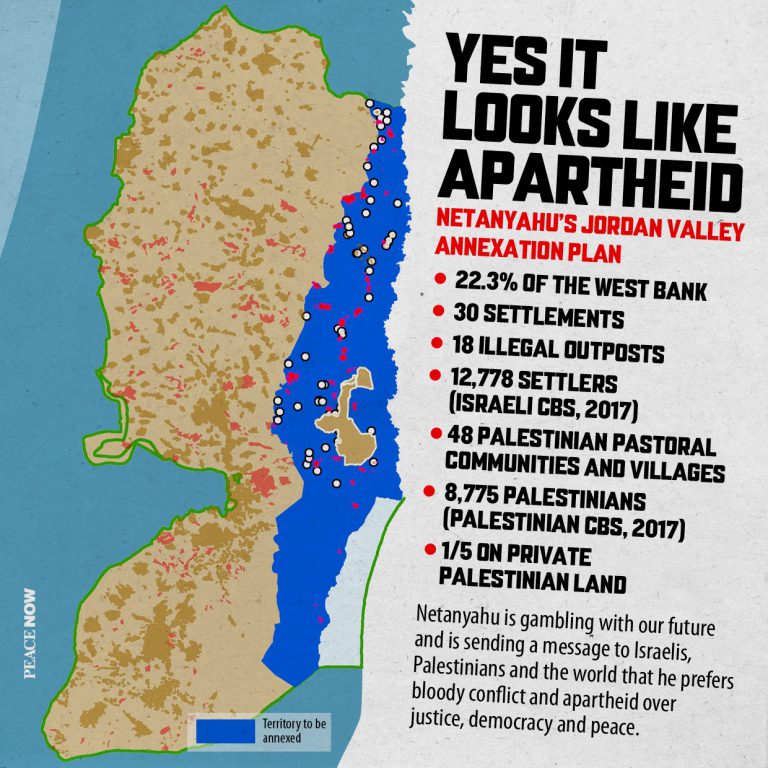
Map by Peace Now
According to Peace Now, 20% of the targeted land (62,000 acres) is privately owned by Palestinians – a fact that Netanyahu did not even mention, much less explain how he would address. Netanayahu did, however, assert that his plan “doesn’t annex a single Palestinian.” Yet, the area highlighted on the map also includes 15 Palestinian populated areas in the Jordan Valley that, under the plan, would be completely encircled by Israeli territory. Netanyahu proposed solving this problem by making these isolated enclaves “autonomous,” accessible only via Israeli-controlled access roads,
Speaking about the fate of the Palestinians, Peace Now said in a statement:
“The vision presented by the Prime Minister is, in fact, a vision of apartheid, of one country in which one group of civilians has full rights (Israeli) and another (Palestinians) does not. The autonomy and access roads Netanyahu guarantees to the Palestinians in the Valley are alarmingly similar to the Bantustan formula in former Apartheid South Africa.”
Even if one ignores the “autonomous” enclaves, Netanyahu’s claim that the plan “does not annex a single Palestinian. Not even one” is a lie. In fact, approximately 8,775 Palestinians live in 48 Palestinian herding communities located in the area he plans to annex. However, Israel’s longtime policies with regards to these Palestinian communities has been aimed at their ultimate dispossession and disappearance, a policy objective that Netanyahu’s annexation plan, particularly his denial of their very existence, makes explicit.
Peace Now said in response:
“This disregard by Netanyahu for thousands of Palestinians reflects long-standing policy in the Valley: one of dispossession and repression of Palestinian residents for the benefit of the settlers. In recent years, pressure has been exerted on the shepherding communities, both by the authorities (house demolitions, IDF training zones and the like), and by settlers who attack the shepherds and expel them from their pasturing areas. For more information, see here.”
Bibi’s Annexation Announcement, Part 2: Jordan Valley Outpost Will Be Retroactively Approved
On September 11th, a day after his “dramatic” declaration that if reelected he will immediately annex the Jordan Valley and later all settlements (and outposts), Prime Minister Netanyahu announced he will submit plans to his Cabinet that, if approved, will grant retroactive legalization to the Mevo’ot Yeriho outpost. Mevo’ot Yeriho, located just north of Jericho in the Jordan Valley, is one of 18 unauthorized Israeli outposts in the Jordan Valley that are slated to be annexed under Netanyahu’s plan (discussed above).
As with Netanyahu’s plans to annex the Jordan Valley, Israeli Attorney General Avichai Mandelblit has cautioned against the timing of the move. Mandelblit and the Israeli Defense Ministry’s legal advisor even released a joint legal opinion cautioning the Israeli Cabinet against authorizing granting approval to Mevo’ot Yeriho so close to an election. It’s worth recalling that the Attorney General has promoted legal arguments that will enable Israel to grant retroactive legalization to unauthorized outposts — meaning that his objection with regards to Mevo’ot Yeriho is one of timing, not substance.
The head of the Jordan Valley Regional Council, David Elhayani, criticized the Attorney General’s legal objections, claiming that gaining legalization is an urgent matter for the outpost. According to The Times of Israel:
“Elhayani claimed that Israelis in the Jordan Valley are in a ‘war against our Palestinian neighbors’ over control of the open land there and that the legal advisers were preventing legalization of Israeli outposts while allowing similar Palestinian land grabs to go unchecked.”
Bibi’s Annexation Announcement, Part 3: Settlers Leaders Unsatisfied with Bibi’s Annexation Announcement
Widely panned as an election ploy, Netanyahu’s pledge to annex the Jordan Valley and all settlements/outposts was by no means an electoral home run – at least not if its goal was to rally enthusiastic support from the settlers and their allies ahead of the Sept. 17th elections. While some settlers praised Netanyahu’s announcement, others expressed skepticism about his seriousness.
A member of the Yesha Council – an umbrella group representing all of the settlements – told The Times of Israel on the basis of anonymity that settlers have made a political calculation in how they have responded to Netanyahu’s announcement:
“A lot of us [settler leaders] are members of the Likud. While we are of course free to criticize the party leader and many of us have done so in the past, we have to exercise caution during these next few days [ahead of the election].”
Within that context, the Yesha Council released a public statement of restrained thanks, saying:
“Sovereignty is the vision of the settlement movement and the path of the future for deepening our presence in the region. The Yesha Council congratulates the Prime Minister on the historic declaration, which places settlement as an integral part of the State of Israel.”
In contrast, Samaria Regional Council chairman Yossi Dagan (who is a member of Netanyahu’s Likud party) was not hesitant to share his dissatisfaction, stating:
“Alongside the praise that must be given to the prime minister for his positive statement… I must say with regret that it is still cause for great concern, particularly due to its timing… It raises considerable concern regarding the possibility of continued Jewish foothold in more than 90 percent of Judea and Samaria. If he really wanted to finally bury his [2009] Bar Ilan speech [in which Netanyahu expressed support for a two-state solution] and the plans of Barack Hussein Obama for a Jewish retreat from Judea and Samaria [West Bank] and the establishment of a terror state in the heart of the Land of Israel, a statement that talks about less than 10% of the land and only in the first stage [is not enough].”
Binyamin Regional Council chairman Yisrael Gantz also criticized Netanyahu and called on him to immediately annex the entire West Bank:
“There is no reason in the world why Judea and Samaria residents should continue to live as second class citizens of the State of Israel. The move must be complete, applying sovereignty to the Binyamin area and throughout all of Judea and Samaria.”
The imminent Israeli elections should also be kept in mind while reading the responses of Netanyahu’s political rivals, most of whom criticized him for delaying his annexation and for stopping short of full annexation of the West Bank. Some notable reactions from Israeli political figures follow.
The Yamina Party, headed by Ayelet Shaked – who is a vocal supporter of annexing all of Area C – panned Netanyahu in a statement:
“Netanyahu explained this evening why voters must vote Yamina and not Likud… Bibi-Trump plan, will only allow for sovereignty to be applied over the Jewish communities in Judea and Samaria, leaving out the surrounding areas…And regarding the Jordan Valley, we call on Netanyahu to introduce a cabinet decision this evening as was done when sovereignty was applied over Jerusalem. There is no need for legislation. We will stand behind him immediately and vote in favor. Otherwise, the entire nation of Israel will know that this was a cheap political spin meant to snarf up votes and nothing more.”
For its part, the Blue & White Party, headed by Benny Gantz, took credit for getting out ahead of Netanyahu in endorsing a similar annexation plan:
“The residents of the Jordan Valley are not Netanyahu’s propaganda props. Blue and White has declared that the Jordan Valley will be part of Israel forever. It was Netanyahu who concocted a plan to surrender the Jordan Valley in [peace talks in] 2014. We’re glad Netanyahu came to his senses and adopted Blue and White’s plan for recognition of the Jordan Valley. The relationship between Israel and the United States is based on shared interests and values, and is stronger than any prime minister. Netanyahu’s spinning of Israel’s citizens will end on September 17.”
By contrast, MK Ayman Odeh (head of the Joint List) said:
“This isn’t just election spin. The right’s apartheid vision is composed of two parallel processes — erasing the civil status of Arabs in Israel as well as annexing the territories. They don’t want to turn the West Bank into part of Israel, they want to turn Israel into an appendage of the West Bank.”
Bibi’s Annexation Announcement, Part 4: International Reactions
Following Netanyahu’s announcement of his plan to annex the Jordan Valley and then all settlements/outposts, statements condemning the plan rang out from across the globe – except from the United States.
After the announcement, a White House official told The Times of Israel that Netanyahu’s annexation plans do no contradict the U.S. vision for a political settlement (hardly a surprise). A formal statement later released by the White House statement read:
“There is no change in United States policy at this time. We will release our Vision for Peace after the Israeli election and work to determine the best path forward to bring long sought security, opportunity and stability to the region.”
In contrast, the United Kingdom responded sharply, in a short video clip release on Twitter, in which a spokesman says:
“Any proposal to annex any part of the occupied Palestinian territories or any step in that direction concerns us. We must be clear that if any such proposal comes to fruition, there will be a response.”
The spokesperson for the United Nations Secretary Antonio Guterres told the press:
“The secretary-general’s position has always been clear: unilateral actions are not helpful in the peace process. Any Israeli decision to impose its laws, jurisdictions and administration in the occupied West Bank is without any international legal effect.”
A spokesperson for the European Union told the press:
“As reaffirmed in numerous Foreign Affairs Council conclusions, the EU will not recognise any changes to the pre-1967 borders including with regard to Jerusalem, other than those agreed by the parties. The policy of settlement construction and expansion, including in East Jerusalem, is illegal under international law and its continuation, and actions taken in this context undermine the viability of the two-state solution and the prospects for lasting peace.”
The Foreign Ministry of Saudi Arabia tweeted a harsh response:
“The Kingdom of Saudi Arabia utterly condemns and rejects the Israeli Prime Minister’s announcement of his intention, if he won the election, to annex parts of the occupied West Bank”
Jordan’s Foreign Minister also slammed the plan, tweeting:
“We condemn announcement by Israeli PM that he intends to annex illegal settlements & Jordan Valley in occupied West Bank. This is a serious escalation that undermines all peace efforts. It’ll lead to more violence & conflict. LAS [League of Arab States] condemned announcement in emergency session”
The Arab League said in a statement that it:
“considers his announcement a dangerous development and a new Israeli aggression by declaring the intention to violate the international law. The league regards these statements as undermining the chances of any progress in the peace process and will torpedo all its foundations.”
In addition, Qatar sent out a statement criticizing “Israel’s continued contempt of international law”; Turkey said the annexation pledge as “racist”; and Saudi Arabia called for an emergency meeting of the Organisation of Islamic Cooperation (OIC).
Saeb Erekat, a former peace negotiator for the PLO, said:
“Israel’s plan to annex the Jordan Valley, an integral part of occupied Palestinian territories, is manifestly illegal and merely adds to Israel’s long history of violations of international law. Israel’s unprecedented culture of impunity, enabled by international inaction, is the only explanation for Mr. Netanyahu’s audacity in using annexation as an election ploy, and asking the Israeli public to facilitate yet another Israeli crime.”
Government Data Is Latest Proof of Systemic East Jerusalem Inequalities & Settlement Surge Under Trump
The Jerusalem Municipality recently released data on construction permits issued for Jerusalem construction from 1991 to 2018; the data shows the stark inequality in building rights between Israeli settlers and Palestinians living in East Jerusalem. According to the Israeli government’s own count of permits issued between 1991 and 2018, only 16.5% of Jerusalem’s building permits were issued to Palestinians, despite the fact that they constitute 38% of the city’s residents.
The data, which was released thanks to a freedom of information request submitted two years ago by the Movement for the Freedom of Information and Peace Now, was covered by the Associated Press and carried by the Washington Post and the New York Times.
After Evicting Palestinian Family & Demolishing Their Home, Israel Allows Settlers to Set Up An Outpost Without Permits
Israeli settlers have set up an unauthorized outpost on land just outside of Bethlehem – on the site where the state recently demolished a Palestinian family’s home and business at the behest of the Jewish National Fund (for details, see our past reporting here). Following the eviction of the Cassia family and the demolition of its home and business, the JNF reportedly leased the land to a group of settlers which, in a matter of days following the demolition, built several temporary buildings at the site — but without the necessary Israeli government-issued building permits.
Peace Now commented:
“The establishment of a new outpost 70 meters (230 feet) from the Palestinian home that was destroyed under pressure from the JNF lets the cat out of the bag. It turns out that when JNF demanded that the Cassia family’s home be demolished, it didn’t care if illegal construction was carried out on its land, but it didn’t want Palestinians to build on its land.”
Bonus Reads
- “How would Netanyahu go about annexing the settlements? An explainer” (Times of Israel)
- “Christian Evangelicals Harvest Land in Settlements Israel Hopes to Annex” (Reuters)
- “Palestinians in the Jordan Valley Want to Remain on their Land” (Al-Monitor)
- “IN PHOTOS: Israel’s Settlers and the Palestinians they Live Among” (Haaretz/Reuters)
- “The Apartheid System in Hebron Persecutes and Subjugates Palestinians” (TruthOut)