Welcome to FMEP’s Weekly Settlement Report, covering everything you need to know about Israeli settlement activity this week.
To subscribe to this report, please click here.
June 1, 2023
-
- Ghaith-Sub Laban Family Face June 11th Eviction from Old City Home
- Construction of Homesh Settlement Continues
- A New Look at Israel’s Annexation & Slow Erasure of Palestinians in Nabi Samwil
- 7amleh Analyzes Israeli Social Media Hate Speech on Huwara, Leading to Pogrom
- New, Comprehensive Report on Children in the Israeli Military Court System
- New Report Details Big Tech Companies’ Facilitation of Occupation
- Bonus Reads
Ghaith-Sub Laban Family Face June 11th Eviction from Old City Home
 Ir Amim reports that the Palestinian Ghaith-Sub Laban family have been issued a new eviction notice ordering them to vacate their decades-long home in the Old City of Jerusalem by June 11, 2023, or else be forcibly evicted. The elderly Ghaith-Sub Laban couple – who have steadfastly remained in their home despite unimaginable challenges and harassment by settlers – report that they expect the eviction to be forcibly carried out as soon as June 11.
The Ghaith-Sub Laban family has spent the past 40-years in a legal battle against settlers (and the State) over their home in the Muslim Quarter of the Old City of Jerusalem. This family’s story is not unique, and the broader, systemic processes behind the forcible dispossession of Palestinians in Jerusalem is also discussed. In March 2023, FMEP hosted Rafat Sub Laban and Ir Amim’s Amy Cohen on a podcast – “‘We Are Determined to Stay”: One Palestinian Family’s Story of Dispossession in Jerusalem” – to discuss the Sub Laban case and how it relates to broader State-back settler efforts to dispossess Palestinians across Jerusalem.
Ir Amim explains:
“The family of veteran Ir Amim staff member, Ahmad Sub Laban, has been embroiled in a 45-year legal battle against persistent attempts by the state and settler groups to displace them and takeover their home for Jewish settlement. The family rented the house in 1953 from the Hashemite Kingdom of Jordan and as such was afforded protected tenancy rights. After 45 years of recurring lawsuits and harassment by the Israeli authorities and settler organizations, the Supreme Court recently ruled to terminate the family’s protected tenancy status and evict them from their home.”
For a comprehensive overview of the Sub Laban family’s legal battle, as well as other East Jerusalem eviction cases, please see Ir Amim’s report.
Construction of Homesh Settlement Continues
The Palestinian Centre for Human Rights reports that non May 29th settlers brought caravans and heavy equipment to the site where they are building permanent infrastructure for the Homesh settlement. Though the Israeli government has not issued building permits or completed planning for the reestablishment of the Homesh settlement, the IDF continues to obey orders to allow the settlers to proceed with construction.
As a reminder, On May 18th the IDF Commander signed a military order that finalized the Knesset’s recent repeal of key sections of the 2005 Disengagement Law, allowing Israelis to enter the area in the northern West Bank where the Homesh settlement stood before it was dismantled by the Israeli government in 2005 as part of Disengagement. In parallel, the Israeli Defense Minister announced that the government plans to relocate the Homesh outpost – a yeshiva (that is, a Jewish religious school) established illegally by settlers as part of their drive to re-establish the Homesh settlement – from its current location, which is on land that Israeli courts have recognized as private Palestinian property, to a small plot of nearby “state land” a few hundred of meters away. The Times of Israel further reports that the IDF Commander signed additional orders on May 15th that temporarily bar Israelis from entering the existing Homesh outpost until the outpost’s yeshiva is relocated to the “state land” plot, and that add the Homesh outpost as an official community under the umbrella of the Shomron Regional Council (a settlement municipal body), which allows the planning of the settlement to begin.
Yesh Din – an Israeli NGO which has led petitions to return the land on which Homesh was built to its Palestinian owners – told Haaretz:
“Moving the yeshiva is adding sin to crime. Its new location still doesn’t allow Palestinians to reach their land and continues their dispossession. Instead of evacuating the outpost immediately, Israel is rewarding serious criminals.”
PCHR further reports that on 30 May 2023, settlers known to be working on the Homesh settlement attacked a home in the Burqa village, and smashed the rear window of the house owner’s vehicle.
Haaretz columnist Amos Harel explained why the government’s actions vis a vis Homesh reveal the true nature of the coalition, saying
“The Homesh affair reiterates the true balance of power within the government, which is controlled by the far-right and ultra-Orthodox parties. The Homesh yeshiva’s relocation was essentially orchestrated by the head of the Samaria Regional Council, Yossi Dagan, who was provided cover from the government by Finance Minister Bezalel Smotrich.”
A New Look at Israel’s Annexation & Slow Erasure of Palestinians in Nabi Samwil
A new Haaretz piece looks at the history of the Palestinian village of Nabu Samwil, located on a strategic hilltop between Jerusalem and Ramallah. This location places the village’s residents — who remain in the eyes of the Israeli government residents of the West Bank, for whom access to Jerusalem is forbidden without a special permit — in a Kafka-esque situation: they are cut off from the West Bank by the separation barrier but barred entry to Jerusalem. They are legally forbidden from taking the one road out of the village because it passes through Jerusalem, and the West Bank is accessible to them only via a circuitous route that passes through an Israeli checkpoint (for background see: The Palestinian village where Israel forbids everything, and this Twitter thread of resources curated by Lara Friedman). The suffocation of Nabi Samwil is in line with Israel’s long-time ambitions to completely de-populate the village and take control of the land.
Palestinian refugees of Nabi Samwil, in conjunction with activists, have held protests to demand recognition from the Israeli government, in order to be able to build legal structures and be granted permits to enter Jerusalem. Refugees have petitioned the Israeli government for over 20 years to accept a formal building plan for the village, in order to allow the buildings to be deemed legal, but the government has refused. Instead, in 2021 the Israeli government greenlit a major project to renovate an archeological and holy site in Nabi Samwil. The plan will see the construction of a new access road, a visitors area, a restaurant, a learning center for tour groups, a shop, and a conference room.
7amleh Analyzes Israeli Social Media Hate Speech on Huwara, Leading to Pogrom
The Palestinian NGO 7amleh: The Arab Center for the Advancement of Social Media has issued a new report – “An Analysis of the Israeli Inciteful speech against the Village of ‘Huwara’ on Twitter” – documenting the social media frenzy that preceded settler-perpetrated pogrom on Huwara on February 27, 2023. The report identified a total of 15,250 Hebrew tweets containing hashtags related to Huwara, of which 80.2% of these tweets contained negative content against the village and its residents. The intensity of incitement and hate speech peaked before and after the attack. During this time, an average of 188 negative tweets per day targeting Huwara were published by approximately 158 accounts on Twitter.
The report recommends that social media companies take decisive measures to prevent the spread of incitement, racism, and violence against Arabs and Palestinians on their platforms. It suggests the development of a lexicon of hate speech in Hebrew for monitoring purposes, the implementation of content management policies for Israeli content in Hebrew, and an end to discriminatory double standards between Palestinian and Israeli content.
New, Comprehensive Report on Children in the Israeli Military Court System
Defense for Children International – Palestinian has released a new report – “Arbitrary by Default: Palestinian children in the Israeli military court system” – comprehensively examining the systemic denial of fair trial rights inherent in Israeli forces’ practice of arrest, detention, interrogation, and prosecution of Palestinian children in the Israeli military courts.
Building on years of documentation, the report’s main findings based on hard evidence are:
- Israeli military courts do not meet the standards of independence and impartiality when dealing with civilians, including children.
- Palestinian children detained and prosecuted in the Israeli military court system are denied the right to a fair hearing by a competent, independent, and impartial tribunal.
- Israeli authorities frequently arrest Palestinian children without issuing arrest warrants, failing to establish a legal basis for detention.
- Israeli authorities rarely provide explanations or information to the child or their family regarding the reasons for arrest.
- Palestinian children are denied prompt access to legal assistance and the presence of a family member during interrogation.
- Israeli forces’ systematic non-compliance with the prohibition of torture or cruel, inhuman, or degrading treatment constitutes arbitrary detention.
New Report Details Big Tech Companies’ Facilitation of Occupation
Who Profits has issued updated company profiles for Microsoft, Cisco Systems, IBM, and Dell Technologies – all of which are Multinational Companies (MCs) which support the Israeli occupation economy through the provision of infrastructure, technology, knowledge, and products to both civil and military institutions. The report highlights the extensive and diverse involvement of these companies in bolstering the capacity of the Israeli occupation economy and its ability to exert control and surveillance over Palestinians on both sides of the Green Line.
Please use the following links to read more on the role and activities of each company:
Bonus Reads
- “Israel Is on a Mission to Supersize Its West Bank Settlements” (Hagit Ofran, Haaretz)
- “Is Judicial Reform a Trojan Horse for West Bank Annexation?” (Yaakov Or, Haaretz)
- “Jewish residents hold morning prayers at entrance to Arab village to protest attacks” (Arutz Sheva)
- “After backlash, conference drops Israeli archeologist for settlement university ties” (+972 Magazine)
Welcome to FMEP’s Weekly Settlement Report, covering everything you need to know about Israeli settlement activity this week.
To subscribe to this report, please click here.
September 1, 2022
- Ramat Migron Outpost Demolished for Third Time in Three Weeks
- Settlers’ Stealth Visit to Joseph’s Tomb in Nablus Ends in Gun Fight
- Settlers Decry Removal of Trees Planted to Take Over Palestinian Land
- Palestinians Campaign for Nabi Samwil Recognition as New Docs Show Original Israeli Intent to Expel Them for Settlement
- Bonus Reads
Ramat Migron Outpost Demolished for Third Time in Three Weeks
On August 30th, Israeli forces cleared settlers and their makeshift structures — comprising the illegal outpost settlers have named “Ramat Migron” — off of land privately owned by Palestinians, as recognized by the Israeli High Court of Justice in 2012. Five settlers were arrested for violating a military order which makes it illegal to enter the area (both for settlers and even for the Palestinians who own the land), and for obstructing the work of a police officer.
Starting in 2017, settlers have repeatedly attempted to re-establish an outpost at this site, which is where the outpost of Migron once stood. The Migron outpost was dismantled by the Israeli government in 2012 after the Israeli High Court of Justice left the government no other option. Israeli forces have demolished the setters’ repeated attempts to set up a new outpost there more than 10 times, most recently on August 15th and August 11th of this year..
Notably (in light of his rising popularity and the upcoming Israeli elections), Kahanist MK Itamar Ben Gvir seized on the repeated razing of the outpost to campaign against Defense Minister Gantz, saying:
“Community-Eviction Minister Gantz continues time and time again to evacuate outposts and surrender to Abu Mazen, a Holocaust denier, his friend. Today there is another evacuation in Ramat Migron. They are uprooting and destroying – we will plant and resettle. The answer to the evacuation will be given On November 1st with a real right-wing government.”
Settlers’ Stealth Visit to Joseph’s Tomb in Nablus Ends in Gun Fight
Two Israeli settlers were wounded this week by Palestinian gunfire in the course of trying to access Joseph’s Tomb, a holy site located in the heart of Nablus, along with a group of other settlers. Notably, that visit was undertaken without the required (by Israeli authorities) approval of and coordination with the Israeli military, which regularly escorts settlers to the site under heavy protection. While Joseph’s Tomb is in Nablus (Area A of the West Bank), the Oslo Accords afford the Israeli army control over the site.
The incident comes amidst a series of clashes between Israeli forces and Palestinians in Nablus, including the high profile killing of Ibrahim al-Nabulsi as a result of a gun battle with the IDF. Just last week, FMEP reported on the IDF is planning to bulk up its security control over Joseph’s Tomb in order to protect settlers who wish to visit.
Settlers Decry Removal of Trees Planted to Take Over Palestinian Land
The High Court of Justice recently issued an injunction to stop the Israeli Civil Administration from continuing to uproot trees illegally planted by settlers on Palestinian land near the settlement of Nokdim, located southeast of Bethlehem. Settlers filed the petition leading to the freeze after the Court ordered the removal of the trees three months ago.
The settlers made their case for the injunction by arguing that (a) Palestinians who petitioned to have the trees removed had not proven their ownership of the land; and (b) the Civil Administration does not have the authority to uproot these trees, some of which are a protected species — notwithstanding the fact that they were planted illegally under Israeli law (such environmental work requires a permit signed by the staff officer in charge of agriculture, who works for the IDF’s Civil Administration). In effect, the settlers are arguing for the High Court to create/sign off on a new method of land takeover by settlers.
The battle of the trees and the plot of land dates back over 20 years, when settlers first built a fence to prevent Palestinians from accessing the area — which until then had been actively cultivated by Palestinians. In 2013, the IDF involved itself when Palestinians requested that it remove settlers from the site. The IDF ended up agreeing to do so and promised to ensure Palestinian access to the area (which it did, but very infrequently). Then, in 2017, settlers once again invaded the area and began planting trees as a means of taking control of the land. Since then settlers further developed the site into a park that is, of course, inaccessible to Palestinians.
In 2021, Palestinians, with the help of Haqel (an Israeli NGO), filed a petition with the Israeli High Court of Justice asking for the trees to be removed, and asserting that the land has been privately owned for generations.
Palestinians Campaign for Nabi Samwil Recognition as New Docs Show Original Israeli Intent to Expel Them for Settlement
+972 reports that newly released archival documents show that, in 1971, Israeli Prime Minister Golda Meir signed off on a plan to expel Palestinians from Nabi Samwil in order to build a luxury settlement on the ruins of the village (which is now an archeological site). Plans for the new settlement – which Meir at one point dubbed “New Savyon” after a wealthy Tel Aviv suburb – were eventually abandoned by the Israeli government in the mid 1980s, but (of course) Palestinians were not allowed to return.
Instead, refugees established a new village some 200meters from their original homes, still located on a strategic and highly prized hilltop (inside an area that Israel has declared to be a national park) just outside of the municipal borders of Jerusalem but on the Israeli side of the separation barrier. Israel considers the village to be in the occupied West Bank and so Nabi Samwil has been left in a Kafka-esque situation: they are cut off from the West Bank by the separation barrier but barred entry to Jerusalem. They are legally forbidden from taking the one road out of the village because it passes through Jerusalem, and the West Bank is accessible to them only via a circuitous route that passes through an Israeli checkpoint (for background see: The Palestinian village where Israel forbids everything, and this Twitter thread of resources curated by Lara Friedman).
Palestinian refugees of Nabi Samwil, in conjunction with activists, have held weekly protests to demand recognition from the Israeli government, in order to be able to build legal structures and be granted permits to enter Jerusalem. Refugees have petitioned the Israeli government for over 20 years to accept a formal building plan for the village, in order to allow the buildings to be deemed legal, but the government has refused. Eid Barakat, an activist in Nabi Samwil, told +972 Magazine:
“Every few years, a new officer in the Civil Administration comes, makes promises, and in the end nothing is done..all our homes have demolition orders. I dug a well; they destroyed it. I built a fence; they destroyed it. I planted trees; they were uprooted.”
Bonus Reads
- “The Fall and Rise of Israel’s First ultra-Orthodox Settlement” (Haaretz)
- “I tracked down the house Israel stole from my grandfather” (Al Jazeera)
- “WATCH: Women of Masafer Yatta tell their stories of resistance” (+972 Magazine)
Welcome to FMEP’s Weekly Settlement Report, covering everything you need to know about Israeli settlement activity this week.
To subscribe to this report, please click here.
August 27, 2021
- Israel Set to Seize More Palestinian Land for West Bank Settlement Expansion
- More Demolitions in Al-Walajeh
- Israel Approves New Plan for Archaeological-Tourism Site in Nabi Samwil
- Ir Amim: JNF’s Proposed Land Registration Will Result in Land Takeover of an ‘Alarming Magnitude’
- Bennett Goes to Washington to Talk Iran, But Questions on Settlements Remain
- Bonus Reads
Israel Set to Seize More Palestinian Land for West Bank Settlement Expansion
Haaretz reports that on August 25th the Israeli government was expected to approve a plan to expropriate 17 acres (68 dunams) of privately owned Palestinians land in order to widen Route 55, a road running east-west in the West Bank in a manner simultaneously serving settlements in the northern West Bank while fragmenting Palestinian life the West Banks. Haaretz reports that despite promises to the contrary made by Israeli planners, the road will not be accessible to Palestinians.
Thirty-five Palestinian land owners – all of whom run plant nurseries on the targeted land – fought this expropriation plan and even proposed a compromise plan, but last week the Israeli High Planning Council rejected both their objections and the compromise they proposed.
By expanding Route 55 (at the high expense of Palestinian landowners) lsraeli is aiming to more seamlessly connect the Israeli town of Kfar Sava, located inside the Green Line, to settlements located near the Palestinian village of Qalqilya. The widened road should also be understood as preparation for more settlement growth, with plans already in the works for 5,650 new settlement units to be built adjacent to the road.
For more on how Israel uses highway infrastructure to advance annexation and settlement expansion, see this December 2020 report by Breaking the Silence.
More Demolitions in Al-Walaja
Ir Amim reports that on August 25th, Israeli forces demolished one building housing two Palestinian families (14 individuals) in the village of Al-Walaja on the southern border of Jerusalem, specifically in the section of the town that was included inside of the expanded municipal borders of Jerusalem. The demolition is notable because the vast majority of Palestinians living in this section of Al-Walaja also face demolition orders, and mass demolitions (and accompanying wide scale displacement) can happen at any time.
Adding to the sense of imminent threat and rapidly changing conditions, the families living in the building demolished this week were only notified of the demolition order on their homes a few months ago. The families submitted an appeal against the order, but that appeal was rejected by the Jerusalem Magistrate Court 10 days ago and the families were not given any further notice of when the demolition was scheduled to take place. The families, therefore, had not yet filed an additional appeal to the District Court.
Ir Amim explains what is transpiring in al-Walaja:
“Since 2016, roughly half of the homes in the East Jerusalem section of Al-Walaja have received demolition orders and roughly 25 of these have been carried out. Indeed, most of the homes in the vicinity of the home demolished yesterday are under demolition orders and three of them were demolished just in the last two years. An appeal submitted by the village to the Israeli Supreme Court has led to temporarily freezing 38 of the pending demolition orders in the village. Recently, the State Attorney’s Office requested that the Supreme Court reject the appeal. If the court does reject it, 38 demolitions are likely to happen quickly. Some 12 additional homes are also at risk of imminent demolition. Demolitions in Al-Walaja are due to two combined Israeli policy decisions: On the one hand, Israeli authorities have never made an outline plan for the annexed part of Al-Walaja and residents therefore have no possibility of obtaining a building permit. All construction that has taken place in Al-Walaja since 1967 is thereby considered illegal under Israeli law. On the other hand, in 2016 the government decided to increase home demolitions – specifically targeting Palestinian communities. Since that year, the National Enforcement Unit (under the authority of the Ministry of Finance) began issuing and carrying out demolition orders in Al-Walaja. This unit is the most aggressive of the Israeli enforcement units. The combined effect of no outline plan and aggressive enforcement has led to half of the homes of the Jerusalem section of Al-Walaja currently being under threat of demolition. In January of this year (2021), the al-Walaja’s community most recent attempt to advance the outline plan they prepared for their village was rejected by the Jerusalem District Committee. Meanwhile, Israeli construction plans of thousands of housing units around Al-Walaja are advancing – including a new settlement on the Western side of the village. Indeed, demolitions in Al-Walaja are part of the creeping annexation Israel is advancing within the Greater Jerusalem area, specifically with the aim of connecting settlements near Bethlehem to Jerusalem, which would effectively fragment the Palestinian space of the southern West Bank.”
Israel Approves New Plan for Archaeological-Tourism Site in Nabi Samwil
Emek Shaveh reports that the Israeli Civil Administration has approved a plan to renovate an archeological and holy site in the Nabi Samwil village, located just north of Jerusalem. The plan will see the construction of a new access road, a visitors area, a restaurant, a learning center for tour groups, a shop, and a conference room.
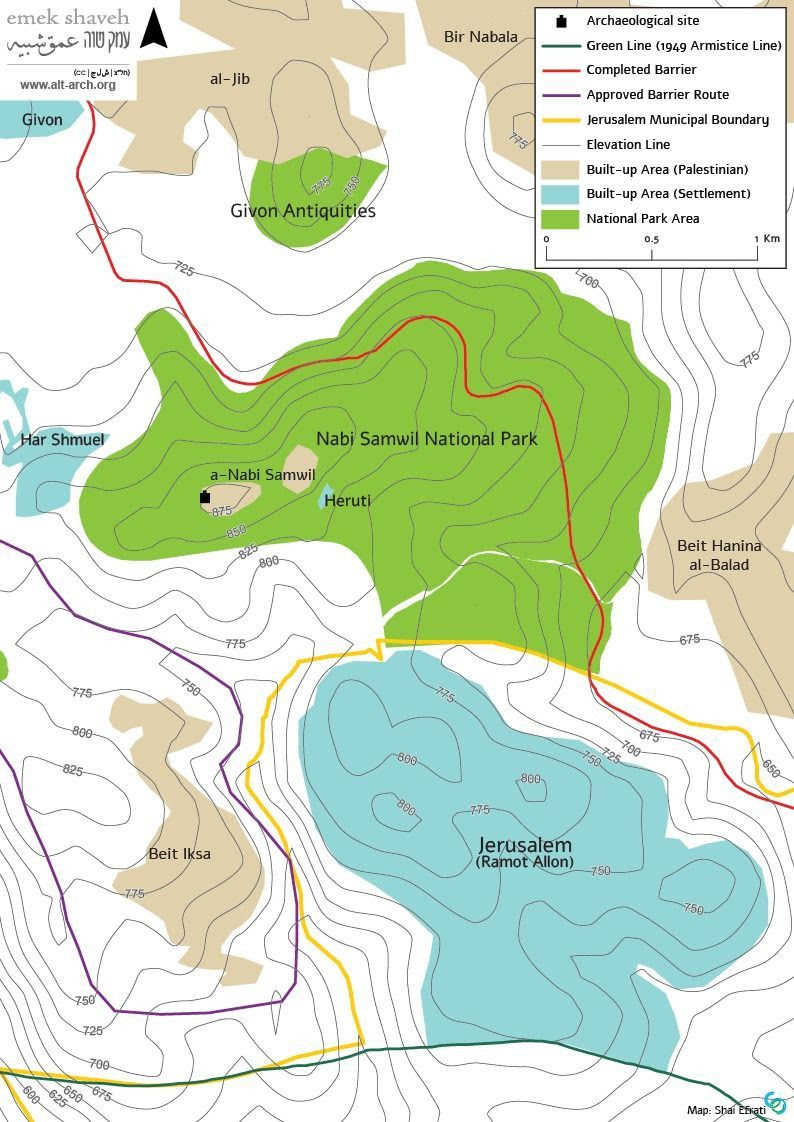 The plan to invest in the development of this tourism site ignores the longtime suffering of the Palestinian residents of Nabi Samwil. This small village is located on a strategic and highly prized hilltop (inside an area that Israel has declared to be a national park) located just outside of the municipal borders of Jerusalem but on the Israeli side of the separation barrier. This location places the village’s residents — who remain in the eyes of the Israeli government residents of the West Bank, for whom access to Jerusalem is forbidden without a special permit — in a Kafka-esque situation: they are cut off from the West Bank by the separation barrier but barred entry to Jerusalem. They are legally forbidden from taking the one road out of the village because it passes through Jerusalem, and the West Bank is accessible to them only via a circuitous route that passes through an Israeli checkpoint (for background see: The Palestinian village where Israel forbids everything, and this Twitter thread of resources curated by Lara Friedman). The suffocation of Nabi Samwil is in line with Israel’s long-time ambitions to completely de-populate the village and take control of the land.
In April 2020 – during one of the most intense periods of the COVID-19 lockdown last year – the Israeli military closed off the village entirely, and enforced the closure with only 14 hours’ notice for residents.
Ir Amim: JNF’s Proposed Land Registration Will Result in Land Takeover of an ‘Alarming Magnitude’
In a new analysis, Ir Amim explains how the Jewish National Fund’s upcoming decision on a proposal to start the process of registering land it claims to have purchased in the West Bank and East Jerusalem will serve as a means for mass land seizure. The JNF’s Board is expected to convene in the coming weeks to approve the plan.
Ir Amim explains:
“Anchoring KKL’s ownership claims to these lands is a dramatic move that puts entire Palestinian communities in jeopardy. This move is yet another troubling indication of how the recently enacted land settlement of title and registration process in East Jerusalem is being misused. As uncovered by Ir Amim over the last several months, this registration process – that has been advanced by the Israeli government – is unprecedented in both scope and consequence and is being used as a mechanism to register lands under Israeli ownership, which in the future could lead to settlement construction and displacement of entire Palestinian communities in East Jerusalem. The dangers these measures pose to Palestinian life in Jerusalem cannot be overstated, nor the severity of the political interests that are behind it. Given that the Sheikh Jarrah eviction cases attracted international attention, it is important to understand that the Israeli exploitation of the land registration process will involve vast areas of East Jerusalem, and therefore will lay the groundwork for future eviction demands against Palestinians several magnitudes larger than seen today.”
As a reminder, the JNF, established in 1901, devoted itself to buying land for Jews. Today, the JNF owns about 15% of all the land inside the Green Line (a figure which stands to increase if the review process leads to more properties being registered to the JNF). In addition, the JNF has used two subsidiary companies – both called Himanuta – to purchase land in the West Bank, even though the stated JNF policy (until now) did not support such purchases. Peace Now reports that the JNF, via Himanuta, has already purchased over 160,000 acres (65,000 dunams) across the West Bank; settlements established on some of those lands include Itamar, Alfei Menashe, Einav, Kedumim, Givat Ze’ev, Metzadot Yehuda (Beit Yatir), Otniel and more. At the same time, the JNF and the settler group Elad have been partnering together to pursue the mass eviction of Palestinians from East Jerusalem neighborhoods, including Silwan.
Bennett Goes to Washington to Talk Iran, But Questions on Settlements Remain
According to reports, Prime Minister Bennett’s priority for his first meeting with President Biden – now scheduled for August 27th – is Iran. However, in the lead up to that meeting Bennett has not been able to escape questions and pressure around the issue of settlement growth and annexation.
In an interview with the New York Times ahead of his meeting, Bennett said that his government is not looking to solve the question of Palestine, but also said that he has no plans to formally annex West Bank territory [although de facto annexation policies are proceeding apace) nor to end the siege on Gaza. Bennett said:
“This government is a government that will make dramatic breakthroughs in the economy. Its claim to fame will not be solving the 130-year-old conflict here in Israel. This government will neither annex nor form a Palestinian state, everyone gets that.”
In the interview, Bennett also briefly reiterated that his approach to settlement construction is limited to projects that address the supposed “natural growth” needs of existing settlements [for Lara Friedman’s take-down of this framing, see here].
In response to Bennett’s comments, settler leaders blasted him for betraying the settlement movement [reminder: Bennett led the settler Yesha Council for several years]. Current Yesha Council head, Yossi Dagan, told the Jerusalem Post that Bennett’s position is “totally unacceptable.” The Jerusalem Post also suggested that Bennett’s promise to allow for “natural growth” represented a cutting back in support for settlement construction compared to recent years.
Even before the New York Times interview, Bennett was facing significant discontent from settlers over the low number of settlement units [in the eyes of the settlers] that were included in the first planning wave under the Bennett-led government. Articulating that discontent, and calling on Bennett to buck what they see as U.S. pressure to limit settlement growth, settler leaders spoke out earlier this week. Binyamin Regional Council head Israel Gantz said:
“We urge you to remember where you came from and to tell the Americans that you are changing your policy and intend to build as needed. All ready-made construction plans in Judea and Samaria must be approved.”
Yossi Avrahami, a settler leader from Givat Ze’ev, said:
“Prove to us that you are not a [US] puppet that is being played.”
Bonus Reads
- “Jewish Agency Invites Staff to Radical West Bank Settlement for Holiday Trip” (Haaretz)
- “The Beita model: Palestinians lead ‘new form of resistance’ at Evyatar outpost” (The Times of Israel)
- “An Israeli Forest to Erase the Ruins of Palestinian Agricultural Terraces” (Haaretz)
- “This Luxury Home Epitomizes the Erasure of Jaffa’s Historical Landscape” (Haaretz)
Welcome to FMEP’s Weekly Settlement Report, covering everything you need to know about Israeli settlement activity this week.
To subscribe to this report, please click here.
April 3, 2020
- Debate about Annexation at Center of Negotiations for the Next Israeli Government
- Israel’s Response to Coronavirus Looks A Lot like the Implementation of the Trump Plan, Especially in East Jerusalem
- Settlers Advance Annexation Agenda of Their Own, Including Through Violence
- Bonus Reads
Comments or questions – email Kristin McCarthy (kmccarthy@fmep.org).
Debate about Annexation at Center of Negotiations for the Next Israeli Government
In a wild week in Israeli politics, the Blue & White party splintered as Benny Gantz entered into negotiations with Likud party to form an emergency power-sharing government. As negotiations made significant headway, the issue of Israel’s annexation of West Bank land nearly derailed the deal. At the time of publication, Israeli press is reporting that the parties have come to some kind of an agreement and expect negotiations to be completed soon that finalize a coalition agreement; it remains unclear what if anything has been agreed with respect to annexation..
To recap how we got here, the Likud party – led by the quarantined Netanyahu – demanded that under a coalition agreement the unity government would move to quickly annex at least part of the West Bank. Likud has reportedly made this point non-negotiable. The Times of Israel reports that Netanyahu is pushing the point by arguing that annexation must be done before U.S. elections in November 2020, at which time the window of opportunity might close if Trump loses. Netanyahu is facing pressure to be absolutist on this point from his “frenemies” in the Yamina party – Naftali Bennett and Ayelet Shaked – who have threatened to advance legislation against Netanyahu for corruption if he reneges on his annexation campaign promise. Yamina leader Shaked further threatened Netanyahu over rumors (which are looking to be accurate) that the Justice Ministry will go to a Blue & White MK, which Shaked warns “will end chances of expressing sovereignty over Judea and Samaria.”
The remnant of the Blue & White party led by Benny Gantz has not agreed to the Likud push for annexation, instead insisting that the first six months of a unity government focus solely on weathering the COVID-19 crisis. Gantz has also reportedly insisted that annexation should then only happen in coordination with the international community, and not unilaterally with solely U.S. backing, as Likud prefers. This Gantz position has been met with confusion, given that the international community has not been supportive of the Trump plan, and by-and-large opposes Israeli annexation of West Bank land. To make matters even more confusing, Gantz has previously and very publicly welcomed the Trump Plan with open arms.
Reportedly, one possible Gantz-Netayahu “compromise” would be to go ahead with annexation only “if the Trump administration gave its full-throated backing to the move.” Likud sources have leaked a different version of the deal, suggesting that the parties have agreed to delay annexation, but have agreed the delay will be for less than six months, permitting Gantz to claim victory in keeping the government focused in the immediate term on COVID-19, while enabling annexation to be carried out before U.S. elections. In addition, sources suggest that an agreement along these lines would include a Likud “concession” that will allow Blue & White party members to “vote their conscience” on an annexation proposal in the Knesset (i.e., allowing them an empty gesture of opposition against an initiative that, by joining the coalition, they are responsible for allowing to come to a vote).
In response to the negotiations, Peace Now called on Gantz to oppose annexation and released a statement saying:
“When the settler right talks about applying sovereignty to the territories or swaths of them, they mean a unilateral and dangerous annexation. The role of the government is to maintain Israel’s ability to flourish as a Jewish and democratic state. This can best be done by keeping an open hand for peace, promoting negotiations with the Palestinians, and taking care to keep its relations with its partners in the region and beyond from deteriorating. The so-called “unity government” to be formed soon must commit not to carry out any unilateral annexation measures in the West Bank. Below is a breakdown of reasons why annexation is not in Israel’s national interest.”
Israel’s Response to Coronavirus Looks A Lot like the Implementation of the Trump Plan, Especially in East Jerusalem
Adding to the topics covered in last week’s Settlement Report (cutting off Shufat Refugee Camp, over-policing Issawiya, and settler violence), the Israeli government continues to roll out policies in the name of fighting the spread of COVID-19 that, in actuality, advance Israel’s annexation plans.
Illustrative of the Israel’s overall policies towards East Jerusalem in the time of Coronavirus, Israel allowed the Palestinian Authority (PA) police force to enter the East Jerusalem neighborhood of Kafr Aqab in order to disperse a riot between groups clashing over the installation of a roadblock leading into the neighborhood. The PA is expressly prohibited by Israel from operating in East Jerusalem neighborhoods. This prohibition that has left neighborhoods like Kafr Aqab, which is located within the Israeli-drawn municipal borders of Jerusalem but on the West Bank side of the separation barrier, in a no-man’s land limbo, with Israel shirking its responsibility for the welfare of legal residents of Jerusalem while simultaneously prohibiting the PA from accessing the areas. One Kafr Aqab resident put it succinctly:
“We [Palestinians living in Kafr Aqab] are paying taxes like anyone else in Israel, but in the first real test, the state is disassociating itself from us. From their standpoint, we may as well die.”
Consistent with this long standing policy of neglect, Ir Amim reports that the Israeli government is failing to provide adequate services to Kafr Aqab at this time of extraordinary urgency and need. In a letter to Jerusalem Mayor Moshe Leon, Ir Amim noted that there is a shortage of medical supplies and disinfectant, that the water supply is insufficient, and that the city provided food baskets for only 300 families, while there are 800 families in need. Ir Amim also reports that there is a growing sanitation crisis as services have been impacted by employee furloughs at a time when trash production has increased due to families being quarantined at home.
Various Israeli plans and proposals for “Greater Jerusalem,” designated areas like Kafr Aqab, the Shufat Refugee Camp, and other neighborhoods beyond the barrier to be excised from the city, with the intent of engineering a stronger Jewish majority in Jerusalem. The Trump Plan adopts Israel’s position on the matter, and assigns the future (conditional) Palestinian state-in-name-only control/responsibility over Kafr Aqab neighborhood. By all appearances, the COVID-19 crisis has provided Israel a pretext to start implementing this reality by permitting the PA to operate openly in Kafr Aqab.
Similarly, Palestinian police have also been openly operating in the Shufat refugee camp – where rumors swirled last week that Israel intends to close the only checkpoint leading into other areas of Jerusalem. Likewise, in the village of al-Walaja, located partially within the Israeli-drawn borders of Jerusalem and partially in the West Bank, residents are reportedly following orders from the PA offices based in Bethlehem. In both cases, Haaretz reports that the PA is acting in these areas to enforce quarantine/lockdown orders to slow the spread of the Coronavirus.
In East Jerusalem neighborhoods that Israel intends to formally annex, with the approval of the Trump Plan, Israeli actions are decidedly the opposite. Rather than allowing the PA to in any way play a role in helping Palestinian residents cope with the COVID-19 threat, Israel continues clamp down on any hint of PA presence of activity — even arresting a prominent Palestinian Authority figure, Fadi al-Hidmi (the PA Minister for Jerusalem Affairs), at his home on the Mount of Olives on April 3rd, based on allegations that he was conducting activities on behalf of the PA. In addition, on March 31st, Isareli authorities stopped a Palestinian food supply truck in East Jerusalem on the suspicion that the effort was organized by the Palestinian Authority. In fact, the supplies had been donated by Palestinians citizens of Israel for needy families in the East Jerusalem neighborhood of Sur Baher.
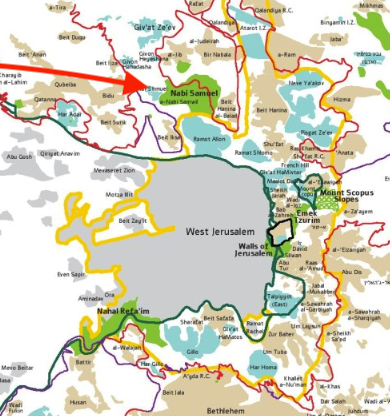
Map by Emek Shaveh (click to enlarge)
Finally, in what is perhaps the most egregious and inhumane face of Israel’s COVID-19 pro-annexation policies, on March 22nd the Israeli military closed the only entry/exit checkpoint for the Palestinian village of Nabi Samwil. This small village is located on a strategic and highly prized hilltop (inside of a national park) just outside of the municipal borders of Jerusalem but on the Israeli side of the separation barrier — placing residents (who have West Bank ID cards) in a Kafka-esque situation wherein they are cut off from both Jerusalem and the West Bank (legally they are forbidden from taking the one road out of the village into Jerusalem, since they are West Bankers, and the West Bank is accessible only via a circuitous route that passes through an Israeli checkpoint – for background see: The Palestinian village where Israel forbids everything). The military enforced the closure with only 14 hours’ notice for residents. On March 25th, HaMoked submitted an urgent pre-petition to the State Attorney’s Office to re-open the checkpoint, arguing that the village does not have a permanent doctor and only one tiny store for supplies. HaMoked intends to submit another urgent petition to the High Court of Justice. HaMoked stressed that closing the checkpoint denies the village’s residents access to medical care and essential groceries.
The suffocation of Nabi Samwil is in line with Israel’s long-time ambitions to completely de-populate the village and take control of the land.
Settlers Advance Annexation Agenda of Their Own, Including Through Violence
In addition to Israel government actions which advance an annexationist agenda (described above), settler efforts to take over more land have continued during the Coronavirus-based West Bank lockdown. Indeed, the lockdown may be aiding and even fueling these efforts.
In the northern West Bank, for example, settlers are once again terrorizing Palestinians who come anywhere near the site of the former Homesh settlement, which was dismantled by Israel in 2005 as part of the Gaza disengagement. Since then, settlers have been obsessed with the desire to re-establish Homesh, hosting religious events and protests at the site of Homesh, some of which have been attended by Israeli MKs and politicians. Because of the settlers’ actions and the lack of enforcement by Israeli military/police, Palestinians were unable to access the area until as recently as February 2020. Now, while Palestinians’ movement is restricted due to PA-imposed efforts to stop COVID-19, settlers (who, as Israelis, are under far less strict COVID-19 related rules, which in any case the IDF doesn’t appear to be enforcing rigorously on settlers), have re-established a violent presence at the site intended to keep Palestinians away. Over the past month, Palestinians report at least five violent incidents. On March 26, Yesh Din sent an urgent letter to Israeli authorities documenting the violent incidents and demanding that authorities immediately evacuate the settlers and investigate their crimes.
A key tool settles use to takeover Palestinian land is violence (as documented in great detail in this excellent report by Yesh Din). As the West Bank lockdown continues, settler violence towards Palestinians and their property has predictably continued and even increased, and fear is growing that it will get worse. According to the Israeli Defense Ministry, in data it provided to Haaretz, there were (at least) 16 physical confrontations between settlers and Palestinians in March, compared to only nine in February and five in January. B’Tselem recorded 21 cases of settler violence, including destruction of property, in March alone.
The Executive Director of Yesh Din, which closely monitors settler violence in the West Bank, told Haaretz:
“The quantity and severity of the violent cases we’ve handled in recent weeks is mind boggling. As long as authorities continue to disregard Palestinians’ lives instead of protecting them and arresting the hooligans, the settlers’ violence will only increase and spread.”
Bonus Reads
- “‘This Isn’t the West Bank’: Soldiers Deployed in South Tel Aviv to Enforce Coronavirus Lockdown” (Haaretz)
- “COVID-19 and the Healthcare Systems in Israel/Palestine: Part 2 – West Bank & East Jerusalem” (Webinar ft. Jessica Montell/HaMoked and Tareq Baconi/ICG)