Welcome to FMEP’s Weekly Settlement Report, covering everything you need to know about Israeli settlement activity this week.
To subscribe to this report, please click here.
August 10, 2023
- Has Israel Annexed the West Bank?
- Peace Now Data: Unprecedented Level of Settlement Growth in 2023
- Israel Says It Will Freeze Part of Nof Zion Expansion Plan, Cites Environmental Concerns
- Settler Violence Coerces Fourth Bedouin Community to Leave Area C Homelands, Handing More Territory to Settlers
- Emboldened Settlers Attack Village of Burqa, Murder Palestinian Teen
- Bonus Reads
Has Israel Annexed the West Bank?
Make sure to check out the latest episode of FMEP’s podcast, “Has Israel Annexed the West Bank,” featuring Shira Livne (Association for Civil Rights in Israel) and Kristin McCarthy (FMEP, and author of the Settlement Report!). The two discuss all things annexation, including: how is annexation related to the current judicial reforms? What has annexation looked like previous to the current government? How significant are the changes in governance that the current government has taken? Should we consider the West Bank, or just Area C, annexed?
Peace Now Data: Unprecedented Level of Settlement Growth in 2023
According to Peace Now data, the government of Israel has accelerated settlement growth in 2023 so much so that – only seven months into the year – it has broken several records. The data shows that in 2023, the government of Israel has:
- Granted retroactive legalization to 22 outposts – making them new, authorized settlements, more than in any year previous.
- Allowed the establishment of at least five new (illegal) outposts (not that settlers have attempted to establish many more. Peace Now reports that the IDF has evacuated more outposts this year than it did during an average year in the past, showing how emboldened settlers are acting in the current environment.
- Issued tenders for 1,289 new settlement units – this is more than any year since the signing of the Oslo Accords.
- Approved 12,855 new settlement units – more than in all of 2020 (12,000 settlement units approved).
Israel Says It Will Freeze Part of Nof Zion Expansion Plan, Cites Environmental Concerns
On August, the Israeli state informed the Jerusalem District Court that it has chosen to freeze a plan to relocated a police station from the Jabal al-Mukaber neighborhood, which was planned in order to allow the Nof Zion settlement enclave to expand onto the land where the current/old police station is located. According to the Times of Israel, the state said that it is negotiating with the Ramy Levy – an Israeli entrepreneur who owns the building rights for the land where the current police station is located (Levy owns an empire of settlement superstores) – to build a new police station as part of the massive expansion of the enclave. 
The State said its decision was made in consideration of a petition against the new police station submitted by environmental groups concerned that the construction would destroy the area’s unique plant ecosystem. Notably, the Israeli NGO Ir Amim also filed a petition against the police station plan, arguing that it is an affront to the planning needs of the local community and that it represents a continuation of Israel’s systematic, city-wide discrimination against the housing, educational, and service-based needs of Palestinian neighborhoods.
Settler Violence Coerces Fourth Bedouin Community to Leave Area C Homelands, Handing More Territory to Settlers
On August 6th the al-Qaboun bedouin community was forcibly coerced by IDF harassment and settler violence to abandon their lands east of Ramallah, where they had lived since 1996. The community number 86 people, including 10 children. This is the fourth bedouin community in recent months that has been forced to leave their land because of Israeli pressure.
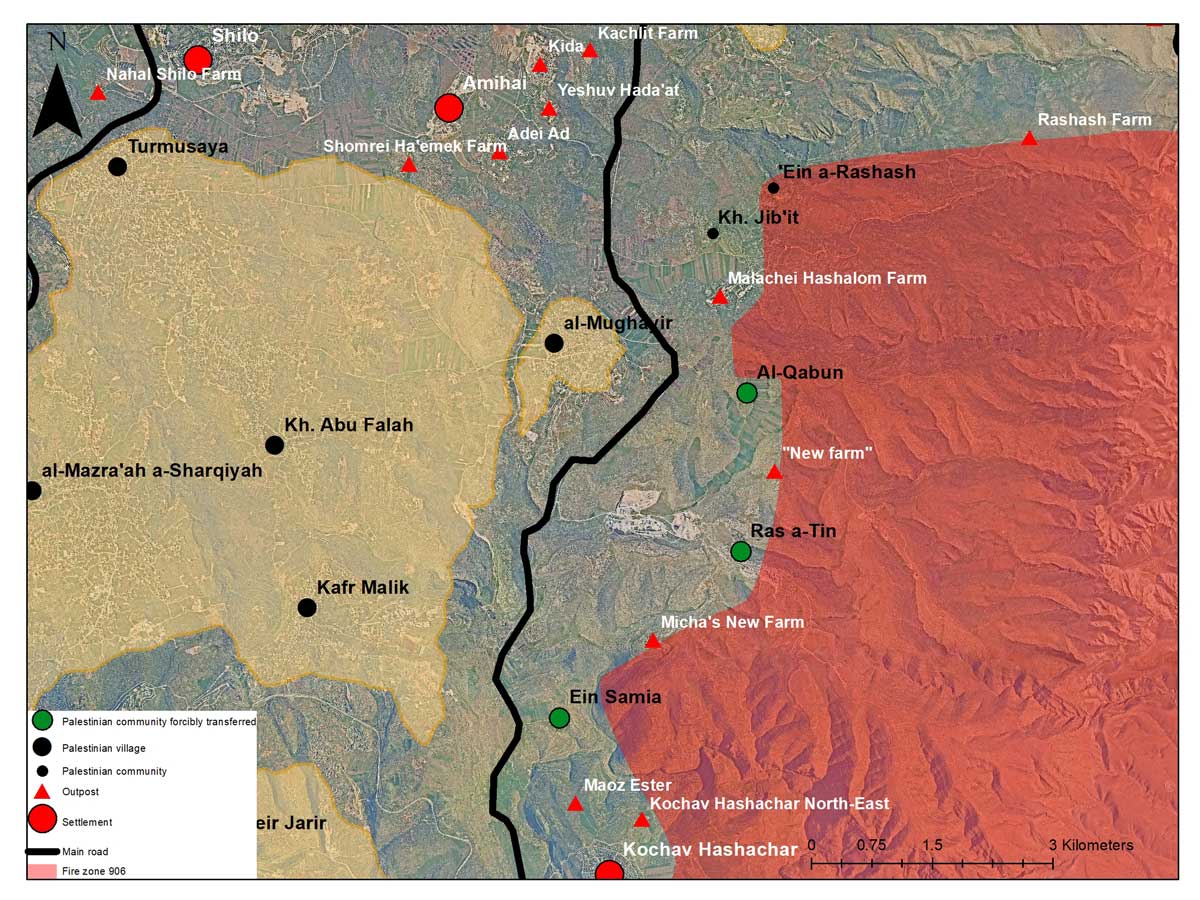 B’Tselem reports that settlers established an outpost near al-Qaboun in February 2023 and have since used violence, harassment, and intimidation to take control of the village’s grazing lands – denying the people their livelihood. The Palestinian Centre for Human Rights further reports that the IDF closed all roads leading to the village.
B’Tselem states:
“Al-Qabun is the fourth community in the area that has had to flee due to Israeli policies, which force impossible conditions on local residents in order to push them to leave, thus clearing the way for it to take over their lands and transfer them to Jewish hands. These policies include banning residential and infrastructure construction, including water, electricity and roads; establishing and financially supporting settlements on Palestinian lands; and violent attacks by settlers on an almost daily basis. All of these are aimed at upholding, preserving and empowering Jewish supremacy.”
Emboldened Settlers Attack Village of Burqa, Murder Palestinian Teen
On the evening of August 4th, 40-50 armed settlers associated with the Oz Zion outpost attacked the Palestinian village of Burqa – the village that continues to protest the Homesh outpost, which was built on its land. Settlers claim they were “just” grazing their sheep, but they came armed with M-16s, clubs, and pistols, and evidence found near two two cars that had been set on fire suggest the settlers came to commit arson. As settlers came within 250 meters of homes in the village, two settlers arrived in a car and fired indiscriminately towards a group of Palestinians, killing 19-year-old Palestinian Qosai Jammal Mi’tan and injuring several others.
 It’s worth noting that the Oz Zion outpost has been, in the past, repeatedly evacuated by the IDF. Earlier this year, as is his purview as a minister with the Defense Ministry charged with civilian affairs in Area C, Bezalel Smotrich shielded Oz Tzion from being evacuated again.
Two settlers were arrested for involvement, one of which was quickly released to house arrest while the other remained in custody as the primary suspect in firing the deadly shot. The settler who was released despite involvement in the shooting, Elisha Yared, is well known for his violent, extremist views, having previously served as a spokesman for the MK Limor Son Har-Melech (Otzma Yehudit) – and articulated his support for collective punishment in a recent interview with Israel Hayom.
In an absolutely absurd display of the government’s unapologetic support for Jewish terrorism, Secruty Minister Itamar Ben-Gvir criticized media coverage of the settler’s arrest, saying “A Jew who defends himself and others from murder by Palestinians is not a murder suspect, but a hero who will get full backing from me.”Separately, two Knesset members (Zvi Sukkot and X) were given permission by Israeli police to visit Yared in the hospital, celebrating him as a hero. In response, a senior Israeli security source told Al-Monitor:
“This is incredibly outrageous…This is a meeting that could easily lead to evidence tampering and disrupt the police investigation. There was no reason to approve it. This is part of the anarchy that is taking over the rule of law system in Israel.”
Elisha Yared lives in the illegal Ramat Migron outpost, an outpost which has been repeatedly demolished by the IDF.
Five Palestinians were also arrested for throwing stones at the invading settlers. All were released after several days in custody.The Palestinian Center for Human Rights reports that so far this year, “settlers have conducted at least 293 attacks against Palestinian civilians and their property. As a result, 9 Palestinians were killed, and dozens of others were injured; most of them due to being beaten and thrown with stones. Also, dozens of houses, vehicles and civilian facilities were set ablaze.”
Haaretz journalist Neri Zelber reported that the Israel Army Radio received data from the IDF showing that the first six months of 2023 as already seen more settler attacks than in the entire 2022 year. The IDF data counts 25 terrorist attacks and 680 clashes.
Bonus Reads
- “The Civil Administration acknowledges extreme discrimination in building permits and law enforcement between Palestinians and settlers” (Peace Now)
- “Armed With an M16 and Jewish Privilege, This Settler Makes Palestinians’ Lives Hell” (Haaretz)
- “Extremist Israeli Settlers Aren’t Innocent Shepherds. They Are Thirsty for a Provocation” (Haaretz)
- “Netanyahu in Golan: ‘Territory that will forever remain under Israeli sovereignty’” (Arutz Sheva)
Welcome to FMEP’s Weekly Settlement Report, covering everything you need to know about Israeli settlement activity this week.
To subscribe to this report, please click here.
August 4, 2023
- High Court Dismisses Petition Against Homesh Outpost
- Israel to Advance More East Jerusalem Settlement Construction
- Israeli Government Funding “Red Heifer” Project that Will Obliterate Temple Mount Status Quo
- Yesh Din Makes Legal Case That Israel’s Occupation Has Lost Any Veneer of Temporality
- Bonus Reads
High Court Dismisses Petition Against Homesh Outpost
On August 2nd, the Israeli High Court dismissed a petition seeking the removal of the Homesh outpost and the return of the land to its Palestinian owners. The Court decided that the settlers’ relocation of the illegal outpost to a small sliver of nearby land that Israel considers to be “state land” has negated the basis for the petition to remove the outpost’s buildings from privately owned Palestinian land. This decision ignores the fact that the access road to the relocated outpost goes through privately owned Palestinian land, and the IDF protection of the Homesh outpost continues to deny Palestinian land owners access to their land.
Nasser Hijja, a village council member of Burqa – the Palestinian village which has historically owned the land on which Homesh settlement was built – told Reuters:
“This settlement is a nightmare for the residents of Burqa…[Israel] does not want any Palestinian presence on this land,” said Hijja.
Yesh Din, the Israeli human rights group which assisted Palestinian landowners in filing the petition, said in response:
“While Israelis everywhere are fighting to protect our High Court as a symbol of democracy, the justices yesterday have clearly reaffirmed what we already know: Palestinians in the West Bank are undeserving of protection under the law. This disgraceful ruling is yet another testament to the apartheid regime in the West Bank, which is being further entrenched every day and which the High Court has grown comfortable with normalizing.”
The Court’s rejection of the petition is yet another step towards granting retroactive legalization to the Homesh yeshiva, which settlers established in contravention of Israeli law on land that Israel had previously recognized as privately owned Palestinian land. The current Israeli government agreed to re-establish the Homesh settlement (which the government dismantled in 2005) as a matter of its founding coalition deals. Earlier this year, the Knesset repealed parts of the 2005 Disengagement Law in order to advance the Homesh project, and after the settlers moved the Homesh yeshiva’s buildings to a small sliver of “state land,” the government connected the outpost to water service.
Israel to Advance More East Jerusalem Settlement Construction
Peace Now reports that the Jerusalem District Planning Committee is scheduled to convene on August 7th and is expected to advance a number of East Jerusalem settlement plans, including:
- Nof Zion/”Nof Zahav” settlement enclave – a plan for 100 settlement units and two hotels (550 rooms total), located in the heart of the Palestinian neighborhood Jabal al-Mukaber. The construction projects are slated for the north eastern slope of the enclave in an area referred to by settlers as Nof Zahav. For more information, see FMEP’s previous reporting. At the upcoming meeting, the committee can decide to deposit this plan for public review.
- Ramat Alon settlement – two plans for a total of 1,918 new settlement units will be discussed for deposit. The Ramat Alon settlement is located northern Jerusalem
Israeli Government Funding “Red Heifer” Project that Will Obliterate Temple Mount Status Quo
The Israeli NGO Ir Amim has uncovered documentation showing that the Israeli government has been involved in securing special breed of cow (“red heifers”) from the United States that are intended to be used in a ritual sacrifice, a ceremony which Jewish law requires to be performed prior to entering and/or rebuilding the Jewish temple on the Haram Al-Sharif/Temple Mount. Ir Amim explains, “The quest to find a ‘red heifer’ has been long considered a fringe endeavor, yet the discovery of government involvement in such an initiative requires serious attention.”
Five cows believed to fit the criteria for the ritual sacrifice were imported from the U.S. to Israel in 2022, an endeavor which required special permission from the Bennett/Lapid government because it is illegal under Israeli law to import livestock from the U.S.. If there was any doubt that the government of Israel is aware of and supports the religious agenda behind the importation of these special cows, those doubts should be dismissed when considering that the government allowed the cows to be imported without inserting a tracking chip into their ears, which under Jewish law would defile the bovine.
Ir Amim further reports that the Director General of the Ministry of Jerusalem Affairs and Heritage attended and delivered a speech at the ceremony to welcome the cows’ arrival to Ben Gurion airport in September 2022. In the speech, it was revealed that the government funds the development of the ceremonial site intended to host the “red heifer ceremony.” The current government continues to support a scheme to build facilities for housing the cows at the Tel Shiloh archaeological site in the West Bank.
The project is being lead by the Temple Mount Movement and a U.S. Evangelical Christian group. The Temple Mount Movement used to be considered a radical, fringe interest group – which advocates for Jewish domination over the Holy Esplanade, the demolition of the Dome of the Rock, and for the Third Temple to be built. The U.S. evangelical group, Boneh Israel, was involved in sending the cows to Israel. Some evangelical Christians believe that the Messiah will return only after the “red heifer” ceremony kicks off the apocalypse.
The government’s involvement in such a scheme shows how flagrantly it disregards the status quo of the Temple Mount (for a more detailed explanation see here and listen here), and once again how what was once fringe is now official Israeli government policy. Case in point, a vocal supporter of the Temple Mount Movement, Amichai Eliyahu, serves as the Minister of Heritage and is active in advancing the Tel Shiloh project to house the cows. This week Eliyahu drew headlines for calling for the government to annex the entire West Bank, calling the “Green Line” fictitious.
For all the wild details of this story, see Ir Amim’s reporting.
Yesh Din Makes Legal Case That Israel’s Occupation Has Lost Any Veneer of Temporality
The Israeli NGO Yesh Din issued a new legal opinion arguing that the policies and practices of the Israeli government over the past 56 has transformed the legal status of its occupation, making it an illegal occupation that must be ended immediately. The paper analyzes key policies which demonstrate that Israel seeks to make its control of occupied Palestinian land permanent, most significantly through demographic engineering (the settlement enterprise), the creation of a nationality-based separation, both physically and legally, of individuals living in the occupied lands, and via the application of Israeli sovereignty.
The report’s summary reads:
“Throughout the 56 years of occupation, Israel pursued a policy aimed at demographically altering the West Bank (including East Jerusalem) and physically and legally separating between the protected Palestinian civilians and Jewish-Israeli settlers, all of this while belligerently and unilaterally asserting Israeli sovereignty over the territory. The cumulative effect of these policies is the perpetuation of Israeli control and the subversion of its temporary nature.
Additionally, the nature of the regime in the West Bank as described above, which is a “regime of systematic oppression and domination by one racial group over any other racial group,” and many actions taken by the Israeli authorities constituting “inhumane acts,” according to its meaning in international criminal law and taken with the aim of maintaining the aforementioned regime, lead to the conclusion that the crime of apartheid is being committed in the West Bank.
The opinion asserts that the fact that successive Israeli governments and authorities have abused the powers granted to them by the laws of occupation in order to violate the rights of the protected persons and exploit the occupied territory, attaching it to sovereign Israel with the tentacles of annexation renders the Israeli occupation of the West Bank an illegal occupation, i.e., control the occupier has an obligation to end immediately, and which the international community must take steps to immediately terminate.”
Bonus Reads
- “Annexation in the name of archeology” (+972 Magazine)
- “Israeli Soldiers Remove Palestinians, Permit Settlers at West Bank Well” (Haaretz)
- “Kafkaesque Rules Keep East Jerusalem Residents Away From Work” (Haaretz)
- “Israeli Settlers Break Into Palestinian Homes Accompanied by Soldiers” (Haaretz)
- “While Israelis were in the streets, Smotrich unveiled his annexation plans” (+972 Magazine)
- “Settlers and Protesters Have an Unusual Encounter in Illegal Outpost in Northern Israel” (Haaretz)
- “UN agency reports nearly 600 settler attacks over past six months” (The Times of Israel)
Welcome to FMEP’s Weekly Settlement Report, covering everything you need to know about Israeli settlement activity this week.
To subscribe to this report, please click here.
May 5, 2023
-
- Planning Initiated for New East Jerusalem Settlement Enclave, Kidmat Zion
- May 8 Hearing Set to Advance Plan Massively Expanding Nof Zion Settlement Enclave
- Israel Announces Start of Construction of the “Sovereignty Road,” Which Enables E-1 Construction & Annexation of Area C
- IDF Created Unit Specifically for Radical, Violent “Hilltop Youth” Settlers to Terrorize
- Two Major New Reports: Amnesty on Surveillance and B’Tselem on Water
- Bonus Reads
Planning Initiated for New East Jerusalem Settlement Enclave, Kidmat Zion
Ir Amim reports that on April 27th a new plan was submitted to the Jerusalem District Planning Committee outlining the construction of a new settlement in East Jerusalem, between the Ras al-Amud neighborhood and the Israeli separation barrier, with the Abu Dis neighborhood on the other side of the wall. This new enclave – dubbed Kidmat Zion – is slated to have 384 settlement units built on a strip of land surrounded by Palestinian neighborhoods and only accessible by driving through the densely populated areas of Ras Al-Amud.
 The plan is being promoted by an affiliate of the Ateret Cohanim settler group – Bahorim Company – which filed documents with the planning committee that show it (Bahorim) only owns 10% of the land the new plan seeks to build on. The land is unregistered, but Bahorim submitted a table of ownership purporting to show that dozens of plots were owned by Jews prior to 1948, still other plots are owned by settler affiliated groups including one run by U.S. millionaire and settlement financier Irving Moskowitz, and 1 or 2 plots are owned by Palestinians. Part of the land is owned by the Israeli Custodian General, and though it is unknown whether or not the Israeli government is involved in the promotion of this plan Ir Amim speculates:
“Although this does not appear in the documents published thus far, it is possible that the General Custodian is involved in the plan’s preparation, which could explain how Bahorim Ltd. has submitted a plan while only allegedly owning 10% of the area. Last year, the General Custodian covertly transferred into its management 12 dunams of land near the area designated for the new settlement and subsequently completed land registration of the property. The assumption is that the General Custodian likely intends to advance another settlement plan on these respective dunams of land. It should be noted that the General Custodian has become one of the leading state institutions who works in close cooperation with settler groups to expand Jewish settlement in East Jerusalem.”
May 8 Hearing Set to Advance Plan Massively Expanding Nof Zion Settlement Enclave
Ir Amim reports that on May 8th the Jerusalem District Planning Committee is scheduled to take up a plan to massively expand the Nof Zion settlement enclave located in the middle of the Palestinian East Jerusalem neighborhood of Jabal Mukaber. The Committee is set to hold its second discussion to decide whether to submit the plan for public objection; it’s first discussion in March 2023 resulted in the committee sending the plan back to its initiators for a few minor revisions.
The plan – called “Nof Zahav” – would allow for 100 new residential units and 550 hotel rooms in the settlement enclave, which currently consists of 95 units, plus another 200 under construction. In order to provide sufficient land for this expansion, the Jerusalem Planning Committee is simultaneously advancing another plan to relocate an Israeli police station [the Oz station], currently located on the border of Jabal Mukaber, to a new site across the street. This will leave its original location free for the planned expansion of Nof Zion, while the new site will become a massive new Israeli security headquarters. Ir Amim filed a petition against the police station plan, arguing that it is an affront to the planning needs of the local community and that it represents a continuation of Israel’s systematic, city-wide discrimination against the housing, educational, and service-based needs of Palestinian neighborhoods.
Israel Announces Start of Construction of the “Sovereignty Road,” Which Enables E-1 Construction & Annexation of Area C
 Peace Now reports that the Israeli Civil Administration has announced that it will begin preparatory work for the so-called “Sovereignty Road” in early May. Terrestrial Jerusalem further reports that In recent days, Israeli authorities have: issued notices to Palestinian landowners whose land will be seized for construction of the road, began testing borings where the road will be paved, and allocated millions of shekels to fund components of the road. If built, the “Sovereignty Road” will seal and divert Palestinian traffic around the area where Israel intends to build the E-1 settlement just east of Jerusalem. [map]
The road was dubbed as the “sovereignty road” by Naftali Bennett, in light of Bennett’s argument that the Palestinian-only, Israeli-controlled road answers key international criticism over the ramifications of the construction of the E-1 settlement. For decades, construction of the E-1 settlement – which is scheduled for its final discussion on June 12th – has been adamantly opposed by the international community because, in part, it would effectively cut the West Bank in half – preventing any two-state solution. The new road has long been Israel’s answer to that criticism, with Israel arguing that it will replace territorial contiguity with limited “transportational continuity” – via a sealed road that is under Israel’s total control.
However, in order to plan for the road, Israel has had to make more than a few exceptions to its own planning laws (suggesting again that for Israel, “rule by law” rather than “rule of law” is the prevailing paradigm). Peace Now explains:
“Officially, the planned road is defined as a ‘security road’. The excuse for its construction is the intention to build the separation barrier around the Ma’ale Adumim settlement bloc, which is defined as a security need. As a derivative of this, there is a need to build a road that will allow the continuation of the ‘abric of life’ of the Palestinians travelling from north to south of the West Bank. Furthermore, by being defined as a security road, it is not brought for planning approval in the Higher Planning Council of the Civil Administration. Subsequently, the public is not given the opportunity to object to it, as in a formal planning process. Seemingly, this is because the State of Israel has no official authority to plan this road as significant parts of it pass through Area B (see map). According to the 1995 Interim Agreement with the Palestinians, planning authority in it is given only to the Palestinian Authority. To bypass this, the Ministry of Defense chose to define the road as a security road. The lands taken for its construction do not go through a process of seizure for public purposes, but rather a process of military seizure, and therefore the planning process is done behind closed doors.”
Terrestrial Jerusalem explains the significance of this road:
“this [road] is the last link in the creation of an ‘Israel-only’ national road grid in Area C, located to the East of East Jerusalem. The completion of this road will be a quantum leap towards de facto annexation of a large portion of Area C. Dovetailed with E-1, and the demolition of Khan al Ahmar, which are intimately-linked to the road project, would further solidify the irrefutable reality of de facto annexation.”
IDF Created Unit Specifically for Radical, Violent “Hilltop Youth” Settlers to Terrorize
An investigation by +972 Magazine and Local Call has revealed that two years ago the IDF created a special unit – “Desert Frontier” – composed mostly of settlers from the Hilltop Youth movement who are known to the army to be violent. The unit is based in the West Bank, operating now almost entirely in the Jordan Valley, and its soldiers police the area to assert Israeli control and presence, protecting settlers and outposts while harassing Palestinians and clearing them out of Israeli declared firing zones. +972 obtained testimony of at least 12 incidents in which the “Desert Frontier” perpetrated terrible interrogations and beatings of Palestinians – often driving their victims to remote areas in the desert and leaving them there without a phone or keys, sometimes blindfolded and handcuffed.
According to a security official who spoke to +972 on the basis of anonymity said that the idea behind the unit was/is to rehabilitate hilltop youth members, who are not only notoriously and violently anti-Palestinian, but who also regularly challenge the Israeli government’s authority. The source said the unit “consists mainly of hilltop youth … the extreme of the extreme, who otherwise would not have enlisted.”
Two Major New Reports: Amnesty on Surveillance and B’Tselem on Water
In case you missed it, two new reports have been released this week that are worth reading for those tracking settlements and annexation.
Amnesty International released “Automated Apartheid: How facial recognition fragments, segregates and controls Palestinians in the OPT”, revealing new information about Israel’s use of technology to enforce apartheid rule in the OPT. The publication of the report was covered by The New York Times.
B’Tselem released “Parched: Israel’s Policy of Water Deprivation in the West Bank.” The report details how Israel uses water rights and planning to strengthen its control over the West Bank and advance the apartheid regime’s principles: reinforcing and entrenching Jewish supremacy in the entire area between the Jordan River and the Mediterranean Sea.
Bonus Reads
- “Recent Developments in the Situation of Palestinian and Israeli Human Rights Defenders – April 2023” (Human Rights Defenders Fund)
- “Israelis Settlers Suspected of Assaulting Two Palestinian Men in West Bank” (Haaretz)
- “Legalizing the Younger Settlement Enterprise (Hanan Greenwood / Israel Hayom)
- “Israel Razed the Last Orchard in Silwan in Search of Siloam Pool. It Still Can’t Be Found”
- “Netanyahu Meets with Settler Leaders” (Arutz Sheva)
Welcome to FMEP’s Weekly Settlement Report, covering everything you need to know about Israeli settlement activity this week.
To subscribe to this report, please click here.
March 10, 2023
- As Part of Nof Zion Settlement Expansion, Israel Approves PlanNew Police Complex in East Jerusalem
- Prime Minister Convenes Summit on Evyatar Outpost Legalization, No Decision Made (Yet)
- Knesset Finalizes Draft of Bill to Reestablish Four Settlements in Northern West Bank
- Key Developments on De Facto Annexation via Archaeology
- Bonus Reads
→ Listen to FMEP’s Kristin McCarthy speak with Rafat Sub Laban (human rights lawyer) and Amy Cohen (Ir Amim) about the Sub Laban eviction case. On March 15th or anytime after, the Sub Laban family can be forcibly displaced from their home of 60+ year at the behest of settlers with the support of the State. You can listen, or watch, the conversation here.
As Part of Nof Zion Settlement Expansion, Israel Approves PlanNew Police Complex in East Jerusalem
As anticipated, in its meeting on March 8th, the Jerusalem District Planning Committee approved a plan to build a massive new Israeli security headquarters on the border of the Jabal Mukaber neighborhood, where the Nof Zion settlement enclave is located. The construction of the new police installment will allow the old station – currently located in Jabal Mukaber – to be handed over to the Nof Zion settlement enclave for the already-approved expansion of that settlement, which includes the construction of a hotel on the site of the former police installment.
The new station faced opposition both Palestinians, anti-settlement groups (the station will be located over the Green Line) as well as ecological groups, the latter because the hill on which the new station will be built is known for its rare flowers as well as panoramic views of Jerusalem. The committee dismissed all objections to the plan, saying that the station is necessary for Israel’s security.
Prime Minister Convenes Summit on Evyatar Outpost Legalization, No Decision Made (Yet)
Channel 13 News reports that on March 5th, Prime Minister Netanyahu convened a high level meeting to discuss the government’s plan to reestablish the Evyatar outpost and yeshiva, a promise made by the Prime Minister to Ben Gvir in their coalition deal. The meeting disbanded without a final decision, much to the dismay of Ben Gvir, Smotrich and the settlers who regularly (and illegally) go to the Evyatar site.
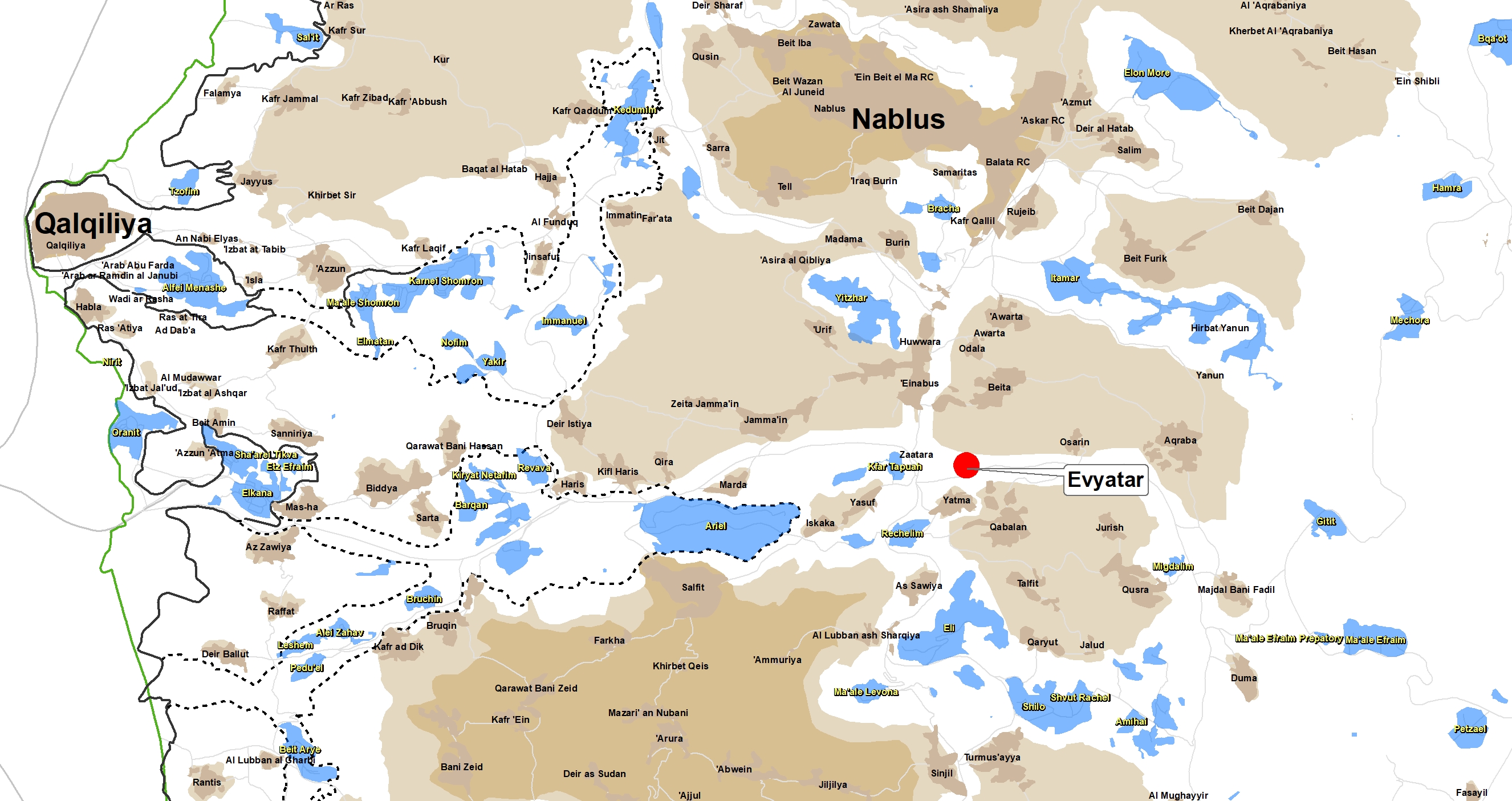
Map by Peace Now
In attendance,was National Security Minister Itamar Ben Gvir, Finance Minister and Minister in the Ministry of Defense Bezalel Smotrich, Defense Minister Yoav Gallant, Chief of Staff Major General Herzi Halevi, Coordinator of Government Activities in the Territories Colonel Ghasan Alyan, and other senior defense officials. Gallant and his allies opposed an immediate decision on Evyatar, citing security risks and rising tensions – especially with Ramadan around the corner.
Settlers attempted to visit the Evyatar outpost to celebrate the Jewish holiday of Purim, but were removed by Israeli security forces.
As a reminder, settlers agreed to temporarily leave the site of the Evyatar outpost in 2021 under terms of a government-brokered deal in which the government promised to undertake an “investigation” into the status of the land. That investigation has reportedly been concluded, and found that part of the land the outpost was illegally built on is “state land,” and part is privately owned by Palestinians. This report agrees with a 2022 opinion issued by then Attorney General Avichai Mandelblit supporting the retroactive authorization of Evyatar. The government deal with settlers also stipulated that the settlers’ illegal construction at the site would be left in place (i.e., did not demolish it) — including buildings and roads — while the government carried out its investigation into the status of the land. In this way, the “compromise” left the outpost intact and allowed Israel to maintain complete control over the site during the “survey” process, clearly signaling that the government’s objective was never to enforce Israeli law, but, rather, was always about finding a legal and political “solution” to enable it to launder the settlers’ illegal actions and accommodate their demands. Indeed, the terms of the Evyatar “compromise” made clear that the government was confident that it would find a pretext on which to assert that the land on which the outpost stands is “state land,” which can be used by the state as it sees fit (which nearly 100% of the time means, will be used to benefit the settlers).
The Evyatar outpost was built illegally by settlers on a hilltop that Palestinians have long known as Mt. Sabih, land which has historically belonged to the nearby Palestinian villages of Beita, Yatma, and Qablan. Evyatar became a recurring headline news story mostly as a result of the determined effort by Palestinians from the nearby village of Beitar to protest the outpost and to resist the Israeli government’s efforts to retroactively legalize it. Palestinians staged regular protests near the site of Evyatar outpost, which resulted in no fewer than seven Palestinian protesters dying as a result of the harsh and violent actions by the IDF to quash the protests.
Knesset Finalizes Draft of Bill to Reestablish Four Settlements in Northern West Bank
On March 9th, a Knesset panel finalized a draft bill that will repeal clauses of the 2005 Disengagement Law, which is required for the government’s plan to reestablish settlements in the northern West Bank that it dismantled as part of the disengagement deal (most notably, the Homesh settlement). The bill is now ready for its first reading and vote in the Knesset.
The agreed-upon draft will repeal clauses from the 2005 Disengagement Law that prohibit Israeli entry into the area of the former settlements, which brings the status of the land in line with the rest of Area C. Many lawmakers were pushing for the bill to also include articles that would give outright permission for the reestablishment of the areas – articles to permit Israelis to buy and own property/real estate – but the final text did not include those articles, nor does it apply any of the changes to Gaza.
Key Developments on De Facto Annexation via Archaeology
Emek Shaveh issued an update on several important issues that show how the Israeli government is continuing and in some cases accelerating the politicization of archaeology as a means to dispossess Palestinians and achieve the de facto annexation of lands in East Jerusalem and the West Bank.
First, Emek Shave reports on structural changes in the ISraeli government that put some of the most radical members of the ruling coalition in charge of key archaeological portfolios with authority over West Bank heritage sites. A government decision transferred power over the Israel Antiquities Authority (IAA) from Ministry of Culture to the Ministry of Heritage, which is headed by a member of Ben Gvir’s radical party (Amihai Eliyahu) – signaling “another step towards the extreme politicization of the authority.” In tandem, Amihai Eliyahu was given bureaucratic responsibility over the Civil Administration’s Staff Officer for Archaeology (SOA), effectively bringing this official (who is seated in the Defense Ministry) under a civilian authority. The SOA is responsible for overseeing all antiquity sites in Area C of the West Bank.
Emek Shaveh explains:
“It is not surprising that the far-right party would choose the heritage portfolio. According to the coalition agreement, the purpose of the Ministry of Heritage ‘is to care for national heritage assets, engage in the exposure, conservation and reconstruction of these assets alongside entrenching Jewish and Zionist heritage.’ Indeed, the plans and structural changes within the ministries show that consolidating heritage governance on both sides of the Green Line under the Ministry of Heritage indicates a strategic decision to use all the available statutory mechanisms in order to apply full Israeli control over ancient sites in the Occupied Territories.”
Second, Emek Shaveh reports that the IAA – as part of its expanding activities in the West Bank – conducted an excavation in the southern West Bank and announced its plan to display its findings in an Israeli museum (both of which are illegal under international law). Further, Emek Shaveh warns that archaeological digs such as the one conducted recently have served historically as a pretext for the establishment of new settlements – like in the case of the Shiloh and Amona settlements. Emek Shaveh writes:
“Even if the initial intention does not include turning the site into a settlement, the establishment of a camp is a means of laying hold to an area and displacing Palestinians from their land. It goes without saying that once a[n archaeological] camp is established, military presence is needed to guard the Israelis staying on site. We can assume that this trend will only intensify under the current minister of heritage.”
You can read the full update by Emek Shaveh, which discusses further news, here.
Bonus Reads
- “Six killed in Israeli raid on Jenin as settlers attack Palestinian town again” (Washington Post)
- “Police minister clowns around with settlers for Purim in flashpoint Hebron” (The Times of Israel)
- “West Bank, Gaza Palestinians to be banned from entering Israel during Purim” (The Times of Israel)
- “Shrinking the Conflict: Debunking Israel’s New Strategy” (Wallid Habbas, Al-Shabaka – March 6, 2023)
Welcome to FMEP’s Weekly Settlement Report, covering everything you need to know about Israeli settlement activity this week.
To subscribe to this report, please click here.
March 3, 2023
- Israel’s Makes Clear No Concessions Were Made in Aqaba Agreement, Settlements & Annexation Will Proceed
- Settlers Invade Evyatar Outpost Site as Calls for Legalization Grow
- Israel Advances Massive Expansion of Nof Zion Settlement Enclave in East Jerusalem
- Settlers Terrorize Huwara with IDF Assistance & Political Support
- Israeli Comptroller Wants Israel to Finish the Wall, Fortify Settlement Industrial Zones
- Bonus Reads
Israel’s Makes Clear No Concessions Were Made in Aqaba Agreement, Settlements & Annexation Will Proceed
On February 26th, the United States, Jordan, Egypt, the Palestinian Authority and Israel released a joint statement in which Israel agreed it will not “discuss new settlement construction plans for four months and will not authorize any new outposts for six months.”
To be clear, this statement is first and foremost a concession by the US, the PA, Egypt, and Jordan – in that it implicitly agrees that Israel may go ahead, after four months, with discussing new settlement construction plans, and after six months with authorizing any new outposts.
And equally clear: the “limits” in this agreement do not represent concession on the part of Israel. As has been Israel’s regular practice, the Higher Planning Council (the body within the Defense Ministry that oversees construction planning in the West Bank) has convened on a quarterly basis since the Obama Administration days, so agreeing to “stop discussion” for four months doesn’t delay or freeze anything, as much as it gives Israel “credit” for the standard pause between convenings. Likewise, with respect to Israel’s commitment to not authorize any new outposts for six months — as FMEP has already described, this is by no means a limitation on Israel’s ability to authorize outposts through the trick of calling them “new neighborhoods” of existing settlements. It’s also clear that this agreement has no bearing on the massive advancement of settlement construction and approval of new settlements undertaken by the Israeli Security Cabinet and Higher Planning Council over the last two weeks.
Prime Minister Netanyahu himself made it abundantly clear that the Aqaba statement will not constrain, restrain, or delay Israel’s advancement of settlement construction and outpost authorization. Netanayhu tweeted: “There isn’t and there will not be any construction freeze…Constructions and authorization in Judea and Samaria will continue according to the original schedule of the Higher Planning Council.”
Bezalel Smotrich, Finance Minister & Minister of the newly created “Settlement Administration” in the Defense Ministry that has power over planning in the West Bank, posted a tweet saying:
“I have no idea what they talked about or didn’t talk about in Jordan…I heard about this superfluous conference from the media just like you. But one thing I do know: there will not be a freeze in the construction and development of settlements, not even for one day (this, on my authority). The IDF will continue to counter terrorism in all areas of Judea and Samaria without any limitation (we will confirm this with the cabinet). It’s very simple.”
Settlers Invade Evyatar Outpost Site as Calls for Legalization Grow
On February 26th, dozens of Israeli settlers illegally invaded and stayed overnight at the site of former Evyatar outpost, in an attempt to reestablish the outpost — an action settlers say was in response to a nearby shooting attack in which a Palestinian gunman killed two settlers near the Palestinian village of Huwara. The IDF – under the command of Defense Minister Yoav Gallant – attempted to quickly remove settlers from the area the night they arrived, but were reportedly unable to do so until the next day (because the settlers refused to leave and the IDF apparently lacked the will to force them).
The Israeli coalition government – as part of the coalition deal – explicitly agreed to retroactively legalize Evyatar as a new settlement, but it was not one of the ten outposts granted legalization by the Israeli Security Cabinet on February 12th. Settlers and their allies have since poured on the pressure seeking to convince the govenment to greenlight the reestablishment of Evyatar.
Itamar Ben Gvir – who demanded the fate of Evyatar be included in the coalition agreement – convened a meeting of his party members at the site of Evyatar after the settlers were evacuated, and noted that he had attempted to appeal to Netanyahu to stop the evacuation. Ben Gvir said he wrote a letter to the Prime Minister that day, pleading to allow the settlers to stay and for the outpost to be legalized as a means of fighting terrorism. Ben Gvir was one of many Israeli lawmakers from within the governing coalition to call for legalization. Settlements and National Missions Minister Orit Strock said on radio, “The return to Evyatar is our mission and we intend to fulfill the agreement to return very soon.” On Feb. 28th, Finance Minister Bezalel Smotrich publicly promised the legalization of Evyatar.
On March 2nd, newly minted MK Tzvi Sukkot (Otzma Yehudit) – a criminal settler who replaced Smotrich upon his resignation from the Knesset to serve in the Cabinet – set up a tent at the site of Evyatar, calling it an parliamentary bureau. Sukkot’s “office” is ostensibly protected from removal by the IDF because of diplomatic immunity, and has been rewarded with a 500-person battalion of IDF officers deployed to the area in order to protect it. Sukkot also joined the settlers on March 26th who illegally invaded the area and stayed overnight in defiance of IDF attempts to clear the settlers from the outpost. Sukkot said:
“I set up my office here in Evyatar in order to monitor the implementation of the coalition agreement signed with our party, from up-close. This is one ‘stone’ on the way to our complete return to the community, as was agreed and as must be.I am working with all my might to ensure that the government keeps its promises and establishes a permanent community here.”
As a reminder, settlers agreed to temporarily leave the site of the Evyatar outpost in 2021 under terms of a government-brokered deal in which the government promised to undertake an “investigation” into the status of the land. That investigation has reportedly been concluded, and found that part of the land the outpost was illegally built on is “state land,” and part is privately owned by Palestinians. This report agrees with a 2022 opinion issued by then Attorney General Avichai Mandelblit supporting the retroactive authorization of Evyatar. The government deal with settlers also stipulated that the settlers’ illegal construction at the site would be left in place (i.e., did not demolish it) — including buildings and roads — while the government carried out its investigation into the status of the land. In this way, the “compromise” left the outpost intact and allowed Israel to maintain complete control over the site during the “survey” process, clearly signaling that the government’s objective was never to enforce Israeli law, but, rather, was always about finding a legal and political “solution” to enable it to launder the settlers’ illegal actions and accommodate their demands. Indeed, the terms of the Evyatar “compromise” made clear that the government was confident that it would find a pretext on which to assert that the land on which the outpost stands is “state land,” which can be used by the state as it sees fit (which nearly 100% of the time means, will be used to benefit the settlers).
The Evyatar outpost was built illegally by settlers on a hilltop that Palestinians have long known as Mt. Sabih, land which has historically belonged to the nearby Palestinian villages of Beita, Yatma, and Qablan. Evyatar became a recurring headline news story mostly as a result of the determined effort by Palestinians from the nearby village of Beitar to protest the outpost and to resist the Israeli government’s efforts to retroactively legalize it. Palestinians staged regular protests near the site of Evyatar outpost, which resulted in no fewer than seven Palestinian protesters dying as a result of the harsh and violent actions by the IDF to quash the protests.
Israel Advances Massive Expansion of Nof Zion Settlement Enclave in East Jerusalem
Ir Amim reports that the Jerusalem Local Planning Committee convened on March 1st and recommended approving a plan for public deposit (a last step before final approval) that would, if approved, massively expand the Nof Zion settlement enclave, located inside the Palestinian East Jerusalem neighborhood of Jabal Mukaber. The Committee is set to reconvene on March 6th to actually approve the plan for public deposit.
Ir Amim writes:
“After being postponed several times over the past few months, including in January, reportedly due to the US National Security Advisor’s visit to the region last month, the Israeli authorities are clearly hellbent on advancing this plan. The re-scheduling of this plan along with the resumption of promotion of the E1 plans follows swiftly on the heels of continuous empty commitments by the Israeli government to temporarily freeze settlement advancement among other measures to reduce tensions…Beyond its geopolitical implications, this is yet another example of the severe discrimination in urban planning and housing in East Jerusalem. Despite the plan being designated for the entrance of Jabal Mukabber, it is not intended for the community’s development needs, but rather the expansion of a Jewish settlement in the middle of a Palestinian neighborhood. It should be noted that Jabal Mukabber has been among the Palestinian neighborhoods in East Jerusalem with the highest number of demolitions per year. Just today, the Israeli authorities razed a home in Jabal Mukabber, displacing a family, including two children.”
The plan – called “Nof Zahav” – would allow for 100 new residential units and 275 hotel rooms in the settlement enclave, which currently consists of 95 units, plus another 200 under construction. In order to provide sufficient land for this expansion, the Jerusalem Planning Committee is simultaneously advancing another plan to relocate an Israeli police station [the Oz station], currently located on the border of Jabal Mukaber, to a new site across the street. This will leave its original location free for the planned expansion of Nof Zion, while the new site will become a massive new Israeli security headquarters. Ir Amim filed a petition against the police station plan, arguing that it is an affront to the planning needs of the local community and that it represents a continuation of Israel’s systematic, city-wide discrimination against the housing, educational, and service-based needs of Palestinian neighborhoods. A decision on the police station relocation plan is expected soon.
Settlers Terrorize Huwara with IDF Assistance & Political Support
Settlers committed a pogrom against Palestinian village of Huwara on February 26th. For eight hours, hundreds of settlers attacked Palestinians and their property, causing terror, far-reaching destruction, hundreds of injuries, and at least one death.
Al-Haq reports that the IDF not only failed to intervene but actually facilitated the settlers’ rampage in the first place.
Al Haq reports:
“The Israeli Occupying Forces (IOF) facilitated the settler attack, effectively laying siege to Huwwara by closing off all the entrances of the town, in advance of the attack, permitting the entrance of hundreds of settlers by foot, and preventing the entry of medics and journalists. During Israeli colonial settler attacks against Palestinians in Huwwara, and other nearby villages, Sameh Aqtash, 37, was killed, a further two Palestinians were shot and wounded, another stabbed, and a fourth beaten with an iron bar, according to the Palestinian Red Crescent Society. The IOF openly accompanied the marauding settler mob, attacking Palestinians with military grade tear gas, leaving 95 Palestinians suffocated from tear gas inhalation.”
The Palestinian Centre for Human Rights further reports:
“IOF closed all Nablus’ entrances and tightened the cordon off the village from three directions. Around half an hour later, at least 500 Israeli settlers started to gather at Huwara and Za’tara checkpoints surrounding Huwara village and down to the Yitzhar Bypass Road leading to “Yitzhar” settlement, which cordons off the village from the southwestern side, and amid the attendance of IOF and Israeli officials from the government at the scene. During their demonstration, the settlers intentionally carried out largescale attacks and violence acts against Palestinians and their property, houses, shops, and vehicles, and in Huwara village, and deliberately set them ablaze without any intervention from the IOF to stop them. The settlers’ attacks continued until 23:15, causing bruises to several Palestinians, completely burning 7 houses, 6 cars garages and 34 vehicles and breaking the windows of 25 houses by stone-throwing and the windows of 20 other vehicles were smashed as well.”
Settlers cited the murder of two Israelis – Hillel and Yagel Yaniv earlier in the day as the pretext for the pogrom. The two were killed by a Palestinian gunman on the main road near Huwara. Palestinians noted that this killing was in response to Israel’s military operation the day before in Nablus (near Huwara), in which 11 Palestinians were killed and more than 100 Palestinians were injured.
Bezalel Smotrich – who is effectively the sovereign authority over the West Bank – celebrated the pogrom and incited further genocidal, state-led violence. In a taped interview Smotrich said:
“The Palestinian village of Hawara should be wiped out of the earth. The Israeli government needs to do it and not private citizens”
Following widespread international condemnation, the IDF arrested six (or seven, per other reports) Israeli settlers, all for their conduct against Israeli soldiers (as opposed to for attack on Palestinians). All were swiftly ordered to be released by a Jerusalem court, but the Defense Ministry ordered two of them (one of whom is a minor) to be held in administrative detention (a tool rarely used with respect to Jewish detainees). According to the Times of Israel, “A senior security official speaking to Channel 12 news claimed the pair were ‘planning and had carried out operations against IDF forces. [They] are extremely dangerous.’ According to Haaretz, a senior security source, possibly the same one, said they were involved in initiating the riots.”
Zvika Foghel,a criminal settler now serving in the Knesset – endorsed the pogrom and incited further violence, saying:
“A Huwara that is burning — that’s the only way we’ll achieve deterrence…We need to stop shying away from collective punishment.”
The pogrom in Huwara happened one day before the U.S. State Department released its 2021 Country Report on Terrorism, in which for the first time the U.S. said that “Israeli security personnel often did not prevent settler attacks and rarely detained or charged perpetrators of settler violence.” Such facts have been documented by Palestinian and Israeli human rights groups for decades.
Israeli Comptroller Wants Israel to Finish the Wall, Fortify Settlement Industrial Zones
In its annual report released late February 2023, the State Comptroller’s Office slammed a wide range of government bodies for their failure to finish the West Bank separation barrier and over the state of security at settlement industrial zones.
On the separation barrier, the comptroller criticized the government and IDF for abandoning efforts to finish the project, for failing to fix damaged areas of the wall, and for decreasing the presence of the IDF along the barrier route. The Comptroller report said that there were 1.4 million instances of Palestinians crossing the barrier in 2021, about 6,000 per day. In response to the report, an IDF source said that the barrier is expected to be finished in late 2023 (or late 2024) and argued that the barrier is 82% effective except “in areas where it was decided operationally not to fix breakthroughs.”
The Israeli Comptroller also harshly criticized the lack of fortification of the 35 settlement industrial zones in the West Bank. The report examined seven of the zones, finding deficiencies in the security systems in each. The report recommends the government formulate and fund a plan to improve security.
Bonus Reads
- “Israel has quietly annexed the West Bank and Biden stays silent” (Mitchell Plitnick, Mondoweiss – 2/25/23)
Welcome to FMEP’s Weekly Settlement Report, covering everything you need to know about Israeli settlement activity this week.
To subscribe to this report, please click here.
January 20, 2023
- Postponed: Plan to Massively Expand East Jerusalem Settlement Enclave
- Coalition Deal Enables Massive Hebron Settlement Plan to Advance
- Settlers to Petition Government to Annex Jordan Valley
- Bonus Reads
Postponed: Plan to Massively Expand East Jerusalem Settlement Enclave
Just hours before the Jerusalem Planning Committee was scheduled to advance a new plan to massively expand the Nof Tzion settlement enclave (located inside the Palestinian East Jerusalem neighborhood of Jabal Mukaber), consideration of the plan was removed from the agenda. Consideration of this plan has been postponed several times in recent months, with this latest deferral coming just before U.S. National Security Advisor Jake Sullivan arrived in Israel.
The plan – called “Nof Zahav” – would allow for 100 new residential units and 275 hotel rooms in the settlement enclave, which currently consists of 95 units, plus another 200 under construction. In order to provide sufficient land for this expansion, the Jerusalem Planning Committee is simultaneously advancing another plan to relocate an Israeli police station [the Oz station], currently located on the border of Jabal Mukaber, to a new site across the street. This will leave its original location free for the planned expansion of Nof Zion, while the new site will become a massive new Israeli security headquarters. Ir Amim filed a petition against the police station plan, arguing that it is an affront to the planning needs of the local community and that it represents a continuation of Israel’s systematic, city-wide discrimination against the housing, educational, and service-based needs of Palestinian neighborhoods. A decision on the police station relocation plan is expected soon.
Ir Amim further explains the impact of these plans:
“Expanding the settlement towards the main entrance of Jabal Mukabber will infringe on the residents’ freedom of movement and further disrupt the fabric of life in the neighborhood. Prior experience show that during clashes and periods of tension and instability, Israel rushes to impose collective restrictions under the pretext of protecting Israeli settlers.”
Ir Amim researcher Aviv Tartarsky told Haaretz:
“In Jabel Mukaber, the state is handing over Palestinian homes to settlers just as in Sheikh Jarrah and Silwan… [A new settlement] that controls the entrance to Jabel Mukaber, will deepen the presence of the police, the border guard and armed security guards, which will harm the sense of security and disrupt daily life for the tens of thousands of neighborhood residents.”
Coalition Deal Enables Massive Hebron Settlement Plan to Advance
Haaretz reports that the coalition deal between the Likud and Religious Zionism parties includes an agreement to hand control of West Bank lands/properties owned by Jews before 1948 (and lost in the 1948 War) back to their original owners (or their descendants). These assets have been held by the Israeli army since 1967, when Israel established its occupation of the West Bank, and since the 1990s Israeli government policy has viewed the disposition of these assets as a matter for final status talks with Palestinians.
Peace Now and Bimkom estimate that 13,000 dunams (3,250 acres) of land in the West Bank are implicated in this policy, including about 70 buildings in central Hebron, the handover of which will enable the realization of an Israeli plan to convert the old wholesale market into a new settlement compound.
In addition to buildings in Hebron, the move will affect land located for the most part in the areas surrounding Bethlehem as well as plots in the area of the Palestinian villages of Nabi Samwil, Batir, and Beit Furik – including plots in Area B of the West Bank, as defined by the Oslo Accords.
As a reminder, while Israel implements this Jewish right to reclaim properties lost in the 1948 War (as it has done systematically in East Jerusalem for years), Israeli law systematically denies Palestinians any rights to claim properties they lost in that same war.
Settlers to Petition Government to Annex Jordan Valley
The Sovereignty Youth Movement – a group of young settlers – has been gathering signatures for a letter calling on the Israeli government to annex the Jordan Valley. The group reportedly plans to send the letter to Prime Minister Netanyahu in the coming days.
Meanwhile, six settlers in the Jordan Valley were caught on film violently attacking a group of tourists and Palestinians who were on a hike near Jericho. Settlers are seen striking the group with clubs and using pepper spray. The Israeli army arrived in time to escort the hikers out of danger, but no arrests were made (or have been since). Three hikers went to the hospital for their injuries.
One Israeli activist familiar with the area identified the attackers seen on video as residents of a nearby outpost, one of whom is known to be violent towards Palestinian shepherds.
Bonus Reads
- “On Flimsy Grounds: Israel’s Pervasive Night Arrests of Palestinian Children” (HaMoked)
- “Protection of Civilians Report | 20 December 2022 – 9 January 2023” (OCHA)
- “Israel’s new army chief Herzi Halevi forced to navigate multiple bosses, far-right whims” (Al-Monitor)
- “Opinion | The Cost of De Facto Annexation Will Be Paid in Blood” (Haaretz)
- “Israel to open ‘there is no occupation’ campaign, new minister says” (Jerusalem Post)
- “Israeli army survey number of residents of two Masafer Yatta hamlets” (WAFA News)
- “Give up your right to live in the West Bank, or never see your children in Gaza again” (+972 Magazine)
Welcome to FMEP’s Weekly Settlement Report, covering everything you need to know about Israeli settlement activity this week.
To subscribe to this report, please click here.
November 18, 2022
- Jerusalem Planning Committee to Discuss (Another) Plan to Significantly Expand Nof Zion Settlement Enclave
- As Court Tries to Avoid Underlying Issue of Land Allocation Practices in the West Bank, Palestinians Reject “Deal” that Would Allow Construction of Givat Eitam/E-2 Settlement,
- Mass Displacement/Dispossession in Silwan Advances, Court Rejects Shahadeh Family Petition
- Elad Continues Illegal Work in East Jerusalem Cemetery
- Bibi’s Coalition Promises on Settlement: Outposts, Homesh, Evyatar, Infrastructure, Override Clause, & More
- Settler Violence Continues to Surge
- U.S Ambassador Visits a Settlement, Less Than a Year After Saying He Won’t
- Bonus Reads
Jerusalem Planning Committee to Discuss (Another) Plan to Significantly Expand Nof Zion Settlement Enclave
Ir Amim reports that on November 23rd the Jerusalem District Planning Committee is scheduled to discuss a plan to expand the Nof Zion settlement enclave, located in the heart of the Palestinan neighborhood of Jabal Mukaber in East Jerusalem. The plan would allow for 100 new residential units and 275 hotel rooms in the settlement enclave, and is part of a larger scheme to connect the enclave to the built-up area of East Talpiot – a scheme which would cut deeply into the Jabal Mukaber neighborhood and entrench the expanding continuum of Israeli settlements surrounding Jerusalem.
Commenting on the plan, the Israeli NGO Ir Amim writes:
“Beyond its geopolitical implications, this is yet another example of the severe discrimination in urban planning and housing in East Jerusalem. Despite the plan being slated for the entrance of Jabal Mukabber, it is not designated for the community’s development needs but rather for the expansion of a Jewish settlement in the middle of a Palestinian neighborhood. It should be noted that Jabal Mukabber is among the Palestinian neighborhoods in East Jerusalem with the highest number of demolitions per year.”
Specifically, the Nof Zion expansion plan to be discussed by the Jerusalem District Planning Committee on November 23rd is interconnected with another plan (last discussed by the Committee in January 2022). That plan seeks to move an Israeli police station [the Oz station] currently located on the border of Jabal Mukaber, to a new site across the street (where it will become a massive Israeli security headquarters), leaving its current location free for the planned expansion of Nof Zion. Ir Amim filed a petition against the police station plan, saying that it is an affront to the planning needs of the local community and continues Israel’s systematic, city-wide discrimination against the housing, educational, and service-based needs of Palestinian neighborhoods. A decision on the police station relocation plan is expected soon.
Ir Amim further explains the impact of these plans:
“Expanding the settlement towards the main entrance of Jabal Mukabber will infringe on the residents’ freedom of movement and further disrupt the fabric of life in the neighborhood. Prior experience show that during clashes and periods of tension and instability, Israel rushes to impose collective restrictions under the pretext of protecting Israeli settlers.”
These plans are just the latest efforts to expand and entrench the Nof Zion settlement enclave. Prior plans include:
- In 2017, the Israeli government approved a plan to build a new synagogue and mikveh for the settlement, to be located on private Palestinian land that had been expropriated form Jabal Mukaber the year before.
- In April 2019, after two years of rumors, the Israeli government issued 176 building permits for the already-approved project to build . According to Ir Amim, those permits were ultimately issued in April 2019.
- In 2019, construction began on a plan to triple the size of the settlement enclave, making it the largest such enclave in East Jerusalem. After a two-year stall, construction on the expansion resumed in 2021 with new financing.
As Court Tries to Avoid Underlying Issue of Land Allocation Practices in the West Bank, Palestinians Reject “Deal” that Would Allow Construction of Givat Eitam/E-2 Settlement
On November 14th, Peace Now tweeted updates from a courtroom where the Israeli Supreme Court was attempting to resolve the ongoing petition against the allocation of “state land” for the construction of the Givat Eitam/E-2 settlement, slated to be build on a strategic hilltop – which Palestinians know as a-Nahle – located just south of Bethlehem. The construction of Givat Eitam/E-2 would significantly expand the Efrat settlement in the direction of Bethlehem. It would also effectively cut Bethlehem off from the southern West Bank and complete the city’s encirclement by Israeli settlements.
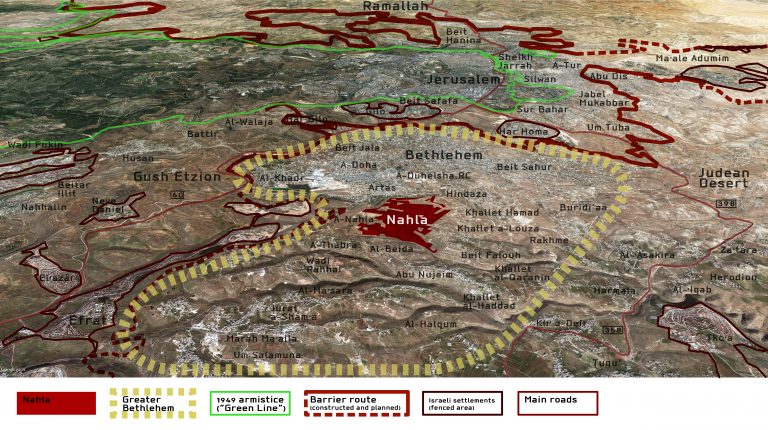 In the hearing, the State of Israel proposed a deal to the Palestinian petitioners, according to which the State would allocate to them a total of 54 dunams (out of the 1,400 dunams originally planned for the construction of the new settlement). The Palestinian landowners rejected the deal, with their lawyer Michael Sfard noting:
“The main problem is that the solution proposed by the court…does not remove the evil of the decree from their heads, and therefore we oppose this proposal…that offer, whether it is 50 or 100 dunams, does not help the Palestinian communities. Since we, and everyone who sits around here, knows that if this neighborhood is built, it’s likely that they won’t even be able to cultivate those acres.”
Peace Now tweeted its sense of where the judges opinions might land, writing:
“The hearing is over. The petitioners rejected the state’s offer. It seems that the judges are trying to avoid a decision on the central question regarding the entire land – whether it should be allocated to the settlements or the Palestinians. The judges keep trying to walk between the drops. On the one hand, they cannot ignore the blatant discrimination in Israel’s land allocation policy. On the other hand, they are trying to avoid the fundamental question of the legality of this land allocation to the settlement.”
The High Court held a hearing in June 2021 on this same petition. Peace Now’s Hagit Ofran told FMEP that at the conclusion of that hearing the Court had given the government of Israel 90 days to respond to a proposal to either allocate to the individual petitioners some of the “state land” directly involved in the case, or to allocate to them “state land” nearby. This decision by the Court purposely narrowed the scope of Peace Now’s legal challenge by addressing only the case of the land in a-Nahle and the individual petitioners involved, thereby dodging the more fundamental question put forth in the petition challenging Israel’s discriminatory practice of allocating 99.8% of “state land” for settlement purposes. This is the first time the issue of state land allocations to settlements is being challenged in an Israel court.
Mass Displacement/Dispossession in Silwan advances, as Court Rejects Shahadeh Family Petition
On November 13th, the Jerusalem District Court announced that it had rejected an appeal by the Palestinian Shehadeh family seeking to cancel eviction orders that seek to dispossess them of their longtime homes in the Batan al-Hawa section of Silwan in favor of the Ateret Cohanim settler organization. The announcement follows a hearing the Court held on the appeal on November 9th.
As a reminder: the Shahadeh family is one of 85 families in Batan al-Hawa facing displacement at the behest of Ateret Cohanim. The legal fate of all of the families is bound together, with the Duweik family’s case being the furthest advanced and setting a dangerous precedent for the Shehadehs and others. Indeed, this week the Supreme Court discussed several of the decisions made in regards to the Duweik family, and their relation to the Shehadehs’ case. Notably, in July 2022 a 3-judge panel of the Supreme Court could not agree on the Duwiek’s family’s petition, which resulted in the petition being sent back to the Jerusalem Magistrate’s Court – where it currently awaits further consideration. One of the judges accepted the argument that the family should be allowed to continue living in their homes because a statute of limitations prohibits Ateret Cohanim – through its management of an historic land trust – from making a claim to the land after such a long period of absence.
As a reminder, Ateret Cohanim has waged a years-long eviction campaign against Palestinians living in Silwan, on property the settler NGO claims to own. In total, Ateret Cohanim’s campaign stands to ultimately dispossess 700 Palestinians (85 families) in Silwan. The group’s claim is based on having gained control of the historic Benvenisti Trust, which oversaw the assets of Yemenite Jews who lived in Silwan in the 19th century. In 2001 the Israeli Charitable Trust Registrar granted Ateret Cohanim permission to revive the trust and become its trustees, (following 63 years of dormancy). In 2002, the Israeli Custodian General transferred ownership of the land in Batan al-Hawa to the Trust (i.e., to Ateret Cohanim). Since then, Ateret Cohanim has accelerated its multi-pronged campaign to remove Palestinians from their homes, claiming that the Palestinians are illegal squatters.
Elad Continues Illegal Work in East Jerusalem Cemetery
Emek Shaveh & Ir Amim tweeted footage of construction work at the site of the Sambuski cemetery, an ancient Jewish cemetery located in the Ben Hinnom Valley in East Jerusalem. The Elad settler group – which is paid by the Israeli government to manage and expand a web of settler-tourist sites and the City of David National Park – has been conducting work on the Sambuski Cemetery despite apparently lacking a permit. Emek Shaveh – an Israeli NGO with expertise in archaeology – notes that any construction within a national park should be heavily scrutinized by professionals and the public before being implemented.
In August 2022, Elad unilaterally closed the main access road leading to the Palestinian neighborhood of Wadi Rababa, which travels past the Sambuski cemetery. 150 families were trapped in the neighborhood while Elad worked on the site.
The Sambuski cemetery was a relatively unknown, neglected site until recent years – but it is deeply integrated into Elad’s overarching, comprehensive plan to take control of the Silwan neighborhood. In 2020, the-president Trump’s “Peace to Prosperity” plan identified the Sambuski cemetery as a place of prime historical and religious importance to Israel, elevating the status of the cemetery. The Israeli NGO Emek Shaveh – which has special expertise on archaeology and the way archeology has been weaponized to serve the political agenda of the settlers and the state of Israel – wrote a report on exactly how the Trump plan supports settler efforts to use Jerusalem’s history and antiquities to promote Israeli-Jewish hegemony and control over the city.
Emek Shaveh explains how the cemetery is connected to other settler endeavors in Silwan:
“For the Elad Foundation the cemetery is a strategic site as it links together two important focal points of its enterprise – the neighborhood of Silwan, home to the City of David archaeological park and specifically to the Pool of Siloam at the southern tip of the site, and the Hinnom Valley an area which Elad has been developing for the past two years (more below).”
Bibi’s Coalition Promises on Settlement: Outposts, Homesh, Evyatar, Infrastructure, Override Clause, & More
Netanyahu continues to negotiate a final coalition agreement in order to form a new government, and has reportedly committed to virtually all of the main demands of the settler movement (short of outright annexation of all the land between the river and the sea), including:
- Passage of the Supreme Court Override Clause (see this new explainer by ACRI). This law would obliviate judicial oversight in Israel, giving ultimate power to the Knesset. Under the new Israeli government and with the current Knesset, this law would likely be used to reinstate the Settlement Regulation Law – the law that seeks to establish a legal basis for Israel to retroactively legalize outposts and settlement structures which are built on land that Israel acknowledges is privately owned by Palestinians. As a reminder, that law was overturned by the Israeli Supreme Court in June 2020. Peace Now estimates that the law stands to convert some 55 unauthorized outposts into official, authorized settlements, seizing some 8,000 dunams of privately owned Palestinian land in the process.
- Full recognition & integration of outposts (i.e., retroactive legalization and de facto annexation). This was reportedly promised to Bezalel Smotrich, who has authored Knesset legislation to grant full status to outposts irregardless of the status of the land on which the outposts were built illegally. Separately, Netanyahu agreed with Itamar Ben Gvir that the outposts would be provided infrastructure services within 60 days of the new government being sworn in.
- The reestablishment of the Homesh Settlement. Netanyahu reportedly committed to Itamar Ben Gvir, a longtime supporter/devotee of Rabbi Meir Kahane, that the settlement of Homesh will be reestablished on the land where it stood prior to being dismantled by the Israeli government in 2005. To do so would require the government to amend the 2005 Disengagement Law that not only ordered the dismantling of the Homesh settlement along with three others in the northern West Bank, but provided for Israel’s withdrawal from Gaza. For more on the long-running campaign by settlers and their allies to reestablish the Homesh settlement – and its consequences for Palestinians who live nearby and own the land on which Homesh once stood – see here.
- The legalization of a yeshiva at the Evyatar Outpost. Netanayhu and Ben Gvir agreed to grant retroactive authorization to a yeshiva established at the Evyator outpost. For more on the Evyatar outpost & yeshiva saga – see here.
- A commitment to expanding settler road infrastructure across the West Bank. Netanyahu agreed with Ben Gvir to allocate $434 million ($1.5 billion shekels) for the paving of new and expanded bypass roads in the West Bank and for the expansion of Highway 60, and to expedite the planning process for doing so. For more analysis on how infrastructure such as roads contribute to Israel’s de facto annexation of the West Bank, see this report by Breaking the Silence.
In addition, Netanyahu is coming under increasing pressure from inside his coalition to name far right-wing MK Bezalel Smotrich as the next Defense Minister. Haaretz reports that Itamar Ben Gvir supports Smotrich’s demand because it will,
“help implement a full right-wing policy, establish new settlements in the West Bank, approve construction of thousands of new housing units in them, stop Palestinian construction in Area C and halt the evictions of illegal outposts.”
Of note, in 2021 Smotrich suggested that a “solution” to Palestinian “illegal” construction in Area C (construction by Palestinians on their own land, but without Israeli-required building permits, that Israeli makes it nearly impossible to obtain) could be to give settlements the authority to demolish Palestinian construction they believe to be unauthorized.
American officials, including Ambassador Nides, have expressed concern over Smotrich’s potential appointment to such a key – and powerful – post. In addition to his pro-settlement, pro-annexation positions, Smotrich is also a self-proclaimed homophobe and has lobbied for the expulsion of Palestinians from Israel.
Lastly, and underscoring the extent to which the settlers’ agenda and the governing coalition’s agenda are one and the same: a newly elected Member of the Knesset, Limor Son Har-Melech of the Religious Zionism coalition, has appointed a member of the radical hilltop youth movement to serve as his spokesperson. Har-Melech’s new spokesman, Elisha Yered, lives in the outpost of Ramat Migron in the northern West Bank, and is under ongoing investigation following his arrest in August 2022 for “racist conspiracy” — amongst other charges for crimes against Palestinians. Yered is quoted as saying:
“the hills are the scene of a war that according to Jewish law one is required to wage…what the hills do is to bring Jewish control to hundreds of dunams – that is something that no soldier in the greatest reconnaissance unit can do during his service.”
Settler Violence Continues to Surge
Following a Palestinian stabbing attack near the Ariel settlement that left 3 Israelis dead and 3 injured, settlers across the West Bank rampaged to take their revenge, committing over 20 attacks against Palestinian and their property, as well as Israeli soldiers, in the 24 hours that followed.
In addition, in its weekly report on Israeli human rights violations covering Nov. 10-16, the Palestinian Centre for Human Rights reports that settlers conducted 4 attacks on Palestinians’ vehicles in different areas in the West Bank during the reporting period Nov. 10-16.
“On 14 November 2022, Israeli settlers moved into Haris village in Salfit, north of the West Bank, and burned four vehicles belonging to the villagers.
On 15 November 2022, Israeli settlers attacked and set fire to a vehicle belonging to a
Palestinian who was in his way back from ‘Attil village in northern Tulkarm to Nablus.On the same day, Israeli settlers intercepted a bus for a women’s trip in Hebron and
prevented it from moving for few hours, enticing fear among the passengers.On 16 November 2022, Israeli settlers threw stones at four vehicles near Ramin village, east of Tulkarm, breaking their windows. On the same day, Israeli settlers damaged a vehicle belonging to a Palestinian doctor near Jit village in Qalqilya.”
PCHR concludes, noting: “Since the beginning of the year, settlers conducted at least 236 attacks. In two of the attacks, 2 Palestinians were killed.”
U.S Ambassador Visits a Settlement, Less Than a Year After Saying He Won’t
This week U.S. Ambassador to Israel Thomas Nides visited the West Bank settlement of Kiryat Netafim to offer his condolences to the grieving family of a victim of Sunday’s stabbing attack that killed three and wounded three. Nides’ trip marks the first time any representative of the Biden Administration has undertaken official travel to any Israeli settlement. A U.S. Embassy spokesperson said that “the shiva visit in no way signals a change in US policy toward settlements”
In January 2022 Ambassador Nides was quoted as saying he “will absolutely not” visit a settlement. It’s worth recalling that the Biden Administration has not reversed or publicly rejected the Trump Administration’s “Pompeo Doctrine,” which made it U.S. policy to view Israeli settlements as not “per se inconsistent with international law.”
Kiryat Netafim is located about half way between the Ariel settlement and the cluster of settlements close to the 1967 Green Line that are slated to be united into a “super settlement” area (Oranit, Elkana, Shiva Tikva, and others). The string of settlements creates a contiguous corridor of Israeli construction and control stretching from sovereign Israeli territory to Ariel. As FMEP has repeatedly pointed out, the Ariel settlement is located in the heart of the northern West Bank, reaching literally to the midpoint between the Green Line and the Jordan border. The future of Ariel has long been one of the greatest challenges to any possible peace agreement, since any plan to attach Ariel to Israel (with a finger of land running through settlements like Kiryat Netafim) will cut the northern West Bank in half..
Bonus Reads
- “Gantz approves upgrade to stretch of West Bank barrier after spate of terror attacks” (The Times of Israel)
- On the U.N.:
- “Key UN committee seeks legal opinion on Israel’s occupation” (Washington Post)
- “Opinion | Israel’s Chutzpah at the United Nations” (Haaretz / Noa Landau)
- “Lapid, Gantz slam UN panel’s call on ICJ to probe Israeli ‘occupation, annexation’” (The Times of Israel)
- “Adalah and Center for Constitutional Rights demand US cancel its plan to build embassy compound in Jerusalem on private Palestinian land” (Adalah)
- “Expulsion by Other Means: Israel’s Campaign Against Palestinians in Masafer Yatta” (J Street)
- “Ben & Jerry’s board bemoans West Bank, east Jerusalem sales” (AP News)
- “Wild boars in Palestine are being weaponized by Israeli colonialism” (Mondoweiss)
- “IDF soldier suspended for cursing left-wing activist in Hebron: ‘You’re a traitor’” (The Times of Israel)
Welcome to FMEP’s Weekly Settlement Report, covering everything you need to know about Israeli settlement activity this week.
To subscribe to this report, please click here.
January 14, 2022
- Israeli Attorney General Supports Settler-Led Dispossession of the Sumreen Family in Silwan
- Tender Published for 300 New Units in East Jerusalem Settlement of East Talpiyot
- Israel to Advance Expansion of East Jerusalem settlement of Gilo
- Israel Advances Plan that Will Pave Way for Expansion of East Jerusalem Settlement Enclave of Nof Zion
- IDF Evacuates Oz Zion Outpost (Again)
- Fight Over Homesh Outpost & Yeshiva Continues (Both Physically and Politically)
- Settlers Seek Outpost Gains from Divided & Fragile Government (With Some Success)
- Construction Begins on Key Stretch of the “Tunnels Road” for Settlements South of Jerusalem
- Israel Gives U.S. Army Officers Tour of Hebron Led by Settlement Spokesman
- Further Reading
Israeli Attorney General Supports Settler-Led Dispossession of the Sumreen Family in Silwan
On January 9th, Israeli Attorney General Avichai Mandelblit submitted a legal opinion to the Supreme Court arguing in support of the immediate eviction of the Sumreen family from their home of 60+ years in the Silwan neighborhood of East Jerusalem. The Supreme Court is expected to announce its next steps on the case in the coming days, which might include setting a new hearing date to again consider legal arguments from both sides (now that the Attorney General has weighed in).
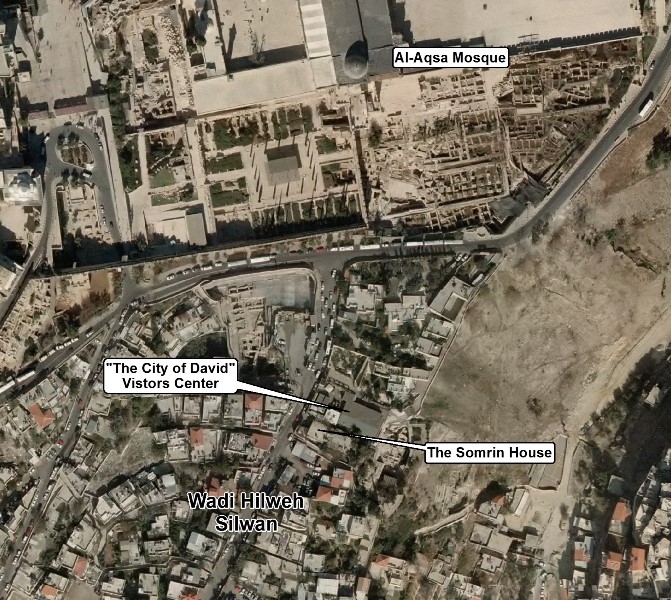
Map by Peace Now (click to expand)
The case to evict the Sumreen family, spearheaded by the JNF, with the secret funding/backing of the Elad settler group, is a key test of the State’s use of the Absentee Property Law to seize Palestinian homes in East Jerusalem. If dispossessed of their home, the Sumreen family case sets a broader precedent for many other ongoing eviction cases in Silwan that could result in the mass displacement of Palestinians in favor of settlers.
In his opinion, the Attorney General did not address the broader political context of widespread dispossession of Palestinians in Silwan, or legally dubious actions on the part of the Elad settler group and the Jewish National Fund in having the property declared to be absentee (see a detailed history of that scandal here) in order to take control over it. Instead, the Attorney General decided simply that there is no new basis on which to overturn the 1999 ruling that legitimized the JNF’s ownership of the home, and that the Sumreen family does not have a legal right to reside there.
Peace Now said in a statement:
“Instead of intervening and doing justice, the Israeli government, through the Attorney General, becomes a direct partner in crime and unforgivable injustice. The Attorney General chooses to ignore the context and the injustice behind the eviction suit and dives into quasi-legal questions to help settlers take over another property in Silwan. The Government’s fingerprints are smeared all over the Sumerin case. This is a political move in which government mechanisms such as the Custodian of Absentee Property and the Israel Land Administration and the JNF have been utilized in order to dispossess Palestinians of their property in East Jerusalem and replace them with settlers.”
It’s worth noting that the Sumreen house is located only a very short distance from the Al-Aqsa Mosque (approximately 10 meters) at the entrance to the Silwan neighborhood, and is adjacent to the “City of David” visitors center built and operated by the Elad settlers. The home is also located in the middle of what today has been designed by Israel as “the City of David National Park.” The entire area is managed by the radical Elad settler organization, which for years has also been pursuing the eviction of Palestinians from the homes in Silwan. For nearly three decades, the Sumreen family has been forced to battle for legal ownership of their home, after the state of Israel, prompted repeatedly by the JNF, declared the Sumreen’s home to be “absentee” property, despite the fact that this was manifestly not the case. Under that designation – which was not communicated to the Sumreen family – Israeli law permitted the State to take over the rights to the building. The State then sold the rights to the home to the JNF in 1991. The JNF has pursued the eviction of the Sumreen family ever since. Israeli courts ruled in favor of the Sumreen family’s ownership claims to the home for years, until a September 2019 ruling by the Jerusalem Magistrate’s Court granted ownership of the family’s home to the JNF, a decision the family immediately appealed to the Jerusalem District Court.
A full history of the saga involving the Sumreen family – which is similar to dozens of other Palestinian homes in Silwan that were declared Absentee Property in the 1990s – can be found on the Peace Now website here.
Tender Published for 300 New Units in East Jerusalem Settlement of East Talpiyot
On January 5th the Israel Lands Authority published a tender for the construction of 300 settlement units in the East Talpiyot settlement, located in East Jerusalem. Ir Amim reports the tender is scheduled to be opened for bids on February 14th.
The new units will expand the built-up footprint of East Talpiyot in the direction of the Palestinian neighborhood of Sur Baher, a neighborhood that is facing multiple new settlement plans that encroach on its historic land (including the Givat HaMatos, Har Homa, and Lower Aqueduct plans). Sur Baher has also been targeted by the Israeli Custodian General in its efforts to gain control over more land that was owned by Jews previous to 1948.
Israel to Advance Expansion of East Jerusalem settlement of Gilo
On January 10th the Jerusalem District Planning Committee convened to discuss two plans that would add 1,538 settlement units to the Gilo settlement in East Jerusalem. The plans are being advanced under the banner of “urban renewal” and will involve demolishing existing settlement units and replacing 470 existing settlement units with 2,008 new units (representing a net expansion of the settlement by 1,538 units). Ir Amim notes that, “while the plans will not necessarily enlarge Gilo territorially, it will increase the Israeli population in the settlement and hence the number of Israelis living in East Jerusalem.”
Israel Advances Plan that Will Pave Way for Expansion of East Jerusalem Settlement Enclave of Nof Zion

Map by Ir Amim (click to expand)
On January 11th, the Jerusalem District Planning Committee held a meeting to discuss public objections to a plan connected to the expansion of Nof Zion, a settlement enclave located inside the Palestinian East Jerualem neighborhood of Jabal Mukaber. One such objection was filed by Palestinian residents of Jabal Mukaber with assistance from Ir Amim. That objection argues that the plan is an affront to the planning needs of the local community and continues Israel’s systematic, city-wide discrimination against the housing, educational, and service-based needs of Palestinian neighborhoods. The Committee closed the meeting without reaching a decision, and has scheduled further private (closed to the public) continuation of its discussion of the plan.
The plan under consideration provides for the construction of a large, new Israeli police station on the border of Jabal Mukhaber neighborhood, on a plot of land that is across the street from the existing police station. The new station, according to Ir Amim, will “constitute a massive security headquarters and border police base, replete with detention facilities and laboratories.” Under the plan, after the new station is built the site of the current station will be designated for public buildings; however, Ir Amim warns that the land is currently allocated for the construction of hotels directly connected to plans to expand the Nof Zion settlement enclave. The relocation of the police station is a step towards the construction of those two hotels, which is part of the larger plan to expand Nof Zion to include the construction of commercial centers, educational institutions, and a sports field.
Ir Amim comments:
“In light of the dearth of public buildings and/or public spaces in the neighborhood, the objection [to the police facility plan] underscores the complete planning error and misuse of the respective plot of land. Rather than allocating the space to meet the dire public needs of the community, the authorities see it fit to utilize the land for a massive security base on the edge of the neighborhood. According to the objection [filed by Ir Amim and Palestinian residents], a plan of such magnitude implies that members of the community are seen as constituting a ‘threat’ rather than actual residents of Jerusalem entitled to equal socioeconomic rights and equitable access to municipal services. The depletion and appropriation of public spaces in East Jerusalem to serve Israeli interests and the expansion of setter enclaves in Palestinian neighborhoods not only erode the fabric of these communities, but severely impinge on Palestinian individual and collective rights and further entrench Israeli control of East Jerusalem.”
Israel has been working consistently to expand and entrench Nof Zion — which it should be underscored is an enclave located wholly inside a Palestinian neighborhood. On July 8, 2021 settlers and their allies held a cornerstone-laying ceremony to mark the beginning of construction on hundreds of new units in Nof Zion. The new construction is just preliminary work on a project that will triple the settlement in size and make it the largest settlement enclave in East Jerusalem.
As a reminder: In 2017, the Israeli government approved a plan to build a new synagogue and mikveh in Nof Zion on private Palestinian land that was expropriated from the Jabel Mukaber neighborhood in 2016. Then, in September 2017, rumors emerged that the government was set to issue 176 building permits for the already-approved project. According to Ir Amim, those permits were ultimately issued in April 2019.
IDF Evacuates Oz Zion Outpost (Again)
On January 10th, settlers sought to obstruct Israeli forces that were dismantling structures at the unauthorized outpost site called Oz Zion, located between Jerusalem and Ramallah. Settlers reportedly chained themselves to structures at the scene, and clashed with Israeli forces when they arrived to remove them.
Oz Zion has been dismantled by the IDF several times in the past (most recently in June 2021). Yet, the settlers – who have violently resisted Israeli forces carrying out the demolition – have repeatedly been allowed to reestablish it. It is one of the outposts for which a standing demolition order was recently re-issued by the IDF.
Fight Over Homesh Outpost & Yeshiva Continues (Both Physically and Politically)
On January 10th, settlers clashed with Israeli forces attempting to confiscate property from the illegal yeshiva settlers have established at the site of the evacuated settlement of Homesh — a yeshiva that the IDF continues to permit settlers to visit and operate. It’s worth recalling the great lengths to which the IDF has gone to offer protection for the settlers to access the yeshiva, at the cost of the freedom of movement and obstruction of normal life to entire nearby Palestinian villages.
In the wake of the killing last month of a settler connected to the illegal yeshiva, national furor – spearheaded by settlers protesting in front of the Prime Minister’s residence – has kept the heat on the government over the fate of the Homesh outpost and yeshiva. Key settler leaders are threatening to bring down the current coalition if the yeshiva is dismantled. While the government has not clearly signaled what it intends to do with the yeshiva, settlers and their political allies outside of the governing coalition are now aggressively pushing the government to undertake hugely consequential efforts on behalf of the settlements — including but not limited to re-establishing the settlement of Homesh and normalizing the status of the illegal yeshiva at the site — in order to prove it allegiance. See below for more details.
Settlers Seek Outpost Gains from Divided & Fragile Government (With Some Success)
As part of their campaign to push the government to authorize the Homesh yeshiva and reestablish the Homesh settlement, key settler leaders are raising at least two additional major initiatives in their aggressive push on the government to compensate the settlers in response to the recent death of settler Yehuda Dimentan.
Those two additional demands by the settlers – a contingent of whom are encamped in front of Prime Minister Bennett’s residence – are:
- To pass a bill – or act unilaterally – to connect unauthorized outposts to the Israeli electric and water grids. To that end, Defense Minister Benny Gantz and Interior Minister Ayelet Shaked reportedly held a meeting on this topic on January 9th. The settler-run news outlet Artuz Sheva optimistically reports that dozens of outposts might meet Israeli criteria for being connected to Israeli infrastructure, and that Gantz would support the move if the Defense Ministry Legal Advisor gives it an OK. This has been a longtime demand of settlers, and has typically included the demand to connect outposts to Israeli water, sewer, power, garbage collection, and other municipal services. Doing so would further entrench the permanence of these outposts and furthers the de facto annexation of Palestinian land. It would also continue and expand on Israel’s long practice of copiously rewarding settlers for breaking Israeli law (by illegally building outposts), and directly incentivizing further settler lawbreaking.
- To more aggressively police Palestinian construction in Area C of the West Bank (some 60% of the land). This demand is grounded in an Orwellian twisting of reality to treat Palestinian construction on Palestinian private land in Area C without permits required by Israel (permits Israel consistently refuses to issue) as theft of Israeli land. For more on this long running, and particularly pernicious, tactic of the settlement movement, see FMEP’s previous reporting.
Construction Begins on Key Stretch of the “Tunnels Road” for Settlements South of Jerusalem
Arutz Sheva reports (gleefully) that ground has been broken on a final stretch of the new tunnel road that will connect settlements to the south of Jerusalem (the Etzion settlement bloc) more seamlessly to the heart of the city. The tunnel is part of Highway 60, which Israel has already begun work to widen, which runs from Jerusalem all the way to the Kiryat Arba in Hebron.
In a deeply researched report on how infrastructure like roads is a means for settlement expansion and annexation, Breaking the Silence explains:
“While Israeli authorities justify many of the projects described in this document by claiming that they serve both the settler and the Palestinian populations in the West Bank, it is important to note that these roads are designed with Israeli, not Palestinian, interests in mind. Many of the roads that are technically open to Palestinian traffic are not intended to lead to locations that are useful to Palestinians.16 Instead, these roads are primarily designed to connect settlements to Israel proper (and thus employment and other services) via lateral roads, rather than to connect Palestinian communities to one another. Further, roads intended to connect Israeli settlements to Jerusalem (many of which are currently under construction) do not serve West Bank Palestinians outside of Jerusalem, as they are not allowed to enter Jerusalem without a permit. In addition, an extensive system of checkpoints and roadblocks allows Israel to control access to bypass roads and the main West Bank highways, and it can restrict Palestinian access when it so chooses.
This prejudice against Palestinian development is even starker when one considers that, according to an official Israeli projection, the expected Palestinian population in the West Bank (excluding East Jerusalem) in 2040 is 4,600,000 individuals. Even if the vision of settler leaders to arrive at 1,000,000 settlers is realized by 2040, the Palestinian population would still be four times the size of the settler one. Despite this discrepancy, priority is still given to settler infrastructure development.
West Bank road and transportation development creates facts on the ground that constitute a significant entrenchment of the de facto annexation already taking place in the West Bank and will enable massive settlement growth in the years to come. By strengthening Israel’s hold on West Bank territory, aiding settlement growth, and fragmenting Palestinian land, this infrastructure growth poses a significant barrier to ending the occupation and achieving an equitable and peaceful solution to the Israeli-Palestinian conflict.”
Israel Gives U.S. Army Officers Tour of Hebron Led by Settlement Spokesman
Raising many eyebrows, the secretariat of the Israeli Central Command reportedly arranged a settler-led tour of Hebron for a delegation of U.S. army officers. The full-day tour designed by the settlers included a visit to the Tomb of the Patriarchs/al-Ibrahimi Mosque and a visit to the settler-run museum (in the Beit Hadassah enclave). The visit empowered settlers to present their version of the religious, historic, geo-political, and security significance of Hebron (including with respect both to settlers/settlements, and presenting Palestinians through the settler lens). The U.S. delegation did not engage any Palestinians while in Hebron, creating an obvious and problematic imbalance in perspective on all matters.
Haaretz reports that the Israeli army has refrained from engaging the settlers for diplomatic tours of Hebron in recent years. In a statement to Haaretz about the tour, the IDF issued a bland statement saying:
“Last week, a few U.S. army officers came for a tour of the Tomb of the Patriarchs and Beit Hadassah led by the commander of the Central Command, for the purpose of learning about the history of the site. As part of the ongoing tours that are held regularly, the American delegation meets with various people in the State of Israel as well as in the Palestinian Authority. This is in order to learn about the area in the best way possible. Dr. Noam Arnon [a far-right-wing settler activist and spokesman for the Hebron settlements] was chosen to guide this tour. The tour was held according to the established regulations in the IDF.”
Further Reading
- “Who Do Israeli Settlement ‘Sheriffs’ Report To? Even They’re Not Sure” (Haaretz)
- “West Bank settlements are annexing land in Israel, too” (+972 Magazine)
- “Fresh Sheikh Jarrah eviction threatens to roil capital anew” (The Times of Israel)
- “From Iron Dome to supply chains, US Christian group quietly shaping US-Israel ties” (The Times of Israel)
- “Editorial | As Israel Bends Over Backwards for Homesh, Palestinians Pay the Price” (Haaretz)
- “The International Community and Israel: Giving Permission to a Permanent Occupation” (Michael Lynk in Just Security)
- “Congress launches bipartisan Abraham Accords Caucus” (Jewish Insider)
Welcome to FMEP’s Weekly Settlement & Annexation Report. To subscribe to this report, please click here.
July 9, 2021
- Palestinians Submit Petition Against Settler-Government “Deal” Regarding Evyatar Outpost
- Settlers Take Over House in Wadi Hilweh, Silwan [East Jerusalem]
- In Ongoing Attempt at Erasure, Israel Demolishes Khirbet Humsa for the Sixth Time
- Israel Moves to Dismiss Petitions Delaying Mass Demolitions in Al-Walajah
- Construction to Begin on New Units in Nof Zion Settlement Enclave Inside Jabal Al-Mukaber [East Jerusalem]
- New Israeli Government, Same Settlement Policy, Despite Including the “Left”
- Bonus Reads
Comments or questions? Email Kristin McCarthy – kmccarthy@fmep.org.
Palestinians Submit Petition Against Settler-Government “Deal” Regarding Evyatar Outpost
On July 8th, Palestinians submitted a petition with the Israeli High Court of Justice that challenges key agreements the Israeli government and settlers struck last week regarding the Evyatar outpost – which was built by settlers illegally (even under Israeli law) on land Palestinians know as Jabal Sabih. Under the terms of that deal, settlers agreed to leave the outpost on July 9th while the government examines the legal status of the land; the settler-built structures and roads will remain in place while that examination takes place. If the state decides, pursuant to the investigation, that it has a basis on which to declare the site to be “state land,” the settlers will be allowed to return and resume the establishment of what would from that point no longer be an illegal outpost, but a new “legal” settlement.
The petition against the deal is led by the local councils of Beita, Yatma and Qabalan (whose land is impacted by the outpost) and a group of nine individual Palestinian landowners. The petitioners seeks the demolition of all illegal settler structures and infrastructure at Jabal Sabih, and the lifting of a military seizure order for the land issued by the Israeli army in the early 1980s (in order to build a military base at the site, a strategic hilltop in the middle of Beita, Yamta, and Qablan). The petition further seeks an investigation into the officials and entities that assisted the settlers in establishing the outpost, including Defense Minister Gantz, the Israeli Civil Administration, and the settler regional council governing the area (the Shomron Regional Council).
The petitioners also seek to prove to the Court that they are the rightful owners of the Jabal Sabih land. Since the land was not registered under the Jordanian government at the time Israel took control over the West Bank (after which Israel promptly froze the land registration process, making it impossible for Palestinian to register land), the petitioners are using Ottoman tax records as well as aerial photos to document and demonstrate that they own the land and cultivated it prior to the time the area was seized by the Israeli army in the 1980s – based on Israeli security needs, not on declaring the area “state land.” Though by the 1990s the army no longer used Jabal Sabih as an army base, Israel continued to define the area as a closed military zone and continued to actively prevent Palestinians from accessing and cultivating their land. Now, as Palestinians seek to have Israel recognize their ownership, the fact that Israel has forcibly prevented them from cultivating the land might become the basis for Israel declaring that the land qualifies as “state land”, since it has not been actively cultivated for a period of at least 10 years.
Sliman Shahin, one of the two attorneys representing the petitioners, told Haaretz:
“The new government is continuing its predecessors’ policy with a vengeance, encouraging the culture of taking over Palestinian lands in the West Bank. With this agreement the state is enlisting the army as a trustee for the squatters to protect the illegal structures at the outpost.”
Alaa Mahajna, the second attorney involved, added:
“In Evyatar’s case, the government intervened on behalf of the squatters and forced an unprecedented, corrupt mechanism that spits in the face of the law. The government has signaled to the settlers that it’s possible to act like the West Bank is the Wild West.”
Settlers Take Over New Property in Wadi Hilweh, Silwan
On the night of July 1st, Israeli police accompanied a large group of Israeli settlers as they moved into a Palestinian home in the Wadi Hilweh neighborhood of Silwan, in East Jerusalem. Reports suggest that the large piece of property – including the home, stores, a plot of land, and another building that is currently under construction – was sold by its Palestinian owners to a Palestinian citizen of Israel, who in turn sold it to individuals associated with the Elad settler organization. Those owners had denied selling the home in the days prior to the takeover; the Palestinian citizen of Israel involved as the middle man confirmed buying the house, but claimed he intended to renovate it into a clinic and denied selling it to Elad. The Wadi Hilweh Information Center obtained footage of the Palestinians who lived in the home leaving in a hurry in the early morning hours of July 1st – suggesting that they did indeed sell the home and knew of the transfer of the home to the settlers later that day.

Map by Peace Now
Peace Now, noted the importance of the broader significance of this new settler-controlled site in Silwan, as well as the context in which Palestinians “sell” homes to settlers, writing:
“A settlement within Palestinian neighborhoods in Jerusalem is harmful to Jerusalem and harmful to Israel. Settler houses in the heart of Palestinian neighborhoods make it difficult to reach a future peace agreement and a compromise in Jerusalem, and they severely damage Jerusalem’s delicate fabric and regional stability. The so-called “purchase” of Palestinian properties, is an ugly and despicable matter, almost always involves the exploitation of the structural inequalities and the fact that Palestinian residents are discriminated against in all areas of life in Jerusalem…
“Elad has dozens of properties in Wadi Hilweh in Silwan, and the government has handed over the management of one of the most important and sensitive tourist sites in Israel, the “City of David” site. With the help of archeology and tourism as legitimating mechanisms, Elad association gains control of a vast area of Silwan and hundreds of thousands of visitors a year. For more information, see: Settlement under the guise of tourism.
“These days are very tense days in East Jerusalem. More than a thousand residents in Silwan (Batan Al-Hawa) and Sheikh Jarrah are facing eviction claims by settlers; More than a thousand residents of Bustan in Silwan are under threat of demolition of their homes because of government plans to build the “King’s Garden” park on the site. On Tuesday, the municipality demolished a store in the Bustan neighborhood (about 700 meters from the new house that the settlers entered today), and in protest of the residents after the demolition, several residents were arrested a dozen wounded by police sponge bullets and stun grenades.”
In Ongoing Attempt at Erasure, Israel Demolishes Khirbet Humsa for the Sixth Time
Map by OCHA
On July 7th, Israeli border police demolished the tiny Palestinian village of Khirbet Humsa, located in the northern Jordan Valley. The bulldozers leveled some 27 tent homes in addition to all of the village’s agricultural structures. Israeli forces also seized the remnants of those tents and their residents’ personal belongings, in addition to the community’s water tanks and food parcels. This demolition left 70 Palestinians – including 36 children – homeless, and left them and their livestock without shelter, shade, food, or water in the hot summer heat (expected to reach 102/39 degrees that day). This is the sixth time in less than a year that Israel has demolished Khirbet Humsa, the last time being in February.
The Israeli Civil Administration proceeded to dump the confiscated items at the site where the Israeli government has proposed relocating the Khirbet Humsa community, a place called Ein Shibli. The community has continually rejected and resisted this plan for their forced displacement.
B’Tselem writes:
“House demolitions in this community are part of the policy Israel employs throughout the West Bank in an effort to create unbearable living conditions with the ultimate aim of pushing Palestinians to leave their homes, concentrating them in enclaves and taking over their lands. This policy is an attempted forcible transfer of the residents – a war crime under international humanitarian law. The responsibility for this policy lies primarily with the government, which directs it, the top military command, which implements it, and the justices of the Supreme Court, who lend it legal legitimacy. Israel’s actions are also a badge of shame for the international community, which has absolved itself of the obligation to demand Israel respect the human rights of Palestinians living under its control and allowed itself to be satisfied with empty rebukes lacking any practical consequences.”
Khirbet Humsa is located in Area C of the West Bank, in an area of the Jordan Valley that Israel declared a closed military zone even though Palestinians had been living there for decades, and using the land for agriculture and herding. Israel has long used the pretext of military firing zones to pursue the forcible displacement of Palestinians, while simultaneously ignoring (and in some cases openly assisting) settlers to establish a presence in the very same areas. Firing zones constitute nearly 30% of Area C, including the native lands and current homes of 38 Palestinian Bedouin and herding communities.
Israel Moves to Dismiss Petitions Delaying Mass Demolitions in Al-Walajah
Ir Amim reports that the state of Israel filed a motion seeking the dismissal of appeals that have delayed the demolition of 38 homes — housing around 300 people — in the Palestinian village of al-Walajah, located just south of Jerusalem (a small part of the city actually within the expanded municipal borders of Jerusalem), based on the argument the houses were built without the required Israeli permits. The Court has given the Palestinians until July 11th to file a response to the State’s motion to dismiss.
The state’s motion comes four months after it rejected a proposed outline plan for al-Walajah, which was developed by experts working with the community. The plan would have provided a way for the 38 homes facing demolition to retroactively receive Israeli building permits. Israel rarely issues such permits to Palestinians anywhere in Area C. For residents of al-Walajah the situation is even worse: given the fact that the Israeli government has refused to approve an official outline plan for the area, they have zero hope of obtaining the permits required to build on their own land, as without an outline plan permits simply cannot be issued.
In an effort to overcome this obstacle, Palestinians, with the help of planning experts, initiated their own outline plan for this section of Al-Walajah in the hopes of getting it approved by Israeli authorities — to no avail. Israeli authorities have repeatedly refused to approve the resident-backed plan, and have also refrained from initiating their own planning process. The result: Al-Walajah’s residents were left in limbo – that is, until the Jerusalem District Committee, as part of a January 25, 2021 ruling against an outline plan proposed by residents, deemed the area in question — where Palestinians have lived for decades — an “agricultural area” where no building would ever be permitted.
Construction to Begin on New Units in Nof Zion Settlement Enclave Inside Jabal Al-Mukaber [East Jerusalem]
Peace Now reports that on the evening of July 8th, a cornerstone laying ceremony was scheduled to be held to mark the beginning of construction on hundreds of new units in the settlement enclave called Nof Zion, which is located in the center of the Jabal al-Mukaber Palestinian neighborhood in East Jerusalem. Jerusalem Mayor Moshe Leon was scheduled to partake in the celebration
Preliminary work on the expansion of Nof Zion – a project that will triple its size and make it the largest settlement enclave in East Jerusalem – first began in December 2019. The project will add 182 homes to the existing 91 units that were approved for construction in 1994 (and built in the early 2000s). The Israeli government originally approved plans for a total of 395 units but the first phase of construction bankrupted the developer and the remaining building 304 permits were never issued. A drama ensued over the fate of the project, after a Palestinian-American made a bid to buy the development rights. His winning bid was ultimately blocked by right-wing Israelis [with a key role played by Jerusalem settler impresario Aryeh King], who objected to the sale of the property – in a Palestinian neighborhood – to an Arab. Plans then stalled until settlers were able to recruit Australian billionaire Kevin Braimster and Israeli entrepreneur Rami Levy (read about Levy’s settlement superstore empire here), to fund and acquire the rights to the project — preventing its transfer to Palestinians.
Nof Zion received significant investment from the Israeli government in 2017, when the government approved a plan to build a new synagogue and mikveh on private Palestinian land that was expropriated from the Jabel Mukaber neighborhood in 2016. Then, in September 2017, rumors emerged that the government was set to issue 176 building permits for the already-approved project. According to Ir Amim, those permits were ultimately issued in April 2019.
Peace Now, in its appeal to Mayor Leon to cancel his attendance at the ceremony, writes:
“Nof Zion is a failed settlement project in the heart of the Palestinian neighborhood of Jabel Mukaber. The first incarnation of the settlement proved that the vast majority of Israelis are not interested in buying houses in the heart of Palestinian neighborhoods and the only ones willing to live there are a minority driven by ideological motives. It so happened, as is well known, that in the end the entrepreneurial company of the project went bankrupt. The fact that the current project is funded by philanthropists is the clear proof that the new project has no economic or real estate interest and does not constitute anything in line for the city’s residents, but only another political attempt to prevent the possibility of compromise and coexistence in Jerusalem.”
New Israeli Government, Same Settlement Policy, Despite Including the “Left”
Interior Minister Ayelet Shaked (Yamina) recently told settler leaders that the new Israeli government, led by Prime Minister Naftali Bennett (Yamina) and alternate Prime Minister Yair Lapid (Yesh Atid), will continue the same basic practices of the recent Netanyahu government when it comes to settlement policy. That includes planning to convene the Civil Administration’s High Planning Council (within the Defense Ministry) once per quarter in order to consider settlement construction plans. Israeli Defense Minister, Benny Gantz (Blue & White), publicly criticized Shaked for telling settler leaders about decisions that fall under the authority of his Ministry.
When asked to confirm Shaked’s announcement that the High Planning Council will meet once per quarter, as was the agreed arrangement between Netanyahu and Trump, a spokesperson for the Defense Ministry said:
“We will run things as we see fit. [The council] didn’t meet once a quarter in the previous administration. There has been no decision.”
Shaked and Gantz recently clashed over the fate of the unauthorized Evyatar outpost, with Shaked advocating for the community’s permanent settlement and Gantz pushing for enforcement of Israeli law and, thus, the demolition of the outpost. Shaked ultimately won out (see above for details of the Israeli government’s “compromise” with settlers that likely paves the way for Evyatar to become a brand new, “legal” settlement).
Bonus Reads
- “The draconian law used by Israel to steal Palestinian land” (Al Jazeera)
- “’With God’s Help, We Will Return Legally’: Israeli Settlers Quietly Leave Illegal Outpost” (Haaretz)
- “In order to expand settlement, Israelis fence off tract of Palestinian land southwest of Bethlehem” (WAFA)
- “Apartheid, the Green Line, and the Need to Overcome Palestinian Fragmentation” (EJIL:Talk // Rania Muhareb)
- “US freezes Abraham Fund, as Israel-UAE business ties falter” (Globes)
- “Israeli-UAE investment projects in uncertainty as US indefinitely ends support for Abraham Fund” (The New Arab)
- “How Israel is automating the occupation of Palestine” (The New Arab)
- “U.S. Slams Israel for Razing Home of Palestinian-American Who Murdered an Israeli” (Haaretz)
Welcome to FMEP’s Weekly Settlement Report, covering everything you need to know about Israeli settlement activity this week.
To subscribe to this report, please click here.
December 5, 2019
- In The Heart of Hebron, Israel Begins Starts Planning New Settlement
- Targeting East Jerusalem (Center): Israel Begins Work to Triple Size of Nof Zion Settlement
- Targeting East Jerusalem (South): Moving Ahead with 3 Plans to Expand Gilo
- Targeting East Jerusalem (North): Plans Readied for New Settlement on Ramallah’s Outskirts
- Jerusalem’s Settler-Backed Cable Car Project Challenged in High Court
- Settler Leaders’ Endorse Netanyahu…and Netanyahu Govt Approves New Funds for Settlers
- Israeli Government Funnels Nearly USD $270 Million of Surplus Taxpayer Funds to Settlements Each Year (in addition to regular budgets)
- Joint U.S.-Israel Research Project Will Include Ariel Settlement University
- Not the Onion: Israeli Govt Sold Palestinian Land to a Settler Org & Now Pays Rent to the Settlers
- Settler-Run Business Council Asks US Congress to Fund Settler-Palestinian Projects
- Bonus Reads
Questions/comments? Contact Kristin at kmccarthy@fmep.org
In The Heart of Hebron, Israel Begins Starts Planning New Settlement
On December 1st, acting Defense Minister Naftali Bennet announced that he had ordered the start of the planning process for a new settlement in downtown Hebron that will double the number of settlers living there. The plan calls for the demolition of the historic Palestinian wholesale market – consisting of shops belonging to Palestinians who hold the properties under what Israel has, until now, recognized as protected tenancies.
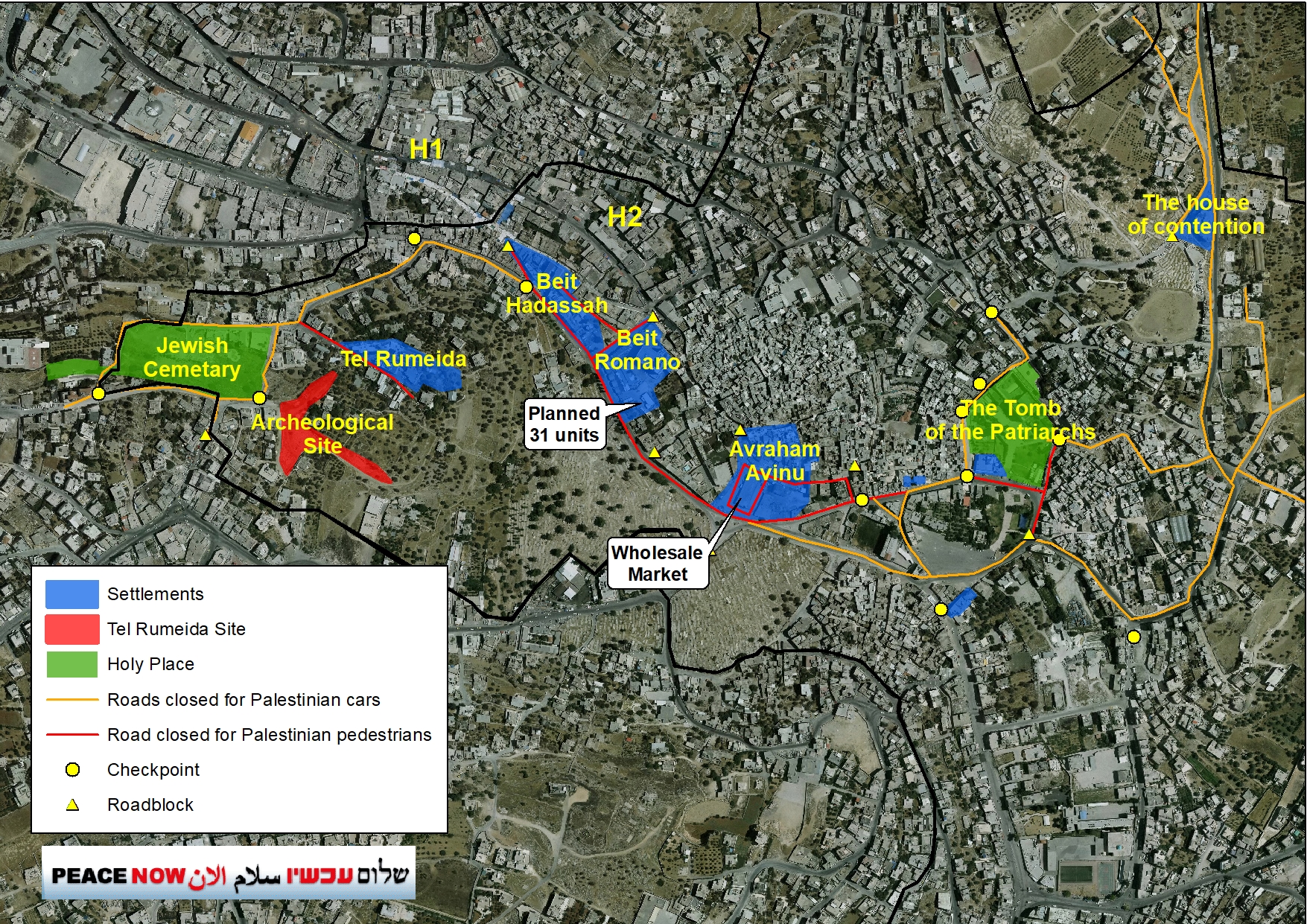
Map by Peace Now
Under the plan, the historic Palestinian market will be replaced with new structures that will include 70 new settlement units located above the new ground floor. Bennet boasted the the project will double the number of Israeli settlers living in Hebron. The site of the planned settlement is located on Shuhada Street in the heart of Hebron, a street that serves as the perhaps the clearest example of Israel’s apartheid-like military administration of the city, as detailed in a recent report by B’Tselem.
In announcing the directive, Bennett made clear the strategic and symbolic importance of the new Hebron settlement, saying it:
“will create a territorial continuation from the Cave of the Patriarchs to the Avraham Avinu neighborhood, and double the number of Jewish residents in the city.”
The plan to build a settlement at the site of the Palestinian wholesale market – which Israel closed 25 years ago following the 1994 Baruch Goldstein massacre of Palestinians worshipping at the Al-Ibrahimi Mosque (detailed history here) – is not new. In fact, it has been a goal of settlers for years, the realization of which has been because previous Israeli governments were less willing to brazenly reverse Israel’s longstanding recognition of the tenancy rights of the Palestinian-run Hebron Municipality (which built the market) and the Palestinian vendors who rent market stalls from it.
Such calculations changed following the election of President Trump and his administration’s open support for the settlers and their agenda. In November 2018, Avigdor Liberman and Ayelet Shaked (at the time the Defense Minister and the Justice Minister, respectively) worked together to issue a new Defense Ministry legal opinion, which argues that, based on claims of Jewish ownership of the land prior to the 1929 Hebron riots and massacre of Jewish residents, the state of Israel has the authority to override the tenancy rights of the Hebron Municipality to build a settlement. This legal opinion paved the way for Bennet’s announcement – long awaited by settlers – this week. In this context, the vague commitment Bennet offered as part of his decision to promote the settlements plan – in which he promised that the rights of Palestinians on the ground floor “will be preserved as they are today” – rings hollow.
Bennet and Shaked’s plan marks a significant expansion of the government’s use of the legal principle that allows Jewish Israelis to reclaim properties that were owned by Jews prior to 1948, as an extension of the Jewish right of return. Peace Now writes:
“The basis of the settlers’ demand for the establishment of a settlement in the wholesale market is that the land was owned by Jews before 1948… If the Israeli government accepts the claim of the landowners to right to return to their land taken in 1948, it will undermine the Israeli claim that the Palestinians’ right of return inside Israel need not be implemented.”
Upon Bennet’s announcement this week, former Justice Minister Shaked reminded Israelis of her role in changing Israeli legal interpretations in order to build the new settlement:
“As justice minister I worked for two years to free the land from a legal entanglement in which it was for many years, and the neighborhood had waited about a year for the defense minister’s approval. Bennett’s courageous decision will boost the Jewish community and develop the city.”
In reaction to Bennet’s order, Peace Now said in a statement:
“This is very bad news for Israel: bad morally, bad for the security, and bad in terms of the political chances for peace. The settlement in Hebron is the ugliest face of Israel’s control in the Occupied Territories. In order to maintain the presence of 800 settlers among a quarter of a million Palestinians, entire streets in Hebron are closed to Palestinians, denying them freedom of movement and impinging on their livelihoods.”
Targeting East Jerusalem (Center): Israel Begins Work to Triple Size of Nof Zion Settlement
On November 8th, the Israeli government began construction work to expand the settlement enclave known as Nof Zion, located in the middle of the Palestinian East Jerusalem neighborhood of Jabal al-Mukaber. The project will add 182 homes to Nof Zion, tripling its size and turning Nof Zion into the largest settlement enclave inside a Palestinian East Jerusalem neighborhood (surpassing the Ma’ale Zeitim settlement in Ras al Amud, on the Mount of Olives).
Ir Amim writes:
“Establishing and expanding state-backed settler enclaves like Nof Zion within Palestinian neighborhoods not only erodes the fabric of these communities, but further reinforces Israeli control of East Jerusalem and foils the possibility of a future political resolution on the city. This phenomenon is exemplified by the acceleration of settlement initiatives in the Old City Basin aimed at further embedding Israeli sovereignty of this area through a constellation of state-sanctioned residential and touristic settlement sites, as illustrated by Ir Amim’s map, ‘Settlement Ring around the Old City.’ “
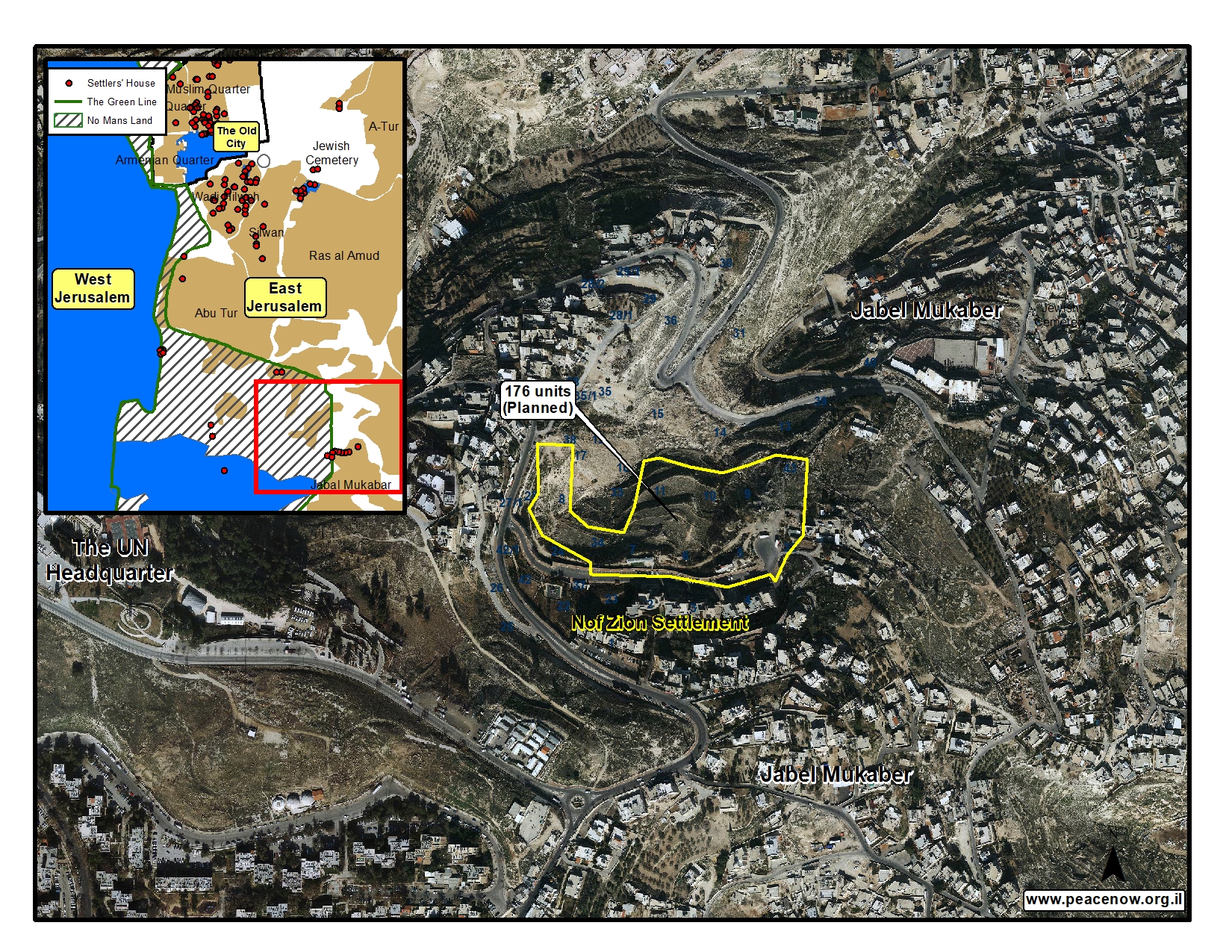
May by Peace Now
Though the Nof Zion settlement currently has 91 units built, in 1994 the Israeli government originally approved plans for a total of 395 units. However, the first phase of construction bankrupted the developer and the remaining building permits were never issued. A drama ensued over the fate of the project, after a Palestinian-American made a bid to buy the development rights. His winning bid was ultimately blocked by right-wing Israelis [with a key role played by Jerusalem settler impresario Aryeh King], who objected to the sale of the property – in a Palestinian neighborhood – to an Arab. Plans then stalled.
In September 2017, rumors emerged that the government was set to issue 176 building permits for the already-approved project. According to Ir Amim, those permits were ultimately issued in April 2019.
Targeting East Jerusalem (South): Moving Ahead with 3 Plans to Expand Gilo
According to Ir Amim, the Jerusalem District Planning Committee has approved an outline plan to build 290 new units in the Gilo settlement, located in southern Jerusalem between the isolated Palestinian East Jerusalem neighbrohood of Beit Safafa and the West Bank city of Bethlehem. Ir Amim reports that the proposed new units will be built within an already built-up area of the settlement, meaning that this plan (unlike the Gilo southeast plan and/or the Har Gilo west plan) will not expand the footprint of the Gilo settlement.
According to Ir Amim:
“The plan is designated for an area in Gilo directly along the planned route of the Jerusalem Light Rail’s green line currently under construction, which will significantly ease access between the neighborhood/settlement and West Jerusalem.”
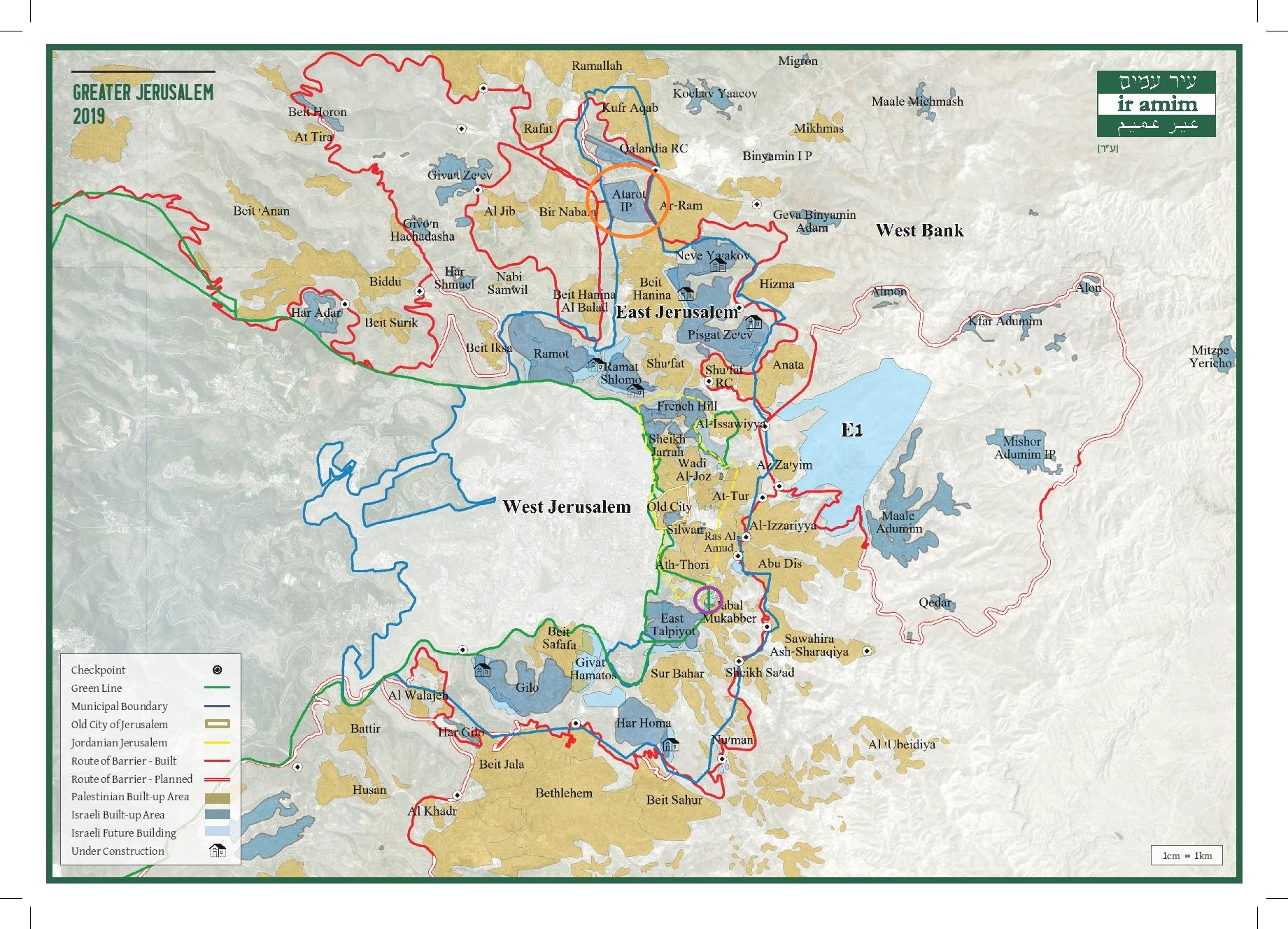
Map by Ir Amim
In approving the outline plan, the Jerusalem District Planning Committee dismissed objections to the plan by a Palestinian family that had fought to prove their ownership of the land. In fact, the committee did not even consider the petition, ruling instead that the question of ownership was beyond the court’s purview – demonstrating yet again the culpability of Israeli courts in the ongoing dispossession of Palestinians.
Additionally, on November 27th, the Local Planning Committee discussed two more plans to expand the Gilo settlement. The first plan, calls for the construction of 1,444 new settlement units in the northern part of the Gilo settlement adjacent to Beit Safafa. The second plan calls for the construction of 110 units and would, if implemented, expand the footprint of the Gilo settlement eastwards towards the West Bank city of Beit Jala. Ir Amim reports the plan is being pushed by a private company.
Ir Amim comments:
“Together all three plans will significantly increase the number of Israelis living over the Green Line in Gilo, while also extending the settlement territorially. These plans are being promoted in tandem with the massive road infrastructure developments in the area, including expansion of Route 60 as well as work on the planned route of the Jerusalem Light Rail’s green line. Road infrastructure projects are part and parcel of the settlement enterprise and are used to lay the groundwork for future settlement expansion. Not only will these developments expedite traffic between Gilo and West Jerusalem, but it will ease access between the Gush Etzion settlement bloc and Jerusalem.”
Targeting East Jerusalem (North): Plans Readied for New Settlement on Ramallah’s Outskirts
On November 28th, the news outlet Israel Hayom reported that the Minister of Construction and Housing is preparing a plan to build a new settlement in East Jerusalem at the site of the disused Atarot airport. The site is located just north of the Palestinian neighborhood of Beit Hanina and extends to the southern border of Ramallah. The plan reportedly outlines 11,000 new settlement units. If implemented, this plan would be the first new government-backed settlement established in East Jerusalem since the construction of Har Homa in the 1990s.
Map by Ir Amim
The Atarot airport site is an important commodity and it was previously promised to the Palestinians for their state’s future international gateway. Developing the site into a settlement would deprive a future Palestinian state of the only airport in the West Bank, dismember Palestinian neighborhoods in the northern part of the city, and sever East Jerusalem from a Palestinian state on this northern flank of the city (acting like E-1 on Jerusalem’s northeast flank, and like Givat Hamatos on Jerusalem’s southern flank).
The Atarot settlement plan dates back to 2007; it was pursued by the Israeli government in 2012 but shelved under pressure from the Obama administration. The plan came back into consideration in April 2017 (a few months following the inauguration of President Trump) when it was rumored to be included on Netanyahu’s master blueprint of settlements for which he was seeking U.S. approval. It was expected to be announced in May 2017 on the occasion of the Jerusalem Day celebration, but was not.
Commenting on the plan when it was under discussion in 2012, Peace Now’s Hagit Ofran observed:
“Not only that this plan might severely harm the future Palestinian State, destroying the only airport in the West Bank, but it will also cut between East Jerusalem and Ramallah at the heart of many Palestinian neighborhoods: Shu’afat and Beit Hanina in the South, Bir Nabala, Al Judeira, Al Jib, Rafat and Qalandia in the West, Ar-Ram, Dahiyat al Bareed and Jaba’ from the East, and Qalandia Refugee Camp, Kafr ‘Aqab and Ramallah from the North. It seems that what the Givat Hamatos plan is meant to do in the South of Jerusalem (to cut between Bethlehem and East Jerusalem), this plan will, god forbid, do at the North of it. The goal of this plan is clear: to prevent the possibility of a Palestinian State in the West Bank, and thus to kill the two states solution.”
Jerusalem’s Settler-Backed Cable Car Project Challenged in High Court
Led by the Israeli NGO Emek Shaveh, a coalition of architects, archeologists, and other professionals has filed an appeal to Israel’s High Court of Justice seeking the withdrawal of a settler-promoter plan to build a cable in East Jerusalem. The plan received approval from the Israeli Housing Cabinet on November 4, 2019.
Emek Shaveh explains the nature of this appeal:
“Our Claims: The plan was approved by a transitional government which was not authorized to do so; This alleged transportation plan was not assessed according to the Ministry of Transportation’s accepted standards; The decision was made based on misleading simulations…Since the High Court of Justice is unauthorized to discuss planning issues, other than the legality of the procedure, the points that were discussed in the public objection, signed by 450 people including 70 public figures, is not included in the appeal…The cable car is a grotesque idea and catastrophic for a unique city such as Jerusalem. It is unclear why the Israeli government needed to approve an irregular, controversial project at the cost of hundreds of millions of shekels in its last days. The fact that senior professionals from all the relevant fields – architects, historians, geographers, tourism specialists and archaeologists – need to turn to the High Court of Justice to prevent it shows, more than anything, that the process of approving the project was unprofessional.”
Though the appeal is limited to a procedural challenge – based on the jurisdiction of the High Court over such matters – Emek Shaveh’s objections to the plan relate to the design of the plan and the negative impact that will result if the plan is implemented. As FMEP has repeatedly covered, this Jerusalem cable car project is an initiative of the Elad settler organization (which is building a massive tourism center – the Kedem Center – in the Silwan neighborhood, which will be a stop along the cable car’s route). The scheme is intended to further entrench settler control, via archeology and tourism sites, inside the Silwan neighborhood of East Jerusalem, while simultaneously delegitimizing, dispossessing, and erasing the Palestinian presence there. Non-governmental organizations including Emek Shaveh, Who Profits, and Terrestrial Jerusalem have repeatedly discredited the government’s contention that the cable car serves a legitimate transportation need in Jerusalem, and have clearly enumerated the obvious political drivers behind the plan, the archeological heresies it validates, and the severe impacts the cable car project will have on Palestinian residents of Silwan.
Settler Leaders’ Endorse Netanyahu…and Netanyahu Govt Approves New Funds for Settlers
On December 1st, the Israeli Cabinet approved a USD $11.5 million security package for the settlements. According to Haaretz, USD $9.9 million of the funds are allocated as a one-time grant to regional settlement councils; the remaining $1.6 million is reportedly earmarked for the construction of “first aid stations.”
In a meeting with Yesha Council leaders prior to the approval of the funds – during which the Yesha Council leaders offered their continued endorsement of Netanyahu amidst the ongoing Israeli political upheaval (in which Netanyahu is fighting for his political life and, likely, to stay out of jail) – Netanyahu promised:
“We are continuing to strengthen the settlement movement and help it. They won’t uproot us from here.”
Shortly after the cabinet’s vote, MK Ayman Odeh sent a letter to Israeli Attorney General Mandelblit requesting an inquiry into the constitutionality of the move, commenting that the sequences of events:
“raise[s] a grave suspicion of a budget allocation [was made] in exchange for a political favor.”
MK Odeh asked whether the security package had been properly reviewed by government professionals. Condemning the disbursal of funds, Odeh said:
“Netanyahu has done the two things that he loves, at the same time, is appropriating public funds for his personal benefit and expanding the settlement enterprise in order to deepen the occupation. It is unconscionable for the head of a transitional government to use the money belonging to all of us to buy the support of the heads of the Yesha Council of settlements for his public battle against the legal system. I demand that the allocation be canceled and its funds directed into the program to curb domestic violence, which has been waiting for funding since its approval in 2017.”
Israeli Government Funnels Nearly USD $270 Million of Surplus Taxpayer Funds to Settlements Each Year (in addition to regular budgets)
According to data from the Israeli Finance Ministry, obtained and analyzed by Peace Now, the Israeli government is using its surplus funding to invest in the growth and entrenchment of settlements — to the tune of nearly $270 million each year. The figure does not include regular funding that goes towards the normal maintenance and security of the settlements.
The data shows:
- There has been a 50% increase in surplus funding for the settlements since 2017 (i.e. the inauguration of President Trump).
- 2017 expenditure: NIS 1.650 billion
- 2018 expenditure: 1.4 billion
- The first quarter of 2019 data indicate another increase.
- The settlements receive ~12% of all Interior Ministry’s grants to all local authorities (including Israel proper), despite representing less than 5% of the total Israeli population.
The Israeli government produces these figures (which, ironically, make a hard distinction between Israel proper and the settlements – a policy of differentiation which the government is very much trying to fight) to comply with a U.S. condition on loan guarantees set in 1990s by Republican President H.W. Bush. At the time, the U.S. administration made an effort to penalize Israel for its settlement activity by deducting the amount spent by Israel for non-security-related settlement costs from the total value of U.S. loan guarantees available to Israel. The condition therefore required the Israeli government to calculate and inform the U.S. every few months regarding its settlement-related expenditures. Peace Now reports in detail on how the Israeli government makes that calculation (spoiler: it’s an estimate) and what is included in it (spoiler: it does not include all of the ways the Israeli government directly funds the settlement enterprise).
Importantly, Peace Now notes that:
“as of September 2018, following the recognition of the Trump administration in annexing the Golan Heights, the Finance Ministry stopped reporting to Americans on investment in Israeli communities in the Golan Heights. At the same time, the first quarter figures for 2019 indicate record expenditures in the settlements, with NIS 390 million (between January – March 2019), compared with an average of NIS 354 million in each quarter in 2018 (including the Golan).”
Commenting on the figure, Peace Now said in a statement:
“State figures themselves show that Israel continues to invest huge capital in developing settlements at the expense of development within Israel. The government’s decision this week to add another NIS 34.5 million in grants unique to the local authorities in the settlements indicates that the government has lost all self-regard for serving the Israeli public at large. With a transitional government on the verge of new elections and close to the end of the fiscal year, the government finds it appropriate to add millions of shekels to the indulgence that is already being given to settlement authorities that receive, according to Treasury figures, close to three times the proportion of their population.”
Joint U.S.-Israel Research Project Will Include Ariel Settlement University
Israeli Minister of Science and Technology Ofir Akunis is reportedly expected to sign an historic agreement in the coming weeks that will establish a new joint research project between American and Israeli universities which will, for the first time, include an Israeli university located in a settlement – Ariel University. Minister Akunis told told the Israeli news outlet Israel Hayom (owned by Sheldon Adelson, who not coincidentally is a key financial backer of Netanyahu, Trump, and Ariel University) that the new agreement:
“is a direct result of the American recognition of Israeli sovereignty over the Golan Heights and Secretary of State Pompeo’s declaration that the settlements in Judea and Samaria do not violate international law.”
For more analysis of the recent announcement by the Trump Administration, see last week’s Settlement Report.
Not from the Onion: Israeli Govt Sold Palestinian Land to a Settler Org & Now Pays Rent to the Settlers
Peace Now reports that the Israeli government sold unofficially expropriated (i.e., stolen) land in the Sheikh Jarrah neighborhood to the radical Amana settler organization for $262,000 (a fraction of its value). But the story gets better: the Israeli government is now paying $224,000 per year in rent to Amana – the settler organization – for use of a single floor of a building built on the land.
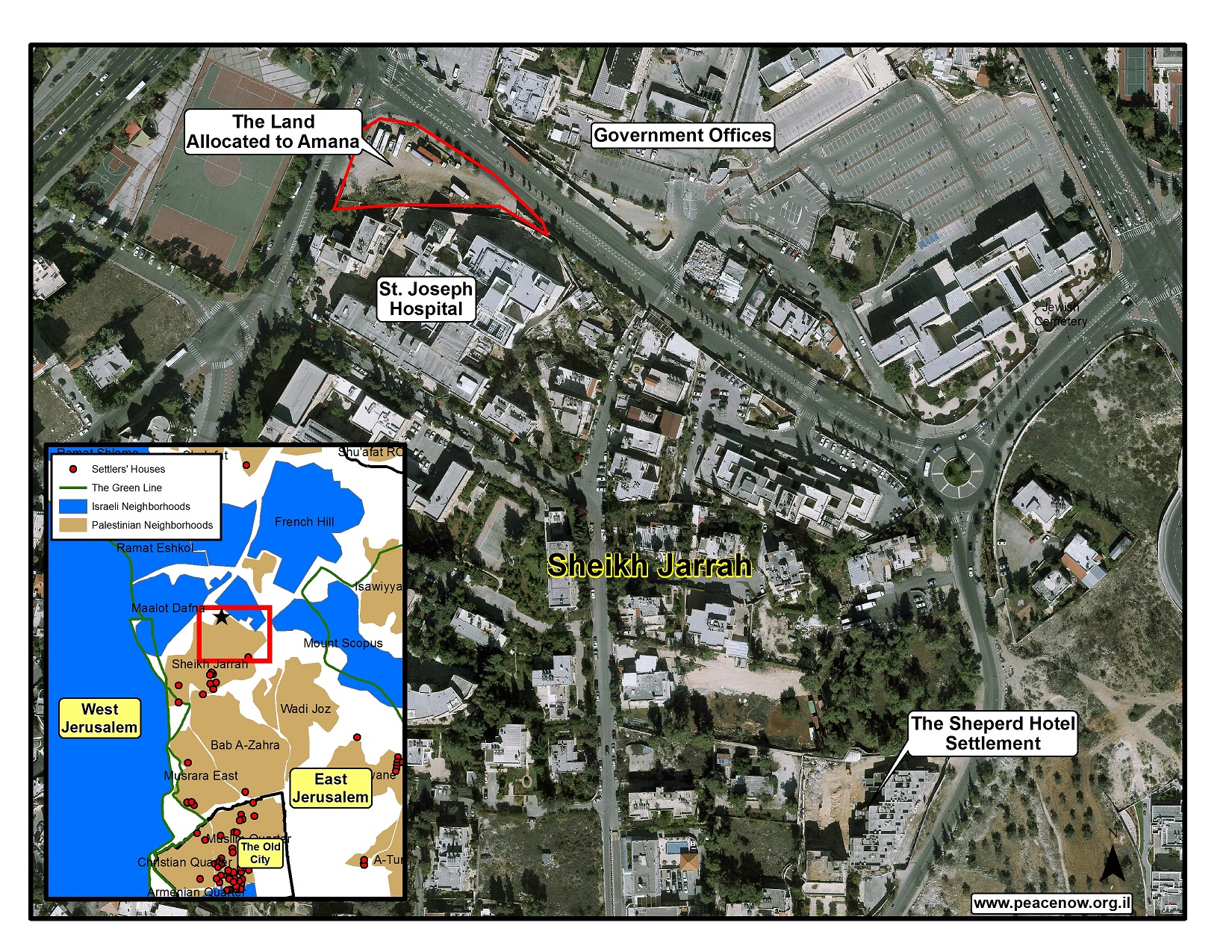
Map by Peace Now
The details of this Kafka-esque story – laid out below – show yet another means by which the Israeli government not only assists settlers in acquiring privately owned Palestinian land, but continues to line the pockets of settlement groups working to take more land from Palestinians.
Regarding the land Amana is now renting to the government, Israel intended to expropriate the land in question from the Palestinian Abu Ta’ah family following the 1967 war. However, the government went ahead and gave the land to the Amana settler organization, and Amana began construction on it, before the process of expropriation was complete – in effect giving the settlers what was still, legally, private Palestinian land. In order to complete the expropriation of the land from the Abu Ta’ah family – which remained the legal owner of the land and fought against the expropriation and Amana’s construction there – the government had to actually retroactively change how the plot of land was registered and sign a retroactive expropriate order.
Peace Now told Haaretz:
“After it received the land that was expropriated in a dubious process without a tender, Amana is profiting in three ways: It built a luxurious office building for itself in the midst of a Palestinian neighborhood; it also strengthens the settlement it built by bringing in Israeli visitors to the welfare office inside the Palestinian neighborhood; and has treated itself to a nice income of about a million shekels a year at our expense and with the help of state and municipal institutions.”
Settler-Run Business Council Asks US Congress to Fund Settler-Palestinian Projects
Ashraf Jabari and Avi Zimmerman, the Palestinian and Israeli co-founders of the Judea and Samaria Chamber of Commerce, recently met Members of Congress while in Washington, D.C. Their goal: to seek support and funding for their joint projects in the West Bank, in the name of supporting peace and coexistence.
Zimmerman said of the trip:
“we now embark on the implementation process by welcoming private and public investments to partner with the businesses that are generating impact for generations to come. Representatives from both Houses and parties were highly responsive, and impressed that we have already begun with strategic planning for private investments.”
As FMEP has repeatedly explained, economic “coexistence” initiatives like the Judea and Samaria Chamber of Commerce (JSCC) seek to normalize, entrench, and reward Israeli settlements while perpetuating Israel’s economic exploitation of occupied territory (including the local workforce, land, and other natural resources). Congressional support for such initiatives could mean U.S. taxpayer dollars going directly (and publicly) to the settlements.
Zimmerman and Jabari were hosted on Capitol Hill by Heather Johston, the Executive Director of the US-Israel Education Association (USIEA). The USIEA is a American evangelical group deeply involved in supporting and normalizing settlements, working in partnership with the Israeli government. It is also works with the Family Research Council to lead Congressional delegations to Israel and runs a bible camp in the Ariel settlement. Boasting of her warm relations on Capitol Hill, Johnston recently spoke to the press about her work to promote the JSCC in Congress:
“Just about everyone on Capitol Hill accepts and recognizes the unique relationship between the U.S. and Israel. It is critical that members of Congress and the Senate have a clear and all-encompassing picture of reality in Israel and how the country and its citizens relate to their neighbors. This visit by Zimmerman and Jabari to Capitol Hill not only introduces members of Congress and the Senate to a phenomenon that is not widely known about but also to untapped opportunities of advancing prosperity and stability in the Middle East.”
Commenting on Jabari and Zimmerman’s recent meetings on Capitol Hill, Rep. Cathy McMorris Rodgers (R-WA) – who led an August 2019 Congressional delegation funded by USIEA, which was hosted by Jabari in his Hebron home – told The Hill:
“Sheikh Ashraf Jabari told us the economic relationship between Palestinians and Israelis is basic, strong, and can’t be separate. In a strong bipartisan way, we should be supporting the grassroots movement for economic cooperation between Israelis and Palestinians. It’s foundational to achieve peace in the region.”
McMorris Rogers and her delegation are not the only Members of Congress who have been warming up to the concept of peace through joint economic “coexistence” schemes like the JSCC. In early March 2019, U.S. Senator James Lankford incorrectly suggested that Congress had already allocated funding for the Judea and Samaria Chamber of Congress. Despite the error, his statement signalled that there are concerted, ongoing conversations in Congress regarding economic peace schemes.
In addition to Members of Congress, Jabari and Zimmerman enjoy close and warm relations with U.S. Ambassador David Friedman, who has repeatedly met with and promoted the JSCC’s work. Amb. Friedman’s support first came into public view in October 2018 when Amb. Friedman attended an event convened by the Judea and Samaria Chamber of Commerce. Then, in February 2019, Amb. Friedman spoke about economic co-existence initiatives at a conference hosted by the JSCC and US-Israel Education Association. Speaking to the press at conference, Ambassador Friedman said the goal of the forum is to “encourage business development in Judea and Samaria, encourage the prosperity of people who live there, most of them Palestinian residents.”
Bonus Reads
- “Israel Limits West Bank Farmers’ Access to Lands Near Green Line” (Haaretz)
- “Forbidden: The West Bank land Israel locks away from Palestinians.” (Middle East Eye)
- “100-plus Democrats sign letter criticizing new US stance on Israeli settlements” (JNS)
- “ Israel Limits West Bank Farmers’ Access to Lands Near Green Line” (Haaretz)