Welcome to FMEP’s Weekly Settlement Report, covering everything you need to know about Israeli settlement activity this week.
To subscribe to this report, please click here.
August 10, 2023
- Has Israel Annexed the West Bank?
- Peace Now Data: Unprecedented Level of Settlement Growth in 2023
- Israel Says It Will Freeze Part of Nof Zion Expansion Plan, Cites Environmental Concerns
- Settler Violence Coerces Fourth Bedouin Community to Leave Area C Homelands, Handing More Territory to Settlers
- Emboldened Settlers Attack Village of Burqa, Murder Palestinian Teen
- Bonus Reads
Has Israel Annexed the West Bank?
Make sure to check out the latest episode of FMEP’s podcast, “Has Israel Annexed the West Bank,” featuring Shira Livne (Association for Civil Rights in Israel) and Kristin McCarthy (FMEP, and author of the Settlement Report!). The two discuss all things annexation, including: how is annexation related to the current judicial reforms? What has annexation looked like previous to the current government? How significant are the changes in governance that the current government has taken? Should we consider the West Bank, or just Area C, annexed?
Peace Now Data: Unprecedented Level of Settlement Growth in 2023
According to Peace Now data, the government of Israel has accelerated settlement growth in 2023 so much so that – only seven months into the year – it has broken several records. The data shows that in 2023, the government of Israel has:
- Granted retroactive legalization to 22 outposts – making them new, authorized settlements, more than in any year previous.
- Allowed the establishment of at least five new (illegal) outposts (not that settlers have attempted to establish many more. Peace Now reports that the IDF has evacuated more outposts this year than it did during an average year in the past, showing how emboldened settlers are acting in the current environment.
- Issued tenders for 1,289 new settlement units – this is more than any year since the signing of the Oslo Accords.
- Approved 12,855 new settlement units – more than in all of 2020 (12,000 settlement units approved).
Israel Says It Will Freeze Part of Nof Zion Expansion Plan, Cites Environmental Concerns
On August, the Israeli state informed the Jerusalem District Court that it has chosen to freeze a plan to relocated a police station from the Jabal al-Mukaber neighborhood, which was planned in order to allow the Nof Zion settlement enclave to expand onto the land where the current/old police station is located. According to the Times of Israel, the state said that it is negotiating with the Ramy Levy – an Israeli entrepreneur who owns the building rights for the land where the current police station is located (Levy owns an empire of settlement superstores) – to build a new police station as part of the massive expansion of the enclave. 
The State said its decision was made in consideration of a petition against the new police station submitted by environmental groups concerned that the construction would destroy the area’s unique plant ecosystem. Notably, the Israeli NGO Ir Amim also filed a petition against the police station plan, arguing that it is an affront to the planning needs of the local community and that it represents a continuation of Israel’s systematic, city-wide discrimination against the housing, educational, and service-based needs of Palestinian neighborhoods.
Settler Violence Coerces Fourth Bedouin Community to Leave Area C Homelands, Handing More Territory to Settlers
On August 6th the al-Qaboun bedouin community was forcibly coerced by IDF harassment and settler violence to abandon their lands east of Ramallah, where they had lived since 1996. The community number 86 people, including 10 children. This is the fourth bedouin community in recent months that has been forced to leave their land because of Israeli pressure.
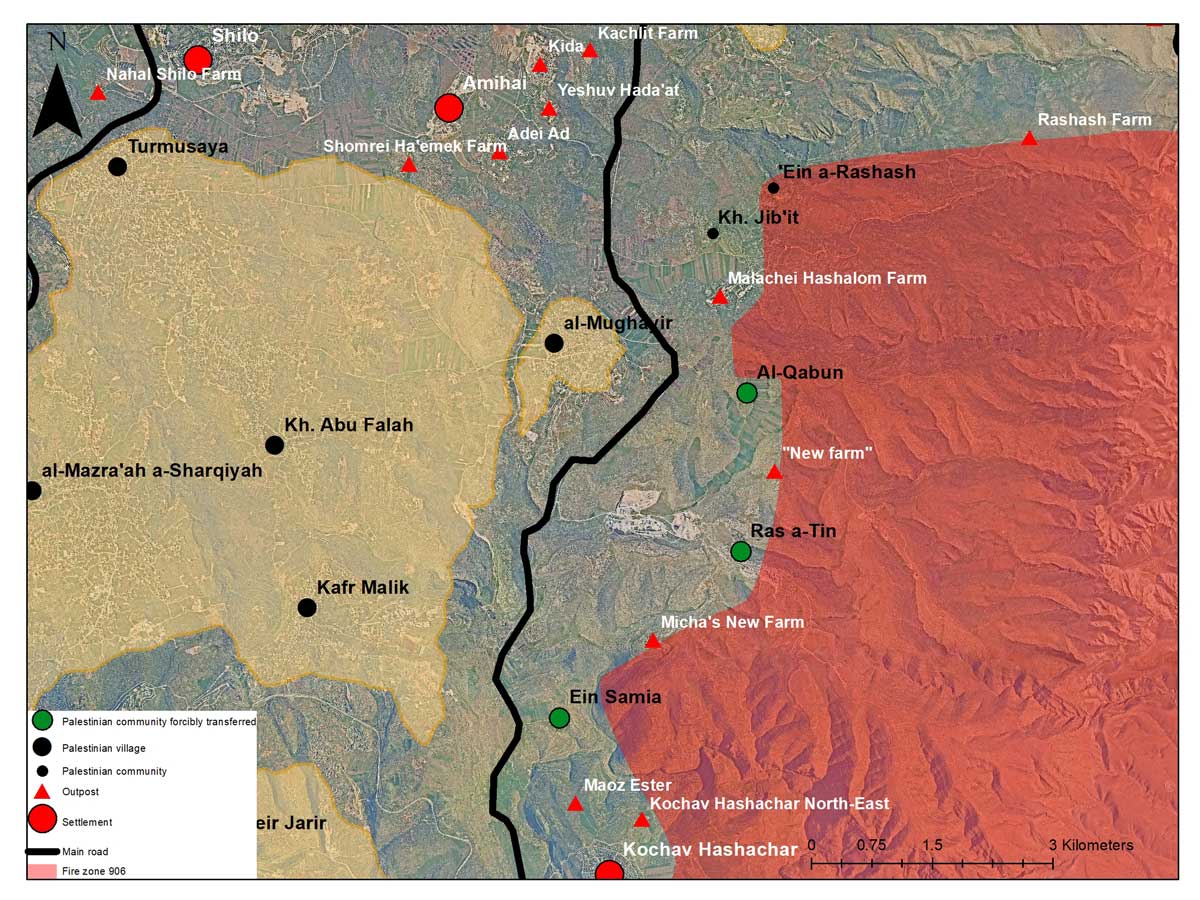 B’Tselem reports that settlers established an outpost near al-Qaboun in February 2023 and have since used violence, harassment, and intimidation to take control of the village’s grazing lands – denying the people their livelihood. The Palestinian Centre for Human Rights further reports that the IDF closed all roads leading to the village.
B’Tselem states:
“Al-Qabun is the fourth community in the area that has had to flee due to Israeli policies, which force impossible conditions on local residents in order to push them to leave, thus clearing the way for it to take over their lands and transfer them to Jewish hands. These policies include banning residential and infrastructure construction, including water, electricity and roads; establishing and financially supporting settlements on Palestinian lands; and violent attacks by settlers on an almost daily basis. All of these are aimed at upholding, preserving and empowering Jewish supremacy.”
Emboldened Settlers Attack Village of Burqa, Murder Palestinian Teen
On the evening of August 4th, 40-50 armed settlers associated with the Oz Zion outpost attacked the Palestinian village of Burqa – the village that continues to protest the Homesh outpost, which was built on its land. Settlers claim they were “just” grazing their sheep, but they came armed with M-16s, clubs, and pistols, and evidence found near two two cars that had been set on fire suggest the settlers came to commit arson. As settlers came within 250 meters of homes in the village, two settlers arrived in a car and fired indiscriminately towards a group of Palestinians, killing 19-year-old Palestinian Qosai Jammal Mi’tan and injuring several others.
 It’s worth noting that the Oz Zion outpost has been, in the past, repeatedly evacuated by the IDF. Earlier this year, as is his purview as a minister with the Defense Ministry charged with civilian affairs in Area C, Bezalel Smotrich shielded Oz Tzion from being evacuated again.
Two settlers were arrested for involvement, one of which was quickly released to house arrest while the other remained in custody as the primary suspect in firing the deadly shot. The settler who was released despite involvement in the shooting, Elisha Yared, is well known for his violent, extremist views, having previously served as a spokesman for the MK Limor Son Har-Melech (Otzma Yehudit) – and articulated his support for collective punishment in a recent interview with Israel Hayom.
In an absolutely absurd display of the government’s unapologetic support for Jewish terrorism, Secruty Minister Itamar Ben-Gvir criticized media coverage of the settler’s arrest, saying “A Jew who defends himself and others from murder by Palestinians is not a murder suspect, but a hero who will get full backing from me.”Separately, two Knesset members (Zvi Sukkot and X) were given permission by Israeli police to visit Yared in the hospital, celebrating him as a hero. In response, a senior Israeli security source told Al-Monitor:
“This is incredibly outrageous…This is a meeting that could easily lead to evidence tampering and disrupt the police investigation. There was no reason to approve it. This is part of the anarchy that is taking over the rule of law system in Israel.”
Elisha Yared lives in the illegal Ramat Migron outpost, an outpost which has been repeatedly demolished by the IDF.
Five Palestinians were also arrested for throwing stones at the invading settlers. All were released after several days in custody.The Palestinian Center for Human Rights reports that so far this year, “settlers have conducted at least 293 attacks against Palestinian civilians and their property. As a result, 9 Palestinians were killed, and dozens of others were injured; most of them due to being beaten and thrown with stones. Also, dozens of houses, vehicles and civilian facilities were set ablaze.”
Haaretz journalist Neri Zelber reported that the Israel Army Radio received data from the IDF showing that the first six months of 2023 as already seen more settler attacks than in the entire 2022 year. The IDF data counts 25 terrorist attacks and 680 clashes.
Bonus Reads
- “The Civil Administration acknowledges extreme discrimination in building permits and law enforcement between Palestinians and settlers” (Peace Now)
- “Armed With an M16 and Jewish Privilege, This Settler Makes Palestinians’ Lives Hell” (Haaretz)
- “Extremist Israeli Settlers Aren’t Innocent Shepherds. They Are Thirsty for a Provocation” (Haaretz)
- “Netanyahu in Golan: ‘Territory that will forever remain under Israeli sovereignty’” (Arutz Sheva)
Welcome to FMEP’s Weekly Settlement Report, covering everything you need to know about Israeli settlement activity this week.
To subscribe to this report, please click here.
September 9, 2022
- Israel Advances Givat HaShaked Settlement Plan in East Jerusalem
- Israel Delays (for now) Consideration of E-1 Settlement
- Israel Planning to “Legalize” 30+ Shepherding Outposts in Massive Land Grab
- Israel to Request Another Delay in Demolition of Khan al-Ahmar
- IDF Issues Orders to Keep Settlers Out of Ramat Migron Outpost Area
- IDF Removes Amichai Settlement Tower
- Yesha Council Elects New Leader
- Settlement Schools are Flourishing
- Bonus Reads
Israel Advances Givat HaShaked Settlement Plan in East Jerusalem
On September 5th, the Jerusalem District Planning Committee advanced plans to build a new settlement in East Jerusalem, to be called “Givat HaShaked.” The plan provides for 700 housing units (in 4 highrise towers and several six-story buildings), a school, and commercial buildings –all to be built on a highly sensitive and geopolitically critical sliver of land located within the Palestinian neighborhood of Beit Safafa. The plan was approved for public deposit, an advanced stage in the Israeli planning process. The plan for Givat HaShaked is unprecedented, according to the Israeli NGO Terrestrial Jerusalem, in that it is the first settlement of this size that that Israeli government will establish within a Palestinian neighborhood. Beit Safafa is already in the process of being completely surrounded by Israeli development (for Jewish Israelis) — most notably with final approval of the Givat Hamatos settlement plan, for which tenders were issued in January 2021.

The Israeli NGO Ir Amim also points out that, while the government goes to great lengths to find a way to squeeze in several high rise towers to house Israelis in East Jerusalem, there is no parallel effort to address the decades-long lack of planning and approvals for Palestinian communities. Ir Amim writes:
“Givat HaShaked is also a flagrant example of the breadth and depth of housing and planning discrimination in the city. While Givat HaShaked is intended for land located along the built-up area of Sharafat, it is not designated for the community’s development needs, but rather a new housing project for Israelis over the Green Line in Jerusalem. Construction of this new settlement will likewise stand in stark contrast to the existing Palestinian neighborhood, dwarfing and engulfing Sharafat with high-rise apartment buildings – the likes of which Israeli authorities refuse to promote or approve for Palestinian areas. In a similar fashion, the remaining land reserves on the eastern side of Beit Safafa, which could have been used to address the neighborhood’s housing needs, were depleted to advance construction of the Israeli settlement of Givat Hamatos.”
Interior Minister Ayelet Shaked celebrated the advancement, telling Arutz Sheva:
“As I promised, despite all the pressures from at home and abroad, the Givat Hashaked plan was approved today by the district committee. This plan is located in the heart of Jerusalem and is unthinkable to prevent development and construction in this area as well as all over the city. This is an important plan that will lead to an increase in the supply of housing units, employment areas and public buildings for the well-being of the residents.”
As a reminder, the Israeli government has been sitting on plans for Givat HaShaked for decades, but has refrained from implementing them because doing so would require the government to seize a sizeable amount of land in East Jerusalem, some of which is privately owned by Palestinian residents of Sharafat (a section of the Palestinian neighborhood of Beit Safafa). Other parts of the land proposed to be used for the Givat HaShaked settlement plan are managed by the Israeli General Custodian (but neither owned or claimed by the government of Israel) – a fact Ir Amim calls “highly unusual and seemingly marks a new phenomenon.” The Israeli General Custodian is empowered by the State to act as a caretaker of land that has unknown ownership until the heirs are located. In an attempt to explain why the General Custodian has the authority to approve a plan for construction on land that the State does not own, the Israeli Justice Ministry told Haaretz that the plan for Givat HaShaked increased the value of the land and that “by law, the administrator general is obligated to care for the assets under his management in a way that will benefit their private owners.” This answer implies, bizarrely, that if and when Palestinian heirs are located, they will be somehow better off with their land having been used to build a settlement.
Another important facet of how Givat HaShaked is being advanced now is the decision by the Israeli government in late 2020 to initiate a (typically secret) registration process for land in East Jerusalem, including in the Sharafat area. At this time, it is unknown whether the land managed by the General Custodian in Sharafat (and designated for the new settlement) has been – or is in the process of being – registered. On that uncertainty, Ir Amim writes:
“…in the event that it is the same location [where formal land registration has taken place], this move would constitute yet another brazen example of how the settlement of title procedures are repeatedly being used to aid state authorities and settler groups in taking over more land in East Jerusalem…Although portrayed as a measure to ostensibly benefit Palestinian residents, there has been grave alarm that these [land registration and settlement of title] procedures would in fact be exploited to confiscate Palestinian land for political purposes, leading to the expansion of Jewish settlement and widespread Palestinian dispossession in the city.”
For a deep dive into land registration in East Jerusalem, please listen to a new FMEP podcast featuring Kristin McCarthy (FMEP) in conversation with Amy Cohen (Ir Amim).
Israel Delays (for now) Consideration of E-1 Settlement
The Israeli Higher Planning Committee of the Civil Administration has again delayed its consideration of the E-1 settlement plan, which was scheduled to be taken up at the Committee’s September 12th meeting. The E-1 settlement is considered a “doomsday” settlement for much of the international community that still hopes to negotiate a two state solution. This same committee was previously scheduled to take up the E-1 plan on July 18th – days after U.S. President Joe Biden’s visit to Jerusalem. The Israeli government intervened to postpone the meeting, rescheduling it for September 12th – the hearing that has now also been delayed.
Peace Now said in response:
“This is welcome news, but we wish to see E1 taken off the table completely. E1 is lethal to the two-state solution, highly detrimental to Palestinian freedom of movement and to connection between different parts of the future Palestinian state. The Israeli government, and in particular Minister of Defense Benny Gantz (in whose jurisdiction these decisions lie), must take the plan off the table completely.”
This repeatedly delayed meeting promises to be a decisive one for the long-pending E-1 plan, and could result in the Committee granting final approval to the highly contentious plan. Barring intensive outside pressure, additional postponement of the hearing seems highly improbable, given the Israeli domestic politics and the upcoming national election.
As a reminder: in its current form, the E-1 plan provides for the construction of 3,412 new settlement units on a site located northeast of Jerusalem. The site is home to several Palestinian bedouin communities, including Khan al-Ahmar, which Israel has already undertaken to forcibly displace (many attempts). Long called a “doomsday” settlement by supporters of a two-state solution, construction of the E-1 settlement would sever East Jerusalem from its West Bank hinterland, preventing East Jerusalem from ever functioning as a viable Palestinian capital. It would also cut the West Bank effectively in half, isolating the northern West Bank from the southern West Bank and foreclosing the possibility of the establishment of a Palestinian state with territorial contiguity.
Israel’s “answer” to the latter criticism has long been to argue that Palestinians don’t need territorial contiguity, and that new roads can instead provide “transportational continuity.” To this end, Israel has already built the so-called “Sovereignty Road” – a sealed road that enables Palestinians to pass through, but not to enter, the E-1 area. That road is wholly under Israel’s control (meaning Israel can cut off Palestinian passage through it at any time). In January 2021, then-Prime Minister Netanyahu promised to increase funding for the “Sovereignty Road” as part of the drive to get E-1 built.
And another reminder: there have been attempts to promote the E-1 plan since the early 1990s, but due to wall-to-wall international opposition, the plan was not advanced until 2012, when Netaynuahu ordered it to be approved for deposit for public review (a key step in the approval process), ostensibly as payback for the Palestinians seeking recognition at the United Nations. Following an outcry from the international community, the plan again went into a sort of dormancy, only to be put back on the agenda by Netanyahu in February 2020, when he was facing his third round of elections in the two years. Also, as a reminder: under the Trump Plan (which the Biden Administration has yet to comment on), the area where E-1 is located is slated to become part of Israel.
Israel Planning to “Legalize” 30+ Shepherding Outposts in Massive Land Grab
Haaretz reports that the Israeli Civil Administration is in the midst of a years-long process of drafting new protocols that will allow the State to “legalize” settlers’ claims to huge areas of the West Bank (mainly in Area C) that settlers have de facto seized through illegal shepherding activities (grazing settler-owned flocks of sheep, etc on the land). The Civil Administration is working to “legalize” this land theft in areas where the land in question is categorized by Israel as “State land.”
The phenomenon of “shepherding outposts” has been extensively documented by the Israeli NGO Kerem Navot, which has identified it as currently the “most significant mechanism for dispossessing Palestinian communities” in the West Bank. According to Kerem Navot’s May 2022 report, entitled “Wild Wild West,” settlers have taken control of nearly 7% of Area C of the West Bank (around 60,000 acres) via 77 of these grazing outposts.
The Haaretz Editorial Board – in a piece entitled “Settler Crime Always Pays” – writes:
“Once again, the settlers have proved that Jewish crime in the territories always pays. The Civil Administration began formulating the draft regulation about two years ago, against the background of the increase in the number of these outposts. The proper response to the growing number of farms established illegally would have been to see to their removal and to step up enforcement. Instead, the agency bowed down to the settler masters and seeks to cut the law to fit their vices…It must be hoped that he [Gantz] recognizes that it is a looting mechanism designed to take control of more and more of Area C, to prevent Palestinians from working their land and to reduce their living space.”
As a reminder: Israel has a legal responsibility under international law regarding stewardship of “state land” held under its occupation. As the Association for Civil Rights in Israel explains:
“Israel holds state land in an occupied territory as a trustee, and must do everything possible to preserve and develop it for the benefit of the local Palestinian population. The very use of state land for the purpose of building settlements and/or developing infrastructure and industrial zones not in favor of the Palestinian population constitutes a violation of international law.”
Israel to Request Another Delay in Demolition of Khan al-Ahmar
Facing a September 11th deadline to complete the forcible relocation of the Khan al-Ahmar community from their longtime lands just east of Jerusalem (an act that would constitute a war crime), Israeli Prime Minister Yair Lapid has become just the most recent Israeli premier to ask the Court for an extension. As a reminder, the High Court has ordered the demolition of Khan al-Ahmar, which it declared to be illegally built (i.e., lacking Israeli building permits that are virtually impossible for Palestinians to obtain).
The Israeli High Court imposed a deadline on the State to demolish Khan al Ahmar in response to a petition filed by the right-wing pro-settler group Regavim, which sued the government for failing to carry out the demolition of the community in the wake of the Court’s ruling that the community was built illegally. That demolition order has been pending since 2018. The Court granted several delays to the Netanyahu government, and one to the Bennett government. When granting the government another delay in September 2020, the Court said that it would not be granting any more delays. It then granted several more delays, most recently in July 2021, ostensibly due to Russia’s invasion of Ukraine.
Prior to becoming Prime Minister, Lapid opposed the State’s plan to forcibly relocate Khan al-Ahmar. Reports suggested that the government has been preparing a plan that would entail the demolition of the Khan Al-Ahmar, followed by (bizarrely) the rebuilding of the community some 300 meters from where it currently stands.
IDF Issues Orders to Keep Settlers Out of Ramat Migron Outpost Area
After three weeks of repeatedly demolishing the “Ramat Migron” outpost, only to have settlers rebuild it, the IDF has issued a new order declaring the area a “closed military zone” — apparently in hopes of barring settlers from entering the area. The order is effective for only one month. As a reminder: The IDF already viewed it as illegal for settlers to enter the area (which is why the IDF arrested settlers in the area last week), so it is not clear (at least as of this writing) what is different about this new order.
The IDF informed the settlers of the new order as they were in the process of constructing buildings at the Ramat Migron site. Settlers have already vowed to continue fighting to establish a settlement on the hilltop.
IDF Removes Amichai Settlement Tower
On September 8th, Israeli authorities demolished a tower built by settlers on land that has been allotted to the Amihai settlement, located in the Shiloh Valley in the northern West Bank. Settlers built the tower apparently in order to surveil a nearby Palestinian village where new homes are being built. Settlers have already vowed to rebuild the tower.
The Amichai settlement was approved for construction in 2017, making it at that time the first new settlement formally approved by the Isareli government in 25 years. Aerial imagery from 2021 show the massive growth Amichai has enjoyed in the years that followed its establishment, a previously empty hilltop with cultivated fields nearby have been transformed into a sizable suburban neighborhood. In addition to new construction, Amichai was also massively expanded, subsequent to its initial construction, when the Israeli Civil Administration announced that its plan to retroactively legalize the Adei Ad outpost by significantly expanding the borders of the Amichai settlement to turn Adei Ad into a (non-contiguous) neighborhood. In effect, this was a slight-of-hand by Israel to turn the Adei Ad outpost into an entirely new official, legal settlement.
Yesha Council Elects New Leader
The Yesha Council – an association of heads of settlements and regional council leaders that acts as the settler lobby to the government – has elected a new chair, Shlomo Ne’eman. Ne’eman is set to take over the post from David Elhayani.
Ne’eman has earned his stripes as the chairman of the Gush Etzion Regional Council. Upon his election (he was unopposed), Ne’eman said:
“The first task before us is to strengthen the sovereignty and the Jewish presence in the region. This is the time to unite against those who seek our harm, the Palestinian Authority and other terrorist organizations that fight us with guns and knives, as well as with plows and concrete pumps, and to continue working to develop and strengthen Israeli settlement in Judea, Samaria and the Jordan Valley.”
Settlement Schools are Flourishing
According to a newsletter issued by the Friends of Beit El Settlement (an organization that former Ambassador David Friedman used to chair), as the new school year starts there are 86,000 children living in settlements and enrolled in 270 elementary schools across the West Bank. In addition, the newsletter reports that 35,000 settler students attend ~200 post-elementary schools. Gloating, the newsletter boasts:
“Beautiful numbers like these don’t just happen on their own. We can barely imagine the amount of idealism and effort and self-sacrifice over the course of decades, under severely difficult economic and security conditions, that has gone into the Yesha enterprise.”
Bonus Reads
- “Settlement Org Eyes a New Target, and Israeli Authorities Go Out of Their Way to Help” (Haaretz)
- “IDF preparing to use armed drones in West Bank operations” (The Times of Israel)
- “U.S. Examining Allegations Against Israel’s Orthodox West Bank Battalion” (Haaretz)
Welcome to FMEP’s Weekly Settlement Report, covering everything you need to know about Israeli settlement activity this week.
To subscribe to this report, please click here.
September 1, 2022
- Ramat Migron Outpost Demolished for Third Time in Three Weeks
- Settlers’ Stealth Visit to Joseph’s Tomb in Nablus Ends in Gun Fight
- Settlers Decry Removal of Trees Planted to Take Over Palestinian Land
- Palestinians Campaign for Nabi Samwil Recognition as New Docs Show Original Israeli Intent to Expel Them for Settlement
- Bonus Reads
Ramat Migron Outpost Demolished for Third Time in Three Weeks
On August 30th, Israeli forces cleared settlers and their makeshift structures — comprising the illegal outpost settlers have named “Ramat Migron” — off of land privately owned by Palestinians, as recognized by the Israeli High Court of Justice in 2012. Five settlers were arrested for violating a military order which makes it illegal to enter the area (both for settlers and even for the Palestinians who own the land), and for obstructing the work of a police officer.
Starting in 2017, settlers have repeatedly attempted to re-establish an outpost at this site, which is where the outpost of Migron once stood. The Migron outpost was dismantled by the Israeli government in 2012 after the Israeli High Court of Justice left the government no other option. Israeli forces have demolished the setters’ repeated attempts to set up a new outpost there more than 10 times, most recently on August 15th and August 11th of this year..
Notably (in light of his rising popularity and the upcoming Israeli elections), Kahanist MK Itamar Ben Gvir seized on the repeated razing of the outpost to campaign against Defense Minister Gantz, saying:
“Community-Eviction Minister Gantz continues time and time again to evacuate outposts and surrender to Abu Mazen, a Holocaust denier, his friend. Today there is another evacuation in Ramat Migron. They are uprooting and destroying – we will plant and resettle. The answer to the evacuation will be given On November 1st with a real right-wing government.”
Settlers’ Stealth Visit to Joseph’s Tomb in Nablus Ends in Gun Fight
Two Israeli settlers were wounded this week by Palestinian gunfire in the course of trying to access Joseph’s Tomb, a holy site located in the heart of Nablus, along with a group of other settlers. Notably, that visit was undertaken without the required (by Israeli authorities) approval of and coordination with the Israeli military, which regularly escorts settlers to the site under heavy protection. While Joseph’s Tomb is in Nablus (Area A of the West Bank), the Oslo Accords afford the Israeli army control over the site.
The incident comes amidst a series of clashes between Israeli forces and Palestinians in Nablus, including the high profile killing of Ibrahim al-Nabulsi as a result of a gun battle with the IDF. Just last week, FMEP reported on the IDF is planning to bulk up its security control over Joseph’s Tomb in order to protect settlers who wish to visit.
Settlers Decry Removal of Trees Planted to Take Over Palestinian Land
The High Court of Justice recently issued an injunction to stop the Israeli Civil Administration from continuing to uproot trees illegally planted by settlers on Palestinian land near the settlement of Nokdim, located southeast of Bethlehem. Settlers filed the petition leading to the freeze after the Court ordered the removal of the trees three months ago.
The settlers made their case for the injunction by arguing that (a) Palestinians who petitioned to have the trees removed had not proven their ownership of the land; and (b) the Civil Administration does not have the authority to uproot these trees, some of which are a protected species — notwithstanding the fact that they were planted illegally under Israeli law (such environmental work requires a permit signed by the staff officer in charge of agriculture, who works for the IDF’s Civil Administration). In effect, the settlers are arguing for the High Court to create/sign off on a new method of land takeover by settlers.
The battle of the trees and the plot of land dates back over 20 years, when settlers first built a fence to prevent Palestinians from accessing the area — which until then had been actively cultivated by Palestinians. In 2013, the IDF involved itself when Palestinians requested that it remove settlers from the site. The IDF ended up agreeing to do so and promised to ensure Palestinian access to the area (which it did, but very infrequently). Then, in 2017, settlers once again invaded the area and began planting trees as a means of taking control of the land. Since then settlers further developed the site into a park that is, of course, inaccessible to Palestinians.
In 2021, Palestinians, with the help of Haqel (an Israeli NGO), filed a petition with the Israeli High Court of Justice asking for the trees to be removed, and asserting that the land has been privately owned for generations.
Palestinians Campaign for Nabi Samwil Recognition as New Docs Show Original Israeli Intent to Expel Them for Settlement
+972 reports that newly released archival documents show that, in 1971, Israeli Prime Minister Golda Meir signed off on a plan to expel Palestinians from Nabi Samwil in order to build a luxury settlement on the ruins of the village (which is now an archeological site). Plans for the new settlement – which Meir at one point dubbed “New Savyon” after a wealthy Tel Aviv suburb – were eventually abandoned by the Israeli government in the mid 1980s, but (of course) Palestinians were not allowed to return.
Instead, refugees established a new village some 200meters from their original homes, still located on a strategic and highly prized hilltop (inside an area that Israel has declared to be a national park) just outside of the municipal borders of Jerusalem but on the Israeli side of the separation barrier. Israel considers the village to be in the occupied West Bank and so Nabi Samwil has been left in a Kafka-esque situation: they are cut off from the West Bank by the separation barrier but barred entry to Jerusalem. They are legally forbidden from taking the one road out of the village because it passes through Jerusalem, and the West Bank is accessible to them only via a circuitous route that passes through an Israeli checkpoint (for background see: The Palestinian village where Israel forbids everything, and this Twitter thread of resources curated by Lara Friedman).
Palestinian refugees of Nabi Samwil, in conjunction with activists, have held weekly protests to demand recognition from the Israeli government, in order to be able to build legal structures and be granted permits to enter Jerusalem. Refugees have petitioned the Israeli government for over 20 years to accept a formal building plan for the village, in order to allow the buildings to be deemed legal, but the government has refused. Eid Barakat, an activist in Nabi Samwil, told +972 Magazine:
“Every few years, a new officer in the Civil Administration comes, makes promises, and in the end nothing is done..all our homes have demolition orders. I dug a well; they destroyed it. I built a fence; they destroyed it. I planted trees; they were uprooted.”
Bonus Reads
- “The Fall and Rise of Israel’s First ultra-Orthodox Settlement” (Haaretz)
- “I tracked down the house Israel stole from my grandfather” (Al Jazeera)
- “WATCH: Women of Masafer Yatta tell their stories of resistance” (+972 Magazine)
Welcome to FMEP’s Weekly Settlement Report, covering everything you need to know about Israeli settlement activity this week.
To subscribe to this report, please click here.
August 19, 2022
- Ir Amim on East Jerusalem Land Registration & State Land Seizures
- Israel Advances Plan to Build New Settlement “Ariel West”
- IDF Razes “Ramat Migron” Outpost for Second Time in a Week
- Ultra-Orthodox Settlers Establish Their First-Ever Outpost
- Israel Pauses to “Rethink” Plan to Build on Historic Site of Lifta
- Bonus Reads
Ir Amim on East Jerusalem Land Registration & State Land Seizures
In an alert issued August 11th, Ir Amim adds important information and analysis of Israel’s seizure of a plot of land in East Jerusalem last week. Importantly, Ir Amim explains how Israel is using the process of land registration to (sometimes covertly) take control over more and more land in the most sensitive areas in East Jerusalem.
Ir Amim writes:
“The area between Jabal Mukkaber and Abu Dis has long been targeted by the state and settlers due to its strategic location…Upon investigation, Ir Amim discovered that 12 dunams of land (bloc 31735) situated in the same location referred to in the article were recently registered under the management of the General Custodian in the Land Registration Office…Rights, bloc 31735 recently underwent settlement of land title procedures (formal land registration). Initiated on May 31, 2021, the settlement of land title process was swiftly completed in just over a year with little to no transparency and formally registered in the Tabu (land record) on July 14, 2022. The official order transferring the respective plot of land into the management of the General Custodian was issued on June 8, 2021—a mere days after the announcement of the settlement of title process on the same bloc of land. It should be underscored that the General Custodian is one of the state institutions formally and integrally involved in the settlement of title process. The timing is certainly not coincidental, and it was clearly carried out as a means to assert Jewish ownership claims of the land. In contrast, the process has yet to be initiated on the adjacent thousands of dunams of land owned by Palestinians in the same area.
Such a move constitutes yet another cynical exploitation of the settlement of land title procedures which are being conducted in the framework of Government Decision 3790—a decision aimed at ostensibly improving the well-being of Palestinians in East Jerusalem. As reported previously, an examination of the locations where the procedures have been completed or currently underway reveals the driving rationale: settlement of land title is largely being promoted in areas where the state and/or settlers have a particular interest and have some capacity to lay claim to the land in the framework of the proceedings. As such, these procedures are being used as yet another mechanism to seize more territory in East Jerusalem under the guise of a decision and budgets earmarked for Palestinians.”
Israel Advances Plan to Build New Settlement “Ariel West”
On August 18th, the Israeli Civil Administration discussed an amended plan to build an access road leading to an area of land where Israel is intending to build a new settlement, dubbed “Ariel West.” At the time of publication, it is unclear the outcome of the discussion is not yet known. We do know that Israel was forced to amend its original plan to build the access road to the new settlement site when it was proven that the route went through privately owned Palestinian land belonging to the village of Salfit.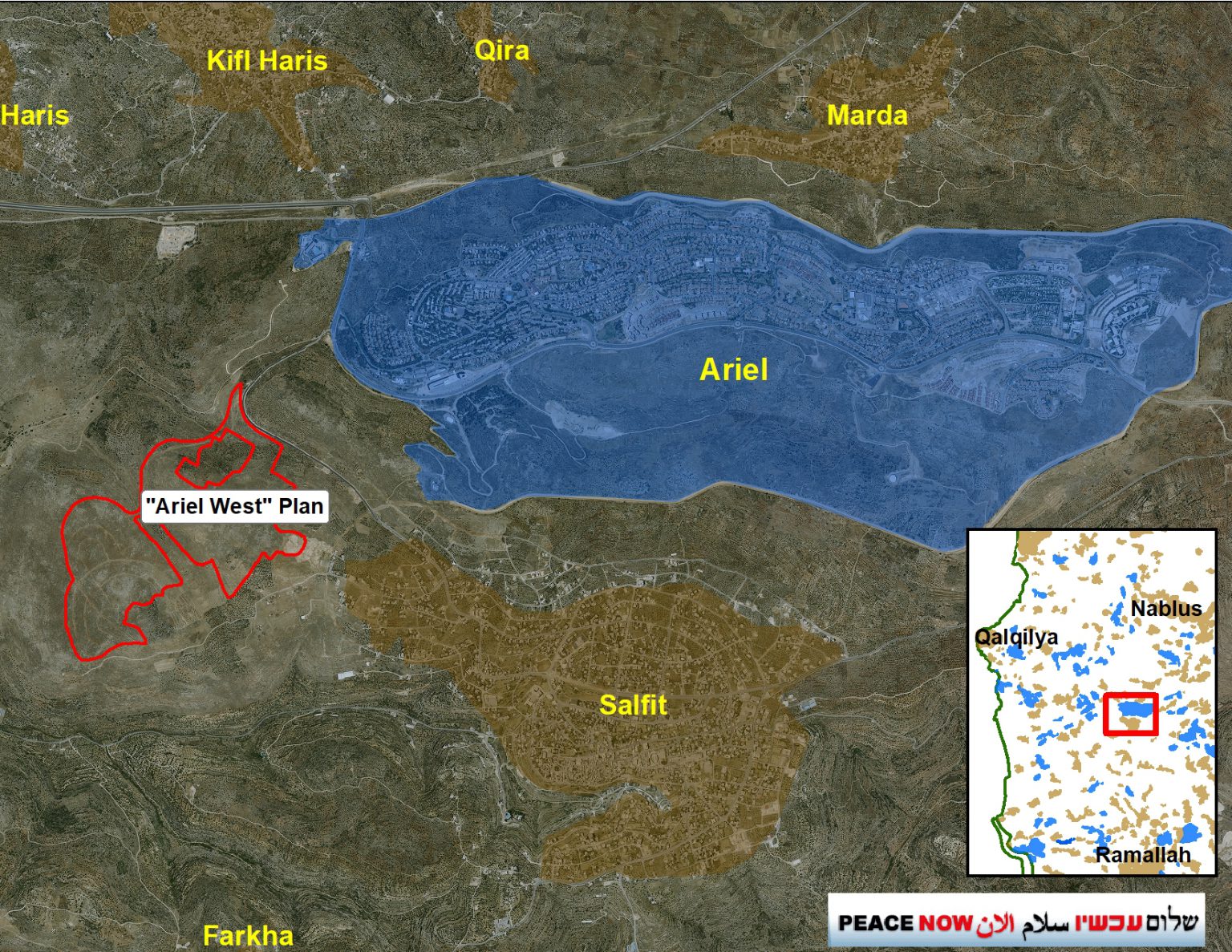
The plan for “Ariel West” was first discovered in November 2021, after the Israeli Ministry of Construction issued tenders (on October 24, 2021) for the new settlement, under the guise of a plan to “expand” the Ariel settlement, located south of Bethlehem. Under the plan, 731 new settlement units will be built on a hilltop located 1.2 miles away from Ariel, in an area that is non-contiguous with the built-up area of the current Ariel settlement.
Peace Now said in a statement:
“The government has been given another opportunity here to stop the establishment of the new settlement. After the Ministry of Housing rushed to issue tenders for the sale of the building rights, construction can still be halted if the defense minister stops the planning process. The “Ariel West” plan is not just a plan for thousands of housing units, but it is a new settlement designed to block the town of Salfit and prevent the development of Palestinian space in the area. Road comprise the infrastructure of the occupation, and the undercurrents of apartheid in the occupied West Bank. This dangerous plan must be stopped.”
“Ariel West” is one of many clear illustrations of how Israel systematically rewards unauthorized/illegal construction undertaken by settlers. In this case, settlers established an unauthorized outpost (i.e., illegal even under Israeli law) called “Nof Avi”on the hilltop where the new settlement is slated for construction. The Israeli government has allowed that outpost to remain in place for the past year, and thereby restrict Palestinians’ access to agricultural lands they rightfully own.
The hilltop and the Nof Avi outpost is located on land declared by Israel to be “state land” inside of the jurisdictional boundaries of the Ariel settlement, as authorized by the Israeli government. The jurisdictional boundaries of Ariel include several non-contiguous land areas — due to the fact that the area is dotted with land that even Israel recognizes to be legally owned by Palestinians (de facto annexing private Palestinian land to the settlement by leaving it in some places nearly completely surrounded by land controlled by the settlement).
The new settlement will further exacerbate the limitations that the settlements inflict on Palestinian agricultural workers, in addition to the future development of the nearby Palestinian town of Salfit, as illustrated in this video by Peace Now. Even before the “expansion” plan, Ariel’s jurisdictional area was identified as a direct hindrance on the future development of Salfit.
With news of the new settlement in October 2021, the Mayor of Salfit – Abdullah Kamil – explained to Haaretz:
“Salfit is slated for expansion. It has a university and there are plans to add 10,000 students over the next few years. The city’s master plan will have to be enlarged, and the site where the new settlement is planned is exactly the direction toward which we wanted to expand. This situation will explode. We also told the Israelis this; it will open a new front and it will harm Israeli security. It’s clear that part of the plan’s purpose is to eliminate any chance of a political solution.”
IDF Razes “Ramat Migron” Outpost for Second Time in a Week
On August 14th Israeli forces once again cleared settlers and their property off of a hilltop where the settlers are attempting to establish a permanent outpost, which the settlers call Ramat Migron. Israeli forces cleared the site just four days prior, but settlers quickly re-occupied the area.
As a reminder, in 2012 an illegal outpost known as Migron was dismantled by the Israeli government when the Israeli High Court ruled the land is privately owned by Palestinians. Since then settlers have continually sought to reestablish a settlement there. Israeli forces have razed outposts at the site at least 10 times in the past 10 years — all the while denying Palestinians the ability to reclaim control over land that an Israeli court affirmed they own.
In addition to the IDF retaining control over the Migron outpost site, Israel rewarded the settlers it forcibly removed from the Migron outpost by promising to establish two new official settlements: “New Migron” as well as 184 housing units to be built east of the settlement of Adam (aka, Geva Binyamin). Construction of the “New Migron” settlement was completed in July 2020. All said, the two new settlements and temporary housing for the evicted settlers cost Israeli taxpayers millions of dollars – sending a clear message that settler law-breaking pays.
Ultra-Orthodox Settlers Establish Their First-Ever Outpost
On August 16th, a group of 15 settler families announced the establishment of a new outpost near the settlement of Metzad, located in the southern West Bank. The settlers, notably, are ultra-orthodox Jews – making this the first outpost established by ultra-orthodox settlers. The settlers, who are calling the outpost “Derech Emunah,” have built 15 makeshift structures already at the site, which they are using as a yeshiva, synagogue, and homes.
A leader of the group, Moshe Rotman, said:
“The establishment of Derech Emunah is designed to increase awareness within the ultra-Orthodox community of the religious commandment of settling the land, as well as showing that the housing crisis in the community can be resolved through settlement construction in Judea and Samaria.”
The Ultra-Orthdox have long been viewed as distinct from religious-nationalistic settlers. Most ultra-Orthodox settlers moved to homes in the settlements for cheap housing (and their desire to live in homogenous communities) rather than out of a religious or nationalistic belief that Israel has a right and/or obligation to reclaim all of the land between the river and the sea. The establishment of this outpost challenges that understanding. Rotman called the Ultra-Orthodox a “dormant volcano,” insisting that the new outpost was established not merely by members from the fringe of the ultra-Orthodox community, and suggesting that many more ultra-Orthodox settlers will follow suit.
Peace Now said in response:
“Security forces must demonstrate zero tolerance to the outpost criminals, whether they are ultra-Orthodox, Zionist ultra-Orthodox or just criminals. Defense Minister Benny Gantz is avoiding evacuating the Homesh outpost. We call on him to instruct today, to demolish the new outpost. Any minute that the outpost is still standing shows that all he (Gantz) cares about is pleasing [right-wing Justice Minister Gideon] Saar and [right-wing Knesset member] Matan Kahana. It shows that he tries pleasing the ultra-Orthodox parties at the expense of the State of Israel.”
It’s also worth noting that Rotman said that the outpost was established in response to what his group perceives as the Israeli government’s selective enforcement against illegal construction by Israelis and the Palestinians in Area C of the West Bank. As FMEP has routinely covered, settlers and their allies in the Israeli government have perpetuated a false narrative – which at this point is deeply held by settler leadership – that the Israeli government is failing to thwart an alleged campaign by the Palestinian Authority to take over land in Area C via “illegal” construction – referring to construction by Palestinians on their own land, but without Israeli-required permits that Israel systematically refuses to issue. Settlers are using this story to push the government to more swiftly and systematically demolish any/all Palestinian construction in Area C.
Playing on this narrative, settler leader Tzvi Succot, who plans to run for the pro-settler Religious-Zionist (Orthodox) party Knesset list primaries, said:
“It is very exciting to see how members of the ultra-Orthodox community join with dedication to the holy mission of settling the land of Israel, breaking through the choking ring placed on the settlement enterprise in the West Bank. I hope the state of Israel won’t play a discrimination game and won’t demolish the new community, while all around it are hundreds of Arab-constructed illegal buildings that are not subjected to the law.”
Israel Pauses to “Rethink” Plan to Build on Historic Site of Lifta
The Times of Israel reports that the Jerusalem Municipality and the Israel Lands Authority have agreed to “rethink” their plans to build a luxury housing development on the ruins of the historic Palestinian village of Lifta, located in West Jerusalem. Lifta is the last Palestinian village in West Jerusalem to remain partially intact. Israel has prevented Palestinian refugees and landowners from returning to it, but has not yet demolished all the original structures (55 out of the original 400 structures still remain). In 2017 the ruins of Lifta were named by the World Monuments Fund as one of 25 at-risk sites around the world, and Lifta on the list of UNESCO’s tentative World Heritage Sites for bearing “unique testimony of the traditional village life.”
The Times of Israel further reports that after visiting the site, Israel’s Mayor of Jerusalem Moshe Leon is considering a plan to “preserve the village and turn it into a World Heritage Site.” However, in commenting on the Mayor’s new directive, the Israeli Municipality erased Palestinians, their history and their culture, from the story of Lifta. In a statement, the Jerusalem Municipality said:
“[Lifta] serves as an important heritage symbol for Jerusalemites, Israelis and all those who come to Jerusalem. In the past, a plan to build housing units on the site was approved. The mayor discovered that this plan does not consider the preservation needs to the proper degree and in his opinion, is not appropriate at all. Therefore, in coordination with the ILA, it was decided not to market [the project] and to have a rethink. At the heart of the new thinking is the preservation of Lifta and its transformation into a world heritage site.”
Israel’s plans to build on top of Lifta’s ruins surfaced In May 2021, when Israel announced it planned to open bidding on a tender for the construction of 259 luxury housing units, commercial buildings, and a hotel. The announcement spurred a strong reaction, including daily protests on the land and several legal petitions. A lawyer representing a group of Palestinians refugees from Lifta submitted a petition against the plan in August 2021. In addition, the Israeli NGO Emek Shaveh submitted a petition against the plan, including three expert opinions with its submission, one from a civil engineer, a second from an ecologist, and a third written by a team of five architects and conservation planners.
While FMEP’s settlement and annexation report focuses on settlement building in areas located over the 1967 Green Line, the story of Lifta – and of other Palestinian villages forcibly depopulated by Israeli forces in the 1948 – is another facet of the Israeli government’s policy of erasure of Palestinians via the establishment of Jewish Israeli communities. You can read one Palestinian’s account of forced her forced displacement from Lifta, here.
Bonus Reads
- “Jerusalem girls school repaints iconic Homesh water tower” (Arutz Sheva)
- “Israel recovers rare findings from alleged antiquities traffickers in West Bank” (The Times of Israel)
- “Peace Now is taking direct action against settler outposts. Can it succeed?” (+972 Magazine)
- “Why did the army shut down a Palestinian village? So settlers could pray in it” (+972 Magazine)
- “Extreme left opposes Mosh Ben Ari’s performance in the Hinnom Valley in Jerusalem“ (Arutz Sheva)
Welcome to FMEP’s Weekly Settlement Report, covering everything you need to know about Israeli settlement activity this week.
To subscribe to this report, please click here.
August 11, 2022
- Israel Completes Secret Registration of New Land in East Jerusalem
- Israel Asks Court to Stay Out of Homesh Outpost Case on Promise to Evacuate Settlers (Eventually)
- IDF Removes Settlers from Ramat Migron Outpost
- This Week in Area C: Continued Annexation & Harassment
- Not Just Area C: Settlers Eye Archaeological Site in Area B
- Update: Israeli University Defends Excavation Near Nabi Saleh
- New Analysis of “Silicon Wadi” Project
- Bonus Reads
Israel Completes Secret Registration of New Land in East Jerusalem
Israel Hayom reports that Israel has succeeded in secretly registering State ownership of 16 dunams (four acres) of land in East Jerusalem, opening the possibility for constructing a new settlement enclave there.
The Israeli Justice Ministry secretly completed the acquisition of the land after the Israeli Custodian General hired researchers tasked with finding evidence that the land was purchased by Jews in the 1920s as part of a larger land purchase, though this part of the land was not registered. A court recently accepted new evidence found by the researchers, resulting in the land being placed under the control of the Israeli Custodian of Absentee Property on a temporary basis, while the State searches for the Jewish owners (or their heirs).
The newly-registered land is surrounded by Palestinian neighborhoods, close to the West Bank barrier (which in this location is an actual wall) to the East – with Abu Dis on the far side – and the Palestinian neighborhood of Jabal al-Mukhaber to the west. According to Haaretz, the location is considered one of the most sensitive in East Jerusalem, due to its proximity to the building designated as the future home of the Palestinian parliament and its distance from other Jewish neighborhoods.
This land is south of the area where that has been planned for the settlement called Kidmat Tzion, though this plan has been frozen. In 2017 (during the Trump-Netanyahu era), Ir Amim reported that Kidmat Zion was one of nine Jerusalem area settlements that Israel planned to move forward.
Israel Asks Court to Stay Out of Homesh Outpost Case on Promise to Evacuate Settlers (Eventually)
On August 10th, lawyers representing the Israeli government told the High Court of Justice that it plans to remove settlers from the illegal Homesh outpost site as soon as the Defense Minister sets a date for the evacuation, asking the Court to allow it to delay the evacuation until it finds “the right time from a security standpoint.” This is the second time the State has assured the Court that it will dismantle the outpost without committing to a deadline to enforce Israeli law against the settlers illegally living and studying there.
The Israeli NGO Yesh Din said in response:
“The state continues its foot-dragging and refuses to carry out its legal and moral obligation, which is to evacuate the outpost built illegally on private land belonging to the village of Burqa. The expulsion of Palestinians and the stealing of their land must end. Every day that passes increases the injustice and rewards lawbreakers. The defense minister and the prime minister, like their predecessors, prove that the rule of law will always take second place in the face of political interests and appeasing the settlers. The Supreme Court must bring them back into line by a clear judicial ruling that expresses its displeasure at this conduct, which is a complete infraction of the law and infringement of Palestinian rights.”
The State has, for over a year, delayed its response to a 2019 petition filed by Yesh Din seeking the removal of settlers and settler structures from the site of the former Homesh settlement, located in the northern West Bank, and a guarantee of the site’s return to Palestinian landowners. The Homesh settlement was dismantled by the Israeli government as part of the 2005 Disengagement Plan (along with two other small settlements in the area). Despite Homesh being dismantled, Israel never permitted Palestinians to regain access to or control of the land, declaring it a closed military zone. That status has prevented Palestinians from entering the area, while allowing settlers to routinely enter and (illegally, under Israeli law) inhabit the land, even (illegally) establishing a yeshiva there. That yeshiva, according to the Israeli NGO Kerem Navot, has become one of the West Bank’s “hardcore centers of settler terror”. Settlers have also wreaked terror on nearby Palestinian villages, most notably Burqa and Sebastia. One Israeli politician even went so far as to say that settlers are “carrying out a pogrom” in Burqa.
Settlers and and their powerful allies in the government ramped up their lobbying campaign pressing the Israeli government to officially reestablish the Homesh settlement in the wake of the death of settler Yehuda Dimentan in December 2021. Dimentan studied at the illegal yeshiva at the Homesh site. In January 2022, settlers staged a massive march to Homesh as part of its pressure campaign to legalize the yeshiva in his memory.
IDF Removes Settlers from Ramat Migron Outpost
In the early morning hours of August 11th, Israeli forces cleared the illegal outpost dubbed by settlers “Ramat Migron”, removing three mobile homes and razing a structure used by settlers as a synagogue. The Times of Israel reports that three families and several young settlers were living in the outpost, which is located north of Ramallah on a hilltop where the illegal outpost of Migron, evacuated by the government of Israel a decade ago, formerly stood. Settlers remain defiant, saying:
“We have something to tell you, ministers of the government: we do not intend even for a moment to give up, and we intend to continue to hold on to the hill until it becomes an established and flourishing permanent settlement.”
As a reminder, the illegal outpost known as Migron was dismantled by the Israeli government in 2012 when the Israeli High Court ruled the land is privately owned by Palestinians. Since then settlers have continually sought to reestablish a settlement there. Israeli forces have razed outposts at the site at least 10 times in the past 10 years — all the while denying Palestinians the ability to reclaim control over land that an Israeli court affirmed they own.
As a reminder: In addition to the IDF retaining control over the Migron outpost site, Israel rewarded the settlers it forcibly removed from the outpost by promising to establish two new official settlements: “New Migron” as well as 184 housing units to be built east of the settlement of Adam (aka, Geva Binyamin). Construction of the “New Migron” settlement was completed in July 2020. All said, the two new settlements and temporary housing for the evicted settlers cost Israeli taxpayers millions of dollars – sending a clear message that settler law-breaking pays off.
This Week in Area C: Continued Annexation & Harassment
The Israeli state and its settlers have not taken a summer break from the ongoing campaign to effect the de facto and de jure annexation of Area C.
- On a tour of the northern West Bank, Justice Minister Gideon Sa’ar called for a new National Plan to “protect” Area C.
- Also in the northern West Bank, work began this week on a large, new Torah center in the Immanuel settlement – a settlement currently enjoying a construction boom as reported by Arutz Sheva.
- And finally, settlers continue to closely monitor and report on Palestinian construction in Area C – this time on a new water park that opened this summer and a few new Though settlers allege the water park was built illegally, the Israeli Civil Administration assured Israel Hayom that illegal construction has already been dismantled.
Not Just Area C: Settlers Eye Archaeological Site in Area B
As FMEP has chronicled, settlers and the Israeli state have undertaken an organized campaign that weaponizes archaeology to serve their own political agenda. Just last week, FMEP covered how the Sambuski cemetery in East Jerusalem is a part of the effort.
An August 3rd report by Israel Hayom details Palestinian plans to develop a national park at a historical site that settlers refer to as “Tel Orma,” which is the site of an ancient fort and reportedly rich with remnants of Jewish heritage in the area. The report suggests that the Palestinian Authority has damaged the site and is also determined to destroy evidence of Jewish civilization and antiquities that are potentially located there. This site is in Area B of the West Bank, where Israel does not exercise civil control of matters like culture and archaeology, but that has not stopped settlers from flying a drone over the site to see what the Palsetinians have been developing there, or from visiting the site to see the work in person.
Head of the Samaria Regional Council Yossi Dagan – whose ambitions to take over more land for the settlements are not confined to Area A – told Israel Hayom:
“We call on the Israeli government, the defense minister, and the public security minister to take action right away and protect these important places. Just like no other country in the world would allow its people’s history to be attacked, we must not allow rioters from the Palestinian Authority to harm our history. Tel Orma is [part of] the Jewish people’s legacy and an important part of Jewish history, and we cannot stand by as the place is systematically destroyed.”
Update: Israeli University Defends Excavation Near Nabi Saleh
Following media attention to an excavation being conducted by Bar Illan University in the West Bank, the university has now publicly defended the dig, saying that it is located on “State land.” The Israeli Civil Administration also stated that the dig is being conducted legally and that a permit had been issued in accordance with Israeli military law which governs the occupied territories.
The area is located between the Palestinian villages of Nabi Saleh and Deir Nidham, just north of Ramallah. Palestinians claim that the land is privately owned.
New Analysis of “Silicon Wadi” Project
This week Ir Amim issued a new report on the “Silicon Wadi” project being implemented by the Jerusalem Municipality, which calls for the establishment of a major high-tech hub along the western side of East Jerusalem’s Wadi Joz neighborhood, requiring the eviction of many Palestinian businesses located there. The report is a useful summary of where the project stands, what its implications are, and how the “Silicon Wadi” initiative connects to larger plans by the State and settlers to increase Israeli hegemony over Jerusalem.
Most importantly and urgently, Ir Amim stresses regarding the Silicon Wadi project:
- Palestinian businesses are in a “tenuous position” because most are able to operate based on “special use” permits allowing them to conduct business on land that is not zoned/designated for such use. Theoretically, Israel can revoke those permits if it chooses.
- The land in question has not been registered, and Israel has been re-initiating the land registration in other parts of Jerusalem. If the process were to be restarted for this land, the land could be placed under the control of the Israeli Custodian General. Ir Amim also reports that the attorney hired by Israel to conduct an unofficial mapping of the area is known to have ties to settler groups.
- The project fails to address the primary need of East Jerusalem: housing. The ongoing housing crisis in East Jerusalem is at an all-time high.
- And finally, Ir Amim writes: “The land slated for the Wadi Joz Business Park is located between the Kerem al-Jaouni section of Sheikh Jarrah, where settler groups have been working to evict approximately 30 Palestinian families, 5 and the northeastern part of the Old City. …there is speculation that the plan aims to extend the ring of settlements within Palestinian neighborhoods around the Old City and establish an Israeli stronghold on the northeastern side under the guise of economic development.”
Bonus Reads
- “More U.S. Jews Moved to West Bank Settlements in 2021 Than Any Other Year in Past Decade” (Haaretz)
- “Israel expands West Bank security fence as violence escalates in Jenin” (Al-Monitor)
- “Israel Demolished a Palestinian’s Home in Violation of Court Orders. He Now Lives in a Tent With His Children” (Haaretz)
- “Top British Funder of Israel Trips to Probe Surprise Overnight Stays in Settlement” (Haaretz)
- “Jewish groups fume at construction of illegal Palestinian water park“ (Israel Hayom)
- “Opinion Shame on me for believing courts could stop the Israeli settlement machine” (Gershom Gorenberg / Washington Post)
- “Basketball Team From West Bank Settlement Should Be Kicked Out of Israel League, Says Ex-pro Player” (Haaretz)