Welcome to FMEP’s Weekly Settlement & Annexation Report. To subscribe to this report, please click here.
November 21, 2025
- Israel Announces Seizure of Sebastia Archaeological Site
- Settlers Establish New Outpost Near Bethlehem
- IDF Raids Bedouin Village in Advance of Settlement Expansion
- Settlers Terrorize Palestinians After IDF Dismantles Illegal Outpost
- State-Backed Settler Terrorism This Week
- Human Rights Watch: Not Just Gaza – Israel Committing War Crimes in the West Bank
- Bonus Reads
Israel Announces Seizure of Sebastia Archaeological Site
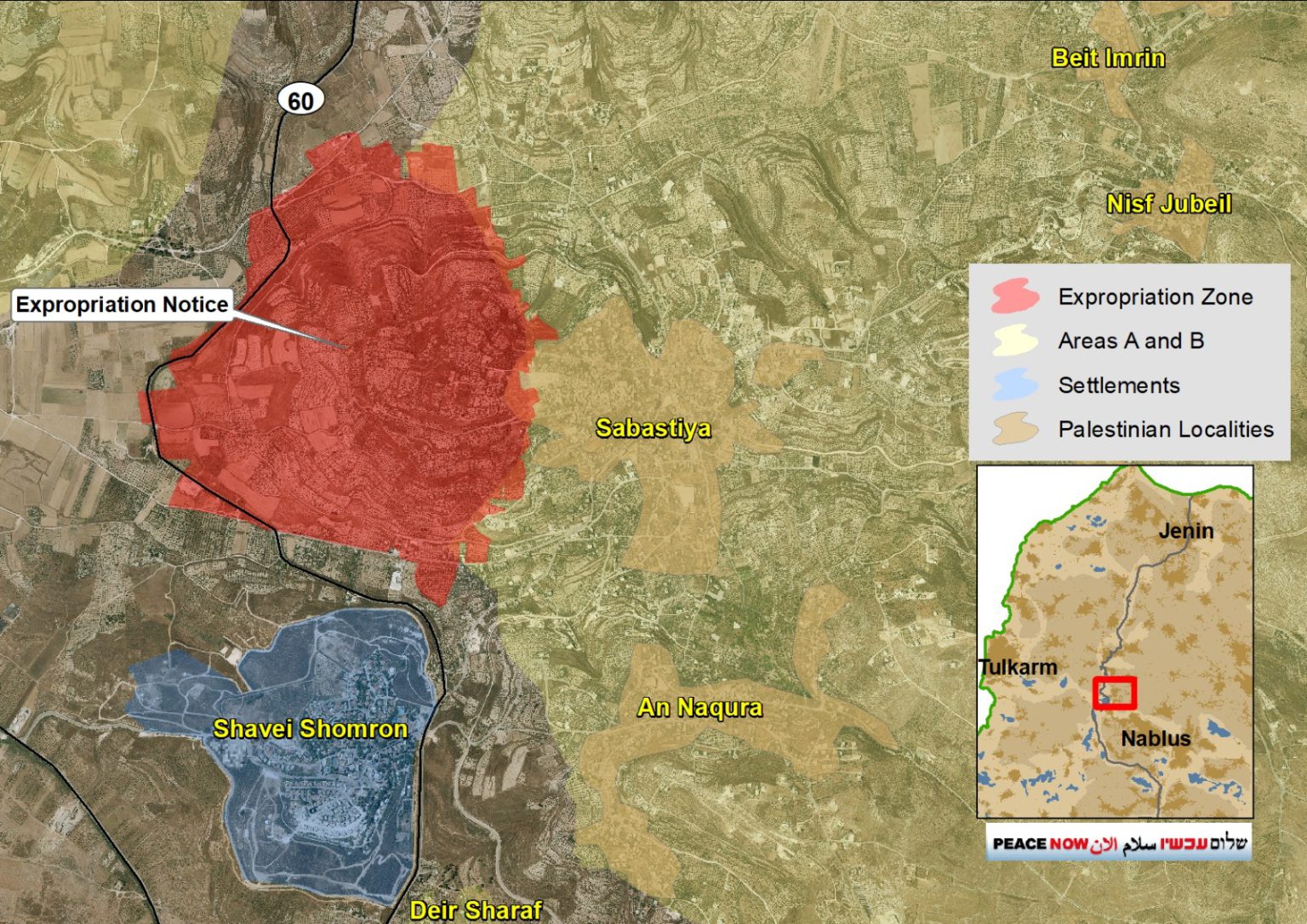 On November 19th the Israeli government announced it will expropriate a large amount of privately owned Palestinian land (445 acres, 1,800 dunams) surrounding and including the Sebastia archaeological site, located in the northern West Bank, in order to bring it under Israeli control and to develop the site into a major tourist attraction. The Israeli government has already allocated 30 million shekels ($9.24 million) to the development of the Sebastia site.
Emek Shaveh said in a statement:
“Under the guise of concern for heritage, the government is investing tens of millions of shekels in turning heritage sites into weapons of dispossession and annexation. The intention to expropriate private land is anything but preservation; its purpose is to establish a tourism settlement that will detach Sebastia’s heritage from the town and Judaize the area through the tourists who visit the site.”
The government’s plan will unilaterally seize land from the villages of Burqa and Sebastia, land in Area C which the Israeli government recognizes as lawfully owned by Palestinians, some of which is cultivated olive groves. The government is nonetheless carrying out the expropriation on the basis of an administrative order for antiquities. Emek Shaveh says Sebastia will be the fifth and most significant archaeological site expropriated by Israel since 1967, and Peace Now provides the receipts.
Along with dispossessing Palestinian landowners, Israel’s plans for the area will devastate the Palestinian tourism industry built around the site, which under Israeli control will be developed not for the benefit of Palestinians but for the Israeli tourism industry and settlers. Tellingly, the Israeli government has already begun renovating a nearby railway station – the Masoudia station – into a tourist site (a settlement) and planning a new access road to the site that bypasses the Palestinian village of Sebastia.
Emek Shaveh explains:
“The intention is clear – to sever the ancient site of Sebastia from the Palestinian historic town of Sebastia, connect the site to Road 60 and turn the site into a settler-led tourist attraction (similar to the City of David in Silwan, East Jerusalem). This development follows government decision 491 (May 2023), which allocates 32 million NIS to develop what Israeli authorities call the “Shomron (Samaria) National Park” in a plan that entails massive development of the site, including a visitors’ centre, a parking lot, and a fence which will separate the acropolis from the rest of the town.”
Peace Now explains:
“The Sebastia case is especially unusual because the expropriation targets an archaeological site that has long served as an economic, cultural, and tourism anchor for residents of Sebastia and the surrounding area, and that has been open to the public. Around the site are souvenir shops and restaurants, and in Sebastia itself, many residents earn their living from guiding visitors and renting rooms to tourists. The Sebastia site lies inside the village, among residents’ homes. The expropriation concerns the western part of the site, an area with fewer homes and surrounded by olive groves.” And on the railway station settlement site, Peace Now says: “Turning the Masoudia train station into a tourist site is, in fact, the establishment of a new settlement. This is not a heritage site—it’s part of a deliberate government plan to plant settlements deep inside a densely populated Palestinian area between Nablus and Jenin. These projects will increase the security burden, deepen the occupation, and advance annexation. The only ‘heritage’ being promoted here is the legacy of lawlessness and brute force championed by the Gush Emunim settler movement, which, then as now, acted illegally, clashed with security forces, and imposed facts on the ground for which the State of Israel continues to pay a heavy price to this day.”
Peace Now said in a statement:
“The Israeli government’s drive for dispossession and annexation knows no limits, and it is prepared to violate international law openly to pursue it. This is part of a broader effort to take control and expand settlements in areas northwest of Nablus that Israel evacuated during the disengagement. Sebastia is a heritage site located inside a Palestinian village, part of its history and part of a future Palestinian state. Under the Oslo Accords, signed by Israel, it should have been transferred to Palestinian administration long ago. Israeli greed harms not only the landowners, but also the prospect of a peaceful solution that upholds the rights and heritage of both peoples.”
Settlers Establish New Outpost Near Bethlehem
 The chairman of the local Etzion settler council, Yaron Rosenthal, proudly and publicly announced the establishment of a new outpost, called “Shdema”, on a hilltop near the Palestinian town of Beit Sahour east of Bethlehem. This new outpost is not a wild and haphazard effort by fringe radical settlers to build an outpost, but the organized and intentional work of settler leadership to establish a permanent new settlement. Tractors appeared overnight to clear and level the land, and several caravans were precipitously moved onto the site with three settler families reported to have moved in.
In his announcement, Rosenthal made it clear that the outposts came in response to the IDF’s evacuation of another outpost in Gush Etzion. The outpost was also built days after a Palestinian attack targeting Israelis at the nearby Gush Etzion junction, where one person was killed and three were injured by masked, knife-wielding assailants.
Peace Now has filed a complaint demanding an investigation into the Gush Etzion Regional Council’s involvement in the illegal construction of the outpost, and said in a statement:
“The new outpost is intended to choke the Palestinian town of Beit Sahour and block its development. There is no limit to the settlers’ audacity in establishing outposts and creating facts on the ground, while using public funds and denying Israel the chance for a future of peace and two states.”
Settlers have spent almost two decades trying to build a settlement at this exact site, an area called Ush Ghurab. The site was an Israeli military base but was vacated in the early 2000s. The U.S. then initiated a plan to fund and build a children’s hospital (with services aimed at Palestinians), but the plan was ultimately scuttled under settler pressure and the Israeli government build a new military post at the site.
IDF Raids Bedouin Village in Advance of Settlement Expansion
Ir Amim reports the Israeli police and soldiers raided the bedouin village of Kasarat living near the site of the future E-1 settlement. A group of 150 soldiers reportedly invaded the village in the early morning hours, forcing residents out of their homes while they proceeded to ransack each residence and beat several men. Residents reported extensive damage and stolen cash after the soldiers left.
Israeli Police have said the raid was aimed at finding weapons, though there were no arrests or seizures. Attorney Roni Pelli, who works for Yesh Din, told The Times of Israel that holding an entire village hostage is a form of collective punishment, and illegal under international law.
Ir Amim warns:
“The scale and violent nature of this unprovoked military action against an entire village is unprecedented in this area and could further indicate Israel’s intent to uproot the Palestinian communities living on lands marked within the E1 corridor….
Ir Amim has long stressed the danger of expulsion for vulnerable Palestinian communities in and around E1, whose land is directly threatened by the plan’s reemergence and approval. We have likewise warned that expulsions could be the first step taken by Israeli authorities following the plan’s approval. In addition to the severe geopolitical ramifications of the E1 settlement plans for the prospects of a viable Palestinian state, the most immediate repercussions are already unfolding on the ground for Palestinian communities.
This military action comes as the District Court reviews several petitions filed against the approval of the E1 settlement plans, including a petition initiated by Ir Amim together with partner organizations, Bimkom and Peace Now. It also follows the court’s recent rejection of a request for an injunction. The raid on the Kasarat community suggests that the authorities intend to continue pushing forward with the E1 plans at full speed, despite the petitions still under review.”
Settlers Terrorize Palestinians After IDF Dismantles Illegal Outpost
On November 17th, Israeli security forces dismantled the violent illegal outpost of Zur Misgavi (aka Givat Hatilim), located near Hebron. Attempting to thwart the evacuation, Israeli settlers barricaded themselves in the outpost and proceeded to throw rocks and metal rods, and burn vehicles and tires as the military and police attempted to remove them. Six settlers were arrested. Smotrich explained his support for the outpost demolition by saying he plans to build thousands of new settlement units on the same plot of land and the outpost was in his way.
The demolition of the outpost was apparently carried out at the request of the Gush Etzion Regional Council which raised concern about anarchy in the area and complained about the unauthorized construction.
The outpost evacuation enraged parts of the settler movement and in retaliation, settlers proceeded to terrorize nearby Palestinians communities, conducting violent raids on two towns.
First, settlers attack Umm al-Butm (located at the foot of the Zur Misgavi outpost), setting buildings and vehicles on fire and assaulting at least one women.
Second, settlers attacked Jab’a, setting fire to three homes, three vehicles, and a caravan. Video from the scene is terrifying. Settlers graffitied several buildings, writing “A Jew doesn’t evict a Jew.”
Following the fiery attack on Jab’a, the IDF announced a manhunt to find the attacks, and several high ranking Israeli officials made public statements condemning settler violence.
State-Backed Settler Terrorism This Week
Over the course of the last two weeks more and more criticism has fallen at the feet of the Israeli government, which has long sought to characterize settler violence as a small problem of a few bad apples, absolving the state of its systematic involvement, financing, and encouragement of settler violence. Following the settler attacks on Jab’a and Umm al-Batun and under mounting international pressure to address the problem, Prime Minister Netanyahu made public comments promising “forceful action” against settler violence, but continuing to assert the problem is one of the minority.
Bibi later convened his cabinet and top security officials to discuss how to address settler violence, reportedly to include getting violent settlers to attend educational programs (i.e. no real legal consequences or accountability). Later, Israeli security officials reportedly drafted a new plan to reportedly entails several recommendations including to: to create a special investigative team to handle severe cases; increase military and police deployment in the West Bank; establish 14 security hubs in violent hotspots; expand surveillance networks with new cameras; and increase punishment of offenders to include property seizures, fines and gun license revocations.
In an editorial, the Jerusalem Post Editorial Board wrote that the Israeli government is complicit in the violence, writing: ”The public silence of Netanyahu and Katz and the encouragement of Ben-Gvir point to the only plausible conclusion that the government is part of the problem, not the solution.”
While the Israeli government formulates a response, settler terrorism in the West Bank continues on a daily basis – and no arrests have been reported. Key attacks this week include:
- Attacks on Jab’a and Umm al-Bum, as detailed above.
- Huwara – On November 20th, settlers conducted a pogrom on the village of Huwara. First throwing stones and molotov cocktails, settlers further escalated to setting vehicles, homes and a scrapyard on fire, resulting in a massive blaze. IDF are reported to have arrested at least one Palestinian journalist who was documenting the attack, but no arrests of Israeli settlers have been reported.
- Al-Mirkez – On November 21st settlers used clubs to violently assault Palestinians in the village of al-Mirkez, located in the Masafer Yatta area of the South Hebron Hills.
- Luban a-Sharqiya – Settlers torched several buildings.
- Abu Falah – Settlers burned an agricultural building and set a home on fire while residents were still inside.
- Deir Sharif – Settlers vandalized a plant nursery, destroyed a bathroom fixture showroom, and burned over a dozen cars.
- Beit Furik – Settlers raided Beit Furik.
- Susya – Settlers attacked an elderly Palestinian man, knocking him off his donkey and requiring hospitalization.
Human Rights Watch: Not Just Gaza – Israel Committing War Crimes in the West Bank
Human Rights Watched published a new report entitled, “‘All My Dreams Have Been Erased’: Israel’s Forced Displacement of Palestinians in the West Bank.” An excerpt reads:
“This report examines the Israeli government’s conduct of Operation Iron Wall from its start in January 2025 through July 2025, and the resulting mass displacement of Palestinians from three refugee camps in the northern West Bank. Human Rights Watch found that Israeli forces committed forcible displacement in violation of the law of occupation under international humanitarian law that amount to war crimes. Human Rights Watch also found that Israeli forces committed the forcible transfer of population and other inhumane acts as part of a widespread or systematic attack directed against a civilian population, which are crimes against humanity under the Rome Statute of the International Criminal Court. Israel’s actions also violated international human rights law, which remains in effect in the West Bank…
When forced displacement is committed as part of a widespread or systematic attack on a civilian population, thus reflecting state or organizational policy, it can constitute a crime against humanity. These actions may also be considered “ethnic cleansing,” a non-legal term used to describe a policy to remove an ethnic or religious group from particular areas “by violent and terror-inspiring means.”…
This forced displacement reflects the broader pattern of ongoing rights violations by Israeli authorities against the Palestinian population, including the crimes against humanity of apartheid and persecution.”
Read the full report here.
Bonus Reads
- “IDF Blocks Activists From Aiding Palestinian Olive Harvest, Declares West Bank Village Closed Military Zone” (Haaretz, 11/14/25)
- “Averting West Bank collapse: How to revive Palestinian politics” (ECFR, November 2025)
- “Editorial | In the West Bank, the IDF Only Arrests Those Who Come to Protect Palestinians” (Haaretz, 11/16/25)
- “‘Palestinian Farmers Are Fighting to Survive’ Drought and Settler Violence Make 2025 West Bank Olive Harvest Worst in Living Memory” (Haaretz, 11/14/25)
Welcome to FMEP’s Weekly Settlement Report, covering everything you need to know about Israeli settlement activity this week.
To subscribe to this report, please click here.
December 5, 2024
-
- End of Year Rush: High Planning Council Set to Meet Twice to Advance Settlement Plans
- Settlers Violently Storm Palestinian Towns After Outpost Evacuation
- Israel Gives Settler Power Over Palestinian Property in East Jerusalem
- Settlement Construction Group is Working in North Gaza, As Israeli Govt Officials Meet with Gaza Settlement Activists
- Emek Shaveh Challenges Military Construction at Sebastia Site
- Recapping Knesset Debate on Annexation via Archaeology
- Settlers Set Operational Plan for Trump Administration
- Don’t Miss: New Reports from B’Tselem & Yesh Din
End of Year Rush: High Planning Council Set to Meet Twice to Advance Settlement Plans
Peace Now reports that the Civil Administration’s High Planning Council met on Nov. 4th and is scheduled to meet again on Nov. 11th to consider advancing plans for a total of 501 new settlement units. In total, Peace Now reports that Israel has advanced plans for a total of 8,720 new settlement units in the West Bank in 2024.
The following plans for a total of 274 units were listed on the agenda for November 4th, with all slated to be deposited for public review (a latter stage of the planning process):
- 83 new units in Elon Moreh settlement, located east of Nablus (for background on the significance of the Elon Moreh settlement, please see here);
- 79 new units in the Mitzpe Yishai settlement; and,
- 112 new units in the Ma’ale Amos settlement, located between Bethlehem and Hebron.
The Committee is set to meet again on November 11th with the following plans for a total of 227 new settlement units on the agenda:
- 196 units in the Telem settlement – ready for final approval. The Telem settlement is located north of Hebron;
- 21 units in the Eli settlement – ready for deposit. The Eli settlement is located southeast of the Ariel settlement in the central West Bank. Though the Eli settlement previously received Israeli government approval, a “Master Plan” – which officially zones land for distinct purposes (residential, commercial, public) – has never been issued for Eli, meaning all construction there is illegal under Israeli law; and,
- 10 units in the Givat Ze’ev settlement – ready for final approval. Givat Zeev is located south of Ramallah in an area that is on the Israeli side of the barrier.
Peace Now said in a statement:
“The Israeli government is expanding settlements in the occupied West Bank as part of its broader plan to entrench Israeli control over the territories, thereby harming any chances for a political solution. After more than a year of war, Israelis and Palestinians do not need more settlement expansion but rather hope for peace and a future free from the horrors of war and occupation.”
Settlers Violently Storm Palestinian Towns After Outpost Evacuation
In the early morning hours of December 4th, dozens of settlers marauded two Palestinian cities near Nablus, and were stopped by the IDF from raiding a third. While storming through Huawara and Beit Furik, settlers threw Molotov cocktails setting at least one home and two cars on fire, and violently attacking at least one person with stones and sticks, fracturing his skull. Israeli police said that eight people have been arrested.
The attackers reportedly came from the Yitzhar settlement, and was launched as a response to the IDF’s removal of settlers from a nearby outpost called Hill 617.
In an Editorial entitled, “Israel’s Government Instigates Settler Pogroms Against Palestinians,” the Haaretz Editorial Board writes:
“When Defense Minister Israel Katz announced when he took office that would stop the use of administrative detention orders against settlers, the lawbreakers in the occupied territories immediately understood they had been given a green light to run amok. The spirit of the new commander is that there is no commander, that the extremist settlers are above the law, that the military, the Shin Bet security service and the police must obey them, that the blood of the Palestinians can be shed and that their land and assets are there for the taking. Aware of Katz’s new policy, on Wednesday, dozens of settlers threw Molotov cocktails and set fire to homes and vehicles in the towns of Beit Furik and Hawara, near Nablus.”
Beit Furik has been a repeated target of settler attacks, including a major incursion last month.
Israel Gives Settler Power Over Palestinian Property in East Jerusalem
The Israeli government has appointed Hananel Gurfinkel as the head of a newly established position of Adminstrator General of the Custodian of Absentee Property Division in the Finance Ministry. This role holds the important and powerful task for managing absentee property owned by Palestinians in East Jerusalem.
Gurfinkel lives in the Nof Zion settlement enclave in East Jerusalem, and is the founder of an organization (Boneh Yerushalayim) dedicated to building settlements in East Jerusalem.
For the past ten years, Gurfinkel has worked in the Justice Ministry’s Custodian General’s office, where he managed Jewish-owned absentee property. In that role, Haaretz reports Gurfinkel:
“used his position to aid settler organizations seeking to control Palestinian-owned properties and promote new settlement projects in the city. He facilitated the sale of land in the Silwan area to the pro-settler group Ateret Cohanim, and hired attorneys affiliated with the group and other right-wing organizations to represent the state in eviction cases targeting Palestinian families. Gurfinkel also actively supported right-wing efforts to expand Jewish settlement and reshape the demographic landscape of East Jerusalem.
Before Gurfinkel took his post, the Custodian General’s Office rarely initiated construction plans for properties under its authority. His tenure, however, marked a significant shift, culminating in a collaboration between the Justice Ministry, Ateret Cohanim and a right-wing-managed real estate company, to advance plans for three new Jewish settlements near Palestinian neighborhoods in East Jerusalem.
Hundreds of homes for Jews are set to be built in each of these new neighborhoods, adjacent to or even inside Palestinian communities.
The construction plans include the neighborhoods of Givat Shaked near the Palestinian Arab neighborhood of Sharafat, Kdmat Zion near Ras al-Amud and another neighborhood between the Palestinian villages of Umm Lison and Jabal Mukkaber…
According to Palestinian residents of Sheikh Jarrah, Gurfinkel has been enthusiastic about evicting them.”
Settlement Construction Group is Working in North Gaza, As Israeli Govt Officials Meet with Gaza Settlement Activists
Drop Site news reports that Israel has contracted with private companies specializing in settlement construction to work in northern Gaza. It is reported to be the first confirmation that Israel has hired private contractors to conduct demolitions and construction work in northern Gaza (previously documented in Rafah) – an arrangement which brings Israeli civilians to an area outside of Israel’s internationally recognized borders.
One of the confirmed private construction companies working in northern Gaza, Libi Constriction and Infrastructure Ltd., is owned by settlers and participates widely in settlement construction, including reportedly the Adei Ad outpost, the Itamar settlement, the Revava outpost. The company’s founder (Harel Libi) has a documented criminal history of illegal construction in the West Bank and has been subjected to a removal order in 2012 after participating in violent attacks on Palestinians in the West Bank.For more details on Harel Libi and his construction company, read Drop Site’s reporting.
As Israel’s actions in Gaza continue to come under increased scrutiny (with Amnesty International recognizing it as genocide this week), Israeli government officials and actions on the ground point to a long term Israeli presence. The New York Times documents how the Israeli military has entrenched its presence in Netzarim Corridor – which has been cleared of any signs of life prior to the military’s arrival. Satellite images show at least 19 large IDF bases, 12 of which have been built or expanded since September. There are also dozens of small bases in the area. Israel’s Minister of for Food Security Avi Dichter – who also services on the Isreali Security Cabinet – said at a press conference this week:
“I think most people understand that [Israel] will be [for] years in some kind of West Bank situation where you go in and out and maybe you remain along Netzarim [corridor].”
Israeli Finance Minister Bezalel Smotrich recently advocated for the Palestinian population in Gaza to be “thinned” by half within two years.
Meanwhile, Israeli Housing Minister Yitzhak Goldknopf was photographed on the Gaza border meeting with prominent settlement activists Daniella Weiss, who was seen showing Goldknopf a map of Gaza showing where she plans to establish Israeli settlements.
Goldknopf stated;
“Jewish settlement here is the answer to the terrible massacre and the answer to the international court in The Hague which, instead of caring about the 101 hostages, chose to issue warrants against the Prime Minister and (former) Defense Minister.”
Appearing on Israeli TV last week, Weiss said:
“The moment that entry is possible, we enter,” she said. “We don’t wait for water supply infrastructure, generators or any other preparations. If 300 people enter at once, evacuating them would require 1,000 soldiers.”
Emek Shaveh Challenges Development of Sebastia
In November 2024, Emek Shaveh joined Palestinian landowners and the Sebastia municipality to file a petition against the construction of a military facility g at the summit of the Sebastia archaeological site. The petition complains that the plans violate private property rights and that the Isareli Staff Officer for Archaeology in the Civil Administration did not submit an opinion regarding the potential impact of a military facility on the ancient site.
The plans for construction were disclosed only months after the Israeli army issued a military order seizing the plot of land, and a year after the Israeli government passed a $9 million (NIS 32 million) plan designed to impose Israeli control over the site both logistically and in the narrative about the site’s history. E
Settlers have been openly agitating for Israel to assert control over the archaeological site in Sebastia for years, and the settler Samaria Regional Council organizes regular tours to the site. To secure the settlers’ visits, the IDF shuts down the town of Sebastia, closing Palestinian streets and businesses.
As in other cases across the West Bank, settlers allege that Palestinians are damaging the Sebastia site and that the Israeli government needs to intervene. In 2021 amidst intensifying settler efforts related to the site, the Palestinian Foreign Ministry called on UNESCO to “protect all Palestinian archaeological and religious sites from Israeli violations, attacks and falsifications.” The archaeological site of Sebastia is on the tentative list of World Heritage sites in Palestine.
Recapping Knesset Debate on Annexation via Archaeology
On November 27th, the Knesset’s Education, Culture, and Sports Committee discussed a proposed bill to expand the Israel Antiquities Authority’s jurisdiction into the West Bank, effectively annexing West Bank antiquity sites to Israeli control. This bill is being prepared for a first reading soon.
The discussion, as summarized by Emek Shaveh, included the strong objections to the bill from the Israeli archaeological community, which stressed the move would be tantamount to annexation and have repercussions for Israel. The Committee’s own legal advisor said that the bill is “incompatible with the region’s laws.”
Emek Shaven Director Alon Arad said:
“Advancing this legislative proposal amounts to the annexation of parts of the West Bank and is contrary to international law and agreements to which the State of Israel is a signatory. This is a bad and dangerous legislative proposal that reflects an extreme and messianic Jewish supremacist ideology. It is being promoted against the opinions of professionals and will inevitably harm the State of Israel, its foreign relations, its political horizon, and put its academic community at risk while hollowing out the field [of archaeology] and turning it into nothing more than a political tool.”
Settlers Set Operational Plan for Trump Administration
At the end of November, the settler Yesha Council convened a high-level meeting in Jerusalem to develop a “operational strategy” to implement the expansion of settlements and annexation of the West Bank during the Trump Administration.
The meeting reportedly proposed a plan that would establish 3-4 new settlements and expand the jurisdiction of regional councils over all of the West Bank land, including Palestinian areas (current jurisdictions only include settler populations). In tandem, the group proposes removing he Palestinian Authority from a position of any control and hinting at dismantling it altogether. Israel Hayom reports that MK Boaron explains:
“Instead [of the PA], the Arab population in the West Bank would be under self-governing municipal authorities. These would receive and pay for services from Israel, with residents holding status similar to Jerusalem’s Arab residents. Their national orientation would mirror the pre-1967 arrangement under Jordanian administration.””
MK Boaron also called for transforming the Jordan Valley into a “power generation huib” by building many power stations there. Plans for the two new power stations were recently announced by Israeli Energy Minister Eli Cohen.
Likud MK Avihai Boaron, who attended the meeting, said:
“We are at a critical juncture – a window of opportunity that we can utilize either wisely or squander. Taking the foolish path would merely result in 700,000 residents and additional housing units four years from now. The wise approach would establish conditions to make Judea, Samaria, and the Jordan Valley inseparable from Israel – not just by creating demographic facts on the ground, but by fundamentally transforming the region’s administrative framework.”
Don’t Miss: New Reports from B’Tselem & Yesh Din
On December 3rd, B’Tselem released a new report on the escalation of brutal policing of Palestinians in Hebron, including patterns of arbitrary arrests, severe beatings and zero accountability. The report presents over 20 testimonies collected between May and August 2024. Victims describe being randomly seized by soldiers, mostly as they were walking down the streets of the city, going about their daily affairs. They were beaten and subjected to severe abuse by soldiers, sometimes in the street, and at other times inside military outposts where they were taken.
In November, Yesh Din released a report documenting at the Abu Awwad family’s case and the severe (and insane) movement restrictions facing the family in the village of Turmusaya in the central West Bank. The family’s sole access to their residential compound, located on the outskirts of the town, was blocked by an earth mound of dirt and stones placed by soldiers and settlers in October 2023. This was only the start of a year of increasing imposition of restrictions imposed on the family by Israeli soldiers. Yesh Din has accompanied the family in filing a petition with the Israeli High Court of Justice to have the earth mound removed.
Welcome to FMEP’s Weekly Settlement Report, covering everything you need to know about Israeli settlement activity this week.
To subscribe to this report, please click here.
July 26, 2024
- Israeli Army Seizes Key Area of Sebastia Archaeological Site
- Family in Old City Faces Dispossession
- First Demolition in Al-Walajah Area C Could be Sign of More to Come
- Peace Now: In 2023, Israeli Government Funded 101 Illegal Outposts
- Israeli Human Rights Groups Publish Joint “State of the Occupation” Report
- Bonus Reads
Israeli Army Seizes Key Area of Sebastia Archaeological Site
Seizure Of Sebastia Summit 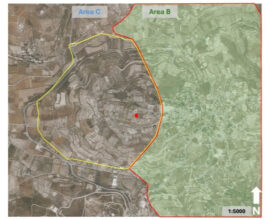 Emek Shaveh reports that on July 10th the Israeli army issued an order seizing land at the summit of the Sebastia archeological site in the northern West Bank. The dot of land (1.3 dunams / .3 acres) is surrounded by the Palestinian village of Sebastia in Area C of the West Bank. Emek Shaveh reports that the IDF is likely to set up a military post on the small area, and erect an Israeli flag at the highest point.
This seizure comes over one year after the Israeli government passed a $9 million (NIS 32 million) plan designed to impose Israeli control over the site both logistically and in the narrative about the site’s history. Emek Shaveh explains:
“the government wants to turn the site into an ‘anchor site’ for tourists which would emphasise Jewish history and Jewish rights to the site. The plan, designed to complete the separation of the acropolis from the village and divert tourism away from the village itself, also threatens the Outstanding Universal Values attributed to the site by the State of Palestine and international experts in the field of heritage. “
Settlers have been openly agitating for Israel to assert control over the archaeological site in Sebastia for years, and the settler Samaria Regional Council organizes regular tours to the site. To secure the settlers’ visits, the IDF shuts down the town of Sebastia, closing Palestinian streets and businesses.
As in other cases across the West Bank, settlers allege that Palestinians are damaging the Sebastia site and that the Israeli government needs to intervene. In 2021 amidst intensifying settler efforts related to the site, the Palestinian Foreign Ministry called on UNESCO to “protect all Palestinian archaeological and religious sites from Israeli violations, attacks and falsifications.” The archaeological site of Sebastia is on the tentative list of World Heritage sites in Palestine.
Family in Old City Faces Dispossession
Ir Amim reports that the Palestinian Quastiro family who has been running a coffee shop (al-Musrara Cafe) located near the Old City of Jerusalem is facing imminent dispossession of their business at the behest of of the Israeli Custodian General, the government body which can “reclaim” buildings that were owned by Jews prior to 1948.
The coffee shop is located on the popular al-Musrara Street, which leads from the Damascus Gate to the Old City towards West Jerusalem Jerusalem. Ir Amim explains “the strategic location has made properties there a target of settler takeover, and a few settler families are already living in some of the residential units in the area….The pretext under which the General Custodian is attempting to evict the family could suggest intent on renting or handing over the property to an Israeli settler organization.”
First Demolition in Al-Walajah Area C Could be Sign of More to Come
Ir Amim reports that on July 22nd Israeli forces demolished the home of the Palestinian Rabah family (12 individuals) in the village of Al-Walaja, located on the southern border of Jerusalem (partially within Israeli’s expanded municipality borders).
Ir Amim explains the significance of this demolition:
“this is the first time a home demolition in Area C of al-Walaja has taken place in years and could indicate a policy change which would place many more homes in the village at risk of demolition. In 2016, the Israeli authorities dramatically toughened their demolition policy in the part of al-Walaja annexed to East Jerusalem. This has resulted in the destruction of dozens of homes in the past eight years by the National Enforcement Unit, an organ of the Ministry of Finance operating in East Jerusalem along with areas inside the Green Line…While the reason behind the Civil Administration’s decision to carry out the demolition is unknown, it could indicate a major change in policy which would place dozens of homes in Area C of al-Walaja under threat of demolition. Finance Minister Bezalel Smotrich who received authority over civil issues in Area C has prioritized increased demolitions of Palestinian homes (along with Israeli takeovers of large areas and authorization of unauthorized outposts). “
The home was built by the Rabah brothers in 2012 adjacent to their parents home on the family’s land. Despite owning the land, the brothers were denied Israeli building permits because the Separation Barrier was being constructed some 35 meters away – – meaning that the land was now located in an area where the ISraeli military prohibits new construction for “security” reasons.
Since 1967, Al-Walajah has suffered due to its location and its complicated status under Israeli law. Much of the village’s lands, including areas with homes, were annexed by Israel in 1967, but Israel never gave the villagers Jerusalem legal residency by Israel – meaning that under Israeli law, their mere presence in their homes is illegal). Today it is acutely suffering from a multi-prong effort by the Israeli government and settlers to grab more land for settlement expansion in pursuit of the “Greater Jerusalem” agenda. This land grab campaign includes home demolitions (four homes in Al-Walajah were demolished by Israel on November 2, 2022, for example), the construction of the separation barrier and bypass roads in a way that seals off the village on three sides, and the systematic denial of planning permits.
Peace Now: In 2023, Israeli Government Funded 101 Illegal Outposts
Peace Now released a new report showing that in 2023 the Israeli government financed 68 settler farming outposts and 33 other (non-farming outposts) to the tune of $7.6 million (NIS 28 million). Peace Now reports that over $20.5 million (NIS 75 million) has been earmarked for outposts in 2024, and that settler regional councils will soon be asked to submit applications for outpost funding in 2024.
The government seeks to obscure its funding of illegal outposts by transferring the money to the World Zionist Organization’s Settlement Division, which then makes the transfers to the outposts. While it is not entirely certain, Peace Now is confident in surmising that government funds were provided by the WZO to five illegal farming outposts that have been targeted by international sanctions.
Peace Now’s findings include:
- In 2023, the Israeli government financed 68 settler farms in the West Bank with an amount of NIS 15 million. Additional NIS 39 million is allocated for farms in 2024.
- In addition the government funded 33 illegal outposts (that are not farms) with NIS 13 million in 2023. Additional NIS million is allocation for outposts in 2024.
- The funds were used for financing vehicles, drones, cameras, electric generators, electric gates, lamp posts, fences, solar panels and more.
- The IDF and the Central Command were involved in planning and approving the funds, including deciding which farms and outposts would receive funding and which components would be financed in each farm and outpost.
The farming outposts have been a particular focus for many settlement watchdog groups because they have significantly proliferated over the past few years, and they are exceptionally effective in gaining control over vast areas in the West Bank with only a few settlers, a few tents, herds of livestock, and – usually – violence.
Peace Now said in a statement:
“Not only does the Israeli government allow settlers to take over lands, establish outposts and farms in violation of the law, and attack and displace Palestinians without any response, it also funds and assists them. Settler violence is not a bug; it is a feature. It is part of an ongoing effort by the Israeli government to systematically expel Palestinians from their homes and lands in Area C in the West Bank.”
Israeli Human Rights Groups Publish Joint “State of the Occupation” Report
In its second annual report, The Platform: Israeli NGOs for Human Rights, published a new report and commentary on Israel’s rule over the West Bank. Twenty-one Israeli human rights groups contributed to the report coordinated by the New Israel Fund. The report affirms that “Israel’s actions in the West Bank today meet the criteria of apartheid.”
The report details four “trends” that defined the work of the contributing organizations in 2023:
- The humanitarian disaster in the Gaza Strip and the suspected war crimes committed by Israel;
- The deepening of the annexation and the acceleration of dispossession in the West Bank;
- The increased Israelisation efforts and displacement of the Palestinian population in East Jerusalem; and,
- The accelerated erosion of democratic space in Israel.
You can read the report and its details here.
Bonus Reads
- “‘Fighting the same battle’: After Oct. 7, settlers court Republican evangelicals” (The Times of Israel)
- “The ICJ Is Right: The Israeli Settlements Are an Illegal Affront” (The New Republic)
Welcome to FMEP’s Weekly Settlement Report, covering everything you need to know about Israeli settlement activity this week.
To subscribe to this report, please click here.
October 6, 2023
- Smotrich Sidelines Military Legal Advisor In Order to Pursue Agenda
- Smotrich & Settlers Demand Bypass Road Near Huwara Following Latest Violence
- Israel Tightens Grip on Sebastia Site
- Settlers, Knesset Continue Push for IDF to Seize “Archaeological Site” at Mt. Ebal/El-Burnat
- The Acceleration of “Herding Outposts”, And Their Impact
- OCHA Reports on Ongoing Ethnic Cleansing of Masafer Yatta
- The JNF Is Funding Hilltop Youth
- Bonus Reads
Smotrich Sidelines Military Legal Advisor In Order to Pursue Agenda
Haaretz reports that Bezalel Smotrich has taken further steps to consolidate his governance over settlements and outposts in the West Bank by sidelining the Defense Ministry’s top military legal advisor in favor of his own hand-picked deputy legal advisor, Moshe Frucht. Prior to joining Smotrich, Frucht was a researcher at the far-right Kohelet Policy Forum, an organization that is widely understood to be the architect behind the anti-democratic judicial revolution and author of many legal opinions arguing for the legality of Israeli settlements under international law.
In recent meetings on the topic of settlements, Smotrich has gone from overruling the objections of the military advisor to excluding them from meetings altogether. One Israeli MK, Gilad Kariv (Labor), also accuses Smotrich of hiding the army’s official legal position from the Knesset in committee hearings and when discussing government decisions.
As a reminder, in February 2023 Smotrich was effectively made the ruling sovereign of Area C of the West Bank via his role as a minister in the Defense Ministry and as the head of the newly created Settlements Administration, which was given power over civilian affairs in Area C.
Smotrich & Settlers Demand Bypass Road Near Huwara Following Latest Violence
The Palestinian village of Huwara has been a focal point of violence over the past few days after a Palestinian gunman opened fire on a settler vehicle on October 5th, following repeated incidents of rock-throwing at Israeli vehicles near Huwara this week. Over the night of October 5th, hundreds of settlers – including MK Zvi Sukkot – descended upon Huwara in what they claim was an attempt to set up a Sukkah in celebration of the Sukkot holiday and in response to the attack. Settlers attacked Palestinian homes and businesses resulting in clashes with Palestinians. A 19-year old Palestinian boy, Labeeb Mohammed Dmaidi, was shot and killed while standing on the roof of his family home and allegedly throwing rocks towards the settlers and IDF soldiers. Palestinians believe a settler was the shooter.
The violence has resulted in the settlers demanding that the government complete the Huwara Bypass road, which has dragged on since construction began in 2021. Bezalel Smotrich publicly stated his support for the demand while in Huwara the day after the attacks, where he further called on Netanyahu to force Palestinian shops on Huwara’s main road to remain closed until the road is complete. Smotrich later criticized Netanyahu and Defense Minister Gallant for closing down Route 60 during the funeral procession for Dmaidi. Recall that earlier this year Smotrich said that Israel should “wipe out” Huwara.
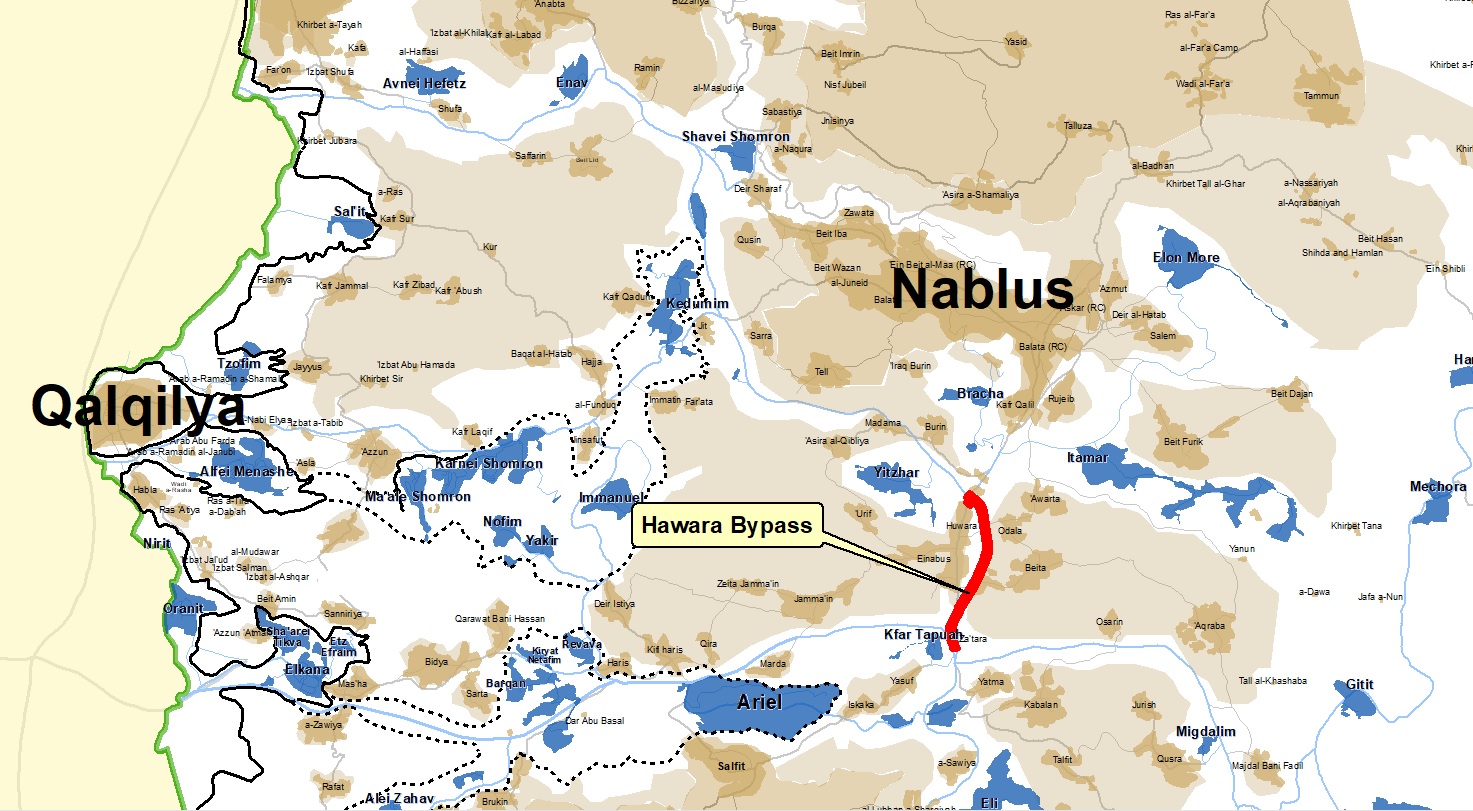 The initial shooting attack occurred on Route 60, which is used by both settlers and Palestinians as the main thoroughfare connecting central and northern West Bank. Route 60 passes through Huwwara. The bypass road is designed so that residents of Nablus-area settlements can more easily/directly access Jerusalem without driving through Huwara. Israel unilaterally expropriated private Palestinian land along the route of the road in preparation for construction.
Beyond the new demand and the possible implications it will have on the freedom of movement for Palestinians to and from Huwara, National Security Minister Ben Gvir posted on X during the settlers October 5th attack on Huwara that “”Our [Jewish Israeli] lives take priority to the Palestinians’ freedom of movement (and commerce). We’ll continue to say this truth and actively work to implement [this truth].” This is the second time that Ben Gvir has said that the rights and freedoms of Jews are more important than Palestinians.
Israel Tightens Grip on Sebastia Site
Emek Shaveh reports that on October 1st Israeli Minister for Environmental Protection, Idit Sliman, toured the archaeological site of Sebastia alongside settler leader Yossi Dagan, declaring that the land belongs to Israel. The Sebastia site is located near the Palestinian village of Sebastia, north of Nablus in the heart of the West Bank, and straddles the line designating Areas B and C, with most of the site is in Area C. The Palestinian village of Sebastia – which settlers travel through to reach the site – is in Area B entirely. During Sliman’s tour of the site the IDF sealed off all entry points to the village.
On May 7, 2023, the Israeli government approved nearly $9 million (NIS 32 million) for a project to develop and “renovate” the archaeological site of Sebastia. The project includes plans to pave a new access road for Israelis to reach the site, which they currently have to access by traveling through the Palestinian village of Sebastia.
Settlers have been openly agitating for Israel to assert control over the archaeological site in Sebastia for years, and the settler Samaria Regional Council organizes regular tours to the site. To secure the settlers’ visits, the IDF shuts down the town of Sebastia, closing Palestinian streets and businesses. As in other cases across the West Bank, settlers allege that Palestinians are damaging the Sebastia site and that the Israeli government needs to intervene. In 2021 amidst intensifying settler efforts related to the site, the Palestinian Foreign Ministry called on UNESCO to “protect all Palestinian archaeological and religious sites from Israeli violations, attacks and falsifications.” The archaeological site of Sebastia is on the tentative list of World Heritage sites in Palestine.
Emek Shaveh further explains the history and politicization of this archaeological site
“The battle over Sebastia is also played out in the narratives each side presents to the public. The informational material distributed by the PA does not include an explicit reference to the Kingdom of Israel or to the Hasmonean connection. On the other hand, in recent years the settlers have been rehabilitating the figure of Omri, a King of the Kingdom of Israel, in an effort to imbue Sebastia with greater nationalist significance. Sebastia also holds a special place in recent history for the settlers because it is the place where the leaders of Gush Emunim, the group that first fought for the establishment of settlements in the West Bank in the 1970s, celebrated the government’s agreement to establish the first settlement in the area in 1975.
In tandem with the growing campaign of recent years to apply full Israeli control over Sebastia, larger numbers of Israelis visit the site every week in buses organized by the Samaria Regional Council and accompanied by soldiers.
Sebastia, is a declared national park. National parks and nature reserves in Area C of the West Bank are managed by the Civil Administration and are referred to as “parks”. Their total area spans approximately 500,000 dunams and constitutes roughly 14.5% of Area C. Palestinians’ rights are violated in these territories through various means. In the Ein Prat Nature Reserve, for example, landowners cannot cultivate their land as their access is restricted. In Herodion National Park and Nabi Samuel, residents can neither construct nor renovate their homes.”
Settlers, Knesset Continue Push for IDF to Seize “Archaeological Site” at Mt. Ebal/El-Burnat
This week settlers have carried out daily trips to the archaeological site at Mt. Ebal, known as el-Burnat to Palestinians, located in Area B of the West Bank. On Monday, the Israeli army coordinated a trip for hundreds of Israelis to the site, but has not coordinated with settlers on their trip to the site in the subsequent days. Over the past two years, settlers have been clamoring for the army to take unilateral control over the site after the Palestinian Authority began to develop land nearby.
On October 6th, MK Son-Harmelech participated in a trip to the site and subsequently called on the government of Israel to establish a new settlement at the site (which, again, is located in Area B).
In a further show of the settlers influence and the government’s intentions with the site, Emek Shaveh reports that on September 25th a subcommittee of the Knesset’s Foreign Affairs and Defense met to discuss accusations (which have proven to be false yet are weaponized by settlers) that the Palestinian Authority has recklessly damaged and is attempting to destroy the site. Emek Shaveh explains: “The reports and the special subcommittee session are part of an orchestrated attempt by the settlers and their representatives in the Israeli parliament to use antiquity sites as a ruse for advancing annexation.”
At the hearing, the Civil Administration’s Head of Infrastructure, Lieutenant Colonel Adam Avidan, acknowledged that the site is in Area B where the IDF has limited authority. He also said the IDF constructed an observation tower to monitor Palestinian activity at the site. Avidan also explained that the IDF had summoned the Palestinian village leader to warn him not to conduct any construction work at the site, showing a map that marked the borders (reminder that the IDF does not have any authority over antiquity sites in Areas A or B).
Mt.Ebal/el-Burnat is purported to be an antiquity site where the biblical prophet Joshua built an altar, originally identified as such in the 1980s by an Israeli archaeologist though the majority of professional archaeologists do not support that conclusion. Emek Shaveh, an Israeli NGO with expertise in archaeology, called the settler campaign to seize Mt. Ebal as a “watershed in Israeli archaeology.” In July 2023, Emek Shaveh reported that a triad composed of settlers, an American Christian evangelical organization, and the Israeli army collaborated on a recent unlicensed excavation on Mount Ebal, which Emek Shaveh called antiquity theft. Further, the groups transferred some 80 cubic meters of soil from Mount Ebal to the Shavei Shomron settlement, where settlers then promoted an opportunity for members of the public to join the archaeologists in sifting through the materials (thereby promoting tourism to the settlements). Haaretz called the excavation “is mainly used as a tourist attraction to the West Bank and is of little scientific significance.”
Emek Shaveh’s explained the significance of what is happening on Mount Ebal:
“The archaeological site at Mount Ebal is becoming a watershed in Israeli archaeology. The activity on the site has turned from a pirate operation led by a group of Messianic Jews and Christians into a state sponsored operation under the auspices of the Civil Administration led by Minister Bezalel Smotrich.This is yet another violation of the Oslo Accords and suspected violation of domestic and international law that is whitewashed by Israeli authorities and intended to serve as a method for advancing the annexation of the West Bank to Israel.In addition to the alleged violation of the law, the excavation constitutes an ethical failure by the entire archaeological community in Israel whose silence continues to grant legitimacy to such projects. A comprehensive and immediate investigation is required by all the relevant parties as well as independently by the Israeli Archaeological Association.”
The Acceleration of “Herding Outposts”, And Their Impact
On October 3rd The New York Times published an article describing the impact of so-called herding outposts on the battle for control over land in the West Bank, highlighting reporting from Kerem Navot that shows how settlers have been establishing herding and farming outposts as a way to coerce the displacement of Palestinians and assert control a maximal amount of land with a minimal number of Israeli settlers.
That 20 new herding outposts have been established so far this year, showing how this tactic has accelerated since 2018 when settlers began to strategically focus on herding outposts as an effective mechanism. Three Palestinian herding communities have been displaced from their lands this year, largely in fear of nearby settlers.
The Times reports:
“The Israeli settlers’ stated intention is to chip away at wide expanses of land that the Palestinian leadership, at the advent of the Oslo peace process 30 years ago, hoped would form the territorial spine of a future Palestinian state. ‘It’s not the nicest thing to evacuate a population,’ said Ariel Danino, 26, an Israeli settler who lives on an outpost and helps lead efforts to build new ones. ‘But we’re talking about a war over the land, and this is what is done during times of war’.”
In a 2022 report on this herding phenomenon, Kerem Navot explains:
“…the development of Israeli sheep and cattle grazing in the West Bank, […] has gradually become Israel’s most significant mechanism for dispossessing Palestinian communities. At issue are tens of thousands of acres of open areas expropriated by the Israeli authorities and settlers through dozens of shepherd outposts and farms, the great majority of which have been established over the past decade. The use of grazing to seize land began in the early 1970s and continued intermittently in the 1980s and 90s. In recent years, however, the phenomenon mushroomed in terms of area size, investments, and the destructive repercussions for Palestinian communities.
The declared objective of the farm outposts is to “protect state lands”. In practice, however, they are designed to uproot Palestinian grazing and farming communities from public or private lands, and turn them into lands that only settlers can use. To promote this objective, one instrument must be used above all others: violence. Indeed, the farm outposts have recently seen some of the most violent incidents in the West Bank. It is no wonder that the uprooting of people from their lands, often also their ancestral lands, requires severe and ongoing violence. Accordingly, countless incidents involving threats, harassments, and assaults on Palestinian farmers and shepherds have occurred around these outposts in recent years, often in the presence and full support of military or police forces.
These outposts are the spearhead of a violent land-grabbing system, well planned and generously funded by various state and quasi-state bodies. These include the military, the Israeli Civil Administration (of the West Bank), regional and local councils, the World Zionist Organization’s Settlement Division, the Ministries of Agriculture and Education, and the new Ministries of Settlement and Intelligence. All are preoccupied with what has recently been referred to as the “Battle for Area C”, meaning the coercive transfer of Palestinians from the area, which represents 61% of the total area of the West Bank, and their enclosure in isolated enclaves.”
OCHA Reports on Ongoing Ethnic Cleansing of Masafer Yatta
 In a new report, OCHA OpT reports that over the past three months, 13 Palestinian families (84 individuals, 44 of which are children) have been forcibly displaced from the homes and grazing lands in the Masafer Yatta region in the South Hebron Hills.
OCHA reports:
“Over the years, and increasingly since May 2022, the Israeli authorities have imposed movement restrictions, confiscated property, demolished homes, and carried out military trainings in Masafer Yatta. Jointly, these practices have contributed to a coercive environment that has pressured residents to move out. In the past three months, movement restrictions have further intensified. Operating from a newly established military base, Israeli forces now patrol the area more frequently, further restricting people’s movement and access to markets and basic services, as well as the shipment of fodder and other inputs for livestock, on which most families rely. They have additionally confiscated vehicles used by residents. Two schools in the area report that 24 students have dropped out this year, including pupils whose families have left amid this coercive environment, and others who fear the unsafe journey to school. In one incident, in September, Israeli forces stopped teachers who were travelling to work and threatened to seize their vehicle if they used it again.”
The JNF Is Funding Hilltop Youth
Haaretz reports that the Jewish National Fund has givn $1million over the past two years to organizations which are involved in the construction of illegal outposts, specifically to support a project aimed at the “Hilltop Youth.” The funding is meant to offer professional training for young high school drop outs living in illegal WEst Bank outposts.
In response the this revelation, the Haaretz Editorial Board writes:
“The Jewish National Fund is continuing to bolster its role as a key player in the settlement enterprise and its accompanying looting and dispossession of the Palestinians in the West Bank, in preparation for a future annexation. Like all other settlement players, JNF too seems to view all means as kosher. And if they aren’t kosher, then they’ll be koshered retroactively in the future, after the settlers finish their takeover of Israel. Over the last two years, the Jewish National Fund has invested 4 million shekels in a project to rehabilitate teen dropouts living on farms and herding outposts in the West Bank. The money, which was meant to fund professional training for teens, is passed on to organizations that encourage the establishment of illegal settlement outposts….. the occupied territories aren’t the periphery, and “agricultural farms” in the West Bank lie outside Israel’s borders. And judging by its response, JNF is indifferent to their illegality. “The JNF is active in educational programs and does not deal with the legal status of these farms,” it said. In practice, it is directing at-risk youth to join the settlers’ extremist “hilltop youth.” Like all of Israel’s other national institutions, JNF completed its national mission once the state was established and should have been closed at that time. This is doubly true now that it has become the Settlement and Annexation National Fund.”
Bonus Reads
- “How to establish a new settlement without the world noticing” (+972 Magazine)
- “Settler violence is fueling the effects of climate breakdown on Palestinians” (+972 Magazine)
- “West Bank Dispatch: Settlers escalate harassment campaign, while army targets more resistance groups” (Mondoweiss)
- “Biden and Europe Beware: Your Silence on Israel’s Annexation Strengthens Putin” (Haaretz)
- “PA police extract 5 tourists mobbed after illegally entering Joseph’s Tomb in Nablus” (The Times of Israel)
- “How Israel uses settler violence to displace Palestinians” (The New Arab)
- “Why I spent Yom Kippur protecting Palestinian villagers from settler violence” (JTA News)
- ”Analysis | Israeli Far Right’s Ambitious West Bank Plan Could Be Saudi Deal’s Achilles’ Heel” (Amos Harel in Haaretz)
Welcome to FMEP’s Weekly Settlement Report, covering everything you need to know about Israeli settlement activity this week.
To subscribe to this report, please click here.
May 12, 2023
Israeli Government Funds the De-Facto Annexation of Sebastia Archaeological Site
On May 7, 2023, the Israeli government approved nearly $9 million (NIS 32 million) for a project to develop and “renovate” the archaeological site of Sebastia, located near the Palestinian village of Sebastia, north of Nablus in the heart of the West Bank. The project includes plans to pave a new access road for Israelis to reach the site, which they currently have to access by traveling through the Palestinian village of Sebastia, which will increase and entrench Israeli control not only over the site itself but the surrounding area – effectively weaponizing archaeology as a tool for dispossession.
Emek Shaveh calls this new project “a considerable investment,” saying it “takes Israel’s unilateral actions at heritage sites in the West Bank to a new level.” The investment is in line with the current government’s coalition agreements which include a commitment to invest $40 million into a “National Emergency Plan” under which Israel must take control of heritage sites across the totality of the West Bank, without regard to the Oslo-defined Areas A, B, and C. The Sebastia archaeological site straddles the line designating Areas B and C, with most of the site is in Area C. The Palestinian village of Sebastia – which settlers travel through to reach the site – is in Area B entirely.
Settlers have been openly agitating for Israel to assert control over the archaeological site in Sebastia for years, and the settler Samaria Regional Council organizes regular tours to the site. To secure the settlers’ visits, the IDF shuts down the town of Sebastia, closing Palestinian streets and businesses. As in other cases across the West Bank, settlers allege that Palestinians are damaging the Sebastia site and that the Israeli government needs to intervene. In 2021 amidst intensifying settler efforts related to the site, the Palestinian Foreign Ministry called on UNESCO to “protect all Palestinian archaeological and religious sites from Israeli violations, attacks and falsifications.” The archaeological site of Sebastia is on the tentative list of World Heritage sites in Palestine.
As a reminder: in January 2023 the Israeli government took a decision to transfer the Israeli Antiquities Authority (IAA) from the Ministry of Culture to the Ministry of Heritage, which is now headed by MK Amihai Eliyahu (Jewish Power). The IAA exercises authority over heritage and archaeological sites in Israel, including East Jerusalem, but has increasingly expanded its authorities into Area C of the West Bank, at the expense of the Staff Officer for Archaeology within the Civil Administration, who has historically been in charge. The government also tasked Eliyahu with preparing an emergency plan to “safeguard” antiquity sites in the West Bank specifically. Settlers have spent years alleging that Palestinians and the Palestinian Authority neglect and damage heritage sites, allegations which, turns out, have created a basis for the government to take control over those sites. The government allocated NIS 150 million to the effort.
Emek Shaveh further explains the history and politicization of this archaeological site:
“The battle over Sebastia is also played out in the narratives each side presents to the public. The informational material distributed by the PA does not include an explicit reference to the Kingdom of Israel or to the Hasmonean connection. On the other hand, in recent years the settlers have been rehabilitating the figure of Omri, a King of the Kingdom of Israel, in an effort to imbue Sebastia with greater nationalist significance. Sebastia also holds a special place in recent history for the settlers because it is the place where the leaders of Gush Emunim, the group that first fought for the establishment of settlements in the West Bank in the 1970s, celebrated the government’s agreement to establish the first settlement in the area in 1975.
In tandem with the growing campaign of recent years to apply full Israeli control over Sebastia, larger numbers of Israelis visit the site every week in buses organized by the Samaria Regional Council and accompanied by soldiers.
Sebastia, is a declared national park. National parks and nature reserves in Area C of the West Bank are managed by the Civil Administration and are referred to as “parks”. Their total area spans approximately 500,000 dunams and constitutes roughly 14.5% of Area C. Palestinians’ rights are violated in these territories through various means. In the Ein Prat Nature Reserve, for example, landowners cannot cultivate their land as their access is restricted. In Herodion National Park and Nabi Samuel, residents can neither construct nor renovate their homes.”
Emek Shaveh Warns Israel Is Moving Towards Start of East Jerusalem Cable Car Construction
Emek Shaveh warns that over the past several months a planning committee has approved several contracts that indicate the committee is barrelling towards issuing the long-anticipated (and long-feared) tender for the construction of the East Jerusalem Cable Car project, possibly as soon as next week.
As a reminder, the Jerusalem cable car project is an initiative backed by the powerful, state-backed Elad settler group and advanced by the Israeli Tourism Ministry. While public efforts to “sell” the cable car plan focused on its purported role in helping to grow Jerusalem’s tourism industry or in serving supposedly vital transportation needs, in reality the purpose of the project is to further entrench settler control in Silwan, via archeology and tourism sites, while simultaneously delegitimizing, dispossessing, and erasing the Palestinian presence there. The State of Israel was forced to publicly admit that the implementation of the cable car project will require the confiscation of privately owned Palestinian land in the Silwan neighborhood of East Jerusalem.
Notably, the cable car line is slated to terminate at the settler-run Kedem Center compound (Elad’s large tourism center, currently under construction at the entrance of the Silwan neighborhood, in the shadows of the Old City’s walls and Al-Aqsa Mosque).
The cable car project received final approval in May 2022, but the tender for construction has yet to be issued. Emek Shaveh speculates that the cable car tender might be issued on Jerusalem Day – which will be celebrated with ultranationalist, racist parades through the Old City next week — on May 18th and 19th. Emek Shaveh further warns that several other settler projects in East Jerusalem, including the Ben Hinnom suspension bridge and the zip line over the Peace Forest, are nearing completion and might also be part of Jerusalem Day celebrations.
Emek Shaveh and other non-governmental organizations, including Who Profits and Terrestrial Jerusalem, have repeatedly challenged (and provided evidence discrediting) the government’s contention that the cable car will serve a legitimate transportation need in Jerusalem, and have clearly enumerated the obvious political drivers behind the plan, the archeological heresies it validates, and the severe negative impacts the cable car project will have on Palestinian residents of Silwan. All objections to the plan were dismissed in May 2022.
Supreme Court Dismisses Regavim Effort to Force Immediate Demolition of Khan Al Ahmar
On May 7th, the Israeli High Court dismissed a new petition submitted by the Regavim settler organization (which Bezalel Smotrich, a top official in the current government, co-founded) seeking to force the government to immediately demolish the Khan Al Ahmar bedouin community. The Court granted the government yet another delay in demolitioning the village, saying that the delay was granted due to “diplomatic and security matters of the highest level.” In requesting this most recent delay, the Israeli government reassured the Court that it fully intends to demolish Khan Al Ahmar in the future and is in “negotiations” with its residents regarding their forcible removal.
In response, Regavim called the current government a “disgrace.”
Bezalel Smotrich, who serves as both the Finance Minister and a minister in the Defense Ministry with broad, unchecked authorities over civil affairs in the West Bank, made a remarkable statement, saying the quiet part out loud:
“Khan al-Ahmar will be evicted not because its illegal. (But because)it sits in a strategic area…this is the area that will determine if God forbid there will be an Arab territorial continuum”
While the Israeli government has taken a cautious approach to demolishing Khan Al-Ahmar – largely in consideration of international pressure – the government showed no restraint in demolishing an EU-funded school near Bethlehem. The school served 60 Palestinian children.
Regavim is also behind this demolition, which was carried out by the government in defiance of a request from the EU to not do so. In a statement, the EU said that demolitions like this are:
“illegal under international law, and children’s right to education must be respected. The EU calls on Israel to halt all demolitions and evictions, which will only increase the suffering of the Palestinian population and risk inflaming tensions on the ground.”
Welcome to FMEP’s Weekly Settlement Report, covering everything you need to know about Israeli settlement activity this week.
To subscribe to this report, please click here.
**The settlement report will be taking a two-week break, and is planned to return the week of October 18th**
September 24, 2021
- New Givat Hamatos Settlement Plan – to Replace Existing, Approved, & Tendered Plan – Advances in Jerusalem
- Settlers, IDF Continue to Impose Control Over Sebastia Archaeological Site As Settlers Amp Up Campaign to Takeover Sites in Palestinian Areas
- Bonus Reads
New Givat Hamatos Settlement Plan – to Replace Existing, Approved, & Tendered Plan – Advances in Jerusalem
Ir Amim reports that, on September 12th, the Jerusalem Local Planning Committee approved for public deposit a new outline plan for the Givat Hamatos settlement in East Jerusalem. This new plan would replace the existing outline plan for Givat Hamatos, under which tenders for the construction of 1,257 settlement units were awarded in January 2021.
Ir Amim explains:
“According to the information currently available, the new plan neither expands the territorial area of the future settlement nor does it explicitly call for an increase in the number of housing units. However, it does cite a 30% increase in the total scope of construction, which appears contradictory. Additional information is still needed to definitively confirm the details of this apparent 30% increase; however, it could be allocated, for example, towards the enlargement of individual housing units. The Jerusalem Municipality has long sought to expand the number of housing units in Givat Hamatos as demonstrated by a master plan it attempted to advance last year, which included an additional 3,900 units. The plan, however, did not move forward.
It should be noted that the approval process for the new outline plan (TPS 979336) will be fast-tracked since it is under the jurisdiction of the Local Planning Committee and will therefore not need to go before the District Planning Committee. While submission of new outline plans after completion of a tender process does occasionally occur, it is typically initiated by contractors in order to maximize future profits. In this instance, it is the municipality who has submitted the new outline plan.
The new plan’s potential impact on the tendered units is still unclear; however, it will certainly not terminate the contracts with the tenders’ winning bidders. Moreover, the ongoing construction of infrastructure works on Givat Hamatos indicates that the process is advancing at full speed. These measures underscore that the current government is continuing to accelerate further settlement and steps towards de facto annexation regardless of promoting the notion of change and reform to Israel’s policies and actions.”
The existing outline plan for Givat Hamatos, under which the tenders were issued, continues to face a legal challenge initiated by Palestinian residents of East Jerusalem (with the assistance of Ir Amim). That petition – which alleges that the planned construction of government-subsidized housing has discriminatory eligibility guidelines – is still pending. A hearing was scheduled on May 27th, but was delayed at the request of the State. The hearing has been rescheduled for October 20th, and Ir Amim secured the Court’s condition that applications for Givat Hamatos housing will not be accepted in the intervening period.
Givat Hamatos has long been regarded as a doomsday settlement by parties interested in preserving the possibility of a two-state solution, in that it will prevent the division of Jerusalem into an Israeli capital and a Palestinian capital (if the Givat Hamatos settlement is built, the Palestinian neighborhood of Beit Safafa in East Jerusalem will be completely surrounded by Israeli construction, severing its connection to the West Bank). Indeed, regardless of the implications of Givat Hamatos on a two-state solution, the impact of the new settlement on the Beit Safafa neighborhood are severe.
Settlers, IDF Continue to Impose Control Over Sebastia Archaeological Site As Settlers Amp Up Campaign to Takeover Sites in Palestinian Areas
In what has become routine, on September 22nd the Israeli army sealed off the archaeological site in the Palestinian city of Sebastia, in order to allow a settler tourist group to visit the site. In addition to securing the site itself, the Palestinian Mayor of Sebastia, Mohammad Azem, told Palestinian media that Israeli troops were also stationed at the town’s entrances as well as all the roads leading to the site, and prevented Palestinains from opening their stores and businesses.
As FMEP has chronicled, settlers and their allies are intent upon taking control of archaeological sites in the West Bank, including Sebastia, and and seizing artifacts that are currently under Palestinian control. Settlers claim the sites are neglected and/or damaged. To that end, the settler groups known as “the Shilo Forum” and the “Shomrim al HaNetzach” (“Preservers of the Eternal”) — see background on these groups here — recently issued a report surveying 365 sites in the West Bank and arguing that the Palestinian Authority is moving to “erase all traces of Israel’s ancient Jewish heritage.” The accusations were in addition to allegations of neglect, mismanagement, and intentional damage. The report is part of the organizations’ campaign to push the Israeli government to assert control over these sites.
An advocate for this strategy – – Michael Freund, who served as a deputy communications director in the Netanyahu government – – wrote in the Jerusalem Post:
“Ever since the signing of the 1993 Oslo Accords, and the establishment of the Palestinian Authority, the Palestinians have been serially abusing our heritage, from digging up the Temple Mount in Jerusalem to attacking and burning Joseph’s Tomb in Shechem (Nablus). It should be clear to all that the Palestinians cannot be entrusted with safeguarding or administering Jewish historical sites under any circumstances whatsoever. The State of Israel needs to assume and assert responsibility for the national and historical heritage of the Jewish people in Judea and Samaria.”
Bonus Reads
- “Palestinians aim to prove right of return with ancestral land titles” (Middle East Eye)
- “The Illegal Settler Outpost Has Running Water. Its Palestinian Neighbors Don’t. This Is Apartheid at Its Starkest” (Haaretz)
- “Why the climate movement must support the Palestinian cause” (Middle East Eye)
- “Opinion | Israel Is Crushing My Right to Protest Its Occupation” (Haaretz // Galia Golan)
Welcome to FMEP’s Weekly Settlement & Annexation Report. To subscribe to this report, please click here.
June 17, 2021
- The New Israeli Government: Key Figures, Items on the Agenda, & Early Indications Related to Settlements & Annexation
- Struggle Against New Outpost Sparks West Bank Protests & Israeli Army Violence
- 30 Palestinian Families in Hebron Receive Demolition Notices to Make Way for Kiryat Arba Settlement Expansion
- Settlers Continue Persistent Invasions of Sebastia Archaeological Site Near Nablus
- Bonus Reads
Comments or questions? Email Kristin McCarthy – kmccarthy@fmep.org.
The New Israeli Government: Key Figures, Items on the Agenda, & Early Indications Related to Settlements & Annexation
A new Israeli government was sworn into office on June 13, 2021. For settlement watchers – here are key facts to know.
Key figures involved in settlement and annexation policy:
- Prime Minister: Naftali Bennet (Yamina)
- Alternate Prime Minister & Foreign Affairs Minister, to rotate to Prime Minister in 2023: Yair Lapid (Yesh Atid)
- Defense Minister: Benny Gantz (Blue and White)
- The Israeli Defense Ministry oversees the Civil Administration, the oddly-named arm of the Defense Ministry responsible for administering the occupation in the West Bank. The Civil Administration has total civilian and security control over Area C including the settlements (60% of the West Bank), and security control over Area B (21% of the West Bank). Press reports suggest that Labor’s Merav Michaeli – who is now serving as the Transportation Minister – attempted to bring West Bank roads under her purview (which would be an act of de facto annexation – West Bank roads are outside of Israel’s sovereignty and not under its domestic control). That was rejected by Gantz, who will retain control of West Bank matters as Defense Minister. One settler recently paraphrased Gantz as saying: “Only I will decide on settlement construction and negotiate with the Americans on issues pertaining to Judea and Samaria.”
- Settlement Affairs Minister: Nir Orbach (Yamina)
- Construction and Housing Minister & Minister for Jerusalem Affairs: Ze’ev Elkin (New Hope)
- Justice Minister: Gideon Sa’ar (New Hope)
- Minister of the Interior: Ayelet Shaked (Yamina)
- Shaked, who previously served as Justice Minister, hard-bargained her way into a second highly consequential posting as the government representative to the Knesset’s Judicial Selection Committee. Ynet reports that the coalition has agreed to name Shaked to the post only after a representative from the Labor Party (reportedly Merav Michaeli) is seated on the panel.
- The coalition’s Security Cabinet will include: Bennett, Lapid, Gantz, Sa’ar, Shaked, Elkin, in addition to: Avigdor Liberman (Finance Minister – Yisrael Beiteinu) Merav Michaeli (Transportation Minister, Labor), Omer Barlev (Public Security Minister – Labor), Nitzan Horowitz (Health Minister – Meretz), Matan Kahana (Religious Minister – Yamina), and Yifat Shasha-Biton (Education Minister – New Hope).
The new government, headed by Nafatli Bennet, published a list of the agreements made by the new coalition – terms that were agreed by all parties as a condition of forming the new government. Those agreements include the following settlement- and annexation-related commitments:
- “Establish a budget for the unfunded students of Ariel University.”
-
-
- Reminder #1: Ariel University is located in the Ariel settlement in the West Bank. As it is not within Israeli sovereign territory, establishing the university, bringing it under domestic authorities like the Israel High Education Council, and establishing a state budget for it, are all acts of de facto annexation.
- Reminder #2: While serving previously as Minister of Education, Naftali Bennett was intimately – and inappropriately – involved in bringing Ariel University under the domestic jurisdiction of the Israeli Higher Education Council.
- Reminder #3: During the Trump Administration, the U.S. signed agreements with Ariel University, a de facto recognition of Israel’s sovereignty in the West Bank. In addition, Florida Governor Rob DeSantis (a close Trump ally and rising political powerhouse in the Trump-aligned Republican party) also signed several agreements establishing academic partnerships between schools in Florida and Ariel University
-
- “Overall plan for transportation in Judea and Samaria and the Jordan Valley.”
-
- For a deep dive into how Israel uses roads and infrastructure as means of de facto annexation and towards the forced displacement of Paelstinians, read this fantastic piece by Break the Silence: “Highway to Annexation: Israeli Road and Infrastructure Development in the West Bank”
- “Ensuring Israel’s national interests in Area C. Allocation of resources to the Ministry of Defense for enforcement in cases of construction violations and illegal takeover of land in Area C.”
- In his first speech to the Knesset after being sworn in as Prime Minister, Naftali Bennett paid particular attention to this promise, saying: “We will ensure Israel’s national interests in Area C – and we will increase standards to that end after much neglect in this area.”
- Reminder #1: This is the continuation of an ongoing campaign – led by settlers and their allies in government, including Bennett and Shaked – to entrench and expand Israel’s control over (and de facto annexation of) the entirety of Area C, which represents around 60% of the West Bank. While in the Knesset, Bennet and others were highly critical of the Netanyahu government’s alleged failure to robustly “defend” Israel’s rights/interests in Area C (e.g., preventing “illegal” Palestinian construction, preventing foreign projects that support Palestinians’ presence in the area, clearing out Palestinians, expanding settlements, consolidating state-built settlement infrastructure). Knesset has also repeatedly hosted forums to discuss the alleged “Palestinian takeover of Area C.”
- Reminder #2: In September 2020 the Netanyahu government allocated 20 million NIS ($6 million USD) for the newly created Settlement Affairs Ministry to survey and map unauthorized (by Israel) Palestinian construction in Area C (construction for which Palestinians can virtually never obtain Israeli approval, and which Israel has been aggressively demolishing). This funding further empowers a domestic Israeli body to exert extraterritorial sovereignty over Area C – in effect, treating the area as land already annexed by Israel.
- The Times of Israel reports that the coalition has also agreed to allow the High Planning Council – the body within the Defense Ministry that considers and approves all settlement construction plans – to continue to meet on a quarterly basis, as has been the practice since 2017. The body has not met since January 2021, during the waning hours of the Trump Administration.
Prior to the new government’s swearing-in ceremony, one settler leader – David Elhayani, who heads the Yesha Council (a settler umbrella group) and the Jordan Valley settlement council, and may be the only settler leader who has come out in support of the new coalition – told the Times of Israel that the new coalition had promised that there would be no freeze on settlement construction.
Struggle Against New Outpost Sparks West Bank Protests & Israeli Army Violence
 Palestinians have continued their weekly protests against the new illegal outpost – which settlers call “Evyatar,” built on on Mount Sabih, which is land belonging to the village of Beita – located south of Nablus. The Israeli army continues to violently suppress these protests, killing two young Palestinians from Beita over the past two weeks: on June 11th, the IDF shot in the chest (with a live round) and killed 16-year old Palestinian Mohammed Said Mohammad Hamayel; on June 16th, the IDF fatally shot 16-year old Ahmed Bani Shamsa in the head. Seven other protestors have also been shot and a total of five Palestinians have been killed by Israeli forces during protests related to Beita and the Evyatar outpost in the past two months.
A representative from Defense for Children International – Palestine said:
“Israeli forces frequently use live ammunition for crowd control to disperse protesters, ignoring their obligation under international law to only resort to intentional lethal force when a direct, mortal threat to life or of serious injury exists/ Systemic impunity has fostered an environment where Israeli forces know no bounds.”
As a reminder, last week Defense Minister Gantz marked this outpost for evacuation and demolition. But in the week since the military orders were issued against the outpost (during which a new Israeli government was sworn in) those orders have not been carried out. Instead of evacuating and dismantling the illegal outpost, uniformed IDF soldiers this week were pictured helping the settlers install new construction at the site.
Explaining the situation, an activist and resident of Beita, Ibrahim Dawoud, told Middle East Eye:
“On every level, the Israeli state is assisting these settlers in the takeover of our land, even though their outpost is illegal under Israel’s own laws. Within 40 days of establishing their outpost, the Israeli government has given these settlers running water, electricity, and have paved a settler-only road for them straight up the mountain…For years the soldiers have prevented [Palstinians from Beita] from accessing their land on the mountain, and it is ours. We have the papers to prove ownership, they do not. They have no right to this land. If someone from Beita even tried to erect a tent on the mountain, just a small tent, the soldiers would be there within seconds, shooting at them and kicking them off their own land. And this is not just in Beita, it’s happening all over Palestine. Israeli settlers are allowed to steal our land freely, but when we try to defend it, we are killed.”
A Facebook page updated by settlers at the outpost states explicitly that the purpose of the outpost is to prevent contiguity between the surrounding Palestinian villages while connecting the Israeli settlement of Tapuah to the Za’atara Junction and Migdalim settlement. [photo]
30 Palestinian Families in Hebron Receive Demolition Notices to Make Way for Kiryat Arba Settlement Expansion
Al-Monitor reports that 30 Palestinian families (approximately 300 people) are under threat of forced displacement from their longtime homes and agricultural land in an area called Khirbet al-Aida, near the Kiryat Arba settlement just outside of Hebron. Israel has asserted the land is “state land,” despite the fact that, according to the nearby Palestinian municipality, all of the families possess Ottoman-era land titles proving their ownership.
Samer Jaber, one of the Palestinians under threat of displacement, recently received an eviction notice after submitting a building permit application to the Israeli authorities. That application was rejected and returned with a notice that Israel has classified Jaber’s land “state land,” and ordered his family’s eviction from the site. Israeli authorities have previously demolished sheds that Jaber built on his land.
Settlers Continue Persistent Invasions of Sebastia Archaeological Site Near Nablus
WAFA reports that on June 16th, hundreds of settlers invaded the Sebastia archaeological site under the protection of the Israeli army. The site is located in the town of Sebastia, near Nablus, a town that is in Area B of the West Bank where Israel – as stipulated in Oslo – should not be operating in. The Mayor of Sebastia, Mohammed Azzem, told WAFA that a large number of Israeli soldiers shut down the town and took up positions in the streets and several rooftops near the site in order to provide security for the settlers.
Settlers have been openly agitating – with some success – for Israel to assert control over the archaeological site in Sebastia for years. In January 2021, Emek Shaveh (an Israeli NGO expert in – and focused on – archaeology) wrote about what is happening in Sebastia, saying:
“The archaeological site of Sebastia is identified with Samaria, the capital of the Kingdom of ancient Israel in 9-8 BCE. The site also features ruins from the Hellenistic, Roman and later periods. The village of Sebastia is situated within Area B while the site itself is located mainly in area C. Over the past few years, the Samaria Regional Council has been organizing tours to the site, particularly during the school holidays. Several times this year, the Civil Administration has removed a Palestinian flag from the village and the site. In the most recent incident, a flag was raised following renovation works funded by the Belgian government. In their response the regional council blamed the Palestinians for destroying a site central to Jewish history and UNESCO for supporting the Palestinians. Sebastia is on the tentative list of World Heritage sites in Palestine….the integration of ancient sites into an organized strategy designed to weaken Palestinian hold on Area C is worrying. The formalization of this approach is likely to result in a steep rise in actions over ancient sites and structures, from water cisterns found in many villages, to major sites such as Sebastia. The justification for preserving and developing ancient sites familiar to us from East Jerusalem is now being applied wholesale to hundreds of places in the West Bank to the detriment of the Palestinians living near the sites and to the multilayered heritage inherent in the ruins which will be distorted for political ends.”
As FMEP has chronicled, settlers and their allies are intent upon taking control of archaeological sites and artifacts that are currently under Palestinian control, claiming the sites are neglected and/or damaged. For example, in February 2021 settlers used a construction mishap to raise claims to the Mt. Ebal site.
In January 2021, the state of Israel committed funding to a new settler initiative to surveil archeological sites under Palestinian control. While the objective of protecting antiquities might appear uncontroversial and apolitical, the true (and transparently self-evident) objective behind this effort is to support yet another pretext to surveil and police Palestinians, and yet another means to dispossess them of their properties. It is the result of a campaign that has taken place over the past year in which settlers have escalated their calls for the Israeli government to seize antiquities located in Palestinian communities across the West Bank, especially in Area C, which Israel today treats as functionally (and legally) indistinguishable from sovereign Israeli territory. The controversy that erupted over the Mt. Ebal archaeological site in February 2021 should be understood in this context.
Previous victories for the settlers include the Israeli Civil Administration’s recent issuance of expropriation orders for two archaeological sites located on privately owned Palestinian property northwest of Ramallah. The expropriations – the first of their kind in 35 years – come amidst a new campaign by settlers lobbying the government to take control of such sites, based on the settlers’ claims that antiquities are being stolen and the sites are being mismanaged by Palestinians. The settlers’ pressure is also credited as the impetus behind the government’s clandestine raid of a Palestinian village in July 2020 to seize an ancient font. The Palestinian envoy to UNESCO, Mounir Anastas, recently called on the United Nations to pressure Israel into returning the font to the Palestinian authorities.
In June 2020, a settler group calling itself “Shomrim Al Hanetzach” (“Guardians of Eternity”) began surveying areas in the West Bank that Israel has designated as archeaological sites in order to call in Israeli authorities to demolish Palestinian construction in these areas. The group communicates its findings to the Archaeology Unit of the Israeli Civil Administration (reminder: the Civil Administration is the arm of the Israeli Defense Ministry which since 1967 has functioned as the de facto sovereign over the West Bank). The Archaeology Unit, playing its part, then delivers eviction and demolition orders against Palestinians, claiming that the structures damage antiquities in the area.
As a reminder, in 2017, Israel designated 1,000 new archaeological sites in Area C of the West Bank. The “Guardians of Eternity” group, not coincidentally, is an offshoot of the radical Regavim organization, which among other things works to push Israeli authorities to demolish Palestinian construction (on Palestinians’ own land) that lacks Israeli permits (permits that Israel virtually never grants). The group raised public alarm about the Trump Plan, alleging that hundreds of biblical sites in the West Bank are slated to become Palestinian territory.
Bonus Reads
- “Former Attorney General Discovers Settler Group Took Over His Family’s Sheikh Jarrah Home” (Haaretz)
- “Israeli settler assaults Jerusalemite activist Muna al-Kurd” (WAFA)
- “Karim Khan, new ICC chief prosecutor, to decide Israel’s fate” (Jerusalem Post)
- “How Israel’s Occupation Came Home” (NewLines // Elizabeth Tsurkov)
- “Saving Lifta: Palestinians rally against latest threat to depopulated Jerusalem village” (Middle East Eye)
- “Palestinian mom fights to stave off punitive home demolition” (AP)
- “Israel to halt nighttime ‘mapping’ of Palestinian homes” (AP)
- “Family left in shock by shooting of young Palestinian woman” (AP)
- “Roadblocks upend Palestinian family’s life in East Jerusalem’s Sheikh Jarrah” (Reuters)
Welcome to FMEP’s Weekly Settlement & Annexation Report. To subscribe to this report, please click here.
March 18, 2021
- Israel Municipality Asks Court to Ok Mass Demolitions in Silwan
- Israel Issues Demolition Order Against Home in Area B of the West Bank
- Palestinians Raise Alarm Over Impending East Jerusalem Dispossession
- Israeli Demolitions are Historically High
- Palestinians Call on UNESCO to Protect Archaeological Sites in the West Bank
- Settlers Once Again Invade Site of Evacuated Sa-Nur Settlement
- New Yesh Din Report Documents Another Category of West Bank Land Theft by Israel
- Bonus Reads
Comments/Questions? Contact Kristin McCarthy (kmccarthy@fmep.org)
Israel Municipality Asks Court to Ok Mass Demolitions in Silwan
Haaretz reports that three weeks ago, the Jerusalem Municipality petitioned the city courts to “reactivate” demolition orders for more than 70 Palestinian structures (home to more than 1,500 individuals) in the al-Bustan section of the Silwan neighborhood in East Jerusalem. [map]
The legal case around these 70 homes dates back to 2005, when the Israeli government unveiled a plan to establish a new archaeological/touristic park called “The King’s Garden” on privately owned Palestinian land in al-Bustan. Following international blowback the plan was dropped for a time, only to be revived by Jerusalem Mayor Nir Barkat in 2010, who once again began moving forward. To implement the plan, Israel issued demolition notices to Palestinian homes in the area — homes that Palestinians built (on their own land) but without the required Israeli-issued permits. This is, of course, a common circumstance for Palestinians in East Jerusalem and Israeli-controlled Area C of the West Bank, because Israel systematically denies planning and construction permissions to Palestinians.
Following another round of international outcry and an organized response by the Palestinian landowners, Israel (hoping to avoid more scrutiny) began quiet negotiations to provide the Palestinian land and home owners with alternative housing. After nearly seven years, the negotiations reportedly resulted in an agreement under which the city would defer demolition of the homes in question until after the Palestinians were able to build new homes (with permits) on adjacent plots.
According to Haaretz, the city has now decided it will no longer honor its commitment to defer those demolitions. The battle is now playing out in Court, with the city arguing that Palestinians have made no substantial progress on building the new homes. The Palestinians asked the court for a one year delay, saying that there has been progress that the city is not telling the court about.
Explaining the complexity of the situation facing Palestinians, Ir Amim wrote in an 2012 report:
“According to the Municipality’s plan, houses are intended to be demolished only after residents receive alternative housing. Consequently, condensation and construction will precede demolition—the reverse of normal procedure. But this proposed solution does not appear to be feasible. In order for the solution to be realized, the people evicted from the western part of Al-Bustan, against whose homes demolition orders are pending, will find themselves in the position of having to build alternative housing. In most cases, the space designated for alternative housing is on top of existing housing in the eastern part of the area; which is to say, in a built-up area, on the private land of other families. Such an arrangement could only be executed if the family currently on the land reaches agreement with the residents who have been evicted. Once an agreement is reached, the owners of the buildings in the eastern side of the area would have to request building permits, and only once said permits are obtained would the designated demolition of the houses in the western part of the plan take place and the buildings in the eastern part be legalized. The entire process would have to occur within a predetermined period; if not, the houses on both sides of the plan—the east and the west—would be torn down. However, as described above, obtaining building permits in this area is next to impossible. Requesting a building permit can jeopardize home owners on the east side who fear ownership of their current residences may be denied, as well as being a cost prohibitive process for most residents. Moreover, the negotiation challenges posed by evicted east side residents requesting to build on top of their neighbors on the west side all but preclude the likelihood of such arrangements.”
Ir Amim wrote in conclusion:
“As argued in a recent report by Bimkom, Planners for Planning Rights: “Despite the professional and apolitical facade of the planning and declaration of national parks, the picture appears to be more complex. In certain cases and places, it appears that the planning and declaration of national parks and nature reserves serves not only to protect natural and heritage assets and valuable open areas, but also serves as an instrument to limit the building and development of the Palestinian population. This phenomenon is widespread and particularly acute in the Palestinian neighborhoods of East Jerusalem.” The report goes on to state that one of the most salient features of existing plans for the Palestinian neighborhoods of East Jerusalem is the proliferation of “green areas” designated as open spaces, which constitute some 35% of the planned area (p. 6). The King’s Garden is another “green” area planned to be an open public space, though it is located in the middle of an overcrowded Palestinian neighborhood. That such a plan involves the massive demolition of Palestinian homes, and a drastic change of the neighborhood’s character from a Palestinian residential neighborhood to an archaeological park under Israeli control, raises more than reasonable concerns that the planning tool of “greening” is once again being used to establish political facts on the ground.”
The Haaretz Editorial Board intervened to plead for the municipality a return to negotiations, writing:
“Decision-makers must understand that a demolition order demolishes the lives of the inhabitants long before the bulldozer destroys their home. Anyone who hasn’t lived under the constant threat of their home’s destruction, who doesn’t panic every time a heavy vehicle rumbles down the street, or who has not seen the shadow of a bulldozer from the window of the children’s room, cannot understand the terror. Leon must come to his senses and bring the municipality back to the negotiating table, for the good of the residents of Silwan and all Jerusalemites. The success of the negotiations over the Bustan neighborhood and the construction of a new neighborhood next to the park will prove that Jerusalem has a mayor who truly works for the good of his residents and his city.”
Israel Issues Demolition Order Against Home in Area B of the West Bank
The Jerusalem Post reports that the IDF has issued a demolition order against a Palestinian home that is under construction in the Wadi al-Hummus village. The village in question is located just east of the Israel-declared municipal border of Jerusalem, but when Israel built its “separation barrier,” it left part of Wadi al-Hummus on the Israeli side (de facto annexing the land to Israel). The home that is now subject to demolition is thus in the odd position of being located simultaneously in Area B of the West Bank (as defined by the Oslo Accords), but inside Israel’s security barrier (the village of Wadi al-Hummus itself is cut up between East Jerusalem and Areas A, B, and C).
In the demolition notice handed to the homeowner, the IDF stated the house will be demolished because it lacks the proper building permits. However, according to the Palestinian news outlet WAFA, the owner obtained permits from the Palestinian Authority – which under Oslo has civil control (including planning) over Area B, where the home is located.
This is not the first time Israel has pursued the demolition of structures in areas outside of its Oslo-permitted control. In July 2019, Israeli forces demolished 13 large apartment buildings (approximately 70 units) in a section of Wadi al-Hummus, leaving the village looking like a war zone. Those buildings were located in Area A (where according to Oslo the PA has full civil and security control). Israel’s 2019 decision to demolish the buildings was given the official seal of approval by an Israeli Supreme Court decision. In its arguments, the Court held that the buildings posed an unacceptable security risk to the Israeli state because of their close proximity to Israel’s separation barrier (and that this risk over-rode the authorities granted under Oslo).
Palestinians Raise Alarm Over Impending East Jerusalem Dispossession
A coalition of 14 Palestinian civil society groups penned a joint letter asking the United Nations to intervene to stop the impending mass eviction of Palestinians from their homes in neighborhoods across East Jerusalem. The letter singles out the case of 15 Palestinian families (8 in Sheikh Jarrah and 7 in Silwan – for a total of 195 individuals) that are at risk of imminent eviction from their longtime homes in favor of settlers.
It’s worth recalling that, while the fate of 15 families is indeed in an urgent crisis, the legal underpinnings of these eviction cases stand to dispossess hundreds more Palestinians in East Jerusalem. Settler organizations, with state backing, are using Israeli law to take possession of Palestinian homes in key, sensitive neighborhoods in East Jerusalem to further consolidate Israeli hegemony over the city.
“At a time when people around the world are trying to survive the global pandemic, Palestinians in East Jerusalem continue to endure an ongoing Nakba, as they continue to be denied their inalienable rights of return and property restitution. In addition, they are subjected to an intensified coercive environment, exemplified in an array of policies including forced eviction thorough which they are again facing the threat of forced displacement and dispossession. They undergo a lengthy, exhausting, and unaffordable legal struggle to challenge the eviction lawsuits filed against them by settler organisations in Israeli courts. Given the discriminatory and untransparent nature of the Israeli legal system as applied in the occupied territory, they are effectively denied access to the rule of law. Many Palestinians have already been forcibly evicted under the same Israeli forcible transfer policy. In light of the above, this joint urgent appeal to the concerned United Nations (UN) Special Procedures underscores Israel’s establishment and maintenance of its apartheid regime over the Palestinian people as whole, and the intensified forcible transfer policies and measures in occupied East Jerusalem.”
Israeli Demolitions are Historically High
In its February 2021 report, OCHA (the United Nations Office for the Coordination of Humanitarian Affairs) notes that “Israeli authorities demolished, forced people to demolish, or seized 153 Palestinian-owned structures across the West Bank, including East Jerusalem: this is the fourth highest such figure recorded in a single month since OCHA began systematically documenting this practice in 2009, surpassed only by November 2020 (178), February (237) and March 2016 (179).” The 2021 monthly average number of structures demolished or seized is 117, compared to an average of 71 last year.
In February along, 305 individuals including 172 minors were affected by Israeli actions.
Palestinians Call on UNESCO to Protect Archaeological Sites in the West Bank
The Palestinian Foreign Ministry issued a statement calling on UNESCO to “protect all Palestinian archaeological and religious sites from Israeli violations, attacks and falsifications.” The statement went on to condemn Israeli actions in the West Bank and East Jerusalem which “serve the expansion of the illegal settlements,” saying that Israel’s seizure of antiquities in Palestinian-controlled areas are then put on “display …in their museums as evidence of its misleading colonial claims.”
Last week, on March 11th, settlers stormed the ancient site in Sebastia. Settlers have been openly agitating – with some success – for Israel to assert control over the archaeological site in Sebastia for years. In January 2021, Emek Shaveh (an Israeli NGO expert in – and focused on – archaeology) wrote on what is happening in Sebastia, saying:
“The archaeological site of Sebastia is identified with Samaria, the capital of the Kingdom of ancient Israel in 9-8 BCE. The site also features ruins from the Hellenistic, Roman and later periods. The village of Sebastia is situated within Area B while the site itself is located mainly in area C. Over the past few years, the Samaria Regional Council has been organizing tours to the site, particularly during the school holidays. Several times this year, the Civil Administration has removed a Palestinian flag from the village and the site. In the most recent incident, a flag was raised following renovation works funded by the Belgian government. In their response the regional council blamed the Palestinians for destroying a site central to Jewish history and UNESCO for supporting the Palestinians. Sebastia is on the tentative list of World Heritage sites in Palestine….the integration of ancient sites into an organized strategy designed to weaken Palestinian hold on Area C is worrying. The formalization of this approach is likely to result in a steep rise in actions over ancient sites and structures, from water cisterns found in many villages, to major sites such as Sebastia. The justification for preserving and developing ancient sites familiar to us from East Jerusalem is now being applied wholesale to hundreds of places in the West Bank to the detriment of the Palestinians living near the sites and to the multilayered heritage inherent in the ruins which will be distorted for political ends.”
As FMEP has chronicled, settlers and their allies have recently become hyper-focused on taking control of archaeological sites and artifacts under Palestinians control, claiming the sites are neglected and/or damaged. Last month settlers used a construction mishap to raise claims to the Mt. Ebal site.
In January 2021, the state of Israel committed funding to a new settler initiative to surveil archeological sites under Palestinian control. While the objective of protecting antiquities might appear uncontroversial and apolitical, the true objective behind this effort is to support yet another pretext to surveil and police Palestinians, and yet another means to dispossess them of their properties. It is the result of a campaign that has taken place over the past year in which settlers have been escalating their calls for the Israeli government to seize antiquities located in Palestinian communities across the West Bank, especially in Area C, which Israel today treats as virtually (and legally) indistinguishable from sovereign Israeli territory. The controversy that erupted over the Mt. Ebal archaeological site in February 2021 should be viewed in this context.
Previous victories for the settlers include the Israeli Civil Administration’s recent issuance of expropriation orders for two archaeological sites located on privately owned Palestinian property northwest of Ramallah. The expropriations – the first of their kind in 35 years – come amidst a new campaign by settlers lobbying the government to take control of such sites, based on the settlers’ claims that antiquities are being stolen and the sites are being mismanaged by Palestinians. The settlers’ pressure is also credited as the impetus behind the government’s clandestine raid of a Palestinian village in July 2020 to seize an ancient font. The Palestinian envoy to UNESCO, Mounir Anastas, recently called on the United Nations to pressure Israel into returning the font to the Palestinian authorities
In June 2020, a settler group calling itself “Shomrim Al Hanetzach” (“Guardians of Eternity”) began surveying areas in the West Bank that Israel has designated as archeaological sites in order to call in Israeli authorities to demolish Palestinian construction in these areas. The group communicates its findings to the Archaeology Unit of the Israeli Civil Administration (reminder: the Civil Administration is the arm of the Israeli Defense Ministry which since 1967 has functioned as the de facto sovereign over the West Bank). The Archaeology Unit, playing its part, then delivers eviction and demolition orders against Palestinians, claiming that the structures damage antiquities in the area. As a reminder, in 2017, Israel designated 1,000 new archaeological sites in Area C of the West Bank. The “Guardians of Eternity” group, not coincidentally, is an offshoot of the radical Regavim organization, which among other things works to push Israeli authorities to demolish Palestinian construction (on Palestinians’ own land) that lacks Israeli permits (permits that Israel virtually never grants). The group raised public alarm about the Trump Plan, alleging that hundreds of biblical sites in the West Bank are slated to become Palestinian territory.
Settlers Once Again Invade Site of Evacuated Sa-Nur Settlement
On March 16th, dozens of Israeli settler families illegally entered the site of the evacuated Sa-Nur settlement in the northern West Bank in an attempt to reestablish the area as a place of permanent Jewish settlement. Settlers have attempted the feat many times before, often with the active, in-person support of high-profile Israeli politicians, and always without punishment for their illegal actions.
After calling on Netanyahu to immediately authorize their presence at the site (a call that included the voice of prominent settler leader Yossi Dagan), the IDF evacuated the settlers once again.
The last time a group of settlers attempted this, in November 2020, MK Miki Zohar (Likud) persuaded the settlers to abandon their illegal campsite and leave the area, with the promise of raising the issue of Sa-Nur’s re establishment directly with Netanyahu.
MK Zohar is a staunch supporter of reestablishing Sa-Nur, along with three other settlements in the area that were likewise dismantled by the Israeli government in 2005 (Homesh, Ganim, and Kadim). Zohar has participated in previous visits to the site to support the settlers’ bid, frequently accompanied by his Likud colleagues, including former Speaker of the Knesset Yuli Edelstein. In July 2018, the Israeli Cabinet had the opportunity to lend government backing to a bill that would have cancelled the 2005 disengagement and allowed the settlers to rebuild those settlements – but the Cabinet blocked the bill.
As a reminder, even though Israel evacuated the four settlements in the West Bank, the IDF issued military orders barring Palestinians from entering the areas, preventing Palestinians from taking control over the area and building there. At the same time, settlers have regularly entered the areas and even repeatedly built a yeshiva at the Homesh site.
New Yesh Din Report Documents Another Category of West Bank Land Theft by Israel
In a new report entitled “Ill-Gotten Gains”, Yesh Din explains how the Israeli government has taken control of Palestinian land that was in the process of being formally titled and registered when Israeli occupied the West Bank in 1967. Yesh Din estimates that Israel has used its authority as the occupying power to declare as “state land” 41,000 dunans (~10,000 acres) of land that was, at the time, in the process of being registered as privately owned by Palestinians. That declaration precludes Palestinians from attempting to regain control of the land (by proving their ownership through a registration process).
Only one-third of West Bank land was registered and titled (under the British Mandatory government and then continued by Jordan) when Israel seized control of the West Bank. Upon assuming governance of the area the Israeli government issued a military order freezing the land registration process. The process remains frozen today, though there are rumblings from settlers pushing that state to resume the process (for their benefit).
Yesh Din writes:
“Israel’s policy of declaring “state land” in areas where settlement of title was halted is based on selective application of the legal mechanisms that regulate the land regime in the West Bank. Israel does so in violation of the rules of international law that apply to Israel as the occupying power in the West Bank. Such declarations also violate the local law in force in the West Bank and the military order issued by the Israeli military commander (Order Concerning Government Property). Above all, Israel’s policy infringes upon the right to property of Palestinians who took part in settlement of title and allows it to dispossess Palestinian individuals and communities of their land. In practice, Israel, which is and has been responsible for the land registry in the West Bank for over 53 years, is benefiting from this policy. Israel does not permit Palestinians who participated in settlement of title to complete the process and register title to their land, but it does declare these very same lands “state land” and transfers them to the exclusive use of the Israeli settlement enterprise in the West Bank.”
Bonus Reads
- “How Israeli industrial zones exploit Palestinian land and labour” (The New Arab)
- “Settler head urges vaccinating Palestinians, paid for by tax revenues sent to PA” (The Times of Israel)
- “Netanyahu pledges to legalize West Bank settler outposts if re-elected” (Jerusalem Post)
- “Why Some Voters in ‘Settler Heartland’ Are Ready to Turn Their Backs on Netanyahu” (Haaretz)
- “Netanyahu ups focus on settlements, as housing starts hit 10-year low” (Jerusalem Post)
- “‘The settler bashed my head with a pipe, and everything went dark’” (+972 Magazine)
- “The U.S. Billionaires Secretly Funding the Right-wing Effort to Reshape Israel” (Haaretz)
- “No One Is More Deserving of Israel’s Highest Honor Than Its Colonialist Settler Leaders” (Haaretz)