Welcome to FMEP’s Weekly Settlement Report, covering everything you need to know about Israeli settlement activity this week.
To subscribe to this report, please click here.
August 9, 2019
- Summary: Another Week, Another Round of Major Settlement Approvals
- Israeli Annexation via Settlement Construction Unleashed, Part 1: Three Outposts are “Legalized”
- Israeli Annexation via Settlement Construction Unleashed, Part 2: Final Approval for 648 New Settlement Units
- Israeli Annexation via Settlement Construction Unleashed, Part 3: Plans Advanced for 1,466 New Settlement Units (With More to Come)
- Israeli Annexation via Settlement Construction Unleashed, Part 4: Reactions
- Following Murder of Settler Youth, Netanyahu Doubles Down on Commitment to Settlements
- Latin Patriarchate Files Suit Claiming New Proof of Fraud Behind Settler Takeover of Old City Hotel Properties
- Education Minister Strips Key Committee Membership from Professor Who Objected to Authorization of Settlement Medical School
- Bimkom Report: Israel’s “No Construction Zone” Adjacent to the Separation Barrier Has Little To Do With Security
- Ir Amim: Israel’s Crackdown in Issawiya Advances Settlement Project in East Jerusalem
- Terrestrial Jerusalem In-Depth Report: The Silwan Tunnel Project
- Bonus Reads
Questions or comments? Contact Kristin McCarthy at kmccarthy@fmep.org.
Summary: Another Week, Another Round of Major Settlement Approvals
During its quarterly convening on August 5th and 6th, the Israeli Defense Ministry’s High Planning Council advanced plans for a total of 2,304 new settlement units. This includes:
- the approval of plans legalizing 190 units that have the effect of retroactively legalizing 3 unauthorized outposts;
- final approval for the construction of 648 settlement units; and
- interim approval (i.e., a step toward final approval) for the construction of 1,466 new settlement units
These approvals comes on the heels of the Israeli Security Cabinet’s decision to issue 6,000 building permits for settlement units last week (details of which are still unpublished). The past week of massive settlement advancements is a clearer-than-ever indication that Israel (with very public backing from top U.S. officials) is not holding back its illegal settlement activities and its ongoing annexation of the West Bank, particularly in Area C.
Details of this week’s approvals are broken down below.
Israeli Annexation via Settlement Construction Unleashed, Part 1: Three Outposts are “Legalized”
Plans advanced August 5-6 by the Israeli Defense Ministry’s High Planning Council In its decisions taken August 5th and 6th include at least 190 units in three illegal outposts — which have the effect of retroactively legalizing those three outposts. The outposts that gained retroactive approval this week are:
- Haroah Haivri – The council approved a plan for an educational institute and accompanying housing for students and staff. Most extraordinarily, Haroah Haivri, located just east of Jerusalem, is within eyesight of the Khan al-Ahmar community, which Israel is planning to demolish (forcibly relocating the Palestinian bedouin community that has lived there since the 1950s) — ostensibly because the structures in Khan al Ahmar were built without necessary Israeli approvals. The Haroah Haivri outpost was also built without the necessary Israeli approvals, but instead of demolishing the construction, Israel has retroactively legalized it — demonstrating once again that, when it comes to administering the occupation, Israel prefers “rule by law” – where law is turned into a tool to elevate the rights/interests of one party over another, over the democratic rule of law.
- Ibei Hanachal – The Council approved 96 units in this outpost, located southeast of Bethlehem, turning it into a “neighborhood” of the Maale Amos settlement. In reality, the outpost is not contiguous with the built-up area of the Maale Amos settlement, meaning that the implementation of this plan will, in effect, create a distinct new settlement (for coverage of this plan, see here) .
- Givat Salit – The Council approved 94 units in this outpost, located in the northern Jordan Valley, as part of turning it into a “neighborhood” of the nearby Mechola settlement.
The legalization of these three outposts only adds to the success of Israel’s ongoing and increasingly successful effort to retroactively legalize all illegal settler construction in the West Bank (that is, construction undertaken illegally under Israel law; all settlement construction is illegal under international law). The lengths to which Israel has gone to in order to achieve that goal include inventing new legal grounds — some outlined by the government’s “Zandberg report” and another – the “market regulation principle” identified by the Isareli Attorney General — that in effect allow Israel to suspend the rule of law and erase private property rights of Palestinians. For the past 2.5 years, FMEP has documented this campaign in detail in its Annexation Policies Tables – regularly updated and available online.
Israeli Annexation via Settlement Construction Unleashed, Part 2: Final Approval for 648 New Settlement Units
The actions taken this week by the High Planning Council include issuing final approval for 648 settlement units – mostly new construction but also some approval of existing construction that had been undertaken without approval (all of this is in addition to the 190 units in outposts legalized retroactively). Details of these approvals for new settlement construction are as follows:
-
Map by Peace Now
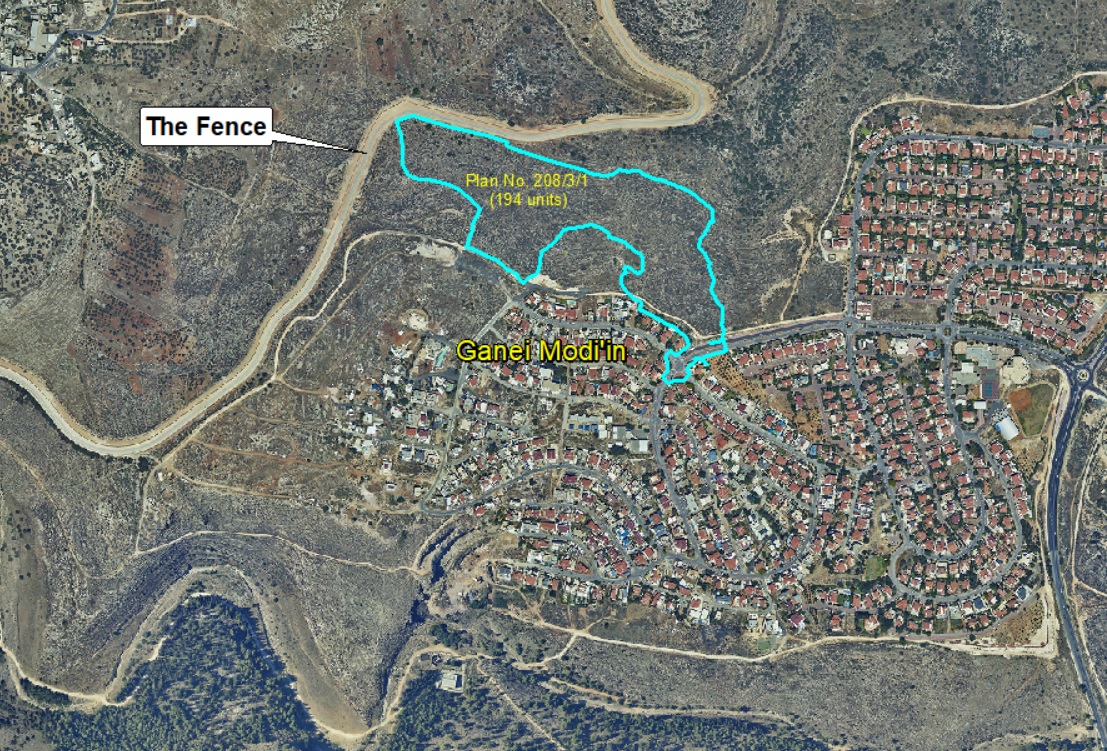
194 units in the Ganei Modlin settlement, located in the northern “seam line zone” in the West Bank but on the Israeli side of the security barrier (by design of the Israeli government). The plan for 194 new units will bring the settlement’s built-up area directly up to the separation barrier, a particularly notable plan given Israel’s recent demolition of 70 Palestinian homes in the West Bank, based on the argument that the construction within a 200-250 foot Israeli-imposed “no construction zone” on either side of the barrier poses an unacceptable security risk to Israel. Israel rejected an offer by Palestinians to privately finance the construction of new and higher wall near the buildings; developers behind the Ganei Modlin project also offered to finance the construction of high wall near the construction, an offer the courts saw fit to accept – resolving the matter in the eyes of the High Planning Council, which approved the plan.
- 96 units in the Kiryat Netafim settlement, located in the northern West Bank and part of a string of settlements and unauthorized outposts – most notably Ariel – extending from the Green Line into the very heart of the West Bank and on towards the Jordan Valley.
- 76 units in the Beit Hagai settlement, located just south of Hebron,
- 66 units in the Efrat settlement, located south of Bethlehem. Efrat had already received final permission for 1,000 new settlement units at the most recent High Planning Council meeting, in April 2019. As a reminder, Efrat is located inside a settlement enclave that cuts deep into the West Bank. Efrat’s location and the route of the barrier wall around it, have literally severed the route of Highway 60 south of Bethlehem, cutting off Bethlehem and Jerusalem from the southern West Bank. The economic, political, and social impacts of the closure of Highway 60 at the Efrat settlement (there is literally a wall built across the highway) have been severe for the Palestinian population.
- 61 units attached to an educational institute in the Gva’ot settlement, located south of Bethlehem. The Gva’ot (Gevaot) settlement was established as an outpost of mobile homes, and later benefited from Israel’s unilateral, mass expropriation of Palestinian land in 2014 (which Israeli officials explictly said was done in response to a Palestinian terror attack). At the time, Peace Now reported that the move constituted the largest single expropriation of Palestinian land by the Israeli state in over 30 years.
- 51 units in Shvut Rachel, which only recently became an authorized settlement area when Israel extended the jurisdiction of the Shiloh settlement to include it as a “neighborhood” (along with three other outposts). The plans approved this week will retroactive legalize existing units and permit the construction of a few news one.
- 29 units in the Otniel settlement, located in the South Hebron Hills area. The plans serve to retroactively legalize existing units.
- 27 units in the Maskiyot settlement, located in the northern Jordan Valley. These units are part of a plan allowing the construction of a “bed and breakfast” with 27 additional rooms (and calling to mind Amnesty International’s recent report on the role tourism plays in supporting the occupation).
- 19 units in the Peduel settlement, located in the northern West Bank and part of a string of settlements and unauthorized outposts – most notably Ariel – extending from the Green Line into the very heart of the West Bank and on towards the Jordan Valley.
- 18 units and a park in the Ma’ale Adumim settlement.
- 11 units in the Einav settlement, located northwest of Nablus.
In addition, the Council gave retroactive approval for a controversial archeological site in the Shiloh settlement, located in the center of the northern West Bank. The Israeli government has devoted a significant amount of money and political energy towards building the tourist site, which is now drawing upwards of 60,000 evangelical tourists each year. For background on the site, see this Emek Shaveh report from 2014 and this brief from 2017, when the government approved the commercialization of the site. For analysis on how the site fits into a bigger pattern of Israeli efforts to normalize the settlements through tourism, see this report by Amnesty International.
Israeli Annexation via Settlement Construction Unleashed, Part 3: Plans Advanced for 1,466 New Settlement Units (With More to Come)
Actions taken August 5-6 by the Israeli Defense Ministry’s High Planning Council include advancing plans that, when they eventually receive final approval, will allow for the construction of 1,466 settlement units (details of the various steps of the planning/approval process are laid out by Peace Now here). Specifically, the Higher Planning Council this week approved the following plans for deposit for public review:
- 382 units in the Beit El settlement, located north of Ramallah. The plans include the retroactive legalization of 36 units; the remaining 346 are new units. As a reminder, Beit El is the settlement closely associated with U.S. Ambassador to Israel David Friedman, who among other things was the President of the “Friends of Beit El” organization, which raised money on its behalf.
- 354 in the Nili settlement, located in the northern West Bank;
- 200 units in the Asfar settlement, located northeast of Hebron. If approved, this plan will triple the size of the Asfar settlement.
- 168 units in the Talmon settlement, located north west of Ramallah. In December 2018, FMEP reported on a deadly encounter between neighboring Palestinians and settlers from Talmon and/or the many unauthorized outposts associated with it. The settlers had been attempting to takeover another hilltop on the outskirts of the Palestinian village of al-Mazra’ah al-Qibliyah. When Palestinians staged an attempt to stop the settlers from entering the area, a scuffle ensued and Israeli soldiers shot and killed two Palestinians.
- 132 units in the Kfar Adumim settlement, located east of Jerusalem and less than one mile from the Khan al-Ahmar bedouin community which the state of Israel is seeking to demolish.
- 84 units in the Shima settlement, located in the southern tip of the West Bank.
- 74 units in the Yakir settlement, located in the northern West Bank and part of a string of settlements and unauthorized outposts – most notably Ariel – extending from the Green Line deep into the West Bank.
- 48 units in the Bracha settlement, located south of Nablus.
- A recreational area in the Kochav Yaakov settlement, located just south of Ramallah.
In addition to the plans approved and advanced detailed above, the High Planning Council delayed consideration of two additional plans, which are:
- A plan that would effectively legalize another outpost, known as Brosh. Similar to the Haroah Haivri plan, discussed above, the plans relating to Brosh serve to retroactively legalize an existing educational institute. Approval of the plan was delayed because the Council had not resolved objections that were filed against the plan, including an objection filed by Peace Now.
A plan for 207 settlement units in the Bracha settlement, located near Nablus (these plans are in addition to the plans for 48 units approved to be deposited for public review, covered above). Though plan was on the Council’s schedule, it could not be approved because the Council first needs to approve the extension of Har Bracha’s existing settlement jurisdiction to include the area units are to be built. Since the plan calls for the construction of units outside of the existing area of jurisdiction, the plan could not be approved.
Israeli Annexation via Settlement Construction Unleashed, Part 4: Reactions
Following this week’s advancement of plans for 2,304 settlement units, settlement watchers and key members and bodies of the international community issued sharp criticism and sounded the annexation alarm bells. In contrast, there was glaring – and very, very, very predictable – silence came from the U.S. administration. A few notable reactions are included below.
Peace Now said in a statement:
“The approval of settlement plans is part of a disastrous government policy designed to prevent the possibility of peace and a two-state solution, and to annex part or all of the West Bank. The linkage of thousands of housing permits for settlers and a negligible number of housing units for Palestinians cannot hide the government’s discrimination policy. As a result, we see for example an approval of the illegal outpost (Haroeh Haivri) built for Israelis adjacent to the Palestinian bedouin village of Khan Al-Ahmar, for which the government refuses to approve any construction permits and instead seeks to transfer. Or we see, the approval of the construction of a new settlement neighborhood adjacent to the separation barrier after demolishing 72 housing units built adjacent to the separation barrier in Wadi Hummus, despite offering to fund security measures.”
The European Union issued a statement which reads:
“The EU expects the Israeli authorities to fully meet their obligations as an occupying power under International Humanitarian Law, and to cease the policy of settlement construction and expansion, of designating land for exclusive Israeli use, and of denying Palestinian development.”
United Nations Special Coordinator for the Middle East Peace Process Nickolay Mladenov said in a statement:
“The expansion of settlements has no legal effect and constitutes a flagrant violation of international law. By advancing the effective annexation of the West Bank, it undermines the chances for establishing a Palestinian state based on relevant UN resolutions, as part of a negotiated two-state solution.”
British Foreign Secretary Dominic Raab urged Israel to stop what he called:
“the effective annexation of the West Bank.”
Leilani Farha, the United Nations Special Rapporteur for the right to housing, and Michael Lynk, the United Nations Special Rapporteur for human rights in the Palestinian territory occupied since 1967, said in a statement:
“These settlement housing units are clearly meant to solidify the Israeli claim of sovereignty over the West Bank. Building civilian settlements in occupied territory is illegal, as is the annexation of territory. The international community has spoken out against the Israeli settlements, but it has not imposed effective consequences for the country’s defiance of international law. Israel’s actions indicate it plans to remain permanently and advance a claim of sovereignty. The Israeli Prime Minister made this clear when he said recently that: ‘No settlement and no settlers will ever be uprooted.’ Should we not take him at his word that Israel has no intention of complying with international law? Criticism without consequences is hollow. The international community has a wide menu of commonly-used countermeasures to push recalcitrant states into compliance with their international duties. If the international community is serious about its support for Palestinian self-determination and its opposition to Israeli settlements then, surely, the time has come for meaningful action.”
Israeli settlers, on the other hand, we filled with glee. Gush Etzion Regional Council Head Shlomo Ne’eman said in a statement:
“Thank God today we received approval from the Higher Planning Council for new housing units in Gush Etzion. Congratulations to all of our residents on the 200 units in Metzad, which is historic in that it will triple the size of the community. Congratulations on the final approvals for the Sadna institution, which works towards integration and is located in Gevaot, and will enable permanent construction of tens of units. Another major breakthrough is the final approval for Ibei Hanachal, which essentially fully legalizes the community and includes the construction of 96 permanent homes. These are major accomplishments for southeastern Gush Etzion, for the Jewish communities in the Judean Desert, and of course for all of Judea and Samaria. This is an opportunity for me to thank Prime Minister Netanyahu on this impressive accomplishment. Let’s hope that the trend of development and construction in Judea and Samaria continues full speed ahead.”
Following Murder of Settler Youth, Netanyahu Doubles Down on Commitment to Settlements
Following the murder of a 19-year old Israeli settler, Prime Minister Netanyahu vowed once again that he will promote settlement construction in all areas of the West Bank. Speaking at a ceremony marking the establishment of a new neighborhood of 650 units in the settlement of Beit El (which just saw plans for 382 new units advance, see above) Bibi said:
“We promised to build hundreds of housing units. Today we are doing it, both because we promised and because our mission is to establish the nation of Israel in our country. We know that the Land of Israel is bought in agony. Today another one of our sons fell. He was from a family that has already made a heavy sacrifice for the Land of Israel. These vicious terrorists: They come to uproot, we come to plant. They come to destroy, we come to build. Our hands will reach out and we will deepen our roots in our homeland – in all parts of it.”
Bibi’s words — which suggest an intention to continue/expand settlement construction across the entirely of the West Bank — did not satisfy many of his challengers on the Israeli right (against whom he is squaring off against in the upcoming election). Ayelet Shaked – who is leading a union of right wing parties – called directly for annexation. She said:
“We have to apply sovereignty to Judea and Samaria. Gush Etzion is in consensus and there is no reason not to apply sovereignty there.”
Knesset Speaker Yuli Edelstein (Likud) said:
“our response to the murder has to be [to] apply sovereignty on the settlements, starting with Gush Etzion.”
And the Sovereignty Movement – is an offshoot of the Women in Green organization, and has been working to formalize its expanding influence over Israeli politicians and public discourse by pushing for the establishment of a Knesset committee devoted to the cause of Israeli annexation of the West Bank – issued a statement saying:
“It is either us or them! This is a 52-year-old struggle that must be resolved. Sovereignty will bring resolution and will erase the hope of pushing us out of here through terror attacks. The resolution must be clear and unambiguous – we have returned to the heritage of our fathers, we will bring another million Jews here, we will build dozens of communities. The Arabs are invited to live under our sovereignty as individuals and enjoy a prosperous life as residents.”
Latin Patriarchate Files Suit Claiming New Proof of Fraud Behind Settler Takeover of Old City Hotel Properties
On August 5th, the Greek Orthodox Patriarchate in Jerusalem filed a request to reopen the underlying case in Jerusalem District Court which awarded the radical settler group Ateret Cohanim the ownership rights to three historic church properties in the Old City of Jerusalem. The Patriarchate’s appeal is based on new evidence of fraud committed by the Jerusalem settler organization Ateret Cohanim – with the aid of church officials – during the sale of the properties. The original Jerusalem District Court ruling acknowledged that there were problems in the transaction, but found that the church failed to prove its allegations of bribery and corruption.
The allegations of fraud rely on the testimony of Ted Bloomfield, a man who managed the Petra Hotel in the 1990s. Bloomfield reportedly told the Greek Patriarchate that Ateret Cohanim paid him to help persuade the Palestinian protected tenants to sell their rights. The lawsuit says these actions are “extraordinary in their severity” and include fraud, forgery of legal documents, and bribery – including alleged attempted sexual bribery. The church’s complaint also alleges that the settler group obstructed justice in deliberately concealing documents during legal proceedings.
Haaaretz recently published a moving video testimony of one Palestinian man, Abu-Walid Dajani, whose family has run the New Imperial Hotel, one of the targeted properties, since 1949. Dajani is now facing eviction.
Education Minister Strips Key Committee Membership from Professor Who Objected to Authorization of Settlement Medical School
The Haaretz Editorial Board penned a sharp criticism of newly appointed (and interim) Israeli Education Minister Rafi Peretz, who recently removed Professor Yossi Shain from the Planning & Budgeting Committee of the Higher Education Council. Shain was one of the members of the key professional committee – which essentially serves as the gatekeeper for schools hoping to join the ranks of accredited Isareli education institutions – who objected to the rushed and politicized process by which, in contravention to the Council’s normal practice, a medical school located in the settlement of Ariel received approval from the Higher Education Council.
The Editorial Board writes:
“The ‘revenge’ taken by Peretz against someone acting according to his professional judgment is a worrisome sign. The message conveyed by the education minister’s bureau is crystal clear: In education and academia, loyalty to the occupation and annexation project has become a decisive criterion.”
Bimkom Report: Israel’s “No Construction Zone” Adjacent to the Separation Barrier Has Little To Do With Security
In a new report, the Israeli NGO Bimkom sheds light on the very problematic regulation that was the legal pretext behind Israel’s recent demolition of 70 Palestinian homes in Wadi Hummos – i.e., the argument that the construction was located too close to Israel’s separation barrier.
Bimkom explains that in 2011, the Israeli military issued a “no construction order” to prevent construction close to the separation barrier, ostensibly on the basis of security considerations. The zone defined by the order ranges from ranges from 30 meters to 700 meters in different areas (on both sides of the barrier). Given that much of the barrier passes through the West Bank (meaning the land on both sides is Palestinian land), the cumulative impact on the Palestinians is significant. According to Bimkon, the total area affected by the no-construction order is approximately 195,000 dunams [48,185 acres/195km2] of land, belonging to 115 Palestinian villages.
While the order also (theoretically) impacts 15,000 dunams of land in areas where there are settlements located close to the barrier, the perimeter of the zone and enforcement against construction within it follows a predictable logic in favor of the settlements.
Bimkom writes:
“Similar to the barrier route, the no-construction order is determined such that its impact on settlement construction is minimal, but its impact on Palestinian villages is enormous. The negative impact of the physical barrier on hundreds of thousands of Palestinians is intensified expanded to hundreds of meters in which Palestinian construction is prevented. The potential for Palestinian development in Area C is already very limited, and the no-construction zone only serves to exacerbate the situation. In summary, it can be seen that the security considerations which are supposedly behind the construction ban are often questionable, and this also applies to Wadi al-Hummus. The obvious conclusion is that the security considerations according to which buildings in Areas A and B were demolished are a smoke-screen for political considerations whose purpose is to reduce the Palestinian population in the seam zone, especially in the Jerusalem region, or even to punish them for unrest in the area, according to army reports. The threat of demolition still hangs over Wadi al-Hummus, as there are a large number of other buildings that have received demolition orders and the court is scheduled to discuss their case in the coming months.”
Also, as detailed above, the inconsistency of Israeli policy when it comes to enforcing the “no-construction zone” was on display this week, as Israel approved the construction of 194 units in the Ganei Modlin settlement, right up to the barrier (discussed above). Whereas Israel rejected an offer by Palestinians in Wadi Hummos to privately finance the construction of new and higher wall near their buildings (and went ahead and demolished them), Israel authorities accepted an offer by developers behind the Ganei Modlin project to finance the construction of high wall near the construction, allowing expansion of a settlement to move ahead.
Ir Amim: Israel’s Crackdown in Issawiya Advances Settlement Project in East Jerusalem
In +972 Mag, Ir Amim researcher Aviv Tartarsky published a superb analysis of the ongoing campaign of daily harassment and intimidation Israeli authorities have unleashed against Palestinians living in the Issawiya neighborhood of East Jerusalem. Tatarsky writes:
“The campaign against Issawiya signals a new stage in Israel’s oppressive policies in East Jerusalem, and is part of the overall change in Israeli policy toward the Palestinians with the backing of the Trump administration. In the past, Israel primarily focused on settlement construction in the eastern part of the city. By building so-called ‘facts on the ground,’ the government intended to make it as difficult as possible to draw a border along the Green Line and create two capitals in Jerusalem. Today that focus has dangerously shifted to breaking apart Palestinian Jerusalem. Israel is pouring hundreds of millions of shekels into projects that will take over large parts of the the Old City and its surrounding neighborhoods, while fragmenting Palestinian territory and jeopardizing the Palestinian population. Neighborhoods such as Silwan, A-Tur and Sheikh Jarrah have seen an intensification of home demolitions and evictions on the one hand, while on the other the municipality has built promenades, heritage centers, and other tourist attractions for the Jewish settlers living inside Palestinian neighborhoods. Meanwhile, Israel is aiming to redraw the city’s municipal borders so as to push 120,000 Palestinians — more than a third of the city’s Palestinian population — out of the city. According to legislation advanced last year by Jerusalem Affairs Minister Ze’ev Elkin, neighborhoods such as Kufr Aqab, Ras Hamis and the Shuafat refugee camp — already separated from the rest of the city by the separation wall — will be drawn out of the municipal boundaries. Issawiya, then, portends what Israel has in store for the remaining Palestinian neighborhoods of Jerusalem: continual violence that has no aim other than oppressing and making life miserable for all who live there.”
Terrestrial Jerusalem In-Depth Report: The Silwan Tunnel Project
Terrestrial Jerusalem produced an essential in-depth report on Israeli and U.S. policy towards Silwan, offering important context and shedding new light on the significance of Ambassador Friedman and Jason Greenblatt’s political stunt alongside Elad in the tunnels underneath the neighborhood.
Danny Seidemann writes in the report’s introduction:
“The event was not merely dramatic. The choreography illuminated at one critical moment and in one critical space two apparently disparate dimensions of the Israel-Palestine conflict, and their current dynamics: the territorial skirmishing and the battle over narrative in Jerusalem. More than anywhere else, the settlement in Silwan embodies the significant changes taking place in the Old City of Jerusalem and its immediate environs. The opening tunnel was, superficially, a minor routine event that disclosed developments that are anything but routine. As such, it requires an in-depth analysis that takes a hard look at the event, its background and its consequences. In our three sectioned report, we will begin by examining the background and significance of the settlement in Silwan. In Part II, we will examine the tunnel, its archeological, historical and ideological significance and the context in which it was excavated. Part III will deal with the nature of the shift in US policy regarding Silwan, its sources and its ramifications.”
Bonus Reads
- “Goodbye withdrawal, hello sovereignty: The triumph of the settlers” (Times of Israel)
- “Peace Cast: Housing Rather than Ideology” (Americans for Peace Now)
- “How Ayelet Shaked, a secular woman, came to dominate the right-wing religious camp in Israel” (JTA)
- “India’s Settler-Colonial Project in Kashmir Takes a Disturbing Turn” (Washington Post)
Welcome to FMEP’s Weekly Settlement Report, covering everything you need to know about Israeli settlement activity this week.
To subscribe to this report, please click here.
August 2, 2019
- Consolidating Annexation of Area C, Part 1: Israel Issues Permits for 715 Palestinian Structures
- Consolidating Annexation of Area C, Part 2: Israel Issues Permits for 6,000 New Settlement Units
- Consolidating Annexation of Area C, Part 3: Big Promises for Efrat, Jordan Valley
- Canadian Judge: Settlements Are Not Israel (All Remaining International Law Supporters: AMEN!)
- Bonus Reads
Questions or comments? Contact Kristin McCarthy at kmccarthy@fmep.org.
Consolidating Annexation of Area C, Part 1: Israel Issues Permits for 715 Palestinian Structures
On July 30th, in an exceedingly rare move, the Israeli Cabinet unanimously approved the issuance of building permits for 715 Palestinian structures in Area C of the West Bank. How rare? Between 2009 and 2016 Israel issued only 66 building permits to Palestinians in Area C (more than offset by demolitions — over the past 2 years alone, Israel has demolished at least 400 Palestinian structures in Area C because they were built without the impossible to obtain Israeli permits).
The approval of even this comparatively small number of permits for Palestinians angered Israeli settlers and their supporters. They expressed outrage at what they characterized as Israeli government “support” for any Palestinian presence in Area C, the 60% of the West Bank settlers have been pressuring the government to unilaterally annex.
Statements made around the approval, however, make clear that the decision to issue the permits for Palestinian construction is not a concession or gift to the Palestinians. One Israeli security cabinet member who voted for the plan, far-right-wing Transportation Minister Bezalel Smotrich (Tkuma), stated in a Facebook post that Israel’s decision to issue the permits actually advances annexation, writing:
“In the last ten years, since the launch of the Fayyad program, the Arab vision of establishing a terrorist state in Area C has been fulfilled in practice. An area under full Israeli security and civil responsibility.
For the first time, the State of Israel will make sure that in Area C, there will only be construction for the Arabs who were original residents of the area since 1994 and not Arabs who came later from Areas A and B.
For the first time, the State of Israel will determine in a clear and unmistakable manner that original inhabitants of the area will be able to build and develop only in places that do not harm the settlement enterprise and security, and do not create territorial contiguity or a de facto Palestinian state. Places that do not serve the national interests of the Arabs, rather the national strategic interests of the State of Israel.
For the first time ever, the State of Israel will implement its sovereignty over the entire territory and take responsibility for what happens inside it. Gone are the days of construction plans pushed by the PA that serve its interests. For the first time, the State of Israel will create a tool basket for real enforcement that will be enacted to neutralize the Palestinian takeover plan.”
As Smotrich made clear, by approving the permits Israel aims to entrench and normalize its complete sovereign control over Area C and the 200k-300k Palestinians who have managed to continue living in that area (again, an area that accounts for 60% of the West Bank land mass), despite the coercive environment Israel has created designed to systematically push out Palestinians.
Peace Now writes:
“The goal of the construction plan is ultimately to serve the settlers, and not out of some sincere concern for the needs of the Palestinian population. The Israeli government is making a significant step toward annexing and applying sovereignty over the territories, and thereby severely damaging the prospect of reaching a political agreement to end this occupation of more than 52 years.”
Notably, an anonymous Israeli official attributed Israel’s approval of the Palestinian permits to American pressure to allow some Palestinan construction in Area C – a theory U.S. Ambassador Friedman denied. However, the theory that there was U.S. involvement in the decision is seemingly backed by two facts: first, U.S. Ambassador David Friedman (extraordinarily) attended the Israeli cabinet meeting at which the permits were approved; and second, the approvals were announced just one day ahead of Jared Kushner’s arrival to Israel. The theory is likewise bolstered by the reality that, as already noted, this issuance of 715 permits for Palestinian structures in Area C is not a generous gift to the Palestinians but rather a move designed to entrench and normalize Israeli control over Area C (60% of the West Bank) – an objective the Trump Administration has clearly embraced.
Consolidating Annexation of Area C, Part 2: Israel Issues Permits for 6,000 New Settlement Units
On July 30th, the Israeli Cabinet unanimously ALSO approved the issuance of permits for 6,000 new settlement units. This massive approval must not be overshadowed by the news of Israel’s rare (and clearly cynical) decision to issue 715 construction permits to the Palestinians (discussed above).
Though details of the settlement plans have not yet been published, if the 6,000 figure is accurate, the cabinet will have in one fell swoop approved around double the number of units Israel has advanced so far this year (which previously stood at 3,691) — bringing the total number of new settlement units approved to a whopping 9,691 – the most in a single year over the past (at least) four years – and the year is only two-thirds over. Assuming (conservatively) a family size of 5, this equals housing for nearly 50k new settlers.
Commenting on the issuance of the permits by Israel and the settlement approvals, Palestinian Prime Minister Mohammed Shtayyeh rejected the current status quo in Area C, in which Israel decides what Palestinians can and cannot do with their own land. He said:
“We do not need permission from the occupying power to build our homes on our lands. Building on land classified as ‘C’ is a right for Palestinians that is not up for exchange with settlements or to treat both as the same. [The Israeli security cabinet’s decision] is aimed at deceiving international public opinion, legitimizing the settlements and attempting to equate Palestinian construction on their lands with the colonial settlement construction that steals the land, the water and the air. The settlements are illegitimate and illegal and will end as they ended in many countries and our right to our land will prevail despite all these decisions.”
Consolidating Annexation of Area C, Part 3: Big Promises for Efrat, Jordan Valley
In addition to the 6,000 units approved this week, during a campaign stop at the Efrat settlement on July 31st, Netanyahu promised to advance plans for 8,250 new housing units in Efrat. Netanyahu also reiterated his (now common) refrain that he will not allow a single settler to be removed, saying:
“No settlement or settler will be uprooted. That is over…What you’re doing here is forever.”
Meanwhile, one of Netanyahu’s biggest rivals in the September elections Benny Gantz (Blue & White) toured the Jordan Valley settlements where he proclaimed that Israeli will never cede control over the border region.
Canadian Judge: Settlements Are Not Israel (All Remaining International Law Supporters: AMEN!)
On July 29th, Candian Judge Anne Maktavish ruled that it is “false, misleading, and deceptive” to label wine from Israeli settlements as “Made in Israel.” The ruling, if effect, rebuffs the international campaign Israel and its defenders are waging to erase any/all distinction that foreign countries make between Israel and Israeli settlements built in the occupied territories, which are illegal under international law.
Naturally, the Candian judge’s ruling upset settlement defenders, who immediately announced their intention to request an appeal.
With this ruling, Canada has aligned itself with a small but significant chorus insisting on a policy which differentiates between Israel and its settlements. In June 2019, a senior advisor to the European Court of Justice issued a strong legal opinion advising the court that under EU rules, labels must make it clear if products originate from Israeli settlements in the occupied territories. Now, the onus is on the EU and its member states to implement the legal opinion.
In response to the Candian judgement this week, PLO Executive Committeewoman Hanan Ashrawi said:
“This is an important first step for Canada and beyond, as this landmark ruling is an affirmation of the supremacy of the law and Canada’s obligation to respect international law, which considers settlements illegal and does not recognize them as part of Israel.”
She also called out the EU, noting:
“It is long overdue for the EU to take the minimal step of properly labeling products originating from Israel’s illegal settlements and to ensure that its partnership agreements do not further enable or favor the continued looting of Palestinian natural resources and the profiteering from the commission is a war crime, as defined in the Rome Statute. Israel’s illegal settlement regime is the embodiment of its colonial agenda in Palestine and its determined efforts to deny the Palestinian people their inalienable rights to self-determination and freedom. The obligation of all states to respect international law and the Palestinian people’s national rights is absolute. Such respect can only be ensured by practical steps that deny Israel and complicit companies the ability to profiteer from the colonial occupation and the flagrant violations of international law. Accountability is the shortest and most assured path to justice”
In the U.S., Israel has benefitted from legislation passed into law by Congress and state governments that directly or indirectly defines “Israel” to include settlements. That legislative onslaught is chronicled and analyzed by FMEP’s Lara Friedman in tables tracking federal and state efforts (with specific focus on the inclusion of settlements).
Bonus Reads
- “What Israel’s Demolition of 70 Palestinian Homes Was Really About” (Haaretz)
- “Digging in the Holy Land: Evangelicals are excavating occupied soil to help their cause, and Israel’s” (The National)
- “Strange Bedfellows: Can Settlers and Leftists Work Together for Peace?” (Partners for a Progressive Israel)
- “With Settlements Strong on Israeli Agenda, Haredi Nationalists Pick Up the Fight for ‘Family Values’” (Haaretz)
- “US Amb: Not Ready to Talk About Palestinian State” (CNN)
- “America Joins Israel’s Campaign to Smear and Silence Palestinians” (Haaretz)
Welcome to FMEP’s Weekly Settlement Report, covering everything you need to know about Israeli settlement activity this week.
To subscribe to this report, please click here.
July 26, 2019
- Annexation By Demolition in East Jerusalem-adjacent area of West Bank
- High Court Rules Settlers Can Stay in Hebron Compound Owned by Palestinians
- Peace Now Report: Return of Rampant Outpost Construction is Ushering in Annexation & “A Permanent Single Undemocratic State”
- Settlement Construction Boom Preys on Vulnerable Palestinian Workers
- Settler Groups: We Want Israeli Annexation, But Not Israeli Law
- Regavim Ups Pressure on Candidates to Promise Annexation of Area C
- Settler-Palestinian “Business Council” Visits Dead Sea
- Bonus Reads
Questions or comments? Contact Kristin McCarthy at kmccarthy@fmep.org.
Annexation By Demolition in East Jerusalem-adjacent area of West Bank
On July 22nd, Israeli forces demolished 13 large apartment buildings (approximately 70 units) in the Wadi al-Hummus neighborhood, leaving the area – located in the West Bank just east of the Israel-declared municipal border of Jerusalem, but on the Israeli side of the separation barrier – looking like a war zone.
 Israel’s decision to demolish the buildings was given the official seal of approval by a Supreme Court decision (much to the comfort and pride of U.S. Ambassador David Friedman). It its arguments, the Court held that the buildings, located mostly in Area A — where the Palestinian Authority is supposed to have full control — posed an unacceptable security risk to the Israeli state because of their close proximity to Israel’s separation barrier.
In so ruling, the Supreme Court set an alarming precedent that puts thousands of additional Palestinian buildings located near the separation barrier at risk of demolition. In addition, the Court provided yet another legal tool in the service of Israel’s ongoing campaign of de facto annexation of Palestinian land.
This case demonstrates yet again, that the Israeli court system affords no meaningful measure of protection or justice for Paelstinians, a fact clearly illustrated in a recent B’Tselem report. B’Tselem said in a statement:
“The Supreme Court ruling, written by Justice Meni Mazuz, fully accepted the State’s framing of the issue as one of purely security matter… Like in many past cases, the judges did not discuss in their ruling the Israeli policy almost completely preventing Palestinian construction in East Jerusalem, with the purpose of forcing a Jewish demographic majority in the city – a policy that forces the residents to build without permits…Instead, the judges ruled that the home demolitions were necessary for security considerations, because construction near the fence ‘can provide hiding for terrorists or illegal aliens’ and enable ‘arms smuggling.’ The judgment also clarifies the extent to which the ‘transfer of powers’ to the Palestinian Authority in areas A and B as part of the interim agreements has no practical meaning – except for the need to promote Israeli propaganda. When it serves its own convenience, Israel relies on that ‘transfer of powers’ to cultivate the illusion that most of the residents of the West Bank do not really live under occupation, and that actually, the occupation is almost over. Whereas when it is not convenient for Israel, like in this case, it sets aside the appearance of ‘self-government,’ raises ‘security arguments,’ and realizes its full control of the entire territory and all of its residents.”
The Israeli NGO “Terrestrial Jerusalem” (led by Danny Seidemann) writes:
“This one case, unfolding in remote areas of the Jerusalem municipal boundary that few Israelis or Palestinians have ever heard of, illuminates the inherent absurdity of the mythical ‘undivided capital of Israel’ and the lack of correlation between the location of a village, the laws that apply to its residents and the authority that governs them. Hence, the residents of Wadi Hummus live on the Jerusalem side of the barrier, but with no rights in Israel, in an area where governance is vested in those with no formal power to govern, where the only “legitimate” use of governmental power is by an occupier whose authorities are based exclusively on military necessity.”
Daniel Sokatch, CEO of the New Israel Fund, writes:
“…we know that Israel’s policy of home demolitions is not just about security. It is an ongoing policy that has been carried out for years that is part of a deliberate planning regime designed to prevent Palestinian demographic growth in East Jerusalem. We know this because our grantees have systematically documented Israel’s policies in East Jerusalem for decades, designed to secure a Jewish majority in the city by diminishing the possibility of Palestinian life and growth…Israel’s demolition of unauthorized Palestinian structures has accelerated massively under President Donald Trump. That makes a lot of sense. Prime Minister Netanyahu and pro-annexationist government know a green light when they see one. Jason Greenblatt, President Trump’s special envoy for negotiations, recently said, that he ‘hasn’t found anything to criticize’ in Netanyahu’s policies.”
High Court Rules Settlers Can Stay in Hebron Compound Owned by Palestinians
On July 21st, a three-judge panel of the Israeli High Court of Justice ruled that Israeli settlers may continue squatting in two disputed Hebron properties while litigation regarding ownership of the property remains ongoing. The property – called the Zaatari Compound after its Palestinian owners, but called “Beit Rachel and “Beit Leah” by the settlers – is located in the heart of downtown Hebron on Shuhada Street, within sight of the Tomb of the Patriarchs/Al-Ibrahimi Mosque. Settlers claim that they purchased the property from the Zaatari family. The Zaatari family rejects that claim. The case remains under consideration in the High Court of Justice.
The new ruling is in response to the Zaatari family’s petition to have the settlers removed from the property, where the settlers have been squatting under the protection of the Israeli military since March 2018, when they broke into the homes. The settlers tried to pull off this stunt once before in 2016 to much less success; that time around, instead of validating the settlers’ theft by allowing them to stay put, a court ordered the Israeli police to evacuate the settlers.
In response to the March 2018 invasion, Peace Now said:
“The settlers’ recent break-in into the Zaatari compound constitutes just the latest in a slew of such unauthorized incidents in Hebron. Their strategy is clear. Since they have failed thus far to obtain the ownership rights legally, instead they must resort to illegal means to establish facts on the ground by squatting, knowing that the right-wing government will be reluctant to attract negative publicity from its base by evicting settlers, and will in turn attempt to delay the eviction or perhaps find a way to legalize the take-over. Fellow Israeli citizens must not give in to this emotional blackmail, and the authorities must evict these squatters without delay.”
Peace Now Report: Return of Rampant Outpost Construction is Ushering in Annexation & “A Permanent Single Undemocratic State”
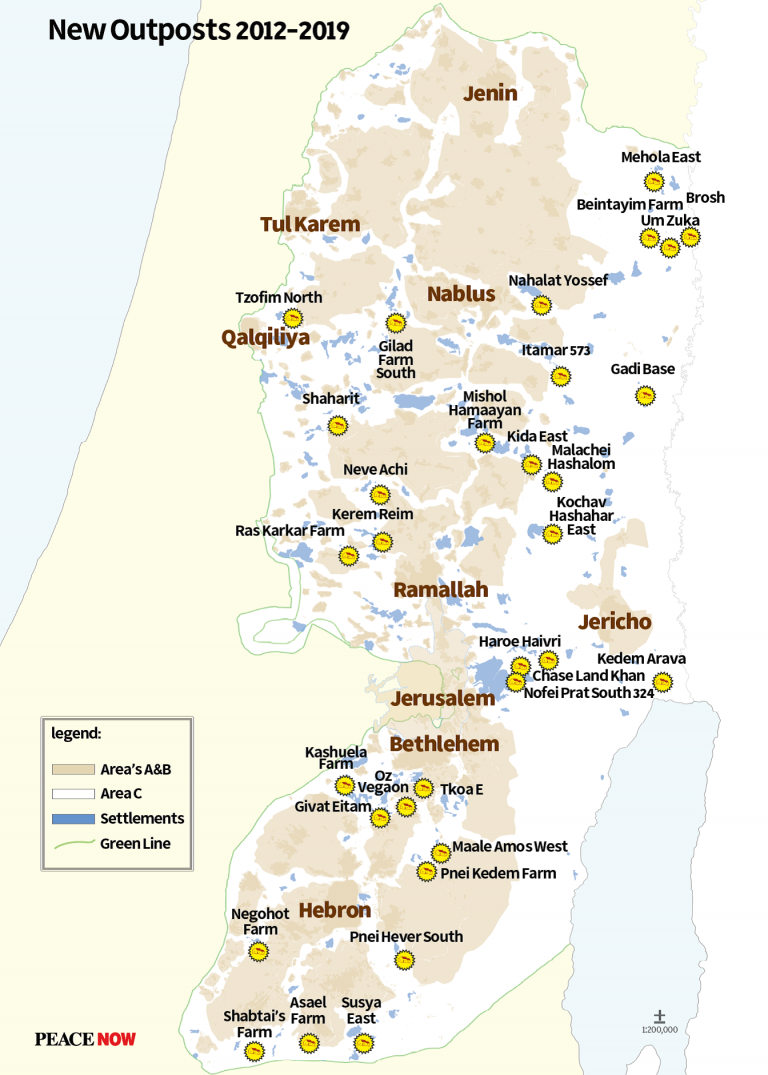 In a new report entitled, “Return of the Outpost Method,” the Israeli settlement watchdog group Peace Now documents the proliferation of new illegal outposts (i.e., new settlement sites established in contravention of Israeli law and regulations; according to international law, ALL settlement activity is illegal) in the West Bank over the past 7 years, with the direct assistance of the Israeli government. The report catalogues 32 new unauthorized outposts established deep in the West Bank since 2012; of those, 18 (56%) were established during the 2.5 years since President Trump took office.
Peace Now said in a statement accompanying the report:
“The Netanyahu government has established dozens of new settlement outposts quietly, without any public debate, in order to take over more territory and prevent the two-state solution. This comes despite talk of regulating the legal status of the more established outposts, in part to create a semblance of law enforcement in the West Bank. When the government and Knesset declare that they will do anything to legalize any unauthorized construction by settlers and even steal private land, settlers see this correctly as an incentive to build more outposts. This outpost method has consequently become a choice tactic in the process of de facto annexation of the West Bank, and it is leading us to a permanent single undemocratic state.”
For many years prior to 2012, settlers did not devote much effort towards establishing new outposts, a decision that bore in mind effective forms of international criticism of outpost construction in addition to the signals sent to the settlers by the Israel government’s decision to evacuate the unauthorized outposts. It was only after March 2011, when Netanyahu’s government declared its intention to legalize as many outposts as possible, that settlers once again set out to build outposts and claim more land in the West Bank. True to its word, the Netanyahu government has undertaken several legal projects aimed at retroactively legalizing these new outposts along with others, a campaign which FMEP has chronicled in detail (see here).
Additional key findings of the new Peace Now report include:
- Since 2012, 32 new outposts have been established, the majority after President Trump was elected. All of the new outposts (except one) are located deep inside the West Bank, in areas that Israel will likely have to evacuate within the framework of any imaginable permanent agreement.
- 21 of the outposts are agricultural farms, which take over large areas for pasturing and cultivation, while their settlers work to remove Palestinian shepherds and farmers from the vicinity.
- Around some of the new outposts there is an increase in violence and attacks against Palestinians.
- The outposts are established in an organized fashion with the involvement of the local settlement authorities, Amana and the Settlement Division of the World Zionist Organization.
- At the same time, the government is working to retroactively legalize existing outposts. To date, 15 outposts have been legalized (“regularized”) as independent settlements or “neighborhoods” in existing settlements. At least 35 additional outposts are undergoing the legalization process.
- One of the outposts established in 2012, Kerem Re’im, has already been legalized, thus becoming an official settlement with nearly 70 families living in dozens of permanent homes.
Settlement Construction Boom Preys on Vulnerable Palestinian Workers
Al-Monitor spoke with several Palestinian construction workers about the risks of participating in the surge of settlement construction that has unfolded in the Trump-Netanyahu era, which has spurred a 39% increase in Israeli spending on infrastructure in the West Bank. The surge has exacerbated an employment “catch-22” facing Palestinians: many Palestinians see no other option but to work in the settlements, but by working in the settlements, they facilitate the expansion and entrenchment of Israeli occupation that ensures there can be no normal Palestinian economic development within which they could find alternate employment.
In addition to that moral/political dilemma that settlement jobs present to an exploited and severely underemployed Palestinian workforce, Al-Monitor columnist Miriam Deprez explains:
“Settlement construction thrives off systemic labor rights abuses of the Palestinian workers by denying proper wages, insurance and basic personal protection equipment, complain the workers and a handful of organizations who try to protect them.”
One Palestinian laborer, Naser Qaswal, worked in a settlement for 25-years before he was forced to leave his job because of injuries he sustained due to the physical demands of the job, yet the settlement employer has not paid Qaswal any form of compensation. According to Qaswal, his cousin lost two fingers in an accident while working at an Israeli settlement, but he did not hold ask his employer for compensation or support in fear that Israel would withdraw his permit to work in Israel. Another laborer, Ahmed, explained how his father fell three stories off a crane while working at a settlement. The accident left him paralyzed from the neck down. The employer paid wages and caregiver fees to Ahmed’s family for the next two years, until his father passed away at the age of 52. The family was left with no income.
The absence of labor safety regulations in the settlements does not only affect Palestinians, as tragically illustrated on July 26th by the death of an Israeli two days after he fell off of a ladder while on the job at a construction site in Neriya settlement. Haaretz reports that the 2019 death toll for settlement laborers stands at 48.
Settler Groups: We Want Israeli Annexation, But Not Israeli Law
For years, settlers have been demanding that the Israel law treat the settlements exactly as part of Israel, with demands for Israeli law to apply and increasingly for outright annexation. Yet, now it seems settlers want to have their cake and eat it too, as illustrated by the Hebron Hills Regional Council – a settlement municipal association – which is fighting against a High Court petition that seeks to extend Israeli laws over settlements in its jurisdiction. Why? Because in this case, Israeli law would limit the Council’s ability to collect association fees from new homebuyers. The petition stems from a request by 26 settlers to who paid exorbitant fees to the association when they moved to the Eshkolot settlement, located in the southern tip of the West Bank but on the Israeli side of the separation barrier.
Haaretz writes:
“…the Hebron Hills Regional Council as well as the Eshkolot community association are arguing before the court that the rule on fees should not apply to [the West Bank]. The Hebron Hills Regional Council’s stand is particularly surprising because like other settler regional councils, it has been insistently calling for Israeli law to be applied in the settlements. Against this, the government is arguing that the rule applies to the settlements because it is a policy of the government’s Custodian for Government and Abandoned Property. What applies inside the Green Line, applies outside it and to Eshkolot.”
Regavim Ups Pressure on Candidates to Promise Annexation of Area
On July 19th, the radical settler group Regavim placed full-page newspaper ads warning: “A Terrorist State – Just Around the Corner.” The group accused the Israeli government of ignoring the alleged “Arab takeover” of Area C, some 60% of the West Bank that the Oslo Accords placed under (temporary) full Israeli control, as an interim stage towards negotiating permanent status of the West Bank and East Jerusalem. Specifically, Regavim accused the government of allowing the Palestinian Authority to build thousands of structures on “state-owned land in strategic locations,” construction which the settlers allege is funded by the European Union with the intention of propping up a “terrorist state” next of Israel. Regavim called on ministers and Knesset members to “take immediate action to prevent a terrorist state in our backyard.”
Settler-Palestinian “Business Council” Visits Dead Sea
On July 9th, leaders of the “Judea and Samaria Chamber of Commerce” took a field trip to the Dead Sea. Ashraf Jabari – one of the few Palestinians who attended the recent U.S.-convened “Peace to Prosperity” shindig and the only Palestinian given a speaking role on-stage at the event (also the only Palestinian to publicly praise the event) – said that the trip was a “direct continuation of the economic workshop in Bahrain,” and mentioned that the group was exploring opportunities to expand cooperation between Israeli and Palestinian business communities.
As FMEP has previously covered, Jabari has been slammed as a traitor by the Palestinian Authority, shunned and dismissed by his fellow Palestinian business people, and disowned by his family in light of his ongoing role with the Judea and Samaria Chamber of Commerce, an initiative Jabari runs alongside Israeli settlers.
Bonus Reads
- “The US Law Restricting Satellite Imagery of Palestine-Israel” (Al-Shabaka)
- “How the Goliath of the Jerusalem settler movement persuaded the world it’s really David” (Mondoweiss)
- “Amnesty International Requests TripAdvisor Employees to Delist Jewish Settlements” (Jerusalem Post)
- “In Bethlehem basement, Palestinian distiller is toasted with global acclaim” (Times of Israel)
- “I’m an Israeli settler. This is why I spoke with J Street’s first ‘alternative Birthright’ group.” (JTA)
Welcome to FMEP’s Weekly Settlement Report, covering everything you need to know about Israeli settlement activity this week.
To subscribe to this report, please click here.
June 28, 2019
- Radical Settler Group Deepens Control Over East Jerusalem Neighborhood & Tourism Network
- Israel Advances Plan for Settlement Enclave in Beit Hanina Neighborhood of East Jerusalem
- Former Mayor of Jerusalem Proposes Plan to Build 12 New Settlement Industrial Zones in Area C
- McDonald’s Wins Bid to Operate in Ben Gurion, Despite Settler Campaign
- Settlers Continue Price Tag Attacks on Palestinian Villages, Still No Arrests
- The Bahrain Workshop [Shhh… Don’t mention Settlements!]
- Bolton Tours Jordan Valley & Hints at U.S. Support for Permanent Israeli Control
- Bonus Reads
Questions or comments? Contact Kristin McCarthy at kmccarthy@fmep.org.
Radical Settler Group Deepens Control Over East Jerusalem Neighborhood & Tourism Network
Approximately two months ago, the radical settler organization Elad opened a new cultural center and cafe in the Palestinian neighborhood of Abu Tor (Abu Tor is a mixed but segregated neighborhood). Named “House in the Valley,” Elad’s new cafe is uncoincidentally located adjacent to the site of a planned new pedestrian footbridge designed to expand Elad’s tourist infrastructure across the area. Specifically, that new footbridge will connect Abu Tor with Elad-run tourist sites and settler homes in the Palestinian Silwan neighborhood – located just outside the Old City’s Dung Gate, in the shadow of the Temple Mount/Haram Al-Sharif.
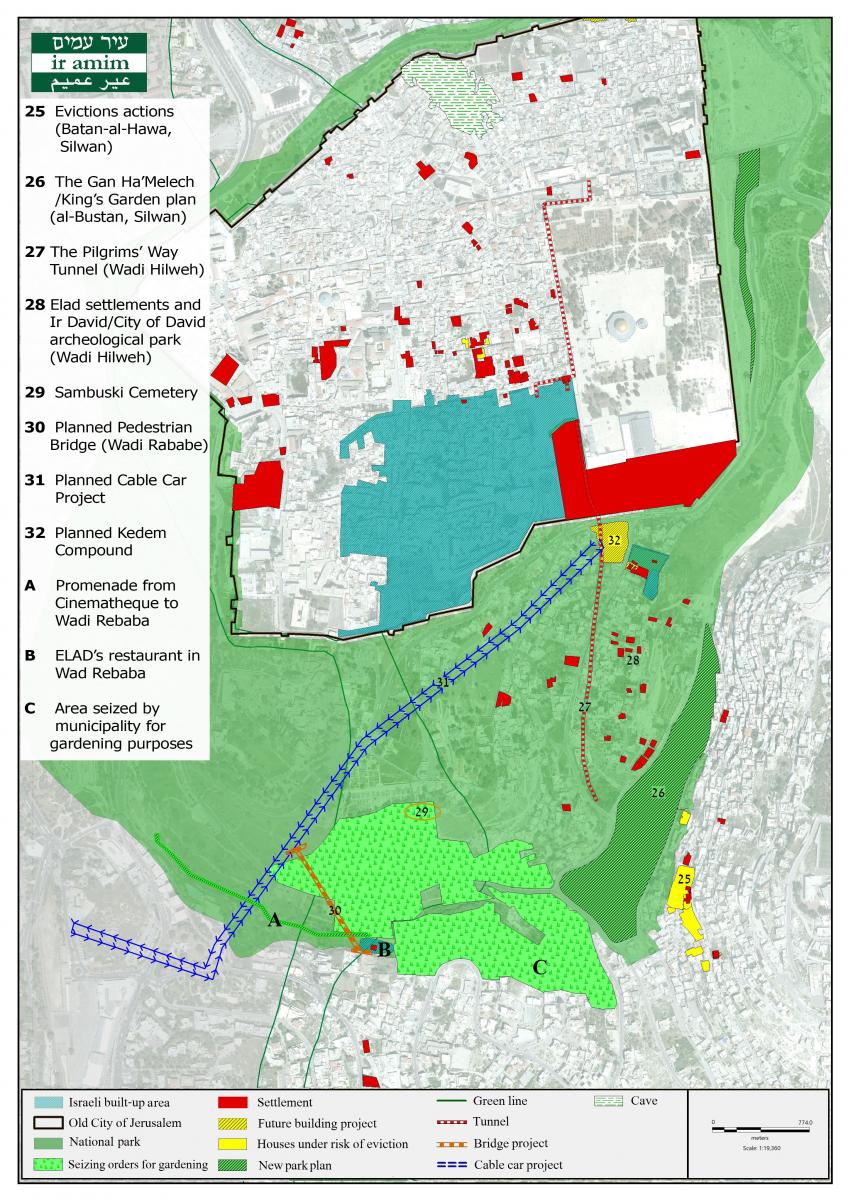
A week after Elad’s new cultural center was opened in April 2019, the Jerusalem Municipality issued “gardening orders” to take control, for a period lasting 5 years (with the likelihood of extensions after that), of 12 nearby plots of privately owned Palestinian land. “Gardening orders” allow Israel to “temporarily” take over privately owned land for what are public purposes (like establishing a parking lot or public garden), based on the argument that the owners are not presently using the land.The government notices posted on the land, say that the Jerusalem Municipality intends to transform the plots with new landscaping, adding new terraces, and a new walking path. Importantly, as Emek Shaveh notes, the 12 plots in question are located in an area declared by Israel to be a national park, meaning that private landowners are legally barred from using their own land.
In short, this is an Orwellian situation wherein Israel has actively blocked Palestinains from using their own land, and is now using the fact that the Palestinians aren’t using their land as a pretext for seizing it. Adding insult to injury, the land is being taken ostensibly for public purposes – but the public the seizures are designed is Elad and its supporters, not the Palestinian residents of the area.
Ir Amim explains key context:
“Portrayed as a seemingly innocuous new establishment for arts and culture designed to serve the Israeli public, Elad’s ‘House in the Valley’ serves as an entry point into the settlement ring around the Old City. The new promenade, constructed by the municipality to aid and abet Elad’s efforts by connecting its center with the Jerusalem Cinemateque, not only enables access from West Jerusalem to an Elad-managed site beyond the Green Line, but it propagates the idea of a contiguous Israeli space, while blurring its Palestinian surroundings and diffusing the political agenda behind these efforts. Moreover, the confiscation of privately-owned Palestinian land for purported purposes of beautification is intended to serve the Israeli public projected to visit Elad’s new complex and likely lead to additional settler activities in the area.”
Emek Shaveh says:
“In effect, the gardening orders and the tourism development of the area are part of an attempt by the Elad Foundation, with the assistance of the Jerusalem Municipality, to gain a foothold in Abu Tor as well and to increase the Israeli presence in the Palestinian part of the neighborhood. A pedestrian bridge that will lead to the café from Mount Zion (see map) is also part of this effort. A budget of 1.8 million shekels for the construction of this bridge was approved two months ago by the Jerusalem Municipality.”
As a reminder, Elad – along with its fellow travelers at Ateret Cohanim – has undertaken a politically- and ideologically-motivated project to hide, marginalize, and erase the presence and history of East Jerusalem’s Palestinian population. It has done so in large part by developing and controlling tourist attractions and infrastructure in the area. Elad’s activities in this regard have been funded, politically and bureaucratically enabled, and encouraged by successive Israeli governments. One of Elad’s most spectacular projects is the planned Jerusalem cable car line – which, despite objections from transportation and planning professionals, was recently advanced through another phase of the planning process. That project, like Elad’s other tourism schemes, is designed to further entrench settler activities and tourism sites inside Silwan, while simultaneously delegitimizing, dispossessing, and erasing the Palestinian presence there. As a spokesman for Elad once proudly declared, “Our aim is Judaize East Jerusalem”).
Israel Advances Plan for Settlement Enclave in Beit Hanina Neighborhood of East Jerusalem
Map by Haaretz
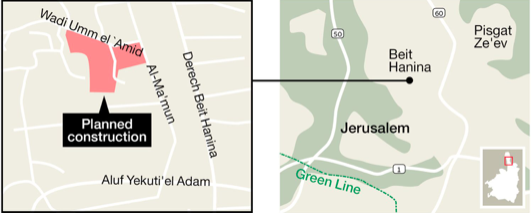
On June 27th, a plan for 150 new settlement units in the Beit Hanina neighborhood of East Jerusalem was deposited for public review, a move which sets off a 60-day period for the public to submit objections to the plan. The Beit Hanina settlement plan – as FMEP has previously reported – is backed and promoted by settlement impresario Aryeh King, and it provides for the construction of 150 new units in the southern end of the Beit Hanina neighborhood. If built, it will be the first-ever authorized settlement project in Beit Hanina, located north of the Old City.
Ir Amim explains essential context:
“If approved, the plan will enable an ideologically driven settler outpost in the heart of Beit Hanina, a neighborhood located on the northern perimeter of East Jerusalem that has remained relatively untouched by Israeli settlement within its limits. Since the land in question is not far from Ramat Shlomo to the south-west and Pisgat Zeev to the north-east of it, its construction may mark the beginning of a far sweeping move to create contiguity between the two settlements, while driving a wedge between Bet Hanina and Shuafat.”
According to the plan, 75 units units would theoretically be earmarked for Palestinians – a point used by the plan’s supporters to suggest that it is actually benevolent. The key word here, however, is: theoretically. As noted by Jerusalem expert Danny Seidemann in another context:
“Since 1967, the Government of Israel has directly engaged in the construction of 55,000 units for Israelis in East Jerusalem; in contrast, fewer than 600 units have been built for Palestinians in East Jerusalem, the last of which were built 40 years ago.”
Former Mayor of Jerusalem Proposes Plan to Build 12 New Settlement Industrial Zones in Area C
Former Mayor of Jerusalem Nir Barkat joined Professor Michael Porter of Harvard University to write what a proposal calling for the establishment of 12 new settlement industrial zones in the West Bank, which Barkat argues will complement the recently unveiled U.S. economic “plan” in jump-starting the Palestinian economy. Like the U.S. plan, Barkat and Porter’s scheme seeks to entrench permanent Israel control and annexation of the land, people, resources, and economy of the West Bank. Barkat made as much clear in an interview with Israel Hayom when he said:
“The plan’s working assumption is avoiding the eviction of Jewish or Arab residents from their homes. Our goal is to take advantage of the relative advantage every society has. The Israeli side can bring the innovation, the capital and managerial knowledge for the benefit of the Palestinian side, which through working in these industrial areas could significantly increase its income. This is a plan that is also good for the settlements, and all the settlement heads have welcomed it.”
Barkat and Porter’s plan – which they say can employ over 200,000 Palestinians and double their average salary – is based on the demonstrably false notion that industrial zones benefit the Palestinian work force and economy. In fact, as Who Profits recently explained:
“Israeli IZs constitute a foundational pillar of the economy of the occupation. They contribute to the economic development of the settlements, which are in violation of international law and the Fourth Geneva Convention, while relying on the de-development of the Palestinian economy and the exploitation of Palestinian land and labor…The IZs in the oPt form part of a practice of ‘financial annexation’ which is an essential component of the broader policy of annexation taking place.”
The report on Barkat and Porter’s plan does not include many specific details as to the locations of the 12 proposed industrial zones, but it hints at several projects that are already known to the public, like the “super settlement” and industrial zone planned to unite four settlements in the northern West Bank, and the industrial zone in the South Hebron Hills near the Tene-Omarin settlement – the latter of which was briefed to the U.S. administration by the Israeli government in September 2018. It is also worth recalling that in January 2019, the Israel government advanced plans for two new industrial zones, one near the Beitar Illit settlement and another near the Avnei Hafez settlement.
Barkat and Porter also call for investments in the West Bank tourism industry, specifically Biblical sites like the Ibrahimi Mosque/Tomb of the Patriarchs (in Hebron) and Solomon’s Pools (located just south of Bethlehem).
According to the report, Barkat and Porter presented this plan to Israeli Prime Minister Netanayhu and U.S. peace envoys Jared Kushner and Jason Greenblatt, all of whom – according to Barkat – welcomed it. Barkat believes his plan enhances the U.S. menu of investments and proposals outlined in Kushner’s “Peace to Prosperity” presentation. Further, Barkat argues that his plan is more feasible than the U.S. program because it only envisions projects in Area C, the 60% of the West Bank over which Israel maintains full control, while (he argued) the U.S. plans focus on Areas A & B. In fact, nothing in the text of the Kushner plan specifies any territorial locations, boundaries, or divisions for the proposed projects.
McDonald’s Wins Bid to Operate in Ben Gurion, Despite Settler Campaign
On June 23rd, the McDonald’s franchise owner in Israel was awarded a government contract to operate one of the few food stands at Ben Gurion International Airport. His bid of 17 million shekels ($4.7 million) was vastly higher than other competing bids, winning him the right to operate a McDonald’s branch in the airport for seven years, with an optional 2-year extension.
Ahead of the government’s decision, settlers led a campaign to disqualify Omri Padan – the Israeli man who holds the only McDonald’d Israel franchise license – from bidding on the contract, based on Padan’s failure to open any McDonald’s branch in an Israeli settlement. The settlers claimed that Padan’s failure to do so violates Israel’s Anti-Boycott Law and therefore disqualifies him from receiving public contracts.
Settlers Continue Price Tag Attacks on Palestinian Villages, Still No Arrests
Settlers are believed to be behind three separate attacks on Palestinian property this week, including a rash of hate crimes that damaged Palestinian cars, homes, and religious buildings, and served to intimidate Palestinians living near Israeli settlements.
On June 24th, Palestinians in the village of Sinjil woke up to discover 12 cars with tires slashed and hate messages sprayed painted in Hebrew on several buildings. This is the fifth hate crime connected to settlers in the month of June. Some of the graffiti read “a village of terrorists” and “We give them jobs and they rape.” The latter is a reference to the horrific alleged rape of a 7-year old girl in a settlement; a Palestinian man was immediately charged with the crime and subjected to the equivalent of a national political and media lynching; this week, after 55-days of imprisonment, he was released due to lack of evidence.
On June 26th, vehicles were vandalized and hate messages were spray painted on walls in the Palestinian town of Sarta, which is located west of the Ariel settlement in the northern West Bank. Some of the graffiti read, “non-Jews = enemies,” and the Star of David appeared many times. This is the first time that Sarta has been targeted in a price tag attack.
Yesh Din – an Israeli NGO that tracks and demands justice for settler violence – said in a Facebook post:
“The violent action tonight joins a series of riots that we document in the West Bank against Palestinians and their property. A reality in which families wake up for a day’s work and are forced to discover that while they are sleeping, unknown gentlemen in an area where their children play with the neighbors’ children has become routine. Over the past month we have reported such riots in various areas of the West Bank: Sinjil, Kafr Malik, Einabus, Asira al Qibliya, Burin from Madame, and more. The one who is supposed to prevent the disturbance, and to stop the unknown people who terrorize the Palestinian villages are the policemen of the SJ District, who only this week presented their amateurish work at best, and failed in their worst case. These interrogators and police officers have a responsibility for the personal security of the Palestinians and they do not fulfill their duties. Thus, they create a reality of terror in which there is no safe place for the Palestinian population, and a sense of security does not exist even in the most private space.”
The Bahrain Workshop [Shhh… Don’t mention Settlements!]
The U.S.-hosted “Peace to Prosperity” economic workshop took place in Manama, Bahrain from June 25-26. The widely-ridiculed event focused on a 95-page project prospectus published by the White House in the two days ahead of the workshop. Without giving any real details, the plan talked about enhancing Palestinian property rights — a notion that begs a myriad of questions given that Palestinain private property rights today are undermined first and foremost by Israel, which in 1967 closed the land registry, and which since 1967 has exploited every available mechanism to seize Palestinian private land, and where such mechanisms could not be found, it created them (like the Regulation Law). Notably, the Trump Administration plan treats Palestinian land registration strictly as a means to foster a better investment climate in the West Bank and Gaza (as opposed to a pillar of rule of law that upholds fundamental rights of individuals).
In this regard, the Director of Human Rights Watch Israel, wrote:
“The plan speaks of the importance of private property rights without mentioning the Israeli authorities’ methodical theft of thousands of hectares of privately owned Palestinian land in the West Bank to build settlements, which are illegal under international humanitarian law, or their illegal.”
Mocking the workshop’s very strange approach to Palestinian property rights, The Economist journalist Gregg Carlstrom – who live-tweeted his disbelief of the entire conference – noted sarcastically on June 26th:
“We kickoff the afternoon’s fun with Kevin Hassett, the ‘Dow 36,000’ guy, talking about property rights. In Palestine, ‘You can radically transform economies when you improve their ability to document property rights!’”
Another notable storyline from Manama: Palestinian businessman Ashraf Jabari was the only Palestinian to be on-stage at the event. As FMEP has previously covered, Jabari has been slammed as a traitor by the Palestinian Authority, shunned and dismissed by his fellow Palestinian business people, and disowned by his family in light of his ongoing role with the Judea and Samaria Chamber of Commerce, an initiative Jabari runs alongside Israeli settlers.
In Manama, Jabari spoke about developing thriving businesses in the West Bank. The Washington Post notes that Jabari was the only speaker to discuss political matters on the stage. The Post writes:
“When asked by British broadcast journalist Nik Gowing…whether the plan could benefit him, Jabari replied that it could — if Palestinians had a state.”
Jabari might have been telling the truth, but he apparently failed to mention the fact that he, alongside Israeli settler Avi Zimmerman, have proposed the launch of a “bond bank” to become the financing vehicle for the Trump Administration’s plan. The bond bank would aggregate projects and issue debt to fund them, allowing for lower borrowing costs. According to the White House presentation, the U.S. envisions a funding mechanism it calls, “The Peace to Prosperity Master Fund” which will manage the money and projects.
Bolton Tours Jordan Valley & Hints at U.S. Support for Permanent Israeli Control
On June 24th, U.S. National Security Advisor John Bolton toured the Jordan Valley, Jerusalem, and the separation barrier, accompanied by Israeli Prime Minister Netanyahu, U.S. Ambassador David Friedman, and Israeli Ambassador to the U.S. Ron Dermer. At a stop overlooking the Jordan Valley, Netanyahu explained to Bolton:
“For those who say that for peace to be established Israel has to leave the Jordan Valley, I’ll say that’s not going to bring peace, that’s going to bring war and terror. We’ve been there and we don’t want to be there again. Under any peace agreement, our position will be that Israel’s presence should continue here for Israel’s security and for the security of all.”
Following the tour, Bolton did not disappoint Netanyahu, tweeting:
“Today I visited the Jordan Valley and Jordan River with PM @netanyahu, Israeli NSA Meir Ben-Shabbat, @USAmbIsrael, & @AmbDermer. I saw firsthand the strategic importance that these locations have on Israel’s national security. In similar acknowledgement of the simple but profound reality that for Israel to defend itself, it cannot relinquish strategic ground along its border, the President in March, signed a proclamation recognizing Israeli sovereignty over the Golan Heights.America welcomes the opportunity to strengthen the already deep cooperation between the U.S. and Israel and build on our lasting partnership, demonstrated repeatedly when courage and persistence are required.”
Some 11,000 settlers and 65,000 Palestinians live in the Jordan Valley – the latter facing severe restrictions on land use and freedom of movement, and lack of access to municipal services like water and electricity. Israeli government officials have publicly and repeatedly demanded complete Israeli sovereignty over the Jordan Valley – which makes up 30% of the West Bank – in the context of any peace agreement, meaning that any future Palestinian state would be entirely encircled by Israel, having no international border with any other nation. Likud MK Sharren Haskel has led several Knesset efforts to formally annex the entire Jordan Valley, and recently re-submitted a bill to that affect in May 2019.
Bonus Reads
- “The Day After: What Happens If Israel Annexes the West Bank?” (Mint Press News)
Welcome to FMEP’s Weekly Settlement Report, covering everything you need to know about Israeli settlement activity this week.
To subscribe to this report, please click here.
June 21, 2019
- Court Awards Radical Settler Group Rights to Another Palestinian Home in Silwan, Evictions to Follow
- At Settler’s Urging, Silwan Streets To Be Named After Rabbis
- Who Profits Issues Critical Report on Industrial Zones in the West Bank, Slamming “Peace” Schemes Promoting Them
- B’Tselem Publishes New Resource on Israel’s Planned Mass Eviction of Palestinians from Wadi Yasul
- Greenblatt Supports Annexation, But Prefers Israel Hold Off Until U.S. “Peace Plan” is Presented
- Bonus Reads
Questions or comments? Contact Kristin McCarthy at kmccarthy@fmep.org.
Court Awards Radical Settler Group Rights to Another Palestinian Home in Silwan, Evictions to Follow
On June 18th, the Jerusalem District Court ruled that the radical Elad settler organization is the legal owner of an apartment and adjacent storefront in the Silwan neighborhood of East Jerusalem long inhabited by members of the Palestinian Siyam family. With the ruling, Elad can evict members of the Siyam family from the apartment and store – increasing settler control over the building where other members of the Siyam family will still live. The court also ordered the Siyam family to pay 10,000 NIS (~$2,700 USD) in court costs.
Elad has waged an eviction campaign against the Siyam family for over 30 years, bringing six different legal cases asserting the organization’s ownership of the building. Making the ruling sting even more for the entire Silwan community, Jawad Siyam – who will be one of the only remaining Palestinian apartment owners living in the building after the ruling this week – is a prominent community activist in Silwan fighting against settlement activities in the neighborhood.
The legal saga – detailed here by Peace Now – shows just how determined Elad has been to gain ownership of the building at the expense of its longtime Palestinian tenants. Elad used seemingly every legal mechanism available, hoping that one would do the trick. Fortunately for Elad, the Israeli Custodian of Absentee Property General (which conspired with Elad to legally sell the rights to ¼ of the building) and Israeli court system (which allowed Elad to exploit Israeli law and set new precedents at the expense of Palestinian residents of Jerusalem) were willing to help the settler organization achieve its goal.
Following an earlier ruling against the Siyam family regarding this same case, Peace Now succinctly explained:
“This case is an example of how the settlers manage to take control of Palestinian property in East Jerusalem by combining manipulations, money, forgery and significant aid from the Israeli authorities. It is not a regular case between equal sides, but a story of David and Goliath, and the settlers are the Goliath. There is a settlers organization with almost unlimited financial resources and enormous political power against an ordinary Palestinian family that has been forced into court for more than 20 years, to invest tremendous resources in legal defense and to deal with various and varied purchase claims. This way the settlers are causing great damage to Israel when they harm the delicate fabric of life in Jerusalem and the possibility of compromise in Jerusalem and a two-state solution.“
As FMEP chronicles on a near weekly basis, Silwan is one of the most intense areas of settlement activity in East Jerusalem. Its location – literally in the shadow of the Temple Mount/Haram al-Sharif – and historic significance make the neighborhood the focus of intense efforts by radical groups like Elad and Ateret Cohanim to displace Palestinians and replace them with Israeli Jews.
In addition to the threat of mass eviction of Palestinians in Silwan, Elad and Ateret Cohanim are also working hand in hand with the many branches of the Israeli government to build tourist attractions and infrastructure designed to hide, marginalize, and over-write the presence and history of the area’s Palestinians. In particular, the Elad-linked cable car project – which was recently advanced through another phase of the planning process despite professional objections – is intended to further entrench settler activities and tourism sites inside Silwan, while simultaneously delegitimizing, dispossessing, and erasing the Palestinian presence there.
At Settler’s Urging, Silwan Streets To Be Named After Rabbis
In a powerful statement of contempt for Palestinians residents of the Silwan neighborhood of East Jerusalem, and an equally powerful statement of support for the activities and agenda of hardline settlers groups targeting of Silwan, the naming committee of the Jerusalem Municipality voted to name five streets in the Silwan neighborhood of East Jerusalem after deceased Jewish rabbis. Notably, the population of Silwan remains overwhelmingly Palestinian, despite a decades-long, energetic effort by extremist Jewish groups, with Israeli government support, to increase the number of Israeli settlers living in their midst – an effort that is proceeding with greater energy and government backing today than perhaps at any time since 1967.
The renaming of the streets was opposed by a professional advisory panel, which warned that the move will increase tensions; that it will be essentially futile, because the names will not be used by the local population; and that, most basically, “it is inappropriate to give Jewish street names in neighborhoods overwhelmingly populated by Arabs.”
Jerusalem Mayor Moshe Leon heads the committee that decided in favor of renaming the streets, an initiative led by the radical settler group Ateret Cohanim. Settlers requested the move in recognition of a small Jewish-Yemenite community that lived in Silwan 80 years ago.
Who Profits Issues Critical Report on Industrial Zones in the West Bank, Slamming “Peace” Schemes Promoting Them
In a new report, the anti-occupation Israeli NGO Who Profits examines the illegality of 91 industrial zones that Israel has built in the occupied territories, and also names international corporations operating in them, in contravention of international law.
Summing how the issue relates to current politically driven “peace” proposals, Who Profit writes:
“Industrial Zones are held up by corporations and Israeli politicians as being part of the framework of ‘economic peace’. It is argued that they provide employment opportunities for Palestinians and form spaces of interaction and coexistence between Palestinian and Israeli workers. Shraga Brosh, the head of the Manufacturers Association of Israel, noted that the employment of Palestinian workers ‘aids security in the region and advances economic peace’. This claim was rejected outright by the United Nations Office of the High Commissioner for Human Rights in a 2018 report and by some 82% of Palestinian workers who stated that they would leave their jobs in the settlements, if there were another choice.”
B’Tselem Publishes New Resource on Israel’s Planned Mass Eviction of Palestinians from Wadi Yasul
In a new brief, B’Tselem provides essential context for Israel’s imminent eviction of Palestinians living in the East Jerusalem neighborhood of Wadi Yasul, where every single home has a standing demolition order issued against it. The publication also includes interviews with several of the Palestinians whose homes in Wadi Yasul have already been demolished.
B’Tselem writes:
“Ever since 1967, planning policy in Jerusalem has been geared toward establishing and maintaining a Jewish demographic majority in the city. Under this policy, it is nearly impossible to obtain a building permit in Palestinian neighborhoods. The outline plans the city has prepared for these neighborhoods are largely aimed at restricting and limiting building opportunities in Palestinian neighborhoods. One way the plans do so is by designating vast areas as open green spaces, thereby barring Palestinians from building there. The resulting housing shortage forces Palestinian residents to build without permits. At the turn of the millennium, the city estimated that about 20,000 housing units had been built without a permit in East Jerusalem. This estimate was made before the Separation Barrier cut off Kafr Aqab and Shu’fat Refugee Camp from the city. Since that time, many high-rises have been built in those areas.”
Greenblatt Supports Annexation, But Prefers Israel Hold Off Until U.S. “Peace Plan” is Presented
In an interview is an Israeli news outlet, U.S. Envoy Jason Greenblatt said he would prefer that Israel delay annexation of the West Bank until after the U.S. presents the long-anticipated “Deal of the Century.” The interview was one in a series of media hits for Greeblatt ahead of the U.S.-conceived economic conference in Bahrain; at an event with New York Times columnist Bret Stephens and American provocateur Rabbi Shmuley Boteach, Greenblatt reiterated his belief that settlements are not an obstacle to peace.
Unsurprisingly, Israeli political figures continue to call for Israel to take advantage of Trump’s tenure in office to annex West Bank territory. At the Jerusalem Post’s recent conference in New York City, Israeli Deputy Minister of Foreign Affairs Tzipi Hotovely told the audience that it is time for Israel to apply sovereignty over all of Area C. Hotovely made the case:
“Using the term annex is not true. You annex something that is not yours. This is not a story of annexation. This is a story of realization. Many ask what’s next, what’s going to happen, what’s going to change [after the annexation of Area C]. For 52 years, we were feeding this myth of occupation. It’s a myth. It’s not true.”
Former Israeli Justice Minister Ayelet Shaked also spoke at the Jerusalem Post conference, also urging Israel to annex Area C while Trump is in office. Following her speech, Shaked tweeted:
“There is no better time than now. Do not miss Trump’s reign – that’s what I just said at the Jerusalem Post in New York.”
Back in Israel, senior Likud figure Gidon Saar tweeted:
“Recent statements by senior US officials indicate that there’s an extraordinary window of opportunity to apply Israeli law to our settlements in Judea, Samaria, and the Jordan Rift. We’ll do everything not to squander [the opportunity].”
Bonus Reads
- “First They’ll Take Area C, Then They’ll Take the West Bank” (Haaretz)
- “Annexing East Jerusalem, First Step Before Annexing the West Bank?” (Al-Monitor)
- “West Bank is a long-established goal” (The National)
Welcome to FMEP’s Weekly Settlement Report, covering everything you need to know about Israeli settlement activity this week.
To subscribe to this report, please click here.
June 14, 2019
- Court Rules in Favor of Israeli Settler Group, Against Greek Orthodox Church, un Battle Over 3 Claiming Old City Properties
- Israel Gave German Construction Giant More Palestinian Land for Quarrying
- Settlers Retaliate Against Palestinians for Israel’s (Rare) Demolition of Outpost Buildings
- IDF Cuts Budget for Civilian Security Guards in Settlements
- New International Crisis Group Report on Israel’s Ongoing Annexation of East Jerusalem
- Shadowy Group Wants to Go After All Companies Not Currently Operating in the Settlements – Starting with McDonald’s
- European Court of Justice Issues Opinion Upholding EU Differentiation Policy
- Anger [& Joy] at U.S. Ambassador Reiterating Support for Israeli Annexation of West Bank Land
- Bonus Reads
Questions or comments? Contact Kristin McCarthy at kmccarthy@fmep.org.
Court Rules in Favor of Israeli Settler Group, Against Greek Orthodox Church, un Battle Over 3 Claiming Old City Properties
Ending a nearly 16-year legal battle, on June 11th the Israeli Supreme Court ruled that the settler group Ateret Cohanim has legal rights to three prized properties in strategic locations in the Old City of Jerusalem, including two famous hotels currently operated by Palestinians. Until now, the properties were owned by the Greek Orthodox Church, which had been fighting to invalidate the transactions at the root of the settlers’ claim to them.
As a reminder, Ateret Cohanim is a radical settler organization working to increase the presence of Israeli Jews living inside Palestinian neighborhoods of Jerusalem – including in the Old City. Ateret Cohanim, along with its compatriots in the Elad settler group, is also leading efforts to take over land and evict Palestinians from their homes in the Silwan neighborhood.
The properties awarded to Ateret Cohanim by the Israeli High Court are:
-
The Petra Hotel, a four-story building near the Jaffa Gate, one of the key entrances to the Old City. Under the ruling, Ateret Cohanim has a valid 99-year lease with an option for an additional 99 years afterwards. The price Ateret Cohanim paid in the transaction the Church said was improper? A meager $500,000, far below market value.
-
The Imperial Hotel, located directly across the street from the Petra Hotel – meaning that a radical Israeli settler group now controls a substantial amount of land at a key entrance to the Old City (the Jaffa Gate). The Imperial Hotel is a two-story building. Ateret Cohanim’s lease for the Imperial Hotel is also for 99-years with an option for 99 more. The price paid in, again, a transaction the Church argued was improper and invalid? $1.25 million – far higher than the price paid for the Petra Hotel but still well below the fair market value of the property.
-
Beit Amziya, a building in the Bab a-Kuta neighborhood of the Muslim Quarter of the Old City. Ateret Cohanim paid $55,000 for this property, again, far below fair market value.
The legal battle over the properties dates back to 2004, when the Greek Orthodox Patriarchate agreed to sell the three properties to a foreign real estate company under three separate contracts. It did so not knowing that the radical settler group Ateret Cohanim was behind the transaction. News of the sales made headlines in early 2005.
Upon the revelation that Ateret Cohanim was the real buyer, the Greek Orthodox Patriarchate was deeply embarrassed and immediately sought to retain control of the properties. The Patriarchate alleged that the transactions involved corruption and bribery, arguing that the legal documents had been signed without permission by a finance employee. Dismissing the church’s arguments, this week the Supreme Court upheld prior rulings that the signatures on the lease documents were valid, with the finance employee acting as a legal proxy of the Patriarchate.
The Greek Orthodox Church has received significant blowback from the sale of these properties. In January 2018, Palestinians protested in Bethlehem in an attempt to block the arrival of Patriarch Theophilos III for Christmas celebrations.
In response to the Supreme Court’s ruling, multi-denominational Christian leaders in Jerusalem issued a rare joint statement criticizing the Court’s action. The statement says:
“The actions of this radical group do not only mean an assault on the property rights of the Greek Orthodox Church, but an assault on the status quo protections for all Christians in this holy city of Jerusalem and deeply threatens the Christian presence in our beloved Holy Land. An attempt to undermine the presence of one church here undermines all the churches and the wider Christian community around the world. We reaffirm our belief that a vibrant Christian community is an essential element in the preservation of Jerusalem’s historically diverse society and a prerequisite for peace in this city; Jerusalem must maintain its multicultural and multi-religious mosaic character, being home to the three monotheistic religions.”
Israel Gave German Construction Giant More Palestinian Land for Quarrying
Kerem Navot has produced government documents showing that in February 2019 the Israeli Civil Administration – the arm of the IDF that is effectively the sovereign ruler over the West Bank – signed over rights to 25 acres of Palestinian land to the German construction company HeidelbergCement. The purpose? To expand the Nahal Raba quarry, located on 145 acres of Palestinian land near the Elkana settlement in the West Bank.
HeidelbergCement is the world’s largest cement producer and has a global footprint. In a comprehensive brief, the Israeli organization Who Profits details the situation of the Nahal Raba quarry and the larger context of Israel’s illegal exploitation of natural resources in the West Bank:
“The Nahal Raba quarry is a 600 Dunam aggregate quarry, owned and operated by Hanson Israel [which HeidelbergCement owns]. The quarry is located in Area C of the West Bank and is licensed by the Israeli Civil Administration. The adjacent Palestinian village of Alzawiyah owns the Palestinian land on which the quarry is situated. This land was taken by Israel’s Civil Administration after declaring it to be state land, despite the fact that it was privately owned by the Palestinian villagers in the adjacent town of Al-Zawiyah. As mentioned by Human Rights Watch in its recent report, Occupation Inc., in 2004 Israel built the separation wall in the area to encompass the quarry from the east, unlawfully diverting the route of the wall into occupied territory beyond the pre-1967 armistice line. Today, the quarry is enclaved into Israeli territory, while the separation wall separates the village of Zawiyah and its rightful owners from their land and quarry. Article 55 of the Hague Regulations (1907) establishes that ‘the occupying State shall be regarded only as administrator and usufructuary’ of the natural resources of the occupied territory, and therefore it is prohibited from exploiting them for commercial purposes. Moreover, Article 43 of the Hague Regulations has been interpreted as obliging the occupying State to exercise its powers for the benefit of the residents of the occupied area.”
In 2009, the Israeli NGO Yesh Din submitted a High Court petition demanding that Israel end all mining and quarrying activities in the West Bank, observing that the activity constitutes a brutal economic exploitation of occupied territory for Israel’s exclusive economic interests. In December 2011, the High Court rejected the petition, giving permission for the continuation and expansion of Israel-regulated quarrying in the West Bank. Yesh Din’s 2017 report, “The Great Drain: Israeli Quarries in the West Bank,” provides a comprehensive accounting of the damage imposed on Palestinians by quarrying activities.
Settlers Retaliate Against Palestinians for Israel’s (Rare) Demolition of Outpost Buildings
Palestinians in the Einabus village woke up on June 13th to find the words “Price tag [for the] Yitzhar evacuation” spray painted on the town mosque and adjacent buildings, and several car tires were slashed. The tagged phrase suggest the settlers have taken revenge on the Palestinian village in respose to these demolition of illegally built settlement structures near the radical Yitzhar settlement by Israeli security foces last week.
Following documentation of the damage by Yesh Din, the IDF announced it had opened an investigation into the incident.
This price tag attack is just the latest in a string of violent attacks by settlers on Palestinian villages in the Nablus region. Over the past few weeks, settlers have set several fields on fire and were caught on video hurling stones at Palestinian school, homes, and cars.
IDF Cuts Budget for Civilian Security Guards in Settlements
Ynet reports that the IDF Central Command has informed settlements that budgetary constraints are forcing it to reduce the number of civilian guards working in several settlements across the West Bank. The reductions will see eight security outposts eliminated completely, including posts in the Kiryat Arba settlement in Hebron. A security officer from Kiryat Arba said in response: “This is abandonment of human life, and the Defense Ministry must come to its senses as soon as possible,”
The IDF said that:
“It’s clear to everyone the reduction in the number of guards in not ideal, but – all things considered – it’s necessary.”
New International Crisis Group Report on Israel’s Ongoing Annexation of East Jerusalem
In a new report, the Crisis Group provides a comprehensive overview of Israeli settlement and annexation policies affecting East Jerusalem, starting with Israeli actions in the immediate aftermath of 1967 through to present day. The report, entitled “Reversing Israeli’s Deepening Annexation of Occupation,” calls on the international community to stop Israel’s creeping annexation of East Jerusalem and reverse decades of intentional neglect designed to push Palestinians out of East Jerusalem and adjacent areas.
Shadowy Group Wants to Go After All Companies Not Currently Operating in the Settlements – Starting with McDonald’s
Following up on FMEP reporting last week, Haaretz has new details on the organization behind a new drive to ban McDonald’s from participating in the Israeli government’s tender process — because McDonald’s doesn’t operate in any Israeli settlements.
The group, named “Forum of Disabled IDF Veterans for Israel’s Security,” is not registered in Israel as a charitable organization. It thus has the luxury of operating in near total secrecy – not required to disclose who is behind the effort or funding it.
In a statement, the group made its ambitions clear:
“We want every company that isn’t interested in opening branches over the Green Line to be prevented from competing on these tenders. We’ll reach everyone.”
Sources told Haaretz that the group is made up of only a handful of activists, all of whom are disabled veterans of the IDF, and works primarily in cooperation with larger pro-settlement, pro-annexation groups like Im Tirtzu and Ad Kan. The group has hired Rosenbaum Communications to steer the campaign against McDonald’s, though the funding source for the project is unknown.
European Court of Justice Issues Opinion Upholding EU Differentiation Policy
On June 13th, an advocate general for the European Court of Justice (the top court for the EU) issued a legal opinion holding that products made in the Israeli settlements must be clearly labeled as such. The ruling upholds the enforcement of European Union’s legal obligations with regard to the settlements (a policy known as differentiation). The labelling requirements, as required by EU law, necessarily distinguish between sovereign Israeli territory and Isareli settlements built illegally in the occupied territories.
The new legal opinion, which is not binding but nonetheless sets the tone for rulings to come, was issued in response to a petition filed by Psagot Winery, located in the Psagot settlement, which argues that French labelling laws discriminate against its products by requiring them to specify the origin of their wine. Rejecting that argument the advocate general stressed that EU law requires labelling products based on their true origin in order to give customers the necessary information to make informed purchasing decisions.
Psagot Winery is part of a broad global effort to blur the legal context around Israeli settlements, pushing nations to treat Israeli settlements as indistinguishable from sovereign Isareli territory.
Anger [& Joy] at U.S. Ambassador Reiterating Support for Israeli Annexation of West Bank Land
Coming quickly on the heels of Jared Kushner’s disastrous interview with Axios, Ambassador David Friedman attracted even more outrage over his recent interview with the New York Times in which Friedman reiterated his support for Israeli annexation of land in the West Bank (a position he has held, clearly, since long before becoming ambassador). The interview sparked a barrage of media coverage, worldwide concern about the possibility of unilateral Israeli annexation of its settlements, glee among pro-annexationist lawmakers in Israel, and indignant rationalizing by American Greater Israel apologists like Alan Dershowitz.
Notably, Israeli Prime Minister Netanyahu – who in the waning days of his April election promised to extend Israeli sovereignty over the settlements – has not commented on Friedman’s statement. Haaretz columnist Anshel Pfeffer observed:
“The easiest way for Netanyahu to counter the settlers’ demands while keeping them in his coalition was to complain about pressure from the Americans. That was his answer every time he was asked why Israel wasn’t building more settlements or evicting more Palestinians. Friedman has taken away Netanyahu’s excuse. It is certainly no coincidence that Netanyahu — usually so quick to praise the slightest gesture coming from the Trump administration — has yet to say a word publicly about the interview. Friedman has done Netanyahu no favors. In less than 100 days — assuming the right wing/religious bloc wins another majority in 2019’s second election, which is almost a certainty — Netanyahu will be more vulnerable than ever.”
Bonus Reads
-
“A high-tech facelift takes the sting out of an Israeli checkpoint — but not out of the occupation” (Washington Post)
-
“The Fate of the Palestinians” (LobeLog)
-
“WATCH: What occupation looks like in the Jordan Valley” (+972 Mag)
Welcome to FMEP’s Weekly Settlement Report, covering everything you need to know about Israeli settlement activity this week.
To subscribe to this report, please click here.
May 24, 2019
- U.S. Announces Economic Workshop in Bahrain, Palestinians Reject Invitations
- Netanyahu Says West Bank Land is Israel’s “Inheritance”
- Likud MK Re-Submits Bill to Annex the Jordan Valley
- Top Israeli Court Admits West Bank Archaeological Digs Are a Legal Liability, Rules Israel Can Dig in Complete Secrecy to Avoid Repercussions
- High Court Override Bill? It’s About Settlements, Stupid
- Report: Likud May Support Bill Effectively Annexing the Settlements (by Disempowering Civil Administration)
- Israeli Border Police Once Again Demolish Structures in “Tapuach West” Outpost
- Video Catches Settlers Attacking Palestinian Town & Torching Fields
- Bonus Reads
U.S. Announces Economic Workshop in Bahrain, Palestinians Reject Invitations
On May 19th, U.S. Treasury Secretary Steven Mnuchin sent invitations to Palestinian, Israeli, and Arab business leaders to attend a workshop in Bahrain on June 25-26 aimed at “unleashing the economic potential of the Palestinian private sector.” With near unanimity, notable Palestinian invitees publicly rejected the invitation, while dismantling the notion that an economic horizon for the Palestinians can be divorced from a political one. The sole Palestinian businessman known (as of this publication) to have accepted the U.S. invitation is Ashraf Jabari, who has gained favor amongst U.S. peace envoys for his public partnership with Israeli settlers to form the Judea and Samaria Chamber of Commerce.For more information about Jabari, see last week’s edition of the Settlement Report, and this new piece on Jabari and how his efforts echo the “Village Leagues” model, written by Mitchell Plitnick.
Explaining the fundamental problem of launching an economic peace effort without a political horizon to end the occupation, Sam Bahour wrote in +972 Mag:
“Kushner seems to be missing the point entirely: Israel is addicted to Palestine’s economy, and without overcoming that addiction, there is no chance for any grand ‘business plan’ to succeed. Moreover, his ‘in-depth operational document,’ which he calls ‘realistic, executable…and will lead to both sides being much better off’ is borderline hallucinatory, given the fact that it dismisses the need for the establishment of a Palestinian state. Israel’s determination to maintain full control of the Palestinian economy for over five decades has become a major hurdle in getting it to realize that its occupation must come to an end. And like recovery from other addictions, this one will require external support. That support needs to be based on third states holding Israel accountable to save it from itself, rather than building a ‘business plan’ to try and paint life under the boot of Israeli military occupation as somehow beautiful. Here, in addition to human rights, we speak of economic rights, too: our rights to our economic assets — land, water, natural gas wells, our Dead Sea and Mediterranean Sea shores, borders, and the like — and the ability to employ them within a Palestinian-defined economic development plan, free from Israeli or donor agendas. Dumping more humanitarian and developmental funds into Palestinian coffers will not solve the conflict.”
Zahi Khouri, a Palestinian-American entrepreneur who owns the Coca-Cola franchise in the West Bank and Gaza Strip, said:
“Putting this first is a blatant payoff. You insult the people by talking about their quality of life when you keep them locked up [under the Israeli occupation]…[It is like] trying to strangle a woman while giving her a manicure. In nation-building you start with dignity and freedom. You don’t start by bribing people and buying people.”
Bashar al-Masri, the Palestinian businessman and developer behind the Rawabi city project, wrote on Facebook:
“The idea of economic peace is an old idea that is now suggested differently. As our people previously rejected it, we are rejecting it now.”
Abed Alkarim Ashour, a Palestinian businessman from Gaza, posted on his Facebook page:
“The Bahrain conference aims at selling Palestine for a fistful of dollars – you in invited the wrong person.”
Ibrahim Barham, the founder of a Palestinian electronics and engineering company and a member of the Palestinian Monetary Authority, politely rejected the invitation, telling the Washington Post that he was surprised to even receive an invitation. Barham’s surprise was a common reaction amongst Palestinian invitees, a clear indication that the U.S. did not lay the groundwork for Palestinian buy-in despite a two-year self-described strategy of speaking directly to the Palestinian people over the heads of the Palestinian Authority. For it’s part, the Palestinian Authority officially declined to participate in the conference.
Ashraf Jabari – who FMEP profiled last week – announced that he will attend the conference on behalf of the Judea and Samaria Chamber of Commerce, an initiative Jabari launched from Hebron alongside Israeli settlers. Criticism of Jabari reached a fever pitch following his predictable acceptance of the U.S. invite when a spokesman for the PLO told Reuters that Jabari and any other Palestinian who accepts the invitation are “collaborators.”
The PA Foreign Minister Riad al-Maliki spoke at an event in London organized by the prestigious Chatham House during which he explained that Israel’s policies in the West Bank designed to:
“ensure confinement and expansion of Israeli settlers with the objective of maximum land with minimum Palestinians. [Palestinians are] now in the final stages of this master plan that Israel is no longer even trying to hide, and which can only be described as colonialism under the disguise of occupation.”
Notably, the Trump Administration elected to schedule this workshop – entitled “Prosperity to Peace” – to take place at the same time the United Nations is set to hold a pledging conference in support of URWA, the Palestinian refugee agency that the U.S. defunded in January 2018.
Netanyahu Says West Bank Land is Israel’s “Inheritance”
This week Israeli Prime Minister Benjamin Netanyahu doubled-down on his pledge to annex the West Bank, lending even a greater sense of inevitability to Israeli annexation. Netanyahu’s latest remarks were in response to a letter warning of the dangers of annexation signed by hundreds of former Israeli security officials. Netanyahu defiantly tweeted his defense of annexation:
“The region in Judea and Samaria are not just a guarantee of Israel’s security — its also the inheritance of our ancestors…The same ‘experts’ supported the Iran nuclear deal and warned that ‘Bibi is taking a wrong turn and ruining the alliance with America.”
The Times of Israel also has new reporting on how settler leaders have are planning to pressure Netanyahu on annexation should he balk at taking action on that front. Reflecting on a pre-election meeting with Netanyahu, Samaria Regional Council Chairman Yossi Dagan that he expects Netanyahu to start proceeding with annexation plans immediately upon forming the next government. Dagan added:
“And if that does not occur, we know how to fight.”
At that meeting with Netanyahu, Yossi Dagan was joined by Binyamin Regional Council chairman Yisrael Gantz, Har Hevron Regional Council chairman Yochai Damri and Kiryat Arba-Hebron Local Council chairman Eliyahu Libman. Reportedly they collectively pressed Netanyahu not just on the annexation of settlements, but on the fate of unauthorized and far flung outposts. According to Dagan, Netanyahu promised that he does not distinguish between regulated settlements and unauthorized outposts.
Likud MK Re-Submits Bill to Annex the Jordan Valley
On May 20th, Likud lawmaker Sharran Haskel filed a bill with the Knesset to annex the Jordan Valley to Israel. Haskel also filed the bill in the previous Knesset session, but the bill was put on hold by more senior lawmakers.
The new bill provides that Israeli annexation of the Jordan Valley should be subject to a referendum, explaining that Israeli annexation will benefit Palestinians. Haskel said:
“the communities of the Jordan Valley are a strategic and security asset of the first degree..[but] under military jurisdiction… we have come to an unreasonable situation where the residents of the Jordan Valley cannot develop their communities.”
As FMEP has reported, Israeli planning policies in the Jordan Valley are designed and implemented in a way that systematically denies Palestinians the right to develop their communities, while at the same time assisting Israeli settlers to take over an increasing amount of land, and often doing so in contravention of Israeli law.
Top Israeli Court Admits West Bank Archaeological Digs Are a Legal Liability, Rules Israel Can Dig in Complete Secrecy to Avoid Repercussions
In response to a petition for the public disclosure of facts regarding state-run archaeological digs in the occupied West Bank, the Israeli Supreme Court ruled that the Israeli government can continue to conceal basic information about the digs in order to protect national interests, particularly to guard against international repercussions and potential legal suits. The petition – filed by the NGOs Emek Shaveh and Yesh Din – notes that it is illegal under international law for an occupying power to remove archaeological findings from the occupied territory.
Justice Elron, who voted in the state’s favor, argued that revealing the data on the archaeological sites would harm Israel, saying that disclosure of the facts will contribute to:
“undermining [Israel’s] interests in the framework of future negotiations with the Palestinian Authority, and could even serve as a tool of attack for parties that seek to harm Israel in the international arena.”
Emek Shaveh explained the ruling’s absurdity:
“The law relates differentially to information inside the Green Line and information in the West Bank, implying that continued Israeli control over the West Bank requires two legal systems under a single government. Justice Baron, in a minority opinion, maintains that the ruling poses a threat to democracy.”
The Court’s ruling also argues that disclosing the name of archaeologists working in the West Bank will expose them to academic and professional boycotts. At least one Supreme Court Justice opposed this point. Justice Barron wrote in her dissent:
“Non-disclosure has the power to silence public debate over the legitimacy of archaeological digs in Judea and Samaria. Public debate could indeed invite criticism of the archaeologists, and perhaps even a boycott, as argued by the respondents. But silencing the debate by concealing the information is no cure for these fears. There is no democracy without a vibrant free market of ideas and opinions, and preventing public debate for fear of criticism, or even of boycotts, poses a real danger to the democratic values Israel espouses. The fear of a slippery slope on this issue is also tangible.”
The Palestinian Authority asserted that Israel’s West Bank excavations are a crime and called for UNESCO and the World Travel & Tourism Council to establish an international fact-finding mission on the matter.
High Court Override Bill? It’s About Settlements, Stupid
As FMEP has long reported, Israeli government officials’ motivation to pass the so-called High Court “override bill” is closely connected to its desire to protect and advance settlements in the West Bank. With possible movement of such legislation in the news this week, Likud MK Miki Zohar tweeted:
“The High Court intervenes in countless decisions, including on settlement in the Land of Israel; we want to put an end to that. We have the political opportunity to do so.”
The latest reporting regarding coalition negotiations over this law (debates over which are inextricably linked to Netanyahu’s plan to shore up his own immunity from criminal prosecution) continues to suggest that the bill will very likely be passed into law.
Former Justice Minister and long-serving Likud member of the Knesset Dan Meridor warned against the override law, saying:
“The idea of an override clause — that we won’t be a democracy, that there will be a dictatorship and the majority can do whatever it wants, that the court can’t say anything and there are no checks and balances — is a dangerous anti-democratic idea. There is not a single parliament in the world without checks and balances.”
Report: Likud May Support Bill Effectively Annexing the Settlements (by Disempowering Civil Administration)
Israeli Radio reports that Likud Party leaders are considering support for a bill, pushed by Bezalel Smotrich in coalition negotiations, that would bring the settlements under domestic Israeli law while leaving the Palestinians under the authority of the Israeli Civil Administration (the arm of the Israeli Defense Ministry that acts as the sovereign authority in the West Bank).
As the inevitability of Israeli annexation grows (and enthusiastic U.S. support for it), it remains to be seen how Israel will enact its annexation. Bringing the settlements under Israeli domestic law is just one way Israel might move forward. For more ways that Israel is already implementing or pursuing de facto annexation of the settlements, see FMEP’s comprehensive tracking.
Israeli Border Police Once Again Demolish Structures in “Tapuach West” Outpost
On May 20th, Israeli forces demolished three illegal structures in the unauthorized Tapuah West outpost, located south of Bethlehem. Three settlers were arrested for interfering in the demolition. A settler who was living in one of the demolished structures told The Times of Israel that it is possible the Samaria Council allowed the demolition to take place in order to build a more expansive settlement project in the area.
In a statement, Samaria Council Chairman Yossi Dagan denied the claim, saying:
“I call upon the government ministers to stop this destruction. On the nearby hills there are hundreds of illegally built Arab homes, yet the government concentrates on a single Jewish home, uprooting it and its inhabitants.”
This is the second time in the past year that Tapuach West outpost has been cleared. In June 2018, settlers violently clashed with the Border Police were met with as they officers 10 structures from the same area. The settler-instigated melee injured 11 Israeli policemen.
Video Catches Settlers Attacking Palestinian Town & Torching Fields
On May 17th, B’Tselem captured video showing masked settlers, believed to be from the notoriously radical Yitzhar settlement, setting two fields on fire and attacking the Palestinian villages of Burin and ‘Asirah al-Qibliyah. B’Tselem says that nearby Israeli soldiers not only failed to stop the attack, but also prevented Palestinians from reaching the flames in order to extinguish them. What’s more, the IDF erroneously blamed Palestinians for setting the fields on fire. The IDF was forced to retract their accusation when video footage proved it was the settlers who committed arson. Settlers later extinguished the flames themselves, reportedly fearing the flames were headed towards their settlement. As of publication, the IDF has not made a single arrest, though the criminals were clearly seen on video, and there has been no news of an investigation.
B’Tselem writes:
“This complete backing from the state authorities is consistent with Israel’s longstanding policy in the West Bank, under which such acts of violence serve its interests and help it achieve its goals.”
Bonus
- “Annexation Threat Heightens Woes of Water-Starved West Bank Palestinians” (The National)
- “Rights Groups Urge International Community to Stand Against US-Israel Annexation Strategy” (WAFA)
- “Despite its Flaws, We Must Fight for the High Court” (+972 Mag)
Welcome to FMEP’s Weekly Settlement Report, covering everything you need to know about Israeli settlement activity this week.
To subscribe to this report, please click here.
May 17, 2019
- TV Report: U.S. Peace Plan Allows for Israeli Annexation of All Settlements
- Peace Now Special Report, Part 1: Key 2018 Settlement Data & Analysis
- Peace Now Special Report, Part 2: Settlement Growth During 10 Years of Netanyahu
- Following Trump Election, Netanyahu Unleashed 39% Increase in Settlement Funding
- 11 Knesset Members Join Campaign to Cancel 2005 Disengagement Law & Re-establish Evacuated West Bank Settlements
- Bibi Pushes High Court Override Legislation During Coalition Negotiations
- Trump Envoy Praises US-Backed Economic “Coexistence” Group for Joint Settler-Palestinian Hebron Iftar
- Bonus Reads
TV Report: U.S. Peace Plan Allows for Israeli Annexation of All Settlements
According to an Israel TV report, the Trump Administration’s peace plan allows for Israel’s annexation of all settlements in the West Bank. Israel TV also reports that, independent of the fate of the peace deal, the U.S. will not object to Israel’s unilateral annexation of those settlements through the extension of Israeli law over them. Though the Trump Administration position on settlements has been made explicitly clear for some time, the reporting, if accurate, confirms that the U.S. “peace plan” is no more than a plan for permanent Israel control in the West Bank.
As FMEP has explained, institutionalizing the application of Israeli law over the settlements – which ends the legal distinctions between Israel and the settlements, as upheld by current Israeli law – would be tantamount to de facto annexation. FMEP has also documented, in great detail, Israel’s progress towards incrementally annexing the settlements in this manner, as various initiatives move through the Knesset, the Executive/Ministerial body, and the Courts. That data can be found on the second table on this document.
Settlers immediately celebrated the Israel TV report. Har Hevron Regional Council Chairman Yohai Damari said:
“I call on the prime minister to immediately announce, following the establishment of a government, that he will extend Israeli law to all the Jewish settlements as a basis for any offer that may come. We have to take advantage of this window of opportunity during the Trump administration in the wake of the transfer of the embassy to Jerusalem and the recognition of the Golan Heights. Now it is time for sovereignty in Judea and Samaria.”
Damari’s plea to the Prime Minister to act quickly to annex the settlements only adds to the growing crescendo pushing for the immediate, unilateral annexation, which U.S. Ambassador Friedman publicly urged on during his recent speech at the AIPAC national policy conference.
Peace Now Special Report, Part 1: Key 2018 Settlement Data & Analysis
In a special version of its annual report on settlement growth – entitled “Special Annual Settlement Construction Report 2018: A Glance at 10 Years Under Netanyahu” – the settlement watchdog group Peace Now published important data and analysis of settlement activity in 2018 (not including East Jerusalem).
According to the report, during 2018:
Israel began construction on 2,100 new settlement units.
- This represents a 9% increase from the annual average of the past 10 years.
- Of that 2,100 units,
- At least 10% (218 new units) are in illegal outposts;
- Nearly 73% (1,539 new units) are in settlements outside of the proposed Geneva Initiative border;
- At least 10 are located on privately owned Palestinian land.
Construction began on 2 new settlements.
- The government officially planned and approved the establishment of the new Amichai settlement, the first new government-backed settlement in over 20 years. Amichai is located in the heart of the West Bank on a hilltop that settlers chose in the hopes it will prevent the possibility of the two-state solution.
- In addition, developers began construction on 108 new units in an area east of the Avnei Hafez settlement and then marketed the new units as a new settlement, which they call “Kedem”. Developers built this settlement based on a construction plan approved in 1998.
A total of 5,618 settlement units were advanced through plans in 79 settlements.
-
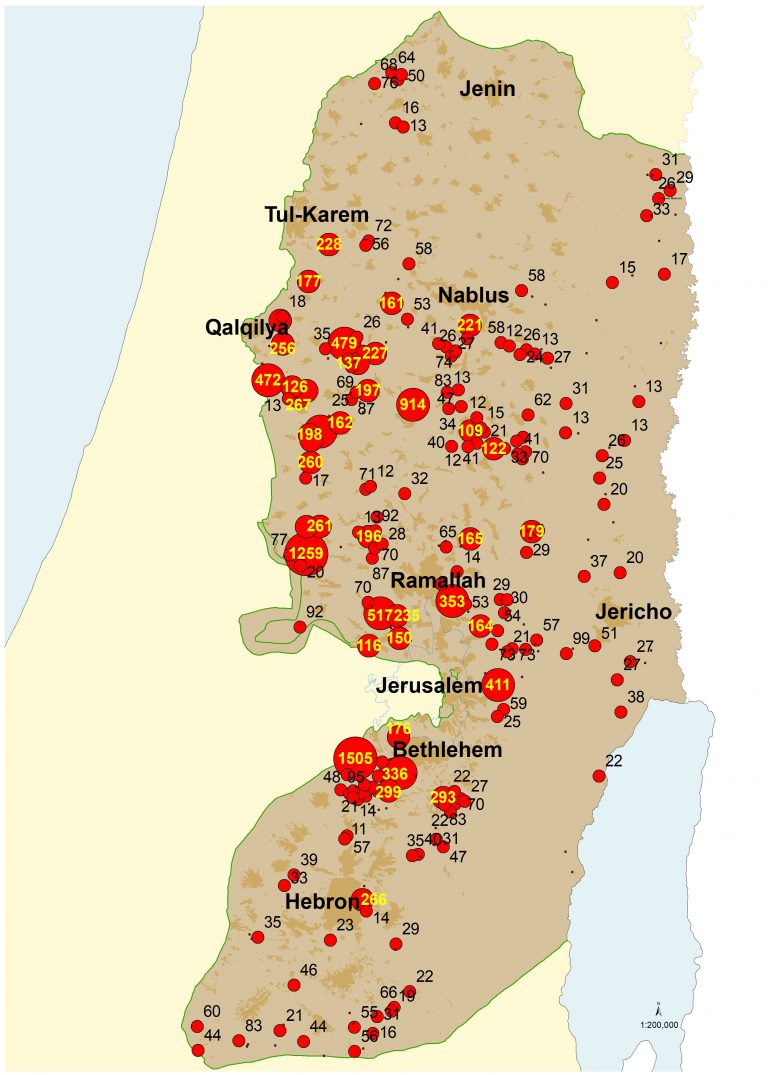
Map by Peace Now
Of that number, almost 83% (4,672 housing units) are planned in settlements east of the proposed Geneva Initiative border.
A total of 5,808 settlement construction tenders were published (but construction had not yet began)
- This was the highest annual total for settlement tenders in almost two decades.
- The Beitar Illit settlement saw the most construction starts in 2018, concentrated in a new neighborhood which significantly expands the footprint of the settlement.
Additional 2018 Key Data Points
- Israel continued to build up an Israeli settler presence on the land between the Elkana settlement and its surrounding settlements (Etz Efraim to its east and Shaarei Tikva to its west), effectively creating one large “super settlement” and building a contiguous settlement band towards the Ariel settlement in the heart of the West Bank.
- In addition to West Bank settlement tenders, tenders for 603 new settlement units in East Jerusalem were also published in 2018.
Peace Now Special Report, Part 2: Settlement Growth During 10 Years of Netanyahu

Peace Now writes:
“In the past decade, most of the construction was in isolated settlements that Israel will have to evacuate. The Peace Now count of housing construction starts reveals that 73 percent of the construction in 2018 (1,539 housing units) and 70 percent of construction during the decade of Netanyahu’s government (13,608 housing units) were implemented precisely in places that jeopardize a two-state agreement (east of the proposed border route of the Geneva Initiative). In this decade, close to 50,000 settlers have been added to these settlements, and the housing units built have the potential to add 60,000 settlers. This means that the Israeli government is digging the country a pit to fall in. Every house built in the settlements and every family that moves there will need to be brought back into Israel in a painful and difficult evacuation. Even if the government does not believe that peace can be achieved in the near future, there is no logic to expanding the settlements and making the solution impossible.”
Following Trump Election, Netanyahu Unleashed 39% Increase in Settlement Funding
After two years of repeatedly submitting freedom of information requests, the AP published results, based on documents turned over by Israel’s Finance Ministry. The documents reveal that the government unleashed at least a 39% funding increase – dubbed by the AP a “spending binge” – on settlement activities in the immediate aftermath of President Trump’s election.
According to the Finance Ministry data, in 2017 the Israeli government spent $459.8 million (NIS 1.65 billion) on roads, schools, and public buildings in settlements across the West Bank, compared to $333.2 million (NIS 1.19 billion) in 2016. AP notes that the new data does not include funds spent on police, education, health, and military, and completely omits government investments made in East Jerusalem settlement related activities — meaning the numbers actually undercount Israeli settlement-related spending (in both years).
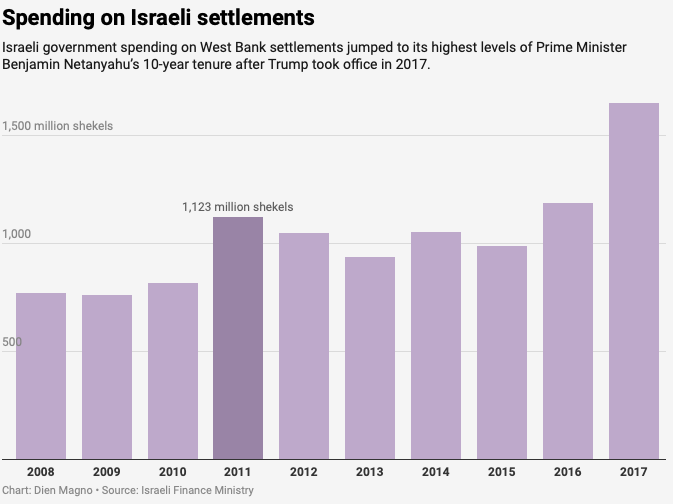 The 2017 figures are the highest amount of Israeli government funds invested in the settlements by the government of Israel during any year since Netanyahu became prime minister 10 years ago (and has remained in power since). The Israeli government tracks its own spending on settlement activities in order to report that total sum to the U.S. government, a practice which began under President George H.W. Bush – which in theory is supposed to deduct the sum from U.S. loan guarantees available to Israel (in reality, the U.S. has made only occasional and minimal deductions).
The areas with the highest growth rate in funding in 2017 were school construction (68% increase from 2016) and road construction (54% increase from 2016). Hagit Ofran, co-Director of the Settlement Watch project at Peace Now, explained the significance of Israeli investments in roads for the settlements:
“We see it very immediately, after the opening of a road, a big boom in construction along the road,” she said. “I think the investments we have these years in the roads are dramatic and will allow the expansion of settlements dramatically. That is very much worrying.”
Nabil Abu Rudaineh, spokesman for Palestinian President Mahmoud Abbas said:
“This proves that the current U.S. administration encouraged settlement activities.”
11 Knesset Members Join Campaign to Cancel 2005 Disengagement Law & Re-establish Evacuated West Bank Settlements
Eleven members of the Knesset, including Speaker of the Knesset Yuli Edelstein, participated in tour of one of the four settlements in the northern West Bank which Israel evacuated in 2005 as part of its Gaza Disengagement plan. The IDF had to provide special permission for the MKs to visit the Homesh settlement, because , even all these years later, it is a closed military zone. This is just the latest event in a settler-led campaign to pressure Netanyahu into canceling the 2005 Gaza Disengagement Plan and re-establishing those settlements.
After Israel’s evacuation of the four settlements in the West Bank – Homesh, Sa-Nur, Ganim, and Kadim – the IDF issued military orders barring Palestinians from entering the areas, let alone building in them. At the same time, settlers have regularly entered the areas and even repeatedly built a yeshiva at the Homesh site.
Bibi Pushes High Court Override Legislation During Coalition Negotiations
Haaretz reports that Prime Minister Netanyahu plans to promote the so-called High Court Override bill, which would empower the Knesset to effectively strip the High Court of its power to review and strike down legislation it deems unconstitutional, as well as overrule the Court’s administrative decisions – a new, and alarming, component of the long touted law. This new component is needed in order for Netanyahu to ensure his own immunity against criminal charges, but it will also empower the Knesset to ignore the Court’s administrative decisions issued in response to petitions – effectively giving elected and partisan government officials a veto over the only justice system accessible by Palestinians. As Haaretz explains: “for example, if a minister makes a decision that is overruled by the court in response to a petition – such as Netanyahu’s decision to ban the entry of Palestinian participants of a joint memorial day ceremony – the minister could reissue the decision anyway.”
Critical for FMEP reporting, if the law is passed the Knesset will be empowered to reinstate the settlement Regulation Law if the High Court rules against it, which it has long been expected to do. The law, passed in February 2017 and quickly frozen, directs the government to retroactively legalize a huge number of illegal outposts and settlement structures which were built on privately owned Palestinian land. Implementation of the Regulation Law was quickly frozen in light of petitions to the High Court challenging its constitutionality.
According to the Haaretz report, an agreement to promote the override bill will be included in the coalition agreement Netanyahu is negotiating to form the next government, and parties are engaged in debates over the specific form the law will take. The right-wing parties want to pass the law within 60 days after the new government takes over, and in a form that would totally negate the authority of the High Court to strike down decisions by elected officials or bodies like the cabinet, the ministers or the Knesset. The comparatively centrist Likud members support the principle of the override law but not the specifics proposed by negotiating partners. Likud members say they are reviewing various models for the law which tinker with the mechanism by which the Knesset can override High Court rulings and administrative decisions.
The override bill has been a key objective of Netanyahu’s negotiating partners, most prominently MK Bezalel Smotrich and Transportation Minister Yariv Levin, who are competing to become the next Justice Minister and whose negotiation demands FMEP analyzed some weeks back. FMEP has also documented the progress of the High Court Override bill in its Annexation Policies tables.
Trump Envoy Praises US-Backed Economic “Coexistence” Group for Joint Settler-Palestinian Hebron Iftar
On May 14th, U.S. peace envoy Jason Greenblatt tweeted his praise for a joint settler-Palestinian iftar event in Hebron, hosted by the “Judea and Samaria Chamber of Commerce,” a favorite group of the Trump Administration’s peace team. As has become a key mantra, Greenblatt said the event helps lay the “groundwork for peace” and said it was a “wonderful example of what could be possible.” As pointed out by many voices on Twitter, praise for the event ignores ignoring the apartheid conditions in Hebron under which Israeli policies deny Palestinian rights and well-being, for the benefit of some 800 Israeli settlers.
Palestinian businessman Sheikh Ashraf Jabari held the event in his Hebron home. Jabari recently launched a new Palestinian political party, the Reform and Development Party, advocating for a one-state solution because, Jabari argues, Palestinians have no other choice than to accept Israeli sovereignty over them. It is well known that Jabari has close ties to the Trump administration, which has very publicly embraced settler-Palestinian economic co-existence initiatives as a core U.S. priority on the ground and are seeking an alternative Palestinian leadership with which to make a deal.
Jabari told the Jerusalem Post about the iftar event and his broader aims:
“We want to build a united front, to create a breakthrough on the economic issue. We are issuing a clear call to separate between economics and politics, and hope to have fruitful cooperation on the subject. From our point of view, we need to strengthen the connection between the US legislature and activity that promotes economic equality here. This meal is meant to reinforce the growing trend in which economic-business connections can strengthen relations and friendship, by way of leading people to a more positive place.”
Along with Jabari, high profile event attendees – which included Samaria Regional Council head Yossi Dagan and Hebron Jewish community leader Yishai Fleisher – praised the business initiative as a model for peaceful relations.
Uri Karzen, the Director General of the settlers in Hebron and an attendee of the iftar, said in a tweet:
“First #Iftar in #Hebron with Kosher food. We are laying the groundwork for peace between people and economic prosperity for all.”
Heather Johnston, executive-director of the US-Israel Education Association which leads U.S. congressional delegation to settlements and runs camps in the Ariel settlement (no joke – to help Ethiopian Jews rediscover their roots), told the event attendees:
“Each of you have played a role in helping to build this integrated business movement. You have made sacrifices. You have gone into the unknown. You have been willing to take risks in business and in relationships. And this is what it takes to pioneer something that will one day be a humongous success. I have been involved in Samaria for the last 22 years. I believe there is more hope today for this important relationship to actually succeed than ever before.”
Chamber president Avi Zimmerman, of the Ariel settlement, said:
“We can measure progress at a people-to-people level, at every business transaction. Every time I get up and say ‘this is only about economics, it is not about peace,’ everyone starts talking about peace. Which makes me believe that if everyone keeps talking about peace when we speak of economics, that these incremental, measured steps toward mutual interest are actually what will birth the peace. They can birth a political process, but it will not happen the other way around,” he said. “We have learned for 70 years that it is not going to be the other way. It has to start this way.”
FMEP has repeatedly explained how initiatives like this perpetuate Israel’s economic exploitation of occupied territory (including the local workforce, land, and other natural resources), and that it is perverse to label such initiatives as “coexistence” programs, or to suggest that they offer the Palestinians benefits they should welcome. The New York Times quoted a spokesman for the Palestinian Authority explaining the Orwellian reality of settlement industrial zones:
“Somebody occupies your country, steals your land, steals your water, steals your resources, then says: ‘I’ll make a good deal for you if you come work for me. I’ll create jobs for you. We are not occupiers. We are employers.’ This is ridiculous. The colonial settlements are illegal in every sense of the word.”
Bonus Reads
- “Israel Okays Major West Bank Roads, Seizing Large Tracts of Palestinian Land” (Haaretz)
- “Israel Dismisses Complaint Against Lawmaker Who Called to Ban Arabs from Highway” (Haaretz)
Welcome to FMEP’s Weekly Settlement Report, covering everything you need to know about Israeli settlement activity this week.
To subscribe to this report, please click here.
May 10, 2019
- Annexation Proceeds: Israel Tourism Ministry Creates Official Funding Channel for Hotels in Settlements
- Settlers Take Over Another Palestinian Home in Hebron, IDF Says It Was for “Military Needs”
- IDF Helps Settlers Celebrate Passover At the Site of the Evacuated Amona Outpost (Which Palestinians Still Cannot Access)
- Israel Issues Construction Permits for Two Settler Bypass Roads
- Every Month Israeli Forces Evacuate the Same Outpost; This Time, 18 Settlers Were Arrested
- No Shame: Settler Builds Illegal Outpost Near Khan Al-Ahmar While Calling for Bedouins’ Eviction
- UNSC Holds Meeting on Israeli Settlements; U.S. Peace Envoy Says Settlements Are Not a Problem
- Greenblatt Touts “Shared Prosperity” Paradigm for Peace Plan Following Beverly Hills Conference
- Bonus Reads
Annexation Proceeds: Israel Tourism Ministry Creates Official Funding Channel for Hotels in Settlements
On April 18th, Israeli Tourism Minister Yariv Levin – who has emerged as a frontrunner to be given the Justice Ministry portfolio in the next government – announced that his ministry had launched a new grant program to expedite funding channels for the construction of hotels in settlements located in Area C of the West Bank. Under previously Israeli law, hotel projects in settlements had to receive special approval from the government; the new program expedites and normalizes that process.
These grants are more than an economic program. Investing in the growing tourism industry inside of settlements in the West Bank is a strategic endeavor intended to entrench settlements, provide for their expansion, normalize their existence within the international community, and advance their seamless integration into Israeli territory. In a recent report on companies which profit from tourism in the settlements, Amnesty International further explains:
“In recent years the Israeli government has invested huge sums to develop the tourism industry in settlements. It uses the designation of certain locations as tourist sites to justify the takeover of Palestinian land and homes, and often deliberately constructs settlements next to archaeological sites to emphasize the Jewish people’s historic connections to the region.”
Following the announcement of the new grant program, Hananel Dorani – Chairman of the powerful Yesha Council, a settlement umbrella group – told the press:
“We thank [Tourism] Minister Yariv Levin (Likud) for his important work on the issue of tourism in Judea, Samaria, and the Jordan Valley. Building hotels and guest houses in the area is an important step which shows the deepening of our roots in the ground and paves the way for Israeli sovereignty in Judea and Samaria. Giving grants for the creation of hotels is another supplemental step which will help solve the problem of where to sleep and will strengthen settlements and our hold on Judea and Samaria.”
Oded Revivi – the foreign envoy of the the Yesha Council – commented:
“[Tourists] will see how there are good neighborly relations between Jews and Arabs. Unlike what has been told to them, they will see that there is not war here every day and that there is no apartheid.”
The Palestinian Ministry of Foreign Affairs and Expatriates said in a statement:
“These plans fall within the framework of the gradual erosion of the occupied Palestinian territory, in particular Area C, under various security, military, economic, settlement and tourism pretexts, which requires the international community to move urgently to save what is left of the chance to achieve peace on the basis of a two-state solution.”
Settlers Take Over Another Palestinian Home in Hebron, IDF Says It Was for “Military Needs”
In early May 2019, a group of settlers broke into a Palestinian-owned home in the Casbah area of the Old City of Hebron. The settlers moved in and promptly started renovating the property. The property is legally owned by the Arafeh family, who were forced to move out in 2005 due to the extreme restrictions on Palestinian movement in the area imposed by the Israeli military.

Map by Peace Now
A lawyer for the Arafeh family asked the Israeli Civil Administration to evict the settlers from the privately owned property. Rather than take action against the settlers, a spokesperson for the Civil Administration justified the settlers’ illegal entrance to the property and the “renovations” they undertook, arguing that the settlers were working on behalf of the IDF to build a military post on the roof of the Arafeh family’s house. This, despite the fact that, according to Peace Now, the Palestinian homeowners never received a notification that the IDF was seizing the property, as required under Israeli law.
Peace Now said in a statement:
“If the works were done for the IDF, it is a shame that the IDF does not respect Palestinian ownership and treats their empty homes as if they were no-man’s property. The Palestinians were forced to leave their houses because of the heavy restrictions imposed by the IDF in order to protect the settlers in Hebron. Those ‘temporary’ restrictions have remained in place now for decades, and the way the IDF and the settlers treat the Palestinian properties show that the security excuse cannot hold anymore and that what is done in the Old City of Hebron may be better described as forced displacement. If the works were done by the settlers, then it is part of a cruel method of the Palestinian dispossession in Hebron: first the IDF closes streets, shops and Palestinian homes to protect a handful of settlers. Then, because of the severe restrictions, Palestinian families are forced to leave their homes. And then settlers take over the empty houses without any permit. Finally the government allows them to remain and establish a new, illegal settlement in the heart of the Palestinian population.”
IDF Helps Settlers Celebrate Passover At the Site of the Evacuated Amona Outpost (Which Palestinians Still Cannot Access)
Haaretz reports that the Israeli military assisted settlers in trespassing into the site of the evacuated Amona outpost to celebrate Passover. The land – which in 2017 the Israeli High Court ruled to be legally owned by Palestinians – remains inaccessible to the Palestinian landowners under a military closure order barring all civilians from entering the area. In practice, the closure only applies to Palestinians. Settlers, on the other hand, are not only given free rein in the area but received high profile political backing and significant funding in their December 2018 efforts to illegally rebuild the Amona outpost. With much scandal, in January the IDF removed several pre-fab structures the settlers managed to install at the Amona site, and evacuated the settlers despite their violent resistance.
In January 2019, the Israeli NGO Yesh Din assisted the Palestinian landowners to filed a new petition with the Higher Court of Justice to reverse the military closure order to allow Palestinian landowners to access their land and restrict Israeli settlers from doing so. The petition is still pending.
Israel Issues Construction Permits for Two Settler Bypass Roads
On May 1st, the Israeli Civil Administration approved construction permits for two new bypass roads for settlers – the Huwwara and Al-Arroub roads. The approval brings construction of the roads closer, though it may still be stalled if Palestinians challenge the government’s confiscation of privately owned Palestinian land for the roads (confiscated on the basis of “security needs”). It’s worth recalling that a recent Kerem Navot report found that a whopping 47% of the total land seized by Israel for “security needs” is currently used to serve the needs of the settler population.
Peace Now said in a statement:
“These expropriations are part of the government’s continued capitulation to the settlers to build Israeli-oriented bypass roads throughout the West Bank. The settlers know very well that without good roads the settlements will not be able to develop, and tactically demand that they be built ‘for security reasons.’ This stated rationale masks the real goal behind these roads: to expand the settlements and to advance plans for annexing the West Bank at the cost of a two-state solution.”
Both roads will be located deep inside of the West Bank: the Huwwara road will serve settlements near Nablus and the Al-Arroub road will serve settlements near Hebron. Among the many benefits for settlers, bypass roads entrench the presence of settlements, enable their expansion, and advance their seamless integration into Israel proper.
Gloating over the new roads, Samaria Regional Council chief Yossi Dagan said:
“The Prime Minister has proven his leadership, responsibility, and his integrity. Netanyahu kept his promise, and I praise him for sticking by the agreement. The Hawara and Al-Arroub bypass roads are strategic roads, which, God-willing, will change the map of the State of Israel in general and the map of Judea and Samaria in particular.”
Every Month Israeli Forces Evacuate the Same Outpost; This Time, 18 Settlers Were Arrested
According to Haaretz, the cat and mouse game (once dubbed “the never-ending evacuation”) between settlers and the IDF over the “Esther Maoz” outpost site has finally resulted in the arrest of 18 settlers.
For years, the IDF has evacuated settlers from the outpost only to allow them to immediately rebuild it. Following the settlers evacuation and arrest, the NGO Honenu – which acts as a legal defense fund for settlers – alleged that the security forces “used intense violence” against the settlers.
The Esther Maoz site is located near the Kokhav Hashahar settlement, and can only be accessed by road from inside of the settlement.
No Shame: Settler Builds Illegal Outpost Near Khan Al-Ahmar While Calling for Bedouins’ Eviction
An Israeli settler name Boaz Ido is funding the illegal construction of an unauthorized outpost just hundreds of meters from the location of the embattled Khan al-Ahmar Bedouin community. Construction at the outpost site has continued despite stop-work orders issued against it by the Civil Administration.
While funding the illegal project, Ido has lobbied the government to forcibly remove Khan al-Ahmar’s inhabitants, based on the argument that the village lacks the required Israel-issued building permits.
Haaretz visited the site of Ido’s new outpost and found a group of Israeli settlers working to construct a straw and mud structure. The location of the construction falls within the approved borders of the Ma’ale Adumim settlement, but is not contiguous with the built-up area of the settlement. Moreover, there are no valid building plans or permits for Ido’s current undertaking.
Dror Etkes, founder of Kerem Navot, told Haaretz:
“It’s no wonder that someone who has been investing so much energy into evicting the Bedouin neighbors who were in the area for decades before him is the same person who is investing a lot of energy into controlling land that he has not even a hint of a right to.”
Ido is a well-connected settler living in the Ma’ale Adumim area. He runs the nearby “Genesis Land” tourism site and is an active member of the Jerusalem Periphery Forum, a group working to evict bedouin from the area. Ido has been deeply involved in pushing the government to evict the bedouin from Khan al-Ahmar, including extracting assurances from Prime Minister Netanyahu and briefing the Knesset about “Palestinian take over of Area C.” According to the settler-run Arutz Sheva outlet, Ido told the Knesset members:
“We cannot lose control of Route 1 and permit illegal [Arab] construction as in the Negev. We are working continuously on the ground and I am pleased that, for the first time, in 2016, cooperation with the Civil Administration has been stepped up, with corresponding results – a halt to illegal construction as well as a small reduction in the number of structures on the ground.”
So in addition to his current hypocrisy, Ido is also complicit in an extraordinary manipulation of facts regarding Area C — a term which refers to the 60% of the occupied West Bank which the Oslo Accords temporarily assigned to complete Israeli control (civil and security) as part of an interim agreement designed to remain in place for a short period, pending conclusion of permanent status negotiations. Since then, Israel has implemented a discriminatory planning policy in Area C, which B’Tselem says is aimed at “preventing Palestinian development and dispossessing Palestinians of their land.”
While implementing a planning system under which it is nearly impossible for Palestinians to obtain building permits, Israel routinely enforces demolition orders against Palestinian structures built without permits while looking the other way with regards to illegal settlement construction in the area. In addition, the government is undertaking a systematic campaign to retroactively authorize the vast majority of illegal outposts and unauthorized settlement construction – – a contradiction which clearly benefits Ido’s new outpost.
UNSC Holds Meeting on Israeli Settlements; U.S. Peace Envoy Says Settlements Are Not a Problem
On May 9th the United Nations Security Council held a meeting at the request of Indonesia, Kuwait, and South Africa entitled “Israeli Settlements and Settlers: Core of the Occupation, Protection Crisis and Obstruction of Peace.” The informal “Arria formula” meeting provided a forum for member states to be briefed by experts in the field; speakers included John Quigley ( Ohio State University), Emily Schaeffer Omer-Man (Israeli human rights attorney); Mohammed Khatib (Popular Struggle Coordination Committee); and James Zogby (Arab American Institute). Member states in attendance included France, Germany, Russia, and Colombia.
U.S. Special Representative for International Negotiations Jason Greenblatt delivered remarks at the meeting on behalf of the United States (not as an expert). His remarks – rather than dealing with the substance of criticisms on settlements – sought to flip the script and attack the UNSC for alleged anti-Israel bias and accuse it of ignoring Hamas attacks on Israelis. Unsurprisingly, given the Trump administration’s public embrace of settlements, Greenblatt said:
“Let’s stop pretending that settlements are what’s keeping the sides from a negotiated peaceful solution. This farce and obsessive focus on one aspect of this complicated conflict helps no one.”
Arab American Institute President Dr. Jim Zogby said of the deterioration of U.S. policy on settlements:
“There has been a steady erosion of US policy on Israeli settlements, it went from rejection to acceptance, and from passive acquiescence to legitimization. It saddens me as an American to say: This makes my government complicit, and more recently an enabler of this criminal activity. A new strategy is needed, not just to challenge Israel, but to challenge the impunity the US has bestowed on Israel that makes it unaccountable.”
Indonesian Foreign Minister Retno Marsudi, who chaired the meeting, said:
“inaction was not an option. Public pressure to end the settlement is absolutely vital… Indonesia will spare no effort to ensure that the Palestinian issue remains one of the main focus of the UN.”
Marsudi also suggested creating an international day of solidarity with the victims of illegal settlements.
Greenblatt Touts “Shared Prosperity” Paradigm for Peace Plan Following Beverly Hills Conference
On April 29th, following a private briefing for attendees at the ritzy Milken Institute’s 2019 Global Conference, U.S. Special Representative for International Negotiations Jason Greenblatt tweeted:
“this year’s [Milken Global Conference] theme ‘Driving Shared Prosperity’ couldn’t be more fitting for what Jared, Amb. David Friedman and I hope will be the future of our peace vision for Israel, Palestinians and the region.”
Jared Kushner also made an appearance at the conference, held in Beverly Hills, California. Kushner and Greenblatt were not listed among the conference speakers, which included prominent celebrity figures such as animal biologist Jane Goodall and NFL quarterback Tom Brady.
The Milken Institute describes itself as:
“a nonprofit, nonpartisan think tank determined to increase global prosperity by advancing collaborative solutions that widen access to capital, create jobs and improve health. We do this through independent, data-driven research, action-oriented meetings, and meaningful policy initiatives.”
Bonus Reads
- “Will Netanyahu Annex the Settlements?” (Newsweek)
- “As Israeli Group Expands, Palestinian Houses Face Demolition” (Associated Press)
- “Some of Israel’s Best American Friends Worried by Netanyahu Annexation Talk” (Times of Israel)
Welcome to FMEP’s Weekly Settlement Report, covering everything you need to know about Israeli settlement activity this week.
To subscribe to this report, please click here.
April 26, 2019
- Israeli Court Reaffirms: Settlers Must Vacate Palestinian Home in Hebron
- Israel Confiscates Privately Palestinian Land for New Settler Bypass Road
- Annexation in Play in Negotiations over Israel’s Next Coalition Government
- OCHA: Palestinians in Downtown Hebron Suffer at Hands of Settlers & IDF; Israel Politicians: Time to Triple Number of Hebron Settlers
- Bonus Reads
Israeli Court Reaffirms: Settlers Must Vacate Palestinian Home in Hebron
On April 22nd, the Jerusalem Magistrate’s Court rejected an appeal by settlers to stop their eviction from a Palestinian-owned home in Hebron, where they have been squatting for the past 18 years. In addition, the court ordered the settlers to pay the true homeowners – the Palestinian Bakri family – $160,000 (NIS 80,000) in damages. Unsurprisingly, the settlers’ attorney immediately announced that they will file another appeal with the Jerusalem District Court — delaying the implementation of the eviction order once again.
The Bakri family has spent the past 18 years petitioning Israeli police and Israeli courts to remove the settlers — cases the Bakri family has repeatedly won. Yet, the settlers have managed to repeatedly delay their eviction by exploiting every possible legal argument, no matter how absurd or contradictory: at different points over the past 18 years, settlers have argued in court that they had a rental agreement; that they purchased the home; that the plot of land was owned by a Jewish trust prior to 1948 and so they have a right to “reclaim” the property; and that regardless of ownership before they took possession, because they have now invested so much money in improving the property it now, under Ottoman Law, legally belongs to them. Underscoring the mockery settlers have made out of the Israeli justice system, when at one point some years ago the courts ruled that the settlers had to vacate, the settlers who at the time were occupying the Bakri home did, indeed, leave, only to be immediately replaced by other settlers — at which point the Israeli Attorney General told the Bakri family that if they wanted THESE settlers, out, they had to start eviction proceedings anew.
For a detailed timeline of the Bakri family’s 18-year saga — which to this day remains unresolved and justice remains denied — see this report from Peace Now.
Israel Confiscates Privately Palestinian Land for New Settler Bypass Road
On April 3rd, the Israeli Civil Administration signed a military order to confiscate privately owned Palestinian land in the West Bank in order to build a new bypass road, to be called the “Al-Arroub/Lev Yehuda bypass road,” approved by the Israeli government in 2012. The Palestinian villages Beit Ummar and Halul, whose land was taken for the road, are expected to file objections to the confiscation..
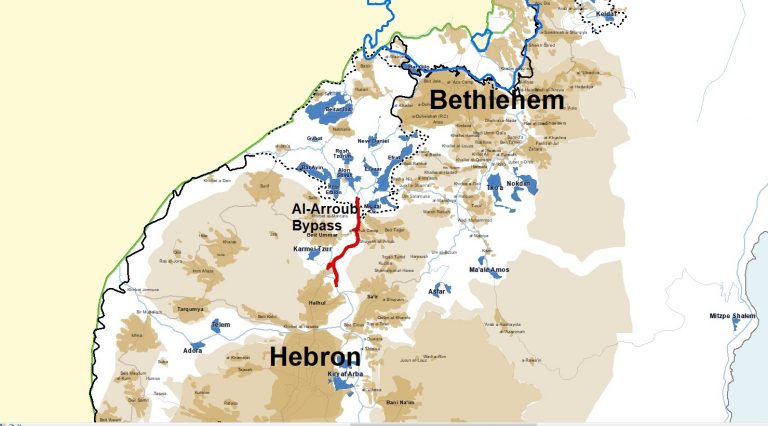
Map by Peace Now
While settlers claim the road is needed both for transportation and security reasons, construction of the road advances a far more important strategic objective for settlers: the establishment of a more direct route between Hebron-area settlements – particularly Kiryat Arba – and sovereign Israeli territory, without going through any Palestinian towns.
This is the second bypass road advanced by Israeli in the month of April; on April 9th, FMEP reported on the advancement of the Huwwara bypass road. Both of these new bypass roads are part of a 5-road package that Prime Minister Netanyahu, under immense pressure from the settler lobby, known as the Yesha Council, promised to build.
Peace Now explained:
“This expropriation is part of the government’s continued capitulation to the settlers to build bypass roads throughout the West Bank. The settlers know very well that without good roads the settlements will not be able to develop, but cynically demand they be built ‘for security reasons.’ In fact, the goal behind these roads is to expand the settlements and advance plans to annex the West Bank into Israel in order to prevent the chances of reaching a two-state solution.”
Settlers and the government say that the roads will be open to both Palestinian and Israeli traffic, but as Peace Now explains, “even if in some cases the Palestinians can benefit from these roads, they are not paved according to a planning conception of the Palestinian needs.” Indeed, bypass roads are not just oblivious to Palestinian needs; they are strategically located to constrict the growth of Palestinian villages, as explained at length by Americans for Peace Now. Moreover, history shows most bypass roads ultimately end up being settler-only routes, as B’Tselem extensively documented in its authoritative 2004 report, “Forbidden Roads: The Discriminatory West Bank Road Regime.”
OCHA: Palestinians in Downtown Hebron Suffer at Hands of Settlers & IDF; Israel Politicians: Time to Triple Number of Hebron Settlers
The United Nations Office for the Coordination of Humanitarian Affairs (OCHA) published a new report based on a survey of 280 Palestinian families living in the downtown part of Hebron know as “H-2”, under the direct control of the Israeli military and cheek-to-jowl with settlers. Accounting for 20% of land in Hebron, the downtown H-2 area is home to some 33,000 Palestinians and a few hundred of the most radical and violent Israeli settlers, whom the IDF protects through a policy of segregation, including keeping areas “sterile,” defined to me free of and off limits to Palestinians.
Palestinian H-2 resident and human rights defender Issa Amro wrote a powerful depiction of the apartheid reality in which he and other Palestinians live. Key findings of the new OCHA report, that give even more detail to that reality, include:
- When asked to list the three major concerns related to their current residence in H-2,
- 75% of the households surveyed cited harassment by Israeli forces;
- 67% cited social isolation [access to the area is generally limited to the residents, cutting them off from family and friends];
- 64% cited limited livelihood opportunities [Palestinian commercial life in the area has for the most part died]
- While only 2% of the households cited settler violence and harassment as a top concern, OCHA notes that the “general perception among Palestinians that most incidents of harassment involve, in one way or another, both settlers and soldiers, rendering the differentiation [between settlers and Israeli forces] meaningless.”
- When asked specifically about violence and harassment by settlers, almost 70% of the respondents reported that at least one member of their household has experienced an incident of settler violence or harassment since October 2015:
- 20% reported experiencing settler violence on a weekly basis;
- 80% of affected households reported psychological distress,
- 25% reported property damage;
- 18% reported physical injury.
Based on these findings, OCHA deemds H-2 a “coercive environment,” writing:
“In addition to settler violence and access restrictions, the lives of Palestinians in H2 have been severely affected by constant raids and incursions into their homes by Israeli forces, which often include the temporary takeover of parts of the homes. These policies and practices have generated a coercive environment, which has undermined the living conditions of Palestinians, including their security, sources of livelihoods, access to services, and family and social life. Thousands have been forced to leave the affected area.”
Against the backdrop of the extraordinary difficulties already facing Palestinians living in the center of Hebron, Israeli politicians are now looking to significantly boost the number of Israeli settlers living there. Speaking at the Tomb of the Patriarchs/Ibrahimi Mosque in Hebron, Bezalel Smotrich – who is jockeying to be the next Justice Minister – called to immediately triple the number of settlers living in the heart of Hebron, and keep increasing the settler population from there, promising:
“That would just be the start. Hebron is a large city. There is a lot of space here for many Jews to redeem this city, which will allow us to draw strength from the strong connection to the city of our forefathers.”
Also at that same event, Deputy Defense Minister Eli Ben Dahan (who famously referred to Palestinians as “animals”) said:
“We are praying that we will create a new government, a government that will declare sovereignty on Judea and Samaria. A government that with God’s help will show the world that there is no difference between Hebron and Beersheba. Hebron is what connects Jerusalem to Beersheba. Here in Hebron the nation of Israel connects to its roots. With God’s help we will declare that Judea and Samaria is an inseparable part of Israel.”
Annexation in Play in Negotiations over Israel’s Next Coalition Government
As negotiations to form the next ruling coalition get underway, the head of the Union of Right Wing Parties (URWP), Bezalel Smotrich, issued a list of demands for Netanyahu’s Likud Party amounting to a checklist for the next phase of Israel’s de facto annexation of the West Bank. None of the URWP’s annexation-related demands are new ideas or efforts — a reminder that Israel has been discussing and promoting annexation policies since long before Netanyahu publicly announced it to the international community. The fact that they are not new and, indeed, have in the past generated significant support — coupled with Netanyahu’s newfound public enthusiasm for annexation and the Trump Administration’s Golan annexation trial balloon — suggests that Smotrich’s/URWP’s annexation-related demands are more than mere political gamesmanship. Rather, they should be examined carefully and treated as serious.
Before jumping into the list of demands, it’s worth recalling that the URWP is made up of three main parties: the national religious Jewish Home, the National Union/Tekuma party, and the Otzma Yehudit/Jewish Power party. It is also worth recalling that the latter party is the latest incarnation of the Kach/Kahane Chai party, which was banned in Israel for racism (and is a U.S.-designated Foreign Terrorist Organization). Netanyahu personally brokered a deal to include Otzma Yehudit in the URWP coalition – a move so appalling that it garnered criticism, albeit veiled, from some of Netanyahu’s most ardent supporters in the United States.
Here are the demands:
Demand #1: Giving a simple majority in the Knesset the power to overrule the High Court of Justice. Smotrich demands that the government promote the “High Court override bill.” If this becomes law, it will allow the Knesset to re-enact legislation that had been struck down by Israel’s highest court by a simple majority vote, in effect turning rule of law into rule by the dictatorship of the majority. This bill is the extreme version of a longtime legislative priority of right-wing Israeli parties, who view the High Court as overly sympathetic to Palestinians, overly deferential to international law, and biased against Israeli settlers (they view the mere fact that Israel’s legal system distinguishes between sovereign Israel proper and the West Bank (which even according to Israel remains, legally speaking, land held under belligerent occupation) constitutes discrimination against settlers. Netanyahu has supported this initiative in the past, making it an all but guaranteed agenda item for the next government. The consequences of the bill will be profound. Since 1967, the High Court of Justice has been the court of first jurisdiction for cases related to Palestinians living in the West Bank, reflecting the extraordinariness of Israeli judges issuing, in effect, extra-territorial legal rulings. By empowering the Knesset (to which West Bank Palestinians are not entitled to elect representatives) to overrule the High Court with a bare majority vote, the rule of law in Israel will be wholly politicized – no doubt against Palestini.
Demand #2: Give URWP power to retroactively legalize illegal settler construction and to open the settlement floodgates. Smotrich demands the formation of a ministerial committee headed by a URWP member that would take over the implementation of plans to retroactive legalize all unauthorized settlement construction and outposts, entrenching even the most far-flung and isolated outposts and allowing for their expansion. Smotrich also wants this committee to take control of the Settlement Division of the World Zionist Organization and its efforts to settle Jews in all areas of the West Bank. Smotrich has previously championed a bill that would hand over a vast tracts of land in Area C of the West Bank to the Settlement Division. By taking control over the Settlement Division, the URWP-headed committee can accelerate this land transfer, opening up more West Bank land for more settlement construction.
Demand #3: Disband the Civil Administration. The Civil Administration is the body within the Israeli Defense Ministry that acts as the sovereign governing power over the West Bank. By shuttering the Civil Administration – the legal structure supporting and maintaining occupation created by Israel as a means to administer the West Bank as distinct entity from sovereign Israeli territory – any legal distinction between the two land areas will vanish, resulting in the annexation of the West Bank. Smotrich has been pushing this move for over a year. Under his plan, Israeli settlers in the West Bank would come under the full sovereignty of domestic Israeli institutions, while Palestinians would be ruled by “Regional Liaison administrations.”
Demand #4: Reverse the 2005 Disengagement Law. Smotrich demands that Israelis be allowed to return both to four northern West Bank settlements and to Gaza, from which settlers were removed in 20005 following the passage of Ariel Sharon’s Disengagement law. A Knesset bill to this effect has been circulating since June 2017, and various Knesset members including Smotrich have joined settlers protests in the West Bank demanding the right to return to the evacuated settlements there.
Demand #5: Diminish the power of the Israeli Attorney General. Smotrich demands that the new government limit the power and independence of the Israeli Attorney General, by forbidding him (or maybe someday, her) from arguing against the Israeli government in a court of law. The catalyst for this demand is the action by the current Attorney General, Avichai Mandelblit, who argued against the government regarding the “Regulation Law,” which Mandelblit said is unconstitutional and which is strongly supported by Smotrich and the Israeli right.
Demand #6: Get the State Comptroller under control. Smotrich demands new restrictions on the State Comptroller’s authority, seemingly an effort to stop the publication of embarrassing or politically awkward government-issued reports that reveal how taxpayer money is funneled to illegal settlement activities. The Times of Israel notes that Israeli Ombudsman Aharon Shapira has published reports over the past several years that have been heavily critical of several ministries funneling of funds toward illegal West Bank outposts.
In addition to the annexation-related demands, the URWP – which won only 5 seats in the Knesset but appears to be playing the role of kingmaker for the Netanyahu’s next coalition – is demanding that two of is members be named to powerful ministerial posts: Smotrich (leader of the National Union party and head of the URWP coalition) wants to be the next Justice Minister and, Rafi Peretz wants to be the next Education Minister. These two high-profile posts are being vacated by Ayelet Shaked and Naftali Bennett, whose newly formed party failed to win any seats in the next Knesset. During her tenure as Justice Minister, Shaked undertook what she deemed a “legal revolution” aimed at completely erasing any distinction between the settlements/outposts and Israel proper, and, significantly, making it more difficult for Palestinians to access the only means of justice available to them under occupation by stripping the Israeli High Court of Justice of primary jurisdiction over land disputes.
As made clear by his personal history and political record – which led to Haaretz to dub him “the youthful face of unrepentant Jewish extremism” – Smotrich is an even more radical ideologue than Shaked. His unapologetic push for annexation and his eagerness to enshrine an apartheid system to permanently rule over the Palestinians leaves no question about how Smotrich will approach the role of Justice Minister, if he succeeds in securing that appointment.
Bonus Reads
- “For Palestinian Families: ‘No Light at the End of the Tunnel’” (New York Times)
- “Palestinians Have No Leverage Against Israeli Annexation” (Al-Monitor)
- “Israel Opens New Qalandiya Checkpoint, Phasing Out Inadequate Crossing” (Times of Israel)