Welcome to FMEP’s Weekly Settlement Report, covering everything you need to know about Israeli settlement activity this week.
To subscribe to this report, please click here.
December 5, 2019
- In The Heart of Hebron, Israel Begins Starts Planning New Settlement
- Targeting East Jerusalem (Center): Israel Begins Work to Triple Size of Nof Zion Settlement
- Targeting East Jerusalem (South): Moving Ahead with 3 Plans to Expand Gilo
- Targeting East Jerusalem (North): Plans Readied for New Settlement on Ramallah’s Outskirts
- Jerusalem’s Settler-Backed Cable Car Project Challenged in High Court
- Settler Leaders’ Endorse Netanyahu…and Netanyahu Govt Approves New Funds for Settlers
- Israeli Government Funnels Nearly USD $270 Million of Surplus Taxpayer Funds to Settlements Each Year (in addition to regular budgets)
- Joint U.S.-Israel Research Project Will Include Ariel Settlement University
- Not the Onion: Israeli Govt Sold Palestinian Land to a Settler Org & Now Pays Rent to the Settlers
- Settler-Run Business Council Asks US Congress to Fund Settler-Palestinian Projects
- Bonus Reads
Questions/comments? Contact Kristin at kmccarthy@fmep.org
In The Heart of Hebron, Israel Begins Starts Planning New Settlement
On December 1st, acting Defense Minister Naftali Bennet announced that he had ordered the start of the planning process for a new settlement in downtown Hebron that will double the number of settlers living there. The plan calls for the demolition of the historic Palestinian wholesale market – consisting of shops belonging to Palestinians who hold the properties under what Israel has, until now, recognized as protected tenancies.
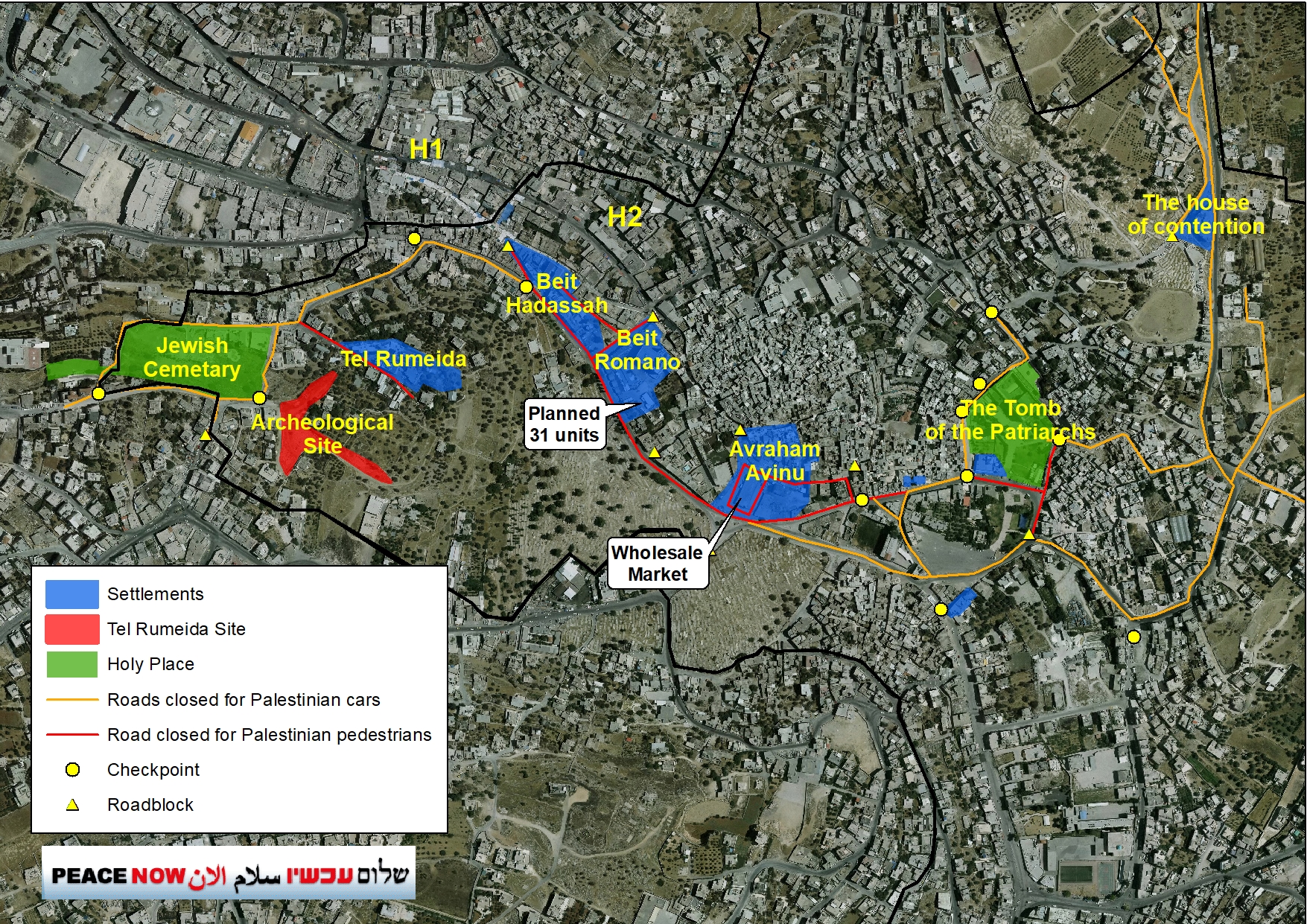
Map by Peace Now
Under the plan, the historic Palestinian market will be replaced with new structures that will include 70 new settlement units located above the new ground floor. Bennet boasted the the project will double the number of Israeli settlers living in Hebron. The site of the planned settlement is located on Shuhada Street in the heart of Hebron, a street that serves as the perhaps the clearest example of Israel’s apartheid-like military administration of the city, as detailed in a recent report by B’Tselem.
In announcing the directive, Bennett made clear the strategic and symbolic importance of the new Hebron settlement, saying it:
“will create a territorial continuation from the Cave of the Patriarchs to the Avraham Avinu neighborhood, and double the number of Jewish residents in the city.”
The plan to build a settlement at the site of the Palestinian wholesale market – which Israel closed 25 years ago following the 1994 Baruch Goldstein massacre of Palestinians worshipping at the Al-Ibrahimi Mosque (detailed history here) – is not new. In fact, it has been a goal of settlers for years, the realization of which has been because previous Israeli governments were less willing to brazenly reverse Israel’s longstanding recognition of the tenancy rights of the Palestinian-run Hebron Municipality (which built the market) and the Palestinian vendors who rent market stalls from it.
Such calculations changed following the election of President Trump and his administration’s open support for the settlers and their agenda. In November 2018, Avigdor Liberman and Ayelet Shaked (at the time the Defense Minister and the Justice Minister, respectively) worked together to issue a new Defense Ministry legal opinion, which argues that, based on claims of Jewish ownership of the land prior to the 1929 Hebron riots and massacre of Jewish residents, the state of Israel has the authority to override the tenancy rights of the Hebron Municipality to build a settlement. This legal opinion paved the way for Bennet’s announcement – long awaited by settlers – this week. In this context, the vague commitment Bennet offered as part of his decision to promote the settlements plan – in which he promised that the rights of Palestinians on the ground floor “will be preserved as they are today” – rings hollow.
Bennet and Shaked’s plan marks a significant expansion of the government’s use of the legal principle that allows Jewish Israelis to reclaim properties that were owned by Jews prior to 1948, as an extension of the Jewish right of return. Peace Now writes:
“The basis of the settlers’ demand for the establishment of a settlement in the wholesale market is that the land was owned by Jews before 1948… If the Israeli government accepts the claim of the landowners to right to return to their land taken in 1948, it will undermine the Israeli claim that the Palestinians’ right of return inside Israel need not be implemented.”
Upon Bennet’s announcement this week, former Justice Minister Shaked reminded Israelis of her role in changing Israeli legal interpretations in order to build the new settlement:
“As justice minister I worked for two years to free the land from a legal entanglement in which it was for many years, and the neighborhood had waited about a year for the defense minister’s approval. Bennett’s courageous decision will boost the Jewish community and develop the city.”
In reaction to Bennet’s order, Peace Now said in a statement:
“This is very bad news for Israel: bad morally, bad for the security, and bad in terms of the political chances for peace. The settlement in Hebron is the ugliest face of Israel’s control in the Occupied Territories. In order to maintain the presence of 800 settlers among a quarter of a million Palestinians, entire streets in Hebron are closed to Palestinians, denying them freedom of movement and impinging on their livelihoods.”
Targeting East Jerusalem (Center): Israel Begins Work to Triple Size of Nof Zion Settlement
On November 8th, the Israeli government began construction work to expand the settlement enclave known as Nof Zion, located in the middle of the Palestinian East Jerusalem neighborhood of Jabal al-Mukaber. The project will add 182 homes to Nof Zion, tripling its size and turning Nof Zion into the largest settlement enclave inside a Palestinian East Jerusalem neighborhood (surpassing the Ma’ale Zeitim settlement in Ras al Amud, on the Mount of Olives).
Ir Amim writes:
“Establishing and expanding state-backed settler enclaves like Nof Zion within Palestinian neighborhoods not only erodes the fabric of these communities, but further reinforces Israeli control of East Jerusalem and foils the possibility of a future political resolution on the city. This phenomenon is exemplified by the acceleration of settlement initiatives in the Old City Basin aimed at further embedding Israeli sovereignty of this area through a constellation of state-sanctioned residential and touristic settlement sites, as illustrated by Ir Amim’s map, ‘Settlement Ring around the Old City.’ “
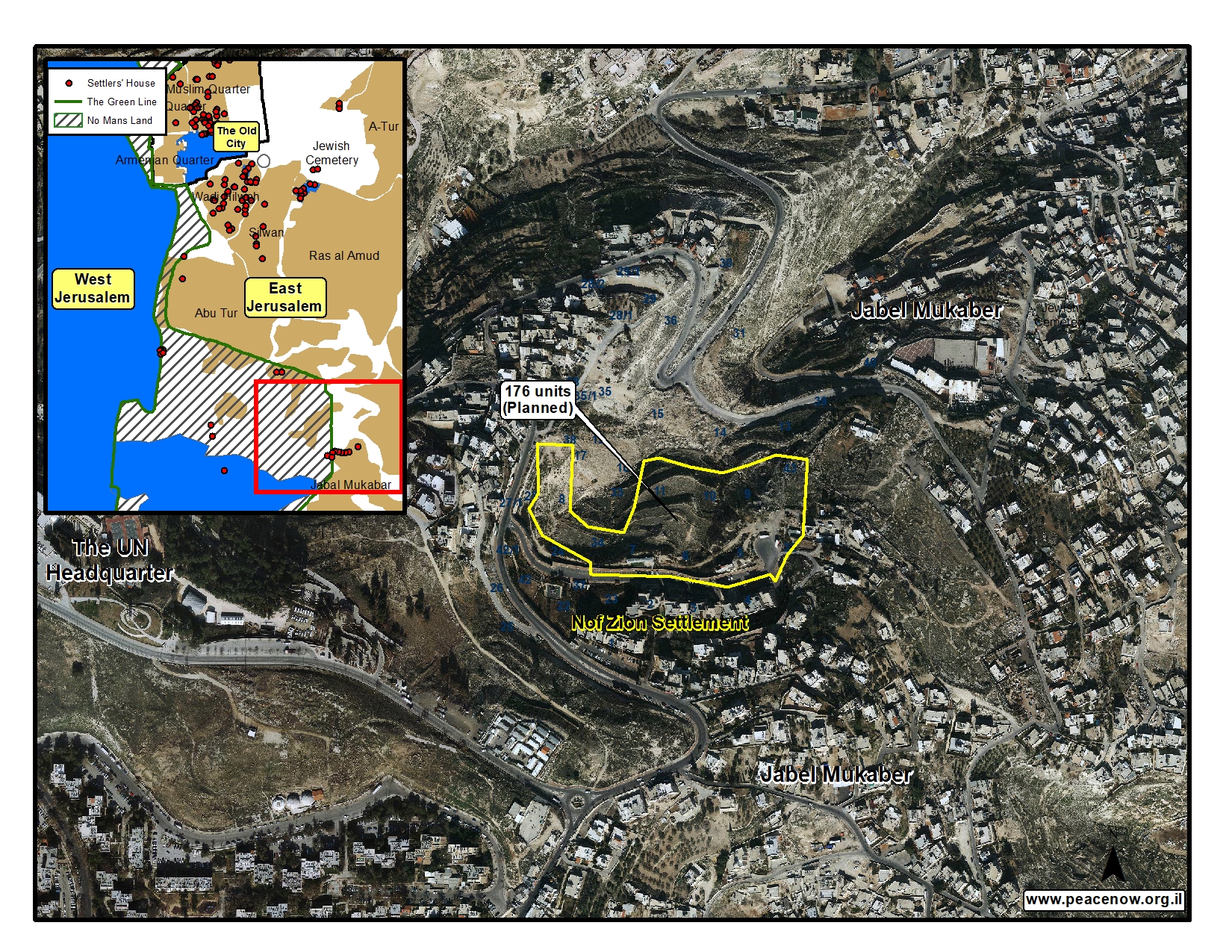
May by Peace Now
Though the Nof Zion settlement currently has 91 units built, in 1994 the Israeli government originally approved plans for a total of 395 units. However, the first phase of construction bankrupted the developer and the remaining building permits were never issued. A drama ensued over the fate of the project, after a Palestinian-American made a bid to buy the development rights. His winning bid was ultimately blocked by right-wing Israelis [with a key role played by Jerusalem settler impresario Aryeh King], who objected to the sale of the property – in a Palestinian neighborhood – to an Arab. Plans then stalled.
In September 2017, rumors emerged that the government was set to issue 176 building permits for the already-approved project. According to Ir Amim, those permits were ultimately issued in April 2019.
Targeting East Jerusalem (South): Moving Ahead with 3 Plans to Expand Gilo
According to Ir Amim, the Jerusalem District Planning Committee has approved an outline plan to build 290 new units in the Gilo settlement, located in southern Jerusalem between the isolated Palestinian East Jerusalem neighbrohood of Beit Safafa and the West Bank city of Bethlehem. Ir Amim reports that the proposed new units will be built within an already built-up area of the settlement, meaning that this plan (unlike the Gilo southeast plan and/or the Har Gilo west plan) will not expand the footprint of the Gilo settlement.
According to Ir Amim:
“The plan is designated for an area in Gilo directly along the planned route of the Jerusalem Light Rail’s green line currently under construction, which will significantly ease access between the neighborhood/settlement and West Jerusalem.”
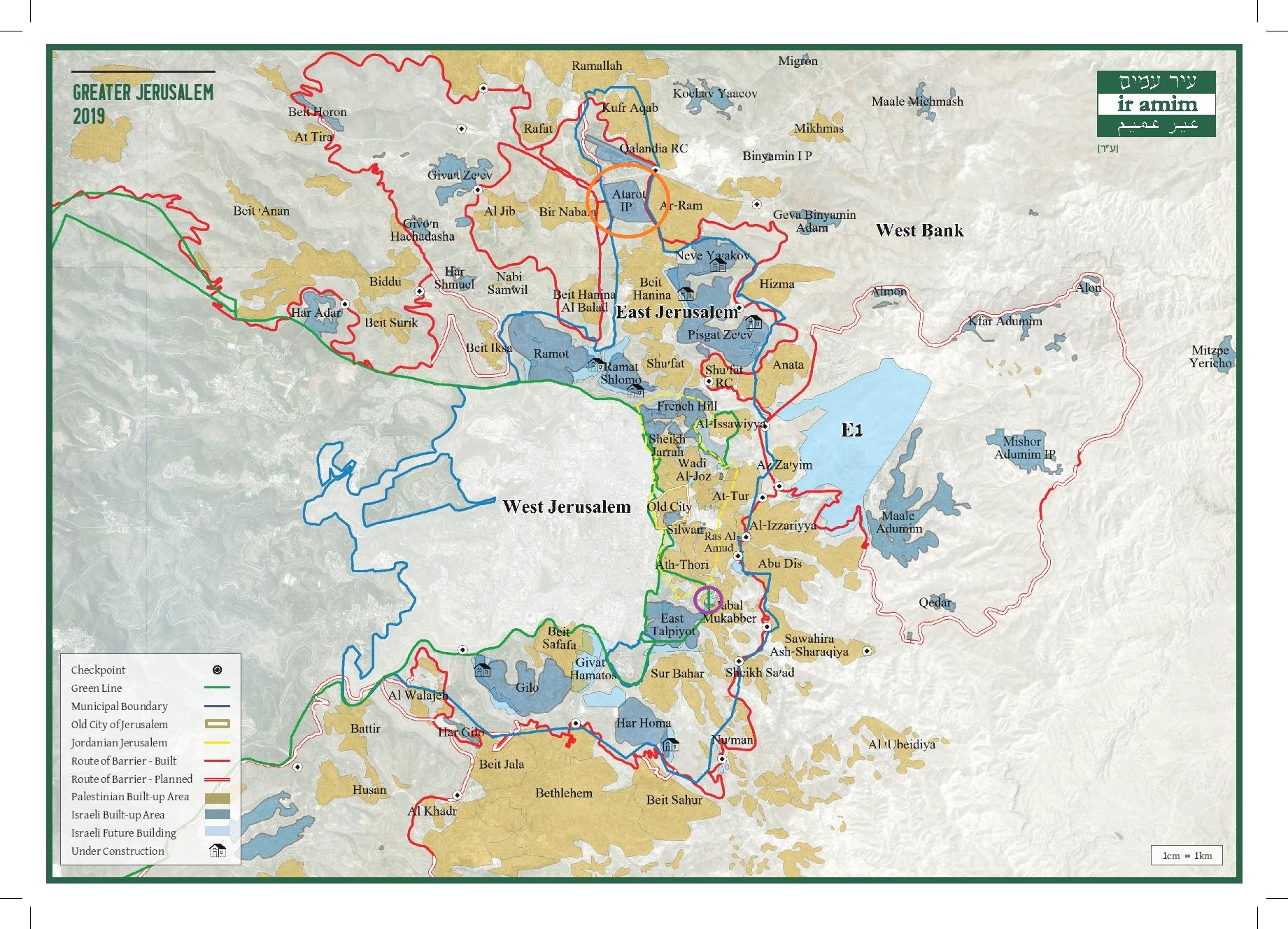
Map by Ir Amim
In approving the outline plan, the Jerusalem District Planning Committee dismissed objections to the plan by a Palestinian family that had fought to prove their ownership of the land. In fact, the committee did not even consider the petition, ruling instead that the question of ownership was beyond the court’s purview – demonstrating yet again the culpability of Israeli courts in the ongoing dispossession of Palestinians.
Additionally, on November 27th, the Local Planning Committee discussed two more plans to expand the Gilo settlement. The first plan, calls for the construction of 1,444 new settlement units in the northern part of the Gilo settlement adjacent to Beit Safafa. The second plan calls for the construction of 110 units and would, if implemented, expand the footprint of the Gilo settlement eastwards towards the West Bank city of Beit Jala. Ir Amim reports the plan is being pushed by a private company.
Ir Amim comments:
“Together all three plans will significantly increase the number of Israelis living over the Green Line in Gilo, while also extending the settlement territorially. These plans are being promoted in tandem with the massive road infrastructure developments in the area, including expansion of Route 60 as well as work on the planned route of the Jerusalem Light Rail’s green line. Road infrastructure projects are part and parcel of the settlement enterprise and are used to lay the groundwork for future settlement expansion. Not only will these developments expedite traffic between Gilo and West Jerusalem, but it will ease access between the Gush Etzion settlement bloc and Jerusalem.”
Targeting East Jerusalem (North): Plans Readied for New Settlement on Ramallah’s Outskirts
On November 28th, the news outlet Israel Hayom reported that the Minister of Construction and Housing is preparing a plan to build a new settlement in East Jerusalem at the site of the disused Atarot airport. The site is located just north of the Palestinian neighborhood of Beit Hanina and extends to the southern border of Ramallah. The plan reportedly outlines 11,000 new settlement units. If implemented, this plan would be the first new government-backed settlement established in East Jerusalem since the construction of Har Homa in the 1990s.
Map by Ir Amim
The Atarot airport site is an important commodity and it was previously promised to the Palestinians for their state’s future international gateway. Developing the site into a settlement would deprive a future Palestinian state of the only airport in the West Bank, dismember Palestinian neighborhoods in the northern part of the city, and sever East Jerusalem from a Palestinian state on this northern flank of the city (acting like E-1 on Jerusalem’s northeast flank, and like Givat Hamatos on Jerusalem’s southern flank).
The Atarot settlement plan dates back to 2007; it was pursued by the Israeli government in 2012 but shelved under pressure from the Obama administration. The plan came back into consideration in April 2017 (a few months following the inauguration of President Trump) when it was rumored to be included on Netanyahu’s master blueprint of settlements for which he was seeking U.S. approval. It was expected to be announced in May 2017 on the occasion of the Jerusalem Day celebration, but was not.
Commenting on the plan when it was under discussion in 2012, Peace Now’s Hagit Ofran observed:
“Not only that this plan might severely harm the future Palestinian State, destroying the only airport in the West Bank, but it will also cut between East Jerusalem and Ramallah at the heart of many Palestinian neighborhoods: Shu’afat and Beit Hanina in the South, Bir Nabala, Al Judeira, Al Jib, Rafat and Qalandia in the West, Ar-Ram, Dahiyat al Bareed and Jaba’ from the East, and Qalandia Refugee Camp, Kafr ‘Aqab and Ramallah from the North. It seems that what the Givat Hamatos plan is meant to do in the South of Jerusalem (to cut between Bethlehem and East Jerusalem), this plan will, god forbid, do at the North of it. The goal of this plan is clear: to prevent the possibility of a Palestinian State in the West Bank, and thus to kill the two states solution.”
Jerusalem’s Settler-Backed Cable Car Project Challenged in High Court
Led by the Israeli NGO Emek Shaveh, a coalition of architects, archeologists, and other professionals has filed an appeal to Israel’s High Court of Justice seeking the withdrawal of a settler-promoter plan to build a cable in East Jerusalem. The plan received approval from the Israeli Housing Cabinet on November 4, 2019.
Emek Shaveh explains the nature of this appeal:
“Our Claims: The plan was approved by a transitional government which was not authorized to do so; This alleged transportation plan was not assessed according to the Ministry of Transportation’s accepted standards; The decision was made based on misleading simulations…Since the High Court of Justice is unauthorized to discuss planning issues, other than the legality of the procedure, the points that were discussed in the public objection, signed by 450 people including 70 public figures, is not included in the appeal…The cable car is a grotesque idea and catastrophic for a unique city such as Jerusalem. It is unclear why the Israeli government needed to approve an irregular, controversial project at the cost of hundreds of millions of shekels in its last days. The fact that senior professionals from all the relevant fields – architects, historians, geographers, tourism specialists and archaeologists – need to turn to the High Court of Justice to prevent it shows, more than anything, that the process of approving the project was unprofessional.”
Though the appeal is limited to a procedural challenge – based on the jurisdiction of the High Court over such matters – Emek Shaveh’s objections to the plan relate to the design of the plan and the negative impact that will result if the plan is implemented. As FMEP has repeatedly covered, this Jerusalem cable car project is an initiative of the Elad settler organization (which is building a massive tourism center – the Kedem Center – in the Silwan neighborhood, which will be a stop along the cable car’s route). The scheme is intended to further entrench settler control, via archeology and tourism sites, inside the Silwan neighborhood of East Jerusalem, while simultaneously delegitimizing, dispossessing, and erasing the Palestinian presence there. Non-governmental organizations including Emek Shaveh, Who Profits, and Terrestrial Jerusalem have repeatedly discredited the government’s contention that the cable car serves a legitimate transportation need in Jerusalem, and have clearly enumerated the obvious political drivers behind the plan, the archeological heresies it validates, and the severe impacts the cable car project will have on Palestinian residents of Silwan.
Settler Leaders’ Endorse Netanyahu…and Netanyahu Govt Approves New Funds for Settlers
On December 1st, the Israeli Cabinet approved a USD $11.5 million security package for the settlements. According to Haaretz, USD $9.9 million of the funds are allocated as a one-time grant to regional settlement councils; the remaining $1.6 million is reportedly earmarked for the construction of “first aid stations.”
In a meeting with Yesha Council leaders prior to the approval of the funds – during which the Yesha Council leaders offered their continued endorsement of Netanyahu amidst the ongoing Israeli political upheaval (in which Netanyahu is fighting for his political life and, likely, to stay out of jail) – Netanyahu promised:
“We are continuing to strengthen the settlement movement and help it. They won’t uproot us from here.”
Shortly after the cabinet’s vote, MK Ayman Odeh sent a letter to Israeli Attorney General Mandelblit requesting an inquiry into the constitutionality of the move, commenting that the sequences of events:
“raise[s] a grave suspicion of a budget allocation [was made] in exchange for a political favor.”
MK Odeh asked whether the security package had been properly reviewed by government professionals. Condemning the disbursal of funds, Odeh said:
“Netanyahu has done the two things that he loves, at the same time, is appropriating public funds for his personal benefit and expanding the settlement enterprise in order to deepen the occupation. It is unconscionable for the head of a transitional government to use the money belonging to all of us to buy the support of the heads of the Yesha Council of settlements for his public battle against the legal system. I demand that the allocation be canceled and its funds directed into the program to curb domestic violence, which has been waiting for funding since its approval in 2017.”
Israeli Government Funnels Nearly USD $270 Million of Surplus Taxpayer Funds to Settlements Each Year (in addition to regular budgets)
According to data from the Israeli Finance Ministry, obtained and analyzed by Peace Now, the Israeli government is using its surplus funding to invest in the growth and entrenchment of settlements — to the tune of nearly $270 million each year. The figure does not include regular funding that goes towards the normal maintenance and security of the settlements.
The data shows:
- There has been a 50% increase in surplus funding for the settlements since 2017 (i.e. the inauguration of President Trump).
- 2017 expenditure: NIS 1.650 billion
- 2018 expenditure: 1.4 billion
- The first quarter of 2019 data indicate another increase.
- The settlements receive ~12% of all Interior Ministry’s grants to all local authorities (including Israel proper), despite representing less than 5% of the total Israeli population.
The Israeli government produces these figures (which, ironically, make a hard distinction between Israel proper and the settlements – a policy of differentiation which the government is very much trying to fight) to comply with a U.S. condition on loan guarantees set in 1990s by Republican President H.W. Bush. At the time, the U.S. administration made an effort to penalize Israel for its settlement activity by deducting the amount spent by Israel for non-security-related settlement costs from the total value of U.S. loan guarantees available to Israel. The condition therefore required the Israeli government to calculate and inform the U.S. every few months regarding its settlement-related expenditures. Peace Now reports in detail on how the Israeli government makes that calculation (spoiler: it’s an estimate) and what is included in it (spoiler: it does not include all of the ways the Israeli government directly funds the settlement enterprise).
Importantly, Peace Now notes that:
“as of September 2018, following the recognition of the Trump administration in annexing the Golan Heights, the Finance Ministry stopped reporting to Americans on investment in Israeli communities in the Golan Heights. At the same time, the first quarter figures for 2019 indicate record expenditures in the settlements, with NIS 390 million (between January – March 2019), compared with an average of NIS 354 million in each quarter in 2018 (including the Golan).”
Commenting on the figure, Peace Now said in a statement:
“State figures themselves show that Israel continues to invest huge capital in developing settlements at the expense of development within Israel. The government’s decision this week to add another NIS 34.5 million in grants unique to the local authorities in the settlements indicates that the government has lost all self-regard for serving the Israeli public at large. With a transitional government on the verge of new elections and close to the end of the fiscal year, the government finds it appropriate to add millions of shekels to the indulgence that is already being given to settlement authorities that receive, according to Treasury figures, close to three times the proportion of their population.”
Joint U.S.-Israel Research Project Will Include Ariel Settlement University
Israeli Minister of Science and Technology Ofir Akunis is reportedly expected to sign an historic agreement in the coming weeks that will establish a new joint research project between American and Israeli universities which will, for the first time, include an Israeli university located in a settlement – Ariel University. Minister Akunis told told the Israeli news outlet Israel Hayom (owned by Sheldon Adelson, who not coincidentally is a key financial backer of Netanyahu, Trump, and Ariel University) that the new agreement:
“is a direct result of the American recognition of Israeli sovereignty over the Golan Heights and Secretary of State Pompeo’s declaration that the settlements in Judea and Samaria do not violate international law.”
For more analysis of the recent announcement by the Trump Administration, see last week’s Settlement Report.
Not from the Onion: Israeli Govt Sold Palestinian Land to a Settler Org & Now Pays Rent to the Settlers
Peace Now reports that the Israeli government sold unofficially expropriated (i.e., stolen) land in the Sheikh Jarrah neighborhood to the radical Amana settler organization for $262,000 (a fraction of its value). But the story gets better: the Israeli government is now paying $224,000 per year in rent to Amana – the settler organization – for use of a single floor of a building built on the land.
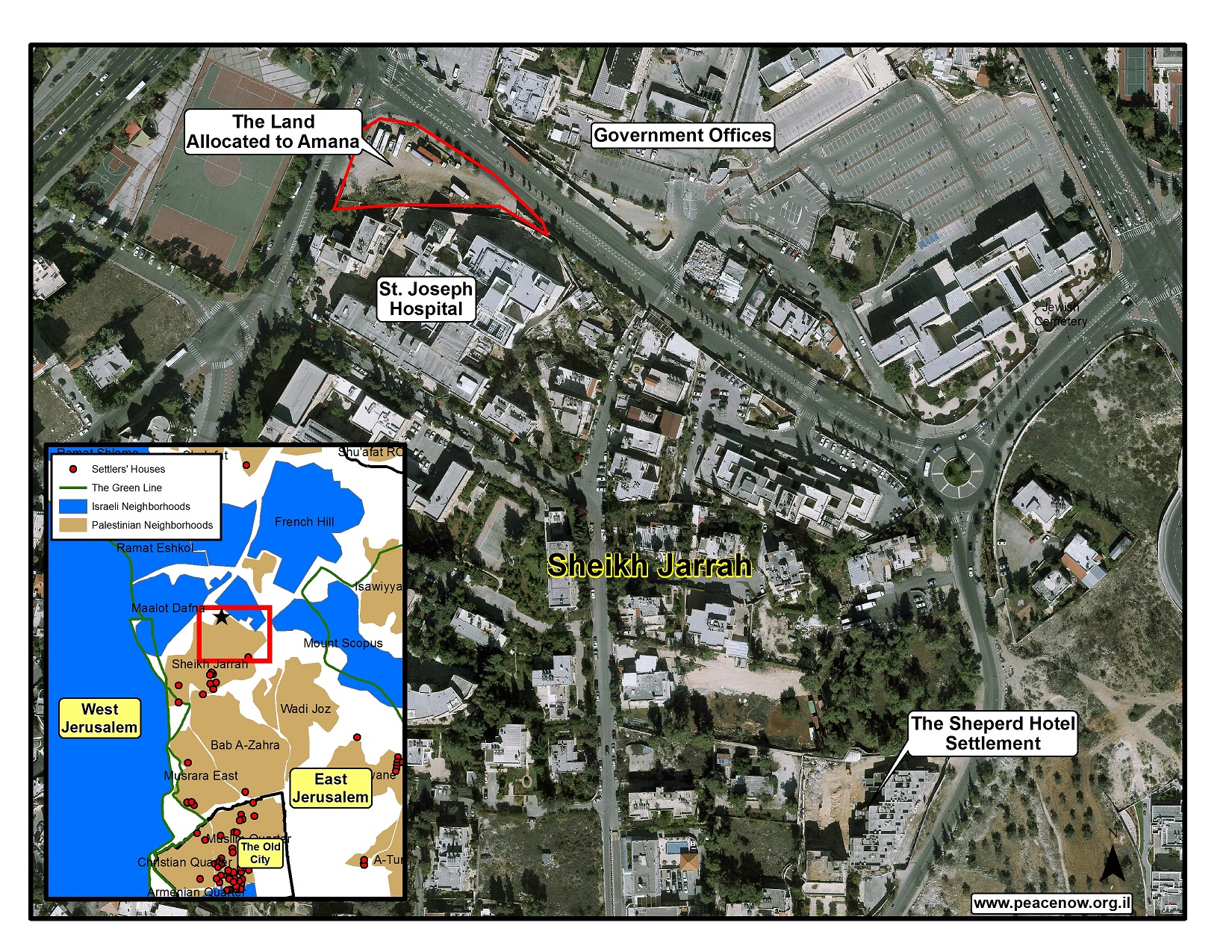
Map by Peace Now
The details of this Kafka-esque story – laid out below – show yet another means by which the Israeli government not only assists settlers in acquiring privately owned Palestinian land, but continues to line the pockets of settlement groups working to take more land from Palestinians.
Regarding the land Amana is now renting to the government, Israel intended to expropriate the land in question from the Palestinian Abu Ta’ah family following the 1967 war. However, the government went ahead and gave the land to the Amana settler organization, and Amana began construction on it, before the process of expropriation was complete – in effect giving the settlers what was still, legally, private Palestinian land. In order to complete the expropriation of the land from the Abu Ta’ah family – which remained the legal owner of the land and fought against the expropriation and Amana’s construction there – the government had to actually retroactively change how the plot of land was registered and sign a retroactive expropriate order.
Peace Now told Haaretz:
“After it received the land that was expropriated in a dubious process without a tender, Amana is profiting in three ways: It built a luxurious office building for itself in the midst of a Palestinian neighborhood; it also strengthens the settlement it built by bringing in Israeli visitors to the welfare office inside the Palestinian neighborhood; and has treated itself to a nice income of about a million shekels a year at our expense and with the help of state and municipal institutions.”
Settler-Run Business Council Asks US Congress to Fund Settler-Palestinian Projects
Ashraf Jabari and Avi Zimmerman, the Palestinian and Israeli co-founders of the Judea and Samaria Chamber of Commerce, recently met Members of Congress while in Washington, D.C. Their goal: to seek support and funding for their joint projects in the West Bank, in the name of supporting peace and coexistence.
Zimmerman said of the trip:
“we now embark on the implementation process by welcoming private and public investments to partner with the businesses that are generating impact for generations to come. Representatives from both Houses and parties were highly responsive, and impressed that we have already begun with strategic planning for private investments.”
As FMEP has repeatedly explained, economic “coexistence” initiatives like the Judea and Samaria Chamber of Commerce (JSCC) seek to normalize, entrench, and reward Israeli settlements while perpetuating Israel’s economic exploitation of occupied territory (including the local workforce, land, and other natural resources). Congressional support for such initiatives could mean U.S. taxpayer dollars going directly (and publicly) to the settlements.
Zimmerman and Jabari were hosted on Capitol Hill by Heather Johston, the Executive Director of the US-Israel Education Association (USIEA). The USIEA is a American evangelical group deeply involved in supporting and normalizing settlements, working in partnership with the Israeli government. It is also works with the Family Research Council to lead Congressional delegations to Israel and runs a bible camp in the Ariel settlement. Boasting of her warm relations on Capitol Hill, Johnston recently spoke to the press about her work to promote the JSCC in Congress:
“Just about everyone on Capitol Hill accepts and recognizes the unique relationship between the U.S. and Israel. It is critical that members of Congress and the Senate have a clear and all-encompassing picture of reality in Israel and how the country and its citizens relate to their neighbors. This visit by Zimmerman and Jabari to Capitol Hill not only introduces members of Congress and the Senate to a phenomenon that is not widely known about but also to untapped opportunities of advancing prosperity and stability in the Middle East.”
Commenting on Jabari and Zimmerman’s recent meetings on Capitol Hill, Rep. Cathy McMorris Rodgers (R-WA) – who led an August 2019 Congressional delegation funded by USIEA, which was hosted by Jabari in his Hebron home – told The Hill:
“Sheikh Ashraf Jabari told us the economic relationship between Palestinians and Israelis is basic, strong, and can’t be separate. In a strong bipartisan way, we should be supporting the grassroots movement for economic cooperation between Israelis and Palestinians. It’s foundational to achieve peace in the region.”
McMorris Rogers and her delegation are not the only Members of Congress who have been warming up to the concept of peace through joint economic “coexistence” schemes like the JSCC. In early March 2019, U.S. Senator James Lankford incorrectly suggested that Congress had already allocated funding for the Judea and Samaria Chamber of Congress. Despite the error, his statement signalled that there are concerted, ongoing conversations in Congress regarding economic peace schemes.
In addition to Members of Congress, Jabari and Zimmerman enjoy close and warm relations with U.S. Ambassador David Friedman, who has repeatedly met with and promoted the JSCC’s work. Amb. Friedman’s support first came into public view in October 2018 when Amb. Friedman attended an event convened by the Judea and Samaria Chamber of Commerce. Then, in February 2019, Amb. Friedman spoke about economic co-existence initiatives at a conference hosted by the JSCC and US-Israel Education Association. Speaking to the press at conference, Ambassador Friedman said the goal of the forum is to “encourage business development in Judea and Samaria, encourage the prosperity of people who live there, most of them Palestinian residents.”
Bonus Reads
- “Israel Limits West Bank Farmers’ Access to Lands Near Green Line” (Haaretz)
- “Forbidden: The West Bank land Israel locks away from Palestinians.” (Middle East Eye)
- “100-plus Democrats sign letter criticizing new US stance on Israeli settlements” (JNS)
- “ Israel Limits West Bank Farmers’ Access to Lands Near Green Line” (Haaretz)
Welcome to FMEP’s Weekly Settlement Report, covering everything you need to know about Israeli settlement activity this week.
To subscribe to this report, please click here.
April 12, 2019
- In Largest Settlement Surge Since Trump, Israel Advances Plans for 3,659 Settlement Units – Including Plan to Retroactively Legalize the Haresha Outpost
- Housing Ministry Publishes Tenders for 956 Settlement Units
- Ariel Medical School Gets Approval, But Faces Two High Court Petitions
- Settlers Celebrate Right-Wing Election Victory
- AirBnb Reverses Settlement Policy
- U.S. Ambassador Friedman Touts East Jerusalem Settlement Business as “Path to Peace”
- Bonus Reads
Questions/comments? Email kmccarthy@fmep.org
In Largest Settlement Surge Since Trump, Israel Advances Plans for 3,659 Settlement Units – Including Plan to Retroactively Legalize the Haresha Outpost
Following up on FMEP’s reporting last week, on April 4th the Israeli Civil Administration Higher Planning Council (the body responsible for regulating all construction in the occupied West Bank) advanced plans for at least 3,659 settlement units, including a plan to retroactively legalize homes in the unauthorized Haresha outpost.
This is the largest batch of settlement plans advanced at one meeting by the High Planning Council since President Trump took office in January 2017; previous High Planning Council meetings (which happen every three months, per a reported agreement with the U.S. Administration) advanced plans on the order of 1,000 to 2,000 units.
Of the total units advanced on April 4th, the High Planning Council granted final approval for 1,226 new settlement, to be built entirely on the west side of the Israeli separation wall. These are:
- In Beitar Illit:
- 31 new units
- A 100 room building for the elderly, or a hotel
-
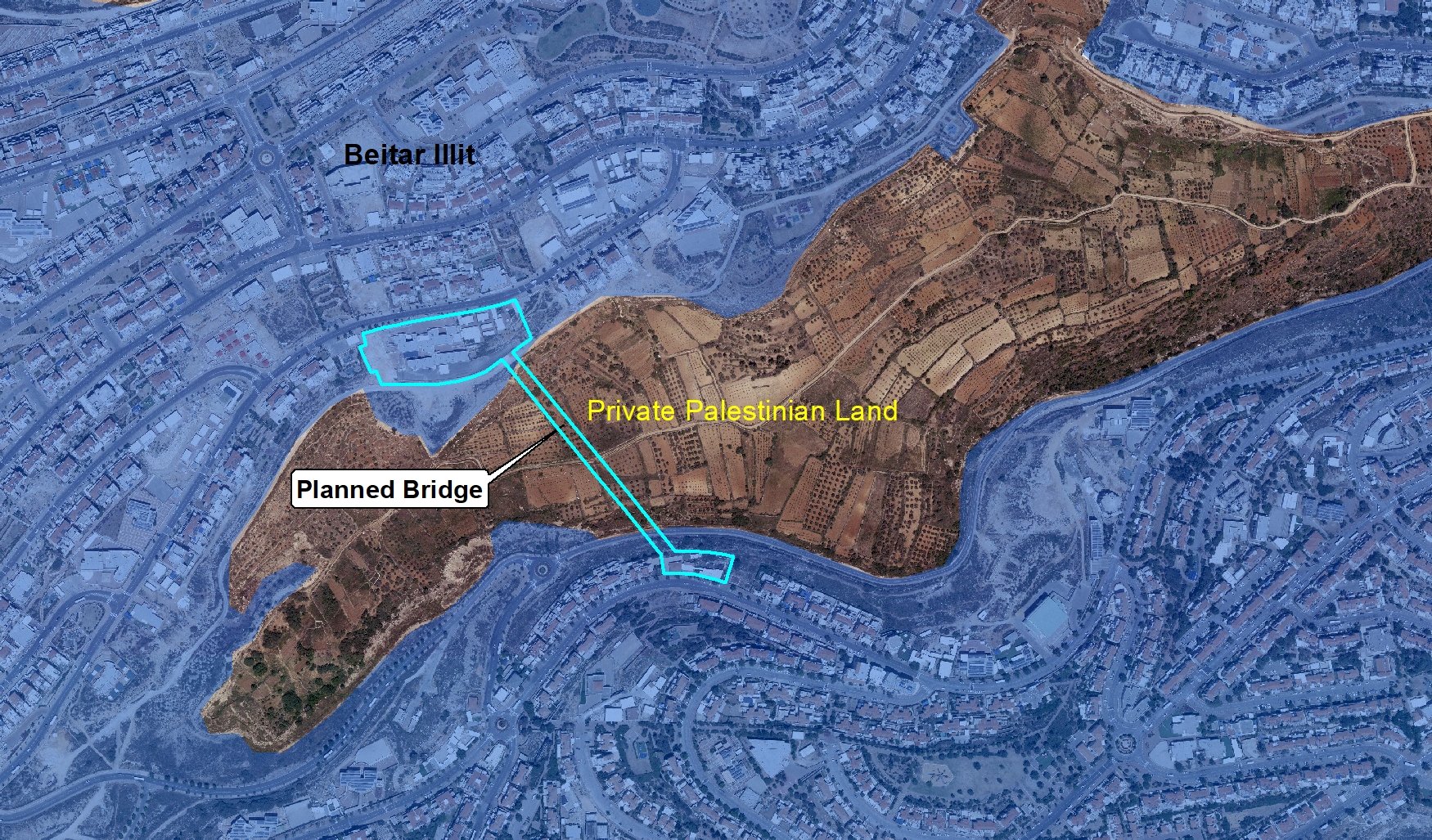
Map by Peace Now
A new pedestrian bridge over privately owned Palestinian land for Israeli settlers to use on the Sabbath (when observant Jews do not drive, and had to walk a long route in order to reach other parts of the settlement).
- 603 new units in Maale Adumim
- A plan to retroactively legalize residential units in the Sde Bar settlement; Peace Now has not yet verified how many units are involved in this plan. Sde Bar was first established as an outpost of the Nokdim settlement in 1998, but Israel granted full approval to that outpost, recognizing it as an educational institute and a full-fledged settlement, in 2005. Settlers recently built a residential neighborhood there without Israeli authorization. The plan approved by the council on April 4th will grant retroactive authorization to those residential settlement units.
- 289 new units in the Alon settlement, located on the Palestinian side of the separation wall within sight of the Khan al-Ahmar bedouin village that Israel is prepared to forcibly relocate. There are plans to expand the neighboring Kfar Adumim settlement to takeover the land where Khan al-Ahmar currently stands.
- 110 new units in the Givat Zeev settlement.
- 108 new units in the Etz Efraim settlement.
- 85 new units in the Karnei Shomron settlement.
Of the total units advanced on April 4th, the High Planning Council also approved for deposit for public review plans for 2,433 new settlement units, the majority of which (1,198) will be built on the east side of the Israeli separation barrier, including:
- 1000 units in Efrat
- A plan to retroactively legalize 720 units in the Haresha outpost. This is part of the Israeli government’s ongoing efforts to retroactively legalize the outpost, which hinges on Israel’s ability to build a legal access road to the outpost. The Israeli government has found several creative solutions to that problem – like building a tunnel or building a bridge – all of which will undoubtedly infringe on the property rights and livelihoods of the Palestinian land owners.
- 210 units in Shiloh – expanding the footprint of the settlement to its north
- 147 units in Ariel.
- 147 units in Mitzpe Yericho.
- 114 units in Elon Moreh.
- 73 new units in Beitar Illit (in addition to the final approvals covered previously).
- 66 units in Oranit.
- 42 more units in Givat Zeev.
- 32 units in Beit Arie.
- 7 new units in Rehelim.
- An unverified number of new units in the following settlements: Paduel, Karnei Shomron, and Elkana.
Peace Now said in response:
“Netanyahu has decided, officially or unofficially, to annex the West Bank to Israel, otherwise one cannot explain the promotion of thousands of units for Israelis in the Occupied Territories. The construction of the settlements only makes it harder to end the occupation and to get to a two states peace agreement and is bad for the Israeli interest to remain a democratic and secured state.”
Housing Ministry Publishes Tenders for 956 Settlement Units
On April 4th the Israeli Ministry of Housing and the Israel Lands Authority met and published tenders for the construction of 956 new settlement units, including commercial complexes; 106 tenders are for plans in settlements east of the separation barrier. These units are in addition to the 3,659 units advanced this week by the Civil Administration’s High Planning Council (discussed above).
The published tenders are:
- 250 units in the Elkana settlement.
- 195 units in the Ariel settlement.
- 118 units in the Ofarim settlement.
- 112 in the Alfei Menashe settlement.
- 111 units in the Oranit settlement.
- 62 in the Adam (Geva Binyamin) settlement, located east of the separation barrier.
- 50 in the Emmanuel settlement.
- 44 units in the Maale Ephraim settlement, located east of the separation barrier.
- 14 units in the Beitar Illit settlement
As Peace Now explains, “some of the tenders are for units that were published in previous tenders but were not sold. The new tenders mean that the government is currently seeking to promote and build those units although failed to do so in the past.”
Ariel Medical School Gets Approval, But Faces High Court Petition
On April 12th, the Israel Higher Education Council voted to approve a new medical school in Ariel University, located in the West Bank settlement of Ariel. This approval contravenes the normal practice of the council, in that it ignores a vote to reject the school by the Higher Education Council’s own professional subcommittee. The medical school is slated to open this fall with significant financing from American casino magnate (and Trump supporter/financial backer) Sheldon Adelson.
However, the High Court of Justice is set to hear a petition regarding the unusual and scandal-ridden process by which the school gained approval at various stages of the planning process. The petition was filed by two Israeli academics – Prof. David Harel of the Weizmann Institute of Science and Prof. Alon Harel of the Hebrew University of Jerusalem – asserting that the approval “casts a heavy shadow on the decision making process in higher education.” It is unclear how the outcome of the petitions might affect the newly approved plan to open the medical school this fall.
Settlers Celebrate Right-Wing Election Victory
Settlers are mostly celebrating the results of Israel’s April 9th elections (in which West Bank and East Jerusalem Palestinians could not vote), which delivered incumbent Prime Minister Netanyahu an opportunity to form and lead the next government.
As has come to be expected, Netanyahu made an 11th hour election pitch by promising to start the process of annexation if he was reelected. Settlers received Netanyahu’s annexation promise and his reelection with predictable enthusiasm. The Yesha Council released a congratulatory statement saying:
“This morning we can say with certainty: In the face of all the campaigns and manipulations, the people of Israel chose the right. The people expressed their loyalty to the Land of Israel and chose in favor of applying Israeli sovereignty over Judea, Samaria and the Jordan Valley. We congratulate Prime Minister Benjamin Netanyahu on his election, and look forward to the establishment of a strong and broad right-wing government. In the next Knesset, too, we will continue to build, expand, legalize and jointly develop Israeli communities in the region.”
Not all settlers believe that Netanyahu will deliver on his promise to annex the settlements, but generally speaking, settlers dismiss the “will he/won’t he” debate (perhaps correctly) as a political decision that does not impact the reality of their presence on the ground.
Peace Now issued a sharp statement on the election results:
“Now the settlement lobby and its re-elected backers in the Knesset are doing what they know best – extorting and manipulating to save Netanyahu from prosecution in exchange for his compliance in working toward annexation. We at Peace Now were never relying on the election to change reality, but rather see grassroots public engagement as the only way to build pressure on the government. Now that Netanyahu has let the annexation genie out of the bag with his pre-election rhetoric, we stand even more equipped to go on the offense by showing fellow Israelis the bleak future the settler lobby and its Knesset backers are leading us, and what viable alternative path Israel can take toward a more prosperous, democratic, secure future.”
AirBnb Reverses Settlement Policy
On April 9th, AirBnB announced that it had reversed its decision to remove rental listings located inside of Israeli settlements in the occupied West Bank, despite previously acknowledging that settlements “are at the core of the dispute between Israelis and Palestinians,” and that the listings there “contribute to existing human suffering.”
AirBnB’s new announcement acknowledges (again) that settlements are “central to ongoing tensions,” but says it will nonetheless continue to allow those listings to remain on their website. Giving a nod to the controversial nature of this decision, AirBnB promised to donate all profits derived from West Bank settlement listings to humanitarian groups, but it conspicuously specified that these will be humanitarian groups working in other parts of the world (as opposed to with the Palestinians).
Omar Shakir, the Israel/Palestine Director at Human Rights Watch – which issued a significant and damning report on the issue of tourism being used to normalize occupation – tweeted in reaction:
“Disappointing @Airbnb decision reverses their stance to fully respect rights. Donating profits from unlawful settlement listings does nothing to remedy ‘human suffering’ they’ve acknowledged causing. By continuing to do business in settlements, they remain complicit in abuses.”
Along with AirBnB’s policy reversal, it settled several lawsuits filed against AirBnB in U.S. courts. FMEP President Lara Friedman tweeted on this important element:
“And just like that, US courts let themselves becomes weapons used to legitimize the violation of intl law, the re-definition of ‘lsrael’ to mean ‘all the land between the river and the sea,’ & the re-definition of ‘anti-Semitism’ to mean ‘refusal to endorse/normalize occupation.’ This is part of a broader trend that very few people are paying any attention to, which is a dangerous mistake. By the time folks wake up it will likely be too late. [link to: https://forward.com/opinion/417058/opinion-the-surprising-new-battleground-in-the-war-against-palestinian/]”
The Center for Constitutional Rights – which recently intervened in the legal cases involving AirBnB – issued a response saying:
“We are dismayed that Airbnb has caved to the legal bullying of Israeli settlers and re-listed properties in illegal settlements in occupied Palestinian territory. Airbnb’s decision reflects an alarming lack of commitment to human rights. When we filed counterclaims on behalf of the Palestinians who actually own the land the listed properties unlawfully sit on, we laid out the international and domestic law violations committed by the settlers, including war crimes and crimes against humanity. In backing down from its decision not to list properties in occupied Palestinian territory, Airbnb is in breach of its international human rights obligations, and is discriminating against Palestinians.”
Amnesty International – which also published a report on the complicity of online rental companies who list properties in East Jerusalem and the West Bank – said in response to AirBnB:
“Airbnb’s decision to continue to allow accommodation listings in illegal Israeli settlements in the occupied West Bank is a reprehensible and cowardly move that will be another devastating blow for the human rights of Palestinians…Airbnb are trying to absolve themselves by stating they will donate the profits from these listings to charity, but that fails to change the fact that by continuing to drive tourism to illegal settlements they are helping to boost the settlement economy. In doing so, they are directly contributing to the maintenance and expansion of illegal settlements, a breach of the Geneva Conventions and a war crime under Rome Statute of the International Criminal Court. Airbnb had a clear opportunity to make the right decision to uphold human rights and use their influence to set a precedent in the tourism industry. Instead, they have chosen to bury their heads in the sand – ignoring blatant evidence that they are helping to fuel violations that cause immense suffering to Palestinians. Airbnb’s reversal demonstrates why we can’t just rely on companies to take the right decisions, and that we need governments to fulfil their obligations by intervening and passing laws obliging their companies to respect human rights.”
U.S. Ambassador Friedman Touts East Jerusalem Settlement Business as “Path to Peace”
U.S. Ambassador David Friedman tweeted his support for the new Rami Levy mall, located in the Atarot settlement industrial zone within sight of Ramallah but inside the security barrier and within Israel’s municipal border, as expanded by Israel after the 1967 war.
Friedman said:
“Great morning at the new Atarot Mall in northern Jerusalem, anchored by a Rami Levy Supermarket. Was given a tour by Rami Levy himself. Israelis and Palestinians working, shopping and doing business together — a simple path to peace!”
FMEP President Lara Friedman tweeted in response:
“Amb Friedman & co’s special notion of peace, based on racist notion that unlike Jews who for 1000s of years refused to forsake their history/narrative, Palestinians will be beaten into submission or bribed into giving up basic human demand for freedom & equal rights.”
When the Rami Levy mall opened in January 2019, FMEP explained:
“The massive new mall is the crown jewel of the shopping empire built by Israeli businessman Rami Levy, who already operates a network of supermarkets in settlements. Like all of Levy’s projects (and settlement industrial zones in general), the new mall is branded as a socially-conscience, ‘coexistence’-building business initiative, with Levy and government officials praising the fact that the new mall will attract both Israeli and Palestinian shoppers and be home not only to Israeli businesses, but to to a few Palestinian-owned/operated businesses as well.”
The ‘coexistence’ argument is dismantled by the Israeli watchdog group Who Profits, which explained:
“The Jerusalem mall would mark a new stage in Levy’s involvement in the occupation economy…[which] began with providing services to Israeli settlers and continued with the exploitation of Palestinians as a cheap labor force in his supermarkets. He now appears to be turning his attention to massive construction projects on occupied Palestinian land and the exploitation of a Palestinian captive market in the East Jerusalem…Rami Levy is in a position that would allow him establish a large mall on “virgin land” because the Israeli authorities have prevented Palestinian businesses from competing with Israelis. Levy’s plan would take advantage of the fact that Palestinians do not have other large-scale retail facilities. A flourishing market in Bir Nabala was destroyed by Israel’s wall in the West Bank. And venturing into West Jerusalem is not an option for Palestinians, most of whom live below the poverty line. Although there is every likelihood that the Israeli authorities will portray Levy’s mall as beneficial to Palestinians, there are important facts to be remembered. Palestinians entering his mall will not be exercising the right of a consumer to informed choice. Rather, they will be captive clients — belonging to an occupied people.”
Bonus Reads
- “Democracy, Israeli Style” (New York Times)
- “Jerusalem is Finally Unified, In Opposition to this Plan” (Haaretz)
Welcome to FMEP’s Weekly Settlement Report, covering everything you need to know about Israeli settlement activity this week.
To subscribe to this report, please click here.
February 22, 2019
- Settlers Fly Israeli Flag Over Muslim Quarter Home Following Eviction of Palestinian Family
- Israel Approves Massive Jerusalem Housing Project – Including Settlement Units in East Jerusalem
- Facing Supreme Court Hearing, Civil Administration Decides to Partially Comply with Geo Data Request from Radical Settler Group Regavim
- U.S. Ambassador to Israel Pushes Economic Peace Scheme (Again) to “Judea & Samaria Chamber of Commerce & Industry”
- Two U.S. Congressmen Tour Settlements, Promote Annexation
- The “Sovereignty Movement” Promoting Annexation, & the Pushback
- Bonus Reads
Questions/comments? Email kmccarthy@fmep.org
Settlers Fly Israeli Flag Over Muslim Quarter Home Following Eviction of Palestinian Family
On February 17, Israeli security forces evicted the 7-member Abu Asab family was from its home of nearly 70 years in the Muslim Quarter of Jerusalem’s Old City. Within hours of the eviction, Israeli settlers moved into the home and raised an Israeli flag on its roof.
Before 1948, the property in question was owned by a Jewish family, the Maisals, which abandoned the property during Israel’s War of Independence. The Abu Asab family was settled in the property by the Jordanian government during this same period – which Palestinians know as the Nakba (the catastrophe), in the wake of their expulsion from their own home in what became Israeli West Jerusalem. Their eviction this week came at the behest of Israeli settlers who had gained control over the land trust to which the original Jewish owners had passed their property rights.
As background: Under Israel’s Legal and Administrative Matters Law, Jews who lost property in 1948 (of which there are approximately 2,000) have the right to reclaim their property. Palestinians who lost property in that same war (of which there are approximately 20,000-30,000) do not have a similar right. Settler organizations have sought to take full advantage of that law, undertaking campaigns to identify Jewish families who abandoned property now occupied by Palestinians, gain title to those properties (even if the original landowner has made no effort to reclaim the property), and then start eviction proceedings against the Palestinian residents. This is happening across East Jerusalem neighborhoods, most prominently in Sheikh Jarrah and Silwan.
Palestinian residents targeted by these evictions, like the the Abu Asab family, have no legal avenue for reclaiming their property in West Jerusalem.
Peace Now explains:
“The Maisel family dedicated the property to a trust. A few years ago, settlers managed to appoint themselves as directors of this trust, and in their name they sued the family who lived in the property in protected rent during the days of the Jordanians and paid rent regularly. With this crooked legal situation, the court granted the settlers the house and the Abu Asab family became refugees for the second time…This eviction is part of a larger strategy by proponents of the settlement enterprise to change the character of Palestinian Jerusalem neighborhoods in order to cement Israeli hegemony over the Old City and its surroundings and to prevent the chances of a two-state solution.”
Ir Amim researcher Aviv Tatarsky writes:
“When Jewish settlers move into Palestinian neighborhoods, they almost always bring with them armed guards to stand guard on their rooftops and outside their doors, a dynamic that has a detrimental influence on entire neighborhoods. Day to day life is disrupted, with residents facing pressure seemingly designed to push them out of their homes. Israeli authorities have various ways of abetting that effort, from the law allowing only Jews to reclaim property, to funding private security guards for the settlers who move in to their properties, to funding tourism initiatives that strengthen the image of those settlements vis-à-vis the Israeli and international public.”
Israel Approves Massive Jerusalem Housing Project – Including Settlement Units in East Jerusalem
According to the Middle East Eye, on February 20th the Jerusalem Planning & Building Committee approved a project for 4,416 new housing units across Jerusalem, including units in Israeli settlements and settler units located within Palestinian neighborhoods in East Jerusalem. Early reporting on the details of the plan describe:
- 76 new units in the Shuafat neighborhood of East Jerusalem
- 56 new units in the Beit Hanina neighborhood of East Jerusalem
- 464 units in the Gilo settlement
- The construction of a new commercial complex at the Atarot settlement industrial zone site, including 3 buildings with 8 floors each.
FMEP will report more details on the plan as the are clarified.
Facing Supreme Court Hearing, Civil Administration Decides to Partially Comply with Data Request from Radical Settler Group Regavim
The settler-aligned Arutz Sheva outlet reports that, days before a scheduled hearing at the Supreme Court, the Israeli Civil Administration announced that it will provide a portion of the geographical information that the radical settler group Regavim requested via a freedom of information request last year. Regavim works to dispossess Palestinians of their land and property in the West Bank by “helping” (i.e., pushing) the Israeli government to enforce planning and building laws – and possession of the Civil Administration’s most recent geographical data will undoubtedly aid Regavim in pursuing its mission. Notably, Regavim works for the application of planning and building laws only against Palestinians; key Regavim staff members actually live in illegally built settlement units (illegal even under Israeli law), which Regavim works to retroactively legalize.
Supreme Court Justice Meni Mazuz chided the Civil Administration for its failure to respond to the initial information request, and for the nine-month delay in responding to Regavim’s court petition. In light of the Civil Administration’s announcement, the Supreme Court subsequently dismissed Regavim’s petition and and ordered the Civil Administration to pay Regavim’s legal expenses related to the case.
Regavim’s Attorney Boaz Arzi crowed:
“Although it took far too long, after a year and a half we finally received the data we needed – but through legal petition, not through the Freedom of Information process. Regavim is considering submitting a new petition against the Civil Administration’s interpretation of its obligations – or more precisely, its presumptive lack of obligation – under the Freedom of Information Law, an interpretation that contradicts the Attorney General’s directive.”
The Civil Administration said:
“We will study this case and draw conclusions in order to improve our responsiveness to the public.”
U.S. Ambassador to Israel Pushes Economic Peace Scheme (Again) to “Judea & Samaria Chamber of Commerce & Industry”
On February 21st, U.S. Ambassador to Israel, David Friedman, spoke about economic co-existence initiatives at a conference hosted by the “Judea Samaria Chamber of Commerce and Industry (JSC)” (an Israeli settler body) and US-Israel Education Association (USIEA) (conference website is here). The USIEA is a U.S. evangelical group deeply involved in supporting and normalizing settlements, working in partnership with the Israeli government. It is also works with the Family Research Council to lead Congressional delegations to Israel and runs a bible camp in the Ariel settlement.
This is the second time the Ambassador has met with the JSC, the first was in October 2018 at a meeting in the Ariel settlement. Speaking to the press at this week’s conference, Ambassador Friedman said the goal of the forum is to “encourage business development in Judea and Samaria, encourage the prosperity of people who live there, most of them Palestinian residents.” Notably, until this point the U.S. State Department has not officially referred to the West Bank as “Judea & Samaria” – a biblical term for the area that is preferred by Israeli settlers and pro-annexationists.
Friedman said in his speech:
“This is not a time for words, this is a time for action, and this is the path I’m confident we’re on. One day, I believe in the near future, as we begin to see Israelis and Palestinians working together, studying together, investing together, and living together in real peace – not the ‘peace’ that comes from a piece of paper, but the real peace that’s in the heart and the soul of everyone who’s here. We will look back on days like today to understand how it all began.”
Commenting on Friedman’s remarks, FMEP President Lara Friedman tweeted:
“Folks, pay close attention to actions/statements like this one. All evidence so far suggests that US direct engagement (new policies, initiatives, funding) to normalize occupation while de-nationalizing Palestinians IS the Trump ‘peace plan’”
FMEP has repeatedly chronicled Amb. Friedman’s embrace of economic co-existence initiatives as a core U.S. priority on the ground, and has repeatedly explained the perversity of labeling Israel’s economic exploitation of occupied territory (including the local workforce, land, and other natural resources) “coexistence” or suggesting that it brings to the Palestinians benefits they should welcome. The New York Times quoted a spokesman for the Palestinian Authority explaining the Orwellian reality of settlement industrial zones:
“Somebody occupies your country, steals your land, steals your water, steals your resources, then says: ‘I’ll make a good deal for you if you come work for me. I’ll create jobs for you. We are not occupiers. We are employers.’ This is ridiculous. The colonial settlements are illegal in every sense of the word.”
Two U.S. Congressmen Tour Settlements, Promote Annexation
While on a tour of Israeli settlements in the West Bank (something that in itself would have been unusual and controversial in the past), U.S. members of Congress Andy Harris (R-MD) and Andy Barr (R-KY) expressed support for Israeli annexation of the settlements and spoke in favor of settlement industrial zones, suggesting that such zones promote peace and prosperity in the region.
While at the Barkan Industrial Zone in the northern West Bank, Barr told members of the press:
“Our job after witnessing what we have seen here today is to communicate to the administration that the best way forward for peace and prosperity for everyone, Jews and Arabs, is more industrial development here, where we can have integration and not segregation: That is the path to peace…free enterprise, where everyone has the opportunity for upward mobility and prosperity – working together – is the best way forward for peace.”
Barr’s comments echo the views of U.S. Ambassador to Israel David Friedman, who once described the Barkan Industrial Zone as a “model of Israeli-Palestinian coexistence since 1982, with thousands working and prospering together.” The reality of West Bank industrial zones, and the role they play in the lives of Palestinians, is more complicated. For decades Israel has used industrial zones as another tool to expand and deepen control over West Bank land. Jobs in industrial zones – often the only jobs available for Palestinians living under an Israeli occupation that prevents the development of any normal Palestinian economy – are widely viewed by Palestinians as a double-edged sword. FMEP has previously reported on the false notion that settlement industrial zones are in the best interests of the Palestinian people living under occupation.
Representatives Harris and Barr met with settler leader Yossi Dagan, the head of the Samaria Regional Council, and two members of the radical activist group called Women in Green, which has long advocated for Israeli annexation of the West Bank. Later on the same trip, the two also met with Prime Minister Benjamin Netanyahu.
Rep. Barr told the Women in Green:
“we will share this [sovereignty] message with our colleagues in Congress and our constituents in the United States as we echo your sentiment that a strong Israel and Israeli sovereignty is an interest not just of the Jewish people but of the United States as well.”
The “Sovereignty Movement” Promoting Annexation, & the Pushback
The Israeli “Sovereignty Movement” (an offshoot of the Women in Green organization) is working to further formalize its expanding influence over Israeli politicians and public discourse by pushing for the establishment of a Knesset committee devoted to the cause of Israeli annexation of the West Bank.
In a recent article detailing how the Israeli political echelon no longer conceals its annexationist aims, veteran Israeli journalist Shlomi Eldar explains that the “Sovereignty Movement” has been instrumental in pushing politicians and candidates to speak more openly and supportively in favor of annexation. Eldar writes:
“The Sovereignty Movement is currently focused on creating a lobby in the Knesset. Its activists are working the ruling party, distributing a journal running a website and promoting paid content on social media. The movement’s influence played a role in Likud’s Central Committee voting in December 2017 in favor of a non-binding decision imposing Israeli sovereignty on Israeli-controlled territories of the West Bank, including the Jordan Valley. This, it turns out, was just the beginning. The Sovereignty Movement posted a video on Feb. 12 calling for imposing Israeli sovereignty on the West Bank territories. ‘First of all, we get the idea of a Palestinian state off the table,’ says Science and Space Minister Ofir Akunis in the video. ‘Second, we need to make brave, difficult, challenging decisions that aren’t simple when facing the international community. First of all, we must impose sovereignty on West Bank Area C.’ According to him, on the land designated Area C, under Israeli civil and security control, there is a clear Israeli and Jewish majority.”
Commanders for Israeli Security – an organization comprised of retired and former senior officials in the Israeli defense establishment – released a statement in direct response to the growing influence of the “Sovereignty Movement,” and its newly revealed ambition of creating a Knesset committee. The statement reads:
“Today, the extreme right’s mode of operation for annexing millions of Palestinians was revealed. Undetected, a right-wing extremist group is working to ensure that the next government will implement its plan. Although most of the Israeli public understands the destructive implications of annexation, utterly opposes it, and is unaware of the measures to realize this horror scenario, the Sovereignty Movement creates facts on the ground, mobilizes extreme right-wing politicians and lays the groundwork for implementing the move. It is now clear that these are not merely delusional dreams. The declarations favoring annexation, or using the laundered term “application of sovereignty,” frequently delivered by extreme right-wing politicians, are public expressions of a well thought-out plan developed in hiding, whose implementation began during the term of the outgoing government. With backwind of the support they have mobilized so far, the annexationists no longer hide their intentions, openly proclaiming their determination to accomplish the feat during the term of the next government, leading to the destruction of Israel as a Jewish, secure and democratic state. The annexation pressure is on. The pressure exerted on politicians to express support for annexation are but the prelude to the pressure to be exerted on Prime Minister Benjamin Netanyahu, if elected, to commit to annexation as a condition for forming the next government. If the annexation move is not halted immediately, we will wake up to a different Israel during the term of the next government, without a solid Jewish majority and all the security and other implications of integrating millions of Palestinians into the State of Israel. This pressure should be stopped right now.”
Bonus Reads
- “Palestinians Live in Caves to Preserve their Land” (Al-Monitor)
- “Netanyahu Pretends the Occupation Doesn’t Exist” (Al-Monitor)
- “Honenu: The legal arm of Israel’s radical settlers” (Ynet)
- “The Escalation of Israeli Collective Punishment of Palestinians” (Al-Shabaka)
- “Verizon, Pfizer, Bank of America – US Corporations are Funding Israeli Settlements” (In These Times)
Welcome to FMEP’s Weekly Settlement Report, covering everything you need to know about Israeli settlement activity this week.
To subscribe to this report, please click here.
August 17, 2018
- U.S. Ambassador: There is “No Reason” to Evacuate Settlements from West Bank
- Israel Publishes Tenders for 603 new units in East Jerusalem Settlement of Ramat Shlomo
- Massive Jerusalem Development Deal for 20,000 New Apartments – Including Settlement Expansion Projects
- Israel Triples Size of New Settlement Industrial Zone In Hebron
- Knesset Sends Funds to New Settler Council in Hebron, Despite High Court Injunction
- Knesset Approves Past Due Payment for the Construction of Amichai Settlement & “Temporary” Outpost
- Delay in Opening of new Jerusalem “Park” That Confiscates Palestinian Spring
- Israel Evicts Palestinians from Bethlehem Home Despite Court Order
- Bonus Reads
Comments, questions, or suggestions? Email Kristin McCarthy at kmccarthy@fmep.org.
U.S. Ambassador: There is “No Reason” to Evacuate Settlements from West Bank
According to MK Yehuda Glick (Likud), U.S. Ambassador to Israel David Friedman – who is one of three lead authors of the supposedly forthcoming U.S. peace plan – told a group of settler leaders that he does not see any reason why settlements would need to be evacuated from the West Bank in a peace deal with the Palestinians. MK Glick said Friedman was “very explicit” about that point during the meeting, which was held at the U.S. Embassy in Jerusalem. Notably, the position attributed to Friedman is consistent with positions he has taken in the past, both in speaking and writing.
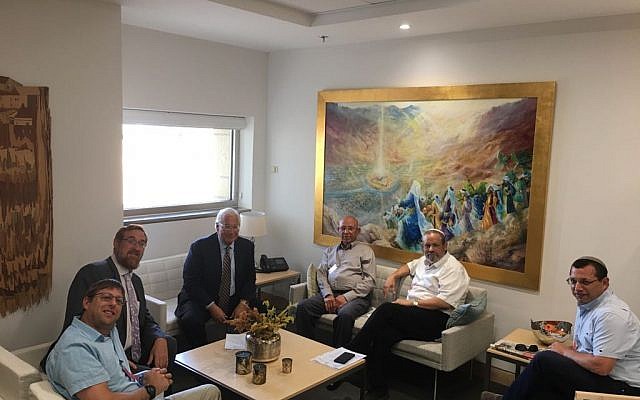 The Embassy declined to comment on the headline-making statement or the meeting itself. Without an American statement, settler leaders are the only source for what transpired in the meeting. According to MK Glick, the small group of settler leaders pushed Ambassador Friedman to endorse an “economic peace plan” as a substitute for a political solution to the conflict. Glick said that an economic proposal would “make redundant the discourse of concessions” (under previous U.S. proposals, Israeli concessions would have included the evacuation of far flung settlements in the West Bank).
Along those lines, the group presented Ambassador Friedman with a plan for a new industrial zone and medical center in the southern West Bank that, according to Glick and Har Hevron Regional Council Chairman Yochai Damari, would employ and serve thousands of Palestinians. The plan was presented by Glick, Damari, and Palestinian businessman Muhammad Nasser, who also attended the meeting. According to Glick, the U.S. Ambassador was supportive of the plan and offered U.S. assistance once the initiative was up and running.
[UPDATED 9/28/18: More details on the joint Israeli-Palestinian industrial zone in the Har Hebron region was later fleshed out by Ynet in a report here. The plan calls for an industrial zone and commercial center to be built near the Tene-Omarim settlement. Israeli Finance Minister Moshe Kahlon briefed the details of the plan to U.S. Treasury Secretary Steven Mnuchin and Jason Greenblatt, U.S. Special Representative for International Negotiations. The U.S. is expected to present the plan to the World Economy Forum during its annual meeting in January 2019]
Israel Publishes Tenders for 603 new units in East Jerusalem Settlement of Ramat Shlomo

Map by Ir Amim
On August 15th, the Israel Land Authority published construction tenders for 603 new settlement units in the Ramat Shlomo settlement in East Jerusalem. The 603 units are part of a larger plan for 1,500 units in Ramat Shlomo (tenders for almost all of which have been published now) that was announced by Israel in 2010, during the visit of then-Vice President Joe Biden. The timing of that announcement, and the inflammatory nature of settlement approvals in East Jerusalem (which the Obama Administration pressured Israel to halt), sparked outrage and prompted Biden to issue harsh criticism of Israel while on the ground. The incident earned the 2010 Ramat Shlomo plan the nickname the “Biden Plan.”
Anti-settlement watchdog Ir Amim comments that the Ramat Shlomo tenders are a part of the Israeli endeavor to:
“expand the Israeli neighborhoods/settlements in such a way as to consume the remaining space between them and nearby Palestinian neighborhoods ( a critical geo-political link between Jerusalem and Ramallah) so as to inhibit their development and further complicate any future division of the city.”
There has been a significant uptick in East Jerusalem settlement advancements since President Trump assumed office in January 2017, reflecting the sea change in U.S. policy towards settlements (evidenced again this week by Ambassador Friedman’s remarks, detailed above). As Ir Amim details, Israel’s unrestrained advancement of settlement construction in East Jerusalem has been coupled with legislative schemes to change the borders of Jerusalem (annexing far flung settlements into Jerusalem and cutting Palestinian neighborhoods out of Jerusalem) in order to engineer a Jewish Israeli majority in Jerusalem.
Massive Jerusalem Development Deal for 20,000 New Apartments – Including Settlement Expansion Projects
On August 15th, the Jerusalem Municipality signed a $380 million deal with the Israel Land Authority to finance a plethora of projects across the city, including 20,000 new apartment units. While much of this development will be in West Jerusalem, some will reportedly be in the East Jerusalem settlements of Pisgat Ze’ev, French Hill, and Atarot. The Jerusalem City Council is expected to give final approval to the plan next week.
Israel Triples Size of New Settlement Industrial Zone In Hebron
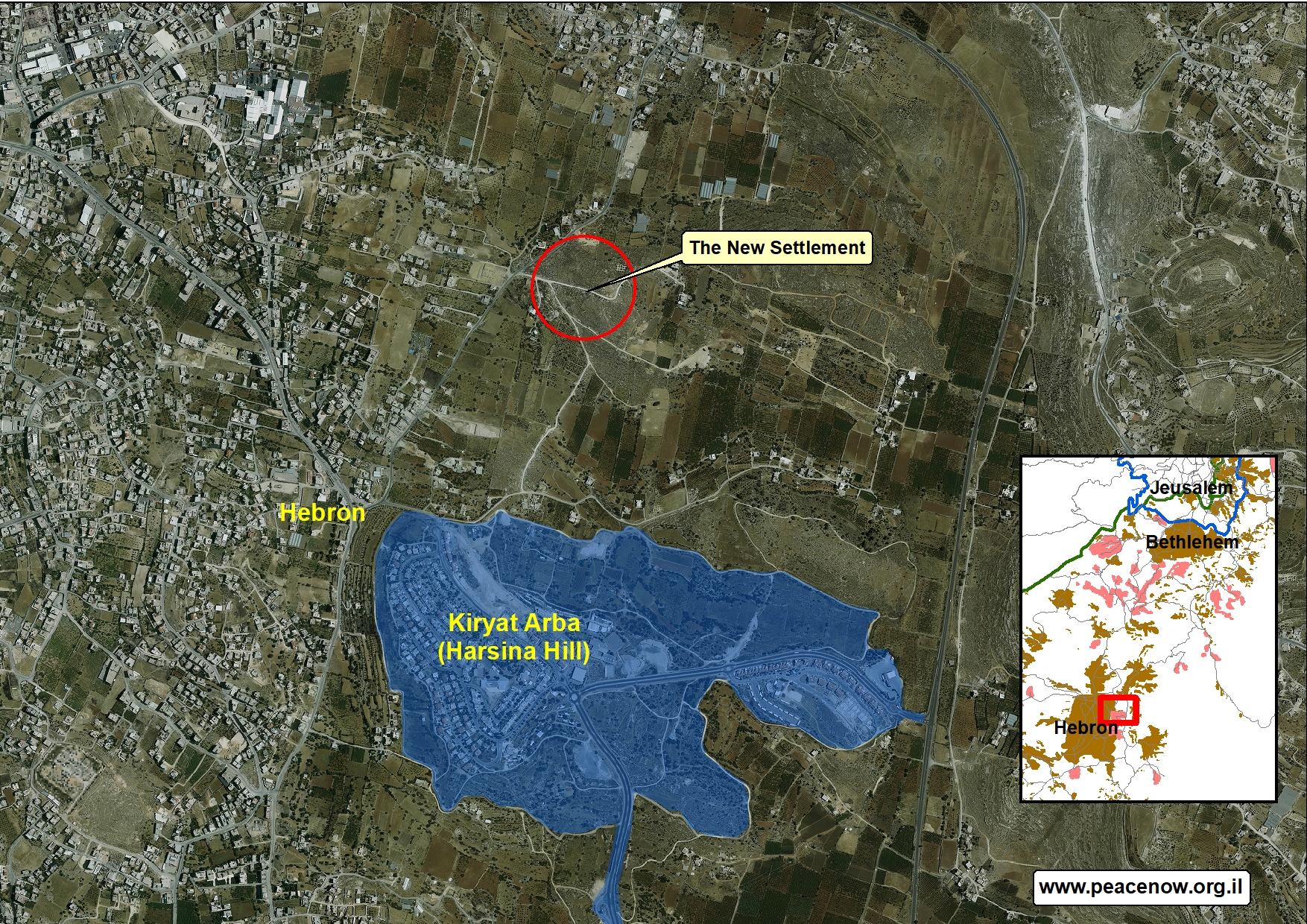
Map by Peace Now
According to The Jerusalem Post, on August 12th the Israeli government approved a plan that will triple the size of an industrial zone in the Kiryat Arba settlement in Hebron, approving 10 million shekels for the project. FMEP reported on the initial plans to build the Kiryat Arba industrial zone in March 2018, noting that the industrial zone is technically within the borders of the settlement but well outside of the developed lines of the settlement and beyond the fence that surrounds it – making it, in effect, a new Israeli settlement in Hebron. Now, the new settlement is set to significantly expand in one of the most volatile areas in the West Bank.
Knesset Sends Funds to New Settler Council in Hebron, Despite High Court Injunction
On August 12th, the Knesset Finance Committee approved 2 million shekels (about $550,000 USD) to fund the new local settler committee in Hebron. The Finance Committee requested that the money be disbursed to the Hebron settler committee “in accordance with an agreement in the past with MK Bezalel Smotrich,” (Habayit Hayehudi)…after the necessary professional and legal checks.”
The creation (via military order) of a new autonomous committee to represent and service a cluster of settlers living in enclaves in Hebron’s city center is being challenged by the Hebron Municipality. In response to the Palestinian petition, the High Court of Justice put a freeze on the plan, effective July 4, 2018, and gave the Israeli government 120 days to explain the legality of the plan. The petition argued that the military order creating the new body was intentionally vague in defining its legal and geographical jurisdiction, and pointed out that the new committee would be able to override decisions by the Hebron Municipality thereby stripping Palestinians of autonomy and representation in matters that directly affect them.
It is unclear from reporting if the Knesset Finance Committee’s decision to fund the new committee is related to the High Court’s ongoing consideration of the case. However, what is clear is that the Knesset is not concerned about undermining the High Court of Justice’s power over West Bank issues — indeed, the Knesset is actively pursuing that end with the recent passage of a new law stripping the Court of jurisdiction over land disputes and transferring it to a domestic Israeli Court, and with ongoing consideration of a bill that would allow the Knesset to reinstate laws that the High Court strikes down.
Knesset Approves Past Due Payment for the Construction of Amichai Settlement & “Temporary” Outpost
On August 12th, the Knesset Finance Committee approved the transfer of $9.5 million to pay contractors for their ongoing work on the first new settlement built with government approval in 25 years, Amichai, and a new “temporary” outpost for settlers whose homes were built on privately owned Palestinian land in the Netiv Ha’avot outpost and were recently demolished. Amichai is the new settlement approved as a pay-off to the settlers who were evacuated from the illegal Amona outpost. Construction on Amichai has begun, but has been interrupted several times due to lack of government cash, a problem ostensibly solved by this week’s cash transfer.
With respect to the new outpost for the Netiv Ha’avot outpost settlers, in February 2017 the Israeli government approved an unusual plan to place 15 mobile homes — connected to Israeli water, power, sewage, roads, and other infrastructure — at a site located near, but not within, the borders of the Alon Shvut settlement, in effect creating a new outpost for settlers evacuated from another outpost. When the High Planning Council initially approved the advancement of this plan in October 2017, it noted that “the plan is improper, but we will have to approve it as a temporary solution.” At the time, the Council ordered the government to go about expanding the borders of the Alon Shvut settlement to include the land. Under the approved plan, the new homes will be allowed to stay in that location for three years. However, based on past practice, it can be expected that within that time, or at the end of those three years, the site will “regulated” by Israel to become a permanent area of Israeli settlement.
In both cases – the Amichai plan and the Netiv Ha’avot plan – the Israeli government massively “compensating” citizens for the inconvenience of having been caught brazenly breaking Israeli law (i.e., for building without permits on privately owned Palestinian land). The two cases highlight the way in which the Israeli government not only encourages illegal settlement building, but generously incentivizes and rewards its. At this point, in addition to two new settlements, approximately 20 million shekels ($5.4 million) has been paid to the Amona evacuees and 15 million shekels ($4 million) to the Netiv Ha’avot evacuees.
Delay in Opening of new Jerusalem “Park” That Confiscates Palestinian Spring
A dispute between Israeli government agencies has led to a delay in the opening of a new Jerusalem tourist site – a park established for the express purpose of taking control over the Ein Al-Hanya spring, which was historically part of the al-Walajah Palestinian village. Originally slated to open April 1st, the delay centers around a battle over who will fund the operations of the site. For now, the site is closed and the grounds are not being maintained.
Regardless of the dispute, Israel has implemented policies that prevent Palestinians from accessing the spring and surrounding lands, including illegally moving a police checkpoint to further choke off al-Walajah from Jerusalem. As detailed in Haaretz, the plan for the park includes three pools filled by the spring – two for Israelis and tourists, and one for al-Walajah residents to water their crops and flocks. However, that third pool for Palestinians has not been built, and the water “merely spills into the nearby wadi.” The other pools, like the park, are currently empty and fenced off.
Israel Evicts Palestinians from Bethlehem Home Despite Court Order
Haaretz reports that settlers have forcibly evicted a Palestinian family from their home near Bethlehem, in defiance of an Israeli court order. The Palestinian Samara family reports that settlers tricked them into leaving the property, after which settlers locked them out, forcibly evicted them and their belongings, and then used a bulldozer to demolish their home. The family has filed an appeal to the High Court of Justice.
The Samara family – which since the early 1980s lived in 3 small units within a larger apartment building – has been targeted for eviction by settlers since 2012, when ownership of the building was transferred to an American organization controlled by Irving Moskowitz, a major funder of Jewish settlement in East Jerusalem. In 2016, the Gush Etzion Regional Council was given jurisdiction over the compound to move in Jewish Israeli settlers. Since that time, the building has been taken over by settlers, except for 2 units in which the Samara family lived as protected tenants (the third was welded shut), based on an Israeli court ruling under which the building’s owner promised not to restrict access to the building for four members of the Samara family (no other family members or visitors were allowed access). Regarding the arrangement, the judge wrote:
“This arrangement will remain in force unless a different judicial order is issued after a legal proceeding instituted by one of the parties.”
As Haaretz notes, there does not appear to be a different or new judicial order that would change the 2016 agreement.
In 2017, the Samaras reported that a new settler family had moved into the compound and began harassing the family members who remained – prompting them to file a complaint on July 26, 2018 with the Israeli police in the Beitar Illit settlement. Two weeks later on August 6th, the family was forcibly evicted and their units were demolished.
Despite the Samara’s harassment complaint and a real-time call to the police while the eviction was taking place, Israeli police took no action to prevent settlers from evicting the Samaras, reportedly stealing their cellphones, and bulldozing the properties. The Beitar Illit police station even refuse to allow the Samara family to enter the station and file a complaint until a lawyer for the family got involved many hours later.
Following intervention by UNRWA, the family was allowed to return to search the site for their ID cards and other important belongings. Now homeless, the Samara are taking their case to Israel’s the High Court of Justice.
Bonus Reads
- “A Palestinian Bedouin Village Braces for Forcible Transfer as Israel Seeks to Split the West Bank in Half” (The Intercept)
- “Between Garbage and Sewage: Israel’s Future Plans for Khan al-Ahmar” (+972 Mag)
- “Their Parents Settled the West Bank for Ideology, They’re Staying for the Vibes” (The Times of Israel)
Welcome to FMEP’s Weekly Settlement Report, covering everything you need to know about Israeli settlement activity this week.
To receive this report via email, please click here.
March 30, 2018
- 2017 – A Record Year in Settlement Expansion
- Hebron Settlers Leave One Disputed Property, Only to Enter Two More
- Settlers Celebrate Moving to Amichai, the First New Government-Backed Settlement in 25 Years
- Housing Minister on Annexation: Settlements are a Non-Negotiable Security Asset, Israel Must Keep Building
- Ambassador Friedman: U.S. Will Not Intervene To Stop Israeli Annexation
- After Annexing Settlement Universities, Israeli Education Ministry Moves to Censor Campus Criticism of Settlements/Occupation
- Terrestrial Jerusalem Report: “The Creation of a Settler Realm in and Around Jerusalem’s Old City”
- Al-Shabaka Policy Brief: Israel’s Annexation Crusade in Jerusalem
- Yesh Din/Emek Shaveh Report: “Appropriating the Past: Israel’s Archaeological Practices in the West Bank”
- Emek Shaveh Report: The Jerusalem Cable Car Undermines the History & Multiculturalism of the Historic Basin
- You Can’t Make This Stuff Up: Settler Lands Helicopter at Qalandiya Checkpoint (in Attempt to Seize It)
- Bonus Reads
Comments, questions, or suggestions? Email Kristin McCarthy at kmccarthy@fmep.org
2017 – A Record Year in Settlement Expansion
In its annual report on settlement activity, the settlement watchdog group Peace Now documents two significant facts about settlement growth in 2017 – the first year in the era of the Trump Administration era. Peace Now figures show that there was a large spike in new settlement starts compared to previous years; and second, most of these new construction starts are located in areas that are beyond the area that Israel can realistically expect to retain under any negotiated two-state agreement. 
Specifically, Peace Now reports that in 2017, construction began on 2,783 new settler housing units, an increase of around 17% over the yearly average rate since 2009. In terms of location of these new starts, Peace Now found that:
- More than three-quarters of the new housing starts are in settlements located deep inside the West Bank, beyond what would be a realistic border for a negotiated two-state agreement.
- Fewer than one-fifth of the new construction starts are located in areas west of the security barrier, as currently constructed (i.e., in settlements already de facto annexed to Israel by the barrier).
- At least one out of every ten of the new settlement starts is illegal according to Israeli laws (all settlements are illegal under international law), with most located in illegal outposts.
Director of the Peace Now Settlement Watch project, Shabtay Benet told i24News,
“If in the past, the government had focused on construction and housing within the blocs, it appears that the government is [today] openly working toward a reality of annexation.”
In addition, Peace Now documents in detail other major 2017 settlement-related developments, including:
- the establishment of three new illegal outposts in 2017: “Neve Achi” (near Ramallah ), “Kedem Arava” (near Jericho), and “Shabtai’s Farm” (south of Hebron).
- the establishment of the new “legal” settlement of “Amichai,” which is the first new settlement built with government approval in 25 years.
- Construction of a major new bypass road to link settlers more seamlessly to Jerusalem,
- The seizure by Israel of nearly 1,000 dunams of Palestinian land near Nablus in order to begin legalizing outposts in the area.
- The approval by the Israeli government of 31 new units for settlers in the heart of the Palestinian city of Hebron.
 The report also provides a timeline of data showing the fluctuation of Israeli government policy regarding outposts from 1996-2017. The data indicate that a 2006 pledge by Netanyahu to cease funding the construction of new outposts (a pledge that followed the publication of the government-mandated report on outposts known as the Sasson Report) expired in 2012, at which time the government began allowing (if not supporting) the construction of new outposts. Since 2012, 16 new outposts have been built and allowed to remain, some of which are now in the process of being retroactively legalized by the government.
The full report is available online here.
Hebron Settlers Leave One Disputed Property, Only to Enter Two More
After nearly eight months of illegally occupying a disputed property in Hebron, more than 100 settlers left the Beit Machpelah/Abu Rajab building. The High Court has ruled that the settlers must leave the residence while the Justices’ consider a case regarding rightful ownership of the property – a case that is not expected to wrap up in the near term.
In tandem with the departure of the settlers, the new head of the Israeli Army’s Central Command, Maj. Gen. Nadav Padan, signed an order declaring the area around the property – which is across the street from the the Tomb of the Patriarchs/Al-Ibrahimi Mosque – as a “closed military zone,” where civilian access is forbidden. Ostensibly intended to prevent the settlers from re-entering the property, the order will inevitably further restrict freedom of movement for Palestinians, who already face acute limitations resulting from segregated and closed-off streets, a maze of checkpoints, harassment by settlers living in the middle of the city, and the heavy IDF presence guarding a few hundred Israeli settlers living amidst ~150,000 Palestinians in Hebron.

Map by Peace Now
Undeterred (or emboldened) by their experience with the Beit Machpelah/Abu Rajab building, Hebron settlers subsequently broke into and occupied two additional properties in downtown Hebron (which settlers are calling “Beit Leah” and “Beit Rachel,” and which Palestinians call the “Zaatari Compound,” after the Palestinian family who owns the buildings). Like in the case of the Beit Machpelah/Abu Rajab building, ownership of these two properties is disputed, with settlers claiming to have purchased the properties lawfully from Palestinian owners, and the Palestinians denying having sold them. And like the past nearly eight months in the case of the Beit Machpelah/Abu Rajab building, the settlers are for now being allowed to stay in the two disputed properties, under the protection of the IDF, in violation of Israeli law.
Breaking the Silence – an Israeli NGO recently barred from giving tours in Hebron – told The Times of Israel that the removal of the settlers from the Beit Machpelah/Abu Rajab building was “appropriate” but:
“Still, this is just only a drop of water in the sea of illegal invasions that we guarded as soldiers… For 50 years, settlers have been establishing facts on the ground and we are being sent to guard them at the expense of the Palestinians.”
With respect to the two new properties occupied by the settlers, Peace Now said:
“The settlers’ recent break-in into the Zaatari compound constitutes just the latest in a slew of such unauthorized incidents in Hebron. Their strategy is clear. Since they have failed thus far to obtain the ownership rights legally, instead they must resort to illegal means to establish facts on the ground by squatting, knowing that the right-wing government will be reluctant to attract negative publicity from its base by evicting settlers, and will in turn attempt to delay the eviction or perhaps find a way to legalize the take-over. Fellow Israeli citizens must not give in to this emotional blackmail, and the authorities must evict these squatters without delay.”
Settlers Celebrate Moving to Amichai, the First New Government-Backed Settlement in 25 Years
Settlers who were removed from the unauthorized Amona outpost last year held a ceremony March 26, 2018, marking the day that they moved into Amichai, the new settlement that was promised to them as compensation. Amichai is the first new settlement built with government approval in 25 years. The leader of the law-breaking Amona settlers, Avichai Boaran, said at the ceremony:
“After a long wait and a stubborn struggle – tomorrow it happens. Amichai residents enter their new community! We are looking forward to entering our new homes, which we were able to establish with the blood of our hearts, with determination and faith, love for the land and for Zionism.”
The settlers will be housed in temporary mobile homes while construction continues in the settlement. The Master Plan approved for Amichai permits 102 units on a hilltop in the Shiloh Valley, a third of which face additional legal proceedings as a result of petitions filed by Palestinian landowners.
As FMEP has covered many times in the past, Amichai is the first of two new settlements approved by the Israeli government in early 2017 as pay-off to settlers who were forced to leave the Amona outpost by the High Court of Justice. That Amona outpost was established without authorization from the Israeli government and was located on private Palestinian land; the government of Israel fought for years to retroactively legalize it, but eventually was forced by the High Court to evacuate its residents (evacuation that some residents resisted violently). The establishment of Amichai clearly demonstrates that settler law-breaking not only goes unpunished, but is handsomely rewarded by the Israeli government, and that establishing illegal outposts is an effective route to establishing new settlements.
Housing Minister on Annexation: Settlements are a Non-Negotiable Security Asset, Israel Must Keep Building
Minister of Housing and Construction, Yoav Galant (Kulanu), told settler leaders that he believes Israel must bolster the settlements, calling them “non-negotiable [security] assets” that Israel must always maintain “full control” over. Galant’s remarks were made during a meeting with leaders of the Yesha Council (a settlement umbrella group) during which he also bragged about doubling the budget for settlement construction. He said:
“The Ministry of Construction and Housing, headed by me, has invested twice the budgets of the previous government in planning and development in Yehuda and Shomron.” [Note: “Yehuda and Shomron” means Judea and Samaria, the biblical names for the area in the West Bank]
Yesha Council Chairman Chananel Dorani thanked Minister Galant for his support, saying:
“Minister Galant leads the Housing Ministry to important goals and objectives for the development of the State of Israel, the area of Yehuda, Shomron and the Jordan Valley is a suitable space for massive construction and dispersal of the population of the country. I am thankful for your consistent support for the settlement, for the ideal, but also for the actions.”
Ambassador Friedman: U.S. Will Not Intervene To Stop Israeli Annexation
In an interview with an Israeli Orthodox newspaper this week, U.S. Ambassador David Friedman was quoted as suggesting that the U.S. was ready to replace President Abbas if he refused to play ball with U.S. efforts. Friedman subsequently claimed he was misquoted. He did not, however, suggest that he was misquoted on another subject that came up in that interview: possible annexation of part of the West Bank. Friedman was asked in the interview if the U.S. would support partial annexation of the West Bank. Friedman reportedly answered:
“On these issues, Israel ought to decide for itself, we will not intervene with the government in Jerusalem regarding its way of handling the conflict. We will definitely express our opinion when asked, but we’ll avoid unnecessary involvement in decision making.”
Friedman’s remark come amidst a growing wave of legislation and legal opinions pushing Israeli annexation schemes forward, none of which the U.S. has publically intervened to stop, or even criticize. To date, Israeli Prime Minister Netanyahu has held at bay the most forthright annexation legislation – like a bill to annex Ma’ale Adumim/E-1, the “Greater Jerusalem Bill,” a Jordan Valley annexation bill, and the Likud-inspired the “Annexation/Sovereignty Bill” – always citing concerns about coordinating with the United States. Friedman’s comments, which were neither clarified nor contradicted by anyone in Washington, suggest that the Trump Administration would not object to legislation of this kind moving forward.
Simultaneously, Netanyahu has allowed annexation to proceed on several more subtle fronts, including: giving government support to the “Ariel Bill” (now law) which effectively annexed settlement universities and colleges; giving government support to a bill that would transfer jurisdiction over West Bank land disputes from the High Court to the Jerusalem District Court (where a pro-settlement judge was recently installed by Justice Minister Shaked); defending the “Regulation Law” and, at least seemingly, beginning to implement it against the dictates of a court-ordered injunction; finding additional legal bases (1 and 2) to retroactively legalize outposts; installing radical settlers in government posts tasked with handling land disputes in the West Bank and East Jerusalem; and much more. These annexation policies are, of course, in addition to the day-to-day settlement construction on the ground that is gobbling up more and more West Bank land (documented in detail in Peace Now’s comprehensive report on settlement activity in 2017, discussed above).
Americans for Peace Now responded to Friedman’s latest pro-settlement, pro-annexation remarks, saying:
“Friedman is a loose cannon, whose statements on the Israeli-Palestinian conflict routinely upend longstanding US foreign policy. Given Friedman’s advocacy on their behalf, it is not difficult to see why settler leaders see President Trump and his Middle East team as sent by God.”
After Annexing Settlement Universities, Israeli Education Ministry Moves to Censor Campus Criticism of Settlements/Occupation
A month after bringing settlement universities under Israeli sovereign control (affectively annexing them), the Israeli Council of Higher Education advanced a new code of ethics that seeks to ban professors in all Israeli universities from criticising settlements or the occupation.
The new code has five principles, most having to do with preventing discrimination based on political views and affiliation. The principles include clauses prohibiting lecturers from calling for or engaging in activity that promotes an academic boycott of Israel or its academic institutions (some of which are now in the settlements), and another clause that prohibits faculty from promoting the idea of boycotting Israel.
Israel’s Association of University Heads (VERA) slammed the move as an attempt to politically censor academia, saying they will not “serve as political thought police for the government.” The statement from VERA, representing the heads of Israeli universities, goes on to say:
“We are already seeing a dangerous deterioration on the edge of the abyss with regards to freedom of expression and academic freedom, as is customary in dark countries and not in a country that claims to be a democracy. [We] do not accept the dictation from ‘the top’ and do not intend to serve as a tool for narrow political interests. We will continue to fight for academic freedom, free speech and freedom of expression in the democratic State of Israel.”
Education Minister Naftali Bennett, who requested the new code, called the statement from VERA “puzzling” and turned logic on its head to defend the new code from criticism, saying:
“We must keep the world of academic free of politics and foreign interests. Complete academic freedom – yes. Promoting political agendas and calling for a boycott – no. We are in fact limiting the freedom of condemnation and increasing the freedom of expression, so the academic discourse in Israel remains free of politics and discrimination. At the gates of academia, leave politics outside.”
Now that the new code has been adopted, the Council for Higher Education is seeking input from universities. After the input is collected, the Council will review and amend the code before bringing it up for a final vote. The Council said it aims to have the code adopted by universities by 2019, with required reporting on efforts to implement its provision due to the Council in 2020.
Terrestrial Jerusalem Report: “The Creation of a Settler Realm in and Around Jerusalem’s Old City”
Terrestrial Jerusalem published a comprehensive look at how Israel is creating a “settler realm” in Jerusalem. The report opens,
“taken as a whole, the array of ongoing projects and plans centered on the Old City and its immediate hinterlands represents an unprecedented move to fundamentally change the character and fabric of life in these areas, turning them into – as we’ve termed it in the past – a Disneyland-style area in which one historical and religious narrative, the Jewish one, predominates and marginalizes/erases all others.”

Map by Terrestrial Jerusalem
The report focuses on 12 recent and ongoing projects that are taking place largely in the context of a 2005 decision of the Sharon government – following its withdrawal from Gaza – to pursue, “a thinly veiled scheme to consolidate the settlers’ control over the public domain in the Old City and its environs.” At that point, an ad hoc, what had been an incremental settler campaign to establish Jewish hegemony over East Jerusalem became a multi-million-shekel per year government-backed endeavor to fortify a Jewish Israeli settler control over all areas of East Jerusalem and the Old City.
Commenting on the settler regime, Terrestrial Jerusalem founder Daniel Seidemann writes:
“While these are all recent developments, they reflect the culmination of a process that has been going on for many years. The data … further illustrate the predominant role played by Elad and the JDA [the Jerusalem Development Authority] in advancing settlers’ control over East Jerusalem, and the complicity of the State in doing so, as detailed in the Comptroller Report published on November 2016 (see our analysis here). Indeed, the settler “DNA” has been injected into virtually all of the governmental organs with any relevant authority in and around the Old City: the Israel Lands Authority, the Custodian General, the Absentee Property Custodian, the Israel Police, the Planning Committees, the Jerusalem Municipality, the Ministry of Finance and many more. Similarly, many of the authorities of these governmental agencies have been outsourced to the settlers. The governmental adoption of the settler ideology and the outsourcing of governmental authority create a situation in which the public interest and the settler interest have become virtually indistinguishable. No new master plan has been created, and none is necessary – the brakes that slowed these schemes have merely been removed. Israel remains a feisty, albeit increasingly challenged democracy: when it comes to the Old City and its visual basin, it morphs into something highly reminiscent of a regime.”
Al-Shabaka Policy Brief: Israel’s Annexation Crusade in Jerusalem
A new report from Al-Shabaka: The Palestinian Policy Network, titled “Israel’s Annexation Crusade in Jerusalem: The Role of Ma’ale Adumim and the E1 Corridor,” paints a picture of Israeli policies building towards the eventual annexation of the settlements bordering Jerusalem, paying particular attention to the history and centrality of the Ma’ale Adumim and E1 settlement areas. Though Netanyahu has delayed the outright annexation of these settlements by blocking the passage of the “Greater Jerusalem Bill,” Al-Shabaka’s brief examines several other bills, projects, resolutions, and regulations that effectively advance the annexation more subtly.
The report’s author, Zena Agha, concludes with key recommendations emphasizing the need to more stridently highlight and oppose the Israeli settlement enterprise and the creeping annexation inherent in recent policies. Agha writes,
“Since it is evident that the Trump administration will not be the restraining force on the right-wing coalition in the Knesset, nations other than the US as well as international bodies must apply pressure on the Israeli government to ensure any annexation bill is costly. Palestinian civil society and the Palestine solidarity movement must go further in raising awareness of how close the Israeli settlement project is to the point of no return in their current and planned campaigns with policymakers.”
Yesh Din/Emek Shaveh Report: “Appropriating the Past: Israel’s Archaeological Practices in the West Bank”
In a new joint report documenting a 4-year project, Emek Shaveh and Yesh Din reveal how Israeli organizations used a guise of archaeological preservation to dispossess Palestinians of privately owned land across the West Bank since 1967. The report, titled “Appropriating the Past: Israel’s Archaeological Practices in the West Bank,” introduces the topic by explaining:
“Israel continues to use its position as the administrator of archaeological sites in the West Bank as a means to deepen its control over West Bank land, to expand the settlement enterprise, and extend the policy of dispossession of Palestinians from their lands and cultural assets. Although the takeover of land through archaeology is not the main method of achieving Israeli control over land, it is significant because of its symbolic aspects and impact on public awareness.”
The report goes on to document several examples of how archaeology is used to advance settlements. Those include:
- Gerrymandering the jurisdiction of settlements to include antiquity sites, as in the case of the Anatot-Almon settlement and the Tel-Alamit antiquity site;
- Illegally invading of antiquity sites, as in the case of the Ain al Qaws spring near Nabi Saleh; and,
- Using archaeological excavations to retroactively justify the establishment of new settlements, as in the case of the Shiloh settlement and the now evacuated Amona outpost.
The report concludes:
“By controlling all aspects of archaeology – the excavations, management of the sites, the interpretation of the nds, and which knowledge is disclosed to (or concealed from) the public – Israel appropriates the archaeological treasures uncovered in the West Bank and exploits them in order to sustain a narrative of continued Israeli control over the OPT.”
The report is available online here.
Emek Shaveh Report: The Jerusalem Cable Car Undermines the History & Multiculturalism of the Historic Basin
In a recent paper, the Israeli NGO Emek Shaveh analyzes the detrimental impacts of the new Israeli cable car project, including the dispossession and tangible economic consequences facing Palestinian Jerusalemites.
The paper concludes:
“The cable car is an experimental project driven by political interests in the most important and sensitive site in our region – the Old City of Jerusalem. Although this project is presented to the public as a response to transportation and tourism needs, its goal is political – strengthening Israel’s hold on East Jerusalem with a national-religious narrative and by “establishing facts on the ground” that will erase the chances of a historic compromise in the Holy Basin and the rich cultural diversity of the city. The cable car will also seriously damage the historical nature of the Old City and corrupt its famous beauty, which attracts visitors from all over the world.”
FMEP has tracked the planning process for the cable car, a project promoted by the settler group Elad. Elad aggressively pursues the eviction of Palestinians and the growing presence of Jewish Israelis across East Jerusalem, but particularly in the Silwan neighborhood where the Kedem Center is being built to serve as the final stop of the cable car line. The project has been harshly critiqued by the international community.
You Can’t Make This Stuff Up: Settler Lands Helicopter at Qalandiya Checkpoint (in Attempt to Seize It)
This week, Yedidya Meshulami – a settler living in an illegal outpost near Nablus – attempted to usurp the Israeli Army and take control of the Qalandiya checkpoint by landing his personal helicopter nearby, declaring “I don’t care what they do to me, I’ll take it [the checkpoint] over.” Israeli security forces arrested Meshulami and seized his helicopter (shortly thereafter he was released to house arrest; it goes without saying that had he been a Palestinian seeking to take over the checkpoint by any means whatsoever, he would still be in custody). The Qalandiya checkpoint is the most heavily trafficked checkpoint in the West Bank, through which 26,000 Palestinians (who are lucky enough to have permits to enter Israel) pass en route to Jerusalem on a daily basis.
Meshulami landed his helicopter at the site of the defunct Atarot airport, situated on a strategic strip of land between Jerusalem and Ramallah near the Qalandiya checkpoint he hoped to take control over. Rumors concerning plans to build a settlement at the Atarot site have been rumbling for over a year, fed by the Knesset’s decision to allocate millions of shekels to the project last October. Developing the airport into an Israeli settlement would deprive a future Palestinian state of the only airport in the West Bank, would cut through many Palestinian neighborhoods, and would further sever East Jerusalem from a Palestinian state (acting like E-1 on Jerusalem’s northeast flank, and like Givat Hamatos on Jerusalem’s southern flank).
Meshulami, lives in an unauthorized outpost called “Alumot” near the settlement of Itamar, south of Nablus. Meshulami helped establish the outpost in 1996 after serving in the Israeli Air Force and, despite lacking permits, he personally built an airstrip in the outpost in 2013. According to reports this week, Israeli security forces had previously revoked Meshulami’s pilot license for flying over the West Bank without a permit. Two days after his arrest, the IDF raided the illegal airstip and seized a second helicopter. They also found an ultralight plane that will reportedly be seized in the coming days.
Bonus Reads
- VIDEO: Times of Israel Settlements Correspondent Jacob Magid discusses internal settler dynamis w/ Ron Kampeas (FMEP)
- “Settler Violence Against Palestinians Is on the Rise, but Goes Regularly Unpunished” (Haaretz)
- “Israel’s government and the settlers want terror.” (Haaretz+)
- “Israel’s Separation Barrier: Legitimate in theory, malicious in practice” (Times of Israel)
***The Settlement Report is taking a two-week break for the Holidays, and will return again after the New Year.***
Welcome to FMEP’s Weekly Settlement Report, covering everything you need to know about Israeli settlement activity this week.
To receive this report via email, please click here.
December 14, 2017
- Israel Announces 6,000 Settlement Units in East Jerusalem
- A Special Israeli Committee Fast-Tracks the Controversial Jerusalem Cable Car Project
- Hebron Squatters Issue Set Conditions for Complying with the Law
- Knesset Expedites Funding for Armored Vehicles for Settlers
- Government Supports Bill to de facto Annex Settlement Universities
- Knesset Suspends Benefits to Non-Profit Operating in Illegal Outpost
- Bonus Reads
Comments, questions, or suggestions? Email Kristin McCarthy at kmccarthy@fmep.org.
Israel Announces 6,000 Settlement Units in East Jerusalem
Shortly after President Trump’s proclamation recognizing Jerusalem as the capital of Israel and directing the U.S. Department of State to begin the process of relocating the U.S. Embassy there, Israel was rumored to be planning 6,000 new settlement units in occupied East Jerusalem.
Israel’s Minister of Housing and Construction, Yoav Galant, was quoted saying, “Following President Trump’s historic declaration, I intend to advance and strengthen building in Jerusalem.”
According to reports the plans include:
- Introduction of a new plan for 5,000 settlement units at the site of the disused Atarot airport at the northern tip of East Jerusalem. Construction at the site has not yet begun, but Israel has made significant moves since Trump took office – in April leaking news of the of the plans and suggesting they were working to come to an understanding with Trump on settlements including Atarot, and in October allocating funds for building the Atarot settlement. If implemented, Atarot will be the first new government-backed settlement in East Jerusalem since the 1995 construction of Har Homa. Settlement construction at Atarot will cut off Palestinian neighborhoods in East Jerusalem from the West Bank. [image]
- A new plan for 1,000 units in the Pisgat Ze’ev settlement in East Jerusalem.
A Special Israeli Committee Fast-Tracks the Controversial Jerusalem Cable Car Project

Map by Terrestrial Jerusalem
Exactly one week after President Trump’s proclamation recognizing Jerusalem as the capital of Israel and directing the U.S. Department of State to begin relocating the U.S. Embassy there, a special committee held a hearing to consider plans for a cable car project. The controversial project is deeply connected to a settler-run tourist organization, Elad, which is responsible for building a huge new tourist center in the heart of the Palestinian East Jerusalem neighborhood of Silwan.
As Ir Amim explains:
The [Israeli] State will invest 200 million shekels in a system designed to seamlessly connect the western part of the city with a constellation of Elad settler group managed tourism enterprises in Silwan. If, as intended, the cable car becomes a primary means of transportation to the Old City, it will route masses of visitors to the compound Elad intends to establish as the headquarters of its decades long campaign to settle the neighborhood of Silwan…
The cable car project is another compelling example of state sponsored private settlement under the guise of tourism. Officials have circumvented the local and district planning committees to fast track the plan, transferring authority to the National Infrastructure Committee (NIC), The NIC was established to expedite approval of significant infrastructure projects and limit the role of the public to block problematic schemes. Until recently, tourism related projects were not discussed under its purview. About a year ago, the Planning and Building Law was amended to enable its new function.
Hebron Squatters Issue Set Conditions for Complying with the Law
The 100 Israeli settlers who since July have been illegally squatting in a contested Hebron house, which they have dubbed the Machpelah house, are attempting to dictate the terms under which they will comply with a court ruling compelling them to leave. After delaying their evacuation for months through a series of Court petitions, the settlers said this week that they will voluntarily vacate the property if the High Court orders the demolition of a storage shed near the house, which they claim Palestinians recently built. They also demanded the right to station their own private security guards to “supervise” the house while the Court decides on its legal ownership, which has been in dispute since 2012.
In response, Peace Now called the settlers’ demands “another dubious exercise,” noting that the “guards” settlers want to station at the house are themselves settlers. In this way, the conditions the settlers are setting demonstrate that the squatters have no intention of leaving, despite the Court’s ruling.
Knesset Expedites Funding for Armored Vehicles for Settlers
Under unrelenting pressure from settler leaders, the Knesset Finance Committee voted to expedite the first transfer of money to finance projects that are a part of the much-promised “Settler Security Package,” slated to total USD $228 million in 2018. This initial allocation, made this week, totals USD $12.8 million to finance the purchase of bullet-proof buses to transport settlers throughout the West Bank.
Government Supports Bill to de facto Annex Settlement Universities
The Israeli government threw its support behind a Knesset bill that would bring universities and colleges located in Israeli settlements under domestic Israeli law. The bill has already cleared the Ministerial Committee for Legislation, and is now set to be voted on three times, after which it will become law.
Settlement universities and colleges have been governed and accredited through the Council of Higher Education in the West Bank, but the bill would disband this council and the settlement schools would fall under the authority of the Council of Higher Education in Israel – further blurring the legal distinction between Israel and the occupied territories.
Knesset Suspends Tax Benefits to Non-Profit Operating in Illegal Outpost
According to Arutz Sheva (a settler-aligned news outlet), the Knesset Finance Committee has removed an organization called “Hebrew Shepherd” from a list of Israeli organizations eligible to receive tax breaks, saying that Hebrew Shepherd requires additional study by the Israeli Tax Authority.
In November, Haaretz published a report revealing that the Israeli Education Ministry established and continues to fund the operations of Hebrew Shepherd, which operates in an illegal settlement outpost. Hebrew Shepherd has launched a petition to have the outpost retroactively legalized in order to void the demolition orders that have been issued against all of the outpost’s structures and its access road.
Ironically, the organization’s mission is to rehabilitate radical Israeli youth, known as the “Hilltop Youth,” who violently establish and defend unauthorized outposts.
Bonus Reads
- “Israel’s Settlement Regularization Law: The Attorney General’s Extraordinary Brief and What it Means for Israel’s Legal Stance on Illegal Settlements” (Lawfare)
- “At East Jerusalem enclave, some Jews happier with Trump than with Netanyahu” (Times of Israel)
- [Opinion] “Should Israelis also Boycot the Haredim and Settlers? Or Just Get Over Their Fear of Arabs?” (Haaretz+)
FMEP has long been a trusted resource on settlement-related issues, reflecting both the excellent work of our grantees on the ground and our own in-house expertise. FMEP’s focus on settlements derives from our commitment to achieving lasting Israeli-Palestinian peace, and our recognition of the fact that Israeli settlements – established for the explicit purpose of dispossessing Palestinians in the West Bank and East Jerusalem of land and resources, and depriving them of the very possibility of self-determination in their own state with borders based on the 1967 lines – are antithetical to that goal.
Welcome to FMEP’s Weekly Settlement Report, covering everything you need to know about Israeli settlement activity this week.
To receive this report via email, please click here.
October 26, 2017
- Assault on Jerusalem [And a Negotiated Solution], Part 1: Cabinet to vote Sunday on “Greater Jerusalem [Annexation] Bill,” with Netanyahu’s Backing
- Assault on Jerusalem [And a Negotiated Solution], Part 2: East Jerusalem Settlement Enclave in Jabal Mukaber Set to Triple in Size
- Assault on Jerusalem [And a Negotiated Solution], Part 3: First New East Jerusalem Settlement in Decades, Atarot, Is Inching Closer Towards Construction
- The New U.S. Settlement Policy: Expand at Will, but Don’t Surprise Us
- Israeli Justice Minister Personally Involved in Drafting State Responses to Settlement Petitions before the High Court of Justice
- Updates: Netiv Ha’avot and the “Settler Security Package”
- Bonus Reads
Comments, questions, or suggestions? Email Kristin McCarthy at kmccarthy@fmep.org.
Assault on Jerusalem [And a Negotiated Solution], Part 1: The “Greater Jerusalem [Annexation] Bill” is Set for a Vote on Sunday with Netanyahu’s Backing
The Israeli Knesset reconvened on Monday for it finals session of the year; in addition to a litany of anti-democratic bills [Americans Peace Now published an excellent explainer of those bills here], Netanyahu has reportedly signalled the Knesset to pass the “Greater Jerusalem Bill” [text here]. With Netanyahu’s approval, the bill is expected to be come up for a vote in the Cabinet on Sunday, October 29th, and after that to be sent to the Knesset.
If passed into law, the “Greater Jerusalem Bill” will:
-
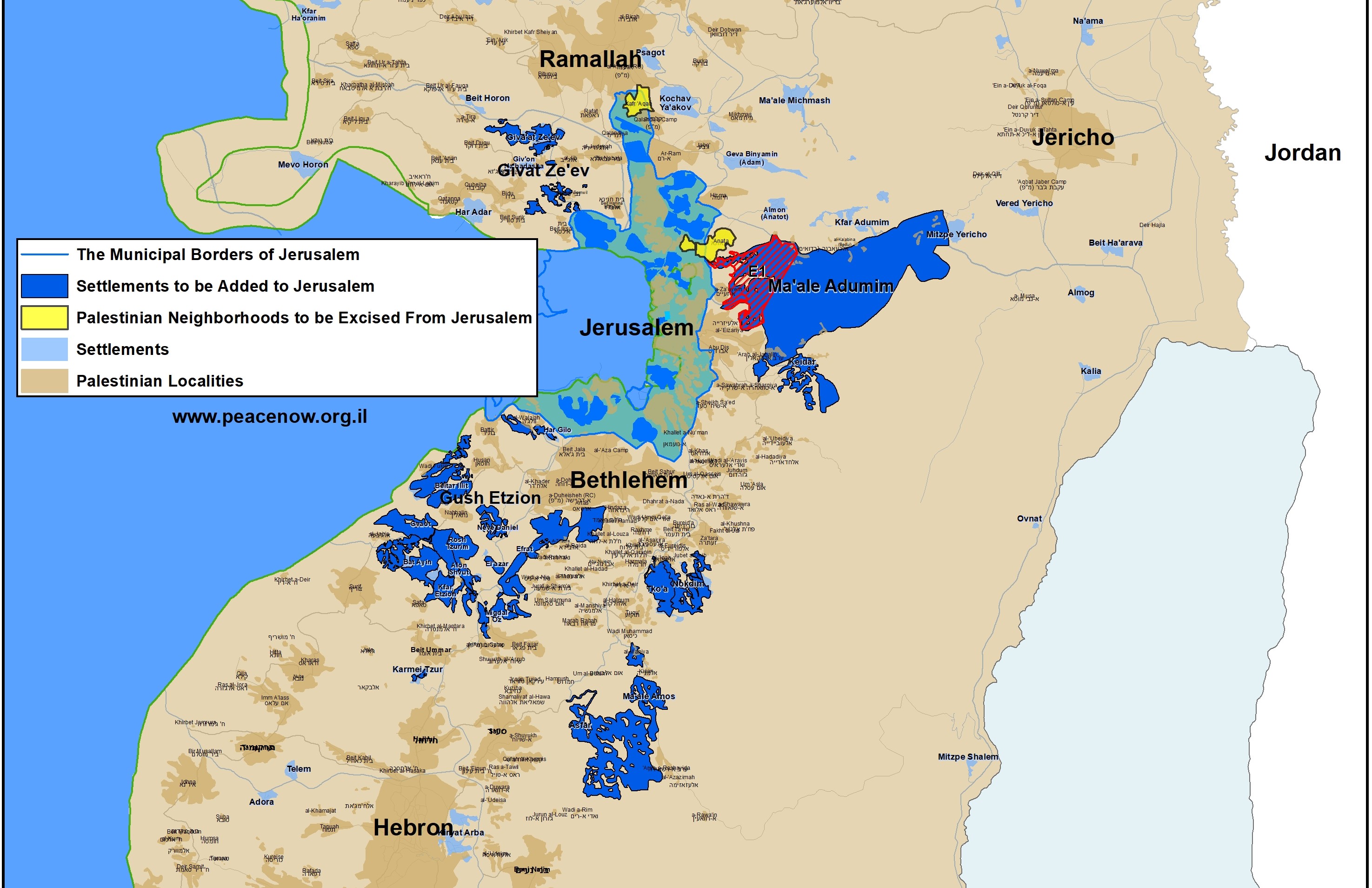
Map by Peace Now
Effectively annex a an enormous area of the West Bank into Israel’s Jerusalem Municipality, including not only the settlements but huge areas of adjacent land designated by Israel as belonging to the settlements. Peace Now has a map of the settlements/land that will annexed [click for greater detail].
- Include as part of Jerusalem settlements/lands located far from the current borders of Jerusalem, extending deep into the West Bank nearly to Jericho (the Palestinian city located on the border with Jordan) and including settlement located closer to Hebron than to Jerusalem.
- Effectively annex the area of the planned E-1 settlement, the same area where the Khan al-Ahmar community continues to await the fate of Israel’s plan to forcibly relocate them (a war crime) out of the area.
- Redraw the borders of the Jerusalem Municipality to cut out several Palestinian neighborhoods that are legally part of the Municipality but that Israel elected to leave on the West Bank side of its separation barrier (these neighborhoods would have new “sub-municipalities” created for them).
PLO Executive Committee member Hanan Ashrawi stated bluntly “such efforts represent the end of the two-state solution.”
The anti-settlement watchdog Peace Now writes,
The bill states that its implementation would allow to maintain a “demographic balance” between Jews and Palestinians in Jerusalem, and will allow for the expansion of construction of housing units and industry in the area. It is clear that the idea is to allow rapid settlement construction in settlements near Jerusalem and create facts on the ground which will prevent the chance for a two state solution, and at the same time excise Palestinian neighborhood by the formation of “sub-municipalities” or if you will, Bantustans, devoid of resources which will allow them to be self-sufficient.
J Street writes that passage of the bill,
would be a major step in Israel’s ongoing, de facto annexation of territory throughout the West Bank – and pose a massive threat to the possibility of ever achieving a two-state solution. If carried out, Israel would be crossing a major red line by unilaterally imposing its own solution to a vital final status issue.
In addition to the “Greater Jerusalem Bill,” a second bill regarding Jerusalem is also on the Knesset’s winter docket. If passed, this bill would amend Israel’s Basic Law to require a supermajority – 80 out of 120 votes – in the Knesset to approve any deal that transfers sovereignty over any part of Jerusalem to a foreign entity. This gives the Knesset veto power over any future peace deal reasonably assuming that the Palestinians will not agree to cede all of Jerusalem (it’s historic capital and home to sacred religious and national sites) to Israel.
Americans for Peace Now explains,
If passed into law, this measure would be unmatched in the Israeli legal code. No other Israeli government executive decision requires a two-thirds majority. This legislation would tie the hands of future governments in negotiating peace and will grant a de facto veto to representatives of the Israeli public’s anti-peace minority. The bill passed an initial vote and will need to pass three additional readings to become law. The absurdity is that the law, if passed, will surely garner significantly fewer than the 80 votes it demands for a future decision on Jerusalem.
Earlier this month, when these two bills were first unveiled, Terrestrial Jerusalem’s founder Danny Seidemann warned:
Cumulatively, these … initiatives constitute an effort to implement the most radical changes in the status of East Jerusalem since the Israeli annexation in June 1967, and threaten to profoundly detrimental impacts on the prospects of a future political agreement. Indeed, it is difficult to overestimate their significance. Together they would create a radically new geopolitical reality in Jerusalem and its environs.
Ir Amim also cautions:
The bills have not surfaced in a vacuum; they complement a series of recent initiatives calculated to impose crucial territorial-political facts on the ground under the guise of “municipal moves.” They would preempt chances of a political resolution to the conflict, weaken the urban fabric, and ratchet up tensions in Jerusalem.
Assault on Jerusalem [And a Negotiated Solution], Part 2: East Jerusalem Settlement Enclave in Jabal al-Mukaber Set to Triple in Size
In addition to the wave of settlement approvals by the Israeli High Planning Council last week [read last week’s Settlement Report here], on Oct. 25th, the Jerusalem Municipality issued conditional building permits for 176 new units in the Nof Zion settlement enclave. The permits are pending until the settlers submit proof of ownership papers; the missing paperwork has delayed the issuance of the permits since the plan was first leaked in early September (it’s not clear what has changed to allow for them to be issued now).
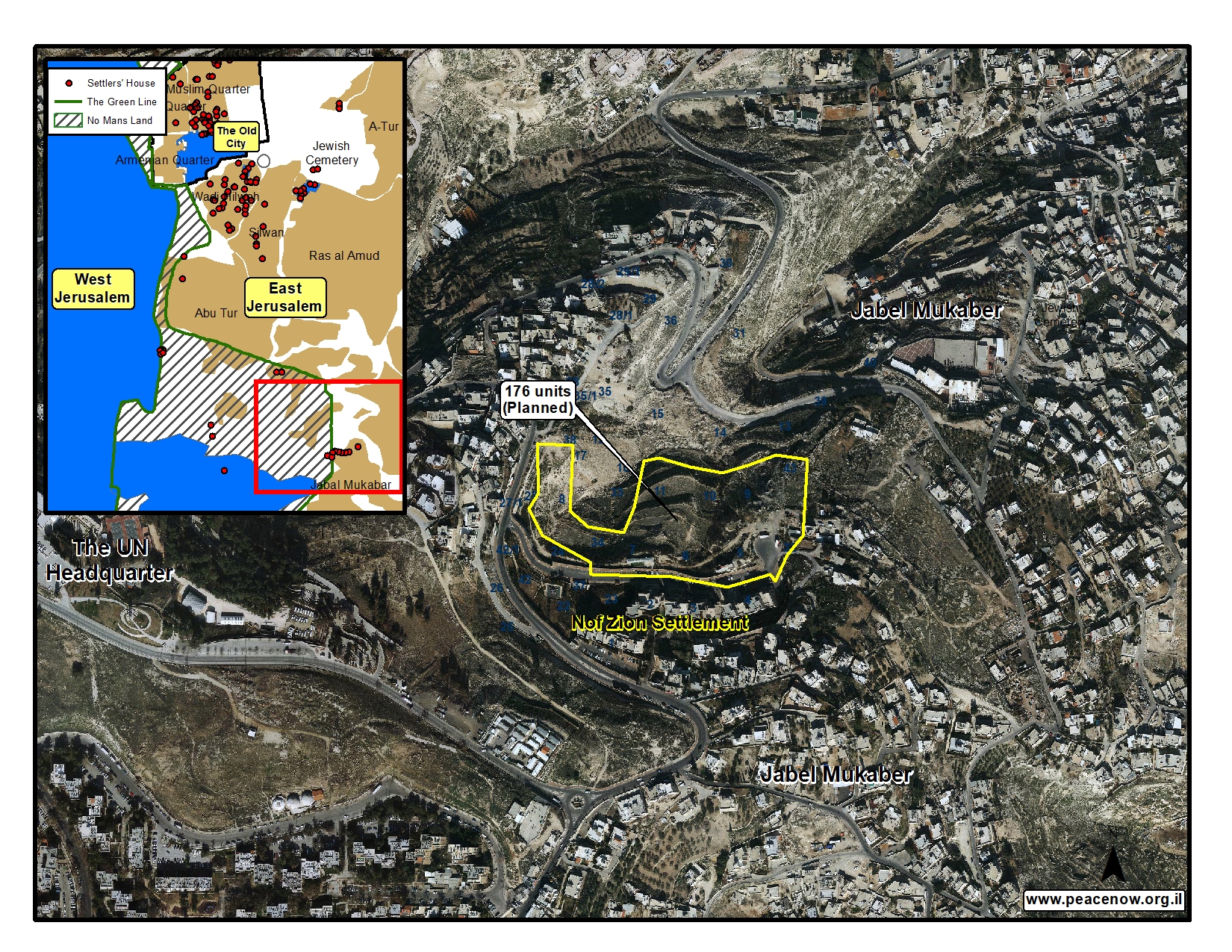
Map by Peace Now
Nof Zion is inside the Palestinian neighborhood of Jabel al-Mukaber in occupied East Jerusalem. The new units will nearly triple the size of the enclave, making it the largest of its kind in East Jerusalem.
When reports of the building permits for Nof Zion surfaced earlier this year, it sparked outrage and concern over unrestrained settlement growth in East Jerusalem and its impacts on the future of Jerusalem. The same concerns are now more urgent and alarming, as it appears there are no settlement plans too controversial for the Netanyahu government to greenlight.
Ir Amim writes,
The primary objective of the settlers’ infiltration into the Palestinian neighborhoods in and around the Old City is to undermine the possibility of dividing Jerusalem, thereby foiling the possibility of a political resolution on the city and an end to the Israeli-Palestinian conflict. The building permits will issue a clear statement that the Israeli government sanctions and supports the establishment of new facts on the ground designed for this purpose.
Assault on Jerusalem [And a Negotiated Solution], Part 3: First New, Government-Backed East Jerusalem Settlement in Decades, Atarot, Inches Closer Towards Construction
In a move described by city planning experts as “nothing less than fantasty,” the Israeli government has set aside millions of shekels to build 10,000+ units in a new settlement planned at the site known as Atarot, in the northern part of East Jerusalem. If implemented, Atarot would be the first new government-backed settlement established in East Jerusalem since the construction of Har Homa in the 1990s [unless plans to move ahead with the new settlement of Givat Hamatos come to fruition first – in that case, Givat Hamatos would be the first new government-backed settlement established in East Jerusalem since the early 1990s; Atarot would be the second].
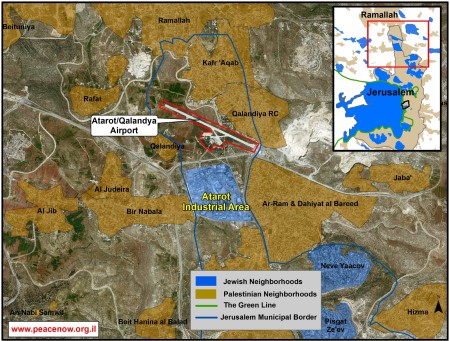
Map by Peace Now
The planned Atarot settlement would be located in the northern part of the East Jerusalem, extending to the southern edge of the West Bank city of Ramallah. It would include 10,000+ units for ultra-Orthodox Jewish Israelis. The location for construction is site of the disused Atarot airport. The airport site is an important commodity, reportedly promised to the Palestinians for their state’s future international gateway. Developing the site into a Jewish Israeli settlement would deprive a future Palestinian state of the only airport in the West Bank, dismember Palestinian neighborhoods in the norther part of the city, and sever East Jerusalem from a Palestinian state on this northern flank of the city (acting like E-1 on Jerusalem’s northeast flank, and like Givat Hamatos on Jerusalem’s southern flank).
FMEP first reported on Atarot in April 2017 when the settlement plan was rumored to be included on the master blueprint of settlements for which Netanyahu intended to seek U.S. approval. It was expected to be announced in May on the occasion of the Jerusalem Day celebration, but until now, the plan has not advanced.
The plan dates back to 2007; it was pursued by the Israeli government in 2012 but shelved under pressure from the Obama administration. At that time, Peace Now’s Hagit Ofran observed:
Not only that this plan might severely harm the future Palestinian State, destroying the only airport in the West Bank, but it will also cut between East Jerusalem and Ramallah at the heart of many Palestinian neighborhoods: Shu’afat and Beit Hanina in the South, Bir Nabala, Al Judeira, Al Jib, Rafat and Qalandia in the West, Ar-Ram, Dahiyat al Bareed and Jaba’ from the East, and Qalandia Refugee Camp, Kafr ‘Aqab and Ramallah from the North. It seems that what the Givat Hamatos plan is meant to do in the South of Jerusalem (to cut between Bethlehem and East Jerusalem), this plan will, god forbid, do at the North of it. The goal of this plan is clear: to prevent the possibility of a Palestinian State in the West Bank, and thus to kill the two states solution.
This week, Peace Now commented:
This is a crazy plan, both politically and in terms of planning. It is an attempt to drive a wedge into the heart of an urban area of hundreds of thousands of Palestinians. Since the neighborhood of Har Homa was established in the 1990s, no new Israeli neighborhood has been built beyond the Green Line in Jerusalem.
Reported New U.S. Settlement Policy: Expand at Will, but Don’t Surprise Us
According to a report posted on Al-Monitor, two months of secret negotiations between the U.S. and Israel have resulted in an unofficial framework for how Israel, with U.S. approval, will advance and expand settlements. The agreement reportedly entails the following:
- The U.S. will see all settlement plans Israel has decided to approve before they are advanced bureaucratically (i.e., before moves that allow them to become public).
- Israel can approve plans for new settlement units anywhere that is adjacent to an existing unit (read: in any/all/every settlement or outpost).
- With respect to the West Bank, there is an unspecified limit on the quantity of new units that each new settlement project is allowed.
- With respect to East Jerusalem, there is no limit on the number of units allowed to advance as long as rules 1 & 2 are respected.
It should be noted that the only plan that appears to violate the letter of this leaked deal is the plan for the Atarot settlement in East Jerusalem, which is not adjacent to any existing units (rule #2).
Israeli Justice Minister Personally Involved in Drafting State Responses to Settlement Petitions before the High Court of Justice
Israeli Justice Minister Ayelet Shaked is coming under fire for her intervention in every case before the High Court related to Israeli settlements and unauthorized outposts. Haaretz reported this week that since being appointed, Shaked has retained the services of a private lawyer to review and redraft each and every state response related to settlements and outposts before that response is submitted to the High Court of Justice. Moreover, the lawyer Shaked selected for this task comes from the notorious far-right, pro-settler group Regavim — a group that devotes its efforts to systematically mapping out and expelling Palestinians from strategic areas in Jerusalem, the West Bank, and the Negev.
Further Haaretz reporting revealed the Israeli Attorney General Avichai Mandleblit and the State Prosecutor Shai Nitzan (whose office ostensibly produces the first draft of state responses that Shaked then edits) have defended Shaked against criticism for this heavy handed political interference in legal matters.
Updates: Netiv Ha’avot and the “Settler Security Package”
-
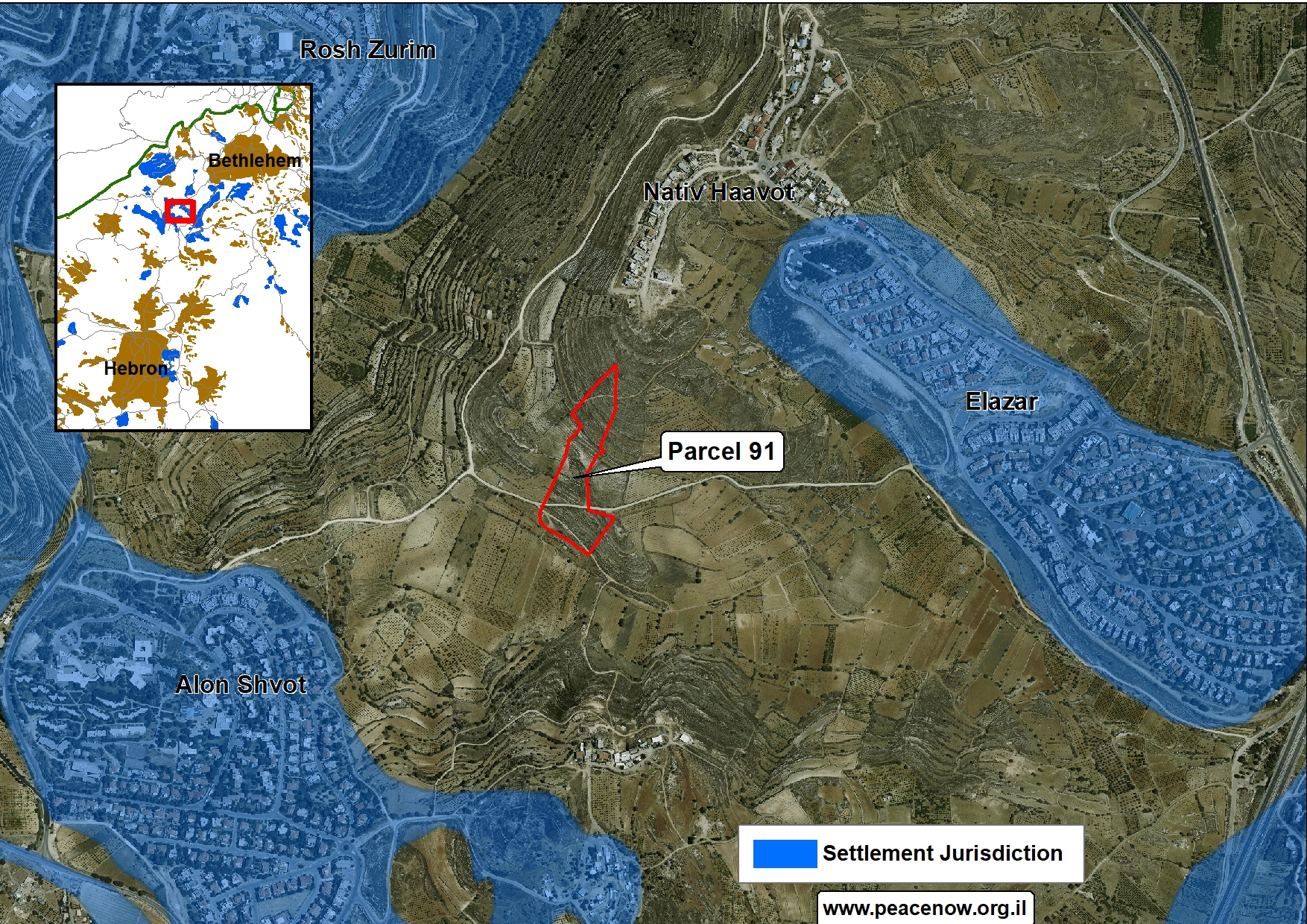
Map by Peace Now
The Israeli High Court dismissed a state-backed petition by settlers challenging the planned demolition of 17 structures built wholly or partly on privately-owned Palestinian land in the unauthorized outpost of Netiv Ha’avot. The settlers asked that 15 of the structures only be partially demolished, leaving intact the portions of them that are not on Palestinian land. The Court rejected the request and ordered the structures to be demolished. The entire outpost of Netiv Ha’avot is slated to be razed by March 2018 following a High Court ruling. Just last week, the High Planning Council approved a plan (a plan it called “improper” but approved anyway) to build 17 temporary new homes for Netiv Ha’avot residents on lands between the Elazar and Alon Shvut settlements. This land parcel is outside of either of the settlements’ jurisdictions – in effect, it is another case of rewarding settlers for breaking the law by “compensating” them with the establishment of a brand-new settlement. However, to avoid the appearance that this is the case, the High Planning Council ordered the borders of Alon Shvut to be formally expanded before the structures are built to include the parcel (which would mean that the plan would not, retroactively, violate the new U.S.-Israeli policy understanding reported previously).
- Settlers continued to protest Netanyahu even after news last week that the government plans to dispense $939 million in 2019 for the “settler security package” they are demanding. In an attempt to placate the settlers’ demands, Netanyahu met with the settler leaders to speed up his government’s timeline for beginning the West Bank settlement infrastructure projects, outlining a plan to invest $228 million beginning in next year. According to the unwritten plan, the 2018 projects will include paving five new settler-only highways to bypass Palestinian villages.
Bonus Reads
- “Dangerously ‘imprecise’ on Israeli settlements” (Americans for Peace Now)
- “Unprotected: Detention of Palestinian Teenagers in East Jerusalem” (B’Tselem & HaMoked)
- “Settler Leaders Appeal to High Court Over Bypass Road” (Jerusalem Post)
FMEP has long been a trusted resource on settlement-related issues, reflecting both the excellent work of our grantees on the ground and our own in-house expertise. FMEP’s focus on settlements derives from our commitment to achieving lasting Israeli-Palestinian peace, and our recognition of the fact that Israeli settlements – established for the explicit purpose of dispossessing Palestinians in the West Bank and East Jerusalem of land and resources, and depriving them of the very possibility of self-determination in their own state with borders based on the 1967 lines – are antithetical to that goal.
Welcome to FMEP’s Weekly Settlement Report, covering everything you need to know about Israeli settlement activity this week.
To receive this report via email, please subscribe here.
June 16, 2017
1. Netanyahu’s Trump-Era Settlement Policy
2. Abbas & Netanyahu Harden Positions on the Future of Settlers
3. Must-Read: “How Many Settlers Really Live in the West Bank?”
4. Shin Bet Moves Against Radical Settler Activists
For questions and comments please contact FMEP’s Director of Policy & Operations, Kristin McCarthy (kmccarthy@fmep.org).
Netanyahu’s Trump-Era Settlement Policy
There is war of words about what Netanyahu’s Trump-era settlement policy actually is. According to settler leaders, Netanyahu is implementing a freeze; according to Netanyahu’s cabinet, he has given settlement construction a green light; and according to the U.S., he is expected to follow a policy of “restraint.” Notably, there has been no official statement by the Trump administration following the last week’s major settlement announcement.
Who is right? Here are the important facts and developments so far with respect to 2017 settlement growth:
- Large #s of Settlement Units Advanced: So far in 2017, plans for 4,909 new settlement housing units have been advanced through the planning process, according to Israel’s Peace Now. Of these, 3,178 were advanced at the June 6-7 meeting of the High Planning Council. And also according to Peace Now, tenders for 2,942 new settlement housing units been issued for imminent construction (meaning there are 2,942 new units actually being built, or about to be). Peace Now, which has tracked settlement growth for decades, based on the Government of Israel’s own officials numbers, notes that these 2017 numbers are “85% more than the housing units promoted during all of 2016 and in half the time.”
- A brand new settlement approved: Earlier this month, Netanyahu’s government has advanced the construction of the first entirely new settlement in 25 years, “Amichai” (a gift to “compensate” settlers who had built/taken up residence illegally in the outpost of Amona, and who were forced to move after the Netanyahu government exhausted all possible means to legalize their illegal acts).
- Illegal outpost legalized: Also earlier this month, the Netanyahu government moved to retroactively “legalize” the illegally-built outpost of “Kerem Reim,” west of Ramallah.
- Jerusalem plans looming but not moving (yet): Despite high profile reports that the government is close to issuing tenders for construction of Givat Hamatos in addition to advancing plans for Ramat Shlomo and Atarot, none of these actions have happened yet. These plans are particularly alarming for the future of Jerusalem and would preclude the contiguity of a future state of Palestine. Likewise, despite similarly high profile reports that the government is going to expedite the advancement of a visitor’s center abutting the Jewish Cemetery on the Mt. of Olives, the government has not yet advanced plans for its approval.
Abbas & Netanyahu Harden Positions on the Future of Settlers
Haaretz is reporting that Netanyahu is now demanding any peace agreement must allow all Israeli settlers to stay where they are, under Israeli rule. This represents a sharp departure from the past Netanyahu demands, as revealed by negotiation documents from the 2014 Kerry effort.
Abbas, on the other hand, is now signaling that he cannot accept a peace deal that leaves even a single settler in the future state of Palestine – also a new position since 2014.
Previously, both Netanyahu and Abbas posited that – at least in principle – some Israeli settlers could be allowed to remain in Palestine under Palestinian jurisdiction – meaning they would become citizens of Palestine (and that their settlements would not remain exclusively Jewish communities). The 2014 policy iterations were (and still are) untenable for both sides, but so too are their new positions.
3. Must-Read: “How Many Settlers Really Live in the West Bank?”

 Haaretz has an investigative report out this week delving deep into the demographics of Israelis living east of the 1967 Green Line, in violation of international law (and in some cases, in violation of Israeli law as well). Highlights from the report:
- There are 380,000 settlers in the West Bank, not including East Jerusalem settlements.
- 178,000 settlers in the West Bank live outside of the major settlement blocs (44% of total); notably, the Haaretz report does not make clear how it defined settlement “blocs” (the term has no formal or legal definition).
- These figures do not include outposts. According to Peace Now, there are 97 outposts with thousands of settlers populating them.
Shin Bet Moves Against Radical Settler Activists
The Israeli Shin Bet appears to be more actively moving to stop the pattern of violence emanating from the Yitzhar settlement, located deep inside the northern West Bank, in connection to the “Hilltop Youth” movement. This week the extremist rabbi and Yitzhar settler Yosef Elitzur was indicted on incitement charges. Elitzur is a prolific writer and teacher known for his religious justification for Jews killing non-Jews. Elitzur is the third Yitzhar settler to be prosecuted in recent weeks for incitement to violence; two others were also convicted because of violent content in articles they published online.
Additionally, nine Israeli teenagers were arrested in Jerusalem this week. There is a gag order in place over the case, but we do know the teenage settlers were arrested while at the house of Yitzhar settler and “Hilltop Youth” movement leader Elkana Pikar. Pikar himself was recently, issued a restraining order requiring him to stay away from the West Bank for four months and banning him from meeting with a list of identified activists for six months. He must also report weekly to Israeli police in the Maale Adumim settlement. Pikar is believed to have been directly involved in a string of recent violent acts perpetrated by Yitzhar extremists in the Nablus area. Notably, the Deputy Speaker of the Knesset rushed to Pikar’s defense following a previous ruling against him, saying that Elitzur is “the only one [who] has managed to get through to the Hilltop Youth and keep them in check a little.”
FMEP has long been a trusted resource on settlement-related issues, reflecting both the excellent work of our grantees on the ground and our own in-house expertise. FMEP’s focus on settlements derives from our commitment to achieving lasting Israeli-Palestinian peace, and our recognition of the fact that Israeli settlements – established for the explicit purpose of dispossessing Palestinians in the West Bank and East Jerusalem of land and resources, and depriving them of the very possibility of self-determination in their own state with borders based on the 1967 lines – are antithetical to that goal.
Welcome to FMEP’s Weekly Settlement Report, covering everything you need to know about what is happening this week related to Israeli settlement activity – news, context, background, and why it matters.
To receive this report via email, please subscribe here.
May 19, 2017
- Statements on Israeli Settlements by the Trump Administration
- Bibi to ask for Trump’s Approval of Massive Settlement Blueprint During Visit
- Plans Actively Moving to Start Construction on Two-State-Ending Settlements
- Updates: Amona, More Settler Violence in Nablus, New Jordan Valley Outpost
Comments, questions, or suggestions? Email Kristin McCarthy at kmccarthy@fmep.org.
Statements on Israeli Settlements by the Trump Administration
Ahead of President Donald Trump’s first visit to Israel, there is still some debate about whether the United States has already shifted its policy on Israeli settlements. Here are Trump officials in their own words:
May 16, 2017: U.S. Ambassador David Friedman, ahead of President Trump’s arrival in Israel and anticipated peace push, said, “we have no demand for a settlement freeze.” Also: “If you look at what the president has said since taking office about settlements, his position has been remarkably different than the Obama administration’s. He has not come out and said that settlements are an obstacle to peace; he has not called for a settlement freeze; he has worked for the Israelis to come up with a common understanding about how they might proceed. The president is aware of the Israeli government’s need to replace the Amona community [reference to settler law-breakers evicted from an illegal outpost].”
March 20-23, 2017: In a read out of joint U.S.-Israel consultations on peace negotiations, the White House reported, “The two delegations also discussed Israeli settlement construction, following up on Prime Minister Netanyahu’s visit to Washington and Mr. Greenblatt’s recent visit to Israel. The United States delegation reiterated President Trump’s concerns regarding settlement activity in the context of moving towards a peace agreement. The Israeli delegation made clear that Israel’s intent going forward is to adopt a policy regarding settlement activity that takes those concerns into consideration. The talks were serious and constructive, and they are ongoing.”
February 15, 2017: At a press conference alongside PM Netanyahu at the White House, President Trump said, “As far as settlements, I’d like to see you hold back on settlements for a little bit. We’ll work something out.” On the same day, the White House released a read-out of Netanyahu & Trump’s private meeting, relaying “The two leaders discussed the issue of Israeli settlement construction, and agreed to continue those discussions and to work out an approach that is consistent with the goal of advancing peace and security.”
February 2, 2017: In an official statement issued after Israel announced significant new settlement plans in the West Bank, the White House said “While we don’t believe the existence of settlements is an impediment to peace, the construction of new settlements or the expansion of existing settlements beyond their current borders may not be helpful in achieving that goal.”
Bibi to ask for Trump’s Approval of Massive Settlement Blueprint During Visit
PM Netanyahu will reportedly ask for President Trump’s approval of a massive blueprint for future settlement construction that includes highly sensitive areas beyond the 1967 Green Line – including construction of Givat Hamatos and Atarot in Jerusalem (see below).
If Netanyahu in fact presents a map detailing plans for new construction, it will be a major test of President Trump’s still-unconfirmed policy shift on settlements, which is speculated to include an American “ok” for construction in East Jerusalem, settlement blocs and “bloc-adjacent” areas. As detailed previously, this shift – if it has in fact taken place – should be understood as a green light for massive settlement growth across the West Bank. The U.S. may not be the only party considering giving this green light to settlement growth; the Wall Street Journal reported this week that some Arab gulf countries are also considering accepting the parameter (the world is awaiting confirmation of this report).
Hoping for Trump’s approval of this blueprint, PM Netanyahu’s office reportedly intervened to delay a meeting of the High Planning Committee (which oversees all construction in the Occupied Territories) until after President Trump’s visit.
Plans Actively Moving to Start Construction on Two-State-Ending Settlements
New details have emerged on two alarming settlement developments that could imminently affect the future of Jerusalem, and thus any hopes of a two state solution.
 Givat Hamatos
Final tenders for the construction of Givat Hamatos are could to be published soon, at which point construction will soon start on the ground. This settlement, will completely sever Palestinian communities in Jerusalem from the West Bank, and will prevent a future division of Jerusalem that leaves Palestinian areas under Palestinian sovereignty and Israeli areas under Israeli sovereignty (map). Publishing tenders for 2,000 units in Givat Hamatos – which is, again, imminently expected – will spell the end to the future possibility of a contiguous Palestinian state. For more on Givat Hamatos – history, maps, state of play, and consequences – see the expert analysis of Terrestrial Jerusalem and Peace Now Israel.

Atarot
Israel may soon approve a plan for 10,000 units to create an ultra-orthodox settler neighborhood in Atarot, the site of a disused airport in the northern part of East Jerusalem, extending to Ramallah’s southern border. To date, no official planning approvals have been published for public review – which means that the Atarot plan has a potentially long bureaucratic process to navigate. The site was reportedly promised as the airport of a future Palestinian state. The construction of a new settlement at the site will compromise the territorial integrity of a future Palestinian state, as well as preventing a Palestinian capital in East Jerusalem. For more on Atarot, read this analysis from Jerusalem expert Danny Seidemann.
Additionally, in the center of the West Bank, a regional council run by Israeli settlers has begun soliciting construction bids to expand the illegal settlement of Kochav Yaakov. The growth – in the settlement’s ultra orthodox neighborhood called Tel Zion – was technically approved by in 1980 but never constructed. Some 37 years later, the settler council officially opened the bidding process to construct 209 new apartments. Peace Now’s Settlement Watch director Hagit Ofran noted, “There are tens of thousands of units [like these] that could be built under old plans. In practice, there was no [construction] freeze and there is no freeze in the settlements. This is a large project beyond the separation barrier that will continue to undermine the two-state solution.”
Updates: Amona Outpost-ers, More Settler Violence in Nablus, New Jordan Valley Outpost
Here are short, but important, updates on settlement news we covered in previous editions of FMEP’s Weekly Settlement Report:
- Already facing planning delays on their new settlement, the law-breaking Amona outpost-ers attempted to get expedited approval on “temporary” construction at their desired Shilo Valley hilltop; that temporary approval is now facing bureaucratic delays of it’s own.
- The greater Nablus area is once again becoming a major flashpoint of settler violence in the West Bank. A string of settler attacks on local Palestinians (and their property) escalated when a settler shot and killed a Palestinian stone-thrower in Huwarra. The settler’s gun fire also wounded a photographer with the Associated Press.
- In the northern Jordan Valley, Palestinian press is reporting a new illegal outpost being constructed by radical settlers.
FMEP has long been a trusted resource on settlement-related issues, reflecting both the excellent work of our grantees on the ground and our own in-house expertise. FMEP’s focus on settlements derives from our commitment to achieving lasting Israeli-Palestinian peace, and our recognition of the fact that Israeli settlements – established for the explicit purpose of dispossessing Palestinians in the West Bank and East Jerusalem of land and resources, and depriving them of the very possibility of self-determination in their own state with borders based on the 1967 lines – are antithetical to that goal.
Welcome to the 2nd edition of FMEP’s Weekly Settlement Report, covering everything you need to know about what is happening this week related to Israeli settlement activity – news, context/background, and why it matters. FMEP has long been a trusted resource on settlement-related issues, reflecting both the excellent work of our grantees on the ground and our own in-house expertise. FMEP’s focus on settlements derives from our commitment to achieving lasting Israeli-Palestinian peace, and our recognition of the fact that Israeli settlements – established for the explicit purpose of dispossessing Palestinians in the West Bank and East Jerusalem of land and resources, and depriving them of the very possibility of self-determination in their own state with borders based on the 1967 lines – are antithetical to that goal.
To receive this report via email, please click here.
April 28, 2017
- Playing with Fire: Two New Settlement Announcements in Jerusalem
- The Violence of Occupation
- Updates: Amona and Adam Outposters
Contact Kristin McCarthy (kmccarthy@fmep.org) for questions and comments.
Playing with Fire: Two Settlement Announcements in Jerusalem
- On April 25th, the Jerusalem Municipality posted a “special plan” to confiscate land on the Mount of Olives, linked to plans for a new “visitors center” to be built adjacent to the Jewish cemetery on the Mount of Olives. The Mount of Olives is an integral part of Jerusalem’s Holy Basin, which is home to major religious, national, and historical sites for Jews, Muslims, and Christians. Israeli construction on the Mount of Olives – especially near the Jewish cemetery, which is only 300 meters from the Temple Mount/Haram Al-Sharif – carries the potential to once again spark violent conflict, as development plans near Jerusalem’s holy sites have in the past.
According to Peace Now, the main beneficiary of the plan is the settler organization known as Elad. Elad is known for its aggressive settlement of Palestinian East Jerusalem neighborhood of Silwan, where it is attempting to establish a new Jewish “City of David.” As part of its efforts, Elad has for years been working to increase Jewish tourism in Silwan and the Mount of Olives, and has been operating its own visitors center out of a trailer immediately next to the Jewish cemetery. The planned new visitors center will likely become the new base of Elad’s touristic activities. For more on how Elad uses “touristic settlements” to alter the character of East Jerusalem, including on the Mount of Olives, read Hagit Ofran’s 2011 piece: Invisible Settlements in Jerusalem.
- The Israeli government is also reportedly reviving plans for a new settlement in East Jerusalem, to be located in the northern part of the city (extending to the southern edge of Ramallah), and to consist of 10,000 units for ultra-orthodox Israelis. Israeli news sources are reporting the final announcement of the units will be made ahead of May 23rd, the Israeli national holiday of “Jerusalem Day,” celebrating the unification of the city in 1967. The location for construction is the abandoned Atarot airport. The plan dates back to 2007; it was pursued by the Israeli government in 2012 but shelved under pressure from the Obama administration. The airport is an important commodity, reportedly promised to the Palestinians for their state’s future international gateway. To develop the airport into a Jewish Israeli settlement would deprive a future Palestinian state of the only airport in the West Bank, will cut through many Palestinian neighborhoods, and will sever East Jerusalem from a Palestinian state on this northern flank of the city (acting like E-1 on Jerusalem’s northeast flank, and like Givat Hamatos on Jerusalem’s southern flank). According to Haaretz, the ultra orthodox Haredi community that this plan is meant to benefit is objecting to the location because of “its distance from the city center and proximity to Palestinian neighborhoods and the separation barrier.”
On April 26th, the Acting Spokesman for the U.S. Department of State was asked about the Atarot plan near Ramallah and replied that Israeli government officials “understand our concerns about this.”
_________________
“The Netanyahu government is deliberately playing with fire in Jerusalem. Plans for the Atarot airport settlement and the visitors center on the Mount of Olives risk inflaming political and religious tensions not only in Israel but across the region.”
– Lara Friedman, President of the Foundation for Middle East Peace
_________________
The Violence of the Settlements
A series of violent settler attacks have ratcheted up tensions between settlers, Palestinians, and the Israeli government. Three of these attacks were allegedly perpetrated by radical settlers from Yitzhar, which is known as the “heartland of settler extremism.”
On Friday, April 21st, 50 extremists from the Yitzhar settlement attacked Palestinian homes in a village called Urif, near Nablus. When IDF soldiers arrived on the scene, the settlers attacked the soldiers, injuring one. The settlers violence against the ID elicited a strong response from Israeli Defense Minister Avigdor Liberman, who failed to note the impetus for the incident; the Yitzhar settlers’ violence against Palestinians.
On April 22nd, Haaretz reported 100 Yitzhar settlers descended from their hill top settlement to attack Urif again, this time throwing stones at the Palestinian villagers. Clashes with Palestinians ensued and the Israeli Defense Forces shot tear gas and rubber bullets at the Palestinians, injuring four and damaging one home.
On April 26th, Palestinian press reported that Yitzhar settlers came into the Palestinian village of Huwwara (near Nablus) and torched a Palestinian vehicle.
Separately, in the Jordan Valley, settlers from the radical Baladim illegal outpost attacked and injured Israeli activists who were accompanying Palestinian farmers to their lands. The attack was captured on video. Though this attack was reported by the Israeli press, Israeli government officials stayed appallingly silent. In contrast, the U.S.-based Anti-Defamation League issued a strong condemnation of the settlers, and asked the Israeli government to hold the perpetrators accountable. This is the second noteworthy attack emanating from Baladim in as many weeks.
The Haaretz Editorial Board issued a strong statement on settler violence, titled “Israel’s Weakness Against Lawbreakers.” In the piece, the Board writes: “While the government is investing huge sums of money in an all-out war against anyone who dares to warn about the creation of ‘apartheid systems,’ it continues to create and preserve two separate law enforcement systems in the territories, one for Arabs and one for Jews, which cannot be described by any other terms.”
Updates: Amona and Adam Outpost-ers
Here are short, but important, updates on settlement news we covered at length in last week’s Settlement Report:
- The pay-off plan for evicted residents of the illegal outpost of Amona by building a new settlement in the Shilo Valley has hit a snag. Apparently the Palestinian hilltop chosen by the illegal settlers to be their future home is not included in the expanded jurisdiction of the local settlement planning council, exposing the lack of intention by the council to build there. This doesn’t preclude changes in the jurisdiction to permit a new settlement on the site, but it frustrated the Amona settlers this week. Meanwhile, the story of the plight of the temporarily displaced Amona law-breakers got sympathetic coverage in a Washington Post human interest story this week.
- Haaretz reports that Israeli police have delivered stop-work orders in the newly established outpost outside of the Adam settlement, near Ramallah. The outpost was first reported last week by Peace Now.